EP3961168B1 - Vorrichtung und verfahren zur erkennung von anormalen temperaturen und entsprechendes speichermedium - Google Patents
Vorrichtung und verfahren zur erkennung von anormalen temperaturen und entsprechendes speichermedium Download PDFInfo
- Publication number
- EP3961168B1 EP3961168B1 EP21191895.8A EP21191895A EP3961168B1 EP 3961168 B1 EP3961168 B1 EP 3961168B1 EP 21191895 A EP21191895 A EP 21191895A EP 3961168 B1 EP3961168 B1 EP 3961168B1
- Authority
- EP
- European Patent Office
- Prior art keywords
- data
- preprocessor
- temperature
- abnormal
- temperature detection
- Prior art date
- Legal status (The legal status is an assumption and is not a legal conclusion. Google has not performed a legal analysis and makes no representation as to the accuracy of the status listed.)
- Active
Links
Images



Classifications
-
- G—PHYSICS
- G01—MEASURING; TESTING
- G01K—MEASURING TEMPERATURE; MEASURING QUANTITY OF HEAT; THERMALLY-SENSITIVE ELEMENTS NOT OTHERWISE PROVIDED FOR
- G01K3/00—Thermometers giving results other than momentary value of temperature
- G01K3/08—Thermometers giving results other than momentary value of temperature giving differences of values; giving differentiated values
- G01K3/10—Thermometers giving results other than momentary value of temperature giving differences of values; giving differentiated values in respect of time, e.g. reacting only to a quick change of temperature
-
- G—PHYSICS
- G01—MEASURING; TESTING
- G01K—MEASURING TEMPERATURE; MEASURING QUANTITY OF HEAT; THERMALLY-SENSITIVE ELEMENTS NOT OTHERWISE PROVIDED FOR
- G01K3/00—Thermometers giving results other than momentary value of temperature
- G01K3/08—Thermometers giving results other than momentary value of temperature giving differences of values; giving differentiated values
-
- G—PHYSICS
- G01—MEASURING; TESTING
- G01K—MEASURING TEMPERATURE; MEASURING QUANTITY OF HEAT; THERMALLY-SENSITIVE ELEMENTS NOT OTHERWISE PROVIDED FOR
- G01K13/00—Thermometers specially adapted for specific purposes
-
- G—PHYSICS
- G01—MEASURING; TESTING
- G01K—MEASURING TEMPERATURE; MEASURING QUANTITY OF HEAT; THERMALLY-SENSITIVE ELEMENTS NOT OTHERWISE PROVIDED FOR
- G01K3/00—Thermometers giving results other than momentary value of temperature
- G01K3/005—Circuits arrangements for indicating a predetermined temperature
-
- G—PHYSICS
- G06—COMPUTING OR CALCULATING; COUNTING
- G06N—COMPUTING ARRANGEMENTS BASED ON SPECIFIC COMPUTATIONAL MODELS
- G06N20/00—Machine learning
-
- G—PHYSICS
- G08—SIGNALLING
- G08B—SIGNALLING SYSTEMS, e.g. PERSONAL CALLING SYSTEMS; ORDER TELEGRAPHS; ALARM SYSTEMS
- G08B17/00—Fire alarms; Alarms responsive to explosion
- G08B17/06—Electric actuation of the alarm, e.g. using a thermally-operated switch
-
- G—PHYSICS
- G08—SIGNALLING
- G08B—SIGNALLING SYSTEMS, e.g. PERSONAL CALLING SYSTEMS; ORDER TELEGRAPHS; ALARM SYSTEMS
- G08B7/00—Signalling systems according to two or more of groups G08B3/00 - G08B6/00
- G08B7/06—Signalling systems according to two or more of groups G08B3/00 - G08B6/00 using electric transmission, e.g. involving audible and visible signalling through the use of sound and light sources
-
- G—PHYSICS
- G01—MEASURING; TESTING
- G01K—MEASURING TEMPERATURE; MEASURING QUANTITY OF HEAT; THERMALLY-SENSITIVE ELEMENTS NOT OTHERWISE PROVIDED FOR
- G01K2219/00—Thermometers with dedicated analog to digital converters
Definitions
- the present invention relates to an abnormal temperature detection device, an abnormal temperature detection method, and a storage medium.
- abnormal temperatures may be used to mean temperatures considerably lower than during a normal time as well as temperatures considerably higher than during a normal time.
- Japanese Patent No. 6076571 Japanese Unexamined Patent Application Publication No. 2020-071137 , Japanese Patent No. 5808605 , and US 2015/0330924 A1 disclose technologies of the related art for detecting abnormal states (including abnormal temperatures).
- the technology disclosed in Japanese Patent No. 6076571 is a technology for generating reference data indicating states at normal times by dividing periodically repeated data into data of respective periods (periodic data) and averaging a plurality of pieces of periodic data. Then, abnormal states are detected based on a deviation in values between the measured periodic data and the reference data.
- an abnormal state is determined when deviated values (a correlation coefficient) is greater than a predetermined allowed error (a threshold).
- a temporal change in temperature an increasing or decreasing direction
- a supplement is provided so that another deviated value (a total sum of differences) is introduced to detect a direction of a change (an increase or decrease in temperature).
- an appropriate threshold for determining whether an abnormal temperature has occurred also differs in accordance with an ambient environment or the like.
- Japanese Patent No. 6076571 it is necessary to adjust a threshold appropriately used for a plurality of pieces of reference data referred to in accordance with an ambient environment.
- an abnormal temperature detection device (1 to 3) includes: a temperature acquirer (11) configured to acquire temperature data; a preprocessor (12, 17) configured to perform preprocessing for calculating difference data indicating a difference sequence in the temperature data, generating substituted data in which either of a piece of difference data which is a positive number or a piece of difference data which is a negative number is substituted with zero, and calculating a similarity between the substituted data and reference data obtained from training data in which normality or abnormality has been identified; a learner (13, 18) configured to perform machine learning on the similarity calculated by the preprocessor and output an identification function; and a determiner (14, 19) configured to determine whether temperature data for detection acquired by the temperature acquirer and subjected to the preprocessing by the preprocessor is normal or abnormal by using the identification function.
- the preprocessor includes: a data processor (12a, 22a, 24, 32a, 34) configured to calculate the difference data and generate the substitution data; and a similarity calculator (12b, 26a, 35a) configured to calculate the similarity.
- the data processor may calculate first-order difference data indicating a first-order difference sequence of the temperature data and second-order difference data indicating a second-order difference sequence of the temperature data, and generate the substitution data in which one of first-order difference data which is a positive number and first-order difference data which is a negative number is substituted with zero with regard to at least the first-order difference data.
- the similarity calculator may calculate the similarity using dynamic time warping.
- the abnormal temperature detection device may further include: a first preprocessor (20) which is a learning preprocessor; and a second preprocessor (30) which is a detection preprocessor.
- the first preprocessor may generate the reference data using the substitution data generated by the first preprocessor.
- the second preprocessor may calculate the similarity between the reference data generated by the first preprocessor and the substitution data generated by the second preprocessor.
- the first preprocessor may generate the reference data by averaging the substitution data corresponding to a predefined time over a period of a plurality of times.
- the abnormal temperature detection device may further include a general determiner (40) configured to determine whether the temperature data is normal or abnormal based on results of the plurality of determiners.
- an abnormal temperature detection method may include: acquiring temperature data by a temperature acquirer (S11); performing, by a preprocessor, preprocessing for calculating difference data indicating a difference sequence in the temperature data, generating substituted data in which either of a piece of difference data which is a positive number or a piece of difference data which is a negative number is substituted with zero, and calculating a similarity between the substituted data and reference data obtained from training data in which normality or abnormality has been identified (S13, S15, S17); performing, by a learner, machine learning on the similarity calculated by the preprocessor and outputting an identification function (S18); acquiring temperature data for detection by the temperature acquirer (S21); performing, by the preprocessor, the preprocessing on the temperature data for detection (S23, S25, S26); and determining, by a determiner, whether the temperature data for detection subjected to the preprocessing by the preprocessor is normal or abnormal by using the identification function (S27).
- the preprocessor includes a data processor and a similarity calculator
- the abnormal temperature detection method further includes: calculating the difference data and generating the substitution data by the data processor; and calculating the similarity by the similarity calculator.
- the abnormal temperature detection method may further include: calculating, by the data processor, first-order difference data indicating a first-order difference sequence of the temperature data and second-layer difference data indicating a second-order difference sequence of the temperature data; and generating, by the data processor, the substitution data in which one of first-order difference data which is a positive number and first-order difference data which is a negative number is substituted with zero with regard to at least the first-order difference data.
- the abnormal temperature detection method may further include: calculating the similarity by the similarity calculator using dynamic time warping.
- the abnormal temperature detection device may include: a first preprocessor which is a learning preprocessor; and a second preprocessor which is a detection preprocessor.
- the abnormal temperature detection method may further include: generating, by the first preprocessor, the reference data using the substitution data generated by the first preprocessor; and calculating, by the second preprocessor, the similarity between the reference data generated by the first preprocessor and the substitution data generated by the second preprocessor.
- the abnormal temperature detection method may further include: generating, by the first preprocessor, the reference data by averaging the substitution data corresponding to a predefined time over a period of a plurality of times.
- the abnormal temperature detection device may further include a general determiner.
- the abnormal temperature detection method may further include: determining, by the general determiner, whether the temperature data is normal or abnormal based on results of the plurality of determiners.
- a non-transitory computer readable storage medium may store an abnormal temperature detection program executed by a computer.
- the abnormal temperature detection program may instruct the computer to: acquire temperature data; perform preprocessing for calculating difference data indicating a difference sequence in the temperature data, generating substituted data in which either of a piece of difference data which is a positive number or a piece of difference data which is a negative number is substituted with zero, and calculating a similarity between the substituted data and reference data obtained from training data in which normality or abnormality has been identified; perform machine learning on the calculated similarity and output an identification function; and determine whether temperature data for detection acquired and subjected to the preprocessing is normal or abnormal by using the identification function.
- An aspect of the present invention is to provide an abnormal temperature detection device, an abnormal temperature detection method, and a storage medium capable of detecting an abnormal temperature with high accuracy in consideration of temporal change in temperature while excluding an influence of an ambient environment.
- an abnormal temperature can be detected with high accuracy in consideration of a temporal change in temperature while excluding an influence of an ambient environment. Specifically, although a temporal change in temperature differs in accordance with a plurality of causes such as a daily change or a seasonal change, an abnormal temperature can be detected with high accuracy.
- Japanese Unexamined Patent Application, First Publication No. 2020-071137 described above discloses a method of predicting an attained temperature using a temperature change rate in order to facilitate setting of a threshold.
- Japanese Patent No. 5808605 described above discloses a method of associating maintenance history information of an expert worker with sensor data with linking keywords and detecting a sign of abnormality through clustering and multivariate analysis.
- a learning step first, difference data indicating a difference sequence of the temperature data acquired by a temperature acquirer is calculated, substitution data in which one of difference data which is a positive number and difference data which is a negative number is substituted with zero is generated, and preprocessing for calculating similarity between the substitution data and reference data obtained from training data of which normality or abnormality is identified is performed. Then, machine learning is performed on the similarity calculated in the preprocessing and an identification function is obtained.
- a detection step it is determined whether temperature data for detection acquired by the temperature acquirer and subjected to the preprocessing is normal or abnormal by using the identification function. In this way, it is possible to detect an abnormal temperature with high accuracy in consideration of a temporal change in temperature while excluding an influence of an ambient environment.
- FIG. 1 is a block diagram illustrating a configuration of main units of an abnormal temperature detection device according to a first embodiment of the present invention.
- an abnormal temperature detection device 1 includes a temperature acquirer 11 (temperature acquisition means), a preprocessor 12 (preprocessing means), a learner 13 (learning means), a determiner 14 (determination means), an outputter 15, and an inputter 16 and detects an abnormal temperature.
- an abnormal temperature is a temperature considerably increasing compared to a normal time or a temperature considerably decreasing compared to the normal time.
- a case in which a temperature considerably increasing compared to the normal time is detected as an abnormal temperature will be described.
- the temperature at a normal time and an abnormal temperature are not fixed and can be changed to any temperatures depending on a situation in which the abnormal temperature detection device 1 is used.
- the temperature acquirer 11 acquires temperature data which is a time-series data indicating change in temperature over time. Specifically, the temperature acquirer 11 acquires temperature data output from, for example, a temperature sensor such as a thermocouple, a resistance temperature detector, a thermistor, a crystal oscillator, an infrared thermometer, an optical fiber temperature sensor.
- the temperature acquirer 11 includes an analog-to-digital converter (ADC) and acquires digitized data as temperature data when an analog signal is output from the temperature sensor.
- ADC analog-to-digital converter
- the temperature data acquired by the temperature acquirer 11 may be obtained in each of sampling periods of the ADC or may be data obtained at each sampling period of the ADC and thinned out at predetermined time intervals.
- temperature data data divided at predefined times (for example, about every 3 to 5 minutes) and acquired over a period of a plurality of times can be used. For example, data equally divided into 3-minute data every 3 minutes for 30 minutes and obtained 10 times or data obtained as 3-minute data 28 times by sliding a data delimiter every minute within 30 minutes can be used.
- temperature data for learning hereinafter referred to as training data
- temperature data generated through simulation by a user of the abnormal temperature detection device 1 may be input from the inputter 16 to the preprocessor 12 instead of being acquired by the temperature acquirer 11.
- the preprocessor 12 includes a data processor 12a and a similarity calculator 12b and performs necessary signal processing (preprocessing) in advance to perform machine learning or detect an abnormal temperature on the temperature data acquired by the temperature acquirer 11.
- the preprocessor 12 performs a noise removing process, a difference calculating process, a unit root checking process, a standardizing process, a sign substituting process, a similarity calculating process, and the like.
- the difference calculating process and the sign substituting process are performed by the data processor 12a and the similarity calculating process is performed by the similarity calculator 12b.
- the noise removing process, the unit root checking process, and the standardizing process can be omitted as necessary.
- the noise removing process is a process of removing noise superimposed on temperature data by performing filter processing such as averaging in a time axis direction on the temperature data acquired by the temperature acquirer 11.
- the foregoing filter processing may be a process performed using a simple moving average filter, a Gaussian weighted moving average filter, a lowpass filter, a bandpass filter, a highpass filter, a median filter effective for impulse-shaped noise, a nonlinear filter, or another filter.
- the filter processing it is preferable to select a filter appropriate for characteristics of noise superimposed on temperature data.
- the difference calculating process is a process of calculating a difference sequence of temporal adjacent temperature data (hereinafter referred to as difference data) when the temperature data is seen as a sequence.
- difference data a difference sequence of temporal adjacent temperature data
- the reason why such difference data is calculated is that a change factor such as a daily change or a seasonal change in temperature is excluded.
- the unit root checking process is, for example, a process of checking whether the temperature data has a unit root using an augmented Dickey-Fuller test (ADF test) or the like.
- the standardizing process is a process of standardizing the difference data (a process of setting an average to 0 and setting a variance to 1).
- the sign substituting process is a process of generating substitution data in which one of difference data which is a positive number and difference data which is a negative number among the foregoing difference data is substituted with zero.
- difference data which is a negative number data indicating a decrease in temperature
- difference data which is a positive number data indicating an increase in temperature
- substitution of the difference data which is a negative number (data indicating a decrease in temperature) with zero corresponds to a rectified linear unit (ReLU) of an activation function.
- ReLU rectified linear unit
- the reason why one of difference data which is a positive number and difference data which is a negative number among the foregoing difference data is substituted with zero is that a feature of one of an increase or a decrease of temperature is emphasized and an effect of classification in machine learning performed by the learner 13 is improved.
- a state in which a temperature is substantially constant is learned as a normal state
- an increase or decrease in temperature is detected as abnormality because of deviation from the normal state.
- the similarity calculating process is a process of calculating similarity between the substitution data generated through the sign substituting process and the reference data obtained by averaging the substitution data over a period of a plurality of times in learning.
- an index indicating the similarity an accumulated warp distance in dynamic time warping (DTW) can be used in addition to a distance between vectors (a Euclidean distance).
- DTW dynamic time warping
- an identification label indicating whether training data is normal or abnormal is input to the preprocessor 12 when a user of the abnormal temperature detection device 1 operates the inputter 16.
- reference data when the temperature is normal is calculated from training data in which the identification label is normal
- reference data when the temperature is abnormal is calculated from training data in which the identification label is abnormal.
- the details of the dynamic time warping (DTW) will be described in a second embodiment.
- an abnormal temperature to be detected it can be selected whether the similarity is calculated with only training data identified as being normal, the similarity is calculated with only training data identified as being abnormal, or the similarity is calculated with both the normal training data and the abnormal training data. For example, when fire detection is performed, it is known in advance that only a direction in which a temperature increases is abnormal. Therefore, by learning both the normal training data and the abnormal training data, it is possible to perform the determination more accurately.
- the learner 13 performs machine learning using a pair of the similarity calculated by the similarity calculator 12b of the preprocessor 12 and the identification label indicating whether the training data is normal of abnormal.
- the learner 13 preferably uses, for example, classification of a support vector machine (SVM) technology. This is because machine learning can be performed with training data less than in deep learning.
- SVM support vector machine
- the learner 13 may uses a binary classification scheme such as a logistic regression, random forest, or decision tree as the scheme of the classification.
- the learner 13 provides (outputs) an identification function (decision function) of enabling the classification to the determiner 14.
- the determiner 14 determines whether temperature data for detection acquired by the temperature acquirer 11 and subjected to the preprocessing by the preprocessor 12 is normal or abnormal by using the identification function output from the learner 13.
- the temperature data for detection is temperature data which is a determination target of which a temperature is abnormal and the identification label is not input.
- the determiner 14 outputs a determination result indicating whether the temperature data for detection is normal or abnormal to the outputter 15.
- the outputter 15 outputs the determination result of the determiner 14.
- the outputter 15 includes, for example, a display device such as a liquid crystal display (LCD) or the like and displays the determination result of the determiner 14 so that the determination result can be viewed.
- the outputter 15 may include, for example, a contact terminal which can connect an alarm such as a red warning lamp or a buzzer to inform of the determination result of the determiner 14 through light or a sound in addition to the LCD.
- the inputter 16 includes, for example, an input device such as a keyboard or a pointing device and outputs an operation signal to the preprocessor 12 in response to an operation on the inputter 16.
- the outputter 15 and the inputter 16 may be integrated, for example, as in a touch panel type liquid crystal display device that has both a display function and an operation function.
- the abnormal temperature detection device 1 is realized by, for example, a desktop, laptop, or tablet computer.
- each of the blocks (the preprocessor 12, the learner 13, the determiner 14, and the like) provided in the abnormal temperature detection device 1 is realized by allowing a central processing unit (CPU) provided in the computer to execute a program (an abnormal temperature detection program) for realizing each function. That is, each of the blocks provided in the abnormal temperature detection device 1 is realized by causing software to cooperate with hardware resources.
- the program realizing the function of each of the blocks provided in the abnormal temperature detection device 1 may be recorded on, for example, a computer-readable recording medium such as a CD-ROM or a DVD (registered trademark)-ROM for distribution or may be distributed via a network such as the Internet.
- the abnormal temperature detection device 1 may be realized by hardware such as a field-programmable gate-array (FPGA), a large scale integration (LSI) circuit, or an application specific integrated circuit (ASIC).
- FPGA field-programmable gate-array
- LSI large scale integration
- ASIC application specific integrated circuit
- FIG. 2 is a flowchart illustrating an overview of the learning-time operation of the abnormal temperature detection device 1 according to the first embodiment of the present invention.
- a process of the flowchart illustrated in FIG. 2 starts, for example, when a user of the abnormal temperature detection device 1 gives an instruction to start machine learning by operating the inputter 16.
- the temperature acquirer 11 first performs a process of acquiring temperature data for learning (step S11: a first temperature acquisition step).
- a predefined time for example, about 3 to 5 minutes
- 100 pieces of temperature data are acquired over a period of 200 times.
- temperature data generated through simulation by the user of the abnormal temperature detection device 1 may be input from the inputter 16 to the preprocessor 12.
- the identification label indicating whether the acquired temperature data (temperature data for learning) is normal or abnormal is input to the preprocessor 12, for example, when the user of the abnormal temperature detection device 1 operates the inputter 16.
- the preprocessor 12 performs a process of removing noise from the acquired temperature data for learning (step S12).
- the process of removing noise superimposed on the temperature data is performed by performing filter processing such as averaging in a time-axis direction on the temperature data acquired by the temperature acquirer 11.
- filter processing a filter appropriate for characteristics of noise superimposed on the temperature data is selected.
- the data processor 12a of the preprocessor 12 performs a process of calculating difference data (step S13: a first preprocessing step). Specifically, a process of calculating difference data indicating a difference sequence of temporal adjacent temperature data is performed. The preprocessor 12 may perform a unit root checking process of checking whether the temperature data for learning has a unit root. Subsequently, the preprocessor 12 performs a process of standardizing the calculated difference data (step S14). Specifically, a process of setting an average of the calculated difference data to 0 and setting a variance of the calculated difference data to 1 is performed. An average value and a standard deviation obtained in this process are also used for a standardizing process in detection (step S24 of FIG. 3 ).
- the data processor 12a performs a process of generating the substitution data in which one of the difference data which is a positive number and the difference data which is a negative number among the standardized difference data is substituted with zero (step S15: a first preprocessing step).
- step S15 a first preprocessing step.
- the preprocessor 12 performs a process of generating the reference data by averaging the substitution data corresponding to a plurality of times (for example, 200 times) (step S16).
- the similarity calculator 12b performs a process of calculating the similarity between the reference data and the substitution data (step S17: a first preprocessing step). For example, the process of calculating the similarity by calculating a distance between the reference data and the substitution data in accordance with dynamic time warping (DTW) is performed.
- the reference data obtained in this process is used for the similarity calculating process in detection (step S26 of FIG. 3 ).
- the reference data for example, data obtained by averaging the substitution data generated from the temperature data corresponding to the predefined time (for example, about 3 to 5 minutes) over a period of a plurality of times can be used.
- the calculated similarity and the identification label (the identification label input from the inputter 16) are set as one pair and the machine learning in which the one pair of similarity and identification label is used is performed by the learner 13 (step S18: a learning step).
- the identification function is output from the learner 13 to the determiner 14 (step S19).
- the process of the flowchart illustrated in FIG. 2 may automatically end, for example, after an amount of learning preset by the user of the abnormal temperature detection device 1 is performed.
- the process may end after a time preset by the user of the abnormal temperature detection device 1 passes or may end in response to an ending instruction from the user of the abnormal temperature detection device 1.
- the process may end when a value of the identification function in predetermined time-series data becomes a predetermined value or less.
- FIG. 3 is a flowchart illustrating an overview of a detection-time operation of the abnormal temperature detection device 1 according to the first embodiment of the present invention.
- a process of the flowchart illustrated in FIG. 3 starts, for example, the user of the abnormal temperature detection device 1 operates the inputter 16 and gives an instruction to start the machine learning.
- the process of the flowchart illustrated in FIG. 3 may automatically start when the process of the flowchart illustrated in FIG. 2 ends.
- the temperature acquirer 11 first performs a process of acquiring the temperature data for detection (step S21: a second temperature acquisition step).
- a predefined time for example, about 3 to 5 minutes
- the identification label is not input.
- the preprocessor 12 performs a process of removing noise from the acquired temperature data for detection (step S22). For example, a process of removing noise superimposed on the temperature data for detection is performed using a similar filter to the filter used for the process of step S13 illustrated in FIG. 2 .
- step S23 a second preprocessing step. Specifically, a process of calculating difference data indicating a difference sequence of temporal adjacent temperature data is performed.
- step S24 a process of standardizing the calculated difference data. Specifically, the process of standardizing the calculated difference data is performed using the average value and the standard deviation obtained in the process of step S14 illustrated in FIG. 2 .
- the data processor 12a performs a process of generating the substitution data in which one of the difference data which is a positive number and the difference data which is a negative number among the standardized difference data is substituted with zero (step S25: a second preprocessing step).
- step S25 a second preprocessing step.
- a process of generating the substitution data in which the difference data which is a negative number is substituted with zero is performed as in the process of step S15 illustrated in FIG. 2 .
- the similarity calculator 12b performs a process of calculating the similarity between the reference data obtained in the learning and the substitution data for detection (step S26: a second preprocessing step). For example, the process of calculating the similarity by calculating a distance between the reference data and the substitution data in accordance with dynamic time warping (DTW) is performed.
- the reference data the data obtained in the process of step S16 illustrated in FIG. 2 in the learning is used.
- step S27 a determination step
- step S28 a determination result is output from the determiner 14 to the outputter 15 (step S28).
- information indicating whether the temperature data for detection is normal or abnormal is displayed on the display device so that the information can be viewed.
- a result indicating that the temperature data for detection is abnormal is informed of through light or a sound by an alarm such as a red warning lamp or a buzzer.
- the process of the flowchart illustrated in FIG. 3 may automatically end, for example, the temperature data for detection is determined to be abnormal. Alternatively, the process of the flowchart illustrated in FIG. 3 may continue in response to an instruction from the user of the abnormal temperature detection device 1 or may end in response to an ending instruction from the user of the abnormal temperature detection device 1.
- the preprocessor 12 calculates the difference data indicating the difference sequence of the temperature data acquired by the temperature acquirer 11 or the temperature data given from the inputter 16, generates the substitution data in which one of the difference data which is a positive number and the difference data which is a negative number is substituted with zero, obtains the reference data by averaging the substitution data over a period of a plurality of times, and performs the preprocessing to calculate the similarity between the substitution data and the reference data of which normality or abnormality is identified. Then, the learner 13 performs the machine learning on the similarity calculated in the preprocessing to obtain the identification function.
- the determiner 14 determines whether the temperature data for detection acquired by the temperature acquirer 11 and subjected to the preprocessing by the preprocessor 12 is normal or abnormal by using the identification function.
- the identification function it is possible to detect an abnormal temperature with high accuracy in consideration of a temporal change in temperature while excluding an influence of an ambient environment.
- FIG. 4 is a block diagram illustrating a configuration of main units of an abnormal temperature detection device according to a second embodiment of the present invention.
- an abnormal temperature detection device 2 according to the embodiment has a configuration in which a preprocessor 17 (preprocessing means), a learner 18 (learning means), and a determiner 19 (determination means) are provided instead of the preprocessor 12, the learner 13, and the determiner 14 of the abnormal temperature detection device 1 illustrated in FIG. 1 .
- the preprocessor 17 generally performs a similar process to that of the preprocessor 12 illustrated in FIG. 1 and is divided into a learning preprocessor 20 (a first preprocessor) used in learning and a detection preprocessor 30 (a second preprocessor) used in detection.
- the learning preprocessor 20 includes a noise remover 21, difference calculators 22a and 22b, standardizers 23a and 23b, a sign processor 24, averagers 25a and 25b, and similarity calculators 26a and 26b.
- the temperature data divided at a time (for example, about 3 to 5 minutes) predefined by the temperature acquirer 11 and acquired over a period of a plurality of times and an identification label (a label indicating whether the acquired temperature data (temperature data for learning) is normal or abnormal) input from the inputter 16 are input to the learning preprocessor 20.
- temperature data generated through simulation by the user of the abnormal temperature detection device 1 may be input from the inputter 16 to the learning preprocessor 20 instead of the temperature acquirer 11.
- the noise remover 21 removes noise superimposed on the temperature data by performing filter processing such as averaging in a time axis direction on the temperature data acquired by the temperature acquirer 11.
- the foregoing filter processing may be a process performed using a simple moving average filter, a Gaussian weighted moving average filter, a lowpass filter, a bandpass filter, a highpass filter, a median filter effective for impulse-shaped noise, a nonlinear filter, or another filter as in the first embodiment. It is preferable to select a filter appropriate for characteristics of noise superimposed on temperature data.
- a component with a high frequency may be mainly removed as noise because a temporal change in temperature is gentler than other physical amounts.
- the difference calculator 22a calculates first-order difference data indicating a first-order difference sequence of the temperature data from which noise is removed by the noise remover 21.
- the reason for calculating the first-order difference is that a change cause such as a daily change or a seasonal change in temperature is excluded as in the first embodiment.
- the temperature data can be determined to be abnormal because an increase in temperature is 50°C.
- the temperature data can be determined to be normal because an increase in temperature is merely 5°C. In this way, since a change cause of temperature is excluded due to a change in a determination result of normality or abnormality in accordance with an absolute value of an ambient temperature, the first-order difference data is calculated.
- the difference calculator 22a calculates the first-order difference data.
- the change cause of temperature can be excluded and there is the effect of removing a unit root which is an obstacle of machine learning.
- Whether the temperature data acquired by the temperature acquirer 11 has a unit root can be checked using, for example, the ADF test or the like. The temperature data with no unit root is used as data for learning.
- the difference calculator 22b calculates second-layer difference data indicating a second-order difference sequence of the temperature data from which noise is removed by the noise remover 21.
- the reason for calculating the second-layer difference is that a feature indicating whether the temporal change in temperature is sharp or gentle is obtained.
- the difference calculator 22b may calculate the second-layer difference data using the temperature data output from the noise remover 21 or may calculate the second-order difference data using the first-order difference data calculated by the difference calculator 22a.
- the standardizer 23a performs a process of standardizing the first-order difference data calculated by the difference calculator 22a (a process of setting an average to 0 and setting a variance to 1).
- the standardizer 23b performs a process of standardizing the second-layer difference data calculated by the difference calculator 22b (a process of setting an average to 0 and setting a variance to 1).
- x k is data before standardization
- ⁇ k is an average value of the data x k
- ⁇ k is a standard deviation of the data x k
- data x k ' after standardization (data of which an average is 0 and a variance is 1) is expressed as in the following Expression (1).
- x k ′ x k ⁇ ⁇ k ⁇ k
- An average value ⁇ 1 and a standard deviation ( ⁇ 1 of data x 1 in the standardizer 23a are used in a standardizer 33a of a detection preprocessor 30.
- An average value ⁇ 2 and a standard deviation ⁇ 2 of data x 2 in the standardizer 23b are used in a standardizer 33b of the detection preprocessor 30.
- the sign processor 24 performs a process of generating the substitution data in which one of the difference data which is a positive number and the difference data which is a negative number among the first-order difference data standardized by the standardizer 23a is substituted with zero.
- the sign processor 24 When a temperature considerably increasing compared to the normal time is detected as an abnormal temperature, the sign processor 24 generates substitution data in which the first-order difference data (data indicating a decrease in temperature) which is a negative number is substituted with zero. Conversely, when a temperature considerably decreasing compared to the normal time is detected as an abnormal temperature, the sign processor 24 generates substitution data in which the difference data (data indicating a decrease in temperature) which is a positive number is substituted with zero.
- the averager 25a obtains first reference data by averaging the substitution data generated by the sign processor 24 over a period of a plurality of times.
- the averager 25b obtains second reference data by averaging the second-layer difference data standardized by the standardizer 23b over a period of a plurality of times.
- the first reference data obtained by the averager 25a is used in the similarity calculator 26a and the similarity calculator 35a of the detection preprocessor 30.
- the second reference data obtained by the averager 25b is used in the similarity calculator 26b and the similarity calculator 35b of the detection preprocessor 30.
- the normality or the abnormality of the first reference data and the second reference data is identified with the identification label input from the inputter 16.
- the similarity calculator 26a calculates similarity between the first reference data obtained by the averager 25a and the substitution data generated by the sign processor 24.
- the similarity calculator 26a calculates the similarity, for example, by calculating a distance between the first reference data and the substitution data in accordance with the dynamic time warping (DTW) as in the similarity calculator 12b illustrated in FIG. 1 .
- the similarity calculator 26b calculates similarity between the second reference data obtained by the averager 25b and the second-layer difference data standardized by the standardizer 23b.
- the similarity calculator 26b calculates the similarity, for example, by calculating a distance between the second reference data and the standardized second-layer difference data in accordance with the dynamic time warping (DTW) as in the similarity calculator 26a.
- the similarity calculated by the similarity calculators 26a and 26b and the identification label input from the inputter 16 are output to the learner 18.
- Waveform data obtained by sampling the time waveforms f(t) and g(t) is assumed to be time-series data formed from N (where N is a positive number equal to or greater than 2) pieces of data.
- the waveform data f i is, for example, the first reference data or the second reference data and the waveform data g j is, for example, the substitution data generated by the sign processor 24 or the second-layer difference data standardized by the standardizer 23b.
- d (i, j) a Euclidean distance between the i axis and the j axis is first calculated by the following Expression (2).
- An accumulated warp distance D A (N, N) finally obtained by performing this calculation is an accumulated warp distance of DTW.
- the accumulated warp distance of DTW decreases as the waveform data f i is more similar to the waveform g i , and increases as the waveform data f i is not more similar to the waveform g i .
- the detection preprocessor 30 includes a noise remover 31, difference calculators 32a and 32b, standardizers 33a and 33b, a sign processor 34, and similarity calculators 35a and 35b.
- the temperature data (temperature data for detection) corresponding to a predefined time (for example, about 3 to 5 minutes) acquired by the temperature acquirer 11 is input to the detection preprocessor 30 only once.
- the identification label is not input from the inputter 16 to the detection preprocessor 30 unlike the learning preprocessor 20.
- the noise remover 31 removes noise superimposed on the temperature data by performing filter processing such as averaging in a time axis direction on the temperature data acquired by the temperature acquirer 11.
- the filter processing performed by the noise remover 31 is similar to the filter processing performed by the noise remover 21 of the learning preprocessor 20.
- the difference calculator 32a calculates first-order difference data indicating a first-order difference sequence of the temperature data from which noise is removed by the noise remover 31.
- the difference calculator 32b calculates second-layer difference data indicating a second-order difference sequence of the temperature data from which noise is removed by the noise remover 31.
- a method of calculating the differences in the difference calculators 32a and 32b is the same as the method of calculating the differences in the difference calculators 22a and 22b provided in the learning preprocessor 20.
- the standardizer 33a performs a process of standardizing the first-order difference data calculated by the difference calculator 32a.
- the standardizer 33b performs a process of standardizing the second-layer difference data calculated by the difference calculator 32b. Specifically, the standardizer 33a performs the process of standardizing the first-order difference data calculated by the difference calculator 32a using the average value ⁇ 1 and the standard deviation ⁇ 1 in the standardizer 23a of the learning preprocessor 20.
- the standardizer 33b performs the process of standardizing the second-layer difference data calculated by the difference calculator 32b using the average value ⁇ 2 and the standard deviation ⁇ 2 in the standardizer 23b of the learning preprocessor 20.
- x 3 is data before standardization input to the standardizer 33a and x 4 is data before standardization input to the standardizer 33b.
- Data x 3 ' after standardization output from the standardizer 33a and data x 4 ' after standardization output from the standardizer 33b are expressed in the following Expression (4).
- the sign processor 34 performs a process of generating the substitution data in which one of the difference data which is a positive number and the difference data which is a negative number among the first-order difference data standardized by the standardizer 33a is substituted with zero.
- the sign processor 34 When a temperature considerably increasing compared to a temperature indicating a normal state is detected as an abnormal temperature, the sign processor 34 generates substitution data in which the first-order difference data (data indicating a decrease in temperature) which is a negative number is substituted with zero.
- the sign processor 24 Conversely, when a temperature considerably decreasing compared to a temperature indicating a normal state is detected as an abnormal temperature, the sign processor 24 generates substitution data in which the difference data (data indicating an increase in temperature) which is a positive number is substituted with zero.
- the sign processor 34 is similar to the sign processor 24 of the learning preprocessor 20.
- the similarity calculator 35a calculates similarity between the first reference data obtained by the averager 25a of the learning preprocessor 20 and the substitution data generated by the sign processor 34.
- the similarity calculator 35b calculates similarity between the second reference data obtained by the averager 25b of the learning preprocessor 20 and the second-layer difference data standardized by the standardizer 33b.
- the method of calculating the similarity in each of the similarity calculators 35a and 35b is similar to the method of calculating the similarity in each of the similarity calculators 26a and 26b of the learning preprocessor 20.
- the similarity calculated by the similarity calculators 35a and 35b is output to the determiner 19.
- the learner 18 performs machine learning using one pair of the similarity calculated by the similarity calculators 26a and 26b of the learning preprocessor 20 and the identification label indicating normality or abnormality of the first reference data and the second reference data.
- the learner 18 can use a similar scheme to the scheme of classification used in the learner 13 illustrated in FIG. 1 .
- the learner 18 supplies (outputs) the identification function of enabling the classification to the determiner 19.
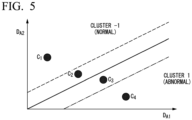
- the determiner 19 determines whether temperature data for detection acquired by the temperature acquirer 11 and subjected to the preprocessing by the preprocessor 17 is normal or abnormal by using the identification function output from the learner 18. For example, when the learner 18 learns a normal cluster as -1 and an abnormal cluster as 1 using a support vector machine (SVM), the obtained identification function means that a negative side is normal and a positive side is abnormal at a boundary of 0. The determiner 19 determines normality or abnormality, for example, using such an identification function. The determiner 19 outputs a determination result indicating whether the temperature data for detection is normal or abnormal to the outputter 15.
- SVM support vector machine
- FIG. 5 is a diagram illustrating a determination method performed using the identification function in the abnormal temperature detection device according to the second embodiment of the present invention.
- the horizontal axis represents the similarity (an accumulated warp distance D A1 ) calculated by the similarity calculator 35a of the detection preprocessor 30 and the vertical axis represents the similarity (an accumulated warp distance D A2 ) calculated by the similarity calculator 35b.
- a dotted line indicates a position at which a value of the identification function is -1
- a solid line indicates a position at which a value of the identification function is 0,
- a one-dot chain line indicates a position at which a value of the identification function is 1.
- values of the identification function are on the negative side. Therefore, the determiner 19 determines that the values are normal. Conversely, at points C3 and C4, values of the identification function are on the positive side. Therefore, the determiner 19 determines that the values are abnormal.
- a linear kernel In the support vector machine (SVM), there are various kinds of kernels such as a linear kernel, a polynomial kernel, and a Gaussian kernel (radial basis function (RBF) kernel).
- a linear kernel In the example illustrated in FIG. 5 , a linear kernel is used.
- the abnormal temperature detection device 2 is realized by, for example, a desktop, laptop, or tablet computer as in the abnormal temperature detection device 1 illustrated in FIG. 1 .
- each of the blocks (the preprocessor 17, the learner 18, the determiner 19, and the like) provided in the abnormal temperature detection device 2 is realized by allowing a central processing unit (CPU) provided in the computer to execute a program (an abnormal temperature detection program) for realizing each function. That is, each of the blocks provided in the abnormal temperature detection device 2 is realized by causing software to cooperate with hardware resources.
- the abnormal temperature detection device 2 may be realized by hardware such as a field-programmable gate-array (FPGA), a large scale integration (LSI) circuit, or an application specific integrated circuit (ASIC).
- FPGA field-programmable gate-array
- LSI large scale integration
- ASIC application specific integrated circuit
- Operations of the abnormal temperature detection device 2 are broadly classified into a learning-time operation performed to obtain the identification function by performing the machine learning and a detection-time operation of detecting an abnormal temperature as in the abnormal temperature detection device 1.
- the operations of the abnormal temperature detection device 2 are basically similar to the operations of the abnormal temperature detection device 1.
- the learning-time operation of the abnormal temperature detection device 2 and the detection-time operation of the abnormal temperature detection device 2 will be described in order with reference to FIGS. 2 and 3 .
- the temperature acquirer 11 performs a process of acquiring the temperature data for learning (step S11: a first temperature acquisition step). For example, 100 pieces of temperature data corresponding to a predefined time (for example, about 3 to 5 minutes) are acquired over a period of 200 times.
- temperature data generated through simulation by the user of the abnormal temperature detection device 2 may be input from the inputter 16 to the learning preprocessor 20.
- the identification label indicating whether the acquired temperature data (temperature data for learning) is normal or abnormal is input to the learning preprocessor 20, for example, when the user of the abnormal temperature detection device 2 operates the inputter 16, as in the first embodiment.
- the noise remover 21 of the learning preprocessor 20 performs a process of removing noise from the acquired temperature data for learning (step S12).
- a filter appropriate for characteristics of noise superimposed on the temperature data is selected.
- the difference calculators 22a and 22b of the learning preprocessor 20 respectively perform a process of calculating the first-order difference data and the second-layer difference data (step S13: a first preprocessing step).
- the learning preprocessor 20 may perform a unit root checking process of checking whether the temperature data has a unit root.
- the standardizers 23a and 23b respectively perform a process of standardizing the calculated first-order difference data and second-layer difference data (step S14). Specifically, the standardizers 23a and 23b respectively perform a process of setting an average of the calculated first-order difference data and second-layer difference data to 0 and setting a variance of the calculated first-order difference data and second-layer difference data to 1 is performed.
- the average value ⁇ 1 and the standard deviation ⁇ 1 used for the standardization of the standardizer 23a are output to the standardizer 33a of the detection preprocessor 30, and the average value ⁇ 12 and the standard deviation ⁇ 2 used for the standardization of the standardizer 23b are output to the standardizer 33b of the detection preprocessor 30.
- the sign processor 24 performs a process of generating the substitution data in which one of the first-order difference data which is a positive number and the first-order difference data which is a negative number among the standardized first-order difference data is substituted with zero (step S15: a first preprocessing step).
- step S15 a first preprocessing step.
- the averager 25a performs a process of obtaining the first reference data by averaging the substitution data generated by the sign processor 24 over a period of a plurality of times.
- the averager 25b performs a process of obtaining the second reference data by averaging the second-layer difference data standardized by the standardizer 23b over a period of a plurality of times (step S16).
- the first reference data obtained by the averager 25a is output to the similarity calculator 26a and the similarity calculator 35a of the detection preprocessor 30.
- the second reference data obtained by the averager 25b is output to the similarity calculator 26b and the similarity calculator 35b of the detection preprocessor 30.
- the similarity calculator 26a performs a process of calculating similarity between the first reference data obtained by the averager 25a and the substitution data generated by the sign processor 24.
- the similarity calculator 26b performs a process of calculating similarity between the second reference data obtained by the averager 25b and the second-layer difference data standardized by the standardizer 23b (step S17: a first preprocessing step).
- DTW dynamic time warping
- the similarity calculated by the similarity calculators 26a and 26b and the identification label indicating normality or abnormality of the first reference data and the second reference data are set as one pair and the machine learning in which the one pair of similarity and identification label is used is performed by the learner 18 (step S18: a learning step).
- the identification function is output from the learner 18 to the determiner 19 (step S19).
- the learning-time operation ends, for example, in accordance with a similar method to that of the first embodiment.
- the temperature acquirer 11 first performs a process of acquiring the temperature data for detection (step S21: a second temperature acquisition step).
- a predefined time for example, about 3 to 5 minutes
- the identification label is not input.
- the noise remover 31 of the detection preprocessor 30 performs a process of removing noise from the acquired temperature data for detection (step S22).
- a filter appropriate for characteristics of noise superimposed on the temperature data is selected.
- the difference calculators 32a and 32b of the detection preprocessor 30 perform a process of calculating the first-order difference data and the second-layer difference data (step S23: a second preprocessing step).
- the standardizer 33a and 33b respectively perform a process of standardizing the calculated first-order difference data and the second-layer difference data (step S24). Specifically, the standardizer 33a performs the process of standardizing the first-order difference data calculated by the difference calculator 32a using the average value ⁇ 1 and the standard deviation ⁇ 1 in the standardizer 23a of the learning preprocessor 20. The standardizer 33b performs the process of standardizing the second-layer difference data calculated by the difference calculator 32b using the average value ⁇ 2 and the standard deviation ⁇ 2 in the standardizer 23b of the learning preprocessor 20.
- the sign processor 34 performs a process of generating the substitution data in which one of the difference data which is a positive number and the difference data which is a negative number among the standardized first-order difference data is substituted with zero (step S25: a second preprocessing step).
- step S25 a second preprocessing step.
- a process of generating the substitution data in which the difference data which is a negative number is substituted with zero is performed as in the process of step S15 illustrated in FIG. 2 .
- the similarity calculator 35a performs a process of calculating similarity between the first reference data output by the averager 25a and the substitution data generated by the sign processor 34.
- the similarity calculator 35b performs a process of calculating similarity between the second reference data obtained by the averager 25b and the second-layer difference data standardized by the standardizer 33b (step S26: a second preprocessing step).
- DTW dynamic time warping
- step S27 a determination step
- step S28 a determination result is output from the determiner 19 to the outputter 15
- step S28 information indicating whether the temperature data for detection is normal or abnormal is displayed on the display device so that the information can be viewed.
- a result indicating that the temperature data for detection is abnormal is informed of through light or a sound by an alarm such as a red warning lamp or a buzzer.
- the detection-time operation ends, for example, in accordance with a similar method to that of the first embodiment.
- the learning preprocessor 20 calculates the first-order difference data and the second-layer difference data of temperature data acquired by the temperature acquirer 11 or the temperature data given from the inputter 16, generates the substitution data in which one of the first-order difference data which is a positive number and the first-order difference data which is a negative number is substituted with zero, obtains the first reference data and the second reference data by averaging the substitution data over a period of a plurality of times, and performs the preprocessing to calculate the similarity between the substitution data and the first reference data of which normality or abnormality is identified and the similarity between the second reference data and the substitution data.
- the learner 18 performs the machine learning on the similarity calculated in the preprocessing to obtain the identification function.
- the determiner 19 determines whether the temperature data for detection acquired by the temperature acquirer 11 and subjected to the preprocessing by the detection preprocessor 30 is normal or abnormal by using the identification function.
- FIG. 6 is a block diagram illustrating a configuration of main units of an abnormal temperature detection device according to a third embodiment of the present invention.
- the same reference numerals are given to the similar configurations illustrated in FIG. 4 .
- an abnormal temperature detection device 3 according to the embodiment has a configuration in which a plurality of sets of the preprocessor 17, the learner 18, and the determiner 19 (three sets in the example illustrated in FIG. 6 ) of the abnormal temperature detection device 2 illustrated in FIG. 4 are provided.
- the temperature acquirer 11 outputs the acquired temperature data to each preprocessor 17 (preprocessors 17A to 17C). That is, the same temperature data acquired by the temperature acquirer 11 is input to each preprocessor 17 (the preprocessors 17A to 17C).
- the preprocessors 17A to 17C are similar to the preprocessor described in the second embodiment and each include the learning preprocessor 20 and the detection preprocessor 30. Here, the preprocessors 17A to 17C may calculate the similarity using mutually different training data.
- the preprocessor 17A calculates the similarity using the temperature data changed due to a gentle increase in the temperature after a sharp increase in the temperature as training data.
- the preprocessor 17B calculates the similarity using the temperature data linearly increasing at a constant inclination as training data.
- the preprocessor 17C calculates the similarity using the temperature data increasing exponentially after start of a gentle increase in temperature as training data.
- the learners 18A to 18C corresponding to the preprocessors 17A to 17C can obtain mutually different identification functions by calculating the similarity using the different training data.
- the determiners 19A to 19C corresponding to the learners 18A to 18C perform the determination using mutually different identification functions.
- a general determiner 40 determines whether the temperature data for detection is normal or abnormal based on determination results of the determiners 19A to 19C.
- the general determiner 40 determines whether the temperature data for detection is normal or abnormal, for example, in accordance with the following algorithm (scheme):
- the outputter 15 outputs the determination result of the general determiner 40.
- the outputter 15 displays the determination result of the general determiner 40 so that the determination result can be viewed on a display device.
- the outputter 15 may inform of a determination result of the general determiner 40 through light or a sound.
- the outputter 15 may output the determination results of the determiners 19A to 19C together in addition to the determination result of the general determiner 40.
- the abnormal temperature detection device 3 is realized by, for example, a desktop, laptop, or tablet computer as in the abnormal temperature detection device 2 illustrated in FIG. 4 .
- each of the blocks (the preprocessor 17, the learner 18, the determiner 19, and the like) provided in the abnormal temperature detection device 3 is realized by allowing a central processing unit (CPU) provided in the computer to execute a program (an abnormal temperature detection program) for realizing each function. That is, each of the blocks provided in the abnormal temperature detection device 3 is realized by causing software to cooperate with hardware resources.
- the abnormal temperature detection device 3 may be realized by hardware such as a field-programmable gate-array (FPGA), a large scale integration (LSI) circuit, or an application specific integrated circuit (ASIC).
- FPGA field-programmable gate-array
- LSI large scale integration
- ASIC application specific integrated circuit
- Operations of the abnormal temperature detection device 3 are broadly classified into a learning-time operation performed to obtain the identification function by performing the machine learning and a detection-time operation of detecting an abnormal temperature as in the abnormal temperature detection device 2.
- learning-time operations are performed in parallel by the preprocessors 17A and the learner 18A, the preprocessors 17B and the learner 18B, and the preprocessors 17C and the learner 18C.
- detection-time operations are performed in parallel by the preprocessor 17A and the determiner 19A, the preprocessor 17B and the determiner 19B, and the preprocessor 17C and the determiner 19C.
- the general determiner 40 performs a process of determining whether the temperature data for detection is normal or abnormal.
- the three preprocessors 17A to 17C and the three learners 18A to 18C first perform the preprocessing and the machine learning to obtain the identification function as in the second embodiment.
- the three preprocessors 17A to 17C and the three determiners 19A to 19C perform the preprocessing and the determination using the identification function to determine whether the temperature data for detection is normal or abnormal as in the second embodiment.
- the general determiner 40 determines whether the temperature data for detection is normal or abnormal.
- the abnormal temperature detection device, the abnormal temperature detection method, and the abnormal temperature detection program according to the embodiments of the present invention have been described above, but the present invention can be changed freely within the scope of the present invention without being limited to the foregoing embodiments.
- the abnormal temperature detection devices 1 to 3 according to the above-described first to third embodiments include the learners (the learners 13 and 18) and the determiners (the determiners 14 and 19), the machine learning may be performed to automatically update the identification function (automatic learning) while determining whether the temperature data for detection is normal or abnormal.
- the abnormal temperature detection devices 1 to 3 according to the above-described first to third embodiments can be optimized in accordance with an environment of a field.
- the foregoing automatic learning may be performed only for a predetermined period. For example, only temperature data for one recent year may be automatically learned and data previous to the temperature data may not be used for the learning.
- the foregoing automatic learning may be started or stopped in response to an instruction from a user.
- the preprocessor 17 including the learning preprocessor 20 and the detection preprocessor 30 has been described to facilitate understanding.
- the preprocessor 17 may not necessarily be classified into the learning preprocessor 20 and the detection preprocessor 30, and overlapping configurations of the learning preprocessor 20 and the detection preprocessor 30 may be condensed into one configuration.
- the noise removers 21 and 31 may be condensed into one remover
- the difference calculators 22a and 32a may be condensed into one calculator
- the difference calculators 22b and 32b may be condensed into one calculator.
- the configuration in which three preprocessors 17, three learners 18, and three determiners 19 are included has been described as an example.
- the number of preprocessors 17, the number of learners 18, and the number of determines 19 are not limited to 3, but may be 2, or may be 4 or more.
- the configurations of the preprocessors 17, the learners 18, and the determiners 19 may be all mounted on one device or may be mounted on different devices.
- the abnormal temperature detection devices 1 to 3 may be realized by a single device or may be realized by cloud computing via a network.
- the cloud computing may conform with, for example, the definition (definition recommended by National Institute of Standards and Technology) described in the documents specified in the following uniform resource locator (URL). http://nvlpubs.nist.gov/nistpubs/Legacy/SP/nistspecialpublication800-145.pdf https://www.ipa.go.jp/files/000025366.pdf
- the term "configured” is used to describe a component, unit or part of a device includes hardware and/or software that is constructed and/or programmed to carry out the desired function.
- unit is used to describe a component, unit or part of a hardware and/or software that is constructed and/or programmed to carry out the desired function.
- Typical examples of the hardware may include, but are not limited to, a device and a circuit.
Landscapes
- Physics & Mathematics (AREA)
- General Physics & Mathematics (AREA)
- Engineering & Computer Science (AREA)
- Theoretical Computer Science (AREA)
- Software Systems (AREA)
- Evolutionary Computation (AREA)
- Computer Vision & Pattern Recognition (AREA)
- Data Mining & Analysis (AREA)
- Artificial Intelligence (AREA)
- Medical Informatics (AREA)
- Computing Systems (AREA)
- General Engineering & Computer Science (AREA)
- Mathematical Physics (AREA)
- Emergency Management (AREA)
- Business, Economics & Management (AREA)
- Testing And Monitoring For Control Systems (AREA)
- Investigating Or Analyzing Materials Using Thermal Means (AREA)
Claims (15)
- Vorrichtung zur Erkennung anormaler Temperaturen, umfassend:eine Temperaturbezugseinheit, die dazu ausgelegt ist, Temperaturdaten zu beziehen;einen Vorprozessor, der dazu ausgelegt ist, Vorverarbeitung durchzuführen, um Unterschiedsdaten zu berechnen, die eine Unterschiedssequenz in den Temperaturdaten angeben, dadurch gekennzeichnet, dass der Vorprozessor weiter dazu ausgelegt ist, Erzeugen ersetzter Daten, in denen entweder ein Unterschiedsdatenstück, das eine positive Zahl ist, oder ein Unterschiedsdatenstück, das eine negative Zahl ist, durch Null ersetzt ist, und Berechnen einer Ähnlichkeit zwischen den ersetzten Daten und Referenzdaten, die von Trainingsdaten erhalten werden, in denen Normalität oder Anomalität identifiziert wurde, durchzuführen; und dadurch, dass die Vorrichtung zur Erkennung anormaler Temperaturen umfasst:eine Lerneinheit, die dazu ausgelegt ist, Maschinenlernen an der Ähnlichkeit durchzuführen, die von dem Vorprozessor berechnet wird, und eine Identifikationsfunktion auszugeben; undeinen Ermittler, der dazu ausgelegt ist, zu ermitteln, ob Temperaturdaten zur Erkennung, die von der Temperaturbezugseinheit bezogen werden und der Vorverarbeitung durch den Vorprozessor unterzogen werden, normal oder anormal sind, indem die Identifikationsfunktion verwendet wird.
- Vorrichtung zur Erkennung anormaler Temperaturen nach Anspruch 1,
wobei der Vorprozessor umfasst:einen Datenprozessor, der dazu ausgelegt ist, die Unterschiedsdaten zu berechnen und die Ersatzdaten zu erzeugen; undeinen Ähnlichkeitsrechner, der dazu ausgelegt ist, die Ähnlichkeit zu berechnen. - Vorrichtung zur Erkennung anormaler Temperaturen nach Anspruch 2,
wobei der Datenprozessor für Folgendes ausgelegt ist:Berechnen von Unterschiedsdaten erster Ordnung, die eine Unterschiedssequenz erster Ordnung der Temperaturdaten angeben, und Unterschiedsdaten zweiter Ordnung, die eine Unterschiedssequenz zweiter Ordnung der Temperaturdaten angeben; undErzeugen der Ersatzdaten, in denen eine von Unterschiedsdaten erster Ordnung, die eine positive Ganzzahl sind, und Unterschiedsdaten erster Ordnung, die eine negative Zahl sind, in Bezug auf zumindest die Unterschiedsdaten erster Ordnung durch Null ersetzt werden. - Vorrichtung zur Erkennung anormaler Temperaturen nach Anspruch 2 oder 3,
wobei der Ähnlichkeitsrechner dazu ausgelegt ist, die Ähnlichkeit unter Verwendung dynamischer Zeitnormierung zu berechnen. - Vorrichtung zur Erkennung anormaler Temperaturen nach einem der Ansprüche 1 bis 4, weiter umfassend:einen ersten Vorprozessor, der ein Lernvorprozessor ist; undeinen zweiten Vorprozessor, der ein Erkennungsvorprozessor ist,wobei der erste Vorprozessor dazu ausgelegt ist, die Referenzdaten unter Verwendung der Ersatzdaten zu erzeugen, die von dem ersten Vorprozessor erzeugt werden, undwobei der zweite Vorprozessor dazu ausgelegt ist, die Ähnlichkeit zwischen den Referenzdaten, die von dem ersten Vorprozessor erzeugt werden, und den Ersatzdaten, die von dem zweiten Vorprozessor erzeugt werden, zu berechnen.
- Vorrichtung zur Erkennung anormaler Temperaturen nach Anspruch 5,
wobei der erste Vorprozessor dazu ausgelegt ist, die Referenzdaten zu erzeugen, indem die Ersatzdaten entsprechend einer vorgegebenen Zeit über eine Dauer einer Vielzahl von Zeiten gemittelt werden. - Vorrichtung zur Erkennung anormaler Temperaturen nach einem der Ansprüche 1 bis 6,wobei eine Vielzahl von Vorprozessoren, eine Vielzahl von Lerneinheiten und eine Vielzahl von Ermittlern bereitgestellt sind, undwobei die Vorrichtung zur Erkennung anormaler Temperaturen weiter einen allgemeinen Ermittler umfasst, der dazu ausgelegt ist, auf Basis von Ergebnissen der Vielzahl von Ermittlern zu ermitteln, ob die Temperaturdaten normal oder anormal sind.
- Verfahren zur Erkennung anormaler Temperaturen, das von einer Vorrichtung zur Erkennung anormaler Temperaturen durchgeführt wird, wobei das Verfahren zur Erkennung anormaler Temperaturen umfasst:Beziehen von Temperaturdaten durch eine Temperaturbezugseinheit;Durchführen, durch einen Vorprozessor, von Vorverarbeitung zum Berechnen von Unterschiedsdaten, die eine Unterschiedssequenz in den Temperaturdaten angeben, dadurch gekennzeichnet, dass das Verfahren zur Erkennung anormaler Temperaturen weiter umfasst: Durchführen, durch den Vorprozessor, von Erzeugen ersetzter Daten, in denen entweder ein Unterschiedsdatenstück, das eine positive Zahl ist, oder ein Unterschiedsdatenstück, das eine negative Zahl ist, durch Null ersetzt ist, und Berechnen einer Ähnlichkeit zwischen den ersetzten Daten und Referenzdaten, die von Trainingsdaten erhalten werden, in denen Normalität oder Anomalität identifiziert wurde; und dadurch, dass das Verfahren zur Erkennung anormaler Temperaturen umfasst:Durchführen, durch eine Lerneinheit, von Maschinenlernen an der Ähnlichkeit, die von dem Vorprozessor berechnet wird, und Ausgeben einer Identifikationsfunktion;Beziehen von Temperaturdaten zur Erkennung durch die Temperaturbezugseinheit;Durchführen, durch den Vorprozessor, der Vorverarbeitung an den Temperaturdaten zur Erkennung; undErmitteln, durch einen Ermittler, ob die Temperaturdaten zur Erkennung der Vorverarbeitung, die durch den Vorprozessor unterzogen werden, normal oder anormal sind, unter Verwendung der Identifikationsfunktion.
- Verfahren zur Erkennung anormaler Temperaturen nach Anspruch 8,wobei der Vorprozessor einen Datenprozessor und einen Ähnlichkeitsrechner umfasst, undwobei das Verfahren zur Erkennung anormaler Temperaturen weiter umfasst:Berechnen der Unterschiedsdaten und Erzeugen der Ersatzdaten durch den Datenprozessor; undBerechnen der Ähnlichkeit durch den Ähnlichkeitsrechner.
- Verfahren zur Erkennung anormaler Temperaturen nach Anspruch 9, weiter umfassend:Berechnen, durch den Datenprozessor, von Unterschiedsdaten erster Ordnung, die eine Unterschiedssequenz erster Ordnung der Temperaturdaten angeben, und Unterschiedsdaten zweiter Ordnung, die eine Unterschiedssequenz zweiter Ordnung der Temperaturdaten angeben; undErzeugen, durch den Datenprozessor, der Ersatzdaten, in denen eine von Unterschiedsdaten erster Ordnung, die eine positive Ganzzahl sind, und Unterschiedsdaten erster Ordnung, die eine negative Zahl sind, in Bezug auf zumindest die Unterschiedsdaten erster Ordnung durch Null ersetzt werden.
- Verfahren zur Erkennung anormaler Temperaturen nach Anspruch 9 oder 10, weiter umfassend:Berechnen der Ähnlichkeit durch den Ähnlichkeitsrechner unter Verwendung dynamischer Zeitnormierung.
- Verfahren zur Erkennung anormaler Temperaturen nach einem der Ansprüche 8 bis 11,wobei die Vorrichtung zur Erkennung anormaler Temperaturen umfasst:einen ersten Vorprozessor, der ein Lernvorprozessor ist; undeinen zweiten Vorprozessor, der ein Erkennungsvorprozessor ist,wobei das Verfahren zur Erkennung anormaler Temperaturen weiter umfasst:Erzeugen, durch den ersten Vorprozessor, der Referenzdaten unter Verwendung der Ersatzdaten, die von dem ersten Vorprozessor erzeugt werden; undBerechnen, durch den zweiten Vorprozessor, der Ähnlichkeit zwischen den Referenzdaten, die von dem ersten Vorprozessor erzeugt werden, und den Ersatzdaten, die von dem zweiten Vorprozessor erzeugt werden.
- Verfahren zur Erkennung anormaler Temperaturen nach Anspruch 12, weiter umfassend:
Erzeugen, durch den ersten Vorprozessor, der Referenzdaten, indem die Ersatzdaten entsprechend einer vorgegebenen Zeit über eine Dauer einer Vielzahl von Zeiten gemittelt werden. - Programm zur Erkennung anormaler Temperaturen, das von einem Computer ausgeführt wird, wobei das Programm zur Erkennung anormaler Temperaturen den Computer zu Folgendem anweist:Beziehen von Temperaturdaten;Durchführen von Vorverarbeitung zum Berechnen von Unterschiedsdaten, die eine Unterschiedssequenz in den Temperaturdaten angeben, dadurch gekennzeichnet, dass das Programm zur Erkennung anormaler Temperaturen den Computer weiter anweist, Erzeugen ersetzter Daten, in denen entweder ein Unterschiedsdatenstück, das eine positive Zahl ist, oder ein Unterschiedsdatenstück, das eine negative Zahl ist, durch Null ersetzt ist, und Berechnen einer Ähnlichkeit zwischen den ersetzten Daten und Referenzdaten, die von Trainingsdaten erhalten werden, in denen Normalität oder Anomalität identifiziert wurde, durchzuführen; und dadurch, dass das Programm zur Erkennung anormaler Temperaturen den Computer zu Folgendem anweist:Durchführen von Maschinenlernen an der berechneten Ähnlichkeit und Ausgeben einer Identifikationsfunktion; undErmitteln, ob Temperaturdaten zur Erkennung, die bezogen und der Vorverarbeitung unterzogen wurden, normal oder anormal sind, unter Verwendung der Identifikationsfunktion.
- Nichtflüchtiges computerlesbares Speichermedium, das ein Programm zur Erkennung anormaler Temperaturen speichert, das von einem Computer ausgeführt wird, wobei das Programm zur Erkennung anormaler Temperaturen den Computer zu Folgendem anweist:Beziehen von Temperaturdaten;Durchführen von Vorverarbeitung zum Berechnen von Unterschiedsdaten, die eine Unterschiedssequenz in den Temperaturdaten angeben, dadurch gekennzeichnet, dass das Programm zur Erkennung anormaler Temperaturen den Computer weiter anweist, Erzeugen ersetzter Daten, in denen entweder ein Unterschiedsdatenstück, das eine positive Zahl ist, oder ein Unterschiedsdatenstück, das eine negative Zahl ist, durch Null ersetzt ist, und Berechnen einer Ähnlichkeit zwischen den ersetzten Daten und Referenzdaten, die von Trainingsdaten erhalten werden, in denen Normalität oder Anomalität identifiziert wurde, durchzuführen; und dadurch, dass das Programm zur Erkennung anormaler Temperaturen den Computer zu Folgendem anweist:Durchführen von Maschinenlernen an der berechneten Ähnlichkeit und Ausgeben einer Identifikationsfunktion; undErmitteln, ob Temperaturdaten zur Erkennung, die bezogen und der Vorverarbeitung unterzogen wurden, normal oder anormal sind, unter Verwendung der Identifikationsfunktion.
Applications Claiming Priority (1)
| Application Number | Priority Date | Filing Date | Title |
|---|---|---|---|
| JP2020143271A JP7537182B2 (ja) | 2020-08-27 | 2020-08-27 | 異常温度検知装置、異常温度検知方法、及び異常温度検知プログラム |
Publications (2)
| Publication Number | Publication Date |
|---|---|
| EP3961168A1 EP3961168A1 (de) | 2022-03-02 |
| EP3961168B1 true EP3961168B1 (de) | 2023-02-22 |
Family
ID=77398465
Family Applications (1)
| Application Number | Title | Priority Date | Filing Date |
|---|---|---|---|
| EP21191895.8A Active EP3961168B1 (de) | 2020-08-27 | 2021-08-18 | Vorrichtung und verfahren zur erkennung von anormalen temperaturen und entsprechendes speichermedium |
Country Status (4)
| Country | Link |
|---|---|
| US (1) | US11788898B2 (de) |
| EP (1) | EP3961168B1 (de) |
| JP (1) | JP7537182B2 (de) |
| CN (1) | CN114112105B (de) |
Families Citing this family (19)
| Publication number | Priority date | Publication date | Assignee | Title |
|---|---|---|---|---|
| US11191423B1 (en) * | 2020-07-16 | 2021-12-07 | DOCBOT, Inc. | Endoscopic system and methods having real-time medical imaging |
| JP7537182B2 (ja) * | 2020-08-27 | 2024-08-21 | 横河電機株式会社 | 異常温度検知装置、異常温度検知方法、及び異常温度検知プログラム |
| JP7226424B2 (ja) * | 2020-12-14 | 2023-02-21 | 横河電機株式会社 | 異常温度検知装置、異常温度検知方法、及び異常温度検知プログラム |
| US12332972B2 (en) | 2022-11-01 | 2025-06-17 | Kabushiki Kaisha Yaskawa Denki | Generation system, computer-readable storage medium, and method for generating waveform evaluation model |
| JP7568766B2 (ja) * | 2022-11-01 | 2024-10-16 | 株式会社安川電機 | 生成システム、プログラム、及び波形評価モデルの生成方法 |
| CN115775436B (zh) * | 2022-11-02 | 2024-12-20 | 北京百瑞盛田环保科技发展有限公司 | 一种平原林地火情识别处理方法及装置 |
| CN116304956B (zh) * | 2023-05-15 | 2023-08-15 | 济宁市质量计量检验检测研究院(济宁半导体及显示产品质量监督检验中心、济宁市纤维质量监测中心) | 一种芯片温度异常在线检测方法 |
| JP2025006253A (ja) * | 2023-06-29 | 2025-01-17 | 横河電機株式会社 | 装置、方法およびプログラム |
| CN116610682B (zh) * | 2023-07-21 | 2023-09-29 | 山东盈动智能科技有限公司 | 基于数据存储的温度测试仪数据分类方法 |
| CN116643951B (zh) * | 2023-07-24 | 2023-10-10 | 青岛冠成软件有限公司 | 一种冷链物流运输大数据监测采集方法 |
| CN116772285B (zh) * | 2023-08-28 | 2023-11-07 | 山东国能智能科技有限公司 | 一种智能楼宇供暖负载安全实时监控方法 |
| CN117288348B (zh) * | 2023-11-24 | 2024-02-09 | 青岛东山集团母线智造有限公司 | 一种母线槽测温方法及系统 |
| CN117872900B (zh) * | 2024-01-17 | 2024-08-23 | 河北维嘉无纺布股份有限公司 | 基于物联网技术的无纺布生产设备远程监控系统 |
| CN117970182A (zh) * | 2024-03-28 | 2024-05-03 | 国网山东省电力公司曲阜市供电公司 | 一种基于dtw算法的漏电预警方法及系统 |
| CN118194208B (zh) * | 2024-05-16 | 2024-08-06 | 深圳市中瑞恒管理策划有限公司 | 一种节能建筑安全智能检测系统 |
| CN119169757B (zh) * | 2024-09-20 | 2025-07-22 | 宁波千里眼智能科技有限公司 | 一种起火预测变频巡检方法、介质及系统 |
| CN119077435A (zh) * | 2024-11-11 | 2024-12-06 | 陕西威达机械制造股份有限公司 | 一种用于数控机床的温度监控方法和系统 |
| CN119203015B (zh) * | 2024-11-29 | 2025-03-11 | 际华三五一三实业有限公司 | 一种鞋靴智能制造生产线数据处理方法 |
| CN120910773B (zh) * | 2025-10-11 | 2025-12-02 | 南通市立新机械制造有限公司 | 一种机械零件加工数据动态安全保护方法 |
Citations (1)
| Publication number | Priority date | Publication date | Assignee | Title |
|---|---|---|---|---|
| JP2020071137A (ja) * | 2018-10-31 | 2020-05-07 | オムロン株式会社 | 温度異常検知システム、温度異常検知方法およびプログラム |
Family Cites Families (11)
| Publication number | Priority date | Publication date | Assignee | Title |
|---|---|---|---|---|
| JPS588605B2 (ja) | 1975-04-21 | 1983-02-16 | 沖電気工業株式会社 | ユウキヨクガタタジユウモ−ドフイルタ |
| JP4066761B2 (ja) | 2001-11-27 | 2008-03-26 | 松下電工株式会社 | 火災警報システム |
| DE102008053064B3 (de) * | 2008-10-24 | 2010-04-01 | Hüttinger Elektronik Gmbh + Co. Kg | Verfahren zur Temperaturüberwachung |
| JP5808605B2 (ja) | 2011-08-17 | 2015-11-10 | 株式会社日立製作所 | 異常検知・診断方法、および異常検知・診断システム |
| WO2014105031A2 (en) | 2012-12-28 | 2014-07-03 | Schneider Electric It Corporation | Method for air flow fault and cause identification |
| US9906069B2 (en) * | 2014-07-28 | 2018-02-27 | Ford Global Technologies, Llc | Vehicle battery status detection by tracking a temperature gradient |
| JP6076571B1 (ja) | 2015-08-06 | 2017-02-08 | 新日鉄住金ソリューションズ株式会社 | 情報処理装置、情報処理システム、情報処理方法及びプログラム |
| JP6591509B2 (ja) * | 2017-11-06 | 2019-10-16 | 株式会社東芝 | 金型温度異常予兆検知装置及びプログラム |
| US11041077B2 (en) | 2019-03-04 | 2021-06-22 | Xerox Corporation | Particles for powder coating applications and method of manufacturing |
| CN110608816A (zh) * | 2019-09-04 | 2019-12-24 | 安徽省粮油信息中心(安徽粮食批发交易市场管委会) | 粮食温度检测期间的异常排查及结果分析认定的方法 |
| JP7537182B2 (ja) * | 2020-08-27 | 2024-08-21 | 横河電機株式会社 | 異常温度検知装置、異常温度検知方法、及び異常温度検知プログラム |
-
2020
- 2020-08-27 JP JP2020143271A patent/JP7537182B2/ja active Active
-
2021
- 2021-08-13 US US17/401,641 patent/US11788898B2/en active Active
- 2021-08-18 EP EP21191895.8A patent/EP3961168B1/de active Active
- 2021-08-25 CN CN202110980413.0A patent/CN114112105B/zh active Active
Patent Citations (1)
| Publication number | Priority date | Publication date | Assignee | Title |
|---|---|---|---|---|
| JP2020071137A (ja) * | 2018-10-31 | 2020-05-07 | オムロン株式会社 | 温度異常検知システム、温度異常検知方法およびプログラム |
Also Published As
| Publication number | Publication date |
|---|---|
| US11788898B2 (en) | 2023-10-17 |
| JP2022038659A (ja) | 2022-03-10 |
| JP7537182B2 (ja) | 2024-08-21 |
| EP3961168A1 (de) | 2022-03-02 |
| CN114112105A (zh) | 2022-03-01 |
| CN114112105B (zh) | 2025-03-21 |
| US20220065705A1 (en) | 2022-03-03 |
Similar Documents
| Publication | Publication Date | Title |
|---|---|---|
| US11788898B2 (en) | Abnormal temperature detection device, abnormal temperature detection method, and storage medium | |
| EP4012365B1 (de) | Vorrichtung zur erkennung anormaler temperaturen, verfahren zur erkennung anormaler temperaturen und programm zur erkennung anormaler temperaturen | |
| US10504036B2 (en) | Optimizing performance of event detection by sensor data analytics | |
| US10228994B2 (en) | Information processing system, information processing method, and program | |
| US20190257716A1 (en) | Detecting apparatus, detection method, and program | |
| Wang et al. | Remaining useful life prediction considering joint dependency of degradation rate and variation on time-varying operating conditions | |
| JP6658250B2 (ja) | 異常診断方法、異常診断装置、及び異常診断プログラム | |
| US11580425B2 (en) | Managing defects in a model training pipeline using synthetic data sets associated with defect types | |
| EP3674827B1 (de) | Vorrichtung zur auswahl eines überwachungsziels, verfahren zur auswahl eines überwachungsziels und programm | |
| US11960271B2 (en) | Power plant early warning device and method employing multiple prediction model | |
| EP3648433B1 (de) | SYSTEM UND METHODE ZUR AUSBILDUNGSVERHALTENS
VON ETIKETTIERUNGSMODELL | |
| US10599501B2 (en) | Information processing device, information processing method, and recording medium | |
| JP2020027342A (ja) | 情報処理装置、監視装置、及び情報処理方法 | |
| EP3506229B1 (de) | Verfahren zur vorerkennung von anomaliezeichen einer kernkraftwerksvorrichtung mit prozessor zum bestimmen der vorrichtungsbedeutung und der warngültigkeit und system dafür | |
| JPWO2019077656A1 (ja) | 生産設備監視装置、生産設備監視方法及び生産設備監視プログラム | |
| US20230353588A1 (en) | Anomalous pattern detection for control of computer networks | |
| US20220083039A1 (en) | Abnormality detection apparatus, abnormality detection system, and learning apparatus, and methods for the same and nontemporary computer-readable medium storing the same | |
| CN119302626A (zh) | 一种施工人员生命体征监测手环及其监测方法 | |
| EP3190519A1 (de) | Überwachungsvorrichtung und überwachungsverfahren dafür, überwachungssystem und aufzeichnungsmedium mit darauf gespeichertem computerprogramm | |
| US20170307750A1 (en) | Waveform estimation device and waveform estimation method | |
| CN110458713B (zh) | 模型监控方法、装置、计算机设备及存储介质 | |
| US20250085696A1 (en) | Abnormality detection apparatus, method, and non-transitory computer readable medium | |
| US11885720B2 (en) | Time series data processing method | |
| US10303841B1 (en) | Automatic peak interval, relative volatility, and relative amplitude detection in high-volume temporal data | |
| Sürücü et al. | PROGNOS: an automatic remaining useful life (RUL) prediction model for military systems using machine learning |
Legal Events
| Date | Code | Title | Description |
|---|---|---|---|
| PUAI | Public reference made under article 153(3) epc to a published international application that has entered the european phase |
Free format text: ORIGINAL CODE: 0009012 |
|
| STAA | Information on the status of an ep patent application or granted ep patent |
Free format text: STATUS: THE APPLICATION HAS BEEN PUBLISHED |
|
| AK | Designated contracting states |
Kind code of ref document: A1 Designated state(s): AL AT BE BG CH CY CZ DE DK EE ES FI FR GB GR HR HU IE IS IT LI LT LU LV MC MK MT NL NO PL PT RO RS SE SI SK SM TR |
|
| STAA | Information on the status of an ep patent application or granted ep patent |
Free format text: STATUS: REQUEST FOR EXAMINATION WAS MADE |
|
| 17P | Request for examination filed |
Effective date: 20220505 |
|
| RBV | Designated contracting states (corrected) |
Designated state(s): AL AT BE BG CH CY CZ DE DK EE ES FI FR GB GR HR HU IE IS IT LI LT LU LV MC MK MT NL NO PL PT RO RS SE SI SK SM TR |
|
| GRAP | Despatch of communication of intention to grant a patent |
Free format text: ORIGINAL CODE: EPIDOSNIGR1 |
|
| STAA | Information on the status of an ep patent application or granted ep patent |
Free format text: STATUS: GRANT OF PATENT IS INTENDED |
|
| INTG | Intention to grant announced |
Effective date: 20220913 |
|
| GRAS | Grant fee paid |
Free format text: ORIGINAL CODE: EPIDOSNIGR3 |
|
| GRAA | (expected) grant |
Free format text: ORIGINAL CODE: 0009210 |
|
| STAA | Information on the status of an ep patent application or granted ep patent |
Free format text: STATUS: THE PATENT HAS BEEN GRANTED |
|
| AK | Designated contracting states |
Kind code of ref document: B1 Designated state(s): AL AT BE BG CH CY CZ DE DK EE ES FI FR GB GR HR HU IE IS IT LI LT LU LV MC MK MT NL NO PL PT RO RS SE SI SK SM TR |
|
| REG | Reference to a national code |
Ref country code: GB Ref legal event code: FG4D |
|
| REG | Reference to a national code |
Ref country code: CH Ref legal event code: EP |
|
| REG | Reference to a national code |
Ref country code: AT Ref legal event code: REF Ref document number: 1549790 Country of ref document: AT Kind code of ref document: T Effective date: 20230315 Ref country code: IE Ref legal event code: FG4D |
|
| REG | Reference to a national code |
Ref country code: DE Ref legal event code: R096 Ref document number: 602021001463 Country of ref document: DE |
|
| REG | Reference to a national code |
Ref country code: LT Ref legal event code: MG9D |
|
| REG | Reference to a national code |
Ref country code: NL Ref legal event code: MP Effective date: 20230222 |
|
| P01 | Opt-out of the competence of the unified patent court (upc) registered |
Effective date: 20230603 |
|
| REG | Reference to a national code |
Ref country code: AT Ref legal event code: MK05 Ref document number: 1549790 Country of ref document: AT Kind code of ref document: T Effective date: 20230222 |
|
| PG25 | Lapsed in a contracting state [announced via postgrant information from national office to epo] |
Ref country code: RS Free format text: LAPSE BECAUSE OF FAILURE TO SUBMIT A TRANSLATION OF THE DESCRIPTION OR TO PAY THE FEE WITHIN THE PRESCRIBED TIME-LIMIT Effective date: 20230222 Ref country code: PT Free format text: LAPSE BECAUSE OF FAILURE TO SUBMIT A TRANSLATION OF THE DESCRIPTION OR TO PAY THE FEE WITHIN THE PRESCRIBED TIME-LIMIT Effective date: 20230622 Ref country code: NO Free format text: LAPSE BECAUSE OF FAILURE TO SUBMIT A TRANSLATION OF THE DESCRIPTION OR TO PAY THE FEE WITHIN THE PRESCRIBED TIME-LIMIT Effective date: 20230522 Ref country code: NL Free format text: LAPSE BECAUSE OF FAILURE TO SUBMIT A TRANSLATION OF THE DESCRIPTION OR TO PAY THE FEE WITHIN THE PRESCRIBED TIME-LIMIT Effective date: 20230222 Ref country code: LV Free format text: LAPSE BECAUSE OF FAILURE TO SUBMIT A TRANSLATION OF THE DESCRIPTION OR TO PAY THE FEE WITHIN THE PRESCRIBED TIME-LIMIT Effective date: 20230222 Ref country code: LT Free format text: LAPSE BECAUSE OF FAILURE TO SUBMIT A TRANSLATION OF THE DESCRIPTION OR TO PAY THE FEE WITHIN THE PRESCRIBED TIME-LIMIT Effective date: 20230222 Ref country code: HR Free format text: LAPSE BECAUSE OF FAILURE TO SUBMIT A TRANSLATION OF THE DESCRIPTION OR TO PAY THE FEE WITHIN THE PRESCRIBED TIME-LIMIT Effective date: 20230222 Ref country code: ES Free format text: LAPSE BECAUSE OF FAILURE TO SUBMIT A TRANSLATION OF THE DESCRIPTION OR TO PAY THE FEE WITHIN THE PRESCRIBED TIME-LIMIT Effective date: 20230222 Ref country code: AT Free format text: LAPSE BECAUSE OF FAILURE TO SUBMIT A TRANSLATION OF THE DESCRIPTION OR TO PAY THE FEE WITHIN THE PRESCRIBED TIME-LIMIT Effective date: 20230222 |
|
| PG25 | Lapsed in a contracting state [announced via postgrant information from national office to epo] |
Ref country code: SE Free format text: LAPSE BECAUSE OF FAILURE TO SUBMIT A TRANSLATION OF THE DESCRIPTION OR TO PAY THE FEE WITHIN THE PRESCRIBED TIME-LIMIT Effective date: 20230222 Ref country code: PL Free format text: LAPSE BECAUSE OF FAILURE TO SUBMIT A TRANSLATION OF THE DESCRIPTION OR TO PAY THE FEE WITHIN THE PRESCRIBED TIME-LIMIT Effective date: 20230222 Ref country code: IS Free format text: LAPSE BECAUSE OF FAILURE TO SUBMIT A TRANSLATION OF THE DESCRIPTION OR TO PAY THE FEE WITHIN THE PRESCRIBED TIME-LIMIT Effective date: 20230622 Ref country code: GR Free format text: LAPSE BECAUSE OF FAILURE TO SUBMIT A TRANSLATION OF THE DESCRIPTION OR TO PAY THE FEE WITHIN THE PRESCRIBED TIME-LIMIT Effective date: 20230523 Ref country code: FI Free format text: LAPSE BECAUSE OF FAILURE TO SUBMIT A TRANSLATION OF THE DESCRIPTION OR TO PAY THE FEE WITHIN THE PRESCRIBED TIME-LIMIT Effective date: 20230222 |
|
| PG25 | Lapsed in a contracting state [announced via postgrant information from national office to epo] |
Ref country code: SM Free format text: LAPSE BECAUSE OF FAILURE TO SUBMIT A TRANSLATION OF THE DESCRIPTION OR TO PAY THE FEE WITHIN THE PRESCRIBED TIME-LIMIT Effective date: 20230222 Ref country code: RO Free format text: LAPSE BECAUSE OF FAILURE TO SUBMIT A TRANSLATION OF THE DESCRIPTION OR TO PAY THE FEE WITHIN THE PRESCRIBED TIME-LIMIT Effective date: 20230222 Ref country code: EE Free format text: LAPSE BECAUSE OF FAILURE TO SUBMIT A TRANSLATION OF THE DESCRIPTION OR TO PAY THE FEE WITHIN THE PRESCRIBED TIME-LIMIT Effective date: 20230222 Ref country code: DK Free format text: LAPSE BECAUSE OF FAILURE TO SUBMIT A TRANSLATION OF THE DESCRIPTION OR TO PAY THE FEE WITHIN THE PRESCRIBED TIME-LIMIT Effective date: 20230222 Ref country code: CZ Free format text: LAPSE BECAUSE OF FAILURE TO SUBMIT A TRANSLATION OF THE DESCRIPTION OR TO PAY THE FEE WITHIN THE PRESCRIBED TIME-LIMIT Effective date: 20230222 |
|
| REG | Reference to a national code |
Ref country code: DE Ref legal event code: R097 Ref document number: 602021001463 Country of ref document: DE |
|
| PG25 | Lapsed in a contracting state [announced via postgrant information from national office to epo] |
Ref country code: SK Free format text: LAPSE BECAUSE OF FAILURE TO SUBMIT A TRANSLATION OF THE DESCRIPTION OR TO PAY THE FEE WITHIN THE PRESCRIBED TIME-LIMIT Effective date: 20230222 |
|
| PLBE | No opposition filed within time limit |
Free format text: ORIGINAL CODE: 0009261 |
|
| STAA | Information on the status of an ep patent application or granted ep patent |
Free format text: STATUS: NO OPPOSITION FILED WITHIN TIME LIMIT |
|
| 26N | No opposition filed |
Effective date: 20231123 |
|
| PG25 | Lapsed in a contracting state [announced via postgrant information from national office to epo] |
Ref country code: SI Free format text: LAPSE BECAUSE OF FAILURE TO SUBMIT A TRANSLATION OF THE DESCRIPTION OR TO PAY THE FEE WITHIN THE PRESCRIBED TIME-LIMIT Effective date: 20230222 |
|
| PG25 | Lapsed in a contracting state [announced via postgrant information from national office to epo] |
Ref country code: MC Free format text: LAPSE BECAUSE OF FAILURE TO SUBMIT A TRANSLATION OF THE DESCRIPTION OR TO PAY THE FEE WITHIN THE PRESCRIBED TIME-LIMIT Effective date: 20230222 |
|
| PG25 | Lapsed in a contracting state [announced via postgrant information from national office to epo] |
Ref country code: MC Free format text: LAPSE BECAUSE OF FAILURE TO SUBMIT A TRANSLATION OF THE DESCRIPTION OR TO PAY THE FEE WITHIN THE PRESCRIBED TIME-LIMIT Effective date: 20230222 |
|
| PG25 | Lapsed in a contracting state [announced via postgrant information from national office to epo] |
Ref country code: LU Free format text: LAPSE BECAUSE OF NON-PAYMENT OF DUE FEES Effective date: 20230818 |
|
| PG25 | Lapsed in a contracting state [announced via postgrant information from national office to epo] |
Ref country code: LU Free format text: LAPSE BECAUSE OF NON-PAYMENT OF DUE FEES Effective date: 20230818 |
|
| REG | Reference to a national code |
Ref country code: BE Ref legal event code: MM Effective date: 20230831 |
|
| REG | Reference to a national code |
Ref country code: IE Ref legal event code: MM4A |
|
| PG25 | Lapsed in a contracting state [announced via postgrant information from national office to epo] |
Ref country code: IT Free format text: LAPSE BECAUSE OF FAILURE TO SUBMIT A TRANSLATION OF THE DESCRIPTION OR TO PAY THE FEE WITHIN THE PRESCRIBED TIME-LIMIT Effective date: 20230222 |
|
| PG25 | Lapsed in a contracting state [announced via postgrant information from national office to epo] |
Ref country code: IE Free format text: LAPSE BECAUSE OF NON-PAYMENT OF DUE FEES Effective date: 20230818 |
|
| PG25 | Lapsed in a contracting state [announced via postgrant information from national office to epo] |
Ref country code: IE Free format text: LAPSE BECAUSE OF NON-PAYMENT OF DUE FEES Effective date: 20230818 |
|
| PG25 | Lapsed in a contracting state [announced via postgrant information from national office to epo] |
Ref country code: BE Free format text: LAPSE BECAUSE OF NON-PAYMENT OF DUE FEES Effective date: 20230831 |
|
| PG25 | Lapsed in a contracting state [announced via postgrant information from national office to epo] |
Ref country code: BG Free format text: LAPSE BECAUSE OF FAILURE TO SUBMIT A TRANSLATION OF THE DESCRIPTION OR TO PAY THE FEE WITHIN THE PRESCRIBED TIME-LIMIT Effective date: 20230222 |
|
| PG25 | Lapsed in a contracting state [announced via postgrant information from national office to epo] |
Ref country code: BG Free format text: LAPSE BECAUSE OF FAILURE TO SUBMIT A TRANSLATION OF THE DESCRIPTION OR TO PAY THE FEE WITHIN THE PRESCRIBED TIME-LIMIT Effective date: 20230222 |
|
| REG | Reference to a national code |
Ref country code: CH Ref legal event code: PL |
|
| PG25 | Lapsed in a contracting state [announced via postgrant information from national office to epo] |
Ref country code: CH Free format text: LAPSE BECAUSE OF NON-PAYMENT OF DUE FEES Effective date: 20240831 |
|
| PG25 | Lapsed in a contracting state [announced via postgrant information from national office to epo] |
Ref country code: CY Free format text: LAPSE BECAUSE OF FAILURE TO SUBMIT A TRANSLATION OF THE DESCRIPTION OR TO PAY THE FEE WITHIN THE PRESCRIBED TIME-LIMIT; INVALID AB INITIO Effective date: 20210818 |
|
| PG25 | Lapsed in a contracting state [announced via postgrant information from national office to epo] |
Ref country code: HU Free format text: LAPSE BECAUSE OF FAILURE TO SUBMIT A TRANSLATION OF THE DESCRIPTION OR TO PAY THE FEE WITHIN THE PRESCRIBED TIME-LIMIT; INVALID AB INITIO Effective date: 20210818 |
|
| PGFP | Annual fee paid to national office [announced via postgrant information from national office to epo] |
Ref country code: DE Payment date: 20250724 Year of fee payment: 5 |
|
| PGFP | Annual fee paid to national office [announced via postgrant information from national office to epo] |
Ref country code: GB Payment date: 20250724 Year of fee payment: 5 |
|
| PGFP | Annual fee paid to national office [announced via postgrant information from national office to epo] |
Ref country code: FR Payment date: 20250725 Year of fee payment: 5 |
|
| PG25 | Lapsed in a contracting state [announced via postgrant information from national office to epo] |
Ref country code: TR Free format text: LAPSE BECAUSE OF FAILURE TO SUBMIT A TRANSLATION OF THE DESCRIPTION OR TO PAY THE FEE WITHIN THE PRESCRIBED TIME-LIMIT Effective date: 20230222 |