EP3960725A1 - Method for producing triorganosilane compound - Google Patents
Method for producing triorganosilane compound Download PDFInfo
- Publication number
- EP3960725A1 EP3960725A1 EP20795713.5A EP20795713A EP3960725A1 EP 3960725 A1 EP3960725 A1 EP 3960725A1 EP 20795713 A EP20795713 A EP 20795713A EP 3960725 A1 EP3960725 A1 EP 3960725A1
- Authority
- EP
- European Patent Office
- Prior art keywords
- group
- producing
- substituent
- triorganosilane
- compound according
- Prior art date
- Legal status (The legal status is an assumption and is not a legal conclusion. Google has not performed a legal analysis and makes no representation as to the accuracy of the status listed.)
- Granted
Links
- 0 CC1(C)*CCC1 Chemical compound CC1(C)*CCC1 0.000 description 3
- OCOKCJOGWHSGBY-UHFFFAOYSA-N CC(C)(C)[SiH+](C(C)(C)C)OS(C(F)(F)F)(=O)=O Chemical compound CC(C)(C)[SiH+](C(C)(C)C)OS(C(F)(F)F)(=O)=O OCOKCJOGWHSGBY-UHFFFAOYSA-N 0.000 description 1
Classifications
-
- C—CHEMISTRY; METALLURGY
- C07—ORGANIC CHEMISTRY
- C07F—ACYCLIC, CARBOCYCLIC OR HETEROCYCLIC COMPOUNDS CONTAINING ELEMENTS OTHER THAN CARBON, HYDROGEN, HALOGEN, OXYGEN, NITROGEN, SULFUR, SELENIUM OR TELLURIUM
- C07F7/00—Compounds containing elements of Groups 4 or 14 of the Periodic Table
- C07F7/02—Silicon compounds
- C07F7/08—Compounds having one or more C—Si linkages
- C07F7/0896—Compounds with a Si-H linkage
-
- C—CHEMISTRY; METALLURGY
- C07—ORGANIC CHEMISTRY
- C07F—ACYCLIC, CARBOCYCLIC OR HETEROCYCLIC COMPOUNDS CONTAINING ELEMENTS OTHER THAN CARBON, HYDROGEN, HALOGEN, OXYGEN, NITROGEN, SULFUR, SELENIUM OR TELLURIUM
- C07F7/00—Compounds containing elements of Groups 4 or 14 of the Periodic Table
- C07F7/02—Silicon compounds
- C07F7/08—Compounds having one or more C—Si linkages
- C07F7/0803—Compounds with Si-C or Si-Si linkages
- C07F7/0825—Preparations of compounds not comprising Si-Si or Si-cyano linkages
- C07F7/0827—Syntheses with formation of a Si-C bond
-
- C—CHEMISTRY; METALLURGY
- C07—ORGANIC CHEMISTRY
- C07F—ACYCLIC, CARBOCYCLIC OR HETEROCYCLIC COMPOUNDS CONTAINING ELEMENTS OTHER THAN CARBON, HYDROGEN, HALOGEN, OXYGEN, NITROGEN, SULFUR, SELENIUM OR TELLURIUM
- C07F7/00—Compounds containing elements of Groups 4 or 14 of the Periodic Table
- C07F7/02—Silicon compounds
- C07F7/08—Compounds having one or more C—Si linkages
- C07F7/0834—Compounds having one or more O-Si linkage
Definitions
- the present invention relates to a novel method for producing a triorganosilane compound.
- a triorganosilane compound has been used as a silyl protecting agent capable of applying to various functional groups in synthetic intermediates of organic compounds (Non-Patent Document 1).
- Non-Patent Documents 2 and 3 As a method for producing the triorganosilane compound, it has been known a method in which a secondary aliphatic hydrocarbon group or an aryl group is introduced into a dialkylsilane compound (Non-Patent Documents 2 and 3).
- Non-Patent Document 4 a method in which the aryl group is converted into a cycloalkyl group by hydrogenation reaction.
- Non-Patent Document 2 When a secondary aliphatic hydrocarbon group is introduced into di-t-butylsilane by the method described in Non-Patent Document 2, there are problems that the yield is medium and an undesired isomer is formed.
- the present inventors have intensively studied and as a result, they have found that the above-mentioned problems have been solved by using a specific intermediate, whereby the present invention has completed. That is, the present invention has the following characteristics.
- a novel method for producing a triorganosilane compound could be provided.
- n- means normal, "s-" and “sec” mean secondary, “t-” and “tert-” mean tertiary, "Bu” means butyl, "Hex” means hexyl, "Ph” means phenyl, "c” means cyclo, "Bn” means benzyl, “Mes” means mesityl and "cC 6 H 10 " means cyclohexanediyl.
- halogen atom mean a fluorine atom, a chlorine atom, a bromine atom or an iodine atom.
- C 1-40 alkyl group mean a linear or branched alkyl group in which a carbon number is 1 to 40, and specific examples thereof may be mentioned a methyl group, an ethyl group, an n-propyl group, an isopropyl group, an n-butyl group, an isobutyl group, an s-butyl group, a t-butyl group, an n-pentyl group, an n-hexyl group, an octyl group, a decyl group, a dodecyl group, a hexadecyl group, an octadecyl group, a docosyl group, a triacontyl group, a tetracontyl group, a 3,7,11,15-tetramethyl-hexadecyl group, etc.
- C 1-20 alkyl group mean a linear or branched alkyl group in which a carbon number is 1 to 20, the terms “C 1-6 alkyl group” are that in which a carbon number is 1 to 6, and the terms “C 3-6 alkyl group” are that in which a carbon number is 3 to 6.
- secondary or tertiary alkyl group having 4 or more carbon atoms mean a secondary or tertiary alkyl group in which a carbon number is 4 or more, preferably a secondary or tertiary alkyl group in which a carbon number is 4 to 40, more preferably that in which a carbon number is 4 to 20, further preferably that in which a carbon number is 4 to 10, and particularly preferably that in which a carbon number is 4 to 6.
- the secondary or tertiary alkyl group means an alkyl group in which the bonding position as a group resides on a secondary or tertiary carbon.
- a 2-butyl group a t-butyl group, a 3-pentyl group, a thexyl group, etc.
- secondary or tertiary C 4-6 alkyl group mean a secondary or tertiary alkyl group in which a carbon number is 4 to 6
- tertiary C 4-6 alkyl group mean a tertiary alkyl group in which a carbon number is 4 to 6.
- alkyl group having 3 or more carbon atoms mean a linear or branched alkyl group in which a carbon number is 3 or more, preferably mean a linear or branched alkyl group in which a carbon number is 3 to 40, more preferably that in which a carbon number is 3 to 20, further preferably that in which a carbon number is 3 to 10, and particularly preferably that in which a carbon number is 3 to 6, and specific examples of the alkyl group having 3 or more carbon atoms may be mentioned an n-propyl group, an isopropyl group, an n-butyl group, a 2-butyl group, a t-butyl group, an n-pentyl group, a 3-pentyl group, an n-hexyl group, a thexyl group, etc.
- cyclo alkyl group having 3 or more carbon atoms mean a cyclic alkyl group in which a carbon number is 3 or more carbon atoms, preferably a cyclic alkyl group in which a carbon number is 3 to 40, more preferably that in which a carbon number is 3 to 20, further preferably that in which a carbon number is 3 to 10, and particularly preferably that in which a carbon number is 3 to 6.
- Specific examples of the cycloalkyl group having 3 or more carbon atoms may be mentioned a cyclopropyl group, a cyclobutyl group, a cyclopentyl group, a cyclohexyl group, etc.
- aryl group having 6 or more carbon atoms mean an aromatic hydrocarbon group in which a carbon number is 6 or more atoms, preferably an aromatic hydrocarbon group in which a carbon number is 6 to 40, more preferably that in which a carbon number is 6 to 20, and further preferably that in which a carbon number is 6 to 12.
- Specific examples of the aryl group having 6 or more carbon atoms may be mentioned a phenyl group, a 1-naphthyl group, a 2-naphthyl group, a 1-anthracenyl group, a 2-anthracenyl group, a 9-anthracenyl group, a biphenyl group, etc.
- C 6-12 aryl group mean an aryl group in which a carbon number is 6 to 12.
- aralkyl group having 7 or more carbon atoms mean an arylalkyl group in which a carbon number is 7 or more, preferably an arylalkyl group in which a carbon number is 7 to 40, more preferably that in which a carbon number is 7 to 20, and further preferably that in which a carbon number is 7 to 13.
- aralkyl group having 7 or more carbon atoms may be mentioned a benzyl group, a 1-phenylethyl group, a 2-phenylethyl group, a 1-phenylpropyl group, a 2-phenylpropyl group, a 3-phenylpropyl group, a diphenylmethyl group, a naphthylmethyl group, a 1-naphthylethyl group, a 1-naphthylpropyl group, etc.
- C 7-13 aralkyl group mean an aralkyl group in which a carbon number is 7 to 13.
- halogenated C 6-12 aryl mean an aryl in which a carbon number is 6 to 12 and one or more hydrogen(s) on the aromatic ring is/are substituted by a halogen atom(s), and specific examples thereof may be mentioned chlorobenzene, bromobenzene, iodobenzene, etc.
- C 6-12 aryllithium mean a compound in which a carbon number is 6 to 12 and that has a carbon-lithium bond, and specific examples thereof may be mentioned phenyllithium, 1-naphthyllithium, 2-naphthyllithium, etc.
- substituteduent(s) in “which may have a substituent(s)” is not particularly limited, and there may be mentioned, for example, a C 1-40 alkyl group, a hydroxy group, a C 1-40 alkoxy group, an acetoxy group, a di-C 1-40 alkylamino group, a halogen atom, etc., preferably a C 1-40 alkyl group, a C 1-40 alkoxy group or a di-C 1-6 alkylamino group, and more preferably a C 1-40 alkyl group or a C 1-40 alkoxy group.
- C 1-40 alkoxy group mean a linear or branched alkoxy group in which a carbon number is 1 to 40 carbon atoms, and specific examples thereof may be mentioned a methoxy group, an ethoxy group, an n-propyloxy group, an isopropyloxy group, an n-butyloxy group, a t-butyloxy group, an n-pentyloxy group, an n-hexyloxy group, an octyloxy group, a dodecyloxy group, a hexadecyloxy group, an octadecyloxy group, etc.
- di-C 1-40 alkylamino group mean a group in which the same or different two above-mentioned "C 1-40 alkyl groups” are bonded to an amino group, and specific examples thereof may be mentioned a dimethylamino group, a diethylamino group, a di-n-propylamino group, a diisopropylamino group, a di-n-butylamino group, a diisobutylamino group, a di-t-butylamino group, a di-n-pentylamino group, a di-n-hexylamino group, an N-ethyl-N-methylamino group, an N-methyl-N-n-propylamino group, an N-isopropyl-N-methylamino group, an N-n-butyl-N-methylamino group, an N-isobutyl-N-methylamino group, an N-t-
- the production of the triorganosilane compound of the present invention is constituted by the respective unit steps described as the following steps (i) to (iii).
- the production of the triorganosilane compound of the present invention can be carried out by subjecting to all the unit steps described as the following steps (i) to (iii) or combining these appropriately.
- the present step is a step of reacting a diorganosilane compound (compound (I)) with a triflating reagent to obtain a monotriflate compound (compound (III)).
- R 1 and R 2 each independently represent a secondary or tertiary alkyl group having 4 or more carbon atoms which may have a substituent(s), a cycloalkyl group having 3 or more carbon atoms which may have a substituent(s), an aryl group having 6 or more carbon atoms which may have a substituent(s) or an aralkyl group having 7 or more carbon atoms which may have a substituent(s).
- R 1 and R 2 are each independently preferably a secondary or tertiary alkyl group having 4 or more carbon atoms, more preferably a secondary or tertiary C 4-6 alkyl group, and further preferably a t-butyl group.
- the triflating reagent to be used in the present step is not particularly limited, and examples thereof may be mentioned trifluoromethanesulfonic acid, trifluoromethanesulfonic anhydride, trifluoromethanesulfonyl chloride, N-(2-pyridyl)bis(tri-fluoromethanesulfonimide), trimethylsilyl trifluoromethanesulfonate, etc. It is preferably trifluoromethanesulfonic acid or trimethylsilyl trifluoromethanesulfonate, and more preferably trifluoromethanesulfonic acid.
- the solvent used in the present step is not particularly limited as long as it does not prohibit the reaction, and examples thereof may be mentioned an aliphatic hydrocarbon (for example, pentane, hexane, heptane), a halogen-containing hydrocarbon solvent (for example, dichloromethane, chloroform), an aromatic hydrocarbon solvent (for example, toluene, xylene), an ether solvent (for example, tetrahydrofuran, 1,4-dioxane, cyclopentyl methyl ether, methyl-t-butyl ether), an amide solvent (for example, N,N-dimethylformamide), a nitrile solvent (for example, acetonitrile), etc. It is preferably an aliphatic hydrocarbon or a halogen-containing hydrocarbon solvent, and more preferably hexane, heptane or dichloromethane.
- an aliphatic hydrocarbon for example, pentane, hexane,
- An amount of the solvent to be used in the present step is preferably 100-fold by mass or less based on the compound (I), more preferably 1-fold by mass to 50-fold by mass, and further preferably 5-fold by mass to 20-fold by mass.
- a reaction temperature is not particularly limited, and is preferably from -20°C to the reflux temperature of the reaction mixture, more preferably -20°C to 50°C, and further preferably -10°C to 30°C.
- the present step is to react the compound (III) obtained in the above-mentioned step (i) with a metal reagent to obtain a triorganosilane compound (the compound (II)).
- a metal reagent to obtain a triorganosilane compound (the compound (II)).
- R 1 and R 2 are the same as defined in the step (i), and R 3 is a substituent in the metal reagent.
- the metal reagent means an organolithium reagent represented by R 3 Li (wherein R 3 represents an alkyl group having 3 or more carbon atoms which may have a substituent(s), a cycloalkyl group having 3 or more carbon atoms which may have a substituent(s), an aryl group having 6 or more carbon atoms which may have a substituent(s) or an aralkyl group having 7 or more carbon atoms which may have a substituent(s).), or a Grignard reagent represented by R 3 MgX (wherein R 3 represents an alkyl group having 3 or more carbon atoms which may have a substituent(s), a cycloalkyl group having 3 or more carbon atoms which may have a substituent(s), an aryl group having 6 or more carbon atoms which may have a substituent(s) or an aralkyl group having 7 or more carbon atoms which may have a substituent(s), and X represents
- R 3 is preferably a C 3-6 alkyl group or a C 6-12 aryl group which may have a substituent(s), more preferably a sec-butyl group, an n-butyl group, an n-hexyl group or a phenyl group which may have a substituent(s), and further preferably a sec-butyl group, an n-butyl group or a phenyl group which may have a substituent(s).
- R 3 is preferably a C 3-6 alkyl group, a C 6-12 aryl group or a C 7-13 aralkyl group, more preferably a C 7-13 aralkyl group, and further preferably a benzyl group.
- X is preferably a chlorine atom or a bromine atom.
- organolithium reagent may be mentioned n-butyllithium, sec-butyllithium, tert-butyllithium, n-hexyllithium, phenyllithium, etc.
- Grignard reagent may be mentioned isopropylmagnesium bromide, tert-butylmagnesium chloride, cyclopropylmagnesium bromide, phenylmagnesium chloride, benzylmagnesium bromide, benzylmagnesium chloride, etc.
- aryllithium wherein the metal reagent is R 3 Li and R 3 is an aryl group
- a commercially available product may be used, or a material produced by the halogen-lithium exchange reaction using a halogenated aryl and a lithium reagent (n-butyllithium, sec-butyllithium, etc.) may be used.
- An amount of the metal reagent to be used is preferably 1 equivalent to 20 equivalents based on the compound (I) used in the step (i), more preferably 1 equivalent to 10 equivalents, and further preferably 1 equivalent to 5 equivalents.
- the solvent used in the present step is not particularly limited as long as it does not prohibit the reaction, and examples thereof may be mentioned an aliphatic hydrocarbon (for example, pentane, hexane, heptane), a halogen-containing hydrocarbon solvent (for example, dichloromethane, chloroform), an aromatic hydrocarbon solvent (for example, toluene, xylene), an ether solvent (for example, tetrahydrofuran, 1,4-dioxane, cyclopentyl methyl ether, methyl-t-butyl ether), an amide solvent (for example, N,N-dimethylformamide), a nitrile solvent (for example, acetonitrile), etc.
- an aliphatic hydrocarbon for example, pentane, hexane, heptane
- a halogen-containing hydrocarbon solvent for example, dichloromethane, chloroform
- an aromatic hydrocarbon solvent for example, toluene,
- It is preferably an aliphatic hydrocarbon or a halogen-containing hydrocarbon solvent, and more preferably hexane, heptane, tetrahydrofuran, cyclopentyl methyl ether or methyl-t-butyl ether.
- An amount of the solvent to be used is preferably 100-fold by mass or less based on the compound (I) used in the step (i), more preferably 1-fold by mass to 50-fold by mass, and further preferably 5-fold by mass to 20-fold by mass.
- a reaction temperature is not particularly limited, and is preferably from -40°C to the reflux temperature of the reaction mixture, more preferably -20°C to 50°C, and further preferably -10°C to 30°C.
- a reaction time is not particularly limited, and is preferably from starting the reaction to 72 hours, more preferably 0.1 to 48 hours, and further preferably 0.5 to 24 hours.
- the same method as in the general liquid phase organic synthetic reaction can be applied. That is, the reaction can be traced using thin layer chromatography, gas chromatography, gas chromatography/mass analysis (GC/MS), etc.
- the present step is a step, when at least one of the substituents R 1 , R 2 and R 3 of the compound (II) is an aryl group having 6 or more carbon atoms which may have a substituent(s), in which hydrogen is reacted in the presence of a metal catalyst to convert the aryl group into a cycloalkyl group.
- a metal catalyst to convert the aryl group into a cycloalkyl group.
- the aryl group is a phenyl group, it is converted into a cyclohexyl group.
- the metal catalyst used in the present step is not particularly limited, and there may be mentioned a palladium catalyst (for example, 5% palladium carbon powder STD type, 10% palladium carbon powder PE type, 5% palladium carbon powder NX type, 5% palladium carbon powder K type, 5% palladium carbon powder PE type, ASCA-2), a platinum catalyst (for example, 3% platinum carbon powder STD type, 3% platinum carbon powder SN101 type) and a ruthenium catalyst (for example, 5% ruthenium carbon powder A type, 5% ruthenium carbon powder B type, 5% ruthenium alumina powder (HYAc-5E N-type, HYAc-5E S-type). It is preferably ruthenium-alumina powder or rhodium carbon powder, and more preferably ruthenium-alumina powder.
- a palladium catalyst for example, 5% palladium carbon powder STD type, 10% palladium carbon powder PE type, 5% palladium carbon powder NX type, 5% palladium
- An amount of the metal catalyst to be used is preferably 0.001-fold by mass to 5-fold by mass based on the compound (III), more preferably 0.01-fold by mass to 1-fold by mass, and further preferably 0.05-fold by mass to 0.5-fold by mass.
- the hydrogen gas used in the present reaction is not necessarily to be high purity, and may contain nitrogen, methane, etc., which do not significantly affect the reduction reaction.
- a reaction pressure is 0.1 to 20 MPa in terms of a hydrogen partial pressure, preferably 0.2 to 10 MPa, and particularly preferably 0.3 to 1 MPa.
- the solvent used in the present step is not particularly limited as long as it does not prohibit the reaction, and examples thereof may be mentioned an aliphatic hydrocarbon (for example, pentane, hexane, heptane), a halogen-containing hydrocarbon solvent (for example, dichloromethane, chloroform), an ether solvent (for example, tetrahydrofuran, 1,4-dioxane, cyclopentyl methyl ether, methyl-t-butyl ether), an alcohol solvent (for example, methanol, ethanol, 2-propanol, 2,2,2-trifluoroethanol), etc. It is preferably an aliphatic hydrocarbon or an alcohol solvent, and more preferably hexane or heptane.
- an aliphatic hydrocarbon for example, pentane, hexane, heptane
- a halogen-containing hydrocarbon solvent for example, dichloromethane, chloroform
- an ether solvent for example, t
- An amount of the solvent to be used is preferably 100-fold by mass or less based on the compound (III), more preferably 1-fold by mass to 50-fold by mass, and further preferably 3-fold by mass to 10-fold by mass.
- a reaction temperature is not particularly limited, and is preferably from -40°C to the reflux temperature of the reaction mixture, more preferably 0°C to 50°C, and further preferably 10°C to 40°C.
- the same method as in the general organic synthetic reaction can be applied. That is, the reaction can be traced using thin layer chromatography, gas chromatography, gas chromatography/mass analysis (GC/MS), etc.
- the proton nuclear magnetic resonance ( 1 H-NMR) in Examples was measured by, unless otherwise specifically mentioned, JNM-ECP300 manufactured by JEOL, Ltd., or JNM-ECX300 manufactured by JEOL, Ltd., in deuterated chloroform solvent, and the chemical shift was shown by the ⁇ value (ppm) when tetramethylsilane was used as the internal standard (0.0 ppm).
- CI is a chemical ionization method
- M-H means a proton deficient.
- Di-tert-butylsilane (0.20 g, 1.39 mmol) was mixed with hexane (0.4 g), the mixture was cooled to 0°C, trifluoromethanesulfonic acid (0.27 g, 1.81 mmol) was added thereto and the resulting mixture was stirred at room temperature for 24 hours.
- sec-butyllithium (1 M hexane solution, 1.9 mL, 1.9 mmol
- phenyl bromide (0.33 g, 2.1 mmol
- reaction solution To the obtained reaction solution were added dropwise a mixed solution of di-tert-butylsilane and trifluoromethanesulfonic acid, and the resulting mixture was stirred for 15 hours.
- the obtained reaction liquid was diluted with hexane, and washed with a 10 wt% aqueous ammonium chloride solution (2 mL) and a 5 wt% aqueous sodium chloride solution (1.0 g) in this order.
- the obtained organic layer was concentrated and then purified by silica gel column chromatography to obtain C 12 H 25 -C 6 H 4 (tBu) 2 SiH (0.32 g, Yield: 59%) as a colorless oily product.
- Di-tert-butylsilane (0.20 g, 1.39 mmol) was mixed with hexane (1.0 g), the mixture was cooled to 0°C, trifluoromethanesulfonic acid (0.27 g, 1.8 mmol) was added thereto and the resulting mixture was stirred at room temperature for 1.5 hours.
- sec-butyllithium (1 M hexane solution, 1.9 mL, 1.9 mmol
- 2-bromomesitylene (0.39 g, 1.9 mmol
- tetrahydrofuran 1.0 g
- reaction solution To the obtained reaction solution were added dropwise a mixed solution of di-tert-butylsilane and trifluoromethanesulfonic acid, and the resulting mixture was stirred for 15 hours.
- the obtained reaction liquid was diluted with hexane, and washed with a 10 wt% aqueous ammonium chloride solution (2 mL), a 5 wt% aqueous sodium chloride solution (1.0 g) in this order.
- the obtained organic layer was concentrated and then purified by silica gel column chromatography to obtain Mes(tBu) 2 SiH (0.22 g, Yield: 62%) as a colorless oily product.
- the obtained reaction liquid was diluted with hexane, and washed with a 10 wt% aqueous ammonium chloride solution (1.0 g) and a 5 wt% aqueous sodium chloride solution (1.0 g) in this order.
- the obtained organic layer was concentrated and then purified by silica gel column chromatography to obtain sBu(tBu) 2 SiH (0.19 g, Yield: 85%) as a colorless oily product.
- Di-tert-butylsilane (0.30 g, 2.08 mmol) was mixed with hexane (3.0 g), the mixture was cooled to 0°C, trifluoromethanesulfonic acid (0.47 g, 3.1 mmol) was added thereto and the resulting mixture was stirred at 30°C for 2 hours.
- This solution was cooled to 0°C, tetrahydrofuran (1.2 g) and n-butyllithium (1.6M hexane solution, 3.3 mL, 5.2 mmol) were added thereto and the resulting mixture was stirred for 2 hours.
- the obtained reaction liquid was diluted with hexane, and the liquids were separated by a 10 wt% aqueous ammonium chloride solution (5 mL). The aqueous layer was extracted with hexane (3 mL), and the obtained organic layers were mixed. The quantitative yield of nBu(tBu) 2 SiH in the organic layer was 93%.
- Di-tert-butylsilane (0.20 g, 1.39 mmol) was mixed with hexane (1. 0 g), the mixture was cooled to 0°C, trifluoromethanesulfonic acid (0.27 g, 1.3 mmol) was added thereto and the resulting mixture was stirred at room temperature for 3 hours.
- To the solution was added dropwise a benzyl magnesium chloride-2M tetrahydrofuran solution (1.0 mL, 2.0 mmol), and the resulting mixture was stirred at room temperature for 4 hours.
- reaction liquid was diluted with tert-butyl methyl ether, and then, the liquids were separated by a 10 wt% aqueous ammonium chloride solution (2 mL).
- the obtained organic layer was concentrated and then purified by silica gel column chromatography to obtain Bn(tBu) 2 SiH (0.28 g, Yield: 85%) as a colorless oily product.
- it can provide an effective method for producing a triorganosilane compound.
Landscapes
- Chemical & Material Sciences (AREA)
- Organic Chemistry (AREA)
- Low-Molecular Organic Synthesis Reactions Using Catalysts (AREA)
Abstract
Description
- The present invention relates to a novel method for producing a triorganosilane compound.
- A triorganosilane compound has been used as a silyl protecting agent capable of applying to various functional groups in synthetic intermediates of organic compounds (Non-Patent Document 1).
- As a method for producing the triorganosilane compound, it has been known a method in which a secondary aliphatic hydrocarbon group or an aryl group is introduced into a dialkylsilane compound (Non-Patent Documents 2 and 3).
- Also, when an aryl group is contained in a substituent(s) of an organosilane compound, it has been known a method in which the aryl group is converted into a cycloalkyl group by hydrogenation reaction (Non-Patent Document 4).
-
- Non-Patent Document 1: Organic Letters, 2011, vol. 13, pp. 4120-4123
- Non-Patent Document 2: Journal of American Chemical Society, 2013, vol. 135, pp. 15282-15285
- Non-Patent Document 3: Inorganic Chemistry, 2004, vol. 43, pp. 3421-3432
- Non-Patent Document 4: Angewandte Chemie International Edition, 2018, vol. 57, pp. 8297-8300
- When a secondary aliphatic hydrocarbon group is introduced into di-t-butylsilane by the method described in Non-Patent Document 2, there are problems that the yield is medium and an undesired isomer is formed.
- Also, when an aryl group is introduced into di-t-butylsilane by the method described in Non-Patent Document 3, there is a problem that a high temperature condition that is stirring under reflux by heating is required. Incidentally, according to confirmation by the inventors, when an aryllithium prepared from a halogenated aryl compound and n-butyllithium or sec-butyllithium reagent was used, it was found that the aryl group could not be efficiently introduced. Further, in the method described in Non-Patent Document 3, it was also found that the reaction of introducing sec-butyllithium was low yield.
- Thus, the present inventors have intensively studied and as a result, they have found that the above-mentioned problems have been solved by using a specific intermediate, whereby the present invention has completed. That is, the present invention has the following characteristics.
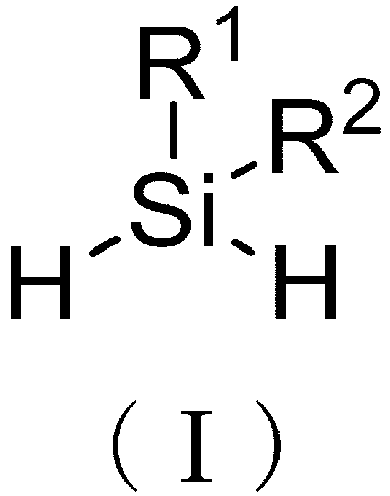
- [1] A method for producing a triorganosilane compound which comprises the following steps (1) and (2): (1) a step of reacting a diorganosilane compound represented by the formula (I):


- [2] The method for producing a triorganosilane compound described in [1], wherein R1 and R2 each independently are a secondary or tertiary C4-6 alkyl group.
- [3] The method for producing a triorganosilane compound described in [2], wherein R1 and R2 each independently are a tertiary C4-6 alkyl group.
- [4] The method for producing a triorganosilane compound described in [3], wherein R1 and R2 each independently are a tert-butyl group.
- [5] The method for producing a triorganosilane compound described in any one of [1] to [4], wherein the metal reagent is R3Li.
- [6] The method for producing a triorganosilane compound described in [5], wherein R3 is a C3-6 alkyl group or a C6-12 aryl group which may have a substituent(s).
- [7] The method for producing a triorganosilane compound described in [6], wherein R3 is a C3-6 alkyl group.
- [8] The method for producing a triorganosilane compound described in [7], wherein R3 is a sec-butyl group or an n-butyl group.
- [9] The method for producing a triorganosilane compound described in [6], wherein R3 is a C6-12 aryl group which may have a substituent(s).
- [10] The method for producing a triorganosilane compound described in [9], wherein R3 is a phenyl group which may have a substituent(s).
- [11] The method for producing a triorganosilane compound described in [9], wherein R3Li is a C6-12 aryllithium which may have a substituent(s) prepared from a halogenated C6-12 aryl which may have a substituent(s).
- [12] The method for producing a triorganosilane compound described in [9], wherein R3Li is a C6-12 aryllithium which may have a substituent(s) prepared by using a halogenated C6-12 aryl which may have a substituent(s) and n-butyllithium or sec-butyllithium.
- [13] The method for producing a triorganosilane compound described in any one of [1] to [4], wherein the metal reagent is R3MgX.
- [14] The method for producing a triorganosilane compound described in [13], wherein R3 is a C7-13 aralkyl group.
- [15] The method for producing a triorganosilane compound described in [14], wherein R3 is a benzyl group.
- [16] The method for producing a triorganosilane compound described in any one of [13] to [15], wherein X is a chlorine atom or a bromine atom.
- [17] The method for producing a triorganosilane compound described in any one of [1] to [16], wherein the triflating reagent is trifluoromethanesulfonic acid, trifluoromethanesulfonic anhydride, trifluoromethanesulfonyl chloride, N-(2-pyridyl)bis(tri-fluoromethanesulfonimide) or trimethylsilyl trifluoromethanesulfonate.
- [18] The method for producing a triorganosilane compound described in [17], wherein the triflating reagent is trifluoromethanesulfonic acid.
- [19] The method for producing a triorganosilane compound described in any one of [1] to [18], which further comprises the following step (3): (3) among R1, R2 and R3 of the triorganosilane compound obtained in the step (2), at least one of which is an aryl group having 6 or more carbon atoms which may have a substituent(s), a step of converting the aryl group into a cycloalkyl group by reacting with hydrogen in the presence of a metal catalyst.
- [20] The method for producing a triorganosilane compound described in [19], wherein among R1, R2 and R3 of the triorganosilane compound obtained in the step (2), at least one of which is a phenyl group which may have a substituent(s).
- [21] The method for producing a triorganosilane compound described in [19] or [20], wherein the metal catalyst is ruthenium-alumina powder or rhodium carbon powder.
- [22] The method for producing a triorganosilane compound described in [21], wherein the metal catalyst is ruthenium-alumina powder.
- According to the present invention, a novel method for producing a triorganosilane compound could be provided.
- In the following, the present invention will be explained in more detail.
- In the present specification, "n-" means normal, "s-" and "sec" mean secondary, "t-" and "tert-" mean tertiary, "Bu" means butyl, "Hex" means hexyl, "Ph" means phenyl, "c" means cyclo, "Bn" means benzyl, "Mes" means mesityl and "cC6H10" means cyclohexanediyl.
- The terms "halogen atom" mean a fluorine atom, a chlorine atom, a bromine atom or an iodine atom.
- The terms "C1-40 alkyl group" mean a linear or branched alkyl group in which a carbon number is 1 to 40, and specific examples thereof may be mentioned a methyl group, an ethyl group, an n-propyl group, an isopropyl group, an n-butyl group, an isobutyl group, an s-butyl group, a t-butyl group, an n-pentyl group, an n-hexyl group, an octyl group, a decyl group, a dodecyl group, a hexadecyl group, an octadecyl group, a docosyl group, a triacontyl group, a tetracontyl group, a 3,7,11,15-tetramethyl-hexadecyl group, etc. Also, the terms "C1-20 alkyl group" mean a linear or branched alkyl group in which a carbon number is 1 to 20, the terms "C1-6 alkyl group" are that in which a carbon number is 1 to 6, and the terms "C3-6 alkyl group" are that in which a carbon number is 3 to 6.
- The terms "secondary or tertiary alkyl group having 4 or more carbon atoms" mean a secondary or tertiary alkyl group in which a carbon number is 4 or more, preferably a secondary or tertiary alkyl group in which a carbon number is 4 to 40, more preferably that in which a carbon number is 4 to 20, further preferably that in which a carbon number is 4 to 10, and particularly preferably that in which a carbon number is 4 to 6. Incidentally, the secondary or tertiary alkyl group means an alkyl group in which the bonding position as a group resides on a secondary or tertiary carbon. Specific examples thereof may be mentioned a 2-butyl group, a t-butyl group, a 3-pentyl group, a thexyl group, etc. Also, the terms "secondary or tertiary C4-6 alkyl group" mean a secondary or tertiary alkyl group in which a carbon number is 4 to 6, and the terms "tertiary C4-6 alkyl group" mean a tertiary alkyl group in which a carbon number is 4 to 6.
- The terms "alkyl group having 3 or more carbon atoms" mean a linear or branched alkyl group in which a carbon number is 3 or more, preferably mean a linear or branched alkyl group in which a carbon number is 3 to 40, more preferably that in which a carbon number is 3 to 20, further preferably that in which a carbon number is 3 to 10, and particularly preferably that in which a carbon number is 3 to 6, and specific examples of the alkyl group having 3 or more carbon atoms may be mentioned an n-propyl group, an isopropyl group, an n-butyl group, a 2-butyl group, a t-butyl group, an n-pentyl group, a 3-pentyl group, an n-hexyl group, a thexyl group, etc.
- The terms "cyclo alkyl group having 3 or more carbon atoms" mean a cyclic alkyl group in which a carbon number is 3 or more carbon atoms, preferably a cyclic alkyl group in which a carbon number is 3 to 40, more preferably that in which a carbon number is 3 to 20, further preferably that in which a carbon number is 3 to 10, and particularly preferably that in which a carbon number is 3 to 6. Specific examples of the cycloalkyl group having 3 or more carbon atoms may be mentioned a cyclopropyl group, a cyclobutyl group, a cyclopentyl group, a cyclohexyl group, etc.
- The terms "aryl group having 6 or more carbon atoms" mean an aromatic hydrocarbon group in which a carbon number is 6 or more atoms, preferably an aromatic hydrocarbon group in which a carbon number is 6 to 40, more preferably that in which a carbon number is 6 to 20, and further preferably that in which a carbon number is 6 to 12. Specific examples of the aryl group having 6 or more carbon atoms may be mentioned a phenyl group, a 1-naphthyl group, a 2-naphthyl group, a 1-anthracenyl group, a 2-anthracenyl group, a 9-anthracenyl group, a biphenyl group, etc. Also, the terms "C6-12 aryl group" mean an aryl group in which a carbon number is 6 to 12.
- The terms "aralkyl group having 7 or more carbon atoms" mean an arylalkyl group in which a carbon number is 7 or more, preferably an arylalkyl group in which a carbon number is 7 to 40, more preferably that in which a carbon number is 7 to 20, and further preferably that in which a carbon number is 7 to 13. Specific examples of the aralkyl group having 7 or more carbon atoms may be mentioned a benzyl group, a 1-phenylethyl group, a 2-phenylethyl group, a 1-phenylpropyl group, a 2-phenylpropyl group, a 3-phenylpropyl group, a diphenylmethyl group, a naphthylmethyl group, a 1-naphthylethyl group, a 1-naphthylpropyl group, etc. Also, the terms "C7-13 aralkyl group" mean an aralkyl group in which a carbon number is 7 to 13.
- The terms "halogenated C6-12 aryl" mean an aryl in which a carbon number is 6 to 12 and one or more hydrogen(s) on the aromatic ring is/are substituted by a halogen atom(s), and specific examples thereof may be mentioned chlorobenzene, bromobenzene, iodobenzene, etc.
- The terms "C6-12 aryllithium" mean a compound in which a carbon number is 6 to 12 and that has a carbon-lithium bond, and specific examples thereof may be mentioned phenyllithium, 1-naphthyllithium, 2-naphthyllithium, etc.
- The terms "which may have a substituent(s)" mean that it is unsubstituted, or substituted by an optional number of an optional substituent(s).
- With regard to the above-mentioned "optional substituent(s)", the kind thereof is not particularly limited as long as it is a substituent which does not exert any bad effect to the reaction which is the target of the present invention.
- The "substituent(s)" in "which may have a substituent(s)" is not particularly limited, and there may be mentioned, for example, a C1-40 alkyl group, a hydroxy group, a C1-40 alkoxy group, an acetoxy group, a di-C1-40 alkylamino group, a halogen atom, etc., preferably a C1-40 alkyl group, a C1-40 alkoxy group or a di-C1-6 alkylamino group, and more preferably a C1-40 alkyl group or a C1-40 alkoxy group.
- The terms "C1-40 alkoxy group" mean a linear or branched alkoxy group in which a carbon number is 1 to 40 carbon atoms, and specific examples thereof may be mentioned a methoxy group, an ethoxy group, an n-propyloxy group, an isopropyloxy group, an n-butyloxy group, a t-butyloxy group, an n-pentyloxy group, an n-hexyloxy group, an octyloxy group, a dodecyloxy group, a hexadecyloxy group, an octadecyloxy group, etc.
- The terms "di-C1-40 alkylamino group" mean a group in which the same or different two above-mentioned "C1-40 alkyl groups" are bonded to an amino group, and specific examples thereof may be mentioned a dimethylamino group, a diethylamino group, a di-n-propylamino group, a diisopropylamino group, a di-n-butylamino group, a diisobutylamino group, a di-t-butylamino group, a di-n-pentylamino group, a di-n-hexylamino group, an N-ethyl-N-methylamino group, an N-methyl-N-n-propylamino group, an N-isopropyl-N-methylamino group, an N-n-butyl-N-methylamino group, an N-isobutyl-N-methylamino group, an N-t-butyl-N-methylamino group, an N-methyl-N-n-pentylamino group, an N-n-hexyl-N-methylamino group, an N-ethyl-N-n-propylamino group, an N-ethyl-N-isopropylamino group, an N-n-butyl-N-ethylamino group, an N-ethyl-N-isobutylamino group, an N-t-butyl-N-ethylamino group, an N-ethyl-N-n-pentylamino group, an N-ethyl-N-n-hexylamino group, a dioctylamino group, a didecyl-amino group, a didodecylamino group, a dihexadecylamino group, a dioctadecylamino group, a didocosylamino group, etc.
- (Specific explanation of method for producing triorganosilane compound of present invention)
- In the following, the respective steps (i) to (iii) of the method for producing a triorganosilane compound of the present invention will be explained.
- As one aspect, the production of the triorganosilane compound of the present invention is constituted by the respective unit steps described as the following steps (i) to (iii).
- As one aspect, the production of the triorganosilane compound of the present invention can be carried out by subjecting to all the unit steps described as the following steps (i) to (iii) or combining these appropriately.
- Incidentally, the present specific explanation will be explained by the following.
- (a) R1, R2 and R3 in the description of the steps (i) to (iii) are the same as defined above.
- (b) The specific conditions of the reaction are not particularly limited as long as production of the triorganosilane compound of the present invention can be accomplished. Preferred conditions in each reaction are appropriately described in detail.
- (c) The solvent described in each reaction may be used alone or may be used in admixture of two or more kinds.
- The present step is a step of reacting a diorganosilane compound (compound (I)) with a triflating reagent to obtain a monotriflate compound (compound (III)).

- R1 and R2 are each independently preferably a secondary or tertiary alkyl group having 4 or more carbon atoms, more preferably a secondary or tertiary C4-6 alkyl group, and further preferably a t-butyl group.
- The triflating reagent to be used in the present step is not particularly limited, and examples thereof may be mentioned trifluoromethanesulfonic acid, trifluoromethanesulfonic anhydride, trifluoromethanesulfonyl chloride, N-(2-pyridyl)bis(tri-fluoromethanesulfonimide), trimethylsilyl trifluoromethanesulfonate, etc. It is preferably trifluoromethanesulfonic acid or trimethylsilyl trifluoromethanesulfonate, and more preferably trifluoromethanesulfonic acid.
- The solvent used in the present step is not particularly limited as long as it does not prohibit the reaction, and examples thereof may be mentioned an aliphatic hydrocarbon (for example, pentane, hexane, heptane), a halogen-containing hydrocarbon solvent (for example, dichloromethane, chloroform), an aromatic hydrocarbon solvent (for example, toluene, xylene), an ether solvent (for example, tetrahydrofuran, 1,4-dioxane, cyclopentyl methyl ether, methyl-t-butyl ether), an amide solvent (for example, N,N-dimethylformamide), a nitrile solvent (for example, acetonitrile), etc. It is preferably an aliphatic hydrocarbon or a halogen-containing hydrocarbon solvent, and more preferably hexane, heptane or dichloromethane.
- An amount of the solvent to be used in the present step is preferably 100-fold by mass or less based on the compound (I), more preferably 1-fold by mass to 50-fold by mass, and further preferably 5-fold by mass to 20-fold by mass.
- A reaction temperature is not particularly limited, and is preferably from -20°C to the reflux temperature of the reaction mixture, more preferably -20°C to 50°C, and further preferably -10°C to 30°C.
- The present step is to react the compound (III) obtained in the above-mentioned step (i) with a metal reagent to obtain a triorganosilane compound (the compound (II)).

- In the present specification, the metal reagent means an organolithium reagent represented by R3Li (wherein R3 represents an alkyl group having 3 or more carbon atoms which may have a substituent(s), a cycloalkyl group having 3 or more carbon atoms which may have a substituent(s), an aryl group having 6 or more carbon atoms which may have a substituent(s) or an aralkyl group having 7 or more carbon atoms which may have a substituent(s).), or a Grignard reagent represented by R3MgX (wherein R3 represents an alkyl group having 3 or more carbon atoms which may have a substituent(s), a cycloalkyl group having 3 or more carbon atoms which may have a substituent(s), an aryl group having 6 or more carbon atoms which may have a substituent(s) or an aralkyl group having 7 or more carbon atoms which may have a substituent(s), and X represents a chlorine atom, a bromine atom or an iodine atom.).
- When the metal reagent is R3Li, R3 is preferably a C3-6 alkyl group or a C6-12 aryl group which may have a substituent(s), more preferably a sec-butyl group, an n-butyl group, an n-hexyl group or a phenyl group which may have a substituent(s), and further preferably a sec-butyl group, an n-butyl group or a phenyl group which may have a substituent(s).
- When the metal reagent is R3MgX, R3 is preferably a C3-6 alkyl group, a C6-12 aryl group or a C7-13 aralkyl group, more preferably a C7-13 aralkyl group, and further preferably a benzyl group. X is preferably a chlorine atom or a bromine atom.
- Specific examples of the organolithium reagent may be mentioned n-butyllithium, sec-butyllithium, tert-butyllithium, n-hexyllithium, phenyllithium, etc., and specific examples of the Grignard reagent may be mentioned isopropylmagnesium bromide, tert-butylmagnesium chloride, cyclopropylmagnesium bromide, phenylmagnesium chloride, benzylmagnesium bromide, benzylmagnesium chloride, etc.
- When an aryllithium wherein the metal reagent is R3Li and R3 is an aryl group is used, a commercially available product may be used, or a material produced by the halogen-lithium exchange reaction using a halogenated aryl and a lithium reagent (n-butyllithium, sec-butyllithium, etc.) may be used.
- An amount of the metal reagent to be used is preferably 1 equivalent to 20 equivalents based on the compound (I) used in the step (i), more preferably 1 equivalent to 10 equivalents, and further preferably 1 equivalent to 5 equivalents.
- The solvent used in the present step is not particularly limited as long as it does not prohibit the reaction, and examples thereof may be mentioned an aliphatic hydrocarbon (for example, pentane, hexane, heptane), a halogen-containing hydrocarbon solvent (for example, dichloromethane, chloroform), an aromatic hydrocarbon solvent (for example, toluene, xylene), an ether solvent (for example, tetrahydrofuran, 1,4-dioxane, cyclopentyl methyl ether, methyl-t-butyl ether), an amide solvent (for example, N,N-dimethylformamide), a nitrile solvent (for example, acetonitrile), etc. It is preferably an aliphatic hydrocarbon or a halogen-containing hydrocarbon solvent, and more preferably hexane, heptane, tetrahydrofuran, cyclopentyl methyl ether or methyl-t-butyl ether.
- An amount of the solvent to be used is preferably 100-fold by mass or less based on the compound (I) used in the step (i), more preferably 1-fold by mass to 50-fold by mass, and further preferably 5-fold by mass to 20-fold by mass.
- A reaction temperature is not particularly limited, and is preferably from -40°C to the reflux temperature of the reaction mixture, more preferably -20°C to 50°C, and further preferably -10°C to 30°C.
- A reaction time is not particularly limited, and is preferably from starting the reaction to 72 hours, more preferably 0.1 to 48 hours, and further preferably 0.5 to 24 hours.
- For confirmation of the progress of the reaction, the same method as in the general liquid phase organic synthetic reaction can be applied. That is, the reaction can be traced using thin layer chromatography, gas chromatography, gas chromatography/mass analysis (GC/MS), etc.
- The present step is a step, when at least one of the substituents R1, R2 and R3 of the compound (II) is an aryl group having 6 or more carbon atoms which may have a substituent(s), in which hydrogen is reacted in the presence of a metal catalyst to convert the aryl group into a cycloalkyl group. As a specific example, when the aryl group is a phenyl group, it is converted into a cyclohexyl group.
- The metal catalyst used in the present step is not particularly limited, and there may be mentioned a palladium catalyst (for example, 5% palladium carbon powder STD type, 10% palladium carbon powder PE type, 5% palladium carbon powder NX type, 5% palladium carbon powder K type, 5% palladium carbon powder PE type, ASCA-2), a platinum catalyst (for example, 3% platinum carbon powder STD type, 3% platinum carbon powder SN101 type) and a ruthenium catalyst (for example, 5% ruthenium carbon powder A type, 5% ruthenium carbon powder B type, 5% ruthenium alumina powder (HYAc-5E N-type, HYAc-5E S-type). It is preferably ruthenium-alumina powder or rhodium carbon powder, and more preferably ruthenium-alumina powder.
- An amount of the metal catalyst to be used is preferably 0.001-fold by mass to 5-fold by mass based on the compound (III), more preferably 0.01-fold by mass to 1-fold by mass, and further preferably 0.05-fold by mass to 0.5-fold by mass.
- The hydrogen gas used in the present reaction is not necessarily to be high purity, and may contain nitrogen, methane, etc., which do not significantly affect the reduction reaction.
- A reaction pressure is 0.1 to 20 MPa in terms of a hydrogen partial pressure, preferably 0.2 to 10 MPa, and particularly preferably 0.3 to 1 MPa.
- The solvent used in the present step is not particularly limited as long as it does not prohibit the reaction, and examples thereof may be mentioned an aliphatic hydrocarbon (for example, pentane, hexane, heptane), a halogen-containing hydrocarbon solvent (for example, dichloromethane, chloroform), an ether solvent (for example, tetrahydrofuran, 1,4-dioxane, cyclopentyl methyl ether, methyl-t-butyl ether), an alcohol solvent (for example, methanol, ethanol, 2-propanol, 2,2,2-trifluoroethanol), etc. It is preferably an aliphatic hydrocarbon or an alcohol solvent, and more preferably hexane or heptane.
- An amount of the solvent to be used is preferably 100-fold by mass or less based on the compound (III), more preferably 1-fold by mass to 50-fold by mass, and further preferably 3-fold by mass to 10-fold by mass.
- A reaction temperature is not particularly limited, and is preferably from -40°C to the reflux temperature of the reaction mixture, more preferably 0°C to 50°C, and further preferably 10°C to 40°C.
- For confirmation of the progress of the reaction, the same method as in the general organic synthetic reaction can be applied. That is, the reaction can be traced using thin layer chromatography, gas chromatography, gas chromatography/mass analysis (GC/MS), etc.
- Hereinafter, the present invention will be explained in more detail by referring to Reference Synthetic Examples and Synthetic Examples, but the present invention is not limited to these Examples.
- Incidentally, in Examples, "M" means mol/L.
- The proton nuclear magnetic resonance (1H-NMR) in Examples was measured by, unless otherwise specifically mentioned, JNM-ECP300 manufactured by JEOL, Ltd., or JNM-ECX300 manufactured by JEOL, Ltd., in deuterated chloroform solvent, and the chemical shift was shown by the δ value (ppm) when tetramethylsilane was used as the internal standard (0.0 ppm).
- In the description of the NMR spectrum, "s" means singlet, "d" means doublet, "t" means triplet, "q" means quartet, "dd" means doublet of doublet, "dt" means doublet of triplet, "m" means multiplet, "br" means broad, "J" means coupling constant, "Hz" menas hertz, and "CDCl3" means deuterated chloroform.
- Gas chromatography/mass analysis was measured by using, unless otherwise specifically mentioned, GCMS-QP2010 Ultra manufactured by Shimadzu Corporation.
- In the description of the gas chromatography/mass analysis, CI is a chemical ionization method, and M-H means a proton deficient.
- In the following, unless otherwise specifically mentioned, the quantitative yield of Ph(tBu)2SiH was calculated by the quantitative analysis method using the following Analytical conditions A.
-
- Gas chromatography: GC-2030 manufactured by SHIMADZU Corporation
- Column: TC-1 (30 m×0.53 mm ID, 1.5 µm) manufactured by GL Sciences Inc.
- Injection method: Split 10 : 1
- Column temperature: 50°C (hold for 5 minutes) → temperature raised with temperature raising rate of 20°C/min → 300°C (hold for 10 minutes)
- Carrier gas: Nitrogen, Linear velocity 30 cm/sec
- Detector: FID, 230°C
- Standard substance: Ph(tBu)2SiH synthesized by the method described in Synthetic Example 1 was purified by silica gel chromatography, which was made the standard substance.
- NMR and MASS of the standard substance are shown.
- 1H-NMR (CDCl3)
- δ ppm: 1.05 (18H, s), 3.85 (1H, s), 7.32-7.36 (3H, m), 7.55-7.59 (2H, m)
- MASS (CI) m/z; 219.10 (M-H)+
- Quantitative method: Absolute calibration curve method
- In the following, unless otherwise specifically mentioned, the quantitative yield of cHex(tBu)2SiH was calculated by the quantitative analysis method using the Analytical conditions A.
- Standard substance: cHex(tBu)2SiH synthesized by the method described in Synthetic Example 5 was purified by silica gel chromatography, which was made the standard substance.
- NMR and MASS of the standard substance are shown.
- 1H-NMR (CDCl3)
- δppm: 1.06 (18H, s), 1.22-1.31 (11H, m), 3.18 (1H, s)
- MASS (CI) m/z; 225.10 (M-H)+
- Quantitative method: Absolute calibration curve method
- In the following, unless otherwise specifically mentioned, the quantitative yield of sBu(tBu)2SiH was calculated by the quantitative analysis method using the Analytical conditions A.
- Standard substance: sBu(tBu)2SiH synthesized by the method described in Synthetic Example 4 was purified by silica gel chromatography, which was made the standard substance.
- NMR and MASS of the standard substance are shown.
- 1H-NMR (CDCl3)
- δ ppm: 0.86-0.91 (3H, m), 1.05 (18H, d, J=1.8Hz), 1.19-1.33 (5H, m), 1.70-1.77 (1H, m), 3.30 (1H, s)
- MASS (CI) m/z; 199.05 (M-H)+
- Quantitative method: Absolute calibration curve method
- In the following, unless otherwise specifically mentioned, the quantitative yield of nBu(tBu)2SiH was calculated by the quantitative analysis method using the Analytical conditions A.
- Standard substance: nBu(tBu)2SiH synthesized by the method described in Synthetic Example 7 was purified by silica gel chromatography, which was made the standard substance.
- NMR and MASS of the standard substance are shown.
- 1H-NMR (CDCl3)
- δ ppm: 0.86-0.91 (3H, m), 1.00 (18H, s), 1.27-1.38 (6H, m), 3.28-3.30 (1H, m)
- MASS (CI) m/z; 199.05 (M-H)+
- Quantitative method: Absolute calibration curve method
- For purification by silica gel column chromatography, unless otherwise specifically mentioned, either of Hi-Flash column manufactured by Yamazen Corporation, Silica gel 60 manufactured by Merck or PSQ60B manufactured by Fuji Silysia Chemical Ltd., was used.
-

- Di-tert-butylsilane (0.20 g, 1.39 mmol) was mixed with hexane (0.4 g), the mixture was cooled to 0°C, trifluoromethanesulfonic acid (0.27 g, 1.81 mmol) was added thereto and the resulting mixture was stirred at room temperature for 24 hours. In a separate vessel, sec-butyllithium (1 M hexane solution, 1.9 mL, 1.9 mmol) and phenyl bromide (0.33 g, 2.1 mmol) were mixed at 0°C, and the mixture was stirred at room temperature for 30 minutes. To the obtained reaction solution were added dropwise a mixed solution of tetrahydrofuran (0.40 g), di-tert-butylsilane and trifluoromethanesulfonic acid and the resulting mixture was stirred for 3 hours. The obtained reaction liquid was washed with 3.6 wt% hydrochloric acid (1.4 g) and a 5 wt% aqueous sodium chloride solution (1.4 g) in this order. The quantitative yield of Ph(tBu)2SiH in the organic layer was 89%.
-

- Di-tert-butylsilane (0.20 g, 1.39 mmol) was mixed with hexane (1.0 g), the mixture was cooled to 0°C, trifluoromethanesulfonic acid (0.27 g, 1.8 mmol) was added thereto and the resulting mixture was stirred at room temperature for 1 hour. In a separate vessel, sec-butyllithium (1 M hexane solution, 1.9 mL, 1.9 mmol), 1-bromo-4-dodecylbenzene (0.63 g, 1.9 mmol) and tetrahydrofuran (1.0 g) were mixed at 0°C, and the mixture was stirred at room temperature for 1 hour. To the obtained reaction solution were added dropwise a mixed solution of di-tert-butylsilane and trifluoromethanesulfonic acid, and the resulting mixture was stirred for 15 hours. The obtained reaction liquid was diluted with hexane, and washed with a 10 wt% aqueous ammonium chloride solution (2 mL) and a 5 wt% aqueous sodium chloride solution (1.0 g) in this order. The obtained organic layer was concentrated and then purified by silica gel column chromatography to obtain C12H25-C6H4(tBu)2SiH (0.32 g, Yield: 59%) as a colorless oily product.
- 1H-NMR (CDCl3)
- δppm: 0.88 (3H, t, J=7.2Hz), 1.04 (18H, s), 1.20-1.30 (18H, m), 1.59-1.61 (2H, m), 2.52-2.61 (2H, m), 3.83 (1H, s), 7.12 (2H, d, J=8.4Hz), 7.46 (2H, d, J=8.1Hz)
-

- Di-tert-butylsilane (0.20 g, 1.39 mmol) was mixed with hexane (1.0 g), the mixture was cooled to 0°C, trifluoromethanesulfonic acid (0.27 g, 1.8 mmol) was added thereto and the resulting mixture was stirred at room temperature for 1.5 hours. In a separate vessel, sec-butyllithium (1 M hexane solution, 1.9 mL, 1.9 mmol), 2-bromomesitylene (0.39 g, 1.9 mmol) and tetrahydrofuran (1.0 g) were mixed at 0°C, and the mixture was stirred for 1 hour. To the obtained reaction solution were added dropwise a mixed solution of di-tert-butylsilane and trifluoromethanesulfonic acid, and the resulting mixture was stirred for 15 hours. The obtained reaction liquid was diluted with hexane, and washed with a 10 wt% aqueous ammonium chloride solution (2 mL), a 5 wt% aqueous sodium chloride solution (1.0 g) in this order. The obtained organic layer was concentrated and then purified by silica gel column chromatography to obtain Mes(tBu)2SiH (0.22 g, Yield: 62%) as a colorless oily product.
- 1H-NMR (CDCl3)
- δ ppm: 0.99 (18H, s), 2.28 (9H, s), 3.97 (1H, s), 6.81 (2H, s)
-

- Di-tert-butylsilane (0.10 g, 0.69 mmol) and hexane (0.5 g) were mixed, the mixture was cooled to 0°C, trifluoromethanesulfonic acid (0.14 g, 0.93 mmol) was added thereto and the resulting mixture was stirred at room temperature for 1 hour. This solution was cooled to 0°C, sec-butyllithium (1 M hexane solution, 0.90 mL, 0.90 mmol) was added thereto and the resulting mixture was stirred for 10 minutes. The obtained reaction liquid was diluted with hexane, and washed with a 10 wt% aqueous ammonium chloride solution (1.0 g) and a 5 wt% aqueous sodium chloride solution (1.0 g) in this order. The obtained organic layer was concentrated and then purified by silica gel column chromatography to obtain sBu(tBu)2SiH (0.19 g, Yield: 85%) as a colorless oily product.
-
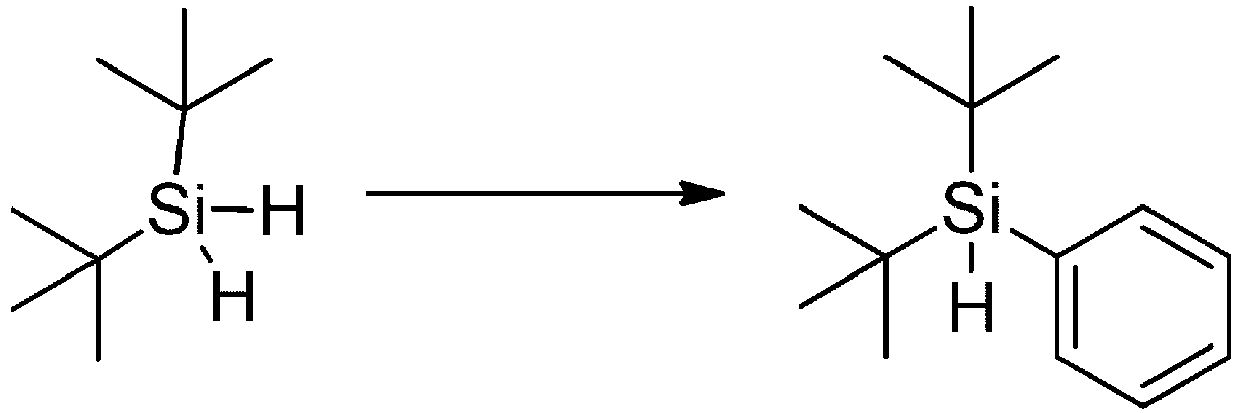
- Sec-butyllithium (1 M hexane solution, 1.8mL, 1.8 mmol) and phenyl bromide (0.13 g, 0.83 mmol) were mixed at 0°C, and the mixture was stirred at room temperature for 30 minutes. To the obtained reaction solution were added dropwise a solution in which di-tert-butylsilane (0.10 g, 0.69 mmol) and tetrahydrofuran (0.40 g) had been mixed, and the resulting mixture was stirred at room temperature for 16 hours. The obtained reaction liquid was washed with 3.6 wt% hydrochloric acid (1.4 g) and a 5 wt% aqueous sodium chloride solution (0.7 g) in this order. The quantitative yield of Ph(tBu)2SiH in the organic layer was 56%.
-

- Di-tert-butylsilane (0.10 g, 0.69 mmol) was mixed with hexane (0.5 g), sec-butyllithium (1 M hexane solution, 0.90 mL, 0.90 mmol) was added to the solution at room temperature and the resulting mixture was stirred at 70°C for 41 hours. The obtained reaction liquid was successively washed with hexane, and then, washed with a 10 wt% aqueous ammonium chloride solution (1.0 g) and a 5 wt% aqueous sodium chloride solution (1.0 g) in this order. The quantitative yield of sBu(tBu)2SiH in the obtained organic layer was 4.7%.
-

- Ph(tBu)2SiH (0.40 g, 1.81 mmol) was mixed with hexane (2.8 g), 5 wt% ruthenium-alumina powder (Trade name: HYAc-5E N-type, 0.16 g) was added thereto and the resulting mixture was stirred at 30°C, under hydrogen atmosphere and 0.8 MPa for 13 hours. The obtained reaction liquid was filtered, and the quantitative yield of cHex(tBu)2SiH in the filtrate was 94%.
-
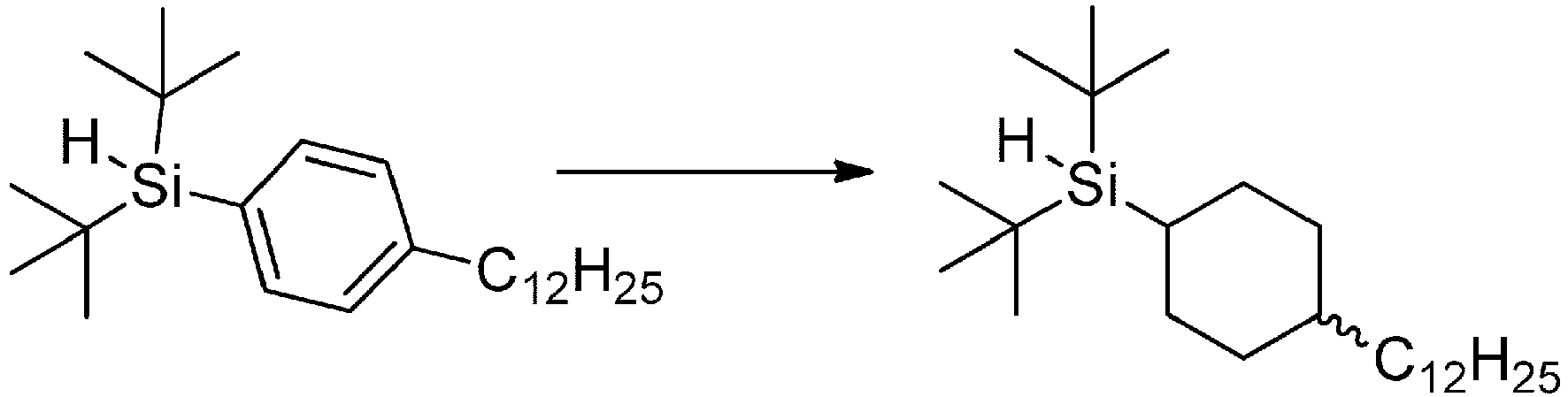
- C12H25-C6H4(tBu)2SiH (0.70 g, 1.80 mmol) was mixed with hexane (7.0 g), 5 wt% ruthenium-alumina powder (Trade name: HYAc-5E S-type, 0.21 g) was added thereto and the resulting mixture was stirred at 60°C, under hydrogen atmosphere and 0.8 MPa for 4 hours. Thereto was added 5 wt% ruthenium-alumina powder (0.14 g) and the resulting mixture was further stirred for 19 hours, and the obtained reaction liquid was filtered. The filtrate was concentrated and then purified by silica gel chromatography to obtain C12H25-cC6H10(tBu)2SiH (0.56 g) as a colorless oily product.
- 1H-NMR(CDCl3)
- δ ppm: 0.83-0.90 (3H, m), 1.05 (18H, s), 1.43-1.70 (32H, m), 3.18 (1H, s)
-

- Di-tert-butylsilane (0.30 g, 2.08 mmol) was mixed with hexane (3.0 g), the mixture was cooled to 0°C, trifluoromethanesulfonic acid (0.47 g, 3.1 mmol) was added thereto and the resulting mixture was stirred at 30°C for 2 hours. This solution was cooled to 0°C, tetrahydrofuran (1.2 g) and n-butyllithium (1.6M hexane solution, 3.3 mL, 5.2 mmol) were added thereto and the resulting mixture was stirred for 2 hours. The obtained reaction liquid was diluted with hexane, and the liquids were separated by a 10 wt% aqueous ammonium chloride solution (5 mL). The aqueous layer was extracted with hexane (3 mL), and the obtained organic layers were mixed. The quantitative yield of nBu(tBu)2SiH in the organic layer was 93%.
-

- Di-tert-butylsilane (0.20 g, 1.39 mmol) was mixed with hexane (1. 0 g), the mixture was cooled to 0°C, trifluoromethanesulfonic acid (0.27 g, 1.3 mmol) was added thereto and the resulting mixture was stirred at room temperature for 3 hours. To the solution was added dropwise a benzyl magnesium chloride-2M tetrahydrofuran solution (1.0 mL, 2.0 mmol), and the resulting mixture was stirred at room temperature for 4 hours. The obtained reaction liquid was diluted with tert-butyl methyl ether, and then, the liquids were separated by a 10 wt% aqueous ammonium chloride solution (2 mL). The obtained organic layer was concentrated and then purified by silica gel column chromatography to obtain Bn(tBu)2SiH (0.28 g, Yield: 85%) as a colorless oily product.
- 1H-NMR (CDCl3)
- δ ppm: 0.99 (18H, s), 2.22 (2H, d, J=3.5Hz), 3.56 (1H, t, J=3.5Hz), 7.03-7.28 (5H, m) MASS (CI) m/z; 233.05 (M-H)+
- According to the present invention, it can provide an effective method for producing a triorganosilane compound.
Claims (22)
- A method for producing a triorganosilane compound which comprises the following steps (1) and (2):(1) a step of reacting a diorganosilane compound represented by the formula (I):


to obtain a triorganosilane compound represented by the formula (II):
- The method for producing a triorganosilane compound according to Claim 1, wherein R1 and R2 each independently are a secondary or tertiary C4-6 alkyl group.
- The method for producing a triorganosilane compound according to Claim 2, wherein R1 and R2 each independently are a tertiary C4-6 alkyl group.
- The method for producing a triorganosilane compound according to Claim 3, wherein R1 and R2 each independently are a tert-butyl group.
- The method for producing a triorganosilane compound according to any one of Claims 1 to 4, wherein the metal reagent is R3Li.
- The method for producing a triorganosilane compound according to Claim 5, wherein R3 is a C3-6 alkyl group or a C6-12 aryl group which may have a substituent(s).
- The method for producing a triorganosilane compound according to Claim 6, wherein R3 is a C3-6 alkyl group.
- The method for producing a triorganosilane compound according to Claim 7, wherein R3 is a sec-butyl group or an n-butyl group.
- The method for producing a triorganosilane compound according to Claim 6, wherein R3 is a C6-12 aryl group which may have a substituent(s).
- The method for producing a triorganosilane compound according to Claim 9, wherein R3 is a phenyl group which may have a substituent(s).
- The method for producing a triorganosilane compound according to Claim 9, wherein R3Li is a C6-12 aryllithium which may have a substituent(s) prepared from a halogenated C6-12 aryl which may have a substituent(s).
- The method for producing a triorganosilane compound according to Claim 9, wherein R3Li is a C6-12 aryllithium which may have a substituent(s) prepared by using a halogenated C6-12 aryl which may have a substituent(s), and n-butyllithium or sec-butyllithium.
- The method for producing a triorganosilane compound according to any one of Claims 1 to 4, wherein the metal reagent is R3MgX.
- The method for producing a triorganosilane compound according to Claim 13, wherein R3 is a C7-13 aralkyl group.
- The method for producing a triorganosilane compound according to Claim 14, wherein R3 is a benzyl group.
- The method for producing a triorganosilane compound according to any one of Claims 13 to 15, wherein X is a chlorine atom or a bromine atom.
- The method for producing a triorganosilane compound according to any one of Claims 1 to 16, wherein the triflating reagent is trifluoromethanesulfonic acid, trifluoromethanesulfonic anhydride, trifluoromethanesulfonyl chloride, N-(2-pyridyl)-bis(trifluoromethanesulfonimide) or trimethylsilyl trifluoromethanesulfonate.
- The method for producing a triorganosilane compound according to Claim 17, wherein the triflating reagent is trifluoromethanesulfonic acid.
- The method for producing a triorganosilane compound according to any one of Claims 1 to 18, which further comprises the following step (3): (3) among R1, R2 and R3 of the triorganosilane compound obtained in the step (2), at least one of which is an aryl group having 6 or more carbon atoms which may have a substituent(s), a step of converting the aryl group into a cycloalkyl group by reacting with hydrogen in the presence of a metal catalyst.
- The method for producing a triorganosilane compound according to Claim 19, wherein among R1, R2 and R3 of the triorganosilane compound obtained in the step (2), at least one of which is a phenyl group which may have a substituent(s).
- The method for producing a triorganosilane compound according to Claim 19 or 20, wherein the metal catalyst is ruthenium-alumina powder or rhodium carbon powder.
- The method for producing a triorganosilane compound according to Claim 21, wherein the metal catalyst is ruthenium-alumina powder.
Applications Claiming Priority (2)
| Application Number | Priority Date | Filing Date | Title |
|---|---|---|---|
| JP2019086647 | 2019-04-26 | ||
| PCT/JP2020/017478 WO2020218413A1 (en) | 2019-04-26 | 2020-04-23 | Method for producing triorganosilane compound |
Publications (4)
| Publication Number | Publication Date |
|---|---|
| EP3960725A1 true EP3960725A1 (en) | 2022-03-02 |
| EP3960725A4 EP3960725A4 (en) | 2023-05-03 |
| EP3960725C0 EP3960725C0 (en) | 2024-07-10 |
| EP3960725B1 EP3960725B1 (en) | 2024-07-10 |
Family
ID=72942123
Family Applications (1)
| Application Number | Title | Priority Date | Filing Date |
|---|---|---|---|
| EP20795713.5A Active EP3960725B1 (en) | 2019-04-26 | 2020-04-23 | Method for producing triorganosilane compound |
Country Status (5)
| Country | Link |
|---|---|
| US (1) | US12466845B2 (en) |
| EP (1) | EP3960725B1 (en) |
| JP (1) | JP7517331B2 (en) |
| CN (1) | CN113727959B (en) |
| WO (1) | WO2020218413A1 (en) |
Families Citing this family (1)
| Publication number | Priority date | Publication date | Assignee | Title |
|---|---|---|---|---|
| JP7560857B2 (en) | 2020-10-02 | 2024-10-03 | 国立研究開発法人産業技術総合研究所 | Method for producing sulfonic acid silyl ester and novel silicon compound |
Family Cites Families (7)
| Publication number | Priority date | Publication date | Assignee | Title |
|---|---|---|---|---|
| DE3632792A1 (en) | 1986-09-26 | 1988-04-07 | Bayer Ag | Poly(tricyclo[5.2.1.0<2,6>]decanyl)siloxane derivatives |
| FR2775478B1 (en) * | 1998-02-27 | 2000-05-19 | Rhodia Chimie Sa | USEFUL PROCESS FOR THE SILYLATION OF TRIFLIC ACID |
| JP4058605B2 (en) | 2001-12-28 | 2008-03-12 | 信越化学工業株式会社 | Silyl triflate compound having bulky substituent and method for producing the same |
| JP4292848B2 (en) * | 2003-04-07 | 2009-07-08 | 新日本理化株式会社 | Method for producing alicyclic group-substituted silane compound |
| EP2816087B1 (en) | 2005-12-13 | 2016-11-09 | Asahi Kasei Kabushiki Kaisha | Aqueous organic-inorganic hybrid composition |
| WO2011155407A1 (en) | 2010-06-07 | 2011-12-15 | セントラル硝子株式会社 | Chemical solution for formation of protective film |
| JP7196087B2 (en) | 2017-10-03 | 2022-12-26 | 日産化学株式会社 | Method for producing peptide compound |
-
2020
- 2020-04-23 CN CN202080030699.XA patent/CN113727959B/en active Active
- 2020-04-23 JP JP2021516200A patent/JP7517331B2/en active Active
- 2020-04-23 US US17/606,198 patent/US12466845B2/en active Active
- 2020-04-23 EP EP20795713.5A patent/EP3960725B1/en active Active
- 2020-04-23 WO PCT/JP2020/017478 patent/WO2020218413A1/en not_active Ceased
Also Published As
| Publication number | Publication date |
|---|---|
| CN113727959B (en) | 2024-10-25 |
| US20220220133A1 (en) | 2022-07-14 |
| EP3960725A4 (en) | 2023-05-03 |
| US12466845B2 (en) | 2025-11-11 |
| JPWO2020218413A1 (en) | 2020-10-29 |
| WO2020218413A1 (en) | 2020-10-29 |
| EP3960725C0 (en) | 2024-07-10 |
| EP3960725B1 (en) | 2024-07-10 |
| JP7517331B2 (en) | 2024-07-17 |
| CN113727959A (en) | 2021-11-30 |
Similar Documents
| Publication | Publication Date | Title |
|---|---|---|
| Oshiki et al. | Stereospecific reduction of menthyloxyphosphine-boranes with one-electron reducing agents | |
| JP2015083570A (en) | Intermediate for synthesis of benzoindene prostaglandin and manufacturing method therefor | |
| EP3960725B1 (en) | Method for producing triorganosilane compound | |
| US20040106818A1 (en) | Process for the preparation of cyclohexanol derivatives | |
| JPH0733392B2 (en) | 2,2'-bis [di (m-tolyl) phosphino] -1,1'-binaphthyl | |
| Naka et al. | Silicon-Carbon Unsaturated Compounds. 50. Palladium-Catalyzed Reactions of 3, 4-Benzo-1, 1, 2, 2-tetraethyl-1, 2-disilacyclobut-3-ene and Reinvestigation of Its Thermal Dimerization Reaction | |
| EP0315886B1 (en) | Isoquinoline derivatives, their manufacture and use | |
| ES2283850T3 (en) | NEW CARBEN-NICKEL COMPLEXES, -PALADIO AND -PLATINO, ITS PRODUCTION AND USE IN CATALYTIC REACTIONS. | |
| CN104788480A (en) | A method of synthesizing aminophenylboronic acid pinacol ester | |
| Dey et al. | Novel Protocol for the Synthesis of Organic Ammonium Tribromides and Investigation of 1, 1′-(Ethane-1, 2-diyl) dipiperidinium Bis (tribromide) in the Silylation of Alcohols and Thiols | |
| Pandey et al. | Catalytic utility of a bimetallic (pincer) PNN-based nickel complex in the synthesis of quinolines and α-alkylation of ketones | |
| US6476250B1 (en) | Optically active fluorinated binaphthol derivative | |
| Xu et al. | Unexpected alkoxyl migration in the reaction of silyl ketene acetals with p-toluenesulfonyl azide | |
| Sivaramakrishna et al. | Synthesis and structural aspects of M-allyl (M= Ir, Rh) complexes | |
| Fiandanese et al. | A convenient synthesis of amides and nitriles with a branched and conjugated dienyne structure | |
| Yus et al. | Six-and five-membered 3-alkoxy-2-lithiocycloalkenes: new stable non-anionic β-functionalised organolithium compounds | |
| JP4156462B2 (en) | Method for producing acetate derivative | |
| US20040254076A1 (en) | Dihydroxy (3-pyridyl) borane compounds | |
| KR100455662B1 (en) | Aminocyclopentadienyl ruthenium complexes and preparation thereof | |
| Lee et al. | A new pathway in the reaction of disilene with carbonyl compounds: an ‘ene’reaction instead of cycloaddition | |
| JP4667589B2 (en) | Method for producing 2,4-dihydroxypyridine | |
| JP2010270092A (en) | Acetyl compound, method for producing the acetyl compound, and method for producing a naphthol compound using the acetyl compound | |
| US6673930B2 (en) | Process for the preparation of 5-(substituted)-10 methoxy-2,2,4-trimethyl-2,5-dihydro-1H-chromeno [3,4-F] quinolines and derivatives thereof | |
| US6291716B1 (en) | Ortho-alkylation method of aromatic ketones | |
| Bavetsias et al. | Synthesis of N-substituted derivatives of tert-butyl 4-aminobenzoate via a palladium-catalysed reaction |
Legal Events
| Date | Code | Title | Description |
|---|---|---|---|
| STAA | Information on the status of an ep patent application or granted ep patent |
Free format text: STATUS: THE INTERNATIONAL PUBLICATION HAS BEEN MADE |
|
| PUAI | Public reference made under article 153(3) epc to a published international application that has entered the european phase |
Free format text: ORIGINAL CODE: 0009012 |
|
| STAA | Information on the status of an ep patent application or granted ep patent |
Free format text: STATUS: REQUEST FOR EXAMINATION WAS MADE |
|
| 17P | Request for examination filed |
Effective date: 20211119 |
|
| AK | Designated contracting states |
Kind code of ref document: A1 Designated state(s): AL AT BE BG CH CY CZ DE DK EE ES FI FR GB GR HR HU IE IS IT LI LT LU LV MC MK MT NL NO PL PT RO RS SE SI SK SM TR |
|
| DAV | Request for validation of the european patent (deleted) | ||
| DAX | Request for extension of the european patent (deleted) | ||
| REG | Reference to a national code |
Ref country code: DE Ref legal event code: R079 Free format text: PREVIOUS MAIN CLASS: C07B0061000000 Ipc: C07F0007080000 Ref country code: DE Ref legal event code: R079 Ref document number: 602020033828 Country of ref document: DE Free format text: PREVIOUS MAIN CLASS: C07B0061000000 Ipc: C07F0007080000 |
|
| A4 | Supplementary search report drawn up and despatched |
Effective date: 20230331 |
|
| RIC1 | Information provided on ipc code assigned before grant |
Ipc: C07B 61/00 20060101ALI20230327BHEP Ipc: C07F 7/08 20060101AFI20230327BHEP |
|
| GRAP | Despatch of communication of intention to grant a patent |
Free format text: ORIGINAL CODE: EPIDOSNIGR1 |
|
| STAA | Information on the status of an ep patent application or granted ep patent |
Free format text: STATUS: GRANT OF PATENT IS INTENDED |
|
| RIC1 | Information provided on ipc code assigned before grant |
Ipc: C07B 61/00 20060101ALI20240112BHEP Ipc: C07F 7/08 20060101AFI20240112BHEP |
|
| INTG | Intention to grant announced |
Effective date: 20240202 |
|
| GRAS | Grant fee paid |
Free format text: ORIGINAL CODE: EPIDOSNIGR3 |
|
| GRAA | (expected) grant |
Free format text: ORIGINAL CODE: 0009210 |
|
| STAA | Information on the status of an ep patent application or granted ep patent |
Free format text: STATUS: THE PATENT HAS BEEN GRANTED |
|
| AK | Designated contracting states |
Kind code of ref document: B1 Designated state(s): AL AT BE BG CH CY CZ DE DK EE ES FI FR GB GR HR HU IE IS IT LI LT LU LV MC MK MT NL NO PL PT RO RS SE SI SK SM TR |
|
| REG | Reference to a national code |
Ref country code: CH Ref legal event code: EP |
|
| REG | Reference to a national code |
Ref country code: DE Ref legal event code: R096 Ref document number: 602020033828 Country of ref document: DE |
|
| U01 | Request for unitary effect filed |
Effective date: 20240808 |
|
| U07 | Unitary effect registered |
Designated state(s): AT BE BG DE DK EE FI FR IT LT LU LV MT NL PT SE SI Effective date: 20240821 |
|
| PG25 | Lapsed in a contracting state [announced via postgrant information from national office to epo] |
Ref country code: NO Free format text: LAPSE BECAUSE OF FAILURE TO SUBMIT A TRANSLATION OF THE DESCRIPTION OR TO PAY THE FEE WITHIN THE PRESCRIBED TIME-LIMIT Effective date: 20241010 |
|
| PG25 | Lapsed in a contracting state [announced via postgrant information from national office to epo] |
Ref country code: GR Free format text: LAPSE BECAUSE OF FAILURE TO SUBMIT A TRANSLATION OF THE DESCRIPTION OR TO PAY THE FEE WITHIN THE PRESCRIBED TIME-LIMIT Effective date: 20241011 Ref country code: PL Free format text: LAPSE BECAUSE OF FAILURE TO SUBMIT A TRANSLATION OF THE DESCRIPTION OR TO PAY THE FEE WITHIN THE PRESCRIBED TIME-LIMIT Effective date: 20240710 |
|
| PG25 | Lapsed in a contracting state [announced via postgrant information from national office to epo] |
Ref country code: IS Free format text: LAPSE BECAUSE OF FAILURE TO SUBMIT A TRANSLATION OF THE DESCRIPTION OR TO PAY THE FEE WITHIN THE PRESCRIBED TIME-LIMIT Effective date: 20241110 |
|
| PG25 | Lapsed in a contracting state [announced via postgrant information from national office to epo] |
Ref country code: HR Free format text: LAPSE BECAUSE OF FAILURE TO SUBMIT A TRANSLATION OF THE DESCRIPTION OR TO PAY THE FEE WITHIN THE PRESCRIBED TIME-LIMIT Effective date: 20240710 |
|
| PG25 | Lapsed in a contracting state [announced via postgrant information from national office to epo] |
Ref country code: ES Free format text: LAPSE BECAUSE OF FAILURE TO SUBMIT A TRANSLATION OF THE DESCRIPTION OR TO PAY THE FEE WITHIN THE PRESCRIBED TIME-LIMIT Effective date: 20240710 Ref country code: RS Free format text: LAPSE BECAUSE OF FAILURE TO SUBMIT A TRANSLATION OF THE DESCRIPTION OR TO PAY THE FEE WITHIN THE PRESCRIBED TIME-LIMIT Effective date: 20241010 |
|
| PG25 | Lapsed in a contracting state [announced via postgrant information from national office to epo] |
Ref country code: RS Free format text: LAPSE BECAUSE OF FAILURE TO SUBMIT A TRANSLATION OF THE DESCRIPTION OR TO PAY THE FEE WITHIN THE PRESCRIBED TIME-LIMIT Effective date: 20241010 Ref country code: PL Free format text: LAPSE BECAUSE OF FAILURE TO SUBMIT A TRANSLATION OF THE DESCRIPTION OR TO PAY THE FEE WITHIN THE PRESCRIBED TIME-LIMIT Effective date: 20240710 Ref country code: NO Free format text: LAPSE BECAUSE OF FAILURE TO SUBMIT A TRANSLATION OF THE DESCRIPTION OR TO PAY THE FEE WITHIN THE PRESCRIBED TIME-LIMIT Effective date: 20241010 Ref country code: IS Free format text: LAPSE BECAUSE OF FAILURE TO SUBMIT A TRANSLATION OF THE DESCRIPTION OR TO PAY THE FEE WITHIN THE PRESCRIBED TIME-LIMIT Effective date: 20241110 Ref country code: HR Free format text: LAPSE BECAUSE OF FAILURE TO SUBMIT A TRANSLATION OF THE DESCRIPTION OR TO PAY THE FEE WITHIN THE PRESCRIBED TIME-LIMIT Effective date: 20240710 Ref country code: GR Free format text: LAPSE BECAUSE OF FAILURE TO SUBMIT A TRANSLATION OF THE DESCRIPTION OR TO PAY THE FEE WITHIN THE PRESCRIBED TIME-LIMIT Effective date: 20241011 Ref country code: ES Free format text: LAPSE BECAUSE OF FAILURE TO SUBMIT A TRANSLATION OF THE DESCRIPTION OR TO PAY THE FEE WITHIN THE PRESCRIBED TIME-LIMIT Effective date: 20240710 |
|
| PG25 | Lapsed in a contracting state [announced via postgrant information from national office to epo] |
Ref country code: SM Free format text: LAPSE BECAUSE OF FAILURE TO SUBMIT A TRANSLATION OF THE DESCRIPTION OR TO PAY THE FEE WITHIN THE PRESCRIBED TIME-LIMIT Effective date: 20240710 |
|
| PG25 | Lapsed in a contracting state [announced via postgrant information from national office to epo] |
Ref country code: CZ Free format text: LAPSE BECAUSE OF FAILURE TO SUBMIT A TRANSLATION OF THE DESCRIPTION OR TO PAY THE FEE WITHIN THE PRESCRIBED TIME-LIMIT Effective date: 20240710 |
|
| PG25 | Lapsed in a contracting state [announced via postgrant information from national office to epo] |
Ref country code: SK Free format text: LAPSE BECAUSE OF FAILURE TO SUBMIT A TRANSLATION OF THE DESCRIPTION OR TO PAY THE FEE WITHIN THE PRESCRIBED TIME-LIMIT Effective date: 20240710 |
|
| PLBE | No opposition filed within time limit |
Free format text: ORIGINAL CODE: 0009261 |
|
| STAA | Information on the status of an ep patent application or granted ep patent |
Free format text: STATUS: NO OPPOSITION FILED WITHIN TIME LIMIT |
|
| U20 | Renewal fee for the european patent with unitary effect paid |
Year of fee payment: 6 Effective date: 20250415 |
|
| 26N | No opposition filed |
Effective date: 20250411 |
|
| PGFP | Annual fee paid to national office [announced via postgrant information from national office to epo] |
Ref country code: CH Payment date: 20250501 Year of fee payment: 6 |
|
| PG25 | Lapsed in a contracting state [announced via postgrant information from national office to epo] |
Ref country code: MC Free format text: LAPSE BECAUSE OF FAILURE TO SUBMIT A TRANSLATION OF THE DESCRIPTION OR TO PAY THE FEE WITHIN THE PRESCRIBED TIME-LIMIT Effective date: 20240710 |
|
| PGFP | Annual fee paid to national office [announced via postgrant information from national office to epo] |
Ref country code: GB Payment date: 20260327 Year of fee payment: 7 |
|
| PG25 | Lapsed in a contracting state [announced via postgrant information from national office to epo] |
Ref country code: IE Free format text: LAPSE BECAUSE OF NON-PAYMENT OF DUE FEES Effective date: 20250423 |
|
| PG25 | Lapsed in a contracting state [announced via postgrant information from national office to epo] |
Ref country code: RO Free format text: LAPSE BECAUSE OF FAILURE TO SUBMIT A TRANSLATION OF THE DESCRIPTION OR TO PAY THE FEE WITHIN THE PRESCRIBED TIME-LIMIT Effective date: 20240710 |
|
| REG | Reference to a national code |
Ref country code: CH Ref legal event code: U11 Free format text: ST27 STATUS EVENT CODE: U-0-0-U10-U11 (AS PROVIDED BY THE NATIONAL OFFICE) Effective date: 20260501 |