EP3959637B1 - Production participative basée sur une chaîne de blocs - Google Patents
Production participative basée sur une chaîne de blocs Download PDFInfo
- Publication number
- EP3959637B1 EP3959637B1 EP20719480.4A EP20719480A EP3959637B1 EP 3959637 B1 EP3959637 B1 EP 3959637B1 EP 20719480 A EP20719480 A EP 20719480A EP 3959637 B1 EP3959637 B1 EP 3959637B1
- Authority
- EP
- European Patent Office
- Prior art keywords
- solution
- function
- proof
- requestor
- smart contract
- Prior art date
- Legal status (The legal status is an assumption and is not a legal conclusion. Google has not performed a legal analysis and makes no representation as to the accuracy of the status listed.)
- Active
Links
Images




Classifications
-
- G—PHYSICS
- G06—COMPUTING OR CALCULATING; COUNTING
- G06F—ELECTRIC DIGITAL DATA PROCESSING
- G06F21/00—Security arrangements for protecting computers, components thereof, programs or data against unauthorised activity
- G06F21/60—Protecting data
- G06F21/64—Protecting data integrity, e.g. using checksums, certificates or signatures
-
- H—ELECTRICITY
- H04—ELECTRIC COMMUNICATION TECHNIQUE
- H04L—TRANSMISSION OF DIGITAL INFORMATION, e.g. TELEGRAPHIC COMMUNICATION
- H04L63/00—Network architectures or network communication protocols for network security
- H04L63/04—Network architectures or network communication protocols for network security for providing a confidential data exchange among entities communicating through data packet networks
- H04L63/0428—Network architectures or network communication protocols for network security for providing a confidential data exchange among entities communicating through data packet networks wherein the data content is protected, e.g. by encrypting or encapsulating the payload
- H04L63/0435—Network architectures or network communication protocols for network security for providing a confidential data exchange among entities communicating through data packet networks wherein the data content is protected, e.g. by encrypting or encapsulating the payload wherein the sending and receiving network entities apply symmetric encryption, i.e. same key used for encryption and decryption
-
- H—ELECTRICITY
- H04—ELECTRIC COMMUNICATION TECHNIQUE
- H04L—TRANSMISSION OF DIGITAL INFORMATION, e.g. TELEGRAPHIC COMMUNICATION
- H04L63/00—Network architectures or network communication protocols for network security
- H04L63/04—Network architectures or network communication protocols for network security for providing a confidential data exchange among entities communicating through data packet networks
- H04L63/0428—Network architectures or network communication protocols for network security for providing a confidential data exchange among entities communicating through data packet networks wherein the data content is protected, e.g. by encrypting or encapsulating the payload
- H04L63/0442—Network architectures or network communication protocols for network security for providing a confidential data exchange among entities communicating through data packet networks wherein the data content is protected, e.g. by encrypting or encapsulating the payload wherein the sending and receiving network entities apply asymmetric encryption, i.e. different keys for encryption and decryption
-
- H—ELECTRICITY
- H04—ELECTRIC COMMUNICATION TECHNIQUE
- H04L—TRANSMISSION OF DIGITAL INFORMATION, e.g. TELEGRAPHIC COMMUNICATION
- H04L9/00—Cryptographic mechanisms or cryptographic arrangements for secret or secure communications; Network security protocols
- H04L9/32—Cryptographic mechanisms or cryptographic arrangements for secret or secure communications; Network security protocols including means for verifying the identity or authority of a user of the system or for message authentication, e.g. authorization, entity authentication, data integrity or data verification, non-repudiation, key authentication or verification of credentials
- H04L9/3218—Cryptographic mechanisms or cryptographic arrangements for secret or secure communications; Network security protocols including means for verifying the identity or authority of a user of the system or for message authentication, e.g. authorization, entity authentication, data integrity or data verification, non-repudiation, key authentication or verification of credentials using proof of knowledge, e.g. Fiat-Shamir, GQ, Schnorr, ornon-interactive zero-knowledge proofs
-
- H—ELECTRICITY
- H04—ELECTRIC COMMUNICATION TECHNIQUE
- H04L—TRANSMISSION OF DIGITAL INFORMATION, e.g. TELEGRAPHIC COMMUNICATION
- H04L9/00—Cryptographic mechanisms or cryptographic arrangements for secret or secure communications; Network security protocols
- H04L9/32—Cryptographic mechanisms or cryptographic arrangements for secret or secure communications; Network security protocols including means for verifying the identity or authority of a user of the system or for message authentication, e.g. authorization, entity authentication, data integrity or data verification, non-repudiation, key authentication or verification of credentials
- H04L9/3236—Cryptographic mechanisms or cryptographic arrangements for secret or secure communications; Network security protocols including means for verifying the identity or authority of a user of the system or for message authentication, e.g. authorization, entity authentication, data integrity or data verification, non-repudiation, key authentication or verification of credentials using cryptographic hash functions
- H04L9/3239—Cryptographic mechanisms or cryptographic arrangements for secret or secure communications; Network security protocols including means for verifying the identity or authority of a user of the system or for message authentication, e.g. authorization, entity authentication, data integrity or data verification, non-repudiation, key authentication or verification of credentials using cryptographic hash functions involving non-keyed hash functions, e.g. modification detection codes [MDCs], MD5, SHA or RIPEMD
-
- H—ELECTRICITY
- H04—ELECTRIC COMMUNICATION TECHNIQUE
- H04L—TRANSMISSION OF DIGITAL INFORMATION, e.g. TELEGRAPHIC COMMUNICATION
- H04L2209/00—Additional information or applications relating to cryptographic mechanisms or cryptographic arrangements for secret or secure communication H04L9/00
- H04L2209/56—Financial cryptography, e.g. electronic payment or e-cash
-
- H—ELECTRICITY
- H04—ELECTRIC COMMUNICATION TECHNIQUE
- H04L—TRANSMISSION OF DIGITAL INFORMATION, e.g. TELEGRAPHIC COMMUNICATION
- H04L9/00—Cryptographic mechanisms or cryptographic arrangements for secret or secure communications; Network security protocols
- H04L9/50—Cryptographic mechanisms or cryptographic arrangements for secret or secure communications; Network security protocols using hash chains, e.g. blockchains or hash trees
Definitions
- the present disclosure generally pertains to the field of information processing, in particular to systems, devices, and methods for distributed computing and crowdsourcing of problems to potential solvers.
- Distributed computing is a field of computer science that studies distributed systems.
- components are located on different computers, which communicate and coordinate their actions by passing messages to one another via a communication network.
- the components interact with one another in order to achieve a common goal.
- Crowdsourcing is an outsourcing model in which individuals or organizations obtain solutions to problems from a large and open group of e.g. internet users.
- Outsourcing certain complex tasks faces two challenges: recruitment and trust. To ensure correct recruitment of resources to perform given tasks, and to guarantee that an agreement is upheld by both parties is difficult.
- the outsourcer Requestor
- the provider Solver
- the present invention provides a system according to independent claim 1.
- the present invention provides a computer-implemented method according to independent claim 10.
- the present invention provides an electronic device according to independent claim 11.
- the disclosure provides a system comprising a distributed ledger configured to store a smart contract related to a problem statement, the smart contract enabling a zero-knowledge proof concerning the problem statement.
- the disclosure provides a computer-implemented method comprising a Requestor requesting solutions to a problem statement, and a distributed ledger verifying a putative solution to the problem statement provided by a Solver using a zero-knowledge proof.
- the disclosure provides an electronic device comprising circuitry configured to implement a zero knowledge scheme in a smart contract and to store the smart contract on a distributed ledger.
- the disclosure provides an electronic device comprising circuitry configured to create a proof of solution from a solution to a problem statement using a zero knowledge scheme implemented in a smart contract stored on a distributed ledger.
- a system comprising a distributed ledger configured to store a smart contract related to a problem statement, the smart contract implementing a zero-knowledge proof concerning the problem statement.
- the problem statement may for example refer to the outsourcing of a certain task.
- the task may be defined by a problem statement.
- An example of a well-posed problem is the problem of finding optimal solutions for protein folding.
- Other well posed problems are for example optimization problems like scheduling (trains, personnel, travel, supplier orders, etc.), packing (e.g., product boxes in delivery vans), or financial optimization.
- the problem statement is a formulation of the task expressed in human or machine-readable form.
- the problem statement may, for example, be defined such that a solution can be deterministically validated in polynomial time without recourse to external information and/or services. This is for example the case if the problem statement is in the complexity class NP.
- a zero-knowledge proof provides a method by which one party (the prover, here in particular the Solver) can prove to another party (the verifier) that they know a specific solution, without conveying any information apart from the fact that they know the solution.
- Zero-knowledge proofs are used to prove possession of a solution without revealing the solution itself or any additional information.
- An embodiment of zero-knowledge proofs may be set up in such a way that no interaction is necessary between prover and verifier, called non-interactive zero-knowledge proofs.
- the distributed ledger may be configured to receive a putative solution to a problem statement, and to verify the putative solution to the problem statement using a zero-knowledge proof.
- the zero-knowledge proof may be based on a validation function which takes a putative solution and returns a score that represents the quality of the putative solution.
- the zero-knowledge proof may be generated based on a computation object which is based on the validation function.
- the computation object is associated with the problem statement which is based on a validation function which takes a putative solution and returns a score that represents the quality of the putative solution.
- the validation function and the computation object may be computer implemented functions that take an input and return a number as an output.
- a zero-knowledge proof object may be created. This can be done for example by using standard non-interactive zero-knowledge-proof producing software like libsnark which is a library that implements the zkSNARK scheme.
- the zero-knowledge proof may for example be implemented using a zkSNARK scheme.
- a fast computable non-interactive zero-knowledge proof scheme like zkSNARK (zero-knowledge Succinct Non-interactive Argument of Knowledge) may be used.
- Other zero-knowledge proof schemes may likewise be used in alternative embodiments.
- a distributed ledger is configured to store a smart contract related to a problem statement.
- a distributed ledger may be a database spread across database nodes that are located at multiple sites, regions, or participants. This may result in that there is no central administrator or centralized data storage needed to implement the database.
- the distributed ledger may for example be realized as a peer-to-peer network in which each peer provides resources, such as processing power, disk storage or network bandwidth, to other network participants, without the need for central coordination by servers or stable hosts.
- Any computing device such as a server, a personal computer, a laptop, a smartphone or the like may act as peer of the peer-to-peer network that implements the distributed ledger.
- Each of these computing devices that contributes to the distributed ledger provides circuitry configured to perform functionality of the distributed ledger, such as processors, memory, communication interfaces or the like.
- the distributed ledger may for example be implemented as a blockchain.
- a smart contract may be implemented on a blockchain.
- a blockchain provides a distributed ledger that can record transactions between two parties efficiently and in a verifiable and permanent ("immutable") way.
- a distributed ledger in particular a blockchain may be a system comprising circuitry configured to host a decentralized database which stores a growing list of blockchain records, called blocks, which are linked using cryptography. Each block typically contains a cryptographic hash of the previous block, a timestamp, and transaction data. Multiple transactions are typically stored in a single block.
- a blockchain can be used for example as an open distributed ledger, where the blockchain is typically managed by a peer-to-peer network collectively adhering to a protocol for inter-node communication and creating and validating new blocks, for example a proof- of-work protocol.
- a blockchain provides a permanent (or "immutable") data storage in the sense that, once recorded, the data in any given block cannot be altered retroactively without alteration of all subsequent blocks, which requires consensus of the network majority.
- immutability is strong in the sense there is no third party, or interest group able to mutate the "smart database" so as to violate the assumptions taken in the embodiments described below.
- a blockchain may in particular provide a trustless, immutable storage/computation which enables immutability of its storage, including data insert timestamps and the ability of the system to accept calls triggering strongly immutable computations on data stored in the database.
- Using a blockchain as platform for smart contracts may further provide a resilience/persistence of the system hosting the smart contracts (and in particular the smart bounty described in the embodiments below) during its validity.
- the zero-knowledge proof may define a function configured to verify a proof of solution.
- the zero-knowledge proof may define a function configured to build a proof of solution according to the zero-knowledge proof.
- a zero-knowledge proof object may for example include a function buildProof configured to build a proof of solution and a function verifyProof configured to verify a proof of solution.
- the object may be a stand-alone program that can run these methods or be an input object to other software that is downloadable elsewhere.
- the smart contract may define a function which is configured to be called on smart contract creation by a Requestor.
- the Initialize function may be configured to record a timestamp after which no further solutions will be accepted by the smart contract and before which Requestor cannot withdraw a bounty.
- the smart contract may further define a function which is configured to be called only by a Requestor, and only after the deadline set by the initialize function has passed and no valid solution has been submitted.
- the smart contract may further define a function which is configured to accept a proof of solution.
- This function may be configured to timestamp the received proof of solution in order to record the time and date of receipt of the proof of solution.
- a timestamp can be recorded for example after the proof of solution has been successfully implemented into a block of the blockchain.
- the smart contract may further define a function which is configured to accept an encrypted solution as payload.
- This function may be configured to run a verifier function against a proof of solution.
- This function may further be configured to, if the verification result is positive, automatically transfer a bounty to the address of the function-caller, and to provide an encrypted solution to a Requestor.
- the smart contract may further define a function which is configured to accept a new public key from Requestor which replaces the previous public key.
- the public/private keys are generated in order to have a system where any person can encrypt a message using the Requestor's public key, but the encrypted message can only be decrypted with the Requestor's private key. This may be achieved by using asymmetric cryptography systems like for example the RSA cryptosystem.
- the distributed ledger may be configured to receive from a Requestor a problem statement.
- the distributed ledger may be configured to manage a bounty related to the problem statement.
- the distributed ledger may be configured to manage this bounty for example in the form of cryptocurrency. For instance, if a bounty is hosted on a blockchain, this cannot be hacked or shut down by anybody before the smart bounty is resolved or expired. Still further, a distributed ledger/blockchain provides the ability to provision a smart contract with a bounty so that it can only be claimed according to the smart contract methods described in the embodiments below in more detail.
- the smart contract may further define a function configured to provide a proof-generating software to Solvers.
- the smart contract may further define a function configured to provide an auxiliary application to Solvers which is configured to help a Solver to find an optimal solution to the problem statement.
- the smart contract may further define a function configured to provide auxiliary data available from the smart contract, such as the problem statement Z, a Requestor's public key, a proving key, and/or functionality to build a proof (which may be implemented in an accompanying proof-generating software).
- auxiliary data available from the smart contract, such as the problem statement Z, a Requestor's public key, a proving key, and/or functionality to build a proof (which may be implemented in an accompanying proof-generating software).
- the smart contract may further include a URL linking to a human- or machine-readable description of the problem statement, a package containing an accompanying proof-generating software, a proving key, and/or a auxiliary application provided by Requestor.
- the system may further comprise a distributed file system for storing a solution to the problem statement.
- the smart contract may further define a function which accepts an amount and date. The amount is blocked until the pledge date, in an account specific to the Requestor and from which individual bounties will be taken.
- the smart contract may further define a function which accepts a bounty amount, a duration of validity, a public key, and a set of public inputs for a zero-knowledge proof.
- the smart contract may further define a function which accepts status information and which returns a list of bounties filtered on their status information.
- the smart contract may further define a function which deactivates the function for submitting a bounty.
- the embodiments described below in more detail also disclose a computer-implemented method comprising a Requestor requesting solutions to a problem statement, and verifying a putative solution provided by a Solver SL using a zero-knowledge proof.
- a Requestor is for example someone who intends to outsource a certain task and a Solver may be someone who intends to provide a solution to the task.
- the Requestor may describe the task by a problem statement.
- Anybody interested in solving the problem may act as a Solver.
- the Requestor may define a bounty (here also called "smart bounty") which is foreseen to be handed out to a Solver who found a valid solution to the problem statement.
- the bounty may for example be a certain amount of a cryptocurrency, i.e. as a digital asset designed to work as a medium of exchange that uses for example strong cryptography to secure financial transactions, control the creation of additional units, and verify the transfer of assets.
- a cryptocurrency may be decentrally stored and managed on a blockchain. Ownership to certain funds of a cryptocurrency may be proven by having the necessary private keys to move the funds.
- the Requestor may send the bounty to a cryptocurrency wallet of the smart contract.
- a cryptocurrency wallet may be a device, physical medium, program or a service which stores the private keys which are related to an amount of cryptocurrency and can be used to track ownership, receive or spend cryptocurrencies.
- the amount of cryptocurrency itself may not be in the wallet but de centrally stored in the blockchain BC, but the private keys to the amount of cryptocurrency may be stored in the cryptocurrency wallet. Therefore, after sending the cryptocurrency bounty B to the smart contact, only the smart contract is in the possession of the private keys necessary to move the bounty B.
- the embodiments disclose a process where the Requestor sets up, for the problem statement, a smart contract containing the zero-knowledge proof for the problem statement.
- a smart contract is a computer protocol intended to digitally facilitate, verify, or enforce the negotiation or performance of a contract.
- a smart contract allows the performance of credible transactions without third parties. These transactions are trackable and irreversible.
- the embodiments disclose a smart contract that may has certain functions that can be called by anyone with the permission to call them, for example the Requestor.
- Cancel function which is configured to be called only by the Requestor, and only after the deadline set by the initialize function has passed and no valid solution has been submitted.
- the embodiments also disclose a process where a solution may be stored on a distributed file system, like IPFS or BitTorrent.
- a distributed file system is a file system with data stored on a server but the data is accessed and processed as if it was stored on the local client machine.
- BitTorrent is a communication protocol for peer-to-peer file sharing which is used to distribute data and electronic files over the Internet.
- IPFS InterPlanetary File System
- IPFS InterPlanetary File System
- the embodiments describe a computer-implemented method comprising a Facilitator setting up a parameter dependent template, including a zkSNARK of a problem where a series of Requestors can submit specific public input parameters to the template, thereby defining the acceptance tests of the problem for which they would pay a certain bounty to get a solution.
- a series of Requestors can submit specific public input parameters to the template, thereby defining the acceptance tests of the problem for which they would pay a certain bounty to get a solution.
- the travelling salesman problem can be solved for a set of coordinates to visit, but there is no generic solution for any set of coordinates.
- a template for the problem including a zkSNARK could be compiled to accept a set of coordinates to visit as public inputs and either a target cost which is provided by the Requestor, or the corresponding solution cost (to be used to select the best solution in a timed contest setup).
- this template including the zkSNARK it may become possible to setup a smart contract to which a series
- an electronic device comprising circuitry configured to implement a zero knowledge scheme in a smart contract and to store the smart contract on a distributed ledger.
- an electronic device comprising circuitry configured to create a proof of solution from a solution to a problem statement using a zero knowledge scheme implemented in a smart contract stored on a distributed ledger.
- An electronic device may for example be a mobile or stationary electronic device, for example a tablet computer, a PC, a mobile phone, a smartwatch, a wearable device, an activity tracker, an electronic glass or the like.
- the circuitry of the electronic device may include a processor (e.g. a CPU), a memory (RAM, ROM or the like), a memory and/or storage, interfaces, etc. Circuitry may comprise or may be connected with input means (mouse, keyboard, camera, etc.), output means (display (e.g. liquid crystal, (organic) light emitting diode, etc.)), loudspeakers, etc., a (wireless) interface, etc., as it is generally known for electronic devices (computers, smartphones, etc.).
- a processor e.g. a CPU
- RAM random access memory
- ROM read only memory
- Circuitry may comprise or may be connected with input means (mouse, keyboard, camera, etc.), output means (display (e.g. liquid crystal, (organic) light emitting diode, etc.)), loudspeakers, etc., a (wireless) interface, etc., as it is generally known for electronic devices (computers, smartphones, etc.).
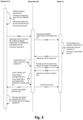
- Fig. 3 shows in more detail an exemplifying communication flow related to the process of Fig. 2 .
- a Requestor R provides a computer-readable or human-readable problem statement Z and converts an acceptance test (see f(S) in Fig. 4 ) related to the problem statement Z into a zkSNARK object ZK. Further, he generates a keypair comprising a public key pk and a private key sk, and provisions a bounty B.
- the Requestor R generates a smart contract for the problem statement Z on blockchain BC and publishes the problem statement Z, zkSNARK object ZK, public key pk and provisioned bounty B on a blockchain BC.
- a Solver SL downloads the problem statement Z and the Requestor's public key pk from the blockchain BC.
- the Solver SL finds a solution S to the problem statement Z, generates a proof of solution P which is signed with the Solver's identification (blockchain address of the Solver SL) key SA, and encrypts solution S with the Requestor's public key pk to obtain an encrypted solution E(S).
- Solver SL uploads the proof of solution P to blockchain BC.
- blockchain BC confirms the Solver's proof of solution P.
- Solver SL downloads, as an input confirmation that his proof of solution was recorded in the blockchain, a proof of ownership related to his proof of solution P.
- This proof of ownership is a signed transaction confirmed on the blockchain (similar to a digital receipt) that shows that Solver SL generated proof of solution P, when proof of solution P was confirmed in the blockchain and which address performed the transaction. This proof of ownership is used by the Solver's client to trigger the solution testing.
- Solver SL uploads encrypted solution E(S) to blockchain BC.
- blockchain BC checks the validity of the Solver's proof of solution P, checks that solution S corresponds to proof of solution P and checks that E(S) is encrypted with requestor's public key pk. Thereby, the blockchain checks that the Solver shared the solution.
- the blockchain transfers the encrypted solution E(S) to Requestor R and, at 311, the blockchain transfers bounty B to Solver SL.
- Requestor R decrypts encrypted solution E(S) with private key sk to obtain solution S.
- the Requestor defines the well-posed problem through a set of requirements.
- the problem statement Z may for example be formulated in human or machine-readable form and may be associated with a validation function f(S) ("acceptance tests") which takes a solution S and returns a Boolean (true or false) dependent on whether or not the input solution is a valid solution.
- the problem statement Z may be defined such that a solution S can be deterministically validated in polynomial time without recourse to external information and/or services.
- NP nondeterministic polynomial time
- problems of the complexity class NP form the set of decision problems for which the problem instances, where the answer is "yes”, have proofs verifiable in polynomial time.
- An introduction to NP type problems is for example given by Kleinberg, Jon and Tardos, Éva (2006) in Algorithm Design (2nd ed.), Addison-Wesley, p. 464 .
- a well-posed problem statement Z is the problem of finding optimal solutions for protein folding.
- This problem has been motivated thoroughly in the literature.
- Cooper et. al. proposed to tackle the protein folding problem through crowdsourcing using an auxiliary application called "Foldit" which is implemented as a client application and which helps potential solvers to find solutions ( Nature volume 466, 756-760 (2010 )).
- a Requestor R interested in finding optimal solutions for the problem of protein folding may distribute an auxiliary application which helps anybody interested in participating in the solving stage to find optimal solutions.
- the auxiliary application may use a protein model such as the wormlike chain or the freely joined chain to model the configuration of the protein.
- anybody can try to derive an optimal protein configuration which is represented by a respective series of vectors defining the position and orientation of the parts of the protein (amino acids).
- the Requestor R is the entity which desires solutions to the protein folding problem.
- a putative solution S to the problem statement Z sought by Requestor R could be defined by an identification of the protein (defined e.g. by the chain of amino acids of the protein) for which a putative optimal configuration has been found and a series of vectors defining the position and orientation of the parts of the protein.
- the validation function f(S) could be configured to take those vectors defining the position and orientation of the parts of the protein of the putative solution as input, to compute the total energy of the protein system, and to verify that it is below a threshold defined by Requestor R.
- the internal potential energy of the protein can be obtained from the chosen protein model, such as the wormlike chain model or the freely joined chain model, and the position and orientation of the parts of the protein.
- a solution is verified by the mathematical function f(S), which takes a solution S and returns a score, e.g. a Boolean (true or false) indicating whether the solution is valid or not, or, alternatively, a number indicating the quality of the solution.
- f(S) the mathematical function f(S)
- the Requestor R advertises the problem statement Z widely.
- This advertisement may be in the form of the human or machine-readable description of problem statement Z.
- Advertising the problem may comprise any communication paths such as publishing the description of problem statement Z on a blockchain (e.g. within a smart contract), posting a description of problem statement Z on a website, advertising problem statement Z on a crowd sourcing platform, or in a newspaper.
- the object of advertising the problem statement Z is to make potential Solvers SL aware of the problem statement Z and to motivate them to provide a solution S to the problem statement Z, for example by announcing a bounty B related to solving the problem statement Z.
- the Requestor R provides funds as incentive by defining a bounty which is made for example of a given amount of crypto currency, like Bitcoin or Ether (ETH) or the like.
- ETH Ether
- the Requestor might also use in-app currency to implement a bounty.
- the Requestor R may for example create a digital wallet prefunded with the bounty B.
- the funds can for example be realized as cryptocurrency like Bitcoin or Ether and they may for example be stored on blockchain BC in the form of a digital cryptocurrency wallet.
- the Requestor R transfers bounty B into a digital wallet which is attributed to the smart contract.
- the management of the bounty B may for example be such that access keys to the digital wallet are known only to the smart contract SB such that only the smart contract has the power of disposition over the bounty B until the deadline T of the smart contract SB is reached. For example, upon receiving a valid proof of solution and after receiving the solution from Solver SL, the smart contract may provide the access keys related to the digital wallet to the successful Solver.
- ethereumjs-wallet is a wallet implementation that supports key creation and conversion between various formats.
- bounties may be foreseen, such as proposed in the alternative embodiments described below in more detail.
- the Requestor R may secure communication by means of a secret key.
- standard asymmetric encryption algorithms for example an RSA cryptosystem, are used.
- the Requestor R generates two keys, a public key pk and a secret key sk (also called private key).
- the public key is published by Requestor R and can be used by anybody to encrypt a message that can be decrypted by Requestor R using the corresponding secret key.
- the Requestor's problem statement Z may be related to a validation function f(S) which takes a solution S in a given format and returns a Boolean (true or false) and which allows zero-knowledge proofs related to the problem statement Z.
- the validation function f(S) may for example be implemented in a zero-knowledge proof scheme.
- a zero-knowledge proof provides a method by which one party (here Solver SL) can prove to another party (here the smart contract) that they know a specific solution S to the problem statement Z, without conveying any information apart from the fact that they know the solution S.
- a fast computable non-interactive zero-knowledge proof scheme like zkSNARK (zero-knowledge Succinct Non-interactive Argument of Knowledge) is used.
- Other zero-knowledge proof schemes may likewise be used in alternative embodiments. Using a zero-knowledge proof such as zkSNARK allows the Solver S to prove possession of a solution S without revealing the solution itself or any additional information.
- the Requestor R To build a zkSNARK object ZK for problem statement Z , the Requestor R prepares a computation object C(f, x , y ), where f is the validation function f(S) ("acceptance tests") which takes a potential solution S and returns true or false dependent on whether or not S solves problem statement Z, and where x are public inputs and y are private inputs.
- the public inputs x of computation object C(f, x , y ) comprise the Requestor's public key pk, an encrypted solution E(S) (also called “ciphertext" of solution S), an identification key SA of Solver SL (e.g. a blockchain address or wallet address).
- the identification key SA of the Solver SL is provided to computation object C(f, x , y ) in order to enable a signing of the proof of solution P by the Solver SL and therefore mitigate the risk of theft of the solution (S).
- the proof of solution P should be signed with the same blockchain address SA like the address from which to proof of solution is uploaded to the blockchain (see section 2.2 Proof registration).
- the computation C(f, x , y ) takes a putative solution S encoded as a byte stream.
- the computation object C(f, x , y ) reduces the inputs to a single Boolean output (true/false), with the value of true if the putative solution S is valid and if the encrypted solution E(S) (ciphertext) is encrypted with the public key pk of Requestor R.
- the computation object C(f, x , y ) checks if the putative solution S is valid by means of function f(S) which returns true if the putative solution S is valid and false otherwise.
- the computation object C(f, x , y ) can validate if the encrypted solution E(S) is encrypted with the public key pk of Requestor R. This can be achieved by the computation object C(f, x , y ) by using public key pk to encrypt the putative solution S and compare the result with encrypted solution E(S).
- the computation object C(f, x , y ) is transformed into a zkSNARK object ZK using standard zero-knowledge proof toolsets such as ZoKrates on Ethereum, or using open source libraries, e.g., libsnark.
- Fig. 3b schematically shows an example of the transformation of a computation C(f, x , y ) into a zero-knowledge provable format using a zkSNARK protocol.
- Requestor R From the computation object C(f, x , y ) and in order to enable zero-knowledge proofs, Requestor R builds a zkSNARK object ZK.
- the Requestor R may for example run setup stages of a zkSNARK for this computation object C(f, x , y ) to produce the zkSNARK object ZK, comprising a proving key and verification key, and an accompanying proof-generating function buildProof and a proof validation function verifyProof.
- the resulting zkSNARK object ZK provides two methods: one for building a proof ( buildProof ), and the other to verify a proof ( verifyProof ) .
- the zkSNARK object ZK may be executable off-chain, that means it may be executable on a local client computer and not just on the blockchain, and buildProof may not be executed through a transaction but locally on a client computer (even though verjfyProof is executed by the smart contract).
- the proving key and the verification key are used by buildProof and, respectively, verifyProof to implement computation object C(f, x , y ).
- the proving key enables generating zero-knowledge proofs P from putative solutions S provided by Solvers SL, and, respectively, the verification key enables validations of generated proof of solutions P.
- buildProof is provided to Solver SL and is foreseen to be called by a Solver SL who found a putative solution SL to generate a proof of solution P based on the putative solution S.
- buildProof requires the public and private inputs x , y (public key pk, encrypted solution E(S), Solver's blockchain address SA), the proving key, and a solution S.
- buildProof returns a proof of solution P.
- buildproof can for example be implemented as a stand-alone software ready-to-use by the Solver SL to generate the proof of solution P or it can be a data object that is used in combination with a proof-generating software library to generate the proof of solution.
- verifyProof requires the public inputs x (public key pk, encrypted solution E(S), Solver's blockchain address SA), the verification key, and a proof generated with buildProof.
- verifyProof returns a Boolean variable which evaluates to true if and only if the encrypted solution E(S) is encrypted with the public key pk and the proof of solution P provided as input is affirmed to the positive.
- the Requestor R creates a smart contract SB that implements the logic around the zkSNARK object ZK.
- Requestor R publishes this smart contract SB on a blockchain BL, prefunded with a bounty B.
- libraries like ether.js, truffle, openzeppelin-solidity, and the like provide toolboxes for generating smart contracts and for registering them on a distributed ledger/blockchain.
- the smart contract SB has its own blockchain address. Every communication between the smart contract SB and for example the Solver SL may be viewed as a transaction performed between the blockchain address of the smart contract SB and Solvers blockchain address SA (identification key). For example every function call to the smart contract SB from the Solver SL (for example RegisterProofOfSolution described in section 2.2 below) is a transaction between the Solvers blockchain address SA and the smart contract address. Therefore the address from which the function call originates may be described as caller address. Those transactions may be stored (recorded) permanently on the blockchain, together with the data (function inputs) that were sent by making the call.
- SA Identification key
- the smart contract code may be implemented by software code which provides the following exemplifying functions which define transactions on the zkSNARI ⁇ object ZK:
- the above setup scheme preferably allows to avoid zkSNARK trusted setup problems.
- zkSNARK requires a so called “trusted setup” phase.
- a given zkSNARK is either specific to a particular computation, or if generic, is very inefficient.
- a one-time trusted setup phase is typically run, involving secret information that should be destroyed after the setup stage. If not destroyed, anyone with access to the secret information could create a "fake” proof.
- the Requestor R runs the trusted setup. Thus, only the Requestor could in principle make fake proofs as a way to cancel a bounty. But then to avoid any loss of reputation, the Requestor would have to also upload a corresponding believable cyphertext which correspond to the fake proof.
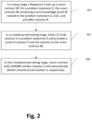
- Fig. 4 shows a flow diagram visualizing in more detail the setup stage in which a Requestor R sets up a smart contract SB (see 201 in Fig. 2 ).
- the Requestor R defines a problem statement Z for a well-posed problem.
- the Requestor R sets up a public/private key-pair pk/sk for safe communication.
- the Requestor R sets up a computation C(f, x , y ) that returns true if and only if, a putative solution S solves the problem statement Z and if the solution S is encrypted with the public key pk.
- the Requestor R transforms the computation C(f, x , y ) into a zkSNARK object ZK using a zkSNARK protocol, the zkSNARK object ZK providing a proof-function buildProof and a verifier-function verifyProof.
- the Requestor R 102 generates a smart contract SB and includes the zkSNARK object ZK, the public key pk and the problem statement Z into the smart contract SB.
- the Requestor R funds the smart contract SB with a bounty B.
- the Requestor R publishes the smart contract SB on a blockchain BC.
- the Requestor R calls an Initialize function of the smart contract SB that initializes the smart contract SB.
- the Solver SL retrieves the proving key and the proof-generating software, respectively any other implementation of the buildproof function by calling the FetchAuxiliaryData function.
- the buildproof function can be implemented as a stand-alone software ready-to-use by the Solver SL to generate the proof of solution or it can be an object that is used in combination with a proof-generating software library to generate the proof of solution.
- the Solver Upon finding a putative solution S, the Solver creates a proof of solution P with the proof generating function buildProof and the proving key.
- the proof generating function buildProof provided by a zero-knowledge proof scheme generates the proof of solution P which provides a method by which the Solver SL can prove that he knows a specific solution S to the problem statement Z, without conveying any information apart from the fact that they know the solution S.
- a fast computable non-interactive zero-knowledge proof scheme like zkSNARK (zero-knowledge Succinct Non-interactive Argument of Knowledge) is used.
- Other zero-knowledge proof schemes may likewise be used in alternative embodiments. Using a zero-knowledge proof such as zkSNARK allows the Solver S to prove possession of a solution S without revealing the solution itself or any additional information.
- Solver SL calls the RegisterProofOfSolution function from the smart contract SB to upload the proof of solution P to the blockchain BC.
- the TestSolution method is called by a Solver SL (the call is made from the Solvers address SA to the smart contract blockchain address)
- the smart contract SB checks if the latest RegisterProofOfSolution call came from the same Solver SL (same address) and takes the proof of solution P that was uploaded during this call. Therefore, the TestSolution function cannot verify a solution S if it doesn't find a valid corresponding proof of solution P uploaded at the RegisterProofOfSolution step.
- this call of the RegisterProofOfSolution function is a transaction between those two addresses.
- This transaction is recorded permanently on the blockchain, together with the function inputs (proof of solution P) that was sent when making the function call.
- the record in the blockchain is called the proof of ownership that shows that the Solver SL uploaded the proof of solution P. Since the proof of solution is signed with the same blockchain address SA, the proof of ownership of the proof of solution confirms that Solver SL generated proof of solution P, when proof of solution P was registered in the blockchain BC and which blockchain address performed the transaction.
- the proof of ownership may be sent as an excerpt from a blockchain explorer, which is recording everything single transaction within the blockchain (like, for example, etherscan.io for the ethereum blockchain), to the Solver SL.
- the address that is shown in the proof of ownership that is the blockchain address from which the RegisterProofOfSolution function call originated
- the blockchain address that was used for the signing of the proof of solution P at its creation that is the Solvers identification key SA are the same.
- the bounty will be paid in case that the solution is valid.
- the Solver SL After receiving a proof of ownership related to proof of solution P as a confirmation of the proof of solution P by the smart contract SB in the blockchain BC, the Solver SL encrypts solution S with the current public key pk of the Requestor obtained from the smart contract SB to obtain an encrypted solution E(S).
- Solver SL then submits the encrypted solution E(S) to blockchain BC using the TestSolution function.
- the TestSolution function will run the verifier function wasifyProof from the zkSNARK object ZK using the proof of solution P, the public input x and the verification key, stored within the zkSNARK object, as inputs. If called before the time limit, TestSolution runs the zkSNARK verifier function verifyProof against the last proof of solution P registered from the caller's address using the public key pk active at the time of the proof registration and the provided encrypted payload as public inputs.
- TestSolution returns a Boolean variable which evaluates to true if and only if the encrypted solution E(S) is encrypted with the public key pk and the proof of solution P which has been previously registered by the caller using RegisterProofOfSolution is affirmed to the positive
- TestSolution function evaluates to true, that is if the solution proof of solution P was valid and the encrypted solution E(S) was encrypted with the public key pk of Requestor R, the TestSolution function will send the bounty B to the Solver's blockchain address SA and the encrypted solution E(S) to the Requestor R.
- the total time between submitting a valid solution and receiving a payout is measured in seconds to minutes, not hours or days.
- the solving stage described in this embodiment is decentralized. Since no trusted third party is involved in verifying solutions and distributing payouts, any associated fees are obviated.
- the scheme provides transparency to the involved parties, Requestor R and Solver SL. Payout is known by all participants ahead of time, and everyone can detect when a problem has been submitted and when the bounty has been claimed successfully.
- the solution's ownership is secured against solution theft to the extent that the used blockchain is. Indeed, stealing the solution S would require stealing a solution as soon as it would be uploaded on the blockchain and recreate the blockchain since the proof registration faster than the main chain to be opted by the network. This risk is further mitigated by requiring the Solver's address as public input as only the Requestor would be able to decrypt the Solver's solution and recreate a valid proof.
- the Requestor R may decide to either use the time of the proof registration or of the solution upload as the reference to arbitrate prior submission.
- transactions are bundled into blocks arbitrarily, so there is a priori no order in them but they are valid as a whole.
- the Requestor R can decide how to arbitrate it by customizing the TestSolution function.
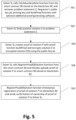
- Fig. 5 shows a flow diagram visualizing a method of Solver SL finding a solution S to a problem statement Z and transforming the solution S into a zkSNARK readable format (202 in Fig. 2 ).
- a Solver SL calls the FetchAuxiliaryData function from the smart contract SB stored on the blockchain BC and retrieves a problem statement Z, the Requestor's public key pk., a proving key and proof-generating software (which impelements the buildProof functionality of the zkSNARK object).
- a Solver SL finds a putative solution S to the problem statement Z.
- the Solver SL creates a proof of solution P with the proof-generating software (respectively function buildProof ) and encrypts a solution S to an encrypted solution E(S) using the public key pk of Requestor R.
- Solver SL calls the RegisterProofOfSolution function from the smart contract SB and thereby uploads the proof of solution P to the smart contract SB stored on blockchain BC.
- the RegisterProofOfSolution function timestamps the registration of the proof of solution P on the blockchain BC and sends a confirmation of ownership of the proof of solution P to Solver SL.
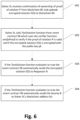
- Fig. 6 shows a flow diagram visualizing a method of a smart contract SB with a zkSNARK verifying a solution S to a problem statement Z and automatically delivering the bounty B and the solution S, respectively (203 in Fig. 2 ).
- a Solver SL receives the confirmation of ownership of the proof of solution P from the blockchain BC that his proof of solution was included into the blockchain and uploads the encrypted solution E(S) to the blockchain BC.
- the Solver SL calls a TestSolution function from the smart contract SB which uses the verifier-function verifyProof to verify if the proof of solution P is valid and if the encrypted solution E(S) is encrypted with the public key pk.
- the TestSolution function evaluates to true the smart contract SB automatically sends the encrypted solution E(S) to the Requestor R.
- the TestSolution function evaluates to true the smart contract SB automatically sends the bounty B to the
- the Requestor being the one creating the trusted setup, is in principal able to cancel his own contract by creating a fake proof and uploading the corresponding dummy pseudo-cyphertext he used for creating it.
- the bounty B is released and the smart contract SB ends.
- multiple proofs can be submitted until the deadline and the proofs of solutions P are accompanied by a score over which solutions are ranked.
- the deadline passes, a period of solution upload is opened and all submitters can upload their best solution.
- the bounty is automatically paid to the contestant with the best validated solution.
- Requestor R loses the ability to cancel the contract after at least one valid solution has been submitted.
- a timed contest is made.
- the smart contract is made to accept multiple proof of solutions annotated with a quality score.
- the zkSNARK is suitably enhanced to allow a score as a public input and test it against the performance of the solution.
- an auction-style pricing scheme is applied.
- submissions also include a price that the Solver would be happy with charging. The cheapest solution wins The Requestor can simultaneously ask the contract to refund him the difference.
- an auxiliary application provided to Solvers SL could expose an application programming interface (API) that would enable the automation of the derivation of a solution (e.g. selection of a protein and finding of a stable configuration) by an artificial intelligence (AI). This would effectively lead to the outsourcing of the computational problem of finding such configurations.
- API application programming interface
- AI artificial intelligence
- the smart bounty idea is equivalent to making a request for a proposal by a solution provider according to a set of requirements.
- the Requestor needs a new asset with certain functionalities and the Solver offers it as a product.
- This variation can be seen as a pay-per-request service model.
- a party say the Facilitator
- a zero-knowledge scheme such as zkSNARK
- the travelling salesman problem can be solved for a set of coordinates to visit, but there is no generic solution for any set of coordinates.
- a zkSNARK could be compiled to accept a set of coordinates to visit as public inputs and either a target cost (provided by the Requestor), or the corresponding solution cost (to be used to select the best solution in a timed contest setup). Using this zkSNARK, it would then be possible to setup a smart contract to which a series of Requestors could submit specific public inputs defining the acceptance tests of the problem for which they would pay a certain bounty to get the solution.
- the smart contract serves as a platform to submit input-specific requests for solutions and their corresponding solutions.
- the settlement of individual requests are handled as for the standard case, but public inputs, bounties, proofs, and solutions form a stream of smart bounties.
- Solvers are able to decide whether to answer only one setup of the problem, or invest in an optimized way of solving the generic problem in order to lower the cost of finding individual solutions.
- a Requestor can pledge a total amount of money to the smart contract that will have to be used for multiple bounties. That guarantees a certain volume for the market, for a specific period, which Solvers can then target more strategically. If the pledged amount is not spent before the end of its validity, the contract could work with a combination of redistribution of this amount to past solvers and extension of the pledge period.
- the standard smart bounty contract methods behave essentially in the same way as they work in the embodiments described above, with the exception that they are specific to specific bounties.
- Bounties can be defined either as a set of inputs, or as a set of (inputs, Requestor public key).
- the smart contract is complemented with the following methods:
- Fig. 7a describes an example of a system that is configured to host a smart contract for requesting solutions to a problem, verifying an answer and automating pay-out and a distributed file system, e.g. IPFS, where a solution might be stored.
- the system comprises a distributed computation platform 720 which hosts a blockchain BC, a first client computer 721 which is operated by a Requestor R, who intends to outsource a certain task, and a second client computer 722 which is operated by a Solver SL, who intends to provide a solution to the task and a distributed file system 723, e.g.
- the distributed computation platform 101, the first client computer 102, and the second client computer 103 and the distributed file system are interconnected by means of a computer network, e.g. the Internet, local area networks (LAN), UMTS/LTE, or the like.
- a computer network e.g. the Internet, local area networks (LAN), UMTS/LTE, or the like.
- a Solver replaces the encrypted solution in his submission with its hash.
- the zero-knowledge proof scheme e.g. zkSNARK
- the Requestor then obtains the solution through the off-blockchain distributed filesystem.
- the main challenge here is to avoid the Solver submitting a valid hash, getting a bounty, and then the Requestor discovering that no file with that hash is available in the distributed filesystem.
- the protocol includes a second zero-knowledge proof mechanism.
- the double zero-knowledge proof mechanism works as follows:
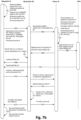
- Fig. 7b shows communication flows of this modified protocol where a Solvers SL stores a solution S to the problem Z on a distributed file system.
- the Requestor R defines a computer readable problem statement Z and converts acceptance tests related to the problem statement Z.
- Requestor R prepares two zkSNARK objects, here ZK1 and ZK2: ZK1 is configured to verify that an encrypted solution is shared offchain, the second zkSNARK object ZK2 is configured to prove that the Requestor R is able to decrypt the encrypted solution E(S).
- Further Requestor R generates a keypair comprising a public key pk and a private key sk, and provisions a bounty B.
- the Requestor R publishes the problem statement Z, the two zkSNARK objects ZK1 and ZK2, public key pk and provisioned bounty B on a blockchain BC.
- a Solver SL downloads the problem statement Z and the public key pk from the blockchain.
- the Solver SL finds a solution to the problem statement Z, and generates a symmetric key ks.
- the Solver SL encrypts (with symmetric encryption) the solution S with an (ephemeral) symmetric key ks of his choosing to obtain an encrypted solution E(ks,S). Further, the Solver SL hashes the encrypted solution E(ks,S) to obtain the hash value H(E(ks,S)).
- the Solver SL generates a proof of solution P1 using the first zkSNARK ZK1 to prove that the encrypted solution is shared offchain and a second a proof of solution P2 using a second zkSNARK ZK2 to prove that the Requestor R is able to decrypt the encrypted the encrypted solution E(ks,S).
- the encrypted solution E(ks,S) is uploaded and stored at an distributed file system (e.g. IPFS), whereby the hash value H(E(ks,S)) serves as an unique identifier for the stored data, i.e. E(ks,S)
- the hash value H(E(ks,S)) and the first proof of solution P1 are uploaded to smart contract SB on blockchain BC.
- the smart contracts SB verifies if S is a valid solution and if the hash value H(E(ks,S)) is valid, i.e. if it is the correct hash address where the encrypted solution E(ks,S) is stored.
- the Requestor looks up the hash value H(E(ks,S)).
- the Requestor R downloads the encrypted solution E(ks,S) using the hash value H(E(ks,S))
- the Requestor R confirms the valid download of E(ks,S)and calls a function which opens the upload of the Solver's encryption key ks.
- the smart contract SB checks if the call is valid, i.e.
- the Solver SL uploads his private key ks encrypted by the public key pk, i.e. E(ks,S)and the second proof of solution P2 to the blockchain BC.
- the smart contract SB checks if the second proof of solution P2 is valid and if the private key ks was encrypted with public key pk.
- the bounty B is transferred to the Solver SL.
- the encrypted key E(ks,S) is transferred to the Requestor R.
- the Requestor R decrypts E(ks,S) with his private key sk and then decrypts E(ks,S)with the Solver's symmetric key ks.
- the Requester R could require double encryption of the solution S to secure the solution S against the unintentional leakage of the Solver's key ks. Therefore, the solution may be doubly-encrypted.. Therefore, the Solver SL first encrypts (with symmetric encryption) the solution S with an (ephemeral) symmetric key ks of his choosing to obtain an encrypted solution E(ks,S). Solver SL then encrypts the result E(ks,S) with the Requestor's public key pk to obtain a doubly-encrypted solution E(pk,E(ks,S)).
- the Solver SL hashes the doubly-encrypted solution E ⁇ pk,E(ks,S)) to obtain the hash value H(E(pk,E(ks,S )).
- the other steps may be the same like explained above.
- the embodiment described above relates to storing encrypted solutions on a distributed filesystem.
- a standard fileserver could be used for storing encrypted solutions, whereby the file location should be a hash of the data itself.
- the principles described above would remain the same.
- the requirement that the file location is a hash of the data itself ensures that the downloaded data corresponds to the Hash value. If the encrypted solution is too big to be put on the blockchain, the hash version may represent it in the solution verification step. In this regard it is important that the hash value is trustlessly related to the data obtained on the file system.
- the particular property of the IPFS to store files at an address constituted of their hash is a trustless component that allows to achieve a trustless setup.
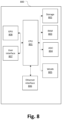
- Fig. 8 schematically describes an embodiment of an electronic device which may implement the functionality of the Requestor's or the Solver's client computer or the functionality of a computer within a blockchain system.
- the electronic device may further implement a process of generating a zkSNARK object ZK.
- the electronic device 800 may be the client computer used by the Requestor R or the Solver SL. Further the electronic device may be a computer participating in the blockchain BC.
- the electronic device 800 comprises a CPU 801 as processor, a GPU as graphics processing unit 808 and an Ethernet interface 806 that may be connected to a router in order for the Requestor R or the Solver SL to communicate with the blockchain BC via internet connection.
- the electronic device, if used as node of the blockchain BC may further comprise an ASIC (Application-specific integrated circuit) unit specially designed to solve potential mining computation in the blockchain BC efficiently.
- ASIC Application-specific integrated circuit
- the electronic device 800 further comprises a data storage 802 and a data memory 803 (here a RAM).
- the data memory 803 is arranged to temporarily store or cache data or computer instructions for processing by the processor 801.
- the data storage 1102 is arranged as a long term storage, e.g., for recording the blockchain BC.
- a blockchain may constitute a decentralized database which stores a growing list of blockchain records, called blocks, which are linked using cryptography. Each block typically contains a cryptographic hash of the previous block, a timestamp, and transaction data. Multiple transactions are typically stored in a single block.
- a blockchain can be used for example as an open distributed ledger, where the blockchain is typically managed by a peer-to-peer network collectively adhering to a protocol for inter-node communication and creating and validating new blocks. Preferably, once recorded, the data in any given block cannot be altered retroactively without alteration of all subsequent blocks, which would require consensus of the network majority (51% attack).
- the data is stored into blocks and the protocol by which a participating peer in the network can create a new block and the other peers validate this new block, i.e. the consensus mechanism, can be implemented for example as a proof-of-work protocol.
- This proof-of-work protocol can for example included finding a valid hash for the block to be included into the blockchain whereas this hash has to have a certain given structure.
- Finding a hash of the block with this given structure i.e. intentionally producing a hash collision, can just be achieved by using brute force computing power and this process is often called mining.
- the mining computation may be efficiently done by using a mining-specific ASIC (see unit 805 in Fig. 8 ).
- the peer within the blockchain network that solves this mining computation first of all is allowed to include the block into the blockchain and may be rewarded for solving the mining computation.
- Decentralized consensus within the blockchain network may then be reached, by every peer checking if the founded hash is valid and then always accepting the longest chain of valid blocks as the currently valid blockchain.
- the embodiments are, however, not restricted to a particular blockchain technology, in particular not to a particular consensus model. Other consensus principles than proof-of-work may be used to implement a blockchain.
Landscapes
- Engineering & Computer Science (AREA)
- Computer Security & Cryptography (AREA)
- Computer Networks & Wireless Communication (AREA)
- Signal Processing (AREA)
- General Engineering & Computer Science (AREA)
- Computer Hardware Design (AREA)
- Computing Systems (AREA)
- Theoretical Computer Science (AREA)
- Health & Medical Sciences (AREA)
- Bioethics (AREA)
- General Health & Medical Sciences (AREA)
- Software Systems (AREA)
- Physics & Mathematics (AREA)
- General Physics & Mathematics (AREA)
- Management, Administration, Business Operations System, And Electronic Commerce (AREA)
Claims (12)
- Système comprenant un grand livre distribué (BC) configuré pour stocker un contrat intelligent (SB) pour un énoncé de problème (Z), le contrat intelligent (SB) implémentant une preuve à divulgation nulle de connaissance (ZK) concernant l'énoncé de problème (Z),dans lequel la preuve à divulgation nulle de connaissance (ZK) définit une fonction configurée pour construire, à partir d'une solution à l'énoncé de problème, une preuve de solution (P) selon la preuve à divulgation nulle de connaissance (ZK) et une fonction de vérificateur configurée pour vérifier une preuve de solution (P),dans lequel le grand livre distribué (BC) est configuré pour recevoir une solution potentielle (S) à l'énoncé de problème (Z), et pour vérifier la solution potentielle (S) à l'énoncé de problème à l'aide de la preuve à divulgation nulle de connaissance (ZK),dans lequel le contrat intelligent (SB) définit une fonction qui est configurée pour accepter une solution cryptée (E(S)) en guise de données utiles, dans lequel la fonction est configurée pour lancer la fonction de vérificateur, et dans lequel la fonction est configurée, si le résultat de vérification est positif, pour transférer automatiquement une prime (B) à l'adresse d'un appelant de fonction, et pour fournir une solution cryptée (E(S)) au demandeur (R).
- Système selon la revendication 1, dans lequel la preuve à divulgation nulle de connaissance (ZK) est en fonction d'une fonction de validation (f(S)) qui prend une solution potentielle (S) et renvoie un score qui représente la qualité de la solution potentielle (S) et/ou dans lequel la preuve à divulgation nulle de connaissance (ZK) est générée en fonction d'un objet de calcul (C(f, x,y)) qui est en fonction de la fonction de validation (f(S)).
- Système selon la revendication 1, dans lequel la preuve à divulgation nulle de connaissance (ZK) est implémentée à l'aide d'un schéma zkSNARK, et/ou dans lequel le grand livre distribué (BV) est implémenté en tant que chaîne de blocs.
- Système selon la revendication 1, dans lequel le contrat intelligent (SB) définitune fonction qui est configurée pour être appelée à la création d'un contrat intelligent (SB) par un demandeur (R), dans lequel la fonction est configurée pour enregistrer un horodatage après lequel aucune solution ultérieure ne sera acceptée par contrat intelligent (SB) et avant lequel le demandeur (R) ne peut pas retirer une prime (B) ; etdans lequel le contrat intelligent (SB) définit une fonction qui est configurée pour être appelée uniquement par un demandeur (R), et uniquement après que l'échéance définie par la fonction d'initialisation a été dépassée et qu'aucune solution valide n'a été présentée.
- Système selon la revendication 1, dans lequel le contrat intelligent (SB) définit une fonction qui est configurée pour accepter une preuve de solution (P) et pour horodater la preuve de solution reçue afin d'enregistrer l'heure et la date de réception de la preuve de solution.
- Système selon la revendication 1, dans lequel le grand livre distribué (BC) est configuré pour gérer une prime (B) apparentée à l'énoncé de problème (Z) ou dans lequel le grand livre distribué (BC) est configuré pour gérer une prime (B) sous la forme de cryptomonnaie.
- Système selon la revendication 1, dans lequel le contrat intelligent (SB) définitune fonction configurée pour fournir un logiciel de génération de preuve à des solveurs (SL) ; ouune fonction configurée pour fournir une application auxiliaire à des solveurs (SL) laquelle est configurée pour aider un solveur (SL) à trouver une solution optimale (S) à l'énoncé de problème (Z) ; ouune fonction configurée pour fournir des données auxiliaires disponibles auprès du contrat intelligent (SB), telles que l'énoncé de problème (Z), une clé publique (pk) du demandeur, une clé probante, et/ou une fonctionnalité pour construire une preuve.
- Système selon la revendication 1, comprenant en outre un système de fichiers distribué permettant de stocker une solution (S) à l'énoncé de problème (Z).
- Système selon la revendication 1, dans lequel le contrat intelligent (SB) définitune fonction qui accepte un montant et une date ; et/ouune fonction qui accepte un montant de prime, une durée de validité, une clé publique et un ensemble d'entrées publiques pour une preuve à divulgation nulle de connaissance ; et/ouune fonction qui accepte des informations d'état et qui renvoie une liste de primes filtrées sur leurs informations d'état ; et/ouune fonction qui désactive la fonction permettant de présenter une prime.
- Procédé implémenté par ordinateur comprenant un demandeur (R) demandant des solutions (S) à un énoncé de problème (Z), et un grand livre distribué (BC) vérifiant une solution potentielle (S) à l'énoncé de problème (Z) fournie par un solveur (SL) à l'aide d'une preuve à divulgation nulle de connaissance (ZK),dans lequel la preuve à divulgation nulle de connaissance (ZK) définit une fonction configurée pour construire une preuve de solution (P) selon la preuve à divulgation nulle de connaissance (ZK) et le solveur (SL) générant une preuve de solution (P) à l'aide de la fonction configurée pour construire la preuve de solution (P), et dans lequel la preuve à divulgation nulle de connaissance (ZK) définit une fonction configurée pour vérifier une preuve de solution (P),dans lequel le procédé fournit une fonction qui est configurée pour accepter une solution cryptée (E(S)) en guise de données utiles et dans lequel la fonction est configurée pour lancer la fonction de vérificateur vis-à-vis d'une preuve de solution (P), et dans lequel la fonction est configurée, si le résultat de vérification est positif, pour transférer automatiquement une prime (B) à l'adresse d'un appelant de fonction, et pour fournir une solution cryptée (E(S)) au demandeur (R).
- Dispositif électronique comprenant un système de circuits configuré pour implémenter un schéma de divulgation nulle de connaissance dans un contrat intelligent (SB) pour un énoncé de problème (Z) et pour stocker le contrat intelligent (SB) sur un grand livre distribué (BC),dans lequel le schéma de divulgation nulle de connaissance définit une fonction configurée pour construire, à partir d'une solution (S) à l'énoncé de problème (Z), une preuve de solution (P) selon une preuve à divulgation nulle de connaissance (ZK) et une fonction de vérificateur configurée pour vérifier une preuve de solution (P),dans lequel le grand livre distribué (BC) est configuré pour recevoir une solution potentielle (S) à l'énoncé de problème (Z), et pour vérifier la solution potentielle (S) à l'énoncé de problème à l'aide de la preuve à divulgation nulle de connaissance (ZK),dans lequel le contrat intelligent (SB) définit une fonction qui est configurée pour accepter une solution cryptée (E(S)) en guise de données utiles, dans lequel la fonction est configurée pour lancer la fonction de vérificateur, et dans lequel la fonction est configurée, si le résultat de vérification est positif, pour transférer automatiquement une prime (B) à l'adresse d'un appelant de fonction, et pour fournir une solution cryptée (E(S)) au demandeur (R).
- Dispositif électronique comprenant un système de circuits configuré pour créer une preuve de solution (P) à partir d'une solution (S) à un énoncé de problème (Z) à l'aide d'un schéma de divulgation nulle de connaissance comprenant une fonction configurée pour construire la preuve de solution (P), implémentée dans un contrat intelligent (SB) pour l'énoncé de problème (Z) stocké sur un grand livre distribué (BC), et une fonction configurée pour vérifier une preuve de solution (P),dans lequel le grand livre distribué (BC) est configuré pour recevoir une solution potentielle (S) à l'énoncé de problème (Z), et pour vérifier la solution potentielle (S) à l'énoncé de problème à l'aide d'une preuve à divulgation nulle de connaissance (ZK),dans lequel le contrat intelligent (SB) définit une fonction qui est configurée pour accepter une solution cryptée (E(S)) en guise de données utiles, dans lequel la fonction est configurée pour lancer la fonction de vérificateur, et dans lequel la fonction est configurée, si le résultat de vérification est positif, pour transférer automatiquement une prime (B) à l'adresse de l'appelant de fonction, et pour fournir une solution cryptée (E(S)) au demandeur (R).
Applications Claiming Priority (2)
| Application Number | Priority Date | Filing Date | Title |
|---|---|---|---|
| EP19170850 | 2019-04-24 | ||
| PCT/EP2020/061369 WO2020216858A1 (fr) | 2019-04-24 | 2020-04-23 | Production participative basée sur une chaîne de blocs |
Publications (2)
| Publication Number | Publication Date |
|---|---|
| EP3959637A1 EP3959637A1 (fr) | 2022-03-02 |
| EP3959637B1 true EP3959637B1 (fr) | 2025-05-28 |
Family
ID=66483780
Family Applications (1)
| Application Number | Title | Priority Date | Filing Date |
|---|---|---|---|
| EP20719480.4A Active EP3959637B1 (fr) | 2019-04-24 | 2020-04-23 | Production participative basée sur une chaîne de blocs |
Country Status (3)
| Country | Link |
|---|---|
| US (1) | US12010236B2 (fr) |
| EP (1) | EP3959637B1 (fr) |
| WO (1) | WO2020216858A1 (fr) |
Families Citing this family (14)
| Publication number | Priority date | Publication date | Assignee | Title |
|---|---|---|---|---|
| CN111104386B (zh) * | 2019-11-04 | 2023-09-01 | 京东科技信息技术有限公司 | 一种文件存储方法、终端及存储介质 |
| EP4191939A4 (fr) * | 2020-07-27 | 2023-09-20 | Fujitsu Limited | Procédé de preuve de connaissance, programme de preuve de connaissance, et appareil de traitement d'informations |
| US11763332B2 (en) * | 2020-11-16 | 2023-09-19 | Theta Labs, Inc. | Edge computing platform supported by smart contract enabled blockchain network |
| CN112839046B (zh) * | 2021-01-14 | 2022-09-27 | 暨南大学 | 基于区块链的可追踪的匿名众包方法及系统 |
| CN113010304B (zh) * | 2021-02-04 | 2022-06-07 | 天津大学 | 一种基于区块链延迟感知移动边缘计算卸载服务系统 |
| WO2022189780A1 (fr) * | 2021-03-08 | 2022-09-15 | John Fletcher | Chaîne de blocs améliorée reposant sur un consensus amélioré |
| CN113364597A (zh) * | 2021-05-31 | 2021-09-07 | 中国工商银行股份有限公司 | 一种基于区块链的隐私信息证明方法及系统 |
| CN113422828A (zh) * | 2021-06-23 | 2021-09-21 | 陈军 | 集群存储服务器、存储服务器系统及搭建ipfs网络的方法 |
| CN113609502B (zh) * | 2021-08-06 | 2023-09-26 | 东北大学 | 一种基于区块链的空间众包系统及方法 |
| CN114760067B (zh) * | 2022-03-30 | 2023-09-12 | 西安电子科技大学 | 一种用零知识证明的区块链群智感知系统隐私安全保护方法 |
| CN114884677B (zh) * | 2022-05-09 | 2023-04-25 | 重庆大学 | 一种基于区块链的多用户众包任务匹配方法及系统 |
| WO2024102357A1 (fr) * | 2022-11-08 | 2024-05-16 | Unity Chain, Inc. | Système et procédé d'accord oracle distribué |
| EP4575868A1 (fr) * | 2023-12-22 | 2025-06-25 | Zkrypto Inc | Support non transitoire lisible par ordinateur fournissant des informations de transaction à l'aide d'un algorithme de preuve à connaissance nulle, procédé de transaction de contenu et système de chaîne de blocs associé |
| US12488345B1 (en) | 2025-03-25 | 2025-12-02 | Bjustcoin Ip Holding Llc | Decentralized integration solutions for securely conducting legal transactions and protecting sensitive data |
Family Cites Families (9)
| Publication number | Priority date | Publication date | Assignee | Title |
|---|---|---|---|---|
| US8132005B2 (en) * | 2005-07-07 | 2012-03-06 | Nokia Corporation | Establishment of a trusted relationship between unknown communication parties |
| US11023859B2 (en) | 2010-06-17 | 2021-06-01 | CrowdFlower, Inc. | Using virtual currency to compensate workers in a crowdsourced task |
| US9495668B1 (en) | 2013-05-10 | 2016-11-15 | EMC IP Holding Company LLC | Computing solutions to a problem involving inversion of a one-way function |
| GB201706132D0 (en) | 2017-04-18 | 2017-05-31 | Nchain Holdings Ltd | Computer-implemented system and method |
| CN107274184A (zh) * | 2017-05-11 | 2017-10-20 | 上海点融信息科技有限责任公司 | 基于零知识证明的区块链数据处理 |
| CN107342858B (zh) | 2017-07-05 | 2019-09-10 | 武汉凤链科技有限公司 | 一种基于可信环境的智能合约保护方法和系统 |
| US11151558B2 (en) * | 2018-12-12 | 2021-10-19 | American Express Travel Related Services Company, Inc | Zero-knowledge proof payments using blockchain |
| US11838406B2 (en) * | 2019-03-18 | 2023-12-05 | Reliance Jio Infocomm Limited | Systems and methods for control-data plane partitioning in virtual distributed ledger networks |
| GB201907396D0 (en) * | 2019-05-24 | 2019-07-10 | Nchain Holdings Ltd | Hash function attacks |
-
2020
- 2020-04-23 EP EP20719480.4A patent/EP3959637B1/fr active Active
- 2020-04-23 US US17/603,591 patent/US12010236B2/en active Active
- 2020-04-23 WO PCT/EP2020/061369 patent/WO2020216858A1/fr not_active Ceased
Also Published As
| Publication number | Publication date |
|---|---|
| EP3959637A1 (fr) | 2022-03-02 |
| US20220200805A1 (en) | 2022-06-23 |
| US12010236B2 (en) | 2024-06-11 |
| WO2020216858A1 (fr) | 2020-10-29 |
Similar Documents
| Publication | Publication Date | Title |
|---|---|---|
| EP3959637B1 (fr) | Production participative basée sur une chaîne de blocs | |
| TWI773912B (zh) | 基於區塊鏈的理賠方法和裝置 | |
| US20210049600A1 (en) | Digital Asset Delivery Network | |
| US11481375B2 (en) | Point-to-point distributed decentralized system | |
| Ferrer-Gomila et al. | A fair contract signing protocol with blockchain support | |
| US20200058023A1 (en) | Decentralized Data Marketplace | |
| US20260004288A1 (en) | Method, system, and computer-readable medium for secured multi-lateral data exchange over a computer network | |
| US20170134161A1 (en) | Blockchaining for media distribution | |
| Deebak et al. | Healthcare applications using blockchain with a cloud-assisted decentralized privacy-preserving framework | |
| Jeong et al. | Implementation of real estate contract system using zero knowledge proof algorithm based blockchain | |
| US20240202703A1 (en) | System and method for blockchain transaction management | |
| Alsharif et al. | A blockchain-based medical data marketplace with trustless fair exchange and access control | |
| Abubaker et al. | Trustful data trading through monetizing IoT data using BlockChain based review system | |
| WO2019186978A1 (fr) | Système de transaction électronique, serveur de transaction, serveur de vérification, procédé de transaction électronique et programme | |
| CN114331437A (zh) | 一种基于区块链的数字印章使用方法及装置 | |
| Mut-Puigserver et al. | Blockchain-based fair certified notifications | |
| Gao et al. | Blockchain-enabled supervised secure data sharing and delegation scheme in Web3. 0 | |
| Mittal et al. | A three-phase framework for secure storage and sharing of healthcare data based on blockchain, IPFS, proxy re-encryption and group communication: S. Mittal, M. Ghosh | |
| Mohit et al. | Design and implementation of blockchain-based supply chain framework with improved traceability, privacy, and ownership | |
| Koch et al. | KRAKEN: a privacy-preserving data market for authentic data | |
| Chenli et al. | Fair $^{2} $2 Trade: Digital Trading Platform Ensuring Exchange and Distribution Fairness | |
| Liu et al. | STEB: A secure service trading ecosystem based on blockchain | |
| Long et al. | BFFDT: Blockchain-based fair and fine-grained data trading using proxy re-encryption and verifiable commitment | |
| Yang et al. | PrivCrowd: A Secure Blockchain‐Based Crowdsourcing Framework with Fine‐Grained Worker Selection | |
| Sahu et al. | zkfi: Privacy-preserving and regulation compliant transactions using zero knowledge proofs |
Legal Events
| Date | Code | Title | Description |
|---|---|---|---|
| STAA | Information on the status of an ep patent application or granted ep patent |
Free format text: STATUS: UNKNOWN |
|
| STAA | Information on the status of an ep patent application or granted ep patent |
Free format text: STATUS: THE INTERNATIONAL PUBLICATION HAS BEEN MADE |
|
| PUAI | Public reference made under article 153(3) epc to a published international application that has entered the european phase |
Free format text: ORIGINAL CODE: 0009012 |
|
| STAA | Information on the status of an ep patent application or granted ep patent |
Free format text: STATUS: REQUEST FOR EXAMINATION WAS MADE |
|
| 17P | Request for examination filed |
Effective date: 20211123 |
|
| AK | Designated contracting states |
Kind code of ref document: A1 Designated state(s): AL AT BE BG CH CY CZ DE DK EE ES FI FR GB GR HR HU IE IS IT LI LT LU LV MC MK MT NL NO PL PT RO RS SE SI SK SM TR |
|
| DAV | Request for validation of the european patent (deleted) | ||
| DAX | Request for extension of the european patent (deleted) | ||
| STAA | Information on the status of an ep patent application or granted ep patent |
Free format text: STATUS: EXAMINATION IS IN PROGRESS |
|
| 17Q | First examination report despatched |
Effective date: 20230613 |
|
| GRAP | Despatch of communication of intention to grant a patent |
Free format text: ORIGINAL CODE: EPIDOSNIGR1 |
|
| STAA | Information on the status of an ep patent application or granted ep patent |
Free format text: STATUS: GRANT OF PATENT IS INTENDED |
|
| RIC1 | Information provided on ipc code assigned before grant |
Ipc: H04L 9/32 20060101ALI20241119BHEP Ipc: H04L 9/40 20220101ALI20241119BHEP Ipc: H04L 9/00 20220101ALI20241119BHEP Ipc: G06F 21/64 20130101AFI20241119BHEP |
|
| INTG | Intention to grant announced |
Effective date: 20241203 |
|
| GRAS | Grant fee paid |
Free format text: ORIGINAL CODE: EPIDOSNIGR3 |
|
| P01 | Opt-out of the competence of the unified patent court (upc) registered |
Free format text: CASE NUMBER: APP_11766/2025 Effective date: 20250311 |
|
| GRAA | (expected) grant |
Free format text: ORIGINAL CODE: 0009210 |
|
| STAA | Information on the status of an ep patent application or granted ep patent |
Free format text: STATUS: THE PATENT HAS BEEN GRANTED |
|
| AK | Designated contracting states |
Kind code of ref document: B1 Designated state(s): AL AT BE BG CH CY CZ DE DK EE ES FI FR GB GR HR HU IE IS IT LI LT LU LV MC MK MT NL NO PL PT RO RS SE SI SK SM TR |
|
| REG | Reference to a national code |
Ref country code: GB Ref legal event code: FG4D |
|
| REG | Reference to a national code |
Ref country code: CH Ref legal event code: EP |
|
| REG | Reference to a national code |
Ref country code: IE Ref legal event code: FG4D Ref country code: DE Ref legal event code: R096 Ref document number: 602020051983 Country of ref document: DE |
|
| REG | Reference to a national code |
Ref country code: NL Ref legal event code: MP Effective date: 20250528 |
|
| PG25 | Lapsed in a contracting state [announced via postgrant information from national office to epo] |
Ref country code: FI Free format text: LAPSE BECAUSE OF FAILURE TO SUBMIT A TRANSLATION OF THE DESCRIPTION OR TO PAY THE FEE WITHIN THE PRESCRIBED TIME-LIMIT Effective date: 20250528 Ref country code: ES Free format text: LAPSE BECAUSE OF FAILURE TO SUBMIT A TRANSLATION OF THE DESCRIPTION OR TO PAY THE FEE WITHIN THE PRESCRIBED TIME-LIMIT Effective date: 20250528 |
|
| REG | Reference to a national code |
Ref country code: LT Ref legal event code: MG9D |
|
| PG25 | Lapsed in a contracting state [announced via postgrant information from national office to epo] |
Ref country code: NO Free format text: LAPSE BECAUSE OF FAILURE TO SUBMIT A TRANSLATION OF THE DESCRIPTION OR TO PAY THE FEE WITHIN THE PRESCRIBED TIME-LIMIT Effective date: 20250828 Ref country code: GR Free format text: LAPSE BECAUSE OF FAILURE TO SUBMIT A TRANSLATION OF THE DESCRIPTION OR TO PAY THE FEE WITHIN THE PRESCRIBED TIME-LIMIT Effective date: 20250829 |
|
| PG25 | Lapsed in a contracting state [announced via postgrant information from national office to epo] |
Ref country code: NL Free format text: LAPSE BECAUSE OF FAILURE TO SUBMIT A TRANSLATION OF THE DESCRIPTION OR TO PAY THE FEE WITHIN THE PRESCRIBED TIME-LIMIT Effective date: 20250528 Ref country code: PL Free format text: LAPSE BECAUSE OF FAILURE TO SUBMIT A TRANSLATION OF THE DESCRIPTION OR TO PAY THE FEE WITHIN THE PRESCRIBED TIME-LIMIT Effective date: 20250528 |
|
| PG25 | Lapsed in a contracting state [announced via postgrant information from national office to epo] |
Ref country code: BG Free format text: LAPSE BECAUSE OF FAILURE TO SUBMIT A TRANSLATION OF THE DESCRIPTION OR TO PAY THE FEE WITHIN THE PRESCRIBED TIME-LIMIT Effective date: 20250528 |
|
| PG25 | Lapsed in a contracting state [announced via postgrant information from national office to epo] |
Ref country code: HR Free format text: LAPSE BECAUSE OF FAILURE TO SUBMIT A TRANSLATION OF THE DESCRIPTION OR TO PAY THE FEE WITHIN THE PRESCRIBED TIME-LIMIT Effective date: 20250528 |
|
| PG25 | Lapsed in a contracting state [announced via postgrant information from national office to epo] |
Ref country code: RS Free format text: LAPSE BECAUSE OF FAILURE TO SUBMIT A TRANSLATION OF THE DESCRIPTION OR TO PAY THE FEE WITHIN THE PRESCRIBED TIME-LIMIT Effective date: 20250828 |
|
| PG25 | Lapsed in a contracting state [announced via postgrant information from national office to epo] |
Ref country code: IS Free format text: LAPSE BECAUSE OF FAILURE TO SUBMIT A TRANSLATION OF THE DESCRIPTION OR TO PAY THE FEE WITHIN THE PRESCRIBED TIME-LIMIT Effective date: 20250928 |
|
| PG25 | Lapsed in a contracting state [announced via postgrant information from national office to epo] |
Ref country code: LV Free format text: LAPSE BECAUSE OF FAILURE TO SUBMIT A TRANSLATION OF THE DESCRIPTION OR TO PAY THE FEE WITHIN THE PRESCRIBED TIME-LIMIT Effective date: 20250528 |
|
| REG | Reference to a national code |
Ref country code: AT Ref legal event code: MK05 Ref document number: 1799029 Country of ref document: AT Kind code of ref document: T Effective date: 20250528 |
|
| PG25 | Lapsed in a contracting state [announced via postgrant information from national office to epo] |
Ref country code: AT Free format text: LAPSE BECAUSE OF FAILURE TO SUBMIT A TRANSLATION OF THE DESCRIPTION OR TO PAY THE FEE WITHIN THE PRESCRIBED TIME-LIMIT Effective date: 20250528 Ref country code: SM Free format text: LAPSE BECAUSE OF FAILURE TO SUBMIT A TRANSLATION OF THE DESCRIPTION OR TO PAY THE FEE WITHIN THE PRESCRIBED TIME-LIMIT Effective date: 20250528 Ref country code: DK Free format text: LAPSE BECAUSE OF FAILURE TO SUBMIT A TRANSLATION OF THE DESCRIPTION OR TO PAY THE FEE WITHIN THE PRESCRIBED TIME-LIMIT Effective date: 20250528 |
|
| PG25 | Lapsed in a contracting state [announced via postgrant information from national office to epo] |
Ref country code: CZ Free format text: LAPSE BECAUSE OF FAILURE TO SUBMIT A TRANSLATION OF THE DESCRIPTION OR TO PAY THE FEE WITHIN THE PRESCRIBED TIME-LIMIT Effective date: 20250528 |
|
| PG25 | Lapsed in a contracting state [announced via postgrant information from national office to epo] |
Ref country code: EE Free format text: LAPSE BECAUSE OF FAILURE TO SUBMIT A TRANSLATION OF THE DESCRIPTION OR TO PAY THE FEE WITHIN THE PRESCRIBED TIME-LIMIT Effective date: 20250528 |
|
| PG25 | Lapsed in a contracting state [announced via postgrant information from national office to epo] |
Ref country code: SK Free format text: LAPSE BECAUSE OF FAILURE TO SUBMIT A TRANSLATION OF THE DESCRIPTION OR TO PAY THE FEE WITHIN THE PRESCRIBED TIME-LIMIT Effective date: 20250528 |
|
| PG25 | Lapsed in a contracting state [announced via postgrant information from national office to epo] |
Ref country code: IT Free format text: LAPSE BECAUSE OF FAILURE TO SUBMIT A TRANSLATION OF THE DESCRIPTION OR TO PAY THE FEE WITHIN THE PRESCRIBED TIME-LIMIT Effective date: 20250528 |