EP4575868A1 - Support non transitoire lisible par ordinateur fournissant des informations de transaction à l'aide d'un algorithme de preuve à connaissance nulle, procédé de transaction de contenu et système de chaîne de blocs associé - Google Patents
Support non transitoire lisible par ordinateur fournissant des informations de transaction à l'aide d'un algorithme de preuve à connaissance nulle, procédé de transaction de contenu et système de chaîne de blocs associé Download PDFInfo
- Publication number
- EP4575868A1 EP4575868A1 EP23220014.7A EP23220014A EP4575868A1 EP 4575868 A1 EP4575868 A1 EP 4575868A1 EP 23220014 A EP23220014 A EP 23220014A EP 4575868 A1 EP4575868 A1 EP 4575868A1
- Authority
- EP
- European Patent Office
- Prior art keywords
- transaction
- content
- blockchain network
- information
- zero
- Prior art date
- Legal status (The legal status is an assumption and is not a legal conclusion. Google has not performed a legal analysis and makes no representation as to the accuracy of the status listed.)
- Pending
Links
Images


Classifications
-
- G—PHYSICS
- G06—COMPUTING OR CALCULATING; COUNTING
- G06F—ELECTRIC DIGITAL DATA PROCESSING
- G06F21/00—Security arrangements for protecting computers, components thereof, programs or data against unauthorised activity
- G06F21/60—Protecting data
- G06F21/64—Protecting data integrity, e.g. using checksums, certificates or signatures
-
- G—PHYSICS
- G06—COMPUTING OR CALCULATING; COUNTING
- G06F—ELECTRIC DIGITAL DATA PROCESSING
- G06F21/00—Security arrangements for protecting computers, components thereof, programs or data against unauthorised activity
- G06F21/60—Protecting data
- G06F21/62—Protecting access to data via a platform, e.g. using keys or access control rules
- G06F21/6218—Protecting access to data via a platform, e.g. using keys or access control rules to a system of files or objects, e.g. local or distributed file system or database
- G06F21/6245—Protecting personal data, e.g. for financial or medical purposes
-
- H—ELECTRICITY
- H04—ELECTRIC COMMUNICATION TECHNIQUE
- H04L—TRANSMISSION OF DIGITAL INFORMATION, e.g. TELEGRAPHIC COMMUNICATION
- H04L9/00—Cryptographic mechanisms or cryptographic arrangements for secret or secure communications; Network security protocols
- H04L9/32—Cryptographic mechanisms or cryptographic arrangements for secret or secure communications; Network security protocols including means for verifying the identity or authority of a user of the system or for message authentication, e.g. authorization, entity authentication, data integrity or data verification, non-repudiation, key authentication or verification of credentials
- H04L9/3218—Cryptographic mechanisms or cryptographic arrangements for secret or secure communications; Network security protocols including means for verifying the identity or authority of a user of the system or for message authentication, e.g. authorization, entity authentication, data integrity or data verification, non-repudiation, key authentication or verification of credentials using proof of knowledge, e.g. Fiat-Shamir, GQ, Schnorr, ornon-interactive zero-knowledge proofs
-
- H—ELECTRICITY
- H04—ELECTRIC COMMUNICATION TECHNIQUE
- H04L—TRANSMISSION OF DIGITAL INFORMATION, e.g. TELEGRAPHIC COMMUNICATION
- H04L9/00—Cryptographic mechanisms or cryptographic arrangements for secret or secure communications; Network security protocols
- H04L9/32—Cryptographic mechanisms or cryptographic arrangements for secret or secure communications; Network security protocols including means for verifying the identity or authority of a user of the system or for message authentication, e.g. authorization, entity authentication, data integrity or data verification, non-repudiation, key authentication or verification of credentials
- H04L9/3236—Cryptographic mechanisms or cryptographic arrangements for secret or secure communications; Network security protocols including means for verifying the identity or authority of a user of the system or for message authentication, e.g. authorization, entity authentication, data integrity or data verification, non-repudiation, key authentication or verification of credentials using cryptographic hash functions
- H04L9/3239—Cryptographic mechanisms or cryptographic arrangements for secret or secure communications; Network security protocols including means for verifying the identity or authority of a user of the system or for message authentication, e.g. authorization, entity authentication, data integrity or data verification, non-repudiation, key authentication or verification of credentials using cryptographic hash functions involving non-keyed hash functions, e.g. modification detection codes [MDCs], MD5, SHA or RIPEMD
-
- H—ELECTRICITY
- H04—ELECTRIC COMMUNICATION TECHNIQUE
- H04L—TRANSMISSION OF DIGITAL INFORMATION, e.g. TELEGRAPHIC COMMUNICATION
- H04L9/00—Cryptographic mechanisms or cryptographic arrangements for secret or secure communications; Network security protocols
- H04L9/50—Cryptographic mechanisms or cryptographic arrangements for secret or secure communications; Network security protocols using hash chains, e.g. blockchains or hash trees
-
- H—ELECTRICITY
- H04—ELECTRIC COMMUNICATION TECHNIQUE
- H04L—TRANSMISSION OF DIGITAL INFORMATION, e.g. TELEGRAPHIC COMMUNICATION
- H04L2209/00—Additional information or applications relating to cryptographic mechanisms or cryptographic arrangements for secret or secure communication H04L9/00
- H04L2209/56—Financial cryptography, e.g. electronic payment or e-cash
Definitions
- the present invention relates to a non-transitory computer-readable medium proving transaction information, to a method of content transaction, and to a blockchain system, using a zero-knowledge proof algorithm.
- a blockchain is a distributed database for recording digital transactions, and since the transaction details recorded in the blockchain are transparently disclosed, there is an advantage that the platform provider cannot hide or forge the transaction details.
- NFT Non-Fungible Token
- OpenSea The world's largest Non-Fungible Token (NFT) exchange called OpenSea, which is equipped with blockchain technology, trades digital contents such as images, photos, music, and works of art in the form of an Non-Fungible Token (NFT).
- NFT Non-Fungible Token
- reliability of the transaction platform is guaranteed by using the blockchain, but as described above, when the public blockchain is used, all transaction details such as the wallet address and selling price of the seller and the buyer are disclosed, resulting in a problem of exposing privacy.
- An object of the present invention is to provide a non-transitory computer-readable medium proving transaction information, a method of content transaction, and a blockchain system, using a zero-knowledge proof algorithm.
- a non-transitory computer-readable medium including machine-readable instructions that, when executed by a processor of a computing device, when executed by a processor of a computing device, cause the computing device to perform a content transaction step of encrypting and transacting content.
- the content transaction step of encrypting and transacting content may cause the computing device to at least generate, by a seller terminal and a buyer terminal, a first transaction, the first transaction generates a private key and a public key and registers the private key and the public key in a blockchain network; encrypt and hash digital content provided from the seller terminal; generate, by the seller terminal, a second transaction, the second transaction registers content-related information in the blockchain network; prove the content-related information in the blockchain network; generate, by the computer-readable medium, a third transaction, the third transaction registers purchase requisition information received from an external terminal in the blockchain network; prove the purchase requisition information in the blockchain network; generate, by the computer-readable medium , a fourth transaction, the fourth transaction generates purchase approval information and registers the purchase approval information in the blockchain network; prove the purchase approval information in the blockchain network; and transmit a decryption key of an encrypted content to the buyer terminal in the blockchain network.
- the content-related information may include a randomly generated private key, the encrypted content using a key data, a hash value of the encrypted content, a hash value of the key data, a seller terminal address, and a first zero-knowledge proof value.
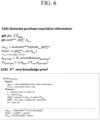
- the purchase requisition information may include a purchase requisition information contract value cm peer and a CT ord obtained by encrypting order information with a seller's public key, wherein the order information comprises a buyer's public key, a random value required to make the cm peer , a purchase price, and a hash value of a content encryption key.
- the purchase approval information may include a CT kdata obtained by encrypting a data encryption key k data using the buyer's public key and a third zero-knowledge proof value.
- the generating of the second transaction may include generating a first zero-knowledge proof of the content-related information.
- the proving of the content-related information may include proving validity of a hash value of encrypted content and a hash value of key data by proving the first zero-knowledge proof.
- the machine-readable instructions may further include registering the content-related information in the blockchain network when the first zero-knowledge proof is proved.
- the generating of the third transaction may include generating a second zero-knowledge proof of the purchase requisition information.
- the proving of the purchase requisition information may include proving the second zero-knowledge proof.
- the machine-readable instructions may further include temporarily storing a content purchase amount in the blockchain network when the second zero-knowledge proof is proved.
- the generating of the fourth transaction may include generating a third zero-knowledge proof of the purchase approval information.
- the proving of the purchase approval information comprises proving the third zero-knowledge proof.
- the machine-readable instructions may further include transmitting the temporarily stored content purchase amount to the seller terminal when the third zero-knowledge proof is proved.
- the second, third and fourth transaction comprise steps to generate the first, second, and third zero-knowledge proofs, respectively.
- the generating the first, second, and third zero-knowledge proofs use a zk-snark algorithm.
- the transmitting of the decryption key of the encrypted content may include decrypting a content decryption key encrypted at the buyer terminal to extract the content decryption key, and decrypting the encrypted content using the content decryption key.
- Another exemplary embodiment of the present invention provides a method of content transaction using a zero-knowledge proof which is performed by a computing device including a processor.
- the method may include generating, by the computing device, a first transaction, the first transaction generates and registers a private key and a public key in a blockchain network; encrypting and hashing digital content provided from an outside; generating, by the computing device, a second transaction, the second transaction registers content-related information in the blockchain network; proving the content-related information through the blockchain network; generating a third transaction, the third transaction registers purchase requisition information received from an external terminal in the blockchain network; proving the purchase requisition information through the blockchain network; generating, by the computing device, a fourth transaction, the fourth transaction generates purchase approval information and registers the purchase approval information in the blockchain network; proving the purchase approval information through the blockchain network; and transmitting a decryption key of an encrypted content to a buyer terminal through the blockchain network.
- a blockchain system which may include a memory, and at least one processor connected to the memory.
- the at least one processor may include generating a first transaction, the first transaction generates a public key and registers the public key in a blockchain network; encrypting and hashing digital content provided from an outside; generating a second transaction, the second transaction registers content-related information in the blockchain network; proving the content-related information through the blockchain network; generating a third transaction, the third transaction registers purchase requisition information received from an external terminal in the blockchain network; proving the purchase requisition information through the blockchain network; generating a fourth transaction, the fourth transaction generates purchase approval information and registers the purchase approval information in the blockchain network; proving the purchase approval information through the blockchain network; and transmitting a decryption key of an encrypted content to a buyer terminal through the blockchain network.
- a component included in any one embodiment and a feature element including a common function may be described using the same name in another embodiment. Unless otherwise stated, the description described in any one embodiment may be applied to other embodiments, and a detailed description may be omitted within a redundant range or a range that can be clearly understood by a skilled person in the art in the art.
- FIG. 1 is a block diagram showing a blockchain system according to an example embodiment.
- the blockchain system may include a server 100, a seller terminal 200, a buyer terminal 300, and a blockchain network 400.
- the server 100 may include a memory 120 and at least one processor 110 connected to the memory.
- the memory 120 may refer to an integral storage for storing and reading data, source code, programs, and data for performing the method of content transaction using the zero-knowledge proof according to the present invention.
- the server 100 is any electronic device including hardware and software.
- the server 100 may be an electronic device such as a router, a switch, a hub, a modem, a bridge, a repeater, a smartphone, a tablet, an IoT device, a PC computer, a server computer, a video game console, a camera, and the like, without being limited to a particular electronic device.
- the memory 120 may store all data necessary for the operation of the server 100.
- the memory 120 may be implemented as a DRAM, a mobile DRAM, an SRAM, a PRAM, an FRAM, an RRAM, and/or an MRAM.
- the memory 120 may include a solid state drive, a hard disk drive, a CD-ROM, etc.
- the memory 120 may store the method of content transaction using the zero-knowledge proof described above with reference to FIGS. 1 to 9 , a blockchain system, a program related to a non-transitory computer-readable medium, application program data, system data, operating system data, and the like.
- the buyer terminal 300 provides the server 100 with the purchase requisition information for the purchase terms of the content to be purchased, and the server 100 generates the purchase requisition information based on the provided information and generates the second zero-knowledge proof.
- the purchase requisition information includes a purchase price, order information, a value obtained by encrypting the order information with a public key of a seller terminal, and a second zero-knowledge proof value.
- the buyer terminal 300 may directly generate the purchase requisition information to generate the second zero-knowledge proof.
- a step of generating a third transaction for registering the purchase requisition information received from the external terminal in the blockchain network is performed.
- the generating of the third transaction includes generating a second zero-knowledge proof of the purchase requisition information, and the proving of the purchase requisition information in the blockchain network includes proving the second zero-knowledge proof.
- the present operation may be performed by the server 100 or may be directly performed by the buyer terminal 300.
- the purchase requisition information indicates that the buyer terminal 300 determines content to be purchased, determines a price of a ciphertext CT data of the content to be purchased by any method, and derives h ct using a hash function H(CT data ).
- the addr peer and h kdata pairs may be found in the blockchain network 400 using the h ct key.
- the purchase requisition information may include order information and purchase requisition information hash values.
- the server 100 or the buyer terminal 300 may generate the purchase requisition information contract value cm peer , generate the order information Order, and generate the CT ord by encrypting the order information with the seller's public key pk enc peer .
- the order information Order may include a buyer's public key, a random value required to create a cm peer , a purchase price, and a hash value of a content encryption key.
- the blockchain network 400 may prove the second zero-knowledge proof.
- a seventh step S107 a step of registering the purchase requisition information in the blockchain network 400 when the second zero-knowledge proof is proved is illustrated.
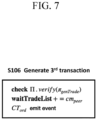
- the third transaction proves the second zero-knowledge proof certificate relation generated in the previous step and includes the encrypted order information CT ord and the purchase requisition information contract value cm peer for the content purchase amount as the temporary waiting list.
- the content purchase amount according to the purchase requisition information (the purchase requisition information contract value cm peer for the content purchase amount) may be transmitted from the buyer terminal 300 to the blockchain network 400 and temporarily stored.
- the seller terminal 200 may transmit the encrypted content to the buyer terminal 300. Since the data processing cost is excessively generated when the content itself is stored in the blockchain network 400 when the amount of data is large, only the part related to the ledger is issued on the blockchain network 400 as a smart contract, and the content source may be traded in a state of being stored in an external storage. For example, the seller terminal 200 may transmit an access link for an external storage in which the encrypted content source is stored to the buyer terminal 300. However, the buyer terminal 300 does not have a key to decrypt the encrypted content. Therefore, after the content transmission is completed, the buyer terminal 300 receives decryption key encrypted with the buyer's public key.
- the content is extracted by decrypting the decryption key by the buyer's public key and decrypt the encrypted content by the decryption key.
- a safe transaction may be performed while privacy is maintained.
- a step of generating a fourth transaction in which the seller terminal 200 provides purchase approval information to the server 100 and the server 100 generates purchase approval information and registers the generated purchase approval information in the blockchain network is performed.
- the seller terminal 200 may directly generate purchase approval information and generate a fourth transaction which registers the purchase approval information in the blockchain network.
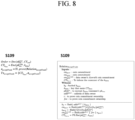
- the purchase approval information may include a CT kdata and a third zero-knowledge proof value.
- the CT kdata is created by encrypting the data encryption key k data with the buyer's public key.
- the purchase approval information may derive order information by decrypting CT ord encrypted with the seller's public key included in the third transaction into the seller's private key sk enc peer .
- the purchase approval information may include a CT kdata obtained by encrypting a data encryption key k data using the buyer's public key.
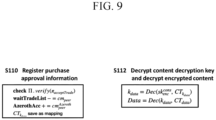
- the purchase approval information may be registered in the blockchain network 400.
- the cm peer in the temporary waiting list is deleted.
- the content purchase amount temporarily stored in the blockchain network 400 is transmitted to the seller terminal 200.
- the buyer terminal 300 may receive the encrypted content decryption key stored in the blockchain network 400, and the buyer terminal 300 may decrypt the encrypted content decryption key to extract the content decryption key, and decrypt the encrypted content based on the extracted content decryption key to extract the content.
- k data which is a content encryption key
- CT data which is content data encrypted using k data
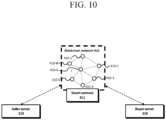
- FIG. 10 is a block diagram showing a blockchain system according to another embodiment of the present disclosure.
- the blockchain system includes a seller server 210, a buyer server 310, and a blockchain network 410.
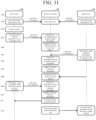
- FIG. 11 is a diagram illustrating a method of content transaction according to another embodiment of the present invention.
- the blockchain network 410 includes a smart contract 411 issued to the blockchain network, and the blockchain network configures a distributed network by a plurality of nodes configured by a plurality of computing devices 410-1 ⁇ 410-N.
- the seller server 210 and the buyer server 310 may include a memory and a processor as any electronic device including hardware and software, and details thereof are as described above with reference to FIGS. 1 and 2 . Details of the blockchain network 410 are also as described above in the contents of FIGS. 1 and 2 .
- each seller server 210 and the buyer server 310 directly generate each transaction, rather than the server 100 of FIG. 1 that performs intermediation.
- the seller server 210 generates a private key and a public key
- the buyer server 310 also generates a private key and a public key.
- the seller server 210 may issue and store the public key on the blockchain network 410 (the first transaction).
- the buyer server 310 may issue and store the public key on the blockchain network 410 (the first transaction).
- the seller server 210 may prepare the content, and according to a third step S203, the prepared content may be encrypted and hashed, and then the first zero-knowledge proof may be generated.
- step S203 a step of generating a second transaction for registering content-related information in the blockchain network in the seller server 210 is performed.
- the content-related information may be proved in the blockchain network. Specifically, the zero-knowledge proof included in the content-related information may be proved.
- the content-related information includes key data of a seller server, encrypted content using the key data, a hash value of the encrypted content, a hash value of the key data, a seller server address, and a first zero-knowledge proof value.
- the content-related information as the content included in the transaction Tx, at least some of a wallet address of the seller, a hash value of a ciphertext of the content, a hash value of a key used to encrypt the content, a zero-knowledge proof (first zero-knowledge proof certificate relation) for encryption and hash of the content, and a price of the content may be registered in the blockchain network.
- a fourth step S204 when the zero-knowledge proof of the content-related information is proved, the content-related information may be registered in the blockchain network.
- the buyer server 310 may directly generate the purchase requisition information including the information on the content to be purchased, generate the second zero-knowledge proof, and then transfer the third transaction to the blockchain network 410.
- the seller server 210 may generate purchase approval information and a third zero-knowledge proof, and generate a fourth transaction which transferred to the blockchain network 410.
- the purchase approval information may include a CT kdata and a third zero-knowledge proof value.
- the CT kdata is created by encrypting the data encryption key k data with the buyer's public key.
- the seller terminal may decrypt the CT ord generated in the buyer terminal, and includes a value obtained by encrypting the key data of the seller terminal with the public key of the buyer, a value obtained by decrypting the encrypted order information, and a third zero-knowledge proof value.
- the buyer server 310 may receive an encrypted content decryption key stored in the blockchain network 410, and the buyer server 310 may decrypt the encrypted content decryption key to extract the content decryption key, and decrypt the encrypted content based on the extracted content decryption key to extract the content.
- a verifier may be made to prove that a public input/output and a private input satisfy a relational expression by using a zero-knowledge proof without revealing a private input.
- the seller terminal may send a transaction for registering purchase approval information to a blockchain network.
- the zero-knowledge proof of the purchase approval information may be proved to confirm the transaction and send the content purchase amount to the seller terminal.
Landscapes
- Engineering & Computer Science (AREA)
- Computer Security & Cryptography (AREA)
- Theoretical Computer Science (AREA)
- Health & Medical Sciences (AREA)
- Bioethics (AREA)
- General Health & Medical Sciences (AREA)
- Signal Processing (AREA)
- Computer Networks & Wireless Communication (AREA)
- Software Systems (AREA)
- Physics & Mathematics (AREA)
- General Engineering & Computer Science (AREA)
- General Physics & Mathematics (AREA)
- Computer Hardware Design (AREA)
- Databases & Information Systems (AREA)
- Medical Informatics (AREA)
- Financial Or Insurance-Related Operations Such As Payment And Settlement (AREA)
Priority Applications (1)
| Application Number | Priority Date | Filing Date | Title |
|---|---|---|---|
| EP23220014.7A EP4575868A1 (fr) | 2023-12-22 | 2023-12-22 | Support non transitoire lisible par ordinateur fournissant des informations de transaction à l'aide d'un algorithme de preuve à connaissance nulle, procédé de transaction de contenu et système de chaîne de blocs associé |
Applications Claiming Priority (1)
| Application Number | Priority Date | Filing Date | Title |
|---|---|---|---|
| EP23220014.7A EP4575868A1 (fr) | 2023-12-22 | 2023-12-22 | Support non transitoire lisible par ordinateur fournissant des informations de transaction à l'aide d'un algorithme de preuve à connaissance nulle, procédé de transaction de contenu et système de chaîne de blocs associé |
Publications (1)
| Publication Number | Publication Date |
|---|---|
| EP4575868A1 true EP4575868A1 (fr) | 2025-06-25 |
Family
ID=89430571
Family Applications (1)
| Application Number | Title | Priority Date | Filing Date |
|---|---|---|---|
| EP23220014.7A Pending EP4575868A1 (fr) | 2023-12-22 | 2023-12-22 | Support non transitoire lisible par ordinateur fournissant des informations de transaction à l'aide d'un algorithme de preuve à connaissance nulle, procédé de transaction de contenu et système de chaîne de blocs associé |
Country Status (1)
| Country | Link |
|---|---|
| EP (1) | EP4575868A1 (fr) |
Citations (4)
| Publication number | Priority date | Publication date | Assignee | Title |
|---|---|---|---|---|
| US20200127834A1 (en) * | 2018-10-19 | 2020-04-23 | Eygs Llp | Methods and systems for retrieving zero-knowledge proof-cloaked data on distributed ledger-based networks |
| US20210297418A1 (en) * | 2020-06-08 | 2021-09-23 | Alipay Labs (singapore) Pte. Ltd. | User management of blockchain-based custom clearance service platform |
| US20210342830A1 (en) * | 2020-04-29 | 2021-11-04 | American Express Travel Related Services Company, Inc. | Privacy-preserving decentralized payment instrument network |
| US20220200805A1 (en) * | 2019-04-24 | 2022-06-23 | Sony Group Corporation | Blockchain-based crowdsourcing |
-
2023
- 2023-12-22 EP EP23220014.7A patent/EP4575868A1/fr active Pending
Patent Citations (4)
| Publication number | Priority date | Publication date | Assignee | Title |
|---|---|---|---|---|
| US20200127834A1 (en) * | 2018-10-19 | 2020-04-23 | Eygs Llp | Methods and systems for retrieving zero-knowledge proof-cloaked data on distributed ledger-based networks |
| US20220200805A1 (en) * | 2019-04-24 | 2022-06-23 | Sony Group Corporation | Blockchain-based crowdsourcing |
| US20210342830A1 (en) * | 2020-04-29 | 2021-11-04 | American Express Travel Related Services Company, Inc. | Privacy-preserving decentralized payment instrument network |
| US20210297418A1 (en) * | 2020-06-08 | 2021-09-23 | Alipay Labs (singapore) Pte. Ltd. | User management of blockchain-based custom clearance service platform |
Similar Documents
| Publication | Publication Date | Title |
|---|---|---|
| US20230139090A1 (en) | Differential client-side encryption of information originating from a client | |
| JP6640320B1 (ja) | トークン管理システムおよびトークン管理方法 | |
| US12003495B2 (en) | Decentralized processing of interactions on delivery | |
| US10484168B2 (en) | Methods and systems for obfuscating data and computations defined in a secure distributed transaction ledger | |
| US10552829B2 (en) | Obfuscation of intent in transactions using cryptographic techniques | |
| JP6364132B2 (ja) | ブロックチェーン取引記録のシステムおよび方法 | |
| US20160260091A1 (en) | Universal wallet for digital currency | |
| CN111047443B (zh) | 用户评分方法及装置、电子设备、计算机可读存储介质 | |
| US12248940B2 (en) | Dynamic ledger address masking | |
| KR102302955B1 (ko) | 자산의 토큰화를 통해 현물 자산 거래를 가능하게 하는 블록체인 및 클라우드 기반의 자산 거래 플랫폼 서버 및 그 동작 방법 | |
| KR102125042B1 (ko) | 블록체인 네트워크를 구성하는 노드 장치 및 그 노드 장치의 동작 방법 | |
| CN107408255A (zh) | 云加密密钥中介设备、方法和系统 | |
| US11502837B2 (en) | Techniques for performing secure operations | |
| CN115867931A (zh) | 保护隐私的分散式支付工具网络 | |
| US20250200562A1 (en) | Non-transitory computer-readable medium proving transaction information using zero-knowledge proof algorithm, method of content transaction, and blockchain system thereof | |
| WO2026031899A1 (fr) | Procédé et appareil de traitement de données, et dispositif et support de stockage | |
| CN111861462B (zh) | 基于区块链的金融产品交易方法及装置 | |
| CN116132185B (zh) | 数据调用方法、系统、装置、设备和介质 | |
| JP7627922B1 (ja) | ゼロ知識証明アルゴリズムを活用した取引情報を検証するコンピュータ読み取り可能媒体、コンテンツ取引方法およびブロックチェーンシステム | |
| Yu et al. | A novel fair and verifiable data trading scheme | |
| US20250315820A1 (en) | Confidential non-fungible tokens (nfts) | |
| US20250209433A1 (en) | Blockchain-based escrowed marketplace | |
| US12597002B2 (en) | Method, system and computer program product for collateralizing non-fungible tokens | |
| CN113475037A (zh) | 使用虚拟区块链协议来实施公平电子交换 | |
| US20240211147A1 (en) | Self protecting digital assets |
Legal Events
| Date | Code | Title | Description |
|---|---|---|---|
| PUAI | Public reference made under article 153(3) epc to a published international application that has entered the european phase |
Free format text: ORIGINAL CODE: 0009012 |
|
| STAA | Information on the status of an ep patent application or granted ep patent |
Free format text: STATUS: REQUEST FOR EXAMINATION WAS MADE |
|
| 17P | Request for examination filed |
Effective date: 20231222 |
|
| AK | Designated contracting states |
Kind code of ref document: A1 Designated state(s): AL AT BE BG CH CY CZ DE DK EE ES FI FR GB GR HR HU IE IS IT LI LT LU LV MC ME MK MT NL NO PL PT RO RS SE SI SK SM TR |