EP3957239B1 - Nichtinvasives verfahren und system zur messung eines bewegungsmerkmals von herzmuskelgewebe - Google Patents
Nichtinvasives verfahren und system zur messung eines bewegungsmerkmals von herzmuskelgewebe Download PDFInfo
- Publication number
- EP3957239B1 EP3957239B1 EP19924783.4A EP19924783A EP3957239B1 EP 3957239 B1 EP3957239 B1 EP 3957239B1 EP 19924783 A EP19924783 A EP 19924783A EP 3957239 B1 EP3957239 B1 EP 3957239B1
- Authority
- EP
- European Patent Office
- Prior art keywords
- heart
- myocardial
- capacitance
- tissue
- change
- Prior art date
- Legal status (The legal status is an assumption and is not a legal conclusion. Google has not performed a legal analysis and makes no representation as to the accuracy of the status listed.)
- Active
Links
Images





Classifications
-
- A—HUMAN NECESSITIES
- A61—MEDICAL OR VETERINARY SCIENCE; HYGIENE
- A61B—DIAGNOSIS; SURGERY; IDENTIFICATION
- A61B5/00—Measuring for diagnostic purposes; Identification of persons
- A61B5/05—Detecting, measuring or recording for diagnosis by means of electric currents or magnetic fields; Measuring using microwaves or radio waves
- A61B5/053—Measuring electrical impedance or conductance of a portion of the body
- A61B5/0531—Measuring skin impedance
-
- A—HUMAN NECESSITIES
- A61—MEDICAL OR VETERINARY SCIENCE; HYGIENE
- A61B—DIAGNOSIS; SURGERY; IDENTIFICATION
- A61B5/00—Measuring for diagnostic purposes; Identification of persons
- A61B5/02—Detecting, measuring or recording for evaluating the cardiovascular system, e.g. pulse, heart rate, blood pressure or blood flow
- A61B5/024—Measuring pulse rate or heart rate
- A61B5/0245—Measuring pulse rate or heart rate by using sensing means generating electric signals, i.e. ECG signals
-
- A—HUMAN NECESSITIES
- A61—MEDICAL OR VETERINARY SCIENCE; HYGIENE
- A61B—DIAGNOSIS; SURGERY; IDENTIFICATION
- A61B5/00—Measuring for diagnostic purposes; Identification of persons
- A61B5/0002—Remote monitoring of patients using telemetry, e.g. transmission of vital signals via a communication network
- A61B5/0004—Remote monitoring of patients using telemetry, e.g. transmission of vital signals via a communication network characterised by the type of physiological signal transmitted
- A61B5/0006—ECG or EEG signals
-
- A—HUMAN NECESSITIES
- A61—MEDICAL OR VETERINARY SCIENCE; HYGIENE
- A61B—DIAGNOSIS; SURGERY; IDENTIFICATION
- A61B5/00—Measuring for diagnostic purposes; Identification of persons
- A61B5/103—Measuring devices for testing the shape, pattern, colour, size or movement of the body or parts thereof, for diagnostic purposes
- A61B5/11—Measuring movement of the entire body or parts thereof, e.g. head or hand tremor or mobility of a limb
- A61B5/1126—Measuring movement of the entire body or parts thereof, e.g. head or hand tremor or mobility of a limb using a particular sensing technique
-
- A—HUMAN NECESSITIES
- A61—MEDICAL OR VETERINARY SCIENCE; HYGIENE
- A61B—DIAGNOSIS; SURGERY; IDENTIFICATION
- A61B5/00—Measuring for diagnostic purposes; Identification of persons
- A61B5/72—Signal processing specially adapted for physiological signals or for diagnostic purposes
- A61B5/7235—Details of waveform analysis
- A61B5/7253—Details of waveform analysis characterised by using transforms
- A61B5/7257—Details of waveform analysis characterised by using transforms using Fourier transforms
-
- A—HUMAN NECESSITIES
- A61—MEDICAL OR VETERINARY SCIENCE; HYGIENE
- A61B—DIAGNOSIS; SURGERY; IDENTIFICATION
- A61B5/00—Measuring for diagnostic purposes; Identification of persons
- A61B5/72—Signal processing specially adapted for physiological signals or for diagnostic purposes
- A61B5/7271—Specific aspects of physiological measurement analysis
- A61B5/7285—Specific aspects of physiological measurement analysis for synchronizing or triggering a physiological measurement or image acquisition with a physiological event or waveform, e.g. an ECG signal
-
- A—HUMAN NECESSITIES
- A61—MEDICAL OR VETERINARY SCIENCE; HYGIENE
- A61B—DIAGNOSIS; SURGERY; IDENTIFICATION
- A61B5/00—Measuring for diagnostic purposes; Identification of persons
- A61B5/74—Details of notification to user or communication with user or patient; User input means
- A61B5/7475—User input or interface means, e.g. keyboard, pointing device, joystick
Definitions
- the present invention relates to a technology for measurement of biological tissues, in particular to a non-invasive method and system for measuring the motion characteristics of a myocardial tissue.
- the basic function of a heart is to pump blood, circulate the blood in an organism, and provide oxygen and nutrients to tissues. Therefore, the measurement of cardiac dynamics parameters is of extremely important significance in the medical field.
- Myocardial cells have structural characteristics indicating that they pertain to an elastic tissue. Therefore, the motion of the myocardial tissue, especially elasticity thereof, should be the main measurement target.
- the stress-strain relationship of the myocardial tissue has been extensively studied, and its related applications are mainly realized through ultrasonic imaging systems.
- a heart has four chambers, including two atria and two ventricles. Under normal circumstances, the right atrium collects blood from the superior and inferior vena cava. The blood then enters the right ventricle, where the blood is pumped into the lungs. The left atrium receives blood from the pulmonary veins and sends it to the left ventricle, which pumps the blood through the aorta to the whole body.
- the heart wall has a three-layer structure, namely the inner endocardium, the middle myocardium and the outer epicardium. The endocardium is the lining of simple squamous epithelium, covering the heart chambers and valves.
- the myocardium is the muscle of the heart, a layer of involuntary striated muscle tissue, which is restricted by the framework of collagen, so that the myocardial cells are arranged on a curved sheet, forming a spiral structure as a whole.
- the myocardium is the focus of the present invention.
- the pericardium is a double-layered sac containing the heart and the roots of large blood vessels.
- the present invention focuses on the early detection of changes in the myocardial tissue and can be used to prevent sudden heart attacks.
- the related document WO 98/53737 A1 discloses a method and a system for non-invasively determining at least one main cardiorespiratory parameter of an individual, such as the Stroke Volume, at least one parameter characterizing balance of the extracellular fluid in the body (such as the Index Balance), and for diagnostics of blood circulatory problems and/or failures of cardiac functions.
- at least one main cardiorespiratory parameter of an individual such as the Stroke Volume
- at least one parameter characterizing balance of the extracellular fluid in the body such as the Index Balance
- the document EP 3 957 240 A1 discusses about a non-invasive method and system to detect characteristic information of body tissues, comprising applying multiple synchronous alternating currents at different frequencies to a human body.
- the present invention proposes a non-invasive method for measuring the motion characteristics of a myocardial tissue, with the purpose of calculating the average longitudinal length of myocardial cells by measuring the overall capacitance of the heart tissue, thereby obtaining the motion characteristics of the myocardial tissue.
- the invention is set out in the appended claim set.
- the method is mainly used for detecting information for non-therapeutic purposes.
- the present invention provides a non-invasive method for measuring the motion characteristics of a myocardial tissue, wherein the method comprises: transmitting a plurality of generated synchronous orthogonal, phase controllable and adjustable alternating currents with different frequencies into an organism so as to generate a plurality of synchronous periodic alternating current (AC) voltage signals with different frequencies; receiving the periodic AC voltage signals modulated by changes in the organism's heart tissue to obtain the organism's frequency responses; calculating resistances and capacitances of the heart tissue according to the frequency responses; and estimating the motion characteristics of the myocardial tissue according to the resistances and the capacitances.
- AC synchronous periodic alternating current
- the calculating resistances and capacitances of the heart tissue according to the frequency responses comprises, obtaining system transfer function of the organism according to the frequency responses, and performing multi-chamber modeling to separate the heart tissue and peripheral tissues.
- the estimating the motion characteristics of the myocardial tissue according to the resistances and the capacitances comprises: calculating the average longitudinal length of myocardial cells and its change according to the capacitances, and/or calculating heart pumping blood flow according to the resistances; and obtaining the overall longitudinal elastic state of the heart according to the average longitudinal length of the myocardial cells and its change and/or the heart pumping blood flow.
- the method further comprises, estimating health and working states of the heart and the myocardium according to the overall longitudinal elastic state of the heart.
- the estimating comprises, analyzing the health and working states of the heart and the myocardium according to the slope value of changes of the overall longitudinal elastic state of the heart, the delay to an R wave, the peak-to-peak value, and the change curve and its derivative's shape of the average longitudinal length of the myocardial cells, wherein the health and working states of the heart and the myocardium comprise, the systole speed, time, intensity and pattern of the heart tissue, and/or the diastole speed, time, recovery and pattern of the heart tissue.
- the obtaining the organism's frequency responses comprises, calculating a frequency response estimation value of a specific frequency every 0.25 to 5 milliseconds.
- the calculating the average longitudinal length of myocardial cells and its change according to the capacitances comprises: detecting the average longitudinal length of the myocardial cells and its change over time at a rate of 200 to 4000 times per second; and processing the time sequence of the change over time of the average longitudinal length of the myocardial cells using a digital signal processing method, wherein the digital signal processing method comprises digital filtering, Fast Fourier Transform (FFT) , and time domain and frequency domain analysis.
- FFT Fast Fourier Transform
- the method further comprises, referring to an electrocardiogram having the same time sequence to analyze the change sequence of the average longitudinal length of the myocardial cells, wherein the referring comprises comparing the electrocardiogram with the change sequence of the average longitudinal length of the myocardial cells for their cardiac cycles, systolic and diastolic phases, and/or the boundaries thereof.
- the performing multi-chamber modeling to separate the heart tissue and peripheral tissues comprises, modeling each chamber as parallel resistor and capacitor, multiple chambers being connected in series or in parallel.
- the present invention also provides a system for implementing the above methods, wherein the system comprises a terminal and at least one processor, wherein the terminal comprises a generator for transmitting a plurality of generated synchronous orthogonal, phase controllable and adjustable, and periodic alternating currents with different frequencies; and one or more sensors for transmitting the periodic alternating currents into an organism to generate a plurality of periodic AC voltage signals with different frequencies, and receiving the periodic AC voltage signals modulated by changes in the heart tissue of the organism to obtain the organism's frequency responses; wherein the processor is configured to calculate resistances and capacitances of the heart tissue according to the frequency responses, and to estimate the motion characteristics of the myocardial tissue according to the resistances and the capacitances, wherein the processor is configured to calculate an average longitudinal length of myocardial cells and its change according to the capacitances, and/or calculating heart pumping blood flow according to the resistances, and obtain the overall longitudinal elastic state of the heart according to the average longitudinal length of the myocardial cells and
- the senor is configured to collect single or multiple pieces of data from different parts.
- the system may comprise a database for storing processing results and data of the processor, and the processor may retrieve the database.
- the processor may be remote, and may be used for remote observation of the system's work in a real-time mode.
- the terminal further comprises a man-machine interface for controlling the system and/or displaying results.
- the present invention relates to a new technology for detecting the contraction and relaxation of the myocardial tissue at the cellular level, and has the advantage that the present invention provides a continuousand non-invasive method with high-sampling rate to measure the motion of the myocardial tissue at an overall cellar level, so as to detect even more subtle abnormal changes in the myocardial cells.
- the present invention avoids the traditional technology of using imaging results for analysis, and provides a faster but standard measurement method with lower cost.
- the present invention relates to a non-invasive technology for detecting the electrical properties of tissues in an organism, such as resistances and capacitances of the tissues and their change patterns. Its goal is to capture changes in body fluid, blood flow and cardiovascular circulatory tissues, to monitor the health state of the organism, to measure and verify the elasticity of the cardiovascular system, and to detect information for non-therapeutic purposes.
- heart cells are considered to be equipotential. Therefore, the cell size can be estimated by capacitance measurement.
- the heart cells When the heart cells are in their normal positions, it can be considered that they are arranged in series and parallel modes at the same time, because the heart's structural cells restrict the muscle cells in space.
- the average geometric scale variable of the cells can be introduced to represent the changing process of the myocardial cells under the influence of an external electromagnetic field.
- a variable particularly relevant to the present invention is the average longitudinal length of the myocardial cells, i.e., r(t), which is proven to be directly proportional to the myocardial capacitance measured under the external field.
- the average longitudinal length of the myocardial cells and its change can be calculated by measuring the capacitance. From the change of the average longitudinal length of the myocardial cells, a method describing the overall longitudinal elasticity of the heart can be given.
- the overall longitudinal elasticity of the heart can be described by the relative change rate of the myocardial capacitance over time under an external electric field.
- the most simplified model is to replace the myocardial cells with an equivalent sphere in the direction of the external electromagnetic field.
- the average longitudinal length r(t) can be regarded as the average contraction radius of the myocardial cells.
- ⁇ 0 is the cell's magnetic permeability.
- the capacitance is also directionally proportional to the average longitudinal length of the myocardial cells, and the proportional coefficient is related to the geometrical shape and the magnetic permeability of the myocardial cells.
- the equivalent sphere is used for illustration below.
- FIG. 1 is a schematic diagram of a two-dimensional abstract model of simulated myocardial cells provided by an embodiment of the present invention, which is supported by a plurality of myocardial cells' microstructures.
- the myocardial cells are connected in series and parallel modes.
- M cells are connected in series to form chains in the longitudinal direction, and L chains are in parallel connection in total.
- the myocardial cells are replaced with an equivalent sphere in the direction of the external electromagnetic field.
- r(t) is the equivalent average contraction radius of the myocardial cells, that is, the average longitudinal length, which is a time variable, and ⁇ 0 is the cell's magnetic permeability. It can be seen that under normal circumstances, C(t) and r(t) have a linear relationship, that is, the capacitance is directly proportional to the average longitudinal length of the myocardial cells, and the proportional coefficient is related to the geometric shape and the magnetic permeability of the myocardial cells. In an abnormal state, the position and size of r(t) will change, or the abnormal cells exhibit different magnetic permeabilities, resulting in the change of C(t), which also have different changing patterns.
- FIG. 2 is an overall frame diagram of a part of the system provided by another embodiment of the present invention.
- a human or animal body 20 is connected to a collection system 23 through electrodes or contacts 21 and cables 22.
- the voltage signals modulated by the human or animal body 20 are transmitted to the collection system 23 through the electrodes or contacts 21, and the collection system 23 processes the voltage signals and transmits them to a host 24 for further analysis.
- the host 24 comprises a human-computer interaction interface for receiving or transmitting external commands.
- FIG. 3 is a schematic diagram illustrating the placement of the transmitting and receiving electrodes provided by another embodiment of the present invention.
- 25 represents the heart tissue in the thoracic cavity of a human or animal body
- the transmitting electrodes 27 and the receiving electrodes 26 are all located at the skin directly above the heart tissue 25.
- the transmitting electrodes 27 comprise two pairs of electrodes T1-T2, and T3-T4. Each pair of the transmitting electrodes is driven in a time-sharing manner and are independent of each other.
- Electrodes T1 and T2 are respectively aligned to the outer edges of both longitudinal ends of the heart tissue 25, and electrodes T3 and T4 are respectively aligned to the outer edges of the both transverse ends of the heart tissue 25.
- the wideband current signals enter the human or animal body 20 from the transmitting electrodes 27.
- the receiving electrodes 26 comprise 3 electrodes R1, R2 and R3. All of them are aligned to the heart tissue 25 and located among the transmitting electrodes 27, for detecting the wideband voltage signals.
- electrodes R1 and R2 or electrodes R1 and R3 respectively constitute a longitudinal receiving pair, and electrodes R2 and R3 constitute a transverse receiving pair.
- the system can comprise these two receiving circuit pairs, so as to detect the heart tissue's motion changes in two directions.
- FIG. 4 is a schematic diagram of a circuit structure of the system provided by another embodiment of the present invention.
- the system can not only receive voltage signals, but also transmit current signals to the human or animal body and its tissues.
- wideband signals are generated from the frequency domain to the time domain in the integrated circuit (IC) of a microprocessor 1 or a field programmable gate array (FPGA) 2. If the wideband signals are updated infrequently, their time-domain signals can be stored in the system, and the FPGA 2 can continuously output the signals to a digital-to-analog converter (DAC) 4.
- the DAC typically operates at a high speed, for example, more than 16 times of the Nyquist rate.
- the output signals of the DAC 4 are amplified to drive the wideband current pump 9.
- the output of the wideband current pump 9 is connected to the input of the analog switch 11, and the outputs of the analog switch 11 are connected to the transmitting electrode pair T1-T2, or T3-T4 respectively.
- the current signals are transmitted to the human or animal body.
- the receiving electrode pair R1-R2, or pair R1-R3 may simultaneously or non-simultaneously receive signals from the long-axis direction of the heart. Meanwhile, the receiving electrode pair R2-R3 may receive signals from the short-axis of the heart.
- the voltage signals modulated by the human or animal body are amplified by a preamplifier array 10. All outputs from the preamplifier array 10 are inputted to a wideband amplifier array 8, among which one output is also connected to a dedicated ECG amplification collector 7, to obtain ECG signals. The ECG signals are transmitted to the FPGA 2.
- the wideband amplifier array 8 outputs the signals to an analog-to-digital converter (ADC) 6. This embodiment uses a high-speed and high-resolution ADC. Then the ADC 6 converts the analog signals into digital signals and sends them to the FPGA 2.
- ADC analog-to-digital converter
- changes in the cardiovascular system of the human body may cause an impedance change of 0.2 %, that is, the dynamic range is about -54dB. If the result of the received signal requires 1 % resolution, then the required dynamic range is 94 dB, which is about 16 bits. Therefore, the minimum requirement of the DAC used in this embodiment is 16 bits.
- a digital correction must be performed to calculate the human body phase response.
- This embodiment does not use an analog filter, but an oversampling DAC.
- the oversampling DAC's high rate will greatly reduce the dependence on the analog filter.
- the oversampling rate can be 16 times the Nyquist rate or higher.
- the signal acquisition adopts a delta-sigma ADC, considering that the signal acquisition has higher requirements than signal generation, but oversampling like a DAC requires high hardware performance and resources, and the effect is not obvious if they are modulated signals.
- the delta-sigma ADC requires superposition and its sampling rate is not high. Specifically, when its sampling rate increases, its bit resolution will decrease.
- the dynamic changing range of the ADC needs to be considered. About 3 bits are reserved for this change, while at least one bit is reserved to prevent saturation.
- the ADC will have a minimum as 20 bits, in order to maintain the same dynamic range as the DAC, therefore a full-speed 24-bit sigma-delta ADC has a dynamic range of about 20 bits.
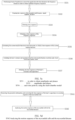
- FIGS. 5a-5d are flowcharts of a method provided by another embodiment of the present invention, which specifically comprises signal generation, signal acquisition, and signal processing.
- the signal generation comprises generating multi-frequency synchronous orthogonal sine wave digital signals from the frequency domain to the time domain S 511, converting the digital signals into analog signals S 512, amplifying the analog signals to drive the current pump S 513 , converting the voltage signals into current signals S 514 , and injecting the multi-frequency synchronous orthogonal sine wave current into the human or animal body to be tested S 515 .
- the signal acquisition specifically comprises receiving analog voltage signals from a human or animal body S 521 and amplifying them S 522 , and converting the analog signals into digital signals S 523.
- a Fourier Transform is performed to convert the signals from the time domain to the frequency domain in order to obtain wideband frequency responses S 531 , and these wideband frequency responses are time-varying. Frequency correction and filtering are later performed on these frequency responses, to eliminate distortion and noises S 532 -S 534 .
- These corrected and filtered frequency responses are used to calculate the system transfer function S 535 , which is also a time-varying sequence. According to the coefficient decomposition of the system transfer function, we can obtain the heart's resistance and capacitance S 536 . Then the resistance and capacitance sequences are filtered for the next processing S 537 . That is, the capacitance of the heart is directly related to the size of the myocardial cells.
- FIG. 5d there is also geometric information in the capacitor, which should be removed S 541 .
- the time derivative of the capacitance is divided by the capacitance fluctuation in one cardiac cycle, that is, dc/dt/ ⁇ c.
- This method is related to the specific parameters. For example, in FIG. 13d and FIG. 14d , after the geometric information is removed, only information about the changes in the radius of the myocardial cells is left. It represents the change in myocardial cells during the cardiac cycle. On such as basis, further analysis and machine learning can be performed S 542 .
- the resistance of the heart is more complex, which includes the resistance of the blood in chambers and in the myocardial tissue. However, since the blood change in the heart is dominant, the resistance can be directly used to calculate the blood flow.
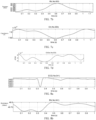
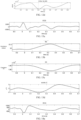
- FIGS. 6a-6d are a young man's electrocardiogram, curves of his heart's resistance and capacitance over time, and the derivative of the capacitance curve provided by another embodiment of the present invention. This is the data of a normal person. Specifically, FIG. 6 a is the electrocardiogram (ECG), FIG. 6b is the heart resistance curve, FIG. 6c is the myocardial capacitance curve, and FIG. 6d is the derivative change curve of the myocardial capacitance.
- ECG electrocardiogram
- FIG. 6b is the heart resistance curve
- FIG. 6c is the myocardial capacitance curve
- FIG. 6d is the derivative change curve of the myocardial capacitance.
- the electrocardiogram is not a standard pattern, but is obtained by simultaneous detection on the electrodes that measure the heart voltage signals.
- the heart resistance comes from the blood in the chambers and the myocardial tissue.
- the chamber has the highest blood volume and thus the minimum resistance.
- the blood resistance is dominant in the displayed heart resistance.
- myocardial cells relax and have the largest cell volume.
- the capacitance reaches its peak value.
- the volume of the myocardial cells is the smallest and so is the capacitance.
- the capacitance curve in this cardiac cycle does not fully recover to the most diastolic level. There may be two reasons for this. The first is interference; the second is that the diastolic process has its randomness; and it is not that every cycle is the same and can be restored to the maximum position, which means that the peaks may vary. From the heart resistance curve, his heart volume starts to decrease (systole) from the R wave until the T wave occurs, and then it begins to increase (diastole). This is completely consistent with the myocardium's bioelectric activity in polarization and depolarization.
- the myocardial cells begin to shrink (systole) from the R wave, and until the T wave ocurrs, they begin to grow (diastole). It does not return to the maximum point of diastole, which is due to the randomness of diastole. From the volume of the heart and the volume change of the myocardial cells, the heart pumping and the myocardial work can be estimated, that is, the characteristics of the mechanical activity of biological tissues can be estimated based on their electrical activities.
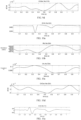
- FIGS. 7a-7d are data of a normal middle-aged male provided by another embodiment of the present invention.
- FIG. 7a is the electrocardiogram (ECG)
- FIG. 7b is the heart resistance curve
- FIG. 7c is the myocardial capacitance curve
- FIG. 7d is the derivative of the myocardial capacitance curve.
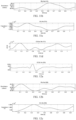
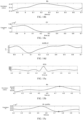
- FIGS. 8a-8d are data of an elderly woman provided by another embodiment of the present invention, wherein FIG. 8a is the electrocardiogram (ECG), FIG. 8b is the heart resistance curve, FIG. 8c is the myocardial capacitance curve, and FIG. 8d is the derivative of the myocardial capacitance curve.
- ECG electrocardiogram
- FIG. 8b is the heart resistance curve
- FIG. 8c is the myocardial capacitance curve
- FIG. 8d is the derivative of the myocardial capacitance curve.
- the subject's blood pressure is relatively high, and premature beats are identified. From the heart resistance curve, the subject's systole is normal, but it is completed long before the myocardial repolarization. After the repolarization, the heart volume does not change much in this cycle, that is, there is not much blood filling.
- the myocardium completes the contraction well before the T wave, and begins to relax, but the relax is very slowly, and does not return to the maximum relax point.
- the systole is too fast and the diastole is slow, thus it is speculated that the myocardial tissue is aging.
- FIGS. 9a-9d are data of an elderly woman provided by another embodiment of the present invention, wherein FIG. 9a is the electrocardiogram (ECG), FIG. 9b is the heart resistance curve, FIG. 9c is the myocardial capacitance curve, and FIG. 9d is the derivative of the myocardial capacitance curve.
- ECG electrocardiogram
- FIG. 9b is the heart resistance curve
- FIG. 9c is the myocardial capacitance curve
- FIG. 9d is the derivative of the myocardial capacitance curve.
- the starting point of myocardial contraction is normal, but the myocardium seems to be weak, the volume of myocardial cells changes very little, and it increases later.
- the myocardial relaxation ends at the T wave, and returns to the maximum relax point. It can be seen from this that the minimum point of the heart volume and the minimum point of the myocardial volume are not necessarily at the same time point.
- FIGS. 10a-10d are data of an elderly woman provided by another embodiment of the present invention, wherein FIG. 10 a is the electrocardiogram (ECG), FIG. 10b is the heart resistance curve, FIG. 10c is the myocardial capacitance curve, and FIG. 10d is the derivative of the myocardial capacitance curve.
- ECG electrocardiogram
- FIG. 10b is the heart resistance curve
- FIG. 10c is the myocardial capacitance curve
- FIG. 10d is the derivative of the myocardial capacitance curve.
- FIGS. 11a-11d are data of an elderly woman provided by another embodiment of the present invention.
- FIG. 11 a is the electrocardiogram (ECG)
- FIG. 11b is the heart resistance curve
- FIG. 11c is the myocardial capacitance curve
- FIG. 11d is the derivative of the myocardial capacitance curve. From the resistance curve, the systole lags slightly and is completed before the peak of the T wave. Then the heart relaxes. From the capacitance curve, the starting point of the myocardial contraction is normal, but the myocardial contraction is divided into two regions, which is more obvious on the derivative curve of the capacitance. Therefore, the states of the myocardial cells are not uniform. The myocardial cells can also relax and recover. It can be determined that the subject's myocardium is defective.
- FIGS. 12a-12d are data of an elderly woman provided by another embodiment of the present invention, wherein FIG. 12 a is the electrocardiogram (ECG), FIG. 12b is the heart resistance curve, FIG. 12c is the myocardial capacitance curve, and FIG. 12d is the derivative of the myocardial capacitance curve.
- ECG electrocardiogram
- FIG. 12b is the heart resistance curve
- FIG. 12c is the myocardial capacitance curve
- FIG. 12d is the derivative of the myocardial capacitance curve.
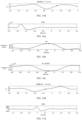
- FIGS. 13a-13d and FIGS. 14a-14d are data of two persons provided by another embodiment of the present invention, wherein, FIG. 13 a and FIG. 14 a are the electrocardiograms (ECG), FIG. 13b and FIG. 14b are the heart resistance curves, FIG. 13 c and FIG. 14c are the myocardial capacitance curves, and FIG. 13d and FIG. 14d are time curves of the relative change rate of myocardial capacitance.
- FIG. 13d and FIG. 14 a are the electrocardiograms (ECG)
- FIG. 13b and FIG. 14b are the heart resistance curves
- FIG. 13 c and FIG. 14c are the myocardial capacitance curves
- FIG. 13d and FIG. 14d are time curves of the relative change rate of myocardial capacitance.
- the myocardial cells' equivalent deformation rate ( S -1 ), or the relative change rate of the capacitance in this embodiment, and the relative change of the capacitance, are two measurement parameters.
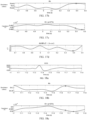
- FIGS. 15a-15d and FIGS. 16a-16d are data of two normal persons provided by another embodiment of the present invention, wherein FIG. 15 a and FIG. 16 a are the electrocardiograms (ECG), FIG. 15b and FIG. 16b are heart resistance curves, FIG. 15c and FIG. 16c are the myocardial capacitance curves, FIG. 15d and FIG. 16d are time curves of the relative change rate of myocardial capacitance.
- ECG electrocardiograms
- FIG. 15b and FIG. 16b are heart resistance curves
- FIG. 15c and FIG. 16c are the myocardial capacitance curves
- FIG. 15d and FIG. 16d are time curves of the relative change rate of myocardial capacitance.
- the circle marks are the moments when the heart volume is the smallest
- the solid dot are the moments when the myocardial cell volume is the smallest.
- the circle and the solid point basically overlap.
- c ( t circle ) is the capacitance at the moment when the heart volume is the smallest
- c ( t dot ) is the capacitance at the moment when the myocardial volume is the smallest
- c pp is the capacitance's peak-to-peak value in this cardiac cycle.
- the relative change of the myocardial capacitance corresponds to the change of tensor in ultrasound. In ultrasound, when the aortic valve is closed, the equivalent deformation (%) and the equivalent deformation rate ( S -1 ) of the tissue are also detected.
- the moment of the minimum value of the heart volume i.e., the maximum value of the resistance
- the relative change rate of the capacitance ( S -1 ) measured at this moment should be consistent with the equivalent deformation rate ( S -1 ) in ultrasonic testing, both approaching zero.
- the capacitance's relative change (%) measured at this point in time should be consistent with the tensor deformation in ultrasonic testing, both approaching zero.
- the maximum of the equivalent deformation rate ( S -1 ) for a normal person in the systole is 1 ( S -1 ).
- the relative change ( ⁇ ) of capacitance and the equivalent deformation rate ( S -1 ) are both approaching zero.
- the relative change ( ⁇ ) of capacitance corresponds to the tensor deformation at the moment of the closure of the aorta in ultrasonic Doppler tissue imaging.
- this embodiment can obtain more information, such as using a waveform analysis method, combining P, R, and T waves in the electrocardiogram, and further combined with statistical models, and the curve characteristics of the resistance and the capacitance, one can totally analyze the elasticity of the tissue from the perspective of deformation mechanics, that is, analyze the contraction and extension of the myocardial cells from the change process of their average longitudinal length, such as calculating the elasticity of the myocardium and its ability to do work from the speeds of contraction and relaxation.
- FIGS. 17a-17d are data of a person with an abnormal heart tissue provided by another embodiment of the present invention, wherein, FIG. 17 a is the electrocardiogram (ECG), FIG. 17b is the heart resistance curve, FIG. 17c is the myocardial capacitance curve, and FIG. 17 d is the time curve of the relative change rate of myocardial capacitance.
- ECG electrocardiogram
- FIG. 17b is the heart resistance curve
- FIG. 17c is the myocardial capacitance curve
- FIG. 17 d is the time curve of the relative change rate of myocardial capacitance.
- the circle marks in the figures are the moments when the heart volume is the smallest, and the solid dots are the moments when the myocardial cell volume is the smallest. According to calculations, the results of ⁇ (27%) and ⁇ (-5.67) both show that the heart tissue is abnormal.
- FIGS. 18a-18d are data of a person with an abnormal heart tissue provided by another embodiment of the present invention, wherein, FIG. 18 a is the electrocardiogram (ECG), FIG. 18b is the heart resistance curve, FIG. 18c is the myocardial capacitance curve, and FIG. 18 d is the time curve of the relative change rate of myocardial capacitance.
- ECG electrocardiogram
- FIG. 18b is the heart resistance curve
- FIG. 18c is the myocardial capacitance curve
- FIG. 18 d is the time curve of the relative change rate of myocardial capacitance.
- the circle marks in the figures are the moments when the heart volume is the smallest, and the solid dots are the moments when the myocardial cell volume is the smallest. According to calculations, the result of ⁇ (22%) shows that the heart tissue is abnormal, and the result of ⁇ (-2.6) shows that the heart tissue is slightly abnormal.
- FIGS. 19a-19d are data of a person with an abnormal heart tissue provided by another embodiment of the present invention, wherein, FIG. 19 a is the electrocardiogram (ECG), FIG. 19b is the heart resistance curve, FIG. 19c is the myocardial capacitance curve, and FIG. 19 d is the curve of the relative change rate of myocardial capacitance over time.
- ECG electrocardiogram
- FIG. 19b is the heart resistance curve
- FIG. 19c is the myocardial capacitance curve
- FIG. 19 d is the curve of the relative change rate of myocardial capacitance over time.
- the circle marks in the figures are the moments when the heart volume is the smallest, and the solid dots are the moments when the myocardial cell volume is the smallest. According to calculations, the result of ⁇ (23%) shows that the heart tissue is abnormal, and the result of ⁇ (-0.9) shows that the heart tissue is basically normal.
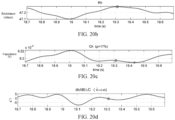
- FIGS. 20a-20d are data of a person with an abnormal heart tissue provided by another embodiment of the present invention, wherein, FIG. 20 a is the electrocardiogram (ECG), FIG. 20b is the heart resistance curve, FIG. 20c is the myocardial capacitance curve, and FIG. 20 d is the time curve of the relative change rate of myocardial capacitance.
- ECG electrocardiogram
- FIG. 20b is the heart resistance curve
- FIG. 20c is the myocardial capacitance curve
- FIG. 20 d is the time curve of the relative change rate of myocardial capacitance.
- the circle marks in the figures are the moments when the heart volume is the smallest, and the solid dots are the moments when the myocardial cell volume is the smallest. According to calculations, the result of ⁇ (17 %) shows that the heart tissue is abnormal, and the result of ⁇ (-0.45) shows that the heart tissue is basically normal.
Landscapes
- Health & Medical Sciences (AREA)
- Life Sciences & Earth Sciences (AREA)
- Engineering & Computer Science (AREA)
- Physics & Mathematics (AREA)
- General Health & Medical Sciences (AREA)
- Veterinary Medicine (AREA)
- Biophysics (AREA)
- Pathology (AREA)
- Biomedical Technology (AREA)
- Heart & Thoracic Surgery (AREA)
- Medical Informatics (AREA)
- Molecular Biology (AREA)
- Surgery (AREA)
- Animal Behavior & Ethology (AREA)
- Public Health (AREA)
- Physiology (AREA)
- Signal Processing (AREA)
- Cardiology (AREA)
- Artificial Intelligence (AREA)
- Computer Vision & Pattern Recognition (AREA)
- Psychiatry (AREA)
- Computer Networks & Wireless Communication (AREA)
- Mathematical Physics (AREA)
- Nuclear Medicine, Radiotherapy & Molecular Imaging (AREA)
- Radiology & Medical Imaging (AREA)
- Dentistry (AREA)
- Oral & Maxillofacial Surgery (AREA)
- Dermatology (AREA)
- Measurement And Recording Of Electrical Phenomena And Electrical Characteristics Of The Living Body (AREA)
- Measuring Pulse, Heart Rate, Blood Pressure Or Blood Flow (AREA)
Claims (12)
- Nicht-invasives Verfahren zur Messung der Bewegungseigenschaften eines Myokardgewebes, wobei das Verfahren Folgendes umfasst:Übertragen einer Vielzahl von erzeugten synchronen orthogonalen, phasensteuerbaren und einstellbaren Wechselströmen mit unterschiedlichen Frequenzen in einen Organismus, um eine Vielzahl von synchronen periodischen Wechselspannungssignalen mit unterschiedlichen Frequenzen zu erzeugen;Empfangen von periodischen Wechselspannungssignalen, die durch Veränderungen im Herzgewebe des Organismus moduliert werden, um die Frequenzgänge des Organismus zu erhalten; Berechnung der Widerstände und Kapazitäten des Herzgewebes in Abhängigkeit von den Frequenzgängen;und Schätzung der Bewegungseigenschaften des Myokardgewebes entsprechend den Widerständen und den Kapazitäten, wobei die Schätzung der Bewegungseigenschaften des Myokardgewebes in Abhängigkeit von den Widerständen und den Kapazitäten Folgendes umfasst:Berechnung der durchschnittlichen Längslänge der Myokardzellen und ihrer Änderung in Abhängigkeit von den Kapazitäten und/oder Berechnung des Blutflusses des Herzens in Abhängigkeit von den Widerständen;und Erreichen eines longitudinalelastischen Gesamtzustands des Herzens entsprechend der durchschnittlichen Längslänge der Myokardzellen und ihrer Veränderung und/oder des Herzpumpens des Blutflusses.
- Verfahren nach Anspruch 1, wobei das Berechnen von Widerständen und Kapazitäten des Herzgewebes gemäß den Frequenzgängen umfasst, das Erlangen einer Systemübertragungsfunktion des Organismus gemäß den Frequenzgängen und das Durchführen einer Mehrkammermodellierung zur Trennung des Herzgewebes und des peripheren Gewebes.
- Verfahren nach Anspruch 1, wobei das Verfahren ferner das Analysieren einer Systolegeschwindigkeit, Zeit, Intensität und Muster des Herzgewebes und/oder einer Diastolengeschwindigkeit, -zeit, -wiederherstellung und -muster des Herzgewebes entsprechend einem Steigungswert von Änderungen des gesamten longitudinalelastischen Zustands des Herzens umfasst, deren Verzögerung zu einer R-Welle, ein Spitze-zu-Spitze-Wert und eine Änderungskurve und die Form ihrer Ableitung der durchschnittlichen Längslänge der Myokardzellen.
- Verfahren nach Anspruch 1, wobei das Ermitteln der Frequenzgänge des Organismus das Berechnen eines Frequenzgang-Schätzwertes einer spezifischen Frequenz alle 0,25 bis 5 Millisekunden umfasst.
- Verfahren nach Anspruch 1, wobei das Berechnen der durchschnittlichen Längslänge von Myokardzellen und deren Änderung entsprechend den Kapazitäten Folgendes umfasst:Erkennung der durchschnittlichen Längslängen der Myokardzellen und ihrer Veränderung im Laufe der Zeit mit einer Geschwindigkeit von 200 bis 4000 Mal pro Sekunde;und Verarbeiten der zeitlichen Abfolge der Änderung der durchschnittlichen Längslänge der Myokardzellen über die Zeit unter Verwendung eines digitalen Signalverarbeitungsverfahrens, wobei das digitale Signalverarbeitungsverfahren digitale Filterung, schnelle FourierTransformation (FFT) und Zeitbereichs- und Frequenzbereichsanalyse umfasst.
- Verfahren nach Anspruch 5, wobei das Verfahren ferner es umfasst, unter Bezugnahme auf ein Elektrokardiogramm mit der gleichen Zeitsequenz die Veränderungssequenz der durchschnittlichen Längslänge der Myokardzellen zu analysieren, wobei das Bezugsverfahren das Vergleichen des Elektrokardiogramms mit der Veränderungssequenz der durchschnittlichen Längslängen der Myokardzellen für ihre Herzzyklen umfasst, systolische und diastolische Phase und/oder deren Grenzen.
- Verfahren nach Anspruch 2, wobei die Durchführung der Mehrkammermodellierung zur Trennung des Herzgewebes und des peripheren Gewebes Modellieren jeder Kammer als paralleler Widerstand und Kondensator modelliert umfasst, wobei mehrere Kammern in Reihe oder parallel geschaltet sind.
- System zum Implementieren eines Verfahrens nach einem der Ansprüche 1 bis 7, wobei das System ein Endgerät und mindestens einen Prozessor umfasst, wobei das Endgerät Folgendes umfasst:ein Generator, der konfiguriert ist, um eine Vielzahl von synchronen orthogonalen, phasensteuerbaren und einstellbaren und periodischen Wechselströmen mit unterschiedlichen Frequenzen zu erzeugen;und einen oder mehrere Sensoren, die so konfiguriert sind, dass sie die periodischen Wechselströme in einen Organismus übertragen, um eine Vielzahl von periodischen Wechselspannungssignalen mit unterschiedlichen Frequenzen zu erzeugen, und die periodischen Wechselspannungssignale zu empfangen, die durch Veränderungen im Herzgewebe des Organismus moduliert werden, um die Frequenzgänge des Organismus zu erhalten;wobei der Prozessor konfiguriert ist, um Widerstände und Kapazitäten des Herzgewebes entsprechend den Frequenzgängen zu berechnen und die Bewegungseigenschaften des Myokardgewebes entsprechend den Widerständen und Kapazitäten zu schätzen, wobei der Prozessor so konfiguriert ist, dass er eine durchschnittliche Längslänge von Myokardzellen und deren Änderung entsprechend den Kapazitäten berechnet, und/oder Berechnung des Herzpumpblutflusses gemäß den Widerständen und erhalten Sie einen longitudinalelastischen Gesamtzustand des Herzens entsprechend der durchschnittlichen Längslänge der Myokardzellen und ihrer Veränderung und/oder des Herzpumpblutflusses.
- System nach Anspruch 8, wobei der Sensor so konfiguriert ist, dass er einzelne oder mehrere Datenstücke von verschiedenen Teilen sammelt.
- System nach Anspruch 8, wobei das System ferner eine Datenbank zum Speichern von Verarbeitungsergebnissen und Daten des Prozessors oder der Prozessoren umfasst, und der oder die Prozessoren die Datenbank abrufen können.
- System nach Anspruch 8, wobei der Prozessor oder die Prozessoren ferngesteuert sein können und zur Fernbeobachtung der Arbeit des Systems in einem Echtzeitmodus verwendet werden können.
- System nach einem der Ansprüche 8 bis 11, wobei das Endgerät ferner eine Mensch-Maschine-Schnittstelle zur Steuerung des Systems und/oder zur Anzeige von Ergebnissen umfasst.
Applications Claiming Priority (1)
| Application Number | Priority Date | Filing Date | Title |
|---|---|---|---|
| PCT/CN2019/083290 WO2020211051A1 (zh) | 2019-04-18 | 2019-04-18 | 一种测量心肌组织运动特征的非侵入性方法及系统 |
Publications (4)
| Publication Number | Publication Date |
|---|---|
| EP3957239A1 EP3957239A1 (de) | 2022-02-23 |
| EP3957239A4 EP3957239A4 (de) | 2022-05-04 |
| EP3957239C0 EP3957239C0 (de) | 2024-11-06 |
| EP3957239B1 true EP3957239B1 (de) | 2024-11-06 |
Family
ID=72837641
Family Applications (1)
| Application Number | Title | Priority Date | Filing Date |
|---|---|---|---|
| EP19924783.4A Active EP3957239B1 (de) | 2019-04-18 | 2019-04-18 | Nichtinvasives verfahren und system zur messung eines bewegungsmerkmals von herzmuskelgewebe |
Country Status (5)
| Country | Link |
|---|---|
| US (1) | US20220183573A1 (de) |
| EP (1) | EP3957239B1 (de) |
| JP (1) | JP7156739B2 (de) |
| CN (1) | CN113727644B (de) |
| WO (1) | WO2020211051A1 (de) |
Families Citing this family (1)
| Publication number | Priority date | Publication date | Assignee | Title |
|---|---|---|---|---|
| CN116616740B (zh) * | 2023-04-17 | 2024-07-02 | 深圳东海浪潮科技有限公司 | 一种基于心阻抗的信号处理方法 |
Family Cites Families (14)
| Publication number | Priority date | Publication date | Assignee | Title |
|---|---|---|---|---|
| EP0249825B1 (de) * | 1986-06-16 | 1991-11-06 | Pacesetter AB | Vorrichtung zur Impedanzmessung an Körpergeweben |
| NL1001282C2 (nl) * | 1995-09-26 | 1997-03-28 | A J Van Liebergen Holding B V | Inrichting voor slagvolumebepaling van een menselijk hart. |
| AU2913397A (en) * | 1997-05-30 | 1998-12-30 | N.I. Medical Ltd. | Method and system for non-invasive determination of the main cardiorespiratory parameters of the human body |
| US7970461B2 (en) * | 2004-06-18 | 2011-06-28 | Andres Kink | Method and apparatus for determining conditions of a biological tissue |
| WO2007001352A2 (en) * | 2004-08-31 | 2007-01-04 | University Of Washington | Ultrasonic technique for assessing wall vibrations in stenosed blood vessels |
| US8773151B2 (en) * | 2006-04-24 | 2014-07-08 | Oü Eliko Tehnoloogia Arenduskeskus | Method and device for multichannel multifrequency analysis of an object |
| SG10201510693UA (en) * | 2010-12-28 | 2016-01-28 | Sotera Wireless Inc | Body-worn system for continous, noninvasive measurement of cardiac output, stroke volume, cardiac power, and blood pressure |
| US9380947B2 (en) * | 2011-07-25 | 2016-07-05 | Cheetah Medical, Inc. | Method and system for monitoring hemodynamics |
| CN108042154B (zh) * | 2017-12-08 | 2021-06-15 | 浙江中医药大学 | 二维超声心动图序列中心肌形状、运动和变形分析方法 |
| US10993672B2 (en) * | 2017-12-31 | 2021-05-04 | Msheaf Health Management Technologies Limited | Non-invasive method and system to extract characteristic information of bio-tissues |
| CN108922580A (zh) * | 2018-05-25 | 2018-11-30 | 杭州脉流科技有限公司 | 一种获取血流储备分数的方法、装置、系统和计算机存储介质 |
| US20220240845A1 (en) * | 2019-03-13 | 2022-08-04 | University Of Virginia Patent Foundation | System, method and computer readable medium for rapidly predicting cardiac response to a heart condition and treatment strategy |
| WO2020210949A1 (zh) * | 2019-04-15 | 2020-10-22 | 麦层移动健康管理有限公司 | 一种用于检测体内组织特征信息的非侵入性方法及其系统 |
| CN117593250A (zh) * | 2023-10-25 | 2024-02-23 | 大连理工大学 | 一种自动化心脏时相检测与心功能计算方法 |
-
2019
- 2019-04-18 JP JP2021549915A patent/JP7156739B2/ja active Active
- 2019-04-18 WO PCT/CN2019/083290 patent/WO2020211051A1/zh not_active Ceased
- 2019-04-18 EP EP19924783.4A patent/EP3957239B1/de active Active
- 2019-04-18 CN CN201980095292.2A patent/CN113727644B/zh active Active
- 2019-04-18 US US17/594,420 patent/US20220183573A1/en active Pending
Also Published As
| Publication number | Publication date |
|---|---|
| EP3957239A1 (de) | 2022-02-23 |
| CN113727644A (zh) | 2021-11-30 |
| WO2020211051A1 (zh) | 2020-10-22 |
| EP3957239C0 (de) | 2024-11-06 |
| EP3957239A4 (de) | 2022-05-04 |
| JP2022528823A (ja) | 2022-06-16 |
| US20220183573A1 (en) | 2022-06-16 |
| JP7156739B2 (ja) | 2022-10-19 |
| CN113727644B (zh) | 2025-12-30 |
Similar Documents
| Publication | Publication Date | Title |
|---|---|---|
| US20230148891A1 (en) | System and method for non-invasive instantaneous and continuous measurement of heart rate, stroke volume and ejection fraction | |
| Zanetti et al. | Seismocardiography: Past, present and future | |
| JP6131404B2 (ja) | 心臓の機能不全と異常を表す情報を測定するための方法及び器械 | |
| Guidoboni et al. | Cardiovascular function and ballistocardiogram: A relationship interpreted via mathematical modeling | |
| JP6571807B2 (ja) | 心臓の機能不全と異常を表す情報を測定するための方法及び器械 | |
| US8145293B2 (en) | Adaptive medical image acquisition system and method | |
| CA2692795C (en) | Cardiac monitoring system | |
| EP1980292A2 (de) | Lungendrucküberwachung | |
| JP6441914B2 (ja) | 心臓障害を表す情報を決定する方法及び装置 | |
| WO2008050334A2 (en) | Non-invasive cardiac parameter measurement | |
| Imtiaz et al. | Correlation between seismocardiogram and systolic blood pressure | |
| EP3957239B1 (de) | Nichtinvasives verfahren und system zur messung eines bewegungsmerkmals von herzmuskelgewebe | |
| KR101498581B1 (ko) | 비침습적 심방신호 추정 시스템 및 방법 | |
| CN110881956B (zh) | 心脏生理参数测量方法、设备、终端及计算机存储介质 | |
| Forouzanfar et al. | Model-based oscillometric blood pressure estimation | |
| Podtaev et al. | Wavelet analysis of the impedance cardiogram waveforms | |
| US12193794B2 (en) | Heart physiological parameter measurement system and terminal, and computer storage medium | |
| US20120296227A1 (en) | Electro-myocardial cardiogram (EmCG) Parameter's CSS/RSS for calculating heart performance | |
| CN114916923B (zh) | 一种电机械互联的心电脉搏信号分析方法及系统 | |
| CN113226170B (zh) | 一种心脏舒张功能评估方法、设备和系统 | |
| Attarodi et al. | Modeling ECG Signals with regard to the Location and Intensity of Myocardial Infarction | |
| HK1219637B (zh) | 确定指示心脏功能障碍的信息的方法和设备 | |
| HK1204538B (en) | Apparatus for determining information indicative of cardiac malfunctions and abnormalities |
Legal Events
| Date | Code | Title | Description |
|---|---|---|---|
| STAA | Information on the status of an ep patent application or granted ep patent |
Free format text: STATUS: THE INTERNATIONAL PUBLICATION HAS BEEN MADE |
|
| PUAI | Public reference made under article 153(3) epc to a published international application that has entered the european phase |
Free format text: ORIGINAL CODE: 0009012 |
|
| STAA | Information on the status of an ep patent application or granted ep patent |
Free format text: STATUS: REQUEST FOR EXAMINATION WAS MADE |
|
| 17P | Request for examination filed |
Effective date: 20211108 |
|
| AK | Designated contracting states |
Kind code of ref document: A1 Designated state(s): AL AT BE BG CH CY CZ DE DK EE ES FI FR GB GR HR HU IE IS IT LI LT LU LV MC MK MT NL NO PL PT RO RS SE SI SK SM TR |
|
| A4 | Supplementary search report drawn up and despatched |
Effective date: 20220407 |
|
| RIC1 | Information provided on ipc code assigned before grant |
Ipc: A61B 5/05 20210101AFI20220401BHEP |
|
| DAV | Request for validation of the european patent (deleted) | ||
| DAX | Request for extension of the european patent (deleted) | ||
| REG | Reference to a national code |
Ref country code: DE Ref legal event code: R079 Free format text: PREVIOUS MAIN CLASS: A61B0005050000 Ipc: A61B0005053100 Ref country code: DE Ref legal event code: R079 Ref document number: 602019061761 Country of ref document: DE Free format text: PREVIOUS MAIN CLASS: A61B0005050000 Ipc: A61B0005053100 |
|
| GRAP | Despatch of communication of intention to grant a patent |
Free format text: ORIGINAL CODE: EPIDOSNIGR1 |
|
| STAA | Information on the status of an ep patent application or granted ep patent |
Free format text: STATUS: GRANT OF PATENT IS INTENDED |
|
| RIC1 | Information provided on ipc code assigned before grant |
Ipc: A61B 5/11 20060101ALI20240612BHEP Ipc: A61B 5/0531 20210101AFI20240612BHEP |
|
| INTG | Intention to grant announced |
Effective date: 20240705 |
|
| GRAS | Grant fee paid |
Free format text: ORIGINAL CODE: EPIDOSNIGR3 |
|
| GRAA | (expected) grant |
Free format text: ORIGINAL CODE: 0009210 |
|
| STAA | Information on the status of an ep patent application or granted ep patent |
Free format text: STATUS: THE PATENT HAS BEEN GRANTED |
|
| AK | Designated contracting states |
Kind code of ref document: B1 Designated state(s): AL AT BE BG CH CY CZ DE DK EE ES FI FR GB GR HR HU IE IS IT LI LT LU LV MC MK MT NL NO PL PT RO RS SE SI SK SM TR |
|
| REG | Reference to a national code |
Ref country code: GB Ref legal event code: FG4D |
|
| REG | Reference to a national code |
Ref country code: CH Ref legal event code: EP |
|
| REG | Reference to a national code |
Ref country code: DE Ref legal event code: R096 Ref document number: 602019061761 Country of ref document: DE |
|
| REG | Reference to a national code |
Ref country code: IE Ref legal event code: FG4D |
|
| U01 | Request for unitary effect filed |
Effective date: 20241127 |
|
| U07 | Unitary effect registered |
Designated state(s): AT BE BG DE DK EE FI FR IT LT LU LV MT NL PT RO SE SI Effective date: 20241204 |
|
| PG25 | Lapsed in a contracting state [announced via postgrant information from national office to epo] |
Ref country code: IS Free format text: LAPSE BECAUSE OF FAILURE TO SUBMIT A TRANSLATION OF THE DESCRIPTION OR TO PAY THE FEE WITHIN THE PRESCRIBED TIME-LIMIT Effective date: 20250306 Ref country code: HR Free format text: LAPSE BECAUSE OF FAILURE TO SUBMIT A TRANSLATION OF THE DESCRIPTION OR TO PAY THE FEE WITHIN THE PRESCRIBED TIME-LIMIT Effective date: 20241106 |
|
| PG25 | Lapsed in a contracting state [announced via postgrant information from national office to epo] |
Ref country code: ES Free format text: LAPSE BECAUSE OF FAILURE TO SUBMIT A TRANSLATION OF THE DESCRIPTION OR TO PAY THE FEE WITHIN THE PRESCRIBED TIME-LIMIT Effective date: 20241106 |
|
| PG25 | Lapsed in a contracting state [announced via postgrant information from national office to epo] |
Ref country code: NO Free format text: LAPSE BECAUSE OF FAILURE TO SUBMIT A TRANSLATION OF THE DESCRIPTION OR TO PAY THE FEE WITHIN THE PRESCRIBED TIME-LIMIT Effective date: 20250206 |
|
| PG25 | Lapsed in a contracting state [announced via postgrant information from national office to epo] |
Ref country code: GR Free format text: LAPSE BECAUSE OF FAILURE TO SUBMIT A TRANSLATION OF THE DESCRIPTION OR TO PAY THE FEE WITHIN THE PRESCRIBED TIME-LIMIT Effective date: 20250207 |
|
| PG25 | Lapsed in a contracting state [announced via postgrant information from national office to epo] |
Ref country code: PL Free format text: LAPSE BECAUSE OF FAILURE TO SUBMIT A TRANSLATION OF THE DESCRIPTION OR TO PAY THE FEE WITHIN THE PRESCRIBED TIME-LIMIT Effective date: 20241106 |
|
| PG25 | Lapsed in a contracting state [announced via postgrant information from national office to epo] |
Ref country code: RS Free format text: LAPSE BECAUSE OF FAILURE TO SUBMIT A TRANSLATION OF THE DESCRIPTION OR TO PAY THE FEE WITHIN THE PRESCRIBED TIME-LIMIT Effective date: 20250206 |
|
| U20 | Renewal fee for the european patent with unitary effect paid |
Year of fee payment: 7 Effective date: 20250415 |
|
| PG25 | Lapsed in a contracting state [announced via postgrant information from national office to epo] |
Ref country code: SM Free format text: LAPSE BECAUSE OF FAILURE TO SUBMIT A TRANSLATION OF THE DESCRIPTION OR TO PAY THE FEE WITHIN THE PRESCRIBED TIME-LIMIT Effective date: 20241106 |
|
| PG25 | Lapsed in a contracting state [announced via postgrant information from national office to epo] |
Ref country code: SK Free format text: LAPSE BECAUSE OF FAILURE TO SUBMIT A TRANSLATION OF THE DESCRIPTION OR TO PAY THE FEE WITHIN THE PRESCRIBED TIME-LIMIT Effective date: 20241106 |
|
| PG25 | Lapsed in a contracting state [announced via postgrant information from national office to epo] |
Ref country code: CZ Free format text: LAPSE BECAUSE OF FAILURE TO SUBMIT A TRANSLATION OF THE DESCRIPTION OR TO PAY THE FEE WITHIN THE PRESCRIBED TIME-LIMIT Effective date: 20241106 |
|
| PLBE | No opposition filed within time limit |
Free format text: ORIGINAL CODE: 0009261 |
|
| STAA | Information on the status of an ep patent application or granted ep patent |
Free format text: STATUS: NO OPPOSITION FILED WITHIN TIME LIMIT |
|
| 26N | No opposition filed |
Effective date: 20250807 |
|
| REG | Reference to a national code |
Ref country code: CH Ref legal event code: H13 Free format text: ST27 STATUS EVENT CODE: U-0-0-H10-H13 (AS PROVIDED BY THE NATIONAL OFFICE) Effective date: 20251125 |
|
| PG25 | Lapsed in a contracting state [announced via postgrant information from national office to epo] |
Ref country code: MC Free format text: LAPSE BECAUSE OF FAILURE TO SUBMIT A TRANSLATION OF THE DESCRIPTION OR TO PAY THE FEE WITHIN THE PRESCRIBED TIME-LIMIT Effective date: 20241106 |
|
| GBPC | Gb: european patent ceased through non-payment of renewal fee |
Effective date: 20250418 |
|
| PG25 | Lapsed in a contracting state [announced via postgrant information from national office to epo] |
Ref country code: GB Free format text: LAPSE BECAUSE OF NON-PAYMENT OF DUE FEES Effective date: 20250418 |
|
| PG25 | Lapsed in a contracting state [announced via postgrant information from national office to epo] |
Ref country code: CH Free format text: LAPSE BECAUSE OF NON-PAYMENT OF DUE FEES Effective date: 20250430 |