EP3952059B1 - Wireless power transmission alignment method and device, wireless power transmission system, and electric vehicle - Google Patents
Wireless power transmission alignment method and device, wireless power transmission system, and electric vehicle Download PDFInfo
- Publication number
- EP3952059B1 EP3952059B1 EP20791587.7A EP20791587A EP3952059B1 EP 3952059 B1 EP3952059 B1 EP 3952059B1 EP 20791587 A EP20791587 A EP 20791587A EP 3952059 B1 EP3952059 B1 EP 3952059B1
- Authority
- EP
- European Patent Office
- Prior art keywords
- induction signal
- coil
- signal
- power
- location
- Prior art date
- Legal status (The legal status is an assumption and is not a legal conclusion. Google has not performed a legal analysis and makes no representation as to the accuracy of the status listed.)
- Active
Links
Images




Classifications
-
- H—ELECTRICITY
- H02—GENERATION; CONVERSION OR DISTRIBUTION OF ELECTRIC POWER
- H02J—ELECTRIC POWER NETWORKS; CIRCUIT ARRANGEMENTS OR SYSTEMS FOR SUPPLYING OR DISTRIBUTING ELECTRIC POWER; SYSTEMS FOR STORING ELECTRIC ENERGY
- H02J50/00—Circuit arrangements or systems for wireless supply or distribution of electric power
- H02J50/90—Circuit arrangements or systems for wireless supply or distribution of electric power involving detection or optimisation of position, e.g. alignment
-
- B—PERFORMING OPERATIONS; TRANSPORTING
- B60—VEHICLES IN GENERAL
- B60L—PROPULSION OF ELECTRICALLY-PROPELLED VEHICLES; SUPPLYING ELECTRIC POWER FOR AUXILIARY EQUIPMENT OF ELECTRICALLY-PROPELLED VEHICLES; ELECTRODYNAMIC BRAKE SYSTEMS FOR VEHICLES IN GENERAL; MAGNETIC SUSPENSION OR LEVITATION FOR VEHICLES; MONITORING OPERATING VARIABLES OF ELECTRICALLY-PROPELLED VEHICLES; ELECTRIC SAFETY DEVICES FOR ELECTRICALLY-PROPELLED VEHICLES
- B60L53/00—Methods of charging batteries, specially adapted for electric vehicles; Charging stations or on-board charging equipment therefor; Exchange of energy storage elements in electric vehicles
- B60L53/10—Methods of charging batteries, specially adapted for electric vehicles; Charging stations or on-board charging equipment therefor; Exchange of energy storage elements in electric vehicles characterised by the energy transfer between the charging station and the vehicle
- B60L53/12—Inductive energy transfer
-
- B—PERFORMING OPERATIONS; TRANSPORTING
- B60—VEHICLES IN GENERAL
- B60L—PROPULSION OF ELECTRICALLY-PROPELLED VEHICLES; SUPPLYING ELECTRIC POWER FOR AUXILIARY EQUIPMENT OF ELECTRICALLY-PROPELLED VEHICLES; ELECTRODYNAMIC BRAKE SYSTEMS FOR VEHICLES IN GENERAL; MAGNETIC SUSPENSION OR LEVITATION FOR VEHICLES; MONITORING OPERATING VARIABLES OF ELECTRICALLY-PROPELLED VEHICLES; ELECTRIC SAFETY DEVICES FOR ELECTRICALLY-PROPELLED VEHICLES
- B60L53/00—Methods of charging batteries, specially adapted for electric vehicles; Charging stations or on-board charging equipment therefor; Exchange of energy storage elements in electric vehicles
- B60L53/30—Constructional details of charging stations
- B60L53/35—Means for automatic or assisted adjustment of the relative position of charging devices and vehicles
- B60L53/38—Means for automatic or assisted adjustment of the relative position of charging devices and vehicles specially adapted for charging by inductive energy transfer
-
- H—ELECTRICITY
- H02—GENERATION; CONVERSION OR DISTRIBUTION OF ELECTRIC POWER
- H02J—ELECTRIC POWER NETWORKS; CIRCUIT ARRANGEMENTS OR SYSTEMS FOR SUPPLYING OR DISTRIBUTING ELECTRIC POWER; SYSTEMS FOR STORING ELECTRIC ENERGY
- H02J50/00—Circuit arrangements or systems for wireless supply or distribution of electric power
- H02J50/10—Circuit arrangements or systems for wireless supply or distribution of electric power using inductive coupling
- H02J50/12—Circuit arrangements or systems for wireless supply or distribution of electric power using inductive coupling of the resonant type
-
- H—ELECTRICITY
- H02—GENERATION; CONVERSION OR DISTRIBUTION OF ELECTRIC POWER
- H02J—ELECTRIC POWER NETWORKS; CIRCUIT ARRANGEMENTS OR SYSTEMS FOR SUPPLYING OR DISTRIBUTING ELECTRIC POWER; SYSTEMS FOR STORING ELECTRIC ENERGY
- H02J2105/00—Networks for supplying or distributing electric power characterised by their spatial reach or by the load
- H02J2105/30—Networks for supplying or distributing electric power characterised by their spatial reach or by the load the load networks being external to vehicles, i.e. exchanging power with vehicles
- H02J2105/33—Networks for supplying or distributing electric power characterised by their spatial reach or by the load the load networks being external to vehicles, i.e. exchanging power with vehicles exchanging power with road vehicles
- H02J2105/37—Networks for supplying or distributing electric power characterised by their spatial reach or by the load the load networks being external to vehicles, i.e. exchanging power with vehicles exchanging power with road vehicles exchanging power with electric vehicles [EV] or with hybrid electric vehicles [HEV]
-
- Y—GENERAL TAGGING OF NEW TECHNOLOGICAL DEVELOPMENTS; GENERAL TAGGING OF CROSS-SECTIONAL TECHNOLOGIES SPANNING OVER SEVERAL SECTIONS OF THE IPC; TECHNICAL SUBJECTS COVERED BY FORMER USPC CROSS-REFERENCE ART COLLECTIONS [XRACs] AND DIGESTS
- Y02—TECHNOLOGIES OR APPLICATIONS FOR MITIGATION OR ADAPTATION AGAINST CLIMATE CHANGE
- Y02T—CLIMATE CHANGE MITIGATION TECHNOLOGIES RELATED TO TRANSPORTATION
- Y02T10/00—Road transport of goods or passengers
- Y02T10/60—Other road transportation technologies with climate change mitigation effect
- Y02T10/70—Energy storage systems for electromobility, e.g. batteries
-
- Y—GENERAL TAGGING OF NEW TECHNOLOGICAL DEVELOPMENTS; GENERAL TAGGING OF CROSS-SECTIONAL TECHNOLOGIES SPANNING OVER SEVERAL SECTIONS OF THE IPC; TECHNICAL SUBJECTS COVERED BY FORMER USPC CROSS-REFERENCE ART COLLECTIONS [XRACs] AND DIGESTS
- Y02—TECHNOLOGIES OR APPLICATIONS FOR MITIGATION OR ADAPTATION AGAINST CLIMATE CHANGE
- Y02T—CLIMATE CHANGE MITIGATION TECHNOLOGIES RELATED TO TRANSPORTATION
- Y02T10/00—Road transport of goods or passengers
- Y02T10/60—Other road transportation technologies with climate change mitigation effect
- Y02T10/7072—Electromobility specific charging systems or methods for batteries, ultracapacitors, supercapacitors or double-layer capacitors
-
- Y—GENERAL TAGGING OF NEW TECHNOLOGICAL DEVELOPMENTS; GENERAL TAGGING OF CROSS-SECTIONAL TECHNOLOGIES SPANNING OVER SEVERAL SECTIONS OF THE IPC; TECHNICAL SUBJECTS COVERED BY FORMER USPC CROSS-REFERENCE ART COLLECTIONS [XRACs] AND DIGESTS
- Y02—TECHNOLOGIES OR APPLICATIONS FOR MITIGATION OR ADAPTATION AGAINST CLIMATE CHANGE
- Y02T—CLIMATE CHANGE MITIGATION TECHNOLOGIES RELATED TO TRANSPORTATION
- Y02T90/00—Enabling technologies or technologies with a potential or indirect contribution to GHG emissions mitigation
- Y02T90/10—Technologies relating to charging of electric vehicles
- Y02T90/12—Electric charging stations
-
- Y—GENERAL TAGGING OF NEW TECHNOLOGICAL DEVELOPMENTS; GENERAL TAGGING OF CROSS-SECTIONAL TECHNOLOGIES SPANNING OVER SEVERAL SECTIONS OF THE IPC; TECHNICAL SUBJECTS COVERED BY FORMER USPC CROSS-REFERENCE ART COLLECTIONS [XRACs] AND DIGESTS
- Y02—TECHNOLOGIES OR APPLICATIONS FOR MITIGATION OR ADAPTATION AGAINST CLIMATE CHANGE
- Y02T—CLIMATE CHANGE MITIGATION TECHNOLOGIES RELATED TO TRANSPORTATION
- Y02T90/00—Enabling technologies or technologies with a potential or indirect contribution to GHG emissions mitigation
- Y02T90/10—Technologies relating to charging of electric vehicles
- Y02T90/14—Plug-in electric vehicles
Definitions
- This application relates to the wireless charging field, and in particular, to a wireless charging alignment method and apparatus, a wireless charging system, and an electric vehicle.
- Wireless charging is a technology in which electric energy is transmitted by using a coupling electromagnetic field as a medium, to charge an in-vehicle power supply of an electric vehicle.
- the wireless charging has the following advantages: easy to use, no spark, no electric shock risk, no mechanical wear, adaptable to a plurality of severe environments and weather, automatic charging and mobile charging, and the like. Therefore, the wireless charging is widely applied.
- a wireless charging system generally includes: a power transmit device disposed on the ground or under the ground, and a power receive device disposed at the bottom of an electric vehicle.
- the power transmit device includes a power transmit coil
- the power receive device includes a power receive coil. After a driver drives the electric vehicle to align the power receive coil with the power transmit coil, the power transmit coil may transmit power to the power receive coil in an electric field coupling manner or a magnetic field coupling manner.
- higher alignment precision between the power transmit coil and the power receive coil indicates higher efficiency of power transmission between the two coils and higher charging efficiency.
- the driver needs to visually measure a relative location of the two coils, and drive the electric vehicle based on the relative location, to align the two coils. Alignment precision in this alignment method is relatively low.
- CN 207 496 493 U discloses that a vehicle alignment guiding device for wireless charging system of electric automobile includes ground primary coil and on -vehicle secondary winding, a plurality of alignment coils, a plurality of voltage sensor, wherein, every voltage sensor respectively with every the alignment coil is connected for obtain the induced voltage who produces in the alignment coil, the treater, with a plurality of voltage sensor connect, and it is right to be used for induced voltage handles, confirms the position of on -vehicle secondary winding for the ground primary coil, display device for need adjustment direction display to come out with the alignment positional information.
- CN 109 067 020 A discloses that an alignment processing method for wireless charging applied to a terminal device, wherein the receiving terminal is provided with a wireless charging receiving terminal, wherein, the receiving terminal is used to be connected with a corresponding wireless charging transmitting terminal,
- This application provides a wireless charging alignment method and apparatus, a wireless charging system, and an electric vehicle, to resolve a problem of relatively low alignment precision in an alignment method in a related technology.
- Technical solutions are as follows:
- this application provides a wireless charging alignment apparatus, including a power receive coil, a location detection coil, a first detection circuit, a second detection circuit, and a location determining circuit.
- the power receive coil is configured to exchange power with a power transmit coil of a transmit end through electromagnetic mutual inductance.
- the first detection circuit is configured to detect a first induction signal of the power receive coil in a positioning magnetic field generated by the power transmit coil.
- the second detection circuit is configured to detect a second induction signal of the location detection coil in the positioning magnetic field.
- the location determining circuit is configured to determine a location of the power receive coil relative to the power transmit coil based on the first induction signal and the second induction signal.
- a driver visually measures a relative location of the two coils.
- both precision and efficiency of determining the relative location based on the induction signals are higher. Therefore, alignment precision and alignment efficiency of the two coils can be effectively improved.
- the wireless charging alignment apparatus may be applied to a receive end (that is, a power receive device) in a wireless charging system, or may be applied to a transmit end (that is, a power transmit device) in a wireless charging system.
- the transmit end and the receive end may be interchanged.
- the receive end may also charge the transmit end.
- the power receive coil described above may also be referred to as a power transmit coil
- the power transmit coil may also be referred to as a power receive coil.
- the location determining circuit is configured to determine, as the location of the power receive coil relative to the power transmit coil based on a correspondence between an offset location and each of an induction signal of the power receive coil and an induction signal of the location detection coil, an offset location corresponding to the first induction signal and the second induction signal.
- the relative location of the two coils is determined based on the correspondence, to effectively improve efficiency of determining the relative location, thereby further ensuring alignment efficiency.
- Each signal group may include a signal value of the induction signal of the power receive coil and a signal value of the induction signal of the location detection coil.
- the location determining circuit is configured to: determine a first difference between a signal value of the first induction signal and the signal value of the induction signal of the power receive coil in each signal group, and a second difference between a signal value of the second induction signal and the signal value of the induction signal of the location detection coil in each signal group, to obtain the first difference and the second difference of each signal group; and determine, as the offset location corresponding to the first induction signal and the second induction signal, an offset location corresponding to a signal group whose sum of the first difference and the second difference is the smallest in the plurality of signal groups.
- the location determining circuit determines, as the offset location corresponding to the first induction signal and the second induction signal, an offset location corresponding to a signal group that is in the correspondence and that is closest to the signal values of the two induction signals, to ensure detection precision and reliability.
- the signal group and the offset location are recorded in the correspondence in a form of a table.
- the location determining circuit may be configured to: determine a coupling coefficient between the power receive coil and the power transmit coil based on the first induction signal and a current or a voltage of the power transmit coil; and determine the location of the power receive coil relative to the power transmit coil based on the coupling coefficient and the second induction signal.
- the location determining circuit may determine, as the location of the power receive coil relative to the power transmit coil based on a pre-stored correspondence between the offset location and each of a coupling coefficient and the induction signal of the location detection coil, the offset location corresponding to the currently detected coupling coefficient and the second induction signal.
- the location determining circuit may be configured to: separately preprocess the first induction signal and the second induction signal, and determine the location of the power receive coil relative to the power transmit coil based on the preprocessed first induction signal and the preprocessed second induction signal.
- the preprocessing may include at least one of normalization processing and weighting processing.
- the first induction signal and the second induction signal may be different physical quantities or amplitudes of signal values of the first induction signal and the second induction signal have relatively large difference therebetween, the amplitudes of the signal values of the induction signals may be relatively close by preprocessing the induction signals, thereby improving precision and efficiency of subsequently determining the relative location based on the induction signals.
- each of the first induction signal, the second induction signal, the induction signal of the power receive coil, and the induction signal of the location detection coil may include at least one of a current and a voltage.
- a type of the first induction signal is the same as a type of the induction signal of the power receive coil in the correspondence
- a type of the second induction signal is the same as a type of the induction signal of the location detection coil in the correspondence.
- the first induction signal may be a current or a voltage
- the first detection circuit may be configured to detect only one type of signal (for example, a voltage), to reduce detection costs.
- the first induction signal may include a current and a voltage
- the first detection circuit may be configured to detect many types of signals (for example, a current and a voltage), to ensure detection reliability.
- the first induction signal includes a current.
- the apparatus may further include a resonant element and a first switch.
- the power receive coil is connected to the resonant element to form a resonant circuit.
- the first switch is connected in parallel to the resonant circuit.
- the first detection circuit is configured to: when the first switch is closed, detect a current flowing through the resonant circuit.
- the resonant element may include: an inductor connected in series to the power receive coil and a capacitor connected in parallel to the power receive coil.
- the current may include at least one of an inductance current flowing through the inductor and a capacitor current flowing through the capacitor.
- the first detection circuit may include two current detection circuits.
- One current detection circuit may be configured to detect the inductance current
- the other direction circuit may be configured to detect the capacitor current.
- the first induction signal includes a current.
- the apparatus further includes a second switch.
- the second switch is connected in parallel to the power receive coil.
- the first detection circuit is configured to: when the second switch is closed, detect a short-circuit current flowing through the power receive coil.
- the current detected by the first detection circuit may include at least one of an inductance current, a capacitor current, and a short-circuit current. Because the inductance current, the capacitor current, and the short-circuit current are relatively easy to detect, and detection precision is relatively high, the at least one of the detected inductance current, the detected capacitor current, and the detected short-circuit current is used as the first induction signal, thereby ensuring precision of the obtained first induction signal.
- the first induction signal includes a voltage.
- the apparatus may further include a third switch.
- the third switch is connected between the power receive coil and a subsequent circuit of the power receive coil.
- the first detection circuit is configured to: when the third switch is opened, detect an open-circuit voltage between two ends of the power receive coil.
- the first detection circuit may include a voltage detection circuit configured to detect the open-circuit voltage.
- the open-circuit voltage detected by the voltage detection circuit may be an alternating current voltage.
- this application provides a wireless charging alignment method.
- the method may be applied to the wireless charging alignment apparatus in the foregoing aspect.
- the method may include: detecting a first induction signal of a power receive coil in a positioning magnetic field generated by a power transmit coil; detecting a second induction signal of a location detection coil in the positioning magnetic field; and determining a location of the power receive coil relative to the power transmit coil based on the first induction signal and the second induction signal, where the power receive coil is configured to exchange power with the transmit coil of a transmit end through electromagnetic mutual inductance.
- the process of determining a location of the power receive coil relative to the power transmit coil based on the first induction signal and the second induction signal includes : determining, as the location of the power receive coil relative to the power transmit coil based on a correspondence between an offset location and each of the induction signal of the power receive coil and the induction signal of the location detection coil, an offset location corresponding to the first induction signal and the second induction signal.
- Each signal group includes a signal value of the induction signal of the power receive coil and a signal value of the induction signal of the location detection coil.
- the process of determining, based on a correspondence between an offset location and each of the induction signal of the power receive coil and the induction signal of the location detection coil, an offset location corresponding to the first induction signal and the second induction signal includes : determining a first difference between a signal value of the first induction signal and the signal value of the induction signal of the power receive coil in each signal group, and a second difference between a signal value of the second induction signal and the signal value of the induction signal of the location detection coil in each signal group, to obtain the first difference and the second difference of each signal group; and determining, as the offset location corresponding to the first induction signal and the second induction signal, an offset location corresponding to a signal group whose sum of the first difference and the second difference is the smallest in the plurality of signal groups.
- the process of determining a location of the power receive coil relative to the power transmit coil based on the first induction signal and the second induction signal may include: determining a coupling coefficient between the power receive coil and the power transmit coil based on the first induction signal and a current or a voltage of the power transmit coil; and determining the location of the power receive coil relative to the power transmit coil based on the coupling coefficient and the second induction signal.
- the process of determining a location of the power receive coil relative to the power transmit coil based on the first induction signal and the second induction signal may include: separately preprocessing the first induction signal and the second induction signal, where the preprocessing includes at least one of normalization processing and weighting processing; and determining the location of the power receive coil relative to the power transmit coil based on the preprocessed first induction signal and the preprocessed second induction signal.
- the first induction signal includes a current.
- the power receive coil is connected to a resonant element to form a resonant circuit.
- the first switch is connected in parallel to the resonant circuit.
- the process of detecting a first induction signal of a power receive coil in a positioning magnetic field generated by a power transmit coil may include: controlling the first switch to be closed, and detecting a current flowing through the resonant circuit.
- the first induction signal includes a current.
- the power receive coil is connected in parallel to a second switch.
- the process of detecting a first induction signal of a power receive coil in a positioning magnetic field generated by a power transmit coil may include: in a first time period, controlling the second switch to be closed, and detecting a short-circuit current flowing through the power receive coil.
- the process of detecting a second induction signal of a location detection coil in the positioning magnetic field may include: in a second time period, controlling the second switch to be opened, and detecting the second induction signal of the location detection coil in the positioning magnetic field, where the second time period and the first time period are two non-overlapping time periods.
- the short-circuit current flowing through the power receive coil is an alternating current.
- a magnetic field generated by the alternating current causes interference to the second induction signal. Therefore, the first induction signal and the second induction signal are respectively detected in the first time period and the second time period in a time division manner, thereby ensuring accuracy of the detected induction signals.
- the first induction signal includes a voltage.
- the power receive coil may be connected to a subsequent circuit of the power receive coil by using a third switch.
- the process of detecting a first induction signal of a power receive coil in a positioning magnetic field generated by a power transmit coil may include: controlling the third switch to be opened, and detecting an open-circuit voltage between two ends of the power receive coil.
- this application provides a wireless charging system.
- the wireless charging system includes: a power transmit device and a power receive device. At least one of the power transmit device and the power receive device includes the wireless charging alignment apparatus according to the foregoing aspect.
- this application provides an electric vehicle.
- the electric vehicle may include the wireless charging alignment apparatus according to the foregoing aspect.
- this application provides a location determining circuit in a wireless charging alignment apparatus.
- the location determining circuit may include a memory, a processor, and a computer program that is stored in the memory and that can be run on the processor.
- the processor executes the computer program, implements the step of determining a location of the power receive coil relative to the power transmit coil in the wireless charging alignment method according to the foregoing aspect.
- this application provides a computer readable storage medium.
- the computer readable storage medium stores an instruction.
- the computer is enabled to perform the step of determining a location of the power receive coil relative to the power transmit coil in the wireless charging alignment method according to the foregoing aspect.
- this application provides a computer program product including an instruction.
- the computer program product When the computer program product is run on a computer, the computer is enabled to perform the step of determining a location of the power receive coil relative to the power transmit coil in the wireless charging alignment method according to the foregoing aspect.
- the embodiments of this application provide the wireless charging alignment method and apparatus, the wireless charging system, and the electric vehicle.
- the location determining circuit in the apparatus determines the location of the power receive coil relative to the power transmit coil based on the induction signals detected by the detection circuit. In this way, at least one of the receive end and the transmit end can adjust its location based on the relative location, so that the two coils are aligned.
- a driver visually measures a relative location of the two coils.
- both precision and efficiency of determiningthe relative location based on the induction signals are higher. Therefore, alignment precision and alignment efficiency of the two coils can be effectively improved.
- the apparatus detects the second induction signal of the location detection coil by using the second detection circuit, and detects the first induction signal of the power receive coil by using the first detection circuit, precision of the relative location determined by the location determining circuit based on the two types of induction signals is higher, thereby effectively ensuring alignment precision of the two coils.
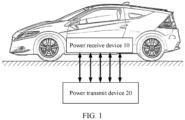
- FIG. 1 is an architectural diagram of a wireless charging system according to an embodiment of this application.
- the wireless charging system may include a power receive device 10 (that is, a receive end) and a power transmit device 20 (that is, a transmit end).
- the power receive device 10 may be disposed in a to-be-charged device.
- the to-be-charged device may be an electricity-driven device such as an electric vehicle or an electric robot.
- the to-be-charged device shown in FIG. 1 is an electric vehicle, and the power receive device 10 is integrated at the bottom of the electric vehicle.
- the power transmit device 20 may be disposed in an area such as a wireless charging station, a wireless charging parking space, or a wireless charging road; and the power transmit device 20 may be disposed on the ground, or may be buried under the ground ( FIG. 1 shows a case in which the power transmit device 20 is buried under the ground).
- the power receive device 10 may be connected to a power supply of the to-be-charged device, and the power transmit device 20 may be connected to a power supply. When the to-be-charged device enters a wireless charging range of the power transmit device 20, the power supply may charge the power supply of the to-be-charged device by using the power transmit device 20 and the power receive device 10.
- the power receive device 10 and the power transmit device 20 may exchangepower in an electromagnetic induction manner.
- the power supply and the power supply of the to-be-charged device may further implement bidirectional charging by using the power receive device 10 and the power transmit device 20.
- the power supply may charge the power supply of the to-be-charged device by using the power transmit device 20 and the power receive device 10, or the power supply of the to-be-charged device may discharge to the power supply by using the power transmit device 20 and the power receive device 10.
- FIG. 2 is an architectural diagram of another wireless charging system according to an embodiment of this application.
- the power transmit device 20 may include a power transmit coil 201, a transmission conversion module 202, a transmission control module 203, a transmission communications module 204, an authentication management module 205, and a storage module 206.
- the power transmit coil 201 and a resonant element that mainly includes an inductor and a capacitor can form a resonant circuit.
- the power transmit coil 201 is configured to convert a high-frequency alternating current into a resonant voltage or a resonant current by using the resonant circuit.
- the transmission conversion module 202 is separately connected to a power supply 30 and the power transmit coil 201, and is configured to: convert an alternating current or a direct current provided by the power supply 30 into a high-frequency alternating current, and provide the high-frequency alternating current to the power transmit coil 201. If the power supply 30 provides a direct current, the transmission conversion module 202 may include an inverter circuit and a voltage conversion circuit. If the power supply 30 provides an alternating current, the transmission conversion module 202 may include a power factor correction circuit and an inverter circuit.
- the inverter circuit may be integrated with the power transmit coil 201, or may be disposed independently.
- the power factor correction circuit can be used to ensure that an input current phase of the wireless charging system is consistent with a power grid voltage phase, to reduce system harmonic content and increase a power factor value, thereby reducing pollution from the wireless charging system to a power grid and improving reliability.
- the power factor correction circuit may further increase or reduce an output voltage of the power factor correction circuit based on a subsequent requirement.
- the inverter circuit may convert, into a high-frequency alternating current voltage, the voltage output by the power factor correction circuit, and apply the high-frequency alternating current voltage to the power transmit coil.
- the high-frequency alternating current voltage can greatly improve transmission efficiency and a power transmission distance of the power transmit coil 201.
- the power supply 30 may be an external power supply of the power transmit device 20, or may be a power supply disposed inside the power transmit device 20. This is not limited in this embodiment of this application.
- the transmission control module 203 is connected to the transmission conversion module 202, and is configured to control parameters such as a voltage, a current, and a frequency of the transmission conversion module 202 based on an actual transmit power requirement for wireless charging, to adjust a voltage or a current of the high-frequency alternating current in the power transmit coil 201.
- the transmission communications module 204 is configured to perform wireless communication with a power receive device 10.
- Communication content may include power control information, fault protection information, power-on/off information, interactive authentication information, and the like.
- the transmission communications module 204 may receive information such as attribute information, a charging request, and interactive authentication information that are of the to-be-charged device and that are sent by the power receive device 10.
- the transmission communications module 204 may further send information such as wireless charging transmission control information, interactive authentication information, and wireless charging historical data information to the power receive device 10.
- a manner of wireless communication between the transmission communications module 204 and the power receive device 10 may include any one of or any combination of Bluetooth (bluetooth), wireless fidelity (wireless fidelity, Wi-Fi), ZigBee (Zigbee), radio frequency identification (radio frequency identification, RFID), long-range (long range, Lora) wireless, and near field communication (near field communication, NFC).
- the transmission communications module 204 may further communicate with an intelligent terminal of a user to which the to-be-charged device belongs, and the user to which the to-be-charged device belongs may implement remote authentication and user information transmission by using a communication function.
- the authentication management module 205 may be configured to perform interactive authentication and permission management with the to-be-charged device.
- the storage module 206 may be configured to store charging process data, interactive authentication data (for example, interactive authentication information), and permission management data (for example, permission management information) of the power transmit device 10.
- the interactive authentication data and the permission management data may be set from the factory or may be set by the user. This is not limited in this embodiment of this application.
- the power receive device 10 may include a power receive coil 101, a receiving conversion module 102, a receiving control module 103, and a receiving communications module 104.
- the power receive coil 101 is configured to receive active power and reactive power transmitted by the power transmit device 20.
- a coupling manner of the power transmit coil 201 and the power receive coil 101 in the wireless charging system may be any selective combination.
- a coupling manner of the two coils may include: S-S coupling, P-P coupling, S-P coupling, P-S coupling, LCL-LCL coupling, LCL-P coupling, or the like.
- S represents in series (series)
- P represents in parallel (parallel)
- L represents an inductor
- C represents a capacitor.
- the S-S coupling means that a resonant circuit in the power transmit device 20 is series resonance, and a resonant circuit in the power receive device 10 is series resonance.
- the S-P coupling means that a resonant circuit in the power transmit device 20 is series resonance, and a resonant circuit in the power receive device 10 is parallel resonance.
- the LCL-LCL type means that aresonant circuit in each of the power transmit device 20 and the power receive device 10 is an LCL resonant circuit (that is, a resonant circuit including two inductors L and one capacitor C).
- each of the power transmit device 20 and the power receive device 10 may include both a power receive coil and a power transmit coil.
- the power transmit coil and the power receive coil in each device may be separately disposed, or may be disposed in an integrated manner.
- the receiving conversion module 102 may be connected to an energy storage module 50 by using an energy storage management module 40.
- the receiving conversion module 102 is configured to convert a high-frequency resonant current (or a voltage) received by the power receive coil 101 into a direct current (or a direct current voltage) required by the energy storage module 50 for charging.
- the receiving conversion module 102 may include a rectifier circuit and a direct current conversion unit.
- the rectifier circuit may convert the high-frequency resonant current (or a voltage) received by the power receive coil 101 into a direct current (or a direct current voltage).
- the direct current conversion unit may provide the direct current (or the direct current voltage) for a subsequent charging circuit, to implement charging in a constant mode.
- the rectifier circuit may be integrated with the power receive coil 101, or may be disposed independently.
- the energy storage management module 40 and the energy storage module 50 may be located outside the power receive device 10, for example, may be integrated into the power supply of the to-be-charged device. Alternatively, the energy storage management module 40 and the energy storage module 50 may be located inside the power receive device 10. Referring to FIG. 2 , it may be learned that the energy storage module 50 may be further connected to a drive apparatus 60 and is configured to supply power to the drive apparatus 60, to drive the to-be-charged device.
- the receiving control module 103 is configured to control parameters such as a voltage, a current, and a frequency of the receiving conversion module 102 based on an actual receive power requirement for wireless charging.
- the receiving communications module 104 is configured to communicate with the transmission communications module 204 in the power transmit device 20.
- a function of the receiving communications module 104 corresponds to a function of the transmission communications module 204. Details are not described herein again.
- An embodiment of this application provides a wireless charging alignment apparatus.
- the apparatus may be applied to the wireless charging system shown in FIG. 1 or FIG. 2 .
- the wireless charging alignment apparatus may be disposed in at least one of the power receive device 10 and the power transmit device 20.
- the wireless charging alignment apparatus may be the power receive device 10 or the power transmit device 20.
- the wireless charging alignment apparatus may be the power receive device 10 disposed in the electric vehicle.
- the wireless charging alignment apparatus may include a power receive coil 01, a location detection coil 02, a first detection circuit 03, a second detection circuit 04, and a location determining circuit 05.
- the power receive coil 01 is configured to exchange power with the power transmit coil through electromagnetic mutual inductance.
- the first detection circuit 03 may be configured to detect a first induction signal of the power receive coil 01 in a positioning magnetic field generated by the power transmit coil
- the second detection circuit 04 may be configured to detect a second induction signal of the location detection coil 02 in the positioning magnetic field.
- the power transmit coil may be a power induction coil specifically used for wireless charging in the power transmit device 20.
- the power transmit coil may be a coil specifically used to generate a magnetic field in the power transmit device 20, and may be disposed adjacent to the power induction coil specifically used for wireless charging.
- the location determining circuit 05 is configured to determine a location of the power receive coil 01 relative to the power transmit coil based on the first induction signal and the second induction signal.
- At least one of the power receive device 10 and the power transmit device 20 may adjust its location based on the location, so that the power receive coil 01 can be accurately aligned with the power transmit coil, to ensure wireless charging efficiency.
- the power receive device 10 may adjust the location of the power receive device 10, so that the two coils are aligned.
- the location of the power receive coil 01 relative to the power transmit coil may be represented by using the following coordinates: coordinates of a central point of the power receive coil 01 in a coordinate system in which a central point of the power transmit coil is used as an origin; or coordinates of a central point of the power transmit coil in a coordinate system in which a central point of the power receive coil 01 is used as an origin. That the power receive coil 01 is aligned with the power transmit coil may indicate that a distance between the central points of the two coils is less than a distance threshold.
- the distance threshold may be configured before the delivery of the power receive device 10 or the power transmit device 20, or may be set by a user. This is not limited in this embodiment of this application.
- the wireless charging alignment apparatus is the power receive device 10 in the electric vehicle.
- the location determining circuit 05 determines the location of the power receive coil 01 relative to the power transmit coil
- the relative location may be displayed on an in-vehicle display device, so that a driver adjusts a location of the electric vehicle based on the relative location to align the power receive coil with the power transmit coil.
- the location determining circuit 05 may directly send the relative location to a controller of the electric vehicle, and the controller of the electric vehicle may automatically adjust a location of the electric vehicle based on the relative location to align the power receive coil with the power transmit coil.
- this embodiment of this application provides the wireless charging alignment apparatus.
- the location determining circuit in the apparatus may determine the location of the power receive coil relative to the power transmit coil based on the induction signals detected by the detection circuit. In this way, at least one of the power receive device and the power transmit device can adjust its location based on the relative location, so that the two coils are aligned.
- a driver visually measures a relative location of the two coils.
- both precision and efficiency of determining the relative location based on the induction signals are higher. Therefore, alignment precision and alignment efficiency of the two coils can be effectively improved.
- the apparatus can detect the second induction signal of the location detection coil by using the second detection circuit, and can also detect the first induction signal of the power receive coil by using the first detection circuit, precision of the relative location determined by the location determining circuit based on the two types of induction signals is higher, thereby effectively ensuring the alignment precision of the two coils.
- the wireless charging alignment apparatus if the wireless charging alignment apparatus is disposed in the power receive device 10 or is the power receive device 10, the first detection circuit 03, the second detection circuit 04, and the location determining circuit 05 may all be circuits in the receiving control module 103 in the power receive device 10. If the wireless charging alignment apparatus is disposed in the power transmit device 20 or is the power transmit device 20, the first detection circuit 03, the second detection circuit 04, and the location determining circuit 05 may all be circuits in the transmission control module 203 in the power transmit device 20.
- the wireless charging alignment apparatus may further include a magnetic core.
- Both the power receive coil 01 and the location detection coil 02 may be disposed on the magnetic core, and may be both located on one side of the magnetic core close to the power transmit coil 01.
- the wireless charging alignment apparatus is a power receive device disposed in an electric vehicle, and the power transmit device is disposed on the ground or buried under the ground, both the power receive coil 01 and the location detection coil 02 may be disposed on one side of the magnetic core close to the ground.
- the magnetic core has a relatively high magnetic permeability and has a function of aggregating a magnetic field, it can be ensured that the induction signals generated by the power receive coil 0 1 and the location detection coil 02 in the positioning magnetic field have higher strength for detection of the induction signals.
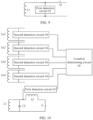
- the wireless charging alignment apparatus may include a plurality of location detection coils 02 and a plurality of second detection circuits 04 in a one-to-one correspondence with the plurality of location detection coils 02.
- Each second detection circuit 04 is connected to a corresponding location detection coil 02, and is configured to detect an induction signal of the location detection coil 02 that is connected to the second detection circuit 04 and that is in the positioning magnetic field generated by the power transmit coil.
- a quantity of location detection coils 02 disposed in the wireless charging alignment apparatus may be greater than or equal to 3.
- four location detection coils 02 are disposed in the wireless charging alignment apparatus.
- a size of each location detection coil 02 may be less than a size of the power receive coil 01.
- the plurality of location detection coils 02 may be evenly distributed, and may be all located in an area enclosed by the power receive coil 01 or located around the power receive coil 01.
- a size of the coil may indicate a radius or a diameter of the coil.
- a size of the coil may indicate a radius or a diameter of a minimum circumcircle of the coil.
- the location determining circuit 05 or a memory connected to the location determining circuit 05 may store a correspondence between an offset location and each of the induction signal of the power receive coil 01 and the induction signal of the location detection coil 02. After obtaining the first induction signal and the second induction signal, the location determining circuit 05 may determine, as the location of the power receive coil 01 relative to the power transmit coil, an offset location corresponding to the first induction signal and the second induction signal in the correspondence.
- the offset location may be represented by using the following coordinates: coordinates of a central point of the power receive coil 01 in a coordinate system in which a central point of the power transmit coil is used as an origin; or coordinates of a central point of the power transmit coil in a coordinate system in which a central point of the power receive coil 01 is used as an origin.
- the relative location of the two coils is determined based on the correspondence, to effectively improve efficiency of determining the relative location, thereby further ensuring alignment efficiency of the two coils.
- a correspondence between an offset location and each of the induction signal of the power receive coil 01 and the induction signal of the location detection coil 02 may be obtained through a pre-experiment.
- the experiment process may be: controlling the power transmit coil driven by an alternating current with a constant root mean square, to generate the positioning magnetic field; then, gradually moving the power receive coil 01 and the location detection coil 02, or moving the power transmit coil, so that the relative location of the power receive coil 01 and the power transmit coil changes constantly, that is, the offset location of the power receive coil 01 and the power transmit coil changes constantly; and at each offset location, separately detecting the induction signal of the power receive coil 01 in the positioning magnetic field and the induction signal of the location detection coil 02 in the positioning magnetic field, to obtain the correspondence between the offset location and each of the induction signal of the power receive coil 01 and the induction signal of the location detection coil 02.
- the offset location of the power receive coil 01 and the location detection coil 02 may be enabled to cover location points in an effective detection range as many as possible, so that induction signals of the power receive coil 01 and the location detection coil 02 at the location points can be obtained.
- the effective detection range may be a range in which at least one of the power receive coil 01 and the location detection coil 02 can sense the positioning magnetic field generated by the power transmit coil.
- the wireless charging alignment apparatus includes four location detection coils 02 in total: a location detection coil 1 to a location detection coil 4, and coordinates of an offset location are coordinates of a central point O' of a power receive coil 01 in a coordinate system in which a central point O of a power transmit coil 00 is used as an origin.
- the coordinates may be simplified as two-dimensional coordinates that are of orthographic projection of the central point O' in a plane in which the power transmit coil 00 is located and that are in a two-dimensional coordinate system (for example, an XOY coordinate system shown in FIG. 4 ) of the plane.
- the power receive coil 01 and the four location detection coils 02 may be controlled to be gradually moved. If the coordinates that are of the orthographic projection of the central point O' of the power receive coil 01 and that are in the XOY coordinate system are (x1, y1), a signal value (for example, a current value of an inductance current) of a detected induction signal of the power receive coil 01 in a positioning magnetic field is Is1, and signal values (for example, voltage values of open-circuit voltages) of induction signals of the four location detection coils 02 in the positioning magnetic field are respectively Ua11, Ua21, Ua31, and Ua41.
- the signal value of the induction signal that is of the power receive coil and that corresponds to the offset location (x1, y1) is Is1
- the signal values of the induction signals that are of the location detection coils and that corresponds to the offset location (x1, y1) are Ua11, Ua21, Ua31, and Ua41.
- the power receive coil 01 and the four location detection coils 02 are moved. In this way, after the central point O' of the power receive coil 01 traverses coordinate points in an effective detection range in the XOY coordinate system, a correspondence between the offset location and each of the induction signal of the power receive coil 01 and the induction signal of the location detection coil 02 may be obtained.
- the coordinate points in the effective detection range may be all coordinate points determined within the effective detection range in the XOY coordinate system by using a first length as a unit length of the x-axis and using a second length as a unit length of the y-axis.
- the first length and the second length may be equal or unequal, and may be set according to a requirement for alignment precision. For example, when a relatively high requirement is imposed on the alignment precision, the first length and the second length may be set to be relatively short; or when a relatively low requirement is imposed on the alignment precision, the first length and the second length may be set to be relatively long.
- Each signal group may include a signal value of an induction signal of the power receive coil 01 and a signal value of an induction signal of the location detection coil 02.
- Table 1 shows n (n is an integer greater than 1) signal groups and an offset location corresponding to each signal group.
- Each signal group includes a signal value of an induction signal of the power receive coil 01 and signal values of induction signals of the location detection coils 02. It is assumed that a signal value that is of a first induction signal and that is obtained by a location determining circuit 05 in an actual alignment process is Is2, and signal values that are of second induction signals and that are obtained by the location determining circuit 05 in the actual alignment process are respectively Ua12, Ua22, Ua32, and Ua42.
- the location determining circuit 05 may determine that a current location of the power receive coil 01 relative to the power transmit coil is (x2, y2).
- Table 1 Offset location Signal group Coordinate on the x-axis Coordinate on the y-axis Signal value of an induction signal of a location detection coil 1 Signal value of an induction signal of a location detection coil 2 Signal value of an induction signal of a location detection coil 3 Signal value of an induction signal of a location detection coil 4 Signal value of an induction signal of a power receive coil x1 y1 Ua11 Ua21 Ua31 Ua41 Is1 x2 y2 Ua12 Ua22 Ua32 Ua42 Is2 x3 y3 Ua13 Ua23 Ua33 Ua43 Is3 x4 y4 Ua14 Ua24 Ua34 Ua44 Is4 x5 y5 Ua15 Ua25 Ua35 Ua45 Is5 ... ... ... ... ... ...
- the correspondence between the offset location and each of the induction signal of the power receive coil 01 and the induction signal of the location detection coil 02 may be recorded in a form of a table such as Table 1, or may be recorded in a form of a function.
- the location determining circuit 05 may apply the signal values of the obtained induction signals to the relationship function, to obtain the location of the power receive coil 01 relative to the power transmit coil.
- the signal value of the first induction signal and the signal values of the second induction signals that are obtained by the location determining circuit 05 may be different from those of each signal group recorded in the table.
- the location determining circuit 05 may determine an offset location corresponding to a signal group with a smallest difference as the location of the power receive coil 0 1 relative to the power transmit coil.
- the location determining circuit 05 may be configured to determine a first difference between the signal value of the first induction signal and the signal value of the induction signal of the power receive coil 01 in each signal group, and a second difference between the signal value of the second induction signal and the signal value of the induction signal of the location detection coil 02 in each signal group, to obtain the first difference and the second difference of each signal group. Then, an offset location corresponding to a signal group whose sum of the first difference and the second difference is the smallest in the plurality of signal groups may be determined as the offset location corresponding to the first induction signal and the second induction signal. Each of the first difference and the second difference may be an absolute value.
- the location determining circuit 05 may separately determine a first difference between Isk and the signal value of the induction signal of the power receive coil 01 in each signal group, and each second difference between each of the signal values of the induction signals of the location detection coils 02 in each signal group and each of Ua1k, Ua2k, Ua3k, and Ua4k, to obtain the first difference and the second differences of each signal group.
- a sum of the first difference and the second differences of an n th signal group: Isn, Ua1n, Ua2n, Ua3n, and Ua4n is the smallest in the signal groups shown in Table 1.
- the location determining circuit 05 may determine that the current location of the power receive coil 01 relative to the power transmit coil is an offset location (xn, yn) corresponding to the n th signal group.
- the location determining circuit 05 may separately calculate a first difference between the signal value of the first induction signal and the signal value of the induction signal of the power receive coil in each signal group in Table 2, and each second difference between each of the signal values of the second induction signals and each of the signal values of the induction signals of the location detection coils in each signal group, to obtain each sum of each first difference and each group of second differences of each of the five signal groups: 88, 36, 55, 131, and 208.
- an offset location (x2, y2) corresponding to the second signal group may be determined as the location of the power receive coil 0 1 relative to the power transmit coil.
- the signal value of the induction signal of the location detection coil 02 shown in Table 2 may be a value obtained after sampling processing is performed on a voltage of the location detection coil 02
- the signal value of the induction signal of the power receive coil 01 may be a value obtained after sampling processing is performed on a current of the power receive coil 01.
- the positioning magnetic field generated by the power transmit coil is generated and driven by an alternating current with a constant root mean square.
- the root mean square of the alternating current in the power transmit coil is fixed.
- the location determining circuit 05 may further determine a coupling coefficient between the power receive coil 01 and the power transmit coil based on the first induction signal and a current or a voltage of the power transmit coil. Then, the location determining circuit 05 determines the location of the power receive coil 01 relative to the power transmit coil based on the coupling coefficient and the second induction signal.
- the coupling coefficient may be a coefficient used to reflect a coupling degree between the power receive coil 01 and the power transmit coil.
- the current or the voltage of the power transmit coil may be obtained through detection performed by the detection circuit and be sent to the wireless charging alignment apparatus.
- the root mean square of the alternating current in the power transmit coil is the same as the root mean square of the alternating current in the experiment process. Therefore, the current or the voltage of the power transmit coil may also be a fixed value pre-stored in the location determining circuit 05.
- L 1 is an inductance value of the power receive coil 01
- L 2 is an inductance value of the power transmit coil
- I 1 is a short-circuit current value of the power receive coil 01
- I 2 is a current value of the power transmit coil.
- j is an imaginary unit
- ⁇ is an operating frequency of the wireless charging system (that is, a frequency of an alternating current in the power transmit coil 201)
- Us is an open-circuit voltage value of the power receive coil 01.
- Up is a voltage value of the power transmit coil.
- the location determining circuit 05 may alternatively determine the location of the power receive coil 01 relative to the power transmit coil based on a correspondence that is between the offset location and each of the induction signal of the location detection coil and the coupling coefficient and that is generated in the pre-experiment.
- the first induction signal and the second induction signal may be different physical quantities or an amplitude difference between signal values of the first induction signal and the second induction signal is relatively large.
- the first induction signal is a current
- the second induction signal is a voltage.
- the location determining circuit 05 may further separately preprocess the first induction signal and the second induction signal, so that amplitudes of the signal value of the preprocessed first induction signal and the signal value of the second induction signal are similar. Then, the location determining circuit 05 determines the location of the power receive coil 01 relative to the power transmit coil based on the preprocessed first induction signal and the preprocessed second induction signal.
- the preprocessing may include at least one of normalization processing and weighting processing.
- the normalization processing on an induction signal may means to normalize a signal value of the induction signal to a value between 0 and 1.
- the weighting processing on an induction signal may means to multiply a weighting factor and a signal value of the induction signal.
- D 1 represents a set of signal values that are of the first induction signals and that are obtained by the location determining circuit 05 when the central point O' of the power receive coil 01 is at different coordinate points
- max( D 1 ) represents a maximum value in the set D1
- min( D 1 ) represents a minimum value in the set D1.
- max( D 1 ) may be equal to the signal value of the first induction signal
- min( D 1 ) may be 0.
- a signal value that is of a second induction signal of an m th location detection coil 02 and that is obtained by the location determining circuit 05 is b mi .
- M is an integer greater than 1
- m is a positive integer not greater than M
- B m represents a set of signal values that are of the second induction signals of the m th location detection coil 02 and that are obtained by the location determining circuit 05 when the central point O' of the power receive coil is at different coordinate points.
- signal values of induction signals in the set D 1 and the set B m may be obtained during generating the correspondence between the offset location and each of the induction signal of the power receive coil 01 and the induction signal of the location detection coil 02.
- the signal values of the induction signals in the set D 1 and the set B m may be obtained by traversing the central point O' of the power receive coil 01 at each coordinate point within the effective detection range and detecting the induction signal at each coordinate point.
- the location determining circuit 05 may further prestore a weighting factor of an induction signal of the power receive coil 01 and a weighting factor of an induction signal of each location detection coil 02.
- the weighting factor of each induction signal may be determined based on an experiment (that is, the foregoing experiment used to generate a correspondence).
- the location determining circuit 05 may multiply a signal value of each induction signal and a weighting factor corresponding to the induction signal, so that amplitudes of signal values of induction signals are relatively close.
- a weighting factor of an induction signal of the power receive coil 01 is ⁇ 1
- a weighting factor of an induction signal of the m th location detection coil 02 in the M location detection coils is ⁇ m .
- the location determining circuit 05 may perform only normalization processing or weighting processing on each induction signal, or the location determining circuit 05 may perform both normalization processing and weighting processing on each induction signal, where a sequence of performing the normalization processing and the weighting processing may be adjusted.
- each induction signal is an induction signal before being preprocessed in the correspondence between the offset location and each of the induction signal of the power receive coil 01 and the induction signal of the location detection coil 02 that are obtained by the location determining circuit 05, the location determining circuit 05 does not need to preprocess the first induction signal and the second induction signal when determining the offset location based on the first induction signal and the second induction signal.
- each induction signal is the preprocessed induction signal in the correspondence between the offset location and each of the induction signal of the power receive coil 01 and the induction signal of the location detection coil 02 that are obtained by the location determining circuit 05
- the location determining circuit 05 needs to preprocess the first induction signal and the second induction signal when determining the offset location based on the first induction signal and the second induction signal.
- the preprocessing manner needs to be the same as the preprocessing manner for the induction signal recorded in the correspondence, to ensure detection accuracy.
- the preprocessing is weighting processing
- a weighting factor of the induction signal of the power receive coil 01 is 15, and a weighting factor of the induction signal of each location detection coil 02 is 1.
- a signal value of an induction signal obtained after the weighting processing is performed on a signal value of an induction signal obtained through real-time measurement in each signal group shown in Table 2 may be shown in Table 3.
- the signal value of the preprocessed first induction signal is 645
- the signal values of the second induction signals are the same as those before the preprocessing and are respectively 410, 432, 412, and 1345.
- Each sum of each first difference between the signal value of the preprocessed first induction signal and the signal value of the induction signal in each signal group, and each second difference between each of the signal values of the second induction signals and each of the signal values of the induction signals in each signal group is 158, 78, 69, 187, or 320.
- an offset location (x3, y3) corresponding to the third signal group may be determined as the location of the power receive coil 0 1 relative to the power transmit coil.
- each of the first induction signal, the second induction signal, the induction signal of the power receive coil 01, and the induction signal of the location detection coil 02 may include at least one of a current and a voltage.
- a type of the first induction signal is the same as a type of the induction signal of the power receive coil 01
- a type of the second induction signal is the same as a type of the induction signal of the location detection coil 02.
- the first detection circuit 03 may include a current detection circuit.
- the first induction signal may include a current.
- the current may be an alternating current
- the current detection circuit may be a circuit configured to detect the alternating current.
- the current detection circuit may include components such as a current transformer, an amplifier, and an analog-to-digital converter.
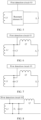
- FIG. 5 is a circuit diagram of a wireless charging alignment apparatus according to an embodiment of this application.
- the apparatus may further include a resonant element 06 and a first switch S 1 .
- a power receive coil 01 may be equivalent to an inductor L1.
- the inductor L1 is connected to the resonant element 06 to form a resonant circuit
- the first switch S 1 is connected in parallel to the resonant circuit.
- the first detection circuit 03 may detect a current flowing through the resonant circuit. In other words, after the resonant circuit is short-circuited, the first detection circuit 03 may detect the current flowing through the resonant circuit.
- the resonant element 06 may include an inductor Lf connected in series to a power receive coil 01 (that is, an inductor L1 shown in FIG. 6 and FIG. 7 ), and a capacitor Cf connected in parallel to the power receive coil 01.
- the first detection circuit 03 may be connected to the inductor Lf.
- the current detected by the first detection circuit 03 is an inductance current flowing through the inductor Lf.
- the first detection circuit 03 may be connected to the capacitor Cf.
- the current detected by the first detection circuit 03 is a capacitor current flowing through the capacitor Cf.
- the apparatus may further include a second switch S 2 .
- the second switch S 2 is connected in parallel to the power receive coil 01 (that is, an inductor L1 shown in FIG. 8 ).
- the first detection circuit 03 is connected to the power receive coil 01.
- the second switch S 2 is closed, that is, after the power receive coil 01 is short-circuited, the first detection circuit 03 may detect a short-circuit current flowing through the power receive coil 01.
- the current detected by the first detection circuit 03 is the short-circuit current flowing through the power receive coil 01.
- the first detection circuit 03 may include at least two current detection circuits, and the at least two current detection circuits may be separately connected to at least two of the inductor Lf, the capacitor Cf, and the power receive coil 01.
- the current detected by the first detection circuit 03 may include at least two of an inductance current, a capacitor current, and a short-circuit current.
- the inductance current, the capacitor current, and the short-circuit current are relatively easy to detect, and detection precision is relatively high, the at least one of the detected inductance current, the detected capacitor current, and the detected short-circuit current is used as the first induction signal, thereby ensuring precision of the obtained first induction signal.
- the first detection circuit 03 may further include a voltage detection circuit.
- the first induction signal may include a voltage.
- the voltage may be an alternating current voltage
- the first detection circuit 03 may be a voltage detection circuit configured to detect the alternating current voltage.
- the first detection circuit 03 may include components such as a rectifier circuit, an amplifier, and an analog-to-digital converter.
- the apparatus may further include a third switch S 3 .
- the third switch S 3 may be connected between the power receive coil 01 (that is, an inductor L1 shown in FIG. 9 ) and a subsequent circuit (not shown in FIG. 9 ) of the power receive coil 01.
- the subsequent circuit may include a circuit such as a receiving conversion module 102 in a power receive device 10.
- the first detection circuit 03 may be connected in parallel to the power receive coil 01, and is configured to: when the third switch S 3 is opened, detect an open-circuit voltage between two ends of the power receive coil 01.
- the first detection circuit 03 may include both a current detection circuit and a voltage detection circuit.
- the first induction signal detected by the first detection circuit 03 may include both a current and a voltage.
- the first induction signal may include a short-circuit current of the power receive coil 0 1 and an open-circuit voltage between the two ends of the power receive coil 01.
- the first detection circuit 03 detects only one type of signal (for example, one of a capacitor current, an inductance current, a short-circuit current, and an open-circuit voltage), detection costs can be reduced. If the first detection circuit 03 can detect a plurality of types of signals (for example, at least two of a capacitor current, an inductance current, a short-circuit current, and an open-circuit voltage), reliability of the detected first induction signal can be ensured.
- one type of signal for example, one of a capacitor current, an inductance current, a short-circuit current, and an open-circuit voltage
- the second detection circuit 04 may include at least one of a voltage detection circuit and a current detection circuit.
- the second induction signal may include at least one of a voltage and a current.
- the voltage may include at least one of a resonant voltage and an open-circuit voltage.
- the current may include at least one of a resonant current and a short-circuit current.
- the location detection coil 02 may be alternatively connected to a resonant element to form a resonant circuit.
- the resonant voltage may indicate a voltage of the resonant circuit.
- the open-circuit voltage may be a voltage between two ends of the location detection coil 02 when the location detection coil 02 is disconnected from the resonant element.
- the resonant current may be a current flowing through the resonant circuit.
- the short-circuit current may be a current flowing through the location detection coil 02 after the location detection coil 02 is short-circuited.
- the second detection circuit 04 may include a voltage detection circuit configured to detect an alternating current voltage, and the second detection circuit 04 may include components such as a rectifier circuit, an amplifier, and an analog-to-digital converter.
- four location detection coils 02 may be disposed in a wireless charging alignment apparatus.
- the four location detection coils 02 may be respectively equivalent to an inductor La1, an inductor La2, an inductor La3, and an inductor La4 in a circuit.
- four second detection circuits 04 are disposed in the wireless charging alignment apparatus.
- Each second detection circuit 04 may be connected in parallel to one inductor, and be configured to: detect a voltage of the inductor connected to the second detection circuit 04, and send the voltage to a location determining circuit 05.
- a switch status of each of the first switch S 1 , the second switch S 2 , and the third switch S 3 may be controlled by the location determining circuit 05;or may be controlled by a switch control circuit independent of the location determining circuit 05 in the wireless charging alignment apparatus.
- the wireless charging alignment apparatus is disposed in a power receive device 10 or is a power receive device 10
- resonant elements such as the inductor Lf and the capacitor Cf may be elements in a receiving conversion module 102 in the power receive device 10.
- resonant elements such as the inductor Lf and the capacitor Cf may be elements in a transmission conversion module 202 in the power transmit device 20.
- the wireless charging alignment apparatus may be applied to a receive end (that is, a power receive device) in a wireless charging system, or may be applied to a transmit end (that is, a power transmit device) in a wireless charging system.
- the transmit end and the receive end may be interchanged.
- the receive end may also charge the transmit end.
- the power receive coil described above may also be referred to as a power transmit coil
- the power transmit coil may also be referred to as a power receive coil.
- the embodiments of this application provide the wireless charging alignment apparatus.
- the location determining circuit in the apparatus may determine the relative location of the two coils based on the induction signals detected by the detection circuit. In this way, at least one of the power receive device and the power transmit device can adjust its location based on the relative location, so that the two coils are aligned.
- a driver visually measures a relative location of the two coils.
- both precision and efficiency of determining the relative location based on the induction signals are higher. Therefore, alignment precision and alignment efficiency of the two coils can be effectively improved.
- the apparatus can detect the second induction signal of the location detection coil by using the second detection circuit, and can also detect the first induction signal of the power receive coil by using the first detection circuit.
- a size and a coverage area of the power receive coil are both larger than those of the location detection coil.
- the power receive coil has a relatively large difference from the location detection coil in terms of features. Therefore, precision of the relative location determined by the location determining circuit based on the two types of induction signals is higher, thereby effectively ensuring the alignment precision of the two coils.
- the power receive coil is an original coil in the wireless charging alignment apparatus
- the power receive coil by using the power receive coil for alignment, hardware usage of the wireless charging alignment apparatus can be effectively improved, thereby ensuring alignment precision and further avoiding increase of costs and a volume of the wireless charging alignment apparatus.
- An embodiment of this application further provides a wireless charging alignment method.
- the method may be applied to the wireless charging alignment apparatus provided in the foregoing embodiments. Referring to FIG. 13 , the method may include the following steps:
- Step 301 Detect a first induction signal of a power receive coil in a positioning magnetic field generated by a power transmit coil.
- the power receive coil is configured to exchange power with the transmit coil of a transmit end through electromagnetic mutual inductance.
- a to-be-charged device is an electric vehicle
- a power receive coil 01 is disposed in the electric vehicle
- a power transmit coil is disposed in a wireless charging station.
- a central controller of the electric vehicle may deliver a charging instruction to a receiving control module 103 in a power receive device 10.
- the receiving control module 103 may send, by using a receiving communications module 104, a positioning instruction to a transmission communications module 204 in a power transmit device 20 located on the ground.
- the transmission control module 203 of the power transmit device 20 may control the power transmit coil 201 to generate a magnetic field used for location detection, that is, the foregoing positioning magnetic field.
- the power transmit coil 201 After the power transmit coil 201 generates the positioning magnetic field, and after the power receive device 10 enters a range of the positioning magnetic field with the electric vehicle, the power receive coil 101 and a location detection coil may generate induction signals.
- Step 302 Detect a second induction signal of the location detection coil in the positioning magnetic field.
- the wireless charging alignment apparatus includes a plurality of location detection coils, a second induction signal of each location detection coil in the positioning magnetic field needs to be detected.
- Step 303 Determine a location of the power receive coil relative to the power transmit coil based on the first induction signal and the second induction signal.
- step 301 may be implemented by a first detection circuit 03 in the wireless charging alignment apparatus
- step 302 may be implemented by a second detection circuit 04 in the wireless charging alignment apparatus
- step 303 may be implemented by a location determining circuit 05 in the wireless charging alignment apparatus.
- step 303 may include: determining, as the location of the power receive coil relative to the power transmit coil based on a correspondence between an offset location and each of an induction signal of the power receive coil and an induction signal of the location detection coil, an offset location corresponding to the first induction signal and the second induction signal.
- the process of determining, based on the correspondence, the offset location corresponding to the first induction signal and the second induction signal in step 303 may include the following steps:
- Step S31 Determine a first difference between a signal value of the first induction signal and a signal value of the induction signal of the power receive coil in each signal group, and a second difference between a signal value of the second induction signal and a signal value of the induction signal of the location detection coil in each signal group, to obtain the first difference and the second difference of each signal group.
- Step S32 Determine, as the offset location corresponding to the first induction signal and the second induction signal, an offset location corresponding to a signal group whose sum of the first difference and the second difference is the smallest in the plurality of signal groups.
- Each of the first difference and the second difference may be an absolute value.
- step 303 may include: determining a coupling coefficient between the power receive coil and the power transmit coil based on the first induction signal and a current or a voltage of the power transmit coil; and determining the location of the power receive coil relative to the power transmit coil based on the coupling coefficient and the second induction signal.
- step 303 may include: separately preprocessing the first induction signal and the second induction signal, where the preprocessing includes at least one of normalization processing and weighting processing; and determining the location of the power receive coil relative to the power transmit coil based on the preprocessed first induction signal and the preprocessed second induction signal.
- the first induction signal detected by the first detection circuit 03 may include at least one of a current and a voltage.
- the second induction signal detected by the second detection circuit 04 may also include at least one of a current and a voltage.
- the apparatus may further include a resonant element 06 and a first switch S 1 .
- the power receive coil is connected to the resonant element 06 to form a resonant circuit.
- the first switch S 1 is connected in parallel to the resonant circuit.
- Step 301 may include: controlling the first switch S 1 to be closed, and detecting a current flowing through the resonant circuit.
- the first induction signal may include the current flowing through the resonant circuit.
- the resonant element 06 may include a capacitor Cf and an inductor Lf.
- the current flowing through the resonant circuit may include at least one of a capacitor current and an inductance current.
- the apparatus may further include a second switch S 2 .
- the second switch S 2 is connected in parallel to the power receive coil.
- Step 301 may include: in a first time period, controlling the second switch S 2 to be closed, and detecting a short-circuit current flowing through the power receive coil.
- the first induction signal may include the short-circuit current flowing through the power receive coil.
- Step 302 may include: in a second time period, controlling the second switch S 2 to be opened, and detecting the second induction signal of the location detection coil in the positioning magnetic field.
- the second time period and the first time period may be two non-overlapping time periods.
- the short-circuit current and the second induction signal may be detected in a time division manner.
- the short-circuit current flowing through the power receive coil is an alternating current, and a magnetic field generated by the alternating current causes interference to the second induction signal generated by the location detection coil. Therefore, the short-circuit current and the second induction signal may be detected in a time division manner, to ensure reliability of the detected second induction signal.
- the inductor, the capacitor, and the power receive coil form a resonant circuit. Because impedance of the inductor and the capacitor relative to the power receive coil is relatively large, the current flowing through the power receive coil is very small, so that no interference is caused to the detection of the second induction signal. Therefore, when the first induction signal includes the inductance current or the capacitor current, the detection of the inductance current or the capacitor current may be performed synchronously with the detection of the second induction signal.
- the apparatus may further include a third switch S 3 .
- the third switch S 3 is separately connected to the power receive coil and a subsequent circuit of the power receive coil.
- step 301 may include: controlling the third switch to be opened, and detecting an open-circuit voltage between two ends of the power receive coil.
- the first induction signal may further include the open-circuit voltage between the two ends of the power receive coil.
- step 301 and step 302 may be performed simultaneously, or step 302 may be performed before step 301.Variation or replacement readily figured out by a person skilled in the art within the technical scope disclosed in the present invention shall fall within the protection scope of the present invention.
- the embodiments of this application provide the wireless charging alignment method.
- the relative location of the two coils may be determined based on the detected induction signals.
- at least one of the power receive device and the power transmit device can adjust its location based on the relative location, so that the two coils are aligned.
- a driver visually measures a relative location of the two coils.
- both precision and efficiency of determining the relative location based on the induction signals are higher. Therefore, alignment precision and alignment efficiency of the two coils can be effectively improved.
- the second induction signal of the location detection coil may be detected, and the first induction signal of the power receive coil may be further detected.
- a size and a coverage area of the power receive coil are both larger than those of the location detection coil.
- the power receive coil has a relatively large difference from the location detection coil in terms of features. Therefore, precision of the relative location determined based on the two types of induction signals is higher, thereby effectively ensuring the alignment precision of the two coils.
- the wireless charging system includes a power transmit device 20 and a power receive device 10. At least one of the power transmit device 20 and the power receive device 10 may include the wireless charging alignment apparatus provided in the foregoing embodiment.
- the power receive coil described above may also be referred to as a power transmit coil, and the power transmit coil may also be referred to as a power receive coil.
- An embodiment of this application further provides an electric vehicle.
- the electric vehicle may include the wireless charging alignment apparatus provided in the foregoing embodiment.
- the electric vehicle may include a power receive device 10, and the power receive device 10 includes the wireless charging alignment apparatus provided in the foregoing embodiment.
- the location determining circuit 05 of the wireless charging alignment apparatus in this embodiment of this application may alternatively be implemented by using an application-specific integrated circuit (application-specific integrated circuit, ASIC) or a programmable logic device (programmable logic device, PLD).
- the PLD may be a complex program logic device (complex programmable logical device, CPLD), a field-programmable gate array (field-programmable gate array, FPGA), generic array logic (generic array logic, GAL), or any combination thereof.
- the step of determining the location of the power receive coil relative to the power transmit coil in the wireless charging alignment method provided in the foregoing method embodiment may also be implemented by using software.
- the circuit that is, the location determining circuit 05 configured to implement this step in the wireless charging alignment apparatus may be a software module.
- FIG. 14 is a schematic structural diagram of a location determining circuit in a wireless charging alignment apparatus according to an embodiment of this application.
- the location determining circuit may include a processor 1201, a memory 1202, a network interface 1203, and a bus 1204.
- the bus 1204 is configured to connect the processor 1201, the memory 1202, and the network interface 1203.
- a communication connection to another device may be implemented by using the network interface 1203 (which may be wired or wireless).
- the memory 1202 stores a computer program 12021, and the computer program 12021 is configured to implement various application functions.
- the processor 1201 may be a CPU, or the processor 1201 may be another general purpose processor, a digital signal processor (DSP), an application-specific integrated circuit (ASIC), a field programmable gate array (FPGA), a GPU or another programmable logic device, a discrete gate or a transistor logic device, a discrete hardware component, or the like.
- the general purpose processor may be a microprocessor, any conventional processor, or the like.
- the memory 1202 may be a volatile memory or a nonvolatile memory, or may include both a volatile memory and a nonvolatile memory.
- the nonvolatile memory may be a read-only memory (read-only memory, ROM), a programmable read-only memory (programmable ROM, PROM), an erasable programmable read-only memory (erasable PROM, EPROM), an electrically erasable programmable read-only memory (electrically EPROM, EEPROM), or a flash memory.
- the volatile memory may be a random access memory (random access memory, RAM), used as an external cache.
- RAMs may be used, for example, a static random access memory (static RAM, SRAM), a dynamic random access memory (DRAM), a synchronous dynamic random access memory (synchronous DRAM, SDRAM), a double data rate synchronous dynamic random access memory (double data rate SDRAM, DDR SDRAM), an enhanced synchronous dynamic random access memory (enhanced SDRAM, ESDRAM), a synchronous link dynamic random access memory (synchlink DRAM, SLDRAM), and a direct rambus dynamic random access memory (direct rambus RAM, DR RAM).
- static random access memory static random access memory
- DRAM dynamic random access memory
- SDRAM synchronous dynamic random access memory
- double data rate SDRAM double data rate SDRAM
- DDR SDRAM double data rate SDRAM
- ESDRAM enhanced synchronous dynamic random access memory
- SLDRAM synchronous link dynamic random access memory
- direct rambus RAM direct rambus RAM
- the bus 1204 may further include a power bus, a control bus, a status signal bus, and the like, in addition to a data bus. However, for clear description, various types of buses in the figure are marked as the bus 1204.
- the processor 1201 is configured to execute the computer program stored in the memory 1202.
- the processor 1201 executes the computer program 12021 to implement the step of determining the location of the power receive coil relative to the power transmit coil in the foregoing method embodiment.
- An embodiment of this application further provides a computer readable storage medium.
- the computer readable storage medium stores an instruction.
- the computer readable storage medium runs on a computer, the computer is enabled to perform the step of determining the location of the power receive coil relative to the power transmit coil in the foregoing method embodiment.
- An embodiment of this application further provides a computer program product including an instruction.
- the computer program product runs on a computer, the computer is enabled to perform the step of determining the location of the power receive coil relative to the power transmit coil in the foregoing method embodiment.
Landscapes
- Engineering & Computer Science (AREA)
- Power Engineering (AREA)
- Transportation (AREA)
- Mechanical Engineering (AREA)
- Computer Networks & Wireless Communication (AREA)
- Charge And Discharge Circuits For Batteries Or The Like (AREA)
Description
- This application relates to the wireless charging field, and in particular, to a wireless charging alignment method and apparatus, a wireless charging system, and an electric vehicle.
- Wireless charging (wireless power transmission, WPT) is a technology in which electric energy is transmitted by using a coupling electromagnetic field as a medium, to charge an in-vehicle power supply of an electric vehicle. Compared with conventional contact charging, the wireless charging has the following advantages: easy to use, no spark, no electric shock risk, no mechanical wear, adaptable to a plurality of severe environments and weather, automatic charging and mobile charging, and the like. Therefore, the wireless charging is widely applied.
- In a related technology, a wireless charging system generally includes: a power transmit device disposed on the ground or under the ground, and a power receive device disposed at the bottom of an electric vehicle. The power transmit device includes a power transmit coil, and the power receive device includes a power receive coil. After a driver drives the electric vehicle to align the power receive coil with the power transmit coil, the power transmit coil may transmit power to the power receive coil in an electric field coupling manner or a magnetic field coupling manner. In addition, higher alignment precision between the power transmit coil and the power receive coil indicates higher efficiency of power transmission between the two coils and higher charging efficiency.
- However, in the related technology, the driver needs to visually measure a relative location of the two coils, and drive the electric vehicle based on the relative location, to align the two coils. Alignment precision in this alignment method is relatively low.
-
CN 207 496 493 U discloses that a vehicle alignment guiding device for wireless charging system of electric automobile includes ground primary coil and on -vehicle secondary winding, a plurality of alignment coils, a plurality of voltage sensor, wherein, every voltage sensor respectively with every the alignment coil is connected for obtain the induced voltage who produces in the alignment coil, the treater, with a plurality of voltage sensor connect, and it is right to be used for induced voltage handles, confirms the position of on -vehicle secondary winding for the ground primary coil, display device for need adjustment direction display to come out with the alignment positional information. -
CN 109 067 020 A discloses that an alignment processing method for wireless charging applied to a terminal device, wherein the receiving terminal is provided with a wireless charging receiving terminal, wherein, the receiving terminal is used to be connected with a corresponding wireless charging transmitting terminal, - The present invention is set out in the appended set of claims. This application provides a wireless charging alignment method and apparatus, a wireless charging system, and an electric vehicle, to resolve a problem of relatively low alignment precision in an alignment method in a related technology. Technical solutions are as follows:
- According to an aspect, this application provides a wireless charging alignment apparatus, including a power receive coil, a location detection coil, a first detection circuit, a second detection circuit, and a location determining circuit. The power receive coil is configured to exchange power with a power transmit coil of a transmit end through electromagnetic mutual inductance. The first detection circuit is configured to detect a first induction signal of the power receive coil in a positioning magnetic field generated by the power transmit coil. The second detection circuit is configured to detect a second induction signal of the location detection coil in the positioning magnetic field. The location determining circuit is configured to determine a location of the power receive coil relative to the power transmit coil based on the first induction signal and the second induction signal.
- In the related technology, a driver visually measures a relative location of the two coils. In comparison with the related technology, in this embodiment of this application, both precision and efficiency of determining the relative location based on the induction signals are higher. Therefore, alignment precision and alignment efficiency of the two coils can be effectively improved.
- Optionally, the wireless charging alignment apparatus may be applied to a receive end (that is, a power receive device) in a wireless charging system, or may be applied to a transmit end (that is, a power transmit device) in a wireless charging system. In addition, in the wireless charging system, the transmit end and the receive end may be interchanged. In other words, the receive end may also charge the transmit end. When the wireless charging alignment apparatus is applied to the transmit end, or when the transmit end and the receive end are interchanged, the power receive coil described above may also be referred to as a power transmit coil, and the power transmit coil may also be referred to as a power receive coil.
- The location determining circuit is configured to determine, as the location of the power receive coil relative to the power transmit coil based on a correspondence between an offset location and each of an induction signal of the power receive coil and an induction signal of the location detection coil, an offset location corresponding to the first induction signal and the second induction signal.
- The relative location of the two coils is determined based on the correspondence, to effectively improve efficiency of determining the relative location, thereby further ensuring alignment efficiency.
- A plurality of signal groups and an offset location corresponding to each signal group is recorded in the correspondence. Each signal group may include a signal value of the induction signal of the power receive coil and a signal value of the induction signal of the location detection coil. The location determining circuit is configured to: determine a first difference between a signal value of the first induction signal and the signal value of the induction signal of the power receive coil in each signal group, and a second difference between a signal value of the second induction signal and the signal value of the induction signal of the location detection coil in each signal group, to obtain the first difference and the second difference of each signal group; and determine, as the offset location corresponding to the first induction signal and the second induction signal, an offset location corresponding to a signal group whose sum of the first difference and the second difference is the smallest in the plurality of signal groups.
- In other words, after obtaining the first induction signal and the second induction signal, the location determining circuit determines, as the offset location corresponding to the first induction signal and the second induction signal, an offset location corresponding to a signal group that is in the correspondence and that is closest to the signal values of the two induction signals, to ensure detection precision and reliability. Herein, the signal group and the offset location are recorded in the correspondence in a form of a table.
- Optionally, the location determining circuit may be configured to: determine a coupling coefficient between the power receive coil and the power transmit coil based on the first induction signal and a current or a voltage of the power transmit coil; and determine the location of the power receive coil relative to the power transmit coil based on the coupling coefficient and the second induction signal.
- For example, the location determining circuit may determine, as the location of the power receive coil relative to the power transmit coil based on a pre-stored correspondence between the offset location and each of a coupling coefficient and the induction signal of the location detection coil, the offset location corresponding to the currently detected coupling coefficient and the second induction signal.
- Optionally, the location determining circuit may be configured to: separately preprocess the first induction signal and the second induction signal, and determine the location of the power receive coil relative to the power transmit coil based on the preprocessed first induction signal and the preprocessed second induction signal. The preprocessing may include at least one of normalization processing and weighting processing.
- Because the first induction signal and the second induction signal may be different physical quantities or amplitudes of signal values of the first induction signal and the second induction signal have relatively large difference therebetween, the amplitudes of the signal values of the induction signals may be relatively close by preprocessing the induction signals, thereby improving precision and efficiency of subsequently determining the relative location based on the induction signals.
- Optionally, each of the first induction signal, the second induction signal, the induction signal of the power receive coil, and the induction signal of the location detection coil may include at least one of a current and a voltage. In addition, a type of the first induction signal is the same as a type of the induction signal of the power receive coil in the correspondence, and a type of the second induction signal is the same as a type of the induction signal of the location detection coil in the correspondence.
- For example, the first induction signal may be a current or a voltage, and the first detection circuit may be configured to detect only one type of signal (for example, a voltage), to reduce detection costs. Alternatively, the first induction signal may include a current and a voltage, and the first detection circuit may be configured to detect many types of signals (for example, a current and a voltage), to ensure detection reliability.
- Optionally, the first induction signal includes a current. The apparatus may further include a resonant element and a first switch. The power receive coil is connected to the resonant element to form a resonant circuit. The first switch is connected in parallel to the resonant circuit. The first detection circuit is configured to: when the first switch is closed, detect a current flowing through the resonant circuit.
- Optionally, the resonant element may include: an inductor connected in series to the power receive coil and a capacitor connected in parallel to the power receive coil. The current may include at least one of an inductance current flowing through the inductor and a capacitor current flowing through the capacitor.
- For example, the first detection circuit may include two current detection circuits. One current detection circuit may be configured to detect the inductance current, and the other direction circuit may be configured to detect the capacitor current.
- Optionally, the first induction signal includes a current. The apparatus further includes a second switch. The second switch is connected in parallel to the power receive coil. The first detection circuit is configured to: when the second switch is closed, detect a short-circuit current flowing through the power receive coil.
- In this embodiment of this application, the current detected by the first detection circuit may include at least one of an inductance current, a capacitor current, and a short-circuit current. Because the inductance current, the capacitor current, and the short-circuit current are relatively easy to detect, and detection precision is relatively high, the at least one of the detected inductance current, the detected capacitor current, and the detected short-circuit current is used as the first induction signal, thereby ensuring precision of the obtained first induction signal.
- Optionally, the first induction signal includes a voltage. The apparatus may further include a third switch. The third switch is connected between the power receive coil and a subsequent circuit of the power receive coil. The first detection circuit is configured to: when the third switch is opened, detect an open-circuit voltage between two ends of the power receive coil.
- For example, the first detection circuit may include a voltage detection circuit configured to detect the open-circuit voltage. The open-circuit voltage detected by the voltage detection circuit may be an alternating current voltage.
- According to another aspect, this application provides a wireless charging alignment method. The method may be applied to the wireless charging alignment apparatus in the foregoing aspect. The method may include: detecting a first induction signal of a power receive coil in a positioning magnetic field generated by a power transmit coil; detecting a second induction signal of a location detection coil in the positioning magnetic field; and determining a location of the power receive coil relative to the power transmit coil based on the first induction signal and the second induction signal, where the power receive coil is configured to exchange power with the transmit coil of a transmit end through electromagnetic mutual inductance.
- The process of determining a location of the power receive coil relative to the power transmit coil based on the first induction signal and the second induction signal includes :
determining, as the location of the power receive coil relative to the power transmit coil based on a correspondence between an offset location and each of the induction signal of the power receive coil and the induction signal of the location detection coil, an offset location corresponding to the first induction signal and the second induction signal. - A plurality of signal groups and an offset location corresponding to each signal group is recorded in the correspondence. Each signal group includes a signal value of the induction signal of the power receive coil and a signal value of the induction signal of the location detection coil.
- The process of determining, based on a correspondence between an offset location and each of the induction signal of the power receive coil and the induction signal of the location detection coil, an offset location corresponding to the first induction signal and the second induction signal includes :
determining a first difference between a signal value of the first induction signal and the signal value of the induction signal of the power receive coil in each signal group, and a second difference between a signal value of the second induction signal and the signal value of the induction signal of the location detection coil in each signal group, to obtain the first difference and the second difference of each signal group; and determining, as the offset location corresponding to the first induction signal and the second induction signal, an offset location corresponding to a signal group whose sum of the first difference and the second difference is the smallest in the plurality of signal groups. - Optionally, the process of determining a location of the power receive coil relative to the power transmit coil based on the first induction signal and the second induction signal may include:
determining a coupling coefficient between the power receive coil and the power transmit coil based on the first induction signal and a current or a voltage of the power transmit coil; and determining the location of the power receive coil relative to the power transmit coil based on the coupling coefficient and the second induction signal. - Optionally, the process of determining a location of the power receive coil relative to the power transmit coil based on the first induction signal and the second induction signal may include:
separately preprocessing the first induction signal and the second induction signal, where the preprocessing includes at least one of normalization processing and weighting processing; and determining the location of the power receive coil relative to the power transmit coil based on the preprocessed first induction signal and the preprocessed second induction signal. - Optionally, the first induction signal includes a current. The power receive coil is connected to a resonant element to form a resonant circuit. The first switch is connected in parallel to the resonant circuit. The process of detecting a first induction signal of a power receive coil in a positioning magnetic field generated by a power transmit coil may include: controlling the first switch to be closed, and detecting a current flowing through the resonant circuit.
- Optionally, the first induction signal includes a current. The power receive coil is connected in parallel to a second switch. The process of detecting a first induction signal of a power receive coil in a positioning magnetic field generated by a power transmit coil may include: in a first time period, controlling the second switch to be closed, and detecting a short-circuit current flowing through the power receive coil.
- The process of detecting a second induction signal of a location detection coil in the positioning magnetic field may include: in a second time period, controlling the second switch to be opened, and detecting the second induction signal of the location detection coil in the positioning magnetic field, where the second time period and the first time period are two non-overlapping time periods.
- After the second switch is closed, the short-circuit current flowing through the power receive coil is an alternating current. In this case, a magnetic field generated by the alternating current causes interference to the second induction signal. Therefore, the first induction signal and the second induction signal are respectively detected in the first time period and the second time period in a time division manner, thereby ensuring accuracy of the detected induction signals.
- Optionally, the first induction signal includes a voltage. The power receive coil may be connected to a subsequent circuit of the power receive coil by using a third switch. The process of detecting a first induction signal of a power receive coil in a positioning magnetic field generated by a power transmit coil may include: controlling the third switch to be opened, and detecting an open-circuit voltage between two ends of the power receive coil.
- According to still another aspect, this application provides a wireless charging system. The wireless charging system includes: a power transmit device and a power receive device. At least one of the power transmit device and the power receive device includes the wireless charging alignment apparatus according to the foregoing aspect.
- According to further another aspect, this application provides an electric vehicle. The electric vehicle may include the wireless charging alignment apparatus according to the foregoing aspect.
- According to further another aspect not claimed, this application provides a location determining circuit in a wireless charging alignment apparatus. The location determining circuit may include a memory, a processor, and a computer program that is stored in the memory and that can be run on the processor. When executing the computer program, the processor implements the step of determining a location of the power receive coil relative to the power transmit coil in the wireless charging alignment method according to the foregoing aspect.
- According to further another aspect not claimed, this application provides a computer readable storage medium. The computer readable storage medium stores an instruction. When the instruction stored in the computer readable storage medium is run on a computer, the computer is enabled to perform the step of determining a location of the power receive coil relative to the power transmit coil in the wireless charging alignment method according to the foregoing aspect.
- According to further another aspect not claimed, this application provides a computer program product including an instruction. When the computer program product is run on a computer, the computer is enabled to perform the step of determining a location of the power receive coil relative to the power transmit coil in the wireless charging alignment method according to the foregoing aspect.
- In conclusion, the embodiments of this application provide the wireless charging alignment method and apparatus, the wireless charging system, and the electric vehicle. The location determining circuit in the apparatus determines the location of the power receive coil relative to the power transmit coil based on the induction signals detected by the detection circuit. In this way, at least one of the receive end and the transmit end can adjust its location based on the relative location, so that the two coils are aligned. In the related technology, a driver visually measures a relative location of the two coils. In comparison with the related technology, in this embodiment of this application, both precision and efficiency of determiningthe relative location based on the induction signals are higher. Therefore, alignment precision and alignment efficiency of the two coils can be effectively improved. In addition, because the apparatus detects the second induction signal of the location detection coil by using the second detection circuit, and detects the first induction signal of the power receive coil by using the first detection circuit, precision of the relative location determined by the location determining circuit based on the two types of induction signals is higher, thereby effectively ensuring alignment precision of the two coils.
-
-
FIG. 1 is an architectural diagram of a wireless charging system according to an embodiment of this application; -
FIG. 2 is an architectural diagram of another wireless charging system according to an embodiment of this application; -
FIG. 3 is a schematic structural diagram of a wireless charging alignment apparatus according to an embodiment of this application; -
FIG. 4 is a schematic diagram of a location of a power receive coil relative to a power transmit coil according to an embodiment of this application; -
FIG. 5 is a partial circuit diagram of a wireless charging alignment apparatus according to an embodiment of this application; -
FIG. 6 is a partial circuit diagram of another wireless charging alignment apparatus according to an embodiment of this application; -
FIG. 7 is a partial circuit diagram of still another wireless charging alignment apparatus according to an embodiment of this application; -
FIG. 8 is a partial circuit diagram of further another wireless charging alignment apparatus according to an embodiment of this application; -
FIG. 9 is a partial circuit diagram of further another wireless charging alignment apparatus according to an embodiment of this application; -
FIG. 10 is a circuit diagram of a wireless charging alignment apparatus according to an embodiment of this application; -
FIG. 11 is a circuit diagram of another wireless charging alignment apparatus according to an embodiment of this application; -
FIG. 12 is a circuit diagram of still another wireless charging alignment apparatus according to an embodiment of this application; -
FIG. 13 is a flowchart of a wireless charging alignment method according to an embodiment of this application; and -
FIG. 14 is a schematic structural diagram of a location determining circuit in a wireless charging alignment apparatus according to an embodiment of this application. - The following describes in detail a wireless charging alignment method and apparatus, an electric vehicle, and a wireless charging system according to the embodiments of this application with reference to the accompany drawings.
- The embodiments in the present disclosure, and particularly hereafter, are not necessarily belonging to the scope of the invention. The invention is defined by the features of the independent claims 1, 8. Preferred embodiments are defined in the dependent claims.
-
FIG. 1 is an architectural diagram of a wireless charging system according to an embodiment of this application. Referring toFIG. 1 , the wireless charging system may include a power receive device 10 (that is, a receive end) and a power transmit device 20 (that is, a transmit end). The power receivedevice 10 may be disposed in a to-be-charged device. The to-be-charged device may be an electricity-driven device such as an electric vehicle or an electric robot. For example, the to-be-charged device shown inFIG. 1 is an electric vehicle, and the power receivedevice 10 is integrated at the bottom of the electric vehicle. The power transmitdevice 20 may be disposed in an area such as a wireless charging station, a wireless charging parking space, or a wireless charging road; and the power transmitdevice 20 may be disposed on the ground, or may be buried under the ground (FIG. 1 shows a case in which the power transmitdevice 20 is buried under the ground). The power receivedevice 10 may be connected to a power supply of the to-be-charged device, and the power transmitdevice 20 may be connected to a power supply. When the to-be-charged device enters a wireless charging range of the power transmitdevice 20, the power supply may charge the power supply of the to-be-charged device by using the power transmitdevice 20 and the power receivedevice 10. - Optionally, the power receive
device 10 and the power transmitdevice 20 may exchangepower in an electromagnetic induction manner. In addition, the power supply and the power supply of the to-be-charged device may further implement bidirectional charging by using the power receivedevice 10 and the power transmitdevice 20. To be specific, the power supply may charge the power supply of the to-be-charged device by using the power transmitdevice 20 and the power receivedevice 10, or the power supply of the to-be-charged device may discharge to the power supply by using the power transmitdevice 20 and the power receivedevice 10. -
FIG. 2 is an architectural diagram of another wireless charging system according to an embodiment of this application. Referring toFIG. 2 , the power transmitdevice 20 may include a power transmitcoil 201, atransmission conversion module 202, atransmission control module 203, a transmission communications module 204, anauthentication management module 205, and astorage module 206. - The power transmit
coil 201 and a resonant element that mainly includes an inductor and a capacitor can form a resonant circuit. The power transmitcoil 201 is configured to convert a high-frequency alternating current into a resonant voltage or a resonant current by using the resonant circuit. - The
transmission conversion module 202 is separately connected to apower supply 30 and the power transmitcoil 201, and is configured to: convert an alternating current or a direct current provided by thepower supply 30 into a high-frequency alternating current, and provide the high-frequency alternating current to the power transmitcoil 201. If thepower supply 30 provides a direct current, thetransmission conversion module 202 may include an inverter circuit and a voltage conversion circuit. If thepower supply 30 provides an alternating current, thetransmission conversion module 202 may include a power factor correction circuit and an inverter circuit. - The inverter circuit may be integrated with the power transmit
coil 201, or may be disposed independently. The power factor correction circuit can be used to ensure that an input current phase of the wireless charging system is consistent with a power grid voltage phase, to reduce system harmonic content and increase a power factor value, thereby reducing pollution from the wireless charging system to a power grid and improving reliability. The power factor correction circuit may further increase or reduce an output voltage of the power factor correction circuit based on a subsequent requirement. The inverter circuit may convert, into a high-frequency alternating current voltage, the voltage output by the power factor correction circuit, and apply the high-frequency alternating current voltage to the power transmit coil. The high-frequency alternating current voltage can greatly improve transmission efficiency and a power transmission distance of the power transmitcoil 201. - It should be noted that the
power supply 30 may be an external power supply of the power transmitdevice 20, or may be a power supply disposed inside the power transmitdevice 20. This is not limited in this embodiment of this application. - The
transmission control module 203 is connected to thetransmission conversion module 202, and is configured to control parameters such as a voltage, a current, and a frequency of thetransmission conversion module 202 based on an actual transmit power requirement for wireless charging, to adjust a voltage or a current of the high-frequency alternating current in the power transmitcoil 201. - The transmission communications module 204 is configured to perform wireless communication with a power receive
device 10. Communication content may include power control information, fault protection information, power-on/off information, interactive authentication information, and the like. For example, the transmission communications module 204 may receive information such as attribute information, a charging request, and interactive authentication information that are of the to-be-charged device and that are sent by the power receivedevice 10. The transmission communications module 204 may further send information such as wireless charging transmission control information, interactive authentication information, and wireless charging historical data information to the power receivedevice 10. - Specifically, a manner of wireless communication between the transmission communications module 204 and the power receive
device 10 may include any one of or any combination of Bluetooth (bluetooth), wireless fidelity (wireless fidelity, Wi-Fi), ZigBee (Zigbee), radio frequency identification (radio frequency identification, RFID), long-range (long range, Lora) wireless, and near field communication (near field communication, NFC). Optionally, the transmission communications module 204 may further communicate with an intelligent terminal of a user to which the to-be-charged device belongs, and the user to which the to-be-charged device belongs may implement remote authentication and user information transmission by using a communication function. - The
authentication management module 205 may be configured to perform interactive authentication and permission management with the to-be-charged device. - The
storage module 206 may be configured to store charging process data, interactive authentication data (for example, interactive authentication information), and permission management data (for example, permission management information) of the power transmitdevice 10. The interactive authentication data and the permission management data may be set from the factory or may be set by the user. This is not limited in this embodiment of this application. - Still referring to
FIG. 2 , the power receivedevice 10 may include a power receivecoil 101, a receiving conversion module 102, a receivingcontrol module 103, and areceiving communications module 104. - The power receive
coil 101 is configured to receive active power and reactive power transmitted by the power transmitdevice 20. A coupling manner of the power transmitcoil 201 and the power receivecoil 101 in the wireless charging system may be any selective combination. For example, a coupling manner of the two coils may include: S-S coupling, P-P coupling, S-P coupling, P-S coupling, LCL-LCL coupling, LCL-P coupling, or the like. Herein, S represents in series (series), P represents in parallel (parallel), L represents an inductor, and C represents a capacitor. The S-S coupling means that a resonant circuit in the power transmitdevice 20 is series resonance, and a resonant circuit in the power receivedevice 10 is series resonance. The S-P coupling means that a resonant circuit in the power transmitdevice 20 is series resonance, and a resonant circuit in the power receivedevice 10 is parallel resonance. The LCL-LCL type means that aresonant circuit in each of the power transmitdevice 20 and the power receivedevice 10 is an LCL resonant circuit (that is, a resonant circuit including two inductors L and one capacitor C). - In addition, to implement a bidirectional charging function of the wireless charging system, each of the power transmit
device 20 and the power receivedevice 10 may include both a power receive coil and a power transmit coil. The power transmit coil and the power receive coil in each device may be separately disposed, or may be disposed in an integrated manner. - The receiving conversion module 102 may be connected to an
energy storage module 50 by using an energystorage management module 40. The receiving conversion module 102 is configured to convert a high-frequency resonant current (or a voltage) received by the power receivecoil 101 into a direct current (or a direct current voltage) required by theenergy storage module 50 for charging. The receiving conversion module 102 may include a rectifier circuit and a direct current conversion unit. The rectifier circuit may convert the high-frequency resonant current (or a voltage) received by the power receivecoil 101 into a direct current (or a direct current voltage). The direct current conversion unit may provide the direct current (or the direct current voltage) for a subsequent charging circuit, to implement charging in a constant mode. The rectifier circuit may be integrated with the power receivecoil 101, or may be disposed independently. - It should be noted that the energy
storage management module 40 and theenergy storage module 50 may be located outside the power receivedevice 10, for example, may be integrated into the power supply of the to-be-charged device. Alternatively, the energystorage management module 40 and theenergy storage module 50 may be located inside the power receivedevice 10. Referring toFIG. 2 , it may be learned that theenergy storage module 50 may be further connected to a drive apparatus 60 and is configured to supply power to the drive apparatus 60, to drive the to-be-charged device. - The receiving
control module 103 is configured to control parameters such as a voltage, a current, and a frequency of the receiving conversion module 102 based on an actual receive power requirement for wireless charging. - The receiving
communications module 104 is configured to communicate with the transmission communications module 204 in the power transmitdevice 20. A function of the receivingcommunications module 104 corresponds to a function of the transmission communications module 204. Details are not described herein again. - An embodiment of this application provides a wireless charging alignment apparatus. The apparatus may be applied to the wireless charging system shown in
FIG. 1 orFIG. 2 . The wireless charging alignment apparatus may be disposed in at least one of the power receivedevice 10 and the power transmitdevice 20. Alternatively, the wireless charging alignment apparatus may be the power receivedevice 10 or the power transmitdevice 20. For example, the wireless charging alignment apparatus may be the power receivedevice 10 disposed in the electric vehicle. - The following provides description by using an example in which the wireless charging alignment apparatus is disposed in the power receive
device 10 and the power transmit coil is disposed in the power transmitdevice 20. Referring toFIG. 3 , the wireless charging alignment apparatus may include a power receivecoil 01, alocation detection coil 02, afirst detection circuit 03, asecond detection circuit 04, and alocation determining circuit 05. - The power receive
coil 01 is configured to exchange power with the power transmit coil through electromagnetic mutual inductance. - The
first detection circuit 03 may be configured to detect a first induction signal of the power receivecoil 01 in a positioning magnetic field generated by the power transmit coil, and thesecond detection circuit 04 may be configured to detect a second induction signal of thelocation detection coil 02 in the positioning magnetic field. The power transmit coil may be a power induction coil specifically used for wireless charging in the power transmitdevice 20. Alternatively, the power transmit coil may be a coil specifically used to generate a magnetic field in the power transmitdevice 20, and may be disposed adjacent to the power induction coil specifically used for wireless charging. - The
location determining circuit 05 is configured to determine a location of the power receivecoil 01 relative to the power transmit coil based on the first induction signal and the second induction signal. - In this embodiment of this application, after the
location determining circuit 05 determines the location of the power receivecoil 01 relative to the power transmit coil, at least one of the power receivedevice 10 and the power transmitdevice 20 may adjust its location based on the location, so that the power receivecoil 01 can be accurately aligned with the power transmit coil, to ensure wireless charging efficiency. For example, the power receivedevice 10 may adjust the location of the power receivedevice 10, so that the two coils are aligned. - Optionally, the location of the power receive
coil 01 relative to the power transmit coil may be represented by using the following coordinates: coordinates of a central point of the power receivecoil 01 in a coordinate system in which a central point of the power transmit coil is used as an origin; or coordinates of a central point of the power transmit coil in a coordinate system in which a central point of the power receivecoil 01 is used as an origin. That the power receivecoil 01 is aligned with the power transmit coil may indicate that a distance between the central points of the two coils is less than a distance threshold. The distance threshold may be configured before the delivery of the power receivedevice 10 or the power transmitdevice 20, or may be set by a user. This is not limited in this embodiment of this application. - For example, it is assumed that the wireless charging alignment apparatus is the power receive
device 10 in the electric vehicle. In this case, after thelocation determining circuit 05 determines the location of the power receivecoil 01 relative to the power transmit coil, the relative location may be displayed on an in-vehicle display device, so that a driver adjusts a location of the electric vehicle based on the relative location to align the power receive coil with the power transmit coil. Alternatively, thelocation determining circuit 05 may directly send the relative location to a controller of the electric vehicle, and the controller of the electric vehicle may automatically adjust a location of the electric vehicle based on the relative location to align the power receive coil with the power transmit coil. - In conclusion, this embodiment of this application provides the wireless charging alignment apparatus. The location determining circuit in the apparatus may determine the location of the power receive coil relative to the power transmit coil based on the induction signals detected by the detection circuit. In this way, at least one of the power receive device and the power transmit device can adjust its location based on the relative location, so that the two coils are aligned. In the related technology, a driver visually measures a relative location of the two coils. In comparison with the related technology, in this embodiment of this application, both precision and efficiency of determining the relative location based on the induction signals are higher. Therefore, alignment precision and alignment efficiency of the two coils can be effectively improved. In addition, because the apparatus can detect the second induction signal of the location detection coil by using the second detection circuit, and can also detect the first induction signal of the power receive coil by using the first detection circuit, precision of the relative location determined by the location determining circuit based on the two types of induction signals is higher, thereby effectively ensuring the alignment precision of the two coils.
- In this embodiment of this application, if the wireless charging alignment apparatus is disposed in the power receive
device 10 or is the power receivedevice 10, thefirst detection circuit 03, thesecond detection circuit 04, and thelocation determining circuit 05 may all be circuits in the receivingcontrol module 103 in the power receivedevice 10. If the wireless charging alignment apparatus is disposed in the power transmitdevice 20 or is the power transmitdevice 20, thefirst detection circuit 03, thesecond detection circuit 04, and thelocation determining circuit 05 may all be circuits in thetransmission control module 203 in the power transmitdevice 20. - Optionally, the wireless charging alignment apparatus may further include a magnetic core. Both the power receive
coil 01 and thelocation detection coil 02 may be disposed on the magnetic core, and may be both located on one side of the magnetic core close to the power transmitcoil 01. For example, if the wireless charging alignment apparatus is a power receive device disposed in an electric vehicle, and the power transmit device is disposed on the ground or buried under the ground, both the power receivecoil 01 and thelocation detection coil 02 may be disposed on one side of the magnetic core close to the ground. - Because the magnetic core has a relatively high magnetic permeability and has a function of aggregating a magnetic field, it can be ensured that the induction signals generated by the power receive coil 0 1 and the
location detection coil 02 in the positioning magnetic field have higher strength for detection of the induction signals. - Referring to
FIG. 3 , it may be further learned that, to ensure detection precision, the wireless charging alignment apparatus may include a plurality of location detection coils 02 and a plurality ofsecond detection circuits 04 in a one-to-one correspondence with the plurality of location detection coils 02. Eachsecond detection circuit 04 is connected to a correspondinglocation detection coil 02, and is configured to detect an induction signal of thelocation detection coil 02 that is connected to thesecond detection circuit 04 and that is in the positioning magnetic field generated by the power transmit coil. - In this embodiment of this application, a quantity of location detection coils 02 disposed in the wireless charging alignment apparatus may be greater than or equal to 3. For example, in the structure shown in
FIG. 3 , four location detection coils 02 are disposed in the wireless charging alignment apparatus. - Optionally, a size of each
location detection coil 02 may be less than a size of the power receivecoil 01. The plurality of location detection coils 02 may be evenly distributed, and may be all located in an area enclosed by the power receivecoil 01 or located around the power receivecoil 01. When the coil is circular, a size of the coil may indicate a radius or a diameter of the coil. When the coil is polygonal, a size of the coil may indicate a radius or a diameter of a minimum circumcircle of the coil. - In this embodiment of this application, the
location determining circuit 05 or a memory connected to thelocation determining circuit 05 may store a correspondence between an offset location and each of the induction signal of the power receivecoil 01 and the induction signal of thelocation detection coil 02. After obtaining the first induction signal and the second induction signal, thelocation determining circuit 05 may determine, as the location of the power receivecoil 01 relative to the power transmit coil, an offset location corresponding to the first induction signal and the second induction signal in the correspondence. - The offset location may be represented by using the following coordinates: coordinates of a central point of the power receive
coil 01 in a coordinate system in which a central point of the power transmit coil is used as an origin; or coordinates of a central point of the power transmit coil in a coordinate system in which a central point of the power receivecoil 01 is used as an origin. - The relative location of the two coils is determined based on the correspondence, to effectively improve efficiency of determining the relative location, thereby further ensuring alignment efficiency of the two coils.
- Optionally, a correspondence between an offset location and each of the induction signal of the power receive
coil 01 and the induction signal of thelocation detection coil 02 may be obtained through a pre-experiment. The experiment process may be: controlling the power transmit coil driven by an alternating current with a constant root mean square, to generate the positioning magnetic field; then, gradually moving the power receivecoil 01 and thelocation detection coil 02, or moving the power transmit coil, so that the relative location of the power receivecoil 01 and the power transmit coil changes constantly, that is, the offset location of the power receivecoil 01 and the power transmit coil changes constantly; and at each offset location, separately detecting the induction signal of the power receivecoil 01 in the positioning magnetic field and the induction signal of thelocation detection coil 02 in the positioning magnetic field, to obtain the correspondence between the offset location and each of the induction signal of the power receivecoil 01 and the induction signal of thelocation detection coil 02. - To ensure alignment precision, in the process of moving the coils, the offset location of the power receive
coil 01 and thelocation detection coil 02 may be enabled to cover location points in an effective detection range as many as possible, so that induction signals of the power receivecoil 01 and thelocation detection coil 02 at the location points can be obtained. The effective detection range may be a range in which at least one of the power receivecoil 01 and thelocation detection coil 02 can sense the positioning magnetic field generated by the power transmit coil. - Referring to
FIG. 4 , it is assumed that the wireless charging alignment apparatus includes four location detection coils 02 in total: a location detection coil 1 to a location detection coil 4, and coordinates of an offset location are coordinates of a central point O' of a power receivecoil 01 in a coordinate system in which a central point O of a power transmitcoil 00 is used as an origin. In addition, to simplify calculation, the coordinates may be simplified as two-dimensional coordinates that are of orthographic projection of the central point O' in a plane in which the power transmitcoil 00 is located and that are in a two-dimensional coordinate system (for example, an XOY coordinate system shown inFIG. 4 ) of the plane. - In an experiment process, the power receive
coil 01 and the four location detection coils 02 may be controlled to be gradually moved. If the coordinates that are of the orthographic projection of the central point O' of the power receivecoil 01 and that are in the XOY coordinate system are (x1, y1), a signal value (for example, a current value of an inductance current) of a detected induction signal of the power receivecoil 01 in a positioning magnetic field is Is1, and signal values (for example, voltage values of open-circuit voltages) of induction signals of the four location detection coils 02 in the positioning magnetic field are respectively Ua11, Ua21, Ua31, and Ua41. In this case, it may be determined that the signal value of the induction signal that is of the power receive coil and that corresponds to the offset location (x1, y1) is Is1, and the signal values of the induction signals that are of the location detection coils and that corresponds to the offset location (x1, y1) are Ua11, Ua21, Ua31, and Ua41. - Based on the foregoing method, the power receive
coil 01 and the four location detection coils 02 are moved. In this way, after the central point O' of the power receivecoil 01 traverses coordinate points in an effective detection range in the XOY coordinate system, a correspondence between the offset location and each of the induction signal of the power receivecoil 01 and the induction signal of thelocation detection coil 02 may be obtained. - The coordinate points in the effective detection range may be all coordinate points determined within the effective detection range in the XOY coordinate system by using a first length as a unit length of the x-axis and using a second length as a unit length of the y-axis. The first length and the second length may be equal or unequal, and may be set according to a requirement for alignment precision. For example, when a relatively high requirement is imposed on the alignment precision, the first length and the second length may be set to be relatively short; or when a relatively low requirement is imposed on the alignment precision, the first length and the second length may be set to be relatively long.
- Optionally, in the correspondence obtained based on the foregoing experiment data, a plurality of signal groups and an offset location corresponding to each signal group may be recorded. Each signal group may include a signal value of an induction signal of the power receive
coil 01 and a signal value of an induction signal of thelocation detection coil 02. - For example, the finally obtained correspondence may be shown in Table 1. Table 1 shows n (n is an integer greater than 1) signal groups and an offset location corresponding to each signal group. Each signal group includes a signal value of an induction signal of the power receive
coil 01 and signal values of induction signals of the location detection coils 02. It is assumed that a signal value that is of a first induction signal and that is obtained by alocation determining circuit 05 in an actual alignment process is Is2, and signal values that are of second induction signals and that are obtained by thelocation determining circuit 05 in the actual alignment process are respectively Ua12, Ua22, Ua32, and Ua42. In this case, according to the correspondence shown in Table 1, thelocation determining circuit 05 may determine that a current location of the power receivecoil 01 relative to the power transmit coil is (x2, y2).Table 1 Offset location Signal group Coordinate on the x-axis Coordinate on the y-axis Signal value of an induction signal of a location detection coil 1 Signal value of an induction signal of a location detection coil 2 Signal value of an induction signal of a location detection coil 3 Signal value of an induction signal of a location detection coil 4 Signal value of an induction signal of a power receive coil x1 y1 Ua11 Ua21 Ua31 Ua41 Is1 x2 y2 Ua12 Ua22 Ua32 Ua42 Is2 x3 y3 Ua13 Ua23 Ua33 Ua43 Is3 x4 y4 Ua14 Ua24 Ua34 Ua44 Is4 x5 y5 Ua15 Ua25 Ua35 Ua45 Is5 ... ... ... ... ... ... ... xn yn Ua1n Ua2n Ua3n Ua4n Isn - In this embodiment of this application, the correspondence between the offset location and each of the induction signal of the power receive
coil 01 and the induction signal of thelocation detection coil 02 may be recorded in a form of a table such as Table 1, or may be recorded in a form of a function. In other words, function fitting may be performed on the offset location obtained from the experiment, the induction signal of thelocation detection coil 02 at the offset location, and the induction signal of the power receivecoil 01 at the offset location, to obtain a function of a relationship between the offset location and each of the induction signal of thelocation detection coil 02 and the induction signal of the power receive coil 01: (x, y)=f(d, b). Herein, (x, y) represents the offset location, d represents the signal value of the induction signal of thelocation detection coil 02, and b represents the signal value of the induction signal of the power receivecoil 01. After obtaining the first induction signal and the second induction signals, thelocation determining circuit 05 may apply the signal values of the obtained induction signals to the relationship function, to obtain the location of the power receivecoil 01 relative to the power transmit coil. - It should be noted that when the correspondence is recorded in a form of a table such as Table 1, the signal value of the first induction signal and the signal values of the second induction signals that are obtained by the
location determining circuit 05 may be different from those of each signal group recorded in the table. In this case, thelocation determining circuit 05 may determine an offset location corresponding to a signal group with a smallest difference as the location of the power receive coil 0 1 relative to the power transmit coil. - In other words, the
location determining circuit 05 may be configured to determine a first difference between the signal value of the first induction signal and the signal value of the induction signal of the power receivecoil 01 in each signal group, and a second difference between the signal value of the second induction signal and the signal value of the induction signal of thelocation detection coil 02 in each signal group, to obtain the first difference and the second difference of each signal group. Then, an offset location corresponding to a signal group whose sum of the first difference and the second difference is the smallest in the plurality of signal groups may be determined as the offset location corresponding to the first induction signal and the second induction signal. Each of the first difference and the second difference may be an absolute value. - It is assumed that the signal value that is of the first induction signal and that is obtained by the
location determining circuit 05 is Isk, and the signal values that are of the second induction signals and that are obtained by thelocation determining circuit 05 are respectively Ua1k, Ua2k, Ua3k, and Ua4k. In this case, thelocation determining circuit 05 may separately determine a first difference between Isk and the signal value of the induction signal of the power receivecoil 01 in each signal group, and each second difference between each of the signal values of the induction signals of the location detection coils 02 in each signal group and each of Ua1k, Ua2k, Ua3k, and Ua4k, to obtain the first difference and the second differences of each signal group. It is assumed that a sum of the first difference and the second differences of an nth signal group: Isn, Ua1n, Ua2n, Ua3n, and Ua4n is the smallest in the signal groups shown in Table 1. The sum ΔU of the first difference and the second differences may be represented as: ΔU =|Isk-Isn|+|Ua1k-Ua1n|+|Ua2k-Ua2n|+|Ua3k-Ua3n|+|Ua4k-Ua4n|. In this case, thelocation determining circuit 05 may determine that the current location of the power receivecoil 01 relative to the power transmit coil is an offset location (xn, yn) corresponding to the nth signal group. - For example, referring to Table 2, it is assumed that five offset locations: (x1, y1) to (x5, y5) and a signal group corresponding to each offset location are recorded in a correspondence stored in the
location determining circuit 05; and a signal value that is of a first induction signal and that is currently obtained by thelocation determining circuit 05 through measurement performed by two detection circuits in real time is 43, and signal values that are of second induction signals and that are currently obtained by thelocation determining circuit 05 through measurement performed by the two detection circuits in real time are respectively 410, 432, 412, and 1345. In this case, according to the foregoing method, thelocation determining circuit 05 may separately calculate a first difference between the signal value of the first induction signal and the signal value of the induction signal of the power receive coil in each signal group in Table 2, and each second difference between each of the signal values of the second induction signals and each of the signal values of the induction signals of the location detection coils in each signal group, to obtain each sum of each first difference and each group of second differences of each of the five signal groups: 88, 36, 55, 131, and 208. Because a sum: 36 of the first difference between the signal value of the first induction signal and a signal value of an induction signal in a second signal group, and each second difference between each of the signal values of the second induction signals and each of signal values of induction signals in a second signal group is the smallest, an offset location (x2, y2) corresponding to the second signal group may be determined as the location of the power receive coil 0 1 relative to the power transmit coil.Table 2 Offset location Signal group Coordinate on the x-axis Coordinate on the y-axis Signal value of an induction signal of a location detection coil 1 Signal value of an induction signal of a location detection coil 2 Signal value of an induction signal of a location detection coil 3 Signal value of an induction signal of a location detection coil 4 Signal value of an induction signal of a power receive coil Sum of a first difference md second differences x1 y1 379 420 399 1372 38 88 x2 y2 402 441 408 1357 46 36 x3 y3 423 461 414 1335 44 55 x4 y4 444 479 416 1303 47 131 x5 y5 468 500 417 1276 51 208 Detected induction signal 410 432 412 1345 43 \ - In this embodiment of this application, the signal value of the induction signal of the
location detection coil 02 shown in Table 2 may be a value obtained after sampling processing is performed on a voltage of thelocation detection coil 02, and the signal value of the induction signal of the power receivecoil 01 may be a value obtained after sampling processing is performed on a current of the power receivecoil 01. - In a scenario in which the four location detection coils 02 are disposed in the wireless charging alignment apparatus, based on an experiment result, it is indicated that an error in determining the relative location based on only the second induction signals of the four location detection coils is 63.6% greater than an error in determining the relative location based on both the first induction signal and the second induction signals. It can be learned that the alignment method provided in this embodiment of this application can be used to effectively improve alignment precision.
- It should be further noted that, in an experiment process of obtaining the correspondence and in an actual alignment process, the positioning magnetic field generated by the power transmit coil is generated and driven by an alternating current with a constant root mean square. In other words, in the experiment process and in the actual alignment process, the root mean square of the alternating current in the power transmit coil is fixed.
- Optionally, in this embodiment of this application, after obtaining the first induction signal and the second induction signal, the
location determining circuit 05 may further determine a coupling coefficient between the power receivecoil 01 and the power transmit coil based on the first induction signal and a current or a voltage of the power transmit coil. Then, thelocation determining circuit 05 determines the location of the power receivecoil 01 relative to the power transmit coil based on the coupling coefficient and the second induction signal. - The coupling coefficient may be a coefficient used to reflect a coupling degree between the power receive
coil 01 and the power transmit coil. The current or the voltage of the power transmit coil may be obtained through detection performed by the detection circuit and be sent to the wireless charging alignment apparatus. Alternatively, in the alignment process, the root mean square of the alternating current in the power transmit coil is the same as the root mean square of the alternating current in the experiment process. Therefore, the current or the voltage of the power transmit coil may also be a fixed value pre-stored in thelocation determining circuit 05. - For example, when the first induction signal is a short-circuit current, the coupling coefficient k determined based on the current of the power transmit coil may meet the following:

- Herein, L 1 is an inductance value of the power receive
coil 01, L 2 is an inductance value of the power transmit coil, I 1 is a short-circuit current value of the power receivecoil 01, and I 2 is a current value of the power transmit coil. - When the first induction signal is anopen-circuit voltage, the coupling coefficient k determined based on the current of the power transmit coil may meet the following:

- Herein, j is an imaginary unit, ω is an operating frequency of the wireless charging system (that is, a frequency of an alternating current in the power transmit coil 201), and Us is an open-circuit voltage value of the power receive
coil 01. - When the first induction signal is an open-circuit voltage, the coupling coefficient k determined based on the voltage of the power transmit coil may further meet the following:
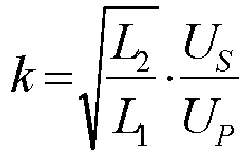
- Herein, Up is a voltage value of the power transmit coil.
- When determining the location of the power receive
coil 01 relative to the power transmit coil based on the coupling coefficient and the second induction signal, thelocation determining circuit 05 may alternatively determine the location of the power receivecoil 01 relative to the power transmit coil based on a correspondence that is between the offset location and each of the induction signal of the location detection coil and the coupling coefficient and that is generated in the pre-experiment. For a process of generating the correspondence between the offset location and each of the coupling coefficient and the induction signal of the location detection coil, refer to the foregoing description. Details are not described herein again. - In this embodiment of this application, the first induction signal and the second induction signal may be different physical quantities or an amplitude difference between signal values of the first induction signal and the second induction signal is relatively large. For example, the first induction signal is a current, and the second induction signal is a voltage. To improve processing efficiency and location determining precision, after obtaining the first induction signal and the second induction signal, the
location determining circuit 05 may further separately preprocess the first induction signal and the second induction signal, so that amplitudes of the signal value of the preprocessed first induction signal and the signal value of the second induction signal are similar. Then, thelocation determining circuit 05 determines the location of the power receivecoil 01 relative to the power transmit coil based on the preprocessed first induction signal and the preprocessed second induction signal. - The preprocessing may include at least one of normalization processing and weighting processing. The normalization processing on an induction signal may means to normalize a signal value of the induction signal to a value between 0 and 1. The weighting processing on an induction signal may means to multiply a weighting factor and a signal value of the induction signal.
- For example, it is assumed that when the central point O' of the power receive
coil 01 is at an ith coordinate point in the coordinate system in which the central point O of the power transmitcoil 00 is used as an origin, the signal value of the first induction signal obtained by thelocation determining circuit 05 is d 1i . In this case, a signal value d 1i ' obtained after thelocation determining circuit 05 performs normalization processing on the signal value d 1i of the first induction signal may be represented as follows:
- Herein, D1 represents a set of signal values that are of the first induction signals and that are obtained by the
location determining circuit 05 when the central point O' of the power receivecoil 01 is at different coordinate points, max(D 1) represents a maximum value in the set D1, and min(D 1) represents a minimum value in the set D1. When the signal values of all the first induction signals in the set D1 are equal, max(D 1) may be equal to the signal value of the first induction signal, and min(D 1) may be 0. - Similarly, it is assumed that when the wireless charging alignment apparatus includes M location detection coils 02, and when the central point O' of the power receive
coil 01 is at an ith coordinate point in the coordinate system in which the central point O of the power transmitcoil 00 is used as an origin, a signal value that is of a second induction signal of an mthlocation detection coil 02 and that is obtained by thelocation determining circuit 05 is bmi. In this case, a signal value bmi' obtained after thelocation determining circuit 05 performs normalization processing on the signal value bmi of the second induction signal may be represented as follows:
- Herein, M is an integer greater than 1, m is a positive integer not greater than M, and Bm represents a set of signal values that are of the second induction signals of the mth
location detection coil 02 and that are obtained by thelocation determining circuit 05 when the central point O' of the power receive coil is at different coordinate points. - In this embodiment of this application, signal values of induction signals in the set D 1 and the set Bm may be obtained during generating the correspondence between the offset location and each of the induction signal of the power receive
coil 01 and the induction signal of thelocation detection coil 02. In other words, the signal values of the induction signals in the set D 1 and the set Bm may be obtained by traversing the central point O' of the power receivecoil 01 at each coordinate point within the effective detection range and detecting the induction signal at each coordinate point. - Optionally, the
location determining circuit 05 may further prestore a weighting factor of an induction signal of the power receivecoil 01 and a weighting factor of an induction signal of eachlocation detection coil 02. The weighting factor of each induction signal may be determined based on an experiment (that is, the foregoing experiment used to generate a correspondence). After obtaining the first induction signal and the second induction signal, thelocation determining circuit 05 may multiply a signal value of each induction signal and a weighting factor corresponding to the induction signal, so that amplitudes of signal values of induction signals are relatively close. - It is assumed that a weighting factor of an induction signal of the power receive
coil 01 is α 1 , and a weighting factor of an induction signal of the mthlocation detection coil 02 in the M location detection coils is βm . In this case, a signal value d 1i " obtained after thelocation determining circuit 05 performs weighting processing on a signal value d 1i of the first induction signal may be represented as d 1i "= α 1·d 1i ; and a signal value b 1i " obtained after thelocation determining circuit 05 performs weighting processing on a signal value b mi of the second induction signal of the mthlocation detection coil 02 may be represented as b 1 i"= βm ·bmi . - It should be noted that in this embodiment of this application, the
location determining circuit 05 may perform only normalization processing or weighting processing on each induction signal, or thelocation determining circuit 05 may perform both normalization processing and weighting processing on each induction signal, where a sequence of performing the normalization processing and the weighting processing may be adjusted. - It should be further noted that, if each induction signal is an induction signal before being preprocessed in the correspondence between the offset location and each of the induction signal of the power receive
coil 01 and the induction signal of thelocation detection coil 02 that are obtained by thelocation determining circuit 05, thelocation determining circuit 05 does not need to preprocess the first induction signal and the second induction signal when determining the offset location based on the first induction signal and the second induction signal. If each induction signal is the preprocessed induction signal in the correspondence between the offset location and each of the induction signal of the power receivecoil 01 and the induction signal of thelocation detection coil 02 that are obtained by thelocation determining circuit 05, thelocation determining circuit 05 needs to preprocess the first induction signal and the second induction signal when determining the offset location based on the first induction signal and the second induction signal. In addition, the preprocessing manner needs to be the same as the preprocessing manner for the induction signal recorded in the correspondence, to ensure detection accuracy. - For example, it is assumed that the preprocessing is weighting processing, a weighting factor of the induction signal of the power receive
coil 01 is 15, and a weighting factor of the induction signal of eachlocation detection coil 02 is 1. In this case, a signal value of an induction signal obtained after the weighting processing is performed on a signal value of an induction signal obtained through real-time measurement in each signal group shown in Table 2 may be shown in Table 3. Referring to Table 3, it may be learned that the signal value of the preprocessed first induction signal is 645, and the signal values of the second induction signals are the same as those before the preprocessing and are respectively 410, 432, 412, and 1345. Each sum of each first difference between the signal value of the preprocessed first induction signal and the signal value of the induction signal in each signal group, and each second difference between each of the signal values of the second induction signals and each of the signal values of the induction signals in each signal group is 158, 78, 69, 187, or 320. - Because a sum: 69 of a first difference between the signal value of the preprocessed first induction signal and a signal value of an induction signal in a third signal group, and each second difference between each of the signal values of the second induction signals and each of signal values of induction signals in the third signal group is the smallest, an offset location (x3, y3) corresponding to the third signal group may be determined as the location of the power receive coil 0 1 relative to the power transmit coil.
Table 3 Offset location Signal group Coordinate on the x-axis Coordinate on the y-axis Signal value of an induction signal of a location detection coil 1 Signal value of an induction signal of a location detection coil 2 Signal value of an induction signal of a location detection coil 3 Signal value of an induction signal of a location detection coil 4 Signal value of an induction signal of a power receive coil Sum of a first difference md second differences x1 y1 379 420 399 1372 570 158 x2 y2 402 441 408 1357 690 78 x3 y3 423 461 414 1335 660 69 x4 y4 444 479 416 1303 705 187 x5 y5 468 500 417 1276 765 320 Measured induction signal 410 432 412 1345 645 \ - In this embodiment of this application, each of the first induction signal, the second induction signal, the induction signal of the power receive
coil 01, and the induction signal of thelocation detection coil 02 may include at least one of a current and a voltage. In addition, a type of the first induction signal is the same as a type of the induction signal of the power receivecoil 01, and a type of the second induction signal is the same as a type of the induction signal of thelocation detection coil 02. - Optionally, the
first detection circuit 03 may include a current detection circuit. Correspondingly, the first induction signal may include a current. For example, the current may be an alternating current, and the current detection circuit may be a circuit configured to detect the alternating current. The current detection circuit may include components such as a current transformer, an amplifier, and an analog-to-digital converter. -
FIG. 5 is a circuit diagram of a wireless charging alignment apparatus according to an embodiment of this application. Referring toFIG. 5 , the apparatus may further include aresonant element 06 and a first switch S1. In the circuit diagram, a power receivecoil 01 may be equivalent to an inductor L1. The inductor L1 is connected to theresonant element 06 to form a resonant circuit, and the first switch S1 is connected in parallel to the resonant circuit. When the first switch S1 is closed, thefirst detection circuit 03 may detect a current flowing through the resonant circuit. In other words, after the resonant circuit is short-circuited, thefirst detection circuit 03 may detect the current flowing through the resonant circuit. - Referring to
FIG. 6 and FIG. 7 , it may be learned that theresonant element 06 may include an inductor Lf connected in series to a power receive coil 01 (that is, an inductor L1 shown inFIG. 6 and FIG. 7 ), and a capacitor Cf connected in parallel to the power receivecoil 01. - Optionally, as shown in
FIG. 6 , thefirst detection circuit 03 may be connected to the inductor Lf. Correspondingly, the current detected by thefirst detection circuit 03 is an inductance current flowing through the inductor Lf. - Alternatively, as shown in
FIG. 7 , thefirst detection circuit 03 may be connected to the capacitor Cf. Correspondingly, the current detected by thefirst detection circuit 03 is a capacitor current flowing through the capacitor Cf. - Optionally, referring to
FIG. 8 , the apparatus may further include a second switch S2. The second switch S2 is connected in parallel to the power receive coil 01 (that is, an inductor L1 shown inFIG. 8 ). Thefirst detection circuit 03 is connected to the power receivecoil 01. When the second switch S2 is closed, that is, after the power receivecoil 01 is short-circuited, thefirst detection circuit 03 may detect a short-circuit current flowing through the power receivecoil 01. Correspondingly, the current detected by thefirst detection circuit 03 is the short-circuit current flowing through the power receivecoil 01. - Alternatively, the
first detection circuit 03 may include at least two current detection circuits, and the at least two current detection circuits may be separately connected to at least two of the inductor Lf, the capacitor Cf, and the power receivecoil 01. Correspondingly, the current detected by thefirst detection circuit 03 may include at least two of an inductance current, a capacitor current, and a short-circuit current. - Because the inductance current, the capacitor current, and the short-circuit current are relatively easy to detect, and detection precision is relatively high, the at least one of the detected inductance current, the detected capacitor current, and the detected short-circuit current is used as the first induction signal, thereby ensuring precision of the obtained first induction signal.
- In this embodiment of this application, the
first detection circuit 03 may further include a voltage detection circuit. Correspondingly, the first induction signal may include a voltage. For example, the voltage may be an alternating current voltage, and thefirst detection circuit 03 may be a voltage detection circuit configured to detect the alternating current voltage. Thefirst detection circuit 03 may include components such as a rectifier circuit, an amplifier, and an analog-to-digital converter. - As shown in
FIG. 9 , the apparatus may further include a third switch S3. The third switch S3 may be connected between the power receive coil 01 (that is, an inductor L1 shown inFIG. 9 ) and a subsequent circuit (not shown inFIG. 9 ) of the power receivecoil 01. The subsequent circuit may include a circuit such as a receiving conversion module 102 in a power receivedevice 10. - The
first detection circuit 03 may be connected in parallel to the power receivecoil 01, and is configured to: when the third switch S3 is opened, detect an open-circuit voltage between two ends of the power receivecoil 01. - Optionally, the
first detection circuit 03 may include both a current detection circuit and a voltage detection circuit. Correspondingly, the first induction signal detected by thefirst detection circuit 03 may include both a current and a voltage. For example, the first induction signal may include a short-circuit current of the power receive coil 0 1 and an open-circuit voltage between the two ends of the power receivecoil 01. - If the
first detection circuit 03 detects only one type of signal (for example, one of a capacitor current, an inductance current, a short-circuit current, and an open-circuit voltage), detection costs can be reduced. If thefirst detection circuit 03 can detect a plurality of types of signals (for example, at least two of a capacitor current, an inductance current, a short-circuit current, and an open-circuit voltage), reliability of the detected first induction signal can be ensured. - In this embodiment of this application, the
second detection circuit 04 may include at least one of a voltage detection circuit and a current detection circuit. Correspondingly, the second induction signal may include at least one of a voltage and a current. The voltage may include at least one of a resonant voltage and an open-circuit voltage. The current may include at least one of a resonant current and a short-circuit current. - Optionally, the
location detection coil 02 may be alternatively connected to a resonant element to form a resonant circuit. In this case, the resonant voltage may indicate a voltage of the resonant circuit. The open-circuit voltage may be a voltage between two ends of thelocation detection coil 02 when thelocation detection coil 02 is disconnected from the resonant element. The resonant current may be a current flowing through the resonant circuit. The short-circuit current may be a current flowing through thelocation detection coil 02 after thelocation detection coil 02 is short-circuited. - For example, the
second detection circuit 04 may include a voltage detection circuit configured to detect an alternating current voltage, and thesecond detection circuit 04 may include components such as a rectifier circuit, an amplifier, and an analog-to-digital converter. - Referring to
FIG. 10 to FIG. 12 , four location detection coils 02 may be disposed in a wireless charging alignment apparatus. The four location detection coils 02 may be respectively equivalent to an inductor La1, an inductor La2, an inductor La3, and an inductor La4 in a circuit. Correspondingly, foursecond detection circuits 04 are disposed in the wireless charging alignment apparatus. Eachsecond detection circuit 04 may be connected in parallel to one inductor, and be configured to: detect a voltage of the inductor connected to thesecond detection circuit 04, and send the voltage to alocation determining circuit 05. - It should be noted that a switch status of each of the first switch S1, the second switch S2, and the third switch S3 may be controlled by the
location determining circuit 05;or may be controlled by a switch control circuit independent of thelocation determining circuit 05 in the wireless charging alignment apparatus. - It should be further noted that if the wireless charging alignment apparatus is disposed in a power receive
device 10 or is a power receivedevice 10, resonant elements such as the inductor Lf and the capacitor Cf may be elements in a receiving conversion module 102 in the power receivedevice 10. If the wireless charging alignment apparatus is disposed in a power transmitdevice 20 or is a power transmitdevice 20, resonant elements such as the inductor Lf and the capacitor Cf may be elements in atransmission conversion module 202 in the power transmitdevice 20. - It should be further noted that the wireless charging alignment apparatus may be applied to a receive end (that is, a power receive device) in a wireless charging system, or may be applied to a transmit end (that is, a power transmit device) in a wireless charging system. In addition, in the wireless charging system, the transmit end and the receive end may be interchanged. In other words, the receive end may also charge the transmit end. When the wireless charging alignment apparatus is applied to the transmit end, or when the transmit end and the receive end are interchanged, the power receive coil described above may also be referred to as a power transmit coil, and the power transmit coil may also be referred to as a power receive coil.
- In conclusion, the embodiments of this application provide the wireless charging alignment apparatus. The location determining circuit in the apparatus may determine the relative location of the two coils based on the induction signals detected by the detection circuit. In this way, at least one of the power receive device and the power transmit device can adjust its location based on the relative location, so that the two coils are aligned. In the related technology, a driver visually measures a relative location of the two coils. In comparison with the related technology, in this embodiment of this application, both precision and efficiency of determining the relative location based on the induction signals are higher. Therefore, alignment precision and alignment efficiency of the two coils can be effectively improved.
- In addition, the apparatus can detect the second induction signal of the location detection coil by using the second detection circuit, and can also detect the first induction signal of the power receive coil by using the first detection circuit. A size and a coverage area of the power receive coil are both larger than those of the location detection coil. The power receive coil has a relatively large difference from the location detection coil in terms of features. Therefore, precision of the relative location determined by the location determining circuit based on the two types of induction signals is higher, thereby effectively ensuring the alignment precision of the two coils. In addition, because the power receive coil is an original coil in the wireless charging alignment apparatus, by using the power receive coil for alignment, hardware usage of the wireless charging alignment apparatus can be effectively improved, thereby ensuring alignment precision and further avoiding increase of costs and a volume of the wireless charging alignment apparatus.
- An embodiment of this application further provides a wireless charging alignment method. The method may be applied to the wireless charging alignment apparatus provided in the foregoing embodiments. Referring to
FIG. 13 , the method may include the following steps: - Step 301: Detect a first induction signal of a power receive coil in a positioning magnetic field generated by a power transmit coil.
- The power receive coil is configured to exchange power with the transmit coil of a transmit end through electromagnetic mutual inductance.
- For example, it is assumed that a to-be-charged device is an electric vehicle, a power receive
coil 01 is disposed in the electric vehicle, and a power transmit coil is disposed in a wireless charging station. In this case, when the electric vehicle needs to be wirelessly charged, a central controller of the electric vehicle may deliver a charging instruction to a receivingcontrol module 103 in a power receivedevice 10. Because the power transmit coil needs to be first aligned with the power receive coil before the charging is started in a wireless charging system, the wireless charging system first enters an alignment state. In this case, the receivingcontrol module 103 may send, by using areceiving communications module 104, a positioning instruction to a transmission communications module 204 in a power transmitdevice 20 located on the ground. After receiving the positioning instruction by using the transmission communications module 204, thetransmission control module 203 of the power transmitdevice 20 may control the power transmitcoil 201 to generate a magnetic field used for location detection, that is, the foregoing positioning magnetic field. - After the power transmit
coil 201 generates the positioning magnetic field, and after the power receivedevice 10 enters a range of the positioning magnetic field with the electric vehicle, the power receivecoil 101 and a location detection coil may generate induction signals. - Step 302: Detect a second induction signal of the location detection coil in the positioning magnetic field.
- If the wireless charging alignment apparatus includes a plurality of location detection coils, a second induction signal of each location detection coil in the positioning magnetic field needs to be detected.
- Step 303: Determine a location of the power receive coil relative to the power transmit coil based on the first induction signal and the second induction signal.
- In this embodiment of this application,
step 301 may be implemented by afirst detection circuit 03 in the wireless charging alignment apparatus,step 302 may be implemented by asecond detection circuit 04 in the wireless charging alignment apparatus, and step 303 may be implemented by alocation determining circuit 05 in the wireless charging alignment apparatus. - In an optional implementation,
step 303 may include:
determining, as the location of the power receive coil relative to the power transmit coil based on a correspondence between an offset location and each of an induction signal of the power receive coil and an induction signal of the location detection coil, an offset location corresponding to the first induction signal and the second induction signal. - For example, the process of determining, based on the correspondence, the offset location corresponding to the first induction signal and the second induction signal in
step 303 may include the following steps: - Step S31: Determine a first difference between a signal value of the first induction signal and a signal value of the induction signal of the power receive coil in each signal group, and a second difference between a signal value of the second induction signal and a signal value of the induction signal of the location detection coil in each signal group, to obtain the first difference and the second difference of each signal group.
- Step S32: Determine, as the offset location corresponding to the first induction signal and the second induction signal, an offset location corresponding to a signal group whose sum of the first difference and the second difference is the smallest in the plurality of signal groups.
- Each of the first difference and the second difference may be an absolute value. For the process of determining the location of the power receive coil relative to the power transmit coil based on the correspondence, refer to the foregoing description. Details are not described herein again.
- In another optional implementation,
step 303 may include:
determining a coupling coefficient between the power receive coil and the power transmit coil based on the first induction signal and a current or a voltage of the power transmit coil; and determining the location of the power receive coil relative to the power transmit coil based on the coupling coefficient and the second induction signal. - For the process of determining the location of the power receive coil relative to the power transmit coil based on the coupling coefficient and the second induction signal, refer to the foregoing description. Details are not described herein again.
- Optionally,
step 303 may include: separately preprocessing the first induction signal and the second induction signal, where the preprocessing includes at least one of normalization processing and weighting processing; and determining the location of the power receive coil relative to the power transmit coil based on the preprocessed first induction signal and the preprocessed second induction signal. For the process of preprocessing the induction signals, refer to the foregoing description. Details are not described herein again. - In this embodiment of this application, the first induction signal detected by the
first detection circuit 03 may include at least one of a current and a voltage. The second induction signal detected by thesecond detection circuit 04 may also include at least one of a current and a voltage. - Optionally, referring to
FIG. 5 to FIG. 7 , the apparatus may further include aresonant element 06 and a first switch S1. The power receive coil is connected to theresonant element 06 to form a resonant circuit. The first switch S1 is connected in parallel to the resonant circuit. - Step 301 may include: controlling the first switch S1 to be closed, and detecting a current flowing through the resonant circuit. In other words, the first induction signal may include the current flowing through the resonant circuit.
- For example, the
resonant element 06 may include a capacitor Cf and an inductor Lf. In this case, the current flowing through the resonant circuit may include at least one of a capacitor current and an inductance current. - Optionally, referring to
FIG. 8 , the apparatus may further include a second switch S2. The second switch S2 is connected in parallel to the power receive coil. - Step 301 may include: in a first time period, controlling the second switch S2 to be closed, and detecting a short-circuit current flowing through the power receive coil. In other words, the first induction signal may include the short-circuit current flowing through the power receive coil.
- Step 302 may include: in a second time period, controlling the second switch S2 to be opened, and detecting the second induction signal of the location detection coil in the positioning magnetic field.
- The second time period and the first time period may be two non-overlapping time periods. In other words, the short-circuit current and the second induction signal may be detected in a time division manner. When the second switch S2 is closed and the power receive coil is short-circuited, the short-circuit current flowing through the power receive coil is an alternating current, and a magnetic field generated by the alternating current causes interference to the second induction signal generated by the location detection coil. Therefore, the short-circuit current and the second induction signal may be detected in a time division manner, to ensure reliability of the detected second induction signal.
- It should be noted that, after the first switch S1 is closed, the inductor, the capacitor, and the power receive coil form a resonant circuit. Because impedance of the inductor and the capacitor relative to the power receive coil is relatively large, the current flowing through the power receive coil is very small, so that no interference is caused to the detection of the second induction signal. Therefore, when the first induction signal includes the inductance current or the capacitor current, the detection of the inductance current or the capacitor current may be performed synchronously with the detection of the second induction signal.
- Optionally, referring to
FIG. 9 , the apparatus may further include a third switch S3. The third switch S3 is separately connected to the power receive coil and a subsequent circuit of the power receive coil. Correspondingly, step 301 may include: controlling the third switch to be opened, and detecting an open-circuit voltage between two ends of the power receive coil. In other words, the first induction signal may further include the open-circuit voltage between the two ends of the power receive coil. - It should be noted that a sequence of steps of the wireless charging alignment method provided in this embodiment of this application may be appropriately adjusted, or steps may be correspondingly increased or decreased based on a situation. For example,
step 301 and step 302 may be performed simultaneously, or step 302 may be performed before step 301.Variation or replacement readily figured out by a person skilled in the art within the technical scope disclosed in the present invention shall fall within the protection scope of the present invention. - In conclusion, the embodiments of this application provide the wireless charging alignment method. According to the method, the relative location of the two coils may be determined based on the detected induction signals. In this way, at least one of the power receive device and the power transmit device can adjust its location based on the relative location, so that the two coils are aligned. In the related technology, a driver visually measures a relative location of the two coils. In comparison with the related technology, in this embodiment of this application, both precision and efficiency of determining the relative location based on the induction signals are higher. Therefore, alignment precision and alignment efficiency of the two coils can be effectively improved.
- In addition, according to the method, the second induction signal of the location detection coil may be detected, and the first induction signal of the power receive coil may be further detected. A size and a coverage area of the power receive coil are both larger than those of the location detection coil. The power receive coil has a relatively large difference from the location detection coil in terms of features. Therefore, precision of the relative location determined based on the two types of induction signals is higher, thereby effectively ensuring the alignment precision of the two coils.
- An embodiment of this application further provides a wireless charging system. Referring to
FIG. 1 andFIG. 2 , the wireless charging system includes a power transmitdevice 20 and a power receivedevice 10. At least one of the power transmitdevice 20 and the power receivedevice 10 may include the wireless charging alignment apparatus provided in the foregoing embodiment. - When the wireless charging alignment apparatus is applied to the power transmit
device 20, the power receive coil described above may also be referred to as a power transmit coil, and the power transmit coil may also be referred to as a power receive coil. - An embodiment of this application further provides an electric vehicle. The electric vehicle may include the wireless charging alignment apparatus provided in the foregoing embodiment. For example, the electric vehicle may include a power receive
device 10, and the power receivedevice 10 includes the wireless charging alignment apparatus provided in the foregoing embodiment. - It should be understood that the
location determining circuit 05 of the wireless charging alignment apparatus in this embodiment of this application may alternatively be implemented by using an application-specific integrated circuit (application-specific integrated circuit, ASIC) or a programmable logic device (programmable logic device, PLD). The PLD may be a complex program logic device (complex programmable logical device, CPLD), a field-programmable gate array (field-programmable gate array, FPGA), generic array logic (generic array logic, GAL), or any combination thereof. Optionally, the step of determining the location of the power receive coil relative to the power transmit coil in the wireless charging alignment method provided in the foregoing method embodiment may also be implemented by using software. When this step is implemented by using software, the circuit (that is, the location determining circuit 05) configured to implement this step in the wireless charging alignment apparatus may be a software module. -
FIG. 14 is a schematic structural diagram of a location determining circuit in a wireless charging alignment apparatus according to an embodiment of this application. Referring toFIG. 14 , the location determining circuit may include aprocessor 1201, amemory 1202, anetwork interface 1203, and abus 1204. Thebus 1204 is configured to connect theprocessor 1201, thememory 1202, and thenetwork interface 1203. A communication connection to another device may be implemented by using the network interface 1203 (which may be wired or wireless). Thememory 1202 stores acomputer program 12021, and thecomputer program 12021 is configured to implement various application functions. - It should be understood that in the embodiment of this application, the
processor 1201 may be a CPU, or theprocessor 1201 may be another general purpose processor, a digital signal processor (DSP), an application-specific integrated circuit (ASIC), a field programmable gate array (FPGA), a GPU or another programmable logic device, a discrete gate or a transistor logic device, a discrete hardware component, or the like. The general purpose processor may be a microprocessor, any conventional processor, or the like. - The
memory 1202 may be a volatile memory or a nonvolatile memory, or may include both a volatile memory and a nonvolatile memory. The nonvolatile memory may be a read-only memory (read-only memory, ROM), a programmable read-only memory (programmable ROM, PROM), an erasable programmable read-only memory (erasable PROM, EPROM), an electrically erasable programmable read-only memory (electrically EPROM, EEPROM), or a flash memory. The volatile memory may be a random access memory (random access memory, RAM), used as an external cache. Through examples but not limitative descriptions, many forms of RAMs may be used, for example, a static random access memory (static RAM, SRAM), a dynamic random access memory (DRAM), a synchronous dynamic random access memory (synchronous DRAM, SDRAM), a double data rate synchronous dynamic random access memory (double data rate SDRAM, DDR SDRAM), an enhanced synchronous dynamic random access memory (enhanced SDRAM, ESDRAM), a synchronous link dynamic random access memory (synchlink DRAM, SLDRAM), and a direct rambus dynamic random access memory (direct rambus RAM, DR RAM). - The
bus 1204 may further include a power bus, a control bus, a status signal bus, and the like, in addition to a data bus. However, for clear description, various types of buses in the figure are marked as thebus 1204. - The
processor 1201 is configured to execute the computer program stored in thememory 1202. Theprocessor 1201 executes thecomputer program 12021 to implement the step of determining the location of the power receive coil relative to the power transmit coil in the foregoing method embodiment. - An embodiment of this application further provides a computer readable storage medium. The computer readable storage medium stores an instruction. When the computer readable storage medium runs on a computer, the computer is enabled to perform the step of determining the location of the power receive coil relative to the power transmit coil in the foregoing method embodiment.
- An embodiment of this application further provides a computer program product including an instruction. When the computer program product runs on a computer, the computer is enabled to perform the step of determining the location of the power receive coil relative to the power transmit coil in the foregoing method embodiment.
- It should be noted that, in this embodiment of this application, "at least one" means one or more, and "a plurality of" means two or more. The term "and/or" describes an association relationship between associated objects and represents that three relationships may exist. For example, A and/or B may represent the following three cases: Only A exists, both A and B exist, and only B exists. A and B may be in a singular or plural form. The character "/" generally indicates an "or" relationship between the associated objects.
Claims (11)
- A wireless charging alignment apparatus, comprising a power receive coil (01, 101), a location detection coil (02), a first detection circuit (03), a second detection circuit (04), and a location determining circuit (05), whereinthe power receive coil is configured to exchange power with a power transmit coil (102) of a transmit end through electromagnetic mutual inductance;the first detection circuit is configured to detect a first induction signal of the power receive coil in a positioning magnetic field generated by the power transmit coil;the second detection circuit is configured to detect a second induction signal of the location detection coil in the positioning magnetic field; andthe location determining circuit is configured to determine a location of the power receive coil relative to the power transmit coil based on the first induction signal and the second induction signal;whereinthe location determining circuit is configured to determine, as the location of the power receive coil relative to the power transmit coil based on a correspondence between an offset location and each of an induction signal of the power receive coil and an induction signal of the location detection coil, an offset location corresponding to the first induction signal and the second induction signal;wherein a plurality of signal groups and an offset location corresponding to each signal group may be recorded, each signal group comprises a signal value of the induction signal of the power receive coil and a signal value of the induction signal of the location detection coil, and the location determining circuit is configured to:determine a first difference between a signal value of the first induction signal and the signal value of the induction signal of the power receive coil in each signal group, and a second difference between a signal value of the second induction signal and the signal value of the induction signal of the location detection coil in each signal group, to obtain the first difference and the second difference of each signal group; anddetermine, as the offset location corresponding to the first induction signal and the second induction signal, an offset location corresponding to a signal group whose sum of the first difference and the second difference is the smallest in the plurality of signal groups.
- The apparatus according to claim 1, wherein each of the first induction signal, the second induction signal, the induction signal of the power receive coil, and the induction signal of the location detection coil comprises at least one of a current and a voltage; and
a type of the first induction signal is the same as a type of the induction signal of the power receive coil, and a type of the second induction signal is the same as a type of the induction signal of the location detection coil. - The apparatus according to claim 1 or 2, wherein
the location determining circuit is configured to: determine a coupling coefficient between the power receive coil and the power transmit coil based on the first induction signal and a current or a voltage of the power transmit coil; and determine the location of the power receive coil relative to the power transmit coil based on the coupling coefficient and the second induction signal. - The apparatus according to any one of claims 1 to 3, whereinthe location determining circuit may be configured to: separately preprocess the first induction signal and the second induction signal, and determine the location of the power receive coil relative to the power transmit coil based on the preprocessed first induction signal and the preprocessed second induction signal, whereinthe preprocessing comprises at least one of normalization processing and weighting processing.
- The apparatus according to any one of claims 1 to 4, wherein the first induction signal comprises a current, the apparatus further comprises a resonant element (06) and a first switch (S 1), the power receive coil is connected to the resonant element to form a resonant circuit, and the first switch is connected in parallel to the resonant circuit; and
the first detection circuit is configured to: when the first switch is closed, detect a current flowing through the resonant circuit. - The apparatus according to any one of claims 1 to 5, wherein the first induction signal comprises a current, the apparatus further comprises a second switch (S2), and the second switch is connected in parallel to the power receive coil; and
the first detection circuit is configured to: when the second switch is closed, detect a short-circuit current flowing through the power receive coil. - The apparatus according to any one of claims 1 to 5, wherein the first induction signal comprises a voltage, the apparatus further comprises a third switch, and the third switch is connected between the power receive coil and a subsequent circuit of the power receive coil; and
the first detection circuit is configured to: when the third switch is opened, detect an open-circuit voltage between two ends of the power receive coil. - A wireless charging alignment method, wherein the method comprises:detecting (301) a first induction signal of a power receive coil (01, 101) in a positioning magnetic field generated by a power transmit coil (102);detecting (302) a second induction signal of a location detection coil (02) in the positioning magnetic field; anddetermining (303) a location of the power receive coil relative to the power transmit coil based on the first induction signal and the second induction signal, whereinthe power receive coil is configured to exchange power with the power transmit coil of a transmit end through electromagnetic mutual inductance; wherein the determining a location of the power receive coil relative to the power transmit coil based on the first induction signal and the second induction signal comprises:determining, as the location of the power receive coil relative to the power transmit coil based on a correspondence between an offset location and each of an induction signal of the power receive coil and an induction signal of the location detection coil, an offset location corresponding to the first induction signal and the second induction signal; wherein a plurality of signal groups and an offset location corresponding to each signal group may be recorded, each signal group comprises a signal value of the induction signal of the power receive coil and a signal value of the induction signal of the location detection coil; andthe determining, based on a correspondence between an offset location and each of an induction signal of the power receive coil and an induction signal of the location detection coil, an offset location corresponding to the first induction signal and the second induction signal comprises:determining a first difference between a signal value of the first induction signal and the signal value of the induction signal of the power receive coil in each signal group, and a second difference between a signal value of the second induction signal and the signal value of the induction signal of the location detection coil in each signal group, to obtain the first difference and the second difference of each signal group; anddetermining, as the offset location corresponding to the first induction signal and the second induction signal, an offset location corresponding to a signal group whose sum of the first difference and the second difference is the smallest in the plurality of signal groups.
- The method according to claim 8, wherein the determining a location of the power receive coil relative to the power transmit coil based on the first induction signal and the second induction signal comprises:determining a coupling coefficient between the power receive coil and the power transmit coil based on the first induction signal and a current or a voltage of the power transmit coil; anddetermining the location of the power receive coil relative to the power transmit coil based on the coupling coefficient and the second induction signal.
- A wireless charging system, comprising a power transmit device and a power receive device, wherein at least one of the power transmit device and the power receive device comprises the wireless charging alignment apparatus according to any one of claims 1 to 7.
- An electric vehicle, comprising the wireless charging alignment apparatus according to any one of claims 1 to 7.
Applications Claiming Priority (2)
| Application Number | Priority Date | Filing Date | Title |
|---|---|---|---|
| CN201910314533.XA CN111823916B (en) | 2019-04-18 | 2019-04-18 | Wireless charging alignment method and device, wireless charging system and electric vehicle |
| PCT/CN2020/070395 WO2020211479A1 (en) | 2019-04-18 | 2020-01-06 | Wireless power transmission alignment method and device, wireless power transmission system, and electric vehicle |
Publications (3)
| Publication Number | Publication Date |
|---|---|
| EP3952059A1 EP3952059A1 (en) | 2022-02-09 |
| EP3952059A4 EP3952059A4 (en) | 2022-05-25 |
| EP3952059B1 true EP3952059B1 (en) | 2023-08-30 |
Family
ID=72836815
Family Applications (1)
| Application Number | Title | Priority Date | Filing Date |
|---|---|---|---|
| EP20791587.7A Active EP3952059B1 (en) | 2019-04-18 | 2020-01-06 | Wireless power transmission alignment method and device, wireless power transmission system, and electric vehicle |
Country Status (4)
| Country | Link |
|---|---|
| US (1) | US12374938B2 (en) |
| EP (1) | EP3952059B1 (en) |
| CN (1) | CN111823916B (en) |
| WO (1) | WO2020211479A1 (en) |
Families Citing this family (21)
| Publication number | Priority date | Publication date | Assignee | Title |
|---|---|---|---|---|
| CN112477663A (en) * | 2020-11-12 | 2021-03-12 | 东南大学 | Wireless charging automobile positioning method and system and automobile |
| CN112421804B (en) * | 2020-12-10 | 2021-12-17 | 哈尔滨工业大学 | Underwater wireless charging and intelligent alignment guiding method for autonomous unmanned underwater vehicle |
| EP4313668A1 (en) | 2021-04-01 | 2024-02-07 | Veturex Inc. | A plug-in module for wireless charging |
| CN113212192B (en) * | 2021-06-10 | 2023-05-02 | 西南交通大学 | Accurate positioning system and method for wireless charging of electric automobile |
| CN113670447A (en) * | 2021-08-13 | 2021-11-19 | 立讯电子科技(昆山)有限公司 | A method and system for locating the defect position of a wireless charging coil |
| CN113746216B (en) * | 2021-09-03 | 2023-09-22 | 福州优朋电子有限公司 | Mobile coil coupling induction detection device and detection method thereof |
| CN114243936B (en) * | 2021-11-11 | 2025-12-02 | 北京理工大学 | Charging control system and charging control method |
| CN117141264A (en) * | 2022-05-24 | 2023-12-01 | 中移物联网有限公司 | UAV charging system, UAV charging control method, device and system |
| CN114940093B (en) * | 2022-05-30 | 2024-08-06 | 重庆大学 | Electric automobile charging position alignment method and system based on orthogonal auxiliary coil |
| CN115047874B (en) * | 2022-06-02 | 2023-09-15 | 北京三快在线科技有限公司 | Robot connection method, locker, robot, system and electronic equipment |
| CN114938083A (en) * | 2022-06-17 | 2022-08-23 | 中国电力科学研究院有限公司 | Position detection device and mobile wireless power transmission system |
| CN115574699A (en) * | 2022-10-13 | 2023-01-06 | 中兴新能源科技有限公司 | Electric vehicle wireless charging offset detection system and detection method |
| DE102023200293A1 (en) * | 2023-01-16 | 2024-07-18 | Mahle International Gmbh | Method for operating a charging system comprising induction charging devices |
| KR20240122118A (en) * | 2023-02-03 | 2024-08-12 | 삼성전자주식회사 | An electronic device mounted in the battery electric vehicle, a method of the electronic device, and a wireless charging system |
| CN116247835A (en) * | 2023-02-14 | 2023-06-09 | 南方科技大学 | An electromagnetic positioning device, an electromagnetic positioning method, and a terminal |
| WO2024182422A2 (en) * | 2023-02-28 | 2024-09-06 | Tesla, Inc. | Wireless charging circuit topology and related methods of manufacturing |
| CN116714452A (en) * | 2023-06-09 | 2023-09-08 | 广西电网有限责任公司柳州供电局 | EV-WPT system and position detection method based on positioning coil detection |
| CN116605070A (en) * | 2023-06-16 | 2023-08-18 | 广西电网有限责任公司电力科学研究院 | Electric automobile charging system and method for positioning based on reverse wireless charging |
| WO2025012863A1 (en) * | 2023-07-13 | 2025-01-16 | Auckland Uniservices Limited | Dynamic inductive power transfer |
| CN116923125B (en) * | 2023-09-18 | 2023-12-12 | 珠海小鲸大合科技有限公司 | Ship wireless charging method, system, computer device and computer readable storage medium |
| CN118920724B (en) * | 2024-07-09 | 2025-08-26 | 广西电网有限责任公司电力科学研究院 | Wireless charging system with position detection function and position adjustment method thereof |
Family Cites Families (27)
| Publication number | Priority date | Publication date | Assignee | Title |
|---|---|---|---|---|
| JP5362453B2 (en) | 2009-06-16 | 2013-12-11 | 三洋電機株式会社 | Charging stand |
| US9148201B2 (en) * | 2011-02-11 | 2015-09-29 | Qualcomm Incorporated | Systems and methods for calibration of a wireless power transmitter |
| US20130033224A1 (en) | 2011-08-05 | 2013-02-07 | Evatran Llc | Method and apparatus for aligning a vehicle with an inductive charging system |
| US9631950B2 (en) * | 2011-08-05 | 2017-04-25 | Evatran Group, Inc. | Method and apparatus for aligning a vehicle with an inductive charging system |
| US9859755B2 (en) * | 2012-07-16 | 2018-01-02 | Qualcomm Incorporated | Device alignment and identification in inductive power transfer systems |
| US9438064B2 (en) * | 2013-08-30 | 2016-09-06 | Qualcomm Incorporated | System and method for alignment and compatibility detection for a wireless power transfer system |
| US9739844B2 (en) | 2014-07-25 | 2017-08-22 | Qualcomm Incorporated | Guidance and alignment system and methods for electric vehicle wireless charging systems |
| CN105634145A (en) | 2014-12-01 | 2016-06-01 | 联想(北京)有限公司 | Electronic equipment and charging prompting method |
| CN105539186B (en) | 2016-01-20 | 2017-07-07 | 厦门新页科技有限公司 | A kind of automobile wireless charges and is directed at matching system and method |
| JP6677520B2 (en) * | 2016-02-09 | 2020-04-08 | キヤノン株式会社 | Information processing apparatus, control method, and program |
| KR101887738B1 (en) * | 2016-03-11 | 2018-08-10 | 현대자동차주식회사 | Alignment method for wireless power transfer coil and apparatus using the same |
| CN205921464U (en) | 2016-04-20 | 2017-02-01 | 中兴新能源汽车有限责任公司 | Charge coil position detecting device , coil skew detection device , capital construction end and on -vehicle end |
| CN107394832A (en) | 2016-05-16 | 2017-11-24 | 深圳市泰金田科技有限公司 | Electric automobile wireless charging is to Barebone, alignment methods and vehicle end device |
| US10029577B2 (en) * | 2016-06-15 | 2018-07-24 | Qualcomm Incorporated | Methods and apparatus for positioning a vehicle |
| US10603501B2 (en) * | 2016-06-15 | 2020-03-31 | Boston Scientific Neuromodulation Corporation | External charger for an implantable medical device having at least one sense coil concentric with a charging coil for determining position |
| CN106160260A (en) | 2016-08-16 | 2016-11-23 | 中惠创智无线供电技术有限公司 | A kind of wireless charging device using magnetic principles to carry out para-position and method |
| CN205945249U (en) * | 2016-08-16 | 2017-02-08 | 中惠创智无线供电技术有限公司 | Adopt magnetic field principle to carry out wireless charging device who counterpoints |
| CN106541844B (en) * | 2016-10-26 | 2020-04-10 | 深圳市沃尔核材股份有限公司 | Wireless charging coil alignment method, device and system |
| CN207496493U (en) * | 2017-11-27 | 2018-06-15 | 浙江万安亿创电子科技有限公司 | For the vehicle alignment guide of wireless charging system for electric automobile |
| CN108151635A (en) | 2018-01-04 | 2018-06-12 | 无锡市瀚为科技有限公司 | A kind of automobile wireless charge position detection device and its detection method |
| CN108725239B (en) * | 2018-05-03 | 2022-04-01 | 中国第一汽车股份有限公司 | Alignment device and method for wireless charging of electric automobile |
| CN109067020A (en) * | 2018-08-01 | 2018-12-21 | 努比亚技术有限公司 | Registration process method, terminal device and the storage medium of wireless charging |
| CN109017426A (en) | 2018-09-28 | 2018-12-18 | 吉林大学 | A wireless charging system for electric vehicles with integrated auxiliary alignment function |
| CN109606176A (en) * | 2018-12-12 | 2019-04-12 | 南京师范大学 | Wireless charging and positioning system for electric vehicles based on two-dimensional double-symmetrical coil structure |
| CN109532526A (en) | 2019-01-04 | 2019-03-29 | 重庆大学 | The electric motor car wireless charging system and control method of ground surface end twin coil position detection |
| JP2020167833A (en) * | 2019-03-29 | 2020-10-08 | ローム株式会社 | Wireless power receivers and electronic devices |
| US11728690B2 (en) * | 2020-06-29 | 2023-08-15 | Renesas Electronics America Inc. | Foreign object detection using wireless power receiver's response to modified transmitter behavior |
-
2019
- 2019-04-18 CN CN201910314533.XA patent/CN111823916B/en active Active
-
2020
- 2020-01-06 EP EP20791587.7A patent/EP3952059B1/en active Active
- 2020-01-06 WO PCT/CN2020/070395 patent/WO2020211479A1/en not_active Ceased
-
2021
- 2021-10-15 US US17/502,243 patent/US12374938B2/en active Active
Also Published As
| Publication number | Publication date |
|---|---|
| CN111823916B (en) | 2022-01-14 |
| CN111823916A (en) | 2020-10-27 |
| WO2020211479A1 (en) | 2020-10-22 |
| US20220069638A1 (en) | 2022-03-03 |
| US12374938B2 (en) | 2025-07-29 |
| EP3952059A1 (en) | 2022-02-09 |
| EP3952059A4 (en) | 2022-05-25 |
Similar Documents
| Publication | Publication Date | Title |
|---|---|---|
| EP3952059B1 (en) | Wireless power transmission alignment method and device, wireless power transmission system, and electric vehicle | |
| US10493856B2 (en) | System, apparatus and method for optimizing wireless charging alignment | |
| EP4054056B1 (en) | Addressing borderline foreign object detection results | |
| JP6227805B2 (en) | System and method for adaptive charge compliance control | |
| CN112311108B (en) | Metal foreign matter detection method and device, wireless charging system and electric vehicle | |
| EP3706285B1 (en) | Wireless charging method and device and wireless charging system | |
| US10432036B2 (en) | Foreign object detection | |
| CN105579278B (en) | A control method and device for a wireless power transmission system for an electric device | |
| WO2022110884A1 (en) | Wireless charging device, charging base and foreign object detection method | |
| US20230268775A1 (en) | Wireless charging device and a method for detecting a receiver device | |
| CN109831035A (en) | A kind of mutual inductance discrimination method of the wireless charging system based on orthogonal double channels algorithm | |
| US11479131B2 (en) | Method for checking a primary or secondary unit of an inductive charging system | |
| US20240208351A1 (en) | Wireless charging board, wireless charging board misalignment detection method, and wireless charging system | |
| CN116247835A (en) | An electromagnetic positioning device, an electromagnetic positioning method, and a terminal | |
| CN104779686B (en) | Method for improving efficiency of ICPT (inductively coupled power transfer)-based non-contact charging for electric vehicle | |
| CN111999772A (en) | Detection device, transmitting terminal, wireless charging system and method for metal foreign matters | |
| CN109950983A (en) | A kind of multi-emitting list reception radio energy transmission system method for parameter configuration | |
| EP4007120A1 (en) | Method for determining mutual inductance for efficient wireless power transfer and apparatus therefor | |
| KR102910450B1 (en) | A Method and an apparatus for minimizing shadow area of foreign objects detection in electric vehicle wireless power transfer system | |
| EP4175121A1 (en) | Foreign object detection apparatus and method and wireless charger | |
| Marques et al. | Modelization and optimization of solenoid magnetic structures for IPT systems | |
| CN108282031A (en) | A kind of non-contact electric energy transmission device and winding construction discrimination method | |
| Iliev et al. | Model of a Wireless Power Transfer System with an Extended Air Gap | |
| JP2022034826A (en) | Non-contact power supply circuit | |
| Tian et al. | A preprocessing and analyzing method of images in pdf documents for mathematical expression retrieval |
Legal Events
| Date | Code | Title | Description |
|---|---|---|---|
| STAA | Information on the status of an ep patent application or granted ep patent |
Free format text: STATUS: THE INTERNATIONAL PUBLICATION HAS BEEN MADE |
|
| PUAI | Public reference made under article 153(3) epc to a published international application that has entered the european phase |
Free format text: ORIGINAL CODE: 0009012 |
|
| STAA | Information on the status of an ep patent application or granted ep patent |
Free format text: STATUS: REQUEST FOR EXAMINATION WAS MADE |
|
| 17P | Request for examination filed |
Effective date: 20211029 |
|
| AK | Designated contracting states |
Kind code of ref document: A1 Designated state(s): AL AT BE BG CH CY CZ DE DK EE ES FI FR GB GR HR HU IE IS IT LI LT LU LV MC MK MT NL NO PL PT RO RS SE SI SK SM TR |
|
| A4 | Supplementary search report drawn up and despatched |
Effective date: 20220428 |
|
| RIC1 | Information provided on ipc code assigned before grant |
Ipc: B60L 53/12 20190101ALI20220421BHEP Ipc: H02J 50/12 20160101ALI20220421BHEP Ipc: B60L 53/38 20190101ALI20220421BHEP Ipc: B60L 53/126 20190101ALI20220421BHEP Ipc: H02J 50/90 20160101AFI20220421BHEP |
|
| DAV | Request for validation of the european patent (deleted) | ||
| DAX | Request for extension of the european patent (deleted) | ||
| GRAP | Despatch of communication of intention to grant a patent |
Free format text: ORIGINAL CODE: EPIDOSNIGR1 |
|
| STAA | Information on the status of an ep patent application or granted ep patent |
Free format text: STATUS: GRANT OF PATENT IS INTENDED |
|
| INTG | Intention to grant announced |
Effective date: 20230420 |
|
| GRAS | Grant fee paid |
Free format text: ORIGINAL CODE: EPIDOSNIGR3 |
|
| GRAA | (expected) grant |
Free format text: ORIGINAL CODE: 0009210 |
|
| STAA | Information on the status of an ep patent application or granted ep patent |
Free format text: STATUS: THE PATENT HAS BEEN GRANTED |
|
| AK | Designated contracting states |
Kind code of ref document: B1 Designated state(s): AL AT BE BG CH CY CZ DE DK EE ES FI FR GB GR HR HU IE IS IT LI LT LU LV MC MK MT NL NO PL PT RO RS SE SI SK SM TR |
|
| REG | Reference to a national code |
Ref country code: GB Ref legal event code: FG4D |
|
| REG | Reference to a national code |
Ref country code: CH Ref legal event code: EP |
|
| REG | Reference to a national code |
Ref country code: DE Ref legal event code: R096 Ref document number: 602020016874 Country of ref document: DE |
|
| REG | Reference to a national code |
Ref country code: IE Ref legal event code: FG4D |
|
| REG | Reference to a national code |
Ref country code: LT Ref legal event code: MG9D |
|
| REG | Reference to a national code |
Ref country code: NL Ref legal event code: MP Effective date: 20230830 |
|
| REG | Reference to a national code |
Ref country code: AT Ref legal event code: MK05 Ref document number: 1606693 Country of ref document: AT Kind code of ref document: T Effective date: 20230830 |
|
| PG25 | Lapsed in a contracting state [announced via postgrant information from national office to epo] |
Ref country code: GR Free format text: LAPSE BECAUSE OF FAILURE TO SUBMIT A TRANSLATION OF THE DESCRIPTION OR TO PAY THE FEE WITHIN THE PRESCRIBED TIME-LIMIT Effective date: 20231201 |
|
| PG25 | Lapsed in a contracting state [announced via postgrant information from national office to epo] |
Ref country code: IS Free format text: LAPSE BECAUSE OF FAILURE TO SUBMIT A TRANSLATION OF THE DESCRIPTION OR TO PAY THE FEE WITHIN THE PRESCRIBED TIME-LIMIT Effective date: 20231230 |
|
| PG25 | Lapsed in a contracting state [announced via postgrant information from national office to epo] |
Ref country code: SE Free format text: LAPSE BECAUSE OF FAILURE TO SUBMIT A TRANSLATION OF THE DESCRIPTION OR TO PAY THE FEE WITHIN THE PRESCRIBED TIME-LIMIT Effective date: 20230830 Ref country code: RS Free format text: LAPSE BECAUSE OF FAILURE TO SUBMIT A TRANSLATION OF THE DESCRIPTION OR TO PAY THE FEE WITHIN THE PRESCRIBED TIME-LIMIT Effective date: 20230830 Ref country code: NO Free format text: LAPSE BECAUSE OF FAILURE TO SUBMIT A TRANSLATION OF THE DESCRIPTION OR TO PAY THE FEE WITHIN THE PRESCRIBED TIME-LIMIT Effective date: 20231130 Ref country code: LV Free format text: LAPSE BECAUSE OF FAILURE TO SUBMIT A TRANSLATION OF THE DESCRIPTION OR TO PAY THE FEE WITHIN THE PRESCRIBED TIME-LIMIT Effective date: 20230830 Ref country code: LT Free format text: LAPSE BECAUSE OF FAILURE TO SUBMIT A TRANSLATION OF THE DESCRIPTION OR TO PAY THE FEE WITHIN THE PRESCRIBED TIME-LIMIT Effective date: 20230830 Ref country code: IS Free format text: LAPSE BECAUSE OF FAILURE TO SUBMIT A TRANSLATION OF THE DESCRIPTION OR TO PAY THE FEE WITHIN THE PRESCRIBED TIME-LIMIT Effective date: 20231230 Ref country code: HR Free format text: LAPSE BECAUSE OF FAILURE TO SUBMIT A TRANSLATION OF THE DESCRIPTION OR TO PAY THE FEE WITHIN THE PRESCRIBED TIME-LIMIT Effective date: 20230830 Ref country code: GR Free format text: LAPSE BECAUSE OF FAILURE TO SUBMIT A TRANSLATION OF THE DESCRIPTION OR TO PAY THE FEE WITHIN THE PRESCRIBED TIME-LIMIT Effective date: 20231201 Ref country code: FI Free format text: LAPSE BECAUSE OF FAILURE TO SUBMIT A TRANSLATION OF THE DESCRIPTION OR TO PAY THE FEE WITHIN THE PRESCRIBED TIME-LIMIT Effective date: 20230830 Ref country code: AT Free format text: LAPSE BECAUSE OF FAILURE TO SUBMIT A TRANSLATION OF THE DESCRIPTION OR TO PAY THE FEE WITHIN THE PRESCRIBED TIME-LIMIT Effective date: 20230830 |
|
| PG25 | Lapsed in a contracting state [announced via postgrant information from national office to epo] |
Ref country code: PL Free format text: LAPSE BECAUSE OF FAILURE TO SUBMIT A TRANSLATION OF THE DESCRIPTION OR TO PAY THE FEE WITHIN THE PRESCRIBED TIME-LIMIT Effective date: 20230830 Ref country code: NL Free format text: LAPSE BECAUSE OF FAILURE TO SUBMIT A TRANSLATION OF THE DESCRIPTION OR TO PAY THE FEE WITHIN THE PRESCRIBED TIME-LIMIT Effective date: 20230830 |
|
| PG25 | Lapsed in a contracting state [announced via postgrant information from national office to epo] |
Ref country code: ES Free format text: LAPSE BECAUSE OF FAILURE TO SUBMIT A TRANSLATION OF THE DESCRIPTION OR TO PAY THE FEE WITHIN THE PRESCRIBED TIME-LIMIT Effective date: 20230830 |
|
| PG25 | Lapsed in a contracting state [announced via postgrant information from national office to epo] |
Ref country code: SM Free format text: LAPSE BECAUSE OF FAILURE TO SUBMIT A TRANSLATION OF THE DESCRIPTION OR TO PAY THE FEE WITHIN THE PRESCRIBED TIME-LIMIT Effective date: 20230830 Ref country code: RO Free format text: LAPSE BECAUSE OF FAILURE TO SUBMIT A TRANSLATION OF THE DESCRIPTION OR TO PAY THE FEE WITHIN THE PRESCRIBED TIME-LIMIT Effective date: 20230830 Ref country code: ES Free format text: LAPSE BECAUSE OF FAILURE TO SUBMIT A TRANSLATION OF THE DESCRIPTION OR TO PAY THE FEE WITHIN THE PRESCRIBED TIME-LIMIT Effective date: 20230830 Ref country code: EE Free format text: LAPSE BECAUSE OF FAILURE TO SUBMIT A TRANSLATION OF THE DESCRIPTION OR TO PAY THE FEE WITHIN THE PRESCRIBED TIME-LIMIT Effective date: 20230830 Ref country code: DK Free format text: LAPSE BECAUSE OF FAILURE TO SUBMIT A TRANSLATION OF THE DESCRIPTION OR TO PAY THE FEE WITHIN THE PRESCRIBED TIME-LIMIT Effective date: 20230830 Ref country code: CZ Free format text: LAPSE BECAUSE OF FAILURE TO SUBMIT A TRANSLATION OF THE DESCRIPTION OR TO PAY THE FEE WITHIN THE PRESCRIBED TIME-LIMIT Effective date: 20230830 Ref country code: SK Free format text: LAPSE BECAUSE OF FAILURE TO SUBMIT A TRANSLATION OF THE DESCRIPTION OR TO PAY THE FEE WITHIN THE PRESCRIBED TIME-LIMIT Effective date: 20230830 Ref country code: PT Free format text: LAPSE BECAUSE OF FAILURE TO SUBMIT A TRANSLATION OF THE DESCRIPTION OR TO PAY THE FEE WITHIN THE PRESCRIBED TIME-LIMIT Effective date: 20240102 |
|
| PG25 | Lapsed in a contracting state [announced via postgrant information from national office to epo] |
Ref country code: IT Free format text: LAPSE BECAUSE OF FAILURE TO SUBMIT A TRANSLATION OF THE DESCRIPTION OR TO PAY THE FEE WITHIN THE PRESCRIBED TIME-LIMIT Effective date: 20230830 |
|
| REG | Reference to a national code |
Ref country code: DE Ref legal event code: R097 Ref document number: 602020016874 Country of ref document: DE |
|
| PLBE | No opposition filed within time limit |
Free format text: ORIGINAL CODE: 0009261 |
|
| STAA | Information on the status of an ep patent application or granted ep patent |
Free format text: STATUS: NO OPPOSITION FILED WITHIN TIME LIMIT |
|
| PG25 | Lapsed in a contracting state [announced via postgrant information from national office to epo] |
Ref country code: SI Free format text: LAPSE BECAUSE OF FAILURE TO SUBMIT A TRANSLATION OF THE DESCRIPTION OR TO PAY THE FEE WITHIN THE PRESCRIBED TIME-LIMIT Effective date: 20230830 |
|
| 26N | No opposition filed |
Effective date: 20240603 |
|
| PG25 | Lapsed in a contracting state [announced via postgrant information from national office to epo] |
Ref country code: MC Free format text: LAPSE BECAUSE OF FAILURE TO SUBMIT A TRANSLATION OF THE DESCRIPTION OR TO PAY THE FEE WITHIN THE PRESCRIBED TIME-LIMIT Effective date: 20230830 |
|
| PG25 | Lapsed in a contracting state [announced via postgrant information from national office to epo] |
Ref country code: MC Free format text: LAPSE BECAUSE OF FAILURE TO SUBMIT A TRANSLATION OF THE DESCRIPTION OR TO PAY THE FEE WITHIN THE PRESCRIBED TIME-LIMIT Effective date: 20230830 |
|
| REG | Reference to a national code |
Ref country code: CH Ref legal event code: PL |
|
| PG25 | Lapsed in a contracting state [announced via postgrant information from national office to epo] |
Ref country code: LU Free format text: LAPSE BECAUSE OF NON-PAYMENT OF DUE FEES Effective date: 20240106 |
|
| GBPC | Gb: european patent ceased through non-payment of renewal fee |
Effective date: 20240106 |
|
| PG25 | Lapsed in a contracting state [announced via postgrant information from national office to epo] |
Ref country code: LU Free format text: LAPSE BECAUSE OF NON-PAYMENT OF DUE FEES Effective date: 20240106 |
|
| PG25 | Lapsed in a contracting state [announced via postgrant information from national office to epo] |
Ref country code: GB Free format text: LAPSE BECAUSE OF NON-PAYMENT OF DUE FEES Effective date: 20240106 |
|
| PG25 | Lapsed in a contracting state [announced via postgrant information from national office to epo] |
Ref country code: BE Free format text: LAPSE BECAUSE OF NON-PAYMENT OF DUE FEES Effective date: 20240131 |
|
| PG25 | Lapsed in a contracting state [announced via postgrant information from national office to epo] |
Ref country code: FR Free format text: LAPSE BECAUSE OF NON-PAYMENT OF DUE FEES Effective date: 20240131 |
|
| PG25 | Lapsed in a contracting state [announced via postgrant information from national office to epo] |
Ref country code: CH Free format text: LAPSE BECAUSE OF NON-PAYMENT OF DUE FEES Effective date: 20240131 |
|
| PG25 | Lapsed in a contracting state [announced via postgrant information from national office to epo] |
Ref country code: GB Free format text: LAPSE BECAUSE OF NON-PAYMENT OF DUE FEES Effective date: 20240106 Ref country code: FR Free format text: LAPSE BECAUSE OF NON-PAYMENT OF DUE FEES Effective date: 20240131 Ref country code: CH Free format text: LAPSE BECAUSE OF NON-PAYMENT OF DUE FEES Effective date: 20240131 Ref country code: BE Free format text: LAPSE BECAUSE OF NON-PAYMENT OF DUE FEES Effective date: 20240131 |
|
| REG | Reference to a national code |
Ref country code: BE Ref legal event code: MM Effective date: 20240131 |
|
| PG25 | Lapsed in a contracting state [announced via postgrant information from national office to epo] |
Ref country code: BG Free format text: LAPSE BECAUSE OF FAILURE TO SUBMIT A TRANSLATION OF THE DESCRIPTION OR TO PAY THE FEE WITHIN THE PRESCRIBED TIME-LIMIT Effective date: 20230830 |
|
| PG25 | Lapsed in a contracting state [announced via postgrant information from national office to epo] |
Ref country code: BG Free format text: LAPSE BECAUSE OF FAILURE TO SUBMIT A TRANSLATION OF THE DESCRIPTION OR TO PAY THE FEE WITHIN THE PRESCRIBED TIME-LIMIT Effective date: 20230830 |
|
| PG25 | Lapsed in a contracting state [announced via postgrant information from national office to epo] |
Ref country code: IE Free format text: LAPSE BECAUSE OF NON-PAYMENT OF DUE FEES Effective date: 20240106 |
|
| PG25 | Lapsed in a contracting state [announced via postgrant information from national office to epo] |
Ref country code: IE Free format text: LAPSE BECAUSE OF NON-PAYMENT OF DUE FEES Effective date: 20240106 |
|
| PG25 | Lapsed in a contracting state [announced via postgrant information from national office to epo] |
Ref country code: CY Free format text: LAPSE BECAUSE OF FAILURE TO SUBMIT A TRANSLATION OF THE DESCRIPTION OR TO PAY THE FEE WITHIN THE PRESCRIBED TIME-LIMIT; INVALID AB INITIO Effective date: 20200106 |
|
| PG25 | Lapsed in a contracting state [announced via postgrant information from national office to epo] |
Ref country code: HU Free format text: LAPSE BECAUSE OF FAILURE TO SUBMIT A TRANSLATION OF THE DESCRIPTION OR TO PAY THE FEE WITHIN THE PRESCRIBED TIME-LIMIT; INVALID AB INITIO Effective date: 20200106 |
|
| PG25 | Lapsed in a contracting state [announced via postgrant information from national office to epo] |
Ref country code: TR Free format text: LAPSE BECAUSE OF FAILURE TO SUBMIT A TRANSLATION OF THE DESCRIPTION OR TO PAY THE FEE WITHIN THE PRESCRIBED TIME-LIMIT Effective date: 20230830 |
|
| PGFP | Annual fee paid to national office [announced via postgrant information from national office to epo] |
Ref country code: DE Payment date: 20251203 Year of fee payment: 7 |