EP3950662A1 - Method for obtaining quaternary ammonium compounds - Google Patents
Method for obtaining quaternary ammonium compounds Download PDFInfo
- Publication number
- EP3950662A1 EP3950662A1 EP20190089.1A EP20190089A EP3950662A1 EP 3950662 A1 EP3950662 A1 EP 3950662A1 EP 20190089 A EP20190089 A EP 20190089A EP 3950662 A1 EP3950662 A1 EP 3950662A1
- Authority
- EP
- European Patent Office
- Prior art keywords
- formula
- acid
- reaction
- hydrohalogenide
- alkyl group
- Prior art date
- Legal status (The legal status is an assumption and is not a legal conclusion. Google has not performed a legal analysis and makes no representation as to the accuracy of the status listed.)
- Withdrawn
Links
- 238000000034 method Methods 0.000 title claims abstract description 71
- 150000003856 quaternary ammonium compounds Chemical class 0.000 title claims abstract description 15
- 150000001412 amines Chemical class 0.000 claims abstract description 24
- 150000002009 diols Chemical class 0.000 claims abstract description 23
- 150000001413 amino acids Chemical class 0.000 claims abstract description 19
- 125000001931 aliphatic group Chemical group 0.000 claims abstract description 18
- 229960003403 betaine hydrochloride Drugs 0.000 claims abstract description 5
- HOPSCVCBEOCPJZ-UHFFFAOYSA-N carboxymethyl(trimethyl)azanium;chloride Chemical compound [Cl-].C[N+](C)(C)CC(O)=O HOPSCVCBEOCPJZ-UHFFFAOYSA-N 0.000 claims abstract description 5
- 125000000217 alkyl group Chemical group 0.000 claims description 37
- 125000004432 carbon atom Chemical group C* 0.000 claims description 36
- -1 acyl azide Chemical class 0.000 claims description 18
- 125000002496 methyl group Chemical group [H]C([H])([H])* 0.000 claims description 14
- 229910052739 hydrogen Inorganic materials 0.000 claims description 10
- UFHFLCQGNIYNRP-UHFFFAOYSA-N Hydrogen Chemical compound [H][H] UFHFLCQGNIYNRP-UHFFFAOYSA-N 0.000 claims description 9
- 239000001257 hydrogen Substances 0.000 claims description 9
- OAICVXFJPJFONN-UHFFFAOYSA-N Phosphorus Chemical compound [P] OAICVXFJPJFONN-UHFFFAOYSA-N 0.000 claims description 6
- 125000002252 acyl group Chemical group 0.000 claims description 6
- 229910052698 phosphorus Inorganic materials 0.000 claims description 6
- 239000011574 phosphorus Substances 0.000 claims description 6
- 239000003153 chemical reaction reagent Substances 0.000 claims description 4
- KWIUHFFTVRNATP-UHFFFAOYSA-N glycine betaine Chemical compound C[N+](C)(C)CC([O-])=O KWIUHFFTVRNATP-UHFFFAOYSA-N 0.000 claims description 4
- 150000001805 chlorine compounds Chemical group 0.000 claims description 3
- 125000005843 halogen group Chemical group 0.000 claims description 3
- 125000000959 isobutyl group Chemical group [H]C([H])([H])C([H])(C([H])([H])[H])C([H])([H])* 0.000 claims description 2
- 125000001449 isopropyl group Chemical group [H]C([H])([H])C([H])(*)C([H])([H])[H] 0.000 claims description 2
- 125000003431 oxalo group Chemical group 0.000 claims description 2
- 125000002914 sec-butyl group Chemical group [H]C([H])([H])C([H])([H])C([H])(*)C([H])([H])[H] 0.000 claims description 2
- 125000000475 sulfinyl group Chemical group [*:2]S([*:1])=O 0.000 claims description 2
- CPELXLSAUQHCOX-UHFFFAOYSA-M Bromide Chemical group [Br-] CPELXLSAUQHCOX-UHFFFAOYSA-M 0.000 claims 1
- DHMQDGOQFOQNFH-UHFFFAOYSA-N Glycine Chemical compound NCC(O)=O DHMQDGOQFOQNFH-UHFFFAOYSA-N 0.000 abstract 2
- 239000004471 Glycine Substances 0.000 abstract 1
- 229960001269 glycine hydrochloride Drugs 0.000 abstract 1
- 238000006243 chemical reaction Methods 0.000 description 58
- 150000001875 compounds Chemical class 0.000 description 40
- 239000004094 surface-active agent Substances 0.000 description 35
- 239000002904 solvent Substances 0.000 description 24
- 239000000203 mixture Substances 0.000 description 23
- YXFVVABEGXRONW-UHFFFAOYSA-N Toluene Chemical compound CC1=CC=CC=C1 YXFVVABEGXRONW-UHFFFAOYSA-N 0.000 description 21
- 230000032050 esterification Effects 0.000 description 21
- 238000005886 esterification reaction Methods 0.000 description 21
- 150000002118 epoxides Chemical class 0.000 description 19
- 230000008569 process Effects 0.000 description 18
- 239000003054 catalyst Substances 0.000 description 17
- 239000000126 substance Substances 0.000 description 16
- 238000012360 testing method Methods 0.000 description 16
- OKKJLVBELUTLKV-UHFFFAOYSA-N Methanol Chemical compound OC OKKJLVBELUTLKV-UHFFFAOYSA-N 0.000 description 15
- XLYOFNOQVPJJNP-UHFFFAOYSA-N water Substances O XLYOFNOQVPJJNP-UHFFFAOYSA-N 0.000 description 15
- MHAJPDPJQMAIIY-UHFFFAOYSA-N Hydrogen peroxide Chemical compound OO MHAJPDPJQMAIIY-UHFFFAOYSA-N 0.000 description 14
- 150000001732 carboxylic acid derivatives Chemical class 0.000 description 14
- 150000001768 cations Chemical class 0.000 description 13
- HEDRZPFGACZZDS-UHFFFAOYSA-N Chloroform Chemical compound ClC(Cl)Cl HEDRZPFGACZZDS-UHFFFAOYSA-N 0.000 description 12
- 230000015572 biosynthetic process Effects 0.000 description 12
- LFQSCWFLJHTTHZ-UHFFFAOYSA-N Ethanol Chemical compound CCO LFQSCWFLJHTTHZ-UHFFFAOYSA-N 0.000 description 11
- 230000002776 aggregation Effects 0.000 description 10
- 150000005690 diesters Chemical class 0.000 description 10
- 150000002576 ketones Chemical class 0.000 description 10
- QTBSBXVTEAMEQO-UHFFFAOYSA-N Acetic acid Chemical compound CC(O)=O QTBSBXVTEAMEQO-UHFFFAOYSA-N 0.000 description 9
- IAZDPXIOMUYVGZ-UHFFFAOYSA-N Dimethylsulphoxide Chemical compound CS(C)=O IAZDPXIOMUYVGZ-UHFFFAOYSA-N 0.000 description 9
- 239000007864 aqueous solution Substances 0.000 description 9
- FYSNRJHAOHDILO-UHFFFAOYSA-N thionyl chloride Chemical compound ClS(Cl)=O FYSNRJHAOHDILO-UHFFFAOYSA-N 0.000 description 9
- HEDRZPFGACZZDS-MICDWDOJSA-N Trichloro(2H)methane Chemical compound [2H]C(Cl)(Cl)Cl HEDRZPFGACZZDS-MICDWDOJSA-N 0.000 description 8
- 238000004220 aggregation Methods 0.000 description 8
- 239000000839 emulsion Substances 0.000 description 8
- 150000002148 esters Chemical class 0.000 description 8
- 150000008040 ionic compounds Chemical class 0.000 description 8
- 229920005989 resin Polymers 0.000 description 8
- 239000011347 resin Substances 0.000 description 8
- 239000007787 solid Substances 0.000 description 8
- YMWUJEATGCHHMB-UHFFFAOYSA-N Dichloromethane Chemical compound ClCCl YMWUJEATGCHHMB-UHFFFAOYSA-N 0.000 description 7
- WYURNTSHIVDZCO-UHFFFAOYSA-N Tetrahydrofuran Chemical compound C1CCOC1 WYURNTSHIVDZCO-UHFFFAOYSA-N 0.000 description 7
- 150000001336 alkenes Chemical class 0.000 description 7
- 125000003342 alkenyl group Chemical group 0.000 description 7
- 239000000376 reactant Substances 0.000 description 7
- 238000003786 synthesis reaction Methods 0.000 description 7
- RTZKZFJDLAIYFH-UHFFFAOYSA-N Diethyl ether Chemical compound CCOCC RTZKZFJDLAIYFH-UHFFFAOYSA-N 0.000 description 6
- KFZMGEQAYNKOFK-UHFFFAOYSA-N Isopropanol Chemical compound CC(C)O KFZMGEQAYNKOFK-UHFFFAOYSA-N 0.000 description 6
- 238000005481 NMR spectroscopy Methods 0.000 description 6
- 229920001429 chelating resin Polymers 0.000 description 6
- 238000009833 condensation Methods 0.000 description 6
- 230000005494 condensation Effects 0.000 description 6
- 239000012374 esterification agent Substances 0.000 description 6
- 238000005984 hydrogenation reaction Methods 0.000 description 6
- 238000004519 manufacturing process Methods 0.000 description 6
- JRZJOMJEPLMPRA-UHFFFAOYSA-N olefin Natural products CCCCCCCC=C JRZJOMJEPLMPRA-UHFFFAOYSA-N 0.000 description 6
- 238000001179 sorption measurement Methods 0.000 description 6
- 238000003756 stirring Methods 0.000 description 6
- 230000002378 acidificating effect Effects 0.000 description 5
- 229910052799 carbon Inorganic materials 0.000 description 5
- 229910002092 carbon dioxide Inorganic materials 0.000 description 5
- 238000006297 dehydration reaction Methods 0.000 description 5
- 235000014113 dietary fatty acids Nutrition 0.000 description 5
- 238000002296 dynamic light scattering Methods 0.000 description 5
- 239000000194 fatty acid Substances 0.000 description 5
- 229930195729 fatty acid Natural products 0.000 description 5
- 150000004665 fatty acids Chemical class 0.000 description 5
- 150000002430 hydrocarbons Chemical class 0.000 description 5
- 239000000047 product Substances 0.000 description 5
- JOXIMZWYDAKGHI-UHFFFAOYSA-N toluene-4-sulfonic acid Chemical compound CC1=CC=C(S(O)(=O)=O)C=C1 JOXIMZWYDAKGHI-UHFFFAOYSA-N 0.000 description 5
- 229910052723 transition metal Inorganic materials 0.000 description 5
- 150000003624 transition metals Chemical class 0.000 description 5
- 238000010626 work up procedure Methods 0.000 description 5
- QAOWNCQODCNURD-UHFFFAOYSA-N Sulfuric acid Chemical compound OS(O)(=O)=O QAOWNCQODCNURD-UHFFFAOYSA-N 0.000 description 4
- DKGAVHZHDRPRBM-UHFFFAOYSA-N Tert-Butanol Chemical compound CC(C)(C)O DKGAVHZHDRPRBM-UHFFFAOYSA-N 0.000 description 4
- VSCWAEJMTAWNJL-UHFFFAOYSA-K aluminium trichloride Chemical compound Cl[Al](Cl)Cl VSCWAEJMTAWNJL-UHFFFAOYSA-K 0.000 description 4
- 239000008346 aqueous phase Substances 0.000 description 4
- 150000001735 carboxylic acids Chemical class 0.000 description 4
- 239000001913 cellulose Substances 0.000 description 4
- 229920002678 cellulose Polymers 0.000 description 4
- 125000001495 ethyl group Chemical group [H]C([H])([H])C([H])([H])* 0.000 description 4
- 125000005842 heteroatom Chemical group 0.000 description 4
- 230000036571 hydration Effects 0.000 description 4
- 238000006703 hydration reaction Methods 0.000 description 4
- 229930195733 hydrocarbon Natural products 0.000 description 4
- 125000002887 hydroxy group Chemical group [H]O* 0.000 description 4
- 239000002054 inoculum Substances 0.000 description 4
- 239000002159 nanocrystal Substances 0.000 description 4
- KDLHZDBZIXYQEI-UHFFFAOYSA-N palladium Substances [Pd] KDLHZDBZIXYQEI-UHFFFAOYSA-N 0.000 description 4
- 239000012071 phase Substances 0.000 description 4
- XHXFXVLFKHQFAL-UHFFFAOYSA-N phosphoryl trichloride Chemical compound ClP(Cl)(Cl)=O XHXFXVLFKHQFAL-UHFFFAOYSA-N 0.000 description 4
- 238000005956 quaternization reaction Methods 0.000 description 4
- 238000007142 ring opening reaction Methods 0.000 description 4
- ITMCEJHCFYSIIV-UHFFFAOYSA-N triflic acid Chemical compound OS(=O)(=O)C(F)(F)F ITMCEJHCFYSIIV-UHFFFAOYSA-N 0.000 description 4
- 238000001644 13C nuclear magnetic resonance spectroscopy Methods 0.000 description 3
- 238000005160 1H NMR spectroscopy Methods 0.000 description 3
- WFTSEJAGKITAKF-UHFFFAOYSA-N 2-chloro-2-(trimethylazaniumyl)acetate Chemical compound C[N+](C)(C)C(Cl)C([O-])=O WFTSEJAGKITAKF-UHFFFAOYSA-N 0.000 description 3
- XMIIGOLPHOKFCH-UHFFFAOYSA-N 3-phenylpropionic acid Chemical compound OC(=O)CCC1=CC=CC=C1 XMIIGOLPHOKFCH-UHFFFAOYSA-N 0.000 description 3
- WEVYAHXRMPXWCK-UHFFFAOYSA-N Acetonitrile Chemical compound CC#N WEVYAHXRMPXWCK-UHFFFAOYSA-N 0.000 description 3
- WKBOTKDWSSQWDR-UHFFFAOYSA-N Bromine atom Chemical compound [Br] WKBOTKDWSSQWDR-UHFFFAOYSA-N 0.000 description 3
- 239000007848 Bronsted acid Substances 0.000 description 3
- ZAMOUSCENKQFHK-UHFFFAOYSA-N Chlorine atom Chemical compound [Cl] ZAMOUSCENKQFHK-UHFFFAOYSA-N 0.000 description 3
- CTQNGGLPUBDAKN-UHFFFAOYSA-N O-Xylene Chemical compound CC1=CC=CC=C1C CTQNGGLPUBDAKN-UHFFFAOYSA-N 0.000 description 3
- KWYUFKZDYYNOTN-UHFFFAOYSA-M Potassium hydroxide Chemical compound [OH-].[K+] KWYUFKZDYYNOTN-UHFFFAOYSA-M 0.000 description 3
- VYPSYNLAJGMNEJ-UHFFFAOYSA-N Silicium dioxide Chemical compound O=[Si]=O VYPSYNLAJGMNEJ-UHFFFAOYSA-N 0.000 description 3
- HEMHJVSKTPXQMS-UHFFFAOYSA-M Sodium hydroxide Chemical compound [OH-].[Na+] HEMHJVSKTPXQMS-UHFFFAOYSA-M 0.000 description 3
- 235000011054 acetic acid Nutrition 0.000 description 3
- 239000002253 acid Substances 0.000 description 3
- 125000002015 acyclic group Chemical group 0.000 description 3
- 238000013019 agitation Methods 0.000 description 3
- 239000012300 argon atmosphere Substances 0.000 description 3
- GDTBXPJZTBHREO-UHFFFAOYSA-N bromine Substances BrBr GDTBXPJZTBHREO-UHFFFAOYSA-N 0.000 description 3
- 229910052794 bromium Inorganic materials 0.000 description 3
- 125000003178 carboxy group Chemical group [H]OC(*)=O 0.000 description 3
- 239000003093 cationic surfactant Substances 0.000 description 3
- 239000000460 chlorine Substances 0.000 description 3
- 229910052801 chlorine Inorganic materials 0.000 description 3
- 230000018044 dehydration Effects 0.000 description 3
- 238000006735 epoxidation reaction Methods 0.000 description 3
- 239000007788 liquid Substances 0.000 description 3
- 239000012074 organic phase Substances 0.000 description 3
- CTSLXHKWHWQRSH-UHFFFAOYSA-N oxalyl chloride Chemical compound ClC(=O)C(Cl)=O CTSLXHKWHWQRSH-UHFFFAOYSA-N 0.000 description 3
- 239000007800 oxidant agent Substances 0.000 description 3
- BASFCYQUMIYNBI-UHFFFAOYSA-N platinum Substances [Pt] BASFCYQUMIYNBI-UHFFFAOYSA-N 0.000 description 3
- 229920005862 polyol Polymers 0.000 description 3
- 150000003077 polyols Chemical class 0.000 description 3
- 239000002244 precipitate Substances 0.000 description 3
- 239000012429 reaction media Substances 0.000 description 3
- 239000013558 reference substance Substances 0.000 description 3
- 239000000523 sample Substances 0.000 description 3
- 239000000243 solution Substances 0.000 description 3
- 239000011550 stock solution Substances 0.000 description 3
- 239000000725 suspension Substances 0.000 description 3
- 239000008096 xylene Substances 0.000 description 3
- ZNOVTXRBGFNYRX-UHFFFAOYSA-N 2-[[4-[(2-amino-5-methyl-4-oxo-1,6,7,8-tetrahydropteridin-6-yl)methylamino]benzoyl]amino]pentanedioic acid Chemical compound C1NC=2NC(N)=NC(=O)C=2N(C)C1CNC1=CC=C(C(=O)NC(CCC(O)=O)C(O)=O)C=C1 ZNOVTXRBGFNYRX-UHFFFAOYSA-N 0.000 description 2
- IVLXQGJVBGMLRR-UHFFFAOYSA-N 2-aminoacetic acid;hydron;chloride Chemical compound Cl.NCC(O)=O IVLXQGJVBGMLRR-UHFFFAOYSA-N 0.000 description 2
- JWUJQDFVADABEY-UHFFFAOYSA-N 2-methyltetrahydrofuran Chemical compound CC1CCCO1 JWUJQDFVADABEY-UHFFFAOYSA-N 0.000 description 2
- FERIUCNNQQJTOY-UHFFFAOYSA-N Butyric acid Chemical compound CCCC(O)=O FERIUCNNQQJTOY-UHFFFAOYSA-N 0.000 description 2
- 0 C=*1CCCC1 Chemical compound C=*1CCCC1 0.000 description 2
- OKTJSMMVPCPJKN-UHFFFAOYSA-N Carbon Chemical group [C] OKTJSMMVPCPJKN-UHFFFAOYSA-N 0.000 description 2
- CURLTUGMZLYLDI-UHFFFAOYSA-N Carbon dioxide Chemical compound O=C=O CURLTUGMZLYLDI-UHFFFAOYSA-N 0.000 description 2
- XDTMQSROBMDMFD-UHFFFAOYSA-N Cyclohexane Chemical compound C1CCCCC1 XDTMQSROBMDMFD-UHFFFAOYSA-N 0.000 description 2
- VEXZGXHMUGYJMC-UHFFFAOYSA-N Hydrochloric acid Chemical compound Cl VEXZGXHMUGYJMC-UHFFFAOYSA-N 0.000 description 2
- CSNNHWWHGAXBCP-UHFFFAOYSA-L Magnesium sulfate Chemical compound [Mg+2].[O-][S+2]([O-])([O-])[O-] CSNNHWWHGAXBCP-UHFFFAOYSA-L 0.000 description 2
- LRHPLDYGYMQRHN-UHFFFAOYSA-N N-Butanol Chemical compound CCCCO LRHPLDYGYMQRHN-UHFFFAOYSA-N 0.000 description 2
- KFSLWBXXFJQRDL-UHFFFAOYSA-N Peracetic acid Chemical compound CC(=O)OO KFSLWBXXFJQRDL-UHFFFAOYSA-N 0.000 description 2
- NBIIXXVUZAFLBC-UHFFFAOYSA-N Phosphoric acid Chemical compound OP(O)(O)=O NBIIXXVUZAFLBC-UHFFFAOYSA-N 0.000 description 2
- JUJWROOIHBZHMG-UHFFFAOYSA-N Pyridine Chemical compound C1=CC=NC=C1 JUJWROOIHBZHMG-UHFFFAOYSA-N 0.000 description 2
- 229910006124 SOCl2 Inorganic materials 0.000 description 2
- VMHLLURERBWHNL-UHFFFAOYSA-M Sodium acetate Chemical compound [Na+].CC([O-])=O VMHLLURERBWHNL-UHFFFAOYSA-M 0.000 description 2
- 229920002472 Starch Polymers 0.000 description 2
- RTAQQCXQSZGOHL-UHFFFAOYSA-N Titanium Chemical compound [Ti] RTAQQCXQSZGOHL-UHFFFAOYSA-N 0.000 description 2
- 150000007513 acids Chemical class 0.000 description 2
- 238000006657 acyloin condensation reaction Methods 0.000 description 2
- 238000005054 agglomeration Methods 0.000 description 2
- 125000002947 alkylene group Chemical group 0.000 description 2
- PNEYBMLMFCGWSK-UHFFFAOYSA-N aluminium oxide Inorganic materials [O-2].[O-2].[O-2].[Al+3].[Al+3] PNEYBMLMFCGWSK-UHFFFAOYSA-N 0.000 description 2
- 239000012736 aqueous medium Substances 0.000 description 2
- QVGXLLKOCUKJST-UHFFFAOYSA-N atomic oxygen Chemical compound [O] QVGXLLKOCUKJST-UHFFFAOYSA-N 0.000 description 2
- 230000009286 beneficial effect Effects 0.000 description 2
- 230000008901 benefit Effects 0.000 description 2
- WPYMKLBDIGXBTP-UHFFFAOYSA-N benzoic acid Chemical compound OC(=O)C1=CC=CC=C1 WPYMKLBDIGXBTP-UHFFFAOYSA-N 0.000 description 2
- 229960003237 betaine Drugs 0.000 description 2
- 239000006227 byproduct Substances 0.000 description 2
- 150000001721 carbon Chemical group 0.000 description 2
- XBDQKXXYIPTUBI-UHFFFAOYSA-N dimethylselenoniopropionate Natural products CCC(O)=O XBDQKXXYIPTUBI-UHFFFAOYSA-N 0.000 description 2
- 238000004090 dissolution Methods 0.000 description 2
- 238000004821 distillation Methods 0.000 description 2
- 239000000706 filtrate Substances 0.000 description 2
- 239000007789 gas Substances 0.000 description 2
- UNRFDARCMOHDBJ-UHFFFAOYSA-N hentriacontan-16-one Chemical compound CCCCCCCCCCCCCCCC(=O)CCCCCCCCCCCCCCC UNRFDARCMOHDBJ-UHFFFAOYSA-N 0.000 description 2
- IPCSVZSSVZVIGE-UHFFFAOYSA-N hexadecanoic acid Chemical compound CCCCCCCCCCCCCCCC(O)=O IPCSVZSSVZVIGE-UHFFFAOYSA-N 0.000 description 2
- 239000002815 homogeneous catalyst Substances 0.000 description 2
- 125000001183 hydrocarbyl group Chemical group 0.000 description 2
- 230000007062 hydrolysis Effects 0.000 description 2
- 238000006460 hydrolysis reaction Methods 0.000 description 2
- 125000001165 hydrophobic group Chemical group 0.000 description 2
- RAXXELZNTBOGNW-UHFFFAOYSA-N imidazole Natural products C1=CNC=N1 RAXXELZNTBOGNW-UHFFFAOYSA-N 0.000 description 2
- 229910052500 inorganic mineral Inorganic materials 0.000 description 2
- 239000011968 lewis acid catalyst Substances 0.000 description 2
- BDAGIHXWWSANSR-UHFFFAOYSA-N methanoic acid Natural products OC=O BDAGIHXWWSANSR-UHFFFAOYSA-N 0.000 description 2
- 239000011707 mineral Substances 0.000 description 2
- 239000007003 mineral medium Substances 0.000 description 2
- 238000012544 monitoring process Methods 0.000 description 2
- PXHVJJICTQNCMI-UHFFFAOYSA-N nickel Substances [Ni] PXHVJJICTQNCMI-UHFFFAOYSA-N 0.000 description 2
- 125000002524 organometallic group Chemical group 0.000 description 2
- 239000001301 oxygen Substances 0.000 description 2
- 229910052760 oxygen Inorganic materials 0.000 description 2
- 229910052763 palladium Inorganic materials 0.000 description 2
- VLTRZXGMWDSKGL-UHFFFAOYSA-N perchloric acid Chemical compound OCl(=O)(=O)=O VLTRZXGMWDSKGL-UHFFFAOYSA-N 0.000 description 2
- 150000004965 peroxy acids Chemical class 0.000 description 2
- FAIAAWCVCHQXDN-UHFFFAOYSA-N phosphorus trichloride Chemical compound ClP(Cl)Cl FAIAAWCVCHQXDN-UHFFFAOYSA-N 0.000 description 2
- 229910052697 platinum Inorganic materials 0.000 description 2
- 238000000746 purification Methods 0.000 description 2
- 230000009257 reactivity Effects 0.000 description 2
- 229910052703 rhodium Inorganic materials 0.000 description 2
- 229920002545 silicone oil Polymers 0.000 description 2
- 239000001632 sodium acetate Substances 0.000 description 2
- 235000017281 sodium acetate Nutrition 0.000 description 2
- 235000019698 starch Nutrition 0.000 description 2
- 239000008107 starch Substances 0.000 description 2
- 125000001424 substituent group Chemical group 0.000 description 2
- CIHOLLKRGTVIJN-UHFFFAOYSA-N tert‐butyl hydroperoxide Chemical compound CC(C)(C)OO CIHOLLKRGTVIJN-UHFFFAOYSA-N 0.000 description 2
- 229910052719 titanium Inorganic materials 0.000 description 2
- 239000010936 titanium Substances 0.000 description 2
- 231100000419 toxicity Toxicity 0.000 description 2
- 230000001988 toxicity Effects 0.000 description 2
- GETQZCLCWQTVFV-UHFFFAOYSA-N trimethylamine Chemical compound CN(C)C GETQZCLCWQTVFV-UHFFFAOYSA-N 0.000 description 2
- 125000006659 (C1-C20) hydrocarbyl group Chemical group 0.000 description 1
- 125000004169 (C1-C6) alkyl group Chemical group 0.000 description 1
- 125000006656 (C2-C4) alkenyl group Chemical group 0.000 description 1
- RYHBNJHYFVUHQT-UHFFFAOYSA-N 1,4-Dioxane Chemical compound C1COCCO1 RYHBNJHYFVUHQT-UHFFFAOYSA-N 0.000 description 1
- GAWAYYRQGQZKCR-UHFFFAOYSA-N 2-chloropropionic acid Chemical compound CC(Cl)C(O)=O GAWAYYRQGQZKCR-UHFFFAOYSA-N 0.000 description 1
- FCOUWUXPSYESKO-UHFFFAOYSA-N 2-methoxysulfonyloxyacetic acid Chemical compound COS(=O)(=O)OCC(O)=O FCOUWUXPSYESKO-UHFFFAOYSA-N 0.000 description 1
- BKOOMYPCSUNDGP-UHFFFAOYSA-N 2-methylbut-2-ene Chemical group CC=C(C)C BKOOMYPCSUNDGP-UHFFFAOYSA-N 0.000 description 1
- FRIBMENBGGCKPD-UHFFFAOYSA-N 3-(2,3-dimethoxyphenyl)prop-2-enal Chemical compound COC1=CC=CC(C=CC=O)=C1OC FRIBMENBGGCKPD-UHFFFAOYSA-N 0.000 description 1
- NHQDETIJWKXCTC-UHFFFAOYSA-N 3-chloroperbenzoic acid Chemical compound OOC(=O)C1=CC=CC(Cl)=C1 NHQDETIJWKXCTC-UHFFFAOYSA-N 0.000 description 1
- OSWFIVFLDKOXQC-UHFFFAOYSA-N 4-(3-methoxyphenyl)aniline Chemical compound COC1=CC=CC(C=2C=CC(N)=CC=2)=C1 OSWFIVFLDKOXQC-UHFFFAOYSA-N 0.000 description 1
- QGZKDVFQNNGYKY-UHFFFAOYSA-O Ammonium Chemical compound [NH4+] QGZKDVFQNNGYKY-UHFFFAOYSA-O 0.000 description 1
- 239000005711 Benzoic acid Substances 0.000 description 1
- 239000004215 Carbon black (E152) Substances 0.000 description 1
- QOSSAOTZNIDXMA-UHFFFAOYSA-N Dicylcohexylcarbodiimide Chemical compound C1CCCCC1N=C=NC1CCCCC1 QOSSAOTZNIDXMA-UHFFFAOYSA-N 0.000 description 1
- PXGOKWXKJXAPGV-UHFFFAOYSA-N Fluorine Chemical compound FF PXGOKWXKJXAPGV-UHFFFAOYSA-N 0.000 description 1
- 229910021578 Iron(III) chloride Inorganic materials 0.000 description 1
- ROHFNLRQFUQHCH-YFKPBYRVSA-N L-leucine Chemical compound CC(C)C[C@H](N)C(O)=O ROHFNLRQFUQHCH-YFKPBYRVSA-N 0.000 description 1
- COLNVLDHVKWLRT-QMMMGPOBSA-N L-phenylalanine Chemical compound OC(=O)[C@@H](N)CC1=CC=CC=C1 COLNVLDHVKWLRT-QMMMGPOBSA-N 0.000 description 1
- ROHFNLRQFUQHCH-UHFFFAOYSA-N Leucine Natural products CC(C)CC(N)C(O)=O ROHFNLRQFUQHCH-UHFFFAOYSA-N 0.000 description 1
- 239000002841 Lewis acid Substances 0.000 description 1
- 239000007832 Na2SO4 Substances 0.000 description 1
- 229920001046 Nanocellulose Polymers 0.000 description 1
- 235000021314 Palmitic acid Nutrition 0.000 description 1
- 239000007868 Raney catalyst Substances 0.000 description 1
- 229910000564 Raney nickel Inorganic materials 0.000 description 1
- KJTLSVCANCCWHF-UHFFFAOYSA-N Ruthenium Chemical compound [Ru] KJTLSVCANCCWHF-UHFFFAOYSA-N 0.000 description 1
- KEAYESYHFKHZAL-UHFFFAOYSA-N Sodium Chemical compound [Na] KEAYESYHFKHZAL-UHFFFAOYSA-N 0.000 description 1
- PMZURENOXWZQFD-UHFFFAOYSA-L Sodium Sulfate Chemical compound [Na+].[Na+].[O-]S([O-])(=O)=O PMZURENOXWZQFD-UHFFFAOYSA-L 0.000 description 1
- 239000005703 Trimethylamine hydrochloride Substances 0.000 description 1
- 229910052770 Uranium Inorganic materials 0.000 description 1
- OBOXTJCIIVUZEN-UHFFFAOYSA-N [C].[O] Chemical compound [C].[O] OBOXTJCIIVUZEN-UHFFFAOYSA-N 0.000 description 1
- 150000001263 acyl chlorides Chemical class 0.000 description 1
- 150000001298 alcohols Chemical class 0.000 description 1
- 229910052784 alkaline earth metal Inorganic materials 0.000 description 1
- 125000000304 alkynyl group Chemical group 0.000 description 1
- 229910000147 aluminium phosphate Inorganic materials 0.000 description 1
- 229910000323 aluminium silicate Inorganic materials 0.000 description 1
- 230000003042 antagnostic effect Effects 0.000 description 1
- 229940053200 antiepileptics fatty acid derivative Drugs 0.000 description 1
- 235000010233 benzoic acid Nutrition 0.000 description 1
- 231100000209 biodegradability test Toxicity 0.000 description 1
- 238000006065 biodegradation reaction Methods 0.000 description 1
- 239000012455 biphasic mixture Substances 0.000 description 1
- 239000001569 carbon dioxide Substances 0.000 description 1
- FOCAUTSVDIKZOP-UHFFFAOYSA-N chloroacetic acid Chemical compound OC(=O)CCl FOCAUTSVDIKZOP-UHFFFAOYSA-N 0.000 description 1
- 229940106681 chloroacetic acid Drugs 0.000 description 1
- 229910017052 cobalt Inorganic materials 0.000 description 1
- 239000010941 cobalt Substances 0.000 description 1
- GUTLYIVDDKVIGB-UHFFFAOYSA-N cobalt atom Chemical compound [Co] GUTLYIVDDKVIGB-UHFFFAOYSA-N 0.000 description 1
- 238000004891 communication Methods 0.000 description 1
- 238000006482 condensation reaction Methods 0.000 description 1
- 229910052802 copper Inorganic materials 0.000 description 1
- 230000008878 coupling Effects 0.000 description 1
- 238000010168 coupling process Methods 0.000 description 1
- 238000005859 coupling reaction Methods 0.000 description 1
- 239000013058 crude material Substances 0.000 description 1
- 239000012043 crude product Substances 0.000 description 1
- 239000013078 crystal Substances 0.000 description 1
- 230000003247 decreasing effect Effects 0.000 description 1
- 239000003599 detergent Substances 0.000 description 1
- 239000002270 dispersing agent Substances 0.000 description 1
- 238000001035 drying Methods 0.000 description 1
- 239000003995 emulsifying agent Substances 0.000 description 1
- 238000005516 engineering process Methods 0.000 description 1
- 125000003700 epoxy group Chemical group 0.000 description 1
- WBJINCZRORDGAQ-UHFFFAOYSA-N ethyl formate Chemical compound CCOC=O WBJINCZRORDGAQ-UHFFFAOYSA-N 0.000 description 1
- 238000011156 evaluation Methods 0.000 description 1
- 238000001704 evaporation Methods 0.000 description 1
- 230000008020 evaporation Effects 0.000 description 1
- 229910052731 fluorine Inorganic materials 0.000 description 1
- 239000011737 fluorine Substances 0.000 description 1
- 239000004088 foaming agent Substances 0.000 description 1
- 235000019253 formic acid Nutrition 0.000 description 1
- 229910052736 halogen Inorganic materials 0.000 description 1
- 150000002367 halogens Chemical class 0.000 description 1
- 238000010438 heat treatment Methods 0.000 description 1
- 239000002638 heterogeneous catalyst Substances 0.000 description 1
- 239000008241 heterogeneous mixture Substances 0.000 description 1
- ACCCMOQWYVYDOT-UHFFFAOYSA-N hexane-1,1-diol Chemical compound CCCCCC(O)O ACCCMOQWYVYDOT-UHFFFAOYSA-N 0.000 description 1
- 150000002432 hydroperoxides Chemical class 0.000 description 1
- FGGJBCRKSVGDPO-UHFFFAOYSA-N hydroperoxycyclohexane Chemical compound OOC1CCCCC1 FGGJBCRKSVGDPO-UHFFFAOYSA-N 0.000 description 1
- 230000006872 improvement Effects 0.000 description 1
- 239000012535 impurity Substances 0.000 description 1
- 238000011065 in-situ storage Methods 0.000 description 1
- PNDPGZBMCMUPRI-UHFFFAOYSA-N iodine Chemical compound II PNDPGZBMCMUPRI-UHFFFAOYSA-N 0.000 description 1
- 229910052741 iridium Inorganic materials 0.000 description 1
- 229910052742 iron Inorganic materials 0.000 description 1
- RBTARNINKXHZNM-UHFFFAOYSA-K iron trichloride Chemical compound Cl[Fe](Cl)Cl RBTARNINKXHZNM-UHFFFAOYSA-K 0.000 description 1
- 229910052943 magnesium sulfate Inorganic materials 0.000 description 1
- WPBNNNQJVZRUHP-UHFFFAOYSA-L manganese(2+);methyl n-[[2-(methoxycarbonylcarbamothioylamino)phenyl]carbamothioyl]carbamate;n-[2-(sulfidocarbothioylamino)ethyl]carbamodithioate Chemical compound [Mn+2].[S-]C(=S)NCCNC([S-])=S.COC(=O)NC(=S)NC1=CC=CC=C1NC(=S)NC(=O)OC WPBNNNQJVZRUHP-UHFFFAOYSA-L 0.000 description 1
- OHZZTXYKLXZFSZ-UHFFFAOYSA-I manganese(3+) 5,10,15-tris(1-methylpyridin-1-ium-4-yl)-20-(1-methylpyridin-4-ylidene)porphyrin-22-ide pentachloride Chemical compound [Cl-].[Cl-].[Cl-].[Cl-].[Cl-].[Mn+3].C1=CN(C)C=CC1=C1C(C=C2)=NC2=C(C=2C=C[N+](C)=CC=2)C([N-]2)=CC=C2C(C=2C=C[N+](C)=CC=2)=C(C=C2)N=C2C(C=2C=C[N+](C)=CC=2)=C2N=C1C=C2 OHZZTXYKLXZFSZ-UHFFFAOYSA-I 0.000 description 1
- 230000001404 mediated effect Effects 0.000 description 1
- 239000002207 metabolite Substances 0.000 description 1
- 229910052751 metal Inorganic materials 0.000 description 1
- 239000002184 metal Substances 0.000 description 1
- 230000000813 microbial effect Effects 0.000 description 1
- WQEPLUUGTLDZJY-UHFFFAOYSA-N n-Pentadecanoic acid Natural products CCCCCCCCCCCCCCC(O)=O WQEPLUUGTLDZJY-UHFFFAOYSA-N 0.000 description 1
- 229910052759 nickel Inorganic materials 0.000 description 1
- 239000012011 nucleophilic catalyst Substances 0.000 description 1
- 230000000269 nucleophilic effect Effects 0.000 description 1
- 239000012434 nucleophilic reagent Substances 0.000 description 1
- 150000002894 organic compounds Chemical class 0.000 description 1
- 150000001451 organic peroxides Chemical class 0.000 description 1
- 230000003647 oxidation Effects 0.000 description 1
- 238000007254 oxidation reaction Methods 0.000 description 1
- 125000001820 oxy group Chemical group [*:1]O[*:2] 0.000 description 1
- 230000036284 oxygen consumption Effects 0.000 description 1
- 239000008188 pellet Substances 0.000 description 1
- COLNVLDHVKWLRT-UHFFFAOYSA-N phenylalanine Natural products OC(=O)C(N)CC1=CC=CC=C1 COLNVLDHVKWLRT-UHFFFAOYSA-N 0.000 description 1
- UHZYTMXLRWXGPK-UHFFFAOYSA-N phosphorus pentachloride Chemical compound ClP(Cl)(Cl)(Cl)Cl UHZYTMXLRWXGPK-UHFFFAOYSA-N 0.000 description 1
- 229920001983 poloxamer Polymers 0.000 description 1
- 229920001223 polyethylene glycol Polymers 0.000 description 1
- 229920001282 polysaccharide Polymers 0.000 description 1
- 239000000843 powder Substances 0.000 description 1
- 235000019260 propionic acid Nutrition 0.000 description 1
- UMJSCPRVCHMLSP-UHFFFAOYSA-N pyridine Natural products COC1=CC=CN=C1 UMJSCPRVCHMLSP-UHFFFAOYSA-N 0.000 description 1
- 125000001453 quaternary ammonium group Chemical group 0.000 description 1
- IUVKMZGDUIUOCP-BTNSXGMBSA-N quinbolone Chemical compound O([C@H]1CC[C@H]2[C@H]3[C@@H]([C@]4(C=CC(=O)C=C4CC3)C)CC[C@@]21C)C1=CCCC1 IUVKMZGDUIUOCP-BTNSXGMBSA-N 0.000 description 1
- 239000011541 reaction mixture Substances 0.000 description 1
- 239000012925 reference material Substances 0.000 description 1
- 229910052702 rhenium Inorganic materials 0.000 description 1
- WUAPFZMCVAUBPE-UHFFFAOYSA-N rhenium atom Chemical compound [Re] WUAPFZMCVAUBPE-UHFFFAOYSA-N 0.000 description 1
- 229910052707 ruthenium Inorganic materials 0.000 description 1
- 150000003839 salts Chemical class 0.000 description 1
- 150000003333 secondary alcohols Chemical class 0.000 description 1
- 230000035945 sensitivity Effects 0.000 description 1
- 238000000926 separation method Methods 0.000 description 1
- 239000000377 silicon dioxide Substances 0.000 description 1
- 239000010802 sludge Substances 0.000 description 1
- 239000011734 sodium Substances 0.000 description 1
- 229910052938 sodium sulfate Inorganic materials 0.000 description 1
- GHCFSEYUTLFJQU-UHFFFAOYSA-M sodium;carboxymethyl sulfate Chemical compound [Na+].OC(=O)COS([O-])(=O)=O GHCFSEYUTLFJQU-UHFFFAOYSA-M 0.000 description 1
- 239000011973 solid acid Substances 0.000 description 1
- 239000011949 solid catalyst Substances 0.000 description 1
- 239000011877 solvent mixture Substances 0.000 description 1
- 239000007858 starting material Substances 0.000 description 1
- 231100000331 toxic Toxicity 0.000 description 1
- 230000002588 toxic effect Effects 0.000 description 1
- SZYJELPVAFJOGJ-UHFFFAOYSA-N trimethylamine hydrochloride Chemical compound Cl.CN(C)C SZYJELPVAFJOGJ-UHFFFAOYSA-N 0.000 description 1
- JSPLKZUTYZBBKA-UHFFFAOYSA-N trioxidane Chemical compound OOO JSPLKZUTYZBBKA-UHFFFAOYSA-N 0.000 description 1
- WFKWXMTUELFFGS-UHFFFAOYSA-N tungsten Chemical compound [W] WFKWXMTUELFFGS-UHFFFAOYSA-N 0.000 description 1
- 229910052721 tungsten Inorganic materials 0.000 description 1
- 239000010937 tungsten Substances 0.000 description 1
- 238000002525 ultrasonication Methods 0.000 description 1
- 238000010200 validation analysis Methods 0.000 description 1
- 229910052720 vanadium Inorganic materials 0.000 description 1
- GPPXJZIENCGNKB-UHFFFAOYSA-N vanadium Chemical compound [V]#[V] GPPXJZIENCGNKB-UHFFFAOYSA-N 0.000 description 1
- 230000035899 viability Effects 0.000 description 1
- 238000005406 washing Methods 0.000 description 1
- 239000000080 wetting agent Substances 0.000 description 1
- 229910052727 yttrium Inorganic materials 0.000 description 1
- 239000010457 zeolite Substances 0.000 description 1
Classifications
-
- C—CHEMISTRY; METALLURGY
- C07—ORGANIC CHEMISTRY
- C07C—ACYCLIC OR CARBOCYCLIC COMPOUNDS
- C07C227/00—Preparation of compounds containing amino and carboxyl groups bound to the same carbon skeleton
- C07C227/14—Preparation of compounds containing amino and carboxyl groups bound to the same carbon skeleton from compounds containing already amino and carboxyl groups or derivatives thereof
- C07C227/18—Preparation of compounds containing amino and carboxyl groups bound to the same carbon skeleton from compounds containing already amino and carboxyl groups or derivatives thereof by reactions involving amino or carboxyl groups, e.g. hydrolysis of esters or amides, by formation of halides, salts or esters
Definitions
- the present invention relates to a new method for obtaining quaternary ammonium compounds. It relates also to new quaternary ammonium compounds which can be obtained by this method.
- WO 97/08284 discloses compositions comprising Guerbet alcohol betaine esters which are represented by the general formula
- R 1 to R 3 are independently selected from C 1 to C 4 alkyl groups or C 2 -C 4 alkenyl groups
- a is from 1 to 4
- R 4 and R 5 are independently selected from C 12 to C 22 alkyl or alkenyl groups, the sum of chain lenghts of R 4 and R 5 preferably being at least 30. Since the compounds are derived form Guerbet alcohols, the number of carbon atoms in groups R 4 and R 5 differs always by 2.
- EP 721 936 and DE 3402146 relate to quaternary ammonium compounds. As in WO 97/08284 and EP 721 936 , the compounds comprise two long chain substituents which are esters of Guerbet acids.
- novel ionic compounds in accordance with the present invention have the general formula (I) wherein
- the aliphatic groups R are advantageously chosen from alkyl groups, alkenyl groups, alkanedienyl groups, alkanetrienyl groups and alkynyl groups.
- the aliphatic groups R may be linear or branched.
- the aliphatic groups R are independently chosen from alkyl and alkenyl groups.
- the aliphatic groups R are independently chosen from alkyl and alkenyl groups, generally from C 6 -C 24 alkyl and C 6 -C 24 alkenyl groups, very often from C 6 -C 21 alkyl and C 6 -C 21 alkenyl groups and often from (i) C 6 -C 19 alkyl and C 6 -C 19 alkenyl groups or from (ii) C 6 -C 17 alkyl and C 6 -C 17 alkenyl groups.
- R represent an alkyl group, generally a C 6 -C 24 alkyl group, very often a C 6 -C 21 alkyl group, often a C 6 -C 19 alkyl group or a C 6 -C 17 alkyl group.
- Aliphatic groups, in particular alkyl groups, with 10 to 20, preferably with 11 to 17 or with 10 to 17 carbon atoms have been found advantageous in certain cases.
- Acyclic aliphatic groups more preferably linear aliphatic groups, still more preferably linear alkyl groups may be mentioned as preferred examples of substituents R.
- the number of carbon atoms of R can be even or odd and each group R can have the same number of carbon atoms or the number of carbon atoms of different groups R may be different.
- R', R" and R' which may be the same or different, are preferably hydrogen or a C 1 to C 4 alkyl group, preferably methyl or ethyl, more preferably methyl.
- Preferably at least one, more preferably at least two, more preferably all three of R', R" and R'" are a C 1 to C 4 alkyl group, preferably methyl or ethyl, most preferably methyl.
- Y is preferably an acyclic divalent aliphatic group, more preferably a linear divalent aliphatic group, still more preferably a linear alkanediyl (alkylene) group and preferably has 1 to 6, even more preferably 1 to 4 carbon atoms.
- aliphatic group Y preferably has at least two carbon atoms, in particular 2 to 6 carbon atoms.
- the ionic compounds in accordance with the present invention can be obtained by a variety of methods.
- a suitable process for the manufacture of internal ketones following this route is diclosed in US 2018/0093936 to which reference is made for further details.
- the ionic compounds of formula (I) can preferably be obtained by two processes.
- the first process starts with a Piria ketonization followed by hydrogenation, dehydration, epoxydation (to obtain an epoxide), hydration (to obtain a diol) and esterification (to obtain a certain diester).
- This is a multi-step process plugged on Piria technology. It has the advantage of being salt-free and relying on chemical transformations which can be easily performed.
- the esterification step may be followed by an amine condensation step (as the final step) to convert the diester into a compound complying with formula (I).
- the basic reaction in the first step is:
- the hydrogenation reaction is conducted by contacting the internal ketone with hydrogen in an autoclave reactor at a temperature ranging from 15°C to 300°C and at a hydrogen pressure ranging from 1 bar to 100 bars.
- the reaction can be conducted in the presence of an optional solvent but the use of such solvent is not mandatory and the reaction can also be conducted without any added solvent.
- suitable solvents one can mention: methanol, ethanol, isopropanol, butanol, THF, methyl-THF, hydrocarbons, water or mixtures thereof.
- a suitable catalyst based on a transition metal should be employed for this reaction.
- heterogeneous transition metal based catalysts such as for example supported dispersed transition metal based catalysts or homogeneous organometallic complexes of transition metals.
- suitable transition metals are: Ni, Cu, Co, Fe, Pd, Rh, Ru, Pt, Ir.
- the desired alcohol can be recovered after appropriate work-up.
- the skilled person is aware of representative techniques so no further details need to be given here. Details of this process step can e.g. be found in US patent 10035746 to which reference is made here.
- the alcohol thus obtained is subjected to dehydration to obtain an internal olefin.
- This reaction can also be carried out under standard conditions known to the skilled person for respective dehydration reactions (e.g. US patent 10035746 , example 4) so that no further details need to be given here:
- the dehydration reaction is conducted by heating the secondary alcohol in a reaction zone in the presence of a suitable catalyst at a temperature ranging between 100°C and 400°C.
- the reaction can be conducted in the presence of an optional solvent but the use of such solvent is not mandatory and the reaction can also be conducted without any added solvent.
- solvents one can mention: hydrocarbons, toluene, xylene or their mixture.
- a catalyst must be employed for this reaction. Suitable examples of catalysts are acidic (Lewis or Bronsted) catalysts either heterogeneous solid acid catalysts or homogeneous catalysts.
- heterogeneous catalysts examples include alumina (Al 2 O 3 ), silica (SiO 2 ), aluminosilicates (Al 2 O 3 -SiO 2 ) such as zeolites, phosphoric acid supported on silica or alumina, acidic resins such as Amberlite ® etc.
- Homogeneous catalysts can also be employed and one can mention the following suitable acids: H 2 SO 4 , HCI, trifluoromethanesulfonic acid, para- toluenesulfonic acid, AlCl 3 , FeCl 3 etc. Water that is generated during the reaction can be distilled out from the reaction medium in the course of the reaction. At the end of the reaction, the desired olefin can be recovered after appropriate work-up.
- the skilled person is aware of representative techniques and same are e.g. described in US patent 10035746 so that no further details need to be given here.
- the epoxidation reaction is advantageously conducted by contacting the internal olefin with an appropriate oxidizing agent in a reaction zone at a temperature ranging usually from 15°C to 250°C.
- peroxide compounds such as hydrogen peroxide (H 2 O 2 ) that can be employed in the form of an aqueous solution, organic peroxides such as peracids of general formula R****-CO 3 H (for example meta -chloroperoxybenzoic acid, peracetic acid, etc.), hydrocarbyl (e.g. alkyl) hydroperoxides of general formula R****'-O 2 H (for example cyclohexyl hydroperoxide, cumene hydroperoxide, tert -butyl hydroperoxide) where R**** in the peracid or R****' in the hydrocarbyl (e.g. alkyl) hydroperoxide is a hydrocarbon group (e.g. an alkyl group) that can be substituted and/or interrupted by a heteroatom or heteroatoms-containing group.
- hydrocarbyl hydroperoxide e.g. alkyl hydroperoxide is a hydrocarbon group (e.g. an alkyl group) that
- the reaction can be conducted in the presence of an optional solvent but the use of such solvent is not mandatory and the reaction can also be conducted without any added solvent.
- suitable solvents one can mention: CHCl 3 , CH 2 Cl 2 , tert -butanol or their mixtures.
- H 2 O 2 When H 2 O 2 is used as the oxidizing agent, the presence of an organic carboxylic acid during the reaction can be beneficial as it will generate in-situ a peracid compound by reaction with H 2 O 2 .
- suitable carboxylic acids one can mention: formic acid, acetic acid, propionic acid, butanoic acid, benzoic acid etc.
- a catalyst can also be used to promote the reaction.
- Suitable catalysts are Lewis or Bronsted acids and one can mention for example: perchloric acid (HClO 4 ), trifluoromethanesulfonic acid, heterogeneous titanium silicalite (TiO 2 -SiO 2 ), heterogeneous acidic resins such as Amberlite ® resins, homogeneous organometallic complexes of manganese, titanium, vanadium, rhenium, tungsten, polyoxometellates etc.
- the desired epoxide can be recovered after appropriate work-up and the skilled person is aware of representative techniques so that no further details need to be given here.
- the epoxide can be directly engaged in next step without further purification.
- This next step can be a hydration step (so as to form a diol, to be the followed by an esterification step) or a direct esterification step.
- the epoxide can thereafter be hydrated to the respective diol in accordance with the following scheme:
- the ring opening reaction can be performed by contacting the epoxide with water, generally in the presence of a suitable catalyst and at a temperature ranging generally from 15°C to 150°C.
- a suitable catalyst such as: H 2 SO 4 , HCI, perchloric acid (HClO 4 ), trifluoromethanesulfonic acid, para- toluenesulfonic acid, heterogeneous acidic resins such as Amberlite ® resins etc.
- the reaction can be conducted in the presence of an optional solvent to facilitate reagent contact and one can mention: Me-THF, THF, DMSO, tert- butanol, methanol, ethanol, isopropanol, acetonitrile, or their mixture.
- an optional solvent to facilitate reagent contact and one can mention: Me-THF, THF, DMSO, tert- butanol, methanol, ethanol, isopropanol, acetonitrile, or their mixture.
- the reaction can also be conducted without any added solvent.
- the desired diol can be recovered after appropriate work-up and the skilled person is aware of representative techniques so that no further details need to be given here.
- the diol can be esterified according to the following reaction scheme: wherein
- the esterification is first performed by contacting the diol with an esterification agent which is a carboxylic acid or an ester of a carboxylic acid of general formula: [L-Y-CO 2 R*****] (t-1) -[U u+ ] (t-1)/u
- Y is a divalent hydrocarbon radical containing between 1 and 6 carbon atoms, more precisely a divalent C 1 -C 6 aliphatic radical, and wherein L is a leaving group.
- Y is preferably an acyclic divalent aliphatic group, more preferably a linear divalent aliphatic group, still more preferably a linear alkanediyl (alkylene) group.
- Y has preferably from 1 to 6, more preferably from 1 to 4 carbon atom(s), still more preferably 1 or 2 carbon atom(s). The most preferred Y is -CH 2 -.
- esterification is performed by contacting the diol with a carboxylic acid or an ester of a carboxylic acid of formula: L-Y-CO 2 R*****.
- a cation noted U u+ (with u preferably being 1, 2 or 3, even more preferably 1) must be present in the reactant to ensure the electroneutrality (in this case the cation possesses a u + charge).
- This cation may e.g. be selected from H + , alkaline metal cations, alkaline earth metal cations (e.g. Na + , K + , Ca 2+ ), Al 3+ and ammonium, to mention only a few examples.
- the nature of the leaving group L is not particularly limited provided next reaction step (i.e. amine condensation, as will be detailed later on) can occur.
- the leaving group L is preferably chosen from:
- t is sodium carboxymethylsulfate acid in which [L-Y-COOR*****] (t-1)- [U u+ ] (t-1)/u is [Na + ] [O-SO 2 -O-CH 2 -COOR*****] - with R***** being H, U being Na and thus [U u+ ] t/u[ L t- ] being Na 2 SO 4 .
- the esterification can be conducted at a temperature ranging from 50°C to 250°C in the presence of an optional solvent.
- suitable solvents one can mention toluene, xylene, hydrocarbons, DMSO, etc.
- Water that is formed as a by-product during the reaction can be removed from the reaction medium by distillation over the course of the reaction.
- a catalyst can also be employed during the reaction and suitable catalysts are Bronsted or Lewis acid catalysts.
- suitable catalysts include H 2 SO 4 , para -toluenesulfonic acid, trifluoromethanesulfonic acid, HCI, or heterogeneous acidic resins such as Amberlite ® resins, AlCl 3 etc.
- H 2 SO 4 para -toluenesulfonic acid
- trifluoromethanesulfonic acid HCI
- heterogeneous acidic resins such as Amberlite ® resins, AlCl 3 etc.
- the diester of formula (III) can be easily converted into a compound of formula (I) as previously represented, which exhibits outstanding surfactant properties.
- the epoxide can be directly esterified into the diester of formula (III) when and only when a carboxylic acid is used as the esterification agent [L-Y-CO 2 R*****] (t-1) -[U u+ ] (t-1)/u , that is to say when the esterification agent [L-Y-CO 2 R*****] (t-1) -[U u+ ] (t-1)/u is of the formula [L-Y-CO 2 H] (t-1) -[U u+ ] (t-1)/u , wherein L, Y, t, U u+ and u are as described here before in connection with the esterification of the diol.
- the epoxide ring-opening and esterification are performed by reacting the epoxide with a carboxylic acid of general formula: [L-Y-CO 2 H] (t-1)- [U u+ ] (t-1)/u wherein L is a leaving group, Y is a divalent C 1 -C 6 aliphatic radical, t is an integer which is equal to 1 or which is equal or superior to 2, U u+ is a cation, and u is an integer fixing the positive charge of the cation.
- esterification is performed by contacting the epoxide with a carboxylic acid of formula: L-Y-CO 2 H.
- the diester compound of formula (III) can be converted into the ionic compound of formula (I) through the following reaction scheme: wherein
- the amine condensation reaction is performed by contacting the intermediate diester of formula (III) obtained as described above with an amine of general formula NR'R"R'" where R', R" and R'" are C 1 to C 4 alkyl groups, preferably methyl or ethyl, most preferably methyl.
- the reaction can be conducted at a temperature ranging from 15°C to 250°C in the presence of a suitable solvent.
- a suitable solvent one can mention: THF, Me-THF, methanol, ethanol, isopropanol, DMSO, toluene, xylene or their mixture.
- the reaction can be also conducted in the absence of any added solvent.
- L (t-1)- plays the role of the leaving group.
- L t- becomes then the counter-anion of the final quaternary ammonium compound.
- the leaving group already carries a negative charge in the diester reactant (this is the case when (t-1) is equal or superior to 1 or when t is equal or superior to 2)
- there is also formation of a salt as the by-product of the reaction with the general chemical formula [U u+ ] t/u [L t- ] as shown in the equation scheme above).
- This reaction can be conducted using the conditions described hereinbefore for the first process variant for the manufacture of compounds of formula (I).
- the number of carbon atoms of the two groups R is preferably any of the following couples if the internal ketones used as reactant in the exemplary processes described hereinbefore are derived from natural fatty acids having an even number of carbon atoms:
- the number of carbon atoms of the two groups R in compounds of formula (I) is one or more of the following couples:
- the compounds of the present invention can be used as surfactants.
- Surfactants are compounds that lower the surface tension (or interfacial tension) between two liquids, a liquid and a gas or between a liquid and a solid. Surfactants may act as detergents, wetting agents, emulsifiers, foaming agents, and dispersants.
- Surfactants are usually organic compounds that are amphiphilic, meaning they contain both hydrophobic groups (their tails ) and hydrophilic groups (their heads ). Therefore, a surfactant contains both a water-insoluble (or oil-soluble) component and a water-soluble component. Surfactants will diffuse in water and adsorb at interfaces between air and water or at the interface between oil and water, in the case where water is mixed with oil.
- the water-insoluble hydrophobic group may extend out of the bulk water phase, into the air or into the oil phase, while the water-soluble head group remains in the water phase.
- adsorption of a cationic surfactant on negatively charged surfaces is an important property for such surfactants. This property is usually linked to the minimum concentration of surfactant needed to produce aggregation of a negatively charged cellulose nanocrystal (CNC, which is often used as reference material)) suspension in aqueous media. Consecutive variation of size can be monitored and followed by dynamic light scattering (DLS).
- DLS dynamic light scattering
- biodegradability of the compounds of the present invention can be determined in accordance with procedures described in the prior art and known to the skilled person. Details about one such method, OECD standard 301, are given in the experimental section hereinafter.
- the reaction was conducted under an inert argon atmosphere.
- the mixture was allowed to stir a second night at 75°C.
- the reaction was conducted under an inert argon atmosphere.
- the mixture was allowed to stir at room temperature and 73 mL of a 3 M aqueous solution of H 2 SO 4 was then added.
- the reaction medium was then stirred at 80°C during 90 minutes. NMR analysis showed that the reaction was completed.
- the biphasic mixture was allowed to cool down to room temperature and the organic phase was separated.
- the solvent was then removed under vacuum and the residue was suspended in 200 mL of diethyl ether.
- the suspension was filtered and the resulting solid was washed 3 times with 50 mL of diethyl ether.
- the white solid was finally washed 2 times with 50 mL of methanol and was dried under vacuum to remove traces of solvent.
- Betaine hydrochloride (19.66 g, 128.4 mmoles) was washed ten times with 20 mL of anhydrous THF followed by drying under vacuum to remove traces of solvent prior to use.
- the heterogeneous mixture was stirred and the temperature was then slowly increased to 70°C. It was observed that when the temperature reached 68°C, gas was released (SO 2 and HCI) and the mixture turned homogeneous yellow.
- Adsorption of cationic surfactant on negatively charged surface is an important property for various applications. This property is linked to the minimal concentration of cationic surfactant needed to produce aggregation of negatively charged cellulose nano crystal (CNC) in suspension in aqueous media. Comparison of the aggregate size can be monitored by dynamic light scattering (DLS).
- DLS dynamic light scattering
- the range of CNC aggregation correspond to the range of ratio X (or M) triggering an aggregation of CNC, i.e. the range where the aggregate size measured by DLS is higher than a pure aqueous solution of CNC or an aqueous solution of surfactant at 0.01wt%.
- Ranges of X and M of aggregation of CNC are summarized in Table 1.
- Table 1 Range of CNC aggregation (Ratio) X [surfactant]/[CNC] X min - X max Range of CNC aggregation (Mass fraction) Mmin - Mmax Compound of Example 1 0.1-1.82 0.09-0.65 Fentacare ® TEP 1-33 0.50-0.97
- Fentacare ® TEP was used as a comparison.
- Fentacare ® TEP is a commercial surfactant representing the benchmark.
- Biodegradability of the test substances has been measured according to the 301 F OECD protocol.
- Oxitop TM respirometric bottles were used in this test in order to access the biodegradability of the test samples: sealed culture BOD flasks were used at a temperature of 20 ⁇ 2 C during 28 days.
- Evolved carbon dioxide was absorbed by pellets of Natrium or Potassium hydroxide present in the head space of the bottle.
- Inoculum corresponded to a municipal activated sludge washed in mineral medium (ZW media) in order to decrease the DOC (Dissolved Oxygen Carbon) content.
- Control solutions containing the reference substance sodium acetate and also toxicity control (test substance + reference substance) were used for validation purposes.
- Toxicity control corresponds to the mixture of the substance reference and the test substance; it will check if the test substance is toxic towards the inoculum (if so, the test has to be redone at a lower test substance concentration, if feasible regarding the sensitivity of the method).
- the substances of the present invention are for a majority of them not very soluble in water (if some are soluble in water, their metabolite after hydrolysis containing the alkyl chain has often very low solubility in water), we used a specific protocol named the "emulsion protocol”. This protocol enabled us to increase the bioavailability of the poorly water soluble substance in the aqueous phase where we had the inoculum.
- Emulsion protocol consisted of adding the test substance in the bottle through a stock solution made in an emulsion.
- Emulsion was a 50/50 v/v mixture of a stock solution of the test substance dissolved in a non-biodegradable surfactant (Synperonic ® PE 105 at 1 g/l) and then mixed with a mineral silicone oil AR 20 (Sigma).
- a non-biodegradable surfactant Synperonic ® PE 105 at 1 g/l
- the first dissolution of the test substance in the non-biodegradable surfactant solution often required magnetic stirrer agitation followed by ultrasonication.
- Two emulsion controls were run in parallel during the test in order to remove their value from the emulsion bottle containing the test substance added through the emulsion stock solution.
- the ionic compounds of the present invention show a good combination of surfactant properties combined with a good biodegradabilty, a combination which is in many cases not achieved by commercial surfactants.
- the ionic compounds of the present invention are also easily available starting from internal ketones which are easily accessible from fatty acids or fatty acid derivatives, the ionic compounds of the present invention also provide economical benefits over the prior art compounds.
Landscapes
- Chemical & Material Sciences (AREA)
- Organic Chemistry (AREA)
- Chemical Kinetics & Catalysis (AREA)
- Organic Low-Molecular-Weight Compounds And Preparation Thereof (AREA)
Abstract
The invention concerns a method for obtaining a quaternary ammonium compound. According to the invention, a diol of formula R<sup>h</sup>-CH(OH)-CH(OH)-R<sup>h</sup> wherein R<sup>h</sup> represents an aliphatic group is reacted with an activated form of an amino-acid or derivative thereof or their hydrohalogenide adducts, such as an activated form of glycine or betaine hydrochloride.
Description
- The present invention relates to a new method for obtaining quaternary ammonium compounds. It relates also to new quaternary ammonium compounds which can be obtained by this method.
- Fatty quaternary ammonium compounds which have surfactant properties and can be used in respective applications have been described in the literature and are available commercially in a variety of different types from various suppliers.
-
WO 97/08284 
- in which R1 to R3 are independently selected from C1 to C4 alkyl groups or C2-C4 alkenyl groups, a is from 1 to 4 and R4 and R5 are independently selected from C12 to C22 alkyl or alkenyl groups, the sum of chain lenghts of R4 and R5 preferably being at least 30. Since the compounds are derived form Guerbet alcohols, the number of carbon atoms in groups R4 and R5 differs always by 2.
-
EP 721 936 DE 3402146 relate to quaternary ammonium compounds. As inWO 97/08284 EP 721 936 - While fatty quaternary ammonium compounds are widely used as surfactants, there is still a need for compounds of this type having a good combination of surfactant properties on one hand and biodegradability on the other hand. Biodegradability has become more and more important in the recent past due to the desire of customers to have more environmentally friendly products. The improvement in biodegradability should not negatively affect the surfactant properties.
- It was thus an object of the present invention to provide new quaternary ammonium compounds with good surfactant properties and a good biodegradability.
- This object is achieved with the compounds of formula (I). Preferred embodiments of the present invention are also detailed hereinafter.
- The novel ionic compounds in accordance with the present invention have the general formula (I)
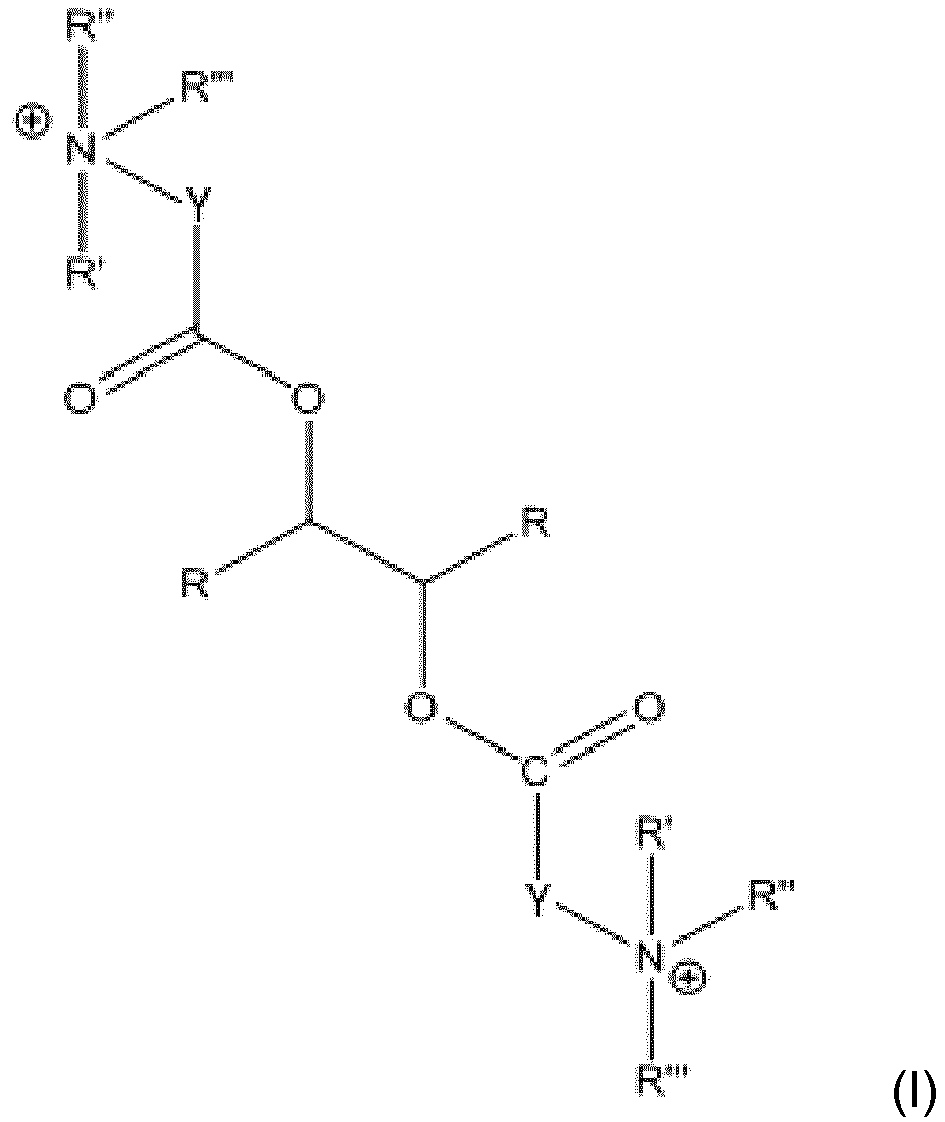
- R, which may be the same or different at each occurrence, is a C5-C27 aliphatic group, preferably a C6 to C24 aliphatic group,
- Y, which may be the same or different at each occurrence, is a divalent C1-C6 aliphatic radical,
- R', R" and R'", which may be the same or different at each occurrence, are, independently from each other, hydrogen or a C1 to C4 alkyl group,
- The aliphatic groups R may be free of any double bond and of any triple bond. Alternatively, the aliphatic groups R may comprise at least one -C=C- double bond and/or at least one -C=C- triple bond.
- The aliphatic groups R are advantageously chosen from alkyl groups, alkenyl groups, alkanedienyl groups, alkanetrienyl groups and alkynyl groups.
- The aliphatic groups R may be linear or branched.
- Preferably, the aliphatic groups R are independently chosen from alkyl and alkenyl groups.
- More preferably, the aliphatic groups R are independently chosen from alkyl and alkenyl groups, generally from C6-C24 alkyl and C6-C24 alkenyl groups, very often from C6-C21 alkyl and C6-C21 alkenyl groups and often from (i) C6-C19 alkyl and C6-C19 alkenyl groups or from (ii) C6-C17 alkyl and C6-C17 alkenyl groups. More preferably, R represent an alkyl group, generally a C6-C24 alkyl group, very often a C6-C21 alkyl group, often a C6-C19 alkyl group or a C6-C17 alkyl group. Aliphatic groups, in particular alkyl groups, with 10 to 20, preferably with 11 to 17 or with 10 to 17 carbon atoms have been found advantageous in certain cases.
- Acyclic aliphatic groups, more preferably linear aliphatic groups, still more preferably linear alkyl groups may be mentioned as preferred examples of substituents R.
- The number of carbon atoms of R can be even or odd and each group R can have the same number of carbon atoms or the number of carbon atoms of different groups R may be different.
- R', R" and R'", which may be the same or different, are preferably hydrogen or a C1 to C4 alkyl group, preferably methyl or ethyl, more preferably methyl. Preferably at least one, more preferably at least two, more preferably all three of R', R" and R'" are a C1 to C4 alkyl group, preferably methyl or ethyl, most preferably methyl.
- Y is preferably an acyclic divalent aliphatic group, more preferably a linear divalent aliphatic group, still more preferably a linear alkanediyl (alkylene) group and preferably has 1 to 6, even more preferably 1 to 4 carbon atoms. In compounds where n' is 1, aliphatic group Y preferably has at least two carbon atoms, in particular 2 to 6 carbon atoms.
- The compounds of formula (II)

- The ionic compounds in accordance with the present invention can be obtained by a variety of methods. Preferred processes for the manufacture of the compounds of the present invention include the reaction of an internal ketone of formula R-C(=O)-R, which internal ketone may preferably be obtained by decarboxylative ketonization of a fatty acid, a fatty acid derivative or a mixture thereof. A suitable process for the manufacture of internal ketones following this route is diclosed in
US 2018/0093936 to which reference is made for further details. - The synthesis of various compounds of the present invention using internal ketones obtainable as indicated above as starting materials is now described. The process variants described hereinafter show the synthesis of specific compounds and the skilled person will modify the reactants and reaction conditions based on his professional knowledge and taking into account the specific target product of the respective synthesis to manufacture other compounds in accordance with the present invention.
- The ionic compounds of formula (I) can preferably be obtained by two processes. The first process starts with a Piria ketonization followed by hydrogenation, dehydration, epoxydation (to obtain an epoxide), hydration (to obtain a diol) and esterification (to obtain a certain diester). This is a multi-step process plugged on Piria technology. It has the advantage of being salt-free and relying on chemical transformations which can be easily performed.
- As an alternative to the above sequence of reactions, it is possible to bypass the hydration step (i.e. the formation of the diol) by converting straightforward the epoxide into the diester provided an appropriate esterification agent is used, as will be detailed later on.
- The esterification step may be followed by an amine condensation step (as the final step) to convert the diester into a compound complying with formula (I).
- Finally, starting from the diol, it also possible to obtain in one reaction step a compound which complies with formula (I), i.e. to achieve in one step said esterification and amine condensation, provided another appropriate esterification is used, as will be detailed later on.
- The basic reaction in the first step is:

- This reaction has been thoroughly described in
US patent 10035746 WO 2018/087179 andWO 2018/033607 to which reference is made for further details. - The internal ketone is then subjected to hydrogenation which can be carried out under standard conditions known to the skilled person for hydrogenation reactions:

- The hydrogenation reaction is conducted by contacting the internal ketone with hydrogen in an autoclave reactor at a temperature ranging from 15°C to 300°C and at a hydrogen pressure ranging from 1 bar to 100 bars. The reaction can be conducted in the presence of an optional solvent but the use of such solvent is not mandatory and the reaction can also be conducted without any added solvent. As examples of suitable solvents one can mention: methanol, ethanol, isopropanol, butanol, THF, methyl-THF, hydrocarbons, water or mixtures thereof. A suitable catalyst based on a transition metal should be employed for this reaction. As examples of suitable catalysts, one can mention heterogeneous transition metal based catalysts such as for example supported dispersed transition metal based catalysts or homogeneous organometallic complexes of transition metals. Examples of suitable transition metals are: Ni, Cu, Co, Fe, Pd, Rh, Ru, Pt, Ir. As examples of suitable catalysts one can mention Pd/C, Ru/C, Pd/Al2O3, Pt/C, Pt/Al2O3, Raney Nickel, Raney Cobalt etc. At the end of the reaction, the desired alcohol can be recovered after appropriate work-up. The skilled person is aware of representative techniques so no further details need to be given here. Details of this process step can e.g. be found in
US patent 10035746 - The skilled person will select suitable reaction conditions based on his professional experience and taking into account the specific target compound to be synthesized. Accordingly, no further details need to be given here.
- In the next step, the alcohol thus obtained is subjected to dehydration to obtain an internal olefin. This reaction can also be carried out under standard conditions known to the skilled person for respective dehydration reactions (e.g.
US patent 10035746 
- The dehydration reaction is conducted by heating the secondary alcohol in a reaction zone in the presence of a suitable catalyst at a temperature ranging between 100°C and 400°C. The reaction can be conducted in the presence of an optional solvent but the use of such solvent is not mandatory and the reaction can also be conducted without any added solvent. As examples of solvents one can mention: hydrocarbons, toluene, xylene or their mixture. A catalyst must be employed for this reaction. Suitable examples of catalysts are acidic (Lewis or Bronsted) catalysts either heterogeneous solid acid catalysts or homogeneous catalysts. As examples of heterogeneous catalysts one can mention alumina (Al2O3), silica (SiO2), aluminosilicates (Al2O3-SiO2) such as zeolites, phosphoric acid supported on silica or alumina, acidic resins such as Amberlite® etc. Homogeneous catalysts can also be employed and one can mention the following suitable acids: H2SO4, HCI, trifluoromethanesulfonic acid, para-toluenesulfonic acid, AlCl3, FeCl3 etc. Water that is generated during the reaction can be distilled out from the reaction medium in the course of the reaction. At the end of the reaction, the desired olefin can be recovered after appropriate work-up. The skilled person is aware of representative techniques and same are e.g. described in
US patent 10035746 - This internal olefin can thereafter be oxidized to the respective epoxide wherein the double bond is substituted by an epoxide group in accordance with the following scheme (where the reactants are just exemplary for respective groups of compounds serving the respective function):

- The epoxidation reaction is advantageously conducted by contacting the internal olefin with an appropriate oxidizing agent in a reaction zone at a temperature ranging usually from 15°C to 250°C.
- As suitable oxidizing agents one can mention peroxide compounds such as hydrogen peroxide (H2O2) that can be employed in the form of an aqueous solution, organic peroxides such as peracids of general formula R****-CO3H (for example meta-chloroperoxybenzoic acid, peracetic acid, etc.), hydrocarbyl (e.g. alkyl) hydroperoxides of general formula R****'-O2H (for example cyclohexyl hydroperoxide, cumene hydroperoxide, tert-butyl hydroperoxide) where R**** in the peracid or R****' in the hydrocarbyl (e.g. alkyl) hydroperoxide is a hydrocarbon group (e.g. an alkyl group) that can be substituted and/or interrupted by a heteroatom or heteroatoms-containing group.
- The reaction can be conducted in the presence of an optional solvent but the use of such solvent is not mandatory and the reaction can also be conducted without any added solvent. As example of suitable solvents one can mention: CHCl3, CH2Cl2, tert-butanol or their mixtures.
- When H2O2 is used as the oxidizing agent, the presence of an organic carboxylic acid during the reaction can be beneficial as it will generate in-situ a peracid compound by reaction with H2O2. As examples of suitable carboxylic acids one can mention: formic acid, acetic acid, propionic acid, butanoic acid, benzoic acid etc.
- A catalyst can also be used to promote the reaction. Suitable catalysts are Lewis or Bronsted acids and one can mention for example: perchloric acid (HClO4), trifluoromethanesulfonic acid, heterogeneous titanium silicalite (TiO2-SiO2), heterogeneous acidic resins such as Amberlite® resins, homogeneous organometallic complexes of manganese, titanium, vanadium, rhenium, tungsten, polyoxometellates etc.
- At the end of the reaction, the desired epoxide can be recovered after appropriate work-up and the skilled person is aware of representative techniques so that no further details need to be given here.
- The epoxide can be directly engaged in next step without further purification. This next step can be a hydration step (so as to form a diol, to be the followed by an esterification step) or a direct esterification step.
- The epoxide can thereafter be hydrated to the respective diol in accordance with the following scheme:

- The ring opening reaction can be performed by contacting the epoxide with water, generally in the presence of a suitable catalyst and at a temperature ranging generally from 15°C to 150°C. As examples of catalysts one can mention Bronsted or Lewis acid catalysts such as: H2SO4, HCI, perchloric acid (HClO4), trifluoromethanesulfonic acid, para-toluenesulfonic acid, heterogeneous acidic resins such as Amberlite® resins etc.
- The reaction can be conducted in the presence of an optional solvent to facilitate reagent contact and one can mention: Me-THF, THF, DMSO, tert-butanol, methanol, ethanol, isopropanol, acetonitrile, or their mixture. The reaction can also be conducted without any added solvent.
- At the end of the reaction, the desired diol can be recovered after appropriate work-up and the skilled person is aware of representative techniques so that no further details need to be given here.
- The diol can be esterified according to the following reaction scheme:

- R, which may be the same or different at each occurrence, is a C5-C27 aliphatic group, preferably a C6 to C24 aliphatic group,
- L is a leaving group,
- Y is a divalent C1-C6 aliphatic radical,
- R***** is hydrogen or a C1-C6 alkyl group,
- t is an integer which is equal to 1 or which is equal or superior to 2,
- Uu+ is a cation, and
- u is an integer fixing the positive charge of the cation.
- The esterification is first performed by contacting the diol with an esterification agent which is a carboxylic acid or an ester of a carboxylic acid of general formula:
[L-Y-CO2R*****](t-1)-[Uu+](t-1)/u
- wherein Y is a divalent hydrocarbon radical containing between 1 and 6 carbon atoms, more precisely a divalent C1-C6 aliphatic radical, and wherein L is a leaving group.
- Y is preferably an acyclic divalent aliphatic group, more preferably a linear divalent aliphatic group, still more preferably a linear alkanediyl (alkylene) group. Y has preferably from 1 to 6, more preferably from 1 to 4 carbon atom(s), still more preferably 1 or 2 carbon atom(s). The most preferred Y is -CH2-.
- When t is equal to 1, no cation is present. Otherwise said, the esterification is performed by contacting the diol with a carboxylic acid or an ester of a carboxylic acid of formula:
L-Y-CO2R*****.
- In the case the leaving group L already carries a negative charge in the carboxylic acid or ester reactant (this is the case when (t-1) is equal or superior to 1 or when t is equal or superior to 2), a cation noted Uu+ (with u preferably being 1, 2 or 3, even more preferably 1) must be present in the reactant to ensure the electroneutrality (in this case the cation possesses a u+ charge). This cation may e.g. be selected from H+, alkaline metal cations, alkaline earth metal cations (e.g. Na+, K+, Ca 2+), Al3+ and ammonium, to mention only a few examples.
- The nature of the leaving group L is not particularly limited provided next reaction step (i.e. amine condensation, as will be detailed later on) can occur. The leaving group L is preferably chosen from:
- a halogen, such as fluorine, chlorine, bromine or iodine,
- a (hydrocarbyloxysulfonyl)oxy group of formula Ra-O-SO2-O- wherein Ra denotes a C1-C20 hydrocarbyl group, such as CH3-O-SO2-O-, and
- an oxysulfonyloxy group of formula -O-SO2-O-.
- An example for a compound with t equal to 1 is the compound CH3-O-SO3-CH2-COOR***** which, for R***** being H, yields the compound CH3-O-SO3-CH2-COOH which can be designated as 2-((methoxysulfonyl)oxy)acetic acid.
- As further examples of compounds in which t is equal to 1 and thus no cation is present, one can mention: chloroacetic acid, bromoacetic acid and 2-chloropropionic acid.
- An example for t being equal to 2 is sodium carboxymethylsulfate acid in which [L-Y-COOR*****](t-1)-[Uu+](t-1)/u is [Na+] [O-SO2-O-CH2-COOR*****]- with R***** being H, U being Na and thus [Uu+]t/u[Lt-] being Na2SO4.
- The esterification can be conducted at a temperature ranging from 50°C to 250°C in the presence of an optional solvent. As example of suitable solvents one can mention toluene, xylene, hydrocarbons, DMSO, etc.
- Water that is formed as a by-product during the reaction can be removed from the reaction medium by distillation over the course of the reaction.
- A catalyst can also be employed during the reaction and suitable catalysts are Bronsted or Lewis acid catalysts. As preferred examples of catalysts one can mention: H2SO4, para-toluenesulfonic acid, trifluoromethanesulfonic acid, HCI, or heterogeneous acidic resins such as Amberlite® resins, AlCl3 etc. At the end of the reaction, the desired diester can be recovered after appropriate work-up and the skilled person is aware of representative techniques so that no further details need to be given here.
- As will be seen later on, the diester of formula (III)

- The Applicant has surprisingly found that the epoxide can be directly esterified into the diester of formula (III) when and only when a carboxylic acid is used as the esterification agent [L-Y-CO2R*****](t-1)-[Uu+](t-1)/u, that is to say when the esterification agent [L-Y-CO2R*****](t-1)-[Uu+](t-1)/u is of the formula
[L-Y-CO2H](t-1)-[Uu+](t-1)/u, wherein L, Y, t, Uu+ and u are as described here before in connection with the esterification of the diol. - The epoxide ring-opening and esterification take then place according to the following reaction scheme:

- R, which may be the same or different at each occurrence, is a C5-C27 aliphatic group, preferably a C6 to C24 aliphatic group,
- L is a leaving group,
- Y is a divalent C1-C6 aliphatic radical,
- t is an integer which is equal to 1 or which is equal or superior to 2,
- Uu+ is a cation, and
- u is an integer fixing the positive charge of the cation.
- The epoxide ring-opening and esterification are performed by reacting the epoxide with a carboxylic acid of general formula:
[L-Y-CO2H](t-1)-[Uu+](t-1)/u
wherein L is a leaving group, Y is a divalent C1-C6 aliphatic radical, t is an integer which is equal to 1 or which is equal or superior to 2, Uu+ is a cation, and u is an integer fixing the positive charge of the cation. - All the details which have been provided here before concerning L, Y, t, Uu+ and U in connection with the esterification of the diol are also valid and can apply here in connection with the direct esterification of the epoxide, so that such details need not to be repeated.
- In particular, when t is equal to 1, no cation is present. Otherwise said, the esterification is performed by contacting the epoxide with a carboxylic acid of formula:
L-Y-CO2H.
- The diester compound of formula (III) can be converted into the ionic compound of formula (I) through the following reaction scheme:

- R, Y, L, t, Uu+ and U are as described here before, and
- R', R" and R'" are C1 to C4 alkyl groups, preferably methyl or ethyl, most preferably methyl.
- The amine condensation reaction is performed by contacting the intermediate diester of formula (III) obtained as described above with an amine of general formula NR'R"R'" where R', R" and R'" are C1 to C4 alkyl groups, preferably methyl or ethyl, most preferably methyl.
- The reaction can be conducted at a temperature ranging from 15°C to 250°C in the presence of a suitable solvent. As example of a suitable solvent one can mention: THF, Me-THF, methanol, ethanol, isopropanol, DMSO, toluene, xylene or their mixture. Alternatively the reaction can be also conducted in the absence of any added solvent.
- During this reaction, there is a nucleophilic attack of the amine that substitues L(t-1)- in the diester, L(t-1)- plays the role of the leaving group. Lt- becomes then the counter-anion of the final quaternary ammonium compound. In the case the leaving group already carries a negative charge in the diester reactant (this is the case when (t-1) is equal or superior to 1 or when t is equal or superior to 2) there is also formation of a salt as the by-product of the reaction (with the general chemical formula [Uu+]t/u[Lt-] as shown in the equation scheme above).
- Starting from the diol of formula

This appropriate esterification agent can be generally defined as an activated form of an amino-acid or an ester thereof of formula (IVa)
R'R"R'" +N-Y-C(=O)-O- (IVa)
or their hydrohalogenide adducts of formula (IVb)
R'R"R'" +N-Y-C(=O)-OH X- (IVb)
wherein - R', R" and R'", which may be the same or different, are hydrogen or a C1 to C4 alkyl group,
- Y is a divalent C1-C6 aliphatic radical, and
- X denotes a halogen atom, such as chlorine or bromine.
- The activated form of the amino-acid or ester thereof of formula (IVa) or their hydrohalogenide adducts of formula (IVb) is advantageously an acyl halogenide of formula (V)
R'R"R'" +N-Y-C(=O)-X X- (V)
wherein R', R", R'", Y and X are as described before in connection with formulae (IVa) and (IVb) ; in particular, it can be an acyl chloride of formula R'R"R'" +N-Y-C(=O)-Cl Cl-. - Other suitable activated forms of the the amino-acid or ester thereof of formula (IVa) or their hydrohalogenide adducts of formula (IVb) include an acyl azide of formula (VI)
R'R"R'" +N-Y-C(=O)-N=N+=N- (VI)
and an acyl imidazole or acyl imidazolium. - Several publications describe the direct esterification of a polyol wherein the hydroxyl groups are primary (emphasis added) hydroxyl groups with an amino-acid or an ester thereof.
- For example, Stakleff in Acta Biomaterialia, 9, 5132-5142 (2013), taught about the reaction of hexanediol with phenylalanine or leucine in the presence of p-toluene sulfonic acid.
- Lele et al., in Synthetic Communications, 29:10, 1727-1739 (1999) achieved the mediated coupling of poly(ethylene glycol) and an amino-acid hydrochloride in the presence of dicyclohexylcarbodiimide.
- Granö et al., in Carbohydrate Polymers, 41, 277-283 (2000), prepared starch betainate from starch and betainyl chloride in the presence of dioxane as solvent and pyridine as nucleophilic reagent and catalyst:
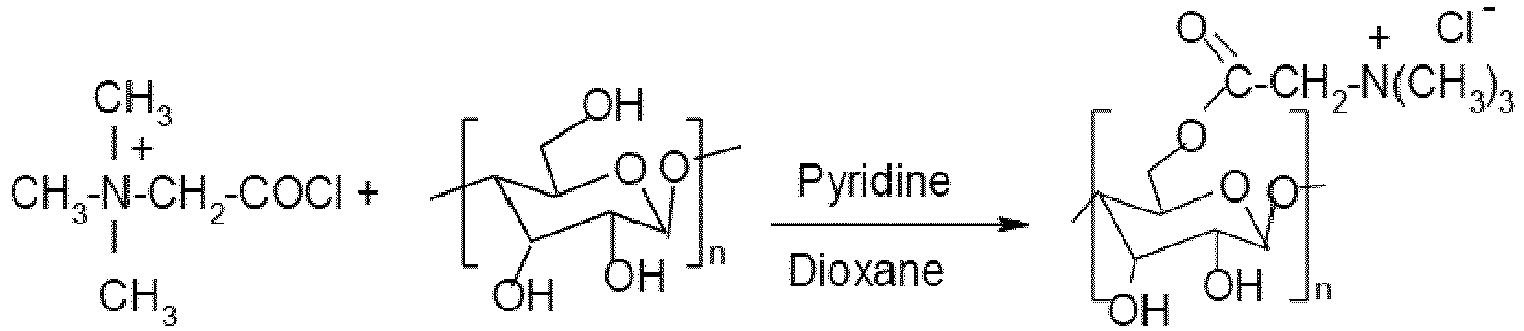
- On the other hand, none of these pieces of prior art addresses the possibility to quaternize directly a polyol bearing two or more secondary hydroxyl groups, the reactivity of which differs substantially from the reactivity of polyols bearing primary hydroxyl groups, as it could now be achieved within the frame of the present invention.
- It was thus another object of the present invention to provide a new, efficient and easy method for the direct quaternization of diols of formula


- This other object is achieved with a method which is described hereinafter under item 1:
- item 1 : a method for obtaining a quaternary ammonium compound having the general formula


wherein- the amino-acid or derivative thereof is of formula (IVa)
R'R"R'" +N-Y-C(=O)-O- (IVa),
and their hydrohalogenide adducts are of formula (IVb)
R'R"R'" +N-Y-C(=O)-OH X- (IVb),
- Rh, which may be the same or different at each occurrence, is an aliphatic group
- R', R" and R'" are hydrogen or a C1 to C4 alkyl group,
- Y is a divalent C1-C6 aliphatic radical, and
- X denotes a halogen atom, such as chlorine or bromine.
Preferred and/or particular embodiments related to the invented method are set hereinafter: - the amino-acid or derivative thereof is of formula (IVa)
- item 2: the method as described in item 1 wherein the activated form of the amino-acid or derivative thereof or their hydrohalogenide adducts is an acyl halogenide of formula (V)
R'R"R'" +N-Y-C(=O)-X X- (V)
wherein R', R", R'", Y and X are as described in item 1; - item 3: the method as described in item 2 which comprises obtaining the acyl halogenide of formula (V) by reacting the amino-acid or derivative thereof of formula (IVa) and/or a hydrohalogenide adduct thereof of formula (IVb) with a reagent chosen from a thionyl halogenide, an oxalyl halogenide, a phosphorus trihalogenide, a phosphorus pentahalogenide or a phosphorus oxyhalogenide, preferably by reacting the amino-acid or derivative thereof of formula (IVa) and/or a hydrohalogenide adduct thereof of formula (IVb) with a reagent chosen from thionyl chloride (SOCl2), oxalyl chloride [(COCl)2], phosphorus trichloride (PCl3), phosphorus pentachloride (PCl5) and phosphorus oxychloride (POCl3), more preferably by reacting the amino-acid or derivative thereof of formula (IVa) and/or a hydrohalogenide adduct of formula (IVb) with thionyl chloride ;
- item 4: the method as described in item 1 wherein the activated form of the amino-acid or derivative thereof or their hydrohalogenide adducts is an acyl azide of formula (VI)
R'R"R'" +N-Y-C(=O)-N=N+=N- (VI)
wherein R', R", R'" and Y are as described before in item 1 ; - item 5: the method as described in any one of items 1 to 4 wherein X is chloride ;
- item 6: the method as described in any one of items 1 to 5 wherein Rh comprises at least 2, possibly at least 3 or at least 4 carbon atoms ;
- item 7: the method as described in any one of items 1 to 6 wherein Rh comprises up to 4 carbon atoms ;
- item 8: the method as described in any one of items 1 to 6 wherein Rh comprises at least 5 carbon atoms ;
- item 9: the method as described in item 8 wherein Rh (i.e. each Rh), which may be the same or different at each occurrence, represents a C5-C27 aliphatic group, i.e. Rh has the same definition as R as previously described, and the quaternary ammonium compound which is obtained by the present method is of formula (I) ;
- item 10: the method as described in item 9 wherein Rh complies with any one of the features which are specified hereafter in sub-items 10.a to 10.g or with any combination of two, three or more of such features, to the extent that so-combined features are not antagonistic with each other:
- sub-item 10.a: Rh (i.e. each Rh) is a C6 to C24 aliphatic group, preferably Rh comprises from 10 to 20 carbon atoms, more preferably Rh comprises from 11 to 17 carbon atoms ;
- sub-item 10.b: Rh is free of any double bond and of any triple bond, preferably Rh is an alkyl group ;
- sub-item 10.c: Rh is linear, preferably Rh is a linear alkyl group having from 14 to 17 carbon atoms ;
- sub-item 10.d: one and only one Rh has an odd number of carbon atoms and one and only one Rh has an even number of carbon atoms ; this can happen when both Rh originate from a carboxylic acid having an even number of carbon atoms and can be advantageous from an economic standpoint because fatty carboxylic acids of natural origin -which have typically such an even number of carbon atoms- are broadly available ; this can also happen when both Rh originate from a carboxylic acid having an odd number of carbon atoms ;
- sub-item 10.e: either both Rh have an even number of carbon atoms or both Rh have an odd number of carbon atoms ; this can happen when one and only one Rh originates from a carboxylic acid having an even number of carbon atoms and one and only one Rh originates from a carboxylic acid having an odd number of carbon atoms ;
- sub-item 10.f: one and only one Rh has an odd number of carbon atoms no while the other Rh has an even number of carbon atoms nE, wherein nE is equal to no-1 ; this can happen when Rh originates from one and only one carboxylic acid ;
- sub-item 10.g: the number of carbon atoms of the two Rh groups is represented by couple (n1, n2), n1 being the number of carbon atoms of the first Rh group and n2 being the number of carbon atoms of the second Rh group, said couple (n1, n2) being chosen from the following couples: (10,11), (12,13), (14,15), (16,17), (10,13), (10,15), (10,17), (11,12), (11,14), (11,16), (12,15), (12,17), (13,14), (13,16), (14,17) and (15,16) ; this can happen when Rh originates from a cut of C12-C18 fatty carboxylic acids of natural origin ;
- item 11: the method as described in any one of items 1 to 10 wherein Y is chosen -CH2-, -CH(CH3)-, -CH[CH(CH3)2]-, -CH[CH2-CH(CH3)2]- and -CH[CH(CH3)-CH2-CH3]- ;
- item 12: the method as described in item 11 wherein Y is -CH2- ;
- item 13: the method as described in any one of items 1 to 12 wherein at least one of R', R" and R'" is a C1 to C4 alkyl group ;
- item 14: the method as described in item 13 wherein R' is a C1 to C4 alkyl group, R" is a C1 to C4 alkyl group and R'" is a C1 to C4 alkyl group ;
- item 15: the method as described in item 14 wherein R', R" and R'" are methyl ;
- item 16: the method as described in any one of items 1 to 15 wherein the amino-acid or derivative thereof of formula (IVa) is trimethyl glycine and the hydrohalogenide adduct of formula (IVb) is betaine hydrochloride.
- An alternative process for the synthesis of compounds of formula (I) proceeds via an acyloin condensation in accordance with the following scheme:

-

- This reaction can be conducted using the conditions described hereinbefore for the first process variant for the manufacture of compounds of formula (I).
- The subsequent reaction steps are also as described hereinbefore for the first process variant for the manufacture of compounds of formula (I).
- The exemplary processes described before are examples of suitable processes, i.e. there might be other suitable processes to synthesize the compounds in accordance with the present invention. The processes described hereinbefore are thus not limiting as far as the methods of manufacture of the compounds according to the present invention is concerned.
- In the compounds of formula (I), the number of carbon atoms of the two groups R is preferably any of the following couples if the internal ketones used as reactant in the exemplary processes described hereinbefore are derived from natural fatty acids having an even number of carbon atoms:
- (4,5), (6,7), (8,9), (10,11), (12,13), (14,15), (16,17)
- (4,7), (4,9), (4,11), (4,13), (4,15), (4,17)
- (5,6), (5,8), (5,10), (5,12), (5,14), (5,16)
- (6,9), (6,11), (6,13), (6,15), (6,17)
- (7,8), (7,10), (7,12), (7,14), (7,16)
- (8,11), (8,13), (8,15), (8,17)
- (9,10), (9,12), (9,14), (9,16)
- (10,13), (10,15), (10,17)
- (11,12), (11,14), (11,16)
- (12,15), (12,17)
- (13,14), (13,16)
- (14,17)
- (15,16).
- In particular, if the internal ketones used as reactant in the exemplary processes described hereinbefore are obtained from one or more carboxylic acids having an even number of carbon atoms ranging from 12 to 18, the number of carbon atoms of the two groups R in compounds of formula (I) is one or more of the following couples:
- (10,11), (12,13), (14,15), (16,17)
- (10,13), (10,15), (10,17)
- (11,12), (11,14), (11,16)
- (12,15), (12,17)
- (13,14), (13,16)
- (14,17)
- (15,16)
- If the internal ketone is obtained from fatty acids comprising an odd numbers of carbon atoms, other couples are possible and will be obtained.
- Compounds of formula (I) possess a particularly interesting and advantageous property profile of surfactant properties on one hand and biodegradability properties on the other hand. Biodegradability is becoming more and more an important aspect for surfactant products.
- The compounds of the present invention can be used as surfactants. Surfactants are compounds that lower the surface tension (or interfacial tension) between two liquids, a liquid and a gas or between a liquid and a solid. Surfactants may act as detergents, wetting agents, emulsifiers, foaming agents, and dispersants.
- Surfactants are usually organic compounds that are amphiphilic, meaning they contain both hydrophobic groups (their tails) and hydrophilic groups (their heads). Therefore, a surfactant contains both a water-insoluble (or oil-soluble) component and a water-soluble component. Surfactants will diffuse in water and adsorb at interfaces between air and water or at the interface between oil and water, in the case where water is mixed with oil. The water-insoluble hydrophobic group may extend out of the bulk water phase, into the air or into the oil phase, while the water-soluble head group remains in the water phase.
- The adsorption of a cationic surfactant on negatively charged surfaces is an important property for such surfactants. This property is usually linked to the minimum concentration of surfactant needed to produce aggregation of a negatively charged cellulose nanocrystal (CNC, which is often used as reference material)) suspension in aqueous media. Consecutive variation of size can be monitored and followed by dynamic light scattering (DLS).
- Following the protocol described in E.K. Oikonomou et al., J. Phys. Chem. B, 2017, 121 (10), 2299-307 the adsorption properties of the quaternary ammonium compounds can be investigated by monitoring the ratio X=[surfactant]/[CNC] or the mass fraction M=[surfactant]/([surfactant + [CNC]), at fixed [surfactant] + [CNC] = 0.01 wt% in aqueous solution, required to induce the agglomeration of the cellulose nanocrystals.
- The biodegradability of the compounds of the present invention can be determined in accordance with procedures described in the prior art and known to the skilled person. Details about one such method, OECD standard 301, are given in the experimental section hereinafter.
- Should the disclosure of any patents, patent applications, and publications which are incorporated herein by reference conflict with the description of the present application to the extent that it may render a term unclear, the present description shall take precedence.
- C31 internal olefin was obtained from palmitic acid according to the protocol described in
US patent 10035746 -

- The reaction was conducted under an inert argon atmosphere.
- In a 1L double-jacketed reactor equipped with a mechanical stirrer (propeller with four inclined plows), a condenser, an addition funnel and a temperature probe were added 61.9 g of C31 alkene (0.142 mol), followed by 16.3 mL (17.1 g, 0.285 mol) of acetic acid and 13.6 g (22 wt%) of Amberlite® IR 120H resin. The mixture was heated to 65 °C to melt the fatty alkene. The agitation was started and then 21.8 mL (24.2 g, 0.214 mol) of an aqueous solution of H2O2 (conc. 30%) was slowly added to the mixture using the addition funnel at a rate avoiding a significant temperature increase. This required about one hour. The temperature was then increased to 75°C and the reaction mixture was allowed to stir overnight (after 15 min, NMR analysis showed that the conversion level was already around 60% with 99% selectivity). Then additional 10.2 mL (11.3 g, 0.1 mol) of an aqueous solution of H2O2 (30%) was added slowly and after 4 hours following the second addition of H2O2 NMR analysis showed that the conversion level was around 88% (98% selectivity). Another addition of 8.14 mL of acetic acid (8.55 g, 0.142 mol) followed by 11.6 mL of 30% H2O2 (12.91 g, 0.114 mol) was finally performed in order to increase the conversion level.
- The mixture was allowed to stir a second night at 75°C.
- Finally NMR analysis showed a conversion level of 93% (95% selectivity).
- The mixture was allowed to cool down to room temperature and then 300 mL of chloroform were added. The mixture was transferred to a separating funnel and the organic phase was washed three times with 300 mL of water and then the aqueous phase was extracted twice with 100 mL of chloroform. The Amberlite® solid catalyst stayed in the aqueous phase and was removed during the first separation with the aqueous phase. The organic phases were collected, dried over MgSO4, filtered and evaporated to give 65.3 g of a white solid with a purity of 91% w/w (epoxide + di-alcohol).
- The yield taking into account the purity was 92%.
1H NMR (CDCl3, 400 MHz) δ (ppm): 2.91-2.85 (m, 2H, diastereoisomer 1), 2.65-2.6 (m, 2H, diastereoisomer 2), 1.53-1.00 (m, 54H), 0.86 (t, J = 6.8 Hz, 6H).
13C NMR (CDCl3, 101 MHz) δ (ppm): 58.97, 57.28, 32.18, 31.96, 29.72, 29.6, 29.4, 27.86, 26.95, 26.63, 26.09, 22.72, 14.15 (terminal CH3). -

- The reaction was conducted under an inert argon atmosphere.
- In a 1L double-jacketed reactor equipped with a mechanical stirrer (propeller with four inclined plows), a condenser and a temperature probe were added 82.9 g of C31 epoxide (purity: 94.5 wt%, 0.174 mol) followed by 480 mL of methyl-THF.
- The mixture was allowed to stir at room temperature and 73 mL of a 3 M aqueous solution of H2SO4 was then added. The reaction medium was then stirred at 80°C during 90 minutes. NMR analysis showed that the reaction was completed. The biphasic mixture was allowed to cool down to room temperature and the organic phase was separated. The solvent was then removed under vacuum and the residue was suspended in 200 mL of diethyl ether. The suspension was filtered and the resulting solid was washed 3 times with 50 mL of diethyl ether. The white solid was finally washed 2 times with 50 mL of methanol and was dried under vacuum to remove traces of solvent.
- At the end 75.53 g of product was obtained as a white powder with a purity of 95.7 % w/w corresponding to a yield of 89 %.
1H NMR (CDCl3, 400 MHz) δ (ppm): 3.61-3.55 (m, 2H, diastereoisomer 1), 3.43-3.25 (m, 2H, diastereoisomer 2), 1.88 (brd, J = 2.4 Hz, OH, diastereoisomer 2), 1.72 (brd, J = 3.2 Hz, OH, diastereoisomer 1), 1.53-1.10 (m, 54H), 0.86 (t, J = 6.8 Hz , 6H).
13C NMR (CDCl3, 101 MHz) δ (ppm): 74.71, 74.57, 33.66, 31.96, 31.23, 29.71, 29.39, 26.04, 25.68, 22.72, 14.15 (terminal CH3) - All the reactions were conducted in carefully dried vessels and under an inert argon atmosphere.
- Fresh commercial anhydrous CHCl3 (amylene stabilized) and anhydrous toluene were used as such.
- Betaine hydrochloride (19.66 g, 128.4 mmoles) was washed ten times with 20 mL of anhydrous THF followed by drying under vacuum to remove traces of solvent prior to use.
- In a 100 mL four-neck round-bottom flask equipped with a magnetic stirrer, a heater, a condenser, a temperature probe and a curved distillation column connected to two traps of NaOH were quickly added:
- 19.66 g of dried betaine hydrochloride (128.4 mmoles) and
- 28 mL of SOCl2 (45.86 g, 0.386 mol).
- The heterogeneous mixture was stirred and the temperature was then slowly increased to 70°C. It was observed that when the temperature reached 68°C, gas was released (SO2 and HCI) and the mixture turned homogeneous yellow.
- The mixture was then allowed to stir at 70°C during two hours and hot anhydrous toluene (25 mL, 80°C) was added into the vessel. The mixture was stirred and then decanted at 0°C (white-yellow precipitate formation) and the upper phase of toluene was removed through a cannula. The operation of toluene washing was repeated seven times in order to remove all SOCl2 excess. NMR analysis showed complete conversion of glycine betaine hydrochloride but also formation of NMe3·HCl adduct (NMe3·HCl content in the solid: 12.3 mol%).
- 20 mL of dry CHCl3 was then added to the solid betainyl chloride.
- A solution of 26.19 g (56 mmol) of fatty diol in 90 mL of anhydrous CHCl3 was prepared at 55°C and was added dropwise under stirring to the reaction vessel at room temperature (exothermicity and emission of HCI was observed). The mixture was then allowed to stir at 55°C overnight. Over the course of the reaction, the mixture turned homogeneously orange. NMR analysis showed that the conversion level was around 100%.
- The mixture was then allowed to cool down to room temperature and the solvent was evaporated under vacuum.
- The residue was solubilized in methanol at 0°C and the formed precipitate was filtered out. The obtained filtrate was then evaporated to give 39.7 g of crude product.
- This product was then deposited on a sinter filter and washed with cyclohexane to remove some remaining organic impurities. The resulting washed solid was dried under vacuum to afford 22 g of crude material. A final purification with a mixture of CH2Cl2/cyclohexane 50:50 was carried out; the solid was solubilized again in this solvent mixture at 50°C and was allowed to cool down to room temperature. The formed precipitate was filtered out and after evaporation of the filtrate 19 g of a beige wax was obtained with the following composition:
- 95 wt% of glycine betaine diester
- 1.5 wt% of methyl betainate
- 2 wt% of trimethylamine hydrochloride
- 1.5 wt% of glycine betaine hydrochloride.
- The purified yield was 44%.
1H NMR (MeOD-d4, 400 MHz) δ (ppm): 5.3-5.2 (m, 2H), 4.68 (d, J = 16.8 Hz, 2H), 4.50 (d, J = 16.8 Hz, 2H), 4.53 (s, 1H), 4.48 (s, 1H), 3.37 (s, 18H), 1.75-1.55 (m, 4H), 1.39-1.10 (m, 50 H), 0.9 (t, J = 6.8 Hz, 6H).
13C NMR (MeOD-d4, 101 MHz) δ (ppm): 164.58, 75.76, 62.43, 53.10, 31.68, 30.05, 29.41, 29.38, 29.33, 29.28, 29.15, 29.09, 28.96, 24.71, 22.34, 13.05 (terminal CH3). - Adsorption of cationic surfactant on negatively charged surface is an important property for various applications. This property is linked to the minimal concentration of cationic surfactant needed to produce aggregation of negatively charged cellulose nano crystal (CNC) in suspension in aqueous media. Comparison of the aggregate size can be monitored by dynamic light scattering (DLS).
- Following the protocol described in literature (Ref.: E. K. Oikonomou, et al., J. Phys. Chem. B, 2017, 121 (10), pp 2299-2307), adsorption properties of quaternary ammonium were investigated by monitoring the ratio X=[surfactant]/[CNC] or the mass fraction M = [surfactant]/([surfactant]+[CNC]), at fixed [surfactant]+[CNC]= 0.01wt% in aqueous solution, required to induce the agglomeration of the cellulose nano crystal.
- The range of CNC aggregation correspond to the range of ratio X (or M) triggering an aggregation of CNC, i.e. the range where the aggregate size measured by DLS is higher than a pure aqueous solution of CNC or an aqueous solution of surfactant at 0.01wt%.
- Ranges of X and M of aggregation of CNC are summarized in Table 1. The lower range of aggregation X or M, the better the adsorption properties on negatively charged surface
Table 1 Range of CNC aggregation (Ratio) X=[surfactant]/[CNC] Xmin - Xmax Range of CNC aggregation (Mass fraction) Mmin - Mmax Compound of Example 1 0.1-1.82 0.09-0.65 Fentacare® TEP 1-33 0.50-0.97 - Fentacare® TEP was used as a comparison. Fentacare® TEP is a commercial surfactant representing the benchmark.
- The data show that the surfactant properties of the compound in accordance with the present invention is superior compared to the commercial surfactant Fentacare® TEP.
- Biodegradability of the test substances has been measured according to the 301 F OECD protocol.
- A measured volume of inoculated mineral medium, containing a known concentration of the test substance in order to reach about 50 to 100 mg ThOD/I (Theoretical Oxygen Demand) as the nominal sole source of organic carbon, was stirred in a closed flask (Oxitop™respirometric flask) at a constant temperature (20 ± 2°C) for up to 28 days. Oxitop™ respirometric bottles were used in this test in order to access the biodegradability of the test samples: sealed culture BOD flasks were used at a temperature of 20±2 C during 28 days.
- Evolved carbon dioxide was absorbed by pellets of Natrium or Potassium hydroxide present in the head space of the bottle. The amount of oxygen taken up by the microbial population (= oxygen consumption expressed in mg/l) during biodegradation process (biological oxidation of the test substance) decreased the pressure of the head space (Δ P measured by the pressure switch) and was mathematically converted in mg O2 consumed /litre. Inoculum corresponded to a municipal activated sludge washed in mineral medium (ZW media) in order to decrease the DOC (Dissolved Oxygen Carbon) content. Control solutions containing the reference substance sodium acetate and also toxicity control (test substance + reference substance) were used for validation purposes. Reference substance, sodium acetate, has been tested in one bottle (at a nominal concentration of 129 mg/l corresponding to 100 mg ThOD/I) in order to check the viability of the inoculum. Toxicity control corresponds to the mixture of the substance reference and the test substance; it will check if the test substance is toxic towards the inoculum (if so, the test has to be redone at a lower test substance concentration, if feasible regarding the sensitivity of the method).
- As the substances of the present invention are for a majority of them not very soluble in water (if some are soluble in water, their metabolite after hydrolysis containing the alkyl chain has often very low solubility in water), we used a specific protocol named the "emulsion protocol". This protocol enabled us to increase the bioavailability of the poorly water soluble substance in the aqueous phase where we had the inoculum.
- Emulsion protocol consisted of adding the test substance in the bottle through a stock solution made in an emulsion.
- Emulsion was a 50/50 v/v mixture of a stock solution of the test substance dissolved in a non-biodegradable surfactant (Synperonic® PE 105 at 1 g/l) and then mixed with a mineral silicone oil AR 20 (Sigma).
- The first dissolution of the test substance in the non-biodegradable surfactant solution often required magnetic stirrer agitation followed by ultrasonication.
- Once the dissolution was made, we mixed the aqueous solution with a mineral silicone oil at a 50/50 volume/volume ratio. This emulsion was maintained by magnetic stirrer agitation and was sampled for an addition in the corresponding bottle in order to reach the required test substance concentration.
- Two emulsion controls were run in parallel during the test in order to remove their value from the emulsion bottle containing the test substance added through the emulsion stock solution.
- The result of the biodegradability test is provided in Table 2 here below:
Table 2 Biodegradability after 28 days Compound of Example 1 92 % (OECD 301F) - The result shows that the compound of example 1 has outstanding biodegradability. This beneficial effect is achieved without detrimentally affecting the surfactant properties of the ionic compounds.
- Overall, the ionic compounds of the present invention show a good combination of surfactant properties combined with a good biodegradabilty, a combination which is in many cases not achieved by commercial surfactants.
- Since the ionic compounds of the present invention are also easily available starting from internal ketones which are easily accessible from fatty acids or fatty acid derivatives, the ionic compounds of the present invention also provide economical benefits over the prior art compounds.
Claims (15)
- A method for obtaining a quaternary ammonium compound having the general formula


wherein- the amino-acid or derivative thereof is of formula (IVa)
R'R"R'" +N-Y-C(=O)-O- (IVa),
and their hydrohalogenide adducts are of formula (IVb)
R'R"R'" +N-Y-C(=O)-OH X- (IVb),
- Rh, which may be the same or different at each occurrence, is an aliphatic group,- R', R" and R'" are hydrogen or a C1 to C4 alkyl group,- Y is a divalent C1-C6 aliphatic radical, and- X denotes a halogen atom. - The method according to claim 1 wherein the activated form of the amino-acid or derivative thereof or their hydrohalogenide adducts is an acyl halogenide of formula (V)
R'R"R'" +N-Y-C(=O)-X X- (V)
wherein R', R", R"', Y and X are as defined in claim 1. - The method according to claim 2 which comprises obtaining the acyl halogenide of formula (V) by reacting the amino-acid or derivative thereof of formula (IVa) and/or a hydrohalogenide adduct thereof of formula (IVb) with a reagent chosen from a thionyl halogenide, an oxalyl halogenide, a phosphorus trihalogenide, a phosphorus pentahalogenide or a phosphorus oxyhalogenide.
- The method according to claim 2 or 3 wherein X is chloride or bromide.
- The method according to claim 4 wherein X is chloride.
- The method according to claim 1 wherein the activated form of the amino-acid or derivative thereof or their hydrohalogenide adducts is an acyl azide of formula (VI)
R'R"R'" +N-Y-C(=O)-N=N+=N- (VI)
wherein R', R", R'" and Y are as defined in claim 1. - The method according to any one of claims 1 to 6 wherein Rh comprises at least 2, preferably at least 3 more preferably at least 4 carbon atoms.
- The method according to claim 7 wherein Rh comprises from 10 to 20 carbon atoms.
- The method according to claim 8 wherein Rh is a linear alkyl group.
- The method according to any one of claims 1 to 9 wherein Y is chosen from -CH2-, -CH(CH3)-, -CH[CH(CH3)2]-, -CH[CH2-CH(CH3)2]- and -CH[CH(CH3)-CH2-CH3]-.
- The method according to claim 10 wherein Y is -CH2-.
- The method according to any one of claims 1 to 11 wherein at least one of R', R" and R'" is a C1 to C4 alkyl group.
- The method according to claim 12 wherein R' is a C1 to C4 alkyl group, R" is a C1 to C4 alkyl group and R'" is a C1 to C4 alkyl group.
- The method according to claim 13 wherein R', R" and R'" are methyl.
- The method according to any one of claims 1 to 14 wherein the amino-acid or derivative thereof of formula (IVa) is trimethyl glycine and the hydrohalogenide adduct of formula (IVb) is betaine hydrochloride.
Priority Applications (1)
| Application Number | Priority Date | Filing Date | Title |
|---|---|---|---|
| EP20190089.1A EP3950662A1 (en) | 2020-08-07 | 2020-08-07 | Method for obtaining quaternary ammonium compounds |
Applications Claiming Priority (1)
| Application Number | Priority Date | Filing Date | Title |
|---|---|---|---|
| EP20190089.1A EP3950662A1 (en) | 2020-08-07 | 2020-08-07 | Method for obtaining quaternary ammonium compounds |
Publications (1)
| Publication Number | Publication Date |
|---|---|
| EP3950662A1 true EP3950662A1 (en) | 2022-02-09 |
Family
ID=71995864
Family Applications (1)
| Application Number | Title | Priority Date | Filing Date |
|---|---|---|---|
| EP20190089.1A Withdrawn EP3950662A1 (en) | 2020-08-07 | 2020-08-07 | Method for obtaining quaternary ammonium compounds |
Country Status (1)
| Country | Link |
|---|---|
| EP (1) | EP3950662A1 (en) |
Citations (8)
| Publication number | Priority date | Publication date | Assignee | Title |
|---|---|---|---|---|
| DE3402146A1 (en) | 1984-01-23 | 1985-07-25 | Henkel KGaA, 4000 Düsseldorf | Novel quaternary ammonium compounds, their preparation and use as textile softeners |
| EP0721936A1 (en) | 1994-07-27 | 1996-07-17 | Kao Corporation | Liquid softener composition and quaternary ammonium salt |
| WO1997008284A1 (en) | 1995-08-25 | 1997-03-06 | Unilever Plc | Fabric softening composition |
| WO2007133616A2 (en) * | 2006-05-09 | 2007-11-22 | Medivas, Llc | Biodegradable water soluble polymers |
| CN107353216A (en) * | 2017-07-07 | 2017-11-17 | 百合花集团股份有限公司 | Ester group-containing quaternary ammonium salt compound and use thereof |
| WO2018033607A1 (en) | 2016-08-19 | 2018-02-22 | Rhodia Operations | Process for the decarboxylative ketonization of fatty acids or fatty acid derivatives |
| US20180093936A1 (en) | 2015-05-07 | 2018-04-05 | Rhodia Operations | Process for the decarboxylative ketonization of fatty acids or fatty acid derivatives |
| WO2018087179A1 (en) | 2016-11-08 | 2018-05-17 | Rhodia Operations | Process for the decarboxylative ketonization of fatty acids or fatty acid derivatives |
-
2020
- 2020-08-07 EP EP20190089.1A patent/EP3950662A1/en not_active Withdrawn
Patent Citations (9)
| Publication number | Priority date | Publication date | Assignee | Title |
|---|---|---|---|---|
| DE3402146A1 (en) | 1984-01-23 | 1985-07-25 | Henkel KGaA, 4000 Düsseldorf | Novel quaternary ammonium compounds, their preparation and use as textile softeners |
| EP0721936A1 (en) | 1994-07-27 | 1996-07-17 | Kao Corporation | Liquid softener composition and quaternary ammonium salt |
| WO1997008284A1 (en) | 1995-08-25 | 1997-03-06 | Unilever Plc | Fabric softening composition |
| WO2007133616A2 (en) * | 2006-05-09 | 2007-11-22 | Medivas, Llc | Biodegradable water soluble polymers |
| US20180093936A1 (en) | 2015-05-07 | 2018-04-05 | Rhodia Operations | Process for the decarboxylative ketonization of fatty acids or fatty acid derivatives |
| US10035746B2 (en) | 2015-05-07 | 2018-07-31 | Rhodia Operations | Process for the decarboxylative ketonization of fatty acids or fatty acid derivatives |
| WO2018033607A1 (en) | 2016-08-19 | 2018-02-22 | Rhodia Operations | Process for the decarboxylative ketonization of fatty acids or fatty acid derivatives |
| WO2018087179A1 (en) | 2016-11-08 | 2018-05-17 | Rhodia Operations | Process for the decarboxylative ketonization of fatty acids or fatty acid derivatives |
| CN107353216A (en) * | 2017-07-07 | 2017-11-17 | 百合花集团股份有限公司 | Ester group-containing quaternary ammonium salt compound and use thereof |
Non-Patent Citations (6)
| Title |
|---|
| E. K. OIKONOMOU ET AL., J. PHYS. CHEM. B, vol. 121, no. 10, 2017, pages 2299 - 2307 |
| EL-REFAIE KENAWY ET AL: "Biologically active polymers. IV. Synthesis and antimicrobial activity of tartaric acid polyamides", JOURNAL OF APPLIED POLYMER SCIENCE, vol. 102, no. 5, 5 December 2006 (2006-12-05), US, pages 4780 - 4790, XP055764202, ISSN: 0021-8995, DOI: 10.1002/app.24126 * |
| GRANO ET AL., CARBOHYDRATE POLYMERS, vol. 41, 2000, pages 277 - 283 |
| GRANO H ET AL: "Preparation of starch betainate: a novel cationic starch derivative", CARBOHYDRATE POLYMERS, APPLIED SCIENCE PUBLISHERS, LTD. BARKING, GB, vol. 41, no. 3, 1 March 2000 (2000-03-01), pages 277 - 283, XP004244360, ISSN: 0144-8617, DOI: 10.1016/S0144-8617(99)00146-0 * |
| LELE ET AL., SYNTHETIC COMMUNICATIONS, vol. 29, no. 10, 1999, pages 1727 - 1739 |
| STAKLEFF, ACTA BIOMATERIALIA, vol. 9, 2013, pages 5132 - 5142 |
Similar Documents
| Publication | Publication Date | Title |
|---|---|---|
| US12522560B2 (en) | Quaternary ammonium compounds | |
| JPS6034929A (en) | Manufacture of carboxylic acid from olefin or vicinaldihydroxy compound as starting substance | |
| JPS60106533A (en) | Manufacture of fluoralkyl replaced iodine alkane | |
| CA2201162C (en) | Alkyl or acyl-dianhydro-1,4:3,6-d-glucitol or alkyl phosphoric esters-utilization and preparation procedure | |
| JP2000212114A (en) | Production of glyceryl ether | |
| US4751027A (en) | Process for the preparation of perfluorocarboxylic acids | |
| EP3950662A1 (en) | Method for obtaining quaternary ammonium compounds | |
| EP3950663A1 (en) | New method for obtaining diester compounds useful for the manufacture of new quaternary ammonium compounds | |
| JP2008291008A (en) | 2,5-dimethylacetophenone derivative, 2,5-dimethylphenylacetic acid obtained from 2,5-dimethylacetophenone derivative and method for producing the same | |
| EP3939969A1 (en) | New epoxide compounds and their use to prepare new quaternary ammonium compounds | |
| EP3939956A1 (en) | New diols and new quaternary ammonium compounds | |
| KR20140103285A (en) | Process for the preparation of azeleic acid from 9-octadecenedioic acid | |
| CN115916743B (en) | Novel ammonium compounds used as surfactants | |
| JP2011105762A (en) | Method for preparing 1-hydroperoxy-16-oxabicyclo[10.4.0]hexadecane | |
| JP2005120037A (en) | Method for producing alkylbenzaldehydes | |
| US20080319232A1 (en) | Synthesis of Aldehydes by Ozonolysis of Secondary Allyl | |
| US6111130A (en) | Process for the preparation of trifluoromethyl containing derivatives | |
| JP3396097B2 (en) | Method for producing 4-isopropylcyclohexanecarboxylic acid ester derivative | |
| US20020099159A1 (en) | Method of synthesizing complexes of platinum and alkenylpolysiloxane, especially of platinum and divinyltetramethyldisiloxane | |
| CA2334901C (en) | Procedure for producing formyl imidazoles | |
| JP2002201156A (en) | Process for producing β-hydroxyhydroperoxides and carboxylic acids and their catalysts | |
| JP5008063B2 (en) | Diphosphine core type amphiphilic dendrimer, process for producing the same, bidentate phosphine ligand and palladium-containing complex compound having a coordination structure thereof | |
| JP3530925B2 (en) | Method for producing oxoester compound | |
| JP3908382B2 (en) | Method for producing fluorine-containing ether compound | |
| JP2890141B2 (en) | Method for producing α, α-dihaloketone derivative |
Legal Events
| Date | Code | Title | Description |
|---|---|---|---|
| PUAI | Public reference made under article 153(3) epc to a published international application that has entered the european phase |
Free format text: ORIGINAL CODE: 0009012 |
|
| STAA | Information on the status of an ep patent application or granted ep patent |
Free format text: STATUS: THE APPLICATION HAS BEEN PUBLISHED |
|
| AK | Designated contracting states |
Kind code of ref document: A1 Designated state(s): AL AT BE BG CH CY CZ DE DK EE ES FI FR GB GR HR HU IE IS IT LI LT LU LV MC MK MT NL NO PL PT RO RS SE SI SK SM TR |
|
| RAP3 | Party data changed (applicant data changed or rights of an application transferred) |
Owner name: RHODIA OPERATIONS |
|
| STAA | Information on the status of an ep patent application or granted ep patent |
Free format text: STATUS: THE APPLICATION IS DEEMED TO BE WITHDRAWN |
|
| 18D | Application deemed to be withdrawn |
Effective date: 20220810 |