EP3950096A1 - Device and method pertaining to gas purification treatment and/or combustion ash neutralization treatment - Google Patents
Device and method pertaining to gas purification treatment and/or combustion ash neutralization treatment Download PDFInfo
- Publication number
- EP3950096A1 EP3950096A1 EP20783056.3A EP20783056A EP3950096A1 EP 3950096 A1 EP3950096 A1 EP 3950096A1 EP 20783056 A EP20783056 A EP 20783056A EP 3950096 A1 EP3950096 A1 EP 3950096A1
- Authority
- EP
- European Patent Office
- Prior art keywords
- ash
- combustion
- water slurry
- slurry containing
- carbon dioxide
- Prior art date
- Legal status (The legal status is an assumption and is not a legal conclusion. Google has not performed a legal analysis and makes no representation as to the accuracy of the status listed.)
- Withdrawn
Links
Images


Classifications
-
- B—PERFORMING OPERATIONS; TRANSPORTING
- B01—PHYSICAL OR CHEMICAL PROCESSES OR APPARATUS IN GENERAL
- B01D—SEPARATION
- B01D53/00—Separation of gases or vapours; Recovering vapours of volatile solvents from gases; Chemical or biological purification of waste gases, e.g. engine exhaust gases, smoke, fumes, flue gases, aerosols
- B01D53/34—Chemical or biological purification of waste gases
- B01D53/46—Removing components of defined structure
- B01D53/62—Carbon oxides
-
- B—PERFORMING OPERATIONS; TRANSPORTING
- B01—PHYSICAL OR CHEMICAL PROCESSES OR APPARATUS IN GENERAL
- B01D—SEPARATION
- B01D53/00—Separation of gases or vapours; Recovering vapours of volatile solvents from gases; Chemical or biological purification of waste gases, e.g. engine exhaust gases, smoke, fumes, flue gases, aerosols
- B01D53/14—Separation of gases or vapours; Recovering vapours of volatile solvents from gases; Chemical or biological purification of waste gases, e.g. engine exhaust gases, smoke, fumes, flue gases, aerosols by absorption
- B01D53/1456—Removing acid components
- B01D53/1475—Removing carbon dioxide
-
- B—PERFORMING OPERATIONS; TRANSPORTING
- B01—PHYSICAL OR CHEMICAL PROCESSES OR APPARATUS IN GENERAL
- B01D—SEPARATION
- B01D53/00—Separation of gases or vapours; Recovering vapours of volatile solvents from gases; Chemical or biological purification of waste gases, e.g. engine exhaust gases, smoke, fumes, flue gases, aerosols
- B01D53/14—Separation of gases or vapours; Recovering vapours of volatile solvents from gases; Chemical or biological purification of waste gases, e.g. engine exhaust gases, smoke, fumes, flue gases, aerosols by absorption
- B01D53/1493—Selection of liquid materials for use as absorbents
-
- B—PERFORMING OPERATIONS; TRANSPORTING
- B01—PHYSICAL OR CHEMICAL PROCESSES OR APPARATUS IN GENERAL
- B01D—SEPARATION
- B01D53/00—Separation of gases or vapours; Recovering vapours of volatile solvents from gases; Chemical or biological purification of waste gases, e.g. engine exhaust gases, smoke, fumes, flue gases, aerosols
- B01D53/34—Chemical or biological purification of waste gases
- B01D53/46—Removing components of defined structure
- B01D53/48—Sulfur compounds
- B01D53/50—Sulfur oxides
-
- B—PERFORMING OPERATIONS; TRANSPORTING
- B01—PHYSICAL OR CHEMICAL PROCESSES OR APPARATUS IN GENERAL
- B01D—SEPARATION
- B01D53/00—Separation of gases or vapours; Recovering vapours of volatile solvents from gases; Chemical or biological purification of waste gases, e.g. engine exhaust gases, smoke, fumes, flue gases, aerosols
- B01D53/34—Chemical or biological purification of waste gases
- B01D53/46—Removing components of defined structure
- B01D53/48—Sulfur compounds
- B01D53/50—Sulfur oxides
- B01D53/501—Sulfur oxides by treating the gases with a solution or a suspension of an alkali or earth-alkali or ammonium compound
-
- B—PERFORMING OPERATIONS; TRANSPORTING
- B01—PHYSICAL OR CHEMICAL PROCESSES OR APPARATUS IN GENERAL
- B01D—SEPARATION
- B01D53/00—Separation of gases or vapours; Recovering vapours of volatile solvents from gases; Chemical or biological purification of waste gases, e.g. engine exhaust gases, smoke, fumes, flue gases, aerosols
- B01D53/34—Chemical or biological purification of waste gases
- B01D53/74—General processes for purification of waste gases; Apparatus or devices specially adapted therefor
- B01D53/75—Multi-step processes
-
- B—PERFORMING OPERATIONS; TRANSPORTING
- B01—PHYSICAL OR CHEMICAL PROCESSES OR APPARATUS IN GENERAL
- B01D—SEPARATION
- B01D53/00—Separation of gases or vapours; Recovering vapours of volatile solvents from gases; Chemical or biological purification of waste gases, e.g. engine exhaust gases, smoke, fumes, flue gases, aerosols
- B01D53/34—Chemical or biological purification of waste gases
- B01D53/74—General processes for purification of waste gases; Apparatus or devices specially adapted therefor
- B01D53/77—Liquid phase processes
- B01D53/78—Liquid phase processes with gas-liquid contact
-
- B—PERFORMING OPERATIONS; TRANSPORTING
- B01—PHYSICAL OR CHEMICAL PROCESSES OR APPARATUS IN GENERAL
- B01D—SEPARATION
- B01D53/00—Separation of gases or vapours; Recovering vapours of volatile solvents from gases; Chemical or biological purification of waste gases, e.g. engine exhaust gases, smoke, fumes, flue gases, aerosols
- B01D53/34—Chemical or biological purification of waste gases
- B01D53/74—General processes for purification of waste gases; Apparatus or devices specially adapted therefor
- B01D53/77—Liquid phase processes
- B01D53/79—Injecting reactants
-
- B—PERFORMING OPERATIONS; TRANSPORTING
- B01—PHYSICAL OR CHEMICAL PROCESSES OR APPARATUS IN GENERAL
- B01D—SEPARATION
- B01D53/00—Separation of gases or vapours; Recovering vapours of volatile solvents from gases; Chemical or biological purification of waste gases, e.g. engine exhaust gases, smoke, fumes, flue gases, aerosols
- B01D53/34—Chemical or biological purification of waste gases
- B01D53/74—General processes for purification of waste gases; Apparatus or devices specially adapted therefor
- B01D53/80—Semi-solid phase processes, i.e. by using slurries
-
- F—MECHANICAL ENGINEERING; LIGHTING; HEATING; WEAPONS; BLASTING
- F23—COMBUSTION APPARATUS; COMBUSTION PROCESSES
- F23J—REMOVAL OR TREATMENT OF COMBUSTION PRODUCTS OR COMBUSTION RESIDUES; FLUES
- F23J15/00—Arrangements of devices for treating smoke or fumes
- F23J15/006—Layout of treatment plant
-
- F—MECHANICAL ENGINEERING; LIGHTING; HEATING; WEAPONS; BLASTING
- F23—COMBUSTION APPARATUS; COMBUSTION PROCESSES
- F23J—REMOVAL OR TREATMENT OF COMBUSTION PRODUCTS OR COMBUSTION RESIDUES; FLUES
- F23J15/00—Arrangements of devices for treating smoke or fumes
- F23J15/02—Arrangements of devices for treating smoke or fumes of purifiers, e.g. for removing noxious material
- F23J15/04—Arrangements of devices for treating smoke or fumes of purifiers, e.g. for removing noxious material using washing fluids
-
- B—PERFORMING OPERATIONS; TRANSPORTING
- B01—PHYSICAL OR CHEMICAL PROCESSES OR APPARATUS IN GENERAL
- B01D—SEPARATION
- B01D2251/00—Reactants
- B01D2251/40—Alkaline earth metal or magnesium compounds
- B01D2251/404—Alkaline earth metal or magnesium compounds of calcium
-
- B—PERFORMING OPERATIONS; TRANSPORTING
- B01—PHYSICAL OR CHEMICAL PROCESSES OR APPARATUS IN GENERAL
- B01D—SEPARATION
- B01D2253/00—Adsorbents used in seperation treatment of gases and vapours
- B01D2253/10—Inorganic adsorbents
- B01D2253/102—Carbon
-
- B—PERFORMING OPERATIONS; TRANSPORTING
- B01—PHYSICAL OR CHEMICAL PROCESSES OR APPARATUS IN GENERAL
- B01D—SEPARATION
- B01D2257/00—Components to be removed
- B01D2257/50—Carbon oxides
- B01D2257/504—Carbon dioxide
-
- B—PERFORMING OPERATIONS; TRANSPORTING
- B01—PHYSICAL OR CHEMICAL PROCESSES OR APPARATUS IN GENERAL
- B01D—SEPARATION
- B01D2258/00—Sources of waste gases
- B01D2258/02—Other waste gases
- B01D2258/0283—Flue gases
-
- F—MECHANICAL ENGINEERING; LIGHTING; HEATING; WEAPONS; BLASTING
- F23—COMBUSTION APPARATUS; COMBUSTION PROCESSES
- F23J—REMOVAL OR TREATMENT OF COMBUSTION PRODUCTS OR COMBUSTION RESIDUES; FLUES
- F23J2215/00—Preventing emissions
- F23J2215/20—Sulfur; Compounds thereof
-
- F—MECHANICAL ENGINEERING; LIGHTING; HEATING; WEAPONS; BLASTING
- F23—COMBUSTION APPARATUS; COMBUSTION PROCESSES
- F23J—REMOVAL OR TREATMENT OF COMBUSTION PRODUCTS OR COMBUSTION RESIDUES; FLUES
- F23J2215/00—Preventing emissions
- F23J2215/50—Carbon dioxide
-
- Y—GENERAL TAGGING OF NEW TECHNOLOGICAL DEVELOPMENTS; GENERAL TAGGING OF CROSS-SECTIONAL TECHNOLOGIES SPANNING OVER SEVERAL SECTIONS OF THE IPC; TECHNICAL SUBJECTS COVERED BY FORMER USPC CROSS-REFERENCE ART COLLECTIONS [XRACs] AND DIGESTS
- Y02—TECHNOLOGIES OR APPLICATIONS FOR MITIGATION OR ADAPTATION AGAINST CLIMATE CHANGE
- Y02A—TECHNOLOGIES FOR ADAPTATION TO CLIMATE CHANGE
- Y02A50/00—TECHNOLOGIES FOR ADAPTATION TO CLIMATE CHANGE in human health protection, e.g. against extreme weather
- Y02A50/20—Air quality improvement or preservation, e.g. vehicle emission control or emission reduction by using catalytic converters
-
- Y—GENERAL TAGGING OF NEW TECHNOLOGICAL DEVELOPMENTS; GENERAL TAGGING OF CROSS-SECTIONAL TECHNOLOGIES SPANNING OVER SEVERAL SECTIONS OF THE IPC; TECHNICAL SUBJECTS COVERED BY FORMER USPC CROSS-REFERENCE ART COLLECTIONS [XRACs] AND DIGESTS
- Y02—TECHNOLOGIES OR APPLICATIONS FOR MITIGATION OR ADAPTATION AGAINST CLIMATE CHANGE
- Y02C—CAPTURE, STORAGE, SEQUESTRATION OR DISPOSAL OF GREENHOUSE GASES [GHG]
- Y02C20/00—Capture or disposal of greenhouse gases
- Y02C20/40—Capture or disposal of greenhouse gases of CO2
-
- Y—GENERAL TAGGING OF NEW TECHNOLOGICAL DEVELOPMENTS; GENERAL TAGGING OF CROSS-SECTIONAL TECHNOLOGIES SPANNING OVER SEVERAL SECTIONS OF THE IPC; TECHNICAL SUBJECTS COVERED BY FORMER USPC CROSS-REFERENCE ART COLLECTIONS [XRACs] AND DIGESTS
- Y02—TECHNOLOGIES OR APPLICATIONS FOR MITIGATION OR ADAPTATION AGAINST CLIMATE CHANGE
- Y02E—REDUCTION OF GREENHOUSE GAS [GHG] EMISSIONS, RELATED TO ENERGY GENERATION, TRANSMISSION OR DISTRIBUTION
- Y02E20/00—Combustion technologies with mitigation potential
- Y02E20/32—Direct CO2 mitigation
Definitions
- the present invention relates to a device and a method relating to a gas purification treatment for removing carbon dioxide and the other contained in combustion exhaust gas and / or a combustion ash neutralization treatment for utilization or disposal of combustion ash.
- Patent Document 1 discloses a wastewater treatment method for a limestone-gypsum wet flue gas desulfurization apparatus -, characterized in that the wastewater is not discharged from the flue gas desulfurization system, by concentrating the wastewater from the wet limestone-gypsum flue gas desulfurization apparatus applied to the treatment of combustion exhaust gas, returning the recovered water to the flue gas desulfurization apparatus, and adding coal ash to the concentrated water to form a slurry, and then the water in the slurry is evaporated to generate a descent containing the hydration reaction product of the dissolved component in the wastewater and coal ash.
- Patent Document 2 discloses a wet flue gas desulfurization method comprising guiding combustion exhaust gas to an absorption tower and absorbing and removing sulfur oxides in the exhaust gas by an absorbent slurry, characterized in that a part of the absorbent slurry is extracted from the absorption tower, coal ash and slaked lime are added and mixed thereto, and then the mixture is heated to obtain a non-polluting solid substance.
- Patent Document 3 discloses a method for simultaneous dust removal and desulfurization comprising absorbing and removing sulfur oxides in combustion exhaust gas with a desulfurizing agent containing an alkaline substance, characterized in that exhaust gas containing coal combustion ash is cooled to not more than 40 °C to obtain a condensed water, coal combustion ash is mixed in the condensed water, and sulfur oxides in the exhaust gas is separated and removed using a desulfurization absorbent produced by adding a desulfurizing agent to the slurry composed of the coal combustion ash and the condensed water.
- Patent Document 4 discloses a method for solidifying coal ash from desulfurized wastewater, in a desulfurization wastewater treatment method comprising discharging desulfurization wastewater to the outside of the system from the absorption tower of the wet limestone - gypsum desulfurization equipment installed in the exhaust gas line, characterized in that the chlorine ion concentration in the absorption liquid circulating in the absorption tower is detected, and the chlorine ion concentration in the absorption liquid is concentrated to a predetermined concentration by adjusting the amount of the absorption liquid extracted from the absorption tower and the amount of make-up water from outside the system, the absorption liquid that is extracted from the inside of the absorption tower to the outside of the system is sent to the Gypsum recovery device, and the remaining absorption liquid that separates and recovers the Gypsum is sent to the concentration tower installed in the exhaust gas line, and chlorine ion concentration in a circulated water in the concentration tower is concentrated by contacting with the combustion exhaust gas, at least one substance of coal ash, lime and cement is added to the liquid
- Patent Document 5 discloses a absorption and immobilization method of carbon dioxide, characterized in that the combustion exhaust gas is brought into gas-liquid contact with a coal ash water slurry or a coal ash water eluate so that carbon dioxide in the combustion exhaust gas is reacted and absorbed to be immobilized as a carbonate.
- Patent Document 6 discloses a method for immobilizing carbon dioxide, characterized in that at least one of fuel, waste, and biomass containing ash elements is put into a combustion furnace and burned, a sensible heat of the combustion exhaust gas is recovered, the combustion exhaust gas after the heat recovery is delivered to a CO 2 immobilization reactor, combustion ash from the combustion furnace is delivered to a CO 2 immobilization reactor, the combustion exhaust gas and the combustion ash are brought into contact with each other in the CO 2 immobilization reactor, and the carbon dioxide in the combustion exhaust gas is carbonized by the metal oxide contained in the combustion ash to be immobilized as a carbonate, and the reaction heat generated during the carbonization is recovered and the recovered heat is used for power generation.
- Patent Document 7 discloses a biomass co-firing boiler system, comprising a vertical coal crusher for crushing coal, a vertical biomass crusher for crushing solid fuel containing biomass, a boiler for burning the crushed coal and the crushed solid fuel, and a dust collector for removing ash in the combustion exhaust gas discharged from the boiler, characterized in that an exhaust gas input line is provided to take out a part of the combustion exhaust gas discharged from the dust collector and to lead it to the vertical biomass crusher, a slurry manufacturing apparatus for producing a desulfurized slurry containing coal ash collected by the dust collector and an alkaline salt as a desulfurized portion is provided and a slurry supply line that guides the desulfurization slurry to the vertical crusher for biomass is provided.
- An object of the present invention is to provide a device and a method relating to a combustion exhaust gas purification treatment for removing carbon dioxide and the like contained in a combustion exhaust gas and / or a combustion ash neutralization treatment for utilization or disposal of combustion ash.
- carbon dioxide can be efficiently removed using combustion ash by-produced by combustion of coal or biomass fuel, and, if necessary, a water slurry or an aqueous solution containing calcium produced as a by-product in removing sulfur oxides contained in the combustion exhaust gas.
- a basic combustion ash can be efficiently neutralized using a gas containing carbon dioxide obtained by removing sulfur oxides contained in combustion exhaust gas and a water slurry or an aqueous solution containing calcium produced as a by-product in removing sulfur oxides contained in the combustion exhaust gas.
- the combustion exhaust gas purification treatment method of the present invention comprises removing sulfur oxides (flue gas desulfurization) from the combustion exhaust gas, and then removing carbon dioxide (flue gas decarboxylation).
- Combustion exhaust gas is a gas emitted when fossil fuels such as coal, liquefied natural gas, and oil; biomass fuels such as wood chips, straw, wood waste, animal manure, and kitchen waste; and a mixture of fossil fuels and biomass fuels are burned.
- Such combustion exhaust gas contains acidic substances that are considered to affect the environment, such as nitrogen oxides, sulfur oxides, and carbon dioxide.
- the present invention preferably targets the gas discharged by combustion in a furnace installed in a boiler or the like.
- Combustion ash (clinker ash) can be obtained from the bottom of the furnace.
- combustion ash can be obtained from the bottom of the economizer or air preheater.
- the combustion exhaust gas purification treatment method of the present invention preferably further comprises removing nitrogen oxides from the combustion exhaust gas, that is, flue gas denitration.
- the flue gas denitration can be performed, for example, by bringing the combustion exhaust gas into contact with a denitration catalyst in the presence of a reducing agent such as ammonia.
- the denitration catalyst to be used is not particularly limited, and examples thereof can include a titanium oxide-based denitration catalyst, a zeolite-based denitration catalyst, and a mixed denitration catalyst thereof.
- the flue gas denitration is preferably performed before flue gas dust collection and flue gas desulfurization described later.
- the combustion exhaust gas purification treatment method of the present invention preferably further comprises removing combustion ash from the combustion exhaust gas, that is, flue gas dust collection.
- Flue gas dust collection can be performed, for example, by passing combustion exhaust gas through a dust collector such as a cyclone separator, an electrostatic precipitator, or a bag filter.
- Combustion ash can be removed from the combustion exhaust gas by flue gas dust collection.
- Combustion ash can be collected as appropriate and used to remove carbon dioxide, which will be described later.
- Flue gas desulfurization is performed by passing the combustion exhaust gas through the wet flue gas desulfurization apparatus 5.
- the wet flue gas desulfurization apparatus used in the present invention preferably comprises a gas absorption device configured to bring combustion exhaust gas into contact with a water slurry containing limestone (CaCO 3 ), slaked lime (Ca(OH) 2 ) or quicklime (CaO).
- the sulfur oxides in the combustion exhaust gas is reacted with limestone, slaked lime or quicklime in the water slurry to obtain calcium sulfite, which is oxidized to obtain calcium sulfate (Gypsum).
- gypsum is removed from the gypsum slurry (a water slurry containing calcium) discharged from the gas absorption device. Separating and removing of the gypsum gives a gypsum dehydration colature (an aqueous solution containing calcium).
- gas containing carbon dioxide is discharged from the wet flue gas desulfurization apparatus.
- the flue gas decarboxylation is carried out by bringing the carbon dioxide-containing gas obtained by the above-mentioned wet flue gas desulfurization into contact with a water slurry containing combustion ash.
- Combustion ash may be bottom ash obtained from the bottom of a furnace, fly ash obtained from the bottom of an economizer or air preheater, or fly ash obtained from flue gas dust collection, or combustion ash obtained from other incinerators, thermal power plants, factories. Of these, fly ash is preferably used from the viewpoint of ease of preparation of water slurry.
- the combustion ash is preferably coal ash, biomass ash, or a mixture of coal ash and biomass ash.
- the amount of combustion ash contained in the water slurry is not particularly limited, but is preferably 3 to 30% by mass, and more preferably 5 to 15% by mass.
- the water used for preparing the water slurry containing combustion ash is not particularly limited, and examples thereof can include industrial water; river, pond or lake water, sea water; calcium-containing water slurry or calcium-containing aqueous solution.
- the water used for preparing the water slurry containing combustion ash is preferably hard water or a water slurry containing calcium or aqueous solution containing calcium from the viewpoint of carbon dioxide absorption capacity, and is preferably a water slurry containing calcium or an aqueous solution containing calcium discharged from a wet flue gas desulfurization apparatus (for example, a gypsum dehydration colature) from the viewpoint of carbon dioxide absorption capacity and operating cost.
- a wet flue gas desulfurization apparatus for example, a gypsum dehydration colature
- the contact between the gas containing carbon dioxide and the water slurry containing combustion ash can be conducted, for example, by insufflating the gas into the water slurry at a bubble column, a bubble tank, a bubble cap tower, etc., by flowing the water slurry and the gas respectively through a packed column, a wet wall tower, etc., or by flowing the gas and spraying the water slurry in a spray tower or the like.
- the temperature during the contact is preferably low, preferably 10 to 80 °C, more preferably 30 to 60 °C, from the viewpoint of easiness of dissolving carbon dioxide.
- the gas from which carbon dioxide has been removed may entrain droplets, it is preferable to pass it through a demister or the like as necessary. Then, it can be discharged to the atmosphere from the chimney.
- a method for neutralizing combustion ash comprises suspending combustion ash in water, a water slurry containing calcium or an aqueous solution containing calcium to obtain a water slurry containing combustion ash, bringing the water slurry containing combustion ash into contact with a gas containing carbon dioxide to obtain a water slurry containing carbonic acid-treated ash, and separating and removing solids from the water slurry containing carbonic acid-treated ash.
- the water used in the combustion ash neutralization treatment method of the present invention may be either hard water or soft water, but hard water is preferable.
- the calcium-containing water slurry or calcium-containing aqueous solution used in the combustion ash neutralization treatment method of the present invention is preferably discharged from a wet flue gas desulfurization apparatus (for example, gypsum dehydration filtrate or the like).
- the wet flue gas desulfurization apparatus preferably comprises a gas absorption device configured to bring the combustion exhaust gas into contact with a water slurry containing limestone, slaked lime or quick lime.
- the combustion ash to which the combustion ash neutralization treatment method of the present invention can be applied is not particularly limited, but those containing biomass ash are preferable.
- Biomass ash has a higher basicity than coal ash and is unsuitable for reuse in cement and the like, and may increase the processing cost.
- combustion ash neutralization treatment method of the present invention combustion ash can be neutralized at low cost and can be made into a material suitable for reuse.
- the biomass ash may be either bottom ash or fly ash. Further, the combustion ash may be a mixture of biomass ash and coal ash.
- the amount of combustion ash that can be contained in the water slurry is preferably 3 to 30% by mass, more preferably 5 to 15% by mass.
- Neutralization is performed by contacting a water slurry containing combustion ash with a gas containing carbon dioxide.
- the gas containing carbon dioxide is preferably the gas discharged from the wet flue gas desulfurization apparatus.
- Contact between the water slurry containing combustion ash and the gas containing carbon dioxide can be performed in a bubble column, a bubble tank, a bubble cap tower, or the like.
- the temperature at the time of neutralization is not particularly limited, but preferably low, specifically, preferably 10 to 80 °C, and more preferably 30 to 60 °C.
- the solids are separated and taken out from the obtained water slurry containing the carbonic acid-treated ash.
- the solids can be separated by an ordinary solid-liquid separation operation.
- the extracted solids (mainly composed of carbonic acid-treated ash) has a pH of around 7, and can be reused for cement or the like.
- the liquid obtained by separating the solids from the water slurry containing carbonic acid-treated ash can be used for preparing a water slurry containing limestone, slaked lime or quicklime used in a wet flue gas desulfurization apparatus, or for preparing a water slurry containing combustion ash. Or, it can be added to calcium-containing water slurries or calcium-containing aqueous solutions (eg, flue gas desulfurization wastewater) discharged from wet flue gas desulfurization apparatus.
- calcium-containing water slurries or calcium-containing aqueous solutions eg, flue gas desulfurization wastewater
- a device for purifying combustion exhaust gas of the present invention comprises a furnace 1, a wet flue gas desulfurization apparatus 5, a carbon dioxide removal apparatus 11, a duct 7 configured to guide a combustion exhaust gas discharged from the furnace to the wet flue gas desulfurization apparatus, and a duct 14 configured to guide a gas containing carbon dioxide discharged from the wet flue gas desulfurization apparatus to the carbon dioxide removal apparatus.
- the flue gas denitration device 2 and / or the dust collector 4 is installed in the duct 7 configured to guide the combustion exhaust gas discharged from the furnace to the wet flue gas desulfurization apparatus.
- Carbon dioxide removal apparatus 11 comprises a water slurry containing combustion ash, and is configured to bring a gas containing the carbon dioxide into contact with the water slurry containing combustion ash to facilitate a removing carbon dioxide from the gas containing the carbon dioxide.
- a bubble column, a bubble tank, a bubble cap tower, or the like can be used as the carbon dioxide removal apparatus.
- the device for purifying the combustion exhaust gas of the present invention preferably further comprises an apparatus for adding and suspending combustion ash to a water slurry containing calcium or an aqueous solution containing calcium (eg. gypsum dehydration colature) discharged from the wet flue gas desulfurization apparatus to obtain a water slurry containing combustion ash.
- the wet flue gas desulfurization apparatus 5 preferably comprises a gas absorption device configured to bring the combustion exhaust gas into contact with a water slurry containing limestone, slaked lime or quick lime, and preferably further comprises a device for separating and removing gypsum.
- the gas absorption device can be a packed column, a wet wall tower, a spray tower, or the like.
- the device for separating and removing gypsum can be a known water treatment device. In the water treatment device, flocculation, coagulation, dehydration and the like are performed.
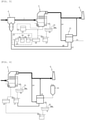
- FIG. 2 , 3 , 4 or 5 shows an example of a device for purifying the combustion exhaust gas of the present invention respectively.
- combustion ash (fly ash) is collected by the electrostatic precipitator 4, is supplied by the combustion ash supply device such as a belt conveyor and a screw feeder to the industrial water supplied through the industrial water supply pipe 13, and is suspended to obtain a water slurry, and carbon dioxide is removed by passing a part of the gas that has passed through the wet flue gas desulfurization apparatus 5 through the carbon dioxide removal device 11 equipped with the water slurry, and the CO 2 -removed gas is released to the atmosphere through the chimney 6.
- the combustion ash supply device such as a belt conveyor and a screw feeder
- the combustion exhaust gas purification treatment device shown in FIG. 3 is the same as the device shown in FIG. 2 except that the gypsum dehydration filtrate supplied through the gypsum dehydration filtrate supply pipe 20 is used instead of the industrial water.
- the gypsum dehydration filtrate is a liquid obtained by removing gypsum using filtration or the like from the gypsum-containing water slurry obtained by contact between the gas containing sulfur oxide and the water slurry containing limestone, quicklime or slaked lime in the gas absorption device of the wet flue gas desulfurization apparatus. This liquid is obtained as a water slurry or an aqueous solution containing calcium.
- the combustion exhaust gas purification treatment device shown in FIG. 4 is the same as the device shown in FIG. 3 except that the biomass ash supplied via the biomass ash supply device 21 is used in the preparation of the water slurry containing combustion ash.
- This biomass ash may be obtained by a device for burning biomass fuel at another location and and be transported.
- the combustion exhaust gas purification treatment device shown in FIG. 5 is the same as the device shown in FIG. 4 except that water obtained by clarifying the gypsum dehydration filtrate in the water treatment facility 22 is used for preparing a water slurry containing combustion ash.
- the water treatment facility comprises a pH adjusting tank configured for adding an alkaline agent and for stirring, a coagulation tank configured for adding a coagulant to generate flocs, and a sedimentation tank 25 configured for precipitating the flocs.
- a device for neutralizing combustion ash of the present invention comprises a wet flue desulfurization apparatus 5, a combustion ash carbonic acid-treatment apparatus 10, a carbonic acid-treated ash separation device 9, and a duct 14 configured to guide a gas containing carbon dioxide discharged from the wet flue gas desulfurization apparatus to the combustion ash carbonic acid-treatment apparatus.
- the combustion ash carbonic acid-treatment apparatus facilitates that a gas containing carbon dioxide is brought into contact with the water slurry containing combustion ash obtained by a device for preparing a water slurry containing combustion ash, and the water slurry containing combustion ash is converted into a slurry containing carbonic acid-treated ash.
- a bubble column, a bubble tank, a bubble cap tower or the like can be used for contact between the water slurry containing combustion ash and the gas containing carbon dioxide.
- the carbonic acid-treated ash separation device facilitates separation and removal of solids from the water slurry containing the carbonic acid-treated ash.
- the wet flue gas desulfurization apparatus preferably comprises a gas absorption device configured to bring the combustion exhaust gas into contact with a water slurry containing limestone, slaked lime or quick lime.
- the carbonic acid-treated ash separation device preferably further comprises a pipe configured to transport the liquid obtained by separating solids from a water slurry containing carbonic acid-treated ash for use in the preparation of a water slurry containing limestone, slaked lime or quicklime, for use in the preparation of a water slurry containing combustion ash or for adding to a water slurry or aqueous solution containing calcium discharged from the wet flue gas desulfurization apparatus.
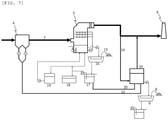
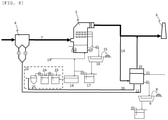
- FIG. 6 , 7 or 8 shows an example of a device for neutralizing the combustion ash of the present invention respectively.
- biomass ash obtained by a device for burning biomass fuel is transported and stored in the hopper 21a, the stored ash is suspended in a gypsum dehydration filtrate to prepare a water slurry, the biomass ash can be neutralized by passing the gas that has passed through the wet flue gas desulfurization apparatus 5 through the water slurry.
- the carbonic acid-treated ash 8 is extracted from the neutralized water slurry by the carbonic acid-treated ash separation device 9. Since carbonic acid-treated ash has low basicity, it can be used as an auxiliary material in the production of cement and the like.
- the liquid separated by the carbonic acid-treated ash separation device 9 can be returned to the desulfurization drainage tank 18 so as to be used for wet flue gas desulfurization or combustion ash carbonic acid-treatment.
- the combustion ash neutralization treatment device shown in FIG. 7 is the same as the device shown in FIG. 6 except that the combustion ash recovered by the electrostatic precipitator 4 is used instead of the biomass ash.
- the combustion ash neutralization treatment device shown in FIG. 8 is the same as the device shown in FIG. 7 except that water obtained by clarifying the gypsum dehydration filtrate in the water treatment facility 22 is used for preparing a water slurry containing combustion ash, and biomass ash is replenished by the biomass ash supply device 21 for water slurry preparation.
- Alkalinity was measured by neutralization titration.
- a water slurry was obtained by suspending 10 parts by mass of coal ash having a pH of 10.84, an alkalinity of 4.3 mol / kg and a Ca concentration of 2.5 mol / kg in 90 parts by mass of a gypsum dehydration filtrate having a chlorine concentration of 10 g / L.
- 400 g of the water slurry was put and stirred while the temperature was adjusted to 20 to 25 °C.
- a mixed gas of 15 parts by volume of carbon dioxide and 85 parts by volume of air was insufflated into the water slurry at 2.0 L / min through an air stone to perform carbonic acid-treatment.
- the water slurry was sampled at predetermined time intervals, the sampled slurry was filtered, dried at 40 °C for 2 hours to obtain a solid, and the concentration of carbonic acid component contained in the solid was measured. When there was no change in the concentration of carbonic acid component contained in the solid, the insufflating of carbon dioxide was stopped.
- the carbonic acid-treated water slurry had a pH of 6.7, and the carbon dioxide immobilized amount was 7 kg-CO 2 / t-ash.
- Carbonic acid-treatment was carried out in the same manner as in Example 1 except that the gypsum dehydration filtrate was changed to industrial water.
- the carbonic acid-treated water slurry had a pH of 7.3, and the carbon dioxide-immobilized amount was 5.9 kg-CO 2 / t-ash.
- Carbonic acid-treatment was carried out in the same manner as in Example 2 except that 10 parts by mass of the coal ash was changed to a mixed ash consisting of 8 parts by mass of coal ash having a pH of 10.84, an alkalinity of 4.3 mol / kg and a Ca concentration of 2.5 mol / kg and 2 parts by mass of old gumwood combustion ash having a pH of 11.74, an alkalinity of 10.0 mol / kg and a Ca concentration of 5.2 mol / kg.
- the carbonic acid-treated water slurry had a pH of 9.2, and the carbon dioxide-immobilized amount was 37.9 kg-CO 2 / t-ash.
- Carbonic acid-treatment was carried out in the same manner as in Example 2 except that the coal ash was changed to a combustion ash having a pH of 9.45, an alkalinity of 0.21 mol / kg and a Ca concentration of 0.15 mol / kg.
- the carbonic acid-treated water slurry had a pH of 6.4, and the carbon dioxide-immobilized amount was 0.2 kg-CO 2 / t-ash.
- Carbonic acid-treatment was carried out in the same manner as in Example 2 except that the coal ash was changed to an old gumwood combustion ash having a pH of 11.74, an alkalinity of 10.0 mol / kg and a Ca concentration of 5.2 mol / kg.
- the carbonic acid-treated water slurry had a pH of 8.1, and the carbon dioxide-immobilized amount was 155.7 kg-CO 2 / t-ash.
- Carbonic acid-treatment was carried out in the same manner as in Example 1 except that the coal ash was changed to an old gumwood combustion ash having a pH of 11.74, an alkalinity of 10.0 mol / kg and a Ca concentration of 5.2 mol / kg.
- the water slurry before the carbonic acid-treatment was sampled, the sampled slurry was filtered and dried at 40 °C for 2 hours.
- the obtained combustion ash had a Na ion concentration of 2.8 g / kg and a K ion concentration of 181 g / kg.
- the amount of alkali metal that causes the alkali-silica reaction which reduces the durability of concrete had been significantly reduced.
- the carbonic acid-treated water slurry had a pH of 7.9, and the carbon dioxide-immobilized amount was 193.8 kg-CO 2 / t-ash.
Landscapes
- Engineering & Computer Science (AREA)
- Chemical & Material Sciences (AREA)
- Environmental & Geological Engineering (AREA)
- General Chemical & Material Sciences (AREA)
- Analytical Chemistry (AREA)
- Oil, Petroleum & Natural Gas (AREA)
- Chemical Kinetics & Catalysis (AREA)
- Biomedical Technology (AREA)
- Health & Medical Sciences (AREA)
- Mechanical Engineering (AREA)
- General Engineering & Computer Science (AREA)
- Treating Waste Gases (AREA)
- Gas Separation By Absorption (AREA)
Abstract
Description
- The present invention relates to a device and a method relating to a gas purification treatment for removing carbon dioxide and the other contained in combustion exhaust gas and / or a combustion ash neutralization treatment for utilization or disposal of combustion ash.
- In recent years, with the economic development of developing countries, the influence of global human activities has increased, and there is growing concern that it may lead to global environmental changes such as global warming. Under such circumstances, it is required to reduce carbon dioxide emissions, which is considered to be one of the causes of global warming. On the other hand, since ash produced when burning biomass, coal, etc. is strongly basic, it is required to dispose of it safely.
-
Patent Document 1 discloses a wastewater treatment method for a limestone-gypsum wet flue gas desulfurization apparatus -, characterized in that the wastewater is not discharged from the flue gas desulfurization system, by concentrating the wastewater from the wet limestone-gypsum flue gas desulfurization apparatus applied to the treatment of combustion exhaust gas, returning the recovered water to the flue gas desulfurization apparatus, and adding coal ash to the concentrated water to form a slurry, and then the water in the slurry is evaporated to generate a descent containing the hydration reaction product of the dissolved component in the wastewater and coal ash. -
Patent Document 2 discloses a wet flue gas desulfurization method comprising guiding combustion exhaust gas to an absorption tower and absorbing and removing sulfur oxides in the exhaust gas by an absorbent slurry, characterized in that a part of the absorbent slurry is extracted from the absorption tower, coal ash and slaked lime are added and mixed thereto, and then the mixture is heated to obtain a non-polluting solid substance. -
Patent Document 3 discloses a method for simultaneous dust removal and desulfurization comprising absorbing and removing sulfur oxides in combustion exhaust gas with a desulfurizing agent containing an alkaline substance, characterized in that exhaust gas containing coal combustion ash is cooled to not more than 40 °C to obtain a condensed water, coal combustion ash is mixed in the condensed water, and sulfur oxides in the exhaust gas is separated and removed using a desulfurization absorbent produced by adding a desulfurizing agent to the slurry composed of the coal combustion ash and the condensed water. -
Patent Document 4 discloses a method for solidifying coal ash from desulfurized wastewater, in a desulfurization wastewater treatment method comprising discharging desulfurization wastewater to the outside of the system from the absorption tower of the wet limestone - gypsum desulfurization equipment installed in the exhaust gas line, characterized in that the chlorine ion concentration in the absorption liquid circulating in the absorption tower is detected, and the chlorine ion concentration in the absorption liquid is concentrated to a predetermined concentration by adjusting the amount of the absorption liquid extracted from the absorption tower and the amount of make-up water from outside the system, the absorption liquid that is extracted from the inside of the absorption tower to the outside of the system is sent to the Gypsum recovery device, and the remaining absorption liquid that separates and recovers the Gypsum is sent to the concentration tower installed in the exhaust gas line, and chlorine ion concentration in a circulated water in the concentration tower is concentrated by contacting with the combustion exhaust gas, at least one substance of coal ash, lime and cement is added to the liquid extracted from the concentration tower, and the resultant is dried. -
Patent Document 5 discloses a absorption and immobilization method of carbon dioxide, characterized in that the combustion exhaust gas is brought into gas-liquid contact with a coal ash water slurry or a coal ash water eluate so that carbon dioxide in the combustion exhaust gas is reacted and absorbed to be immobilized as a carbonate. -
Patent Document 6 discloses a method for immobilizing carbon dioxide, characterized in that at least one of fuel, waste, and biomass containing ash elements is put into a combustion furnace and burned, a sensible heat of the combustion exhaust gas is recovered, the combustion exhaust gas after the heat recovery is delivered to a CO2 immobilization reactor, combustion ash from the combustion furnace is delivered to a CO2 immobilization reactor, the combustion exhaust gas and the combustion ash are brought into contact with each other in the CO2 immobilization reactor, and the carbon dioxide in the combustion exhaust gas is carbonized by the metal oxide contained in the combustion ash to be immobilized as a carbonate, and the reaction heat generated during the carbonization is recovered and the recovered heat is used for power generation. -
Patent Document 7 discloses a biomass co-firing boiler system, comprising a vertical coal crusher for crushing coal, a vertical biomass crusher for crushing solid fuel containing biomass, a boiler for burning the crushed coal and the crushed solid fuel, and a dust collector for removing ash in the combustion exhaust gas discharged from the boiler, characterized in that an exhaust gas input line is provided to take out a part of the combustion exhaust gas discharged from the dust collector and to lead it to the vertical biomass crusher, a slurry manufacturing apparatus for producing a desulfurized slurry containing coal ash collected by the dust collector and an alkaline salt as a desulfurized portion is provided and a slurry supply line that guides the desulfurization slurry to the vertical crusher for biomass is provided. -
- [Patent Document 1]
JP H03-8411 A - [Patent Document 2]
JP H04-141216 A - [Patent Document 3]
JP H06-126127 A - [Patent Document 4]
JP H09-29058 A - [Patent Document 5]
JP 2004-261658 A - [Patent Document 6]
JP H11-192416 A - [Patent Document 7]
JP 2012-137250 A - An object of the present invention is to provide a device and a method relating to a combustion exhaust gas purification treatment for removing carbon dioxide and the like contained in a combustion exhaust gas and / or a combustion ash neutralization treatment for utilization or disposal of combustion ash.
- In order to solve the above problems, the present invention including the following embodiments has been completed.
- [1] A method for purifying combustion exhaust gas, which comprises passing the combustion exhaust gas through a wet flue gas desulfurization apparatus configured to remove sulfur oxides from the combustion exhaust gas to obtain a gas containing carbon dioxide, and bringing the obtained gas containing carbon dioxide into contact with a water slurry containing combustion ash to remove carbon dioxide from the gas containing carbon dioxide.
- [2] The method for purifying combustion exhaust gas according to [1], wherein the water slurry containing combustion ash is one obtained by adding and suspending the combustion ash to a water slurry or an aqueous solution containing calcium discharged from the wet flue gas desulfurization apparatus.
- [3] The method for purifying combustion exhaust gas according to [1] or [2], wherein the combustion ash is coal ash, biomass ash, or a mixture of coal ash and biomass ash.
- [4] The method for purifying combustion exhaust gas according to any one of [1] to [3], wherein the wet flue gas desulfurization apparatus comprises a gas absorption device configured to bring the combustion exhaust gas into contact with a water slurry containing limestone, slaked lime or quick lime.
- [5] The method for purifying combustion exhaust gas according to [4], wherein the wet flue gas desulfurization apparatus further comprises a device for separating and removing gypsum.
- [6] A method for neutralizing combustion ash, which comprises
- suspending combustion ash in water, a water slurry containing calcium or an aqueous solution containing calcium to obtain a water slurry containing combustion ash,
- bringing the water slurry containing combustion ash into contact with a gas containing carbon dioxide discharged from a wet flue gas desulfurization apparatus to obtain a water slurry containing carbonic acid-treated ash, and
- separating and removing solids from the water slurry containing carbonic acid-treated ash.
- [7] The method for neutralizing combustion ash according to [6], wherein the combustion ash comprises biomass ash.
- [8] The method for neutralizing combustion ash according to [6] or [7], wherein the wet flue gas desulfurization apparatus comprises a gas absorption device configured to bring the combustion exhaust gas into contact with a water slurry containing limestone, slaked lime or quick lime.
- [9] The method for neutralizing combustion ash according to [8], further comprising adding a liquid obtained by separating the solids from the water slurry containing carbonic acid-treated ash to a water slurry or an aqueous solution containing calcium discharged from the wet flue gas desulfurization apparatus.
- [10] A device for purifying combustion exhaust gas, comprising
- a furnace,
- a wet flue gas desulfurization apparatus,
- a carbon dioxide removal apparatus,
- a duct configured to guide a combustion exhaust gas discharged from the furnace to the wet flue gas desulfurization apparatus, and
- a duct configured to guide a gas containing carbon dioxide discharged from the wet flue gas desulfurization apparatus to the carbon dioxide removal apparatus;
- wherein the carbon dioxide removal apparatus comprises a water slurry containing combustion ash, and is configured to bring the gas containing the carbon dioxide into contact with the water slurry containing combustion ash to facilitate a removing carbon dioxide from the gas containing the carbon dioxide.
- [11] The device for purifying combustion exhaust gas according to [10], further comprising an apparatus for adding and suspending combustion ash to a water slurry containing calcium or an aqueous solution containing calcium discharged from the wet flue gas desulfurization apparatus to obtain the water slurry containing combustion ash.
- [12] The device for purifying combustion exhaust gas according to [10] or [11], wherein the combustion ash is coal ash, biomass ash, or a mixture of coal ash and biomass ash.
- [13] The device for purifying combustion exhaust gas according to any one of [10] to [12], wherein the wet flue gas desulfurization apparatus comprises a gas absorption device configured to bring the combustion exhaust gas into contact with a water slurry containing limestone, slaked lime or quick lime.
- [14] The device for purifying combustion exhaust gas according to [13], wherein the wet flue gas desulfurization apparatus further comprises a device for separating and removing gypsum.
- [15] A device for neutralizing combustion ash, comprising
- a wet flue desulfurization apparatus,
- a combustion ash carbonic acid-treatment apparatus, a carbonic acid-treated ash separation device, and a duct configured to guide a gas containing carbon dioxide discharged from the wet flue gas
- desulfurization apparatus to the combustion ash carbonic acid-treatment apparatus,
- wherein the combustion ash carbonic acid-treatment apparatus comprises a device for preparing a water slurry containing combustion ash, and is configured to bring a gas containing carbon dioxide into
- contact with the water slurry containing combustion ash obtained by the preparation device to facilitate a converting the water slurry containing combustion ash into a water slurry containing carbonic acid-treated ash, and carbonic acid-treated ash
- separation device is configured to facilitate a separating and removing solids from the water slurry containing carbonic acid-treated ash.
- [16] The device for neutralizing the combustion ash according to [15], wherein the combustion ash contains biomass ash.
- [17] The device for neutralizing combustion ash according to [15] or [16], wherein the wet flue gas desulfurization apparatus comprises a gas absorption device configured to bring combustion exhaust gas into contact with a water slurry containing limestone, slaked lime or quick lime.
- [18] The device for neutralizing combustion ash according to [17], further comprising a pipe for adding a liquid obtained by separating the solids from the water slurry containing carbonic acid-treated ash to a water slurry or an aqueous solution containing calcium discharged from the wet flue gas desulfurization apparatus.
- According to the combustion exhaust gas purification treatment method and device of the present invention, carbon dioxide can be efficiently removed using combustion ash by-produced by combustion of coal or biomass fuel, and, if necessary, a water slurry or an aqueous solution containing calcium produced as a by-product in removing sulfur oxides contained in the combustion exhaust gas.
- According to the combustion ash neutralization treatment method and device of the present invention, a basic combustion ash can be efficiently neutralized using a gas containing carbon dioxide obtained by removing sulfur oxides contained in combustion exhaust gas and a water slurry or an aqueous solution containing calcium produced as a by-product in removing sulfur oxides contained in the combustion exhaust gas.
-
-
FIG. 1 is a diagram showing an example of a boiler system. -
FIG. 2 is a diagram showing an example of a device for purifying the combustion exhaust gas of the present invention. -
FIG. 3 is a diagram showing another example of a device for purifying the combustion exhaust gas of the present invention. -
FIG. 4 is a diagram showing another example of a device for purifying the combustion exhaust gas of the present invention. -
FIG. 5 is a diagram showing another example of a device for purifying the combustion exhaust gas of the present invention. -
FIG. 6 is a diagram showing an example of a device for neutralizing the combustion ash of the present invention. -
FIG. 7 is a diagram showing another example of a device for neutralizing the combustion ash of the present invention. -
FIG. 8 is a diagram showing another example of a device for neutralizing the combustion ash of the present invention. - The combustion exhaust gas purification treatment method of the present invention comprises removing sulfur oxides (flue gas desulfurization) from the combustion exhaust gas, and then removing carbon dioxide (flue gas decarboxylation).
- Combustion exhaust gas is a gas emitted when fossil fuels such as coal, liquefied natural gas, and oil; biomass fuels such as wood chips, straw, wood waste, animal manure, and kitchen waste; and a mixture of fossil fuels and biomass fuels are burned. Such combustion exhaust gas contains acidic substances that are considered to affect the environment, such as nitrogen oxides, sulfur oxides, and carbon dioxide. In particular, the present invention preferably targets the gas discharged by combustion in a furnace installed in a boiler or the like. Combustion ash (clinker ash) can be obtained from the bottom of the furnace. Also, combustion ash (fly ash) can be obtained from the bottom of the economizer or air preheater.
- The combustion exhaust gas purification treatment method of the present invention preferably further comprises removing nitrogen oxides from the combustion exhaust gas, that is, flue gas denitration.
- The flue gas denitration can be performed, for example, by bringing the combustion exhaust gas into contact with a denitration catalyst in the presence of a reducing agent such as ammonia. The denitration catalyst to be used is not particularly limited, and examples thereof can include a titanium oxide-based denitration catalyst, a zeolite-based denitration catalyst, and a mixed denitration catalyst thereof. The flue gas denitration is preferably performed before flue gas dust collection and flue gas desulfurization described later.
- The combustion exhaust gas purification treatment method of the present invention preferably further comprises removing combustion ash from the combustion exhaust gas, that is, flue gas dust collection.
- Flue gas dust collection can be performed, for example, by passing combustion exhaust gas through a dust collector such as a cyclone separator, an electrostatic precipitator, or a bag filter. Combustion ash (fly ash) can be removed from the combustion exhaust gas by flue gas dust collection. Combustion ash (fly ash) can be collected as appropriate and used to remove carbon dioxide, which will be described later.
- Flue gas desulfurization is performed by passing the combustion exhaust gas through the wet flue
gas desulfurization apparatus 5. As typical methods of the wet flue gas desulfurization, mentioned can be a lime-gypsum method, a magnesium hydroxide method, and a soda method. The wet flue gas desulfurization apparatus used in the present invention preferably comprises a gas absorption device configured to bring combustion exhaust gas into contact with a water slurry containing limestone (CaCO3), slaked lime (Ca(OH)2) or quicklime (CaO). In this gas absorption device, the sulfur oxides in the combustion exhaust gas is reacted with limestone, slaked lime or quicklime in the water slurry to obtain calcium sulfite, which is oxidized to obtain calcium sulfate (Gypsum). Using a device for separating and removing gypsum, gypsum is removed from the gypsum slurry (a water slurry containing calcium) discharged from the gas absorption device. Separating and removing of the gypsum gives a gypsum dehydration colature (an aqueous solution containing calcium). On the other hand, gas containing carbon dioxide is discharged from the wet flue gas desulfurization apparatus. - The flue gas decarboxylation is carried out by bringing the carbon dioxide-containing gas obtained by the above-mentioned wet flue gas desulfurization into contact with a water slurry containing combustion ash. Combustion ash may be bottom ash obtained from the bottom of a furnace, fly ash obtained from the bottom of an economizer or air preheater, or fly ash obtained from flue gas dust collection, or combustion ash obtained from other incinerators, thermal power plants, factories. Of these, fly ash is preferably used from the viewpoint of ease of preparation of water slurry. The combustion ash is preferably coal ash, biomass ash, or a mixture of coal ash and biomass ash. The amount of combustion ash contained in the water slurry is not particularly limited, but is preferably 3 to 30% by mass, and more preferably 5 to 15% by mass.
- The water used for preparing the water slurry containing combustion ash is not particularly limited, and examples thereof can include industrial water; river, pond or lake water, sea water; calcium-containing water slurry or calcium-containing aqueous solution. The water used for preparing the water slurry containing combustion ash is preferably hard water or a water slurry containing calcium or aqueous solution containing calcium from the viewpoint of carbon dioxide absorption capacity, and is preferably a water slurry containing calcium or an aqueous solution containing calcium discharged from a wet flue gas desulfurization apparatus (for example, a gypsum dehydration colature) from the viewpoint of carbon dioxide absorption capacity and operating cost.
- The contact between the gas containing carbon dioxide and the water slurry containing combustion ash can be conducted, for example, by insufflating the gas into the water slurry at a bubble column, a bubble tank, a bubble cap tower, etc., by flowing the water slurry and the gas respectively through a packed column, a wet wall tower, etc., or by flowing the gas and spraying the water slurry in a spray tower or the like. The temperature during the contact is preferably low, preferably 10 to 80 °C, more preferably 30 to 60 °C, from the viewpoint of easiness of dissolving carbon dioxide.
- Since the gas from which carbon dioxide has been removed may entrain droplets, it is preferable to pass it through a demister or the like as necessary. Then, it can be discharged to the atmosphere from the chimney.
- A method for neutralizing combustion ash comprises suspending combustion ash in water, a water slurry containing calcium or an aqueous solution containing calcium to obtain a water slurry containing combustion ash, bringing the water slurry containing combustion ash into contact with a gas containing carbon dioxide to obtain a water slurry containing carbonic acid-treated ash, and separating and removing solids from the water slurry containing carbonic acid-treated ash.
- The water used in the combustion ash neutralization treatment method of the present invention may be either hard water or soft water, but hard water is preferable. Further, the calcium-containing water slurry or calcium-containing aqueous solution used in the combustion ash neutralization treatment method of the present invention is preferably discharged from a wet flue gas desulfurization apparatus (for example, gypsum dehydration filtrate or the like). The wet flue gas desulfurization apparatus preferably comprises a gas absorption device configured to bring the combustion exhaust gas into contact with a water slurry containing limestone, slaked lime or quick lime.
- The combustion ash to which the combustion ash neutralization treatment method of the present invention can be applied is not particularly limited, but those containing biomass ash are preferable. Biomass ash has a higher basicity than coal ash and is unsuitable for reuse in cement and the like, and may increase the processing cost. By the combustion ash neutralization treatment method of the present invention, combustion ash can be neutralized at low cost and can be made into a material suitable for reuse. The biomass ash may be either bottom ash or fly ash. Further, the combustion ash may be a mixture of biomass ash and coal ash. The amount of combustion ash that can be contained in the water slurry is preferably 3 to 30% by mass, more preferably 5 to 15% by mass.
- Neutralization is performed by contacting a water slurry containing combustion ash with a gas containing carbon dioxide. The gas containing carbon dioxide is preferably the gas discharged from the wet flue gas desulfurization apparatus. Contact between the water slurry containing combustion ash and the gas containing carbon dioxide can be performed in a bubble column, a bubble tank, a bubble cap tower, or the like. The temperature at the time of neutralization is not particularly limited, but preferably low, specifically, preferably 10 to 80 °C, and more preferably 30 to 60 °C. By this neutralization, a water slurry containing carbonic acid-treated ash can be obtained.
- The solids are separated and taken out from the obtained water slurry containing the carbonic acid-treated ash. The solids can be separated by an ordinary solid-liquid separation operation. The extracted solids (mainly composed of carbonic acid-treated ash) has a pH of around 7, and can be reused for cement or the like.
- The liquid obtained by separating the solids from the water slurry containing carbonic acid-treated ash can be used for preparing a water slurry containing limestone, slaked lime or quicklime used in a wet flue gas desulfurization apparatus, or for preparing a water slurry containing combustion ash. Or, it can be added to calcium-containing water slurries or calcium-containing aqueous solutions (eg, flue gas desulfurization wastewater) discharged from wet flue gas desulfurization apparatus.
- A device for purifying combustion exhaust gas of the present invention, comprises a
furnace 1, a wet fluegas desulfurization apparatus 5, a carbondioxide removal apparatus 11, aduct 7 configured to guide a combustion exhaust gas discharged from the furnace to the wet flue gas desulfurization apparatus, and aduct 14 configured to guide a gas containing carbon dioxide discharged from the wet flue gas desulfurization apparatus to the carbon dioxide removal apparatus. It is preferable that the fluegas denitration device 2 and / or thedust collector 4 is installed in theduct 7 configured to guide the combustion exhaust gas discharged from the furnace to the wet flue gas desulfurization apparatus. - Carbon
dioxide removal apparatus 11 comprises a water slurry containing combustion ash, and is configured to bring a gas containing the carbon dioxide into contact with the water slurry containing combustion ash to facilitate a removing carbon dioxide from the gas containing the carbon dioxide. As the carbon dioxide removal apparatus, a bubble column, a bubble tank, a bubble cap tower, or the like can be used. The device for purifying the combustion exhaust gas of the present invention preferably further comprises an apparatus for adding and suspending combustion ash to a water slurry containing calcium or an aqueous solution containing calcium (eg. gypsum dehydration colature) discharged from the wet flue gas desulfurization apparatus to obtain a water slurry containing combustion ash. - The wet flue
gas desulfurization apparatus 5 preferably comprises a gas absorption device configured to bring the combustion exhaust gas into contact with a water slurry containing limestone, slaked lime or quick lime, and preferably further comprises a device for separating and removing gypsum. The gas absorption device can be a packed column, a wet wall tower, a spray tower, or the like. The device for separating and removing gypsum can be a known water treatment device. In the water treatment device, flocculation, coagulation, dehydration and the like are performed. -
FIG. 2 ,3 ,4 or5 shows an example of a device for purifying the combustion exhaust gas of the present invention respectively. - In the combustion exhaust gas purification treatment device shown in
FIG. 2 , combustion ash (fly ash) is collected by theelectrostatic precipitator 4, is supplied by the combustion ash supply device such as a belt conveyor and a screw feeder to the industrial water supplied through the industrialwater supply pipe 13, and is suspended to obtain a water slurry, and carbon dioxide is removed by passing a part of the gas that has passed through the wet fluegas desulfurization apparatus 5 through the carbondioxide removal device 11 equipped with the water slurry, and the CO2-removed gas is released to the atmosphere through thechimney 6. - The combustion exhaust gas purification treatment device shown in
FIG. 3 is the same as the device shown inFIG. 2 except that the gypsum dehydration filtrate supplied through the gypsum dehydrationfiltrate supply pipe 20 is used instead of the industrial water. The gypsum dehydration filtrate is a liquid obtained by removing gypsum using filtration or the like from the gypsum-containing water slurry obtained by contact between the gas containing sulfur oxide and the water slurry containing limestone, quicklime or slaked lime in the gas absorption device of the wet flue gas desulfurization apparatus. This liquid is obtained as a water slurry or an aqueous solution containing calcium. - The combustion exhaust gas purification treatment device shown in
FIG. 4 is the same as the device shown inFIG. 3 except that the biomass ash supplied via the biomassash supply device 21 is used in the preparation of the water slurry containing combustion ash. This biomass ash may be obtained by a device for burning biomass fuel at another location and and be transported. - The combustion exhaust gas purification treatment device shown in
FIG. 5 is the same as the device shown inFIG. 4 except that water obtained by clarifying the gypsum dehydration filtrate in thewater treatment facility 22 is used for preparing a water slurry containing combustion ash. The water treatment facility comprises a pH adjusting tank configured for adding an alkaline agent and for stirring, a coagulation tank configured for adding a coagulant to generate flocs, and asedimentation tank 25 configured for precipitating the flocs. - A device for neutralizing combustion ash of the present invention comprises a wet
flue desulfurization apparatus 5, a combustion ash carbonic acid-treatment apparatus 10, a carbonic acid-treatedash separation device 9, and aduct 14 configured to guide a gas containing carbon dioxide discharged from the wet flue gas desulfurization apparatus to the combustion ash carbonic acid-treatment apparatus. - The combustion ash carbonic acid-treatment apparatus facilitates that a gas containing carbon dioxide is brought into contact with the water slurry containing combustion ash obtained by a device for preparing a water slurry containing combustion ash, and the water slurry containing combustion ash is converted into a slurry containing carbonic acid-treated ash. In the combustion ash carbonic acid-treatment apparatus, a bubble column, a bubble tank, a bubble cap tower or the like can be used for contact between the water slurry containing combustion ash and the gas containing carbon dioxide.
- The carbonic acid-treated ash separation device facilitates separation and removal of solids from the water slurry containing the carbonic acid-treated ash. The wet flue gas desulfurization apparatus preferably comprises a gas absorption device configured to bring the combustion exhaust gas into contact with a water slurry containing limestone, slaked lime or quick lime. The carbonic acid-treated ash separation device preferably further comprises a pipe configured to transport the liquid obtained by separating solids from a water slurry containing carbonic acid-treated ash for use in the preparation of a water slurry containing limestone, slaked lime or quicklime, for use in the preparation of a water slurry containing combustion ash or for adding to a water slurry or aqueous solution containing calcium discharged from the wet flue gas desulfurization apparatus.
-
FIG. 6 ,7 or8 shows an example of a device for neutralizing the combustion ash of the present invention respectively. - In the combustion ash neutralization treatment device shown in
FIG. 6 , biomass ash obtained by a device for burning biomass fuel is transported and stored in thehopper 21a, the stored ash is suspended in a gypsum dehydration filtrate to prepare a water slurry, the biomass ash can be neutralized by passing the gas that has passed through the wet fluegas desulfurization apparatus 5 through the water slurry. - The carbonic acid-treated ash 8 is extracted from the neutralized water slurry by the carbonic acid-treated
ash separation device 9. Since carbonic acid-treated ash has low basicity, it can be used as an auxiliary material in the production of cement and the like. The liquid separated by the carbonic acid-treatedash separation device 9 can be returned to thedesulfurization drainage tank 18 so as to be used for wet flue gas desulfurization or combustion ash carbonic acid-treatment. - The combustion ash neutralization treatment device shown in
FIG. 7 is the same as the device shown inFIG. 6 except that the combustion ash recovered by theelectrostatic precipitator 4 is used instead of the biomass ash. - The combustion ash neutralization treatment device shown in
FIG. 8 is the same as the device shown inFIG. 7 except that water obtained by clarifying the gypsum dehydration filtrate in thewater treatment facility 22 is used for preparing a water slurry containing combustion ash, and biomass ash is replenished by the biomassash supply device 21 for water slurry preparation. - The effects of the device and method of the present invention are shown below by way of examples.
- In 100 ml of pure water, 0.1 g of combustion ash was suspended and the resultant suspension was boiled. The suspension was cooled to room temperature and the pH of the suspension was measured.
- Alkalinity was measured by neutralization titration.
- Calcium concentration was measured by chelatometric titration.
- A water slurry was obtained by suspending 10 parts by mass of coal ash having a pH of 10.84, an alkalinity of 4.3 mol / kg and a Ca concentration of 2.5 mol / kg in 90 parts by mass of a gypsum dehydration filtrate having a chlorine concentration of 10 g / L. In a reactor, 400 g of the water slurry was put and stirred while the temperature was adjusted to 20 to 25 °C. A mixed gas of 15 parts by volume of carbon dioxide and 85 parts by volume of air was insufflated into the water slurry at 2.0 L / min through an air stone to perform carbonic acid-treatment. The water slurry was sampled at predetermined time intervals, the sampled slurry was filtered, dried at 40 °C for 2 hours to obtain a solid, and the concentration of carbonic acid component contained in the solid was measured. When there was no change in the concentration of carbonic acid component contained in the solid, the insufflating of carbon dioxide was stopped. The carbonic acid-treated water slurry had a pH of 6.7, and the carbon dioxide immobilized amount was 7 kg-CO2 / t-ash.
- Carbonic acid-treatment was carried out in the same manner as in Example 1 except that the gypsum dehydration filtrate was changed to industrial water. The carbonic acid-treated water slurry had a pH of 7.3, and the carbon dioxide-immobilized amount was 5.9 kg-CO2 / t-ash.
- Carbonic acid-treatment was carried out in the same manner as in Example 2 except that 10 parts by mass of the coal ash was changed to a mixed ash consisting of 8 parts by mass of coal ash having a pH of 10.84, an alkalinity of 4.3 mol / kg and a Ca concentration of 2.5 mol / kg and 2 parts by mass of old gumwood combustion ash having a pH of 11.74, an alkalinity of 10.0 mol / kg and a Ca concentration of 5.2 mol / kg. The carbonic acid-treated water slurry had a pH of 9.2, and the carbon dioxide-immobilized amount was 37.9 kg-CO2 / t-ash.
- Carbonic acid-treatment was carried out in the same manner as in Example 2 except that the coal ash was changed to a combustion ash having a pH of 9.45, an alkalinity of 0.21 mol / kg and a Ca concentration of 0.15 mol / kg. The carbonic acid-treated water slurry had a pH of 6.4, and the carbon dioxide-immobilized amount was 0.2 kg-CO2 / t-ash.
- Carbonic acid-treatment was carried out in the same manner as in Example 2 except that the coal ash was changed to an old gumwood combustion ash having a pH of 11.74, an alkalinity of 10.0 mol / kg and a Ca concentration of 5.2 mol / kg. The carbonic acid-treated water slurry had a pH of 8.1, and the carbon dioxide-immobilized amount was 155.7 kg-CO2 / t-ash.
- Carbonic acid-treatment was carried out in the same manner as in Example 1 except that the coal ash was changed to an old gumwood combustion ash having a pH of 11.74, an alkalinity of 10.0 mol / kg and a Ca concentration of 5.2 mol / kg. The water slurry before the carbonic acid-treatment was sampled, the sampled slurry was filtered and dried at 40 °C for 2 hours. The obtained combustion ash had a Na ion concentration of 2.8 g / kg and a K ion concentration of 181 g / kg. The amount of alkali metal that causes the alkali-silica reaction which reduces the durability of concrete had been significantly reduced. The carbonic acid-treated water slurry had a pH of 7.9, and the carbon dioxide-immobilized amount was 193.8 kg-CO2 / t-ash.
-
- 1:
- Furnace
- 2:
- Flue denitration device
- 3:
- Air preheater
- 4:
- Electrostatic precipitator
- 5:
- Wet flue gas desulfurization apparatus
- 6:
- Chimney
- 7:
- Duct
- 8:
- Carbonic acid-treated ash
- 9:
- Carbonic acid-treated ash separation device
- 10:
- Combustion ash carbonic acid-treatment apparatus
- 11:
- Carbon dioxide removal device
- 12:
- Combustion ash supply device
- 13:
- Industrial water supply pipe
- 14:
- CO2-containing gas induction duct
- 15:
- Gypsum
- 16:
- Gypsum separation device (dehydrator)
- 17:
- Gypsum dehydration filtrate tank
- 18:
- Desulfurization drainage tank
- 19:
- Limestone slurry preparation tank
- 20:
- Gypsum dehydration colature supply pipe
- 21:
- Biomass ash supply device
- 21a:
- Biomass ash hopper
- 22:
- Water treatment facility
- 23:
- Alkaline agent Feed
- 24:
- Coagulant Feed
- 25:
- Sedimentation tank
- 26:
- Water treated drainage supply pipe
Claims (18)
- A method for purifying combustion exhaust gas, which comprises
passing the combustion exhaust gas through a wet flue gas desulfurization apparatus configured to remove sulfur oxides from the combustion exhaust gas to obtain a gas containing carbon dioxide, and bringing the obtained gas containing carbon dioxide into contact with a water slurry containing combustion ash to remove carbon dioxide from the gas containing carbon dioxide. - The method for purifying combustion exhaust gas according to claim 1, wherein the water slurry containing combustion ash is one obtained by adding and suspending combustion ash to a water slurry or an aqueous solution containing calcium discharged from the wet flue gas desulfurization apparatus.
- The method for purifying combustion exhaust gas according to claim 1 or 2, wherein the combustion ash is coal ash, biomass ash, or a mixture of coal ash and biomass ash.
- The method for purifying combustion exhaust gas according to any one of claims 1 to 3, wherein the wet flue gas desulfurization apparatus comprises a gas absorption device configured to bring the combustion exhaust gas into contact with a water slurry containing limestone, slaked lime or quick lime.
- The method for purifying combustion exhaust gas according to claim 4, wherein the wet flue gas desulfurization apparatus further comprises a device for separating and removing gypsum.
- A method for neutralizing combustion ash, which comprisessuspending combustion ash in water, a water slurry containing calcium or an aqueous solution containing calcium to obtain a water slurry containing combustion ash,bringing the water slurry containing combustion ash into contact with a gas containing carbon dioxide discharged from a wet flue gas desulfurization apparatus to obtain a water slurry containing carbonic acid-treated ash, andseparating and removing solids from the water slurry containing carbonic acid-treated ash.
- The method for neutralizing combustion ash according to claim 6, wherein the combustion ash comprises biomass ash.
- The method for neutralizing combustion ash according to claim 6 or 7, wherein the wet flue gas desulfurization apparatus comprises a gas absorption device configured to bring the combustion exhaust gas into contact with a water slurry containing limestone, slaked lime or quick lime.
- The method for neutralizing combustion ash according to claim 8, wherein further comprises adding a liquid obtained by separating the solids from the water slurry containing carbonic acid-treated ash to a water slurry or an aqueous solution containing calcium discharged from the wet flue gas desulfurization apparatus.
- A device for purifying combustion exhaust gas, comprisinga furnace,a wet flue gas desulfurization apparatus,a carbon dioxide removal apparatus,a duct configured to guide a combustion exhaust gas discharged from the furnace to the wet flue gas desulfurization apparatus, anda duct configured to guide a gas containing carbon dioxide discharged from the wet flue gas desulfurization apparatus to the carbon dioxide removal apparatus;wherein the carbon dioxide removal apparatus comprises a water slurry containing combustion ash, and is configured to bring the gas containing carbon dioxide into contact with the water slurry containing combustion ash to facilitate a removing carbon dioxide from the gas containing carbon dioxide.
- The device for purifying combustion exhaust gas according to claim 10, further comprising an apparatus for adding and suspending combustion ash to a water slurry containing calcium or an aqueous solution containing calcium discharged from the wet flue gas desulfurization apparatus to obtain the water slurry containing combustion ash.
- The device for purifying combustion exhaust gas according to claim 10 or 11, wherein the combustion ash is coal ash, biomass ash, or a mixture of coal ash and biomass ash.
- The device for purifying combustion exhaust gas according to any one of claims 10 to 12, wherein the wet flue gas desulfurization apparatus comprises a gas absorption device configured to bring the combustion exhaust gas into contact with a water slurry containing limestone, slaked lime or quick lime.
- The device for purifying combustion exhaust gas according to claim 13, wherein the wet flue gas desulfurization apparatus further comprises a device for separating and removing gypsum.
- A device for neutralizing combustion ash, comprising a wet flue desulfurization apparatus,a combustion ash carbonic acid-treatment apparatus, a carbonic acid-treated ash separation device, anda duct configured to guide a gas containing carbon dioxide discharged from the wet flue gas desulfurization apparatus to the combustion ash carbonic acid-treatment apparatus,wherein the combustion ash carbonic acid-treatment apparatus comprises a device for preparing a water slurry containing combustion ash, and is configured to bring the gas containing carbon dioxide into contact with the water slurry containing combustion ash obtained by the preparation device to facilitate a converting the water slurry containing combustion ash into a water slurry containing carbonic acid-treated ash, and the carbonic acid-treated ash separation device is configured to facilitate a separating and removing solids from the water slurry containing carbonic acid-treated ash.
- The device for neutralizing the combustion ash according to claim 15, wherein the combustion ash contains biomass ash.
- The device for neutralizing combustion ash according to claim 15 or 16, wherein the wet flue gas desulfurization apparatus comprises a gas absorption device configured to bring combustion exhaust gas into contact with a water slurry containing limestone, slaked lime or quick lime.
- The device for neutralizing combustion ash according to claim 17, further comprising a pipe for adding a liquid obtained by separating the solids from the water slurry containing carbonic acid-treated ash to a water slurry or an aqueous solution containing calcium discharged from the wet flue gas desulfurization apparatus.
Applications Claiming Priority (2)
| Application Number | Priority Date | Filing Date | Title |
|---|---|---|---|
| JP2019070190A JP7356251B2 (en) | 2019-04-01 | 2019-04-01 | Apparatus and method related to gas purification treatment and/or combustion ash neutralization treatment |
| PCT/JP2020/014820 WO2020204026A1 (en) | 2019-04-01 | 2020-03-31 | Device and method pertaining to gas purification treatment and/or combustion ash neutralization treatment |
Publications (2)
| Publication Number | Publication Date |
|---|---|
| EP3950096A1 true EP3950096A1 (en) | 2022-02-09 |
| EP3950096A4 EP3950096A4 (en) | 2023-03-29 |
Family
ID=72668114
Family Applications (1)
| Application Number | Title | Priority Date | Filing Date |
|---|---|---|---|
| EP20783056.3A Withdrawn EP3950096A4 (en) | 2019-04-01 | 2020-03-31 | DEVICE AND METHOD FOR GAS PURIFICATION TREATMENT AND/OR COMBUSTION ASH NEUTRALIZATION TREATMENT |
Country Status (6)
| Country | Link |
|---|---|
| EP (1) | EP3950096A4 (en) |
| JP (1) | JP7356251B2 (en) |
| KR (1) | KR20210126746A (en) |
| CN (1) | CN113660997A (en) |
| TW (1) | TW202042891A (en) |
| WO (1) | WO2020204026A1 (en) |
Families Citing this family (10)
| Publication number | Priority date | Publication date | Assignee | Title |
|---|---|---|---|---|
| CN112933947A (en) * | 2021-02-19 | 2021-06-11 | 西安热工研究院有限公司 | Power plant desulfurization system optimization operation control system |
| JP7600830B2 (en) * | 2021-03-31 | 2024-12-17 | 住友大阪セメント株式会社 | Method for producing cement raw material and method for removing alkali metals from biomass combustion ash |
| JP7336480B2 (en) * | 2021-04-28 | 2023-08-31 | 北海道電力株式会社 | Carbon dioxide absorbent, carbon dioxide absorption equipment, carbon dioxide absorption method, and method for producing carbon dioxide absorbent |
| TW202310914A (en) * | 2021-05-05 | 2023-03-16 | 傑智環境科技股份有限公司 | Repurifying device for nitrogen oxides in exhaust gas of incinerator |
| CN113413754B (en) * | 2021-07-30 | 2022-07-12 | 浙江杭钻机械制造股份有限公司 | Carbon fixation and alkali reduction reaction device and control method thereof |
| CN114367186A (en) * | 2021-12-31 | 2022-04-19 | 山东蓝一检测技术有限公司 | Flue gas purifying device |
| JP7833908B2 (en) * | 2022-02-28 | 2026-03-23 | 株式会社フジタ | Greening materials |
| CN115364629B (en) * | 2022-09-13 | 2023-06-23 | 华能沁北发电有限责任公司 | A comprehensive utilization system and method for carbon reduction of thermal power plant tail gas |
| KR102925265B1 (en) * | 2022-11-21 | 2026-02-10 | 한국전력공사 | Exhaust gas purification scubber and purification method using the same |
| WO2024257429A1 (en) * | 2023-06-13 | 2024-12-19 | 栗田工業株式会社 | Method for collecting carbon dioxide |
Family Cites Families (27)
| Publication number | Priority date | Publication date | Assignee | Title |
|---|---|---|---|---|
| NZ225964A (en) * | 1987-09-16 | 1991-11-26 | Passamaquoddy Tribe | Scrubbing acid gases from exhaust stream using slurry of ash |
| JPH0286899A (en) * | 1988-09-22 | 1990-03-27 | Kawasaki Heavy Ind Ltd | Treatment of sludge |
| JP2886180B2 (en) | 1989-06-05 | 1999-04-26 | バブコツク日立株式会社 | Wastewater treatment method for wet desulfurization equipment |
| JP3002516B2 (en) | 1990-10-02 | 2000-01-24 | バブコツク日立株式会社 | Wet flue gas desulfurization method |
| JPH06126127A (en) | 1992-10-15 | 1994-05-10 | Babcock Hitachi Kk | Method and apparatus for simultaneous treatment of dust collection and desulfurization |
| JPH0788362A (en) * | 1993-08-27 | 1995-04-04 | Tohoku Electric Power Co Inc | Gaseous carbon dioxide adsorbent |
| JPH07265688A (en) * | 1994-03-31 | 1995-10-17 | Agency Of Ind Science & Technol | Method for fixing co2 |
| JP3526975B2 (en) | 1995-07-21 | 2004-05-17 | バブコック日立株式会社 | Coal ash solidification treatment method for desulfurization wastewater |
| JP3110717B2 (en) * | 1997-12-29 | 2000-11-20 | 川崎重工業株式会社 | How to fix carbon dioxide |
| FR2814533B1 (en) * | 2000-09-27 | 2002-10-31 | Alstom Power Nv | METHOD FOR SIMULTANEOUSLY REDUCING SO2 CO2 EMISSIONS IN A COMBUSTION PLANT |
| JP2004261658A (en) * | 2003-02-26 | 2004-09-24 | Tokyo Electric Power Co Inc:The | Method for immobilizing carbon dioxide in flue gas |
| JP2005008478A (en) * | 2003-06-18 | 2005-01-13 | Toshiba Corp | Carbon dioxide recovery system in exhaust gas and carbon dioxide recovery method |
| JP4358014B2 (en) * | 2004-03-29 | 2009-11-04 | 株式会社荏原製作所 | Method and apparatus for washing incineration ash and cement kiln dust with water |
| CN101219330B (en) * | 2007-09-14 | 2011-05-04 | 东南大学 | Method and device for carbonating solid waste to fix CO2 in flue gas |
| WO2009039591A1 (en) * | 2007-09-27 | 2009-04-02 | Forbes Oil And Gas Pty Ltd | Carbon dioxide fixation to carbonates |
| US7655202B2 (en) * | 2007-10-09 | 2010-02-02 | Ceramatec, Inc. | Coal fired flue gas treatment and process |
| JP2010279894A (en) * | 2009-06-04 | 2010-12-16 | Takao Yokoe | System for fixing carbon dioxide by ash |
| JP5631197B2 (en) | 2010-12-27 | 2014-11-26 | バブコック日立株式会社 | Biomass mixed boiler system |
| KR101221033B1 (en) * | 2012-05-16 | 2013-01-10 | 한국지질자원연구원 | Method for production of calcium carbonate with fly ash and carbon dioxide micro-bubble |
| CN103980971A (en) * | 2014-05-29 | 2014-08-13 | 湖南和道资源科技有限公司 | Methane treatment method and methane treatment system |
| US9174165B1 (en) * | 2014-08-28 | 2015-11-03 | Alstom Technology Ltd | Acidic gas removal using dry sorbent injection |
| CN104383811B (en) * | 2014-11-17 | 2016-08-24 | 南京朗洁环保科技有限公司 | A kind of method of semidry method carbon dioxide removal based on straw ash |
| CN106237976B (en) * | 2016-08-09 | 2019-02-15 | 神华集团有限责任公司 | A kind of adsorbent and its preparation method and application |
| CN106215601A (en) * | 2016-09-14 | 2016-12-14 | 广东电网有限责任公司电力科学研究院 | A kind of flue gas demercuration desulfurization dust-removal system and technique |
| CN206529336U (en) * | 2017-01-20 | 2017-09-29 | 永清环保股份有限公司 | A kind of device for being used to remove calcium ion in desulfurization wastewater |
| CN107961658B (en) * | 2017-12-02 | 2020-12-01 | 李雪琴 | Device and method for desulfurizing and decarbonizing flue gas by using carbide slag |
| CN109126409A (en) * | 2018-10-30 | 2019-01-04 | 中冶焦耐(大连)工程技术有限公司 | Process for desulfurizing and decarbonizing biomass gas by using causticizing liquid |
-
2019
- 2019-04-01 JP JP2019070190A patent/JP7356251B2/en active Active
-
2020
- 2020-03-31 TW TW109110978A patent/TW202042891A/en unknown
- 2020-03-31 KR KR1020217030163A patent/KR20210126746A/en active Pending
- 2020-03-31 CN CN202080026090.5A patent/CN113660997A/en active Pending
- 2020-03-31 EP EP20783056.3A patent/EP3950096A4/en not_active Withdrawn
- 2020-03-31 WO PCT/JP2020/014820 patent/WO2020204026A1/en not_active Ceased
Also Published As
| Publication number | Publication date |
|---|---|
| JP2020168590A (en) | 2020-10-15 |
| KR20210126746A (en) | 2021-10-20 |
| TW202042891A (en) | 2020-12-01 |
| WO2020204026A1 (en) | 2020-10-08 |
| JP7356251B2 (en) | 2023-10-04 |
| EP3950096A4 (en) | 2023-03-29 |
| CN113660997A (en) | 2021-11-16 |
Similar Documents
| Publication | Publication Date | Title |
|---|---|---|
| JP7356251B2 (en) | Apparatus and method related to gas purification treatment and/or combustion ash neutralization treatment | |
| TWI795750B (en) | Apparatus and method for combustion exhaust gas purification | |
| US11559767B2 (en) | Method for carbon dioxide capture and sequestration using alkaline industrial wastes | |
| Córdoba | Status of Flue Gas Desulphurisation (FGD) systems from coal-fired power plants: Overview of the physic-chemical control processes of wet limestone FGDs | |
| EP3656750A2 (en) | Use of carbon dioxide from and for cement | |
| JP2004261658A (en) | Method for immobilizing carbon dioxide in flue gas | |
| MX2008005635A (en) | System and method for obtaining load measurements in a wellbore. | |
| HU206642B (en) | Method for cleaning the hot flue gases of boilers or cement works | |
| JP7788687B2 (en) | Method for fixing carbon dioxide, method for producing calcium carbonate, and method for utilizing waste gypsum board | |
| CN119585206A (en) | Method for producing sodium bicarbonate and gypsum using sodium sulfate | |
| CN103585869A (en) | Flue gas purifying method with recyclable alkali absorption liquid | |
| CN115006982A (en) | Method for desulfurizing and carbon-fixing coal-fired flue gas by using carbide slag slurry | |
| JP2022139316A (en) | Co2 immobilization apparatus | |
| CN113426275A (en) | Process for mineralizing carbon dioxide by utilizing desulfurization waste residues | |
| KR101902624B1 (en) | Pretreatment method of desulfurization wastewater and system therefor | |
| JP2023130224A (en) | Co2 immobilization apparatus | |
| EP0643987B1 (en) | Bioregenerative flue gas desulphurization | |
| CN111701437A (en) | Flue gas desulfurizing agent | |
| JP2023061314A (en) | Co2 immobilizing device | |
| EP4488346A1 (en) | Method for upgrading biogas and syngas | |
| JP2024094693A (en) | Carbon dioxide fixation method | |
| JP4097573B2 (en) | Waste gas treatment furnace waste gas treatment method and treatment system | |
| JP5726358B1 (en) | Carbon dioxide emission control method in chemical reaction treatment of calcium carbonate | |
| JPS6043198B2 (en) | Neutralization and solidification treatment method for waste sulfuric acid | |
| WO2024144635A1 (en) | Method of converting carbon dioxide (co2) in flue gas to calcium carbonate (caco 3) using calcined eggshell |
Legal Events
| Date | Code | Title | Description |
|---|---|---|---|
| STAA | Information on the status of an ep patent application or granted ep patent |
Free format text: STATUS: THE INTERNATIONAL PUBLICATION HAS BEEN MADE |
|
| PUAI | Public reference made under article 153(3) epc to a published international application that has entered the european phase |
Free format text: ORIGINAL CODE: 0009012 |
|
| STAA | Information on the status of an ep patent application or granted ep patent |
Free format text: STATUS: REQUEST FOR EXAMINATION WAS MADE |
|
| 17P | Request for examination filed |
Effective date: 20211027 |
|
| AK | Designated contracting states |
Kind code of ref document: A1 Designated state(s): AL AT BE BG CH CY CZ DE DK EE ES FI FR GB GR HR HU IE IS IT LI LT LU LV MC MK MT NL NO PL PT RO RS SE SI SK SM TR |
|
| RAP1 | Party data changed (applicant data changed or rights of an application transferred) |
Owner name: MITSUBISHI HEAVY INDUSTRIES, LTD. |
|
| DAV | Request for validation of the european patent (deleted) | ||
| DAX | Request for extension of the european patent (deleted) | ||
| A4 | Supplementary search report drawn up and despatched |
Effective date: 20230227 |
|
| RIC1 | Information provided on ipc code assigned before grant |
Ipc: F23J 15/00 20060101ALI20230221BHEP Ipc: B01D 53/80 20060101ALI20230221BHEP Ipc: B01D 53/75 20060101ALI20230221BHEP Ipc: B01D 53/50 20060101ALI20230221BHEP Ipc: B01D 53/14 20060101ALI20230221BHEP Ipc: B01D 53/62 20060101AFI20230221BHEP |
|
| STAA | Information on the status of an ep patent application or granted ep patent |
Free format text: STATUS: THE APPLICATION IS DEEMED TO BE WITHDRAWN |
|
| 18D | Application deemed to be withdrawn |
Effective date: 20251001 |