EP3949953A1 - Sustained-release dosage forms of ruxolitinib - Google Patents
Sustained-release dosage forms of ruxolitinib Download PDFInfo
- Publication number
- EP3949953A1 EP3949953A1 EP21174620.1A EP21174620A EP3949953A1 EP 3949953 A1 EP3949953 A1 EP 3949953A1 EP 21174620 A EP21174620 A EP 21174620A EP 3949953 A1 EP3949953 A1 EP 3949953A1
- Authority
- EP
- European Patent Office
- Prior art keywords
- dosage form
- sustained
- ruxolitinib
- release
- disease
- Prior art date
- Legal status (The legal status is an assumption and is not a legal conclusion. Google has not performed a legal analysis and makes no representation as to the accuracy of the status listed.)
- Pending
Links
Images


Classifications
-
- A—HUMAN NECESSITIES
- A61—MEDICAL OR VETERINARY SCIENCE; HYGIENE
- A61K—PREPARATIONS FOR MEDICAL, DENTAL OR TOILETRY PURPOSES
- A61K9/00—Medicinal preparations characterised by special physical form
- A61K9/20—Pills, tablets, discs, rods
- A61K9/2004—Excipients; Inactive ingredients
- A61K9/2022—Organic macromolecular compounds
- A61K9/205—Polysaccharides, e.g. alginate, gums; Cyclodextrin
- A61K9/2054—Cellulose; Cellulose derivatives, e.g. hydroxypropyl methylcellulose
-
- A—HUMAN NECESSITIES
- A61—MEDICAL OR VETERINARY SCIENCE; HYGIENE
- A61K—PREPARATIONS FOR MEDICAL, DENTAL OR TOILETRY PURPOSES
- A61K31/00—Medicinal preparations containing organic active ingredients
- A61K31/33—Heterocyclic compounds
- A61K31/395—Heterocyclic compounds having nitrogen as a ring hetero atom, e.g. guanethidine or rifamycins
- A61K31/495—Heterocyclic compounds having nitrogen as a ring hetero atom, e.g. guanethidine or rifamycins having six-membered rings with two or more nitrogen atoms as the only ring heteroatoms, e.g. piperazine or tetrazines
- A61K31/505—Pyrimidines; Hydrogenated pyrimidines, e.g. trimethoprim
- A61K31/519—Pyrimidines; Hydrogenated pyrimidines, e.g. trimethoprim ortho- or peri-condensed with heterocyclic rings
-
- A—HUMAN NECESSITIES
- A61—MEDICAL OR VETERINARY SCIENCE; HYGIENE
- A61P—SPECIFIC THERAPEUTIC ACTIVITY OF CHEMICAL COMPOUNDS OR MEDICINAL PREPARATIONS
- A61P1/00—Drugs for disorders of the alimentary tract or the digestive system
- A61P1/04—Drugs for disorders of the alimentary tract or the digestive system for ulcers, gastritis or reflux esophagitis, e.g. antacids, inhibitors of acid secretion, mucosal protectants
-
- A—HUMAN NECESSITIES
- A61—MEDICAL OR VETERINARY SCIENCE; HYGIENE
- A61P—SPECIFIC THERAPEUTIC ACTIVITY OF CHEMICAL COMPOUNDS OR MEDICINAL PREPARATIONS
- A61P1/00—Drugs for disorders of the alimentary tract or the digestive system
- A61P1/14—Prodigestives, e.g. acids, enzymes, appetite stimulants, antidyspeptics, tonics, antiflatulents
-
- A—HUMAN NECESSITIES
- A61—MEDICAL OR VETERINARY SCIENCE; HYGIENE
- A61P—SPECIFIC THERAPEUTIC ACTIVITY OF CHEMICAL COMPOUNDS OR MEDICINAL PREPARATIONS
- A61P1/00—Drugs for disorders of the alimentary tract or the digestive system
- A61P1/16—Drugs for disorders of the alimentary tract or the digestive system for liver or gallbladder disorders, e.g. hepatoprotective agents, cholagogues, litholytics
-
- A—HUMAN NECESSITIES
- A61—MEDICAL OR VETERINARY SCIENCE; HYGIENE
- A61P—SPECIFIC THERAPEUTIC ACTIVITY OF CHEMICAL COMPOUNDS OR MEDICINAL PREPARATIONS
- A61P1/00—Drugs for disorders of the alimentary tract or the digestive system
- A61P1/18—Drugs for disorders of the alimentary tract or the digestive system for pancreatic disorders, e.g. pancreatic enzymes
-
- A—HUMAN NECESSITIES
- A61—MEDICAL OR VETERINARY SCIENCE; HYGIENE
- A61P—SPECIFIC THERAPEUTIC ACTIVITY OF CHEMICAL COMPOUNDS OR MEDICINAL PREPARATIONS
- A61P11/00—Drugs for disorders of the respiratory system
-
- A—HUMAN NECESSITIES
- A61—MEDICAL OR VETERINARY SCIENCE; HYGIENE
- A61P—SPECIFIC THERAPEUTIC ACTIVITY OF CHEMICAL COMPOUNDS OR MEDICINAL PREPARATIONS
- A61P13/00—Drugs for disorders of the urinary system
- A61P13/08—Drugs for disorders of the urinary system of the prostate
-
- A—HUMAN NECESSITIES
- A61—MEDICAL OR VETERINARY SCIENCE; HYGIENE
- A61P—SPECIFIC THERAPEUTIC ACTIVITY OF CHEMICAL COMPOUNDS OR MEDICINAL PREPARATIONS
- A61P13/00—Drugs for disorders of the urinary system
- A61P13/12—Drugs for disorders of the urinary system of the kidneys
-
- A—HUMAN NECESSITIES
- A61—MEDICAL OR VETERINARY SCIENCE; HYGIENE
- A61P—SPECIFIC THERAPEUTIC ACTIVITY OF CHEMICAL COMPOUNDS OR MEDICINAL PREPARATIONS
- A61P15/00—Drugs for genital or sexual disorders; Contraceptives
-
- A—HUMAN NECESSITIES
- A61—MEDICAL OR VETERINARY SCIENCE; HYGIENE
- A61P—SPECIFIC THERAPEUTIC ACTIVITY OF CHEMICAL COMPOUNDS OR MEDICINAL PREPARATIONS
- A61P17/00—Drugs for dermatological disorders
-
- A—HUMAN NECESSITIES
- A61—MEDICAL OR VETERINARY SCIENCE; HYGIENE
- A61P—SPECIFIC THERAPEUTIC ACTIVITY OF CHEMICAL COMPOUNDS OR MEDICINAL PREPARATIONS
- A61P17/00—Drugs for dermatological disorders
- A61P17/04—Antipruritics
-
- A—HUMAN NECESSITIES
- A61—MEDICAL OR VETERINARY SCIENCE; HYGIENE
- A61P—SPECIFIC THERAPEUTIC ACTIVITY OF CHEMICAL COMPOUNDS OR MEDICINAL PREPARATIONS
- A61P17/00—Drugs for dermatological disorders
- A61P17/06—Antipsoriatics
-
- A—HUMAN NECESSITIES
- A61—MEDICAL OR VETERINARY SCIENCE; HYGIENE
- A61P—SPECIFIC THERAPEUTIC ACTIVITY OF CHEMICAL COMPOUNDS OR MEDICINAL PREPARATIONS
- A61P19/00—Drugs for skeletal disorders
- A61P19/02—Drugs for skeletal disorders for joint disorders, e.g. arthritis, arthrosis
-
- A—HUMAN NECESSITIES
- A61—MEDICAL OR VETERINARY SCIENCE; HYGIENE
- A61P—SPECIFIC THERAPEUTIC ACTIVITY OF CHEMICAL COMPOUNDS OR MEDICINAL PREPARATIONS
- A61P19/00—Drugs for skeletal disorders
- A61P19/08—Drugs for skeletal disorders for bone diseases, e.g. rachitism, Paget's disease
-
- A—HUMAN NECESSITIES
- A61—MEDICAL OR VETERINARY SCIENCE; HYGIENE
- A61P—SPECIFIC THERAPEUTIC ACTIVITY OF CHEMICAL COMPOUNDS OR MEDICINAL PREPARATIONS
- A61P19/00—Drugs for skeletal disorders
- A61P19/08—Drugs for skeletal disorders for bone diseases, e.g. rachitism, Paget's disease
- A61P19/10—Drugs for skeletal disorders for bone diseases, e.g. rachitism, Paget's disease for osteoporosis
-
- A—HUMAN NECESSITIES
- A61—MEDICAL OR VETERINARY SCIENCE; HYGIENE
- A61P—SPECIFIC THERAPEUTIC ACTIVITY OF CHEMICAL COMPOUNDS OR MEDICINAL PREPARATIONS
- A61P21/00—Drugs for disorders of the muscular or neuromuscular system
-
- A—HUMAN NECESSITIES
- A61—MEDICAL OR VETERINARY SCIENCE; HYGIENE
- A61P—SPECIFIC THERAPEUTIC ACTIVITY OF CHEMICAL COMPOUNDS OR MEDICINAL PREPARATIONS
- A61P21/00—Drugs for disorders of the muscular or neuromuscular system
- A61P21/04—Drugs for disorders of the muscular or neuromuscular system for myasthenia gravis
-
- A—HUMAN NECESSITIES
- A61—MEDICAL OR VETERINARY SCIENCE; HYGIENE
- A61P—SPECIFIC THERAPEUTIC ACTIVITY OF CHEMICAL COMPOUNDS OR MEDICINAL PREPARATIONS
- A61P25/00—Drugs for disorders of the nervous system
-
- A—HUMAN NECESSITIES
- A61—MEDICAL OR VETERINARY SCIENCE; HYGIENE
- A61P—SPECIFIC THERAPEUTIC ACTIVITY OF CHEMICAL COMPOUNDS OR MEDICINAL PREPARATIONS
- A61P25/00—Drugs for disorders of the nervous system
- A61P25/28—Drugs for disorders of the nervous system for treating neurodegenerative disorders of the central nervous system, e.g. nootropic agents, cognition enhancers, drugs for treating Alzheimer's disease or other forms of dementia
-
- A—HUMAN NECESSITIES
- A61—MEDICAL OR VETERINARY SCIENCE; HYGIENE
- A61P—SPECIFIC THERAPEUTIC ACTIVITY OF CHEMICAL COMPOUNDS OR MEDICINAL PREPARATIONS
- A61P27/00—Drugs for disorders of the senses
- A61P27/02—Ophthalmic agents
-
- A—HUMAN NECESSITIES
- A61—MEDICAL OR VETERINARY SCIENCE; HYGIENE
- A61P—SPECIFIC THERAPEUTIC ACTIVITY OF CHEMICAL COMPOUNDS OR MEDICINAL PREPARATIONS
- A61P27/00—Drugs for disorders of the senses
- A61P27/02—Ophthalmic agents
- A61P27/14—Decongestants or antiallergics
-
- A—HUMAN NECESSITIES
- A61—MEDICAL OR VETERINARY SCIENCE; HYGIENE
- A61P—SPECIFIC THERAPEUTIC ACTIVITY OF CHEMICAL COMPOUNDS OR MEDICINAL PREPARATIONS
- A61P29/00—Non-central analgesic, antipyretic or antiinflammatory agents, e.g. antirheumatic agents; Non-steroidal antiinflammatory drugs [NSAID]
-
- A—HUMAN NECESSITIES
- A61—MEDICAL OR VETERINARY SCIENCE; HYGIENE
- A61P—SPECIFIC THERAPEUTIC ACTIVITY OF CHEMICAL COMPOUNDS OR MEDICINAL PREPARATIONS
- A61P3/00—Drugs for disorders of the metabolism
- A61P3/02—Nutrients, e.g. vitamins, minerals
-
- A—HUMAN NECESSITIES
- A61—MEDICAL OR VETERINARY SCIENCE; HYGIENE
- A61P—SPECIFIC THERAPEUTIC ACTIVITY OF CHEMICAL COMPOUNDS OR MEDICINAL PREPARATIONS
- A61P3/00—Drugs for disorders of the metabolism
- A61P3/04—Anorexiants; Antiobesity agents
-
- A—HUMAN NECESSITIES
- A61—MEDICAL OR VETERINARY SCIENCE; HYGIENE
- A61P—SPECIFIC THERAPEUTIC ACTIVITY OF CHEMICAL COMPOUNDS OR MEDICINAL PREPARATIONS
- A61P3/00—Drugs for disorders of the metabolism
- A61P3/08—Drugs for disorders of the metabolism for glucose homeostasis
- A61P3/10—Drugs for disorders of the metabolism for glucose homeostasis for hyperglycaemia, e.g. antidiabetics
-
- A—HUMAN NECESSITIES
- A61—MEDICAL OR VETERINARY SCIENCE; HYGIENE
- A61P—SPECIFIC THERAPEUTIC ACTIVITY OF CHEMICAL COMPOUNDS OR MEDICINAL PREPARATIONS
- A61P3/00—Drugs for disorders of the metabolism
- A61P3/12—Drugs for disorders of the metabolism for electrolyte homeostasis
- A61P3/14—Drugs for disorders of the metabolism for electrolyte homeostasis for calcium homeostasis
-
- A—HUMAN NECESSITIES
- A61—MEDICAL OR VETERINARY SCIENCE; HYGIENE
- A61P—SPECIFIC THERAPEUTIC ACTIVITY OF CHEMICAL COMPOUNDS OR MEDICINAL PREPARATIONS
- A61P31/00—Antiinfectives, i.e. antibiotics, antiseptics, chemotherapeutics
- A61P31/12—Antivirals
-
- A—HUMAN NECESSITIES
- A61—MEDICAL OR VETERINARY SCIENCE; HYGIENE
- A61P—SPECIFIC THERAPEUTIC ACTIVITY OF CHEMICAL COMPOUNDS OR MEDICINAL PREPARATIONS
- A61P31/00—Antiinfectives, i.e. antibiotics, antiseptics, chemotherapeutics
- A61P31/12—Antivirals
- A61P31/14—Antivirals for RNA viruses
-
- A—HUMAN NECESSITIES
- A61—MEDICAL OR VETERINARY SCIENCE; HYGIENE
- A61P—SPECIFIC THERAPEUTIC ACTIVITY OF CHEMICAL COMPOUNDS OR MEDICINAL PREPARATIONS
- A61P31/00—Antiinfectives, i.e. antibiotics, antiseptics, chemotherapeutics
- A61P31/12—Antivirals
- A61P31/14—Antivirals for RNA viruses
- A61P31/18—Antivirals for RNA viruses for HIV
-
- A—HUMAN NECESSITIES
- A61—MEDICAL OR VETERINARY SCIENCE; HYGIENE
- A61P—SPECIFIC THERAPEUTIC ACTIVITY OF CHEMICAL COMPOUNDS OR MEDICINAL PREPARATIONS
- A61P31/00—Antiinfectives, i.e. antibiotics, antiseptics, chemotherapeutics
- A61P31/12—Antivirals
- A61P31/20—Antivirals for DNA viruses
-
- A—HUMAN NECESSITIES
- A61—MEDICAL OR VETERINARY SCIENCE; HYGIENE
- A61P—SPECIFIC THERAPEUTIC ACTIVITY OF CHEMICAL COMPOUNDS OR MEDICINAL PREPARATIONS
- A61P35/00—Antineoplastic agents
-
- A—HUMAN NECESSITIES
- A61—MEDICAL OR VETERINARY SCIENCE; HYGIENE
- A61P—SPECIFIC THERAPEUTIC ACTIVITY OF CHEMICAL COMPOUNDS OR MEDICINAL PREPARATIONS
- A61P35/00—Antineoplastic agents
- A61P35/02—Antineoplastic agents specific for leukemia
-
- A—HUMAN NECESSITIES
- A61—MEDICAL OR VETERINARY SCIENCE; HYGIENE
- A61P—SPECIFIC THERAPEUTIC ACTIVITY OF CHEMICAL COMPOUNDS OR MEDICINAL PREPARATIONS
- A61P37/00—Drugs for immunological or allergic disorders
-
- A—HUMAN NECESSITIES
- A61—MEDICAL OR VETERINARY SCIENCE; HYGIENE
- A61P—SPECIFIC THERAPEUTIC ACTIVITY OF CHEMICAL COMPOUNDS OR MEDICINAL PREPARATIONS
- A61P37/00—Drugs for immunological or allergic disorders
- A61P37/02—Immunomodulators
-
- A—HUMAN NECESSITIES
- A61—MEDICAL OR VETERINARY SCIENCE; HYGIENE
- A61P—SPECIFIC THERAPEUTIC ACTIVITY OF CHEMICAL COMPOUNDS OR MEDICINAL PREPARATIONS
- A61P37/00—Drugs for immunological or allergic disorders
- A61P37/02—Immunomodulators
- A61P37/06—Immunosuppressants, e.g. drugs for graft rejection
-
- A—HUMAN NECESSITIES
- A61—MEDICAL OR VETERINARY SCIENCE; HYGIENE
- A61P—SPECIFIC THERAPEUTIC ACTIVITY OF CHEMICAL COMPOUNDS OR MEDICINAL PREPARATIONS
- A61P37/00—Drugs for immunological or allergic disorders
- A61P37/08—Antiallergic agents
-
- A—HUMAN NECESSITIES
- A61—MEDICAL OR VETERINARY SCIENCE; HYGIENE
- A61P—SPECIFIC THERAPEUTIC ACTIVITY OF CHEMICAL COMPOUNDS OR MEDICINAL PREPARATIONS
- A61P43/00—Drugs for specific purposes, not provided for in groups A61P1/00-A61P41/00
-
- A—HUMAN NECESSITIES
- A61—MEDICAL OR VETERINARY SCIENCE; HYGIENE
- A61P—SPECIFIC THERAPEUTIC ACTIVITY OF CHEMICAL COMPOUNDS OR MEDICINAL PREPARATIONS
- A61P5/00—Drugs for disorders of the endocrine system
- A61P5/14—Drugs for disorders of the endocrine system of the thyroid hormones, e.g. T3, T4
-
- A—HUMAN NECESSITIES
- A61—MEDICAL OR VETERINARY SCIENCE; HYGIENE
- A61P—SPECIFIC THERAPEUTIC ACTIVITY OF CHEMICAL COMPOUNDS OR MEDICINAL PREPARATIONS
- A61P7/00—Drugs for disorders of the blood or the extracellular fluid
-
- A—HUMAN NECESSITIES
- A61—MEDICAL OR VETERINARY SCIENCE; HYGIENE
- A61P—SPECIFIC THERAPEUTIC ACTIVITY OF CHEMICAL COMPOUNDS OR MEDICINAL PREPARATIONS
- A61P9/00—Drugs for disorders of the cardiovascular system
-
- A—HUMAN NECESSITIES
- A61—MEDICAL OR VETERINARY SCIENCE; HYGIENE
- A61P—SPECIFIC THERAPEUTIC ACTIVITY OF CHEMICAL COMPOUNDS OR MEDICINAL PREPARATIONS
- A61P9/00—Drugs for disorders of the cardiovascular system
- A61P9/10—Drugs for disorders of the cardiovascular system for treating ischaemic or atherosclerotic diseases, e.g. antianginal drugs, coronary vasodilators, drugs for myocardial infarction, retinopathy, cerebrovascula insufficiency, renal arteriosclerosis
Definitions
- the present invention relates to sustained-release formulations and dosage forms of ruxolitinib, or a pharmaceutically acceptable salt thereof, which are useful in the treatment of Janus kinase-associated diseases such as myeloproliferative disorders.
- Ruxolitinib ((3 R)-3 -cyclopentyl-3 - [4-(7H-pyrrolo [2,3-d]pyrimidin-4-yl)pyrazol-1-yl]propanenitrile) is the first FDA approved Janus kinase (JAK) inhibitor and is the only drug currently approved for treatment of myelofibrosis.
- the compound has been shown in the clinic to effectively reduce spleen volume and improve total symptom scores in patients suffering from myelofibrosis. See, e.g., Verstovsek, S., et al.
- ruxolitinib is a BCS Class I molecule with rapid oral absorption and a short half-life of about 3 hours. See, Shi et al., J. Clin. Pharmacol. 2012 Jun;52(6):809-18. Epub 2011 May 20 . These properties result in a high peak/trough plasma concentration ratio in human subjects leading to multiple daily doses for optimal treatment, and potentially contributing to problems with patient compliance and unwanted side effects.
- Ruxolitinib therapy is often associated with the adverse events of thrombocytopenia (low platelet count) and anemia (low hemoglobin). Thrombocytopenia is dose-dependent and considered the dose-limiting toxic effect.
- the present invention is directed to a sustained-release dosage form comprising at least one active ingredient which is ruxolitinib, or a pharmaceutically acceptable salt thereof, wherein the ruxolitinib, or pharmaceutically acceptable salt thereof, is present in the dosage form in an amount of about 10 to about 60 mg on a free base basis.
- the present invention is further directed to a method of treating a disease associated with JAK activity in a patient in need thereof, comprising administering the sustained-release dosage form of the invention to said patient.
- the present invention provides, inter alia, an oral, sustained-release dosage form comprising ruxolitinib, or a pharmaceutically acceptable salt thereof, as an active ingredient.
- the dosage form can contain ruxolitinib, or a pharmaceutically acceptable salt thereof, in an amount of about 10 to about 60 mg, about 10 to about 40 mg, about 20 to about 40 mg, or about 20 to about 30 mg on a free base basis.
- the dosage form contains about 10 mg, about 12.5 mg, about 20 mg, about 25 mg, about 30 mg, about 37.5 mg, about 40 mg, about 50 mg, or about 60 mg on a free base basis.
- the dosage form contains about 25 mg of ruxolitinib on a free base basis.
- the phrase "on a free base basis" indicates that the amount of ruxolitinib or salt thereof in the dosage form is measured based on the molecular weight of ruxolitinib free base only, even when the actual active ingredient is a salt of ruxolitinib having a different molecular weight than the free base.
- the conversion factor for ruxolitinib phosphate salt to free base is 0.7575.
- the active ingredient is a pharmaceutically acceptable salt of ruxolitinib, such as the maleic acid salt, sulfuric acid salt, or phosphoric acid salt.
- the active ingredient is ruxolitinib phosphate (i.e., phosphoric acid salt of ruxolitinib).
- the dosage form of the invention comprises a sustained-release formulation of ruxolitinib, or a pharmaceutically acceptable salt thereof.
- sustained-release is used as generally understood in the art and refers to a formulation designed to slowly release the active ingredient into a patient after oral administration and to maintain an essentially steady, therapeutically effective plasma level of active ingredient over a relatively long period of time, such as about 8 to about 24 hours or longer.
- the dosage forms of the invention include a sustained-release matrix former.
- Example sustained-release matrix formers include cellulosic ethers such as hydroxypropyl methylcellulose (HPMC, hypromellose) which is a high viscosity polymer.
- the sustained-release dosage forms of the invention can include, for example, about 10 to about 30%, about 15 to about 25%, or about 18 to about 24 % by weight of hydroxypropyl methylcellulose(s).
- the formulation has about 20 % by weight of one or more hydroxypropyl methylcelluloses.
- the formulation has about 22 % by weight of one or more hydroxypropyl methyl celluloses.
- Example hydroxypropyl methylcelluloses include Methocel K15M, Methocel K4M, and Methocel K100LV.
- the sustained-release dosage forms of the invention can further include one or more fillers, glidants, disintegrants, binders, or lubricants as inactive ingredients.
- Fillers can be present in the formulations in an amount of 0 to about 85 % by weight. In some embodiments, the formulation has about 50 to about 80%, about 55 to about 75%, or about 60 to about 70% by weight of filler.
- Non-limiting examples of fillers include lactose monohydrate, microcrystalline cellulose, starch 1500, and lactose anhydrous, or combinations thereof. In some embodiments, the filler comprises microcrystalline cellulose, lactose monohydrate, or both.
- Lubricants can be present in the dosage forms of the invention in an amount of 0 to about 5% by weight.
- Non-limiting examples of lubricants include magnesium stearate, stearic acid (stearin), hydrogenated oil, polyethylene glycol, sodium stearyl fumarate, and glyceryl behenate.
- the formulations include magnesium stearate, stearic acid, or both.
- Glidants can be present in the dosage forms of the invention in an amount of 0 to about 5% by weight.
- Non-limiting examples of glidants include talc, colloidal silicon dioxide, and cornstarch.
- the glidant is colloidal silicon dioxide.
- Disintegrants can be present in the dosage forms of the invention in an amount of 0 to about 10% by weight.
- Non-limiting examples of disintegrants include croscarmellose sodium, crospovidone, starch, cellulose, and low substituted hydroxypropyl cellulose. Croscarmellose sodium is a preferred disintegrant.
- Film-coating agents can be present in an amount of 0 to about 5% by weight.
- Non-limiting illustrative examples of film-coating agents include hypromellose or polyvinyl alcohol based coating with titanium dioxide, talc and optionally colorants available in several commercially available complete coating systems.
- the dosage form of the invention includes a sustained-release formulation comprising about 12.2% ruxolitinib phosphate, about 20% hydroxypropyl methylcellulose, about 64.3% filler, about 2.5% lubricant, and about 1% glidant, all by weight.
- the dosage form of the invention includes a sustained-release formulation comprising about 12.2% ruxolitinib phosphate, about 22% hydroxypropyl methylcellulose, about 62.3% filler, about 2.5% lubricant, and about 1% glidant, all by weight.
- the dosage form of the invention includes a sustained-release formulation as set out below.
- the dosage form of the invention includes a sustained-release formulation as set out below.
- the dosage form of the invention includes a sustained-release formulation as set out below.
- dosage form is meant to refer to a physically discrete unit of sustained-release formulation of the invention to be administered to a patient.
- Example dosage forms include tablets, caplets, capsules, and the like, containing any of the sustained-release formulations described herein. Dosage forms can further include pharmaceutically acceptable coatings, pigments, or dyes.
- the dosage forms of the invention contain a sustained-release formulation that results in the relatively slow release of ruxolitinib once administered, characterized by particular pharmacokinetic parameters different from those of an immediate-release formulation.
- the sustained-release dosage forms of the invention can minimize potentially harmful spikes in drug plasma concentrations that are associated with immediate-release formulations, and can help provide continuous, steady, and therapeutically effective plasma levels of drug.
- the dosage forms of the invention can be administered to a human patient as needed for therapeutic efficacy against the disease being treated, for example, once daily.
- the dosage forms of the invention are administered to fasted patients.
- fasted means, in reference to a human patient or subject, that the patient or subject has not ingested food or drink (except water) for at least 3 hours prior to dosing. In some embodiments, patients are fasted for at least 10 hours prior to dosing.
- the dosage forms of the invention are administered to non-fasted human patients or subjects.
- Bioavailability of ruxolitinib is high (e.g., about 70-80%) and no food effect has been observed in immediate-release dosage forms. Accordingly, it is believed that the pharmacokinetics of ruxolitinib administered as a sustained-release dosage form would not be significantly different in fasted and non-fasted patients.
- administration of the sustained-release dosage form of the invention to a human results in a mean peak plasma concentration (C max ) of ruxolitinib of about 700 nM or less.
- administration of the sustained-release dosage form of the invention to a human results in a mean peak plasma concentration (C max ) of ruxolitinib of about 600 nM or less.
- administration of the sustained-release dosage form of the invention to a human results in a mean peak plasma concentration (C max ) of ruxolitinib of about 500 nM or less.
- administration of the sustained-release dosage form of the invention to a human results in a mean peak plasma concentration (C max ) of ruxolitinib of about 400 nM or less.
- administration of the sustained-release dosage form of the invention to a human results in a mean peak plasma concentration (C max ) of ruxolitinib of about 200 to about 700 nM.
- administration of the sustained-release dosage form of the invention to a human results in a mean peak plasma concentration (C max ) of ruxolitinib of about 200 to about 600 nM.
- administration of the sustained-release dosage form of the invention to a human results in a mean peak plasma concentration (C max ) of ruxolitinib of about 300 to about 500 nM.
- administration of the sustained-release dosage form of the invention to a human results in a mean peak plasma concentration (C max ) of ruxolitinib of about 300 to about 400 nM.
- administration of the sustained-release dosage form of the invention to a human results a mean time to peak plasma concentration (T max ) of ruxolitinib of about 1.5 hours or more.
- administration of the sustained-release dosage form of the invention to a human results in a mean time to peak plasma concentration (T max ) of ruxolitinib of about 1.5 hours to about 5 hours.
- administration of the sustained-release dosage form of the invention to a human results in a mean time to peak plasma concentration (T max ) of ruxolitinib of about 2 hours to about 4 hours.
- administration of the sustained-release dosage form of the invention to a human results in a ratio of mean peak plasma concentration (C max ) to mean 12-hour plasma concentration (C 12h ) of ruxolitinib of about 10 or less.
- administration of the sustained-release dosage form of the invention to a human results in a ratio of mean peak plasma concentration (C max ) to mean 12-hour plasma concentration (C 12h ) of ruxolitinib of about 6 or less.
- administration of the sustained-release dosage form of the invention to a human results in a ratio of mean peak plasma concentration (C max ) to mean 12-hour plasma concentration (C 12h ) of ruxolitinib of about 5 or less.
- administration of the sustained-release dosage form of the invention to a human results in a ratio of mean peak plasma concentration (C max ) to mean 12-hour plasma concentration (C 12h ) of ruxolitinib of about 4 or less.
- administration of the sustained-release dosage form of the invention to a human results in a ratio of mean peak plasma concentration (C max ) to mean 12-hour plasma concentration (C 12h ) of ruxolitinib of about 1 to 10.
- administration of the sustained-release dosage form of the invention to a human results in a ratio of mean peak plasma concentration (C max ) to mean 12-hour plasma concentration (C 12h ) of ruxolitinib of about 2 to 7.
- administration of the sustained-release dosage form of the invention to a human results in a mean half-life (t 1/2 ) of from about 3.5 hours to about 11 hours.
- administration of the sustained-release dosage form of the invention to a human results in a mean half-life (t 1/2 ) of from about 4 hours to about 8 hours.
- administration of a single dose of a sustained-release dosage form of the invention to a human results in mean bioavailability (AUC 0- ⁇ ) of ruxolitinib of at least about 3000 nM ⁇ h.
- administration of a single dose of a sustained-release dosage form of the invention to a human results in mean bioavailability (AUC 0- ⁇ ) of ruxolitinib of at least about 3500 nM ⁇ h.
- administration of a single dose of a sustained-release dosage form of the invention to a human results in mean bioavailability (AUC 0- ⁇ ) of ruxolitinib of about 3000 to about 4000 nM ⁇ h.
- administration of a single dose of a sustained-release dosage form of the invention to a human results in mean bioavailability (AUC 0- ⁇ ) of ruxolitinib of about 3100 to about 3800 nM ⁇ h.
- the sustained-release dosage form of the invention has a mean relative bioavailability based on AUC of from about 65 % to about 110 % or about 75% to about 95% relative to an immediate release formulation comprising the same amount of ruxolitinib, or a pharmaceutically acceptable salt thereof, in patients.
- AUC can be, for example, AUC 0- ⁇ (e.g., for a single dose) or AUC 0-t where t is a specified time.
- mean when preceding a pharmacokinetic value (e.g. mean C max ) represents the arithmetic mean value of the pharmacokinetic value taken from a population of patients unless otherwise specified.
- C max means the maximum observed plasma concentration
- C 12h refers to the plasma concentration measured at 12 hours from administration.
- T max refers to the time at which the maximum blood plasma concentration is observed.
- T 1/2 refers to the time at which the plasma concentration is half of the observed maximum.
- AUC refers to the area under the plasma concentration-time curve which is a measure of total bioavailability.
- AUC 0- ⁇ refers to the area under the plasma concentration-time curve extrapolated to infinity.
- AUC 0-t refers to the area under the plasma concentration-time curve from time 0 to the last time point with a quantifiable plasma concentration, usually about 12-36 hours.
- AUC 0- ⁇ refers to the area under the plasma concentration-time curve from time 0 to the time of the next dose.
- sustained-release dosage forms of the invention have certain advantages over immediate-release dosage forms.
- the maintenance of steady, therapeutically effective plasma levels of ruxolitinib afforded by the sustained-release dosage forms of the invention allows for reduced dosing, such as doing only once per day, as opposed to twice or more for immediate-release forms.
- the reduced dosing can help with patient compliance in their treatment regimen.
- administration of the sustained-release dosage form of the invention to a human results in a therapeutically effective plasma level of ruxolitinib for at least about 8 hours, at least about 10 hours, at least about 12 hours, at least about 18, or at least about 24 hours.
- the sustained-release dosage form of the invention maintains a plasma level between about 75 and about 500 nM for at least about 8 hours, at least about 12 hours, or at least about 18 hours.
- the sustained-release dosage form of the invention maintains a plasma level between about 100 and about 400 nM for at least about 6 hours or at least about 8 hours.
- sustained-release dosage form e.g., containing 25 mg of ruxolitinib phosphate on a free base basis
- an immediate-release dosing regimen e.g. 15 mg or 20 mg BID.
- a sustained-release formulation of ruxolitinib could both maintain therapeutic efficacy and significantly reduce unwanted side effects related to thrombocytopenia or reduced hemoglobin levels.
- Clinical data related to efficacy and side effects in myelofibrosis patients for both sustained-release and immediate-release dosing is compared in the Examples.
- administration of the sustained-release dosage form of the invention to a human once daily for at least 16 weeks results in a mean decrease in mean base platelet count of no more than about 100 ⁇ 10 9 /L, no more than about 80 ⁇ 10 9 /L, no more than about 60 ⁇ 10 9 /L, or no more than about 40 ⁇ 10 9 /L.
- administration of the sustained-release dosage form of the invention to a human once daily for at least 16 weeks results in a mean decrease in mean base platelet count of between about 0 ⁇ 10 9 /L and about 100 ⁇ 10 9 /L, between about 30 ⁇ 10 9 /L and about 80 ⁇ 10 9 /L, or between about 50 ⁇ 10 9 /L and about 70 ⁇ 10 9 /L.
- administration of the sustained-release dosage form of the invention to a human once daily for at least 16 weeks results in a mean decrease in mean baseline hemoglobin (Hgb) of no more than about 15 g/L, no more than about 10 g/L, no more than about 8 g/L, or no more than about 6 g/L.
- Hgb mean baseline hemoglobin
- administration of the sustained-release dosage form of the invention to a human once daily for at least 16 weeks results in a mean decrease in mean baseline hemoglobin (Hgb) of about 0 to about 15 g/L, about 5 to about 15 g/L, about 2 to about 12 g/L, or about 5 to about 12 g/L.
- Hgb mean baseline hemoglobin
- the platelet counts and hemoglobin levels are measured in patients having received no blood transfusions during the treatment period.
- Mean baseline platelet counts and mean baseline hemoglobin levels are typically measured prior to the start of treatment.
- a JAK-associated disease can include any disease, disorder or condition that is directly or indirectly linked to expression or activity of the JAK, including overexpression and/or abnormal activity levels.
- a JAK-associated disease can also include any disease, disorder or condition that can be prevented, ameliorated, or cured by modulating JAK activity.
- JAK-associated diseases include diseases involving the immune system including, for example, organ transplant rejection (e.g., allograft rejection and graft versus host disease).
- organ transplant rejection e.g., allograft rejection and graft versus host disease.
- JAK-associated diseases include autoimmune diseases such as multiple sclerosis, rheumatoid arthritis, juvenile arthritis, psoriatic arthritis, type I diabetes, lupus, psoriasis, inflammatory bowel disease, ulcerative colitis, Crohn's disease, myasthenia gravis, immunoglobulin nephropathies, myocarditis, autoimmune thyroid disorders, chronic obstructive pulmonary disease (COPD), and the like.
- the autoimmune disease is an autoimmune bullous skin disorder such as pemphigus vulgaris (PV) or bullous pemphigoid (BP).
- JAK-associated diseases include allergic conditions such as asthma, food allergies, eszematous dermatitis, contact dermatitis, atopic dermatitis (atropic eczema), and rhinitis.
- JAK-associated diseases include viral diseases such as Epstein Barr Virus (EBV), Hepatitis B, Hepatitis C, HIV, HTLV 1, Varicella-Zoster Virus (VZV) and Human Papilloma Virus (HPV).
- EBV Epstein Barr Virus
- Hepatitis B Hepatitis C
- HIV HTLV 1
- VZV Varicella-Zoster Virus
- HPV Human Papilloma Virus
- JAK-associated disease examples include diseases associated with cartilage turnover, for example, gouty arthritis, septic or infectious arthritis, reactive arthritis, reflex sympathetic dystrophy, algodystrophy, Tietze syndrome, costal athropathy, osteoarthritis deformans endemica, Mseleni disease, Handigodu disease, degeneration resulting from fibromyalgia, systemic lupus erythematosus, scleroderma, or ankylosing spondylitis.
- diseases associated with cartilage turnover for example, gouty arthritis, septic or infectious arthritis, reactive arthritis, reflex sympathetic dystrophy, algodystrophy, Tietze syndrome, costal athropathy, osteoarthritis deformans endemica, Mseleni disease, Handigodu disease, degeneration resulting from fibromyalgia, systemic lupus erythematosus, scleroderma, or ankylosing spondylitis.
- JAK-associated disease include congenital cartilage malformations, including hereditary chrondrolysis, chrondrodysplasias, and pseudochrondrodysplasias (e.g., microtia, enotia, and metaphyseal chrondrodysplasia).
- congenital cartilage malformations including hereditary chrondrolysis, chrondrodysplasias, and pseudochrondrodysplasias (e.g., microtia, enotia, and metaphyseal chrondrodysplasia).
- JAK-associated diseases or conditions include skin disorders such as psoriasis (for example, psoriasis vulgaris), atopic dermatitis, skin rash, skin irritation, skin sensitization (e.g., contact dermatitis or allergic contact dermatitis).
- skin disorders such as psoriasis (for example, psoriasis vulgaris), atopic dermatitis, skin rash, skin irritation, skin sensitization (e.g., contact dermatitis or allergic contact dermatitis).
- certain substances including some pharmaceuticals when topically applied can cause skin sensitization.
- co-administration or sequential administration of at least one JAK inhibitor of the invention together with the agent causing unwanted sensitization can be helpful in treating such unwanted sensitization or dermatitis.
- the skin disorder is treated by topical administration of at least one JAK inhibitor of the invention.
- the JAK-associated disease is cancer including those characterized by solid tumors (e.g., prostate cancer, renal cancer, hepatic cancer, pancreatic cancer, gastric cancer, breast cancer, lung cancer, cancers of the head and neck, thyroid cancer, glioblastoma, Kaposi's sarcoma, Castleman's disease, uterine leiomyosarcoma, melanoma etc.), hematological cancers (e.g., lymphoma, leukemia such as acute lymphoblastic leukemia (ALL), acute myelogenous leukemia (AML) or multiple myeloma), and skin cancer such as cutaneous T-cell lymphoma (CTCL) and cutaneous B-cell lymphoma.
- CTCLs include Sezary syndrome and mycosis fungoides.
- the JAK inhibitors described herein, or in combination with other JAK inhibitors, such as those reported in U.S. Ser. No. 11/637,545 , which is incorporated herein by reference in its entirety, can be used to treat inflammation-associated cancers.
- the cancer is associated with inflammatory bowel disease.
- the inflammatory bowel disease is ulcerative colitis.
- the inflammatory bowel disease is Crohn's disease.
- the inflammation-associated cancer is colitis-associated cancer.
- the inflammation-associated cancer is colon cancer or colorectal cancer.
- the cancer is gastric cancer, gastrointestinal carcinoid tumor, gastrointestinal stromal tumor (GIST), adenocarcinoma, small intestine cancer, or rectal cancer.
- JAK-associated diseases can further include those characterized by expression of: JAK2 mutants such as those having at least one mutation in the pseudo-kinase domain (e.g., JAK2V617F); JAK2 mutants having at least one mutation outside of the pseudo-kinase domain; JAK1 mutants; JAK3 mutants; erythropoietin receptor (EPOR) mutants; or deregulated expression of CRLF2.
- JAK2 mutants such as those having at least one mutation in the pseudo-kinase domain (e.g., JAK2V617F); JAK2 mutants having at least one mutation outside of the pseudo-kinase domain; JAK1 mutants; JAK3 mutants; erythropoietin receptor (EPOR) mutants; or deregulated expression of CRLF2.
- JAK-associated diseases can further include myeloproliferative disorders (MPDs) such as polycythemia vera (PV), essential thrombocythemia (ET), primary myelofibrosis (PMF), chronic myelogenous leukemia (CML), chronic myelomonocytic leukemia (CMML), hypereosinophilic syndrome (HES), systemic mast cell disease (SMCD), and the like.
- MPDs myeloproliferative disorders
- the myeloproliferative disorder is myelofibrosis (e.g., primary myelofibrosis (PMF) or post polycythemia vera/essential thrombocythemia myelofibrosis (Post-PV/ET MF)).
- the myeloproliferative disorder is post-essential thrombocythemia myelofibrosis (Post-ET MF). In some embodiments, the myeloproliferative disorder is post polycythemia vera myelofibrosis (Post-PV MF).
- the present invention further provides methods of treating psoriasis or other skin disorders by administration of a topical formulation containing a compound of the invention.
- sustained-release formulation and dosage forms described herein can be used to treat pulmonary arterial hypertension.
- sustained-release formulation and dosage forms described herein can be used to treat mast cell activation syndrome.
- the present invention further provides a method of treating dermatological side effects of other pharmaceuticals by administration of the sustained-release dosage form of the invention.
- numerous pharmaceutical agents result in unwanted allergic reactions which can manifest as acneiform rash or related dermatitis.
- Example pharmaceutical agents that have such undesirable side effects include anti-cancer drugs such as gefitinib, cetuximab, erlotinib, and the like.
- the dosage form of the invention can be administered in combination with (e.g., simultaneously or sequentially) the pharmaceutical agent having the undesirable dermatological side effect.
- JAK-associated diseases include inflammation and inflammatory diseases.
- Example inflammatory diseases include sarcoidosis, inflammatory diseases of the eye (e . g ., ulceris, uveitis, scleritis, conjunctivitis, or related disease), inflammatory diseases of the respiratory tract (e.g., the upper respiratory tract including the nose and sinuses such as rhinitis or sinusitis or the lower respiratory tract including bronchitis, chronic obstructive pulmonary disease, and the like), inflammatory myopathy such as myocarditis, and other inflammatory diseases.
- the inflammation disease of the eye is blepharitis.
- the sustained-release dosage forms herein can further be used to treat ischemia reperfusion injuries or a disease or condition related to an inflammatory ischemic event such as stroke or cardiac arrest.
- the sustained-release dosage forms described herein can further be used to treat endotoxin-driven disease state (e.g., complications after bypass surgery or chronic endotoxin states contributing to chronic cardiac failure).
- the sustained-release dosage forms described herein can further be used to treat anorexia, cachexia, or fatigue such as that resulting from or associated with cancer.
- the sustained-release dosage forms described herein can further be used to treat restenosis, sclerodermitis, or fibrosis.
- the sustained-release dosage forms described herein can further be used to treat conditions associated with hypoxia or astrogliosis such as, for example, diabetic retinopathy, cancer, or neurodegeneration. See, e.g., Dudley, A.C. et al. Biochem. J. 2005, 390(Pt 2):427-36 and Sriram, K. et al. J. Biol. Chem. 2004, 279(19):19936-47. Epub 2004 Mar 2 , both of which are incorporated herein by reference in their entirety.
- the sustained-release dosage forms described herein can be used to treat Alzheimer's disease.
- sustained-release dosage forms described herein can further be used to treat other inflammatory diseases such as systemic inflammatory response syndrome (SIRS) and septic shock.
- SIRS systemic inflammatory response syndrome
- sustained-release dosage forms described herein can further be used to treat gout and increased prostate size due to, e.g., benign prostatic hypertrophy or benign prostatic hyperplasia.
- JAK-associated diseases include bone resorption diseases such as osteoporosis, osteoarthritis. Bone resorption can also be associated with other conditions such as hormonal imbalance and/or hormonal therapy, autoimmune disease (e.g. osseous sarcoidosis), or cancer (e.g. myeloma).
- the reduction of the bone resorption due to the JAK inhibitors can be about 10%, about 20%, about 30%, about 40%, about 50%, about 60%, about 70%, about 80%, or about 90%.
- sustained-release dosage forms described herein can further be used to treat a dry eye disorder.
- dry eye disorder is intended to encompass the disease states summarized in a recent official report of the Dry Eye Workshop (DEWS), which defined dry eye as "a multifactorial disease of the tears and ocular surface that results in symptoms of discomfort, visual disturbance, and tear film instability with potential damage to the ocular surface. It is accompanied by increased osmolarity of the tear film and inflammation of the ocular surface.”
- DEWS Dry Eye Workshop
- the dry eye disorder is selected from aqueous tear-deficient dry eye (ADDE) or evaporative dry eye disorder, or appropriate combinations thereof.
- the dry eye disorder is Sjogren syndrome dry eye (SSDE).
- the dry eye disorder is non-Sjogren syndrome dry eye (NSSDE).
- the present invention provides a method of treating conjunctivitis, uveitis (including chronic uveitis), chorioditis, retinitis, cyclitis, sclieritis, episcleritis, or ulceris; treating inflammation or pain related to corneal transplant, LASIK (laser assisted in situ keratomileusis), photorefractive keratectomy, or LASEK (laser assisted sub-epithelial keratomileusis); inhibiting loss of visual acuity related to corneal transplant, LASIK, photorefractive keratectomy, or LASEK; or inhibiting transplant rejection in a patient in need thereof, comprising administering to the patient a therapeutically effective amount of the compound of the invention, or a pharmaceutically acceptable salt thereof.
- sustained-release dosage forms of the invention can be used to treat respiratory dysfunction or failure associated with viral infection, such as influenza and SARS.
- the term "individual,” “subject,” or “patient,” refers to a human, who can be fasted or un-fasted when the dosage form of the invention is administered.
- pharmaceutically acceptable refers to those compounds, materials, compositions and/or dosage forms, which are, within the scope of sound medical judgment, suitable for contact humans without excessive toxicity, irritation, allergic response and other problem complications commensurate with a reasonable benefit/risk ratio.
- the term "treating" or “treatment” refers to one or more of (1) preventing the disease; for example, preventing a disease, condition or disorder in an individual who may be predisposed to the disease, condition or disorder but does not yet experience or display the pathology or symptomatology of the disease; (2) inhibiting the disease; for example, inhibiting a disease, condition or disorder in an individual who is experiencing or displaying the pathology or symptomatology of the disease, condition or disorder (i.e., arresting further development of the pathology and/or symptomatology); and (3) ameliorating the disease; for example, ameliorating a disease, condition or disorder in an individual who is experiencing or displaying the pathology or symptomatology of the disease, condition or disorder (i.e., reversing the pathology and/or symptomatology) such as decreasing the severity of disease.
- preventing the disease for example, preventing a disease, condition or disorder in an individual who may be predisposed to the disease, condition or disorder but does not yet experience or display the pathology or symptomatology of
- One or more additional pharmaceutical agents such as, for example, chemotherapeutics, anti-inflammatory agents, steroids, immunosuppressants, as well as Bcr-Abl, Flt-3, RAF and FAK kinase inhibitors such as, for example, those described in WO 2006/056399 , which is incorporated herein by reference in its entirety, or other agents can be used in combination with the sustained-release dosage forms described herein for treatment of JAK-associated diseases, disorders or conditions.
- the one or more additional pharmaceutical agents can be administered to a patient simultaneously or sequentially.
- Example chemotherapeutics include proteosome inhibitors (e.g., bortezomib), thalidomide, revlimid, and DNA-damaging agents such as melphalan, doxorubicin, cyclophosphamide, vincristine, etoposide, carmustine, and the like.
- proteosome inhibitors e.g., bortezomib
- thalidomide thalidomide
- revlimid thalidomide
- DNA-damaging agents such as melphalan, doxorubicin, cyclophosphamide, vincristine, etoposide, carmustine, and the like.
- Example steroids include coriticosteroids such as dexamethasone or prednisone.
- Example Bcr-Abl inhibitors include the compounds, and pharmaceutically acceptable salts thereof, of the genera and species disclosed in U.S. Pat. No. 5,521,184 , WO 04/005281 , and U.S. Ser. No. 60/578,491 , all of which are incorporated herein by reference in their entirety.
- Example suitable Flt-3 inhibitors include compounds, and their pharmaceutically acceptable salts, as disclosed in WO 03/037347 , WO 03/099771 , and WO 04/046120 , all of which are incorporated herein by reference in their entirety.
- Example suitable RAF inhibitors include compounds, and their pharmaceutically acceptable salts, as disclosed in WO 00/09495 and WO 05/028444 , both of which are incorporated herein by reference in their entirety.
- Example suitable FAK inhibitors include compounds, and their pharmaceutically acceptable salts, as disclosed in WO 04/080980 , WO 04/056786 , WO 03/024967 , WO 01/064655 , WO00/053595 , and WO 01/014402 , all of which are incorporated herein by reference in their entirety.
- one or more of the compounds of the invention can be used in combination with one or more other kinase inhibitors including imatinib, particularly for treating patients resistant to imatinib or other kinase inhibitors.
- one or more JAK inhibitors of the invention can be used in combination with a chemotherapeutic in the treatment of cancer, such as multiple myeloma, and may improve the treatment response as compared to the response to the chemotherapeutic agent alone, without exacerbation of its toxic effects.
- additional pharmaceutical agents used in the treatment of multiple myeloma can include, without limitation, melphalan, melphalan plus prednisone [MP], doxorubicin, dexamethasone, and Velcade (bortezomib).
- Further additional agents used in the treatment of multiple myeloma include Bcr-Abl, Flt-3, RAF and FAK kinase inhibitors.
- Additive or synergistic effects are desirable outcomes of combining a JAK inhibitor of the present invention with an additional agent.
- resistance of multiple myeloma cells to agents such as dexamethasone may be reversible upon treatment with a JAK inhibitor of the present invention.
- the agents can be combined with the present compounds in a single or continuous dosage form, or the agents can be administered simultaneously or sequentially as separate dosage forms.
- a corticosteroid such as dexamethasone is administered to a patient in combination with at least one JAK inhibitor where the dexamethasone is administered intermittently as opposed to continuously.
- combinations of sustained-release dosage forms with other therapeutic agents can be administered to a patient prior to, during, and/or after a bone marrow transplant or stem cell transplant.
- the additional therapeutic agent is fluocinolone acetonide (Retisert ® ), or rimexolone (AL-2178, Vexol, Alcon).
- the additional therapeutic agent is cyclosporine (Restasis ® ).
- the additional therapeutic agent is a corticosteroid.
- the corticosteroid is triamcinolone, dexamethasone, fluocinolone, cortisone, prednisolone, or flumetholone.
- the additional therapeutic agent is selected from Dehydrex TM (Holles Labs), Civamide (Opko), sodium hyaluronate (Vismed, Lantibio/TRB Chemedia), cyclosporine (ST-603, Sirion Therapeutics), ARG101(T) (testosterone, Argentis), AGR1012(P) (Argentis), ecabet sodium (Senju-Ista), gefarnate (Santen), 15-(s)-hydroxyeicosatetraenoic acid (15(S)-HETE), cevilemine, doxycycline (ALTY-0501, Alacrity), minocycline, iDestrin TM (NP50301, Nascent Pharmaceuticals), cyclosporine A (Nova22007, Novagali), oxytetracycline (Duramycin, MOLI1901, Lantibio), CF101 (2S,3S,4R,5R)-3,4-dihydroxy-5-[6-[(3
- the additional therapeutic agent is an anti-angiogenic agent, cholinergic agonist, TRP-1 receptor modulator, a calcium channel blocker, a mucin secretagogue, MUC1 stimulant, a calcineurin inhibitor, a corticosteroid, a P2Y2 receptor agonist, a muscarinic receptor agonist, an mTOR inhibitor, another JAK inhibitor, Bcr-Abl kinase inhibitor, Flt-3 kinase inhibitor, RAF kinase inhibitor, and FAK kinase inhibitor such as, for example, those described in WO 2006/056399 , which is incorporated herein by reference in its entirety.
- the additional therapeutic agent is a tetracycline derivative (e.g., minocycline or doxycline).
- the additional therapeutic agent binds to FKBP12.
- the additional therapeutic agent is an alkylating agent or DNA cross-linking agent; an anti-metabolite/demethylating agent (e.g., 5-flurouracil, capecitabine or azacitidine); an anti-hormone therapy (e.g., hormone receptor antagonists, SERMs, or aromotase inhibitor); a mitotic inhibitor (e.g. vincristine or paclitaxel); an topoisomerase (I or II) inhibitor (e.g. mitoxantrone and irinotecan); an apoptotic inducers (e.g. ABT-737); a nucleic acid therapy (e.g.
- an anti-metabolite/demethylating agent e.g., 5-flurouracil, capecitabine or azacitidine
- an anti-hormone therapy e.g., hormone receptor antagonists, SERMs, or aromotase inhibitor
- a mitotic inhibitor e.g. vincristine or paclitaxel
- RNAi nuclear receptor ligands
- nuclear receptor ligands e.g., agonists and/or antagonists: all-trans retinoic acid or bexarotene
- epigenetic targeting agents such as histone deacetylase inhibitors (e.g. vorinostat), hypomethylating agents (e.g. decitabine); regulators of protein stability such as Hsp90 inhibitors, ubiquitin and/or ubiquitin like conjugating or deconjugating molecules; or an EGFR inhibitor (erlotinib).
- the additional therapeutic agent(s) are demulcent eye drops (also known as "artificial tears"), which include, but are not limited to, compositions containing polyvinylalcohol, hydroxypropyl methylcellulose, glycerin, polyethylene glycol (e.g. PEG400), or carboxymethyl cellulose. Artificial tears can help in the treatment of dry eye by compensating for reduced moistening and lubricating capacity of the tear film.
- the additional therapeutic agent is a mucolytic drug, such as N-acetylcysteine, which can interact with the mucoproteins and, therefore, to decrease the viscosity of the tear film.
- the additional therapeutic agent includes an antibiotic, antiviral, antifungal, anesthetic, anti-inflammatory agents including steroidal and non-steroidal anti-inflammatories, and anti-allergic agents.
- suitable medicaments include aminoglycosides such as amikacin, gentamycin, tobramycin, streptomycin, netilmycin, and kanamycin; fluoroquinolones such as ciprofloxacin, norfloxacin, ofloxacin, trovafloxacin, lomefloxacin, levofloxacin, and enoxacin; naphthyridine; sulfonamides; polymyxin; chloramphenicol; neomycin; paramomycin; colistimethate; bacitracin; vancomycin; tetracyclines; rifampin and its derivatives ("rifampins"); cycloserine; beta-lactams; cephalosporins; amphoter
- a 25 mg sustained-release formulation of ruxolitinib phosphate was prepared according to the following protocol.
- the formulation components are provided in Table 1a. Percentages are by weight.
- Table 1a Component Function Percentage Ruxolitinib phosphate a Active ingredient 12.2 Microcryrstalline cellulose, NF Filler 22.0 Hypromellose, USP (Methocel K15M) Sustained release matrix former 4.0 Hypromellose, USP (Methocel K4M) Sustained release matrix former 16.0 Lactose monohydrate, NF Filler 42.3 Colloidal silicon dioxide, NF Glidant 1.0 Magnesium stearate, NF Lubricant 0.5 Stearic acid, NF Lubricant 2.0 Total 100 a On a free base basis, conversion factor for phosphate salt to free base is 0.7575.
- Step 1 Add microcrystalline cellulose, ruxolitinib phosphate, lactose monohydrate, and hypromelloses to a suitable blender and mix.
- Step 2 Transfer the mix from Step 1 to a suitable granulator and mix.
- Step 3 Add purified water while mixing.
- Step 4 Screen the wet granules from Step 3.
- Step 5 Transfer the granules from Step 4 into a suitable dryer and dry until LOD is no more than 3%.
- Step 6 Screen the granules from Step 5.
- Step 7 Mix colloidal silicon dioxide with granules in Step 6 in a suitable blender.
- Step 8 Mix stearic acid and magnesium stearate with the blend in Step 7 and continue blending.
- Step 9 Compress the final blend in Step 8 on a suitable rotary tablet press.
- Table 1b Component Function Percentage Ruxolitinib phosphate a Active ingredient 12.2 Microcryrstalline cellulose, NF Filler 42.3 Hypromellose, USP (Methocel K100LV) Sustained release matrix former 10.0 Hypromellose, USP (Methocel K4M) Sustained release matrix former 12.0 Lactose monohydrate, NF Filler 20.0 Colloidal silicon dioxide, NF Glidant 1.0 Magnesium stearate, NF Lubricant 0.5 Stearic acid, NF Lubricant 2.0 Total 100 a On a free base basis, conversion factor for phosphate salt to free base is 0.7575.
- Step 1 Add microcrystalline cellulose, ruxolitinib phosphate, lactose monohydrate, and hypromelloses to a suitable blender and mix.
- Step 2 Transfer the mix from Step 1 to a suitable granulator and mix.
- Step 3 Add purified water while mixing.
- Step 4 Screen the wet granules from Step 3.
- Step 5 Transfer the granules from Step 4 into a suitable dryer and dry until LOD is no more than 3%.
- Step 6 Screen the granules from Step 5.
- Step 7 Mix colloidal silicon dioxide with granules in Step 6 in a suitable blender.
- Step 8 Mix stearic acid and magnesium stearate with the blend in Step 7 and continue blending.
- Step 9 Compress the final blend in Step 8 on a suitable rotary tablet press.
- Immediate-release dosage forms of ruxolitinib phosphate can be obtained commercially in 5, 10, 15, 20, and 25 mg doses as the drug product Jakafi ® (ruxolitinib phosphate (tablets)) (NDA no. N202192).
- the commercially available dosage forms are the same as used in the Phase 3 COMFORT-1 and COMFORT-II studies.
- PK values are provided as mean ⁇ SD and geometric mean
- This study was performed to evaluate pharmacokinetic performance of two ruxolitinib phosphate sustained release (SR) formulations compared to the ruxolitinib phosphate immediate release (IR) tablets.
- the study was conducted as a 3-period study in which each subject received the IR tablets, the SR-1 tablets and the SR-2 tablets, all in fasted state. All treatments were administered as a single dose in one tablet.
- Nine healthy subjects enrolled in this study received IR tablets in Period 1, and 8 subjects continued on the study were randomized into 2 sequences to receive SR-1 and SR-2 tablets in Period 2 and Period 3.
- Subject 1 25 mg IR tablet fasted 25 mg SR-1 tablet fasted 25 mg SR-2 tablet fasted 102 ⁇ , 103, 106, 107, 109 2 25 mg IR tablet fasted 25 mg SR-2 tablet fasted 25 mg SR-1 tablet fasted 101, 104, 105, 108 ⁇
- Plasma and urine samples were shipped to Incyte Corporation for determination of ruxolitinib concentrations.
- the plasma samples were assayed by validated, GLP, LC/MS/MS methods with a linear range of 1 to 1000 nM.
- AUC 0-t was estimated using the linear trapezoidal rule for increasing concentrations and the log-trapezoidal rule for decreasing concentrations, and the total AUC 0- ⁇ was calculated as AUC 0-t + C t / ⁇ z .
- the oral-dose clearance (Cl/F) was estimated as Dose/AUC 0- ⁇
- the terminal-phase volume of distribution (V z /F) was estimated as Dose/[AUC 0- ⁇ * ⁇ z ].
- the log-transformed pharmacokinetic parameters were compared among the treatments using a 2-factor ANOVA with the fixed factor for treatment and random factor for subject.
- the relative bioavailability of the fasted administration of the SR formulations (test treatments) compared to fasted administration of the IR tablets (reference treatment) were estimated using the geometric mean relative bioavailability and 90% confidence intervals for C max , AUC 0-t and AUC 0- ⁇ , which were calculated from the adjusted means (least square means) from the ANOVA. All statistical analyses were performed using SAS version 9.1 (SAS Institute, Inc., Cary, NC).
- SR-2 sustained-release formulation
- All patients were treated with 25 mg once daily doses for 8 weeks. After 8 weeks, depending upon the clinical response, the investigator was allowed to (a) maintain the same dose of SR-2, (b) increase the dose to 50 mg once daily, (c) increase the dose to alternating doses of 25 mg and 50 mg, dosed once daily, or (d) switch to treatment with the immediate release formulation.
- Hgb mean platelet count and mean hemoglobin levels
- the Part 1 evaluated two dose levels of 25 mg bid and 50 mg bid, Part 2 studied five dose regimens of 10 mg bid, 25 mg bid, 25 mg qd, 50 mg qd and 100 mg qd and Part 3 assessed six dose regimens of 10 mg bid, 15 mg bid, 25 mg bid, 50 mg qd, 100 mg qd and 200 mg qd.
- the pharmacokinetic blood samples were collected at pre-dose and 0.5, 1, 1.5, 2, 4, 6 and 9 hours post-dose on Days 1 and 15 of Cycle 1 and at pre-dose on Day 1 of Cycles 2 and 3, using lavender top (K3EDTA) Vacutainer ® tubes.
- the pharmacokinetic samples were collected at pre-dose and 0.5, 1, 1.5, 2, 4, 6 and 9 hours post-dose on Day 15 of Cycle 1 and at pre-dose on Day 1 of Cycles 2 and 3.
- the pharmacokinetic samples were collected at pre-dose and 2 hours after administration of the morning dose of ruxolitinib on Day 15 of Cycle 1 and Day 1 of Cycles 2 and 3.
- Plasma concentration data from Cycle 1 for subjects in Part 1 and 2 were used for non-compartmental analysis while all plasma concentration data were used for population PK analysis.
- ruxolitinib phosphate tablets Following fasting, oral, first-dose or multiple-dose administration of ruxolitinib phosphate tablets, the drug was absorbed rapidly, typically attaining peak plasma concentrations within 0.3 to 2 hours after administration in all subjects. Plasma concentrations subsequently declined in a monophasic or biphasic fashion.
- Part 3 was studied in three separate groups of patients to further evaluate the safety and efficacy of selected starting dose levels and to explore dose modification on an individual patient basis as appropriate. Dose hold and withdrawal for safety were defined in terms of platelet count and absolute neutrophil count (ANC) while provision for dose increase was provided based on inadequate efficacy defined by change in spleen size.
- ANC absolute neutrophil count
- Ruxolitinib phosphate tablets (5 and 25 mg) were administered as oral doses with water in an outpatient setting. Doses ranged from 10 mg bid to 50 mg bid, and from 25 mg qd to 200 mg qd. The individual patient participation was expected to be approximately 12-24 months; patients might continue on therapy indefinitely if they did not meet any of the withdrawal criteria, did not have disease progression and are receiving some clinical benefit.
- the pharmacokinetic blood samples were collected at pre-dose and 0.5, 1, 1.5, 2, 4, 6 and 9 hours post-dose on Days 1 and 15 of Cycle 1 and at pre-dose on Day 1 of Cycles 2 and 3, using lavender top (K3EDTA) Vacutainer ® tubes.
- the pharmacokinetic samples were collected at pre-dose and 0.5, 1, 1.5, 2, 4, 6 and 9 hours post-dose on Day 15 of Cycle 1 and at pre-dose on Day 1 of Cycles 2 and 3.
- the pharmacokinetic samples were collected at pre-dose and 2 hours after administration of the morning dose on Day 15 of Cycle 1 and Day 1 of Cycles 2 and 3.
- Plasma samples were shipped to Incyte Corporation and assayed by a validated, GLP, LC/MS/MS method with a linear range of 1 to 1000 nM and a limit of quantification of 1 nM.
- the actual time post-dose was used for pharmacokinetic analyses.
- the dose information on Cycle 1 Day 15 for patients in Part 2 and three additional patients in Part 1 were not collected.
- the nominal time were used for pharmacokinetic analyses for these patients.
- the dose information on Cycle 1 Day 15 for four additional patients was questionable.
- the nominal time were used for these patients also.
- Plasma concentrations at 12 hours post dose for bid or 24 hours post dose for qd on Cycle 1, Day 15 were imputed by sample at pre-dose on Cycle 1 Day 15 to calculate steady state AUC 0- ⁇ .
- ⁇ z was estimated using a log-linear regression of the concentration data in the terminal disposition phase, and t 1/2 was estimated as ln(2)/ ⁇ z .
- the AUC over one dosing interval (AUC 0-12h for q12h administration, or AUC 0-24h for q24h administration) was estimated using the linear trapezoidal rule for increasing concentrations and the log-trapezoidal rule for decreasing concentrations.
- the Cl/F was estimated as Dose/AUC
- V z /F was estimated as Dose/[AUC ⁇ ⁇ z ].
- the C min and AUC 0-t (Area under the steady-state plasma concentration-time curve from time zero to the time of the last sample obtained) were calculated for the multiple-dose data.
- the PK parameters of ruxolitinib were summarized for each dose group using descriptive statistics, and the log-transformed ruxolitinib PK parameters were compared among the dose groups using a 1-factor analysis of variance.
- ruxolitinib The pharmacokinetics of ruxolitinib in MF patients was similar to that in healthy volunteers.
- Enlarged spleen is a common and prominent symptom of myelofibrosis. Reduction in spleen volume serves as a measure for assessing the effectiveness of a given treatment.
- Table 5a reports the mean reduction in spleen volume in MF patients enrolled in the sustained-release study (See Example 3) at 16 weeks of treatment, while Table 5b reports the mean reduction in spleen volume in MF patients enrolled in the COMFORT-I study (immediate release, see Comparative Example A) at 24 weeks of treatment.
- both the sustained-release and immediate release treatment regimens were effective in reducing spleen volume.
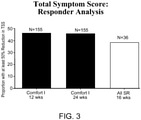
- Effectiveness of a treatment regimen in an MF patient can also be assessed by Total Symptom Score.
- symptoms of MF were assessed using a symptom diary (modified MFSAF v2.0 diary) where subjects recorded answers to queries regarding MF symptoms on a handheld device. Symptoms assessed included filling up quickly/early satiety, abdominal discomfort, abdominal pain, inactivity, night sweats, itching, and bone/muscle pain.
- Table 5c reports the Total Symptom Score results in the sustained-release study (see Example 3) while Table 5d reports the Total Symptom Score results in the COMFORT-I study (immediate-release, see Comparative Example A) at 24 weeks.
- both the SR and IR regimens were effective at treating MF in patients.
- a Grade 3 adverse event generally corresponds to a reaction that is severe or medically significant, but not immediately life-threatening where hospitalization or prolongation of hospitalization is indicated and where the reaction is disabling to the extent of limiting self care. Higher Grades are 4 (life-threatening requiring urgent intervention) and 5 (death). For anemia, Grade 3 corresponds to Hgb ⁇ 8.0 g/dL; ⁇ 4.9 mmol/L; ⁇ 80 g/L, where a transfusion is indicated. For thrombocytopenia (decreased platelet count), Grade 3 corresponds to ⁇ 50,000-25,000/mm 3 ; ⁇ 50.0-25.0 ⁇ 10 9 /L. The sustained-release data was evaluated for patients over the course of 16 weeks. Mean duration of exposure to ruxolitinib in the COMFORT-I was approximately 242 days. Typically, the majority of hematologic adverse events occur within the first few months of therapy as observed in the COMFORT-I study.
- Tables 6b and 6c report the number and percentage of patients in the studies exhibiting certain reactions including anemia and thrombocytopenia.
- the sustained-release data was evaluated for patients over the course of 16 weeks. Mean duration of exposure to ruxolitinib in the COMFORT-I study was approximately 242 days. The vast majority of hematologic adverse events occur within the first few months of therapy as observed in the COMFORT-I study. As can be seen from the data in the tables, the number and percentage of patients exhibiting blood-related adverse events is lower in the sustained-release study. Additionally, the severity of the adverse events is lesser in the sustained-release study.
- ruxolitinib in myelofibrosis patients.
- patients with intermediate-2 or high risk myelofibrosis were randomly assigned to twice-daily oral, immediate-release (see Example 1) ruxolitinib (155 patients) or placebo (154 patients).
- the starting dose of ruxolitinib depended on the baseline platelet count: 15 mg twice daily for a platelet count of 100 ⁇ 109 to 200 ⁇ 109 per liter and 20 mg twice daily for a count that exceeded 200 ⁇ 109 per liter. The dose was adjusted for lack of efficacy or excess toxicity.
- the primary end point was the proportion of patients with a reduction in spleen volume of 35% or more at 24 weeks, assessed by means of magnetic resonance imaging. Secondary end points included the durability of response, changes in symptom burden (assessed by the total symptom score), and overall survival.
- the proportion of patients with a reduction of 35% or more in spleen volume at week 24 was 41.9% in the ruxolitinib group as compared with 0.7% in the placebo group.
- Myelofibrosis patients were randomly assigned, in a 2:1 ratio, to receive ruxolitinib or the best available therapy, which included any commercially available agents (as monotherapy or in combination) or no therapy at all and which could be changed during the treatment phase.
- the starting dose of ruxolitinib tablets was 15 mg twice daily of an immediate release formulation (See Example 1) if the baseline platelet count was 200 ⁇ 109 per liter or less and 20 mg orally twice daily if the baseline platelet count was greater than 200 ⁇ 109 per liter.
- the primary end point was a reduction of 35% or more in spleen volume from baseline at week 48.
- week 48 most of the patients in the ruxolitinib group had a reduction in spleen volume. Only patients in the ruxolitinib group met the criterion for the primary end point, at least a 35% reduction in spleen volume from baseline at 48 weeks (28%, vs. 0% in the group receiving the best available therapy; P ⁇ 0.001).
- Patients in the ruxolitinib group as compared with patients receiving the best available therapy, had improved quality of life and role functioning.
- patients receiving ruxolitinib had marked reductions in myelofibrosis associated symptoms, including appetite loss, dyspnea, fatigue, insomnia, and pain, whereas patients receiving the best available therapy had worsening symptoms.
Landscapes
- Health & Medical Sciences (AREA)
- Life Sciences & Earth Sciences (AREA)
- Pharmacology & Pharmacy (AREA)
- Veterinary Medicine (AREA)
- Chemical & Material Sciences (AREA)
- Public Health (AREA)
- General Health & Medical Sciences (AREA)
- Medicinal Chemistry (AREA)
- Animal Behavior & Ethology (AREA)
- Chemical Kinetics & Catalysis (AREA)
- Organic Chemistry (AREA)
- Nuclear Medicine, Radiotherapy & Molecular Imaging (AREA)
- General Chemical & Material Sciences (AREA)
- Engineering & Computer Science (AREA)
- Bioinformatics & Cheminformatics (AREA)
- Physical Education & Sports Medicine (AREA)
- Immunology (AREA)
- Diabetes (AREA)
- Virology (AREA)
- Orthopedic Medicine & Surgery (AREA)
- Rheumatology (AREA)
- Hematology (AREA)
- Neurology (AREA)
- Oncology (AREA)
- Epidemiology (AREA)
- Communicable Diseases (AREA)
- Endocrinology (AREA)
- Obesity (AREA)
- Biomedical Technology (AREA)
- Molecular Biology (AREA)
- Neurosurgery (AREA)
- Urology & Nephrology (AREA)
- Dermatology (AREA)
- Cardiology (AREA)
- Ophthalmology & Optometry (AREA)
- Pulmonology (AREA)
- Heart & Thoracic Surgery (AREA)
- Nutrition Science (AREA)
- Tropical Medicine & Parasitology (AREA)
- Hospice & Palliative Care (AREA)
Abstract
Description
- The present invention relates to sustained-release formulations and dosage forms of ruxolitinib, or a pharmaceutically acceptable salt thereof, which are useful in the treatment of Janus kinase-associated diseases such as myeloproliferative disorders.
- Ruxolitinib ((3 R)-3 -cyclopentyl-3 - [4-(7H-pyrrolo [2,3-d]pyrimidin-4-yl)pyrazol-1-yl]propanenitrile) is the first FDA approved Janus kinase (JAK) inhibitor and is the only drug currently approved for treatment of myelofibrosis. Mascarenhas, J. et al. Clin Cancer Res. 2012 Jun 1;18(11):3008-14. Epub 2012 Apr 2. The compound has been shown in the clinic to effectively reduce spleen volume and improve total symptom scores in patients suffering from myelofibrosis. See, e.g., Verstovsek, S., et al. "A double-blind, placebo-controlled trial of ruxolitinib for myelofibrosis," N. Eng. J. Med., 2012, Mar 1:366(9):799-807, which is incorporated herein by reference in its entirety, which reports the results of a
Phase 3 clinical trial (COMFORT-I Study) of ruxolitinib for myelofibrosis. See also, Harrison, C. et al., "JAK inhibition with ruxolitinib versus best available therapy for myelofibrosis," N. Eng. J. Med., 2012, Mar 1;366(9):787-98 reportingPhase 3 clinical trial results of the COMFORT-II study, which is incorporated herein by reference in its entirety. - To date, all published human clinical data for ruxolitinib relate to dosing of an immediate-release formulation. However, ruxolitinib is a BCS Class I molecule with rapid oral absorption and a short half-life of about 3 hours. See, Shi et al., J. Clin. Pharmacol. 2012 Jun;52(6):809-18. Epub 2011 May 20. These properties result in a high peak/trough plasma concentration ratio in human subjects leading to multiple daily doses for optimal treatment, and potentially contributing to problems with patient compliance and unwanted side effects.
- Ruxolitinib therapy is often associated with the adverse events of thrombocytopenia (low platelet count) and anemia (low hemoglobin). Thrombocytopenia is dose-dependent and considered the dose-limiting toxic effect.
- Accordingly, there is a need for new and improved formulations of ruxolitinib that not only mitigate adverse side-effects in patients, but still achieve therapeutic efficacy, and also facilitate administration of the drug such as by reducing the number of doses required to achieve a therapeutic effect. The sustained-release formulations provided herein help meet these and other needs.
- The present invention is directed to a sustained-release dosage form comprising at least one active ingredient which is ruxolitinib, or a pharmaceutically acceptable salt thereof, wherein the ruxolitinib, or pharmaceutically acceptable salt thereof, is present in the dosage form in an amount of about 10 to about 60 mg on a free base basis.
- The present invention is further directed to a method of treating a disease associated with JAK activity in a patient in need thereof, comprising administering the sustained-release dosage form of the invention to said patient.
-
-
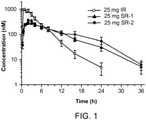
Figure 1 shows a graph comparing plasma concentrations of ruxolitinib after administration of a single dose of either 25 mg immediate-release or 25 mg sustained-release formulation in fasted, healthy human subjects. -
Figure 2 shows a graph comparing spleen volume responders in the COMFORT-I immediate-release formulation study and the sustained-release study. -
Figure 3 shows a graph comparing total symptom scores in the COMFORT-I immediate-release formulation study and the sustained-release study. -
Figure 4 shows a graph comparing ruxolitinib steady state plasma concentrations in MF patients dosed with 25 mg immediate-release or 25 mg sustained-release formulations. - The present invention provides, inter alia, an oral, sustained-release dosage form comprising ruxolitinib, or a pharmaceutically acceptable salt thereof, as an active ingredient. The dosage form can contain ruxolitinib, or a pharmaceutically acceptable salt thereof, in an amount of about 10 to about 60 mg, about 10 to about 40 mg, about 20 to about 40 mg, or about 20 to about 30 mg on a free base basis. In some embodiments, the dosage form contains about 10 mg, about 12.5 mg, about 20 mg, about 25 mg, about 30 mg, about 37.5 mg, about 40 mg, about 50 mg, or about 60 mg on a free base basis. In some embodiments, the dosage form contains about 25 mg of ruxolitinib on a free base basis. The phrase "on a free base basis" indicates that the amount of ruxolitinib or salt thereof in the dosage form is measured based on the molecular weight of ruxolitinib free base only, even when the actual active ingredient is a salt of ruxolitinib having a different molecular weight than the free base. For example, the conversion factor for ruxolitinib phosphate salt to free base is 0.7575.
- The structure, preparation, and characterization of ruxolitinib, and pharmaceutically acceptable salts thereof, are described in, e.g.,
US Pat. No. 7,598,257 andUS Pat. Pub. No. 2008/0312259 , each of which is incorporated herein by reference in its entirety. In some embodiments, the active ingredient is a pharmaceutically acceptable salt of ruxolitinib, such as the maleic acid salt, sulfuric acid salt, or phosphoric acid salt. In some embodiments, the active ingredient is ruxolitinib phosphate (i.e., phosphoric acid salt of ruxolitinib). - The dosage form of the invention comprises a sustained-release formulation of ruxolitinib, or a pharmaceutically acceptable salt thereof. As used herein, "sustained-release" is used as generally understood in the art and refers to a formulation designed to slowly release the active ingredient into a patient after oral administration and to maintain an essentially steady, therapeutically effective plasma level of active ingredient over a relatively long period of time, such as about 8 to about 24 hours or longer.
- The dosage forms of the invention include a sustained-release matrix former. Example sustained-release matrix formers include cellulosic ethers such as hydroxypropyl methylcellulose (HPMC, hypromellose) which is a high viscosity polymer. The sustained-release dosage forms of the invention can include, for example, about 10 to about 30%, about 15 to about 25%, or about 18 to about 24 % by weight of hydroxypropyl methylcellulose(s). In some embodiments, the formulation has about 20 % by weight of one or more hydroxypropyl methylcelluloses. In further embodiments, the formulation has about 22 % by weight of one or more hydroxypropyl methyl celluloses. Example hydroxypropyl methylcelluloses include Methocel K15M, Methocel K4M, and Methocel K100LV.
- The sustained-release dosage forms of the invention can further include one or more fillers, glidants, disintegrants, binders, or lubricants as inactive ingredients. Fillers can be present in the formulations in an amount of 0 to about 85 % by weight. In some embodiments, the formulation has about 50 to about 80%, about 55 to about 75%, or about 60 to about 70% by weight of filler. Non-limiting examples of fillers include lactose monohydrate, microcrystalline cellulose, starch 1500, and lactose anhydrous, or combinations thereof. In some embodiments, the filler comprises microcrystalline cellulose, lactose monohydrate, or both.
- Lubricants can be present in the dosage forms of the invention in an amount of 0 to about 5% by weight. Non-limiting examples of lubricants include magnesium stearate, stearic acid (stearin), hydrogenated oil, polyethylene glycol, sodium stearyl fumarate, and glyceryl behenate. In some embodiments, the formulations include magnesium stearate, stearic acid, or both.
- Glidants can be present in the dosage forms of the invention in an amount of 0 to about 5% by weight. Non-limiting examples of glidants include talc, colloidal silicon dioxide, and cornstarch. In some embodiments, the glidant is colloidal silicon dioxide.
- Disintegrants can be present in the dosage forms of the invention in an amount of 0 to about 10% by weight. Non-limiting examples of disintegrants include croscarmellose sodium, crospovidone, starch, cellulose, and low substituted hydroxypropyl cellulose. Croscarmellose sodium is a preferred disintegrant.
- Film-coating agents can be present in an amount of 0 to about 5% by weight. Non-limiting illustrative examples of film-coating agents include hypromellose or polyvinyl alcohol based coating with titanium dioxide, talc and optionally colorants available in several commercially available complete coating systems.
- In some embodiments, the dosage form of the invention includes a sustained-release formulation comprising about 12.2% ruxolitinib phosphate, about 20% hydroxypropyl methylcellulose, about 64.3% filler, about 2.5% lubricant, and about 1% glidant, all by weight.
- In some embodiments, the dosage form of the invention includes a sustained-release formulation comprising about 12.2% ruxolitinib phosphate, about 22% hydroxypropyl methylcellulose, about 62.3% filler, about 2.5% lubricant, and about 1% glidant, all by weight.
- In some embodiments, the dosage form of the invention includes a sustained-release formulation as set out below.
Component Percentage (wt%) Ruxolitinib phosphate 12.2 Microcrystalline cellulose, NF 22.0 Hypromellose, USP (Methocel K15M) 4.0 Hypromellose, USP (Methocel K4M) 16.0 Lactose monohydrate, NF 42.3 Colloidal silicon dioxide, NF 1.0 Magnesium stearate, NF 0.5 Stearic acid, NF 2.0 - In some embodiments, the dosage form of the invention includes a sustained-release formulation as set out below.
Component Percentage (wt%) Ruxolitinib phosphate 12.2 Microcrystalline cellulose, NF 42.3 Hypromellose, USP (Methocel K100LV) 10.0 Hypromellose, USP (Methocel K4M) 12.0 Lactose monohydrate, NF 20.0 Colloidal silicon dioxide, NF 1.0 Magnesium stearate, NF 0.5 Stearic acid, NF 2.0 - In some embodiments, the dosage form of the invention includes a sustained-release formulation as set out below.
Component Percentage (wt%) Ruxolitinib phosphate 12.2 Microcrystalline cellulose, NF 22.0 - 42.3 Hypromellose, USP (Methocel K100LV) 0 - 10.0 Hypromellose, USP (Methocel K15M) 0-4.0 Hypromellose, USP (Methocel K4M) 12.0 - 16.0 Lactose monohydrate, NF 20.0 - 42.3 Colloidal silicon dioxide, NF 1.0 Magnesium stearate, NF 0.5 Stearic acid, NF 2.0 - As used herein, the term "dosage form" is meant to refer to a physically discrete unit of sustained-release formulation of the invention to be administered to a patient. Example dosage forms include tablets, caplets, capsules, and the like, containing any of the sustained-release formulations described herein. Dosage forms can further include pharmaceutically acceptable coatings, pigments, or dyes.
- The dosage forms of the invention contain a sustained-release formulation that results in the relatively slow release of ruxolitinib once administered, characterized by particular pharmacokinetic parameters different from those of an immediate-release formulation. The sustained-release dosage forms of the invention can minimize potentially harmful spikes in drug plasma concentrations that are associated with immediate-release formulations, and can help provide continuous, steady, and therapeutically effective plasma levels of drug. The dosage forms of the invention can be administered to a human patient as needed for therapeutic efficacy against the disease being treated, for example, once daily.
- In some embodiments, the dosage forms of the invention are administered to fasted patients. As used herein, "fasted" means, in reference to a human patient or subject, that the patient or subject has not ingested food or drink (except water) for at least 3 hours prior to dosing. In some embodiments, patients are fasted for at least 10 hours prior to dosing.
- In further embodiments, the dosage forms of the invention are administered to non-fasted human patients or subjects. Bioavailability of ruxolitinib is high (e.g., about 70-80%) and no food effect has been observed in immediate-release dosage forms. Accordingly, it is believed that the pharmacokinetics of ruxolitinib administered as a sustained-release dosage form would not be significantly different in fasted and non-fasted patients.
- In some embodiments, administration of the sustained-release dosage form of the invention to a human results in a mean peak plasma concentration (Cmax) of ruxolitinib of about 700 nM or less.
- In some embodiments, administration of the sustained-release dosage form of the invention to a human results in a mean peak plasma concentration (Cmax) of ruxolitinib of about 600 nM or less.
- In some embodiments, administration of the sustained-release dosage form of the invention to a human results in a mean peak plasma concentration (Cmax) of ruxolitinib of about 500 nM or less.
- In some embodiments, administration of the sustained-release dosage form of the invention to a human results in a mean peak plasma concentration (Cmax) of ruxolitinib of about 400 nM or less.
- In some embodiments, administration of the sustained-release dosage form of the invention to a human results in a mean peak plasma concentration (Cmax) of ruxolitinib of about 200 to about 700 nM.
- In some embodiments, administration of the sustained-release dosage form of the invention to a human results in a mean peak plasma concentration (Cmax) of ruxolitinib of about 200 to about 600 nM.
- In some embodiments, administration of the sustained-release dosage form of the invention to a human results in a mean peak plasma concentration (Cmax) of ruxolitinib of about 300 to about 500 nM.
- In some embodiments, administration of the sustained-release dosage form of the invention to a human results in a mean peak plasma concentration (Cmax) of ruxolitinib of about 300 to about 400 nM.
- In some embodiments, administration of the sustained-release dosage form of the invention to a human results a mean time to peak plasma concentration (Tmax) of ruxolitinib of about 1.5 hours or more.
- In some embodiments, administration of the sustained-release dosage form of the invention to a human results in a mean time to peak plasma concentration (Tmax) of ruxolitinib of about 1.5 hours to about 5 hours.
- In some embodiments, administration of the sustained-release dosage form of the invention to a human results in a mean time to peak plasma concentration (Tmax) of ruxolitinib of about 2 hours to about 4 hours.
- In some embodiments, administration of the sustained-release dosage form of the invention to a human results in a ratio of mean peak plasma concentration (Cmax) to mean 12-hour plasma concentration (C12h) of ruxolitinib of about 10 or less.
- In some embodiments, administration of the sustained-release dosage form of the invention to a human results in a ratio of mean peak plasma concentration (Cmax) to mean 12-hour plasma concentration (C12h) of ruxolitinib of about 6 or less.
- In some embodiments, administration of the sustained-release dosage form of the invention to a human results in a ratio of mean peak plasma concentration (Cmax) to mean 12-hour plasma concentration (C12h) of ruxolitinib of about 5 or less.
- In some embodiments, administration of the sustained-release dosage form of the invention to a human results in a ratio of mean peak plasma concentration (Cmax) to mean 12-hour plasma concentration (C12h) of ruxolitinib of about 4 or less.
- In some embodiments, administration of the sustained-release dosage form of the invention to a human results in a ratio of mean peak plasma concentration (Cmax) to mean 12-hour plasma concentration (C12h) of ruxolitinib of about 1 to 10.
- In some embodiments, administration of the sustained-release dosage form of the invention to a human results in a ratio of mean peak plasma concentration (Cmax) to mean 12-hour plasma concentration (C12h) of ruxolitinib of about 2 to 7.
- In some embodiments, administration of the sustained-release dosage form of the invention to a human results in a mean half-life (t1/2) of from about 3.5 hours to about 11 hours.
- In some embodiments, administration of the sustained-release dosage form of the invention to a human results in a mean half-life (t1/2) of from about 4 hours to about 8 hours.
- In some embodiments, administration of a single dose of a sustained-release dosage form of the invention to a human results in mean bioavailability (AUC0-∞) of ruxolitinib of at least about 3000 nM∗h.
- In some embodiments, administration of a single dose of a sustained-release dosage form of the invention to a human results in mean bioavailability (AUC0-∞) of ruxolitinib of at least about 3500 nM∗h.
- In some embodiments, administration of a single dose of a sustained-release dosage form of the invention to a human results in mean bioavailability (AUC0-∞) of ruxolitinib of about 3000 to about 4000 nM∗h.
- In some embodiments, administration of a single dose of a sustained-release dosage form of the invention to a human results in mean bioavailability (AUC0-∞) of ruxolitinib of about 3100 to about 3800 nM∗h.
- In some embodiments, the sustained-release dosage form of the invention has a mean relative bioavailability based on AUC of from about 65 % to about 110 % or about 75% to about 95% relative to an immediate release formulation comprising the same amount of ruxolitinib, or a pharmaceutically acceptable salt thereof, in patients. AUC can be, for example, AUC0-∞ (e.g., for a single dose) or AUC0-t where t is a specified time.
- As used herein, "mean" when preceding a pharmacokinetic value (e.g. mean Cmax) represents the arithmetic mean value of the pharmacokinetic value taken from a population of patients unless otherwise specified.
- As used herein, "Cmax" means the maximum observed plasma concentration.
- As used herein, "C12h" refers to the plasma concentration measured at 12 hours from administration.
- As used herein, "Tmax" refers to the time at which the maximum blood plasma concentration is observed.
- As used herein, "T1/2" refers to the time at which the plasma concentration is half of the observed maximum.
- As used herein, "AUC" refers to the area under the plasma concentration-time curve which is a measure of total bioavailability.
- As used herein, "AUC0-∞" refers to the area under the plasma concentration-time curve extrapolated to infinity.
- As used herein, "AUC0-t" refers to the area under the plasma concentration-time curve from
time 0 to the last time point with a quantifiable plasma concentration, usually about 12-36 hours. - As used herein, "AUC0-τ" refers to the area under the plasma concentration-time curve from
time 0 to the time of the next dose. - As used herein, "Cl/F" refers to oral clearance.
- The sustained-release dosage forms of the invention have certain advantages over immediate-release dosage forms. The maintenance of steady, therapeutically effective plasma levels of ruxolitinib afforded by the sustained-release dosage forms of the invention allows for reduced dosing, such as doing only once per day, as opposed to twice or more for immediate-release forms. The reduced dosing can help with patient compliance in their treatment regimen.
- In some embodiments, administration of the sustained-release dosage form of the invention to a human results in a therapeutically effective plasma level of ruxolitinib for at least about 8 hours, at least about 10 hours, at least about 12 hours, at least about 18, or at least about 24 hours. In some embodiments, the sustained-release dosage form of the invention maintains a plasma level between about 75 and about 500 nM for at least about 8 hours, at least about 12 hours, or at least about 18 hours. In some embodiments, the sustained-release dosage form of the invention maintains a plasma level between about 100 and about 400 nM for at least about 6 hours or at least about 8 hours.
- An additional advantage of the sustained-release dosage form (e.g., containing 25 mg of ruxolitinib phosphate on a free base basis) includes a reduction in unwanted side effects related to thrombocytopenia and anemia while maintaining therapeutic efficacy comparable with an immediate-release dosing regimen, e.g., 15 mg or 20 mg BID. It was not predictable that a sustained-release formulation of ruxolitinib could both maintain therapeutic efficacy and significantly reduce unwanted side effects related to thrombocytopenia or reduced hemoglobin levels. Clinical data related to efficacy and side effects in myelofibrosis patients for both sustained-release and immediate-release dosing is compared in the Examples.
- In some embodiments, administration of the sustained-release dosage form of the invention to a human once daily for at least 16 weeks results in a mean decrease in mean base platelet count of no more than about 100 × 109/L, no more than about 80 × 109/L, no more than about 60 × 109/L, or no more than about 40 × 109/L.
- In some embodiments, administration of the sustained-release dosage form of the invention to a human once daily for at least 16 weeks results in a mean decrease in mean base platelet count of between about 0 × 109/L and about 100 × 109/L, between about 30 × 109/L and about 80 × 109/L, or between about 50 × 109/L and about 70 × 109/L.
- In some embodiments, administration of the sustained-release dosage form of the invention to a human once daily for at least 16 weeks results in a mean decrease in mean baseline hemoglobin (Hgb) of no more than about 15 g/L, no more than about 10 g/L, no more than about 8 g/L, or no more than about 6 g/L.
- In some embodiments, administration of the sustained-release dosage form of the invention to a human once daily for at least 16 weeks results in a mean decrease in mean baseline hemoglobin (Hgb) of about 0 to about 15 g/L, about 5 to about 15 g/L, about 2 to about 12 g/L, or about 5 to about 12 g/L.
- In some embodiments, the platelet counts and hemoglobin levels are measured in patients having received no blood transfusions during the treatment period.
- Mean baseline platelet counts and mean baseline hemoglobin levels are typically measured prior to the start of treatment.
- It is appreciated that certain features of the invention, which are, for clarity, described in the context of separate embodiments, can also be provided in combination in a single embodiment (while the embodiments are intended to be combined as if written in multiply dependent form). Conversely, various features of the invention which are, for brevity, described in the context of a single embodiment, can also be provided separately or in any suitable subcombination.
- Another aspect of the present invention pertains to methods of treating a JAK-associated disease or disorder in an individual (e.g., patient) by administering to the individual in need of such treatment a sustained-release dosage form of the invention. A JAK-associated disease can include any disease, disorder or condition that is directly or indirectly linked to expression or activity of the JAK, including overexpression and/or abnormal activity levels. A JAK-associated disease can also include any disease, disorder or condition that can be prevented, ameliorated, or cured by modulating JAK activity.
- Examples of JAK-associated diseases include diseases involving the immune system including, for example, organ transplant rejection (e.g., allograft rejection and graft versus host disease).
- Further examples of JAK-associated diseases include autoimmune diseases such as multiple sclerosis, rheumatoid arthritis, juvenile arthritis, psoriatic arthritis, type I diabetes, lupus, psoriasis, inflammatory bowel disease, ulcerative colitis, Crohn's disease, myasthenia gravis, immunoglobulin nephropathies, myocarditis, autoimmune thyroid disorders, chronic obstructive pulmonary disease (COPD), and the like. In some embodiments, the autoimmune disease is an autoimmune bullous skin disorder such as pemphigus vulgaris (PV) or bullous pemphigoid (BP).
- Further examples of JAK-associated diseases include allergic conditions such as asthma, food allergies, eszematous dermatitis, contact dermatitis, atopic dermatitis (atropic eczema), and rhinitis. Further examples of JAK-associated diseases include viral diseases such as Epstein Barr Virus (EBV), Hepatitis B, Hepatitis C, HIV,
HTLV 1, Varicella-Zoster Virus (VZV) and Human Papilloma Virus (HPV). - Further examples of JAK-associated disease include diseases associated with cartilage turnover, for example, gouty arthritis, septic or infectious arthritis, reactive arthritis, reflex sympathetic dystrophy, algodystrophy, Tietze syndrome, costal athropathy, osteoarthritis deformans endemica, Mseleni disease, Handigodu disease, degeneration resulting from fibromyalgia, systemic lupus erythematosus, scleroderma, or ankylosing spondylitis.
- Further examples of JAK-associated disease include congenital cartilage malformations, including hereditary chrondrolysis, chrondrodysplasias, and pseudochrondrodysplasias (e.g., microtia, enotia, and metaphyseal chrondrodysplasia).
- Further examples of JAK-associated diseases or conditions include skin disorders such as psoriasis (for example, psoriasis vulgaris), atopic dermatitis, skin rash, skin irritation, skin sensitization (e.g., contact dermatitis or allergic contact dermatitis). For example, certain substances including some pharmaceuticals when topically applied can cause skin sensitization. In some embodiments, co-administration or sequential administration of at least one JAK inhibitor of the invention together with the agent causing unwanted sensitization can be helpful in treating such unwanted sensitization or dermatitis. In some embodiments, the skin disorder is treated by topical administration of at least one JAK inhibitor of the invention.
- In further embodiments, the JAK-associated disease is cancer including those characterized by solid tumors (e.g., prostate cancer, renal cancer, hepatic cancer, pancreatic cancer, gastric cancer, breast cancer, lung cancer, cancers of the head and neck, thyroid cancer, glioblastoma, Kaposi's sarcoma, Castleman's disease, uterine leiomyosarcoma, melanoma etc.), hematological cancers (e.g., lymphoma, leukemia such as acute lymphoblastic leukemia (ALL), acute myelogenous leukemia (AML) or multiple myeloma), and skin cancer such as cutaneous T-cell lymphoma (CTCL) and cutaneous B-cell lymphoma. Example CTCLs include Sezary syndrome and mycosis fungoides.
- In some embodiments, the JAK inhibitors described herein, or in combination with other JAK inhibitors, such as those reported in
U.S. Ser. No. 11/637,545 , which is incorporated herein by reference in its entirety, can be used to treat inflammation-associated cancers. In some embodiments, the cancer is associated with inflammatory bowel disease. In some embodiments, the inflammatory bowel disease is ulcerative colitis. In some embodiments, the inflammatory bowel disease is Crohn's disease. In some embodiments, the inflammation-associated cancer is colitis-associated cancer. In some embodiments, the inflammation-associated cancer is colon cancer or colorectal cancer. In some embodiments, the cancer is gastric cancer, gastrointestinal carcinoid tumor, gastrointestinal stromal tumor (GIST), adenocarcinoma, small intestine cancer, or rectal cancer. - JAK-associated diseases can further include those characterized by expression of: JAK2 mutants such as those having at least one mutation in the pseudo-kinase domain (e.g., JAK2V617F); JAK2 mutants having at least one mutation outside of the pseudo-kinase domain; JAK1 mutants; JAK3 mutants; erythropoietin receptor (EPOR) mutants; or deregulated expression of CRLF2.
- JAK-associated diseases can further include myeloproliferative disorders (MPDs) such as polycythemia vera (PV), essential thrombocythemia (ET), primary myelofibrosis (PMF), chronic myelogenous leukemia (CML), chronic myelomonocytic leukemia (CMML), hypereosinophilic syndrome (HES), systemic mast cell disease (SMCD), and the like. In some embodiments, the myeloproliferative disorder is myelofibrosis (e.g., primary myelofibrosis (PMF) or post polycythemia vera/essential thrombocythemia myelofibrosis (Post-PV/ET MF)). In some embodiments, the myeloproliferative disorder is post-essential thrombocythemia myelofibrosis (Post-ET MF). In some embodiments, the myeloproliferative disorder is post polycythemia vera myelofibrosis (Post-PV MF).
- The present invention further provides methods of treating psoriasis or other skin disorders by administration of a topical formulation containing a compound of the invention.
- In some embodiments, sustained-release formulation and dosage forms described herein can be used to treat pulmonary arterial hypertension.
- In some embodiments, the sustained-release formulation and dosage forms described herein can be used to treat mast cell activation syndrome.
- The present invention further provides a method of treating dermatological side effects of other pharmaceuticals by administration of the sustained-release dosage form of the invention. For example, numerous pharmaceutical agents result in unwanted allergic reactions which can manifest as acneiform rash or related dermatitis. Example pharmaceutical agents that have such undesirable side effects include anti-cancer drugs such as gefitinib, cetuximab, erlotinib, and the like. The dosage form of the invention can be administered in combination with (e.g., simultaneously or sequentially) the pharmaceutical agent having the undesirable dermatological side effect.
- Further JAK-associated diseases include inflammation and inflammatory diseases. Example inflammatory diseases include sarcoidosis, inflammatory diseases of the eye (e.g., iritis, uveitis, scleritis, conjunctivitis, or related disease), inflammatory diseases of the respiratory tract (e.g., the upper respiratory tract including the nose and sinuses such as rhinitis or sinusitis or the lower respiratory tract including bronchitis, chronic obstructive pulmonary disease, and the like), inflammatory myopathy such as myocarditis, and other inflammatory diseases. In some embodiments, the inflammation disease of the eye is blepharitis.
- The sustained-release dosage forms herein can further be used to treat ischemia reperfusion injuries or a disease or condition related to an inflammatory ischemic event such as stroke or cardiac arrest. The sustained-release dosage forms described herein can further be used to treat endotoxin-driven disease state (e.g., complications after bypass surgery or chronic endotoxin states contributing to chronic cardiac failure). The sustained-release dosage forms described herein can further be used to treat anorexia, cachexia, or fatigue such as that resulting from or associated with cancer. The sustained-release dosage forms described herein can further be used to treat restenosis, sclerodermitis, or fibrosis. The sustained-release dosage forms described herein can further be used to treat conditions associated with hypoxia or astrogliosis such as, for example, diabetic retinopathy, cancer, or neurodegeneration. See, e.g., Dudley, A.C. et al. Biochem. J. 2005, 390(Pt 2):427-36 and Sriram, K. et al. J. Biol. Chem. 2004, 279(19):19936-47. Epub 2004 , both of which are incorporated herein by reference in their entirety. The sustained-release dosage forms described herein can be used to treat Alzheimer's disease.
- The sustained-release dosage forms described herein can further be used to treat other inflammatory diseases such as systemic inflammatory response syndrome (SIRS) and septic shock.
- The sustained-release dosage forms described herein can further be used to treat gout and increased prostate size due to, e.g., benign prostatic hypertrophy or benign prostatic hyperplasia.
- Further JAK-associated diseases include bone resorption diseases such as osteoporosis, osteoarthritis. Bone resorption can also be associated with other conditions such as hormonal imbalance and/or hormonal therapy, autoimmune disease (e.g. osseous sarcoidosis), or cancer (e.g. myeloma). The reduction of the bone resorption due to the JAK inhibitors can be about 10%, about 20%, about 30%, about 40%, about 50%, about 60%, about 70%, about 80%, or about 90%.
- In some embodiments, sustained-release dosage forms described herein can further be used to treat a dry eye disorder. As used herein, "dry eye disorder" is intended to encompass the disease states summarized in a recent official report of the Dry Eye Workshop (DEWS), which defined dry eye as "a multifactorial disease of the tears and ocular surface that results in symptoms of discomfort, visual disturbance, and tear film instability with potential damage to the ocular surface. It is accompanied by increased osmolarity of the tear film and inflammation of the ocular surface." Lemp, "The Definition and Classification of Dry Eye Disease: Report of the Definition and Classification Subcommittee of the International Dry Eye Workshop", The Ocular Surface, 5(2), 75-92 April 2007, which is incorporated herein by reference in its entirety. In some embodiments, the dry eye disorder is selected from aqueous tear-deficient dry eye (ADDE) or evaporative dry eye disorder, or appropriate combinations thereof. In some embodiments, the dry eye disorder is Sjogren syndrome dry eye (SSDE). In some embodiments, the dry eye disorder is non-Sjogren syndrome dry eye (NSSDE).
- In a further aspect, the present invention provides a method of treating conjunctivitis, uveitis (including chronic uveitis), chorioditis, retinitis, cyclitis, sclieritis, episcleritis, or iritis; treating inflammation or pain related to corneal transplant, LASIK (laser assisted in situ keratomileusis), photorefractive keratectomy, or LASEK (laser assisted sub-epithelial keratomileusis); inhibiting loss of visual acuity related to corneal transplant, LASIK, photorefractive keratectomy, or LASEK; or inhibiting transplant rejection in a patient in need thereof, comprising administering to the patient a therapeutically effective amount of the compound of the invention, or a pharmaceutically acceptable salt thereof.
- Additionally, the sustained-release dosage forms of the invention, optionally in combination with other JAK inhibitors such as those reported in
U.S. Ser. No. 11/637,545 , which is incorporated herein by reference in its entirety, can be used to treat respiratory dysfunction or failure associated with viral infection, such as influenza and SARS. - As used herein, the term "individual," "subject," or "patient," refers to a human, who can be fasted or un-fasted when the dosage form of the invention is administered.
- As used herein the term "pharmaceutically acceptable" refers to those compounds, materials, compositions and/or dosage forms, which are, within the scope of sound medical judgment, suitable for contact humans without excessive toxicity, irritation, allergic response and other problem complications commensurate with a reasonable benefit/risk ratio.
- As used herein, the term "treating" or "treatment" refers to one or more of (1) preventing the disease; for example, preventing a disease, condition or disorder in an individual who may be predisposed to the disease, condition or disorder but does not yet experience or display the pathology or symptomatology of the disease; (2) inhibiting the disease; for example, inhibiting a disease, condition or disorder in an individual who is experiencing or displaying the pathology or symptomatology of the disease, condition or disorder (i.e., arresting further development of the pathology and/or symptomatology); and (3) ameliorating the disease; for example, ameliorating a disease, condition or disorder in an individual who is experiencing or displaying the pathology or symptomatology of the disease, condition or disorder (i.e., reversing the pathology and/or symptomatology) such as decreasing the severity of disease.
- One or more additional pharmaceutical agents such as, for example, chemotherapeutics, anti-inflammatory agents, steroids, immunosuppressants, as well as Bcr-Abl, Flt-3, RAF and FAK kinase inhibitors such as, for example, those described in
WO 2006/056399 , which is incorporated herein by reference in its entirety, or other agents can be used in combination with the sustained-release dosage forms described herein for treatment of JAK-associated diseases, disorders or conditions. The one or more additional pharmaceutical agents can be administered to a patient simultaneously or sequentially. - Example chemotherapeutics include proteosome inhibitors (e.g., bortezomib), thalidomide, revlimid, and DNA-damaging agents such as melphalan, doxorubicin, cyclophosphamide, vincristine, etoposide, carmustine, and the like.
- Example steroids include coriticosteroids such as dexamethasone or prednisone.
- Example Bcr-Abl inhibitors include the compounds, and pharmaceutically acceptable salts thereof, of the genera and species disclosed in
U.S. Pat. No. 5,521,184 ,WO 04/005281 U.S. Ser. No. 60/578,491 , all of which are incorporated herein by reference in their entirety. - Example suitable Flt-3 inhibitors include compounds, and their pharmaceutically acceptable salts, as disclosed in
WO 03/037347 WO 03/099771 WO 04/046120 - Example suitable RAF inhibitors include compounds, and their pharmaceutically acceptable salts, as disclosed in
WO 00/09495 WO 05/028444 - Example suitable FAK inhibitors include compounds, and their pharmaceutically acceptable salts, as disclosed in
WO 04/080980 WO 04/056786 WO 03/024967 WO 01/064655 WO00/053595 WO 01/014402 - In some embodiments, one or more of the compounds of the invention can be used in combination with one or more other kinase inhibitors including imatinib, particularly for treating patients resistant to imatinib or other kinase inhibitors.
- In some embodiments, one or more JAK inhibitors of the invention can be used in combination with a chemotherapeutic in the treatment of cancer, such as multiple myeloma, and may improve the treatment response as compared to the response to the chemotherapeutic agent alone, without exacerbation of its toxic effects. Examples of additional pharmaceutical agents used in the treatment of multiple myeloma, for example, can include, without limitation, melphalan, melphalan plus prednisone [MP], doxorubicin, dexamethasone, and Velcade (bortezomib). Further additional agents used in the treatment of multiple myeloma include Bcr-Abl, Flt-3, RAF and FAK kinase inhibitors. Additive or synergistic effects are desirable outcomes of combining a JAK inhibitor of the present invention with an additional agent. Furthermore, resistance of multiple myeloma cells to agents such as dexamethasone may be reversible upon treatment with a JAK inhibitor of the present invention. The agents can be combined with the present compounds in a single or continuous dosage form, or the agents can be administered simultaneously or sequentially as separate dosage forms.
- In some embodiments, a corticosteroid such as dexamethasone is administered to a patient in combination with at least one JAK inhibitor where the dexamethasone is administered intermittently as opposed to continuously.
- In some further embodiments, combinations of sustained-release dosage forms with other therapeutic agents can be administered to a patient prior to, during, and/or after a bone marrow transplant or stem cell transplant.
- In some embodiments, the additional therapeutic agent is fluocinolone acetonide (Retisert®), or rimexolone (AL-2178, Vexol, Alcon).
- In some embodiments, the additional therapeutic agent is cyclosporine (Restasis®).
- In some embodiments, the additional therapeutic agent is a corticosteroid. In some embodiments, the corticosteroid is triamcinolone, dexamethasone, fluocinolone, cortisone, prednisolone, or flumetholone.
- In some embodiments, the additional therapeutic agent is selected from Dehydrex™ (Holles Labs), Civamide (Opko), sodium hyaluronate (Vismed, Lantibio/TRB Chemedia), cyclosporine (ST-603, Sirion Therapeutics), ARG101(T) (testosterone, Argentis), AGR1012(P) (Argentis), ecabet sodium (Senju-Ista), gefarnate (Santen), 15-(s)-hydroxyeicosatetraenoic acid (15(S)-HETE), cevilemine, doxycycline (ALTY-0501, Alacrity), minocycline, iDestrin™ (NP50301, Nascent Pharmaceuticals), cyclosporine A (Nova22007, Novagali), oxytetracycline (Duramycin, MOLI1901, Lantibio), CF101 (2S,3S,4R,5R)-3,4-dihydroxy-5-[6-[(3-iodophenyl)methylamino]purin-9-yl]-N-methyl-oxolane-2-carbamyl, Can-Fite Biopharma), voclosporin (LX212 or LX214, Lux Biosciences), ARG103 (Agentis), RX-10045 (synthetic resolvin analog, Resolvyx), DYN15 (Dyanmis Therapeutics), rivoglitazone (DE011, Daiichi Sanko), TB4 (RegeneRx), OPH-01 (Ophtalmis Monaco), PCS101 (Pericor Science), REV1-31 (Evolutec), Lacritin (Senju), rebamipide (Otsuka-Novartis), OT-551 (Othera), PAI-2 (University of Pennsylvania and Temple University), pilocarpine, tacrolimus, pimecrolimus (AMS981, Novartis), loteprednol etabonate, rituximab, diquafosol tetrasodium (INS365, Inspire), KLS-0611 (Kissei Pharmaceuticals), dehydroepiandrosterone, anakinra, efalizumab, mycophenolate sodium, etanercept (Embrel®), hydroxychloroquine, NGX267 (TorreyPines Therapeutics), actemra, gemcitabine, oxaliplatin, L-asparaginase, or thalidomide.
- In some embodiments, the additional therapeutic agent is an anti-angiogenic agent, cholinergic agonist, TRP-1 receptor modulator, a calcium channel blocker, a mucin secretagogue, MUC1 stimulant, a calcineurin inhibitor, a corticosteroid, a P2Y2 receptor agonist, a muscarinic receptor agonist, an mTOR inhibitor, another JAK inhibitor, Bcr-Abl kinase inhibitor, Flt-3 kinase inhibitor, RAF kinase inhibitor, and FAK kinase inhibitor such as, for example, those described in
WO 2006/056399 , which is incorporated herein by reference in its entirety. In some embodiments, the additional therapeutic agent is a tetracycline derivative (e.g., minocycline or doxycline). In some embodiments, the additional therapeutic agent binds to FKBP12. - In some embodiments, the additional therapeutic agent is an alkylating agent or DNA cross-linking agent; an anti-metabolite/demethylating agent (e.g., 5-flurouracil, capecitabine or azacitidine); an anti-hormone therapy (e.g., hormone receptor antagonists, SERMs, or aromotase inhibitor); a mitotic inhibitor (e.g. vincristine or paclitaxel); an topoisomerase (I or II) inhibitor (e.g. mitoxantrone and irinotecan); an apoptotic inducers (e.g. ABT-737); a nucleic acid therapy (e.g. antisense or RNAi); nuclear receptor ligands (e.g., agonists and/or antagonists: all-trans retinoic acid or bexarotene); epigenetic targeting agents such as histone deacetylase inhibitors (e.g. vorinostat), hypomethylating agents (e.g. decitabine); regulators of protein stability such as Hsp90 inhibitors, ubiquitin and/or ubiquitin like conjugating or deconjugating molecules; or an EGFR inhibitor (erlotinib).
- In some embodiments, the additional therapeutic agent(s) are demulcent eye drops (also known as "artificial tears"), which include, but are not limited to, compositions containing polyvinylalcohol, hydroxypropyl methylcellulose, glycerin, polyethylene glycol (e.g. PEG400), or carboxymethyl cellulose. Artificial tears can help in the treatment of dry eye by compensating for reduced moistening and lubricating capacity of the tear film. In some embodiments, the additional therapeutic agent is a mucolytic drug, such as N-acetylcysteine, which can interact with the mucoproteins and, therefore, to decrease the viscosity of the tear film.
- In some embodiments, the additional therapeutic agent includes an antibiotic, antiviral, antifungal, anesthetic, anti-inflammatory agents including steroidal and non-steroidal anti-inflammatories, and anti-allergic agents. Examples of suitable medicaments include aminoglycosides such as amikacin, gentamycin, tobramycin, streptomycin, netilmycin, and kanamycin; fluoroquinolones such as ciprofloxacin, norfloxacin, ofloxacin, trovafloxacin, lomefloxacin, levofloxacin, and enoxacin; naphthyridine; sulfonamides; polymyxin; chloramphenicol; neomycin; paramomycin; colistimethate; bacitracin; vancomycin; tetracyclines; rifampin and its derivatives ("rifampins"); cycloserine; beta-lactams; cephalosporins; amphotericins; fluconazole; flucytosine; natamycin; miconazole; ketoconazole; corticosteroids; diclofenac; flurbiprofen; ketorolac; suprofen; cromolyn; lodoxamide; levocabastin; naphazoline; antazoline; pheniramine; or azalide antibiotic.
- The invention will be described in greater detail by way of specific examples. The following examples are offered for illustrative purposes, and are not intended to limit the invention in any manner. Those of skill in the art will readily recognize a variety of noncritical parameters which can be changed or modified to yield essentially the same results.
- A 25 mg sustained-release formulation of ruxolitinib phosphate was prepared according to the following protocol. The formulation components are provided in Table 1a. Percentages are by weight.
Table 1a Component Function Percentage Ruxolitinib phosphatea Active ingredient 12.2 Microcryrstalline cellulose, NF Filler 22.0 Hypromellose, USP (Methocel K15M) Sustained release matrix former 4.0 Hypromellose, USP (Methocel K4M) Sustained release matrix former 16.0 Lactose monohydrate, NF Filler 42.3 Colloidal silicon dioxide, NF Glidant 1.0 Magnesium stearate, NF Lubricant 0.5 Stearic acid, NF Lubricant 2.0 Total 100 a On a free base basis, conversion factor for phosphate salt to free base is 0.7575. -
Step 1. Add microcrystalline cellulose, ruxolitinib phosphate, lactose monohydrate, and hypromelloses to a suitable blender and mix. -
Step 2. Transfer the mix fromStep 1 to a suitable granulator and mix. -
Step 3. Add purified water while mixing. - Step 4. Screen the wet granules from
Step 3. - Step 5. Transfer the granules from Step 4 into a suitable dryer and dry until LOD is no more than 3%.
-
Step 6. Screen the granules from Step 5. - Step 7. Mix colloidal silicon dioxide with granules in
Step 6 in a suitable blender. - Step 8. Mix stearic acid and magnesium stearate with the blend in Step 7 and continue blending.
-
Step 9. Compress the final blend in Step 8 on a suitable rotary tablet press. - An alternate 25 mg sustained-release formulation of ruxolitinib phosphate has been prepared as described below. The formulation components are provided in Table 1b. Percentages are by weight.
Table 1b Component Function Percentage Ruxolitinib phosphatea Active ingredient 12.2 Microcryrstalline cellulose, NF Filler 42.3 Hypromellose, USP (Methocel K100LV) Sustained release matrix former 10.0 Hypromellose, USP (Methocel K4M) Sustained release matrix former 12.0 Lactose monohydrate, NF Filler 20.0 Colloidal silicon dioxide, NF Glidant 1.0 Magnesium stearate, NF Lubricant 0.5 Stearic acid, NF Lubricant 2.0 Total 100 a On a free base basis, conversion factor for phosphate salt to free base is 0.7575. -
Step 1. Add microcrystalline cellulose, ruxolitinib phosphate, lactose monohydrate, and hypromelloses to a suitable blender and mix. -
Step 2. Transfer the mix fromStep 1 to a suitable granulator and mix. -
Step 3. Add purified water while mixing. - Step 4. Screen the wet granules from
Step 3. - Step 5. Transfer the granules from Step 4 into a suitable dryer and dry until LOD is no more than 3%.
-
Step 6. Screen the granules from Step 5. - Step 7. Mix colloidal silicon dioxide with granules in
Step 6 in a suitable blender. - Step 8. Mix stearic acid and magnesium stearate with the blend in Step 7 and continue blending.
-
Step 9. Compress the final blend in Step 8 on a suitable rotary tablet press. - Immediate-release dosage forms of ruxolitinib phosphate can be obtained commercially in 5, 10, 15, 20, and 25 mg doses as the drug product Jakafi® (ruxolitinib phosphate (tablets)) (NDA no. N202192). The commercially available dosage forms are the same as used in the
Phase 3 COMFORT-1 and COMFORT-II studies. - A relative bioavailability study of the sustained release and immediate formulations of ruxolitinib phosphate was conducted in healthy adult volunteers. Subjects in the fasted state were given a single oral dose of immediate-release formulation (25 mg, see Example 1) or a single oral dose of sustained-release formulation (25 mg, see Example 1). Plasma concentrations of ruxolitinib were measured and are compared in
Figure 1 . Table 2a provides comparative pharmacokinetic (PK) data.Table 2a* Treatment n Cmax (nM) Tmax (h) C12h (nM) Cmax/C12h t1/2 (h) AUC0-t (nM*h) AUC0-∞ (nM*h) Cl/F (L/h) 25 mg IR 9 1100±332 0.94±0.46 45.6±38.1 40±24 2.8±0.72 4340±1990 4350±1990 22.8±10.3 1060 0.86 32.1 33 2.7 3930 3940 20.7 25 mg SR-1 8 333±76.1 2.4±0.98 121±46.8 3.0±1.0 5.3±1.8 3110±840 3180±864 27.2±6,72 325 2.2 114 2.9 5.1 3020 3090 26.4 25 mg SR-2 8 394±126 2.9±1.6 104±43.2 4.7±3.1 6.1±2.1 3520±1260 3740±1400 24.6±9,02 377 2.5 96.5 3.9 5.8 3330 3520 23.2 P-Values from a Crossover ANOVA of Log-Transformed Data <0.0001 0.0003 -- -- <0.0001 0.040 0.070 0.070 Geometric Mean Relative Bioavailability and 90% Cl (Reference = IR) SR-1 vs. IR 30.4% 74.7% 76.2% 25.4-36.4% 62.2-89.7% 63.1-92.0% SR-2 vs. IR 35.2% 82.5% 86.7% 29.5-42.2% 68.7-99.1% 71.8-105% ∗PK values are provided as mean±SD and geometric mean - This study was performed to evaluate pharmacokinetic performance of two ruxolitinib phosphate sustained release (SR) formulations compared to the ruxolitinib phosphate immediate release (IR) tablets. The study was conducted as a 3-period study in which each subject received the IR tablets, the SR-1 tablets and the SR-2 tablets, all in fasted state. All treatments were administered as a single dose in one tablet. Nine healthy subjects enrolled in this study received IR tablets in
Period 1, and 8 subjects continued on the study were randomized into 2 sequences to receive SR-1 and SR-2 tablets inPeriod 2 andPeriod 3. - The 9 subjects enrolled in the study received a single dose of IR tablets, SR-1 tablets and SR-2 tablets, according to the randomization schedule (see Table 2b). Dosing was administered orally after at least 10 hour overnight fast, and a standardized meal was served approximately 3 hours after administration. A washout period of 7 days (not less than 5 days) was instituted between the treatment periods.
- Blood samples for determination of plasma concentrations of ruxolitinib were collected at 0, 0.25, 0.5, 1, 1.5, 2, 3, 4, 6, 8, 12, 16, 24 and 36 hours post-dose using lavender top (K2EDTA) Vacutainer® tubes. No samples were collected for determination of urine concentrations of ruxolitinib.
Table 2b. Randomization Schedule for Study Sequence Period 1 Period 2Period 3Subject 1 25 mg IR tablet fasted 25 mg SR-1 tablet fasted 25 mg SR-2 tablet fasted 102∗, 103, 106, 107, 109 2 25 mg IR tablet fasted 25 mg SR-2 tablet fasted 25 mg SR-1 tablet fasted 101, 104, 105, 108 ∗Subject withdrew from the study before the start of Period 2 - Plasma and urine samples were shipped to Incyte Corporation for determination of ruxolitinib concentrations. The plasma samples were assayed by validated, GLP, LC/MS/MS methods with a linear range of 1 to 1000 nM.
- All PK blood samples were collected within 5 minutes of their scheduled time, and therefore the schedule times relative to the time of dose administration were used for all pharmacokinetic analyses.
- Standard non-compartmental pharmacokinetic methods were used to analyze the ruxolitinib plasma concentration data using Phoenix WinNonlin version 6.0 (Pharsight Corporation, Mountain View, CA). Thus, Cmax and Tmax were taken directly from the observed plasma concentration data. The absorption lag time (Tlag) was defined as the sampling time immediately preceding that corresponding to the first measurable (non-zero) concentration. The terminal-phase disposition rate constant (λz) was estimated using a log-linear regression of the concentration data in the terminal disposition phase, and t1/2 was estimated as ln(2)/λz. AUC0-t was estimated using the linear trapezoidal rule for increasing concentrations and the log-trapezoidal rule for decreasing concentrations, and the total AUC0-∞ was calculated as AUC0-t + Ct/λz. The oral-dose clearance (Cl/F) was estimated as Dose/AUC0-∞, and the terminal-phase volume of distribution (Vz/F) was estimated as Dose/[AUC0-∞*λz].
- The log-transformed pharmacokinetic parameters were compared among the treatments using a 2-factor ANOVA with the fixed factor for treatment and random factor for subject. The relative bioavailability of the fasted administration of the SR formulations (test treatments) compared to fasted administration of the IR tablets (reference treatment) were estimated using the geometric mean relative bioavailability and 90% confidence intervals for Cmax, AUC0-t and AUC0-∞, which were calculated from the adjusted means (least square means) from the ANOVA. All statistical analyses were performed using SAS version 9.1 (SAS Institute, Inc., Cary, NC).
- A
Phase 2 clinical trial was carried out in patients with myelofibrosis (MF). A total of 41 subjects were enrolled, and spleen volume and total symptom scores were obtained at baseline. Tablets of sustained-release formulation SR-2 (see Example 1) were administered to fasted patients. All patients were treated with 25 mg once daily doses for 8 weeks. After 8 weeks, depending upon the clinical response, the investigator was allowed to (a) maintain the same dose of SR-2, (b) increase the dose to 50 mg once daily, (c) increase the dose to alternating doses of 25 mg and 50 mg, dosed once daily, or (d) switch to treatment with the immediate release formulation. - Data related to spleen volume and total symptom scores are provided in
Figures 2 and3 together with comparative data from the COMFORT-1 Study where patients were dosed only with the immediate-release formulation. See Example A below for details of the COMFORT-1 Study. As can be seen inFigures 2 and3 , treatment with the 25 mg sustained-release formulation was nearly as effective as the immediate-release formulation in the COMFORT-I study. Percentages of spleen volume responders in COMFORT-1 as shown inFigure 2 were 39.4% and 43.9% at 12 weeks and 24 weeks, respectively. The percentage of spleen volume responders in the sustained-release study atweek 16 was 28.9%. Similarly, the percentages of total symptom score responders in COMFORT-1 as shown inFigure 3 were 46.3% and 45.9% at 12 weeks and 24 weeks, respectively. The percentage of total symptom score responders in the sustained release study as shown inFigure 3 was 36.8%. - Data relating to mean platelet count and mean hemoglobin levels (Hgb) is presented below in Table 3 together with comparative data from the COMFORT-I study. As can be seen from the data, the mean change from baseline platelet count in the SR patients was about half of what was observed in COMFORT-I. Similar results are seen for hemoglobin levels. Data is shown as mean±SD.
Table 3 Parameter Sustained-Release Study COMFORT-I Study (active) COMPFORT-I Study (placebo) N 41 155 154 Mean Baseline platelet count, ×109/L 274 ± 193 321 ± 202 280 ± 152 Mean Baseline Hgb in patient with no transfusions, g/L 105 ± 17 108 ± 20 106 ± 22 Week 16Week 12Week 12Mean total daily dose, mg 34 30.4 0 Mean change from baseline platelet count, x109/L -65 ± 101 -131 ± 143 -9 ± 75 Mean change from baseline Hgb, g/L -7.4 ± 13.3 -13.2 ± 15.5 0.3 ± 11.5 - Steady state plasma concentrations of ruxolitinib in myelofibrosis (MF) patients receiving repeating 25 mg doses are compared in
Figure 4 between sustained release (SR) and immediate release (IR) formulations. Comparative pharmacokinetic parameters are provided below in Table 4a.Table 4a* Formula and Regimen n Cmax (nM) Tmax (h) Cmin (nM) t1/2 (h) AUC0-τ (nM*h) AUC0-t (nM*h) Cl/F (L/h) SR 39 397±175 2.35±1.75 32±40.6 7.33±3.73 3650±2450 2060±1140 32.0±18.0 25 mg QDa 368 1.88 -- 6.42 3020 1810 27.1 IR 25 mg27 1481±575 0.83±0.45 47±54 1.94±0.50 4363±2066 4148±1885 22.7 ±10.1 BIDb (1A) 1374 0.74 -- 1.88 3949 3778 20.7 IR 25 mg QDb6 1417±150 0.84±0.38 0±0 1.60±0.36 3567±777 3291±604 23.9±5.5 (2A) 1410 0.78 -- 1.57 3494 3243 23.4 IR 25 mg7 1650±506 0.79±0.49 85±102 1.96±0.59 4939±2566 4444±1918 19.9±8.1 BIDb (2C) 1578 0.68 43 1.90 4463 4120 18.3 SR 25 mg8 394±126 2.9±1.6 -- 6.1±2.1 3740±1400 -- 24.6±9.02 single dosec 377 2.5 5.8 3520 23.2 aFrom SR study described in Example 3
bFrom IR study described below (Description of Open-Label Study in MF patients)
cFrom single dose study described in Example 2 (AUC0-τ will be AUC0-∞)
∗Values are mean±SD and geometric mean. - This was an open-label study exploring the safety, tolerability, and efficacy of ruxolitinib, administered orally to patients with primary myelofibrosis (PMF) and post polycythemia vera/essential thrombocythemia myelofibrosis (Post-PV/ET MF). The study was comprised of 3 parts: Part 1-dose escalation and expansion, bid dosing, Part 2-alternative dosing schedules (A, B and C), and Part 3-three independent patient groups (Group I, II and III). Eight dose regimens
were evaluated in 3 parts. ThePart 1 evaluated two dose levels of 25 mg bid and 50 mg bid,Part 2 studied five dose regimens of 10 mg bid, 25 mg bid, 25 mg qd, 50 mg qd and 100 mg qd andPart 3 assessed six dose regimens of 10 mg bid, 15 mg bid, 25 mg bid, 50 mg qd, 100 mg qd and 200 mg qd. A total of 154 subjects were enrolled; 32 subjects enrolled inPart 1, 29 subjects inPart 2 and 93 subjects inPart 3. See Table 4b (qd = once per day; bid = twice per day). - In
Part 1, the pharmacokinetic blood samples were collected at pre-dose and 0.5, 1, 1.5, 2,
4, 6 and 9 hours post-dose onDays Cycle 1 and at pre-dose onDay 1 ofCycles Part 2, the pharmacokinetic samples were collected at pre-dose and 0.5, 1, 1.5, 2, 4, 6 and 9 hours post-dose onDay 15 ofCycle 1 and at pre-dose onDay 1 ofCycles Part 3, the pharmacokinetic samples were collected at pre-dose and 2 hours after administration of the morning dose of ruxolitinib onDay 15 ofCycle 1 andDay 1 ofCycles - Plasma concentration data from
Cycle 1 for subjects inPart - Following fasting, oral, first-dose or multiple-dose administration of ruxolitinib phosphate tablets, the drug was absorbed rapidly, typically attaining peak plasma concentrations within 0.3 to 2 hours after administration in all subjects. Plasma concentrations subsequently declined in a monophasic or biphasic fashion.
- The mean Cmax and AUC increased approximately linearly proportional to dose from 10 mg to 100 mg. The pharmacokinetics of ruxolitinib in MF patients was similar to that in healthy volunteers.
- This multicenter, open-label, non-randomized, dose escalation clinical study was conducted by M.D. Anderson Cancer Center, Houston, TX and Mayo Clinic, Rochester, MN, according to Protocol INCB 18424-251, and 154 patients with PMF or Post-PV/ET MF were enrolled and received at least a single dose according to the study plan in Table 4b. The study was comprised of 3 parts: Part 1-dose escalation and expansion cohort, bid dosing, Part 2- alternative dosing schedules (A, B and C), and Part 3-three independent patient groups (Group I, II and III). Schedules A, B and C in
Part 2 were once daily (qd) dosing regimens, low dose regimen of 10 mg bid and induction/maintenance regimen, respectively.Part 3 was studied in three separate groups of patients to further evaluate the safety and efficacy of selected starting dose levels and to explore dose modification on an individual patient basis as appropriate. Dose hold and withdrawal for safety were defined in terms of platelet count and absolute neutrophil count (ANC) while provision for dose increase was provided based on inadequate efficacy defined by change in spleen size. - Ruxolitinib phosphate tablets (5 and 25 mg) were administered as oral doses with water in an outpatient setting. Doses ranged from 10 mg bid to 50 mg bid, and from 25 mg qd to
200 mg qd. The individual patient participation was expected to be approximately 12-24 months; patients might continue on therapy indefinitely if they did not meet any of the withdrawal criteria, did not have disease progression and are receiving some clinical benefit. - In
Part 1, the pharmacokinetic blood samples were collected at pre-dose and 0.5, 1, 1.5, 2,
4, 6 and 9 hours post-dose onDays Cycle 1 and at pre-dose onDay 1 ofCycles Part 2, the pharmacokinetic samples were collected at pre-dose and 0.5, 1, 1.5, 2, 4, 6 and 9 hours post-dose onDay 15 ofCycle 1 and at pre-dose onDay 1 ofCycles Part 3, the pharmacokinetic samples were collected at pre-dose and 2 hours after administration of the morning dose onDay 15 ofCycle 1 andDay 1 ofCycles Table 4b Part Schedule Dose Regimen 1 A 25 mg bid 1 B 50 mg bid 2 A 25 mg qd 2 A 50 mg qd 2 A 100 mg qd 2 B 10 mg bid 2 C 25 mg bid 3 I 50 mg qd 3 I 10 mg qd 3 I 25 mg bid 3 II 100 mg qd 3 II 200 mg qd 3 III 10 mg bid 3 III 15 mg bid - Plasma samples were shipped to Incyte Corporation and assayed by a validated, GLP, LC/MS/MS method with a linear range of 1 to 1000 nM and a limit of quantification of 1 nM.
- Generally, the actual time post-dose was used for pharmacokinetic analyses. However,
the dose information onCycle 1Day 15 for patients inPart 2 and three additional patients inPart 1 were not collected. The nominal time were used for pharmacokinetic analyses for these patients. The dose information onCycle 1Day 15 for four additional patients was questionable. Hence, the nominal time were used for these patients also. Plasma concentrations at 12 hours post dose for bid or 24 hours post dose for qd onCycle 1,Day 15 were imputed by sample at pre-dose onCycle 1Day 15 to calculate steady state AUC0-τ. - Standard noncompartmental pharmacokinetic methods were used to analyze the ruxolitinib plasma concentration data using WinNonlin version 6.0 (Pharsight Corporation, Mountain View, CA). Thus, Cmax and Tmax were taken directly from the observed plasma concentration data. For single dose, the terminal-phase disposition rate constant (λz) was estimated using a log-linear regression of the concentration data in the terminal disposition phase, and t1/2 was estimated as ln(2)/λz. AUC0-t was estimated using the linear-trapezoidal rule for increasing concentrations and the log-trapezoidal rule for decreasing concentrations, and the total AUC0-∞ was calculated as AUC0-t + Ct/λz. The oral-dose clearance (Cl/F) was estimated as Dose/ AUC0-∞, and the terminal-phase volume of distribution (Vz/F) was estimated as Dose/[AUC0-∞ ∗λz].
- For the multiple-dose data, λz was estimated using a log-linear regression of the concentration data in the terminal disposition phase, and t1/2 was estimated as ln(2)/ λz. The AUC over one dosing interval (AUC0-12h for q12h administration, or AUC0-24h for q24h administration) was estimated using the linear trapezoidal rule for increasing concentrations and the log-trapezoidal rule for decreasing concentrations. The Cl/F was estimated as Dose/AUC, and Vz/F was estimated as Dose/[AUC∗ λz]. Additionally, the Cmin and AUC0-t (Area under the steady-state plasma concentration-time curve from time zero to the time of the last sample obtained) were calculated for the multiple-dose data.
- The PK parameters of ruxolitinib were summarized for each dose group using descriptive statistics, and the log-transformed ruxolitinib PK parameters were compared among the dose groups using a 1-factor analysis of variance. The dose-proportionality of Cmax and AUC was evaluated using a power function regression model (eg, Cmax = α·Doseβ).
- The pharmacokinetics of ruxolitinib in MF patients was similar to that in healthy volunteers.
- Enlarged spleen is a common and prominent symptom of myelofibrosis. Reduction in spleen volume serves as a measure for assessing the effectiveness of a given treatment. Table 5a reports the mean reduction in spleen volume in MF patients enrolled in the sustained-release study (See Example 3) at 16 weeks of treatment, while Table 5b reports the mean reduction in spleen volume in MF patients enrolled in the COMFORT-I study (immediate release, see Comparative Example A) at 24 weeks of treatment. As can be seen from the data, both the sustained-release and immediate release treatment regimens were effective in reducing spleen volume.
Table 5a Spleen Volume (cm3) from Sustained-Release Study Percent Change from Baseline to Week 16 (%) n 40 Mean -22.3 STD 20.79 Median -21.7 (MIN,MAX) (-64.6,43.6) Table 5b Spleen Volume (cm3) from COMFORT I (Immediate-Release) Treatment Group Percent Change from Baseline To Week 12 (%) To Week 24 (%) - Ruxolitinib Placebo Ruxolitinib Placebo (N=155) (N=154) (N=155) (N=154) - n 148 132 139 106 Mean -32.0 8.4 -31.6 8.1 STD 15.58 14.61 18.92 15.31 Min -74.4 -26.2 -75.9 -46.4 Median -31.7 6.1 -33.0 8.5 Max 3.8 64.6 25.1 48.8 - Effectiveness of a treatment regimen in an MF patient can also be assessed by Total Symptom Score. In calculating Total Symptom Score, symptoms of MF were assessed using a symptom diary (modified MFSAF v2.0 diary) where subjects recorded answers to queries regarding MF symptoms on a handheld device. Symptoms assessed included filling up quickly/early satiety, abdominal discomfort, abdominal pain, inactivity, night sweats, itching, and bone/muscle pain.
- Table 5c reports the Total Symptom Score results in the sustained-release study (see Example 3) while Table 5d reports the Total Symptom Score results in the COMFORT-I study (immediate-release, see Comparative Example A) at 24 weeks. As can be seen from the data, both the SR and IR regimens were effective at treating MF in patients.
Table 5c Total Symptom Scores from Sustained-Release Study Percent Change from Baseline to Week 16 n 38 Mean -50.4 STD 31.16 Median -48.6 (MIN,MAX) (-100.0,12.7) Table 5d Total Symptom Score from COMFORT I Study (Immediate-Release) Treatment Group Percent Change from Baseline Ruxolitinib Placebo Ruxolitinib Placebo To Week 16To Week 24 (N=155) (N=154) (N=155) (N=154) n 140 124 129 103 Mean -40.5 37.8 -46.1 41.8 STD 54.31 93.92 48.55 99.26 Min -100.0 -82.5 -100.0 -100.0 Median -51.1 12.7 -56.2 14.6 Max 292.5 464.8 108.3 511.6 - Data for adverse events relating to anemia, thrombocytopenia, neutropenia, and all
Grade 3 or higher adverse events are compared for the sustained-release and COMFORT-I (immediate-release) studies (see Example 3 and Comparative Example A for descriptions of the studies) in Table 6a. Adverse events are graded according to CTCAE criteria which can be found online at ctep.cancer.gov/protocolDevelopment/electronic_applications/ctc.htm or evs.nci.nih.gov/ftp1/CTCAE/CTCAE_4.03_2010-06-14_QuickReference_5x7.pdf. AGrade 3 adverse event generally corresponds to a reaction that is severe or medically significant, but not immediately life-threatening where hospitalization or prolongation of hospitalization is indicated and where the reaction is disabling to the extent of limiting self care. Higher Grades are 4 (life-threatening requiring urgent intervention) and 5 (death). For anemia,Grade 3 corresponds to Hgb<8.0 g/dL; <4.9 mmol/L; <80 g/L, where a transfusion is indicated. For thrombocytopenia (decreased platelet count),Grade 3 corresponds to <50,000-25,000/mm3; <50.0-25.0×10⁹ /L. The sustained-release data was evaluated for patients over the course of 16 weeks. Mean duration of exposure to ruxolitinib in the COMFORT-I was approximately 242 days. Typically, the majority of hematologic adverse events occur within the first few months of therapy as observed in the COMFORT-I study. - As can be seen from the data in Table 6a, adverse events relating to anemia, thrombocytopenia, neutropenia, and all events that were considered
Grade 3 or higher occurred less frequently in the sustained-release study compared with the COMFORT-I immediate-release study.Table 6a Percent of Patients with Selected Grade 3 or Higher Adverse EventsAdverse Event SR Study COMFORT I Ruxolitinib COMFORT I Placebo All ≥ Grade 3 Adverse Events17.1% 47.1% 44.4 % Anemia 0% 15.5% 4.6% Thrombocytopenia 2.4% 8.4% 2.0 % Neutropenia 0% 1.3% 0.7% - The occurrence of blood-related adverse events are further compared in Tables 6b and 6c which report the number and percentage of patients in the studies exhibiting certain reactions including anemia and thrombocytopenia. The sustained-release data was evaluated for patients over the course of 16 weeks. Mean duration of exposure to ruxolitinib in the COMFORT-I study was approximately 242 days. The vast majority of hematologic adverse events occur within the first few months of therapy as observed in the COMFORT-I study. As can be seen from the data in the tables, the number and percentage of patients exhibiting blood-related adverse events is lower in the sustained-release study. Additionally, the severity of the adverse events is lesser in the sustained-release study.
Table 6b Treatment-Related Haematologic Adverse Events By Organ Class, Preferred Term, and Maximum Severity in the Sustained-Release Study (First 16 Weeks)* Ruxolitinib (N=41) MedDRA System Organ Class/ MedDRA Preferred Term Mi Mo Se LT Any Number (%) of Subjects With Any Adverse Events 16 9 7 0 32 (78.0) Blood and lymphatic system disorders 3 4 1 0 8 (19.5) Anaemia 0 2 0 0 2 (4.9) Thrombocytopenia 3 2 1 0 6 (14.6) *Mi (mild), Mo (moderate), Se (severe), LT (life threatening) Table 6c Treatment-Related Adverse Events By MedDRA System Organ Class, Preferred Term, and Maximum Severity in COMFORT I* Ruxolitinib (N=155) Placebo (N=151) MedDRA System Organ Class/ MedDRA Preferred Term Mi Mo Se LT FT Any Mi Mo Se LT FT Any Number (%) of Subjects With Any Adverse Events (98.0) 20 58 55 9 9 151 (97.4) 23 58 53 4 10 148 Blood and lymphatic system disorders (37.1) 20 28 27 10 0 85 (54.8) 18 21 15 2 0 56 Anaemia (13.9) 4 20 16 8 0 48 (31.0) 4 10 7 0 0 21 Thrombocytopenia 9.3) 21 19 11 2 0 53 (34.2) 6 5 2 1 0 14 ( ∗Mi (mild), Mo (moderate), Se (severe), LT (life threatening), FT (fatal) - A
Phase 3 clinical trial was completed showing efficacy of ruxolitinib in myelofibrosis patients. In this double-blind trial, patients with intermediate-2 or high risk myelofibrosis were randomly assigned to twice-daily oral, immediate-release (see Example 1) ruxolitinib (155 patients) or placebo (154 patients). The starting dose of ruxolitinib depended on the baseline platelet count: 15 mg twice daily for a platelet count of 100×109 to 200× 109 per liter and 20 mg twice daily for a count that exceeded 200× 109 per liter. The dose was adjusted for lack of efficacy or excess toxicity. The primary end point was the proportion of patients with a reduction in spleen volume of 35% or more at 24 weeks, assessed by means of magnetic resonance imaging. Secondary end points included the durability of response, changes in symptom burden (assessed by the total symptom score), and overall survival. - The proportion of patients with a reduction of 35% or more in spleen volume at week 24 (primary end point) was 41.9% in the ruxolitinib group as compared with 0.7% in the placebo group. The proportion of patients with a reduction of 50% or more in the total symptom score from baseline to
week 24, a pre-specified secondary end point, was significantly higher in the ruxolitinib group than in the placebo group (45.9% vs. 5.3%; odds ratio, 15.3; 95% CI, 6.9 to 33.7; P<0.001). - The study showed that ruxolitinib was associated with reductions in splenomegaly and symptoms that are prominent manifestations of myelofibrosis and appeared to be associated with an improvement in overall survival. Additionally, the most common toxic effects of anemia and thrombocytopenia were generally managed with dose modification. Details regarding this study are provided in Verstovsek, S., et al. "A double-blind, placebo-controlled trial of ruxolitinib for myelofibrosis," N. Eng. J. Med., 2012, Mar 1:366(9):799-807, which is incorporated herein by reference in its entirety.
- A
Phase 3 clinical trial was completed showing the superiority of ruxolitinib treatment in myelofibrosis patients compared with best available therapy. Continuous ruxolitinib therapy, as compared with the best available therapy, was associated with marked and durable reductions in splenomegaly and disease-related symptoms, improvements in role functioning and quality of life, and modest toxic effects. - Myelofibrosis patients were randomly assigned, in a 2:1 ratio, to receive ruxolitinib or the best available therapy, which included any commercially available agents (as monotherapy or in combination) or no therapy at all and which could be changed during the treatment phase. The starting dose of ruxolitinib tablets was 15 mg twice daily of an immediate release formulation (See Example 1) if the baseline platelet count was 200× 109 per liter or less and 20 mg orally twice daily if the baseline platelet count was greater than 200×109 per liter.
- The primary end point was a reduction of 35% or more in spleen volume from baseline at week 48. At week 48, most of the patients in the ruxolitinib group had a reduction in spleen volume. Only patients in the ruxolitinib group met the criterion for the primary end point,
at least a 35% reduction in spleen volume from baseline at 48 weeks (28%, vs. 0% in the group receiving the best available therapy; P<0.001). Patients in the ruxolitinib group, as compared with patients receiving the best available therapy, had improved quality of life and role functioning. At week 48, patients receiving ruxolitinib had marked reductions in myelofibrosis associated symptoms, including appetite loss, dyspnea, fatigue, insomnia, and pain, whereas patients receiving the best available therapy had worsening symptoms. - Thrombocytopenia and anemia occurred more frequently in the patients receiving ruxolitinib than in those receiving the best available therapy, but these events were generally manageable with dose modifications, transfusions of packed red cells, or both. Additional details of the study are provided in Harrison, C. et al., "JAK inhibition with ruxolitinib versus best available therapy for myelofibrosis," N. Eng. J. Med., 2012, which is incorporated herein by reference in its entirety.
- Various modifications of the invention, in addition to those described herein, will be apparent to those skilled in the art from the foregoing description. Such modifications are also intended to fall within the scope of the appended claims. Each reference, including all patent, patent applications, and publications, cited in the present application is incorporated herein by reference in its entirety.
-
- 1. A sustained-release dosage form comprising at least one active ingredient which is ruxolitinib, or a pharmaceutically acceptable salt thereof, wherein said ruxolitinib, or pharmaceutically acceptable salt thereof, is present in said dosage form in an amount of about 10 to about 60 mg on a free base basis.
- 2. The sustained-release dosage form of
Embodiment 1 wherein said ruxolitinib, or pharmaceutically acceptable salt thereof, is present in said dosage form in an amount of about 25 mg on a free base basis. - 3. The sustained-release dosage form of
Embodiment - 4. The sustained-release dosage form of any one of
Embodiments 1 to 3, wherein administration of said dosage form to a human results in a mean peak plasma concentration (Cmax) of ruxolitinib of about 700 nM or less. - 5. The sustained-release dosage form of any one of
Embodiments 1 to 3, wherein administration of said dosage form to a human results in a mean peak plasma concentration (Cmax) of ruxolitinib of about 200 to about 700 nM. - 6. The sustained-release dosage form of any one of
Embodiments 1 to 3, wherein administration of said dosage form to a human results in a mean peak plasma concentration (Cmax) of ruxolitinib of about 300 to about 400 nM. - 7. The sustained-release dosage form of any one of
Embodiments 1 to 6, wherein administration of said dosage form to a human state results in a mean time to peak plasma concentration (Tmax) of ruxolitinib of about 1.5 hours or more. - 8. The sustained-release dosage form of any one of
Embodiments 1 to 6, wherein administration of said dosage form to a human results in a mean time to peak plasma concentration (Tmax) of ruxolitinib of about 1.5 hours to about 5 hours. - 9. The sustained-release dosage form of any one of
Embodiments 1 to 8, wherein administration of said dosage form to a human results in a ratio of mean peak plasma concentration (Cmax) to mean 12-hour plasma concentration (C12h) of ruxolitinib of about 10 or less. - 10. The sustained-release dosage form of any one of
Embodiments 1 to 8, wherein administration of said dosage form to a human results in a ratio of mean peak plasma concentration (Cmax) to mean 12-hour plasma concentration (C12h) of ruxolitinib of about 4 or less. - 11. The sustained-release dosage form of any one of
Embodiments 1 to 10, wherein administration of said dosage form to a human results in a mean half-life (t1/2) of from about 3.5 hours to about 11 hours. - 12. The sustained-release dosage form of any one of
Embodiments 1 to 10, wherein administration of said dosage form to a human results in a mean half-life (t1/2) of from about 4 hours to about 8 hours. - 13. The sustained-release dosage form of any one of
Embodiments 1 to 12, wherein administration of a single dose of said dosage form to a human results in mean bioavailability (AUC0-∞) of ruxolitinib of about 3000 to about 4000 nM∗h. - 14. The sustained-release dosage form of any one of
Embodiments 1 to 12, wherein administration of a single dose of said dosage form to a human results in mean bioavailability (AUC0-∞) of ruxolitinib of about 3100 to about 3800 nM∗h. - 15. The sustained-release dosage form of any one of
Embodiments 1 to 12 comprising one or more cellulosic ethers. - 16. The sustained-release dosage form of
Embodiment 15 comprising hydroxypropyl methylcellulose. - 17. The sustained-release dosage form of
Embodiment 15 comprising from about 10% to about 30% by weight of hydroxypropyl methylcellulose. - 18. The sustained-release dosage form of any one of
Embodiments 1 to 17 which is in the form of a tablet or capsule. - 19. The sustained-release dosage form of any one of
Embodiments 1 to 18, comprising 25 mg of ruxolitinib on a free base basis, or a pharmaceutically acceptable salt thereof, wherein administration to a patient results in a mean ruxolitinib plasma level of about 75 to about 500 nM for at least about 8 hours. - 20. The sustained-release dosage form of Embodiment 19 comprising 12-13% ruxolitinib phosphate by weight on a free base basis and 19-23% by weight of one or more hypromelloses.
- 21. The sustained-release dosage form of Embodiment 19 comprising 12.2% ruxolitinib phosphate by weight on a free base basis and 20% by weight or 22% by weight of one or more hypromelloses.
- 22. The sustained-release dosage form of any one of Embodiments 19 to 21, wherein administration to a patient results in a ruxolitinib plasma level of about 75 to about 500 nM for at least about 8 hours.
- 23. The sustained-release dosage form of any one of Embodiments 19 to 21, wherein administration to a patient results in a ruxolitinib plasma level of about 75 to about 500 nM for at least about 12 hours.
- 24. The sustained-release dosage form of any one of
Embodiments 1 to 23 comprising 25 mg ruxolitinib phosphate on a free base basis, wherein administration of said dosage form to a patient for at least 16 weeks results in a mean decrease in mean base platelet count of no more than about 100 × 109/L. - 25. The sustained-release dosage form of
Embodiment 24 wherein administration of said dosage form to a patient for at least 16 weeks results in a mean decrease in mean base platelet count of no more than about 80 × 109/L. - 26. The sustained-release dosage form of
Embodiment 24 wherein administration of said dosage form to a patient for at least 16 weeks results in a mean decrease in mean base platelet count of no more than about 60 × 109/L. - 27. The sustained-release dosage form of
Embodiment 24 wherein administration of said dosage form to a patient for at least 16 weeks results in a mean decrease in mean base platelet count of no more than about 40 × 109/L. - 28. The sustained-release dosage form of any one of
Embodiments 1 to 27, comprising 25 mg ruxolitinib phosphate on a free base basis, wherein administration of said dosage form to a patient for at least 16 weeks results in a mean decrease in mean hemoglobin of no more than about 15 g/L. - 29. The sustained-release dosage form of Embodiment 28 wherein administration of said dosage form to a patient for at least 16 weeks results in a mean decrease in mean hemoglobin of no more than about 10 g/L.
- 30. The sustained-release dosage form of Embodiment 28 wherein administration of said dosage form to a patient for at least 16 weeks results in a mean decrease in mean hemoglobin of no more than about 8 g/L.
- 31. The sustained-release dosage form of Embodiment 28 wherein administration of said dosage form to a patient for at least 16 weeks results in a mean decrease in mean hemoglobin of no more than about 6 g/L.
- 32. The sustained-release dosage form of any one of
Embodiments 1 to 31, comprising (1) ruxolitinib phosphate, or a pharmaceutically acceptable salt thereof, (2) microcrystalline cellulose, (3) hypromellose, (4) lactose monohydrate, (5) colloidal silicon dioxide, (6) magnesium stearate, and (7) stearic acid. - 33. A method of treating a disease associated with JAK activity in a patient in need thereof, comprising administering the dosage form of any one of
Embodiments 1 to 32 to said patient, wherein said disease is selected from an autoimmune disease, a skin disorder, allograft rejection, graft versus host disease, multiple sclerosis, rheumatoid arthritis, juvenile arthritis, type I diabetes, lupus, inflammatory bowel disease, Crohn's disease, myasthenia gravis, immunoglobulin nephropathies, myocarditis, autoimmune thyroid disorder, a viral disease, Epstein Barr Virus (EBV), Hepatitis B, Hepatitis C, HIV,HTLV 1, Varicella-Zoster Virus (VZV), Human Papilloma Virus (HPV), cancer, a myeloproliferative disorder, an inflammatory disease, an inflammatory disease of the eye, iritis, uveitis, scleritis, conjunctivitis, an inflammatory disease of the respiratory tract, an inflammatory disease of the upper respiratory tract, an inflammatory disease of the lower respiratory tract, an inflammatory myopathy, myocarditis, ischemia reperfusion or a disorder related to an ischemic event, anorexia or cachexia resulting from or associated with cancer, fatigue resulting from or associated with cancer, a bone resorption disease, or mast cell activation syndrome. - 34. The method of Embodiment 33, wherein said autoimmune disease is bullous skin disorder.
- 35. The method of Embodiment 34, wherein said bullous skin disorder is pemphigus vulgaris (PV) or bullous pemphigoid (BP).
- 36. The method of Embodiment 33, wherein said skin disorder is atopic dermatitis, psoriasis, skin sensitization, skin irritation, skin rash, contact dermatitis or allergic contact sensitization.
- 37. The method of
Embodiment 36, wherein said skin disorder is psoriasis. - 38. The method of Embodiment 33, wherein said myeloproliferative disorder (MPD) is polycythemia vera (PV), essential thrombocythemia (ET), primary myelofibrosis (PMF), post-polycythemia vera myelofibrosis (post PV-MF), post-essential thrombocythemia myelofibrosis (post ET-MF), chronic myelogenous leukemia (CML), chronic myelomonocytic leukemia (CMML), hypereosinophilic syndrome (HES), or systemic mast cell disease (SMCD).
- 39. The method of Embodiment 38, wherein said disease is primary myelofibrosis (PMF), post-polycythemia vera myelofibrosis (post PV-MF), post-essential thrombocythemia myelofibrosis (post ET-MF), polycythemia vera (PV), or essential thrombocythemia (ET).
- 40. The method of Embodiment 38, wherein said disease is primary myelofibrosis (PMF), post-polycythemia vera myelofibrosis (post PV-MF), or post-essential thrombocythemia myelofibrosis (post ET-MF).
- 41. The method of Embodiment 33, wherein said cancer is a solid tumor, myeloma, prostate cancer, renal cancer, hepatic cancer, breast cancer, lung cancer, thyroid cancer, Kaposi's sarcoma, Castleman's disease, pancreatic cancer, hematological cancer, lymphoma, leukemia, multiple myeloma, skin cancer, cutaneous T-cell lymphoma or cutaneous B-cell lymphoma.
- 42. The method of Embodiment 33, wherein said bone resorption disease is osteoporosis, osteoarthritis, bone resorption associated with hormonal imbalance, bone resorption associated with hormonal therapy, bone resorption associated with autoimmune disease, or bone resorption associated with cancer.
- 43. The method of Embodiment 33, wherein said oral dosage form is administered once daily.
Claims (23)
- A sustained-release dosage form, comprising:at least one active ingredient which is ruxolitinib, or a pharmaceutically acceptable salt thereof;a sustained-release matrix former; anda filler;wherein the filler is present in an amount of about 50% to about 80% by weight;wherein said ruxolitinib, or pharmaceutically acceptable salt thereof, is present in said dosage form in an amount of about 10 to about 60 mg on a free base basis;wherein administration of said dosage form to a human results in a ratio of mean peak plasma concentration (Cmax) to mean 12-hour plasma concentration (C12h) of ruxolitinib of about 10 or less; andwherein administration of said dosage form to a human results in a mean half-life (t1/2) of from about 3.5 hours to about 11 hours.
- The sustained-release dosage form of claim 1, wherein said ruxolitinib, or pharmaceutically acceptable salt thereof, is present in said dosage form in an amount of about 10 to about 40 mg on a free base basis.
- The sustained-release dosage form of claim 1, wherein said ruxolitinib, or pharmaceutically acceptable salt thereof, is present in said dosage form in an amount of about 10 mg on a free base basis.
- The sustained-release dosage form of claim 1, wherein said ruxolitinib, or pharmaceutically acceptable salt thereof, is present in said dosage form in an amount of about 20 mg on a free base basis.
- The sustained-release dosage form of claim 1, wherein said ruxolitinib, or pharmaceutically acceptable salt thereof, is present in said dosage form in an amount of about 30 mg on a free base basis.
- The sustained-release dosage form of claim 1, wherein said ruxolitinib, or pharmaceutically acceptable salt thereof, is present in said dosage form in an amount of about 40 mg on a free base basis.
- The sustained-release dosage form of claim 1, wherein said ruxolitinib, or pharmaceutically acceptable salt thereof, is present in said dosage form in an amount of about 50 mg on a free base basis.
- The sustained-release dosage form of any one of claims 1 to 7, wherein said active ingredient is ruxolitinib phosphate.
- The sustained-release dosage form of any one of claims 1 to 8, wherein:(i) administration of said dosage form to a human results in a mean peak plasma concentration (Cmax) of ruxolitinib of about 700 nM or less; or(ii) administration of said dosage form to a human results in a mean peak plasma concentration (Cmax) of ruxolitinib of about 200 to about 700 nM; or(iii) administration of said dosage form to a human results in a mean peak plasma concentration (Cmax) of ruxolitinib of about 300 to about 400 nM
- The sustained-release dosage form of any one of claims 1 to 9, wherein:(i) administration of said dosage form to a human state results in a mean time to peak plasma concentration (Tmax) of ruxolitinib of about 1.5 hours or more; or(ii) administration of said dosage form to a human results in a mean time to peak plasma concentration (Tmax) of ruxolitinib of about 1.5 hours to about 5 hours.
- The sustained-release dosage form of any one of claims 1 to 10, wherein:(i) administration of said dosage form to a human results in a ratio of mean peak plasma concentration (Cmax) to mean 12-hour plasma concentration (C12h) of ruxolitinib of about 4 or less; or(ii) administration of said dosage form to a human results in a ratio of mean peak plasma concentration (Cmax) to mean 12-hour plasma concentration (C12h) of ruxolitinib of about 2 to 7.
- The sustained-release dosage form of any one of claims 1 to 11, wherein administration of said dosage form to a human results in a mean half-life (t1/2) of from about 4 hours to about 8 hours.
- The sustained-release dosage form of any one of claims 1 to 12, wherein:(i) administration of a single dose of said dosage form to a human results in mean bioavailability (AUC0-∞) of ruxolitinib of about 3000 to about 4000 nM∗h; or(ii) administration of a single dose of said dosage form to a human results in mean bioavailability (AUC0-∞9) of ruxolitinib of about 3100 to about 3800 nM∗h.
- The sustained-release dosage form of any one of claims 1 to 13, wherein:(i) the sustained-release matrix former is one or more cellulosic ethers; or(ii) the sustained-release matrix former is hydroxypropyl methylcellulose; or(iii) the sustained-release matrix former is from about 10% to about 30% by weight of hydroxypropyl methylcellulose.
- The sustained-release dosage form of any one of claims 1 to 14, which is in the form of a tablet or capsule.
- A sustained release-dosage form of any one of claims 1 to 15 for use in treatment of a disease associated with JAK activity, wherein said disease is selected from an autoimmune disease, a skin disorder, allograft rejection, graft versus host disease, multiple sclerosis, rheumatoid arthritis, juvenile arthritis, type I diabetes, lupus, inflammatory bowel disease, Crohn's disease, myasthenia gravis, immunoglobulin nephropathies, myocarditis, autoimmune thyroid disorder, a viral disease, Epstein Barr Virus (EBV), Hepatitis B, Hepatitis C, HIV, HTLV 1, Varicella-Zoster Virus (VZV), Human Papilloma Virus (HPV), cancer, a myeloproliferative disorder, an inflammatory disease, an inflammatory disease of the eye, iritis, uveitis, scleritis, conjunctivitis, an inflammatory disease of the respiratory tract, an inflammatory disease of the upper respiratory tract, an inflammatory disease of the lower respiratory tract, an inflammatory myopathy, myocarditis, ischemia reperfusion or a disorder related to an ischemic event, anorexia or cachexia resulting from or associated with cancer, fatigue resulting from or associated with cancer, a bone resorption disease, or mast cell activation syndrome.
- The sustained release-dosage form for use according to of claim 16, wherein said autoimmune disease is bullous skin disorder.
- The sustained release-dosage form for use according to claim 17, wherein said bullous skin disorder is pemphigus vulgaris (PV) or bullous pemphigoid (BP).
- The sustained release-dosage form for use according to claim 16, wherein said skin disorder is:(i) atopic dermatitis, psoriasis, skin sensitization, skin irritation, skin rash, contact dermatitis or allergic contact sensitization; or(ii) psoriasis.
- The sustained release-dosage form for use according to claim 16, wherein said myeloproliferative disorder (MPD) is:(i) polycythemia vera (PV), essential thrombocythemia (ET), primary myelofibrosis (PMF), post-polycythemia vera myelofibrosis (post PV-MF), post-essential thrombocythemia myelofibrosis (post ET-MF), chronic myelogenous leukemia (CML), chronic myelomonocytic leukemia (CMML), hypereosinophilic syndrome (HES), or systemic mast cell disease (SMCD); or(ii) primary myelofibrosis (PMF), post-polycythemia vera myelofibrosis (post PV-MF), post-essential thrombocythemia myelofibrosis (post ET-MF), polycythemia vera (PV), or essential thrombocythemia (ET); or(iii) primary myelofibrosis (PMF), post-polycythemia vera myelofibrosis (post PV-MF), or post-essential thrombocythemia myelofibrosis (post ET-MF); or(iv) polycythemia vera (PV).
- The sustained release-dosage form for use according to claim 16, wherein said cancer is a solid tumor, myeloma, prostate cancer, renal cancer, hepatic cancer, breast cancer, lung cancer, thyroid cancer, Kaposi's sarcoma, Castleman's disease, pancreatic cancer, hematological cancer, lymphoma, leukemia, multiple myeloma, skin cancer, cutaneous T-cell lymphoma or cutaneous B-cell lymphoma.
- The sustained release-dosage form for use according to claim 16, wherein said bone resorption disease is osteoporosis, osteoarthritis, bone resorption associated with hormonal imbalance, bone resorption associated with hormonal therapy, bone resorption associated with autoimmune disease, or bone resorption associated with cancer.
- The sustained release-dosage form for use according to claim 16, wherein the disease is graft versus host disease.
Applications Claiming Priority (4)
| Application Number | Priority Date | Filing Date | Title |
|---|---|---|---|
| US201261726893P | 2012-11-15 | 2012-11-15 | |
| US201361769408P | 2013-02-26 | 2013-02-26 | |
| PCT/US2013/070012 WO2014078486A1 (en) | 2012-11-15 | 2013-11-14 | Sustained-release dosage forms of ruxolitinib |
| EP13798840.8A EP2919766B1 (en) | 2012-11-15 | 2013-11-14 | Sustained-release dosage forms of ruxolitinib |
Related Parent Applications (1)
| Application Number | Title | Priority Date | Filing Date |
|---|---|---|---|
| EP13798840.8A Division EP2919766B1 (en) | 2012-11-15 | 2013-11-14 | Sustained-release dosage forms of ruxolitinib |
Publications (1)
| Publication Number | Publication Date |
|---|---|
| EP3949953A1 true EP3949953A1 (en) | 2022-02-09 |
Family
ID=49681181
Family Applications (2)
| Application Number | Title | Priority Date | Filing Date |
|---|---|---|---|
| EP13798840.8A Active EP2919766B1 (en) | 2012-11-15 | 2013-11-14 | Sustained-release dosage forms of ruxolitinib |
| EP21174620.1A Pending EP3949953A1 (en) | 2012-11-15 | 2013-11-14 | Sustained-release dosage forms of ruxolitinib |
Family Applications Before (1)
| Application Number | Title | Priority Date | Filing Date |
|---|---|---|---|
| EP13798840.8A Active EP2919766B1 (en) | 2012-11-15 | 2013-11-14 | Sustained-release dosage forms of ruxolitinib |
Country Status (34)
| Country | Link |
|---|---|
| US (9) | US10166191B2 (en) |
| EP (2) | EP2919766B1 (en) |
| JP (4) | JP2015537030A (en) |
| KR (3) | KR102242077B1 (en) |
| CN (3) | CN113384546A (en) |
| AR (1) | AR093490A1 (en) |
| AU (4) | AU2013344780B2 (en) |
| BR (1) | BR112015010663B1 (en) |
| CA (2) | CA3178452A1 (en) |
| CL (1) | CL2015001286A1 (en) |
| CR (2) | CR20190073A (en) |
| CY (1) | CY1124446T1 (en) |
| DK (1) | DK2919766T3 (en) |
| EA (1) | EA201590930A1 (en) |
| ES (1) | ES2880814T3 (en) |
| HR (1) | HRP20211158T1 (en) |
| HU (1) | HUE055894T2 (en) |
| IL (5) | IL297429A (en) |
| LT (1) | LT2919766T (en) |
| MX (3) | MX2020012676A (en) |
| MY (1) | MY191357A (en) |
| NZ (2) | NZ748448A (en) |
| PE (2) | PE20200175A1 (en) |
| PH (2) | PH12020551186B1 (en) |
| PL (1) | PL2919766T3 (en) |
| PT (1) | PT2919766T (en) |
| RS (1) | RS62329B1 (en) |
| SG (3) | SG11201503695XA (en) |
| SI (1) | SI2919766T1 (en) |
| SM (1) | SMT202100436T1 (en) |
| TW (4) | TWI761825B (en) |
| UA (1) | UA120834C2 (en) |
| WO (1) | WO2014078486A1 (en) |
| ZA (1) | ZA202202711B (en) |
Families Citing this family (66)
| Publication number | Priority date | Publication date | Assignee | Title |
|---|---|---|---|---|
| HUE028588T2 (en) | 2005-12-13 | 2016-12-28 | Incyte Holdings Corp | Heteroaryl-substituted pyrrolo [2,3-b] pyridines and pyrrolo [2,3-b] pyrimidines as Janus kinase inhibitors |
| EP2740731B1 (en) | 2007-06-13 | 2016-03-23 | Incyte Holdings Corporation | Crystalline salts of the janus kinase inhibitor (r)-3-(4-(7h-pyrrolo[2,3-d]pyrimidin-4-yl)-1h-pyrazol-1-yl)-3-cyclopentylpropanenitrile |
| BRPI1012108B8 (en) | 2009-05-22 | 2021-05-25 | Incyte Corp | compound 3-[4-(7h-pyrrolo[2,3-d]pyrimidin-4-yl)-1h-pyrazol-1-yl]octane- or heptane-nitrile, its composition, its uses and process for preparing a phosphoric acid salt |
| NZ596479A (en) | 2009-05-22 | 2014-01-31 | Incyte Corp | N-(hetero)aryl-pyrrolidine derivatives of pyrazol-4-yl-pyrrolo[2,3-d]pyrimidines and pyrrol-3-yl-pyrrolo[2,3-d]pyrimidines as janus kinase inhibitors |
| CA2792508C (en) | 2010-03-10 | 2018-01-16 | Incyte Corporation | Piperidin-4-yl azetidine derivatives as jak1 inhibitors |
| EA202091303A3 (en) | 2010-05-21 | 2021-05-31 | Инсайт Холдингс Корпорейшн | JAK INHIBITOR COMPOSITION FOR LOCAL APPLICATION |
| CA2818542A1 (en) | 2010-11-19 | 2012-05-24 | Incyte Corporation | Cyclobutyl substituted pyrrolopyridine and pyrrolopyrimidine derivatives as jak inhibitors |
| US8691807B2 (en) | 2011-06-20 | 2014-04-08 | Incyte Corporation | Azetidinyl phenyl, pyridyl or pyrazinyl carboxamide derivatives as JAK inhibitors |
| UA111854C2 (en) | 2011-09-07 | 2016-06-24 | Інсайт Холдінгс Корпорейшн | METHODS AND INTERMEDIATE COMPOUNDS FOR JAK INHIBITORS |
| EP3450434B1 (en) * | 2012-06-15 | 2021-02-24 | CoNCERT Pharmaceuticals, Inc. | Deuterated derivatives of ruxolitinib |
| CA2888816A1 (en) | 2012-11-01 | 2014-05-08 | Incyte Corporation | Tricyclic fused thiophene derivatives as jak inhibitors |
| KR102242077B1 (en) | 2012-11-15 | 2021-04-20 | 인사이트 홀딩스 코포레이션 | Sustained-release dosage forms of ruxolitinib |
| EP3489239B1 (en) | 2013-03-06 | 2021-09-15 | Incyte Holdings Corporation | Processes and intermediates for making a jak inhibitor |
| CR20190156A (en) | 2013-05-17 | 2019-05-16 | Incyte Corp | Bipyrazole derivatives as jak inhibitors |
| MX376856B (en) | 2013-08-07 | 2025-03-07 | Incyte Holdings Corp | EXTENDED-RELEASE DOSAGE FORMS FOR A JAK 1 (JANUS KINASE 1) INHIBITOR. |
| CA3158254C (en) | 2014-04-08 | 2024-05-21 | Incyte Corporation | Treatment of b-cell malignancies by a combination jak and pi3k inhibitors |
| SG11201609016VA (en) | 2014-04-30 | 2016-11-29 | Incyte Corp | Processes of preparing a jak1 inhibitor and new forms thereto |
| US10363260B2 (en) * | 2014-05-28 | 2019-07-30 | Oncotracker, Inc. | Anti-cancer effects of JAK2 inhibitors in combination with thalidomide derivatives and glucocorticoids |
| WO2015184305A1 (en) | 2014-05-30 | 2015-12-03 | Incyte Corporation | TREATMENT OF CHRONIC NEUTROPHILIC LEUKEMIA (CNL) AND ATYPICAL CHRONIC MYELOID LEUKEMIA (aCML) BY INHIBITORS OF JAK1 |
| WO2016020901A1 (en) | 2014-08-07 | 2016-02-11 | Acerta Pharma B.V. | Methods of treating cancers, immune and autoimmune diseases, and inflammatory diseases based on btk occupancy and btk resynthesis rate |
| CA3019007C (en) * | 2016-04-26 | 2024-09-24 | Lts Lohmann Therapie-Systeme Ag | FILM-BASED PHARMACEUTICAL FORMS FOR TRANSMUCOSAL ADMINISTRATION OF PEPTIDE ANTIDIABETICS |
| US10561659B2 (en) * | 2016-05-04 | 2020-02-18 | Concert Pharmaceuticals, Inc. | Treatment of hair loss disorders with deuterated JAK inhibitors |
| JP6380922B2 (en) * | 2016-05-30 | 2018-08-29 | 大正製薬株式会社 | Tipepidine oral formulation |
| CN105919955A (en) * | 2016-06-13 | 2016-09-07 | 佛山市腾瑞医药科技有限公司 | Ruxolitinib preparation and application thereof |
| CN105902508A (en) * | 2016-06-13 | 2016-08-31 | 佛山市腾瑞医药科技有限公司 | Ruxolitinib dispersible tablet and preparation method thereof |
| CA3045666A1 (en) * | 2016-12-14 | 2018-06-21 | Progenity, Inc. | Treatment of a disease of the gastrointestinal tract with a jak inhibitor and devices |
| TW201924683A (en) | 2017-12-08 | 2019-07-01 | 美商英塞特公司 | Low dose combination therapy for treatment of myeloproliferative neoplasms |
| MD3746429T2 (en) | 2018-01-30 | 2022-08-31 | Incyte Corp | Processes for preparing (1-(3-fluoro-2-(trifluoromethyl)isonicotinyl)piperidine-4-one) |
| CA3091339A1 (en) | 2018-02-16 | 2019-08-22 | Incyte Corporation | Jak1 pathway inhibitors for the treatment of cytokine-related disorders |
| WO2019191679A1 (en) | 2018-03-30 | 2019-10-03 | Incyte Corporation | Biomarkers for inflammatory skin disease |
| KR20260080448A (en) | 2018-03-30 | 2026-06-02 | 인사이트 코포레이션 | Treatment of hidradenitis suppurativa using jak inhibitors |
| CN112567247A (en) | 2018-04-13 | 2021-03-26 | 因赛特公司 | Biomarkers for graft versus host disease |
| IL278889B2 (en) | 2018-06-01 | 2025-11-01 | Incyte Corp | Dosage regimen for the treatment of PI3K-related disorders |
| WO2020039401A1 (en) | 2018-08-24 | 2020-02-27 | Novartis Ag | Treatment comprising il-1βeta binding antibodies and combinations thereof |
| MA53745A (en) * | 2018-09-25 | 2021-08-04 | Impact Biomedicines Inc | METHODS OF TREATING MYELOPROLIFERATIVE DISORDERS |
| WO2020092792A2 (en) * | 2018-10-31 | 2020-05-07 | Oncotracker, Inc. | Method of enhancing immune-based therapy |
| KR20210109522A (en) | 2018-10-31 | 2021-09-06 | 인사이트 코포레이션 | Combination Therapy for Treatment of Blood Disorders |
| WO2020212395A1 (en) * | 2019-04-16 | 2020-10-22 | INSERM (Institut National de la Santé et de la Recherche Médicale) | Use of jak inhibitors for the treatment of painful conditions involving nav1.7 channels |
| WO2021046350A1 (en) * | 2019-09-05 | 2021-03-11 | Incyte Corporation | Ruxolitinib formulation for reduction of itch in atopic dermatitis |
| EP4028029A4 (en) * | 2019-09-09 | 2023-09-20 | The Children's Hospital of Philadelphia | COMPOSITIONS AND METHODS FOR TREATING DISORDERS ASSOCIATED WITH DYSFUNCTION OR LOSS OF KEY16A |
| GB201913827D0 (en) * | 2019-09-25 | 2019-11-06 | Cape Peninsula Univ Of Technology | Sustained Release Formulation Containing Aspalathus linearis Extract |
| WO2021072116A1 (en) | 2019-10-10 | 2021-04-15 | Incyte Corporation | Biomarkers for graft-versus-host disease |
| US12360120B2 (en) | 2019-10-10 | 2025-07-15 | Incyte Corporation | Biomarkers for graft-versus-host disease |
| JP7767279B2 (en) * | 2019-11-04 | 2025-11-11 | ジェロン・コーポレーション | Use of Janus Kinase Inhibitors and Telomerase Inhibitors for the Treatment of Myeloproliferative Neoplasms - Patent application |
| EP4054585A1 (en) * | 2019-11-05 | 2022-09-14 | Abbvie Inc. | Dosing regimens for use in treating myelofibrosis and mpn-related disorders with navitoclax |
| TW202131926A (en) | 2019-11-22 | 2021-09-01 | 美商英塞特公司 | Combination therapy comprising an alk2 inhibitor and a jak2 inhibitor |
| IL294369A (en) * | 2019-12-26 | 2022-08-01 | Actuate Therapeutics Inc | Compounds for the treatment of myelofibrosis |
| SI4157831T1 (en) | 2020-06-02 | 2025-02-28 | Incyte Corporation | Processes of preparing a jak1 inhibitor |
| US11833155B2 (en) | 2020-06-03 | 2023-12-05 | Incyte Corporation | Combination therapy for treatment of myeloproliferative neoplasms |
| EP3944859A1 (en) * | 2020-07-30 | 2022-02-02 | Assistance Publique Hôpitaux de Paris | Method for treating immune toxicities induced by immune checkpoint inhibitors |
| CA3192055A1 (en) | 2020-08-18 | 2022-02-24 | Incyte Corporation | Process and intermediates for preparing a jak1 inhibitor |
| IL300555A (en) | 2020-08-18 | 2023-04-01 | Incyte Corp | Process and intermediates for preparing a jak inhibitor |
| IL303238A (en) | 2020-12-08 | 2023-07-01 | Incyte Corp | Jak1 pathway inhibitors for the treatment of vitiligo |
| AU2022270072A1 (en) | 2021-05-03 | 2023-11-02 | Incyte Corporation | Jak1 pathway inhibitors for the treatment of prurigo nodularis |
| CA3226714A1 (en) | 2021-07-12 | 2023-01-19 | Incyte Corporation | Process and intermediates for preparing baricitinib |
| WO2023018904A1 (en) | 2021-08-11 | 2023-02-16 | Concert Pharmaceuticals, Inc. | Treatment of hair loss disorders with deuterated jak inhibitors |
| US20250325549A1 (en) * | 2021-08-18 | 2025-10-23 | Samyang Holdings Corporation | Oral tablet composition of ruxolitinib and method for preparing same |
| WO2023052411A1 (en) * | 2021-09-30 | 2023-04-06 | Université De Genève | Treatment of nudt2 mutation |
| US20260027119A1 (en) * | 2022-07-20 | 2026-01-29 | The Johns Hopkins University | Inhibitors of calcium/calmodulin-dependent protein kinase ii and their uses |
| EP4565213A1 (en) * | 2022-08-03 | 2025-06-11 | Medichem, S.A. | Stable oral pharmaceutical formulation containing ruxolitinib hemifumarate |
| WO2024144258A1 (en) * | 2022-12-28 | 2024-07-04 | 주식회사 삼양홀딩스 | Multiple-release-controlled tablet composition of ruxolitinib, and preparation method therefor |
| WO2024187415A1 (en) * | 2023-03-15 | 2024-09-19 | Zhejiang Qizheng Pharmaceutical Co., Ltd. | Pharmaceutical composition comprising ruxolitinib |
| WO2024187416A1 (en) * | 2023-03-15 | 2024-09-19 | Zhejiang Qizheng Pharmaceutical Co., Ltd. | Pharmaceutical composition comprising ruxolitinib |
| EP4491175A1 (en) | 2023-07-10 | 2025-01-15 | Genepharm S.A. | A solid oral composition of ruxolitinib |
| CN117298055A (en) * | 2023-09-18 | 2023-12-29 | 正大制药(青岛)有限公司 | A kind of ruxolitinib phosphate tablet and preparation method thereof |
| WO2026099445A1 (en) | 2024-11-08 | 2026-05-15 | Synthon B.V | Ruxolitinib phosphate control release formulation |
Citations (18)
| Publication number | Priority date | Publication date | Assignee | Title |
|---|---|---|---|---|
| US5521184A (en) | 1992-04-03 | 1996-05-28 | Ciba-Geigy Corporation | Pyrimidine derivatives and processes for the preparation thereof |
| WO2000009495A1 (en) | 1998-08-11 | 2000-02-24 | Novartis Ag | Isoquinoline derivatives with angiogenesis inhibiting activity |
| WO2000053595A1 (en) | 1999-03-06 | 2000-09-14 | Astrazeneca Ab | Pyrimidine compounds |
| WO2001014402A1 (en) | 1999-08-19 | 2001-03-01 | Isis Pharmaceuticals, Inc. | Antisense modulation of focal adhesion kinase expression |
| WO2001064655A1 (en) | 2000-03-01 | 2001-09-07 | Astrazeneca Ab | 2, 4-di(hetero-)arylamino (-oxy)-5-substituted pyrimidines as antineoplastic agents |
| WO2003024967A2 (en) | 2001-09-19 | 2003-03-27 | Aventis Pharma S.A. | Indolizines as kinase protein inhibitors |
| WO2003037347A1 (en) | 2001-10-30 | 2003-05-08 | Novartis Ag | Staurosporine derivatives as inhibitors of flt3 receptor tyrosine kinase activity |
| WO2003099771A2 (en) | 2002-05-29 | 2003-12-04 | Novartis Ag | Diaryl urea derivatives useful for the treatment of protein kinase dependent diseases |
| WO2004005281A1 (en) | 2002-07-05 | 2004-01-15 | Novartis Ag | Inhibitors of tyrosine kinases |
| WO2004046120A2 (en) | 2002-11-15 | 2004-06-03 | Vertex Pharmaceuticals Incorporated | Diaminotriazoles useful as inhibitors of protein kinases |
| WO2004056786A2 (en) | 2002-12-20 | 2004-07-08 | Pfizer Products Inc. | Pyrimidine derivates for the treatment of abnormal cell growth |
| WO2004080980A1 (en) | 2003-03-14 | 2004-09-23 | Novartis Ag | 2, 4- di (phenylamino) pyrimidines useful in the treatment of neoplastic diseases, inflammatory and immune system disorders |
| WO2005028444A1 (en) | 2003-09-24 | 2005-03-31 | Novartis Ag | 1,4-disubstituted isoquinilone derivatives as raf-kinase inhibitors useful for the treatment of proliferative diseases |
| WO2006056399A2 (en) | 2004-11-24 | 2006-06-01 | Novartis Ag | Combinations of jak inhibitors and at least one of bcr-abl, flt-3, fak or raf kinase inhibitors |
| US20080312259A1 (en) | 2007-06-13 | 2008-12-18 | Incyte Corporation | SALTS OF THE JANUS KINASE INHIBITOR (R)-3-(4-(7H-PYRROLO[2,3-d]PYRIMIDIN-4-YL)-1H-PYRAZOL-1-YL)-3-CYCLOPENTYLPROPANENITRILE |
| US20090088410A1 (en) * | 2002-11-06 | 2009-04-02 | Celgene Corporation | Methods for the treatment and management of myeloproliferative diseases using 4-(amino)-2-(2,6-dioxo(3-piperidyl)-isoindoline-1,3-dione in combination with other therapies |
| US7598257B2 (en) | 2005-12-13 | 2009-10-06 | Incyte Corporation | Heteroaryl substituted pyrrolo[2,3-b]pyridines and pyrrolo[2,3-b]pyrimidines as janus kinase inhibitors |
| WO2014016396A1 (en) * | 2012-07-27 | 2014-01-30 | Ratiopharm Gmbh | Oral dosage forms for modified release comprising ruxolitinib |
Family Cites Families (290)
| Publication number | Priority date | Publication date | Assignee | Title |
|---|---|---|---|---|
| US2985589A (en) | 1957-05-22 | 1961-05-23 | Universal Oil Prod Co | Continuous sorption process employing fixed bed of sorbent and moving inlets and outlets |
| US3632836A (en) | 1968-10-25 | 1972-01-04 | Dow Chemical Co | Solid curable polyepoxides modified with hydrolyzed liquid polyepoxides |
| US3832460A (en) | 1971-03-19 | 1974-08-27 | C Kosti | Anesthetic-vasoconstrictor-antihistamine composition for the treatment of hypertrophied oral tissue |
| US4140755A (en) | 1976-02-13 | 1979-02-20 | Hoffmann-La Roche Inc. | Sustained release tablet formulations |
| DE3036390A1 (en) | 1980-09-26 | 1982-05-13 | Troponwerke GmbH & Co KG, 5000 Köln | Antiinflammatory intermediate 7H-pyrrolo-(2,3-D)-pyrimidine derivs. - prepd. by dealkylation of 7-phenyl:ethyl derivs. by reaction with hydrochloric, phosphoric or poly:phosphoric acid |
| DE3220113A1 (en) | 1982-05-28 | 1983-12-01 | Basf Ag, 6700 Ludwigshafen | DIFLUORMETHOXIPHENYLTHIOPHOSPHORSAEUREESTER |
| US4402832A (en) | 1982-08-12 | 1983-09-06 | Uop Inc. | High efficiency continuous separation process |
| US4404335A (en) | 1982-08-16 | 1983-09-13 | The Dow Chemical Company | Hydrolyzing epoxy resins in absence of solvent and in presence of oxalic acid and a phosphonium compound |
| US4548990A (en) | 1983-08-15 | 1985-10-22 | Ciba-Geigy Corporation | Crosslinked, porous polymers for controlled drug delivery |
| US4498991A (en) | 1984-06-18 | 1985-02-12 | Uop Inc. | Serial flow continuous separation process |
| NL8403224A (en) | 1984-10-24 | 1986-05-16 | Oce Andeno Bv | DIOXAPHOSPHORINANS, THEIR PREPARATION AND THE USE FOR SPLITTING OF OPTICALLY ACTIVE COMPOUNDS. |
| CA1306260C (en) | 1985-10-18 | 1992-08-11 | Shionogi & Co., Ltd. | Condensed imidazopyridine derivatives |
| KR0155955B1 (en) | 1989-10-11 | 1998-11-16 | 이따가끼 히로시 | Cyclic pyrimidine derivatives, preparation method thereof, and pharmaceutical preparations using the same |
| US5403593A (en) | 1991-03-04 | 1995-04-04 | Sandoz Ltd. | Melt granulated compositions for preparing sustained release dosage forms |
| IT1258781B (en) | 1992-01-16 | 1996-02-29 | Zambon Spa | OPHTHALMIC PHARMACEUTICAL COMPOSITION CONTAINING N-ACETYLCISTEIN AND POLYVINYL ALCOHOL |
| FR2695126B1 (en) | 1992-08-27 | 1994-11-10 | Sanofi Elf | Thienyl or pyrrolyl carboxylic acid derivatives, their preparation and medicaments containing them. |
| AU671491B2 (en) | 1992-12-18 | 1996-08-29 | F. Hoffmann-La Roche Ag | N-oxycarbonyl substituted 5'-deoxy-5-fluorcytidines |
| JPH0710876A (en) | 1993-06-24 | 1995-01-13 | Teijin Ltd | Pyrrolo [2,3-d] pyrimidine having a cyclic amino group at the 4-position |
| USH1439H (en) | 1993-10-18 | 1995-05-02 | The Dow Chemical Company | Method to increase the level of α-glycol in liquid epoxy resin |
| EP0727217A3 (en) | 1995-02-10 | 1997-01-15 | Suntory Ltd | Pharmaceutical and cosmetic compositions containing ellagitannin of the god type as active ingredient |
| IL117580A0 (en) | 1995-03-29 | 1996-07-23 | Merck & Co Inc | Inhibitors of farnesyl-protein transferase and pharmaceutical compositions containing them |
| US5856326A (en) | 1995-03-29 | 1999-01-05 | Merck & Co., Inc. | Inhibitors of farnesyl-protein transferase |
| MX9800136A (en) | 1995-07-05 | 1998-03-29 | Du Pont | Fungicidal pyrimidinones. |
| PL188959B1 (en) | 1995-07-06 | 2005-05-31 | Novartis Ag | Pyrollepyrimidines and methods of obtaining them |
| US5630943A (en) | 1995-11-30 | 1997-05-20 | Merck Patent Gesellschaft Mit Beschrankter Haftung | Discontinuous countercurrent chromatographic process and apparatus |
| GB9604361D0 (en) | 1996-02-29 | 1996-05-01 | Pharmacia Spa | 4-Substituted pyrrolopyrimidine compounds as tyrosine kinase inhibitors |
| JP2000504023A (en) | 1996-04-03 | 2000-04-04 | メルク エンド カンパニー インコーポレーテッド | Cancer treatment methods |
| WO1997038664A2 (en) | 1996-04-18 | 1997-10-23 | Merck & Co., Inc. | A method of treating cancer |
| US5795909A (en) | 1996-05-22 | 1998-08-18 | Neuromedica, Inc. | DHA-pharmaceutical agent conjugates of taxanes |
| AU3215197A (en) | 1996-05-30 | 1998-01-05 | Merck & Co., Inc. | A method of treating cancer |
| US6624138B1 (en) | 2001-09-27 | 2003-09-23 | Gp Medical | Drug-loaded biological material chemically treated with genipin |
| WO1998044797A1 (en) | 1997-04-07 | 1998-10-15 | Merck & Co., Inc. | A method of treating cancer |
| US6063284A (en) | 1997-05-15 | 2000-05-16 | Em Industries, Inc. | Single column closed-loop recycling with periodic intra-profile injection |
| US6060038A (en) | 1997-05-15 | 2000-05-09 | Merck & Co., Inc. | Radiolabeled farnesyl-protein transferase inhibitors |
| US5908841A (en) | 1997-08-11 | 1999-06-01 | Boehringer Ingelheim Pharmaceuticals, Inc. | 5,11-dihydro-6H-dipyrido 3,2-b:2',3'-e!azepine-6-ones and their use in the prevention of treatment of HIV infection |
| US7153845B2 (en) * | 1998-08-25 | 2006-12-26 | Columbia Laboratories, Inc. | Bioadhesive progressive hydration tablets |
| US6075056A (en) | 1997-10-03 | 2000-06-13 | Penederm, Inc. | Antifungal/steroid topical compositions |
| US6025366A (en) | 1998-04-02 | 2000-02-15 | Merck & Co., Inc. | Antagonists of gonadotropin releasing hormone |
| AU4231299A (en) | 1998-06-04 | 1999-12-20 | Abbott Laboratories | Cell adhesion-inhibiting antinflammatory compounds |
| US6232320B1 (en) | 1998-06-04 | 2001-05-15 | Abbott Laboratories | Cell adhesion-inhibiting antiinflammatory compounds |
| AU3951899A (en) | 1998-06-19 | 2000-01-05 | Pfizer Products Inc. | Pyrrolo(2,3-d)pyrimidine compounds |
| PA8474101A1 (en) | 1998-06-19 | 2000-09-29 | Pfizer Prod Inc | PYROLEUM [2,3-D] PIRIMIDINE COMPOUNDS |
| JP2000119271A (en) | 1998-08-12 | 2000-04-25 | Hokuriku Seiyaku Co Ltd | 1H-imidazopyridine derivative |
| EA004032B1 (en) | 1998-09-10 | 2003-12-25 | Нюкомед Данмарк А/С | Quick release pharmaceutical compositions of drug substances |
| US6375839B1 (en) | 1998-10-29 | 2002-04-23 | Institut Francais Du Petrole | Process and device for separation with variable-length chromatographic zones |
| FR2785196B1 (en) | 1998-10-29 | 2000-12-15 | Inst Francais Du Petrole | METHOD AND DEVICE FOR SEPARATION WITH VARIABLE LENGTH CHROMATOGRAPHIC AREAS |
| US6413419B1 (en) | 1998-10-29 | 2002-07-02 | Institut Francais Du Petrole | Process and device for separation with variable-length chromatographic |
| EP1165084A4 (en) | 1999-03-03 | 2002-05-15 | Merck & Co Inc | PRENYL PROTEIN TRANSFERASES INHIBITORS |
| US6217895B1 (en) | 1999-03-22 | 2001-04-17 | Control Delivery Systems | Method for treating and/or preventing retinal diseases with sustained release corticosteroids |
| US6239113B1 (en) | 1999-03-31 | 2001-05-29 | Insite Vision, Incorporated | Topical treatment or prevention of ocular infections |
| AU3565999A (en) | 1999-04-16 | 2000-11-02 | Coelacanth Chemical Corporation | Synthesis of azetidine derivatives |
| US6921763B2 (en) | 1999-09-17 | 2005-07-26 | Abbott Laboratories | Pyrazolopyrimidines as therapeutic agents |
| ES2223588T3 (en) | 1999-10-13 | 2005-03-01 | Banyu Pharmaceutical Co., Ltd. | IMIDAZOLIDINONA SUBSTITUTED DERIVATIVES. |
| US7235258B1 (en) | 1999-10-19 | 2007-06-26 | Nps Pharmaceuticals, Inc. | Sustained-release formulations for treating CNS-mediated disorders |
| OA12118A (en) | 1999-12-10 | 2006-05-04 | Pfizer Prod Inc | PyrroloÄ2,3-dÜpyrimidine compounds. |
| HUP0203895A3 (en) | 1999-12-24 | 2004-09-28 | Aventis Pharma Ltd West Mallin | Substituted azaindoles and pharmaceutical compositions containing them and their use |
| US7235551B2 (en) | 2000-03-02 | 2007-06-26 | Smithkline Beecham Corporation | 1,5-disubstituted-3,4-dihydro-1h-pyrimido[4,5-d]pyrimidin-2-one compounds and their use in treating csbp/p38 kinase mediated diseases |
| PT1142566E (en) | 2000-04-07 | 2004-02-27 | Medidom Lab | Topical Formulin Formulation in the Form of a Aqueous Solution and Use of a Cyclosporine in Association with Hyaluronic Acid or One of Its Salts and with Polysorbate 80 |
| WO2001081345A1 (en) | 2000-04-20 | 2001-11-01 | Mitsubishi Pharma Corporation | Aromatic amide compounds |
| DE60144277D1 (en) | 2000-04-25 | 2011-05-05 | Icos Corp | HEMMER OF HUMAN PHOSPHATIDYL-INOSITOL-3-KINASE DELTA |
| CA2412215A1 (en) | 2000-06-16 | 2001-12-27 | Curis, Inc. | Angiogenesis-modulating compositions and uses |
| US7498304B2 (en) | 2000-06-16 | 2009-03-03 | Curis, Inc. | Angiogenesis-modulating compositions and uses |
| US6335342B1 (en) | 2000-06-19 | 2002-01-01 | Pharmacia & Upjohn S.P.A. | Azaindole derivatives, process for their preparation, and their use as antitumor agents |
| CA2413313C (en) | 2000-06-23 | 2011-06-14 | Mitsubishi Pharma Corporation | Antitumor effect potentiators |
| OA12292A (en) | 2000-06-26 | 2003-11-11 | Pfizer Prod Inc | PyrroloÄ2,3-dÜpyrimidine compounds as immunosuppressive agents. |
| EP1294358B1 (en) | 2000-06-28 | 2004-08-18 | Smithkline Beecham Plc | Wet milling process |
| WO2002016370A1 (en) | 2000-08-22 | 2002-02-28 | Hokuriku Seiyaku Co., Ltd. | 1h-imidazopyridine derivatives |
| CA2430539C (en) | 2000-12-05 | 2010-07-13 | Vertex Pharmaceuticals Incorporated | Inhibitors of c-jun n-terminal kinases (jnk) and other protein kinases |
| GB0100622D0 (en) | 2001-01-10 | 2001-02-21 | Vernalis Res Ltd | Chemical compounds V111 |
| JP2004520347A (en) | 2001-01-15 | 2004-07-08 | グラクソ グループ リミテッド | Arylpiperidine and piperazine derivatives as inducers of LDL-receptor expression |
| WO2002060492A1 (en) | 2001-01-30 | 2002-08-08 | Cytopia Pty Ltd | Methods of inhibiting kinases |
| JP4316893B2 (en) | 2001-05-16 | 2009-08-19 | バーテックス ファーマシューティカルズ インコーポレイテッド | Inhibitors of Src and other protein kinases |
| US7301023B2 (en) | 2001-05-31 | 2007-11-27 | Pfizer Inc. | Chiral salt resolution |
| GB0115109D0 (en) | 2001-06-21 | 2001-08-15 | Aventis Pharma Ltd | Chemical compounds |
| GB0115393D0 (en) | 2001-06-23 | 2001-08-15 | Aventis Pharma Ltd | Chemical compounds |
| CA2455181C (en) | 2001-08-01 | 2010-04-06 | Merck & Co., Inc. | Benzimidazo[4,5-f]isoquinolinone derivatives |
| US6429231B1 (en) | 2001-09-24 | 2002-08-06 | Bradley Pharmaceuticals, Inc. | Compositions containing antimicrobials and urea for the treatment of dermatological disorders and methods for their use |
| JP2003155285A (en) | 2001-11-19 | 2003-05-27 | Toray Ind Inc | Cyclic nitrogen-containing derivative |
| US6949668B2 (en) | 2001-11-30 | 2005-09-27 | Teijin Limited | Process for producing 5-(3-cyanophenyl)-3-formylbenzoic acid compound |
| PY0228255A (en) | 2001-12-06 | 2004-06-01 | Pfizer Prod Inc | NOVEL CRYSTALLINE COMPOUNDS |
| US6995144B2 (en) | 2002-03-14 | 2006-02-07 | Eisai Co., Ltd. | Nitrogen containing heterocyclic compounds and medicines containing the same |
| JP5466346B2 (en) | 2002-04-15 | 2014-04-09 | レキット ベンキーザー エルエルシー | Sustained release of guaifenesin combination |
| TW200403058A (en) | 2002-04-19 | 2004-03-01 | Bristol Myers Squibb Co | Heterocyclo inhibitors of potassium channel function |
| EP1506189A1 (en) | 2002-04-26 | 2005-02-16 | Vertex Pharmaceuticals Incorporated | Pyrrole derivatives as inhibitors of erk2 and uses thereof |
| US7125888B2 (en) | 2002-05-02 | 2006-10-24 | Merck & Co., Inc. | Tyrosine kinase inhibitors |
| BR0309844A (en) | 2002-05-07 | 2005-02-15 | Control Delivery Sys Inc | Processes for forming a drug delivery device |
| CA2486183C (en) | 2002-05-23 | 2012-01-10 | Cytopia Pty Ltd. | Protein kinase inhibitors |
| US7385018B2 (en) | 2002-06-26 | 2008-06-10 | Idemitsu Kosan Co., Ltd. | Hydrogenated copolymer, process for producing the same, and hot-melt adhesive composition containing the same |
| GB0215844D0 (en) | 2002-07-09 | 2002-08-14 | Novartis Ag | Organic compounds |
| WO2004007472A1 (en) | 2002-07-10 | 2004-01-22 | Ono Pharmaceutical Co., Ltd. | Ccr4 antagonist and medicinal use thereof |
| JP2006502183A (en) | 2002-09-20 | 2006-01-19 | アルコン,インコーポレイテッド | Use of cytokine synthesis inhibitors for the treatment of dry eye disorders |
| US20040204404A1 (en) | 2002-09-30 | 2004-10-14 | Robert Zelle | Human N-type calcium channel blockers |
| US7259161B2 (en) | 2002-11-04 | 2007-08-21 | Vertex Pharmaceuticals Incorporated | Compositions useful as inhibitors of JAK and other protein kinases |
| US20040099204A1 (en) | 2002-11-25 | 2004-05-27 | Nestor John J. | Sheet, page, line, position marker |
| WO2004047843A1 (en) | 2002-11-26 | 2004-06-10 | Pfizer Products Inc. | Method of treatment of transplant rejection |
| TWI335819B (en) | 2002-12-24 | 2011-01-11 | Alcon Inc | Use of oculosurface selective glucocorticoid in the treatment of dry eye |
| US7135493B2 (en) | 2003-01-13 | 2006-11-14 | Astellas Pharma Inc. | HDAC inhibitor |
| US7444183B2 (en) | 2003-02-03 | 2008-10-28 | Enteromedics, Inc. | Intraluminal electrode apparatus and method |
| CA2515132C (en) | 2003-02-07 | 2012-01-03 | Vertex Pharmaceuticals Incorporated | Heteroaryl substituted pyrroles useful as inhibitors of protein kinases |
| US7547794B2 (en) | 2003-04-03 | 2009-06-16 | Vertex Pharmaceuticals Incorporated | Compositions useful as inhibitors of protein kinases |
| SE0301372D0 (en) | 2003-05-09 | 2003-05-09 | Astrazeneca Ab | Novel compounds |
| SE0301373D0 (en) | 2003-05-09 | 2003-05-09 | Astrazeneca Ab | Novel compounds |
| FR2857454B1 (en) | 2003-07-08 | 2006-08-11 | Aventis Pasteur | DOSAGE OF TECHIC ACIDS OF BACTERIA GRAM + |
| US20050043346A1 (en) | 2003-08-08 | 2005-02-24 | Pharmacia Italia S.P.A. | Pyridylpyrrole derivatives active as kinase inhibitors |
| WO2005020921A2 (en) | 2003-08-29 | 2005-03-10 | Exelixis, Inc. | C-kit modulators and methods of use |
| US8084457B2 (en) | 2003-09-15 | 2011-12-27 | Lead Discovery Center Gmbh | Pharmaceutically active 4,6-disubstituted aminopyrimidine derivatives as modulators of protein kinases |
| US7358255B2 (en) | 2003-10-24 | 2008-04-15 | Santen Pharmaceutical Co., Ltd. | Therapeutic agent for keratoconjunctival disorder |
| US7387793B2 (en) | 2003-11-14 | 2008-06-17 | Eurand, Inc. | Modified release dosage forms of skeletal muscle relaxants |
| MY141220A (en) | 2003-11-17 | 2010-03-31 | Astrazeneca Ab | Pyrazole derivatives as inhibitors of receptor tyrosine kinases |
| CA2545192A1 (en) | 2003-11-25 | 2005-06-09 | Pfizer Products Inc. | Method of treatment of atherosclerosis |
| RU2006120956A (en) | 2003-12-17 | 2008-01-27 | Пфайзер Продактс Инк. (Us) | PYRROLO {2, 3-D} Pyrimidine Compounds for the Treatment of Transplant Rejection |
| US7338968B2 (en) | 2003-12-19 | 2008-03-04 | Schering Corporation | Thiadiazoles AS CXC- and CC- chemokine receptor ligands |
| JP5138938B2 (en) | 2003-12-19 | 2013-02-06 | プレキシコン インコーポレーテッド | Compounds and methods for the development of RET modulators |
| EP2228369A1 (en) | 2003-12-23 | 2010-09-15 | Astex Therapeutics Ltd. | Pyrazole derivatives as protein kinase modulators |
| US20050153989A1 (en) | 2004-01-13 | 2005-07-14 | Ambit Biosciences Corporation | Pyrrolopyrimidine derivatives and analogs and their use in the treatment and prevention of diseases |
| CA2559285A1 (en) | 2004-03-18 | 2005-09-29 | Brigham And Women's Hospital, Inc. | Methods for the treatment of synucleinopathies |
| ES2364340T3 (en) | 2004-03-30 | 2011-08-31 | Vertex Pharmaceuticals Incorporated | USEFUL AZAINDOLS AS JAK INHIBITORS AND OTHER PROTEIN KINASES. |
| WO2005117909A2 (en) | 2004-04-23 | 2005-12-15 | Exelixis, Inc. | Kinase modulators and methods of use |
| WO2005105988A2 (en) | 2004-04-28 | 2005-11-10 | Vertex Pharmaceuticals Incorporated | Crystal structure of human jak3 kinase domain complex and binding pockets thereof |
| US20060106020A1 (en) | 2004-04-28 | 2006-05-18 | Rodgers James D | Tetracyclic inhibitors of Janus kinases |
| WO2005105146A1 (en) | 2004-05-03 | 2005-11-10 | Novartis Ag | Combinations comprising a s1p receptor agonist and a jak3 kinase inhibitor |
| MXPA06013250A (en) | 2004-05-14 | 2007-02-28 | Abbott Lab | Kinase inhibitors as therapeutic agents. |
| PE20060426A1 (en) | 2004-06-02 | 2006-06-28 | Schering Corp | TARTARIC ACID DERIVATIVES AS INHIBITORS OF MMPs, ADAMs, TACE AND TNF-alpha |
| MXPA06014247A (en) | 2004-06-10 | 2007-03-12 | Irm Llc | Compounds and compositions as protein kinase inhibitors. |
| WO2006001463A1 (en) | 2004-06-23 | 2006-01-05 | Ono Pharmaceutical Co., Ltd. | Compound having s1p receptor binding potency and use thereof |
| EP2325184A1 (en) | 2004-06-30 | 2011-05-25 | Vertex Pharmceuticals Incorporated | Azaindoles useful as inhibitors of protein kinases |
| US7138423B2 (en) | 2004-07-20 | 2006-11-21 | Bristol-Myers Squibb Company | Arylpyrrolidine derivatives as NK-1 /SSRI antagonists |
| FR2873691B1 (en) | 2004-07-29 | 2006-10-06 | Sanofi Synthelabo | AMINO-PIPERIDINE DERIVATIVES, THEIR PREPARATION AND THEIR THERAPEUTIC APPLICATION |
| WO2006013114A1 (en) | 2004-08-06 | 2006-02-09 | Develogen Aktiengesellschaft | Use of a timp-2 secreted protein product for preventing and treating pancreatic diseases and/or obesity and/or metabolic syndrome |
| CN101006186A (en) | 2004-08-23 | 2007-07-25 | 财团法人牧岩生命工学研究所 | Primer and probe for detection of sars coronavirus, kit comprising the primer and/or the probe, and detection method thereof |
| US20070054916A1 (en) | 2004-10-01 | 2007-03-08 | Amgen Inc. | Aryl nitrogen-containing bicyclic compounds and methods of use |
| CN101899049A (en) | 2004-10-13 | 2010-12-01 | 霍夫曼-拉罗奇有限公司 | Disubstituted pyrazolobenzodiazepines* |
| MY179032A (en) | 2004-10-25 | 2020-10-26 | Cancer Research Tech Ltd | Ortho-condensed pyridine and pyrimidine derivatives (e.g.purines) as protein kinase inhibitors |
| UY29177A1 (en) | 2004-10-25 | 2006-05-31 | Astex Therapeutics Ltd | SUBSTITUTED DERIVATIVES OF PURINA, PURINONA AND DEAZAPURINA, COMPOSITIONS THAT CONTAIN METHODS FOR THEIR PREPARATION AND ITS USES |
| DE602005023763D1 (en) | 2004-11-04 | 2010-11-04 | Vertex Pharma | PYRAZOLOA1,5-ATPYRIMIDINES SUITABLE AS INHIBITORS OF PROTEIN KINASES |
| US7517870B2 (en) | 2004-12-03 | 2009-04-14 | Fondazione Telethon | Use of compounds that interfere with the hedgehog signaling pathway for the manufacture of a medicament for preventing, inhibiting, and/or reversing ocular diseases related with ocular neovascularization |
| WO2006065916A1 (en) | 2004-12-14 | 2006-06-22 | Alcon, Inc. | Method of treating dry eye disorders using 13(s)-hode and its analogs |
| AR054416A1 (en) | 2004-12-22 | 2007-06-27 | Incyte Corp | PIRROLO [2,3-B] PIRIDIN-4-IL-AMINAS AND PIRROLO [2,3-B] PIRIMIDIN-4-IL-AMINAS AS INHIBITORS OF THE JANUS KINASES. PHARMACEUTICAL COMPOSITIONS. |
| AR053992A1 (en) | 2004-12-22 | 2007-05-30 | Astrazeneca Ab | CHEMICAL COMPOUNDS WITH ANTI-TARGET ACTIVITY, A PROCEDURE FOR THEIR PREPARATION, ITS USE IN THE PREPARATION OF MEDICINES AND PHARMACEUTICAL COMPOSITION. |
| US20090124635A1 (en) | 2005-01-20 | 2009-05-14 | Pfizer Inc. | Chemical compounds |
| US8633205B2 (en) | 2005-02-03 | 2014-01-21 | Vertex Pharmaceuticals Incorporated | Substituted pyrrolo[2,3-d]pyrimidines as inhibitors of protein kinases |
| US7683171B2 (en) | 2005-02-04 | 2010-03-23 | Bristol-Myers Squibb Company | 1H-imidazo[4,5-d]thieno[3,2-b]pyridine based tricyclic compounds and pharmaceutical compositions comprising same |
| WO2006101783A2 (en) | 2005-03-15 | 2006-09-28 | Irm Llc | Compounds and compositions as protein kinase inhibitors |
| BRPI0610514A2 (en) | 2005-04-05 | 2016-11-16 | Pharmacopeia Inc | compound, pharmaceutical composition, and method of treating a disorder |
| GB0510139D0 (en) | 2005-05-18 | 2005-06-22 | Addex Pharmaceuticals Sa | Novel compounds B1 |
| GB0510390D0 (en) | 2005-05-20 | 2005-06-29 | Novartis Ag | Organic compounds |
| JP2008545660A (en) | 2005-05-20 | 2008-12-18 | バーテックス ファーマシューティカルズ インコーポレイテッド | Pyrropyridine compounds useful as protein kinase inhibitors |
| WO2006133426A2 (en) | 2005-06-08 | 2006-12-14 | Rigel Pharmaceuticals, Inc. | Compositions and methods for inhibition of the jak pathway |
| WO2006136823A1 (en) | 2005-06-21 | 2006-12-28 | Astex Therapeutics Limited | Heterocyclic containing amines as kinase b inhibitors |
| MY153898A (en) | 2005-06-22 | 2015-04-15 | Plexxikon Inc | Compounds and methods for kinase modulation, and indications therefor |
| CN102127078A (en) | 2005-07-14 | 2011-07-20 | 安斯泰来制药株式会社 | Heterocyclic janus kinase 3 inhibitors |
| FR2889662B1 (en) | 2005-08-11 | 2011-01-14 | Galderma Res & Dev | OIL-IN-WATER EMULSION FOR TOPICAL APPLICATION IN DERMATOLOGY |
| US20070049591A1 (en) | 2005-08-25 | 2007-03-01 | Kalypsys, Inc. | Inhibitors of MAPK/Erk Kinase |
| WO2007038215A1 (en) | 2005-09-22 | 2007-04-05 | Incyte Corporation | Tetracyclic inhibitors of janus kinases |
| CN101801971A (en) | 2005-09-30 | 2010-08-11 | 沃泰克斯药物股份有限公司 | Deazapurines useful as inhibitors of janus kinases |
| WO2007044894A2 (en) | 2005-10-11 | 2007-04-19 | Chembridge Research Laboratories, Inc. | Cell-free protein expression systems and methods of use thereof |
| PL1937664T3 (en) | 2005-10-14 | 2011-11-30 | Sumitomo Chemical Co | Hydrazide compound and pesticidal use of the same |
| BRPI0618011A2 (en) | 2005-10-28 | 2011-08-16 | Astrazeneca Ab | compound or a pharmaceutically acceptable salt thereof, process for the preparation thereof, pharmaceutical composition, use of a compound or a pharmaceutically acceptable salt thereof, and methods for producing an antiproliferative effect and a pro-apoptotic effect in an animal warm-blooded to treat disease and to produce a jak inhibiting effect on a warm-blooded animal |
| WO2007053452A1 (en) | 2005-11-01 | 2007-05-10 | Targegen, Inc. | Bi-aryl meta-pyrimidine inhibitors of kinases |
| WO2007062459A1 (en) | 2005-11-29 | 2007-06-07 | Cytopia Research Pty Ltd | Selective kinase inhibitors based on pyridine scaffold |
| US20130137681A1 (en) | 2005-12-13 | 2013-05-30 | Incyte Corporation | HETEROARYL SUBSTITUTED PYRROLO[2,3-b]PYRIDINES AND PYRROLO[2,3-b]PYRIMIDINES AS JANUS KINASE INHIBITORS |
| WO2007076423A2 (en) | 2005-12-22 | 2007-07-05 | Smithkline Beecham Corporation | INHIBITORS OF Akt ACTIVITY |
| WO2007076348A2 (en) | 2005-12-23 | 2007-07-05 | Smithkline Beecham Corporation | Azaindole inhibitors of aurora kinases |
| US20100172988A1 (en) * | 2006-01-10 | 2010-07-08 | Kissei Pharmaceutical Co., Ltd. | Sustained release preparation and method for production thereof |
| JP4643455B2 (en) | 2006-01-12 | 2011-03-02 | 株式会社ユニバーサルエンターテインメント | Game system |
| NZ592968A (en) | 2006-01-17 | 2012-08-31 | Vertex Pharma | Azaindoles substituted with either triazine or pyrimidine useful as inhibitors of janus kinases consisting of JAK1, JAK2, JAK3, and TYK2 |
| WO2007084667A2 (en) | 2006-01-19 | 2007-07-26 | Osi Pharmaceutical, Inc. | Fused heterobicyclic kinase inhibitors |
| EP1981887A2 (en) | 2006-02-01 | 2008-10-22 | SmithKline Beecham Corporation | Pyrrolo[2,3,b]pyridine derivatives useful as raf kinase inhibitors |
| US7745477B2 (en) | 2006-02-07 | 2010-06-29 | Hoffman-La Roche Inc. | Heteroaryl and benzyl amide compounds |
| MX2008010877A (en) | 2006-02-24 | 2008-11-25 | Teva Pharma | Metoprolol succinate e.r. tablets and methods for their preparation. |
| RU2008140144A (en) | 2006-03-10 | 2010-04-20 | Оно Фармасьютикал Ко., Лтд. (Jp) | NITROGEN CONTAINING HETEROCYCLIC DERIVATIVE AND PHARMACEUTICAL PRODUCT INCLUDING SUCH DERIVATIVE AS AN ACTIVE INGREDIENT |
| EP2003132B1 (en) | 2006-04-03 | 2014-03-05 | Astellas Pharma Inc. | Oxadiazole derivatives as S1P1 agonists |
| JP2009532475A (en) | 2006-04-05 | 2009-09-10 | バーテックス ファーマシューティカルズ インコーポレイテッド | Deazapurine useful as an inhibitor of Janus kinase |
| CA2647448A1 (en) | 2006-04-12 | 2007-10-18 | Pfizer Limited | Pyrrolidine derivatives as modulators of chemokine ccr5 receptors |
| WO2007129195A2 (en) | 2006-05-04 | 2007-11-15 | Pfizer Products Inc. | 4-pyrimidine-5-amino-pyrazole compounds |
| JP2009537505A (en) | 2006-05-18 | 2009-10-29 | バイエル・ヘルスケア・アクチェンゲゼルシャフト | Pharmaceutical compositions containing imprapapid and methods of using the pharmaceutical compositions |
| US7691811B2 (en) | 2006-05-25 | 2010-04-06 | Bodor Nicholas S | Transporter-enhanced corticosteroid activity and methods and compositions for treating dry eye |
| TWI398252B (en) | 2006-05-26 | 2013-06-11 | 諾華公司 | Pyrrolopyrimidine compound and use thereof |
| NZ573174A (en) | 2006-06-01 | 2012-01-12 | Msd Consumer Care Inc | Sustained release pharmaceutical dosage form containing phenylephrine |
| BRPI0713187A2 (en) | 2006-07-20 | 2012-10-16 | Mehmet Kahraman | method of inhibiting rho kinase, method of treating rho kinase mediated disease, compound and pharmaceutical composition |
| WO2008013622A2 (en) | 2006-07-27 | 2008-01-31 | E. I. Du Pont De Nemours And Company | Fungicidal azocyclic amides |
| US8492378B2 (en) | 2006-08-03 | 2013-07-23 | Takeda Pharmaceutical Company Limited | GSK-3β inhibitor |
| CA2660560A1 (en) | 2006-08-16 | 2008-02-21 | Boehringer Ingelheim International Gmbh | Pyrazine compounds, their use and methods of preparation |
| RU2009112719A (en) | 2006-09-08 | 2010-10-20 | Новартис АГ (CH) | N-BIARIL (HETERO) ARILSULFONAMIDE DERIVATIVES APPLICABLE IN THE TREATMENT OF DISEASES MEDIATED BY THE INTERACTION OF LYMPHOCYTES |
| WO2008035376A2 (en) | 2006-09-19 | 2008-03-27 | Council Of Scientific & Industrial Research | A novel bio-erodible insert for ophthalmic applications and a process for the preparation thereof |
| TW200837064A (en) | 2006-10-04 | 2008-09-16 | Pharmacopeia Inc | 8-substituted 2-(benzimidazolyl)purine derivatives for immunosuppression |
| TW200831104A (en) | 2006-10-04 | 2008-08-01 | Pharmacopeia Inc | 6-substituted 2-(benzimidazolyl)purine and purinone derivatives for immunosuppression |
| US20120225057A1 (en) | 2006-10-11 | 2012-09-06 | Deciphera Pharmaceuticals, Llc | Methods and compositions for the treatment of myeloproliferative diseases and other proliferative diseases |
| US7750007B2 (en) | 2006-11-06 | 2010-07-06 | Supergen, Inc. | Imidazo[1,2-beta]pyridazine and pyrazolo[1,5-alpha]pyrimidine derivatives and their use as protein kinase inhibitors |
| US20080119496A1 (en) | 2006-11-16 | 2008-05-22 | Pharmacopeia Drug Discovery, Inc. | 7-Substituted Purine Derivatives for Immunosuppression |
| GEP20125658B (en) | 2006-11-22 | 2012-10-10 | Incyte Corp | Imidazotriazines and imidazo pyrimidines as kinase inhibitors |
| WO2008067119A2 (en) | 2006-11-27 | 2008-06-05 | Smithkline Beecham Corporation | Novel compounds |
| RU2009127095A (en) | 2006-12-15 | 2011-01-20 | Эбботт Лэборетриз (Us) | NEW OXADIAZOLE COMPOUNDS |
| AU2007338792B2 (en) | 2006-12-20 | 2012-05-31 | Amgen Inc. | Substituted heterocycles and methods of use |
| MX2009006543A (en) | 2006-12-20 | 2009-06-26 | Amgen Inc | Heterocyclic compounds and their use in treating inflammation, angiogenesis and cancer. |
| AU2007338210B2 (en) | 2006-12-22 | 2013-01-31 | Sigma-Tau Industrie Farmaceutiche Riunite S.P.A. | Gel useful for the delivery of ophthalmic drugs |
| ES2415863T3 (en) | 2006-12-22 | 2013-07-29 | Incyte Corporation | Substituted heterocycles as Janus Kinase inhibitors |
| KR20080062876A (en) | 2006-12-29 | 2008-07-03 | 주식회사 대웅제약 | Novel Antifungal Triazole Derivatives |
| WO2008082839A2 (en) | 2006-12-29 | 2008-07-10 | Abbott Laboratories | Pim kinase inhibitors as cancer chemotherapeutics |
| WO2008082840A1 (en) | 2006-12-29 | 2008-07-10 | Abbott Laboratories | Pim kinase inhibitors as cancer chemotherapeutics |
| CN101679266B (en) | 2007-03-01 | 2015-05-06 | 诺华股份有限公司 | PIM kinase inhibitors and methods of their use |
| UA101611C2 (en) | 2007-04-03 | 2013-04-25 | Аррей Байофарма Инк. | Compounds of imidazo[1,2-a]pyridine as receptor tyrosine kinase inhibitors |
| US8188178B2 (en) | 2007-05-07 | 2012-05-29 | 3M Innovative Properties Company | Cold shrinkable article including an epichlorohydrin composition |
| GB0709031D0 (en) | 2007-05-10 | 2007-06-20 | Sareum Ltd | Pharmaceutical compounds |
| CA2687931C (en) | 2007-05-31 | 2016-05-24 | Boehringer Ingelheim International Gmbh | Ccr2 receptor antagonists and uses thereof |
| GB0710528D0 (en) | 2007-06-01 | 2007-07-11 | Glaxo Group Ltd | Novel compounds |
| CL2008001709A1 (en) | 2007-06-13 | 2008-11-03 | Incyte Corp | Compounds derived from pyrrolo [2,3-b] pyrimidine, jak kinase modulators; pharmaceutical composition; and use in the treatment of diseases such as cancer, psoriasis, rheumatoid arthritis, among others. |
| WO2009007839A1 (en) | 2007-07-11 | 2009-01-15 | Pfizer Inc. | Pharmaceutical compositions and methods of treating dry eye disorders |
| BRPI0815042A2 (en) | 2007-08-01 | 2015-02-10 | Pfizer | PIRAZOL COMPOUNDS |
| WO2009049028A1 (en) | 2007-10-09 | 2009-04-16 | Targegen Inc. | Pyrrolopyrimidine compounds and their use as janus kinase modulators |
| CA2743756A1 (en) | 2007-11-15 | 2009-05-22 | Musc Foundation For Research Development | Inhibitors of pim protein kinases, compositions, and methods for treating cancer |
| EA020777B1 (en) | 2007-11-16 | 2015-01-30 | Инсайт Корпорейшн | 4-pyrazolyl-n-arylpyrimidin-2-amines, 4-pyrazolyl-n-pyrazolylpyrimidin-2-amines and 4-pyrazolyl-n-pyridylpyrimidin-2-amines as janus kinase inhibitors |
| GB0723815D0 (en) | 2007-12-05 | 2008-01-16 | Glaxo Group Ltd | Compounds |
| WO2009089804A1 (en) | 2008-01-18 | 2009-07-23 | Institute Of Organic Chemistry And Biochemistry As Cr, V.V.I. | Novel cytostatic 7-deazapurine nucleosides |
| UA106037C2 (en) | 2008-02-04 | 2014-07-25 | Мерк'Юрі Терап'Ютікс, Інк. | Modulators of ampk (amp-activated protein kinase) |
| PE20091577A1 (en) | 2008-03-03 | 2009-11-05 | Novartis Ag | PIM KINASE INHIBITORS AND METHODS FOR THEIR USE |
| MY165582A (en) | 2008-03-11 | 2018-04-05 | Incyte Holdings Corp | Azetidine and cyclobutane derivatives as jak inhibitors |
| WO2009115572A2 (en) | 2008-03-21 | 2009-09-24 | Novartis Ag | Novel heterocyclic compounds and uses therof |
| EP2299816B1 (en) | 2008-06-18 | 2013-11-13 | Merck Sharp & Dohme Corp. | Inhibitors of janus kinases |
| MX2010013562A (en) | 2008-06-26 | 2011-02-15 | Anterios Inc | DERMIC APPLICATION |
| UY31952A (en) | 2008-07-02 | 2010-01-29 | Astrazeneca Ab | 5-METHYLIDENE-1,3-THIAZOLIDINE-2,4-DIONAS REPLACED AS PIM QUINASE INHIBITORS |
| FR2933409B1 (en) | 2008-07-03 | 2010-08-27 | Centre Nat Rech Scient | NEW PYRROLO ° 2,3-a! CARBAZOLES AND THEIR USE AS INHIBITORS OF PIM KINASES |
| TWI496779B (en) | 2008-08-19 | 2015-08-21 | Array Biopharma Inc | Triazolopyridine compounds as pim kinase inhibitors |
| WO2010022081A1 (en) | 2008-08-19 | 2010-02-25 | Array Biopharma Inc. | Triazolopyridine compounds as pim kinase inhibitors |
| RS53382B (en) | 2008-08-20 | 2014-10-31 | Zoetis Llc | PIROL [2,3-D] PIRIMIDINE COMPOUNDS |
| JP5564045B2 (en) | 2008-09-02 | 2014-07-30 | ノバルティス アーゲー | Bicyclic kinase inhibitor |
| WO2010026122A1 (en) | 2008-09-02 | 2010-03-11 | Novartis Ag | Heterocyclic pim-kinase inhibitors |
| PT2344474E (en) | 2008-09-02 | 2015-12-28 | Novartis Ag | Picolinamide derivatives as kinase inhibitors |
| CL2009001884A1 (en) | 2008-10-02 | 2010-05-14 | Incyte Holdings Corp | Use of 3-cyclopentyl-3- [4- (7h-pyrrolo [2,3-d] pyrimidin-4-yl) -1h-pyrazol-1-yl) propanonitrile, janus kinase inhibitor, and use of a composition that understands it for the treatment of dry eye. |
| US20110183958A1 (en) | 2008-10-17 | 2011-07-28 | Merck Frosst Canada Ltd. | Azetidine derivatives as inhibitors of stearoyl-coenzyme a delta-9 desaturase |
| WO2010083283A2 (en) | 2009-01-15 | 2010-07-22 | Incyte Corporation | Processes for preparing jak inhibitors and related intermediate compounds |
| EP2210890A1 (en) | 2009-01-19 | 2010-07-28 | Almirall, S.A. | Oxadiazole derivatives as S1P1 receptor agonists |
| US8263601B2 (en) | 2009-02-27 | 2012-09-11 | Concert Pharmaceuticals, Inc. | Deuterium substituted xanthine derivatives |
| BRPI1012108B8 (en) | 2009-05-22 | 2021-05-25 | Incyte Corp | compound 3-[4-(7h-pyrrolo[2,3-d]pyrimidin-4-yl)-1h-pyrazol-1-yl]octane- or heptane-nitrile, its composition, its uses and process for preparing a phosphoric acid salt |
| NZ596479A (en) | 2009-05-22 | 2014-01-31 | Incyte Corp | N-(hetero)aryl-pyrrolidine derivatives of pyrazol-4-yl-pyrrolo[2,3-d]pyrimidines and pyrrol-3-yl-pyrrolo[2,3-d]pyrimidines as janus kinase inhibitors |
| UA110324C2 (en) | 2009-07-02 | 2015-12-25 | Genentech Inc | Jak inhibitory compounds based on pyrazolo pyrimidine |
| JP5690823B2 (en) | 2009-07-08 | 2015-03-25 | レオ ファーマ アクティーゼルスカブ | Heterocyclic compounds as JAK receptors and protein tyrosine kinase inhibitors |
| US20120157500A1 (en) | 2009-08-24 | 2012-06-21 | Weikang Tao | Jak inhibition blocks rna interference associated toxicities |
| TW201111385A (en) | 2009-08-27 | 2011-04-01 | Biocryst Pharm Inc | Heterocyclic compounds as janus kinase inhibitors |
| TW201113285A (en) | 2009-09-01 | 2011-04-16 | Incyte Corp | Heterocyclic derivatives of pyrazol-4-yl-pyrrolo[2,3-d]pyrimidines as janus kinase inhibitors |
| WO2011029802A1 (en) | 2009-09-08 | 2011-03-17 | F. Hoffmann-La Roche Ag | 4-substituted pyridin-3-yl-carboxamide compounds and methods of use |
| EP2305660A1 (en) | 2009-09-25 | 2011-04-06 | Almirall, S.A. | New thiadiazole derivatives |
| EA021478B1 (en) | 2009-10-09 | 2015-06-30 | Инсайт Корпорейшн | HYDROXYL, KETO, AND GLUCURONIDE DERIVATIVES OF 3-(4-(7H-PYRROLO[2,3-d]PYRIMIDIN-4-YL)-1H-PYRAZOL-1-YL)-3-CYCLOPENTYLPROPANENITRILE |
| EA022120B1 (en) | 2009-10-20 | 2015-11-30 | Целльзом Лимитид | Heterocyclyl pyrazolopyrimidine analogues as jak inhibitors |
| US20110113416A1 (en) | 2009-11-09 | 2011-05-12 | Bank Of America Corporation | Network-Enhanced Control Of Software Updates Received Via Removable Computer-Readable Medium |
| EP2332917B1 (en) | 2009-11-11 | 2012-08-01 | Sygnis Bioscience GmbH & Co. KG | Compounds for PIM kinase inhibition and for treating malignancy |
| EP2504032A4 (en) | 2009-11-24 | 2013-06-19 | Alderbio Holdings Llc | Antagonists of il-6 to prevent or treat thrombosis |
| WO2011069141A2 (en) | 2009-12-04 | 2011-06-09 | Board Of Regents, The University Of Texas System | Interferon therapies in combination with blockade of stat3 activation |
| CA2782720A1 (en) | 2009-12-18 | 2011-06-23 | Pfizer Inc. | Pyrrolo[2,3-d]pyrimidine compounds |
| CN102712640A (en) | 2010-01-12 | 2012-10-03 | 弗·哈夫曼-拉罗切有限公司 | Tricyclic heterocyclic compounds, compositions and methods of use thereof |
| AU2011213198B2 (en) | 2010-02-05 | 2014-04-24 | Zoetis Llc | Pyrrolo [ 2,3-d] pyrimidine urea compounds as JAK inhibitors |
| SA111320200B1 (en) | 2010-02-17 | 2014-02-16 | ديبيوفارم اس ايه | Bicyclic Compounds and their Uses as Dual C-SRC / JAK Inhibitors |
| US20110207754A1 (en) | 2010-02-18 | 2011-08-25 | Incyte Corporation | Cyclobutane and methylcyclobutane derivatives as janus kinase inhibitors |
| CA2792508C (en) | 2010-03-10 | 2018-01-16 | Incyte Corporation | Piperidin-4-yl azetidine derivatives as jak1 inhibitors |
| KR20130094710A (en) | 2010-04-14 | 2013-08-26 | 어레이 바이오파마 인크. | 5,7-substituted-imidazo[1,2-c]pyrimidines as inhibitors of jak kinases |
| EP2390252A1 (en) | 2010-05-19 | 2011-11-30 | Almirall, S.A. | New pyrazole derivatives |
| EA202091303A3 (en) | 2010-05-21 | 2021-05-31 | Инсайт Холдингс Корпорейшн | JAK INHIBITOR COMPOSITION FOR LOCAL APPLICATION |
| WO2011156698A2 (en) | 2010-06-11 | 2011-12-15 | Abbott Laboratories | NOVEL PYRAZOLO[3,4-d]PYRIMIDINE COMPOUNDS |
| WO2012003457A1 (en) | 2010-07-01 | 2012-01-05 | Mtm Research Llc | Anti-fibroblastic fluorochemical emulsion therapies |
| WO2012045020A1 (en) | 2010-09-30 | 2012-04-05 | Portola Pharmaceuticals, Inc. | Combinations of 4-(cyclopropylamino)-2-(4-(4-(ethylsulfonyl)piperazin-1-yl)phenylamino)pyrimidine-5-carboxamide and fludarabine |
| CA2818542A1 (en) | 2010-11-19 | 2012-05-24 | Incyte Corporation | Cyclobutyl substituted pyrrolopyridine and pyrrolopyrimidine derivatives as jak inhibitors |
| ES2536415T3 (en) | 2010-11-19 | 2015-05-25 | Incyte Corporation | Pyrrolopyridines and heterocyclic substituted pyrrolopyrimidines as JAK inhibitors |
| EA201390815A1 (en) | 2010-12-03 | 2013-12-30 | Им Байосайенсиз Острелиа Пти Лтд. | TREATMENT OF JAK2-MEDIATED STATES |
| WO2012112847A1 (en) | 2011-02-18 | 2012-08-23 | Novartis Pharma Ag | mTOR/JAK INHIBITOR COMBINATION THERAPY |
| CN102247368B (en) | 2011-05-19 | 2013-05-29 | 安徽永生堂药业有限责任公司 | Compound acrivastine sustained release tablets, and preparation method thereof |
| CN102218042A (en) | 2011-05-26 | 2011-10-19 | 青岛黄海制药有限责任公司 | Sustained release tablet of quetiapine fumarate composition and preparation method of sustained release tablet |
| US8691807B2 (en) | 2011-06-20 | 2014-04-08 | Incyte Corporation | Azetidinyl phenyl, pyridyl or pyrazinyl carboxamide derivatives as JAK inhibitors |
| WO2013007765A1 (en) | 2011-07-13 | 2013-01-17 | F. Hoffmann-La Roche Ag | Fused tricyclic compounds for use as inhibitors of janus kinases |
| WO2013007768A1 (en) | 2011-07-13 | 2013-01-17 | F. Hoffmann-La Roche Ag | Tricyclic heterocyclic compounds, compositions and methods of use thereof as jak inhibitors |
| WO2013023119A1 (en) | 2011-08-10 | 2013-02-14 | Novartis Pharma Ag | JAK P13K/mTOR COMBINATION THERAPY |
| TW201313721A (en) | 2011-08-18 | 2013-04-01 | Incyte Corp | Cyclohexyl azetidine derivatives as JAK inhibitors |
| UA111854C2 (en) | 2011-09-07 | 2016-06-24 | Інсайт Холдінгс Корпорейшн | METHODS AND INTERMEDIATE COMPOUNDS FOR JAK INHIBITORS |
| TW201406761A (en) | 2012-05-18 | 2014-02-16 | Incyte Corp | Piperidinylcyclobutyl substituted pyrrolopyridine and pyrrolopyrimidine derivatives as JAK inhibitors |
| US10155987B2 (en) | 2012-06-12 | 2018-12-18 | Dana-Farber Cancer Institute, Inc. | Methods of predicting resistance to JAK inhibitor therapy |
| EP3450434B1 (en) | 2012-06-15 | 2021-02-24 | CoNCERT Pharmaceuticals, Inc. | Deuterated derivatives of ruxolitinib |
| CN102772384A (en) | 2012-08-07 | 2012-11-14 | 四川百利药业有限责任公司 | Minocycline hydrochloride sustained release tablet and preparation method thereof |
| EP2890691B1 (en) | 2012-08-31 | 2018-04-25 | Principia Biopharma Inc. | Benzimidazole derivatives as itk inhibitors |
| CA2888816A1 (en) | 2012-11-01 | 2014-05-08 | Incyte Corporation | Tricyclic fused thiophene derivatives as jak inhibitors |
| KR102242077B1 (en) | 2012-11-15 | 2021-04-20 | 인사이트 홀딩스 코포레이션 | Sustained-release dosage forms of ruxolitinib |
| EP3489239B1 (en) | 2013-03-06 | 2021-09-15 | Incyte Holdings Corporation | Processes and intermediates for making a jak inhibitor |
| CR20190156A (en) | 2013-05-17 | 2019-05-16 | Incyte Corp | Bipyrazole derivatives as jak inhibitors |
| MX376856B (en) | 2013-08-07 | 2025-03-07 | Incyte Holdings Corp | EXTENDED-RELEASE DOSAGE FORMS FOR A JAK 1 (JANUS KINASE 1) INHIBITOR. |
| EA201690421A1 (en) | 2013-08-20 | 2016-06-30 | Инсайт Корпорейшн | POSITIVE EFFECT IN THE FORM OF INCREASING THE DURATION OF LIFE IN PATIENTS WITH SALTED TUMORS WITH INCREASED C-REACTIVE PROTEIN LEVELS |
| SG11201607083VA (en) | 2014-02-28 | 2016-09-29 | Incyte Corp | Jak1 inhibitors for the treatment of myelodysplastic syndromes |
| CA3158254C (en) | 2014-04-08 | 2024-05-21 | Incyte Corporation | Treatment of b-cell malignancies by a combination jak and pi3k inhibitors |
| SG11201609016VA (en) | 2014-04-30 | 2016-11-29 | Incyte Corp | Processes of preparing a jak1 inhibitor and new forms thereto |
| US10363260B2 (en) | 2014-05-28 | 2019-07-30 | Oncotracker, Inc. | Anti-cancer effects of JAK2 inhibitors in combination with thalidomide derivatives and glucocorticoids |
| WO2015184305A1 (en) | 2014-05-30 | 2015-12-03 | Incyte Corporation | TREATMENT OF CHRONIC NEUTROPHILIC LEUKEMIA (CNL) AND ATYPICAL CHRONIC MYELOID LEUKEMIA (aCML) BY INHIBITORS OF JAK1 |
| US10766900B2 (en) | 2017-12-29 | 2020-09-08 | Formosa Laboratories, Inc. | Baricitinib intermediate, method for forming Baricitinib intermediate, and method for preparing Baricitinib or pharmaceutically acceptable salt thereof |
| EP3921318A1 (en) | 2019-02-06 | 2021-12-15 | Concert Pharmaceuticals Inc. | Process for preparing enantiomerically enriched jak inhibitors |
-
2013
- 2013-11-14 KR KR1020157015681A patent/KR102242077B1/en active Active
- 2013-11-14 TW TW109114623A patent/TWI761825B/en active
- 2013-11-14 NZ NZ748448A patent/NZ748448A/en unknown
- 2013-11-14 RS RS20210982A patent/RS62329B1/en unknown
- 2013-11-14 CN CN202110377873.4A patent/CN113384546A/en active Pending
- 2013-11-14 CN CN201380070296.8A patent/CN105007901A/en active Pending
- 2013-11-14 TW TW102141524A patent/TWI702057B/en active
- 2013-11-14 BR BR112015010663-3A patent/BR112015010663B1/en active IP Right Grant
- 2013-11-14 IL IL297429A patent/IL297429A/en unknown
- 2013-11-14 KR KR1020227040652A patent/KR20220162825A/en not_active Ceased
- 2013-11-14 HU HUE13798840A patent/HUE055894T2/en unknown
- 2013-11-14 CR CR20190073A patent/CR20190073A/en unknown
- 2013-11-14 IL IL291391A patent/IL291391B/en unknown
- 2013-11-14 PE PE2019001988A patent/PE20200175A1/en unknown
- 2013-11-14 PE PE2015000624A patent/PE20151157A1/en not_active Application Discontinuation
- 2013-11-14 SG SG11201503695XA patent/SG11201503695XA/en unknown
- 2013-11-14 TW TW111113106A patent/TW202228704A/en unknown
- 2013-11-14 IL IL328652A patent/IL328652A/en unknown
- 2013-11-14 MY MYPI2015001254A patent/MY191357A/en unknown
- 2013-11-14 PH PH1/2020/551186A patent/PH12020551186B1/en unknown
- 2013-11-14 KR KR1020217009090A patent/KR20210037012A/en not_active Ceased
- 2013-11-14 SG SG10201703685UA patent/SG10201703685UA/en unknown
- 2013-11-14 TW TW107133083A patent/TW201922255A/en unknown
- 2013-11-14 CN CN202110377848.6A patent/CN113384545A/en active Pending
- 2013-11-14 EP EP13798840.8A patent/EP2919766B1/en active Active
- 2013-11-14 ES ES13798840T patent/ES2880814T3/en active Active
- 2013-11-14 HR HRP20211158TT patent/HRP20211158T1/en unknown
- 2013-11-14 AU AU2013344780A patent/AU2013344780B2/en active Active
- 2013-11-14 NZ NZ708157A patent/NZ708157A/en unknown
- 2013-11-14 UA UAA201505798A patent/UA120834C2/en unknown
- 2013-11-14 LT LTEP13798840.8T patent/LT2919766T/en unknown
- 2013-11-14 PL PL13798840T patent/PL2919766T3/en unknown
- 2013-11-14 SI SI201331922T patent/SI2919766T1/en unknown
- 2013-11-14 SM SM20210436T patent/SMT202100436T1/en unknown
- 2013-11-14 CA CA3178452A patent/CA3178452A1/en active Pending
- 2013-11-14 AR ARP130104195A patent/AR093490A1/en not_active Application Discontinuation
- 2013-11-14 JP JP2015542764A patent/JP2015537030A/en active Pending
- 2013-11-14 EA EA201590930A patent/EA201590930A1/en unknown
- 2013-11-14 IL IL317061A patent/IL317061A/en unknown
- 2013-11-14 EP EP21174620.1A patent/EP3949953A1/en active Pending
- 2013-11-14 DK DK13798840.8T patent/DK2919766T3/en active
- 2013-11-14 US US14/079,901 patent/US10166191B2/en active Active
- 2013-11-14 CA CA2890755A patent/CA2890755C/en active Active
- 2013-11-14 SG SG10202111768XA patent/SG10202111768XA/en unknown
- 2013-11-14 WO PCT/US2013/070012 patent/WO2014078486A1/en not_active Ceased
- 2013-11-14 MX MX2020012676A patent/MX2020012676A/en unknown
- 2013-11-14 PT PT137988408T patent/PT2919766T/en unknown
- 2013-11-14 MX MX2015005947A patent/MX380147B/en unknown
-
2015
- 2015-05-11 IL IL238765A patent/IL238765B/en unknown
- 2015-05-12 MX MX2023000255A patent/MX2023000255A/en unknown
- 2015-05-12 CL CL2015001286A patent/CL2015001286A1/en unknown
- 2015-05-15 PH PH12015501089A patent/PH12015501089A1/en unknown
- 2015-05-19 CR CR20150265A patent/CR20150265A/en unknown
-
2018
- 2018-06-01 AU AU2018203899A patent/AU2018203899B2/en active Active
- 2018-11-14 US US16/190,883 patent/US10874616B2/en active Active
-
2019
- 2019-03-05 JP JP2019039497A patent/JP6975738B2/en active Active
-
2020
- 2020-02-12 AU AU2020201011A patent/AU2020201011B2/en active Active
- 2020-11-16 US US17/098,913 patent/US11337927B2/en active Active
-
2021
- 2021-04-15 JP JP2021069078A patent/JP7225299B2/en active Active
- 2021-08-19 CY CY20211100742T patent/CY1124446T1/en unknown
-
2022
- 2022-03-07 ZA ZA2022/02711A patent/ZA202202711B/en unknown
- 2022-03-08 AU AU2022201582A patent/AU2022201582A1/en not_active Abandoned
- 2022-03-23 US US17/702,315 patent/US20220211631A1/en not_active Abandoned
- 2022-06-23 US US17/847,760 patent/US11576865B2/en active Active
- 2022-06-23 US US17/847,734 patent/US11576864B2/en active Active
- 2022-12-29 US US18/090,547 patent/US11896717B2/en active Active
-
2023
- 2023-02-08 JP JP2023017676A patent/JP7577146B2/en active Active
-
2024
- 2024-11-08 US US18/941,410 patent/US20250064746A1/en not_active Abandoned
-
2025
- 2025-06-18 US US19/241,848 patent/US20250312279A1/en active Pending
Patent Citations (18)
| Publication number | Priority date | Publication date | Assignee | Title |
|---|---|---|---|---|
| US5521184A (en) | 1992-04-03 | 1996-05-28 | Ciba-Geigy Corporation | Pyrimidine derivatives and processes for the preparation thereof |
| WO2000009495A1 (en) | 1998-08-11 | 2000-02-24 | Novartis Ag | Isoquinoline derivatives with angiogenesis inhibiting activity |
| WO2000053595A1 (en) | 1999-03-06 | 2000-09-14 | Astrazeneca Ab | Pyrimidine compounds |
| WO2001014402A1 (en) | 1999-08-19 | 2001-03-01 | Isis Pharmaceuticals, Inc. | Antisense modulation of focal adhesion kinase expression |
| WO2001064655A1 (en) | 2000-03-01 | 2001-09-07 | Astrazeneca Ab | 2, 4-di(hetero-)arylamino (-oxy)-5-substituted pyrimidines as antineoplastic agents |
| WO2003024967A2 (en) | 2001-09-19 | 2003-03-27 | Aventis Pharma S.A. | Indolizines as kinase protein inhibitors |
| WO2003037347A1 (en) | 2001-10-30 | 2003-05-08 | Novartis Ag | Staurosporine derivatives as inhibitors of flt3 receptor tyrosine kinase activity |
| WO2003099771A2 (en) | 2002-05-29 | 2003-12-04 | Novartis Ag | Diaryl urea derivatives useful for the treatment of protein kinase dependent diseases |
| WO2004005281A1 (en) | 2002-07-05 | 2004-01-15 | Novartis Ag | Inhibitors of tyrosine kinases |
| US20090088410A1 (en) * | 2002-11-06 | 2009-04-02 | Celgene Corporation | Methods for the treatment and management of myeloproliferative diseases using 4-(amino)-2-(2,6-dioxo(3-piperidyl)-isoindoline-1,3-dione in combination with other therapies |
| WO2004046120A2 (en) | 2002-11-15 | 2004-06-03 | Vertex Pharmaceuticals Incorporated | Diaminotriazoles useful as inhibitors of protein kinases |
| WO2004056786A2 (en) | 2002-12-20 | 2004-07-08 | Pfizer Products Inc. | Pyrimidine derivates for the treatment of abnormal cell growth |
| WO2004080980A1 (en) | 2003-03-14 | 2004-09-23 | Novartis Ag | 2, 4- di (phenylamino) pyrimidines useful in the treatment of neoplastic diseases, inflammatory and immune system disorders |
| WO2005028444A1 (en) | 2003-09-24 | 2005-03-31 | Novartis Ag | 1,4-disubstituted isoquinilone derivatives as raf-kinase inhibitors useful for the treatment of proliferative diseases |
| WO2006056399A2 (en) | 2004-11-24 | 2006-06-01 | Novartis Ag | Combinations of jak inhibitors and at least one of bcr-abl, flt-3, fak or raf kinase inhibitors |
| US7598257B2 (en) | 2005-12-13 | 2009-10-06 | Incyte Corporation | Heteroaryl substituted pyrrolo[2,3-b]pyridines and pyrrolo[2,3-b]pyrimidines as janus kinase inhibitors |
| US20080312259A1 (en) | 2007-06-13 | 2008-12-18 | Incyte Corporation | SALTS OF THE JANUS KINASE INHIBITOR (R)-3-(4-(7H-PYRROLO[2,3-d]PYRIMIDIN-4-YL)-1H-PYRAZOL-1-YL)-3-CYCLOPENTYLPROPANENITRILE |
| WO2014016396A1 (en) * | 2012-07-27 | 2014-01-30 | Ratiopharm Gmbh | Oral dosage forms for modified release comprising ruxolitinib |
Non-Patent Citations (11)
| Title |
|---|
| "FDA prescribing information forJakafi (Ruxolitinib dosage form)", 1 November 2011 (2011-11-01), XP055080930, Retrieved from the Internet <URL:http://www.accessdata.fda.gov/drugsatfda_docs/label/2011/202192lbl.pdf> [retrieved on 20130925] * |
| ANONYMOUS: "History of Changes for Study: NCT01340651, Sustained Release Formulation in Myelofibrosis Patients", WWW.CLINICALTRIALS.GOV, 22 October 2012 (2012-10-22), pages 1 - 4, XP055875441, Retrieved from the Internet <URL:https://clinicaltrials.gov/ct2/history/NCT01340651?V_7=View#StudyPageTop> [retrieved on 20211222] * |
| CHAUHAN ET AL: "A concise review on sustained drug delivery system and its opportunities", vol. 2, no. 2, March 2012 (2012-03-01), XP002718280, Retrieved from the Internet <URL:http://www.ajptr.com/archive/volume-2/april-2012-issue-2/article-137.html> [retrieved on 20140102] * |
| DUDLEY, A.C. ET AL., BIOCHEM. J., vol. 390, 2005, pages 427 - 36 |
| HARRISON, C ET AL.: "JAK inhibition with ruxolitinib versus best available therapy for myelofibrosis", N. ENG. J. MED., vol. 366, no. 9, 1 March 2012 (2012-03-01), pages 787 - 98, XP055472462, DOI: 10.1056/NEJMoa1110556 |
| J. MASCARENHAS ET AL: "Ruxolitinib: The First FDA Approved Therapy for the Treatment of Myelofibrosis", CLINICAL CANCER RESEARCH, vol. 18, no. 11, 1 June 2012 (2012-06-01), pages 3008 - 3014, XP055094693, ISSN: 1078-0432, DOI: 10.1158/1078-0432.CCR-11-3145 * |
| LEMP: "The Definition and Classification of Dry Eye Disease: Report of the Definition and Classification Subcommittee of the International Dry Eye Workshop", THE OCULAR SURFACE, vol. 5, no. 2, April 2007 (2007-04-01), pages 75 - 92, XP055573160, DOI: 10.1016/S1542-0124(12)70081-2 |
| MASCARENHAS, J ET AL., CLIN CANCER RES, vol. 18, no. 11, 2 April 2012 (2012-04-02), pages 3008 - 14 |
| SHI ET AL., J. CLIN. PHARMACOL., vol. 52, no. 6, 20 May 2011 (2011-05-20), pages 809 - 18 |
| SRIRAM, K ET AL., J. BIOL. CHEM., vol. 279, no. 19, 2 March 2004 (2004-03-02), pages 19936 - 47 |
| VERSTOVSEK, S. ET AL.: "A double-blind, placebo-controlled trial of ruxolitinib for myelofibrosis", N. ENG. J. MED., vol. 366, no. 9, 1 March 2012 (2012-03-01), pages 799 - 807 |
Also Published As
Similar Documents
| Publication | Publication Date | Title |
|---|---|---|
| US11896717B2 (en) | Sustained-release dosage forms of ruxolitinib | |
| HK40068526A (en) | Sustained-release dosage forms of ruxolitinib | |
| HK1213796B (en) | Sustained-release dosage forms of ruxolitinib |
Legal Events
| Date | Code | Title | Description |
|---|---|---|---|
| PUAI | Public reference made under article 153(3) epc to a published international application that has entered the european phase |
Free format text: ORIGINAL CODE: 0009012 |
|
| STAA | Information on the status of an ep patent application or granted ep patent |
Free format text: STATUS: THE APPLICATION HAS BEEN PUBLISHED |
|
| AC | Divisional application: reference to earlier application |
Ref document number: 2919766 Country of ref document: EP Kind code of ref document: P |
|
| AK | Designated contracting states |
Kind code of ref document: A1 Designated state(s): AL AT BE BG CH CY CZ DE DK EE ES FI FR GB GR HR HU IE IS IT LI LT LU LV MC MK MT NL NO PL PT RO RS SE SI SK SM TR |
|
| STAA | Information on the status of an ep patent application or granted ep patent |
Free format text: STATUS: REQUEST FOR EXAMINATION WAS MADE |
|
| 17P | Request for examination filed |
Effective date: 20220805 |
|
| RAX | Requested extension states of the european patent have changed |
Extension state: ME Payment date: 20220805 Extension state: BA Payment date: 20220805 |
|
| RBV | Designated contracting states (corrected) |
Designated state(s): AL AT BE BG CH CY CZ DE DK EE ES FI FR GB GR HR HU IE IS IT LI LT LU LV MC MK MT NL NO PL PT RO RS SE SI SK SM TR |
|
| REG | Reference to a national code |
Ref country code: HK Ref legal event code: DE Ref document number: 40068526 Country of ref document: HK |
|
| STAA | Information on the status of an ep patent application or granted ep patent |
Free format text: STATUS: EXAMINATION IS IN PROGRESS |
|
| 17Q | First examination report despatched |
Effective date: 20250128 |