EP3947336B1 - Process for preparing 3-hydroxy-3-methylbutyrate (hmb) and salts thereof - Google Patents
Process for preparing 3-hydroxy-3-methylbutyrate (hmb) and salts thereof Download PDFInfo
- Publication number
- EP3947336B1 EP3947336B1 EP20712978.4A EP20712978A EP3947336B1 EP 3947336 B1 EP3947336 B1 EP 3947336B1 EP 20712978 A EP20712978 A EP 20712978A EP 3947336 B1 EP3947336 B1 EP 3947336B1
- Authority
- EP
- European Patent Office
- Prior art keywords
- hmb
- process according
- salt
- hydroxy
- product
- Prior art date
- Legal status (The legal status is an assumption and is not a legal conclusion. Google has not performed a legal analysis and makes no representation as to the accuracy of the status listed.)
- Active
Links
Classifications
-
- C—CHEMISTRY; METALLURGY
- C07—ORGANIC CHEMISTRY
- C07C—ACYCLIC OR CARBOCYCLIC COMPOUNDS
- C07C51/00—Preparation of carboxylic acids or their salts, halides or anhydrides
- C07C51/08—Preparation of carboxylic acids or their salts, halides or anhydrides from nitriles
-
- C—CHEMISTRY; METALLURGY
- C07—ORGANIC CHEMISTRY
- C07D—HETEROCYCLIC COMPOUNDS
- C07D301/00—Preparation of oxiranes
- C07D301/02—Synthesis of the oxirane ring
- C07D301/03—Synthesis of the oxirane ring by oxidation of unsaturated compounds, or of mixtures of unsaturated and saturated compounds
- C07D301/12—Synthesis of the oxirane ring by oxidation of unsaturated compounds, or of mixtures of unsaturated and saturated compounds with hydrogen peroxide or inorganic peroxides or peracids
-
- C—CHEMISTRY; METALLURGY
- C12—BIOCHEMISTRY; BEER; SPIRITS; WINE; VINEGAR; MICROBIOLOGY; ENZYMOLOGY; MUTATION OR GENETIC ENGINEERING
- C12P—FERMENTATION OR ENZYME-USING PROCESSES TO SYNTHESISE A DESIRED CHEMICAL COMPOUND OR COMPOSITION OR TO SEPARATE OPTICAL ISOMERS FROM A RACEMIC MIXTURE
- C12P7/00—Preparation of oxygen-containing organic compounds
- C12P7/40—Preparation of oxygen-containing organic compounds containing a carboxyl group including Peroxycarboxylic acids
- C12P7/42—Hydroxy-carboxylic acids
-
- C—CHEMISTRY; METALLURGY
- C12—BIOCHEMISTRY; BEER; SPIRITS; WINE; VINEGAR; MICROBIOLOGY; ENZYMOLOGY; MUTATION OR GENETIC ENGINEERING
- C12Y—ENZYMES
- C12Y305/00—Hydrolases acting on carbon-nitrogen bonds, other than peptide bonds (3.5)
- C12Y305/05—Hydrolases acting on carbon-nitrogen bonds, other than peptide bonds (3.5) in nitriles (3.5.5)
- C12Y305/05001—Nitrilase (3.5.5.1)
Definitions
- the inventors have found a new synthesis route to HMB that meets the requirements of the above objective.
- the amount of hydrogen peroxide relative to the amount of isobutene is not critical. Most suitable are molar ratios of isobutene: hydrogen peroxide from 100:1 to 1:10. Preferably, the molar ratio of isobutene to hydrogen peroxide is in the range of from 1:5 to 10:1. A molar ratio of isobutene to hydrogen peroxide of 1: 2 is particularly preferred.
- a hetereogenous catalyst and a solvent is present in the reaction mixture.
- the amount of catalyst employed is not critical, but should be sufficient to accomplish the desired epoxidation in particularly short time.
- the optimal quantity of catalyst will depend on a number of factors including reaction temperature, isobutene concentration, hydrogen peroxide /epoxidation reagent concentration, type and concentration of organic solvent as well as catalyst activity and reactor type.
- the nitrilase enzyme directly converts the aliphatic nitrile to the corresponding carboxylic acid, without formation of the corresponding amide intermediate.
- Said feed, feed material, premix or feed additive may be prepared in a process comprising preparing 3-hydroxy-3-methylbutyric acid (HMB) or salt thereof according to a method of the present invention, as detailed above.
- the method for preparing the feed, feed material, premix or feed additive optionally further comprises the steps of
Landscapes
- Chemical & Material Sciences (AREA)
- Organic Chemistry (AREA)
- Engineering & Computer Science (AREA)
- Inorganic Chemistry (AREA)
- Oil, Petroleum & Natural Gas (AREA)
- Life Sciences & Earth Sciences (AREA)
- Zoology (AREA)
- Wood Science & Technology (AREA)
- General Chemical & Material Sciences (AREA)
- Microbiology (AREA)
- Chemical Kinetics & Catalysis (AREA)
- Biotechnology (AREA)
- Health & Medical Sciences (AREA)
- Biochemistry (AREA)
- Bioinformatics & Cheminformatics (AREA)
- General Engineering & Computer Science (AREA)
- General Health & Medical Sciences (AREA)
- Genetics & Genomics (AREA)
- Preparation Of Compounds By Using Micro-Organisms (AREA)
Description
- The present invention pertains to a new process for preparing 3-hydroxy-3-methylbutyric acid (HMB) and salts of HMB.
- 3-Hydroxy-3-methylbutyric acid (HMB) is known as a metabolite of the essential amino acid L-leucine. Due to its anabolic, anti-catabolic and lipolytic properties, HMB is used as a nutritional supplement for humans, in particular in strength- and endurance sports. In addition, HMB is used in pharmaceutical applications, such as in the treatment of muscular dystrophy.
- The positive effects of HMB, however, are not limited to applications in humans. The use of HMB as feed additive or feed supplement has been described for a number of economically relevant livestock, such as poultry and pigs, see e.g.
US 5,087,472 orUS 2010/0179112 A1 . - The dosage form mainly applied for HMB is the calcium salt, which may be obtained from the free acid.
- In the established manufacturing process, as described in
EP 2 744 489 A1 , the key synthetic reaction is sodium hypochloride (NaClO) oxidation of diacetone alcohol, whereby the HMB sodium salt is obtained. Neutralisation with hydrochloric acid yields HMB.
- The established production process not only produces stoichiometric quantities of salt but also large quantities of undesirable hazardous substances such as chloroform. In addition, the yield of the oxidation reaction is rather low.
- Accordingly, it was the objective of the present invention to provide a simple and inexpensive manufacturing process for HMB in which less hazardous byproducts are formed and in which the formation of byproducts is minimized, respectively.
JP H10276792 - The inventors have found a new synthesis route to HMB that meets the requirements of the above objective.
- More specifically, the present invention provides a process for preparing 3-hydroxy-3-methylbutyric acid (HMB) or a salt thereof, the method comprising (a) reacting isobutylene oxide with cyanide in order to obtain 3-hydroxy-3-methylbutyronitrile, and (b) hydrolyzing the 3-hydroxy-3-methylbutyronitrile obtained in step (a) in order to obtain HMB,wherein hydrolysis step (b) is performed using either at least one nitrilase enzyme or, alternatively, using a combination of enzymes, said combination comprising at least one nitrile hydratase and at least one amidase.
- Key synthetic reaction of the process according to the invention is the reaction of isobutylene oxide (1 ,2-epoxy-2-methylpropane) with cyanide in aqueous solution at pH > 7 (process step (a)).
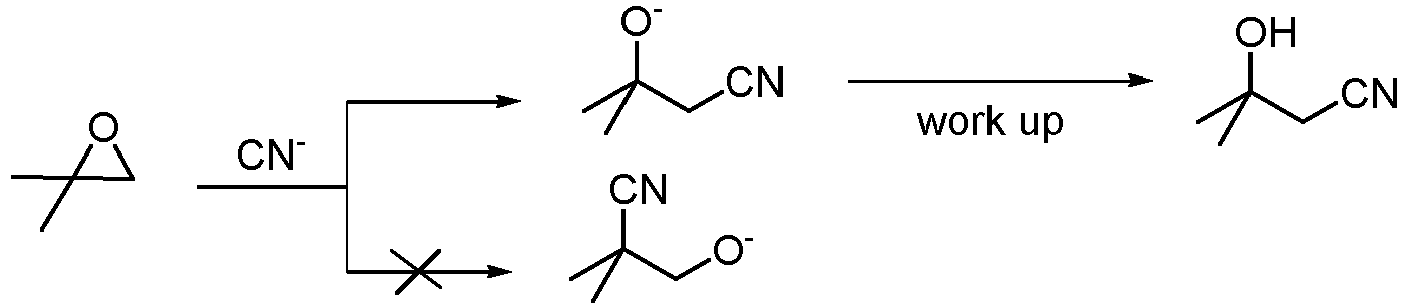
- Surprisingly, it was found that the ring opening of the epoxide is completely selective in aqueous solution at pH > 7, in particular between pH 7 and 12, meaning that the corresponding primary alcoholate is not formed at all. The reaction proceeds in a quantitative manner. 3-Hydroxy-3-methylbutyronitrile is obtained after aqueous, optionally slightly acidic, work-up from the alcoholate.
- The selectivity of the above-mentioned ring-opening reaction is particularly surprising, as nucleophilic reactions with isobutene oxide generally results in the formation of the primary, terminal alcohol. Depending from the solvent system, the tertiary alcohol can be isolated as a small quantity product.
- The ring-opening reaction according to the present invention can be carried out at room temperature. Alternatively, the reaction can be carried out at elevated temperature for accelerating the reaction. The amount of 1,2-epoxy-2-methylpropane relative to the amount cyanide should be between 1:1 and 1:1.2.
- Typically, reaction times or residence times of from 10 min to10 h and in particular 2 h to 5 h, will be appropriate for achieving reasonable and sufficient reaction yields.
- The nitrile may be isolated from the reaction mixture and purified using techniques generally known in the art, e.g. distillation or flash chromatography on silica.
- Suitable cyanides for the epoxide opening reaction are in particular alkali metal cyanides or alkaline earth metal cyanides. Preferably, sodium cyanide is used.
- An aqueous sodium cyanide solution with a pH > 7, in particular with a pH between 9 and 12, preferably with a pH of about 11, is particularly suitable.

- The isobutylene oxide used in step (a) may be obtained via catalytic epoxidation. Suitable oxidants for the process according to the present invention are hydrogen peroxide or hydroperoxides. Examples for hydroperoxides include tert-butyl hydroperoxide (tBuOOH, TBHP) and ethyl benzyl hydroperoxide (EBHP). As additional alternatives, the epoxidation step may be performed using ozone (Os) or meta-chloroperoxybenzoic acid (mCPBA).
- The preferred oxidant for the process according to the present invention is hydrogen peroxide (HzOz).

- The amount of hydrogen peroxide relative to the amount of isobutene is not critical. Most suitable are molar ratios of isobutene: hydrogen peroxide from 100:1 to 1:10. Preferably, the molar ratio of isobutene to hydrogen peroxide is in the range of from 1:5 to 10:1. A molar ratio of isobutene to hydrogen peroxide of 1: 2 is particularly preferred.
- Besides the substrate and the oxidant or epoxidation reagent, a hetereogenous catalyst and a solvent is present in the reaction mixture.
- The heterogeneous catalyst used for isobutylene oxide preparation according to the present invention contain a group 4 (e.g. Ti, Zr, Hf), a group 5 (e.g. V, Nb, Ta) or a group 6 (e.g. Cr, Mo, Wj metal and may be crystalline or amorphous. Preferably, the catalyst contains a group 4 metal, in particular titanium. Particularly preferred catalysts are crystalline molecular sieves, and particular zeolithes containing titanium.
- The titanium silicalites useful as catalysts for the isobutene epoxidation include zeolithes, in which the titanium is substitutes for a portion of the silicon atoms in the lattice framework of a molecular sieve. Such substances are well-known in the art.
- The titanium silicalites include the classes of molecular sieves commonly referred to as "TS-1" (having an MFI topology analogous to that of the ZSM-5 aluminosilicate zeolithes), "TS-2" (having an MEL topology analogous to that of the ZSM-11 aluminosilicate zeolithes) and "TS-3" (describes in BE 1,001 ,038). The preferred catalyst is titanium silicalite-1.
- The amount of catalyst employed is not critical, but should be sufficient to accomplish the desired epoxidation in particularly short time. The optimal quantity of catalyst will depend on a number of factors including reaction temperature, isobutene concentration, hydrogen peroxide /epoxidation reagent concentration, type and concentration of organic solvent as well as catalyst activity and reactor type.
- The catalyst may be used in powder, pellet, microspheric, extruded, monolithic or other suitable physical form.
- The temperature applied for the epoxidation reaction is between 0°C and 100 °C, in particular between 30°C and 80°C and preferably between 35°C and 40°C. The epoxidation reaction is generally performed at elevated pressure, as it is desirable to maintain the reaction components as a liquid mixture.
- Typically, reaction times or residence times of from 10 min to 24 h and in particular 2h to 5 h, will be appropriate for achieving reasonable and sufficient reaction yields.
- The epoxide may be isolated from the reaction mixture and purified using techniques generally known in the art, e.g. vacuum distillation.
- In a second process step (process step (b)), the 3-hydroxy-3-methylbutyronitrile obtained in step (a) is hydrolyzed to give HMB as a free acid.

- Nitriles can be readily converted to the corresponding carboxylic acids by a variety of chemical processes. Typical reagents are known in the art. For example, nitrile hydrolysis can be performed by reacting the nitrile with calcium hydroxide; ceroxide/zirconium oxide, optionally as nanopowder; acetone/ potassium hydroxide; titanium dioxide, optionally in combination with sulfuric acid or in combination with sodium hydroxide or with potassium hydroxide/hydrogen peroxide.
- Such processes however, typically require strongly acidic or caustic reaction conditions and/or high reaction temperatures. Further, unwanted byproducts and/or large amounts of inorganic salts are produced as unwanted waste.
- With regard to process simplicity and product yield, it was surprisingly found that in comparison to the aforementioned chemical hydrolysis conditions, enzyme catalyzed hydrolysis provides superior results.
- For enzyme catalyzed nitrile hydrolysis in aqueous solution, either a nitrilase enzyme or a combination of two enzymes, nitrile hydratase and amidase, can be used.
- The nitrilase enzyme directly converts the aliphatic nitrile to the corresponding carboxylic acid, without formation of the corresponding amide intermediate.
- The nitrile hydratase (NHase) initially converts the aliphatic nitrile to an amide, which can be subsequently further converted by the amidase to the corresponding carboxylic acid.
- In the process according to the present invention, an enzyme having nitrilase activity, or, alternatively, a combination of enzymes having nitrilase activity is used.

- Enzyme catalyzed hydrolysis of 3-hydroxy-3-methylbutyronitrile is preferably performed in phosphate buffer (potassium dihydrogen phosphate / dipotassium hydrogen phosphate) at a pH in the range of 6.5 to 7.5 and at a Temperature in the range of 30°C to 42°C.
- The enzyme catalyst can be present in the form of microbial cells (biomass), such as E. coli cells, permeablized microbial cells, one or more cell components of a microbial cell extract or as (partially) purified enzymes. These different forms can be immobilized on a soluble or insoluble support.
- In case the enzyme-catalyzed hydrolysis of 3-hydroxy-3-methylbutyronitrile is performed using microbial cells, it is possible to isolate the HMB product from the reaction medium by removing the bacterium biomass present in the medium to a complete extent (100%) or to a virtually complete extent, i.e. more than or greater than (>) 90%, >95%, >97%, >99%.
- Alternatively, the remaining constituents of the reaction medium can be left in the HBM product to a large extent, i.e. to an extent of 30% to 100%, 40% to 100%, 50% to 100%, 60% to 100%, 70% to 100%, 80% to 100%, or 90% to 100%, preferably greater than or equal to (≥) 50%, ≥60%, ≥70%, ≥80%, ≥90% or ≥95%, or else to a complete extent (100%). The latter variant, i.e. a mixture of HMBproduct and biomass is particularly suitable for feed applications.
- The biomass may removed or separated off by using separation methods such as, for example, centrifugation, filtration, decanting, flocculation or a combination thereof. Then, the biomass can be recycled, i.e. re-used in further nitrilase reactions.
- The medium obtained after biomass-removal may then be thickened or concentrated using known methods such as, for example, with the aid of a rotary evaporator, thin-film evaporator, falling-film evaporator, by reverse osmosis, by nanofiltration or a combination thereof, to give the HMB product as lubricous fluid.
- Free HMB has a strong odor. Therefore, livestock animals would avoid eating pure HMB. Accordingly, free HMB is only under certain conditions suitable as feed additive. However, HMB salts of alkali metals, alkaline earth metals or combinations thereof are free of odor and are converted into the free HMB acid in the animal stomach.
- Accordingly, the HMB product obtained in step (b) may be converted to HMB salts including, but not limited to, alkali metal salts, alkaline earth metal salts, or both. In this case, HMB, in its free acid form, is treated with at least one source of cations, preferably of calcium cations, such as calcium hydroxide.
- Optionally, the HMB salt, such as Ca-HMB, is recrystallized from a recrystallization solvent, such as ethanol, to provide crystalline HMB salt in high purity.
- The HMB product, HMB or a HMB salt, can be used as feed, feed material, premix or feed additive.
- Said feed, feed material, premix or feed additive may be prepared in a process comprising preparing 3-hydroxy-3-methylbutyric acid (HMB) or salt thereof according to a method of the present invention, as detailed above. The method for preparing the feed, feed material, premix or feed additive optionally further comprises the steps of
- (e) admixing the HMB product or salt thereof with a processing aid, and/or
- (f) pelletizing the HMB product or salt thereof, or the mixture obtained in step (e), and/or
- (g) coating the HMB product or salt thereof, or the pellet obtained in step (f).
- In the following, the invention is illustrated by non-limiting examples and exemplifying embodiments.
-
- 1,2-Epoxy-2-methylpropane (Aldrich)
- Natriumcyanide (Merck, p.A.)
- Potassium dihydrogenphosphate (Merck, p.A.)
- Dipotassium hydrogen phosphate (Roth, 98%)
- NIT59 / NIT60 (Nitrilasekit c-LEcta)
-
- Device: Agilent 1260 Infinity
- Column: RP18 Grace Alltima 5 µ, 4,5 mm * 250 mm
- Solvent: Gradient Acetonitril / 1,5 Gew% aqueous phosphoric acid
- Detection: UV 229 nm
- Column temperature 20°C
- GC for isobutylene oxide analysis
- Device (GC, HPLC): Agilent (GC)
- Column: DB1701 (Agilent)
- Method: Injection-temp. 250°C, Detection temp. 250°C,
Temperature programme: 40°C/5min → 10°C/min→ 125°C → 40°C/min → 280°C - Retention times: Isobutene 1,99min, Isobutene oxide 3.69 min, Methanol 2.55 min, side product 11.47 min
- GC for further analysis
- Device: HP 6890 Series GC System
- Column: HP-5, 5% Phenyl Methyl Siloxane, length: 30 m, diameter: 320 µm
- Front Inlet Temperature 200°C
- Detektion: FID @ 260°C
- Carrier gas: He
-

- An autoclave with catalyst basket was charged with TS-1 catalyst (5.00 g, extrudate, Evonik). After a leak test with nitrogen, the pressure was released. MeOH was added via a pump. The temperature was slowly increased to 40°C by means of a thermostat. Under rotation of the catalyst basket, a pressure of 2.0 bar (0.2 MPa) isobutylene was applied. As soon as pressure and temperature were constant, hydrogen peroxide (11.4 g, aqueous solution, 30 % w/w) was added. After 150 min, an isobutylene conversion of 83 % and the formation of the target product was determined by means of gas chromatographic analysis (reference measurement).
-

- 1,2-Epoxy-2-methylpropane (0.14 g, 1.9 mmol) was placed in a reaction vessel and dissolved in deionized water (5 mL). Under stirring, sodium cyanide (0.14 g, 2.0 mmol) was added. The resulting solution was stirred for 5 h at room temperature. Gaschromatographic analysis showed quantitative conversion (single peak at 13 min, for comparison of retention times see below). The abovereferenced product was obtained from the sodium salt intermediate after hydrolysis.
- GC retention times (for reference measurement).
- 1, 2-Epoxy-2-methylpropane: 11 min
- 3-Hydroxy-3-methylbutyronitrile: 13 min
- 3-Hydroxy-2, 2-dimethylpropionitrile 13,4 min
-

- 3-hydroxy-3-methylbutyronitrile (54 mg, 0.54 mmol) was placed in a reaction vessel and dissolved in phosphate buffer (5 mL, pH = 7, potassium dihydrogen phosphate / dipotassium hydrogen phosphate). A sample of 500 µL of the thus-obtained solution was mixed with nitrilase solution (10 µL), NIT59 and NIT60 (c-LEcta, Leipzig), respectively.
- The reaction mixture was shaken for 24 h at 37°C.
- Product yields: Hydrolysis with enzyme NIT59: 20%; Hydrolysis with enzyme NIT60: 26%
Claims (14)
- Process for preparing 3-hydroxy-3-methylbutyric acid (HMB) or a salt thereof, the process comprising(a) reacting isobutylene oxide with cyanide in orderto obtain 3-hydroxy-3-methylbutyronitrile, and(b) hydrolyzing the 3-hydroxy-3-methylbutyronitrile obtained in step (a) in order to obtain HMB,wherein hydrolysis step (b) is performed using either at least one nitrilase enzyme or, alternatively, using a combination of enzymes, said combination comprising at least one nitrile hydratase and at least one amidase.
- The process according to claim 1, wherein the cyanide used in process step (a) is an aqueous sodium cyanide solution with a pH > 7, preferably with a pH of between 9 and 12.
- The process according to claim 1 or according to claim 2, wherein the amount of 1,2-epoxy-2-methylpropane relative to the amount cyanide is between 1:1 and 1:1.2.
- The method according to any one of the preceding claims, wherein hydrolysis step (b) is performed using at least one enzyme having nitrilase activity.
- The process according to claim 4, wherein hydrolysis step (b) is performed in phosphate buffer at a pH in the range of 6.5 to 7.5 and at a Temperature in the range of 37°C to 42°C.
- The process according to any one of the preceding claims, wherein wherein hydrolysis step (b) is performed with the enzyme catalyst present in the form of microbial cells, in the form of permeablized microbial cells, in the form of one or more cell components of a microbial cell extract or in the form of (partially) purified enzymes.
- The process according to any one of the preceding claims, wherein hydrolysis step (b) is performed with the enzyme catalyst present in the form of microbial cells.
- The process according to claim 7, wherein after process step (b), the microbial cells are separated off and recycled.
- The process according to any one of the preceding claims, the process further comprising(c) converting the HMB product obtained in step (b) to HMB salts of alkali metals, alkaline earth metals or combinations thereof, and optionally(d) recrystallizing the HMB salt obtained in step (c).
- The process according to claim 9, wherein the HMB salt is calcium-HMB.
- The process according to any one of the preceding claims, wherein the isobutylene oxide used in step (a) is obtained via catalytic epoxidation.
- The process according to claim 11, wherein the epoxidation is performed using hydrogen peroxide.
- The process according to claim 11 or according to claim 12, wherein the epoxidation is performed using a titanium silicalite catalyst.
- Process for preparing feed, feed material or premix of feed additive, the process comprising preparing 3-hydroxy-3-methylbutyric acid (HMB) or salt thereof according to any one of claims 1 to 13 and optionally further comprising(e) admixing the HMB product or salt thereof with a processing aid, and/or(f) pelletizing the HMB product or salt thereof, or the mixture obtained in step (e), and/or(g) coating the HMB product or salt thereof, or the pellet obtained in step (f).
Applications Claiming Priority (2)
| Application Number | Priority Date | Filing Date | Title |
|---|---|---|---|
| EP19166808 | 2019-04-02 | ||
| PCT/EP2020/058340 WO2020200952A1 (en) | 2019-04-02 | 2020-03-25 | Process for preparing 3-hydroxy-3-methylbutyrate (hmb) and salts thereof |
Publications (2)
| Publication Number | Publication Date |
|---|---|
| EP3947336A1 EP3947336A1 (en) | 2022-02-09 |
| EP3947336B1 true EP3947336B1 (en) | 2023-03-15 |
Family
ID=66239757
Family Applications (1)
| Application Number | Title | Priority Date | Filing Date |
|---|---|---|---|
| EP20712978.4A Active EP3947336B1 (en) | 2019-04-02 | 2020-03-25 | Process for preparing 3-hydroxy-3-methylbutyrate (hmb) and salts thereof |
Country Status (4)
| Country | Link |
|---|---|
| US (1) | US12162828B2 (en) |
| EP (1) | EP3947336B1 (en) |
| CN (1) | CN113646293A (en) |
| WO (1) | WO2020200952A1 (en) |
Family Cites Families (14)
| Publication number | Priority date | Publication date | Assignee | Title |
|---|---|---|---|---|
| IT1216500B (en) | 1988-03-23 | 1990-03-08 | Eniricerche S P A Milano Enich | Prepn. of synthetic crystalline porous zeolite materials |
| US5087472A (en) | 1990-01-30 | 1992-02-11 | Iowa State University Research Foundation, Inc. | Feed compositions for domestics animals containing hydroxymethylbutyrate |
| JPH10276792A (en) * | 1997-04-04 | 1998-10-20 | Nitto Chem Ind Co Ltd | Process for producing hydroxycarboxylic acid and its amide |
| KR100313668B1 (en) * | 1999-02-03 | 2001-11-26 | 박영구 | A process for preparing (R)-4-cyano-3-hydroxybutyric acid ester |
| GB2387597B (en) * | 2001-01-22 | 2004-11-10 | Council Scient Ind Res | Stereoselective preparation of 3-hydroxy-3-phenylpropionitrile |
| US6582943B1 (en) * | 2002-02-05 | 2003-06-24 | E. I. Du Pont De Nemours And Company | Method for producing 2-hydroxyisobutyric acid and methacrylic acid from acetone cyanohydrin |
| US6960680B2 (en) * | 2003-01-08 | 2005-11-01 | Rhodia Chirex, Inc. | Manufacture of water-soluble β-hydroxynitriles |
| JP2007514648A (en) * | 2003-10-24 | 2007-06-07 | エーザイ株式会社 | Compounds and methods for treating diseases and conditions associated with Toll-likereceptor2 |
| US20110130540A1 (en) | 2007-08-17 | 2011-06-02 | E.I. Du Pont De Nemours And Company | Processes for the synthesis of 3-hydroxyglutaronitrile |
| PT2381784T (en) | 2008-12-09 | 2018-10-30 | Metabolic Tech Inc | Nutritional intervention for improving muscular function and strength |
| DE102009009580A1 (en) | 2009-02-19 | 2010-08-26 | Evonik Degussa Gmbh | Process for the preparation of free acids from their salts |
| DE102009001008A1 (en) | 2009-02-19 | 2010-08-26 | Evonik Degussa Gmbh | Reactive extraction of free organic acids from their ammonium salts |
| BR112014003434A2 (en) | 2011-08-15 | 2017-03-01 | Abbott Lab | process for producing hmb and its salts |
| EP2863914B1 (en) * | 2012-06-20 | 2018-10-03 | Merck Sharp & Dohme Corp. | Pyrazolyl derivatives as syk inhibitors |
-
2020
- 2020-03-25 EP EP20712978.4A patent/EP3947336B1/en active Active
- 2020-03-25 US US17/600,289 patent/US12162828B2/en active Active
- 2020-03-25 CN CN202080025878.4A patent/CN113646293A/en active Pending
- 2020-03-25 WO PCT/EP2020/058340 patent/WO2020200952A1/en not_active Ceased
Also Published As
| Publication number | Publication date |
|---|---|
| WO2020200952A1 (en) | 2020-10-08 |
| CN113646293A (en) | 2021-11-12 |
| US12162828B2 (en) | 2024-12-10 |
| EP3947336A1 (en) | 2022-02-09 |
| US20220204435A1 (en) | 2022-06-30 |
Similar Documents
| Publication | Publication Date | Title |
|---|---|---|
| US7368600B2 (en) | Method for production of methionine from homoserine | |
| US20150119573A1 (en) | Method for synthesizing sapropterin dihydrochloride | |
| EP1072600B2 (en) | Process for the preparation of Epoxides | |
| US6649757B2 (en) | Process for producing laurolactam from cyclododecanone | |
| US11788107B2 (en) | Method for producing aniline or an aniline derivative | |
| US10703709B2 (en) | Method for producing aniline or an aniline conversion product | |
| US9102589B2 (en) | Reactive distillation process for preparation of acetaminophen | |
| US6838571B2 (en) | Oxirane production using peroxidized compound | |
| CN116041270A (en) | Preparation process of intermediate chloroisoxazole for synthesizing fenpyr-diethyl | |
| US7442817B1 (en) | Process for the preparation of olefin oxides | |
| EP1253147B1 (en) | Process for preparing piperonal | |
| US12162828B2 (en) | Process for preparing 3-hydroxy-3-methylbutyric acid (HMB) and salts thereof | |
| US20050084942A1 (en) | Production of gluconate salts | |
| EP1556343B1 (en) | Process for the production of 3-methylthiopropanal | |
| EP1449824B1 (en) | Process for producing erythro-3-amino-2-hydroxybutyric acid derivatives | |
| KR100390079B1 (en) | Preparation of benzophennone imines | |
| US20100113804A1 (en) | Process for Preparing Dorzolamide | |
| CN118084747B (en) | Preparation method of florfenicol | |
| US6576775B1 (en) | Process for producing simvastatin | |
| JPH07285899A (en) | Method for producing γ, δ-unsaturated alcohol | |
| US6600062B2 (en) | Preparation of chiral 6,7-dihydroxy geranyloxy compounds | |
| JP4066679B2 (en) | Process for producing aralkyl ketones and catalyst thereof | |
| JP5026833B2 (en) | Process for producing optically active (S) -7-hydroxy-6-methylheptan-2-one and its precursor | |
| EP1632485A1 (en) | Method of producing 3,4,5,7,8,9-hexahydro-2h-dibenzofuran-1-one | |
| WO2024241125A1 (en) | A process for the preparation of propaquizafop |
Legal Events
| Date | Code | Title | Description |
|---|---|---|---|
| STAA | Information on the status of an ep patent application or granted ep patent |
Free format text: STATUS: UNKNOWN |
|
| STAA | Information on the status of an ep patent application or granted ep patent |
Free format text: STATUS: THE INTERNATIONAL PUBLICATION HAS BEEN MADE |
|
| PUAI | Public reference made under article 153(3) epc to a published international application that has entered the european phase |
Free format text: ORIGINAL CODE: 0009012 |
|
| STAA | Information on the status of an ep patent application or granted ep patent |
Free format text: STATUS: REQUEST FOR EXAMINATION WAS MADE |
|
| 17P | Request for examination filed |
Effective date: 20210913 |
|
| AK | Designated contracting states |
Kind code of ref document: A1 Designated state(s): AL AT BE BG CH CY CZ DE DK EE ES FI FR GB GR HR HU IE IS IT LI LT LU LV MC MK MT NL NO PL PT RO RS SE SI SK SM TR |
|
| DAV | Request for validation of the european patent (deleted) | ||
| DAX | Request for extension of the european patent (deleted) | ||
| GRAP | Despatch of communication of intention to grant a patent |
Free format text: ORIGINAL CODE: EPIDOSNIGR1 |
|
| STAA | Information on the status of an ep patent application or granted ep patent |
Free format text: STATUS: GRANT OF PATENT IS INTENDED |
|
| INTG | Intention to grant announced |
Effective date: 20221028 |
|
| GRAS | Grant fee paid |
Free format text: ORIGINAL CODE: EPIDOSNIGR3 |
|
| GRAA | (expected) grant |
Free format text: ORIGINAL CODE: 0009210 |
|
| STAA | Information on the status of an ep patent application or granted ep patent |
Free format text: STATUS: THE PATENT HAS BEEN GRANTED |
|
| AK | Designated contracting states |
Kind code of ref document: B1 Designated state(s): AL AT BE BG CH CY CZ DE DK EE ES FI FR GB GR HR HU IE IS IT LI LT LU LV MC MK MT NL NO PL PT RO RS SE SI SK SM TR |
|
| REG | Reference to a national code |
Ref country code: CH Ref legal event code: EP Ref country code: GB Ref legal event code: FG4D |
|
| REG | Reference to a national code |
Ref country code: DE Ref legal event code: R096 Ref document number: 602020008890 Country of ref document: DE |
|
| REG | Reference to a national code |
Ref country code: IE Ref legal event code: FG4D |
|
| REG | Reference to a national code |
Ref country code: AT Ref legal event code: REF Ref document number: 1553943 Country of ref document: AT Kind code of ref document: T Effective date: 20230415 |
|
| P01 | Opt-out of the competence of the unified patent court (upc) registered |
Effective date: 20230524 |
|
| REG | Reference to a national code |
Ref country code: LT Ref legal event code: MG9D |
|
| REG | Reference to a national code |
Ref country code: NL Ref legal event code: MP Effective date: 20230315 |
|
| PG25 | Lapsed in a contracting state [announced via postgrant information from national office to epo] |
Ref country code: RS Free format text: LAPSE BECAUSE OF FAILURE TO SUBMIT A TRANSLATION OF THE DESCRIPTION OR TO PAY THE FEE WITHIN THE PRESCRIBED TIME-LIMIT Effective date: 20230315 Ref country code: NO Free format text: LAPSE BECAUSE OF FAILURE TO SUBMIT A TRANSLATION OF THE DESCRIPTION OR TO PAY THE FEE WITHIN THE PRESCRIBED TIME-LIMIT Effective date: 20230615 Ref country code: LV Free format text: LAPSE BECAUSE OF FAILURE TO SUBMIT A TRANSLATION OF THE DESCRIPTION OR TO PAY THE FEE WITHIN THE PRESCRIBED TIME-LIMIT Effective date: 20230315 Ref country code: LT Free format text: LAPSE BECAUSE OF FAILURE TO SUBMIT A TRANSLATION OF THE DESCRIPTION OR TO PAY THE FEE WITHIN THE PRESCRIBED TIME-LIMIT Effective date: 20230315 Ref country code: HR Free format text: LAPSE BECAUSE OF FAILURE TO SUBMIT A TRANSLATION OF THE DESCRIPTION OR TO PAY THE FEE WITHIN THE PRESCRIBED TIME-LIMIT Effective date: 20230315 |
|
| REG | Reference to a national code |
Ref country code: AT Ref legal event code: MK05 Ref document number: 1553943 Country of ref document: AT Kind code of ref document: T Effective date: 20230315 |
|
| PG25 | Lapsed in a contracting state [announced via postgrant information from national office to epo] |
Ref country code: SE Free format text: LAPSE BECAUSE OF FAILURE TO SUBMIT A TRANSLATION OF THE DESCRIPTION OR TO PAY THE FEE WITHIN THE PRESCRIBED TIME-LIMIT Effective date: 20230315 Ref country code: NL Free format text: LAPSE BECAUSE OF FAILURE TO SUBMIT A TRANSLATION OF THE DESCRIPTION OR TO PAY THE FEE WITHIN THE PRESCRIBED TIME-LIMIT Effective date: 20230315 Ref country code: GR Free format text: LAPSE BECAUSE OF FAILURE TO SUBMIT A TRANSLATION OF THE DESCRIPTION OR TO PAY THE FEE WITHIN THE PRESCRIBED TIME-LIMIT Effective date: 20230616 Ref country code: FI Free format text: LAPSE BECAUSE OF FAILURE TO SUBMIT A TRANSLATION OF THE DESCRIPTION OR TO PAY THE FEE WITHIN THE PRESCRIBED TIME-LIMIT Effective date: 20230315 |
|
| PG25 | Lapsed in a contracting state [announced via postgrant information from national office to epo] |
Ref country code: SM Free format text: LAPSE BECAUSE OF FAILURE TO SUBMIT A TRANSLATION OF THE DESCRIPTION OR TO PAY THE FEE WITHIN THE PRESCRIBED TIME-LIMIT Effective date: 20230315 Ref country code: RO Free format text: LAPSE BECAUSE OF FAILURE TO SUBMIT A TRANSLATION OF THE DESCRIPTION OR TO PAY THE FEE WITHIN THE PRESCRIBED TIME-LIMIT Effective date: 20230315 Ref country code: PT Free format text: LAPSE BECAUSE OF FAILURE TO SUBMIT A TRANSLATION OF THE DESCRIPTION OR TO PAY THE FEE WITHIN THE PRESCRIBED TIME-LIMIT Effective date: 20230717 Ref country code: ES Free format text: LAPSE BECAUSE OF FAILURE TO SUBMIT A TRANSLATION OF THE DESCRIPTION OR TO PAY THE FEE WITHIN THE PRESCRIBED TIME-LIMIT Effective date: 20230315 Ref country code: EE Free format text: LAPSE BECAUSE OF FAILURE TO SUBMIT A TRANSLATION OF THE DESCRIPTION OR TO PAY THE FEE WITHIN THE PRESCRIBED TIME-LIMIT Effective date: 20230315 Ref country code: CZ Free format text: LAPSE BECAUSE OF FAILURE TO SUBMIT A TRANSLATION OF THE DESCRIPTION OR TO PAY THE FEE WITHIN THE PRESCRIBED TIME-LIMIT Effective date: 20230315 Ref country code: AT Free format text: LAPSE BECAUSE OF FAILURE TO SUBMIT A TRANSLATION OF THE DESCRIPTION OR TO PAY THE FEE WITHIN THE PRESCRIBED TIME-LIMIT Effective date: 20230315 |
|
| PG25 | Lapsed in a contracting state [announced via postgrant information from national office to epo] |
Ref country code: SK Free format text: LAPSE BECAUSE OF FAILURE TO SUBMIT A TRANSLATION OF THE DESCRIPTION OR TO PAY THE FEE WITHIN THE PRESCRIBED TIME-LIMIT Effective date: 20230315 Ref country code: PL Free format text: LAPSE BECAUSE OF FAILURE TO SUBMIT A TRANSLATION OF THE DESCRIPTION OR TO PAY THE FEE WITHIN THE PRESCRIBED TIME-LIMIT Effective date: 20230315 Ref country code: IS Free format text: LAPSE BECAUSE OF FAILURE TO SUBMIT A TRANSLATION OF THE DESCRIPTION OR TO PAY THE FEE WITHIN THE PRESCRIBED TIME-LIMIT Effective date: 20230715 |
|
| REG | Reference to a national code |
Ref country code: BE Ref legal event code: MM Effective date: 20230331 |
|
| REG | Reference to a national code |
Ref country code: DE Ref legal event code: R097 Ref document number: 602020008890 Country of ref document: DE |
|
| PG25 | Lapsed in a contracting state [announced via postgrant information from national office to epo] |
Ref country code: LU Free format text: LAPSE BECAUSE OF NON-PAYMENT OF DUE FEES Effective date: 20230325 |
|
| PG25 | Lapsed in a contracting state [announced via postgrant information from national office to epo] |
Ref country code: MC Free format text: LAPSE BECAUSE OF FAILURE TO SUBMIT A TRANSLATION OF THE DESCRIPTION OR TO PAY THE FEE WITHIN THE PRESCRIBED TIME-LIMIT Effective date: 20230315 |
|
| REG | Reference to a national code |
Ref country code: IE Ref legal event code: MM4A |
|
| PLBE | No opposition filed within time limit |
Free format text: ORIGINAL CODE: 0009261 |
|
| STAA | Information on the status of an ep patent application or granted ep patent |
Free format text: STATUS: NO OPPOSITION FILED WITHIN TIME LIMIT |
|
| PG25 | Lapsed in a contracting state [announced via postgrant information from national office to epo] |
Ref country code: SI Free format text: LAPSE BECAUSE OF FAILURE TO SUBMIT A TRANSLATION OF THE DESCRIPTION OR TO PAY THE FEE WITHIN THE PRESCRIBED TIME-LIMIT Effective date: 20230315 Ref country code: MC Free format text: LAPSE BECAUSE OF FAILURE TO SUBMIT A TRANSLATION OF THE DESCRIPTION OR TO PAY THE FEE WITHIN THE PRESCRIBED TIME-LIMIT Effective date: 20230315 Ref country code: IE Free format text: LAPSE BECAUSE OF NON-PAYMENT OF DUE FEES Effective date: 20230325 Ref country code: DK Free format text: LAPSE BECAUSE OF FAILURE TO SUBMIT A TRANSLATION OF THE DESCRIPTION OR TO PAY THE FEE WITHIN THE PRESCRIBED TIME-LIMIT Effective date: 20230315 |
|
| 26N | No opposition filed |
Effective date: 20231218 |
|
| PG25 | Lapsed in a contracting state [announced via postgrant information from national office to epo] |
Ref country code: BE Free format text: LAPSE BECAUSE OF NON-PAYMENT OF DUE FEES Effective date: 20230331 |
|
| PGFP | Annual fee paid to national office [announced via postgrant information from national office to epo] |
Ref country code: DE Payment date: 20240320 Year of fee payment: 5 |
|
| PG25 | Lapsed in a contracting state [announced via postgrant information from national office to epo] |
Ref country code: IT Free format text: LAPSE BECAUSE OF FAILURE TO SUBMIT A TRANSLATION OF THE DESCRIPTION OR TO PAY THE FEE WITHIN THE PRESCRIBED TIME-LIMIT Effective date: 20230315 |
|
| PGFP | Annual fee paid to national office [announced via postgrant information from national office to epo] |
Ref country code: FR Payment date: 20240328 Year of fee payment: 5 |
|
| PGFP | Annual fee paid to national office [announced via postgrant information from national office to epo] |
Ref country code: CH Payment date: 20240401 Year of fee payment: 5 |
|
| PG25 | Lapsed in a contracting state [announced via postgrant information from national office to epo] |
Ref country code: BG Free format text: LAPSE BECAUSE OF FAILURE TO SUBMIT A TRANSLATION OF THE DESCRIPTION OR TO PAY THE FEE WITHIN THE PRESCRIBED TIME-LIMIT Effective date: 20230315 |
|
| GBPC | Gb: european patent ceased through non-payment of renewal fee |
Effective date: 20240325 |
|
| PG25 | Lapsed in a contracting state [announced via postgrant information from national office to epo] |
Ref country code: BG Free format text: LAPSE BECAUSE OF FAILURE TO SUBMIT A TRANSLATION OF THE DESCRIPTION OR TO PAY THE FEE WITHIN THE PRESCRIBED TIME-LIMIT Effective date: 20230315 |
|
| PG25 | Lapsed in a contracting state [announced via postgrant information from national office to epo] |
Ref country code: GB Free format text: LAPSE BECAUSE OF NON-PAYMENT OF DUE FEES Effective date: 20240325 |
|
| PG25 | Lapsed in a contracting state [announced via postgrant information from national office to epo] |
Ref country code: GB Free format text: LAPSE BECAUSE OF NON-PAYMENT OF DUE FEES Effective date: 20240325 |
|
| PG25 | Lapsed in a contracting state [announced via postgrant information from national office to epo] |
Ref country code: CY Free format text: LAPSE BECAUSE OF FAILURE TO SUBMIT A TRANSLATION OF THE DESCRIPTION OR TO PAY THE FEE WITHIN THE PRESCRIBED TIME-LIMIT; INVALID AB INITIO Effective date: 20200325 |
|
| PG25 | Lapsed in a contracting state [announced via postgrant information from national office to epo] |
Ref country code: HU Free format text: LAPSE BECAUSE OF FAILURE TO SUBMIT A TRANSLATION OF THE DESCRIPTION OR TO PAY THE FEE WITHIN THE PRESCRIBED TIME-LIMIT; INVALID AB INITIO Effective date: 20200325 |
|
| REG | Reference to a national code |
Ref country code: DE Ref legal event code: R119 Ref document number: 602020008890 Country of ref document: DE |
|
| REG | Reference to a national code |
Ref country code: CH Ref legal event code: H13 Free format text: ST27 STATUS EVENT CODE: U-0-0-H10-H13 (AS PROVIDED BY THE NATIONAL OFFICE) Effective date: 20251023 |
|
| PG25 | Lapsed in a contracting state [announced via postgrant information from national office to epo] |
Ref country code: TR Free format text: LAPSE BECAUSE OF FAILURE TO SUBMIT A TRANSLATION OF THE DESCRIPTION OR TO PAY THE FEE WITHIN THE PRESCRIBED TIME-LIMIT Effective date: 20230315 |
|
| PG25 | Lapsed in a contracting state [announced via postgrant information from national office to epo] |
Ref country code: DE Free format text: LAPSE BECAUSE OF NON-PAYMENT OF DUE FEES Effective date: 20251001 |
|
| PG25 | Lapsed in a contracting state [announced via postgrant information from national office to epo] |
Ref country code: FR Free format text: LAPSE BECAUSE OF NON-PAYMENT OF DUE FEES Effective date: 20250331 |
|
| PG25 | Lapsed in a contracting state [announced via postgrant information from national office to epo] |
Ref country code: CH Free format text: LAPSE BECAUSE OF NON-PAYMENT OF DUE FEES Effective date: 20250331 |