EP3946891B1 - Multy-cavity mould for a thermoforming machine used in the process of high-volume, continuous thermoforming of thin-gauge plastic products - Google Patents
Multy-cavity mould for a thermoforming machine used in the process of high-volume, continuous thermoforming of thin-gauge plastic products Download PDFInfo
- Publication number
- EP3946891B1 EP3946891B1 EP19733894.0A EP19733894A EP3946891B1 EP 3946891 B1 EP3946891 B1 EP 3946891B1 EP 19733894 A EP19733894 A EP 19733894A EP 3946891 B1 EP3946891 B1 EP 3946891B1
- Authority
- EP
- European Patent Office
- Prior art keywords
- zone
- mould
- cavity
- common
- dies
- Prior art date
- Legal status (The legal status is an assumption and is not a legal conclusion. Google has not performed a legal analysis and makes no representation as to the accuracy of the status listed.)
- Active
Links
Images









Classifications
-
- B—PERFORMING OPERATIONS; TRANSPORTING
- B29—WORKING OF PLASTICS; WORKING OF SUBSTANCES IN A PLASTIC STATE IN GENERAL
- B29C—SHAPING OR JOINING OF PLASTICS; SHAPING OF MATERIAL IN A PLASTIC STATE, NOT OTHERWISE PROVIDED FOR; AFTER-TREATMENT OF THE SHAPED PRODUCTS, e.g. REPAIRING
- B29C51/00—Shaping by thermoforming, i.e. shaping sheets or sheet like preforms after heating, e.g. shaping sheets in matched moulds or by deep-drawing; Apparatus therefor
- B29C51/26—Component parts, details or accessories; Auxiliary operations
- B29C51/261—Handling means, e.g. transfer means, feeding means
- B29C51/262—Clamping means for the sheets, e.g. clamping frames
-
- B—PERFORMING OPERATIONS; TRANSPORTING
- B26—HAND CUTTING TOOLS; CUTTING; SEVERING
- B26F—PERFORATING; PUNCHING; CUTTING-OUT; STAMPING-OUT; SEVERING BY MEANS OTHER THAN CUTTING
- B26F1/00—Perforating; Punching; Cutting-out; Stamping-out; Apparatus therefor
- B26F1/38—Cutting-out; Stamping-out
- B26F1/40—Cutting-out; Stamping-out using a press, e.g. of the ram type
-
- B—PERFORMING OPERATIONS; TRANSPORTING
- B26—HAND CUTTING TOOLS; CUTTING; SEVERING
- B26F—PERFORATING; PUNCHING; CUTTING-OUT; STAMPING-OUT; SEVERING BY MEANS OTHER THAN CUTTING
- B26F1/00—Perforating; Punching; Cutting-out; Stamping-out; Apparatus therefor
- B26F1/38—Cutting-out; Stamping-out
- B26F1/44—Cutters therefor; Dies therefor
-
- B—PERFORMING OPERATIONS; TRANSPORTING
- B29—WORKING OF PLASTICS; WORKING OF SUBSTANCES IN A PLASTIC STATE IN GENERAL
- B29C—SHAPING OR JOINING OF PLASTICS; SHAPING OF MATERIAL IN A PLASTIC STATE, NOT OTHERWISE PROVIDED FOR; AFTER-TREATMENT OF THE SHAPED PRODUCTS, e.g. REPAIRING
- B29C51/00—Shaping by thermoforming, i.e. shaping sheets or sheet like preforms after heating, e.g. shaping sheets in matched moulds or by deep-drawing; Apparatus therefor
- B29C51/04—Combined thermoforming and prestretching, e.g. biaxial stretching
-
- B—PERFORMING OPERATIONS; TRANSPORTING
- B29—WORKING OF PLASTICS; WORKING OF SUBSTANCES IN A PLASTIC STATE IN GENERAL
- B29C—SHAPING OR JOINING OF PLASTICS; SHAPING OF MATERIAL IN A PLASTIC STATE, NOT OTHERWISE PROVIDED FOR; AFTER-TREATMENT OF THE SHAPED PRODUCTS, e.g. REPAIRING
- B29C51/00—Shaping by thermoforming, i.e. shaping sheets or sheet like preforms after heating, e.g. shaping sheets in matched moulds or by deep-drawing; Apparatus therefor
- B29C51/26—Component parts, details or accessories; Auxiliary operations
- B29C51/30—Moulds
-
- B—PERFORMING OPERATIONS; TRANSPORTING
- B29—WORKING OF PLASTICS; WORKING OF SUBSTANCES IN A PLASTIC STATE IN GENERAL
- B29C—SHAPING OR JOINING OF PLASTICS; SHAPING OF MATERIAL IN A PLASTIC STATE, NOT OTHERWISE PROVIDED FOR; AFTER-TREATMENT OF THE SHAPED PRODUCTS, e.g. REPAIRING
- B29C51/00—Shaping by thermoforming, i.e. shaping sheets or sheet like preforms after heating, e.g. shaping sheets in matched moulds or by deep-drawing; Apparatus therefor
- B29C51/26—Component parts, details or accessories; Auxiliary operations
- B29C51/30—Moulds
- B29C51/32—Moulds having cutting means
-
- B—PERFORMING OPERATIONS; TRANSPORTING
- B26—HAND CUTTING TOOLS; CUTTING; SEVERING
- B26D—CUTTING; DETAILS COMMON TO MACHINES FOR PERFORATING, PUNCHING, CUTTING-OUT, STAMPING-OUT OR SEVERING
- B26D1/00—Cutting through work characterised by the nature or movement of the cutting member or particular materials not otherwise provided for; Apparatus or machines therefor; Cutting members therefor
- B26D1/0006—Cutting members therefor
- B26D2001/0053—Cutting members therefor having a special cutting edge section or blade section
-
- B—PERFORMING OPERATIONS; TRANSPORTING
- B26—HAND CUTTING TOOLS; CUTTING; SEVERING
- B26F—PERFORATING; PUNCHING; CUTTING-OUT; STAMPING-OUT; SEVERING BY MEANS OTHER THAN CUTTING
- B26F1/00—Perforating; Punching; Cutting-out; Stamping-out; Apparatus therefor
- B26F1/38—Cutting-out; Stamping-out
- B26F1/44—Cutters therefor; Dies therefor
- B26F2001/4427—Cutters therefor; Dies therefor combining cutting and forming operations
-
- B—PERFORMING OPERATIONS; TRANSPORTING
- B26—HAND CUTTING TOOLS; CUTTING; SEVERING
- B26F—PERFORATING; PUNCHING; CUTTING-OUT; STAMPING-OUT; SEVERING BY MEANS OTHER THAN CUTTING
- B26F1/00—Perforating; Punching; Cutting-out; Stamping-out; Apparatus therefor
- B26F1/38—Cutting-out; Stamping-out
- B26F1/44—Cutters therefor; Dies therefor
- B26F2001/4472—Cutting edge section features
-
- B—PERFORMING OPERATIONS; TRANSPORTING
- B26—HAND CUTTING TOOLS; CUTTING; SEVERING
- B26F—PERFORATING; PUNCHING; CUTTING-OUT; STAMPING-OUT; SEVERING BY MEANS OTHER THAN CUTTING
- B26F2210/00—Perforating, punching, cutting-out, stamping-out, severing by means other than cutting of specific products
- B26F2210/06—Trimming plastic mouldings
-
- B—PERFORMING OPERATIONS; TRANSPORTING
- B29—WORKING OF PLASTICS; WORKING OF SUBSTANCES IN A PLASTIC STATE IN GENERAL
- B29C—SHAPING OR JOINING OF PLASTICS; SHAPING OF MATERIAL IN A PLASTIC STATE, NOT OTHERWISE PROVIDED FOR; AFTER-TREATMENT OF THE SHAPED PRODUCTS, e.g. REPAIRING
- B29C2793/00—Shaping techniques involving a cutting or machining operation
- B29C2793/0009—Cutting out
-
- B—PERFORMING OPERATIONS; TRANSPORTING
- B29—WORKING OF PLASTICS; WORKING OF SUBSTANCES IN A PLASTIC STATE IN GENERAL
- B29C—SHAPING OR JOINING OF PLASTICS; SHAPING OF MATERIAL IN A PLASTIC STATE, NOT OTHERWISE PROVIDED FOR; AFTER-TREATMENT OF THE SHAPED PRODUCTS, e.g. REPAIRING
- B29C2793/00—Shaping techniques involving a cutting or machining operation
- B29C2793/0054—Shaping techniques involving a cutting or machining operation partially cutting through the material
-
- B—PERFORMING OPERATIONS; TRANSPORTING
- B29—WORKING OF PLASTICS; WORKING OF SUBSTANCES IN A PLASTIC STATE IN GENERAL
- B29C—SHAPING OR JOINING OF PLASTICS; SHAPING OF MATERIAL IN A PLASTIC STATE, NOT OTHERWISE PROVIDED FOR; AFTER-TREATMENT OF THE SHAPED PRODUCTS, e.g. REPAIRING
- B29C2793/00—Shaping techniques involving a cutting or machining operation
- B29C2793/0081—Shaping techniques involving a cutting or machining operation before shaping
-
- B—PERFORMING OPERATIONS; TRANSPORTING
- B29—WORKING OF PLASTICS; WORKING OF SUBSTANCES IN A PLASTIC STATE IN GENERAL
- B29C—SHAPING OR JOINING OF PLASTICS; SHAPING OF MATERIAL IN A PLASTIC STATE, NOT OTHERWISE PROVIDED FOR; AFTER-TREATMENT OF THE SHAPED PRODUCTS, e.g. REPAIRING
- B29C48/00—Extrusion moulding, i.e. expressing the moulding material through a die or nozzle which imparts the desired form; Apparatus therefor
- B29C48/25—Component parts, details or accessories; Auxiliary operations
- B29C48/285—Feeding the extrusion material to the extruder
- B29C48/29—Feeding the extrusion material to the extruder in liquid form
-
- B—PERFORMING OPERATIONS; TRANSPORTING
- B29—WORKING OF PLASTICS; WORKING OF SUBSTANCES IN A PLASTIC STATE IN GENERAL
- B29C—SHAPING OR JOINING OF PLASTICS; SHAPING OF MATERIAL IN A PLASTIC STATE, NOT OTHERWISE PROVIDED FOR; AFTER-TREATMENT OF THE SHAPED PRODUCTS, e.g. REPAIRING
- B29C51/00—Shaping by thermoforming, i.e. shaping sheets or sheet like preforms after heating, e.g. shaping sheets in matched moulds or by deep-drawing; Apparatus therefor
- B29C51/26—Component parts, details or accessories; Auxiliary operations
- B29C51/266—Auxiliary operations after the thermoforming operation
-
- B—PERFORMING OPERATIONS; TRANSPORTING
- B29—WORKING OF PLASTICS; WORKING OF SUBSTANCES IN A PLASTIC STATE IN GENERAL
- B29K—INDEXING SCHEME ASSOCIATED WITH SUBCLASSES B29B, B29C OR B29D, RELATING TO MOULDING MATERIALS OR TO MATERIALS FOR MOULDS, REINFORCEMENTS, FILLERS OR PREFORMED PARTS, e.g. INSERTS
- B29K2027/00—Use of polyvinylhalogenides or derivatives thereof as moulding material
- B29K2027/12—Use of polyvinylhalogenides or derivatives thereof as moulding material containing fluorine
- B29K2027/18—PTFE, i.e. polytetrafluoroethylene, e.g. ePTFE, i.e. expanded polytetrafluoroethylene
-
- B—PERFORMING OPERATIONS; TRANSPORTING
- B29—WORKING OF PLASTICS; WORKING OF SUBSTANCES IN A PLASTIC STATE IN GENERAL
- B29L—INDEXING SCHEME ASSOCIATED WITH SUBCLASS B29C, RELATING TO PARTICULAR ARTICLES
- B29L2031/00—Other particular articles
- B29L2031/712—Containers; Packaging elements or accessories, Packages
- B29L2031/7132—Bowls, Cups, Glasses
Definitions
- the present invention relates to the field of machines which thermoform thin-gauge plastic sheet material into various parts and/or products and particularly to a multi-cavity mould included as a part of the thermoforming machine used in the process of high-volume, continuous thermoforming of thin-gauge plastic products, for example in the Form/Cut/Stack and/or In-Mould-Cut thermoforming machines with multi-cavity mould.
- thermoforming process is widely used in the packaging industry to make various products from sheets (sometimes referred to as "films") of thermoplastic material, which is a substance (especially synthetic plastic or resin) becoming soft and moldable when subjected to heat and regaining its solid state when cooling, without appreciable change of properties.
- CN105383049A discloses a multi-cavity mould in accordance with the preamble of claim 1 and corresponding thermoforming apparatuses comprising the multi-cavity mould.
- thermoforming process is a manufacturing process for thermoplastic sheet or film. Specifically, it is more of a converting process, where thermoplastic sheet or film is converted into a formed, finished part. The sheet or film is heated in an oven to its forming temperature, then stretched into or onto a mould, whose shape it takes and then cooled.
- the thermoforming process uses thin-gauge or thick-gauge sheets of thermoplastic material. Thin-gauge films are used to manufacturing trays, containers, disposable cups, blisters, etc. They have wide applications in the food, fast moving consumer goods, and medical industries.
- the thin-gauge thermoplastic films are usually wrapped up on a reel of cardboard and have a thickness (A) between 0.2 and 2 mm.
- thermoplastic materials used are: Polypropylene (PP), Polyvinyl chloride (PVC), Polystyrene (PS), Oriented Polystyrene (OPS), Polyethylene terephthalate (PET), Poly(lactic acid) or polylactic acid or polylactide (PLA), Crystalline Polyethylene Terephthalate (CPET), various combinations like Polypropylene/Ethylene vinyl alcohol/Polypropylene (PP/EVOH/PP), Polypropylene/Polyethylene or polythene (PP/PE), Polyethylene terephthalate/ Polyethylene or polythene (PET/PE) and the combinations thereof.
- PP Polypropylene
- PVC Polyvinyl chloride
- PS Polystyrene
- OPS Oriented Polystyrene
- PET Poly(lactic acid) or polylactic acid or polylactide
- PLA Crystalline Polyethylene Terephthalate
- CPET Crystalline Polyethylene Terephthalate
- PP/EVOH/PP Polypropylene
- the thin-gauge thermoplastic film is fed through the thermoforming machine, either continuously from a roll or in cut sheets and is subsequently heated to allow forming of the plastic, shaped in moulds (which can be plug moulds or cavity moulds) to produce the shapes of the various desired parts or products, then cooled and trimmed to separate the parts/products from the surrounding scrap sheet/film (sometimes referred to as "web").
- Thermoforming machines typically include:
- thermoforming methods differing in the technique used for the forming stage: vacuum, pressure and mechanical thermoforming.
- thermoforming machines which use the techniques mentioned above.
- the preferred thermoforming machines used in the process of high-volume, continuous thermoforming of thin-gauge plastic products are the Form/Cut/Stack and In-Mould-Cut thermoforming machines.
- the forming and cutting operations are accomplished in separate stations, in different subassemblies of the thermoforming machine and the desired geometry is accomplished with or without the benefit of a mechanical plug assist (i.e. a mechanical device used to aid or assist sheet stretching prior to total contact with the mould).
- a mechanical plug assist i.e. a mechanical device used to aid or assist sheet stretching prior to total contact with the mould.
- the forming and cutting operations are accomplished in a single station. Desired geometry is accomplished with or without the benefit of a mechanical plug assist.
- the process begins by first holding the sheet of plastic material against a hardened cutting plate by means of the leading edge of the forged steel cutting die (or steel-rule cutting die) penetrating the surface of the plastic sheet. This contact provides the seal needed for the next step in the forming process, in case of In-Mould-Cut tools with CNC (forged) dies.
- the seal is provided via a pressure box and O-rings used for sealing.
- Pressurized air usually introduced through the hardened cutting plate, pushes the heated plastic sheet (preheated into the previous oven station) into the mould geometry, mounted inside the perimeter of the steel dies. After cooling, the steel die is pushed the rest of the way through the plastic material, into contact with the hardened cutting plate, and the part/product is cut.
- the part/product inside the web is ejected from the mould by means of pressurized air, spring assisted ejection rings, movable bottom ejectors, movable stripping plate or combinations thereof. It is then conveyed to the next station (usually a stacker station) inside the web. This is facilitated by tiny precise notches (also called "nicks") in the cutting edge of the die. These notches hold the plastic parts/products in the web while being conveyed, but are kept small enough so the parts/products can be easily separated from the web for packing.
- the In-Mould-Cut thermoforming technology available today is preferred because it has several advantages compared to the other known thermoforming technologies.
- This type of machines generally produces the least amount of trim waste/scrap plastic.
- the cutting die not only cuts on the part perimeter, but is also used to form the airtight perimeter seal needed to form the plastic product.
- Another advantage is that the plastic material/formed product is generally warm when it is trimmed. This is highly desirable when cutting PET, because warm plastic material/formed product requires dramatically less pressure to trim. These lower pressures usually extend the usefulness of the cutting edge of the die significantly.
- An additional advantage is the accuracy of trimming the part/product geometry.
- Today's modern thermoforming machines are achieving trim accuracy that approaches the precision found in match metal trim stations, at a significant cost savings.
- some thermoplastic materials allow for extremely short thermoforming cycle times, especially in geometries that feature shallow draw.
- the plastic thermoforming moulds for a thermoforming machine usually comprise one pair of complementary tools in which: male (also known as “plug moulds” or “positive moulds”) and female (also known as “cavity moulds” or “negative moulds”) are provided.
- the cavity moulds are placed in cavities provided inside one of the molding tool's main body.
- male moulds the thermoplastic sheet is formed over the surface of the male mould.
- female moulds the thermoplastic sheet is formed inside of the female mould's surface.
- Male moulds are used when the inside dimensions of the plastic part are a priority.
- Female moulds are used when the part's or product's outer dimensions are more important than its inner dimensions.
- a female mould can produce highly detailed parts/products.
- the inside of the mould surface usually produces the exterior surface of the finished parts/products. This supports the creation of sharp corners and molded-in features such as logos, ribbing, and recesses for name plates which is particularly important in the packaging industry.
- the inside corners of a female mould may be relatively tight.
- Multi-cavity moulds can be extremely cost effective and can provide enormous capacity for the manufacturer; however, they come with some degree of risk.
- the tool design must be able to provide uniform processing conditions at each cavity and less plastic scrap or waste material at the end of a thermoforming production cycle.
- thermoforming machines with multi-cavity mould produce two or more identical parts/products at one press stroke.
- the formed identical parts/products are then trimmed individually from the sheet of plastic material leaving a skeleton of scrap material which has to be discarded or recycled.
- This is due to the spaced-apart layout of the cavities inside a multi-cavity mould.
- the standard distance between adjacent cavity moulds is of 12 - 40 mm.
- This is due to the configuration of a supporting block (i.e. a metal block, typically of a rectangular shape, which extends perpendicularly from a base plate inside the main body of a mould, over a predetermined total height, situated between adjacent cavities).
- This supporting block has to confer increased rigidity to the tool's main block and to the cavity moulds, as well as high mechanical resistance during the thermoforming process at multiple press strokes. Therefore the standard minimum distance between adjacent cavity moulds is of 12 mm to ensure an increased rigidity and mechanical resistance of the supporting block. Thus, a considerable amount of unformed plastic material remains between the edges of the parts/products formed as well as between the edges of the parts/products formed and the surrounding plastic sheet margins.
- the minimum distance between adjacent cavity moulds is of 12 mm to ensure adequate space for the configuration of the ventilation channels inside the mould;
- the ventilation channels are vent holes around the periphery of the cavity moulds and in areas requiring crisp detail; these channels are so small that they do not deform the plastic material which will line the cavity mould during moulding, but at the same time are large enough to permit the trapped air to escape from the cavity mould.
- Other reasons to maintain a minimum distance of 12 mm between adjacent cavity moulds are:
- thermoforming mould The main disadvantage of the conventional thermoforming mould is that it generates a substantially large amount of scrap material that needs to be stored, discarded or recycled at additional cost.
- the scrap percentage is usually around 20% to 50%.
- Most thermoforming companies recycle their plastic scrap material. Frequently this is converted back into extruded sheet for forming again. This recycling process decreases the efficiency of the thermoforming process by increasing the production lead time of finished parts/products per m 2 of plastic sheet material. Another oft-forgotten fact about recycling is that the recovered material degrades in quality.
- thermoforming mould Another disadvantage of the conventional thermoforming mould is the higher maintenance costs for replacing the individual cutting dies. For example, if a single forged die is damaged, the entire set of forged dies must be sent out for sharpening, thereby increasing the set-up times and decreasing productivity. Also, the high force required to cut through the plastic sheet has to be well controlled to minimize what is called the "overshoot" of the moving die. Otherwise the forged dies will hit the counter plate too hard which will quickly damage the dies and degrade the quality of the cutting edges. Therefore, lowering the force required to cut through the plastic sheet will allow for a better control of the cutting die.
- the auto-centering of the individual dies is based on additional centering features provided on the forming station, such as forming cones in an area where adjacent products are formed and/or an independent aligning system for dies provided on the cutting station.
- additional centering features increase considerably the total production costs for the thermoforming moulds and the precision alignment capabilities of the thermoforming moulds are poor.
- thermoforming machines with multi-cavity mould that address these conventional inefficiencies are therefore needed.
- the present invention provides a solution to the above mentioned inherent problems associated with the known thermoforming machines with multi-cavity mould.
- the main objective technical problem is how to improve the efficiency of a thermoforming process while producing the most finished parts/products per m 2 of plastic sheet material and maintaining a reduced scrap rate.
- the main purpose of the present invention is to remedy the above mentioned drawbacks of the prior art by disclosing a multi-cavity mould for a thermoforming machine that can form and/or trim a series of parts/products in a row/a column or multiple rows/columns while eliminating all web between the edges of the parts/products and gaining extra 10% efficiency using the common-edge-cut tooling technology compared to the conventional thermoforming machines with multi-cavity mould.
- the multi-cavity mould of the invention for a thermoforming machine used in the process of high-volume, continuous thermoforming of a plurality of thin-gauge plastic products from a preheated thin-gauge thermoplastic sheet according to the independent claim 1 comprises:
- FIG. 1 A detailed front view in a vertical cross section of a conventional supporting block of a multi-cavity mould is shown in fig. 1 .
- the width (w) of the conventional supporting block, as shown in fig. 1 is usually calculated as 20-25% of the total height (a) of the supporting block, thus complying with the technical considerations mentioned above.
- the inventive solution to the technical problems associated with the known thermoforming moulds, provided by the present invention is to reconfigure the supporting block's structure and profile between adjacent cavities in order to reduce the distance between adjacent cavity moulds such that the formed products are joined only by a common-edge and then severed on this common-edge by a cutting die to obtain the finished thin-gauge plastic products.
- the inventive solution complies with the technical requirements regarding rigidity, adequate space for the cooling circuit and for the ventilation channels, easy trimming of the formed products and so on.
- a multi-cavity mould (1) for a thermoforming machine used in the process of high-volume, continuous thermoforming of a plurality of thin-gauge plastic products (2) from a preheated thin-gauge thermoplastic sheet (3) according to the present invention comprising an upper tool (11) and a lower tool (12) arranged in a cooperating manner to simultaneously form and/or sever a plurality of thin-gauge plastic products (2).
- the lower tool (12) comprises a plurality of cavities (8) arranged in a x-z array, in which cavity moulds (8') may be placed.
- the lower tool (12) further comprises a plurality of base plates (91) from which a plurality of supporting blocks (92) extend perpendicularly over a predetermined total height (a), situated between adjacent cavities (8).
- the base plates (91), the supporting blocks (92) and the cavity moulds (8') are made of an Aluminum alloy selected from a group consisting of 5083, 6082 or 7075 Aluminum alloys. These are known for their low density (the overall weight of a mould is therefore lower and can be easily transported), higher strength when compared to steel, relatively soft, ductile and easily workable under normal temperature.
- the tensile strength of these Aluminum alloys is higher than aluminum.
- the electrical and heat conductivity is less than that of pure aluminum and more than that of steel (the mould can have a relatively constant temperature in its entire groundmass). These can be easily forged, casted and worked with respect to their low melting point, especially on numerically controlled tools.
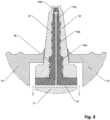
- Each supporting block (92) has a stepped profile divided into four zones (92a, 92b, 92c, 92d).
- the first three zones, namely a first (92a), a second (92b) and a third (92c) zone are substantially rectangular shaped zones in a vertical cross section and the fourth zone (92d) has a substantially isosceles trapezoid shaped, in a vertical cross section. All of these four zones (92a, 92b, 92c, 92d) have a common symmetry axis in a vertical cross section through a plane perpendicular to the base plate (91).
- the adjacent cavity moulds (8') have a stepped profile, on their exterior surface, which corresponds in a complementary manner to the profile of the supporting block (92) between them.
- the first zone (92a) extends perpendicularly from the base plate (91) over a distance (a1), which represents the height of the first zone (92a), calculated as 17-50% of the total height (a) of the supporting block (92).
- the width of the first zone (92a) is calculated as 24-60% of the total height (a) of the supporting block (92).
- the second zone (92b) extends in continuation of the first zone (92a) over a distance (a2), which represents the height of the second zone (92b), calculated as 45-65% of the total height (a) of the supporting block (92).
- the width of the second zone (92b) is calculated as 7-16% of the total height (a) of the supporting block (92).
- the third zone (92c) extends in continuation of the second zone (92b) over a distance (a3), which represents the height of the third zone (92c), calculated as 9-12% of the total height (a) of the supporting block (92).
- the width of the third zone (92c) is calculated as 5-10% of the total height (a) of the supporting block (92).
- the fourth zone (92d) has a substantially isosceles trapezoid shape and extends in continuation of said third zone (92c) over a distance (a4), which represents the height of the fourth zone (92d), calculated as 9-12% of the total height (a) of the supporting block (92).
- the term “isosceles trapezoid shape” can be defined as a trapezoid with two bases (i.e. parallel sides), in which both legs (i.e. non-parallel sides) have the same length; the base angles have the same measure pair wise and the trapezoid has a line of symmetry through the midpoints of opposite sides. The segment that joins the midpoints of the parallel sides (i.e. top base and bottom base) is perpendicular to them.
- the term “isosceles trapezoid shape” is limited to a “convex isosceles trapezoid shape”.
- the fourth zone (92d) has a bottom base in contact with and having the same width as the third zone (92c), a top base and two legs between the top and bottom bases, and the width of its top base is calculated as 2.5-5% of the total height (a) of the supporting block (92).
- the both acute angles described by the bottom base with each of the two legs of the fourth zone (92d) are of about 75° to about 89°. In a preferred embodiment of the present invention, both acute angles are of 81°.
- the fourth zone (92d) has its bottom base in contact with and having the same width as the third zone (92c) and the width of its top base is calculated as 2.5-5% of the total height (a) of the supporting block (92).
- the first zone (92a) supports the weight of the second (92b), third (92c) and fourth (92d) zones.
- the cooling channels may be provided in the region of the second zone (92b).
- the third zone (92c) may be situated above the cooling zone (where the cooling channels may be provided) and above sealing means, preferably O-rings, used for sealing of the second zone (92b).
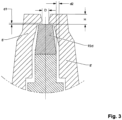
- the legs and top base of the fourth zone (92d) are spaced apart from a top part of adjacent cavity moulds (8') at distances (d1, d2) leaving a space between the fourth zone (92d) and the top part of adjacent cavity moulds (8') which is used for the ventilation of the formed thermoplastic products (2) inside the cavity moulds (8') ( fig. 3 ).
- the top rims of two adjacent cavity moulds (8') extend over a part of the top base of the fourth zone (92d) of the supporting block (92) situated between them, leaving a middle portion of the top base uncovered, with a width (D) of about 1.5 mm to about 6 mm ( fig. 3 ).
- the width (D) of the middle portion is of about 2 to 4 mm and more preferably about 3.2 mm.
- the width (D) of the middle portion of about 3.2 mm is preferred because it is the ideal dimension for the standard range of thermoplastic sheet (3) thicknesses as long as the distance (H) measured between the top of the top base of the fourth zone (92d) and the top rim of an adjacent cavity mould (8') is not altered above the standard dimensions for a product's rim (usually about 3 to 5 mm). Also, the distance (D) between two adjacent cavity moulds (8') in the fourth zone (92d), where the products (2) are formed, cannot be less than: 2 ⁇ A + b mm , wherein
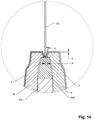
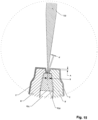
- a secondary flange (B) of a formed product (2) is a projecting edge of a formed thermoplastic product (2) used for connecting two adjacent formed products (2) in the forming and/or cutting stations of a thermoforming machine ( figs. 14-15 ).
- This limitation is due to the further alignment of the cutting dies with respect to the formed products (2) inside the cavities (8) in a cutting station of a Form/Cut/Stack mould or in a In-Mould-Cut mould and to the alignment precision of, for example, an auto-centering assembly with a non-zero tolerance.
- the common edges are arranged in the transport direction (x) and/or in a direction (z) perpendicular to the transport direction (x) in the same horizontal plane.
- the common-edge cut dies (131, 132) are cutting dies with a common-edge/jointed pattern.
- the design of the common-edge cut dies (131, 132) allows for cut adjacent formed plastic products (2) to be separated from the plastic material (2) more easily and provide for zero trim material between the two patterns.
- the common-edge cut dies (131, 132) are preferably steel-rule dies (131), CNC dies (132) or forged dies (132).
- thermoforming moulds In the Form/Cut/Stack or In-Mould-Cut thermoforming moulds according to the present invention, it is desirable to have a minimum clearance space (d), preferably of 0.3 to 1.1 mm, between the common-edge cut dies (131, 132) and the preheated thermoplastic sheet (3) placed on adjacent cavity moulds (8')/adjacent cavities (8) ( figs. 14-15 ) in order to avoid that:
- the stepped profile of the supporting block (92), according to the present invention, ensures an increased rigidity of the supporting block (92) and the adjacent cavity moulds (8') while allowing a proximal arrangement of the adjacent cavity moulds (8') relative to a central symmetry axis of the supporting block (92) in a vertical cross section through a plane perpendicular to the base plate (91).
- the increased rigidity also supports the cooling agent's (usually water) pressure acting between the supporting block (92) and the exterior walls of the adjacent cavity moulds (8').
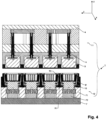
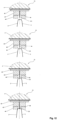
- a multi-cavity mould (1) has an upper tool (11) and a lower tool (12) being operable to simultaneously form a plurality of thin-gauge plastic products (2) in corresponding cavity moulds (8') arranged inside the cavities (8) of the lower tool (12) in an x-z array.
- the upper tool (11) comprises a top base plate (4) and a plurality of plug moulds (5) arranged in an x-z array.
- the plug moulds (5) are connected to the top base plate (4) in a translational manner by means of driving rods (6) in such a way that the plug moulds (5) can move in a direction (y) perpendicular to a transport direction (x) of the preheated thin-gauge thermoplastic sheet (3) placed between the upper tool (11) and the lower tool (12).
- the lower tool (12) also comprises a bottom base plate (7) connected to the plurality of base plates (91) via spacer blocks (71); a plurality of mobile plates (72) connected in a translational manner to the bottom base plate (7) and capable of moving in the direction (y) perpendicular to the transport direction (x) of the preheated thin-gauge thermoplastic sheet (3).
- the lower tool (12) further comprises a plurality of mould inserts (10) for matching a corresponding cavity mould's (8') model ( figs. 7-8 ).
- Mould inserts (10) are parts of the cavity mould (8') that are created separately from the cavity mould (8') block. Mould inserts (10) are inserted in the cavity mould (8') block to achieve a desired cavity shape or cooling effect.
- An insert (10) may assist heat transfer only if a cooling channel is located in or near the mould insert (10).
- Inserts (10) can also be used to modify the rate of cooling in specific areas of the cavity mould (8').
- An example is a product (2) with ribs that are thinner than its main surface.
- a mould insert (10) of lower conductivity or containing a separate cooling circuit can be used to form the ribs. This gives better control of the rib temperature.
- a mould insert (10) may have narrow water channels (also known as "water lines") passing through it, as in a baffle.
- additional support means (101) placed on the exterior top surfaces of the mould inserts (10), and contacting the cavity mould's (8') inner walls may be used ( fig. 8 ).
- the additional support means (101) may be Polytetrafluoroethylene (PTFE) pads, more preferably 10 mm x 10 mm PTFE square pads. These PTFE pads reduce friction (has one of the lowest coefficients of friction of any solid), wear, and corrosion of the thermoforming mould (it is a non-reactive compound). It maintains high strength, toughness and self-lubrication at low temperatures down to -268.15 °C and good flexibility at temperatures above -79 °C. PTFE is also hydrophobic and possesses fairly high heat resistance.
- the stepped profile and increased rigidity of the supporting block (92), according to the present invention, enable a standardized execution of the water channels for cooling around the cavity moulds (8'), thus eliminating any water flow rate restriction in the water channels.
- These cooling water channels may be vertical channels with a medium cross section of about 10 to 20 mm 2 , placed on the first (92a) and second zones (92b) of the supporting block (92).
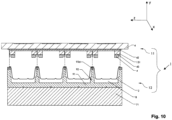
- a multi-cavity mould (1) has an upper tool (11) and a lower tool (12) being operable to simultaneously sever a plurality of thin-gauge plastic products (2) from a thin-gauge thermoplastic sheet (3) by moving the upper tool (11) and lower tool (12) towards each other in a direction (y) perpendicular to a transport direction (x) of the thin-gauge thermoplastic sheet (3) when formed plastic products (2), connected to each other by the common edge, are placed in the cavities (8).
- the upper tool (11) comprises a plurality of common-edge cut dies (131, 132) which are arranged to sever, the adjacent formed plastic products (2) on the common edge.
- the plurality of base plates (91) may be connected to each other to form a continuous base plate (91) ( fig. 10 ).
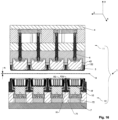
- the plurality of common-edge cut dies (131, 132) are grouped into a plurality of floating die assemblies (13) arranged in an x-z array on a supporting base (42) and connected to a top base plate (4) of the upper tool (11) by means of a plurality of guiding means (14) ( figs. 12 , 19a , 22 ).
- the guiding means (14) are preferably bushing guides (14) with a relative movement, in the horizontal (x-z) plane of the plurality of floating die assemblies (13), of about 1 to 3 mm, more preferably of about 2.5 mm. The horizontal movement is limited by the bushing guide's (14) diameter and by its mounting bore's diameter.
- the relative movement is used for a precise positioning of the common-edge cut dies (131,132) relative to the common-edge of the adjacent formed plastic products (2) by auto-centering the plurality of floating die assemblies (13).
- the bushing guides (14) are made from example from metal, preferably bronze.
- an intermediate plate (not-shown), made preferably from stainless steel, may be provided for enhanced support of the floating die assemblies (13).
- floating die in the context of the present invention is to be understood as a common-edge cut die (131, 132), mounted in a die holder (43) such as a slight amount of motion compensates for tolerance in the common-edge cut die (131, 132) parts or the work.
- the term "floating die” in the context of the present invention may also refer to a common-edge cut die (131, 132) mounted on heavy springs to allow vertical motion and easy centering of the common-edge cut die (131, 132) in some trimming, shearing, and forming operations.
- Each floating die assembly (13) comprises a die holder (43) connected to the supporting base (42).
- Each common-edge cut die (131, 132) is connected to both the supporting base (42) and the die holder (43).
- the floating die assembly (13) also comprises an assembly of auto centering plugs (44) arranged on the die holder (43).
- the auto-centering is done by means of auto centering plugs (44), which are configured to come into contact with the thermoformed products (2) on their most rigid top areas before closing the cutting station and to pull all the floating die assemblies (13) as close as possible to the thermoformed products (2), thus aligning the common-edge cut die (131, 132) on the common edge between adjacent formed plastic products (2).
- the auto centering plugs (44) are preferably rigid, CNC-machined parts (i.e. Computer Numerical Control (CNC)), positioned very precisely (0.1 mm precision), with respect to the cutting contour of the products (2).
- thermoformed sheet of material (3) after leaving the forming station, is subject to deformation between the forming station and the cutting station due to the precision of the conveyor chains, the parallelism or the non-parallelism between the conveyor chains, due to the shrinkage of the thermoplastic sheet (3) or due to the stretching of the thermoplastic sheet (3) between the chains, or other known reasons.
- the large weight of the floating die assembly (13) is upheld by using for example, a plurality of resilient means (41) between the top base plate (4) and the die holder (43), a solution valid for the floating die assemblies (13) with steel-rule dies (131) or CNC dies (132), forged dies (132).
- the plurality of resilient means (41) is a plurality of extension springs (41) made of stainless steel and according with DIN 2097, range A, more preferably zinc-plated ( fig. 22 ).
- extension springs (41) is preferred because of its low cost of manufacturing, high corrosion resistance and high operating temperatures (about 200°C).
- the extension of a resilient means (41) or in this preferred example, an extension spring (41) is linearly proportional to its tension, the force used to stretch it.
- the contraction (negative extension) is proportional to the compression (negative tension).
- the plurality of common-edge cut dies (131, 132) are grouped into a plurality of fixed die assemblies (15) arranged in an x-z array on a top base plate (4) of the upper tool (11) ( fig. 19b ). If the fixed dies assemblies (15) are CNC dies (132) or forged dies (132), each fixed die assembly (15) will represent an independent pressure box. The seal is made between the fixed die (15) and the thermoplastic sheet (3) during forming - the fixed die (15) penetrates only 30-70% of the thermoplastic sheet (3) thickness (A).
- the fixed die (15) is moved further toward the fourth zone (92d), preferably made from hardened stainless steel having a hardness of about 55-64 HRC, more preferably of about 60-62 HRC, and penetrates through the entire thickness (A) of the thermoplastic sheet (3) to sever said adjacent plastic products (2).
- the fixed dies assemblies (15) are steel-rule dies (131) then, a pressure box will be mounted on the upper tool (11) via O-ring seals which will compensate for the supplementary applied cutting force.
- This supplementary applied cutting force relates to the force applied in order to close the distance between the lower tool (12) and upper tool (11) beyond the threshold to which they have sealed (in the forming stage).
- the mould (1) When the mould (1) is closed, the forming pressurized air, forces the pressure box up, in an open position of the mould (1). This force is compensated by the O-ring seals.
- the O-ring seals also provide for the sealing needed during the cutting operation.
- the pressure box is guided by means of, for example, rods with a detent plate assembly or screws with thresholds.
- the fourth zone (92d) made from hardened stainless steel having a hardness of about 55-64 HRC, more preferably of about 60-62 HRC is preferred because of its corrosion and wear resistance and extremely high hardness with excellent toughness. It is advisable to use this type of steel for the manufacturing of the fourth zone (92d) of the supporting block (92) according to the present invention, both for the cutting station of a Form/Cut/Stack thermoforming mould and for a In-Mould-Cut thermoforming mould.
- the precision of alignment of the common-edge cut dies (131, 132) relative to the thermoformed products (2) is considerably higher compared to the precision of alignment of the common-edge cut dies (131, 132) relative to the cavities (8) in a cutting station of a Form/Cut/Stack thermoforming mould according to the present invention, respectively of about 0.02 - 0.08 mm.
- This precision is achieved by simply aligning the lower tool (12) and upper tool (11).
- a larger secondary flange (B) of a formed plastic product (2) is needed is related to the cutting tolerances.
- the cutting precision depends on the positioning precision of the auto centering plugs (44) of the cutting station, relative to the thermoformed plastic sheet (3), which may suffer deformations both in the transport direction (x) and in a direction (z) perpendicular to said transport direction (x) in the same horizontal plane.
Landscapes
- Engineering & Computer Science (AREA)
- Mechanical Engineering (AREA)
- Life Sciences & Earth Sciences (AREA)
- Forests & Forestry (AREA)
- Moulds For Moulding Plastics Or The Like (AREA)
- Blow-Moulding Or Thermoforming Of Plastics Or The Like (AREA)
- Perforating, Stamping-Out Or Severing By Means Other Than Cutting (AREA)
Priority Applications (1)
| Application Number | Priority Date | Filing Date | Title |
|---|---|---|---|
| HRP20230399TT HRP20230399T1 (hr) | 2019-04-24 | 2019-04-24 | Kalup s mnoštvom šupljina za stroj za termooblikovanje koji se koristi u postupku kontinuiranog termooblikovanja velikih količina tankih plastičnih proizvoda |
Applications Claiming Priority (1)
| Application Number | Priority Date | Filing Date | Title |
|---|---|---|---|
| PCT/RO2019/000014 WO2020218932A1 (en) | 2019-04-24 | 2019-04-24 | Multy-cavity mould for a thermoforming machine used in the process of high-volume, continuous thermoforming of thin-gauge plastic products |
Publications (2)
| Publication Number | Publication Date |
|---|---|
| EP3946891A1 EP3946891A1 (en) | 2022-02-09 |
| EP3946891B1 true EP3946891B1 (en) | 2023-04-05 |
Family
ID=67070896
Family Applications (2)
| Application Number | Title | Priority Date | Filing Date |
|---|---|---|---|
| EP19733894.0A Active EP3946891B1 (en) | 2019-04-24 | 2019-04-24 | Multy-cavity mould for a thermoforming machine used in the process of high-volume, continuous thermoforming of thin-gauge plastic products |
| EP20745332.5A Active EP3953142B1 (en) | 2019-04-24 | 2020-04-24 | Multi-cavity mould with a knife pressure-box for a thermoforming machine used in the process of high-volume, continuous thermoforming of thin-gauge plastic products |
Family Applications After (1)
| Application Number | Title | Priority Date | Filing Date |
|---|---|---|---|
| EP20745332.5A Active EP3953142B1 (en) | 2019-04-24 | 2020-04-24 | Multi-cavity mould with a knife pressure-box for a thermoforming machine used in the process of high-volume, continuous thermoforming of thin-gauge plastic products |
Country Status (9)
| Country | Link |
|---|---|
| US (2) | US11981067B2 (pl) |
| EP (2) | EP3946891B1 (pl) |
| CA (2) | CA3137837A1 (pl) |
| DK (1) | DK3946891T3 (pl) |
| ES (1) | ES2943502T3 (pl) |
| HR (1) | HRP20230399T1 (pl) |
| MD (1) | MD3946891T2 (pl) |
| PL (1) | PL3946891T3 (pl) |
| WO (2) | WO2020218932A1 (pl) |
Cited By (1)
| Publication number | Priority date | Publication date | Assignee | Title |
|---|---|---|---|---|
| US12186967B1 (en) | 2024-06-20 | 2025-01-07 | Ionel-Dan DRAGULINESCU | Multi-cavity mould, a heating element for forming a smooth periphery for thermoformed thin-gauge plastic products and method for forming such a periphery |
Families Citing this family (2)
| Publication number | Priority date | Publication date | Assignee | Title |
|---|---|---|---|---|
| EP3946891B1 (en) * | 2019-04-24 | 2023-04-05 | Dragulinescu, Ionel-Dan | Multy-cavity mould for a thermoforming machine used in the process of high-volume, continuous thermoforming of thin-gauge plastic products |
| EP4650125A1 (de) * | 2024-05-17 | 2025-11-19 | Rohrer Tools AG | Stanzwerkzeug |
Family Cites Families (25)
| Publication number | Priority date | Publication date | Assignee | Title |
|---|---|---|---|---|
| US3406428A (en) * | 1966-04-11 | 1968-10-22 | Brown Machine Co Of Michigan | Mold construction for differential pressure plastic molding machines |
| GB1267351A (en) * | 1968-03-08 | 1972-03-15 | Calmec Extruform Ltd | Improvements in plastics containers, methods of producing them and tooling apparatus therefor |
| US3518334A (en) * | 1968-10-01 | 1970-06-30 | Kirkhof Mfg Corp | Method of forming three dimensional plastic articles |
| DE1931827A1 (de) * | 1969-06-23 | 1971-01-21 | Ver Schuhmasch Gmbh | Antriebs- und Steuereinrichtung fuer eine Hochfrequenz-Schweissstanzmaschine |
| US3712780A (en) * | 1969-09-25 | 1973-01-23 | Monsanto Co | Improved molding apparatus for simultaneously forming plural articles |
| US3640666A (en) * | 1969-09-25 | 1972-02-08 | Monsanto Co | Trim in place thermoforming apparatus |
| US3728062A (en) * | 1970-04-02 | 1973-04-17 | Monsanto Co | Forming articles from sheet material |
| US4179252A (en) * | 1975-09-17 | 1979-12-18 | Seufert Kunststoffverpackung G | Apparatus for forming flexible fold lines in thermoplastic sheets and article so formed |
| IT1070867B (it) * | 1976-09-15 | 1985-04-02 | Isap Spa | Dispositivo realizzante un procedimento per formare contenitori in materiale plastico con linee di frattura prestabilita |
| US4304747A (en) * | 1976-12-06 | 1981-12-08 | S. Eisenberg & Company, Division Of Creative Industries, Inc. | Method of heat-trimming foam material |
| US4351210A (en) * | 1978-11-20 | 1982-09-28 | Zimmer Manufacturing Corp. | Shear cut tooth |
| US4755129A (en) * | 1987-03-09 | 1988-07-05 | Mobil Oil Corporation | Trim in place thermoforming arrangement for plastic articles |
| WO1990012678A1 (en) * | 1989-04-17 | 1990-11-01 | Jetra Engineering Pty Ltd | Cutting and trimming plastic pot |
| DE69627578T2 (de) * | 1995-06-21 | 2004-02-12 | Toyoda Gosei Co., Ltd. | Airbagabdeckung und Verfahren zu deren Herstellung |
| DE10017042B4 (de) | 2000-04-05 | 2004-09-30 | Adolf Illig Maschinenbau Gmbh & Co.Kg | Form-/Stanzwerkzeug zum Herstellen von Behältern aus einer thermoplastischen Kunststofffolie |
| US6733714B2 (en) * | 2001-08-13 | 2004-05-11 | Edwin J. Oakey | Method for forming high-impact, transparent, distortion-free polymeric material |
| ITVR20010132A1 (it) * | 2001-12-11 | 2003-06-11 | Isap Omv Group Spa | Procedimento ed apparecchiatura per il taglio in stampo di oggetti termoformati estraibili dallo stampo senza piastra di prelievo. |
| DE102007050637B4 (de) * | 2007-10-23 | 2013-10-10 | Rpc Bebo-Plastik Gmbh | Verfahren zur Herstellung thermogeformter Artikel sowie Werkzeug zu deren Herstellung |
| NL1036841C2 (nl) * | 2009-03-18 | 2010-09-21 | Bosch Sprang Beheer B V | Thermovorminrichting met meerdere snijranden. |
| FR2943268B1 (fr) * | 2009-03-20 | 2014-02-28 | Arcil | Moule de thermofromage a isolation thermique et procede associe. |
| NL2011432C2 (nl) | 2013-01-18 | 2014-07-28 | Naber Beheer B V | Verpakking, werkwijze voor het vervaardigen van een verpakking, en mal voor toepassing ten behoeve van een dergelijke werkwijze. |
| NL1041060B1 (en) * | 2014-11-24 | 2016-09-05 | Dexter Mould Tech B V | Method of and apparatus for manufacturing a plastic container having a curled rim. |
| CN105383049A (zh) | 2015-12-12 | 2016-03-09 | 广东金兴机械有限公司 | 一种成型冲孔剪切模具 |
| US11155022B2 (en) * | 2016-04-05 | 2021-10-26 | Bosch Sprang Bv | Device, mould assembly and method for thermoforming of a product from a plastic film |
| EP3946891B1 (en) * | 2019-04-24 | 2023-04-05 | Dragulinescu, Ionel-Dan | Multy-cavity mould for a thermoforming machine used in the process of high-volume, continuous thermoforming of thin-gauge plastic products |
-
2019
- 2019-04-24 EP EP19733894.0A patent/EP3946891B1/en active Active
- 2019-04-24 ES ES19733894T patent/ES2943502T3/es active Active
- 2019-04-24 WO PCT/RO2019/000014 patent/WO2020218932A1/en not_active Ceased
- 2019-04-24 US US17/594,588 patent/US11981067B2/en active Active
- 2019-04-24 CA CA3137837A patent/CA3137837A1/en active Pending
- 2019-04-24 HR HRP20230399TT patent/HRP20230399T1/hr unknown
- 2019-04-24 DK DK19733894.0T patent/DK3946891T3/da active
- 2019-04-24 MD MDE20220123T patent/MD3946891T2/ro unknown
- 2019-04-24 PL PL19733894.0T patent/PL3946891T3/pl unknown
-
2020
- 2020-04-24 CA CA3137820A patent/CA3137820A1/en active Pending
- 2020-04-24 EP EP20745332.5A patent/EP3953142B1/en active Active
- 2020-04-24 WO PCT/RO2020/050004 patent/WO2020218934A2/en not_active Ceased
- 2020-04-24 US US17/594,593 patent/US20220126501A1/en not_active Abandoned
Cited By (2)
| Publication number | Priority date | Publication date | Assignee | Title |
|---|---|---|---|---|
| US12186967B1 (en) | 2024-06-20 | 2025-01-07 | Ionel-Dan DRAGULINESCU | Multi-cavity mould, a heating element for forming a smooth periphery for thermoformed thin-gauge plastic products and method for forming such a periphery |
| WO2025264134A1 (en) | 2024-06-20 | 2025-12-26 | Dragulinescu Ionel Dan | A multi-cavity mould, a heating element for forming a smooth periphery for thermoformed thin-gauge plastic products and method for forming such a periphery |
Also Published As
| Publication number | Publication date |
|---|---|
| PL3946891T3 (pl) | 2023-06-26 |
| WO2020218934A3 (en) | 2020-12-03 |
| EP3953142A2 (en) | 2022-02-16 |
| WO2020218932A1 (en) | 2020-10-29 |
| ES2943502T3 (es) | 2023-06-13 |
| EP3953142B1 (en) | 2023-04-05 |
| US20220212393A1 (en) | 2022-07-07 |
| CA3137820A1 (en) | 2020-10-29 |
| EP3946891A1 (en) | 2022-02-09 |
| WO2020218934A2 (en) | 2020-10-29 |
| US20220126501A1 (en) | 2022-04-28 |
| MD3946891T2 (ro) | 2023-08-31 |
| HRP20230399T1 (hr) | 2023-07-07 |
| CA3137837A1 (en) | 2020-10-29 |
| US11981067B2 (en) | 2024-05-14 |
| DK3946891T3 (da) | 2023-05-01 |
Similar Documents
| Publication | Publication Date | Title |
|---|---|---|
| EP3946891B1 (en) | Multy-cavity mould for a thermoforming machine used in the process of high-volume, continuous thermoforming of thin-gauge plastic products | |
| US8545208B2 (en) | Method for producing thermoformed articles as well as a die for the production thereof | |
| US4636348A (en) | System for thermoforming articles such as picnic plates in a pair of simultaneously fed, continuous thermoplastic webs which subsequently move into nested relation, and then dually trimming the nested articles from the webs | |
| US4477243A (en) | Thermoforming apparatus | |
| JPH11506063A (ja) | プリカットダイ装置及び熱成形方法及び装置 | |
| US4442064A (en) | Thermoforming and self-alignment trimming method and apparatus | |
| EP3556536A1 (en) | Thermoforming machine and process | |
| EP3215345B1 (en) | Blow molding machine with molds moved mechanically and without the aid of electrical, hydraulic or pneumatic devices | |
| US3461756A (en) | Method for trimming plastic preforms | |
| US12186967B1 (en) | Multi-cavity mould, a heating element for forming a smooth periphery for thermoformed thin-gauge plastic products and method for forming such a periphery | |
| US3964856A (en) | Vacuum moulding techniques | |
| US20130049250A1 (en) | Method and Device for Manufacturing Containers By Thermoforming | |
| US4952264A (en) | Method for producing plastic components | |
| US8075819B2 (en) | Tooling system for thermoforming and trimming a heated sheet of material to form a molded part | |
| US20240042655A1 (en) | Laminate Tooling Unit And Process For The Manufacture Of Laminate Tooling Unit With Functional Features | |
| CN222679299U (zh) | 一种铝箔容器用成型装置 | |
| EP0670214B1 (en) | Vertical thermoforming apparatus | |
| CA3169846C (en) | Trim tool with adjustable trim centers | |
| WO2013160886A1 (en) | Thermoforming apparatus and process for making objects | |
| RU2021134177A (ru) | Многогнездовая пресс-форма для термоформовочной машины, использующейся в процессе высокообъёмного непрерывного термоформования тонкостенных пластиковых изделий | |
| US20020175170A1 (en) | Thermal plastic expanded foam meat tray and method and apparatus for precisely trimming the meat tray from an expanded foam web | |
| EP2708346B1 (en) | Apparatus for thermoforming objects | |
| WO2020202586A1 (ja) | トリミング装置 | |
| JPS6245813B2 (pl) |
Legal Events
| Date | Code | Title | Description |
|---|---|---|---|
| REG | Reference to a national code |
Ref country code: HR Ref legal event code: TUEP Ref document number: P20230399T Country of ref document: HR |
|
| STAA | Information on the status of an ep patent application or granted ep patent |
Free format text: STATUS: UNKNOWN |
|
| STAA | Information on the status of an ep patent application or granted ep patent |
Free format text: STATUS: THE INTERNATIONAL PUBLICATION HAS BEEN MADE |
|
| PUAI | Public reference made under article 153(3) epc to a published international application that has entered the european phase |
Free format text: ORIGINAL CODE: 0009012 |
|
| STAA | Information on the status of an ep patent application or granted ep patent |
Free format text: STATUS: REQUEST FOR EXAMINATION WAS MADE |
|
| 17P | Request for examination filed |
Effective date: 20211103 |
|
| AK | Designated contracting states |
Kind code of ref document: A1 Designated state(s): AL AT BE BG CH CY CZ DE DK EE ES FI FR GB GR HR HU IE IS IT LI LT LU LV MC MK MT NL NO PL PT RO RS SE SI SK SM TR |
|
| DAX | Request for extension of the european patent (deleted) | ||
| RAV | Requested validation state of the european patent: fee paid |
Extension state: MD Effective date: 20211103 |
|
| GRAP | Despatch of communication of intention to grant a patent |
Free format text: ORIGINAL CODE: EPIDOSNIGR1 |
|
| STAA | Information on the status of an ep patent application or granted ep patent |
Free format text: STATUS: GRANT OF PATENT IS INTENDED |
|
| RIC1 | Information provided on ipc code assigned before grant |
Ipc: B29L 23/18 20060101ALI20220929BHEP Ipc: B29L 31/00 20060101ALI20220929BHEP Ipc: B29C 51/04 20060101ALI20220929BHEP Ipc: B26F 1/38 20060101ALI20220929BHEP Ipc: B29C 51/32 20060101ALI20220929BHEP Ipc: B29C 51/30 20060101AFI20220929BHEP |
|
| INTG | Intention to grant announced |
Effective date: 20221026 |
|
| GRAS | Grant fee paid |
Free format text: ORIGINAL CODE: EPIDOSNIGR3 |
|
| GRAA | (expected) grant |
Free format text: ORIGINAL CODE: 0009210 |
|
| STAA | Information on the status of an ep patent application or granted ep patent |
Free format text: STATUS: THE PATENT HAS BEEN GRANTED |
|
| AK | Designated contracting states |
Kind code of ref document: B1 Designated state(s): AL AT BE BG CH CY CZ DE DK EE ES FI FR GB GR HR HU IE IS IT LI LT LU LV MC MK MT NL NO PL PT RO RS SE SI SK SM TR |
|
| REG | Reference to a national code |
Ref country code: GB Ref legal event code: FG4D |
|
| REG | Reference to a national code |
Ref country code: DE Ref legal event code: R096 Ref document number: 602019027210 Country of ref document: DE |
|
| REG | Reference to a national code |
Ref country code: CH Ref legal event code: EP |
|
| REG | Reference to a national code |
Ref country code: AT Ref legal event code: REF Ref document number: 1557906 Country of ref document: AT Kind code of ref document: T Effective date: 20230415 |
|
| REG | Reference to a national code |
Ref country code: IE Ref legal event code: FG4D |
|
| REG | Reference to a national code |
Ref country code: DK Ref legal event code: T3 Effective date: 20230426 |
|
| REG | Reference to a national code |
Ref country code: RO Ref legal event code: EPE Ref country code: NL Ref legal event code: FP |
|
| REG | Reference to a national code |
Ref country code: SE Ref legal event code: TRGR |
|
| REG | Reference to a national code |
Ref country code: HR Ref legal event code: ODRP Ref document number: P20230399T Country of ref document: HR Payment date: 20230523 Year of fee payment: 5 |
|
| REG | Reference to a national code |
Ref country code: ES Ref legal event code: FG2A Ref document number: 2943502 Country of ref document: ES Kind code of ref document: T3 Effective date: 20230613 |
|
| REG | Reference to a national code |
Ref country code: HR Ref legal event code: T1PR Ref document number: P20230399 Country of ref document: HR |
|
| P01 | Opt-out of the competence of the unified patent court (upc) registered |
Effective date: 20230530 |
|
| REG | Reference to a national code |
Ref country code: LT Ref legal event code: MG9D |
|
| REG | Reference to a national code |
Ref country code: MD Ref legal event code: VAGR Ref document number: 3946891 Country of ref document: MD Date of ref document: 20230831 Kind code of ref document: T2 |
|
| REG | Reference to a national code |
Ref country code: AT Ref legal event code: MK05 Ref document number: 1557906 Country of ref document: AT Kind code of ref document: T Effective date: 20230405 |
|
| PG25 | Lapsed in a contracting state [announced via postgrant information from national office to epo] |
Ref country code: PT Free format text: LAPSE BECAUSE OF FAILURE TO SUBMIT A TRANSLATION OF THE DESCRIPTION OR TO PAY THE FEE WITHIN THE PRESCRIBED TIME-LIMIT Effective date: 20230807 Ref country code: NO Free format text: LAPSE BECAUSE OF FAILURE TO SUBMIT A TRANSLATION OF THE DESCRIPTION OR TO PAY THE FEE WITHIN THE PRESCRIBED TIME-LIMIT Effective date: 20230705 Ref country code: AT Free format text: LAPSE BECAUSE OF FAILURE TO SUBMIT A TRANSLATION OF THE DESCRIPTION OR TO PAY THE FEE WITHIN THE PRESCRIBED TIME-LIMIT Effective date: 20230405 |
|
| VSFP | Annual fee paid to validation state [announced via postgrant information from national office to epo] |
Ref country code: MD Payment date: 20230531 Year of fee payment: 5 |
|
| PG25 | Lapsed in a contracting state [announced via postgrant information from national office to epo] |
Ref country code: RS Free format text: LAPSE BECAUSE OF FAILURE TO SUBMIT A TRANSLATION OF THE DESCRIPTION OR TO PAY THE FEE WITHIN THE PRESCRIBED TIME-LIMIT Effective date: 20230405 Ref country code: LV Free format text: LAPSE BECAUSE OF FAILURE TO SUBMIT A TRANSLATION OF THE DESCRIPTION OR TO PAY THE FEE WITHIN THE PRESCRIBED TIME-LIMIT Effective date: 20230405 Ref country code: LT Free format text: LAPSE BECAUSE OF FAILURE TO SUBMIT A TRANSLATION OF THE DESCRIPTION OR TO PAY THE FEE WITHIN THE PRESCRIBED TIME-LIMIT Effective date: 20230405 Ref country code: IS Free format text: LAPSE BECAUSE OF FAILURE TO SUBMIT A TRANSLATION OF THE DESCRIPTION OR TO PAY THE FEE WITHIN THE PRESCRIBED TIME-LIMIT Effective date: 20230805 Ref country code: GR Free format text: LAPSE BECAUSE OF FAILURE TO SUBMIT A TRANSLATION OF THE DESCRIPTION OR TO PAY THE FEE WITHIN THE PRESCRIBED TIME-LIMIT Effective date: 20230706 |
|
| REG | Reference to a national code |
Ref country code: CH Ref legal event code: PL |
|
| PG25 | Lapsed in a contracting state [announced via postgrant information from national office to epo] |
Ref country code: LU Free format text: LAPSE BECAUSE OF NON-PAYMENT OF DUE FEES Effective date: 20230424 Ref country code: FI Free format text: LAPSE BECAUSE OF FAILURE TO SUBMIT A TRANSLATION OF THE DESCRIPTION OR TO PAY THE FEE WITHIN THE PRESCRIBED TIME-LIMIT Effective date: 20230405 |
|
| REG | Reference to a national code |
Ref country code: DE Ref legal event code: R097 Ref document number: 602019027210 Country of ref document: DE |
|
| PG25 | Lapsed in a contracting state [announced via postgrant information from national office to epo] |
Ref country code: SK Free format text: LAPSE BECAUSE OF FAILURE TO SUBMIT A TRANSLATION OF THE DESCRIPTION OR TO PAY THE FEE WITHIN THE PRESCRIBED TIME-LIMIT Effective date: 20230405 |
|
| PG25 | Lapsed in a contracting state [announced via postgrant information from national office to epo] |
Ref country code: MC Free format text: LAPSE BECAUSE OF FAILURE TO SUBMIT A TRANSLATION OF THE DESCRIPTION OR TO PAY THE FEE WITHIN THE PRESCRIBED TIME-LIMIT Effective date: 20230405 |
|
| PG25 | Lapsed in a contracting state [announced via postgrant information from national office to epo] |
Ref country code: SM Free format text: LAPSE BECAUSE OF FAILURE TO SUBMIT A TRANSLATION OF THE DESCRIPTION OR TO PAY THE FEE WITHIN THE PRESCRIBED TIME-LIMIT Effective date: 20230405 Ref country code: SK Free format text: LAPSE BECAUSE OF FAILURE TO SUBMIT A TRANSLATION OF THE DESCRIPTION OR TO PAY THE FEE WITHIN THE PRESCRIBED TIME-LIMIT Effective date: 20230405 Ref country code: MC Free format text: LAPSE BECAUSE OF FAILURE TO SUBMIT A TRANSLATION OF THE DESCRIPTION OR TO PAY THE FEE WITHIN THE PRESCRIBED TIME-LIMIT Effective date: 20230405 Ref country code: LI Free format text: LAPSE BECAUSE OF NON-PAYMENT OF DUE FEES Effective date: 20230430 Ref country code: EE Free format text: LAPSE BECAUSE OF FAILURE TO SUBMIT A TRANSLATION OF THE DESCRIPTION OR TO PAY THE FEE WITHIN THE PRESCRIBED TIME-LIMIT Effective date: 20230405 Ref country code: CH Free format text: LAPSE BECAUSE OF NON-PAYMENT OF DUE FEES Effective date: 20230430 |
|
| PLBE | No opposition filed within time limit |
Free format text: ORIGINAL CODE: 0009261 |
|
| STAA | Information on the status of an ep patent application or granted ep patent |
Free format text: STATUS: NO OPPOSITION FILED WITHIN TIME LIMIT |
|
| REG | Reference to a national code |
Ref country code: IE Ref legal event code: MM4A |
|
| 26N | No opposition filed |
Effective date: 20240108 |
|
| PG25 | Lapsed in a contracting state [announced via postgrant information from national office to epo] |
Ref country code: IE Free format text: LAPSE BECAUSE OF NON-PAYMENT OF DUE FEES Effective date: 20230424 |
|
| REG | Reference to a national code |
Ref country code: HR Ref legal event code: ODRP Ref document number: P20230399 Country of ref document: HR Payment date: 20240411 Year of fee payment: 6 |
|
| PG25 | Lapsed in a contracting state [announced via postgrant information from national office to epo] |
Ref country code: IE Free format text: LAPSE BECAUSE OF NON-PAYMENT OF DUE FEES Effective date: 20230424 |
|
| PG25 | Lapsed in a contracting state [announced via postgrant information from national office to epo] |
Ref country code: SI Free format text: LAPSE BECAUSE OF FAILURE TO SUBMIT A TRANSLATION OF THE DESCRIPTION OR TO PAY THE FEE WITHIN THE PRESCRIBED TIME-LIMIT Effective date: 20230405 |
|
| PG25 | Lapsed in a contracting state [announced via postgrant information from national office to epo] |
Ref country code: SI Free format text: LAPSE BECAUSE OF FAILURE TO SUBMIT A TRANSLATION OF THE DESCRIPTION OR TO PAY THE FEE WITHIN THE PRESCRIBED TIME-LIMIT Effective date: 20230405 |
|
| PG25 | Lapsed in a contracting state [announced via postgrant information from national office to epo] |
Ref country code: BG Free format text: LAPSE BECAUSE OF FAILURE TO SUBMIT A TRANSLATION OF THE DESCRIPTION OR TO PAY THE FEE WITHIN THE PRESCRIBED TIME-LIMIT Effective date: 20230405 |
|
| PG25 | Lapsed in a contracting state [announced via postgrant information from national office to epo] |
Ref country code: BG Free format text: LAPSE BECAUSE OF FAILURE TO SUBMIT A TRANSLATION OF THE DESCRIPTION OR TO PAY THE FEE WITHIN THE PRESCRIBED TIME-LIMIT Effective date: 20230405 |
|
| PGFP | Annual fee paid to national office [announced via postgrant information from national office to epo] |
Ref country code: RO Payment date: 20250218 Year of fee payment: 7 |
|
| PGFP | Annual fee paid to national office [announced via postgrant information from national office to epo] |
Ref country code: PL Payment date: 20250319 Year of fee payment: 7 |
|
| REG | Reference to a national code |
Ref country code: HR Ref legal event code: ODRP Ref document number: P20230399 Country of ref document: HR Payment date: 20250411 Year of fee payment: 7 |
|
| PGFP | Annual fee paid to national office [announced via postgrant information from national office to epo] |
Ref country code: NL Payment date: 20250418 Year of fee payment: 7 |
|
| PGFP | Annual fee paid to national office [announced via postgrant information from national office to epo] |
Ref country code: DE Payment date: 20250422 Year of fee payment: 7 |
|
| PGFP | Annual fee paid to national office [announced via postgrant information from national office to epo] |
Ref country code: GB Payment date: 20250423 Year of fee payment: 7 Ref country code: ES Payment date: 20250530 Year of fee payment: 7 Ref country code: DK Payment date: 20250429 Year of fee payment: 7 |
|
| VSFP | Annual fee paid to validation state [announced via postgrant information from national office to epo] |
Ref country code: MD Payment date: 20250416 Year of fee payment: 7 |
|
| PGFP | Annual fee paid to national office [announced via postgrant information from national office to epo] |
Ref country code: BE Payment date: 20250418 Year of fee payment: 7 Ref country code: IT Payment date: 20250424 Year of fee payment: 7 |
|
| PGFP | Annual fee paid to national office [announced via postgrant information from national office to epo] |
Ref country code: HR Payment date: 20250411 Year of fee payment: 7 |
|
| PGFP | Annual fee paid to national office [announced via postgrant information from national office to epo] |
Ref country code: FR Payment date: 20250425 Year of fee payment: 7 |
|
| PG25 | Lapsed in a contracting state [announced via postgrant information from national office to epo] |
Ref country code: CY Free format text: LAPSE BECAUSE OF FAILURE TO SUBMIT A TRANSLATION OF THE DESCRIPTION OR TO PAY THE FEE WITHIN THE PRESCRIBED TIME-LIMIT; INVALID AB INITIO Effective date: 20190424 |
|
| PGFP | Annual fee paid to national office [announced via postgrant information from national office to epo] |
Ref country code: TR Payment date: 20250415 Year of fee payment: 7 |
|
| PGFP | Annual fee paid to national office [announced via postgrant information from national office to epo] |
Ref country code: CZ Payment date: 20250414 Year of fee payment: 7 |
|
| PGFP | Annual fee paid to national office [announced via postgrant information from national office to epo] |
Ref country code: SE Payment date: 20250429 Year of fee payment: 7 |
|
| VSFP | Annual fee paid to validation state [announced via postgrant information from national office to epo] |
Ref country code: MD Payment date: 20240418 Year of fee payment: 6 |
|
| PG25 | Lapsed in a contracting state [announced via postgrant information from national office to epo] |
Ref country code: HU Free format text: LAPSE BECAUSE OF FAILURE TO SUBMIT A TRANSLATION OF THE DESCRIPTION OR TO PAY THE FEE WITHIN THE PRESCRIBED TIME-LIMIT; INVALID AB INITIO Effective date: 20190424 |