EP3943917A1 - A method for the in-line analysis of a composite product in a machine for producing absorbent sanitary articles - Google Patents
A method for the in-line analysis of a composite product in a machine for producing absorbent sanitary articles Download PDFInfo
- Publication number
- EP3943917A1 EP3943917A1 EP21187128.0A EP21187128A EP3943917A1 EP 3943917 A1 EP3943917 A1 EP 3943917A1 EP 21187128 A EP21187128 A EP 21187128A EP 3943917 A1 EP3943917 A1 EP 3943917A1
- Authority
- EP
- European Patent Office
- Prior art keywords
- composite product
- target materials
- reference wavelength
- optical sensor
- electromagnetic radiation
- Prior art date
- Legal status (The legal status is an assumption and is not a legal conclusion. Google has not performed a legal analysis and makes no representation as to the accuracy of the status listed.)
- Granted
Links
Images
Classifications
-
- G—PHYSICS
- G01—MEASURING; TESTING
- G01N—INVESTIGATING OR ANALYSING MATERIALS BY DETERMINING THEIR CHEMICAL OR PHYSICAL PROPERTIES
- G01N21/00—Investigating or analysing materials by the use of optical means, i.e. using sub-millimetre waves, infrared, visible or ultraviolet light
- G01N21/17—Systems in which incident light is modified in accordance with the properties of the material investigated
- G01N21/25—Colour; Spectral properties, i.e. comparison of effect of material on the light at two or more different wavelengths or wavelength bands
- G01N21/31—Investigating relative effect of material at wavelengths characteristic of specific elements or molecules, e.g. atomic absorption spectrometry
- G01N21/314—Investigating relative effect of material at wavelengths characteristic of specific elements or molecules, e.g. atomic absorption spectrometry with comparison of measurements at specific and non-specific wavelengths
-
- G—PHYSICS
- G01—MEASURING; TESTING
- G01N—INVESTIGATING OR ANALYSING MATERIALS BY DETERMINING THEIR CHEMICAL OR PHYSICAL PROPERTIES
- G01N21/00—Investigating or analysing materials by the use of optical means, i.e. using sub-millimetre waves, infrared, visible or ultraviolet light
- G01N21/17—Systems in which incident light is modified in accordance with the properties of the material investigated
- G01N21/25—Colour; Spectral properties, i.e. comparison of effect of material on the light at two or more different wavelengths or wavelength bands
-
- G—PHYSICS
- G01—MEASURING; TESTING
- G01N—INVESTIGATING OR ANALYSING MATERIALS BY DETERMINING THEIR CHEMICAL OR PHYSICAL PROPERTIES
- G01N21/00—Investigating or analysing materials by the use of optical means, i.e. using sub-millimetre waves, infrared, visible or ultraviolet light
- G01N21/17—Systems in which incident light is modified in accordance with the properties of the material investigated
- G01N21/25—Colour; Spectral properties, i.e. comparison of effect of material on the light at two or more different wavelengths or wavelength bands
- G01N21/31—Investigating relative effect of material at wavelengths characteristic of specific elements or molecules, e.g. atomic absorption spectrometry
- G01N21/35—Investigating relative effect of material at wavelengths characteristic of specific elements or molecules, e.g. atomic absorption spectrometry using infrared light
- G01N21/3563—Investigating relative effect of material at wavelengths characteristic of specific elements or molecules, e.g. atomic absorption spectrometry using infrared light for analysing solids; Preparation of samples therefor
-
- G—PHYSICS
- G01—MEASURING; TESTING
- G01N—INVESTIGATING OR ANALYSING MATERIALS BY DETERMINING THEIR CHEMICAL OR PHYSICAL PROPERTIES
- G01N21/00—Investigating or analysing materials by the use of optical means, i.e. using sub-millimetre waves, infrared, visible or ultraviolet light
- G01N21/17—Systems in which incident light is modified in accordance with the properties of the material investigated
- G01N21/25—Colour; Spectral properties, i.e. comparison of effect of material on the light at two or more different wavelengths or wavelength bands
- G01N21/31—Investigating relative effect of material at wavelengths characteristic of specific elements or molecules, e.g. atomic absorption spectrometry
- G01N21/35—Investigating relative effect of material at wavelengths characteristic of specific elements or molecules, e.g. atomic absorption spectrometry using infrared light
- G01N21/359—Investigating relative effect of material at wavelengths characteristic of specific elements or molecules, e.g. atomic absorption spectrometry using infrared light using near infrared light
-
- G—PHYSICS
- G01—MEASURING; TESTING
- G01N—INVESTIGATING OR ANALYSING MATERIALS BY DETERMINING THEIR CHEMICAL OR PHYSICAL PROPERTIES
- G01N21/00—Investigating or analysing materials by the use of optical means, i.e. using sub-millimetre waves, infrared, visible or ultraviolet light
- G01N21/17—Systems in which incident light is modified in accordance with the properties of the material investigated
- G01N21/55—Specular reflectivity
-
- G—PHYSICS
- G01—MEASURING; TESTING
- G01N—INVESTIGATING OR ANALYSING MATERIALS BY DETERMINING THEIR CHEMICAL OR PHYSICAL PROPERTIES
- G01N21/00—Investigating or analysing materials by the use of optical means, i.e. using sub-millimetre waves, infrared, visible or ultraviolet light
- G01N21/17—Systems in which incident light is modified in accordance with the properties of the material investigated
- G01N21/59—Transmissivity
-
- A—HUMAN NECESSITIES
- A61—MEDICAL OR VETERINARY SCIENCE; HYGIENE
- A61F—FILTERS IMPLANTABLE INTO BLOOD VESSELS; PROSTHESES; DEVICES PROVIDING PATENCY TO, OR PREVENTING COLLAPSING OF, TUBULAR STRUCTURES OF THE BODY, e.g. STENTS; ORTHOPAEDIC, NURSING OR CONTRACEPTIVE DEVICES; FOMENTATION; TREATMENT OR PROTECTION OF EYES OR EARS; BANDAGES, DRESSINGS OR ABSORBENT PADS; FIRST-AID KITS
- A61F13/00—Bandages or dressings; Absorbent pads
- A61F13/15—Absorbent pads, e.g. sanitary towels, swabs or tampons for external or internal application to the body; Supporting or fastening means therefor; Tampon applicators
- A61F13/15577—Apparatus or processes for manufacturing
- A61F13/15772—Control
- A61F2013/1578—Control via optical means associated to computer coordinator
-
- A—HUMAN NECESSITIES
- A61—MEDICAL OR VETERINARY SCIENCE; HYGIENE
- A61F—FILTERS IMPLANTABLE INTO BLOOD VESSELS; PROSTHESES; DEVICES PROVIDING PATENCY TO, OR PREVENTING COLLAPSING OF, TUBULAR STRUCTURES OF THE BODY, e.g. STENTS; ORTHOPAEDIC, NURSING OR CONTRACEPTIVE DEVICES; FOMENTATION; TREATMENT OR PROTECTION OF EYES OR EARS; BANDAGES, DRESSINGS OR ABSORBENT PADS; FIRST-AID KITS
- A61F13/00—Bandages or dressings; Absorbent pads
- A61F13/15—Absorbent pads, e.g. sanitary towels, swabs or tampons for external or internal application to the body; Supporting or fastening means therefor; Tampon applicators
- A61F13/15577—Apparatus or processes for manufacturing
- A61F2013/15821—Apparatus or processes for manufacturing characterized by the apparatus for manufacturing
-
- A—HUMAN NECESSITIES
- A61—MEDICAL OR VETERINARY SCIENCE; HYGIENE
- A61F—FILTERS IMPLANTABLE INTO BLOOD VESSELS; PROSTHESES; DEVICES PROVIDING PATENCY TO, OR PREVENTING COLLAPSING OF, TUBULAR STRUCTURES OF THE BODY, e.g. STENTS; ORTHOPAEDIC, NURSING OR CONTRACEPTIVE DEVICES; FOMENTATION; TREATMENT OR PROTECTION OF EYES OR EARS; BANDAGES, DRESSINGS OR ABSORBENT PADS; FIRST-AID KITS
- A61F13/00—Bandages or dressings; Absorbent pads
- A61F13/15—Absorbent pads, e.g. sanitary towels, swabs or tampons for external or internal application to the body; Supporting or fastening means therefor; Tampon applicators
- A61F13/53—Absorbent pads, e.g. sanitary towels, swabs or tampons for external or internal application to the body; Supporting or fastening means therefor; Tampon applicators characterised by the absorbing medium
- A61F2013/530481—Absorbent pads, e.g. sanitary towels, swabs or tampons for external or internal application to the body; Supporting or fastening means therefor; Tampon applicators characterised by the absorbing medium having superabsorbent materials, i.e. highly absorbent polymer gel materials
-
- G—PHYSICS
- G01—MEASURING; TESTING
- G01N—INVESTIGATING OR ANALYSING MATERIALS BY DETERMINING THEIR CHEMICAL OR PHYSICAL PROPERTIES
- G01N21/00—Investigating or analysing materials by the use of optical means, i.e. using sub-millimetre waves, infrared, visible or ultraviolet light
- G01N21/84—Systems specially adapted for particular applications
- G01N2021/8444—Fibrous material
-
- G—PHYSICS
- G01—MEASURING; TESTING
- G01N—INVESTIGATING OR ANALYSING MATERIALS BY DETERMINING THEIR CHEMICAL OR PHYSICAL PROPERTIES
- G01N21/00—Investigating or analysing materials by the use of optical means, i.e. using sub-millimetre waves, infrared, visible or ultraviolet light
- G01N21/84—Systems specially adapted for particular applications
- G01N2021/845—Objects on a conveyor
-
- G—PHYSICS
- G01—MEASURING; TESTING
- G01N—INVESTIGATING OR ANALYSING MATERIALS BY DETERMINING THEIR CHEMICAL OR PHYSICAL PROPERTIES
- G01N21/00—Investigating or analysing materials by the use of optical means, i.e. using sub-millimetre waves, infrared, visible or ultraviolet light
- G01N21/84—Systems specially adapted for particular applications
- G01N2021/8472—Investigation of composite materials
-
- G—PHYSICS
- G01—MEASURING; TESTING
- G01N—INVESTIGATING OR ANALYSING MATERIALS BY DETERMINING THEIR CHEMICAL OR PHYSICAL PROPERTIES
- G01N21/00—Investigating or analysing materials by the use of optical means, i.e. using sub-millimetre waves, infrared, visible or ultraviolet light
- G01N21/17—Systems in which incident light is modified in accordance with the properties of the material investigated
- G01N21/47—Scattering, i.e. diffuse reflection
- G01N21/4738—Diffuse reflection, e.g. also for testing fluids, fibrous materials
-
- G—PHYSICS
- G01—MEASURING; TESTING
- G01N—INVESTIGATING OR ANALYSING MATERIALS BY DETERMINING THEIR CHEMICAL OR PHYSICAL PROPERTIES
- G01N21/00—Investigating or analysing materials by the use of optical means, i.e. using sub-millimetre waves, infrared, visible or ultraviolet light
- G01N21/84—Systems specially adapted for particular applications
- G01N21/88—Investigating the presence of flaws or contamination
- G01N21/94—Investigating contamination, e.g. dust
Definitions
- the present invention relates to the production of absorbent sanitary articles, and relates to a method for the in-line analysis of a composite product that advances in a machine for producing absorbent sanitary articles.
- the analysis of composite products may have the object of determining parameters such as, for example, position, concentration, density, mass, or volume of one or more materials within the composite product.
- the product to be analyzed may be a continuous composite web or a discrete element, such as, for example, an absorbent core or a generic semi-finished product.
- the invention was developed specifically to check, in-line, the position and concentration of a superabsorbent granular material (Super Absorbent Polymer or SAP) present in discrete absorbent cores, or in spaced apart areas of a continuous composite web.
- a superabsorbent granular material Super Absorbent Polymer or SAP
- Machines for producing absorbent sanitary articles containing discretely applied absorbent granular material comprising a device for detecting the absorbent granular material.
- the detector device comprises a microwave resonator facing - at least in part - the continuous succession of absorbent cores advancing along a machine direction.
- the information provided by the detector device is used by a control unit in order to phase the dispensing device of absorbent granular material with a forming drum of the fibrous web if the deviation between the detected position of the absorbent granular material and the position of required application exceeds a defined threshold value.
- Italian patent n.102017000088859 by the same Applicant describes a method for detecting the density of absorbent granular material contained in a composite sheet, comprising: advancing a composite web in a longitudinal direction; emitting electromagnetic radiation with a frequency from 50 to 3000 GHz towards the composite web; receiving electromagnetic radiation transmitted through the composite web by means of a sensor sensitive to said electromagnetic radiation; and processing the signals provided by said sensor to obtain information on the density of the absorbent granular material contained in the composite web.
- the main limitation of the known solutions described above consists in the fact that the physical principles on which they are based are unable to provide high resolution and repeatable measurements of the parameters to be controlled (for example, the position and concentration of SAP and the quantity of cellulose fluff and/or the distribution of both of these in the composite web) at the speeds with which the products on which to perform the measurements are made.
- the present invention aims to provide a method for in-line analysis of a composite product that overcomes the problems of the prior art.
- this object is achieved by a method having the characteristics forming the subject of claim 1.
- the present invention envisages the use of a hyperspectral sensor to acquire images of isolated target materials that are part of the composite product to be analyzed, and to identify the reflectance of the isolated materials at various wavelengths. Subsequently, a determined wavelength is selected to display the materials of interest, and a narrowband optical sensor, for example, a Short-Wavelength Infrared (SWIR) sensor, is used to perform an in-line optical inspection at process speed on the selected wavelength.
- SWIR Short-Wavelength Infrared
- the main advantage of the proposed solution is that it allows separation of the spectral responses of different materials that make up the composite product, and visual separation of the materials mixed within the product, with a high processing speed.
- the solution according to the invention therefore, allows optical detection - with a high resolution - of characteristics, parameters and production defects directly in-line and at the process speed.
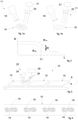
- Figures 1-4 illustrate different steps of a method for the in-line optical analysis of a composite product indicated by 10 in Figure 3 .
- the composite product 10 is formed in a machine for producing absorbent sanitary articles, indicated schematically by 12 in Figure 3 , by assembling together a plurality of different materials, such as cellulose fluff, superabsorbent granular material, non-woven sheets, elastic elements, etc. according to techniques known per se.
- the composite product 10 may be a continuous composite web, or a discrete product (for example, an absorbent core), which is part of a continuous array of discrete products that are spaced apart along a feed direction X.
- a discrete product for example, an absorbent core
- Figure 1 illustrates, schematically, a preliminary calibration station 11 comprising a broad-spectrum illuminator 18, for example, a halogen illuminator, a hyperspectral sensor 20, and a first processing unit 21.
- a spectral analysis is carried out on two target materials 14, 16, of which certain parameters are to be analyzed, such as, for example, position, concentration, density, mass, or volume within the composite product 10.
- the two target materials 14, 16 are cellulose fluff and superabsorbent granular material.
- two samples are formed, each of which consists of a single target material.
- the spectral analysis consists of a measurement of the reflectance or reflection coefficient of the target materials 14, 16, as a function of the wavelength of the reflected radiation.
- the samples of target materials 14, 16 are illuminated by the broad-spectrum illuminator 18, and the radiation reflected by the target materials 14, 16 is detected by the hyperspectral sensor 20.
- the hyperspectral sensor 20 provides signals to the processing unit 21, which are indicative of the reflectance value (or reflection coefficient) for very narrow and closely spaced wavelength ranges, covering a wide electromagnetic spectrum comprised, for example, from 952 to 1710 nm.
- the processing unit 21 processes the signals received from the hyperspectral sensor 20, and determines the reflectances of the target materials 14, 16.
- the graph in Figure 2 illustrates the reflectances R14, R16 of the target materials 14, 16 as a function of the wavelength L of the radiation.
- the processing unit 21 is configured to identify a reference wavelength Lr at which the reflectance difference dR between the reflectances R14, R16 of the target materials 14, 16 is maximum.
- the preliminary calibration step is only performed once before the operating step described below is initiated, and is repeated if the target materials change.
- the machine 12 comprises a vision apparatus 22 comprising an illuminator 24 arranged to illuminate the composite product 10 as it advances at the process speed in the direction X; an optical sensor 26 arranged to receive the radiation reflected by the composite product 10; and a second processing unit 28 that receives and processes the signals coming from the optical sensor 26.
- a vision apparatus 22 comprising an illuminator 24 arranged to illuminate the composite product 10 as it advances at the process speed in the direction X; an optical sensor 26 arranged to receive the radiation reflected by the composite product 10; and a second processing unit 28 that receives and processes the signals coming from the optical sensor 26.
- the optical sensor 26 is a narrowband sensor that is only sensitive to electromagnetic radiation in a narrow range of wavelengths around the reference wavelength Lr, determined during the preliminary calibration step.
- the optical sensor 26 may have a measurement range of ⁇ 100 nm with respect to the reference wavelength Lr.
- the illuminator 24 may also be a narrowband illuminator arranged to emit electromagnetic radiation only around the reference wavelength Lr.
- the illuminator 24 is configured to illuminate the composite product 10 with radiation having a wavelength range less than the measurement range of the optical sensor 26.
- the illuminator 24 may have an emission range of ⁇ 50 nm with respect to the reference wavelength Lr.
- the reference wavelength Lr at which the reflectance difference between the target materials is maximum, is between 1300 nm and 1500 nm, which is in the short wavelength infrared range (SWIR). It is, therefore, possible to select an illuminator having an emission range of 1400 nm - 1500 nm.
- the optical sensor 26 is a linear array of SWIR sensors combined with a band pass filter centered on the same reference wavelength.
- optical analysis centered on a narrow wavelength range has very fast acquisition and processing times, which are consistent with the feed rates of the composite product in the process machine, which are between 100 - 800 m/1'.
- SWIR linear scan cameras with an acquisition frequency in the order of 30 KHz, which are able to acquire and process images of the composite product at the normal processing speeds of the products in machines for producing absorbent sanitary articles.
- optical analysis of the composite product 10 centered on the reference wavelength Lr, at which the difference in reflectance between the target materials 14, 16 is maximum, allows optimization of the resolution of the images with respect to the target materials 14, 16.
- Figure 4 schematically shows an image of the composite product 10 processed by the processing unit 28, in which the two target materials 14, 16 are highlighted.
- the processing of these images allows obtaining characteristic parameters of the target materials 14, 16 within the composite product 10, such as position, concentration, mass, volume, etc.
- the mass of the superabsorbent polymer in a first way, which involves performing a calibration that associates a specific quantity of SAP with a signal detected by the optical sensor 26, or in a second way wherein, knowing the density of the SAP, and by measuring the volume percentage occupied by the SAP that is identified by the reflectance value, it is possible to estimate the mass of the SAP with high precision.
- SAP superabsorbent polymer
- the solution according to the invention allows separation of the spectral responses of the target materials, which are part of the composite product. This enables visual highlighting of the mixed materials within the composite product, with a high resolution and processing speed.
- the solution according to the invention therefore, allows optical detection of characteristics, parameters and production defects directly in-line, and at the process speed.
- the vision apparatus 22 could employ a hyperspectral sensor instead of the narrowband optical sensor 26 to perform optical analysis on a wider spectrum of wavelengths.
- the measurement on the electromagnetic radiation transmitted through the product may be carried out while maintaining all the other characteristics of the method.
- the reflectance or spectral transmittance of each of the target materials is determined, and the reference wavelength is determined at which the difference between the reflectances or spectral transmittances of the target materials is maximum, and in the operating step, electromagnetic radiation is received, which is reflected from, or transmitted through, said composite product.
Landscapes
- Physics & Mathematics (AREA)
- Spectroscopy & Molecular Physics (AREA)
- Health & Medical Sciences (AREA)
- General Health & Medical Sciences (AREA)
- Life Sciences & Earth Sciences (AREA)
- Pathology (AREA)
- Biochemistry (AREA)
- Analytical Chemistry (AREA)
- General Physics & Mathematics (AREA)
- Immunology (AREA)
- Chemical & Material Sciences (AREA)
- Investigating Or Analysing Materials By Optical Means (AREA)
- Engineering & Computer Science (AREA)
- Epidemiology (AREA)
- Manufacturing & Machinery (AREA)
- Biomedical Technology (AREA)
- Heart & Thoracic Surgery (AREA)
- Vascular Medicine (AREA)
- Animal Behavior & Ethology (AREA)
- Public Health (AREA)
- Veterinary Medicine (AREA)
- Absorbent Articles And Supports Therefor (AREA)
Abstract
Description
- The present invention relates to the production of absorbent sanitary articles, and relates to a method for the in-line analysis of a composite product that advances in a machine for producing absorbent sanitary articles.
- The analysis of composite products may have the object of determining parameters such as, for example, position, concentration, density, mass, or volume of one or more materials within the composite product. The product to be analyzed may be a continuous composite web or a discrete element, such as, for example, an absorbent core or a generic semi-finished product.
- The invention was developed specifically to check, in-line, the position and concentration of a superabsorbent granular material (Super Absorbent Polymer or SAP) present in discrete absorbent cores, or in spaced apart areas of a continuous composite web.
- In the sector of the production of absorbent sanitary articles there is a lot of interest in the in-line checking of some product characteristics, such as, for example, the composition of the absorbent cores, to determine the quality of the product and the correctness of the production processes.
- For example, in processes involving the application of superabsorbent granular material on a fibrous sheet, with variable density in the longitudinal direction of the sheet, it is important to provide a control system to detect the density of the absorbent granular material applied onto the fibrous sheet. In fact, the discrete application of the absorbent granular material must be in phase with the fibrous sheet, to ensure that - in the finished product - the area containing the absorbent granular product is actually located in the area of the absorbent core that is struck by the flow of body fluids. Checking the density of absorbent granular material on the composite web allows correction, in-line, of the phase of the areas containing the absorbent granular material in cases wherein the dispensing device that delivers the superabsorbent granular material is not correctly in phase with the fibrous sheet.
- Machines for producing absorbent sanitary articles containing discretely applied absorbent granular material are known, comprising a device for detecting the absorbent granular material. In a known solution, the detector device comprises a microwave resonator facing - at least in part - the continuous succession of absorbent cores advancing along a machine direction. The information provided by the detector device is used by a control unit in order to phase the dispensing device of absorbent granular material with a forming drum of the fibrous web if the deviation between the detected position of the absorbent granular material and the position of required application exceeds a defined threshold value.
-
Italian patent n.102017000088859 - The main limitation of the known solutions described above consists in the fact that the physical principles on which they are based are unable to provide high resolution and repeatable measurements of the parameters to be controlled (for example, the position and concentration of SAP and the quantity of cellulose fluff and/or the distribution of both of these in the composite web) at the speeds with which the products on which to perform the measurements are made.
- The present invention aims to provide a method for in-line analysis of a composite product that overcomes the problems of the prior art.
- According to the present invention, this object is achieved by a method having the characteristics forming the subject of claim 1.
- The claims form an integral part of the disclosure provided here in relation to the invention.
- The present invention envisages the use of a hyperspectral sensor to acquire images of isolated target materials that are part of the composite product to be analyzed, and to identify the reflectance of the isolated materials at various wavelengths. Subsequently, a determined wavelength is selected to display the materials of interest, and a narrowband optical sensor, for example, a Short-Wavelength Infrared (SWIR) sensor, is used to perform an in-line optical inspection at process speed on the selected wavelength.
- The main advantage of the proposed solution is that it allows separation of the spectral responses of different materials that make up the composite product, and visual separation of the materials mixed within the product, with a high processing speed.
- The solution according to the invention, therefore, allows optical detection - with a high resolution - of characteristics, parameters and production defects directly in-line and at the process speed.
- The characteristics and advantages of the present invention will become apparent from the detailed description that follows, given purely by way of nonlimiting example, with reference to the attached drawings, wherein:
-
Figures 1a and 1b are schematic views illustrating a preliminary calibration station, -
Figure 2 is a graph illustrating the spectral reflectance of two different materials, -
Figure 3 is a schematic view of a vision apparatus that detects, in-line, images of a succession of composite products at a reference wavelength, and -
Figure 4 is a schematic view illustrating an image of a composite web detected by a vision apparatus according to the present invention. -
Figures 1-4 illustrate different steps of a method for the in-line optical analysis of a composite product indicated by 10 inFigure 3 . - The
composite product 10 is formed in a machine for producing absorbent sanitary articles, indicated schematically by 12 inFigure 3 , by assembling together a plurality of different materials, such as cellulose fluff, superabsorbent granular material, non-woven sheets, elastic elements, etc. according to techniques known per se. - The
composite product 10 may be a continuous composite web, or a discrete product (for example, an absorbent core), which is part of a continuous array of discrete products that are spaced apart along a feed direction X. -
Figure 1 illustrates, schematically, apreliminary calibration station 11 comprising a broad-spectrum illuminator 18, for example, a halogen illuminator, ahyperspectral sensor 20, and afirst processing unit 21. - In the preliminary calibration station, a spectral analysis is carried out on two
target materials composite product 10. The twotarget materials - The spectral analysis consists of a measurement of the reflectance or reflection coefficient of the
target materials - The samples of
target materials spectrum illuminator 18, and the radiation reflected by thetarget materials hyperspectral sensor 20. Thehyperspectral sensor 20 provides signals to theprocessing unit 21, which are indicative of the reflectance value (or reflection coefficient) for very narrow and closely spaced wavelength ranges, covering a wide electromagnetic spectrum comprised, for example, from 952 to 1710 nm. - The
processing unit 21 processes the signals received from thehyperspectral sensor 20, and determines the reflectances of thetarget materials Figure 2 illustrates the reflectances R14, R16 of thetarget materials - The
processing unit 21 is configured to identify a reference wavelength Lr at which the reflectance difference dR between the reflectances R14, R16 of thetarget materials - The preliminary calibration step is only performed once before the operating step described below is initiated, and is repeated if the target materials change.
- With reference to
Figure 3 , themachine 12 comprises avision apparatus 22 comprising anilluminator 24 arranged to illuminate thecomposite product 10 as it advances at the process speed in the direction X; anoptical sensor 26 arranged to receive the radiation reflected by thecomposite product 10; and asecond processing unit 28 that receives and processes the signals coming from theoptical sensor 26. - The
optical sensor 26 is a narrowband sensor that is only sensitive to electromagnetic radiation in a narrow range of wavelengths around the reference wavelength Lr, determined during the preliminary calibration step. Theoptical sensor 26 may have a measurement range of ± 100 nm with respect to the reference wavelength Lr. - The
illuminator 24 may also be a narrowband illuminator arranged to emit electromagnetic radiation only around the reference wavelength Lr. - In one embodiment, the
illuminator 24 is configured to illuminate thecomposite product 10 with radiation having a wavelength range less than the measurement range of theoptical sensor 26. - In a possible embodiment, the
illuminator 24 may have an emission range of ± 50 nm with respect to the reference wavelength Lr. - With target materials composed of cellulose fluff and superabsorbent granular polymers, the reference wavelength Lr, at which the reflectance difference between the target materials is maximum, is between 1300 nm and 1500 nm, which is in the short wavelength infrared range (SWIR). It is, therefore, possible to select an illuminator having an emission range of 1400 nm - 1500 nm. Some embodiments envisage that the
optical sensor 26 is a linear array of SWIR sensors combined with a band pass filter centered on the same reference wavelength. - Unlike broad spectrum hyperspectral analysis, optical analysis centered on a narrow wavelength range has very fast acquisition and processing times, which are consistent with the feed rates of the composite product in the process machine, which are between 100 - 800 m/1'. On the market there are SWIR linear scan cameras with an acquisition frequency in the order of 30 KHz, which are able to acquire and process images of the composite product at the normal processing speeds of the products in machines for producing absorbent sanitary articles.
- In the operating step, optical analysis of the
composite product 10 centered on the reference wavelength Lr, at which the difference in reflectance between thetarget materials target materials - At the output of the
processing unit 28 it is, therefore, possible to obtain high resolution images that enhance thetarget materials Figure 4 schematically shows an image of thecomposite product 10 processed by theprocessing unit 28, in which the twotarget materials - The processing of these images allows obtaining characteristic parameters of the
target materials composite product 10, such as position, concentration, mass, volume, etc. - For example, it is possible to calculate the mass of the superabsorbent polymer (SAP) in a first way, which involves performing a calibration that associates a specific quantity of SAP with a signal detected by the
optical sensor 26, or in a second way wherein, knowing the density of the SAP, and by measuring the volume percentage occupied by the SAP that is identified by the reflectance value, it is possible to estimate the mass of the SAP with high precision. - The solution according to the invention allows separation of the spectral responses of the target materials, which are part of the composite product. This enables visual highlighting of the mixed materials within the composite product, with a high resolution and processing speed. The solution according to the invention, therefore, allows optical detection of characteristics, parameters and production defects directly in-line, and at the process speed.
- In particular, the use of a narrowband optical sensor focused on the wavelength at which the reflectance difference between the two target materials is maximum allows:
- reduction of the energy,
- performing the optical analysis at process speeds between 100 and 800 m/1',
- increasing the analysis resolution and the speed of image acquisition and processing.
- When hyperspectral sensors become available with acquisition and processing speeds compatible with the process speeds of machines for producing absorbent sanitary articles, the
vision apparatus 22 could employ a hyperspectral sensor instead of the narrowbandoptical sensor 26 to perform optical analysis on a wider spectrum of wavelengths. - In the above description, reference was made to the measurement of the reflected electromagnetic radiation (reflectance). In the case wherein the composite product is thin, the measurement on the electromagnetic radiation transmitted through the product (transmittance) may be carried out while maintaining all the other characteristics of the method.
- Therefore, in the preliminary calibration step, the reflectance or spectral transmittance of each of the target materials is determined, and the reference wavelength is determined at which the difference between the reflectances or spectral transmittances of the target materials is maximum, and in the operating step, electromagnetic radiation is received, which is reflected from, or transmitted through, said composite product.
- Of course, without prejudice to the principle of the invention, the details of construction and the embodiments can be widely varied with respect to those described and illustrated, without thereby departing from the scope of the invention as defined by the claims that follow.
Claims (5)
- A method for in-line analysis of a composite product (10), comprising a preliminary step and an operating step,
wherein said preliminary step comprises:- arranging two samples of target materials (14, 16), which are part of said composite product (10), composed of cellulose fluff and granular superabsorbent polymer (SAP), respectively;- carrying out a spectral analysis of said two samples of target materials (14, 16);- determining spectral reflectance or transmittance data (R14, R16) of each of said target materials (14, 16),- identifying a reference wavelength (Lr) at which the difference (dR) between the spectral reflectances or transmittances (R14, R16) of said at least two target materials (14, 16) is maximum; wherein said reference wavelength (Lr) is between 1300 nm and 1500 nm;and wherein said operating step comprises:- advancing said composite product (10) in a feed direction (X) in a machine (12) for producing absorbent sanitary products, at a speed from 100 to 800 m/1',- illuminating said composite product (10) with electromagnetic radiation having an emission range including said reference wavelength (Lr),- receiving electromagnetic radiation reflected by, or transmitted through, said composite product (10) by means of an optical sensor (26) sensitive to said reference wavelength (Lr),- processing the signals provided by said optical sensor (26), and obtaining information on characteristic parameters of said two target materials (14, 16) contained in the composite product (10). - A method according to claim 1, wherein said optical sensor (26) has a detection range that is greater than the emission range of the electromagnetic radiation that illuminates said composite product (10).
- A method according to claim 1 or claim 2, wherein the emission range of the electromagnetic radiation that illuminates said composite product (10) is between ± 50 nm around said reference wavelength (Lr) .
- A method according to any of the previous claims, wherein said optical sensor (26) has a detection range of ± 100 nm around said reference wavelength (Lr).
- A method according to any one of claims 1-4, wherein said optical sensor (26) is a hyperspectral sensor.
Applications Claiming Priority (1)
| Application Number | Priority Date | Filing Date | Title |
|---|---|---|---|
| IT102020000017836A IT202000017836A1 (en) | 2020-07-23 | 2020-07-23 | PROCEDURE AND APPARATUS FOR IN-LINE ANALYSIS OF A COMPOSITE PRODUCT IN A MACHINE FOR THE PRODUCTION OF ABSORBENT SANITARY GOODS |
Publications (2)
| Publication Number | Publication Date |
|---|---|
| EP3943917A1 true EP3943917A1 (en) | 2022-01-26 |
| EP3943917B1 EP3943917B1 (en) | 2022-09-14 |
Family
ID=72801891
Family Applications (1)
| Application Number | Title | Priority Date | Filing Date |
|---|---|---|---|
| EP21187128.0A Active EP3943917B1 (en) | 2020-07-23 | 2021-07-22 | A method for the in-line analysis of a composite product in a machine for producing absorbent sanitary articles |
Country Status (4)
| Country | Link |
|---|---|
| US (1) | US11946862B2 (en) |
| EP (1) | EP3943917B1 (en) |
| CN (1) | CN113970522B (en) |
| IT (1) | IT202000017836A1 (en) |
Citations (3)
| Publication number | Priority date | Publication date | Assignee | Title |
|---|---|---|---|---|
| US6927857B2 (en) * | 2002-03-09 | 2005-08-09 | Kimberly-Clark Worldwide, Inc. | Process for the detection of marked components of a composite article using infrared blockers |
| WO2013090370A1 (en) * | 2011-12-13 | 2013-06-20 | 3M Innovative Properties Company | Method of detecting a component of an article and method of preparing a component for detection |
| IT201700088859A1 (en) | 2017-08-02 | 2019-02-02 | Fameccanica Data Spa | PROCEDURE AND EQUIPMENT TO DETERMINE THE DENSITY OF GRANULAR ABSORBENT MATERIAL IN A COMPOSITE TAPE |
Family Cites Families (15)
| Publication number | Priority date | Publication date | Assignee | Title |
|---|---|---|---|---|
| FR2589578B1 (en) * | 1985-11-05 | 1988-02-05 | Univ Reims Champagne Ardenne | METHOD AND DEVICE FOR OPTICAL CONTROL BY REFLECTION OF A SEMI-TRANSPARENT MATERIAL OR COMPONENT |
| US6100526A (en) * | 1996-12-30 | 2000-08-08 | Dsquared Development, Inc. | Grain quality monitor |
| US6224699B1 (en) * | 1998-11-12 | 2001-05-01 | Kimberly-Clark Worldwide, Inc. | Infrared imaging to detect components on personal care articles |
| US7809179B2 (en) * | 2005-09-09 | 2010-10-05 | The Procter & Gamble Company | Manufacturing inspection of folded feminine hygiene products by cascading edge and skew detection |
| US9030551B2 (en) * | 2011-05-24 | 2015-05-12 | Discovery Metals, Llc | Ambient reflectivity absorption system for identifying precious or semi-precious materials and associated methods |
| DE102011103253B4 (en) * | 2011-05-31 | 2012-12-27 | Fraunhofer-Gesellschaft zur Förderung der angewandten Forschung e.V. | Arrangement for optically determining a sample and corresponding method |
| CN103983649B (en) * | 2014-05-27 | 2016-05-25 | 中国工程物理研究院流体物理研究所 | A kind of foreign matter detecting method based on light spectrum image-forming |
| US9750646B2 (en) * | 2014-06-26 | 2017-09-05 | The Procter & Gamble Company | Systems and methods for monitoring and controlling an absorbent article converting line |
| FR3035716B1 (en) * | 2015-04-30 | 2019-06-21 | Biomerieux | MACHINE AND METHOD FOR AUTOMATED IN VITRO DETECTION OF ANALYTES USING CHROMATIC SPECTRAL DECOMPOSITION OF AN OPTICAL RESPONSE |
| US20170128274A1 (en) * | 2015-11-11 | 2017-05-11 | The Procter & Gamble Company | Methods and Apparatuses for Registering Substrates in Absorbent Article Converting Lines |
| US10451548B2 (en) * | 2016-01-15 | 2019-10-22 | The Mitre Corporation | Active hyperspectral imaging system |
| US11022494B2 (en) * | 2016-07-14 | 2021-06-01 | Commonwealth Scientific and Indsutrial Research Organisation | Apparatus for measuring spectra |
| US10929969B2 (en) * | 2016-08-25 | 2021-02-23 | Accusentry, Inc. | Method and apparatus for measuring and profiling absorbent material in an absorbent article |
| EP3538877B1 (en) * | 2016-11-08 | 2025-10-29 | University of Southern California | A hyperspectral imaging system |
| CN109799202B (en) * | 2019-01-16 | 2023-11-24 | 黄文佳 | Device and method for analyzing substances by using electromagnetic wave reflection imaging image |
-
2020
- 2020-07-23 IT IT102020000017836A patent/IT202000017836A1/en unknown
-
2021
- 2021-07-21 US US17/381,411 patent/US11946862B2/en active Active
- 2021-07-22 CN CN202110831841.7A patent/CN113970522B/en active Active
- 2021-07-22 EP EP21187128.0A patent/EP3943917B1/en active Active
Patent Citations (3)
| Publication number | Priority date | Publication date | Assignee | Title |
|---|---|---|---|---|
| US6927857B2 (en) * | 2002-03-09 | 2005-08-09 | Kimberly-Clark Worldwide, Inc. | Process for the detection of marked components of a composite article using infrared blockers |
| WO2013090370A1 (en) * | 2011-12-13 | 2013-06-20 | 3M Innovative Properties Company | Method of detecting a component of an article and method of preparing a component for detection |
| IT201700088859A1 (en) | 2017-08-02 | 2019-02-02 | Fameccanica Data Spa | PROCEDURE AND EQUIPMENT TO DETERMINE THE DENSITY OF GRANULAR ABSORBENT MATERIAL IN A COMPOSITE TAPE |
Also Published As
| Publication number | Publication date |
|---|---|
| CN113970522A (en) | 2022-01-25 |
| US20220023105A1 (en) | 2022-01-27 |
| US11946862B2 (en) | 2024-04-02 |
| IT202000017836A1 (en) | 2022-01-23 |
| CN113970522B (en) | 2024-11-15 |
| EP3943917B1 (en) | 2022-09-14 |
Similar Documents
| Publication | Publication Date | Title |
|---|---|---|
| US5406084A (en) | Process and device for the in-line NIR measurement of pourable foodstuffs | |
| KR101019650B1 (en) | Heterogeneous Detector Using Planar Spectrometer | |
| EP1830179B1 (en) | A method and apparatus for determining one or more physical properties of a rolled smoking article or filter rod | |
| DE102011112697B4 (en) | Method and apparatus for determining a substance using THz radiation | |
| EP2681508B1 (en) | Method and apparatus for measuring the thickness of a transparent object in an automatic production line | |
| US20070002326A1 (en) | Multi-grade object sorting system and method | |
| WO2017178009A1 (en) | Terahertz measuring apparatus for measuring test object and a terahertz measurement method | |
| JP7462418B2 (en) | Method and apparatus for measuring and profiling absorbent materials in absorbent articles - Patents.com | |
| EP3662283B1 (en) | Fiber blend identification and/or ratio measurement | |
| EP0548582B1 (en) | A method for determining compositional information of a multilayer web | |
| JP2013044729A (en) | Coating state measuring method | |
| CA3061512A1 (en) | Method and system for the automatic measuring of physical and dimensional parameters of multi-segment articles | |
| US20020191192A1 (en) | Method and arrangement for contactless determination of product characteristics | |
| EP0299194B1 (en) | Sheet inspection method providing simultaneous resolution of measurement zones and wavelength bands | |
| US6111651A (en) | Method and apparatus for measuring properties of a moving web | |
| EP2679950A1 (en) | Device and method for evaluating a front surface of a rod-shaped product of the tobacco processing industry | |
| EP3943917B1 (en) | A method for the in-line analysis of a composite product in a machine for producing absorbent sanitary articles | |
| US11614320B2 (en) | Device for determining a layer thickness in a multilayer film | |
| US4837438A (en) | Direct infrared measurement of homogenous mixtures | |
| WO2008122597A1 (en) | Method and apparatus for analysis of a sample | |
| JPH07301598A (en) | Optical sensor probe | |
| JPH02297007A (en) | Measuring method for thickness of body to be inspected | |
| JP2002504680A (en) | Method and apparatus for inspecting at least one quantity of a material | |
| Leach | Moisture measurement during biscuit manufacture | |
| JP2012021922A (en) | Quality measuring apparatus |
Legal Events
| Date | Code | Title | Description |
|---|---|---|---|
| PUAI | Public reference made under article 153(3) epc to a published international application that has entered the european phase |
Free format text: ORIGINAL CODE: 0009012 |
|
| STAA | Information on the status of an ep patent application or granted ep patent |
Free format text: STATUS: THE APPLICATION HAS BEEN PUBLISHED |
|
| AK | Designated contracting states |
Kind code of ref document: A1 Designated state(s): AL AT BE BG CH CY CZ DE DK EE ES FI FR GB GR HR HU IE IS IT LI LT LU LV MC MK MT NL NO PL PT RO RS SE SI SK SM TR |
|
| STAA | Information on the status of an ep patent application or granted ep patent |
Free format text: STATUS: REQUEST FOR EXAMINATION WAS MADE |
|
| GRAP | Despatch of communication of intention to grant a patent |
Free format text: ORIGINAL CODE: EPIDOSNIGR1 |
|
| STAA | Information on the status of an ep patent application or granted ep patent |
Free format text: STATUS: GRANT OF PATENT IS INTENDED |
|
| 17P | Request for examination filed |
Effective date: 20220324 |
|
| RBV | Designated contracting states (corrected) |
Designated state(s): AL AT BE BG CH CY CZ DE DK EE ES FI FR GB GR HR HU IE IS IT LI LT LU LV MC MK MT NL NO PL PT RO RS SE SI SK SM TR |
|
| INTG | Intention to grant announced |
Effective date: 20220504 |
|
| GRAS | Grant fee paid |
Free format text: ORIGINAL CODE: EPIDOSNIGR3 |
|
| GRAA | (expected) grant |
Free format text: ORIGINAL CODE: 0009210 |
|
| STAA | Information on the status of an ep patent application or granted ep patent |
Free format text: STATUS: THE PATENT HAS BEEN GRANTED |
|
| AK | Designated contracting states |
Kind code of ref document: B1 Designated state(s): AL AT BE BG CH CY CZ DE DK EE ES FI FR GB GR HR HU IE IS IT LI LT LU LV MC MK MT NL NO PL PT RO RS SE SI SK SM TR |
|
| REG | Reference to a national code |
Ref country code: GB Ref legal event code: FG4D |
|
| REG | Reference to a national code |
Ref country code: CH Ref legal event code: EP |
|
| REG | Reference to a national code |
Ref country code: DE Ref legal event code: R096 Ref document number: 602021000434 Country of ref document: DE |
|
| REG | Reference to a national code |
Ref country code: IE Ref legal event code: FG4D |
|
| REG | Reference to a national code |
Ref country code: AT Ref legal event code: REF Ref document number: 1518987 Country of ref document: AT Kind code of ref document: T Effective date: 20221015 |
|
| REG | Reference to a national code |
Ref country code: LT Ref legal event code: MG9D |
|
| REG | Reference to a national code |
Ref country code: NL Ref legal event code: MP Effective date: 20220914 |
|
| PG25 | Lapsed in a contracting state [announced via postgrant information from national office to epo] |
Ref country code: SE Free format text: LAPSE BECAUSE OF FAILURE TO SUBMIT A TRANSLATION OF THE DESCRIPTION OR TO PAY THE FEE WITHIN THE PRESCRIBED TIME-LIMIT Effective date: 20220914 Ref country code: RS Free format text: LAPSE BECAUSE OF FAILURE TO SUBMIT A TRANSLATION OF THE DESCRIPTION OR TO PAY THE FEE WITHIN THE PRESCRIBED TIME-LIMIT Effective date: 20220914 Ref country code: NO Free format text: LAPSE BECAUSE OF FAILURE TO SUBMIT A TRANSLATION OF THE DESCRIPTION OR TO PAY THE FEE WITHIN THE PRESCRIBED TIME-LIMIT Effective date: 20221214 Ref country code: LV Free format text: LAPSE BECAUSE OF FAILURE TO SUBMIT A TRANSLATION OF THE DESCRIPTION OR TO PAY THE FEE WITHIN THE PRESCRIBED TIME-LIMIT Effective date: 20220914 Ref country code: LT Free format text: LAPSE BECAUSE OF FAILURE TO SUBMIT A TRANSLATION OF THE DESCRIPTION OR TO PAY THE FEE WITHIN THE PRESCRIBED TIME-LIMIT Effective date: 20220914 Ref country code: FI Free format text: LAPSE BECAUSE OF FAILURE TO SUBMIT A TRANSLATION OF THE DESCRIPTION OR TO PAY THE FEE WITHIN THE PRESCRIBED TIME-LIMIT Effective date: 20220914 |
|
| REG | Reference to a national code |
Ref country code: AT Ref legal event code: MK05 Ref document number: 1518987 Country of ref document: AT Kind code of ref document: T Effective date: 20220914 |
|
| PG25 | Lapsed in a contracting state [announced via postgrant information from national office to epo] |
Ref country code: HR Free format text: LAPSE BECAUSE OF FAILURE TO SUBMIT A TRANSLATION OF THE DESCRIPTION OR TO PAY THE FEE WITHIN THE PRESCRIBED TIME-LIMIT Effective date: 20220914 Ref country code: GR Free format text: LAPSE BECAUSE OF FAILURE TO SUBMIT A TRANSLATION OF THE DESCRIPTION OR TO PAY THE FEE WITHIN THE PRESCRIBED TIME-LIMIT Effective date: 20221215 |
|
| PG25 | Lapsed in a contracting state [announced via postgrant information from national office to epo] |
Ref country code: SM Free format text: LAPSE BECAUSE OF FAILURE TO SUBMIT A TRANSLATION OF THE DESCRIPTION OR TO PAY THE FEE WITHIN THE PRESCRIBED TIME-LIMIT Effective date: 20220914 Ref country code: RO Free format text: LAPSE BECAUSE OF FAILURE TO SUBMIT A TRANSLATION OF THE DESCRIPTION OR TO PAY THE FEE WITHIN THE PRESCRIBED TIME-LIMIT Effective date: 20220914 Ref country code: PT Free format text: LAPSE BECAUSE OF FAILURE TO SUBMIT A TRANSLATION OF THE DESCRIPTION OR TO PAY THE FEE WITHIN THE PRESCRIBED TIME-LIMIT Effective date: 20230116 Ref country code: ES Free format text: LAPSE BECAUSE OF FAILURE TO SUBMIT A TRANSLATION OF THE DESCRIPTION OR TO PAY THE FEE WITHIN THE PRESCRIBED TIME-LIMIT Effective date: 20220914 Ref country code: CZ Free format text: LAPSE BECAUSE OF FAILURE TO SUBMIT A TRANSLATION OF THE DESCRIPTION OR TO PAY THE FEE WITHIN THE PRESCRIBED TIME-LIMIT Effective date: 20220914 Ref country code: AT Free format text: LAPSE BECAUSE OF FAILURE TO SUBMIT A TRANSLATION OF THE DESCRIPTION OR TO PAY THE FEE WITHIN THE PRESCRIBED TIME-LIMIT Effective date: 20220914 |
|
| PG25 | Lapsed in a contracting state [announced via postgrant information from national office to epo] |
Ref country code: SK Free format text: LAPSE BECAUSE OF FAILURE TO SUBMIT A TRANSLATION OF THE DESCRIPTION OR TO PAY THE FEE WITHIN THE PRESCRIBED TIME-LIMIT Effective date: 20220914 Ref country code: PL Free format text: LAPSE BECAUSE OF FAILURE TO SUBMIT A TRANSLATION OF THE DESCRIPTION OR TO PAY THE FEE WITHIN THE PRESCRIBED TIME-LIMIT Effective date: 20220914 Ref country code: IS Free format text: LAPSE BECAUSE OF FAILURE TO SUBMIT A TRANSLATION OF THE DESCRIPTION OR TO PAY THE FEE WITHIN THE PRESCRIBED TIME-LIMIT Effective date: 20230114 Ref country code: EE Free format text: LAPSE BECAUSE OF FAILURE TO SUBMIT A TRANSLATION OF THE DESCRIPTION OR TO PAY THE FEE WITHIN THE PRESCRIBED TIME-LIMIT Effective date: 20220914 |
|
| REG | Reference to a national code |
Ref country code: DE Ref legal event code: R097 Ref document number: 602021000434 Country of ref document: DE |
|
| PG25 | Lapsed in a contracting state [announced via postgrant information from national office to epo] |
Ref country code: NL Free format text: LAPSE BECAUSE OF FAILURE TO SUBMIT A TRANSLATION OF THE DESCRIPTION OR TO PAY THE FEE WITHIN THE PRESCRIBED TIME-LIMIT Effective date: 20220914 Ref country code: AL Free format text: LAPSE BECAUSE OF FAILURE TO SUBMIT A TRANSLATION OF THE DESCRIPTION OR TO PAY THE FEE WITHIN THE PRESCRIBED TIME-LIMIT Effective date: 20220914 |
|
| PLBE | No opposition filed within time limit |
Free format text: ORIGINAL CODE: 0009261 |
|
| STAA | Information on the status of an ep patent application or granted ep patent |
Free format text: STATUS: NO OPPOSITION FILED WITHIN TIME LIMIT |
|
| PG25 | Lapsed in a contracting state [announced via postgrant information from national office to epo] |
Ref country code: DK Free format text: LAPSE BECAUSE OF FAILURE TO SUBMIT A TRANSLATION OF THE DESCRIPTION OR TO PAY THE FEE WITHIN THE PRESCRIBED TIME-LIMIT Effective date: 20220914 |
|
| 26N | No opposition filed |
Effective date: 20230615 |
|
| PG25 | Lapsed in a contracting state [announced via postgrant information from national office to epo] |
Ref country code: MC Free format text: LAPSE BECAUSE OF FAILURE TO SUBMIT A TRANSLATION OF THE DESCRIPTION OR TO PAY THE FEE WITHIN THE PRESCRIBED TIME-LIMIT Effective date: 20220914 |
|
| PG25 | Lapsed in a contracting state [announced via postgrant information from national office to epo] |
Ref country code: MC Free format text: LAPSE BECAUSE OF FAILURE TO SUBMIT A TRANSLATION OF THE DESCRIPTION OR TO PAY THE FEE WITHIN THE PRESCRIBED TIME-LIMIT Effective date: 20220914 |
|
| REG | Reference to a national code |
Ref country code: BE Ref legal event code: MM Effective date: 20230731 |
|
| PG25 | Lapsed in a contracting state [announced via postgrant information from national office to epo] |
Ref country code: LU Free format text: LAPSE BECAUSE OF NON-PAYMENT OF DUE FEES Effective date: 20230722 |
|
| PG25 | Lapsed in a contracting state [announced via postgrant information from national office to epo] |
Ref country code: LU Free format text: LAPSE BECAUSE OF NON-PAYMENT OF DUE FEES Effective date: 20230722 |
|
| REG | Reference to a national code |
Ref country code: IE Ref legal event code: MM4A |
|
| PG25 | Lapsed in a contracting state [announced via postgrant information from national office to epo] |
Ref country code: BE Free format text: LAPSE BECAUSE OF NON-PAYMENT OF DUE FEES Effective date: 20230731 |
|
| PG25 | Lapsed in a contracting state [announced via postgrant information from national office to epo] |
Ref country code: IE Free format text: LAPSE BECAUSE OF NON-PAYMENT OF DUE FEES Effective date: 20230722 |
|
| PG25 | Lapsed in a contracting state [announced via postgrant information from national office to epo] |
Ref country code: IE Free format text: LAPSE BECAUSE OF NON-PAYMENT OF DUE FEES Effective date: 20230722 |
|
| PG25 | Lapsed in a contracting state [announced via postgrant information from national office to epo] |
Ref country code: BG Free format text: LAPSE BECAUSE OF FAILURE TO SUBMIT A TRANSLATION OF THE DESCRIPTION OR TO PAY THE FEE WITHIN THE PRESCRIBED TIME-LIMIT Effective date: 20220914 |
|
| PG25 | Lapsed in a contracting state [announced via postgrant information from national office to epo] |
Ref country code: BG Free format text: LAPSE BECAUSE OF FAILURE TO SUBMIT A TRANSLATION OF THE DESCRIPTION OR TO PAY THE FEE WITHIN THE PRESCRIBED TIME-LIMIT Effective date: 20220914 |
|
| REG | Reference to a national code |
Ref country code: CH Ref legal event code: PL |
|
| PG25 | Lapsed in a contracting state [announced via postgrant information from national office to epo] |
Ref country code: CH Free format text: LAPSE BECAUSE OF NON-PAYMENT OF DUE FEES Effective date: 20240731 |
|
| PG25 | Lapsed in a contracting state [announced via postgrant information from national office to epo] |
Ref country code: CY Free format text: LAPSE BECAUSE OF FAILURE TO SUBMIT A TRANSLATION OF THE DESCRIPTION OR TO PAY THE FEE WITHIN THE PRESCRIBED TIME-LIMIT; INVALID AB INITIO Effective date: 20210722 |
|
| PG25 | Lapsed in a contracting state [announced via postgrant information from national office to epo] |
Ref country code: HU Free format text: LAPSE BECAUSE OF FAILURE TO SUBMIT A TRANSLATION OF THE DESCRIPTION OR TO PAY THE FEE WITHIN THE PRESCRIBED TIME-LIMIT; INVALID AB INITIO Effective date: 20210722 |
|
| PGFP | Annual fee paid to national office [announced via postgrant information from national office to epo] |
Ref country code: DE Payment date: 20250729 Year of fee payment: 5 |
|
| PGFP | Annual fee paid to national office [announced via postgrant information from national office to epo] |
Ref country code: IT Payment date: 20250721 Year of fee payment: 5 |
|
| PGFP | Annual fee paid to national office [announced via postgrant information from national office to epo] |
Ref country code: FR Payment date: 20250725 Year of fee payment: 5 |
|
| PG25 | Lapsed in a contracting state [announced via postgrant information from national office to epo] |
Ref country code: TR Free format text: LAPSE BECAUSE OF FAILURE TO SUBMIT A TRANSLATION OF THE DESCRIPTION OR TO PAY THE FEE WITHIN THE PRESCRIBED TIME-LIMIT Effective date: 20220914 |
|
| PG25 | Lapsed in a contracting state [announced via postgrant information from national office to epo] |
Ref country code: SI Free format text: LAPSE BECAUSE OF FAILURE TO SUBMIT A TRANSLATION OF THE DESCRIPTION OR TO PAY THE FEE WITHIN THE PRESCRIBED TIME-LIMIT Effective date: 20220914 |
|
| GBPC | Gb: european patent ceased through non-payment of renewal fee |
Effective date: 20250722 |
|
| PG25 | Lapsed in a contracting state [announced via postgrant information from national office to epo] |
Ref country code: GB Free format text: LAPSE BECAUSE OF NON-PAYMENT OF DUE FEES Effective date: 20250722 |