EP3943573A1 - Materiau metallique luminescent, procede de preparation et utilisation - Google Patents
Materiau metallique luminescent, procede de preparation et utilisation Download PDFInfo
- Publication number
- EP3943573A1 EP3943573A1 EP20186887.4A EP20186887A EP3943573A1 EP 3943573 A1 EP3943573 A1 EP 3943573A1 EP 20186887 A EP20186887 A EP 20186887A EP 3943573 A1 EP3943573 A1 EP 3943573A1
- Authority
- EP
- European Patent Office
- Prior art keywords
- metal
- luminescent
- luminescent material
- mixture
- pigment
- Prior art date
- Legal status (The legal status is an assumption and is not a legal conclusion. Google has not performed a legal analysis and makes no representation as to the accuracy of the status listed.)
- Granted
Links
Images
Classifications
-
- A—HUMAN NECESSITIES
- A44—HABERDASHERY; JEWELLERY
- A44C—PERSONAL ADORNMENTS, e.g. JEWELLERY; COINS
- A44C27/00—Making jewellery or other personal adornments
- A44C27/001—Materials for manufacturing jewellery
-
- C—CHEMISTRY; METALLURGY
- C22—METALLURGY; FERROUS OR NON-FERROUS ALLOYS; TREATMENT OF ALLOYS OR NON-FERROUS METALS
- C22C—ALLOYS
- C22C1/00—Making non-ferrous alloys
- C22C1/04—Making non-ferrous alloys by powder metallurgy
- C22C1/05—Mixtures of metal powder with non-metallic powder
-
- C—CHEMISTRY; METALLURGY
- C09—DYES; PAINTS; POLISHES; NATURAL RESINS; ADHESIVES; COMPOSITIONS NOT OTHERWISE PROVIDED FOR; APPLICATIONS OF MATERIALS NOT OTHERWISE PROVIDED FOR
- C09K—MATERIALS FOR MISCELLANEOUS APPLICATIONS, NOT PROVIDED FOR ELSEWHERE
- C09K11/00—Luminescent materials, e.g. electroluminescent or chemiluminescent
- C09K11/02—Use of particular materials as binders, particle coatings or suspension media therefor
-
- C—CHEMISTRY; METALLURGY
- C09—DYES; PAINTS; POLISHES; NATURAL RESINS; ADHESIVES; COMPOSITIONS NOT OTHERWISE PROVIDED FOR; APPLICATIONS OF MATERIALS NOT OTHERWISE PROVIDED FOR
- C09K—MATERIALS FOR MISCELLANEOUS APPLICATIONS, NOT PROVIDED FOR ELSEWHERE
- C09K11/00—Luminescent materials, e.g. electroluminescent or chemiluminescent
- C09K11/08—Luminescent materials, e.g. electroluminescent or chemiluminescent containing inorganic luminescent materials
- C09K11/77—Luminescent materials, e.g. electroluminescent or chemiluminescent containing inorganic luminescent materials containing rare earth metals
- C09K11/7706—Aluminates
-
- C—CHEMISTRY; METALLURGY
- C09—DYES; PAINTS; POLISHES; NATURAL RESINS; ADHESIVES; COMPOSITIONS NOT OTHERWISE PROVIDED FOR; APPLICATIONS OF MATERIALS NOT OTHERWISE PROVIDED FOR
- C09K—MATERIALS FOR MISCELLANEOUS APPLICATIONS, NOT PROVIDED FOR ELSEWHERE
- C09K11/00—Luminescent materials, e.g. electroluminescent or chemiluminescent
- C09K11/08—Luminescent materials, e.g. electroluminescent or chemiluminescent containing inorganic luminescent materials
- C09K11/77—Luminescent materials, e.g. electroluminescent or chemiluminescent containing inorganic luminescent materials containing rare earth metals
- C09K11/7728—Luminescent materials, e.g. electroluminescent or chemiluminescent containing inorganic luminescent materials containing rare earth metals containing europium
- C09K11/7734—Aluminates
-
- C—CHEMISTRY; METALLURGY
- C22—METALLURGY; FERROUS OR NON-FERROUS ALLOYS; TREATMENT OF ALLOYS OR NON-FERROUS METALS
- C22C—ALLOYS
- C22C32/00—Non-ferrous alloys containing at least 5% by weight but less than 50% by weight of oxides, carbides, borides, nitrides, silicides or other metal compounds, e.g. oxynitrides, sulfides, whether added as such or formed in situ
- C22C32/001—Non-ferrous alloys containing at least 5% by weight but less than 50% by weight of oxides, carbides, borides, nitrides, silicides or other metal compounds, e.g. oxynitrides, sulfides, whether added as such or formed in situ with only oxides
-
- G—PHYSICS
- G04—HOROLOGY
- G04B—MECHANICALLY-DRIVEN CLOCKS OR WATCHES; MECHANICAL PARTS OF CLOCKS OR WATCHES IN GENERAL; TIME PIECES USING THE POSITION OF THE SUN, MOON OR STARS
- G04B19/00—Indicating the time by visual means
- G04B19/04—Hands; Discs with a single mark or the like
- G04B19/042—Construction and manufacture of the hands; arrangements for increasing reading accuracy
-
- G—PHYSICS
- G04—HOROLOGY
- G04B—MECHANICALLY-DRIVEN CLOCKS OR WATCHES; MECHANICAL PARTS OF CLOCKS OR WATCHES IN GENERAL; TIME PIECES USING THE POSITION OF THE SUN, MOON OR STARS
- G04B19/00—Indicating the time by visual means
- G04B19/06—Dials
- G04B19/12—Selection of materials for dials or graduations markings
-
- G—PHYSICS
- G04—HOROLOGY
- G04B—MECHANICALLY-DRIVEN CLOCKS OR WATCHES; MECHANICAL PARTS OF CLOCKS OR WATCHES IN GENERAL; TIME PIECES USING THE POSITION OF THE SUN, MOON OR STARS
- G04B19/00—Indicating the time by visual means
- G04B19/28—Adjustable guide marks or pointers for indicating determined points of time
-
- G—PHYSICS
- G04—HOROLOGY
- G04B—MECHANICALLY-DRIVEN CLOCKS OR WATCHES; MECHANICAL PARTS OF CLOCKS OR WATCHES IN GENERAL; TIME PIECES USING THE POSITION OF THE SUN, MOON OR STARS
- G04B19/00—Indicating the time by visual means
- G04B19/30—Illumination of dials or hands
- G04B19/32—Illumination of dials or hands by luminescent substances
-
- G—PHYSICS
- G04—HOROLOGY
- G04B—MECHANICALLY-DRIVEN CLOCKS OR WATCHES; MECHANICAL PARTS OF CLOCKS OR WATCHES IN GENERAL; TIME PIECES USING THE POSITION OF THE SUN, MOON OR STARS
- G04B37/00—Cases
- G04B37/22—Materials or processes of manufacturing pocket watch or wrist watch cases
-
- G—PHYSICS
- G04—HOROLOGY
- G04B—MECHANICALLY-DRIVEN CLOCKS OR WATCHES; MECHANICAL PARTS OF CLOCKS OR WATCHES IN GENERAL; TIME PIECES USING THE POSITION OF THE SUN, MOON OR STARS
- G04B45/00—Time pieces of which the indicating means or cases provoke special effects, e.g. aesthetic effects
- G04B45/0007—Light-, colour-, line-, or spot-effects caused by parts or pictures moved by the clockwork
-
- G—PHYSICS
- G04—HOROLOGY
- G04B—MECHANICALLY-DRIVEN CLOCKS OR WATCHES; MECHANICAL PARTS OF CLOCKS OR WATCHES IN GENERAL; TIME PIECES USING THE POSITION OF THE SUN, MOON OR STARS
- G04B45/00—Time pieces of which the indicating means or cases provoke special effects, e.g. aesthetic effects
- G04B45/0015—Light-, colour-, line- or spot-effects caused by or on stationary parts
-
- G—PHYSICS
- G04—HOROLOGY
- G04B—MECHANICALLY-DRIVEN CLOCKS OR WATCHES; MECHANICAL PARTS OF CLOCKS OR WATCHES IN GENERAL; TIME PIECES USING THE POSITION OF THE SUN, MOON OR STARS
- G04B45/00—Time pieces of which the indicating means or cases provoke special effects, e.g. aesthetic effects
- G04B45/0076—Decoration of the case and of parts thereof, e.g. as a method of manufacture thereof
-
- B—PERFORMING OPERATIONS; TRANSPORTING
- B22—CASTING; POWDER METALLURGY
- B22F—WORKING METALLIC POWDER; MANUFACTURE OF ARTICLES FROM METALLIC POWDER; MAKING METALLIC POWDER; APPARATUS OR DEVICES SPECIALLY ADAPTED FOR METALLIC POWDER
- B22F2998/00—Supplementary information concerning processes or compositions relating to powder metallurgy
- B22F2998/10—Processes characterised by the sequence of their steps
Definitions
- the present invention relates to a luminescent metallic material obtained from metallic particles and a luminescent pigment. This material can in particular be used in watchmaking or jewelry.
- Luminescence corresponds to the emission of light rapidly (fluorescence) or more slowly (phosphorescence) following the excitation of a chemical compound by absorption of photons. Certain phosphorescent compounds can thus emit for several hours after having been initially excited by exposure to electromagnetic radiation.
- Luminescent materials therefore have the particularity of emitting light in the dark, which can be interesting, whether for aesthetic or functional reasons.
- integrating a luminescent material into the hands or the markers of the dial of a watch allows or facilitates the reading of the time in the dark.
- WO 2014/72388 discloses a phosphorescent ceramic composite material having at least two phases. This material is obtained by 1) sintering in an oxidizing atmosphere, and 2) sintering in a reducing atmosphere at a higher temperature.
- EP 3 395 784 describes a ceramic material comprising 5 wt% or less of a noble metal.
- EP 3 572 209 describes a process for preparing a composite material by impregnating a reinforcement (ceramic, metallic or organic material) with a matrix (synthetic resin) which may comprise a phosphorescent compound.
- the present invention relates to a luminescent material based on a noble metal and its method of manufacture.
- the luminescent material according to the invention is based on a metal chosen from gold, platinum, palladium or silver.
- the luminescent material according to the invention consists of at least one type of luminescent pigment (luminophore) and of a metallic matrix.
- the luminescent material (metal matrix + luminescent pigment) is not a ceramic material. Indeed, it is not obtained by ceramization, it is obtained from a mixture of metallic particles and luminescent pigments.
- the luminescent pigment can be a ceramic material.
- the luminescent material according to the invention can therefore be a cermet (ceramic-metal).
- the alloy of metal M comprises, for 24 parts by weight, at least 14 parts of metal M, advantageously 14 to 23 parts, more advantageously 18 to 23 parts. This includes in particular gold (more than 14 carats to 24 carats) or 925 silver (alloy comprising at least 92.5% by weight of silver).
- the metal matrix represents 58.5 to 95.9%, based on the weight of the luminescent material, more advantageously 85 to 95%.
- the luminescent pigment advantageously represents 4.1 to 41.5%, relative to the weight of the luminescent material, more advantageously 5 to 15%.
- the material according to the invention is luminescent, that is to say phosphorescent or fluorescent. It is preferentially phosphorescent.
- the luminescent material according to the invention has a porosity advantageously less than 5%, more advantageously less than 1%.
- the median pore size is advantageously less than 100 micrometers, more advantageously less than 50 ⁇ m, and even more advantageously less than 20 ⁇ m.
- the luminescent material according to the invention consists of luminescent pigment and of a metallic matrix in which the luminescent pigment is dispersed.
- the phosphor is not a phosphor comprising a luminescent pigment and intimately mixed metallic particles. Indeed, during the preparation of the material, the metallic particles coalesce with each other and form a matrix integrating the luminescent pigment.
- the luminescent pigment advantageously represents 5 to 40%, more advantageously 10 to 30%, relative to the volume of the luminescent material according to the invention.
- the luminescent pigment is generally an inorganic compound. It can in particular be chosen from the group comprising calcium tungstate (CaWO 4 ); cadmium zinc sulphide (ZnSO 3 :Cd); cesium iodide (CsI); barium sulphate (BaSO 4 ); doped oxides, in particular rare earth doped oxides; rare earth salts (advantageously gadolinium, lanthanum, or tantalum), in particular the rare earth salts doped with yttrium; and their mixtures.
- CaWO 4 calcium tungstate
- ZnSO 3 :Cd cadmium zinc sulphide
- CsI cesium iodide
- BaSO 4 barium sulphate
- the luminescent pigment can be coated with a ceramic.
- this coating may be useful for improving the resistance of the luminescent pigment to the temperatures reached during the preparation of the luminescent material according to the invention.
- strontium aluminate (SrAl 2 O 4 ) doped with rare earth (scandium, yttrium and lanthanides, for example europium or dysprosium).
- the metal matrix advantageously represents 60 to 95%, more advantageously 70 to 90%, relative to the volume of the luminescent material according to the invention.
- the metal M is chosen from the group consisting of gold, platinum, palladium, silver and their mixtures. It is preferably gold.
- Gold and its alloys refer to gold over 14 carats to 24 carats gold, preferably 18 to 24 carat gold, more preferably 18 to 22 carat.
- metal M/luminescent pigment ratio to obtain a luminescent material having a quantity of metal M advantageously between 14 carats and 22 carats, preferably between 18 and 22 carats, relative to the luminescent material ( 24 karat).
- the volume ratio between the metallic matrix and the luminescent pigment makes it possible to obtain a material having the visual appearance of the metal, or of the alloy, under normal lighting conditions, and a luminescent material in the dark.
- the luminescent material can comprise one or more luminescent parts, for example in the form of at least one luminescent layer. It can also be a material with a luminescence gradient.
- the Applicant has noticed that it is possible to form a luminophore (luminescent material) by sintering even though this material is mainly based on a metal M having a high melting point. For this, the Applicant has developed a process consisting in sintering metal particles, without degrading the luminescent pigments.
- This luminescent material is preferably obtained by densification of a powder mixture.
- the luminescent pigment and/or the metal particles can be in the form of flakes or three-dimensional particles, for example spherical particles.
- the luminescent pigment used to prepare the luminescent material is in the form of particles. It has a number-average size advantageously between 1 and 200 ⁇ m, more advantageously between 1 and 100 ⁇ m.
- a particle size of the order of 1 to 20 ⁇ m makes it possible to obtain a luminescent material having a homogeneous visual appearance, whereas a particle size greater than 50 ⁇ m provides a starry effect.
- the method of preparing the luminescent material does not modify the size of the luminescent pigment.
- the heat treatment is carried out at a temperature below the melting temperature of the luminescent pigment.
- the luminescent pigment is embedded in a metallic matrix.
- the metal particles used to prepare the luminescent material have a number median size (D50) advantageously between 1 and 200 ⁇ m, more advantageously between 5 and 100 ⁇ m.
- the metallic particles and/or the luminescent pigment can be in the form of a powder, for example a gold powder for the metallic particles.
- the dimensions (for example the size) of the particles can be measured according to the conventional techniques used by those skilled in the art, for example by laser granulometry (Malvern). With a suitable optical system, the form factor can be determined, the density can also be determined by gas pycnometer or by BET, a technology based on Brunauer, Emmett and Teller theory. Grain morphology can be determined by SEM (scanning electron microscopy).
- the gold particles used to prepare the mixture are advantageously based on 18 carat to 24 carat gold, preferably 20 or 22 carat gold. It can be a colored gold alloy, for example yellow, white, red or pink.
- the weight ratio between the metal (or its alloy) and the luminescent pigment is the same in the mixture (before the heat treatment) and in the final material.
- the mixture of the luminescent pigment and the metallic particles can be carried out by means of any conventional device. It can therefore be carried out manually or mechanically.
- an automatic mixer is used, for example of the turbula type.
- This type of device makes it possible to improve the homogeneity of the mixture and, consequently, of the luminescent material.
- the mixture can be produced using a grinder. If necessary, those skilled in the art will know how to choose the appropriate grinding agent (grinding medium) in order to preserve the initial physical properties (shape and size) of the luminescent pigment and of the metallic particles.
- the sintering treatment is advantageously carried out at a temperature between 300 and 1400°C, more advantageously between 500 and 800°C, even more advantageously between 600 and 700°C.
- the mixture Prior to the sintering treatment, the mixture is preferably compacted.
- the compacting is advantageously carried out by pressurizing the mixture, between 5 and 1500 MPa, more advantageously between 10 and 1200 MPa, even more advantageously between 20 and 500 MPa. This is the pressure applied to the mixture before the sintering treatment. It is advantageously identical to that which can be exerted during the sintering treatment.
- the sintering treatment is advantageously carried out at a pressure of between 5 and 1500 MPa, more advantageously between 10 and 1200 MPa, even more advantageously between 20 and 500 MPa.
- the SPS sintering treatment is carried out for a time advantageously between 1 minute and 45 minutes, more advantageously between 5 minutes and 15 minutes.
- the heat treatment can advantageously correspond to a sequence of 1) compacting and 2) sintering or to a sequence 1) compacting and 2) sintering+compacting. It is advantageously produced by flash sintering (SPS “spark plasma sintering”) consisting in carrying out the sintering under pressure.
- SPS flash sintering
- the sintering treatment can be carried out by means of a hot press, a cold press, by passing through an oven (at atmospheric pressure, advantageously after a compacting step), by manufacturing additive, by thermal spraying, or by simultaneous spraying of a powder of metallic particles and a powder of luminescent pigment.
- the formation of the luminescent material by spraying a powder of metal particles and a powder of luminescent pigment may consist in forming the mixture of metal particles/luminescent pigment during the spraying of the powders and their deposition on a substrate.
- the sintering treatment can be carried out after the deposition of the powder mixture on a substrate by conventional techniques (laser, SPS, etc.). However, and preferably, the sintering treatment is carried out during the spraying of the powders, for example by co-projection of the powders coaxially with a laser which allows the metal particles to be melted.
- the method according to the invention may consist in depositing pigments, or the mixture (metallic particles + luminescent pigments), according to a predefined pattern such as a logo or a graphic representation, this pattern being observable in the dark after absorption of photons.
- Carrying out the heat treatment by SPS provides many advantages, for example, a faster temperature rise and a shorter treatment time compared to conventional methods such as hot pressing. Indeed, in the SPS, the mixture is heated by Joule effect and by conduction, thanks to an electric current. This phenomenon makes it possible to lower the sintering temperature, its duration and, thus, to avoid the degradation of the luminescent pigments.
- an SPS treatment requires a powder pressing device assisted by an electric current.
- luminescent pigments are generally not electrically conductive, electrical current passes through the conductive metal particles (gold, platinum, palladium, silver and their alloys), causing them and adjacent luminescent pigments to heat up.
- the present invention also relates to the use of this luminescent material in watchmaking or in jewelry, in particular a watchmaking or jewelry article comprising the luminescent material. It can be watch hands or marks on a watch dial but also a watch case back, a watch case middle, a watch case bezel, a watch pusher, a watch crown or an articulated watch strap.
- This article therefore comprises the luminescent material, which may have been machined beforehand, and possibly polished, in particular by ionic polishing.
- the luminescence of the material can result from its exposure to a source of natural and/or artificial light. This may in particular be exposure to ultraviolet radiation.
- the absorption wavelength of the luminescent pigment does not necessarily correspond to its emission wavelength.
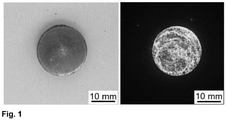
- the figure 1 illustrates the luminescent material according to the invention exposed to natural light and in the dark.
- the luminescent material is obtained in the form of a pellet in less than 10 minutes.
- the material thus obtained After being exposed to less than 5 cm from a source of artificial light for 20 seconds, the material thus obtained is luminescent for several tens of minutes.
Landscapes
- Chemical & Material Sciences (AREA)
- Engineering & Computer Science (AREA)
- Materials Engineering (AREA)
- Physics & Mathematics (AREA)
- General Physics & Mathematics (AREA)
- Organic Chemistry (AREA)
- Mechanical Engineering (AREA)
- Metallurgy (AREA)
- Manufacturing & Machinery (AREA)
- Inorganic Chemistry (AREA)
- Powder Metallurgy (AREA)
Abstract
Description
- La présente invention concerne un matériau métallique luminescent obtenu à partir de particules métalliques et d'un pigment luminescent. Ce matériau peut notamment être utilisé dans l'horlogerie ou la joaillerie.
- La luminescence correspond à l'émission de lumière de manière rapide (fluorescence) ou plus lente (phosphorescence) suite à l'excitation d'un composé chimique par absorption de photons. Certains composés phosphorescents peuvent ainsi émettre pendant plusieurs heures après avoir été initialement excités par exposition à un rayonnement électromagnétique.
- Les matériaux luminescents présentent donc la particularité d'émettre de la lumière dans l'obscurité, ce qui peut s'avérer intéressant, que ce soit pour des raisons esthétiques ou fonctionnelles.
- Ainsi, dans le domaine de l'horlogerie, intégrer un matériau luminescent dans les aiguilles ou les repères du cadran d'une montre permet ou facilite la lecture de l'heure dans l'obscurité.
- A titre d'exemple,
WO 2014/72388 -
EP 3 395 784 décrit un matériau céramique comprenant 5%pds ou moins d'un métal noble. -
EP 3 572 209 décrit un procédé de préparation d'un matériau composite par imprégnation d'un renfort (matière céramique, métallique ou organique) avec une matrice (résine synthétique) pouvant comprendre un composé phosphorescent. - Quand bien même ces matériaux présentent des propriétés luminescentes, il existe un besoin de disposer d'alternatives faciles à préparer, notamment pour des matériaux comprenant un métal noble.
- La présente invention concerne un matériau luminescent à base de métal noble et son procédé de fabrication.
- Le matériau luminescent selon l'invention est à base d'un métal choisi parmi l'or, le platine, le palladium ou l'argent.
- Plus précisément, la présente invention concerne un matériau luminescent pour l'horlogerie ou la joaillerie constitué de :
- 5 à 40 % de pigment luminescent,
- 60 à 95 % d'une matrice métallique,
- Le matériau luminescent selon l'invention est constitué d'au moins un type de pigment luminescent (luminophore) et d'une matrice métallique. Le matériau luminescent (matrice métallique + pigment luminescent) n'est pas un matériau céramique. En effet, il n'est pas obtenu par céramisation, il est obtenu à partir d'un mélange de particules métalliques et de pigments luminescents. Cependant, le pigment luminescent peut être un matériau céramique. Le matériau luminescent selon l'invention peut donc être un cermet (céramique-métal).
- En d'autres termes, il ne comprend pas d'autres éléments, outre d'éventuelles impuretés qui ne dépassent 10 ppm en poids du matériau luminescent.
- L'alliage de métal M comprend, pour 24 parts en poids, au moins 14 parts de métal M, avantageusement 14 à 23 parts, plus avantageusement 18 à 23 parts. Cela inclut notamment l'or (plus de 14 carats à 24 carats) ou l'argent 925 (alliage comprenant au moins 92,5% en poids d'argent).
- De manière avantageuse, la matrice métallique représente 58,5 à 95,9 %, par rapport au poids du matériau luminescent, plus avantageusement 85 à 95 %.
- Ainsi, le pigment luminescent représente avantageusement 4,1 à 41,5 %, par rapport au poids du matériau luminescent, plus avantageusement 5 à 15 %.
- Le matériau selon l'invention est luminescent c'est-à-dire phosphorescent ou fluorescent. Il est préférentiellement phosphorescent.
- Le matériau luminescent selon l'invention présente une porosité avantageusement inférieure à 5%, plus avantageusement inférieure à 1%.
- Le cas échéant, la taille médiane de pores est avantageusement inférieure à 100 micromètres, plus avantageusement inférieure à 50 µm, et encore plus avantageusement inférieure à 20 µm.
- Le matériau luminescent selon l'invention est constitué de pigment luminescent et d'une matrice métallique dans laquelle le pigment luminescent est dispersé.
- En d'autres termes, il ne s'agit pas d'un luminophore comprenant un pigment luminescent et des particules métalliques intimement mélangées. En effet, lors de la préparation du matériau, les particules métalliques coalescent entre elles et forment une matrice intégrant le pigment luminescent.
- Le pigment luminescent représente avantageusement 5 à 40 %, plus avantageusement 10 à 30%, par rapport au volume du matériau luminescent selon l'invention.
- Le pigment luminescent est généralement un composé inorganique. Il peut notamment être choisi dans le groupe comprenant le tungstate de calcium (CaWO4) ; le sulfure de zinc cadmié (ZnSO3:Cd) ; l'iodure de césium (CsI) ; le sulfate de baryum (BaSO4) ; les oxydes dopés, notamment les oxydes dopés terre rare ; les sels de terres rares (avantageusement gadolinium, lanthane, ou tantale), notamment les sels de terres rares dopés avec de l'yttrium ; et leurs mélanges.
- De manière avantageuse, le pigment luminescent peut être enrobé par une céramique. Le cas échéant, cet enrobage peut être utile pour améliorer la résistance du pigment luminescent aux températures atteintes lors de la préparation du matériau luminescent selon l'invention.
- Selon un mode de réalisation préféré, il s'agit de l'aluminate de strontium (SrAl2O4) dopé terre rare (scandium, yttrium et lanthanides, par exemple europium ou dysprosium).
- La matrice métallique représente avantageusement 60 à 95 %, plus avantageusement 70 à 90%, par rapport au volume du matériau luminescent selon l'invention.
- Comme déjà indiqué, le métal M est choisi dans le groupe constitué de l'or, le platine, le palladium, l'argent et leurs mélanges. Il s'agit préférentiellement d'or.
- L'or et ses alliages désignent l'or de plus de 14 carats à l'or 24 carats, préférentiellement de l'or de 18 à 24 carats, plus préférentiellement 18 à 22 carats.
- De manière générale, l'homme du métier ajustera le rapport métal M/pigment luminescent pour obtenir un matériau luminescent ayant une quantité de métal M comprise avantageusement entre 14 carats et 22 carats, préférentiellement entre 18 et 22 carats, par rapport au matériau luminescent (24 carats).
- Le rapport volumique entre la matrice métallique et le pigment luminescent permet d'obtenir un matériau ayant l'aspect visuel du métal, ou de l'alliage, en conditions normales d'éclairage, et un matériau luminescent dans l'obscurité.
- Le matériau luminescent peut comprendre une ou plusieurs parties luminescentes, par exemple sous la forme d'au moins une couche luminescente. Il peut également s'agir d'un matériau à gradient de luminescence.
- La présente invention concerne également le procédé de préparation de ce matériau luminescent. Ce procédé comprend les étapes suivantes :
- préparation d'un mélange contenant au moins un pigment luminescent et des particules métalliques,
les particules métalliques étant constituées d'un métal M pur ou d'un alliage de métal M,
le métal M étant choisi dans le groupe constitué par l'or, le platine, le palladium et l'argent,
le mélange comprenant, pour 24 parts en poids, au moins 14 parts de métal M, - optionnellement, compactage de ce mélange,
- traitement de frittage, avantageusement sous pression, de ce mélange à une température inférieure à la température de fusion du pigment luminescent.
- Le Demandeur a remarqué qu'il était possible de former un luminophore (matériau luminescent) par frittage quand bien même ce matériau est majoritairement à base d'un métal M ayant un point de fusion élevé. Pour cela, le Demandeur a mis au point un procédé consistant à fritter des particules métalliques, sans dégrader les pigments luminescents.
- Ce matériau luminescent est préférentiellement obtenu par densification d'un mélange pulvérulent.
- De manière générale, le pigment luminescent et/ou les particules métalliques peuvent se présenter sous la forme de paillettes ou de particules tridimensionnelles, par exemple des particules sphériques.
- Le pigment luminescent utilisé pour préparer le matériau luminescent se présente sous la forme de particules. Il présente une taille moyenne en nombre avantageusement comprise entre 1 et 200 µm, plus avantageusement entre 1 et 100 µm.
- En général, une granulométrie de l'ordre de 1 à 20 µm permet d'obtenir un matériau luminescent ayant un aspect visuel homogène alors qu'une granulométrie supérieure à 50 µm procure un effet étoilé.
- De manière générale, le procédé de préparation du matériau luminescent ne modifie pas la taille du pigment luminescent.
- Comme déjà indiqué, le traitement thermique est réalisé à une température inférieure à la température de fusion du pigment luminescent. Ainsi, le pigment luminescent est englobé dans une matrice métallique.
- Les particules métalliques utilisées pour préparer le matériau luminescent présentent une taille médiane en nombre (D50) avantageusement comprise entre 1 et 200 µm, plus avantageusement entre 5 et 100 µm.
- Les particules métalliques et/ou le pigment luminescent peuvent se présenter sous la forme d'une poudre, par exemple une poudre d'or pour les particules métalliques.
- Les dimensions (par exemple la taille) des particules (métalliques ou luminescentes) peuvent être mesurées selon les techniques conventionnelles utilisées par l'homme du métier, par exemple par granulométrie laser (Malvern). Avec un système optique adapté, le facteur de forme peut être déterminé, la densité peut également être déterminée par pycnomètre à gaz ou par BET, technologie basée sur la théorie Brunauer, Emmett et Teller. La morphologie des grains peut être déterminée par MEB (microscopie électronique à balayage).
- Comme déjà indiqué, les particules d'or utilisées pour préparer le mélange sont avantageusement à base d'or 18 carats à 24 carats, préférentiellement de l'or 20 ou 22 carats. Il peut s'agir d'un alliage d'or de couleur, par exemple jaune, blanc, rouge ou rose.
- Le procédé de préparation du matériau luminescent n'entrainant pas de perte ou de gain de matière, le rapport en poids entre le métal (ou son alliage) et le pigment luminescent est le même dans le mélange (avant le traitement thermique) et dans le matériau final.
- Le mélange du pigment luminescent et des particules métalliques peut être réalisé au moyen de tout dispositif conventionnel. Il peut donc être réalisé manuellement ou mécaniquement.
- De manière avantageuse, un mélangeur automatique est utilisé, par exemple de type turbula. Ce type d'appareil permet d'améliorer l'homogénéité du mélange et, par conséquent, du matériau luminescent.
- Selon un autre mode de réalisation, le mélange peut être réalisé au moyen d'un broyeur. Le cas échéant, l'homme du métier saura choisir l'agent de broyage (grinding médium) adapté afin de préserver les propriétés physiques initiales (forme et taille) du pigment luminescent et des particules métalliques.
- Le traitement de frittage est avantageusement réalisé à une température comprise entre 300 et 1400 °C, plus avantageusement entre 500 et 800 °C, encore plus avantageusement entre 600 et 700 °C.
- Préalablement au traitement de frittage, le mélange est préférentiellement compacté. Le compactage est avantageusement réalisé par mise sous pression du mélange, entre 5 et 1500 MPa, plus avantageusement entre 10 et 1200 MPa, encore plus avantageusement entre 20 et 500MPa. Il s'agit de la pression appliquée sur le mélange avant le traitement de frittage. Elle est avantageusement identique à celle pouvant être exercée lors du traitement de frittage.
- Le traitement de frittage est avantageusement réalisé à une pression comprise entre 5 et 1500 MPa, plus avantageusement entre 10 et 1200 MPa, encore plus avantageusement entre 20 et 500 MPa.
- Le traitement de frittage SPS est réalisé pendant une durée avantageusement comprise entre 1 minute et 45 minutes, plus avantageusement entre 5 minutes et 15 minutes.
- Ainsi, le traitement thermique peut avantageusement correspondre à une séquence 1) de compactage et 2) de frittage ou à une séquence 1) de compactage et 2) de frittage + compactage. Il est avantageusement réalisé par frittage flash (SPS « spark plasma sintering ») consistant à réaliser le frittage sous pression.
- Selon un autre mode de réalisation, le traitement de frittage peut être réalisé au moyen d'une presse à chaud, d'une presse à froid, par passage dans un four (à la pression atmosphérique, avantageusement après une étape de compactage), par fabrication additive, par projection thermique, ou par pulvérisation simultanée d'une poudre de particules métalliques et d'une poudre de pigment luminescent.
- La formation du matériau luminescent par pulvérisation d'une poudre de particules métalliques et d'une poudre de pigment luminescent peut consister à former le mélange particules métalliques/pigment luminescent lors de la pulvérisation des poudres et de leur dépôt sur un substrat. Le traitement de frittage peut être réalisé après le dépôt du mélange de poudre sur un substrat par les techniques conventionnelles (laser, SPS...). Cependant, et préférentiellement, le traitement de frittage est réalisé lors de la pulvérisation des poudres, par exemple par co-projection des poudres de manière coaxiale avec un laser qui permet la fonte les particules métalliques.
- Ainsi, le procédé selon l'invention peut consister à déposer des pigments, ou le mélange (particules métalliques + pigments luminescents), selon un motif prédéfini tel qu'un logo ou une représentation graphique, ce motif étant observable dans l'obscurité après absorption de photons.
- La réalisation du traitement thermique par SPS procure de nombreux avantages, par exemple, une montée en température plus rapide et une durée de traitement plus courte par rapport aux procédés conventionnels tels que le pressage à chaud. En effet, dans le SPS, le mélange est chauffé par effet Joule et par conduction, grâce à un courant électrique. Ce phénomène permet d'abaisser la température de frittage, sa durée et, ainsi, d'éviter la dégradation des pigments luminescents.
- De manière générale, un traitement par SPS nécessite un dispositif de pressage de poudre assisté d'un courant électrique.
- Même si les pigments luminescents ne sont généralement pas conducteurs électrique, le courant électrique passe par les particules métalliques conductrices (or, platine, palladium, argent et leurs alliages), provoquant leur échauffement ainsi que celui des pigments luminescents adjacents.
- La présente invention concerne également l'utilisation de ce matériau luminescent dans l'horlogerie ou dans la joaillerie, notamment un article d'horlogerie ou de joaillerie comprenant le matériau luminescent. Il peut s'agir d'aiguilles de montre ou de repères sur un cadran de montre mais également d'un fond de boite de montre, d'une carrure de boite de montre, d'une lunette de boite de montre, d'un poussoir de montre, d'une couronne de montre ou d'un bracelet articulé de montre.
- Cet article comprend donc le matériau luminescent, qui peut avoir été préalablement usiné, et éventuellement poli, notamment par polissage ionique.
- La luminescence du matériau peut résulter de son exposition à une source de lumière naturelle et/ou artificielle. Il peut notamment s'agir d'une exposition à un rayonnement ultraviolet.
- De manière générale, la longueur d'onde d'absorption du pigment luminescent ne correspond pas nécessairement à sa longueur d'onde d'émission.
- La présente invention et les avantages qui en découlent ressortiront mieux de la figure et des exemples suivants donnés afin d'illustrer l'invention et non de manière limitative.
- La
figure 1 illustre le matériau luminescent selon l'invention exposé à la lumière naturelle et dans l'obscurité. - Un matériau luminescent (
figure 1 ) a été préparé selon les étapes suivantes : - préparation d'une poudre d'or 18 carats ayant un diamètre de particules dso de 16 µm, d10 de10 µm et d90 de 52 µm (dxx : XX% de particule inférieure à ce nombre), par atomisation gazeuse,
- préparation d'un mélange de 75% en volume de poudre d'or 18 carats et de 25% en volume de pigment luminescent (aluminate de strontium dopé europium ou dysprosium), la quantité de pigment représentant 9,5% par rapport au poids du mélange,
- compaction/frittage par SPS de ce mélange
- obtention d'un matériau luminescent sous forme d'une pastille.
- Les conditions du traitement par SPS sont les suivantes :
- appliquer, sur le mélange, une pression de 16 kN au moyen d'un piston de 2 cm de diamètre,
- chauffer le mélange à 450 °C pendant 5 min,
- atteindre 630 °C (100 °C/min) et maintenir à 630 °C pendant 2 minutes,
- stopper le traitement thermique,
- laisser l'échantillon reposer pendant 2 minutes avant de relâcher la pression,
- laisser l'échantillon refroidir.
- Ainsi, le matériau luminescent est obtenu sous la forme d'une pastille en moins de 10 minutes.
- Après avoir été exposé à moins de 5 cm d'une source de lumière artificielle pendant 20 secondes, le matériau ainsi obtenu est luminescent pendant plusieurs dizaines de minutes.
la matrice métallique étant constituée d'un métal M pur ou d'un alliage de métal M,
le métal M étant choisi dans le groupe constitué par l'or, le platine, le palladium et l'argent,
le matériau luminescent comprenant, pour 24 parts en poids, au moins 14 parts de métal M.
Claims (15)
- Matériau luminescent pour l'horlogerie ou la joaillerie, constitué de :- 5 à 40 % de pigment luminescent,- 95 à 60 % d'une matrice métallique,les pourcentages étant exprimés par rapport au volume du matériau,
la matrice métallique étant constituée d'un métal M pur ou d'un alliage de métal M,
le métal M étant choisi dans le groupe constitué par l'or, le platine, le palladium et l'argent,
le matériau luminescent comprenant, pour 24 parts en poids, au moins 14 parts de métal M. - Matériau luminescent selon la revendication 1, caractérisé en ce que le métal représente 58,5 à 95,9 %, par rapport au poids du matériau luminescent.
- Matériau luminescent selon la revendication 1 ou 2, caractérisé en ce que le pigment luminescent est SrAl2O4 dopé terre rare.
- Matériau luminescent selon l'une des revendications 1 à 3, caractérisé en ce que le métal M est de l'or.
- Matériau luminescent selon l'une des revendications 1 à 3, caractérisé en ce que le pigment luminescent représente 10 à 30%, par rapport au volume du matériau luminescent.
- Article d'horlogerie ou de joaillerie comprenant le matériau luminescent objet de l'une des revendications 1 à 5.
- Article selon la revendication 6, caractérisé en ce qu'il s'agit d'aiguilles de montre, de repères sur un cadran de montre, d'un fond de boite de montre, d'une carrure de boite de montre, d'une lunette de boite de montre, d'un poussoir de montre, d'une couronne de montre ou d'un bracelet articulé de montre.
- Procédé de préparation du matériau luminescent objet de l'une des revendications 1 à 5, selon les étapes suivantes :- préparation d'un mélange contenant au moins un pigment luminescent et des particules métalliques,
les particules métalliques étant constituées d'un métal M pur ou d'un alliage de métal M,
le métal M étant choisi dans le groupe constitué par l'or, le platine, le palladium et l'argent,
le mélange comprenant, pour 24 parts en poids, au moins 14 parts de métal M.- traitement de frittage, avantageusement sous pression, de ce mélange à une température inférieure à la température de fusion du pigment luminescent. - Procédé selon la revendication 8, caractérisé en ce que le mélange soumis à une étape de compactage préalablement au traitement de frittage.
- Procédé selon l'une des revendications 8 à 9, caractérisé en ce que le mélange est mis en forme préalablement au traitement de frittage.
- Procédé selon l'une des revendications 8 à 10, caractérisé en ce que le traitement de frittage est réalisé sous une pression comprise entre 5 et 1500 MPa.
- Procédé selon l'une des revendications 8 à 11, caractérisé en ce que le traitement de frittage est réalisé à une température comprise entre 300 °C et 400 °C.
- Procédé selon l'une des revendications 8 à 12, caractérisé en ce que le mélange soumis à une étape de compactage sous une pression comprise entre 5 et 1500 MPa, préalablement au traitement de frittage.
- Procédé selon l'une des revendications 8 à 13, caractérisé en ce que le traitement de frittage est réalisé par frittage flash.
- Procédé selon la revendication 8, caractérisé en ce que le traitement de frittage est réalisé au moyen d'une presse à chaud, au moyen d'une presse à froid, par passage dans un four, par fabrication additive, par projection thermique, ou par pulvérisations d'une poudre de particules métalliques et d'une poudre de pigment luminescent simultanément.
Priority Applications (1)
| Application Number | Priority Date | Filing Date | Title |
|---|---|---|---|
| EP20186887.4A EP3943573B1 (fr) | 2020-07-21 | 2020-07-21 | Materiau metallique luminescent, procede de preparation et utilisation |
Applications Claiming Priority (1)
| Application Number | Priority Date | Filing Date | Title |
|---|---|---|---|
| EP20186887.4A EP3943573B1 (fr) | 2020-07-21 | 2020-07-21 | Materiau metallique luminescent, procede de preparation et utilisation |
Publications (2)
| Publication Number | Publication Date |
|---|---|
| EP3943573A1 true EP3943573A1 (fr) | 2022-01-26 |
| EP3943573B1 EP3943573B1 (fr) | 2026-02-25 |
Family
ID=71738041
Family Applications (1)
| Application Number | Title | Priority Date | Filing Date |
|---|---|---|---|
| EP20186887.4A Active EP3943573B1 (fr) | 2020-07-21 | 2020-07-21 | Materiau metallique luminescent, procede de preparation et utilisation |
Country Status (1)
| Country | Link |
|---|---|
| EP (1) | EP3943573B1 (fr) |
Citations (7)
| Publication number | Priority date | Publication date | Assignee | Title |
|---|---|---|---|---|
| JP2000026902A (ja) * | 1998-07-08 | 2000-01-25 | Daido Steel Co Ltd | 金属焼結体及びその製造方法 |
| US20110305919A1 (en) * | 2010-06-10 | 2011-12-15 | Authentix, Inc. | Metallic materials with embedded luminescent particles |
| WO2014072388A1 (fr) | 2012-11-07 | 2014-05-15 | Rolex S.A. | Composants de montre |
| WO2015149879A1 (fr) * | 2014-03-31 | 2015-10-08 | Siemens Aktiengesellschaft | Composites matriciels de matériau luminescent pour détection à distance de déformations structurelles et d'usure |
| EP3395784A1 (fr) | 2017-04-20 | 2018-10-31 | Rolex Sa | Composant en céramique pour pièce d'horlogerie |
| EP3572209A1 (fr) | 2018-05-24 | 2019-11-27 | The Swatch Group Research and Development Ltd | Composant d'habillage en materiau composite et son procede de fabrication |
| EP3653744A1 (fr) * | 2018-11-16 | 2020-05-20 | The Swatch Group Research and Development Ltd | Matériau composite à matrice métallique et procédé de fabrication d'un tel matériau |
Family Cites Families (1)
| Publication number | Priority date | Publication date | Assignee | Title |
|---|---|---|---|---|
| CH714899B1 (fr) * | 2018-11-16 | 2019-10-15 | Swatch Group Res & Dev Ltd | Matériau composite à matrice métallique et procédé de fabrication d'un tel matériau. |
-
2020
- 2020-07-21 EP EP20186887.4A patent/EP3943573B1/fr active Active
Patent Citations (7)
| Publication number | Priority date | Publication date | Assignee | Title |
|---|---|---|---|---|
| JP2000026902A (ja) * | 1998-07-08 | 2000-01-25 | Daido Steel Co Ltd | 金属焼結体及びその製造方法 |
| US20110305919A1 (en) * | 2010-06-10 | 2011-12-15 | Authentix, Inc. | Metallic materials with embedded luminescent particles |
| WO2014072388A1 (fr) | 2012-11-07 | 2014-05-15 | Rolex S.A. | Composants de montre |
| WO2015149879A1 (fr) * | 2014-03-31 | 2015-10-08 | Siemens Aktiengesellschaft | Composites matriciels de matériau luminescent pour détection à distance de déformations structurelles et d'usure |
| EP3395784A1 (fr) | 2017-04-20 | 2018-10-31 | Rolex Sa | Composant en céramique pour pièce d'horlogerie |
| EP3572209A1 (fr) | 2018-05-24 | 2019-11-27 | The Swatch Group Research and Development Ltd | Composant d'habillage en materiau composite et son procede de fabrication |
| EP3653744A1 (fr) * | 2018-11-16 | 2020-05-20 | The Swatch Group Research and Development Ltd | Matériau composite à matrice métallique et procédé de fabrication d'un tel matériau |
Also Published As
| Publication number | Publication date |
|---|---|
| EP3943573B1 (fr) | 2026-02-25 |
Similar Documents
| Publication | Publication Date | Title |
|---|---|---|
| CA2752664C (fr) | Composition a base d'europium, d'oxyde d'yttrium ou de gadolinium, de type coeur/coquille, luminophore comprenant cette composition et procedes de preparation | |
| EP3245259B1 (fr) | Procédé de fabrication d'un matériau composite céramique | |
| CA2723028C (fr) | Phosphate de lanthane et d'au moins une terre rare choisie parmi le cerium et le terbium sous forme d'une suspension, procede de preparation et utilisation comme luminophore | |
| TW201235447A (en) | Emissive ceramic materials having a dopant concentration gradient and methods of making and using the same | |
| Liu et al. | CaAlSiN3: Eu2+ phosphors bonding with bismuth borate glass for high power light excitation | |
| EP3395784A1 (fr) | Composant en céramique pour pièce d'horlogerie | |
| CN109075236A (zh) | 波长转换构件 | |
| FR2956407A1 (fr) | Composes luminescents | |
| CA2752381C (fr) | Phosphate de lanthane, de cerium et de terbium de type coeur/coquille, luminophore comprenant ce phosphate et procedes de preparation | |
| EP2265690B1 (fr) | Aluminate de baryum et de magnesium submicronique, procede de preparation et utilisation comme luminophore | |
| Hasabeldaim et al. | Effect of PLD growth atmosphere on the physical properties of ZnO: Zn thin films | |
| TWI624529B (zh) | Ceramic composite material for light conversion, method for producing the same, and light-emitting device therewith | |
| EP3567007A1 (fr) | Alumine, luminophores et composés mixtes ainsi que procédés de préparation associés | |
| EP3612504B1 (fr) | Fabrication d'un composant en céramique | |
| EP3601440B1 (fr) | Matériau composite coloré | |
| EP3943573B1 (fr) | Materiau metallique luminescent, procede de preparation et utilisation | |
| Huang et al. | Silver catalyzed gallium phosphide nanowires integrated on silicon and in situ Ag-alloying induced bandgap transition | |
| CA2035170C (fr) | Procede de fabrication d'une cathode impregnee et cathode obtenue par ce procede | |
| CA2816385A1 (fr) | Composition a base d'un aluminate, de type coeur/coquille, luminophore issu de cette composition et procedes de preparation | |
| HK40067574A (en) | Luminescent metal material, method for preparing same and use thereof | |
| CN119585395A (zh) | 粉末层深度受控制的纳米金刚石颗粒的热处理 | |
| Gopal et al. | PVP-functionalized Dy 2 O 3/Pr 2 O 3 nanocomposites: a multifunctional platform for photoluminescence, WLEDs, latent fingerprinting, and anti-counterfeiting applications | |
| EP4617249A1 (fr) | Procédé de préparation d'un article céramique phosphorescent à base de zircone | |
| EP3515997A1 (fr) | Article recouvert au moins partiellement par au moins une couche de revetement luminescent | |
| EP1223208B1 (fr) | Matière luminescente polycristalline mal cristallisée ou amorphe et procédé d'obtention |
Legal Events
| Date | Code | Title | Description |
|---|---|---|---|
| PUAI | Public reference made under article 153(3) epc to a published international application that has entered the european phase |
Free format text: ORIGINAL CODE: 0009012 |
|
| STAA | Information on the status of an ep patent application or granted ep patent |
Free format text: STATUS: THE APPLICATION HAS BEEN PUBLISHED |
|
| AK | Designated contracting states |
Kind code of ref document: A1 Designated state(s): AL AT BE BG CH CY CZ DE DK EE ES FI FR GB GR HR HU IE IS IT LI LT LU LV MC MK MT NL NO PL PT RO RS SE SI SK SM TR |
|
| STAA | Information on the status of an ep patent application or granted ep patent |
Free format text: STATUS: REQUEST FOR EXAMINATION WAS MADE |
|
| 17P | Request for examination filed |
Effective date: 20220719 |
|
| RBV | Designated contracting states (corrected) |
Designated state(s): AL AT BE BG CH CY CZ DE DK EE ES FI FR GB GR HR HU IE IS IT LI LT LU LV MC MK MT NL NO PL PT RO RS SE SI SK SM TR |
|
| REG | Reference to a national code |
Ref country code: HK Ref legal event code: DE Ref document number: 40067574 Country of ref document: HK |
|
| STAA | Information on the status of an ep patent application or granted ep patent |
Free format text: STATUS: EXAMINATION IS IN PROGRESS |
|
| 17Q | First examination report despatched |
Effective date: 20240412 |
|
| GRAP | Despatch of communication of intention to grant a patent |
Free format text: ORIGINAL CODE: EPIDOSNIGR1 |
|
| STAA | Information on the status of an ep patent application or granted ep patent |
Free format text: STATUS: GRANT OF PATENT IS INTENDED |
|
| INTG | Intention to grant announced |
Effective date: 20251126 |
|
| GRAS | Grant fee paid |
Free format text: ORIGINAL CODE: EPIDOSNIGR3 |
|
| GRAA | (expected) grant |
Free format text: ORIGINAL CODE: 0009210 |
|
| STAA | Information on the status of an ep patent application or granted ep patent |
Free format text: STATUS: THE PATENT HAS BEEN GRANTED |
|
| AK | Designated contracting states |
Kind code of ref document: B1 Designated state(s): AL AT BE BG CH CY CZ DE DK EE ES FI FR GB GR HR HU IE IS IT LI LT LU LV MC MK MT NL NO PL PT RO RS SE SI SK SM TR |
|
| REG | Reference to a national code |
Ref country code: CH Ref legal event code: F10 Free format text: ST27 STATUS EVENT CODE: U-0-0-F10-F00 (AS PROVIDED BY THE NATIONAL OFFICE) Effective date: 20260225 Ref country code: GB Ref legal event code: FG4D Free format text: NOT ENGLISH |
|
| REG | Reference to a national code |
Ref country code: DE Ref legal event code: R096 Ref document number: 602020067396 Country of ref document: DE |
|
| REG | Reference to a national code |
Ref country code: IE Ref legal event code: FG4D Free format text: LANGUAGE OF EP DOCUMENT: FRENCH |