EP3943373B1 - Electric scooter with battery dock - Google Patents
Electric scooter with battery dock Download PDFInfo
- Publication number
- EP3943373B1 EP3943373B1 EP20187693.5A EP20187693A EP3943373B1 EP 3943373 B1 EP3943373 B1 EP 3943373B1 EP 20187693 A EP20187693 A EP 20187693A EP 3943373 B1 EP3943373 B1 EP 3943373B1
- Authority
- EP
- European Patent Office
- Prior art keywords
- battery
- support frame
- locking mechanism
- dock
- partially
- Prior art date
- Legal status (The legal status is an assumption and is not a legal conclusion. Google has not performed a legal analysis and makes no representation as to the accuracy of the status listed.)
- Active
Links
Images



Classifications
-
- B—PERFORMING OPERATIONS; TRANSPORTING
- B62—LAND VEHICLES FOR TRAVELLING OTHERWISE THAN ON RAILS
- B62H—CYCLE STANDS; SUPPORTS OR HOLDERS FOR PARKING OR STORING CYCLES; APPLIANCES PREVENTING OR INDICATING UNAUTHORIZED USE OR THEFT OF CYCLES; LOCKS INTEGRAL WITH CYCLES; DEVICES FOR LEARNING TO RIDE CYCLES
- B62H5/00—Appliances preventing or indicating unauthorised use or theft of cycles; Locks integral with cycles
- B62H5/001—Preventing theft of parts or accessories used on cycles, e.g. lamp, dynamo
-
- B—PERFORMING OPERATIONS; TRANSPORTING
- B60—VEHICLES IN GENERAL
- B60L—PROPULSION OF ELECTRICALLY-PROPELLED VEHICLES; SUPPLYING ELECTRIC POWER FOR AUXILIARY EQUIPMENT OF ELECTRICALLY-PROPELLED VEHICLES; ELECTRODYNAMIC BRAKE SYSTEMS FOR VEHICLES IN GENERAL; MAGNETIC SUSPENSION OR LEVITATION FOR VEHICLES; MONITORING OPERATING VARIABLES OF ELECTRICALLY-PROPELLED VEHICLES; ELECTRIC SAFETY DEVICES FOR ELECTRICALLY-PROPELLED VEHICLES
- B60L50/00—Electric propulsion with power supplied within the vehicle
- B60L50/50—Electric propulsion with power supplied within the vehicle using propulsion power supplied by batteries or fuel cells
- B60L50/60—Electric propulsion with power supplied within the vehicle using propulsion power supplied by batteries or fuel cells using power supplied by batteries
- B60L50/64—Constructional details of batteries specially adapted for electric vehicles
-
- B—PERFORMING OPERATIONS; TRANSPORTING
- B60—VEHICLES IN GENERAL
- B60L—PROPULSION OF ELECTRICALLY-PROPELLED VEHICLES; SUPPLYING ELECTRIC POWER FOR AUXILIARY EQUIPMENT OF ELECTRICALLY-PROPELLED VEHICLES; ELECTRODYNAMIC BRAKE SYSTEMS FOR VEHICLES IN GENERAL; MAGNETIC SUSPENSION OR LEVITATION FOR VEHICLES; MONITORING OPERATING VARIABLES OF ELECTRICALLY-PROPELLED VEHICLES; ELECTRIC SAFETY DEVICES FOR ELECTRICALLY-PROPELLED VEHICLES
- B60L50/00—Electric propulsion with power supplied within the vehicle
- B60L50/50—Electric propulsion with power supplied within the vehicle using propulsion power supplied by batteries or fuel cells
- B60L50/60—Electric propulsion with power supplied within the vehicle using propulsion power supplied by batteries or fuel cells using power supplied by batteries
- B60L50/66—Arrangements of batteries
-
- B—PERFORMING OPERATIONS; TRANSPORTING
- B60—VEHICLES IN GENERAL
- B60L—PROPULSION OF ELECTRICALLY-PROPELLED VEHICLES; SUPPLYING ELECTRIC POWER FOR AUXILIARY EQUIPMENT OF ELECTRICALLY-PROPELLED VEHICLES; ELECTRODYNAMIC BRAKE SYSTEMS FOR VEHICLES IN GENERAL; MAGNETIC SUSPENSION OR LEVITATION FOR VEHICLES; MONITORING OPERATING VARIABLES OF ELECTRICALLY-PROPELLED VEHICLES; ELECTRIC SAFETY DEVICES FOR ELECTRICALLY-PROPELLED VEHICLES
- B60L53/00—Methods of charging batteries, specially adapted for electric vehicles; Charging stations or on-board charging equipment therefor; Exchange of energy storage elements in electric vehicles
- B60L53/80—Exchanging energy storage elements, e.g. removable batteries
-
- B—PERFORMING OPERATIONS; TRANSPORTING
- B62—LAND VEHICLES FOR TRAVELLING OTHERWISE THAN ON RAILS
- B62J—CYCLE SADDLES OR SEATS; AUXILIARY DEVICES OR ACCESSORIES SPECIALLY ADAPTED TO CYCLES AND NOT OTHERWISE PROVIDED FOR, e.g. ARTICLE CARRIERS OR CYCLE PROTECTORS
- B62J43/00—Arrangements of batteries
- B62J43/10—Arrangements of batteries for propulsion
-
- B—PERFORMING OPERATIONS; TRANSPORTING
- B62—LAND VEHICLES FOR TRAVELLING OTHERWISE THAN ON RAILS
- B62J—CYCLE SADDLES OR SEATS; AUXILIARY DEVICES OR ACCESSORIES SPECIALLY ADAPTED TO CYCLES AND NOT OTHERWISE PROVIDED FOR, e.g. ARTICLE CARRIERS OR CYCLE PROTECTORS
- B62J43/00—Arrangements of batteries
- B62J43/20—Arrangements of batteries characterised by the mounting
- B62J43/23—Arrangements of batteries characterised by the mounting dismounted when charging
-
- B—PERFORMING OPERATIONS; TRANSPORTING
- B62—LAND VEHICLES FOR TRAVELLING OTHERWISE THAN ON RAILS
- B62K—CYCLES; CYCLE FRAMES; CYCLE STEERING DEVICES; RIDER-OPERATED TERMINAL CONTROLS SPECIALLY ADAPTED FOR CYCLES; CYCLE AXLE SUSPENSIONS; CYCLE SIDECARS, FORECARS, OR THE LIKE
- B62K19/00—Cycle frames
- B62K19/30—Frame parts shaped to receive other cycle parts or accessories
- B62K19/40—Frame parts shaped to receive other cycle parts or accessories for attaching accessories, e.g. article carriers, lamps
-
- B—PERFORMING OPERATIONS; TRANSPORTING
- B62—LAND VEHICLES FOR TRAVELLING OTHERWISE THAN ON RAILS
- B62K—CYCLES; CYCLE FRAMES; CYCLE STEERING DEVICES; RIDER-OPERATED TERMINAL CONTROLS SPECIALLY ADAPTED FOR CYCLES; CYCLE AXLE SUSPENSIONS; CYCLE SIDECARS, FORECARS, OR THE LIKE
- B62K3/00—Bicycles
- B62K3/002—Bicycles without a seat, i.e. the rider operating the vehicle in a standing position, e.g. non-motorized scooters; non-motorized scooters with skis or runners
-
- H—ELECTRICITY
- H01—ELECTRIC ELEMENTS
- H01M—PROCESSES OR MEANS, e.g. BATTERIES, FOR THE DIRECT CONVERSION OF CHEMICAL ENERGY INTO ELECTRICAL ENERGY
- H01M50/00—Constructional details or processes of manufacture of the non-active parts of electrochemical cells other than fuel cells, e.g. hybrid cells
- H01M50/20—Mountings; Secondary casings or frames; Racks, modules or packs; Suspension devices; Shock absorbers; Transport or carrying devices; Holders
- H01M50/249—Mountings; Secondary casings or frames; Racks, modules or packs; Suspension devices; Shock absorbers; Transport or carrying devices; Holders specially adapted for aircraft or vehicles, e.g. cars or trains
-
- H—ELECTRICITY
- H01—ELECTRIC ELEMENTS
- H01M—PROCESSES OR MEANS, e.g. BATTERIES, FOR THE DIRECT CONVERSION OF CHEMICAL ENERGY INTO ELECTRICAL ENERGY
- H01M50/00—Constructional details or processes of manufacture of the non-active parts of electrochemical cells other than fuel cells, e.g. hybrid cells
- H01M50/20—Mountings; Secondary casings or frames; Racks, modules or packs; Suspension devices; Shock absorbers; Transport or carrying devices; Holders
- H01M50/262—Mountings; Secondary casings or frames; Racks, modules or packs; Suspension devices; Shock absorbers; Transport or carrying devices; Holders with fastening means, e.g. locks
-
- B—PERFORMING OPERATIONS; TRANSPORTING
- B60—VEHICLES IN GENERAL
- B60L—PROPULSION OF ELECTRICALLY-PROPELLED VEHICLES; SUPPLYING ELECTRIC POWER FOR AUXILIARY EQUIPMENT OF ELECTRICALLY-PROPELLED VEHICLES; ELECTRODYNAMIC BRAKE SYSTEMS FOR VEHICLES IN GENERAL; MAGNETIC SUSPENSION OR LEVITATION FOR VEHICLES; MONITORING OPERATING VARIABLES OF ELECTRICALLY-PROPELLED VEHICLES; ELECTRIC SAFETY DEVICES FOR ELECTRICALLY-PROPELLED VEHICLES
- B60L2200/00—Type of vehicles
- B60L2200/12—Bikes
-
- B—PERFORMING OPERATIONS; TRANSPORTING
- B62—LAND VEHICLES FOR TRAVELLING OTHERWISE THAN ON RAILS
- B62K—CYCLES; CYCLE FRAMES; CYCLE STEERING DEVICES; RIDER-OPERATED TERMINAL CONTROLS SPECIALLY ADAPTED FOR CYCLES; CYCLE AXLE SUSPENSIONS; CYCLE SIDECARS, FORECARS, OR THE LIKE
- B62K2204/00—Adaptations for driving cycles by electric motor
-
- Y—GENERAL TAGGING OF NEW TECHNOLOGICAL DEVELOPMENTS; GENERAL TAGGING OF CROSS-SECTIONAL TECHNOLOGIES SPANNING OVER SEVERAL SECTIONS OF THE IPC; TECHNICAL SUBJECTS COVERED BY FORMER USPC CROSS-REFERENCE ART COLLECTIONS [XRACs] AND DIGESTS
- Y02—TECHNOLOGIES OR APPLICATIONS FOR MITIGATION OR ADAPTATION AGAINST CLIMATE CHANGE
- Y02E—REDUCTION OF GREENHOUSE GAS [GHG] EMISSIONS, RELATED TO ENERGY GENERATION, TRANSMISSION OR DISTRIBUTION
- Y02E60/00—Enabling technologies; Technologies with a potential or indirect contribution to GHG emissions mitigation
- Y02E60/10—Energy storage using batteries
-
- Y—GENERAL TAGGING OF NEW TECHNOLOGICAL DEVELOPMENTS; GENERAL TAGGING OF CROSS-SECTIONAL TECHNOLOGIES SPANNING OVER SEVERAL SECTIONS OF THE IPC; TECHNICAL SUBJECTS COVERED BY FORMER USPC CROSS-REFERENCE ART COLLECTIONS [XRACs] AND DIGESTS
- Y02—TECHNOLOGIES OR APPLICATIONS FOR MITIGATION OR ADAPTATION AGAINST CLIMATE CHANGE
- Y02T—CLIMATE CHANGE MITIGATION TECHNOLOGIES RELATED TO TRANSPORTATION
- Y02T10/00—Road transport of goods or passengers
- Y02T10/60—Other road transportation technologies with climate change mitigation effect
- Y02T10/70—Energy storage systems for electromobility, e.g. batteries
-
- Y—GENERAL TAGGING OF NEW TECHNOLOGICAL DEVELOPMENTS; GENERAL TAGGING OF CROSS-SECTIONAL TECHNOLOGIES SPANNING OVER SEVERAL SECTIONS OF THE IPC; TECHNICAL SUBJECTS COVERED BY FORMER USPC CROSS-REFERENCE ART COLLECTIONS [XRACs] AND DIGESTS
- Y02—TECHNOLOGIES OR APPLICATIONS FOR MITIGATION OR ADAPTATION AGAINST CLIMATE CHANGE
- Y02T—CLIMATE CHANGE MITIGATION TECHNOLOGIES RELATED TO TRANSPORTATION
- Y02T10/00—Road transport of goods or passengers
- Y02T10/60—Other road transportation technologies with climate change mitigation effect
- Y02T10/7072—Electromobility specific charging systems or methods for batteries, ultracapacitors, supercapacitors or double-layer capacitors
Definitions
- Embodiments of the present disclosure relate generally to electric scooters, which are powered by batteries.
- Scooters are wheeled devices used for individual transportation.
- a conventional scooter has a running board on which the user stands.
- the running board is supported by at least two wheels, one at the front and one at the rear.
- the front wheel may be steerable by means of a handle bar, which is connected to the front wheel through a steering shaft.
- the scooter is typically operated by holding the handle bar with two hands, placing one foot on the running board, and pushing with the other foot to propel the scooter.
- motorized scooters also known as electric scooters or e-scooters have become available.
- the motor is usually attached to the rear wheel of the scooter.
- An e-scooter may be used similar to a conventional scooter during the kick-off phase.
- the motor may start driving the wheel or wheels after a certain minimum speed is reached.
- Scooters are often provided by a company in public areas and users can book scooters for individual transportation.
- Documents CN 210063206 U , US 2020212395 A1 , CN 110203318 A , CN 209700845 U , US 2013027183 A1 , CN 210618344 U and CN 109927829 A relate to devices used for individual transportation having an electric motor and a battery.
- Said document CN 210063206 U discloses a system comprising:
- the invention is defined by the appended claims und comprises a system as defined in claim 1 and a method for operating an e-scooter as defined in claim 14.
- the battery is removable from the battery dock by a lifting motion in an at least partially upward direction perpendicular to the support surface.
- the locking mechanism is configured to unlock the battery, wherein unlocking of the locking mechanism is electrically powered.
- the electric scooter can further comprise a controller configured to unlock the locking mechanism.
- the method can comprise: - removing the battery from the battery dock by a lifting motion in an at least partially upward direction perpendicular to the support surface.
- a scooter 1 comprises a support frame 5 including a support surface 8 configured to support a user, at least a first and a second wheel 3, 4, and a steering shaft 2 connected to at least one wheel 3, 4 for steering the scooter 1.
- the scooter 1 is an electric scooter (e-scooter) and further comprises a motor.
- Fig. 1 also shows a battery dock 10 and a battery 30, wherein the battery 30 supplies power to the motor and wherein at least one wheel 3, 4 can be driven by the motor.
- the rear wheel 4 is driven by the motor (not shown).
- the maximum speed of the scooter can be for example, 20 km/h.
- the wheels 3, 4 comprise a front wheel 3 and a rear wheel 4 as shown in Fig. 1 .
- the front wheel 3 can be disposed on a first end of the support frame 5 and the second wheel can be disposed on a second end of the support frame 5 opposite the first end.
- the front wheel 3 is connected to the steering shaft 2.
- the scooter 1 can have further features like, for example, one or more brakes, front and/or rear lights, one or more controllers, a locking mechanism and one or more suspensions at the wheels.
- the scooter 1 has a driving direction 7 which is in Fig. 1 from right to left.
- the angle of the steering shaft 2 relative to the ground or the driving direction is tilted compared to a right angle.
- the angle between the steering shaft 2 and the ground can be between 75° and 82°.
- the rotation axis of the steering shaft 2 has a tilt between 8° and 15°.
- the tilt can have a positive influence on the driving behavior, especially on the mass distribution.
- a high mass close to the rotation axis of the steering shaft 2 has a positive influence on the driving experience of a user.
- the rotation axis of the steering shaft 2 is tilted towards the battery 30 and the support surface 8 on which a user stands.
- the system according to an aspect of the present invention is exemplary shown in Fig. 1 comprising: an electric scooter 1 comprising a support frame 5 with a support surface 8 configured to support a user, at least a first and a second wheel 3, 4, a steering shaft 2 connected the support frame 5 and to at least one wheel 3 for steering the electric scooter 1, an electric motor configured to drive at least one of the wheels 3, 4, and a battery dock 10 for at least partially receiving a battery 30.
- the system further comprises a battery 30, wherein the battery 30 is configured to supply power to the motor (not shown), wherein the battery 30 is releasable at least partially received in the battery dock 10.
- the system further comprises a locking mechanism 20 configured to lock the battery 30 in the battery dock 10.
- locking mechanism 20 is part of the scooter 1. In other examples, locking mechanism 20 is part of the battery 30. In further examples, locking mechanism 20 may be partially part of scooter 1 and partially part of battery 30.
- the battery 30 is removable from the battery dock 10 by a lifting motion in an at least partially upward direction perpendicular to the support surface 8 which is exemplary illustrated in Fig. 2 .
- the lifting motion may also include a direction parallel to the support surface 8.
- the motion may include a sliding of the battery 30 into the battery dock 10.
- a user can remove the battery 30 easily without additional tools and without turning the scooter into an unusual position, for example, upside down.
- the battery 30 can be removed from the battery dock 10 in the driving position of the scooter standing. This provides easy excess to the battery 30 for the users of the scooter. Scooters are used outside and the bottom area of scooters are often covered with dirt and dust. Touching the bottom portion of the scooters or using additional tools which are often not available can be avoided with the present disclosure.
- locking mechanism 20 is configured to unlock battery 30 from battery dock 10 with the locking mechanism 20 being electrically powered.
- electric scooter 1 can further comprise a controller configured to unlock locking mechanism 20.
- Locking mechanism 20 prevents unwanted removal of the battery 30.
- Battery 30 may be removed for a battery exchange or a battery charge.
- a scooter may include a GPS tracker to track its location and to prevent the scooter from being stolen.
- the locking mechanism 20 engages the battery 30 with the scooter. Furthermore, the battery 30 shall not be removed while driving.
- a controller may also communicate with a server to validate a request by a user to remove the battery.
- scooter 1 may comprise a telematics unit, wherein the controller can communicate with a server via the telematics unit.
- a user may send a request to unlock the locking mechanism 20 or the battery, respectively, to a sever using a mobile device.
- the server validates the requests and send a signal to the controller upon which the controller unlocks the locking mechanism and the battery.
- locking mechanism 20 is configured to lock the battery 30 in the battery dock 10 without the locking mechanism 20 to be powered. Locking of the battery 30 in the battery dock 10 can be without electrical power required and can be manually done by a user.
- the locking mechanism may be a passive electronic lock mechanism. A more detailed example of the locking mechanism 20 is shown in Fig. 5 .
- the scooter has a driving direction 7 as shown in Fig. 1 .
- driving direction 7 defines a front portion of the support frame 5 and a rear portion of the support frame 5, wherein the battery dock 10 is located in the front portion of the support frame 5. Since the battery 30 is usually a heavy part of the scooter, location of battery 30 can be an issue of balance. A location in the front portion of the support frame 5 close to the steering shaft 2 increases the balance behavior of the scooter.
- the scooter has a driving direction 7 defining a front portion of the support frame 5 and a rear portion of the support frame.
- the front portion can be tilted relative to the rear portion in an angle of about 100° to 130°.
- the battery dock 10 can be at least partially located in the tilted front portion of the support frame 5. This location of the battery 30 is preferred for a better location of the center of mass of the scooter.
- the center of mass of the battery 30 is preferably close to the ground and close to the rotation axis of the front wheel 3.
- steering shaft 2 crosses a direct line upwardly from the battery 30. In other words, steering shaft 2 crosses an upward direction from the battery 30 perpendicular to the support surface 8. The rotation axis of steering shaft 2 is partially above battery 30.
- battery 30 has a handle 34 as best shown in Figs. 4
- handle 34 can be located on top of the battery 30 so that a user may grab handle 34 and remove battery 30 from battery dock 10 by a lifting motion in an at least partially upward direction.
- a handle may improve the usability of battery 30 since battery 30 may be heavy and not easy to lift for a user.
- the battery 30 is configured to supply power to the motor which is usually integrated in one of the wheels 3, 4 and not shown in the figures.
- Battery 30 can have electrical contacts located, for example, at the bottom.
- the battery 30 may further supply power other electrical components of the scooter, for example, a telematics unit, a GPS tracker, lights, and one or more controllers.
- the battery has a capacity between 10 and 20 Ah, specifically between 12 and 15 Ah.
- the voltage of the battery can be between 35 and 55 V, wherein the voltage to charge and voltage to discharge may be different.
- the battery has a power output of up to 0.7 kW.
- the battery can be a lithium battery.
- the locking mechanism 20 comprises a latch 11 configured to move between a locked position in which the battery 30 is locked in the battery dock 10 and an unlocked position in which the battery 30 is removable from the battery dock 10.
- the latch 11 may comprise a metal, specifically to be able to apply a holding force to the battery 30.
- Locking mechanism can also comprise a counter extension 12 as shown in Fig. 6 , wherein latch 11 applies a holding force through the battery 30 against the counter extension 12.
- Locking mechanism 20 is configured to lock and unlock battery 30, wherein unlocking of the locking mechanism 20 is electrically powered.
- Locking mechanism 20 may comprise an electric actuator 13 configured to move the latch 11 from the locked position to the unlocked position as shown in Fig. 5 .
- the electric actuator 13 may be, for example, a solenoid or a linear motor.
- locking mechanism 20 is not accessible for a user when the battery is at least partially received in the battery dock 10 as shown in Fig. 5 .
- This is a protection so that the locking mechanism 20 cannot be manipulated by a not authorized user.
- locking mechanism 20 can be located between battery dock 10 and battery 30.
- battery 30 can has a recess 32 configured to engage with latch 11 of locking mechanism 20.
- latch 11 may be part of battery 30 and recess 32 may be part of battery dock 10.
- the locking mechanism 20 comprises a locking spring 14 configured to hold the latch 11 in the locked position as shown in Fig. 5 .
- the spring requires no electrical power.
- the locking mechanism 20 may be a snap-fit mechanism, which can be electrically unlocked.
- the electric scooter 1 can further comprise a controller (no shown) configured to unlock the locking mechanism 20.
- the controller may be configured to control electric actuator 13.
- the controller is also configured to control other functions of the scooter 1.
- the scooter may comprise a telematics unit, wherein the controller is configured to communicate to a server via the telemetric unit.
- the server may send a signal to the controller, via the telemetric unit, upon which the controller unlocks the locking mechanism 20.
- locking mechanism 20 can be firmly attached to and/or partially integrated in the support frame 5 of the electric scooter 1.
- locking mechanism 20 can be attached to the support frame 5 with screws or can be welded to the support frame 5.
- battery dock 10 is partially integrated in the support frame 5 of the electric scooter 1 and partially extends upwardly from the support frame 5.
- Fig. 7 shows a cut through battery dock 10.
- Battery dock 10 can comprise a support frame 15 which extends upwardly from support frame 5 of the electric scooter and a hollow base 16 integrated in support frame 5 of the electric scooter 1.
- Support frame 15 of battery dock 10 can be welded to support frame 5 of scooter 1. Locating battery 30 partially in support frame 5 of the electric scooter moves the center of mass in a preferred position and provides a stable position for battery 30.
- hollow base 16 may have an opening 17 in which electrical contacts of scooter 1 and of battery 30 may be connected.
- Battery 30 can have electrical contacts (not shown) at its bottom.
- Hollow base 16 of the battery dock 10 may further have a hole at the bottom to allow water to escape the hollow base 16.
- battery dock 10 may comprises one or more ejection springs 18 configured to eject battery 30 from battery dock 10.
- Ejection springs 18 can improve the removal of battery 30 and make it easier for the user to see if the battery 30 is unlocked and ejected or if battery 30 is still locked by locking mechanism 20.
- ejection springs 18 may be configured to eject battery 30 from battery dock 10 and move battery 30 by at least 1 cm, specifically by at least 2 cm.
- battery 30 may have one or more recesses 33 configured to engage with ejection springs 18.
- ejection spring 18 ejects battery 30 immediately after locking mechanism 20 unlocks battery 30. Therefore, the electric actuator 13 can be deactivated after a short time which is positive for the power consumption. Specifically, if electric actuator 13 is powered by battery 30, electric actuator 13 will not be powered anyway after battery 30 is ejected.
- battery 30 can have a groove 31 and battery dock 10 can have a corresponding extension 19 which together create a form fit. Groove 31 and extension 19 may increase stability of battery 30 in battery dock 10. In other examples, battery 30 may have the extension and battery dock 10 may have the groove.
- battery dock 10 can have two opposing side covers which at least partially enclose the sides of the battery 30. Battery is partially received between side covers.
- battery dock 10 can have a support frame 15 and an inner liner 21, wherein the support frame 15 comprises a metal and the inner liner 21 comprises a plastic. While support frame 15 provides stability, inner liner 21 comprises a softer material to be in direct contact with battery 30. Inner liner 21 is configured as a damping for battery 30 in battery dock 10 and prevents impacts on the outer side of battery dock 10 to damage battery 30.
- the electric scooter (e-scooter) can be any scooter 1 using any battery 30 disclosed herein.
- the method comprises: - providing an electric scooter 1 comprising a support frame 5 with a support surface 8 configured to support a user, at least a first and a second wheel 3, 4, a steering shaft 2 connected the support frame 5 and to at least one wheel 3 for steering the electric scooter 1, an electric motor configured to drive at least one of the wheels 3, 4, and a battery dock 10 for at least partially receiving a battery; - providing a battery 30, wherein the battery 30 is configured to supply power to the motor, wherein the battery 30 is releasably at least partially received in the battery dock 10; - providing a locking mechanism 20 configured to lock the battery 30 in the battery dock 10.
- the method further comprises: unlocking the locking mechanism 20, wherein the unlocking of the locking mechanism is electrically powered. In other words, electrically unlocking the locking mechanism 20.
- the method may comprise: - removing the battery 30 from the battery dock 10 by a lifting motion in an at least partially upward direction perpendicular to the support surface 8 as shown in Fig. 2 , specifically, removing the battery 30 from the battery dock 10 by a lifting motion in an at least partially upward direction perpendicular to the support surface 8 and in a direction parallel to the support surface 8.
- the parallel direction may be the direction opposing the driving direction.
- Scooters are often provided by a company in public areas for public transport as individual transportation vehicles. Users can book scooters for individual transportation.
- the method includes: - receiving a request to unlock the battery 30 sent by a mobile device of a user; - validating the request; - sending a signal to the controller upon which the controller unlocks the locking mechanism 20.
- the request to unlock the battery 30 sent by a mobile device of a user can be received by a server, which also validates the request.
- Sending a signal to the controller can be done via the telemetric unit.
- a mobile device is typically a smart phone or tablet device. Connection to the server from the mobile device may be via the internet and can be provided with a software application (app) on the mobile device.
- Unlocking the locking mechanism 20 electrically powered may comprise pushing latch 11 with linear actuator 13. Specifically, linear actuator 13 also pushes against tension spring 14. After latch 11 releases battery 30, ejection springs 18 may push battery 30 towards in an ejected position.
- linear actuator 13 may stop pushing latch 11.
- Tension spring 14 will accordingly push latch 11 back to the locked position, wherein the battery 30 is not locked.
- Battery 30 can be locked again by pushing it against latch 11 which will lead latch 11 to move temporary in the unlocked position. This is a snap-fit mechanism.
- battery 30 is resting on ejection springs 18, in ejected position.
- a user presses battery 30 is against ejection springs 18 and forces latch 11 towards unlocked position while compressing tension spring 14.
- Ejection springs 18 get fully compressed and latch 11 moves into locked position, wherein tension spring 14 pushes latch 11 into locked position and holds it in locked position.
Landscapes
- Engineering & Computer Science (AREA)
- Mechanical Engineering (AREA)
- Power Engineering (AREA)
- Transportation (AREA)
- Sustainable Energy (AREA)
- Life Sciences & Earth Sciences (AREA)
- Sustainable Development (AREA)
- Chemical & Material Sciences (AREA)
- Chemical Kinetics & Catalysis (AREA)
- Electrochemistry (AREA)
- General Chemical & Material Sciences (AREA)
- Aviation & Aerospace Engineering (AREA)
- Automatic Cycles, And Cycles In General (AREA)
- Electric Propulsion And Braking For Vehicles (AREA)
- Arrangement Or Mounting Of Propulsion Units For Vehicles (AREA)
Description
- Embodiments of the present disclosure relate generally to electric scooters, which are powered by batteries.
- Scooters are wheeled devices used for individual transportation. A conventional scooter has a running board on which the user stands. The running board is supported by at least two wheels, one at the front and one at the rear. The front wheel may be steerable by means of a handle bar, which is connected to the front wheel through a steering shaft. The scooter is typically operated by holding the handle bar with two hands, placing one foot on the running board, and pushing with the other foot to propel the scooter.
- Recently, motorized scooters also known as electric scooters or e-scooters have become available. In these types of devices, the motor is usually attached to the rear wheel of the scooter. An e-scooter may be used similar to a conventional scooter during the kick-off phase. The motor may start driving the wheel or wheels after a certain minimum speed is reached.
- Scooters are often provided by a company in public areas and users can book scooters for individual transportation.
- The motor of the scooter is usually powered by a battery. Once the battery of the scooter is empty, the battery has to be charged or changed. Battery charging is one of the main issues of personal mobility vehicles. Documents
CN 210063206 U ,US 2020212395 A1 ,CN 110203318 A ,CN 209700845 U ,US 2013027183 A1 ,CN 210618344 U andCN 109927829 A relate to devices used for individual transportation having an electric motor and a battery. Said documentCN 210063206 U discloses a system comprising: - an electric scooter comprising a support frame with a support surface configured to support a standing user, a front wheel and a rear wheel, a steering shaft connected to the support frame and to the front wheel for steering the electric scooter, an electric motor configured to drive at least one of the wheels, and a battery dock for at least partially receiving a battery,
- the battery, wherein the battery is configured to supply power to the motor, wherein the battery is releasably at least partially received in the battery dock, and
- a locking mechanism configured to lock and unlock the battery, wherein unlocking of the locking mechanism is electrically powered.
- The invention is defined by the appended claims und comprises a system as defined in
claim 1 and a method for operating an e-scooter as defined inclaim 14. - According to a preferred embodiment, the battery is removable from the battery dock by a lifting motion in an at least partially upward direction perpendicular to the support surface.
- According to the invention, the locking mechanism is configured to unlock the battery, wherein unlocking of the locking mechanism is electrically powered. Specifically, the electric scooter can further comprise a controller configured to unlock the locking mechanism.
- According another aspect, the method can comprise: - removing the battery from the battery dock by a lifting motion in an at least partially upward direction perpendicular to the support surface.
- These and other features, aspects, and advantages are described below with reference to drawings of an example embodiment, which are intended to illustrate, but not to limit, the present disclosure.
- Fig. 1
- shows a system with an electric scooter and a battery;
- Fig. 2
- shows a portion of an electric scooter with a battery dock and a battery and a motion of the battery, when the battery is removed from the battery dock;
- Fig. 3
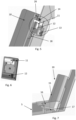
- shows a portion of an electric scooter, a battery dock and a battery;
- Fig. 4
- shows a battery;
- Fig. 5
- shows a locking mechanism;
- Fig. 6
- shows a portion of a locking mechanism;
- Fig. 7
- shows a cut through a battery dock; and
- Fig. 8
- shows a battery dock.
- Reference will now be made in detail to the various embodiments, one or more examples of which are illustrated in each figure.
- Within the following description of the drawings, the same reference numbers refer to the same or to similar components.
- With exemplary reference to
Fig. 1 , ascooter 1 comprises asupport frame 5 including asupport surface 8 configured to support a user, at least a first and asecond wheel steering shaft 2 connected to at least onewheel scooter 1. Thescooter 1 is an electric scooter (e-scooter) and further comprises a motor.Fig. 1 also shows abattery dock 10 and abattery 30, wherein thebattery 30 supplies power to the motor and wherein at least onewheel rear wheel 4 is driven by the motor (not shown). The maximum speed of the scooter can be for example, 20 km/h. - The
wheels front wheel 3 and arear wheel 4 as shown inFig. 1 . Thefront wheel 3 can be disposed on a first end of thesupport frame 5 and the second wheel can be disposed on a second end of thesupport frame 5 opposite the first end. Thefront wheel 3 is connected to thesteering shaft 2. - The
scooter 1 can have further features like, for example, one or more brakes, front and/or rear lights, one or more controllers, a locking mechanism and one or more suspensions at the wheels. - The
scooter 1 has adriving direction 7 which is inFig. 1 from right to left. The angle of thesteering shaft 2 relative to the ground or the driving direction is tilted compared to a right angle. For example, the angle between thesteering shaft 2 and the ground can be between 75° and 82°. In other words, the rotation axis of thesteering shaft 2 has a tilt between 8° and 15°. The tilt can have a positive influence on the driving behavior, especially on the mass distribution. A high mass close to the rotation axis of thesteering shaft 2 has a positive influence on the driving experience of a user. Specifically, as shown inFig. 1 , the rotation axis of thesteering shaft 2 is tilted towards thebattery 30 and thesupport surface 8 on which a user stands. - The system according to an aspect of the present invention is exemplary shown in
Fig. 1 comprising: anelectric scooter 1 comprising asupport frame 5 with asupport surface 8 configured to support a user, at least a first and asecond wheel steering shaft 2 connected thesupport frame 5 and to at least onewheel 3 for steering theelectric scooter 1, an electric motor configured to drive at least one of thewheels battery dock 10 for at least partially receiving abattery 30. The system further comprises abattery 30, wherein thebattery 30 is configured to supply power to the motor (not shown), wherein thebattery 30 is releasable at least partially received in thebattery dock 10. The system further comprises alocking mechanism 20 configured to lock thebattery 30 in thebattery dock 10. - In some examples, locking
mechanism 20 is part of thescooter 1. In other examples, lockingmechanism 20 is part of thebattery 30. In further examples, lockingmechanism 20 may be partially part ofscooter 1 and partially part ofbattery 30. - According to an aspect the
battery 30 is removable from thebattery dock 10 by a lifting motion in an at least partially upward direction perpendicular to thesupport surface 8 which is exemplary illustrated inFig. 2 . The lifting motion may also include a direction parallel to thesupport surface 8. The motion may include a sliding of thebattery 30 into thebattery dock 10. A user can remove thebattery 30 easily without additional tools and without turning the scooter into an unusual position, for example, upside down. Specifically, thebattery 30 can be removed from thebattery dock 10 in the driving position of the scooter standing. This provides easy excess to thebattery 30 for the users of the scooter. Scooters are used outside and the bottom area of scooters are often covered with dirt and dust. Touching the bottom portion of the scooters or using additional tools which are often not available can be avoided with the present disclosure. - According to the invention, locking
mechanism 20 is configured to unlockbattery 30 frombattery dock 10 with thelocking mechanism 20 being electrically powered. Specifically,electric scooter 1 can further comprise a controller configured to unlocklocking mechanism 20. Lockingmechanism 20 prevents unwanted removal of thebattery 30.Battery 30 may be removed for a battery exchange or a battery charge. For example a scooter may include a GPS tracker to track its location and to prevent the scooter from being stolen. Thelocking mechanism 20 engages thebattery 30 with the scooter. Furthermore, thebattery 30 shall not be removed while driving. - A controller may also communicate with a server to validate a request by a user to remove the battery. For example,
scooter 1 may comprise a telematics unit, wherein the controller can communicate with a server via the telematics unit. A user may send a request to unlock thelocking mechanism 20 or the battery, respectively, to a sever using a mobile device. The server validates the requests and send a signal to the controller upon which the controller unlocks the locking mechanism and the battery. - According to another aspect, locking
mechanism 20 is configured to lock thebattery 30 in thebattery dock 10 without thelocking mechanism 20 to be powered. Locking of thebattery 30 in thebattery dock 10 can be without electrical power required and can be manually done by a user. In other words, the locking mechanism may be a passive electronic lock mechanism. A more detailed example of thelocking mechanism 20 is shown inFig. 5 . - The scooter has a driving
direction 7 as shown inFig. 1 . According to the invention, drivingdirection 7 defines a front portion of thesupport frame 5 and a rear portion of thesupport frame 5, wherein thebattery dock 10 is located in the front portion of thesupport frame 5. Since thebattery 30 is usually a heavy part of the scooter, location ofbattery 30 can be an issue of balance. A location in the front portion of thesupport frame 5 close to thesteering shaft 2 increases the balance behavior of the scooter. - As best shown in the example of
Fig. 3 , the scooter has a drivingdirection 7 defining a front portion of thesupport frame 5 and a rear portion of the support frame. The front portion can be tilted relative to the rear portion in an angle of about 100° to 130°. Thebattery dock 10 can be at least partially located in the tilted front portion of thesupport frame 5. This location of thebattery 30 is preferred for a better location of the center of mass of the scooter. In particular, the center of mass of thebattery 30 is preferably close to the ground and close to the rotation axis of thefront wheel 3. - As also best shown in
Fig. 3 , steeringshaft 2 crosses a direct line upwardly from thebattery 30. In other words, steeringshaft 2 crosses an upward direction from thebattery 30 perpendicular to thesupport surface 8. The rotation axis of steeringshaft 2 is partially abovebattery 30. - According to an aspect,
battery 30 has ahandle 34 as best shown inFigs. 4 Specifically, handle 34 can be located on top of thebattery 30 so that a user may grabhandle 34 and removebattery 30 frombattery dock 10 by a lifting motion in an at least partially upward direction. A handle may improve the usability ofbattery 30 sincebattery 30 may be heavy and not easy to lift for a user. - In some examples,
battery 30 can have a length between 350 and 450 mm, a width between 60 and 100 mm and a thickness between 90 and 130 mm. The battery can have weight between 5 and 7 kg. - In some further examples,
battery 30 may have a display configured to show the charge level ofbattery 30. Specifically, the display can be located on the top ofbattery 30 visible for a user standing onsupport surface 8. - The
battery 30 is configured to supply power to the motor which is usually integrated in one of thewheels Battery 30 can have electrical contacts located, for example, at the bottom. Thebattery 30 may further supply power other electrical components of the scooter, for example, a telematics unit, a GPS tracker, lights, and one or more controllers. In some examples, the battery has a capacity between 10 and 20 Ah, specifically between 12 and 15 Ah. The voltage of the battery can be between 35 and 55 V, wherein the voltage to charge and voltage to discharge may be different. In some examples, the battery has a power output of up to 0.7 kW. The battery can be a lithium battery. - As best seen in the example of
Figs. 5 and 6 , thelocking mechanism 20 comprises alatch 11 configured to move between a locked position in which thebattery 30 is locked in thebattery dock 10 and an unlocked position in which thebattery 30 is removable from thebattery dock 10. Thelatch 11 may comprise a metal, specifically to be able to apply a holding force to thebattery 30. Locking mechanism can also comprise acounter extension 12 as shown inFig. 6 , whereinlatch 11 applies a holding force through thebattery 30 against thecounter extension 12. - Locking
mechanism 20 is configured to lock and unlockbattery 30, wherein unlocking of thelocking mechanism 20 is electrically powered. Lockingmechanism 20 may comprise anelectric actuator 13 configured to move thelatch 11 from the locked position to the unlocked position as shown inFig. 5 . Theelectric actuator 13 may be, for example, a solenoid or a linear motor. - According to an aspect, locking
mechanism 20 is not accessible for a user when the battery is at least partially received in thebattery dock 10 as shown inFig. 5 . This is a protection so that thelocking mechanism 20 cannot be manipulated by a not authorized user. In particular, lockingmechanism 20 can be located betweenbattery dock 10 andbattery 30. - As best shown in
Fig. 4 ,battery 30 can has arecess 32 configured to engage withlatch 11 of lockingmechanism 20. However, in other examples, latch 11 may be part ofbattery 30 andrecess 32 may be part ofbattery dock 10. - According to aspect, the
locking mechanism 20 comprises a lockingspring 14 configured to hold thelatch 11 in the locked position as shown inFig. 5 . The spring requires no electrical power. - The
locking mechanism 20 may be a snap-fit mechanism, which can be electrically unlocked. - The
electric scooter 1 can further comprise a controller (no shown) configured to unlock thelocking mechanism 20. Specifically, the controller may be configured to controlelectric actuator 13. In some examples, the controller is also configured to control other functions of thescooter 1. - The scooter may comprise a telematics unit, wherein the controller is configured to communicate to a server via the telemetric unit. The server may send a signal to the controller, via the telemetric unit, upon which the controller unlocks the
locking mechanism 20. - As best shown in
Fig. 5 and 6 ,locking mechanism 20 can be firmly attached to and/or partially integrated in thesupport frame 5 of theelectric scooter 1. For example, lockingmechanism 20 can be attached to thesupport frame 5 with screws or can be welded to thesupport frame 5. - As best shown in
Fig. 7 ,battery dock 10 is partially integrated in thesupport frame 5 of theelectric scooter 1 and partially extends upwardly from thesupport frame 5.Fig. 7 shows a cut throughbattery dock 10.Battery dock 10 can comprise asupport frame 15 which extends upwardly fromsupport frame 5 of the electric scooter and ahollow base 16 integrated insupport frame 5 of theelectric scooter 1.Support frame 15 ofbattery dock 10 can be welded to supportframe 5 ofscooter 1. Locatingbattery 30 partially insupport frame 5 of the electric scooter moves the center of mass in a preferred position and provides a stable position forbattery 30. - As best shown in
Fig. 7 ,hollow base 16 may have anopening 17 in which electrical contacts ofscooter 1 and ofbattery 30 may be connected.Battery 30 can have electrical contacts (not shown) at its bottom.Hollow base 16 of thebattery dock 10 may further have a hole at the bottom to allow water to escape thehollow base 16. - As best shown in
Fig. 8 ,battery dock 10 may comprises one or more ejection springs 18 configured to ejectbattery 30 frombattery dock 10. Ejection springs 18 can improve the removal ofbattery 30 and make it easier for the user to see if thebattery 30 is unlocked and ejected or ifbattery 30 is still locked by lockingmechanism 20. Specifically, ejection springs 18 may be configured to ejectbattery 30 frombattery dock 10 and movebattery 30 by at least 1 cm, specifically by at least 2 cm. As best shown inFig. 4 ,battery 30 may have one ormore recesses 33 configured to engage with ejection springs 18. - According to an aspect,
ejection spring 18 ejectsbattery 30 immediately after lockingmechanism 20 unlocksbattery 30. Therefore, theelectric actuator 13 can be deactivated after a short time which is positive for the power consumption. Specifically, ifelectric actuator 13 is powered bybattery 30,electric actuator 13 will not be powered anyway afterbattery 30 is ejected. - As best shown in
Figs. 4 and8 ,battery 30 can have agroove 31 andbattery dock 10 can have acorresponding extension 19 which together create a form fit.Groove 31 andextension 19 may increase stability ofbattery 30 inbattery dock 10. In other examples,battery 30 may have the extension andbattery dock 10 may have the groove. - As best shown in
Figs. 8 battery dock 10 can have two opposing side covers which at least partially enclose the sides of thebattery 30. Battery is partially received between side covers. - As also best shown in
Figs. 8 ,battery dock 10 can have asupport frame 15 and aninner liner 21, wherein thesupport frame 15 comprises a metal and theinner liner 21 comprises a plastic. Whilesupport frame 15 provides stability,inner liner 21 comprises a softer material to be in direct contact withbattery 30.Inner liner 21 is configured as a damping forbattery 30 inbattery dock 10 and prevents impacts on the outer side ofbattery dock 10 to damagebattery 30. - A method for operating an electric scooter is also suggested. The electric scooter (e-scooter) can be any
scooter 1 using anybattery 30 disclosed herein. - The method comprises: - providing an
electric scooter 1 comprising asupport frame 5 with asupport surface 8 configured to support a user, at least a first and asecond wheel steering shaft 2 connected thesupport frame 5 and to at least onewheel 3 for steering theelectric scooter 1, an electric motor configured to drive at least one of thewheels battery dock 10 for at least partially receiving a battery; - providing abattery 30, wherein thebattery 30 is configured to supply power to the motor, wherein thebattery 30 is releasably at least partially received in thebattery dock 10; - providing alocking mechanism 20 configured to lock thebattery 30 in thebattery dock 10. - The method further comprises: unlocking the
locking mechanism 20, wherein the unlocking of the locking mechanism is electrically powered. In other words, electrically unlocking thelocking mechanism 20. - According to an aspect, the method may comprise: - removing the
battery 30 from thebattery dock 10 by a lifting motion in an at least partially upward direction perpendicular to thesupport surface 8 as shown inFig. 2 , specifically, removing thebattery 30 from thebattery dock 10 by a lifting motion in an at least partially upward direction perpendicular to thesupport surface 8 and in a direction parallel to thesupport surface 8. The parallel direction may be the direction opposing the driving direction. - Scooters are often provided by a company in public areas for public transport as individual transportation vehicles. Users can book scooters for individual transportation. In some examples, the method includes: - receiving a request to unlock the
battery 30 sent by a mobile device of a user; - validating the request; - sending a signal to the controller upon which the controller unlocks thelocking mechanism 20. Specially, the request to unlock thebattery 30 sent by a mobile device of a user can be received by a server, which also validates the request. Sending a signal to the controller can be done via the telemetric unit. A mobile device is typically a smart phone or tablet device. Connection to the server from the mobile device may be via the internet and can be provided with a software application (app) on the mobile device. - Unlocking the
locking mechanism 20 electrically powered may comprise pushinglatch 11 withlinear actuator 13. Specifically,linear actuator 13 also pushes againsttension spring 14. Afterlatch 11releases battery 30, ejection springs 18 may pushbattery 30 towards in an ejected position. - In the ejected position,
linear actuator 13 may stop pushinglatch 11.Tension spring 14 will accordingly pushlatch 11 back to the locked position, wherein thebattery 30 is not locked. -
Battery 30 can be locked again by pushing it againstlatch 11 which will leadlatch 11 to move temporary in the unlocked position. This is a snap-fit mechanism. In particular,battery 30 is resting on ejection springs 18, in ejected position. A user pressesbattery 30 is against ejection springs 18 and forces latch 11 towards unlocked position while compressingtension spring 14. Ejection springs 18 get fully compressed and latch 11 moves into locked position, whereintension spring 14 pushes latch 11 into locked position and holds it in locked position. -
- 1
- scooter
- 2
- steering shaft
- 3
- front wheel
- 4
- rear wheel
- 5
- support frame
- 6
- handle bar
- 7
- driving direction
- 8
- support surface
- 10
- battery dock
- 11
- latch
- 12
- extension
- 13
- actuator
- 14
- tension spring
- 15
- support frame
- 16
- hollow base
- 17
- opening
- 18
- ejection spring
- 19
- extension
- 20
- locking mechanism
- 21
- inner liner
- 30
- battery
- 31
- groove
- 32
- recess
- 33
- recess
- 34
- handle
Claims (14)
- A system comprising:an electric scooter (1) comprising a support frame (5) with a support surface (8) configured to support a standing user, a front wheel (3) and a rear wheel (4), a steering shaft (2) connected to the support frame (5) and to the front wheel (3) for steering the electric scooter (1), an electric motor configured to drive at least one of the wheels (3, 4), and a battery dock (10) for at least partially receiving a battery,the battery (30), wherein the battery (30) is configured to supply power to the motor, wherein the battery (30) is releasably at least partially received in the battery dock (10), anda locking mechanism (20) configured to lock and unlock the battery (30), wherein unlocking of the locking mechanism (20) is electrically powered,characterized in thatthe battery dock (10) is partially integrated in the support frame (5) of the electric scooter (1) and partially extends upwardly from the support frame (5), wherein the battery (30) is partially located in the support frame (5), wherein the electric scooter (1) has a driving direction (7) defining a front portion of the support frame (5) and a rear portion of the support frame (5), the battery dock (10) being located in the front portion of the support frame (5), wherein the steering shaft (2) has a rotation axis, the rotation axis of the steering shaft (2) being tilted towards the battery (30) and the support surface (8) of the support frame (5), wherein the rotation axis of the steering shaft (2) extends partially above the battery (30) so that the steering shaft (2) crosses a line extending in an upward direction from the battery (30) perpendicular to the support surface (8).
- The system of claim 1, wherein the locking mechanism (20) is not accessible for the user when the battery is at least partially received in the battery dock (10).
- The system according to any preceding claims, wherein the locking mechanism (20) is configured to lock the battery (30) in the battery dock (10) without the locking mechanism (20) to be powered.
- The system according to any preceding claims, wherein the battery (30) is removable from the battery dock (10) by a lifting motion in an at least partially upward direction perpendicular to the support surface (8).
- The system according to any preceding claims, wherein the locking mechanism (20) comprises a latch (11) configured to move between a locked position in which the battery (30) is locked in the battery dock (10) and an unlocked position in which the battery (30) is removable from the battery dock (10).
- The system according to claim 5, wherein the locking mechanism (20) comprises an electric actuator (13) configured to move the latch (11) from the locked position to the unlocked position.
- The system according to claim 6, wherein the electric actuator (13) is a solenoid.
- The system according to claim 6, wherein the electric actuator (13) is a linear motor.
- The system according to any of claims 5 to 8, wherein the locking mechanism (20) comprises a locking spring (14) configured to hold the latch (11) in the locked position.
- The system according to any preceding claims, wherein the electric scooter (1) further comprises a controller configured to unlock the locking mechanism (20).
- The system according to any preceding claims, wherein the locking mechanism (20) is firmly attached to and/or partially integrated in the support frame (5) of the electric scooter (1).
- The system according to any preceding claims, wherein the battery dock (10) comprises one or more ejection springs (18) configured to eject the battery (30) from the battery dock (10).
- The system according to any preceding claims, wherein the battery (30) has a handle (34).
- A method for operating an e-scooter, comprising:- providing an electric scooter (1) comprising a support frame (5) with a support surface (8) configured to support a standing user, at least a front wheel (3) and a rear wheel (4), a steering shaft (2) connected to the support frame (5) and to the front wheel (3) for steering the electric scooter (1), an electric motor configured to drive at least one of the wheels (3, 4), and a battery dock for at least partially receiving a battery, wherein the battery dock (10) is partially integrated in the support frame (5) of the electric scooter (1) and partially extends upwardly from the support frame (5), wherein the battery (30) is partially located in the support frame (5), wherein the electric scooter (1) has a driving direction (7) defining a front portion of the support frame (5) and a rear portion of the support frame (5), the battery dock (10) being located in the front portion of the support frame (5), wherein the steering shaft (2) has a rotation axis, the rotation axis of the steering shaft (2) being tilted towards the battery (30) and the support surface (8) of the support frame (5), wherein the rotation axis of the steering shaft (2) extends partially above the battery (30) so that the steering shaft (2) crosses a line extending in an upward direction from the battery (30) perpendicular to the support surface (8);- providing the battery, wherein the battery is configured to supply power to the motor, wherein the battery is releasably at least partially received in the battery dock (10);- providing a locking mechanism (20) configured to lock the battery (30) in the battery dock (10); and- unlocking the locking mechanism (20), wherein the unlocking of the locking mechanism is electrically powered.
Priority Applications (2)
| Application Number | Priority Date | Filing Date | Title |
|---|---|---|---|
| EP20187693.5A EP3943373B1 (en) | 2020-07-24 | 2020-07-24 | Electric scooter with battery dock |
| PCT/EP2021/069628 WO2022017887A1 (en) | 2020-07-24 | 2021-07-14 | Electric scooter with battery dock |
Applications Claiming Priority (1)
| Application Number | Priority Date | Filing Date | Title |
|---|---|---|---|
| EP20187693.5A EP3943373B1 (en) | 2020-07-24 | 2020-07-24 | Electric scooter with battery dock |
Publications (2)
| Publication Number | Publication Date |
|---|---|
| EP3943373A1 EP3943373A1 (en) | 2022-01-26 |
| EP3943373B1 true EP3943373B1 (en) | 2025-03-12 |
Family
ID=71833167
Family Applications (1)
| Application Number | Title | Priority Date | Filing Date |
|---|---|---|---|
| EP20187693.5A Active EP3943373B1 (en) | 2020-07-24 | 2020-07-24 | Electric scooter with battery dock |
Country Status (2)
| Country | Link |
|---|---|
| EP (1) | EP3943373B1 (en) |
| WO (1) | WO2022017887A1 (en) |
Families Citing this family (13)
| Publication number | Priority date | Publication date | Assignee | Title |
|---|---|---|---|---|
| US8186693B2 (en) | 2008-03-06 | 2012-05-29 | Leverage Design Ltd. | Transportation device with pivoting axle |
| USD693414S1 (en) | 2012-03-15 | 2013-11-12 | Razor Usa Llc | Electric scooter |
| USD810836S1 (en) | 2015-10-29 | 2018-02-20 | Razor Usa Llc | Electric scooter |
| US12403974B2 (en) | 2016-01-22 | 2025-09-02 | Razor Usa Llc | Electric scooter |
| WO2018013994A1 (en) | 2016-07-15 | 2018-01-18 | Razor Usa Llc | Powered mobility systems |
| USD986979S1 (en) * | 2020-01-03 | 2023-05-23 | Beijing Niu Information Technology Co., Ltd. | Scooter |
| WO2022032136A1 (en) * | 2020-08-07 | 2022-02-10 | Razor Usa Llc | Electric scooter with removable battery |
| USD1072062S1 (en) | 2020-09-14 | 2025-04-22 | Razor Usa Llc | Electric scooter |
| USD1049246S1 (en) | 2020-12-18 | 2024-10-29 | Neutron Holdings, Inc. | Scooter |
| MX2024003868A (en) * | 2021-10-22 | 2024-04-19 | Crown Equip Corp | BATTERY LOCKING MECHANISMS, REMOVABLE BATTERY ASSEMBLIES AND MATERIALS HANDLING VEHICLES INCORPORATING THE SAME. |
| DE102022208328A1 (en) * | 2022-08-10 | 2024-02-15 | Robert Bosch Gesellschaft mit beschränkter Haftung | Holding device for electrical energy storage integrated in the frame tube of an electric bicycle |
| DE102022214010B4 (en) * | 2022-12-20 | 2026-02-26 | Zf Friedrichshafen Ag | System for actuated clamping of an energy storage device in a bicycle frame and bicycle |
| CN220483478U (en) * | 2023-07-11 | 2024-02-13 | 金华卓远实业有限公司 | Novel scooter |
Citations (2)
| Publication number | Priority date | Publication date | Assignee | Title |
|---|---|---|---|---|
| CN109927829A (en) * | 2017-12-16 | 2019-06-25 | 孙玮锋 | A kind of Segway Human Transporter |
| CN210618344U (en) * | 2019-06-06 | 2020-05-26 | 深圳市正祥科技实业有限公司 | Electric scooter of battery case is taken out perpendicularly in whole die-casting of a section |
Family Cites Families (6)
| Publication number | Priority date | Publication date | Assignee | Title |
|---|---|---|---|---|
| DE4308296C1 (en) * | 1992-08-04 | 1994-01-13 | Hans Peter Schnippering | Anti-theft scooter with electric drive |
| TWI517078B (en) * | 2011-07-26 | 2016-01-11 | 睿能創意公司 | Apparatus, method and article for a power storage device compartment |
| US11211661B2 (en) * | 2018-12-27 | 2021-12-28 | Neutron Holdings, Inc. | Rechargeable battery and rechargeable battery holster for light electric vehicles |
| CN209700845U (en) * | 2019-04-01 | 2019-11-29 | 深圳市欣力通科技有限公司 | car sharing |
| CN110203318A (en) * | 2019-04-26 | 2019-09-06 | 深圳市正祥科技实业有限公司 | A kind of Segway Human Transporter of interchangeable battery |
| CN210063206U (en) * | 2019-06-25 | 2020-02-14 | 浙江飞神车业有限公司 | Battery quick detach structure of sharing scooter |
-
2020
- 2020-07-24 EP EP20187693.5A patent/EP3943373B1/en active Active
-
2021
- 2021-07-14 WO PCT/EP2021/069628 patent/WO2022017887A1/en not_active Ceased
Patent Citations (2)
| Publication number | Priority date | Publication date | Assignee | Title |
|---|---|---|---|---|
| CN109927829A (en) * | 2017-12-16 | 2019-06-25 | 孙玮锋 | A kind of Segway Human Transporter |
| CN210618344U (en) * | 2019-06-06 | 2020-05-26 | 深圳市正祥科技实业有限公司 | Electric scooter of battery case is taken out perpendicularly in whole die-casting of a section |
Also Published As
| Publication number | Publication date |
|---|---|
| EP3943373A1 (en) | 2022-01-26 |
| WO2022017887A1 (en) | 2022-01-27 |
Similar Documents
| Publication | Publication Date | Title |
|---|---|---|
| EP3943373B1 (en) | Electric scooter with battery dock | |
| AU2020238004B2 (en) | An electric-powered personal transport vehicle | |
| CN206358276U (en) | Self-balancing plate | |
| US9282695B2 (en) | Electric power mower | |
| US8490732B2 (en) | Electric wheeled apparatus powered by battery packs | |
| JP4262677B2 (en) | Ground compaction device with traveling device | |
| US8706331B2 (en) | Two wheeled vehicle with all wheel drive system | |
| US20240286697A1 (en) | Off-road electric motorcycle | |
| JP5927677B2 (en) | Two-wheeled vehicle with all-wheel drive system | |
| KR20140053176A (en) | Foldable, ultra-lightweight tricycle having an electric motor | |
| CN1239927A (en) | Battery charging and replacement systems for electrically driven vehicles | |
| JP2018522778A (en) | Anti-theft lock for motorcycles | |
| WO2016128488A1 (en) | Vehicle having at least one motorized wheel that contains drive components | |
| US9656700B2 (en) | Driven load-bearing system | |
| CN110092121A (en) | Materials handling vehicles and material handling system including this vehicle | |
| KR101533256B1 (en) | Self-stabilized vehicle having two wheels | |
| US10583877B2 (en) | Torque stick apparatus and methods of use | |
| EP4117476A1 (en) | Storage device for a foldable protective helmet | |
| KR101533258B1 (en) | Self-stabilized vehicle having two wheels including intelligent battery management system | |
| CN220374551U (en) | Electric carrier | |
| CN218559054U (en) | Wheelbarrow | |
| JP4134192B2 (en) | Overcharge protection device for battery working vehicle | |
| WO2022191117A1 (en) | Vehicle | |
| JP7800943B1 (en) | Battery set and battery set storage structure using said battery set | |
| WO2025145132A1 (en) | Vehicle push roller system |
Legal Events
| Date | Code | Title | Description |
|---|---|---|---|
| PUAI | Public reference made under article 153(3) epc to a published international application that has entered the european phase |
Free format text: ORIGINAL CODE: 0009012 |
|
| STAA | Information on the status of an ep patent application or granted ep patent |
Free format text: STATUS: THE APPLICATION HAS BEEN PUBLISHED |
|
| AK | Designated contracting states |
Kind code of ref document: A1 Designated state(s): AL AT BE BG CH CY CZ DE DK EE ES FI FR GB GR HR HU IE IS IT LI LT LU LV MC MK MT NL NO PL PT RO RS SE SI SK SM TR |
|
| RAP3 | Party data changed (applicant data changed or rights of an application transferred) |
Owner name: TIER MOBILITY SE |
|
| STAA | Information on the status of an ep patent application or granted ep patent |
Free format text: STATUS: REQUEST FOR EXAMINATION WAS MADE |
|
| 17P | Request for examination filed |
Effective date: 20220725 |
|
| RBV | Designated contracting states (corrected) |
Designated state(s): AL AT BE BG CH CY CZ DE DK EE ES FI FR GB GR HR HU IE IS IT LI LT LU LV MC MK MT NL NO PL PT RO RS SE SI SK SM TR |
|
| STAA | Information on the status of an ep patent application or granted ep patent |
Free format text: STATUS: EXAMINATION IS IN PROGRESS |
|
| TPAC | Observations filed by third parties |
Free format text: ORIGINAL CODE: EPIDOSNTIPA |
|
| 17Q | First examination report despatched |
Effective date: 20230310 |
|
| TPAC | Observations filed by third parties |
Free format text: ORIGINAL CODE: EPIDOSNTIPA |
|
| GRAP | Despatch of communication of intention to grant a patent |
Free format text: ORIGINAL CODE: EPIDOSNIGR1 |
|
| STAA | Information on the status of an ep patent application or granted ep patent |
Free format text: STATUS: GRANT OF PATENT IS INTENDED |
|
| RIC1 | Information provided on ipc code assigned before grant |
Ipc: H01M 50/262 20210101ALI20240402BHEP Ipc: H01M 50/249 20210101ALI20240402BHEP Ipc: B60L 53/80 20190101ALI20240402BHEP Ipc: B60L 50/64 20190101ALI20240402BHEP Ipc: B62K 19/40 20060101ALI20240402BHEP Ipc: B62K 3/00 20060101ALI20240402BHEP Ipc: B62H 5/00 20060101ALI20240402BHEP Ipc: B62J 43/10 20200101ALI20240402BHEP Ipc: B62J 43/23 20200101AFI20240402BHEP |
|
| INTG | Intention to grant announced |
Effective date: 20240418 |
|
| GRAJ | Information related to disapproval of communication of intention to grant by the applicant or resumption of examination proceedings by the epo deleted |
Free format text: ORIGINAL CODE: EPIDOSDIGR1 |
|
| STAA | Information on the status of an ep patent application or granted ep patent |
Free format text: STATUS: EXAMINATION IS IN PROGRESS |
|
| GRAP | Despatch of communication of intention to grant a patent |
Free format text: ORIGINAL CODE: EPIDOSNIGR1 |
|
| STAA | Information on the status of an ep patent application or granted ep patent |
Free format text: STATUS: GRANT OF PATENT IS INTENDED |
|
| INTC | Intention to grant announced (deleted) | ||
| INTG | Intention to grant announced |
Effective date: 20240903 |
|
| GRAS | Grant fee paid |
Free format text: ORIGINAL CODE: EPIDOSNIGR3 |
|
| GRAA | (expected) grant |
Free format text: ORIGINAL CODE: 0009210 |
|
| STAA | Information on the status of an ep patent application or granted ep patent |
Free format text: STATUS: THE PATENT HAS BEEN GRANTED |
|
| RAP3 | Party data changed (applicant data changed or rights of an application transferred) |
Owner name: TIER MOBILITY SE |
|
| AK | Designated contracting states |
Kind code of ref document: B1 Designated state(s): AL AT BE BG CH CY CZ DE DK EE ES FI FR GB GR HR HU IE IS IT LI LT LU LV MC MK MT NL NO PL PT RO RS SE SI SK SM TR |
|
| REG | Reference to a national code |
Ref country code: GB Ref legal event code: FG4D |
|
| REG | Reference to a national code |
Ref country code: CH Ref legal event code: EP |
|
| REG | Reference to a national code |
Ref country code: DE Ref legal event code: R096 Ref document number: 602020047510 Country of ref document: DE |
|
| REG | Reference to a national code |
Ref country code: IE Ref legal event code: FG4D |
|
| PG25 | Lapsed in a contracting state [announced via postgrant information from national office to epo] |
Ref country code: RS Free format text: LAPSE BECAUSE OF FAILURE TO SUBMIT A TRANSLATION OF THE DESCRIPTION OR TO PAY THE FEE WITHIN THE PRESCRIBED TIME-LIMIT Effective date: 20250612 |
|
| PG25 | Lapsed in a contracting state [announced via postgrant information from national office to epo] |
Ref country code: FI Free format text: LAPSE BECAUSE OF FAILURE TO SUBMIT A TRANSLATION OF THE DESCRIPTION OR TO PAY THE FEE WITHIN THE PRESCRIBED TIME-LIMIT Effective date: 20250312 |
|
| PG25 | Lapsed in a contracting state [announced via postgrant information from national office to epo] |
Ref country code: ES Free format text: LAPSE BECAUSE OF FAILURE TO SUBMIT A TRANSLATION OF THE DESCRIPTION OR TO PAY THE FEE WITHIN THE PRESCRIBED TIME-LIMIT Effective date: 20250312 |
|
| REG | Reference to a national code |
Ref country code: LT Ref legal event code: MG9D |
|
| PG25 | Lapsed in a contracting state [announced via postgrant information from national office to epo] |
Ref country code: NO Free format text: LAPSE BECAUSE OF FAILURE TO SUBMIT A TRANSLATION OF THE DESCRIPTION OR TO PAY THE FEE WITHIN THE PRESCRIBED TIME-LIMIT Effective date: 20250612 |
|
| PG25 | Lapsed in a contracting state [announced via postgrant information from national office to epo] |
Ref country code: HR Free format text: LAPSE BECAUSE OF FAILURE TO SUBMIT A TRANSLATION OF THE DESCRIPTION OR TO PAY THE FEE WITHIN THE PRESCRIBED TIME-LIMIT Effective date: 20250312 |
|
| REG | Reference to a national code |
Ref country code: NL Ref legal event code: MP Effective date: 20250312 |
|
| PG25 | Lapsed in a contracting state [announced via postgrant information from national office to epo] |
Ref country code: LV Free format text: LAPSE BECAUSE OF FAILURE TO SUBMIT A TRANSLATION OF THE DESCRIPTION OR TO PAY THE FEE WITHIN THE PRESCRIBED TIME-LIMIT Effective date: 20250312 |
|
| PG25 | Lapsed in a contracting state [announced via postgrant information from national office to epo] |
Ref country code: GR Free format text: LAPSE BECAUSE OF FAILURE TO SUBMIT A TRANSLATION OF THE DESCRIPTION OR TO PAY THE FEE WITHIN THE PRESCRIBED TIME-LIMIT Effective date: 20250613 Ref country code: BG Free format text: LAPSE BECAUSE OF FAILURE TO SUBMIT A TRANSLATION OF THE DESCRIPTION OR TO PAY THE FEE WITHIN THE PRESCRIBED TIME-LIMIT Effective date: 20250312 |
|
| REG | Reference to a national code |
Ref country code: AT Ref legal event code: MK05 Ref document number: 1774827 Country of ref document: AT Kind code of ref document: T Effective date: 20250312 |
|
| PG25 | Lapsed in a contracting state [announced via postgrant information from national office to epo] |
Ref country code: NL Free format text: LAPSE BECAUSE OF FAILURE TO SUBMIT A TRANSLATION OF THE DESCRIPTION OR TO PAY THE FEE WITHIN THE PRESCRIBED TIME-LIMIT Effective date: 20250312 |
|
| PG25 | Lapsed in a contracting state [announced via postgrant information from national office to epo] |
Ref country code: SE Free format text: LAPSE BECAUSE OF FAILURE TO SUBMIT A TRANSLATION OF THE DESCRIPTION OR TO PAY THE FEE WITHIN THE PRESCRIBED TIME-LIMIT Effective date: 20250312 |
|
| PG25 | Lapsed in a contracting state [announced via postgrant information from national office to epo] |
Ref country code: SM Free format text: LAPSE BECAUSE OF FAILURE TO SUBMIT A TRANSLATION OF THE DESCRIPTION OR TO PAY THE FEE WITHIN THE PRESCRIBED TIME-LIMIT Effective date: 20250312 |
|
| PG25 | Lapsed in a contracting state [announced via postgrant information from national office to epo] |
Ref country code: PT Free format text: LAPSE BECAUSE OF FAILURE TO SUBMIT A TRANSLATION OF THE DESCRIPTION OR TO PAY THE FEE WITHIN THE PRESCRIBED TIME-LIMIT Effective date: 20250714 |
|
| PGFP | Annual fee paid to national office [announced via postgrant information from national office to epo] |
Ref country code: DE Payment date: 20250721 Year of fee payment: 6 |
|
| PG25 | Lapsed in a contracting state [announced via postgrant information from national office to epo] |
Ref country code: IT Free format text: LAPSE BECAUSE OF FAILURE TO SUBMIT A TRANSLATION OF THE DESCRIPTION OR TO PAY THE FEE WITHIN THE PRESCRIBED TIME-LIMIT Effective date: 20250312 Ref country code: PL Free format text: LAPSE BECAUSE OF FAILURE TO SUBMIT A TRANSLATION OF THE DESCRIPTION OR TO PAY THE FEE WITHIN THE PRESCRIBED TIME-LIMIT Effective date: 20250312 |
|
| PG25 | Lapsed in a contracting state [announced via postgrant information from national office to epo] |
Ref country code: AT Free format text: LAPSE BECAUSE OF FAILURE TO SUBMIT A TRANSLATION OF THE DESCRIPTION OR TO PAY THE FEE WITHIN THE PRESCRIBED TIME-LIMIT Effective date: 20250312 |
|
| PG25 | Lapsed in a contracting state [announced via postgrant information from national office to epo] |
Ref country code: CZ Free format text: LAPSE BECAUSE OF FAILURE TO SUBMIT A TRANSLATION OF THE DESCRIPTION OR TO PAY THE FEE WITHIN THE PRESCRIBED TIME-LIMIT Effective date: 20250312 Ref country code: EE Free format text: LAPSE BECAUSE OF FAILURE TO SUBMIT A TRANSLATION OF THE DESCRIPTION OR TO PAY THE FEE WITHIN THE PRESCRIBED TIME-LIMIT Effective date: 20250312 |
|
| PG25 | Lapsed in a contracting state [announced via postgrant information from national office to epo] |
Ref country code: RO Free format text: LAPSE BECAUSE OF FAILURE TO SUBMIT A TRANSLATION OF THE DESCRIPTION OR TO PAY THE FEE WITHIN THE PRESCRIBED TIME-LIMIT Effective date: 20250312 |
|
| PG25 | Lapsed in a contracting state [announced via postgrant information from national office to epo] |
Ref country code: SK Free format text: LAPSE BECAUSE OF FAILURE TO SUBMIT A TRANSLATION OF THE DESCRIPTION OR TO PAY THE FEE WITHIN THE PRESCRIBED TIME-LIMIT Effective date: 20250312 |
|
| PG25 | Lapsed in a contracting state [announced via postgrant information from national office to epo] |
Ref country code: IS Free format text: LAPSE BECAUSE OF FAILURE TO SUBMIT A TRANSLATION OF THE DESCRIPTION OR TO PAY THE FEE WITHIN THE PRESCRIBED TIME-LIMIT Effective date: 20250712 |
|
| REG | Reference to a national code |
Ref country code: DE Ref legal event code: R097 Ref document number: 602020047510 Country of ref document: DE |
|
| PG25 | Lapsed in a contracting state [announced via postgrant information from national office to epo] |
Ref country code: DK Free format text: LAPSE BECAUSE OF FAILURE TO SUBMIT A TRANSLATION OF THE DESCRIPTION OR TO PAY THE FEE WITHIN THE PRESCRIBED TIME-LIMIT Effective date: 20250312 |
|
| PLBE | No opposition filed within time limit |
Free format text: ORIGINAL CODE: 0009261 |
|
| STAA | Information on the status of an ep patent application or granted ep patent |
Free format text: STATUS: NO OPPOSITION FILED WITHIN TIME LIMIT |
|
| REG | Reference to a national code |
Ref country code: CH Ref legal event code: L10 Free format text: ST27 STATUS EVENT CODE: U-0-0-L10-L00 (AS PROVIDED BY THE NATIONAL OFFICE) Effective date: 20260121 |
|
| 26N | No opposition filed |
Effective date: 20251215 |
|
| REG | Reference to a national code |
Ref country code: CH Ref legal event code: H13 Free format text: ST27 STATUS EVENT CODE: U-0-0-H10-H13 (AS PROVIDED BY THE NATIONAL OFFICE) Effective date: 20260224 |
|
| PG25 | Lapsed in a contracting state [announced via postgrant information from national office to epo] |
Ref country code: LU Free format text: LAPSE BECAUSE OF NON-PAYMENT OF DUE FEES Effective date: 20250724 |
|
| GBPC | Gb: european patent ceased through non-payment of renewal fee |
Effective date: 20250724 |
|
| REG | Reference to a national code |
Ref country code: BE Ref legal event code: MM Effective date: 20250731 |
|
| PG25 | Lapsed in a contracting state [announced via postgrant information from national office to epo] |
Ref country code: GB Free format text: LAPSE BECAUSE OF NON-PAYMENT OF DUE FEES Effective date: 20250724 |
|
| PG25 | Lapsed in a contracting state [announced via postgrant information from national office to epo] |
Ref country code: BE Free format text: LAPSE BECAUSE OF NON-PAYMENT OF DUE FEES Effective date: 20250731 |
|
| PG25 | Lapsed in a contracting state [announced via postgrant information from national office to epo] |
Ref country code: FR Free format text: LAPSE BECAUSE OF NON-PAYMENT OF DUE FEES Effective date: 20250731 |
|
| PG25 | Lapsed in a contracting state [announced via postgrant information from national office to epo] |
Ref country code: CH Free format text: LAPSE BECAUSE OF NON-PAYMENT OF DUE FEES Effective date: 20250731 |