EP3941802B1 - Aerodynamic front closing cross-member for road vehicle - Google Patents
Aerodynamic front closing cross-member for road vehicle Download PDFInfo
- Publication number
- EP3941802B1 EP3941802B1 EP19934225.4A EP19934225A EP3941802B1 EP 3941802 B1 EP3941802 B1 EP 3941802B1 EP 19934225 A EP19934225 A EP 19934225A EP 3941802 B1 EP3941802 B1 EP 3941802B1
- Authority
- EP
- European Patent Office
- Prior art keywords
- front closing
- closing cross
- medial
- average thickness
- transition
- Prior art date
- Legal status (The legal status is an assumption and is not a legal conclusion. Google has not performed a legal analysis and makes no representation as to the accuracy of the status listed.)
- Active
Links
Images




Classifications
-
- B—PERFORMING OPERATIONS; TRANSPORTING
- B62—LAND VEHICLES FOR TRAVELLING OTHERWISE THAN ON RAILS
- B62D—MOTOR VEHICLES; TRAILERS
- B62D21/00—Understructures, i.e. chassis frame on which a vehicle body may be mounted
- B62D21/02—Understructures, i.e. chassis frame on which a vehicle body may be mounted comprising longitudinally or transversely arranged frame members
- B62D21/03—Understructures, i.e. chassis frame on which a vehicle body may be mounted comprising longitudinally or transversely arranged frame members transverse members providing body support
-
- B—PERFORMING OPERATIONS; TRANSPORTING
- B60—VEHICLES IN GENERAL
- B60K—ARRANGEMENT OR MOUNTING OF PROPULSION UNITS OR OF TRANSMISSIONS IN VEHICLES; ARRANGEMENT OR MOUNTING OF PLURAL DIVERSE PRIME-MOVERS IN VEHICLES; AUXILIARY DRIVES FOR VEHICLES; INSTRUMENTATION OR DASHBOARDS FOR VEHICLES; ARRANGEMENTS IN CONNECTION WITH COOLING, AIR INTAKE, GAS EXHAUST OR FUEL SUPPLY OF PROPULSION UNITS IN VEHICLES
- B60K11/00—Arrangement in connection with cooling of propulsion units
- B60K11/08—Air inlets for cooling; Shutters or blinds therefor
-
- B—PERFORMING OPERATIONS; TRANSPORTING
- B60—VEHICLES IN GENERAL
- B60Y—INDEXING SCHEME RELATING TO ASPECTS CROSS-CUTTING VEHICLE TECHNOLOGY
- B60Y2200/00—Type of vehicle
- B60Y2200/10—Road Vehicles
- B60Y2200/14—Trucks; Load vehicles, Busses
-
- B—PERFORMING OPERATIONS; TRANSPORTING
- B62—LAND VEHICLES FOR TRAVELLING OTHERWISE THAN ON RAILS
- B62D—MOTOR VEHICLES; TRAILERS
- B62D35/00—Vehicle bodies characterised by streamlining
- B62D35/001—For commercial vehicles or tractor-trailer combinations, e.g. caravans
Definitions
- the disclosure relates generally to frame members that make up a chassis frame, also referred to as a chassis frame ladder, of road vehicles such as trucks.
- the disclosure relates to a front closing cross-member configured to improve aerodynamic performance and provide enhanced flow of air to the cooling package (e.g., radiator) of a road WO 2009/121446 discloses the preamble of claim 1.
- the cost of fuel is typically the largest cost associated with operating a tractor trailer.
- a tractor trailer in regular full-time operation may use 75,700 liters (20,000 gallons) or more of diesel fuel per year.
- Fuel costs are similarly high for bus vehicles. Even small improvements in fuel efficiency can have a significant impact on aggregate fuel costs for operators of truck, tractor, or bus vehicles. Decreases in fuel consumption would also lead to concomitant reductions in emissions such as NOx, SOx, particulates, and unburned hydrocarbons.
- FIG. 1A is a front elevational view of a front exterior of a tractor 10 of a tractor trailer, showing left and right fenders 12A, 12B that are laterally arranged relative to a hood 14 that serves as a cover for an engine of the tractor.
- the hood 14 and fenders 12A, 12B may be part of a unitary fairing configured to tilt forward to permit access to the tractor engine for servicing.
- the left and right fenders 12A, 12B increase in width, and a remainder of the hood 14 decreases in width, with increasing proximity to a front end 16 of the tractor 10.
- a primary front opening 18 is arranged below a forward end of the hood 14 and between the fenders 12A, 12B, and permits ingress of air into an engine compartment for thermal interaction with one or more heat exchangers such as a front radiator.
- a conventional front closing cross-member 20 is arranged within the primary front opening 18.
- the front closing cross-member 20 has a ladder-like shape, with a generally rectangular perimeter and several apertures 22 defined therein to permit the passage of air.
- FIG. 1B is a front elevational view of a portion of FIG. 1A , showing an exposed portion of the front closing cross-member 20 (including apertures 22 defined therein) within the primary front opening 18.
- a front closing cross-member is an integral part of a chassis frame (also referred to as a chassis frame ladder) of the truck portion of a tractor trailer.
- a front closing cross-member sets the front width of the chassis frame ladder, provides structural rigidity at the front end of the tractor, and is critical in promoting proper chassis and hood alignment.
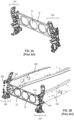
- FIG. 2A is a rear perspective view of the front closing cross-member 20 of FIGS. 1A-1B attached to left and right multi-function brackets (MFBs) 24A, 24B that embody forward portions of a tractor frame.
- MFBs multi-function brackets
- the terms “left,” “right,” “forward,” and so on, are used in a manner relative to the perception of a person present in the driver's seat of a truck, such that “left” corresponds to the driver's side, “right” corresponds to the passenger's side, etc.
- FIG. 2B is a front perspective view of the front closing cross-member 20 and MFBs 24A, 24B of FIG. 2A , with left and right longitudinal rails 26A, 26B fastened to the left and right MFBs 24A, 24B, respectively.
- the front closing cross-member 20 is secured to the MFBs 24A, 24B with left and right groups of longitudinal bolts 28A, 28B, and the left and right longitudinal rails 26A, 26B are secured to the MFBs 24A, 24B with left and right groups of transverse bolts 29A, 29B, respectively.
- FIG. 3 is a side cross-sectional schematic view of an engine compartment 34 of a tractor (i.e., of a tractor-trailer) incorporating the front closing cross-member 20 of FIGS. 1A-1 B and 2A-2B positioned in a primary front opening 18 of the tractor.
- the primary front opening 18 is defined between bounding members 30, 30' (optionally part of a front fairing).
- the front closing cross-member 20 is positioned forward of a front radiator 31, which is arranged forward of an engine 32 within the engine compartment 34.
- Horizontal arrows show the direction of airflow through the primary front opening 18, as well as past the front closing cross-member 20 and through apertures 22 defined therein, to impinge on the front radiator 31.
- FIG. 4 is a side cross-sectional view of a portion of the front closing cross-member 20 of FIG. 3 (with an aperture 22 defined therein), with superimposed streamlines showing a turbulent airflow wake 36 downstream of the front closing cross-member 20.
- This turbulent airflow wake 36 results in localized low pressure regions along a face of the front radiator (element 31 shown in FIG. 3 ), which detrimentally limits transfer of heat between the air and the front radiator 31.
- a front closing cross-member including a medial portion having an airfoil-like shape arranged between left and right end portions of greater height than the medial portion.
- the medial portion includes a trailing edge having a height less than a height of a leading edge thereof.
- the left and right end portions are configured to be mounted to at least a portion of a structural frame of the road vehicle (e.g., by using fasteners extending through multiple apertures defined in the end portions).
- the novel front closing cross-member may exhibit the same or greater stiffness and torsional rigidity as a conventional front closing cross-member, while exhibiting reduced drag and facilitating formation of a laminar airflow wake to permit improved cooling of a front radiator positioned downstream of the front closing cross-member.
- the front closing cross-member comprises left and right portions, and a medial portion having a leading edge, a trailing edge, and an airfoil-like cross-sectional shape.
- the trailing edge has a height less than a height of the leading edge, and the medial portion is arranged between the left and right end portions.
- Each of the left and right end portions has a height greater than a maximum height of the medial portion, and each of the left and right end portions is configured to be mounted to at least a portion of a structural frame of the road vehicle.
- the front closing cross-member comprises a left transition portion arranged between the left end portion and the medial portion, and a right transition portion is arranged between the right end portion and the medial portion.
- the left transition portion comprises a height that increases from a medial end thereof (i.e., proximate to the medial portion) to a lateral end thereof (proximate to the left end portion) to provide a height transition between the medial portion and the left end portion.
- the right transition portion comprises a height that increases from a medial end thereof (i.e., proximate to the medial portion) to a lateral end thereof (proximate to the right end portion) to provide a height transition between the medial portion and the right end portion.
- a left opening is defined between a portion of the left transition portion and the left end portion, and a right opening is defined between a portion of the right transition portion and the right end portion.
- the medial portion, the left and right end portions, and the left and right transition portions comprise a single unitary element. In certain embodiments, the medial portion, the left and right end portions, and the left and right transition portions comprise a single casting of metal or metal alloy.
- the medial portion comprises a first average thickness extending in a front-to-rear direction; each of the left end portion and the right end portion comprises a second average thickness extending in the front-to-rear direction; and the first average thickness is greater than the second average thickness.
- the medial portion comprises a first average thickness extending in a front-to-rear direction; each of the left end portion and the right end portion comprises a second average thickness extending in the front-to-rear direction; each of the left transition portion and the right transition portion comprises a third average thickness extending in the front-to-rear direction; the first average thickness is greater than the second average thickness; and the third average thickness is between the first average thickness and the second average thickness.
- the medial portion comprises an arcuate shape when viewed from above, with a front surface at a center of the medial portion arranged forward of the front surface at ends of the medial portion.
- each end portion of the left and right end portions defines a plurality of apertures, and each aperture of the plurality of apertures is configured to receive a fastener arranged to couple the end portion to the at least a portion of the structural frame of the road vehicle.
- the plurality of apertures defines at least three (or at least four) apertures that are vertically aligned, with central axes of the apertures being parallel to one another.
- a plurality of wiring harness mounting regions arranged along or proximate to the trailing edge of the medial portion.
- the leading edge comprises a first curved surface
- the trailing edge comprises a second curved surface
- the medial portion comprises a generally symmetric airfoil shape that provides a zero degree angle of attack relative to a horizontal plane when the front closing cross-member is mounted to a truck frame and exposed to an oncoming airflow in a horizontal direction.
- the disclosure relates to a front closing cross-member for a road vehicle, the front closing cross-member comprising left and right end portions, left and right transition portions, and a medial portion having a leading edge, a trailing edge, and an airfoil-like cross sectional shape with the trailing edge having a height less than a height of the leading edge.
- the left and right end portions are configured to be mounted to at least a portion of a structural frame of the road vehicle.
- the left transition portion is arranged between the left end portion and the medial portion, and the right transition portion is arranged between the right end portion and the medial portion.
- the left and right end portions each have a height greater than a maximum height of the medial portion.
- the left transition portion provides a height transition between the medial portion and the left end portion
- the right transition portion provides a height transition between the medial portion and the right end portion.
- the medial portion comprises a first average thickness extending in a front-to-rear direction
- the left and right end portions each comprise a second average thickness extending in the front-to-rear direction; with the first average thickness being greater than the second average thickness.
- a left opening is defined between a portion of the left transition portion and the left end portion
- a right opening is defined between a portion of the right transition portion and the right end portion.
- each end portion of the left and right end portions defines a plurality of apertures, each aperture of the plurality of apertures is configured to receive a fastener arranged to couple the end portion to the at least a portion of the structural frame of the road vehicle, and for each end portion of the left and right end portions, the plurality of apertures defines at least three apertures (or at least four apertures) that are vertically aligned, with central axes of the apertures being parallel to one another.
- a road vehicle frame comprises a front closing cross-member as disclosed herein attached to first and second multi-function brackets of the road vehicle.
- brackets multi-function brackets may be further attached to left and right longitudinal rails of a frame of the road vehicle.
- a road vehicle comprises an engine, a radiator, and a front closing cross-member as disclosed herein, wherein the radiator is positioned forward of the engine, and the front closing cross-member is positioned forward of the radiator.
- any one or more aspects or features described herein may be combined with any one or more other aspects or features for additional advantage.
- the present disclosure relate to a front closing cross-member including a medial portion having an airfoil-like shape arranged between left and right end portions of greater height than the medial portion.
- the medial portion includes a trailing edge having a height less than a height of a leading edge thereof.
- the left and right end portions of increased height relative to the medial portion are configured to be mounted to at least a portion of a structural frame of the road vehicle.
- the front closing cross-member may exhibit the same or greater stiffness and torsional rigidity as a conventional front closing cross-member, while exhibiting reduced drag and facilitating formation of a laminar airflow wake.
- Such an airflow wake may avoid formation of low pressure regions inherent to turbulent airflow wakes, and permit improved cooling of a front radiator positioned downstream of the novel front closing cross-member, relative to use of a conventional front closing cross-member as described in the background portion of the present disclosure.
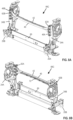
- FIG. 5A is a front elevational view of a front closing cross-member 40 according to one embodiment of the present disclosure. Additional views (i.e., a front perspective view, a magnified portion of the front perspective view, and a cross-sectional view) of the front closing cross-member 40 are provided in FIGS. 5B-5D .
- the front closing cross-member 40 includes a medial portion 42 arranged between left and right end portions 46A, 46B, with left and right transition portions 44A, 44B being provided between the medial portion 42 and the left and right end portions 46A, 46B, respectively.
- the left and right transition portions 44A, 44B each have a generally triangular shape.
- the front closing cross-member 40 further includes left and right ends 50A, 50B. As shown, each of the left and right end portions 46A, 46B has a height that is substantially greater (e.g., at least about three times, about four times, or about five times greater in certain embodiments) than a height of the medial portion 42.
- the left transition portion 44A has a height that increases from a medial end 43A to a lateral end 45A of the left transition portion 44A to provide a height transition between the medial portion 42 and the left end portion 46A.
- the right transition portion 44B has a height that increases from a medial end 43B to a lateral end 45B of the right transition portion 44B to provide a height transition between the medial portion 42 and the right end portion 46B.
- a left opening 48A is defined between a portion of the left transition portion 44A and the left end portion 46A
- a right opening 48B is defined between a portion of the right transition portion 44B and the right end portion 46B, wherein the left and right openings 48A, 48B are provided to reduce aerodynamic drag and weight of the front closing cross-member 40.
- the left and right end portions 46A, 46B each have a rounded, generally rectangular shape and each defines four vertically aligned apertures 52A, 52B that are configured to permit insertion of fasteners (e.g., bolts, not shown) in a longitudinal direction for attachment of the end portions 46A, 46B of the front closing cross-member 40 to at least one portion of a vehicular frame (such as left and right multi-function brackets (MFBs) thereof, as shown hereinafter in connection with FIGS. 6-8B ).
- a vehicular frame such as left and right multi-function brackets (MFBs) thereof, as shown hereinafter in connection with FIGS. 6-8B .
- the respective apertures With each group of vertically aligned apertures 52A, 52B, the respective apertures have central axes that are parallel to one another.
- FIG. 5B is a front perspective view of the front closing cross-member 40
- FIG. 5C is a magnified front perspective view of part of the front closing cross-member 40, including a cross-sectional view of the medial portion 42.
- each transition portion 44A, 44B has a thickness in a front-to-rear direction that is reduced with proximity to the end portions 46A, 46B.
- the medial portion 42 has an average thickness in a front-to-rear direction that is greater than an average thickness of the transition portions 44A, 44B, and an average thickness of the transition portions 44A, 44B is greater than an average thickness of the end portions 46A, 46B.
- FIGS. 5C is a magnified front perspective view of part of the front closing cross-member 40, including a cross-sectional view of the medial portion 42.
- each transition portion 44A, 44B has a thickness in a front-to-rear direction that is reduced with proximity to the end portions 46A, 46B.
- the medial portion 42 has an average
- the medial portion 42 includes a curved leading edge 54 and a curved trailing edge 56, with a downwardly sloping upper surface 53 and an upwardly sloping lower surface 55 extending therebetween.
- the end portions 46A, 46B each define four vertically aligned apertures 52A, 52B, which are substantially equally spaced and extend through the respective end portions 46A, 46B in a longitudinal direction.
- FIG. 5D is a cross-sectional view of the medial portion 42 of the front closing cross-member 40 of FIGS. 5A-5C .
- the medial portion 42 includes a curved leading edge 54 and a curved trailing edge 56, with a downwardly sloping upper surface 53 and an upwardly sloping lower surface 55 extending therebetween.
- the curved leading edge 54 has a height H L that is greater (e.g., at least 30% greater, 50% greater, 70% greater, 85% greater, or 100% greater in certain embodiments) than a height of the curved trailing edge H T .
- the medial portion 42 is generally symmetric relative to a horizontal plane (not shown).
- a front closing cross-member as disclosed herein may embody a unitary single member.
- Various fabrication techniques that may be used including one or more of casting, machining, forging, welding, additive material deposition, and/or subtractive material removal.
- a front closing cross-member may be fabricated of a metal or metal alloy (including but not limited to spheroidal graphite cast iron (also known as ductile iron), aluminum, steel, alloy steel, or the like).
- spheroidal graphite cast iron also known as ductile iron
- Ductile iron is a type of cast iron known for its impact and fatigue resistance, elongation, and wear resistance due to the spherical (round) graphite structures in the metal.
- a front closing cross-member as disclosed herein may be produced by lost foam casting.
- a lost foam casting is created by a type of evaporative-pattern casting process where a polystyrene foam pattern is used to form a mold. The foam pattern is coated and embedded with a ceramic bead medium compacted around it to support the external form of the foam.
- Other casting techniques e.g., green sand casting
- lost foam casting is preferable to provide higher resolution features, tighter dimensional tolerances, and smoother surface finishes that may reduce or eliminate the need for post-casting finishing steps (e.g., machining).
- various portions of a front closing cross-member may be separately produced (e.g., cast) and joined together by welding or other means to form a final product.
- FIG. 6 is a front elevational view of a portion of a first road vehicle frame 66A including the front closing cross-member 40 of FIGS. 5A-5D and a lower cross-member 60 both spanning between left and right multi-function brackets 24A, 24B.
- the lower cross-member 60 is generally rectangular in shape without exhibiting an aerodynamic profile, but little utility would be gained by reshaping the lower cross-member 60 since it is arranged behind a front bumper or fairing of the tractor without being directly exposed to a flow of incoming air when the tractor is traveling in a forward direction.
- the front closing cross-member 40 is secured to the MFBs 24A, 24B with left and right groups of longitudinal bolts 62A, 62B that extend through end portions 46A, 46B of the front closing cross-member 40.
- Left and right groups of transverse bolts 64A, 64B may also be provided.
- FIG. 7 is a front perspective view of the road vehicle frame portion 66B of FIG. 6 with the addition of left and right longitudinal rail members 26A, 26B affixed to the left and right MFBs 24A, 24B thereof.
- the front closing cross-member 40 is secured to the MFBs 24A, 24B with left and right groups of longitudinal bolts 62A, 62B that extend through end portions 46A, 46B of the front closing cross-member 40.
- the left and right groups of transverse bolts 64A, 64B may be used to join the MFBs 24A, 24B to the longitudinal rail members 26A, 26B.
- FIG. 8A and 8B provide front and rear elevational views, respectively, of a portion of a second road vehicle frame 66C including the front closing cross-member 40 of FIGS. 5A-5D and a lower cross-member 60 both spanning between left and right MFBs 24A, 24B, with each MFB 24A, 24B including a tow hook 25A, 25B.
- the front closing cross-member 40 is secured to the MFBs 24A, 24B with left and right groups of longitudinal bolts 62A, 62B that extend through end portions 46A, 46B of the front closing cross-member 40.
- the medial portion 42 of the front closing cross-member 40 may have an arcuate shape when viewed from above, with a front surface at a center of the medial portion 40 arranged forward of the end portions 46A, 46B, and arranged forward of front surfaces at distal ends of the medial portion 42.
- a plurality of wiring harness mounting regions 72 e.g., holes, optionally being threaded
- FIG. 9 is a side cross-sectional schematic view of an engine compartment 34 of a tractor (i.e., of a tractor-trailer) incorporating the front closing cross-member 40 of FIGS. 5A-5D positioned in a primary front opening 18 of the tractor.
- the primary front opening 18 is defined between bounding members 30, 30' (optionally part of a front fairing).
- the front closing cross-member 40 is positioned forward of a front radiator 31, which is arranged forward of an engine 32 within the engine compartment 34.
- Horizontal arrows show the direction of airflow through the primary front opening 18, as well as past the front closing cross-member 40, to impinge on the front radiator 31.
- FIG. 10 is a side cross-sectional view of a portion of the front closing cross-member 40 of FIGS. 5A-5D , with superimposed streamlines showing a laminar airflow wake downstream of the front closing cross-member 40.
- the front closing cross-member 40 is generally symmetrical relative to a horizontal reference line 74. As shown, superimposed streamlines show a laminar airflow wake downstream of the front closing cross-member 40, without exhibiting a turbulent wake that would lead to localized low pressure regions.
Landscapes
- Engineering & Computer Science (AREA)
- Chemical & Material Sciences (AREA)
- Combustion & Propulsion (AREA)
- Transportation (AREA)
- Mechanical Engineering (AREA)
- Body Structure For Vehicles (AREA)
Description
- The disclosure relates generally to frame members that make up a chassis frame, also referred to as a chassis frame ladder, of road vehicles such as trucks. In particular aspects, the disclosure relates to a front closing cross-member configured to improve aerodynamic performance and provide enhanced flow of air to the cooling package (e.g., radiator) of a road
WO 2009/121446 discloses the preamble ofclaim 1. - The cost of fuel is typically the largest cost associated with operating a tractor trailer. A tractor trailer in regular full-time operation may use 75,700 liters (20,000 gallons) or more of diesel fuel per year. Fuel costs are similarly high for bus vehicles. Even small improvements in fuel efficiency can have a significant impact on aggregate fuel costs for operators of truck, tractor, or bus vehicles. Decreases in fuel consumption would also lead to concomitant reductions in emissions such as NOx, SOx, particulates, and unburned hydrocarbons.
- Increasing combustion pressure in engines and development of exhaust treatment systems often require increased cooling capacity; however, aerodynamic efficiency is typically promoted by reducing the size of airflow openings at the front of a tractor trailer.
-
FIG. 1A is a front elevational view of a front exterior of atractor 10 of a tractor trailer, showing left andright fenders hood 14 that serves as a cover for an engine of the tractor. Thehood 14 andfenders right fenders hood 14 decreases in width, with increasing proximity to afront end 16 of thetractor 10. Aprimary front opening 18 is arranged below a forward end of thehood 14 and between thefenders front closing cross-member 20 is arranged within theprimary front opening 18. Thefront closing cross-member 20 has a ladder-like shape, with a generally rectangular perimeter andseveral apertures 22 defined therein to permit the passage of air.FIG. 1B is a front elevational view of a portion ofFIG. 1A , showing an exposed portion of the front closing cross-member 20 (includingapertures 22 defined therein) within the primary front opening 18. - A front closing cross-member is an integral part of a chassis frame (also referred to as a chassis frame ladder) of the truck portion of a tractor trailer. A front closing cross-member sets the front width of the chassis frame ladder, provides structural rigidity at the front end of the tractor, and is critical in promoting proper chassis and hood alignment.
-
FIG. 2A is a rear perspective view of thefront closing cross-member 20 ofFIGS. 1A-1B attached to left and right multi-function brackets (MFBs) 24A, 24B that embody forward portions of a tractor frame. As used herein, the terms "left," "right," "forward," and so on, are used in a manner relative to the perception of a person present in the driver's seat of a truck, such that "left" corresponds to the driver's side, "right" corresponds to the passenger's side, etc. TheMFBs front closing cross-member 20 as portions of a tractor frame.FIG. 2B is a front perspective view of thefront closing cross-member 20 andMFBs FIG. 2A , with left and rightlongitudinal rails right MFBs front closing cross-member 20 is secured to theMFBs longitudinal bolts longitudinal rails MFBs transverse bolts -
FIG. 3 is a side cross-sectional schematic view of anengine compartment 34 of a tractor (i.e., of a tractor-trailer) incorporating thefront closing cross-member 20 ofFIGS. 1A-1 B and 2A-2B positioned in a primary front opening 18 of the tractor. Theprimary front opening 18 is defined between boundingmembers 30, 30' (optionally part of a front fairing). As shown, thefront closing cross-member 20 is positioned forward of afront radiator 31, which is arranged forward of anengine 32 within theengine compartment 34. Horizontal arrows show the direction of airflow through the primary front opening 18, as well as past thefront closing cross-member 20 and throughapertures 22 defined therein, to impinge on thefront radiator 31. Unfortunately, the shape of the conventionalfront closing cross-member 20 provides significant aerodynamic drag and causes a turbulent airflow wake downstream of thefront closing cross-member 20 when the tractor is traveling at highway speeds.FIG. 4 is a side cross-sectional view of a portion of thefront closing cross-member 20 ofFIG. 3 (with anaperture 22 defined therein), with superimposed streamlines showing a turbulent airflow wake 36 downstream of thefront closing cross-member 20. This turbulent airflow wake 36 results in localized low pressure regions along a face of the front radiator (element 31 shown inFIG. 3 ), which detrimentally limits transfer of heat between the air and thefront radiator 31. - A need therefore exists in the art for improved front closing cross-members and road vehicles incorporating the same, to address limitations associated with conventional front closing cross-members.
- Aspects of the disclosure relate to a front closing cross-member including a medial portion having an airfoil-like shape arranged between left and right end portions of greater height than the medial portion. The medial portion includes a trailing edge having a height less than a height of a leading edge thereof. The left and right end portions are configured to be mounted to at least a portion of a structural frame of the road vehicle (e.g., by using fasteners extending through multiple apertures defined in the end portions). The novel front closing cross-member may exhibit the same or greater stiffness and torsional rigidity as a conventional front closing cross-member, while exhibiting reduced drag and facilitating formation of a laminar airflow wake to permit improved cooling of a front radiator positioned downstream of the front closing cross-member.
- One aspect of the present disclosure provides a front closing cross-member for a road vehicle. The front closing cross-member comprises left and right portions, and a medial portion having a leading edge, a trailing edge, and an airfoil-like cross-sectional shape. The trailing edge has a height less than a height of the leading edge, and the medial portion is arranged between the left and right end portions. Each of the left and right end portions has a height greater than a maximum height of the medial portion, and each of the left and right end portions is configured to be mounted to at least a portion of a structural frame of the road vehicle.
- In certain embodiments, the front closing cross-member comprises a left transition portion arranged between the left end portion and the medial portion, and a right transition portion is arranged between the right end portion and the medial portion. The left transition portion comprises a height that increases from a medial end thereof (i.e., proximate to the medial portion) to a lateral end thereof (proximate to the left end portion) to provide a height transition between the medial portion and the left end portion. The right transition portion comprises a height that increases from a medial end thereof (i.e., proximate to the medial portion) to a lateral end thereof (proximate to the right end portion) to provide a height transition between the medial portion and the right end portion.
- In certain embodiments, a left opening is defined between a portion of the left transition portion and the left end portion, and a right opening is defined between a portion of the right transition portion and the right end portion.
- In certain embodiments, the medial portion, the left and right end portions, and the left and right transition portions comprise a single unitary element. In certain embodiments, the medial portion, the left and right end portions, and the left and right transition portions comprise a single casting of metal or metal alloy.
- In certain embodiments, the medial portion comprises a first average thickness extending in a front-to-rear direction; each of the left end portion and the right end portion comprises a second average thickness extending in the front-to-rear direction; and the first average thickness is greater than the second average thickness.
- In certain embodiments, the medial portion comprises a first average thickness extending in a front-to-rear direction; each of the left end portion and the right end portion comprises a second average thickness extending in the front-to-rear direction; each of the left transition portion and the right transition portion comprises a third average thickness extending in the front-to-rear direction; the first average thickness is greater than the second average thickness; and the third average thickness is between the first average thickness and the second average thickness.
- In certain embodiments, the medial portion comprises an arcuate shape when viewed from above, with a front surface at a center of the medial portion arranged forward of the front surface at ends of the medial portion.
- In certain embodiments, each end portion of the left and right end portions defines a plurality of apertures, and each aperture of the plurality of apertures is configured to receive a fastener arranged to couple the end portion to the at least a portion of the structural frame of the road vehicle.
- In certain embodiments, for each end portion of the left and right end portions, the plurality of apertures defines at least three (or at least four) apertures that are vertically aligned, with central axes of the apertures being parallel to one another.
- In certain embodiments, a plurality of wiring harness mounting regions arranged along or proximate to the trailing edge of the medial portion.
- In certain embodiments, the leading edge comprises a first curved surface, the trailing edge comprises a second curved surface, the medial portion comprises a generally symmetric airfoil shape that provides a zero degree angle of attack relative to a horizontal plane when the front closing cross-member is mounted to a truck frame and exposed to an oncoming airflow in a horizontal direction.
- In another aspect, the disclosure relates to a front closing cross-member for a road vehicle, the front closing cross-member comprising left and right end portions, left and right transition portions, and a medial portion having a leading edge, a trailing edge, and an airfoil-like cross sectional shape with the trailing edge having a height less than a height of the leading edge. The left and right end portions are configured to be mounted to at least a portion of a structural frame of the road vehicle. The left transition portion is arranged between the left end portion and the medial portion, and the right transition portion is arranged between the right end portion and the medial portion. The left and right end portions each have a height greater than a maximum height of the medial portion. The left transition portion provides a height transition between the medial portion and the left end portion, and the right transition portion provides a height transition between the medial portion and the right end portion. The medial portion comprises a first average thickness extending in a front-to-rear direction, and the left and right end portions each comprise a second average thickness extending in the front-to-rear direction; with the first average thickness being greater than the second average thickness.
- In certain embodiments, a left opening is defined between a portion of the left transition portion and the left end portion, a right opening is defined between a portion of the right transition portion and the right end portion. Additionally, each end portion of the left and right end portions defines a plurality of apertures, each aperture of the plurality of apertures is configured to receive a fastener arranged to couple the end portion to the at least a portion of the structural frame of the road vehicle, and for each end portion of the left and right end portions, the plurality of apertures defines at least three apertures (or at least four apertures) that are vertically aligned, with central axes of the apertures being parallel to one another.
- In certain embodiments, a road vehicle frame comprises a front closing cross-member as disclosed herein attached to first and second multi-function brackets of the road vehicle. Such brackets multi-function brackets may be further attached to left and right longitudinal rails of a frame of the road vehicle.
- In certain embodiments, a road vehicle comprises an engine, a radiator, and a front closing cross-member as disclosed herein, wherein the radiator is positioned forward of the engine, and the front closing cross-member is positioned forward of the radiator.
- In another aspect, any one or more aspects or features described herein may be combined with any one or more other aspects or features for additional advantage.
- Other aspects and embodiments will be apparent from the detailed description and accompanying drawings.
- Those skilled in the art will appreciate the scope of the present disclosure and realize additional aspects thereof after reading the following detailed description of the preferred embodiments in association with the accompanying drawing figures.
- The accompanying drawing figures incorporated in and forming a part of this specification illustrate several aspects of the disclosure, and together with the description serve to explain the principles of the disclosure.
-
FIG. 1A is a front elevational view of a front exterior portion of a tractor portion of a tractor trailer, showing a conventional front closing cross-member arranged within a primary front opening. -
FIG. 1B is a front elevational view of a portion ofFIG. 1A , showing an exposed portion of the front closing cross-member within the primary front opening. -
FIG. 2A is a rear perspective view of the front closing cross-member ofFIGS. 1A-1B attached to left and right multi-function brackets (MFBs) that embody forward portions of a tractor frame. -
FIG. 2B is a front perspective view of the front closing cross-member and MFBs ofFIG. 2A , with left and right longitudinal rails received by the left and right MFBs, respectively. -
FIG. 3 is a side cross-sectional schematic view of an engine compartment of a tractor of a tractor-trailer incorporating the front closing cross-member ofFIGS. 1A-1B and 2A-2B positioned in a primary front opening of the tractor. -
FIG. 4 is a side cross-sectional view of a portion of the front closing cross-member ofFIG. 3 , with superimposed streamlines showing a turbulent airflow wake downstream of the front closing cross-member. -
FIG. 5A is a front elevational view of a front closing cross-member according to one embodiment of the present disclosure. -
FIG. 5B is a front perspective view of the front closing cross-member ofFIG. 5A . -
FIG. 5C is a magnified front perspective view of part of the front closing cross-member ofFIGS. 5A-5B , including a cross-sectional view of the medial portion. -
FIG. 5D is a cross-sectional view of the medial portion of the front closing cross-member ofFIGS. 5A-5C . -
FIG. 6 is a front elevational view of a portion of a first road vehicle frame including the front closing cross-member ofFIGS. 5A-5D and a lower cross-member both spanning between left and right multi-function brackets. -
FIG. 7 is a front perspective view of the road vehicle frame portion ofFIG. 6 with addition of left and right longitudinal rails affixed to the left and right multi-function brackets thereof. -
FIG. 8A and 8B provide front and rear elevational views, respectively, of a portion of a second road vehicle frame including the front closing cross-member ofFIGS. 5A-5D and a lower cross-member both spanning between left and right multi-function brackets, with each multi-function bracket including a tow hook. -
FIG. 9 is a side cross-sectional schematic view of an engine compartment of a tractor of a tractor-trailer incorporating the front closing cross-member ofFIGS. 5A-5D positioned in a primary front opening of the tractor. -
FIG. 10 is a side cross-sectional view of a portion of the front closing cross-member ofFIGS. 5A-5D , with superimposed streamlines showing a laminar airflow wake downstream of the front closing cross-member. - The embodiments set forth below represent the necessary information to enable those skilled in the art to practice the embodiments and illustrate the best mode of practicing the embodiments. Upon reading the following description in light of the accompanying drawing figures, those skilled in the art will understand the concepts of the disclosure and will recognize applications of these concepts not particularly addressed herein. It should be understood that these concepts and applications fall within the scope of the disclosure and the accompanying claims.
- It will be understood that, although the terms first, second, etc. may be used herein to describe various elements, these elements should not be limited by these terms. These terms are only used to distinguish one element from another. For example, a first element could be termed a second element, and, similarly, a second element could be termed a first element, without departing from the scope of the present disclosure. As used herein, the term "and/or" includes any and all combinations of one or more of the associated listed items.
- It will be understood that when an element is referred to as being "connected" or "coupled" to another element, it can be directly connected or coupled to the other element or intervening elements may be present. In contrast, when an element is referred to as being "directly connected" or "directly coupled" to another element, there are no intervening elements present.
- Relative terms such as "below" or "above" or "upper" or "lower" or "horizontal" or "vertical" may be used herein to describe a relationship of one element, layer, or region to another element, layer, or region as illustrated in the Figures. It will be understood that these terms and those discussed above are intended to encompass different orientations of the device in addition to the orientation depicted in the Figures.
- The terminology used herein is for the purpose of describing particular embodiments only and is not intended to be limiting of the disclosure. As used herein, the singular forms "a," "an," and "the" are intended to include the plural forms as well, unless the context clearly indicates otherwise. It will be further understood that the terms "comprises," "comprising," "includes," and/or "including" when used herein specify the presence of stated features, integers, steps, operations, elements, and/or components, but do not preclude the presence or addition of one or more other features, integers, steps, operations, elements, components, and/or groups thereof.
- Unless otherwise defined, all terms (including technical and scientific terms) used herein have the same meaning as commonly understood by one of ordinary skill in the art to which this disclosure belongs. It will be further understood that terms used herein should be interpreted as having a meaning that is consistent with their meaning in the context of this specification and the relevant art and will not be interpreted in an idealized or overly formal sense unless expressly so defined herein.
- The present disclosure relate to a front closing cross-member including a medial portion having an airfoil-like shape arranged between left and right end portions of greater height than the medial portion. The medial portion includes a trailing edge having a height less than a height of a leading edge thereof. The left and right end portions of increased height relative to the medial portion are configured to be mounted to at least a portion of a structural frame of the road vehicle. The front closing cross-member may exhibit the same or greater stiffness and torsional rigidity as a conventional front closing cross-member, while exhibiting reduced drag and facilitating formation of a laminar airflow wake. Such an airflow wake may avoid formation of low pressure regions inherent to turbulent airflow wakes, and permit improved cooling of a front radiator positioned downstream of the novel front closing cross-member, relative to use of a conventional front closing cross-member as described in the background portion of the present disclosure.
- Details of illustrative embodiments are described hereinafter. As noted previously, the terms "left," "right," "forward," and so on, are used herein in a manner relative to the perception of a person present in the driver's seat of a truck, such that "left" corresponds to the driver's side, "right" corresponds to the passenger's side, etc.
-
FIG. 5A is a front elevational view of afront closing cross-member 40 according to one embodiment of the present disclosure. Additional views (i.e., a front perspective view, a magnified portion of the front perspective view, and a cross-sectional view) of thefront closing cross-member 40 are provided inFIGS. 5B-5D . Referring toFIG. 5A , thefront closing cross-member 40 includes amedial portion 42 arranged between left andright end portions right transition portions medial portion 42 and the left andright end portions right transition portions front closing cross-member 40 further includes left and right ends 50A, 50B. As shown, each of the left andright end portions medial portion 42. Theleft transition portion 44A has a height that increases from amedial end 43A to alateral end 45A of theleft transition portion 44A to provide a height transition between themedial portion 42 and theleft end portion 46A. Similarly, theright transition portion 44B has a height that increases from amedial end 43B to alateral end 45B of theright transition portion 44B to provide a height transition between themedial portion 42 and theright end portion 46B. Aleft opening 48A is defined between a portion of theleft transition portion 44A and theleft end portion 46A, and aright opening 48B is defined between a portion of theright transition portion 44B and theright end portion 46B, wherein the left andright openings front closing cross-member 40. The left andright end portions apertures end portions front closing cross-member 40 to at least one portion of a vehicular frame (such as left and right multi-function brackets (MFBs) thereof, as shown hereinafter in connection withFIGS. 6-8B ). With each group of vertically alignedapertures -
FIG. 5B is a front perspective view of thefront closing cross-member 40, andFIG. 5C is a magnified front perspective view of part of thefront closing cross-member 40, including a cross-sectional view of themedial portion 42. As shown inFIGS. 5C and5D , eachtransition portion end portions medial portion 42 has an average thickness in a front-to-rear direction that is greater than an average thickness of thetransition portions transition portions end portions FIGS. 5C and5D , themedial portion 42 includes a curvedleading edge 54 and acurved trailing edge 56, with a downwardly slopingupper surface 53 and an upwardly slopinglower surface 55 extending therebetween. Theend portions apertures respective end portions -
FIG. 5D is a cross-sectional view of themedial portion 42 of thefront closing cross-member 40 ofFIGS. 5A-5C . As noted previously, themedial portion 42 includes a curvedleading edge 54 and acurved trailing edge 56, with a downwardly slopingupper surface 53 and an upwardly slopinglower surface 55 extending therebetween. The curvedleading edge 54 has a height HL that is greater (e.g., at least 30% greater, 50% greater, 70% greater, 85% greater, or 100% greater in certain embodiments) than a height of the curved trailing edge HT. In certain embodiments, themedial portion 42 is generally symmetric relative to a horizontal plane (not shown). - In certain embodiments, a front closing cross-member as disclosed herein (i.e., including a medial portion, transition portions, and end portions thereof according to the
front closing cross-member 40 ofFIGS. 5A-5D ) may embody a unitary single member. Various fabrication techniques that may be used including one or more of casting, machining, forging, welding, additive material deposition, and/or subtractive material removal. In certain embodiments, a front closing cross-member may be fabricated of a metal or metal alloy (including but not limited to spheroidal graphite cast iron (also known as ductile iron), aluminum, steel, alloy steel, or the like). Ductile iron is a type of cast iron known for its impact and fatigue resistance, elongation, and wear resistance due to the spherical (round) graphite structures in the metal. - In certain embodiments, a front closing cross-member as disclosed herein may be produced by lost foam casting. A lost foam casting is created by a type of evaporative-pattern casting process where a polystyrene foam pattern is used to form a mold. The foam pattern is coated and embedded with a ceramic bead medium compacted around it to support the external form of the foam. Other casting techniques (e.g., green sand casting) may be used in certain embodiments, but lost foam casting is preferable to provide higher resolution features, tighter dimensional tolerances, and smoother surface finishes that may reduce or eliminate the need for post-casting finishing steps (e.g., machining). In certain embodiments, various portions of a front closing cross-member may be separately produced (e.g., cast) and joined together by welding or other means to form a final product.
-
FIG. 6 is a front elevational view of a portion of a firstroad vehicle frame 66A including thefront closing cross-member 40 ofFIGS. 5A-5D and alower cross-member 60 both spanning between left and rightmulti-function brackets front closing cross-member 40, thelower cross-member 60 is generally rectangular in shape without exhibiting an aerodynamic profile, but little utility would be gained by reshaping thelower cross-member 60 since it is arranged behind a front bumper or fairing of the tractor without being directly exposed to a flow of incoming air when the tractor is traveling in a forward direction. Thefront closing cross-member 40 is secured to theMFBs longitudinal bolts end portions front closing cross-member 40. Left and right groups oftransverse bolts -
FIG. 7 is a front perspective view of the road vehicle frame portion 66B ofFIG. 6 with the addition of left and rightlongitudinal rail members right MFBs front closing cross-member 40 is secured to theMFBs longitudinal bolts end portions front closing cross-member 40. Additionally, the left and right groups oftransverse bolts MFBs longitudinal rail members -
FIG. 8A and 8B provide front and rear elevational views, respectively, of a portion of a secondroad vehicle frame 66C including thefront closing cross-member 40 ofFIGS. 5A-5D and alower cross-member 60 both spanning between left andright MFBs MFB tow hook front closing cross-member 40 is secured to theMFBs longitudinal bolts end portions front closing cross-member 40.FIGS. 8A and 8B show that themedial portion 42 of thefront closing cross-member 40 may have an arcuate shape when viewed from above, with a front surface at a center of themedial portion 40 arranged forward of theend portions medial portion 42. As shown inFIG. 8B , a plurality of wiring harness mounting regions 72 (e.g., holes, optionally being threaded) may be arranged along or proximate to a trailing edge of themedial portion 42, to receive fasteners for permitting wires (e.g., for sensors or other components) to be mounted along a rear of themedial portion 42. -
FIG. 9 is a side cross-sectional schematic view of anengine compartment 34 of a tractor (i.e., of a tractor-trailer) incorporating thefront closing cross-member 40 ofFIGS. 5A-5D positioned in a primary front opening 18 of the tractor. Theprimary front opening 18 is defined between boundingmembers 30, 30' (optionally part of a front fairing). As shown, thefront closing cross-member 40 is positioned forward of afront radiator 31, which is arranged forward of anengine 32 within theengine compartment 34. Horizontal arrows show the direction of airflow through theprimary front opening 18, as well as past thefront closing cross-member 40, to impinge on thefront radiator 31. -
FIG. 10 is a side cross-sectional view of a portion of thefront closing cross-member 40 ofFIGS. 5A-5D , with superimposed streamlines showing a laminar airflow wake downstream of thefront closing cross-member 40. Thefront closing cross-member 40 is generally symmetrical relative to ahorizontal reference line 74. As shown, superimposed streamlines show a laminar airflow wake downstream of thefront closing cross-member 40, without exhibiting a turbulent wake that would lead to localized low pressure regions. - Those skilled in the art will recognize improvements and modifications to the preferred embodiments of the present disclosure that would fall within the scope of the claims that follow.
Claims (12)
- A front closing cross-member (40) for a road vehicle, the front closing cross-member comprising:left and right end portions (46A, 46B); anda medial portion (42) having a leading edge (54), a trailing edge (56) that extends rearward in a longitudinal direction relative to the leading edge (56), and an airfoil-like cross-sectional shape, wherein the trailing edge (56) has a height less than a height of the leading edge (54), and the medial portion (43) is arranged between the left and right end portions (46A, 46B);characterized in that:
each of the left and right end portions (46A, 46B) has a rounded, generally rectangular shape and a height greater than a maximum height of the medial portion (42), each of the left and right end portions (46A, 46B) defines a plurality of apertures (52A, 52B) extending in the longitudinal direction, and each aperture (52A, 52B) of the plurality of apertures (52A, 52B) is configured to receive a fastener arranged to couple each of the left and right end portions (46A, 46B) to at least a portion of a structural frame of the road vehicle, wherein for each end portion (46A, 46B) of the left and right end portions (46A, 46B), the plurality of apertures (52A, 52B) defines at least three apertures (52A, 52B) that are vertically aligned, with central axes of the apertures (52A, 52B) being parallel to one another. - The front closing cross-member (40) of claim 1, further comprising left and right transition portions (44A, 44B), wherein:the left transition portion (44A) is arranged between the left end portion (46A) and the medial portion (42), and the right transition portion (44B) is arranged between the right end portion (46B) and the medial portion (42);the left transition portion (44A) comprises a height that increases from a medial end (43A) to a lateral end (45A) of the left transition portion (44A) to provide a height transition between the medial portion (42) and the left end portion (46A); andthe right transition portion (44B) comprises a height that increases from a medial end (43B) to a lateral end (45B) of the right transition portion (44B) to provide a height transition between the medial portion (42) and the right end portion (46B).
- The front closing cross-member (40) of claim 2, wherein a left opening (48A) is defined between a portion of the left transition portion (44A) and the left end portion (46A), and a right opening (48B) is defined between a portion of the right transition portion (44B) and the right end portion (46B).
- The front closing cross-member (40) of claim 2, wherein the medial portion (42), the left and right end portions (46A, 46B), and the left and right transition portions (44A, 44B) comprise a single unitary element.
- The front closing cross-member (40) of claim 2, wherein the medial portion (42), the left and right end portions (46A, 46B), and the left and right transition portions (44A, 44B) comprise a single casting of metal or metal alloy.
- The front closing cross-member (40) of any one of claims 1 to 5, wherein:the medial portion (42) comprises a first average thickness extending in the longitudinal direction;each of the left end portion (46A) and the right end portion (46B) comprises a second average thickness extending in the longitudinal direction; andthe first average thickness is greater than the second average thickness.
- The front closing cross-member (40) of any one of claims 2 to 5, wherein:the medial portion (42) comprises a first average thickness extending in the longitudinal direction;each of the left end portion (46A) and the right end portion (46B) comprises a second average thickness extending in the longitudinal direction;each of the left transition portion (44A) and the right transition portion (44B) comprises a third average thickness extending in the longitudinal direction;the first average thickness is greater than the second average thickness; andthe third average thickness is between the first average thickness and the second average thickness.
- The front closing cross-member (40) of any one of claims 1 to 7, wherein the medial portion (42) comprises an arcuate shape when viewed from above, with a front surface at a center of the medial portion (42) arranged forward of the front surface at an end of the medial portion (42).
- The front closing cross-member (40) of any one of claims 1 to 8, further comprising a plurality of wiring harness mounting regions (72) arranged along or proximate to the trailing edge of the medial portion (42).
- The front closing cross-member (40) of any one of claims 1 to 9, wherein:the leading edge comprises a first curved surface;the trailing edge comprises a second curved surface; andthe medial portion (42) comprises a generally symmetric airfoil shape that provides a zero degree angle of attack relative to a horizontal plane when the front closing cross-member (42) is mounted to a truck frame and exposed to an oncoming airflow in a horizontal direction.
- A road vehicle frame assembly comprising the front closing cross-member (40) of any one of claims 1 to 10 attached to first and second multi-function brackets (24A, 24B) of the road vehicle.
- A road vehicle comprising an engine (32), a radiator (31), and the front closing cross-member (40) of any one of claims 1 to 10, wherein the radiator (31) is positioned forward of the engine (32), and the front closing cross-member (40) is positioned forward of the radiator (31).
Applications Claiming Priority (1)
| Application Number | Priority Date | Filing Date | Title |
|---|---|---|---|
| PCT/US2019/037921 WO2020256717A1 (en) | 2019-06-19 | 2019-06-19 | Aerodynamic front closing cross-member for road vehicle |
Publications (4)
| Publication Number | Publication Date |
|---|---|
| EP3941802A1 EP3941802A1 (en) | 2022-01-26 |
| EP3941802A4 EP3941802A4 (en) | 2022-03-30 |
| EP3941802C0 EP3941802C0 (en) | 2024-10-09 |
| EP3941802B1 true EP3941802B1 (en) | 2024-10-09 |
Family
ID=74037502
Family Applications (1)
| Application Number | Title | Priority Date | Filing Date |
|---|---|---|---|
| EP19934225.4A Active EP3941802B1 (en) | 2019-06-19 | 2019-06-19 | Aerodynamic front closing cross-member for road vehicle |
Country Status (4)
| Country | Link |
|---|---|
| US (1) | US12017523B2 (en) |
| EP (1) | EP3941802B1 (en) |
| CN (1) | CN113840771B (en) |
| WO (1) | WO2020256717A1 (en) |
Family Cites Families (23)
| Publication number | Priority date | Publication date | Assignee | Title |
|---|---|---|---|---|
| US5499690A (en) | 1994-02-03 | 1996-03-19 | Paccar Inc. | Integral hood, radiator and bumper support apparatus |
| US6386624B1 (en) * | 1998-10-29 | 2002-05-14 | Plastech | Front end assembly for an automotive vehicle |
| FR2801030B1 (en) * | 1999-11-15 | 2002-02-15 | Plastic Omnium Cie | QUARTER FRONT FIXING ON CROSS |
| ITTO20001203A1 (en) * | 2000-12-22 | 2002-06-22 | Fiat Auto Spa | VEHICLE EQUIPPED WITH A STRUCTURE FOR THE PIPING OF A HEAT EXCHANGER UNIT IN THE ENGINE COMPARTMENT. |
| US20050062251A1 (en) * | 2003-09-22 | 2005-03-24 | Ramsey John E. | Vehicle frame having air tank cross member |
| JP2005255070A (en) * | 2004-03-15 | 2005-09-22 | Mazda Motor Corp | Car suspension cross member |
| US7766111B2 (en) | 2004-10-29 | 2010-08-03 | Daimler Trucks North America Llc | Selective closing of at least one vehicle opening at a front portion of a vehicle |
| DE102006040073A1 (en) * | 2006-08-26 | 2008-02-28 | Daimler Ag | Hollow support useful in construction areas, comprises tube-shaped individual hollow profiles which are pushed into one another and fixed together by sliding connection at internal high pressure |
| FR2911573B1 (en) * | 2007-01-19 | 2009-04-24 | Faurecia Bloc Avant | FRONT PANEL OF MOTOR VEHICLE |
| ITTO20070941A1 (en) * | 2007-12-27 | 2009-06-28 | Sistemi Sospensioni Spa | CROSSBEAM FOR A REAR SUSPENSION WITH TORCENT BRIDGE FOR MOTOR VEHICLES |
| DE102008016381B4 (en) * | 2008-03-29 | 2015-01-08 | Daimler Ag | Flow-optimized cross member |
| DE102009009882B4 (en) * | 2009-02-20 | 2022-10-13 | Dr. Ing. H.C. F. Porsche Aktiengesellschaft | Front module for a motor vehicle |
| FR2943595B1 (en) * | 2009-03-26 | 2011-06-03 | Faurecia Bloc Avant | FRONT VEHICLE ASSEMBLY COMPRISING A FRONT BUMPER SHIELD |
| DE102010018886A1 (en) * | 2010-04-30 | 2011-11-03 | Man Truck & Bus Ag | Commercial vehicle with cross member |
| EP2569185B1 (en) | 2010-05-10 | 2015-01-14 | Volvo Lastvagnar AB | Airflow regulating system for a vehicle and a method for regulating airflow to a radiator belonging to a vehicle cooling system |
| DE102011116208B4 (en) * | 2011-10-14 | 2021-07-15 | Daimler Ag | Front-end module |
| CN203713971U (en) * | 2013-12-15 | 2014-07-16 | 陕西同力重工股份有限公司 | Through type front cross beam assembly of non-highway dumper frame |
| EA026451B1 (en) * | 2014-10-13 | 2017-04-28 | Открытое акционерное общество "КАМАЗ" | Motor vehicle chassis frame with an independent suspension |
| GB2531544A (en) * | 2014-10-21 | 2016-04-27 | Daimler Ag | Grille for a vehicle, in particular a commercial vehicle as well as a vehicle |
| US9994257B2 (en) * | 2016-09-07 | 2018-06-12 | Thunder Power New Energy Vehicle Development Company Limited | Specific ribs in longitudinal crash beam |
| US10040494B2 (en) * | 2017-01-05 | 2018-08-07 | GM Global Technology Operations LLC | Aerodynamic floor pan for a vehicle |
| CN107009996A (en) * | 2017-05-19 | 2017-08-04 | 十堰合威锻压工程技术有限公司 | A kind of chassis protects assembly |
| US10823209B2 (en) * | 2018-10-05 | 2020-11-03 | Toyota Motor Engineering & Manufacturing North America, Inc. | Clamp assemblies and grille assemblies with wire harness clamp attachment structures |
-
2019
- 2019-06-19 US US17/598,579 patent/US12017523B2/en active Active
- 2019-06-19 CN CN201980096525.0A patent/CN113840771B/en active Active
- 2019-06-19 WO PCT/US2019/037921 patent/WO2020256717A1/en not_active Ceased
- 2019-06-19 EP EP19934225.4A patent/EP3941802B1/en active Active
Also Published As
| Publication number | Publication date |
|---|---|
| EP3941802A4 (en) | 2022-03-30 |
| EP3941802C0 (en) | 2024-10-09 |
| US12017523B2 (en) | 2024-06-25 |
| EP3941802A1 (en) | 2022-01-26 |
| US20220176807A1 (en) | 2022-06-09 |
| WO2020256717A1 (en) | 2020-12-24 |
| CN113840771B (en) | 2024-01-09 |
| CN113840771A (en) | 2021-12-24 |
Similar Documents
| Publication | Publication Date | Title |
|---|---|---|
| US8210600B1 (en) | Aerodynamic package for an automotive vehicle | |
| US7958966B2 (en) | Exhaust stack fairing | |
| US20080217957A1 (en) | Aerodynamic forebody shape for van trailer | |
| CN210191603U (en) | A front end casting extension beam of a dump truck frame | |
| AU2016204718B2 (en) | Devices and methods for reducing vehicle drag | |
| US20140265435A1 (en) | Bumper with enhanced cooling and associated drag reduction device | |
| US11623700B2 (en) | Multi-panel skirt system for cargo enclosures | |
| WO2018200007A1 (en) | End of trailer fairing for improved aerodynamic performance | |
| US20150015026A1 (en) | Vehicle body substructure of vehicle | |
| EP3941802B1 (en) | Aerodynamic front closing cross-member for road vehicle | |
| WO2014035299A1 (en) | Commercial vehicle with vortex generators | |
| US20230001990A1 (en) | System and apparatus for reducing the aerodynamic drag of a vehicle or trailer | |
| JP3624609B2 (en) | Body air resistance reduction structure | |
| JPH0226733Y2 (en) | ||
| CN222372833U (en) | Pedal anti-collision beam assembly and commercial vehicle | |
| CN222116733U (en) | Front anti-collision beam assembly and vehicle | |
| CN220315145U (en) | Suspension combination bracket and vehicle | |
| CN213008012U (en) | vehicle front structure | |
| CN115027580B (en) | bus | |
| JPH1111163A (en) | Vehicle cooling air intake structure | |
| CN202518367U (en) | Car body front spoiler | |
| CN219172511U (en) | Mounting bracket for combined light truck steering oil tank and ECU | |
| CN217435610U (en) | Noise reduction rearview mirror for vehicle | |
| JP6964949B2 (en) | Vehicle structure | |
| JP3840693B2 (en) | Automobile front lower structure |
Legal Events
| Date | Code | Title | Description |
|---|---|---|---|
| STAA | Information on the status of an ep patent application or granted ep patent |
Free format text: STATUS: THE INTERNATIONAL PUBLICATION HAS BEEN MADE |
|
| PUAI | Public reference made under article 153(3) epc to a published international application that has entered the european phase |
Free format text: ORIGINAL CODE: 0009012 |
|
| STAA | Information on the status of an ep patent application or granted ep patent |
Free format text: STATUS: REQUEST FOR EXAMINATION WAS MADE |
|
| 17P | Request for examination filed |
Effective date: 20211021 |
|
| AK | Designated contracting states |
Kind code of ref document: A1 Designated state(s): AL AT BE BG CH CY CZ DE DK EE ES FI FR GB GR HR HU IE IS IT LI LT LU LV MC MK MT NL NO PL PT RO RS SE SI SK SM TR |
|
| STAA | Information on the status of an ep patent application or granted ep patent |
Free format text: STATUS: EXAMINATION IS IN PROGRESS |
|
| A4 | Supplementary search report drawn up and despatched |
Effective date: 20220225 |
|
| RIC1 | Information provided on ipc code assigned before grant |
Ipc: B62D 21/03 20060101AFI20220221BHEP |
|
| 17Q | First examination report despatched |
Effective date: 20220310 |
|
| DAV | Request for validation of the european patent (deleted) | ||
| DAX | Request for extension of the european patent (deleted) | ||
| GRAP | Despatch of communication of intention to grant a patent |
Free format text: ORIGINAL CODE: EPIDOSNIGR1 |
|
| STAA | Information on the status of an ep patent application or granted ep patent |
Free format text: STATUS: GRANT OF PATENT IS INTENDED |
|
| INTG | Intention to grant announced |
Effective date: 20240618 |
|
| GRAS | Grant fee paid |
Free format text: ORIGINAL CODE: EPIDOSNIGR3 |
|
| GRAA | (expected) grant |
Free format text: ORIGINAL CODE: 0009210 |
|
| STAA | Information on the status of an ep patent application or granted ep patent |
Free format text: STATUS: THE PATENT HAS BEEN GRANTED |
|
| AK | Designated contracting states |
Kind code of ref document: B1 Designated state(s): AL AT BE BG CH CY CZ DE DK EE ES FI FR GB GR HR HU IE IS IT LI LT LU LV MC MK MT NL NO PL PT RO RS SE SI SK SM TR |
|
| REG | Reference to a national code |
Ref country code: CH Ref legal event code: EP |
|
| REG | Reference to a national code |
Ref country code: DE Ref legal event code: R096 Ref document number: 602019060348 Country of ref document: DE |
|
| REG | Reference to a national code |
Ref country code: IE Ref legal event code: FG4D |
|
| U01 | Request for unitary effect filed |
Effective date: 20241105 |
|
| U07 | Unitary effect registered |
Designated state(s): AT BE BG DE DK EE FI FR IT LT LU LV MT NL PT RO SE SI Effective date: 20241114 |
|
| PG25 | Lapsed in a contracting state [announced via postgrant information from national office to epo] |
Ref country code: HR Free format text: LAPSE BECAUSE OF FAILURE TO SUBMIT A TRANSLATION OF THE DESCRIPTION OR TO PAY THE FEE WITHIN THE PRESCRIBED TIME-LIMIT Effective date: 20241009 Ref country code: IS Free format text: LAPSE BECAUSE OF FAILURE TO SUBMIT A TRANSLATION OF THE DESCRIPTION OR TO PAY THE FEE WITHIN THE PRESCRIBED TIME-LIMIT Effective date: 20250209 |
|
| PG25 | Lapsed in a contracting state [announced via postgrant information from national office to epo] |
Ref country code: ES Free format text: LAPSE BECAUSE OF FAILURE TO SUBMIT A TRANSLATION OF THE DESCRIPTION OR TO PAY THE FEE WITHIN THE PRESCRIBED TIME-LIMIT Effective date: 20241009 |
|
| PG25 | Lapsed in a contracting state [announced via postgrant information from national office to epo] |
Ref country code: NO Free format text: LAPSE BECAUSE OF FAILURE TO SUBMIT A TRANSLATION OF THE DESCRIPTION OR TO PAY THE FEE WITHIN THE PRESCRIBED TIME-LIMIT Effective date: 20250109 |
|
| PG25 | Lapsed in a contracting state [announced via postgrant information from national office to epo] |
Ref country code: GR Free format text: LAPSE BECAUSE OF FAILURE TO SUBMIT A TRANSLATION OF THE DESCRIPTION OR TO PAY THE FEE WITHIN THE PRESCRIBED TIME-LIMIT Effective date: 20250110 |
|
| PG25 | Lapsed in a contracting state [announced via postgrant information from national office to epo] |
Ref country code: PL Free format text: LAPSE BECAUSE OF FAILURE TO SUBMIT A TRANSLATION OF THE DESCRIPTION OR TO PAY THE FEE WITHIN THE PRESCRIBED TIME-LIMIT Effective date: 20241009 |
|
| PG25 | Lapsed in a contracting state [announced via postgrant information from national office to epo] |
Ref country code: RS Free format text: LAPSE BECAUSE OF FAILURE TO SUBMIT A TRANSLATION OF THE DESCRIPTION OR TO PAY THE FEE WITHIN THE PRESCRIBED TIME-LIMIT Effective date: 20250109 |
|
| PG25 | Lapsed in a contracting state [announced via postgrant information from national office to epo] |
Ref country code: SM Free format text: LAPSE BECAUSE OF FAILURE TO SUBMIT A TRANSLATION OF THE DESCRIPTION OR TO PAY THE FEE WITHIN THE PRESCRIBED TIME-LIMIT Effective date: 20241009 |
|
| PG25 | Lapsed in a contracting state [announced via postgrant information from national office to epo] |
Ref country code: SK Free format text: LAPSE BECAUSE OF FAILURE TO SUBMIT A TRANSLATION OF THE DESCRIPTION OR TO PAY THE FEE WITHIN THE PRESCRIBED TIME-LIMIT Effective date: 20241009 |
|
| PG25 | Lapsed in a contracting state [announced via postgrant information from national office to epo] |
Ref country code: CZ Free format text: LAPSE BECAUSE OF FAILURE TO SUBMIT A TRANSLATION OF THE DESCRIPTION OR TO PAY THE FEE WITHIN THE PRESCRIBED TIME-LIMIT Effective date: 20241009 |
|
| U20 | Renewal fee for the european patent with unitary effect paid |
Year of fee payment: 7 Effective date: 20250624 |
|
| PLBE | No opposition filed within time limit |
Free format text: ORIGINAL CODE: 0009261 |
|
| STAA | Information on the status of an ep patent application or granted ep patent |
Free format text: STATUS: NO OPPOSITION FILED WITHIN TIME LIMIT |
|
| 26N | No opposition filed |
Effective date: 20250710 |
|
| REG | Reference to a national code |
Ref country code: CH Ref legal event code: H13 Free format text: ST27 STATUS EVENT CODE: U-0-0-H10-H13 (AS PROVIDED BY THE NATIONAL OFFICE) Effective date: 20260127 |
|
| PG25 | Lapsed in a contracting state [announced via postgrant information from national office to epo] |
Ref country code: MC Free format text: LAPSE BECAUSE OF FAILURE TO SUBMIT A TRANSLATION OF THE DESCRIPTION OR TO PAY THE FEE WITHIN THE PRESCRIBED TIME-LIMIT Effective date: 20241009 |
|
| GBPC | Gb: european patent ceased through non-payment of renewal fee |
Effective date: 20250619 |
|
| PG25 | Lapsed in a contracting state [announced via postgrant information from national office to epo] |
Ref country code: GB Free format text: LAPSE BECAUSE OF NON-PAYMENT OF DUE FEES Effective date: 20250619 |
|
| PG25 | Lapsed in a contracting state [announced via postgrant information from national office to epo] |
Ref country code: IE Free format text: LAPSE BECAUSE OF NON-PAYMENT OF DUE FEES Effective date: 20250619 |
|
| PG25 | Lapsed in a contracting state [announced via postgrant information from national office to epo] |
Ref country code: CH Free format text: LAPSE BECAUSE OF NON-PAYMENT OF DUE FEES Effective date: 20250630 |