EP3940667A2 - Verfahren und vorrichtung zur zuordnung von fahrzeugen, strassenfahrzeugsausrüstung und cloud-steuerungsplattform - Google Patents
Verfahren und vorrichtung zur zuordnung von fahrzeugen, strassenfahrzeugsausrüstung und cloud-steuerungsplattform Download PDFInfo
- Publication number
- EP3940667A2 EP3940667A2 EP21190441.2A EP21190441A EP3940667A2 EP 3940667 A2 EP3940667 A2 EP 3940667A2 EP 21190441 A EP21190441 A EP 21190441A EP 3940667 A2 EP3940667 A2 EP 3940667A2
- Authority
- EP
- European Patent Office
- Prior art keywords
- observation
- current vehicle
- observation point
- sequence
- current
- Prior art date
- Legal status (The legal status is an assumption and is not a legal conclusion. Google has not performed a legal analysis and makes no representation as to the accuracy of the status listed.)
- Ceased
Links
Images



Classifications
-
- G—PHYSICS
- G06—COMPUTING OR CALCULATING; COUNTING
- G06V—IMAGE OR VIDEO RECOGNITION OR UNDERSTANDING
- G06V20/00—Scenes; Scene-specific elements
- G06V20/50—Context or environment of the image
- G06V20/56—Context or environment of the image exterior to a vehicle by using sensors mounted on the vehicle
- G06V20/588—Recognition of the road, e.g. of lane markings; Recognition of the vehicle driving pattern in relation to the road
-
- G—PHYSICS
- G06—COMPUTING OR CALCULATING; COUNTING
- G06V—IMAGE OR VIDEO RECOGNITION OR UNDERSTANDING
- G06V20/00—Scenes; Scene-specific elements
- G06V20/50—Context or environment of the image
- G06V20/52—Surveillance or monitoring of activities, e.g. for recognising suspicious objects
- G06V20/54—Surveillance or monitoring of activities, e.g. for recognising suspicious objects of traffic, e.g. cars on the road, trains or boats
-
- G—PHYSICS
- G06—COMPUTING OR CALCULATING; COUNTING
- G06F—ELECTRIC DIGITAL DATA PROCESSING
- G06F18/00—Pattern recognition
- G06F18/20—Analysing
- G06F18/22—Matching criteria, e.g. proximity measures
-
- G—PHYSICS
- G06—COMPUTING OR CALCULATING; COUNTING
- G06T—IMAGE DATA PROCESSING OR GENERATION, IN GENERAL
- G06T7/00—Image analysis
- G06T7/20—Analysis of motion
-
- G—PHYSICS
- G06—COMPUTING OR CALCULATING; COUNTING
- G06T—IMAGE DATA PROCESSING OR GENERATION, IN GENERAL
- G06T7/00—Image analysis
- G06T7/20—Analysis of motion
- G06T7/292—Multi-camera tracking
-
- G—PHYSICS
- G06—COMPUTING OR CALCULATING; COUNTING
- G06T—IMAGE DATA PROCESSING OR GENERATION, IN GENERAL
- G06T7/00—Image analysis
- G06T7/70—Determining position or orientation of objects or cameras
-
- G—PHYSICS
- G06—COMPUTING OR CALCULATING; COUNTING
- G06V—IMAGE OR VIDEO RECOGNITION OR UNDERSTANDING
- G06V10/00—Arrangements for image or video recognition or understanding
- G06V10/70—Arrangements for image or video recognition or understanding using pattern recognition or machine learning
- G06V10/74—Image or video pattern matching; Proximity measures in feature spaces
-
- G—PHYSICS
- G06—COMPUTING OR CALCULATING; COUNTING
- G06V—IMAGE OR VIDEO RECOGNITION OR UNDERSTANDING
- G06V10/00—Arrangements for image or video recognition or understanding
- G06V10/70—Arrangements for image or video recognition or understanding using pattern recognition or machine learning
- G06V10/74—Image or video pattern matching; Proximity measures in feature spaces
- G06V10/761—Proximity, similarity or dissimilarity measures
-
- G—PHYSICS
- G06—COMPUTING OR CALCULATING; COUNTING
- G06V—IMAGE OR VIDEO RECOGNITION OR UNDERSTANDING
- G06V20/00—Scenes; Scene-specific elements
- G06V20/50—Context or environment of the image
- G06V20/56—Context or environment of the image exterior to a vehicle by using sensors mounted on the vehicle
- G06V20/58—Recognition of moving objects or obstacles, e.g. vehicles or pedestrians; Recognition of traffic objects, e.g. traffic signs, traffic lights or roads
- G06V20/584—Recognition of moving objects or obstacles, e.g. vehicles or pedestrians; Recognition of traffic objects, e.g. traffic signs, traffic lights or roads of vehicle lights or traffic lights
-
- G—PHYSICS
- G08—SIGNALLING
- G08G—TRAFFIC CONTROL SYSTEMS
- G08G1/00—Traffic control systems for road vehicles
- G08G1/01—Detecting movement of traffic to be counted or controlled
- G08G1/017—Detecting movement of traffic to be counted or controlled identifying vehicles
- G08G1/0175—Detecting movement of traffic to be counted or controlled identifying vehicles by photographing vehicles, e.g. when violating traffic rules
-
- G—PHYSICS
- G08—SIGNALLING
- G08G—TRAFFIC CONTROL SYSTEMS
- G08G1/00—Traffic control systems for road vehicles
- G08G1/01—Detecting movement of traffic to be counted or controlled
- G08G1/04—Detecting movement of traffic to be counted or controlled using optical or ultrasonic detectors
-
- G—PHYSICS
- G06—COMPUTING OR CALCULATING; COUNTING
- G06T—IMAGE DATA PROCESSING OR GENERATION, IN GENERAL
- G06T2207/00—Indexing scheme for image analysis or image enhancement
- G06T2207/10—Image acquisition modality
- G06T2207/10016—Video; Image sequence
-
- G—PHYSICS
- G06—COMPUTING OR CALCULATING; COUNTING
- G06T—IMAGE DATA PROCESSING OR GENERATION, IN GENERAL
- G06T2207/00—Indexing scheme for image analysis or image enhancement
- G06T2207/30—Subject of image; Context of image processing
- G06T2207/30236—Traffic on road, railway or crossing
-
- G—PHYSICS
- G06—COMPUTING OR CALCULATING; COUNTING
- G06T—IMAGE DATA PROCESSING OR GENERATION, IN GENERAL
- G06T2207/00—Indexing scheme for image analysis or image enhancement
- G06T2207/30—Subject of image; Context of image processing
- G06T2207/30241—Trajectory
-
- G—PHYSICS
- G06—COMPUTING OR CALCULATING; COUNTING
- G06V—IMAGE OR VIDEO RECOGNITION OR UNDERSTANDING
- G06V2201/00—Indexing scheme relating to image or video recognition or understanding
- G06V2201/08—Detecting or categorising vehicles
-
- G—PHYSICS
- G08—SIGNALLING
- G08G—TRAFFIC CONTROL SYSTEMS
- G08G1/00—Traffic control systems for road vehicles
- G08G1/01—Detecting movement of traffic to be counted or controlled
- G08G1/0104—Measuring and analyzing of parameters relative to traffic conditions
- G08G1/0108—Measuring and analyzing of parameters relative to traffic conditions based on the source of data
- G08G1/0116—Measuring and analyzing of parameters relative to traffic conditions based on the source of data from roadside infrastructure, e.g. beacons
Definitions
- the present disclosure relates to the technical field of artificial intelligence, further, to intelligent transportation technology and, in particular, to a vehicle association method and device, a roadside equipment and a cloud control platform.
- Vehicle association is a core subject of today's intelligent transportation and related technologies.
- all the information of a vehicle to be observed cannot be accurately obtained only through a single observation point.
- Different observation points acquire different information in different directions and different angles. Therefore, it is extremely necessary to combine the data obtained by different observation points for the same vehicle to obtain high-precision information of the vehicle in various directions or various angles.
- the present disclosure provides a vehicle association method and a device, a roadside equipment and a cloud control platform, so that the misassociation caused by abnormal single-frame images may be effectively prevented, and thereby the success rate of the association can be improved.
- a vehicle association method includes the steps described below.
- An image of a current vehicle running on a road is collected according to a preset period by each observation point.
- An original observation sequence of the each observation point relative to the current vehicle is determined according to the image collected by the each observation point within a preset time period.
- a target observation sequence of the each observation point relative to the current vehicle is determined according to the original observation sequence of the each observation point relative to the current vehicle.
- a vehicle association device includes a collection module, a determination module and a detection module.
- the collection module is configured to collect, by each observation point, an image of a current vehicle running on a road according to a preset period.
- the determination module is configured to determine, according to the image collected by the each observation point within a preset time period, an original observation sequence of the each observation point relative to the current vehicle; and determine, according to the original observation sequence of the each observation point relative to the current vehicle, a target observation sequence of the each observation point relative to the current vehicle.
- the detection module is configured to detect, according to the target observation sequence of the each observation point relative to the current vehicle, whether current vehicles observed by every two observation points are a same vehicle.
- an electronic equipment includes one or more processors and a memory.
- the memory is configured to store one or more programs, and the one or more programs are executed by the one or more processors to cause the one or more processors to implement the vehicle association method of any embodiment of the present disclosure.
- a storage medium stores a computer program.
- the program when executed by a processor, implements the vehicle association method of any embodiment of the present disclosure.
- a computer program product when executed by a computer equipment, implements the vehicle association method of any embodiment of the present disclosure.
- a roadside equipment includes the electronic equipment of the embodiment of the present disclosure.
- a cloud control platform includes the electronic equipment of the embodiment of the present disclosure.
- the problem in the related art is solved that the association preformed according to a single-frame image which has limitations leads to the impossibility of accurately associating images collected by different observation points and the relatively low success rate of the association.
- the misassociation caused by abnormal single-frame images may be effectively prevented, and thereby the success rate of the association can be improved.
- Example embodiments of the present disclosure including details of embodiments of the present disclosure, are described hereinafter in conjunction with the drawings to facilitate understanding.
- the example embodiments are illustrative only. Therefore, it is to be understood by those of ordinary skill in the art that various changes and modifications may be made to the embodiments described herein without departing from the scope and spirit of the present disclosure. Similarly, description of well-known functions and constructions is omitted hereinafter for clarity and conciseness.
- FIG. 1 is a first flowchart of a vehicle association method according to an embodiment of the present disclosure.
- the method may be executed by a vehicle association device or an electronic equipment or a roadside equipment.
- the device or the electronic equipment or the roadside equipment may be implemented as software and/or hardware.
- the device or the electronic equipment or the roadside equipment may be integrated in any intelligent equipment having the network communication function.
- the vehicle association method may include the steps described below.
- step S101 an image of a current vehicle running on a road is collected according to a preset period by each observation point.
- an electronic equipment may collect an image of a current vehicle running on a road according to a preset period by each observation point.
- the observation point in the present disclosure may be various types of image collection equipments, such as a camera or a video camera.
- the electronic equipment may collect the image of the vehicle according to a preset period, for example, the collection frequency may be 60 Hertz (Hz).
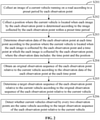
- step S102 an original observation sequence of the each observation point relative to the current vehicle is determined according to the image collected by the each observation point within a preset time period.
- the electronic equipment may determine an original observation sequence of the each observation point relative to the current vehicle according to the image collected by the each observation point within a preset time period. Specifically, the electronic equipment may determine, according to the image collected by the each observation point within the preset time period, a position where the current vehicle is located when each image is collected by the each observation point; determine, according to the position where the current vehicle is located when the each image is collected by the each observation point and a time point at which the each image is collected by the each observation point, observation data of the each observation point at each time point, where the observation data includes: the time point and the position; and obtain, according to the observation data of the each observation point at the each time point, the original observation sequence of the each observation point relative to the current vehicle.
- step S103 a target observation sequence of the each observation point relative to the current vehicle is determined according to the original observation sequence of the each observation point relative to the current vehicle.
- the electronic equipment may determine a target observation sequence of the each observation point relative to the current vehicle according to the original observation sequence of the each observation point relative to the current vehicle. Specifically, the electronic equipment may detect, according to each piece of observation data in the original observation sequence of the each observation point relative to the current vehicle, whether the original observation sequence of the each observation point relative to the current vehicle satisfies an interception condition. In response to the original observation sequence of the each observation point relative to the current vehicle satisfying the interception condition, the electronic equipment may intercept, according to a time point in each piece of observation data in each of the original observation sequence, the original observation sequence of the each observation point relative to the current vehicle, and obtain the target observation sequence of the each observation point relative to the current vehicle.
- step S104 whether current vehicles observed by every two observation points are the same vehicle is detected according to the target observation sequence of the each observation point relative to the current vehicle.
- the electronic equipment may detect whether current vehicles observed by every two observation points are the same vehicle according to the target observation sequence of the each observation point relative to the current vehicle. Specifically, the electronic equipment may calculate, according to the target observation sequence of the each observation point relative to the current vehicle, an average length of running tracks of current vehicles observed by the every two observation points and an area between the running tracks of the current vehicles observed by the every two observation points; calculate, according to the area between the running tracks of the current vehicles observed by the every two observation points and the average length of the running tracks of the current vehicles observed by the every two observation points, a similarity between the current vehicles observed by the every two observation points; and detect, according to the similarity between the current vehicles observed by the every two observation points, whether the current vehicles observed by the every two observation points are the same vehicle.
- an image of a current vehicle running on a road is firstly collected according to a preset period by each observation point; an original observation sequence of the each observation point relative to the current vehicle is determined according to the image collected by the each observation point within a preset time period; then a target observation sequence of the each observation point relative to the current vehicle is determined according to the original observation sequence of the each observation point relative to the current vehicle; and whether current vehicles observed by every two observation points are the same vehicle are detected according to the target observation sequence of the each observation point relative to the current vehicle. That is, according to the present disclosure, the vehicle association may be performed according to the original observation sequence of the each observation point relative to the current vehicle.
- FIG. 2 is a second flowchart of a vehicle association method according to an embodiment of the present disclosure. As shown in FIG. 2 , the vehicle association method may include the steps described below.
- step S201 an image of a current vehicle running on a road is collected according to a preset period by each observation point.
- step S202 a position where the current vehicle is located when each image is collected by the each observation point is determined according to the image collected by the each observation point within a preset time period.
- an electronic equipment may determine a position where the current vehicle is located when each image is collected by the each observation point according to the image collected by the each observation point within a preset time period. Specifically, the electronic equipment may identify the image collected by the each observation point within the preset time period. For example, the electronic equipment may input the image collected by the each observation point within the preset time period into a pre-trained image identification model, and determine, through the image recognition model, the position where the current vehicle is located when the each image is collected by the each observation point.
- observation data of the each observation point at each time point is determined according to the position where the current vehicle is located when the each image is collected by the each observation point and a time point at which the each image is collected by the each observation point.
- the observation data includes: the time point and the position.
- the electronic equipment may determine observation data of the each observation point at each time point according to the position where the current vehicle is located when the each image is collected by the each observation point and a time point at which the each image is collected by the each observation point.
- the observation data includes: the time point and the position. Specifically, it is assumed that the positions where the current vehicle is located are A1, A2, A3, ..., An when each image is collected by an observation point A, and n is a natural number greater than or equal to 1; A1 represents the observation data of the observation point A at a first time point, A2 represents the observation data of the observation point A at a second time point, and so on.
- step S204 an original observation sequence of the each observation point relative to the current vehicle is obtained according to the observation data of the each observation point at the each time point.
- step S205 a target observation sequence of the each observation point relative to the current vehicle is determined according to the original observation sequence of the each observation point relative to the current vehicle.
- step S206 whether current vehicles observed by every two observation points are the same vehicle is detected according to the target observation sequence of the each observation point relative to the current vehicle.
- an image of a current vehicle running on a road is firstly collected according to a preset period by each observation point; an original observation sequence of the each observation point relative to the current vehicle is determined according to the image collected by the each observation point within a preset time period; then a target observation sequence of the each observation point relative to the current vehicle is determined according to the original observation sequence of the each observation point relative to the current vehicle; and whether current vehicles observed by every two observation points are the same vehicle are detected according to the target observation sequence of the each observation point relative to the current vehicle. That is, according to the present disclosure, the vehicle association may be performed according to the original observation sequence of the each observation point relative to the current vehicle.
- the related vehicle association methods conventional association methods are mostly performed according to a single-frame image.
- the present disclosure adopts the technical means of performing the vehicle association according to an original observation sequence of each observation point relative to a current vehicle, so that the problem in the related art is solved that the association preformed according to a single-frame image which has limitations leads to the impossibility of accurately associating images collected by different observation points and the relatively low success rate of the association.
- the technical solution provided by the present disclosure the misassociation caused by abnormal single-frame images can be effectively prevented, and thereby the success rate of the association can be improved.
- the technical solution of the embodiment of the present disclosure is simple and convenient to implement, easy to popularize and has a wider application range.
- FIG. 3 is a third flowchart of a vehicle association method according to an embodiment of the present disclosure. As shown in FIG. 3 , the vehicle association method may include the steps described below.
- step S301 an image of a current vehicle running on a road is collected according to a preset period by each observation point.
- step S302 an original observation sequence of the each observation point relative to the current vehicle is determined according to the image collected by the each observation point within a preset time period.
- step S303 a target observation sequence of the each observation point relative to the current vehicle is determined according to the original observation sequence of the each observation point relative to the current vehicle.
- an electronic equipment may determine a target observation sequence of the each observation point relative to the current vehicle according to the original observation sequence of the each observation point relative to the current vehicle. Specifically, the electronic equipment may detect, according to each piece of observation data in the original observation sequence of the each observation point relative to the current vehicle, whether the original observation sequence of the each observation point relative to the current vehicle satisfies an interception condition; and in response to the original observation sequence of the each observation point relative to the current vehicle satisfying the interception condition, the electronic equipment may intercept, according to a time point in each piece of observation data in each of the original observation sequence, the original observation sequence of the each observation point relative to the current vehicle, and obtain the target observation sequence of the each observation point relative to the current vehicle.
- original observation sequences collected by an observation point A respectively are: A1, A2, A3, A4, A5, A6, A7, A8, A9 and A10; and original observation sequences collected by an observation point B are: B7, B8, B9 and BIO. Therefore, in the step, the original observation sequences collected by the observation point A may be intercepted to obtain A7, A8, A9 and A10, which can be aligned with the original observation sequences collected by the observation point B.
- step S304 an average length of running tracks of current vehicles observed by every two observation points and an area between the running tracks of the current vehicles observed by the every two observation points are calculated according to the target observation sequence of the each observation point relative to the current vehicle.
- the electronic equipment may calculate an average length of running tracks of current vehicles observed by every two observation points and an area between the running tracks of the current vehicles observed by the every two observation points according to the target observation sequence of the each observation point relative to the current vehicle. Specifically, the electronic equipment may, when calculating the average length of the running tracks of the current vehicles observed by the every two observation points, firstly extract a position in each piece of observation data from the target observation sequence of the each observation point relative to the current vehicle; then calculate, according to the position in the each piece of observation data extracted from the target observation sequence of the each observation point relative to the current vehicle, a length of a running track of the current vehicle observed by the each observation point; and calculate, according to the length of the running track of the current vehicle observed by the each observation point, the average length of the running tracks of the current vehicles observed by the every two observation points.
- step S305 a similarity between the current vehicles observed by the every two observation points is calculated according to the area between the running tracks of the current vehicles observed by the every two observation points and the average length of the running tracks of the current vehicles observed by the every two observation points.
- step S306 whether the current vehicles observed by the every two observation points are the same vehicle is detected according to the similarity between the current vehicles observed by the every two observation points.
- FIG. 4 is a scene view of a vehicle running on a road according to the present disclosure. As shown in FIG. 4 , the same vehicle deviates greatly in some single frame situations, and the similarity of tracks is relatively high. Therefore, by utilizing the track similarity method based on area division, noise may be removed, and the miassociation of objects in movement caused by inaccurate single frame information can be avoided.
- an image of a current vehicle running on a road is firstly collected according to a preset period by each observation point; an original observation sequence of the each observation point relative to the current vehicle is determined according to the image collected by the each observation point within a preset time period; then a target observation sequence of the each observation point relative to the current vehicle is determined according to the original observation sequence of the each observation point relative to the current vehicle; and whether current vehicles observed by every two observation points are the same vehicle are detected according to the target observation sequence of the each observation point relative to the current vehicle. That is, according to the present disclosure, the vehicle association may be performed according to the original observation sequence of the each observation point relative to the current vehicle.
- the related vehicle association methods conventional association methods are mostly performed according to a single-frame image.
- the present disclosure adopts the technical means of performing the vehicle association according to an original observation sequence of each observation point relative to a current vehicle, so that the problem in the related art is solved that the association preformed according to a single-frame image which has limitations leads to the impossibility of accurately associating images collected by different observation points and the relatively low success rate of the association.
- the technical solution provided by the present disclosure the misassociation caused by abnormal single-frame images can be effectively prevented, and thereby the success rate of the association can be improved.
- the technical solution of the embodiment of the present disclosure is simple and convenient to implement, easy to popularize and has a wider application range.
- FIG. 5 is a structural diagram of a vehicle association device according to an embodiment of the present disclosure.
- the device 500 includes: a collection module 501, a determination module 502 and a detection module 503.
- the collection module 501 is configured to collect, by each observation point, an image of a current vehicle running on a road according to a preset period.
- the determination module 502 is configured to determine, according to the image collected by the each observation point within a preset time period, an original observation sequence of the each observation point relative to the current vehicle; and determine, according to the original observation sequence of the each observation point relative to the current vehicle, a target observation sequence of the each observation point relative to the current vehicle.
- the detection module 503 is configured to detect, according to the target observation sequence of the each observation point relative to the current vehicle, whether current vehicles observed by every two observation points are the same vehicle.
- the determination module 502 is specifically configured to determine, according to the image collected by the each observation point within the preset time period, a position where the current vehicle is located when each image is collected by the each observation point; determine, according to the position where the current vehicle is located when the each image is collected by the each observation point and a time point at which the each image is collected by the each observation point, observation data of the each observation point at each time point, where the observation data includes: the time point and the position; and obtain, according to the observation data of the each observation point at the each time point, the original observation sequence of the each observation point relative to the current vehicle.
- the determination module 502 is specifically configured to detect, according to each piece of observation data in the original observation sequence of the each observation point relative to the current vehicle, whether the original observation sequence of the each observation point relative to the current vehicle satisfies an interception condition; and in response to the original observation sequence of the each observation point relative to the current vehicle satisfying the interception condition, intercept, according to a time point in each piece of observation data in each of the original observation sequence, the original observation sequence of the each observation point relative to the current vehicle, and obtain the target observation sequence of the each observation point relative to the current vehicle.
- FIG. 6 is a structural diagram of a detection module according to an embodiment of the present disclosure.
- the detection module 503 includes: a computation submodule 5031 and a detection submodule 5032.
- the computation submodule 5031 is configured to calculate, according to the target observation sequence of the each observation point relative to the current vehicle, an average length of running tracks of current vehicles observed by the every two observation points and an area between the running tracks of the current vehicles observed by the every two observation points; and calculate, according to the area between the running tracks of the current vehicles observed by the every two observation points and the average length of the running tracks of the current vehicles observed by the every two observation points, a similarity between the current vehicles observed by the every two observation points
- the detection submodule 5032 is configured to detect, according to the similarity between the current vehicles observed by the every two observation points, whether the current vehicles observed by the every two observation points are the same vehicle.
- the computation submodule 5031 is configured to extract a position in each piece of observation data from the target observation sequence of the each observation point relative to the current vehicle; calculate, according to the position in the each piece of observation data extracted from the target observation sequence of the each observation point relative to the current vehicle, a length of a running track of the current vehicle observed by the each observation point; and calculate, according to the length of the running track of the current vehicle observed by the each observation point, the average length of the running tracks of the current vehicles observed by the every two observation points.
- the above vehicle association device can execute the method provided by any embodiment of the present disclosure, and has functional modules and beneficial effects corresponding to the executed method.
- the vehicle association method provided by any embodiment of the present disclosure.
- the present disclosure further provides an electronic equipment, a readable storage medium and a computer program product.
- FIG. 7 shows a schematic block diagram of an example electronic equipment 700 for implementing the embodiments of the present disclosure.
- Electronic equipments are intended to represent various forms of digital computers, for example, laptop computers, desktop computers, worktables, personal digital assistants, servers, blade servers, mainframe computers and other applicable computers.
- Electronic equipments may also represent various forms of mobile devices, for example, personal digital assistants, cellphones, smartphones, wearable devices and other similar computing devices.
- the shown components, the connections and relationships between these components, and the functions of these components are illustrative only and are not intended to limit the implementation of the present disclosure as described and/or claimed herein.
- the equipment 700 includes a computing unit 701.
- the computing unit 701 may perform various appropriate actions and processing according to a computer program stored in a read-only memory (ROM) 702 or a computer program loaded into a random-access memory (RAM) 703 from a storage unit 708.
- the RAM 703 may also store various programs and data required for operations of the equipment 700.
- the computing unit 701, the ROM 702 and the RAM 703 are connected to each other by a bus 704.
- An input/output (I/O) interface 705 is also connected to the bus 704.
- the multiple components include an input unit 706 such as a keyboard or a mouse; an output unit 707 such as various types of displays or speakers; a storage unit 708 such as a magnetic disk or an optical disk; and a communication unit 709 such as a network card, a modem or a wireless communication transceiver.
- the communication unit 709 allows the equipment 700 to exchange information/data with other equipments over a computer network such as the Internet and/or over various telecommunication networks.
- the computing unit 701 may be a general-purpose and/or special-purpose processing component having processing and computing capabilities. Examples of the computing unit 701 include, but are not limited to, a central processing unit (CPU), a graphics processing unit (GPU), a special-purpose artificial intelligence (AI) computing chip, a computing unit executing machine learning model algorithms, a digital signal processor (DSP), and any appropriate processor, controller and microcontroller.
- the computing unit 701 executes various methods and processing described above, such as the vehicle association method.
- the vehicle association method may be implemented as a computer software program tangibly contained in a machine-readable medium such as the storage unit 708.
- part or all of computer programs may be loaded and/or installed on the equipment 700 via the ROM 702 and/or the communication unit 709.
- the computer program When the computer program is loaded to the RAM 703 and executed by the computing unit 701, one or more steps of the preceding vehicle association method may be executed.
- the computing unit 701 may be configured, in any other suitable manner (for example, by means of firmware), to perform the vehicle association method.
- the preceding various embodiments of systems and techniques may be implemented in digital electronic circuitry, integrated circuitry, a field-programmable gate array (FPGA), an disclosure-specific integrated circuit (ASIC), an disclosure-specific standard product (ASSP), a system on a chip (SoC), a complex programmable logic device (CPLD), computer hardware, firmware, software and/or any combination thereof.
- the various embodiments may include implementations in one or more computer programs.
- the one or more computer programs are executable and/or interpretable on a programmable system including at least one programmable processor.
- the programmable processor may be a special-purpose or general-purpose programmable processor for receiving data and instructions from a memory system, at least one input device and at least one output device and transmitting the data and instructions to the memory system, the at least one input device and the at least one output device.
- Program codes for implementation of the method of the present disclosure may be written in any combination of one or more programming languages. These program codes may be provided for the processor or controller of a general-purpose computer, a special-purpose computer or another programmable data processing device to enable functions/operations specified in a flowchart and/or a block diagram to be implemented when the program codes are executed by the processor or controller.
- the program codes may all be executed on a machine; may be partially executed on a machine; may serve as a separate software package that is partially executed on a machine and partially executed on a remote machine; or may all be executed on a remote machine or a server.
- the machine-readable medium may be a tangible medium that contains or stores a program available for an instruction execution system, device or equipment or a program used in conjunction with an instruction execution system, device or equipment.
- the machine-readable medium may be a machine-readable signal medium or a machine-readable storage medium.
- the machine-readable medium may include, but is not limited to, an electronic, magnetic, optical, electromagnetic, infrared or semiconductor system, device or equipment, or any appropriate combination thereof.
- machine-readable storage medium may include an electrical connection based on one or more wires, a portable computer disk, a hard disk, a random-access memory (RAM), a read-only memory (ROM), an erasable programmable read-only memory (EPROM) or a flash memory, an optical fiber, a portable compact disc read-only memory (CD-ROM), an optical storage equipment, a magnetic storage equipment, or any appropriate combination thereof.
- RAM random-access memory
- ROM read-only memory
- EPROM erasable programmable read-only memory
- flash memory an optical fiber
- CD-ROM portable compact disc read-only memory
- CD-ROM compact disc read-only memory
- magnetic storage equipment or any appropriate combination thereof.
- the systems and techniques described herein may be implemented on a computer.
- the computer has a display device (for example, a cathode-ray tube (CRT) or liquid-crystal display (LCD) monitor) for displaying information to the user; and a keyboard and a pointing device (for example, a mouse or a trackball) through which the user can provide input to the computer.
- a display device for example, a cathode-ray tube (CRT) or liquid-crystal display (LCD) monitor
- a keyboard and a pointing device for example, a mouse or a trackball
- Other types of devices may also be used for providing interaction with a user.
- feedback provided for the user may be sensory feedback in any form (for example, visual feedback, auditory feedback or haptic feedback).
- input from the user may be received in any form (including acoustic input, voice input or haptic input).
- the systems and techniques described herein may be implemented in a computing system including a back-end component (for example, a data server), a computing system including a middleware component (for example, an application server), a computing system including a front-end component (for example, a client computer having a graphical user interface or a web browser through which a user can interact with implementations of the systems and techniques described herein) or a computing system including any combination of such back-end, middleware or front-end components.
- the components of the system may be interconnected by any form or medium of digital data communication (for example, a communication network). Examples of the communication network include a local area network (LAN), a wide area network (WAN), a blockchain network and the Internet.
- the computing system may include clients and servers.
- a client and a server are generally remote from each other and typically interact through a communication network.
- the relationship between the client and the server arises by virtue of computer programs running on the respective computers and having a client-server relationship to each other.
- the server may be a cloud server, also referred to as a cloud computing server or a cloud host.
- the server solves the defects of difficult management and weak service scalability in a related physical host and a related VPS service.
- the present disclosure further provides a roadside equipment and a cloud control platform.
- the roadside equipment and the cloud control platform may include the electronic equipment of the embodiment of the present disclosure.
- the roadside equipment may further include, besides the electronic equipment, communication components and the like.
- the electronic equipment and the communication components may be integrated with or disposed separately from each other.
- the electronic equipment may acquire data, such as pictures and videos, of a sensing equipment (such as a roadside camera) so as to perform video processing and data calculation.
- the cloud control platform executes processing at a cloud terminal, and the electronic equipment included in the cloud control platform can acquire data, such as pictures and videos, of a sensing equipment (such as a roadside camera) so as to perform video processing and data calculation.
- the cloud control platform may also be referred to as a vehicle-road cooperative management platform, an edge computing platform, a cloud computing platform, a center system, a cloud server, etc.
Landscapes
- Engineering & Computer Science (AREA)
- Theoretical Computer Science (AREA)
- General Physics & Mathematics (AREA)
- Physics & Mathematics (AREA)
- Computer Vision & Pattern Recognition (AREA)
- Multimedia (AREA)
- Artificial Intelligence (AREA)
- Evolutionary Computation (AREA)
- Data Mining & Analysis (AREA)
- Databases & Information Systems (AREA)
- Software Systems (AREA)
- Medical Informatics (AREA)
- General Health & Medical Sciences (AREA)
- Computing Systems (AREA)
- Health & Medical Sciences (AREA)
- Life Sciences & Earth Sciences (AREA)
- Bioinformatics & Cheminformatics (AREA)
- Bioinformatics & Computational Biology (AREA)
- Evolutionary Biology (AREA)
- General Engineering & Computer Science (AREA)
- Traffic Control Systems (AREA)
- Image Analysis (AREA)
Applications Claiming Priority (1)
| Application Number | Priority Date | Filing Date | Title |
|---|---|---|---|
| CN202011520233.6A CN112507957B (zh) | 2020-12-21 | 2020-12-21 | 一种车辆关联方法、装置、路侧设备及云控平台 |
Publications (2)
| Publication Number | Publication Date |
|---|---|
| EP3940667A2 true EP3940667A2 (de) | 2022-01-19 |
| EP3940667A3 EP3940667A3 (de) | 2022-03-16 |
Family
ID=74923028
Family Applications (1)
| Application Number | Title | Priority Date | Filing Date |
|---|---|---|---|
| EP21190441.2A Ceased EP3940667A3 (de) | 2020-12-21 | 2021-08-09 | Verfahren und vorrichtung zur zuordnung von fahrzeugen, strassenfahrzeugsausrüstung und cloud-steuerungsplattform |
Country Status (5)
| Country | Link |
|---|---|
| US (1) | US20210390334A1 (de) |
| EP (1) | EP3940667A3 (de) |
| JP (1) | JP7280331B2 (de) |
| KR (1) | KR102595678B1 (de) |
| CN (1) | CN112507957B (de) |
Families Citing this family (1)
| Publication number | Priority date | Publication date | Assignee | Title |
|---|---|---|---|---|
| CN114202912B (zh) * | 2021-11-15 | 2023-08-18 | 新奇点智能科技集团有限公司 | 交通服务提供方法、装置、服务器及存储介质 |
Family Cites Families (21)
| Publication number | Priority date | Publication date | Assignee | Title |
|---|---|---|---|---|
| JP5996903B2 (ja) | 2012-03-28 | 2016-09-21 | セコム株式会社 | 移動物体追跡装置 |
| EP2925564B1 (de) * | 2012-11-27 | 2019-08-14 | Cloudparc, Inc. | Steuerung der verwendung eines einzelnen parkraums für mehrere fahrzeuge mit mehreren kameras |
| CN103927764B (zh) * | 2014-04-29 | 2017-09-29 | 重庆大学 | 一种结合目标信息和运动估计的车辆跟踪方法 |
| US9449258B1 (en) * | 2015-07-02 | 2016-09-20 | Agt International Gmbh | Multi-camera vehicle identification system |
| CN107204114A (zh) * | 2016-03-18 | 2017-09-26 | 中兴通讯股份有限公司 | 一种车辆异常行为的识别方法及装置 |
| US10296828B2 (en) * | 2017-04-05 | 2019-05-21 | Here Global B.V. | Learning a similarity measure for vision-based localization on a high definition (HD) map |
| CN107545582B (zh) * | 2017-07-04 | 2021-02-05 | 深圳大学 | 基于模糊逻辑的视频多目标跟踪方法及装置 |
| TWI617998B (zh) * | 2017-07-18 | 2018-03-11 | Chunghwa Telecom Co Ltd | System and method for car number identification data filtering |
| US10599161B2 (en) * | 2017-08-08 | 2020-03-24 | Skydio, Inc. | Image space motion planning of an autonomous vehicle |
| CN110874925A (zh) * | 2018-08-31 | 2020-03-10 | 百度在线网络技术(北京)有限公司 | 智能路侧单元及其控制方法 |
| CN109118766A (zh) * | 2018-09-04 | 2019-01-01 | 华南师范大学 | 一种基于交通卡口的同行车辆判别方法及装置 |
| JP6831117B2 (ja) | 2018-11-29 | 2021-02-17 | 技研トラステム株式会社 | 移動体追跡方法及びこれに用いる画像処理装置 |
| CN109583151B (zh) * | 2019-02-20 | 2023-07-21 | 阿波罗智能技术(北京)有限公司 | 车辆的行驶轨迹预测方法及装置 |
| DE112020002604T5 (de) * | 2019-05-29 | 2022-03-03 | Mobileye Vision Technologies Ltd. | Systeme und verfahren für die fahrzeugnavigation |
| WO2021011617A1 (en) * | 2019-07-15 | 2021-01-21 | Mobileye Vision Technologies Ltd. | Reducing stored parameters for a navigation system |
| CN110780289B (zh) * | 2019-10-23 | 2021-07-30 | 北京信息科技大学 | 基于场景雷达的多目标车辆跟踪方法及装置 |
| US11125575B2 (en) * | 2019-11-20 | 2021-09-21 | Here Global B.V. | Method and apparatus for estimating a location of a vehicle |
| CN111275983B (zh) * | 2020-02-14 | 2022-11-01 | 阿波罗智联(北京)科技有限公司 | 车辆追踪方法、装置、电子设备和计算机可读存储介质 |
| EP4173285A1 (de) * | 2020-06-25 | 2023-05-03 | Mobileye Vision Technologies Ltd. | Bewegungsbasierte online-kalibrierung einer multikamera |
| CN111914664A (zh) * | 2020-07-06 | 2020-11-10 | 同济大学 | 基于重识别的车辆多目标检测和轨迹跟踪方法 |
| US11377117B2 (en) * | 2020-10-21 | 2022-07-05 | IAA, Inc. | Automated vehicle condition grading |
-
2020
- 2020-12-21 CN CN202011520233.6A patent/CN112507957B/zh active Active
-
2021
- 2021-08-09 EP EP21190441.2A patent/EP3940667A3/de not_active Ceased
- 2021-08-11 US US17/444,891 patent/US20210390334A1/en not_active Abandoned
- 2021-09-27 KR KR1020210127050A patent/KR102595678B1/ko active Active
- 2021-11-02 JP JP2021179818A patent/JP7280331B2/ja active Active
Also Published As
| Publication number | Publication date |
|---|---|
| EP3940667A3 (de) | 2022-03-16 |
| JP2022098433A (ja) | 2022-07-01 |
| US20210390334A1 (en) | 2021-12-16 |
| JP7280331B2 (ja) | 2023-05-23 |
| CN112507957B (zh) | 2023-12-15 |
| KR20210125447A (ko) | 2021-10-18 |
| CN112507957A (zh) | 2021-03-16 |
| KR102595678B1 (ko) | 2023-10-27 |
Similar Documents
| Publication | Publication Date | Title |
|---|---|---|
| EP3951741B1 (de) | Verfahren zur erfassung des verkehrszustandes, entsprechende vorrichtung, strassenseitige vorrichtung und cloud-steuerungsplattform | |
| US20220321598A1 (en) | Method of processing security information, device and storage medium | |
| EP3985610B1 (de) | Verfahren und einrichtung zur positionierung einer audioerfassungsvorrichtung und verfahren und system zur sprechererkennung | |
| CN114093006A (zh) | 活体人脸检测模型的训练方法、装置、设备以及存储介质 | |
| CN113378712B (zh) | 物体检测模型的训练方法、图像检测方法及其装置 | |
| EP4086905B1 (de) | Verfahren und vorrichtung zur erkennung der sprachaktivität, elektronische vorrichtung und speichermedium | |
| CN113392794B (zh) | 车辆跨线识别方法、装置、电子设备和存储介质 | |
| CN112784102A (zh) | 视频检索方法、装置和电子设备 | |
| CN114299115B (zh) | 用于多目标跟踪的方法及装置、存储介质及电子设备 | |
| US20220392192A1 (en) | Target re-recognition method, device and electronic device | |
| CN111063011A (zh) | 一种人脸图像处理方法、装置、设备和介质 | |
| WO2026025967A1 (zh) | 障碍物视觉感知算法评价方法、装置、设备、介质及产品 | |
| CN116258769B (zh) | 一种定位校验方法、装置、电子设备和存储介质 | |
| EP3940667A2 (de) | Verfahren und vorrichtung zur zuordnung von fahrzeugen, strassenfahrzeugsausrüstung und cloud-steuerungsplattform | |
| CN121458766A (zh) | 轨迹匹配方法、装置、设备以及存储介质 | |
| CN115965648A (zh) | 一种离岗检测方法、装置、电子设备及存储介质 | |
| CN114119990A (zh) | 用于图像特征点匹配的方法、装置及计算机程序产品 | |
| US20240249429A1 (en) | Identifier positioning method and apparatus, electronic device and computer-readable storage medium | |
| CN116703963A (zh) | 一种ar跟踪方法、装置、ar设备及存储介质 | |
| CN118506278A (zh) | 基于类中心人脸特征的人员监控方法、装置、设备及介质 | |
| EP4134843A2 (de) | Fusions- und assoziationsverfahren und -vorrichtung für verkehrsobjekte in einer fahrumgebung und edge-computing-vorrichtung | |
| EP4174847B1 (de) | Verfahren und vorrichtung zur erkennung von navigationsrundfunk sowie elektronische vorrichtung und medium | |
| EP4125062A1 (de) | Verfahren und vorrichtung zur fahrzeugpositionierung, elektronische vorrichtung, nichtflüchtiges computerlesbares speichermedium und computerprogrammprodukt | |
| CN117710459A (zh) | 三维信息的确定方法、装置及计算机程序产品 | |
| CN114299595A (zh) | 人脸识别方法、装置、设备、存储介质和程序产品 |
Legal Events
| Date | Code | Title | Description |
|---|---|---|---|
| PUAI | Public reference made under article 153(3) epc to a published international application that has entered the european phase |
Free format text: ORIGINAL CODE: 0009012 |
|
| STAA | Information on the status of an ep patent application or granted ep patent |
Free format text: STATUS: REQUEST FOR EXAMINATION WAS MADE |
|
| 17P | Request for examination filed |
Effective date: 20210809 |
|
| AK | Designated contracting states |
Kind code of ref document: A2 Designated state(s): AL AT BE BG CH CY CZ DE DK EE ES FI FR GB GR HR HU IE IS IT LI LT LU LV MC MK MT NL NO PL PT RO RS SE SI SK SM TR |
|
| REG | Reference to a national code |
Ref country code: DE Ref legal event code: R079 Free format text: PREVIOUS MAIN CLASS: G08G0001010000 Ipc: G08G0001040000 |
|
| PUAL | Search report despatched |
Free format text: ORIGINAL CODE: 0009013 |
|
| AK | Designated contracting states |
Kind code of ref document: A3 Designated state(s): AL AT BE BG CH CY CZ DE DK EE ES FI FR GB GR HR HU IE IS IT LI LT LU LV MC MK MT NL NO PL PT RO RS SE SI SK SM TR |
|
| RIC1 | Information provided on ipc code assigned before grant |
Ipc: G06V 20/54 20220101ALI20220209BHEP Ipc: G06V 10/74 20220101ALI20220209BHEP Ipc: G08G 1/017 20060101ALI20220209BHEP Ipc: G08G 1/01 20060101ALI20220209BHEP Ipc: G08G 1/04 20060101AFI20220209BHEP |
|
| STAA | Information on the status of an ep patent application or granted ep patent |
Free format text: STATUS: EXAMINATION IS IN PROGRESS |
|
| 17Q | First examination report despatched |
Effective date: 20221111 |
|
| STAA | Information on the status of an ep patent application or granted ep patent |
Free format text: STATUS: THE APPLICATION HAS BEEN REFUSED |
|
| 18R | Application refused |
Effective date: 20231021 |