EP3936584A1 - Disposable autonomous thermal device - Google Patents
Disposable autonomous thermal device Download PDFInfo
- Publication number
- EP3936584A1 EP3936584A1 EP19919342.6A EP19919342A EP3936584A1 EP 3936584 A1 EP3936584 A1 EP 3936584A1 EP 19919342 A EP19919342 A EP 19919342A EP 3936584 A1 EP3936584 A1 EP 3936584A1
- Authority
- EP
- European Patent Office
- Prior art keywords
- disposable
- thermal device
- container
- autonomous
- autonomous thermal
- Prior art date
- Legal status (The legal status is an assumption and is not a legal conclusion. Google has not performed a legal analysis and makes no representation as to the accuracy of the status listed.)
- Granted
Links
Images



Classifications
-
- C—CHEMISTRY; METALLURGY
- C09—DYES; PAINTS; POLISHES; NATURAL RESINS; ADHESIVES; COMPOSITIONS NOT OTHERWISE PROVIDED FOR; APPLICATIONS OF MATERIALS NOT OTHERWISE PROVIDED FOR
- C09K—MATERIALS FOR MISCELLANEOUS APPLICATIONS, NOT PROVIDED FOR ELSEWHERE
- C09K5/00—Heat-transfer, heat-exchange or heat-storage materials, e.g. refrigerants; Materials for the production of heat or cold by chemical reactions other than by combustion
- C09K5/16—Materials undergoing chemical reactions when used
- C09K5/18—Non-reversible chemical reactions
-
- A—HUMAN NECESSITIES
- A61—MEDICAL OR VETERINARY SCIENCE; HYGIENE
- A61F—FILTERS IMPLANTABLE INTO BLOOD VESSELS; PROSTHESES; DEVICES PROVIDING PATENCY TO, OR PREVENTING COLLAPSING OF, TUBULAR STRUCTURES OF THE BODY, e.g. STENTS; ORTHOPAEDIC, NURSING OR CONTRACEPTIVE DEVICES; FOMENTATION; TREATMENT OR PROTECTION OF EYES OR EARS; BANDAGES, DRESSINGS OR ABSORBENT PADS; FIRST-AID KITS
- A61F7/00—Heating or cooling appliances for medical or therapeutic treatment of the human body
- A61F7/02—Compresses or poultices for effecting heating or cooling
- A61F7/03—Compresses or poultices for effecting heating or cooling thermophore, i.e. self-heating, e.g. using a chemical reaction
-
- A—HUMAN NECESSITIES
- A61—MEDICAL OR VETERINARY SCIENCE; HYGIENE
- A61F—FILTERS IMPLANTABLE INTO BLOOD VESSELS; PROSTHESES; DEVICES PROVIDING PATENCY TO, OR PREVENTING COLLAPSING OF, TUBULAR STRUCTURES OF THE BODY, e.g. STENTS; ORTHOPAEDIC, NURSING OR CONTRACEPTIVE DEVICES; FOMENTATION; TREATMENT OR PROTECTION OF EYES OR EARS; BANDAGES, DRESSINGS OR ABSORBENT PADS; FIRST-AID KITS
- A61F7/00—Heating or cooling appliances for medical or therapeutic treatment of the human body
- A61F7/02—Compresses or poultices for effecting heating or cooling
- A61F2007/0268—Compresses or poultices for effecting heating or cooling having a plurality of compartments being filled with a heat carrier
- A61F2007/0276—Compresses or poultices for effecting heating or cooling having a plurality of compartments being filled with a heat carrier with separate compartments connectable by rupturing a wall or membrane
Definitions
- the invention as stated in the title of the present specification, relates to a disposable autonomous thermal device which contributes, to its intended use, advantages and features, which are described in detail further on, which imply an improvement in the current state of the art.
- the object of the invention focuses on a disposable autonomous thermal device that provides heat to living beings, garments or objects with very different purposes, for which it comprises a container with a composition that, in contact with a liquid, generates a controlled exothermal reaction, said composition consisting of a mixture of two chemical substances, wherein at least one of said substances is an acid and the other a base, both being wrapped or contained in a container in the form of a film or sheet.
- the field of application of the present invention falls within the sector of the industry dedicated to the manufacture of thermal devices.
- These devices are glued directly to the skin or any light garment, by means of a glue that is activated when the seal is removed in order for oxygen to enter and the reaction to begin.
- This type of reaction is used, generally for thermal therapeutic uses for the whole body, in the so-called heating pads or heat patches or pad, heat packs, thermal blankets, thermal cushions, thermal bandages, etc., and according to the area of use: knee pads, shoulder pads, collars, back, shoulders, groin (for menstrual pains), hands, feet, etc.
- the disadvantages of this first type of device are, among others, that they can be activated prematurely by the air due to the loss of leak-tightness, taking into account that the humidity already comes in the mixture and that the fabrics containing the mixture (generally of the non-woven fabric type) have pores precisely so that air can enter the pad at the time of use.
- Another disadvantage is that the heat generated is exclusively local in the area of the body where it is applied but cannot heat larger surfaces or volumes.
- the objective of the present invention is, therefore, a thermal device that constitutes an improved alternative to the aforementioned within its field of application, the characterising details that distinguish it being included in the final claims that accompany the present description.
- the disposable autonomous thermal device that the invention proposes, as noted above, comprises a composition that, made up of a mixture of an acidic substance and a basic substance, is incorporated into a container and, upon contact with a liquid, it generates a controlled exothermal reaction that provides heat and allows multiple uses, several systems having been provided for activating the device in order to enable said composition to come into contact with the liquid, there being multiple apparatuses, objects or specific garments in which the device can be implemented for multiple uses.
- the disposable autonomous thermal device may comprise a mixture of two chemical substances, wherein at least one of these is an acid and the other a base, both being wrapped or contained in a film or sheet.
- the mixture may comprise a first substance from the group of bases or hydroxides, one or more hydroxides or a base of any basic salt or a mixture of same, and further comprise a second substance from the group of acids, one or more inorganic or organic acids or an acid of any acidic salt or a mixture of same.
- the basic substance comprises one or more of the group of bases or hydroxides, one or more hydroxides or a base any basic salt selected from the group consisting of calcium hydroxide, sodium hydroxide, magnesium hydroxide, nickel hydroxide, zinc hydroxide, iron hydroxide, bromine hydroxide, carbon hydroxide, silver hydroxide, boron hydroxide, lithium hydroxide, copper hydroxide, the mixtures and derivatives thereof or combinations thereof.
- the acidic substance comprises one or more inorganic or organic acids or an acid of any acidic salt, one or more acidic components selected from the group consisting of citric acid, acetic acid, adipic acid, alginic acid, amygdalic acid, arsenous acid, ascorbic acid, acetylsalicylic acid, isoascorbic acid, benzoic acid, boric acid, metaboric acid, bromic acid, carbonic acid, carbonaceous acid, caproic acid, cyanic and thiocyanic acid, cinnamic acid, chromic and dichromic acids, hydrocinnamic acid, hydrochloric acid, edetic acid, stearic acid, phenoxyacetic acid, phenylacetic acid, phytic acid, phosphoric acid, hypophosphorous acid, orthophosphoric acid, fruit acids or any other natural acid, formic acid, phosphonic acid, fumaric acid, phthalic acid, gallic acid, glutamic
- the speed, duration, temperature and thermal stability of the device the following can be modified: the percentage ratio of the ingredients, particle size, the form of the mixture (powder, pellets, tablets, etc.), addition of moisture absorbents, different degrees of vacuum in the container, the size and number of containers that make up autonomous thermal devices that can even be joined together to form a single body.
- the amount, composition, form of joining with the ingredients and even the number of shakes after mixing can also vary.
- the different apparatuses or elements adapted to each use and the modification of the features thereof such as the thickness and type of insulation, among others.
- the immediate generation of heat is achieved by contacting an aqueous liquid with the mixture of said substances, which is carried out by means of an activator element that can have various embodiments.
- the term container of the device can correspond to a heating pad, heating pillow, heating bag or heating pack, that is, an element similar to a bag, which is suitable for thermal treatment, as well as with a thermal element, heat generating package, pocket heat generating device, heating apparatus, heating element, heater, thermal cushion.
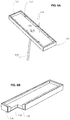
- Figures 6A and 6B show respective perspective views of the lower portion of a flat mop and of the lid of said flat mop, respectively, as an example of an applicable object to incorporate the thermal device of the invention.
- the exothermal composition (4) although in a generic way, comprises at least:
- the exothermal composition (4) comprises from 0.5% to 40% by weight of moisture-absorbing materials, preferably between 10% by weight and 30% by weight of particulate wood.
- Said particulate wood of the exothermal composition (4) can be from silvicultural, agricultural, agro-industrial, energy or forestry species selected from the group consisting of olive pits, nut shells, fir, birch, acacia, aspen, carob, cork oak, larch, almond tree, bamboo, cedar, cypress, poplar, juniper, holm oak, eucalyptus, flamboyant, ash, fruit trees, beech, pine, walnut, elm, olive, oak, teak, among others, and mixtures thereof.
- the particulate wood preferably comprises from 1% to 20% by weight of moisture, preferably from 8% to 10% by weight of moisture.
- the exothermal composition (4) optionally, has a solid consistency, and can be in the form of a powder, granules, pellets or tablets, preferably in the form of a powder.
- the ingredients of the exothermal composition (4) may be unmixed and separated from each other inside the container (1) of the device, some of which may be loose inside said container (1) and the others inside another container or inner bag of water-soluble material (not represented in the figures) as this, in turn, is inside the main container (1) of the device.
- ingredients of the exothermal composition (4) can be inside a first container or inner bag of water-soluble material and the others inside a second container or other inner bag of water-soluble material, that is, both containers or both bags being water-soluble inside the main container (1) of the device.
- the ingredients of the exothermal composition (4) may be mixed and bonded inside the device container (1), all of which may be loose inside the main container (1) of the device or inside an inner bag of water-soluble material in turn incorporated inside said container (1) of the device.
- the aqueous liquid (6) comprised by the container (1) of the device is selected from the group consisting of water, distilled water, double distilled water, deionised water, mineral water, spring water, water with salts, brackish water, salt water, or any of the mixtures thereof, preferably distilled water.
- said aqueous liquid (6) is added to the exothermal composition (4) from 5 to 80 parts by weight of this composition, preferably from 20 to 30 parts by weight, in order to generate heat by a neutralising reaction.
- the aqueous liquid (6) is a solution with the acid, a solution with one or more bases or a solution with hydrogen peroxide or alcohol, preferably a solution with hydrogen peroxide, wherein the hydrogen peroxide of said solution preferably comprises from 0.20% by weight to 10% of the solution, and preferably from 0.50% by weight to 3% by weight of the solution.
- the hydrogen peroxide of the solution of the aqueous liquid (6) contains a concentration of 1.5% (5 volumes) to a concentration of 50% (200 volumes), preferably between 3% (10 volumes) and 9% (45 volumes).
- the aqueous liquid (6) is separated from the exothermal composition (4) that contains the main container (1) of the device, for which, preferably, it is contained in a secondary container (7), it being possible for this secondary container (7) to be inside or outside the container (1) of the device, being the preferred one that is inside the same.
- the secondary container (7) is selected from the group consisting of a vial, bottle, canister, ampoule, glass, bag, terrine and syringe, being in any case preferably a breakable bag or a breakable receptacle.
- the aqueous liquid (6) is brought into contact with the exothermal composition (4) or manually, preferably by manual compression in an area (8) of the container (1) of the device to break the secondary container (7), or through an activating element (50) that acts by different means selected from the group comprising injection, breaking of the secondary container (7) by twisting or by mechanical compression.
- the secondary container (7) where the aqueous liquid (6) is located comprises one or more sheets of polymeric material sealed forming a flexible bag and the materials of which are selected from the group consisting of EVOH, LDPE, MDPE, HDPE, PT/PE, Paper/AL, Paper/PE, PET/AL, PET/PE, PVC/PE, PA/PE, NY/PVDC, PE/PVDC, PP/PVDC, MOPP/PE, Paper/AL/PE, PET/AL/PE, PET/AL/PE, PET/PA/PE, BOPP/AL/PE, BOPP/PE/OPP, BOPP/VMPET/PE, PET/VMPET/PE, PET/AL/CPP, MOPP/Kraft paper/CPP, PET/AL/Paper, PET/PVDC/PE, PET/PT/PE, PT/AL/PE, Wax/Paper/PE, OP/AL/HSL, BOPP/PET/AL/PE, MOPP/PET/AL/PE, Paper
- the thickness of the polymeric material of one or more sheets of the secondary container (7) containing the aqueous liquid (6) is between 20 and 150 microns, preferably between 50 and 80 microns.
- one or more sheets of the secondary container (7) containing the aqueous liquid (6) are hermetically heat-sealed on the perimeter thereof by means of a manual, semi-automatic or automatic sealing or packaging machine, by closing with 4 welds, 3 welds, 3 fillet welds, side folds, with square bottom or Stand-Up, with rear fold, preferably by means of automatic heat closure with 4 welds.
- one or more sheets of polymeric material of the secondary container (7) containing the aqueous liquid (6) are hermetically sealed forming a closed bag.
- the secondary container (7) containing the aqueous liquid (6) can be of different sizes, logically depending on the size of the main container (1) of the device, although preferably it is 8 cm wide x 6 cm long.
- said container (1) of the device comprises one or more sheets of polymeric material sealed forming a flexible bag adaptable to the shape of any part of the human body, animal or object to be heated.
- the main container (1) is of a water-soluble composition selected from the group consisting of Polyvinyl Alcohol (PVA/PVAL/POVH) and derivatives.
- PVA/PVAL/POVH Polyvinyl Alcohol
- one or more materials of the composition of the same are selected from the group consisting of EVOH, LDPE, MDPE, HDPE, PT/PE, Paper/AL, Paper/PE, PET/AL, PET/PE, PVC/PE, PA/PE, NY/PVDC, PE/PVDC, PP/PVDC, MOPP/PE, Paper/AL/PE, PET/AL/PE, PET/PA/PE, BOPP/AL/PE, BOPP/PE/OPP, BOPP/VMPET/PE, PET/VMPET/PE, PET/AL/CPP, MOPP/Kraft paper/CPP, PET/AL/Paper, PET/PVDC/PE, PET/PT/PE, PT/AL/PE, wax/paper/PE, OP/AL/HSL, BOPP/PET/AL/PE, MOPP/PET/AL/PE, Paper/AL/Paper/PE, PT/BOPP/PE, PVDC/
- said the non-water-soluble polymeric material of one or more sheets (5) of the main container (1) of the device is preferably Polyester (PET) - Aluminium (AL) - Polyethylene (PE) and, the thickness of said non-water-soluble polymeric material of one or more sheets of the main container (1) of the device is between 20 and 150 microns, preferably between 80 and 100 microns.
- one or more sheets (5) of the main container (1) of the device are sealed inside same enabling subdivisions.
- the main container (1) of the device comprises an envelope or wrapper, a vacuum bag or one or more sheets of air bubbles, although this detail has not been represented in the figures.
- the container (1) of the device comprises a closure system on one or more of the sides thereof, for example of the easy open type, self-closing, pressure, grip type pressure, zip type, zipper type or slider, velcro, brackets, adhesive type, funnel-type cap, heat-sealed, preferably perimeter heat-sealed.
- one or more sheets (5) of the main container (1) are hermetically heat-sealed on the perimeter edges (3) thereof by means of a manual, semiautomatic or automatic, preferably automatic, sealing or packaging machine by closing with 4 welds, 3 welds, 3 fillet welds, side folds, with square bottom or Stand-Up, preferably by means of automatic hermetic heat closure with 4 welds and with a Euro-Hole type perforation (2).
- one or more sheets (5) of polymeric material of the container (1) of the device or main container are hermetically sealed forming a closed bag with different degrees of vacuum, preferably with a high degree of vacuum.
- the container (1) of the device has adhered to the outside, or in the form of a non-disposable or disposable cover, support or wrapping, preferably made of non-woven fabric, which comprises, or which can be incorporated therein, pharmaceutical compounds, insecticides, essential oils and non-active and active aromatic compounds, extracts and natural plant compounds such as tea oils, neem oil, essential lemon eucalyptus oil, citronella oil, savory, garlic, basil, bergamot, cinnamon, cardamom, onion, cedar, coriander, citronella, clove, juniper, tarragon, eucalyptus, geranium, lemongrass, fennel, bay leaf, lavender, lemon, marjoram, lemon balm, mint, mustard, orange, oregano, rosewood, paprika, parsley, pine, grapefruit, rosemary, sage, soy, thyme, vanilla, etc. or mixtures thereof in order to increase the effectiveness of therapeutic uses,
- the container (1) of the device has means of fastening to parts of the body or objects, such as velcro, adhesive, straps, tapes and belts, among others.
- the container (1) of the described autonomous thermal device can be joined to the container (1) of other identical or similar autonomous thermal devices by sealing any of the edges (3) thereof, preferably at a heat-sealed seam (9), forming a single body of several of the same.
- the device contemplates the use of an activator element (50) that may have different configurations, for example in the form of a needle, a clamp, a striker, a threaded push button or others, which can be used either directly on the container (1) of the thermal device or through additional elements incorporated on said container (1) or in which it is housed, such as a heat shield (10) or a thermal cover (31) that are described in detail below.
- an activator element (50) may have different configurations, for example in the form of a needle, a clamp, a striker, a threaded push button or others, which can be used either directly on the container (1) of the thermal device or through additional elements incorporated on said container (1) or in which it is housed, such as a heat shield (10) or a thermal cover (31) that are described in detail below.
- thermal device contemplates the existence of a heat shield (10) the purpose of which is to insulate from the cold and distribute the heat generated by the container (1) of said device, for which such shield (10) preferably comprises one or more layers of bonded superimposed materials and fabrics.
- one or more materials of the layers of said heat shield (10) are selected from the group consisting of: wool, polyester, metallic materials such as silver or copper, aerogel, neoprene, wool wadding, acetate, polyester or cotton, among others and any of the mixtures thereof, preferably three layers of neoprene, aerogel and wool.
- one or more metallic materials of some of the layers of the heat shield (10) are silver or copper, in percentages of 5 to 100%, preferably in percentages of these metals between 5 and 40%, for one or the 2 faces.
- one or more superimposed layers of the heat shield (10) are joined by any joining system, selected from the group consisting of: stitching, buttons, clasps, zip, velcro, laces and eyelets, studs, glue, hot-melt spray, glue, heat sealing, among others, depending on the object or garment to which it is adhered.
- any joining system selected from the group consisting of: stitching, buttons, clasps, zip, velcro, laces and eyelets, studs, glue, hot-melt spray, glue, heat sealing, among others, depending on the object or garment to which it is adhered.
- said heat shield (10) can be incorporated and coupled to the device in any non-textile or textile object, item of clothing for people or animals already marketed, such as: pockets, bags, covers for tablets, mobiles and other electronic devices, computers or tablets keyboards, rigid and flexible containers, baby bottle warmers, beverage container warmers, warmers for plates, cutlery, glasses and food, food containers, mops, tiles, rugs, mats, mattresses, air mattresses, beds, bed covers, pillowcases, cots, puffs, seats, chairs, easy chairs, armchairs, cushions, protective seat covers, laundry baskets, tents, sleeping bags for babies, sleeping bags, rucksacks, stuffed animals, toy dolls, hats, caps, neck pads, pillows, anti-mite pillows, scarves, collars, capes, spinal tapes, shoulder pads, harnesses, girdles, bum bags, lumbar pads, elbow pads, mittens, gloves, shoe insoles, socks, hand and foot warmers, trousers, knee braces, ankle bra
- the heat shield (10) can be located on the objects and items of clothing in the areas near the thermal device and, preferably, covering or located on the container (1) itself of the device.
- it can be manufactured in the shape of objects or items of clothing such as a scarf, neck brace, shoulder pads, elbow pads, belt, harnesses, gloves, foot insoles, sleeves, vests, girdles, bum bags, blankets, knee braces, trousers, ankle braces, shoe insoles, socks, towels, among others.
- the device additionally contemplates the existence of a cover (31), specifically a thermal cover in order to distribute the heat generated by the described thermal device to any object or parts thereof, surfaces, living beings, food or beverages.
- a cover specifically a thermal cover in order to distribute the heat generated by the described thermal device to any object or parts thereof, surfaces, living beings, food or beverages.
- the same can be manufactured for purposes such as: heating, conserving heat, drying and defrosting, among others and, optionally, for the purpose of thermal sanitisation of any object, living beings or parts of any thereof, surfaces, food or beverages in order to eliminate mites, microorganisms, insects, fungi and ectoparasites, or for therapeutic uses based on heat on people and animals such as: anti-inflammatory and analgesic for any part of the body including injuries to muscles, ligaments and tendons, menstrual pain, hypothermia, pharyngitis, snoring and contractures, or to vaporise molecules, substances or compounds in order to eliminate or repel mites, microorganisms, insects, ectoparasites and fungi, or to vaporise substances or compounds used in allergies, nasal and bronchial congestion, sneezing, cough, pharyngitis, hiccups or singultus and sn
- said cover (31) comprises one or more insulating sheets (34) between which a hollow (33) is defined that houses the container (1) of the autonomous thermal device and a closure system.
- said one or more sheets (34) are made of one or more types of materials selected from the group comprising polymers of inorganic, natural organic and synthetic organic origin.
- one or more sheets (34) are made of materials selected from the group consisting of polyurethane or polyester or PVC or polyethylene foam; in foams or agglomerate or extruded or in memory foam; elastomers such as neoprene, lycra or spandex; cork, cardboard, rubber, aerogel, or they consist of a fabric or mesh (35) that incorporates metallic materials such as silver or copper, in percentages of 5 to 100%, preferably in percentages of these metals between 5 and 40%, or mixtures thereof.
- the cover (31) has one or two polyurethane foam sheets (34), in this second case being separated leaving a hollow (33) that houses the autonomous thermal device.
- said polyurethane foam sheets (34) are of a thickness between 1 mm and 300 mm, preferably two sheets, it being possible for the thicknesses of both sheets to be the same or different, preferably both of the same thickness of between 5 and 12 mm.
- one or both polyurethane foam sheets (34) has (have) a density between 5 kg/m3 and 70 kg/m3, preferably between 10 kg/m3 and 30 kg/m3.
- one or both of the polyurethane foam sheets (34) are hard or soft, preferably soft and very flexible, which allows it to adapt to any shape depending on the use thereof.
- the cover (31) is covered on the inside thereof, outside thereof or both by a fabric or a mesh (35).
- one or more materials of the fabric or mesh (35) that cover it are selected from the group consisting of any natural textile material such as cotton, wool, silk, leather, micro-wool and linen among others, or synthetics such as polyamide, nylon, polyester, PVC, trilaminate, tetralaminate, Gore-tex ® , vinyl, neoprene, PU, lycra or spandex, copper or silver metallic fabrics, silicone, latex, neoprene, anti-mite fabric, polyester, aerogel, non-woven fabric, aluminised plastic or not, nylon, vinyl among others or any of the mixtures thereof.
- any natural textile material such as cotton, wool, silk, leather, micro-wool and linen among others
- synthetics such as polyamide, nylon, polyester, PVC, trilaminate, tetralaminate, Gore-tex ® , vinyl, neoprene, PU, lycra or spandex, copper or silver metallic fabrics, silicone, latex, neo
- the cover (31) contains, on said fabric or mesh (35), an additional covering selected from the group consisting of any textile material, preferably neoprene.
- the fabric or mesh (35) with which the cover (31) is covered inside, outside or both contains metallic materials such as silver or copper, in percentages from 5 to 100%, preferably in percentages of these metals between 5 and 40%.
- the arrangement of the sheets or layers of insulating material (34) and fabric (35) is preferably: a sheet of foam rubber covered by fabric on both faces, a hollow (33) that houses the container (1) of the autonomous thermal device and a sheet of aerogel covered by fabric on both faces.
- One or more sheets can be made of foamed fabric comprising the fabric and the polyurethane foam sheet.
- the cover (31) can be of any size, according to all the possible and multiple uses as well as according to the number of thermal devices that it incorporates, preferably a size of 150 mm x 250 mm for each thermal device.
- it can have different shapes such as square, rectangular, semi-circular-straight and round, among others.
- the cover (31) can be single-use or reusable, preferably washable and reusable multiple times.
- the cover (31) preferably comprises a zip (32) ( Figure 3A ), velcro (36), a flap with velcro (37) ( Figure 3B ), magnets, clasps, snaps or others to insulate inside the thermal device.
- the cover (31) has a configuration that comprises one or more tabs in the upper (41), lower (42) and lateral (43) position, with closure systems, preferably velcro and that serve to adhere and adjust to certain objects such as the straps (219) of a harness as shown in Figures 5A to 5G , or to parts of the body.
- it comprises other types of fastening systems to fasten or adapt to the body of people, animals, items of clothing, bedding, sleeping bags, harnesses and any object to be heated, selected from the group consisting of straps, tapes, belts, velcro, glue, adhesive, or for example a magnetic sheet (39) or magnets (40) as shown in Figure 3E , or with buckles, stitching, etc.
- the cover (31), in one embodiment option, comprises a magnetic sheet (39) or a magnet (40) on the outside or inside thereof to fix or adapt to the body of people, animals, items of clothing, bedding, sleeping bags, harnesses and any object to be heated when it comes into contact with another magnetic sheet or other magnet on the external face of the object or garment to which it is fastened.
- the cover (31) can also comprise an anti-radiation pocket (38), represented in Figure 3D , made of any of the current commercial materials, preferably sewn thereto, to prevent radiation from mobile devices and theft of data of same or of bank cards, etc.
- an anti-radiation pocket 38, represented in Figure 3D , made of any of the current commercial materials, preferably sewn thereto, to prevent radiation from mobile devices and theft of data of same or of bank cards, etc.
- the cover (31) contains the heat shield (10) described above, as well as other complementary elements or devices, for example, as shown in Figure 3I , it contains a temperature indicator (44) and/or contains one or more photovoltaic electrical generators (45) to generate and supply electrical energy to charge any battery or directly any electronic mobile device such as mobile phones, computers or tablets among others, or any electrical or electronic apparatus.
- thermoelectric generators 46
- the container (1) of which is incorporated in the cover (31) can also contain one or more thermoelectric generators (46), preferably one or more Peltier plates that use the heat generated by the thermal device, the container (1) of which is incorporated in the cover (31), by means of the Seebeck effect to generate and supply electrical energy to charge any battery or directly any electronic mobile device such as mobile phones, computers or tablets among others, or any electrical or electronic apparatus.
- it also comprises one or more terminals for charging electronic devices and/or one or more batteries.
- the cover (31) is the one that contains a non-disposable or disposable wrapping that comprises, or which can be incorporated therein, pharmaceutical compounds, insecticides, essential oils and non-active and active aromatic compounds, extracts and natural plant compounds such as tea oils, neem oil, essential lemon eucalyptus oil, citronella oil, savory, garlic, basil, bergamot, cinnamon, cardamom, onion, cedar, coriander, citronella, clove, juniper, tarragon, eucalyptus, geranium, lemongrass, fennel, bay leaf, lavender, lemon, marjoram, lemon balm, mint, mustard, orange, oregano, rosewood, paprika, parsley, pine, grapefruit, rosemary, sage, soy, thyme, vanilla, etc. or mixtures thereof.
- tea oils such as tea oils, neem oil, essential lemon eucalyptus oil, citronella oil, savory, garlic,
- the device optionally comprises the inclusion of activator elements (50) of the device, applicable directly on the container (1) thereof, or through accessory elements.
- the invention comprises an activator (50) applicable on the cover (31) described, which comprises a lid (47) with one or more strikers (48) and a base (49), both joined on the outside of the opposite faces of the thermal cover (31), in such a way that, when the lid (47) is pressed, the striker or strikers (48) pass through the thermal cover (31), the sheet (5) of the container (1) of the thermal device and the secondary container (7), and the aqueous liquid (6) comes out contacting the reagents of the exothermal composition (4) activating the exothermal reaction.
- the cover (31) can be manufactured in the shape of any part of the body of people or animals in order to be directly coupled to same.
- a scarf can be manufactured in the shape of objects or items of clothing such as a scarf, neck brace, shoulder pads, elbow pads, belt, harnesses, gloves, foot insoles, sleeves, vests, girdles, bum bags, blankets, knee braces, trousers, ankle braces, shoe insoles, socks, towels, among others.
- objects or items of clothing such as a scarf, neck brace, shoulder pads, elbow pads, belt, harnesses, gloves, foot insoles, sleeves, vests, girdles, bum bags, blankets, knee braces, trousers, ankle braces, shoe insoles, socks, towels, among others.
- the container (1) can be incorporated, housed in the cover (31) and including or not the heat shield (10), to the straps (219) of a harness to attach it to the body of a user.
- said harness can be one that has two straps (219) that extend from the front portion of the body to the rear portion, passing over the shoulders, crossing at the neck or not, preferably not crossed, and incorporating one or more thermal covers (31) that house the container (1) of the autonomous thermal device of the invention, for which said cover or covers have fastening systems to fasten or adapt to the harness, such as velcro, glue, adhesive, snaps, zip, sewn, wings or extensions, etc., on two or the four sides thereof, preferably forming part of the body of the cover and sewn to the straps and in such a way that they have different positions and at different heights thanks to the mobility thereof along the straps of the harness, preferably front, rear, right or left lateral positions or any combination thereof, and chest, abdominal, back areas, lumbar region and hips and at any height.
- said cover or covers have fastening systems to fasten or adapt to the harness, such as velcro, glue, adhesive, snaps, zip, sewn, wings or extensions, etc., on
- the harness has a third strap (220) that is fastened to one of the right or left straps (219) by means of fastening and adjustment systems at both ends, such as carabiners, rings, velcro or buckles, preferably by adjustable buckles (221). Furthermore, preferably, each of the two straps is fitted to a belt (225) by means of an adjustable adjustment buckle (222).
- both the two straps (219) of the harness and one or more thermal covers (31) contain accessories such as material-holder rings (223), padded protectors (224), pockets, carabiners and pins.
- the thermal device of the invention in a non-limiting embodiment option, for the application thereof housed in an object, is incorporated in a mop that comprises a body (133) provided with a hollow to house the container (1) of said device with a closing lid (138), turning it into a thermal mop.
- the material of the body and cover of said thermal mop is selected from the group consisting of gold, silver, platinum, copper, aluminium, iron, lead, steel, tin, zinc, nickel, magnesium, manganese, titanium, beryllium or any of the alloys thereof, ceramics or ceramic matrix composites with high thermal conductivity, carbon or graphite or any type of plastic.
- it can incorporate one or more sheets made of insulating materials, preferably polyurethane foam, on the base of the inner faces of the body (133) and of the lid (139), with a thickness of 10 to 40 mm, of preferably 30 mm and on the walls of both with a thickness of 10 to 40 mm, preferably 20 mm and a density of 20 kg/m2 to 50 kg/m2, preferably 30 kg/m2, in both parts.
- insulating materials preferably polyurethane foam
- thermal covers (31) forming part of the body of the thermal mop, as well as the heat shield (10) and/or some other type of insulating sheet (134).
- the mop comprises a telescopic or non-telescopic pole (135) that is fastened to the mop body by means of a frame or a threaded piece, preferably by means of a threaded piece (136).
- the body (133) of the mop contains fastening systems of the autonomous thermal device, such as an independent frame with tabs or grate that is fixed to the base of the container, preferably tabs (137) on the lower edge of the body.
- fastening systems of the autonomous thermal device such as an independent frame with tabs or grate that is fixed to the base of the container, preferably tabs (137) on the lower edge of the body.
- the body (133) is adjusted to the lid (138) by means of a pressure closure system, velcro, snaps, lever with or without a padlock or any other, preferably by pressure and can contain an automated motorised robot with wheels.
- a pressure closure system velcro, snaps, lever with or without a padlock or any other, preferably by pressure and can contain an automated motorised robot with wheels.
- it can also have a temperature indicator, preferably with an acoustic alarm.
- a disposable or non-disposable mop made of materials selected from the group consisting of microfibre, polyester, cotton, non-woven fabric, preferably silver or copper metallised fabric, or any other material used for the manufacture of disposable or non-disposable mops, as well as having the shapes and sizes of both the body and the lid to adapt to any type of domestic or professional mop, serving for the cleaning and thermal sanitisation of any surface in order to eliminate mites, microorganisms, insects, ectoparasites and fungi, or to vaporise molecules, substances or compounds on said surfaces.
Landscapes
- Chemical & Material Sciences (AREA)
- Engineering & Computer Science (AREA)
- Physics & Mathematics (AREA)
- Thermal Sciences (AREA)
- Health & Medical Sciences (AREA)
- Public Health (AREA)
- Biomedical Technology (AREA)
- Life Sciences & Earth Sciences (AREA)
- Animal Behavior & Ethology (AREA)
- General Health & Medical Sciences (AREA)
- Heart & Thoracic Surgery (AREA)
- Veterinary Medicine (AREA)
- Vascular Medicine (AREA)
- General Chemical & Material Sciences (AREA)
- Chemical Kinetics & Catalysis (AREA)
- Combustion & Propulsion (AREA)
- Materials Engineering (AREA)
- Organic Chemistry (AREA)
- Thermotherapy And Cooling Therapy Devices (AREA)
- Packages (AREA)
Abstract
Description
- The invention, as stated in the title of the present specification, relates to a disposable autonomous thermal device which contributes, to its intended use, advantages and features, which are described in detail further on, which imply an improvement in the current state of the art.
- More particularly, the object of the invention focuses on a disposable autonomous thermal device that provides heat to living beings, garments or objects with very different purposes, for which it comprises a container with a composition that, in contact with a liquid, generates a controlled exothermal reaction, said composition consisting of a mixture of two chemical substances, wherein at least one of said substances is an acid and the other a base, both being wrapped or contained in a container in the form of a film or sheet.
- The field of application of the present invention falls within the sector of the industry dedicated to the manufacture of thermal devices.
- Autonomous devices that generate heat mainly base the action thereof on three types of exothermal reactions:
- First type: Oxidation reactions due to oxygen in the air and in the presence of humidity of certain metals in powder form such as iron for example. In addition, some also contain activated carbon, metal halides, water-absorbent polymers, tackifiers, among others. Said mixture is contained in a bag, generally made of non-woven fabric, and when the seal is broken the air penetrates and oxidises the metal, initiating the reaction.
- These devices are glued directly to the skin or any light garment, by means of a glue that is activated when the seal is removed in order for oxygen to enter and the reaction to begin.
- This type of reaction is used, generally for thermal therapeutic uses for the whole body, in the so-called heating pads or heat patches or pad, heat packs, thermal blankets, thermal cushions, thermal bandages, etc., and according to the area of use: knee pads, shoulder pads, collars, back, shoulders, groin (for menstrual pains), hands, feet, etc.
- Regarding other uses, to heat a seat from the patent
ES282288 (U 1985-05-01 of EIXO THERMUS ESPANOLA, S.A - The disadvantages of this first type of device are, among others, that they can be activated prematurely by the air due to the loss of leak-tightness, taking into account that the humidity already comes in the mixture and that the fabrics containing the mixture (generally of the non-woven fabric type) have pores precisely so that air can enter the pad at the time of use.
- Another disadvantage is that friction between the particles over time results in the loss of the exothermal potential thereof. There are patents to try to solve problems of this type, such as applying an exothermal coating made up of oxidisable metal powder, polymer latex, polysaccharide and solvent to the substrate described in patent
WO2007078558 , as an example of this type of device. - Another disadvantage is the small surface area of the body on which the heating pad acts due to its size, generally 9.5 cm x 13 cm. There are patents that join several pads with flexible materials that also make it possible in some cases to adapt to the part of the body to be treated.
- Another disadvantage is that in order to be activated by air, they are permeable to liquids and become inactive when they become damp or wet.
- Another disadvantage is that the heat generated is exclusively local in the area of the body where it is applied but cannot heat larger surfaces or volumes.
- Another disadvantage is that the maximum temperatures reached are far below those necessary for disinfecting, sanitising, acaricidal or insecticidal effects.
- Second type: Combination reactions between an oxide of a metal or metal salts or metals such as calcium oxide (CaO), sodium hydroxide, potassium hydroxide (KOH), calcium chloride (CaCI2) and magnesium chloride (MgCI2). Electrolytic materials (NaCl, KCI, MgCI 2, FeCI 2, NiCI 2) mix to form a heating element, metals such as aluminium, iron or magnesium or the mixtures thereof, to which when water is added, they generate high temperatures and are used to heat food or beverages as in patent
WO/2016/186226 PCT/KR2015/005025 - Among the disadvantages is that over time and due to the hygroscopic and reactive nature of the elements to be reacted by combination, they become prematurely activated, losing their action.
- Other combinations such as calcium oxide and phosphoric acid can explode in addition to being eutrophying for ecosystems.
- Some, such as
Japanese patent No. 62-9151 - Others with several layers are very expensive like
US Patent No. 5,205,277 . - In general, the use of chemical compounds of this type is delicate and dangerous and they are not exempt from risks because some are caustic or corrosive or the products resulting from the reaction. In many cases, hydrogen gas is generated with a risk of explosion.
- In addition, since the foods are included in the containers, they occupy a lot of space and condition the types of food to a small group.
- And third type: Neutralising reactions between an acid and a base: the patent with some similarity that we have found is the Aquecedor quimico sem chamas
BR0200224 (A 2003-12-02 - The objective of the present invention is, therefore, a thermal device that constitutes an improved alternative to the aforementioned within its field of application, the characterising details that distinguish it being included in the final claims that accompany the present description.
- In general terms, the disposable autonomous thermal device that the invention proposes, as noted above, comprises a composition that, made up of a mixture of an acidic substance and a basic substance, is incorporated into a container and, upon contact with a liquid, it generates a controlled exothermal reaction that provides heat and allows multiple uses, several systems having been provided for activating the device in order to enable said composition to come into contact with the liquid, there being multiple apparatuses, objects or specific garments in which the device can be implemented for multiple uses.
- In an exemplary embodiment, the disposable autonomous thermal device may comprise a mixture of two chemical substances, wherein at least one of these is an acid and the other a base, both being wrapped or contained in a film or sheet.
- In another exemplary embodiment, the mixture may comprise a first substance from the group of bases or hydroxides, one or more hydroxides or a base of any basic salt or a mixture of same, and further comprise a second substance from the group of acids, one or more inorganic or organic acids or an acid of any acidic salt or a mixture of same.
- More specifically, the basic substance comprises one or more of the group of bases or hydroxides, one or more hydroxides or a base any basic salt selected from the group consisting of calcium hydroxide, sodium hydroxide, magnesium hydroxide, nickel hydroxide, zinc hydroxide, iron hydroxide, bromine hydroxide, carbon hydroxide, silver hydroxide, boron hydroxide, lithium hydroxide, copper hydroxide, the mixtures and derivatives thereof or combinations thereof.
- And, as for the acidic substance, it comprises one or more inorganic or organic acids or an acid of any acidic salt, one or more acidic components selected from the group consisting of citric acid, acetic acid, adipic acid, alginic acid, amygdalic acid, arsenous acid, ascorbic acid, acetylsalicylic acid, isoascorbic acid, benzoic acid, boric acid, metaboric acid, bromic acid, carbonic acid, carbonaceous acid, caproic acid, cyanic and thiocyanic acid, cinnamic acid, chromic and dichromic acids, hydrocinnamic acid, hydrochloric acid, edetic acid, stearic acid, phenoxyacetic acid, phenylacetic acid, phytic acid, phosphoric acid, hypophosphorous acid, orthophosphoric acid, fruit acids or any other natural acid, formic acid, phosphonic acid, fumaric acid, phthalic acid, gallic acid, glutamic acid, glutamic acid hydrochloride, glutaric acid, hydrochloric acid, lactic acid, lauric acid, malic acid, maleic acid, malonic acid, manganic acid, permanganic acid, nitric acid, oleic acid, orthoarsenic acid, oxalic acid, oxoacid, or hydrogen peroxide, palmitic acid, pelargonic acid, potassium acid, selenous acid, silicic acid, solanthic acid, sorbic acid, succinic acid, tannic acid, tartaric acid, valeric acid, isovaleric acid, 4-methylbenzene sulfonic acid, and mandelic acid, periodic acid, oxacids and hydracids, carboxylic acids in general, derivatives of any of them, any inorganic acidic salt, and the mixtures and derivatives thereof or combinations of the same.
- To control and modify, according to each use, the speed, duration, temperature and thermal stability of the device, the following can be modified: the percentage ratio of the ingredients, particle size, the form of the mixture (powder, pellets, tablets, etc.), addition of moisture absorbents, different degrees of vacuum in the container, the size and number of containers that make up autonomous thermal devices that can even be joined together to form a single body. With respect to the aqueous liquid, the amount, composition, form of joining with the ingredients and even the number of shakes after mixing can also vary. Likewise, by means of the different apparatuses or elements adapted to each use and the modification of the features thereof such as the thickness and type of insulation, among others.
- In any case, the immediate generation of heat is achieved by contacting an aqueous liquid with the mixture of said substances, which is carried out by means of an activator element that can have various embodiments.
- Lastly, it should be noted that the use of heat for the different uses thereof is achieved by implementing the device in different apparatuses and objects.
- In this sense, it should be noted that the term container of the device, depending on the application for which it is intended, can correspond to a heating pad, heating pillow, heating bag or heating pack, that is, an element similar to a bag, which is suitable for thermal treatment, as well as with a thermal element, heat generating package, pocket heat generating device, heating apparatus, heating element, heater, thermal cushion.
- Moreover, as an example of the multiple applications of use that the device can have, the following applications can be highlighted:
- Thermal therapy: as a device that generates heat to apply to any area of the body of people or animals (contractures, anti-inflammatory, analgesic, hypothermia, colic, etc.).
- Thermal vaporisation of substances, molecules or compounds with uses as a device for:
- i) eliminating or repelling mites, microorganisms, insects, ectoparasites and fungi, among others,
- ii) flavouring food and perfuming, deodorising or purifying environments,
- iii) vaporising molecules, substances or compounds used in allergies, nasal and bronchial congestion, sneezing, cough, pharyngitis, hiccups or singultus and snoring, among others.
- Heating food, objects, clothing items and accessories: as a device for heating, isolating from the cold, preventing and eliminating humidity, keeping warm and defrosting, among others.
- Heating objects and surfaces: as a device for disinfection, sanitisation or pasteurisation purposes against microorganisms, mites and insects:
- i) Thermal acaricide: anti-mite pillow, among others. Mites in their different stages and thermal denaturation of some of the allergenic proteins in clothes, beds, etc.
- ii) Insecticide: pediculicide in humans (antiparasitic thermal cap), fleas and ticks in animals or against nests of insects of exotic species.
- iii) Thermal disinfectant of surfaces such as kitchen cutting boards, walls (antifungal), computer keyboards, floors (thermal mop and its own replacement for same), etc.
- ivi) Thermal disinfectant for objects such as combs, hair ties, nit combs, toothbrushes, clothes, hair bands, shoes, brooms, string mops, flat mops, computer or tablet keyboards, electronic devices, etc.
- Electricity production: as a device in order to charge batteries and electrical or electronic devices.
- To complement the description provided herein, and for the purpose of helping to make the features of the invention more readily understandable, said description is accompanied by a set of drawings constituting an integral part of the same, which by way of illustration and not limitation represents the following:
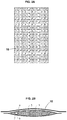
- Figure number 1 A shows a plan view of a schematic representation of an exemplary embodiment of the disposable autonomous thermal device object of the invention, showing the general external configuration thereof.
- Figure number 1B shows a cross-sectional view, according to a cross-sectional cut, of the example of the device, according to the invention, shown in
Figure 1A , showing the elements that it comprises internally. - Figure number 1C shows a plan view of another example of the disposable autonomous thermal device of the invention, in this case an example with a double container.
- Figures number 2A and 2B show, respectively, a plan view of an example of the heat shield comprising the device according to the invention, and a cross-sectional view of said shield incorporated on the container of the device.
- Figure number 3A shows a schematic perspective view of an example of the thermal cover that the device comprises.
- Figures number 3B, 3C, 3D and 3E show perspective views of the cover shown in
Figure 3A , in respective options for the embodiment thereof with velcro, roll-up, with a pocket, and with magnets. - Figures number 3F, 3G and 3H show respective plan views of the cover with upper and lower tabs, with lateral tabs and with upper and lower and lateral tabs.
- Figure number 3I shows a schematic representation of the cover with accessory accessories.
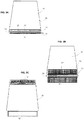
- Figures number 4A, 4B, 4C and 4D show respective top and bottom plan and perspective views of the lid and perspective view of the base of an example of an activator of the device, specifically an example to activate it with the thermal cover shown in
Figures 3A to 3I . - Figures number 4E and 4F show respective perspective views of the lid and of the base of the activator shown in
Figures 4A to 4D , once incorporated into the thermal cover. -
Figure 5A shows a schematic perspective view of a harness, as an example of elements that incorporates the thermal device of the invention. - Figures number 5B, 5C, 5D, 5E and 5F show respective views of the harness shown in
Figure 5A incorporating the device in different positions and numbers. - Figure number 5G shows a plan view of the belt of the harness shown in the preceding figures.
- And
Figures 6A and 6B show respective perspective views of the lower portion of a flat mop and of the lid of said flat mop, respectively, as an example of an applicable object to incorporate the thermal device of the invention. - In view of the aforementioned figures, and in accordance with the numbering adopted, a non-limiting example of the recommended disposable autonomous thermal device can be seen, which comprises the parts and elements indicated and described in detail below.
- Considering
Figures 1A and 1B , it can be seen how the device in question essentially comprises: - a body in the form of a container (1) comprising one or more sheets (5);
- an exothermal composition (4) incorporated into the body of the container (1), wherein the exothermal composition (4) consists of the mixture of the acidic substance and the basic substance, which can also contain moisture-absorbing materials;
- and an aqueous liquid (6) separated from the exothermal composition (4), inside or outside the container (1),
- The exothermal composition (4), although in a generic way, comprises at least:
- from 1% to 90% by weight of one or more inorganic or organic acids, an acid of any acidic salt or a mixture of same;
- from 1% to 90% by weight of one or more inorganic bases selected from one or more hydroxides or a base of any basic salt or a mixture of same;
- 1 % to 90% by weight of one or more moisture-absorbing materials, preferably, it contains:
- between 15% and 70% by weight of the acidic ingredient, more specifically between 20% and 50%, preferably a citric acid;
- between 25% and 80% by weight of the basic ingredient, more specifically between 35% and 60%, preferably a calcium hydroxide;
- and any absorbent material or materials from among particulate wood, pelletised wood, sodium polyacrylate, cellulose, starches, corn starch, potato starch, katakuri starch, collagen, agar, carrageenan, gelatin, sodium pyrophosphate, furcelleran, polysaccharides, pectin, proteins, amylum, sago, locust bean gum, xanthan gum, guar gum, vegetable gums, arrowroot, tapioca, alginine and mixtures thereof.
- It should be noted that, in an embodiment option, the exothermal composition (4) comprises from 0.5% to 40% by weight of moisture-absorbing materials, preferably between 10% by weight and 30% by weight of particulate wood.
- Said particulate wood of the exothermal composition (4) can be from silvicultural, agricultural, agro-industrial, energy or forestry species selected from the group consisting of olive pits, nut shells, fir, birch, acacia, aspen, carob, cork oak, larch, almond tree, bamboo, cedar, cypress, poplar, juniper, holm oak, eucalyptus, flamboyant, ash, fruit trees, beech, pine, walnut, elm, olive, oak, teak, among others, and mixtures thereof.
- In any case, the particulate wood preferably comprises from 1% to 20% by weight of moisture, preferably from 8% to 10% by weight of moisture.
- Furthermore, the exothermal composition (4), optionally, has a solid consistency, and can be in the form of a powder, granules, pellets or tablets, preferably in the form of a powder.
- Likewise, in an embodiment option, the ingredients of the exothermal composition (4) may be unmixed and separated from each other inside the container (1) of the device, some of which may be loose inside said container (1) and the others inside another container or inner bag of water-soluble material (not represented in the figures) as this, in turn, is inside the main container (1) of the device.
- Optionally, some of the ingredients of the exothermal composition (4), not mixed and separated in the container (1) of the device, can be inside a first container or inner bag of water-soluble material and the others inside a second container or other inner bag of water-soluble material, that is, both containers or both bags being water-soluble inside the main container (1) of the device.
- Alternatively, however, the ingredients of the exothermal composition (4) may be mixed and bonded inside the device container (1), all of which may be loose inside the main container (1) of the device or inside an inner bag of water-soluble material in turn incorporated inside said container (1) of the device.
- As for the aqueous liquid (6) comprised by the container (1) of the device, it is selected from the group consisting of water, distilled water, double distilled water, deionised water, mineral water, spring water, water with salts, brackish water, salt water, or any of the mixtures thereof, preferably distilled water.
- In any case, said aqueous liquid (6) is added to the exothermal composition (4) from 5 to 80 parts by weight of this composition, preferably from 20 to 30 parts by weight, in order to generate heat by a neutralising reaction.
- The aqueous liquid (6) is a solution with the acid, a solution with one or more bases or a solution with hydrogen peroxide or alcohol, preferably a solution with hydrogen peroxide, wherein the hydrogen peroxide of said solution preferably comprises from 0.20% by weight to 10% of the solution, and preferably from 0.50% by weight to 3% by weight of the solution.
- More specifically, the hydrogen peroxide of the solution of the aqueous liquid (6) contains a concentration of 1.5% (5 volumes) to a concentration of 50% (200 volumes), preferably between 3% (10 volumes) and 9% (45 volumes).
- As has been stated, the aqueous liquid (6) is separated from the exothermal composition (4) that contains the main container (1) of the device, for which, preferably, it is contained in a secondary container (7), it being possible for this secondary container (7) to be inside or outside the container (1) of the device, being the preferred one that is inside the same.
- In any case, the secondary container (7) is selected from the group consisting of a vial, bottle, canister, ampoule, glass, bag, terrine and syringe, being in any case preferably a breakable bag or a breakable receptacle.
- As previously stated, the aqueous liquid (6) is brought into contact with the exothermal composition (4) or manually, preferably by manual compression in an area (8) of the container (1) of the device to break the secondary container (7), or through an activating element (50) that acts by different means selected from the group comprising injection, breaking of the secondary container (7) by twisting or by mechanical compression.
- Preferably, the secondary container (7) where the aqueous liquid (6) is located comprises one or more sheets of polymeric material sealed forming a flexible bag and the materials of which are selected from the group consisting of EVOH, LDPE, MDPE, HDPE, PT/PE, Paper/AL, Paper/PE, PET/AL, PET/PE, PVC/PE, PA/PE, NY/PVDC, PE/PVDC, PP/PVDC, MOPP/PE, Paper/AL/PE, PET/AL/PE, PET/AL/PE, PET/PA/PE, BOPP/AL/PE, BOPP/PE/OPP, BOPP/VMPET/PE, PET/VMPET/PE, PET/AL/CPP, MOPP/Kraft paper/CPP, PET/AL/Paper, PET/PVDC/PE, PET/PT/PE, PT/AL/PE, Wax/Paper/PE, OP/AL/HSL, BOPP/PET/AL/PE, MOPP/PET/AL/PE, Paper/AL/Paper/PE, PT/PE/BOPP/PE, PVDC/PT/PVDC/PE, PVDC/PT/PE/AL/PE, PE/paper/PE/AL/PE/PE, nylon, other laminated coextruded polymeric materials and the combinations thereof, preferably LDPE.
- Preferably, the thickness of the polymeric material of one or more sheets of the secondary container (7) containing the aqueous liquid (6) is between 20 and 150 microns, preferably between 50 and 80 microns.
- In addition, also preferably, one or more sheets of the secondary container (7) containing the aqueous liquid (6) are hermetically heat-sealed on the perimeter thereof by means of a manual, semi-automatic or automatic sealing or packaging machine, by closing with 4 welds, 3 welds, 3 fillet welds, side folds, with square bottom or Stand-Up, with rear fold, preferably by means of automatic heat closure with 4 welds.
- And, alternatively, one or more sheets of polymeric material of the secondary container (7) containing the aqueous liquid (6) are hermetically sealed forming a closed bag.
- In addition, the secondary container (7) containing the aqueous liquid (6) can be of different sizes, logically depending on the size of the main container (1) of the device, although preferably it is 8 cm wide x 6 cm long.
- As for said container (1) of the device, it comprises one or more sheets of polymeric material sealed forming a flexible bag adaptable to the shape of any part of the human body, animal or object to be heated.
- Optionally, the main container (1) is of a water-soluble composition selected from the group consisting of Polyvinyl Alcohol (PVA/PVAL/POVH) and derivatives.
- And, when said container (1) is not water-soluble, one or more materials of the composition of the same are selected from the group consisting of EVOH, LDPE, MDPE, HDPE, PT/PE, Paper/AL, Paper/PE, PET/AL, PET/PE, PVC/PE, PA/PE, NY/PVDC, PE/PVDC, PP/PVDC, MOPP/PE, Paper/AL/PE, PET/AL/PE, PET/AL/PE, PET/PA/PE, BOPP/AL/PE, BOPP/PE/OPP, BOPP/VMPET/PE, PET/VMPET/PE, PET/AL/CPP, MOPP/Kraft paper/CPP, PET/AL/Paper, PET/PVDC/PE, PET/PT/PE, PT/AL/PE, wax/paper/PE, OP/AL/HSL, BOPP/PET/AL/PE, MOPP/PET/AL/PE, Paper/AL/Paper/PE, PT/PE/BOPP/PE, PVDC/PT/PVDC/PE, PVDC/PT/PE/AL/PE, PE/paper/PE/AL/PE/PE, nylon, other laminated co-extruded polymeric materials and the combinations thereof.
- Optionally, said the non-water-soluble polymeric material of one or more sheets (5) of the main container (1) of the device is preferably Polyester (PET) - Aluminium (AL) - Polyethylene (PE) and, the thickness of said non-water-soluble polymeric material of one or more sheets of the main container (1) of the device is between 20 and 150 microns, preferably between 80 and 100 microns.
- In any case, in an embodiment option, one or more sheets (5) of the main container (1) of the device are sealed inside same enabling subdivisions.
- Likewise, in another embodiment option, the main container (1) of the device comprises an envelope or wrapper, a vacuum bag or one or more sheets of air bubbles, although this detail has not been represented in the figures.
- Also optionally, the container (1) of the device comprises a closure system on one or more of the sides thereof, for example of the easy open type, self-closing, pressure, grip type pressure, zip type, zipper type or slider, velcro, brackets, adhesive type, funnel-type cap, heat-sealed, preferably perimeter heat-sealed.
- For this option, and in the same way that has been described for the secondary container (7), one or more sheets (5) of the main container (1) are hermetically heat-sealed on the perimeter edges (3) thereof by means of a manual, semiautomatic or automatic, preferably automatic, sealing or packaging machine by closing with 4 welds, 3 welds, 3 fillet welds, side folds, with square bottom or Stand-Up, preferably by means of automatic hermetic heat closure with 4 welds and with a Euro-Hole type perforation (2).
- And, optionally, one or more sheets (5) of polymeric material of the container (1) of the device or main container are hermetically sealed forming a closed bag with different degrees of vacuum, preferably with a high degree of vacuum.
- Furthermore, in an embodiment option, the container (1) of the device has adhered to the outside, or in the form of a non-disposable or disposable cover, support or wrapping, preferably made of non-woven fabric, which comprises, or which can be incorporated therein, pharmaceutical compounds, insecticides, essential oils and non-active and active aromatic compounds, extracts and natural plant compounds such as tea oils, neem oil, essential lemon eucalyptus oil, citronella oil, savory, garlic, basil, bergamot, cinnamon, cardamom, onion, cedar, coriander, citronella, clove, juniper, tarragon, eucalyptus, geranium, lemongrass, fennel, bay leaf, lavender, lemon, marjoram, lemon balm, mint, mustard, orange, oregano, rosewood, paprika, parsley, pine, grapefruit, rosemary, sage, soy, thyme, vanilla, etc. or mixtures thereof in order to increase the effectiveness of therapeutic uses, thermal sanitisation, to flavour, insecticide or insect repellent.
- Optionally, the container (1) of the device has means of fastening to parts of the body or objects, such as velcro, adhesive, straps, tapes and belts, among others.
- Regarding
Figure 1C , it is observed how, optionally, the container (1) of the described autonomous thermal device can be joined to the container (1) of other identical or similar autonomous thermal devices by sealing any of the edges (3) thereof, preferably at a heat-sealed seam (9), forming a single body of several of the same. - Furthermore, as mentioned, in order to cause the combination of the exothermal composition (4) of the container (1) with the aqueous liquid (6), in addition to doing so manually, the device contemplates the use of an activator element (50) that may have different configurations, for example in the form of a needle, a clamp, a striker, a threaded push button or others, which can be used either directly on the container (1) of the thermal device or through additional elements incorporated on said container (1) or in which it is housed, such as a heat shield (10) or a thermal cover (31) that are described in detail below.
- Regarding
Figures 2A and 2B , it is observed how the thermal device contemplates the existence of a heat shield (10) the purpose of which is to insulate from the cold and distribute the heat generated by the container (1) of said device, for which such shield (10) preferably comprises one or more layers of bonded superimposed materials and fabrics. - More specifically and preferably, one or more materials of the layers of said heat shield (10) are selected from the group consisting of: wool, polyester, metallic materials such as silver or copper, aerogel, neoprene, wool wadding, acetate, polyester or cotton, among others and any of the mixtures thereof, preferably three layers of neoprene, aerogel and wool.
- Preferably, one or more metallic materials of some of the layers of the heat shield (10) are silver or copper, in percentages of 5 to 100%, preferably in percentages of these metals between 5 and 40%, for one or the 2 faces.
- Preferably, one or more superimposed layers of the heat shield (10) are joined by any joining system, selected from the group consisting of: stitching, buttons, clasps, zip, velcro, laces and eyelets, studs, glue, hot-melt spray, glue, heat sealing, among others, depending on the object or garment to which it is adhered.
- Furthermore, said heat shield (10) can be incorporated and coupled to the device in any non-textile or textile object, item of clothing for people or animals already marketed, such as: pockets, bags, covers for tablets, mobiles and other electronic devices, computers or tablets keyboards, rigid and flexible containers, baby bottle warmers, beverage container warmers, warmers for plates, cutlery, glasses and food, food containers, mops, tiles, rugs, mats, mattresses, air mattresses, beds, bed covers, pillowcases, cots, puffs, seats, chairs, easy chairs, armchairs, cushions, protective seat covers, laundry baskets, tents, sleeping bags for babies, sleeping bags, rucksacks, stuffed animals, toy dolls, hats, caps, neck pads, pillows, anti-mite pillows, scarves, collars, capes, spinal tapes, shoulder pads, harnesses, girdles, bum bags, lumbar pads, elbow pads, mittens, gloves, shoe insoles, socks, hand and foot warmers, trousers, knee braces, ankle braces, boots, pyjamas, dressing gowns, towels, bathrobes, blankets, quilts, vests, life jackets, surf life jackets, bulletproof vests, tactical vests, reflective vests, hunting vests, baseball jackets, raincoats, diving suits, divers suits, pilot suits, astronaut suits, ski suits, cat and dog clothes, cat and dog beds, cushion-pillows for dogs and cats, kennels for dogs and cats, cave-beds for dogs and cats, carriers for dogs and cats, rugs for horses, ovens, vibrators, sex dolls, walls, robot vacuum cleaners and mop robots, among others.
- In any case, the heat shield (10) can be located on the objects and items of clothing in the areas near the thermal device and, preferably, covering or located on the container (1) itself of the device. In addition, it can be manufactured in the shape of objects or items of clothing such as a scarf, neck brace, shoulder pads, elbow pads, belt, harnesses, gloves, foot insoles, sleeves, vests, girdles, bum bags, blankets, knee braces, trousers, ankle braces, shoe insoles, socks, towels, among others.
- Regarding
Figures 3A to 3I , it is observed that the device additionally contemplates the existence of a cover (31), specifically a thermal cover in order to distribute the heat generated by the described thermal device to any object or parts thereof, surfaces, living beings, food or beverages. In addition, depending on the option of carrying out the same, it can be manufactured for purposes such as: heating, conserving heat, drying and defrosting, among others and, optionally, for the purpose of thermal sanitisation of any object, living beings or parts of any thereof, surfaces, food or beverages in order to eliminate mites, microorganisms, insects, fungi and ectoparasites, or for therapeutic uses based on heat on people and animals such as: anti-inflammatory and analgesic for any part of the body including injuries to muscles, ligaments and tendons, menstrual pain, hypothermia, pharyngitis, snoring and contractures, or to vaporise molecules, substances or compounds in order to eliminate or repel mites, microorganisms, insects, ectoparasites and fungi, or to vaporise substances or compounds used in allergies, nasal and bronchial congestion, sneezing, cough, pharyngitis, hiccups or singultus and snoring, or for the purpose of aromatising, perfuming, deodorising or purifying environments. Likewise, a possible use of the cover (31), in one of its embodiment options, is suitable for use thereof to produce electricity in order to charge batteries and electrical or electronic devices. - For this, said cover (31) comprises one or more insulating sheets (34) between which a hollow (33) is defined that houses the container (1) of the autonomous thermal device and a closure system.
- Preferably, said one or more sheets (34) are made of one or more types of materials selected from the group comprising polymers of inorganic, natural organic and synthetic organic origin.
- Optionally, one or more sheets (34) are made of materials selected from the group consisting of polyurethane or polyester or PVC or polyethylene foam; in foams or agglomerate or extruded or in memory foam; elastomers such as neoprene, lycra or spandex; cork, cardboard, rubber, aerogel, or they consist of a fabric or mesh (35) that incorporates metallic materials such as silver or copper, in percentages of 5 to 100%, preferably in percentages of these metals between 5 and 40%, or mixtures thereof.
- In the preferred embodiment, the cover (31) has one or two polyurethane foam sheets (34), in this second case being separated leaving a hollow (33) that houses the autonomous thermal device.
- Preferably said polyurethane foam sheets (34) are of a thickness between 1 mm and 300 mm, preferably two sheets, it being possible for the thicknesses of both sheets to be the same or different, preferably both of the same thickness of between 5 and 12 mm.
- Preferably, one or both polyurethane foam sheets (34) has (have) a density between 5 kg/m3 and 70 kg/m3, preferably between 10 kg/m3 and 30 kg/m3.
- Preferably, one or both of the polyurethane foam sheets (34) are hard or soft, preferably soft and very flexible, which allows it to adapt to any shape depending on the use thereof.
- Optionally, the cover (31) is covered on the inside thereof, outside thereof or both by a fabric or a mesh (35).
- Preferably, one or more materials of the fabric or mesh (35) that cover it are selected from the group consisting of any natural textile material such as cotton, wool, silk, leather, micro-wool and linen among others, or synthetics such as polyamide, nylon, polyester, PVC, trilaminate, tetralaminate, Gore-tex®, vinyl, neoprene, PU, lycra or spandex, copper or silver metallic fabrics, silicone, latex, neoprene, anti-mite fabric, polyester, aerogel, non-woven fabric, aluminised plastic or not, nylon, vinyl among others or any of the mixtures thereof.
- Optionally, the cover (31) contains, on said fabric or mesh (35), an additional covering selected from the group consisting of any textile material, preferably neoprene.
- In any case, preferably, the fabric or mesh (35) with which the cover (31) is covered inside, outside or both contains metallic materials such as silver or copper, in percentages from 5 to 100%, preferably in percentages of these metals between 5 and 40%.
- In one embodiment option, the arrangement of the sheets or layers of insulating material (34) and fabric (35) is preferably: a sheet of foam rubber covered by fabric on both faces, a hollow (33) that houses the container (1) of the autonomous thermal device and a sheet of aerogel covered by fabric on both faces.
- One or more sheets can be made of foamed fabric comprising the fabric and the polyurethane foam sheet.
- In any case, the cover (31) can be of any size, according to all the possible and multiple uses as well as according to the number of thermal devices that it incorporates, preferably a size of 150 mm x 250 mm for each thermal device.
- In addition, it can have different shapes such as square, rectangular, semi-circular-straight and round, among others.
- Likewise, the cover (31) can be single-use or reusable, preferably washable and reusable multiple times.
- Furthermore, as a closure system, the cover (31) preferably comprises a zip (32) (
Figure 3A ), velcro (36), a flap with velcro (37) (Figure 3B ), magnets, clasps, snaps or others to insulate inside the thermal device. - In addition, as can be seen in
Figures 3F to 3H , the cover (31) has a configuration that comprises one or more tabs in the upper (41), lower (42) and lateral (43) position, with closure systems, preferably velcro and that serve to adhere and adjust to certain objects such as the straps (219) of a harness as shown inFigures 5A to 5G , or to parts of the body. - Optionally, it comprises other types of fastening systems to fasten or adapt to the body of people, animals, items of clothing, bedding, sleeping bags, harnesses and any object to be heated, selected from the group consisting of straps, tapes, belts, velcro, glue, adhesive, or for example a magnetic sheet (39) or magnets (40) as shown in
Figure 3E , or with buckles, stitching, etc. - In the aforementioned
Figure 3E , it is observed how the cover (31), in one embodiment option, comprises a magnetic sheet (39) or a magnet (40) on the outside or inside thereof to fix or adapt to the body of people, animals, items of clothing, bedding, sleeping bags, harnesses and any object to be heated when it comes into contact with another magnetic sheet or other magnet on the external face of the object or garment to which it is fastened. - Optionally, the cover (31) can also comprise an anti-radiation pocket (38), represented in
Figure 3D , made of any of the current commercial materials, preferably sewn thereto, to prevent radiation from mobile devices and theft of data of same or of bank cards, etc. - Optionally, the cover (31) contains the heat shield (10) described above, as well as other complementary elements or devices, for example, as shown in
Figure 3I , it contains a temperature indicator (44) and/or contains one or more photovoltaic electrical generators (45) to generate and supply electrical energy to charge any battery or directly any electronic mobile device such as mobile phones, computers or tablets among others, or any electrical or electronic apparatus. - Optionally, it can also contain one or more thermoelectric generators (46), preferably one or more Peltier plates that use the heat generated by the thermal device, the container (1) of which is incorporated in the cover (31), by means of the Seebeck effect to generate and supply electrical energy to charge any battery or directly any electronic mobile device such as mobile phones, computers or tablets among others, or any electrical or electronic apparatus.
- Preferably, although it has not been represented, it also comprises one or more terminals for charging electronic devices and/or one or more batteries.
- Optionally, instead of the container (1) as indicated in the previous paragraphs, the cover (31) is the one that contains a non-disposable or disposable wrapping that comprises, or which can be incorporated therein, pharmaceutical compounds, insecticides, essential oils and non-active and active aromatic compounds, extracts and natural plant compounds such as tea oils, neem oil, essential lemon eucalyptus oil, citronella oil, savory, garlic, basil, bergamot, cinnamon, cardamom, onion, cedar, coriander, citronella, clove, juniper, tarragon, eucalyptus, geranium, lemongrass, fennel, bay leaf, lavender, lemon, marjoram, lemon balm, mint, mustard, orange, oregano, rosewood, paprika, parsley, pine, grapefruit, rosemary, sage, soy, thyme, vanilla, etc. or mixtures thereof.
- Furthermore, as indicated in previous paragraphs, the device optionally comprises the inclusion of activator elements (50) of the device, applicable directly on the container (1) thereof, or through accessory elements. In this sense, as shown in
Figures 4A to 4F , in an embodiment option the invention comprises an activator (50) applicable on the cover (31) described, which comprises a lid (47) with one or more strikers (48) and a base (49), both joined on the outside of the opposite faces of the thermal cover (31), in such a way that, when the lid (47) is pressed, the striker or strikers (48) pass through the thermal cover (31), the sheet (5) of the container (1) of the thermal device and the secondary container (7), and the aqueous liquid (6) comes out contacting the reagents of the exothermal composition (4) activating the exothermal reaction. - In any case, the cover (31) can be manufactured in the shape of any part of the body of people or animals in order to be directly coupled to same.
- Likewise, it can be manufactured in the shape of objects or items of clothing such as a scarf, neck brace, shoulder pads, elbow pads, belt, harnesses, gloves, foot insoles, sleeves, vests, girdles, bum bags, blankets, knee braces, trousers, ankle braces, shoe insoles, socks, towels, among others.
- In the same way, it can be incorporated and attached to any non-textile or textile object, item of clothing for people or animals.
- Thus, as can be seen in
Figures 5A to 5G , in a possible application option of the device of the invention, the container (1) can be incorporated, housed in the cover (31) and including or not the heat shield (10), to the straps (219) of a harness to attach it to the body of a user. - More specifically, said harness can be one that has two straps (219) that extend from the front portion of the body to the rear portion, passing over the shoulders, crossing at the neck or not, preferably not crossed, and incorporating one or more thermal covers (31) that house the container (1) of the autonomous thermal device of the invention, for which said cover or covers have fastening systems to fasten or adapt to the harness, such as velcro, glue, adhesive, snaps, zip, sewn, wings or extensions, etc., on two or the four sides thereof, preferably forming part of the body of the cover and sewn to the straps and in such a way that they have different positions and at different heights thanks to the mobility thereof along the straps of the harness, preferably front, rear, right or left lateral positions or any combination thereof, and chest, abdominal, back areas, lumbar region and hips and at any height.
- Optionally, the harness has a third strap (220) that is fastened to one of the right or left straps (219) by means of fastening and adjustment systems at both ends, such as carabiners, rings, velcro or buckles, preferably by adjustable buckles (221). Furthermore, preferably, each of the two straps is fitted to a belt (225) by means of an adjustable adjustment buckle (222).
- Optionally, both the two straps (219) of the harness and one or more thermal covers (31) contain accessories such as material-holder rings (223), padded protectors (224), pockets, carabiners and pins.
- Finally, as can be seen in
Figures 6A and 6B , the thermal device of the invention, in a non-limiting embodiment option, for the application thereof housed in an object, is incorporated in a mop that comprises a body (133) provided with a hollow to house the container (1) of said device with a closing lid (138), turning it into a thermal mop. - Preferably, the material of the body and cover of said thermal mop is selected from the group consisting of gold, silver, platinum, copper, aluminium, iron, lead, steel, tin, zinc, nickel, magnesium, manganese, titanium, beryllium or any of the alloys thereof, ceramics or ceramic matrix composites with high thermal conductivity, carbon or graphite or any type of plastic.
- Optionally, in addition, it can incorporate one or more sheets made of insulating materials, preferably polyurethane foam, on the base of the inner faces of the body (133) and of the lid (139), with a thickness of 10 to 40 mm, of preferably 30 mm and on the walls of both with a thickness of 10 to 40 mm, preferably 20 mm and a density of 20 kg/m2 to 50 kg/m2, preferably 30 kg/m2, in both parts.
- Optionally, it comprises one or more thermal covers (31) forming part of the body of the thermal mop, as well as the heat shield (10) and/or some other type of insulating sheet (134).
- The mop comprises a telescopic or non-telescopic pole (135) that is fastened to the mop body by means of a frame or a threaded piece, preferably by means of a threaded piece (136).
- In any case, the body (133) of the mop contains fastening systems of the autonomous thermal device, such as an independent frame with tabs or grate that is fixed to the base of the container, preferably tabs (137) on the lower edge of the body.
- The body (133) is adjusted to the lid (138) by means of a pressure closure system, velcro, snaps, lever with or without a padlock or any other, preferably by pressure and can contain an automated motorised robot with wheels.
- Optionally, it can also have a temperature indicator, preferably with an acoustic alarm.
- Logically, on the body (133) of the mop there may be fastened a disposable or non-disposable mop made of materials selected from the group consisting of microfibre, polyester, cotton, non-woven fabric, preferably silver or copper metallised fabric, or any other material used for the manufacture of disposable or non-disposable mops, as well as having the shapes and sizes of both the body and the lid to adapt to any type of domestic or professional mop, serving for the cleaning and thermal sanitisation of any surface in order to eliminate mites, microorganisms, insects, ectoparasites and fungi, or to vaporise molecules, substances or compounds on said surfaces.
- Having sufficiently described the nature of the present invention, as well as the ways of implementing it, it is not considered necessary to extend its explanation for any expert in the state of the art to understand its scope and the advantages which derive from it, stating that it may be implemented in other embodiments that differ in detail from that indicated by way of example provided the fundamentals are not modified.
Claims (78)
- A DISPOSABLE AUTONOMOUS THERMAL DEVICE characterised in that it comprises:- a body in the form of a container (1) comprising one or more sheets (5);- an exothermal composition (4), incorporated into the body of the container (1), wherein the exothermal composition (4) comprises:- from 1% to 90% by weight of one or more inorganic or organic acids, an acid of any acidic salt or a mixture of same;- from 1% to 90% by weight of one or more inorganic bases selected from one or more hydroxides or a base of any basic salt or a mixture of same;- from 1% to 90% by weight of one or more moisture-absorbing materials;- and an aqueous liquid (6) separated from the exothermal composition (4), inside or outside the container (1),wherein, when the exothermal composition (4) of the container (1) is combined with the aqueous liquid (6), manually or by means of an auxiliary activating element (50), an exothermal neutralising reaction is produced.
- THE DISPOSABLE AUTONOMOUS THERMAL DEVICE, according to claim 1, characterised in that the exothermal composition (4) contains between 15% and 70% by weight of the acidic ingredient.
- THE DISPOSABLE AUTONOMOUS THERMAL DEVICE, according to claim 2, characterised in that the exothermal composition (4) contains between 20% and 50% by weight of the acidic ingredient.
- THE DISPOSABLE AUTONOMOUS THERMAL DEVICE, according to any of claims 1 to 3, characterised in that the exothermal composition (4) contains, as an acidic ingredient, a citric acid.
- THE DISPOSABLE AUTONOMOUS THERMAL DEVICE, according to any of claims 1 to 4, characterised in that the exothermal composition (4) contains between 25% and 80% by weight of the basic ingredient.
- THE DISPOSABLE AUTONOMOUS THERMAL DEVICE, according to claim 2, characterised in that the exothermal composition (4) contains between 35% and 60% by weight of the basic ingredient.
- THE DISPOSABLE AUTONOMOUS THERMAL DEVICE, according to any of claims 1 to 6, characterised in that the exothermal composition (4) contains a calcium hydroxide as a basic ingredient.
- THE DISPOSABLE AUTONOMOUS THERMAL DEVICE, according to any of claims 1 to 7, characterised in that the exothermal composition (4) comprises from 0.5% to 40% by weight of moisture-absorbing materials.
- THE DISPOSABLE AUTONOMOUS THERMAL DEVICE, according to any of claims 1 to 8, characterised in that the moisture-absorbing material or materials containing the exothermal composition (4) are selected from any from among particulate wood, pelletised wood, sodium polyacrylate, cellulose, starches, corn starch, potato starch, katakuri starch, collagen, agar, carrageenan, gelatin, sodium pyrophosphate, furcelleran, polysaccharides, pectin, proteins, amylum, sago, locust bean gum, xanthan gum, guar gum, vegetable gums, arrowroot, tapioca, alginine and mixtures thereof.
- THE DISPOSABLE AUTONOMOUS THERMAL DEVICE, according to claim 9, characterised in that the exothermal composition (4) comprises between 10% and 30% by weight of particulate wood.
- THE DISPOSABLE AUTONOMOUS THERMAL DEVICE, according to claim 10, characterised in that the particulate wood of the exothermal composition (4) can be from silvicultural, agricultural, agro-industrial, energy or forestry species selected from the group consisting of olive pits, nut shells, fir, birch, acacia, aspen, carob, cork oak, larch, almond tree, bamboo, cedar, cypress, poplar, juniper, holm oak, eucalyptus, flamboyant, ash, fruit trees, beech, pine, walnut, elm, olive, oak, teak, among others, and mixtures thereof.
- THE DISPOSABLE AUTONOMOUS THERMAL DEVICE, according to claim 11, characterised in that the particulate wood comprises from 1% to 20% by weight of moisture.
- THE DISPOSABLE AUTONOMOUS THERMAL DEVICE, according to any of claims 1 to 12, characterised in that the exothermal composition (4) has a solid consistency, with the possibility of being in the form of powder, granules, pellets or tablets.
- THE DISPOSABLE AUTONOMOUS THERMAL DEVICE, according to any of claims 1 to 13, characterised in that the ingredients of the exothermal composition (4) are unmixed and separated from each other inside the container (1) of the device, some being loose inside said container (1) and the others inside another container or inner bag of water-soluble material that, in turn, is inside the main container (1) of the device.
- THE DISPOSABLE AUTONOMOUS THERMAL DEVICE, according to any of claims 1 to 13, characterised in that the ingredients of the exothermal composition (4) are unmixed and separated from each other inside the container (1) of the device, some being inside a first container or inner bag of water-soluble material and the others inside a second container or other inner bag of water-soluble material.
- THE DISPOSABLE AUTONOMOUS THERMAL DEVICE, according to any of claims 1 to 13, characterised in that the ingredients of the exothermal composition (4) are mixed and bonded inside the container (1) of the device.
- THE DISPOSABLE AUTONOMOUS THERMAL DEVICE, according to claim 16, characterised in that the ingredients of the exothermal composition (4) are mixed and bonded inside an inner bag of water-soluble material incorporated in turn inside said container (1) of the device.
- THE DISPOSABLE AUTONOMOUS THERMAL DEVICE, according to any of claims 1 to 17, characterised in that the aqueous liquid (6) comprised by the container (1) of the device is selected from the group consisting of water, distilled water, double distilled water, deionised water, mineral water, spring water, water with salts, brackish water, salt water, or any of the mixtures thereof, preferably distilled water.
- THE DISPOSABLE AUTONOMOUS THERMAL DEVICE, according to any of claims 1 to 18, characterised in that the aqueous liquid (6) is added to the exothermal composition (4) from 5 to 80 parts by weight of this composition in order to generate the heat by a neutralising reaction.
- THE DISPOSABLE AUTONOMOUS THERMAL DEVICE, according to claim 19, characterised in that the aqueous liquid (6) is added from 20 to 30 parts by weight.
- THE DISPOSABLE AUTONOMOUS THERMAL DEVICE, according to any of claims 1 to 20, characterised in that the aqueous liquid (6) is a solution with the acid, a solution with one or more bases or a solution with hydrogen peroxide or alcohol.
- THE DISPOSABLE AUTONOMOUS THERMAL DEVICE, according to claim 21, characterised in that the aqueous liquid (6) is a solution with hydrogen peroxide, wherein the hydrogen peroxide of said solution comprises from 0.20% by weight to 10% of the solution.
- THE DISPOSABLE AUTONOMOUS THERMAL DEVICE, according to claim 12, characterised in that the aqueous liquid (6) contains a concentration of 1.5% (5 volumes) to a concentration of 50% (200 volumes).
- THE DISPOSABLE AUTONOMOUS THERMAL DEVICE, according to any of claims 1 to 23, characterised in that the aqueous liquid (6) is contained in a secondary container (7) to the main container (1) of the device.
- THE DISPOSABLE AUTONOMOUS THERMAL DEVICE, according to claim 24, characterised in that the secondary container (7) is inside the main container (1).
- THE DISPOSABLE AUTONOMOUS THERMAL DEVICE, according to claim 24 or 25, characterised in that the secondary container (7) is selected from the group consisting of a vial, bottle, canister, ampoule, glass, bag, terrine and syringe, being in any case preferably a breakable bag or a breakable receptacle.
- THE DISPOSABLE AUTONOMOUS THERMAL DEVICE, according to claim 26, characterised in that the secondary container (7) where the aqueous liquid (6) is located comprises one or more sheets of polymeric material sealed forming a flexible bag with a thickness between 20 and 150 microns.
- THE DISPOSABLE AUTONOMOUS THERMAL DEVICE, according to any of claims 1 to 27, characterised in that the main container (1) of the device comprises one or more sheets (5) of polymeric material sealed forming a flexible bag adaptable to the shape of any part of the human body, animal or object to be heated.
- THE DISPOSABLE AUTONOMOUS THERMAL DEVICE, according to claim 28, characterised in that the main container (1) is of a water-soluble composition selected from the group consisting of Polyvinyl Alcohol (PVA/PVAL/POVH) and derivatives.
- THE DISPOSABLE AUTONOMOUS THERMAL DEVICE, according to claim 28, characterised in that said container (1) is not water-soluble.
- THE DISPOSABLE AUTONOMOUS THERMAL DEVICE, according to claim 30, characterised in that one or more sheets (5) of the main container (1) of the device is Polyester (PET) - Aluminium (AL) - Polyethylene (PE) and, the thickness of said polymeric material and the thickness is between 20 and 150 microns.
- THE DISPOSABLE AUTONOMOUS THERMAL DEVICE, according to any of claims 1 to 31, characterised in that one or more sheets (5) of the main container (1) of the device are sealed inside same enabling subdivisions.
- THE DISPOSABLE AUTONOMOUS THERMAL DEVICE, according to any of claims 1 to 32, characterised in that the container (1) comprises an envelope or wrapper, a vacuum bag or one or more sheets of air bubbles.
- THE DISPOSABLE AUTONOMOUS THERMAL DEVICE, according to any of claims 1 to 33, characterised in that the container (1) comprises a closure system on one or more sides thereof.
- THE DISPOSABLE AUTONOMOUS THERMAL DEVICE, according to any of claims 1 to 31, characterised in that one or more sheets (5) of polymeric material of the container (1) of the device or main container are hermetically sealed forming a closed bag with a high degree of vacuum.
- THE DISPOSABLE AUTONOMOUS THERMAL DEVICE, according to any of claims 1 to 35, characterised in that the container (1) has adhered to the outside, or in the form of a cover, support or wrapping that comprises, or which can be incorporated therein, pharmaceutical compounds, insecticides, essential oils and non-active and active aromatic compounds, extracts and natural plant compounds such as tea oils, neem oil, essential lemon eucalyptus oil, citronella oil, savory, garlic, basil, bergamot, cinnamon, cardamom, onion, cedar, coriander, citronella, clove, juniper, tarragon, eucalyptus, geranium, lemongrass, fennel, bay leaf, lavender, lemon, marjoram, lemon balm, mint, mustard, orange, oregano, rosewood, paprika, parsley, pine, grapefruit, rosemary, sage, soy, thyme, vanilla, etc. or mixtures thereof in order to increase the effectiveness of therapeutic uses, thermal sanitisation, to flavour, insecticide or insect repellent.
- THE DISPOSABLE AUTONOMOUS THERMAL DEVICE, according to any of claims 1 to 36, characterised in that the container (1) has means of fastening to parts of the body or objects, such as velcro, adhesive, straps, tapes and belts, among others.
- THE DISPOSABLE AUTONOMOUS THERMAL DEVICE, according to any of claims 1 to 39, characterised in that the container (1) is joined to the container (1) of other identical or similar autonomous thermal devices, forming a single body of several of the same.
- THE DISPOSABLE AUTONOMOUS THERMAL DEVICE, according to any of claims 1 to 38, characterised in that it further comprises a heat shield (10) that insulates from the cold and distributes the heat generated by the container (1) of said device, which comprises one or more layers of bonded superimposed materials and fabrics.
- THE DISPOSABLE AUTONOMOUS THERMAL DEVICE, according to claim 39, characterised in that one or more materials of the layers of said heat shield (10) are selected from the group consisting of: wool, polyester, metallic materials such as silver or copper, aerogel, neoprene, wool wadding, acetate, polyester or cotton, among others and any of the mixtures thereof, preferably three layers of neoprene, aerogel and wool.
- THE DISPOSABLE AUTONOMOUS THERMAL DEVICE, according to claim 40, characterised in that one or more metallic materials of any of the layers of the heat shield (10) are silver or copper, in percentages from 5 to 100%, on one or the two faces.
- THE DISPOSABLE AUTONOMOUS THERMAL DEVICE, according to any of claims 39 to 41, characterised in that one or more superimposed layers of the heat shield (10) are joined by any joining system, selected from the group consisting of: stitching, buttons, clasps, zip, velcro, laces and eyelets, studs, glue, hot-melt spray, glue, heat sealing, among others, depending on the object or garment to which it is adhered.
- THE DISPOSABLE AUTONOMOUS THERMAL DEVICE, according to any of claims 39 to 42, characterised in that said heat shield (10) is incorporated and coupled to any non-textile or textile object, item of clothing for people or animals already marketed, located on them in the areas near the thermal device, covering or located on the container (1).
- THE DISPOSABLE AUTONOMOUS THERMAL DEVICE, according to any of claims 39 to 41, characterised in that the heat shield (10) is manufactured in the shape of objects or items of clothing.
- THE DISPOSABLE AUTONOMOUS THERMAL DEVICE, according to any of claims 1 to 44, characterised in that it further comprises a thermal cover (31) that distributes the heat generated by the thermal device to any object or parts thereof, surfaces, living beings, food or beverages, which comprises one or more insulating sheets (34) between which a hollow (33) is defined that houses the container (1) of the device and a closure system.
- THE DISPOSABLE AUTONOMOUS THERMAL DEVICE, according to claim 45, characterised in that said one or more sheets (34) are made of one or more types of materials selected from the group comprising polymers of inorganic, natural organic and synthetic organic origin.
- THE DISPOSABLE AUTONOMOUS THERMAL DEVICE, according to claim 46, characterised in that one or more sheets (34) are made of materials selected from the group consisting of polyurethane or polyester or PVC or polyethylene foam; in foams or agglomerate or extruded or in memory foam; elastomers such as neoprene, lycra or spandex; cork, cardboard, rubber, aerogel, or they consist of a fabric or mesh (35) that incorporates metallic materials such as silver or copper, in percentages of 5 to 100%, preferably in percentages of these metals between 5 and 40%, or mixtures thereof.
- THE DISPOSABLE AUTONOMOUS THERMAL DEVICE, according to claim 47, characterised in that the cover (31) has polyurethane foam sheets (34), which are separated leaving a hollow (33) that houses the container (1) of the device; being arranged such that there is a sheet of foam rubber covered by fabric on both faces, a hollow (33) that houses the container (1) of the autonomous thermal device and a sheet of aerogel covered by fabric on both faces.
- THE DISPOSABLE AUTONOMOUS THERMAL DEVICE, according to claim 48, characterised in that said polyurethane foam sheets (34) have a thickness of between 1 mm and 300 mm and have a density between 5 kg/m3 and 70 kg/m3, preferably between 10 kg/m3 and 30 kg/m3.
- THE DISPOSABLE AUTONOMOUS THERMAL DEVICE, according to claim 49, characterised in that one or both polyurethane foam sheets (34) are of the very flexible soft type.
- THE DISPOSABLE AUTONOMOUS THERMAL DEVICE, according to any of claims 45 to 50, characterised in that the cover (31) is covered inside, outside or both by a fabric or a mesh (35) wherein one or more materials of said fabric or mesh (35) are selected from the group consisting of any natural textile material such as cotton, wool, silk, leather, micro-wool and linen among others, or synthetics such as polyamide, nylon, polyester, PVC, trilaminate, tetralaminate, Gore-tex®, vinyl, neoprene, PU, lycra or spandex, copper or silver metallic fabrics, silicone, latex, neoprene, anti-mite fabric, polyester, aerogel, non-woven fabric, aluminised plastic or not, nylon, vinyl among others or any of the mixtures thereof.
- THE DISPOSABLE AUTONOMOUS THERMAL DEVICE, according to claim 51, characterised in that the cover (31) contains, on said fabric or mesh (35), an additional neoprene coating.
- THE DISPOSABLE AUTONOMOUS THERMAL DEVICE, according to claim 51 or 52, characterised in that the fabric or mesh (35) contains metallic materials such as silver or copper, in percentages of 5 and 40%.
- THE DISPOSABLE AUTONOMOUS THERMAL DEVICE, according to any of claims 45 to 53, characterised in that the cover (31) comprises a zip (32), velcro (36), a flap with velcro (37), magnets, clasps, snaps or others to insulate inside the thermal device.
- THE DISPOSABLE AUTONOMOUS THERMAL DEVICE, according to any of claims 45 to 54, characterised in that it comprises fastening systems to fasten or adapt to the body of people, animals, items of clothing, bedding, sleeping bags, harnesses and any object to be heated, selected from the group consisting of straps, tapes, belts, velcro, glue, adhesive, or a magnetic sheet (39) or magnets (40), or with buckles, sewing, etc.
- THE DISPOSABLE AUTONOMOUS THERMAL DEVICE, according to claim 55, characterised in that the cover (31) has a configuration that comprises one or more tabs in the upper (41), lower (42) and lateral (43) position, with closure systems, that serve to adhere and adjust to objects such as straps (219) of a harness.
- THE DISPOSABLE AUTONOMOUS THERMAL DEVICE, according to any of claims 45 to 56, characterised in that the cover (31) comprises an anti-radiation pocket (38), to prevent radiation from mobile devices and theft of data of same or of bank cards, etc.
- THE DISPOSABLE AUTONOMOUS THERMAL DEVICE, according to any of claims 45 to 57, characterised in that the cover (31) contains a heat shield (10) as described in claims 39 to 44.
- THE DISPOSABLE AUTONOMOUS THERMAL DEVICE, according to any of claims 45 to 58, characterised in that the cover (31) contains a temperature indicator (44).
- THE DISPOSABLE AUTONOMOUS THERMAL DEVICE, according to any of claims 45 to 59, characterised in that the cover (31) contains one or more photovoltaic electrical generators (45) to generate and supply electrical energy to charge any battery or directly any electronic mobile device such as mobile phones, computers or tablets among others, or any electrical or electronic apparatus.
- THE DISPOSABLE AUTONOMOUS THERMAL DEVICE, according to any of claims 45 to 60, characterised in that the cover (31) contains one or more thermoelectric generators (46) that use the heat generated by the thermal device, the container (1) of which is incorporated in said cover (31) to generate and supply electrical energy to charge any battery or directly any electronic mobile device such as mobile phones, computers or tablets among others, or any electrical or electronic apparatus.
- THE DISPOSABLE AUTONOMOUS THERMAL DEVICE, according to any of claims 60 or 61, characterised in that the cover (31) contains one or more terminals for charging electronic devices and/or one or more batteries.
- THE DISPOSABLE AUTONOMOUS THERMAL DEVICE, according to any of claims 45 to 62, characterised in that the cover (31) contains a wrapping that comprises, or which can be incorporated therein, pharmaceutical compounds, insecticides, essential oils and non-active and active aromatic compounds, extracts and natural plant compounds such as tea oils, neem oil, essential lemon eucalyptus oil, citronella oil, savory, garlic, basil, bergamot, cinnamon, cardamom, onion, cedar, coriander, citronella, clove, juniper, tarragon, eucalyptus, geranium, lemongrass, fennel, bay leaf, lavender, lemon, marjoram, lemon balm, mint, mustard, orange, oregano, rosewood, paprika, parsley, pine, grapefruit, rosemary, sage, soy, thyme, vanilla, etc. or mixtures thereof.
- THE DISPOSABLE AUTONOMOUS THERMAL DEVICE, according to any of claims 45 to 63, characterised in that it comprises an activator (50) applicable to the cover (31) which comprises a lid (47) with one or more strikers (48) and a base (49), both joined on the outside of the opposite faces of the thermal cover (31), in such a way that, when the lid (47) is pressed, the striker or strikers (48) pass through the thermal cover (31), the sheet (5) of the container (1) of the thermal device and the secondary container (7), and the aqueous liquid (6) comes out contacting the reagents of the exothermal composition (4) activating the exothermal reaction.
- THE DISPOSABLE AUTONOMOUS THERMAL DEVICE, according to any of claims 45 to 64, characterised in that the cover (31) is manufactured in the shape of any part of the body of people or animals in order to be directly coupled to same.
- THE DISPOSABLE AUTONOMOUS THERMAL DEVICE, according to any of claims 45 to 64, characterised in that the cover (31) is manufactured in the shape of objects or items of clothing or to be incorporated and coupled to any non-textile or textile object, item of clothing for people or animals.
- THE DISPOSABLE AUTONOMOUS THERMAL DEVICE, according to any of claims 45 to 64, characterised in that the container (1) is incorporated, housed in the cover (31) including or not a heat shield (10), to the straps (219) of a harness to attach it to the body of a user.
- THE DISPOSABLE AUTONOMOUS THERMAL DEVICE, according to claim 67, characterised in that the two straps (219) of the harness and/or one or more thermal covers (31) incorporated into said harness contain accessories such as material-holder rings (223), padded protectors (224), pockets, carabiners and pins.
- THE DISPOSABLE AUTONOMOUS THERMAL DEVICE, according to some of the preceding claims, characterised in that it is housed in an object.
- THE DISPOSABLE AUTONOMOUS THERMAL DEVICE, according to claim 69, characterised in that it is incorporated into an object consisting of a thermal mop that comprises a body (133) provided with a hollow to house the container (1) of the device with a closing lid (138).
- THE DISPOSABLE AUTONOMOUS THERMAL DEVICE, according to claim 70, characterised in that the material of the body and cover of said thermal mop is selected from the group consisting of gold, silver, platinum, copper, aluminium, iron, lead, steel, tin, zinc, nickel, magnesium, manganese, titanium, beryllium or any of the alloys thereof, ceramics or ceramic matrix composites with high thermal conductivity, carbon or graphite or any type of plastic.
- THE DISPOSABLE AUTONOMOUS THERMAL DEVICE, according to claim 71, characterised in that, in addition, it incorporates one or more sheets made of insulating materials, such as polyurethane foam, on the base of the inner faces of the body (133) and of the lid (139).
- THE DISPOSABLE AUTONOMOUS THERMAL DEVICE, according to any of claims 70 to 72, characterised in that it comprises one or more thermal covers (31) forming part of the body of the thermal mop.
- THE DISPOSABLE AUTONOMOUS THERMAL DEVICE, according to any of claims 70 to 73, characterised in that it comprises a heat shield (10) forming part of the body of the thermal mop.
- THE DISPOSABLE AUTONOMOUS THERMAL DEVICE, according to any of claims 70 to 74, characterised in that the body (133) of the mop contains fastening systems of the container (1) of the autonomous thermal device, such as an independent frame with tabs (137) on the lower edge of the body.
- THE DISPOSABLE AUTONOMOUS THERMAL DEVICE, according to any of claims 70 to 75, characterised in that the body (133) is adjusted to the lid (138) by means of a pressure closure system, velcro, snaps, lever with or without a padlock or other.
- THE DISPOSABLE AUTONOMOUS THERMAL DEVICE, according to any of claims 70 to 76, characterised in that the mop contains an automated motorised robot with wheels.
- THE DISPOSABLE AUTONOMOUS THERMAL DEVICE, according to any of claims 70 to 77, characterised in that the mop contains a temperature indicator with an acoustic alarm.
Applications Claiming Priority (1)
| Application Number | Priority Date | Filing Date | Title |
|---|---|---|---|
| PCT/ES2019/070156 WO2020183034A1 (en) | 2019-03-08 | 2019-03-08 | Disposable autonomous thermal device |
Publications (4)
| Publication Number | Publication Date |
|---|---|
| EP3936584A1 true EP3936584A1 (en) | 2022-01-12 |
| EP3936584A4 EP3936584A4 (en) | 2022-12-14 |
| EP3936584C0 EP3936584C0 (en) | 2025-08-13 |
| EP3936584B1 EP3936584B1 (en) | 2025-08-13 |
Family
ID=72426156
Family Applications (1)
| Application Number | Title | Priority Date | Filing Date |
|---|---|---|---|
| EP19919342.6A Active EP3936584B1 (en) | 2019-03-08 | 2019-03-08 | Disposable autonomous thermal device |
Country Status (3)
| Country | Link |
|---|---|
| EP (1) | EP3936584B1 (en) |
| ES (1) | ES3041455T3 (en) |
| WO (1) | WO2020183034A1 (en) |
Families Citing this family (1)
| Publication number | Priority date | Publication date | Assignee | Title |
|---|---|---|---|---|
| WO2022184946A1 (en) * | 2021-03-02 | 2022-09-09 | Global Termobiomasa S.L. | Multipurpose autonomous thermal device |
Family Cites Families (8)
| Publication number | Priority date | Publication date | Assignee | Title |
|---|---|---|---|---|
| JPS5552377A (en) * | 1978-10-11 | 1980-04-16 | Ito Eiichi | Heat-generating composition for pocket heater |
| JPS629151A (en) | 1985-07-04 | 1987-01-17 | Toyo Jozo Co Ltd | Heating device |
| US5205277A (en) | 1992-04-22 | 1993-04-27 | Chao Tsung Chen | Food heating technique for producing high temperature |
| BRPI0200224B1 (en) | 2002-01-24 | 2015-11-17 | José Luiz Bellix Favrin | flameless chemical heater |
| US7686840B2 (en) | 2005-12-15 | 2010-03-30 | Kimberly-Clark Worldwide, Inc. | Durable exothermic coating |
| EP2385976A4 (en) * | 2009-01-07 | 2012-08-29 | Univ South Florida | PROLONGED MODULATION OF THE TEMPERATURE OF A SELF-HEATING CHEMICAL SYSTEM |
| WO2016186226A1 (en) | 2015-05-19 | 2016-11-24 | 주식회사 하늘 | Method for preparing exothermic agent |
| EP3639797A4 (en) * | 2017-06-15 | 2021-03-24 | Ferric Inc. | RADIATOR AND METHOD OF MANUFACTURING THEREOF |
-
2019
- 2019-03-08 WO PCT/ES2019/070156 patent/WO2020183034A1/en not_active Ceased
- 2019-03-08 EP EP19919342.6A patent/EP3936584B1/en active Active
- 2019-03-08 ES ES19919342T patent/ES3041455T3/en active Active
Also Published As
| Publication number | Publication date |
|---|---|
| EP3936584A4 (en) | 2022-12-14 |
| EP3936584C0 (en) | 2025-08-13 |
| EP3936584B1 (en) | 2025-08-13 |
| WO2020183034A1 (en) | 2020-09-17 |
| ES3041455T3 (en) | 2025-11-12 |
Similar Documents
| Publication | Publication Date | Title |
|---|---|---|
| JPWO2006006655A1 (en) | Heat generating pad and method of using the same | |
| EP1782777A1 (en) | Heating cloth and process for producing the same | |
| MX2009002575A (en) | Thermal covering. | |
| JP4490971B2 (en) | Heating element | |
| US20200307892A1 (en) | Self-heated or self-cooled towel | |
| WO2017061459A1 (en) | Water vapor generation body and heating tool | |
| JPWO2006006653A1 (en) | Micro heater and manufacturing method thereof | |
| EP3936584B1 (en) | Disposable autonomous thermal device | |
| US7117816B2 (en) | Heated pet bed | |
| CN101983042A (en) | Heating element | |
| WO2014018970A1 (en) | Methods, devices and systems for thermal-based pest control | |
| WO2010012750A1 (en) | Article with refreshing or warming effect for user | |
| WO2015016281A1 (en) | Nasal congestion reliever | |
| JP4786349B2 (en) | Thermal stimulation device | |
| WO2022184946A1 (en) | Multipurpose autonomous thermal device | |
| JP3109136U (en) | Portable wrapping heater / heater | |
| AU2011101105A4 (en) | The Portacot Kozzzee | |
| KR200392118Y1 (en) | Half-vase shaped clothes with refrigerants | |
| CN213993903U (en) | Portable passive warmer heating pad blanket | |
| TWI849167B (en) | Heat generating parts | |
| JP2007275082A (en) | Exothermic pack, and its application method | |
| JP2007275083A (en) | Exothermic wrap | |
| JP3164907U (en) | Bed grip for bedridden people | |
| JP2023170628A (en) | warm pocket warmer | |
| GB2641666A (en) | Heating implement for alleviation of stiffness |
Legal Events
| Date | Code | Title | Description |
|---|---|---|---|
| STAA | Information on the status of an ep patent application or granted ep patent |
Free format text: STATUS: THE INTERNATIONAL PUBLICATION HAS BEEN MADE |
|
| PUAI | Public reference made under article 153(3) epc to a published international application that has entered the european phase |
Free format text: ORIGINAL CODE: 0009012 |
|
| STAA | Information on the status of an ep patent application or granted ep patent |
Free format text: STATUS: REQUEST FOR EXAMINATION WAS MADE |
|
| 17P | Request for examination filed |
Effective date: 20211007 |
|
| AK | Designated contracting states |
Kind code of ref document: A1 Designated state(s): AL AT BE BG CH CY CZ DE DK EE ES FI FR GB GR HR HU IE IS IT LI LT LU LV MC MK MT NL NO PL PT RO RS SE SI SK SM TR |
|
| DAV | Request for validation of the european patent (deleted) | ||
| DAX | Request for extension of the european patent (deleted) | ||
| A4 | Supplementary search report drawn up and despatched |
Effective date: 20221110 |
|
| RIC1 | Information provided on ipc code assigned before grant |
Ipc: A61F 7/08 20060101ALI20221104BHEP Ipc: C09K 5/16 20060101AFI20221104BHEP |
|
| GRAP | Despatch of communication of intention to grant a patent |
Free format text: ORIGINAL CODE: EPIDOSNIGR1 |
|
| STAA | Information on the status of an ep patent application or granted ep patent |
Free format text: STATUS: GRANT OF PATENT IS INTENDED |
|
| INTG | Intention to grant announced |
Effective date: 20250304 |
|
| GRAS | Grant fee paid |
Free format text: ORIGINAL CODE: EPIDOSNIGR3 |
|
| GRAA | (expected) grant |
Free format text: ORIGINAL CODE: 0009210 |
|
| STAA | Information on the status of an ep patent application or granted ep patent |
Free format text: STATUS: THE PATENT HAS BEEN GRANTED |
|
| AK | Designated contracting states |
Kind code of ref document: B1 Designated state(s): AL AT BE BG CH CY CZ DE DK EE ES FI FR GB GR HR HU IE IS IT LI LT LU LV MC MK MT NL NO PL PT RO RS SE SI SK SM TR |
|
| REG | Reference to a national code |
Ref country code: GB Ref legal event code: FG4D |
|
| REG | Reference to a national code |
Ref country code: CH Ref legal event code: EP |
|
| REG | Reference to a national code |
Ref country code: DE Ref legal event code: R096 Ref document number: 602019074251 Country of ref document: DE |
|
| REG | Reference to a national code |
Ref country code: IE Ref legal event code: FG4D |
|
| U01 | Request for unitary effect filed |
Effective date: 20250912 |
|
| U07 | Unitary effect registered |
Designated state(s): AT BE BG DE DK EE FI FR IT LT LU LV MT NL PT RO SE SI Effective date: 20250919 |
|
| REG | Reference to a national code |
Ref country code: ES Ref legal event code: FG2A Ref document number: 3041455 Country of ref document: ES Kind code of ref document: T3 Effective date: 20251112 |
|
| PG25 | Lapsed in a contracting state [announced via postgrant information from national office to epo] |
Ref country code: IS Free format text: LAPSE BECAUSE OF FAILURE TO SUBMIT A TRANSLATION OF THE DESCRIPTION OR TO PAY THE FEE WITHIN THE PRESCRIBED TIME-LIMIT Effective date: 20251213 |
|
| PG25 | Lapsed in a contracting state [announced via postgrant information from national office to epo] |
Ref country code: NO Free format text: LAPSE BECAUSE OF FAILURE TO SUBMIT A TRANSLATION OF THE DESCRIPTION OR TO PAY THE FEE WITHIN THE PRESCRIBED TIME-LIMIT Effective date: 20251113 |
|
| PG25 | Lapsed in a contracting state [announced via postgrant information from national office to epo] |
Ref country code: HR Free format text: LAPSE BECAUSE OF FAILURE TO SUBMIT A TRANSLATION OF THE DESCRIPTION OR TO PAY THE FEE WITHIN THE PRESCRIBED TIME-LIMIT Effective date: 20250813 |
|
| PG25 | Lapsed in a contracting state [announced via postgrant information from national office to epo] |
Ref country code: GR Free format text: LAPSE BECAUSE OF FAILURE TO SUBMIT A TRANSLATION OF THE DESCRIPTION OR TO PAY THE FEE WITHIN THE PRESCRIBED TIME-LIMIT Effective date: 20251114 |
|
| PG25 | Lapsed in a contracting state [announced via postgrant information from national office to epo] |
Ref country code: PL Free format text: LAPSE BECAUSE OF FAILURE TO SUBMIT A TRANSLATION OF THE DESCRIPTION OR TO PAY THE FEE WITHIN THE PRESCRIBED TIME-LIMIT Effective date: 20250813 |
|
| PG25 | Lapsed in a contracting state [announced via postgrant information from national office to epo] |
Ref country code: RS Free format text: LAPSE BECAUSE OF FAILURE TO SUBMIT A TRANSLATION OF THE DESCRIPTION OR TO PAY THE FEE WITHIN THE PRESCRIBED TIME-LIMIT Effective date: 20251113 |
|
| PG25 | Lapsed in a contracting state [announced via postgrant information from national office to epo] |
Ref country code: SM Free format text: LAPSE BECAUSE OF FAILURE TO SUBMIT A TRANSLATION OF THE DESCRIPTION OR TO PAY THE FEE WITHIN THE PRESCRIBED TIME-LIMIT Effective date: 20250813 |
|
| PG25 | Lapsed in a contracting state [announced via postgrant information from national office to epo] |
Ref country code: CZ Free format text: LAPSE BECAUSE OF FAILURE TO SUBMIT A TRANSLATION OF THE DESCRIPTION OR TO PAY THE FEE WITHIN THE PRESCRIBED TIME-LIMIT Effective date: 20250813 |
|
| PG25 | Lapsed in a contracting state [announced via postgrant information from national office to epo] |
Ref country code: SK Free format text: LAPSE BECAUSE OF FAILURE TO SUBMIT A TRANSLATION OF THE DESCRIPTION OR TO PAY THE FEE WITHIN THE PRESCRIBED TIME-LIMIT Effective date: 20250813 |
|
| U20 | Renewal fee for the european patent with unitary effect paid |
Year of fee payment: 8 Effective date: 20260329 |
|
| PLBE | No opposition filed within time limit |
Free format text: ORIGINAL CODE: 0009261 |
|
| STAA | Information on the status of an ep patent application or granted ep patent |
Free format text: STATUS: NO OPPOSITION FILED WITHIN TIME LIMIT |
|
| REG | Reference to a national code |
Ref country code: CH Ref legal event code: L10 Free format text: ST27 STATUS EVENT CODE: U-0-0-L10-L00 (AS PROVIDED BY THE NATIONAL OFFICE) Effective date: 20260624 |
|
| PGFP | Annual fee paid to national office [announced via postgrant information from national office to epo] |
Ref country code: ES Payment date: 20260401 Year of fee payment: 8 |
|
| 26N | No opposition filed |
Effective date: 20260515 |