EP3936347B1 - Method for producing modified conjugated diene polymer, modified conjugated diene polymer, polymer composition, crosslinked body and tire - Google Patents
Method for producing modified conjugated diene polymer, modified conjugated diene polymer, polymer composition, crosslinked body and tire Download PDFInfo
- Publication number
- EP3936347B1 EP3936347B1 EP20765609.1A EP20765609A EP3936347B1 EP 3936347 B1 EP3936347 B1 EP 3936347B1 EP 20765609 A EP20765609 A EP 20765609A EP 3936347 B1 EP3936347 B1 EP 3936347B1
- Authority
- EP
- European Patent Office
- Prior art keywords
- conjugated diene
- based polymer
- group
- compound
- modified conjugated
- Prior art date
- Legal status (The legal status is an assumption and is not a legal conclusion. Google has not performed a legal analysis and makes no representation as to the accuracy of the status listed.)
- Active
Links
Classifications
-
- C—CHEMISTRY; METALLURGY
- C08—ORGANIC MACROMOLECULAR COMPOUNDS; THEIR PREPARATION OR CHEMICAL WORKING-UP; COMPOSITIONS BASED THEREON
- C08F—MACROMOLECULAR COMPOUNDS OBTAINED BY REACTIONS ONLY INVOLVING CARBON-TO-CARBON UNSATURATED BONDS
- C08F236/00—Copolymers of compounds having one or more unsaturated aliphatic radicals, at least one having two or more carbon-to-carbon double bonds
- C08F236/02—Copolymers of compounds having one or more unsaturated aliphatic radicals, at least one having two or more carbon-to-carbon double bonds the radical having only two carbon-to-carbon double bonds
- C08F236/04—Copolymers of compounds having one or more unsaturated aliphatic radicals, at least one having two or more carbon-to-carbon double bonds the radical having only two carbon-to-carbon double bonds conjugated
- C08F236/10—Copolymers of compounds having one or more unsaturated aliphatic radicals, at least one having two or more carbon-to-carbon double bonds the radical having only two carbon-to-carbon double bonds conjugated with vinyl-aromatic monomers
-
- B—PERFORMING OPERATIONS; TRANSPORTING
- B60—VEHICLES IN GENERAL
- B60C—VEHICLE TYRES; TYRE INFLATION; TYRE CHANGING; CONNECTING VALVES TO INFLATABLE ELASTIC BODIES IN GENERAL; DEVICES OR ARRANGEMENTS RELATED TO TYRES
- B60C1/00—Tyres characterised by the chemical composition or the physical arrangement or mixture of the composition
- B60C1/0016—Compositions of the tread
-
- B—PERFORMING OPERATIONS; TRANSPORTING
- B60—VEHICLES IN GENERAL
- B60C—VEHICLE TYRES; TYRE INFLATION; TYRE CHANGING; CONNECTING VALVES TO INFLATABLE ELASTIC BODIES IN GENERAL; DEVICES OR ARRANGEMENTS RELATED TO TYRES
- B60C1/00—Tyres characterised by the chemical composition or the physical arrangement or mixture of the composition
- B60C1/0025—Compositions of the sidewalls
-
- C—CHEMISTRY; METALLURGY
- C08—ORGANIC MACROMOLECULAR COMPOUNDS; THEIR PREPARATION OR CHEMICAL WORKING-UP; COMPOSITIONS BASED THEREON
- C08C—TREATMENT OR CHEMICAL MODIFICATION OF RUBBERS
- C08C19/00—Chemical modification of rubber
- C08C19/22—Incorporating nitrogen atoms into the molecule
-
- C—CHEMISTRY; METALLURGY
- C08—ORGANIC MACROMOLECULAR COMPOUNDS; THEIR PREPARATION OR CHEMICAL WORKING-UP; COMPOSITIONS BASED THEREON
- C08C—TREATMENT OR CHEMICAL MODIFICATION OF RUBBERS
- C08C19/00—Chemical modification of rubber
- C08C19/25—Incorporating silicon atoms into the molecule
-
- C—CHEMISTRY; METALLURGY
- C08—ORGANIC MACROMOLECULAR COMPOUNDS; THEIR PREPARATION OR CHEMICAL WORKING-UP; COMPOSITIONS BASED THEREON
- C08C—TREATMENT OR CHEMICAL MODIFICATION OF RUBBERS
- C08C19/00—Chemical modification of rubber
- C08C19/30—Addition of a reagent which reacts with a hetero atom or a group containing hetero atoms of the macromolecule
- C08C19/42—Addition of a reagent which reacts with a hetero atom or a group containing hetero atoms of the macromolecule reacting with metals or metal-containing groups
- C08C19/44—Addition of a reagent which reacts with a hetero atom or a group containing hetero atoms of the macromolecule reacting with metals or metal-containing groups of polymers containing metal atoms exclusively at one or both ends of the skeleton
-
- C—CHEMISTRY; METALLURGY
- C08—ORGANIC MACROMOLECULAR COMPOUNDS; THEIR PREPARATION OR CHEMICAL WORKING-UP; COMPOSITIONS BASED THEREON
- C08F—MACROMOLECULAR COMPOUNDS OBTAINED BY REACTIONS ONLY INVOLVING CARBON-TO-CARBON UNSATURATED BONDS
- C08F4/00—Polymerisation catalysts
- C08F4/42—Metals; Metal hydrides; Metallo-organic compounds; Use thereof as catalyst precursors
- C08F4/44—Metals; Metal hydrides; Metallo-organic compounds; Use thereof as catalyst precursors selected from light metals, zinc, cadmium, mercury, copper, silver, gold, boron, gallium, indium, thallium, rare earths or actinides
- C08F4/46—Metals; Metal hydrides; Metallo-organic compounds; Use thereof as catalyst precursors selected from light metals, zinc, cadmium, mercury, copper, silver, gold, boron, gallium, indium, thallium, rare earths or actinides selected from alkali metals
- C08F4/461—Catalysts containing at least two different components covered by the same or by different subgroups of group C08F4/46, e.g. butyllithium + propylrubidium
-
- C—CHEMISTRY; METALLURGY
- C08—ORGANIC MACROMOLECULAR COMPOUNDS; THEIR PREPARATION OR CHEMICAL WORKING-UP; COMPOSITIONS BASED THEREON
- C08F—MACROMOLECULAR COMPOUNDS OBTAINED BY REACTIONS ONLY INVOLVING CARBON-TO-CARBON UNSATURATED BONDS
- C08F8/00—Chemical modification by after-treatment
- C08F8/30—Introducing nitrogen atoms or nitrogen-containing groups
- C08F8/32—Introducing nitrogen atoms or nitrogen-containing groups by reaction with amines
-
- C—CHEMISTRY; METALLURGY
- C08—ORGANIC MACROMOLECULAR COMPOUNDS; THEIR PREPARATION OR CHEMICAL WORKING-UP; COMPOSITIONS BASED THEREON
- C08F—MACROMOLECULAR COMPOUNDS OBTAINED BY REACTIONS ONLY INVOLVING CARBON-TO-CARBON UNSATURATED BONDS
- C08F8/00—Chemical modification by after-treatment
- C08F8/42—Introducing metal atoms or metal-containing groups
-
- C—CHEMISTRY; METALLURGY
- C08—ORGANIC MACROMOLECULAR COMPOUNDS; THEIR PREPARATION OR CHEMICAL WORKING-UP; COMPOSITIONS BASED THEREON
- C08K—Use of inorganic or non-macromolecular organic substances as compounding ingredients
- C08K3/00—Use of inorganic substances as compounding ingredients
- C08K3/02—Elements
- C08K3/06—Sulfur
-
- C—CHEMISTRY; METALLURGY
- C08—ORGANIC MACROMOLECULAR COMPOUNDS; THEIR PREPARATION OR CHEMICAL WORKING-UP; COMPOSITIONS BASED THEREON
- C08K—Use of inorganic or non-macromolecular organic substances as compounding ingredients
- C08K3/00—Use of inorganic substances as compounding ingredients
- C08K3/34—Silicon-containing compounds
- C08K3/36—Silica
-
- C—CHEMISTRY; METALLURGY
- C08—ORGANIC MACROMOLECULAR COMPOUNDS; THEIR PREPARATION OR CHEMICAL WORKING-UP; COMPOSITIONS BASED THEREON
- C08L—COMPOSITIONS OF MACROMOLECULAR COMPOUNDS
- C08L15/00—Compositions of rubber derivatives
-
- C—CHEMISTRY; METALLURGY
- C08—ORGANIC MACROMOLECULAR COMPOUNDS; THEIR PREPARATION OR CHEMICAL WORKING-UP; COMPOSITIONS BASED THEREON
- C08L—COMPOSITIONS OF MACROMOLECULAR COMPOUNDS
- C08L9/00—Compositions of homopolymers or copolymers of conjugated diene hydrocarbons
- C08L9/06—Copolymers with styrene
-
- C—CHEMISTRY; METALLURGY
- C08—ORGANIC MACROMOLECULAR COMPOUNDS; THEIR PREPARATION OR CHEMICAL WORKING-UP; COMPOSITIONS BASED THEREON
- C08F—MACROMOLECULAR COMPOUNDS OBTAINED BY REACTIONS ONLY INVOLVING CARBON-TO-CARBON UNSATURATED BONDS
- C08F236/00—Copolymers of compounds having one or more unsaturated aliphatic radicals, at least one having two or more carbon-to-carbon double bonds
- C08F236/02—Copolymers of compounds having one or more unsaturated aliphatic radicals, at least one having two or more carbon-to-carbon double bonds the radical having only two carbon-to-carbon double bonds
- C08F236/04—Copolymers of compounds having one or more unsaturated aliphatic radicals, at least one having two or more carbon-to-carbon double bonds the radical having only two carbon-to-carbon double bonds conjugated
- C08F236/06—Butadiene
-
- Y—GENERAL TAGGING OF NEW TECHNOLOGICAL DEVELOPMENTS; GENERAL TAGGING OF CROSS-SECTIONAL TECHNOLOGIES SPANNING OVER SEVERAL SECTIONS OF THE IPC; TECHNICAL SUBJECTS COVERED BY FORMER USPC CROSS-REFERENCE ART COLLECTIONS [XRACs] AND DIGESTS
- Y02—TECHNOLOGIES OR APPLICATIONS FOR MITIGATION OR ADAPTATION AGAINST CLIMATE CHANGE
- Y02T—CLIMATE CHANGE MITIGATION TECHNOLOGIES RELATED TO TRANSPORTATION
- Y02T10/00—Road transport of goods or passengers
- Y02T10/80—Technologies aiming to reduce greenhouse gasses emissions common to all road transportation technologies
- Y02T10/86—Optimisation of rolling resistance, e.g. weight reduction
Definitions
- the present disclosure relates to a method for producing a modified conjugated diene-based polymer, and to a modified conjugated diene-based polymer, a polymer composition, a crosslinked product, and a tire.
- a conjugated diene-based polymer prepared through polymerization of a conjugated diene compound exhibits favorable properties (e.g., heat resistance, wear resistance, mechanical strength, and processability).
- the conjugated diene-based polymer has been used in various industrial products, including pneumatic tires, vibrationproof rubbers, and hoses.
- a rubber composition used for, for example, the tread or sidewall of a pneumatic tire contains a conjugated diene-based polymer, and a reinforcing agent (e.g., carbon black or silica) for improving the durability and wear resistance of a final product.
- a reinforcing agent e.g., carbon black or silica
- a modified conjugated diene-based polymer prepared through modification of a conjugated diene-based polymer with a silicon- or nitrogen-containing compound for enhancing the affinity of the conjugated diene-based polymer to a reinforcing agent (see, for example, Patent Documents 1 to 3).
- an object of the present disclosure is to provide a modified conjugated diene-based polymer capable of producing a crosslinked rubber that exhibits high strength and achieves excellent fuel efficiency.
- the present disclosure provides a method for producing a modified conjugated diene-based polymer, a modified conjugated diene-based polymer, a polymer composition, a crosslinked product, and a tire, which are described below.
- the modified conjugated diene-based polymer of the present disclosure can produce a crosslinked rubber that exhibits high strength and achieves excellent fuel efficiency.
- the modified conjugated diene-based polymer of the present disclosure is a reaction product between a conjugated diene-based polymer having an active terminal and a compound [A] represented by the aforementioned formula (1).
- the modified conjugated diene-based polymer is produced through the below-described method including a polymerization step and a modification step. Embodiments of the present disclosure will next be described in detail.
- This step involves polymerization of a monomer including a conjugated diene compound for preparation of a conjugated diene-based polymer having an active terminal.
- the conjugated diene compound used in the polymerization include 1,3-butadiene, isoprene, 2,3-dimethyl-1,3-butadiene, 1,3-pentadiene, 1,3-hexadiene, 1,3-heptadiene, 2-phenyl-1,3-butadiene, 3-methyl-1,3-pentadiene, and 2-chloro-1,3-butadiene. Of these, 1,3-butadiene, isoprene, and 2,3-dimethyl-1,3-butadiene are preferred.
- the conjugated diene-based polymer may be a homopolymer of a conjugated diene compound.
- the conjugated diene-based polymer is preferably a copolymer of a conjugated diene compound and an aromatic vinyl compound, from the viewpoint of increasing the strength of the resultant rubber.
- aromatic vinyl compound used for the polymerization examples include styrene, 2-methylstyrene, 3-methylstyrene, 4-methylstyrene, ⁇ -methylstyrene, 2,4-dimethylstyrene, 2,4-diisopropylstyrene, 4-t-butylstyrene, 5-t-butyl-2-methylstyrene, vinylethylbenzene, divinylbenzene, trivinylbenzene, divinylnaphthalene, t-butoxystyrene, vinylbenzyldimethylamine, (4-vinylbenzyl)dimethylaminoethyl ether, N,N-dimethylaminoethylstyrene, N,N-dimethylaminomethylstyrene, 2-ethylstyrene, 3-ethylstyrene, 4-ethylstyrene, 2-
- the conjugated diene-based polymer is a copolymer of a conjugated diene compound and an aromatic vinyl compound
- the conjugated diene-based polymer is preferably a polymer prepared from 1,3-butadiene and styrene serving as monomers, in view of high living property in anionic polymerization.
- the copolymer preferably has a random copolymerization segment in which the conjugated diene compound and the aromatic vinyl compound are irregularly distributed.
- the copolymer may further have a block segment formed of the conjugated diene compound or the aromatic vinyl compound.
- the amount of the aromatic vinyl compound used is preferably 3 to 55 mass%, more preferably 5 to 50 mass%, relative to the total amount of the conjugated diene compound and the aromatic vinyl compound used for the polymerization, from the viewpoint of a good balance between the low hysteresis loss property and wet skid resistance of the resultant crosslinked polymer.
- the amount of a structural unit derived from the aromatic vinyl compound in the polymer is measured through 1 H-NMR.
- the conjugated diene compounds or aromatic vinyl compounds may be used singly or in combination of two or more species.
- the polymerization may employ a monomer compound other than the conjugated diene compound and the aromatic vinyl compound (hereinafter the monomer compound may be referred to as "additional monomer").
- the additional monomer include acrylonitrile, methyl (meth)acrylate, and ethyl (meth)acrylate.
- the amount of the additional monomer used is preferably 10 mass% or less, more preferably 5 mass% or less, relative to the total amount of the monomers used for the polymerization.
- the method employed for the polymerization may be any of solution polymerization, vapor-phase polymerization, and bulk polymerization.
- solution polymerization is preferred.
- the polymerization may be performed in a batch or a continuous process.
- a monomer including a conjugated diene compound is polymerized in an organic solvent in the presence of a polymerization initiator and an optional randomizer.
- alkali metal compound is used as the polymerization initiator.
- alkali metal compound include alkyllithiums, such as methyllithium, ethyllithium, n-propyllithium, n-butyllithium, sec-butyllithium, and tert-butyllithium, 1,4-dilithiobutane, phenyllithium, stilbenelithium, naphthyllithium, 1,3-bis(1-lithio-1,3-dimethylpentyl)benzene, 1,3-phenylenebis(3-methyl-1-phenylpentylidene)dilithium, naphthylsodium, naphthylpotassium, and ethoxypotassium. Of these, lithium compounds are preferred.
- the alkali metal compound used in the polymerization may be a compound having a functional group capable of interacting with silica (hereinafter the compound may be referred to as "modifying polymerization initiator").
- the polymerization in the presence of such a modifying polymerization initiator can introduce a functional group capable of interacting with silica into a polymerization initiation terminal or the conjugated diene-based polymer.
- the term "functional group capable of interacting with silica” refers to a group having an element capable of interacting with silica, such as nitrogen, sulfur, phosphorus, or oxygen.
- interaction refers to formation of a covalent bond between molecules, or formation of intermolecular force (e.g., intermolecular electromagnetic force, such as ion-dipole interaction, dipole-dipole interaction, hydrogen bond, or van der Waals force) weaker than a covalent bond.
- intermolecular force e.g., intermolecular electromagnetic force, such as ion-dipole interaction, dipole-dipole interaction, hydrogen bond, or van der Waals force
- the modifying polymerization initiator is preferably a nitrogen-containing alkali metal compound.
- the nitrogen-containing alkali metal compound is preferably a compound represented by formula (2): (wherein R 8 represents a nitrogen-containing group; Y 1 represents a hydrocarbylene group prepared through polymerization of a conjugated diene compound or an aromatic vinyl compound; M 1 represents an alkali metal; and n is an integer of 1 to 10).
- the nitrogen-containing group represented by R 8 is preferably a monovalent group that is bonded to the group "-(CH 2 ) n -" via a nitrogen atom and does not contain active hydrogen, and is more preferably a tertiary amino group.
- R 8 is a tertiary amino group
- R 8 is, for example, a group "-NR 11 R 12 " (wherein R 11 and R 12 each independently represent a C1 to C10 hydrocarbyl group).
- the conjugated diene compound or aromatic vinyl compound may be a compound selected from among the above-exemplified monomer compounds used for the polymerization.
- Y 1 is preferably a hydrocarbylene group prepared through polymerization of 1,3-butadiene, isoprene, 2,3-dimethyl-1,3-butadiene, or styrene, particularly preferably a hydrocarbylene group prepared through polymerization of isoprene.
- the polymerization degree of Y 1 is preferably 2 to 10, more preferably 2 to 4.
- Examples of the alkali metal represented by M 1 include lithium, sodium, and potassium. Lithium is preferred.
- the compound represented by the aforementioned formula (2) is preferably ((2E,6E)-11-(dimethylamino)-3,7-dimethylundeca-2,6-dien-1-yl) lithium.
- the modifying polymerization initiator used for the polymerization is, for example, a mixture of a nitrogen-free alkali metal compound and a secondary amine compound, besides a compound represented by the aforementioned formula (2).
- the secondary amine compound of the mixture include chain or cyclic secondary amine compounds, such as dimethylamine, diethylamine, dipropylamine, dibutylamine, dodecamethyleneimine, N,N'-dimethyl-N'-trimethylsilyl-1,6-diaminohexane, piperidine, pyrrolidine, hexamethyleneimine, heptamethyleneimine, dicyclohexylamine, N-methylbenzylamine, di-(2-ethylhexyl)amine, diallylamine, morpholine, N-(trimethylsilyl)piperazine, N-(tertbutyldimethylsilyl)piperazine, 1,3-ditrimethylsilyl-1,3,5-tria
- a nitrogen-free alkali metal compound and a secondary amine compound may be mixed in advance, and the resultant mixture may be added to the polymerization system for polymerization.
- a nitrogen-free alkali metal compound and a secondary amine compound may be added to the polymerization system, and these compounds may be mixed in the polymerization system for polymerization.
- the amount of the polymerization initiator used (or the total amount of two or more polymerization initiators used) is preferably 0.01 to 20 mmol, more preferably 0.05 to 15 mmol, relative to 100 g of the monomer used for synthesis of the modified conjugated diene-based polymer.
- the amount of the compound represented by the aforementioned formula (2) is preferably 50 mol% or more, more preferably 60 mol% or more, still more preferably 80 mol% or more, relative to the total amount of the polymerization initiator(s) (preferably alkali metal compound(s)) used for polymerization of the monomer.
- the randomizer can be used for the purpose of, for example, adjustment of the vinyl bond content (i.e., the amount of vinyl bonds) of the polymer.
- the randomizer include dimethoxybenzene, tetrahydrofuran, dimethoxyethane, diethylene glycol dibutyl ether, diethylene glycol dimethyl ether, 2,2-di(tetrahydrofuryl)propane, 2-(2-ethoxyethoxy)-2-methylpropane, triethylamine, pyridine, N-methylmorpholine, and tetramethylethylenediamine. These randomizers may be used singly or in combination of two or more species.
- the organic solvent used for polymerization may be any organic solvent that is inert to the reaction.
- the organic solvent include aliphatic hydrocarbons, alicyclic hydrocarbons, and aromatic hydrocarbons.
- the organic solvent is preferably a C3 to C8 hydrocarbon.
- C3 to C8 hydrocarbon examples include propane, n-butane, isobutane, n-pentane, isopentane, n-hexane, cyclohexane, propene, 1-butene, isobutene, trans-2-butene, cis-2-butene, 1-pentyne, 2-pentyne, 1-hexene, 2-hexene, benzene, toluene, xylene, ethylbenzene, heptane, cyclopentane, methylcyclopentane, methylcyclohexane, 1-pentene, 2-pentene, and cyclohexene.
- These organic solvents may be used singly or in combination of two or more species.
- the monomer concentration of the reaction solvent is preferably 5 to 50 mass%, more preferably 10 to 30 mass%, from the viewpoint of maintaining the balance between productivity and polymerization controllability.
- the polymerization reaction temperature is preferably -20°C to 150°C, more preferably 0 to 120°C.
- the polymerization reaction is preferably performed under a pressure sufficient to maintain the monomer substantially in a liquid phase. Such a pressure can be achieved by, for example, pressurizing the reactor by use of a gas employed inert to the polymerization reaction.
- the polymerization reaction can produce a conjugated diene-based polymer having an active terminal.
- the resultant conjugated diene-based polymer has a weight average molecular weight (Mw) (in terms of polystyrene) of preferably 5.0 ⁇ 10 4 to 1.0 ⁇ 10 6 as measured by means of gel permeation chromatography (GPC).
- Mw weight average molecular weight
- An Mw of less than 5.0 ⁇ 10 4 may lead to a reduction in the tensile strength, low exothermicity, and wear resistance of the resultant crosslinked polymer, whereas an Mw exceeding 1.0 ⁇ 10 6 may lead to poor processability of a rubber composition containing the modified polymer.
- the Mw is more preferably 8.0 ⁇ 10 4 to 8.0 ⁇ 10 5 , still more preferably 1.0 ⁇ 10 5 to 5.0 ⁇ 10 5 .
- the vinyl bond content (hereinafter may be referred to as "vinyl content”) of a butadiene unit is preferably 30 mass% or more, more preferably 33 mass% or more, still more preferably 35 mass% or more.
- the vinyl content is preferably 70 mass% or less, more preferably 68 mass% or less, still more preferably 65 mass% or less.
- a vinyl content of less than 30 mol% may lead to poor grip property, whereas a vinyl content exceeding 70 mass% may lead to a reduction in the wear resistance of the resultant vulcanized rubber.
- vinyl content refers to the percentage of the structural unit having a 1,2-bond relative to all the butadiene structural units in the conjugated diene-based polymer. The vinyl content is measured by means of 1 H-NMR.
- This step involves reaction between an active terminal of the conjugated diene-based polymer prepared through the aforementioned polymerization step and a compound [A] represented by formula (1).
- a compound [A] represented by formula (1) Use of the compound [A] as a terminal modifier can produce a modified conjugated diene-based polymer having two or more branched chains and modified with a group capable of interacting with silica.
- R 1 and R 2 each independently represent a hydrogen atom or a C1 to C8 hydrocarbyl group, or R 1 and R 2 taken together represent a C5 to C8 ring together with the carbon atom to which R 1 and R 2 bond;
- R 5 and R 6 each independently represent a hydrogen atom or a C1 to C8 hydrocarbyl group, or R 5 and R 6 taken together represent a C5 to C8 ring together with the carbon atom to which R 5 and R 6 bond;
- R 1 and R 2 are not simultaneously a hydrogen atom, and R 5 and R 6 are not simultaneously a hydrogen atom;
- R 3 and R 4 each independently represent a C1 to C6 hydrocarbylene group;
- R 7 represents a C1 to C10 hydrocarbylene group;
- X 1 represents a C1 to C4 hydrocarbyloxy group;
- X 2 and X 3 each independently represent a C1 to C4 hydrocarbyl group or hydrocarbyloxy group;
- m is an integer of
- the C1 to C8 hydrocarbyl group represented by each of R 1 , R 2 , R 5 , and R 6 is, for example, a C1 to C8 alkyl group, a C3 to C8 cycloalkyl group, a C2 to C8 alkenyl group, or a C6 to C8 aryl group.
- the ring represented by R 1 and R 2 taken together with the carbon atom to which R 1 and R 2 bond, or the ring represented by R 5 and R 6 taken together with the carbon atom to which R 5 and R 6 bond is, for example, a cyclopentane ring, a cyclohexane ring, a cycloheptane ring, or a cyclooctane ring.
- Each of R 1 , R 2 , R 5 , and R 6 is preferably a C1 to C8 hydrocarbyl group, more preferably a C1 to C8 linear or branched alkyl group.
- Each of R 3 and R 4 includes a C1 to C6 alkanediyl group, a C3 to C6 cycloalkylene group, a C2 to C6 alkenediyl group, and a phenylene group.
- Each of R 3 and R 4 is preferably a C1 to C6 alkanediyl group, more preferably a C2 to C6 alkanediyl group, still more preferably a C2 to C4 linear alkanediyl group.
- R 7 includes a C1 to C10 alkanediyl group, a C3 to C10 cycloalkylene group, a C2 to C10 alkenediyl group, and a C6 to C10 arylene group. Of these, R 7 is preferably a C1 to C10 linear or branched alkanediyl group.
- Examples of the C1 to C4 hydrocarbyloxy group represented by each of X 1 to X 3 include a methoxy group, an ethoxy group, a propoxy group, an isopropoxy group, and a butoxy group.
- Examples of the C1 to C4 hydrocarbyl group represented by each of X 2 and X 3 include a methyl group, an ethyl group, a propyl group, an isopropyl group, and a butyl group. From the viewpoint of improving the fuel efficiency of the resultant crosslinked rubber, preferably, at least one of X 2 and X 3 is a hydrocarbyloxy group, more preferably, both X 2 and X 3 are a hydrocarbyloxy group.
- m is preferably 1 or 2, more preferably 1, from the viewpoint of preventing impairment of the processability of a rubber composition containing the modified conjugated diene-based polymer of the present disclosure.
- the compound [A] include compounds represented by the following formulae (1-1) to (1-15).
- the compounds [A] may be used singly or in combination of two or more species.
- This synthesis reaction can be performed optionally in an appropriate organic solvent in the presence of a catalyst.
- the reaction between the conjugated diene-based polymer having an active terminal and the compound [A] is preferably a solution reaction.
- the amount of the compound [A] used (or the total amount of two or more compounds [A] used) is preferably 0.01 mol or more, more preferably 0.05 mol or more, relative to 1 mol of the metal atom (responsible for the polymerization) of the polymerization initiator, from the viewpoint of sufficient proceeding of the modification reaction.
- the amount of the compound [A] used is preferably less than 2.0 mol, more preferably less than 1.5 mol, relative to 1 mol of the metal atom (responsible for the polymerization) of the polymerization initiator.
- the modification reaction temperature is generally equal to the polymerization reaction temperature, and is preferably -20°C to 150°C, more preferably 0 to 120°C.
- An excessively low reaction temperature tends to lead to an increase in the viscosity of the modified polymer, whereas an excessively high reaction temperature promotes the inactivation of the polymerization active terminal.
- the reaction time is preferably 1 minute to 5 hours, more preferably 2 minutes to 1 hour.
- the conjugated diene-based polymer having an active terminal is reacted with the compound [A]
- a compound different from the compound [A] (hereinafter the different compound may be referred to as "additional modifier or coupling agent”) may be used in addition to the compound [A].
- the modifier or coupling agent used for the conjugated diene-based polymer may be any known compound (e.g., a nitrogen-containing alkoxysilane compound or a glycidyl-group-containing polysiloxane).
- the amount thereof is preferably 5 mol% or less, more preferably 1 mol% or less.
- the modified conjugated diene-based polymer can be isolated from the reaction mixture through a known solvent removal method (e.g., steam stripping) or a drying operation such as thermal treatment.
- the modified conjugated diene-based polymer of the present disclosure has a weight average molecular weight (in terms of polystyrene) as measured by means of gel permeation chromatography (GPC) of preferably 1.5 ⁇ 10 5 to 2.0 ⁇ 10 6 , more preferably 1.8 ⁇ 10 5 to 1.5 ⁇ 10 6 , still more preferably 2.0 ⁇ 10 5 to 1.2 ⁇ 10 6 , from the viewpoint of producing crosslinked rubber exhibiting high strength, low exothermicity, and excellent wear resistance.
- GPC gel permeation chromatography
- the weight average molecular weight of the modified conjugated diene-based polymer is determined from the maximum peak molecular weight of a GPC curve as measured by means of GPC after the reaction between the conjugated diene-based polymer having an active terminal and the compound [A].
- the ratio of the area AT of a peak showing a peak top molecular weight twice or more that of a peak of minimum molecular weight to the total area AL of the peaks of the GPC curve; i.e., the AT/AL ratio (hereinafter may be referred to as "coupling ratio of two or more branches") is preferably 40% or more.
- the AT/AL ratio is 40% or more, crosslinked rubber exhibiting sufficiently high strength and achieving better fuel efficiency can be preferably produced.
- the coupling ratio of two or more branches is more preferably 45% or more, still more preferably 50% or more, particularly preferably 60% or more.
- the coupling ratio of two or more branches is, for example, 99% or less, preferably 90% or less.
- the peak top molecular weight of a peak of minimum molecular weight which is measured by means of GPC after the reaction between the conjugated diene-based polymer having an active terminal and the compound [A], is preferably 5.0 ⁇ 10 4 to 2.0 ⁇ 10 6 , more preferably 8.0 ⁇ 10 4 to 1.5 ⁇ 10 6 , still more preferably 1.0 ⁇ 10 5 to 1.2 ⁇ 10 6 .
- the production method including the aforementioned polymerization step and modification step produces a modified conjugated diene-based polymer represented by formula (3): (wherein R 1 and R 2 each independently represent a hydrogen atom or a C1 to C8 hydrocarbyl group, or R 1 and R 2 taken together represent a C5 to C8 ring together with the carbon atom to which R 1 and R 2 bond; R 5 and R 6 each independently represent a hydrogen atom or a C1 to C8 hydrocarbyl group, or R 5 and R 6 taken together represent a C5 to C8 ring together with the carbon atom to which R 5 and R 6 bond; R 1 and R 2 are not simultaneously a hydrogen atom, and R 5 and R 6 are not simultaneously a hydrogen atom; R 3 and R 4 each independently represent a C1 to C6 hydrocarbylene group; R 7 represents a C1 to C10 hydrocarbylene group; Poly represents a modified or unmodified conjugated diene-based polymer chain; Z 1 represents a C1 to C4 hydrocar
- R 1 to R 7 and m are as described in the aforementioned formula (1).
- the hydrocarbyloxy group represented by each of Z 1 to Z 3 is as described about X 1 to X 3 in the aforementioned formula (1).
- each of Z 1 to Z 3 is a hydrocarbyloxy group, it is preferably an ethoxy group or a methoxy group.
- the conjugated diene-based polymer chain represented by each of Z 1 to Z 3 or the conjugated diene-based polymer chain (Poly) in formula (3) is a structure corresponding to the conjugated diene-based polymer having an active terminal produced through the aforementioned polymerization step.
- the conjugated diene-based polymer chain may have a functional group capable of interacting with silica at the end of the polymer chain.
- the functional group at the end of the conjugated diene-based polymer chain is preferably a nitrogen-containing group in view of its high effect of improving the fuel efficiency of the resultant crosslinked rubber.
- the polymer composition of the present disclosure contains the aforementioned modified conjugated diene-based polymer, silica, and a crosslinking agent.
- the amount of the modified conjugated diene-based polymer contained in the polymer composition is preferably 10 mass% or more, more preferably 20 mass% or more, still more preferably 25 mass% or more, relative to the entire amount of the polymer composition.
- the amount of the modified conjugated diene-based polymer contained in the polymer composition is preferably 50 mass% or less, more preferably 40 mass% or less.
- silica examples include wet silica (hydrated silica), dry silica (silicic anhydride), colloidal silica, precipitated silica, calcium silicate, and aluminum silicate.
- wet silica is particularly preferred from the viewpoints of an improvement in fracture resistance, and the compatibility between wet grip property and low rolling resistance.
- use of high dispersible-type silica is preferred for achieving favorable dispersion of the silica in the polymer composition and improvements in physical properties and processability.
- These silica materials may be used singly or in combination of two or more species.
- the polymer composition may contain, in addition to silica, any reinforcing filler (e.g., carbon black, clay, or calcium carbonate).
- any reinforcing filler e.g., carbon black, clay, or calcium carbonate.
- silica is used alone, or carbon black and silica are used in combination.
- the total amount of silica and carbon black contained in the polymer composition is preferably 20 to 130 parts by mass, more preferably 25 to 110 parts by mass, relative to 100 parts by mass of the total amount of the polymer components contained in the polymer composition.
- crosslinking agent examples include sulfur, sulfur halides, organic peroxides, quinone dioximes, organic polyamine compounds, and alkyl phenolic resins having a methylol group.
- Sulfur is generally used.
- the amount of sulfur is preferably 0.1 to 5 parts by mass, more preferably 0.5 to 3 parts by mass, relative to 100 parts by mass of the total amount of the polymer components contained in the polymer composition.
- the polymer composition of the present disclosure which contains the above-prepared modified conjugated diene-based polymer, may contain an additional rubber component.
- additional rubber component examples include, but are not particularly limited to, butadiene rubber (BR, such as high cis BR having a cis-1,4 bond content of 90% or more, or BR containing syndiotactic-1,2-polybutadiene (SPB)), styrene butadiene rubber (SBR), natural rubber (NR), isoprene rubber (IR), styrene-isoprene copolymer rubber, and butadiene-isoprene copolymer rubber.
- BR or SBR is more preferred.
- the amount of the additional rubber component contained in the polymer composition is preferably 60 mass% or less, more preferably 50 mass% or less, relative to the total amount of the modified conjugated diene-based polymer and the additional rubber component.
- the polymer composition may contain, as an extender oil, a process oil commonly used for oil extension of an elastomer.
- the process oil is incorporated into the rubber composition through, for example, direct addition of the oil during incorporation of a rubber component.
- preferred process oils include various oils known in the art.
- the process oils include aromatic oils, paraffinic oils, naphthenic oils, vegetable oils, and oils having a low polycyclic aromatic compound content (low PCA oils), such as mild extraction solvate (MES), treated distillate aromatic extract (TDAE), special residual aromatic extract (SRAE), and heavy naphthenic oil.
- MES mild extraction solvate
- TDAE treated distillate aromatic extract
- SRAE special residual aromatic extract
- heavy naphthenic oil heavy naphthenic oil.
- commercially available MES include Catenex SNR (heavy paraffin prepared through dewaxing of distillate oil with a solvent) (manufactured by Shell).
- TDAE examples include Vivatec 500 (manufactured by H&R Wasag AG).
- SRAE examples of commercially available SRAE include NC140 (manufactured by Japan Energy Corp.).
- the amount of the process oil incorporated is preferably 10 to 100 parts by mass relative to 100 parts by mass of the total amount of the polymer components contained in the polymer composition.
- the polymer composition may contain, in addition to the aforementioned components, any additive that is commonly used in a rubber composition for tire.
- the additive include an antioxidant, zinc flower, stearic acid, a softener, sulfur, a vulcanization accelerator, a silane coupling agent, a compatibilizer, a vulcanization aid, a processing aid, and an anti-scorching agent.
- the amount of such an additive incorporated into the polymer composition may be appropriately determined, so long as the advantageous effects of the present disclosure are not impaired.
- the polymer composition of the present disclosure can be prepared through kneading of the polymer components, silica, the crosslinking agent, and an optional component by means of, for example, an open-type kneader (e.g., a roll) or a closed-type kneader (e.g., a Banbury mixer).
- the polymer composition is prepared into a crosslinked product through molding and subsequent crosslinking (vulcanization).
- the resultant crosslinked product can be applied to various rubber products.
- the crosslinked product may be applied to tires (e.g., tire tread, undertread, carcass, sidewall, and bead); sealing materials, such as packing, gasket, weather strip, and O-ring; interior and exterior surface materials for various vehicles, such as automobile, ship, aircraft, and train; building materials; vibrationproof rubbers for industrial machines, facilities, etc.; hoses and hose covers, such as diaphragm, roll, radiator hose, and air hose; belts, such as belts for power transmission; linings; dust boots; materials for medical devices; fenders; insulating materials for electric wires; and other industrial products.
- tires e.g., tire tread, undertread, carcass, sidewall, and bead
- sealing materials such as packing, gasket, weather strip, and O-ring
- interior and exterior surface materials for various vehicles such as automobile, ship, aircraft, and train
- building materials vibrationproof rubbers for industrial machines, facilities, etc.
- hoses and hose covers such as diaphragm, roll, radiator
- the modified conjugated diene-based polymer of the present disclosure can produce a crosslinked product achieving favorable physical properties (e.g., fuel efficiency and strength) required for tire application.
- the polymer composition containing the modified conjugated diene-based polymer of the present disclosure is particularly suitable for use as a material for a tire tread or sidewall or both.
- the tire may be produced by a customary method.
- the polymer composition is mixed by means of a kneader to form a sheet, and the sheet is disposed at a predetermined position (e.g., the outside of a carcass in the case of a sidewall) and vulcanized through a customary method, to thereby form a tread rubber or a sidewall rubber. Then, a pneumatic tire is thereby produced.
- 1,3-butadiene (20 g) was added to the reactor over 10 minutes. Thereafter, N,N-bis(2-(((E)-4-methylpentan-2-ylidene)amino)ethyl)-3-(triethoxysilyl)propane-1-amine (the compound represented by the following formula (1-4)) (1.82 mmol) was added as a terminal modifier, and then reaction was allowed to proceed for 15 minutes. To the resultant modified conjugated diene-based polymer solution was added 2,6-di-tert-butyl-p-cresol (3.52 g).
- a modified conjugated diene-based polymer ii was produced in the same manner as employed in Example 1, except that n-butyllithium (3.87 mmol) serving as a polymerization initiator was replaced with ((2E,6E)-11-(dimethylamino)-3,7-dimethylundeca-2,6-dien-1-yl)lithium (the compound represented by the following formula (2-1)) (3.87 mmol).
- n-butyllithium 3.87 mmol
- ((2E,6E)-11-(dimethylamino)-3,7-dimethylundeca-2,6-dien-1-yl)lithium the compound represented by the following formula (2-1)
- the polymer synthesis was performed in the same manner as employed in Example 1, except that the amount of n-butyllithium serving as a polymerization initiator was changed to 1.94 mmol, the terminal modifier was replaced with octanol (3.63 mmol) serving as a terminator, and reaction was allowed to proceed for 15 minutes, to thereby produce an unmodified conjugated diene-based polymer iii.
- Various physical properties and the like of the resulting conjugated diene-based polymer iii are shown in Table 1 below.
- the polymer synthesis was performed in the same manner as employed in Example 1, except that N,N-bis(2-(((E)-4-methylpentan-2-ylidene)amino)ethyl)-3-(triethoxysilyl)propane-1-amine (1.82 mmol) serving as a terminal modifier was replaced with dimethyldichlorosilane (1.82 mmol), and reaction was allowed to proceed for 15 minutes, to thereby produce a modified conjugated diene-based polymer iv.
- Various physical properties and the like of the resulting modified conjugated diene-based polymer iv are shown in Table 1 below.
- Example 1 Example 2 Comparative Example 1 Comparative Example 2 ⁇ Polymerization formulation> Type of initiator Initiator 1 Initiator 2 Initiator 1 Initiator 1 Type of terminal modifier Modifier 1 Modifier 1 - Modifier 2 Polymer No. i ii iii iv ⁇ Properties of polymer> Vinyl content (%) 57 57 56 57 Bonded styrene content (%) 28 27 28 28 Peak molecular weight before modification ( ⁇ 10 4 ) 19 20 42 20 Coupling ratio of two or more branches (%) 74 71 4 83 Mooney viscosity (ML1+4, 100°C) 51 57 55 53
- Components including each of the above-produced (modified) conjugated diene-based polymers i to iv) were mixed according to the formulation shown in Table 2 below, and the resultant mixture was kneaded to thereby produce a rubber composition. The kneading was performed as described below.
- the modified conjugated diene-based polymer (the unmodified conjugated diene-based polymer in Comparative Example 1), butadiene rubber, an extender oil, silica, carbon black, a silane coupling agent, stearic acid, an antioxidant, and zinc oxide were mixed and kneaded by means of Plastomill (inner volume: 250 mL) equipped with a temperature controller under the following conditions: filling rate: 72%, rotation speed: 60 rpm.
- the above-prepared mixture was cooled to room temperature, and then sulfur and a vulcanization accelerator were added and kneaded.
- the resultant rubber composition was molded and vulcanized by means of a vulcanizing press at 160°C for a predetermined period of time, to thereby produce a crosslinked rubber (vulcanized rubber).
- the crosslinked rubber was evaluated for tensile strength and rolling resistance as described below. The results are shown in Table 3 below.
- Example 1 or 2 exhibits considerably improved 300% modulus (tensile strength) and 70°C tan ⁇ , as compared with the rubber composition of Comparative Example 1 or 2.
- a crosslinked rubber exhibiting favorable rolling resistance (fuel efficiency) and tensile strength was found to be produced from the modified conjugated diene-based polymer prepared by using the compound [A] as a modifier.
Landscapes
- Chemical & Material Sciences (AREA)
- Organic Chemistry (AREA)
- Health & Medical Sciences (AREA)
- Chemical Kinetics & Catalysis (AREA)
- Medicinal Chemistry (AREA)
- Polymers & Plastics (AREA)
- General Chemical & Material Sciences (AREA)
- Engineering & Computer Science (AREA)
- Mechanical Engineering (AREA)
- Materials Engineering (AREA)
- Addition Polymer Or Copolymer, Post-Treatments, Or Chemical Modifications (AREA)
- Compositions Of Macromolecular Compounds (AREA)
- Tires In General (AREA)
- Polymerization Catalysts (AREA)
Description
- The present disclosure relates to a method for producing a modified conjugated diene-based polymer, and to a modified conjugated diene-based polymer, a polymer composition, a crosslinked product, and a tire.
- A conjugated diene-based polymer prepared through polymerization of a conjugated diene compound exhibits favorable properties (e.g., heat resistance, wear resistance, mechanical strength, and processability). Thus, the conjugated diene-based polymer has been used in various industrial products, including pneumatic tires, vibrationproof rubbers, and hoses.
- As has been known, a rubber composition used for, for example, the tread or sidewall of a pneumatic tire contains a conjugated diene-based polymer, and a reinforcing agent (e.g., carbon black or silica) for improving the durability and wear resistance of a final product. Also, there has conventionally been used a modified conjugated diene-based polymer prepared through modification of a conjugated diene-based polymer with a silicon- or nitrogen-containing compound for enhancing the affinity of the conjugated diene-based polymer to a reinforcing agent (see, for example, Patent Documents 1 to 3).
-
- Patent Document 1:
WO 2008/123164 - Patent Document 2:
JP-A-H11-349632 - Patent Document 3:
WO 2017/221943 - In view of, for example, recent environmental circumstances, increasing awareness about resource savings and energy savings, and increasing consumer needs for traveling performance, rubber materials for automobile tires have been required to achieve fuel efficiency (rolling resistance) superior to those of conventional tires. Extension of the service life (durable years) of rubber products also contributes to the reduction of environmental load, and thus demand has arisen for a material capable of producing crosslinked rubber that exhibits further increased strength and achieves improved fuel efficiency.
- In view of the foregoing, an object of the present disclosure is to provide a modified conjugated diene-based polymer capable of producing a crosslinked rubber that exhibits high strength and achieves excellent fuel efficiency.
- The present disclosure provides a method for producing a modified conjugated diene-based polymer, a modified conjugated diene-based polymer, a polymer composition, a crosslinked product, and a tire, which are described below.
-
- [1] A method for producing a modified conjugated diene-based polymer, the method comprising: reacting a conjugated diene-based polymer having an active terminal, obtained by polymerizing a monomer including a conjugated diene compound in the presence of an alkali metal compound, with a compound [A] represented by formula (1):


- [2] A modified conjugated diene-based polymer, which is a reaction product between a conjugated diene-based polymer having an active terminal and a compound [A] represented by the aforementioned formula (1).
- [3] A polymer composition, comprising a modified conjugated diene-based polymer produced through the method as described in [1] above or the modified conjugated diene-based polymer as described in [2] above; silica; and a crosslinking agent.
- [4] A crosslinked product, produced by crosslinking the polymer composition as described in [3] above.
- [5] A tire comprising a tread and a sidewall, wherein at least one of the tread and the sidewall is formed from the polymer composition as described in [3] above.
- The modified conjugated diene-based polymer of the present disclosure can produce a crosslinked rubber that exhibits high strength and achieves excellent fuel efficiency.
- The modified conjugated diene-based polymer of the present disclosure is a reaction product between a conjugated diene-based polymer having an active terminal and a compound [A] represented by the aforementioned formula (1). The modified conjugated diene-based polymer is produced through the below-described method including a polymerization step and a modification step. Embodiments of the present disclosure will next be described in detail.
- This step involves polymerization of a monomer including a conjugated diene compound for preparation of a conjugated diene-based polymer having an active terminal. Examples of the conjugated diene compound used in the polymerization include 1,3-butadiene, isoprene, 2,3-dimethyl-1,3-butadiene, 1,3-pentadiene, 1,3-hexadiene, 1,3-heptadiene, 2-phenyl-1,3-butadiene, 3-methyl-1,3-pentadiene, and 2-chloro-1,3-butadiene. Of these, 1,3-butadiene, isoprene, and 2,3-dimethyl-1,3-butadiene are preferred.
- The conjugated diene-based polymer may be a homopolymer of a conjugated diene compound. However, the conjugated diene-based polymer is preferably a copolymer of a conjugated diene compound and an aromatic vinyl compound, from the viewpoint of increasing the strength of the resultant rubber. Examples of the aromatic vinyl compound used for the polymerization include styrene, 2-methylstyrene, 3-methylstyrene, 4-methylstyrene, α-methylstyrene, 2,4-dimethylstyrene, 2,4-diisopropylstyrene, 4-t-butylstyrene, 5-t-butyl-2-methylstyrene, vinylethylbenzene, divinylbenzene, trivinylbenzene, divinylnaphthalene, t-butoxystyrene, vinylbenzyldimethylamine, (4-vinylbenzyl)dimethylaminoethyl ether, N,N-dimethylaminoethylstyrene, N,N-dimethylaminomethylstyrene, 2-ethylstyrene, 3-ethylstyrene, 4-ethylstyrene, 2-t-butylstyrene, 3-t-butylstyrene, vinylxylene, vinylnaphthalene, vinylpyridine, diphenylethylene, and diphenylethylene containing a tertiary amino group (e.g., 1-(4-N,N-dimethylaminophenyl)-1-phenylethylene). The aromatic vinyl compound is preferably styrene and α-methylstyrene among the above-exemplified compounds.
- In the case where the conjugated diene-based polymer is a copolymer of a conjugated diene compound and an aromatic vinyl compound, the conjugated diene-based polymer is preferably a polymer prepared from 1,3-butadiene and styrene serving as monomers, in view of high living property in anionic polymerization. The copolymer preferably has a random copolymerization segment in which the conjugated diene compound and the aromatic vinyl compound are irregularly distributed. The copolymer may further have a block segment formed of the conjugated diene compound or the aromatic vinyl compound.
- In the case where the conjugated diene-based polymer is a copolymer of a conjugated diene compound and an aromatic vinyl compound, the amount of the aromatic vinyl compound used is preferably 3 to 55 mass%, more preferably 5 to 50 mass%, relative to the total amount of the conjugated diene compound and the aromatic vinyl compound used for the polymerization, from the viewpoint of a good balance between the low hysteresis loss property and wet skid resistance of the resultant crosslinked polymer. The amount of a structural unit derived from the aromatic vinyl compound in the polymer is measured through 1H-NMR. The conjugated diene compounds or aromatic vinyl compounds may be used singly or in combination of two or more species.
- The polymerization may employ a monomer compound other than the conjugated diene compound and the aromatic vinyl compound (hereinafter the monomer compound may be referred to as "additional monomer"). Examples of the additional monomer include acrylonitrile, methyl (meth)acrylate, and ethyl (meth)acrylate. The amount of the additional monomer used is preferably 10 mass% or less, more preferably 5 mass% or less, relative to the total amount of the monomers used for the polymerization.
- The method employed for the polymerization may be any of solution polymerization, vapor-phase polymerization, and bulk polymerization. In particular, solution polymerization is preferred. The polymerization may be performed in a batch or a continuous process. In the case where solution polymerization is performed, for example, a monomer including a conjugated diene compound is polymerized in an organic solvent in the presence of a polymerization initiator and an optional randomizer.
- An alkali metal compound is used as the polymerization initiator. Specific examples of the alkali metal compound include alkyllithiums, such as methyllithium, ethyllithium, n-propyllithium, n-butyllithium, sec-butyllithium, and tert-butyllithium, 1,4-dilithiobutane, phenyllithium, stilbenelithium, naphthyllithium, 1,3-bis(1-lithio-1,3-dimethylpentyl)benzene, 1,3-phenylenebis(3-methyl-1-phenylpentylidene)dilithium, naphthylsodium, naphthylpotassium, and ethoxypotassium. Of these, lithium compounds are preferred.
- The alkali metal compound used in the polymerization may be a compound having a functional group capable of interacting with silica (hereinafter the compound may be referred to as "modifying polymerization initiator"). The polymerization in the presence of such a modifying polymerization initiator can introduce a functional group capable of interacting with silica into a polymerization initiation terminal or the conjugated diene-based polymer. As used herein, the term "functional group capable of interacting with silica" refers to a group having an element capable of interacting with silica, such as nitrogen, sulfur, phosphorus, or oxygen. The term "interaction" refers to formation of a covalent bond between molecules, or formation of intermolecular force (e.g., intermolecular electromagnetic force, such as ion-dipole interaction, dipole-dipole interaction, hydrogen bond, or van der Waals force) weaker than a covalent bond.
- The modifying polymerization initiator is preferably a nitrogen-containing alkali metal compound. The nitrogen-containing alkali metal compound is preferably a compound represented by formula (2):

- In formula (2), the nitrogen-containing group represented by R8 is preferably a monovalent group that is bonded to the group "-(CH2)n-" via a nitrogen atom and does not contain active hydrogen, and is more preferably a tertiary amino group. When R8 is a tertiary amino group, R8 is, for example, a group "-NR11R12" (wherein R11 and R12 each independently represent a C1 to C10 hydrocarbyl group).
- In the hydrocarbylene group represented by Y1, the conjugated diene compound or aromatic vinyl compound may be a compound selected from among the above-exemplified monomer compounds used for the polymerization. Of these, Y1 is preferably a hydrocarbylene group prepared through polymerization of 1,3-butadiene, isoprene, 2,3-dimethyl-1,3-butadiene, or styrene, particularly preferably a hydrocarbylene group prepared through polymerization of isoprene. The polymerization degree of Y1 is preferably 2 to 10, more preferably 2 to 4. Examples of the alkali metal represented by M1 include lithium, sodium, and potassium. Lithium is preferred.
- The compound represented by the aforementioned formula (2) is preferably ((2E,6E)-11-(dimethylamino)-3,7-dimethylundeca-2,6-dien-1-yl) lithium.
- The modifying polymerization initiator used for the polymerization is, for example, a mixture of a nitrogen-free alkali metal compound and a secondary amine compound, besides a compound represented by the aforementioned formula (2). Examples of the secondary amine compound of the mixture include chain or cyclic secondary amine compounds, such as dimethylamine, diethylamine, dipropylamine, dibutylamine, dodecamethyleneimine, N,N'-dimethyl-N'-trimethylsilyl-1,6-diaminohexane, piperidine, pyrrolidine, hexamethyleneimine, heptamethyleneimine, dicyclohexylamine, N-methylbenzylamine, di-(2-ethylhexyl)amine, diallylamine, morpholine, N-(trimethylsilyl)piperazine, N-(tertbutyldimethylsilyl)piperazine, 1,3-ditrimethylsilyl-1,3,5-triazinane, N-trimethylsilylpiperazine, 1,3,3-trimethyl-6-azabicyclo[3.2.1]octane, and 1-propyl-3-azabicyclo[3.2.2]nonane. The nitrogen-free alkali metal compound is preferably alkyllithium.
- In the case where the polymerization is performed in the presence of the aforementioned mixture, a nitrogen-free alkali metal compound and a secondary amine compound may be mixed in advance, and the resultant mixture may be added to the polymerization system for polymerization. Alternatively, a nitrogen-free alkali metal compound and a secondary amine compound may be added to the polymerization system, and these compounds may be mixed in the polymerization system for polymerization.
- The amount of the polymerization initiator used (or the total amount of two or more polymerization initiators used) is preferably 0.01 to 20 mmol, more preferably 0.05 to 15 mmol, relative to 100 g of the monomer used for synthesis of the modified conjugated diene-based polymer. The amount of the compound represented by the aforementioned formula (2) is preferably 50 mol% or more, more preferably 60 mol% or more, still more preferably 80 mol% or more, relative to the total amount of the polymerization initiator(s) (preferably alkali metal compound(s)) used for polymerization of the monomer.
- The randomizer can be used for the purpose of, for example, adjustment of the vinyl bond content (i.e., the amount of vinyl bonds) of the polymer. Examples of the randomizer include dimethoxybenzene, tetrahydrofuran, dimethoxyethane, diethylene glycol dibutyl ether, diethylene glycol dimethyl ether, 2,2-di(tetrahydrofuryl)propane, 2-(2-ethoxyethoxy)-2-methylpropane, triethylamine, pyridine, N-methylmorpholine, and tetramethylethylenediamine. These randomizers may be used singly or in combination of two or more species.
- The organic solvent used for polymerization may be any organic solvent that is inert to the reaction. Examples of the organic solvent include aliphatic hydrocarbons, alicyclic hydrocarbons, and aromatic hydrocarbons. In particular, the organic solvent is preferably a C3 to C8 hydrocarbon. Specific examples of the C3 to C8 hydrocarbon include propane, n-butane, isobutane, n-pentane, isopentane, n-hexane, cyclohexane, propene, 1-butene, isobutene, trans-2-butene, cis-2-butene, 1-pentyne, 2-pentyne, 1-hexene, 2-hexene, benzene, toluene, xylene, ethylbenzene, heptane, cyclopentane, methylcyclopentane, methylcyclohexane, 1-pentene, 2-pentene, and cyclohexene. These organic solvents may be used singly or in combination of two or more species.
- In the case of the solution polymerization, the monomer concentration of the reaction solvent is preferably 5 to 50 mass%, more preferably 10 to 30 mass%, from the viewpoint of maintaining the balance between productivity and polymerization controllability. The polymerization reaction temperature is preferably -20°C to 150°C, more preferably 0 to 120°C. The polymerization reaction is preferably performed under a pressure sufficient to maintain the monomer substantially in a liquid phase. Such a pressure can be achieved by, for example, pressurizing the reactor by use of a gas employed inert to the polymerization reaction.
- The polymerization reaction can produce a conjugated diene-based polymer having an active terminal. The resultant conjugated diene-based polymer has a weight average molecular weight (Mw) (in terms of polystyrene) of preferably 5.0 × 10⁴ to 1.0 × 10⁶ as measured by means of gel permeation chromatography (GPC). An Mw of less than 5.0 × 10⁴ may lead to a reduction in the tensile strength, low exothermicity, and wear resistance of the resultant crosslinked polymer, whereas an Mw exceeding 1.0 × 10⁶ may lead to poor processability of a rubber composition containing the modified polymer. The Mw is more preferably 8.0 × 10⁴ to 8.0 × 10⁵, still more preferably 1.0 × 10⁵ to 5.0 × 10⁵.
- In the conjugated diene-based polymer having an active terminal, the vinyl bond content (hereinafter may be referred to as "vinyl content") of a butadiene unit is preferably 30 mass% or more, more preferably 33 mass% or more, still more preferably 35 mass% or more. The vinyl content is preferably 70 mass% or less, more preferably 68 mass% or less, still more preferably 65 mass% or less. A vinyl content of less than 30 mol% may lead to poor grip property, whereas a vinyl content exceeding 70 mass% may lead to a reduction in the wear resistance of the resultant vulcanized rubber. As used herein, the term "vinyl content" refers to the percentage of the structural unit having a 1,2-bond relative to all the butadiene structural units in the conjugated diene-based polymer. The vinyl content is measured by means of 1H-NMR.
- This step involves reaction between an active terminal of the conjugated diene-based polymer prepared through the aforementioned polymerization step and a compound [A] represented by formula (1). Use of the compound [A] as a terminal modifier can produce a modified conjugated diene-based polymer having two or more branched chains and modified with a group capable of interacting with silica.

- In formula (1), the C1 to C8 hydrocarbyl group represented by each of R1, R2, R5, and R6 is, for example, a C1 to C8 alkyl group, a C3 to C8 cycloalkyl group, a C2 to C8 alkenyl group, or a C6 to C8 aryl group. The ring represented by R1 and R2 taken together with the carbon atom to which R1 and R2 bond, or the ring represented by R5 and R6 taken together with the carbon atom to which R5 and R6 bond is, for example, a cyclopentane ring, a cyclohexane ring, a cycloheptane ring, or a cyclooctane ring. Each of R1, R2, R5, and R6 is preferably a C1 to C8 hydrocarbyl group, more preferably a C1 to C8 linear or branched alkyl group.
- Each of R3 and R4 includes a C1 to C6 alkanediyl group, a C3 to C6 cycloalkylene group, a C2 to C6 alkenediyl group, and a phenylene group. Each of R3 and R4 is preferably a C1 to C6 alkanediyl group, more preferably a C2 to C6 alkanediyl group, still more preferably a C2 to C4 linear alkanediyl group.
- R7 includes a C1 to C10 alkanediyl group, a C3 to C10 cycloalkylene group, a C2 to C10 alkenediyl group, and a C6 to C10 arylene group. Of these, R7 is preferably a C1 to C10 linear or branched alkanediyl group.
- Examples of the C1 to C4 hydrocarbyloxy group represented by each of X1 to X3 include a methoxy group, an ethoxy group, a propoxy group, an isopropoxy group, and a butoxy group. Examples of the C1 to C4 hydrocarbyl group represented by each of X2 and X3 include a methyl group, an ethyl group, a propyl group, an isopropyl group, and a butyl group. From the viewpoint of improving the fuel efficiency of the resultant crosslinked rubber, preferably, at least one of X2 and X3 is a hydrocarbyloxy group, more preferably, both X2 and X3 are a hydrocarbyloxy group.
- m is preferably 1 or 2, more preferably 1, from the viewpoint of preventing impairment of the processability of a rubber composition containing the modified conjugated diene-based polymer of the present disclosure.
- Specific examples of the compound [A] include compounds represented by the following formulae (1-1) to (1-15). The compounds [A] may be used singly or in combination of two or more species.


- The compound [A] can be synthesized through an appropriate combination of organic chemical techniques. Specifically, a compound represented by the aforementioned formula (1) is produced as follows: a compound represented by "H2N-(R3-NH)m-R4-NH2" is reacted with a compound represented by "R1-C(=O)-R2" and a compound represented by "R5-C(=O)-R6", to thereby prepare a compound represented by "(R1)(R2)C=N-(R3-NH)m-R4-N=C(R5)(R6)"; and the resultant compound is reacted with a compound represented by "Y2-R7-Si(X1)(X2)(X3)" (wherein Y2 represents a halogen atom). This synthesis reaction can be performed optionally in an appropriate organic solvent in the presence of a catalyst. However, the synthesis method for the compound [A] is not limited to the aforementioned method.
- The reaction between the conjugated diene-based polymer having an active terminal and the compound [A] is preferably a solution reaction. The amount of the compound [A] used (or the total amount of two or more compounds [A] used) is preferably 0.01 mol or more, more preferably 0.05 mol or more, relative to 1 mol of the metal atom (responsible for the polymerization) of the polymerization initiator, from the viewpoint of sufficient proceeding of the modification reaction. In order to prevent excessive addition, the amount of the compound [A] used is preferably less than 2.0 mol, more preferably less than 1.5 mol, relative to 1 mol of the metal atom (responsible for the polymerization) of the polymerization initiator.
- The modification reaction temperature is generally equal to the polymerization reaction temperature, and is preferably -20°C to 150°C, more preferably 0 to 120°C. An excessively low reaction temperature tends to lead to an increase in the viscosity of the modified polymer, whereas an excessively high reaction temperature promotes the inactivation of the polymerization active terminal. The reaction time is preferably 1 minute to 5 hours, more preferably 2 minutes to 1 hour.
- When the conjugated diene-based polymer having an active terminal is reacted with the compound [A], a compound different from the compound [A] (hereinafter the different compound may be referred to as "additional modifier or coupling agent") may be used in addition to the compound [A]. No particular limitation is imposed on the additional modifier or coupling agent, so long as it is a compound capable of reacting with the active terminal of the conjugated diene-based polymer produced through the aforementioned polymerization. The modifier or coupling agent used for the conjugated diene-based polymer may be any known compound (e.g., a nitrogen-containing alkoxysilane compound or a glycidyl-group-containing polysiloxane). When such an additional modifier or coupling agent is used, the amount thereof is preferably 5 mol% or less, more preferably 1 mol% or less.
- The modified conjugated diene-based polymer can be isolated from the reaction mixture through a known solvent removal method (e.g., steam stripping) or a drying operation such as thermal treatment. The modified conjugated diene-based polymer of the present disclosure has a weight average molecular weight (in terms of polystyrene) as measured by means of gel permeation chromatography (GPC) of preferably 1.5 × 10⁵ to 2.0 × 10⁶, more preferably 1.8 × 10⁵ to 1.5 × 10⁶, still more preferably 2.0 × 10⁵ to 1.2 × 10⁶, from the viewpoint of producing crosslinked rubber exhibiting high strength, low exothermicity, and excellent wear resistance. The weight average molecular weight of the modified conjugated diene-based polymer is determined from the maximum peak molecular weight of a GPC curve as measured by means of GPC after the reaction between the conjugated diene-based polymer having an active terminal and the compound [A].
- In a GPC curve obtained by means of GPC after the reaction between the conjugated diene-based polymer having an active terminal and the compound [A], the ratio of the area AT of a peak showing a peak top molecular weight twice or more that of a peak of minimum molecular weight to the total area AL of the peaks of the GPC curve; i.e., the AT/AL ratio (hereinafter may be referred to as "coupling ratio of two or more branches") is preferably 40% or more. When the AT/AL ratio is 40% or more, crosslinked rubber exhibiting sufficiently high strength and achieving better fuel efficiency can be preferably produced. From such a viewpoint, the coupling ratio of two or more branches is more preferably 45% or more, still more preferably 50% or more, particularly preferably 60% or more. The coupling ratio of two or more branches is, for example, 99% or less, preferably 90% or less.
- The peak top molecular weight of a peak of minimum molecular weight, which is measured by means of GPC after the reaction between the conjugated diene-based polymer having an active terminal and the compound [A], is preferably 5.0 × 10⁴ to 2.0 × 10⁶, more preferably 8.0 × 10⁴ to 1.5 × 10⁶, still more preferably 1.0 × 10⁵ to 1.2 × 10⁶.
- The modified conjugated diene-based polymer produced through the aforementioned step has a branched structure wherein a modified or unmodified conjugated diene-based polymer chain is bonded to a plurality of reactive sites of the compound [A] (i.e., a carbon-nitrogen double bond (C=N group) and a hydrocarbyloxysilyl group). The compound [A] has at least three hydrocarbylene groups bonded to a nitrogen atom, wherein two C=N groups and at least one hydrocarbyloxysilyl group are bonded to different hydrocarbylene groups. Conceivably, when the compound [A] is used as a modifier, the reaction between the conjugated diene-based polymer having an active terminal and a C=N group preferentially occurs, leading to an increase in the number of branches of the conjugated diene-based polymer chain, as well as an increase in the number of remaining hydrocarbyloxysilyl groups. This probably contributes to improved interaction between the modified conjugated diene-based polymer and silica, resulting in excellent low exothermicity of the crosslinked product produced from the modified conjugated diene-based polymer.
- The production method including the aforementioned polymerization step and modification step produces a modified conjugated diene-based polymer represented by formula (3):

- In formula (3), R1 to R7 and m are as described in the aforementioned formula (1). The hydrocarbyloxy group represented by each of Z1 to Z3 is as described about X1 to X3 in the aforementioned formula (1). When each of Z1 to Z3 is a hydrocarbyloxy group, it is preferably an ethoxy group or a methoxy group. The conjugated diene-based polymer chain represented by each of Z1 to Z3 or the conjugated diene-based polymer chain (Poly) in formula (3) is a structure corresponding to the conjugated diene-based polymer having an active terminal produced through the aforementioned polymerization step. The conjugated diene-based polymer chain may have a functional group capable of interacting with silica at the end of the polymer chain. The functional group at the end of the conjugated diene-based polymer chain is preferably a nitrogen-containing group in view of its high effect of improving the fuel efficiency of the resultant crosslinked rubber.
- The polymer composition of the present disclosure contains the aforementioned modified conjugated diene-based polymer, silica, and a crosslinking agent. The amount of the modified conjugated diene-based polymer contained in the polymer composition is preferably 10 mass% or more, more preferably 20 mass% or more, still more preferably 25 mass% or more, relative to the entire amount of the polymer composition. The amount of the modified conjugated diene-based polymer contained in the polymer composition is preferably 50 mass% or less, more preferably 40 mass% or less.
- Examples of the silica include wet silica (hydrated silica), dry silica (silicic anhydride), colloidal silica, precipitated silica, calcium silicate, and aluminum silicate. Of these, wet silica is particularly preferred from the viewpoints of an improvement in fracture resistance, and the compatibility between wet grip property and low rolling resistance. Also, use of high dispersible-type silica is preferred for achieving favorable dispersion of the silica in the polymer composition and improvements in physical properties and processability. These silica materials may be used singly or in combination of two or more species.
- The polymer composition may contain, in addition to silica, any reinforcing filler (e.g., carbon black, clay, or calcium carbonate). Preferably, silica is used alone, or carbon black and silica are used in combination. The total amount of silica and carbon black contained in the polymer composition is preferably 20 to 130 parts by mass, more preferably 25 to 110 parts by mass, relative to 100 parts by mass of the total amount of the polymer components contained in the polymer composition.
- Examples of the crosslinking agent include sulfur, sulfur halides, organic peroxides, quinone dioximes, organic polyamine compounds, and alkyl phenolic resins having a methylol group. Sulfur is generally used. The amount of sulfur is preferably 0.1 to 5 parts by mass, more preferably 0.5 to 3 parts by mass, relative to 100 parts by mass of the total amount of the polymer components contained in the polymer composition.
- The polymer composition of the present disclosure, which contains the above-prepared modified conjugated diene-based polymer, may contain an additional rubber component. Examples of the type of the additional rubber component include, but are not particularly limited to, butadiene rubber (BR, such as high cis BR having a cis-1,4 bond content of 90% or more, or BR containing syndiotactic-1,2-polybutadiene (SPB)), styrene butadiene rubber (SBR), natural rubber (NR), isoprene rubber (IR), styrene-isoprene copolymer rubber, and butadiene-isoprene copolymer rubber. BR or SBR is more preferred. The amount of the additional rubber component contained in the polymer composition is preferably 60 mass% or less, more preferably 50 mass% or less, relative to the total amount of the modified conjugated diene-based polymer and the additional rubber component.
- The polymer composition may contain, as an extender oil, a process oil commonly used for oil extension of an elastomer. The process oil is incorporated into the rubber composition through, for example, direct addition of the oil during incorporation of a rubber component. Examples of preferred process oils include various oils known in the art. Examples of the process oils include aromatic oils, paraffinic oils, naphthenic oils, vegetable oils, and oils having a low polycyclic aromatic compound content (low PCA oils), such as mild extraction solvate (MES), treated distillate aromatic extract (TDAE), special residual aromatic extract (SRAE), and heavy naphthenic oil. Examples of commercially available MES include Catenex SNR (heavy paraffin prepared through dewaxing of distillate oil with a solvent) (manufactured by Shell). Examples of commercially available TDAE include Vivatec 500 (manufactured by H&R Wasag AG). Examples of commercially available SRAE include NC140 (manufactured by Japan Energy Corp.). The amount of the process oil incorporated is preferably 10 to 100 parts by mass relative to 100 parts by mass of the total amount of the polymer components contained in the polymer composition.
- The polymer composition may contain, in addition to the aforementioned components, any additive that is commonly used in a rubber composition for tire. Examples of the additive include an antioxidant, zinc flower, stearic acid, a softener, sulfur, a vulcanization accelerator, a silane coupling agent, a compatibilizer, a vulcanization aid, a processing aid, and an anti-scorching agent. The amount of such an additive incorporated into the polymer composition may be appropriately determined, so long as the advantageous effects of the present disclosure are not impaired.
- The polymer composition of the present disclosure can be prepared through kneading of the polymer components, silica, the crosslinking agent, and an optional component by means of, for example, an open-type kneader (e.g., a roll) or a closed-type kneader (e.g., a Banbury mixer). The polymer composition is prepared into a crosslinked product through molding and subsequent crosslinking (vulcanization). The resultant crosslinked product can be applied to various rubber products. For example, the crosslinked product may be applied to tires (e.g., tire tread, undertread, carcass, sidewall, and bead); sealing materials, such as packing, gasket, weather strip, and O-ring; interior and exterior surface materials for various vehicles, such as automobile, ship, aircraft, and train; building materials; vibrationproof rubbers for industrial machines, facilities, etc.; hoses and hose covers, such as diaphragm, roll, radiator hose, and air hose; belts, such as belts for power transmission; linings; dust boots; materials for medical devices; fenders; insulating materials for electric wires; and other industrial products.
- The modified conjugated diene-based polymer of the present disclosure can produce a crosslinked product achieving favorable physical properties (e.g., fuel efficiency and strength) required for tire application. Thus, the polymer composition containing the modified conjugated diene-based polymer of the present disclosure is particularly suitable for use as a material for a tire tread or sidewall or both.
- The tire may be produced by a customary method. For example, the polymer composition is mixed by means of a kneader to form a sheet, and the sheet is disposed at a predetermined position (e.g., the outside of a carcass in the case of a sidewall) and vulcanized through a customary method, to thereby form a tread rubber or a sidewall rubber. Then, a pneumatic tire is thereby produced.
- The present disclosure will next be described in detail by way of examples, which should not be construed as limiting the disclosure thereto. Unless otherwise specified, the units "part(s)" and "%" described in Examples and Comparative Examples refer to "part(s) by mass" and "mass%," respectively. The physical properties of a polymer and rubber are determined as described below.
-
- Vinyl content (%): determined by means of 1H-NMR (400 MHz) .
- Bonded styrene content (%): determined by means of 1H-NMR (400 MHz).
- Weight average molecular weight (Mw): determined on the basis of a chart of molecular weight (in terms of polystyrene) obtained by means of gel permeation chromatography (GPC). Specific conditions for GPC are as follows.
-
- Chromatograph: HLC-8020 (manufactured by Tosoh Corporation)
- Column: two columns of GMH-HR-H (manufactured by Tosoh Corporation) connected in series
- Detector: differential refractometer RI-8020 (manufactured by Tosoh Corporation)
- Eluent: tetrahydrofuran
- Column temperature: 40°C
- Flow rate: 1.0 mL/min
- Sample concentration: 10 mg/20 mL
- Mooney viscosity (ML1+4, 100°C) : determined according to JIS K6300-1:2013 by use of an L rotor under the following conditions: preheating: 1 minute, rotor operation time: 4 minutes, temperature: 100°C.
- Coupling ratio of two or more branches (%): the coupling ratio of two or more branches was determined as the ratio of the area of a peak showing a peak top molecular weight twice or more that of a peak of minimum molecular weight to the polymer-derived total area (100%) of a GPC curve.
- Cyclohexane (1,600 g), 2,2-di(tetrahydrofuryl)propane (1.96 mmol), styrene (108 g), and 1,3-butadiene (272 g) were added to an autoclave reactor (inner volume: 5 L) purged with nitrogen. The temperature of the mixture contained in the reactor was adjusted to 10°C, and then n-butyllithium (3.87 mmol) serving as a polymerization initiator was added to the reactor for initiation of polymerization. The polymerization was performed under adiabatic conditions, and the maximum temperature reached 85°C. When the polymerization conversion reached 99% (after the elapse of 20 minutes from initiation of the polymerization), 1,3-butadiene (20 g) was added to the reactor over 10 minutes. Thereafter, N,N-bis(2-(((E)-4-methylpentan-2-ylidene)amino)ethyl)-3-(triethoxysilyl)propane-1-amine (the compound represented by the following formula (1-4)) (1.82 mmol) was added as a terminal modifier, and then reaction was allowed to proceed for 15 minutes. To the resultant modified conjugated diene-based polymer solution was added 2,6-di-tert-butyl-p-cresol (3.52 g). Subsequently, polymer coagulation of the polymer solution (rubber content: 200 g) was performed in methanol (2,000 g), and the solvent was then removed through steam stripping. The resultant product was dried by means of a heating roll whose temperature was adjusted to 110°C, to thereby produce a modified conjugated diene-based polymer i. Various physical properties and the like of the resulting modified conjugated diene-based polymer i are shown in Table 1 below.

- A modified conjugated diene-based polymer ii was produced in the same manner as employed in Example 1, except that n-butyllithium (3.87 mmol) serving as a polymerization initiator was replaced with ((2E,6E)-11-(dimethylamino)-3,7-dimethylundeca-2,6-dien-1-yl)lithium (the compound represented by the following formula (2-1)) (3.87 mmol). Various physical properties and the like of the resulting modified conjugated diene-based polymer ii are shown in Table 1 below.
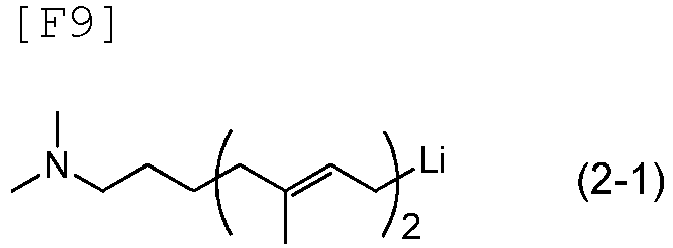
- The polymer synthesis was performed in the same manner as employed in Example 1, except that the amount of n-butyllithium serving as a polymerization initiator was changed to 1.94 mmol, the terminal modifier was replaced with octanol (3.63 mmol) serving as a terminator, and reaction was allowed to proceed for 15 minutes, to thereby produce an unmodified conjugated diene-based polymer iii. Various physical properties and the like of the resulting conjugated diene-based polymer iii are shown in Table 1 below.
- The polymer synthesis was performed in the same manner as employed in Example 1, except that N,N-bis(2-(((E)-4-methylpentan-2-ylidene)amino)ethyl)-3-(triethoxysilyl)propane-1-amine (1.82 mmol) serving as a terminal modifier was replaced with dimethyldichlorosilane (1.82 mmol), and reaction was allowed to proceed for 15 minutes, to thereby produce a modified conjugated diene-based polymer iv. Various physical properties and the like of the resulting modified conjugated diene-based polymer iv are shown in Table 1 below.
[Table 1] Example 1 Example 2 Comparative Example 1 Comparative Example 2 <Polymerization formulation> Type of initiator Initiator 1 Initiator 2 Initiator 1 Initiator 1 Type of terminal modifier Modifier 1 Modifier 1 - Modifier 2 Polymer No. i ii iii iv <Properties of polymer> Vinyl content (%) 57 57 56 57 Bonded styrene content (%) 28 27 28 28 Peak molecular weight before modification (×104) 19 20 42 20 Coupling ratio of two or more branches (%) 74 71 4 83 Mooney viscosity (ML1+4, 100°C) 51 57 55 53 - Abbreviations shown in Table 1 have the following meanings.
- Initiator 1: n-butyllithium
- Initiator 2: ((2E,6E)-11-(dimethylamino)-3,7-dimethylundeca-2,6-dien-1-yl) lithium
- Modifier 1: N,N-bis(2-(((E)-4-methylpentane-2-ylidene)amino)ethyl)-3-(triethoxysilyl)propane-1-amine
- Modifier 2: dimethyldichlorosilane
- Components (including each of the above-produced (modified) conjugated diene-based polymers i to iv) were mixed according to the formulation shown in Table 2 below, and the resultant mixture was kneaded to thereby produce a rubber composition. The kneading was performed as described below. In a first kneading step, the modified conjugated diene-based polymer (the unmodified conjugated diene-based polymer in Comparative Example 1), butadiene rubber, an extender oil, silica, carbon black, a silane coupling agent, stearic acid, an antioxidant, and zinc oxide were mixed and kneaded by means of Plastomill (inner volume: 250 mL) equipped with a temperature controller under the following conditions: filling rate: 72%, rotation speed: 60 rpm. Subsequently, in a second kneading step, the above-prepared mixture was cooled to room temperature, and then sulfur and a vulcanization accelerator were added and kneaded. The resultant rubber composition was molded and vulcanized by means of a vulcanizing press at 160°C for a predetermined period of time, to thereby produce a crosslinked rubber (vulcanized rubber). The crosslinked rubber was evaluated for tensile strength and rolling resistance as described below. The results are shown in Table 3 below.
- (1) Tensile strength: the crosslinked rubber was used as a sample for analysis, and the 300% modulus (M300) of the crosslinked rubber was determined according to JIS K6251:2010. A determined value is represented by an index relative to that (taken as 100) of the crosslinked rubber of Comparative Example 1. A larger value indicates a higher tensile strength; i.e., favorable property.
- (2) Rolling resistance (70°C tanδ): the crosslinked rubber was used as a sample for analysis, and the rolling resistance of the crosslinked rubber was determined by means of ARES-RDA (manufactured by TA Instruments) under the following conditions: shear strain 1.0%, angular velocity: 100 radians/second, temperature: 70°C. The rolling resistance was represented by an index relative to that (taken as 100) of the crosslinked rubber of Comparative Example 1. A larger value indicates a smaller energy loss and better rolling resistance (fuel efficiency).
- Trade names of components shown in Table 2 are as follows.
- *1: BR01, manufactured by JSR Corporation
- *2: JOMO Process NC-140, manufactured by Japan Energy Corporation
- *3: ZEOSIL 1165MP, manufactured by Rhodia
- *4: DIABLACK N339, manufactured by Mitsubishi Chemical Corporation
- *5: Si75, manufactured by Evonik
- *6: Ozonone 6C, manufactured by Seiko Chemical Co., Ltd.
- *7: Nocceler D, manufactured by Ouchi Shinko Chemical Industrial Co., Ltd.
- *8: Nocceler CZ, manufactured by Ouchi Shinko Chemical Industrial Co., Ltd.
- As is clear from the results shown in Table 3, the rubber composition of Example 1 or 2 exhibits considerably improved 300% modulus (tensile strength) and 70°C tanδ, as compared with the rubber composition of Comparative Example 1 or 2. Thus, a crosslinked rubber exhibiting favorable rolling resistance (fuel efficiency) and tensile strength was found to be produced from the modified conjugated diene-based polymer prepared by using the compound [A] as a modifier.
| Formulation | (phr) |
| (Modified) conjugated diene-based polymer | 70 |
| Butadiene rubber *1 | 30 |
| Extender oil *2 | 37.5 |
| Silica *3 | 70 |
| Carbon black *4 | 5.6 |
| Silane coupling agent *5 | 5.6 |
| Stearic acid | 2 |
| Antioxidant *6 | 1 |
| Zinc oxide | 3 |
| Vulcanization accelerator D *7 | 1.5 |
| Vulcanization accelerator CZ *8 | 1.8 |
| Sulfur | 1.5 |
| Properties of rubber composition | Example 1 | Example 2 | Comparative Example 1 | Comparative Example 2 |
| Type of (modified) conjugated diene-based polymer | i | ii | iii | iv |
| Tensile strength 300% modulus (index) | 112 | 121 | 100 | 85 |
| Rolling resistance 70°C tanδ (index) | 136 | 146 | 100 | 91 |
Claims (10)
- A method for producing a modified conjugated diene-based polymer, the method comprising:
reacting a conjugated diene-based polymer having an active terminal, obtained by polymerizing a monomer including a conjugated diene compound in the presence of an alkali metal compound, with a compound [A] represented by formula (1) :
- The method for producing a modified conjugated diene-based polymer according to claim 1, wherein the alkali metal compound comprises a compound represented by formula (2) :

- The method for producing a modified conjugated diene-based polymer according to claim 2, wherein the amount of the compound represented by formula (2) contained in the alkali metal compound is 50 mol% or more.
- The method for producing a modified conjugated diene-based polymer according to claim 2 or 3, wherein the alkali metal compound comprises, as the compound represented by formula (2), ((2E,6E)-11-(dimethylamino)-3,7-dimethylundeca-2,6-dien-1-yl) lithium.
- The method for producing a modified conjugated diene-based polymer according to any one of claims 1 to 4, wherein the monomer further comprises an aromatic vinyl compound.
- A modified conjugated diene-based polymer, which is a reaction product between a conjugated diene-based polymer having an active terminal and a compound represented by formula (1):

- The modified conjugated diene-based polymer according to claim 6, wherein the modified conjugated diene-based polymer is represented by formula (3):

- A polymer composition, comprising a modified conjugated diene-based polymer produced through the method as recited in any one of claims 1 to 5 or the modified conjugated diene-based polymer as recited in claim 6 or 7; silica; and a crosslinking agent.
- A crosslinked product, produced by crosslinking the polymer composition as recited in claim 8.
- A tire, comprising a tread and a sidewall, wherein at least one of the tread and the sidewall is formed from the polymer composition as recited in claim 8.
Applications Claiming Priority (2)
| Application Number | Priority Date | Filing Date | Title |
|---|---|---|---|
| JP2019041440 | 2019-03-07 | ||
| PCT/JP2020/008462 WO2020179705A1 (en) | 2019-03-07 | 2020-02-28 | Method for producing modified conjugated diene polymer, modified conjugated diene polymer, polymer composition, crosslinked body and tire |
Publications (4)
| Publication Number | Publication Date |
|---|---|
| EP3936347A1 EP3936347A1 (en) | 2022-01-12 |
| EP3936347A4 EP3936347A4 (en) | 2022-04-27 |
| EP3936347B1 true EP3936347B1 (en) | 2024-08-28 |
| EP3936347B8 EP3936347B8 (en) | 2024-10-09 |
Family
ID=72338703
Family Applications (1)
| Application Number | Title | Priority Date | Filing Date |
|---|---|---|---|
| EP20765609.1A Active EP3936347B8 (en) | 2019-03-07 | 2020-02-28 | Method for producing modified conjugated diene polymer, modified conjugated diene polymer, polymer composition, crosslinked body and tire |
Country Status (7)
| Country | Link |
|---|---|
| US (1) | US11945937B2 (en) |
| EP (1) | EP3936347B8 (en) |
| JP (1) | JP7346543B2 (en) |
| KR (1) | KR102549890B1 (en) |
| CN (1) | CN113226789B (en) |
| PL (1) | PL3936347T3 (en) |
| WO (1) | WO2020179705A1 (en) |
Families Citing this family (1)
| Publication number | Priority date | Publication date | Assignee | Title |
|---|---|---|---|---|
| EP4186911A1 (en) | 2021-11-30 | 2023-05-31 | Trinseo Europe GmbH | Amine-containing vinyldisiloxanes in the manufacture of elastomeric polymers |
Family Cites Families (15)
| Publication number | Priority date | Publication date | Assignee | Title |
|---|---|---|---|---|
| JP3583167B2 (en) * | 1994-07-08 | 2004-10-27 | 信越化学工業株式会社 | Ketimine structure-containing organosilicon compound and method for producing the same |
| JP4111590B2 (en) * | 1998-06-04 | 2008-07-02 | 株式会社ブリヂストン | Method for producing polymer, obtained polymer, and rubber composition using the same |
| CN101243106A (en) * | 2005-08-08 | 2008-08-13 | 横滨橡胶株式会社 | Modified conjugated diene-based polymer rubber and rubber composition comprising same |
| KR101475966B1 (en) | 2007-03-23 | 2014-12-23 | 제이에스알 가부시끼가이샤 | Method for producing modified conjugated diene based (co)polymer, modified conjugated diene based (co)polymer, and rubber composition |
| JP5691623B2 (en) * | 2010-02-26 | 2015-04-01 | 住友化学株式会社 | Conjugated diene polymer rubber and conjugated diene polymer rubber composition |
| EP2752434B1 (en) * | 2011-08-31 | 2016-04-06 | JSR Corporation | Method for producing denatured conjugated diene polymer |
| CN104011093A (en) * | 2011-12-23 | 2014-08-27 | Jsr株式会社 | Modified conjugated diene polymer and its production method |
| KR101365902B1 (en) | 2013-01-14 | 2014-03-12 | 금호석유화학 주식회사 | Terminal modifier for conjugated diene polymers |
| JP6191685B2 (en) * | 2013-02-28 | 2017-09-06 | Jsr株式会社 | Method for producing modified conjugated diene polymer, method for producing polymer composition, method for producing crosslinked polymer, and method for producing tire |
| JP6476179B2 (en) * | 2013-11-15 | 2019-02-27 | エルジー・ケム・リミテッド | Modified conjugated diene polymer, process for producing the same, and rubber composition containing the same |
| KR101877100B1 (en) * | 2015-06-19 | 2018-07-10 | 주식회사 엘지화학 | method for preparing rubber composition using terminal modifier of functionalized aminosilane, and rubber composition prepared using the same |
| JPWO2017026288A1 (en) * | 2015-08-10 | 2018-05-31 | Jsr株式会社 | Conjugated diene polymer and method for producing the same, polymer composition, cross-linked polymer, and tire |
| HUE057974T2 (en) | 2016-06-24 | 2022-06-28 | Jsr Corp | Method for producing modified conjugated diene polymer, modified conjugated diene polymer, polymer composition, crosslinked body, tire and compound |
| KR102099923B1 (en) * | 2016-08-12 | 2020-04-10 | 주식회사 엘지화학 | Modified conjugated diene polymer, method for preparing the same and rubber composition comprising the same |
| JP2019041440A (en) | 2017-08-22 | 2019-03-14 | トヨタ自動車株式会社 | Stator for rotary electric machine |
-
2020
- 2020-02-28 EP EP20765609.1A patent/EP3936347B8/en active Active
- 2020-02-28 US US17/422,531 patent/US11945937B2/en active Active
- 2020-02-28 PL PL20765609.1T patent/PL3936347T3/en unknown
- 2020-02-28 JP JP2021504068A patent/JP7346543B2/en active Active
- 2020-02-28 CN CN202080007273.2A patent/CN113226789B/en active Active
- 2020-02-28 KR KR1020217021129A patent/KR102549890B1/en active Active
- 2020-02-28 WO PCT/JP2020/008462 patent/WO2020179705A1/en not_active Ceased
Also Published As
| Publication number | Publication date |
|---|---|
| PL3936347T3 (en) | 2024-11-18 |
| CN113226789A (en) | 2021-08-06 |
| US20220073710A1 (en) | 2022-03-10 |
| KR20210098528A (en) | 2021-08-10 |
| JPWO2020179705A1 (en) | 2020-09-10 |
| EP3936347A1 (en) | 2022-01-12 |
| US11945937B2 (en) | 2024-04-02 |
| WO2020179705A1 (en) | 2020-09-10 |
| EP3936347B8 (en) | 2024-10-09 |
| CN113226789B (en) | 2022-10-18 |
| EP3936347A4 (en) | 2022-04-27 |
| KR102549890B1 (en) | 2023-06-29 |
| JP7346543B2 (en) | 2023-09-19 |
Similar Documents
| Publication | Publication Date | Title |
|---|---|---|
| US10894876B2 (en) | Method for producing modified conjugated diene-based polymer, modified conjugated diene-based polymer, polymer composition, crosslinked body, tire and compound | |
| JP6503064B2 (en) | Hydrogenated conjugated diene rubber, rubber composition, crosslinked rubber and tire | |
| EP4052925B1 (en) | Method for producing modified conjugated-diene-based polymer, polymer composition, crosslinked object, and tire | |
| EP3950378B1 (en) | Hydrogenated conjugated diene polymer, polymer composition, crosslinked body and tire | |
| JP6252705B2 (en) | Method for producing hydrogenated conjugated diene polymer, hydrogenated conjugated diene polymer, polymer composition, crosslinked polymer and tire | |
| JP6885079B2 (en) | Method for Producing Modified Conjugated Diene Polymer, Polymer Composition, Crosslinked Polymer and Tire | |
| KR20200137976A (en) | Method for producing modified conjugated diene polymer, modified conjugated diene polymer, polymer composition, crosslinked body and tire | |
| EP3269744B1 (en) | Modified conjugated diene polymer, method for producing modified conjugated diene polymer, polymer composition, crosslinked polymer, and tire | |
| EP3336108B1 (en) | Conjugated diene polymer and method for producing same, polymer composition, crosslinked polymer, and tire | |
| EP3936347B1 (en) | Method for producing modified conjugated diene polymer, modified conjugated diene polymer, polymer composition, crosslinked body and tire | |
| WO2017086208A1 (en) | Production method for hydrogenated conjugated diene polymer, hydrogenated conjugated diene polymer, polymer composition, crosslinked polymer, and tire |
Legal Events
| Date | Code | Title | Description |
|---|---|---|---|
| STAA | Information on the status of an ep patent application or granted ep patent |
Free format text: STATUS: THE INTERNATIONAL PUBLICATION HAS BEEN MADE |
|
| PUAI | Public reference made under article 153(3) epc to a published international application that has entered the european phase |
Free format text: ORIGINAL CODE: 0009012 |
|
| STAA | Information on the status of an ep patent application or granted ep patent |
Free format text: STATUS: REQUEST FOR EXAMINATION WAS MADE |
|
| 17P | Request for examination filed |
Effective date: 20210721 |
|
| AK | Designated contracting states |
Kind code of ref document: A1 Designated state(s): AL AT BE BG CH CY CZ DE DK EE ES FI FR GB GR HR HU IE IS IT LI LT LU LV MC MK MT NL NO PL PT RO RS SE SI SK SM TR |
|
| RIC1 | Information provided on ipc code assigned before grant |
Ipc: C08C 19/44 20060101ALI20220318BHEP Ipc: C08C 19/22 20060101ALI20220318BHEP Ipc: C08K 3/36 20060101ALI20220318BHEP Ipc: C08L 15/00 20060101ALI20220318BHEP Ipc: C08F 4/46 20060101ALI20220318BHEP Ipc: C08C 19/25 20060101ALI20220318BHEP Ipc: B60C 1/00 20060101AFI20220318BHEP |
|
| A4 | Supplementary search report drawn up and despatched |
Effective date: 20220324 |
|
| DAV | Request for validation of the european patent (deleted) | ||
| DAX | Request for extension of the european patent (deleted) | ||
| RAP1 | Party data changed (applicant data changed or rights of an application transferred) |
Owner name: ENEOS MATERIALS CORPORATION |
|
| GRAP | Despatch of communication of intention to grant a patent |
Free format text: ORIGINAL CODE: EPIDOSNIGR1 |
|
| STAA | Information on the status of an ep patent application or granted ep patent |
Free format text: STATUS: GRANT OF PATENT IS INTENDED |
|
| INTG | Intention to grant announced |
Effective date: 20240404 |
|
| P01 | Opt-out of the competence of the unified patent court (upc) registered |
Free format text: CASE NUMBER: APP_33120/2024 Effective date: 20240603 |
|
| GRAS | Grant fee paid |
Free format text: ORIGINAL CODE: EPIDOSNIGR3 |
|
| GRAA | (expected) grant |
Free format text: ORIGINAL CODE: 0009210 |
|
| STAA | Information on the status of an ep patent application or granted ep patent |
Free format text: STATUS: THE PATENT HAS BEEN GRANTED |
|
| GRAT | Correction requested after decision to grant or after decision to maintain patent in amended form |
Free format text: ORIGINAL CODE: EPIDOSNCDEC |
|
| AK | Designated contracting states |
Kind code of ref document: B1 Designated state(s): AL AT BE BG CH CY CZ DE DK EE ES FI FR GB GR HR HU IE IS IT LI LT LU LV MC MK MT NL NO PL PT RO RS SE SI SK SM TR |
|
| REG | Reference to a national code |
Ref country code: CH Ref legal event code: EP |
|
| REG | Reference to a national code |
Ref country code: CH Ref legal event code: PK Free format text: BERICHTIGUNG B8 |
|
| REG | Reference to a national code |
Ref country code: DE Ref legal event code: R096 Ref document number: 602020036715 Country of ref document: DE |
|
| RAP4 | Party data changed (patent owner data changed or rights of a patent transferred) |
Owner name: ENEOS MATERIALS CORPORATION |
|
| REG | Reference to a national code |
Ref country code: IE Ref legal event code: FG4D |
|
| RAP4 | Party data changed (patent owner data changed or rights of a patent transferred) |
Owner name: ENEOS MATERIALS CORPORATION |
|
| REG | Reference to a national code |
Ref country code: LT Ref legal event code: MG9D |
|
| PG25 | Lapsed in a contracting state [announced via postgrant information from national office to epo] |
Ref country code: NO Free format text: LAPSE BECAUSE OF FAILURE TO SUBMIT A TRANSLATION OF THE DESCRIPTION OR TO PAY THE FEE WITHIN THE PRESCRIBED TIME-LIMIT Effective date: 20241128 |
|
| REG | Reference to a national code |
Ref country code: AT Ref legal event code: MK05 Ref document number: 1717584 Country of ref document: AT Kind code of ref document: T Effective date: 20240828 |
|
| PG25 | Lapsed in a contracting state [announced via postgrant information from national office to epo] |
Ref country code: NL Free format text: LAPSE BECAUSE OF FAILURE TO SUBMIT A TRANSLATION OF THE DESCRIPTION OR TO PAY THE FEE WITHIN THE PRESCRIBED TIME-LIMIT Effective date: 20240828 Ref country code: PT Free format text: LAPSE BECAUSE OF FAILURE TO SUBMIT A TRANSLATION OF THE DESCRIPTION OR TO PAY THE FEE WITHIN THE PRESCRIBED TIME-LIMIT Effective date: 20241230 Ref country code: GR Free format text: LAPSE BECAUSE OF FAILURE TO SUBMIT A TRANSLATION OF THE DESCRIPTION OR TO PAY THE FEE WITHIN THE PRESCRIBED TIME-LIMIT Effective date: 20241129 Ref country code: FI Free format text: LAPSE BECAUSE OF FAILURE TO SUBMIT A TRANSLATION OF THE DESCRIPTION OR TO PAY THE FEE WITHIN THE PRESCRIBED TIME-LIMIT Effective date: 20240828 |
|
| PG25 | Lapsed in a contracting state [announced via postgrant information from national office to epo] |
Ref country code: BG Free format text: LAPSE BECAUSE OF FAILURE TO SUBMIT A TRANSLATION OF THE DESCRIPTION OR TO PAY THE FEE WITHIN THE PRESCRIBED TIME-LIMIT Effective date: 20240828 |
|
| PG25 | Lapsed in a contracting state [announced via postgrant information from national office to epo] |
Ref country code: LV Free format text: LAPSE BECAUSE OF FAILURE TO SUBMIT A TRANSLATION OF THE DESCRIPTION OR TO PAY THE FEE WITHIN THE PRESCRIBED TIME-LIMIT Effective date: 20240828 |
|
| REG | Reference to a national code |
Ref country code: NL Ref legal event code: MP Effective date: 20240828 |
|
| PG25 | Lapsed in a contracting state [announced via postgrant information from national office to epo] |
Ref country code: IS Free format text: LAPSE BECAUSE OF FAILURE TO SUBMIT A TRANSLATION OF THE DESCRIPTION OR TO PAY THE FEE WITHIN THE PRESCRIBED TIME-LIMIT Effective date: 20241228 Ref country code: AT Free format text: LAPSE BECAUSE OF FAILURE TO SUBMIT A TRANSLATION OF THE DESCRIPTION OR TO PAY THE FEE WITHIN THE PRESCRIBED TIME-LIMIT Effective date: 20240828 |
|
| PG25 | Lapsed in a contracting state [announced via postgrant information from national office to epo] |
Ref country code: HR Free format text: LAPSE BECAUSE OF FAILURE TO SUBMIT A TRANSLATION OF THE DESCRIPTION OR TO PAY THE FEE WITHIN THE PRESCRIBED TIME-LIMIT Effective date: 20240828 |
|
| PG25 | Lapsed in a contracting state [announced via postgrant information from national office to epo] |
Ref country code: ES Free format text: LAPSE BECAUSE OF FAILURE TO SUBMIT A TRANSLATION OF THE DESCRIPTION OR TO PAY THE FEE WITHIN THE PRESCRIBED TIME-LIMIT Effective date: 20240828 Ref country code: RS Free format text: LAPSE BECAUSE OF FAILURE TO SUBMIT A TRANSLATION OF THE DESCRIPTION OR TO PAY THE FEE WITHIN THE PRESCRIBED TIME-LIMIT Effective date: 20241128 |
|
| PG25 | Lapsed in a contracting state [announced via postgrant information from national office to epo] |
Ref country code: RS Free format text: LAPSE BECAUSE OF FAILURE TO SUBMIT A TRANSLATION OF THE DESCRIPTION OR TO PAY THE FEE WITHIN THE PRESCRIBED TIME-LIMIT Effective date: 20241128 Ref country code: PT Free format text: LAPSE BECAUSE OF FAILURE TO SUBMIT A TRANSLATION OF THE DESCRIPTION OR TO PAY THE FEE WITHIN THE PRESCRIBED TIME-LIMIT Effective date: 20241230 Ref country code: NO Free format text: LAPSE BECAUSE OF FAILURE TO SUBMIT A TRANSLATION OF THE DESCRIPTION OR TO PAY THE FEE WITHIN THE PRESCRIBED TIME-LIMIT Effective date: 20241128 Ref country code: NL Free format text: LAPSE BECAUSE OF FAILURE TO SUBMIT A TRANSLATION OF THE DESCRIPTION OR TO PAY THE FEE WITHIN THE PRESCRIBED TIME-LIMIT Effective date: 20240828 Ref country code: LV Free format text: LAPSE BECAUSE OF FAILURE TO SUBMIT A TRANSLATION OF THE DESCRIPTION OR TO PAY THE FEE WITHIN THE PRESCRIBED TIME-LIMIT Effective date: 20240828 Ref country code: IS Free format text: LAPSE BECAUSE OF FAILURE TO SUBMIT A TRANSLATION OF THE DESCRIPTION OR TO PAY THE FEE WITHIN THE PRESCRIBED TIME-LIMIT Effective date: 20241228 Ref country code: HR Free format text: LAPSE BECAUSE OF FAILURE TO SUBMIT A TRANSLATION OF THE DESCRIPTION OR TO PAY THE FEE WITHIN THE PRESCRIBED TIME-LIMIT Effective date: 20240828 Ref country code: GR Free format text: LAPSE BECAUSE OF FAILURE TO SUBMIT A TRANSLATION OF THE DESCRIPTION OR TO PAY THE FEE WITHIN THE PRESCRIBED TIME-LIMIT Effective date: 20241129 Ref country code: FI Free format text: LAPSE BECAUSE OF FAILURE TO SUBMIT A TRANSLATION OF THE DESCRIPTION OR TO PAY THE FEE WITHIN THE PRESCRIBED TIME-LIMIT Effective date: 20240828 Ref country code: ES Free format text: LAPSE BECAUSE OF FAILURE TO SUBMIT A TRANSLATION OF THE DESCRIPTION OR TO PAY THE FEE WITHIN THE PRESCRIBED TIME-LIMIT Effective date: 20240828 Ref country code: BG Free format text: LAPSE BECAUSE OF FAILURE TO SUBMIT A TRANSLATION OF THE DESCRIPTION OR TO PAY THE FEE WITHIN THE PRESCRIBED TIME-LIMIT Effective date: 20240828 Ref country code: AT Free format text: LAPSE BECAUSE OF FAILURE TO SUBMIT A TRANSLATION OF THE DESCRIPTION OR TO PAY THE FEE WITHIN THE PRESCRIBED TIME-LIMIT Effective date: 20240828 |
|
| PG25 | Lapsed in a contracting state [announced via postgrant information from national office to epo] |
Ref country code: SM Free format text: LAPSE BECAUSE OF FAILURE TO SUBMIT A TRANSLATION OF THE DESCRIPTION OR TO PAY THE FEE WITHIN THE PRESCRIBED TIME-LIMIT Effective date: 20240828 Ref country code: RO Free format text: LAPSE BECAUSE OF FAILURE TO SUBMIT A TRANSLATION OF THE DESCRIPTION OR TO PAY THE FEE WITHIN THE PRESCRIBED TIME-LIMIT Effective date: 20240828 Ref country code: DK Free format text: LAPSE BECAUSE OF FAILURE TO SUBMIT A TRANSLATION OF THE DESCRIPTION OR TO PAY THE FEE WITHIN THE PRESCRIBED TIME-LIMIT Effective date: 20240828 |
|
| PG25 | Lapsed in a contracting state [announced via postgrant information from national office to epo] |
Ref country code: CZ Free format text: LAPSE BECAUSE OF FAILURE TO SUBMIT A TRANSLATION OF THE DESCRIPTION OR TO PAY THE FEE WITHIN THE PRESCRIBED TIME-LIMIT Effective date: 20240828 |
|
| PG25 | Lapsed in a contracting state [announced via postgrant information from national office to epo] |
Ref country code: SK Free format text: LAPSE BECAUSE OF FAILURE TO SUBMIT A TRANSLATION OF THE DESCRIPTION OR TO PAY THE FEE WITHIN THE PRESCRIBED TIME-LIMIT Effective date: 20240828 Ref country code: IT Free format text: LAPSE BECAUSE OF FAILURE TO SUBMIT A TRANSLATION OF THE DESCRIPTION OR TO PAY THE FEE WITHIN THE PRESCRIBED TIME-LIMIT Effective date: 20240828 |
|
| REG | Reference to a national code |
Ref country code: DE Ref legal event code: R097 Ref document number: 602020036715 Country of ref document: DE |
|
| PLBE | No opposition filed within time limit |
Free format text: ORIGINAL CODE: 0009261 |
|
| STAA | Information on the status of an ep patent application or granted ep patent |
Free format text: STATUS: NO OPPOSITION FILED WITHIN TIME LIMIT |
|
| 26N | No opposition filed |
Effective date: 20250530 |
|
| PG25 | Lapsed in a contracting state [announced via postgrant information from national office to epo] |
Ref country code: SE Free format text: LAPSE BECAUSE OF FAILURE TO SUBMIT A TRANSLATION OF THE DESCRIPTION OR TO PAY THE FEE WITHIN THE PRESCRIBED TIME-LIMIT Effective date: 20240828 |
|
| PG25 | Lapsed in a contracting state [announced via postgrant information from national office to epo] |
Ref country code: MC Free format text: LAPSE BECAUSE OF FAILURE TO SUBMIT A TRANSLATION OF THE DESCRIPTION OR TO PAY THE FEE WITHIN THE PRESCRIBED TIME-LIMIT Effective date: 20240828 |
|
| REG | Reference to a national code |
Ref country code: CH Ref legal event code: PL |
|
| PG25 | Lapsed in a contracting state [announced via postgrant information from national office to epo] |
Ref country code: LU Free format text: LAPSE BECAUSE OF NON-PAYMENT OF DUE FEES Effective date: 20250228 |
|
| PG25 | Lapsed in a contracting state [announced via postgrant information from national office to epo] |
Ref country code: CH Free format text: LAPSE BECAUSE OF NON-PAYMENT OF DUE FEES Effective date: 20250228 |
|
| GBPC | Gb: european patent ceased through non-payment of renewal fee |
Effective date: 20250228 |
|
| REG | Reference to a national code |
Ref country code: BE Ref legal event code: MM Effective date: 20250228 |
|
| PG25 | Lapsed in a contracting state [announced via postgrant information from national office to epo] |
Ref country code: GB Free format text: LAPSE BECAUSE OF NON-PAYMENT OF DUE FEES Effective date: 20250228 |
|
| PGFP | Annual fee paid to national office [announced via postgrant information from national office to epo] |
Ref country code: FR Payment date: 20251231 Year of fee payment: 7 |
|
| PG25 | Lapsed in a contracting state [announced via postgrant information from national office to epo] |
Ref country code: BE Free format text: LAPSE BECAUSE OF NON-PAYMENT OF DUE FEES Effective date: 20250228 |
|
| PG25 | Lapsed in a contracting state [announced via postgrant information from national office to epo] |
Ref country code: IE Free format text: LAPSE BECAUSE OF NON-PAYMENT OF DUE FEES Effective date: 20250228 |
|
| PGFP | Annual fee paid to national office [announced via postgrant information from national office to epo] |
Ref country code: DE Payment date: 20260102 Year of fee payment: 7 |
|
| PGFP | Annual fee paid to national office [announced via postgrant information from national office to epo] |
Ref country code: PL Payment date: 20260102 Year of fee payment: 7 |