EP3935339B1 - Enhanced polymer marking projectile for nonlethal cartridge - Google Patents
Enhanced polymer marking projectile for nonlethal cartridge Download PDFInfo
- Publication number
- EP3935339B1 EP3935339B1 EP20766146.3A EP20766146A EP3935339B1 EP 3935339 B1 EP3935339 B1 EP 3935339B1 EP 20766146 A EP20766146 A EP 20766146A EP 3935339 B1 EP3935339 B1 EP 3935339B1
- Authority
- EP
- European Patent Office
- Prior art keywords
- projectile
- nonlethal
- polymer
- cartridge
- shell
- Prior art date
- Legal status (The legal status is an assumption and is not a legal conclusion. Google has not performed a legal analysis and makes no representation as to the accuracy of the status listed.)
- Active
Links
Images


Classifications
-
- F—MECHANICAL ENGINEERING; LIGHTING; HEATING; WEAPONS; BLASTING
- F42—AMMUNITION; BLASTING
- F42B—EXPLOSIVE CHARGES, e.g. FOR BLASTING, FIREWORKS, AMMUNITION
- F42B12/00—Projectiles, missiles or mines characterised by the warhead, the intended effect, or the material
- F42B12/02—Projectiles, missiles or mines characterised by the warhead, the intended effect, or the material characterised by the warhead or the intended effect
- F42B12/36—Projectiles, missiles or mines characterised by the warhead, the intended effect, or the material characterised by the warhead or the intended effect for dispensing materials; for producing chemical or physical reaction; for signalling ; for transmitting information
- F42B12/40—Projectiles, missiles or mines characterised by the warhead, the intended effect, or the material characterised by the warhead or the intended effect for dispensing materials; for producing chemical or physical reaction; for signalling ; for transmitting information of target-marking, i.e. impact-indicating type
-
- F—MECHANICAL ENGINEERING; LIGHTING; HEATING; WEAPONS; BLASTING
- F42—AMMUNITION; BLASTING
- F42B—EXPLOSIVE CHARGES, e.g. FOR BLASTING, FIREWORKS, AMMUNITION
- F42B12/00—Projectiles, missiles or mines characterised by the warhead, the intended effect, or the material
- F42B12/02—Projectiles, missiles or mines characterised by the warhead, the intended effect, or the material characterised by the warhead or the intended effect
- F42B12/34—Projectiles, missiles or mines characterised by the warhead, the intended effect, or the material characterised by the warhead or the intended effect expanding before or on impact, i.e. of dumdum or mushroom type
-
- F—MECHANICAL ENGINEERING; LIGHTING; HEATING; WEAPONS; BLASTING
- F42—AMMUNITION; BLASTING
- F42B—EXPLOSIVE CHARGES, e.g. FOR BLASTING, FIREWORKS, AMMUNITION
- F42B12/00—Projectiles, missiles or mines characterised by the warhead, the intended effect, or the material
- F42B12/72—Projectiles, missiles or mines characterised by the warhead, the intended effect, or the material characterised by the material
- F42B12/74—Projectiles, missiles or mines characterised by the warhead, the intended effect, or the material characterised by the material of the core or solid body
- F42B12/745—Projectiles, missiles or mines characterised by the warhead, the intended effect, or the material characterised by the material of the core or solid body the core being made of plastics; Compounds or blends of plastics and other materials, e.g. fillers
-
- F—MECHANICAL ENGINEERING; LIGHTING; HEATING; WEAPONS; BLASTING
- F42—AMMUNITION; BLASTING
- F42B—EXPLOSIVE CHARGES, e.g. FOR BLASTING, FIREWORKS, AMMUNITION
- F42B14/00—Projectiles or missiles characterised by arrangements for guiding or sealing them inside barrels, or for lubricating or cleaning barrels
- F42B14/02—Driving bands; Rotating bands
-
- F—MECHANICAL ENGINEERING; LIGHTING; HEATING; WEAPONS; BLASTING
- F42—AMMUNITION; BLASTING
- F42B—EXPLOSIVE CHARGES, e.g. FOR BLASTING, FIREWORKS, AMMUNITION
- F42B14/00—Projectiles or missiles characterised by arrangements for guiding or sealing them inside barrels, or for lubricating or cleaning barrels
- F42B14/06—Sub-calibre projectiles having sabots; Sabots therefor
- F42B14/064—Sabots enclosing the rear end of a kinetic energy projectile, i.e. having a closed disk shaped obturator base and petals extending forward from said base
-
- F—MECHANICAL ENGINEERING; LIGHTING; HEATING; WEAPONS; BLASTING
- F42—AMMUNITION; BLASTING
- F42B—EXPLOSIVE CHARGES, e.g. FOR BLASTING, FIREWORKS, AMMUNITION
- F42B8/00—Practice or training ammunition
- F42B8/02—Cartridges
-
- F—MECHANICAL ENGINEERING; LIGHTING; HEATING; WEAPONS; BLASTING
- F42—AMMUNITION; BLASTING
- F42B—EXPLOSIVE CHARGES, e.g. FOR BLASTING, FIREWORKS, AMMUNITION
- F42B5/00—Cartridge ammunition, e.g. separately-loaded propellant charges
- F42B5/02—Cartridges, i.e. cases with charge and missile
- F42B5/045—Cartridges, i.e. cases with charge and missile of telescopic type
Definitions
- the technical field relates generally to cartridges for firearms, and more particularly, relates to cartridges including a nonlethal projectile that includes a polymer base projectile portion that is configured to engage rifling of a firearm barrel to impart spin stabilization and a polymer front shell projectile portion that is formed of a relatively soft polymer to help absorb impact energy upon impact.
- a nonlethal projectile that includes a polymer base projectile portion that is configured to engage rifling of a firearm barrel to impart spin stabilization and a polymer front shell projectile portion that is formed of a relatively soft polymer to help absorb impact energy upon impact.
- nonlethal cartridges for firearms include a nonlethal, fully mushrooming (e.g., deforming) polymer marking projectile and have been used for realistic small caliber weapon force-on-force training for many years now. This is especially the case since the advent of U.S. Patent No. 5,035,183 , entitled “The Frangible Nonlethal Marking Projectile Design” issued to Luxton and U.S. Patent No. 5,359,937 entitled “The Reduced Energy Cartridge” issued to Dittrich, which, when combined, revolutionized the military and law enforcement training doctrines by introducing the world to FX ® marking cartridges.
- This industry-leading, lightweight, 2-part polymer projectile design has a front projectile shell that is filled with a color marking composition and a rear part which acts as a cap.
- these marking rounds have been produced for use in pistols, rifles, submachine guns and machineguns, which have been temporarily modified for training by using Simunition ® weapon conversion kits.
- US2012/192751 constitutes another relevant prior art document.
- FX ® training cartridges feature 2-part marking projectiles that are normally filled with a semi-viscous color compound that is expelled from a thin-shelled projectile along pre-defined break lines in the front projectile portion upon impact with the target. These break lines allow the projectile to crumple upon impact and "mushroom” (e.g., deform and spread outwardly) on the target. This allows the marking compound and the impact kinetic energy of the projectile to be distributed over a larger surface area than the mere in-flight cross-sectional area of the projectile. Projectile designs with more complicated, less efficient method(s) of transferring the marking compound to the target upon impact have been developed to go around the prior art taught in U.S. Patent No. 5,035,183 by Luxton .
- Prior art nonlethal full mushrooming polymer marking projectiles often involve barrel rifling engraving into the soft polymer front shell and back part, resulting from engagement with the barrel rifling of a firearm barrel to impart spin stabilization onto the projectile.
- Optimal nonlethal projectile technology requires the front shell to be made of a thin and soft polymer nature with pre-defined break lines to ensure reliable and adequate projectile deformation for acceptable marking compound and energy dissipation upon impact.
- barrel engraving in soft polymer projectile natures is a notorious cause for rapid plastic fouling (e.g., generating plastic residue) of the weapon barrel, which can negatively affect the ballistic performance and reliability of the firearm and require frequent barrel cleaning.
- a substantially fully mushrooming marking projectile design that engraves in the soft polymer back part and front shell can generate rapid and significant plastic fouling in the weapon barrel.
- this requires frequent barrel cleaning to maintain constant projectile velocities and ballistic performance, which can be an irritant or a drawback for some users.
- the plastic fouling residue remaining in the barrel can eventually dry out and become difficult to remove with the industry-standard bore brushing technique.
- the marking compound in the 2-part projectile can age prematurely through prolonged exposure to sub-optimal storage (e.g., very high temperature and/or humidity) conditions and so the need for an improved shelf-life marking projectile became apparent.
- sub-optimal storage e.g., very high temperature and/or humidity
- Other concepts that employ wax or oil-based color marking compounds are not suitable for use on force training because the wax or oil-based color marking compound is difficult to clean up after training because it does not fully wash off simply with a damp cloth. Therefore, these wax or oil-based compounds induce the additional logistical burden of having to machine wash the training protective gear after the exercise.
- a loss of marking compound moisture and corresponding loss of mass may vary from projectile to projectile. This mass variation may thus lead to increased variations in projectile velocity at the muzzle of the firearm that may further lead to undesirable increased impact dispersion/spread of the marking compound on the target and decreased accuracy.
- the increased variation of the marking compound mass distribution inside the projectile may also lead to decreased flight stability of the lightweight polymer projectile, further degrading accuracy results. Additionally, reliable cartridge functioning in the firearm may even be affected.
- Nonlethal projectiles for a nonlethal cartridge that has a mouth for holding the nonlethal projectile and nonlethal cartridges adapted to be chambered in a firearm having a barrel that includes rifling are provided herein.
- a nonlethal cartridge includes a cartridge case.
- a primer and/or a propellant is disposed in the cartridge case and is ignitable to produce a propellant gas.
- a sabot is telescopically coupled to the cartridge case to allow relative movement between the cartridge case and the sabot in response to expansion of the propellant gas.
- the sabot has a sabot mouth and is configured to fluidly communicate the propellant gas to the sabot mouth.
- a nonlethal projectile is configured to be propelled from the sabot through the barrel of the firearm.
- the nonlethal projectile includes a polymer base projectile portion disposed in the sabot mouth and is formed of a first polymer material.
- a polymer front shell projectile portion is formed of a second polymer material that is softer than the first polymer material.
- the polymer front shell projectile portion is coupled to the polymer base projectile portion and has an outer surface that includes a circular locking rib feature that forms an interference fit with the sabot mouth, thereby constraining the nonlethal projectile by the sabot mouth to prevent disconnection of a projectile snap.
- the polymer base projectile portion is configured to engage the rifling of the barrel to impart spin stabilization to the projectile when propelled from the sabot in response to the expansion of the propellant gas.
- the polymer front shell projectile portion is configured to deform upon impact to absorb impact energy.
- a nonlethal projectile includes a polymer base projectile portion that is disposed in the mouth of the nonlethal cartridge and that is formed of a first polymer material.
- a polymer front shell projectile portion is formed of a second polymer material that is softer than the first polymer material.
- the polymer front shell projectile portion is coupled to the polymer base projectile portion and has an outer surface that includes a circular locking rib feature that forms an interference fit with the mouth.
- the polymer base projectile portion is configured to engage the rifling of the barrel to impart spin stabilization to the projectile when propelled through the barrel of the firearm in response to an expansion of propellant gas.
- the polymer front shell projectile portion is configured to deform upon impact to absorb impact energy.
- nonlethal cartridges including nonlethal projectiles for firearms.
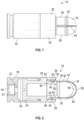
- the exemplary embodiments taught herein provide a nonlethal cartridge 10 adapted to be chambered in a firearm 12 having a barrel 14 that includes rifling 16.
- the nonlethal cartridge 10 includes a cartridge case 18, a primer pocket 19 including a primer 21, a flash hole 23, and a propellant 20 that are disposed in the cartridge case 18.
- the primer 21 is ignitable to ignite the propellant 20 to produce a propellant gas 22.
- the nonlethal cartridge 10 may include alternative configurations, such as, for example, the nonlethal cartridge 10 can be powered by a primer gas expansion alone without propellant, or alternatively powered by two primers, one for the weapon recoil and one for the projectile propulsion.
- a sabot 24 is telescopically coupled to the cartridge case to allow relative movement (indicated by double headed arrow 25), for example telescopic or axial expanding/sliding movement, between the cartridge case 18 and the sabot 24 in response to expansion of the propellant gas 22.
- the sabot 24 has a sabot mouth 26 and is configured to fluidly communicate the propellant gas 22 to the sabot mouth 26.
- the sabot mouth 26 is sized or otherwise configured to hold a nonlethal projectile 28.
- the nonlethal cartridge 10 may have an alternative configuration, such as, for example, a rearward recoiling inner piston in place of a sabot in which the piston includes a mouth for holding the nonlethal projectile 28.
- the nonlethal projectile 28 is configured to be propelled from the sabot 24 through the barrel 14 of the firearm 12 in response to expansion of the propellant gas 22.
- the nonlethal projectile 28 includes a polymer base projectile portion 30 that is disposed in the sabot mouth 26.
- a polymer front shell projectile portion 32 is coupled to the polymer base projectile portion 30.
- the polymer front shell projectile portion 32 has a substantially cylindrical outer surface that tapers or narrows inwardly in the forward or distal direction to define an outer surface having an aerodynamic shape with a substantially rounded front surface section.
- the outer surface includes a circular locking rib feature 34 (e.g., annular locking rib feature) that forms an interference fit with the sabot mouth 26.
- the polymer base projectile portion 30 is configured to engage the rifling 16 of the barrel 14 to impart spin stabilization to the nonlethal projectile 28 when propelled from the sabot 24 in response to the expansion of the propellant gas 22 during firing of the firearm 12.
- the polymer front shell projectile portion 32 is configured to mushroom or otherwise deform upon impact to absorb impact energy, for example when the nonlethal projectile 28 hits an intended target.
- the nonlethal projectile 28 is relatively lightweight as compared to other conventional nonlethal projectiles.
- the polymer base projectile portion 30 is formed of a relatively hard or rigid polymer material 36 and the polymer front shell projectile portion 32 is formed of a relatively soft or flexible polymer material 38 that is softer than the relatively hard polymer material 36 of the polymer base projectile portion 30.
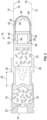
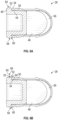
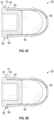
- the outer surface of the polymer front shell projectile portion 32 includes two annular or circular guiding bands 40 and 42 for optimal engraving alignment in the barrel 14 and includes pre-positioned break lines (frangible lines) 44 to enable substantially complete mushrooming (shown in FIGS. 7-8 ) on the target 55 to consistently release the marking compound 46 (see also FIG. 9 ) and distribute the impact energy.
- the polymer base projectile portion 30 has a perimeter base end portion 48 that extends from the outer base surface 50 and that defines a rear driving band 52.
- the rear driving band 52 of the polymer base projectile portion 30 and the circular locking rib feature 34 and the circular guiding bands 40 and 42 of the polymer front shell projectile portion 32 cooperate to enable effective magazine loading and feeding robustness in firearms 12 and to aid in transferring spin from the polymer base projectile portion 30 to the polymer front shell projectile portion 32 when the nonlethal projectile 28 is accelerated through the barrel 14 engaging with the rifling 16.
- the outer base surface 50 of the polymer base projectile portion 30 includes a circular projectile snap feature 54 that is configured to attach the polymer base projectile portion 30 and the polymer front shell projectile portion 32.
- This embodiment also includes an interference or "press fit" between the diameters of outer base surface 50 of polymer base projectile portion 30 and the contacting diameter polymer front shell projectile portion 32 which aids in sealing the marking compound 46 that is disposed in the internal shell volume 56 of the nonlethal projectile 28 to extend the shelf life of the marking compound 46 and thus of the nonlethal projectile 28.
- the nonlethal projectile 28 is a non-marking nonlethal projectile in which the internal shell volume 56 of the nonlethal projectile does not contain any marking compound and therefore, is a relatively lighter weight nonlethal projectile.
- the polymer front shell projectile portion 32 has a shell length
- the polymer base projectile portion 30 is disposed in the internal shell volume 56 a distance of at least about 30% of the shell length, while the perimeter base end portion 48 is disposed rearward of the polymer front shell projectile portion 32 outside of the internal shell volume 56.
- the insertion depth of the polymer base projectile portion 30 into the internal shell volume 56 represents an increase of approximately 15% compared to the prior art nonlethal projectiles, thereby, once the nonlethal projectile 28 is assembled in the sabot 24, increasing the resistance to possibly prying off the relatively soft, thin and fragile polymer front shell projectile portion 32 from the polymer base projectile portion 30 held within the mouth 26 of the sabot 24.
- the circular locking rib feature 34 of the polymer front shell projectile portion 32 effectively acts as a restriction with the sabot mouth 26 to prevent the projectile snap attachment 54 from disconnecting and thus increasing the resistance to possibly pulling out the polymer front shell projectile portion 32 from the polymer base projectile portion 30 held within the sabot mouth 26 (e.g., ensuring the projectile snap connection is maintained).
- This key feature also aids in ensuring full spin transfer from the polymer base projectile portion 30 to the polymer front shell projectile portion 32 through the compressive forces from the rifling 16 to the circular locking rib feature 34 to the polymer base projectile portion 30.
- the circular locking rib feature 34 of the polymer front shell projectile portion 32 is configured to ensure the projectile snap connection 54 is maintained while having a minimal contact surface area with the rifling 16 to ensure negligible soft plastic barrel fouling.
- the circular locking rib feature 34 has a profile shape such as a square shape, a rectangle shape, an arcuate shape, a radius, a cone shape, the like, or a combination thereof, for example a rectangle shape combined with a conical leading edge to ensure minimal, but sufficient surface contact with the rifling 16 of the barrel 14 of the firearm 12.
- the rectangular shape portion of the circular locking rib feature 34 is positioned slightly behind (e.g., rearward) the projectile snap feature 54 to ensure effective resistance to the projectile snap disconnection.
- the rear driving band 52 of the polymer base projectile portion 30 is configured to efficiently scrape and collect any combustion or polymer residues that may be deposited in the barrel 14, by combining the rigidity from the hard polymer material 36 and the relatively sharp leading-edge 58 geometry of the rear driving band 52.
- residues are effectively collected in a gap 60 formed between the rear driving band 52 and the circular locking rib feature 34.
- the rear driving band 52 of the polymer base projectile portion 30 may have various configurations.
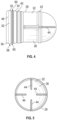
- the rear driving band 52 is configured as a rear, substantially full-length driving band 64.
- the rear driving band 52 is configured as a rear, grooved driving band 66 which includes two gaps and two sharp leading-edge features which can mutually act to scrape and collect residues.
- the rear driving band 52 is configured as a rear, rear edged driving band 70.
- the rear driving band 52 is configured as a rear, forward edged driving band 72.
- the hard polymer material 36 of the polymer base projectile portion 30 in combination with the rear driving band 52 results in a much smaller engraving surface 62, thereby reducing plastic fouling which may be deposited by the softer polymer front shell projectile portion 32 during weapon firing.
- the nonlethal projectile 28 significantly reduces plastic fouling in the barrel 14. With the elimination of undesired plastic barrel fouling, muzzle velocity and spin transfer consistency is greatly improved, thus improving accuracy on the target 55 and reducing target impact dispersion, thereby enabling the user to maintain the expected ballistic performance and projectiles velocity with a minimal barrel cleaning frequency.
- the polymer base projectile portion 30 can be used to form the polymer base projectile portion 30, such as, for example, polyamide (e.g., nylon(s)), high density polyethylene, PVC blends, acetal polymers (e.g., Delrin ® ), or the like.
- the hard polymer material 36 includes acetal homopolymer, acetal copolymer, or a combination thereof to provide adequate engraving resistance, excellent dimensional stability, relatively high melting point and low barrel fouling characteristics.
- the soft polymer material 38 that forms the polymer front shell projectile portion 32 is a relatively flexible polymer, such as a flexible grade of polyolefin, for example polypropylene and/or a thermoplastic olefin (TPO).
- a relatively flexible polymer such as a flexible grade of polyolefin, for example polypropylene and/or a thermoplastic olefin (TPO).
- the hard polymer material 36 of the polymer base projectile portion 30 has a hardness of at least 100 Rockwell R, for example a hardness of from about 100 to about 140 Rockwell R.
- the soft polymer material 38 of the polymer front shell projectile portion 32 has a Shore D hardness of from about 35 to about 65, such as from about 40 to about 60, such as from about 40 to about 50, for example about 46.
- the polymer front shell projectile portion 32 has at least one, for example at least two circular guiding bands 40 and 42, that are integrally molded in the polymer front shell projectile portion 32.
- the circular guiding bands 40 and 42 are slightly smaller (e.g. smaller outside diameter) than the barrel 14 bore diameter to advantageously guide the nonlethal projectile 28 in the barrel 14 bore to minimize balloting within the barrel 14 (to minimize projectile yaw upon leaving the barrel 14) and to contribute to improving the accuracy of the nonlethal projectile 28, thereby improving the nonlethal projectile's accuracy to longer ranges than the prior art projectile configurations.
- the nonlethal projectile 28 is configured for use in various caliber weapons.
- the nonlethal projectile 28 is about a 5.56 mm caliber projectile and has a weight of from about 0.15 to about 0.4 grams.
- the nonlethal projectile 28 is about a 6.8 mm caliber projectile and has a weight of from about 0.2 to about 0.5 grams.
- the nonlethal projectile 28 is about a 7.62 mm caliber projectile and has a weight of from about 0.2 to about 0.6 grams.
- the nonlethal projectile 28 is about a 9 mm caliber projectile and has a weight of from about 0.3 to about 0.7 grams.
- the following is a nonlimiting example of a nonlethal projectile in accordance with an exemplary embodiment.
- the nonlethal projectile 28 is configured as a subcaliber 7.62mm projectile with the following average specs:
Landscapes
- Engineering & Computer Science (AREA)
- General Engineering & Computer Science (AREA)
- Chemical & Material Sciences (AREA)
- Combustion & Propulsion (AREA)
- Physics & Mathematics (AREA)
- Thermal Sciences (AREA)
- Toys (AREA)
- Portable Nailing Machines And Staplers (AREA)
- Organic Low-Molecular-Weight Compounds And Preparation Thereof (AREA)
- Filling Or Discharging Of Gas Storage Vessels (AREA)
- Medicinal Preparation (AREA)
- Aiming, Guidance, Guns With A Light Source, Armor, Camouflage, And Targets (AREA)
Priority Applications (1)
| Application Number | Priority Date | Filing Date | Title |
|---|---|---|---|
| RS20240435A RS65470B1 (sr) | 2019-03-04 | 2020-02-25 | Poboljšan projektil za obeležavanje na bazi polimera za ne-smrtonosni metak |
Applications Claiming Priority (2)
| Application Number | Priority Date | Filing Date | Title |
|---|---|---|---|
| US201962813357P | 2019-03-04 | 2019-03-04 | |
| PCT/CA2020/050240 WO2020176970A1 (en) | 2019-03-04 | 2020-02-25 | Enhanced polymer marking projectile for nonlethal cartridge |
Publications (4)
| Publication Number | Publication Date |
|---|---|
| EP3935339A1 EP3935339A1 (en) | 2022-01-12 |
| EP3935339A4 EP3935339A4 (en) | 2023-03-01 |
| EP3935339C0 EP3935339C0 (en) | 2024-04-03 |
| EP3935339B1 true EP3935339B1 (en) | 2024-04-03 |
Family
ID=72338108
Family Applications (1)
| Application Number | Title | Priority Date | Filing Date |
|---|---|---|---|
| EP20766146.3A Active EP3935339B1 (en) | 2019-03-04 | 2020-02-25 | Enhanced polymer marking projectile for nonlethal cartridge |
Country Status (12)
| Country | Link |
|---|---|
| US (1) | US11287235B2 (es) |
| EP (1) | EP3935339B1 (es) |
| JP (1) | JP7358494B2 (es) |
| AU (1) | AU2020230461B2 (es) |
| CA (1) | CA3128704C (es) |
| ES (1) | ES2979079T3 (es) |
| HU (1) | HUE067089T2 (es) |
| MX (1) | MX2021010396A (es) |
| PL (1) | PL3935339T3 (es) |
| RS (1) | RS65470B1 (es) |
| SG (1) | SG11202108939RA (es) |
| WO (1) | WO2020176970A1 (es) |
Families Citing this family (10)
| Publication number | Priority date | Publication date | Assignee | Title |
|---|---|---|---|---|
| US11473888B2 (en) * | 2020-08-25 | 2022-10-18 | General Dynamics OTS—Canada Inc. | Spotter ammunition projectile and method for making the same |
| US11656063B2 (en) * | 2020-11-12 | 2023-05-23 | General Dynamics OTS—Canada, Inc. | Reduced-energy cartridge with exterior sealing member for fluted chamber |
| JP7636973B2 (ja) * | 2021-06-15 | 2025-02-27 | 株式会社日本製鋼所 | 残渣除去板及び射出体 |
| CN115164650A (zh) * | 2022-07-19 | 2022-10-11 | 湖南洪源远大科技有限公司 | 利用发射能量完成弹丸出膛后解体的全形空包弹 |
| US12203733B2 (en) * | 2022-07-28 | 2025-01-21 | Richmond Italia | Low lethal projectile system |
| SI4361551T1 (sl) | 2022-10-28 | 2025-08-29 | General Dynamics Ordnance And Tactical Systems - Canada, Inc. | Komplet za predelavo za zamenjavo cevi na službenem orožju s cevjo za urjenje, da bi pri urjenju izstrelili vadbene naboje z nižjo energijo |
| US12025415B1 (en) * | 2023-04-15 | 2024-07-02 | UMAREX GmbH & Co. KG | Precision non-shattering less-lethal projectile |
| CN121039457A (zh) | 2023-04-15 | 2025-11-28 | 乌玛雷克斯股份有限公司及两合公司 | 一种精准非碎裂式低致命性弹丸 |
| US12352548B1 (en) * | 2024-05-09 | 2025-07-08 | Cherub Milsim, LLC | Soft reusable grenade round for team-based shooting game |
| US12460910B1 (en) | 2024-07-11 | 2025-11-04 | General Dynamics Ordnance and Tactical Systems—Canada, Inc. | Reduced energy marking cartridges providing a multi-phase firing cycle |
Family Cites Families (16)
| Publication number | Priority date | Publication date | Assignee | Title |
|---|---|---|---|---|
| US5016536A (en) * | 1988-04-11 | 1991-05-21 | Rainier International, Inc. | Non-lethal practice round for automatic and semiautomatic firearms |
| US5035183A (en) | 1990-03-12 | 1991-07-30 | David Luxton | Frangible nonlethal projectile |
| IL97632A (en) | 1990-03-22 | 1994-05-30 | Snc Ind Technologies Inc | Reduced energy |
| TW430736B (en) * | 2000-07-10 | 2001-04-21 | Combined Service Forces 205Th | Bullets for use in training exercises |
| US6439123B1 (en) * | 2000-08-30 | 2002-08-27 | Snc Technologies Inc. | Training cartridge |
| GB2389167A (en) | 2002-05-30 | 2003-12-03 | Lambeth Properties Ltd | Marker projectile |
| US7225741B2 (en) * | 2004-01-22 | 2007-06-05 | Pdt Tech, Llc | Reduced energy training cartridge for self-loading firearms |
| GB0507719D0 (en) * | 2005-04-16 | 2005-05-25 | Secr Defence | Low lethality projectile |
| CN201145529Y (zh) * | 2008-01-16 | 2008-11-05 | 浙江红旗机械有限公司 | 一种标记弹 |
| US8485102B2 (en) * | 2010-04-14 | 2013-07-16 | Alliant Techsystems, Inc. | Marking ammunition |
| US8327767B2 (en) * | 2011-01-27 | 2012-12-11 | General Dynamics-Ordnance and Tactical Systems Canada, Inc. | Reduced energy training cartridge for straight blow back operated firearms |
| SG194090A1 (en) * | 2011-03-30 | 2013-11-29 | Nobel Sport | Less lethal weapon projectile |
| US9494397B2 (en) * | 2011-11-30 | 2016-11-15 | Vista Outdoor Operations Llc | Polymer projectile having an integrated driving band |
| GB2500028B (en) * | 2012-03-07 | 2015-08-19 | Utm Ip Ltd | Non-lethal telescopically expanding training cartridge for self loading guns |
| WO2014110529A1 (en) * | 2013-01-14 | 2014-07-17 | Pdt Tech, Llc | Improved low energy mechanical operating cartridge |
| US9157715B1 (en) * | 2014-05-14 | 2015-10-13 | General Dynamics Ordnance and Tactical Systems—Canada Inc. | Polymer marking projectile with integrated metallic sealing ring |
-
2020
- 2020-02-19 US US16/795,001 patent/US11287235B2/en active Active
- 2020-02-25 HU HUE20766146A patent/HUE067089T2/hu unknown
- 2020-02-25 PL PL20766146.3T patent/PL3935339T3/pl unknown
- 2020-02-25 ES ES20766146T patent/ES2979079T3/es active Active
- 2020-02-25 AU AU2020230461A patent/AU2020230461B2/en active Active
- 2020-02-25 JP JP2021552510A patent/JP7358494B2/ja active Active
- 2020-02-25 RS RS20240435A patent/RS65470B1/sr unknown
- 2020-02-25 SG SG11202108939RA patent/SG11202108939RA/en unknown
- 2020-02-25 EP EP20766146.3A patent/EP3935339B1/en active Active
- 2020-02-25 MX MX2021010396A patent/MX2021010396A/es unknown
- 2020-02-25 WO PCT/CA2020/050240 patent/WO2020176970A1/en not_active Ceased
- 2020-02-25 CA CA3128704A patent/CA3128704C/en active Active
Also Published As
| Publication number | Publication date |
|---|---|
| EP3935339A1 (en) | 2022-01-12 |
| PL3935339T3 (pl) | 2024-08-05 |
| EP3935339C0 (en) | 2024-04-03 |
| CA3128704A1 (en) | 2020-09-10 |
| JP7358494B2 (ja) | 2023-10-10 |
| ES2979079T3 (es) | 2024-09-24 |
| AU2020230461A1 (en) | 2021-08-12 |
| HUE067089T2 (hu) | 2024-09-28 |
| WO2020176970A1 (en) | 2020-09-10 |
| CA3128704C (en) | 2023-06-13 |
| RS65470B1 (sr) | 2024-05-31 |
| SG11202108939RA (en) | 2021-09-29 |
| JP2022522872A (ja) | 2022-04-20 |
| US20210270587A1 (en) | 2021-09-02 |
| MX2021010396A (es) | 2021-10-01 |
| US11287235B2 (en) | 2022-03-29 |
| EP3935339A4 (en) | 2023-03-01 |
| AU2020230461B2 (en) | 2024-02-15 |
Similar Documents
| Publication | Publication Date | Title |
|---|---|---|
| EP3935339B1 (en) | Enhanced polymer marking projectile for nonlethal cartridge | |
| US11402187B2 (en) | Polymer projectile having an integrated driving band | |
| US5133261A (en) | Devel small arms bullet | |
| US8915191B2 (en) | Spin stabilized and/ or drag stabilized, blunt impact non-lethal projectile | |
| US7287475B2 (en) | Reloadable non-lethal training cartridge | |
| US6371028B2 (en) | Projectiles | |
| US8528481B2 (en) | Less lethal ammunition | |
| US7219607B2 (en) | Firearm projectile | |
| WO2012145053A2 (en) | Multiple purpose tandem nested projectile | |
| SK280419B6 (sk) | Munícia do zbraní malého, stredného a veľkého kali | |
| US8434410B2 (en) | Deformable high volocity bullet | |
| US8904941B2 (en) | Ammunition | |
| FI111296B (fi) | Kontrolloidusti osiin jakautuva pidike alikaliiperisiin projektiileihin | |
| WO2013140182A1 (en) | Ammunition with multiple projectiles | |
| RU2084807C1 (ru) | Пуля для гладкоствольного оружия | |
| RU2310153C1 (ru) | Патрон с нелетально поражающим элементом | |
| US20060278114A1 (en) | Shotgun shell with slug | |
| RU2080552C1 (ru) | Пуля омельяненко для гладкоствольного оружия | |
| JP2023539621A (ja) | 弾薬筒を備えた火器 | |
| US20250198733A1 (en) | New configuration for spin stabilized less lethal munitions | |
| RU207328U1 (ru) | Снаряд бронебойный подкалиберный с энергоимпульсом подкалиберному сердечнику взрывчатым веществом в глухом канале поддона | |
| FI83137C (fi) | Projektil. | |
| CN112923788A (zh) | 弹托弹头分离装置 | |
| CZ17306U1 (cs) | Podkaliberní průbojná střela |
Legal Events
| Date | Code | Title | Description |
|---|---|---|---|
| STAA | Information on the status of an ep patent application or granted ep patent |
Free format text: STATUS: THE INTERNATIONAL PUBLICATION HAS BEEN MADE |
|
| PUAI | Public reference made under article 153(3) epc to a published international application that has entered the european phase |
Free format text: ORIGINAL CODE: 0009012 |
|
| STAA | Information on the status of an ep patent application or granted ep patent |
Free format text: STATUS: REQUEST FOR EXAMINATION WAS MADE |
|
| 17P | Request for examination filed |
Effective date: 20210903 |
|
| AK | Designated contracting states |
Kind code of ref document: A1 Designated state(s): AL AT BE BG CH CY CZ DE DK EE ES FI FR GB GR HR HU IE IS IT LI LT LU LV MC MK MT NL NO PL PT RO RS SE SI SK SM TR |
|
| DAV | Request for validation of the european patent (deleted) | ||
| DAX | Request for extension of the european patent (deleted) | ||
| A4 | Supplementary search report drawn up and despatched |
Effective date: 20230127 |
|
| RIC1 | Information provided on ipc code assigned before grant |
Ipc: F42B 12/74 20060101ALI20230123BHEP Ipc: F42B 5/045 20060101ALI20230123BHEP Ipc: F42B 12/34 20060101ALI20230123BHEP Ipc: F42B 8/02 20060101ALI20230123BHEP Ipc: F42B 14/02 20060101ALI20230123BHEP Ipc: F42B 8/04 20060101ALI20230123BHEP Ipc: F42B 14/06 20060101AFI20230123BHEP |
|
| P01 | Opt-out of the competence of the unified patent court (upc) registered |
Effective date: 20230505 |
|
| GRAP | Despatch of communication of intention to grant a patent |
Free format text: ORIGINAL CODE: EPIDOSNIGR1 |
|
| STAA | Information on the status of an ep patent application or granted ep patent |
Free format text: STATUS: GRANT OF PATENT IS INTENDED |
|
| RIC1 | Information provided on ipc code assigned before grant |
Ipc: F42B 12/74 20060101ALI20231012BHEP Ipc: F42B 5/045 20060101ALI20231012BHEP Ipc: F42B 12/34 20060101ALI20231012BHEP Ipc: F42B 8/02 20060101ALI20231012BHEP Ipc: F42B 14/02 20060101ALI20231012BHEP Ipc: F42B 8/04 20060101ALI20231012BHEP Ipc: F42B 14/06 20060101AFI20231012BHEP |
|
| INTG | Intention to grant announced |
Effective date: 20231106 |
|
| GRAS | Grant fee paid |
Free format text: ORIGINAL CODE: EPIDOSNIGR3 |
|
| GRAA | (expected) grant |
Free format text: ORIGINAL CODE: 0009210 |
|
| STAA | Information on the status of an ep patent application or granted ep patent |
Free format text: STATUS: THE PATENT HAS BEEN GRANTED |
|
| AK | Designated contracting states |
Kind code of ref document: B1 Designated state(s): AL AT BE BG CH CY CZ DE DK EE ES FI FR GB GR HR HU IE IS IT LI LT LU LV MC MK MT NL NO PL PT RO RS SE SI SK SM TR |
|
| REG | Reference to a national code |
Ref country code: CH Ref legal event code: EP |
|
| REG | Reference to a national code |
Ref country code: IE Ref legal event code: FG4D |
|
| REG | Reference to a national code |
Ref country code: DE Ref legal event code: R096 Ref document number: 602020028404 Country of ref document: DE |
|
| P04 | Withdrawal of opt-out of the competence of the unified patent court (upc) registered |
Effective date: 20240418 |
|
| U01 | Request for unitary effect filed |
Effective date: 20240419 |
|
| U07 | Unitary effect registered |
Designated state(s): AT BE BG DE DK EE FI FR IT LT LU LV MT NL PT SE SI Effective date: 20240425 |
|
| REG | Reference to a national code |
Ref country code: SK Ref legal event code: T3 Ref document number: E 44307 Country of ref document: SK |
|
| REG | Reference to a national code |
Ref country code: GR Ref legal event code: EP Ref document number: 20240401539 Country of ref document: GR Effective date: 20240819 |
|
| REG | Reference to a national code |
Ref country code: ES Ref legal event code: FG2A Ref document number: 2979079 Country of ref document: ES Kind code of ref document: T3 Effective date: 20240924 |
|
| REG | Reference to a national code |
Ref country code: HU Ref legal event code: AG4A Ref document number: E067089 Country of ref document: HU |
|
| PG25 | Lapsed in a contracting state [announced via postgrant information from national office to epo] |
Ref country code: IS Free format text: LAPSE BECAUSE OF FAILURE TO SUBMIT A TRANSLATION OF THE DESCRIPTION OR TO PAY THE FEE WITHIN THE PRESCRIBED TIME-LIMIT Effective date: 20240803 |
|
| PG25 | Lapsed in a contracting state [announced via postgrant information from national office to epo] |
Ref country code: HR Free format text: LAPSE BECAUSE OF FAILURE TO SUBMIT A TRANSLATION OF THE DESCRIPTION OR TO PAY THE FEE WITHIN THE PRESCRIBED TIME-LIMIT Effective date: 20240403 |
|
| PG25 | Lapsed in a contracting state [announced via postgrant information from national office to epo] |
Ref country code: IS Free format text: LAPSE BECAUSE OF FAILURE TO SUBMIT A TRANSLATION OF THE DESCRIPTION OR TO PAY THE FEE WITHIN THE PRESCRIBED TIME-LIMIT Effective date: 20240803 Ref country code: HR Free format text: LAPSE BECAUSE OF FAILURE TO SUBMIT A TRANSLATION OF THE DESCRIPTION OR TO PAY THE FEE WITHIN THE PRESCRIBED TIME-LIMIT Effective date: 20240403 |
|
| REG | Reference to a national code |
Ref country code: DE Ref legal event code: R097 Ref document number: 602020028404 Country of ref document: DE |
|
| PG25 | Lapsed in a contracting state [announced via postgrant information from national office to epo] |
Ref country code: SM Free format text: LAPSE BECAUSE OF FAILURE TO SUBMIT A TRANSLATION OF THE DESCRIPTION OR TO PAY THE FEE WITHIN THE PRESCRIBED TIME-LIMIT Effective date: 20240403 |
|
| PG25 | Lapsed in a contracting state [announced via postgrant information from national office to epo] |
Ref country code: SM Free format text: LAPSE BECAUSE OF FAILURE TO SUBMIT A TRANSLATION OF THE DESCRIPTION OR TO PAY THE FEE WITHIN THE PRESCRIBED TIME-LIMIT Effective date: 20240403 |
|
| PLBE | No opposition filed within time limit |
Free format text: ORIGINAL CODE: 0009261 |
|
| STAA | Information on the status of an ep patent application or granted ep patent |
Free format text: STATUS: NO OPPOSITION FILED WITHIN TIME LIMIT |
|
| 26N | No opposition filed |
Effective date: 20250106 |
|
| PGFP | Annual fee paid to national office [announced via postgrant information from national office to epo] |
Ref country code: HU Payment date: 20250206 Year of fee payment: 6 |
|
| U20 | Renewal fee for the european patent with unitary effect paid |
Year of fee payment: 6 Effective date: 20250227 |
|
| PGFP | Annual fee paid to national office [announced via postgrant information from national office to epo] |
Ref country code: RO Payment date: 20250205 Year of fee payment: 6 |
|
| PGFP | Annual fee paid to national office [announced via postgrant information from national office to epo] |
Ref country code: ES Payment date: 20250303 Year of fee payment: 6 |
|
| PGFP | Annual fee paid to national office [announced via postgrant information from national office to epo] |
Ref country code: IE Payment date: 20250227 Year of fee payment: 6 |
|
| PGFP | Annual fee paid to national office [announced via postgrant information from national office to epo] |
Ref country code: NO Payment date: 20250227 Year of fee payment: 6 |
|
| PGFP | Annual fee paid to national office [announced via postgrant information from national office to epo] |
Ref country code: CH Payment date: 20250304 Year of fee payment: 6 Ref country code: GR Payment date: 20250226 Year of fee payment: 6 |
|
| PGFP | Annual fee paid to national office [announced via postgrant information from national office to epo] |
Ref country code: PL Payment date: 20250205 Year of fee payment: 6 Ref country code: CZ Payment date: 20250205 Year of fee payment: 6 |
|
| PGFP | Annual fee paid to national office [announced via postgrant information from national office to epo] |
Ref country code: SK Payment date: 20250131 Year of fee payment: 6 Ref country code: GB Payment date: 20250227 Year of fee payment: 6 |
|
| PGFP | Annual fee paid to national office [announced via postgrant information from national office to epo] |
Ref country code: RS Payment date: 20250204 Year of fee payment: 6 |
|
| PGFP | Annual fee paid to national office [announced via postgrant information from national office to epo] |
Ref country code: TR Payment date: 20250205 Year of fee payment: 6 |
|
| PG25 | Lapsed in a contracting state [announced via postgrant information from national office to epo] |
Ref country code: MC Free format text: LAPSE BECAUSE OF FAILURE TO SUBMIT A TRANSLATION OF THE DESCRIPTION OR TO PAY THE FEE WITHIN THE PRESCRIBED TIME-LIMIT Effective date: 20240403 |