EP3934728B1 - Femorale und venöse arterielle kanülen zur verminderung des risikos auf gliedmassenischämie - Google Patents
Femorale und venöse arterielle kanülen zur verminderung des risikos auf gliedmassenischämie Download PDFInfo
- Publication number
- EP3934728B1 EP3934728B1 EP20766367.5A EP20766367A EP3934728B1 EP 3934728 B1 EP3934728 B1 EP 3934728B1 EP 20766367 A EP20766367 A EP 20766367A EP 3934728 B1 EP3934728 B1 EP 3934728B1
- Authority
- EP
- European Patent Office
- Prior art keywords
- cannula
- balloon
- distal
- femoral
- proximal
- Prior art date
- Legal status (The legal status is an assumption and is not a legal conclusion. Google has not performed a legal analysis and makes no representation as to the accuracy of the status listed.)
- Active
Links
Images



Classifications
-
- A—HUMAN NECESSITIES
- A61—MEDICAL OR VETERINARY SCIENCE; HYGIENE
- A61M—DEVICES FOR INTRODUCING MEDIA INTO, OR ONTO, THE BODY; DEVICES FOR TRANSDUCING BODY MEDIA OR FOR TAKING MEDIA FROM THE BODY; DEVICES FOR PRODUCING OR ENDING SLEEP OR STUPOR
- A61M60/00—Blood pumps; Devices for mechanical circulatory actuation; Balloon pumps for circulatory assistance
- A61M60/30—Medical purposes thereof other than the enhancement of the cardiac output
- A61M60/34—Medical purposes thereof other than the enhancement of the cardiac output for enhancement of circulation to the extremities, e.g. the feet
-
- A—HUMAN NECESSITIES
- A61—MEDICAL OR VETERINARY SCIENCE; HYGIENE
- A61M—DEVICES FOR INTRODUCING MEDIA INTO, OR ONTO, THE BODY; DEVICES FOR TRANSDUCING BODY MEDIA OR FOR TAKING MEDIA FROM THE BODY; DEVICES FOR PRODUCING OR ENDING SLEEP OR STUPOR
- A61M1/00—Suction or pumping devices for medical purposes; Devices for carrying-off, for treatment of, or for carrying-over, body-liquids; Drainage systems
- A61M1/36—Other treatment of blood in a by-pass of the natural circulatory system, e.g. temperature adaptation, irradiation ; Extra-corporeal blood circuits
- A61M1/3613—Reperfusion, e.g. of the coronary vessels, e.g. retroperfusion
-
- A—HUMAN NECESSITIES
- A61—MEDICAL OR VETERINARY SCIENCE; HYGIENE
- A61M—DEVICES FOR INTRODUCING MEDIA INTO, OR ONTO, THE BODY; DEVICES FOR TRANSDUCING BODY MEDIA OR FOR TAKING MEDIA FROM THE BODY; DEVICES FOR PRODUCING OR ENDING SLEEP OR STUPOR
- A61M1/00—Suction or pumping devices for medical purposes; Devices for carrying-off, for treatment of, or for carrying-over, body-liquids; Drainage systems
- A61M1/36—Other treatment of blood in a by-pass of the natural circulatory system, e.g. temperature adaptation, irradiation ; Extra-corporeal blood circuits
- A61M1/3621—Extra-corporeal blood circuits
- A61M1/3653—Interfaces between patient blood circulation and extra-corporal blood circuit
- A61M1/3659—Cannulae pertaining to extracorporeal circulation
-
- A—HUMAN NECESSITIES
- A61—MEDICAL OR VETERINARY SCIENCE; HYGIENE
- A61M—DEVICES FOR INTRODUCING MEDIA INTO, OR ONTO, THE BODY; DEVICES FOR TRANSDUCING BODY MEDIA OR FOR TAKING MEDIA FROM THE BODY; DEVICES FOR PRODUCING OR ENDING SLEEP OR STUPOR
- A61M25/00—Catheters; Hollow probes
- A61M25/01—Introducing, guiding, advancing, emplacing or holding catheters
- A61M25/02—Holding devices, e.g. on the body
- A61M25/04—Holding devices, e.g. on the body in the body, e.g. expansible
-
- A—HUMAN NECESSITIES
- A61—MEDICAL OR VETERINARY SCIENCE; HYGIENE
- A61M—DEVICES FOR INTRODUCING MEDIA INTO, OR ONTO, THE BODY; DEVICES FOR TRANSDUCING BODY MEDIA OR FOR TAKING MEDIA FROM THE BODY; DEVICES FOR PRODUCING OR ENDING SLEEP OR STUPOR
- A61M25/00—Catheters; Hollow probes
- A61M25/10—Balloon catheters
- A61M25/1018—Balloon inflating or inflation-control devices
- A61M25/10181—Means for forcing inflation fluid into the balloon
- A61M25/10183—Compressible bulbs
-
- A—HUMAN NECESSITIES
- A61—MEDICAL OR VETERINARY SCIENCE; HYGIENE
- A61M—DEVICES FOR INTRODUCING MEDIA INTO, OR ONTO, THE BODY; DEVICES FOR TRANSDUCING BODY MEDIA OR FOR TAKING MEDIA FROM THE BODY; DEVICES FOR PRODUCING OR ENDING SLEEP OR STUPOR
- A61M60/00—Blood pumps; Devices for mechanical circulatory actuation; Balloon pumps for circulatory assistance
- A61M60/10—Location thereof with respect to the patient's body
- A61M60/122—Implantable pumps or pumping devices, i.e. the blood being pumped inside the patient's body
- A61M60/126—Implantable pumps or pumping devices, i.e. the blood being pumped inside the patient's body implantable via, into, inside, in line, branching on, or around a blood vessel
- A61M60/135—Implantable pumps or pumping devices, i.e. the blood being pumped inside the patient's body implantable via, into, inside, in line, branching on, or around a blood vessel inside a blood vessel, e.g. using grafting
-
- A—HUMAN NECESSITIES
- A61—MEDICAL OR VETERINARY SCIENCE; HYGIENE
- A61M—DEVICES FOR INTRODUCING MEDIA INTO, OR ONTO, THE BODY; DEVICES FOR TRANSDUCING BODY MEDIA OR FOR TAKING MEDIA FROM THE BODY; DEVICES FOR PRODUCING OR ENDING SLEEP OR STUPOR
- A61M60/00—Blood pumps; Devices for mechanical circulatory actuation; Balloon pumps for circulatory assistance
- A61M60/20—Type thereof
- A61M60/295—Balloon pumps for circulatory assistance
-
- A—HUMAN NECESSITIES
- A61—MEDICAL OR VETERINARY SCIENCE; HYGIENE
- A61M—DEVICES FOR INTRODUCING MEDIA INTO, OR ONTO, THE BODY; DEVICES FOR TRANSDUCING BODY MEDIA OR FOR TAKING MEDIA FROM THE BODY; DEVICES FOR PRODUCING OR ENDING SLEEP OR STUPOR
- A61M60/00—Blood pumps; Devices for mechanical circulatory actuation; Balloon pumps for circulatory assistance
- A61M60/80—Constructional details other than related to driving
- A61M60/841—Constructional details other than related to driving of balloon pumps for circulatory assistance
- A61M60/843—Balloon aspects, e.g. shapes or materials
-
- A—HUMAN NECESSITIES
- A61—MEDICAL OR VETERINARY SCIENCE; HYGIENE
- A61M—DEVICES FOR INTRODUCING MEDIA INTO, OR ONTO, THE BODY; DEVICES FOR TRANSDUCING BODY MEDIA OR FOR TAKING MEDIA FROM THE BODY; DEVICES FOR PRODUCING OR ENDING SLEEP OR STUPOR
- A61M60/00—Blood pumps; Devices for mechanical circulatory actuation; Balloon pumps for circulatory assistance
- A61M60/80—Constructional details other than related to driving
- A61M60/855—Constructional details other than related to driving of implantable pumps or pumping devices
- A61M60/857—Implantable blood tubes
-
- A—HUMAN NECESSITIES
- A61—MEDICAL OR VETERINARY SCIENCE; HYGIENE
- A61M—DEVICES FOR INTRODUCING MEDIA INTO, OR ONTO, THE BODY; DEVICES FOR TRANSDUCING BODY MEDIA OR FOR TAKING MEDIA FROM THE BODY; DEVICES FOR PRODUCING OR ENDING SLEEP OR STUPOR
- A61M60/00—Blood pumps; Devices for mechanical circulatory actuation; Balloon pumps for circulatory assistance
- A61M60/80—Constructional details other than related to driving
- A61M60/855—Constructional details other than related to driving of implantable pumps or pumping devices
- A61M60/865—Devices for guiding or inserting pumps or pumping devices into the patient's body
- A61M60/867—Devices for guiding or inserting pumps or pumping devices into the patient's body using position detection during deployment, e.g. for blood pumps mounted on and driven through a catheter
-
- A—HUMAN NECESSITIES
- A61—MEDICAL OR VETERINARY SCIENCE; HYGIENE
- A61M—DEVICES FOR INTRODUCING MEDIA INTO, OR ONTO, THE BODY; DEVICES FOR TRANSDUCING BODY MEDIA OR FOR TAKING MEDIA FROM THE BODY; DEVICES FOR PRODUCING OR ENDING SLEEP OR STUPOR
- A61M1/00—Suction or pumping devices for medical purposes; Devices for carrying-off, for treatment of, or for carrying-over, body-liquids; Drainage systems
- A61M1/36—Other treatment of blood in a by-pass of the natural circulatory system, e.g. temperature adaptation, irradiation ; Extra-corporeal blood circuits
- A61M1/3621—Extra-corporeal blood circuits
- A61M1/3666—Cardiac or cardiopulmonary bypass, e.g. heart-lung machines
-
- A—HUMAN NECESSITIES
- A61—MEDICAL OR VETERINARY SCIENCE; HYGIENE
- A61M—DEVICES FOR INTRODUCING MEDIA INTO, OR ONTO, THE BODY; DEVICES FOR TRANSDUCING BODY MEDIA OR FOR TAKING MEDIA FROM THE BODY; DEVICES FOR PRODUCING OR ENDING SLEEP OR STUPOR
- A61M25/00—Catheters; Hollow probes
- A61M2025/0008—Catheters; Hollow probes having visible markings on its surface, i.e. visible to the naked eye, for any purpose, e.g. insertion depth markers, rotational markers or identification of type
-
- A—HUMAN NECESSITIES
- A61—MEDICAL OR VETERINARY SCIENCE; HYGIENE
- A61M—DEVICES FOR INTRODUCING MEDIA INTO, OR ONTO, THE BODY; DEVICES FOR TRANSDUCING BODY MEDIA OR FOR TAKING MEDIA FROM THE BODY; DEVICES FOR PRODUCING OR ENDING SLEEP OR STUPOR
- A61M25/00—Catheters; Hollow probes
- A61M25/0021—Catheters; Hollow probes characterised by the form of the tubing
- A61M25/0023—Catheters; Hollow probes characterised by the form of the tubing by the form of the lumen, e.g. cross-section, variable diameter
- A61M25/0026—Multi-lumen catheters with stationary elements
- A61M25/003—Multi-lumen catheters with stationary elements characterized by features relating to least one lumen located at the distal part of the catheter, e.g. filters, plugs or valves
- A61M2025/0031—Multi-lumen catheters with stationary elements characterized by features relating to least one lumen located at the distal part of the catheter, e.g. filters, plugs or valves characterized by lumina for withdrawing or delivering, i.e. used for extracorporeal circuit treatment
-
- A—HUMAN NECESSITIES
- A61—MEDICAL OR VETERINARY SCIENCE; HYGIENE
- A61M—DEVICES FOR INTRODUCING MEDIA INTO, OR ONTO, THE BODY; DEVICES FOR TRANSDUCING BODY MEDIA OR FOR TAKING MEDIA FROM THE BODY; DEVICES FOR PRODUCING OR ENDING SLEEP OR STUPOR
- A61M25/00—Catheters; Hollow probes
- A61M25/10—Balloon catheters
- A61M2025/1043—Balloon catheters with special features or adapted for special applications
- A61M2025/105—Balloon catheters with special features or adapted for special applications having a balloon suitable for drug delivery, e.g. by using holes for delivery, drug coating or membranes
-
- A—HUMAN NECESSITIES
- A61—MEDICAL OR VETERINARY SCIENCE; HYGIENE
- A61M—DEVICES FOR INTRODUCING MEDIA INTO, OR ONTO, THE BODY; DEVICES FOR TRANSDUCING BODY MEDIA OR FOR TAKING MEDIA FROM THE BODY; DEVICES FOR PRODUCING OR ENDING SLEEP OR STUPOR
- A61M25/00—Catheters; Hollow probes
- A61M25/10—Balloon catheters
- A61M2025/1043—Balloon catheters with special features or adapted for special applications
- A61M2025/1052—Balloon catheters with special features or adapted for special applications for temporarily occluding a vessel for isolating a sector
-
- A—HUMAN NECESSITIES
- A61—MEDICAL OR VETERINARY SCIENCE; HYGIENE
- A61M—DEVICES FOR INTRODUCING MEDIA INTO, OR ONTO, THE BODY; DEVICES FOR TRANSDUCING BODY MEDIA OR FOR TAKING MEDIA FROM THE BODY; DEVICES FOR PRODUCING OR ENDING SLEEP OR STUPOR
- A61M25/00—Catheters; Hollow probes
- A61M25/10—Balloon catheters
- A61M2025/1043—Balloon catheters with special features or adapted for special applications
- A61M2025/1095—Balloon catheters with special features or adapted for special applications with perfusion means for enabling blood circulation while the balloon is in an inflated state or in a deflated state, e.g. permanent by-pass within catheter shaft
-
- A—HUMAN NECESSITIES
- A61—MEDICAL OR VETERINARY SCIENCE; HYGIENE
- A61M—DEVICES FOR INTRODUCING MEDIA INTO, OR ONTO, THE BODY; DEVICES FOR TRANSDUCING BODY MEDIA OR FOR TAKING MEDIA FROM THE BODY; DEVICES FOR PRODUCING OR ENDING SLEEP OR STUPOR
- A61M25/00—Catheters; Hollow probes
- A61M25/0067—Catheters; Hollow probes characterised by the distal end, e.g. tips
- A61M25/0068—Static characteristics of the catheter tip, e.g. shape, atraumatic tip, curved tip or tip structure
- A61M25/007—Side holes, e.g. their profiles or arrangements; Provisions to keep side holes unblocked
-
- A—HUMAN NECESSITIES
- A61—MEDICAL OR VETERINARY SCIENCE; HYGIENE
- A61M—DEVICES FOR INTRODUCING MEDIA INTO, OR ONTO, THE BODY; DEVICES FOR TRANSDUCING BODY MEDIA OR FOR TAKING MEDIA FROM THE BODY; DEVICES FOR PRODUCING OR ENDING SLEEP OR STUPOR
- A61M25/00—Catheters; Hollow probes
- A61M25/01—Introducing, guiding, advancing, emplacing or holding catheters
- A61M25/0105—Steering means as part of the catheter or advancing means; Markers for positioning
- A61M25/0108—Steering means as part of the catheter or advancing means; Markers for positioning using radio-opaque or ultrasound markers
Definitions
- the invention relates to the field of cannulas and more specifically to femoral and venous arterial cannulas and a method for mitigating the risk of limb ischemia.
- the invention provides femoral arterial and venous cannulas for cardiopulmonary support. Both cannulas utilize a balloon to isolate femoral artery and vein circulations from their respective systemic arterial and venous flow; subsequently these cannulas provide for dedicated femoral artery perfusion along with dedicated femoral vein drainage.
- the cannulas avoid the need to insert a distal limb perfusion cannula to facilitate arterial limb perfusion and therefore mitigate the complications associated therewith.
- ECMO ECMO is often fraught with a range of complications ranging in severity from bleeding to sepsis to death (Juo, et al. 2017).
- a major contributor to ECMO related morbidity and mortality is the development of the ischemic limb.
- the presence of a femoral arterial and venous cannula to achieve adequate cardiac output can significantly impair blood flow and venous drainage from the leg. This presents numerous challenges to the clinician. If not identified early, the consequences of limb ischemia are numerous, often requiring surgical intervention and challenges with blood pressure and hemodynamic patient management.
- a mechanical pump As well as gas and temperature exchange (mechanical oxygenator with an incorporated heat exchanger).
- gas and temperature exchange mechanical oxygenator with an incorporated heat exchanger.
- reservoirs and filters There may or may not be various types of reservoirs and filters required, this is dependent upon the type of support necessary for the patient's clinical status.
- These devices are connected to form a cardiopulmonary circuit with various lengths of tubing to join these multiple components.
- the cause of these events is often mechanical in nature; the presence of the cannula within the lumen of the blood vessel can obliterate the blood pathway thus inhibiting the ability to either deliver blood downstream (retrograde) from the point of cannula insertion in the artery or to drain blood from the vein distal to the point of cannula entry.
- limb ischemia is a common morbidity in the presence of femoral cannulation and is multi-factorial in nature. It is recognized that the diminished blood flow to the limb is significant in nature but is not the sole factor in precipitating limb ischemia. This feature when combined with reduced or negligible venous drainage from the limb renders it highly susceptible to the consequence of mal-perfusion.
- Compromised venous drainage of the limb results in limb engorgement with an overall increase in vascular pressure. This increase subsequently impacts upon the ability to deliver arterial flow while also inhibiting lymphatic drainage.
- limb ischemia The consequence of limb ischemia is significant. Venous thrombosis is a common morbidity, while tissue necrosis would be the ultimate sequelae. Further interventions are routinely required in the presence of limb ischemia such as embolectomies, fasciotomies and amputations.
- WO 2018/169503 describes a femoral arterial ECMO cannula with a balloon that has dual flow and that provides arterial body blood flow during femoral Extra Corporeal Membrane Oxygenation.
- a femoral artery cannula that allows distal blood flow by Magovern et al., THE JOURNAL OF THORACIC AND CARDIOVASCULAR SURGERY, vol. 130, no. 3, 1 September 2005, pages 684 - 686 , describes that a femoral artery cannula is used for certain types of circulatory support but can cause ischemia, especially during prolonged perfusion. The study tests the function of a femoral cannula designed to allow proximal and distal blood flow.
- WO 2016/022797 describes multi-lumen cannulae that can be used in various different medical procedures.
- the multi-lumen cannulae can comprise an elongated body comprising multiple different ports that connect to the various different sidewall lumens contained within the elongated body.
- the multi-lumen cannulae can also comprise a central lumen that extends through the entire elongated body and can be fluidly connected to the various different sidewall lumens.
- the multi-lumen cannulae can further comprise two balloons on the exterior of the elongated body, which can be used to isolate the right atrium of a patient's heart.
- a femoral arterial cannula may include an elongated hollow cylindrical cannula body having distal and proximal open ends.
- a low-profile balloon may be situated on the body adjacent the distal end and an inflation device may be connected to the balloon for inflating the balloon.
- four blood flow exit ports may be situated in the cannula body between the balloon and the distal end with two of the distal exit ports in-line with one-another along the cannula body and two other distal exit ports being 180° circumferentially offset from the first two distal exit ports.
- Two blood flow exit ports may be situated in the cannula body between the balloon and the proximal end with the proximal exit ports being 180° circumferentially offset and longitudinally offset from one-another.
- the cannula body may include a taper from the distal to the proximal end.
- the cannula body may also include a distal single radio-opaque marker and a proximal double radio-opaque marker.
- the inflation device may include a small-bore tubing connected to the balloon at a first end, a balloon cuff connected to a second end of said small bore tubing, a two-way valve connected to the balloon cuff, and a female luer port connected to the two-way valve.
- femoral venous cannula may include an elongated hollow cylindrical cannula body of varying lengths having distal and proximal open ends.
- a broad-profile balloon may be situated on the body adjacent the proximal end and an inflation device may be connected to the balloon for inflating said balloon.
- two blood flow entry ports may be situated in the cannula body between the balloon and the distal end with the distal entry ports being 180° circumferentially offset and longitudinally offset from one-another along the cannula body.
- Two blood flow entry ports may be situated in the cannula body between the balloon and the proximal end with the proximal entry ports being 180° circumferentially offset and longitudinally offset from one-another and 90° offset from the distal entry ports.
- the cannula body may include a taper from said distal to said proximal end.
- the cannula body may also include a distal single radio-opaque marker and a proximal double radio-opaque marker.
- the inflation device may include a small-bore tubing connected to said balloon at a first end, a balloon cuff connected to a second end of the small bore tubing, a two-way valve connected to the balloon cuff, and a female luer port connected to the two-way valve.
- the method may include inserting a femoral arterial cannula into a femoral artery of a limb with the femoral arterial cannula having a balloon to seal the femoral artery. Once in situ in the femoral artery, the method may include inflating the femoral arterial cannula balloon to seal the femoral artery to deliver blood flow in a retrograde direction to the limb while simultaneously delivering systemic arterial blood flow.
- the method may include inserting a femoral venous cannula into a femoral vein of the limb with the femoral venous cannula having a balloon to seal the femoral vein.
- the method may include inflating the femoral venous cannula balloon to seal the femoral vein to drain venous blood flow from the limb while simultaneously draining systemic venous blood flow.
- Ischemia is defined as, "an inadequate blood supply to an organ or part of the body". Tissue injury and/or death occur as a result of the initial ischemic insult.
- the extent of injury is determined primarily by the magnitude and duration of the interruption in the blood supply. If unaddressed, cell death by necrotic, necroptotic, apoptotic, and autophagic mechanisms occurs (Kalogeris, et al. 2017).
- More advanced stages of ischemia include mottled skin, increased limb circumference and compartment pressures above 30mmHg.
- Accumulation of inflammatory mediators in a hypoxic environment in conjunction with the inability to wash out these mediators via the congested lymphatic system results in both apoptotic and necrotic cell death. This can cause an increase in systemic potassium.
- Both inflammatory mediators and high potassium can result in significant vasoplegia similar to that of sepsis. This often requires high dose vasopressors to maintain adequate systemic perfusion pressures. If distal limb flow is re-established late on in the ischemic insult the subsequent wash out of inflammatory mediators and potassium accumulation can further potentiate the vasoplegia (Kalogeris, et al. 2017).
- BMI body mass index
- PVD peripheral vascular disease
- APACHE II Acute Physiology and Chronic Health Evaluation II score
- SOFA Sequential Organ Failure Assessment score: ECMO, extracorporeal membrane oxygenation. Data are presented as numbers (with percentages) or as means ⁇ standard deviation.
- Figure 1 Patient demographics taken from Yuo et al .2016. This table demonstrates that expected co-morbidities that are expected to increase likelihood of limb ischemia are non-correlating.
- limb ischemia could be more complex than solely reduced arterial flow to the limb. This is noted by the prevalence of reported limb ischemia in Veno-Venous ECMO via ELSO.org. This suggests that the generation of limb ischemia could also be caused by venous and lymphatic congestion due to the presence of the femoral venous cannula.
- Figure 2 Yuo et al .2016 demonstrating the difference between a rescue and preemptive strategy to address ischemic limb as a consequence to peripherally cannulated ECMO.
- femoral vessel complications associated with cannulation include arterial dissection, pseudo-aneurysms, thromboembolic complications and infectious arterial complications. It could be surmised that these complications are inclusive of placement of a distal limb cannula.
- the limb perfusion cannula provides flow via extra 1/4 inch tubing either via a Y connector off the main 3/8 inch tubing or an external port on the ECMO oxygenator, if the flow is not sufficient it can often result in clot formation and potentially embolic delivery to the limb.
- This can often compound limb ischemia and requires complex intervention by a vascular surgeon to perform embolectomies and or femoral bypass grafts. This can further expose the patient to excessive bleeding, potential for infection as well as increased blood transfusion rates.
- lymphatic congestion The etiology of lymphatic congestion is a complex process, which is not fully understood.
- lymph transport not venous capillary reabsorption
- lymph transport is the main process responsible for interstitial fluid drainage (Mortimer and Levick 2004). Therefore all edema is due to an imbalance between capillary filtration and lymph drainage. It is theorized therefore that in the presence of a femoral venous cannula, reduction in venous drainage from the limb results in subsequent venous engorgement. This then results in increased capillary perfusion pressures with subsequent fluid movement from the venous compartment to the lymphatic vessels.
- lymphatic compartment it is thought that the ability of the lymphatic compartment to compensate for this increased interstitial blood flow is low and limb edema ensues. If this is paired with low oncotic pressures (fluid overload is common in patients requiring ECMO as well as Cardiopulmonary bypass for OHS/MICS) increased capillary filtration then overwhelms increased lymph drainage, which subsequently under-compensates.
- Interstitial edema in this overwhelmed vascular compartment then increases the oxygen diffusion barrier resulting in cellular ischemia.
- the inflammatory process then further exacerbates the interstitial edema due to the development of "leaky” capillary beds.
- An object of the inventions is to mitigate the potential for limb ischemia occurring as a consequence to the presence of arterial and venous femoral cannulation.
- the cannulas are designed to require no additional components other than that of the arterial and venous cannula themselves.
- the cannulas are designed to be suitable for all femoral cannulation requirements, be it for ECMO, OHS, MICS or other cardiopulmonary systems.
- the function of the femoral arterial cannula is to provide retrograde arterial limb flow in the presence of systemic arterial flow via a single cannula.
- the function of the femoral venous cannula is to provide retrograde venous limb drainage in the presence of systemic venous flow via a single cannula.
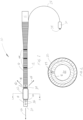
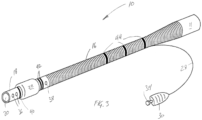
- a femoral arterial cannula 10 features a cylindrical plastic body of tubing 12 which preferably has a biocompatible surface coating.
- the initial length 11 (3/8" OD) remains clear and a 3/8x3/8" luer lock connector is used to connect the initial length with a cardiopulmonary circuit; arterial blood flow enters the cannula 10 through this connector.
- This connector is a standard perfusion component and is not shown in the figures..
- the length of body tubing 12 tapers to one of the varied sizes; e.g. a 15 Fr (5.0mm) body of wire wound tubing 16 or a 17 Fr (5.6mm) body of wire wound tubing or a 19 Fr (6.3mm) body of wire wound tubing 16.
- a contiguous length of clear tubing 18 Distal to the length of wire wound tubing 16 is a contiguous length of clear tubing 18, the tip 20 of which is open ended and is the exit port for systemic arterial flow.
- Circumferentially attached to body tubing 12 is a low-profile compliant balloon 22.
- Balloon 22 remains parallel to the length of clear tubing 12 when non-inflated.
- the balloon 22 length is approximately 20mm.
- the external balloon 22 surface has a drug eluting coating.
- a channel 27, as best illustrated in Fig. 2 runs the length of body tubing 12 to accommodate and allow a small-bore length of tubing 28 to sit longitudinally flush along body tubing 12.
- Small-bore length tubing 28 is attached to balloon 22 at one end and at its other end, to a balloon cuff 30 that includes a two-way valve and female luer port 34.
- Exit ports 36 are contiguous with the blood pathway for systemic arterial flow.
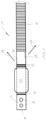
- exit ports 38 Proximal to the proximal end of the balloon 22 are two exit ports 38 within the contiguous length of clear tubing 18; exit ports 38 are at 180 degrees circumferentially, and as best illustrated in Fig. 5 , are offset longitudinally from each other by 5mm (one exit port is 5mm from the proximal balloon end while the second exit port is 10mm from the proximal balloon end).
- a circular radio-opaque marker 40 Distal to the distal end of the balloon 22 is a circular radio-opaque marker 40 within the body tubing 12.
- Proximal to the proximal end of the cannula 10 are two parallel circular radio-opaque markers 42 within the body tubing 12.
- Positional markers 44 are identified on the length of the wire wound tubing 16 body of the body tubing 12 to identify cannula positional depth.
- the femoral arterial cannula 10 is designed to be inserted either by a surgical cut down or by a percutaneous Seldinger technique.
- the cannula 10 delivers systemic arterial blood flow 46 along the length of the cannula 10 body through to the cannula tip 20 and the additional blood pathway exit ports 38.
- the balloon 22 is designed to seal the femoral artery 100 once inflated.
- the balloon 22 has a drug eluting coating.
- the cannula 10 has a biocompatible surface coating.
- the balloon 22 is de-aired prior to insertion by means of injection and aspiration of saline/contrast solution.
- the balloon 22 will effectively isolate the blood flow of the proximal exit ports 38 such that they are only available to deliver flow in a retrograde direction down 48 to the ipsilateral limb. With the balloon 22 inflated there is dedicated limb blood flow delivery 48.
- the femoral venous cannula 50 features a cylindrical plastic length of tubing 52 which preferably has a biocompatible surface coating.
- the initial length 51 (3/8"OD) remains clear with a 3/8 ⁇ 3/8 connector in situ (non luer lock); venous blood flow exits the cannula 50 through this connector which is a standard perfusion item and not shown in the figures.
- This length of tubing 52 tapers to one of varied sizes: a 23Fr (7.6mm) body of wire wound tubing 54 or a 25Fr (8.3mm) body of wire wound tubing or a 27Fr (9.7mm) body of wire wound tubing..
- a contiguous length of clear tubing 52 Distal to the length of wire wound tubing 54 is a contiguous length of clear tubing 52. Attached to clear length of tubing 52 is a broad-profile compliant balloon 56 which remains parallel to the length of clear tubing 52 when non-inflated. The external balloon 56 surface has a drug eluting coating. The balloon 56 length is approximately 12mm. When inflated the balloon 56 remains cylindrical along its length and is parallel to the body tubing 52. A channel 57, as best illustrated in Figs. 7 and 11 , runs the length of body tubing 52 to accommodate and allow a small-bore length of tubing 58 to sit longitudinally flush along body tubing 52. Small-bore length tubing 58 is attached to balloon 56 at one end and at its other end, to a balloon cuff 62 that includes a two-way valve and female luer port 66.
- Distal to the distal end of the balloon 56 are two circular blood pathway entry ports 62 within the clear tubing 52; the two blood entry ports 62 are at 180 degrees circumferentially. These blood entry ports 62 are offset from each other by 5mm (one entry port is 5mm distal from the balloon 56 while the second entry port is 10mm from the balloon 56 end). These entry ports 62 are contiguous with the blood pathway 65 for systemic venous blood flow.
- Proximal to the proximal end of the balloon 56 are two blood pathway entry ports 64 within the clear tubing 52, these ports are at 180 degrees circumferentially but are off-set from each other by 5mm (one entry port is 5mm proximal from the balloon 56 end while the second entry port is 10mm from the balloon end). These ports 64 are circumferentially offset by 90 degrees from the two distal blood entry ports 62.
- a single circular radio-opaque marker 66 Distal to the distal end of the balloon 56 is a single circular radio-opaque marker 66 within the body of the cannula 50. Proximal to the proximal end of the cannula 10 are two parallel circular radio-opaque markers 68 within the body tubing 52.
- a contiguous length of wire wound tubing 70 Distal to the clear tubing 52 is a contiguous length of wire wound tubing 70. Distal to the length of wire wound tubing 70 is a contiguous length of clear tubing 72, the tip 74 of which is open ended and is the entry port for systemic venous flow 65. Within this length of clear tubing 72 are six circular blood pathway entry ports 76 within the clear tubing 72, three entry ports longitudinally with identical exit ports at 180 degrees circumferentially.
- Positional markers 68 are identified on the length of the wire wound tubing body 54 of the body tubing 52 to identify cannula positional depth.
- the femoral venous cannula 50 is designed to be in varying lengths depending upon its clinical application as well the physical size of the patient.
- the femoral venous cannula 50 that has application for V-A ECMO, OHS and MICS procedures has three lengths while the model for V-V ECMO has three lengths.
- the femoral venous model designed for V-V ECMO is a shorter length than that of the femoral venous cannula designed for V-A ECMO, OHS and MICS.
- the included schematic has individual design components identical to those of the longer cannula.
- the femoral venous cannula 50 is designed to be inserted either by a surgical cut down or by a percutaneous Seldinger technique.
- the cannula 50 drains systemic venous blood flow 65 along the length of the body tubing 52 from the cannula tip 74 and the additional blood pathway entry ports 62.
- the balloon 56 is designed to seal the femoral vein 200 once inflated.
- the balloon 56 has a drug eluting coating.
- the cannula 50 has a biocompatible surface coating. The balloon 56 is de-aired prior to insertion by means of injection and aspiration of saline/contrast solution.
- the balloon 56 will effectively isolate the blood flow of the proximal entry ports 64 such that they are only available to drain venous blood flow 67 from the ipsilateral limb. With the balloon 56 inflated there is dedicated limb flow drainage while the distal entry ports 62 directly above the balloon will drain venous blood from the lower length of the inferior vena cava.
- the femoral arterial 10 and venous 50 cannulas have been designed to facilitate the delivery of dedicated arterial limb flow in the presence of dedicated venous limb drainage.
- a non-perfused limb will suffer the inevitable clinical consequences of ischemia, however a limb that is adequately perfused but is insulted by having inadequate or absent venous drainage will similarly be subjected to a physiological insult that may ultimately be irrecoverable.
- By facilitating both arterial perfusion along with venous drainage will protect the limb from the adverse consequences of limb ischemia. This identifies and recognizes the multifactorial nature of ischemic limb associated with peripheral cannulation and therefore offers a clinically superior solution opposed to using one cannula in isolation.
Landscapes
- Health & Medical Sciences (AREA)
- Heart & Thoracic Surgery (AREA)
- Engineering & Computer Science (AREA)
- Life Sciences & Earth Sciences (AREA)
- Cardiology (AREA)
- General Health & Medical Sciences (AREA)
- Veterinary Medicine (AREA)
- Hematology (AREA)
- Anesthesiology (AREA)
- Animal Behavior & Ethology (AREA)
- Biomedical Technology (AREA)
- Public Health (AREA)
- Vascular Medicine (AREA)
- Mechanical Engineering (AREA)
- Biophysics (AREA)
- Pulmonology (AREA)
- Physics & Mathematics (AREA)
- Geometry (AREA)
- Transplantation (AREA)
- Child & Adolescent Psychology (AREA)
- External Artificial Organs (AREA)
Claims (13)
- Femorale arterielle Kanüle (10), umfassend:einen länglichen hohlen Kanülenkörper (12), der ein distales (20) und ein proximales (11) offenes Ende aufweist;einen Ballon (22), der an dem Körper angrenzend an das distale Ende platziert ist;ein Aufblähmittel, das mit dem Ballon verbunden ist, zum Aufblähen des Ballons;vier Blutfluss-Austrittsöffnungen (36), die in dem Kanülenkörper zwischen dem Ballon und dem distalen Ende platziert sind, wobei zwei der distalen Austrittsöffnungen in Reihe miteinander entlang des Kanülenkörpers sind und zwei andere distale Austrittsöffnungen um 180° umlaufend versetzt von den ersten beiden distalen Austrittsöffnungen sind; undzwei Blutfluss-Austrittsöffnungen (38), die in dem Kanülenkörper zwischen dem Ballon und dem proximalen Ende platziert sind, wobei die proximalen Austrittsöffnungen um 180° umlaufend versetzt und in Längsrichtung voneinander versetzt sind, wobei:das distale Ende eine Spitze des länglichen hohlen Kanülenkörpers ist, unddas proximale Ende am gegenüberliegenden Ende des länglichen hohlen Kanülenkörpers vom distalen Ende ist.
- Femorale arterielle Kanüle nach Anspruch 1, wobei der Kanülenkörper ein länglicher hohler zylindrischer Körper ist.
- Femorale arterielle Kanüle nach Anspruch 1, wobei der Ballon einen Ballon mit niedrigem Profil umfasst.
- Femorale arterielle Kanüle nach Anspruch 1, wobei der Kanülenkörper einen Kegel vom distalen zum proximalen Ende umfasst.
- Femorale arterielle Kanüle nach Anspruch 1, wobei der Kanülenkörper einen distalen einzelnen radio-opaken Marker (40) oder einen proximalen doppelten radio-opaken Marker (42) umfasst.
- Femorale arterielle Kanüle nach Anspruch 1, wobei das Aufblähmittel umfasst:eine Leitung (28) mit kleinem Durchmesser, die mit dem Ballon an einem ersten Ende verbunden ist;eine Ballonmanschette (30), die mit einem zweiten Ende der Leitung mit kleinem Durchmesser verbunden ist;ein Zweiwegeventil, das mit der Ballonmanschette verbunden ist; undeine weibliche Luer-Öffnung (34), die mit dem Zweiwegeventil verbunden ist.
- Femorale venöse Kanüle (50), umfassend:einen länglichen hohlen Kanülenkörper (52), der ein distales (74) und ein proximales (51) offenes Ende aufweist;einen Ballon (56), der an dem Körper angrenzend an das proximale Ende platziert ist;ein Aufblähmittel, das mit dem Ballon verbunden ist, zum Aufblähen des Ballons;zwei Blutfluss-Eintrittsöffnungen (62), die in dem Kanülenkörper zwischen dem Ballon und dem distalen Ende platziert sind, wobei die distalen Eintrittsöffnungen um 180° umlaufend versetzt und in Längsrichtung voneinander entlang des Kanülenkörpers versetzt sind; undzwei Blutfluss-Eintrittsöffnungen (64), die in dem Kanülenkörper zwischen dem Ballon und dem proximalen Ende platziert sind, wobei die proximalen Eintrittsöffnungen um 180° umlaufend versetzt und in Längsrichtung voneinander versetzt und um 90° von den distalen Eintrittsöffnungen versetzt sind, wobei:das distale Ende eine Spitze (74) des länglichen hohlen Kanülenkörpers ist, unddas proximale Ende am gegenüberliegenden Ende des länglichen hohlen Kanülenkörpers vom distalen Ende ist.
- Femorale venöse Kanüle nach Anspruch 7, wobei der längliche hohle Kanülenkörper unterschiedliche Längen aufweist.
- Femorale venöse Kanüle nach Anspruch 7, wobei der Kanülenkörper ein länglicher hohler zylindrischer Körper ist.
- Femorale venöse Kanüle nach Anspruch 7, wobei der Ballon einen Ballon mit breitem Profil umfasst.
- Femorale venöse Kanüle nach Anspruch 7, wobei der Kanülenkörper einen Kegel vom distalen zum proximalen Ende umfasst.
- Femorale venöse Kanüle nach Anspruch 7, wobei der Kanülenkörper einen distalen einzelnen radio-opaken Marker (66) oder einen proximalen doppelten radio-opaken Marker (68) umfasst.
- Femorale venöse Kanüle nach Anspruch 7, wobei das Aufblähmittel umfasst:eine Leitung (58) mit kleinem Durchmesser, die mit dem Ballon an einem ersten Ende verbunden ist;eine Ballonmanschette (62), die mit einem zweiten Ende der Leitung mit kleinem Durchmesser verbunden ist;ein Zweiwegeventil, das mit der Ballonmanschette verbunden ist; undeine weibliche Luer-Öffnung (66), die mit dem Zweiwegeventil verbunden ist.
Applications Claiming Priority (2)
| Application Number | Priority Date | Filing Date | Title |
|---|---|---|---|
| CA3035749A CA3035749A1 (en) | 2019-03-05 | 2019-03-05 | Femoral and venous arterial cannulas and a method for mitigating the risk of limb ischemia |
| PCT/CA2020/050191 WO2020176968A1 (en) | 2019-03-05 | 2020-02-13 | Femoral and venous arterial cannulas and a method for mitigating the risk of limb ischemia |
Publications (4)
| Publication Number | Publication Date |
|---|---|
| EP3934728A1 EP3934728A1 (de) | 2022-01-12 |
| EP3934728A4 EP3934728A4 (de) | 2022-05-11 |
| EP3934728B1 true EP3934728B1 (de) | 2024-05-22 |
| EP3934728C0 EP3934728C0 (de) | 2024-05-22 |
Family
ID=72321875
Family Applications (1)
| Application Number | Title | Priority Date | Filing Date |
|---|---|---|---|
| EP20766367.5A Active EP3934728B1 (de) | 2019-03-05 | 2020-02-13 | Femorale und venöse arterielle kanülen zur verminderung des risikos auf gliedmassenischämie |
Country Status (5)
| Country | Link |
|---|---|
| US (1) | US20230166099A1 (de) |
| EP (1) | EP3934728B1 (de) |
| CA (1) | CA3035749A1 (de) |
| ES (1) | ES2981837T3 (de) |
| WO (1) | WO2020176968A1 (de) |
Families Citing this family (5)
| Publication number | Priority date | Publication date | Assignee | Title |
|---|---|---|---|---|
| WO2023148723A1 (en) * | 2022-02-03 | 2023-08-10 | Rambam Medtech Ltd. | Venous cannula insertion |
| EP4493250A4 (de) * | 2022-03-15 | 2026-03-18 | Total Flow Medical Ltd | Bidirektionale strömungskanülen, systeme mit bidirektionalen kanülen und verfahren zur verwendung davon |
| CN219595415U (zh) * | 2023-02-03 | 2023-08-29 | 南京鼓楼医院 | 一种提供下肢血液灌注的股动脉插管 |
| WO2025057066A1 (en) * | 2023-09-11 | 2025-03-20 | Total Flow Medical Limited | Bidirectional flow cannulas and methods of using same |
| WO2026084924A1 (en) | 2024-10-14 | 2026-04-23 | Edwards Lifesciences Corporation | Bidirectional cannula |
Family Cites Families (14)
| Publication number | Priority date | Publication date | Assignee | Title |
|---|---|---|---|---|
| US3884242A (en) * | 1971-03-29 | 1975-05-20 | Mpc Kurgisil | Catheter assembly |
| US4211233A (en) * | 1978-01-05 | 1980-07-08 | Lin Edward D | Urethral catheter |
| US5584803A (en) * | 1991-07-16 | 1996-12-17 | Heartport, Inc. | System for cardiac procedures |
| US6821265B1 (en) * | 1996-04-10 | 2004-11-23 | Endoscopic Technologies, Inc. | Multichannel catheter |
| US5928181A (en) * | 1997-11-21 | 1999-07-27 | Advanced International Technologies, Inc. | Cardiac bypass catheter system and method of use |
| US20060247575A1 (en) * | 2001-12-21 | 2006-11-02 | Richard Cartledge | Balloon cannulae |
| US20110004057A1 (en) * | 2004-04-21 | 2011-01-06 | Acclarent, Inc. | Systems and methods for transnasal dilation of passageways in the ear, nose or throat |
| US20070016168A1 (en) * | 2005-06-29 | 2007-01-18 | Conway Anthony J | Method of making a catheter device |
| US8241248B2 (en) * | 2009-02-27 | 2012-08-14 | Cvdevices, Llc | Devices and systems for selective auto-retroperfusion of the cerebral venous system |
| US8992817B2 (en) * | 2012-12-10 | 2015-03-31 | Abbott Cardiovascular Systems, Inc. | Process of making a medical balloon |
| CN203447625U (zh) * | 2013-09-03 | 2014-02-26 | 董爱强 | 双极双气囊股静脉插管 |
| US20170232238A1 (en) | 2014-08-06 | 2017-08-17 | Edwars Litesciences Corporation | Multi-lumen cannulae |
| DE102016103560A1 (de) | 2016-02-29 | 2017-08-31 | Eberhard Karls Universität Tübingen Medizinische Fakultät | System zum Einsatz bei Organersatz- oder -unterstützungsverfahren |
| TR201704099A2 (tr) | 2017-03-17 | 2018-09-21 | T C Istanbul Medipol Ueniversitesi | Bi̇r femoral arteryel ecmo (extracorporeal membrane oxygenation ekstrakorporeal membran oksi̇jenasyon) kanülü |
-
2019
- 2019-03-05 CA CA3035749A patent/CA3035749A1/en active Pending
-
2020
- 2020-02-13 ES ES20766367T patent/ES2981837T3/es active Active
- 2020-02-13 US US17/436,574 patent/US20230166099A1/en active Pending
- 2020-02-13 WO PCT/CA2020/050191 patent/WO2020176968A1/en not_active Ceased
- 2020-02-13 EP EP20766367.5A patent/EP3934728B1/de active Active
Also Published As
| Publication number | Publication date |
|---|---|
| US20230166099A1 (en) | 2023-06-01 |
| CA3035749A1 (en) | 2020-09-05 |
| WO2020176968A1 (en) | 2020-09-10 |
| EP3934728C0 (de) | 2024-05-22 |
| EP3934728A1 (de) | 2022-01-12 |
| EP3934728A4 (de) | 2022-05-11 |
| ES2981837T3 (es) | 2024-10-10 |
Similar Documents
| Publication | Publication Date | Title |
|---|---|---|
| US20230166099A1 (en) | Femoral venous and femoral arterial cannulas and a method for mitigating the risk of limb ischemia | |
| US6056717A (en) | Implantable vascular device | |
| US7341570B2 (en) | Apparatus and methods for treating congestive heart disease | |
| US6086553A (en) | Arteriovenous shunt | |
| US6053901A (en) | Subcutaneously implanted cannula and method for arterial access | |
| JPH04507050A (ja) | 血液の体外処理のための脈管アクセスシステム | |
| JP2013078575A (ja) | 外部流れチャネルを備えるカテーテル | |
| US6544206B1 (en) | Dialysis access system and method | |
| US20240009438A1 (en) | Devices and methods for fistula-free hemodialysis | |
| Raina et al. | Challenges of vascular access in the pediatric population | |
| Kasirajan et al. | The total artificial heart for biventricular heart failure and beyond | |
| Zhang et al. | Extracorporeal membrane oxygenation (ECMO) assisted mediastinal tumor resection and superior vena cava replacement are safe and feasible | |
| US20220273857A1 (en) | Novel type superior vena cava cannula for use in extrathoracic cannulation in open heart surgery | |
| US20230310187A1 (en) | Methods and systems for facilitating laminar flow between conduits | |
| US11077239B2 (en) | Tributary access device and methods of use | |
| Ng et al. | Lethal pulmonary embolism following left upper extremity angiogram/angioplasty with thrombectomy at malfunctioning arteriovenous fistula | |
| Christianson | Caring for a patient who has an implanted venous port | |
| Dosluoglu et al. | External femorofemoral bypass to relieve acute leg ischemia during circulatory assist | |
| Soundaravalli et al. | Open surgical repair of abdominal aortic aneurysm: Proximal aortic control by endoaortic balloon-A novel approach | |
| Granata et al. | Vascular access for acute extracorporeal renal replacement therapies | |
| Goranovska et al. | Extra-anatomic aorto-right subclavian bypass after complicated insertion of permanent dialysis catheter | |
| D'Intini et al. | Management of vascular catheters for acute renal replacement therapy | |
| Khanin | hemodialysis Access | |
| Conrad | Vascular Access | |
| Sato et al. | Two cases of chronic pulmonary thromboembolism saved by postoperative use of a percutaneous cardiopulmonary support device |
Legal Events
| Date | Code | Title | Description |
|---|---|---|---|
| STAA | Information on the status of an ep patent application or granted ep patent |
Free format text: STATUS: THE INTERNATIONAL PUBLICATION HAS BEEN MADE |
|
| PUAI | Public reference made under article 153(3) epc to a published international application that has entered the european phase |
Free format text: ORIGINAL CODE: 0009012 |
|
| STAA | Information on the status of an ep patent application or granted ep patent |
Free format text: STATUS: REQUEST FOR EXAMINATION WAS MADE |
|
| 17P | Request for examination filed |
Effective date: 20211005 |
|
| AK | Designated contracting states |
Kind code of ref document: A1 Designated state(s): AL AT BE BG CH CY CZ DE DK EE ES FI FR GB GR HR HU IE IS IT LI LT LU LV MC MK MT NL NO PL PT RO RS SE SI SK SM TR |
|
| A4 | Supplementary search report drawn up and despatched |
Effective date: 20220408 |
|
| RIC1 | Information provided on ipc code assigned before grant |
Ipc: A61M 25/04 20060101ALI20220404BHEP Ipc: A61M 25/00 20060101ALI20220404BHEP Ipc: A61M 1/36 20060101ALI20220404BHEP Ipc: A61M 25/10 20130101AFI20220404BHEP |
|
| DAV | Request for validation of the european patent (deleted) | ||
| DAX | Request for extension of the european patent (deleted) | ||
| GRAP | Despatch of communication of intention to grant a patent |
Free format text: ORIGINAL CODE: EPIDOSNIGR1 |
|
| STAA | Information on the status of an ep patent application or granted ep patent |
Free format text: STATUS: GRANT OF PATENT IS INTENDED |
|
| INTG | Intention to grant announced |
Effective date: 20231002 |
|
| GRAS | Grant fee paid |
Free format text: ORIGINAL CODE: EPIDOSNIGR3 |
|
| GRAA | (expected) grant |
Free format text: ORIGINAL CODE: 0009210 |
|
| STAA | Information on the status of an ep patent application or granted ep patent |
Free format text: STATUS: THE PATENT HAS BEEN GRANTED |
|
| RAP3 | Party data changed (applicant data changed or rights of an application transferred) |
Owner name: TOTAL FLOW MEDICAL LIMITED |
|
| AK | Designated contracting states |
Kind code of ref document: B1 Designated state(s): AL AT BE BG CH CY CZ DE DK EE ES FI FR GB GR HR HU IE IS IT LI LT LU LV MC MK MT NL NO PL PT RO RS SE SI SK SM TR |
|
| REG | Reference to a national code |
Ref country code: GB Ref legal event code: FG4D |
|
| REG | Reference to a national code |
Ref country code: CH Ref legal event code: EP |
|
| REG | Reference to a national code |
Ref country code: DE Ref legal event code: R096 Ref document number: 602020031322 Country of ref document: DE |
|
| REG | Reference to a national code |
Ref country code: IE Ref legal event code: FG4D |
|
| U01 | Request for unitary effect filed |
Effective date: 20240522 |
|
| U07 | Unitary effect registered |
Designated state(s): AT BE BG DE DK EE FI FR IT LT LU LV MT NL PT SE SI Effective date: 20240603 |
|
| PG25 | Lapsed in a contracting state [announced via postgrant information from national office to epo] |
Ref country code: IS Free format text: LAPSE BECAUSE OF FAILURE TO SUBMIT A TRANSLATION OF THE DESCRIPTION OR TO PAY THE FEE WITHIN THE PRESCRIBED TIME-LIMIT Effective date: 20240922 |
|
| PG25 | Lapsed in a contracting state [announced via postgrant information from national office to epo] |
Ref country code: HR Free format text: LAPSE BECAUSE OF FAILURE TO SUBMIT A TRANSLATION OF THE DESCRIPTION OR TO PAY THE FEE WITHIN THE PRESCRIBED TIME-LIMIT Effective date: 20240522 |
|
| REG | Reference to a national code |
Ref country code: ES Ref legal event code: FG2A Ref document number: 2981837 Country of ref document: ES Kind code of ref document: T3 Effective date: 20241010 |
|
| PG25 | Lapsed in a contracting state [announced via postgrant information from national office to epo] |
Ref country code: GR Free format text: LAPSE BECAUSE OF FAILURE TO SUBMIT A TRANSLATION OF THE DESCRIPTION OR TO PAY THE FEE WITHIN THE PRESCRIBED TIME-LIMIT Effective date: 20240823 |
|
| PG25 | Lapsed in a contracting state [announced via postgrant information from national office to epo] |
Ref country code: PL Free format text: LAPSE BECAUSE OF FAILURE TO SUBMIT A TRANSLATION OF THE DESCRIPTION OR TO PAY THE FEE WITHIN THE PRESCRIBED TIME-LIMIT Effective date: 20240522 |
|
| PG25 | Lapsed in a contracting state [announced via postgrant information from national office to epo] |
Ref country code: PL Free format text: LAPSE BECAUSE OF FAILURE TO SUBMIT A TRANSLATION OF THE DESCRIPTION OR TO PAY THE FEE WITHIN THE PRESCRIBED TIME-LIMIT Effective date: 20240522 Ref country code: NO Free format text: LAPSE BECAUSE OF FAILURE TO SUBMIT A TRANSLATION OF THE DESCRIPTION OR TO PAY THE FEE WITHIN THE PRESCRIBED TIME-LIMIT Effective date: 20240822 Ref country code: IS Free format text: LAPSE BECAUSE OF FAILURE TO SUBMIT A TRANSLATION OF THE DESCRIPTION OR TO PAY THE FEE WITHIN THE PRESCRIBED TIME-LIMIT Effective date: 20240922 Ref country code: HR Free format text: LAPSE BECAUSE OF FAILURE TO SUBMIT A TRANSLATION OF THE DESCRIPTION OR TO PAY THE FEE WITHIN THE PRESCRIBED TIME-LIMIT Effective date: 20240522 Ref country code: GR Free format text: LAPSE BECAUSE OF FAILURE TO SUBMIT A TRANSLATION OF THE DESCRIPTION OR TO PAY THE FEE WITHIN THE PRESCRIBED TIME-LIMIT Effective date: 20240823 Ref country code: RS Free format text: LAPSE BECAUSE OF FAILURE TO SUBMIT A TRANSLATION OF THE DESCRIPTION OR TO PAY THE FEE WITHIN THE PRESCRIBED TIME-LIMIT Effective date: 20240822 |
|
| PG25 | Lapsed in a contracting state [announced via postgrant information from national office to epo] |
Ref country code: CZ Free format text: LAPSE BECAUSE OF FAILURE TO SUBMIT A TRANSLATION OF THE DESCRIPTION OR TO PAY THE FEE WITHIN THE PRESCRIBED TIME-LIMIT Effective date: 20240522 |
|
| PG25 | Lapsed in a contracting state [announced via postgrant information from national office to epo] |
Ref country code: SK Free format text: LAPSE BECAUSE OF FAILURE TO SUBMIT A TRANSLATION OF THE DESCRIPTION OR TO PAY THE FEE WITHIN THE PRESCRIBED TIME-LIMIT Effective date: 20240522 Ref country code: RO Free format text: LAPSE BECAUSE OF FAILURE TO SUBMIT A TRANSLATION OF THE DESCRIPTION OR TO PAY THE FEE WITHIN THE PRESCRIBED TIME-LIMIT Effective date: 20240522 |
|
| PG25 | Lapsed in a contracting state [announced via postgrant information from national office to epo] |
Ref country code: SM Free format text: LAPSE BECAUSE OF FAILURE TO SUBMIT A TRANSLATION OF THE DESCRIPTION OR TO PAY THE FEE WITHIN THE PRESCRIBED TIME-LIMIT Effective date: 20240522 |
|
| PG25 | Lapsed in a contracting state [announced via postgrant information from national office to epo] |
Ref country code: SM Free format text: LAPSE BECAUSE OF FAILURE TO SUBMIT A TRANSLATION OF THE DESCRIPTION OR TO PAY THE FEE WITHIN THE PRESCRIBED TIME-LIMIT Effective date: 20240522 Ref country code: SK Free format text: LAPSE BECAUSE OF FAILURE TO SUBMIT A TRANSLATION OF THE DESCRIPTION OR TO PAY THE FEE WITHIN THE PRESCRIBED TIME-LIMIT Effective date: 20240522 Ref country code: RO Free format text: LAPSE BECAUSE OF FAILURE TO SUBMIT A TRANSLATION OF THE DESCRIPTION OR TO PAY THE FEE WITHIN THE PRESCRIBED TIME-LIMIT Effective date: 20240522 Ref country code: CZ Free format text: LAPSE BECAUSE OF FAILURE TO SUBMIT A TRANSLATION OF THE DESCRIPTION OR TO PAY THE FEE WITHIN THE PRESCRIBED TIME-LIMIT Effective date: 20240522 |
|
| REG | Reference to a national code |
Ref country code: DE Ref legal event code: R097 Ref document number: 602020031322 Country of ref document: DE |
|
| U20 | Renewal fee for the european patent with unitary effect paid |
Year of fee payment: 6 Effective date: 20250217 |
|
| PLBE | No opposition filed within time limit |
Free format text: ORIGINAL CODE: 0009261 |
|
| STAA | Information on the status of an ep patent application or granted ep patent |
Free format text: STATUS: NO OPPOSITION FILED WITHIN TIME LIMIT |
|
| 26N | No opposition filed |
Effective date: 20250225 |
|
| PG25 | Lapsed in a contracting state [announced via postgrant information from national office to epo] |
Ref country code: MC Free format text: LAPSE BECAUSE OF FAILURE TO SUBMIT A TRANSLATION OF THE DESCRIPTION OR TO PAY THE FEE WITHIN THE PRESCRIBED TIME-LIMIT Effective date: 20240522 |
|
| REG | Reference to a national code |
Ref country code: CH Ref legal event code: U11 Free format text: ST27 STATUS EVENT CODE: U-0-0-U10-U11 (AS PROVIDED BY THE NATIONAL OFFICE) Effective date: 20260301 |
|
| U20 | Renewal fee for the european patent with unitary effect paid |
Year of fee payment: 7 Effective date: 20260216 |
|
| PGFP | Annual fee paid to national office [announced via postgrant information from national office to epo] |
Ref country code: GB Payment date: 20260216 Year of fee payment: 7 |
|
| PGFP | Annual fee paid to national office [announced via postgrant information from national office to epo] |
Ref country code: ES Payment date: 20260303 Year of fee payment: 7 |
|
| PGFP | Annual fee paid to national office [announced via postgrant information from national office to epo] |
Ref country code: IE Payment date: 20260216 Year of fee payment: 7 |
|
| PGFP | Annual fee paid to national office [announced via postgrant information from national office to epo] |
Ref country code: CH Payment date: 20260301 Year of fee payment: 7 |