EP3933449B1 - System zur dosimetrischen und mikrodosimetrischen charakterisierung ionisierender strahlung - Google Patents
System zur dosimetrischen und mikrodosimetrischen charakterisierung ionisierender strahlung Download PDFInfo
- Publication number
- EP3933449B1 EP3933449B1 EP20305733.6A EP20305733A EP3933449B1 EP 3933449 B1 EP3933449 B1 EP 3933449B1 EP 20305733 A EP20305733 A EP 20305733A EP 3933449 B1 EP3933449 B1 EP 3933449B1
- Authority
- EP
- European Patent Office
- Prior art keywords
- micro
- dosimetric
- sensitive
- sensor
- dose
- Prior art date
- Legal status (The legal status is an assumption and is not a legal conclusion. Google has not performed a legal analysis and makes no representation as to the accuracy of the status listed.)
- Active
Links
Images


Classifications
-
- G—PHYSICS
- G01—MEASURING; TESTING
- G01T—MEASUREMENT OF NUCLEAR OR X-RADIATION
- G01T1/00—Measuring X-radiation, gamma radiation, corpuscular radiation, or cosmic radiation
- G01T1/16—Measuring radiation intensity
- G01T1/26—Measuring radiation intensity with resistance detectors
Definitions
- the present invention relates to dosimetric and micro-dosimetric ionizing radiation characterization.
- hadron therapy using protons or carbon ions damages tumor cells more effectively than photon therapy.
- Charged particles have an inverse depth-dose distribution in comparison to photons, delivering a dose increasing with penetration depth up to a maximum at the end of the particles path (Bragg peak). This maximizes the dose transmitted to the cancerous area and reduces the dose transmitted to the healthy tissue.
- RBE Relative Biological Effectiveness
- the RBE is defined as the ratio of the irradiated dose of ions to that of a reference photon energy that would be required to result in the same biological effect for both.
- MKM Microdosimetric Kinetic Model
- the LET is used to describe the average energy deposited per unit length (in keV/ ⁇ m) in an absorber material. Limitations of the LET for precise assessment of the RBE have resulted in the development of a set of measurable stochastic quantities, such as the lineal energy which provides the fundamental basis for microdosimetry.
- tissue equivalent proportional counter TEPC
- silicon-based semiconductor microdosimeter Several devices such as the tissue equivalent proportional counter (TEPC) or silicon-based semiconductor microdosimeter may be used for the measurement of microdosimetric spectra.
- TEPC tissue equivalent proportional counter
- Known TEPC consist of a tissue equivalent plastic sphere in a grounded aluminum shell. The sphere is filled with a tissue equivalent gas to simulate interactions with human tissue. This kind of detectors usually use centimeter-sized sensors, which is much larger than the size of a typical human cell.
- Mini-TEPCs have been developed with cylindrical sensitive volumes having sizes of the order of a few tens of millimeters. Recently, different miniaturized tissue-equivalent gas detectors corresponding to operation at a nanometric level down to 35 nm have been developed for microdosimetry applications in radiotherapy.
- TEPC detectors have had some success while tested in different therapeutic heavy ion beams but are still being further developed.
- TEPCs compared to microdosimetry include the need for high-voltage and for a gas supply system. Further limitations include so-called pulse pile-up problems, as well as a low spatial resolution due to a relatively large size of the sensitive volumes compared to other solid-state microdosimeters (which are in the ⁇ m size range).
- Silicon-based microdosimeters better known as silicon-on-insulator (SOI) microdosimeters, have also been developed over the last 20 years. Different generations of SOI devices have been designed.
- SOI silicon-on-insulator
- Diamond with its unique physical properties (e.g. a large-band gap, temperature stability, fast drift velocity and low capacitance), has been identified as a promising candidate material to produce microdosimetry devices. Recently, significant developments in diamond-based microdosimetry have been made with various fabrication and operational approaches.
- the average absorbed dose (dose-depth profile) of the ion beams in water is measured using different commercially available tools in a separate run where conditions are assumed to be the same as for the micro-dosimetric run. These additional tools are placed at the same effective depth within a water phantom as the micro-dosimeters (along the central axis of the beam) to obtain a depth-dose profile of the beam and verify the quality of the measured micro-dosimetric spectra.
- Monte Carlo simulations of the entire clinical beamlines are made and used for the verification of the ion beam range.
- the detector operates by collecting free charge produced by ionizing radiation in the depletion layer.
- the latter is extended by reverse biasing of the p-n junction, which is connected to a spectroscopy set up.
- a pulse-height spectrum of ionized radiation can be acquired, i.e. a micro-dosimetric spectrum.
- the electric signal used for the integral dosimetry measurement with the MOSFET detector is the threshold voltage of the transistor, which exhibits a shift after irradiation. This radiation induced effect must be removed by annealing at 150-200°C after a few measurements.
- the MOSFET detector can be simultaneously used for integral dosimetry of radiation dose and for differential spectroscopy.
- the response of the MOSFET detector is strongly dependent on the particle LET angle with respect to the oxide electric field and to temperature.
- a further significant limitation of this system is also the measurement of the lineal energy, because due to a high noise level, no lineal energies measurements below some level are possible.
- the MOSFET's shift in threshold voltage requires as mentioned above a thermal treatment to reset the device and is not very practical. Also, after several irradiations the detector suffers permanent damage and cannot be re-used.
- the present invention relates to a system according to claim 1 for dosimetric and micro-dosimetric ionizing radiation characterization, comprising:
- the picoammeter enables low DC current measurements corresponding to the dose rate (current at the plateau) and dose (integrated current).
- the invention allows precise and accurate measurements of lineal energy spectra in the form of a calibrated pulse-height spectrum, which provide an essential input parameter, such as dose-mean lineal energy, for the calculation and thus prediction of the RBE for a specific cell type in in compliance with the MKM model.
- the invention allows for example an 'in-flight' scan of the radiation field to get dose profiles, i.e. in 3D, then to identify 'points of interest' and measure microdosimetric spectra.
- This dual measurement of dose rate and dose is made with a same sensor and is particularly useful for ion beam characterization in hadron therapy, as the knowledge of the lineal energy provides information about the effectiveness of the ion beam, while the dose rate may be used for the verification of the range of the ion beam and may help position the sensor within the irradiation field with high precision, which contributes to Quality Assurance (QA) improvement as well as radiobiological optimization of the treatment plans.
- QA Quality Assurance
- the invention allows the fabrication of a compact and user-friendly system with the ability to measure both quantities above with high spatial resolution at low noise and with the same sensor in a reliable manner. Furthermore, the sensor allows "pinpoint" measurements, for example within an area less than 1mm 2 , better less than 0.1mm 2 , for example about 0.05mm 2 . Accordingly, the system gives little perturbation to the field at the point of measurement, improving the precision and the reliability of such measurements.
- the system has ability of measuring very low induced current signals.
- the sensor may exhibit a small leakage current, that may be in the order of 0.01pA or less, and a high sensitivity threshold for lineal energy, that may be of the order of 0.5 keV/ ⁇ m (calculated for water equivalent) or less.
- the senor is more tissue equivalent and radiation hard when compared to the silicon-based sensors.
- the diamond-based sensor comprises at least two micro-sensitive volumes having respective electrodes, the at least one micro-dosimetric readout channel and the at least one dosimetry readout channel being connected to these respective electrodes.
- the at least one micro-sensitive volume is connected to top and back electrodes, the at least one micro-dosimetric readout channel and the at least one picoammeter being connected respectively to these top and back electrodes, or vice-versa.
- a bias voltage may be applied to the top electrode or to the back electrode through the picoammeter.
- the at least one micro-dosimetric readout system and the at least one dosimetry readout channel are connected to a same electrode, preferably a top electrode.
- the charge sensitive amplifier may be connected to the corresponding electrode through a decoupling capacitor.
- bias voltage When a bias voltage is applied, it may range from 0 to 100 V or more, so that the electric field induced by the bias voltage is for example of the order of 10V/micron.
- the senor comprises a non-electrically active material extending around said at least one micro-sensitive volume.
- a “non-electrically active material” refers to a material that creates substantially no directional drift of radiation-induced free charge carriers under an electric field. While incident radiation such as an ion beam may create free charge carriers in the non-electrically active material, the lifetime of the free charge carriers in the non-electrically active material is very short, e.g. on the order of a picosecond.
- non-electrically active materials include radiation hard resists such as epoxy-based resins (e.g. SU-8), polymers such as PMMA, and some inorganic materials such as glass.
- radiation hard resists such as epoxy-based resins (e.g. SU-8), polymers such as PMMA, and some inorganic materials such as glass.
- the non-electrically active material may have a planar configuration and/or be of a substantially constant thickness, preferably having a same thickness as the micro-sensitive volumes.
- the non-electrically active material preferably extends in contact with and around the entire periphery of each one of the micro-sensitive volumes.
- the non-electrically active material fills all the space between the micro-sensitive volumes, leaving no voids between them.
- the non-electrically active material may be rigid or flexible.
- the micro-sensitive volumes may be mechanically supported by the non-electrically active material, and the latter may be supported only at its periphery by a frame, preferably a diamond-based frame made of a same material as the micro-sensitive volumes.
- the non-electrically active material may support metal electrodes that covers both the micro-sensitive volumes and the non-electrically active material.
- the non-electrically active material may support a doped layer or cover a doped layer.
- the non-electrically active material may be superposed entirely to a substrate, for example a HPHT (high pressure high temperature) or CVD diamond substrate.
- a substrate for example a HPHT (high pressure high temperature) or CVD diamond substrate.
- the non-electrically substrate may support conductive tracks extending along its thickness.
- the sensor comprises at least one micro-sensitive volume, preferably an array of micro-sensitive volumes.
- the micro-sensitive volume may have a cylindrical shape, preferably with a symmetry of revolution. In some variants, the micro-sensitive volume has a hemispherical or spherical shape.
- a thickness of the micro-sensitive volume may range from 0.1 to 500 ⁇ m, better from 1 to 50 ⁇ m and in particular from 1 to 20 ⁇ m.
- a diameter or largest dimension in cross-section of the micro-sensitive volume may range from 0.5 to 500 ⁇ m, better from 1 to 100 ⁇ m, even better from 5 to 100 ⁇ m or 10 to 100 ⁇ m.
- the volume of one micro-sensitive volume may range from 1 ⁇ m 3 to 1000000 ⁇ m 3 , better from 1 to 50000 and even better from 1 to 2500 ⁇ m 3 .
- the micro-sensitive volume is preferably made of Single Crystalline Chemical Vapor Deposited (scCVD) diamond.
- a top electrode connected to the dosimetry and/or micro-dosimetry readout channel(s) may interconnect several micro-sensitive volumes of an array of micro-sensitive volumes of the sensor.
- the number of interconnected micro-sensitive volumes may range from 1 to several thousands.
- the number of micro-sensitive volumes of the sensor may range from 1 to several thousands.
- At least some micro-sensitive volumes are surrounded by said non-electrically active material where no directional charge drift under the presence of electric field takes place.
- the micro-sensitive volume is surrounded by a Guard Ring (GR) electrode, as disclosed in I. A. Zahradnik et al., "A diamond guard ring microdosimeter for ion beam therapy,” Rev. Sci. Instrum. 91, 054102 (2020 ).
- GR Guard Ring
- Such a sensor is referred to below as the "GR sensor”.
- micro-sensitive volumes may also be defined by a boron-doped diamond deposited on top of intrinsic diamond as in the so-called self-biased "p+ sensor" disclosed in the publication "scCVD diamond membrane based microdosimeter for hadron therapy", IA Zahradnik, MT Pomorski, L De Marzi, D Tromson, P Barberet, N Skukan, ...Physica Status Solidi (a) 215 (22), 1800383.
- All micro-sensitive volumes of the sensor may be of a same thickness, or in a variant of different thicknesses.
- Micro-sensitive volumes of different thicknesses may be connected to respective readout channels.
- the micro-sensitive volumes may have end faces in contact with respective top and back electrodes.
- top and back refer to one orientation of the sensor.
- the sensor may be used in any appropriate orientation with respect to the incident radiation, and the top electrode may or not be facing the incident radiation.
- a micro-sensitive volume may be in contact or not with a doped layer, for example a p or p+ type or n or n+ type doped layer, preferably a p+ doped layer or a n+ doped layer, for example a p+ boron doped layer or a n+ phosphorus doped layer.
- a doped layer for example a p or p+ type or n or n+ type doped layer, preferably a p+ doped layer or a n+ doped layer, for example a p+ boron doped layer or a n+ phosphorus doped layer.
- the electrodes may be metal based or carbon-based electrodes.
- An electrode may be constituted at least partially by a doped layer.
- the system preferably comprises processing means for generating a Lineal Energy Spectrum (LES) based on signals outputted by the at least one micro-dosimetric readout channel, and preferably also an RBE based on said lineal energy spectrum.
- LES Lineal Energy Spectrum
- the system preferably comprises processing means for integrating the dose rate signal provided by the picoammeter and generate dose data.
- the processing means may comprise any computer such as a personal computer or specialized hardware such as microcontroller or FPGA circuit.
- the processing means may comprise any interface for signal processing, for example Multi Channel Analyzer, A/D converter, filters, amplifiers, etc.
- the invention also relates to a method according to claim 12, for assessing the dose and lineal energy spectra of an ionizing radiation, comprising measuring the dose rate and the deposited energy distribution using a system as defined above.
- This measurement may be performed simultaneously and with a same sensor, each with at least one micro-sensitive volume connected to micro-dosimetric and dosimetric readout channels or with at least two different micro-sensitive volumes connected respectively to a micro-dosimetric readout channel and to a dosimetric readout channel.
- the sensor may be placed after a water or plastics phantom or within a water phantom.
- the ionizing radiation may be a hadron therapy ion beam, for example a proton beam or a beam of heavier ions such as carbon ions.
- the ion beam may be produced by Pencil Beam Scanning (PBS) or by passive scattering (so-called double scattering (DS)) delivery techniques.
- the method of the invention is also useful when the ionizing radiation is space radiation.
- the system 1 shown in Fig.1 comprises a diamond-based sensor 10 and two readout channels 20 and 30 for respective micro-dosimetric spectrum and dosimetry measurements.
- the sensor 10 defines an array of micro-sensitive volumes 12 that are each responsive to an incident ion beam.
- micro-sensitive volumes 12 are preferably made of scCVD diamond and extend between top electrodes, two of them (being referred to as 15 and 16) being shown in the Figures, and a back electrode 19, which may be metallic or made by other materials such as carbon-based materials for example.
- Each top electrode 15 or 16 may contact a respective set of micro-sensitive volumes 12 arranged in an array, as shown. In a variant (not shown), each top electrode contacts only one respective micro-sensitive volume 12.
- a non-electrically active material 13 such as an epoxy-based resist or PMMA, may extend around each micro-sensitive volume 12, as shown, to improve the performances of the sensor 10 by isolating each micro-sensitive volume from charge diffusion from the neighboring material.
- Each micro-sensitive volume 12 may be of a cylindrical shape with a diameter in the range 10-60 microns for example, and a thickness no greater than 10 microns.
- the back electrode 19 is connected to all micro-sensitive volumes 12.
- This back electrode 13 may be connected by a connection 59 to a bias voltage source.
- the top electrode 15 is connected to a first readout channel 20 for micro-dosimetry measurement.
- the other top electrode 16 is connected to a second readout channel 30 for dosimetry measurement.
- top electrodes may be connected similarly to corresponding readout channels (not shown).
- the first readout channel 20 comprises a Charge Sensitive Amplifier (CSA) 21, known per se, which outputs a voltage based on the integration of the current induced by a single passing particle through a corresponding volume at the input.
- CSA Charge Sensitive Amplifier
- the integration time is typically very short here, below 1ns.
- the CSA is connected to a Multi-Channel Analyzer (MCA) which may further amplify and digitize the signal.
- MCA Multi-Channel Analyzer
- the latter may be, as shown in Figure 1 , a pulse 24 and the processing may result in generating for a given travel distance in a phantom, such as a water phantom or a plastics phantom, a pulse height spectrum 25 figuring the number of counts (as ordinate) with respect to the Energy (as abscissa).
- the second readout channel 30 comprises a picoammeter 31 that measures the DC current induced by the beam in the sensor 10.
- a relative dose rate 34 may be estimated at the measured curves plateau. The integration of this current curve results in a measured collected charge and provides the information 35 about the dose.
- the micro-dosimetric spectrum 26 provides information allowing to compute the dose-mean lineal energy to estimate the cell specific RBE in compliance with the MKM model, as explained above, while the simultaneous measurement of the dose may be used additionally for the verification of the 3D dose profiles, and the position of the sensor within the irradiation field with high precision (dosimetry).
- the picoammeter 31 of the embodiment of Figure 1 may be connected to ground GND, as illustrated in Figure 2 .
- Figure 9 shows in more details a possible structure for the sensor of Figures 1 and 2 , where the array of single solid-state micro-sensitive volumes is embedded within a non-electrically active material. This sensor is referred to as "fully 3D sensor”.
- the invention also works with other types of diamond-based sensors, such as the "GR sensor” or "p+ sensor” mentioned above.
- the layer of non-electrically active material 13 may be supported by a frame 11 as shown.
- This frame 11 may support bonding pads 120 and 121 connected to respective top electrodes, as shown, and to the readout channels.
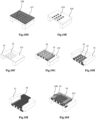
- the sensor 10 of Figure 9 may be microfabricated as illustrated in Figures 10A to 10I .
- a diamond plate 124 is provided ( Figure 10A ).
- the diamond plate is preferably between 300 and 1000 ⁇ m thick and may be made of single crystal chemical vapor deposition (scCVD) raw synthetic diamond.
- scCVD single crystal chemical vapor deposition
- the diamond plate 124 is then sliced in thin plates 125 with a preferred thickness of 20 ⁇ m to 60 ⁇ m, and polished.
- the surface area of the thin plates may be comprised between 3x3 mm 2 and 1 ⁇ 1 cm 2 .
- the thin plate 125 is etched to create an ultra-thin membrane 126 with a thickness smaller than or equal to 20 ⁇ m, suspended over a bulky frame 11 ( Figure 10C ).
- the ultra-thin membrane 126 may have the same surface area as the original thin plate.
- the bulky frame 11 may be U-shaped when viewed in a direction orthogonal to the plane of the membrane.
- a deep Ar/O 2 plasma etching is used, following the method described e.g. in M. Pomorski et al., "Super-thin single crystal diamond membrane radiation detectors," Appl. Phys. Lett. 103, 112106 (2013 ).
- the ultra-thin diamond membrane 126 is advantageously cleaned with hydrofluoric acid and a hot acid treatment in order to eliminate possible surface contamination.
- the sample is fixed onto a silicon wafer in order to achieve a better structural stability for the following processing steps.
- a thin layer of photoresist is spin coated on the silicon wafer and the sample placed on it with its top side facing up.
- the photoresist is then hardened by soft baking for a few minutes, for instance at a temperature of 100 °C.
- a positive epoxy-based resist 127 is deposited on the diamond membrane.
- Photolithographic patterning is then performed using UV light. In other words, only specific areas of the resist layer 127 are exposed to the UV light, such that the resist from these specific areas may be removed. This creates empty volumes 128 that allow a direct access to the intrinsic diamond membrane 126 through the resist layer 127.
- a layer of chromium (Cr) which may be 200 ⁇ m to 600 ⁇ m thick is deposited onto the top side of the diamond membrane 126.
- the sample may then be gently rinsed with acetone in order to detach the residual photoresist layer (lift-off technique).
- a metallic Cr mask 129 on the diamond membrane 126 is thus obtained ( Figure 10E ).
- a wet etch approach may also be used to obtain the Cr mask 129.
- Acetone rinsing may be used to remove the sample from the silicon wafer.
- RIE Ar/O 2 Reactive Ion Etching
- the diamond membrane 126 is not fully etched through: a residual layer 131 of intrinsic diamond, which may be approximately 5 ⁇ m thick, is left as a layer supporting the ⁇ SVs 12.
- a chromium etchant followed by a gentle hot acid cleaning treatment may then be applied to the etched membrane, in order to remove the residual Cr-mask and possible surface contamination of the sample. Isopropanol rinsing and blow-drying may be carried out. Additionally, Ar plasma may be used to ensure that the surface of the sample is clean from any organic contamination before further processing.
- a layer 13 of non-electrically active material is spin coated onto the supporting layer 131 as illustrated in Figure 10G .
- the layer 13 may be made of a hard baked radiation hard resist or PMMA, for example an epoxy-based SU-8 photoresist.
- photolithographic patterning may be performed using UV light. In other words, only specific areas of the resist layer 13 are exposed to the UV light, such that the resist from these specific areas may be removed.
- the following step depicted in Figure 10H , consists in removing the residual diamond layer 131 from the bottom side of the non-electrically active layer 13. To do so, Ar/O 2 reactive ion etching may be used.
- the bottom electrode 19 which may be metal-based, preferably aluminum-based, is deposited as a large strip on the bottom side of the layer 13 and of the array of ⁇ SVs 12.
- the electrode 19 acts as a full pad back electrode for the sensor and provides improved mechanical stability.
- top electrodes on the top side of the layer 13 and of the ⁇ SVs 12 are deposited.
- the sample may be fixed on a silicon wafer following the procedure described previously.
- a standard resist is spin coated onto the sample. Using photolithography, resist patterns can be created which will define the top electrical contacts 15, 16 and the bonding pads 120, 121.
- a wet etch technique may be applied: using a specific metal etchant, all metallization except the regions covered by the resist is removed.
- a lift-off technique may be used instead.
- the sensor 10 is then ready for mounting onto an appropriate sensor carrier and for wire-bonding.
- the sensor may be integrated into a PCB with connectors (for example of the SMA type) for connection to read out electronics.
- Figure 3 shows a variant embodiment where the picoammeter 31 is connected between the back electrode 19 and the bias voltage source.
- the CSA 21 is connected to the top electrode 15 as in the embodiment of Figures 1 and 2 .
- the same set of micro-sensitive volumes 12 provides the signal that is read out by the first and second readout channels 20 and 30, contrary to the embodiment of Figures 1 and 2 where the signals come from respective sets of micro-sensitive volumes 12.
- the picoammeter 31 is connected between the back electrode 19 and the ground GND.
- the CSA 21 is connected through a decoupling capacitor 26 to the top electrode 15. The latter is connected by a connection 59 to a source of biasing voltage.
- the back electrode 19 is connected via a connection 59 to a source of biasing voltage.
- the picoammeter 31 is connected between the top electrode 15 and the ground GND.
- the CSA 21 is connected through a decoupling capacitor 26 to the top electrode 15.
- the readout channels are connected respectively to the top and back electrodes
- reverse configuration i.e. the readout channel connected to the top electrode is then connected to the back electrode and the read out channel connected to the back electrode is then connected to the top electrode.
- Such reverse configuration is however not preferred as it may worsen the signal if the electrodes are not of a similar size, causing the electric field to be inhomogeneous.
- the sensor has the configuration of Figures 1 and 2 for example, or may have any other appropriate configuration, and be for example a "GR sensor” or a "p+ sensor”.
- the output for the micro-dosimetric spectrum (pulse-height) measurement from one set of micro-sensitive volumes 12 is fed into a charge sensitive preamplifier (CSA) Amptek CoolFET [AMPTEK].
- CSA charge sensitive preamplifier
- AMPTEK Amptek CoolFET
- a positive bias voltage fixed to 15V equivalent to an electric field within the micro-sensitive volumes (also referred to as ⁇ SVs) of 1.2 V/ ⁇ m during the entire experiment, is applied directly to the back electrode of the sensor.
- the positive bias voltage is established by a voltage adjustment element (VADJ).
- the pre-amplified voltage pulses from the CSA are fed into a multi-channel analyzer LabZY nanoMCA II (MCA).
- MCA LabZY nanoMCA II
- the MCA amplifies and digitizes the signal, as well as processes the generated pulse-height spectra while communicating with a personal computer (PC) situated in the control area through a Wi-Fi network for example.
- PC personal computer
- the beam induced DC current from another set of micro-sensitive volumes 12 of the same sensor is fed into a high precision Keithley Picoammeter (pAM) for the dose rate and depth-dose profile measurement.
- pAM Keithley Picoammeter
- the very good agreement between the dose and dose rate indicates a possibility of fast scanning in water phantoms if only constant dose rate is guaranteed at accelerator level.
- the calibrated micro-dosimetric spectrum for selected depth within the measured Bragg Peak are presented and exhibit typical and expected shift of their peak as well as a broader spectrum towards greater LET values.
- the measured dose-mean lineal energy values are presented with which the RBE of a specific cell type can be estimated in compliance with the MKM model.
Landscapes
- Physics & Mathematics (AREA)
- Health & Medical Sciences (AREA)
- Life Sciences & Earth Sciences (AREA)
- General Physics & Mathematics (AREA)
- High Energy & Nuclear Physics (AREA)
- Molecular Biology (AREA)
- Spectroscopy & Molecular Physics (AREA)
- Measurement Of Radiation (AREA)
Claims (14)
- System zur dosimetrischen und mikrodosimetrischen Charakterisierung ionisierender Strahlung, das Folgendes umfasst:- mindestens einen diamantbasierten Sensor (10), der mindestens ein mikrosensitives Volumen (12) umfasst,- mindestens einen mikrodosimetrischen Auslesekanal (20), der einen ladungssensitiven Vorverstärker (CSA) umfasst, das mit dem Sensor verbunden ist, um ein Signal auszugeben, dass die Verteilung der Energie darstellt, die durch die ionisierende Strahlung abgegeben wird, die auf das mindestens eine mikrosensitive Volumen (12) auftrifft,dadurch gekennzeichnet, dass das System ferner Folgendes umfasst:- mindestens einen Dosimetrie-Auslesekanal (30), der ein Piko-Ampèremeter (31) zum Auslesen von Strom, der durch die ionisierende Strahlung in dem mindestens einen berührungssensitive Volumen (12) induziert wird, und zum Erzeugen eines Signals, das eine Dosisrate darstellt, umfasst.
- System nach Anspruch 1, wobei der diamantbasierte Sensor (10) mindestens zwei mikrosensitive Volumina (12) umfasst, die jeweilige Elektroden (15; 16) aufweisen, wobei der mindestens eine mikrodosimetrische Auslesekanal (20) und der mindestens eine Dosimetrie-Auslesekanal (30) mit diesen jeweiligen Elektroden verbunden sind.
- System nach Anspruch 1, wobei der mindestens eine mikrodosimetrische Auslesekanal (20) und der mindestens eine Dosimetrie-Auslesekanal (30) mit derselben Elektrode (15) verbunden sind.
- System nach Anspruch 2 oder 3, wobei der ladungssensitive Verstärker (21) mit der entsprechenden Elektrode (15) durch einen Entkopplungskondensator (26) verbunden ist.
- System nach Anspruch 1, wobei das mindestens eine mikrosensitive Volumen (12) mit einer oberen (15) und einer hinteren (19) Elektrode verbunden ist, der mindestens eine mikrodosimetrische Auslesekanal (20) und das mindestens eine Piko-Ampèremeter (31) mit der oberen (15) bzw. der hinteren (19) Elektrode verbunden sind, oder umgekehrt.
- System nach Anspruch 5, wobei eine Vorspannung an die obere Elektrode (15) angelegt wird, mit der der mikrodosimetrische Auslesekanal (20) verbunden ist.
- System nach Anspruch 5 oder 6, wobei der ladungssensitive Verstärker (21) durch einen Entkopplungskondensator (26) mit der oberen Elektrode (15) verbunden ist.
- System nach Anspruch 7, wobei eine Vorspannung an das Piko-Ampèremeter (31) angelegt wird.
- System nach einem der Ansprüche 1 bis 8, wobei der Sensor ein nicht elektrisch aktives Material (13) umfasst, das sich um mindestens ein mikrosensitives Volumen (12) erstreckt, bevorzugt einen Schutzlack.
- System nach einem der Ansprüche 1 bis 9, das Verarbeitungsmittel zum Erzeugen eines linearen Energiespektrums basierend auf Signalen, die durch den mindestens einen mikrodosimetrischen Auslesekanal ausgegeben werden, und bevorzugt auch einer mittleren linearen Energie der Dosis basierend auf dem linearen Energiespektrum, umfasst.
- System nach einem der Ansprüche 1 bis 10, das Verarbeitungsmittel zum Integrieren der Dosisrate und zum Erzeugen von Dosisdaten umfasst.
- Verfahren zum Bewerten der Dosis und der linearen Energiespektren einer ionisierenden Strahlung, das das Messen der Dosisrate und der Verteilung der abgegebenen Energie unter Verwendung eines Systems nach einem der vorhergehenden Ansprüche umfasst.
- Verfahren nach Anspruch 13, wobei die ionisierende Strahlung ein Hadronentherapie-Ionenstrahl ist.
- Verfahren nach Anspruch 13, wobei die ionisierende Strahlung Weltraumstrahlung ist.
Priority Applications (1)
| Application Number | Priority Date | Filing Date | Title |
|---|---|---|---|
| EP20305733.6A EP3933449B1 (de) | 2020-06-30 | 2020-06-30 | System zur dosimetrischen und mikrodosimetrischen charakterisierung ionisierender strahlung |
Applications Claiming Priority (1)
| Application Number | Priority Date | Filing Date | Title |
|---|---|---|---|
| EP20305733.6A EP3933449B1 (de) | 2020-06-30 | 2020-06-30 | System zur dosimetrischen und mikrodosimetrischen charakterisierung ionisierender strahlung |
Publications (2)
| Publication Number | Publication Date |
|---|---|
| EP3933449A1 EP3933449A1 (de) | 2022-01-05 |
| EP3933449B1 true EP3933449B1 (de) | 2025-05-14 |
Family
ID=72840424
Family Applications (1)
| Application Number | Title | Priority Date | Filing Date |
|---|---|---|---|
| EP20305733.6A Active EP3933449B1 (de) | 2020-06-30 | 2020-06-30 | System zur dosimetrischen und mikrodosimetrischen charakterisierung ionisierender strahlung |
Country Status (1)
| Country | Link |
|---|---|
| EP (1) | EP3933449B1 (de) |
Families Citing this family (1)
| Publication number | Priority date | Publication date | Assignee | Title |
|---|---|---|---|---|
| CN116013758B (zh) * | 2022-12-29 | 2026-01-09 | 中国原子能科学研究院 | 一种微网型组织等效正比计数器 |
-
2020
- 2020-06-30 EP EP20305733.6A patent/EP3933449B1/de active Active
Non-Patent Citations (1)
| Title |
|---|
| IZABELLA A. ZAHRADNIK ET AL: "scCVD Diamond Membrane based Microdosimeter for Hadron Therapy", PHYSICA STATUS SOLIDI. A: APPLICATIONS AND MATERIALS SCIENCE, vol. 215, no. 22, 30 July 2018 (2018-07-30), DE, pages 1800383, XP055752957, ISSN: 1862-6300, DOI: 10.1002/pssa.201800383 * |
Also Published As
| Publication number | Publication date |
|---|---|
| EP3933449A1 (de) | 2022-01-05 |
Similar Documents
| Publication | Publication Date | Title |
|---|---|---|
| Rosenfeld | Novel detectors for silicon based microdosimetry, their concepts and applications | |
| US8421022B2 (en) | Method and apparatus for tissue equivalent solid state microdosimetry | |
| B. Rosenfeld | MOSFET dosimetry on modern radiation oncology modalities | |
| US8461541B2 (en) | Radiation detector, method of manufacturing a radiation detector and use of the detector for measuring radiation | |
| Bradley et al. | Solid state microdosimetry | |
| Fleta et al. | 3D cylindrical silicon microdosimeters: fabrication, simulation and charge collection study | |
| Bachiller-Perea et al. | Microdosimetry performance of the first multi-arrays of 3D-cylindrical microdetectors | |
| Pastuovic et al. | IBIC microscopy–The powerful tool for testing micron–Sized sensitive volumes in segmented radiation detectors used in synchrotron microbeam radiation and hadron therapies | |
| Tran et al. | 3D radiation detectors: Charge collection characterisation and applicability of technology for microdosimetry | |
| Guardiola et al. | Preliminary microdosimetric measurements with ultra-thin 3D silicon detectors of a 62 MeV proton beam | |
| EP3933449B1 (de) | System zur dosimetrischen und mikrodosimetrischen charakterisierung ionisierender strahlung | |
| Fronk | Dual-side etched microstructured semiconductor neutron detectors | |
| Guardiola et al. | Microdosimetry in low energy proton beam at therapeutic-equivalent fluence rate with silicon 3D-cylindrical microdetectors | |
| JP2016519304A (ja) | 新規な単結晶ダイヤモンド線量計およびその使用 | |
| Prieto-Pena et al. | Impact of charge collection efficiency and electronic noise on the performance of solid-state 3D microdetectors | |
| Mendicino et al. | Characterization of 3D and planar Si diodes with different neutron converter materials | |
| Zahradnik et al. | A diamond guard ring microdosimeter for ion beam therapy | |
| EP3933448B1 (de) | Diamantbasierter sensor mit mikroempfindlichen volumina | |
| Bachiller-Perea et al. | Multi-arrays of 3D cylindrical microdetectors for beam characterization and microdosimetry in proton therapy | |
| US12034422B1 (en) | Enhanced electronic sensors | |
| Pérez et al. | Evaluation of a silicon carbide P–N diode for thermal neutron detection in a radiotherapy LINAC | |
| EP3821276B1 (de) | Detektor ionisierender strahlung aus siliziumkarbid | |
| Curtoni et al. | Towards a beam-tagging diamond hodoscope for online ion range monitoring | |
| RU2142148C1 (ru) | Способ определения среднего заряда от нейтронов в импульсе камеры деления | |
| CN107731652B (zh) | 辐射射线检测装置及其制备方法 |
Legal Events
| Date | Code | Title | Description |
|---|---|---|---|
| STAA | Information on the status of an ep patent application or granted ep patent |
Free format text: STATUS: UNKNOWN |
|
| PUAI | Public reference made under article 153(3) epc to a published international application that has entered the european phase |
Free format text: ORIGINAL CODE: 0009012 |
|
| STAA | Information on the status of an ep patent application or granted ep patent |
Free format text: STATUS: THE APPLICATION HAS BEEN PUBLISHED |
|
| AK | Designated contracting states |
Kind code of ref document: A1 Designated state(s): AL AT BE BG CH CY CZ DE DK EE ES FI FR GB GR HR HU IE IS IT LI LT LU LV MC MK MT NL NO PL PT RO RS SE SI SK SM TR |
|
| B565 | Issuance of search results under rule 164(2) epc |
Effective date: 20201204 |
|
| STAA | Information on the status of an ep patent application or granted ep patent |
Free format text: STATUS: REQUEST FOR EXAMINATION WAS MADE |
|
| 17P | Request for examination filed |
Effective date: 20220120 |
|
| RBV | Designated contracting states (corrected) |
Designated state(s): AL AT BE BG CH CY CZ DE DK EE ES FI FR GB GR HR HU IE IS IT LI LT LU LV MC MK MT NL NO PL PT RO RS SE SI SK SM TR |
|
| STAA | Information on the status of an ep patent application or granted ep patent |
Free format text: STATUS: EXAMINATION IS IN PROGRESS |
|
| 17Q | First examination report despatched |
Effective date: 20230531 |
|
| RAP3 | Party data changed (applicant data changed or rights of an application transferred) |
Owner name: COMMISSARIAT A L'ENERGIE ATOMIQUE ET AUX ENERGIESALTERNATIVES |
|
| GRAP | Despatch of communication of intention to grant a patent |
Free format text: ORIGINAL CODE: EPIDOSNIGR1 |
|
| STAA | Information on the status of an ep patent application or granted ep patent |
Free format text: STATUS: GRANT OF PATENT IS INTENDED |
|
| INTG | Intention to grant announced |
Effective date: 20250210 |
|
| GRAS | Grant fee paid |
Free format text: ORIGINAL CODE: EPIDOSNIGR3 |
|
| GRAA | (expected) grant |
Free format text: ORIGINAL CODE: 0009210 |
|
| STAA | Information on the status of an ep patent application or granted ep patent |
Free format text: STATUS: THE PATENT HAS BEEN GRANTED |
|
| AK | Designated contracting states |
Kind code of ref document: B1 Designated state(s): AL AT BE BG CH CY CZ DE DK EE ES FI FR GB GR HR HU IE IS IT LI LT LU LV MC MK MT NL NO PL PT RO RS SE SI SK SM TR |
|
| REG | Reference to a national code |
Ref country code: GB Ref legal event code: FG4D |
|
| REG | Reference to a national code |
Ref country code: CH Ref legal event code: EP |
|
| REG | Reference to a national code |
Ref country code: DE Ref legal event code: R096 Ref document number: 602020051201 Country of ref document: DE |
|
| REG | Reference to a national code |
Ref country code: IE Ref legal event code: FG4D |
|
| REG | Reference to a national code |
Ref country code: NL Ref legal event code: MP Effective date: 20250514 |
|
| PG25 | Lapsed in a contracting state [announced via postgrant information from national office to epo] |
Ref country code: ES Free format text: LAPSE BECAUSE OF FAILURE TO SUBMIT A TRANSLATION OF THE DESCRIPTION OR TO PAY THE FEE WITHIN THE PRESCRIBED TIME-LIMIT Effective date: 20250514 Ref country code: FI Free format text: LAPSE BECAUSE OF FAILURE TO SUBMIT A TRANSLATION OF THE DESCRIPTION OR TO PAY THE FEE WITHIN THE PRESCRIBED TIME-LIMIT Effective date: 20250514 Ref country code: PT Free format text: LAPSE BECAUSE OF FAILURE TO SUBMIT A TRANSLATION OF THE DESCRIPTION OR TO PAY THE FEE WITHIN THE PRESCRIBED TIME-LIMIT Effective date: 20250915 |
|
| REG | Reference to a national code |
Ref country code: LT Ref legal event code: MG9D |
|
| PG25 | Lapsed in a contracting state [announced via postgrant information from national office to epo] |
Ref country code: NO Free format text: LAPSE BECAUSE OF FAILURE TO SUBMIT A TRANSLATION OF THE DESCRIPTION OR TO PAY THE FEE WITHIN THE PRESCRIBED TIME-LIMIT Effective date: 20250814 Ref country code: GR Free format text: LAPSE BECAUSE OF FAILURE TO SUBMIT A TRANSLATION OF THE DESCRIPTION OR TO PAY THE FEE WITHIN THE PRESCRIBED TIME-LIMIT Effective date: 20250815 |
|
| PG25 | Lapsed in a contracting state [announced via postgrant information from national office to epo] |
Ref country code: NL Free format text: LAPSE BECAUSE OF FAILURE TO SUBMIT A TRANSLATION OF THE DESCRIPTION OR TO PAY THE FEE WITHIN THE PRESCRIBED TIME-LIMIT Effective date: 20250514 Ref country code: PL Free format text: LAPSE BECAUSE OF FAILURE TO SUBMIT A TRANSLATION OF THE DESCRIPTION OR TO PAY THE FEE WITHIN THE PRESCRIBED TIME-LIMIT Effective date: 20250514 |
|
| REG | Reference to a national code |
Ref country code: AT Ref legal event code: MK05 Ref document number: 1795236 Country of ref document: AT Kind code of ref document: T Effective date: 20250514 |
|
| PG25 | Lapsed in a contracting state [announced via postgrant information from national office to epo] |
Ref country code: BG Free format text: LAPSE BECAUSE OF FAILURE TO SUBMIT A TRANSLATION OF THE DESCRIPTION OR TO PAY THE FEE WITHIN THE PRESCRIBED TIME-LIMIT Effective date: 20250514 |
|
| PG25 | Lapsed in a contracting state [announced via postgrant information from national office to epo] |
Ref country code: HR Free format text: LAPSE BECAUSE OF FAILURE TO SUBMIT A TRANSLATION OF THE DESCRIPTION OR TO PAY THE FEE WITHIN THE PRESCRIBED TIME-LIMIT Effective date: 20250514 |
|
| PG25 | Lapsed in a contracting state [announced via postgrant information from national office to epo] |
Ref country code: AT Free format text: LAPSE BECAUSE OF FAILURE TO SUBMIT A TRANSLATION OF THE DESCRIPTION OR TO PAY THE FEE WITHIN THE PRESCRIBED TIME-LIMIT Effective date: 20250514 |
|
| PGFP | Annual fee paid to national office [announced via postgrant information from national office to epo] |
Ref country code: FR Payment date: 20250703 Year of fee payment: 6 |
|
| PG25 | Lapsed in a contracting state [announced via postgrant information from national office to epo] |
Ref country code: RS Free format text: LAPSE BECAUSE OF FAILURE TO SUBMIT A TRANSLATION OF THE DESCRIPTION OR TO PAY THE FEE WITHIN THE PRESCRIBED TIME-LIMIT Effective date: 20250814 |
|
| PG25 | Lapsed in a contracting state [announced via postgrant information from national office to epo] |
Ref country code: IS Free format text: LAPSE BECAUSE OF FAILURE TO SUBMIT A TRANSLATION OF THE DESCRIPTION OR TO PAY THE FEE WITHIN THE PRESCRIBED TIME-LIMIT Effective date: 20250914 |
|
| PG25 | Lapsed in a contracting state [announced via postgrant information from national office to epo] |
Ref country code: LV Free format text: LAPSE BECAUSE OF FAILURE TO SUBMIT A TRANSLATION OF THE DESCRIPTION OR TO PAY THE FEE WITHIN THE PRESCRIBED TIME-LIMIT Effective date: 20250514 |
|
| REG | Reference to a national code |
Ref country code: DE Ref legal event code: R119 Ref document number: 602020051201 Country of ref document: DE |
|
| PG25 | Lapsed in a contracting state [announced via postgrant information from national office to epo] |
Ref country code: DK Free format text: LAPSE BECAUSE OF FAILURE TO SUBMIT A TRANSLATION OF THE DESCRIPTION OR TO PAY THE FEE WITHIN THE PRESCRIBED TIME-LIMIT Effective date: 20250514 Ref country code: SM Free format text: LAPSE BECAUSE OF FAILURE TO SUBMIT A TRANSLATION OF THE DESCRIPTION OR TO PAY THE FEE WITHIN THE PRESCRIBED TIME-LIMIT Effective date: 20250514 |
|
| PG25 | Lapsed in a contracting state [announced via postgrant information from national office to epo] |
Ref country code: CZ Free format text: LAPSE BECAUSE OF FAILURE TO SUBMIT A TRANSLATION OF THE DESCRIPTION OR TO PAY THE FEE WITHIN THE PRESCRIBED TIME-LIMIT Effective date: 20250514 |
|
| PG25 | Lapsed in a contracting state [announced via postgrant information from national office to epo] |
Ref country code: EE Free format text: LAPSE BECAUSE OF FAILURE TO SUBMIT A TRANSLATION OF THE DESCRIPTION OR TO PAY THE FEE WITHIN THE PRESCRIBED TIME-LIMIT Effective date: 20250514 |
|
| PG25 | Lapsed in a contracting state [announced via postgrant information from national office to epo] |
Ref country code: SK Free format text: LAPSE BECAUSE OF FAILURE TO SUBMIT A TRANSLATION OF THE DESCRIPTION OR TO PAY THE FEE WITHIN THE PRESCRIBED TIME-LIMIT Effective date: 20250514 Ref country code: RO Free format text: LAPSE BECAUSE OF FAILURE TO SUBMIT A TRANSLATION OF THE DESCRIPTION OR TO PAY THE FEE WITHIN THE PRESCRIBED TIME-LIMIT Effective date: 20250514 |
|
| REG | Reference to a national code |
Ref country code: CH Ref legal event code: H13 Free format text: ST27 STATUS EVENT CODE: U-0-0-H10-H13 (AS PROVIDED BY THE NATIONAL OFFICE) Effective date: 20260127 |
|
| PG25 | Lapsed in a contracting state [announced via postgrant information from national office to epo] |
Ref country code: IT Free format text: LAPSE BECAUSE OF FAILURE TO SUBMIT A TRANSLATION OF THE DESCRIPTION OR TO PAY THE FEE WITHIN THE PRESCRIBED TIME-LIMIT Effective date: 20250514 |
|
| PG25 | Lapsed in a contracting state [announced via postgrant information from national office to epo] |
Ref country code: LU Free format text: LAPSE BECAUSE OF NON-PAYMENT OF DUE FEES Effective date: 20250630 |
|
| PG25 | Lapsed in a contracting state [announced via postgrant information from national office to epo] |
Ref country code: MC Free format text: LAPSE BECAUSE OF FAILURE TO SUBMIT A TRANSLATION OF THE DESCRIPTION OR TO PAY THE FEE WITHIN THE PRESCRIBED TIME-LIMIT Effective date: 20250514 |
|
| REG | Reference to a national code |
Ref country code: BE Ref legal event code: MM Effective date: 20250630 |
|
| PLBE | No opposition filed within time limit |
Free format text: ORIGINAL CODE: 0009261 |
|
| STAA | Information on the status of an ep patent application or granted ep patent |
Free format text: STATUS: NO OPPOSITION FILED WITHIN TIME LIMIT |