EP3933183B1 - Ensemble propulsif d'un aéronef comprenant un système anti-incendie avec une ligne de distribution d'agent extincteur - Google Patents
Ensemble propulsif d'un aéronef comprenant un système anti-incendie avec une ligne de distribution d'agent extincteur Download PDFInfo
- Publication number
- EP3933183B1 EP3933183B1 EP21177681.0A EP21177681A EP3933183B1 EP 3933183 B1 EP3933183 B1 EP 3933183B1 EP 21177681 A EP21177681 A EP 21177681A EP 3933183 B1 EP3933183 B1 EP 3933183B1
- Authority
- EP
- European Patent Office
- Prior art keywords
- distribution line
- fire
- propulsion assembly
- fluid passage
- valve
- Prior art date
- Legal status (The legal status is an assumption and is not a legal conclusion. Google has not performed a legal analysis and makes no representation as to the accuracy of the status listed.)
- Active
Links
Images
Classifications
-
- B—PERFORMING OPERATIONS; TRANSPORTING
- B64—AIRCRAFT; AVIATION; COSMONAUTICS
- B64D—EQUIPMENT FOR FITTING IN OR TO AIRCRAFT; FLIGHT SUITS; PARACHUTES; ARRANGEMENT OR MOUNTING OF POWER PLANTS OR PROPULSION TRANSMISSIONS IN AIRCRAFT
- B64D27/00—Arrangement or mounting of power plants in aircraft; Aircraft characterised by the type or position of power plants
- B64D27/02—Aircraft characterised by the type or position of power plants
- B64D27/10—Aircraft characterised by the type or position of power plants of gas-turbine type
- B64D27/12—Aircraft characterised by the type or position of power plants of gas-turbine type within, or attached to, wings
-
- B—PERFORMING OPERATIONS; TRANSPORTING
- B64—AIRCRAFT; AVIATION; COSMONAUTICS
- B64D—EQUIPMENT FOR FITTING IN OR TO AIRCRAFT; FLIGHT SUITS; PARACHUTES; ARRANGEMENT OR MOUNTING OF POWER PLANTS OR PROPULSION TRANSMISSIONS IN AIRCRAFT
- B64D45/00—Aircraft indicators or protectors not otherwise provided for
-
- A—HUMAN NECESSITIES
- A62—LIFE-SAVING; FIRE-FIGHTING
- A62C—FIRE-FIGHTING
- A62C3/00—Fire prevention, containment or extinguishing specially adapted for particular objects or places
- A62C3/07—Fire prevention, containment or extinguishing specially adapted for particular objects or places in vehicles, e.g. in road vehicles
- A62C3/08—Fire prevention, containment or extinguishing specially adapted for particular objects or places in vehicles, e.g. in road vehicles in aircraft
-
- A—HUMAN NECESSITIES
- A62—LIFE-SAVING; FIRE-FIGHTING
- A62C—FIRE-FIGHTING
- A62C35/00—Permanently-installed equipment
- A62C35/58—Pipe-line systems
- A62C35/68—Details, e.g. of pipes or valve systems
-
- A—HUMAN NECESSITIES
- A62—LIFE-SAVING; FIRE-FIGHTING
- A62C—FIRE-FIGHTING
- A62C37/00—Control of fire-fighting equipment
- A62C37/36—Control of fire-fighting equipment an actuating signal being generated by a sensor separate from an outlet device
- A62C37/38—Control of fire-fighting equipment an actuating signal being generated by a sensor separate from an outlet device by both sensor and actuator, e.g. valve, being in the danger zone
- A62C37/40—Control of fire-fighting equipment an actuating signal being generated by a sensor separate from an outlet device by both sensor and actuator, e.g. valve, being in the danger zone with electric connection between sensor and actuator
-
- B—PERFORMING OPERATIONS; TRANSPORTING
- B64—AIRCRAFT; AVIATION; COSMONAUTICS
- B64D—EQUIPMENT FOR FITTING IN OR TO AIRCRAFT; FLIGHT SUITS; PARACHUTES; ARRANGEMENT OR MOUNTING OF POWER PLANTS OR PROPULSION TRANSMISSIONS IN AIRCRAFT
- B64D29/00—Power-plant nacelles, fairings or cowlings
- B64D29/02—Power-plant nacelles, fairings or cowlings associated with wings
-
- F—MECHANICAL ENGINEERING; LIGHTING; HEATING; WEAPONS; BLASTING
- F02—COMBUSTION ENGINES; HOT-GAS OR COMBUSTION-PRODUCT ENGINE PLANTS
- F02C—GAS-TURBINE PLANTS; AIR INTAKES FOR JET-PROPULSION PLANTS; CONTROLLING FUEL SUPPLY IN AIR-BREATHING JET-PROPULSION PLANTS
- F02C7/00—Features, components parts, details or accessories, not provided for in, or of interest apart form groups F02C1/00 - F02C6/00; Air intakes for jet-propulsion plants
- F02C7/24—Heat or noise insulation
- F02C7/25—Fire protection or prevention
-
- B—PERFORMING OPERATIONS; TRANSPORTING
- B64—AIRCRAFT; AVIATION; COSMONAUTICS
- B64D—EQUIPMENT FOR FITTING IN OR TO AIRCRAFT; FLIGHT SUITS; PARACHUTES; ARRANGEMENT OR MOUNTING OF POWER PLANTS OR PROPULSION TRANSMISSIONS IN AIRCRAFT
- B64D45/00—Aircraft indicators or protectors not otherwise provided for
- B64D2045/009—Fire detection or protection; Erosion protection, e.g. from airborne particles
Definitions
- the present invention relates to an aircraft propulsion system comprising a fire-fighting system with a distribution line for the distribution of a pressurized extinguishing agent.
- a propulsion assembly fixed under the wing of an aircraft comprises a turbine engine, a strut for fixing the turbine engine to the aircraft as well as a fire-fighting system for detecting and extinguishing a fire occurring on the assembly propellant.
- the fire-fighting system contains two tanks of extinguishing agent with controlled opening which are arranged in the mast, a distribution line, in the form of pipes, connecting the tanks to the fire zones of the turbomachine, and a detection and control assembly. activation to detect a fire and command the opening of the tanks in order to trigger the emission of extinguishing agent from the tanks to the fire zones through the distribution line.
- the space available in the mast for the passage of the distribution line of the fire-fighting system is limited and constrained by the presence of a plurality of systems. On some aircraft, it is not possible to route the extinguishing agent distribution line without locally generating at least one low point.
- the distribution line is a standby line, it is filled with ambient air which enters from the fire zones. This air contains humidity which condenses and accumulates at low points, and freezes when the aircraft flies at high altitude, thus preventing the proper functioning of the fire suppression system.
- a drainage device in the form of a hole, is therefore arranged at each low point to evacuate, by gravity, the water which could accumulate there.
- Such a drainage hole is effective in evacuating stagnant water, but in the event of opening of a tank, part of the extinguishing agent is lost through this hole. This makes it necessary to increase the volume of extinguishing agent in the tank to compensate for this loss and leads to tanks that are bulkier and therefore more difficult to integrate into the mast.
- the invention aims to meet all or part of this need and relates to a propulsion assembly comprising a turbine engine attached to a mast, and a fire-fighting system, as claimed in claim 1.
- the patent application FR3015568 describes the preamble of claim 1.
- the invention thus makes it possible to avoid increasing the volume of extinguishing agent in the tanks (aimed at compensating for the loss of agent through the drainage hole in the prior art) and therefore to limit the volume/mass of the tanks embarked.
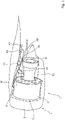
- FIG. 1 is a schematic representation of a propulsion assembly of an aircraft which comprises a pressurized extinguishing agent distribution line according to the invention
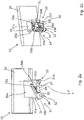
- the figure 2a is a sectional view of a drainage device of the distribution line of the figure 1 , according to a first embodiment of the invention
- FIG 2b is a perspective view of the drainage device shown in figure 2a ;
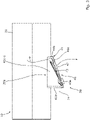
- the picture 3 is a view similar to the figure 2a , of a section of a drainage device of the distribution line of the figure 1 , according to a second embodiment of the invention
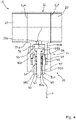
- the figure 4 is a view similar to the figure 2a , of a section of a drainage device of the distribution line of the figure 1 , according to a third embodiment of the invention.
- a propulsion unit 1 is attached under the wing W of an aircraft (not shown) and comprises a turbomachine 2 comprising a nacelle 3 surrounding an engine 4, a mast 5 fixed to the wing W and under which the turbomachine is attached 2, as well as a fire protection system 6.
- the turbomachine 2 comprises a plurality of fire zones Z1, Z2, separated from one another by walls and fire seals (not shown) to contain a fire within the limits of a fire zone and prevent its spread to another fire zone.
- the fire-fighting system 6 is provided to detect and extinguish, by sending an extinguishing agent, any fire which may occur in one of the fire zones Z1, Z2.
- the fire-fighting system 6 contains two reservoirs R1, R2 with controlled opening and each containing a volume of extinguishing agent under pressure, a distribution line 10 of extinguishing agent connecting each of the reservoirs R1, R2 to nozzles ejection (not shown) of extinguishing agent located in the fire zones Z1, Z2, and a detection and activation unit 11 for detecting a fire and controlling the opening of the tanks R1, R2.
- Each tank R1, R2 is located in the mast 5 and is equipped with an opening system to release the extinguishing agent out of the tank R1, R2.
- the opening system (not shown) is for example of the butterfly valve type, or of the pyrotechnic type.
- the detection and activation unit 11 comprises a central unit to which are connected a plurality of fire sensors located in the fire zones Z1, Z2 to detect a fire in the latter, and the central unit is, moreover, connected to the tank opening systems to control their opening.
- the detection and activation unit 11 is connected to controls and devices of the aircraft. Upon detection of a fire, the detection and activation unit 11 sends a fire alarm signal to the pilots.
- the cockpit comprises two activation controls, each being associated with a single tank R1, R2 and operable by the pilot to send an activation signal of the tank associated with the detection unit.
- the detection and activation unit 11 Upon activation of a command associated with a tank R1, R2, the detection and activation unit 11 sends an opening signal to the tank opening system for the opening of said tank R1, R2.
- the extinguishing agent released moves under pressure in the distribution line and is expelled into the fire zones Z1, Z2 through the ejection nozzles.
- the distribution line 10 comprises a piping consisting of pipes 20 connected to each other to ensure the circulation of the extinguishing agent.
- the detection line 10 includes one or more low points 21 (only one shown).
- a low point 21 is a point of the distribution line 10 where fluids tend to accumulate due to the lower height of this point compared to the points of the distribution line 10 directly located upstream and downstream of the point bottom 21.
- the terms upstream and downstream being chosen according to the direction of flow of the extinguishing agent in the distribution line, that is to say from the reservoirs R1, R2 towards the nozzles.
- the distribution line 10 comprises a drainage device 30 arranged at the level of each low point 21 with a fluid passage P making it possible to evacuate the fluids from the distribution line 10.
- the drainage device 30 comprises a frame 31 fixed to a pipe 20 as well as a blocking mechanism 32 of the fluid passage P, fixed to the frame 31, which comprises a movable device of the movable valve type 33 and an elastic means 34 mechanically coupled to valve 33.
- the frame 31 has the overall shape of an open box with four side walls 31a-d parallel in pairs and a flat wall 31e fixed to the four side walls and which forms the bottom of the frame 31.
- the side walls 31a-d are all fixed to the distribution line 10, for example by tight welding, at the level of an opening 20a made in a pipe 20 in line with the low point 21.
- the side walls 31a-d extend outside the pipe, towards the bottom of the latter, so as not to impede the circulation of the extinguishing agent.
- the bottom of the frame 31e is thus at a distance from the pipe 20.
- each of the side walls is provided with a through hole 35.
- the through holes 35 of the two side walls are identical and aligned.
- the bottom 31e comprises, for its part, an opening 37 to allow the evacuation of liquids at the level of the low point 21.
- a fluid can flow through the fluid passage P going from the pipe 20 to the drainage device 30 and which comprises the opening 20a made in the pipe 20 in line with the low point 21 then the opening 37 of the bottom 31e of the frame.
- the valve 33 of the shutter mechanism 32 comprises a panel 33a to which are fixed two hinge fittings 33b, distributed on either side of the width of the panel 33a, each being provided with an orifice (not shown) for the passage of pin 36. Hinge fittings 33b are fitted onto pin 36 so that valve 33 is pivotally mounted on the frame between a rest position in which it releases opening 37 of bottom 31e and opens the fluid passage P, and a closed position in which it closes the opening 37 and closes the fluid passage P thus preventing the flow of a fluid out of the distribution line 10.
- the elastic means 34 is a torsion spring fitted on the pin 36 and arranged between the two hinge fittings 33b of the valve.
- a first end 34a of the spring is fixed to the panel 33a of the valve while a second end 34b of the spring is fixed to the frame 31, for example fixed to the bottom 31e of the frame as illustrated in the figures 2a-b .
- the spring 34 is constrained so that the rest position of the spring 34 corresponds to the rest position of the valve 33, in which the latter releases the opening 37 of the bottom 31e.
- the torsion spring 34 forces the valve 33 into a position of rest in which it releases the bottom opening 31e and therefore opens the fluid passage P.
- the drainage device 30 thus makes it possible to drain the water which could accumulate at the level of the low point 21 of the distribution line 10 and to avoid the formation of an ice cube which could block the distribution line 10. from the percussion of a reservoir R1, R2 and as long as the distribution line 10 is pressurized, the drainage device 30 according to the invention makes it possible to limit the loss of extinguishing agent.
- the invention thus makes it possible to avoid increasing the volume of agent in the reservoirs R1, R2 (aimed at compensating for the loss of agent through the drainage hole in the prior art) and therefore to limit the volume/mass on-board tanks.
- the drainage device 30 comprises a frame 41 fixed to a pipe 20 as well as a closure mechanism 42 of the fluid passage P, where the closure mechanism 42 comprises a leaf spring 43 fixed to the frame 41.
- the chassis 41 generally has the shape of an open box with four side walls 41a-d parallel in pairs and a flat wall 41e fixed to the four side walls 41a-d and which forms the bottom of the chassis 41.
- the side walls 41a-d are all fixed to the pipe 20, for example by tight welding, at the level of an opening 20a made in the pipe 20 at the right of the low point 21.
- the side walls 41a-d extend completely outside the pipe 20, towards the bottom of the latter, so as not to impede the passage of the extinguishing agent.
- the bottom 41e of the frame is thus at a distance from the pipe 20.
- a fluid can flow through the fluid passage P going from the pipe 20 to the drainage device 30 which comprises the opening 20a made in the pipe 20 at the right of the low point 21 then the through hole 47 of the bottom 41e of the chassis .
- the leaf spring 43 is arranged inside the frame 41, that is to say between the side walls 41a-d, and fixed to the bottom 41e of the frame.
- the fixing of the leaf spring 43 is carried out via conventional fixing means, such as for example rivets 43a.
- the leaf spring 43 extends partly above the drainage hole 47.
- the leaf spring 43 is a thin flexible band and is prestressed in a rest position in which it is curved upwards with respect to the bottom 41e and releases the through hole 47 to open the fluid passage P.
- the leaf spring 43 is movable between its rest position and a closed position in which it is pressed against the bottom 41e and closes the through orifice 47 to close the fluid passage P thereby preventing the flow of a fluid out of distribution line 10.
- the leaf spring 43 In operation, when the distribution line is filled with ambient air (normal configuration where there is no impact from one of the reservoirs), the leaf spring 43 is in its rest position.
- the drainage device 30 comprises a frame 51 having the form of a connection with a tapping duct 51b and the closure mechanism 52 of the fluid passage P comprises a valve with rod 53, movably mounted in the tapping duct 51b, as well as an elastic means 54 mechanically coupled to said valve.
- the frame 51 for example of the T-type, comprises a main body 51a to which the tapping duct 51b is fixed by projecting out of the main body 51a, an intermediate part 51c arranged partly in the tapping duct 51b and ensuring the guiding of the valve 53, as well as a nut 51d to secure the intermediate piece 51c to the tapping duct 51b.
- the main body 51a is hollow, of cylindrical shape, and is connected to a pipe 20 of the distribution line 10 by conventional means, for example of the screwing or welding type, at each of its ends 51e-f.
- the tapping duct 51b of cylindrical shape, comprises a blind bore 55 and a through hole 55a made at the bottom of the blind bore.
- the bore 55a opens into the main body 51a by crossing the outer wall of said body.
- the tapping duct 51b extends in length downwards so that a fluid arriving in the main body 51a is evacuated out of the body, under the effect of gravity, through the bore 55a. Note that in the example of figure 4 , the tapping duct 51b extends lengthwise in a radial direction of the main body 51a.
- the intermediate piece 51c has a cylindrical shape and includes a collar 56, placed approximately halfway along the intermediate piece 51c.
- the intermediate piece 51c is machined and comprises, at its first end 56a, a first bore 57 of a diameter substantially greater than the diameter of the valve stem 53a, and on its second end 56b, a countersink 58 followed a second bore 59 concentric with the first bore 57 and the countersink 58 and having a diameter greater than the diameter of the first bore 57.
- the first bore 57 leads to the second bore 58 and the countersink leads to the second bore 58.
- the bottom of the second bore 58 is pierced with a multitude of orifices 60, called drain discharge orifices, opening onto the first end 56a of the intermediate piece 51c, the countersink 58 has a shape complementary to that of the head 53b of valve to form a valve seat.
- the periphery of the tapping duct 51b is threaded.
- the intermediate piece 51c is inserted, partly in the tapping duct, in the blind bore 55, and is held in place in the latter by the nut 51d screwed onto the periphery of the tapping duct.
- the intermediate piece 51c is inserted, via its second end 56b, into the bore 55 of the tapping duct 51b and a first shoulder of the collar 56 comes into abutment against the edge of the tapping duct 51b.
- the nut 51d comprises a shoulder which bears against a second shoulder of the collar 55 to hold the intermediate piece 51c against the edge of the tapping duct 51b.
- the contact between the intermediate part 51c and the tapping duct 51b alone ensures the seal between these two parts.
- a fluid can flow through the fluid passage P going from a pipe 20 to the drainage device 30 and which comprises the bore 55a made at the bottom of the blind bore 55 of the tapping conduit 51b, the valve seat 58 , and drain discharge ports 60.
- the valve 53 has its stem 53a received, in part, in the first bore 57 of the intermediate piece 51c in order to ensure its guiding in translation.
- the valve head 53b is arranged between the valve seat 58 and the bottom of the blind bore 55 of the tapping duct.
- the valve 53 is mounted in sliding connection on the intermediate part of the frame between a rest position in which its head 53b is at a distance from the valve seat 58, and a closed position in which its head 53b closes the valve seat 58 and closes the fluid passage P thus preventing the flow of a fluid out of the distribution line 10.
- the elastic means 54 is a helical-shaped compression spring, called a lifting spring, fitted onto the stem 53a of the valve 53 and received in the second bore 59 of the intermediate piece. One end of the spring rests on the bottom of the second bore 59 of the intermediate piece.
- the lifting spring 54 is constrained so that the rest position of the spring corresponds to the rest position of the valve 53.
- the head 53b of the valve from the rest position of said valve, is closer to the valve seat 58, the stress of the spring returns the valve 53 to its rest position.
- the lifting spring 54 forces the valve into a rest position in which it opens the valve seat 58 and therefore the fluid passage P.
Landscapes
- Engineering & Computer Science (AREA)
- Chemical & Material Sciences (AREA)
- Combustion & Propulsion (AREA)
- Health & Medical Sciences (AREA)
- Public Health (AREA)
- Business, Economics & Management (AREA)
- Emergency Management (AREA)
- Aviation & Aerospace Engineering (AREA)
- Mechanical Engineering (AREA)
- General Engineering & Computer Science (AREA)
- Fire-Extinguishing By Fire Departments, And Fire-Extinguishing Equipment And Control Thereof (AREA)
Description
- La présente invention concerne un ensemble propulsif d'aéronef comprenant un système anti-incendie avec une ligne de distribution pour la distribution d'un agent extincteur sous pression.
- De manière connue, un ensemble propulsif fixé sous l'aile d'un aéronef comprend une turbomachine, un mât de fixation de la turbomachine à l'aéronef ainsi qu'un système anti-incendie pour détecter et éteindre un incendie survenant sur l'ensemble propulsif.
- Le système anti-incendie contient deux réservoirs d'agent extincteur à ouverture commandée qui sont arrangés dans le mat, une ligne de distribution, sous forme de tuyauterie, reliant les réservoirs à des zones feu de la turbomachine, et un ensemble de détection et d'activation pour détecter un incendie et commander l'ouverture des réservoirs afin de déclencher l'émission d'agent extincteur à partir des réservoirs vers les zones feu au travers de la ligne de distribution.
- L'espace disponible dans le mat pour le passage de la ligne de distribution du système anti-incendie est limité et contraint par la présence d'une pluralité de systèmes. Sur certains avions, il n'est pas possible de router la ligne de distribution de l'agent extincteur sans générer localement au moins un point bas.
- La ligne de distribution étant une ligne en attente, celle-ci est remplie d'air ambiant qui pénètre depuis les zones feu. Cet air contient de l'humidité qui condense et s'accumule au niveau des point bas, et gèle lorsque l'aéronef vole à haute altitude, empêchant de ce fait le bon fonctionnement du système anti-incendie. Un dispositif de drainage, sous la forme d'un trou est, par conséquent, arrangé au niveau de chaque point bas pour évacuer, par gravité, l'eau qui pourrait s'y accumuler.
- Un tel trou de drainage est efficace pour évacuer l'eau stagnante, mais en cas d'ouverture d'un réservoir, une partie de l'agent extincteur est perdu au travers de ce trou. Cela oblige à majorer le volume d'agent extincteur dans le réservoir pour compenser cette perte et conduit à des réservoirs plus volumineux et donc plus difficiles à intégrer dans le mât.
- Il existe donc un besoin de trouver une solution à ce problème de perte d'agent extincteur au travers du dispositif de drainage afin de pouvoir réduire les dimensions des réservoirs et faciliter leur intégration dans le mat.
- L'invention vise à répondre en tout ou partie à ce besoin et concerne un ensemble propulsif comprenant une turbomachine accrochée à un mat, et un système anti-incendie, tel que revendiqué dans la revendication 1. La demande de brevet
FR3015568 - Ainsi, à une pression proche de la pression atmosphérique (c'est-à-dire au sol ou en vol), l'eau issue de la condensation sera évacuée hors de ligne de distribution de sorte que des glaçons ne pourront pas se former. En revanche, l'agent extincteur sous pression ne sera pas évacué hors de la ligne de distribution. L'invention permet ainsi d'éviter la majoration du volume d'agent extincteur dans les réservoirs (visant à compenser la perte d'agent par le trou de drainage dans l'art antérieur) et donc de limiter le volume/la masse des réservoirs embarqués.
- Les caractéristiques de l'invention mentionnées ci-dessus, ainsi que d'autres, apparaîtront plus clairement à la lecture de la description suivante d'un exemple de réalisation, ladite description étant faite en relation avec les dessins joints, parmi lesquels :
- la
figure 1 , est une représentation schématique d'un ensemble propulsif d'un aéronef qui comprend une ligne de distribution d'agent extincteur sous pression selon l'invention; - la
figure 2a est une vue en coupe d'un dispositif de drainage de la ligne de distribution de lafigure 1 , selon un premier mode de réalisation de l'invention ; - la
figure 2b est une vue en perspective du dispositif de drainage représenté à lafigure 2a ; - la
figure 3 est une vue similaire à lafigure 2a , d'une coupe d'un dispositif de drainage de la ligne de distribution de lafigure 1 , selon un deuxième mode de réalisation de l'invention ; - la
figure 4 est une vue similaire à lafigure 2a , d'une coupe d'un dispositif de drainage de la ligne de distribution de lafigure 1 , selon un troisième mode de réalisation de l'invention ; - En référence avec la
figure 1 , un ensemble propulsif 1 est accroché sous l'aile W d'un aéronef (non représenté) et comporte une turbomachine 2 comprenant une nacelle 3 entourant un moteur 4, un mât 5 fixé à l'aile W et sous lequel est accrochée la turbomachine 2, ainsi qu'un système anti-incendie 6. - La turbomachine 2 comprend une pluralité de zones feu Z1, Z2, séparées entre elles par des parois et joints feu (non représentés) pour contenir un incendie dans les limites d'une zone feu et empêcher sa propagation vers une autre zone feu.
- Le système anti-incendie 6 est prévu pour détecter et éteindre par l'envoi d'un agent extincteur, tout incendie qui pourrait survenir dans une des zones feu Z1, Z2. De manière classique, le système anti-incendie 6 contient deux réservoirs R1,R2 à ouverture commandée et contenant chacun un volume d'agent extincteur sous pression, une ligne de distribution 10 d'agent extincteur reliant chacun des réservoirs R1, R2 à des buses d'éjection (non représentés) d'agent extincteur situées dans les zones feu Z1, Z2, et une unité de détection et d'activation 11 pour détecter un incendie et commander l'ouverture des réservoirs R1, R2.
- Chaque réservoir R1, R2 est situé dans le mât 5 et est équipé d'un système d'ouverture pour libérer l'agent extincteur hors du réservoir R1, R2. Le système d'ouverture (non représenté) est par exemple de type vanne papillon, ou percutable de type pyrotechnique.
- L'unité de détection et d'activation 11, comprend une unité centrale à laquelle sont reliés une pluralité de capteurs incendie situés dans les zones feu Z1, Z2 pour détecter un incendie dans ces dernières, et l'unité centrale est, en outre, connecté aux systèmes d'ouverture des réservoirs pour en contrôler l'ouverture. L'unité de détection et d'activation 11 est connectée à des commandes et dispositifs de l'aéronef. A la détection d'un incendie, l'unité de détection et d'activation 11 envoie un signal d'alarme incendie à destination des pilotes. Le poste de pilotage comprend deux commandes d'activation, chacune étant associée à un unique réservoir R1, R2 et actionnable par le pilote pour envoyer un signal d'activation du réservoir associé à l'unité de détection. A l'activation d'une commande associée à un réservoir R1, R2, l'unité de détection et d'activation 11 envoie un signal d'ouverture au système d'ouverture du réservoir pour l'ouverture dudit réservoir R1, R2. Lorsqu'un réservoir R1, R2 est ouvert, l'agent extincteur libéré se déplace sous pression dans la ligne de distribution et est expulsé dans les zones feu Z1, Z2 au travers des buses d'éjection.
- La ligne de distribution 10 comprend une tuyauterie constituée de tuyaux 20 connectés les uns aux autres pour assurer la circulation de l'agent extincteur. La ligne de détection 10 comprend un ou plusieurs points bas 21 (un seul représenté). Un point bas 21 est un point de la ligne de distribution 10 où des fluides ont tendance à s'accumuler du fait de la hauteur moindre de ce point par rapport aux points de la ligne de distribution 10 directement situés en amont et en aval du point bas 21. Les termes amont et aval étant choisis en fonction de la direction d'écoulement de l'agent extincteur dans la ligne de distribution, c'est-à-dire des réservoirs R1, R2 vers les buses.
- De manière connue, la ligne de distribution 10 comprend un dispositif de drainage 30 arrangé au niveau de chaque point bas 21 avec un passage de fluide P permettant d'évacuer les fluides hors de la ligne de distribution 10.
- Selon l'invention, et en référence avec les
figures 2a-b , le dispositif de drainage 30 comprend un châssis 31 fixé à un tuyau 20 ainsi qu'un mécanisme d'obturation 32 du passage de fluide P, fixé au châssis 31, qui comprend un dispositif mobile de type clapet mobile 33 et un moyen élastique 34 mécaniquement couplé au clapet 33. - Le châssis 31 a globalement une forme de boitier ouvert avec quatre parois latérales 31a-d parallèles deux à deux et une paroi plane 31e fixée aux quatre parois latérales et qui forme le fond du châssis 31. Les parois latérales 31a-d sont toutes fixées à la ligne de distribution 10, par exemple par soudure étanche, au niveau d'une ouverture 20a réalisée dans un tuyau 20 au droit du point bas 21.
- Les parois latérales 31a-d s'étendent hors du tuyau, vers le bas de cette dernière, afin de ne pas gêner la circulation de l'agent extincteur. Le fond du châssis 31e se trouve ainsi à distance du tuyau 20.
- Pour une paire de parois latérales 31c-d parallèles entre elles, chacune des parois latérales est pourvue d'un orifice traversant 35. Les orifices traversants 35 des deux parois latérales sont identiques et alignés. Un axe 36, dit broche, et insérée au travers des deux orifices traversants 35.
- Le fond 31e comprend, quant à lui, une ouverture 37 pour permettre l'évacuation des liquides au niveau du point bas 21. Un fluide peut s'écouler par le passage de fluide P allant du tuyau 20 vers le dispositif de drainage 30 et qui comprend l'ouverture 20a réalisée dans le tuyau 20 au droit du point bas 21 puis l'ouverture 37 du fond 31e du châssis.
- Le clapet 33 du mécanisme d'obturation 32 comprend un panneau 33a auquel sont fixées deux ferrures d'articulation 33b, reparties de part et d'autre de la largeur du panneau 33a, chacune étant munie d'un orifice (non représenté) pour le passage de la broche 36. Les ferrures d'articulation 33b sont emmanchées sur la broche 36 de sorte que le clapet 33 est monté en liaison pivot sur le châssis entre une position de repos dans laquelle il libère l'ouverture 37 du fond 31e et ouvre le passage de fluide P, et une position d'obturation dans laquelle il obture l'ouverture 37 et ferme le passage de fluide P empêchant ainsi l'écoulement d'un fluide hors de la ligne de distribution 10.
- Le moyen élastique 34 est un ressort de torsion emmanché sur la broche 36 et arrangé entre les deux ferrures d'articulation 33b du clapet. Une première extrémité 34a du ressort est fixée au panneau 33a du clapet tandis qu'une seconde extrémité 34b du ressort est fixée sur le châssis 31, par exemple fixée sur le fond 31e du châssis comme illustré sur les
figures 2a-b . Le ressort 34 est contraint de sorte que la position de repos du ressort 34 correspond à la position de repos du clapet 33, dans laquelle ce dernier libère l'ouverture 37 du fond 31e. En revanche, lorsque le clapet 33, à partir de sa position de repos, est rapproché de l'ouverture 37, c'est-à-dire lorsque la première extrémité du ressort 34a est rapprochée de la seconde extrémité 34b du ressort, le ressort 34 exerce une force qui tend à rappeler le clapet 33 vers sa position de repos. - En fonctionnement, lorsque la ligne de distribution 10 est remplie d'air ambiant (configuration normale où il n'y a pas de percussion d'un des réservoirs R1, R2), le ressort de torsion 34 contraint le clapet 33 dans une position de repos dans laquelle il libère l'ouverture du fond 31e et donc ouvre le passage de fluide P.
- A l'inverse, lorsqu'un réservoir R1, R2 est percuté, la pression (aux alentours de 1000 psi) exercée par la libération hors du réservoir et le déplacement de l'agent extincteur sous pression dans la ligne de distribution 10 exerce une force sur le panneau 33a du clapet (et par conséquent sur le ressort de torsion 34) qui tend à déplacer ce dernier vers sa position d'obturation 33a. Cette force est supérieure à l'effort du ressort 34 (le ressort a été choisi selon ce critère) pour maintenir le clapet 33a dans sa position de repos, et le clapet 33 se déplace par conséquent dans sa position d'obturation.
- Lorsque la pression dans la ligne de distribution 10 décroit (c'est-à-dire lorsque la totalité de l'agent extincteur d'un réservoir percuté a été libéré dans les zones feu Z1, Z2), la force exercée sur le clapet 33 diminue et le ressort de torsion 34 rappelle le clapet 33 vers sa position de repos. Le passage de fluide P est à nouveau ouvert pour l'évacuation des fluides autres que l'agent extincteur.
- Le dispositif de drainage 30 permet ainsi de drainer l'eau qui pourrait s'accumuler au niveau du point bas 21 de la ligne de distribution 10 et d'éviter la formation d'un glaçon qui pourrait obturer la ligne de distribution 10. A compter de la percussion d'un réservoir R1,R2 et tant que la ligne de distribution 10 est mise sous pression, le dispositif de drainage 30 selon l'invention permet de limiter la perte d'agent extincteur.
- L'invention permet ainsi d'éviter la majoration du volume d'agent dans les réservoirs R1, R2 (visant à compenser la perte d'agent par le trou de drainage dans l'art antérieur) et donc de limiter le volume/la masse des réservoirs embarqués.
- En référence avec la
figure 3 , et dans un autre mode de réalisation de l'invention, le dispositif de drainage 30 comprend un châssis 41 fixé à un tuyau 20 ainsi qu'un mécanisme d'obturation 42 du passage de fluide P, où le mécanisme d'obturation 42 comprend une lame ressort 43 fixée au châssis 41. - Dans ce mode de réalisation, le châssis 41 a globalement une forme de boitier ouvert avec quatre parois latérales 41a-d parallèles deux à deux et une paroi plane 41e fixée aux quatre parois latérales 41a-d et qui forme le fond du châssis 41.
- Les parois latérales 41a-d sont toutes fixées au tuyau 20, par exemple par soudure étanche, au niveau d'une ouverture 20a réalisée dans le tuyau 20 au droit du point bas 21. Les parois latérales 41a-d s'étendent intégralement hors du tuyau 20, vers le bas de ce dernier, afin de ne pas gêner le passage de l'agent extincteur. Le fond 41e du châssis se trouve ainsi à distance du tuyau 20.
- Le fond 41e du châssis et percé d'un orifice traversant 47 afin de former une ouverture permettant l'évacuation des liquides au niveau du point bas. Un fluide peut s'écouler par le passage de fluide P allant du tuyau 20 vers le dispositif de drainage 30 qui comprend l'ouverture 20a réalisée dans le tuyau 20 au droit du point bas 21 puis l'orifice traversant 47 du fond 41e du châssis.
- La lame ressort 43 est arrangée à l'intérieur du châssis 41, c'est-à-dire entre les parois latérales 41a-d, et fixée au fond 41e du châssis. La fixation de la lame ressort 43 s'effectue via des moyens de fixations classiques, comme par exemple des rivets 43a. La lame ressort 43 s'étend en partie au-dessus du trou de drainage 47.
- La lame ressort 43 est une bande mince flexible et est précontrainte dans une position de repos dans laquelle elle est courbée, vers le haut, par rapport au fond 41e et libère l'orifice traversant 47 pour ouvrir le passage de fluide P. La lame ressort 43 est mobile entre sa position de repos et une position d'obturation dans laquelle elle est plaquée contre le fond 41e et obture l'orifice traversant 47 pour fermer le passage de fluide P en empêchant, de ce fait, l'écoulement d'un fluide hors de la ligne de distribution 10.
- En fonctionnement, lorsque la ligne de distribution est remplie d'air ambiant (configuration normale où il n'y a pas de percussion d'un des réservoirs), la lame ressort 43 est dans sa position de repos.
- A l'inverse, lorsqu'un réservoir R1,R2 est percuté, la pression exercée par la libération hors du réservoir et le déplacement de l'agent extincteur sous pression dans la ligne de distribution 10 exerce une force sur la lame ressort 43 qui vient la plaquer contre le fond 41e, dans sa position d'obturation.
- Lorsque la pression dans la ligne de distribution décroit, la contrainte exercée sur la lame ressort 43 diminue et cette dernière revient à sa position de repos. Le passage de fluide P est à nouveau ouvert pour l'évacuation des fluides autres que l'agent extincteur.
- En référence avec la
figure 4 , et selon un troisième mode de réalisation de l'invention, le dispositif de drainage 30 comprend un châssis 51 ayant la forme d'un raccord avec un conduit de piquage 51b et le mécanisme d'obturation 52 du passage de fluide P comprend une soupape à tige 53, montée mobile dans le conduit de piquage 51b, ainsi qu'un moyen élastique 54 mécaniquement couplé à ladite soupape. - Le châssis 51, par exemple de type en T, comprend un corps principal 51a auquel est fixé le conduit de piquage 51b en faisant saillie hors du corps principal 51a, une pièce intermédiaire 51c arrangée en partie dans le conduit de piquage 51b et assurant le guidage de la soupape 53, ainsi qu'un écrou 51d pour assurer la fixation de la pièce intermédiaire 51c au conduit de piquage 51b.
- Le corps principal 51a est creux, de forme cylindrique, et est connectée à un tuyau 20 de la ligne de distribution 10 par des moyens classiques, par exemple de type vissage ou soudage, à chacun de ses extrémités 51e-f.
- Le conduit de piquage 51b, de forme cylindrique, comprend un alésage borgne 55 et un perçage traversant 55a réalisé au fond de l'alésage borgne. Le perçage 55a débouche dans le corps principal 51a en traversant la paroi externe dudit corps. Le conduit de piquage 51b s'étend en longueur vers le bas de sorte qu'un fluide arrivant dans le corps principal 51a est évacué hors du corps, sous l'effet de la gravité, au travers du perçage 55a. On notera que dans l'exemple de la
figure 4 , le conduit de piquage 51b s'étend en longueur selon une direction radiale du corps principal 51a. - La pièce intermédiaire 51c a une forme cylindrique et comprend un collet 56, placé approximativement à mi- longueur de la pièce intermédiaire 51c. En outre, la pièce intermédiaire 51c est usinée et comprend, au niveau de sa première extrémité 56a, un premier alésage 57 d'un diamètre sensiblement supérieur au diamètre de la tige de soupape 53a, et sur sa seconde extrémité 56b, une fraisure 58 suivie d'un second alésage 59 concentrique avec le premier alésage 57 et la fraisure 58 et ayant un diamètre supérieur au diamètre du premier alésage 57. Le premier alésage 57 débouche sur le second alésage 58 et la fraisure débouche sur le second alésage 58.
- Le fond du second alésage 58 est percé d'une multitude d'orifices 60, dits orifices de décharge du drain, débouchants sur la première extrémité 56a de la pièce intermédiaire 51c, La fraisure 58 à une forme complémentaire à celle de la tête 53b de soupape pour former un siège de soupape.
- Le pourtour du conduit de piquage 51b est fileté. La pièce intermédiaire 51c est insérée, en partie dans le conduit de piquage, dans l'alésage borgne 55, et est maintenue en place dans ce dernier par l'écrou 51d vissé sur le pourtour du conduit de piquage.
- La pièce intermédiaire 51c est insérée, par sa seconde extrémité 56b, dans l'alésage 55 du conduit de piquage 51b et un premier épaulement du collet 56 vient en butée contre le bord du conduit de piquage 51b. L'écrou 51d comprend un épaulement qui vient s'appuyer contre un second épaulement du collet 55 pour maintenir la pièce intermédiaire 51c contre le bord du conduit de piquage 51b. Le contact entre la pièce intermédiaire 51c et le conduit de piquage 51b assure à lui seul l'étanchéité entre ces deux pièces.
- Un fluide peut s'écouler par le passage de fluide P allant d'un tuyau 20 vers le dispositif de drainage 30 et qui comprend le perçage 55a réalisé au fond de l'alésage borgne 55 du conduit de piquage 51b, le siège de soupape 58, et les orifices de décharge du drain 60.
- La soupape 53 a sa tige 53a reçue, en partie, dans le premier alésage 57 de la pièce intermédiaire 51c afin d'assurer son guidage en translation. La tête 53b de la soupape est arrangée entre le siège de soupape 58 et le fond de l'alésage borgne 55 du conduit de piquage.
- La soupape 53 est monté en liaison glissière sur la pièce intermédiaire du châssis entre une position de repos dans laquelle sa tête 53b est à distance du siège de soupape 58, et une position d'obturation dans laquelle sa tête 53b ferme le siège de soupape 58 et ferme le passage de fluide P empêchant ainsi l'écoulement d'un fluide hors de la ligne de distribution 10.
- Le moyen élastique 54 est un ressort de compression de forme hélicoïdale, dit ressort de levée, emmanché sur la tige 53a de la soupape 53 et reçu dans le second alésage 59 de la pièce intermédiaire. Une extrémité du ressort repose sur le fond du second alésage 59 de la pièce intermédiaire.
- Le ressort de levée 54 est contraint de sorte que la position de repos du ressort correspond à la position de repos de la soupape 53. En revanche, lorsque la tête 53b de la soupape, à partir de la position de repos de ladite soupape, est rapprochée du siège de soupape 58, la contrainte du ressort rappelle la soupape 53 vers sa position de repos.
- En fonctionnement, lorsque la ligne de distribution 10 est remplie d'air ambiant (configuration normale où il n'y a pas de percussion d'un des réservoirs), le ressort de levée 54 contraint la soupape dans une position de repos dans laquelle elle ouvre le siège de soupape 58 et, par conséquent, le passage de fluide P.
- A l'inverse, lorsqu'un réservoir R1, R2 est percuté, la pression exercée par la libération hors du réservoir et le déplacement de l'agent extincteur sous pression dans la ligne de distribution 10 exerce une force sur la tête 53b de soupape (et par conséquent sur le ressort de levée 54) qui tend à déplacer cette dernière vers sa position d'obturation. Cette force est supérieure à l'effort du ressort de levée 54 pour maintenir la soupape 53 dans sa position de repos (le ressort a été choisi selon ce critère), et la soupape 53 se déplace par conséquent dans sa position d'obturation.
- Lorsque la pression dans la ligne de distribution 10 décroit, la force exercée sur la soupape/ressort diminue et ce dernier rappelle la soupape 53 vers sa position de repos. Le passage de fluide P est à nouveau ouvert pour l'évacuation des fluides autres que l'agent extincteur.
- En alternative (non représentée sur les figures) de ce mode de réalisation, au lieu d'un raccord en T, le châssis se présente sous la forme d'une bride de piquage. Dans ce cas, les différences par rapport à ce qui vient d'être décrit en relation avec la figure, sont que :
- le châssis comprend un corps principal arrangé autour d'un tuyau 20 (au lieu d'un corps principal servant de raccord entre deux tuyaux) ; et
- le conduit de piquage comprend un perçage qui débouche dans le tuyau (et non pas dans le corps principal) et traverse la paroi d'un tuyau.
Claims (7)
- Ensemble propulsif (1) comprenant une turbomachine (2) accrochée à un mat (5), et un système anti-incendie (6), la turbomachine (2) comprenant une pluralité de zones feu (Z1, Z2), le système anti-incendie (6) comprenant deux réservoirs (R1, R2) d'agent extincteur sous pression situés dans le mat (5) et une ligne de distribution reliant chacun des réservoirs (R1, R2) à des buses situées dans les zones feu (Z1, Z2), la ligne de distribution (10) comprenant un ensemble de tuyaux (20) connectés les uns aux autres et présentant au moins un point bas (21) entre les réservoirs (R1, R2) et les buses, et pour chaque point bas, un dispositif de drainage de fluide (30) pour l'évacuation d'un fluide hors de la ligne de distribution (10), caractérisé en que le dispositif de drainage (30) comprend un passage de fluide (P) pour l'évacuation du fluide vers l'extérieur de la ligne de distribution (10) et un mécanisme d'obturation (32, 42, 52) du passage de fluide (P), ledit mécanisme (32, 42, 52) étant mobile sous l'effet de la pression régnant dans la ligne de distribution (10), entre une première position en attente dans laquelle il ouvre le passage de fluide (P) et une seconde position dans laquelle il ferme le passage de fluide (P), la seconde position étant atteinte lorsque la pression dans la ligne de distribution (10) est supérieure ou égale à une pression prédéterminée.
- Ensemble propulsif (1) selon la revendication 1, caractérisé en ce que le mécanisme d'obturation (32, 42, 52) comprend un dispositif mobile (33,53) entre une position de repos dans laquelle il ouvre le passage de fluide (P) et une position d'obturation dans laquelle il ferme le passage de fluide (P).
- Ensemble propulsif (1) selon la revendication 2, caractérisé en ce que le dispositif de drainage (30) comprend un châssis (31,41,51) fixé à au moins un tuyau (20) et sur lequel est fixé le mécanisme d'obturation (32, 42, 52) .
- Ensemble propulsif (1) selon la revendication 3, caractérisé en ce que le mécanisme d'obturation (42) est une lame ressort (43).
- Ensemble propulsif (1) selon la revendication 3, caractérisé en ce que le mécanisme d'obturation (32,52) comprend un moyen élastique (34,54) mécaniquement couplé au dispositif mobile (33,53) pour rappeler ledit dispositif dans sa position de repos.
- Ensemble propulsif (1) selon la revendication 5, caractérisé en ce que le dispositif mobile est un clapet (33) monté en liaison pivot sur le châssis (31) et le moyen élastique (34) est un ressort de torsion fixé au clapet (33) ainsi qu'au châssis (31).
- Ensemble propulsif (1) selon la revendication 5, caractérisé en ce que le dispositif mobile est une soupape (53) montée mobile en translation dans le châssis (51) et le moyen élastique est un ressort (54) emmanché sur la soupape.
Applications Claiming Priority (1)
| Application Number | Priority Date | Filing Date | Title |
|---|---|---|---|
| FR2007005A FR3112121A1 (fr) | 2020-07-02 | 2020-07-02 | Ensemble propulsif d’un aeronef comprenant un systeme anti-incendie avec une ligne de distribution d’agent extincteur. |
Publications (2)
| Publication Number | Publication Date |
|---|---|
| EP3933183A1 EP3933183A1 (fr) | 2022-01-05 |
| EP3933183B1 true EP3933183B1 (fr) | 2022-08-10 |
Family
ID=72709581
Family Applications (1)
| Application Number | Title | Priority Date | Filing Date |
|---|---|---|---|
| EP21177681.0A Active EP3933183B1 (fr) | 2020-07-02 | 2021-06-04 | Ensemble propulsif d'un aéronef comprenant un système anti-incendie avec une ligne de distribution d'agent extincteur |
Country Status (4)
| Country | Link |
|---|---|
| US (1) | US11524192B2 (fr) |
| EP (1) | EP3933183B1 (fr) |
| CN (1) | CN113879545A (fr) |
| FR (1) | FR3112121A1 (fr) |
Families Citing this family (1)
| Publication number | Priority date | Publication date | Assignee | Title |
|---|---|---|---|---|
| FR3137371A1 (fr) | 2022-07-01 | 2024-01-05 | Airbus Operations (S.A.S.) | Ensemble propulsif d’un aeronef comprenant un systeme anti-incendie avec une ligne de distribution d’agent extincteur. |
Family Cites Families (3)
| Publication number | Priority date | Publication date | Assignee | Title |
|---|---|---|---|---|
| FR3014133B1 (fr) * | 2013-12-04 | 2015-12-25 | Snecma | Mat d'evacuation de fluides draines pour un ensemble propulsif |
| FR3015568B1 (fr) | 2013-12-24 | 2016-01-01 | Snecma | Ventilation d'un ensemble propulsif d'aeronef |
| DE102018222162A1 (de) * | 2018-12-18 | 2020-06-18 | Rolls-Royce Deutschland Ltd & Co Kg | Belüftungs- und Löschvorrichtung für ein Gasturbinentriebwerk |
-
2020
- 2020-07-02 FR FR2007005A patent/FR3112121A1/fr not_active Ceased
-
2021
- 2021-06-04 EP EP21177681.0A patent/EP3933183B1/fr active Active
- 2021-06-29 CN CN202110730316.6A patent/CN113879545A/zh active Pending
- 2021-06-29 US US17/362,568 patent/US11524192B2/en active Active
Also Published As
| Publication number | Publication date |
|---|---|
| EP3933183A1 (fr) | 2022-01-05 |
| CN113879545A (zh) | 2022-01-04 |
| US11524192B2 (en) | 2022-12-13 |
| FR3112121A1 (fr) | 2022-01-07 |
| US20220001223A1 (en) | 2022-01-06 |
Similar Documents
| Publication | Publication Date | Title |
|---|---|---|
| EP2414242B1 (fr) | Dispositif d'avitaillement de propulseurs d'un lanceur | |
| CA2696712C (fr) | Nacelle equipee d'au moins une trappe de surpression | |
| EP0037334B1 (fr) | Dispositif à vanne d'isolement à protection contre surpressions | |
| EP3933183B1 (fr) | Ensemble propulsif d'un aéronef comprenant un système anti-incendie avec une ligne de distribution d'agent extincteur | |
| EP0010465A2 (fr) | Vanne à ouverture automatique, notamment pour des installations de protection contre l'incendie | |
| FR3094892A1 (fr) | Systeme anti-incendie pour un aeronef comportant un reservoir a double chambre | |
| FR2550607A1 (fr) | Regulateur destine a etre monte sur le raccord de sortie d'une bouteille de gaz ou recipient analogue | |
| EP0579519B1 (fr) | Vanne pilotée | |
| EP2958642A2 (fr) | Sprinkler comprenant un opercule d'obturation maintenu en position par un fusible à l'aide d'un moyen d'appui déplaçable | |
| EP3681606B1 (fr) | Systeme de securite incendie combine pour la detection precoce de fumee, gaz et la protection incendie | |
| EP3909652B1 (fr) | Aéronef comprenant un ensemble propulsif et un système anti-incendie de l'ensemble propulsif | |
| EP4455021B1 (fr) | Aéronef comprenant au moins un dispositif d'alimentation en hydrogène équipé d'au moins un système d'évacuation de gaz en cas de fuite | |
| EP3543056B1 (fr) | Reservoir de carburant anti-surpression | |
| EP2623162B1 (fr) | Tete d'aspersion | |
| FR3139120A3 (fr) | Ensemble propulsif d’un aeronef comprenant un systeme anti-incendie avec une ligne de distribution d’agent extincteur. | |
| FR3137371A1 (fr) | Ensemble propulsif d’un aeronef comprenant un systeme anti-incendie avec une ligne de distribution d’agent extincteur. | |
| EP4458682B1 (fr) | Aéronef comprenant au moins un circuit d'alimentation en fluide équipé d'au moins un obturateur à fermeture automatique | |
| FR2681399A1 (fr) | Dispositif d'arret automatique et de securite destine notamment aux postes de detente de gaz. | |
| EP4495008B1 (fr) | Nacelle d aéronef comportant un caisson étanche et une porte ouvrant le caisson sur l extérieur | |
| EP2958639B1 (fr) | Installation de lutte contre les incendies, incluant un réseau de sprinklers sous vide, susceptibles d'être déclenchés par un actuateur comprenant un piston et étant piloté par un actionneur maître | |
| EP3868649B1 (fr) | Aeronef comportant un plancher et une trappe anti-feu et/ou antifumee | |
| EP0508851B1 (fr) | Amortisseur d'onde de choc pour un système de propulsion à réaction | |
| FR2930817A1 (fr) | Systeme d'obturation d'un conduit d'evacuation des gaz d'un lanceur de missiles | |
| FR2922972A1 (fr) | Dispositif d'ejection de fluide et utilisation d'un tel dispositif. | |
| WO2020053494A1 (fr) | Installation de lutte contre les incendies avec clapet, ainsi que l'utilisation d'un clapet dans une installation de lutte contre les incendies |
Legal Events
| Date | Code | Title | Description |
|---|---|---|---|
| PUAI | Public reference made under article 153(3) epc to a published international application that has entered the european phase |
Free format text: ORIGINAL CODE: 0009012 |
|
| STAA | Information on the status of an ep patent application or granted ep patent |
Free format text: STATUS: REQUEST FOR EXAMINATION WAS MADE |
|
| 17P | Request for examination filed |
Effective date: 20210604 |
|
| AK | Designated contracting states |
Kind code of ref document: A1 Designated state(s): AL AT BE BG CH CY CZ DE DK EE ES FI FR GB GR HR HU IE IS IT LI LT LU LV MC MK MT NL NO PL PT RO RS SE SI SK SM TR |
|
| B565 | Issuance of search results under rule 164(2) epc |
Effective date: 20211108 |
|
| RIC1 | Information provided on ipc code assigned before grant |
Ipc: B64D 45/00 20060101ALN20220404BHEP Ipc: F02C 7/25 20060101AFI20220404BHEP |
|
| GRAP | Despatch of communication of intention to grant a patent |
Free format text: ORIGINAL CODE: EPIDOSNIGR1 |
|
| STAA | Information on the status of an ep patent application or granted ep patent |
Free format text: STATUS: GRANT OF PATENT IS INTENDED |
|
| RIC1 | Information provided on ipc code assigned before grant |
Ipc: B64D 45/00 20060101ALN20220506BHEP Ipc: F02C 7/25 20060101AFI20220506BHEP |
|
| GRAS | Grant fee paid |
Free format text: ORIGINAL CODE: EPIDOSNIGR3 |
|
| INTG | Intention to grant announced |
Effective date: 20220520 |
|
| GRAA | (expected) grant |
Free format text: ORIGINAL CODE: 0009210 |
|
| STAA | Information on the status of an ep patent application or granted ep patent |
Free format text: STATUS: THE PATENT HAS BEEN GRANTED |
|
| AK | Designated contracting states |
Kind code of ref document: B1 Designated state(s): AL AT BE BG CH CY CZ DE DK EE ES FI FR GB GR HR HU IE IS IT LI LT LU LV MC MK MT NL NO PL PT RO RS SE SI SK SM TR |
|
| RBV | Designated contracting states (corrected) |
Designated state(s): AL AT BE BG CH CY CZ DE DK EE ES FI FR GB GR HR HU IE IS IT LI LT LU LV MC MK MT NL NO PL PT RO RS SE SI SK SM TR |
|
| REG | Reference to a national code |
Ref country code: AT Ref legal event code: REF Ref document number: 1510709 Country of ref document: AT Kind code of ref document: T Effective date: 20220815 Ref country code: CH Ref legal event code: EP |
|
| REG | Reference to a national code |
Ref country code: IE Ref legal event code: FG4D Free format text: LANGUAGE OF EP DOCUMENT: FRENCH |
|
| REG | Reference to a national code |
Ref country code: DE Ref legal event code: R096 Ref document number: 602021000299 Country of ref document: DE |
|
| REG | Reference to a national code |
Ref country code: NL Ref legal event code: MP Effective date: 20220810 |
|
| REG | Reference to a national code |
Ref country code: LT Ref legal event code: MG9D |
|
| PG25 | Lapsed in a contracting state [announced via postgrant information from national office to epo] |
Ref country code: SE Free format text: LAPSE BECAUSE OF FAILURE TO SUBMIT A TRANSLATION OF THE DESCRIPTION OR TO PAY THE FEE WITHIN THE PRESCRIBED TIME-LIMIT Effective date: 20220810 Ref country code: RS Free format text: LAPSE BECAUSE OF FAILURE TO SUBMIT A TRANSLATION OF THE DESCRIPTION OR TO PAY THE FEE WITHIN THE PRESCRIBED TIME-LIMIT Effective date: 20220810 Ref country code: PT Free format text: LAPSE BECAUSE OF FAILURE TO SUBMIT A TRANSLATION OF THE DESCRIPTION OR TO PAY THE FEE WITHIN THE PRESCRIBED TIME-LIMIT Effective date: 20221212 Ref country code: NO Free format text: LAPSE BECAUSE OF FAILURE TO SUBMIT A TRANSLATION OF THE DESCRIPTION OR TO PAY THE FEE WITHIN THE PRESCRIBED TIME-LIMIT Effective date: 20221110 Ref country code: NL Free format text: LAPSE BECAUSE OF FAILURE TO SUBMIT A TRANSLATION OF THE DESCRIPTION OR TO PAY THE FEE WITHIN THE PRESCRIBED TIME-LIMIT Effective date: 20220810 Ref country code: LV Free format text: LAPSE BECAUSE OF FAILURE TO SUBMIT A TRANSLATION OF THE DESCRIPTION OR TO PAY THE FEE WITHIN THE PRESCRIBED TIME-LIMIT Effective date: 20220810 Ref country code: LT Free format text: LAPSE BECAUSE OF FAILURE TO SUBMIT A TRANSLATION OF THE DESCRIPTION OR TO PAY THE FEE WITHIN THE PRESCRIBED TIME-LIMIT Effective date: 20220810 Ref country code: FI Free format text: LAPSE BECAUSE OF FAILURE TO SUBMIT A TRANSLATION OF THE DESCRIPTION OR TO PAY THE FEE WITHIN THE PRESCRIBED TIME-LIMIT Effective date: 20220810 |
|
| REG | Reference to a national code |
Ref country code: AT Ref legal event code: MK05 Ref document number: 1510709 Country of ref document: AT Kind code of ref document: T Effective date: 20220810 |
|
| PG25 | Lapsed in a contracting state [announced via postgrant information from national office to epo] |
Ref country code: PL Free format text: LAPSE BECAUSE OF FAILURE TO SUBMIT A TRANSLATION OF THE DESCRIPTION OR TO PAY THE FEE WITHIN THE PRESCRIBED TIME-LIMIT Effective date: 20220810 Ref country code: IS Free format text: LAPSE BECAUSE OF FAILURE TO SUBMIT A TRANSLATION OF THE DESCRIPTION OR TO PAY THE FEE WITHIN THE PRESCRIBED TIME-LIMIT Effective date: 20221210 Ref country code: HR Free format text: LAPSE BECAUSE OF FAILURE TO SUBMIT A TRANSLATION OF THE DESCRIPTION OR TO PAY THE FEE WITHIN THE PRESCRIBED TIME-LIMIT Effective date: 20220810 Ref country code: GR Free format text: LAPSE BECAUSE OF FAILURE TO SUBMIT A TRANSLATION OF THE DESCRIPTION OR TO PAY THE FEE WITHIN THE PRESCRIBED TIME-LIMIT Effective date: 20221111 |
|
| PG25 | Lapsed in a contracting state [announced via postgrant information from national office to epo] |
Ref country code: SM Free format text: LAPSE BECAUSE OF FAILURE TO SUBMIT A TRANSLATION OF THE DESCRIPTION OR TO PAY THE FEE WITHIN THE PRESCRIBED TIME-LIMIT Effective date: 20220810 Ref country code: RO Free format text: LAPSE BECAUSE OF FAILURE TO SUBMIT A TRANSLATION OF THE DESCRIPTION OR TO PAY THE FEE WITHIN THE PRESCRIBED TIME-LIMIT Effective date: 20220810 Ref country code: ES Free format text: LAPSE BECAUSE OF FAILURE TO SUBMIT A TRANSLATION OF THE DESCRIPTION OR TO PAY THE FEE WITHIN THE PRESCRIBED TIME-LIMIT Effective date: 20220810 Ref country code: DK Free format text: LAPSE BECAUSE OF FAILURE TO SUBMIT A TRANSLATION OF THE DESCRIPTION OR TO PAY THE FEE WITHIN THE PRESCRIBED TIME-LIMIT Effective date: 20220810 Ref country code: CZ Free format text: LAPSE BECAUSE OF FAILURE TO SUBMIT A TRANSLATION OF THE DESCRIPTION OR TO PAY THE FEE WITHIN THE PRESCRIBED TIME-LIMIT Effective date: 20220810 Ref country code: AT Free format text: LAPSE BECAUSE OF FAILURE TO SUBMIT A TRANSLATION OF THE DESCRIPTION OR TO PAY THE FEE WITHIN THE PRESCRIBED TIME-LIMIT Effective date: 20220810 |
|
| REG | Reference to a national code |
Ref country code: DE Ref legal event code: R097 Ref document number: 602021000299 Country of ref document: DE |
|
| PG25 | Lapsed in a contracting state [announced via postgrant information from national office to epo] |
Ref country code: SK Free format text: LAPSE BECAUSE OF FAILURE TO SUBMIT A TRANSLATION OF THE DESCRIPTION OR TO PAY THE FEE WITHIN THE PRESCRIBED TIME-LIMIT Effective date: 20220810 Ref country code: EE Free format text: LAPSE BECAUSE OF FAILURE TO SUBMIT A TRANSLATION OF THE DESCRIPTION OR TO PAY THE FEE WITHIN THE PRESCRIBED TIME-LIMIT Effective date: 20220810 |
|
| PLBE | No opposition filed within time limit |
Free format text: ORIGINAL CODE: 0009261 |
|
| STAA | Information on the status of an ep patent application or granted ep patent |
Free format text: STATUS: NO OPPOSITION FILED WITHIN TIME LIMIT |
|
| PG25 | Lapsed in a contracting state [announced via postgrant information from national office to epo] |
Ref country code: AL Free format text: LAPSE BECAUSE OF FAILURE TO SUBMIT A TRANSLATION OF THE DESCRIPTION OR TO PAY THE FEE WITHIN THE PRESCRIBED TIME-LIMIT Effective date: 20220810 |
|
| 26N | No opposition filed |
Effective date: 20230511 |
|
| PG25 | Lapsed in a contracting state [announced via postgrant information from national office to epo] |
Ref country code: MC Free format text: LAPSE BECAUSE OF FAILURE TO SUBMIT A TRANSLATION OF THE DESCRIPTION OR TO PAY THE FEE WITHIN THE PRESCRIBED TIME-LIMIT Effective date: 20220810 |
|
| PG25 | Lapsed in a contracting state [announced via postgrant information from national office to epo] |
Ref country code: MC Free format text: LAPSE BECAUSE OF FAILURE TO SUBMIT A TRANSLATION OF THE DESCRIPTION OR TO PAY THE FEE WITHIN THE PRESCRIBED TIME-LIMIT Effective date: 20220810 |
|
| REG | Reference to a national code |
Ref country code: BE Ref legal event code: MM Effective date: 20230630 |
|
| PG25 | Lapsed in a contracting state [announced via postgrant information from national office to epo] |
Ref country code: LU Free format text: LAPSE BECAUSE OF NON-PAYMENT OF DUE FEES Effective date: 20230604 |
|
| REG | Reference to a national code |
Ref country code: IE Ref legal event code: MM4A |
|
| PG25 | Lapsed in a contracting state [announced via postgrant information from national office to epo] |
Ref country code: LU Free format text: LAPSE BECAUSE OF NON-PAYMENT OF DUE FEES Effective date: 20230604 |
|
| PG25 | Lapsed in a contracting state [announced via postgrant information from national office to epo] |
Ref country code: IE Free format text: LAPSE BECAUSE OF NON-PAYMENT OF DUE FEES Effective date: 20230604 |
|
| PG25 | Lapsed in a contracting state [announced via postgrant information from national office to epo] |
Ref country code: IE Free format text: LAPSE BECAUSE OF NON-PAYMENT OF DUE FEES Effective date: 20230604 |
|
| PG25 | Lapsed in a contracting state [announced via postgrant information from national office to epo] |
Ref country code: IT Free format text: LAPSE BECAUSE OF FAILURE TO SUBMIT A TRANSLATION OF THE DESCRIPTION OR TO PAY THE FEE WITHIN THE PRESCRIBED TIME-LIMIT Effective date: 20220810 Ref country code: BE Free format text: LAPSE BECAUSE OF NON-PAYMENT OF DUE FEES Effective date: 20230630 |
|
| PG25 | Lapsed in a contracting state [announced via postgrant information from national office to epo] |
Ref country code: BG Free format text: LAPSE BECAUSE OF FAILURE TO SUBMIT A TRANSLATION OF THE DESCRIPTION OR TO PAY THE FEE WITHIN THE PRESCRIBED TIME-LIMIT Effective date: 20220810 |
|
| PG25 | Lapsed in a contracting state [announced via postgrant information from national office to epo] |
Ref country code: BG Free format text: LAPSE BECAUSE OF FAILURE TO SUBMIT A TRANSLATION OF THE DESCRIPTION OR TO PAY THE FEE WITHIN THE PRESCRIBED TIME-LIMIT Effective date: 20220810 |
|
| REG | Reference to a national code |
Ref country code: CH Ref legal event code: PL |
|
| PG25 | Lapsed in a contracting state [announced via postgrant information from national office to epo] |
Ref country code: CH Free format text: LAPSE BECAUSE OF NON-PAYMENT OF DUE FEES Effective date: 20240630 |
|
| PGFP | Annual fee paid to national office [announced via postgrant information from national office to epo] |
Ref country code: DE Payment date: 20250618 Year of fee payment: 5 |
|
| PGFP | Annual fee paid to national office [announced via postgrant information from national office to epo] |
Ref country code: GB Payment date: 20250618 Year of fee payment: 5 |
|
| PGFP | Annual fee paid to national office [announced via postgrant information from national office to epo] |
Ref country code: FR Payment date: 20250627 Year of fee payment: 5 |
|
| PG25 | Lapsed in a contracting state [announced via postgrant information from national office to epo] |
Ref country code: CY Free format text: LAPSE BECAUSE OF FAILURE TO SUBMIT A TRANSLATION OF THE DESCRIPTION OR TO PAY THE FEE WITHIN THE PRESCRIBED TIME-LIMIT; INVALID AB INITIO Effective date: 20210604 |
|
| PG25 | Lapsed in a contracting state [announced via postgrant information from national office to epo] |
Ref country code: HU Free format text: LAPSE BECAUSE OF FAILURE TO SUBMIT A TRANSLATION OF THE DESCRIPTION OR TO PAY THE FEE WITHIN THE PRESCRIBED TIME-LIMIT; INVALID AB INITIO Effective date: 20210604 |
|
| PG25 | Lapsed in a contracting state [announced via postgrant information from national office to epo] |
Ref country code: TR Free format text: LAPSE BECAUSE OF FAILURE TO SUBMIT A TRANSLATION OF THE DESCRIPTION OR TO PAY THE FEE WITHIN THE PRESCRIBED TIME-LIMIT Effective date: 20220810 |
|
| PG25 | Lapsed in a contracting state [announced via postgrant information from national office to epo] |
Ref country code: SI Free format text: LAPSE BECAUSE OF FAILURE TO SUBMIT A TRANSLATION OF THE DESCRIPTION OR TO PAY THE FEE WITHIN THE PRESCRIBED TIME-LIMIT Effective date: 20220810 |