EP3932698B1 - An anti-skid device - Google Patents
An anti-skid device Download PDFInfo
- Publication number
- EP3932698B1 EP3932698B1 EP21164799.5A EP21164799A EP3932698B1 EP 3932698 B1 EP3932698 B1 EP 3932698B1 EP 21164799 A EP21164799 A EP 21164799A EP 3932698 B1 EP3932698 B1 EP 3932698B1
- Authority
- EP
- European Patent Office
- Prior art keywords
- chain
- support
- connecting element
- skid
- appropriately
- Prior art date
- Legal status (The legal status is an assumption and is not a legal conclusion. Google has not performed a legal analysis and makes no representation as to the accuracy of the status listed.)
- Active
Links
Images




Classifications
-
- B—PERFORMING OPERATIONS; TRANSPORTING
- B60—VEHICLES IN GENERAL
- B60C—VEHICLE TYRES; TYRE INFLATION; TYRE CHANGING; CONNECTING VALVES TO INFLATABLE ELASTIC BODIES IN GENERAL; DEVICES OR ARRANGEMENTS RELATED TO TYRES
- B60C27/00—Non-skid devices temporarily attachable to resilient tyres or resiliently-tyred wheels
- B60C27/06—Non-skid devices temporarily attachable to resilient tyres or resiliently-tyred wheels extending over the complete circumference of the tread, e.g. made of chains or cables
- B60C27/061—Non-skid devices temporarily attachable to resilient tyres or resiliently-tyred wheels extending over the complete circumference of the tread, e.g. made of chains or cables provided with radial arms for supporting the ground engaging parts on the tread
-
- B—PERFORMING OPERATIONS; TRANSPORTING
- B60—VEHICLES IN GENERAL
- B60C—VEHICLE TYRES; TYRE INFLATION; TYRE CHANGING; CONNECTING VALVES TO INFLATABLE ELASTIC BODIES IN GENERAL; DEVICES OR ARRANGEMENTS RELATED TO TYRES
- B60C27/00—Non-skid devices temporarily attachable to resilient tyres or resiliently-tyred wheels
- B60C27/06—Non-skid devices temporarily attachable to resilient tyres or resiliently-tyred wheels extending over the complete circumference of the tread, e.g. made of chains or cables
- B60C27/062—Non-skid devices temporarily attachable to resilient tyres or resiliently-tyred wheels extending over the complete circumference of the tread, e.g. made of chains or cables provided with fastening means
- B60C27/063—Non-skid devices temporarily attachable to resilient tyres or resiliently-tyred wheels extending over the complete circumference of the tread, e.g. made of chains or cables provided with fastening means acting on the wheel, e.g. on the rim or wheel bolts
-
- B—PERFORMING OPERATIONS; TRANSPORTING
- B60—VEHICLES IN GENERAL
- B60C—VEHICLE TYRES; TYRE INFLATION; TYRE CHANGING; CONNECTING VALVES TO INFLATABLE ELASTIC BODIES IN GENERAL; DEVICES OR ARRANGEMENTS RELATED TO TYRES
- B60C27/00—Non-skid devices temporarily attachable to resilient tyres or resiliently-tyred wheels
- B60C27/06—Non-skid devices temporarily attachable to resilient tyres or resiliently-tyred wheels extending over the complete circumference of the tread, e.g. made of chains or cables
- B60C27/068—Non-skid devices temporarily attachable to resilient tyres or resiliently-tyred wheels extending over the complete circumference of the tread, e.g. made of chains or cables the ground-engaging part being rigid
Definitions
- the present invention relates to an anti-skid device for a vehicle wheel, typically a "spider chain” system.
- spider chain is well-known and comprises a central fastening system to the wheel rim and peripheral elements which are superposed on the tyre tread to carry out an anti-skid action.
- Spider chains are known in which there are supports for two flanked chain portions present on the tread. The two portions are constrained to a support by means of a corresponding bracket bent in a U-shape. Two of these brackets are used (one for each chain portion). The brackets are applied to opposite axial ends of the support, with an axial direction that is understood to be the rotation direction of the wheel.
- Each bracket is constituted by two parallel arms reciprocally connected by a joining portion (which defines the base of the U).
- the two parallel arms fit into corresponding links of a same chain portion.
- the brackets enable retaining the two flanked portions of chain in position, preventing undesired displacements due to stresses.
- the technical task underpinning the present invention is to provide an anti-skid device for a vehicle wheel that enables accelerating the assembly thereof, optimising the number and cost of the components without penalising the ability to absorb any stresses originating from the functioning, thus offering excellent resistance to fatigue.
- Anti-skid devices are also disclosed by DE8814916 and WO2006/106442 , wherein WO2006/106442 is showing an anti-skid device according to the preamble of claim 1.
- reference numeral 1 indicates an anti-skid device for a wheel of a vehicle.
- the anti-skid device 1 is advantageously of the "spider chain” type.
- the device 1 comprises a first and a second portion 21, 22 of chain, flanked to one another and destined to extend along a development of a tread of the wheel.
- the first and the second portion 21, 22 are part of two separate chains.
- the first and the second portion 21, 22 might be parallel, or not.
- the first portion 21 is part of a first chain.
- the second portion 22 is part of a second chain.
- the first chain appropriately surrounds the tread by 360° without interruptions.
- the first chain thus surrounds the rotation axis of the wheel. It develops about the axis.
- the links of the first chain extend one following another without interruptions. All the links are therefore mutually connected without interruptions.
- the first chain is closed on itself.
- the second chain entirely surrounds the tread, appropriately without interruptions.
- the second chain is closed on itself.
- the device 1 comprises a first support 31 of the first and the second portion 21, 22 of chain.
- the first support 31 is destined to at least partly superpose on a tread of the wheel (i.e. the tyre).
- the first support 31 is at least partly interposed between the first and the second portion 21, 22 of chain and the tread.
- the first support 31 comprises:
- the device 1 appropriately comprises at least a first connecting element 41 for connecting the first and the second portion 21, 22 of chain.
- the first connecting element 41 is located at the first support 31.
- the first connecting element 41 appropriately extends internally of the first support 31.
- the first connecting element 41 is at least partly incorporated in said first support 31.
- the first support 31 comprises at least a channel (typically having transversal sections with a closed perimeter) which runs along it transversally to the first and the second portion 21, 22 of chain and houses the first connecting element 41.
- the first connecting element 41 is advantageously flexible.
- the first connecting element 41 is appropriately a longitudinal element, typically straight. It is for example a flexible bar.
- the bar can be flexed and elastically return into the original position.
- the bar appropriately has a section that is perpendicular to the prevalent extension direction having an area comprised between 0.28 cm 2 and 1.13 cm 2 (or having a radius comprised between 0.3 and 0.6 centimetres).
- the first connecting element 41 is preferably made of a metal material.
- they might comprise a plurality of (typically) interwoven metal wires.
- the above-mentioned flexible cable can in fact comprise a plurality of strands (preferably more than 10, advantageously 19) woven to one another. In this way resistance to fatigue is optimised.
- the first connecting element 41 crosses a link of the first portion 21 of chain and a link of the second portion 22 of chain.
- the first and the second portion 21, 22 of chain comprise a succession of annular links, linked to one another.
- the first connecting element 41 is appropriately confined in the thickness of the first support 31.
- the first connecting element 41 for at least 75% of the longitudinal extension thereof, is appropriately concealed inside the first support 31 (in an operating configuration in which the first support 31 and first connecting element 41 are assembled).
- the device 1 comprises a first and a second abutment 51, 52 which retain the first connecting element 41 in position.
- the first and the second abutment 51, 52 are located at two ends of said first connecting element 41.
- the first abutment 51 is appropriately constrained to or incorporated in a single body with said first connecting element 41.
- the second abutment 52 is appropriately constrainable (for example by interference or screwing) to the first connecting element 41. In this way the increase of the transversal section at the ends prevents the extraction of the first connecting element 41 from the first support 31.
- the first and the second abutment 51, 52 are applied to the first connecting element 41 outside a zone interposed between the first and the second portion 21, 22 of chain.
- the first support 31 appropriately defines a first and a second seat 510, 520 for housing respectively the first and the second abutment 51, 52.
- the first seat 510 appropriately defines a through-hole through the first support 31 and transversally delimited (surrounded) by the first support 31.
- the second seat 520 defines a through-hole through the first support 31 and transversally delimited (surrounded) by the first support 31.
- the first and the second seat 510, 520 cross the thickness of the first support 31.
- the first support 31 defines a first housing 511 for the first portion 21 of chain and/or a second housing 521 for the second portion 22 of chain.
- the first housing 511 is preferably complementarily shaped with respect to the first portion 21 of chain. Therefore, a profile of the first portion 21 of chain is made in the first support 31.
- the second housing 521 is complementarily shaped with respect to the second portion 22 of chain. Therefore, a profile of the second portion 22 of chain is made in the first support 31.
- the first and second housing 511, 521 In the accommodating direction of the first and the second portion 21, 22 of chain, the first and second housing 511, 521 appropriately extend parallel to each other.
- the first support 31 is preferably made of a plastic or elastomeric material. It is therefore flexible. As mentioned in the foregoing, the first flexible element 41 is made of a metal material.
- the device 1 appropriately comprises a second connecting element 42 for connecting the first and the second portion 21, 22 of chain.
- the second connecting element 42 is flexible and flanked to the first connecting element 41 at the first support 31.
- One or more of the characteristics described with reference to the first connecting element 41 can appropriately be repeated for the second connecting element 42.
- the second connecting element 42 is advantageously a flexible element.
- the device 1 comprises a crown 9 along which the first support 31 is located and a central anchoring portion 90 (hub) to the wheel.
- the crown 9 is destined to superpose on the tread.
- the device 1 comprises an anchoring structure 6 to a wheel, for example a fastening bolt of the wheel of the vehicle.
- the anchoring structure 6 is located at the central portion.
- the first support 31 is connected to said anchoring structure 6.
- the device 1 comprises a second support 32 of a third and fourth portion 23, 24 of chain that are flanked to one another.
- the second support 32 is destined to superpose on the tread.
- the second support 32 is at least partly interposed between the tread and the third and fourth portion 23, 24 of chain.
- the first and third portion 21, 23 of chain are advantageously part of a same chain.
- the second and fourth portion 22, 24 of chain are part of a same chain.
- the second support 32 is located along the crown 9 of the device 1.
- the first and the second support 31, 32 are appropriately in directly opposite positions.
- the device 1 appropriately comprises a third and a fourth support 33, 34 of corresponding pairs of portions of chain.
- the third and fourth support 33, 34 are appropriately diametrically opposite one another and are connected by a directrix which is rotated by 90° with respect to a directrix that connects the first and the second support 31, 32. What has been disclosed with reference to the first or second support 31, 32 can appropriately be repeated for the third and/or fourth support 33, 34.
- the device 1 advantageously comprises at least a first flexible rod 8 for connecting the third and the fourth portion 23, 24 of chain.
- the first flexible rod 8 is located at the second support 32.
- the first flexible rod 8 appropriately extends inside the second support 32.
- the first flexible rod 8 is at least partly incorporated in the second support 32.
- the first flexible rod 8 is made of a metal material. One or more of the characteristics described with reference to the first connecting element 41 can appropriately be repeated for the first flexible rod 8.
- the first flexible rod 8 is advantageously flanked by a second flexible rod 80 which connects the third and the fourth portion 23, 24 of chain at the second support 32.
- the first and/or the second rod 8, 80 can be made from a metal element having a prevalent longitudinal extension comprising a plurality of strands woven to one another.
- One or more of the previously described features in relation to the first support 31 and the interaction thereof with the first and the second portion 21, 22 of chain can be repeated for the second support 32 and the interaction thereof with the third and fourth portion 23, 24 of chain.
- the first support 31 comprises first anti-skid means 81, comprising a plurality of anti-skid teeth 810 being part of a single piece (in a single monolithic body) and destined to carry out the action thereof on a road surface.
- the first anti-skid means 81 comprise/are an insert partly incorporated in the first support 31.
- the first anti-skid means 81 are appropriately made of a metal material.
- the first anti-skid means 81 are inserted partly in the first support 31.
- the first anti-skid means 81 comprise/are a bar.
- the teeth in a single body with one another, are appropriately flanked to one another along an extension direction of the bar.
- the bar comprises a first arm 811, a second arm 812 and a connecting zone 813 of the first and the second arm 811, 812.
- the first arm 811, the second arm 812 and the connecting zone 813 define, in combination, a first concavity 814.
- the first and the second arm 811, 812 are parallel to one another. They are preferably two straight portions.
- the connecting zone 813 appropriately comprises a straight portion perpendicular to the first and the second arm 811, 812.
- the first arm 811 is appropriately longer than the second arm 812.
- the connecting zone 813 is appropriately longer than the first arm 811 and/or the second arm 812.
- the connecting zone 813 has a prevalent extension direction destined to be arranged parallel to the width of the tread (along a parallel direction to the direction of the rotation axis of the wheel).
- the first anti-skid means 81 comprise at least four teeth 810 arranged in said connecting zone 813. At least one tooth, preferably two, is/are appropriately located along the first and/or the second arm 811, 812.
- the second arm 812 comprises a first hole 816.
- the first connecting element 41 transits in the first hole 816.
- the first arm 811 comprises a second hole 815 in which the second connecting element 42 transits.
- the passage of the first and second element 41, 42 respectively into the first and the second hole 816, 815 enables stabilising the system and preventing tilting.
- the first arm 811 appropriately also comprises an additional hole 817 in which the first connecting element 41 transits.
- the first hole 816 and the additional hole 817 are coaxial.
- the device 1 appropriately comprises second anti-skid means 82 incorporating in a single body a plurality of anti-skid teeth 820 destined to carry out the action thereof on a road surface.
- the second anti-skid means 82 comprise a plurality of anti-skid teeth 820 being part of a single piece (in a single monolithic body).
- the second anti-skid means 82 extend along an extension line along which the anti-skid teeth 820 are arranged in succession.
- the extension line of the second anti-skid means 82 defines a second concavity 824.
- the first and said second concavity 814, 824 are faced to one another.
- the second anti-skid means 82 preferably comprise a first and a second segment 821, 822 which extend transversally from an intermediate segment 823.
- the first and the second segment 821, 822 are appropriately parallel to one another. They are appropriately perpendicular to the intermediate segment 823.
- the second anti-skid means 82 comprise at least two passage holes 825, 826 in which the first and the second connecting element 41, 42 respectively transit.
- the two passage holes 825, 826 are appropriately arranged along the first segment 821.
- One of said two holes 825 is appropriately coaxial to the first hole 816 and the other to the second hole 815.
- the second anti-skid means 82 appropriately comprise a further passage hole 827 in which the second connecting element 42 transits.
- the further passage hole 827 is made in the second segment 822.
- first and/or the second anti-skid means 81, 82 are crossed by the first and/or the second connecting element 41, 42.
- the central anchoring portion connects to the first and second support 31, 32 respectively by means of a first and a second spoke 71, 72.
- the first and the second spoke 71, 72 appropriately extend substantially in a radial direction.
- the device 1 comprises a plurality of spokes 71, 72 which at a radially more inner end connect in a joining zone 70; one of said spokes 71, in a radially more outer position, is associated to said first support 31.
- the present invention achieves important advantages.
- a further important advantage is linked to the sturdiness of the system associated to the flexibility thereof, this being obtained by means of a flexible connecting element 41. This enables optimising resistance to fatigue.
Landscapes
- Engineering & Computer Science (AREA)
- Mechanical Engineering (AREA)
- Transmissions By Endless Flexible Members (AREA)
- Braking Arrangements (AREA)
- Electrical Discharge Machining, Electrochemical Machining, And Combined Machining (AREA)
- Window Of Vehicle (AREA)
- Ladders (AREA)
- Farming Of Fish And Shellfish (AREA)
- Tires In General (AREA)
Description
- The present invention relates to an anti-skid device for a vehicle wheel, typically a "spider chain" system.
- In the technical language the expression "spider chain" is well-known and comprises a central fastening system to the wheel rim and peripheral elements which are superposed on the tyre tread to carry out an anti-skid action.
- Spider chains are known in which there are supports for two flanked chain portions present on the tread. The two portions are constrained to a support by means of a corresponding bracket bent in a U-shape. Two of these brackets are used (one for each chain portion). The brackets are applied to opposite axial ends of the support, with an axial direction that is understood to be the rotation direction of the wheel.
- Each bracket is constituted by two parallel arms reciprocally connected by a joining portion (which defines the base of the U). The two parallel arms fit into corresponding links of a same chain portion.
- The brackets enable retaining the two flanked portions of chain in position, preventing undesired displacements due to stresses.
- One drawback of this solution is linked to the fact that the brackets are additional components and the application thereof requires extra time.
- In this context, the technical task underpinning the present invention is to provide an anti-skid device for a vehicle wheel that enables accelerating the assembly thereof, optimising the number and cost of the components without penalising the ability to absorb any stresses originating from the functioning, thus offering excellent resistance to fatigue.
- Anti-skid devices are also disclosed by
DE8814916 andWO2006/106442 , whereinWO2006/106442 is showing an anti-skid device according to the preamble ofclaim 1. - The technical task set and the objects specified are substantially attained by an anti-skid device, comprising the technical characteristics as set out in one or more of the accompanying claims.
- Further characteristics and advantages of the present invention will become more apparent from the following indicative, and hence nonlimiting, description of a preferred, but not exclusive, embodiment of an anti-skid device as illustrated in the appended drawings, in which:
-
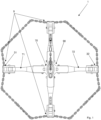
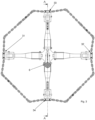
figures 1 ,2 and3 are respectively a front, side and rear view of an anti-skid device according to the present invention; -
figure 4 is a section view along plane A-A offigure 3 ; -
figures 5 and 6 show two perspective views of an anti-skid device according to the present invention; -
figure 7 illustrates a detail of an anti-skid device according to the present invention; -
figure 8 is a view according to section plane B-B offigure 7 ; -
figure 9 is a lateral view of the detail offigure 7 ; -
figures 10 and 11 are respectively views along planes C-C and D-D offigure 9 ; -
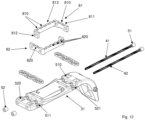
figure 12 is an exploded view of the detail offigure 7 ; -
figure 13 illustrates a detail in larger scale offigure 12 . - In the accompanying drawings,
reference numeral 1 indicates an anti-skid device for a wheel of a vehicle. - The
anti-skid device 1 is advantageously of the "spider chain" type. - The
device 1 comprises a first and asecond portion second portion second portion first portion 21 is part of a first chain. Thesecond portion 22 is part of a second chain. The first chain appropriately surrounds the tread by 360° without interruptions. The first chain thus surrounds the rotation axis of the wheel. It develops about the axis. The links of the first chain extend one following another without interruptions. All the links are therefore mutually connected without interruptions. The first chain is closed on itself. Likewise the second chain entirely surrounds the tread, appropriately without interruptions. The second chain is closed on itself. - The
device 1 comprises afirst support 31 of the first and thesecond portion first support 31 is destined to at least partly superpose on a tread of the wheel (i.e. the tyre). Thefirst support 31 is at least partly interposed between the first and thesecond portion first support 31 comprises: - a
first portion 311 which extends from a radially more inner position to a radially more outer position; and - a
second portion 312 which is destined to surmount the tread. - The
device 1 appropriately comprises at least a first connectingelement 41 for connecting the first and thesecond portion element 41 is located at thefirst support 31. The first connectingelement 41 appropriately extends internally of thefirst support 31. The first connectingelement 41 is at least partly incorporated in saidfirst support 31. Thefirst support 31 comprises at least a channel (typically having transversal sections with a closed perimeter) which runs along it transversally to the first and thesecond portion element 41. - The first connecting
element 41 is advantageously flexible. The first connectingelement 41 is appropriately a longitudinal element, typically straight. It is for example a flexible bar. The bar can be flexed and elastically return into the original position. The bar appropriately has a section that is perpendicular to the prevalent extension direction having an area comprised between 0.28 cm2 and 1.13 cm2 (or having a radius comprised between 0.3 and 0.6 centimetres). The first connectingelement 41 is preferably made of a metal material. For example they might comprise a plurality of (typically) interwoven metal wires. The above-mentioned flexible cable can in fact comprise a plurality of strands (preferably more than 10, advantageously 19) woven to one another. In this way resistance to fatigue is optimised. - The first connecting
element 41 crosses a link of thefirst portion 21 of chain and a link of thesecond portion 22 of chain. The first and thesecond portion - The first connecting
element 41 is appropriately confined in the thickness of thefirst support 31. The first connectingelement 41, for at least 75% of the longitudinal extension thereof, is appropriately concealed inside the first support 31 (in an operating configuration in which thefirst support 31 and first connectingelement 41 are assembled). - The
device 1 comprises a first and asecond abutment element 41 in position. The first and thesecond abutment element 41. Thefirst abutment 51 is appropriately constrained to or incorporated in a single body with said first connectingelement 41. - The
second abutment 52 is appropriately constrainable (for example by interference or screwing) to the first connectingelement 41. In this way the increase of the transversal section at the ends prevents the extraction of the first connectingelement 41 from thefirst support 31. - The first and the
second abutment element 41 outside a zone interposed between the first and thesecond portion - The
first support 31 appropriately defines a first and asecond seat second abutment first seat 510 appropriately defines a through-hole through thefirst support 31 and transversally delimited (surrounded) by thefirst support 31. Likewise thesecond seat 520 defines a through-hole through thefirst support 31 and transversally delimited (surrounded) by thefirst support 31. The first and thesecond seat first support 31. - The
first support 31 defines afirst housing 511 for thefirst portion 21 of chain and/or asecond housing 521 for thesecond portion 22 of chain. Thefirst housing 511 is preferably complementarily shaped with respect to thefirst portion 21 of chain. Therefore, a profile of thefirst portion 21 of chain is made in thefirst support 31. Thesecond housing 521 is complementarily shaped with respect to thesecond portion 22 of chain. Therefore, a profile of thesecond portion 22 of chain is made in thefirst support 31. In the accommodating direction of the first and thesecond portion second housing - The
first support 31 is preferably made of a plastic or elastomeric material. It is therefore flexible. As mentioned in the foregoing, the firstflexible element 41 is made of a metal material. - The
device 1 appropriately comprises a second connectingelement 42 for connecting the first and thesecond portion element 42 is flexible and flanked to the first connectingelement 41 at thefirst support 31. One or more of the characteristics described with reference to the first connectingelement 41 can appropriately be repeated for the second connectingelement 42. In the preferred embodiment the second connectingelement 42 is advantageously a flexible element. - The
device 1 comprises acrown 9 along which thefirst support 31 is located and a central anchoring portion 90 (hub) to the wheel. Thecrown 9 is destined to superpose on the tread. - The
device 1 comprises an anchoringstructure 6 to a wheel, for example a fastening bolt of the wheel of the vehicle. The anchoringstructure 6 is located at the central portion. Thefirst support 31 is connected to said anchoringstructure 6. - The
device 1 comprises asecond support 32 of a third andfourth portion second support 32 is destined to superpose on the tread. Thesecond support 32 is at least partly interposed between the tread and the third andfourth portion third portion fourth portion second support 32 is located along thecrown 9 of thedevice 1. The first and thesecond support crown 9, thedevice 1 appropriately comprises a third and afourth support 33, 34 of corresponding pairs of portions of chain. The third andfourth support 33, 34 are appropriately diametrically opposite one another and are connected by a directrix which is rotated by 90° with respect to a directrix that connects the first and thesecond support second support fourth support 33, 34. - The
device 1 advantageously comprises at least a firstflexible rod 8 for connecting the third and thefourth portion flexible rod 8 is located at thesecond support 32. The firstflexible rod 8 appropriately extends inside thesecond support 32. The firstflexible rod 8 is at least partly incorporated in thesecond support 32. - The first
flexible rod 8 is made of a metal material. One or more of the characteristics described with reference to the first connectingelement 41 can appropriately be repeated for the firstflexible rod 8. The firstflexible rod 8 is advantageously flanked by a secondflexible rod 80 which connects the third and thefourth portion second support 32. The first and/or thesecond rod - One or more of the previously described features in relation to the
first support 31 and the interaction thereof with the first and thesecond portion second support 32 and the interaction thereof with the third andfourth portion - The
first support 31 comprises first anti-skid means 81, comprising a plurality ofanti-skid teeth 810 being part of a single piece (in a single monolithic body) and destined to carry out the action thereof on a road surface. - The first anti-skid means 81 comprise/are an insert partly incorporated in the
first support 31. The first anti-skid means 81 are appropriately made of a metal material. The first anti-skid means 81 are inserted partly in thefirst support 31. - The first anti-skid means 81 comprise/are a bar.
- The teeth, in a single body with one another, are appropriately flanked to one another along an extension direction of the bar.
- Appropriately though not necessarily, the bar comprises a
first arm 811, asecond arm 812 and a connectingzone 813 of the first and thesecond arm first arm 811, thesecond arm 812 and the connectingzone 813 define, in combination, afirst concavity 814. Preferably but not necessarily, the first and thesecond arm zone 813 appropriately comprises a straight portion perpendicular to the first and thesecond arm - The
first arm 811 is appropriately longer than thesecond arm 812. The connectingzone 813 is appropriately longer than thefirst arm 811 and/or thesecond arm 812. The connectingzone 813 has a prevalent extension direction destined to be arranged parallel to the width of the tread (along a parallel direction to the direction of the rotation axis of the wheel). - The first anti-skid means 81 comprise at least four
teeth 810 arranged in said connectingzone 813. At least one tooth, preferably two, is/are appropriately located along the first and/or thesecond arm - The
second arm 812 comprises afirst hole 816. The first connectingelement 41 transits in thefirst hole 816. - The
first arm 811 comprises asecond hole 815 in which the second connectingelement 42 transits. The passage of the first andsecond element second hole - The
first arm 811 appropriately also comprises anadditional hole 817 in which the first connectingelement 41 transits. Thefirst hole 816 and theadditional hole 817 are coaxial. - The
device 1 appropriately comprises second anti-skid means 82 incorporating in a single body a plurality ofanti-skid teeth 820 destined to carry out the action thereof on a road surface. In other words the second anti-skid means 82 comprise a plurality ofanti-skid teeth 820 being part of a single piece (in a single monolithic body). The second anti-skid means 82 extend along an extension line along which theanti-skid teeth 820 are arranged in succession. - The extension line of the second anti-skid means 82 defines a
second concavity 824. The first and saidsecond concavity second segment intermediate segment 823. The first and thesecond segment intermediate segment 823. - The second anti-skid means 82 comprise at least two
passage holes element passage holes first segment 821. One of said twoholes 825 is appropriately coaxial to thefirst hole 816 and the other to thesecond hole 815. The second anti-skid means 82 appropriately comprise afurther passage hole 827 in which the second connectingelement 42 transits. Thefurther passage hole 827 is made in thesecond segment 822. - More generally, the first and/or the second anti-skid means 81, 82 are crossed by the first and/or the second connecting
element - The central anchoring portion connects to the first and
second support second spoke - In fact the
device 1 comprises a plurality ofspokes zone 70; one of saidspokes 71, in a radially more outer position, is associated to saidfirst support 31. The present invention achieves important advantages. - Primarily this enables a rapid and fast assembly linked in particular to the simplicity with which the first connecting
element 41 is connected both to the first and to the second portion ofchain - A further important advantage is linked to the sturdiness of the system associated to the flexibility thereof, this being obtained by means of a flexible connecting
element 41. This enables optimising resistance to fatigue. - The invention as it is conceived is susceptible to numerous modifications and variants, as defined by the appended claims.
Claims (10)
- An anti-skid device for a vehicle wheel comprising:- a first and a second portion (21, 22) of chain, flanked to one another and destined to extend along a development of a tread of the wheel;- a first support (31) of the first and the second portion (21, 22) of chain, said first support (31) being destined to at least partly superpose on a tread of the wheel;- at least a first connecting element (41) for connecting the first and the second portion (21, 22) of chain, located at the first support (31), said first connecting element (41) being a flexible bar;characterised in that said first connecting element (41) crosses a link of the first portion (21) of chain and a link of the second portion (22) of chain; the first portion (21) is part of a first chain; the first chain surrounding the rotation axis of the wheel without interruption;the second portion (22) is part of a second chain; the second chain is closed on itself.
- The device according to claim 1, characterised in that the first connecting element (41) is at least partly incorporated in said first support (31).
- The device according to claim 1 or 2, characterised in that it comprises a second connecting element (42) for connecting the first and the second portion (21, 22) of chain, the second connecting element (42) being flexible and flanked to the first connecting element (41) at the first support (31).
- The device according to any one of the preceding claims, characterised in that it comprises a first and a second abutment (51, 52) for retaining in position are applied to said first connecting element (41) and located at two ends of said first connecting element (41); said first and said second abutment (51, 52) are applied outside a zone interposed between the first and the second portion (21, 22) of chain.
- The device according to claim 4, characterised in that said first support (31) defines a first and a second seat (510, 520) for housing the first and the second abutment (51, 52).
- The device according to any one of the preceding claims, characterised in that said first support (31) defines a first housing (511) for the first portion (21) of chain and a second housing (521) for the second portion (22) of chain.
- The device according to any one of the preceding claims, characterised in that said first support (31) is made of a plastic or elastomeric material, said first flexible element (41) is a flexible cable having a prevalent longitudinal extension comprising a plurality of metal strands woven together.
- The device according to any one of the preceding claims, characterised in that it comprises an anchoring structure (6) to a wheel, said first support (31) being connected to said anchoring structure (6).
- The device according to claim 8, characterised in that it comprises a second support (32) of a third and fourth portion (23, 24) of chain that are flanked to one another, said anchoring structure (6) connecting to the first and second support (31, 32) respectively by means of a first and a second spoke (71, 72).
- The device according to any one of the preceding claims, characterised in that the first support (31) comprises first anti-skid means (81) comprising a plurality of anti-skid teeth (810) being part of a single piece in a single monolithic body and destined to carry out the action thereof on a road surface; the first anti-skid means (81) being crossed by the first connecting element (41).
Priority Applications (1)
| Application Number | Priority Date | Filing Date | Title |
|---|---|---|---|
| SI202130045T SI3932698T1 (en) | 2020-06-29 | 2021-03-25 | An anti-skid device |
Applications Claiming Priority (1)
| Application Number | Priority Date | Filing Date | Title |
|---|---|---|---|
| IT102020000015655A IT202000015655A1 (en) | 2020-06-29 | 2020-06-29 | ANTI-SLIP DEVICE |
Publications (2)
| Publication Number | Publication Date |
|---|---|
| EP3932698A1 EP3932698A1 (en) | 2022-01-05 |
| EP3932698B1 true EP3932698B1 (en) | 2023-05-10 |
Family
ID=72473826
Family Applications (1)
| Application Number | Title | Priority Date | Filing Date |
|---|---|---|---|
| EP21164799.5A Active EP3932698B1 (en) | 2020-06-29 | 2021-03-25 | An anti-skid device |
Country Status (4)
| Country | Link |
|---|---|
| EP (1) | EP3932698B1 (en) |
| ES (1) | ES2948625T3 (en) |
| IT (1) | IT202000015655A1 (en) |
| SI (1) | SI3932698T1 (en) |
Family Cites Families (4)
| Publication number | Priority date | Publication date | Assignee | Title |
|---|---|---|---|---|
| DE8709545U1 (en) * | 1987-07-08 | 1987-10-29 | Rud-Kettenfabrik Rieger & Dietz Gmbh U. Co, 7080 Aalen | Foldable anti-skid device for vehicle wheels |
| DE8814916U1 (en) * | 1988-11-30 | 1989-01-12 | Eisen- Und Drahtwerk Erlau Ag, 7080 Aalen | Gripping piece for running parts of tire chains |
| ITMI20050574A1 (en) * | 2005-04-06 | 2006-10-07 | Maggi Catene Spa | PERFECTED CONNECTION PLATE FOR A ROLLING ROLLER OF A SNOW CHAIN |
| ATE442269T1 (en) * | 2007-10-15 | 2009-09-15 | Thule Spa | ANTI-SLIP DEVICE WITH CHAIN LENGTH ADJUSTMENT SYSTEM |
-
2020
- 2020-06-29 IT IT102020000015655A patent/IT202000015655A1/en unknown
-
2021
- 2021-03-25 SI SI202130045T patent/SI3932698T1/en unknown
- 2021-03-25 ES ES21164799T patent/ES2948625T3/en active Active
- 2021-03-25 EP EP21164799.5A patent/EP3932698B1/en active Active
Also Published As
| Publication number | Publication date |
|---|---|
| ES2948625T3 (en) | 2023-09-14 |
| SI3932698T1 (en) | 2023-07-31 |
| EP3932698A1 (en) | 2022-01-05 |
| IT202000015655A1 (en) | 2021-12-29 |
Similar Documents
| Publication | Publication Date | Title |
|---|---|---|
| US6367883B1 (en) | Bicycle wheel | |
| US4256346A (en) | Wheels for vehicles, such as motorcycles | |
| EP2902217B1 (en) | Non-pneumatic tire | |
| EP3932697B1 (en) | An anti-skid device for a wheel | |
| EP3978272B1 (en) | Tire | |
| MX2007007853A (en) | Suspension mounting system and a method of assembling the same. | |
| US20130038117A1 (en) | Spoke wheel | |
| JPH10181669A (en) | Bicycle sprocket supporting unit | |
| JP4761857B2 (en) | Hub body for bicycle wheel and hub having the hub body | |
| EP0391946A1 (en) | TIRE CONSTRUCTION. | |
| EP3932698B1 (en) | An anti-skid device | |
| EP2323855A1 (en) | Vehicle wheel with rock guard | |
| EP3653407B1 (en) | Strap center fixed type resonator and wheel assembly comprising the same | |
| EP3543037A1 (en) | Non-pneumatic tire | |
| EP4049857B1 (en) | Vehicle wheel | |
| EP3113596B1 (en) | An agricultural roller ring and a land packer comprising a set of such agricultural roller rings | |
| WO2022209682A1 (en) | Work vehicle | |
| US20020096006A1 (en) | Starter wheel for a motor vehicle | |
| JP2013224051A (en) | Wire spoke wheel for tubeless tire | |
| JP3693144B2 (en) | Tire structure | |
| EP4558361A1 (en) | Bumper reinforcement for a motor vehicle | |
| EP1262334B1 (en) | Bicycle wheel | |
| US4391316A (en) | Anti-skid device for vehicle wheels | |
| US20250296383A1 (en) | Vehicle wheel structure | |
| JP2008168666A (en) | Wheel disc with increased rigidity against tilt deformation |
Legal Events
| Date | Code | Title | Description |
|---|---|---|---|
| PUAI | Public reference made under article 153(3) epc to a published international application that has entered the european phase |
Free format text: ORIGINAL CODE: 0009012 |
|
| STAA | Information on the status of an ep patent application or granted ep patent |
Free format text: STATUS: THE APPLICATION HAS BEEN PUBLISHED |
|
| AK | Designated contracting states |
Kind code of ref document: A1 Designated state(s): AL AT BE BG CH CY CZ DE DK EE ES FI FR GB GR HR HU IE IS IT LI LT LU LV MC MK MT NL NO PL PT RO RS SE SI SK SM TR |
|
| B565 | Issuance of search results under rule 164(2) epc |
Effective date: 20210921 |
|
| STAA | Information on the status of an ep patent application or granted ep patent |
Free format text: STATUS: REQUEST FOR EXAMINATION WAS MADE |
|
| 17P | Request for examination filed |
Effective date: 20220126 |
|
| RBV | Designated contracting states (corrected) |
Designated state(s): AL AT BE BG CH CY CZ DE DK EE ES FI FR GB GR HR HU IE IS IT LI LT LU LV MC MK MT NL NO PL PT RO RS SE SI SK SM TR |
|
| STAA | Information on the status of an ep patent application or granted ep patent |
Free format text: STATUS: EXAMINATION IS IN PROGRESS |
|
| 17Q | First examination report despatched |
Effective date: 20220920 |
|
| GRAP | Despatch of communication of intention to grant a patent |
Free format text: ORIGINAL CODE: EPIDOSNIGR1 |
|
| STAA | Information on the status of an ep patent application or granted ep patent |
Free format text: STATUS: GRANT OF PATENT IS INTENDED |
|
| GRAS | Grant fee paid |
Free format text: ORIGINAL CODE: EPIDOSNIGR3 |
|
| INTG | Intention to grant announced |
Effective date: 20230131 |
|
| GRAA | (expected) grant |
Free format text: ORIGINAL CODE: 0009210 |
|
| STAA | Information on the status of an ep patent application or granted ep patent |
Free format text: STATUS: THE PATENT HAS BEEN GRANTED |
|
| AK | Designated contracting states |
Kind code of ref document: B1 Designated state(s): AL AT BE BG CH CY CZ DE DK EE ES FI FR GB GR HR HU IE IS IT LI LT LU LV MC MK MT NL NO PL PT RO RS SE SI SK SM TR |
|
| REG | Reference to a national code |
Ref country code: GB Ref legal event code: FG4D |
|
| REG | Reference to a national code |
Ref country code: AT Ref legal event code: REF Ref document number: 1566348 Country of ref document: AT Kind code of ref document: T Effective date: 20230515 Ref country code: CH Ref legal event code: EP |
|
| REG | Reference to a national code |
Ref country code: DE Ref legal event code: R096 Ref document number: 602021002241 Country of ref document: DE |
|
| REG | Reference to a national code |
Ref country code: IE Ref legal event code: FG4D |
|
| P01 | Opt-out of the competence of the unified patent court (upc) registered |
Effective date: 20230517 |
|
| REG | Reference to a national code |
Ref country code: LT Ref legal event code: MG9D |
|
| REG | Reference to a national code |
Ref country code: NL Ref legal event code: MP Effective date: 20230510 |
|
| REG | Reference to a national code |
Ref country code: ES Ref legal event code: FG2A Ref document number: 2948625 Country of ref document: ES Kind code of ref document: T3 Effective date: 20230914 |
|
| PG25 | Lapsed in a contracting state [announced via postgrant information from national office to epo] |
Ref country code: SE Free format text: LAPSE BECAUSE OF FAILURE TO SUBMIT A TRANSLATION OF THE DESCRIPTION OR TO PAY THE FEE WITHIN THE PRESCRIBED TIME-LIMIT Effective date: 20230510 Ref country code: PT Free format text: LAPSE BECAUSE OF FAILURE TO SUBMIT A TRANSLATION OF THE DESCRIPTION OR TO PAY THE FEE WITHIN THE PRESCRIBED TIME-LIMIT Effective date: 20230911 Ref country code: NO Free format text: LAPSE BECAUSE OF FAILURE TO SUBMIT A TRANSLATION OF THE DESCRIPTION OR TO PAY THE FEE WITHIN THE PRESCRIBED TIME-LIMIT Effective date: 20230810 Ref country code: NL Free format text: LAPSE BECAUSE OF FAILURE TO SUBMIT A TRANSLATION OF THE DESCRIPTION OR TO PAY THE FEE WITHIN THE PRESCRIBED TIME-LIMIT Effective date: 20230510 |
|
| PG25 | Lapsed in a contracting state [announced via postgrant information from national office to epo] |
Ref country code: RS Free format text: LAPSE BECAUSE OF FAILURE TO SUBMIT A TRANSLATION OF THE DESCRIPTION OR TO PAY THE FEE WITHIN THE PRESCRIBED TIME-LIMIT Effective date: 20230510 Ref country code: PL Free format text: LAPSE BECAUSE OF FAILURE TO SUBMIT A TRANSLATION OF THE DESCRIPTION OR TO PAY THE FEE WITHIN THE PRESCRIBED TIME-LIMIT Effective date: 20230510 Ref country code: LV Free format text: LAPSE BECAUSE OF FAILURE TO SUBMIT A TRANSLATION OF THE DESCRIPTION OR TO PAY THE FEE WITHIN THE PRESCRIBED TIME-LIMIT Effective date: 20230510 Ref country code: LT Free format text: LAPSE BECAUSE OF FAILURE TO SUBMIT A TRANSLATION OF THE DESCRIPTION OR TO PAY THE FEE WITHIN THE PRESCRIBED TIME-LIMIT Effective date: 20230510 Ref country code: IS Free format text: LAPSE BECAUSE OF FAILURE TO SUBMIT A TRANSLATION OF THE DESCRIPTION OR TO PAY THE FEE WITHIN THE PRESCRIBED TIME-LIMIT Effective date: 20230910 Ref country code: HR Free format text: LAPSE BECAUSE OF FAILURE TO SUBMIT A TRANSLATION OF THE DESCRIPTION OR TO PAY THE FEE WITHIN THE PRESCRIBED TIME-LIMIT Effective date: 20230510 Ref country code: GR Free format text: LAPSE BECAUSE OF FAILURE TO SUBMIT A TRANSLATION OF THE DESCRIPTION OR TO PAY THE FEE WITHIN THE PRESCRIBED TIME-LIMIT Effective date: 20230811 |
|
| PG25 | Lapsed in a contracting state [announced via postgrant information from national office to epo] |
Ref country code: FI Free format text: LAPSE BECAUSE OF FAILURE TO SUBMIT A TRANSLATION OF THE DESCRIPTION OR TO PAY THE FEE WITHIN THE PRESCRIBED TIME-LIMIT Effective date: 20230510 |
|
| PG25 | Lapsed in a contracting state [announced via postgrant information from national office to epo] |
Ref country code: SK Free format text: LAPSE BECAUSE OF FAILURE TO SUBMIT A TRANSLATION OF THE DESCRIPTION OR TO PAY THE FEE WITHIN THE PRESCRIBED TIME-LIMIT Effective date: 20230510 |
|
| PG25 | Lapsed in a contracting state [announced via postgrant information from national office to epo] |
Ref country code: SM Free format text: LAPSE BECAUSE OF FAILURE TO SUBMIT A TRANSLATION OF THE DESCRIPTION OR TO PAY THE FEE WITHIN THE PRESCRIBED TIME-LIMIT Effective date: 20230510 Ref country code: SK Free format text: LAPSE BECAUSE OF FAILURE TO SUBMIT A TRANSLATION OF THE DESCRIPTION OR TO PAY THE FEE WITHIN THE PRESCRIBED TIME-LIMIT Effective date: 20230510 Ref country code: RO Free format text: LAPSE BECAUSE OF FAILURE TO SUBMIT A TRANSLATION OF THE DESCRIPTION OR TO PAY THE FEE WITHIN THE PRESCRIBED TIME-LIMIT Effective date: 20230510 Ref country code: EE Free format text: LAPSE BECAUSE OF FAILURE TO SUBMIT A TRANSLATION OF THE DESCRIPTION OR TO PAY THE FEE WITHIN THE PRESCRIBED TIME-LIMIT Effective date: 20230510 Ref country code: DK Free format text: LAPSE BECAUSE OF FAILURE TO SUBMIT A TRANSLATION OF THE DESCRIPTION OR TO PAY THE FEE WITHIN THE PRESCRIBED TIME-LIMIT Effective date: 20230510 Ref country code: CZ Free format text: LAPSE BECAUSE OF FAILURE TO SUBMIT A TRANSLATION OF THE DESCRIPTION OR TO PAY THE FEE WITHIN THE PRESCRIBED TIME-LIMIT Effective date: 20230510 |
|
| REG | Reference to a national code |
Ref country code: DE Ref legal event code: R097 Ref document number: 602021002241 Country of ref document: DE |
|
| REG | Reference to a national code |
Ref country code: AT Ref legal event code: UEP Ref document number: 1566348 Country of ref document: AT Kind code of ref document: T Effective date: 20230510 |
|
| PLBE | No opposition filed within time limit |
Free format text: ORIGINAL CODE: 0009261 |
|
| STAA | Information on the status of an ep patent application or granted ep patent |
Free format text: STATUS: NO OPPOSITION FILED WITHIN TIME LIMIT |
|
| 26N | No opposition filed |
Effective date: 20240213 |
|
| PG25 | Lapsed in a contracting state [announced via postgrant information from national office to epo] |
Ref country code: IT Free format text: LAPSE BECAUSE OF FAILURE TO SUBMIT A TRANSLATION OF THE DESCRIPTION OR TO PAY THE FEE WITHIN THE PRESCRIBED TIME-LIMIT Effective date: 20230510 |
|
| PG25 | Lapsed in a contracting state [announced via postgrant information from national office to epo] |
Ref country code: BG Free format text: LAPSE BECAUSE OF FAILURE TO SUBMIT A TRANSLATION OF THE DESCRIPTION OR TO PAY THE FEE WITHIN THE PRESCRIBED TIME-LIMIT Effective date: 20230510 |
|
| PG25 | Lapsed in a contracting state [announced via postgrant information from national office to epo] |
Ref country code: LU Free format text: LAPSE BECAUSE OF NON-PAYMENT OF DUE FEES Effective date: 20240325 |
|
| PG25 | Lapsed in a contracting state [announced via postgrant information from national office to epo] |
Ref country code: MC Free format text: LAPSE BECAUSE OF FAILURE TO SUBMIT A TRANSLATION OF THE DESCRIPTION OR TO PAY THE FEE WITHIN THE PRESCRIBED TIME-LIMIT Effective date: 20230510 |
|
| PG25 | Lapsed in a contracting state [announced via postgrant information from national office to epo] |
Ref country code: MC Free format text: LAPSE BECAUSE OF FAILURE TO SUBMIT A TRANSLATION OF THE DESCRIPTION OR TO PAY THE FEE WITHIN THE PRESCRIBED TIME-LIMIT Effective date: 20230510 Ref country code: LU Free format text: LAPSE BECAUSE OF NON-PAYMENT OF DUE FEES Effective date: 20240325 Ref country code: BG Free format text: LAPSE BECAUSE OF FAILURE TO SUBMIT A TRANSLATION OF THE DESCRIPTION OR TO PAY THE FEE WITHIN THE PRESCRIBED TIME-LIMIT Effective date: 20230510 |
|
| REG | Reference to a national code |
Ref country code: BE Ref legal event code: MM Effective date: 20240331 |
|
| PG25 | Lapsed in a contracting state [announced via postgrant information from national office to epo] |
Ref country code: BE Free format text: LAPSE BECAUSE OF NON-PAYMENT OF DUE FEES Effective date: 20240331 |
|
| PG25 | Lapsed in a contracting state [announced via postgrant information from national office to epo] |
Ref country code: IE Free format text: LAPSE BECAUSE OF NON-PAYMENT OF DUE FEES Effective date: 20240325 |
|
| PG25 | Lapsed in a contracting state [announced via postgrant information from national office to epo] |
Ref country code: IE Free format text: LAPSE BECAUSE OF NON-PAYMENT OF DUE FEES Effective date: 20240325 Ref country code: BE Free format text: LAPSE BECAUSE OF NON-PAYMENT OF DUE FEES Effective date: 20240331 |
|
| PGFP | Annual fee paid to national office [announced via postgrant information from national office to epo] |
Ref country code: SI Payment date: 20250307 Year of fee payment: 5 |
|
| PGFP | Annual fee paid to national office [announced via postgrant information from national office to epo] |
Ref country code: ES Payment date: 20250417 Year of fee payment: 5 |
|
| PGFP | Annual fee paid to national office [announced via postgrant information from national office to epo] |
Ref country code: CH Payment date: 20250401 Year of fee payment: 5 |
|
| PG25 | Lapsed in a contracting state [announced via postgrant information from national office to epo] |
Ref country code: CY Free format text: LAPSE BECAUSE OF FAILURE TO SUBMIT A TRANSLATION OF THE DESCRIPTION OR TO PAY THE FEE WITHIN THE PRESCRIBED TIME-LIMIT; INVALID AB INITIO Effective date: 20210325 |
|
| PG25 | Lapsed in a contracting state [announced via postgrant information from national office to epo] |
Ref country code: HU Free format text: LAPSE BECAUSE OF FAILURE TO SUBMIT A TRANSLATION OF THE DESCRIPTION OR TO PAY THE FEE WITHIN THE PRESCRIBED TIME-LIMIT; INVALID AB INITIO Effective date: 20210325 |
|
| GBPC | Gb: european patent ceased through non-payment of renewal fee |
Effective date: 20250325 |
|
| PG25 | Lapsed in a contracting state [announced via postgrant information from national office to epo] |
Ref country code: TR Free format text: LAPSE BECAUSE OF FAILURE TO SUBMIT A TRANSLATION OF THE DESCRIPTION OR TO PAY THE FEE WITHIN THE PRESCRIBED TIME-LIMIT Effective date: 20230510 |
|
| PG25 | Lapsed in a contracting state [announced via postgrant information from national office to epo] |
Ref country code: GB Free format text: LAPSE BECAUSE OF NON-PAYMENT OF DUE FEES Effective date: 20250325 |
|
| REG | Reference to a national code |
Ref country code: CH Ref legal event code: U11 Free format text: ST27 STATUS EVENT CODE: U-0-0-U10-U11 (AS PROVIDED BY THE NATIONAL OFFICE) Effective date: 20260401 |
|
| PGFP | Annual fee paid to national office [announced via postgrant information from national office to epo] |
Ref country code: DE Payment date: 20260320 Year of fee payment: 6 |
|
| PGFP | Annual fee paid to national office [announced via postgrant information from national office to epo] |
Ref country code: AT Payment date: 20260318 Year of fee payment: 6 |
|
| PGFP | Annual fee paid to national office [announced via postgrant information from national office to epo] |
Ref country code: FR Payment date: 20260323 Year of fee payment: 6 |