EP3932384A1 - Cosmetic composition for uv-protection that increases uv protection efficiency by means of uv light - Google Patents
Cosmetic composition for uv-protection that increases uv protection efficiency by means of uv light Download PDFInfo
- Publication number
- EP3932384A1 EP3932384A1 EP19916789.1A EP19916789A EP3932384A1 EP 3932384 A1 EP3932384 A1 EP 3932384A1 EP 19916789 A EP19916789 A EP 19916789A EP 3932384 A1 EP3932384 A1 EP 3932384A1
- Authority
- EP
- European Patent Office
- Prior art keywords
- cosmetic composition
- methoxycinnamate
- oil
- protection
- sunscreen
- Prior art date
- Legal status (The legal status is an assumption and is not a legal conclusion. Google has not performed a legal analysis and makes no representation as to the accuracy of the status listed.)
- Pending
Links
Images


Classifications
-
- A—HUMAN NECESSITIES
- A61—MEDICAL OR VETERINARY SCIENCE; HYGIENE
- A61K—PREPARATIONS FOR MEDICAL, DENTAL OR TOILETRY PURPOSES
- A61K8/00—Cosmetics or similar toiletry preparations
- A61K8/18—Cosmetics or similar toiletry preparations characterised by the composition
- A61K8/30—Cosmetics or similar toiletry preparations characterised by the composition containing organic compounds
- A61K8/31—Hydrocarbons
-
- A—HUMAN NECESSITIES
- A61—MEDICAL OR VETERINARY SCIENCE; HYGIENE
- A61K—PREPARATIONS FOR MEDICAL, DENTAL OR TOILETRY PURPOSES
- A61K8/00—Cosmetics or similar toiletry preparations
- A61K8/18—Cosmetics or similar toiletry preparations characterised by the composition
- A61K8/30—Cosmetics or similar toiletry preparations characterised by the composition containing organic compounds
- A61K8/33—Cosmetics or similar toiletry preparations characterised by the composition containing organic compounds containing oxygen
- A61K8/37—Esters of carboxylic acids
-
- A—HUMAN NECESSITIES
- A61—MEDICAL OR VETERINARY SCIENCE; HYGIENE
- A61K—PREPARATIONS FOR MEDICAL, DENTAL OR TOILETRY PURPOSES
- A61K8/00—Cosmetics or similar toiletry preparations
- A61K8/18—Cosmetics or similar toiletry preparations characterised by the composition
- A61K8/30—Cosmetics or similar toiletry preparations characterised by the composition containing organic compounds
- A61K8/33—Cosmetics or similar toiletry preparations characterised by the composition containing organic compounds containing oxygen
- A61K8/37—Esters of carboxylic acids
- A61K8/375—Esters of carboxylic acids the alcohol moiety containing more than one hydroxy group
-
- A—HUMAN NECESSITIES
- A61—MEDICAL OR VETERINARY SCIENCE; HYGIENE
- A61K—PREPARATIONS FOR MEDICAL, DENTAL OR TOILETRY PURPOSES
- A61K8/00—Cosmetics or similar toiletry preparations
- A61K8/18—Cosmetics or similar toiletry preparations characterised by the composition
- A61K8/30—Cosmetics or similar toiletry preparations characterised by the composition containing organic compounds
- A61K8/40—Cosmetics or similar toiletry preparations characterised by the composition containing organic compounds containing nitrogen
-
- A—HUMAN NECESSITIES
- A61—MEDICAL OR VETERINARY SCIENCE; HYGIENE
- A61K—PREPARATIONS FOR MEDICAL, DENTAL OR TOILETRY PURPOSES
- A61K8/00—Cosmetics or similar toiletry preparations
- A61K8/18—Cosmetics or similar toiletry preparations characterised by the composition
- A61K8/30—Cosmetics or similar toiletry preparations characterised by the composition containing organic compounds
- A61K8/58—Cosmetics or similar toiletry preparations characterised by the composition containing organic compounds containing atoms other than carbon, hydrogen, halogen, oxygen, nitrogen, sulfur or phosphorus
- A61K8/585—Organosilicon compounds
-
- A—HUMAN NECESSITIES
- A61—MEDICAL OR VETERINARY SCIENCE; HYGIENE
- A61K—PREPARATIONS FOR MEDICAL, DENTAL OR TOILETRY PURPOSES
- A61K8/00—Cosmetics or similar toiletry preparations
- A61K8/18—Cosmetics or similar toiletry preparations characterised by the composition
- A61K8/72—Cosmetics or similar toiletry preparations characterised by the composition containing organic macromolecular compounds
- A61K8/84—Cosmetics or similar toiletry preparations characterised by the composition containing organic macromolecular compounds obtained by reactions otherwise than those involving only carbon-carbon unsaturated bonds
- A61K8/89—Polysiloxanes
- A61K8/891—Polysiloxanes saturated, e.g. dimethicone, phenyl trimethicone, C24-C28 methicone or stearyl dimethicone
-
- A—HUMAN NECESSITIES
- A61—MEDICAL OR VETERINARY SCIENCE; HYGIENE
- A61Q—SPECIFIC USE OF COSMETICS OR SIMILAR TOILETRY PREPARATIONS
- A61Q17/00—Barrier preparations; Preparations brought into direct contact with the skin for affording protection against external influences, e.g. sunlight, X-rays or other harmful rays, corrosive materials, bacteria or insect stings
- A61Q17/04—Topical preparations for affording protection against sunlight or other radiation; Topical sun tanning preparations
Definitions
- the present disclosure relates to a cosmetic composition for ultraviolet (UV) protection which shows a boost in sun protection efficiency by UV light.
- UV ultraviolet
- UV light irradiated from the sunlight functions as a main cause of erythema, edema, freckle, or the like, on the skin, or skin cancer.
- UV-C having a wavelength of 200-280 nm
- UV-B having a wavelength of 280-320 nm
- UV-A having a wavelength of 320-400 nm.
- UV-C does not arrive at the ground surface and disappears, while passing through the ozone layer, UV-B infiltrates to the skin epidermis to cause erythema, freckle, edema, or the like, and UV-A infiltrates to the derma to cause skin cancer, to accelerate skin aging, such as wrinkles and melanin formation, and to cause skin irritation.
- UV-C does not arrive at the ground surface and disappears, while passing through the ozone layer
- UV-B infiltrates to the skin epidermis to cause erythema, freckle, edema, or the like
- UV-A infiltrates to the derma to cause skin cancer
- the sun protection products include inorganic sunscreens, such as titanium dioxide or zinc oxide, or organic sunscreens, such as ethylhexyl methoxycinnamate, ethylhexyl salicylate, octocrylene, butylmethoxydibenzoyl methane, bis-ethylhexyloxyphenolmethoxyphenyl triazine or diethylaminohydroxybenzoylhexyl benzoate, so that they may have a high SPF value.
- inorganic sunscreens such as titanium dioxide or zinc oxide
- organic sunscreens such as ethylhexyl methoxycinnamate, ethylhexyl salicylate, octocrylene, butylmethoxydibenzoyl methane, bis-ethylhexyloxyphenolmethoxyphenyl triazine or diethylaminohydroxybenzoylhexyl benzoate, so that they
- Sun protection cosmetic products may undergo a decrease in sun protection efficiency by UV light.
- a sunscreen such as ethylhexyl methoxycinnamate, isoamyl p-methoxycinnamate or cinoxate, having a methoxycinnamate structure has a problem of degradation of UV light absorbing efficiency because its trans structure is converted into a cis structure by UV light.
- sun protection efficiency is decreased, it is not possible to protect UV light effectively, resulting in skin aging or various skin diseases.
- the inconvenience of having to reapply a sun protection product several times may be generated.
- the present disclosure is directed to providing a cosmetic composition for UV protection, which solves the problem of degradation of sun protection efficiency upon the exposure of a sunscreen having a methoxycinnamate structure to UV light and rather shows a boost in sun protection efficiency by UV light.
- the inventors of the present disclosure have conducted intensive studies to solve the problems of the related art, and have found that a cosmetic composition including a sunscreen having a methoxycinnamate structure shows a boost in sun protection efficiency, when it is exposed to UV light under a specific condition.
- the present disclosure is based on this finding.
- the inventors of the present disclosure have found that a variation in content of polar oil or hydrocarbon oil in the cosmetic composition including the above-mentioned sunscreen can control the intermolecular distance of methoxycinnamate.
- methoxycinnamate molecules having a trans structure may be converted into a cis structure by UV light, resulting in significant degradation of UV absorptivity.
- various photoreaction products, including dimers can be formed upon the exposure to UV light.
- ⁇ - ⁇ staking with the formed photoreaction products causes a change in ⁇ - ⁇ * transition energy level, and thus the wavelength region capable of being absorbed by the sunscreen may be extended.
- the cosmetic composition including a sunscreen according to the present disclosure has a significantly increased absorbance in the UV-A wavelength region (320-400 nm) and UV-B wavelength region (280-320 nm), as compared to the absorbance before UV irradiation, and shows a significantly increased SPF value.
- a cosmetic composition for UV protection including a sunscreen having a methoxycinnamate structure and polar oil.
- a cosmetic composition for UV protection including a sunscreen having a methoxycinnamate structure and hydrocarbon oil.
- the sunscreen having a methoxycinnamate structure may include at least one selected from the group consisting of ethylhexyl methoxycinnamate, isoamyl p-methoxycinnamate and cinoxate.
- the sunscreen having a methoxycinnamate structure may be used in an amount of 2-30 wt%, preferably 2-25 wt%, and more preferably 2-20 wt%, based on the total weight of the composition.
- SPF is decreased by UV light.
- the sunscreen having a methoxycinnamate structure is used in an amount of larger than 30 wt%, the formulation stability of the cosmetic composition may be affected adversely.
- the polar oil may be ester-based oil or triglyceride, and particularly, may include at least one selected from the group consisting of cetylethyl hexanoate, caprylic/capric glycerides, phenethyl benzoate, dicaprylyl carbonate, C12-C15 alkyl benzoates and octocrylene, but is not limited thereto.
- the polar oil may be used in an amount of 5 wt% or less, preferably 0.01-5 wt%, and more preferably 0.05-4 wt%, based on the total weight of the composition. However, it is most preferred that the composition includes no polar oil. When the polar oil is used in an amount of larger than 5 wt%, it is not possible to realize the effect of increasing SPF by UV light.
- the cosmetic composition for UV protection including a sunscreen having a methoxycinnamate structure and polar oil according to the present disclosure may further include hydrocarbon oil.
- hydrocarbon oil it is possible to increase the sun protection effect significantly and to provide excellent skin applicability.
- the hydrocarbon oil may include at least one selected from the group consisting of liquid paraffin, light liquid isoparaffin, heavy liquid isoparaffin, Vaseline, n-paraffin, mineral oil, isoparaffin, isododecane, isohexadecane, polyisobutylene, hydrogenated polyisobutylene, polybutene, ozokerite, ceresin, microcrystalline wax, paraffin wax, polyethylene wax, polyethylene/polypropylene wax, squalane, squalene, pristane and polyisoprene, but is not limited thereto.
- the hydrocarbon oil may be used in an amount of 5-30 wt%, preferably 5.1-30 wt%, 5.5-30 wt%, 6-30 wt%, 6.5-30 wt%, or 7-30 wt%, based on the total weight of the composition.
- the hydrocarbon oil may be used in an amount of 5-25 wt%, more preferably 5.1-25 wt%, 5.5-25 wt%, 6-25 wt%, 6.5-25 wt%, or 7-25 wt%, based on the total weight of the composition.
- the hydrocarbon oil may be used in an amount of 5-15 wt%, more preferably 5.1-15 wt%, 5.5-15 wt%, 6-15 wt%, 6.5-15 wt%, or 7-15 wt%, based on the total weight of the composition.
- the cosmetic composition shows an excessively stiff feeling of use, and thus cannot satisfy the fundamental quality standard of cosmetic products.
- the formulation stability may be affected adversely.
- the cosmetic composition for UV protection according to the present disclosure may further include silicone oil.
- the cosmetic composition for UV protection according to the present disclosure includes substantially no silicone oil, and may include silicone oil in an amount of 15 wt% or less, preferably 10 wt% or less, more preferably 5 wt% or less, and even more preferably 3 wt% or less, based on the total weight of the composition.
- the silicone oil may be at least one selected from the group consisting of cyclotetrasiloxane, cyclopentasiloxane, cyclohexasiloxane, dimethicone, dimethiconol and phenyl trimethicone, but is not limited thereto.
- the sunscreen contained in the cosmetic composition according to the present disclosure i.e. ethylhexyl methoxycinnamate or isoamyl p-methoxycinnamate, has poor compatibility with silicone oil. Therefore, when silicone oil is used in an amount of larger than 15 wt%, the cosmetic composition may show poor stability at room temperature.
- the cosmetic composition for UV protection may include a sunscreen having a methoxycinnamate structure and polar oil at a weight ratio (sunscreen having a methoxycinnamate structure:polar oil) of 1:0.01-1, preferably 1:0.01-0.8, more preferably 1:0.01-0.6, even more preferably 1:0.01-0.4, particularly 1:0.01-0.2.
- the cosmetic composition for UV protection may include no polar oil. When the content of the polar oil exceeds the above-defined weight ratio, it is not possible to realize an effect of increasing sun protection efficiency by UV light.
- the cosmetic composition for UV protection may include a sunscreen having a methoxycinnamate structure and hydrocarbon oil at a weight ratio (sunscreen having a methoxycinnamate structure:hydrocarbon oil) of 1:0.2-15, preferably 1:0.2-8, and more preferably 1:0.2-3.
- the hydrocarbon oil may be used at an adequate weight ratio to the sunscreen to improve the feeling of use of the cosmetic composition, within a range of 5 wt% or more based on the total weight of the composition.
- the content of the hydrocarbon oil does not fall within the above-defined range, the effect of increasing sun protection efficiency by UV light or the feeling of use of the cosmetic composition may be degraded.
- the cosmetic composition for UV protection when the cosmetic composition for UV protection according to the present disclosure includes polar oil and hydrocarbon oil at the same time, it may include polar oil and hydrocarbon oil at a weight ratio (polar oil:hydrocarbon oil) of 1:1-300, preferably 1:1-200, and more preferably 1:1-100.
- polar oil:hydrocarbon oil When the weight ratio of polar oil to hydrocarbon oil does not fall within the above-defined range, the effect of increasing sun protection efficiency by UV light or the feeling of use of the cosmetic composition may be degraded.
- the cosmetic composition for UV protection according to the present disclosure may further include an inorganic sunscreen.
- the inorganic sunscreen may include titanium dioxide, zinc oxide, iron oxide, or the like, but is not limited thereto.
- the cosmetic composition for UV protection according to the present disclosure may further include a moisturizing agent, a thickener, a surfactant, an oil base, a preservative, an antioxidant, alcohol, a fragrance, a pH modifier, a natural extract, or the like, but is not limited thereto.
- the cosmetic composition according to the present disclosure may be formulated into any formulation prepared conventionally in the art.
- the cosmetic composition may be formulated into solution, suspension, emulsion, paste, gel, cream, lotion, soap, surfactant-containing cleanser, oil, or the like, but is not limited thereto.
- the cosmetic composition may be formulated into skin softener, nutrient skin, skin toner, nutrient cream, emulsion, cosmetic ointment, massage cream, essence, eye cream, cleansing cream, cleansing foam, cleansing water, pack, gel, makeup base, foundation, spray, powder, or the like.
- the cosmetic composition for UV protection according to the present disclosure may be an emulsion formulation, such as a water-in-oil (W/O) or oil-in-water (O/W) formulation.
- the present disclosure provides a cosmetic composition for UV protection, including 2-30 wt% of a sunscreen having a methoxycinnamate structure, 5 wt% or less of polar oil and 5-30 wt% of hydrocarbon oil, based on the total weight of the composition.
- the cosmetic composition shows a significant boost in UV protection effect after UV irradiation and a significantly improved feeling of use.
- the cosmetic composition for UV protection according to the present disclosure shows a significant boost in SPF value after UV irradiation.
- the cosmetic composition shows a boost in SPF value of 3-80%, preferably 5-77%, as compared to the SPF value before UV irradiation.
- the cosmetic composition for UV protection according to the present disclosure shows an increased effect of protecting UV-A (320-400 nm) and UV-B (280-320 nm), and preferably shows a significantly increased effect of protecting UV-B, after UV irradiation.
- the present disclosure also provides a method for preparing a cosmetic composition for UV protection, including a step of mixing a sunscreen having a methoxycinnamate structure with 5 wt% or less of polar oil based on the total weight of the composition.
- the method may further include a step of further mixing with hydrocarbon oil. The same as described above with reference to the cosmetic composition for UV protection according to the present disclosure may be applied to the method.
- the inventors of the present disclosure have found that when the cosmetic composition including the sunscreen contains a specific content of polar oil and is prepared in an oil-in-water (O/W) formulation, the intermolecular distance of methoxycinnamate may be controlled to get closer, resulting in a boost in UV protection efficiency upon the exposure to UV light.
- O/W oil-in-water
- the present disclosure provides a cosmetic composition for UV protection, including a sunscreen having a methoxycinnamate structure and polar oil, wherein the sunscreen is isoamyl p-methoxycinnamate.
- the sunscreen may further include ethylhexyl methoxycinnamate, cinoxate or a mixture thereof, besides isoamyl p-methoxycinnamate.
- the sunscreen having a methoxycinnamate structure may be used in an amount of 2-30 wt%, preferably 2-25 wt%, and more preferably 2-20 wt%, based on the total weight of the composition.
- the sunscreen having a methoxycinnamate structure When the sunscreen having a methoxycinnamate structure is used in an amount of less than 2 wt%, SPF is reduced by UV light. When the sunscreen having a methoxycinnamate structure is used in an amount of larger than 30 wt%, the formulation stability of the cosmetic composition may be degraded.
- isoamyl p-methoxycinnamate may be used in an amount of 2-30 wt%, preferably 2-25 wt%, and more preferably 2-20 wt%, based on the total weight of the composition.
- isoamyl p-methoxycinnamate is used in an amount of less than 2 wt%, SPF is reduced by UV light.
- isoamyl p-methoxycinnamate is used in an amount of larger than 30 wt%, the formulation stability of the cosmetic composition may be degraded.
- the polar oil may be ester-based oil or triglyceride, except a sunscreen having a methoxycinnamate structure.
- the polar oil may include at least one selected from the group consisting of cetylethyl hexanoate, caprylic/capric glycerides, phenethyl benzoate, dicaprylyl carbonate, C12-C15 alkyl benzoates, octocrylene and phenyl trimethicone, but is not limited thereto
- the content of the polar oil may be equal to or smaller than the content of isoamyl p-methoxycinnamate.
- the polar oil may be used in an amount of 0.01-30 wt%, preferably 0.01-25 wt%, and more preferably 0.01-20 wt%, based on the total weight of the composition.
- the cosmetic composition for UV protection according to the present disclosure may include no polar oil. When the content of the polar oil is larger than the content of isoamyl p-methoxycinnamate, it is not possible to realize an effect of increasing SPF by UV light.
- the cosmetic composition for UV protection according to the present disclosure may include the sunscreen having a methoxycinnamate structure and polar oil at a weight ratio (sunscreen having a methoxycinnamate structure:polar oil) of 1:0.01-7, preferably 1:0.01-0.5, and more preferably 1:0.01-0.3.
- the cosmetic composition for UV protection according to the present disclosure may include isoamyl p-methoxycinnamate and polar oil at a weight ratio (isoamyl p-methoxycinnamate:polar oil) of 1:0.01-7, preferably 1:0.01-0.5, and more preferably 1:0.01-0.3.
- the content of the polar oil exceeds the above-defined range of weight ratio, it is not possible to realize an effect of increasing UV protection efficiency by UV light.
- the cosmetic composition for UV protection may further include nonpolar oil.
- the nonpolar oil may include hydrocarbon oil, silicone oil or a mixture thereof.
- hydrocarbon oil may include at least one selected from the group consisting of isododecane, isohexadecane, mineral oil, hydrogenated polydecene and squalane, but is not limited thereto.
- silicone oil it is possible to realize an excellent effect of increasing UV protection efficiency by UV light and to improve a feeling of use.
- the silicone oil may be at least one selected from the group consisting of cyclotetrasiloxane, cyclopentasiloxane, cyclohexasiloxane, dimethicone, dimethiconol and phenyltrimethicone, but is not limited thereto.
- the cosmetic composition for UV protection according to the present disclosure may include nonpolar oil in an amount of 20 wt% or less, preferably 15 wt% or less, more preferably 5 wt% or less, and even more preferably 3 wt% or less, based on the total weight of the composition.
- the nonpolar oil may be used in an amount of 0.01-20 wt%, preferably 5.0-20 wt%, or 5.1-20 wt%, based on the total weight of the composition.
- the nonpolar oil may be used in an amount of 0.01-10 wt%, more preferably 5.0-10 wt%, or 5.1-10 wt%, based on the total weight of the composition.
- the cosmetic composition shows an excessively stiff feeling of use and thus cannot satisfy the fundamental quality standard of cosmetic products.
- the nonpolar oil is used in an amount of larger than 20 wt%, the formulation stability may be affected adversely.
- the cosmetic composition for UV protection according to the present disclosure may have an emulsion formulation, preferably oil-in-water (O/W) formulation.
- O/W oil-in-water
- the cosmetic composition for UV protection according to the present disclosure is provided in an oil-in-water formulation containing a specific content of polar oil, it is possible to provide a significantly high effect of increasing UV protection efficiency after UV irradiation.
- the present disclosure provides a cosmetic composition for UV protection having an oil-in-water formulation and including a sunscreen having a methoxycinnamate structure and polar oil, wherein the sunscreen includes isoamyl p-methoxycinnamate and is used in an amount of 2-30 wt% based on the total weight of the composition, and the content of the polar oil is equal to or smaller than the content of isoamyl p-methoxycinnamate.
- the composition shows a significantly increased UV protection effect after UV irradiation, and has a significantly improved feeling of use.
- the cosmetic composition for UV protection according to the present disclosure shows a significant boost in SPF value after UV irradiation.
- the SPF value may be increased by 3-80%, preferably 5-77%, as compared to the SPF value before UV irradiation.
- the cosmetic composition for UV protection according to the present disclosure shows an increased effect of protecting UV-A (320-400 nm) and UV-B (280-320 nm), and preferably shows a significantly increased effect of protecting UV-B, after UV irradiation.
- the present disclosure also provides a method for preparing a cosmetic composition for UV protection according to the present disclosure, including a step of mixing a sunscreen having a methoxycinnamate structure with polar oil, wherein the sunscreen includes isoamyl p-methoxycinnamate, and the content of the polar oil is equal to or smaller than the content of isoamyl p-methoxycinnamate.
- a sunscreen having a methoxycinnamate structure with polar oil
- the sunscreen includes isoamyl p-methoxycinnamate
- the content of the polar oil is equal to or smaller than the content of isoamyl p-methoxycinnamate.
- the cosmetic composition for UV protection according to the present disclosure shows an increased UV protection efficiency upon the exposure to UV light, and particularly shows a significantly increased effect of protecting UV-A (320-400 nm) and UV-B (280-320 nm).
- the cosmetic composition for UV protection according to the present disclosure includes a specific content of hydrocarbon oil, and thus shows a significantly improved feeling of use.
- OMC or IMC having a methoxycinnamate structure shows a boost in in-vitro SPF value, while the remaining sunscreens show no significant change.
- the cosmetic products for UV protection were obtained according to the composition of the following Table 2.
- Part A and Part B were prepared individually and warmed to 75°C. While Part B was introduced gradually to Part B, emulsification was carried out for 5 minutes by using a homo-mixer, followed by cooling to 30°C.
- Each of the resultant samples was determined in terms of SPF value before and after UV irradiation in the same manner as Test Example 1. The results are shown in the following Table 3. [Table 2] Comp. Ex. 1 Ex. 2 Ex. 3 Ex. 4 Ex. 5 Ex. 6 Ex.
- FIG. 2 shows a change in absorbance in the UV region of Example 8 before and after UV irradiation.
- the data measured by using SPF-290S are used as absorbance data to determine in-vitro SPF values.
- the absorbance of Example 8 before UV irradiation is represented by a solid line, while the absorbance of Example 8 after UV irradiation is represented by a dotted line.
- Example 8 shows a boost in absorbance over the whole UV region after UV irradiation.
- Such a boost in SPF after UV irradiation is likely to be induced from a significant increase in absorbance in the UV-A (320-400 nm) and UV-B (280-320 nm) regions, particularly in the UV-B region.
- the test was carried out to determine the effect of the present disclosure depending on the type and content of polar oil.
- the content of polar oil is 5% or less, the UV protection effect is increased significantly, as can be seen from the results of Examples 13 and 14.
- the content of polar oil is larger than 5%, it is not possible to realize a boost in UV protection efficiency, as can be seen from the results of Comparative Examples 10-13.
- FIG. 3 shows a graph illustrating the absorbance of Example 13 before and after UV irradiation. Referring to the graph of absorbance, it can be seen that UV protection efficiency is increased in the whole UV region.
- FIG. 4 shows a graph illustrating the absorbance of Comparative Example 11 before and after UV irradiation. Referring to FIG. 4 showing a change in absorbance of Comparative Example 11, it can be seen that there is little change in absorbance, and Example 11 rather shows a slight decrease in absorbance in the UVB region.
- the test was carried out to further determine the effect of the present disclosure depending on the type and content of polar oil.
- the content of polar oil is 5% or less, the UV protection effect is increased significantly, as can be seen from the results of Examples 15-19.
- the content of polar oil is larger than 5%, it is not possible to realize a boost in UV protection efficiency, as can be seen from the results of Comparative Examples 14-18.
- the cosmetic products for UV protection were obtained according to the composition of the following Table 12 as follows.
- the ingredients of Part A were mixed thoroughly at 75°C.
- Ingredient 11 was introduced to Ingredient 10 and dispersed therein for 30 minutes by using Disper.
- the remaining ingredients of Part B were introduced thereto and the resultant mixture warmed to 75°C.
- Part A was introduced gradually to Part B, emulsification was carried out for 10 minutes by using a homo-mixer, followed by cooling to 30°C.
- Table 12 Ex. 20 Comp. Ex. 19 Comp. Ex. 20 Ex. 21 Ex. 22 Ex.
- Example 20 including no oil or Examples 21-23 including nonpolar oil show a boost in in-vitro SPF value by UV light.
- Comparative Examples 19 and 20 including 10 wt% of polar oil shows a decrease in in-vitro SPF value by UV light. It can be seen from the above results that it is required to limit the content of polar oil, unlike nonpolar oil, so that the cosmetic composition for UV protection according to the present disclosure may realize an excellent UV protection effect.
- the cosmetic products for UV protection were prepared according to the compositions of the following Table 14 and Table 15 as follows.
- the ingredients of Part A were mixed thoroughly at 75°C.
- Ingredient 7 was introduced to Ingredient 6 and dispersed therein for 30 minutes by using Disper.
- the remaining ingredients of Part B were introduced thereto and the resultant mixture warmed to 75°C.
- Part A was introduced gradually to Part B, emulsification was carried out for 10 minutes by using a homo-mixer, followed by cooling to 30°C.
- Table 14 Ex. 24 Com p. Ex.21 Com p. Ex.22 Com p. Ex.23 Ex. 25 Ex. 26 Ex. 27 Ex. 28 Ex. 29 Ex.
- in-vitro SPF was calculated according to the following formula by using the absorbance measured through a spectrophotometer (Epoch). The absorbance was measured at nine different points on the PMMA plate, and the average of the SPF values calculated from the absorbance values was used.
- SPF ⁇ 290 400 E ⁇ S ⁇ / ⁇ 290 400 E ⁇ S ⁇ T ⁇
- the cosmetic products for UV protection were prepared according to the compositions of the following Table 18 and Table 19 as follows.
- the ingredients of Part A were mixed thoroughly at 75°C.
- Ingredient 7 was introduced to Ingredient 6 and dispersed therein for 30 minutes by using Disper.
- Ingredient 8 was introduced thereto and the resultant mixture warmed to 75°C.
- Part A was introduced gradually to Part B, emulsification was carried out for 10 minutes by using a homo-mixer, followed by cooling to 30°C.
- Table 18 Comp. Ex.24 Comp. Ex.25 Comp. Ex.26 Comp. Ex.27 Ex.41 Comp. Ex.28 Comp. Ex.29 Comp.
- in-vitro SPF was calculated according to the following formula by using the absorbance measured through a spectrophotometer (Epoch). The absorbance was measured at nine different points on the PMMA plate, and the average of the SPF values calculated from the absorbance values was used.
- SPF ⁇ 290 400 E ⁇ S ⁇ / ⁇ 290 400 E ⁇ S ⁇ T ⁇
- the cosmetic products for UV protection were obtained according to the composition of the following Table 21.
- Part A and Part B were prepared individually and warmed to 75°C. While Part B was introduced gradually to Part B, emulsification was carried out for 5 minutes by using a homo-mixer, followed by cooling to 30°C.
- Each of the resultant samples was determined in terms of SPF value before and after UV irradiation in the same manner as Test Example 1. The results are shown in the following Table 22. [Table 21] Ex. 47 Ex. 48 Ex. 49 Ex.
- UV protection efficiency is increased by UV light.
- the cosmetic products for UV protection were obtained according to the composition of the following Table 23.
- Part A and Part B were prepared individually and warmed to 75°C. While Part B was introduced gradually to Part B, emulsification was carried out for 5 minutes by using a homo-mixer, followed by cooling to 30°C.
- Each of the resultant samples was determined in terms of SPF value before and after UV irradiation in the same manner as Test Example 1. The results are shown in the following Table 24. [Table 23] Ex. 51 Ex. 52 Ex. 53 Comp. Ex. 34 Comp. Ex.
- the cosmetic products for UV protection were obtained according to the composition of the following Table 25 and Table 26.
- Part A and Part B were prepared individually and warmed to 75°C. While Part B was introduced gradually to Part B, emulsification was carried out for 5 minutes by using a homo-mixer, followed by cooling to 30°C.
- Each of the resultant samples was determined in terms of SPF value before and after UV irradiation in the same manner as Test Example 1. The results are shown in the following Table 27.
- the cosmetic products for UV protection were obtained according to the composition of the following Table 28 and Table 29.
- Part A and Part B were prepared individually and warmed to 75°C. While Part B was introduced gradually to Part B, emulsification was carried out for 5 minutes by using a homo-mixer, followed by cooling to 30°C.
- Each of the resultant samples was determined in terms of SPF value before and after UV irradiation in the same manner as Test Example 1. The results are shown in the following Table 30.
- the cosmetic products for UV protection were prepared by using various types of emulsifiers as shown in the following Table 32 according to the composition of the following Table 31 as follows.
- the ingredients of Part A were mixed thoroughly at 75°C.
- Ingredient 7 and Ingredient 8 were introduced to Ingredient 6 and dispersed therein for 30 minutes by using Disper.
- the remaining ingredients of Part B were introduced thereto and the resultant mixture warmed to 75°C.
- Part A was introduced gradually to Part B, emulsification was carried out for 10 minutes by using a homo-mixer, followed by cooling to 30°C.
- Each of the resultant samples was determined in terms of SPF value before and after UV irradiation in the same manner as Test Example 1. The results are shown in the following Table 33.
Landscapes
- Health & Medical Sciences (AREA)
- Life Sciences & Earth Sciences (AREA)
- Animal Behavior & Ethology (AREA)
- General Health & Medical Sciences (AREA)
- Public Health (AREA)
- Veterinary Medicine (AREA)
- Birds (AREA)
- Epidemiology (AREA)
- Emergency Medicine (AREA)
- Dermatology (AREA)
- Cosmetics (AREA)
Abstract
Description
- The present application claims priority to
Korean Patent Application No. 10-2019-0023391 filed on February 27, 2019 Korean Patent Application No. 10-2019-37278 filed on March 29, 2019 Korean Patent Application No. 10-2019-0106892 filed on August 29, 2019 Korean Patent Application No. 10-2019-0106893 filed on August 29, 2019 - The present disclosure relates to a cosmetic composition for ultraviolet (UV) protection which shows a boost in sun protection efficiency by UV light.
- Ultraviolet (UV) light irradiated from the sunlight functions as a main cause of erythema, edema, freckle, or the like, on the skin, or skin cancer. Recently, active studies have been conducted about various types of skin diseases caused by ultraviolet light. In general, UV is classified, depending on wavelength, into UV-C having a wavelength of 200-280 nm, UV-B having a wavelength of 280-320 nm, and UV-A having a wavelength of 320-400 nm. Among them, it is known that UV-C does not arrive at the ground surface and disappears, while passing through the ozone layer, UV-B infiltrates to the skin epidermis to cause erythema, freckle, edema, or the like, and UV-A infiltrates to the derma to cause skin cancer, to accelerate skin aging, such as wrinkles and melanin formation, and to cause skin irritation. A strong relationship between exposure to the sunlight and human skin cancer has been demonstrated through many epidemiological studies.
- As a result of the above-mentioned risks related with exposure to the sunlight, public interest in sun protection products has been increased, resulting in the launch of various types of sun protection products having different sun protection factors (SPF). The sun protection products include inorganic sunscreens, such as titanium dioxide or zinc oxide, or organic sunscreens, such as ethylhexyl methoxycinnamate, ethylhexyl salicylate, octocrylene, butylmethoxydibenzoyl methane, bis-ethylhexyloxyphenolmethoxyphenyl triazine or diethylaminohydroxybenzoylhexyl benzoate, so that they may have a high SPF value.
- Sun protection cosmetic products may undergo a decrease in sun protection efficiency by UV light. Particularly, a sunscreen, such as ethylhexyl methoxycinnamate, isoamyl p-methoxycinnamate or cinoxate, having a methoxycinnamate structure has a problem of degradation of UV light absorbing efficiency because its trans structure is converted into a cis structure by UV light. When sun protection efficiency is decreased, it is not possible to protect UV light effectively, resulting in skin aging or various skin diseases. In addition, as outdoor activities increase and the skin is exposed to the sunlight for a longer time, the inconvenience of having to reapply a sun protection product several times may be generated. To solve the above-mentioned problems, there is a need for developing a method for preventing the efficacy degradation of a sunscreen having a methoxycinnamate structure in a cosmetic composition for UV protection, or a method for enhancing the effect even with the same amount.
- The present disclosure is directed to providing a cosmetic composition for UV protection, which solves the problem of degradation of sun protection efficiency upon the exposure of a sunscreen having a methoxycinnamate structure to UV light and rather shows a boost in sun protection efficiency by UV light.
- The inventors of the present disclosure have conducted intensive studies to solve the problems of the related art, and have found that a cosmetic composition including a sunscreen having a methoxycinnamate structure shows a boost in sun protection efficiency, when it is exposed to UV light under a specific condition. The present disclosure is based on this finding.
- The inventors of the present disclosure have found that a variation in content of polar oil or hydrocarbon oil in the cosmetic composition including the above-mentioned sunscreen can control the intermolecular distance of methoxycinnamate. Particularly, when the intermolecular distance is large, methoxycinnamate molecules having a trans structure may be converted into a cis structure by UV light, resulting in significant degradation of UV absorptivity. However, when the intermolecular distance is sufficiently short, various photoreaction products, including dimers, can be formed upon the exposure to UV light. In addition, π-π staking with the formed photoreaction products causes a change in π-π* transition energy level, and thus the wavelength region capable of being absorbed by the sunscreen may be extended. The cosmetic composition including a sunscreen according to the present disclosure has a significantly increased absorbance in the UV-A wavelength region (320-400 nm) and UV-B wavelength region (280-320 nm), as compared to the absorbance before UV irradiation, and shows a significantly increased SPF value.
- In one aspect of the present disclosure, there is provided a cosmetic composition for UV protection, including a sunscreen having a methoxycinnamate structure and polar oil. In another aspect of the present disclosure, there is provided a cosmetic composition for UV protection, including a sunscreen having a methoxycinnamate structure and hydrocarbon oil. The sunscreen having a methoxycinnamate structure may include at least one selected from the group consisting of ethylhexyl methoxycinnamate, isoamyl p-methoxycinnamate and cinoxate. The sunscreen having a methoxycinnamate structure may be used in an amount of 2-30 wt%, preferably 2-25 wt%, and more preferably 2-20 wt%, based on the total weight of the composition. When the sunscreen having a methoxycinnamate structure is used in an amount of less than 2 wt% based on the total weight of the composition, SPF is decreased by UV light. When the sunscreen having a methoxycinnamate structure is used in an amount of larger than 30 wt%, the formulation stability of the cosmetic composition may be affected adversely.
- According to an embodiment, the polar oil may be ester-based oil or triglyceride, and particularly, may include at least one selected from the group consisting of cetylethyl hexanoate, caprylic/capric glycerides, phenethyl benzoate, dicaprylyl carbonate, C12-C15 alkyl benzoates and octocrylene, but is not limited thereto. The polar oil may be used in an amount of 5 wt% or less, preferably 0.01-5 wt%, and more preferably 0.05-4 wt%, based on the total weight of the composition. However, it is most preferred that the composition includes no polar oil. When the polar oil is used in an amount of larger than 5 wt%, it is not possible to realize the effect of increasing SPF by UV light.
- According to an embodiment, the cosmetic composition for UV protection, including a sunscreen having a methoxycinnamate structure and polar oil according to the present disclosure may further include hydrocarbon oil. In this case, it is possible to increase the sun protection effect significantly and to provide excellent skin applicability. The hydrocarbon oil may include at least one selected from the group consisting of liquid paraffin, light liquid isoparaffin, heavy liquid isoparaffin, Vaseline, n-paraffin, mineral oil, isoparaffin, isododecane, isohexadecane, polyisobutylene, hydrogenated polyisobutylene, polybutene, ozokerite, ceresin, microcrystalline wax, paraffin wax, polyethylene wax, polyethylene/polypropylene wax, squalane, squalene, pristane and polyisoprene, but is not limited thereto.
- The hydrocarbon oil may be used in an amount of 5-30 wt%, preferably 5.1-30 wt%, 5.5-30 wt%, 6-30 wt%, 6.5-30 wt%, or 7-30 wt%, based on the total weight of the composition. Preferably, the hydrocarbon oil may be used in an amount of 5-25 wt%, more preferably 5.1-25 wt%, 5.5-25 wt%, 6-25 wt%, 6.5-25 wt%, or 7-25 wt%, based on the total weight of the composition. Preferably, the hydrocarbon oil may be used in an amount of 5-15 wt%, more preferably 5.1-15 wt%, 5.5-15 wt%, 6-15 wt%, 6.5-15 wt%, or 7-15 wt%, based on the total weight of the composition. When the hydrocarbon oil is used in an amount of less than 5 wt% based on the total weight of the composition, the cosmetic composition shows an excessively stiff feeling of use, and thus cannot satisfy the fundamental quality standard of cosmetic products. When the hydrocarbon oil is used in an amount of larger than 30 wt%, the formulation stability may be affected adversely. According to an embodiment, the cosmetic composition for UV protection according to the present disclosure may further include silicone oil. In this case, it is possible to provide an excellent effect of increasing sun protection efficiency by UV light and to assist improvement of a feeling of use. However, since silicone oil has poor compatibility with a sunscreen having a methoxycinnamate structure under the above-defined condition with a limited content of polar oil, it is not preferred to use an excessive amount of silicone oil. The cosmetic composition for UV protection according to the present disclosure includes substantially no silicone oil, and may include silicone oil in an amount of 15 wt% or less, preferably 10 wt% or less, more preferably 5 wt% or less, and even more preferably 3 wt% or less, based on the total weight of the composition. The silicone oil may be at least one selected from the group consisting of cyclotetrasiloxane, cyclopentasiloxane, cyclohexasiloxane, dimethicone, dimethiconol and phenyl trimethicone, but is not limited thereto. The sunscreen contained in the cosmetic composition according to the present disclosure, i.e. ethylhexyl methoxycinnamate or isoamyl p-methoxycinnamate, has poor compatibility with silicone oil. Therefore, when silicone oil is used in an amount of larger than 15 wt%, the cosmetic composition may show poor stability at room temperature.
- According to an embodiment, the cosmetic composition for UV protection according to the present disclosure may include a sunscreen having a methoxycinnamate structure and polar oil at a weight ratio (sunscreen having a methoxycinnamate structure:polar oil) of 1:0.01-1, preferably 1:0.01-0.8, more preferably 1:0.01-0.6, even more preferably 1:0.01-0.4, particularly 1:0.01-0.2. Most preferably, the cosmetic composition for UV protection may include no polar oil. When the content of the polar oil exceeds the above-defined weight ratio, it is not possible to realize an effect of increasing sun protection efficiency by UV light.
- According to an embodiment, the cosmetic composition for UV protection according to the present disclosure may include a sunscreen having a methoxycinnamate structure and hydrocarbon oil at a weight ratio (sunscreen having a methoxycinnamate structure:hydrocarbon oil) of 1:0.2-15, preferably 1:0.2-8, and more preferably 1:0.2-3. The hydrocarbon oil may be used at an adequate weight ratio to the sunscreen to improve the feeling of use of the cosmetic composition, within a range of 5 wt% or more based on the total weight of the composition. When the content of the hydrocarbon oil does not fall within the above-defined range, the effect of increasing sun protection efficiency by UV light or the feeling of use of the cosmetic composition may be degraded.
- According to an embodiment, when the cosmetic composition for UV protection according to the present disclosure includes polar oil and hydrocarbon oil at the same time, it may include polar oil and hydrocarbon oil at a weight ratio (polar oil:hydrocarbon oil) of 1:1-300, preferably 1:1-200, and more preferably 1:1-100. When the weight ratio of polar oil to hydrocarbon oil does not fall within the above-defined range, the effect of increasing sun protection efficiency by UV light or the feeling of use of the cosmetic composition may be degraded.
- According to an embodiment, the cosmetic composition for UV protection according to the present disclosure may further include an inorganic sunscreen. The inorganic sunscreen may include titanium dioxide, zinc oxide, iron oxide, or the like, but is not limited thereto. In addition, the cosmetic composition for UV protection according to the present disclosure may further include a moisturizing agent, a thickener, a surfactant, an oil base, a preservative, an antioxidant, alcohol, a fragrance, a pH modifier, a natural extract, or the like, but is not limited thereto.
- The cosmetic composition according to the present disclosure may be formulated into any formulation prepared conventionally in the art. For example, the cosmetic composition may be formulated into solution, suspension, emulsion, paste, gel, cream, lotion, soap, surfactant-containing cleanser, oil, or the like, but is not limited thereto. Particularly, the cosmetic composition may be formulated into skin softener, nutrient skin, skin toner, nutrient cream, emulsion, cosmetic ointment, massage cream, essence, eye cream, cleansing cream, cleansing foam, cleansing water, pack, gel, makeup base, foundation, spray, powder, or the like. According to an embodiment, the cosmetic composition for UV protection according to the present disclosure may be an emulsion formulation, such as a water-in-oil (W/O) or oil-in-water (O/W) formulation.
- According to an embodiment, the present disclosure provides a cosmetic composition for UV protection, including 2-30 wt% of a sunscreen having a methoxycinnamate structure, 5 wt% or less of polar oil and 5-30 wt% of hydrocarbon oil, based on the total weight of the composition. The cosmetic composition shows a significant boost in UV protection effect after UV irradiation and a significantly improved feeling of use.
- The cosmetic composition for UV protection according to the present disclosure shows a significant boost in SPF value after UV irradiation. Particularly, the cosmetic composition shows a boost in SPF value of 3-80%, preferably 5-77%, as compared to the SPF value before UV irradiation. The cosmetic composition for UV protection according to the present disclosure shows an increased effect of protecting UV-A (320-400 nm) and UV-B (280-320 nm), and preferably shows a significantly increased effect of protecting UV-B, after UV irradiation.
- The present disclosure also provides a method for preparing a cosmetic composition for UV protection, including a step of mixing a sunscreen having a methoxycinnamate structure with 5 wt% or less of polar oil based on the total weight of the composition. According to an embodiment, the method may further include a step of further mixing with hydrocarbon oil. The same as described above with reference to the cosmetic composition for UV protection according to the present disclosure may be applied to the method.
- In another aspect, the inventors of the present disclosure have found that when the cosmetic composition including the sunscreen contains a specific content of polar oil and is prepared in an oil-in-water (O/W) formulation, the intermolecular distance of methoxycinnamate may be controlled to get closer, resulting in a boost in UV protection efficiency upon the exposure to UV light.
- The present disclosure provides a cosmetic composition for UV protection, including a sunscreen having a methoxycinnamate structure and polar oil, wherein the sunscreen is isoamyl p-methoxycinnamate. The sunscreen may further include ethylhexyl methoxycinnamate, cinoxate or a mixture thereof, besides isoamyl p-methoxycinnamate. The sunscreen having a methoxycinnamate structure may be used in an amount of 2-30 wt%, preferably 2-25 wt%, and more preferably 2-20 wt%, based on the total weight of the composition. When the sunscreen having a methoxycinnamate structure is used in an amount of less than 2 wt%, SPF is reduced by UV light. When the sunscreen having a methoxycinnamate structure is used in an amount of larger than 30 wt%, the formulation stability of the cosmetic composition may be degraded.
- According to an embodiment, isoamyl p-methoxycinnamate may be used in an amount of 2-30 wt%, preferably 2-25 wt%, and more preferably 2-20 wt%, based on the total weight of the composition. When isoamyl p-methoxycinnamate is used in an amount of less than 2 wt%, SPF is reduced by UV light. When isoamyl p-methoxycinnamate is used in an amount of larger than 30 wt%, the formulation stability of the cosmetic composition may be degraded.
- According to an embodiment, the polar oil may be ester-based oil or triglyceride, except a sunscreen having a methoxycinnamate structure. Particularly, the polar oil may include at least one selected from the group consisting of cetylethyl hexanoate, caprylic/capric glycerides, phenethyl benzoate, dicaprylyl carbonate, C12-C15 alkyl benzoates, octocrylene and phenyl trimethicone, but is not limited thereto
- According to an embodiment, the content of the polar oil may be equal to or smaller than the content of isoamyl p-methoxycinnamate. In other words, the polar oil may be used in an amount of 0.01-30 wt%, preferably 0.01-25 wt%, and more preferably 0.01-20 wt%, based on the total weight of the composition. In a variant, the cosmetic composition for UV protection according to the present disclosure may include no polar oil. When the content of the polar oil is larger than the content of isoamyl p-methoxycinnamate, it is not possible to realize an effect of increasing SPF by UV light.
- According to an embodiment, the cosmetic composition for UV protection according to the present disclosure may include the sunscreen having a methoxycinnamate structure and polar oil at a weight ratio (sunscreen having a methoxycinnamate structure:polar oil) of 1:0.01-7, preferably 1:0.01-0.5, and more preferably 1:0.01-0.3. In a variant, the cosmetic composition for UV protection according to the present disclosure may include isoamyl p-methoxycinnamate and polar oil at a weight ratio (isoamyl p-methoxycinnamate:polar oil) of 1:0.01-7, preferably 1:0.01-0.5, and more preferably 1:0.01-0.3. When the content of the polar oil exceeds the above-defined range of weight ratio, it is not possible to realize an effect of increasing UV protection efficiency by UV light.
- According to an embodiment, the cosmetic composition for UV protection may further include nonpolar oil. Particular examples of the nonpolar oil may include hydrocarbon oil, silicone oil or a mixture thereof. When the cosmetic composition for UV protection includes hydrocarbon oil, it is possible to realize excellent skin applicability and an increased UV protection effect. The hydrocarbon oil may include at least one selected from the group consisting of isododecane, isohexadecane, mineral oil, hydrogenated polydecene and squalane, but is not limited thereto. In addition, when the cosmetic composition for UV protection further includes silicone oil, it is possible to realize an excellent effect of increasing UV protection efficiency by UV light and to improve a feeling of use. The silicone oil may be at least one selected from the group consisting of cyclotetrasiloxane, cyclopentasiloxane, cyclohexasiloxane, dimethicone, dimethiconol and phenyltrimethicone, but is not limited thereto.
- The cosmetic composition for UV protection according to the present disclosure may include nonpolar oil in an amount of 20 wt% or less, preferably 15 wt% or less, more preferably 5 wt% or less, and even more preferably 3 wt% or less, based on the total weight of the composition. The nonpolar oil may be used in an amount of 0.01-20 wt%, preferably 5.0-20 wt%, or 5.1-20 wt%, based on the total weight of the composition. Preferably, the nonpolar oil may be used in an amount of 0.01-10 wt%, more preferably 5.0-10 wt%, or 5.1-10 wt%, based on the total weight of the composition. When the nonpolar oil is used in an amount of less than 0.01 wt% based on the total weight of the composition, the cosmetic composition shows an excessively stiff feeling of use and thus cannot satisfy the fundamental quality standard of cosmetic products. When the nonpolar oil is used in an amount of larger than 20 wt%, the formulation stability may be affected adversely.
- According to an embodiment, the cosmetic composition for UV protection according to the present disclosure may have an emulsion formulation, preferably oil-in-water (O/W) formulation. When the cosmetic composition for UV protection according to the present disclosure is provided in an oil-in-water formulation containing a specific content of polar oil, it is possible to provide a significantly high effect of increasing UV protection efficiency after UV irradiation.
- According to an embodiment, the present disclosure provides a cosmetic composition for UV protection having an oil-in-water formulation and including a sunscreen having a methoxycinnamate structure and polar oil, wherein the sunscreen includes isoamyl p-methoxycinnamate and is used in an amount of 2-30 wt% based on the total weight of the composition, and the content of the polar oil is equal to or smaller than the content of isoamyl p-methoxycinnamate. The composition shows a significantly increased UV protection effect after UV irradiation, and has a significantly improved feeling of use.
- The cosmetic composition for UV protection according to the present disclosure shows a significant boost in SPF value after UV irradiation. Particularly, the SPF value may be increased by 3-80%, preferably 5-77%, as compared to the SPF value before UV irradiation. The cosmetic composition for UV protection according to the present disclosure shows an increased effect of protecting UV-A (320-400 nm) and UV-B (280-320 nm), and preferably shows a significantly increased effect of protecting UV-B, after UV irradiation.
- The present disclosure also provides a method for preparing a cosmetic composition for UV protection according to the present disclosure, including a step of mixing a sunscreen having a methoxycinnamate structure with polar oil, wherein the sunscreen includes isoamyl p-methoxycinnamate, and the content of the polar oil is equal to or smaller than the content of isoamyl p-methoxycinnamate. The same as described above with reference to the cosmetic composition for UV protection according to the present disclosure may be applied to the method.
- The cosmetic composition for UV protection according to the present disclosure shows an increased UV protection efficiency upon the exposure to UV light, and particularly shows a significantly increased effect of protecting UV-A (320-400 nm) and UV-B (280-320 nm). In addition, the cosmetic composition for UV protection according to the present disclosure includes a specific content of hydrocarbon oil, and thus shows a significantly improved feeling of use.
-
-
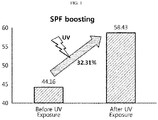
FIG. 1 shows the result of a boost in UV protection efficiency according to an embodiment (Example 8) of the present disclosure. -
FIG. 2 shows the result of a change in absorbance according to an embodiment (Example 8) of the present disclosure, before and after UV irradiation. -
FIG. 3 shows the result of a change in absorbance according to an embodiment (Example 13) of the present disclosure, before and after UV irradiation. -
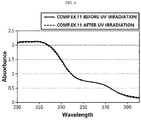
FIG. 4 shows the result of a change in absorbance according to Comparative Example 11, before and after UV irradiation. - Hereinafter, the present disclosure will be explained in more detail with reference to exemplary embodiments. The present disclosure may, however, be embodied in many different forms and should not be construed as limited to the exemplary embodiments set forth therein. The following Examples are provided so that the present disclosure will be understood more fully by those skilled in the art
- Each of the five types of typical sunscreens as shown in the following Table 1 was applied to a PMMA plate (HelioScreen Labs, HD6) at 1.3 mg/cm2, and in-vitro SPF thereof was measured by using SPF-290S (Optometrics Corporation) before and after irradiating UV light at 2MED (minimum erythema dose) through a UV irradiating system (Solar Simulator 16S, Solar light company). Herein, in-vitro SPF was measured at six different portions of the PMMA plate, and the average value was recorded. The results are shown in Table 1.
[Table 1] UV filter SPF (before UV irradiation) SPF (after UV irradiation) Change in SPF value Change in SPF (%) OMC 15.84±1.05 23.27±3.07 7.43 46.91 IMC 18.19±1.12 26.33±2.3 8.14 44.75 Ethylhexyl salicylate 10.11±161 10.10±1.66 -0.01 -0.10 Polysilicone 15 14.59±0.41 14.65±0.34 0.06 -5.16 Octocrylene 27.11±6.79 25.71±10.69 -1.40 -5.16 * OMC: Ethylhexyl methoxycinnamate/ IMC: Isoamyl p-methoxycinnamate - It can be seen from the above results that OMC or IMC having a methoxycinnamate structure shows a boost in in-vitro SPF value, while the remaining sunscreens show no significant change.
- The cosmetic products for UV protection were obtained according to the composition of the following Table 2. Part A and Part B were prepared individually and warmed to 75°C. While Part B was introduced gradually to Part B, emulsification was carried out for 5 minutes by using a homo-mixer, followed by cooling to 30°C. Each of the resultant samples was determined in terms of SPF value before and after UV irradiation in the same manner as Test Example 1. The results are shown in the following Table 3.
[Table 2] Comp. Ex. 1 Ex. 2 Ex. 3 Ex. 4 Ex. 5 Ex. 6 Ex. 1 A 1 Purified water to 100 to 100 to 100 to 100 to 100 to 100 to 100 2 Sodium polyacrylate 0.5 0.5 0.5 0.5 0.5 0.5 0.5 B 3 OMC 0.5 1 1.5 2 2.5 5 7.5 4 IMC 0.5 1 1.5 2 2.5 5 7.5 * OMC: Ethylhexyl methoxycinnamate/ IMC: Isoamyl p-methoxycinnamate [Table 3] SPF (before UV irradiation) SPF (after UV irradiation) Change in SPF value Change in SPF (%) Comp. Ex. 1 2.18±0.32 1.75±0.24 -0.43 -19.72 Ex. 1 2.7±0.31 3.09±0.22 0.39 14.44 Ex. 2 3.93±0.4 4.02±0.53 0.09 2.29 Ex. 3 4.46±0.72 5.88±0.63 1.42 31.84 Ex. 4 6.31±0.89 7.85±0.89 1.54 24.41 Ex. 5 6.62±1.64 11.68±1.45 5.06 76.44 Ex. 6 7.66±1.44 13.45±1.44 5.79 75.59 - The samples were prepared according to the composition of the following Table 4 in the same manner as described above. Each sample was determined in terms of in-vitro SPF before and after UV irradiation, and the in-vitro SPF values before and after UV irradiation were compared with each other. The results are shown in the following Table 5.
[Table 4] Comp. Ex. 2 Comp. Ex. 3 Comp. Ex. 4 Comp. Ex. 5 A Purified water to 100 to 100 to 100 to 100 Magnesium sulfate 1.0 1.0 1.0 1.0 DPG 5.0 5.0 5.0 5.0 B OMC 7.0 7.0 7.0 7.0 IMC 7.0 7.0 7.0 7.0 D5 0.0 5 10 15 BEMT 1.0 1.0 1.0 1.0 Abil EM 180 3.0 3.0 3.0 3.0 TiO2 2.0 2.0 2.0 2.0 ZnO 2.0 2.0 2.0 2.0 * OMC: Ethylhexyl methoxycinnamate/ IMC: Isoamyl p-methoxycinnamate/ D5: Cyclopentasiloxane/BEMT: Bis-ethylhexyloxyphenol methoxyphenyl triazine/ Abil EM 180: Cetyl PEG/PPG-10/1 Dimethicone [Table 5] SPF (before UV irradiation) SPF (after UV irradiation) Change in SPF value Change in SPF (%) Comp. Ex. 2 28.74±13.97 38.45±23.03 9.71 33.79 Comp. Ex. 3 30.77±17.47 44.65±27.46 13.88 45.11 Comp. Ex. 4 30.68±15.55 40.62±23.05 9.94 32.40 Comp. Ex. 5 37.67±16.54 46.31±24.51 8.64 22.94 - The test was carried out to determine the effect of the present disclosure depending on the content of silicone oil. As can be seen from the test results of Comparative Examples 2-5, when the content of silicone oil is increased, the effect of the present disclosure is maintained. However, since silicone oil shows poor compatibility with OMC and IMC, each sample shows slightly reduced stability.
- The samples were prepared according to the composition of the following Table 6 in the same manner as described above. Each sample was determined in terms of in-vitro SPF before and after UV irradiation, and the in-vitro SPF values before and after UV irradiation were compared with each other. The results are shown in the following Table 7.
[Table 6] Comp. Ex.6 Comp. Ex.7 Ex.8 Ex.9 Ex. 10 Comp. Ex.8 Ex. 11 Comp. Ex.9 Ex. 12 A Purified water to 100 to 100 to 100 to 100 to 100 to 100 to 100 to 100 to 100 Magnesium sulfate 1.0 1.0 1.0 1.0 1.0 1.0 1.0 1.0 1.0 DPG 5.0 5.0 5.0 5.0 5.0 5.0 5.0 5.0 5.0 B OMC 7.0 7.0 7.0 7.0 7.0 7.0 7.0 7.0 7.0 IMC 7.0 7.0 7.0 7.0 7.0 7.0 7.0 7.0 7.0 Isododecane 1.0 4.0 7.0 10.0 13.0 Isohexadecan e 4.0 10.0 Mineral oil 4.0 10.0 BEMT 1.0 1.0 1.0 1.0 1.0 1.0 1.0 1.0 1.0 Abil EM 180 1.5 1.5 1.5 1.5 1.5 1.5 1.5 1.5 1.5 Olivem 900 3.0 3.0 3.0 3.0 3.0 3.0 3.0 3.0 3.0 TiO2 2.0 2.0 2.0 2.0 2.0 2.0 2.0 2.0 2.0 ZnO 2.0 2.0 2.0 2.0 2.0 2.0 2.0 2.0 2.0 * OMC: Ethylhexyl methoxycinnamate/ IMC: Isoamyl p-methoxycinnamate/ BEMT: Bis-ethylhexyloxyphenol methoxyphenyl triazine/ Abil EM 180: Cetyl PEG/PPG-10/1 Dimethicone / Olivem 900: sorbitan olivate [Table 7] SPF (before UV irradiation) SPF (after UV irradiation) Change in SPF value Change in SPF (%) Comp. Ex. 6 43.39±3.91 57.52±5.82 14.13 32.57 Comp. Ex. 7 36.69±7.03 47.81±7.57 11.12 30.31 Ex. 8 44.16±7.53 58.43±9.29 14.27 32.31 Ex. 9 44.01±7.35 56.9±9.97 12.89 29.29 Ex. 10 42.27±5.46 50.61±8.09 8.34 19.73 Comp. Ex. 8 37.91±7.18 46.66±9.05 8.75 23.08 Ex. 11 46.96±9 56.4±10.32 9.44 20.10 Comp. Ex. 9 28.86±6.35 37.51±8.94 8.65 29.97 Ex. 12 27.7±3.04 37.36±7.44 9.66 34.87 - The test was carried out to determine the effect of the present disclosure depending on the type and content of hydrocarbon oil. As can be seen from the test results of Comparative Examples 6-9 and Examples 9-12, the effect of increasing SPF according to the present disclosure is realized sufficiently regardless of the type and content of hydrocarbon oil. However, in the case of Comparative Examples 6-9 having a content of hydrocarbon oil of less than 5%, each sample shows an excessively stiff feeling of use and thus cannot satisfy the fundamental quality standard of cosmetic products. In the case of Examples 9-12 having a content of hydrocarbon oil of 5% or more, the effect of increasing SPF is realized sufficiently, and each sample shows excellent skin applicability.
-
FIG. 2 shows a change in absorbance in the UV region of Example 8 before and after UV irradiation. The data measured by using SPF-290S (Optometrics Corporation) are used as absorbance data to determine in-vitro SPF values. The absorbance of Example 8 before UV irradiation is represented by a solid line, while the absorbance of Example 8 after UV irradiation is represented by a dotted line. As shown inFIG. 2 , Example 8 shows a boost in absorbance over the whole UV region after UV irradiation. Such a boost in SPF after UV irradiation is likely to be induced from a significant increase in absorbance in the UV-A (320-400 nm) and UV-B (280-320 nm) regions, particularly in the UV-B region. - The samples were prepared according to the composition of the following Table 8 in the same manner as described above. Each sample was determined in terms of in-vitro SPF before and after UV irradiation, and the in-vitro SPF values before and after UV irradiation were compared with each other. The results are shown in the following Table 9.
[Table 8] Ex. 13 Comp. Ex. 10 Comp. Ex. 11 Ex. 14 Comp. Ex. 12 Comp. Ex. 13 A Purified water to 100 to 100 to 100 to 100 to 100 to 100 Magnesium sulfate 1.0 1.0 1.0 1.0 1.0 1.0 DPG 5.0 5.0 5.0 5.0 5.0 5.0 B OMC 7.0 7.0 7.0 7.0 7.0 7.0 IMC 7.0 7.0 7.0 7.0 7.0 7.0 Cetylethyl hexanoate 4.0 10.0 13.0 - - - Caprylic/capric Glycerides - - - 4.0 10.0 13.0 BEMT 1.0 1.0 1.0 1.0 1.0 1.0 Abil EM 180 1.5 1.5 1.5 1.5 1.5 1.5 Olivem 900 3.0 3.0 3.0 3.0 3.0 3.0 TiO2 2.0 2.0 2.0 2.0 2.0 2.0 ZnO 2.0 2.0 2.0 2.0 2.0 2.0 * OMC: Ethylhexyl methoxycinnamate/ IMC: Isoamyl p-methoxycinnamate/ BEMT: Bis-ethylhexyloxyphenol methoxyphenyl triazine/ Abil EM 180: Cetyl PEG/PPG-10/1 Dimethicone / Olivem 900: Sorbitan olivate [Table 9] SPF (before UV irradiation) SPF (after UV irradiation) Change in SPF value Change in SPF (%) Ex. 13 25.5±4.38 33.62±7.93 8.12 31.84 Comp. Ex. 10 39.88±8.01 39.98±8.2 0.1 0.25 Comp. Ex. 11 35.73±3.25 35.62±2.61 -0.11 -0.31 Ex. 14 28.09±4.85 36.99±5.68 8.9 31.68 Comp. Ex. 12 42.59±2.1 42.44±2.1 -0.15 -0.35 Comp. Ex. 13 40.99±4.81 41.29±4.4 0.3 0.73 - The test was carried out to determine the effect of the present disclosure depending on the type and content of polar oil. When the content of polar oil is 5% or less, the UV protection effect is increased significantly, as can be seen from the results of Examples 13 and 14. However, when the content of polar oil is larger than 5%, it is not possible to realize a boost in UV protection efficiency, as can be seen from the results of Comparative Examples 10-13.
-
FIG. 3 shows a graph illustrating the absorbance of Example 13 before and after UV irradiation. Referring to the graph of absorbance, it can be seen that UV protection efficiency is increased in the whole UV region. -
FIG. 4 shows a graph illustrating the absorbance of Comparative Example 11 before and after UV irradiation. Referring toFIG. 4 showing a change in absorbance of Comparative Example 11, it can be seen that there is little change in absorbance, and Example 11 rather shows a slight decrease in absorbance in the UVB region. - The samples were prepared according to the composition of the following Table 10 in the same manner as described above. Each sample was determined in terms of in- vitro SPF before and after UV irradiation, and the in-vitro SPF values before and after UV irradiation were compared with each other. The results are shown in the following Table 11.
[Table 10] Ex. 15 Comp. Ex. 14 Ex. 16 Comp. Ex. 15 Ex. 17 Comp. Ex. 16 Ex. 18 Comp. Ex. 17 Ex. 19 Comp. Ex. 18 A Purified water To 100 To 100 To 100 To 100 To 100 To 100 To 100 To 100 To 100 To 100 Magnesium sulfate 1.0 1.0 1.0 1.0 1.0 1.0 1.0 1.0 1.0 1.0 DPG 5.0 5.0 5.0 5.0 5.0 5.0 5.0 5.0 5.0 5.0 B OMC 7.0 7.0 7.0 7.0 7.0 7.0 7.0 7.0 7.0 7.0 IMC 7.0 7.0 7.0 7.0 7.0 7.0 7.0 7.0 7.0 7.0 Isododecane 7.0 7.0 7.0 7.0 7.0 7.0 7.0 7.0 7.0 7.0 Caprylic/cap ric glycerides 3.0 9.0 - - - - - - - - Phenethyl benzoate - - 3.0 9.0 - - - - - - Dicaprylyl carbonate - - - - 3.0 9.0 - - - - C12-15 Alkyl benzoate - - - - - - 3.0 9.0 - - Octocrylene - - - - - - - - 3.0 9.0 BEMT 1.0 1.0 1.0 1.0 1.0 1.0 1.0 1.0 1.0 1.0 Abil EM 180 1.5 1.5 1.5 1.5 1.5 1.5 1.5 1.5 1.5 1.5 Olivem 900 3.0 3.0 3.0 3.0 3.0 3.0 3.0 3.0 3.0 3.0 TiO2 2.0 2.0 2.0 2.0 2.0 2.0 2.0 2.0 2.0 2.0 ZnO 2.0 2.0 2.0 2.0 2.0 2.0 2.0 2.0 2.0 2.0 * OMC: Ethylhexyl methoxycinnamate/ IMC: Isoamyl p-methoxycinnamate/ BEMT: Bis-ethylhexyloxyphenol methoxyphenyl triazine/ Abil EM 180: Cetyl PEG/PPG-10/1 Dimethicone / Olivem 900: Sorbitan olivate [Table 11] SPF (before UV SPF (after UV Change in SPF Change in SPF irradiation) irradiation) value (%) Ex. 15 24.54±1.35 25.98±1.52 1.44 5.87 Comp. Ex. 14 25.26±2.76 24.87±2.87 -0.39 -1.54 Ex. 16 37.55±2.85 40.89±2.7 3.34 8.89 Comp. Ex. 15 26.38±7.63 24.24±1.76 -2.14 -8.11 Ex. 17 28.31±1.61 28.89±1.74 0.58 2.05 Comp. Ex. 16 23.63±1.96 23.5±2.71 -0.13 -0.55 Ex. 18 28.87±1.79 29.24±1.89 0.37 1.28 Comp. Ex. 17 24.77±1.55 23.37±0.94 -1.40 -5.65 Ex. 19 25.33±6.61 36.69±5.54 11.36 44.85 Comp. Ex. 18 47.82±5.46 46.86±4.58 -0.96 -2.01 - The test was carried out to further determine the effect of the present disclosure depending on the type and content of polar oil. When the content of polar oil is 5% or less, the UV protection effect is increased significantly, as can be seen from the results of Examples 15-19. However, when the content of polar oil is larger than 5%, it is not possible to realize a boost in UV protection efficiency, as can be seen from the results of Comparative Examples 14-18.
- The cosmetic products for UV protection were obtained according to the composition of the following Table 12 as follows. The ingredients of Part A were mixed thoroughly at 75°C. Ingredient 11 was introduced to Ingredient 10 and dispersed therein for 30 minutes by using Disper. The remaining ingredients of Part B were introduced thereto and the resultant mixture warmed to 75°C. While Part A was introduced gradually to Part B, emulsification was carried out for 10 minutes by using a homo-mixer, followed by cooling to 30°C.
[Table 12] Ex. 20 Comp. Ex. 19 Comp. Ex. 20 Ex. 21 Ex. 22 Ex. 23 A 1 OMC 5.0 5.0 5.0 5.0 5.0 5.0 2 IMC 5.0 5.0 5.0 5.0 5.0 5.0 3 BEMT 1.0 1.0 1.0 1.0 1.0 1.0 4 Hydrogenated lecithin 1.5 1.5 1.5 1.5 1.5 1.5 5 Cetylethyl hexanoate - 10.0 - - - - 6 Caprylic/capric glycerides - - 10.0 - - - 7 Isododecane - - - 10.0 - - 8 Dimethicone - - - - 10.0 - 9 Cyclopentasiloxane - - - - - 10.0 B 10 Water to 100 to 100 to 100 to 100 to 100 to 100 11 Sodium polyacrylate 0.5 0.5 0.5 0.5 0.5 0.5 12 Dexpanthenol 1.0 1.0 1.0 1.0 1.0 1.0 13 1,2-Hexanediol 2.0 2.0 2.0 2.0 2.0 2.0 * OMC: Ethylhexyl methoxycinnamate/ IMC: Isoamyl p-methoxycinnamate/ BEMT: Bis-ethylhexyloxyphenol methoxyphenyl triazine - Each sample was determined in terms of SPF value before and after UV irradiation in the same manner as Test Example 1. The results are shown in the following Table 13.
[Table 13] SPF (before UV irradiation) SPF (after UV irradiation) Change in SPF value Change in SPF (%) Ex. 20 14.46±2.21 20.84±3.53 6.38 44.12 Comp. Ex.19 8.02±1.43 7.15±1.38 -0.87 -10.85 Comp. Ex.20 12.07±2 11.07±2.01 -1.00 -8.29 Ex. 21 8.39±0.11 14.83±1.59 6.44 76.76 Ex. 22 18.1±2.96 27.71±4.85 9.61 53.09 Ex. 23 17.61±1.91 22.58±2.1 4.97 28.22 - Example 20 including no oil or Examples 21-23 including nonpolar oil show a boost in in-vitro SPF value by UV light. However, Comparative Examples 19 and 20 including 10 wt% of polar oil shows a decrease in in-vitro SPF value by UV light. It can be seen from the above results that it is required to limit the content of polar oil, unlike nonpolar oil, so that the cosmetic composition for UV protection according to the present disclosure may realize an excellent UV protection effect.
- The cosmetic products for UV protection were prepared according to the compositions of the following Table 14 and Table 15 as follows. The ingredients of Part A were mixed thoroughly at 75°C. Ingredient 7 was introduced to Ingredient 6 and dispersed therein for 30 minutes by using Disper. The remaining ingredients of Part B were introduced thereto and the resultant mixture warmed to 75°C. While Part A was introduced gradually to Part B, emulsification was carried out for 10 minutes by using a homo-mixer, followed by cooling to 30°C.
[Table 14] Ex. 24 Com p. Ex.21 Com p. Ex.22 Com p. Ex.23 Ex. 25 Ex. 26 Ex. 27 Ex. 28 Ex. 29 Ex. 30 A 1 OMC 7.00 7.00 7.00 7.00 7.00 7.00 7.00 7.00 7.00 7.00 2 Cetylethyl hexanoate - 1.00 4.00 7.00 - - - - - - 3 Cyclopentasiloxane - - - - 1.00 4.00 7.00 - - - 4 dimethicone - - - - - - - 1.00 4.00 7.00 5 BEMT 1.00 1.00 1.00 1.00 1.00 1.00 1.00 1.00 1.00 1.00 6 hydrogenate d lecithin 1.50 1.50 1.50 1.50 1.50 1.50 1.50 1.50 1.50 1.50 B 7 Purified water to 100 to 100 to 100 to 100 to 100 to 100 to 100 to 100 to 100 to 100 8 sodium polyacrylate 0.50 0.50 0.50 0.50 0.50 0.50 0.50 0.50 0.50 0.50 9 1,2-Hexanediol 2.00 2.00 2.00 2.00 2.00 2.00 2.00 2.00 2.00 2.00 * OMC: Ethylhexyl methoxycinnamate/ IMC: Isoamyl p-methoxycinnamate/ CEH: Cetylethyl hexanoate/ BEMT: Bis-ethylhexyloxyphenol methoxyphenyl triazine [Table 15] Ex.3 1 Ex.3 2 Ex.3 3 Ex.3 4 Ex.3 5 Ex.3 6 Ex.3 7 Ex.3 8 Ex.3 9 Ex.4 0 A 1 IMC 7.00 7.00 7.00 7.00 7.00 7.00 7.00 7.00 7.00 7.00 2 Cetylethyl hexanoate - 1.00 4.00 7.00 - - - - - - 3 cyclopentasi loxane - - - - 1.00 4.00 7.00 - - - 4 dimethicone - - - - - - - 1.00 4.00 7.00 5 BEMT 1.00 1.00 1.00 1.00 1.00 1.00 1.00 1.00 1.00 1.00 6 hydrogenate d lecithin 1.50 1.50 1.50 1.50 1.50 1.50 1.50 1.50 1.50 1.50 B 7 Purified water to 100 to 100 to 100 to 100 to 100 to 100 to 100 to 100 to 100 to 100 8 sodium polyacrylate 0.50 0.50 0.50 0.50 0.50 0.50 0.50 0.50 0.50 0.50 9 1,2-Hexanediol 2.00 2.00 2.00 2.00 2.00 2.00 2.00 2.00 2.00 2.00 * OMC: Ethylhexyl methoxycinnamate/ IMC: Isoamyl p-methoxycinnamate/ CEH: Cetylethyl hexanoate/ BEMT: Bis-ethylhexyloxyphenol methoxyphenyl triazine - Each sample was applied to a PMMA plate (HelioScreen Labs, HD6) at 1.3 mg/cm2, and in-vitro SPF thereof was measured before and after irradiating UV light with a wavelength of 321 nm at 2MED by using a laboratory UV irradiation system, bio-sun (Vilber Lourmat). The results are shown in the following Table 16 and Table 17. Herein, in-vitro SPF was calculated according to the following formula by using the absorbance measured through a spectrophotometer (Epoch). The absorbance was measured at nine different points on the PMMA plate, and the average of the SPF values calculated from the absorbance values was used.

- Eλ : Erythemal action spectrum
- Sλ: Spectral irradiance (W/m2/nm)
- Tλ: Transmittance
- In the case of Comparative Examples 21-23 using OMC alone, SPF is decreased after UV irradiation, even when a small amount of polar oil is present, and thus it is not possible to realize the effect of the present disclosure. In the case of Examples 25-30 including nonpolar oil in addition to OMC, it can be seen that UV protection efficiency is increased. In the case of Examples 32-34 using IMC alone, the negative effect of polar oil is reduced significantly. In the case of Examples 35-40 including nonpolar oil in addition to IMC, it can be seen that UV protection efficiency is increased.
- The cosmetic products for UV protection were prepared according to the compositions of the following Table 18 and Table 19 as follows. The ingredients of Part A were mixed thoroughly at 75°C. Ingredient 7 was introduced to Ingredient 6 and dispersed therein for 30 minutes by using Disper. Then, Ingredient 8 was introduced thereto and the resultant mixture warmed to 75°C. While Part A was introduced gradually to Part B, emulsification was carried out for 10 minutes by using a homo-mixer, followed by cooling to 30°C.
[Table 18] Comp. Ex.24 Comp. Ex.25 Comp. Ex.26 Comp. Ex.27 Ex.41 Comp. Ex.28 Comp. Ex.29 Comp. Ex.30 A 1 OMC 7.00 7.00 7.00 7.00 7.00 7.00 7.00 7.00 2 IMC 3.00 3.00 3.00 3.00 5.00 5.00 5.00 5.00 3 CEH 5.00 7.00 9.00 11.00 5.00 7.00 9.00 11.00 4 BEMT 1.00 1.00 1.00 1.00 1.00 1.00 1.00 1.00 5 Hydrogenated lecithin 1.50 1.50 1.50 1.50 1.50 1.50 1.50 1.50 B 6 Purified water to 100 to 100 to 100 to 100 to 100 to 100 to 100 to 100 7 Sodium polyacrylate 0.50 0.50 0.50 0.50 0.50 0.50 0.50 0.50 8 1,2-Hexanediol 2.00 2.00 2.00 2.00 2.00 2.00 2.00 2.00 * OMC: Ethylhexyl methoxycinnamate/ IMC: Isoamyl p-methoxycinnamate/ CEH: Cetylethyl hexanoate/ BEMT: Bis-ethylhexyloxyphenol methoxyphenyl triazine [Table 19] Ex. 42 Ex. 43 Comp. Ex.31 Comp. Ex.32 Ex. 44 Ex. 45 Ex. 46 Comp. Ex.33 A 1 OMC 7.00 7.00 7.00 7.00 7.00 7.00 7.00 7.00 2 IMC 7.00 7.00 7.00 7.00 9.00 9.00 9.00 9.00 3 CEH 5.00 7.00 9.00 11.00 5.00 7.00 9.00 11.00 4 BEMT 1.00 1.00 1.00 1.00 1.00 1.00 1.00 1.00 5 Hydro genated lecithin 1.50 1.50 1.50 1.50 1.50 1.50 1.50 1.50 B 6 Purified water to 100 to 100 to 100 to 100 to 100 to 100 to 100 to 100 7 Sodium polyacrylate 0.50 0.50 0.50 0.50 0.50 0.50 0.50 0.50 8 1,2-Hexanediol 2.00 2.00 2.00 2.00 2.00 2.00 2.00 2.00 * OMC: Ethylhexyl methoxycinnamate/ IMC: Isoamyl p-methoxycinnamate/ CEH: Cetylethyl hexanoate/ BEMT: Bis-ethylhexyloxyphenol methoxyphenyl triazine - Each sample was applied to a PMMA plate (HelioScreen Labs, HD6) at 1.3 mg/cm2, and in-vitro SPF thereof was measured before and after irradiating UV light at 2MED by using suntest XLS+ (solar simulator). The results are shown in the following Table 20. Herein, in-vitro SPF was calculated according to the following formula by using the absorbance measured through a spectrophotometer (Epoch). The absorbance was measured at nine different points on the PMMA plate, and the average of the SPF values calculated from the absorbance values was used.

- Eλ : Erythemal action spectrum
- Sλ: Spectral irradiance (W/m2/nm)
- Tλ: Transmittance
- When the content of polar oil is equal to or small than the content of IMC, like Examples 41-46, in-vitro SPF values are increased by UV light. On the contrary, when the content of polar oil is larger than the content of IMC, like Comparative Examples 24-33, in-vitro SPF values are reduced or show a significantly reduced change. Therefore, it can be seen that the content of polar oil should be equal to or smaller than the content of a sunscreen, particularly IMC, so that the cosmetic composition for UV protection according to the present disclosure may realize an excellent UV protection effect.
- The cosmetic products for UV protection were obtained according to the composition of the following Table 21. Part A and Part B were prepared individually and warmed to 75°C. While Part B was introduced gradually to Part B, emulsification was carried out for 5 minutes by using a homo-mixer, followed by cooling to 30°C. Each of the resultant samples was determined in terms of SPF value before and after UV irradiation in the same manner as Test Example 1. The results are shown in the following Table 22.
[Table 21] Ex. 47 Ex. 48 Ex. 49 Ex. 50 A 1 OMC 5.00 5.00 5.00 5.00 2 IMC 5.00 5.00 5.00 5.00 3 BEMT 1.00 1.00 1.00 1.00 4 hydrogenated lecithin 1.50 1.50 1.50 1.50 5 dimethicone 5.00 10.00 15.00 20.00 B 6 Purified water to 100 to 100 to 100 to 100 7 sodium polyacrylate 2.00 2.00 2.00 2.00 8 1,2-Hexanediol 0.50 0.50 0.50 0.50 * OMC: Ethylhexyl methoxycinnamate/ IMC: Isoamyl p-methoxycinnamate/ CEH: Cetylethyl hexanoate/ BEMT: Bis-ethylhexyloxyphenol methoxyphenyl triazine [Table 22] SPF (before UV irradiation) SPF (after UV irradiation) Change in SPF value Change in SPF (%) Ex. 47 21.39±1.53 24.05±2.65 2.66 12.44 Ex. 48 18.1±2.96 27.71±4.85 9.61 53.09 Ex. 49 20.31±2.34 28.94±3.33 8.63 42.49 Ex. 50 18.12±2.64 29.24±4.71 11.12 61.37 - It can be seen that even when nonpolar oil is used up to 20%, like Examples 40-50, UV protection efficiency is increased by UV light.
- The cosmetic products for UV protection were obtained according to the composition of the following Table 23. Part A and Part B were prepared individually and warmed to 75°C. While Part B was introduced gradually to Part B, emulsification was carried out for 5 minutes by using a homo-mixer, followed by cooling to 30°C. Each of the resultant samples was determined in terms of SPF value before and after UV irradiation in the same manner as Test Example 1. The results are shown in the following Table 24.
[Table 23] Ex. 51 Ex. 52 Ex. 53 Comp. Ex. 34 Comp. Ex. 35 A 1 OMC 5.00 5.00 5.00 5.00 5.00 2 IMC 5.00 5.00 5.00 5.00 5.00 3 BEMT 1.00 1.00 1.00 1.00 1.00 4 hydrogenated lecithin 1.50 1.50 1.50 1.50 1.50 5 dimethicone 10.00 7.50 5.00 2.50 - 6 caprylic/Capric Glycerides - 2.50 5.00 7.50 10.00 B 7 Purified water to 100 to 100 to 100 to 100 to 100 8 sodium polyacrylate 2.00 2.00 2.00 2.00 2.00 9 1,2-Hexanediol 0.50 0.50 0.50 0.50 0.50 * OMC: Ethylhexyl methoxycinnamate/ IMC: Isoamyl p-methoxycinnamate/ CEH: Cetylethyl hexanoate/ BEMT: Bis-ethylhexyloxyphenol methoxyphenyl triazine [Table 24] SPF (before UV irradiation) SPF (after UV irradiation) Change in SPF value Change in SPF (%) Ex. 51 18.1±2.96 27.71±4.85 9.61 53.09 Ex. 52 7.6±1.26 1.26±9.75 2.15 28.29 Ex. 53 7.11±0.9 0.9±8.28 1.17 16.46 Comp. Ex. 34 4.84±0.37 0.37±4.55 (0.29) -5.99 Comp. Ex. 35 12.07±2 11.07±2.01 -1.00 -8.29 - It can be seen that when the content of polar oil is smaller than the content of IMC, like Examples 51-53, the effect of the present disclosure is maintained. On the contrary, it can be seen that when the content of polar oil is larger than the content of IMC, like Comparative Examples 34 and 35, it is not possible to realize the effect of the present disclosure.
- The cosmetic products for UV protection were obtained according to the composition of the following Table 25 and Table 26. Part A and Part B were prepared individually and warmed to 75°C. While Part B was introduced gradually to Part B, emulsification was carried out for 5 minutes by using a homo-mixer, followed by cooling to 30°C. Each of the resultant samples was determined in terms of SPF value before and after UV irradiation in the same manner as Test Example 1. The results are shown in the following Table 27.
[Table 25] A 1 OMC 7.00 2 IMC 9.00 3 BEMT 2.00 4 MT-100TV 2.00 5 Emulsifier 3.00 B 6 Purified water to 100 7 1,2-Hexanediol 2.00 [Table 26] Emulsifier Content Ex.54 Lipomulse 165 3 Ex.55 Olivem 800 3 Ex.56 Olivem 1000 3 Ex.57 Montanov L 3 Ex.58 Montanov 68 3 Ex.59 Lipoid S 75-3 3 Ex.60 Tegocare 450 3 Ex.61 Span 603 Ex.62 Tween 20 3 Ex.63 Amphisol K 3 [Table 27] SPF (before UV irradiation) SPF (after UV irradiation) Change in SPF value Change in SPF (%) Ex.54 45.56±12.36 50.12±11.04 4.56 10.01 Ex.55 40.72±8.03 44.4±7.84 3.68 9.04 Ex.56 49.73±9.95 55.05±9.65 5.32 10.70 Ex.57 46.24±9.79 49.22±9.09 2.98 6.44 Ex.58 48.17±9.6 52.67±9.57 4.50 9.34 Ex.59 51.21±8.67 58.04±10.14 6.83 13.34 Ex.60 35.16±7.48 46.72±8.48 11.56 32.88 Ex.61 40.93±7.62 48.73±7.86 7.80 19.06 Ex.62 34.13±7.53 34.95±8.39 0.82 2.40 Ex.63 24.78±4.88 26.47±4.99 1.69 6.82 - It can be seen that even when an emulsifier suitable for an oil-in-water formulation is present, the effect of the present disclosure is maintained.
- The cosmetic products for UV protection were obtained according to the composition of the following Table 28 and Table 29. Part A and Part B were prepared individually and warmed to 75°C. While Part B was introduced gradually to Part B, emulsification was carried out for 5 minutes by using a homo-mixer, followed by cooling to 30°C. Each of the resultant samples was determined in terms of SPF value before and after UV irradiation in the same manner as Test Example 1. The results are shown in the following Table 30.
[Table 28] Examples 64-68 Examples 69-71 A 1 OMC 7.00 7.00 2 IMC 9.00 9.00 3 BEMT 2.00 2.00 4 MT-100TV 2.00 2.00 5 Lipoid S 75-3 3.00 3.00 B 6 Purified water 79.70 79.75 7 1,2-Hexanediol 2.00 2.00 8 polymer 0.30 0.15 9 tris amino ultra pc 0.00 0.10 [Table 29] Polymer Content Ex.64 comedia SP 0.3 Ex.65 Aristoflex AVC 0.3 Ex.66 volarest 0.3 Ex.67 sepimax gen 0.3 Ex.68 Keltrol F 0.3 Ex.69 pemulene TR2 0.15 Ex.70 C 980 0.15 Ex.71 Utrez-21 0.15 [Table 30] SPF (before UV irradiation) SPF (after UV irradiation) Change in SPF value Change in SPF (%) Ex.64 44.81±8.19 48.47±10.33 3.66 8.17 Ex.65 43.9±6.07 47.49±5.34 3.59 8.18 Ex.66 39.13±6.39 42.76±7.63 3.63 9.28 Ex.67 33.09±1.75 36.86±2.27 3.77 11.39 Ex.68 31.5±3.64 33.9±5.3 2.68 9.30 Ex.69 28.81±2.21 31.49±2.77 2.40 7.62 Ex.70 44.13±6.45 48.53±9.22 4.40 9.97 Ex.71 41.85±4.91 44.71±5.68 2.86 6.83 - It can be seen that even when a thickener used for an oil-in-water formulation is present, the effect of the present disclosure is maintained.
- The cosmetic products for UV protection were prepared by using various types of emulsifiers as shown in the following Table 32 according to the composition of the following Table 31 as follows. The ingredients of Part A were mixed thoroughly at 75°C. Ingredient 7 and Ingredient 8 were introduced to Ingredient 6 and dispersed therein for 30 minutes by using Disper. The remaining ingredients of Part B were introduced thereto and the resultant mixture warmed to 75°C. While Part A was introduced gradually to Part B, emulsification was carried out for 10 minutes by using a homo-mixer, followed by cooling to 30°C. Each of the resultant samples was determined in terms of SPF value before and after UV irradiation in the same manner as Test Example 1. The results are shown in the following Table 33.
[Table 31] A 1 OMC 7.00 2 IMC 9.00 3 BEMT 2.00 4 MT-100TV 2.00 5 Emulsifier 3.00 B 6 Purified water to 100 7 Sodium polyacrylate 0.50 8 Xanthan gum 0.10 9 Tinosorb S lite aqua 5.00 10 Panthenol 1.00 11 EDTA3NA 0.02 12 1,2-Hexanediol 2.00 * OMC: Ethylhexyl methoxycinnamate/ IMC: Isoamyl p-methoxycinnamate/ BEMT: Bis-ethylhexyloxyphenol methoxyphenyl triazine [Table 32] Emulsifier Ex.72 Sodium polyacrylate Ex.73 Cetearyl olivate, Sorbitan olivate Ex.74 C14-22 alcohols, C12-20 alkyl glucoside Ex.75 Hydrogenated lecithin Ex.76 Ceteareth-6 olivate Ex.77 Polyglyceryl-3 methyl glucose distearate Ex.78 Polysorbate 20 Comp. Ex.36 Polysorbate 60Ex.79 Potassium cetyl phosphate [Table 33] SPF (before UV irradiation) SPF (after UV irradiation) Change in SPF value Change in SPF (%) Ex.72 37.57±4.89 44.19±5.41 6.62 17.62 Ex.73 52.29±4.53 59.85±5.18 7.56 14.46 Ex.74 52.47±3.36 57.86±7.61 5.39 10.27 Ex.75 42.5±4.12 56.84±4.74 14.34 33.74 Ex.76 52.73±3.79 53.65±3.73 0.92 1.74 Ex.77 43.27±4.92 44.01±4.75 0.74 1.71 Ex.78 51.09±5.41 53.64±7.44 2.55 4.99 Comp. Ex. 36 44.36±7.54 39.45±8.43 -4.91 -11.07 Ex.79 51.96±4.37 53±4.57 1.04 2.00 - While the emulsifiers used in Examples 72-79 increase UV protection effect significantly, the emulsifier used in Comparative Example 36 cannot increase UV protection effect.
| SPF (before UV irradiation) | SPF (after UV irradiation) | Change in SPF value | Change in SPF (%) | |
| Ex.24 | 6.08±0.86 | 7.1±1.17 | 1.02 | 16.78 |
| Comp. Ex.21 | 6.9±1.03 | 6.34±1.02 | -0.56 | -8.12 |
| Comp. Ex.22 | 4.98±0.26 | 4.22±0.22 | -0.76 | -15.26 |
| Comp. Ex.23 | 6.15±0.83 | 5.2±0.6 | -0.95 | -15.45 |
| Ex.25 | 7.66±0.84 | 7.86±1.00 | 0.20 | 2.61 |
| Ex.26 | 8.06±0.59 | 8.44±0.6 | 0.38 | 4.71 |
| Ex.27 | 7.25±0.59 | 7.62±0.57 | 0.37 | 5.10 |
| Ex.28 | 6.76±0.74 | 7.36±0.93 | 0.60 | 8.88 |
| Ex.29 | 6.84±0.78 | 7.33±0.89 | 0.49 | 7.16 |
| Ex.30 | 4.73±0.73 | 5.74±0.93 | 1.01 | 21.35 |
| SPF (before UV irradiation) | SPF (after UV irradiation) | Change in SPF value | Change in SPF (%) | |
| Ex.31 | 22.09±2.26 | 23.79±2.57 | 1.70 | 7.70 |
| Ex.32 | 21.79±0.96 | 24.95±1.02 | 3.16 | 14.50 |
| Ex.33 | 11.12±1.23 | 12.18±1.41 | 1.06 | 9.53 |
| Ex.34 | 8.46±1.88 | 8.12±2.04 | -0.34 | -4.02 |
| Ex.35 | 22.29±3.24 | 23.64±3.25 | 1.35 | 6.06 |
| Ex.36 | 20.07±2.18 | 21.35±2.36 | 1.28 | 6.38 |
| Ex.37 | 21.38±2.67 | 22.07±2.53 | 0.69 | 3.23 |
| Ex.38 | 23.37±1.89 | 26.49±2.15 | 3.12 | 13.35 |
| Ex.39 | 22.05±2.46 | 25.13±2.74 | 3.08 | 13.97 |
| Ex.40 | 24.41±2.91 | 27.47±3.01 | 3.06 | 12.54 |
| SPF (before UV irradiation) | SPF (after UV irradiation) | Change in SPF value | Change in SPF (%) | |
| Comp. Ex.24 | 4.67±0.44 | 4.33±0.49 | -0.34 | -7.27 |
| Comp. Ex.25 | 4.91±0.53 | 4.7±0.35 | -0.22 | -4.42 |
| Comp. Ex.26 | 5.87±1.09 | 5.04±0.94 | -0.82 | -14.06 |
| Comp. Ex.27 | 6.15±0.45 | 5.37±0.76 | -0.79 | -12.79 |
| Ex. 41 | 6.37±0.68 | 10.13±1.8 | 3.76 | 58.99 |
| Comp. Ex.28 | 6.18±0.53 | 6.31±0.69 | 0.13 | 2.15 |
| Comp. Ex.29 | 9.11±2.59 | 8.25±2.42 | -0.86 | -9.42 |
| Comp. Ex.30 | 8.06±1.88 | 6.39±1.58 | -1.67 | -20.73 |
| Ex. 42 | 12.04±1.76 | 21.34±2.33 | 9.3 | 77.24 |
| Ex. 43 | 11.02±1.63 | 14.97±2.99 | 3.95 | 35.83 |
| Comp. Ex.31 | 9.24±2.25 | 8.66±1.6 | -0.58 | -6.24 |
| Comp. Ex.32 | 20.41±4.59 | 18.76±3.98 | -1.65 | -8.07 |
| Ex. 44 | 18.28±1.4 | 25.26±1.48 | 6.98 | 38.17 |
| Ex. 45 | 26.04±3.7 | 29.1±3.51 | 3.05 | 11.73 |
| Ex. 46 | 11.54±2.07 | 14.75±3.29 | 3.22 | 27.89 |
| Comp. Ex.33 | 19.28±2.53 | 19.67±3.11 | 0.4 | 2.05 |
Claims (27)
- A cosmetic composition for UV protection, comprising a sunscreen having a methoxycinnamate structure and 5 wt% or less of polar oil based on the total weight of the composition.
- A cosmetic composition for UV protection, comprising a sunscreen having a methoxycinnamate structure and hydrocarbon oil.
- The cosmetic composition for UV protection according to claim 1 or 2, wherein the sunscreen having a methoxycinnamate structure is used in an amount of 2-30 wt% based on the total weight of the composition.
- The cosmetic composition for UV protection according to claim 1, which further comprises hydrocarbon oil.
- The cosmetic composition for UV protection according to claim 2 or 4, wherein the hydrocarbon oil is used in an amount of 5-30 wt% based on the total weight of the composition.
- The cosmetic composition for UV protection according to claim 1, wherein which comprises the sunscreen having a methoxycinnamate structure and polar oil at a weight ratio (sunscreen having a methoxycinnamate structure:polar oil) of 1:0.01-1.
- The cosmetic composition for UV protection according to claim 2 or 4, which comprises the sunscreen having a methoxycinnamate structure and hydrocarbon oil at a weight ratio (sunscreen having a methoxycinnamate structure:hydrocarbon oil) of 1:0.2-15.
- The cosmetic composition for UV protection according to claim 4, which comprises the polar oil and hydrocarbon oil at a weight ratio (polar oil:hydrocarbon oil) of 1:1-300.
- The cosmetic composition for UV protection according to claim 1 or 2, wherein the sunscreen having a methoxycinnamate structure comprises at least one selected from the group consisting of ethylhexyl methoxycinnamate, isoamyl p-methoxycinnamate and cinoxate.
- The cosmetic composition for UV protection according to claim 1, wherein the polar oil comprises at least one selected from the group consisting of cetylethyl hexanoate, caprylic/capric glycerides, phenethyl benzoate, dicaprylyl carbonate, C12-C15 alkyl benzoates and octocrylene.
- The cosmetic composition for UV protection according to claim 2 or 4, wherein the hydrocarbon oil comprises at least one selected from the group consisting of liquid paraffin, light liquid isoparaffin, heavy liquid isoparaffin, Vaseline, n-paraffin, mineral oil, isoparaffin, isododecane, isohexadecane, polyisobutylene, hydrogenated polyisobutylene, polybutene, ozokerite, ceresin, microcrystalline wax, paraffin wax, polyethylene wax, polyethylene/polypropylene wax, squalane, squalene, pristane and polyisoprene.
- The cosmetic composition for UV protection according to claim 1 or 2, which comprises silicone oil in an amount of 15 wt% or less based on the total weight of the composition.
- The cosmetic composition for UV protection according to claim 1 or 2, which shows a boost in SPF value after UV irradiation, as compared to the SPF value before UV irradiation.
- The cosmetic composition for UV protection according to claim 1 or 2, which shows a boost in effect of protecting UV-A and UV-B after UV irradiation.
- A cosmetic composition for UV protection, comprising 2-30 wt% of a sunscreen having a methoxycinnamate structure, 5 wt% or less of polar oil and 5-30 wt% of hydrocarbon oil, based on the total weight of the composition.
- A method for preparing a cosmetic composition for UV protection, comprising a step of mixing a sunscreen having a methoxycinnamate structure with 5 wt% or less of polar oil based on the total weight of the composition.
- A cosmetic composition for UV protection, comprising a sunscreen having a methoxycinnamate structure and polar oil, wherein the sunscreen is isoamyl p-methoxycinnamate.
- The cosmetic composition for UV protection according to claim 17, wherein the content of the polar oil is equal to or smaller than the content of isoamyl p-methoxycinnamate.
- The cosmetic composition for UV protection according to claim 17, which has an oil-in-water formulation.
- The cosmetic composition for UV protection according to claim 17, wherein the sunscreen having a methoxycinnamate structure is used in an amount of 2-30 wt% based on the total weight of the composition.
- The cosmetic composition for UV protection according to claim 17, wherein the sunscreen having a methoxycinnamate structure further comprises ethylhexyl methoxycinnamate, cinoxate or a mixture thereof.
- The cosmetic composition for UV protection according to claim 17, which comprises isoamyl p-methoxycinnamate and polar oil at a weight ratio (isoamyl p-methoxycinnamate:polar oil) of 1:0.01-7.
- The cosmetic composition for UV protection according to claim 17, which further comprises nonpolar oil.
- The cosmetic composition for UV protection according to claim 17, which shows a boost in SPF value after UV irradiation, as compared to the SPF value before UV irradiation.
- The cosmetic composition for UV protection according to claim 17, which shows a boost in effect of protecting UV-A and UV-B after UV irradiation.
- A cosmetic composition for UV protection having an oil-in-water formulation and comprising a sunscreen having a methoxycinnamate structure and polar oil, wherein the sunscreen comprises isoamyl p-methoxycinnamate and is used in an amount of 2-30 wt% based on the total weight of the composition, and the content of the polar oil is equal to or smaller than the content of isoamyl p-methoxycinnamate.
- A method for preparing a cosmetic composition for UV protection, comprising a step of mixing a sunscreen having a methoxycinnamate structure with polar oil, wherein the sunscreen comprises isoamyl p-methoxycinnamate, and the content of the polar oil is equal to or smaller than the content of isoamyl p-methoxycinnamate.
Applications Claiming Priority (5)
| Application Number | Priority Date | Filing Date | Title |
|---|---|---|---|
| KR20190023391 | 2019-02-27 | ||
| KR1020190037278A KR102026658B1 (en) | 2019-02-27 | 2019-03-29 | A Sunscreen Cosmetic Formulation with Increased UV absorption efficiency by UV light |
| KR1020190106893A KR102824653B1 (en) | 2019-02-27 | 2019-08-29 | A Sunscreen Cosmetic Formulation with Increased UV absorption efficiency by UV light |
| KR1020190106892A KR102284873B1 (en) | 2019-02-27 | 2019-08-29 | A Sunscreen Cosmetic Formulation with Increased UV absorption efficiency by UV light |
| PCT/KR2019/017182 WO2020175772A1 (en) | 2019-02-27 | 2019-12-06 | Cosmetic composition for uv-protection that increases uv protection efficiency by means of uv light |
Publications (2)
| Publication Number | Publication Date |
|---|---|
| EP3932384A1 true EP3932384A1 (en) | 2022-01-05 |
| EP3932384A4 EP3932384A4 (en) | 2022-12-14 |
Family
ID=68098538
Family Applications (1)
| Application Number | Title | Priority Date | Filing Date |
|---|---|---|---|
| EP19916789.1A Pending EP3932384A4 (en) | 2019-02-27 | 2019-12-06 | COSMETIC COMPOSITION FOR PROTECTION AGAINST UV WHICH INCREASES THE EFFECTIVENESS OF PROTECTION AGAINST UV BY MEANS OF UV LIGHT |
Country Status (4)
| Country | Link |
|---|---|
| EP (1) | EP3932384A4 (en) |
| KR (6) | KR102026658B1 (en) |
| CN (1) | CN111867551B (en) |
| TW (1) | TWI853897B (en) |
Families Citing this family (8)
| Publication number | Priority date | Publication date | Assignee | Title |
|---|---|---|---|---|
| WO2020175772A1 (en) * | 2019-02-27 | 2020-09-03 | 주식회사 엘지생활건강 | Cosmetic composition for uv-protection that increases uv protection efficiency by means of uv light |
| KR102313519B1 (en) | 2020-06-03 | 2021-10-15 | 주식회사 엘지생활건강 | UV-blocking cosmetic composition that increases UV blocking efficiency by heat and UV light |
| KR102519492B1 (en) * | 2021-03-12 | 2023-04-10 | 주식회사 다솔 | A composition for blocking UV rays of hair and preventing heat damage including SPFSOL |
| KR102568273B1 (en) * | 2021-03-12 | 2023-08-18 | 주식회사 다솔 | Cosmetic composition containing a mixture that improves the effect of SPFSOL on hair |
| KR102419912B1 (en) * | 2022-01-19 | 2022-07-13 | 박혜랑 | Mist type sunscreen cosmetic composition |
| CN114522119B (en) * | 2022-03-16 | 2025-02-14 | 上海家化联合股份有限公司 | Compositions containing water-dispersible sunscreens and uses thereof |
| CN114504521A (en) * | 2022-03-16 | 2022-05-17 | 上海家化联合股份有限公司 | Emulsified composition of water-dispersed sunscreen agent |
| KR102796121B1 (en) * | 2023-05-31 | 2025-04-22 | 제너럴바이오(주) | Cosmetic composition for sunscreen, and method thereof |
Family Cites Families (16)
| Publication number | Priority date | Publication date | Assignee | Title |
|---|---|---|---|---|
| DE3302123A1 (en) * | 1983-01-22 | 1984-07-26 | Haarmann & Reimer Gmbh | NEW DIBENZOLE METHANE DERIVATIVES, METHOD FOR THE PRODUCTION THEREOF AND THEIR USE |
| JP2002284705A (en) * | 2001-01-19 | 2002-10-03 | Shiseido Co Ltd | Torpent |
| GB2439618A (en) * | 2006-06-14 | 2008-01-02 | Reckitt & Colmann Prod Ltd | Skincare composition |
| KR101054884B1 (en) * | 2007-04-02 | 2011-08-05 | 주식회사 엘지생활건강 | Solid formed cosmetic composition for sunscreen |
| KR101047694B1 (en) * | 2007-11-30 | 2011-07-08 | (주)아모레퍼시픽 | Solid oil-in-water type cosmetic composition having a volatilization stability and excellent moisture retention |
| KR101438375B1 (en) * | 2007-12-26 | 2014-09-05 | (주)아모레퍼시픽 | Cosmetic composition containing the ultraviolet absorber or blocking agent encapsulated in the lipidic capsules |
| KR101678456B1 (en) * | 2009-11-18 | 2016-11-24 | (주)아모레퍼시픽 | Composition for Blocking Ultraviolet containing Coacervate Supported with Sunscreen Agent |
| KR20120105498A (en) * | 2009-12-09 | 2012-09-25 | 디에스엠 아이피 어셋츠 비.브이. | Novel compounds |
| BRPI1005345B1 (en) * | 2010-04-13 | 2017-06-13 | U.S. Cosmetics Corporation | Strengthening composition of sun protection factor |
| DE102011077037A1 (en) * | 2011-06-07 | 2012-12-13 | Beiersdorf Ag | Cosmetic or dermatological sunscreen formulation with improved water resistance |
| KR101342292B1 (en) * | 2011-09-05 | 2013-12-16 | 한국콜마주식회사 | Cosmetic composition for sun protection |
| KR101901857B1 (en) * | 2011-11-03 | 2018-09-27 | (주)아모레퍼시픽 | Stick type cosmetic composition for sun screening |
| KR101466649B1 (en) * | 2011-12-12 | 2014-12-01 | 한국콜마주식회사 | UV protecting cosmetic composition with good stability and texture using water in silicone type emulsion as a thickener |
| KR20140048690A (en) * | 2012-10-16 | 2014-04-24 | 주식회사 착한생각 | Cosmetic composition for sunscreen |
| BR112015029650B1 (en) * | 2013-05-30 | 2020-06-30 | L'oreal | cosmetic composition, non-therapeutic cosmetic methods and uses of a cosmetic composition |
| KR101551370B1 (en) * | 2013-07-23 | 2015-09-09 | 주식회사 서울화장품 | Cosmetic composition for uv-protecting prepared being impregnated in a sponge foam |
-
2019
- 2019-03-29 KR KR1020190037278A patent/KR102026658B1/en active Active
- 2019-08-29 KR KR1020190106893A patent/KR102824653B1/en active Active
- 2019-08-29 KR KR1020190106892A patent/KR102284873B1/en active Active
- 2019-09-23 KR KR1020190116735A patent/KR102254710B1/en active Active
- 2019-12-06 EP EP19916789.1A patent/EP3932384A4/en active Pending
- 2019-12-06 CN CN201980004246.7A patent/CN111867551B/en active Active
-
2020
- 2020-02-27 TW TW109106610A patent/TWI853897B/en active
-
2021
- 2021-05-14 KR KR1020210062863A patent/KR102502084B1/en active Active
- 2021-07-27 KR KR1020210098840A patent/KR20210097079A/en not_active Ceased
Also Published As
| Publication number | Publication date |
|---|---|
| KR102284873B1 (en) | 2021-08-02 |
| KR102824653B1 (en) | 2025-06-24 |
| KR20210058794A (en) | 2021-05-24 |
| KR102254710B1 (en) | 2021-05-21 |
| KR20200104777A (en) | 2020-09-04 |
| TWI853897B (en) | 2024-09-01 |
| EP3932384A4 (en) | 2022-12-14 |
| TW202038896A (en) | 2020-11-01 |
| KR102502084B1 (en) | 2023-02-21 |
| CN111867551B (en) | 2025-08-12 |
| KR102026658B1 (en) | 2019-09-30 |
| KR20200104779A (en) | 2020-09-04 |
| CN111867551A (en) | 2020-10-30 |
| KR20210097079A (en) | 2021-08-06 |
| KR102284873B9 (en) | 2022-10-05 |
| KR20200104776A (en) | 2020-09-04 |
Similar Documents
| Publication | Publication Date | Title |
|---|---|---|
| KR102284873B1 (en) | A Sunscreen Cosmetic Formulation with Increased UV absorption efficiency by UV light | |
| EP3081206B1 (en) | Sunscreen composition | |
| EP2194958B1 (en) | Sunless tanning composition with photostabilized sunscreen | |
| US20090232754A1 (en) | Enhanced photostability of suncare compositions containing avobenzone | |
| WO2009079486A1 (en) | Enhanced photostability of avobenzone in the presence of zinc oxide using phosphate-based emulsifiers | |
| AU720481B2 (en) | Photostable, emulsifier-free cosmetic compositions | |
| FR2768337A1 (en) | W / O / W-TYPE THREE EMULSIONS CONTAINING A PHOTOPROTECTIVE SYSTEM CAPABLE OF FILTERING UV RAYS; THEIR USES IN COSMETICS | |
| KR20080093574A (en) | Mousse type sunscreen cosmetic composition | |
| KR20140048690A (en) | Cosmetic composition for sunscreen | |
| US12168065B2 (en) | Cosmetic composition for UV-protection that increases UV protection efficiency by means of UV light | |
| JP2006036704A (en) | Cosmetic for sun screen | |
| SG11202110333TA (en) | Ultraviolet light blocking composition comprising bis-ethylhexyloxyphenol methoxyphenyl triazine composite formulation | |
| HK40043083A (en) | Cosmetic composition for uv-protection that increases uv protection efficiency by means of uv light | |
| JP2006036702A (en) | Cosmetic for sun screen | |
| HK40043083B (en) | Cosmetic composition for uv-protection that increases uv protection efficiency by means of uv light |
Legal Events
| Date | Code | Title | Description |
|---|---|---|---|
| STAA | Information on the status of an ep patent application or granted ep patent |
Free format text: STATUS: THE INTERNATIONAL PUBLICATION HAS BEEN MADE |
|
| PUAI | Public reference made under article 153(3) epc to a published international application that has entered the european phase |
Free format text: ORIGINAL CODE: 0009012 |
|
| STAA | Information on the status of an ep patent application or granted ep patent |
Free format text: STATUS: REQUEST FOR EXAMINATION WAS MADE |
|
| 17P | Request for examination filed |
Effective date: 20210824 |
|
| AK | Designated contracting states |
Kind code of ref document: A1 Designated state(s): AL AT BE BG CH CY CZ DE DK EE ES FI FR GB GR HR HU IE IS IT LI LT LU LV MC MK MT NL NO PL PT RO RS SE SI SK SM TR |
|
| DAV | Request for validation of the european patent (deleted) | ||
| DAX | Request for extension of the european patent (deleted) | ||
| A4 | Supplementary search report drawn up and despatched |
Effective date: 20221114 |
|
| RIC1 | Information provided on ipc code assigned before grant |
Ipc: A61Q 17/04 20060101ALI20221108BHEP Ipc: A61K 8/31 20060101ALI20221108BHEP Ipc: A61K 8/37 20060101AFI20221108BHEP |
|
| STAA | Information on the status of an ep patent application or granted ep patent |
Free format text: STATUS: EXAMINATION IS IN PROGRESS |
|
| 17Q | First examination report despatched |
Effective date: 20240523 |