EP3932187A1 - Leno woven fabric with alternated monofilament and strip - Google Patents
Leno woven fabric with alternated monofilament and strip Download PDFInfo
- Publication number
- EP3932187A1 EP3932187A1 EP21183058.3A EP21183058A EP3932187A1 EP 3932187 A1 EP3932187 A1 EP 3932187A1 EP 21183058 A EP21183058 A EP 21183058A EP 3932187 A1 EP3932187 A1 EP 3932187A1
- Authority
- EP
- European Patent Office
- Prior art keywords
- net
- weft yarns
- band
- polyethylene
- realized
- Prior art date
- Legal status (The legal status is an assumption and is not a legal conclusion. Google has not performed a legal analysis and makes no representation as to the accuracy of the status listed.)
- Granted
Links
Images


Classifications
-
- A—HUMAN NECESSITIES
- A01—AGRICULTURE; FORESTRY; ANIMAL HUSBANDRY; HUNTING; TRAPPING; FISHING
- A01G—HORTICULTURE; CULTIVATION OF VEGETABLES, FLOWERS, RICE, FRUIT, VINES, HOPS OR SEAWEED; FORESTRY; WATERING
- A01G13/00—Protection of plants
- A01G13/20—Protective coverings for plants
- A01G13/21—Protective coverings for plants providing overhead protection, i.e. canopies
-
- A—HUMAN NECESSITIES
- A01—AGRICULTURE; FORESTRY; ANIMAL HUSBANDRY; HUNTING; TRAPPING; FISHING
- A01G—HORTICULTURE; CULTIVATION OF VEGETABLES, FLOWERS, RICE, FRUIT, VINES, HOPS OR SEAWEED; FORESTRY; WATERING
- A01G9/00—Cultivation in receptacles, forcing-frames or greenhouses; Edging for beds, lawn or the like
- A01G9/22—Shades or blinds for greenhouses, or the like
- A01G9/222—Lamellar or like blinds
-
- D—TEXTILES; PAPER
- D03—WEAVING
- D03D—WOVEN FABRICS; METHODS OF WEAVING; LOOMS
- D03D1/00—Woven fabrics designed to make specified articles
- D03D1/0035—Protective fabrics
-
- D—TEXTILES; PAPER
- D03—WEAVING
- D03D—WOVEN FABRICS; METHODS OF WEAVING; LOOMS
- D03D15/00—Woven fabrics characterised by the material, structure or properties of the fibres, filaments, yarns, threads or other warp or weft elements used
- D03D15/20—Woven fabrics characterised by the material, structure or properties of the fibres, filaments, yarns, threads or other warp or weft elements used characterised by the material of the fibres or filaments constituting the yarns or threads
- D03D15/283—Woven fabrics characterised by the material, structure or properties of the fibres, filaments, yarns, threads or other warp or weft elements used characterised by the material of the fibres or filaments constituting the yarns or threads synthetic polymer-based, e.g. polyamide or polyester fibres
-
- D—TEXTILES; PAPER
- D03—WEAVING
- D03D—WOVEN FABRICS; METHODS OF WEAVING; LOOMS
- D03D15/00—Woven fabrics characterised by the material, structure or properties of the fibres, filaments, yarns, threads or other warp or weft elements used
- D03D15/40—Woven fabrics characterised by the material, structure or properties of the fibres, filaments, yarns, threads or other warp or weft elements used characterised by the structure of the yarns or threads
- D03D15/44—Woven fabrics characterised by the material, structure or properties of the fibres, filaments, yarns, threads or other warp or weft elements used characterised by the structure of the yarns or threads with specific cross-section or surface shape
- D03D15/46—Flat yarns, e.g. tapes or films
-
- D—TEXTILES; PAPER
- D03—WEAVING
- D03D—WOVEN FABRICS; METHODS OF WEAVING; LOOMS
- D03D19/00—Gauze or leno-woven fabrics
-
- D—TEXTILES; PAPER
- D10—INDEXING SCHEME ASSOCIATED WITH SUBLASSES OF SECTION D, RELATING TO TEXTILES
- D10B—INDEXING SCHEME ASSOCIATED WITH SUBLASSES OF SECTION D, RELATING TO TEXTILES
- D10B2321/00—Fibres made from polymers obtained by reactions only involving carbon-to-carbon unsaturated bonds
- D10B2321/02—Fibres made from polymers obtained by reactions only involving carbon-to-carbon unsaturated bonds polyolefins
- D10B2321/021—Fibres made from polymers obtained by reactions only involving carbon-to-carbon unsaturated bonds polyolefins polyethylene
-
- D—TEXTILES; PAPER
- D10—INDEXING SCHEME ASSOCIATED WITH SUBLASSES OF SECTION D, RELATING TO TEXTILES
- D10B—INDEXING SCHEME ASSOCIATED WITH SUBLASSES OF SECTION D, RELATING TO TEXTILES
- D10B2505/00—Industrial
-
- Y—GENERAL TAGGING OF NEW TECHNOLOGICAL DEVELOPMENTS; GENERAL TAGGING OF CROSS-SECTIONAL TECHNOLOGIES SPANNING OVER SEVERAL SECTIONS OF THE IPC; TECHNICAL SUBJECTS COVERED BY FORMER USPC CROSS-REFERENCE ART COLLECTIONS [XRACs] AND DIGESTS
- Y02—TECHNOLOGIES OR APPLICATIONS FOR MITIGATION OR ADAPTATION AGAINST CLIMATE CHANGE
- Y02A—TECHNOLOGIES FOR ADAPTATION TO CLIMATE CHANGE
- Y02A40/00—Adaptation technologies in agriculture, forestry, livestock or agroalimentary production
- Y02A40/10—Adaptation technologies in agriculture, forestry, livestock or agroalimentary production in agriculture
- Y02A40/25—Greenhouse technology, e.g. cooling systems therefor
Definitions
- the present Patent application relates to a net for crops protection.
- the present invention relates to a crops protection net which combines good mechanical resistance and dimensional stability with optimal light scattering capacity and various possibilities of shading.
- FIG. 1 An example of "English turn Leno weave” of the type known at the state of the art is shown in figure 1 , where it is possible to see the path of the (vertical) warp yarns interlacing after each (horizontal) weft yarn.
- figure 1-b it is shown a detail of the net shown in figure 1-a , where the arrow indicates the point where two warp yarns are interlaced in the passage between a weft yarn and the next one.
- Figure 1-c shows another embodiment known at the state of the art, described in document BE1009448 .
- BE1009448 The net described in BE1009448 is provided with alternated warp bands of various width (3, 4) and weft bands (1, 2) of various width.
- this is not an "English turn Leno weave” but a flat weave net.
- the warp band (3) twisting is never observed.
- the thin warp bands (3) are necessarily interposed in odd number compared with the wide warp bands (4).
- JP 2020005576 Another type of net provided with periodically alternated bands with various thickness is described in JP 2020005576 . Also in this document a flat net is described, which is not woven by "English turn Leno weave” technique, realized in order to have a shading function. The net described in this document is realized only in transparent monofilament (both for weft and warp), and in the following some shading strips are applied thereto, which do not contribute to the net mechanical resistance. It is clear that the separation of mechanical resistance and shading does not allow to optimize the net resistance compared to the weight of the material used.
- aim of the present invention is to provide a net for crops protection which overcomes the limits linked to the nets known at the state of the art. More in particular, the invention provides a net for crops protection which combines good mechanical resistance and good dimensional stability with high shading capacity.
- the present invention provides a net for crops protection which can be produced in various models, provided with various shading capacities.
- the present invention provides a net for crops protection which combines all the just described advantages with a high light scattering capacity as well.
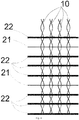
- the present invention realizes the prefixed aims since it is a flat net in polyethylene for crops protection, produced with English turn weaving and comprising: a plurality of weft yarns (21, 22), a plurality of warp yarns (10), associated in couples to each other and configured so that each couple of warp yarns is twisted after each passage of each weft yarn, characterized in that said plurality of weft yarns comprises a plurality of weft yarns realized in monofilament (21) and a plurality of weft yarns realized in band (22), said weft yarns realized in monofilament (21) and said weft yarns realized in band (22) being alternated with each other periodically.
- Figure 1-a shows an "English turn Leno weave" of the type known at the state of the art
- figure 1-b shows an enlargement of figure 1-a in which it is clear the warp yarns twisting
- figure 1-a shows a flat net known at the state of the art.
- Figures 2 , 3 and 4 show three embodiments of the net according to the invention in which a weft in monofilament is alternated with 1, 2 and 3 wefts in band, respectively.
- the net according to the invention is a net in polyethylene for crops protection, realized by "English turn Leno weave” technique and comprising a plurality of weft yarns realized in monofilament (21) and a plurality of weft yarns realized in band (22), said weft yarns in monofilament (21) and said weft yarns in band (22) being periodically alternated with each other.
- the net according to the invention provides a weft yarn in monofilament (21) and a weft yarn in band (22) periodically alternated with each other.
- the net according to the invention provides two weft yarns in monofilament (21) and two weft yarns in band (22) periodically alternated with each other.
- the net according to the invention provides a weft yarn in band periodically alternated with each "n" weft yarns in monofilament, as a function of the desired shading capacity.
- the polyethylene for the realization of the net (bands) is suitably additivated in order to increase its light scattering capacity.
- warp yarns title is between 150 den and 1000 den.
- the section of the warp monofilaments is preferably circular, but also sections of other type, as for example elliptical, hexagonal, lozenge or star shaped, are possible.
- the weft is provided with periodically alternated monofilament and bands.
- the weft can have a 1:1 monofilament to bands alternance ratio, but other ratios, such as for example 2 bands for each monofilament, or 3 bands for each monofilament are possible, in order to satisfy various shading needs.
- alternance ratios such as a band each 2 monofilaments, a band each three monofilaments and so on are also possible.
- Another important feature of the nets produced according to the invention is that they are woven by means of a loom adjusted so that warp does not grip bands during weaving, and so that bands remain in their flat configuration while passing inside a warp plait. This allows to exploit the whole surface of bands for shading purposes.
- the title of the bands used is preferably between 300 den and 1200 den.
- the thickness of the bands used is preferably between 15 and 50 micrometers, in order to obtain sufficient mechanical resistance features and to maximize the effect of light scattering at the same time.
- the bands are wide between 2 and 3 mm.
- the meshes of the net according to the invention can be realized in various dimensions.
- the net according to the invention is realized with large weaving meshes, this meaning meshes with dimensions between 3 mm x 2 mm and 9.5 mm x 5 mm.
- the mesh is defined by the dimensions of the distance between two following warps and the dimensions of the distance between two following wefts.
- the net according to the invention can be produced in any dimension according to what known at the state of the art. Typically, looms allow to realize nets with height between 2.5 cm and 6 cm and any length. Again, by means of sewing and cutting operations known at the state of the art, it is possible to realize nets of any dimension.
- bands are in translucid white polyethylene in order to increase the net light scattering properties.
- filming step i.e. when the film is realized from which the bands to be used for the weft are cut, at least an additive is added to polyethylene, which is able to absorb infrared rays and to increase the light scattering effect.
- the additive is a mineral additive chosen among carbonates (calcite, dolomite, anchorite, magnesite, rhodochrosite), sulphates (alunite, jarosite, calcium sulphate), phyllosilicates (clays, chlorites), hydroxylated silicates (heptode, amphibole) used in percentages lower than 10% with respect to the composition.
- the additive used comprises calcite and is provided in the composition of yarn and band in wt% lower than 10% and preferably between 4 and 6%.
- the "English turn Leno weave” allows mesh stability even when very few yarns are provided per cm 2 , while nets with few yarns per cm 2 do not remain together and are extremely fragile.
- the net according to the invention can be realized also with 5 yarns per cm 2 (dimension corresponding to a 9.5 x 5 mm mesh). According to another example, the net according to the invention can be realized with a 3 mm x 2 mm mesh, equal to 9 yarns per cm 2 . Moreover, in "English turn Leno weave" it is observed that the weft is substantially not extendible, considering that it is yet completely extended, and so a deformation in its direction would meet the resistance of a yarn yet extended at its maximum.
- the "English turn Leno weave” according to the present invention keeps the band extended also when the same crosses the warp yarns crossing, and this allows to exploit better the band for shading and light scattering purposes.
- a net with only one monofilament with a mesh similar to the one provided for the inventive net has a 18% maximum full area.
- weft yarns realized in monofilament and weft yarns realized in band allows to have both the advantage of rigidity and resistance of the net in transversal direction (given by the usage of wefts in monofilament), and the possibility to have good shading and light scattering values (obtained by using bands).
- the band is useful to obtain a wide covered surface (full area) of the net, containing at the same time the weight per square meter.
- the wide surface covered is needed to allow the transition from direct radiation to diffused radiation of a greater quantity of light, thus coming closer in this way to the effect obtained by means of a plastic film, yet keeping the advantages deriving from the usage of a net (air exchange, water passage in case of rain, even if slowed down by the net) .
Landscapes
- Engineering & Computer Science (AREA)
- Textile Engineering (AREA)
- Life Sciences & Earth Sciences (AREA)
- Environmental Sciences (AREA)
- Health & Medical Sciences (AREA)
- General Health & Medical Sciences (AREA)
- Toxicology (AREA)
- Woven Fabrics (AREA)
Abstract
Description
- The present Patent application relates to a net for crops protection.
- In particular, the present invention relates to a crops protection net which combines good mechanical resistance and dimensional stability with optimal light scattering capacity and various possibilities of shading.
- At the state of the art, there are known various embodiments for crops protection nets and with various weave patterns.
- It is to be specified that in the present document, it is referred to nets realized in plastic material and:
- for monofilament it is intended a yarn obtained by extrusion, with any section, for example a round, elliptical or polygonal section;
- for band it is intended a polyethylene strip obtained by cutting a polyethylene film;
- for "English turn Leno weave" - in the meaning yet known on the market - it is intended a weave whose weft - realized with monofilaments or bands - passes inside warp yarns (or generally filaments), formed each by two yarns rolled (i.e. twisted) after each weft passage.
- An example of "English turn Leno weave" of the type known at the state of the art is shown in
figure 1 , where it is possible to see the path of the (vertical) warp yarns interlacing after each (horizontal) weft yarn. - In the enlarged
figure 1-b it is shown a detail of the net shown infigure 1-a , where the arrow indicates the point where two warp yarns are interlaced in the passage between a weft yarn and the next one. - In particular, concerning the present application, at the state of the art there are known and are available on the market "English turn Leno weave" whose weft is realized in monofilament, mainly used as hail protection nets, as well as "English turn Leno weave" whose weft is realized with band (proposed as shading).
- Anyway, the first ones have low shading capacity (in relation to net weight and costs) and low light scattering capacity; the second ones, instead, have low mechanical resistance and low dimensional stability, even if they good shading capacity.
Figure 1-c shows another embodiment known at the state of the art, described in documentBE1009448 - The net described in
BE1009448 - This flat net, even if it has a variable shading capacity as a function of the dimensions of the used bands, it is not provided with the mechanical stability given to the "English turn Leno weaves" by the warp yarns twisting.
- Moreover, with equal shading capacity the surface weight of a net of the just described type is higher.
- Another type of net provided with periodically alternated bands with various thickness is described in
JP 2020005576 - Therefore, aim of the present invention is to provide a net for crops protection which overcomes the limits linked to the nets known at the state of the art. More in particular, the invention provides a net for crops protection which combines good mechanical resistance and good dimensional stability with high shading capacity.
- Yet, the present invention provides a net for crops protection which can be produced in various models, provided with various shading capacities.
- Yet, according to another aim, the present invention provides a net for crops protection which combines all the just described advantages with a high light scattering capacity as well.
- The present invention realizes the prefixed aims since it is a flat net in polyethylene for crops protection, produced with English turn weaving and comprising: a plurality of weft yarns (21, 22), a plurality of warp yarns (10), associated in couples to each other and configured so that each couple of warp yarns is twisted after each passage of each weft yarn, characterized in that said plurality of weft yarns comprises a plurality of weft yarns realized in monofilament (21) and a plurality of weft yarns realized in band (22), said weft yarns realized in monofilament (21) and said weft yarns realized in band (22) being alternated with each other periodically.
- The net will be described in the following with reference to the appended
figures 1 to 4 .Figure 1-a shows an "English turn Leno weave" of the type known at the state of the art,figure 1-b shows an enlargement offigure 1-a in which it is clear the warp yarns twisting,figure 1-a shows a flat net known at the state of the art. -
Figures 2 ,3 and4 show three embodiments of the net according to the invention in which a weft in monofilament is alternated with 1, 2 and 3 wefts in band, respectively. - With reference to the appended figures, the net according to the invention is a net in polyethylene for crops protection, realized by "English turn Leno weave" technique and comprising a plurality of weft yarns realized in monofilament (21) and a plurality of weft yarns realized in band (22), said weft yarns in monofilament (21) and said weft yarns in band (22) being periodically alternated with each other.
- In a first embodiment, the net according to the invention provides a weft yarn in monofilament (21) and a weft yarn in band (22) periodically alternated with each other.
- In a second embodiment, the net according to the invention provides two weft yarns in monofilament (21) and two weft yarns in band (22) periodically alternated with each other.
- According to other embodiments, the net according to the invention provides a weft yarn in band periodically alternated with each "n" weft yarns in monofilament, as a function of the desired shading capacity.
- Preferably, the polyethylene for the realization of the net (bands) is suitably additivated in order to increase its light scattering capacity.
- It is now described a preferred embodiment of the net according to the invention.
- It is a net produced by flat weaving (by means of projectile looms, gripper looms or shuttle looms) with "English turn Leno weave" technique and comprising warp (10) realized in monofilament. The warp yarns title is between 150 den and 1000 den. The section of the warp monofilaments is preferably circular, but also sections of other type, as for example elliptical, hexagonal, lozenge or star shaped, are possible.
- The weft is provided with periodically alternated monofilament and bands.
- In a first embodiment, the weft can have a 1:1 monofilament to bands alternance ratio, but other ratios, such as for example 2 bands for each monofilament, or 3 bands for each monofilament are possible, in order to satisfy various shading needs.
- Similarly, alternance ratios such as a band each 2 monofilaments, a band each three monofilaments and so on are also possible.
- Another important feature of the nets produced according to the invention is that they are woven by means of a loom adjusted so that warp does not grip bands during weaving, and so that bands remain in their flat configuration while passing inside a warp plait. This allows to exploit the whole surface of bands for shading purposes.
- The title of the bands used is preferably between 300 den and 1200 den.
- The thickness of the bands used is preferably between 15 and 50 micrometers, in order to obtain sufficient mechanical resistance features and to maximize the effect of light scattering at the same time. Preferably, moreover, the bands are wide between 2 and 3 mm.
- Moreover, it is to be specified that the meshes of the net according to the invention can be realized in various dimensions. Preferably, the net according to the invention is realized with large weaving meshes, this meaning meshes with dimensions between 3 mm x 2 mm and 9.5 mm x 5 mm.
- It is to be specified that the mesh is defined by the dimensions of the distance between two following warps and the dimensions of the distance between two following wefts.
- Moreover, it is clear that the net according to the invention can be produced in any dimension according to what known at the state of the art. Typically, looms allow to realize nets with height between 2.5 cm and 6 cm and any length. Anyway, by means of sewing and cutting operations known at the state of the art, it is possible to realize nets of any dimension.
- Preferably, bands are in translucid white polyethylene in order to increase the net light scattering properties. Yet, more preferably in filming step (i.e. when the film is realized from which the bands to be used for the weft are cut), at least an additive is added to polyethylene, which is able to absorb infrared rays and to increase the light scattering effect.
- According to a preferred embodiment, the additive is a mineral additive chosen among carbonates (calcite, dolomite, anchorite, magnesite, rhodochrosite), sulphates (alunite, jarosite, calcium sulphate), phyllosilicates (clays, chlorites), hydroxylated silicates (heptode, amphibole) used in percentages lower than 10% with respect to the composition. According to a preferred embodiment, the additive used comprises calcite and is provided in the composition of yarn and band in wt% lower than 10% and preferably between 4 and 6%.
- After describing the characteristics of the net according to the invention, it is possible to highlight now the effects of such characteristics, and so the advantages compared to the types of nets known at the state of the art.
- In primis, it is to be specified that the usage of a flat net (woven by means of the "English turn Leno weave" technique) comprising a portion of wefts realized in monofilament allows to obtain good dimensional stability.
- In other terms, thanks to the weaving technique the phenomenon of side shrinkage upon longitudinal stretching, observed in nets woven by means of other techniques, is not observed.
- Moreover, the "English turn Leno weave" allows mesh stability even when very few yarns are provided per cm2, while nets with few yarns per cm2 do not remain together and are extremely fragile.
- The net according to the invention can be realized also with 5 yarns per cm2 (dimension corresponding to a 9.5 x 5 mm mesh). According to another example, the net according to the invention can be realized with a 3 mm x 2 mm mesh, equal to 9 yarns per cm2. Moreover, in "English turn Leno weave" it is observed that the weft is substantially not extendible, considering that it is yet completely extended, and so a deformation in its direction would meet the resistance of a yarn yet extended at its maximum.
- It is also observed that if an "English turn Leno weave" is realized (as it is known at the state of the art as well) with weft yarns realized only in band (i.e. without alternated weft yarns in monofilament) the fabric softness in weft direction is reduced sensibly.
- This means that it is easy to make the various warp spirals come closer to each other. If instead wefts in monofilament (alternated with bands) are provided, the "hand" of the fabric varies sensibly. It is to be specified, if needed, that "hand" in textile field is the technical term indicating softness and volume evaluated by the tactile perception given by a fabric, a jersey or a yarn. With regards to fabrics, it helps to describe the peculiar features given by the combination of two factors: the peculiarities of the yarn (material used and type of working) linked to the weave effect (texture of the yarns).
- During the tests for the development of the present invention, it was observed that the provision of wefts in monofilament, yet starting from their provision for a monofilament each three bands, gives the fabric a shape stability, which needs rigidity for agricultural uses.
- It is to be considered in fact that in the agricultural usage it is needed a high precision of the fabric dimensions definition. Since great fields are covered, if there was no dimensional stability in both terms, small dimensional errors summed up on great extensions would lead to remarkable absence of fabric (or as an alternative, to significant excesses).
- Yet, the "English turn Leno weave" according to the present invention keeps the band extended also when the same crosses the warp yarns crossing, and this allows to exploit better the band for shading and light scattering purposes.
- Moreover, the usage of a wide mesh net allows very much margin to modulate the ratio between empty area and full area by means of monofilament and band alternance.
- It is to be specified that in the systems known at the state of the art, a net with only one monofilament with a mesh similar to the one provided for the inventive net has a 18% maximum full area.
- Yet, the alternance of weft yarns realized in monofilament and weft yarns realized in band allows to have both the advantage of rigidity and resistance of the net in transversal direction (given by the usage of wefts in monofilament), and the possibility to have good shading and light scattering values (obtained by using bands).
- In fac, the band is useful to obtain a wide covered surface (full area) of the net, containing at the same time the weight per square meter. The wide surface covered is needed to allow the transition from direct radiation to diffused radiation of a greater quantity of light, thus coming closer in this way to the effect obtained by means of a plastic film, yet keeping the advantages deriving from the usage of a net (air exchange, water passage in case of rain, even if slowed down by the net) .
Claims (10)
- Flat net in polyethylene for crops protection, produced by "English turn Leno weave" technique and comprising:- a plurality of weft yarns (21, 22),- a plurality of warp yarns (10), associated in couples to each other and configured so that each one of said couples is twisted after each passage of each weft yarn,
characterized in that
said plurality of weft yarns comprises- a plurality of weft yarns realized in monofilament (21) and
a plurality of weft yarns realized in band (22), said weft yarns realized in monofilament (21) and said weft yarns realized in band (22) being periodically alternated with each other. - Net in polyethylene for crops protection according to claim 1, characterized in that said weft yarns in monofilament (21) and said weft yarns in band (22) are alternated with each other for a weft yarn realized in monofilament and a weft yarn in band.
- Net in polyethylene for crops protection according to claim 1, characterized in that said weft yarns in monofilament (21) and said weft yarns in band (22) are alternated for a weft yarn realized in monofilament with each "n" weft yarns in band, as a function of the desired shading capacity.
- Net in polyethylene for crops protection according to any one of the preceding claims, characterized in that the polyethylene for the realization of said weft yarns in band (22) is additivated by addition of at least an additive, which is able to absorb infrared rays and to increase the light scattering effect.
- Net in polyethylene for crops protection according to claim 4, characterized in that said at least one additive is a mineral additive chosen among carbonates (calcite, dolomite, anchorite, magnesite, rhodochrosite), sulphates (alunite, jarosite, calcium sulphate), phyllosilicates (clays, chlorites), hydroxylated silicates (heptode, amphibole) used in percentages lower than 10%.
- Net in polyethylene for crops protection according to claim 5, characterized in that said additive comprises calcite and is provided in wt% lower than 10% and preferably between 4 and 6%.
- Net in polyethylene for crops protection according to any one of the preceding claims, characterized in that said weft yarns in band (22) are realized in translucid white polyethylene in order to increase the net light scattering properties.
- Net in polyethylene for crops protection according to any one of the preceding claims, characterized in that it is woven so that warp (10) does not grip said weft yarns in band (22) and so that the same remain in a substantially flat configuration while passing inside each warp plait (10) .
- Net in polyethylene for crops protection according to any one of the preceding claims, characterized in that the thickness of said weft yarns in band (22) is between 15 and 50 micrometers, in order to obtain sufficient mechanical resistance features and to maximize the effect of light scattering at the same time.
- Net in polyethylene for crops protection according to any one of the preceding claims, characterized in that it is realized with a number of yarns per cm2 between 5 and 9.
Applications Claiming Priority (1)
| Application Number | Priority Date | Filing Date | Title |
|---|---|---|---|
| IT102020000016108A IT202000016108A1 (en) | 2020-07-03 | 2020-07-03 | LENO NET WITH ALTERNATING MONOFILAMENT AND STRIP |
Publications (3)
| Publication Number | Publication Date |
|---|---|
| EP3932187A1 true EP3932187A1 (en) | 2022-01-05 |
| EP3932187C0 EP3932187C0 (en) | 2025-08-20 |
| EP3932187B1 EP3932187B1 (en) | 2025-08-20 |
Family
ID=72473880
Family Applications (1)
| Application Number | Title | Priority Date | Filing Date |
|---|---|---|---|
| EP21183058.3A Active EP3932187B1 (en) | 2020-07-03 | 2021-07-01 | Leno woven fabric with alternated monofilament and strip |
Country Status (3)
| Country | Link |
|---|---|
| EP (1) | EP3932187B1 (en) |
| ES (1) | ES3053868T3 (en) |
| IT (1) | IT202000016108A1 (en) |
Cited By (1)
| Publication number | Priority date | Publication date | Assignee | Title |
|---|---|---|---|---|
| JP2023072781A (en) * | 2021-11-15 | 2023-05-25 | 小泉製麻株式会社 | Sheet net for preventing climbing of vine |
Citations (3)
| Publication number | Priority date | Publication date | Assignee | Title |
|---|---|---|---|---|
| BE1009448A3 (en) | 1995-06-22 | 1997-03-04 | Uco Technical Fabrics N V | Light filter screen |
| KR101412397B1 (en) * | 2013-05-24 | 2014-06-27 | 방송혁 | strong reinforced leno textile |
| JP2020005576A (en) | 2018-07-10 | 2020-01-16 | 日本ワイドクロス株式会社 | Thermal insulation net |
Family Cites Families (2)
| Publication number | Priority date | Publication date | Assignee | Title |
|---|---|---|---|---|
| CA3000807A1 (en) * | 2015-10-22 | 2017-04-27 | Nine Ip Limited | Crop netting material |
| KR102071226B1 (en) * | 2019-10-23 | 2020-01-30 | 윤효상 | A shading net |
-
2020
- 2020-07-03 IT IT102020000016108A patent/IT202000016108A1/en unknown
-
2021
- 2021-07-01 EP EP21183058.3A patent/EP3932187B1/en active Active
- 2021-07-01 ES ES21183058T patent/ES3053868T3/en active Active
Patent Citations (3)
| Publication number | Priority date | Publication date | Assignee | Title |
|---|---|---|---|---|
| BE1009448A3 (en) | 1995-06-22 | 1997-03-04 | Uco Technical Fabrics N V | Light filter screen |
| KR101412397B1 (en) * | 2013-05-24 | 2014-06-27 | 방송혁 | strong reinforced leno textile |
| JP2020005576A (en) | 2018-07-10 | 2020-01-16 | 日本ワイドクロス株式会社 | Thermal insulation net |
Cited By (1)
| Publication number | Priority date | Publication date | Assignee | Title |
|---|---|---|---|---|
| JP2023072781A (en) * | 2021-11-15 | 2023-05-25 | 小泉製麻株式会社 | Sheet net for preventing climbing of vine |
Also Published As
| Publication number | Publication date |
|---|---|
| IT202000016108A1 (en) | 2022-01-03 |
| EP3932187C0 (en) | 2025-08-20 |
| ES3053868T3 (en) | 2026-01-27 |
| EP3932187B1 (en) | 2025-08-20 |
Similar Documents
| Publication | Publication Date | Title |
|---|---|---|
| JP6104255B2 (en) | Seat belt strap for seat belt system | |
| US6418974B1 (en) | Woven fabric using three dimensional and flat weave in combination, related methods and filter element | |
| US4691744A (en) | Filter wire cloth | |
| CN101978105B (en) | Fabric made up of at least two laps interwoven along a common stretch and method for its production | |
| EP3932187B1 (en) | Leno woven fabric with alternated monofilament and strip | |
| CN113308776A (en) | High-breathability woven fabric and weaving method thereof | |
| CA1070619A (en) | Filter mesh weave | |
| US20210148015A1 (en) | Industrial two-layer fabric | |
| CN209971769U (en) | Novel elastic gray cloth | |
| CN101245527A (en) | Method for forming three-dimensional special-shaped textile grille | |
| WO2014125744A1 (en) | Industrial two-layer woven fabric | |
| CN213652795U (en) | Grid-shaped four-side elastic interwoven silk | |
| KR100888153B1 (en) | Weaving method of the mesh and its woven fabric | |
| CN220482786U (en) | Shading polyester fabric | |
| CN210684077U (en) | Plaid fabric | |
| JP7074540B2 (en) | Clothing | |
| CN210481653U (en) | Novel antibacterial deodorizing mesh cloth | |
| RU2040605C1 (en) | Fabric of combined weave | |
| CN222294329U (en) | A small jacquard fabric with letters | |
| CN219044194U (en) | Tes Lin Sanceng fabric | |
| CN218812409U (en) | Weave variable rib weave | |
| CN213328049U (en) | Yarn-dyed fabric with interwoven cellulose fibers and metallic yarns | |
| CN217455167U (en) | Stretch-proof three-layer mesh cloth | |
| JPS6225110Y2 (en) | ||
| EP1705273A2 (en) | Textile fabrics for clothing |
Legal Events
| Date | Code | Title | Description |
|---|---|---|---|
| PUAI | Public reference made under article 153(3) epc to a published international application that has entered the european phase |
Free format text: ORIGINAL CODE: 0009012 |
|
| STAA | Information on the status of an ep patent application or granted ep patent |
Free format text: STATUS: THE APPLICATION HAS BEEN PUBLISHED |
|
| AK | Designated contracting states |
Kind code of ref document: A1 Designated state(s): AL AT BE BG CH CY CZ DE DK EE ES FI FR GB GR HR HU IE IS IT LI LT LU LV MC MK MT NL NO PL PT RO RS SE SI SK SM TR |
|
| B565 | Issuance of search results under rule 164(2) epc |
Effective date: 20211103 |
|
| STAA | Information on the status of an ep patent application or granted ep patent |
Free format text: STATUS: REQUEST FOR EXAMINATION WAS MADE |
|
| 17P | Request for examination filed |
Effective date: 20220621 |
|
| RBV | Designated contracting states (corrected) |
Designated state(s): AL AT BE BG CH CY CZ DE DK EE ES FI FR GB GR HR HU IE IS IT LI LT LU LV MC MK MT NL NO PL PT RO RS SE SI SK SM TR |
|
| STAA | Information on the status of an ep patent application or granted ep patent |
Free format text: STATUS: EXAMINATION IS IN PROGRESS |
|
| 17Q | First examination report despatched |
Effective date: 20231023 |
|
| GRAP | Despatch of communication of intention to grant a patent |
Free format text: ORIGINAL CODE: EPIDOSNIGR1 |
|
| STAA | Information on the status of an ep patent application or granted ep patent |
Free format text: STATUS: GRANT OF PATENT IS INTENDED |
|
| RIC1 | Information provided on ipc code assigned before grant |
Ipc: D03D 19/00 20060101ALI20250211BHEP Ipc: D03D 15/46 20210101ALI20250211BHEP Ipc: D03D 15/283 20210101ALI20250211BHEP Ipc: D03D 1/00 20060101ALI20250211BHEP Ipc: A01G 13/21 20250101ALI20250211BHEP Ipc: A01G 9/22 20060101AFI20250211BHEP |
|
| INTG | Intention to grant announced |
Effective date: 20250220 |
|
| GRAS | Grant fee paid |
Free format text: ORIGINAL CODE: EPIDOSNIGR3 |
|
| RAP1 | Party data changed (applicant data changed or rights of an application transferred) |
Owner name: ARRIGONI S.P.A. |
|
| GRAA | (expected) grant |
Free format text: ORIGINAL CODE: 0009210 |
|
| STAA | Information on the status of an ep patent application or granted ep patent |
Free format text: STATUS: THE PATENT HAS BEEN GRANTED |
|
| AK | Designated contracting states |
Kind code of ref document: B1 Designated state(s): AL AT BE BG CH CY CZ DE DK EE ES FI FR GB GR HR HU IE IS IT LI LT LU LV MC MK MT NL NO PL PT RO RS SE SI SK SM TR |
|
| REG | Reference to a national code |
Ref country code: GB Ref legal event code: FG4D |
|
| REG | Reference to a national code |
Ref country code: CH Ref legal event code: EP |
|
| REG | Reference to a national code |
Ref country code: IE Ref legal event code: FG4D |
|
| REG | Reference to a national code |
Ref country code: DE Ref legal event code: R096 Ref document number: 602021036491 Country of ref document: DE |
|
| U01 | Request for unitary effect filed |
Effective date: 20250912 |
|
| U07 | Unitary effect registered |
Designated state(s): AT BE BG DE DK EE FI FR IT LT LU LV MT NL PT RO SE SI Effective date: 20250919 |
|
| PG25 | Lapsed in a contracting state [announced via postgrant information from national office to epo] |
Ref country code: IS Free format text: LAPSE BECAUSE OF FAILURE TO SUBMIT A TRANSLATION OF THE DESCRIPTION OR TO PAY THE FEE WITHIN THE PRESCRIBED TIME-LIMIT Effective date: 20251220 |
|
| PG25 | Lapsed in a contracting state [announced via postgrant information from national office to epo] |
Ref country code: NO Free format text: LAPSE BECAUSE OF FAILURE TO SUBMIT A TRANSLATION OF THE DESCRIPTION OR TO PAY THE FEE WITHIN THE PRESCRIBED TIME-LIMIT Effective date: 20251120 |
|
| PG25 | Lapsed in a contracting state [announced via postgrant information from national office to epo] |
Ref country code: HR Free format text: LAPSE BECAUSE OF FAILURE TO SUBMIT A TRANSLATION OF THE DESCRIPTION OR TO PAY THE FEE WITHIN THE PRESCRIBED TIME-LIMIT Effective date: 20250820 |
|
| PG25 | Lapsed in a contracting state [announced via postgrant information from national office to epo] |
Ref country code: GR Free format text: LAPSE BECAUSE OF FAILURE TO SUBMIT A TRANSLATION OF THE DESCRIPTION OR TO PAY THE FEE WITHIN THE PRESCRIBED TIME-LIMIT Effective date: 20251121 |
|
| PG25 | Lapsed in a contracting state [announced via postgrant information from national office to epo] |
Ref country code: PL Free format text: LAPSE BECAUSE OF FAILURE TO SUBMIT A TRANSLATION OF THE DESCRIPTION OR TO PAY THE FEE WITHIN THE PRESCRIBED TIME-LIMIT Effective date: 20250820 |
|
| REG | Reference to a national code |
Ref country code: ES Ref legal event code: FG2A Ref document number: 3053868 Country of ref document: ES Kind code of ref document: T3 Effective date: 20260127 |
|
| PG25 | Lapsed in a contracting state [announced via postgrant information from national office to epo] |
Ref country code: RS Free format text: LAPSE BECAUSE OF FAILURE TO SUBMIT A TRANSLATION OF THE DESCRIPTION OR TO PAY THE FEE WITHIN THE PRESCRIBED TIME-LIMIT Effective date: 20251120 |
|
| PG25 | Lapsed in a contracting state [announced via postgrant information from national office to epo] |
Ref country code: SM Free format text: LAPSE BECAUSE OF FAILURE TO SUBMIT A TRANSLATION OF THE DESCRIPTION OR TO PAY THE FEE WITHIN THE PRESCRIBED TIME-LIMIT Effective date: 20250820 |
|
| PG25 | Lapsed in a contracting state [announced via postgrant information from national office to epo] |
Ref country code: CZ Free format text: LAPSE BECAUSE OF FAILURE TO SUBMIT A TRANSLATION OF THE DESCRIPTION OR TO PAY THE FEE WITHIN THE PRESCRIBED TIME-LIMIT Effective date: 20250820 |
|
| PG25 | Lapsed in a contracting state [announced via postgrant information from national office to epo] |
Ref country code: SK Free format text: LAPSE BECAUSE OF FAILURE TO SUBMIT A TRANSLATION OF THE DESCRIPTION OR TO PAY THE FEE WITHIN THE PRESCRIBED TIME-LIMIT Effective date: 20250820 |