EP3932161B1 - Work vehicle - Google Patents
Work vehicle Download PDFInfo
- Publication number
- EP3932161B1 EP3932161B1 EP20763263.9A EP20763263A EP3932161B1 EP 3932161 B1 EP3932161 B1 EP 3932161B1 EP 20763263 A EP20763263 A EP 20763263A EP 3932161 B1 EP3932161 B1 EP 3932161B1
- Authority
- EP
- European Patent Office
- Prior art keywords
- point
- ridge
- automatic travel
- reference position
- control
- Prior art date
- Legal status (The legal status is an assumption and is not a legal conclusion. Google has not performed a legal analysis and makes no representation as to the accuracy of the status listed.)
- Active
Links
Images







Classifications
-
- A—HUMAN NECESSITIES
- A01—AGRICULTURE; FORESTRY; ANIMAL HUSBANDRY; HUNTING; TRAPPING; FISHING
- A01B—SOIL WORKING IN AGRICULTURE OR FORESTRY; PARTS, DETAILS, OR ACCESSORIES OF AGRICULTURAL MACHINES OR IMPLEMENTS, IN GENERAL
- A01B69/00—Steering of agricultural machines or implements; Guiding agricultural machines or implements on a desired track
- A01B69/007—Steering or guiding of agricultural vehicles, e.g. steering of the tractor to keep the plough in the furrow
- A01B69/008—Steering or guiding of agricultural vehicles, e.g. steering of the tractor to keep the plough in the furrow automatic
-
- A—HUMAN NECESSITIES
- A01—AGRICULTURE; FORESTRY; ANIMAL HUSBANDRY; HUNTING; TRAPPING; FISHING
- A01C—PLANTING; SOWING; FERTILISING
- A01C11/00—Transplanting machines
- A01C11/02—Transplanting machines for seedlings
- A01C11/025—Transplanting machines using seedling trays; Devices for removing the seedlings from the trays
-
- G—PHYSICS
- G05—CONTROLLING; REGULATING
- G05D—SYSTEMS FOR CONTROLLING OR REGULATING NON-ELECTRIC VARIABLES
- G05D1/00—Control of position, course, altitude or attitude of land, water, air or space vehicles, e.g. using automatic pilots
- G05D1/02—Control of position or course in two dimensions
- G05D1/021—Control of position or course in two dimensions specially adapted to land vehicles
- G05D1/0212—Control of position or course in two dimensions specially adapted to land vehicles with means for defining a desired trajectory
- G05D1/0219—Control of position or course in two dimensions specially adapted to land vehicles with means for defining a desired trajectory ensuring the processing of the whole working surface
-
- G—PHYSICS
- G05—CONTROLLING; REGULATING
- G05D—SYSTEMS FOR CONTROLLING OR REGULATING NON-ELECTRIC VARIABLES
- G05D1/00—Control of position, course, altitude or attitude of land, water, air or space vehicles, e.g. using automatic pilots
- G05D1/02—Control of position or course in two dimensions
- G05D1/021—Control of position or course in two dimensions specially adapted to land vehicles
- G05D1/0268—Control of position or course in two dimensions specially adapted to land vehicles using internal positioning means
- G05D1/0274—Control of position or course in two dimensions specially adapted to land vehicles using internal positioning means using mapping information stored in a memory device
-
- G—PHYSICS
- G05—CONTROLLING; REGULATING
- G05D—SYSTEMS FOR CONTROLLING OR REGULATING NON-ELECTRIC VARIABLES
- G05D1/00—Control of position, course, altitude or attitude of land, water, air or space vehicles, e.g. using automatic pilots
- G05D1/02—Control of position or course in two dimensions
- G05D1/021—Control of position or course in two dimensions specially adapted to land vehicles
- G05D1/0276—Control of position or course in two dimensions specially adapted to land vehicles using signals provided by a source external to the vehicle
- G05D1/0278—Control of position or course in two dimensions specially adapted to land vehicles using signals provided by a source external to the vehicle using satellite positioning signals, e.g. GPS
-
- B—PERFORMING OPERATIONS; TRANSPORTING
- B60—VEHICLES IN GENERAL
- B60Y—INDEXING SCHEME RELATING TO ASPECTS CROSS-CUTTING VEHICLE TECHNOLOGY
- B60Y2200/00—Type of vehicle
- B60Y2200/20—Off-Road Vehicles
- B60Y2200/22—Agricultural vehicles
Definitions
- the present invention relates to a work vehicle that executes notification when approaching a ridge-adjacent position in automatic travel.
- work vehicles such as rice transplanters that automatically travel straight forward in a field using a satellite positioning system
- Such a work vehicle performs autonomous straightforward travel along a linear travel route that is set parallel to a reference route.
- the reference route is generated on the basis of a set of reference points called point A and point B.
- point A and the point B are set as the positions between ridge-adjacent positions in the field so that automatic travel can be performed extensively in the field
- Patent Literatures 1 to 3 it is known that a work vehicle executes notification by a buzzer or the like just before the automatic travel is terminated. This allows an operator to be informed in advance that the work vehicle will reach the ridge-adjacent positions. Upon receiving the notification, the operator prepares himself/herself for stop or switches to manual travel.
- the ridge-adjacent position should be updated by erasing and re-setting the point A and the point B each time so that the notification during the automatic travel is made appropriately, which had nonconformity that a complicated operation was forced.
- Patent Literature 4 discloses a work vehicle capable of preventing a reference position for a rectilinear travel from being acquired due to an improper operation and curtailing increase of the quantity of components
- Patent Literature 5 relates to a path generation device comprising a path generation unit and a control unit.
- Patent Literature 6 describes a work vehicle capable of preventing a reference position for a rectilinear travel from being acquired due to an improper operation and curtailing increase of the quantity of components
- Patent Literature 7 discloses a parallel operation work vehicle for enabling operation of an autonomous work vehicle by a long distance operating device installed in an accompanying work vehicle for performing work while accompanying the autonomous work vehicle.
- the present invention was made in consideration of the above problem, and its object is to provide a work vehicle capable of flexibly updating the ridge-adjacent position, and capable of appropriately executing notification during automatic travel even in a deformed field.
- a work vehicle is a work vehicle configured to be capable of automatic travel along a travel route that is set parallel to a reference route generated on the basis of a first reference point and a second reference point set in advance, while identifying an own vehicle position thereof using a satellite positioning system, including a control unit that activates a notification device if the own vehicle position approaches a first control reference position identified on the basis of the first reference point or a second control reference position identified on the basis of the second reference point when the automatic t ravel is being performed, the control unit is configured to be capable of changing one of the first control reference position and the second control reference position to a third control reference position identified on the basis of a third reference point which is different from the first reference point and the second reference point, and after the change, the notification device is activated on the basis of the third control reference position instead of one of the first control reference position and the second control reference position.
- the first control reference position or the second control reference position identified on the basis of them can be changed to the third control reference position after that.
- the activation of the notification device is controlled on the basis of the third control reference position instead of the first control reference position or the second control reference position. Therefore, it is possible to update the ridge-adjacent position flexibly, and to properly execute the notification during automatic travel even in a deformed field.
- the control unit is preferably configured to be capable of changing one of the first control reference position and the second control reference position to the third control reference position, both when the automatic travel is being performed and when the automatic travel is not being performed. Since the control reference position can be changed when the automatic travel is being performed, the ridge-adjacent position can be updated without interrupting the work. In addition, since the control reference position can be changed when the automatic travel is not performed, it is possible, for example, to update the ridge-adjacent position after moving to the exact ridge-adjacent position by manual travel.
- the control unit is preferably configured to change one of the first control reference position and the second control reference position, which is on a rear side of a working direction, to the third control reference position, when the third reference point is set in a work area defined on the basis of the first reference point and the second reference point while the automatic travel is being performed. According to such a configuration, it is not necessary to select which control reference position is to be changed, and it is possible to update the ridge-adjacent position in accordance with an intention of the operator in the work area.
- the control unit is preferably configured to identify the working direction when automatic travel is started and to change one of the first control reference position and the second control reference position, which is on the rear side of the working direction, to the third control reference position when the third reference point is set in the work area defined on the basis of the first reference point and the second reference point while automatic travel is not being performed. According to such a configuration, the control reference position is appropriately changed even when the automatic travel is not being performed. Moreover, there is no need to select which control reference position is to be changed, and the ridge-adjacent position can be updated in accordance with the user's intention.
- the control unit is preferably configured to change one of the first control reference position and the second control reference position, which is closer to the own vehicle position, to the third control reference position when the third reference point is set outside the work area defined on the basis of the first reference point and the second reference point. According to such a configuration, it is not necessary to select which control reference position is to be changed, and it is possible to update the ridge-adjacent position outside the work area in accordance with the intention of the operator.
- This embodiment shows an example of an automatic travel system that causes a passenger-type rice transplanter to perform automatic travel, an example of a work vehicle, while identifying a vehicle position using a satellite positioning system.
- the work vehicle is not limited to a rice transplanter, but may be, for example, a tractor, a combine harvester, a seedling transplanter, or any other agricultural work vehicle. Alternatively, it may be a civil engineering and construction vehicle or a snowplow.
- the rice transplanter 1 has a traveling unit 10 and a planting unit 20 as a working portion.
- the planting unit 20 is disposed behind the traveling unit 10.
- the planting unit 20 is connected to a rear part of the traveling unit 10, capable of elevation via an elevating mechanism 21.
- the rice transplanter 1 is configured to perform a seedling planting (rice planting) operation in which seedlings are planted by the planting unit 20 while traveling in a field by the traveling unit 10.
- the traveling unit 10 has a traveling machine body 2, a pair of left and right front wheels 3 supporting the traveling machine body 2, and also a pair of left and right rear wheels 4.
- the front wheels 3 are mounted on front axles extending from a front axle case 5 to both right and left sides.
- the front axle case 5 is provided on the side of a transmission case 8 and is supported at a front part of the traveling machine body 2.
- the rear wheels 4 are mounted on rear axles extending from a rear axle case 6 to both right and left sides.
- the rear axle case 6 is provided at a rear end of a tubular frame 9 projecting rearwardly from the transmission case 8 and is supported at the rear part of the traveling machine body 2.
- the engine 7 is covered by a bonnet 11.
- the power of the engine 7 is transmitted to a transmission case 8 disposed behind the engine 7, and is transmitted to the front wheels 3 and the rear wheels 4 through the transmission case 8.
- the traveling unit 10 can travel in the front-rear direction.
- a link frame 17 is provided upright at the rear end of the traveling machine body 2.
- the planting unit 20 is connected to the link frame 17, capable of elevation, via the elevating mechanism 21.
- the elevating mechanism 21 has a lower link 21a and a top link 21b.
- a rod end of a hydraulic elevating cylinder 22 is connected to the lower link 21a.
- a cylinder base end of the elevating cylinder 22 is supported vertically rotatably at the rear part of the upper surface of the tubular frame 9. It is configured such that, by extending / retracting the elevating cylinder 22, the elevating mechanism 21 is rotated in the vertical direction, and the planting unit 20 is elevated up and down.
- the planting unit 20 includes a planting input case 23 to which power is transmitted from the engine 7 via the transmission case 8 and a PTO shaft (power transmission shaft) 18, a plurality of planting transmission cases 24 connected to the planting input case 23, a seedling planting mechanism 25 provided at the rear end side of each planting transmission case 24, and a seedling loading table 26 on which seedling mats are placed.
- Reserve seedlings to be supplied to the planting unit 20 for seedling refill (seedling replenishment) are placed on reserve seedling stands 15 disposed on both left and right sides of the bonnet 11.
- the reserve seedling stand 15 is supported on a support frame 16 (reserve seedling support) provided upright on both the left and right sides of the front part of the traveling machine body 2.
- the seedling planting mechanism 25 includes a rotary case 28 having two planting claws 27, 27 for one row. In accordance with a rotating movement of the rotary case 28, the two planting claws 27, 27 take out seedlings from the seedling mat alternately and plant them in the field. Since the rice transplanter 1 of this embodiment is an eight-row planting rice transplanter, it includes four sets of planting transmission cases 24 for eight-row planting (two rows forming one set), and the seedling loading table 26 is also configured for eight-row planting However, the rice transplanter 1 is not limited thereto, and may be, for example, a six-row or ten-row rice transplanter.
- the side marker 29 has a marker wheel body 29w for drawing lines and a marker arm 29a that rotatably supports the marker wheel body 29w.
- a base end of the marker arm 29a is supported at the left and right outer sides of the planting unit 20 rotatably in the left and right directions.
- the side marker 29 is configured to be displaceable between a landing posture, in which the marker wheel body 29w is lowered to form a reference trajectory on the rice field for the next process, and a non-landing posture (see FIG. 1 ), in which the marker wheel body 29w is raised to move away from the rice field.
- a driving operation unit 30 is provided at the center of the traveling machine body 2 in the front-rear direction.
- the operator boards a work step 12 (body cover) provided on the upper surface side of the traveling machine body 2 and operates the rice transplanter 1 at the driving operation unit 30.
- An operation panel 31 is provided at the front part of the driving operation unit 30.
- the operation panel 31 is disposed on the rear upper surface side of the bonnet 11.
- Aplurality of operating tools, including a steering wheel 32 and a main gearshift lever 33, are disposed on the operation panel 31.
- a driver's seat 14 is disposed behind the operation panel 31 via a seat frame 13.
- a plurality of (four in this embodiment) reserve seedling stands 15 are supported by a pair of support frames 16, 16 spaced apart in the front-rear direction.
- a connecting frame 40 having a substantial L-shape on a side view is connected to upper ends of the pair of support frames 16, 16.
- a unit frame 42 is connected to an upper end of the connecting frame 40 via an intermediate frame 41 extending in the up-and-down direction.
- the unit frame 42 is connected rotatably to the upper parts of the left and right intermediate frames 41.
- a positioning unit 43 as a positioning unit is fixed to the unit frame 42.
- the positioning unit 43 receives positioning signals from a satellite positioning system (GNSS) and identifies the vehicle's position on the basis of the positioning signals.
- GNSS satellite positioning system
- DGPS Different GPS
- position information of the rice transplanter 1 (mobile station) is corrected by correction information from a base station installed at a predetermined point, and the own vehicle position of the rice transplanter 1 can be identified with high accuracy.
- satellite positioning systems such as RTK (Real Time Kinematic) and SBAS (Geostationary Satellite Augmentation System) can also be used.
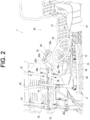
- various operating tools including the steering wheel 32 and a display device 34 are disposed on the operation panel 31.
- the steering wheel 32 is provided in front of the driver's seat 14.
- a gearshift pedal and a brake pedal, not shown, are installed below the operation panel 31.
- the gearshift pedal is an operating tool for changing a vehicle speed of the rice transplanter 1.
- the brake pedal is an operating tool for braking the rice transplanter 1.
- the gearshift pedal is disposed at lower right of the operation panel 31, and the brake pedal is disposed on the left of the gearshift pedal.
- the rice transplanter 1 includes an operation member 50 for performing operations related to automatic travel and an arm member 35 supporting the operation member 50.
- the arm member 35 has a stay-like upper arm 35a fixed to the support frames 16, 16, a forearm 35c which rotates horizontally with respect to the upper arm 35a with a hinge 35b as a fulcrum, and a holder 35e which rotates horizontally with respect to the forearm 35c with a hinge 35d as a fulcrum.
- the operation member 50 is attached to the holder 35e.
- elbow portions 35f, 35f which are bent along the up-and-down direction are formed, respectively.
- the elbow portion 35f may be configured to be rotatable in the up-and-down direction via a hinge.
- the operation member 50 held in the holder 35e can be moved in a movable range of the arm member 35.
- the operation member 50 includes an AUTO button 51, which is an indicator for instructing start of automatic travel, an A button 53, which is an indicator for instructing setting of the point A, which is a start point of a reference route, and a B button 54, which is an indicator for instructing the setting of the point B, which is an end point of the reference route.
- the AUTO button 51 is disposed at the center of an operation surface 50f of the operation member 50.
- the A button 53 and the B button 54 are disposed side by side on the left and right below the AUTO button 51.
- An indicator lamp 52 indicating a positioning state of the positioning unit 43 is disposed at upper left of the AUTO button 51.
- the AUTO button 51 is operated when starting and stopping automatic travel. Since the AUTO button 51 is operated more frequently than the A button 53 and the B button 54, it is formed larger on a front view than the A button 53 and the B button 54 so that it can be easily pressed and operated. In addition, the AUTO button 51 protrudes larger than the A button 53 and the B button 54.
- the A button 53 and the B button 54 are the buttons having the same shape and are disposed symmetrically.
- a ring-shaped light-emitting portion 55 is provided around the AUTO button 51. The light emitting portion 55 has a function of informing the operator of various states related to automatic travel by its light color and lighting pattern.
- the operation member 50 for performing operations related to automatic travel is provided independently of the operation panel 31. According to such a configuration, there is no need to modify the operation panel 31 when an automatic travel system is additionally installed in an existing rice transplanter, which is convenient. However, it is not limited thereto, and it is also possible to incorporate and provide an operation member for performing operations related to automatic travel in the operation panel 31.
- the rice transplanter 1 is configured to be capable of performing automatic travel along a travel route that is set parallel to a reference route generated on the basis of a preset first reference point (one of the point A and the point B) and a second reference point (the other of points A and B) while identifying an own vehicle position thereof using a satellite positioning system.
- a preset first reference point one of the point A and the point B
- a second reference point the other of points A and B
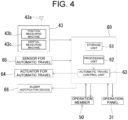
- FIG. 4 is a block diagram illustrating the major configurations related to the automatic travel.
- the positioning unit 43 includes a positioning antenna 43a, a position measuring machine 43b, and an inertial measurement unit (IMU) 43c.
- the positioning antenna 43a receives signals from positioning satellites (GPS satellites, for example) that constitute a satellite positioning system.
- the positioning signal received by the positioning antenna 43a is input to the position measuring machine 43b.
- the position measuring machine 43b measures the position of the own vehicle by signal processing of the input positioning signal.
- the inertial measuring machine 43c identifies the posture (roll angle, pitch angle, and yaw angle) of the traveling machine body 2.
- the rice transplanter 1 includes a control unit 60 for controlling the operation of the traveling machine body 2 (forward movement, backward movement, stopping and turning and the like) and the operation of the planting unit 20, which is a work unit (elevating up and down, driving and stopping and the like.).
- the control unit 60 is constituted by including a CPU, ROM, RAM, I/O, and the like, not shown.
- the CPU can read various programs and the like from the ROM and execute them. Operation programs, application programs, and various data are stored in the ROM.
- the control unit 60 can be operated as a storage unit 61, a processing unit 62, an automatic travel control unit 63, and the like.
- the storage unit 61 stores various kinds of information required for automatic travel of the rice transplanter 1. Such information includes, for example, a horizontal distance from the positioning antenna 43a to the seedling planting mechanism 25, the positions of the first and second reference points set by the operator, and the position of the third reference point described below.
- the processing unit 62 executes various processes required for automatic travel of the rice transplanter 1. Such processes include generation of the reference route and change of the control reference route described below (update of a ridge-adjacent position).
- the automatic travel control unit 63 executes control related to automatic travel.
- the automatic travel control unit 63 controls an actuator 64 for automatic travel so that the rice transplanter 1 travels along a travel route on the basis of the information of the own vehicle position measured by the positioning unit 43.
- the actuator 64 for automatic travel refers to various actuators to be activated during automatic travel, including an actuator for steering the steering handle 32, an actuator for shifting the transmission of the transmission case 8, an actuator for elevating the planting unit 20 up and down (the elevating cylinder 22), and the like.
- the automatic travel control unit 63 controls the operation of the rice transplanter 1 on the basis of the signals from a sensor 65 for automatic travel provided in the rice transplanter 1.
- the rice transplanter 1 includes a buzzer 66 as a notification device.
- the buzzer 66 emits a warning sound (buzzer sound) in response to the control by the control unit 60.
- the buzzer 66 may be included in the operation member 50. It is also possible to configure a notification device using a lamp that gives notification using light, or a combination of a buzzer and a lamp, for example, not limited to a buzzer that gives notification using sound.
- Afield 70 shown in FIG. 5 is divided by a pair of ridges 71, 72 extending in parallel with each other.
- the operator causes the rice transplanter 1 to travel from a ridge adjacent 71a close to one ridge 71 toward a ridge adjacent 72a close to the other ridge 72 in order to generate a reference route SC.
- the A button 53 is operated at the start point A to set the point A.
- the B button 54 is operated at the end point B to set the point B.
- the point A corresponds to the first reference point and the point B corresponds to the second reference point, but these may be vice versa.
- the control unit 60 generates the reference route SC on the basis of the point A and the point B set in advance, and defines a work area 73 on the basis of the points A and B thereof.
- the reference route SC can be identified as a line segment connecting the point A and the point B.
- the work area 73 can be identified as the area sandwiched between a ridge-adjacent position L1, which is acquired as a line segment perpendicular to the reference route SC with respect to the point A, and a ridge-adjacent position L2, which is acquired as a line segment perpendicular to the reference route SC with respect to the point B.
- the lengths of the line segments that constitute the ridge-adjacent positions L1 and L2 are set at predetermined distances (1 km on each side, for example) with the points A and B at the centers, respectively.
- a travel route C1 passing through the own vehicle position and in parallel to the reference route SC is set, and the working direction WD (traveling direction during automatic travel) is identified on the basis of the direction (azimuth) of the vehicle body, and the automatic travel is started.
- the working direction WD is parallel to the reference route SC and can be either downward or upward in FIG. 5 .
- the working direction WD is switched at each turn, but is not limited to this.
- the system is configured such that, when the direction of the vehicle body (front-rear direction) is inclined with respect to the reference route SC, the automatic travel is not started unless the inclination angle is not more than a predetermined value (not more than 15 degrees, for example).
- the travel routes C2, C3... are set in the same manner, and autonomous straight travel is performed along them.
- the points A and B are continuously used until they are erased or reset, so that the plurality of travel routes C1, C2... are parallel to each other.
- a U-turn travel (180-degree turn of direction) is performed by the operator's operation.
- the ridge-adjacent position L1 corresponds to the first control reference position identified on the basis of the first reference point, which is the point A
- the ridge-adjacent position L2 corresponds to the second control reference position identified on the basis of the second reference point, which is the point B.
- the control unit 60 activates the buzzer 66 when the position of the own vehicle approaches the ridge-adjacent position L1 or the ridge-adjacent position L2 when the automatic travel is being performed.
- the control unit 60 causes the buzzer 66 to sound and give notification when the rice transplanter 1 approaches a predetermined distance (8 m, for example) with respect to the ridge-adjacent position L1 or the ridge-adjacent position L2, for example.
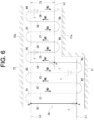
- FIG. 6 shows an example in which the field 70 is a deformed field.
- the ridge 71 is bent so as to narrow the field 70, and accordingly the ridge adjacent 71a has a step. Since the ridge-adjacent position L1 is identified on the basis of the point A set in advance, and the activation of the buzzer 66 is controlled on the basis of the ridge-adjacent position L1 and the ridge-adjacent position L2, the buzzer 66 is not activated even if the rice transplanter 1 reaches the ridge adjacent 71a in the case of the automatic travel along the travel route C5.
- the ridge adjacent has steps or the ridge adjacent is curved in a direction opposite to that in FIG. 6 , and depending on the shape thereof, the buzzer may be activated even when the rice transplanter is not approaching the ridge adjacent.
- the control unit 60 is configured to be capable of changing one of the ridge-adjacent position L1 and the ridge-adjacent position L2 to the third control reference position identified on the basis of the third reference point (point P) different from the first reference point (point A) and the second reference point (point B), and after the change, the buzzer 66 is activated on the basis of the third control reference position instead of one of the ridge-adjacent position L1 and the ridge-adjacent position L2.
- the control unit 60 is configured to be capable of changing one of the ridge-adjacent position L1 and the ridge-adjacent position L2 to the third control reference position either when the automatic travel is being performed or when the automatic travel is not being performed.
- the ridge-adjacent position L1 is updated to a ridge-adjacent position L3.
- the updated ridge-adjacent position L3 is acquired as a line segment perpendicular to the reference route SC with a set point P as the reference.
- the point P corresponds to the third reference point.
- the ridge-adjacent position L3 corresponds to the third control reference position identified on the basis of the third reference point.
- the point P is set in response to a predetermined operation by the operator, and the control reference position is changed accordingly, that is, the ridge-adjacent position is updated
- the activation of the buzzer 66 is controlled on the basis of the ridge-adjacent position L1 and the ridge-adjacent position L2, and after the change, the activation of the buzzer 66 is controlled on the basis of the ridge-adjacent position L3 and the ridge-adjacent position L2.
- the buzzer 66 is appropriately activated when the position of the own vehicle approaches the ridge adjacent 71a in the automatic travel on and after the travel route C5.
- the work area 73 is defined on the basis of the point P and the point B.
- the control unit 60 is configured to change one of the first control reference position and the second control reference position, which is on the rear side of the working direction WD, to the third control reference position when the third reference point is set in the work area 73 when the automatic travel is being performed.
- the control unit 60 is configured such that, while the automatic travel is being performed along the working direction WD with either of the first control reference position and the second control reference position as the starting point, when the third reference point is set in the work area 73, the control unit 60 changes either of the first control reference position and the second control reference position, which is the starting point, to the third control reference position. Since the control reference position can be changed during the automatic travel, the ridge-adjacent position can be updated without interrupting the work.
- the ridge-adjacent position L1 on the rear side of the working direction WD in the pair of ridge-adjacent positions L1 and L2 is changed to the ridge-adjacent position L3.
- the ridge-adjacent position L1 that was the starting point of the travel route C4 in the pair of ridge-adjacent positions L1 and L2 is changed to the ridge-adjacent position L3.
- FIGS. 7(A) to 7(C) schematically show the update patterns of the ridge-adjacent positions in the cases 1 to 3, respectively. Since the case 1 has already been described, the explanation of FIG. 7(A) is omitted.
- the control unit 60 is configured to change one of the first control reference position and the second control reference position, which is closer to the own vehicle position, to the third control reference position when the third reference point is set outside the work area 73. Accordingly, when the point P is set outside the work area 73 as shown in FIG. 7(B) , the ridge-adjacent position L1 closer to the own vehicle position in the pair of ridge-adjacent positions L1 and L2 is changed to the ridge-adjacent position L3, and thereafter the activation of the buzzer 66 is controlled on the basis of the ridge-adjacent position L3 and the ridge-adjacent position L2. Similarly, when the point P is set outside the work area 73 as shown in FIG.
- the ridge-adjacent position L2 closer to the own vehicle position in the pair of ridge-adjacent positions L1 and L2 is changed to the ridge-adjacent position L3, and thereafter the activation of the buzzer 66 is controlled on the basis of the ridge-adjacent position L3 and the ridge-adjacent position L1.
- the control unit 60 changes one of the pair of ridge-adjacent positions L1 and L2, which is on the rear side of the working direction WD (ridge-adjacent position L1), to the ridge-adjacent position L3, and when the point P is set closer to the front side of the working direction WD than the work area 73 as shown in FIG.
- These may be done either when the automatic travel is being performed or when it is not.
- the working direction when the automatic travel is started only needs to be the reference in the same way as when the third reference point is set in the work area 73 described below.
- FIG. 7(D) is different from FIG. 7(A) in that the point P is set when automatic travel is not performed. It is configured such that, when the point P is set in the work area 73 when the automatic travel is not being performed, the control unit 60 identifies the working direction WD in the case where the automatic travel is started, and changes one of the ridge-adjacent position L1 and the ridge-adjacent position L2, which is on the rear side of the working direction WD (the ridge-adjacent position L1), to the ridge-adjacent position L3.
- the working direction WD when the automatic travel is started is the working direction when the automatic travel is assumed to have been started.
- the ridge-adjacent position can be updated without hindrance by using the working direction WD when the automatic travel is started as a reference.
- the updated ridge-adjacent position L3 is defined as a line segment perpendicular to the reference route SC with respect to the point P set after that.
- the ridge-adjacent position L3 can be also identified as a line segment parallel to at least one of the ridge-adjacent position L1 and the ridge-adjacent position L2 when using the point P as a reference, for example.
- the rice transplanter 1 has a function that can adjust the angle of the ridge-adjacent position L1 or the ridge-adjacent position L2, there may be a situation in which the pair of ridge-adjacent positions L1 and L2 are not parallel to each other but in such a case, the ridge-adjacent position L3 can be identified as a line segment parallel to the ridge-adjacent position to be updated.
- the operator can set a third reference point, that is, the point P, by a predetermined operation both when the automatic travel is being performed and when the automatic travel is not being performed. From the viewpoint of simplification of the operation, it is preferable that the setting of the third reference point can be indicated using an indicator for indicating the setting of the first reference point and/or the second reference point.
- the A button 53 can be used to indicate the setting of the point P. When the A button 53 is pressed in a situation where the points A and B are set, the position of the own vehicle at that time is set as the point P.
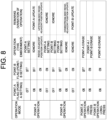
- FIG. 8 is a table showing the relationship between the operation modes of the A button 53 as well las the B button 54 and the operation. Various variations of these operations are possible, as shown in the remarks column of the table.
- the ridge-adjacent position is updated by the point-A operation (pressing operation of the A button 53). Since the processing is executed in accordance with the update pattern shown in FIGs. 7 , it is not necessary to select which of the ridge-adjacent positions L1 and L2 is to be updated. Instead of the point-A operation, the point-B operation (press operation of the B button 54) may be used. Alternatively, both the A button 53 and the B button 54 can be used.
- the ridge-adjacent position on the rear side of the working direction may be updated by the point-A operation in the work area 73
- the ridge-adjacent position on the front side of the working direction may be updated by the point-B operation as well (see the remarks column in FIG. 8 ).
- the system can be updated at both the ridge-adjacent positions L1 and L2 regardless of the direction of the vehicle body.
- FIGS. 9 to 12 are flowcharts showing processes executed by the control unit 60 regarding automatic travel of the rice transplanter 1.
- the rice transplanter 1 when the rice transplanter 1 is turned on, it is "START", and first, the conditions for performing straight-travel assistance work by automatic travel are set (work condition setting process S1). Next, the automatic travel is executed on the basis of the set conditions (automatic travel execution process S2). Thereafter, if a predetermined end condition is satisfied, the automatic travel is terminated, otherwise the automatic travel is continued (automatic travel end /continuation process S3), and these processes S1 to S3 are repeated.
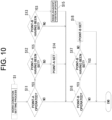
- the point A is set in response to the operation (steps S11, S12 and S14). If the both point A and point B are set when the point-A operation is performed, the ridge-adjacent positions are updated in accordance with the operation (steps S11 to S13 and S15). This means that the third reference point (point P) is set in response to the point-A operation, thereby changing the control reference position. If the point-B operation is performed and the point B has not yet been set, the point B is set in response to the operation (steps S16-18).
- the set points A and B can be erased by long-pressing the A button 53 and the B button 54. Specifically, as shown in FIG. 8 , if the A button 53 is long-pressed in a situation where only the point A is set, the set point A is erased. In addition, if the A button 53 is long-pressed in a situation where both the points A and B have been set, both the set points A and B are erased. If the B button 54 is long-pressed in a situation where both the points A and B have been set, the set point B is erased. As another operation mode, it may be configured such that the points A and B are erased by simultaneously pressing the A button 53 and the B button 54.
- the reference route SC is generated on the basis of the set points A and B, and the ridge-adjacent positions L1 and L2 are identified (steps S21 to S24). If the positioning state of the positioning unit 43 is good, automatic travel is permitted by the control unit 60 (step S25). When start of automatic travel is instructed by the ON operation of the AUTO button 51, a travel route is set and automatic travel is started along the travel route (steps S26 to S28). On the other hand, if the automatic travel is in progress at step S21, the buzzer 66 is activated to execute notification based on the ridge-adjacent position that has been identified (step S29).
- step S31 and S32 it is determined whether or not a predetermined end condition is satisfied during the automatic travel.
- the end condition of the automatic travel is satisfied, for example, when the end of the automatic travel is instructed by the OFF operation of the AUTO button 51, or when it is determined that the positioning state of the positioning unit 43 is not satisfactory to such an extent that the automatic travel cannot be continued. If the end condition is satisfied, the automatic travel is terminated; otherwise, the automatic travel is continued (steps S32 to S34).
Landscapes
- Engineering & Computer Science (AREA)
- Life Sciences & Earth Sciences (AREA)
- Radar, Positioning & Navigation (AREA)
- Remote Sensing (AREA)
- General Physics & Mathematics (AREA)
- Aviation & Aerospace Engineering (AREA)
- Physics & Mathematics (AREA)
- Automation & Control Theory (AREA)
- Environmental Sciences (AREA)
- Soil Sciences (AREA)
- Mechanical Engineering (AREA)
- Guiding Agricultural Machines (AREA)
- Control Of Position, Course, Altitude, Or Attitude Of Moving Bodies (AREA)
Description
- The present invention relates to a work vehicle that executes notification when approaching a ridge-adjacent position in automatic travel.
- Conventionally, work vehicles such as rice transplanters that automatically travel straight forward in a field using a satellite positioning system are known. Such a work vehicle performs autonomous straightforward travel along a linear travel route that is set parallel to a reference route. The reference route is generated on the basis of a set of reference points called point A and point B. In general, the point A and the point B are set as the positions between ridge-adjacent positions in the field so that automatic travel can be performed extensively in the field
- Also, as described in
Patent Literatures 1 to 3, it is known that a work vehicle executes notification by a buzzer or the like just before the automatic travel is terminated. This allows an operator to be informed in advance that the work vehicle will reach the ridge-adjacent positions. Upon receiving the notification, the operator prepares himself/herself for stop or switches to manual travel. - In a deformed field that is not a simple rectangle, such a situation may occur that the notification is made even if the work vehicle is not approaching the ridge-adjacent position, or that the notification is not made even when the work vehicle is approaching the ridge-adjacent position. Therefore, in a deformed field, the ridge-adjacent position should be updated by erasing and re-setting the point A and the point B each time so that the notification during the automatic travel is made appropriately, which had nonconformity that a complicated operation was forced.
Patent Literature 4 discloses a work vehicle capable of preventing a reference position for a rectilinear travel from being acquired due to an improper operation and curtailing increase of the quantity of components,Patent Literature 5 relates to a path generation device comprising a path generation unit and a control unit.Patent Literature 6 describes a work vehicle capable of preventing a reference position for a rectilinear travel from being acquired due to an improper operation and curtailing increase of the quantity of components, andPatent Literature 7 discloses a parallel operation work vehicle for enabling operation of an autonomous work vehicle by a long distance operating device installed in an accompanying work vehicle for performing work while accompanying the autonomous work vehicle. -
- Patent Document 1:
Japanese Unexamined Patent Application Publication No. 3-135608 - Patent Document 2:
Japanese Unexamined Patent Application Publication No. 2013-74815 - Patent Literature 3:
Japanese Unexamined Patent Application Publication No. 2004-337031 - Patent Literature 4:
JP 2018-093861 A - Patent Literature 5 :
WO 2017/169373 (A1 ) - Patent Literature 6 :
JP 2018-093793 (A - Patent Literature 7 :
US 2017/079195 (A1 ) - The present invention was made in consideration of the above problem, and its object is to provide a work vehicle capable of flexibly updating the ridge-adjacent position, and capable of appropriately executing notification during automatic travel even in a deformed field.
- A work vehicle according to the present invention is a work vehicle configured to be capable of automatic travel along a travel route that is set parallel to a reference route generated on the basis of a first reference point and a second reference point set in advance, while identifying an own vehicle position thereof using a satellite positioning system, including a control unit that activates a notification device if the own vehicle position approaches a first control reference position identified on the basis of the first reference point or a second control reference position identified on the basis of the second reference point when the automatic t ravel is being performed, the control unit is configured to be capable of changing one of the first control reference position and the second control reference position to a third control reference position identified on the basis of a third reference point which is different from the first reference point and the second reference point, and after the change, the notification device is activated on the basis of the third control reference position instead of one of the first control reference position and the second control reference position.
- According to such a configuration, after setting the first reference point (one of the point A and the point B) and the second reference point (the other of the point A and the point B), the first control reference position or the second control reference position identified on the basis of them can be changed to the third control reference position after that. After the change, the activation of the notification device is controlled on the basis of the third control reference position instead of the first control reference position or the second control reference position. Therefore, it is possible to update the ridge-adjacent position flexibly, and to properly execute the notification during automatic travel even in a deformed field.
- The control unit is preferably configured to be capable of changing one of the first control reference position and the second control reference position to the third control reference position, both when the automatic travel is being performed and when the automatic travel is not being performed. Since the control reference position can be changed when the automatic travel is being performed, the ridge-adjacent position can be updated without interrupting the work. In addition, since the control reference position can be changed when the automatic travel is not performed, it is possible, for example, to update the ridge-adjacent position after moving to the exact ridge-adjacent position by manual travel.
- The control unit is preferably configured to change one of the first control reference position and the second control reference position, which is on a rear side of a working direction, to the third control reference position, when the third reference point is set in a work area defined on the basis of the first reference point and the second reference point while the automatic travel is being performed. According to such a configuration, it is not necessary to select which control reference position is to be changed, and it is possible to update the ridge-adjacent position in accordance with an intention of the operator in the work area.
- The control unit is preferably configured to identify the working direction when automatic travel is started and to change one of the first control reference position and the second control reference position, which is on the rear side of the working direction, to the third control reference position when the third reference point is set in the work area defined on the basis of the first reference point and the second reference point while automatic travel is not being performed. According to such a configuration, the control reference position is appropriately changed even when the automatic travel is not being performed. Moreover, there is no need to select which control reference position is to be changed, and the ridge-adjacent position can be updated in accordance with the user's intention.
- The control unit is preferably configured to change one of the first control reference position and the second control reference position, which is closer to the own vehicle position, to the third control reference position when the third reference point is set outside the work area defined on the basis of the first reference point and the second reference point. According to such a configuration, it is not necessary to select which control reference position is to be changed, and it is possible to update the ridge-adjacent position outside the work area in accordance with the intention of the operator.
-
- [
FIG. 1 ] A left side view of a rice transplanter, which is an example of a work vehicle according to the present invention. - [
FIG. 2 ] A perspective view of a driving operation unit seen from the left front. - [
FIG. 3 ] A view of an operation surface of an operation member. - [
FIG. 4 ] A block diagram showing main configurations related to automatic travel. - [
FIG. 5 ] A schematic diagram of an example of a travel route in automatic travel in a field. - [
FIG. 6 ] A schematic diagram of an example of the travel route in the automatic travel in a deformed field. - [
FIG. 7 ] Schematic diagrams of update patterns of a ridge-adjacent position. - [
FIG. 8 ] A table showing a relationship between an operation modes and operations of an A button and a B button. - [
FIG. 9 ] A flowchart showing a process of a control unit regarding the automatic travel. - [
FIG. 10 ] A flowchart showing a work condition setting process. - [
FIG. 11 ] A flowchart showing an automatic travel execution process. - [
FIG. 12 ] A flowchart showing a process of ending / continuing automatic travel. - An embodiment of the present invention will be described with reference to the drawings. This embodiment shows an example of an automatic travel system that causes a passenger-type rice transplanter to perform automatic travel, an example of a work vehicle, while identifying a vehicle position using a satellite positioning system. The work vehicle is not limited to a rice transplanter, but may be, for example, a tractor, a combine harvester, a seedling transplanter, or any other agricultural work vehicle. Alternatively, it may be a civil engineering and construction vehicle or a snowplow.
- First, the overall structure of the rice transplanter will be briefly explained. In
FIG. 1 , a front-rear direction and an up-and-down direction of therice transplanter 1 are indicated by arrows, and the direction perpendicular to the paper surface is a left-right direction. Therice transplanter 1 has atraveling unit 10 and aplanting unit 20 as a working portion. Theplanting unit 20 is disposed behind thetraveling unit 10. Theplanting unit 20 is connected to a rear part of thetraveling unit 10, capable of elevation via anelevating mechanism 21. Therice transplanter 1 is configured to perform a seedling planting (rice planting) operation in which seedlings are planted by theplanting unit 20 while traveling in a field by thetraveling unit 10. - The traveling
unit 10 has atraveling machine body 2, a pair of left and rightfront wheels 3 supporting thetraveling machine body 2, and also a pair of left and rightrear wheels 4. Thefront wheels 3 are mounted on front axles extending from afront axle case 5 to both right and left sides. Thefront axle case 5 is provided on the side of atransmission case 8 and is supported at a front part of the travelingmachine body 2. Therear wheels 4 are mounted on rear axles extending from arear axle case 6 to both right and left sides. Therear axle case 6 is provided at a rear end of atubular frame 9 projecting rearwardly from thetransmission case 8 and is supported at the rear part of the travelingmachine body 2. - An
engine 7, which is a drive source, is mounted at the front part of the travelingmachine body 2. Theengine 7 is covered by abonnet 11. The power of theengine 7 is transmitted to atransmission case 8 disposed behind theengine 7, and is transmitted to thefront wheels 3 and therear wheels 4 through thetransmission case 8. By transmitting power to thefront wheels 3 and therear wheels 4 to rotate / drive them, the travelingunit 10 can travel in the front-rear direction. - A
link frame 17 is provided upright at the rear end of the travelingmachine body 2. Theplanting unit 20 is connected to thelink frame 17, capable of elevation, via the elevatingmechanism 21. The elevatingmechanism 21 has alower link 21a and atop link 21b. A rod end of a hydraulic elevatingcylinder 22 is connected to thelower link 21a. A cylinder base end of the elevatingcylinder 22 is supported vertically rotatably at the rear part of the upper surface of thetubular frame 9. It is configured such that, by extending / retracting the elevatingcylinder 22, the elevatingmechanism 21 is rotated in the vertical direction, and theplanting unit 20 is elevated up and down. - The
planting unit 20 includes aplanting input case 23 to which power is transmitted from theengine 7 via thetransmission case 8 and a PTO shaft (power transmission shaft) 18, a plurality of plantingtransmission cases 24 connected to theplanting input case 23, aseedling planting mechanism 25 provided at the rear end side of eachplanting transmission case 24, and a seedling loading table 26 on which seedling mats are placed. Reserve seedlings to be supplied to theplanting unit 20 for seedling refill (seedling replenishment) are placed on reserve seedling stands 15 disposed on both left and right sides of thebonnet 11. Thereserve seedling stand 15 is supported on a support frame 16 (reserve seedling support) provided upright on both the left and right sides of the front part of the travelingmachine body 2. - The
seedling planting mechanism 25 includes arotary case 28 having two plantingclaws rotary case 28, the twoplanting claws rice transplanter 1 of this embodiment is an eight-row planting rice transplanter, it includes four sets of plantingtransmission cases 24 for eight-row planting (two rows forming one set), and the seedling loading table 26 is also configured for eight-row planting However, therice transplanter 1 is not limited thereto, and may be, for example, a six-row or ten-row rice transplanter. -
Side markers 29 are provided on the left and right outer sides of theplanting unit 20, respectively. Theside marker 29 has amarker wheel body 29w for drawing lines and amarker arm 29a that rotatably supports themarker wheel body 29w. A base end of themarker arm 29a is supported at the left and right outer sides of theplanting unit 20 rotatably in the left and right directions. Theside marker 29 is configured to be displaceable between a landing posture, in which themarker wheel body 29w is lowered to form a reference trajectory on the rice field for the next process, and a non-landing posture (seeFIG. 1 ), in which themarker wheel body 29w is raised to move away from the rice field. - At the center of the traveling
machine body 2 in the front-rear direction, a drivingoperation unit 30 is provided. The operator boards a work step 12 (body cover) provided on the upper surface side of the travelingmachine body 2 and operates therice transplanter 1 at the drivingoperation unit 30. Anoperation panel 31 is provided at the front part of the drivingoperation unit 30. Theoperation panel 31 is disposed on the rear upper surface side of thebonnet 11. Aplurality of operating tools, including asteering wheel 32 and amain gearshift lever 33, are disposed on theoperation panel 31. A driver'sseat 14 is disposed behind theoperation panel 31 via aseat frame 13. - On both the left and right sides of the
bonnet 11, a plurality of (four in this embodiment) reserve seedling stands 15 are supported by a pair of support frames 16, 16 spaced apart in the front-rear direction. A connectingframe 40 having a substantial L-shape on a side view is connected to upper ends of the pair of support frames 16, 16. Aunit frame 42 is connected to an upper end of the connectingframe 40 via anintermediate frame 41 extending in the up-and-down direction. Theunit frame 42 is connected rotatably to the upper parts of the left and right intermediate frames 41. Apositioning unit 43 as a positioning unit is fixed to theunit frame 42. - The
positioning unit 43 receives positioning signals from a satellite positioning system (GNSS) and identifies the vehicle's position on the basis of the positioning signals. For example, DGPS (Differential GPS) is used as the satellite positioning system. According to this, position information of the rice transplanter 1 (mobile station) is corrected by correction information from a base station installed at a predetermined point, and the own vehicle position of therice transplanter 1 can be identified with high accuracy. Not limited to DGPS, satellite positioning systems such as RTK (Real Time Kinematic) and SBAS (Geostationary Satellite Augmentation System) can also be used. - Next, the driving
operation unit 30 will be described. As shown inFIG. 2 , various operating tools including thesteering wheel 32 and adisplay device 34 are disposed on theoperation panel 31. Thesteering wheel 32 is provided in front of the driver'sseat 14. A gearshift pedal and a brake pedal, not shown, are installed below theoperation panel 31. The gearshift pedal is an operating tool for changing a vehicle speed of therice transplanter 1. The brake pedal is an operating tool for braking therice transplanter 1. Generally, the gearshift pedal is disposed at lower right of theoperation panel 31, and the brake pedal is disposed on the left of the gearshift pedal. - The
rice transplanter 1 includes anoperation member 50 for performing operations related to automatic travel and anarm member 35 supporting theoperation member 50. Thearm member 35 has a stay-likeupper arm 35a fixed to the support frames 16, 16, aforearm 35c which rotates horizontally with respect to theupper arm 35a with ahinge 35b as a fulcrum, and aholder 35e which rotates horizontally with respect to theforearm 35c with ahinge 35d as a fulcrum. Theoperation member 50 is attached to theholder 35e. At both ends of theforearm 35c,elbow portions elbow portion 35f may be configured to be rotatable in the up-and-down direction via a hinge. Theoperation member 50 held in theholder 35e can be moved in a movable range of thearm member 35. - As shown in
FIG. 3 , theoperation member 50 includes anAUTO button 51, which is an indicator for instructing start of automatic travel, anA button 53, which is an indicator for instructing setting of the point A, which is a start point of a reference route, and aB button 54, which is an indicator for instructing the setting of the point B, which is an end point of the reference route. TheAUTO button 51 is disposed at the center of anoperation surface 50f of theoperation member 50. TheA button 53 and theB button 54 are disposed side by side on the left and right below theAUTO button 51. Anindicator lamp 52 indicating a positioning state of thepositioning unit 43 is disposed at upper left of theAUTO button 51. - The
AUTO button 51 is operated when starting and stopping automatic travel. Since theAUTO button 51 is operated more frequently than theA button 53 and theB button 54, it is formed larger on a front view than theA button 53 and theB button 54 so that it can be easily pressed and operated. In addition, theAUTO button 51 protrudes larger than theA button 53 and theB button 54. TheA button 53 and theB button 54 are the buttons having the same shape and are disposed symmetrically. A ring-shaped light-emittingportion 55 is provided around theAUTO button 51. Thelight emitting portion 55 has a function of informing the operator of various states related to automatic travel by its light color and lighting pattern. - In the present embodiment, the
operation member 50 for performing operations related to automatic travel is provided independently of theoperation panel 31. According to such a configuration, there is no need to modify theoperation panel 31 when an automatic travel system is additionally installed in an existing rice transplanter, which is convenient. However, it is not limited thereto, and it is also possible to incorporate and provide an operation member for performing operations related to automatic travel in theoperation panel 31. - The
rice transplanter 1 is configured to be capable of performing automatic travel along a travel route that is set parallel to a reference route generated on the basis of a preset first reference point (one of the point A and the point B) and a second reference point (the other of points A and B) while identifying an own vehicle position thereof using a satellite positioning system. For straight-travel assistance work by automatic travel, operations of setting a start point of a reference route, called point A, setting an end point of the reference route, called point B, and turning on (start) / off (stop) the automatic travel via theoperation member 50 are needed. -
FIG. 4 is a block diagram illustrating the major configurations related to the automatic travel. Thepositioning unit 43 includes apositioning antenna 43a, aposition measuring machine 43b, and an inertial measurement unit (IMU) 43c. Thepositioning antenna 43a receives signals from positioning satellites (GPS satellites, for example) that constitute a satellite positioning system. The positioning signal received by thepositioning antenna 43a is input to theposition measuring machine 43b. Theposition measuring machine 43b measures the position of the own vehicle by signal processing of the input positioning signal. Theinertial measuring machine 43c identifies the posture (roll angle, pitch angle, and yaw angle) of the travelingmachine body 2. - The
rice transplanter 1 includes acontrol unit 60 for controlling the operation of the traveling machine body 2 (forward movement, backward movement, stopping and turning and the like) and the operation of theplanting unit 20, which is a work unit (elevating up and down, driving and stopping and the like.). Thecontrol unit 60 is constituted by including a CPU, ROM, RAM, I/O, and the like, not shown. The CPU can read various programs and the like from the ROM and execute them. Operation programs, application programs, and various data are stored in the ROM. By collaborating such hardware and software, thecontrol unit 60 can be operated as astorage unit 61, aprocessing unit 62, an automatictravel control unit 63, and the like. - The
storage unit 61 stores various kinds of information required for automatic travel of therice transplanter 1. Such information includes, for example, a horizontal distance from thepositioning antenna 43a to theseedling planting mechanism 25, the positions of the first and second reference points set by the operator, and the position of the third reference point described below. Theprocessing unit 62 executes various processes required for automatic travel of therice transplanter 1. Such processes include generation of the reference route and change of the control reference route described below (update of a ridge-adjacent position). The automatictravel control unit 63 executes control related to automatic travel. - The automatic
travel control unit 63 controls anactuator 64 for automatic travel so that therice transplanter 1 travels along a travel route on the basis of the information of the own vehicle position measured by thepositioning unit 43. Theactuator 64 for automatic travel refers to various actuators to be activated during automatic travel, including an actuator for steering thesteering handle 32, an actuator for shifting the transmission of thetransmission case 8, an actuator for elevating theplanting unit 20 up and down (the elevating cylinder 22), and the like. The automatictravel control unit 63 controls the operation of therice transplanter 1 on the basis of the signals from asensor 65 for automatic travel provided in therice transplanter 1. - The
rice transplanter 1 includes abuzzer 66 as a notification device. Thebuzzer 66 emits a warning sound (buzzer sound) in response to the control by thecontrol unit 60. Thebuzzer 66 may be included in theoperation member 50. It is also possible to configure a notification device using a lamp that gives notification using light, or a combination of a buzzer and a lamp, for example, not limited to a buzzer that gives notification using sound. - Afield 70 shown in
FIG. 5 is divided by a pair ofridges rice transplanter 1 to travel from a ridge adjacent 71a close to oneridge 71 toward a ridge adjacent 72a close to theother ridge 72 in order to generate a reference route SC. At that time, theA button 53 is operated at the start point A to set the point A. Also, theB button 54 is operated at the end point B to set the point B. In this embodiment, it is described that the point A corresponds to the first reference point and the point B corresponds to the second reference point, but these may be vice versa. - The
control unit 60 generates the reference route SC on the basis of the point A and the point B set in advance, and defines awork area 73 on the basis of the points A and B thereof. The reference route SC can be identified as a line segment connecting the point A and the point B. Thework area 73 can be identified as the area sandwiched between a ridge-adjacent position L1, which is acquired as a line segment perpendicular to the reference route SC with respect to the point A, and a ridge-adjacent position L2, which is acquired as a line segment perpendicular to the reference route SC with respect to the point B. The lengths of the line segments that constitute the ridge-adjacent positions L1 and L2 are set at predetermined distances (1 km on each side, for example) with the points A and B at the centers, respectively. - After generating the reference route SC, when the
AUTO button 51 is pressed, a travel route C1 passing through the own vehicle position and in parallel to the reference route SC is set, and the working direction WD (traveling direction during automatic travel) is identified on the basis of the direction (azimuth) of the vehicle body, and the automatic travel is started. The working direction WD is parallel to the reference route SC and can be either downward or upward inFIG. 5 . The working direction WD is switched at each turn, but is not limited to this. The system is configured such that, when the direction of the vehicle body (front-rear direction) is inclined with respect to the reference route SC, the automatic travel is not started unless the inclination angle is not more than a predetermined value (not more than 15 degrees, for example). - Thereafter, the travel routes C2, C3... are set in the same manner, and autonomous straight travel is performed along them. Once set, the points A and B are continuously used until they are erased or reset, so that the plurality of travel routes C1, C2... are parallel to each other. In an arc-shaped turning routes R1, R2, ... which connect the ends of the travel routes C1, C2, ... to each other, a U-turn travel (180-degree turn of direction) is performed by the operator's operation. However, it is not limited thereto and may be configured such that the autonomous U-turn travel can be performed.
- The ridge-adjacent position L1 corresponds to the first control reference position identified on the basis of the first reference point, which is the point A, and the ridge-adjacent position L2 corresponds to the second control reference position identified on the basis of the second reference point, which is the point B. The
control unit 60 activates thebuzzer 66 when the position of the own vehicle approaches the ridge-adjacent position L1 or the ridge-adjacent position L2 when the automatic travel is being performed. Thecontrol unit 60 causes thebuzzer 66 to sound and give notification when therice transplanter 1 approaches a predetermined distance (8 m, for example) with respect to the ridge-adjacent position L1 or the ridge-adjacent position L2, for example. If the gearshift pedal is pressed even when the ridge-adjacent positions L1, L2 are reached, the automatic travel is continued. While the function of traveling at a constant speed without stepping on the gearshift pedal is active, it is desirable to control to stop therice transplanter 1 or to stop theengine 7 when therice transplanter 1 reaches the ridge-adjacent positions L1, L2. -
FIG. 6 shows an example in which thefield 70 is a deformed field. InFIG. 6 , theridge 71 is bent so as to narrow thefield 70, and accordingly the ridge adjacent 71a has a step. Since the ridge-adjacent position L1 is identified on the basis of the point A set in advance, and the activation of thebuzzer 66 is controlled on the basis of the ridge-adjacent position L1 and the ridge-adjacent position L2, thebuzzer 66 is not activated even if therice transplanter 1 reaches the ridge adjacent 71a in the case of the automatic travel along the travel route C5. In addition, there are deformed fields where the ridge adjacent has steps or the ridge adjacent is curved in a direction opposite to that inFIG. 6 , and depending on the shape thereof, the buzzer may be activated even when the rice transplanter is not approaching the ridge adjacent. - In the past, in order to ensure that the notification is properly executed, the points A and B must be erased once after traveling on the travel route C4, and the points A and B must be reset while traveling manually on the travel route C5 so as to update the ridge-adjacent position. However, such a complicated operation is inconvenient for the operator. In addition, whether or not the parallelism of the travel route is properly maintained before and after the update of the ridge-adjacent positions tends to depend on the skill of the operator. If the operator is an unskilled person, there is a risk that the travel routes C5 to C7 may be set with inclination to the travel routes C1 to C4.
- Therefore, with this
rice transplanter 1, thecontrol unit 60 is configured to be capable of changing one of the ridge-adjacent position L1 and the ridge-adjacent position L2 to the third control reference position identified on the basis of the third reference point (point P) different from the first reference point (point A) and the second reference point (point B), and after the change, thebuzzer 66 is activated on the basis of the third control reference position instead of one of the ridge-adjacent position L1 and the ridge-adjacent position L2. In addition, thecontrol unit 60 is configured to be capable of changing one of the ridge-adjacent position L1 and the ridge-adjacent position L2 to the third control reference position either when the automatic travel is being performed or when the automatic travel is not being performed. - In
FIG. 6 , the ridge-adjacent position L1 is updated to a ridge-adjacent position L3. The updated ridge-adjacent position L3 is acquired as a line segment perpendicular to the reference route SC with a set point P as the reference. The point P corresponds to the third reference point. The ridge-adjacent position L3 corresponds to the third control reference position identified on the basis of the third reference point. The point P is set in response to a predetermined operation by the operator, and the control reference position is changed accordingly, that is, the ridge-adjacent position is updated Before the change, the activation of thebuzzer 66 is controlled on the basis of the ridge-adjacent position L1 and the ridge-adjacent position L2, and after the change, the activation of thebuzzer 66 is controlled on the basis of the ridge-adjacent position L3 and the ridge-adjacent position L2. For this reason, thebuzzer 66 is appropriately activated when the position of the own vehicle approaches the ridge adjacent 71a in the automatic travel on and after the travel route C5. After the update, thework area 73 is defined on the basis of the point P and the point B. - The
control unit 60 is configured to change one of the first control reference position and the second control reference position, which is on the rear side of the working direction WD, to the third control reference position when the third reference point is set in thework area 73 when the automatic travel is being performed. In other words, thecontrol unit 60 is configured such that, while the automatic travel is being performed along the working direction WD with either of the first control reference position and the second control reference position as the starting point, when the third reference point is set in thework area 73, thecontrol unit 60 changes either of the first control reference position and the second control reference position, which is the starting point, to the third control reference position. Since the control reference position can be changed during the automatic travel, the ridge-adjacent position can be updated without interrupting the work. - Accordingly, as shown in
FIG. 6 , when the point P, which is the third reference point, is set in thework area 73 during the automatic travel along the travel route C4, the ridge-adjacent position L1 on the rear side of the working direction WD in the pair of ridge-adjacent positions L1 and L2 is changed to the ridge-adjacent position L3. In other words, the ridge-adjacent position L1 that was the starting point of the travel route C4 in the pair of ridge-adjacent positions L1 and L2 is changed to the ridge-adjacent position L3. This eliminates the need for the operator to select which control reference position to change, that is, the ridge-adjacent position L1 or the ridge-adjacent position L2. Such update patterns are easy to understand sensually, and the update of the ridge-adjacent position in accordance with the intention of the operator is possible. - There are two possible situations when the third reference point is to be set, or in other words, when the ridge-adjacent position is to be updated, that is, when the
rice transplanter 1 is inside the work area 73 (case 1), and when therice transplanter 1 is outside thework area 73. Furthermore, the latter may include a case in which thework area 73 is on the front side of the rice transplanter 1 (case 2) and a case in which thework area 73 is on the rear side of the rice transplanter 1 (case 3).FIGS. 7(A) to 7(C) schematically show the update patterns of the ridge-adjacent positions in thecases 1 to 3, respectively. Since thecase 1 has already been described, the explanation ofFIG. 7(A) is omitted. - The
control unit 60 is configured to change one of the first control reference position and the second control reference position, which is closer to the own vehicle position, to the third control reference position when the third reference point is set outside thework area 73. Accordingly, when the point P is set outside thework area 73 as shown inFIG. 7(B) , the ridge-adjacent position L1 closer to the own vehicle position in the pair of ridge-adjacent positions L1 and L2 is changed to the ridge-adjacent position L3, and thereafter the activation of thebuzzer 66 is controlled on the basis of the ridge-adjacent position L3 and the ridge-adjacent position L2. Similarly, when the point P is set outside thework area 73 as shown inFIG. 7(C) , the ridge-adjacent position L2 closer to the own vehicle position in the pair of ridge-adjacent positions L1 and L2 is changed to the ridge-adjacent position L3, and thereafter the activation of thebuzzer 66 is controlled on the basis of the ridge-adjacent position L3 and the ridge-adjacent position L1. - In other words, it is configured such that, when the point P is set closer to the rear side of the working direction WD than the
work area 73 as shown inFIG. 7(B) , thecontrol unit 60 changes one of the pair of ridge-adjacent positions L1 and L2, which is on the rear side of the working direction WD (ridge-adjacent position L1), to the ridge-adjacent position L3, and when the point P is set closer to the front side of the working direction WD than thework area 73 as shown inFIG. 7(C) , one of the pair of the ridge-adjacent positions L1 and L2, which is on the front side of the working direction WD (ridge-adjacent position L2), is changed to the ridge-adjacent position L3. These may be done either when the automatic travel is being performed or when it is not. When automatic travel is not being performed, the working direction when the automatic travel is started only needs to be the reference in the same way as when the third reference point is set in thework area 73 described below. -
FIG. 7(D) is different fromFIG. 7(A) in that the point P is set when automatic travel is not performed. It is configured such that, when the point P is set in thework area 73 when the automatic travel is not being performed, thecontrol unit 60 identifies the working direction WD in the case where the automatic travel is started, and changes one of the ridge-adjacent position L1 and the ridge-adjacent position L2, which is on the rear side of the working direction WD (the ridge-adjacent position L1), to the ridge-adjacent position L3. The working direction WD when the automatic travel is started is the working direction when the automatic travel is assumed to have been started. Although the working direction is not determined when the automatic travel is not being performed, such as during stop and during manual travel, the ridge-adjacent position can be updated without hindrance by using the working direction WD when the automatic travel is started as a reference. - As previously described, the updated ridge-adjacent position L3 is defined as a line segment perpendicular to the reference route SC with respect to the point P set after that. Not limited to this, the ridge-adjacent position L3 can be also identified as a line segment parallel to at least one of the ridge-adjacent position L1 and the ridge-adjacent position L2 when using the point P as a reference, for example. If the
rice transplanter 1 has a function that can adjust the angle of the ridge-adjacent position L1 or the ridge-adjacent position L2, there may be a situation in which the pair of ridge-adjacent positions L1 and L2 are not parallel to each other but in such a case, the ridge-adjacent position L3 can be identified as a line segment parallel to the ridge-adjacent position to be updated. - The operator can set a third reference point, that is, the point P, by a predetermined operation both when the automatic travel is being performed and when the automatic travel is not being performed. From the viewpoint of simplification of the operation, it is preferable that the setting of the third reference point can be indicated using an indicator for indicating the setting of the first reference point and/or the second reference point. In this embodiment, the
A button 53 can be used to indicate the setting of the point P. When theA button 53 is pressed in a situation where the points A and B are set, the position of the own vehicle at that time is set as the point P.FIG. 8 is a table showing the relationship between the operation modes of theA button 53 as well las theB button 54 and the operation. Various variations of these operations are possible, as shown in the remarks column of the table. - As shown in
FIG. 8 , in this embodiment, the ridge-adjacent position is updated by the point-A operation (pressing operation of the A button 53). Since the processing is executed in accordance with the update pattern shown inFIGs. 7 , it is not necessary to select which of the ridge-adjacent positions L1 and L2 is to be updated. Instead of the point-A operation, the point-B operation (press operation of the B button 54) may be used. Alternatively, both theA button 53 and theB button 54 can be used. For example, the ridge-adjacent position on the rear side of the working direction (upstream side of the traveling direction) may be updated by the point-A operation in thework area 73, and the ridge-adjacent position on the front side of the working direction (downstream side of the traveling direction) may be updated by the point-B operation as well (see the remarks column inFIG. 8 ). According to such a configuration, the system can be updated at both the ridge-adjacent positions L1 and L2 regardless of the direction of the vehicle body. -
FIGS. 9 to 12 are flowcharts showing processes executed by thecontrol unit 60 regarding automatic travel of therice transplanter 1. As shown inFIG. 9 , when therice transplanter 1 is turned on, it is "START", and first, the conditions for performing straight-travel assistance work by automatic travel are set (work condition setting process S1). Next, the automatic travel is executed on the basis of the set conditions (automatic travel execution process S2). Thereafter, if a predetermined end condition is satisfied, the automatic travel is terminated, otherwise the automatic travel is continued (automatic travel end /continuation process S3), and these processes S1 to S3 are repeated. - As shown in
FIG. 10 , in the work condition setting process S1, when the point-A operation is performed, if the point A has not yet been set, the point A is set in response to the operation (steps S11, S12 and S14). If the both point A and point B are set when the point-A operation is performed, the ridge-adjacent positions are updated in accordance with the operation (steps S11 to S13 and S15). This means that the third reference point (point P) is set in response to the point-A operation, thereby changing the control reference position. If the point-B operation is performed and the point B has not yet been set, the point B is set in response to the operation (steps S16-18). - Although not shown in
FIG. 10 , the set points A and B can be erased by long-pressing theA button 53 and theB button 54. Specifically, as shown inFIG. 8 , if theA button 53 is long-pressed in a situation where only the point A is set, the set point A is erased. In addition, if theA button 53 is long-pressed in a situation where both the points A and B have been set, both the set points A and B are erased. If theB button 54 is long-pressed in a situation where both the points A and B have been set, the set point B is erased. As another operation mode, it may be configured such that the points A and B are erased by simultaneously pressing theA button 53 and theB button 54. - As shown in
FIG. 11 , in the automatic travel execution process S2, when automatic travel is not being performed and the points A and B have already been set, the reference route SC is generated on the basis of the set points A and B, and the ridge-adjacent positions L1 and L2 are identified (steps S21 to S24). If the positioning state of thepositioning unit 43 is good, automatic travel is permitted by the control unit 60 (step S25). When start of automatic travel is instructed by the ON operation of theAUTO button 51, a travel route is set and automatic travel is started along the travel route (steps S26 to S28). On the other hand, if the automatic travel is in progress at step S21, thebuzzer 66 is activated to execute notification based on the ridge-adjacent position that has been identified (step S29). - As shown in
FIG. 12 , in the automatic travel end / continuation process S3, it is determined whether or not a predetermined end condition is satisfied during the automatic travel (steps S31 and S32). The end condition of the automatic travel is satisfied, for example, when the end of the automatic travel is instructed by the OFF operation of theAUTO button 51, or when it is determined that the positioning state of thepositioning unit 43 is not satisfactory to such an extent that the automatic travel cannot be continued. If the end condition is satisfied, the automatic travel is terminated; otherwise, the automatic travel is continued (steps S32 to S34). - The present invention is not limited to the above-described embodiment in any way, and various improvements and changes can be made within the scope of the subject-matter of the appended claims.
-
- 1 Rice transplanter (an example of work vehicle)
- 51 AUTO button
- 53 A button
- 54 B button
- 60 Control unit
- 66 Buzzer (an example of a notification device)
- 73 Work area
- L1 Ridge-adjacent position (first control reference position)
- L2 Ridge-adjacent position (second control reference position)
- L3 Ridge-adjacent (third control reference position)
- SC Reference route
Claims (5)
- A work vehicle (1) capable of automatic travel along a travel route that is set parallel to a reference route generated on the basis of a first reference point and a second reference point set in advance, while identifying an own vehicle position thereof using a satellite positioning system, comprising:a control unit (60) that is configured to activate a notification device, if the own vehicle position approaches a first control reference position identified on the basis of the first reference point (A) or a second control reference position identified on the basis of the second reference point (B) when the automatic travel is being performed, characterized in thatthe control unit (60) is configured to change one of the first control reference position and the second control reference position to a third control reference position identified on the basis of a third reference point which is different from the first reference point (A) and the second reference point (B), andafter the change, the notification device is activated on the basis of the third control reference position instead of one of the first control reference position and the second control reference position.
- The work vehicle (1) according to claim 1, wherein the control unit (60) is capable of changing one of the first control reference position and the second control reference position to the third control reference position, both when the automatic travel is being performed and when the automatic travel is not being performed.
- The work vehicle (1) according to claim 1 or 2, wherein the control unit (60) is configured to change one of the first control reference position and the second control reference position, which is on a rear side of a working direction, to the third control reference position when the third reference point is set in a work area (73) defined on the basis of the first reference point (A) and the second reference point (B) while the automatic travel is being performed.
- The work vehicle (1) according to any one of claims 1 to 3, wherein the control unit (60) is configured to identify a working direction when the automatic travel is started and changes one of the first control reference position and the second control reference position, which is on a rear side of the working direction, to the third control reference position when the third reference point is set in a work area defined on the basis of the first reference point (A) and the second reference point (B) while the automatic travel is not being performed.
- The work vehicle (1) according to any one of claims 1 to 4, wherein the control unit (60) is configured to change one of the first control reference position and the second control reference position, which is closer to the own vehicle position, to the third control reference position when the third reference point is set outside a work area (73) defined on the basis of the first reference point (A) and the second reference point (B).
Applications Claiming Priority (2)
| Application Number | Priority Date | Filing Date | Title |
|---|---|---|---|
| JP2019036669A JP7146671B2 (en) | 2019-02-28 | 2019-02-28 | work vehicle |
| PCT/JP2020/000616 WO2020174894A1 (en) | 2019-02-28 | 2020-01-10 | Work vehicle |
Publications (3)
| Publication Number | Publication Date |
|---|---|
| EP3932161A1 EP3932161A1 (en) | 2022-01-05 |
| EP3932161A4 EP3932161A4 (en) | 2022-12-21 |
| EP3932161B1 true EP3932161B1 (en) | 2024-10-02 |
Family
ID=72239296
Family Applications (1)
| Application Number | Title | Priority Date | Filing Date |
|---|---|---|---|
| EP20763263.9A Active EP3932161B1 (en) | 2019-02-28 | 2020-01-10 | Work vehicle |
Country Status (6)
| Country | Link |
|---|---|
| US (1) | US20220147055A1 (en) |
| EP (1) | EP3932161B1 (en) |
| JP (2) | JP7146671B2 (en) |
| KR (1) | KR20210131315A (en) |
| CN (1) | CN113038822A (en) |
| WO (1) | WO2020174894A1 (en) |
Families Citing this family (7)
| Publication number | Priority date | Publication date | Assignee | Title |
|---|---|---|---|---|
| JP7591911B2 (en) * | 2020-12-02 | 2024-11-29 | ヤンマーホールディングス株式会社 | Work vehicle and work vehicle control method |
| JP7627191B2 (en) * | 2021-08-16 | 2025-02-05 | ヤンマーホールディングス株式会社 | Autonomous driving method, agricultural material supply method, automatic driving system, and automatic driving program |
| JP7609760B2 (en) * | 2021-11-26 | 2025-01-07 | ヤンマーホールディングス株式会社 | Autonomous driving method, work vehicle, and automated driving system |
| CN115593416A (en) * | 2022-10-13 | 2023-01-13 | 广州极飞科技股份有限公司(Cn) | A U-turn control method, device, equipment, system and storage medium |
| JP7819092B2 (en) * | 2022-12-27 | 2026-02-24 | 株式会社クボタ | Work vehicle |
| CN116430850A (en) * | 2023-03-02 | 2023-07-14 | 深圳乐动机器人股份有限公司 | Method, device, terminal device and readable storage medium for mowing grass |
| KR20250072536A (en) | 2023-11-16 | 2025-05-23 | 엘에스엠트론 주식회사 | Electronic operation system for agricultural vehicle and operating method thereof |
Family Cites Families (11)
| Publication number | Priority date | Publication date | Assignee | Title |
|---|---|---|---|---|
| JP2537094B2 (en) | 1989-10-20 | 1996-09-25 | 生物系特定産業技術研究推進機構 | Autonomous straight ahead method for field work vehicle |
| JP4553097B2 (en) | 2003-05-14 | 2010-09-29 | 井関農機株式会社 | Paddy field machine |
| JP5891686B2 (en) | 2011-09-29 | 2016-03-23 | 井関農機株式会社 | Work vehicle |
| KR102125112B1 (en) * | 2014-05-22 | 2020-06-22 | 얀마 파워 테크놀로지 가부시키가이샤 | Running system of work vehicle |
| CN119631665A (en) * | 2015-12-25 | 2025-03-18 | 株式会社久保田 | Work vehicle |
| KR20200045004A (en) | 2016-03-30 | 2020-04-29 | 얀마 가부시키가이샤 | Path generation device and work vehicle |
| JP6690518B2 (en) * | 2016-12-13 | 2020-04-28 | 井関農機株式会社 | Work vehicle |
| JP6805090B2 (en) * | 2017-06-26 | 2020-12-23 | 株式会社クボタ | Work vehicle |
| US10627824B2 (en) * | 2017-06-27 | 2020-04-21 | Deere & Company | Automatic ground speed control system for a work vehicle |
| JP6477811B2 (en) | 2017-09-07 | 2019-03-06 | 井関農機株式会社 | Work vehicle |
| CN107817794B (en) * | 2017-10-13 | 2021-07-23 | 上海司南卫星导航技术股份有限公司 | Automatic navigation method, control device and navigation system |
-
2019
- 2019-02-28 JP JP2019036669A patent/JP7146671B2/en active Active
-
2020
- 2020-01-10 CN CN202080006206.9A patent/CN113038822A/en active Pending
- 2020-01-10 WO PCT/JP2020/000616 patent/WO2020174894A1/en not_active Ceased
- 2020-01-10 EP EP20763263.9A patent/EP3932161B1/en active Active
- 2020-01-10 KR KR1020217023267A patent/KR20210131315A/en not_active Ceased
- 2020-01-10 US US17/434,431 patent/US20220147055A1/en active Pending
-
2022
- 2022-09-21 JP JP2022149810A patent/JP7474298B2/en active Active
Also Published As
| Publication number | Publication date |
|---|---|
| EP3932161A1 (en) | 2022-01-05 |
| KR20210131315A (en) | 2021-11-02 |
| JP7474298B2 (en) | 2024-04-24 |
| CN113038822A (en) | 2021-06-25 |
| US20220147055A1 (en) | 2022-05-12 |
| WO2020174894A1 (en) | 2020-09-03 |
| JP7146671B2 (en) | 2022-10-04 |
| JP2020137483A (en) | 2020-09-03 |
| EP3932161A4 (en) | 2022-12-21 |
| JP2022173320A (en) | 2022-11-18 |
Similar Documents
| Publication | Publication Date | Title |
|---|---|---|
| EP3932161B1 (en) | Work vehicle | |
| JP7348731B2 (en) | work vehicle | |
| JP7445721B2 (en) | automatic driving system | |
| JP2008131880A (en) | Agricultural working vehicle | |
| JP2008072963A (en) | Agricultural work vehicle | |
| JP2016011024A (en) | Planting and seeding system farm field working machine | |
| JP7683762B2 (en) | Work vehicles | |
| JP2019103467A (en) | Field work machine | |
| JP6477812B2 (en) | Work vehicle | |
| JP7044477B2 (en) | Automatic steering control device | |
| JP7156414B2 (en) | work vehicle | |
| JP7641834B2 (en) | Paddy field farming machine | |
| JP2019022524A (en) | Working machine | |
| KR20250063180A (en) | Traveling vehicle | |
| JP6669226B2 (en) | Seedling transplanter | |
| JP2019062811A (en) | Work vehicle | |
| JP2025022041A (en) | Farm work vehicle | |
| JP2025132290A (en) | Field work vehicle | |
| JP2023037765A (en) | Automatic traveling paddy field working machine |
Legal Events
| Date | Code | Title | Description |
|---|---|---|---|
| STAA | Information on the status of an ep patent application or granted ep patent |
Free format text: STATUS: THE INTERNATIONAL PUBLICATION HAS BEEN MADE |
|
| PUAI | Public reference made under article 153(3) epc to a published international application that has entered the european phase |
Free format text: ORIGINAL CODE: 0009012 |
|
| STAA | Information on the status of an ep patent application or granted ep patent |
Free format text: STATUS: REQUEST FOR EXAMINATION WAS MADE |
|
| 17P | Request for examination filed |
Effective date: 20210928 |
|
| AK | Designated contracting states |
Kind code of ref document: A1 Designated state(s): AL AT BE BG CH CY CZ DE DK EE ES FI FR GB GR HR HU IE IS IT LI LT LU LV MC MK MT NL NO PL PT RO RS SE SI SK SM TR |
|
| DAV | Request for validation of the european patent (deleted) | ||
| DAX | Request for extension of the european patent (deleted) | ||
| A4 | Supplementary search report drawn up and despatched |
Effective date: 20221117 |
|
| RIC1 | Information provided on ipc code assigned before grant |
Ipc: G05D 1/02 20200101ALI20221111BHEP Ipc: A01B 69/04 20060101AFI20221111BHEP |
|
| REG | Reference to a national code |
Ref country code: DE Ref legal event code: R079 Free format text: PREVIOUS MAIN CLASS: A01B0069000000 Ipc: A01B0069040000 Ref country code: DE Ref legal event code: R079 Ref document number: 602020038739 Country of ref document: DE Free format text: PREVIOUS MAIN CLASS: A01B0069000000 Ipc: A01B0069040000 |
|
| GRAP | Despatch of communication of intention to grant a patent |
Free format text: ORIGINAL CODE: EPIDOSNIGR1 |
|
| STAA | Information on the status of an ep patent application or granted ep patent |
Free format text: STATUS: GRANT OF PATENT IS INTENDED |
|
| INTG | Intention to grant announced |
Effective date: 20240506 |
|
| RIC1 | Information provided on ipc code assigned before grant |
Ipc: A01B 69/04 20060101AFI20240419BHEP |
|
| RIN1 | Information on inventor provided before grant (corrected) |
Inventor name: UEDA, RYOHEI |
|
| GRAS | Grant fee paid |
Free format text: ORIGINAL CODE: EPIDOSNIGR3 |
|
| GRAA | (expected) grant |
Free format text: ORIGINAL CODE: 0009210 |
|
| STAA | Information on the status of an ep patent application or granted ep patent |
Free format text: STATUS: THE PATENT HAS BEEN GRANTED |
|
| AK | Designated contracting states |
Kind code of ref document: B1 Designated state(s): AL AT BE BG CH CY CZ DE DK EE ES FI FR GB GR HR HU IE IS IT LI LT LU LV MC MK MT NL NO PL PT RO RS SE SI SK SM TR |
|
| REG | Reference to a national code |
Ref country code: GB Ref legal event code: FG4D |
|
| REG | Reference to a national code |
Ref country code: CH Ref legal event code: EP |
|
| REG | Reference to a national code |
Ref country code: DE Ref legal event code: R096 Ref document number: 602020038739 Country of ref document: DE |
|
| REG | Reference to a national code |
Ref country code: IE Ref legal event code: FG4D |
|
| REG | Reference to a national code |
Ref country code: LT Ref legal event code: MG9D |
|
| REG | Reference to a national code |
Ref country code: NL Ref legal event code: MP Effective date: 20241002 |
|
| REG | Reference to a national code |
Ref country code: AT Ref legal event code: MK05 Ref document number: 1727772 Country of ref document: AT Kind code of ref document: T Effective date: 20241002 |
|
| PG25 | Lapsed in a contracting state [announced via postgrant information from national office to epo] |
Ref country code: NL Free format text: LAPSE BECAUSE OF FAILURE TO SUBMIT A TRANSLATION OF THE DESCRIPTION OR TO PAY THE FEE WITHIN THE PRESCRIBED TIME-LIMIT Effective date: 20241002 |
|
| PG25 | Lapsed in a contracting state [announced via postgrant information from national office to epo] |
Ref country code: NL Free format text: LAPSE BECAUSE OF FAILURE TO SUBMIT A TRANSLATION OF THE DESCRIPTION OR TO PAY THE FEE WITHIN THE PRESCRIBED TIME-LIMIT Effective date: 20241002 |
|
| PG25 | Lapsed in a contracting state [announced via postgrant information from national office to epo] |
Ref country code: PT Free format text: LAPSE BECAUSE OF FAILURE TO SUBMIT A TRANSLATION OF THE DESCRIPTION OR TO PAY THE FEE WITHIN THE PRESCRIBED TIME-LIMIT Effective date: 20250203 Ref country code: HR Free format text: LAPSE BECAUSE OF FAILURE TO SUBMIT A TRANSLATION OF THE DESCRIPTION OR TO PAY THE FEE WITHIN THE PRESCRIBED TIME-LIMIT Effective date: 20241002 Ref country code: IS Free format text: LAPSE BECAUSE OF FAILURE TO SUBMIT A TRANSLATION OF THE DESCRIPTION OR TO PAY THE FEE WITHIN THE PRESCRIBED TIME-LIMIT Effective date: 20250202 |
|
| PG25 | Lapsed in a contracting state [announced via postgrant information from national office to epo] |
Ref country code: FI Free format text: LAPSE BECAUSE OF FAILURE TO SUBMIT A TRANSLATION OF THE DESCRIPTION OR TO PAY THE FEE WITHIN THE PRESCRIBED TIME-LIMIT Effective date: 20241002 |
|
| PG25 | Lapsed in a contracting state [announced via postgrant information from national office to epo] |
Ref country code: BG Free format text: LAPSE BECAUSE OF FAILURE TO SUBMIT A TRANSLATION OF THE DESCRIPTION OR TO PAY THE FEE WITHIN THE PRESCRIBED TIME-LIMIT Effective date: 20241002 |
|
| PG25 | Lapsed in a contracting state [announced via postgrant information from national office to epo] |
Ref country code: ES Free format text: LAPSE BECAUSE OF FAILURE TO SUBMIT A TRANSLATION OF THE DESCRIPTION OR TO PAY THE FEE WITHIN THE PRESCRIBED TIME-LIMIT Effective date: 20241002 |
|
| PG25 | Lapsed in a contracting state [announced via postgrant information from national office to epo] |
Ref country code: NO Free format text: LAPSE BECAUSE OF FAILURE TO SUBMIT A TRANSLATION OF THE DESCRIPTION OR TO PAY THE FEE WITHIN THE PRESCRIBED TIME-LIMIT Effective date: 20250102 |
|
| PG25 | Lapsed in a contracting state [announced via postgrant information from national office to epo] |
Ref country code: LV Free format text: LAPSE BECAUSE OF FAILURE TO SUBMIT A TRANSLATION OF THE DESCRIPTION OR TO PAY THE FEE WITHIN THE PRESCRIBED TIME-LIMIT Effective date: 20241002 Ref country code: AT Free format text: LAPSE BECAUSE OF FAILURE TO SUBMIT A TRANSLATION OF THE DESCRIPTION OR TO PAY THE FEE WITHIN THE PRESCRIBED TIME-LIMIT Effective date: 20241002 Ref country code: GR Free format text: LAPSE BECAUSE OF FAILURE TO SUBMIT A TRANSLATION OF THE DESCRIPTION OR TO PAY THE FEE WITHIN THE PRESCRIBED TIME-LIMIT Effective date: 20250103 |
|
| PG25 | Lapsed in a contracting state [announced via postgrant information from national office to epo] |
Ref country code: PL Free format text: LAPSE BECAUSE OF FAILURE TO SUBMIT A TRANSLATION OF THE DESCRIPTION OR TO PAY THE FEE WITHIN THE PRESCRIBED TIME-LIMIT Effective date: 20241002 Ref country code: CZ Free format text: LAPSE BECAUSE OF FAILURE TO SUBMIT A TRANSLATION OF THE DESCRIPTION OR TO PAY THE FEE WITHIN THE PRESCRIBED TIME-LIMIT Effective date: 20241002 |
|
| PG25 | Lapsed in a contracting state [announced via postgrant information from national office to epo] |
Ref country code: RS Free format text: LAPSE BECAUSE OF FAILURE TO SUBMIT A TRANSLATION OF THE DESCRIPTION OR TO PAY THE FEE WITHIN THE PRESCRIBED TIME-LIMIT Effective date: 20250102 |
|
| PG25 | Lapsed in a contracting state [announced via postgrant information from national office to epo] |
Ref country code: SM Free format text: LAPSE BECAUSE OF FAILURE TO SUBMIT A TRANSLATION OF THE DESCRIPTION OR TO PAY THE FEE WITHIN THE PRESCRIBED TIME-LIMIT Effective date: 20241002 |
|
| REG | Reference to a national code |
Ref country code: DE Ref legal event code: R097 Ref document number: 602020038739 Country of ref document: DE |
|
| PG25 | Lapsed in a contracting state [announced via postgrant information from national office to epo] |
Ref country code: DK Free format text: LAPSE BECAUSE OF FAILURE TO SUBMIT A TRANSLATION OF THE DESCRIPTION OR TO PAY THE FEE WITHIN THE PRESCRIBED TIME-LIMIT Effective date: 20241002 |
|
| PG25 | Lapsed in a contracting state [announced via postgrant information from national office to epo] |
Ref country code: EE Free format text: LAPSE BECAUSE OF FAILURE TO SUBMIT A TRANSLATION OF THE DESCRIPTION OR TO PAY THE FEE WITHIN THE PRESCRIBED TIME-LIMIT Effective date: 20241002 |
|
| PG25 | Lapsed in a contracting state [announced via postgrant information from national office to epo] |
Ref country code: RO Free format text: LAPSE BECAUSE OF FAILURE TO SUBMIT A TRANSLATION OF THE DESCRIPTION OR TO PAY THE FEE WITHIN THE PRESCRIBED TIME-LIMIT Effective date: 20241002 |
|
| PG25 | Lapsed in a contracting state [announced via postgrant information from national office to epo] |
Ref country code: SK Free format text: LAPSE BECAUSE OF FAILURE TO SUBMIT A TRANSLATION OF THE DESCRIPTION OR TO PAY THE FEE WITHIN THE PRESCRIBED TIME-LIMIT Effective date: 20241002 |
|
| PG25 | Lapsed in a contracting state [announced via postgrant information from national office to epo] |
Ref country code: IT Free format text: LAPSE BECAUSE OF FAILURE TO SUBMIT A TRANSLATION OF THE DESCRIPTION OR TO PAY THE FEE WITHIN THE PRESCRIBED TIME-LIMIT Effective date: 20241002 |
|
| PLBE | No opposition filed within time limit |
Free format text: ORIGINAL CODE: 0009261 |
|
| STAA | Information on the status of an ep patent application or granted ep patent |
Free format text: STATUS: NO OPPOSITION FILED WITHIN TIME LIMIT |
|
| REG | Reference to a national code |
Ref country code: CH Ref legal event code: PL |
|
| PG25 | Lapsed in a contracting state [announced via postgrant information from national office to epo] |
Ref country code: SE Free format text: LAPSE BECAUSE OF FAILURE TO SUBMIT A TRANSLATION OF THE DESCRIPTION OR TO PAY THE FEE WITHIN THE PRESCRIBED TIME-LIMIT Effective date: 20241002 |
|
| 26N | No opposition filed |
Effective date: 20250703 |
|
| PG25 | Lapsed in a contracting state [announced via postgrant information from national office to epo] |
Ref country code: LU Free format text: LAPSE BECAUSE OF NON-PAYMENT OF DUE FEES Effective date: 20250110 Ref country code: MC Free format text: LAPSE BECAUSE OF FAILURE TO SUBMIT A TRANSLATION OF THE DESCRIPTION OR TO PAY THE FEE WITHIN THE PRESCRIBED TIME-LIMIT Effective date: 20241002 |
|
| GBPC | Gb: european patent ceased through non-payment of renewal fee |
Effective date: 20250110 |
|
| PG25 | Lapsed in a contracting state [announced via postgrant information from national office to epo] |
Ref country code: BE Free format text: LAPSE BECAUSE OF NON-PAYMENT OF DUE FEES Effective date: 20250131 Ref country code: GB Free format text: LAPSE BECAUSE OF NON-PAYMENT OF DUE FEES Effective date: 20250110 |
|
| PG25 | Lapsed in a contracting state [announced via postgrant information from national office to epo] |
Ref country code: CH Free format text: LAPSE BECAUSE OF NON-PAYMENT OF DUE FEES Effective date: 20250131 |
|
| REG | Reference to a national code |
Ref country code: BE Ref legal event code: MM Effective date: 20250131 |
|
| PG25 | Lapsed in a contracting state [announced via postgrant information from national office to epo] |
Ref country code: IE Free format text: LAPSE BECAUSE OF NON-PAYMENT OF DUE FEES Effective date: 20250110 |
|
| PGFP | Annual fee paid to national office [announced via postgrant information from national office to epo] |
Ref country code: DE Payment date: 20260121 Year of fee payment: 7 |
|
| PGFP | Annual fee paid to national office [announced via postgrant information from national office to epo] |
Ref country code: FR Payment date: 20260123 Year of fee payment: 7 |