EP3932057B1 - An encoder, a decoder and corresponding methods for intra prediction - Google Patents
An encoder, a decoder and corresponding methods for intra prediction Download PDFInfo
- Publication number
- EP3932057B1 EP3932057B1 EP20779704.4A EP20779704A EP3932057B1 EP 3932057 B1 EP3932057 B1 EP 3932057B1 EP 20779704 A EP20779704 A EP 20779704A EP 3932057 B1 EP3932057 B1 EP 3932057B1
- Authority
- EP
- European Patent Office
- Prior art keywords
- intra
- intra prediction
- current block
- mode
- mpm
- Prior art date
- Legal status (The legal status is an assumption and is not a legal conclusion. Google has not performed a legal analysis and makes no representation as to the accuracy of the status listed.)
- Active
Links
Images






Classifications
-
- H—ELECTRICITY
- H04—ELECTRIC COMMUNICATION TECHNIQUE
- H04N—PICTORIAL COMMUNICATION, e.g. TELEVISION
- H04N19/00—Methods or arrangements for coding, decoding, compressing or decompressing digital video signals
- H04N19/10—Methods or arrangements for coding, decoding, compressing or decompressing digital video signals using adaptive coding
- H04N19/102—Methods or arrangements for coding, decoding, compressing or decompressing digital video signals using adaptive coding characterised by the element, parameter or selection affected or controlled by the adaptive coding
- H04N19/103—Selection of coding mode or of prediction mode
- H04N19/11—Selection of coding mode or of prediction mode among a plurality of spatial predictive coding modes
-
- H—ELECTRICITY
- H04—ELECTRIC COMMUNICATION TECHNIQUE
- H04N—PICTORIAL COMMUNICATION, e.g. TELEVISION
- H04N19/00—Methods or arrangements for coding, decoding, compressing or decompressing digital video signals
- H04N19/10—Methods or arrangements for coding, decoding, compressing or decompressing digital video signals using adaptive coding
- H04N19/102—Methods or arrangements for coding, decoding, compressing or decompressing digital video signals using adaptive coding characterised by the element, parameter or selection affected or controlled by the adaptive coding
- H04N19/103—Selection of coding mode or of prediction mode
- H04N19/105—Selection of the reference unit for prediction within a chosen coding or prediction mode, e.g. adaptive choice of position and number of pixels used for prediction
-
- H—ELECTRICITY
- H04—ELECTRIC COMMUNICATION TECHNIQUE
- H04N—PICTORIAL COMMUNICATION, e.g. TELEVISION
- H04N19/00—Methods or arrangements for coding, decoding, compressing or decompressing digital video signals
- H04N19/10—Methods or arrangements for coding, decoding, compressing or decompressing digital video signals using adaptive coding
- H04N19/102—Methods or arrangements for coding, decoding, compressing or decompressing digital video signals using adaptive coding characterised by the element, parameter or selection affected or controlled by the adaptive coding
- H04N19/13—Adaptive entropy coding, e.g. adaptive variable length coding [AVLC] or context adaptive binary arithmetic coding [CABAC]
-
- H—ELECTRICITY
- H04—ELECTRIC COMMUNICATION TECHNIQUE
- H04N—PICTORIAL COMMUNICATION, e.g. TELEVISION
- H04N19/00—Methods or arrangements for coding, decoding, compressing or decompressing digital video signals
- H04N19/10—Methods or arrangements for coding, decoding, compressing or decompressing digital video signals using adaptive coding
- H04N19/134—Methods or arrangements for coding, decoding, compressing or decompressing digital video signals using adaptive coding characterised by the element, parameter or criterion affecting or controlling the adaptive coding
- H04N19/157—Assigned coding mode, i.e. the coding mode being predefined or preselected to be further used for selection of another element or parameter
- H04N19/159—Prediction type, e.g. intra-frame, inter-frame or bidirectional frame prediction
-
- H—ELECTRICITY
- H04—ELECTRIC COMMUNICATION TECHNIQUE
- H04N—PICTORIAL COMMUNICATION, e.g. TELEVISION
- H04N19/00—Methods or arrangements for coding, decoding, compressing or decompressing digital video signals
- H04N19/10—Methods or arrangements for coding, decoding, compressing or decompressing digital video signals using adaptive coding
- H04N19/134—Methods or arrangements for coding, decoding, compressing or decompressing digital video signals using adaptive coding characterised by the element, parameter or criterion affecting or controlling the adaptive coding
- H04N19/167—Position within a video image, e.g. region of interest [ROI]
-
- H—ELECTRICITY
- H04—ELECTRIC COMMUNICATION TECHNIQUE
- H04N—PICTORIAL COMMUNICATION, e.g. TELEVISION
- H04N19/00—Methods or arrangements for coding, decoding, compressing or decompressing digital video signals
- H04N19/10—Methods or arrangements for coding, decoding, compressing or decompressing digital video signals using adaptive coding
- H04N19/169—Methods or arrangements for coding, decoding, compressing or decompressing digital video signals using adaptive coding characterised by the coding unit, i.e. the structural portion or semantic portion of the video signal being the object or the subject of the adaptive coding
- H04N19/17—Methods or arrangements for coding, decoding, compressing or decompressing digital video signals using adaptive coding characterised by the coding unit, i.e. the structural portion or semantic portion of the video signal being the object or the subject of the adaptive coding the unit being an image region, e.g. an object
- H04N19/176—Methods or arrangements for coding, decoding, compressing or decompressing digital video signals using adaptive coding characterised by the coding unit, i.e. the structural portion or semantic portion of the video signal being the object or the subject of the adaptive coding the unit being an image region, e.g. an object the region being a block, e.g. a macroblock
-
- H—ELECTRICITY
- H04—ELECTRIC COMMUNICATION TECHNIQUE
- H04N—PICTORIAL COMMUNICATION, e.g. TELEVISION
- H04N19/00—Methods or arrangements for coding, decoding, compressing or decompressing digital video signals
- H04N19/10—Methods or arrangements for coding, decoding, compressing or decompressing digital video signals using adaptive coding
- H04N19/169—Methods or arrangements for coding, decoding, compressing or decompressing digital video signals using adaptive coding characterised by the coding unit, i.e. the structural portion or semantic portion of the video signal being the object or the subject of the adaptive coding
- H04N19/186—Methods or arrangements for coding, decoding, compressing or decompressing digital video signals using adaptive coding characterised by the coding unit, i.e. the structural portion or semantic portion of the video signal being the object or the subject of the adaptive coding the unit being a colour or a chrominance component
-
- H—ELECTRICITY
- H04—ELECTRIC COMMUNICATION TECHNIQUE
- H04N—PICTORIAL COMMUNICATION, e.g. TELEVISION
- H04N19/00—Methods or arrangements for coding, decoding, compressing or decompressing digital video signals
- H04N19/46—Embedding additional information in the video signal during the compression process
-
- H—ELECTRICITY
- H04—ELECTRIC COMMUNICATION TECHNIQUE
- H04N—PICTORIAL COMMUNICATION, e.g. TELEVISION
- H04N19/00—Methods or arrangements for coding, decoding, compressing or decompressing digital video signals
- H04N19/50—Methods or arrangements for coding, decoding, compressing or decompressing digital video signals using predictive coding
- H04N19/593—Methods or arrangements for coding, decoding, compressing or decompressing digital video signals using predictive coding involving spatial prediction techniques
-
- H—ELECTRICITY
- H04—ELECTRIC COMMUNICATION TECHNIQUE
- H04N—PICTORIAL COMMUNICATION, e.g. TELEVISION
- H04N19/00—Methods or arrangements for coding, decoding, compressing or decompressing digital video signals
- H04N19/70—Methods or arrangements for coding, decoding, compressing or decompressing digital video signals characterised by syntax aspects related to video coding, e.g. related to compression standards
Definitions
- Video coding (video encoding and decoding) is used in a wide range of digital video applications, for example broadcast digital TV, video transmission over internet and mobile networks, real-time conversational applications such as video chat, video conferencing, DVD and Blu-ray discs, video content acquisition and editing systems, and camcorders of security applications.
- digital video applications for example broadcast digital TV, video transmission over internet and mobile networks, real-time conversational applications such as video chat, video conferencing, DVD and Blu-ray discs, video content acquisition and editing systems, and camcorders of security applications.
- the invention relates to a method performed by an encoding apparatus.
- the method includes: determining whether an intra prediction mode of a current block is comprised in a set of most probable modes; and determining whether the closest neighboring reference line to the current block is used for intra prediction.
- the set of most probable modes comprises 5 candidate intra prediction modes and Planar mode.
- the method further includes encoding a bitstream, wherein the bitstream includes information to indicate whether the intra prediction mode of the current block is Planar mode when the intra prediction mode of the current block is comprised in the set of most probable modes, and the closest neighboring reference line to the current block is used for intra prediction.
- Planar mode has a high frequency used as an intra prediction mode.
- the coding efficiency of the coding process can be enhanced by employment of the information to indicate whether the intra prediction mode of the current block is Planar mode as compared to the art, when the intra prediction mode of the current block is comprised in the set of most probable modes, and the closest neighboring reference line to the current block is used for intra prediction.
- the decoder 30 may be implemented via processing circuitry 46 to embody the various modules as discussed with respect to decoder 30 of FIG. 3 and/or any other decoder system or subsystem described herein.
- the processing circuitry may be configured to perform the various operations as discussed later.
- a device may store instructions for the software in a suitable, non-transitory computer-readable storage medium and may execute the instructions in hardware using one or more processors to perform the techniques of this disclosure.
- Either of video encoder 20 and video decoder 30 may be integrated as part of a combined encoder/decoder (CODEC) in a single device, for example, as shown in Fig. 1B .
- CDEC combined encoder/decoder
- HEVC High-Efficiency Video Coding
- VVC Versatile Video coding
- JCT-VC Joint Collaboration Team on Video Coding
- VCEG ITU-T Video Coding Experts Group
- MPEG ISO/IEC Motion Picture Experts Group
- the transform processing unit 206 may be configured to apply a transform, e.g. a discrete cosine transform (DCT) or discrete sine transform (DST), on the sample values of the residual block 205 to obtain transform coefficients 207 in a transform domain.
- a transform e.g. a discrete cosine transform (DCT) or discrete sine transform (DST)
- DCT discrete cosine transform
- DST discrete sine transform
- Additional scaling factors may be introduced for quantization and dequantization to restore the norm of the residual block, which might get modified because of the scaling used in the fixed point approximation of the equation for quantization step size and quantization parameter.
- the scaling of the inverse transform and dequantization might be combined.
- customized quantization tables may be used and signaled from an encoder to a decoder, e.g. in a bitstream.
- the quantization is a lossy operation, wherein the loss increases with increasing quantization step sizes.
- the reconstruction unit 214 (e.g. adder or summer 214) is configured to add the transform block 213 (i.e. reconstructed residual block 213) to the prediction block 265 to obtain a reconstructed block 215 in the sample domain, e.g. by adding - sample by sample - the sample values of the reconstructed residual block 213 and the sample values of the prediction block 265.
- Embodiments of the video encoder 20 may be configured to output loop filter parameters (such as sample adaptive offset information), e.g. directly or encoded via the entropy encoding unit 270, so that, e.g., a decoder 30 may receive and apply the same loop filter parameters or respective loop filters for decoding.
- loop filter parameters such as sample adaptive offset information
- the decoded picture buffer (DPB) 230 may be also configured to store one or more unfiltered reconstructed blocks 215, or in general unfiltered reconstructed samples, e.g. if the reconstructed block 215 is not filtered by loop filter unit 220, or any other further processed version of the reconstructed blocks or samples.
- Mode selection unit 260 may be configured to determine or select a partitioning for a current block prediction mode (including no partitioning) and a prediction mode (e.g. an intra or inter prediction mode) and generate a corresponding prediction block 265, which is used for the calculation of the residual block 205 and for the reconstruction of the reconstructed block 215.
- a prediction mode e.g. an intra or inter prediction mode
- a tree using partitioning into two partitions is referred to as binary-tree (BT)
- BT binary-tree
- TT ternary-tree
- QT quad-tree
- a coding unit may be or comprise a coding block of luma samples, two corresponding coding blocks of chroma samples of a picture that has three sample arrays, or a coding block of samples of a monochrome picture or a picture that is coded using three separate colour planes and syntax structures used to code the samples.
- a coding block may be an MxN block of samples for some values of M and N such that the division of a CTB into coding blocks is a partitioning.
- a combined Quad-tree and binary tree (QTBT) partitioning is for example used to partition a coding block.
- a CU can have either a square or rectangular shape.
- a coding tree unit (CTU) is first partitioned by a quadtree structure.
- the quadtree leaf nodes are further partitioned by a binary tree or ternary (or triple) tree structure.
- the partitioning tree leaf nodes are called coding units (CUs), and that segmentation is used for prediction and transform processing without any further partitioning.
- CUs coding units
- multiple partition for example, triple tree partition may be used together with the QTBT block structure.
- the set of intra-prediction modes may comprise 35 different intra-prediction modes, e.g. non-directional modes like DC (or mean) mode and planar mode, or directional modes, e.g. as defined in HEVC, or may comprise 67 different intra-prediction modes, e.g. non-directional modes like DC (or mean) mode and planar mode, or directional modes, e.g. as defined for VVC.
- intra-prediction modes e.g. non-directional modes like DC (or mean) mode and planar mode
- directional modes e.g. as defined for VVC.
- the set of (or possible) inter-prediction modes depends on the available reference pictures (i.e. previous at least partially decoded pictures, e.g. stored in DBP 230) and other inter-prediction parameters, e.g. whether the whole reference picture or only a part, e.g. a search window area around the area of the current block, of the reference picture is used for searching for a best matching reference block, and/or e.g. whether pixel interpolation is applied, e.g. half/semi-pel and/or quarter-pel interpolation, or not.
- other inter-prediction parameters e.g. whether the whole reference picture or only a part, e.g. a search window area around the area of the current block, of the reference picture is used for searching for a best matching reference block, and/or e.g. whether pixel interpolation is applied, e.g. half/semi-pel and/or quarter-pel interpolation, or not.
- skip mode and/or direct mode may be applied.
- the inter prediction unit 244 may include a motion estimation (ME) unit and a motion compensation (MC) unit (both not shown in Fig.2 ).
- the motion estimation unit may be configured to receive or obtain the picture block 203 (current picture block 203 of the current picture 17) and a decoded picture 231, or at least one or a plurality of previously reconstructed blocks, e.g. reconstructed blocks of one or a plurality of other/different previously decoded pictures 231, for motion estimation.
- a video sequence may comprise the current picture and the previously decoded pictures 231, or in other words, the current picture and the previously decoded pictures 231 may be part of or form a sequence of pictures forming a video sequence.
- the encoder 20 may, e.g., be configured to select a reference block from a plurality of reference blocks of the same or different pictures of the plurality of other pictures and provide a reference picture (or reference picture index) and/or an offset (spatial offset) between the position (x, y coordinates) of the reference block and the position of the current block as inter prediction parameters to the motion estimation unit.
- This offset is also called motion vector (MV).
- the motion compensation unit is configured to obtain, e.g. receive, an inter prediction parameter and to perform inter prediction based on or using the inter prediction parameter to obtain an inter prediction block 265.
- Motion compensation performed by the motion compensation unit, may involve fetching or generating the prediction block based on the motion/block vector determined by motion estimation, possibly performing interpolations to sub-pixel precision. Interpolation filtering may generate additional pixel samples from known pixel samples, thus potentially increasing the number of candidate prediction blocks that may be used to code a picture block.
- the motion compensation unit may locate the prediction block to which the motion vector points in one of the reference picture lists.
- the entropy encoding unit 270 is configured to apply, for example, an entropy encoding algorithm or scheme (e.g. a variable length coding (VLC) scheme, an context adaptive VLC scheme (CAVLC), an arithmetic coding scheme, a binarization, a context adaptive binary arithmetic coding (CABAC), syntax-based context-adaptive binary arithmetic coding (SBAC), probability interval partitioning entropy (PIPE) coding or another entropy encoding methodology or technique) or bypass (no compression) on the quantized coefficients 209, inter prediction parameters, intra prediction parameters, loop filter parameters and/or other syntax elements to obtain encoded picture data 21 which can be output via the output 272, e.g.
- an entropy encoding algorithm or scheme e.g. a variable length coding (VLC) scheme, an context adaptive VLC scheme (CAVLC), an arithmetic coding scheme, a binarization, a context adaptive binary a
- Fig. 3 shows an example of a video decoder 30 that is configured to implement the techniques of this present application.
- the video decoder 30 is configured to receive encoded picture data 21 (e.g. encoded bitstream 21), e.g. encoded by encoder 20, to obtain a decoded picture 331.
- the encoded picture data or bitstream comprises information for decoding the encoded picture data, e.g. data that represents picture blocks of an encoded video slice (and/or tile groups or tiles) and associated syntax elements.
- the decoder 30 comprises an entropy decoding unit 304, an inverse quantization unit 310, an inverse transform processing unit 312, a reconstruction unit 314 (e.g. a summer 314), a loop filter 320, a decoded picture buffer (DBP) 330, a mode application unit 360, an inter prediction unit 344 and an intra prediction unit 354.
- Inter prediction unit 344 may be or include a motion compensation unit.
- Video decoder 30 may, in some examples, perform a decoding pass generally reciprocal to the encoding pass described with respect to video encoder 100 from FIG. 2 .
- the inverse quantization unit 310 may be configured to receive quantization parameters (QP) (or in general information related to the inverse quantization) and quantized coefficients from the encoded picture data 21 (e.g. by parsing and/or decoding, e.g. by entropy decoding unit 304) and to apply based on the quantization parameters an inverse quantization on the decoded quantized coefficients 309 to obtain dequantized coefficients 311, which may also be referred to as transform coefficients 311.
- the inverse quantization process may include use of a quantization parameter determined by video encoder 20 for each video block in the video slice (or tile or tile group) to determine a degree of quantization and, likewise, a degree of inverse quantization that should be applied.
- Inverse transform processing unit 312 may be configured to receive dequantized coefficients 311, also referred to as transform coefficients 311, and to apply a transform to the dequantized coefficients 311 in order to obtain reconstructed residual blocks 213 in the sample domain.
- the reconstructed residual blocks 213 may also be referred to as transform blocks 313.
- the transform may be an inverse transform, e.g., an inverse DCT, an inverse DST, an inverse integer transform, or a conceptually similar inverse transform process.
- the inverse transform processing unit 312 may be further configured to receive transform parameters or corresponding information from the encoded picture data 21 (e.g. by parsing and/or decoding, e.g. by entropy decoding unit 304) to determine the transform to be applied to the dequantized coefficients 311.
- the decoder 30 is configured to output the decoded picture 311, e.g. via output 312, for presentation or viewing to a user.
- the operations may be applied during the sum of mvp and mvd, as shown in formula (5) to (8).
- the video coding device 400 may also comprise optical-to-electrical (OE) components and electrical-to-optical (EO) components coupled to the ingress ports 410, the receiver units 420, the transmitter units 440, and the egress ports 450 for egress or ingress of optical or electrical signals.
- OE optical-to-electrical
- EO electrical-to-optical
- the bus 512 of the apparatus 500 can be composed of multiple buses.
- the secondary storage 514 can be directly coupled to the other components of the apparatus 500 or can be accessed via a network and can comprise a single integrated unit such as a memory card or multiple units such as multiple memory cards.
- the apparatus 500 can thus be implemented in a wide variety of configurations.
- the intra prediction mode coding of VVC depends on the intra prediction modes of its neighboring blocks. Namely The left and above blocks of the current block. Their position is shown in Figure 10 .
- a flag (i.e. MPM flag) is used to indicate whether the current block's intra prediction mode is in the MPM list or not.
- MPM flag i.e. a value of 1
- the intra prediction mode can be determined using a MPM index.
- the MPM index is coded using truncated unary code, as shown in the following Table 3 when the length of MPM list is 6.
- MPM flag is not true, the intra prediction mode of current block is not in the MPM list, and the mode is coded using truncated binary code.
- Another example of MPM index when the MPM list is comprised of 5 modes is shown in Table 4.
- VTM4.0 the following syntax design, as shown in Table 6 is used for signaling intra prediction mode information.
- intra_luma_ref_idx[ x0 ][ y0 ] can have three values, 0, 1, or 2, indicates which reference line is used. When intra_luma_ref_idx[ x0 ][ y0 ] is not present it is inferred to be equal to 0.
- intra_subpartitions_mode_flag[ x0 ][ y0 ] 1 specifies that the current intra coding unit is further partitioned (i.e ISP mode is enabled).
- intra_subpartitions_mode_flag[ x0 ][ y0 ] 0 specifies that the current intra coding unit is not partitioned into rectangular transform block subpartitions.
- intra_subpartitions_mode_flag[ x0 ][ y0 ] is not present, it is inferred to be equal to 0.
- intra_luma_mpm_idx corresponds to MPM index in Table 3 and use truncated unary code as shown in Table 3.
- intra_luma_mpm _ remainder represents truncated binary code of mode that is not in the MPM list.
- a syntax element intra_luma_planar_flag and ctx are disclosed.
- a flag intra_luma_planar_flag is introduced.
- a value of the intra_luma_not_planar_flag is CABAC contexted coded (i.e. not CABAC by-pass coded), and decoder parse the flag using context based on whether current block is an intra block with intra sub-partition (ISP) coding mode enabled or not.
- CABAC contexted coded i.e. not CABAC by-pass coded
- decoder parse the flag using context based on whether current block is an intra block with intra sub-partition (ISP) coding mode enabled or not.
- ISP intra sub-partition
- intra_luma_planar_flag When a value of the intra_luma_planar_flag is 0, the intra prediction mode of current block is NOT a Planar mode. If intra_luma_planar_flag is not present, a value of the intra_luma_planar_flag is inferred as 0.
- a flag intra_luma_not_planar_flag is introduced.
- intra_not_luma_planar_flag The position of intra_not_luma_planar_flag is placed as in Table 11.
- a MPM list is constructed according to the following process.
- the luma intra prediction mode IntraPredModeY[ xCb ][ yCb ] is derived.
- Table 13 specifies the value for the intra prediction mode IntraPredModeY[ xCb ][ yCb ] and the associated names.
- Table 13 - Specification of intra prediction mode and associated names Intra prediction mode Associated name 0 INTRA_PLANAR 1 INTRA_DC 2..66 INTRA_ANGULAR2..INTRA_ANGULAR66 81..83 INTRA_LT_CCLM, INTRA_L_CCLM, INTRA_T_CCLM NOTE - : The intra prediction modes INTRA_LT_CCLM, INTRA _L_CCLM and INTRA_T_CCLM are only applicable to chroma components.
- IntraPredModeY[ xCb ][ yCb ] is derived as follows:
- the intra prediction mode of the current block (e.g. variable name is. luma_intra_mode) is neither a planar mode nor an intra prediction mode in a 5-MPM list, its value is derived and the prediction of this intra prediction mode is performed as follows:
- Planar mode might be implicitly considered as always the first entry in an implicit 6-MPM list.
- This implicit 6-MPM list is comprised of planar (always the first entry) and 5 other modes (which can be explicit described as 5-MPM list).
- Planar mode is always in the first position of the implicit 6-MPM list, it can be split out from the implicit MPM list, and a special flag (for example a flag intra_luma _planar_flag or a flag
- intra_luma_not_planar_flag is assigned to indicate whehter the intra prediction mode of current block is planar or not.
- intra_luma_not_planar_flag[ x0 ][ y0 ] as a special flag to indicate if planar mode is equal to the intra prediction mode of the current block.
- intra_luma_not_planar_flag is set to 0, otherwise set to 1.
- the first bin of mpm_idx is equivalent to the special flag intra luma not _ planar flag.
- MPM index When the intra prediction mode of the current block is planar, MPM index equal to 0, and the coded bin is 0. When the intra prediction mode of the current block is Not planar, MPM index equal is not equal to 0, and the fisrt bin of MPM index is always equal to 1.
- intra luma mpm idx is coded by using truncated unary (TR) code, Value TR Mpm_idx 0 0 Mpm_idx 1 10 Mpm_idx 2 110 Mpm_idx 3 1110 Mpm_idx 4 1111
- non-angular branch (non-angular branch):
- non-angular branch (non-angular branch):
- non-angular branch (non-angular branch):
- non-angular branch (non-angular branch):
- the N is set equal to 6.
- the N is set equal to 6.
- the said list of intra prediction modes includes the first 5 entries as listed above and not the sixth entry.
- the N is set equal to 4.
- the said list of intra prediction modes includes the first 4 entries as listed above and not the fifth entry and the sixth entry.
- said list of intra prediction modes is called an MPM list.
- said list index is signaled in the bitstream as an indicator.
- the MPM index can be coded with Context Adaptive Entropy Coder (CABAC).
- CABAC Context Adaptive Entropy Coder
- the MPM index might be coded according to various number of probability models (in other words context) by CABAC.
- the first bin of the codedword for mpm_index is CABAC context coded.
- its context is decided based on whether the current intra block is applied with multiple reference line, ISP or normal intra blocks. In total three contexts are created for the CABAC context of the first bin of the codedword for mpm index.
- a MPM list contains both planar and DC mode
- a MPM list excluding planar and DC mode from the constructed MPM list is used by multiple reference line coding tool.
- a 4-MPM list is used by multiple reference line's intra prediction mode coding.
- a MPM list is ⁇ Planar (a value of 0), DC(a value of 1), VER(a value of 50), HOR(a value of 18), VER-4 (a value of 46), VER+4 (a value of 54) ⁇ after MPM list construction, then a 4-MPM list of ⁇ VER, HOR, VER-4, VER+4 ⁇ is used by the intra prediction mode coding when multiple reference line is enable.
- a MPM list contains planar and but no DC mode
- a MPM list excluding planar from the constructed MPM list is used by multiple reference line coding tool.
- a 5-MPM list is used by multiple reference line's intra prediction mode coding.
- a MPM list is ⁇ Planar, VER, HOR, 43, 60, 3 ⁇ after MPM list construction, then a 5-MPM list of ⁇ VER, HOR, 43, 60, 3 ⁇ is used by the intra prediction mode coding when multiple reference line is enable.
- syntax modification for a MPM list without DC mode might be needed. If a MPM list contains no DC, probably DC mode will be used very frequently in the non-MPM branch (i.e. the mpm flag is false). In this case, a new syntax, DC_mode is introduced. DC_mode is equal to 1 indicates the intra prediction mode of current block is DC mode. DC_mode is equal to 0 indicates the intra prediction mode of current block is not DC mode. Namely, the old syntax of non-MPM is changed from to
- the syntax DC_mode can be coded with Context Adaptive Entropy Coder (CABAC).
- CABAC Context Adaptive Entropy Coder
- the DC_mode might be coded according to various number of probability models (in other words context) by CABAC.
- the maximum value for truncated binary is 60, i.e. 67 (number of total modes) - 6 (MPM) -1 (DC).
- the maximum value for the truncated binary is 61, i.e, 67 (number of total modes) - 6 (MPM).
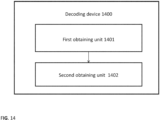
- the decoding device may be video decoder 30 of Figure 1A , or decoder 30 of Figure 3 .
- the encoding device may be video encoder 20 of Figure 1A , or encoder 20 of Figure 2 .
- Step 1202 the device obtains a value of a reference index line of the current block.
- the value of the reference index line of the current block may be indicated by intra luma ref idx.
- the closest neighboring reference line to the current block is used. There is no sequence between step 1201 and 1202.
- Step 1203 the device determines whether the value of the first indication information indicates the intra prediction mode of the current block is comprised in the set of most probable modes.
- Step 1204 the device determines whether the value of the reference index line indicates the closest neighboring reference line to the current block is used. There is no sequence between step 1203 and 1204.
- the devices parse a bitstream to obtain the value of the second indication information.
- planar mode is not efficient when MRL is enabled (i.e. reference line index is not equal to 0) in the conventional method.
- MRL coding when MRL coding is enabled, the value of the second indication information is obtained by a default value.
- Planar mode is excluded and its corresponding flag (i.e. intra_luma_not_planar_flag) is not parsed from the bitstream, but is inferred as a default value (e.g. a value of 1).
- a bit is saved to indicate the value of the planar flag (i.e, intra_luma_not_planar) when MRL is enabled).
- a method of intra prediction of a current block implemented by a decoding device includes the following steps.
- Step 1211 the device obtains a value of a reference index line of the current block.
- the value of the reference index line of the current block may be indicated by intra_luma_ref_idx.
- the closest neighboring reference line to the current block is used.
- Step 1212 the device determines whether the value of the reference index line indicates the closest neighboring reference line to the current block is used.
- Step 1213 when the value of the reference index line indicates the closest neighboring reference line to the current block is used, the device obtains a value of a first indication information of a current block, the value of the first indication information indicates whether the intra prediction mode of the current block is comprised in a set of most probable modes,
- the set of most probable modes comprises 5 candidate intra prediction modes and Planar mode.
- the first indication information is indicated by a first flag, intra_luma_mpm_flag. As described above, when the value of intra luma mpm flag equals to 1, the intra prediction mode of the current block is comprised in the set of most probable modes.
- Step 1214 the device determines whether the value of the first indication information indicates the intra prediction mode of the current block is comprised in the set of most probable modes.
- Step 1215 the device obtains a value of a second indication information of the current block when the value of the first indication information indicates the intra prediction mode of the current block is comprised in the set of most probable modes, and the value of the reference index line indicates the closest neighboring reference line to the current block is used, the value of the second indication information of the current block indicating whether the intra prediction mode of the current block is Planar mode or not.
- the value of the second indication information is context adaptive binary arithmetic coding (CABAC) context decoded.
- CABAC context adaptive binary arithmetic coding
- the second indication information is indicated by a second flag, intra_luma_not_planar_flag.
- the device parses the second flag using context based on whether the current block is an intra block with intra sub-partition (ISP) coding mode enabled or not.
- ISP intra sub-partition
- a method of intra prediction of a current block implemented by an encoding device includes the following steps. Step 1301, the device determines whether an intra prediction mode of a current block is comprised in a set of most probable modes.
- the set of most probable modes comprises 5 candidate intra prediction modes and Planar mode.
- Step 1302 the device determines whether the closest neighboring reference line to the current block is used for intra prediction. There is no sequence between 1301 and 1302.
- Step 1303 the device encodes a bitstream, wherein the bitstream includes information to indicate whether the intra prediction mode of the current block is Planar mode when the intra prediction mode of the current block is comprised in the set of most probable modes, and the closest neighboring reference line to the current block is used for intra prediction, and send the encoded bitstream to a decoding device.
- the bitstream may also include an indication to indicate the value of the reference index line of the current block.
- the value of the reference index line of the current block is indicated by intra luma ref idx, for example.
- the closest neighboring reference line to the current block is used.
- FIG. 15 illustrates embodiments of an encoding device 1500 for intra prediction.
- the encoding device 1500 may be video encoder 20 of Figure 1A , or encoder 20 of Figure 2 .
- the encoding device 1500 can be used to implement the embodiment 1300 and the other embodiments described above.
- the terminal device 310 receives and reproduces the encoded data.
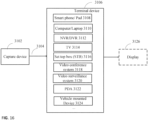
- the terminal device 3106 could be a device with data receiving and recovering capability, such as smart phone or Pad 3108, computer or laptop 3110, network video recorder (NVR)/ digital video recorder (DVR) 3112, TV 3114, set top box (STB) 3116, video conference system 3118, video surveillance system 3120, personal digital assistant (PDA) 3122, vehicle mounted device 3124, or a combination of any of them, or the like capable of decoding the above-mentioned encoded data.
- the terminal device 3106 may include the destination device 14 as described above.
- the encoded data includes video
- the video decoder 30 included in the terminal device is prioritized to perform video decoding.
- an audio decoder included in the terminal device is prioritized to perform audio decoding processing.
- stream file is generated.
- the file is outputted to a demultiplexing unit 3204.
- the demultiplexing unit 3204 can separate the multiplexed data into the encoded audio data and the encoded video data. As described above, for some practical scenarios, for example in the video conference system, the encoded audio data and the encoded video data are not multiplexed. In this situation, the encoded data is transmitted to video decoder 3206 and audio decoder 3208 without through the demultiplexing unit 3204.
- bit-wise operators are defined as follows: & Bit-wise "and".
- integer arguments operates on a two's complement representation of the integer value.
- Bit-wise "or” operates on integer arguments.
- Bit-wise "or” operates on integer arguments.
- bit-wise "exclusive or” operates on integer arguments.
- integer arguments operates on a two's complement representation of the integer value.
- bit-wise "exclusive or” operates on integer arguments.
- the table 14 below specifies the precedence of operations from highest to lowest; a higher position in the table 14 indicates a higher precedence.
- embodiments of the invention have been primarily described based on video coding, it should be noted that embodiments of the coding system 10, encoder 20 and decoder 30 (and correspondingly the system 10) and the other embodiments described herein may also be configured for still picture processing or coding, i.e. the processing or coding of an individual picture independent of any preceding or consecutive picture as in video coding.
- inter-prediction units 244 (encoder) and 344 (decoder) may not be available in case the picture processing coding is limited to a single picture 17. All other functionalities (also referred to as tools or technologies) of the video encoder 20 and video decoder 30 may equally be used for still picture processing, e.g.
- Embodiments, e.g. of the encoder 20 and the decoder 30, and functions described herein, e.g. with reference to the encoder 20 and the decoder 30, may be implemented in hardware, software, firmware, or any combination thereof. If implemented in software, the functions may be stored on a computer-readable medium or transmitted over communication media as one or more instructions or code and executed by a hardware-based processing unit.
- Computer-readable media may include computer-readable storage media, which corresponds to a tangible medium such as data storage media, or communication media including any medium that facilitates transfer of a computer program from one place to another, e.g., according to a communication protocol.
- computer-readable media generally may correspond to (1) tangible computer-readable storage media which is non-transitory or (2) a communication medium such as a signal or carrier wave.
- Data storage media may be any available media that can be accessed by one or more computers or one or more processors to retrieve instructions, code and/or data structures for implementation of the techniques described in this disclosure.
- a computer program product may include a computer-readable medium.
- such computer-readable storage media can comprise RAM, ROM, EEPROM, CD-ROM or other optical disk storage, magnetic disk storage, or other magnetic storage devices, flash memory, or any other medium that can be used to store desired program code in the form of instructions or data structures and that can be accessed by a computer.
- any connection is properly termed a computer-readable medium.
- a computer-readable medium For example, if instructions are transmitted from a website, server, or other remote source using a coaxial cable, fiber optic cable, twisted pair, digital subscriber line (DSL), or wireless technologies such as infrared, radio, and microwave, then the coaxial cable, fiber optic cable, twisted pair, DSL, or wireless technologies such as infrared, radio, and microwave are included in the definition of medium.
- DSL digital subscriber line
- Disk and disc includes compact disc (CD), laser disc, optical disc, digital versatile disc (DVD), floppy disk and Blu-ray disc, where disks usually reproduce data magnetically, while discs reproduce data optically with lasers. Combinations of the above should also be included within the scope of computer-readable media.
- processors such as one or more digital signal processors (DSPs), general purpose microprocessors, application specific integrated circuits (ASICs), field programmable logic arrays (FPGAs), or other equivalent integrated or discrete logic circuitry.
- DSPs digital signal processors
- ASICs application specific integrated circuits
- FPGAs field programmable logic arrays
- processors may refer to any of the foregoing structure or any other structure suitable for implementation of the techniques described herein.
- the functionality described herein may be provided within dedicated hardware and/or software modules configured for encoding and decoding, or incorporated in a combined codec. Also, the techniques could be fully implemented in one or more circuits or logic elements.
- the techniques of this disclosure may be implemented in a wide variety of devices or apparatuses, including a wireless handset, an integrated circuit (IC) or a set of ICs (e.g., a chip set).
- IC integrated circuit
- a set of ICs e.g., a chip set.
- Various components, modules, or units are described in this disclosure to emphasize functional aspects of devices configured to perform the disclosed techniques, but do not necessarily require realization by different hardware units. Rather, as described above, various units may be combined in a codec hardware unit or provided by a collection of interoperative hardware units, including one or more processors as described above, in conjunction with suitable software and/or firmware.
Landscapes
- Engineering & Computer Science (AREA)
- Multimedia (AREA)
- Signal Processing (AREA)
- Compression Or Coding Systems Of Tv Signals (AREA)
- Compression, Expansion, Code Conversion, And Decoders (AREA)
Priority Applications (1)
| Application Number | Priority Date | Filing Date | Title |
|---|---|---|---|
| EP23213846.1A EP4307675A3 (en) | 2019-03-23 | 2020-03-23 | An encoder, a decoder and corresponding methods for intra prediction |
Applications Claiming Priority (4)
| Application Number | Priority Date | Filing Date | Title |
|---|---|---|---|
| US201962822865P | 2019-03-23 | 2019-03-23 | |
| US201962824282P | 2019-03-26 | 2019-03-26 | |
| US201962824360P | 2019-03-27 | 2019-03-27 | |
| PCT/CN2020/080650 WO2020192625A1 (en) | 2019-03-23 | 2020-03-23 | An encoder, a decoder and corresponding methods for intra prediction |
Related Child Applications (2)
| Application Number | Title | Priority Date | Filing Date |
|---|---|---|---|
| EP23213846.1A Division EP4307675A3 (en) | 2019-03-23 | 2020-03-23 | An encoder, a decoder and corresponding methods for intra prediction |
| EP23213846.1A Division-Into EP4307675A3 (en) | 2019-03-23 | 2020-03-23 | An encoder, a decoder and corresponding methods for intra prediction |
Publications (3)
| Publication Number | Publication Date |
|---|---|
| EP3932057A1 EP3932057A1 (en) | 2022-01-05 |
| EP3932057A4 EP3932057A4 (en) | 2022-05-11 |
| EP3932057B1 true EP3932057B1 (en) | 2024-07-10 |
Family
ID=72610950
Family Applications (4)
| Application Number | Title | Priority Date | Filing Date |
|---|---|---|---|
| EP20779704.4A Active EP3932057B1 (en) | 2019-03-23 | 2020-03-23 | An encoder, a decoder and corresponding methods for intra prediction |
| EP23213846.1A Pending EP4307675A3 (en) | 2019-03-23 | 2020-03-23 | An encoder, a decoder and corresponding methods for intra prediction |
| EP23200275.8A Pending EP4277269A3 (en) | 2019-03-23 | 2020-03-23 | An encoder, a decoder and corresponding methods for intra prediction |
| EP20777477.9A Active EP3932076B1 (en) | 2019-03-23 | 2020-03-23 | An encoder, a decoder and corresponding methods for intra prediction |
Family Applications After (3)
| Application Number | Title | Priority Date | Filing Date |
|---|---|---|---|
| EP23213846.1A Pending EP4307675A3 (en) | 2019-03-23 | 2020-03-23 | An encoder, a decoder and corresponding methods for intra prediction |
| EP23200275.8A Pending EP4277269A3 (en) | 2019-03-23 | 2020-03-23 | An encoder, a decoder and corresponding methods for intra prediction |
| EP20777477.9A Active EP3932076B1 (en) | 2019-03-23 | 2020-03-23 | An encoder, a decoder and corresponding methods for intra prediction |
Country Status (17)
| Country | Link |
|---|---|
| US (7) | US11070799B2 (pl) |
| EP (4) | EP3932057B1 (pl) |
| JP (7) | JP7303322B2 (pl) |
| KR (4) | KR102794366B1 (pl) |
| CN (4) | CN114173115B (pl) |
| AU (5) | AU2020246735B2 (pl) |
| CA (4) | CA3258356A1 (pl) |
| DK (1) | DK3932057T3 (pl) |
| ES (2) | ES2966479T3 (pl) |
| FI (1) | FI3932057T3 (pl) |
| HU (2) | HUE063890T2 (pl) |
| MX (5) | MX2021011419A (pl) |
| PL (2) | PL3932076T3 (pl) |
| PT (2) | PT3932057T (pl) |
| SG (1) | SG11202110425VA (pl) |
| UA (1) | UA129651C2 (pl) |
| WO (2) | WO2020192629A1 (pl) |
Families Citing this family (23)
| Publication number | Priority date | Publication date | Assignee | Title |
|---|---|---|---|---|
| WO2019151280A1 (ja) | 2018-01-30 | 2019-08-08 | パナソニック インテレクチュアル プロパティ コーポレーション オブ アメリカ | 符号化装置、復号装置、符号化方法及び復号方法 |
| EP3811612A1 (en) * | 2018-06-21 | 2021-04-28 | Telefonaktiebolaget LM Ericsson (publ) | Tile partitions with sub-tiles in video coding |
| CN112602329B (zh) | 2018-06-21 | 2023-08-11 | 瑞典爱立信有限公司 | 用于360度视频解码的块置乱 |
| EP3811613B1 (en) | 2018-06-21 | 2025-11-12 | Telefonaktiebolaget LM Ericsson (publ) | Flexible tile partitions |
| KR20240024330A (ko) * | 2018-07-05 | 2024-02-23 | 텐센트 아메리카 엘엘씨 | 비디오 압축에서의 다중 라인 인트라 예측을 위한 방법 및 장치 |
| US11997311B2 (en) * | 2018-09-17 | 2024-05-28 | Hfi Innovation Inc. | Methods and apparatuses of combining multiple predictors for block prediction in video coding systems |
| CN118741097A (zh) | 2018-12-12 | 2024-10-01 | 数码士有限公司 | 使用当前图片参考的视频信号处理方法和设备 |
| KR20250152694A (ko) | 2019-02-19 | 2025-10-23 | (주)휴맥스 | 인트라 예측 기반 비디오 신호 처리 방법 및 장치 |
| CA3250568A1 (en) | 2019-03-23 | 2025-11-29 | Lg Electronics Inc. | Method for coding image on basis of intra prediction using mpm list and apparatus therefor |
| WO2020192629A1 (en) * | 2019-03-23 | 2020-10-01 | Huawei Technologies Co., Ltd. | An encoder, a decoder and corresponding methods for intra prediction |
| US11936916B2 (en) * | 2019-06-25 | 2024-03-19 | Lg Electronics Inc. | Image decoding method using lossless coding in image coding system and apparatus therefor |
| KR102794273B1 (ko) * | 2019-07-24 | 2025-04-14 | 후아웨이 테크놀러지 컴퍼니 리미티드 | 인트라 예측 모드에 관련된 인코더, 디코더 및 대응하는 방법들 |
| US11438616B2 (en) * | 2019-08-27 | 2022-09-06 | Tencent America LLC | Method and apparatus for video coding |
| US11375223B2 (en) * | 2019-09-20 | 2022-06-28 | Tencent America LLC | Method for signaling output layer set with sub-picture |
| CN114531953A (zh) * | 2019-09-24 | 2022-05-24 | 交互数字Vc控股法国公司 | 使用多参考行帧内预测的最可能模式信令 |
| US12267528B2 (en) * | 2020-02-25 | 2025-04-01 | Lg Electronics Inc. | Image decoding method related to residual coding, and device therefor |
| US12537946B2 (en) * | 2021-05-19 | 2026-01-27 | Beijing Bytedance Network Technology Co., Ltd. | Method, device, and medium for video processing |
| WO2023106603A1 (ko) * | 2021-12-10 | 2023-06-15 | 현대자동차주식회사 | 템플릿 매칭 기반 이차적인 mpm 리스트를 이용하는 비디오 코딩을 위한 방법 및 장치 |
| WO2023163374A1 (ko) * | 2022-02-22 | 2023-08-31 | 현대자동차주식회사 | 인트라 예측에서 mpm 리스트 구성하기 위한 방법 |
| WO2023195646A1 (ko) * | 2022-04-05 | 2023-10-12 | 현대자동차주식회사 | 선택적 다중 참조라인을 이용하는 비디오 코딩을 위한 방법 및 장치 |
| EP4554213A4 (en) * | 2022-07-05 | 2026-04-29 | Guangdong Oppo Mobile Telecommunications Corp Ltd | METHOD AND DEVICE FOR SORTING LISTS OF MULTIPLE REFERENCE LINE INDEXES, METHOD AND DEVICE FOR VIDEO ENCODING, METHOD AND DEVICE FOR VIDEO DECODING, AND SYSTEM |
| WO2024050099A1 (en) * | 2022-09-02 | 2024-03-07 | Beijing Dajia Internet Information Technology Co., Ltd. | Methods and devices for intra block copy |
| US20250211798A1 (en) * | 2023-12-20 | 2025-06-26 | Tencent America LLC | Intra prediction with in-loop filters |
Family Cites Families (47)
| Publication number | Priority date | Publication date | Assignee | Title |
|---|---|---|---|---|
| EP3410706B1 (en) | 2007-06-29 | 2021-12-01 | Velos Media International Limited | Image encoding device and image decoding device |
| KR20120070479A (ko) * | 2010-12-21 | 2012-06-29 | 한국전자통신연구원 | 화면 내 예측 방향 정보 부호화/복호화 방법 및 그 장치 |
| CN102685474B (zh) * | 2011-03-10 | 2014-11-05 | 华为技术有限公司 | 预测模式的编解码方法、编解码设备及网络系统 |
| US9532058B2 (en) * | 2011-06-03 | 2016-12-27 | Qualcomm Incorporated | Intra prediction mode coding with directional partitions |
| WO2013000324A1 (en) * | 2011-06-28 | 2013-01-03 | Mediatek Singapore Pte. Ltd. | Method and apparatus of intra mode coding |
| US20130003829A1 (en) * | 2011-07-01 | 2013-01-03 | Kiran Misra | System for initializing an arithmetic coder |
| RU2011131824A (ru) | 2011-07-28 | 2013-02-10 | ЭлЭсАй Корпорейшн | Поиск интра-режима для кодирования видеоинформации |
| ES3059245T3 (en) * | 2011-10-07 | 2026-03-19 | Dolby Laboratories Licensing Corp | Method for decoding an intra prediction mode using candidate intra prediction modes |
| CN107087183B (zh) * | 2011-10-24 | 2020-02-14 | 英孚布瑞智有限私人贸易公司 | 对帧内预测模式进行解码的方法 |
| KR20130049522A (ko) * | 2011-11-04 | 2013-05-14 | 오수미 | 인트라 예측 블록 생성 방법 |
| WO2013074042A1 (en) * | 2011-11-17 | 2013-05-23 | Agency For Science, Technology And Research | Method and an apparatus for coding an intra prediction mode |
| CN103220508B (zh) | 2012-01-20 | 2014-06-11 | 华为技术有限公司 | 编解码方法和装置 |
| US9210438B2 (en) * | 2012-01-20 | 2015-12-08 | Sony Corporation | Logical intra mode naming in HEVC video coding |
| US9538172B2 (en) | 2012-04-11 | 2017-01-03 | Qualcomm Incorporated | Grouping bypass coded syntax elements in video coding |
| US9967592B2 (en) | 2014-01-11 | 2018-05-08 | Qualcomm Incorporated | Block-based advanced residual prediction for 3D video coding |
| KR20170135847A (ko) * | 2015-04-08 | 2017-12-08 | 엘지전자 주식회사 | 비디오 신호의 인코딩/디코딩 방법 및 장치 |
| US10448058B2 (en) * | 2015-05-21 | 2019-10-15 | Qualcomm Incorporated | Grouping palette index at the end and index coding using palette size and run value |
| US10148961B2 (en) * | 2015-05-29 | 2018-12-04 | Qualcomm Incorporated | Arithmetic coder with multiple window sizes |
| US10142627B2 (en) * | 2015-06-18 | 2018-11-27 | Qualcomm Incorporated | Intra prediction and intra mode coding |
| US11463689B2 (en) * | 2015-06-18 | 2022-10-04 | Qualcomm Incorporated | Intra prediction and intra mode coding |
| US20160373770A1 (en) * | 2015-06-18 | 2016-12-22 | Qualcomm Incorporated | Intra prediction and intra mode coding |
| US20160373742A1 (en) * | 2015-06-18 | 2016-12-22 | Qualcomm Incorporated | Intra prediction and intra mode coding |
| US20160373782A1 (en) * | 2015-06-18 | 2016-12-22 | Qualcomm Incorporated | Intra prediction and intra mode coding |
| CN105357535B (zh) * | 2015-11-05 | 2019-09-03 | 广东中星微电子有限公司 | 一种帧内预测模式编解码方法及设备 |
| KR20170058837A (ko) | 2015-11-19 | 2017-05-29 | 한국전자통신연구원 | 화면내 예측모드 부호화/복호화 방법 및 장치 |
| CN107925763B (zh) | 2015-12-23 | 2020-01-10 | 华为技术有限公司 | 等级分割中的块级别变换选择和隐式信令的编码变换方法和设备 |
| US11259047B2 (en) * | 2016-04-06 | 2022-02-22 | Kt Corporation | Method and apparatus for processing video signal |
| US10764576B2 (en) * | 2016-05-04 | 2020-09-01 | Microsoft Technology Licensing, Llc | Intra-picture prediction using non-adjacent reference lines of sample values |
| US10547854B2 (en) * | 2016-05-13 | 2020-01-28 | Qualcomm Incorporated | Neighbor based signaling of intra prediction modes |
| US10484712B2 (en) * | 2016-06-08 | 2019-11-19 | Qualcomm Incorporated | Implicit coding of reference line index used in intra prediction |
| WO2018026219A1 (ko) | 2016-08-03 | 2018-02-08 | 주식회사 케이티 | 비디오 신호 처리 방법 및 장치 |
| CN116915989A (zh) * | 2016-10-19 | 2023-10-20 | Sk电信有限公司 | 对视频数据进行编码或解码的设备及发送比特流的方法 |
| US20180146191A1 (en) * | 2016-11-22 | 2018-05-24 | Futurewei Technologies, Inc. | System and Method for Coding Intra Prediction Mode using a Second Set of Most Probable Modes |
| US10560723B2 (en) * | 2017-05-08 | 2020-02-11 | Qualcomm Incorporated | Context modeling for transform coefficient coding |
| US10750181B2 (en) | 2017-05-11 | 2020-08-18 | Mediatek Inc. | Method and apparatus of adaptive multiple transforms for video coding |
| EP3618446A4 (en) * | 2017-06-22 | 2020-05-13 | Huawei Technologies Co., Ltd. | APPARATUS AND METHOD FOR IN-FRAME PREDICTION |
| WO2019047883A1 (en) * | 2017-09-08 | 2019-03-14 | Fg Innovation Ip Company Limited | DEVICE AND METHOD FOR ENCODING VIDEO DATA BASED ON MULTIPLE REFERENCE LINES |
| WO2019107927A1 (ko) * | 2017-11-28 | 2019-06-06 | 한국전자통신연구원 | 양방향 인트라 예측 방법 및 장치 |
| WO2019151280A1 (ja) * | 2018-01-30 | 2019-08-08 | パナソニック インテレクチュアル プロパティ コーポレーション オブ アメリカ | 符号化装置、復号装置、符号化方法及び復号方法 |
| KR102448401B1 (ko) * | 2018-03-16 | 2022-09-28 | 엘지전자 주식회사 | 인트라 예측 기반 영상/비디오 코딩 방법 및 그 장치 |
| US10819977B2 (en) * | 2018-07-05 | 2020-10-27 | Tencent America LLC | Methods and apparatus for multiple line intra prediction in video compression |
| US10771778B2 (en) * | 2018-09-14 | 2020-09-08 | Tencent America LLC | Method and device for MPM list generation for multi-line intra prediction |
| US10469845B1 (en) * | 2018-09-21 | 2019-11-05 | Tencent America, Llc | Method and apparatus for intra mode coding |
| US10848763B2 (en) * | 2018-11-14 | 2020-11-24 | Tencent America LLC | Method and apparatus for improved context design for prediction mode and coded block flag (CBF) |
| KR102954705B1 (ko) | 2019-02-20 | 2026-04-17 | 베이징 시아오미 모바일 소프트웨어 컴퍼니 리미티드 | Mpm 리스트 기반 인트라 예측 방법 및 장치 |
| WO2020192629A1 (en) * | 2019-03-23 | 2020-10-01 | Huawei Technologies Co., Ltd. | An encoder, a decoder and corresponding methods for intra prediction |
| CA3250568A1 (en) | 2019-03-23 | 2025-11-29 | Lg Electronics Inc. | Method for coding image on basis of intra prediction using mpm list and apparatus therefor |
-
2020
- 2020-03-23 WO PCT/CN2020/080674 patent/WO2020192629A1/en not_active Ceased
- 2020-03-23 MX MX2021011419A patent/MX2021011419A/es unknown
- 2020-03-23 KR KR1020217033324A patent/KR102794366B1/ko active Active
- 2020-03-23 CN CN202111229874.0A patent/CN114173115B/zh active Active
- 2020-03-23 HU HUE20777477A patent/HUE063890T2/hu unknown
- 2020-03-23 CN CN202111229641.0A patent/CN114650419B/zh active Active
- 2020-03-23 SG SG11202110425VA patent/SG11202110425VA/en unknown
- 2020-03-23 JP JP2021556948A patent/JP7303322B2/ja active Active
- 2020-03-23 ES ES20777477T patent/ES2966479T3/es active Active
- 2020-03-23 FI FIEP20779704.4T patent/FI3932057T3/fi active
- 2020-03-23 EP EP20779704.4A patent/EP3932057B1/en active Active
- 2020-03-23 CA CA3258356A patent/CA3258356A1/en active Pending
- 2020-03-23 MX MX2021011421A patent/MX2021011421A/es unknown
- 2020-03-23 CA CA3134410A patent/CA3134410A1/en active Pending
- 2020-03-23 CA CA3258376A patent/CA3258376A1/en active Pending
- 2020-03-23 PT PT207797044T patent/PT3932057T/pt unknown
- 2020-03-23 PL PL20777477.9T patent/PL3932076T3/pl unknown
- 2020-03-23 PT PT207774779T patent/PT3932076T/pt unknown
- 2020-03-23 AU AU2020246735A patent/AU2020246735B2/en active Active
- 2020-03-23 UA UAA202105884A patent/UA129651C2/uk unknown
- 2020-03-23 EP EP23213846.1A patent/EP4307675A3/en active Pending
- 2020-03-23 PL PL20779704.4T patent/PL3932057T3/pl unknown
- 2020-03-23 CN CN202080022916.0A patent/CN113615198A/zh active Pending
- 2020-03-23 HU HUE20779704A patent/HUE068015T2/hu unknown
- 2020-03-23 KR KR1020257011263A patent/KR20250053975A/ko active Pending
- 2020-03-23 DK DK20779704.4T patent/DK3932057T3/da active
- 2020-03-23 CA CA3134398A patent/CA3134398A1/en active Pending
- 2020-03-23 AU AU2020246733A patent/AU2020246733B2/en active Active
- 2020-03-23 KR KR1020257011265A patent/KR20250053205A/ko active Pending
- 2020-03-23 JP JP2021556950A patent/JP7401556B2/ja active Active
- 2020-03-23 KR KR1020217033329A patent/KR102794367B1/ko active Active
- 2020-03-23 ES ES20779704T patent/ES2989421T3/es active Active
- 2020-03-23 EP EP23200275.8A patent/EP4277269A3/en active Pending
- 2020-03-23 CN CN202080022835.0A patent/CN113615177A/zh active Pending
- 2020-03-23 EP EP20777477.9A patent/EP3932076B1/en active Active
- 2020-03-23 WO PCT/CN2020/080650 patent/WO2020192625A1/en not_active Ceased
- 2020-09-03 US US17/011,504 patent/US11070799B2/en active Active
- 2020-09-09 US US17/016,128 patent/US10986336B2/en active Active
-
2021
- 2021-04-16 US US17/232,946 patent/US11405610B2/en active Active
- 2021-06-11 US US17/346,005 patent/US12200201B2/en active Active
- 2021-09-20 MX MX2024015343A patent/MX2024015343A/es unknown
- 2021-09-20 MX MX2024015342A patent/MX2024015342A/es unknown
- 2021-09-20 MX MX2024013315A patent/MX2024013315A/es unknown
-
2022
- 2022-07-01 US US17/856,428 patent/US12149684B2/en active Active
-
2023
- 2023-06-22 JP JP2023102366A patent/JP7536959B2/ja active Active
- 2023-12-07 JP JP2023206546A patent/JP2024019426A/ja active Pending
-
2024
- 2024-02-06 AU AU2024200707A patent/AU2024200707B2/en active Active
- 2024-02-06 AU AU2024200708A patent/AU2024200708B2/en active Active
- 2024-08-07 JP JP2024131240A patent/JP7771300B2/ja active Active
- 2024-10-17 US US18/918,992 patent/US20250055982A1/en active Pending
- 2024-11-27 US US18/962,489 patent/US20250159143A1/en active Pending
-
2025
- 2025-05-20 JP JP2025083893A patent/JP2025120191A/ja active Pending
- 2025-09-30 AU AU2025242081A patent/AU2025242081A1/en active Pending
- 2025-11-05 JP JP2025186125A patent/JP2026027340A/ja active Pending
Non-Patent Citations (2)
| Title |
|---|
| YU (MOTOROLA) Y ET AL: "On MPM determination and Planar mode signaling", no. JCTVC-H0516, 3 February 2012 (2012-02-03), XP030232397, Retrieved from the Internet <URL:http://phenix.int-evry.fr/jct/doc_end_user/documents/8_San%20Jose/wg11/JCTVC-H0516-v4.zip JCTVC-H0516-r3.doc> [retrieved on 20120203] * |
| YU (MOTOROLA) Y ET AL: "On MPM determination and Planar mode signaling", no. JCTVC-H0516, 3 February 2012 (2012-02-03), XP030232398, Retrieved from the Internet <URL:http://phenix.int-evry.fr/jct/doc_end_user/documents/8_San%20Jose/wg11/JCTVC-H0516-v4.zip JCTVC-H0516.ppt> [retrieved on 20120203] * |
Also Published As
Similar Documents
| Publication | Publication Date | Title |
|---|---|---|
| US12149684B2 (en) | Encoder, a decoder and corresponding methods for intra prediction | |
| EP4322531A2 (en) | An encoder, a decoder and corresponding methods harmonizing matrix-based intra prediction and secoundary core selection | |
| EP3932056B1 (en) | Method and apparatus for intra-prediction | |
| EP4576775A2 (en) | An encoder, a decoder and corresponding methods related to intra prediction mode | |
| EP3939263B1 (en) | Method and apparatus for intra smoothing | |
| US20250343946A1 (en) | Encoder, a decoder and corresponding methods using intra mode coding for intra prediction | |
| EP4236313A2 (en) | An encoder, a decoder and corresponding methods of reduction on intra prediction for the planar mode | |
| HK40057198A (en) | An encoder, a decoder and corresponding methods for intra prediction | |
| HK40057198B (en) | An encoder, a decoder and corresponding methods for intra prediction | |
| HK40055894A (en) | An encoder, a decoder and corresponding methods using intra mode coding for intra prediction | |
| HK40055894B (en) | An encoder, a decoder and corresponding methods using intra mode coding for intra prediction | |
| HK40056627B (en) | An encoder, a decoder and corresponding methods for intra prediction | |
| HK40056627A (en) | An encoder, a decoder and corresponding methods for intra prediction |
Legal Events
| Date | Code | Title | Description |
|---|---|---|---|
| STAA | Information on the status of an ep patent application or granted ep patent |
Free format text: STATUS: THE INTERNATIONAL PUBLICATION HAS BEEN MADE |
|
| PUAI | Public reference made under article 153(3) epc to a published international application that has entered the european phase |
Free format text: ORIGINAL CODE: 0009012 |
|
| STAA | Information on the status of an ep patent application or granted ep patent |
Free format text: STATUS: REQUEST FOR EXAMINATION WAS MADE |
|
| 17P | Request for examination filed |
Effective date: 20210929 |
|
| AK | Designated contracting states |
Kind code of ref document: A1 Designated state(s): AL AT BE BG CH CY CZ DE DK EE ES FI FR GB GR HR HU IE IS IT LI LT LU LV MC MK MT NL NO PL PT RO RS SE SI SK SM TR |
|
| REG | Reference to a national code |
Ref country code: HK Ref legal event code: DE Ref document number: 40057198 Country of ref document: HK |
|
| A4 | Supplementary search report drawn up and despatched |
Effective date: 20220411 |
|
| RIC1 | Information provided on ipc code assigned before grant |
Ipc: H04N 19/593 20140101ALI20220405BHEP Ipc: H04N 19/159 20140101ALI20220405BHEP Ipc: H04N 19/70 20140101ALI20220405BHEP Ipc: H04N 19/13 20140101ALI20220405BHEP Ipc: H04N 19/11 20140101AFI20220405BHEP |
|
| DAV | Request for validation of the european patent (deleted) | ||
| DAX | Request for extension of the european patent (deleted) | ||
| STAA | Information on the status of an ep patent application or granted ep patent |
Free format text: STATUS: EXAMINATION IS IN PROGRESS |
|
| 17Q | First examination report despatched |
Effective date: 20230113 |
|
| GRAP | Despatch of communication of intention to grant a patent |
Free format text: ORIGINAL CODE: EPIDOSNIGR1 |
|
| STAA | Information on the status of an ep patent application or granted ep patent |
Free format text: STATUS: GRANT OF PATENT IS INTENDED |
|
| INTG | Intention to grant announced |
Effective date: 20230808 |
|
| GRAJ | Information related to disapproval of communication of intention to grant by the applicant or resumption of examination proceedings by the epo deleted |
Free format text: ORIGINAL CODE: EPIDOSDIGR1 |
|
| STAA | Information on the status of an ep patent application or granted ep patent |
Free format text: STATUS: EXAMINATION IS IN PROGRESS |
|
| P01 | Opt-out of the competence of the unified patent court (upc) registered |
Effective date: 20231121 |
|
| INTC | Intention to grant announced (deleted) | ||
| GRAP | Despatch of communication of intention to grant a patent |
Free format text: ORIGINAL CODE: EPIDOSNIGR1 |
|
| STAA | Information on the status of an ep patent application or granted ep patent |
Free format text: STATUS: GRANT OF PATENT IS INTENDED |
|
| INTG | Intention to grant announced |
Effective date: 20240206 |
|
| GRAS | Grant fee paid |
Free format text: ORIGINAL CODE: EPIDOSNIGR3 |
|
| GRAA | (expected) grant |
Free format text: ORIGINAL CODE: 0009210 |
|
| STAA | Information on the status of an ep patent application or granted ep patent |
Free format text: STATUS: THE PATENT HAS BEEN GRANTED |
|
| AK | Designated contracting states |
Kind code of ref document: B1 Designated state(s): AL AT BE BG CH CY CZ DE DK EE ES FI FR GB GR HR HU IE IS IT LI LT LU LV MC MK MT NL NO PL PT RO RS SE SI SK SM TR |
|
| REG | Reference to a national code |
Ref country code: CH Ref legal event code: EP |
|
| REG | Reference to a national code |
Ref country code: DE Ref legal event code: R096 Ref document number: 602020033805 Country of ref document: DE |
|
| REG | Reference to a national code |
Ref country code: PT Ref legal event code: SC4A Ref document number: 3932057 Country of ref document: PT Date of ref document: 20240802 Kind code of ref document: T Free format text: AVAILABILITY OF NATIONAL TRANSLATION Effective date: 20240729 |
|
| REG | Reference to a national code |
Ref country code: NL Ref legal event code: FP |
|
| REG | Reference to a national code |
Ref country code: FI Ref legal event code: FGE Ref country code: DK Ref legal event code: T3 Effective date: 20240912 |
|
| REG | Reference to a national code |
Ref country code: SE Ref legal event code: TRGR |
|
| REG | Reference to a national code |
Ref country code: SK Ref legal event code: T3 Ref document number: E 44934 Country of ref document: SK |
|
| REG | Reference to a national code |
Ref country code: LT Ref legal event code: MG9D |
|
| REG | Reference to a national code |
Ref country code: ES Ref legal event code: FG2A Ref document number: 2989421 Country of ref document: ES Kind code of ref document: T3 Effective date: 20241126 |
|
| REG | Reference to a national code |
Ref country code: AT Ref legal event code: MK05 Ref document number: 1703061 Country of ref document: AT Kind code of ref document: T Effective date: 20240710 |
|
| REG | Reference to a national code |
Ref country code: HU Ref legal event code: AG4A Ref document number: E068015 Country of ref document: HU |
|
| PG25 | Lapsed in a contracting state [announced via postgrant information from national office to epo] |
Ref country code: NO Free format text: LAPSE BECAUSE OF FAILURE TO SUBMIT A TRANSLATION OF THE DESCRIPTION OR TO PAY THE FEE WITHIN THE PRESCRIBED TIME-LIMIT Effective date: 20241010 |
|
| PG25 | Lapsed in a contracting state [announced via postgrant information from national office to epo] |
Ref country code: GR Free format text: LAPSE BECAUSE OF FAILURE TO SUBMIT A TRANSLATION OF THE DESCRIPTION OR TO PAY THE FEE WITHIN THE PRESCRIBED TIME-LIMIT Effective date: 20241011 |
|
| PG25 | Lapsed in a contracting state [announced via postgrant information from national office to epo] |
Ref country code: BG Free format text: LAPSE BECAUSE OF FAILURE TO SUBMIT A TRANSLATION OF THE DESCRIPTION OR TO PAY THE FEE WITHIN THE PRESCRIBED TIME-LIMIT Effective date: 20240710 |
|
| PG25 | Lapsed in a contracting state [announced via postgrant information from national office to epo] |
Ref country code: LV Free format text: LAPSE BECAUSE OF FAILURE TO SUBMIT A TRANSLATION OF THE DESCRIPTION OR TO PAY THE FEE WITHIN THE PRESCRIBED TIME-LIMIT Effective date: 20240710 |
|
| PG25 | Lapsed in a contracting state [announced via postgrant information from national office to epo] |
Ref country code: IS Free format text: LAPSE BECAUSE OF FAILURE TO SUBMIT A TRANSLATION OF THE DESCRIPTION OR TO PAY THE FEE WITHIN THE PRESCRIBED TIME-LIMIT Effective date: 20241110 Ref country code: AT Free format text: LAPSE BECAUSE OF FAILURE TO SUBMIT A TRANSLATION OF THE DESCRIPTION OR TO PAY THE FEE WITHIN THE PRESCRIBED TIME-LIMIT Effective date: 20240710 |
|
| PG25 | Lapsed in a contracting state [announced via postgrant information from national office to epo] |
Ref country code: HR Free format text: LAPSE BECAUSE OF FAILURE TO SUBMIT A TRANSLATION OF THE DESCRIPTION OR TO PAY THE FEE WITHIN THE PRESCRIBED TIME-LIMIT Effective date: 20240710 |
|
| PG25 | Lapsed in a contracting state [announced via postgrant information from national office to epo] |
Ref country code: RS Free format text: LAPSE BECAUSE OF FAILURE TO SUBMIT A TRANSLATION OF THE DESCRIPTION OR TO PAY THE FEE WITHIN THE PRESCRIBED TIME-LIMIT Effective date: 20241010 |
|
| PG25 | Lapsed in a contracting state [announced via postgrant information from national office to epo] |
Ref country code: RS Free format text: LAPSE BECAUSE OF FAILURE TO SUBMIT A TRANSLATION OF THE DESCRIPTION OR TO PAY THE FEE WITHIN THE PRESCRIBED TIME-LIMIT Effective date: 20241010 Ref country code: NO Free format text: LAPSE BECAUSE OF FAILURE TO SUBMIT A TRANSLATION OF THE DESCRIPTION OR TO PAY THE FEE WITHIN THE PRESCRIBED TIME-LIMIT Effective date: 20241010 Ref country code: LV Free format text: LAPSE BECAUSE OF FAILURE TO SUBMIT A TRANSLATION OF THE DESCRIPTION OR TO PAY THE FEE WITHIN THE PRESCRIBED TIME-LIMIT Effective date: 20240710 Ref country code: IS Free format text: LAPSE BECAUSE OF FAILURE TO SUBMIT A TRANSLATION OF THE DESCRIPTION OR TO PAY THE FEE WITHIN THE PRESCRIBED TIME-LIMIT Effective date: 20241110 Ref country code: HR Free format text: LAPSE BECAUSE OF FAILURE TO SUBMIT A TRANSLATION OF THE DESCRIPTION OR TO PAY THE FEE WITHIN THE PRESCRIBED TIME-LIMIT Effective date: 20240710 Ref country code: GR Free format text: LAPSE BECAUSE OF FAILURE TO SUBMIT A TRANSLATION OF THE DESCRIPTION OR TO PAY THE FEE WITHIN THE PRESCRIBED TIME-LIMIT Effective date: 20241011 Ref country code: BG Free format text: LAPSE BECAUSE OF FAILURE TO SUBMIT A TRANSLATION OF THE DESCRIPTION OR TO PAY THE FEE WITHIN THE PRESCRIBED TIME-LIMIT Effective date: 20240710 Ref country code: AT Free format text: LAPSE BECAUSE OF FAILURE TO SUBMIT A TRANSLATION OF THE DESCRIPTION OR TO PAY THE FEE WITHIN THE PRESCRIBED TIME-LIMIT Effective date: 20240710 |
|
| REG | Reference to a national code |
Ref country code: DE Ref legal event code: R097 Ref document number: 602020033805 Country of ref document: DE |
|
| PG25 | Lapsed in a contracting state [announced via postgrant information from national office to epo] |
Ref country code: SM Free format text: LAPSE BECAUSE OF FAILURE TO SUBMIT A TRANSLATION OF THE DESCRIPTION OR TO PAY THE FEE WITHIN THE PRESCRIBED TIME-LIMIT Effective date: 20240710 Ref country code: RO Free format text: LAPSE BECAUSE OF FAILURE TO SUBMIT A TRANSLATION OF THE DESCRIPTION OR TO PAY THE FEE WITHIN THE PRESCRIBED TIME-LIMIT Effective date: 20240710 |
|
| PG25 | Lapsed in a contracting state [announced via postgrant information from national office to epo] |
Ref country code: EE Free format text: LAPSE BECAUSE OF FAILURE TO SUBMIT A TRANSLATION OF THE DESCRIPTION OR TO PAY THE FEE WITHIN THE PRESCRIBED TIME-LIMIT Effective date: 20240710 |
|
| PLBE | No opposition filed within time limit |
Free format text: ORIGINAL CODE: 0009261 |
|
| STAA | Information on the status of an ep patent application or granted ep patent |
Free format text: STATUS: NO OPPOSITION FILED WITHIN TIME LIMIT |
|
| 26N | No opposition filed |
Effective date: 20250411 |
|
| PGFP | Annual fee paid to national office [announced via postgrant information from national office to epo] |
Ref country code: ES Payment date: 20250411 Year of fee payment: 6 |
|
| PGFP | Annual fee paid to national office [announced via postgrant information from national office to epo] |
Ref country code: CH Payment date: 20250401 Year of fee payment: 6 |
|
| PG25 | Lapsed in a contracting state [announced via postgrant information from national office to epo] |
Ref country code: MC Free format text: LAPSE BECAUSE OF FAILURE TO SUBMIT A TRANSLATION OF THE DESCRIPTION OR TO PAY THE FEE WITHIN THE PRESCRIBED TIME-LIMIT Effective date: 20240710 |
|
| PG25 | Lapsed in a contracting state [announced via postgrant information from national office to epo] |
Ref country code: LU Free format text: LAPSE BECAUSE OF NON-PAYMENT OF DUE FEES Effective date: 20250323 |
|
| PG25 | Lapsed in a contracting state [announced via postgrant information from national office to epo] |
Ref country code: IE Free format text: LAPSE BECAUSE OF NON-PAYMENT OF DUE FEES Effective date: 20250323 |
|
| PGFP | Annual fee paid to national office [announced via postgrant information from national office to epo] |
Ref country code: NL Payment date: 20260213 Year of fee payment: 7 |
|
| REG | Reference to a national code |
Ref country code: CH Ref legal event code: U11 Free format text: ST27 STATUS EVENT CODE: U-0-0-U10-U11 (AS PROVIDED BY THE NATIONAL OFFICE) Effective date: 20260401 |
|
| PGFP | Annual fee paid to national office [announced via postgrant information from national office to epo] |
Ref country code: SE Payment date: 20260211 Year of fee payment: 7 |
|
| PGFP | Annual fee paid to national office [announced via postgrant information from national office to epo] |
Ref country code: GB Payment date: 20260202 Year of fee payment: 7 |
|
| PGFP | Annual fee paid to national office [announced via postgrant information from national office to epo] |
Ref country code: DK Payment date: 20260313 Year of fee payment: 7 Ref country code: DE Payment date: 20260204 Year of fee payment: 7 |
|
| PGFP | Annual fee paid to national office [announced via postgrant information from national office to epo] |
Ref country code: BE Payment date: 20260216 Year of fee payment: 7 Ref country code: FI Payment date: 20260312 Year of fee payment: 7 Ref country code: IT Payment date: 20260220 Year of fee payment: 7 |
|
| PGFP | Annual fee paid to national office [announced via postgrant information from national office to epo] |
Ref country code: HU Payment date: 20260303 Year of fee payment: 7 |
|
| PGFP | Annual fee paid to national office [announced via postgrant information from national office to epo] |
Ref country code: FR Payment date: 20260209 Year of fee payment: 7 |
|
| PGFP | Annual fee paid to national office [announced via postgrant information from national office to epo] |
Ref country code: TR Payment date: 20260318 Year of fee payment: 7 |
|
| PGFP | Annual fee paid to national office [announced via postgrant information from national office to epo] |
Ref country code: PT Payment date: 20260320 Year of fee payment: 7 Ref country code: CZ Payment date: 20260310 Year of fee payment: 7 |
|
| PGFP | Annual fee paid to national office [announced via postgrant information from national office to epo] |
Ref country code: PL Payment date: 20260212 Year of fee payment: 7 |
|
| PGFP | Annual fee paid to national office [announced via postgrant information from national office to epo] |
Ref country code: SK Payment date: 20260212 Year of fee payment: 7 |