EP3931009B1 - Procédé de gestion d'un circuit de climatisation relié à un circuit de refroidissement d'une batterie - Google Patents
Procédé de gestion d'un circuit de climatisation relié à un circuit de refroidissement d'une batterie Download PDFInfo
- Publication number
- EP3931009B1 EP3931009B1 EP20702655.0A EP20702655A EP3931009B1 EP 3931009 B1 EP3931009 B1 EP 3931009B1 EP 20702655 A EP20702655 A EP 20702655A EP 3931009 B1 EP3931009 B1 EP 3931009B1
- Authority
- EP
- European Patent Office
- Prior art keywords
- battery
- circuit
- circulation
- water
- cooling
- Prior art date
- Legal status (The legal status is an assumption and is not a legal conclusion. Google has not performed a legal analysis and makes no representation as to the accuracy of the status listed.)
- Active
Links
Images

Classifications
-
- B—PERFORMING OPERATIONS; TRANSPORTING
- B60—VEHICLES IN GENERAL
- B60H—ARRANGEMENTS OF HEATING, COOLING, VENTILATING OR OTHER AIR-TREATING DEVICES SPECIALLY ADAPTED FOR PASSENGER OR GOODS SPACES OF VEHICLES
- B60H1/00—Heating, cooling or ventilating devices
- B60H1/00271—HVAC devices specially adapted for particular vehicle parts or components and being connected to the vehicle HVAC unit
- B60H1/00278—HVAC devices specially adapted for particular vehicle parts or components and being connected to the vehicle HVAC unit for the battery
-
- B—PERFORMING OPERATIONS; TRANSPORTING
- B60—VEHICLES IN GENERAL
- B60H—ARRANGEMENTS OF HEATING, COOLING, VENTILATING OR OTHER AIR-TREATING DEVICES SPECIALLY ADAPTED FOR PASSENGER OR GOODS SPACES OF VEHICLES
- B60H1/00—Heating, cooling or ventilating devices
- B60H1/00357—Air-conditioning arrangements specially adapted for particular vehicles
- B60H1/00385—Air-conditioning arrangements specially adapted for particular vehicles for vehicles having an electrical drive, e.g. hybrid or fuel cell
- B60H1/004—Air-conditioning arrangements specially adapted for particular vehicles for vehicles having an electrical drive, e.g. hybrid or fuel cell for vehicles having a combustion engine and electric drive means, e.g. hybrid electric vehicles
-
- B—PERFORMING OPERATIONS; TRANSPORTING
- B60—VEHICLES IN GENERAL
- B60H—ARRANGEMENTS OF HEATING, COOLING, VENTILATING OR OTHER AIR-TREATING DEVICES SPECIALLY ADAPTED FOR PASSENGER OR GOODS SPACES OF VEHICLES
- B60H1/00—Heating, cooling or ventilating devices
- B60H1/00642—Control systems or circuits; Control members or indication devices for heating, cooling or ventilating devices
- B60H1/00814—Control systems or circuits characterised by their output, for controlling particular components of the heating, cooling or ventilating installation
- B60H1/00878—Control systems or circuits characterised by their output, for controlling particular components of the heating, cooling or ventilating installation the components being temperature regulating devices
- B60H1/00885—Controlling the flow of heating or cooling liquid, e.g. valves or pumps
-
- B—PERFORMING OPERATIONS; TRANSPORTING
- B60—VEHICLES IN GENERAL
- B60H—ARRANGEMENTS OF HEATING, COOLING, VENTILATING OR OTHER AIR-TREATING DEVICES SPECIALLY ADAPTED FOR PASSENGER OR GOODS SPACES OF VEHICLES
- B60H1/00—Heating, cooling or ventilating devices
- B60H1/00642—Control systems or circuits; Control members or indication devices for heating, cooling or ventilating devices
- B60H1/00814—Control systems or circuits characterised by their output, for controlling particular components of the heating, cooling or ventilating installation
- B60H1/00878—Control systems or circuits characterised by their output, for controlling particular components of the heating, cooling or ventilating installation the components being temperature regulating devices
- B60H1/00892—Devices specially adapted for avoiding uncomfortable feeling, e.g. sudden temperature changes
-
- B—PERFORMING OPERATIONS; TRANSPORTING
- B60—VEHICLES IN GENERAL
- B60H—ARRANGEMENTS OF HEATING, COOLING, VENTILATING OR OTHER AIR-TREATING DEVICES SPECIALLY ADAPTED FOR PASSENGER OR GOODS SPACES OF VEHICLES
- B60H1/00—Heating, cooling or ventilating devices
- B60H1/32—Cooling devices
- B60H1/3204—Cooling devices using compression
- B60H1/3228—Cooling devices using compression characterised by refrigerant circuit configurations
- B60H1/32281—Cooling devices using compression characterised by refrigerant circuit configurations comprising a single secondary circuit, e.g. at evaporator or condenser side
-
- B—PERFORMING OPERATIONS; TRANSPORTING
- B60—VEHICLES IN GENERAL
- B60H—ARRANGEMENTS OF HEATING, COOLING, VENTILATING OR OTHER AIR-TREATING DEVICES SPECIALLY ADAPTED FOR PASSENGER OR GOODS SPACES OF VEHICLES
- B60H1/00—Heating, cooling or ventilating devices
- B60H1/32—Cooling devices
- B60H1/3204—Cooling devices using compression
- B60H1/323—Cooling devices using compression characterised by comprising auxiliary or multiple systems, e.g. plurality of evaporators, or by involving auxiliary cooling devices
-
- H—ELECTRICITY
- H01—ELECTRIC ELEMENTS
- H01M—PROCESSES OR MEANS, e.g. BATTERIES, FOR THE DIRECT CONVERSION OF CHEMICAL ENERGY INTO ELECTRICAL ENERGY
- H01M10/00—Secondary cells; Manufacture thereof
- H01M10/60—Heating or cooling; Temperature control
- H01M10/61—Types of temperature control
- H01M10/613—Cooling or keeping cold
-
- H—ELECTRICITY
- H01—ELECTRIC ELEMENTS
- H01M—PROCESSES OR MEANS, e.g. BATTERIES, FOR THE DIRECT CONVERSION OF CHEMICAL ENERGY INTO ELECTRICAL ENERGY
- H01M10/00—Secondary cells; Manufacture thereof
- H01M10/60—Heating or cooling; Temperature control
- H01M10/62—Heating or cooling; Temperature control specially adapted for specific applications
- H01M10/625—Vehicles
-
- H—ELECTRICITY
- H01—ELECTRIC ELEMENTS
- H01M—PROCESSES OR MEANS, e.g. BATTERIES, FOR THE DIRECT CONVERSION OF CHEMICAL ENERGY INTO ELECTRICAL ENERGY
- H01M10/00—Secondary cells; Manufacture thereof
- H01M10/60—Heating or cooling; Temperature control
- H01M10/65—Means for temperature control structurally associated with the cells
- H01M10/656—Means for temperature control structurally associated with the cells characterised by the type of heat-exchange fluid
- H01M10/6567—Liquids
- H01M10/6568—Liquids characterised by flow circuits, e.g. loops, located externally to the cells or cell casings
-
- H—ELECTRICITY
- H01—ELECTRIC ELEMENTS
- H01M—PROCESSES OR MEANS, e.g. BATTERIES, FOR THE DIRECT CONVERSION OF CHEMICAL ENERGY INTO ELECTRICAL ENERGY
- H01M10/00—Secondary cells; Manufacture thereof
- H01M10/60—Heating or cooling; Temperature control
- H01M10/66—Heat-exchange relationships between the cells and other systems, e.g. central heating systems or fuel cells
- H01M10/663—Heat-exchange relationships between the cells and other systems, e.g. central heating systems or fuel cells the system being an air-conditioner or an engine
-
- B—PERFORMING OPERATIONS; TRANSPORTING
- B60—VEHICLES IN GENERAL
- B60H—ARRANGEMENTS OF HEATING, COOLING, VENTILATING OR OTHER AIR-TREATING DEVICES SPECIALLY ADAPTED FOR PASSENGER OR GOODS SPACES OF VEHICLES
- B60H1/00—Heating, cooling or ventilating devices
- B60H1/00271—HVAC devices specially adapted for particular vehicle parts or components and being connected to the vehicle HVAC unit
- B60H2001/00307—Component temperature regulation using a liquid flow
-
- Y—GENERAL TAGGING OF NEW TECHNOLOGICAL DEVELOPMENTS; GENERAL TAGGING OF CROSS-SECTIONAL TECHNOLOGIES SPANNING OVER SEVERAL SECTIONS OF THE IPC; TECHNICAL SUBJECTS COVERED BY FORMER USPC CROSS-REFERENCE ART COLLECTIONS [XRACs] AND DIGESTS
- Y02—TECHNOLOGIES OR APPLICATIONS FOR MITIGATION OR ADAPTATION AGAINST CLIMATE CHANGE
- Y02E—REDUCTION OF GREENHOUSE GAS [GHG] EMISSIONS, RELATED TO ENERGY GENERATION, TRANSMISSION OR DISTRIBUTION
- Y02E60/00—Enabling technologies; Technologies with a potential or indirect contribution to GHG emissions mitigation
- Y02E60/10—Energy storage using batteries
-
- Y—GENERAL TAGGING OF NEW TECHNOLOGICAL DEVELOPMENTS; GENERAL TAGGING OF CROSS-SECTIONAL TECHNOLOGIES SPANNING OVER SEVERAL SECTIONS OF THE IPC; TECHNICAL SUBJECTS COVERED BY FORMER USPC CROSS-REFERENCE ART COLLECTIONS [XRACs] AND DIGESTS
- Y02—TECHNOLOGIES OR APPLICATIONS FOR MITIGATION OR ADAPTATION AGAINST CLIMATE CHANGE
- Y02T—CLIMATE CHANGE MITIGATION TECHNOLOGIES RELATED TO TRANSPORTATION
- Y02T10/00—Road transport of goods or passengers
- Y02T10/60—Other road transportation technologies with climate change mitigation effect
- Y02T10/70—Energy storage systems for electromobility, e.g. batteries
Definitions
- the invention relates to a method for managing an air conditioning circuit connected to a cooling circuit of a battery.
- the term “connected” means that there is an interaction between the air conditioning circuit and the battery cooling circuit.
- PHEV Plug-in-Hybrid Electric Vehicle
- the cabin air conditioning system and the high-voltage electric battery cooling system are physically interconnected at the level of a chiller, bringing into contact an air conditioning fluid and a circulation of battery cooling water.
- cooling of the battery is ensured by an extension of the traditional air conditioning circuit.
- a chiller is a closed circuit cold water production unit, which allows cooling and control of the water temperature.
- a method according to the invention makes it possible to manage an air conditioning system connected to a cooling circuit of an electric battery, by preventing a temporary rise in temperature of the air conditioning fluid, during a request for cooling of the battery.
- the subject of the invention is a method for managing an air conditioning system of a vehicle comprising an electric battery, said system comprising a first circuit for circulating an air conditioning fluid, connected via a chiller to a second water circulation circuit intended to cool said battery, the first circuit comprising a condenser, a compressor, an evaporator, two solenoid valves and two expansion valves.
- the principle of a method according to the invention is to cut off the circulation of water in the second circuit just after a request for cooling from the battery, in order to temporarily prevent the water from said second circuit from circulating in the chiller and therefore to temporarily warm the cooling fluid of the air conditioning system.
- the water from the second circuit having already been used to cool the battery is brought to a certain temperature, and bringing it into contact with the cooling fluid in the chiller risks increasing the temperature of said cooling fluid.
- Passengers in the vehicle will then experience slight warming while the air conditioning system is operating. However, such a phenomenon should be avoided, because it will be poorly perceived by a person present in the vehicle.
- the water cut-off is momentary, that is to say carried out over a fairly short period not exceeding a few tens of seconds, because the battery must imperatively be made since a request for it has been made.
- the request for cooling of the battery is carried out at by means of a computer on board the vehicle.
- the temperature of the battery is known at each moment of vehicle rolling, either directly by means of a temperature sensor measuring the temperature of the battery, or indirectly by means of the determination of a parameter which is representative of the temperature of said battery.
- the water cut-off step occurs within a very short time after the battery cooling request, said time being preferably less than 5 seconds, and advantageously less than 1 second.
- Such a method can be implemented in an electric vehicle or a hybrid vehicle.
- the step of cutting off the water circulation is carried out over a period less than or equal to 60 seconds. It was observed that over such a period, the battery temperature could not reach a critical value, beyond which the battery would be likely to degrade.
- the step of cutting off the water circulation is carried out over a period less than or equal to 30 seconds.
- the steps of cutting off the water and restoring water circulation are carried out by means of a solenoid valve.
- a solenoid valve the operation of such a solenoid valve is precise, reliable and reproductive.
- the opening or closing of such a valve is almost instantaneous as soon as an opening or closing order has been transmitted to it.
- the battery cooling request step is triggered when the battery reaches a predetermined threshold temperature. Indeed, each time the battery is able to reach this critical temperature, a cooling request is then made to ensure that the battery will not exceed this threshold temperature.
- the first circulation circuit of the air conditioning fluid comprises a condenser, a compressor, an evaporator, two solenoid valves and two expansion valves.
- the air conditioning fluid is a 1234yf refrigerant fluid.
- This is an illustrative and non-limiting example of an air conditioning fluid that can be used in a motor vehicle in which a method according to the invention could be implemented.
- the second water circulation circuit comprises a pump. This pump is used to circulate the cooling water in the second circuit in order to cool the battery.
- the different stages are managed by a central computing unit on board the vehicle.
- This computing center is equipped with software capable of managing the air conditioning system and the second battery cooling circuit, either independently or in a coupled manner once a battery cooling request has been requested. .
- Another subject of the invention is a vehicle comprising an electric battery, an air conditioning system comprising a first circuit for circulating an air conditioning fluid comprising a condenser, a compressor, an evaporator, two solenoid valves and two regulators, connected by the via a chiller to a second water circulation circuit intended to cool said battery.
- an air conditioning system comprising a first circuit for circulating an air conditioning fluid comprising a condenser, a compressor, an evaporator, two solenoid valves and two regulators, connected by the via a chiller to a second water circulation circuit intended to cool said battery.
- the vehicle comprises a central computing unit equipped with software capable of implementing a management method in accordance with the invention.
- This software is capable of managing the air conditioning system and the second battery cooling circuit, either independently or in a coupled manner once a battery cooling request has been requested.
- the software will control a process according to the invention.
- a management method has the advantage of being capable of satisfactorily managing an air conditioning system of a vehicle and a cooling circuit of a battery of said vehicle, by means of judicious use of the circulation of water in said cooling circuit, requiring neither a structural modification of said system and/or said circuit, nor the addition of additional elements which could be a source of bulk and additional costs.
- the air conditioning system 1 comprises a first circuit 4 for circulating an air conditioning fluid, which may for example be a refrigerant 1234yf, and the cooling system 3 of the battery 2 comprises a second circuit 5 for circulating water.
- the first circuit 4 for circulating the air conditioning fluid conventionally comprises a condenser 7, a compressor 8, an evaporator 9 making it possible to ensure cooling in the passenger compartment of the vehicle, two solenoid valves 10, 11, two expansion valves 12, 13 and the chiller 6.
- the second circuit 5 comprises a pump 14, a solenoid valve and the chiller 6.
- the cooling fluid air conditioning circulating in the first circuit 4 and the cooling water circulating in the second circuit 5 are brought into contact with each other at the level of the chiller 6 which is placed between said two circuits 4, 5.
- the chiller 6 can be assimilated to a heat exchanger making it possible to ensure thermal exchanges between the air conditioning fluid of the air conditioning system 1 and the cooling water of the cooling system of the electric battery 2.
- These vehicles also have a central calculation unit making it possible to electronically control a certain number of functions in the vehicle, such as for example the cooling of the battery 2.
- FIG. 2 An example of this malfunction of the air conditioning system 1 is illustrated in figure 2 .
- the temperature outside the vehicle is 35°C
- the initial temperature 15 of the evaporator 9, which corresponds to a set temperature is 4°C.
- chiller 6 On activation of chiller 6, following the cooling request from battery 2, we observe a peak 16 in the temperature at the level of evaporator 9 of the order of 21°C, generating a peak 17 in the temperature air blown into the passenger compartment 30 of the order of 16°C.
- the temporary rise in temperature of the air blown into the passenger compartment is reduced by approximately 5°C compared to the temperature obtained without a water cut, allowing passengers present in the vehicle so as not to feel a rise in temperature in the passenger compartment.
Landscapes
- Engineering & Computer Science (AREA)
- Physics & Mathematics (AREA)
- Mechanical Engineering (AREA)
- Thermal Sciences (AREA)
- Chemical & Material Sciences (AREA)
- Chemical Kinetics & Catalysis (AREA)
- General Chemical & Material Sciences (AREA)
- Electrochemistry (AREA)
- Manufacturing & Machinery (AREA)
- Combustion & Propulsion (AREA)
- Life Sciences & Earth Sciences (AREA)
- Sustainable Development (AREA)
- Sustainable Energy (AREA)
- Air-Conditioning For Vehicles (AREA)
- Electric Propulsion And Braking For Vehicles (AREA)
Description
- L'invention se rapporte à un procédé de gestion d'un circuit de climatisation relié à un circuit de refroidissement d'une batterie. Le terme « relié » signifie qu'il existe une interaction entre le circuit de climatisation et le circuit de refroidissement de la batterie.
- Sur les véhicules de type PHEV (de l'anglais Plug-in-Hybrid Electric Vehicle), le système de climatisation habitacle et le système de refroidissement de la batterie électrique haute tension, sont physiquement interconnectés au niveau d'un chiller, mettant en contact un fluide de climatisation et une circulation d'eau de refroidissement de la batterie. En effet, le refroidissement de la batterie est assuré par l'intermédiaire d'une extension du circuit de climatisation traditionnel. Pour rappel, un chiller est un groupe de production d'eau froide en circuit fermé, qui permet le refroidissement et le contrôle de la température d'eau.
- Il s'avère que dans certains cas, lors d'une demande de refroidissement de la batterie, l'eau de refroidissement de celle-ci, qui est portée à une certaine température au contact de ladite batterie, circule dans le chiller et contribue momentanément à augmenter la température du fluide de climatisation. Pendant cette phase de refroidissement de la batterie, une quantité moins importante de fluide de climatisation étant allouée par ailleurs au refroidissement de l'habitacle, une personne présente dans le véhicule à ce moment-là, va alors percevoir une légère montée de la température dans l'habitacle, malgré l'activation du système de climatisation. Or, ce réchauffement momentané de l'habitacle peut apparaitre comme une mauvaise finition du système de climatisation, qu'un client est susceptible de mal percevoir.
- On connait le document
US2018/215231 qui décrit un procédé de gestion de circuit de climatisation conforme au préambule de la revendication 1. - Un procédé selon l'invention, permet de gérer un système de climatisation relié à un circuit de refroidissement d'une batterie électrique, en empêchant une montée en température temporaire du fluide de climatisation, lors d'une demande de refroidissement de la batterie.
- L'invention a pour objet un procédé de gestion d'un système de climatisation d'un véhicule comprenant une batterie électrique, ledit système comportant un premier circuit de circulation d'un fluide de climatisation, relié par l'intermédiaire d'un chiller à un second circuit de circulation d'eau destiné à refroidir ladite batterie, le premier circuit comprenant un condenseur, un compresseur, un évaporateur, deux électrovannes et deux détendeurs.
- Selon l'invention, le procédé comprend les étapes suivantes :
- Une étape de demande de refroidissement de la batterie alors que le système de climatisation 1 est en fonctionnement,
- Une étape de coupure de la circulation d'eau dans le second circuit pendant une période donnée, ladite étape se déclenchant juste après l'étape de demande de refroidissement de la batterie,
- Une étape de rétablissement de la circulation d'eau dans le second circuit après la période donnée afin de réactiver le chiller et ainsi refroidir ladite batterie.
- Le principe d'un procédé selon l'invention, est de couper la circulation d'eau dans le second circuit juste après une demande de refroidissement de la batterie, afin d'empêcher momentanément l'eau dudit second circuit de circuler dans le chiller et donc de réchauffer temporairement le fluide de refroidissement du système de climatisation. En effet, l'eau du second circuit ayant déjà servi à refroidir la batterie, est portée à une certaine température, et sa mise au contact avec le fluide de refroidissement dans le chiller risque d'augmenter la température dudit fluide de refroidissement. Les passagers présents dans le véhicule vont alors subir un léger réchauffement alors que le système de climatisation fonctionne. Or, un tel phénomène est à éviter, car il sera mal perçu par une personne présente dans le véhicule. Il est important de préciser que la coupure d'eau est momentanée, c'est-à-dire réalisée sur une période assez courte n'excédant pas quelques dizaines de secondes, car il la batterie doit impérativement être faite puisqu'une demande en a été faite. Avantageusement, la demande de refroidissement de la batterie est réalisée au moyen d'un calculateur embarqué dans le véhicule. Avantageusement, la température de la batterie est connue à chaque instant de roulage du véhicule, soit directement au moyen d'un capteur de température mesurant la température de la batterie, soit indirectement au moyen de la détermination d'un paramètre qui est représentatif de la température de ladite batterie. L'étape de coupure d'eau intervient dans un délai très court après la demande de refroidissement de la batterie, ledit délai étant préférentiellement inférieur à 5 secondes, et de façon avantageuse inférieur à 1 seconde. Un tel procédé peut être mis en oeuvre dans un véhicule électrique ou un véhicule hybride.
- Selon une caractéristique possible de l'invention, l'étape de coupure de la circulation d'eau s'effectue sur une période inférieure ou égale à 60 secondes. Il a été observé que sur une telle période, la température de la batterie ne pouvait pas atteindre une valeur critique, à partir de laquelle la batterie serait susceptible de se dégrader.
- Selon une caractéristique possible de l'invention, l'étape de coupure de la circulation d'eau s'effectue sur une période inférieure ou égale à 30 secondes.
- Selon une caractéristique possible de l'invention, les étapes de coupure d'eau et de rétablissement de la circulation d'eau s'effectuent au moyen d'une électrovanne. En effet, le fonctionnement d'une telle électrovanne est précis, fiable et reproductif. De plus, l'ouverture ou la fermeture d'une telle vanne est quasiment instantané dès qu'un ordre d'ouverture ou de fermeture lui a été transmis.
- Selon une caractéristique possible de l'invention, l'étape de demande de refroidissement de la batterie est déclenchée lorsque la batterie atteint une température seuil prédéterminée. En effet, à chaque fois que la batterie se retrouve en mesure d'atteindre cette température critique, une demande de refroidissement est alors effectuée afin de s'assurer que la batterie ne dépassera pas cette température seuil.
- Selon une caractéristique possible de l'invention, le premier circuit de circulation du fluide de climatisation comprend un condenseur, un compresseur, un évaporateur, deux électrovannes et deux détendeurs.
- Selon une caractéristique possible de l'invention, le fluide de climatisation est un fluide frigorigène 1234yf. Il s'agit d'un exemple illustratif et non limitatif d'un fluide de climatisation pouvant être utilisé dans un véhicule automobile dans lequel un procédé selon l'invention pourrait être mis en oeuvre.
- Selon une caractéristique possible de l'invention, le second circuit de circulation d'eau comprend une pompe. Cette pompe sert à faire circuler l'eau de refroidissement dans le second circuit afin de refroidir la batterie.
- Selon une caractéristique possible de l'invention, les différentes étapes sont gérées par une unité centrale de calcul embarquée dans le véhicule. Cette centrale de calcul est dotée d'un logiciel capable de gérer le système de climatisation et le second circuit de refroidissement de la batterie, soit de façon indépendante, soit de façon couplée dès lors qu'une demande de refroidissement de la batterie a été demandée.
- L'invention a pour autre objet, un véhicule comprenant une batterie électrique, un système de climatisation comportant un premier circuit de circulation d'un fluide de climatisation comprenant un condenseur, un compresseur, un évaporateur, deux électrovannes et deux détendeurs, relié par l'intermédiaire d'un chiller à un second circuit de circulation d'eau destiné à refroidir ladite batterie.
- Selon l'invention, le véhicule comprend une unité centrale de calcul dotée d'un logiciel apte à mettre en oeuvre un procédé de gestion conforme à l'invention. Ce logiciel est capable de gérer le système de climatisation et le second circuit de refroidissement de la batterie, soit de façon indépendante, soit de façon couplée dès lors qu'une demande de refroidissement de la batterie a été demandée. Dans ce deuxième cas, le logiciel va piloter un procédé selon l'invention.
- Un procédé de gestion selon l'invention, présente l'avantage d'être capable de gérer de façon satisfaisante un système de climatisation d'un véhicule et un circuit de refroidissement d'une batterie dudit véhicule, au moyen d'une utilisation judicieuse de la circulation d'eau dans ledit circuit de refroidissement, ne nécessitant, ni une modification structurelle dudit système et/ou dudit circuit, ni l'ajout d'éléments supplémentaires pouvant être source d'encombrement et de surcoûts.
- On donne, ci-après, une description détaillée d'un mode de réalisation préféré d'un procédé de gestion selon l'invention, en se référant aux figures suivantes :
- [
Fig. 1 ] est une vue schématique d'un plan décrivant un système de climatisation couplé à un circuit de refroidissement d'une batterie permettant d'appliquer un procédé selon l'invention, - [
Fig. 2 ] est un diagramme illustrant des exemples de variation de différentes températures au niveau du système de climatisation en fonction du temps, lorsqu'une demande de refroidissement de la batterie est effectuée, - [
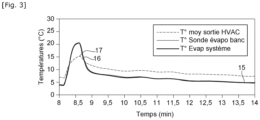
Fig. 3 ] est un diagramme illustrant des exemples de variation de différentes températures au niveau du système de climatisation en fonction du temps, une fois qu'une demande de refroidissement de la batterie a été effectuée. - En se référant à la
figure 1 , certains véhicules automobiles électriques ou hybrides sont dotés d'un système de climatisation 1, d'une batterie électrique 2 et d'un système de refroidissement 3 de ladite batterie 2 relié audit système de climatisation 1 par l'intermédiaire d'un chiller 6. Le système de climatisation 1 comprend un premier circuit 4 de circulation d'un fluide de climatisation, pouvant par exemple être un fluide frigorigène 1234yf, et le système de refroidissement 3 de la batterie 2 comprend un second circuit 5 de circulation d'eau. Le premier circuit 4 de circulation du fluide de climatisation, comprend classiquement un condenseur 7, un compresseur 8, un évaporateur 9 permettant d'assurer un refroidissement dans l'habitacle du véhicule, deux électrovannes 10, 11, deux détendeurs 12, 13 et le chiller 6. Le deuxième circuit 5 comporte une pompe 14, une électrovanne et le chiller 6. Le fluide de climatisation circulant dans le premier circuit 4 et l'eau de refroidissement circulant dans le second circuit 5 sont mis au contact l'un de l'autre au niveau du chiller 6 qui est placé entre lesdits deux circuits 4, 5. Le chiller 6 peut être assimilé à un échangeur thermique permettant d'assurer des échanges thermiques entre le fluide de climatisation du système de climatisation 1 et l'eau de refroidissement du système de refroidissement de la batterie électrique 2. Ces véhicules possèdent également une unité centrale de calcul permettant de piloter électroniquement un certain nombre de fonctions dans le véhicule, comme par exemple le refroidissement de la batterie 2. - Or, dans ce type de configuration, à savoir un couplage au niveau d'un chiller 6, du système de climatisation 1 et du système de refroidissement 3 de la batterie 2, il peut se produire un phénomène intempestif, qui va dégrader la qualité perçue du véhicule. Il s'agit d'une montée temporaire de la température dans l'habitacle 30 du véhicule alors que le système de climatisation 1 est en fonctionnement, lors d'une demande de refroidissement de la batterie 2. En effet, lors d'une telle demande, l'eau de refroidissement circulant dans le second circuit 5 et qui a déjà servi à refroidir la batterie 2, va circuler dans le chiller 6 et va donc réchauffer temporairement le fluide de climatisation. Durant ce réchauffement momentané du fluide de climatisation, les occupants du véhicule vont percevoir une légère montée en température dans l'habitacle du véhicule, alors que le système de climatisation 1 est activé. Cette légère montée en température peut apparaitre comme le signe d'une mauvaise finition du véhicule et sera donc mal perçue par un client qui aura fait l'acquisition d'un tel véhicule.
- Un exemple de ce mauvais fonctionnement du système de climatisation 1 est illustré à la
figure 2 . Dans cet exemple, la température extérieure au véhicule est de 35°C, et la température initiale 15 de l'évaporateur 9, qui correspond à une température de consigne, est de 4°C. Sur l'activation du chiller 6, suite à la demande de refroidissement de la batterie 2, on observe un pic 16 de la température au niveau de l'évaporateur 9 de l'ordre de 21°C, engendrant un pic 17 de la température de l'air soufflé dans l'habitacle 30 de l'ordre de 16°C. - En se référant à la
figure 3 , il faut attendre environ 6 mn avant que la température de l'évaporateur 9 ne retombe à 4°C. - Afin d'empêcher de telles montées temporaires en température, il est préconisé dans un procédé selon l'invention de couper la circulation d'eau dans le second circuit 5 de refroidissement de la batterie dès qu'une demande de refroidissement de la batterie 2 est effectuée par l'unité centrale de calcul.
- De façon plus précise, un procédé de gestion selon l'invention comprend les étapes suivantes :
- Une étape de demande de refroidissement de la batterie 2 alors que le système de climatisation 1 est en fonctionnement, Cette étape peut par exemple être conduite par l'intermédiaire d'au moins un capteur 20 de température, placé sur la batterie 2 et qui mesure en continu la température de ladite batterie 2. Ainsi, dès que la batterie 2 atteint une température seuil prédéterminée, un signal est transmis à l'unité centrale de calcul.
- Une étape de coupure de la circulation d'eau dans le second circuit 5 pendant une période donnée, ladite étape se déclenchant juste après l'étape de demande de refroidissement de la batterie 2. En effet, dès que l'unité centrale reçoit le signal correspondant à une demande de refroidissement de la batterie 2, elle pilote instantanément la fermeture de circulation d'eau dans le second circuit 5, afin de ne pas activer le chiller 6, cette fermeture étant réalisée, par exemple, par le biais d'une électrovanne placée dans le second circuit 5. La durée de cette coupure de circulation d'eau dans le second circuit 5 est inférieure ou égale à 60s, et préférentiellement est inférieure à 30s.
- Une étape de rétablissement de la circulation d'eau dans le second circuit 5 une fois que la période donnée s'est écoulée. Ce rétablissement est effectué au moyen d'une réactivation de la pompe 14 placée dans le second circuit 5, et avec une augmentation progressive du débit d'eau dans ledit second circuit 5.
- Grâce à cette stratégie, en prenant pour référence l'exemple illustré aux
figures 2 et3 , on observe un pic de la température au niveau de l'évaporateur 9 qui n'est plus que de 14°C au lieu de 21°C, engendrant un pic 17 de la température de l'air soufflé dans l'habitacle qui n'est plus que de 12°C au lieu de 16°C. - Lorsqu'une demande de refroidissement de la batterie 2 est demandée, la montée temporaire en température de l'air soufflé dans l'habitacle est réduite d'environ 5°C par rapport à la température obtenue sans coupure d'eau, permettant aux passagers présents dans le véhicule de ne pas ressentir de montée en température dans l'habitacle.
Claims (9)
- Procédé de gestion d'un système de climatisation (1) d'un véhicule comprenant une batterie électrique (2), ledit système (1) comportant un premier circuit (4) de circulation d'un fluide de climatisation, relié par l'intermédiaire d'un chiller (6) à un second circuit (5) de circulation d'eau destiné à refroidir ladite batterie (2), le premier circuit (4) de circulation du fluide de climatisation comprenant un condenseur (7), un compresseur (8), un évaporateur (9), deux électrovannes (10, 11) et deux détendeurs (12, 13), caractérisé en ce que le procédé comprend les étapes suivantes :- Une étape de demande de refroidissement de la batterie (2) alors que le système de climatisation (1) est en fonctionnement,- Une étape de coupure de la circulation d'eau dans le second circuit (5) pendant une période donnée, ladite étape se déclenchant juste après l'étape de demande de refroidissement de la batterie (2),- Une étape de rétablissement de la circulation d'eau dans le second circuit (5) après la période donnée afin de réactiver le chiller (6) et ainsi refroidir ladite batterie (2).
- Procédé de gestion selon la revendication 1, caractérisé en ce que l'étape de coupure de la circulation d'eau s'effectue sur une période inférieure ou égale à 60 secondes.
- Procédé de gestion selon la revendication 2, caractérisé en ce que l'étape de coupure de la circulation d'eau s'effectue sur une période inférieure ou égale à 30 secondes.
- Procédé de gestion selon l'une quelconque des revendications 1 à 3, caractérisé en ce que les étapes de coupure d'eau et de rétablissement de la circulation d'eau s'effectuent au moyen d'une électrovanne.
- Procédé de gestion selon l'une quelconque des revendications 1 à 4, caractérisé en ce que l'étape de demande de refroidissement de la batterie (2) est déclenchée lorsque la batterie (2) atteint une température seuil prédéterminée.
- Procédé de gestion selon l'une quelconque des revendications 1 à 5, caractérisé en ce que le fluide de climatisation est un fluide frigorigène 1234yf.
- Procédé selon l'une quelconque des revendications 1 à 6 caractérisé en ce que le second circuit (5) de circulation d'eau comprend une pompe (14).
- Procédé selon l'une quelconque des revendications 1 à 7, caractérisé en ce que les différentes étapes sont gérées par une unité centrale de calcul embarquée dans le véhicule.
- Véhicule comprenant une batterie électrique, un système de climatisation comportant un premier circuit (4) de circulation d'un fluide de climatisation comprenant un condenseur (7), un compresseur (8), un évaporateur (9), deux électrovannes (10, 11) et deux détendeurs (12, 13) , relié par l'intermédiaire d'un chiller (6) à un second circuit (5) de circulation d'eau destiné à refroidir ladite batterie (2), caractérisé en ce qu'il comprend une unité centrale de calcul dotée d'un logiciel apte à mettre en oeuvre un procédé de gestion conforme à l'une quelconque des revendications 1 à 8.
Applications Claiming Priority (2)
| Application Number | Priority Date | Filing Date | Title |
|---|---|---|---|
| FR1902034A FR3093028B1 (fr) | 2019-02-27 | 2019-02-27 | Procédé de gestion d’un circuit de climatisation relié à un circuit de refroidissement d’une batterie |
| PCT/EP2020/052956 WO2020173678A1 (fr) | 2019-02-27 | 2020-02-06 | Procédé de gestion d'un circuit de climatisation relié à un circuit de refroidissement d'une batterie |
Publications (2)
| Publication Number | Publication Date |
|---|---|
| EP3931009A1 EP3931009A1 (fr) | 2022-01-05 |
| EP3931009B1 true EP3931009B1 (fr) | 2024-04-03 |
Family
ID=67742554
Family Applications (1)
| Application Number | Title | Priority Date | Filing Date |
|---|---|---|---|
| EP20702655.0A Active EP3931009B1 (fr) | 2019-02-27 | 2020-02-06 | Procédé de gestion d'un circuit de climatisation relié à un circuit de refroidissement d'une batterie |
Country Status (3)
| Country | Link |
|---|---|
| EP (1) | EP3931009B1 (fr) |
| FR (1) | FR3093028B1 (fr) |
| WO (1) | WO2020173678A1 (fr) |
Cited By (1)
| Publication number | Priority date | Publication date | Assignee | Title |
|---|---|---|---|---|
| WO2026061909A1 (fr) * | 2024-09-20 | 2026-03-26 | Renault S.A.S. | Systeme de regulation thermique pour vehicule automobile, vehicule automobile equipe d'un tel systeme et procede de regulation thermique |
Families Citing this family (2)
| Publication number | Priority date | Publication date | Assignee | Title |
|---|---|---|---|---|
| FR3129329B1 (fr) | 2021-11-19 | 2025-02-14 | Psa Automobiles Sa | Procede de surveillance thermique des modules de batterie |
| FR3131092A1 (fr) | 2021-12-16 | 2023-06-23 | Psa Automobiles Sa | Procede de surveillance de fonctionnement de capteurs de temperature de modules de batterie |
Family Cites Families (4)
| Publication number | Priority date | Publication date | Assignee | Title |
|---|---|---|---|---|
| FR3031576A1 (fr) * | 2015-01-12 | 2016-07-15 | Peugeot Citroen Automobiles Sa | Dispositif de thermoregulation d’un vehicule automobile |
| FR3041484A3 (fr) * | 2015-09-22 | 2017-03-24 | Renault Sas | Dispositif de conditionnement thermique d'une batterie d'un vehicule electrique ou hybride durant une recharge rapide |
| US10384511B2 (en) * | 2017-01-27 | 2019-08-20 | Ford Global Technologies, Llc | Method to control battery cooling using the battery coolant pump in electrified vehicles |
| CN108656890B (zh) * | 2017-03-27 | 2021-07-20 | 翰昂系统株式会社 | 车辆用空调装置 |
-
2019
- 2019-02-27 FR FR1902034A patent/FR3093028B1/fr active Active
-
2020
- 2020-02-06 WO PCT/EP2020/052956 patent/WO2020173678A1/fr not_active Ceased
- 2020-02-06 EP EP20702655.0A patent/EP3931009B1/fr active Active
Cited By (2)
| Publication number | Priority date | Publication date | Assignee | Title |
|---|---|---|---|---|
| WO2026061909A1 (fr) * | 2024-09-20 | 2026-03-26 | Renault S.A.S. | Systeme de regulation thermique pour vehicule automobile, vehicule automobile equipe d'un tel systeme et procede de regulation thermique |
| FR3166580A1 (fr) * | 2024-09-20 | 2026-03-27 | Renault Sas | Système de régulation thermique pour véhicule automobile, véhicule automobile équipé d’un tel système et procédé de régulation thermique |
Also Published As
| Publication number | Publication date |
|---|---|
| WO2020173678A1 (fr) | 2020-09-03 |
| FR3093028B1 (fr) | 2021-03-12 |
| EP3931009A1 (fr) | 2022-01-05 |
| FR3093028A1 (fr) | 2020-08-28 |
Similar Documents
| Publication | Publication Date | Title |
|---|---|---|
| EP3931009B1 (fr) | Procédé de gestion d'un circuit de climatisation relié à un circuit de refroidissement d'une batterie | |
| EP3727910B1 (fr) | Procédé de fonctionnement d'un système de régulation thermique d'un véhicule automobile à propulsion électrique ou hybride | |
| EP2841288B1 (fr) | Installation de chauffage, ventilation, et/ou climatisation comportant un dispositif de régulation thermique d'une batterie et procédé de mise en uvre correspondant | |
| EP2822788B1 (fr) | Procede de commande automatique destine au degivrage d'une pompe a chaleur pour vehicule | |
| EP3983733B1 (fr) | Procédé de gestion d'un dispositif de gestion thermique pour un véhicule automobile et dispositif de gestion thermique associé | |
| WO2012085414A2 (fr) | Procede d'arret automatique d'un moteur a combustion interne par un systeme d'arret et de redemarrage automatique | |
| EP4088126B1 (fr) | Diagnostic d'état d'une batterie de servitude d'un véhicule par impulsions de courant | |
| FR3028772A1 (fr) | Dispositif de nebulisation, notamment destine a un habitacle de vehicule, et dispositif d'aeration comprenant un tel dispositif | |
| US9982646B2 (en) | Heating element operation and engine start-stop availability | |
| EP4069534A1 (fr) | Procédé de régulation d'un circuit de fluide réfrigerant | |
| EP4500129B1 (fr) | Surveillance du bon fonctionnement d'un capteur de température du circuit caloporteur de la batterie de traction | |
| FR3070902B1 (fr) | Dispositif de controle de clapet(s) motorise(s) d’extraction d’air pour une installation de chauffage/climatisation d’un vehicule. | |
| EP4161790B1 (fr) | Procédé de contrôle d'une boucle de thermoregulation, notamment pour véhicule automobile | |
| EP3956615A1 (fr) | Procede de controle d'un dispositif de gestion thermique d'un vehicule automobile | |
| EP4431320A1 (fr) | Système thermique pour véhicule automobile | |
| EP1806548B1 (fr) | Installation de climatisation parcourue par un fluide supercritique | |
| EP2979146B1 (fr) | Dispositif de commande pour machine de chauffage, ventilation et climatisation | |
| EP3016816A1 (fr) | Procede de commande d'un groupe motopropulseur electrique optimisant la phase d'utilisation a faible vitesse | |
| FR3153037A3 (fr) | Engin comprenant un habitacle de pilotage et comprenant une pompe à chaleur permettant une pluralité de modes de fonctionnement | |
| WO2026073673A1 (fr) | Procédé de traitement thermique pour un système de traitement thermique | |
| FR3153034A3 (fr) | Engin comprenant un habitacle de pilotage et comprenant une pompe à chaleur permettant le dégivrage d’un échangeur en mode chauffage | |
| FR2774033A1 (fr) | Procede et dispositif de chauffage et de climatisation de vehicule evitant l'embuage | |
| WO2018142085A1 (fr) | Dispositif de pre-conditionnement pour vehicule automobile et procede de pre-conditionnement correspondant | |
| FR3114637A1 (fr) | Procédé de contrôle d’un compresseur à cylindrée fixe pour système de refroidissement d’un véhicule automobile à combustion | |
| FR2766561A1 (fr) | Procede et dispositif pour limiter l'echauffement a la sortie d'un compresseur de fluide refrigerant |
Legal Events
| Date | Code | Title | Description |
|---|---|---|---|
| STAA | Information on the status of an ep patent application or granted ep patent |
Free format text: STATUS: UNKNOWN |
|
| STAA | Information on the status of an ep patent application or granted ep patent |
Free format text: STATUS: THE INTERNATIONAL PUBLICATION HAS BEEN MADE |
|
| PUAI | Public reference made under article 153(3) epc to a published international application that has entered the european phase |
Free format text: ORIGINAL CODE: 0009012 |
|
| STAA | Information on the status of an ep patent application or granted ep patent |
Free format text: STATUS: REQUEST FOR EXAMINATION WAS MADE |
|
| 17P | Request for examination filed |
Effective date: 20210907 |
|
| AK | Designated contracting states |
Kind code of ref document: A1 Designated state(s): AL AT BE BG CH CY CZ DE DK EE ES FI FR GB GR HR HU IE IS IT LI LT LU LV MC MK MT NL NO PL PT RO RS SE SI SK SM TR |
|
| RAP3 | Party data changed (applicant data changed or rights of an application transferred) |
Owner name: RENAULT S.A.S |
|
| DAV | Request for validation of the european patent (deleted) | ||
| DAX | Request for extension of the european patent (deleted) | ||
| RAP3 | Party data changed (applicant data changed or rights of an application transferred) |
Owner name: RENAULT S.A.S |
|
| STAA | Information on the status of an ep patent application or granted ep patent |
Free format text: STATUS: EXAMINATION IS IN PROGRESS |
|
| 17Q | First examination report despatched |
Effective date: 20221122 |
|
| P01 | Opt-out of the competence of the unified patent court (upc) registered |
Effective date: 20230608 |
|
| GRAP | Despatch of communication of intention to grant a patent |
Free format text: ORIGINAL CODE: EPIDOSNIGR1 |
|
| STAA | Information on the status of an ep patent application or granted ep patent |
Free format text: STATUS: GRANT OF PATENT IS INTENDED |
|
| RIC1 | Information provided on ipc code assigned before grant |
Ipc: H01M 10/6568 20140101ALI20230901BHEP Ipc: H01M 10/625 20140101ALI20230901BHEP Ipc: H01M 10/613 20140101ALI20230901BHEP Ipc: H01M 10/663 20140101ALI20230901BHEP Ipc: B60H 1/32 20060101ALI20230901BHEP Ipc: B60H 1/00 20060101AFI20230901BHEP |
|
| INTG | Intention to grant announced |
Effective date: 20230928 |
|
| GRAS | Grant fee paid |
Free format text: ORIGINAL CODE: EPIDOSNIGR3 |
|
| GRAA | (expected) grant |
Free format text: ORIGINAL CODE: 0009210 |
|
| STAA | Information on the status of an ep patent application or granted ep patent |
Free format text: STATUS: THE PATENT HAS BEEN GRANTED |
|
| AK | Designated contracting states |
Kind code of ref document: B1 Designated state(s): AL AT BE BG CH CY CZ DE DK EE ES FI FR GB GR HR HU IE IS IT LI LT LU LV MC MK MT NL NO PL PT RO RS SE SI SK SM TR |
|
| REG | Reference to a national code |
Ref country code: CH Ref legal event code: EP |
|
| REG | Reference to a national code |
Ref country code: IE Ref legal event code: FG4D Free format text: LANGUAGE OF EP DOCUMENT: FRENCH |
|
| REG | Reference to a national code |
Ref country code: DE Ref legal event code: R096 Ref document number: 602020028274 Country of ref document: DE |
|
| REG | Reference to a national code |
Ref country code: LT Ref legal event code: MG9D |
|
| REG | Reference to a national code |
Ref country code: NL Ref legal event code: MP Effective date: 20240403 |
|
| REG | Reference to a national code |
Ref country code: AT Ref legal event code: MK05 Ref document number: 1671894 Country of ref document: AT Kind code of ref document: T Effective date: 20240403 |
|
| PG25 | Lapsed in a contracting state [announced via postgrant information from national office to epo] |
Ref country code: NL Free format text: LAPSE BECAUSE OF FAILURE TO SUBMIT A TRANSLATION OF THE DESCRIPTION OR TO PAY THE FEE WITHIN THE PRESCRIBED TIME-LIMIT Effective date: 20240403 |
|
| PG25 | Lapsed in a contracting state [announced via postgrant information from national office to epo] |
Ref country code: NL Free format text: LAPSE BECAUSE OF FAILURE TO SUBMIT A TRANSLATION OF THE DESCRIPTION OR TO PAY THE FEE WITHIN THE PRESCRIBED TIME-LIMIT Effective date: 20240403 |
|
| PG25 | Lapsed in a contracting state [announced via postgrant information from national office to epo] |
Ref country code: IS Free format text: LAPSE BECAUSE OF FAILURE TO SUBMIT A TRANSLATION OF THE DESCRIPTION OR TO PAY THE FEE WITHIN THE PRESCRIBED TIME-LIMIT Effective date: 20240803 |
|
| PG25 | Lapsed in a contracting state [announced via postgrant information from national office to epo] |
Ref country code: BG Free format text: LAPSE BECAUSE OF FAILURE TO SUBMIT A TRANSLATION OF THE DESCRIPTION OR TO PAY THE FEE WITHIN THE PRESCRIBED TIME-LIMIT Effective date: 20240403 |
|
| PG25 | Lapsed in a contracting state [announced via postgrant information from national office to epo] |
Ref country code: FI Free format text: LAPSE BECAUSE OF FAILURE TO SUBMIT A TRANSLATION OF THE DESCRIPTION OR TO PAY THE FEE WITHIN THE PRESCRIBED TIME-LIMIT Effective date: 20240403 Ref country code: HR Free format text: LAPSE BECAUSE OF FAILURE TO SUBMIT A TRANSLATION OF THE DESCRIPTION OR TO PAY THE FEE WITHIN THE PRESCRIBED TIME-LIMIT Effective date: 20240403 |
|
| PG25 | Lapsed in a contracting state [announced via postgrant information from national office to epo] |
Ref country code: GR Free format text: LAPSE BECAUSE OF FAILURE TO SUBMIT A TRANSLATION OF THE DESCRIPTION OR TO PAY THE FEE WITHIN THE PRESCRIBED TIME-LIMIT Effective date: 20240704 |
|
| PG25 | Lapsed in a contracting state [announced via postgrant information from national office to epo] |
Ref country code: PT Free format text: LAPSE BECAUSE OF FAILURE TO SUBMIT A TRANSLATION OF THE DESCRIPTION OR TO PAY THE FEE WITHIN THE PRESCRIBED TIME-LIMIT Effective date: 20240805 |
|
| PG25 | Lapsed in a contracting state [announced via postgrant information from national office to epo] |
Ref country code: ES Free format text: LAPSE BECAUSE OF FAILURE TO SUBMIT A TRANSLATION OF THE DESCRIPTION OR TO PAY THE FEE WITHIN THE PRESCRIBED TIME-LIMIT Effective date: 20240403 |
|
| PG25 | Lapsed in a contracting state [announced via postgrant information from national office to epo] |
Ref country code: CZ Free format text: LAPSE BECAUSE OF FAILURE TO SUBMIT A TRANSLATION OF THE DESCRIPTION OR TO PAY THE FEE WITHIN THE PRESCRIBED TIME-LIMIT Effective date: 20240403 |
|
| PG25 | Lapsed in a contracting state [announced via postgrant information from national office to epo] |
Ref country code: AT Free format text: LAPSE BECAUSE OF FAILURE TO SUBMIT A TRANSLATION OF THE DESCRIPTION OR TO PAY THE FEE WITHIN THE PRESCRIBED TIME-LIMIT Effective date: 20240403 |
|
| PG25 | Lapsed in a contracting state [announced via postgrant information from national office to epo] |
Ref country code: PL Free format text: LAPSE BECAUSE OF FAILURE TO SUBMIT A TRANSLATION OF THE DESCRIPTION OR TO PAY THE FEE WITHIN THE PRESCRIBED TIME-LIMIT Effective date: 20240403 |
|
| PG25 | Lapsed in a contracting state [announced via postgrant information from national office to epo] |
Ref country code: LV Free format text: LAPSE BECAUSE OF FAILURE TO SUBMIT A TRANSLATION OF THE DESCRIPTION OR TO PAY THE FEE WITHIN THE PRESCRIBED TIME-LIMIT Effective date: 20240403 |
|
| PG25 | Lapsed in a contracting state [announced via postgrant information from national office to epo] |
Ref country code: PT Free format text: LAPSE BECAUSE OF FAILURE TO SUBMIT A TRANSLATION OF THE DESCRIPTION OR TO PAY THE FEE WITHIN THE PRESCRIBED TIME-LIMIT Effective date: 20240805 Ref country code: PL Free format text: LAPSE BECAUSE OF FAILURE TO SUBMIT A TRANSLATION OF THE DESCRIPTION OR TO PAY THE FEE WITHIN THE PRESCRIBED TIME-LIMIT Effective date: 20240403 Ref country code: NO Free format text: LAPSE BECAUSE OF FAILURE TO SUBMIT A TRANSLATION OF THE DESCRIPTION OR TO PAY THE FEE WITHIN THE PRESCRIBED TIME-LIMIT Effective date: 20240703 Ref country code: LV Free format text: LAPSE BECAUSE OF FAILURE TO SUBMIT A TRANSLATION OF THE DESCRIPTION OR TO PAY THE FEE WITHIN THE PRESCRIBED TIME-LIMIT Effective date: 20240403 Ref country code: IS Free format text: LAPSE BECAUSE OF FAILURE TO SUBMIT A TRANSLATION OF THE DESCRIPTION OR TO PAY THE FEE WITHIN THE PRESCRIBED TIME-LIMIT Effective date: 20240803 Ref country code: HR Free format text: LAPSE BECAUSE OF FAILURE TO SUBMIT A TRANSLATION OF THE DESCRIPTION OR TO PAY THE FEE WITHIN THE PRESCRIBED TIME-LIMIT Effective date: 20240403 Ref country code: GR Free format text: LAPSE BECAUSE OF FAILURE TO SUBMIT A TRANSLATION OF THE DESCRIPTION OR TO PAY THE FEE WITHIN THE PRESCRIBED TIME-LIMIT Effective date: 20240704 Ref country code: FI Free format text: LAPSE BECAUSE OF FAILURE TO SUBMIT A TRANSLATION OF THE DESCRIPTION OR TO PAY THE FEE WITHIN THE PRESCRIBED TIME-LIMIT Effective date: 20240403 Ref country code: ES Free format text: LAPSE BECAUSE OF FAILURE TO SUBMIT A TRANSLATION OF THE DESCRIPTION OR TO PAY THE FEE WITHIN THE PRESCRIBED TIME-LIMIT Effective date: 20240403 Ref country code: CZ Free format text: LAPSE BECAUSE OF FAILURE TO SUBMIT A TRANSLATION OF THE DESCRIPTION OR TO PAY THE FEE WITHIN THE PRESCRIBED TIME-LIMIT Effective date: 20240403 Ref country code: BG Free format text: LAPSE BECAUSE OF FAILURE TO SUBMIT A TRANSLATION OF THE DESCRIPTION OR TO PAY THE FEE WITHIN THE PRESCRIBED TIME-LIMIT Effective date: 20240403 Ref country code: AT Free format text: LAPSE BECAUSE OF FAILURE TO SUBMIT A TRANSLATION OF THE DESCRIPTION OR TO PAY THE FEE WITHIN THE PRESCRIBED TIME-LIMIT Effective date: 20240403 Ref country code: RS Free format text: LAPSE BECAUSE OF FAILURE TO SUBMIT A TRANSLATION OF THE DESCRIPTION OR TO PAY THE FEE WITHIN THE PRESCRIBED TIME-LIMIT Effective date: 20240703 |
|
| REG | Reference to a national code |
Ref country code: DE Ref legal event code: R097 Ref document number: 602020028274 Country of ref document: DE |
|
| PG25 | Lapsed in a contracting state [announced via postgrant information from national office to epo] |
Ref country code: DK Free format text: LAPSE BECAUSE OF FAILURE TO SUBMIT A TRANSLATION OF THE DESCRIPTION OR TO PAY THE FEE WITHIN THE PRESCRIBED TIME-LIMIT Effective date: 20240403 |
|
| PG25 | Lapsed in a contracting state [announced via postgrant information from national office to epo] |
Ref country code: EE Free format text: LAPSE BECAUSE OF FAILURE TO SUBMIT A TRANSLATION OF THE DESCRIPTION OR TO PAY THE FEE WITHIN THE PRESCRIBED TIME-LIMIT Effective date: 20240403 |
|
| PG25 | Lapsed in a contracting state [announced via postgrant information from national office to epo] |
Ref country code: RO Free format text: LAPSE BECAUSE OF FAILURE TO SUBMIT A TRANSLATION OF THE DESCRIPTION OR TO PAY THE FEE WITHIN THE PRESCRIBED TIME-LIMIT Effective date: 20240403 Ref country code: SK Free format text: LAPSE BECAUSE OF FAILURE TO SUBMIT A TRANSLATION OF THE DESCRIPTION OR TO PAY THE FEE WITHIN THE PRESCRIBED TIME-LIMIT Effective date: 20240403 |
|
| PG25 | Lapsed in a contracting state [announced via postgrant information from national office to epo] |
Ref country code: SM Free format text: LAPSE BECAUSE OF FAILURE TO SUBMIT A TRANSLATION OF THE DESCRIPTION OR TO PAY THE FEE WITHIN THE PRESCRIBED TIME-LIMIT Effective date: 20240403 |
|
| PG25 | Lapsed in a contracting state [announced via postgrant information from national office to epo] |
Ref country code: SM Free format text: LAPSE BECAUSE OF FAILURE TO SUBMIT A TRANSLATION OF THE DESCRIPTION OR TO PAY THE FEE WITHIN THE PRESCRIBED TIME-LIMIT Effective date: 20240403 Ref country code: SK Free format text: LAPSE BECAUSE OF FAILURE TO SUBMIT A TRANSLATION OF THE DESCRIPTION OR TO PAY THE FEE WITHIN THE PRESCRIBED TIME-LIMIT Effective date: 20240403 Ref country code: RO Free format text: LAPSE BECAUSE OF FAILURE TO SUBMIT A TRANSLATION OF THE DESCRIPTION OR TO PAY THE FEE WITHIN THE PRESCRIBED TIME-LIMIT Effective date: 20240403 Ref country code: EE Free format text: LAPSE BECAUSE OF FAILURE TO SUBMIT A TRANSLATION OF THE DESCRIPTION OR TO PAY THE FEE WITHIN THE PRESCRIBED TIME-LIMIT Effective date: 20240403 Ref country code: DK Free format text: LAPSE BECAUSE OF FAILURE TO SUBMIT A TRANSLATION OF THE DESCRIPTION OR TO PAY THE FEE WITHIN THE PRESCRIBED TIME-LIMIT Effective date: 20240403 |
|
| PLBE | No opposition filed within time limit |
Free format text: ORIGINAL CODE: 0009261 |
|
| STAA | Information on the status of an ep patent application or granted ep patent |
Free format text: STATUS: NO OPPOSITION FILED WITHIN TIME LIMIT |
|
| 26N | No opposition filed |
Effective date: 20250106 |
|
| PG25 | Lapsed in a contracting state [announced via postgrant information from national office to epo] |
Ref country code: SI Free format text: LAPSE BECAUSE OF FAILURE TO SUBMIT A TRANSLATION OF THE DESCRIPTION OR TO PAY THE FEE WITHIN THE PRESCRIBED TIME-LIMIT Effective date: 20240403 |
|
| PG25 | Lapsed in a contracting state [announced via postgrant information from national office to epo] |
Ref country code: SE Free format text: LAPSE BECAUSE OF FAILURE TO SUBMIT A TRANSLATION OF THE DESCRIPTION OR TO PAY THE FEE WITHIN THE PRESCRIBED TIME-LIMIT Effective date: 20240403 |
|
| PG25 | Lapsed in a contracting state [announced via postgrant information from national office to epo] |
Ref country code: MC Free format text: LAPSE BECAUSE OF FAILURE TO SUBMIT A TRANSLATION OF THE DESCRIPTION OR TO PAY THE FEE WITHIN THE PRESCRIBED TIME-LIMIT Effective date: 20240403 |
|
| REG | Reference to a national code |
Ref country code: CH Ref legal event code: PL |
|
| PG25 | Lapsed in a contracting state [announced via postgrant information from national office to epo] |
Ref country code: LU Free format text: LAPSE BECAUSE OF NON-PAYMENT OF DUE FEES Effective date: 20250206 |
|
| PG25 | Lapsed in a contracting state [announced via postgrant information from national office to epo] |
Ref country code: CH Free format text: LAPSE BECAUSE OF NON-PAYMENT OF DUE FEES Effective date: 20250228 |
|
| REG | Reference to a national code |
Ref country code: BE Ref legal event code: MM Effective date: 20250228 |
|
| PG25 | Lapsed in a contracting state [announced via postgrant information from national office to epo] |
Ref country code: BE Free format text: LAPSE BECAUSE OF NON-PAYMENT OF DUE FEES Effective date: 20250228 |
|
| PG25 | Lapsed in a contracting state [announced via postgrant information from national office to epo] |
Ref country code: IE Free format text: LAPSE BECAUSE OF NON-PAYMENT OF DUE FEES Effective date: 20250206 |
|
| PG25 | Lapsed in a contracting state [announced via postgrant information from national office to epo] |
Ref country code: IT Free format text: LAPSE BECAUSE OF FAILURE TO SUBMIT A TRANSLATION OF THE DESCRIPTION OR TO PAY THE FEE WITHIN THE PRESCRIBED TIME-LIMIT Effective date: 20240403 |
|
| PGFP | Annual fee paid to national office [announced via postgrant information from national office to epo] |
Ref country code: GB Payment date: 20260220 Year of fee payment: 7 |
|
| PGFP | Annual fee paid to national office [announced via postgrant information from national office to epo] |
Ref country code: DE Payment date: 20260218 Year of fee payment: 7 |
|
| PGFP | Annual fee paid to national office [announced via postgrant information from national office to epo] |
Ref country code: FR Payment date: 20260219 Year of fee payment: 7 |