EP3929299B1 - Erythritol produzierender saprotroph - Google Patents
Erythritol produzierender saprotroph Download PDFInfo
- Publication number
- EP3929299B1 EP3929299B1 EP20182382.0A EP20182382A EP3929299B1 EP 3929299 B1 EP3929299 B1 EP 3929299B1 EP 20182382 A EP20182382 A EP 20182382A EP 3929299 B1 EP3929299 B1 EP 3929299B1
- Authority
- EP
- European Patent Office
- Prior art keywords
- gene encoding
- saprotroph
- erythritol
- genetically modified
- culture medium
- Prior art date
- Legal status (The legal status is an assumption and is not a legal conclusion. Google has not performed a legal analysis and makes no representation as to the accuracy of the status listed.)
- Active
Links
Images



Classifications
-
- C—CHEMISTRY; METALLURGY
- C12—BIOCHEMISTRY; BEER; SPIRITS; WINE; VINEGAR; MICROBIOLOGY; ENZYMOLOGY; MUTATION OR GENETIC ENGINEERING
- C12N—MICROORGANISMS OR ENZYMES; COMPOSITIONS THEREOF; PROPAGATING, PRESERVING, OR MAINTAINING MICROORGANISMS; MUTATION OR GENETIC ENGINEERING; CULTURE MEDIA
- C12N1/00—Microorganisms; Compositions thereof; Processes of propagating, maintaining or preserving microorganisms or compositions thereof; Processes of preparing or isolating a composition containing a microorganism; Culture media therefor
- C12N1/14—Fungi; Culture media therefor
- C12N1/145—Fungi isolates
-
- C—CHEMISTRY; METALLURGY
- C12—BIOCHEMISTRY; BEER; SPIRITS; WINE; VINEGAR; MICROBIOLOGY; ENZYMOLOGY; MUTATION OR GENETIC ENGINEERING
- C12N—MICROORGANISMS OR ENZYMES; COMPOSITIONS THEREOF; PROPAGATING, PRESERVING, OR MAINTAINING MICROORGANISMS; MUTATION OR GENETIC ENGINEERING; CULTURE MEDIA
- C12N1/00—Microorganisms; Compositions thereof; Processes of propagating, maintaining or preserving microorganisms or compositions thereof; Processes of preparing or isolating a composition containing a microorganism; Culture media therefor
- C12N1/14—Fungi; Culture media therefor
-
- C—CHEMISTRY; METALLURGY
- C12—BIOCHEMISTRY; BEER; SPIRITS; WINE; VINEGAR; MICROBIOLOGY; ENZYMOLOGY; MUTATION OR GENETIC ENGINEERING
- C12N—MICROORGANISMS OR ENZYMES; COMPOSITIONS THEREOF; PROPAGATING, PRESERVING, OR MAINTAINING MICROORGANISMS; MUTATION OR GENETIC ENGINEERING; CULTURE MEDIA
- C12N15/00—Mutation or genetic engineering; DNA or RNA concerning genetic engineering, vectors, e.g. plasmids, or their isolation, preparation or purification; Use of hosts therefor
- C12N15/09—Recombinant DNA-technology
- C12N15/11—DNA or RNA fragments; Modified forms thereof; Non-coding nucleic acids having a biological activity
- C12N15/52—Genes encoding for enzymes or proenzymes
-
- C—CHEMISTRY; METALLURGY
- C12—BIOCHEMISTRY; BEER; SPIRITS; WINE; VINEGAR; MICROBIOLOGY; ENZYMOLOGY; MUTATION OR GENETIC ENGINEERING
- C12N—MICROORGANISMS OR ENZYMES; COMPOSITIONS THEREOF; PROPAGATING, PRESERVING, OR MAINTAINING MICROORGANISMS; MUTATION OR GENETIC ENGINEERING; CULTURE MEDIA
- C12N15/00—Mutation or genetic engineering; DNA or RNA concerning genetic engineering, vectors, e.g. plasmids, or their isolation, preparation or purification; Use of hosts therefor
- C12N15/09—Recombinant DNA-technology
- C12N15/63—Introduction of foreign genetic material using vectors; Vectors; Use of hosts therefor; Regulation of expression
- C12N15/79—Vectors or expression systems specially adapted for eukaryotic hosts
- C12N15/80—Vectors or expression systems specially adapted for eukaryotic hosts for fungi
-
- C—CHEMISTRY; METALLURGY
- C12—BIOCHEMISTRY; BEER; SPIRITS; WINE; VINEGAR; MICROBIOLOGY; ENZYMOLOGY; MUTATION OR GENETIC ENGINEERING
- C12N—MICROORGANISMS OR ENZYMES; COMPOSITIONS THEREOF; PROPAGATING, PRESERVING, OR MAINTAINING MICROORGANISMS; MUTATION OR GENETIC ENGINEERING; CULTURE MEDIA
- C12N9/00—Enzymes; Proenzymes; Compositions thereof; Processes for preparing, activating, inhibiting, separating or purifying enzymes
- C12N9/0004—Oxidoreductases (1.)
- C12N9/0006—Oxidoreductases (1.) acting on CH-OH groups as donors (1.1)
-
- C—CHEMISTRY; METALLURGY
- C12—BIOCHEMISTRY; BEER; SPIRITS; WINE; VINEGAR; MICROBIOLOGY; ENZYMOLOGY; MUTATION OR GENETIC ENGINEERING
- C12N—MICROORGANISMS OR ENZYMES; COMPOSITIONS THEREOF; PROPAGATING, PRESERVING, OR MAINTAINING MICROORGANISMS; MUTATION OR GENETIC ENGINEERING; CULTURE MEDIA
- C12N9/00—Enzymes; Proenzymes; Compositions thereof; Processes for preparing, activating, inhibiting, separating or purifying enzymes
- C12N9/10—Transferases (2.)
- C12N9/1022—Transferases (2.) transferring aldehyde or ketonic groups (2.2)
-
- C—CHEMISTRY; METALLURGY
- C12—BIOCHEMISTRY; BEER; SPIRITS; WINE; VINEGAR; MICROBIOLOGY; ENZYMOLOGY; MUTATION OR GENETIC ENGINEERING
- C12P—FERMENTATION OR ENZYME-USING PROCESSES TO SYNTHESISE A DESIRED CHEMICAL COMPOUND OR COMPOSITION OR TO SEPARATE OPTICAL ISOMERS FROM A RACEMIC MIXTURE
- C12P7/00—Preparation of oxygen-containing organic compounds
- C12P7/02—Preparation of oxygen-containing organic compounds containing a hydroxy group
- C12P7/04—Preparation of oxygen-containing organic compounds containing a hydroxy group acyclic
- C12P7/18—Preparation of oxygen-containing organic compounds containing a hydroxy group acyclic polyhydric
-
- C—CHEMISTRY; METALLURGY
- C12—BIOCHEMISTRY; BEER; SPIRITS; WINE; VINEGAR; MICROBIOLOGY; ENZYMOLOGY; MUTATION OR GENETIC ENGINEERING
- C12Y—ENZYMES
- C12Y101/00—Oxidoreductases acting on the CH-OH group of donors (1.1)
- C12Y101/01—Oxidoreductases acting on the CH-OH group of donors (1.1) with NAD+ or NADP+ as acceptor (1.1.1)
- C12Y101/01017—Mannitol-1-phosphate 5-dehydrogenase (1.1.1.17)
-
- C—CHEMISTRY; METALLURGY
- C12—BIOCHEMISTRY; BEER; SPIRITS; WINE; VINEGAR; MICROBIOLOGY; ENZYMOLOGY; MUTATION OR GENETIC ENGINEERING
- C12Y—ENZYMES
- C12Y202/00—Transferases transferring aldehyde or ketonic groups (2.2)
- C12Y202/01—Transketolases and transaldolases (2.2.1)
- C12Y202/01001—Transketolase (2.2.1.1)
-
- C—CHEMISTRY; METALLURGY
- C12—BIOCHEMISTRY; BEER; SPIRITS; WINE; VINEGAR; MICROBIOLOGY; ENZYMOLOGY; MUTATION OR GENETIC ENGINEERING
- C12Y—ENZYMES
- C12Y202/00—Transferases transferring aldehyde or ketonic groups (2.2)
- C12Y202/01—Transketolases and transaldolases (2.2.1)
- C12Y202/01002—Transaldolase (2.2.1.2)
-
- C—CHEMISTRY; METALLURGY
- C12—BIOCHEMISTRY; BEER; SPIRITS; WINE; VINEGAR; MICROBIOLOGY; ENZYMOLOGY; MUTATION OR GENETIC ENGINEERING
- C12Y—ENZYMES
- C12Y205/00—Transferases transferring alkyl or aryl groups, other than methyl groups (2.5)
- C12Y205/01—Transferases transferring alkyl or aryl groups, other than methyl groups (2.5) transferring alkyl or aryl groups, other than methyl groups (2.5.1)
- C12Y205/01054—3-Deoxy-7-phosphoheptulonate synthase (2.5.1.54)
Definitions
- the present invention pertains to a genetically modified saprotroph for the biotechnological production of erythritol and a method for the production of erythritol using said genetically modified saprotroph.
- Erythritol is a naturally occurring four-carbon sugar alcohol gaining increasing importance in the food industry due to its specific properties and its manifold fields of application. It can be found in several fruits, such as pears, grapes and melons, mushrooms, alcoholic drinks (beer, wine, sake) and fermented food products, such as soy sauce and miso bean paste, but naturally also occurs in biofluids of humans and animals such as eye lens tissue, serum, plasma, fetal fluid and urine. Due to its small molecular weight, erythritol is easily absorbed already in the upper intestine and therefore causes less digestive distress than other sugar alcohols used in the food industry.
- erythritol is non-cariogenic, thermally stable, crystalizes well and is less hygroscopic than sucrose. Due to the negative enthalpy of dissolution, the consumption of erythritol causes a cooling sensation in the oral cavity.
- a 10% (w/v) solution of erythritol has 60-80% of the sweetness of sucrose.
- erythritol is produced via the so-called pentose phosphate pathway. It is synthesized from D-erythrose-4-phosphate through dephosphorylation and subsequent reduction of erythrose. Based thereon, the suitability of osmophilic yeast, such as Aureobasidium sp., Trichosporonoides sp. and Candida magnoliae, for the biotechnological production of erythritol has been investigated in several studies ( Ishizuka et al., Breeding of a mutant of Aureobasidium sp. with high erythritol production, 1989, J. Ferm. Bioeng., Vol.
- EP 2 436 772 A1 discloses the production of erythritol by reduction of erythrose to erythritol using an erythrose reductase from Hypocrea , Gibberella, Aspergillus or Penicillum. In Moon et al. (Biotechnological production of erythritol and its applications, 2010, Appl. Microbiol. Biotechnol., Vol.
- the present invention overcomes the disadvantages of the methods in the prior art by the subject-matter of the independent claims, in particular by the genetically modified saprotroph according to the present invention and the method for the production of erythritol according to the present invention.
- the present invention in particular pertains to a genetically modified saprotroph comprising at least one gene encoding at least one membrane-bound alditol transporter, at least one gene encoding at least one erythrose reductase and at least one inactivated gene encoding mannitol 1-phosphate 5-dehydrogenase, wherein the saprotroph is a filamentous fungus selected from the genera Hypocrea, Gibberella, Aspergillus and Penicillium.
- the saprotroph is a filamentous fungus selected from Hypocrea jecorina (Trichoderma reesei), Gibberella zeae, Aspergillus niger, Aspergillus nidulans, Aspergillus oryzae and Penicillium chrysogenum.
- Hypocrea jecorina Trichoderma reesei
- Gibberella zeae Aspergillus niger
- Aspergillus nidulans Aspergillus oryzae
- Penicillium chrysogenum is a filamentous fungus selected from Hypocrea jecorina (Trichoderma reesei), Gibberella zeae, Aspergillus niger, Aspergillus nidulans, Aspergillus oryzae and Penicillium chrysogenum.
- the genetically modified saprotroph is Hypocrea jecorina (Trichoderma reesei).
- the genetically modified saprotroph is based on the Trichoderma reesei strain QM6a ⁇ tmus53.
- the at least one gene encoding at least one membrane-bound alditol transporter is fps1 , in particular codon-optimized fps1 .
- the at least one gene encoding at least one membrane-bound alditol transporter is fps1 from Saccharomyces cerevisiae, in particular codon-optimized fps1 from Saccharomyces cerevisiae.
- the at least one gene encoding at least one membrane-bound alditol transporter comprises the nucleotide sequence of SEQ ID No. 1 , in particular consists of the nucleotide sequence of SEQ ID No. 1.
- the membrane-bound alditol transporter comprises the amino acid sequence of SEQ ID No. 2 , in particular consists of the amino acid sequence of SEQ ID No. 2.
- the at least one gene encoding at least one erythrose reductase is err1 , in particular codon-optimized err1.
- the at least one gene encoding at least one erythrose reductase is err1 , in particular codon-optimized err1 , from Trichoderma reesei, Aspergillus niger or Fusarium graminearum.
- the at least one gene encoding at least one erythrose reductase comprises the nucleotide sequence of SEQ ID No. 3 , in particular consist of the nucleotide sequence of SEQ ID No. 3.
- the erythrose reductase comprises the amino acid sequence of SEQ ID No. 4 , in particular consists of the amino acid sequence of SEQ ID No. 4.
- the at least one inactivated gene encoding mannitol 1-phosphate 5-dehydrogenase is mpdh.
- the at least one gene encoding mannitol 1-phosphate 5-dehydrogenase of the genetically modified saprotroph comprised the nucleotide sequence of SEQ ID No. 12 before inactivation, in particular consisted of the nucleotide sequence of SEQ ID No. 12 before inactivation.
- the mannitol 1-phosphate 5-dehydrogenase encoded by the nucleotide sequence of SEQ ID No. 12 before inactivation comprises the amino acid sequence of SEQ ID No. 13 , in particular consists of the amino acid sequence of SEQ ID No. 13.
- the at least one inactivated gene encoding mannitol 1-phosphate 5-dehydrogenase of the genetically modified saprotroph is deleted.
- the at least one inactivated gene encoding mannitol 1-phosphate 5-dehydrogenase of the genetically modified saprotroph is non-functional.
- the at least one inactivated gene encoding mannitol 1-phosphate 5-dehydrogenase of the genetically modified saprotroph is inactivated by gene knock-out, in particular gene replacement.
- the at least one inactivated gene encoding mannitol 1-phosphate 5-dehydrogenase of the genetically modified saprotroph is inactivated by gene replacement using a deletion cassette.
- the at least one gene encoding mannitol 1-phosphate 5-dehydrogenase of the genetically modified saprotroph is inactivated, in particular made non-functional, by genome editing, in particular by meganucleases, zinc-finger nucleases (ZFNs), transcription activator-like effector nucleases (TALENs) or by the clustered regularly interspaced short palindromic repeats (CRISPR) system.
- genome editing in particular by meganucleases, zinc-finger nucleases (ZFNs), transcription activator-like effector nucleases (TALENs) or by the clustered regularly interspaced short palindromic repeats (CRISPR) system.
- the genetically modified saprotroph comprises at least one, preferably at least two, preferably at least three, preferably at least four, preferably at least five, further inactivated genes.
- the at least one further inactivated gene is selected from the group consisting of a gene encoding phospho-2-dehydro-3-deoxyheptonate aldolase 1 (Dhaps-1), a gene encoding erythritol utilization factor (EUF), a gene encoding erythrulose kinase (EYK1), a gene encoding erythritol dehydrogenase (EYD1), a gene encoding erythritol isomerase 1 (EYI1) and a gene encoding erythritol isomerase 2 (EYI2).
- Dhaps-1 phospho-2-dehydro-3-deoxyheptonate aldolase 1
- EUF erythritol utilization factor
- EYK1 erythr
- the at least one further inactivated gene is a gene encoding phospho-2-dehydro-3-deoxyheptonate aldolase 1 (Dhaps-1).
- the at least one gene encoding phospho-2-dehydro-3-deoxyheptonate aldolase 1 (Dhaps1) of the genetically modified saprotroph comprised the nucleotide sequence of SEQ ID No. 14 before inactivation, in particular consisted of the nucleotide sequence of SEQ ID No. 14 before inactivation.
- the phospho-2-dehydro-3-deoxyheptonate aldolase 1 (Dhaps1) encoded by the nucleotide sequence of SEQ ID No. 14 before inactivation comprises the amino acid sequence of SEQ ID No. 15 , in particular consists of the amino acid sequence of SEQ ID No. 15.
- the at least one further inactivated gene is a gene encoding erythritol utilization factor (EUF).
- EUF erythritol utilization factor
- the at least one gene encoding erythritol utilization factor (Euf1) of the genetically modified saprotroph comprised the nucleotide sequence of SEQ ID No. 16 before inactivation, in particular consisted of the nucleotide sequence of SEQ ID No. 16 before inactivation.
- the erythritol utilization factor (Euf1) encoded by the nucleotide sequence of SEQ ID No. 16 before inactivation comprises the amino acid sequence of SEQ ID No. 17 , in particular consists of the amino acid sequence of SEQ ID No. 17.
- the at least one further inactivated gene is a gene encoding erythrulose kinase (EYK1).
- EYK1 erythrulose kinase
- the at least one gene encoding erythrulose kinase (Eyk1) of the genetically modified saprotroph comprised the nucleotide sequence of SEQ ID No. 18 before inactivation, in particular consisted of the nucleotide sequence of SEQ ID No. 18 before inactivation.
- the erythrulose kinase (Eyk1) encoded by the nucleotide sequence of SEQ ID No. 18 before inactivation comprises the amino acid sequence of SEQ ID No. 19 , in particular consists of the amino acid sequence of SEQ ID No. 19.
- the at least one further inactivated gene is a gene encoding erythritol dehydrogenase (EYD1).
- EYD1 erythritol dehydrogenase
- the at least one gene encoding erythritol dehydrogenase (Eyd1) of the genetically modified saprotroph comprised the nucleotide sequence of SEQ ID No. 20 before inactivation, in particular consisted of the nucleotide sequence of SEQ ID No. 20 before inactivation.
- the erythritol dehydrogenase (Eyd1) encoded by the nucleotide sequence of SEQ ID No. 20 before inactivation comprises the amino acid sequence of SEQ ID No. 21 , in particular consists of the amino acid sequence of SEQ ID No. 21.
- the at least one further inactivated gene is a gene encoding erythritol isomerase 1 (EYI1).
- EYI1 erythritol isomerase 1
- the at least one gene encoding erythritol isomerase 1 (Eyi1) of the genetically modified saprotroph comprised the nucleotide sequence of SEQ ID No. 22 before inactivation, in particular consisted of the nucleotide sequence of SEQ ID No. 22 before inactivation.
- the erythritol isomerase 1 (Eyi1) encoded by the nucleotide sequence of SEQ ID No. 22 before inactivation comprises the amino acid sequence of SEQ ID No. 23 , in particular consists of the amino acid sequence of SEQ ID No. 23.
- the at least one further inactivated gene is a gene encoding erythritol isomerase 2 (EYI2).
- EYI2 erythritol isomerase 2
- the at least one gene encoding isomerase 2 (Eyi2) of the genetically modified saprotroph comprised the nucleotide sequence of SEQ ID No. 24 before inactivation, in particular consisted of the nucleotide sequence of SEQ ID No. 24 before inactivation.
- the isomerase 2 (Eyi2) encoded by the nucleotide sequence of SEQ ID No. 24 before inactivation comprises the amino acid sequence of SEQ ID No. 25 , in particular consists of the amino acid sequence of SEQ ID No. 25.
- Dhaps-1 phospho-2-dehydro-3-deoxyheptonate aldolase 1
- EUF erythritol utilization factor
- EYK1 erythrulose kinase
- EYD1 a gene encoding erythritol dehydrogenase
- Dhaps-1 phospho-2-dehydro-3-deoxyheptonate aldolase 1
- EUF erythritol utilization factor
- EYK1 erythrulose kinase
- EYD1 a gene encoding erythritol dehydrogenase
- the at least one further inactivated gene selected from the group consisting of a gene encoding phospho-2-dehydro-3-deoxyheptonate aldolase 1 (Dhaps-1), a gene encoding erythritol utilization factor (EUF), a gene encoding erythrulose kinase (EYK1), a gene encoding erythritol dehydrogenase (EYD1), a gene encoding erythritol isomerase (EYI1) and a gene encoding erythritol isomerase (EYI2) of the genetically modified saprotroph is inactivated by gene knock-out, in particular gene replacement.
- the at least one further inactivated gene selected from the group consisting of a gene encoding phospho-2-dehydro-3-deoxyheptonate aldolase 1 (Dhaps-1), a gene encoding erythritol utilization factor (EUF), a gene encoding erythrulose kinase (EYK1), a gene encoding erythritol dehydrogenase (EYD1), a gene encoding erythritol isomerase (EYI1) and a gene encoding erythritol isomerase (EYI2) of the genetically modified saprotroph is inactivated by gene replacement using a deletion cassette.
- the at least one further inactivated gene selected from the group consisting of a gene encoding phospho-2-dehydro-3-deoxyheptonate aldolase 1 (Dhaps-1), a gene encoding erythritol utilization factor (EUF), a gene encoding erythrulose kinase (EYK1), a gene encoding erythritol dehydrogenase (EYD1), a gene encoding erythritol isomerase (EYI1) and a gene encoding erythritol isomerase (EYI2) of the genetically modified saprotroph is inactivated, in particular made non-functional, by genome editing, in particular by meganucleases, zinc-finger nucleases (ZFNs), transcription activator-like effector nucleases (TALENs) or by the clustered regularly interspaced short palindromic repeats (CRISPR) system
- Dhaps-1 a gene
- the genetically modified saprotroph further comprises at least one gene encoding at least one transketolase.
- the at least one gene encoding at least one transketolase is tkll, in particular codon-optimized tkll.
- the genetically modified saprotroph further comprises at least one gene encoding tkll from T. reesei, in particular codon-optimized tkll from T. reesei.
- the at least one gene encoding at least one transketolase comprises the nucleotide sequence of SEQ ID No. 5 , in particular consists of the nucleotide sequence of SEQ ID No. 5.
- the at least one transketolase comprises the amino acid sequence of SEQ ID No. 6 , in particular consists of the amino acid sequence of SEQ ID No. 6.
- the genetically modified saprotroph further comprises at least one gene encoding at least one transaldolase.
- the at least one gene encoding at least one transaldolase is tall, in particular codon-optimized tall.
- the genetically modified saprotroph further comprises at least one gene encoding tall from T. reesei, in particular codon-optimized tall from T. reesei.
- the at least one gene encoding at least one transaldolase comprises the nucleotide sequence of SEQ ID No. 7 , in particular consist of the nucleotide sequence of SEQ ID No. 7.
- the at least one transaldolase comprises the amino acid sequence of SEQ ID No. 8 , in particular consists of the amino acid sequence of SEQ ID No. 8.
- the genetically modified saprotroph further comprises at least one gene encoding at least one erythritol utilization factor (EUF).
- EUF erythritol utilization factor
- the at least one gene encoding at least one erythritol utilization factor is eufl, in particular codon-optimized eufl.
- the genetically modified saprotroph further comprises at least one gene encoding eufl from T. reesei, in particular codon-optimized eufl from T. reesei.
- the at least one gene encoding at least one erythritol utilization factor comprises the nucleotide sequence of SEQ ID No. 16 , in particular consist of the nucleotide sequence of SEQ ID No. 16.
- the at least one erythritol utilization factor comprises the amino acid sequence of SEQ ID No. 17 , in particular consists of the amino acid sequence of SEQ ID No. 17.
- the at least one gene encoding at least one membrane-bound alditol transporter, the at least one gene encoding at least one erythrose reductase, the at least one gene encoding at least one transketolase, the at least one gene encoding at least one transaldolase and/or the at least one gene encoding at least one erythritol utilization factor (EUF) of the genetically modified saprotroph is an exogenous polynucleotide sequence.
- the at least one gene encoding at least one membrane-bound alditol transporter, the at least one gene encoding at least one erythrose reductase, the at least one gene encoding at least one transketolase, the at least one gene encoding at least one transaldolase and/or the at least one gene encoding at least one erythritol utilization factor (EUF) of the genetically modified saprotroph is an endogenous polynucleotide sequence.
- the genetically modified saprotroph according to the present invention comprises at least one exogenous gene encoding at least one membrane-bound alditol transporter.
- genetically modified saprotroph according to the present invention comprises at least one endogenous gene encoding at least one membrane-bound alditol transporter.
- the genetically modified saprotroph according to the present invention comprises at least one exogenous gene encoding at least one erythrose reductase.
- the genetically modified saprotroph according to the present invention comprises at least one endogenous gene encoding at least one erythrose reductase.
- the genetically modified saprotroph according to the present invention comprises at least one exogenous gene encoding at least one transketolase. In a preferred embodiment of the present invention, the genetically modified saprotroph according to the present invention comprises at least one endogenous gene encoding at least one transketolase.
- the genetically modified saprotroph according to the present invention comprises at least one exogenous gene encoding at least one transaldolase.
- the genetically modified saprotroph according to the present invention comprises at least one endogenous gene encoding at least one transaldolase.
- the genetically modified saprotroph according to the present invention comprises at least one exogenous gene encoding at least one erythritol utilization factor (EUF).
- the genetically modified saprotroph according to the present invention comprises at least one endogenous gene encoding at least one erythritol utilization factor (EUF).
- the at least one gene encoding at least one membrane-bound alditol transporter, the at least one gene encoding at least one erythrose reductase, the at least one gene encoding at least one transketolase, the at least one gene encoding at least one transaldolase and/or the at least one gene encoding at least one erythritol utilization factor (EUF) is stably or transiently introduced into the genome of the genetically modified saprotroph.
- the at least one gene encoding at least one membrane-bound alditol transporter, the at least one gene encoding at least one erythrose reductase, the at least one gene encoding at least one transketolase, the at least one gene encoding at least one transaldolase and/or the at least one gene encoding at least one erythritol utilization factor (EUF), is overexpressed.
- the at least one gene encoding at least one membrane-bound alditol transporter in particular the at least one exogenous or endogenous gene encoding at least one membrane-bound alditol transporter, is overexpressed.
- the at least one gene encoding at least one erythrose reductase in particular the at least one exogenous or endogenous gene encoding at least one erythrose reductase, is overexpressed.
- the at least one gene encoding at least one transketolase in particular the at least one exogenous or endogenous gene encoding at least one transketolase, is overexpressed.
- the at least one gene encoding at least one transaldolase in particular the at least one exogenous or endogenous gene encoding at least one transaldolase, is overexpressed.
- the at least one gene encoding at least one erythritol utilization factor (EUF) in particular the at least one exogenous or endogenous gene encoding at least one erythritol utilization factor (EUF)
- EUF erythritol utilization factor
- the at least one gene encoding at least one membrane-bound alditol transporter, the at least one gene encoding at least one erythrose reductase, the at least one gene encoding at least one transketolase, the at least one gene encoding at least one transaldolase and/or the at least one gene encoding at least one erythritol utilization factor (EUF) is under the control of a constitutive or inducible promoter.
- the constitutive or inducible promoter is a naturally occurring promoter.
- the constitutive or inducible promoter is a synthetic promoter.
- the constitutive promoter is selected from pki, tef, gpd.
- the inducible promoter is preferably selected from bga1, bxll, cbhl, cbh2, xyn1, xyn2.
- the at least one gene encoding at least one membrane-bound alditol transporter is under the control of a promoter selected from pki, tef , gpd, preferably under control of a pki promoter.
- the at least one gene encoding at least one erythrose reductase is under the control of a promoter selected from pki, tef , gpd, preferably under control of a tef promoter.
- the at least one gene encoding at least one transketolase is under the control of a promoter selected from pki, tef , gpd, preferably under control of a tef promoter.
- the at least one gene encoding at least one transaldolase is under the control of a promoter selected from pki, tef , gpd, preferably under control of a tef promoter.
- the at least one gene encoding at least one erythritol utilization factor is under the control of a promoter selected from pki, tef , gpd, preferably under control of a tef promoter.
- a promoter selected from pki, tef , gpd, preferably under control of a tef promoter.
- the at least one gene encoding at least one membrane-bound alditol transporter, the at least one gene encoding at least one erythrose reductase, the at least one gene encoding at least one transketolase, the at least one gene encoding at least one transaldolase and/or the at least one gene encoding at least one erythritol utilization factor (EUF) is present on a plasmid.
- EUF erythritol utilization factor
- each of the at least one gene encoding at least one membrane-bound alditol transporter, the at least one gene encoding at least one erythrose reductase, the at least one gene encoding at least one transketolase, the at least one gene encoding at least one transaldolase and/or the at least one gene encoding at least one erythritol utilization factor (EUF) is present on a separate plasmid.
- EUF erythritol utilization factor
- the genetically modified saprotroph is the Trichoderma reesei strain deposited at the Westerdijk Fungal Biodiversity Institute under CBS number 146708.
- the present invention further pertains to a method for the production of erythritol, comprising the steps:
- the culture medium comprises lignocellulosic biomass, in particular straw, and/or at least one residue of dairy product production, in particular whey.
- the culture medium comprises lignocellulosic biomass, in particular straw, preferably hydrolysed straw.
- the genetically modified saprotroph is able to grow on lignocellulosic biomass as carbon source, in particular on lignocellulosic biomass as the sole carbon source.
- the culture medium comprises at least one residue of dairy product production.
- the culture medium comprises whey.
- the culture medium comprises ammonium as a nitrogen source. In a further preferred embodiment of the present invention, the culture medium comprises nitrate as a nitrogen source.
- the culture medium comprises glycerol.
- the at least one genetically modified saprotroph provided in step a) is cultured in step b) at a temperature of 25 to 35 °C, preferably 26 to 34 °C, preferably 27 to 33 °C, preferably 28 to 32 °C, preferably 29 to 31 °C, preferably 30 °C.
- the pH of the culture medium in step b) is within the range of 3 to 8, preferably 3 to 7, preferably 3.5 to 6.5, preferably 3.5 to 6, preferably 4 to 5.5, preferably 4 to 5.
- step b) is conducted until a concentration of erythritol in the culture medium of at least 1 g/L, preferably at least 1.5 g/L, preferably at least 2 g/L, preferably at least 2.5 g/L, preferably at least 3 g/L, is reached.
- step b) at least one substrate that causes osmotic stress is added to the culture medium.
- the at least one substrate that causes osmotic stress is added to the culture medium after 10 hours of cultivation, preferably 12 hours of cultivation, preferably 14 hours of cultivation, preferably 16 hours of cultivation.
- the substrate that causes osmotic stress is selected from glycerol and sodium chloride or a combination thereof.
- the substrate that causes osmotic stress is glycerol.
- the substrate that causes osmotic stress is sodium chloride.
- step c) erythritol is recovered by crystallisation.
- the recovery of erythritol from the culture medium in step c) comprises the steps:
- the present invention also pertains to the use of a genetically modified saprotroph according to the present invention for the production of erythritol.
- nucleic acid e.g. the nucleic acid within the genome of an organism, in particular within the genome of a saprotroph.
- a “genetically modified” saprotroph can refer to a saprotroph with an added, deleted and/or altered, in particular inactivated, gene.
- the term “erythrose reductase” pertains to any enzyme that catalyses reversibly the reduction of an aldose to an alditol, wherein the enzyme has predominant specific activity for the reduction of erythrose to erythritol.
- an "erythrose reductase” according to the present invention exhibits a high specificity and affinity for the substrate erythrose.
- the "erythrose reductase” has a higher specificity for erythrose than for any other substrate, such as glycerol.
- membrane-bound alditol transporter designates a membrane protein suitable to reversibly transport alditols across the outer membrane, in particular to transport intracellularly produced alditols to the culture medium.
- a membrane-bound alditol transporter is suitable to transport intracellularly produced erythritol across the membrane to the culture medium.
- transketolase refers to an enzyme of the pentose phosphate pathway catalysing the thiamine-dependent reversible transfer of a C-2 unit from a ketose donor to an acceptor aldopentose.
- the "transketolase” catalyses the transfer of a C-2 unit from xylulose-5-phosphate to ribose-5-phosphate forming seduheptulose-7-phosphate and glyceraldehyde-3-phosphate.
- transaldolase designates an enzyme of the non-oxidative branch of the pentose phosphate pathway catalysing the reversible transfer of a C-3 unit from a ketose donor to an acceptor aldose.
- the "transketolase” catalyses the transfer of a C-3 unit from sedoheptulose-7-phosphate to glyceraldehyde-3-phosphate forming erythrose-4-phosphate and fructose-6-phosphate.
- an “inactivated” gene is a gene which can temporarily or permanently not be transcribed or can be transcribed but the transcript is not accessible for gene translation.
- the inactivation of a gene includes but is not limited to inactivation by partial or complete gene deletion, partial or complete gene replacement, gene repression, gene insertion, and gene mutation.
- “Inactivation” in the context of the present invention further includes any post-transcriptional gene regulation, in particular by RNAi or siRNA, resulting in inhibition of translation of the transcript into the gene product.
- non-functional gene is a gene that is present in the genome of an organism or a plasmid in an organism which gene is either not transcribed or is transcribed but the transcript is not translated to the gene product.
- a “deleted” gene is a gene that has previously been present in the genome of an organism or a plasmid in an organism but has been completely removed from the genome of the organism or the plasmid in the organism.
- to overexpress refers to the artificial expression of a gene in increased quantity. This includes the inducible overexpression of a gene which can be regulated using an inducible promoter and the constant overexpression of a gene using a constitutive promoter.
- the term “comprising” preferably has the meaning of “containing” or “including”, meaning including the specifically identified elements without excluding the presence of further elements.
- the term “comprising” is also understood to have the meaning of “consisting essentially of' and in a further preferred embodiment the meaning of "consisting of'.
- the parental T. reesei strain used in the experiments is auxotroph for uridine (lack of functional pyr4), arginine (lack of functional asl1 ), histidine (lack of functional 80820 HisG) and is further resistant to hygromycin (hygR).
- the first transformation with the plasmid pKR_Reasl1fps1 to restore the asl1 locus not only introduces the fps1 gene into the genome, but also makes the strain hygromycin sensible again.
- the err1 gene encoding erythrose reductase was introduced using the plasmid pKR_Repyr4err1 (see Fig. 6 ).
- the deletion of mpdh was done by transformation of a deletion cassette (see Fig. 7 ) to regain hygromycin resistance by homologous recombination. All transformations are performed as protoplast transformations. Typically, 30 to 50 ⁇ g of digested plasmid DNA (in 15 ⁇ l sterile double-distilled water) were used for transformation of 10 7 protoplasts (in 200 ⁇ l). For selection for resistance against hygromycin B, 100 ⁇ l to 2 ml of the transformation reaction mixture was added to 10 ml melted, 50 °C warm malt extract (MEX) agar containing 1.2 M sorbitol.
- MEX warm malt extract
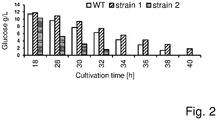
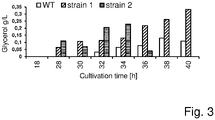
- ammonium was used as nitrogen source and glucose as carbon source under osmotic stress.
- the total duration of cultivation was 40 hours.
- sodium chloride was added to the medium in order to initiate osmotic stress.
- Culture broth samples have been taken at the time of this addition and next after 28 hours of total cultivation time and then every two hours until end of the cultivation. Samples were centrifuged to separate the mycelium from the supernatant.
- the whole cultivation broth was filtered through miracloth, the mycelia were pressed dry with Whatman filter paper and dried at 80 °C overnight.
- Glucose, glycerol, mannitol and erythritol concentrations were quantified by high-performance liquid chromatography (HPLC) (Shimadzu Prominence Series equipped with a RID-20A refractive-index detector). Culture supernatants were filtered through 0.20 ⁇ m membranes and measured by HPLC using a Rezex RCM-Monosaccharide column (300 mm x 7.8 mm; Phenomenex, Torrance, CA, USA). The mobile phase was 30% acetonitrile (HPLC grade). For sample analysis, the column was eluted at 60 °C with 30% acetonitrile (HPLC grade) at a flow rate of 0.6 ml/min.
- HPLC high-performance liquid chromatography
- the biomass production at the end of the cultivation is nearly the same for all strains.
- WT produces slightly more biomass ( Fig. 1 ).
- the glucose consumption is faster in strain 2 compared to WT and strain 1, which is deduced from concentration measurements in the respective supernatants ( Fig. 2 ).
- strain 1 shows a constant increase in glycerol production
- strain 2 bearing the overexpressed err1 gene shows a fluctuating accumulation of glycerol over time ( Fig. 3 ).
- Erythritol is only detectable in the supernatants of strains bearing the transporter FPS1 of Saccharomyces cerevisiae ( Fig. 4 ).
Landscapes
- Chemical & Material Sciences (AREA)
- Life Sciences & Earth Sciences (AREA)
- Organic Chemistry (AREA)
- Health & Medical Sciences (AREA)
- Engineering & Computer Science (AREA)
- Genetics & Genomics (AREA)
- Wood Science & Technology (AREA)
- Zoology (AREA)
- Bioinformatics & Cheminformatics (AREA)
- General Engineering & Computer Science (AREA)
- Biochemistry (AREA)
- General Health & Medical Sciences (AREA)
- Biotechnology (AREA)
- Biomedical Technology (AREA)
- Microbiology (AREA)
- Molecular Biology (AREA)
- Medicinal Chemistry (AREA)
- Mycology (AREA)
- Biophysics (AREA)
- Physics & Mathematics (AREA)
- Plant Pathology (AREA)
- Virology (AREA)
- Tropical Medicine & Parasitology (AREA)
- Botany (AREA)
- Chemical Kinetics & Catalysis (AREA)
- General Chemical & Material Sciences (AREA)
- Micro-Organisms Or Cultivation Processes Thereof (AREA)
- Preparation Of Compounds By Using Micro-Organisms (AREA)
Claims (17)
- Gentechnisch veränderter Saprotroph, der mindestens ein mindestens einen membrangebundenen Alditol-Transporter kodierendes Gen, mindestens ein mindestens eine Erythrose-Reduktase kodierendes Gen, und mindestens ein Mannitol-1-Phosphat-5-Dehydrogenase kodierendes inaktiviertes Gen, umfasst, wobei der Saprotroph ein filamentöser Pilz ausgewählt aus den Gattungen Hypocrea, Gibberella, Aspergillus und Penicillium ist.
- Gentechnisch veränderter Saprotroph nach Anspruch 1, wobei der Saprotroph ein filamentöser Pilz ausgewählt aus Hypocrea jecorina (Trichoderma reesei), Gibberella zeae, Aspergillus niger, Aspergillus nidulans, Aspergillus oryzae und Penicillium chrysogenum ist.
- Gentechnisch veränderter Saprotroph nach Anspruch 1 oder 2, wobei der Saprotroph Hypocrea jecorina (Trichoderma reesei) ist.
- Gentechnisch veränderter Saprotroph nach einem der vorhergehenden Ansprüche, wobei das mindestens eine mindestens einen membrangebundenen Alditol-Transporter kodierende Gen, fps1 aus Saccharomyces cerevisiae ist.
- Gentechnisch veränderter Saprotroph nach einem der vorhergehenden Ansprüche, wobei das mindestens eine mindestens eine Erythrose-Reduktase kodierende Gen, err1 aus Trichoderma reesei, Aspergillus niger oder Fusarium graminearum ist.
- Gentechnisch veränderter Saprotroph nach einem der vorhergehenden Ansprüche, wobei der Saprotroph ferner mindestens ein mindestens eine Transketolase kodierendes Gen, insbesondere tkl1 aus Hypocrea jecorina (T. reesei), umfasst.
- Gentechnisch veränderter Saprotroph nach einem der vorhergehenden Ansprüche, wobei der Saprotroph ferner mindestens ein mindestens eine Transaldolase kodierendes Gen, insbesondere tal1 aus Hypocrea jecorina (T. reesei), umfasst.
- Gentechnisch veränderter Saprotroph nach einem der vorhergehenden Ansprüche, wobei der Saprotroph ferner mindestens ein Phospho-2-dehydro-3-deoxyheptonat-Aldolase 1 (Dhaps-1) kodierendes inaktiviertes Gen umfasst.
- Gentechnisch veränderter Saprotroph nach einem der vorhergehenden Ansprüche, wobei das mindestens eine mindestens einen membrangebundenen Alditol-Transporter kodierende Gen, das mindestens eine mindestens eine Erythrose-Reduktase kodierende Gen, das mindestens eine mindestens eine Transketolase kodierende Gen, und/oder das mindestens eine mindestens eine Transaldolase kodierende Gen, überexprimiert wird.
- Verfahren zur Herstellung von Erythritol umfassend die Schritte:a) Bereitstellen mindestens eines gentechnisch veränderten Saprotrophen nach einem der Ansprüche 1 bis 9,b) Kultivieren des mindestens einen in Schritt a) bereitgestellten gentechnisch veränderten Saprotrophen in Gegenwart eines Kulturmediums zum Erhalt von Erythritol in dem Kulturmedium,c) Gewinnen von Erythritol aus dem Kulturmedium.
- Verfahren nach Anspruch 10, wobei das Kulturmedium Lignozellulose-haltige Biomasse, insbesondere Stroh, und/oder mindestens einen Rückstand aus der Milchproduktherstellung, insbesondere Molke, umfasst.
- Verfahren nach Anspruch 10 oder 11, wobei das Kulturmedium Nitrat als Stickstoffquelle umfasst.
- Verfahren nach einem der Ansprüche 10 bis 12, wobei das Kulturmedium Glycerin umfasst.
- Verfahren nach einem der Ansprüche 10 bis 13, wobei Schritt b) durchgeführt wird, bis eine Konzentration von Erythritol im Kulturmedium von mindestens 1 g/L, vorzugsweise mindestens 1,5 g/L, vorzugsweise mindestens 2 g/L, vorzugsweise mindestens 2,5 g/L, vorzugsweise mindestens 3 g/L, erreicht ist.
- Verfahren nach Anspruch 10 oder 14, wobei in Schritt b) mindestens ein osmotischen Stress verursachendes Substrat dem Kulturmedium nach 14 Stunden Kultivieren hinzugefügt wird.
- Verfahren nach Anspruch 15, wobei das osmotischen Stress verursachende Substrat, Glycerin und/oder Natriumchlorid ist.
- Verwendung eines gentechnisch veränderten Saprotrophen nach einem der Ansprüche 1 bis 9 zur Herstellung von Erythritol.
Priority Applications (8)
| Application Number | Priority Date | Filing Date | Title |
|---|---|---|---|
| EP20182382.0A EP3929299B1 (de) | 2020-06-25 | 2020-06-25 | Erythritol produzierender saprotroph |
| US18/012,440 US20230357705A1 (en) | 2020-06-25 | 2021-06-25 | Erythritol producing saprotroph |
| IL299190A IL299190A (en) | 2020-06-25 | 2021-06-25 | Erythritol producing saprotroph |
| JP2022580352A JP2023531270A (ja) | 2020-06-25 | 2021-06-25 | エリスリトールを産生する腐生菌 |
| KR1020237002470A KR20230041705A (ko) | 2020-06-25 | 2021-06-25 | 에리트리톨 생산 부생 생물 |
| CN202180045623.9A CN116034163A (zh) | 2020-06-25 | 2021-06-25 | 产赤藓糖醇的腐生生物 |
| EP21733844.1A EP4172349A1 (de) | 2020-06-25 | 2021-06-25 | Saprotroph produzierender erythritol |
| PCT/EP2021/067473 WO2021260170A1 (en) | 2020-06-25 | 2021-06-25 | Erythritol producing saprotroph |
Applications Claiming Priority (1)
| Application Number | Priority Date | Filing Date | Title |
|---|---|---|---|
| EP20182382.0A EP3929299B1 (de) | 2020-06-25 | 2020-06-25 | Erythritol produzierender saprotroph |
Publications (2)
| Publication Number | Publication Date |
|---|---|
| EP3929299A1 EP3929299A1 (de) | 2021-12-29 |
| EP3929299B1 true EP3929299B1 (de) | 2022-08-10 |
Family
ID=71409104
Family Applications (2)
| Application Number | Title | Priority Date | Filing Date |
|---|---|---|---|
| EP20182382.0A Active EP3929299B1 (de) | 2020-06-25 | 2020-06-25 | Erythritol produzierender saprotroph |
| EP21733844.1A Pending EP4172349A1 (de) | 2020-06-25 | 2021-06-25 | Saprotroph produzierender erythritol |
Family Applications After (1)
| Application Number | Title | Priority Date | Filing Date |
|---|---|---|---|
| EP21733844.1A Pending EP4172349A1 (de) | 2020-06-25 | 2021-06-25 | Saprotroph produzierender erythritol |
Country Status (7)
| Country | Link |
|---|---|
| US (1) | US20230357705A1 (de) |
| EP (2) | EP3929299B1 (de) |
| JP (1) | JP2023531270A (de) |
| KR (1) | KR20230041705A (de) |
| CN (1) | CN116034163A (de) |
| IL (1) | IL299190A (de) |
| WO (1) | WO2021260170A1 (de) |
Families Citing this family (1)
| Publication number | Priority date | Publication date | Assignee | Title |
|---|---|---|---|---|
| WO2024004983A1 (ja) * | 2022-06-27 | 2024-01-04 | 花王株式会社 | エリスリトール資化能欠損変異トリコデルマ属菌、及びこれを用いた目的物質の製造方法 |
Family Cites Families (3)
| Publication number | Priority date | Publication date | Assignee | Title |
|---|---|---|---|---|
| US4939091A (en) | 1986-09-09 | 1990-07-03 | Director Of National Food Research Institute, Ministry Of Agriculture, Forestry And Fisheries | Novel auerobasidium sp. microorganisms, method for obtaining the same and method for preparing erythritol with the same |
| KR19980075195A (ko) | 1997-03-26 | 1998-11-16 | 손경식 | 트리코스포로노이데스 속 변이균주 및 이를 이용한 에리스리톨의 제조방법 |
| EP2436772A1 (de) * | 2010-09-30 | 2012-04-04 | Annikki GmbH | Verfahren zur Herstellung von Erythritol |
-
2020
- 2020-06-25 EP EP20182382.0A patent/EP3929299B1/de active Active
-
2021
- 2021-06-25 IL IL299190A patent/IL299190A/en unknown
- 2021-06-25 KR KR1020237002470A patent/KR20230041705A/ko not_active Withdrawn
- 2021-06-25 WO PCT/EP2021/067473 patent/WO2021260170A1/en not_active Ceased
- 2021-06-25 JP JP2022580352A patent/JP2023531270A/ja not_active Withdrawn
- 2021-06-25 EP EP21733844.1A patent/EP4172349A1/de active Pending
- 2021-06-25 US US18/012,440 patent/US20230357705A1/en active Pending
- 2021-06-25 CN CN202180045623.9A patent/CN116034163A/zh active Pending
Also Published As
| Publication number | Publication date |
|---|---|
| WO2021260170A1 (en) | 2021-12-30 |
| CN116034163A (zh) | 2023-04-28 |
| JP2023531270A (ja) | 2023-07-21 |
| IL299190A (en) | 2023-02-01 |
| EP4172349A1 (de) | 2023-05-03 |
| KR20230041705A (ko) | 2023-03-24 |
| EP3929299A1 (de) | 2021-12-29 |
| US20230357705A1 (en) | 2023-11-09 |
Similar Documents
| Publication | Publication Date | Title |
|---|---|---|
| AU2016361425B2 (en) | Genetically modified yeasts and fermentation processes using genetically modified yeasts | |
| US12291713B2 (en) | Modified yeast and method for increasing lysine content in fermentation co-products | |
| JP2022515078A (ja) | マロン酸セミアルデヒドからの3-HPおよびアセチル-CoA誘導体の共産生経路 | |
| Hawary et al. | Enhancement of glycerol production by UV-mutagenesis of the marine yeast Wickerhamomyces anomalus HH16: kinetics and optimization of the fermentation process | |
| US10208326B2 (en) | Methods and materials for biosynthesis of manoyl oxide | |
| CN114269896B (zh) | 酵母中用于增加醇和赖氨酸生产的cdc42效应因子破坏 | |
| US20230357705A1 (en) | Erythritol producing saprotroph | |
| US11634718B2 (en) | Production of macrocyclic ketones in recombinant hosts | |
| EP4202050B1 (de) | Verfahren zur biotechnologischen herstellung von erythritol | |
| JP7070161B2 (ja) | ミオ-イノシトールの製造方法 | |
| TW201525139A (zh) | 2,3-丁二醇之製造方法 | |
| EP2636738A1 (de) | Transformant von hefe der gattung schizosaccharomyces und herstellungsverfahren dafür | |
| Ghezelbash et al. | Study of polyols production by Yarrowia lipolytica in batch culture and optimization of growth condition for maximum production | |
| KR101828580B1 (ko) | 자일로스 이소머라제의 분비발현을 통하여 자일로스를 탄소원으로 이용하는 방법 | |
| KR20160093492A (ko) | 2,3-부탄다이올 생산능을 갖는 유전적으로 조작된 효모 세포 및 그를 사용하여 2,3-부탄다이올을 생산하는 방법 | |
| Miguez et al. | Application of Plackett–Burman design for medium constituents optimization for the production of L-phenylacetylcarbinol (L-PAC) by Saccharomyces Cerevisiae | |
| JP7115075B2 (ja) | ミオ-イノシトール生産能を有する耐酸性微生物 | |
| KR100730315B1 (ko) | 자일리톨의 고수율 생산방법 | |
| CN118931747A (zh) | 高效合成肌醇的马克斯克鲁维酵母工程菌及其应用 |
Legal Events
| Date | Code | Title | Description |
|---|---|---|---|
| STAA | Information on the status of an ep patent application or granted ep patent |
Free format text: STATUS: EXAMINATION IS IN PROGRESS |
|
| PUAI | Public reference made under article 153(3) epc to a published international application that has entered the european phase |
Free format text: ORIGINAL CODE: 0009012 |
|
| 17P | Request for examination filed |
Effective date: 20210310 |
|
| AK | Designated contracting states |
Kind code of ref document: A1 Designated state(s): AL AT BE BG CH CY CZ DE DK EE ES FI FR GB GR HR HU IE IS IT LI LT LU LV MC MK MT NL NO PL PT RO RS SE SI SK SM TR |
|
| B565 | Issuance of search results under rule 164(2) epc |
Effective date: 20201203 |
|
| GRAP | Despatch of communication of intention to grant a patent |
Free format text: ORIGINAL CODE: EPIDOSNIGR1 |
|
| STAA | Information on the status of an ep patent application or granted ep patent |
Free format text: STATUS: GRANT OF PATENT IS INTENDED |
|
| INTG | Intention to grant announced |
Effective date: 20220216 |
|
| GRAS | Grant fee paid |
Free format text: ORIGINAL CODE: EPIDOSNIGR3 |
|
| GRAA | (expected) grant |
Free format text: ORIGINAL CODE: 0009210 |
|
| STAA | Information on the status of an ep patent application or granted ep patent |
Free format text: STATUS: THE PATENT HAS BEEN GRANTED |
|
| RBV | Designated contracting states (corrected) |
Designated state(s): AL AT BE BG CH CY CZ DE DK EE ES FI FR GB GR HR HU IE IS IT LI LT LU LV MC MK MT NL NO PL PT RO RS SE SI SK SM TR |
|
| AK | Designated contracting states |
Kind code of ref document: B1 Designated state(s): AL AT BE BG CH CY CZ DE DK EE ES FI FR GB GR HR HU IE IS IT LI LT LU LV MC MK MT NL NO PL PT RO RS SE SI SK SM TR |
|
| REG | Reference to a national code |
Ref country code: AT Ref legal event code: REF Ref document number: 1510572 Country of ref document: AT Kind code of ref document: T Effective date: 20220815 Ref country code: CH Ref legal event code: EP |
|
| REG | Reference to a national code |
Ref country code: IE Ref legal event code: FG4D |
|
| REG | Reference to a national code |
Ref country code: DE Ref legal event code: R096 Ref document number: 602020004430 Country of ref document: DE |
|
| REG | Reference to a national code |
Ref country code: NL Ref legal event code: FP |
|
| REG | Reference to a national code |
Ref country code: LT Ref legal event code: MG9D |
|
| REG | Reference to a national code |
Ref country code: GR Ref legal event code: EP Ref document number: 20220402210 Country of ref document: GR Effective date: 20221212 |
|
| PG25 | Lapsed in a contracting state [announced via postgrant information from national office to epo] |
Ref country code: SE Free format text: LAPSE BECAUSE OF FAILURE TO SUBMIT A TRANSLATION OF THE DESCRIPTION OR TO PAY THE FEE WITHIN THE PRESCRIBED TIME-LIMIT Effective date: 20220810 Ref country code: RS Free format text: LAPSE BECAUSE OF FAILURE TO SUBMIT A TRANSLATION OF THE DESCRIPTION OR TO PAY THE FEE WITHIN THE PRESCRIBED TIME-LIMIT Effective date: 20220810 Ref country code: PT Free format text: LAPSE BECAUSE OF FAILURE TO SUBMIT A TRANSLATION OF THE DESCRIPTION OR TO PAY THE FEE WITHIN THE PRESCRIBED TIME-LIMIT Effective date: 20221212 Ref country code: NO Free format text: LAPSE BECAUSE OF FAILURE TO SUBMIT A TRANSLATION OF THE DESCRIPTION OR TO PAY THE FEE WITHIN THE PRESCRIBED TIME-LIMIT Effective date: 20221110 Ref country code: LV Free format text: LAPSE BECAUSE OF FAILURE TO SUBMIT A TRANSLATION OF THE DESCRIPTION OR TO PAY THE FEE WITHIN THE PRESCRIBED TIME-LIMIT Effective date: 20220810 Ref country code: LT Free format text: LAPSE BECAUSE OF FAILURE TO SUBMIT A TRANSLATION OF THE DESCRIPTION OR TO PAY THE FEE WITHIN THE PRESCRIBED TIME-LIMIT Effective date: 20220810 |
|
| PG25 | Lapsed in a contracting state [announced via postgrant information from national office to epo] |
Ref country code: PL Free format text: LAPSE BECAUSE OF FAILURE TO SUBMIT A TRANSLATION OF THE DESCRIPTION OR TO PAY THE FEE WITHIN THE PRESCRIBED TIME-LIMIT Effective date: 20220810 Ref country code: IS Free format text: LAPSE BECAUSE OF FAILURE TO SUBMIT A TRANSLATION OF THE DESCRIPTION OR TO PAY THE FEE WITHIN THE PRESCRIBED TIME-LIMIT Effective date: 20221210 Ref country code: HR Free format text: LAPSE BECAUSE OF FAILURE TO SUBMIT A TRANSLATION OF THE DESCRIPTION OR TO PAY THE FEE WITHIN THE PRESCRIBED TIME-LIMIT Effective date: 20220810 |
|
| PG25 | Lapsed in a contracting state [announced via postgrant information from national office to epo] |
Ref country code: SM Free format text: LAPSE BECAUSE OF FAILURE TO SUBMIT A TRANSLATION OF THE DESCRIPTION OR TO PAY THE FEE WITHIN THE PRESCRIBED TIME-LIMIT Effective date: 20220810 Ref country code: RO Free format text: LAPSE BECAUSE OF FAILURE TO SUBMIT A TRANSLATION OF THE DESCRIPTION OR TO PAY THE FEE WITHIN THE PRESCRIBED TIME-LIMIT Effective date: 20220810 Ref country code: ES Free format text: LAPSE BECAUSE OF FAILURE TO SUBMIT A TRANSLATION OF THE DESCRIPTION OR TO PAY THE FEE WITHIN THE PRESCRIBED TIME-LIMIT Effective date: 20220810 Ref country code: DK Free format text: LAPSE BECAUSE OF FAILURE TO SUBMIT A TRANSLATION OF THE DESCRIPTION OR TO PAY THE FEE WITHIN THE PRESCRIBED TIME-LIMIT Effective date: 20220810 Ref country code: CZ Free format text: LAPSE BECAUSE OF FAILURE TO SUBMIT A TRANSLATION OF THE DESCRIPTION OR TO PAY THE FEE WITHIN THE PRESCRIBED TIME-LIMIT Effective date: 20220810 |
|
| REG | Reference to a national code |
Ref country code: DE Ref legal event code: R097 Ref document number: 602020004430 Country of ref document: DE |
|
| PG25 | Lapsed in a contracting state [announced via postgrant information from national office to epo] |
Ref country code: SK Free format text: LAPSE BECAUSE OF FAILURE TO SUBMIT A TRANSLATION OF THE DESCRIPTION OR TO PAY THE FEE WITHIN THE PRESCRIBED TIME-LIMIT Effective date: 20220810 Ref country code: EE Free format text: LAPSE BECAUSE OF FAILURE TO SUBMIT A TRANSLATION OF THE DESCRIPTION OR TO PAY THE FEE WITHIN THE PRESCRIBED TIME-LIMIT Effective date: 20220810 |
|
| PLBE | No opposition filed within time limit |
Free format text: ORIGINAL CODE: 0009261 |
|
| STAA | Information on the status of an ep patent application or granted ep patent |
Free format text: STATUS: NO OPPOSITION FILED WITHIN TIME LIMIT |
|
| PG25 | Lapsed in a contracting state [announced via postgrant information from national office to epo] |
Ref country code: AL Free format text: LAPSE BECAUSE OF FAILURE TO SUBMIT A TRANSLATION OF THE DESCRIPTION OR TO PAY THE FEE WITHIN THE PRESCRIBED TIME-LIMIT Effective date: 20220810 |
|
| 26N | No opposition filed |
Effective date: 20230511 |
|
| REG | Reference to a national code |
Ref country code: AT Ref legal event code: UEP Ref document number: 1510572 Country of ref document: AT Kind code of ref document: T Effective date: 20220810 |
|
| PG25 | Lapsed in a contracting state [announced via postgrant information from national office to epo] |
Ref country code: MC Free format text: LAPSE BECAUSE OF FAILURE TO SUBMIT A TRANSLATION OF THE DESCRIPTION OR TO PAY THE FEE WITHIN THE PRESCRIBED TIME-LIMIT Effective date: 20220810 |
|
| PG25 | Lapsed in a contracting state [announced via postgrant information from national office to epo] |
Ref country code: MC Free format text: LAPSE BECAUSE OF FAILURE TO SUBMIT A TRANSLATION OF THE DESCRIPTION OR TO PAY THE FEE WITHIN THE PRESCRIBED TIME-LIMIT Effective date: 20220810 |
|
| REG | Reference to a national code |
Ref country code: BE Ref legal event code: MM Effective date: 20230630 |
|
| PG25 | Lapsed in a contracting state [announced via postgrant information from national office to epo] |
Ref country code: LU Free format text: LAPSE BECAUSE OF NON-PAYMENT OF DUE FEES Effective date: 20230625 |
|
| REG | Reference to a national code |
Ref country code: IE Ref legal event code: MM4A |
|
| PG25 | Lapsed in a contracting state [announced via postgrant information from national office to epo] |
Ref country code: LU Free format text: LAPSE BECAUSE OF NON-PAYMENT OF DUE FEES Effective date: 20230625 |
|
| PG25 | Lapsed in a contracting state [announced via postgrant information from national office to epo] |
Ref country code: IE Free format text: LAPSE BECAUSE OF NON-PAYMENT OF DUE FEES Effective date: 20230625 |
|
| PG25 | Lapsed in a contracting state [announced via postgrant information from national office to epo] |
Ref country code: IE Free format text: LAPSE BECAUSE OF NON-PAYMENT OF DUE FEES Effective date: 20230625 |
|
| PG25 | Lapsed in a contracting state [announced via postgrant information from national office to epo] |
Ref country code: IT Free format text: LAPSE BECAUSE OF FAILURE TO SUBMIT A TRANSLATION OF THE DESCRIPTION OR TO PAY THE FEE WITHIN THE PRESCRIBED TIME-LIMIT Effective date: 20220810 Ref country code: BE Free format text: LAPSE BECAUSE OF NON-PAYMENT OF DUE FEES Effective date: 20230630 |
|
| PG25 | Lapsed in a contracting state [announced via postgrant information from national office to epo] |
Ref country code: BG Free format text: LAPSE BECAUSE OF FAILURE TO SUBMIT A TRANSLATION OF THE DESCRIPTION OR TO PAY THE FEE WITHIN THE PRESCRIBED TIME-LIMIT Effective date: 20220810 |
|
| PG25 | Lapsed in a contracting state [announced via postgrant information from national office to epo] |
Ref country code: BG Free format text: LAPSE BECAUSE OF FAILURE TO SUBMIT A TRANSLATION OF THE DESCRIPTION OR TO PAY THE FEE WITHIN THE PRESCRIBED TIME-LIMIT Effective date: 20220810 |
|
| PGFP | Annual fee paid to national office [announced via postgrant information from national office to epo] |
Ref country code: FI Payment date: 20250627 Year of fee payment: 6 |
|
| PGFP | Annual fee paid to national office [announced via postgrant information from national office to epo] |
Ref country code: GB Payment date: 20250618 Year of fee payment: 6 |
|
| PGFP | Annual fee paid to national office [announced via postgrant information from national office to epo] |
Ref country code: NL Payment date: 20250618 Year of fee payment: 6 |
|
| PGFP | Annual fee paid to national office [announced via postgrant information from national office to epo] |
Ref country code: FR Payment date: 20250627 Year of fee payment: 6 |
|
| PGFP | Annual fee paid to national office [announced via postgrant information from national office to epo] |
Ref country code: GR Payment date: 20250620 Year of fee payment: 6 |
|
| PGFP | Annual fee paid to national office [announced via postgrant information from national office to epo] |
Ref country code: AT Payment date: 20250620 Year of fee payment: 6 |
|
| PG25 | Lapsed in a contracting state [announced via postgrant information from national office to epo] |
Ref country code: CY Free format text: LAPSE BECAUSE OF FAILURE TO SUBMIT A TRANSLATION OF THE DESCRIPTION OR TO PAY THE FEE WITHIN THE PRESCRIBED TIME-LIMIT; INVALID AB INITIO Effective date: 20200625 |
|
| PG25 | Lapsed in a contracting state [announced via postgrant information from national office to epo] |
Ref country code: HU Free format text: LAPSE BECAUSE OF FAILURE TO SUBMIT A TRANSLATION OF THE DESCRIPTION OR TO PAY THE FEE WITHIN THE PRESCRIBED TIME-LIMIT; INVALID AB INITIO Effective date: 20200625 |
|
| PGFP | Annual fee paid to national office [announced via postgrant information from national office to epo] |
Ref country code: DE Payment date: 20250630 Year of fee payment: 6 |
|
| PGFP | Annual fee paid to national office [announced via postgrant information from national office to epo] |
Ref country code: CH Payment date: 20250701 Year of fee payment: 6 |
|
| PG25 | Lapsed in a contracting state [announced via postgrant information from national office to epo] |
Ref country code: TR Free format text: LAPSE BECAUSE OF FAILURE TO SUBMIT A TRANSLATION OF THE DESCRIPTION OR TO PAY THE FEE WITHIN THE PRESCRIBED TIME-LIMIT Effective date: 20220810 |
|
| PG25 | Lapsed in a contracting state [announced via postgrant information from national office to epo] |
Ref country code: SI Free format text: LAPSE BECAUSE OF FAILURE TO SUBMIT A TRANSLATION OF THE DESCRIPTION OR TO PAY THE FEE WITHIN THE PRESCRIBED TIME-LIMIT Effective date: 20220810 |