EP3928684A1 - Contactless temperature-based monitoring of a patient - Google Patents
Contactless temperature-based monitoring of a patient Download PDFInfo
- Publication number
- EP3928684A1 EP3928684A1 EP20182416.6A EP20182416A EP3928684A1 EP 3928684 A1 EP3928684 A1 EP 3928684A1 EP 20182416 A EP20182416 A EP 20182416A EP 3928684 A1 EP3928684 A1 EP 3928684A1
- Authority
- EP
- European Patent Office
- Prior art keywords
- patient
- subsection
- signal
- temperature values
- generating
- Prior art date
- Legal status (The legal status is an assumption and is not a legal conclusion. Google has not performed a legal analysis and makes no representation as to the accuracy of the status listed.)
- Withdrawn
Links
Images


Classifications
-
- A—HUMAN NECESSITIES
- A61—MEDICAL OR VETERINARY SCIENCE; HYGIENE
- A61B—DIAGNOSIS; SURGERY; IDENTIFICATION
- A61B5/00—Measuring for diagnostic purposes; Identification of persons
- A61B5/0033—Features or image-related aspects of imaging apparatus, e.g. for MRI, optical tomography or impedance tomography apparatus; Arrangements of imaging apparatus in a room
- A61B5/004—Features or image-related aspects of imaging apparatus, e.g. for MRI, optical tomography or impedance tomography apparatus; Arrangements of imaging apparatus in a room adapted for image acquisition of a particular organ or body part
-
- A—HUMAN NECESSITIES
- A61—MEDICAL OR VETERINARY SCIENCE; HYGIENE
- A61B—DIAGNOSIS; SURGERY; IDENTIFICATION
- A61B5/00—Measuring for diagnostic purposes; Identification of persons
- A61B5/0059—Measuring for diagnostic purposes; Identification of persons using light, e.g. diagnosis by transillumination, diascopy, fluorescence
- A61B5/0077—Devices for viewing the surface of the body, e.g. camera, magnifying lens
-
- A—HUMAN NECESSITIES
- A61—MEDICAL OR VETERINARY SCIENCE; HYGIENE
- A61B—DIAGNOSIS; SURGERY; IDENTIFICATION
- A61B5/00—Measuring for diagnostic purposes; Identification of persons
- A61B5/02—Detecting, measuring or recording for evaluating the cardiovascular system, e.g. pulse, heart rate, blood pressure or blood flow
- A61B5/0205—Simultaneously evaluating both cardiovascular conditions and different types of body conditions, e.g. heart and respiratory condition
- A61B5/02055—Simultaneously evaluating both cardiovascular condition and temperature
-
- A—HUMAN NECESSITIES
- A61—MEDICAL OR VETERINARY SCIENCE; HYGIENE
- A61B—DIAGNOSIS; SURGERY; IDENTIFICATION
- A61B5/00—Measuring for diagnostic purposes; Identification of persons
- A61B5/02—Detecting, measuring or recording for evaluating the cardiovascular system, e.g. pulse, heart rate, blood pressure or blood flow
- A61B5/026—Measuring blood flow
- A61B5/0261—Measuring blood flow using optical means, e.g. infrared light
-
- A—HUMAN NECESSITIES
- A61—MEDICAL OR VETERINARY SCIENCE; HYGIENE
- A61B—DIAGNOSIS; SURGERY; IDENTIFICATION
- A61B5/00—Measuring for diagnostic purposes; Identification of persons
- A61B5/08—Measuring devices for evaluating the respiratory organs
- A61B5/0816—Measuring devices for examining respiratory frequency
-
- A—HUMAN NECESSITIES
- A61—MEDICAL OR VETERINARY SCIENCE; HYGIENE
- A61B—DIAGNOSIS; SURGERY; IDENTIFICATION
- A61B5/00—Measuring for diagnostic purposes; Identification of persons
- A61B5/103—Measuring devices for testing the shape, pattern, colour, size or movement of the body or parts thereof, for diagnostic purposes
- A61B5/11—Measuring movement of the entire body or parts thereof, e.g. head or hand tremor or mobility of a limb
- A61B5/1102—Ballistocardiography
-
- A—HUMAN NECESSITIES
- A61—MEDICAL OR VETERINARY SCIENCE; HYGIENE
- A61B—DIAGNOSIS; SURGERY; IDENTIFICATION
- A61B5/00—Measuring for diagnostic purposes; Identification of persons
- A61B5/103—Measuring devices for testing the shape, pattern, colour, size or movement of the body or parts thereof, for diagnostic purposes
- A61B5/11—Measuring movement of the entire body or parts thereof, e.g. head or hand tremor or mobility of a limb
- A61B5/1126—Measuring movement of the entire body or parts thereof, e.g. head or hand tremor or mobility of a limb using a particular sensing technique
-
- A—HUMAN NECESSITIES
- A61—MEDICAL OR VETERINARY SCIENCE; HYGIENE
- A61B—DIAGNOSIS; SURGERY; IDENTIFICATION
- A61B5/00—Measuring for diagnostic purposes; Identification of persons
- A61B5/103—Measuring devices for testing the shape, pattern, colour, size or movement of the body or parts thereof, for diagnostic purposes
- A61B5/11—Measuring movement of the entire body or parts thereof, e.g. head or hand tremor or mobility of a limb
- A61B5/113—Measuring movement of the entire body or parts thereof, e.g. head or hand tremor or mobility of a limb occurring during breathing
-
- A—HUMAN NECESSITIES
- A61—MEDICAL OR VETERINARY SCIENCE; HYGIENE
- A61B—DIAGNOSIS; SURGERY; IDENTIFICATION
- A61B5/00—Measuring for diagnostic purposes; Identification of persons
- A61B5/70—Means for positioning the patient in relation to the detecting, measuring or recording means
- A61B5/704—Tables
-
- A—HUMAN NECESSITIES
- A61—MEDICAL OR VETERINARY SCIENCE; HYGIENE
- A61B—DIAGNOSIS; SURGERY; IDENTIFICATION
- A61B5/00—Measuring for diagnostic purposes; Identification of persons
- A61B5/72—Signal processing specially adapted for physiological signals or for diagnostic purposes
- A61B5/7203—Signal processing specially adapted for physiological signals or for diagnostic purposes for noise prevention, reduction or removal
- A61B5/7207—Signal processing specially adapted for physiological signals or for diagnostic purposes for noise prevention, reduction or removal of noise induced by motion artifacts
- A61B5/721—Signal processing specially adapted for physiological signals or for diagnostic purposes for noise prevention, reduction or removal of noise induced by motion artifacts using a separate sensor to detect motion or using motion information derived from signals other than the physiological signal to be measured
-
- A—HUMAN NECESSITIES
- A61—MEDICAL OR VETERINARY SCIENCE; HYGIENE
- A61B—DIAGNOSIS; SURGERY; IDENTIFICATION
- A61B5/00—Measuring for diagnostic purposes; Identification of persons
- A61B5/72—Signal processing specially adapted for physiological signals or for diagnostic purposes
- A61B5/7271—Specific aspects of physiological measurement analysis
- A61B5/7278—Artificial waveform generation or derivation, e.g. synthesizing signals from measured signals
-
- A—HUMAN NECESSITIES
- A61—MEDICAL OR VETERINARY SCIENCE; HYGIENE
- A61B—DIAGNOSIS; SURGERY; IDENTIFICATION
- A61B5/00—Measuring for diagnostic purposes; Identification of persons
- A61B5/72—Signal processing specially adapted for physiological signals or for diagnostic purposes
- A61B5/7271—Specific aspects of physiological measurement analysis
- A61B5/7285—Specific aspects of physiological measurement analysis for synchronizing or triggering a physiological measurement or image acquisition with a physiological event or waveform, e.g. an ECG signal
- A61B5/7292—Prospective gating, i.e. predicting the occurrence of a physiological event for use as a synchronisation signal
-
- A—HUMAN NECESSITIES
- A61—MEDICAL OR VETERINARY SCIENCE; HYGIENE
- A61B—DIAGNOSIS; SURGERY; IDENTIFICATION
- A61B5/00—Measuring for diagnostic purposes; Identification of persons
- A61B5/0033—Features or image-related aspects of imaging apparatus, e.g. for MRI, optical tomography or impedance tomography apparatus; Arrangements of imaging apparatus in a room
- A61B5/0035—Features or image-related aspects of imaging apparatus, e.g. for MRI, optical tomography or impedance tomography apparatus; Arrangements of imaging apparatus in a room adapted for acquisition of images from more than one imaging mode, e.g. combining MRI and optical tomography
-
- A—HUMAN NECESSITIES
- A61—MEDICAL OR VETERINARY SCIENCE; HYGIENE
- A61B—DIAGNOSIS; SURGERY; IDENTIFICATION
- A61B5/00—Measuring for diagnostic purposes; Identification of persons
- A61B5/01—Measuring temperature of body parts ; Diagnostic temperature sensing, e.g. for malignant or inflamed tissue
- A61B5/015—By temperature mapping of body part
Definitions
- the invention relates to the field of detecting breathing motion and cardiac motion of a patient and in particular to the detection of breathing motion and cardiac motion during medical imaging examinations or scan acquisitions.
- Physiology signals for breathing and pulse may be provided by the analysis of a live video stream of a patient either in RGB or IR mode.
- IR mode For detection of breathing motion, visibility of the motion of the target body part such as the chest or the upper abdomen is required.
- coils, accessories, blankets or support devices may obstruct the view from a particular fixed view angle thus limiting the applicability of this technique.
- video data can be used to detect the color changes in the skin due to the pulsatile flow. The principle of measurement is then based on the pulse plethysmography principle.
- the signal strength may be reduced by different aspects, i.e. by the visibility of the skin due to top or facial hair or by the physiologic delay which may vary from patient to patient or for a single patient even over time.
- video-based pulse plethysmography works well with a multi-spectral detector so that absorption and reflection properties of the skin can be self-calibrated for each video-frame.
- a preferred setup for such a technique is based on a visible RGB camera employing visible white light.
- a method for detecting at least one physiological signal of a patient comprises the following method steps: monitoring at least a subsection of a patient's surface with a thermal camera which generates consecutive video frames with multiple pixels of the monitored subsection, wherein the subsection of a patient's surface includes at least a part of the mouth and/or nose area of the patient as a region of interest; generating time-resolved temperature values of at least one pixel of the region of interest; and generating a cardiac signal as the physiological signal based on the generated time-resolved temperature values.
- a cardiac signal a signal generated from the vibration wave following the contraction of the heart muscle in the chest is meant.
- the heart rate shown by the cardiac signal is the speed of the heartbeat which is typically measured by the number of heart beats per minute.
- the method is adapted for generating a physiological signal based on temperature values of breathing air flow. That is why the region of interest includes the mouth and nose area or only the mouth or only the nose area.
- the method further comprises the method step of generating a respiration signal as an additional physiological signal based on the generated time-resolved temperature values.
- a respiration signal a signal generated from the inhalation and exhalation process of a patient's breathing is meant.
- the breathing rate is the number of breaths a person takes per time, e.g. per minute.
- a low pixel temperature relative to the reference temperature indicates inhalation and a high pixel temperature relative to the reference temperature indicates exhalation.
- the method further comprises the method step of triggering and/or gating a scan acquisition based on the at least one physiological signal, wherein the scan acquisition is carried out during medical imaging examination with a medical imaging device and/or during medical therapy.
- Breathing and heart motions cause uncertainties during medical imaging examinations and/or during medical therapies, because organs, or ROIs in general, are moving during scan acquisition.
- the image data acquisition is triggered in dependence on the breathing motion and/or the cardiac motion, so that the uncertainties because of moving ROIs during scan acquisition are reduced.
- a medical imaging device can be for example MRI, CT, PET and a medical therapy can be for example radiotherapy.
- a physiological signal is generated based on temperature values of breathing air flow.
- the region of interest includes the mouth and nose area or only the mouth or only the nose area
- the at least one pixel is from the pixels covering the patient's nostrils.
- One advantage resides in providing a method, wherein in the step of generating time-resolved temperature values of at least one pixel of the region of interest one single pixel is used. Hence, it is not necessary to generate time-resolved values of all pixels of the region of interest. Time-resolved temperature values of only one single pixel may be sufficient to generate a physiological signal.
- a monitoring system for detecting at least one physiological signal of a patient.
- the monitoring system comprises a thermal camera which is adapted for monitoring at least a subsection of a patient's surface.
- the thermal camera generates consecutive video frames with multiple pixels of the monitored subsection.
- the subsection of the patient's surface includes at least a part of the mouth and/or nose area of the patient as a region of interest.
- the monitoring system further comprises a signal processing unit which is adapted for generating time-resolved temperature values of at least one pixel of the region of interest and for generating a cardiac signal as the physiological signal based on the generated time-resolved temperature values.
- the monitoring system comprises a patient support which is adapted for holding the patient in such a way that the subsection of the patient's surface which may be monitored by the thermal camera comprises at least a part of the mouth and/or nose area of the patient.
- the patient support may be designed as a patient table that may be movable in all three spatial directions so that the positioning of the patient can be done very precisely.
- face and/or body tracking devices and algorithms can be used to further confine the region of interest.
- the camera itself may be such a device and known computer vision algorithms could be applied to determine e.g. facial or head area.
- the signal processing unit is adapted for generating a respiration signal based on the generated time-resolved temperature values as an additional physiological signal.
- a frequency range for the pulse is defined. The range may be for example between 40 and 300 beats per minute.
- a range for respiration is defined. The range may be for example 10 to 20 breathing cycles per minute.
- the contributions by band-passing may be separated.
- a non-transitory computer-readable medium which comprises instructions stored thereon, that when executed on a processor, induce a monitoring system with a thermal camera to perform the method a method for detecting at least one physiological signal of a patient.
- Fig. 1 schematically depicts a scheme of a method according to a preferred embodiment of the invention.
- the first step S1 is to monitor at least a subsection 2 of a patient's surface 4 with a thermal camera 5.
- the thermal camera 5 generates consecutive video frames with multiple pixels 6 of the monitored subsection 2.
- the subsection 2 of a patient's surface 4 includes at least a part of the mouth and/or nose area of the patient 7 as a region of interest 3.
- the second step S2 is to generate these time-resolved temperature values of at least one pixel 8 of the region of interest 3.
- the third step S3 is to generate a cardiac signal 9 as the physiological signal 1 based on the generated time-resolved temperature values.
- the generated cardiac signal 9 can be used for the fifth step S5 and/or for the sixth step S6.
- the fifth step S5 is to trigger and the sixth step S6 is to gate a scan acquisition based on the at least one physiological signal 1.
- a scan acquisition is carried out during medical imaging examination with a medical imaging device 11 and/or during medical therapy.
- the image data acquisition may be gated in dependence on the cardiac signal 9, so that the cardiac motion can be traced on medical images.
- Another opportunity is to trigger the image data acquisition in dependence on the cardiac signal 9, so that the image data acquisition is triggered every time the heart is in the same position.
- the medical imaging device 11 is a MRI system, a CT or a linear accelerator.
- Fig. 2 schematically depicts a second scheme of a method according to a preferred embodiment of the invention.
- the second step S2 thus after generating time-resolved temperature values of at least one pixel 8 of the region of interest 3, it is not only possible to generate a cardiac signal, as it is described in the third step S3 in Fig. 1 , it is also possible to generate a respiration signal 10 as an additional physiological signal 1 based on the generated time-resolved temperature values.
- Generating a respiration signal 10 is the fourth step S4. Based on the cardiac signal 9 and/or the respiration signal 10 the image data acquisition may be triggered S5 and/or gated S6.
- Fig. 3 schematically depicts a monitoring system 14 according to a preferred embodiment of the invention.
- a situation during image data acquisition is shown.
- a patient 7 is lying on a patient table 16.
- the table is movable in all three dimensions so that the region of interest 3 may be positioned precisely.
- the region of interest 3 is a part of a subsection 2 of the patient 7 and includes the patient's nostrils 13.
- a thermal camera 5 is attached to the medical imaging device 11.
- the medical imaging device 11 is a MRI.
- the thermal camera 5 scans the patient's surface 4, especially the precisely positioned region of interest 3.
- the thermal camera 5 is adapted to generate time-resolved temperature-values that are processed by a signal processing unit 15.
- the signal processing unit 15 generates two physiological signals based on the time-resolved temperature-values: a cardiac signal 9 and a respiration signal 10 that are visualized.
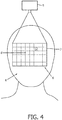
- Fig. 4 schematically depicts a thermal camera 5 and a region of interest 3 of a monitoring system according to a preferred embodiment of the invention.
- the thermal camera 5 scans the patient's surface 4 and generates consecutive video frames with multiple pixels 6 of the region of interest 3.
- the patient's nostrils 13 are not shown in Fig. 4 , but they are part of the region of interest 3.
- Time-resolved temperature values of at least one pixel 8 of the region of interest 3 are generated.
Landscapes
- Health & Medical Sciences (AREA)
- Life Sciences & Earth Sciences (AREA)
- Engineering & Computer Science (AREA)
- Veterinary Medicine (AREA)
- Biophysics (AREA)
- Biomedical Technology (AREA)
- Heart & Thoracic Surgery (AREA)
- Medical Informatics (AREA)
- Molecular Biology (AREA)
- Surgery (AREA)
- Animal Behavior & Ethology (AREA)
- General Health & Medical Sciences (AREA)
- Public Health (AREA)
- Physics & Mathematics (AREA)
- Pathology (AREA)
- Physiology (AREA)
- Cardiology (AREA)
- Signal Processing (AREA)
- Computer Vision & Pattern Recognition (AREA)
- Psychiatry (AREA)
- Artificial Intelligence (AREA)
- Dentistry (AREA)
- Oral & Maxillofacial Surgery (AREA)
- Pulmonology (AREA)
- Nuclear Medicine, Radiotherapy & Molecular Imaging (AREA)
- Radiology & Medical Imaging (AREA)
- Hematology (AREA)
- Measuring And Recording Apparatus For Diagnosis (AREA)
- Measuring Pulse, Heart Rate, Blood Pressure Or Blood Flow (AREA)
Priority Applications (6)
| Application Number | Priority Date | Filing Date | Title |
|---|---|---|---|
| EP20182416.6A EP3928684A1 (en) | 2020-06-26 | 2020-06-26 | Contactless temperature-based monitoring of a patient |
| US18/011,852 US20230263408A1 (en) | 2020-06-26 | 2021-06-21 | Contactless temperature-based monitoring of a patient |
| EP21733462.2A EP4171355B1 (en) | 2020-06-26 | 2021-06-21 | Contactless temperature-based monitoring of a patient |
| CN202180045608.4A CN115811957A (zh) | 2020-06-26 | 2021-06-21 | 对患者的无接触式基于温度的监测 |
| PCT/EP2021/066772 WO2021259835A1 (en) | 2020-06-26 | 2021-06-21 | Contactless temperature-based monitoring of a patient |
| JP2022576523A JP7740266B2 (ja) | 2020-06-26 | 2021-06-21 | 患者の非接触温度ベース監視 |
Applications Claiming Priority (1)
| Application Number | Priority Date | Filing Date | Title |
|---|---|---|---|
| EP20182416.6A EP3928684A1 (en) | 2020-06-26 | 2020-06-26 | Contactless temperature-based monitoring of a patient |
Publications (1)
| Publication Number | Publication Date |
|---|---|
| EP3928684A1 true EP3928684A1 (en) | 2021-12-29 |
Family
ID=71170376
Family Applications (2)
| Application Number | Title | Priority Date | Filing Date |
|---|---|---|---|
| EP20182416.6A Withdrawn EP3928684A1 (en) | 2020-06-26 | 2020-06-26 | Contactless temperature-based monitoring of a patient |
| EP21733462.2A Active EP4171355B1 (en) | 2020-06-26 | 2021-06-21 | Contactless temperature-based monitoring of a patient |
Family Applications After (1)
| Application Number | Title | Priority Date | Filing Date |
|---|---|---|---|
| EP21733462.2A Active EP4171355B1 (en) | 2020-06-26 | 2021-06-21 | Contactless temperature-based monitoring of a patient |
Country Status (5)
| Country | Link |
|---|---|
| US (1) | US20230263408A1 (enExample) |
| EP (2) | EP3928684A1 (enExample) |
| JP (1) | JP7740266B2 (enExample) |
| CN (1) | CN115811957A (enExample) |
| WO (1) | WO2021259835A1 (enExample) |
Cited By (1)
| Publication number | Priority date | Publication date | Assignee | Title |
|---|---|---|---|---|
| EP4505963A1 (de) * | 2023-08-08 | 2025-02-12 | Siemens Healthineers AG | Magnetresonanztomograph |
Families Citing this family (1)
| Publication number | Priority date | Publication date | Assignee | Title |
|---|---|---|---|---|
| FR3123795B1 (fr) * | 2021-06-10 | 2025-03-21 | Valeo Systemes Thermiques | Système d’aide pour fournir une information de diagnostic |
Citations (4)
| Publication number | Priority date | Publication date | Assignee | Title |
|---|---|---|---|---|
| US20140275832A1 (en) * | 2013-03-14 | 2014-09-18 | Koninklijke Philips N.V. | Device and method for obtaining vital sign information of a subject |
| US20150157270A1 (en) * | 2013-12-06 | 2015-06-11 | Xerox Corporation | Using an adaptive band-pass filter to compensate for motion induced artifacts in a physiological signal extracted from video |
| US20190101655A1 (en) * | 2017-09-30 | 2019-04-04 | Uih America, Inc. | Systems and methods for positron emission tomography image reconstruction |
| US20200155040A1 (en) * | 2018-11-16 | 2020-05-21 | Hill-Rom Services, Inc. | Systems and methods for determining subject positioning and vital signs |
Family Cites Families (8)
| Publication number | Priority date | Publication date | Assignee | Title |
|---|---|---|---|---|
| US7194107B2 (en) * | 2003-06-30 | 2007-03-20 | The Boeing Company | System and method for augmented thermal imagery |
| JP5446443B2 (ja) * | 2009-05-15 | 2014-03-19 | 日産自動車株式会社 | 心拍数測定装置および心拍数測定方法 |
| CN104055498A (zh) * | 2014-04-30 | 2014-09-24 | 首都医科大学 | 一种基于红外序列图像的人体呼吸和心率信号非接触式检测方法 |
| US10216981B2 (en) * | 2015-06-14 | 2019-02-26 | Facense Ltd. | Eyeglasses that measure facial skin color changes |
| US20170035344A1 (en) * | 2015-08-08 | 2017-02-09 | Facense Ltd. | Detection of an Allergic Reaction Using Thermal Measurements of the Face |
| GB2598245B (en) * | 2016-10-14 | 2022-09-28 | Facense Ltd | Clip-on device with inward-facing visible-light camera |
| JP7132568B2 (ja) * | 2018-05-17 | 2022-09-07 | Cyberdyne株式会社 | 生体情報計測装置及び生体情報計測方法 |
| JP7230409B2 (ja) * | 2018-10-02 | 2023-03-01 | カシオ計算機株式会社 | 判定装置、判定方法及び判定プログラム |
-
2020
- 2020-06-26 EP EP20182416.6A patent/EP3928684A1/en not_active Withdrawn
-
2021
- 2021-06-21 EP EP21733462.2A patent/EP4171355B1/en active Active
- 2021-06-21 WO PCT/EP2021/066772 patent/WO2021259835A1/en not_active Ceased
- 2021-06-21 CN CN202180045608.4A patent/CN115811957A/zh active Pending
- 2021-06-21 US US18/011,852 patent/US20230263408A1/en active Pending
- 2021-06-21 JP JP2022576523A patent/JP7740266B2/ja active Active
Patent Citations (4)
| Publication number | Priority date | Publication date | Assignee | Title |
|---|---|---|---|---|
| US20140275832A1 (en) * | 2013-03-14 | 2014-09-18 | Koninklijke Philips N.V. | Device and method for obtaining vital sign information of a subject |
| US20150157270A1 (en) * | 2013-12-06 | 2015-06-11 | Xerox Corporation | Using an adaptive band-pass filter to compensate for motion induced artifacts in a physiological signal extracted from video |
| US20190101655A1 (en) * | 2017-09-30 | 2019-04-04 | Uih America, Inc. | Systems and methods for positron emission tomography image reconstruction |
| US20200155040A1 (en) * | 2018-11-16 | 2020-05-21 | Hill-Rom Services, Inc. | Systems and methods for determining subject positioning and vital signs |
Non-Patent Citations (1)
| Title |
|---|
| HU MZHAI GLI DFAN YDUAN HZHU W ET AL.: "Combination of near-infrared and thermal imaging techniques for the remote and simultaneous measurements of breathing and heart rates under sleep situation", PLOS ONE, vol. 13, no. 1, 2018 |
Cited By (1)
| Publication number | Priority date | Publication date | Assignee | Title |
|---|---|---|---|---|
| EP4505963A1 (de) * | 2023-08-08 | 2025-02-12 | Siemens Healthineers AG | Magnetresonanztomograph |
Also Published As
| Publication number | Publication date |
|---|---|
| EP4171355B1 (en) | 2025-05-14 |
| US20230263408A1 (en) | 2023-08-24 |
| JP2023530927A (ja) | 2023-07-20 |
| JP7740266B2 (ja) | 2025-09-17 |
| EP4171355A1 (en) | 2023-05-03 |
| WO2021259835A1 (en) | 2021-12-30 |
| CN115811957A (zh) | 2023-03-17 |
Similar Documents
| Publication | Publication Date | Title |
|---|---|---|
| EP4014875B1 (en) | Method for controlling a medical imaging examination of a subject, medical imaging system and computer-readable data storage medium | |
| CN111374675B (zh) | 用于在医学成像会话中检测患者状态的系统和方法 | |
| EP3151728B1 (en) | Device, system and method for detecting apnoea of a subject | |
| Barbosa Pereira et al. | Contactless monitoring of heart and respiratory rate in anesthetized pigs using infrared thermography | |
| CN105451646B (zh) | 用于提取生理信息的设备、系统和方法 | |
| JP6461021B2 (ja) | 被検者のバイタルサイン情報を取得するためのデバイス及び方法 | |
| EP3664704B1 (en) | Device, system and method for determining a physiological parameter of a subject | |
| Lewis et al. | A novel method for extracting respiration rate and relative tidal volume from infrared thermography | |
| JP7073961B2 (ja) | 動態画像解析装置、動態画像解析方法及びプログラム | |
| US20180279885A1 (en) | Device, system and method for obtaining vital sign information of a subject | |
| US10993621B2 (en) | Contact-free physiological monitoring during simultaneous magnetic resonance imaging | |
| CN105009173B (zh) | 用于确定对象的动脉血氧饱和度的设备和方法 | |
| US9504426B2 (en) | Using an adaptive band-pass filter to compensate for motion induced artifacts in a physiological signal extracted from video | |
| JP6597548B2 (ja) | 動態解析システム | |
| WO2019140155A1 (en) | Systems, devices, and methods for tracking and/or analyzing subject images and/or videos | |
| US20170224256A1 (en) | Device and method for detecting vital sign information of a subject | |
| WO2019173237A1 (en) | Systems, devices, and methods for tracking and analyzing subject motion during a medical imaging scan and/or therapeutic procedure | |
| JP2005218507A (ja) | バイタルサイン計測方法と装置 | |
| Basu et al. | Infrared imaging based hyperventilation monitoring through respiration rate estimation | |
| EP4171355B1 (en) | Contactless temperature-based monitoring of a patient | |
| Chen et al. | Collaborative use of RGB and thermal imaging for remote breathing rate measurement under realistic conditions | |
| Wang et al. | Camera-based respiration monitoring: Motion and PPG-based measurement | |
| JP6873902B2 (ja) | 血流撮像 | |
| KR20220035417A (ko) | X선 이미지 획득 방법 | |
| Nakai et al. | Performance enhancement of thermal image analysis for noncontact cardiopulmonary signal extraction |
Legal Events
| Date | Code | Title | Description |
|---|---|---|---|
| PUAI | Public reference made under article 153(3) epc to a published international application that has entered the european phase |
Free format text: ORIGINAL CODE: 0009012 |
|
| STAA | Information on the status of an ep patent application or granted ep patent |
Free format text: STATUS: THE APPLICATION HAS BEEN PUBLISHED |
|
| AK | Designated contracting states |
Kind code of ref document: A1 Designated state(s): AL AT BE BG CH CY CZ DE DK EE ES FI FR GB GR HR HU IE IS IT LI LT LU LV MC MK MT NL NO PL PT RO RS SE SI SK SM TR |
|
| B565 | Issuance of search results under rule 164(2) epc |
Effective date: 20201020 |
|
| STAA | Information on the status of an ep patent application or granted ep patent |
Free format text: STATUS: THE APPLICATION IS DEEMED TO BE WITHDRAWN |
|
| 18D | Application deemed to be withdrawn |
Effective date: 20220630 |