EP3926533A2 - Verfahren und vorrichtung zum ändern der frisur von menschlichen objekten, gerät und speichermedium - Google Patents
Verfahren und vorrichtung zum ändern der frisur von menschlichen objekten, gerät und speichermedium Download PDFInfo
- Publication number
- EP3926533A2 EP3926533A2 EP21198213.7A EP21198213A EP3926533A2 EP 3926533 A2 EP3926533 A2 EP 3926533A2 EP 21198213 A EP21198213 A EP 21198213A EP 3926533 A2 EP3926533 A2 EP 3926533A2
- Authority
- EP
- European Patent Office
- Prior art keywords
- hairstyle
- target
- original
- vector
- character
- Prior art date
- Legal status (The legal status is an assumption and is not a legal conclusion. Google has not performed a legal analysis and makes no representation as to the accuracy of the status listed.)
- Withdrawn
Links
Images



Classifications
-
- G—PHYSICS
- G06—COMPUTING OR CALCULATING; COUNTING
- G06V—IMAGE OR VIDEO RECOGNITION OR UNDERSTANDING
- G06V40/00—Recognition of biometric, human-related or animal-related patterns in image or video data
- G06V40/10—Human or animal bodies, e.g. vehicle occupants or pedestrians; Body parts, e.g. hands
- G06V40/16—Human faces, e.g. facial parts, sketches or expressions
- G06V40/161—Detection; Localisation; Normalisation
-
- G—PHYSICS
- G06—COMPUTING OR CALCULATING; COUNTING
- G06T—IMAGE DATA PROCESSING OR GENERATION, IN GENERAL
- G06T11/00—2D [Two Dimensional] image generation
- G06T11/40—Filling a planar surface by adding surface attributes, e.g. colour or texture
-
- G—PHYSICS
- G06—COMPUTING OR CALCULATING; COUNTING
- G06F—ELECTRIC DIGITAL DATA PROCESSING
- G06F18/00—Pattern recognition
- G06F18/20—Analysing
- G06F18/21—Design or setup of recognition systems or techniques; Extraction of features in feature space; Blind source separation
- G06F18/214—Generating training patterns; Bootstrap methods, e.g. bagging or boosting
-
- G—PHYSICS
- G06—COMPUTING OR CALCULATING; COUNTING
- G06F—ELECTRIC DIGITAL DATA PROCESSING
- G06F18/00—Pattern recognition
- G06F18/20—Analysing
- G06F18/24—Classification techniques
-
- G—PHYSICS
- G06—COMPUTING OR CALCULATING; COUNTING
- G06N—COMPUTING ARRANGEMENTS BASED ON SPECIFIC COMPUTATIONAL MODELS
- G06N3/00—Computing arrangements based on biological models
- G06N3/02—Neural networks
- G06N3/04—Architecture, e.g. interconnection topology
-
- G—PHYSICS
- G06—COMPUTING OR CALCULATING; COUNTING
- G06N—COMPUTING ARRANGEMENTS BASED ON SPECIFIC COMPUTATIONAL MODELS
- G06N3/00—Computing arrangements based on biological models
- G06N3/02—Neural networks
- G06N3/04—Architecture, e.g. interconnection topology
- G06N3/045—Combinations of networks
-
- G—PHYSICS
- G06—COMPUTING OR CALCULATING; COUNTING
- G06N—COMPUTING ARRANGEMENTS BASED ON SPECIFIC COMPUTATIONAL MODELS
- G06N3/00—Computing arrangements based on biological models
- G06N3/02—Neural networks
- G06N3/04—Architecture, e.g. interconnection topology
- G06N3/0464—Convolutional networks [CNN, ConvNet]
-
- G—PHYSICS
- G06—COMPUTING OR CALCULATING; COUNTING
- G06N—COMPUTING ARRANGEMENTS BASED ON SPECIFIC COMPUTATIONAL MODELS
- G06N3/00—Computing arrangements based on biological models
- G06N3/02—Neural networks
- G06N3/04—Architecture, e.g. interconnection topology
- G06N3/047—Probabilistic or stochastic networks
-
- G—PHYSICS
- G06—COMPUTING OR CALCULATING; COUNTING
- G06N—COMPUTING ARRANGEMENTS BASED ON SPECIFIC COMPUTATIONAL MODELS
- G06N3/00—Computing arrangements based on biological models
- G06N3/02—Neural networks
- G06N3/08—Learning methods
-
- G—PHYSICS
- G06—COMPUTING OR CALCULATING; COUNTING
- G06N—COMPUTING ARRANGEMENTS BASED ON SPECIFIC COMPUTATIONAL MODELS
- G06N3/00—Computing arrangements based on biological models
- G06N3/02—Neural networks
- G06N3/08—Learning methods
- G06N3/09—Supervised learning
-
- G—PHYSICS
- G06—COMPUTING OR CALCULATING; COUNTING
- G06T—IMAGE DATA PROCESSING OR GENERATION, IN GENERAL
- G06T11/00—2D [Two Dimensional] image generation
-
- G—PHYSICS
- G06—COMPUTING OR CALCULATING; COUNTING
- G06T—IMAGE DATA PROCESSING OR GENERATION, IN GENERAL
- G06T11/00—2D [Two Dimensional] image generation
- G06T11/60—Editing figures and text; Combining figures or text
-
- G—PHYSICS
- G06—COMPUTING OR CALCULATING; COUNTING
- G06V—IMAGE OR VIDEO RECOGNITION OR UNDERSTANDING
- G06V10/00—Arrangements for image or video recognition or understanding
- G06V10/20—Image preprocessing
- G06V10/30—Noise filtering
-
- G—PHYSICS
- G06—COMPUTING OR CALCULATING; COUNTING
- G06V—IMAGE OR VIDEO RECOGNITION OR UNDERSTANDING
- G06V10/00—Arrangements for image or video recognition or understanding
- G06V10/40—Extraction of image or video features
- G06V10/44—Local feature extraction by analysis of parts of the pattern, e.g. by detecting edges, contours, loops, corners, strokes or intersections; Connectivity analysis, e.g. of connected components
-
- G—PHYSICS
- G06—COMPUTING OR CALCULATING; COUNTING
- G06V—IMAGE OR VIDEO RECOGNITION OR UNDERSTANDING
- G06V10/00—Arrangements for image or video recognition or understanding
- G06V10/40—Extraction of image or video features
- G06V10/50—Extraction of image or video features by performing operations within image blocks; by using histograms, e.g. histogram of oriented gradients [HoG]; by summing image-intensity values; Projection analysis
-
- G—PHYSICS
- G06—COMPUTING OR CALCULATING; COUNTING
- G06V—IMAGE OR VIDEO RECOGNITION OR UNDERSTANDING
- G06V10/00—Arrangements for image or video recognition or understanding
- G06V10/40—Extraction of image or video features
- G06V10/56—Extraction of image or video features relating to colour
-
- G—PHYSICS
- G06—COMPUTING OR CALCULATING; COUNTING
- G06V—IMAGE OR VIDEO RECOGNITION OR UNDERSTANDING
- G06V40/00—Recognition of biometric, human-related or animal-related patterns in image or video data
- G06V40/10—Human or animal bodies, e.g. vehicle occupants or pedestrians; Body parts, e.g. hands
-
- G—PHYSICS
- G06—COMPUTING OR CALCULATING; COUNTING
- G06V—IMAGE OR VIDEO RECOGNITION OR UNDERSTANDING
- G06V40/00—Recognition of biometric, human-related or animal-related patterns in image or video data
- G06V40/10—Human or animal bodies, e.g. vehicle occupants or pedestrians; Body parts, e.g. hands
- G06V40/16—Human faces, e.g. facial parts, sketches or expressions
- G06V40/168—Feature extraction; Face representation
- G06V40/171—Local features and components; Facial parts ; Occluding parts, e.g. glasses; Geometrical relationships
Definitions
- the present disclosure relates to a field of artificial intelligence technology, and in particular to computer vision and deep learning technologies.
- a technical solution has been proposed to process an image containing a character for a computer vision and deep learning technologies.
- different hairstyles such as long hair, short hair, straight hair, curly hair, etc.
- performances of these technical solutions are not satisfactory.
- how to change the hairstyle of the character in a simpler and more effective way has become a technical challenge.
- a scheme for changing a hairstyle of a character is provided.
- a method for changing a hairstyle of a character includes: determining an original feature vector of an original image containing the character, in which the character in the original image has an original hairstyle; acquiring a boundary vector associated with the original hairstyle and a target hairstyle based on a hairstyle classification model; determining a target feature vector corresponding to the target hairstyle based on the original feature vector and the boundary vector; and generating a target image containing the character based on the target feature vector, in which the character in the target image has the target hairstyle.
- an apparatus for changing a hairstyle of a character includes: an original feature determination module configured to determine an original feature vector of an original image containing the character, in which the character in the original image has an original hairstyle; an acquisition module configured to acquire a boundary vector associated with the original hairstyle and a target hairstyle based on a hairstyle classification model; a target feature determination module configured to determine a target feature vector corresponding to the target hairstyle based on the original feature vector and the boundary vector; and a generation module configured to generate a target image containing the character based on the target feature vector, in which the character in the target image has the target hairstyle.
- an electronic device in a third aspect of the present disclosure, includes: one or more processors; and a memory communicatively connected to the at least one processor; wherein the memory stores instructions executable by the at least one processor, and the instructions, when executed by the at least one processor, cause the at least one processor to implement the method according to the first aspect of the present disclosure.
- a computer-readable storage medium storing computer instructions configured to cause a computer to implement the method according to the first aspect of the present disclosure is provided.
- a computer program product including a computer program, wherein the computer program, when executed by a processor, implements the method according to the first aspect of the present disclosure is provided.
- the term “including” and its similar terms may be understood as open inclusion, namely “including but not limited to”.
- the term “based” may be understood as “at least partially based”.
- a term “an embodiment” or “the embodiment” may be understood as “at least one embodiment”.
- the terms “first”, “second” and so on may refer to different objects or a same object. Other clear and implied definitions may also be included below.
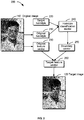
- FIG. 1 schematically shows a block diagram 100 of an original image and a target image before and after changing the hairstyle.
- the original image 110 may be provided, and a target image 120 containing a character with a changed hairstyle may be generated based on the original image 110.
- a technical solution for changing a hairstyle of a character is provided according to the exemplary embodiments of the present disclosure.
- a feature vector of an image may be extracted from the original image 110, and the target image 120 related to a target hairstyle may be generated by adjusting the feature vector.
- the boundary vector may represent a boundary between two hairstyles (for example, an original hairstyle "curly hair” and a target hairstyle "straight hair”). That is, for a feature vector of any image, a hairstyle of a character in the image may be changed to any of the two hairstyles based on the boundary vector.
- the hairstyle of the character may be changed to the straight hair by determining a sum of the feature vector and the boundary vector; and the hairstyle of the character may be changed to the curly hair by determining a difference between the feature vector and the boundary vector.
- a hairstyle classification model may be obtained based on less training images. Furthermore, one or more boundary vectors between different types of hairstyles may be obtained. In this way, by using various boundary vectors, a simple and effective conversion between different types of hairstyles may be achieved.
- FIG. 2 schematically shows a block diagram of a process 200 for changing a hairstyle of a character according to the exemplary embodiments of the present disclosure.
- an original hairstyle 210 e.g., curly hair
- a desired target hairstyle 220 for example, straight hair
- a boundary vector 250 associated with the original hairstyle 210 and the target hairstyle 220 may be acquired based on the hairstyle classification model 240.
- a target feature vector 260 corresponding to the target hairstyle 220 may be determined based on the original feature vector 230 of the original image 110 and the boundary vector 250.
- the target feature vector 260 may be converted to a final target image 120 based on an inverse operation of the extraction of the original feature vector 230.
- the character in the target image 120 may include the target hairstyle 220, i.e. straight hair.
- the hairstyle may involve multiple attributes.
- attributes regarding curl degree may include straight hair and curly hair.
- curly hair may be subdivided into more curling grades.
- attributes regarding color may include black hair, brown hair, yellow hair, white hair, etc.
- the hairstyle may include at least one of the following attributes: a length, a curl degree, a color, a hair parting style, and a bangs style, etc.
- the number of attributes of the hairstyle to be changed is not limited, and the change may involve one or more attributes.
- the original hairstyle 210 may include short curly hair, and the target hairstyle 220 may include short straight hair, and in this case, the change only involves the curl degree and does not involve the length.
- the original hairstyle 210 may include short curly hair, and the target hairstyle 220 may include long straight hair, and in this case, the change for the hairstyle may involve both the length and the curl degree.
- the change of hairstyle involving one attribute will be described first.
- FIG. 3 schematically shows a flowchart of a method 300 for changing a hairstyle of a character according to the exemplary embodiments of the present disclosure.
- the original feature vector 230 of the original image 110 containing the character is determined, wherein the character in the original image 110 has the original hairstyle 210.
- the original image containing the character in this embodiment may come from a public data set.
- the original image 110 may be divided into a plurality of regions according to a body structure of the character.
- FIG. 4 schematically shows a block diagram 400 of a plurality of regions corresponding to the original image according to the exemplary embodiments of the present disclosure.
- FIG. 4 shows the original image 110 on the left and a region image 410 including the plurality of regions corresponding to the original image 110 on the right.
- a foreground region containing the character and a background region 440 may be determined first from the original image 110.
- the foreground region and the background region 440 may be determined based on a variety of technologies currently available and/or to be developed in the future.
- a head region 420 (as shown in a solid line region) may be determined from the foreground region of the original image 110 based on a head detection model, and a remaining portion of the foreground region may be regarded as a body region 430.
- the head detection model may be a model generated based on an existing mature technology.
- the head detection model may be trained based on a machine learning technology. In this way, the head region 420 may be recognized from the original image 110 in a convenient and effective manner.
- a hairstyle region 450 may be determined in the head region 420 based on a key-point detection model.
- the key-point detection model may be a model generated based on an existing mature technology.
- the key-point detection model may be trained based on a machine learning technology.
- the model may detect key-points related to a hairline, a nose, eyes, and a mouth.
- the head region 420 may be divided into a hairstyle region 450, a face region 460, an eye region 470, a nose region 480, and a mouth region 490. In this way, the hairstyle region 450 and other regions of the face may be recognized from the original image 110 in a convenient and effective manner.
- a normalization may be performed for the head region 420 in the original image 110 to eliminate an influence of illumination in an environment in which the character is located. For example, a mean value and/or a variance value of various pixels in the head region 420 may be determined, and the normalization may be performed based on the mean value and/or the variance value described above. In this way, the influence of ambient light on the head region 420 of the character may be eliminated, and a difference in brightness of the image caused by the unevenness of light and dark in part of the image may be reduced.
- a plurality of feature sub-vectors may be generated for the plurality of regions, respectively. Specifically, a feature sub-vector corresponding to each region may be generated, and the original feature vector 230 may be determined based on the plurality of feature sub-vectors.
- FIG. 5 schematically shows a block diagram of a process 500 for generating the original feature vector 230 based on the original image 110 according to the exemplary embodiments of the present disclosure.
- the original feature vector 230 may be extracted from the original image 110 using a feature extraction model 510.
- the feature extraction model 510 may be generated based on a machine learning technology currently available and/or to be developed in the future.
- the feature extraction model 510 may include convolutional layers 512,..., and 514.
- the above-mentioned convolutional layers may be used to determine a sub-feature for each region, respectively.
- the feature extraction model 510 may include a pooling layer 516, and the pooling layer 516 may perform region-related pooling operations based on the plurality of regions marked in the region image 410, so as to generate the final original feature vector 230.
- the original feature vector 230 may be generated based on the sub-features for the plurality of regions.
- FIG. 6 schematically shows a block diagram of a data structure 600 of a feature vector according to the exemplary embodiments of the present disclosure.
- the feature vector 610 may include a plurality of sub-vectors: a hairstyle sub-vector 611, a face sub-vector 612, an eye sub-vector 613, a nose sub-vector 614, a mouth sub-vector 615, a body sub-vector 616 and a background sub-vector 617.
- FIG. 6 merely show an example of the data structure of the feature vector.
- the feature vector 610 may include more or less sub-vectors, and the sub-vectors may be arranged in a different order. It should be understood that a dimension of the feature vector 610 and a dimension of each sub-vector may be customized.
- the hairstyle sub-vector 611 since the purpose of the present disclosure is to change the hairstyle, the hairstyle sub-vector 611 may be stored in a higher precision (for example, 512 dimensions), and the background sub-vector 617 may be represented in a lower precision.
- each sub-vector may also be represented in other dimensions.
- the boundary vector 250 associated with the original hairstyle 110 and the target hairstyle 120 is acquired based on a hairstyle classification model 240.
- the hair classification model 240 may be trained using training images, so as to obtain the boundary vector 250.
- FIG. 7 schematically shows a block diagram of a process 700 for acquiring the boundary vector 250 according to the exemplary embodiments of the present disclosure.
- a set of training images 710 containing curly hair may be acquired, and a set of training images 720 containing straight hair may be acquired.
- the hair classification model 240 may be trained based on two sets of training images, respectively.
- Each training image may be processed in accordance with the method shown above referring to FIGS. 4 to 6 , so as to generate a feature vector for each training image.
- a feature vector may be extracted from each training image in the set of training images 710 to generate a set of training vectors 712
- a feature vector may be extracted from each training image in the set of training images 720 to generate a set of training vectors 722.
- the hair classification model 240 may be generated by using the sets of training vector 712 for images containing characters with curly hair and the set of training vectors 722 for images containing characters with straight hair.
- the hairstyle classification model 240 may be generated based on a machine learning technology currently available and/or to be developed in the future.
- the hair classification model 240 obtained by training may classify an input image into curly hair or straight hair based on a feature vector of the input image.
- a boundary vector indicating a boundary between the curly hair and the straight hair may be acquired from the hairstyle classification model 240.
- a feature vector on a side of a high-dimensional curved surface represented by the boundary vector is classified into curly hair, and a feature vector on another side of the high-dimensional curved surface represented by the boundary vector will be classified into straight hair.
- a sum of the feature vector and the boundary vector may correspond to a hairstyle (for example, straight hair), and a difference between the feature vector and the boundary vector may correspond to another hairstyle (for example, curly hair).
- any hairstyle may be converted into curly hair or straight hair based on the boundary vector.
- the curl degree may also include more grades.
- a hair classification model may be generated by using sets of training images containing hairstyles with different curl degrees based on the method described above.
- the generated hair classification model may classify the hairstyle of the character into N curling grades, and N-1 boundary vectors may be obtained.
- the hair classification model 240 may be generated based on a set of training images contain characters having long hair and a set of training images contain characters having short hair respectively, so as to obtain a boundary vector between long hair and short hair.
- a sum of the boundary vector between long hair and short hair and the feature vector may correspond to a hairstyle (for example, short hair), and a difference between the feature vector and the boundary vector may correspond to another hairstyle (for example, long hair). In this way, any hairstyle may be converted into long hair or short hair based on the boundary vector.
- the hair classification model 240 may be generated based on a set of training image sets containing characters having black hair and a set of training image sets containing characters having brown hair respectively, so as to obtain a boundary vector between black hair and brown hair.
- the hair classification model 240 may also be trained according to the hair parting style (for example, left side parting, central parting, right side parting, etc.).
- the hairstyle classification model may be trained according the bangs style (for example, no bangs, short bangs, long bangs, etc.). In this way, any hairstyle may be converted to include a specified color, hair parting style, and bangs style based on the boundary vector.
- a boundary vector between any two of the plurality of hairstyles may be determined in the manner as described above.
- the boundary vector may relate to varying of multiple attributes.
- Two sets of training images may include differences among multiple attributes. Characters A set of training images may contain characters having black curly hair, and another set of training images may contain characters having brown straight hair. In this case, a boundary vector between black curly hair and brown straight hair may be acquired based on the hair classification model.
- the target feature vector 260 corresponding to the target hairstyle 220 is determined based on the original feature vector 230 and the boundary vector 250.
- the feature sub-vector, which corresponds to the hairstyle region 450, in the original feature vector 230 may be updated based on the boundary vector 250. It should be understood that the purpose of the exemplary embodiments according to the present disclosure is to change the hairstyle of the character, so that when changing a feature sub-vector, it is not necessary to change feature sub-vectors corresponding to other regions.
- the original feature vector 230 includes 2048 dimensions and a hairstyle sub-vector occupies dimensions 1 to 512
- the data in the 1 st to 512 th dimensions of the original feature vector 230 may be summed up with the boundary vector, thereby obtaining the target feature vector 260.
- the curl degree and the color of the character's hair may be changed at the same time.
- the target hairstyle 220 may be set to brown straight hair.
- the original feature vector 230 may be updated based on the boundary vector between curly hair and straight hair and the boundary vector between black hair and brown hair, so as to obtain the target feature vector 260 corresponding to the brown straight hair.
- the target feature vector 260 corresponding to brown straight hair may be determined based on the boundary vectors involving multiple attributes described above.
- FIG. 8 schematically shows a block diagram of a process 800 for generating the target image 120 according to the exemplary embodiments of the present disclosure.
- the target image 120 may be generated based on an image generation model 820, and the image generation model 820 performs an inverse operation of the process performed by the feature extraction model 510 shown in FIG. 5 .
- the image generation model 820 may include a plurality of convolutional layers 822,..., and 824, and a plurality of sub-units 830,..., and 840 (including an upper sampling module and a SEAN ResBlk module).
- the target feature vector 260 includes a plurality of sub-vectors: a hairstyle sub-vector811,..., and a background sub-vector 817.
- the hairstyle sub-vector 811 includes data that is updated in accordance with the method described above.
- the sub-vectors may be processed by using the plurality of sub-units 830,..., and 840, respectively.
- the background sub-vector 817 may be processed by using the sub-unit 830.
- the sub-unit 830 may include an upper sampling module 834 and a SEAN ResBlk (semantic region adaptive normalized resource block) module 832.
- the hairstyle sub-vector 811 may be processed by using the sub-unit 840 including an upper sampling module 844 and a SEAN ResBlk module 842.
- the image generation model 820 may include sub-units for processing other sub-vectors in the target feature vector 260. Further, the image generation model 820 may receive the region image 410 so as to determine a region corresponding to a respective sub-vector in the entire image, and thus output the final target image 120.
- noise data may be introduced to add variance in the original image 110.
- the target image 120 may be generated based on both a noise vector for adjusting the target image and the target feature vector 260.
- the noise vector here may be used to adjust just a portion related to the hairstyle region 450.
- the noise vector may be used to adjust all regions of the image.
- noise 850 may also be added, and the noise 850 may include noise sub-vectors 852,... and 854 associated with respective sub-vectors. In this way, content of each region in the target image 120 may be changed at different degrees.
- variance may be added in each region in order to enrich a visual effect of the target image 120.
- the change of the hairline of the character may be simulated, to provide target images 120 containing hairlines with different heights.
- an original hairline of the character in the original image 110 may be determined based on the hairstyle region 450.
- a position of a target hairline may be received, and a target hairline mask may be generated based on the original hairline and the target hairline.
- the hairline mask may control a region in which the changed hair is located.
- the target image 120 may be generated based on the target feature vector 260 and the target hairline mask.
- the hairline moving upward as the character getting older may be simulated.
- the hairline returning to a young state after hair transplantation may be simulated.
- FIG. 9A schematically shows a block diagram 900A of the original image for a hairstyle before being changed and the target image for a hairstyle after being changed according to the exemplary embodiments of the present disclosure.
- an image 910A represents the original image, in which the hairstyle of the character is short hair and the hairline is high.
- An image 920A represents the target image, in which a hair length of the character is slightly longer and the hairline is lower as compared to those in the original image.
- An image 930A is another target image, in which the hairstyle of the character is changed to long hair.
- FIG. 9B schematically shows a block diagram 900B of the original image for a hairstyle before being changed and the target image for a hairstyle after being changed according to the exemplary embodiments of the present disclosure.
- the character in the original image 910B has long brown hair
- the character in the changed target image 920B has long black hair.
- a boundary vector between any two of the plurality of hairstyles may be obtained. Based on the above-mentioned boundary vector, any hairstyle of the character may be converted into a desired hairstyle. In this way, it is not necessary to use a large number of training images to obtain a conversion model between any two hairstyles, and a desired hairstyle classification model and thus a boundary vector related thereto may be obtained by using less training images.
- the requirements for training data may be greatly reduced, a calculation amount of training process may be reduced and a realistic target image may be obtained.
- FIG. 10 schematically shows a block diagram of an apparatus 1000 for changing a hairstyle of a character according to the exemplary embodiments of the present disclosure. As shown in FIG.
- the apparatus 100 includes: an original feature determination module 1010 configured to determine an original feature vector of an original image containing the character, wherein the character in the original image has an original hairstyle; an acquisition module 1020 configured to acquire a boundary vector associated with the original hairstyle and a target hairstyle based on a hairstyle classification model; a target feature determination module 1030 configured to determine a target feature vector corresponding to the target hairstyle based on the original feature vector and the boundary vector; and a generation module 1040 configured to generate a target image containing the character based on the target feature vector, wherein the character in the target image has the target hairstyle.
- an original feature determination module 1010 configured to determine an original feature vector of an original image containing the character, wherein the character in the original image has an original hairstyle
- an acquisition module 1020 configured to acquire a boundary vector associated with the original hairstyle and a target hairstyle based on a hairstyle classification model
- a target feature determination module 1030 configured to determine a target feature vector corresponding to the target hairstyle based on the original
- the original feature determination module 1010 includes: a division module configured to divide the original image into a plurality of regions according to a body structure of the character; a sub-vector generation module configured to generate a plurality of feature sub-vectors for the plurality of regions respectively; and a vector determination module configured to determine the original feature vector based on the plurality of feature sub-vectors.
- the division module includes: a head region determination module configured to determine a head region in the original image based on a head detection model; and a hairstyle region determination module configured to determine a hairstyle region in the head region based on a key-point detection model.
- the apparatus 1000 further includes: a normalization module configured to normalize the original image to eliminate an influence of illumination in an environment in which the character is located.
- the acquisition module 1020 includes: a training image acquisition module configured to acquire a plurality of sets of training images, in which each set of training images contains characters having one of a plurality of hairstyles; a training feature determination module configured to determine a feature vector of each training image in each set of training images; a classification model generation module configured to generate the hairstyle classification model based on the feature vector of each training image and the hairstyle of the character in the each training image; and a boundary vector determination module configured to determine the boundary vector describing between any two of the plurality of hairstyles based on the hairstyle classification model.
- the target feature determination module 1030 includes: an updating module configured to update a feature sub-vector corresponding to the hairstyle region in the original feature vector based on the boundary vector.
- the generation module 1040 further includes: a hairline determination module configured to determine an original hairline of the character in the original image based on the hairstyle region; a mask generation module configured to generate a target hairline mask based on the original hairline and a target hairline; and a target image generation module configured to generate the target image based on the target feature vector and the target hairline mask.
- the generation module 1040 further includes: a noise module configured to generate the target image based on the target feature vector and a noise vector for adjusting the target image.
- each of the original hairstyle and the target hairstyle includes at least one of: an attribute of length, an attribute of curl degree, an attribute of color, an attribute of hair parting style, and an attribute of bangs style.
- Collecting, storing, using, processing, transmitting, providing, and disclosing etc. of the personal information of the user involved in the present disclosure all comply with the relevant laws and regulations, and do not violate the public order and morals.
- FIG. 11 shows a block diagram of an electronic device 1100 implementing the embodiments of the present disclosure.
- the device 1100 may be used to implement the method described in FIG. 3 .
- the device 1100 includes a computing unit 1101, e.g. a central processing unit (CPU), which may perform various appropriate actions and processing based on computer program instructions stored in a read-only memory (ROM) 1102 or computer program instructions loaded from a storage unit 1108 to a random access memory (RAM) 1103.
- ROM read-only memory
- RAM random access memory
- various programs and data required for the operation of the device 1100 may also be stored.
- the CPU 1101, the ROM 1102, and the RAM 1103 are connected to each other through a bus 1104.
- An input/output (I/O) interface 1105 is also connected to the bus 1104.
- the multiple components include: an input unit 1106, such as a keyboard, a mouse, etc.; an output unit 1107, such as various types of displays, speakers, etc.; and a storage unit 1108, such as a disk, an optical disc, etc.; and a communication unit 1109, such as a network card, a modem, a wireless communication transceiver, etc.
- the communication unit 1109 allows the device 1100 to exchange information/data with other devices through a computer network such as the Internet and/or various telecommunication networks.
- the processing unit 1101 executes the various methods and processes described above, for example, the method 300.
- the method 300 may be implemented as a computer software program, which is tangibly contained in a machine-readable medium, such as the storage unit 1108.
- the computer programs may be partly or entirely loaded and/or installed on the device 1100 via the ROM 1102 and/or the communication unit 1109.
- the CPU 1101 may be configured to execute the method 300 in any other suitable manner (for example, by means of firmware).
- a computer-readable storage medium having a computer program stored thereon is provided.
- the program is executed by the processor, the method described in the present disclosure is implemented.
- exemplary types of hardware logic components include: field programmable gate array (FPGA), application specific integrated circuit (ASIC), application specific standard product (ASSP), system on chip system (SOC), complex programming logic device (CPLD) and so on.
- FPGA field programmable gate array
- ASIC application specific integrated circuit
- ASSP application specific standard product
- SOC system on chip system
- CPLD complex programming logic device
- the program codes used to implement the method of the present disclosure may be written in any combination of one or more programming languages. These program codes may be provided to the processors or controllers of general-purpose computers, special-purpose computers, or other programmable data processing apparatus, so that when the program codes are executed by the processors or controllers, the functions/operations specified in the flowcharts and/or block diagrams are implemented.
- the program codes may be executed entirely on the machine, executed partly on the machine, executed partly on the machine as an independent software package, executed partly on the remote machine and partly on the remote machine, or executed entirely on the remote machine or server.
- the server may be a cloud server, a server of a distributed system, or a server in combination with block chains.
- a machine-readable medium may be a tangible medium, which may contain or store a program for use by an instruction execution system, apparatus, or device, or in combination with the instruction execution system, apparatus, or device.
- the machine-readable medium may be a machine-readable signal medium or a machine-readable storage medium.
- the machine-readable medium may include, but is not limited to, an electronic, magnetic, optical, electromagnetic, infrared, or semiconductor system, apparatus, or device, or any suitable combination of the foregoing.
- machine-readable storage medium may include electrical connections based on one or more wires, portable computer disks, hard disks, random access memory (RAM), read-only memory (ROM), erasable programmable read-only memory (EPROM or flash memory), optical fiber, portable compact disk read-only memory (CD-ROM), optical storage device, magnetic storage device, or any suitable combination of the foregoing.
- RAM random access memory
- ROM read-only memory
- EPROM or flash memory erasable programmable read-only memory
- CD-ROM compact disk read-only memory
- magnetic storage device magnetic storage device
Landscapes
- Engineering & Computer Science (AREA)
- Theoretical Computer Science (AREA)
- Physics & Mathematics (AREA)
- General Physics & Mathematics (AREA)
- Multimedia (AREA)
- Health & Medical Sciences (AREA)
- General Health & Medical Sciences (AREA)
- Data Mining & Analysis (AREA)
- General Engineering & Computer Science (AREA)
- Evolutionary Computation (AREA)
- Life Sciences & Earth Sciences (AREA)
- Artificial Intelligence (AREA)
- Computer Vision & Pattern Recognition (AREA)
- Oral & Maxillofacial Surgery (AREA)
- Computing Systems (AREA)
- Molecular Biology (AREA)
- Software Systems (AREA)
- Mathematical Physics (AREA)
- Biomedical Technology (AREA)
- Biophysics (AREA)
- Computational Linguistics (AREA)
- Human Computer Interaction (AREA)
- Evolutionary Biology (AREA)
- Bioinformatics & Computational Biology (AREA)
- Bioinformatics & Cheminformatics (AREA)
- Probability & Statistics with Applications (AREA)
- Image Analysis (AREA)
- Image Processing (AREA)
Applications Claiming Priority (1)
| Application Number | Priority Date | Filing Date | Title |
|---|---|---|---|
| CN202011379566.1A CN112819921B (zh) | 2020-11-30 | 2020-11-30 | 用于改变人物的发型的方法、装置、设备和存储介质 |
Publications (2)
| Publication Number | Publication Date |
|---|---|
| EP3926533A2 true EP3926533A2 (de) | 2021-12-22 |
| EP3926533A3 EP3926533A3 (de) | 2022-04-27 |
Family
ID=75853234
Family Applications (1)
| Application Number | Title | Priority Date | Filing Date |
|---|---|---|---|
| EP21198213.7A Withdrawn EP3926533A3 (de) | 2020-11-30 | 2021-09-22 | Verfahren und vorrichtung zum ändern der frisur eines menschlichen objekts, vorrichtung und speichermedium |
Country Status (3)
| Country | Link |
|---|---|
| US (1) | US20220005244A1 (de) |
| EP (1) | EP3926533A3 (de) |
| CN (1) | CN112819921B (de) |
Families Citing this family (2)
| Publication number | Priority date | Publication date | Assignee | Title |
|---|---|---|---|---|
| CN114581551B (zh) * | 2022-03-03 | 2025-07-15 | 厦门美图之家科技有限公司 | 图像的头发编辑方法、装置和计算机设备 |
| CN120707372A (zh) * | 2024-03-25 | 2025-09-26 | 北京字跳网络技术有限公司 | 图像处理方法、装置、设备及介质 |
Family Cites Families (17)
| Publication number | Priority date | Publication date | Assignee | Title |
|---|---|---|---|---|
| US7792333B2 (en) * | 2004-10-19 | 2010-09-07 | Sri International | Method and apparatus for person identification |
| JP2007299070A (ja) * | 2006-04-27 | 2007-11-15 | Toshiba Corp | 顔形状モデル生成装置及びその方法 |
| US8270682B2 (en) * | 2008-11-25 | 2012-09-18 | Eastman Kodak Company | Hair segmentation |
| KR20100077263A (ko) * | 2008-12-29 | 2010-07-08 | 삼성전자주식회사 | 개인 정보 제공 장치 및 방법 |
| CN102800129B (zh) * | 2012-06-20 | 2015-09-30 | 浙江大学 | 一种基于单幅图像的头发建模和肖像编辑方法 |
| US10339365B2 (en) * | 2016-03-31 | 2019-07-02 | Snap Inc. | Automated avatar generation |
| CN107527318B (zh) * | 2017-07-17 | 2021-06-04 | 复旦大学 | 一种基于生成对抗式网络模型的发型更换方法 |
| CN109408653B (zh) * | 2018-09-30 | 2022-01-28 | 叠境数字科技(上海)有限公司 | 基于多特征检索和形变的人体发型生成方法 |
| CN111507791A (zh) * | 2019-01-31 | 2020-08-07 | 北京奇虎科技有限公司 | 基于图像的发型变换方法、装置、计算机设备及存储介质 |
| CN109934895B (zh) * | 2019-03-18 | 2020-12-22 | 北京海益同展信息科技有限公司 | 图像局部特征迁移方法与装置 |
| EP3723050A1 (de) * | 2019-04-09 | 2020-10-14 | Koninklijke Philips N.V. | Modifizieren des erscheinungsbildes von haaren |
| US20200349376A1 (en) * | 2019-05-01 | 2020-11-05 | Qualcomm Incorporated | Privacy augmentation using counter recognition |
| CN110111246B (zh) * | 2019-05-15 | 2022-02-25 | 北京市商汤科技开发有限公司 | 一种虚拟头像生成方法及装置、存储介质 |
| CN111899159B (zh) * | 2020-07-31 | 2023-12-22 | 北京百度网讯科技有限公司 | 用于变换发型的方法、装置、设备以及存储介质 |
| US11790581B2 (en) * | 2020-09-28 | 2023-10-17 | Adobe Inc. | Transferring hairstyles between portrait images utilizing deep latent representations |
| US11587288B2 (en) * | 2021-03-15 | 2023-02-21 | Tencent America LLC | Methods and systems for constructing facial position map |
| US11461970B1 (en) * | 2021-03-15 | 2022-10-04 | Tencent America LLC | Methods and systems for extracting color from facial image |
-
2020
- 2020-11-30 CN CN202011379566.1A patent/CN112819921B/zh active Active
-
2021
- 2021-09-20 US US17/479,056 patent/US20220005244A1/en not_active Abandoned
- 2021-09-22 EP EP21198213.7A patent/EP3926533A3/de not_active Withdrawn
Also Published As
| Publication number | Publication date |
|---|---|
| US20220005244A1 (en) | 2022-01-06 |
| CN112819921B (zh) | 2023-09-26 |
| EP3926533A3 (de) | 2022-04-27 |
| CN112819921A (zh) | 2021-05-18 |
Similar Documents
| Publication | Publication Date | Title |
|---|---|---|
| US12039454B2 (en) | Microexpression-based image recognition method and apparatus, and related device | |
| US20230037908A1 (en) | Machine learning model training method and device, and expression image classification method and device | |
| US20190102603A1 (en) | Method and apparatus for determining image quality | |
| US9875445B2 (en) | Dynamic hybrid models for multimodal analysis | |
| JP2022177218A (ja) | 虚像生成モデルのトレーニング方法および虚像生成方法 | |
| US20190034814A1 (en) | Deep multi-task representation learning | |
| CN114332666A (zh) | 一种基于轻量化神经网络模型的图像目标检测方法及系统 | |
| CN110909680A (zh) | 人脸图像的表情识别方法、装置、电子设备及存储介质 | |
| CN117726897B (zh) | 训练数据生成方法、装置、电子设备和存储介质 | |
| CN116091667B (zh) | 一种基于aigc技术的人物艺术形象生成系统 | |
| EP3926533A2 (de) | Verfahren und vorrichtung zum ändern der frisur von menschlichen objekten, gerät und speichermedium | |
| CN109977394A (zh) | 文本模型训练方法、文本分析方法、装置、设备及介质 | |
| CN111325173A (zh) | 毛发类型识别方法、装置、电子设备及存储介质 | |
| CN116363732B (zh) | 人脸情绪识别方法、装置、设备及存储介质 | |
| CN116052241B (zh) | 一种虚拟角色捏脸方法、系统、存储介质及处理终端 | |
| CN119166766A (zh) | 智能交互方法、装置、电子设备及可读存储介质 | |
| CN111813470A (zh) | 一种初始交互界面优化方法及装置 | |
| CN117830081A (zh) | 虚拟对象的妆容生成方法、装置、设备和可读存储介质 | |
| CN117315445A (zh) | 目标识别方法、装置、电子设备及可读存储介质 | |
| CN117218219A (zh) | 模型处理方法、装置、设备及存储介质 | |
| CN116704264A (zh) | 动物分类方法、分类模型训练方法、存储介质及电子设备 | |
| Yang et al. | Directing DNNs Attention for Facial Attribution Classification using Gradient-weighted Class Activation Mapping. | |
| Laubmann et al. | Tackling fake images in cybersecurity--Interpretation of a StyleGAN and lifting its black-box | |
| CN119313964B (zh) | 高清图像可解释分类方法、装置、计算机设备和存储介质 | |
| CN117115877B (zh) | 一种人脸动态表情的识别方法、装置、设备以及存储介质 |
Legal Events
| Date | Code | Title | Description |
|---|---|---|---|
| PUAI | Public reference made under article 153(3) epc to a published international application that has entered the european phase |
Free format text: ORIGINAL CODE: 0009012 |
|
| STAA | Information on the status of an ep patent application or granted ep patent |
Free format text: STATUS: REQUEST FOR EXAMINATION WAS MADE |
|
| 17P | Request for examination filed |
Effective date: 20210922 |
|
| AK | Designated contracting states |
Kind code of ref document: A2 Designated state(s): AL AT BE BG CH CY CZ DE DK EE ES FI FR GB GR HR HU IE IS IT LI LT LU LV MC MK MT NL NO PL PT RO RS SE SI SK SM TR |
|
| REG | Reference to a national code |
Ref country code: DE Ref legal event code: R079 Free format text: PREVIOUS MAIN CLASS: G06K0009000000 Ipc: G06V0040160000 |
|
| PUAL | Search report despatched |
Free format text: ORIGINAL CODE: 0009013 |
|
| AK | Designated contracting states |
Kind code of ref document: A3 Designated state(s): AL AT BE BG CH CY CZ DE DK EE ES FI FR GB GR HR HU IE IS IT LI LT LU LV MC MK MT NL NO PL PT RO RS SE SI SK SM TR |
|
| RIC1 | Information provided on ipc code assigned before grant |
Ipc: G06V 10/50 20220101ALI20220321BHEP Ipc: G06V 40/16 20220101AFI20220321BHEP |
|
| STAA | Information on the status of an ep patent application or granted ep patent |
Free format text: STATUS: EXAMINATION IS IN PROGRESS |
|
| 17Q | First examination report despatched |
Effective date: 20221223 |
|
| STAA | Information on the status of an ep patent application or granted ep patent |
Free format text: STATUS: THE APPLICATION HAS BEEN WITHDRAWN |
|
| 18W | Application withdrawn |
Effective date: 20230424 |