EP3925628A1 - Vorrichtung und verfahren zum sterilisieren von behältnisverschlüssen - Google Patents
Vorrichtung und verfahren zum sterilisieren von behältnisverschlüssen Download PDFInfo
- Publication number
- EP3925628A1 EP3925628A1 EP21183091.4A EP21183091A EP3925628A1 EP 3925628 A1 EP3925628 A1 EP 3925628A1 EP 21183091 A EP21183091 A EP 21183091A EP 3925628 A1 EP3925628 A1 EP 3925628A1
- Authority
- EP
- European Patent Office
- Prior art keywords
- container closures
- sterilization
- radiation
- transport
- closures
- Prior art date
- Legal status (The legal status is an assumption and is not a legal conclusion. Google has not performed a legal analysis and makes no representation as to the accuracy of the status listed.)
- Pending
Links
- 230000001954 sterilising effect Effects 0.000 title claims abstract description 96
- 238000000034 method Methods 0.000 title claims description 13
- 238000004659 sterilization and disinfection Methods 0.000 claims abstract description 86
- 230000032258 transport Effects 0.000 claims abstract description 76
- 230000005855 radiation Effects 0.000 claims abstract description 46
- 239000002800 charge carrier Substances 0.000 claims abstract description 32
- KFSLWBXXFJQRDL-UHFFFAOYSA-N Peracetic acid Chemical compound CC(=O)OO KFSLWBXXFJQRDL-UHFFFAOYSA-N 0.000 description 2
- 238000010894 electron beam technology Methods 0.000 description 2
- 230000002093 peripheral effect Effects 0.000 description 2
- 239000000126 substance Substances 0.000 description 2
- 230000001360 synchronised effect Effects 0.000 description 2
- RTAQQCXQSZGOHL-UHFFFAOYSA-N Titanium Chemical compound [Ti] RTAQQCXQSZGOHL-UHFFFAOYSA-N 0.000 description 1
- 230000001133 acceleration Effects 0.000 description 1
- 238000013459 approach Methods 0.000 description 1
- 244000052616 bacterial pathogen Species 0.000 description 1
- 230000005540 biological transmission Effects 0.000 description 1
- 230000008878 coupling Effects 0.000 description 1
- 238000010168 coupling process Methods 0.000 description 1
- 238000005859 coupling reaction Methods 0.000 description 1
- 230000000249 desinfective effect Effects 0.000 description 1
- 238000011161 development Methods 0.000 description 1
- 230000018109 developmental process Effects 0.000 description 1
- 230000000694 effects Effects 0.000 description 1
- 230000005670 electromagnetic radiation Effects 0.000 description 1
- 239000007788 liquid Substances 0.000 description 1
- 239000002245 particle Substances 0.000 description 1
- 239000003206 sterilizing agent Substances 0.000 description 1
- 229910052719 titanium Inorganic materials 0.000 description 1
- 239000010936 titanium Substances 0.000 description 1
- XLYOFNOQVPJJNP-UHFFFAOYSA-N water Substances O XLYOFNOQVPJJNP-UHFFFAOYSA-N 0.000 description 1
Images
Classifications
-
- A—HUMAN NECESSITIES
- A61—MEDICAL OR VETERINARY SCIENCE; HYGIENE
- A61L—METHODS OR APPARATUS FOR STERILISING MATERIALS OR OBJECTS IN GENERAL; DISINFECTION, STERILISATION OR DEODORISATION OF AIR; CHEMICAL ASPECTS OF BANDAGES, DRESSINGS, ABSORBENT PADS OR SURGICAL ARTICLES; MATERIALS FOR BANDAGES, DRESSINGS, ABSORBENT PADS OR SURGICAL ARTICLES
- A61L2/00—Methods or apparatus for disinfecting or sterilising materials or objects other than foodstuffs or contact lenses; Accessories therefor
- A61L2/02—Methods or apparatus for disinfecting or sterilising materials or objects other than foodstuffs or contact lenses; Accessories therefor using physical phenomena
- A61L2/08—Radiation
- A61L2/087—Particle radiation, e.g. electron-beam, alpha or beta radiation
-
- B—PERFORMING OPERATIONS; TRANSPORTING
- B65—CONVEYING; PACKING; STORING; HANDLING THIN OR FILAMENTARY MATERIAL
- B65B—MACHINES, APPARATUS OR DEVICES FOR, OR METHODS OF, PACKAGING ARTICLES OR MATERIALS; UNPACKING
- B65B55/00—Preserving, protecting or purifying packages or package contents in association with packaging
- B65B55/02—Sterilising, e.g. of complete packages
- B65B55/04—Sterilising wrappers or receptacles prior to, or during, packaging
- B65B55/08—Sterilising wrappers or receptacles prior to, or during, packaging by irradiation
-
- A—HUMAN NECESSITIES
- A61—MEDICAL OR VETERINARY SCIENCE; HYGIENE
- A61L—METHODS OR APPARATUS FOR STERILISING MATERIALS OR OBJECTS IN GENERAL; DISINFECTION, STERILISATION OR DEODORISATION OF AIR; CHEMICAL ASPECTS OF BANDAGES, DRESSINGS, ABSORBENT PADS OR SURGICAL ARTICLES; MATERIALS FOR BANDAGES, DRESSINGS, ABSORBENT PADS OR SURGICAL ARTICLES
- A61L2/00—Methods or apparatus for disinfecting or sterilising materials or objects other than foodstuffs or contact lenses; Accessories therefor
- A61L2/02—Methods or apparatus for disinfecting or sterilising materials or objects other than foodstuffs or contact lenses; Accessories therefor using physical phenomena
- A61L2/08—Radiation
-
- A—HUMAN NECESSITIES
- A61—MEDICAL OR VETERINARY SCIENCE; HYGIENE
- A61L—METHODS OR APPARATUS FOR STERILISING MATERIALS OR OBJECTS IN GENERAL; DISINFECTION, STERILISATION OR DEODORISATION OF AIR; CHEMICAL ASPECTS OF BANDAGES, DRESSINGS, ABSORBENT PADS OR SURGICAL ARTICLES; MATERIALS FOR BANDAGES, DRESSINGS, ABSORBENT PADS OR SURGICAL ARTICLES
- A61L2/00—Methods or apparatus for disinfecting or sterilising materials or objects other than foodstuffs or contact lenses; Accessories therefor
- A61L2/02—Methods or apparatus for disinfecting or sterilising materials or objects other than foodstuffs or contact lenses; Accessories therefor using physical phenomena
- A61L2/08—Radiation
- A61L2/082—X-rays
-
- B—PERFORMING OPERATIONS; TRANSPORTING
- B67—OPENING, CLOSING OR CLEANING BOTTLES, JARS OR SIMILAR CONTAINERS; LIQUID HANDLING
- B67B—APPLYING CLOSURE MEMBERS TO BOTTLES JARS, OR SIMILAR CONTAINERS; OPENING CLOSED CONTAINERS
- B67B3/00—Closing bottles, jars or similar containers by applying caps
- B67B3/003—Pretreatment of caps, e.g. cleaning, steaming, heating or sterilizing
-
- A—HUMAN NECESSITIES
- A61—MEDICAL OR VETERINARY SCIENCE; HYGIENE
- A61L—METHODS OR APPARATUS FOR STERILISING MATERIALS OR OBJECTS IN GENERAL; DISINFECTION, STERILISATION OR DEODORISATION OF AIR; CHEMICAL ASPECTS OF BANDAGES, DRESSINGS, ABSORBENT PADS OR SURGICAL ARTICLES; MATERIALS FOR BANDAGES, DRESSINGS, ABSORBENT PADS OR SURGICAL ARTICLES
- A61L2202/00—Aspects relating to methods or apparatus for disinfecting or sterilising materials or objects
- A61L2202/20—Targets to be treated
- A61L2202/23—Containers, e.g. vials, bottles, syringes, mail
Definitions
- the present invention relates to a device and a method for sterilizing container closures.
- Such devices and methods have long been known from the prior art.
- liquid or gaseous sterilization media such as peracetic acid or H 2 O 2 are used to sterilize container closures. These are applied to the container closures.
- the present invention is therefore based on the object of providing a device and a method which allow container closures to be sterilized and at the same time reduce or even prevent the use of chemical sterilizing agents.
- a device according to the invention for sterilizing container closures has a transport device which transports the container closures along a predetermined transport path and a sterilization device which is suitable and intended to sterilize the container closures at least in sections.
- the sterilization device has a charge carrier source which generates charge carriers and a radiation device which radiates the charge carriers onto a surface of the container closures to be sterilized. Furthermore, at least one element of the sterilization device can be introduced into an inner region of the container closures.
- the inner area of the container closures is understood to mean that area of the plastic closures which is surrounded by the peripheral wall of the container closures and in particular that area which is surrounded by an internal thread of the container closures.
- the inner area of the container closures is that area which receives a section of the mouth of the container when the container is in a closed state.
- these charge carriers are electrons. These can be generated, for example, by means of a hot cathode. However, other charge carriers are also conceivable, such as protons, alpha particles and the like.
- the sterilization device has at least one tubular or rod-shaped body, within which the charge carriers are moved and / or accelerated. At least one section of this tubular body can particularly preferably be introduced into the interior of the container closures. In particular this at least one section can be introduced into a region of the container closures which is surrounded by an internal thread of the container closure.
- this tubular body has an essentially constant cross section along its longitudinal direction.
- an end section of this tubular body to have a reduced cross section and for this tubular body to have a reduced cross section, in particular in that area which is inserted into the container closure.
- the device has an acceleration device which accelerates the charge carriers and which in particular accelerates the electrons.
- the sterilization device has a radiation device which can be moved with respect to the container closures in a direction of movement which has at least one component which is perpendicular to the transport path of the container closures. This direction of movement is particularly preferably perpendicular to the transport path of the container closures.
- This radiation device can be arranged at the end of the above-mentioned tubular body.
- the sterilization device and in particular the radiation device it is particularly possible for the sterilization device and in particular the radiation device to be able to be advanced towards the container closures and, particularly preferably, to be able to be introduced into the interior of these container closures. In this way, reliable sterilization of the internal thread area of the container closures is also possible.
- the container closures are preferably plastic closures.
- the device has a drive device which triggers the movement of the radiation device.
- the container closures themselves to be moved towards the sterilization device.
- the device has at least one electric motor which realizes the said movement of the radiation device.
- the tubular bodies are also referred to below as jet fingers.
- the tubular bodies or beam fingers have an exit window through which the charge carriers and in particular the electrons can exit the tubular bodies.
- This exit window can be a titanium window, for example.
- This exit window particularly preferably has a thickness that is greater than 1 ⁇ m, preferably greater than 2 ⁇ m, preferably greater than 3 ⁇ m, preferably greater than 5 ⁇ m.
- the exit window particularly preferably has a thickness which is smaller than 50 ⁇ m, preferably smaller than 40 ⁇ m, preferably smaller than 30 ⁇ m, preferably smaller than 25 ⁇ m, preferably smaller than 20 ⁇ m.
- At least one element of the sterilization device can be introduced into the interior of the container closures.
- this is an end section of the above-mentioned beam finger and in particular the area which also contains the said exit window.
- the areas of the internal thread can also be reliably sterilized. In particular, there is no shading of the individual areas of the internal thread.
- the sterilization device has a plurality of tubular bodies or jet fingers arranged one behind the other along the transport path. In this way, several container closures arranged one behind the other can be sterilized by means of the jet finger.
- the sterilization device is arranged in a stationary manner along the transport path of the container closures. This means that the sterilization device and / or the beam fingers can indeed move towards and away from the container closures, that is to say in particular perpendicular to the transport path, but otherwise cannot move in the transport direction.
- the container closures it is possible for the container closures to be transported in a clocked manner. For example, a certain number of container closures could be moved under the sterilization devices, then the transport could be stopped and the sterilization fingers could dip into the container closures. After this has been done, these container closures can be moved out of the sterilization area and a new batch of container closures can be brought into the sterilization area.
- the sterilization device and / or the sterilization devices could be arranged so as to be movable in the transport direction of the container closures.
- the sterilization devices could be attached to a rotatable carrier, with holding devices for holding the container closures also being arranged on this rotatable carrier, so that the container closures are sterilized while the container closures and also the sterilization devices are rotated.
- the device also has a sterilization device which sterilizes the outer surfaces of the container closures.
- This further sterilization device also preferably works with charge carrier radiation and in particular with electron radiation.
- this further sterilization device can be designed in such a way that the container closures are moved past it, since there is less risk of shading in the outer area of the container closures and the outer surface is less critical than the inner surface of the container closures with regard to sterilization.
- the transport device transports the container closures individually.
- the transported container closures are therefore preferred spaced from each other during transport. In this way, isolated sterilization of the container closures is possible.
- outer surface areas of the container closures can also be reliably sterilized in this way.
- the container closures are preferably transported in a row and in particular in a row.
- the sterilization device has a plurality of tubular radiation devices which are arranged on a rotatable sterilization carrier, the radiation devices being movable along the transport path with respect to the container closures.
- the sterilization devices or beam fingers are arranged on a rotatable dedicated carrier and the container closures are transported, for example, with a further carrier, for example with a further rotatable carrier.
- this carrier on which the sterilization devices are arranged differs from the transport device for transporting the container closures.
- the transport device it would also be possible here for the transport device to transport the container closures in a straight line.
- the transport device has a rotatable carrier and a plurality of holding elements arranged on this carrier in order to move the container closures relative to the sterilization device.
- This rotatable carrier preferably differs from the sterilization carrier mentioned above.
- the axes of rotation of the transport device and the sterilization device or the sterilization carrier preferably fall apart. These axes of rotation are preferably perpendicular to one another.
- a division of the jet fingers and in particular a division of the jet fingers in the end sections of the same and a division of the holding elements for holding the container closures match. It is preferably possible here for the beam fingers, which are arranged on the sterilization carrier and the individual container closures, to mesh with one another in the manner of a toothed wheel.
- this transport star is a to this transport star (more precisely to the rotational movement of this star) by a predetermined angle, for example 90 ° inclined disc, the above-mentioned sterilization carrier on which the radiation fingers are attached.
- This disk preferably rotates in the direction of rotation of the transport star for the container closures and is particularly preferably adapted to this with regard to the rotational speed.
- the radiation fingers Due to the circular path of the radiation fingers, which in the above-mentioned case is at 90 ° to the circular path of the closures, the radiation fingers can dip into the respective closures for a brief moment.
- the applicant has determined that an irradiation time of only 0.2 seconds is necessary for disinfection.
- Coupling and / or synchronization means are preferably provided which synchronize the rotary movement of the transport device and the rotary movement of the sterilization carrier with one another.
- the rotary movement of these transport devices can be removed from the shaft or the drive unit of the transport star for the plastic preforms by means of a gear.
- separate synchronized drives are also conceivable.
- the container closures can be disinfected without a shadow.
- the jet fingers can dip into the closures without having to stop the movement of the transport star for the container closures.
- a separate drive for the sterilization support is not absolutely necessary here.
- the device has a feed device which feeds the container closures to the above-mentioned transport device.
- a transport device for example a transport disk, is half full, this transport device can stop and a unit which has a multiplicity of radiation emitters can carry out the above-mentioned lifting movement.
- the stroke causes the radiation devices to dip into the respective container closure and thereby completely sterilize the closure.
- complete sterilization takes about 0.2 seconds.
- Adding the time for the mechanical movement results in a time of approx. 0.5 seconds.
- a system output of 36,000 bottles per hour for example, five radiation devices could be provided.
- the transport device can start moving again and, through the rotational movement, remove the closures in the direction of a further unit, such as a closer. With the same movement, the opposite side of the rotating star can be refilled with closures and the process is repeated.
- a stationary finger can be installed in a channel inlet, for example.
- the aforementioned transport disk and the finger exit are particularly preferably located in a radiation-tight chamber.
- the device has a clean room which, in particular, separates the area in which the sterilization takes place and / or the transport path of the container closures from an environment and in particular a non-sterile environment.
- This clean room can have walls that are movable with respect to one another, but which are sealed, for example with labyrinth seals or so-called water locks.
- the container closures are therefore preferably sterilized within a clean room.
- the device has a shielding unit which shields radiation and, in particular, X-rays that arise during the sterilization process.
- Such a shielding device can be built up around the individual sterilization devices or beam fingers, for example.
- the present invention is further directed to a method for sterilizing container closures, the container closures being transported with a transport device along a predetermined transport path and the container closures being sterilized at least in sections with a sterilization device and preferably being sterilized at least in sections in an interior of the container closures.
- the sterilization device has a charge carrier source which generates charge carriers and a radiation device radiates the charge carriers onto a surface of the container closures to be sterilized, the radiation device more precisely at least one element of this radiation device being introduced or immersed at least temporarily into an interior space of the container closures.
- the radiation device and, in particular, an end section of the radiation device immerse into an interior space of the container closures for sterilization. In this way, efficient internal sterilization of the container closures is possible.
- the sterilization devices are preferably transported on a circular path.
- the transport path of these sterilization devices preferably deviates from the transport path of the container closures during their sterilization.
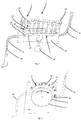
- Figure 1 shows a device 1 according to the invention for sterilizing container closures 10.
- these container closures 10 are fed to a transport device 2 via a feed device, such as a feed channel 32, for example.
- This transport device 2 has a rotatable carrier 24 which has a multiplicity of holding elements for holding the container closures 10.
- the container closures 10 are first retracted with the transport device 2 until, for example, the individual holding elements are occupied.
- a sterilization device designated in its entirety by 4 is shown above the container closures 10 or the transport device 2, a sterilization device designated in its entirety by 4 is shown.
- This has a multiplicity of charge carrier sources 42.
- the reference numeral 46 relates to a tubular body within which the charge carriers, i.e. here the electrons, are accelerated in the direction of an exit window.
- the reference number 44 relates accordingly to the individual radiation devices from which the electrons exit, which are used to act on the container closures.
- a carrier 26 is provided on which the individual sterilization devices or beam fingers 44 are arranged. This carrier 26 allows the individual beam fingers 46 and thus also the radiation devices 44 to be moved in the direction of movement B.
- the container closures are transported here in a clocked manner by means of a drive device such as a motor 28. As soon as the container closures are in their sterilization position, the beam fingers 46 with the lifting device or the carrier 26 are lowered and immersed in the interior 10a of the container closures. Sterilization takes place there.
- the reference number 50 denotes a clean room which surrounds the sterilization area.
- This clean room 50 can have locks via which the container closures are supplied and via which they are also carried out again. Furthermore, it is conceivable that the clean room is subjected to an overpressure with respect to atmospheric pressure, so that the entry of germs into the clean room can be reliably prevented.
- the device has a shielding device (not shown) which in particular shields the electromagnetic radiation and in particular X-ray radiation that is generated by the individual charge carrier sources 42 or the radiation devices 44.
- Figure 2 shows a top view of the in Figure 1 shown device. It can be seen here that the transport device 2 is designed as a rotatable carrier and has a multiplicity of holding elements 22 for receiving the container closures 10.
- the individual radiation devices or radiation fingers 44 are also arranged on a common carrier 27 which, in its entirety, can be lowered and raised again in the direction of the transport path of the container closures.
- the reference number 56 denotes a further sterilization device which is used in particular for external sterilization of the container closures. This can be arranged, for example, below said feed channel 32.
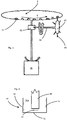
- FIG. 3 shows schematically a further embodiment of the present invention.
- a transport device 2 is again provided, which moves a large number of container closures 10 along the transport path T.
- a sterilization support 45 is provided on which a plurality of beam fingers 46 are arranged.
- the reference numeral 62 denotes a gear with which a drive shaft 64, on which the sterilization support 45 is arranged, is synchronized with the transport device 2 so that the individual jet fingers can penetrate into the individual container closures.
- sterilization carrier it would also be possible for the sterilization carrier to be arranged above the container closures in a way that is different from what is shown here.
- the reference symbol 28 again identifies the drive device for driving the transport device 2 and thus also the shaft 64 here.
- Fig. 4 shows a representation of a container closure 10. This has a cover surface 16 and a peripheral wall 12 on which an internal thread is arranged.
- the reference symbol 10a identifies the interior of the container closure.
- the reference numeral 46 denotes a jet finger which has just dipped into the container closure 10.
- the reference symbol 47 denotes an exit window which is arranged at the lower end of the beam finger and via which the electrons can exit from the beam finger 46
Landscapes
- Health & Medical Sciences (AREA)
- General Health & Medical Sciences (AREA)
- Epidemiology (AREA)
- Life Sciences & Earth Sciences (AREA)
- Animal Behavior & Ethology (AREA)
- Public Health (AREA)
- Veterinary Medicine (AREA)
- Engineering & Computer Science (AREA)
- Mechanical Engineering (AREA)
- Toxicology (AREA)
- Apparatus For Disinfection Or Sterilisation (AREA)
Applications Claiming Priority (2)
| Application Number | Priority Date | Filing Date | Title |
|---|---|---|---|
| DE102019108565.9A DE102019108565A1 (de) | 2019-04-02 | 2019-04-02 | Vorrichtung und Verfahren zum Sterilisieren von Behältnisverschlüssen |
| EP20167030.4A EP3733217B1 (de) | 2019-04-02 | 2020-03-31 | Vorrichtung und verfahren zum sterilisieren von behältnisverschlüssen |
Related Parent Applications (2)
| Application Number | Title | Priority Date | Filing Date |
|---|---|---|---|
| EP20167030.4A Division EP3733217B1 (de) | 2019-04-02 | 2020-03-31 | Vorrichtung und verfahren zum sterilisieren von behältnisverschlüssen |
| EP20167030.4A Division-Into EP3733217B1 (de) | 2019-04-02 | 2020-03-31 | Vorrichtung und verfahren zum sterilisieren von behältnisverschlüssen |
Publications (1)
| Publication Number | Publication Date |
|---|---|
| EP3925628A1 true EP3925628A1 (de) | 2021-12-22 |
Family
ID=70110056
Family Applications (2)
| Application Number | Title | Priority Date | Filing Date |
|---|---|---|---|
| EP21183091.4A Pending EP3925628A1 (de) | 2019-04-02 | 2020-03-31 | Vorrichtung und verfahren zum sterilisieren von behältnisverschlüssen |
| EP20167030.4A Active EP3733217B1 (de) | 2019-04-02 | 2020-03-31 | Vorrichtung und verfahren zum sterilisieren von behältnisverschlüssen |
Family Applications After (1)
| Application Number | Title | Priority Date | Filing Date |
|---|---|---|---|
| EP20167030.4A Active EP3733217B1 (de) | 2019-04-02 | 2020-03-31 | Vorrichtung und verfahren zum sterilisieren von behältnisverschlüssen |
Country Status (5)
| Country | Link |
|---|---|
| EP (2) | EP3925628A1 (enExample) |
| JP (1) | JP2020169058A (enExample) |
| CN (1) | CN111792120B (enExample) |
| DE (1) | DE102019108565A1 (enExample) |
| SI (1) | SI3733217T1 (enExample) |
Families Citing this family (2)
| Publication number | Priority date | Publication date | Assignee | Title |
|---|---|---|---|---|
| CN112918721A (zh) * | 2021-01-23 | 2021-06-08 | 徐艳霞 | 一种智能制造桶装涂料打包用自动定位合盖封口的装置 |
| DE102021131993A1 (de) * | 2021-12-03 | 2023-06-07 | Krones Aktiengesellschaft | Vorrichtung und Verfahren zum Behandeln von Behälterverschlüssen |
Citations (6)
| Publication number | Priority date | Publication date | Assignee | Title |
|---|---|---|---|---|
| EP2161202A1 (de) * | 2008-08-30 | 2010-03-10 | Krones AG | Elektronenstrahlsterilisation für Behältnisse |
| JP2011213417A (ja) * | 2011-07-12 | 2011-10-27 | Mitsubishi Heavy Ind Ltd | ボトルキャップ殺菌装置 |
| EP2610209A1 (en) * | 2011-12-27 | 2013-07-03 | Shibuya Kogyo Co., Ltd. | Electron beam sterilizer for cap |
| EP2650022A1 (de) * | 2012-04-11 | 2013-10-16 | Krones AG | Vorrichtung und Verfahren zum strahlungsbasierten Sterilisieren von Behältnisverschlüssen |
| WO2015093096A1 (ja) * | 2013-12-19 | 2015-06-25 | 日立造船株式会社 | ボトルキャップの滅菌および装着方法、並びにボトルキャップの滅菌および装着設備 |
| WO2015124358A1 (en) * | 2014-02-19 | 2015-08-27 | Tetra Laval Holdings & Finance S.A. | Sterilization machine and method for sterilizing packaging containers |
Family Cites Families (12)
| Publication number | Priority date | Publication date | Assignee | Title |
|---|---|---|---|---|
| JP4501269B2 (ja) * | 2000-10-30 | 2010-07-14 | 澁谷工業株式会社 | キャップ殺菌装置 |
| DE102007050582B4 (de) * | 2007-10-23 | 2018-09-06 | Khs Corpoplast Gmbh | Verfahren und Vorrichtung zum Sterilisieren sowie Vorrichtung zur Blasformung von Behältern |
| DE102008007428B4 (de) * | 2008-02-01 | 2016-02-11 | Khs Gmbh | Verfahren sowie Vorrichtung zum Sterilisieren von Packmitteln |
| DE102010012569A1 (de) * | 2010-03-23 | 2011-09-29 | Krones Ag | Vorrichtung zum Sterilisieren von Behältnissen |
| DE102011055553A1 (de) * | 2011-11-21 | 2013-05-23 | Krones Ag | Vorrichtung zur Innen- und Außensterilisierung von Kunststoffbehältnissen mittels Ladungsträgerstrahlen |
| DE102011056628A1 (de) * | 2011-12-19 | 2013-06-20 | Krones Aktiengesellschaft | Vorrichtung und Verfahren zum Sterilisieren von Behältnissen mit Funktionsüberwachung |
| EP2640022B1 (en) * | 2012-03-14 | 2016-07-20 | Telefonaktiebolaget LM Ericsson (publ) | Technique for generating a filter for data reception |
| DE102013109988A1 (de) * | 2013-09-11 | 2015-03-12 | Krones Ag | Vorrichtung zum Sterilisieren von Kunststoffvorformlingen bei gleichzeitiger Innen- und Außensterilisierung |
| DE102014102537A1 (de) * | 2014-02-26 | 2015-08-27 | Krones Ag | Vorrichtung und Verfahren zum Sterilisieren von Behältnissen |
| JP2015212156A (ja) * | 2014-05-02 | 2015-11-26 | 日立造船株式会社 | ボトルキャップの電子線滅菌方法および装置 |
| FR3037247B1 (fr) * | 2015-06-15 | 2020-10-23 | Serac Group | Installation de sterilisation d'articles par rayonnement |
| EP3362105B1 (en) * | 2015-10-13 | 2025-12-03 | Suntory Holdings Limited | Sterilization system |
-
2019
- 2019-04-02 DE DE102019108565.9A patent/DE102019108565A1/de active Pending
-
2020
- 2020-03-26 JP JP2020055662A patent/JP2020169058A/ja active Pending
- 2020-03-31 EP EP21183091.4A patent/EP3925628A1/de active Pending
- 2020-03-31 SI SI202030095T patent/SI3733217T1/sl unknown
- 2020-03-31 EP EP20167030.4A patent/EP3733217B1/de active Active
- 2020-04-02 CN CN202010256027.2A patent/CN111792120B/zh active Active
Patent Citations (6)
| Publication number | Priority date | Publication date | Assignee | Title |
|---|---|---|---|---|
| EP2161202A1 (de) * | 2008-08-30 | 2010-03-10 | Krones AG | Elektronenstrahlsterilisation für Behältnisse |
| JP2011213417A (ja) * | 2011-07-12 | 2011-10-27 | Mitsubishi Heavy Ind Ltd | ボトルキャップ殺菌装置 |
| EP2610209A1 (en) * | 2011-12-27 | 2013-07-03 | Shibuya Kogyo Co., Ltd. | Electron beam sterilizer for cap |
| EP2650022A1 (de) * | 2012-04-11 | 2013-10-16 | Krones AG | Vorrichtung und Verfahren zum strahlungsbasierten Sterilisieren von Behältnisverschlüssen |
| WO2015093096A1 (ja) * | 2013-12-19 | 2015-06-25 | 日立造船株式会社 | ボトルキャップの滅菌および装着方法、並びにボトルキャップの滅菌および装着設備 |
| WO2015124358A1 (en) * | 2014-02-19 | 2015-08-27 | Tetra Laval Holdings & Finance S.A. | Sterilization machine and method for sterilizing packaging containers |
Also Published As
| Publication number | Publication date |
|---|---|
| EP3733217A1 (de) | 2020-11-04 |
| DE102019108565A1 (de) | 2020-10-08 |
| CN111792120B (zh) | 2022-08-05 |
| EP3733217B1 (de) | 2022-07-20 |
| SI3733217T1 (sl) | 2022-10-28 |
| CN111792120A (zh) | 2020-10-20 |
| JP2020169058A (ja) | 2020-10-15 |
Similar Documents
| Publication | Publication Date | Title |
|---|---|---|
| EP2491955B1 (de) | Verfahren und Vorrichtung zur Sterilisation von Behältnissen | |
| EP2371397B1 (de) | Vorrichtung zum Sterilisieren von Behältnissen | |
| EP2845609B1 (de) | Vorrichtung und Verfahren zum Sterilisieren von Behältnissen mit Wartungsmöglichkeit | |
| DE102008007428B4 (de) | Verfahren sowie Vorrichtung zum Sterilisieren von Packmitteln | |
| EP2594493B1 (de) | Vorrichtung zur Innen- und Außensterilisierung von Vorformlingen mittels Ladungsträgerstrahlen sowie entsprechendes Verfahren und Behandlungsanlage | |
| EP2650022B1 (de) | Vorrichtung und Verfahren zum strahlungsbasierten Sterilisieren von Behältnisverschlüssen | |
| DE102012110108A1 (de) | Vorrichtung zur Außensterilisation von Kunststoffvorformlingen | |
| DE102011107772A1 (de) | Verfahren und Vorrichtung zum Herstellen von mit Flüssigkeiten gefüllten Getränkebehältnissen | |
| DE102013109988A1 (de) | Vorrichtung zum Sterilisieren von Kunststoffvorformlingen bei gleichzeitiger Innen- und Außensterilisierung | |
| EP3733217B1 (de) | Vorrichtung und verfahren zum sterilisieren von behältnisverschlüssen | |
| EP2559444B1 (de) | Verfahren und Vorrichtung zum Sterilisieren von Kunststoffbehältnissen mit Schutzvorrichtung | |
| EP2164527B1 (de) | STERILISATION MIT ß-STRAHLUNG | |
| EP2581096B1 (de) | Vorrichtung und Verfahren zum Sterilisieren von Behältnissen mit in die Behältnisse eingeführter Elektronenquelle | |
| DE2439157A1 (de) | Verfahren und anordnung zum fuellen und verschliessen vorfabrizierter verpackungsbehaelter unter aseptischen bedingungen | |
| EP2842579B1 (de) | Verfahren und Vorrichtung zum Sterilisieren von Behältnissen mit Reinigung eines Strahlaustrittsfensters | |
| EP2803368B1 (de) | Vorrichtung und Verfahren zum Sterilisieren von Behältnissen mit Abschirmeinrichtung gegen Röntgenstrahlen | |
| DE102015103962B4 (de) | Vorrichtung zum Desinfizieren und Spülen von Behältern in einer Getränkeabfüllanlage | |
| DE102023116964A1 (de) | Vorrichtung und Verfahren zum Behandeln und insbesondere Sterilisieren von Behältnissen | |
| EP4647237A2 (de) | Vorrichtung zum sterilisieren von kunststoffvorformlingen und verfahren hierzu | |
| DE102011055550A1 (de) | Vorrichtung und Verfahren zum Sterilisieren von Kunststoffbehältnissen mit Elektronenstrahlung | |
| DE102020129960A1 (de) | Vorrichtung und Verfahren zum Behandeln von Behältnissen mit Dreheinrichtung zum Drehen der Behältnisse |
Legal Events
| Date | Code | Title | Description |
|---|---|---|---|
| PUAI | Public reference made under article 153(3) epc to a published international application that has entered the european phase |
Free format text: ORIGINAL CODE: 0009012 |
|
| STAA | Information on the status of an ep patent application or granted ep patent |
Free format text: STATUS: THE APPLICATION HAS BEEN PUBLISHED |
|
| AC | Divisional application: reference to earlier application |
Ref document number: 3733217 Country of ref document: EP Kind code of ref document: P |
|
| AK | Designated contracting states |
Kind code of ref document: A1 Designated state(s): AL AT BE BG CH CY CZ DE DK EE ES FI FR GB GR HR HU IE IS IT LI LT LU LV MC MK MT NL NO PL PT RO RS SE SI SK SM TR |
|
| B565 | Issuance of search results under rule 164(2) epc |
Effective date: 20211020 |
|
| STAA | Information on the status of an ep patent application or granted ep patent |
Free format text: STATUS: REQUEST FOR EXAMINATION WAS MADE |
|
| 17P | Request for examination filed |
Effective date: 20220531 |
|
| RBV | Designated contracting states (corrected) |
Designated state(s): AL AT BE BG CH CY CZ DE DK EE ES FI FR GB GR HR HU IE IS IT LI LT LU LV MC MK MT NL NO PL PT RO RS SE SI SK SM TR |
|
| P01 | Opt-out of the competence of the unified patent court (upc) registered |
Effective date: 20230523 |
|
| STAA | Information on the status of an ep patent application or granted ep patent |
Free format text: STATUS: EXAMINATION IS IN PROGRESS |
|
| 17Q | First examination report despatched |
Effective date: 20240724 |