EP3925532B1 - Bestimmung von cochleahydrops auf basis von aufgezeichneten auditiven elektrophysiologischen antworten - Google Patents
Bestimmung von cochleahydrops auf basis von aufgezeichneten auditiven elektrophysiologischen antworten Download PDFInfo
- Publication number
- EP3925532B1 EP3925532B1 EP21179483.9A EP21179483A EP3925532B1 EP 3925532 B1 EP3925532 B1 EP 3925532B1 EP 21179483 A EP21179483 A EP 21179483A EP 3925532 B1 EP3925532 B1 EP 3925532B1
- Authority
- EP
- European Patent Office
- Prior art keywords
- stimulus
- audio
- chirp
- person
- animal
- Prior art date
- Legal status (The legal status is an assumption and is not a legal conclusion. Google has not performed a legal analysis and makes no representation as to the accuracy of the status listed.)
- Active
Links
Images

Classifications
-
- A—HUMAN NECESSITIES
- A61—MEDICAL OR VETERINARY SCIENCE; HYGIENE
- A61B—DIAGNOSIS; SURGERY; IDENTIFICATION
- A61B5/00—Measuring for diagnostic purposes; Identification of persons
- A61B5/24—Detecting, measuring or recording bioelectric or biomagnetic signals of the body or parts thereof
- A61B5/316—Modalities, i.e. specific diagnostic methods
- A61B5/369—Electroencephalography [EEG]
- A61B5/377—Electroencephalography [EEG] using evoked responses
- A61B5/38—Acoustic or auditory stimuli
-
- A—HUMAN NECESSITIES
- A61—MEDICAL OR VETERINARY SCIENCE; HYGIENE
- A61B—DIAGNOSIS; SURGERY; IDENTIFICATION
- A61B5/00—Measuring for diagnostic purposes; Identification of persons
- A61B5/12—Audiometering
- A61B5/121—Audiometering evaluating hearing capacity
-
- A—HUMAN NECESSITIES
- A61—MEDICAL OR VETERINARY SCIENCE; HYGIENE
- A61B—DIAGNOSIS; SURGERY; IDENTIFICATION
- A61B5/00—Measuring for diagnostic purposes; Identification of persons
- A61B5/12—Audiometering
- A61B5/121—Audiometering evaluating hearing capacity
- A61B5/123—Audiometering evaluating hearing capacity subjective methods
-
- A—HUMAN NECESSITIES
- A61—MEDICAL OR VETERINARY SCIENCE; HYGIENE
- A61B—DIAGNOSIS; SURGERY; IDENTIFICATION
- A61B5/00—Measuring for diagnostic purposes; Identification of persons
- A61B5/12—Audiometering
- A61B5/121—Audiometering evaluating hearing capacity
- A61B5/125—Audiometering evaluating hearing capacity objective methods
-
- A—HUMAN NECESSITIES
- A61—MEDICAL OR VETERINARY SCIENCE; HYGIENE
- A61B—DIAGNOSIS; SURGERY; IDENTIFICATION
- A61B5/00—Measuring for diagnostic purposes; Identification of persons
- A61B5/68—Arrangements of detecting, measuring or recording means, e.g. sensors, in relation to patient
- A61B5/6801—Arrangements of detecting, measuring or recording means, e.g. sensors, in relation to patient specially adapted to be attached to or worn on the body surface
- A61B5/6813—Specially adapted to be attached to a specific body part
- A61B5/6814—Head
- A61B5/6815—Ear
-
- A—HUMAN NECESSITIES
- A61—MEDICAL OR VETERINARY SCIENCE; HYGIENE
- A61B—DIAGNOSIS; SURGERY; IDENTIFICATION
- A61B5/00—Measuring for diagnostic purposes; Identification of persons
- A61B5/68—Arrangements of detecting, measuring or recording means, e.g. sensors, in relation to patient
- A61B5/6801—Arrangements of detecting, measuring or recording means, e.g. sensors, in relation to patient specially adapted to be attached to or worn on the body surface
- A61B5/6813—Specially adapted to be attached to a specific body part
- A61B5/6814—Head
- A61B5/6815—Ear
- A61B5/6817—Ear canal
Definitions
- the present application relates to a system for diagnosing cochlear hydrops of a person or an animal.
- the present application further relates to a method of recording an auditory electrophysiological response of the person or animal.
- Meniere's disease is today typically diagnosed by the observing the symptoms episodic vertigo, tinnitus, fluctuating hearing loss, and sensation of fullness of the ear or pressure. Further, sometimes the diagnosis may be combination with a CT or MR scanning to exclude any other causes of the symptoms.
- Endolymphatic hydrops is a condition where distension of the endolymphatic system occurs [1].
- RU2722051 C1 relates to an assessment of the hydrodynamic disorders in the cochlea by research of brainstem auditory evoked responses (BAERs) on both sides using a broadband click and a chirp stimulus as a sound stimulation. Stimulation is carried out in compression and rarefaction modes.
- BAERs brainstem auditory evoked responses
- Petoe M A et al "A System to Generate Patient-Specific Stimuli for use with the Auditory Brainstem Response Test", 2007 ANNUAL INTERNATIONAL CONFERENCE OF THE IEEE ENGINEERING IN MEDICINE AND BIOLOGY SOCIETY : [EMBC '07] ; LYON, FRANCE, 22 - 26 AUGUST 2007 ; [IN CONJUNCTION WITH THE BIENNIAL CONFERENCE OF THE SOCIETE FRAN ⁇ AISE DE GENIE BIOLOGIQUE ET MEDICAL (SFGB, 22 August 2007 (2007-08-22), pages 2452-2455, ISBN: 978-1-4244-0787-3 , relates to a system to generate patient-specific stimuli for use with the auditory brainstem response test
- a system for diagnosing cochlear hydrops of a person or an animal is provided.
- the system comprises an acoustic stimulus generating unit comprising a stimulus generator and an output transducer.
- the system may comprise a loudspeaker.
- the loudspeaker may comprise the output transducer so that audio from the acoustic stimulus generating unit may be output in the environment of the person or animal.
- the system may comprise a headset.
- the headset may comprise the output transducer so that audio from the acoustic stimulus generating unit may be output from the headset at the ear(s) of the person or animal.
- the system may comprise an ear-contacting part.
- the ear-contacting part may be an ear-piece suitable for being inserted into the ear canal of the person or animal.
- the ear-piece may comprise a flexible material configured to conform with the shape of the wall of the ear canal of the person or animal, such as a dome or mold.
- the ear-piece may comprise a mold having a shape substantially fitting the shape of the wall of the ear canal of the person or animal.
- the output transducer may be arranged in the ear-contacting part so that the output transducer may be located in the ear canal in a stable manner and output the acoustic stimulus correctly towards the inner ear of the person or animal.
- the stimulus generator may be connected to the output transducer (and e.g. the ear-contacting part, the loudspeaker, or the headset if present) in a wired or wireless manner.
- the acoustic stimulus generating unit is configured to provide one or more audio stimuli by the stimulus generator to at least one of the ears of the person or animal via the output transducer.
- the acoustic stimulus generating unit may be configured to automatically provide an audio stimulus by the stimulus generator, whereby a simple audio stimulus generation is provided.
- the acoustic stimulus generating unit is configured to provide a plurality of audio stimuli.
- the acoustic stimulus generating unit may be configured to provide two or more different types of audio stimuli so that the response of the person or animal to different audio stimuli may monitored and compared to get more data for the evaluation of the person or animal.
- the plurality of audio stimuli comprises either providing at least a first click audio stimulus and at least a first chirp audio stimulus or providing at least a first chirp audio stimulus and at least a second chirp audio stimulus.
- a chirp audio stimulus may comprise a CE-chirp [4].
- the system comprises a recording unit configured to record one or more auditory electrophysiological responses of the person or animal.
- the one or more auditory electrophysiological response may be recorded in response to the audio stimulus being provided by the acoustic stimulus generating unit to at least one of the ears of the person or animal.
- the acoustic stimulus generating unit may provide the plurality of audio stimuli via the output transducer to the inner ear of the person or animal and may record the resulting one or more auditory electrophysiological responses of the person or animal to each provided audio stimulus.
- the system may be configured to (e.g. automatically) record an auditory electrophysiological response of the person or animal in response to one or more audio stimulus being provided by the acoustic stimulus generating unit, whereby a simple recording of auditory electrophysiological response is provided.
- the one or more auditory electrophysiological responses may be measured by electrodes arranged at the skin of the person or animal.
- the one or more auditory electrophysiological responses may be measured by electrodes arranged at the ear-contacting part of the acoustic stimulus generating unit.
- the system comprises a diagnostic unit.
- the diagnostic unit may be configured to process the recorded auditory electrophysiological responses.
- processing the recorded auditory electrophysiological response may comprise sorting the recorded auditory electrophysiological response depending on e.g. the type and size of the plurality of audio stimuli.
- processing the recorded auditory electrophysiological response may comprise analyzing the recorded auditory electrophysiological response, e.g. determining a parameter (e.g. a size) of the auditory electrophysiological response, such as determining an amplitude of the recorded auditory electrophysiological response.
- a parameter e.g. a size
- the diagnostic unit may be configured to provide a diagnosis of cochlear hydrops of the person or animal based on the one or more audio stimuli.
- providing a diagnosis of cochlear hydrops may comprise determining whether the person or animal has cochlear hydrops, or not.
- Providing a diagnosis may be based on the analysis of the auditory electrophysiological response recorded in response to the at least first click audio stimulus and at least first chirp audio stimulus, or in response to the at least first and second chirp audio stimuli.
- cochlear hydrops may be diagnosed based on providing at least a first click audio stimulus and at least a first chirp audio stimulus, or on providing at least one first and second chirp audio stimulus, and recording and processing the resulting auditory electrophysiological response, which is faster, easier, and more comfortable to the person or animal compared to existing techniques.
- the recorded auditory electrophysiological response may be an auditory brain-stem response (ABR).
- ABR auditory brain-stem response
- the system may comprise a recording unit configured to record one or more ABRs of the person or animal.
- the diagnostic unit being configured to process the recorded one or more auditory electrophysiological responses may comprise that the diagnostic unit may be configured to compare response characteristics (e.g. in time or frequency domain) of the recorded one or more auditory electrophysiological responses based on the at least first click audio stimulus and at least first chirp audio stimulus, respectively, or based on the at least first and second chirp audio stimuli, respectively.
- response characteristics e.g. in time or frequency domain
- the diagnostic unit being configured to process the recorded one or more auditory electrophysiological responses and provide a diagnosis of cochlear hydrops, may comprise that the diagnostic unit may be configured to compare a response characteristics (e.g. in time or frequency domain) of the recorded one or more auditory electrophysiological responses based on the at least first click audio stimulus and at least first chirp audio stimulus, or based on the at least first and second chirp audio stimuli.
- a response characteristics e.g. in time or frequency domain
- the CHAMP technique involves recording auditory electrophysiological responses to moderate level clicks and simultaneous Ipsilateral high-pass masking noise. Responses to the click audio stimuli presented alone and to click audio stimuli with masking noise high-pass filtered at 8, 4, 2, 1 and 0.5 kHz are recorded.
- the observed increased wave V latency is expected because with each lowering of the high-pass masking noise cut off frequency, the response to the click audio stimuli is dominated by a lower-frequency region.
- the wave V latency of the measured auditory electrophysiological response increases as the area of the unmasked cochlea is successively restricted to lower frequencies.
- the diagnostic unit being configured to compare may comprise that the diagnostic unit may be configured to determine a ratio between the respective response characteristics of the recorded one or more auditory electrophysiological responses based on the at least first click audio stimulus and first chirp audio stimulus.
- the diagnostic unit being configured to compare may comprise that the diagnostic unit may be configured to determine a ratio between the respective response characteristics of the recorded one or more auditory electrophysiological responses based on the at least first and second chirp audio stimuli.
- the diagnostic unit may be configured to receive a recorded auditory electrophysiological response, in response to at least a first click audio stimulus is provided to the ear of the person or animal, and determine the corresponding response characteristics. Further, the diagnostic unit may be configured to receive a recorded auditory electrophysiological response, in response to at least a first chirp audio stimulus is provided to the ear of the person or animal, and determine the corresponding response characteristics. Further, the diagnostic unit may be configured to receive a recorded auditory electrophysiological response, in response to at least a second chirp audio stimulus is provided to the ear of the person or animal, and determine the corresponding response characteristics. The diagnostic unit may be configured to determine a ratio between the determined response characteristics of the click and chirp audio stimuli, respectively.
- the CHAMP measurements suggest that the normal cochlear travel time is severely reduced in an ear of a person or an animal with cochlear hydrops. For a normal hearing person, it usually takes approx. 10 ms for an audio stimulus to travel through the cochlea. Further, there is a difference in travelling time of e.g. 10 ms between a low frequency and a high frequency in the cochlear (depending on the exact frequencies). This suggests that the wave V amplitude benefit of the chirp audio stimulus over the click audio stimulus observed in the ear of a person or an animal with normal hearing would be replaced by a disbenefit in the ear of a person or an animal with cochlear hydrops.
- the at least one first chirp audio stimulus may be different from the at least one second chirp audio stimulus.
- the first chirp audio stimulus may have a longer or shorter duration than the second chirp audio stimulus.
- the first chirp audio stimulus may have a larger or smaller sound pressure level than the second chirp audio stimulus.
- the first chirp audio stimulus may have a delay profile (a duration) according to the average delay profile of a cochleae affected by hydrops.
- the second chirp audio stimulus may have a delay profile (a duration) according to the average delay profile of a healthy cochleae.
- the delay profiles of the first and second chirp audio stimuli may be the reverse.
- a comparison may be made between click and chirp responses, or first and second chirp audio stimulus responses.
- This effect may then be used as a simpler diagnosis of cochlear hydrops.
- the diagnostic unit may be configured to compare the determined ratio with predetermined ratios.
- the diagnostic unit may be configured to determine whether the response characteristics based on the chirp audio stimulus is higher than the response characteristics based on the click audio stimulus. In such a case, the person or animal is diagnosed with a normal hearing.
- the diagnostic unit may be configured to determine whether the response characteristics based on the click audio stimulus is higher than the response characteristics based on the chirp audio stimulus. In such a case, the person or animal is diagnosed with cochlear hydrops.
- the acoustic stimulus generating unit may be configured to provide the at least first click audio stimulus and at least first chirp audio stimulus at a fixed suprathreshold level.
- the acoustic stimulus generating unit may be configured to provide the at least first chirp audio stimulus and at least second chirp audio stimulus at a fixed suprathreshold level.
- the click audio stimulus and chirp audio stimulus may be provided at 60 dB.
- the click audio stimulus may be frequency shaped.
- the click audio stimulus may be frequency shaped based on a hearing threshold level (HTL) of the person or animal.
- HTL hearing threshold level
- the chirp audio stimulus (first and/or second) may be frequency shaped.
- the chirp audio stimulus may be frequency shaped based on an HTL of the person or animal.
- the HTL may be determined based on an audiogram measured on the person or animal at an earlier stage. For example, an earlier stage may be immediately before using the system on the person or animal or at an even earlier stage.
- the click audio stimulus and/or the chirp audio stimulus may be provided at a fixed sensation level (SL).
- the click audio stimulus and/or the chirp audio stimulus may be provided at a fixed SL above the HTL of the person or animal across the stimulus frequency range.
- the click audio stimulus and/or the chirp audio stimulus may be provided at 20 dB SL above the HTL of the person or animal across the stimulus frequency range.
- the acoustic stimulus generating unit may be configured to provide a plurality of click audio stimuli and chirp audio stimuli.
- the acoustic stimulus generating unit may be configured to provide a plurality of chirp audio stimuli.
- the acoustic stimulus generating unit may be configured to provide a plurality of click audio stimuli.
- the acoustic stimulus generating unit may be configured to provide a plurality of click audio stimuli and/or chirp audio stimuli to at least one of the ears of the person or animal in an alternating manner.
- the acoustic stimulus generating unit may be configured to provide alternating click audio stimuli and/or chirp audio stimuli to at least one of the ears of the person or animal.
- the acoustic stimulus generating unit may be configured to provide a plurality of click audio stimuli and/or chirp audio stimuli to both ears of the person or animal in an alternating manner.
- the acoustic stimulus generating unit may be configured to provide alternating click audio stimuli and/or chirp audio stimuli to both ears of the person or animal.
- the plurality of audio stimuli may be provided simultaneously to both ears of the person or animal in an alternating manner.
- the acoustic stimulus generating unit may be configured to provide alternating first click audio stimulus and first chirp audio stimulus.
- the acoustic stimulus generating unit may be configured to provide alternating first chirp audio stimulus and second chirp audio stimulus.
- the acoustic stimulus generating unit may be configured to provide a plurality of click audio stimuli at a plurality of sound pressure levels to at least one of the ears of the person or animal.
- the acoustic stimulus generating unit may be configured to provide a plurality of chirp audio stimuli at a plurality of sound pressure levels to at least one of the ears of the person or animal.
- the plurality of click and/or chirp audio stimuli may be provided at similar sound pressure levels to both ears of the person or animal at the same time to allow ear specific information to be retrieved. Thereby, the audio stimuli provision and the following auditory electrophysiological response recording may be simplified.
- the auditory electrophysiological response recordings may be done successively in response to the provided plurality of click and/or chirp audio stimuli to facilitate the following analysis of the recordings.
- the auditory electrophysiological response recordings may be done interleaved.
- the diagnostic unit may be configured to provide respective averages of the response characteristics of the recorded one or more auditory electrophysiological responses based on at least first click audio stimulus and first chirp audio stimulus, respectively, or based on the at least first and second chirp audio stimuli, respectively.
- the diagnostic unit may be configured to provide an average of the response characteristics of the recorded auditory electrophysiological response based on the first click audio stimulus.
- the diagnostic unit may be configured to provide an average of the response characteristics of the recorded auditory electrophysiological response based on the first chirp audio stimulus or on the second chirp audio stimulus.
- the diagnostic unit may be configured to process the recorded auditory electrophysiological response, including providing respective average response characteristics, and configured to provide a diagnosis of cochlear hydrops of the person or animal based on the respective average first click audio stimulus and average chirp audio stimulus, or based on the respective average first chirp audio stimulus and average second chirp audio stimulus.
- the system may be configured to diagnose based on simultaneously measuring on both ears of the person or animal to allow ear specific information to be retrieved.
- the acoustic stimulus generating unit of the system may comprise one loudspeaker comprising an output transducer.
- the acoustic stimulus generating unit of the system may comprise a headset and two output transducers.
- the acoustic stimulus generating unit of the system may comprise two ear-contacting parts and two output transducers.
- the one ear-contacting part may fit into the left ear and the other ear-contacting part may fit into the right ear of the person or animal.
- the one output transducer may fit into the one ear-contacting part and the other output transducer may fit into the other ear-contacting part.
- the acoustic stimulus generating unit may be configured to provide one or more audio stimuli by the stimulus generator to both of the ears of the person or animal simultaneously or alternately via the output transducer(s).
- measurements may be done at one ear first and at a second ear next.
- the response characteristics comprise a wave V amplitude of the recorded one or more auditory electrophysiological responses.
- the one or more auditory electrophysiological responses may be one or more auditory brain-stem responses (ABR).
- ABR auditory brain-stem responses
- the system may be or form part of a portable device, e.g. a device comprising a local energy source, e.g. a battery, e.g. a rechargeable battery.
- a local energy source e.g. a battery, e.g. a rechargeable battery.
- the acoustic stimulus generating unit may provide a plurality of click audio stimuli to at least one of the ears of the person or animal.
- the acoustic stimulus generating unit may provide a plurality of chirp audio stimuli to at least one of the ears of the person or animal.
- Wave V responses are likely to provide the clinically most robust response component for such assessments as described here, but other response components might be used as well, either alone or in combination where the combination may or may not include wave V.
- the acoustic stimulus generating unit may provide a plurality of click audio stimuli and/or chirp audio stimuli in an alternating manner to at least one of the ears of the person or animal.
- the audio stimulus may have a specified frequency bandwidth.
- the audio stimulus may have a specified presentation rate.
- the audio stimulus may have a specified amplitude.
- the audio stimulus may have a specified spectral content.
- the audio stimulus may have a specified frequency bandwidth, presentation rate, amplitude, and spectral content.
- a computer readable medium or data carrier :
- a tangible computer-readable medium storing a computer program comprising program code means (instructions) for causing a data processing system (a computer) to perform (carry out) at least some (such as a majority or all) of the (steps of the) method described above, in the ⁇ detailed description of embodiments' and in the claims, when said computer program is executed on the data processing system is furthermore provided by the present application.
- Such computer-readable media can comprise RAM, ROM, EEPROM, CD-ROM or other optical disk storage, magnetic disk storage or other magnetic storage devices, or any other medium that can be used to carry or store desired program code in the form of instructions or data structures and that can be accessed by a computer.
- Disk and disc includes compact disc (CD), laser disc, optical disc, digital versatile disc (DVD), floppy disk and Blu-ray disc where disks usually reproduce data magnetically, while discs reproduce data optically with lasers.
- Other storage media include storage in DNA (e.g. in synthesized DNA strands). Combinations of the above should also be included within the scope of computer-readable media.
- the computer program can also be transmitted via a transmission medium such as a wired or wireless link or a network, e.g. the Internet, and loaded into a data processing system for being executed at a location different from that of the tangible medium.
- a transmission medium such as a wired or wireless link or a network, e.g. the Internet
- a computer program comprising instructions which, when the program is executed by a computer, cause the computer to carry out (steps of) the method described above, in the 'detailed description of embodiments' and in the claims is furthermore provided by the present application as an example useful to understand the invention.
- a data processing system :
- a data processing system comprising a processor and program code means for causing the processor to perform at least some (such as a majority or all) of the steps of the method described above, in the ⁇ detailed description of embodiments' and in the claims is furthermore provided by the present application.
- the system may be adapted to establish a communication link between the system and an auxiliary device to provide that information (e.g. control and status signals, possibly audio signals) can be exchanged or forwarded from one to the other.
- information e.g. control and status signals, possibly audio signals
- the auxiliary device may comprise a remote control, or other portable electronic device.
- the auxiliary device may be constituted by or comprise a remote control for controlling functionality and operation of the system, such as via a user interface.
- a non-transitory application termed an APP
- the APP comprises executable instructions configured to be executed on an auxiliary device to implement a user interface for a system described above in the 'detailed description of embodiments', and in the claims.
- the APP may be configured to run on cellular phone, e.g. a smartphone, or on another portable device allowing communication with said system.
- the electronic hardware may include micro-electronic-mechanical systems (MEMS), integrated circuits (e.g. application specific), microprocessors, microcontrollers, digital signal processors (DSPs), field programmable gate arrays (FPGAs), programmable logic devices (PLDs), gated logic, discrete hardware circuits, printed circuit boards (PCB) (e.g. flexible PCBs), and other suitable hardware configured to perform the various functionality described throughout this disclosure, e.g. sensors, e.g. for sensing and/or registering physical properties of the environment, the device, the user, etc.
- MEMS micro-electronic-mechanical systems
- integrated circuits e.g. application specific
- DSPs digital signal processors
- FPGAs field programmable gate arrays
- PLDs programmable logic devices
- gated logic discrete hardware circuits
- PCB printed circuit boards
- PCB printed circuit boards
- Computer program shall be construed broadly to mean instructions, instruction sets, code, code segments, program code, programs, subprograms, software modules, applications, software applications, software packages, routines, subroutines, objects, executables, threads of execution, procedures, functions, etc., whether referred to as software, firmware, middleware, microcode, hardware description language, or otherwise.
- FIG. 1 shows an exemplary application scenario of a system according to the present disclosure.
- FIG. 1 a system 1 for diagnosing cochlear hydrops of a person 2 is shown.
- the system 1 may comprise an acoustic stimulus generating unit.
- the acoustic stimulus generating unit may be configured to provide an audio stimulus to at least one of the ears of the person 2.
- the audio stimulus may be provided to both a first ear 3 and a second ear 4 of the person 2.
- the acoustic stimulus generating unit may comprise a stimulus generator 5.
- the stimulus generator 5 may provide the audio stimulus.
- the acoustic stimulus generating unit may comprise an ear-contacting part 6 and an output transducer 7. Instead, the acoustic stimulus generating unit may comprise a loudspeaker or a headset.
- the output transducer 7 may be arranged in the ear-contacting part 6.
- the ear-contacting part 6 may have an outer surface with a shape configured to fit the surface of the ear canal of the person 2.
- the ear-contacting part 6 may comprise a flexible material so that the ear-contacting part 6 may fit closely into the ear canal of the person 2.
- the acoustic stimulus generating unit may provide an audio stimulus by the stimulus generator 5 to the first ear 3 and/or the second ear 4 of the person 2 via the output transducer 7 arranged in the ear-contacting part 6.
- the stimulus generator 5 may be connected (e.g. operationally connected) to the output transducer 7 through a wired connection, e.g. a first wired connection 8 and a second wired connection 9.
- the stimulus generator 5 may be connected to the output transducer 7 through a wireless connection.
- the stimulus generator 5 of the acoustic stimulus generating unit may be configured to provide a plurality of audio stimuli to the first ear 3 and/or the second ear 4 of the person 2, e.g. in an alternating manner.
- the plurality of audio stimuli may comprise at least one click audio stimulus and at least one chirp audio stimulus.
- the plurality of audio stimuli may comprise at least a first chirp audio stimulus and at least a second chirp audio stimulus.
- the system 1 may comprise a recording unit 10.
- the recording unit 10 may be configured to record one or more auditory electrophysiological responses (e.g. an ABR) of the person 2 in response to the audio stimulus, or plurality of audio stimuli, being provided by the acoustic stimulus generating unit to at least one of the ears of the person 2.
- the recording of auditory electrophysiological response may be carried out automatically by the recording unit 10 and/or manually by a second person operating the system on the person 2.
- the system 1 may comprise a diagnostic unit 11.
- the diagnostic unit 11 may be configured to process the recorded auditory electrophysiological responses.
- the diagnostic unit 11 may be configured to provide a diagnosis of cochlear hydrops of the person 2 based on the at least one click audio stimulus and at least one chirp audio stimulus, or based on the at least first chirp audio stimulus and at least second chirp audio stimulus, provided by the stimulus generator 5 to the first ear 3 and/or the second ear 4 of the person 2.
- FIG. 1 it is shown that the stimulus generator 5, the recording unit 10, and the diagnostic unit 11 may be arranged in the same apparatus 12, whereby generating the audio stimulus, measuring the resulting auditory electrophysiological responses, and diagnosing cochlear hydrops may be carried out with use of one apparatus 12. Thereby, a faster and easier diagnosis of cochlear hydrops may be provided.
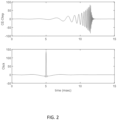
- FIG. 2 shows an exemplary click and chirp audio stimulus according to the present disclosure.
- the top graph shows a chirp audio stimulus waveform, e.g. a CE-chirp audio stimulus.
- the amplitude of the chirp audio stimulus is shown as function of time in milliseconds.
- the lower graph shows a click audio stimulus waveform.
- the amplitude of the click audio stimulus is shown as function of time in milliseconds.
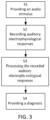
- FIG. 3 shows an exemplary flow diagram of a method of recording one or more auditory electrophysiological response of a person or an animal.
- the method of recording auditory electrophysiological responses of a person or an animal may be recorded in response to providing at least one audio stimulus to at least one of the ears of the person or animal.
- the method may comprise providing an audio stimulus S1.
- the audio stimulus may comprise at least one click audio stimulus and at least one chirp audio stimulus, or may comprise at least a first chirp audio stimulus and at least a second chirp audio stimulus.
- the audio stimuli may be provided by a stimulus generator of an acoustic stimulus generating unit.
- the audio stimuli may be provided to at least one of the ears (e.g. to both) of the person or animal via an output transducer of the acoustic stimulus generating unit.
- the method may comprise recording one or more auditory electrophysiological responses S2 of the person or animal.
- the auditory electrophysiological response may be recorded by a recording unit, in response to the audio stimulus being provided by the acoustic stimulus generating unit to at least one of the ears of the person or animal.
- the method may comprise processing the recorded one or more auditory electrophysiological responses S3.
- the processing the recorded auditory electrophysiological responses S3 may be carried out by a diagnostic unit.
- the method may comprise providing a diagnosis S4 of cochlear hydrops of the person or animal.
- the providing of a diagnosis S4 of cochlear hydrops may be carried out by a diagnostic unit.
- the diagnostic unit may provide the diagnoses based on the audio stimuli.
- the diagnostic unit may provide the diagnoses based on the recorded auditory electrophysiological responses.
- connection or “coupled” as used herein may include wirelessly connected or coupled.
- the term “and/or” includes any and all combinations of one or more of the associated listed items. The steps of any disclosed method is not limited to the exact order stated herein, unless expressly stated otherwise.
Landscapes
- Health & Medical Sciences (AREA)
- Life Sciences & Earth Sciences (AREA)
- Physics & Mathematics (AREA)
- Engineering & Computer Science (AREA)
- Heart & Thoracic Surgery (AREA)
- Surgery (AREA)
- Biophysics (AREA)
- Pathology (AREA)
- Veterinary Medicine (AREA)
- Biomedical Technology (AREA)
- Public Health (AREA)
- Medical Informatics (AREA)
- Molecular Biology (AREA)
- General Health & Medical Sciences (AREA)
- Animal Behavior & Ethology (AREA)
- Acoustics & Sound (AREA)
- Otolaryngology (AREA)
- Audiology, Speech & Language Pathology (AREA)
- Psychology (AREA)
- Psychiatry (AREA)
- Multimedia (AREA)
- Measurement And Recording Of Electrical Phenomena And Electrical Characteristics Of The Living Body (AREA)
Claims (9)
- System (1) zum Diagnostizieren von Cochleahydrops einer Person (2) oder eines Tieres, wobei das System (1) Folgendes umfasst:- eine Erzeugungseinheit für einen akustischen Stimulus, umfassend einen Stimulusgenerator (5) und einen Ausgangswandler (7), wobei die Erzeugungseinheit für einen akustischen Stimulus dazu konfiguriert ist, einen Audiostimulus durch den Stimulusgenerator (5) an mindestens eines der Ohren der Person (2) oder des Tieres über den Ausgangswandler (7) bereitzustellen,- wobei die Erzeugungseinheit für einen akustischen Stimulus dazu konfiguriert ist, eine Vielzahl von Audiostimuli bereitzustellen,- eine Aufzeichnungseinheit (10), die dazu konfiguriert ist, eine oder mehrere auditive elektrophysiologische Antworten der Person (2) oder des Tieres als Reaktion auf den einen oder die mehreren Audiostimuli, die von der Erzeugungseinheit für einen akustischen Stimulus an mindestens eines der Ohren der Person (2) oder des Tieres bereitgestellt werden, aufzuzeichnen und
dadurch gekennzeichnet, dass- die Vielzahl von Audiostimuli mindestens einen ersten Klick-Audiostimulus und einen ersten Chirp-Audiostimulus oder mindestens einen ersten und einen zweiten Chirp-Audiostimulus umfasst, und dass- das System ferner eine Diagnoseeinheit (11) umfasst, die dazu konfiguriert ist, die aufgezeichneten auditiven elektrophysiologischen Antworten zu verarbeiten, umfassend, dass die Diagnoseeinheit (11) dazu konfiguriert ist, Wellen-V-Amplituden der aufgezeichneten einen oder mehreren auditiven elektrophysiologischen Antworten auf Basis des mindestens ersten Klick-Audiostimulus und des mindestens ersten Chirp-Audiostimulus oder auf Basis des mindestens ersten und zweiten Chirp-Audiostimulus zu vergleichen. - System (1) nach Anspruch 1, wobei die Diagnoseeinheit (11), die zum Vergleichen konfiguriert ist, umfasst, dass die Diagnoseeinheit (11) dazu konfiguriert ist, ein Verhältnis zwischen der jeweiligen Wellen-V-Amplitude der aufgezeichneten einen oder mehreren auditiven elektrophysiologischen Antworten auf Basis des mindestens ersten Klick-Audiostimulus und ersten Chirp-Audiostimulus oder auf Basis des den ersten und zweiten Chirp-Audiostimulus zu bestimmen.
- System (1) nach einem der vorhergehenden Ansprüche, wobei die Erzeugungseinheit für einen akustischen Stimulus dazu konfiguriert ist, den mindestens ersten Klick-Audiostimulus und ersten Chirp-Audiostimulus oder den mindestens ersten und zweiten Chirp-Audiostimulus bei einem festen Überschwellenpegel bereitzustellen.
- System (1) nach einem der vorhergehenden Ansprüche, wobei der mindestens erste Klick-Audiostimulus und/oder der mindestens erste Chirp-Audiostimulus oder der mindestens erste und zweite Chirp-Audiostimulus auf Basis eines Hörschwellenpegels (HTL) der Person (2) oder des Tieres frequenzförmig sind.
- System (1) nach Anspruch 4, wobei der mindestens erste Klick-Audiostimulus und/oder der mindestens erste Chirp-Audiostimulus oder der mindestens erste und zweite Chirp-Audiostimulus bei einem festgelegten Empfindungspegel (SL) über dem HTL der Person (2) oder des Tieres über den Stimulusfrequenzbereich bereitgestellt werden.
- System (1) nach einem der vorhergehenden Ansprüche, wobei die Erzeugungseinheit für einen akustischen Stimulus dazu konfiguriert ist, alternierende Klick-Audiostimuli und/oder Chirp-Audiostimuli an mindestens eines der Ohren der Person (2) oder des Tieres bereitzustellen.
- System (1) nach einem der vorhergehenden Ansprüche, wobei die Erzeugungseinheit für einen akustischen Stimulus dazu konfiguriert ist, eine Vielzahl von Klick-Audiostimuli und/oder Chirp-Audiostimuli mit einer Vielzahl von Schalldruckpegeln an mindestens eines der Ohren der Person (2) oder des Tieres bereitzustellen.
- System (1) nach einem der vorhergehenden Ansprüche, wobei die Diagnoseeinheit (11) dazu konfiguriert ist, jeweilige Mittelwerte der Antworteigenschaften der aufgezeichneten einen oder mehreren auditiven elektrophysiologischen Antworten auf Basis des mindestens ersten Klick-Audiostimulus bzw. des ersten Chirp-Audiostimulus oder auf Basis des mindestens ersten bzw. zweiten Chirp-Audiostimulus bereitzustellen.
- System (1) nach einem der vorhergehenden Ansprüche, wobei die eine oder die mehreren auditiven elektrophysiologischen Antworten eine oder mehrere auditive Hirnstammantworten sind.
Applications Claiming Priority (1)
| Application Number | Priority Date | Filing Date | Title |
|---|---|---|---|
| EP20180272.5A EP3733061A3 (de) | 2020-06-16 | 2020-06-16 | Bestimmung von cochleahydrops auf basis von aufgezeichneten auditiven elektrophysiologischen antworten |
Publications (3)
| Publication Number | Publication Date |
|---|---|
| EP3925532A1 EP3925532A1 (de) | 2021-12-22 |
| EP3925532C0 EP3925532C0 (de) | 2024-01-03 |
| EP3925532B1 true EP3925532B1 (de) | 2024-01-03 |
Family
ID=71105233
Family Applications (2)
| Application Number | Title | Priority Date | Filing Date |
|---|---|---|---|
| EP20180272.5A Withdrawn EP3733061A3 (de) | 2020-06-16 | 2020-06-16 | Bestimmung von cochleahydrops auf basis von aufgezeichneten auditiven elektrophysiologischen antworten |
| EP21179483.9A Active EP3925532B1 (de) | 2020-06-16 | 2021-06-15 | Bestimmung von cochleahydrops auf basis von aufgezeichneten auditiven elektrophysiologischen antworten |
Family Applications Before (1)
| Application Number | Title | Priority Date | Filing Date |
|---|---|---|---|
| EP20180272.5A Withdrawn EP3733061A3 (de) | 2020-06-16 | 2020-06-16 | Bestimmung von cochleahydrops auf basis von aufgezeichneten auditiven elektrophysiologischen antworten |
Country Status (4)
| Country | Link |
|---|---|
| US (1) | US12543997B2 (de) |
| EP (2) | EP3733061A3 (de) |
| JP (1) | JP7807033B2 (de) |
| CN (1) | CN113796855B (de) |
Families Citing this family (2)
| Publication number | Priority date | Publication date | Assignee | Title |
|---|---|---|---|---|
| AU2022210720B2 (en) * | 2021-01-25 | 2024-11-28 | Med-El Elektromedizinische Geraete Gmbh | Estimation of audiogram based on in-vivo acoustic chirp |
| WO2022159882A1 (en) * | 2021-01-25 | 2022-07-28 | Med-El Elektromedizinische Geraete Gmbh | Optimized acoustic chirp based on in-vivo bm-delays in human |
Family Cites Families (12)
| Publication number | Priority date | Publication date | Assignee | Title |
|---|---|---|---|---|
| GB9618998D0 (en) * | 1996-09-11 | 1996-10-23 | Univ Glasgow | Anaesthesia control |
| US7399282B2 (en) * | 2000-05-19 | 2008-07-15 | Baycrest Center For Geriatric Care | System and method for objective evaluation of hearing using auditory steady-state responses |
| US7223246B2 (en) | 2003-06-06 | 2007-05-29 | House Ear Institute | Diagnosis of the presence of cochlear hydrops using observed auditory brainstem responses |
| US9656096B2 (en) * | 2003-12-05 | 2017-05-23 | Rio Grande Neurosciences, Inc. | Method and apparatus for electromagnetic enhancement of biochemical signaling pathways for therapeutics and prophylaxis in plants, animals and humans |
| WO2008006164A1 (en) * | 2006-07-12 | 2008-01-17 | The University Of Queensland | Method of acquiring a physiological response |
| WO2008116462A1 (en) * | 2007-03-23 | 2008-10-02 | Widex A/S | System and method for the objective measurement of hearing ability of an individual |
| WO2010025504A1 (en) * | 2008-09-02 | 2010-03-11 | The University Of Queensland | Improvements for cochlear implants |
| FR3012316B1 (fr) * | 2013-10-25 | 2017-09-15 | Hospices Civils Lyon | Methode electrophysiologique d'evaluation de l'efficacite d'une prothese auditive |
| CN105877762B (zh) * | 2015-02-16 | 2021-08-24 | 国际听力公司 | 用语音类刺激产生和记录听觉稳态反应的系统和方法 |
| US20180263536A1 (en) * | 2017-03-17 | 2018-09-20 | Purdue Research Foundation | Changes in auditory evoked responses as simple, rapid biomarkers for blast injury and other traumatic brain injuries |
| EP4064732B1 (de) * | 2018-06-29 | 2023-10-25 | Interacoustics A/S | System zur validierung von hörgeräten für kinder unter verwendung eines sprachsignals |
| RU2722051C1 (ru) * | 2019-09-25 | 2020-05-26 | Государственное бюджетное учреждение здравоохранения Московской области "Московский областной научно-исследовательский клинический институт им. М.Ф. Владимирского" (ГБУЗ МО МОНИКИ им. М.Ф. Владимирского) | Способ диагностики перилимфатической фистулы |
-
2020
- 2020-06-16 EP EP20180272.5A patent/EP3733061A3/de not_active Withdrawn
-
2021
- 2021-06-15 EP EP21179483.9A patent/EP3925532B1/de active Active
- 2021-06-15 US US17/347,949 patent/US12543997B2/en active Active
- 2021-06-15 JP JP2021099553A patent/JP7807033B2/ja active Active
- 2021-06-16 CN CN202110667993.8A patent/CN113796855B/zh active Active
Also Published As
| Publication number | Publication date |
|---|---|
| US20210386357A1 (en) | 2021-12-16 |
| JP2021194545A (ja) | 2021-12-27 |
| US12543997B2 (en) | 2026-02-10 |
| JP7807033B2 (ja) | 2026-01-27 |
| CN113796855A (zh) | 2021-12-17 |
| EP3733061A2 (de) | 2020-11-04 |
| EP3925532C0 (de) | 2024-01-03 |
| EP3733061A3 (de) | 2020-11-11 |
| CN113796855B (zh) | 2026-02-24 |
| EP3925532A1 (de) | 2021-12-22 |
Similar Documents
| Publication | Publication Date | Title |
|---|---|---|
| CN103313653B (zh) | 具有电极验证的个人eeg监测装置 | |
| US8840565B2 (en) | Test battery system and method for assessment of auditory function | |
| US8559645B2 (en) | Method and device for setting a hearing device by detecting listening effort | |
| EP3313092A1 (de) | Hörsystem zur überwachung eines gesundheitsbezogenen parameters | |
| WO2019241645A1 (en) | Device for monitoring activities of daily living and physiological parameters to determine a condition and diagnosis of the human brain and body | |
| EP3925532B1 (de) | Bestimmung von cochleahydrops auf basis von aufgezeichneten auditiven elektrophysiologischen antworten | |
| WO2018154289A2 (en) | System, method, computer program and computer program product for detecting a change in hearing response | |
| CN103384494B (zh) | 基于电生理学的耳蜗死区检测装置及用于使用该装置检测耳蜗死区的信息提供方法 | |
| Mertes et al. | Concurrent measures of contralateral suppression of transient-evoked otoacoustic emissions and of auditory steady-state responses | |
| US12490918B2 (en) | Spectro-temporal modulation test unit | |
| RU2722875C1 (ru) | Способ определения оптимальных параметров настройки слухового аппарата | |
| Marriage et al. | Psychoacoustic audiometry | |
| ES2858150A1 (es) | Metodo y sistema de medicion auditiva y dispositivo que lo comprende | |
| Baljić et al. | Evaluation of optimal masking levels in place-specific low-frequency chirp-evoked auditory brainstem responses | |
| Lutman | The scientific basis for the assessment of hearing | |
| US20260123853A1 (en) | Spectro-temporal modulation test unit | |
| RU2534877C1 (ru) | Способ оценки звуковосприятия у пациентов с патологией среднего уха | |
| US20060277999A1 (en) | Audiometer and method of hearing screening | |
| Marriage et al. | Psychoacoustic and Objective Assessment of Hearing | |
| JP2024141299A (ja) | 聴覚検査装置および聴覚検査方法 | |
| Larsby et al. | A system for recording of auditory evoked responses | |
| Blomster et al. | Finding the Optimal Head Position for Bone Conduction Sound Measurements when Using a Skin Microphone | |
| Bird et al. | Subjective audiometry | |
| BASCHIR et al. | EARLY DETECTION OF HEARING LOSS–A CONDITION FOR A GOOD RECOVERY OF THE DEAF CHILD | |
| NILSSON et al. | Review of Audiometry |
Legal Events
| Date | Code | Title | Description |
|---|---|---|---|
| PUAI | Public reference made under article 153(3) epc to a published international application that has entered the european phase |
Free format text: ORIGINAL CODE: 0009012 |
|
| STAA | Information on the status of an ep patent application or granted ep patent |
Free format text: STATUS: THE APPLICATION HAS BEEN PUBLISHED |
|
| AK | Designated contracting states |
Kind code of ref document: A1 Designated state(s): AL AT BE BG CH CY CZ DE DK EE ES FI FR GB GR HR HU IE IS IT LI LT LU LV MC MK MT NL NO PL PT RO RS SE SI SK SM TR |
|
| B565 | Issuance of search results under rule 164(2) epc |
Effective date: 20211111 |
|
| STAA | Information on the status of an ep patent application or granted ep patent |
Free format text: STATUS: REQUEST FOR EXAMINATION WAS MADE |
|
| 17P | Request for examination filed |
Effective date: 20220622 |
|
| RBV | Designated contracting states (corrected) |
Designated state(s): AL AT BE BG CH CY CZ DE DK EE ES FI FR GB GR HR HU IE IS IT LI LT LU LV MC MK MT NL NO PL PT RO RS SE SI SK SM TR |
|
| GRAP | Despatch of communication of intention to grant a patent |
Free format text: ORIGINAL CODE: EPIDOSNIGR1 |
|
| STAA | Information on the status of an ep patent application or granted ep patent |
Free format text: STATUS: GRANT OF PATENT IS INTENDED |
|
| INTG | Intention to grant announced |
Effective date: 20230721 |
|
| GRAS | Grant fee paid |
Free format text: ORIGINAL CODE: EPIDOSNIGR3 |
|
| GRAA | (expected) grant |
Free format text: ORIGINAL CODE: 0009210 |
|
| STAA | Information on the status of an ep patent application or granted ep patent |
Free format text: STATUS: THE PATENT HAS BEEN GRANTED |
|
| AK | Designated contracting states |
Kind code of ref document: B1 Designated state(s): AL AT BE BG CH CY CZ DE DK EE ES FI FR GB GR HR HU IE IS IT LI LT LU LV MC MK MT NL NO PL PT RO RS SE SI SK SM TR |
|
| REG | Reference to a national code |
Ref country code: GB Ref legal event code: FG4D |
|
| REG | Reference to a national code |
Ref country code: CH Ref legal event code: EP |
|
| REG | Reference to a national code |
Ref country code: DE Ref legal event code: R096 Ref document number: 602021008229 Country of ref document: DE |
|
| REG | Reference to a national code |
Ref country code: IE Ref legal event code: FG4D |
|
| U01 | Request for unitary effect filed |
Effective date: 20240129 |
|
| U07 | Unitary effect registered |
Designated state(s): AT BE BG DE DK EE FI FR IT LT LU LV MT NL PT SE SI Effective date: 20240207 |
|
| PG25 | Lapsed in a contracting state [announced via postgrant information from national office to epo] |
Ref country code: ES Free format text: LAPSE BECAUSE OF FAILURE TO SUBMIT A TRANSLATION OF THE DESCRIPTION OR TO PAY THE FEE WITHIN THE PRESCRIBED TIME-LIMIT Effective date: 20240103 |
|
| PG25 | Lapsed in a contracting state [announced via postgrant information from national office to epo] |
Ref country code: ES Free format text: LAPSE BECAUSE OF FAILURE TO SUBMIT A TRANSLATION OF THE DESCRIPTION OR TO PAY THE FEE WITHIN THE PRESCRIBED TIME-LIMIT Effective date: 20240103 |
|
| PG25 | Lapsed in a contracting state [announced via postgrant information from national office to epo] |
Ref country code: IS Free format text: LAPSE BECAUSE OF FAILURE TO SUBMIT A TRANSLATION OF THE DESCRIPTION OR TO PAY THE FEE WITHIN THE PRESCRIBED TIME-LIMIT Effective date: 20240503 |
|
| PG25 | Lapsed in a contracting state [announced via postgrant information from national office to epo] |
Ref country code: GR Free format text: LAPSE BECAUSE OF FAILURE TO SUBMIT A TRANSLATION OF THE DESCRIPTION OR TO PAY THE FEE WITHIN THE PRESCRIBED TIME-LIMIT Effective date: 20240404 |
|
| PG25 | Lapsed in a contracting state [announced via postgrant information from national office to epo] |
Ref country code: RS Free format text: LAPSE BECAUSE OF FAILURE TO SUBMIT A TRANSLATION OF THE DESCRIPTION OR TO PAY THE FEE WITHIN THE PRESCRIBED TIME-LIMIT Effective date: 20240403 Ref country code: HR Free format text: LAPSE BECAUSE OF FAILURE TO SUBMIT A TRANSLATION OF THE DESCRIPTION OR TO PAY THE FEE WITHIN THE PRESCRIBED TIME-LIMIT Effective date: 20240103 |
|
| PG25 | Lapsed in a contracting state [announced via postgrant information from national office to epo] |
Ref country code: CZ Free format text: LAPSE BECAUSE OF FAILURE TO SUBMIT A TRANSLATION OF THE DESCRIPTION OR TO PAY THE FEE WITHIN THE PRESCRIBED TIME-LIMIT Effective date: 20240103 |
|
| PG25 | Lapsed in a contracting state [announced via postgrant information from national office to epo] |
Ref country code: RS Free format text: LAPSE BECAUSE OF FAILURE TO SUBMIT A TRANSLATION OF THE DESCRIPTION OR TO PAY THE FEE WITHIN THE PRESCRIBED TIME-LIMIT Effective date: 20240403 Ref country code: NO Free format text: LAPSE BECAUSE OF FAILURE TO SUBMIT A TRANSLATION OF THE DESCRIPTION OR TO PAY THE FEE WITHIN THE PRESCRIBED TIME-LIMIT Effective date: 20240403 Ref country code: IS Free format text: LAPSE BECAUSE OF FAILURE TO SUBMIT A TRANSLATION OF THE DESCRIPTION OR TO PAY THE FEE WITHIN THE PRESCRIBED TIME-LIMIT Effective date: 20240503 Ref country code: HR Free format text: LAPSE BECAUSE OF FAILURE TO SUBMIT A TRANSLATION OF THE DESCRIPTION OR TO PAY THE FEE WITHIN THE PRESCRIBED TIME-LIMIT Effective date: 20240103 Ref country code: GR Free format text: LAPSE BECAUSE OF FAILURE TO SUBMIT A TRANSLATION OF THE DESCRIPTION OR TO PAY THE FEE WITHIN THE PRESCRIBED TIME-LIMIT Effective date: 20240404 Ref country code: CZ Free format text: LAPSE BECAUSE OF FAILURE TO SUBMIT A TRANSLATION OF THE DESCRIPTION OR TO PAY THE FEE WITHIN THE PRESCRIBED TIME-LIMIT Effective date: 20240103 |
|
| PG25 | Lapsed in a contracting state [announced via postgrant information from national office to epo] |
Ref country code: PL Free format text: LAPSE BECAUSE OF FAILURE TO SUBMIT A TRANSLATION OF THE DESCRIPTION OR TO PAY THE FEE WITHIN THE PRESCRIBED TIME-LIMIT Effective date: 20240103 |
|
| U20 | Renewal fee for the european patent with unitary effect paid |
Year of fee payment: 4 Effective date: 20240701 |
|
| PG25 | Lapsed in a contracting state [announced via postgrant information from national office to epo] |
Ref country code: PL Free format text: LAPSE BECAUSE OF FAILURE TO SUBMIT A TRANSLATION OF THE DESCRIPTION OR TO PAY THE FEE WITHIN THE PRESCRIBED TIME-LIMIT Effective date: 20240103 |
|
| REG | Reference to a national code |
Ref country code: DE Ref legal event code: R097 Ref document number: 602021008229 Country of ref document: DE |
|
| PG25 | Lapsed in a contracting state [announced via postgrant information from national office to epo] |
Ref country code: SM Free format text: LAPSE BECAUSE OF FAILURE TO SUBMIT A TRANSLATION OF THE DESCRIPTION OR TO PAY THE FEE WITHIN THE PRESCRIBED TIME-LIMIT Effective date: 20240103 |
|
| PG25 | Lapsed in a contracting state [announced via postgrant information from national office to epo] |
Ref country code: SK Free format text: LAPSE BECAUSE OF FAILURE TO SUBMIT A TRANSLATION OF THE DESCRIPTION OR TO PAY THE FEE WITHIN THE PRESCRIBED TIME-LIMIT Effective date: 20240103 |
|
| PG25 | Lapsed in a contracting state [announced via postgrant information from national office to epo] |
Ref country code: SM Free format text: LAPSE BECAUSE OF FAILURE TO SUBMIT A TRANSLATION OF THE DESCRIPTION OR TO PAY THE FEE WITHIN THE PRESCRIBED TIME-LIMIT Effective date: 20240103 Ref country code: SK Free format text: LAPSE BECAUSE OF FAILURE TO SUBMIT A TRANSLATION OF THE DESCRIPTION OR TO PAY THE FEE WITHIN THE PRESCRIBED TIME-LIMIT Effective date: 20240103 Ref country code: RO Free format text: LAPSE BECAUSE OF FAILURE TO SUBMIT A TRANSLATION OF THE DESCRIPTION OR TO PAY THE FEE WITHIN THE PRESCRIBED TIME-LIMIT Effective date: 20240103 |
|
| PLBE | No opposition filed within time limit |
Free format text: ORIGINAL CODE: 0009261 |
|
| STAA | Information on the status of an ep patent application or granted ep patent |
Free format text: STATUS: NO OPPOSITION FILED WITHIN TIME LIMIT |
|
| 26N | No opposition filed |
Effective date: 20241007 |
|
| PG25 | Lapsed in a contracting state [announced via postgrant information from national office to epo] |
Ref country code: MC Free format text: LAPSE BECAUSE OF FAILURE TO SUBMIT A TRANSLATION OF THE DESCRIPTION OR TO PAY THE FEE WITHIN THE PRESCRIBED TIME-LIMIT Effective date: 20240103 |
|
| REG | Reference to a national code |
Ref country code: CH Ref legal event code: PL |
|
| PG25 | Lapsed in a contracting state [announced via postgrant information from national office to epo] |
Ref country code: IE Free format text: LAPSE BECAUSE OF NON-PAYMENT OF DUE FEES Effective date: 20240615 |
|
| PG25 | Lapsed in a contracting state [announced via postgrant information from national office to epo] |
Ref country code: CH Free format text: LAPSE BECAUSE OF NON-PAYMENT OF DUE FEES Effective date: 20240630 |
|
| PGFP | Annual fee paid to national office [announced via postgrant information from national office to epo] |
Ref country code: GB Payment date: 20250528 Year of fee payment: 5 |
|
| U20 | Renewal fee for the european patent with unitary effect paid |
Year of fee payment: 5 Effective date: 20250630 |
|
| PG25 | Lapsed in a contracting state [announced via postgrant information from national office to epo] |
Ref country code: CY Free format text: LAPSE BECAUSE OF FAILURE TO SUBMIT A TRANSLATION OF THE DESCRIPTION OR TO PAY THE FEE WITHIN THE PRESCRIBED TIME-LIMIT; INVALID AB INITIO Effective date: 20210615 |
|
| PG25 | Lapsed in a contracting state [announced via postgrant information from national office to epo] |
Ref country code: HU Free format text: LAPSE BECAUSE OF FAILURE TO SUBMIT A TRANSLATION OF THE DESCRIPTION OR TO PAY THE FEE WITHIN THE PRESCRIBED TIME-LIMIT; INVALID AB INITIO Effective date: 20210615 |