EP3922109A1 - Composition comprising fructose-transferred steviol glycoside - Google Patents
Composition comprising fructose-transferred steviol glycoside Download PDFInfo
- Publication number
- EP3922109A1 EP3922109A1 EP20790935.9A EP20790935A EP3922109A1 EP 3922109 A1 EP3922109 A1 EP 3922109A1 EP 20790935 A EP20790935 A EP 20790935A EP 3922109 A1 EP3922109 A1 EP 3922109A1
- Authority
- EP
- European Patent Office
- Prior art keywords
- steviol glycoside
- transfructosylated
- rebaudioside
- sweetness
- stevioside
- Prior art date
- Legal status (The legal status is an assumption and is not a legal conclusion. Google has not performed a legal analysis and makes no representation as to the accuracy of the status listed.)
- Granted
Links
Images

Classifications
-
- C—CHEMISTRY; METALLURGY
- C07—ORGANIC CHEMISTRY
- C07H—SUGARS; DERIVATIVES THEREOF; NUCLEOSIDES; NUCLEOTIDES; NUCLEIC ACIDS
- C07H15/00—Compounds containing hydrocarbon or substituted hydrocarbon radicals directly attached to hetero atoms of saccharide radicals
- C07H15/20—Carbocyclic rings
- C07H15/24—Condensed ring systems having three or more rings
- C07H15/256—Polyterpene radicals
-
- A—HUMAN NECESSITIES
- A23—FOODS OR FOODSTUFFS; TREATMENT THEREOF, NOT COVERED BY OTHER CLASSES
- A23L—FOODS, FOODSTUFFS OR NON-ALCOHOLIC BEVERAGES, NOT OTHERWISE PROVIDED FOR; PREPARATION OR TREATMENT THEREOF
- A23L27/00—Spices; Flavouring agents or condiments; Artificial sweetening agents; Table salts; Dietetic salt substitutes; Preparation or treatment thereof
- A23L27/30—Artificial sweetening agents
- A23L27/33—Artificial sweetening agents containing sugars or derivatives
- A23L27/36—Terpene glycosides
-
- A—HUMAN NECESSITIES
- A23—FOODS OR FOODSTUFFS; TREATMENT THEREOF, NOT COVERED BY OTHER CLASSES
- A23L—FOODS, FOODSTUFFS OR NON-ALCOHOLIC BEVERAGES, NOT OTHERWISE PROVIDED FOR; PREPARATION OR TREATMENT THEREOF
- A23L27/00—Spices; Flavouring agents or condiments; Artificial sweetening agents; Table salts; Dietetic salt substitutes; Preparation or treatment thereof
- A23L27/30—Artificial sweetening agents
- A23L27/33—Artificial sweetening agents containing sugars or derivatives
- A23L27/34—Sugar alcohols
-
- C—CHEMISTRY; METALLURGY
- C07—ORGANIC CHEMISTRY
- C07H—SUGARS; DERIVATIVES THEREOF; NUCLEOSIDES; NUCLEOTIDES; NUCLEIC ACIDS
- C07H1/00—Processes for the preparation of sugar derivatives
-
- C—CHEMISTRY; METALLURGY
- C07—ORGANIC CHEMISTRY
- C07H—SUGARS; DERIVATIVES THEREOF; NUCLEOSIDES; NUCLEOTIDES; NUCLEIC ACIDS
- C07H15/00—Compounds containing hydrocarbon or substituted hydrocarbon radicals directly attached to hetero atoms of saccharide radicals
- C07H15/20—Carbocyclic rings
- C07H15/24—Condensed ring systems having three or more rings
-
- A—HUMAN NECESSITIES
- A23—FOODS OR FOODSTUFFS; TREATMENT THEREOF, NOT COVERED BY OTHER CLASSES
- A23V—INDEXING SCHEME RELATING TO FOODS, FOODSTUFFS OR NON-ALCOHOLIC BEVERAGES AND LACTIC OR PROPIONIC ACID BACTERIA USED IN FOODSTUFFS OR FOOD PREPARATION
- A23V2002/00—Food compositions, function of food ingredients or processes for food or foodstuffs
-
- A—HUMAN NECESSITIES
- A23—FOODS OR FOODSTUFFS; TREATMENT THEREOF, NOT COVERED BY OTHER CLASSES
- A23V—INDEXING SCHEME RELATING TO FOODS, FOODSTUFFS OR NON-ALCOHOLIC BEVERAGES AND LACTIC OR PROPIONIC ACID BACTERIA USED IN FOODSTUFFS OR FOOD PREPARATION
- A23V2250/00—Food ingredients
- A23V2250/24—Non-sugar sweeteners
- A23V2250/258—Rebaudioside
-
- A—HUMAN NECESSITIES
- A23—FOODS OR FOODSTUFFS; TREATMENT THEREOF, NOT COVERED BY OTHER CLASSES
- A23V—INDEXING SCHEME RELATING TO FOODS, FOODSTUFFS OR NON-ALCOHOLIC BEVERAGES AND LACTIC OR PROPIONIC ACID BACTERIA USED IN FOODSTUFFS OR FOOD PREPARATION
- A23V2250/00—Food ingredients
- A23V2250/24—Non-sugar sweeteners
- A23V2250/262—Stevioside
Definitions
- the present disclosure relates to a sweetener composition including a transfructosylated steviol glycoside.
- alternative sweeteners are continuously being developed and commercialized.
- synthetic high-intensity sweeteners e.g., Saccharin, Aspartame, Sucralose, etc.
- synthetic sugar alcohols e.g., Maltitol and Xylitol
- high-intensity sweeteners e.g., Rebaudioside A and Liquorice
- Stevia is a natural material, the sweetness of which is 200 to 300 times that of sugar, and consists of Stevioside, Rebaudioside A, etc. Although Stevioside and Rebaudioside A show high sweetness, they have a strong bitter taste, which presents a limitation in use.
- Methods to improve the sweetness of Stevioside and Rebaudioside A include a method for transferring a saccharide using an enzyme.
- a method for transferring 1 to 12 glucose molecules to a steviol glycoside using CGTase is widely used in the art ( Korean Patent Application No. 10-1991-0020769 ).
- Korean Patent Application No. 10-1991-0020769 Korean Patent Application No. 10-1991-0020769 .
- Such method has a disadvantage in that all glucose molecules transferred to the steviol glycoside are degraded by intestinal microorganisms, increasing calories. Therefore, there is a need for a steviol glycoside wherein a saccharide other than glucose is transferred.
- the present inventors have completed the present disclosure by confirming that the transfructosylated steviol glycoside has an improved bitter taste compared to a steviol glycoside, and shows superior sweetness preference and overall preference.
- An object of the present disclosure is to provide a sweetener composition including a transfructosylated steviol glycoside.
- Another object of the present disclosure is to provide a food composition including the sweetener composition.
- Still another object of the present disclosure is to provide a method for improving the sweetness of a steviol glycoside, including converting a steviol glycoside into a transfructosylated steviol glycoside.
- the sweetener composition of the present disclosure includes a transfructosylated steviol glycoside, thereby having an improved bitter taste compared to a steviol glycoside and showing superior sweetness preference and overall preference, and thus can be used as a high-intensity sweetener.
- an aspect of the present disclosure may be to provide a transfructosylated steviol glycoside or a sweetener composition including the transfructosylated steviol glycoside.
- the transfructosylated steviol glycoside may be produced by the method described above.
- steviol glycoside refers to a natural sweetener and may be represented by Chemical Formula 1 below.
- hydrogen (H) may be bound, or 1 to 3 glucose molecules may be bound via a ⁇ -bond; and at R2, one molecule of glucose, xylose, or rhamnose may be bound via a ⁇ -bond, and 0 to 2 glucose molecules may be bound thereto via a ⁇ -bond, but these are not limited thereto.
- the steviol glycoside may be one or more selected from the group consisting of Stevioside, Rubusoside, Dulcoside A, Rebaudioside A, Rebaudioside C, Rebaudioside D, Rebaudioside E, Rebaudioside F, and Rebaudioside M, and specifically, it may be Stevioside or Rebaudioside A, but is not limited thereto.
- the steviol glycoside may be Stevioside represented by Chemical Formula 2 below or Rebaudioside A represented by Chemical Formula 3 below.
- transfructosylated steviol glycoside may refer to a compound in which fructose is linked (transferred) to the steviol glycoside.
- the transfructosylated steviol glycoside may be in the form in which fructose is linked to a 19-OH site of the steviol glycoside or to glucose conjugated thereto.
- the transfructosylated steviol glycoside may be in the form in which fructose is linked to the steviol glycoside via a ⁇ -(2,6) bond.
- the transfructosylated steviol glycoside may be in the form in which 1 to 3 fructose molecules are linked to the steviol glycoside.
- the transfructosylated steviol glycoside may be a transfructosylated Stevioside or a transfructosylated Rebaudioside A.
- the sweetener composition of the present disclosure may include a transfructosylated Stevioside or a transfructosylated Rebaudioside A, or a transfructosylated Stevioside and a transfructosylated Rebaudioside A.
- the sweetener composition including a transfructosylated Stevioside and a transfructosylated Rebaudioside A may contain 40 parts by weight or more of the transfructosylated Rebaudioside A based on 100 parts by weight of the total weight of the transfructosylated Stevioside and transfructosylated Rebaudioside A.
- the composition may contain 50 parts by weight or more, more specifically 60 parts by weight or more, even more specifically 70 parts by weight or more, even more specifically 75 parts by weight or more of the transfructosylated Rebaudioside A.
- the transfructosylated steviol glycoside may have an improved bitter taste as compared to the stveiol glycoside.
- the improvement in bitter taste may mean a decrease in bitter taste.
- the improvement in bitter taste may be evaluated when the transfructosylated steviol glycoside and the steviol glycoside have equivalent sweetness.
- the sweetness may be the sweetness corresponding to 10 brix of sugar.
- the transfructosylated steviol glycoside may have an improved sweetness as compared to the steviol glycoside.
- the improvement in sweetness may be an increase in sweetness preference and overall preference.
- the improvement in sweetness may be evaluated when the transfructosylated steviol glycoside and the steviol glycoside have equivalent sweetness.
- the sweetness may be the sweetness corresponding to 10 brix of sugar.
- the transfructosylated steviol glycoside may be produced by reacting the steviol glycoside and a fructose donor in the presence of a fructosyltransferase, but for the purposes of the present disclosure, such reaction is not limited as long as the transfructosylated steviol glycoside can be obtained.
- nucleotide sequence of a gene encoding the fructosyltransferase and protein information thereof can be obtained from a known database such as GenBank of NCBI, etc.
- GenBank of NCBI
- any protein may be included as long as it exhibits the same effect of transferring fructose as the fructosyltransferase without limitation to its origin or sequence.
- a homologous protein or a variant protein may also be included in the scope of the fructosyltransferase of the present disclosure.
- the step of reacting the steviol glycoside with a fructose donor in the presence of the enzyme may be carried out at a pH of 3 to 8, specifically at a pH of 4 to 7, and more specifically at a pH of 5 to 6, but the pH range is not limited thereto.
- the above step may be carried out at 10°C to 60°C, specifically at 20°C to 50°C, and more specifically at 20°C to 40°C, but the temperature range is not limited thereto.
- the sweetener composition of the present disclosure may be used for preparing sweeteners or providing sweetness to edible products.
- the sweetener composition of the present disclosure may be used as a sweetener for the purpose of cooking and/or processed foods. Additionally, the sweetener composition of the present disclosure may be used as a sweetener for pharmaceutical products in addition to the edible products, but is not limited thereto. Further, the sweetener composition of the present disclosure may further include a flavoring agent, a preservative, a stabilizer, an antioxidant, etc., but is not limited thereto.
- another aspect of the present disclosure provides a food composition including the sweetener composition.
- the food composition of the present disclosure may be prepared using methods commonly used in the art, and may be prepared by adding raw materials and ingredients commonly added in the art during preparation. Additionally, the food composition of the present disclosure uses a food as a raw material unlike generic drugs, and thus has no side effects that may occur during long-term administration thereof, and may be highly portable.
- the food composition may contain the sweetener composition in an amount of 0.001 to 25% by weight, specifically 0.01 to 20% by weight, more specifically 0.01 to 10% by weight, based on the total weight of the composition, but is not limited thereto.
- still another aspect of the present disclosure provides a method for improving the sweetness of a steviol glycoside, including converting a steviol glycoside into a transfructosylated steviol glycoside.
- the conversion is not limited by its method as long as the transfructosylated steviol glycoside can be obtained from the steviol glycoside.
- the conversion may include reacting the steviol glycoside with a fructose donor in the presence of a fructosyltransferase, but is not limited thereto.
- the fructose donor may be any oligomer, polymer, or cyclic form of fructose which can be reacted in the presence of a fructosyltransferase such that one or more fructose molecules can be transferred to the steviol glycoside, and specifically, it may be sugar, but is not limited thereto.
- nucleotide sequence of a gene encoding the fructosyltransferase and protein information thereof can be obtained from a known database such as GenBank of NCBI, etc.
- GenBank of NCBI
- any sequence may be included as long as it exhibits the same effect of transferring fructose as the fructosyltransferase without limitation to its origin or sequence, and a homologous protein or a variant protein may also be included in the scope of the fructosyltransferase of the present disclosure.
- the step of reacting the steviol glycoside with a fructose donor may be carried out at a pH of 3 to 8, specifically at a pH of 4 to 7, and more specifically at a pH of 5 to 6, but the pH range is not limited thereto.
- the above step may be carried out at 10°C to 60°C, specifically at 20°C to 50°C, and more specifically at 20°C to 40°C, but the temperature range is not limited thereto.
- the term "improvement in sweetness” may mean an improvement in sweetness preference or overall preference as the bitter taste or the off-smell/off-flavor is reduced.
- the fructosyltransferase transfers fructose from sugar.
- the resulting transfructosylated product is in the form in which 1 to 3 fructose molecules are linked (transferred) to the 19-OH position of Stevioside or Ribaudioside A or to glucose conjugated thereto, by a linkage via a ⁇ -(2,6) bond.
- the structure of the thus-prepared transfructosylated Stevioside and transfructosylated Rebaudioside A was analyzed by 1 H/ 13 C NMR, Homonuclear Correlation Spectroscopy (COSY), Total Correlation Spectroscopy (TOCSY), Heteronuclear Single-Quantum Coherence (HSQC), and Heteronuclear Multiple-Bond Correlation (HMBC), and the results ( 1 H/ 13 C NMR, COSY and HMBC) are shown in Tables 1 and 2.
- transfructosylated Stevioside and the transfructosylated Rebaudioside A were represented by Chemical Formula 4 and Chemical Formula 5, respectively.
- transfructosylated Rebaudioside A and the transfructosylated Stevioside have significantly low bitterness intensity and off-smell/off flavor intensity and significantly high sweetness preference and overall preference, as compared to Rebaudioside A (RA) and Stevioside (STV), respectively.
- Example 1 Prior to sensory evaluation, four samples of Example 1 (STV, STV-Fru, RA, RA-Fru) were diluted to the sweetness equivalent to 10% (w/w) or 10 brix of sugar, and the sensory evaluation was carried out on the four samples.
- Table 5 shows that the transfructosylated Stevioside (STV-Fru) has excellent sweetness preference and overall preference as compared to Stevioside (STV).
- Table 6 shows that the transfructosylated Rebaudioside A (RA-Fru) has excellent sweetness preference and overall preference as compared to Rebaudioside A (RA).
- a mixture of 5% Stevioside (Carbosynth) and 5% Rebaudioside A (Purecircle) (where the ratio of Rebaudioside A in the mixture was 40, 60, 80% by weight, respectively) and 20% white sugar (CJ CheilJedang) were dissolved in 50 mM sodium acetate buffer, and then a mixture comprising the transfructosylated Stevioside and the transfructosylated Rebaudioside A was prepared by the same manner as in Preparation Example 1.
- the ratio of the transfructosylated Stevioside to the transfructosylated Rebaudioside A in the thus-prepared mixture was maintained at the same level as the ratio of Stevioside to Rebaudioside A in the raw material.
Landscapes
- Chemical & Material Sciences (AREA)
- Life Sciences & Earth Sciences (AREA)
- Organic Chemistry (AREA)
- Health & Medical Sciences (AREA)
- Engineering & Computer Science (AREA)
- Molecular Biology (AREA)
- General Health & Medical Sciences (AREA)
- Genetics & Genomics (AREA)
- Biotechnology (AREA)
- Biochemistry (AREA)
- Proteomics, Peptides & Aminoacids (AREA)
- Nutrition Science (AREA)
- Food Science & Technology (AREA)
- Polymers & Plastics (AREA)
- Seasonings (AREA)
- Saccharide Compounds (AREA)
Abstract
Description
- The present disclosure relates to a sweetener composition including a transfructosylated steviol glycoside.
- As the World Health Organization (WHO) recommends lowering the amount of daily sugar intake due to concerns about disease (obesity) caused by sugar consumption, various policies aimed at reducing the amount of sugar intake are actively being discussed by the governments of developed countries. Therefore, as the need for developing various alternative sweeteners is increasing in the market, alternative sweeteners are continuously being developed and commercialized. As alternative sweeteners, these are the subject of continuous variation in the form of synthetic high-intensity sweeteners (e.g., Saccharin, Aspartame, Sucralose, etc.), synthetic sugar alcohols (e.g., Maltitol and Xylitol), and high-intensity sweeteners (e.g., Rebaudioside A and Liquorice). Nevertheless, due to concerns over the safety of synthetic sweeteners, customers' need for natural sweeteners has been steadily increasing; however, because of limitations to peculiar flavor properties of natural sweeteners (i.e., off-smell and off-flavor), natural sweeteners cannot fully replace existing low-calorie and zero-calorie products based on synthetic sweeteners.
- A natural high-intensity sweetener that has received considerable attention in recent years is stevia extracted from the leaves of Stevia rebaudiana Bertoni. Stevia is a natural material, the sweetness of which is 200 to 300 times that of sugar, and consists of Stevioside, Rebaudioside A, etc. Although Stevioside and Rebaudioside A show high sweetness, they have a strong bitter taste, which presents a limitation in use.
- Methods to improve the sweetness of Stevioside and Rebaudioside A include a method for transferring a saccharide using an enzyme. As the method for transferring a saccharide using an enzyme, a method for transferring 1 to 12 glucose molecules to a steviol glycoside using CGTase is widely used in the art (
Korean Patent Application No. 10-1991-0020769 - Under such circumstances, the present inventors have completed the present disclosure by confirming that the transfructosylated steviol glycoside has an improved bitter taste compared to a steviol glycoside, and shows superior sweetness preference and overall preference.
- An object of the present disclosure is to provide a sweetener composition including a transfructosylated steviol glycoside.
- Another object of the present disclosure is to provide a food composition including the sweetener composition.
- Still another object of the present disclosure is to provide a method for improving the sweetness of a steviol glycoside, including converting a steviol glycoside into a transfructosylated steviol glycoside.
- The sweetener composition of the present disclosure includes a transfructosylated steviol glycoside, thereby having an improved bitter taste compared to a steviol glycoside and showing superior sweetness preference and overall preference, and thus can be used as a high-intensity sweetener.
-
-
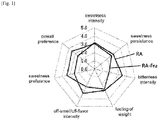
Fig. 1 shows the results of sensory descriptive analysis of transfructosylated Rebaudioside A (RA-Fru) and Rebaudioside A (RA). -
Fig. 2 shows the results of sensory descriptive analysis of transfructosylated Stevioside (STV-Fru) and Stevioside (STV). - Hereinbelow, the present disclosure will be described in detail. Meanwhile, each of the explanations and exemplary embodiments disclosed herein can be applied to other explanations and exemplary embodiments. That is, all combinations of various factors disclosed herein belong to the scope of the present disclosure. Furthermore, the scope of the present disclosure should not be limited by the specific disclosure provided hereinbelow. Meanwhile, the terms defined herein can be identically applied to other aspects of the present disclosure.
- In order to achieve the objects of the present disclosure, an aspect of the present disclosure may be to provide a transfructosylated steviol glycoside or a sweetener composition including the transfructosylated steviol glycoside. The transfructosylated steviol glycoside may be produced by the method described above.
- As used herein, the term "steviol glycoside" refers to a natural sweetener and may be represented by Chemical Formula 1 below.

- In Chemical Formula 1, at R1, hydrogen (H) may be bound, or 1 to 3 glucose molecules may be bound via a β-bond; and at R2, one molecule of glucose, xylose, or rhamnose may be bound via a β-bond, and 0 to 2 glucose molecules may be bound thereto via a β-bond, but these are not limited thereto.
- The steviol glycoside may be one or more selected from the group consisting of Stevioside, Rubusoside, Dulcoside A, Rebaudioside A, Rebaudioside C, Rebaudioside D, Rebaudioside E, Rebaudioside F, and Rebaudioside M, and specifically, it may be Stevioside or Rebaudioside A, but is not limited thereto.
- Specifically, the steviol glycoside may be Stevioside represented by Chemical Formula 2 below or Rebaudioside A represented by Chemical Formula 3 below.


- As used herein, the term "transfructosylated steviol glycoside" may refer to a compound in which fructose is linked (transferred) to the steviol glycoside.
- Specifically, the transfructosylated steviol glycoside may be in the form in which fructose is linked to a 19-OH site of the steviol glycoside or to glucose conjugated thereto.
- Specifically, the transfructosylated steviol glycoside may be in the form in which fructose is linked to the steviol glycoside via a β-(2,6) bond.
- Specifically, the transfructosylated steviol glycoside may be in the form in which 1 to 3 fructose molecules are linked to the steviol glycoside.
- Specifically, the transfructosylated steviol glycoside may be a transfructosylated Stevioside or a transfructosylated Rebaudioside A. Accordingly, the sweetener composition of the present disclosure may include a transfructosylated Stevioside or a transfructosylated Rebaudioside A, or a transfructosylated Stevioside and a transfructosylated Rebaudioside A.
- The sweetener composition including a transfructosylated Stevioside and a transfructosylated Rebaudioside A may contain 40 parts by weight or more of the transfructosylated Rebaudioside A based on 100 parts by weight of the total weight of the transfructosylated Stevioside and transfructosylated Rebaudioside A. Specifically, the composition may contain 50 parts by weight or more, more specifically 60 parts by weight or more, even more specifically 70 parts by weight or more, even more specifically 75 parts by weight or more of the transfructosylated Rebaudioside A.
- Specifically, the transfructosylated steviol glycoside may have an improved bitter taste as compared to the stveiol glycoside. The improvement in bitter taste may mean a decrease in bitter taste.
- In particular, the improvement in bitter taste may be evaluated when the transfructosylated steviol glycoside and the steviol glycoside have equivalent sweetness. Specifically, the sweetness may be the sweetness corresponding to 10 brix of sugar.
- Specifically, the transfructosylated steviol glycoside may have an improved sweetness as compared to the steviol glycoside. The improvement in sweetness may be an increase in sweetness preference and overall preference.
- In particular, the improvement in sweetness may be evaluated when the transfructosylated steviol glycoside and the steviol glycoside have equivalent sweetness. Specifically, the sweetness may be the sweetness corresponding to 10 brix of sugar.
- Specifically, the transfructosylated steviol glycoside may be produced by reacting the steviol glycoside and a fructose donor in the presence of a fructosyltransferase, but for the purposes of the present disclosure, such reaction is not limited as long as the transfructosylated steviol glycoside can be obtained.
- Specific nucleotide sequence of a gene encoding the fructosyltransferase and protein information thereof can be obtained from a known database such as GenBank of NCBI, etc. However, in addition to the above known sequences, any protein may be included as long as it exhibits the same effect of transferring fructose as the fructosyltransferase without limitation to its origin or sequence. Additionally, a homologous protein or a variant protein may also be included in the scope of the fructosyltransferase of the present disclosure.
- The step of reacting the steviol glycoside with a fructose donor in the presence of the enzyme may be carried out at a pH of 3 to 8, specifically at a pH of 4 to 7, and more specifically at a pH of 5 to 6, but the pH range is not limited thereto.
- Additionally, the above step may be carried out at 10°C to 60°C, specifically at 20°C to 50°C, and more specifically at 20°C to 40°C, but the temperature range is not limited thereto.
- The sweetener composition of the present disclosure may be used for preparing sweeteners or providing sweetness to edible products. The sweetener composition of the present disclosure may be used as a sweetener for the purpose of cooking and/or processed foods. Additionally, the sweetener composition of the present disclosure may be used as a sweetener for pharmaceutical products in addition to the edible products, but is not limited thereto. Further, the sweetener composition of the present disclosure may further include a flavoring agent, a preservative, a stabilizer, an antioxidant, etc., but is not limited thereto.
- In order to achieve the objects of the present disclosure, another aspect of the present disclosure provides a food composition including the sweetener composition.
- The food composition of the present disclosure may be prepared using methods commonly used in the art, and may be prepared by adding raw materials and ingredients commonly added in the art during preparation. Additionally, the food composition of the present disclosure uses a food as a raw material unlike generic drugs, and thus has no side effects that may occur during long-term administration thereof, and may be highly portable.
- The food composition may contain the sweetener composition in an amount of 0.001 to 25% by weight, specifically 0.01 to 20% by weight, more specifically 0.01 to 10% by weight, based on the total weight of the composition, but is not limited thereto.
- In order to achieve the objects of the present disclosure, still another aspect of the present disclosure provides a method for improving the sweetness of a steviol glycoside, including converting a steviol glycoside into a transfructosylated steviol glycoside.
- The "steviol glycoside" and the "transfructosylated steviol glycoside" are as described above.
- For the purpose of the present disclosure, the conversion is not limited by its method as long as the transfructosylated steviol glycoside can be obtained from the steviol glycoside.
- Specifically, the conversion may include reacting the steviol glycoside with a fructose donor in the presence of a fructosyltransferase, but is not limited thereto.
- The fructose donor may be any oligomer, polymer, or cyclic form of fructose which can be reacted in the presence of a fructosyltransferase such that one or more fructose molecules can be transferred to the steviol glycoside, and specifically, it may be sugar, but is not limited thereto.
- Specific nucleotide sequence of a gene encoding the fructosyltransferase and protein information thereof can be obtained from a known database such as GenBank of NCBI, etc. However, in addition to the above known sequences, any sequence may be included as long as it exhibits the same effect of transferring fructose as the fructosyltransferase without limitation to its origin or sequence, and a homologous protein or a variant protein may also be included in the scope of the fructosyltransferase of the present disclosure.
- The step of reacting the steviol glycoside with a fructose donor may be carried out at a pH of 3 to 8, specifically at a pH of 4 to 7, and more specifically at a pH of 5 to 6, but the pH range is not limited thereto.
- Additionally, the above step may be carried out at 10°C to 60°C, specifically at 20°C to 50°C, and more specifically at 20°C to 40°C, but the temperature range is not limited thereto.
- As used herein, the term "improvement in sweetness" may mean an improvement in sweetness preference or overall preference as the bitter taste or the off-smell/off-flavor is reduced.
- Hereinbelow, the present disclosure will be described in detail with accompanying exemplary embodiments. However, the exemplary embodiments disclosed herein are only for illustrative purposes and should not be construed as limiting the scope of the present disclosure.
- 5% Stevioside (Carbosynth) or 5% Rebaudioside A (Purecircle) and 20% white sugar (CJ CheilJedang) were dissolved in 50 mM sodium acetate buffer, and then a fructosyltransferase derived from Arthrobacter globiformis was added thereto, and the mixture was reacted at 40°C for 24 hours. Subsequently, the mixture was adsorbed onto an adsorption resin (HP-20) and desorbed with 20% ethanol. Thereafter, the desorbed solution was concentrated under reduced pressure and dried to prepare a sample.
- The fructosyltransferase transfers fructose from sugar. In particular, the resulting transfructosylated product is in the form in which 1 to 3 fructose molecules are linked (transferred) to the 19-OH position of Stevioside or Ribaudioside A or to glucose conjugated thereto, by a linkage via a β-(2,6) bond.
- The structure of the thus-prepared transfructosylated Stevioside and transfructosylated Rebaudioside A was analyzed by 1H/13C NMR, Homonuclear Correlation Spectroscopy (COSY), Total Correlation Spectroscopy (TOCSY), Heteronuclear Single-Quantum Coherence (HSQC), and Heteronuclear Multiple-Bond Correlation (HMBC), and the results (1H/13C NMR, COSY and HMBC) are shown in Tables 1 and 2.
- Additionally, upon confirmation of the structure of the transfructosylated Stevioside and the transfructosylated Rebaudioside A, the results revealed that the transfructosylated Stevioside was found to be 13-[(2-O-β-D-Glucopyranosyl-α-D-glucopyranosyl)oxylkaur-16-en-18-oic acid 6-O-β-D-fructofuranose-β-D-glucopyranosyl ester, and the transfructosylated Rebaudioside A was found to be 13-[(2-O-β-D-glucopyranosyl-3-O-β-D-glucopyranosyl-β-D-glucopyranosyl)oxy]ent-kaur-16-en-19-oic acid 6-O-β-D-fructofuranose-β-D-glucopyranosyl ester.
- The transfructosylated Stevioside and the transfructosylated Rebaudioside A were represented by Chemical Formula 4 and Chemical Formula 5, respectively.


[Table 1] Position • H mult. (J in Hz) • C mult. HMBC Correlation COSY correlation Key ROESY correlation 1 0.77 br m / 1.81 br m 40.3 CH2 1.81/0.77 2 1.37 br m / 1.78 br m 18.7 CH2 1.78/1.37 3 1.00 br m / 2.09 br m 37.5 CH2 56.8 / 40.3, 43.8 1.78, 2.09/ 1.00 /1.18 4 43.8 C 5 1.07br s 56.8 CH 21.4, 28.0, 39.3, 40.9, 43.8, 1.80 178.6 6 1.80 br m 21.4 CH2 1.07 3.40 7 1.35 br m / 1.52 br m 40.9 CH2 /56.8, 42.1 1.52 / 1.35 1.18 8 42.1 C 9 0.90 br s 53.4 CH 20.3, 36.1, 39.3, 42.1, 44.2, 1.55 47.0 10 39.3 C 11 1.55 br m /1.75 br m 20.3 CH2 39.3, 53.4 / 39.3, 42.1, 86.9 1.90, 1.75/ 1.55 12 1.47 brm/1.90 br m 36.1 CH2 1.90/1.47 13 86.9 C 14 1.40 br d (10.0) 44.2 36.1, 42.1, 53.4, 86.9 2.11 2.11 br m 36.1,47.0 1.40 0.83, 3.22 15 1.96 br d (17.0) 47.0 CH2 42.1, 44.2, 53.4, 86.9, 153.0 2.12 2.12 br d (17.0) 42.1, 53.4, 86.9, 104.8,153.0 1.96 16 153.0 C 17 4.84 br s / 5.08 br s 104.8 CH2 2.12 / 1.96, 2.12 / 3.22, 3.31 18 1.18 s 28.0 CH3 37.5, 43.8, 56.8, 178.6 1.80, 2.09, 3.40, 3.45, 3.65, 4.01,5.34 19 178.6 C 20 1' 0.83 s 4.65 br d (7.5) 15.1 95.8 CH3 CH 39.3, 40.3, 53.4, 56.8 86.9 3.46 1.78, 2.11, 3.22, 3.25, 5.34 3.26, 3.57 2' 3.46 br m 80.6 CH 75.6, 95.8, 103.1 3.57,4.65 3' 3.57 br m 75.6 CH 69.6, 80.6, 95.8w 3.33,3.46 4' 3.33 br m 69.6 CH 60.7, 75.6 3.26,3.57 5' 3.26 br m 75.6 CH 69.6 3.33,3.62 6' 3.62 br m / 3.76 br m 60.7 CH2 3.26, 3.76 /3.62 1" 4.62 d (7.5) 103.1 CH 80.6 3.22 3.46, 3.41, 3.31, 2" 3.22 t (7.5) 74.3 CH 75.6, 103.1 3.41,4.62 0.83 3" 3.41 br m 75.6 CH 69.8, 74.3 3.22,3.25 4" 3.25 br m 69.8 CH 61.2, 75.6, 76.3 3.31,3.41 0.83 5" 3.31 br m 76.3 CH 69.8 3.25,3.59 6" 3.59 br m / 3.78 br m 61.2 CH2 3.31,3.78 / 3.59 1'" 5.34 d (8.0) 94.1 CH 178.6, 75.8 3.40 0.83, 1.18,3.45,3.54 2'" 3.40 t (8.0) 71.9 CH 94.1, 76.0 3.45,5.34 1.18 3'" 3.45 br m 76.0 CH 68.8 3.40 1.18 4'" 3.45 br m 68.8 CH 60.1, 71.9, 76.0 5'" 3.54 br m 75.6 CH 68.8 3.65 6'" 3.65 br m 60.1 CH2 75.6, 103.6 3.54 / 3.54, 3.65 3.87 br m 68.8, 75.6, 103.6 1"" 3.55 br m / 3.63 br m 60.0 CH2 77.0, 103.6, 2"" 103.6 CH 3"" 4.07 d (8.5) 77.0 CH 60.0, 74.5, 103.6 4.01 3.55, 3.63, 3.76, 4"" 4.01 t (8.5) 74.5 CH 62.5, 77.0, 81.4 3.76,4.07 1.18, 3.53, 3.65, 3.76 5 "" 3.76 81.4 CH 74.5, 103.6 3.53,4.01 6"" 3.53 br m / 3.65 br m 62.5 CH2 74.5, 81.4 / 74.5 3.65, 3.76 /3.53 [Table 2] No. dH mult. (J in Hz) dC mult HMBC Correlation COSY corr. Key ROESY corr. 1 0.76 br m 40.3 CH2 15.0 1.37W, 1.78, 1.81 2 1.37 br m 18.7 CH2 1.78 3 0.99 br m 37.6 CH2 1.78, 2.08 4 43.8 C 5 1.05 br m 56.9 CH 15.0, 21.4, 28.0, 39.3, 40.9, 1.81 6 1.81 br m 21.4 CH2 1.35 3.40 7 1.35 br m 40.9 CH2 1.53 8 42.0 C 9 0.89 br s 53.5 CH 15.0, 20.3, 36.3, 39.3, 42.0, 1.54 10 39.3 C 11 1.54 br m 20.3 CH2 42.0, 53.5, 87.1 1.75, 1.89 12 1.46 br m 36.3 CH2 1.89 13 87.1 C 14 1.43 br m 44.0 36.3, 42.0, 53.5, 87.1, 2.09 15 1.95 br d (16.0) 47.1 CH2 44.0 2.14 16 152.9 C 17 4.85 br s 104.8 CH2 47.1, 87.1, 152.9 2.14 18 1.17 s 28.0 CH3 37.6, 43.8, 56.9, 178.4 1.81,3.40 19 178.4 C 20 0.83 s 15.0 CH3 39.3, 40.3, 53.5, 56.9 3.17, 3.41, 5.37 1' 5.37 d (8.0) 94.1 CH 75.2, 178.4 3.40 3.40, 3.47, 3.66 2' 3.40 br m 71.9 CH 76.3,94.1 3.47,5.37 1.17, 1.81 3' 3.47 br m 76.3 CH 68.9, 71.9, 3.40 4' 3.48 br m 68.9 CH 65.2, 75.2, 76.3 3.66 5' 3.66 br m 75.2 CH 3.48,3.64 6' 3.64 br m 65.2 CH2 97.8 3.87 1" 4.66 ovlp solv. 95.9 CH 75.2, 87.1 3.65 2" 3.65 br m 78.6 CH 85.1, 95.9, 102.11 4.66 3" 3.80 br m 85.1 CH 68.5, 78.6, 102.20 3.42 3.30, 3.70, 4" 3.42 br m 68.5 CH 60.8, 75.2, 85.1 3.29 ∼ 3.33,3.80 5" 3.30 br m 75.2 CH 3.64 3.80 6" 3.64 br m 60.8 CH2 3.30,3.78 1'" 4.77 br d (8.0) 102.1 CH 75,9, 76.5, 78.6 3.17 3.31, 3.37, 3.65 2'" 3.17 br m 74.1 CH 75.9, 120.1 3.37,4.77 1.46, 2.09 3'" 3.37 br m 75.9 CH 70.2, 74.1 3.17 4'" 3.18 br m 70.3 CH 61.5, 75.9, 76.5 3.31 5'" 3.31 br m 76.5 CH 61.5 3.18,3.55 6'" 3.55 br m* 61.5 CH2 76.5 3.80 1"" 4.70 ovlp solv. 102.2 CH 75.8, 76.1, 85.1 , 3.29 2"" 3.29 br m 73.3 CH 75.8, 102.2 3.42,4.70 3"" 3.42 br m 75.8 CH 69.5, 73.3 3.29 ∼ 3.33 4"" 3.33 br m 69.5 CH 61.6, 75.8, 76.1 3.42 5 "" 3.41 br m 76.1 CH 3.63 6"" 3.63 br m 60.6 CH2 76.3 3.41,3.83 1'"" 4.83 br d (3.0) 97.8 CH 65.2, 71.7, 73.1 3.45 3.45, 3.64 2'"'' 3.45 br m 71.4 CH 97.8, 3.63, 4.83 3'"'' 3.63 br m 73.1 CH 69.3, 71.4 3.34, 3.45 4'"'' 3.34 br m 69.3 CH 60.3, 71.7, 73.1 3.59, 3.63 5'"" 3.59 br m 71.7 CH 3.34, 3.68 6'"'' 3.68 br m* 60.3 CH2 3.59,3.71 - The transfructosylated Stevioside (STV-Fru) and the transfructosylated Rebaudioside A (RA-Fru) prepared in Preparation Example 1 were diluted to the sweetness equivalent to Stevioside (STV) and Rebaudioside A (RA) (sweetness based on 10 brix of sugar), respectively, and then presented to experts (n = 15) for descriptive analysis.
- The results of comparing the transfructosylated Rebaudioside A (RA-Fru) and Rebaudioside A (RA) are shown in Table 3 and
Fig. 1 . - The results of comparing the transfructosylated Stevioside (STV-Fru) and Stevioside (STV) are shown in Table 4 and
Fig. 2 .[Table 3] RA RA-Fru p-value Sweetness Intensity 3.2 3.1 0.70 Sweetness Persistence 2.9 2.6 0.41 Bitterness Intensity 3.4 1.8 0.00 Feeling of Weight 2.9 2.7 0.49 Off-smell/Off flavor Intensity 3.3 2.4 0.01 Sweetness Preference 2.5 3.4 0.00 Overall Preference 2.6 3.5 0.01 [Table 4] STV STV-Fru p-value Sweetness Intensity 2.8 2.6 0.64 Sweetness Persistence 2.9 2.7 0.72 Bitterness Intensity 3.9 2.3 0.00 Feeling of Weight 2.8 3.2 0.35 Off-smell/Off flavor Intensity 3.5 2.3 0.00 Sweetness Preference 2.3 3.3 0.00 Overall Preference 2.1 3.5 0.00 - As shown in Tables 3 and 4, it can be found that the transfructosylated Rebaudioside A and the transfructosylated Stevioside (STV-Fru) have significantly low bitterness intensity and off-smell/off flavor intensity and significantly high sweetness preference and overall preference, as compared to Rebaudioside A (RA) and Stevioside (STV), respectively.
- Prior to sensory evaluation, four samples of Example 1 (STV, STV-Fru, RA, RA-Fru) were diluted to the sweetness equivalent to 10% (w/w) or 10 brix of sugar, and the sensory evaluation was carried out on the four samples.
- The evaluation was proceeded as follow: 15 panels were given the four samples and required to evaluate the sweetness preference and the overall preference of the four samples on a 9-point scale (1= very much dislike, 5= neither dislike nor like, 9= very much like).
- Then, the statistical analysis was converted to a 5-point scale to verify the significant difference through paired T tests (reliability level of 95%).
-
[Table 5] Sensory Attributes STV STV-Fru P-value Sweetness Preference 2.13 3.14 0.0002 Overall Preference 2.02 3.02 0.001 - Table 5 shows that the transfructosylated Stevioside (STV-Fru) has excellent sweetness preference and overall preference as compared to Stevioside (STV).
-
[Table 6] Sensory Attributes RA RA-Fru P-value Sweetness Preference 2.51 3.42 0.0002 Overall Preference 2.72 3.73 0.00001 - Table 6 shows that the transfructosylated Rebaudioside A (RA-Fru) has excellent sweetness preference and overall preference as compared to Rebaudioside A (RA).
- A mixture of 5% Stevioside (Carbosynth) and 5% Rebaudioside A (Purecircle) (where the ratio of Rebaudioside A in the mixture was 40, 60, 80% by weight, respectively) and 20% white sugar (CJ CheilJedang) were dissolved in 50 mM sodium acetate buffer, and then a mixture comprising the transfructosylated Stevioside and the transfructosylated Rebaudioside A was prepared by the same manner as in Preparation Example 1. The ratio of the transfructosylated Stevioside to the transfructosylated Rebaudioside A in the thus-prepared mixture was maintained at the same level as the ratio of Stevioside to Rebaudioside A in the raw material.
- While the present disclosure has been described with reference to the particular illustrative embodiments, it will be understood by those skilled in the art to which the present disclosure pertains that the present disclosure may be embodied in other specific forms without departing from the technical spirit or essential characteristics of the present disclosure. Therefore, the embodiments described above are considered to be illustrative in all respects and not restrictive. Furthermore, the scope of the present disclosure is defined by the appended claims rather than the detailed description, and it should be understood that all modifications or variations derived from the meanings and scope of the present disclosure and equivalents thereof are included in the scope of the appended claims.
Claims (11)
- A sweetener composition, comprising a transfructosylated steviol glycoside in which fructose is linked to a 19-OH site of a steviol glycoside or to glucose conjugated thereto.
- The sweetener composition of claim 1, wherein the transfructosylated steviol glycoside is in the form in which fructose is linked to the steviol glycoside via a β-(2,6) bond.
- The sweetener composition of claim 1, wherein the steviol glycoside is stevioside or rebaudioside A.
- The sweetener composition of claim 1, wherein the transfructosylated steviol glycoside is in the form in which 1 to 3 fructose molecules are linked to the steviol glycoside.
- The sweetener composition of claim 1, wherein the transfructosylated steviol glycoside has an improved bitter taste compared to the steviol glycoside.
- The sweetener composition of claim 1, wherein the transfructosylated steviol glycoside has improved sweetness compared to the steviol glycoside.
- A food composition, comprising the composition of claims 1 to 6.
- A method for improving the sweetness of a steviol glycoside, comprising converting a steviol glycoside into a transfructosylated steviol glycoside,
wherein the transfructosylated steviol glycoside is in the form in which fructose is linked to a 19-OH site of the steviol glycoside or to glucose conjugated thereto. - The method of claim 8, wherein the transfructosylated steviol glycoside is in the form in which fructose is linked to the steviol glycoside via a β-(2,6) bond.
- The method of claim 8, wherein the steviol glycoside is stevioside or rebaudioside A.
- The method of claim 8, wherein the transfructosylated steviol glycoside is in the form in which 1 to 3 fructose molecules are linked to the steviol glycoside.
Applications Claiming Priority (2)
| Application Number | Priority Date | Filing Date | Title |
|---|---|---|---|
| KR1020190046300A KR20200123359A (en) | 2019-04-19 | 2019-04-19 | Composition comprising transfructosylated steviol glycoside |
| PCT/KR2020/004809 WO2020213891A1 (en) | 2019-04-19 | 2020-04-09 | Composition comprising fructose-transferred steviol glycoside |
Publications (3)
| Publication Number | Publication Date |
|---|---|
| EP3922109A1 true EP3922109A1 (en) | 2021-12-15 |
| EP3922109A4 EP3922109A4 (en) | 2022-03-16 |
| EP3922109B1 EP3922109B1 (en) | 2026-05-20 |
Family
ID=72837429
Family Applications (1)
| Application Number | Title | Priority Date | Filing Date |
|---|---|---|---|
| EP20790935.9A Active EP3922109B1 (en) | 2019-04-19 | 2020-04-09 | COMPOSITION WITH FRUCTOSETRANS STEVIOL GLYCOSIDE |
Country Status (7)
| Country | Link |
|---|---|
| US (1) | US20220160009A1 (en) |
| EP (1) | EP3922109B1 (en) |
| JP (1) | JP7410972B2 (en) |
| KR (2) | KR20200123359A (en) |
| CN (1) | CN113710104A (en) |
| PY (1) | PY2018536A (en) |
| WO (1) | WO2020213891A1 (en) |
Families Citing this family (1)
| Publication number | Priority date | Publication date | Assignee | Title |
|---|---|---|---|---|
| GB202112610D0 (en) * | 2021-09-03 | 2021-10-20 | Optibiotix Ltd | Sweetener compositions and methods of production thereof |
Family Cites Families (12)
| Publication number | Priority date | Publication date | Assignee | Title |
|---|---|---|---|---|
| JPH0399092A (en) * | 1989-09-12 | 1991-04-24 | Hokkaido Togyo Kk | New suteviol glycoside, its production and edulcorant using the same |
| JPH0434813A (en) | 1990-05-30 | 1992-02-05 | Hitachi Ltd | high speed circuit breaker |
| JPH0633309B2 (en) * | 1990-06-13 | 1994-05-02 | 北海道糖業株式会社 | Novel steviol glycoside, production method thereof and sweetener using the same |
| JPH04293494A (en) * | 1991-03-22 | 1992-10-19 | Ensuiko Sugar Refining Co Ltd | Production of fructose-containing oligosaccharide or glycoside |
| KR950002868B1 (en) * | 1991-11-21 | 1995-03-27 | 주식회사 미원 | Preparation of fructosyl stevioside and sweetener thereof |
| JPH05255372A (en) * | 1992-03-16 | 1993-10-05 | Suntory Ltd | New rubusoside derivative |
| KR970004368B1 (en) * | 1993-07-27 | 1997-03-27 | 미쯔비시주우고오교오 가부시기가이샤 | Painting method with a ship block |
| KR101199821B1 (en) * | 2011-06-23 | 2012-11-09 | 전남대학교산학협력단 | Method for preparing functional natural high intensity sweetener stevio- oligoglycosides by using glycosyltransferases |
| WO2013005800A1 (en) * | 2011-07-06 | 2013-01-10 | 松谷化学工業株式会社 | Enzyme produced by arthrobacter globiformis |
| KR101767606B1 (en) * | 2013-10-21 | 2017-08-11 | 한국생명공학연구원 | Method for producing rubusoside from stevioside using lactic acid bacteria |
| CN108884484A (en) * | 2015-11-30 | 2018-11-23 | 谱赛科有限责任公司 | Method for preparing high-purity steviol glycosides |
| EP3702451A4 (en) | 2017-10-27 | 2021-08-04 | CJ Cheiljedang Corporation | Method for preparing transfructosylated stevioside using arthrobacter genus microorganisms |
-
2019
- 2019-04-19 KR KR1020190046300A patent/KR20200123359A/en not_active Ceased
-
2020
- 2020-04-09 JP JP2021559901A patent/JP7410972B2/en active Active
- 2020-04-09 EP EP20790935.9A patent/EP3922109B1/en active Active
- 2020-04-09 US US17/440,409 patent/US20220160009A1/en active Pending
- 2020-04-09 CN CN202080028028.XA patent/CN113710104A/en active Pending
- 2020-04-09 WO PCT/KR2020/004809 patent/WO2020213891A1/en not_active Ceased
- 2020-05-06 PY PY202002018536A patent/PY2018536A/en unknown
-
2021
- 2021-08-30 KR KR1020210114879A patent/KR102558525B1/en active Active
Also Published As
| Publication number | Publication date |
|---|---|
| CN113710104A (en) | 2021-11-26 |
| EP3922109B1 (en) | 2026-05-20 |
| KR102558525B1 (en) | 2023-07-21 |
| WO2020213891A1 (en) | 2020-10-22 |
| PY2018536A (en) | 2021-06-02 |
| KR20200123359A (en) | 2020-10-29 |
| JP7410972B2 (en) | 2024-01-10 |
| EP3922109A4 (en) | 2022-03-16 |
| KR20210111721A (en) | 2021-09-13 |
| US20220160009A1 (en) | 2022-05-26 |
| JP2022528435A (en) | 2022-06-10 |
Similar Documents
| Publication | Publication Date | Title |
|---|---|---|
| JP6976173B2 (en) | Enzymatic modification methods of steviol glycosides, the resulting modified steviol glycosides, and their use as sweeteners. | |
| CN110358795B (en) | High purity steviol glycosides | |
| US20210095322A1 (en) | High-purity steviol glycosides | |
| EP3708672B1 (en) | Method for producing transglucosylated steviol glycoside using lactobacillus mali | |
| KR20130014227A (en) | NOVEL α-GLUCOSYL STEVIOSIDES AND PROCESS FOR PRODUCING THE SAME | |
| US20210246156A1 (en) | High-purity steviol glycosides | |
| KR102106161B1 (en) | Sweetener composition with high color stability | |
| US20220380824A1 (en) | High-purity steviol glycosides | |
| CN112513059A (en) | High purity steviol glycosides | |
| KR20130029753A (en) | A sweetener material composition containing sugar hydrolyse inhibiting materials for preventing and improving obesity | |
| US20220160009A1 (en) | Composition comprising transfructosylated steviol glycoside | |
| US20260009063A1 (en) | High-purity steviol glycosides | |
| US20220132898A1 (en) | Composition comprising transglycosylated stevioside and transglycosylated rebaudioside a | |
| EP3524065B1 (en) | Sweetener containing enzyme-treated stevia composition and having improved sweetness | |
| EP3702451A2 (en) | Method for preparing transfructosylated stevioside using arthrobacter genus microorganisms | |
| CN113453565B (en) | Sweetener composition and preparation method thereof | |
| US20210002318A1 (en) | High-purity steviol glycosides | |
| BR112017019290B1 (en) | METHODS OF ENZYMATIC MODIFICATION OF STEVIOL GLYCOSIDES, MODIFIED STEVIOL GLYCOSIDES OBTAINED IN THIS WAY AND THEIR USE AS SWEETENERS | |
| KR20190063189A (en) | Novel α-Glucosyl-Rebaudioside A and Method for Preparing The Same |
Legal Events
| Date | Code | Title | Description |
|---|---|---|---|
| STAA | Information on the status of an ep patent application or granted ep patent |
Free format text: STATUS: THE INTERNATIONAL PUBLICATION HAS BEEN MADE |
|
| PUAI | Public reference made under article 153(3) epc to a published international application that has entered the european phase |
Free format text: ORIGINAL CODE: 0009012 |
|
| STAA | Information on the status of an ep patent application or granted ep patent |
Free format text: STATUS: REQUEST FOR EXAMINATION WAS MADE |
|
| 17P | Request for examination filed |
Effective date: 20210910 |
|
| AK | Designated contracting states |
Kind code of ref document: A1 Designated state(s): AL AT BE BG CH CY CZ DE DK EE ES FI FR GB GR HR HU IE IS IT LI LT LU LV MC MK MT NL NO PL PT RO RS SE SI SK SM TR |
|
| A4 | Supplementary search report drawn up and despatched |
Effective date: 20220214 |
|
| RIC1 | Information provided on ipc code assigned before grant |
Ipc: C07H 15/24 20060101ALI20220208BHEP Ipc: A23L 27/30 20160101AFI20220208BHEP |
|
| DAV | Request for validation of the european patent (deleted) | ||
| DAX | Request for extension of the european patent (deleted) | ||
| STAA | Information on the status of an ep patent application or granted ep patent |
Free format text: STATUS: EXAMINATION IS IN PROGRESS |
|
| 17Q | First examination report despatched |
Effective date: 20221205 |
|
| P01 | Opt-out of the competence of the unified patent court (upc) registered |
Effective date: 20230606 |
|
| GRAP | Despatch of communication of intention to grant a patent |
Free format text: ORIGINAL CODE: EPIDOSNIGR1 |
|
| STAA | Information on the status of an ep patent application or granted ep patent |
Free format text: STATUS: GRANT OF PATENT IS INTENDED |
|
| INTG | Intention to grant announced |
Effective date: 20251219 |
|
| GRAS | Grant fee paid |
Free format text: ORIGINAL CODE: EPIDOSNIGR3 |
|
| GRAA | (expected) grant |
Free format text: ORIGINAL CODE: 0009210 |
|
| STAA | Information on the status of an ep patent application or granted ep patent |
Free format text: STATUS: THE PATENT HAS BEEN GRANTED |