EP3919530A1 - Crosslinkable rubber composition, acrylic rubber, and cured rubber product - Google Patents
Crosslinkable rubber composition, acrylic rubber, and cured rubber product Download PDFInfo
- Publication number
- EP3919530A1 EP3919530A1 EP19912360.5A EP19912360A EP3919530A1 EP 3919530 A1 EP3919530 A1 EP 3919530A1 EP 19912360 A EP19912360 A EP 19912360A EP 3919530 A1 EP3919530 A1 EP 3919530A1
- Authority
- EP
- European Patent Office
- Prior art keywords
- mass
- parts
- units
- acrylic rubber
- rubber
- Prior art date
- Legal status (The legal status is an assumption and is not a legal conclusion. Google has not performed a legal analysis and makes no representation as to the accuracy of the status listed.)
- Granted
Links
Classifications
-
- C—CHEMISTRY; METALLURGY
- C08—ORGANIC MACROMOLECULAR COMPOUNDS; THEIR PREPARATION OR CHEMICAL WORKING-UP; COMPOSITIONS BASED THEREON
- C08F—MACROMOLECULAR COMPOUNDS OBTAINED BY REACTIONS ONLY INVOLVING CARBON-TO-CARBON UNSATURATED BONDS
- C08F8/00—Chemical modification by after-treatment
- C08F8/30—Introducing nitrogen atoms or nitrogen-containing groups
- C08F8/32—Introducing nitrogen atoms or nitrogen-containing groups by reaction with amines
-
- C—CHEMISTRY; METALLURGY
- C08—ORGANIC MACROMOLECULAR COMPOUNDS; THEIR PREPARATION OR CHEMICAL WORKING-UP; COMPOSITIONS BASED THEREON
- C08L—COMPOSITIONS OF MACROMOLECULAR COMPOUNDS
- C08L33/00—Compositions of homopolymers or copolymers of compounds having one or more unsaturated aliphatic radicals, each having only one carbon-to-carbon double bond, and only one being terminated by only one carboxyl radical, or of salts, anhydrides, esters, amides, imides or nitriles thereof; Compositions of derivatives of such polymers
- C08L33/04—Homopolymers or copolymers of esters
- C08L33/06—Homopolymers or copolymers of esters of esters containing only carbon, hydrogen and oxygen, which oxygen atoms are present only as part of the carboxyl radical
- C08L33/10—Homopolymers or copolymers of methacrylic acid esters
- C08L33/12—Homopolymers or copolymers of methyl methacrylate
-
- C—CHEMISTRY; METALLURGY
- C08—ORGANIC MACROMOLECULAR COMPOUNDS; THEIR PREPARATION OR CHEMICAL WORKING-UP; COMPOSITIONS BASED THEREON
- C08F—MACROMOLECULAR COMPOUNDS OBTAINED BY REACTIONS ONLY INVOLVING CARBON-TO-CARBON UNSATURATED BONDS
- C08F210/00—Copolymers of unsaturated aliphatic hydrocarbons having only one carbon-to-carbon double bond
- C08F210/02—Ethene
-
- C—CHEMISTRY; METALLURGY
- C08—ORGANIC MACROMOLECULAR COMPOUNDS; THEIR PREPARATION OR CHEMICAL WORKING-UP; COMPOSITIONS BASED THEREON
- C08F—MACROMOLECULAR COMPOUNDS OBTAINED BY REACTIONS ONLY INVOLVING CARBON-TO-CARBON UNSATURATED BONDS
- C08F220/00—Copolymers of compounds having one or more unsaturated aliphatic radicals, each having only one carbon-to-carbon double bond, and only one being terminated by only one carboxyl radical or a salt, anhydride ester, amide, imide or nitrile thereof
- C08F220/02—Monocarboxylic acids having less than ten carbon atoms; Derivatives thereof
- C08F220/10—Esters
- C08F220/12—Esters of monohydric alcohols or phenols
- C08F220/16—Esters of monohydric alcohols or phenols of phenols or of alcohols containing two or more carbon atoms
- C08F220/18—Esters of monohydric alcohols or phenols of phenols or of alcohols containing two or more carbon atoms with acrylic or methacrylic acids
- C08F220/1802—C2-(meth)acrylate, e.g. ethyl (meth)acrylate
-
- C—CHEMISTRY; METALLURGY
- C08—ORGANIC MACROMOLECULAR COMPOUNDS; THEIR PREPARATION OR CHEMICAL WORKING-UP; COMPOSITIONS BASED THEREON
- C08F—MACROMOLECULAR COMPOUNDS OBTAINED BY REACTIONS ONLY INVOLVING CARBON-TO-CARBON UNSATURATED BONDS
- C08F220/00—Copolymers of compounds having one or more unsaturated aliphatic radicals, each having only one carbon-to-carbon double bond, and only one being terminated by only one carboxyl radical or a salt, anhydride ester, amide, imide or nitrile thereof
- C08F220/02—Monocarboxylic acids having less than ten carbon atoms; Derivatives thereof
- C08F220/10—Esters
- C08F220/12—Esters of monohydric alcohols or phenols
- C08F220/16—Esters of monohydric alcohols or phenols of phenols or of alcohols containing two or more carbon atoms
- C08F220/18—Esters of monohydric alcohols or phenols of phenols or of alcohols containing two or more carbon atoms with acrylic or methacrylic acids
- C08F220/1804—C4-(meth)acrylate, e.g. butyl (meth)acrylate, isobutyl (meth)acrylate or tert-butyl (meth)acrylate
-
- C—CHEMISTRY; METALLURGY
- C08—ORGANIC MACROMOLECULAR COMPOUNDS; THEIR PREPARATION OR CHEMICAL WORKING-UP; COMPOSITIONS BASED THEREON
- C08F—MACROMOLECULAR COMPOUNDS OBTAINED BY REACTIONS ONLY INVOLVING CARBON-TO-CARBON UNSATURATED BONDS
- C08F222/00—Copolymers of compounds having one or more unsaturated aliphatic radicals, each having only one carbon-to-carbon double bond, and at least one being terminated by a carboxyl radical and containing at least one other carboxyl radical in the molecule; Salts, anhydrides, esters, amides, imides, or nitriles thereof
- C08F222/10—Esters
- C08F222/12—Esters of phenols or saturated alcohols
- C08F222/14—Esters having no free carboxylic acid groups, e.g. dialkyl maleates or fumarates
-
- C—CHEMISTRY; METALLURGY
- C08—ORGANIC MACROMOLECULAR COMPOUNDS; THEIR PREPARATION OR CHEMICAL WORKING-UP; COMPOSITIONS BASED THEREON
- C08F—MACROMOLECULAR COMPOUNDS OBTAINED BY REACTIONS ONLY INVOLVING CARBON-TO-CARBON UNSATURATED BONDS
- C08F226/00—Copolymers of compounds having one or more unsaturated aliphatic radicals, each having only one carbon-to-carbon double bond, and at least one being terminated by a single or double bond to nitrogen or by a heterocyclic ring containing nitrogen
- C08F226/02—Copolymers of compounds having one or more unsaturated aliphatic radicals, each having only one carbon-to-carbon double bond, and at least one being terminated by a single or double bond to nitrogen or by a heterocyclic ring containing nitrogen by a single or double bond to nitrogen
-
- C—CHEMISTRY; METALLURGY
- C08—ORGANIC MACROMOLECULAR COMPOUNDS; THEIR PREPARATION OR CHEMICAL WORKING-UP; COMPOSITIONS BASED THEREON
- C08K—Use of inorganic or non-macromolecular organic substances as compounding ingredients
- C08K3/00—Use of inorganic substances as compounding ingredients
- C08K3/02—Elements
- C08K3/04—Carbon
-
- C—CHEMISTRY; METALLURGY
- C08—ORGANIC MACROMOLECULAR COMPOUNDS; THEIR PREPARATION OR CHEMICAL WORKING-UP; COMPOSITIONS BASED THEREON
- C08K—Use of inorganic or non-macromolecular organic substances as compounding ingredients
- C08K5/00—Use of organic ingredients
- C08K5/0008—Organic ingredients according to more than one of the "one dot" groups of C08K5/01 - C08K5/59
- C08K5/0025—Crosslinking or vulcanising agents; including accelerators
-
- C—CHEMISTRY; METALLURGY
- C08—ORGANIC MACROMOLECULAR COMPOUNDS; THEIR PREPARATION OR CHEMICAL WORKING-UP; COMPOSITIONS BASED THEREON
- C08K—Use of inorganic or non-macromolecular organic substances as compounding ingredients
- C08K5/00—Use of organic ingredients
- C08K5/16—Nitrogen-containing compounds
- C08K5/17—Amines; Quaternary ammonium compounds
- C08K5/18—Amines; Quaternary ammonium compounds with aromatically bound amino groups
-
- F—MECHANICAL ENGINEERING; LIGHTING; HEATING; WEAPONS; BLASTING
- F16—ENGINEERING ELEMENTS AND UNITS; GENERAL MEASURES FOR PRODUCING AND MAINTAINING EFFECTIVE FUNCTIONING OF MACHINES OR INSTALLATIONS; THERMAL INSULATION IN GENERAL
- F16L—PIPES; JOINTS OR FITTINGS FOR PIPES; SUPPORTS FOR PIPES, CABLES OR PROTECTIVE TUBING; MEANS FOR THERMAL INSULATION IN GENERAL
- F16L11/00—Hoses, i.e. flexible pipes
- F16L11/04—Hoses, i.e. flexible pipes made of rubber or flexible plastics
-
- C—CHEMISTRY; METALLURGY
- C08—ORGANIC MACROMOLECULAR COMPOUNDS; THEIR PREPARATION OR CHEMICAL WORKING-UP; COMPOSITIONS BASED THEREON
- C08L—COMPOSITIONS OF MACROMOLECULAR COMPOUNDS
- C08L2201/00—Properties
- C08L2201/08—Stabilised against heat, light or radiation or oxydation
-
- C—CHEMISTRY; METALLURGY
- C08—ORGANIC MACROMOLECULAR COMPOUNDS; THEIR PREPARATION OR CHEMICAL WORKING-UP; COMPOSITIONS BASED THEREON
- C08L—COMPOSITIONS OF MACROMOLECULAR COMPOUNDS
- C08L2203/00—Applications
- C08L2203/18—Applications used for pipes
Definitions
- the present invention relates to a crosslinkable rubber composition, an acrylic rubber, and a cured rubber product.
- Acrylic rubbers are known as rubber materials excellent in heat resistance and oil resistance, and cured products obtained by curing rubber compositions containing acrylic rubbers are used suitably for parts for motor vehicles and the like.
- Patent Literatures 1 and 2 describe acrylic rubber compositions obtained by blending carboxyl group-containing acrylic rubbers in combination with guanidine compounds, diamine compounds, and phenolic antioxidants.
- An object of the present invention is to provide a crosslinkable rubber composition which can form a cured rubber product in which decrease in tensile strength and elongation at high temperature (for example, 190°C) is suppressed.
- An object of the present invention is to provide an acrylic rubber which enables suppressing decrease in tensile strength and elongation at high temperature (for example, 190°C) and a crosslinkable rubber composition containing the acrylic rubber.
- An object of the present invention is to provide a cured rubber product in which decrease in tensile strength and elongation at high temperature (for example, 190°C) is suppressed.
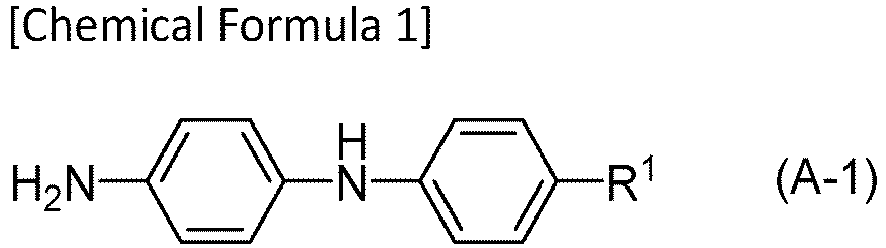
- One aspect of the present invention relates to a crosslinkable rubber composition, comprising: an acrylic rubber; an amine compound represented by the following formula (A-1); a carbon black; and a crosslinking agent.
- the acrylic rubber has acrylate units and carboxy group-containing monomer units, and has 0.5 to 10 parts by mass of ethylene units with respect to 100 parts by mass of the above-mentioned acrylate units and/or 5 to 20 parts by mass of alkyl methacrylate units with respect to 100 parts by mass of the above-mentioned acrylate units.
- R 1 represents a hydrogen atom or an amino group in the formula (A-1).
- the content of the above-mentioned carboxy group-containing monomer units may be 0.1 to 5 parts by mass with respect to 100 parts by mass of the above-mentioned acrylate units.
- the ratio of a total number of amino groups (-NH 2 ) which the above-mentioned amine compound has, C 2 , to a total number of carboxyl groups which the above-mentioned acrylic rubber has, C 1 , (C 2 /C 1 ) may be 0.1 to 5.
- Another aspect of the present invention relates to an acrylic rubber, comprising acrylate units, carboxy group-containing monomer units, amine-containing monomer units having a group represented by the following formula (B-1), and ethylene units at 0.5 to 10 parts by mass with respect to 100 parts by mass of the above-mentioned acrylate units and/or alkyl methacrylate units at 5 to 20 parts by mass with respect to 100 parts by mass of the above-mentioned acrylate units.
- R 1 represents a hydrogen atom or an amino group in the formula (B-1).
- the content of the above-mentioned amine-containing monomer units may be 0.1 to 5 parts by mass with respect to 100 parts by mass of the above-mentioned acrylate units.
- the ratio of the number of the above-mentioned amine-containing monomer units to a total number of the above-mentioned carboxy group-containing monomer units and the above-mentioned amine-containing monomer units may be 0.09 to 0.8.
- Yet another aspect of the present invention relates to a crosslinkable rubber composition, comprising: the above-mentioned acrylic rubber; a carbon black; and a crosslinking agent.
- Yet another aspect of the present invention relates to a cured rubber product, wherein the cured rubber product is a cured product of the above-mentioned crosslinkable rubber composition.
- Yet another aspect of the present invention relates to a hose member, comprising the above-mentioned cured rubber product.
- a crosslinkable rubber composition which can form a cured rubber product in which decrease in tensile strength and elongation at high temperature (for example, 190°C) is suppressed is provided.
- an acrylic rubber which enables suppressing decrease in tensile strength and elongation at high temperature (for example, 190°C) and a crosslinkable rubber composition, comprising the acrylic rubber are provided.
- a cured rubber product in which decrease in tensile strength and elongation at high temperature (for example, 190°C) is suppressed is further provided.
- a crosslinkable rubber composition according to a first embodiment contains an acrylic rubber, an amine compound represented by the following formula (A-1), a carbon black, and a crosslinking agent.
- R 1 represents a hydrogen atom or an amino group in the formula (A-1).
- the acrylic rubber has acrylate units and carboxy group-containing monomer units, and has 0.5 to 10 parts by mass of ethylene units with respect to 100 parts by mass of the acrylate units and/or 5 to 20 parts by mass of alkyl methacrylate units with respect to 100 parts by mass of the acrylate units.
- the acrylic rubber has the carboxy group-containing monomer units.
- the amine compound represented by the formula (A-1) has a diphenylamine skeleton and an amino group (-NH 2 ) which have heat deterioration suppression action. For this reason, when the crosslinkable rubber composition according to the first embodiment is cured, and carboxy groups of the acrylic rubber and amino groups of the amine compound are dehydrated and condensed to form amide bonds. Since the diphenylamine skeletons are connected with the acrylic rubber by the amide bonds, the heat deterioration (especially decrease in tensile strength and elongation) of a cured rubber product is suppressed.
- the acrylic rubber has ethylene units and/or alkyl methacrylate units.
- the acrylic rubber When an acrylic rubber is exposed to high temperature, the acrylic rubber usually tends to decrease in molecular weight by thermal decomposition.
- diphenylamine skeletons are bound to an acrylic rubber as mentioned above, low molecular weight components including a diphenylamine skeleton volatilize, and the heat deterioration suppression effect may decrease in the case where the acrylic rubber decreases in molecular weight.
- the acrylic rubber has the above-mentioned specific constituent units, crosslinking reaction proceeds simultaneously at the time of thermal decomposition and decrease in the molecular weight of the acrylic rubber is suppressed.
- decrease in the effect due to the volatilization of the low molecular weight components is therefore avoided, and heat deterioration (especially decrease in tensile strength and elongation) is suppressed remarkably.
- the acrylic rubber has the acrylate units, the carboxy group-containing monomer units, the ethylene units, and/or the alkyl methacrylate units.
- the acrylate units are constituent units derived from an acrylate.
- the acrylate include alkyl acrylates and alkoxyalkyl acrylates, and, among these, the alkyl acrylates are preferable.
- the alkyl acrylates may be, for example, alkyl acrylates having an alkyl group with 1 to 12 carbon atoms, and are preferably alkyl acrylates having an alkyl group with 1 to 8 carbon atoms, and more preferably alkyl acrylates having an alkyl group with 2 to 4 carbon atoms.
- alkyl acrylates examples include methyl acrylate, ethyl acrylate, n-propyl acrylate, n-butyl acrylate, isobutyl acrylate, n-pentyl acrylate, isoamyl acrylate, n-hexyl acrylate, 2-methylpentyl acrylate, n-octyl acrylate, 2-ethylhexyl acrylate, and n-dodecyl acrylate.
- the content of the alkyl acrylate units in the acrylic rubber may be, for example, 50% by mass or more, preferably 70% by mass or more, and more preferably 90% by mass or more based on the total amount of the acrylic rubber.
- the content of the alkyl acrylate units in the acrylic rubber may be, for example, 99.9% by mass or less, and is preferably 99.8% by mass or less, and more preferably 99.7% by mass or less based on the total amount of the acrylic rubber.
- the carboxy group-containing monomer units are constituent units derived from a carboxy group-containing monomer.
- the carboxy group-containing monomers may be a monomer which has carboxy groups, and may be monomers which can be copolymerized with the alkyl acrylate.
- carboxy group-containing monomers examples include acrylic acid, methacrylic acid, crotonic acid, 2-pentenoic acid, maleic acid, fumaric acid, itaconic acid, and unsaturated dicarboxylic acid monoesters.
- unsaturated dicarboxylic acid monoesters examples include monoalkyl maleates, monoalkyl fumarates, monocyclohexyl maleate, monocyclohexyl fumarate, and cinnamic acid.
- unsaturated dicarboxylic acid monoesters unsaturated dicarboxylic acid monoalkyl esters are preferable.
- Alkyl groups which the unsaturated dicarboxylic acid monoalkyl esters have may be, for example, alkyl groups having 1 to 12 carbon atoms, alkyl groups having preferably 1 to 8 carbon atoms, and more preferably alkyl groups having 2 to 4 carbon atoms.
- unsaturated dicarboxylic acid monoesters include mono-n-butyl maleate, monoethyl maleate, monomethyl maleate, mono-n-butyl fumarate, monoethyl fumarate, and monomethyl fumarate.
- the content of the carboxy group-containing monomer units is preferably 0.1 parts by mass or more, more preferably 0.2 parts by mass or more, and further preferably 0.3 parts by mass or more with respect to 100 parts by mass of the acrylate units.
- Increasing the content of the carboxy group-containing monomer units increases reactive sites with the amine compound and crosslinking points by the crosslinking agent, easily improves the effect of suppressing heat deterioration, and improves the crosslinkablity, and a more rigid rubber material is easily obtained.
- the content of the carboxy group-containing monomer units is preferably 5 parts by mass or less, more preferably 4 parts by mass or less, and further preferably 3 parts by mass or less with respect to 100 parts by mass of the acrylate units.
- the tear resistance of the cured rubber product tends to be improved by reducing the content of the carboxy group-containing monomer units.
- the ethylene units are constituent units derived from ethylene.
- the content of the ethylene units is preferably 0.5 parts by mass or more, more preferably 0.7 parts by mass or more, and further preferably 1 part by mass or more with respect to 100 parts by mass of the acrylate units.
- Increasing the content of the ethylene units easily advances crosslinking reaction at the time of thermal decomposition and suppresses decrease in the molecular weight of the acrylic rubber, and the effect of suppressing heat deterioration is easily obtained.
- the acrylic rubber contains 5 to 20 parts by mass of the alkyl methacrylate units, the content of the ethylene units does not need to be in the above-mentioned range necessarily.
- the content of the ethylene units is preferably 10 parts by mass or less, more preferably 7 parts by mass or less, and further preferably 5 parts by mass or less with respect to 100 parts by mass of the acrylate units.
- the elongation of the cured rubber product tends to be maintained after a heat resistance test by reducing the content of the ethylene units.
- the alkyl methacrylate units are constituent units derived from an alkyl methacrylate.
- the alkyl methacrylates may be alkyl methacrylates having alkyl groups with 1 to 12 carbon atoms, and are preferably alkyl methacrylates having alkyl groups with 1 to 8 carbon atoms, and more preferably alkyl methacrylates having alkyl groups with 1 to 4 carbon atoms.
- alkyl methacrylates examples include methyl methacrylate, ethyl methacrylate, n-butyl methacrylate, and isobutyl methacrylate.
- the content of the alkyl methacrylate units is preferably 5 parts by mass or more, more preferably 7 parts by mass or more, and further preferably 10 parts by mass or more with respect to 100 parts by mass of the acrylate units.
- Increasing the content of the alkyl methacrylate units easily advances crosslinking reaction at the time of thermal decomposition and suppresses decrease in the molecular weight of the acrylic rubber, and the effect of suppressing heat deterioration is easily obtained.
- the acrylic rubber contains 0.5 to 10 parts by mass of the ethylene units, the content of the alkyl methacrylate units does not need to be in the above-mentioned range necessarily.
- the content of the alkyl methacrylate units is preferably 30 parts by mass or less, more preferably 25 parts by mass less, and further preferably 20 parts by mass or less with respect to 100 parts by mass of the acrylate units.
- the cold resistance of the cured rubber product tends to be improved by reducing the content of the alkyl methacrylate units.
- the acrylic rubber may have at least one selected from the group consisting of the ethylene units and the alkyl methacrylate units, or may have both.
- the acrylic rubber may further have other monomer units than the above.
- the other monomer units include ethylenic unsaturated compounds including vinyl acetate; alkyl vinyl ketones such as methyl vinyl ketone; vinyl or allyl ethers such as vinyl ethyl ether or allyl methyl ether; vinyl aromatic compounds such as styrene, ⁇ -methylstyrene, chlorostyrene, vinyltoluene, and vinylnaphthalene; vinyl nitriles such as acrylonitrile and methacrylonitrile; acrylamide; propylene; butadiene; isoprene; pentadiene; vinyl chloride; vinylidene chloride; vinyl fluoride; vinylidene fluoride; ethylene; vinyl propionate; maleate diester such as dimethyl maleate; dialkyl fumarates such as dimethyl fumarate; dialkyl itaconates such as dimethyl itaconate; dialkyl citraconates such as dimethyl
- the content of the other monomer units may be 20 parts by mass or less, and is preferably 10 parts by mass or less, more preferably 5 parts by mass or less, and may be 0 parts by mass (that is, the other monomers are not contained) with respect to 100 parts by mass of the acrylate units.
- the amine compound is a compound represented by the formula (A-1).
- R 1 is a hydrogen atom or an amino group (-NH 2 ), and is preferably a hydrogen atom.
- the ratio of the total number of the amino groups (-NH2) which the amine compound has C 2 to the total number of the carboxyl groups which the acrylic rubber has C 1 (C 2 /C 1 ) is preferably 0.1 or more, more preferably 0.2 or more, and further preferably 0.3 or more.
- the ratio (C 2 /C 1 ) is in the above-mentioned range, long-term heat resistance is further improved.
- the ratio (C 2 /C 1 ) is preferably 5 or less, more preferably 4 or less, and further preferably 3 or less.
- the ratio (C 2 /C 1 ) is in the above-mentioned range, the crosslinking rate of the crosslinkable rubber composition tends to be improved.
- the content of the amine compound in the crosslinkable rubber composition is not particularly limited, and may be a content, for example, wherein the ratio (C 2 /C 1 ) is in the above-mentioned preferable range.
- the content of the amine compound in the crosslinkable rubber composition may be, for example, 0.1 parts by mass or more, and is preferably 0.2 parts by mass or more and more preferably 0.3 parts by mass or more, for example, with respect to 100 parts by mass of the acrylic rubber.
- the content of the amine compound may be, for example, 10 parts by mass or less, and is preferably 5 parts by mass or less and more preferably 3 parts by mass or less with respect to 100 parts by mass of the acrylic rubber.
- Examples of the carbon black include acetylene black, ketjen black, thermal black, channel black, furnace black, lamp black, and graphitized carbon black.
- the content of the carbon black in the crosslinkable rubber composition may be, for example, 20 parts by mass or more, and is preferably 30 parts by mass or more and more preferably 40 parts by mass or more with respect to 100 parts by mass of the acrylic rubber.
- the mechanical characteristic of the cured rubber product tends to be further improved by increasing the content of the carbon black.
- the content of the carbon black may be, for example, 90 parts by mass or less, and is preferably 80 parts by mass or less and more preferably 70 parts by mass or less with respect to 100 parts by mass of the acrylic rubber.
- the rubber elasticity of the cured rubber product tends to be further improved by reducing the content of the carbon black.
- the crosslinking agent may be a crosslinking agent which can crosslink the acrylic rubber.
- a well-known crosslinking agent can be used without particular limitation as a crosslinking agent which can crosslink the acrylic rubber having the carboxy groups.
- crosslinking agent examples include a crosslinking agent which can react with the carboxy groups in the acrylic rubber and form crosslinked structure when the crosslinkable rubber composition is heated.
- the crosslinking agent may have crosslinking groups which react with carboxy groups or groups which produce the crosslinkable groups by heating.
- crosslinking agent examples include polyvalent amine compounds and carbonates of polyvalent amine compounds.
- the content of the crosslinking agent in the crosslinkable rubber composition may be, for example, 0.1 parts by mass or more, and is preferably 0.2 parts by mass or more and more preferably 0.3 parts by mass or more with respect to 100 parts by mass of the acrylic rubber.
- the mechanical characteristic of the cured rubber product tends to be further improved by increasing the content of the crosslinking agent.
- the content of the crosslinking agent may be, for example, 10 parts by mass or less, and is preferably 5 parts by mass or less and more preferably 2 parts by mass or less with respect to 100 parts by mass of the acrylic rubber.
- the tensile elongation of the cured rubber product tends to be further improved by reducing the content of the crosslinking agent.
- the crosslinkable rubber composition may further contain other components than the above.
- the other components include a lubricant, a crosslinking promoter, a plasticizer, a filler, a reinforcing agent, and a silane coupling agent.
- lubricant examples include liquid paraffin, stearic acid, stearylamine, fatty acid zinc, fatty acid esters, and organosilicones.
- the content of the lubricant in the crosslinkable rubber composition may be, for example, 0.1 parts by mass or more, and is preferably 0.3 or more parts by mass and more preferably 0.5 parts by mass or more with respect to 100 parts by mass of the acrylic rubber.
- the fluidity of the crosslinkable rubber composition tends to be further improved by increasing the content of the lubricant.
- the content of the lubricant may be, for example, 10 parts by mass or less, and is preferably 7 parts by mass or less and more preferably 5 parts by mass or less with respect to 100 parts by mass of the acrylic rubber.
- the heat resistance of the cured rubber product tends to be further improved by reducing the content of the lubricant.
- crosslinking promoter a well-known crosslinking promoter can be suitably selected and used depending on the type of the crosslinking agent.
- crosslinking promoter examples include aliphatic monovalent secondary amine compounds, aliphatic monovalent tertiary amine compounds, guanidine compounds, imidazole compounds, quaternary onium salts, tertiary phosphine compounds, alkali metal salts of weak acids, and diazabicycloalkene compounds.
- the content of the crosslinking promoter in the crosslinkable rubber composition may be, for example, 0.1 parts by mass or more, and is preferably 0.2 parts by mass or more and more preferably 0.3 parts by mass or more with respect to 100 parts by mass of the acrylic rubber.
- the crosslinking time of the crosslinkable rubber composition can be reduced by increasing the content of the crosslinking promoter.
- the content of the crosslinking promoter may be, for example, 10 parts by mass or less, and is preferably 5 parts by mass or less and more preferably 3 parts by mass or less with respect to 100 parts by mass of the acrylic rubber.
- the heat resistance of the cured rubber product tends to be further improved by reducing the content of the crosslinking promoter.
- a crosslinkable rubber composition according to a second embodiment contains an acrylic rubber, a carbon black, and a crosslinking agent.
- the acrylic rubber has acrylate units, carboxy group-containing monomer units, amine-containing monomer units having a group represented by the following formula (B-1), and ethylene units at 0.5 to 10 parts by mass with respect to 100 parts by mass of the acrylate units and/or alkyl methacrylate units at 5 to 20 parts by mass with respect to 100 parts by mass of the acrylate units.
- R 1 represents a hydrogen atom or an amino group in the formula (B-1).
- the acrylic rubber has groups represented by the formula (B-1).
- the groups have a diphenylamine skeleton, and has the function of suppressing the heat deterioration (especially decrease in tensile strength and elongation) of the cured rubber product. Since the acrylic rubber has the ethylene units and/or the alkyl methacrylate units in the crosslinkable rubber composition according to the second embodiment, decrease in molecular weight due to thermal decomposition at high temperature is suppressed, decrease in the effect due to the volatilization of low molecular weight components is avoided, and heat deterioration (especially decrease in tensile strength and elongation) is suppressed remarkably.
- the acrylic rubber in the second embodiment may be an acrylic rubber in which some carboxy groups in the acrylic rubber in the first embodiment react with the amine compound represented by the formula (A-1). That is, as the acrylate units, the carboxy group-containing monomer units, the ethylene units, and the alkyl methacrylate units which the acrylic rubber in the second embodiment has, the same as the constituent units which the acrylic rubber in the first embodiment has can be illustrated.
- the contents of the acrylate units, the ethylene units, and the alkyl methacrylate units in the acrylic rubber may be the same as the contents of the constituent units in the acrylic rubber in the first embodiment.
- the content of the carboxy group-containing monomer units is preferably 0.05 parts by mass or more, more preferably 0.1 parts by mass or more, and further preferably 0.2 parts by mass or more with respect to 100 parts by mass of the acrylate units.
- the content of the carboxy group-containing monomer units is preferably 4.5 parts by mass or less, more preferably 3.5 parts by mass or less, and further preferably 2.5 parts by mass or less with respect to 100 parts by mass of the acrylate units.
- the ratio of the number of the amine-containing monomer units to the total number of the carboxy group-containing monomer units and the amine-containing monomer units is preferably 0.09 or more and more preferably 0.1 or more.
- the ratio is preferably 0.8 or less and more preferably 0.7 or less.
- the crosslinkable rubber composition according to the second embodiment may further contain other components than the above.
- the carbon black, the crosslinking agent, and the other components in the second embodiment the same as the carbon blacks, the crosslinking agents, and the other components in the first embodiment can be illustrated.
- the contents of the components in the second embodiment may be the same as the contents of the components in the first embodiment.
- a cured rubber product according to the present embodiment can be obtained by thermosetting the above-mentioned crosslinkable rubber compositions.
- the cured rubber product according to the present embodiment may be the cured product of the crosslinkable rubber composition according to the first embodiment, may be the cured product of the crosslinkable rubber composition according to the second embodiment, or may be a cured product of a mixture of the crosslinkable rubber composition according to the first embodiment and the crosslinkable rubber composition according to the second embodiment.
- the curing conditions of the crosslinkable rubber composition are not particularly limited.
- the curing temperature may be, for example, 150 to 220°C, and is preferably 160 to 180°C.
- the curing time may be, for example, 5 minutes to 2 hours, and is preferably 5 to 60 minutes.
- the cured rubber product according to the present embodiment can be suitably used as rubber members exposed to high temperature.
- the cured rubber product according to the present embodiment can be suitably used for the uses of hose members such as transmission oil cooler hoses, engine oil cooler hoses, air duct hoses, turbo intercooler hoses, hot air hoses, radiator hoses, power steering hoses, hoses for fuel systems, and hoses for drain systems of, for example, motor vehicles, construction machinery, hydraulic equipment, and the like.
- hose members such as transmission oil cooler hoses, engine oil cooler hoses, air duct hoses, turbo intercooler hoses, hot air hoses, radiator hoses, power steering hoses, hoses for fuel systems, and hoses for drain systems of, for example, motor vehicles, construction machinery, hydraulic equipment, and the like.
- An acrylic rubber A was produced by the following method.
- an aqueous t-butyl hydroperoxide solution (0.25% by mass, 2 liters) was separately injected from an injection port for 6 hours for polymerization to a final rate of polymerization of 95%.
- An aqueous sodium borate solution (3.5% by mass, 7 liters) was added to the generated polymerization liquid as a coagulant, and a polymer was solidified, dehydrated, and dried to produce an acrylic rubber A.
- An acrylic rubber B was produced in a similar manner to that for the acrylic rubber A except that the ethylene pressure was changed into 10 MPa.
- An acrylic rubber C was produced in a similar manner to that for the acrylic rubber A except that the ethylene pressure was changed into 0.5 MPa.
- An acrylic rubber D was produced in a similar manner to that for the acrylic rubber A except that the monomer mixed liquid was changed into a monomer mixed liquid of 7.8 kg of ethyl acrylate, 3.4 kg of n-butyl acrylate, 500 g of monobutyl maleate, and 1.8 g of tert-dodecyl mercaptan.
- An acrylic rubber E was produced in a similar manner to that for the acrylic rubber A except that the monomer mixed liquid was changed into a monomer mixed liquid of 7.8 kg of ethyl acrylate, 3.4 kg of n-butyl acrylate, 150 g of monobutyl maleate, and 1.8 g of tert-dodecyl mercaptan.
- An acrylic rubber F was produced in a similar manner to that for the acrylic rubber A except that ethylene was not used.
- An acrylic rubber G was produced in a similar manner to that for the acrylic rubber A except that the monomer mixed liquid was changed into a monomer mixed liquid of 6.2 kg of ethyl acrylate, 3.9 kg of n-butyl acrylate, 1.1 kg of methyl methacrylate, 300 g of monobutyl maleate, and 1.8 g of tert-dodecyl mercaptan.
- An acrylic rubber H was produced in a similar manner to that for the acrylic rubber A except that the monomer mixed liquid was changed into a monomer mixed liquid of 5.6 kg of ethyl acrylate, 3.4 kg of n-butyl acrylate, 2.2 kg of methyl methacrylate, 300 g of monobutyl maleate, and 1.8 g of tert-dodecyl mercaptan.
- An acrylic rubber I was produced in a similar manner to that for the acrylic rubber A except that the monomer mixed liquid was changed into a monomer mixed liquid of 5.6 kg of ethyl acrylate, 3.4 kg of n-butyl acrylate, 2.2 kg of methyl methacrylate, 300 g of monobutyl maleate, and 1.8 g of tert-dodecyl mercaptan, and ethylene was not used.
- An acrylic rubber I was produced in a similar manner to that for the acrylic rubber A except that the monomer mixed liquid was changed into a monomer mixed liquid of 5.6 kg of ethyl acrylate, 3.4 kg of n-butyl acrylate, 2.2 kg of methyl methacrylate, 300 g of monobutyl maleate, and 1.8 g of tert-dodecyl mercaptan, and ethylene was not used.
- Crosslinkable rubber compositions were produced by the following method.
- Kneading was performed in blending compositions in Tables 1 to 3 using the acrylic rubbers obtained by the above-mentioned methods with a 0.5-L pressure kneader and 6-inch open rolls.
- Cured rubber products were produced by the following method.
- Each of the obtained crosslinkable rubber compositions was rolled into a sheet having a thickness of 2.4 mm, then subjected to primary vulcanization at 170°C for 40 minutes with a press vulcanizer and then subjected to secondary vulcanization at 170°C for 4 hours with a Gear oven to produce a cured rubber product.
- the "Carbon black: SEAST SO” indicates the trade name “SEAST SO” (arithmetic average particle size 43 nm) produced by TOKAI CARBON CO., LTD.
- the "antioxidant: Naugard #445” indicates the trade name “Naugard #445” produced from Addivant.
- the "crosslinking agent: Diak #1” indicates the trade name “Diak #1” produced by DuPont.
- the "crosslinking promoter: XLA-60” indicates the trade name "XLA-60” produced by LANXESS Deutschland GmbH.
Landscapes
- Chemical & Material Sciences (AREA)
- Organic Chemistry (AREA)
- Health & Medical Sciences (AREA)
- Chemical Kinetics & Catalysis (AREA)
- Medicinal Chemistry (AREA)
- Polymers & Plastics (AREA)
- Engineering & Computer Science (AREA)
- General Engineering & Computer Science (AREA)
- Mechanical Engineering (AREA)
- General Chemical & Material Sciences (AREA)
- Compositions Of Macromolecular Compounds (AREA)
- Rigid Pipes And Flexible Pipes (AREA)
- Addition Polymer Or Copolymer, Post-Treatments, Or Chemical Modifications (AREA)
Abstract
Description
- The present invention relates to a crosslinkable rubber composition, an acrylic rubber, and a cured rubber product.
- Acrylic rubbers are known as rubber materials excellent in heat resistance and oil resistance, and cured products obtained by curing rubber compositions containing acrylic rubbers are used suitably for parts for motor vehicles and the like.
- For example, Patent Literatures 1 and 2 describe acrylic rubber compositions obtained by blending carboxyl group-containing acrylic rubbers in combination with guanidine compounds, diamine compounds, and phenolic antioxidants.
-
- Patent Literature 1:
Japanese Unexamined Patent Publication No. 2004-175840 - Patent Literature 2:
Japanese Patent No. 4851398 - Further heat resistance has been required for rubber parts for motor vehicles in recent years due to countermeasures to emission control, increase in the output of engines, and the like. Especially in hose members, the suppression of decrease in tensile strength and elongation at high temperature has been required.
- An object of the present invention is to provide a crosslinkable rubber composition which can form a cured rubber product in which decrease in tensile strength and elongation at high temperature (for example, 190°C) is suppressed. An object of the present invention is to provide an acrylic rubber which enables suppressing decrease in tensile strength and elongation at high temperature (for example, 190°C) and a crosslinkable rubber composition containing the acrylic rubber. An object of the present invention is to provide a cured rubber product in which decrease in tensile strength and elongation at high temperature (for example, 190°C) is suppressed.
- One aspect of the present invention relates to a crosslinkable rubber composition, comprising: an acrylic rubber; an amine compound represented by the following formula (A-1); a carbon black; and a crosslinking agent. In this composition, the acrylic rubber has acrylate units and carboxy group-containing monomer units, and has 0.5 to 10 parts by mass of ethylene units with respect to 100 parts by mass of the above-mentioned acrylate units and/or 5 to 20 parts by mass of alkyl methacrylate units with respect to 100 parts by mass of the above-mentioned acrylate units.

- In one mode, the content of the above-mentioned carboxy group-containing monomer units may be 0.1 to 5 parts by mass with respect to 100 parts by mass of the above-mentioned acrylate units.
- In one mode, the ratio of a total number of amino groups (-NH2) which the above-mentioned amine compound has, C2, to a total number of carboxyl groups which the above-mentioned acrylic rubber has, C1, (C2/C1) may be 0.1 to 5.
- Another aspect of the present invention relates to an acrylic rubber, comprising acrylate units, carboxy group-containing monomer units, amine-containing monomer units having a group represented by the following formula (B-1), and ethylene units at 0.5 to 10 parts by mass with respect to 100 parts by mass of the above-mentioned acrylate units and/or alkyl methacrylate units at 5 to 20 parts by mass with respect to 100 parts by mass of the above-mentioned acrylate units.

- In one mode, the content of the above-mentioned amine-containing monomer units may be 0.1 to 5 parts by mass with respect to 100 parts by mass of the above-mentioned acrylate units.
- In one mode, the ratio of the number of the above-mentioned amine-containing monomer units to a total number of the above-mentioned carboxy group-containing monomer units and the above-mentioned amine-containing monomer units may be 0.09 to 0.8.
- Yet another aspect of the present invention relates to a crosslinkable rubber composition, comprising: the above-mentioned acrylic rubber; a carbon black; and a crosslinking agent.
- Yet another aspect of the present invention relates to a cured rubber product, wherein the cured rubber product is a cured product of the above-mentioned crosslinkable rubber composition.
- Yet another aspect of the present invention relates to a hose member, comprising the above-mentioned cured rubber product.
- According to the present invention, a crosslinkable rubber composition which can form a cured rubber product in which decrease in tensile strength and elongation at high temperature (for example, 190°C) is suppressed is provided. According to the present invention, an acrylic rubber which enables suppressing decrease in tensile strength and elongation at high temperature (for example, 190°C) and a crosslinkable rubber composition, comprising the acrylic rubber are provided. According to the present invention, a cured rubber product in which decrease in tensile strength and elongation at high temperature (for example, 190°C) is suppressed is further provided.
- Suitable embodiments of the present invention will be described in detail hereinafter.
- A crosslinkable rubber composition according to a first embodiment contains an acrylic rubber, an amine compound represented by the following formula (A-1), a carbon black, and a crosslinking agent.

- R1 represents a hydrogen atom or an amino group in the formula (A-1).
- In the first embodiment, the acrylic rubber has acrylate units and carboxy group-containing monomer units, and has 0.5 to 10 parts by mass of ethylene units with respect to 100 parts by mass of the acrylate units and/or 5 to 20 parts by mass of alkyl methacrylate units with respect to 100 parts by mass of the acrylate units.
- In a crosslinkable rubber composition according to the first embodiment, the acrylic rubber has the carboxy group-containing monomer units. The amine compound represented by the formula (A-1) has a diphenylamine skeleton and an amino group (-NH2) which have heat deterioration suppression action. For this reason, when the crosslinkable rubber composition according to the first embodiment is cured, and carboxy groups of the acrylic rubber and amino groups of the amine compound are dehydrated and condensed to form amide bonds. Since the diphenylamine skeletons are connected with the acrylic rubber by the amide bonds, the heat deterioration (especially decrease in tensile strength and elongation) of a cured rubber product is suppressed.
- In the crosslinkable rubber composition according to the first embodiment, the acrylic rubber has ethylene units and/or alkyl methacrylate units. When an acrylic rubber is exposed to high temperature, the acrylic rubber usually tends to decrease in molecular weight by thermal decomposition. When diphenylamine skeletons are bound to an acrylic rubber as mentioned above, low molecular weight components including a diphenylamine skeleton volatilize, and the heat deterioration suppression effect may decrease in the case where the acrylic rubber decreases in molecular weight. Meanwhile, in the first embodiment, it is considered that since the acrylic rubber has the above-mentioned specific constituent units, crosslinking reaction proceeds simultaneously at the time of thermal decomposition and decrease in the molecular weight of the acrylic rubber is suppressed. In the first embodiment, decrease in the effect due to the volatilization of the low molecular weight components is therefore avoided, and heat deterioration (especially decrease in tensile strength and elongation) is suppressed remarkably.
- Components of the crosslinkable rubber composition will be described in detail hereinafter.
- The acrylic rubber has the acrylate units, the carboxy group-containing monomer units, the ethylene units, and/or the alkyl methacrylate units.
- The acrylate units are constituent units derived from an acrylate. Examples of the acrylate include alkyl acrylates and alkoxyalkyl acrylates, and, among these, the alkyl acrylates are preferable.
- The alkyl acrylates may be, for example, alkyl acrylates having an alkyl group with 1 to 12 carbon atoms, and are preferably alkyl acrylates having an alkyl group with 1 to 8 carbon atoms, and more preferably alkyl acrylates having an alkyl group with 2 to 4 carbon atoms.
- Examples of the alkyl acrylates include methyl acrylate, ethyl acrylate, n-propyl acrylate, n-butyl acrylate, isobutyl acrylate, n-pentyl acrylate, isoamyl acrylate, n-hexyl acrylate, 2-methylpentyl acrylate, n-octyl acrylate, 2-ethylhexyl acrylate, and n-dodecyl acrylate.
- The content of the alkyl acrylate units in the acrylic rubber may be, for example, 50% by mass or more, preferably 70% by mass or more, and more preferably 90% by mass or more based on the total amount of the acrylic rubber. The content of the alkyl acrylate units in the acrylic rubber may be, for example, 99.9% by mass or less, and is preferably 99.8% by mass or less, and more preferably 99.7% by mass or less based on the total amount of the acrylic rubber.
- The carboxy group-containing monomer units are constituent units derived from a carboxy group-containing monomer. The carboxy group-containing monomers may be a monomer which has carboxy groups, and may be monomers which can be copolymerized with the alkyl acrylate.
- Examples of the carboxy group-containing monomers include acrylic acid, methacrylic acid, crotonic acid, 2-pentenoic acid, maleic acid, fumaric acid, itaconic acid, and unsaturated dicarboxylic acid monoesters.
- Examples of the unsaturated dicarboxylic acid monoesters include monoalkyl maleates, monoalkyl fumarates, monocyclohexyl maleate, monocyclohexyl fumarate, and cinnamic acid.
- As the unsaturated dicarboxylic acid monoesters, unsaturated dicarboxylic acid monoalkyl esters are preferable. Alkyl groups which the unsaturated dicarboxylic acid monoalkyl esters have may be, for example, alkyl groups having 1 to 12 carbon atoms, alkyl groups having preferably 1 to 8 carbon atoms, and more preferably alkyl groups having 2 to 4 carbon atoms.
- Specific examples of the unsaturated dicarboxylic acid monoesters include mono-n-butyl maleate, monoethyl maleate, monomethyl maleate, mono-n-butyl fumarate, monoethyl fumarate, and monomethyl fumarate.
- The content of the carboxy group-containing monomer units is preferably 0.1 parts by mass or more, more preferably 0.2 parts by mass or more, and further preferably 0.3 parts by mass or more with respect to 100 parts by mass of the acrylate units. Increasing the content of the carboxy group-containing monomer units increases reactive sites with the amine compound and crosslinking points by the crosslinking agent, easily improves the effect of suppressing heat deterioration, and improves the crosslinkablity, and a more rigid rubber material is easily obtained.
- The content of the carboxy group-containing monomer units is preferably 5 parts by mass or less, more preferably 4 parts by mass or less, and further preferably 3 parts by mass or less with respect to 100 parts by mass of the acrylate units. The tear resistance of the cured rubber product tends to be improved by reducing the content of the carboxy group-containing monomer units.
- The ethylene units are constituent units derived from ethylene.
- When the acrylic rubber contains the ethylene units, the content of the ethylene units is preferably 0.5 parts by mass or more, more preferably 0.7 parts by mass or more, and further preferably 1 part by mass or more with respect to 100 parts by mass of the acrylate units. Increasing the content of the ethylene units easily advances crosslinking reaction at the time of thermal decomposition and suppresses decrease in the molecular weight of the acrylic rubber, and the effect of suppressing heat deterioration is easily obtained. When the acrylic rubber contains 5 to 20 parts by mass of the alkyl methacrylate units, the content of the ethylene units does not need to be in the above-mentioned range necessarily.
- The content of the ethylene units is preferably 10 parts by mass or less, more preferably 7 parts by mass or less, and further preferably 5 parts by mass or less with respect to 100 parts by mass of the acrylate units. The elongation of the cured rubber product tends to be maintained after a heat resistance test by reducing the content of the ethylene units.
- The alkyl methacrylate units are constituent units derived from an alkyl methacrylate.
- The alkyl methacrylates may be alkyl methacrylates having alkyl groups with 1 to 12 carbon atoms, and are preferably alkyl methacrylates having alkyl groups with 1 to 8 carbon atoms, and more preferably alkyl methacrylates having alkyl groups with 1 to 4 carbon atoms.
- Examples of the alkyl methacrylates include methyl methacrylate, ethyl methacrylate, n-butyl methacrylate, and isobutyl methacrylate.
- When the acrylic rubber contains the alkyl methacrylate units, the content of the alkyl methacrylate units is preferably 5 parts by mass or more, more preferably 7 parts by mass or more, and further preferably 10 parts by mass or more with respect to 100 parts by mass of the acrylate units. Increasing the content of the alkyl methacrylate units easily advances crosslinking reaction at the time of thermal decomposition and suppresses decrease in the molecular weight of the acrylic rubber, and the effect of suppressing heat deterioration is easily obtained. When the acrylic rubber contains 0.5 to 10 parts by mass of the ethylene units, the content of the alkyl methacrylate units does not need to be in the above-mentioned range necessarily.
- The content of the alkyl methacrylate units is preferably 30 parts by mass or less, more preferably 25 parts by mass less, and further preferably 20 parts by mass or less with respect to 100 parts by mass of the acrylate units. The cold resistance of the cured rubber product tends to be improved by reducing the content of the alkyl methacrylate units.
- The acrylic rubber may have at least one selected from the group consisting of the ethylene units and the alkyl methacrylate units, or may have both.
- The acrylic rubber may further have other monomer units than the above. Examples of the other monomer units include ethylenic unsaturated compounds including vinyl acetate; alkyl vinyl ketones such as methyl vinyl ketone; vinyl or allyl ethers such as vinyl ethyl ether or allyl methyl ether; vinyl aromatic compounds such as styrene, α-methylstyrene, chlorostyrene, vinyltoluene, and vinylnaphthalene; vinyl nitriles such as acrylonitrile and methacrylonitrile; acrylamide; propylene; butadiene; isoprene; pentadiene; vinyl chloride; vinylidene chloride; vinyl fluoride; vinylidene fluoride; ethylene; vinyl propionate; maleate diester such as dimethyl maleate; dialkyl fumarates such as dimethyl fumarate; dialkyl itaconates such as dimethyl itaconate; dialkyl citraconates such as dimethyl citraconate; dialkyl mesaconates such as dimethyl mesaconate; 2-pentenedioic acid dialkyl esters such as 2-pentenedioic acid dimethyl ester; and dialkyl acetylenedicarboxylates such as dimethyl acetylenedicarboxylate.
- The content of the other monomer units may be 20 parts by mass or less, and is preferably 10 parts by mass or less, more preferably 5 parts by mass or less, and may be 0 parts by mass (that is, the other monomers are not contained) with respect to 100 parts by mass of the acrylate units.
- The amine compound is a compound represented by the formula (A-1). In the formula (A-1), R1 is a hydrogen atom or an amino group (-NH2), and is preferably a hydrogen atom.
- The ratio of the total number of the amino groups (-NH2) which the amine compound has C2 to the total number of the carboxyl groups which the acrylic rubber has C1 (C2/C1) is preferably 0.1 or more, more preferably 0.2 or more, and further preferably 0.3 or more. When the ratio (C2/C1) is in the above-mentioned range, long-term heat resistance is further improved.
- The ratio (C2/C1) is preferably 5 or less, more preferably 4 or less, and further preferably 3 or less. When the ratio (C2/C1) is in the above-mentioned range, the crosslinking rate of the crosslinkable rubber composition tends to be improved.
- The content of the amine compound in the crosslinkable rubber composition is not particularly limited, and may be a content, for example, wherein the ratio (C2/C1) is in the above-mentioned preferable range.
- The content of the amine compound in the crosslinkable rubber composition may be, for example, 0.1 parts by mass or more, and is preferably 0.2 parts by mass or more and more preferably 0.3 parts by mass or more, for example, with respect to 100 parts by mass of the acrylic rubber. The content of the amine compound may be, for example, 10 parts by mass or less, and is preferably 5 parts by mass or less and more preferably 3 parts by mass or less with respect to 100 parts by mass of the acrylic rubber.
- Examples of the carbon black include acetylene black, ketjen black, thermal black, channel black, furnace black, lamp black, and graphitized carbon black.
- The content of the carbon black in the crosslinkable rubber composition may be, for example, 20 parts by mass or more, and is preferably 30 parts by mass or more and more preferably 40 parts by mass or more with respect to 100 parts by mass of the acrylic rubber. The mechanical characteristic of the cured rubber product tends to be further improved by increasing the content of the carbon black.
- The content of the carbon black may be, for example, 90 parts by mass or less, and is preferably 80 parts by mass or less and more preferably 70 parts by mass or less with respect to 100 parts by mass of the acrylic rubber. The rubber elasticity of the cured rubber product tends to be further improved by reducing the content of the carbon black.
- The crosslinking agent may be a crosslinking agent which can crosslink the acrylic rubber. As the crosslinking agent, a well-known crosslinking agent can be used without particular limitation as a crosslinking agent which can crosslink the acrylic rubber having the carboxy groups.
- Examples of the crosslinking agent include a crosslinking agent which can react with the carboxy groups in the acrylic rubber and form crosslinked structure when the crosslinkable rubber composition is heated. The crosslinking agent may have crosslinking groups which react with carboxy groups or groups which produce the crosslinkable groups by heating.
- Examples of the crosslinking agent include polyvalent amine compounds and carbonates of polyvalent amine compounds.
- The content of the crosslinking agent in the crosslinkable rubber composition may be, for example, 0.1 parts by mass or more, and is preferably 0.2 parts by mass or more and more preferably 0.3 parts by mass or more with respect to 100 parts by mass of the acrylic rubber. The mechanical characteristic of the cured rubber product tends to be further improved by increasing the content of the crosslinking agent.
- The content of the crosslinking agent may be, for example, 10 parts by mass or less, and is preferably 5 parts by mass or less and more preferably 2 parts by mass or less with respect to 100 parts by mass of the acrylic rubber. The tensile elongation of the cured rubber product tends to be further improved by reducing the content of the crosslinking agent.
- The crosslinkable rubber composition may further contain other components than the above. Examples of the other components include a lubricant, a crosslinking promoter, a plasticizer, a filler, a reinforcing agent, and a silane coupling agent.
- Examples of the lubricant include liquid paraffin, stearic acid, stearylamine, fatty acid zinc, fatty acid esters, and organosilicones.
- The content of the lubricant in the crosslinkable rubber composition may be, for example, 0.1 parts by mass or more, and is preferably 0.3 or more parts by mass and more preferably 0.5 parts by mass or more with respect to 100 parts by mass of the acrylic rubber. The fluidity of the crosslinkable rubber composition tends to be further improved by increasing the content of the lubricant.
- The content of the lubricant may be, for example, 10 parts by mass or less, and is preferably 7 parts by mass or less and more preferably 5 parts by mass or less with respect to 100 parts by mass of the acrylic rubber. The heat resistance of the cured rubber product tends to be further improved by reducing the content of the lubricant.
- As the crosslinking promoter, a well-known crosslinking promoter can be suitably selected and used depending on the type of the crosslinking agent.
- Examples of the crosslinking promoter include aliphatic monovalent secondary amine compounds, aliphatic monovalent tertiary amine compounds, guanidine compounds, imidazole compounds, quaternary onium salts, tertiary phosphine compounds, alkali metal salts of weak acids, and diazabicycloalkene compounds.
- The content of the crosslinking promoter in the crosslinkable rubber composition may be, for example, 0.1 parts by mass or more, and is preferably 0.2 parts by mass or more and more preferably 0.3 parts by mass or more with respect to 100 parts by mass of the acrylic rubber. The crosslinking time of the crosslinkable rubber composition can be reduced by increasing the content of the crosslinking promoter.
- The content of the crosslinking promoter may be, for example, 10 parts by mass or less, and is preferably 5 parts by mass or less and more preferably 3 parts by mass or less with respect to 100 parts by mass of the acrylic rubber. The heat resistance of the cured rubber product tends to be further improved by reducing the content of the crosslinking promoter.
- A crosslinkable rubber composition according to a second embodiment contains an acrylic rubber, a carbon black, and a crosslinking agent.
- In the second embodiment, the acrylic rubber has acrylate units, carboxy group-containing monomer units, amine-containing monomer units having a group represented by the following formula (B-1), and ethylene units at 0.5 to 10 parts by mass with respect to 100 parts by mass of the acrylate units and/or alkyl methacrylate units at 5 to 20 parts by mass with respect to 100 parts by mass of the acrylate units.

- R1 represents a hydrogen atom or an amino group in the formula (B-1).
- In a crosslinkable rubber composition according to the second embodiment, the acrylic rubber has groups represented by the formula (B-1). The groups have a diphenylamine skeleton, and has the function of suppressing the heat deterioration (especially decrease in tensile strength and elongation) of the cured rubber product. Since the acrylic rubber has the ethylene units and/or the alkyl methacrylate units in the crosslinkable rubber composition according to the second embodiment, decrease in molecular weight due to thermal decomposition at high temperature is suppressed, decrease in the effect due to the volatilization of low molecular weight components is avoided, and heat deterioration (especially decrease in tensile strength and elongation) is suppressed remarkably.
- The acrylic rubber in the second embodiment may be an acrylic rubber in which some carboxy groups in the acrylic rubber in the first embodiment react with the amine compound represented by the formula (A-1). That is, as the acrylate units, the carboxy group-containing monomer units, the ethylene units, and the alkyl methacrylate units which the acrylic rubber in the second embodiment has, the same as the constituent units which the acrylic rubber in the first embodiment has can be illustrated. In the second embodiment, the contents of the acrylate units, the ethylene units, and the alkyl methacrylate units in the acrylic rubber may be the same as the contents of the constituent units in the acrylic rubber in the first embodiment.
- In the acrylic rubber in the second embodiment, the content of the carboxy group-containing monomer units is preferably 0.05 parts by mass or more, more preferably 0.1 parts by mass or more, and further preferably 0.2 parts by mass or more with respect to 100 parts by mass of the acrylate units. In the second embodiment, the content of the carboxy group-containing monomer units is preferably 4.5 parts by mass or less, more preferably 3.5 parts by mass or less, and further preferably 2.5 parts by mass or less with respect to 100 parts by mass of the acrylate units.
- In the acrylic rubber in the second embodiment, the ratio of the number of the amine-containing monomer units to the total number of the carboxy group-containing monomer units and the amine-containing monomer units is preferably 0.09 or more and more preferably 0.1 or more. The ratio is preferably 0.8 or less and more preferably 0.7 or less.
- The crosslinkable rubber composition according to the second embodiment may further contain other components than the above.
- As the carbon black, the crosslinking agent, and the other components in the second embodiment, the same as the carbon blacks, the crosslinking agents, and the other components in the first embodiment can be illustrated. The contents of the components in the second embodiment may be the same as the contents of the components in the first embodiment.
- A cured rubber product according to the present embodiment can be obtained by thermosetting the above-mentioned crosslinkable rubber compositions. The cured rubber product according to the present embodiment may be the cured product of the crosslinkable rubber composition according to the first embodiment, may be the cured product of the crosslinkable rubber composition according to the second embodiment, or may be a cured product of a mixture of the crosslinkable rubber composition according to the first embodiment and the crosslinkable rubber composition according to the second embodiment.
- The curing conditions of the crosslinkable rubber composition are not particularly limited. The curing temperature may be, for example, 150 to 220°C, and is preferably 160 to 180°C. The curing time may be, for example, 5 minutes to 2 hours, and is preferably 5 to 60 minutes.
- Since decrease in tensile strength and elongation at high temperature (for example, 190°C) is suppressed, the cured rubber product according to the present embodiment can be suitably used as rubber members exposed to high temperature.
- The cured rubber product according to the present embodiment can be suitably used for the uses of hose members such as transmission oil cooler hoses, engine oil cooler hoses, air duct hoses, turbo intercooler hoses, hot air hoses, radiator hoses, power steering hoses, hoses for fuel systems, and hoses for drain systems of, for example, motor vehicles, construction machinery, hydraulic equipment, and the like.
- Although the suitable embodiments of the present invention were described above, the present invention is not limited to the above-mentioned embodiments.
- Although the present invention will be described in further detail hereinafter by the Examples, the present invention is not limited to these Examples.
- An acrylic rubber A was produced by the following method.
- First, 17 kg of an aqueous 4% by mass partially saponified polyvinyl alcohol solution and 22 g of sodium acetate were fed into a pressure resistant reaction vessel with a capacity of 40 liters, upper air in the tank was replaced with nitrogen while the mixture was well mixed with a stirrer, ethylene was then injected into the upper part in the tank, and the pressure was adjusted to 3.5 MPa. The stirring was continued, the inside of the tank was maintained at 55°C, and a monomer mixed liquid of 7.8 kg of ethyl acrylate, 3.4 kg of n-butyl acrylate, 300 g of monobutyl maleate, and 1.8 g of tert-dodecyl mercaptan was then injected for 6 hours. Simultaneously, an aqueous t-butyl hydroperoxide solution (0.25% by mass, 2 liters) was separately injected from an injection port for 6 hours for polymerization to a final rate of polymerization of 95%. An aqueous sodium borate solution (3.5% by mass, 7 liters) was added to the generated polymerization liquid as a coagulant, and a polymer was solidified, dehydrated, and dried to produce an acrylic rubber A.
- An acrylic rubber B was produced in a similar manner to that for the acrylic rubber A except that the ethylene pressure was changed into 10 MPa.
- An acrylic rubber C was produced in a similar manner to that for the acrylic rubber A except that the ethylene pressure was changed into 0.5 MPa.
- An acrylic rubber D was produced in a similar manner to that for the acrylic rubber A except that the monomer mixed liquid was changed into a monomer mixed liquid of 7.8 kg of ethyl acrylate, 3.4 kg of n-butyl acrylate, 500 g of monobutyl maleate, and 1.8 g of tert-dodecyl mercaptan.
- An acrylic rubber E was produced in a similar manner to that for the acrylic rubber A except that the monomer mixed liquid was changed into a monomer mixed liquid of 7.8 kg of ethyl acrylate, 3.4 kg of n-butyl acrylate, 150 g of monobutyl maleate, and 1.8 g of tert-dodecyl mercaptan.
- An acrylic rubber F was produced in a similar manner to that for the acrylic rubber A except that ethylene was not used.
- An acrylic rubber G was produced in a similar manner to that for the acrylic rubber A except that the monomer mixed liquid was changed into a monomer mixed liquid of 6.2 kg of ethyl acrylate, 3.9 kg of n-butyl acrylate, 1.1 kg of methyl methacrylate, 300 g of monobutyl maleate, and 1.8 g of tert-dodecyl mercaptan.
- An acrylic rubber H was produced in a similar manner to that for the acrylic rubber A except that the monomer mixed liquid was changed into a monomer mixed liquid of 5.6 kg of ethyl acrylate, 3.4 kg of n-butyl acrylate, 2.2 kg of methyl methacrylate, 300 g of monobutyl maleate, and 1.8 g of tert-dodecyl mercaptan.
- An acrylic rubber I was produced in a similar manner to that for the acrylic rubber A except that the monomer mixed liquid was changed into a monomer mixed liquid of 5.6 kg of ethyl acrylate, 3.4 kg of n-butyl acrylate, 2.2 kg of methyl methacrylate, 300 g of monobutyl maleate, and 1.8 g of tert-dodecyl mercaptan, and ethylene was not used.
- An acrylic rubber I was produced in a similar manner to that for the acrylic rubber A except that the monomer mixed liquid was changed into a monomer mixed liquid of 5.6 kg of ethyl acrylate, 3.4 kg of n-butyl acrylate, 2.2 kg of methyl methacrylate, 300 g of monobutyl maleate, and 1.8 g of tert-dodecyl mercaptan, and ethylene was not used.
- Crosslinkable rubber compositions were produced by the following method.
- Kneading was performed in blending compositions in Tables 1 to 3 using the acrylic rubbers obtained by the above-mentioned methods with a 0.5-L pressure kneader and 6-inch open rolls.
- Cured rubber products were produced by the following method.
- Each of the obtained crosslinkable rubber compositions was rolled into a sheet having a thickness of 2.4 mm, then subjected to primary vulcanization at 170°C for 40 minutes with a press vulcanizer and then subjected to secondary vulcanization at 170°C for 4 hours with a Gear oven to produce a cured rubber product.
-
- (1) Scorch time
Measurement was performed according to JIS K6300-1-2013. - (2) Vulcanization curve
Measurement was performed according to JIS K6300-2-2001. - (3) Initial tensile strength and elongation
Measurement was performed according to JIS K6251-2010. - (4) Initial hardness
Measurement was performed according to JIS K6253-2006 using a type A durometer. - (5) Permanent compression set
Measurement was performed according to JIS K6262-2013. - (6) Heat resistance test
The test was performed under the conditions of 190°C and 504 hours according to JIS K6257-2010. The tensile strength, the elongation, and the hardness after the heat resistance test were measured as described in the above-mentioned (3) and (4). - In the tables, the "Carbon black: SEAST SO" indicates the trade name "SEAST SO" (arithmetic average particle size 43 nm) produced by TOKAI CARBON CO., LTD. The "antioxidant: Naugard #445" indicates the trade name "Naugard #445" produced from Addivant. The "crosslinking agent: Diak #1" indicates the trade name "Diak #1" produced by DuPont. The "crosslinking promoter: XLA-60" indicates the trade name "XLA-60" produced by LANXESS Deutschland GmbH.
| Example | |||||||||||
| 1 | 2 | 3 | 4 | 5 | 6 | 7 | 8 | ||||
| Acrylic rubber | A | A | B | C | D | D | E | E | |||
| Ethyl acrylate | [wt %] | 67.5 | 67.5 | 62.2 | 68.4 | 66.9 | 66.9 | 68.2 | 68.2 | ||
| n-Butyl acrylate | [wt %] | 28.9 | 28.9 | 26.6 | 29.3 | 28.7 | 28.7 | 29.2 | 29.2 | ||
| Methyl methacrylate | [wt %] | 0 | 0 | 0 | 0 | 0 | 0 | 0 | 0 | ||
| Ethylene | [wt %] | 1.9 | 1.9 | 9.5 | 0.6 | 1.9 | 1.9 | 1.9 | 1.9 | ||
| Monobutyl maleate | [wt %] | 1.7 | 1.7 | 1.7 | 1.7 | 2.5 | 2.5 | 0.7 | 0.7 | ||
| C2/C1 | 0.27 | 0.54 | 0.32 | 0.26 | 0.18 | 0.36 | 0.65 | 1.3 | |||
| Acrylic rubber | 100 | 100 | 100 | 100 | 100 | 100 | 100 | 100 | |||
| 4-Aminodipphenylamine | 0.5 | 1 | 0.5 | 0.5 | 0.5 | 1 | 0.5 | 1 | |||
| Carbon black: SEAST SO | 50 | 50 | 50 | 50 | 50 | 50 | 50 | 50 | |||
| Lubricant: Stearic acid | 1 | 1 | 1 | 1 | 1 | 1 | 1 | 1 | |||
| Antioxidant: Naugard #445 | - | - | - | - | - | - | - | ||||
| Lubricant: Liquid paraffin | 1 | 1 | 1 | 1 | 1 | 1 | 1 | 1 | |||
| Lubricant: Stearylamine | 0.3 | 0.3 | 0.3 | 0.3 | 0.3 | 0.3 | 0.3 | 0.3 | |||
| Crosslinking agent: Diak #1 | 0.4 | 0.4 | 0.4 | 0.4 | 0.4 | 0.4 | 0.4 | 0.4 | |||
| Crosslinking promoter: XLA-60 | 0.8 | 0.8 | 0.8 | 0.8 | 0.8 | 0.8 | 0.8 | 0.8 | |||
| Total | 154 | 154.5 | 154 | 154 | 154 | 154.5 | 154 | 154.5 | |||
| Scorch time | [min] | 10.3 | 10.6 | 10.3 | 10.3 | 9.1 | 9.3 | 11.2 | 12.0 | ||
| Vulcanization curve (Δtorque) | [Kgf·cm] | 5.8 | 5.4 | 5.8 | 5.8 | 6.2 | 5.9 | 6.0 | 5.8 | ||
| Initial physical property | Tensile strength | [MPa] | 12.1 | 12.2 | 12.6 | 11.7 | 12.7 | 12.6 | 10.9 | 10.8 | |
| Elongation | [%] | 295 | 325 | 291 | 280 | 234 | 256 | 351 | 373 | ||
| Hardness | [Shore A] | 58 | 60 | 58 | 58 | 59 | 60 | 57 | 58 | ||
| Permanent compression set | 190°C×72 h | [%] | 33 | 35 | 35 | 32 | 31 | 33 | 34 | 29 | |
| Heat resistance 190°C×504 h | Tensile strength | [MPa] | 6.6 | 7.0 | 7.2 | 6.0 | 6.9 | 7.3 | 5.7 | 6.0 | |
| Elongation | [%] | 169 | 179 | 171 | 146 | 139 | 134 | 181 | 192 | ||
| Hardness | [Shore A] | 85 | 85 | 85 | 85 | 87 | 86 | 86 | 84 | ||
| ΔTensile strength | [%] | -45 | -43 | -43 | -49 | -46 | -42 | -48 | -44 | ||
| ΔElongation | [%] | -43 | -45 | -41 | -48 | -41 | -48 | -48 | -49 | ||
| ΔHardness | [Shore A] | +27 | +25 | +27 | +27 | +28 | +26 | +29 | +26 | ||
| Example | ||||||||||
| 9 | 10 | 11 | 12 | 13 | 14 | 15 | ||||
| Acrylic rubber | E | G | G | H | I | I | J | |||
| Ethyl acrylate | [wt %] | 68.2 | 53 | 53 | 48 | 54.1 | 54.1 | 49.1 | ||
| n-Butyl acrylate | [wt %] | 29.2 | 33.7 | 33.7 | 30.5 | 34.4 | 34.4 | 31.3 | ||
| Methyl methacrylate | [wt %] | 0 | 9.7 | 9.7 | 18 | 9.9 | 9.9 | 18 | ||
| Ethylene | [wt %] | 1.9 | 2 | 2 | 1.9 | 0 | 0 | 0 | ||
| Monobutyl maleate | [wt %] | 0.7 | 1.6 | 1.6 | 1.6 | 1.6 | 1.6 | 1.6 | ||
| C2/C1 | 3.9 | 0.28 | 0.56 | 0.28 | 0.27 | 0.53 | 0.27 | |||
| Acrylic rubber | 100 | 100 | 100 | 100 | 100 | 100 | 100 | |||
| 4-Aminodipenylamine | 3 | 0.5 | 1 | 0.5 | 0.5 | 1 | 0.5 | |||
| Carbon black: SEAST SO | 50 | 50 | 50 | 50 | 50 | 50 | 50 | |||
| Lubricant: Stearic acid | 1 | 1 | 1 | 1 | 1 | 1 | 1 | |||
| Antioxidant: Naugard #445 | - | - | - | - | - | - | ||||
| Lubricant: Liquid paraffin | 1 | 1 | 1 | 1 | 1 | 1 | 1 | |||
| Lubricant: Stearylamine | 0.3 | 0.3 | 0.3 | 0.3 | 0.3 | 0.3 | 0.3 | |||
| Crosslinking agent: Diak #1 | 0.4 | 0.4 | 0.4 | 0.4 | 0.4 | 0.4 | 0.4 | |||
| Crosslinking promoter: XLA-60 | 0.8 | 0.8 | 0.8 | 0.8 | 0.8 | 0.8 | 0.8 | |||
| Total | 156.5 | 154 | 154.5 | 154 | 154 | 154.5 | 154 | |||
| Scorch time | [min] | 10.9 | 11.6 | 11.3 | 12.6 | 10.1 | 11.3 | 10.5 | ||
| Vulcanization curve (Δtorque) | [Kgf·cm] | 5.2 | 4.8 | 4.7 | 4.3 | 5.2 | 4.8 | 5.1 | ||
| Initial physical property | Tensile strength | [MPa] | 10.1 | 9.8 | 9.3 | 9.5 | 9.6 | 9.2 | 8.9 | |
| Elongation | [%] | 423 | 399 | 434 | 436 | 379 | 429 | 453 | ||
| Hardness | [Shore A] | 59 | 68 | 69 | 69 | 68 | 69 | 69 | ||
| Permanent compression set | 190°C×72 h | [%] | 29 | 48 | 52 | 51 | 47 | 51 | 49 | |
| Heat resistance 190°C×504 h | Tensile strength | [MPa] | 6.8 | 6.7 | 6.7 | 5.8 | 5.4 | 5.4 | 4.9 | |
| Elongation | %] | 199 | 239 | 247 | 267 | 192 | 218 | 257 | ||
| Hardness | [Shore A] | 83 | 88 | 89 | 86 | 88 | 89 | 88 | ||
| ΔTensile strength | [%] | -33 | -32 | -28 | -39 | -44 | -41 | -45 | ||
| ΔElongation | [%] | -53 | -40 | -43 | -39 | -49 | -49 | -43 | ||
| ΔHardness | [Shore A] | +24 | +20 | +20 | +17 | +20 | +20 | +19 | ||
| Comparative Example | ||||||||
| 1 | 2 | 3 | 4 | 5 | ||||
| Acrylic rubber | A | A | G | F | F | |||
| Ethyl acrylate | [wt %] | 67.5 | 67.5 | 53 | 68.9 | 68.9 | ||
| n-Butyl acrylate | [wt %] | 28.9 | 28.9 | 33.7 | 29.5 | 29.5 | ||
| Methyl methacrylate | [wt %] | 0 | 0 | 9.7 | 0 | 0 | ||
| Ethylene | [wt %] | 1.9 | 1.9 | 2 | 0 | 0 | ||
| Monobutyl maleate | [wt %] | 1.7 | 1.7 | 1.6 | 1.6 | 1.6 | ||
| C2/C1 | 0 | 0 | 0 | 0.27 | 0.54 | |||
| Acrylic rubber | 100 | 100 | 100 | 100 | 100 | |||
| 4-Aminodiphenylamine | - | - | - | 0.5 | 1 | |||
| Carbon black: SEAST SO | 50 | 50 | 50 | 50 | 50 | |||
| Lubricant: Stearic acid | 1 | 1 | 1 | 1 | 1 | |||
| Antioxidant: Naugard #445 | - | 1 | 1 | - | - | |||
| Lubricant: Liquid paraffin | 1 | 1 | 1 | 1 | 1 | |||
| Lubricant: Stearylamine | 0.3 | 0.3 | 0.3 | 0.3 | 0.3 | |||
| Crosslinking agent: Diak #1 | 0.4 | 0.4 | 0.4 | 0.4 | 0.4 | |||
| Crosslinking promoter: XLA-60 | 0.8 | 0.8 | 0.8 | 0.8 | 0.8 | |||
| Total | 153.5 | 154.5 | 154.5 | 154 | 154.5 | |||
| Scorch time | [min] | 9.8 | 10.0 | 10.6 | 10.1 | 10.4 | ||
| Vulcanization curve (Δtorque) | [Kgf·cm] | 6.1 | 6.0 | 5.6 | 5.6 | 5.3 | ||
| Tensile strength | [MPa] | 12.4 | 12.2 | 10.2 | 12.3 | 12.0 | ||
| Initial physical property | Elongation | [%] | 289 | 287 | 386 | 293 | 302 | |
| Hardness | [Shore A] | 56 | 57 | 67 | 58 | 60 | ||
| Permanent compression set | 190°C×72 h | [%] | 30 | 29 | 41 | 32 | 34 | |
| Heat resistance 190°C×504 h | Tensile strength | [MPa] | 6.9 | 5.3 | 4.3 | 5.1 | 5.2 | |
| Elongation | [%] | 30 | 60 | 173 | 126 | 124 | ||
| Hardness | [Shore A] | 95 | 90 | 91 | 88 | 89 | ||
| ΔTensile strength | [%] | -44 | -57 | -58 | -59 | -57 | ||
| ΔElonation | [%] | -90 | -79 | -55 | -57 | -59 | ||
| ΔHardness | [%] [Shore A] | +39 | +33 | +24 | +30 | +29 | ||
Claims (9)
- A crosslinkable rubber composition, comprising: an acrylic rubber; an amine compound represented by the following formula (A-1); a carbon black; and a crosslinking agent, wherein
the acrylic rubber has acrylate units and carboxy group-containing monomer units, and has 0.5 to 10 parts by mass of ethylene units with respect to 100 parts by mass of the acrylate units and/or 5 to 20 parts by mass of alkyl methacrylate units with respect to 100 parts by mass of the acrylate units,
- The crosslinkable rubber composition according to claim 1, wherein a content of the carboxy group-containing monomer units is 0.1 to 5 parts by mass with respect to 100 parts by mass of the acrylate units.
- The crosslinkable rubber composition according to claim 1 or 2, wherein a ratio of a total number of amino groups (-NH2) which the amine compound has, C2, to a total number of carboxyl groups which the acrylic rubber has, C1, (C2/C1) is 0.1 to 5.
- An acrylic rubber, comprisingacrylate units,carboxy group-containing monomer units,amine-containing monomer units having a group represented by the following formula (B-1), andethylene units at 0.5 to 10 parts by mass with respect to 100 parts by mass of the acrylate units and/or alkyl methacrylate units at 5 to 20 parts by mass with respect to 100 parts by mass of the acrylate units,


- The acrylic rubber according to claim 4, wherein a content of the amine-containing monomer units is 0.1 to 5 parts by mass with respect to 100 parts by mass of the acrylate units.
- The acrylic rubber according to claim 4 or 5, wherein a ratio of a number of the amine-containing monomer units to a total number of the carboxy group-containing monomer units and the amine-containing monomer units is 0.09 to 0.8.
- A crosslinkable rubber composition, comprising: the acrylic rubber according to any one of claims 4 to 6; a carbon black; and a crosslinking agent.
- A cured rubber product, wherein the cured rubber product is a cured product of the crosslinkable rubber composition according to any one of claims 1 to 3 and 7.
- A hose member, comprising the cured rubber product according to claim 8.
Applications Claiming Priority (2)
| Application Number | Priority Date | Filing Date | Title |
|---|---|---|---|
| JP2019015901 | 2019-01-31 | ||
| PCT/JP2019/046019 WO2020158132A1 (en) | 2019-01-31 | 2019-11-25 | Crosslinkable rubber composition, acrylic rubber, and cured rubber product |
Publications (3)
| Publication Number | Publication Date |
|---|---|
| EP3919530A1 true EP3919530A1 (en) | 2021-12-08 |
| EP3919530A4 EP3919530A4 (en) | 2022-03-23 |
| EP3919530B1 EP3919530B1 (en) | 2024-04-24 |
Family
ID=71840420
Family Applications (1)
| Application Number | Title | Priority Date | Filing Date |
|---|---|---|---|
| EP19912360.5A Active EP3919530B1 (en) | 2019-01-31 | 2019-11-25 | Crosslinkable rubber composition, acrylic rubber, and cured rubber product |
Country Status (6)
| Country | Link |
|---|---|
| US (1) | US20220064430A1 (en) |
| EP (1) | EP3919530B1 (en) |
| JP (1) | JP7353309B2 (en) |
| CN (1) | CN112955479B (en) |
| ES (1) | ES2984513T3 (en) |
| WO (1) | WO2020158132A1 (en) |
Families Citing this family (6)
| Publication number | Priority date | Publication date | Assignee | Title |
|---|---|---|---|---|
| EP4130067A4 (en) * | 2020-03-31 | 2024-03-27 | Osaka Soda Co., Ltd. | ACRYLIC RUBBER, COMPOSITION CONTAINING ACRYLIC RUBBER AND CROSS-LINKED RUBBER |
| JP7705019B2 (en) * | 2021-01-05 | 2025-07-09 | 横浜ゴム株式会社 | Rubber composition for hose, automobile transmission oil piping and manufacturing method thereof |
| WO2023021832A1 (en) | 2021-08-18 | 2023-02-23 | ユニマテック株式会社 | Crosslinkable acrylic rubber composition |
| US20250115694A1 (en) | 2021-12-02 | 2025-04-10 | Unimatec Co., Ltd. | Acrylic elastomer copolymer |
| WO2023223643A1 (en) | 2022-05-19 | 2023-11-23 | ユニマテック株式会社 | Crosslinkable acrylic rubber composition |
| CN119639211B (en) * | 2024-12-02 | 2025-11-04 | 万华化学集团股份有限公司 | A thermoplastic polyurethane elastomer composition with anti-lubricant exudation |
Family Cites Families (10)
| Publication number | Priority date | Publication date | Assignee | Title |
|---|---|---|---|---|
| KR880010065A (en) * | 1987-02-16 | 1988-10-06 | 아사쿠라 다쯔오 | Rubber compositions, crosslinkable rubber compositions and oil seals and rubber hoses prepared therefrom |
| JP4255608B2 (en) | 1999-11-05 | 2009-04-15 | 電気化学工業株式会社 | Acrylic rubber and composition thereof |
| AU2001268278A1 (en) | 2000-06-12 | 2001-12-24 | Uniroyal Chemical Company, Inc. | Ethylene/(meth)acrylate copolymers having aromatic amines grafted thereto |
| JP3960907B2 (en) | 2002-11-25 | 2007-08-15 | 電気化学工業株式会社 | Acrylic rubber composition |
| JP2008214418A (en) * | 2007-03-01 | 2008-09-18 | Nippon Zeon Co Ltd | Acrylic rubber, acrylic rubber composition and cross-linked acrylic rubber |
| JP4851398B2 (en) | 2007-06-28 | 2012-01-11 | 電気化学工業株式会社 | Acrylic rubber composition |
| JP5041225B2 (en) | 2007-10-02 | 2012-10-03 | 日本ゼオン株式会社 | Crosslinkable acrylic rubber composition and cross-linked product thereof |
| WO2009099113A1 (en) * | 2008-02-05 | 2009-08-13 | Denki Kagaku Kogyo Kabushiki Kaisha | Acrylic rubber |
| JP2009209268A (en) | 2008-03-04 | 2009-09-17 | Nippon Zeon Co Ltd | Acrylic rubber, crosslinkable acrylic rubber composition, and crosslinked product thereof |
| WO2018101146A1 (en) * | 2016-11-30 | 2018-06-07 | 株式会社大阪ソーダ | Acrylic copolymer, and crosslinked product thereof |
-
2019
- 2019-11-25 WO PCT/JP2019/046019 patent/WO2020158132A1/en not_active Ceased
- 2019-11-25 JP JP2020569400A patent/JP7353309B2/en active Active
- 2019-11-25 CN CN201980072967.1A patent/CN112955479B/en active Active
- 2019-11-25 US US17/417,273 patent/US20220064430A1/en not_active Abandoned
- 2019-11-25 EP EP19912360.5A patent/EP3919530B1/en active Active
- 2019-11-25 ES ES19912360T patent/ES2984513T3/en active Active
Also Published As
| Publication number | Publication date |
|---|---|
| EP3919530B1 (en) | 2024-04-24 |
| JP7353309B2 (en) | 2023-09-29 |
| CN112955479B (en) | 2023-04-07 |
| EP3919530A4 (en) | 2022-03-23 |
| JPWO2020158132A1 (en) | 2021-12-02 |
| WO2020158132A1 (en) | 2020-08-06 |
| CN112955479A (en) | 2021-06-11 |
| US20220064430A1 (en) | 2022-03-03 |
| ES2984513T3 (en) | 2024-10-29 |
Similar Documents
| Publication | Publication Date | Title |
|---|---|---|
| EP3919530B1 (en) | Crosslinkable rubber composition, acrylic rubber, and cured rubber product | |
| JP5814343B2 (en) | Chloroprene rubber composition and vulcanized rubber thereof, rubber mold using the vulcanized rubber, anti-vibration rubber member, engine mount and hose | |
| CN102124040B (en) | Acrylic rubber | |
| JPWO2007094158A1 (en) | Hydrogenated NBR composition | |
| US20190256701A1 (en) | Acrylic rubber composition | |
| US7847008B2 (en) | Hydrogenated NBR composition | |
| EP0905182B1 (en) | Acrylic elastomer composition | |
| EP3184585B1 (en) | Crosslinkable nitrile rubber composition and crosslinked rubber product | |
| EP3483212B1 (en) | Acrylic rubber composition | |
| CN108350186B (en) | Method for producing cross-linkable rubber composition | |
| JP5163390B2 (en) | Acrylic rubber | |
| JPH11343378A (en) | Rubber composition for oil-resistant hose and oil-resistant hose | |
| JP4441348B2 (en) | Ethylene-acrylic rubber composition | |
| JP4346800B2 (en) | Carboxyl group-containing acrylic rubber composition | |
| JP4297544B2 (en) | Acrylic rubber composition | |
| JP4232344B2 (en) | Acrylic rubber composition and vulcanizate | |
| JP3963038B2 (en) | Crosslinkable acrylic rubber composition and crosslinked rubber molded article | |
| JPH0699515A (en) | Oil resistant hose | |
| CN116137865B (en) | Acrylic rubber composition | |
| EP4549512A1 (en) | Rubber composition and cured product thereof | |
| JP2004155845A (en) | Blend rubber composition | |
| JPS61225243A (en) | Acrylic rubber composition | |
| EP4585622A1 (en) | Acrylic rubber, rubber composition, and crosslink product | |
| JPH10120829A (en) | Rubber blend composition |
Legal Events
| Date | Code | Title | Description |
|---|---|---|---|
| STAA | Information on the status of an ep patent application or granted ep patent |
Free format text: STATUS: THE INTERNATIONAL PUBLICATION HAS BEEN MADE |
|
| PUAI | Public reference made under article 153(3) epc to a published international application that has entered the european phase |
Free format text: ORIGINAL CODE: 0009012 |
|
| STAA | Information on the status of an ep patent application or granted ep patent |
Free format text: STATUS: REQUEST FOR EXAMINATION WAS MADE |
|
| 17P | Request for examination filed |
Effective date: 20210629 |
|
| AK | Designated contracting states |
Kind code of ref document: A1 Designated state(s): AL AT BE BG CH CY CZ DE DK EE ES FI FR GB GR HR HU IE IS IT LI LT LU LV MC MK MT NL NO PL PT RO RS SE SI SK SM TR |
|
| A4 | Supplementary search report drawn up and despatched |
Effective date: 20220223 |
|
| RIC1 | Information provided on ipc code assigned before grant |
Ipc: C08F 220/18 20060101ALI20220217BHEP Ipc: C08F 8/32 20060101ALI20220217BHEP Ipc: C08K 3/04 20060101ALI20220217BHEP Ipc: C08L 33/08 20060101ALI20220217BHEP Ipc: C08K 5/18 20060101ALI20220217BHEP Ipc: C08F 220/34 20060101AFI20220217BHEP |
|
| DAV | Request for validation of the european patent (deleted) | ||
| DAX | Request for extension of the european patent (deleted) | ||
| STAA | Information on the status of an ep patent application or granted ep patent |
Free format text: STATUS: EXAMINATION IS IN PROGRESS |
|
| 17Q | First examination report despatched |
Effective date: 20230621 |
|
| GRAP | Despatch of communication of intention to grant a patent |
Free format text: ORIGINAL CODE: EPIDOSNIGR1 |
|
| STAA | Information on the status of an ep patent application or granted ep patent |
Free format text: STATUS: GRANT OF PATENT IS INTENDED |
|
| INTG | Intention to grant announced |
Effective date: 20240108 |
|
| GRAS | Grant fee paid |
Free format text: ORIGINAL CODE: EPIDOSNIGR3 |
|
| GRAA | (expected) grant |
Free format text: ORIGINAL CODE: 0009210 |
|
| STAA | Information on the status of an ep patent application or granted ep patent |
Free format text: STATUS: THE PATENT HAS BEEN GRANTED |
|
| P01 | Opt-out of the competence of the unified patent court (upc) registered |
Effective date: 20240228 |
|
| AK | Designated contracting states |
Kind code of ref document: B1 Designated state(s): AL AT BE BG CH CY CZ DE DK EE ES FI FR GB GR HR HU IE IS IT LI LT LU LV MC MK MT NL NO PL PT RO RS SE SI SK SM TR |
|
| REG | Reference to a national code |
Ref country code: GB Ref legal event code: FG4D |
|
| REG | Reference to a national code |
Ref country code: CH Ref legal event code: EP |
|
| REG | Reference to a national code |
Ref country code: DE Ref legal event code: R096 Ref document number: 602019051122 Country of ref document: DE |
|
| REG | Reference to a national code |
Ref country code: IE Ref legal event code: FG4D |
|
| REG | Reference to a national code |
Ref country code: LT Ref legal event code: MG9D |
|
| REG | Reference to a national code |
Ref country code: NL Ref legal event code: MP Effective date: 20240424 |
|
| REG | Reference to a national code |
Ref country code: AT Ref legal event code: MK05 Ref document number: 1679524 Country of ref document: AT Kind code of ref document: T Effective date: 20240424 |
|
| PG25 | Lapsed in a contracting state [announced via postgrant information from national office to epo] |
Ref country code: NL Free format text: LAPSE BECAUSE OF FAILURE TO SUBMIT A TRANSLATION OF THE DESCRIPTION OR TO PAY THE FEE WITHIN THE PRESCRIBED TIME-LIMIT Effective date: 20240424 |
|
| PG25 | Lapsed in a contracting state [announced via postgrant information from national office to epo] |
Ref country code: NL Free format text: LAPSE BECAUSE OF FAILURE TO SUBMIT A TRANSLATION OF THE DESCRIPTION OR TO PAY THE FEE WITHIN THE PRESCRIBED TIME-LIMIT Effective date: 20240424 |
|
| PG25 | Lapsed in a contracting state [announced via postgrant information from national office to epo] |
Ref country code: IS Free format text: LAPSE BECAUSE OF FAILURE TO SUBMIT A TRANSLATION OF THE DESCRIPTION OR TO PAY THE FEE WITHIN THE PRESCRIBED TIME-LIMIT Effective date: 20240824 |
|
| PG25 | Lapsed in a contracting state [announced via postgrant information from national office to epo] |
Ref country code: BG Free format text: LAPSE BECAUSE OF FAILURE TO SUBMIT A TRANSLATION OF THE DESCRIPTION OR TO PAY THE FEE WITHIN THE PRESCRIBED TIME-LIMIT Effective date: 20240424 |
|
| PG25 | Lapsed in a contracting state [announced via postgrant information from national office to epo] |
Ref country code: HR Free format text: LAPSE BECAUSE OF FAILURE TO SUBMIT A TRANSLATION OF THE DESCRIPTION OR TO PAY THE FEE WITHIN THE PRESCRIBED TIME-LIMIT Effective date: 20240424 Ref country code: FI Free format text: LAPSE BECAUSE OF FAILURE TO SUBMIT A TRANSLATION OF THE DESCRIPTION OR TO PAY THE FEE WITHIN THE PRESCRIBED TIME-LIMIT Effective date: 20240424 |
|
| PG25 | Lapsed in a contracting state [announced via postgrant information from national office to epo] |
Ref country code: GR Free format text: LAPSE BECAUSE OF FAILURE TO SUBMIT A TRANSLATION OF THE DESCRIPTION OR TO PAY THE FEE WITHIN THE PRESCRIBED TIME-LIMIT Effective date: 20240725 |
|
| PG25 | Lapsed in a contracting state [announced via postgrant information from national office to epo] |
Ref country code: PT Free format text: LAPSE BECAUSE OF FAILURE TO SUBMIT A TRANSLATION OF THE DESCRIPTION OR TO PAY THE FEE WITHIN THE PRESCRIBED TIME-LIMIT Effective date: 20240826 |
|
| PG25 | Lapsed in a contracting state [announced via postgrant information from national office to epo] |
Ref country code: AT Free format text: LAPSE BECAUSE OF FAILURE TO SUBMIT A TRANSLATION OF THE DESCRIPTION OR TO PAY THE FEE WITHIN THE PRESCRIBED TIME-LIMIT Effective date: 20240424 |
|
| PG25 | Lapsed in a contracting state [announced via postgrant information from national office to epo] |
Ref country code: PL Free format text: LAPSE BECAUSE OF FAILURE TO SUBMIT A TRANSLATION OF THE DESCRIPTION OR TO PAY THE FEE WITHIN THE PRESCRIBED TIME-LIMIT Effective date: 20240424 |
|
| REG | Reference to a national code |
Ref country code: ES Ref legal event code: FG2A Ref document number: 2984513 Country of ref document: ES Kind code of ref document: T3 Effective date: 20241029 |
|
| PG25 | Lapsed in a contracting state [announced via postgrant information from national office to epo] |
Ref country code: LV Free format text: LAPSE BECAUSE OF FAILURE TO SUBMIT A TRANSLATION OF THE DESCRIPTION OR TO PAY THE FEE WITHIN THE PRESCRIBED TIME-LIMIT Effective date: 20240424 |
|
| PG25 | Lapsed in a contracting state [announced via postgrant information from national office to epo] |
Ref country code: PT Free format text: LAPSE BECAUSE OF FAILURE TO SUBMIT A TRANSLATION OF THE DESCRIPTION OR TO PAY THE FEE WITHIN THE PRESCRIBED TIME-LIMIT Effective date: 20240826 Ref country code: PL Free format text: LAPSE BECAUSE OF FAILURE TO SUBMIT A TRANSLATION OF THE DESCRIPTION OR TO PAY THE FEE WITHIN THE PRESCRIBED TIME-LIMIT Effective date: 20240424 Ref country code: NO Free format text: LAPSE BECAUSE OF FAILURE TO SUBMIT A TRANSLATION OF THE DESCRIPTION OR TO PAY THE FEE WITHIN THE PRESCRIBED TIME-LIMIT Effective date: 20240724 Ref country code: LV Free format text: LAPSE BECAUSE OF FAILURE TO SUBMIT A TRANSLATION OF THE DESCRIPTION OR TO PAY THE FEE WITHIN THE PRESCRIBED TIME-LIMIT Effective date: 20240424 Ref country code: IS Free format text: LAPSE BECAUSE OF FAILURE TO SUBMIT A TRANSLATION OF THE DESCRIPTION OR TO PAY THE FEE WITHIN THE PRESCRIBED TIME-LIMIT Effective date: 20240824 Ref country code: HR Free format text: LAPSE BECAUSE OF FAILURE TO SUBMIT A TRANSLATION OF THE DESCRIPTION OR TO PAY THE FEE WITHIN THE PRESCRIBED TIME-LIMIT Effective date: 20240424 Ref country code: GR Free format text: LAPSE BECAUSE OF FAILURE TO SUBMIT A TRANSLATION OF THE DESCRIPTION OR TO PAY THE FEE WITHIN THE PRESCRIBED TIME-LIMIT Effective date: 20240725 Ref country code: FI Free format text: LAPSE BECAUSE OF FAILURE TO SUBMIT A TRANSLATION OF THE DESCRIPTION OR TO PAY THE FEE WITHIN THE PRESCRIBED TIME-LIMIT Effective date: 20240424 Ref country code: BG Free format text: LAPSE BECAUSE OF FAILURE TO SUBMIT A TRANSLATION OF THE DESCRIPTION OR TO PAY THE FEE WITHIN THE PRESCRIBED TIME-LIMIT Effective date: 20240424 Ref country code: AT Free format text: LAPSE BECAUSE OF FAILURE TO SUBMIT A TRANSLATION OF THE DESCRIPTION OR TO PAY THE FEE WITHIN THE PRESCRIBED TIME-LIMIT Effective date: 20240424 Ref country code: RS Free format text: LAPSE BECAUSE OF FAILURE TO SUBMIT A TRANSLATION OF THE DESCRIPTION OR TO PAY THE FEE WITHIN THE PRESCRIBED TIME-LIMIT Effective date: 20240724 |
|
| PGFP | Annual fee paid to national office [announced via postgrant information from national office to epo] |
Ref country code: DE Payment date: 20241001 Year of fee payment: 6 |
|
| PG25 | Lapsed in a contracting state [announced via postgrant information from national office to epo] |
Ref country code: DK Free format text: LAPSE BECAUSE OF FAILURE TO SUBMIT A TRANSLATION OF THE DESCRIPTION OR TO PAY THE FEE WITHIN THE PRESCRIBED TIME-LIMIT Effective date: 20240424 |
|
| PG25 | Lapsed in a contracting state [announced via postgrant information from national office to epo] |
Ref country code: EE Free format text: LAPSE BECAUSE OF FAILURE TO SUBMIT A TRANSLATION OF THE DESCRIPTION OR TO PAY THE FEE WITHIN THE PRESCRIBED TIME-LIMIT Effective date: 20240424 |
|
| PGFP | Annual fee paid to national office [announced via postgrant information from national office to epo] |
Ref country code: FR Payment date: 20241001 Year of fee payment: 6 |
|
| PG25 | Lapsed in a contracting state [announced via postgrant information from national office to epo] |
Ref country code: CZ Free format text: LAPSE BECAUSE OF FAILURE TO SUBMIT A TRANSLATION OF THE DESCRIPTION OR TO PAY THE FEE WITHIN THE PRESCRIBED TIME-LIMIT Effective date: 20240424 |
|
| PG25 | Lapsed in a contracting state [announced via postgrant information from national office to epo] |
Ref country code: SK Free format text: LAPSE BECAUSE OF FAILURE TO SUBMIT A TRANSLATION OF THE DESCRIPTION OR TO PAY THE FEE WITHIN THE PRESCRIBED TIME-LIMIT Effective date: 20240424 Ref country code: RO Free format text: LAPSE BECAUSE OF FAILURE TO SUBMIT A TRANSLATION OF THE DESCRIPTION OR TO PAY THE FEE WITHIN THE PRESCRIBED TIME-LIMIT Effective date: 20240424 |
|
| REG | Reference to a national code |
Ref country code: DE Ref legal event code: R097 Ref document number: 602019051122 Country of ref document: DE |
|
| PG25 | Lapsed in a contracting state [announced via postgrant information from national office to epo] |
Ref country code: SM Free format text: LAPSE BECAUSE OF FAILURE TO SUBMIT A TRANSLATION OF THE DESCRIPTION OR TO PAY THE FEE WITHIN THE PRESCRIBED TIME-LIMIT Effective date: 20240424 |
|
| PGFP | Annual fee paid to national office [announced via postgrant information from national office to epo] |
Ref country code: ES Payment date: 20241204 Year of fee payment: 6 |
|
| PG25 | Lapsed in a contracting state [announced via postgrant information from national office to epo] |
Ref country code: SM Free format text: LAPSE BECAUSE OF FAILURE TO SUBMIT A TRANSLATION OF THE DESCRIPTION OR TO PAY THE FEE WITHIN THE PRESCRIBED TIME-LIMIT Effective date: 20240424 Ref country code: SK Free format text: LAPSE BECAUSE OF FAILURE TO SUBMIT A TRANSLATION OF THE DESCRIPTION OR TO PAY THE FEE WITHIN THE PRESCRIBED TIME-LIMIT Effective date: 20240424 Ref country code: RO Free format text: LAPSE BECAUSE OF FAILURE TO SUBMIT A TRANSLATION OF THE DESCRIPTION OR TO PAY THE FEE WITHIN THE PRESCRIBED TIME-LIMIT Effective date: 20240424 Ref country code: EE Free format text: LAPSE BECAUSE OF FAILURE TO SUBMIT A TRANSLATION OF THE DESCRIPTION OR TO PAY THE FEE WITHIN THE PRESCRIBED TIME-LIMIT Effective date: 20240424 Ref country code: DK Free format text: LAPSE BECAUSE OF FAILURE TO SUBMIT A TRANSLATION OF THE DESCRIPTION OR TO PAY THE FEE WITHIN THE PRESCRIBED TIME-LIMIT Effective date: 20240424 Ref country code: CZ Free format text: LAPSE BECAUSE OF FAILURE TO SUBMIT A TRANSLATION OF THE DESCRIPTION OR TO PAY THE FEE WITHIN THE PRESCRIBED TIME-LIMIT Effective date: 20240424 |
|
| PLBE | No opposition filed within time limit |
Free format text: ORIGINAL CODE: 0009261 |
|
| STAA | Information on the status of an ep patent application or granted ep patent |
Free format text: STATUS: NO OPPOSITION FILED WITHIN TIME LIMIT |
|
| 26N | No opposition filed |
Effective date: 20250127 |
|
| PG25 | Lapsed in a contracting state [announced via postgrant information from national office to epo] |
Ref country code: SI Free format text: LAPSE BECAUSE OF FAILURE TO SUBMIT A TRANSLATION OF THE DESCRIPTION OR TO PAY THE FEE WITHIN THE PRESCRIBED TIME-LIMIT Effective date: 20240424 |
|
| REG | Reference to a national code |
Ref country code: CH Ref legal event code: PL |
|
| PG25 | Lapsed in a contracting state [announced via postgrant information from national office to epo] |
Ref country code: MC Free format text: LAPSE BECAUSE OF FAILURE TO SUBMIT A TRANSLATION OF THE DESCRIPTION OR TO PAY THE FEE WITHIN THE PRESCRIBED TIME-LIMIT Effective date: 20240424 |
|
| PG25 | Lapsed in a contracting state [announced via postgrant information from national office to epo] |
Ref country code: LU Free format text: LAPSE BECAUSE OF NON-PAYMENT OF DUE FEES Effective date: 20241125 |
|
| REG | Reference to a national code |
Ref country code: CH Ref legal event code: PL |
|
| GBPC | Gb: european patent ceased through non-payment of renewal fee |
Effective date: 20241125 |
|
| PG25 | Lapsed in a contracting state [announced via postgrant information from national office to epo] |
Ref country code: CH Free format text: LAPSE BECAUSE OF NON-PAYMENT OF DUE FEES Effective date: 20241130 |
|
| REG | Reference to a national code |
Ref country code: BE Ref legal event code: MM Effective date: 20241130 |
|
| PG25 | Lapsed in a contracting state [announced via postgrant information from national office to epo] |
Ref country code: SE Free format text: LAPSE BECAUSE OF FAILURE TO SUBMIT A TRANSLATION OF THE DESCRIPTION OR TO PAY THE FEE WITHIN THE PRESCRIBED TIME-LIMIT Effective date: 20240424 |
|
| PG25 | Lapsed in a contracting state [announced via postgrant information from national office to epo] |
Ref country code: GB Free format text: LAPSE BECAUSE OF NON-PAYMENT OF DUE FEES Effective date: 20241125 Ref country code: BE Free format text: LAPSE BECAUSE OF NON-PAYMENT OF DUE FEES Effective date: 20241130 |
|
| PG25 | Lapsed in a contracting state [announced via postgrant information from national office to epo] |
Ref country code: IE Free format text: LAPSE BECAUSE OF NON-PAYMENT OF DUE FEES Effective date: 20241125 |
|
| PG25 | Lapsed in a contracting state [announced via postgrant information from national office to epo] |
Ref country code: IT Free format text: LAPSE BECAUSE OF NON-PAYMENT OF DUE FEES Effective date: 20241125 |
|
| PG25 | Lapsed in a contracting state [announced via postgrant information from national office to epo] |
Ref country code: HU Free format text: LAPSE BECAUSE OF FAILURE TO SUBMIT A TRANSLATION OF THE DESCRIPTION OR TO PAY THE FEE WITHIN THE PRESCRIBED TIME-LIMIT; INVALID AB INITIO Effective date: 20191125 |
|
| PG25 | Lapsed in a contracting state [announced via postgrant information from national office to epo] |
Ref country code: CY Free format text: LAPSE BECAUSE OF FAILURE TO SUBMIT A TRANSLATION OF THE DESCRIPTION OR TO PAY THE FEE WITHIN THE PRESCRIBED TIME-LIMIT; INVALID AB INITIO Effective date: 20191125 |
|
| PG25 | Lapsed in a contracting state [announced via postgrant information from national office to epo] |
Ref country code: IT Free format text: LAPSE BECAUSE OF NON-PAYMENT OF DUE FEES Effective date: 20241125 |
|
| PGFP | Annual fee paid to national office [announced via postgrant information from national office to epo] |
Ref country code: IT Payment date: 20241010 Year of fee payment: 6 |
|
| PGRI | Patent reinstated in contracting state [announced from national office to epo] |
Ref country code: IT Effective date: 20250331 |