EP3917810B1 - Flugkörper sowie verfahren zum betreiben eines flugkörpers - Google Patents
Flugkörper sowie verfahren zum betreiben eines flugkörpers Download PDFInfo
- Publication number
- EP3917810B1 EP3917810B1 EP20702606.3A EP20702606A EP3917810B1 EP 3917810 B1 EP3917810 B1 EP 3917810B1 EP 20702606 A EP20702606 A EP 20702606A EP 3917810 B1 EP3917810 B1 EP 3917810B1
- Authority
- EP
- European Patent Office
- Prior art keywords
- air
- flying body
- air outlet
- wing
- profile surface
- Prior art date
- Legal status (The legal status is an assumption and is not a legal conclusion. Google has not performed a legal analysis and makes no representation as to the accuracy of the status listed.)
- Active
Links
Images

Classifications
-
- B—PERFORMING OPERATIONS; TRANSPORTING
- B60—VEHICLES IN GENERAL
- B60V—AIR-CUSHION VEHICLES
- B60V1/00—Air-cushion
- B60V1/02—Air-cushion wherein the cushion is generated and contained by at least one peripheral fluid curtain
-
- B—PERFORMING OPERATIONS; TRANSPORTING
- B60—VEHICLES IN GENERAL
- B60V—AIR-CUSHION VEHICLES
- B60V1/00—Air-cushion
- B60V1/10—Air-cushion in which the curtain-forming nozzle or the vehicle base is shaped to create a vortex curtain
-
- B—PERFORMING OPERATIONS; TRANSPORTING
- B64—AIRCRAFT; AVIATION; COSMONAUTICS
- B64C—AEROPLANES; HELICOPTERS
- B64C39/00—Aircraft not otherwise provided for
- B64C39/02—Aircraft not otherwise provided for characterised by special use
- B64C39/024—Aircraft not otherwise provided for characterised by special use of the remote controlled vehicle type, i.e. RPV
-
- B—PERFORMING OPERATIONS; TRANSPORTING
- B64—AIRCRAFT; AVIATION; COSMONAUTICS
- B64C—AEROPLANES; HELICOPTERS
- B64C39/00—Aircraft not otherwise provided for
- B64C39/06—Aircraft not otherwise provided for having disc- or ring-shaped wings
- B64C39/062—Aircraft not otherwise provided for having disc- or ring-shaped wings having annular wings
- B64C39/064—Aircraft not otherwise provided for having disc- or ring-shaped wings having annular wings with radial airflow
-
- B—PERFORMING OPERATIONS; TRANSPORTING
- B64—AIRCRAFT; AVIATION; COSMONAUTICS
- B64C—AEROPLANES; HELICOPTERS
- B64C9/00—Adjustable control surfaces or members, e.g. rudders
- B64C9/02—Mounting or supporting thereof
-
- B—PERFORMING OPERATIONS; TRANSPORTING
- B64—AIRCRAFT; AVIATION; COSMONAUTICS
- B64U—UNMANNED AERIAL VEHICLES [UAV]; EQUIPMENT THEREFOR
- B64U10/00—Type of UAV
- B64U10/10—Rotorcrafts
- B64U10/13—Flying platforms
-
- B—PERFORMING OPERATIONS; TRANSPORTING
- B64—AIRCRAFT; AVIATION; COSMONAUTICS
- B64U—UNMANNED AERIAL VEHICLES [UAV]; EQUIPMENT THEREFOR
- B64U10/00—Type of UAV
- B64U10/25—Fixed-wing aircraft
-
- B—PERFORMING OPERATIONS; TRANSPORTING
- B64—AIRCRAFT; AVIATION; COSMONAUTICS
- B64U—UNMANNED AERIAL VEHICLES [UAV]; EQUIPMENT THEREFOR
- B64U30/00—Means for producing lift; Empennages; Arrangements thereof
- B64U30/10—Wings
-
- B—PERFORMING OPERATIONS; TRANSPORTING
- B64—AIRCRAFT; AVIATION; COSMONAUTICS
- B64U—UNMANNED AERIAL VEHICLES [UAV]; EQUIPMENT THEREFOR
- B64U30/00—Means for producing lift; Empennages; Arrangements thereof
- B64U30/20—Rotors; Rotor supports
-
- B—PERFORMING OPERATIONS; TRANSPORTING
- B64—AIRCRAFT; AVIATION; COSMONAUTICS
- B64U—UNMANNED AERIAL VEHICLES [UAV]; EQUIPMENT THEREFOR
- B64U30/00—Means for producing lift; Empennages; Arrangements thereof
- B64U30/20—Rotors; Rotor supports
- B64U30/26—Ducted or shrouded rotors
-
- B—PERFORMING OPERATIONS; TRANSPORTING
- B64—AIRCRAFT; AVIATION; COSMONAUTICS
- B64U—UNMANNED AERIAL VEHICLES [UAV]; EQUIPMENT THEREFOR
- B64U30/00—Means for producing lift; Empennages; Arrangements thereof
- B64U30/30—Lift-producing means using radial airflow
-
- B—PERFORMING OPERATIONS; TRANSPORTING
- B64—AIRCRAFT; AVIATION; COSMONAUTICS
- B64U—UNMANNED AERIAL VEHICLES [UAV]; EQUIPMENT THEREFOR
- B64U50/00—Propulsion; Power supply
- B64U50/10—Propulsion
- B64U50/13—Propulsion using external fans or propellers
- B64U50/14—Propulsion using external fans or propellers ducted or shrouded
-
- Y—GENERAL TAGGING OF NEW TECHNOLOGICAL DEVELOPMENTS; GENERAL TAGGING OF CROSS-SECTIONAL TECHNOLOGIES SPANNING OVER SEVERAL SECTIONS OF THE IPC; TECHNICAL SUBJECTS COVERED BY FORMER USPC CROSS-REFERENCE ART COLLECTIONS [XRACs] AND DIGESTS
- Y02—TECHNOLOGIES OR APPLICATIONS FOR MITIGATION OR ADAPTATION AGAINST CLIMATE CHANGE
- Y02T—CLIMATE CHANGE MITIGATION TECHNOLOGIES RELATED TO TRANSPORTATION
- Y02T50/00—Aeronautics or air transport
- Y02T50/10—Drag reduction
Definitions
- the invention relates to a missile and a method for operating a missile.
- the prior art includes, for example, the publication DE 20 2018 104 722 U1 This describes an aircraft with a frame structure and several lifting rotors arranged on the frame structure, by means of which a vertically upward directed primary lift and propulsive forces can be generated.
- a jet turbine is also provided, the thrust jet of which can be aligned in such a way that a secondary lift can be generated which is directed essentially parallel to the primary lift and which can be superimposed on the primary lift.
- the flying object can basically be designed in any way, for example it can be an unmanned aircraft or - preferably - an aircraft.
- An aircraft is a vehicle that flies within the earth's atmosphere. In this respect, it represents a mobile means of transport that is used to transport people, goods or the like. The aircraft is therefore designed and constructed for the transport of people and/or goods.
- the missile or aircraft is heavier than air and has a propulsion system or a power drive, so that the missile as a whole can be referred to as an aircraft.
- an aircraft is an aircraft that is heavier than air and generates the dynamic lift required for its flight with non-rotating lifting surfaces.
- the missile according to the invention has the wing, although it is of course also possible to have a plurality of wings, which are preferably connected to one another, in particular via a structure of the missile. In the latter case, the following statements for the wing preferably apply to several of the wings or to each of the wings.
- the wing is delimited in section by two profile surfaces, namely the first profile surface and the second profile surface.
- the first profile surface and the second profile surface delimit the wing in opposite directions, in particular with respect to a longitudinal center axis of the wing or the missile.
- the first profile surface is arranged at the bottom and the second profile surface at the top, so the first profile surface is on the side of the missile facing the ground, in particular the earth, whereas the second profile surface is arranged on a side of the missile facing away from the ground.
- the first profile surface and the second profile surface converge at the wing transition point and therefore merge into one another at the wing transition point.
- the wing transition point is, for example, a line, in particular a line with a continuous course and/or a continuous line, or runs continuously along the line.
- the continuous line is to be understood as meaning that the line is self-contained, i.e. a starting point of the line corresponds to an end point of the line and the starting point and the end point are continuously connected to one another.
- the line can be, for example, a straight line. However, it is preferably round, circular or oval.
- the wing transition point can correspond to or be present on an outer side of the wing.
- the outer side of the wing represents the point on the wing that is furthest away from the longitudinal center axis or is present at this point.
- the wing transition point is a wing transition edge at which the first profile surface and the second profile surface meet and merge into one another in a discontinuous manner in section.
- first profile surface and the second profile surface converge at the wing transition point, they can converge at a point opposite the wing transition point in section.
- the first profile surface and the second profile surface can be spaced apart from one another on the inside of the wing, in particular they are spaced apart from one another on the inside of the wing.
- the first profile surface and the second profile surface therefore run away from one another, for example when viewed in section, starting from the wing transition point in the direction of the inside of the wing, so that they are further apart from one another on the inside of the wing than at the wing transition point.
- the wing transition point is in any case further out than the inside of the wing, in particular it is further away from the longitudinal center axis.
- the distance between the first profile surface and the second profile surface increases continuously from the wing transition point in the direction of the inside of the wing.
- the two profile surfaces are designed and/or arranged accordingly for this purpose.
- the first profile surface and the second profile surface merge continuously into one another on the inside of the wing.
- the missile has the air inlet opening and the air outlet opening.
- air is sucked in through the air inlet opening and discharged through the air outlet opening.
- the air inlet opening and the air outlet opening are fluidically connected to one another so that the air sucked in through the air inlet opening is subsequently discharged through the air outlet opening.
- there is only a single air inlet opening Alternatively, several air inlet openings are implemented. This applies accordingly to the air outlet opening, so that there is either a single air outlet opening or several air outlet openings.
- the corresponding statements always apply to the at least one air inlet opening and vice versa and - in the case of several air inlet openings - to each of the air inlet openings.
- the statements for the air outlet openings always apply to the at least one air outlet opening and vice versa and - in the case of several air outlet openings - to each of the several air outlet openings.
- the formulations air inlet opening and at least one air inlet opening on the one hand and air outlet opening and at least one air outlet opening on the other hand each have the same meaning.
- the air inlet opening is enclosed by the first profile surface and the air outlet opening by the second profile surface.
- the first profile surface surrounds the air inlet opening and the second profile surface surrounds the air outlet opening in a ring shape.
- the air inlet opening passes through the first profile surface and/or the air outlet opening passes through the second profile surface.
- the missile has the drive device, which in turn has the air conveying device.
- This is intended and designed to convey air from the inlet opening in the direction of the air outlet opening during the intended flight operation of the missile and to suck in air through the air inlet opening and to expel it through the air outlet opening.
- the missile is now geodetically arranged in such a way that during the intended flight operation of the missile the first profile surface is arranged at the bottom and the second profile surface at the top. In other words, the first profile surface faces the ground or the earth, whereas the second profile surface faces away from the ground or the earth.
- the drive device conveys air from the underside of the missile to its top.
- the drive device is intended and designed to convey air from a first side of the wing on the side of the first profile surface, which is the underside, to a second side of the wing on the side of the second profile surface, which is the top.
- the air outlet opening is overlapped at least in some areas by the deflecting element.
- the deflecting element serves to deflect the air exiting through the air outlet opening and, together with the second profile surface, delimits the air outlet gap, which is in flow connection with the air outlet opening. Since the deflecting element delimits the air outlet gap together with the second profile surface, the air exiting from the air outlet opening and subsequently fed to the air outlet gap exits through the air outlet gap at least partially parallel or completely parallel to the second profile surface. This forms an air film on the second profile surface, which flows over the second profile surface in the direction of the wing transition point.
- the air outlet gap is therefore intended and designed in particular for discharging the air parallel to the second profile surface and for forming an air film on the second profile surface.
- the air film breaks off from the second profile surface or from the entire aircraft, in order to subsequently flow in the form of a free jet air stream to flow further, namely in the direction of the ground.
- This free jet air flow induces a support vortex.
- the intake of air through the air inlet opening supports the formation of the support vortex by the air being sucked into the air inlet opening in the form of an intake air flow.
- the free jet air flow of the support vortex flows in a free jet direction and on the other hand the intake air flow of the support vortex flows in a suction direction, whereby the free jet direction and the suction direction are each tangential to the support vortex and point in different directions, in particular are opposite to one another.
- the support vortex is therefore formed at least by the free jet air flow.
- the intake air flow can contribute to the formation of the support vortex.
- the support vortex is preferably present at least in part beneath the first profile surface, in other words in particular between the first profile surface and the ground or soil.
- the air film is torn off from the second profile surface at a tear-off point, as seen in section.
- This can correspond to the wing transition point or be spaced apart from it.
- the distance between the inside of the wing or the air outlet gap on the one hand and the tear-off point on the other hand, again along the second profile surface is at least 50%, at least 60%, at least 70%, at least 80% or at least 90%.
- the air film particularly preferably flows along the second profile surface up to the wing transition point.
- the lift acting on the missile is achieved through different mechanisms.
- an air film is present on the upper side of the wing, which, due to its high flow speed, causes a negative pressure compared to the underside of the wing according to the Bernoulli equation. Since the flow speed of the air on the second profile surface is greater than the flow speed of the air on the first profile surface, the pressure on the second profile surface is smaller than the pressure on the first profile surface.
- the pressure difference between the pressures on the first profile surface and on the second profile surface i.e. the pressure difference between the underside and the top of the wing, already causes part of the lift acting on the missile. Another part of the lift is provided by the support vortex as soon as it is present.
- the support vortex can only be formed when there is sufficient distance of the missile from the ground.
- the use of the lifting vortex to at least partially provide the lift enables the missile to be operated in a particularly energy-efficient manner, because the lifting vortex can be generated and maintained with a comparatively low energy expenditure, which is significantly lower than the energy expenditure that would be necessary to lift the missile directly.
- the lifting vortex also results in the missile being particularly stable in the air, because the lifting vortex takes up a large volume of air or creates a voluminous air cushion for the missile.
- the wing and thus the missile can be scaled as required in terms of load-bearing capacity, because the lifting vortex can also be scaled as required.
- the lifting vortex is designed in the manner of a potential vortex.
- the wing is preferably symmetrical when viewed in section, for example even rotationally symmetrical.
- two different designs of the wing can be distinguished.
- the wing is straight and, when viewed in section, is designed symmetrically with respect to an axis of symmetry.
- the axis of symmetry is also referred to as the longitudinal center axis in this description.
- the axis of symmetry preferably runs centrally through the air inlet opening and the air outlet opening in section.
- the first profile surface and the second profile surface therefore extend from the wing transition point in the direction of the axis of symmetry to the inside of the wing, which preferably delimits the air inlet opening and/or the air outlet opening.
- the first profile surface and the second profile surface extend from a (further) inside of the wing to a (further) wing transition point, where they again converge.
- the wing transition points are spaced apart from one another, in particular parallel to one another. They preferably each run straight.
- the missile is symmetrical in section with respect to the air inlet opening and/or the air outlet opening or with respect to the axis of symmetry running centrally through the air inlet opening and/or the air outlet opening. In such a design, the support vortex is cylindrical.
- a second design of the missile is preferred, according to which the wing is round or oval, so that the missile can be designed, for example, in the manner of a flying disc.
- the round wing is preferably rotationally symmetrical with respect to the longitudinal center axis, the longitudinal center axis, when viewed in section, representing a mirror axis of the wing.
- the wing transition point is preferably continuous in the circumferential direction with respect to the longitudinal center axis.
- the wing transition point preferably has a constant curvature throughout in the circumferential direction, so that the wing transition point ultimately runs in a circle.
- the wing is therefore ring-shaped with respect to the longitudinal center axis.
- the support vortex is toroidal, the torus being understood as a body of rotation of a circle, in particular as a body of rotation around the longitudinal center axis of the wing.
- Such a circumferentially closed design of the support vortex enables particularly energy-efficient flight of the missile.
- the air outlet opening and - preferably - the wing are overlapped by the deflection element at least in some areas, in particular when viewed in section.
- the deflection element extends, for example, in the radial direction with respect to the longitudinal center axis of the wing in the radial direction outwards, namely in particular starting from the longitudinal center axis.
- the deflection element overlaps the wing in the radial direction over at least 5%, at least 10%, at least 15% or at least 20% and thus only partially and less than 50%.
- it overlaps the wing over at least 50%, at least 60%, at least 70%, at least 80% or at least 90% and thus only partially, but mostly.
- the deflection element completely overlaps the wing in the radial direction starting from the longitudinal center axis, in particular it protrudes beyond the wing in the radial direction.
- the deflection element is designed in such a way that the air outlet gap is limited by the wing transition point or the separation point.
- the air outlet gap for example, surrounds the outside of the wing when viewed in section and is present as an annular gap between the deflection element and the wing. In this case, the air outlet gap lies completely in an imaginary plane that is perpendicular to the longitudinal center axis. The air thus exits vertically through the air outlet gap towards the ground.
- a further development of the invention provides that the at least one air inlet opening is arranged centrally in the first profile surface and/or the at least one air outlet opening is arranged centrally in the second profile surface.
- the air inlet opening or the Air outlet opening in section, in particular in longitudinal section with respect to the longitudinal center axis, formed centrally in the respective profile surface. This means that the air flowing out of the air outlet opening during flight of the missile flows over a large part of the second profile surface or even the entire profile surface, in particular in the form of an air film.
- the air flows over at least 50%, at least 60%, at least 70%, at least 80% or at least 90% of the second profile surface on average.
- the air film absorbs or entrains ambient air as it flows over the second profile surface, in particular due to the suction effect due to its higher flow velocity compared to the ambient air, the mass flow of the air film increases as it flows over the second profile surface. This means that the free jet air flow, which ultimately generates the support vortex, has a larger mass flow, at least temporarily, than the air film immediately as it exits the air outlet opening or the air outlet gap. This further improves the energy efficiency of the missile.
- the wing is ring-shaped with respect to a longitudinal center axis and the profile surfaces are spaced apart from one another in the axial direction in a longitudinal section.
- the wing is ring-shaped and preferably rotationally symmetrical with respect to the longitudinal center axis. Seen in the longitudinal section with respect to the longitudinal center axis, the profile surfaces are spaced apart from one another in the axial direction in a longitudinal section, namely away from the wing transition point where they converge.
- This design of the missile enables the particularly energy-efficient flight operation mentioned above.
- a further development of the invention provides that the at least one air inlet opening and the at least one air outlet opening are fluidically connected via a flow channel formed centrally in the wing in section, wherein a ducted propeller of the air conveying device is arranged in the flow channel so as to be rotatable about an axis of rotation.
- the section is again preferably to be understood as the longitudinal section with respect to the longitudinal center axis of the wing.
- the flow channel fluidically connecting the air inlet opening and the air outlet opening preferably has a constant flow cross-section or a constant flow cross-sectional area throughout. The ultimately means that the air inlet opening and the air outlet opening have the same flow cross-sectional area.
- the air inlet opening is continuously delimited in the circumferential direction with respect to the longitudinal center axis by the first profile surface, so that the first profile surface forms an edge of the air inlet opening on the inside of the wing.
- the second profile surface continuously surrounds the air outlet opening in the circumferential direction, so that the second profile surface forms an edge of the air outlet opening on the inside of the wing.
- the edge of the air inlet opening preferably lies continuously in an imaginary first plane, whereas the edge of the air outlet opening preferably lies continuously in an imaginary second plane.
- the two imaginary planes are arranged in particular parallel to one another and are preferably each perpendicular to the longitudinal center axis. Accordingly, a normal direction of the air inlet opening and a normal direction of the air outlet opening are arranged parallel to the longitudinal center axis or coincide with it.
- the ducted propeller of the air conveying device is arranged in the flow channel and is rotatably mounted.
- the ducted propeller is intended and designed to suck in air through the air inlet opening and to convey it in the direction of the air outlet opening during flight of the missile, so that the air sucked in through the air inlet opening subsequently exits from the air outlet opening.
- the ducted propeller represents an impeller of the air conveying device, which is designed as an axial impeller.
- the air conveying device can have a guide wheel, which is arranged downstream of the ducted propeller and serves to align the air flowing through it parallel to the longitudinal center axis.
- the ducted propeller is arranged overall in such a way that it works extremely efficiently on the one hand because flow losses at the blade tips of the ducted propeller are reduced, and on the other hand it is reliably protected against damage.
- a further development of the invention provides that the air outlet opening is fluidically connected to the air outlet gap via a connecting channel which, when viewed in section, is located between the second profile surface and the deflection element.
- the connecting channel is delimited in section, in particular in longitudinal section with respect to the longitudinal center axis, on the one hand by the second profile surface and on the other hand by the deflection element, i.e. on opposite sides.
- the connecting channel preferably runs at an angle with respect to the above-mentioned flow channel, so that a main flow direction of the air flowing through the connecting channel is in relation to a main flow direction of the air flowing through the flow channel. is angled to the air flowing through, i.e. it encloses an angle that is greater than 0° and less than 180°.
- the angle is at least 45° and at most 135°, at least 60° and at most 120°, at least 70° and at most 110°, at least 80° and at most 100° or approximately or exactly 90°.
- the connecting channel like the air outlet gap, is preferably continuous and in particular uninterrupted in the circumferential direction with respect to the longitudinal center axis, so that the air film on the second profile surface is also continuous and uninterrupted. This generates the support vortex particularly efficiently.
- the connecting channel has a cross-section that increases or decreases in the direction of the air outlet gap, so that it is designed in the manner of a nozzle.
- the connecting channel can either increase or decrease in the direction of the air outlet gap.
- the shape of the connecting channel is selected in particular such that the air in the air outlet gap or the air film has a desired flow speed immediately after it exits through the air outlet gap. This flow speed is preferably in the subsonic range, so that no negative mechanical influences on the missile are to be expected due to fluidic shocks or the like.
- the design of the connecting channel in the manner of a nozzle enables effective operation of the missile.
- a further development of the invention provides that the air outlet gap is continuous, in particular in the circumferential direction with respect to the longitudinal center axis. This has already been mentioned above. Such a design enables a uniform generation of the air film and accordingly a particularly efficient stimulation of the support vortex.
- the second profile surface has a first region extending from the wing transition point and a second region adjoining the first region and delimiting the air outlet gap, wherein - seen in section - the first region is curved, in particular continuous, and the second region curved or flat.
- the second profile surface therefore has the first region and the second region, in particular it is composed exclusively of the first region and the second region.
- the first region and the second region are each ring-shaped, with the first region enclosing the second region in the circumferential direction with respect to the longitudinal center axis.
- the first region is directly adjacent to the second region, in particular the first region merges seamlessly and continuously into the second region.
- the first region of the second profile surface is curved, namely in the radial direction with respect to the longitudinal center axis outwards from the deflection element.
- the distance in the axial direction between the second profile surface and the deflection element in the first region also increases with increasing distance in the radial direction.
- the first region is continuously curved, i.e., when viewed in section or longitudinal section, it has a curvature other than 0 throughout.
- the second area can also be curved, for example partially or continuously. However, it can also be completely flat or - alternatively - partially curved and partially flat. For example, the second area overlaps the deflection element when viewed in section. In the radial direction, however, the first area is located away from or outside the deflection element.
- the division of the second profile surface into the first area and the second area enables particularly advantageous air flow, so that the film of air sweeping over the second profile surface generates the wing vortex in a particularly effective manner after it has broken off from the wing.
- a further development of the invention provides that the first profile surface, seen in section, is partially set back in relation to the wing transition point in the direction of the second profile surface, so that a vortex chamber is formed which is encompassed by the wing transition point.
- the section is again preferably understood to mean the longitudinal section with respect to the longitudinal center axis.
- the partial setting back of the first profile surface with respect to the wing transition point is realized, for example, by a curvature of the first profile surface and/or a recess, i.e. in particular the formation of a step.
- a radius of curvature of the curvature is preferably selected such that it is larger than a radius of the wing vortex generated or corresponds approximately or exactly to this.
- the vortex chamber is limited in the axial direction upwards by the first profile surface and in the radial direction outwards by the wing transition point. In the radial direction inwards, the vortex chamber preferably extends as far as the air inlet opening.
- the vortex chamber serves to absorb the support vortex in certain areas during flight of the missile and stabilizes and positions the support vortex, particularly in the radial direction. Due to the positioning of the support vortex with the help of the vortex chamber, a particularly effective generation of lift is achieved.
- first profile surface and the second profile surface are curved in the same direction at least in some areas when viewed in section.
- the same direction curvature is to be understood as a curvature with the same sign. This results in a particularly material- and weight-saving design of the missile.
- the first profile surface has a constant curvature throughout, starting from the wing transition point to the inside of the wing or up to the air inlet opening.
- the first profile surface has a curvature that changes, in particular decreases, starting from the wing transition point in the direction of the inside of the wing.
- the curvature of the first profile surface directly at the wing transition point is greater than the curvature of the second profile surface.
- the curvature of the first profile surface decreases, for example down to a curvature of 0.
- the first profile surface has a straight course in section or longitudinal section at a distance from the wing transition point, with an imaginary plane taking up this straight course of the first profile surface preferably being perpendicular to the longitudinal center axis.
- the first profile surface particularly preferably limits the air outlet gap. This achieves particularly effective air guidance.
- a further development of the invention provides that the second profile surface at the wing transition point merges into the first profile surface at an angle that is at least 0° and at most 60° with respect to a straight line perpendicular to an imaginary plane that continuously accommodates the wing transition point.
- the imaginary plane should continuously accommodate the wing transition point.
- it is particularly preferably perpendicular to the longitudinal center axis.
- the straight line is in turn perpendicular to the imaginary plane and is therefore preferably arranged parallel to the longitudinal center axis of the wing.
- the second profile surface forms an angle of at least 0° and at most 60° with the straight line. It can therefore be provided that the second profile surface merges into the second profile surface parallel to the straight line. Preferably, however, the angle is greater than 0°. For example, it is at least 15° and at most 60°, at least 30° and at most 50°, or approximately or exactly 0°, approximately or exactly 30°, or approximately or exactly 50°. In the angle range mentioned, premature detachment of the air film from the second profile surface is reliably prevented, so that the resulting free jet air flow forms the wing vortex particularly effectively.
- the deflection element can be displaced for global and/or local change of a flow cross-sectional area of the air outlet gap.
- the deflection element can be displaced in such a way, in particular by means of a control drive, that the size of the air outlet gap is changed, namely either globally and/or locally.
- the global change of the air outlet gap or the flow cross-sectional area of the air outlet gap is to be understood as meaning that the size of the air outlet gap or the flow cross-sectional area is changed uniformly over the entire extent of the air outlet gap, i.e. enlarged or reduced.
- the local change on the other hand, means only a regional enlargement or reduction of the air outlet gap or the flow cross-sectional area.
- the deflection element is displaced in such a way that the air outlet gap is enlarged in some areas and reduced in some areas.
- the missile in particular its flight direction, can be controlled in a simple manner.
- a further development of the invention provides that the distance of the deflection element to the second profile surface can be uniformly changed in order to globally change the flow cross-sectional area of the air outlet gap.
- Uniform change is to be understood as a uniform enlargement or a uniform reduction of the air outlet gap.
- the deflection element is displaced parallel to the longitudinal center axis of the wing, namely away from the second profile surface to enlarge the air outlet surface and towards the second profile surface to reduce the flow cross-sectional area. This enables a Particularly effective control of the missile by adjusting the intensity of the vortex.
- a further development of the invention provides that the deflection element can be tilted with respect to the second profile surface in order to locally change the flow cross-sectional area of the air outlet gap.
- the air outlet gap is locally changed, in particular partially enlarged and partially reduced.
- the tilting takes place, for example, with respect to the longitudinal center axis of the wing.
- the deflection element is preferably designed in such a way that when the deflection element is aligned parallel with respect to the longitudinal center axis and thus at an angle of 0°, the air outlet gap in the circumferential direction has a consistently constant size with respect to the longitudinal center axis. When the angle is changed, however, the local change in the flow cross-sectional area occurs. Again, such a design enables particularly efficient control of the missile.
- first control elements extend from the first profile surface and/or second control elements extend from the second profile surface, each of which has a control fin.
- the first control elements and the second control elements serve to control the missile, namely by influencing the air film and/or the wing vortex. It can be provided that only the first control elements are present, but not the second control elements, or only the second control elements are present, but not the first control elements. However, it can also be provided that both the first control elements and the second control elements are implemented.
- Each of the control elements has a control fin, which is designed, for example, like a plate or like a wing. In the latter case, the control fin can be symmetrical with respect to its chord or have a flow-technical profile.
- the first control elements which originate from the first profile surface, serve to directly influence the support vortex
- the second control elements which originate from the second profile surface, directly influence the air film and thus only indirectly influence the support vortex.
- the control elements can be implemented in addition to or as an alternative to the ability to move the deflection element.
- the second control elements are arranged in the second area of the second profile surface or are mounted in it, for example.
- a further development of the invention provides that the first control elements and/or the second control elements are coupled to a control drive of the missile via a common coupling element.
- the control drive serves to adjust the control elements. It is only indirectly connected to the control elements via the common coupling element. To do this, the control elements and the control drive act on the coupling element. In particular, the control drive acts on the coupling element at a distance from the control elements. This enables the control elements to be adjusted simultaneously using the control drive.
- the deflection element can also be connected to the coupling element additionally or alternatively.
- a further development of the invention provides that the coupling element is coupled to the first control elements and/or the second control elements and/or the control drive via a ball joint and a lever arm.
- Each control element and/or the control drive is assigned a ball element and a lever arm by means of which they are connected to the control drive in terms of drive technology.
- the use of the ball joint ensures extremely flexible adjustment of the control elements by means of the control drive.
- the coupling element is designed as a control ring.
- the control ring preferably surrounds the longitudinal center axis of the wing continuously and completely in the circumferential direction. It engages both the first control elements and the second control elements - if present in each case - in order to couple them to the control drive.
- the control ring is arranged in such a way that it can not only describe a rotary movement in the circumferential direction with respect to the longitudinal center axis, but that it can also be tilted and thus exists in the manner of a swash plate. This enables the previously mentioned flexible actuation of the control elements by means of the control drive.
- control drive has several actuators, each of which is coupled to the coupling element at a distance from one another.
- the actuators are preferably evenly spaced from one another, so that in the case of two actuators they engage the coupling element at a distance of 180°, in the case of three actuators at a distance of 120° and in the case of four actuators at a distance of 90°.
- the use of several actuators enables the coupling element to be displaced not only in the circumferential direction with respect to the longitudinal center axis, but also in the radial direction, so that the flexible adjustment of the control elements described above is realized.
- the invention further relates to a method for operating a missile according to claim 14.
- a further development of the invention provides that air in the form of an intake air flow is sucked in through the air inlet opening in an intake direction by means of the drive device and is discharged through the air outlet gap in an outlet direction angled with respect to the intake direction in such a way that at the wing transition point the air forms a free jet air flow in a free jet direction, so that a support vortex is formed between the intake air flow and the free jet air flow, which is present at least in some areas under the first profile surface.
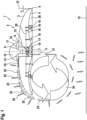
- the Figure 1 shows a schematic representation of a missile 1 in a first embodiment, which has at least one wing 2, which is round or ring-shaped in cross section with respect to a longitudinal center axis 3 of the wing 2.
- the wing 2 is delimited in the axial direction with respect to the longitudinal center axis 3 in a first direction by a first profile surface 4 and in a second direction by a second profile surface 5.
- Each of the profile surfaces 4 and 5 is in turn itself ring-shaped.
- the two profile surfaces 4 and 5 converge at a wing transition point 6, wherein the transition between the profile surfaces 4 and 5 at this point is preferably discontinuous when viewed in section.
- the profile surfaces 4 and 5 therefore preferably form an edge together at the wing transition point 6.
- the wing transition point 6 is for this purpose in the form of a geometric circle, for example, into which the first profile surface 4 flows at a first angle and the second profile surface 5 flows at a second angle different from the first angle.
- the first profile surface 4 encloses an air inlet opening 7 and the second profile surface 5 encloses an air outlet opening 8.
- the air inlet opening 7 and the air outlet opening 8 are fluidically connected to one another via a flow channel 9, with a ducted propeller 10 of an air conveying device 11 being rotatably mounted in the flow channel 9.
- the air conveying device 11 is part of a drive device 12 of the missile 1. It can be clearly seen that the first profile surface 4 is on a side of the missile 1 facing a ground 13, whereas the second profile surface 5 faces away from the ground 13. The missile 1 is shown here during normal and intended flight operations.
- the air inlet opening 7 and the air outlet opening 8 are located centrally with respect to the longitudinal center axis 3 and are enclosed by the first profile surface 4 and the second profile surface 5 on a wing inner side 14 lying radially inward.
- the flow channel 9, which fluidically connects the air inlet opening 7 and the air outlet opening 8 to one another, is for example in the form of a cylinder, in particular a circular cylinder and particularly preferably in the form of a straight circular cylinder.
- the air inlet opening 7 and the air outlet opening 8 have the same flow cross-section.
- the air inlet opening 7 is arranged on a lower side and the air outlet opening 8 on a upper side of the missile 1.
- the air outlet opening 8 is at least partially, in the embodiment shown here completely, surrounded by a Deflection element 15 overlaps, which together with the second profile surface 5 delimits an air outlet gap 16.
- the air outlet gap 16 is therefore located between the deflection element 15 and the second profile surface 5 when viewed in longitudinal section.
- the air outlet gap 16 is fluidically connected to the air outlet opening 8 via a connecting channel 17, the connecting channel 17 also being delimited at least in some areas by the deflection element 15 and the second profile surface 5.
- both the air outlet gap 16 and the connecting channel 17 are continuous in the circumferential direction with respect to the longitudinal center axis 3 and each completely encompass the longitudinal center axis 3.
- a flow cross-section of the connecting channel 17 decreases in the direction of the air outlet gap 16, so that the connecting channel 17 is in the form of a nozzle and the air outlet gap 16 represents an opening of this nozzle.
- the deflection element 15 can be displaced in such a way that a flow cross-sectional area of the air outlet gap 16 can be changed locally and/or globally.
- the deflection element 15 is coupled in terms of drive technology, for example, to a control drive of the missile 1 (not shown here).
- several first control elements 18 are connected in terms of drive technology to the control drive.
- second control elements (not shown here) can be present.
- the first control elements 18 originate from the first profile surface 4; the second control elements from the second profile surface 5.
- the control elements 18 each have a control fin 19 and are each connected in terms of drive technology to a coupling element 20 via a lever arm (not shown here) and a ball joint (also not shown), which is present, for example, as a control ring.
- the coupling element 20 serves for the drive-related connection of the control elements 18 to the control drive, in particular to several actuators of the control drive, which are not shown here.
- the drive device 12 When the missile 1 is in flight, the drive device 12 is operated in such a way that air is conveyed from the underside of the missile 1 in the direction of its upper side or in such a way that air in the form of an intake air flow 21 is sucked in in an intake direction through the air inlet opening 7 and conveyed through the flow channel 9 in the direction of the air outlet opening 8.
- the conveyed air is discharged through the air outlet opening 8 and fed to the air outlet gap 16 through the connecting channel 17.
- the air is discharged through the air outlet gap 16 in an outlet direction in the form of an air film 22 in such a way that that the air film 22 rests against the second profile surface 5.
- the air film 22 is preferably applied to the air outlet gap 16 parallel to the second profile surface 5.
- the air film 22 runs along the second profile surface 5 to the wing transition point 6. There, the air film 22 detaches from the wing 2 and flows as a free jet air flow 23 onto the underside of the missile 1, namely in a free jet direction.
- the free jet air flow 23 stimulates a support vortex 24, which provides at least part of the lift for the missile 1.
- the support vortex 24 is reinforced by the intake air flow 21. It can be seen that both the free jet air flow 23 and the intake air flow 21 are each tangential to the support vortex 24.
- the support vortex 24 formed Due to the annular shape of the wing 2, the support vortex 24 formed has a toroidal shape. For the sake of clarity, the support vortex 24 is only shown on one side of the wing 2.
- the support vortex 24 preferably completely and continuously surrounds the longitudinal center axis 3 in the circumferential direction. Due to the high speed of the air film 22, this causes a suction effect on the surrounding air. This means that additional air is supplied to the air film 22 as it flows over the second profile surface 5. This is indicated by the arrows 25.
- a vortex chamber 26 is formed on the wing 2, which is delimited in the radial direction outwards by the wing transition point 6.
- the vortex chamber 26 is formed, for example, by a curvature or a recess in the first profile surface 4.
- the second profile surface 5 merges into the first profile surface 4 at the wing transition point 6 at an angle ⁇ , which is determined with respect to a straight line 27 which runs parallel to the longitudinal center axis 3 through the wing transition point 6.
- the straight line 27 is in particular perpendicular to an imaginary straight line which continuously takes up the wing transition point 6.
- wing 2 design of the wing 2 described here as an annular wing 2 merely represents an advantageous embodiment.
- the wing 2 can also be straight in principle and have, for example, the cross-section shown.
- the advantages described can also be achieved in principle with such a design.
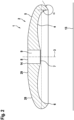
- the Figure 2 shows a schematic and simplified second embodiment of the missile 1, although some elements have not been shown for reasons of clarity.
- the second embodiment corresponds to the first embodiment, so reference is made to the corresponding embodiments and only the differences are discussed below.
- the angle ⁇ is negative or greater than 180°.
- the angle ⁇ is at least 270° and less than 360°.
- it is at least 300° and at most 345° or at most 330°.
- the second profile surface 5 starting from an outer side of the wing where it is at the greatest distance from the longitudinal center axis 3, approaches the longitudinal center axis 3 again before it merges into the first profile surface 4 at the wing transition point 6.
- the air inlet opening 7 is clearly spaced apart in the axial direction with respect to the longitudinal center axis 3 from an imaginary plane that continuously accommodates the wing transition point 6.
- the distance is at least 20%, at least 30%, at least 40% or at least 50% of an axial distance between the plane and a point on the second profile surface 5 or the air outlet opening that is furthest away from the plane in the axial direction when viewed in section.
- the air inlet opening 7 is arranged at a corresponding distance from the plane, so that the formation of the wing vortex is facilitated.
- the second profile surface 5 is not continuously curved, but is made up of a first region 28 and a second region 29.
- the first region 28 extends in section from the wing transition point 6 to directly to the second region 29. It is preferably continuously curved in section.
- the second region 29, on the other hand, is flat in section or has a different curvature to the first region 28.
- the transition between the first region 28 and the second region 29 is discontinuous in section. Alternatively, however, it can also be continuous.
- the Figure 3 shows a schematic representation of the fluid body 1 in a third embodiment.
- the difference is essentially that the deflection element 15 completely overlaps the wing 2 when viewed in section, so that it extends from the longitudinal center axis 3 of the wing 2 in the radial direction beyond the outside of the wing.
- the air inlet opening 7 and the air outlet opening 8 are preferably located in imaginary planes that are parallel and spaced apart from one another, are perpendicular to the longitudinal center axis 3 and rest against the wing 2 from opposite sides.
- the plane in which the air inlet opening 7 is located is arranged on an underside of the wing 2 and the plane in which the air outlet opening 8 is located is arranged on an upper side of the wing 2.
- the air outlet gap 16 is in the form of an annular gap and is completely accommodated in an imaginary plane that is perpendicular to the longitudinal center axis 3.
- This imaginary plane is preferably located between the planes of the air inlet opening 7 and the air outlet opening 8, in particular closer to the former. However, it can also be located on the side of the air inlet opening facing away from the air outlet opening 8.
- the described design enables particularly effective guidance of the air from the outlet opening 8 to the air outlet gap 16, in particular without using the Coanda effect.
- the deflection element 15 has several air guide webs.
- the air guide webs extend from a base body of the deflection element 15 and protrude into the connecting channel 17.
- the air guide webs extend in the radial direction and are preferably evenly distributed in the circumferential direction with respect to the longitudinal center axis 3.
- the air guide webs serve to guide the air entering the connecting channel 17 from the air outlet opening 8.
- the air conveying device 11 is preferably attached to the deflection element 15 and in particular is attached to the wing 2 only via the deflection element.
- the missile 1 is also preferably controlled using the first control elements 18 and/or the second control elements (not shown here).
- the first control elements 18 and the second control elements can be configured in accordance with the above statements be designed.
- a bearing can particularly preferably be implemented both on the wing 2 and on the deflection element 15.
- the second control elements are thus rotatably mounted on the wing 2 on the one hand and on the deflection element 15 on the other.
- a bearing can also only take place on the wing 2 or the deflection element 15, so that the control element or a shaft used to support the control element is spaced apart from the deflection element 15 or the wing 2.
- the missile 1 is controlled, for example, by displacing and/or deforming control elements that form part of the wing 2 and extend from a base body of the wing 2.
- the control elements are arranged and/or articulated on a side of the base body that is on the outside in the radial direction. By displacing and/or rotating the control elements with respect to the base body, the air escaping through the air outlet gap 16 can be diverted and the missile 1 can thus be controlled.
- the control elements can preferably be displaced and/or rotated independently of one another. However, they can also be coupled to one another so that the displacement and/or rotation takes place, for example, by means of a common actuator.
- the statements regarding the third embodiment can also be applied to the first embodiment and the second embodiment. It can therefore also be provided, for example, that the deflection element 15 completely overlaps the wing 2 in accordance with the difference described, but the optional control elements of the third embodiment are present instead of the control elements. Likewise, the deflection elements can of course be present, but the deflection element 15 only partially overlaps the wing 2. The deflection elements can therefore also be used in the context of the first embodiment or the second embodiment.
- the described missile 1 has the advantage in all embodiments that it operates extremely energy-efficiently due to the use of the support vortex 24 to provide at least part of the lift.
- the missile 1 can be controlled extremely precisely by means of the displaceable deflection element 15 and/or the control elements 18.
- the missile 1 can hover in the air analogously to a helicopter. Nevertheless, it can achieve quite high speeds because, unlike a helicopter, it is not limited by a maximum flow velocity at the blade tips of a rotor.
Landscapes
- Engineering & Computer Science (AREA)
- Aviation & Aerospace Engineering (AREA)
- Mechanical Engineering (AREA)
- Chemical & Material Sciences (AREA)
- Combustion & Propulsion (AREA)
- Transportation (AREA)
- Remote Sensing (AREA)
- Structures Of Non-Positive Displacement Pumps (AREA)
- Aerodynamic Tests, Hydrodynamic Tests, Wind Tunnels, And Water Tanks (AREA)
- Aiming, Guidance, Guns With A Light Source, Armor, Camouflage, And Targets (AREA)
- Toys (AREA)
Description
- Die Erfindung betrifft einen Flugkörper sowie ein Verfahren zum Betreiben eines Flugkörpers. Aus dem Stand der Technik ist beispielsweise die Druckschrift
DE 20 2018 104 722 U1 bekannt. Diese beschreibt ein Fluggerät mit einer Rahmenstruktur und mehreren an der Rahmenstruktur angeordneten Hubrotoren, mittels derer ein vertikal nach oben gerichteter Primärauftrieb sowie Vortriebskräfte erzeugbar sind. Dabei ist vorgesehen, dass darüber hinaus eine Strahlturbine vorgesehen ist, deren Schubstrahl so ausrichtbar ist, dass ein im Wesentlichen parallel zum Primärauftrieb gerichteter Sekundärauftrieb erzeugbar ist, der dem Primärauftrieb überlagerbar ist. - Ein weiteres Fluggerät ist aus der
US5203521 bekannt. Dieses hat einen ringförmigen Körper, welcher von einem Luftstrom umströmt wird, den eine zentrale Luftfördereinrichtung antreibt. - Es ist Aufgabe der Erfindung, einen Flugkörper vorzuschlagen, welcher gegenüber bekannten Flugkörpern Vorteile aufweist, insbesondere hinsichtlich seiner Nutzlast beliebig skalierbar ist und zudem einen besonders effizienten Betrieb ermöglicht.
- Dies wird erfindungsgemäß mit einem Flugkörper mit den Merkmalen des Anspruchs 1 erreicht.
- Der Flugkörper kann grundsätzlich beliebig ausgestaltet sein, beispielsweise liegt er als unbemanntes Fluggerät oder - bevorzugt - als Luftfahrzeug vor. Unter dem Luftfahrzeug ist ein Fahrzeug zu verstehen, das innerhalb der Erdatmosphäre fliegt. Es stellt insoweit ein mobiles Verkehrsmittel dar, das dem Transport von Personen, Gütern oder dergleichen dient. Das Luftfahrzeug ist also für den Personenverkehr und/oder dem Güterverkehr vorgesehen und ausgebildet. Der Flugkörper beziehungsweise das Luftfahrzeug ist schwerer als Luft und verfügt über die Antriebseinrichtung beziehungsweise einen Kraftantrieb, sodass der Flugkörper insgesamt als Flugzeug bezeichnet werden kann. Ein Flugzeug ist ganz allgemein ausgedrückt ein Luftfahrzeug, das schwerer als Luft ist und den zu seinem Fliegen nötigen dynamischen Auftrieb mit nicht-rotierenden Auftriebsflächen erzeugt.
- Der erfindungsgemäße Flugkörper verfügt über die Tragfläche, wobei selbstverständlich auch eine Mehrzahl von Tragflächen vorgehen kann, welche vorzugsweise miteinander verbunden sind, insbesondere über einen Aufbau des Flugkörpers. Im letzteren Fall gelten die nachfolgenden Ausführungen für die Tragfläche bevorzugt für mehrere der Tragflächen oder für jede der Tragflächen. Die Tragfläche wird im Schnitt gesehen von zwei Profilflächen begrenzt, nämlich von der ersten Profilfläche und der zweiten Profilfläche. Die erste Profilfläche und die zweite Profilfläche begrenzen insoweit die Tragfläche in gegenüberliegende Richtungen, insbesondere bezüglich einer Längsmittelachse der Tragfläche beziehungsweise des Flugkörpers. Bei einem bestimmungsgemäßen Betrieb des Flugkörpers ist die erste Profilfläche unten und die zweite Profifläche oben angeordnet, die erste Profilfläche liegt also auf der einem Boden, insbesondere einem Erdboden, zugewandten Seite des Flugkörpers vor, wohingegen die zweite Profilfläche auf einer dem Boden abgewandten Seite des Flugkörpers angeordnet ist.
- Im Schnitt gesehen laufen die erste Profilfläche und die zweite Profilfläche an der Tragflächenübergangsstelle zusammen und gehen daher an der Tragflächenübergangsstelle ineinander über. Die Tragflächenübergangsstelle ist beispielsweise eine Linie, insbesondere eine Linie mit stetigem Verlauf und/oder eine durchgehende Linie, oder verläuft durchgehend entlang der Linie. Unter der durchgehenden Linie ist zu verstehen, dass die Linie in sich geschlossen ist, also ein Startpunkt der Linie einem Endpunkt der Linie entspricht und der Startpunkt und der Endpunkt durchgehend miteinander verbunden sind. Die Linie kann beispielsweise eine gerade Linie sein. Bevorzugt ist sie jedoch rund beziehungsweise kreisförmig oder oval. Die Tragflächenübergangsstellen kann einer Tragflächenaußenseite entsprechen oder an dieser vorliegen. Die Tragflächenaußenseite stellt die am weitesten von der Längsmittelachse entfernteste Stelle der Tragfläche dar oder liegt an dieser Stelle vor. Beispielsweise ist die Tragflächenübergangsstelle eine Tragflächenübergangskante, an welcher die erste Profilfläche und die zweite Profilfläche im Schnitt gesehen unstetig aufeinanderstoßen und ineinander übergehen.
- Während die erste Profilfläche und die zweite Profilfläche an der Tragflächenübergangsstelle zusammenlaufen, können sie an einer der Tragflächenübergangsstelle im Schnitt gegenüberliegenden Tragflächeninnenseite voneinander beabstandet sein, insbesondere sind sie an der Tragflächeninnenseite voneinander beabstandet. Die erste Profilfläche und die zweite Profilfläche laufen also beispielsweise im Schnitt gesehen ausgehend von der Tragflächenübergangsstelle in Richtung der Tragflächeninnenseite voneinander fort, sodass sie an der Tragflächeninnenseite einen größeren Abstand voneinander aufweisen als an der Tragflächenübergangsstelle. Die Tragflächenübergangsstelle liegt insoweit im Schnitt gesehen in jedem Fall weiter außen als die Tragflächeninnenseite, insbesondere ist sie weiter von der Längsmittelachse beabstandet. Besonders bevorzugt ist es vorgesehen, dass der Abstand zwischen der ersten Profilfläche und der zweiten Profilfläche ausgehend von der Tragflächenübergangsstelle in Richtung der Tragflächeninnenseite stetig wächst. Hierzu sind die beiden Profilflächen entsprechend ausgestaltet und/oder angeordnet. Es kann jedoch auch vorgesehen sein, dass die erste Profilfläche und die zweite Profilfläche auf der Tragflächeninnenseite stetig ineinander übergehen. Mit einer derartigen Ausgestaltung der Tragfläche kann ein besonders turbulenzarmes und damit verlustfreies Einströmen von Luft durch die Lufteintrittsöffnung erzielt werden.
- Der Flugkörper weist die Lufteinlassöffnung und die Luftauslassöffnung auf. Während eines Betriebs des Flugkörpers wird durch die Lufteinlassöffnung Luft angesaugt und durch die Luftauslassöffnung ausgebracht. Hierzu sind die Lufteinlassöffnung und die Luftauslassöffnung strömungstechnisch miteinander verbunden, sodass die durch die Lufteinlassöffnung angesaugte Luft nachfolgend durch die Luftauslassöffnung ausgebracht wird. Es kann vorgesehen sein, dass lediglich eine einzige Lufteinlassöffnung vorliegt. Alternativ sind mehrere Lufteinlassöffnungen realisiert. Dies gilt entsprechend für die Luftauslassöffnung, sodass entweder eine einzige Luftauslassöffnung oder mehrere Luftauslassöffnungen vorliegen. Sofern im Rahmen dieser Beschreibung von der Lufteinlassöffnung die Rede ist, so gelten die entsprechenden Ausführungen stets für die wenigstens eine Lufteinlassöffnung und umgekehrt sowie - im Falle mehrerer Lufteinlassöffnungen - für jede der Lufteinlassöffnungen. Analog gelten die Ausführungen für die Luftauslassöffnungen stets für die wenigstens eine Luftauslassöffnung und umgekehrt sowie - im Falle mehrerer Luftauslassöffnungen - für jede der mehreren Luftauslassöffnungen. In diesem Sinne sind die Formulierungen Lufteinlassöffnung und wenigstens eine Lufteinlassöffnung einerseits sowie Luftauslassöffnung und wenigstens eine Luftauslassöffnung andererseits jeweils mit demselben Sinngehalt versehen.
- Die Lufteinlassöffnung ist von der ersten Profilfläche und die Luftauslassöffnung von der zweiten Profilfläche eingefasst. Darunter ist insbesondere zu verstehen, dass die Lufteinlassöffnung von der tragflächeninnenseitigen Seite der ersten Profilfläche und die Luftauslassöffnung von der tragflächeninnenseitigen Seite der zweiten Profilfläche begrenzt ist. Insbesondere umgibt die erste Profilfläche die Lufteinlassöffnung und die zweite Profilfläche die Luftauslassöffnung jeweils ringförmig. Es kann jedoch auch vorgesehen sein, dass die Lufteinlassöffnung die erste Profilfläche und/oder die Luftauslassöffnung die zweite Profilfläche durchgreift.
- Der Flugkörper verfügt über die Antriebseinrichtung, welche wiederum die Luftfördereinrichtung aufweist. Diese ist dazu vorgesehen und ausgebildet, während des bestimmungsgemäßen Flugbetriebs des Flugkörpers Luft von der Einlassöffnung in Richtung der Luftauslassöffnung zu fördern und insoweit Luft durch die Lufteinlassöffnung anzusaugen und durch die Luftauslassöffnung auszustoßen. Der Flugkörper ist nun geodätisch derart angeordnet, dass während des bestimmungsgemäßen Flugbetriebs des Flugkörpers die erste Profilfläche unten und die zweite Profilfläche oben angeordnet ist. Anders ausgedrückt ist die erste Profilfläche dem Boden beziehungsweise dem Erdboden zugewandt, wohingegen die zweite Profilfläche dem Boden beziehungsweise Erdboden abgewandt ist. Das bedeutet, dass die Antriebseinrichtung Luft von der Unterseite des Flugkörpers auf seine Oberseite fördert. Die Antriebseinrichtung ist insoweit dazu vorgesehen und ausgebildet, Luft von einer auf Seiten der ersten Profilfläche vorliegenden ersten Seite der Tragfläche, welche die Unterseite ist, auf eine auf Seiten der zweiten Profilfläche vorliegende zweite Seite der Tragfläche zu fördern, die die Oberseite darstellt.
- Um dennoch Auftrieb zu erzeugen und den Flugbetrieb zu ermöglichen, ist die Luftauslassöffnung zumindest bereichsweise von dem Umlenkelement übergriffen. Das Umlenkelement dient einer Umlenkung der durch die Luftauslassöffnung austretenden Luft und begrenzt hierzu gemeinsam mit der zweiten Profilfläche den Luftaustrittsspalt, der mit der Luftauslassöffnung in Strömungsverbindung steht. Da das Umlenkelement den Luftaustrittsspalt gemeinsam mit der zweiten Profilfläche begrenzt, tritt die aus der Luftauslassöffnung austretende und nachfolgend dem Luftaustrittsspalt zugeführte Luft durch den Luftaustrittsspalt zumindest teilweise parallel oder vollständig parallel zu der zweiten Profilfläche aus. Hierdurch wird ein Luftfilm auf der zweiten Profilfläche ausgebildet, welcher die zweite Profilfläche in Richtung der Tragflächenübergangsstelle überströmt. Der Luftaustrittsspalt ist also insbesondere für eine zu der zweiten Profilfläche parallele Ausbringung der Luft und zur Ausbildung eines Luftfilms auf der zweiten Profilfläche vorgesehen und ausgebildet.
- Spätestens an der Tragflächenübergangsstelle reißt der Luftfilm von der zweiten Profilfläche beziehungsweise von dem gesamten Flugkörper ab, um nachfolgend in Form eines Freistrahlluftstroms weiter zu strömen, nämlich in Richtung des Bodens. Dieser Freistrahlluftstrom induziert einen Tragwirbel. Tragflächeninnenseitig unterstützt das Ansaugen der Luft durch die Lufteinlassöffnung die Ausbildung des Tragwirbels, indem die Luft in Form eines Ansaugluftstroms in die Lufteintrittsöffnung angesaugt wird. Im Schnitt gesehen strömt nun einerseits des Tragwirbels der Freistrahlluftstrom in eine Freistrahlrichtung und andererseits des Tragwirbels der Ansaugluftstrom in eine Ansaugrichtung, wobei die Freistrahlrichtung und die Ansaugrichtung jeweils tangential zu dem Tragwirbel vorliegen und in unterschiedliche Richtungen weisen, insbesondere einander entgegengesetzt sind. Der Tragwirbel wird also zumindest durch den Freistrahlluftstrom ausgebildet. Zusätzlich kann (optional) der Ansaugluftstrom zur Ausbildung des Tragwirbels beitragen. Der Tragwirbel liegt bevorzugt zumindest bereichsweise unter der ersten Profilfläche vor, also insbesondere zwischen der ersten Profilfläche und dem Boden beziehungsweise Erdboden.
- Das Abreißen des Luftfilms von der zweiten Profilfläche erfolgt im Schnitt gesehen an einer Abrissstelle. Diese kann der Tragflächenübergangsstelle entsprechen oder aber von dieser beabstandet sein. Im Schnitt bezogen auf einen Abstand der Tragflächeninnenseite oder des Luftaustrittsspalts von der Tragflächenübergangsstelle entlang der zweiten Profilfläche beträgt der Abstand zwischen der Tragflächeninnenseite oder dem Luftaustrittsspalt einerseits und der Abrisstelle andererseits, wiederum entlang der zweiten Profilfläche, mindestens 50 %, mindestens 60 %, mindestens 70 %, mindestens 80 % oder mindestens 90 %. Besonders bevorzugt strömt der Luftfilm bis zu der Tragflächenübergangsstelle entlang der zweiten Profilfläche.
- Der auf den Flugkörper wirkende Auftrieb wird durch unterschiedliche Wirkmechanismen erzielt. Zum einen liegt aufgrund des Ausbringens der Luft aus dem Luftaustrittsspalt der Luftfilm auf der Oberseite der Tragfläche vor, welcher aufgrund seiner hohen Strömungsgeschwindigkeit nach der Bernoulli-Gleichung einen Unterdruck gegenüber der Unterseite der Tragfläche bewirkt. Da nämlich die Strömungsgeschwindigkeit der Luft auf Seiten der zweiten Profilfläche größer ist als die Strömungsgeschwindigkeit der Luft auf Seiten der ersten Profilfläche, ist der auf Seiten der zweiten Profilfläche vorliegende Druck kleiner als der auf Seiten der ersten Profilfläche vorliegende Druck. Die Druckdifferenz zwischen den Drücken seitens der ersten Profilfläche und seitens der zweiten Profilfläche, also die Druckdifferenz zwischen der Unterseite und der Oberseite der Tragfläche, bewirkt bereits einen Teil des auf den Flugkörper wirkenden Auftriebs. Ein weiterer Teil des Auftriebs wird durch den Tragwirbel bereitgestellt, sobald dieser vorliegt. Es ist einsichtig, dass der Tragwirbel erst dann ausgebildet werden kann, wenn ein hinreichender Abstand des Flugkörpers von dem Boden vorliegt. Um den von dem Tragwirbel erzeugten Auftrieb zu nutzen, ist es also zunächst notwendig, den Flugkörper von dem Boden zu beabstanden. Vorzugsweise erfolgt dies mithilfe einer mechanischen Hebevorrichtung, welche den Flugkörper gegenüber dem Boden anhebt.
- Die Verwendung des Tragwirbels zum zumindest teilweisen Bereitstellen des Auftriebs ermöglicht ein besonders energieeffizientes Betreiben des Flugkörpers, weil das Erzeugen und Erhalten des Tragwirbels mit einem vergleichsweise geringen Energieaufwand möglich ist, der deutlich geringer ist als der Energieaufwand, welcher zum unmittelbaren Anheben des Flugkörpers notwendig wäre. Der Tragwirbel hat zudem eine besonders hohe Stabilität des Flugkörpers in der Luft zur Folge, weil der Tragwirbel ein großes Luftvolumen einnimmt beziehungsweise ein voluminöses Luftpolster für den Flugkörper schafft. Die Tragfläche und insoweit der Flugkörper sind hinsichtlich der Tragfähigkeit beliebig skalierbar, weil auch der Tragwirbel grundsätzlich beliebig skalierbar ist. Der Tragwirbel wird nämlich nach Art eines Potentialwirbels ausgebildet.
- Die Tragfläche ist vorzugsweise im Schnitt gesehen symmetrisch, beispielsweise sogar rotationssymmetrisch. Grundsätzlich können zwei unterschiedliche Ausgestaltungen der Tragfläche unterschieden werden. Gemäß einer ersten Ausgestaltung ist die Tragfläche gerade und hierbei im Schnitt gesehen bezüglich einer Symmetrieachse symmetrisch ausgestaltet. Die Symmetrieachse wird im Rahmen dieser Beschreibung auch als Längsmittelachse bezeichnet. Die Symmetrieachse verläuft im Schnitt vorzugsweise mittig durch die Lufteinlassöffnung und die Luftauslassöffnung. Die erste Profilfläche und die zweite Profilfläche erstrecken sich also ausgehend von der Tragflächenübergangsstelle in Richtung der Symmetrieachse bis hin zu der Tragflächeninnenseite, welche vorzugsweise die Lufteinlassöffnung und/oder die Luftauslassöffnung begrenzt. Auf der gegenüberliegenden Seite der Symmetrieachse erstrecken sich die erste Profilfläche und die zweite Profilfläche wiederum von einer (weiteren) Tragflächeninnenseite bis hin zu einer (weiteren) Tragflächenübergangsstelle, an welcher sie wiederum zusammenlaufen. Die Tragflächenübergangsstellen verlaufen insoweit voneinander beabstandet, insbesondere parallel voneinander beabstandet. Sie verlaufen vorzugsweise jeweils gerade. Der Flugkörper ist im Schnitt gesehen bezüglich der Lufteinlassöffnung und/oder der Luftauslassöffnung oder bezüglich der mittig durch die Lufteinlassöffnung und/oder die Luftauslassöffnung verlaufenden Symmetrieachse symmetrisch. Bei einer solchen Ausgestaltung ist der Tragwirbel walzenförmig.
- Bevorzugt wird jedoch eine zweite Ausgestaltung des Flugkörpers, gemäß welcher die Tragfläche rund oder oval ist, sodass der Flugkörper beispielsweise nach Art einer Flugscheibe ausgestaltet ist. Die runde Tragfläche ist vorzugsweise rotationssymmetrisch bezüglich der Längsmittelachse, wobei die Längsmittelachse im Schnitt gesehen eine Spiegelachse der Tragfläche darstellt. Die Tragflächenübergangsstelle ist vorzugsweise in Umfangsrichtung bezüglich der Längsmittelachse durchgehend ausgebildet. Die Tragflächenübergangsstelle weist bevorzugt in Umfangsrichtung eine durchgehend konstante Krümmung auf, sodass die Tragflächenübergangsstelle schlussendlich kreisförmig verläuft. Die Tragfläche ist insoweit bezüglich der Längsmittelachse ringförmig. Im Falle der zweiten Ausführungsform des Flugkörpers ist der Tragwirbel torusförmig, wobei der Torus als Rotationskörper eines Kreises zu verstehen ist, insbesondere als Rotationskörper um die Längsmittelachse der Tragfläche. Eine solche in Umfangsrichtung geschlossene Ausbildung des Tragwirbels ermöglicht einen besonders energieeffizienten Flugbetrieb des Flugkörpers.
- Die Luftauslassöffnung und - bevorzugt - die Tragfläche werden zumindest bereichsweise von dem Umlenkelement übergriffen, insbesondere im Schnitt gesehen. Das Umlenkelement erstreckt sich beispielsweise in radialer Richtung bezüglich der Längsmittelachse der Tragfläche in radialer Richtung nach außen, nämlich insbesondere ausgehend von der der Längsmittelachse. In einer ersten Variante des Umlenkelements übergreift das Umlenkelement die Tragfläche in radialer Richtung über wenigstens 5 %, wenigstens 10 %, wenigstens 15 % oder wenigstens 20 % und insoweit lediglich teilweise und weniger als 50 %. In einer zweiten Variante übergreift es die Tragfläche über wenigstens 50 %, wenigstens 60 %, wenigstens 70 %, wenigstens 80 % oder wenigstens 90 % und somit nur teilweise, aber größtenteils. In einer dritten Variante, die eine besonders effiziente Bereitstellung der den Auftrieb bewirkenden Luft ermöglicht, übergreift das Umlenkelement die Tragfläche in radialer Richtung ausgehend von der Längsmittelachse vollständig, insbesondere ragt es in radialer Richtung über die Tragfläche hinaus. Beispielsweise ist das Umlenkelement hierbei derart ausgestaltet, dass der Luftaustrittsspalt von der Tragflächenübergangsstelle oder der Abrissstelle begrenzt ist. Der Luftaustrittsspalt umgreift zum Beispiel die Tragfläche im Schnitt gesehen außenseitig und liegt als Ringspalt zwischen dem Umlenkelement und der Tragfläche vor. Der Luftaustrittsspalt liegt in diesem Fall insbesondere vollständig in einer gedachten Ebene, die senkrecht auf der Längsmittelachse steht. Durch den Luftaustrittsspalt tritt insoweit die Luft in vertikaler Richtung in Richtung des Bodens aus.
- Eine Weiterbildung der Erfindung sieht vor, dass die wenigstens eine Lufteinlassöffnung zentral in der ersten Profilfläche und/oder die wenigstens eine Luftauslassöffnung zentral in der zweiten Profilfläche angeordnet ist. In anderen Worten sind die Lufteinlassöffnung beziehungsweise die Luftauslassöffnung im Schnitt, insbesondere im Längsschnitt bezüglich der Längsmittelachse, mittig in der jeweiligen Profilfläche ausgebildet. Das bedeutet, dass die aus der Luftauslassöffnung während eines Flugbetriebs des Flugkörpers ausströmende Luft einen Großteil der zweiten Profilfläche oder sogar die gesamte Profilfläche überströmt, insbesondere in Form des Luftfilms. Beispielsweise überströmt die Luft im Schnitt gesehen mindestens 50 %, mindestens 60 %, mindestens 70 %, mindestens 80 % oder mindestens 90 % der zweiten Profilfläche. Weil der Luftfilm während seines Überströmens der zweiten Profilfläche Umgebungsluft aufnimmt beziehungsweise mitnimmt, insbesondere durch die aufgrund seiner im Vergleich mit der Umgebungsluft höheren Strömungsgeschwindigkeit vorliegenden Saugwirkung, vergrößert sich der Massenstrom des Luftfilms während seines Überströmens der zweiten Profilfläche. Das bedeutet, dass der Freistrahlluftstrom, welcher schlussendlich den Tragwirbel erzeugt, zumindest zeitweise einen größeren Massenstrom aufweist als der Luftfilm unmittelbar bei seinem Austreten aus der Luftauslassöffnung beziehungsweise dem Luftaustrittsspalt. Hierdurch wird die Energieeffizienz des Flugkörpers nochmals verbessert.
- Eine Weiterbildung der Erfindung sieht vor, dass die Tragfläche bezüglich einer Längsmittelachse ringförmig ist und die Profilflächen im Längsschnitt gesehen in axialer Richtung bereichsweise voneinander beabstandet sind. Dies betrifft insbesondere die vorstehend bereits erwähnte zweite Ausführungsform des Flugkörpers. Gemäß dieser ist die Tragfläche ringförmig und bezüglich der Längsmittelachse bevorzugt rotationssymmetrisch. Im Längsschnitt bezüglich der Längsmittelachse gesehen sind die Profilflächen bereichsweise in axialer Richtung voneinander beabstandet, nämlich abseits der Tragflächenübergangsstelle, an welcher sie zusammenlaufen. Mit dieser Ausgestaltung des Flugkörpers wird der bereits erwähnte besonders energieeffiziente Flugbetrieb ermöglicht.
- Eine Weiterbildung der Erfindung sieht vor, dass die wenigstens eine Lufteinlassöffnung und die wenigstens eine Luftauslassöffnung über einen im Schnitt zentral in der Tragfläche ausgebildeten Strömungskanal strömungstechnisch verbunden sind, wobei in dem Strömungskanal ein Mantelpropeller der Luftfördereinrichtung um eine Drehachse drehbar angeordnet ist. Unter dem Schnitt ist wiederum bevorzugt der Längsschnitt bezüglich der Längsmittelachse der Tragfläche zu verstehen. Der die Lufteinlassöffnung und die Luftauslassöffnung strömungstechnisch miteinander verbindende Strömungskanal weist bevorzugt durchgehend einen konstanten Durchströmungsquerschnitt beziehungsweise eine konstante Durchströmungsquerschnittsfläche auf. Das bedeutet schlussendlich, dass die Lufteinlassöffnung und die Luftauslassöffnung über dieselbe Durchströmungsquerschnittsfläche verfügen.
- Die Lufteinlassöffnung ist in Umfangsrichtung bezüglich der Längsmittelachse durchgehend von der ersten Profilfläche begrenzt, sodass die erste Profilfläche an der Tragflächeninnenseite einen Rand der Lufteinlassöffnung ausbildet. Analog hierzu umgreift die zweite Profilfläche in Umfangsrichtung durchgehend die Luftauslassöffnung, sodass die zweite Profilfläche an der Tragflächeninnenseite einen Rand der Luftauslassöffnung ausbildet. Der Rand der Lufteinlassöffnung liegt bevorzugt durchgehend in einer gedachten ersten Ebene, wohingegen der Rand der Luftauslassöffnung bevorzugt durchgehend in einer gedachten zweiten Ebene liegt. Die beiden gedachten Ebenen sind insbesondere parallel zueinander angeordnet und stehen bevorzugt jeweils senkrecht auf der Längsmittelachse. Entsprechend sind eine Normalenrichtung der Lufteinlassöffnung und eine Normalenrichtung der Luftauslassöffnung parallel zu der Längsmittelachse angeordnet oder fallen mit dieser zusammen.
- In dem Strömungskanal ist der Mantelpropeller der Luftfördereinrichtung angeordnet und drehbar gelagert. Der Mantelpropeller ist dazu vorgesehen und ausgebildet, während des Flugbetriebs des Flugkörpers die Luft durch die Lufteinlassöffnung anzusaugen und in Richtung der Luftauslassöffnung zu fördern, sodass die durch die Lufteinlassöffnung angesaugte Luft nachfolgend aus der Luftauslassöffnung austritt. Der Mantelpropeller stellt ein Laufrad der Luftfördereinrichtung dar, welches als Axiallaufrad ausgestaltet ist. Zusätzlich zu dem Mantelpropeller kann die Luftfördereinrichtung über ein Leitrad verfügen, welches stromabwärts des Mantelpropellers angeordnet ist und einer Ausrichtung der es durchströmenden Luft parallel zu der Längsmittelachse dient. Der Mantelpropeller ist insgesamt derart angeordnet, dass er zum einen äußerst effizient arbeitet, weil Strömungsverluste an Blattspitzen des Mantelpropellers verringert werden, und zum anderen vor Beschädigungen zuverlässig geschützt ist.
- Eine Weiterbildung der Erfindung sieht vor, dass die Luftauslassöffnung mit dem Luftaustrittsspalt über einen Verbindungskanal strömungstechnisch verbunden ist, der im Schnitt gesehen zwischen der zweiten Profilfläche und dem Umlenkelement vorliegt. Der Verbindungskanal ist im Schnitt, insbesondere im Längsschnitt bezüglich der Längsmittelachse, einerseits von der zweiten Profilfläche und andererseits von dem Umlenkelement begrenzt, also auf gegenüberliegenden Seiten. Der Verbindungskanal verläuft vorzugsweise bezüglich des vorstehend erwähnten Strömungskanals angewinkelt, sodass eine Hauptströmungsrichtung der den Verbindungskanal durchströmenden Luft bezüglich einer Hauptströmungsrichtung der den Strömungskanal durchströmenden Luft angewinkelt ist, also einen Winkel einschließt, der größer als 0° und kleiner als 180° ist. Bevorzugt beträgt der Winkel mindestens 45° und höchstens 135°, mindestens 60° und höchstens 120°, mindestens 70° und höchstens 110°, mindestens 80° und höchstens 100° oder in etwa oder genau 90°.
- Der Verbindungskanal ist bevorzugt ebenso wie der Luftaustrittsspalt in Umfangsrichtung bezüglich der Längsmittelachse durchgehend und insbesondere unterbrechungsfrei ausgebildet, sodass der Luftfilm auf der zweiten Profilfläche ebenfalls durchgehend und unterbrechungsfrei ausgebildet wird. Hierdurch wird der Tragwirbel besonders effizient erzeugt. Selbstredend können jedoch dünne Stege vorliegen, mittels welchen das Umlenkelement mit der Tragfläche verbunden ist. Aus strömungstechnischer Sicht sind diese Stege derart ausgestaltet, dass dennoch von dem unterbrechungsfreien Verbindungskanal und dem unterbrechungsfreien Luftaustrittsspalt ausgegangen werden kann.
- Eine Weiterbildung der Erfindung sieht vor, dass der Verbindungskanal einen sich in Richtung des Luftaustrittsspalts vergrößernden oder verkleinernden Querschnitt aufweist, sodass er nach Art einer Düse ausgestaltet ist. In Abhängigkeit von der Strömungsgeschwindigkeit der Luft in dem Strömungskanal kann der Verbindungskanal sich in Richtung des Luftaustrittsspalts entweder erweitern oder verjüngen. Die Gestalt des Verbindungskanals wird insbesondere derart gewählt, dass die Luft in dem Luftaustrittsspalt beziehungsweise der Luftfilm unmittelbar nach seinem Austreten durch den Luftaustrittsspalt eine gewünschte Strömungsgeschwindigkeit aufweist. Diese Strömungsgeschwindigkeit liegt bevorzugt im Unterschallbereich, sodass keine negativen mechanischen Einflüsse auf den Flugkörper durch strömungstechnische Stöße oder dergleichen zu erwarten sind. Die Ausgestaltung des Verbindungskanals nach Art einer Düse ermöglicht einen effektiven Betrieb des Flugkörpers.
- Eine Weiterbildung der Erfindung sieht vor, dass der Luftaustrittsspalt durchgehend ausgebildet ist, insbesondere in Umfangsrichtung bezüglich der Längsmittelachse. Hierauf wurde vorstehend bereits hingewiesen. Eine solche Ausgestaltung ermöglicht eine gleichmäßige Erzeugung des Luftfilms und entsprechend ein besonders effizientes Anregen des Tragwirbels.
- Eine Weiterbildung der Erfindung sieht vor, dass die zweite Profilfläche einen von der Tragflächenübergangsstelle ausgehenden ersten Bereich und einen sich an den ersten Bereich anschließenden und den Luftaustrittsspalt begrenzenden zweiten Bereich aufweist, wobei - im Schnitt gesehen - der erste Bereich gekrümmt ist, insbesondere durchgehend, und der zweite Bereich gekrümmt oder plan ist. Die zweite Profilfläche weist also den ersten Bereich und den zweiten Bereich auf, insbesondere setzt sie sich ausschließlich aus dem ersten Bereich und dem zweiten Bereich zusammen. Bevorzugt sind der erste Bereich und der zweite Bereich jeweils ringförmig ausgestaltet, wobei der erste Bereich den zweiten Bereich in Umfangsrichtung bezüglich der Längsmittelachse umgreift. Der erste Bereich schließt sich unmittelbar an den zweiten Bereich an, insbesondere geht der erste Bereich nahtlos und stetig in den zweiten Bereich über.
- Im Schnitt, insbesondere im Längsschnitt bezüglich der Längsmittelachse gesehen, ist der erste Bereich der zweiten Profilfläche gekrümmt, nämlich in radialer Richtung bezüglich der Längsmittelachse nach außen von dem Umlenkelement fort. Das bedeutet, dass der Abstand in axialer Richtung zwischen der zweiten Profilfläche und dem Umlenkelement in dem ersten Bereich mit zunehmendem Abstand in radialer Richtung ebenfalls zunimmt. Besonders bevorzugt ist der erste Bereich durchgehend gekrümmt, weist also im Schnitt beziehungsweise Längsschnitt gesehen durchgehend eine von 0 verschiedene Krümmung auf.
- Der zweite Bereich kann ebenfalls gekrümmt sein, beispielsweise teilweise oder durchgehend. Er kann jedoch auch durchgehend plan sein oder - alternativ - teilweise gekrümmt und teilweise plan ausgeführt sein. Beispielsweise liegt der zweite Bereich im Schnitt gesehen in Überdeckung mit dem Umlenkelement vor. In radialer Richtung abseits beziehungsweise außerhalb des Umlenkelements liegt hingegen der erste Bereich vor. Die Aufteilung der zweiten Profilfläche in den ersten Bereich und den zweiten Bereich ermöglicht eine besonders vorteilhafte Luftführung, sodass der die zweite Profilfläche überstreichende Luftfilm nach seinem Abreißen von der Tragfläche den Tragwirbel auf besonders effektive Art und Weise erzeugt.
- Eine Weiterbildung der Erfindung sieht vor, dass die erste Profilfläche im Schnitt gesehen bereichsweise gegenüber der Tragflächenübergangsstelle in Richtung der zweiten Profilfläche zurückversetzt ist, sodass eine Wirbelkammer ausgebildet ist, die von der Tragflächenübergangsstelle umgriffen ist. Unter dem Schnitt ist wiederum bevorzugt der Längsschnitt bezüglich der Längsmittelachse zu verstehen. Das bereichsweise Zurückversetzen der ersten Profilfläche bezüglich der Tragflächenübergangsstelle ist beispielsweise durch eine Krümmung der ersten Profilfläche und/oder einen Rücksprung, also insbesondere die Ausbildung einer Stufe, realisiert. Im Falle der Krümmung ist ein Krümmungsradius der Krümmung bevorzugt derart gewählt, dass er größer ist als ein Radius des erzeugten Tragwirbels oder diesem in etwa oder genau entspricht.
- Die Wirbelkammer ist in axialer Richtung nach oben von der ersten Profilfläche und in radialer Richtung nach außen von der Tragflächenübergangsstelle begrenzt. In radialer Richtung nach innen erstreckt sich die Wirbelkammer vorzugsweise bis hin zu der Lufteintrittsöffnung. Die Wirbelkammer dient einer bereichsweisen Aufnahme des Tragwirbels während des Flugbetriebs des Flugkörpers und bewirkt eine Stabilisierung und Positionierung des Tragwirbels, insbesondere in radialer Richtung. Aufgrund der Positionierung des Tragwirbels mithilfe der Wirbelkammer wird eine besonders effektive Erzeugung des Auftriebs erzielt.
- Eine Weiterbildung der Erfindung sieht vor, dass die erste Profilfläche und die zweite Profilfläche im Schnitt gesehen zumindest bereichsweise gleichsinnig gekrümmt sind. Unter der gleichsinnigen Krümmung ist eine Krümmung mit demselben Vorzeichen zu verstehen. Hierdurch wird eine besonders material- und gewichtssparende Ausgestaltung des Flugkörpers erzielt. Beispielsweise ist es vorgesehen, dass die erste Profilfläche ausgehend von der Tragflächenübergangsstelle bis hin zu der Tragflächeninnenseite beziehungsweise bis hin zu der Lufteinlassöffnung eine durchgehend konstante Krümmung aufweist. Zusätzlich oder alternativ verfügt die erste Profilfläche über eine sich ausgehend von der Tragflächenübergangsstelle in Richtung der Tragflächeninnenseite verändernde, insbesondere abnehmende Krümmung.
- Beispielsweise ist die Krümmung der ersten Profilfläche unmittelbar an der Tragflächenübergangsstelle größer als die Krümmung der zweiten Profilfläche. In Richtung der Tragflächeninnenseite verringert sich hingegen die Krümmung der ersten Profilfläche, beispielsweise bis hin zu einer Krümmung von 0. Besonders bevorzugt weist die erste Profilfläche im Schnitt beziehungsweise Längsschnitt gesehen beabstandet von der Tragflächenübergangsstelle einen geraden Verlauf auf, wobei eine diesen geraden Verlauf der ersten Profilfläche aufnehmende gedachte Ebene bevorzugt senkrecht auf der Längsmittelachse steht. Im Bereich des geraden Verlaufs begrenzt die erste Profilfläche besonders bevorzugt den Luftaustrittsspalt. Hierdurch wird eine besonders effektive Luftführung erzielt.
- Eine Weiterbildung der Erfindung sieht vor, dass die zweite Profilfläche an der Tragflächenübergangsstelle unter einem Winkel in die erste Profilfläche übergeht, der bezüglich einer senkrecht auf einer die Tragflächenübergangsstelle durchgehend aufnehmenden gedachten Ebene stehenden Geraden mindestens 0° und höchstens 60° beträgt. Dies gilt insbesondere im Schnitt, vorzugsweise im Längsschnitt bezüglich der Längsmittelachse gesehen. Die gedachte Ebene soll die Tragflächenübergangsstelle durchgehend aufnehmen. Zusätzlich steht sie besonders bevorzugt senkrecht auf der Längsmittelachse. Die Gerade steht wiederum senkrecht auf der gedachten Ebene und ist insoweit bevorzugt parallel zu der Längsmittelachse der Tragfläche angeordnet.
- Unmittelbar an der Tragflächenübergangsstelle schließt die zweite Profilfläche mit der Geraden den Winkel von mindestens 0° und höchstens 60° ein. Es kann also vorgesehen sein, dass die zweite Profilfläche parallel zu der Geraden in die zweite Profilfläche übergeht. Vorzugsweise ist der Winkel jedoch größer als 0°. Beispielsweise beträgt er mindestens 15° und höchstens 60°, mindestens 30° und höchstens 50° oder in etwa oder genau 0°, in etwa oder genau 30° oder in etwa oder genau 50°. In dem genannten Winkelbereich wird eine vorzeitige Ablösung des Luftfilms von der zweiten Profilfläche zuverlässig verhindert, sodass der entstehende Freistrahlluftstrom den Tragwirbel besonders effektiv ausbildet.
- Eine Weiterbildung der Erfindung sieht vor, dass das Umlenkelement zur globalen und/oder lokalen Veränderung einer Strömungsquerschnittsfläche des Luftaustrittsspalts verlagerbar ist. Das Umlenkelement ist insoweit derart verlagerbar, insbesondere mittels eines Steuerantriebs, dass die Größe des Luftaustrittsspalts verändert wird, nämlich entweder global und/oder lokal. Unter der globalen Veränderung des Luftaustrittsspalts beziehungsweise der Strömungsquerschnittsfläche des Luftaustrittsspalts ist zu verstehen, dass die Größe des Luftaustrittsspalts beziehungsweise der Durchströmungsquerschnittsfläche gleichmäßig über die gesamte Erstreckung des Luftaustrittsspalts verändert, also vergrößert oder verkleinert, wird. Die lokale Veränderung bedeutet hingegen eine lediglich bereichsweise Vergrößerung oder Verkleinerung des Luftaustrittsspalts beziehungsweise der Strömungsquerschnittsfläche. Beispielsweise wird zur lokalen Veränderung das Umlenkelement derart verlagert, dass der Luftaustrittsspalt bereichsweise vergrößert und bereichsweise verkleinert wird. Durch die Veränderung der Strömungsquerschnittsfläche des Luftaustrittsspalts lässt sich eine Steuerung des Flugkörpers, insbesondere einer Flugrichtung des Flugkörpers, auf einfache Art und Weise bewerkstelligen.
- Eine Weiterbildung der Erfindung sieht vor, dass zur globalen Veränderung der Strömungsquerschnittsfläche des Luftaustrittsspalts der Abstand des Umlenkelements zu der zweiten Profilfläche gleichmäßig veränderbar ist. Unter dem gleichmäßigen Verändern ist ein gleichmäßiges Vergrößern oder ein gleichmäßiges Verkleinern des Luftaustrittsspalts zu verstehen. Beispielsweise wird hierzu das Umlenkelement parallel zu der Längsmittelachse der Tragfläche verlagert, nämlich zur Vergrößerung der Luftaustrittsfläche von der zweiten Profilfläche fort und zur Verkleinerung der Strömungsquerschnittsfläche auf die zweite Profilfläche zu. Dies ermöglicht ein besonders effektives Steuern des Flugkörpers durch ein Einstellen der Wirbelintensität des Tragwirbels.
- Eine Weiterbildung der Erfindung sieht vor, dass zur lokalen Veränderung der Strömungsquerschnittsfläche des Luftaustrittsspalts das Umlenkelement bezüglich der zweiten Profilfläche verkippbar ist. Durch das Verkippen des Umlenkelements wird der Luftaustrittsspalt lokal verändert, insbesondere teilweise vergrößert und teilweise verkleinert. Das Verkippen erfolgt beispielsweise bezüglich der Längsmittelachse der Tragfläche. Bevorzugt ist das Umlenkelement derart ausgestaltet, dass bei einer parallelen Ausrichtung des Umlenkelements bezüglich der Längsmittelachse und insoweit einem Winkel von 0° der Luftaustrittsspalt in Umfangsrichtung bezüglich der Längsmittelachse eine durchgehend gleichbleibende Größe aufweist. Bei einer Veränderung des Winkels tritt hingegen die lokale Veränderung der Strömungsquerschnittsfläche auf. Wiederum ermöglicht eine solche Ausgestaltung eine besonders effiziente Steuerung des Flugkörpers.
- Eine Weiterbildung der Erfindung sieht vor, dass von der ersten Profilfläche erste Steuerelemente und/oder von der zweiten Profilfläche zweite Steuerelemente ausgehen, die jeweils eine Steuerfinne aufweisen. Die ersten Steuerelemente und die zweiten Steuerelemente dienen einer Steuerung des Flugkörpers, nämlich durch Beeinflussung des Luftfilms und/oder des Tragwirbels. Es kann vorgesehen sein, dass lediglich die ersten Steuerelemente, nicht jedoch die zweiten Steuerelemente, oder lediglich die zweiten Steuerelemente, nicht jedoch die ersten Steuerelemente vorliegen. Es kann jedoch auch vorgesehen sein, dass sowohl die ersten Steuerelemente als auch die zweiten Steuerelemente realisiert sind. Jedes der Steuerelemente verfügt über jeweils eine Steuerfinne, welche beispielsweise plattenartig oder tragflächenartig ausgestaltet ist. Die Steuerfinne kann in letzterem Fall bezüglich ihrer Profilsehne symmetrisch sein oder ein strömungstechnisches Profil aufweisen. Die ersten Steuerelemente, die von der ersten Profilfläche ausgehen, dienen einer direkten Beeinflussung des Tragwirbels, wohingegen die zweiten Steuerelemente, die von der zweiten Profilfläche ausgehen, einer direkten Beeinflussung des Luftfilms und mithin einer lediglich mittelbaren Beeinflussung des Tragwirbels dienen. In Abhängigkeit von einem Anstellwinkel der Steuerelemente werden der Tragwirbel und/oder der Luftfilm abgelenkt, sodass eine Steuerung des Flugkörpers auf effektive Art und Weise realisiert ist. Die Steuerelemente können zusätzlich oder alternativ zu der Verlagerbarkeit des Umlenkelements realisiert sein. Die zweiten Steuerelemente sind beispielsweise in dem zweiten Bereich der zweiten Profilfläche angeordnet oder in diesem gelagert.
- Eine Weiterbildung der Erfindung sieht vor, dass die ersten Steuerelemente und/oder die zweiten Steuerelemente über ein gemeinsames Koppelelement mit einem Steuerantrieb des Flugkörpers antriebstechnisch gekoppelt sind. Der Steuerantrieb dient dem Verstellen der Steuerelemente. Er ist lediglich mittelbar über das gemeinsame Koppelelement an die Steuerelemente antriebstechnisch angebunden. Hierzu greifen einerseits die Steuerelemente und andererseits der Steuerantrieb an dem Koppelelement an. Insbesondere greift der Steuerantrieb beabstandet von den Steuerelementen an dem Koppelelement an. Hierdurch wird ein gleichzeitiges Verstellen der Steuerelemente mittels des Steuerantriebs realisiert. Auch das Umlenkelement kann zusätzlich oder alternativ an das Koppelelement angebunden sein.
- Eine Weiterbildung der Erfindung sieht vor, dass das Koppelelement jeweils über ein Kugelgelenk und einen Hebelarm mit den ersten Steuerelementen und/oder den zweiten Steuerelementen und/oder dem Steuerantrieb gekoppelt ist. Jedem Steuerelement und/oder dem Steuerantrieb ist insoweit jeweils ein Kugelelement und ein Hebelarm zugeordnet, mittels welchem sie mit dem Steuerantrieb antriebstechnisch verbunden sind. Die Verwendung des Kugelgelenks stellt ein äußerst flexibles Einstellen der Steuerelemente mittels des Steuerantriebs sicher.
- Eine Weiterbildung der Erfindung sieht vor, dass das Koppelelement als Steuerring ausgebildet ist. Der Steuerring umgreift vorzugsweise die Längsmittelachse der Tragfläche in Umfangsrichtung durchgehend und vollständig. Er greift sowohl an den ersten Steuerelementen als auch an den zweiten Steuerelementen - soweit jeweils vorhanden - an, um diese mit dem Steuerantrieb zu koppelt. Der Steuerring ist derart angeordnet, dass er nicht lediglich eine Drehbewegung in Umfangsrichtung bezüglich der Längsmittelachse beschreiben kann, sondern dass er zusätzlich verkippbar ist und somit nach Art einer Taumelscheibe vorliegt. Dies ermöglicht das bereits erwähnte flexible Betätigen der Steuerelemente mittels des Steuerantriebs.
- Eine Weiterbildung der Erfindung sieht vor, dass der Steuerantrieb mehrere Stellantriebe aufweist, die jeweils beabstandet voneinander mit dem Koppelement antriebstechnisch gekoppelt sind. Vorzugsweise sind die Stellantriebe gleichmäßig voneinander beabstandet, sodass also im Falle von zwei Stellantrieben diese mit einem Abstand von 180° an dem Koppelelement angreifen, im Falle von drei Stellelementen mit einem Abstand von 120° und im Falle von vier Stellelementen mit einem Abstand von 90°. Die Verwendung der mehreren Stellantriebe ermöglicht eine Verlagerung des Koppelements nicht lediglich in Umfangsrichtung bezüglich der Längsmittelachse, sondern zusätzlich in radialer Richtung, sodass das bereits beschriebene flexible Einstellen der Steuerelemente realisiert ist.
- Die Erfindung betrifft weiterhin ein Verfahren zum Betreiben eines Flugkörpers gemäß Anspruch 14.
- Auf die Vorteile einer derartigen Ausgestaltung des Flugkörpers beziehungsweise einer derartigen Vorgehensweise wurde bereits hingewiesen. Sowohl der Flugkörper als auch das Verfahren zu seinem Betreiben können gemäß den Ausführungen im Rahmen dieser Beschreibung weitergebildet sein, sodass insoweit auf diese verwiesen wird.
- Eine Weiterbildung der Erfindung sieht vor, dass mittels der Antriebseinrichtung Luft in Form eines Ansaugluftstroms in einer Ansaugrichtung durch die Lufteintrittsöffnung angesaugt und durch den Luftaustrittsspalt in einer bezüglich der Ansaugrichtung angewinkelten Austrittsrichtung derart ausgebracht wird, dass an der Tragflächenübergangsstelle die Luft einen Freistrahlluftstrom in einer Freistrahlrichtung bildet, sodass zwischen Ansaugluftstrom und Freistrahlluftstrom ein Tragwirbel ausgebildet wird, der zumindest bereichsweise unter der ersten Profilfläche vorliegt. Auch hierauf wurde bereits eingegangen.
- Die Erfindung wird nachfolgend anhand der in der Zeichnung dargestellten Ausführungsbeispiele näher erläutert, ohne dass eine Beschränkung der Erfindung erfolgt. Dabei zeigt
- Figur 1
- eine schematische Darstellung einer ersten Ausführungsform eines Flugkörpers im Längsschnitt bezüglich einer Längsmittelachse,
- Figur 2
- eine vereinfachte schematische Darstellung des Flugkörpers in einer zweiten Ausführungsform, sowie
- Figur 3
- eine schematische Darstellung des Flugkörpers in einer dritten Ausführungsform.
- Die
Figur 1 zeigt eine schematische Darstellung eines Flugkörpers 1 in einer ersten Ausführungsform, welcher zumindest eine Tragfläche 2 aufweist, die im Querschnitt bezüglich einer Längsmittelachse 3 der Tragfläche 2 rund beziehungsweise ringförmig ist. Die Tragfläche 2 wird in axialer Richtung bezüglich der Längsmittelachse 3 in einer ersten Richtung von einer ersten Profilfläche 4 und in einer zweiten Richtung von einer zweiten Profilfläche 5 begrenzt. Jede der Profilflächen 4 und 5 ist wiederum selbst ringförmig. Die beiden Profilflächen 4 und 5 laufen an einer Tragflächenübergangsstelle 6 zusammen, wobei der Übergang zwischen den Profilflächen 4 und 5 an dieser Stelle im Schnitt gesehen vorzugsweise unstetig ist. Die Profilflächen 4 und 5 bilden also bevorzugt an der Tragflächenübergangsstelle 6 gemeinsam eine Kante aus. Die Tragflächenübergangsstelle 6 liegt hierzu beispielsweise in Form eines geometrischen Kreises vor, in welchen die erste Profilfläche 4 unter einem ersten Winkel und die zweite Profilfläche 5 unter einem von dem ersten Winkel verschiedenen zweiten Winkel einmündet. - Die erste Profilfläche 4 fasst eine Lufteinlassöffnung 7 und die zweite Profilfläche 5 eine Luftauslassöffnung 8 ein. Die Lufteinlassöffnung 7 und die Luftauslassöffnung 8 sind über einen Strömungskanal 9 strömungstechnisch miteinander verbunden, wobei in dem Strömungskanal 9 ein Mantelpropeller 10 einer Luftfördereinrichtung 11 drehbar gelagert angeordnet ist. Die Luftfördereinrichtung 11 ist Bestandteil einer Antriebseinrichtung 12 des Flugkörpers 1. Es ist deutlich zu erkennen, dass die erste Profilfläche 4 auf einer einem Boden 13 zugewandten Seite des Flugkörpers 1 vorliegt, wohingegen die zweite Profilfläche 5 dem Boden 13 abgewandt ist. Der Flugkörper 1 ist hier während eines normalen und bestimmungsgemäßen Flugbetriebs dargestellt.
- Die Lufteinlassöffnung 7 und die Luftauslassöffnung 8 liegen mittig bezüglich der Längsmittelachse 3 vor und werden von der ersten Profilfläche 4 beziehungsweise der zweiten Profilfläche 5 auf einer in radialer Richtung innen liegenden Tragflächeninnenseite 14 von diesen eingefasst. Der Strömungskanal 9, welcher die Lufteinlassöffnung 7 und die Luftauslassöffnung 8 strömungstechnisch miteinander verbindet, liegt beispielsweise in Form eines Zylinders, insbesondere eines Kreiszylinders und besonders bevorzugt in Form eines geraden Kreiszylinders, vor. Besonders bevorzugt weisen die Lufteinlassöffnung 7 und die Luftauslassöffnung 8 denselben Durchströmungsquerschnitt auf. Die Lufteinlassöffnung 7 ist an einer Unterseite und die Luftauslassöffnung 8 an einer Oberseite des Flugkörpers 1 angeordnet. Die Luftauslassöffnung 8 ist zumindest bereichsweise, in dem hier dargestellten Ausführungsbeispiel vollständig, von einem Umlenkelement 15 übergriffen, welches gemeinsam mit der zweiten Profilfläche 5 einen Luftaustrittsspalt 16 begrenzt. Der Luftaustrittsspalt 16 liegt also im Längsschnitt gesehen zwischen dem Umlenkelement 15 und der zweiten Profilfläche 5 vor.
- Der Luftaustrittsspalt 16 ist über einen Verbindungskanal 17 strömungstechnisch mit der Luftauslassöffnung 8 verbunden, wobei der Verbindungskanal 17 ebenfalls von dem Umlenkelement 15 und der zweiten Profilfläche 5 zumindest bereichsweise begrenzt ist. Sowohl der Luftaustrittsspalt 16 als auch der Verbindungskanal 17 sind in dem hier dargestellten Ausführungsbeispiel in Umfangsrichtung bezüglich der Längsmittelachse 3 durchgehend ausgebildet und umgreifen die Längsmittelachse 3 jeweils vollständig. Gemäß dem dargestellten Ausführungsbeispiel verkleinert sich ein Durchströmungsquerschnitt des Verbindungskanals 17 in Richtung des Luftaustrittsspalts 16, sodass der Verbindungskanal 17 nach Art einer Düse vorliegt und der Luftaustrittsspalt 16 eine Mündungsöffnung dieser Düse darstellt.
- Das Umlenkelement 15 ist derart verlagerbar, dass eine Strömungsquerschnittsfläche des Luftaustrittspalts 16 lokal und/oder global veränderbar ist. Hierzu ist das Umlenkelement 15 beispielsweise mit einem hier nicht dargestellten Steuerantrieb des Flugkörpers 1 antriebstechnisch gekoppelt. Zusätzlich oder alternativ sind mehrere erste Steuerelemente 18 antriebstechnisch mit dem Steuerantrieb verbunden. Zusätzlich oder alternativ zu den ersten Steuerelementen 18 können hier nicht dargestellte zweite Steuerelemente vorliegen. Die ersten Steuerelemente 18 gehen von der ersten Profilfläche 4 aus; die zweiten Steuerelemente von der zweiten Profilfläche 5. Die Steuerelemente 18 verfügen jeweils über eine Steuerfinne 19 und sind jeweils über einen hier nicht dargestellten Hebelarm und ein ebenfalls nicht dargestelltes Kugelgelenk mit einem Koppelelement 20 antriebstechnisch verbunden, welches beispielsweise als Steuerring vorliegt. Das Koppelelement 20 dient der antriebstechnischen Anbindung der Steuerelemente 18 an den Steuerantrieb, insbesondere an mehrere Stellantriebe des Steuerantriebs, welche hier nicht dargestellt sind.
- Bei einem Flugbetrieb des Flugkörpers 1 wird die Antriebseinrichtung 12 derart betrieben, dass Luft von der Unterseite des Flugkörpers 1 in Richtung seiner Oberseite gefördert wird beziehungsweise derart, dass Luft in Form eines Ansaugluftstroms 21 in einer Ansaugrichtung durch die Lufteinlassöffnung 7 angesaugt und durch den Strömungskanal 9 in Richtung der Luftauslassöffnung 8 gefördert wird. Die geförderte Luft wird durch die Luftauslassöffnung 8 ausgebracht und durch den Verbindungskanal 17 dem Luftaustrittsspalt 16 zugeführt. Durch den Luftaustrittsspalt 16 wird die Luft in einer Austrittsrichtung in Form eines Luftfilms 22 derart ausgebracht, dass der Luftfilm 22 an der zweiten Profilfläche 5 anliegt. Hierzu wird der Luftfilm 22 vorzugsweise an dem Luftaustrittsspalt 16 parallel zu der zweiten Profilfläche 5 ausgebracht.
- Aufgrund des Coandä-Effekts läuft der Luftfilm 22 entlang der zweiten Profilfläche 5 bis zu der Tragflächenübergangsstelle 6. Dort löst sich der Luftfilm 22 von der Tragfläche 2 und strömt als Freistrahlluftstrom 23 wiederum auf die Unterseite des Flugkörpers 1, nämlich in einer Freistrahlrichtung. Hierbei regt der Freistrahlluftstrom 23 einen Tragwirbel 24 an, der zumindest einen Teil des Auftriebs für den Flugkörper 1 bereitstellt. Verstärkt wird der Tragwirbel 24 durch den Ansaugluftstrom 21. Es ist erkennbar, dass sowohl der Freistrahlluftstrom 23 als auch der Ansaugluftstrom 21 jeweils tangential zu dem Tragwirbel 24 vorliegen. Aufgrund der ringförmigen Gestalt der Tragfläche 2 weist der ausgebildete Tragwirbel 24 eine torusförmige Gestalt auf. Der Übersicht wegen ist der Tragwirbel 24 lediglich auf einer Seite der Tragfläche 2 dargestellt. Selbstverständlich umgreift der Tragwirbel 24 jedoch die Längsmittelachse 3 in Umfangsrichtung vorzugsweise vollständig und durchgehend. Aufgrund der hohen Geschwindigkeit des Luftfilms 22 bewirkt dieser auf die umgebende Luft eine Sogwirkung. Das bedeutet, dass dem Luftfilm 22 bei seinem Überströmen der zweiten Profilfläche 5 weitere Luft zugeführt wird. Dies ist durch die Pfeile 25 angedeutet.
- Um eine präzise Positionierung des Tragwirbels 24 unterhalb der Tragfläche 2 zu erzielen, ist an der Tragfläche 2 eine Wirbelkammer 26 ausgebildet, die in radialer Richtung nach außen von der Tragflächenübergangsstelle 6 begrenzt ist. Die Wirbelkammer 26 ist beispielsweise durch eine Krümmung oder einen Rücksprung der ersten Profilfläche 4 ausgebildet. Um eine besonders vorteilhafte Umströmung der zweiten Profilfläche 5 durch den Luftfilm 22 zu realisieren, geht die zweite Profilfläche 5 an der Tragflächenübergangsstelle 6 unter einem Winkel α in die erste Profilfläche 4 über, der bezüglich einer Geraden 27 bestimmt wird, welche parallel zu der Längsmittelachse 3 durch die Tragflächenübergangsstelle 6 verläuft. Die Gerade 27 steht insbesondere senkrecht auf einer gedachten Geraden, welche die Tragflächenübergangsstelle 6 durchgehend aufnimmt.
- Es sei darauf hingewiesen, dass die hier beschriebene Ausgestaltung der Tragfläche 2 als ringförmige Tragfläche 2 lediglich ein vorteilhaftes Ausführungsbeispiel darstellt. Die Tragfläche 2 kann auch grundsätzlich gerade sein und hierbei beispielsweise den dargestellten Querschnitt aufweisen. Auch bei einer solchen Ausgestaltung können die beschriebenen Vorteile grundsätzlich erzielt werden.
- Die
Figur 2 zeigt schematisch und vereinfacht eine zweite Ausführungsform des Flugkörpers 1, wobei einige Elemente aus Gründen der Übersichtlichkeit nicht dargestellt sind. Grundsätzlich entspricht die zweite Ausführungsform der ersten Ausführungsform, sodass auf die entsprechenden Ausführungen hingewiesen und nachfolgend lediglich auf die Unterschiede eingegangen wird. Diese liegen zum einen darin, dass der Winkel α negativ beziehungsweise größer als 180° ist. Beispielsweise beträgt der Winkel α mindestens 270° und ist kleiner als 360°. Alternativ beträgt er mindestens 300° und höchstens 345° oder höchstens 330°. Das bedeutet, dass die zweite Profilfläche 5 sich ausgehend von einer Tragflächenaußenseite, an welcher sie den größten Abstand von der Längsmittelachse 3 aufweist, wieder der Längsmittelachse 3 annähert, bevor sie an der Tragflächenübergangsstelle 6 in die erste Profilfläche 4 übergeht. - Ein weiterer Unterschied liegt darin, dass die Lufteinlassöffnung 7 in axialer Richtung bezüglich der Längsmittelachse 3 deutlich von einer gedachten Ebene beabstandet ist, die die Tragflächenübergangsstelle 6 durchgehend aufnimmt. Beispielsweise beträgt der Abstand mindestens 20 %, mindestens 30 %, mindestens 40 % oder mindestens 50 % eines axialen Abstands zwischen der Ebene und einer im Schnitt gesehen in axialer Richtung am weitesten von der Ebene entfernten Stelle der zweiten Profilfläche 5 oder der Luftauslassöffnung. Hierdurch ist die Lufteinlassöffnung 7 um den entsprechenden Abstand von der Ebene entfernt angeordnet, sodass die Ausbildung des Tragwirbels erleichtert wird.
- Noch ein Unterschied ist darin zu sehen, dass die zweite Profilfläche 5 nicht durchgehend gekrümmt ist, sondern sich aus einem ersten Bereich 28 und einem zweiten Bereich 29 zusammensetzt. Der erste Bereich 28 erstreckt sich im Schnitt gesehen ausgehend von der Tragflächenübergangsstelle 6 bis unmittelbar zu dem zweiten Bereich 29. Er ist bevorzugt im Schnitt gesehen durchgehend gekrümmt. Der zweite Bereich 29 ist hingegen im Schnitt gesehen plan oder weist eine von dem ersten Bereich 28 verschiedene Krümmung auf. Beispielsweise ist der Übergang zwischen dem ersten Bereich 28 und dem zweiten Bereich 29 im Schnitt gesehen unstetig. Er kann alternativ jedoch auch stetig ausgebildet sein.
- Es sei darauf hingewiesen, dass jeder der genannten Unterschiede für sich genommen auf die erste Ausführungsform anwendbar ist. Es ist also nicht notwendig, dass die Unterschiede stets in Kombination miteinander auftreten.
- Die
Figur 3 zeigt eine schematische Darstellung des Fluidkörpers 1 in einer dritten Ausführungsform. Grundsätzlich wird erneut auf die vorstehenden Ausführungen verwiesen und nachfolgend lediglich auf den Unterschied zu der ersten Ausführungsform und der zweiten Ausführungsform eingegangen. Der Unterschied liegt im Wesentlichen darin, dass das Umlenkelement 15 die Tragfläche 2 im Schnitt gesehen vollständig übergreift, sodass es sich ausgehend von der Längsmittelachse 3 der Tragfläche 2 in radialer Richtung bis über die Tragflächenaußenseite hinaus erstreckt. Die Lufteinlassöffnung 7 und die Luftauslassöffnung 8 liegen bevorzugt in zueinander parallel beabstandeten gedachten Ebenen, die senkrecht auf der Längsmittelachse 3 stehen und von gegenüberliegenden Seiten an der Tragfläche 2 anliegen. Die Ebene, in welcher die Lufteinlassöffnung 7 vorliegt, ist insoweit an einer Unterseite und die Ebene, in welcher die Luftauslassöffnung 8 vorliegt, an einer Oberseite der Tragfläche 2 angeordnet. - Der Luftaustrittsspalt 16 liegt als Ringspalt vor und ist vollständig in einer gedachten Ebene aufgenommen, die senkrecht auf der Längsmittelachse 3 steht. Bevorzugt liegt diese gedachte Ebene zwischen den Ebenen der Lufteinlassöffnung 7 und der Luftauslassöffnung 8, insbesondere näher an ersterer. Sie kann jedoch auch auf der der Luftauslassöffnung 8 abgewandten Seite der Lufteinlassöffnung vorliegen. Die beschriebene Ausgestaltung ermöglicht eine besonders effektive Führung der Luft von der Auslassöffnung 8 bis hin zu dem Luftaustrittsspalt 16, insbesondere ohne Ausnutzung des Coanda-Effekts. Der Verbindungskanal 17, welcher die Luftaustrittsöffnung 8 und den Luftaustrittsspalt 16 strömungstechnisch miteinander verbindet, weist im Schnitt gesehen einen sich zumindest abschnittsweise, insbesondere durchgehend, kontinuierlich verkleinernden Durchströmungsquerschnitt auf, wobei der Durchströmungsquerschnitt in dem Luftaustrittsspalts 16 kleiner ist als an der Luftaustrittsöffnung 8.Es kann rein optional vorgesehen sein, dass das Umlenkelement 15 mehrere Luftleitstege aufweist. Die Luftleitstege gehen von einem Grundkörper des Umlenkelements 15 aus und ragen in den Verbindungskanal 17 hinein. Die Luftleitstege erstrecken sich in radialer Richtung und sind in Umfangsrichtung bezüglich der Längsmittelachse 3 bevorzugt gleichmäßig verteilt angeordnet. Die Luftleitstege dienen einer Führung der aus der Luftaustrittsöffnung 8 in den Verbindungskanal 17 eintretenden Luft. Sie verringern einen Drall der Luft, welchen diese möglicherweise aufgrund der hier nicht dargestellten Luftfördereinrichtung 11 aufweist. Die Luftfördereinrichtung 11 ist im Übrigen in der hier dargestellten Ausführungsform bevorzugt an dem Umlenkelement 15 befestigt und insbesondere lediglich über dieses an der Tragfläche 2 befestigt.
- Das Steuern des Flugkörpers 1 erfolgt auch in der dritten Ausführungsform bevorzugt mit den hier nicht dargestellten ersten Steuerelementen 18 und/oder den zweiten Steuerelementen. Die ersten Steuerelemente 18 und die zweiten Steuerelemente können gemäß den vorstehenden Ausführungen ausgestaltet sein. Im Falle der zweiten Steuerelemente kann besonders bevorzugt eine Lagerung sowohl an der Tragfläche 2 als auch an dem Umlenkelement 15 realisiert sein. Die zweiten Steuerelemente sind also einerseits an der Tragfläche 2 und andererseits an dem Umlenkelement 15 drehbar gelagert. Alternativ kann eine Lagerung jedoch auch nur an der Tragfläche 2 oder dem Umlenkelement 15 erfolgen, sodass das Steuerelement beziehungsweise eine zur Lagerung des Steuerelement dienende Welle von dem Umlenkelement 15 oder der Tragfläche 2 beabstandet ist.
- Es kann auch rein optional vorgesehen sein, dass im Vergleich zu der ersten Ausführungsform die ersten Steuerelemente 18 und/oder die zweiten Steuerelemente entfallen. Ein Steuern des Flugkörpers 1 erfolgt beispielsweise durch ein Verlagern und/oder Verformen von Steuerelementen, die einen Teil der Tragfläche 2 bilden und von einem Grundkörper der Tragfläche 2 ausgehen. Die Steuerelemente sind an einer in radialer Richtung außenliegenden Seite des Grundkörpers an diesem angeordnet und/oder angelenkt. Durch ein Verlagern und/oder Verdrehen der Steuerelemente bezüglich des Grundkörpers kann die durch den Luftaustrittsspalt 16 austretende Luft umgelenkt und somit der Flugkörper 1 gesteuert werden. Vorzugsweise sind die Steuerelemente unabhängig voneinander verlagerbar und/oder verdrehbar. Sie können jedoch auch miteinander gekoppelt sein, sodass das Verlagern und/oder Verdrehen zum Beispiel mittels eines gemeinsamen Stellantriebs erfolgt.
- Es sei darauf hingewiesen, dass die Ausführungen zu der dritten Ausführungsform auch für die erste Ausführungsform und die zweite Ausführungsform Anwendung finden können. Es kann also zum Beispiel auch vorgesehen sein, dass zwar gemäß dem beschriebenen Unterschied das Umlenkelement 15 die Tragfläche 2 vollständig übergreift, anstelle der Steuerelemente jedoch die optionalen Steuerelemente der dritten Ausführungsform vorliegen. Ebenso können selbstverständlich die Umlenkelemente vorliegen, jedoch das Umlenkelement 15 die Tragfläche 2 nur teilweise übergreifen. Die Umlenkelemente können insoweit auch im Rahmen der ersten Ausführungsform oder der zweiten Ausführungsform Anwendung finden.
- Der beschriebene Flugkörper 1 hat in allen Ausführungsformen den Vorteil, dass er aufgrund der Nutzung des Tragwirbels 24 zur Bereitstellung zumindest eines Teils des Auftriebs äußerst energieeffizient arbeitet. Zudem ist eine Steuerung des Flugkörpers 1 mittels des verlagerbaren Umlenkelements 15 und/oder der Steuerelemente 18 äußerst präzise möglich. Insbesondere kann der Flugkörper 1 analog zu einem Hubschrauber in der Luft schweben. Dennoch kann er recht hohe Geschwindigkeiten erzielen, weil er im Unterschied zu dem Hubschrauber nicht durch eine maximale Strömungsgeschwindigkeit an den Blattspitzen eines Rotors begrenzt ist.
Claims (15)
- Flugkörper (1), mit einer Tragfläche (2), die im Schnitt gesehen einerseits von einer bei bestimmungsgemäßem Betrieb des Flugkörpers (1) unteren, einem Erdboden (13) zugewandten ersten Profilfläche (4) und andererseits von einer oberen, an einer Tragflächenübergangsstelle (6) mit der ersten Profilfläche (4) zusammenlaufenden zweiten Profilfläche (5) begrenzt ist, wobei die erste Profilfläche (4) wenigstens eine Lufteinlassöffnung (7) und die zweite Profilfläche (5) wenigstens eine Luftauslassöffnung (8) einfasst und der Flugkörper (1) eine Antriebseinrichtung (12) mit einer Luftfördereinrichtung (11) aufweist, die zum Ansaugen von Luft durch die wenigstens eine Lufteinlassöffnung (7) und zum Ausbringen der angesaugten Luft durch die wenigstens eine Luftauslassöffnung (8) vorgesehen und ausgebildet ist, wobei die wenigstens eine Luftauslassöffnung (8) zumindest bereichsweise von einem Umlenkelement (15) übergriffen ist, das mit der zweiten Profilfläche (5) einen mit der Luftauslassöffnung (8) in Strömungsverbindung stehenden Luftaustrittspalt (16) begrenzt, dadurch gekennzeichnet, dass im Betrieb das Ansaugen der Luft durch die wenigstens eine Lufteinlassöffnung (7) mittels der Luftfördereinrichtung (11) von einer Unterseite des Flugkörpers (1) erfolgt, und dass die Antriebseinrichtung (12) bei einem Flugbetrieb des Flugkörpers (1) derart betreibbar ist, dass Luft in Form eines Ansaugluftstroms (21) durch die Lufteinlassöffnung (7) von der Unterseite des Flugkörpers (1) in Richtung seiner Oberseite gefördert wird und ein entlang der zweiten Profilfläche (5) strömender Luftfilm (22) sich an einer Abrissstelle von der Tragfläche (2) löst und als Freistrahlluftstrom (23) unter den Flugkörper (1) strömt, sodass ein zumindest bereichsweise zwischen der ersten Profilfläche (4) und dem Erdboden (13) vorliegender, torusförmiger Tragwirbel (23) nach Art eines Potentialwirbels angeregt wird, zu dem der Freistrahlluftstrom (23) und der Ansaugluftstrom (21) jeweils tangential vorliegen.
- Flugkörper nach Anspruch 1, dadurch gekennzeichnet, dass die wenigstens eine Lufteinlassöffnung (7) zentral in der ersten Profilfläche (4) und/oder die wenigstens eine Luftauslassöffnung (8) zentral in der zweiten Profilfläche (5) angeordnet ist.
- Flugkörper nach einem der vorhergehenden Ansprüche, dadurch gekennzeichnet, dass die Tragfläche (2) bezüglich einer Längsmittelachse (3) ringförmig ist und die Profilflächen (4,5) im Längsschnitt gesehen in axialer Richtung bereichsweise voneinander beabstandet sind.
- Flugkörper nach einem der vorhergehenden Ansprüche, dadurch gekennzeichnet, dass die wenigstens eine Lufteinlassöffnung (7) und die wenigstens eine Luftauslassöffnung (8) über einen im Schnitt zentral in der Tragfläche (2) ausgebildeten Strömungskanal (9) strömungstechnisch verbunden sind, wobei in dem Strömungskanal (9) ein Mantelpropeller (10) der Luftfördereinrichtung (11) um eine Drehachse drehbar angeordnet ist.
- Flugkörper nach einem der vorhergehenden Ansprüche, dadurch gekennzeichnet, dass die Luftauslassöffnung (8) mit dem Luftaustrittsspalt (16) über einen Verbindungskanal (17) strömungstechnisch verbunden ist, der im Schnitt gesehen zwischen der zweiten Profilfläche (5) und dem Umlenkelement (15) vorliegt.
- Flugkörper nach einem der vorhergehenden Ansprüche, dadurch gekennzeichnet, dass der Verbindungskanal (17) einen sich in Richtung des Luftaustrittsspalts (16) vergrößernden oder verkleinernden Querschnitt aufweist, sodass er nach Art einer Düse ausgestaltet ist.
- Flugkörper nach einem der vorhergehenden Ansprüche, dadurch gekennzeichnet, dass die zweite Profilfläche (5) einen von der Tragflächenübergangsstelle (6) ausgehenden ersten Bereich und einen sich an den ersten Bereich anschließenden und den Luftaustrittsspalt (16) begrenzenden zweiten Bereich aufweist, wobei - im Schnitt gesehen - der erste Bereich gekrümmt ist und der zweite Bereich gekrümmt oder plan ist.
- Flugkörper nach einem der vorhergehenden Ansprüche, dadurch gekennzeichnet, dass die erste Profilfläche (4) im Schnitt gesehen bereichsweise gegenüber der Tragflächenübergangsstelle (6) in Richtung der zweiten Profilfläche (5) zurückversetzt ist, sodass eine Wirbelkammer (26) ausgebildet ist, die von der Tragflächenübergangsstelle (6) umgriffen ist.
- Flugkörper nach einem der vorhergehenden Ansprüche, dadurch gekennzeichnet, dass die erste Profilfläche (4) und die zweite Profilfläche (5) im Schnitt gehen zumindest bereichsweise gleichsinnig gekrümmt ist.
- Flugkörper nach einem der vorhergehenden Ansprüche, dadurch gekennzeichnet, dass die zweite Profilfläche (5) an der Tragflächenübergangsstelle (6) unter einem Winkel in die erste Profilfläche (4) übergeht, der bezüglich einer senkrecht auf einer die Tragflächenübergangsstelle (6) durchgehend aufnehmenden gedachten Ebene stehenden Geraden (27) mindestens 0° und höchstens 60° beträgt.
- Flugkörper nach einem der vorhergehenden Ansprüche, dadurch gekennzeichnet, dass das Umlenkelement (15) zur globalen und/oder lokalen Veränderung einer Strömungsquerschnittsfläche des Luftaustrittsspalts (16) verlagerbar ist.
- Flugkörper nach einem der vorhergehenden Ansprüche, dadurch gekennzeichnet, dass von der ersten Profilfläche (4) erste Steuerelemente (18) und/oder von der zweiten Profilfläche (5) zweite Steuerelemente ausgehen, die jeweils eine Steuerfinne (19) aufweisen.
- Flugkörper nach einem der vorhergehenden Ansprüche, dadurch gekennzeichnet, dass die ersten Steuerelemente (18) und/oder die zweiten Steuerelemente über ein gemeinsames Koppelelement (20) mit einem Steuerantrieb des Flugkörpers (1) antriebstechnisch gekoppelt sind.
- Verfahren zum Betreiben eines Flugkörpers (1) nach einem oder mehreren der vorhergehenden Ansprüche, dadurch gekennzeichnet, dass das Ansaugen der Luft durch die wenigstens eine Lufteinlassöffnung (7) mittels der Luftfördereinrichtung (11) von einer Unterseite des Flugkörpers (1) erfolgt, und dass die Antriebseinrichtung (12) bei einem Flugbetrieb des Flugkörpers (1) derart betrieben wird, dass Luft in Form eines Ansaugluftstroms (21) durch die Lufteinlassöffnung (7) von der Unterseite des Flugkörpers (1) in Richtung seiner Oberseite gefördert wird und ein entlang der zweiten Profilfläche (5) strömender Luftfilm (22) sich an einer Abrissstelle von der Tragfläche (2) löst und als Freistrahlluftstrom (23) unter den Flugkörper (1) strömt, sodass ein zumindest bereichsweise zwischen der ersten Profilfläche (4) und dem Erdboden (13) vorliegender, torusförmiger Tragwirbel (23) nach Art eines Potentialwirbels angeregt wird, zu dem der Freistrahlluftstrom (23) und der Ansaugluftstrom (21) jeweils tangential vorliegen.
- Verfahren nach Anspruch 14, dadurch gekennzeichnet, dass mittels der Antriebseinrichtung (12) Luft in Form eines Ansaugluftstroms (21) in einer Ansaugrichtung durch die Lufteintrittsöffnung (7) angesaugt und durch den Luftaustrittsspalt (16) in einer bezüglich der Ansaugrichtung angewinkelten Austrittsrichtung derart ausgebracht wird, dass an der Tragflächenübergangsstelle (6) die Luft einen Freistrahlluftstrom (23) in einer Freistrahlrichtung bildet, sodass zwischen Ansaugluftstrom (21) und Freistrahlluftstrom (23) ein Tragwirbel (24) ausgebildet wird, der zumindest bereichsweise unter der ersten Profilfläche (4) vorliegt.
Applications Claiming Priority (3)
| Application Number | Priority Date | Filing Date | Title |
|---|---|---|---|
| DE102019000682.8A DE102019000682B4 (de) | 2019-01-30 | 2019-01-30 | Flugkörper für Transport und Verkehr |
| DE102019210417.7A DE102019210417B4 (de) | 2019-01-30 | 2019-07-15 | Flugkörper sowie Verfahren zum Betreiben eines Flugkörpers |
| PCT/EP2020/052021 WO2020157052A1 (de) | 2019-01-30 | 2020-01-28 | Flugkörper sowie verfahren zum betreiben eines flugkörpers |
Publications (3)
| Publication Number | Publication Date |
|---|---|
| EP3917810A1 EP3917810A1 (de) | 2021-12-08 |
| EP3917810B1 true EP3917810B1 (de) | 2024-07-17 |
| EP3917810C0 EP3917810C0 (de) | 2024-07-17 |
Family
ID=71524067
Family Applications (1)
| Application Number | Title | Priority Date | Filing Date |
|---|---|---|---|
| EP20702606.3A Active EP3917810B1 (de) | 2019-01-30 | 2020-01-28 | Flugkörper sowie verfahren zum betreiben eines flugkörpers |
Country Status (10)
| Country | Link |
|---|---|
| US (1) | US11851182B2 (de) |
| EP (1) | EP3917810B1 (de) |
| JP (1) | JP7434341B2 (de) |
| KR (1) | KR102887506B1 (de) |
| CN (1) | CN113661105B (de) |
| AU (1) | AU2020214711B2 (de) |
| CA (1) | CA3130598A1 (de) |
| DE (1) | DE102019000682B4 (de) |
| IL (1) | IL284976B2 (de) |
| WO (1) | WO2020157052A1 (de) |
Families Citing this family (5)
| Publication number | Priority date | Publication date | Assignee | Title |
|---|---|---|---|---|
| DE102019000682B4 (de) * | 2019-01-30 | 2022-07-14 | Kmtc Vortifer Projektgesellschaft Mbh | Flugkörper für Transport und Verkehr |
| CN116133915B (zh) * | 2020-07-24 | 2026-03-17 | 科姆泰克沃蒂弗有限公司 | 飞行体发动机、飞行体发动机操作方法及具有至少一个发动机的飞行体 |
| US11873083B2 (en) * | 2020-12-15 | 2024-01-16 | Thomas Francis Daily, JR. | Ducted wing propulsion system |
| AU2024395474A1 (en) | 2023-07-10 | 2026-01-22 | Bansi Aviation, LLC | Aerolift systems and methods using air ducts and lifting bodies |
| KR102876574B1 (ko) * | 2023-09-04 | 2025-10-28 | 강대현 | 추진력 발생기 및 이를 이용한 드론 |
Family Cites Families (31)
| Publication number | Priority date | Publication date | Assignee | Title |
|---|---|---|---|---|
| US2468787A (en) * | 1943-09-09 | 1949-05-03 | Catherine D Sharpe | Aerodynamic impelling device |
| GB915515A (en) * | 1959-03-04 | 1963-01-16 | William Wharton | Aircraft |
| US2997254A (en) * | 1959-10-30 | 1961-08-22 | Thomas P Mulgrave | Gyro stabilized vertical rising vehicle |
| GB945938A (en) * | 1959-11-11 | 1964-01-08 | Eric Hurst | Improvements in or relating to powered vehicles |
| US3397853A (en) * | 1966-10-05 | 1968-08-20 | William B. Richardson Sr. | Fluid sustained vehicle |
| US3592413A (en) | 1969-06-25 | 1971-07-13 | Chandler Evans Inc | Vertical lift machine |
| US3747726A (en) * | 1971-12-10 | 1973-07-24 | W Walter | Ground effect vehicle |
| US4674708A (en) | 1983-04-27 | 1987-06-23 | Del Castillo Gilbert | Amphibious discoidal aircraft |
| JP2958810B2 (ja) * | 1989-05-12 | 1999-10-06 | ロバート デイ,テレンス | 円環型航空機 |
| KR920700996A (ko) | 1989-05-12 | 1992-08-10 | 테렌스 데이 로버트 | 환상몸체를 가진 에어크레프트 |
| US6666403B1 (en) * | 2002-02-11 | 2003-12-23 | Robert E. Follensbee | Force-producing apparatus |
| GB2387158B (en) * | 2002-03-01 | 2005-08-10 | Robert John Collins | Aerial devices |
| US20040164203A1 (en) * | 2003-02-21 | 2004-08-26 | Charles Billiu | Vertical take-off and landing aircraft |
| CN100354182C (zh) * | 2003-07-16 | 2007-12-12 | 肖立峰 | 伞翼喷气飞行器 |
| US7147183B1 (en) * | 2004-01-22 | 2006-12-12 | Robert Jonathan Carr | Lift system for an aerial crane and propulsion system for a vehicle |
| GB0505956D0 (en) * | 2005-03-23 | 2005-04-27 | Gfs Projects Ltd | Thrust generating apparatus |
| GB0505958D0 (en) * | 2005-03-23 | 2005-04-27 | Gfs Projects Ltd | A craft having a rotatable fluid propulsion device |
| JP2009029400A (ja) * | 2007-06-22 | 2009-02-12 | Toyota Motor Corp | 飛翔体 |
| GB2452255A (en) * | 2007-08-28 | 2009-03-04 | Gfs Projects Ltd | Vertical-take-off air vehicle with lift created by a rotary impeller causing air to flow over convex outer surfaces |
| WO2009068835A1 (en) | 2007-11-28 | 2009-06-04 | Peter Frost-Gaskin | Static wing for an aircraft |
| GB2471663A (en) * | 2009-07-06 | 2011-01-12 | Aesir Ltd | Coanda effect vehicle |
| GB0911667D0 (en) * | 2009-07-06 | 2009-08-12 | Aesir Ltd | Improvements to controlling spin of an aircraft |
| GB2472023A (en) * | 2009-07-21 | 2011-01-26 | Aesir Ltd | Steering flying vehicle by control of aerofoil |
| CN103057694A (zh) * | 2013-01-04 | 2013-04-24 | 北京航空航天大学 | 一种用于科恩达效应飞行器的开口式控制舵面 |
| CN103419935B (zh) * | 2013-07-24 | 2016-08-24 | 南京航空航天大学 | 基于新型增升装置的碟形布局垂直起降飞行器 |
| US9802700B1 (en) * | 2014-11-13 | 2017-10-31 | Jonathan M. Essary | VTOL rotary aircraft and method of use |
| CN106143907A (zh) * | 2016-06-30 | 2016-11-23 | 宁波市成大机械研究所 | 一种喷气飞碟 |
| CN106379534B (zh) * | 2016-10-21 | 2018-11-23 | 刘德庆 | 自旋控制系统及飞行器 |
| EP3398852A1 (de) * | 2017-05-01 | 2018-11-07 | Ecotech Engines AG | Verfahren und vorrichtung zur erzeugung von auftriebskraft auf einer flügelscheibentransportvorrichtung |
| DE202018104722U1 (de) | 2018-08-16 | 2018-08-30 | Technisch-Mathematische Studiengesellschaft Mbh | Fluggerät |
| DE102019000682B4 (de) | 2019-01-30 | 2022-07-14 | Kmtc Vortifer Projektgesellschaft Mbh | Flugkörper für Transport und Verkehr |
-
2019
- 2019-01-30 DE DE102019000682.8A patent/DE102019000682B4/de active Active
-
2020
- 2020-01-28 EP EP20702606.3A patent/EP3917810B1/de active Active
- 2020-01-28 IL IL284976A patent/IL284976B2/en unknown
- 2020-01-28 CN CN202080011515.5A patent/CN113661105B/zh active Active
- 2020-01-28 CA CA3130598A patent/CA3130598A1/en active Pending
- 2020-01-28 AU AU2020214711A patent/AU2020214711B2/en active Active
- 2020-01-28 KR KR1020217027260A patent/KR102887506B1/ko active Active
- 2020-01-28 WO PCT/EP2020/052021 patent/WO2020157052A1/de not_active Ceased
- 2020-01-28 JP JP2021544736A patent/JP7434341B2/ja active Active
- 2020-01-28 US US17/426,835 patent/US11851182B2/en active Active
Also Published As
| Publication number | Publication date |
|---|---|
| AU2020214711B2 (en) | 2025-05-08 |
| US20220119112A1 (en) | 2022-04-21 |
| EP3917810C0 (de) | 2024-07-17 |
| US11851182B2 (en) | 2023-12-26 |
| DE102019000682B4 (de) | 2022-07-14 |
| DE102019000682A1 (de) | 2020-07-30 |
| WO2020157052A1 (de) | 2020-08-06 |
| JP2022519099A (ja) | 2022-03-18 |
| KR102887506B1 (ko) | 2025-11-17 |
| CN113661105B (zh) | 2024-08-02 |
| CN113661105A (zh) | 2021-11-16 |
| EP3917810A1 (de) | 2021-12-08 |
| IL284976B2 (en) | 2025-08-01 |
| KR20210120062A (ko) | 2021-10-06 |
| AU2020214711A1 (en) | 2021-08-12 |
| JP7434341B2 (ja) | 2024-02-20 |
| CA3130598A1 (en) | 2020-08-06 |
| IL284976B1 (en) | 2025-04-01 |
| IL284976A (en) | 2021-09-30 |
Similar Documents
| Publication | Publication Date | Title |
|---|---|---|
| EP3917810B1 (de) | Flugkörper sowie verfahren zum betreiben eines flugkörpers | |
| DE69710733T2 (de) | Verbesserungen an oder bezuglich der fluiddynamische auftriebserzeugung | |
| EP0553490B1 (de) | Fluggerät | |
| EP3306066B1 (de) | Turbofan-triebwerk für ein ziviles überschallflugzeug | |
| CH665185A5 (de) | Drehfluegelflugkoerper. | |
| CH647042A5 (de) | Abdampfstutzen einer turbine. | |
| DE2832082A1 (de) | Turbinenluftstrahl-triebwerk | |
| DE1200140B (de) | Flugzeug mit etwa in waagerechter Ebene liegender Lufteintrittsoeffnung fuer einen etwa senkrechten Luftkanal | |
| DE2453039A1 (de) | Rotorblatt mit veraenderlicher laenge | |
| DE3343152A1 (de) | Drehfluegelflugzeug | |
| EP4185502B1 (de) | Triebwerk für einen flugkörper, verfahren zum betreiben eines triebwerks für einen flugkörper sowie flugkörper mit wenigstens einem triebwerk | |
| EP0439014B1 (de) | Flügelrand-Düsen-VSL-Flugzeug | |
| EP4281363A1 (de) | Flugeinheit für ein fluggerät | |
| EP2223853A1 (de) | Strömungsdynamische Fläche mit einer von einer durch die angeströmte Fläche induzierten Strömung angetriebenen Turbine | |
| DE102019210417B4 (de) | Flugkörper sowie Verfahren zum Betreiben eines Flugkörpers | |
| EP3966107B1 (de) | Vertikal start- und landfähiges flugobjekt | |
| DE10126814A1 (de) | Windradrotor | |
| DE20012586U1 (de) | Rotorblatt mit Steuerklappe | |
| DE2952446C2 (de) | Teilchenabscheider für den Lufteinlaufkanal eines Flugzeugtriebwerkes | |
| DE112022001965B4 (de) | Elektrisches Gebläse und elektrisches senkrecht startendes/landendes Luftfahrzeug | |
| DE102020004677A1 (de) | iSliceRotor Drehflügelkonstruktion als Rotorscheibenkonstruktion zur Erzeugung von oder Vorschub mittels ringförmigen Anordnungen von Flügelabschnitten, deren Anstellwinkel veränderlich sind und deren Durchmesser sich lokal ändern lässt, um z.B. Umwuchten auszugleichen. Die Stützstruktur zwischen Nabe und Rotorringen kann aktiv Hub oder Vorschub erzeugen. | |
| DE10028631B4 (de) | Fluggerät | |
| DE202023102941U1 (de) | Fluggerät | |
| WO2024011267A1 (de) | Fluggerät und verfahren zum betrieb des fluggeräts | |
| DE29702492U1 (de) | Ringflügel-Fluggerät |
Legal Events
| Date | Code | Title | Description |
|---|---|---|---|
| STAA | Information on the status of an ep patent application or granted ep patent |
Free format text: STATUS: UNKNOWN |
|
| STAA | Information on the status of an ep patent application or granted ep patent |
Free format text: STATUS: THE INTERNATIONAL PUBLICATION HAS BEEN MADE |
|
| PUAI | Public reference made under article 153(3) epc to a published international application that has entered the european phase |
Free format text: ORIGINAL CODE: 0009012 |
|
| STAA | Information on the status of an ep patent application or granted ep patent |
Free format text: STATUS: REQUEST FOR EXAMINATION WAS MADE |
|
| 17P | Request for examination filed |
Effective date: 20210830 |
|
| AK | Designated contracting states |
Kind code of ref document: A1 Designated state(s): AL AT BE BG CH CY CZ DE DK EE ES FI FR GB GR HR HU IE IS IT LI LT LU LV MC MK MT NL NO PL PT RO RS SE SI SK SM TR |
|
| DAV | Request for validation of the european patent (deleted) | ||
| DAX | Request for extension of the european patent (deleted) | ||
| STAA | Information on the status of an ep patent application or granted ep patent |
Free format text: STATUS: EXAMINATION IS IN PROGRESS |
|
| 17Q | First examination report despatched |
Effective date: 20230120 |
|
| GRAP | Despatch of communication of intention to grant a patent |
Free format text: ORIGINAL CODE: EPIDOSNIGR1 |
|
| STAA | Information on the status of an ep patent application or granted ep patent |
Free format text: STATUS: GRANT OF PATENT IS INTENDED |
|
| INTG | Intention to grant announced |
Effective date: 20240305 |
|
| GRAS | Grant fee paid |
Free format text: ORIGINAL CODE: EPIDOSNIGR3 |
|
| GRAA | (expected) grant |
Free format text: ORIGINAL CODE: 0009210 |
|
| STAA | Information on the status of an ep patent application or granted ep patent |
Free format text: STATUS: THE PATENT HAS BEEN GRANTED |
|
| RAP3 | Party data changed (applicant data changed or rights of an application transferred) |
Owner name: KMTC VORTIFER TECHNOLOGIES GMBH |
|
| RIN1 | Information on inventor provided before grant (corrected) |
Inventor name: MEIER, CLAUDIA Inventor name: OBERMOSER, KARL |
|
| AK | Designated contracting states |
Kind code of ref document: B1 Designated state(s): AL AT BE BG CH CY CZ DE DK EE ES FI FR GB GR HR HU IE IS IT LI LT LU LV MC MK MT NL NO PL PT RO RS SE SI SK SM TR |
|
| REG | Reference to a national code |
Ref country code: CH Ref legal event code: EP |
|
| REG | Reference to a national code |
Ref country code: DE Ref legal event code: R096 Ref document number: 502020008580 Country of ref document: DE |
|
| REG | Reference to a national code |
Ref country code: IE Ref legal event code: FG4D Free format text: LANGUAGE OF EP DOCUMENT: GERMAN |
|
| U01 | Request for unitary effect filed |
Effective date: 20240726 |
|
| U07 | Unitary effect registered |
Designated state(s): AT BE BG DE DK EE FI FR IT LT LU LV MT NL PT SE SI Effective date: 20240812 |
|
| PG25 | Lapsed in a contracting state [announced via postgrant information from national office to epo] |
Ref country code: NO Free format text: LAPSE BECAUSE OF FAILURE TO SUBMIT A TRANSLATION OF THE DESCRIPTION OR TO PAY THE FEE WITHIN THE PRESCRIBED TIME-LIMIT Effective date: 20241017 |
|
| PG25 | Lapsed in a contracting state [announced via postgrant information from national office to epo] |
Ref country code: GR Free format text: LAPSE BECAUSE OF FAILURE TO SUBMIT A TRANSLATION OF THE DESCRIPTION OR TO PAY THE FEE WITHIN THE PRESCRIBED TIME-LIMIT Effective date: 20241018 Ref country code: PL Free format text: LAPSE BECAUSE OF FAILURE TO SUBMIT A TRANSLATION OF THE DESCRIPTION OR TO PAY THE FEE WITHIN THE PRESCRIBED TIME-LIMIT Effective date: 20240717 |
|
| PG25 | Lapsed in a contracting state [announced via postgrant information from national office to epo] |
Ref country code: IS Free format text: LAPSE BECAUSE OF FAILURE TO SUBMIT A TRANSLATION OF THE DESCRIPTION OR TO PAY THE FEE WITHIN THE PRESCRIBED TIME-LIMIT Effective date: 20241117 |
|
| PG25 | Lapsed in a contracting state [announced via postgrant information from national office to epo] |
Ref country code: HR Free format text: LAPSE BECAUSE OF FAILURE TO SUBMIT A TRANSLATION OF THE DESCRIPTION OR TO PAY THE FEE WITHIN THE PRESCRIBED TIME-LIMIT Effective date: 20240717 |
|
| PG25 | Lapsed in a contracting state [announced via postgrant information from national office to epo] |
Ref country code: ES Free format text: LAPSE BECAUSE OF FAILURE TO SUBMIT A TRANSLATION OF THE DESCRIPTION OR TO PAY THE FEE WITHIN THE PRESCRIBED TIME-LIMIT Effective date: 20240717 Ref country code: RS Free format text: LAPSE BECAUSE OF FAILURE TO SUBMIT A TRANSLATION OF THE DESCRIPTION OR TO PAY THE FEE WITHIN THE PRESCRIBED TIME-LIMIT Effective date: 20241017 |
|
| PG25 | Lapsed in a contracting state [announced via postgrant information from national office to epo] |
Ref country code: RS Free format text: LAPSE BECAUSE OF FAILURE TO SUBMIT A TRANSLATION OF THE DESCRIPTION OR TO PAY THE FEE WITHIN THE PRESCRIBED TIME-LIMIT Effective date: 20241017 Ref country code: PL Free format text: LAPSE BECAUSE OF FAILURE TO SUBMIT A TRANSLATION OF THE DESCRIPTION OR TO PAY THE FEE WITHIN THE PRESCRIBED TIME-LIMIT Effective date: 20240717 Ref country code: NO Free format text: LAPSE BECAUSE OF FAILURE TO SUBMIT A TRANSLATION OF THE DESCRIPTION OR TO PAY THE FEE WITHIN THE PRESCRIBED TIME-LIMIT Effective date: 20241017 Ref country code: IS Free format text: LAPSE BECAUSE OF FAILURE TO SUBMIT A TRANSLATION OF THE DESCRIPTION OR TO PAY THE FEE WITHIN THE PRESCRIBED TIME-LIMIT Effective date: 20241117 Ref country code: HR Free format text: LAPSE BECAUSE OF FAILURE TO SUBMIT A TRANSLATION OF THE DESCRIPTION OR TO PAY THE FEE WITHIN THE PRESCRIBED TIME-LIMIT Effective date: 20240717 Ref country code: GR Free format text: LAPSE BECAUSE OF FAILURE TO SUBMIT A TRANSLATION OF THE DESCRIPTION OR TO PAY THE FEE WITHIN THE PRESCRIBED TIME-LIMIT Effective date: 20241018 Ref country code: ES Free format text: LAPSE BECAUSE OF FAILURE TO SUBMIT A TRANSLATION OF THE DESCRIPTION OR TO PAY THE FEE WITHIN THE PRESCRIBED TIME-LIMIT Effective date: 20240717 |
|
| U20 | Renewal fee for the european patent with unitary effect paid |
Year of fee payment: 6 Effective date: 20250129 |
|
| PG25 | Lapsed in a contracting state [announced via postgrant information from national office to epo] |
Ref country code: SM Free format text: LAPSE BECAUSE OF FAILURE TO SUBMIT A TRANSLATION OF THE DESCRIPTION OR TO PAY THE FEE WITHIN THE PRESCRIBED TIME-LIMIT Effective date: 20240717 |
|
| PG25 | Lapsed in a contracting state [announced via postgrant information from national office to epo] |
Ref country code: CZ Free format text: LAPSE BECAUSE OF FAILURE TO SUBMIT A TRANSLATION OF THE DESCRIPTION OR TO PAY THE FEE WITHIN THE PRESCRIBED TIME-LIMIT Effective date: 20240717 |
|
| PG25 | Lapsed in a contracting state [announced via postgrant information from national office to epo] |
Ref country code: SK Free format text: LAPSE BECAUSE OF FAILURE TO SUBMIT A TRANSLATION OF THE DESCRIPTION OR TO PAY THE FEE WITHIN THE PRESCRIBED TIME-LIMIT Effective date: 20240717 |
|
| PLBE | No opposition filed within time limit |
Free format text: ORIGINAL CODE: 0009261 |
|
| STAA | Information on the status of an ep patent application or granted ep patent |
Free format text: STATUS: NO OPPOSITION FILED WITHIN TIME LIMIT |
|
| 26N | No opposition filed |
Effective date: 20250422 |
|
| REG | Reference to a national code |
Ref country code: CH Ref legal event code: PL |
|
| PG25 | Lapsed in a contracting state [announced via postgrant information from national office to epo] |
Ref country code: MC Free format text: LAPSE BECAUSE OF FAILURE TO SUBMIT A TRANSLATION OF THE DESCRIPTION OR TO PAY THE FEE WITHIN THE PRESCRIBED TIME-LIMIT Effective date: 20240717 |
|
| GBPC | Gb: european patent ceased through non-payment of renewal fee |
Effective date: 20250128 |
|
| PG25 | Lapsed in a contracting state [announced via postgrant information from national office to epo] |
Ref country code: GB Free format text: LAPSE BECAUSE OF NON-PAYMENT OF DUE FEES Effective date: 20250128 |
|
| PG25 | Lapsed in a contracting state [announced via postgrant information from national office to epo] |
Ref country code: CH Free format text: LAPSE BECAUSE OF NON-PAYMENT OF DUE FEES Effective date: 20250131 |
|
| PG25 | Lapsed in a contracting state [announced via postgrant information from national office to epo] |
Ref country code: IE Free format text: LAPSE BECAUSE OF NON-PAYMENT OF DUE FEES Effective date: 20250128 |
|
| U20 | Renewal fee for the european patent with unitary effect paid |
Year of fee payment: 7 Effective date: 20260129 |
|
| PG25 | Lapsed in a contracting state [announced via postgrant information from national office to epo] |
Ref country code: RO Free format text: LAPSE BECAUSE OF FAILURE TO SUBMIT A TRANSLATION OF THE DESCRIPTION OR TO PAY THE FEE WITHIN THE PRESCRIBED TIME-LIMIT Effective date: 20240717 |