EP3916709B1 - Bildverarbeitungsverfahren und -vorrichtung, elektronische vorrichtung und speichermedium - Google Patents
Bildverarbeitungsverfahren und -vorrichtung, elektronische vorrichtung und speichermedium Download PDFInfo
- Publication number
- EP3916709B1 EP3916709B1 EP21151726.3A EP21151726A EP3916709B1 EP 3916709 B1 EP3916709 B1 EP 3916709B1 EP 21151726 A EP21151726 A EP 21151726A EP 3916709 B1 EP3916709 B1 EP 3916709B1
- Authority
- EP
- European Patent Office
- Prior art keywords
- image data
- value
- image
- displaying
- updated
- Prior art date
- Legal status (The legal status is an assumption and is not a legal conclusion. Google has not performed a legal analysis and makes no representation as to the accuracy of the status listed.)
- Active
Links
Images



Classifications
-
- G—PHYSICS
- G06—COMPUTING OR CALCULATING; COUNTING
- G06T—IMAGE DATA PROCESSING OR GENERATION, IN GENERAL
- G06T7/00—Image analysis
- G06T7/90—Determination of colour characteristics
-
- G—PHYSICS
- G09—EDUCATION; CRYPTOGRAPHY; DISPLAY; ADVERTISING; SEALS
- G09G—ARRANGEMENTS OR CIRCUITS FOR CONTROL OF INDICATING DEVICES USING STATIC MEANS TO PRESENT VARIABLE INFORMATION
- G09G5/00—Control arrangements or circuits for visual indicators common to cathode-ray tube indicators and other visual indicators
- G09G5/12—Synchronisation between the display unit and other units, e.g. other display units, video-disc players
-
- G—PHYSICS
- G09—EDUCATION; CRYPTOGRAPHY; DISPLAY; ADVERTISING; SEALS
- G09G—ARRANGEMENTS OR CIRCUITS FOR CONTROL OF INDICATING DEVICES USING STATIC MEANS TO PRESENT VARIABLE INFORMATION
- G09G3/00—Control arrangements or circuits, of interest only in connection with visual indicators other than cathode-ray tubes
- G09G3/20—Control arrangements or circuits, of interest only in connection with visual indicators other than cathode-ray tubes for presentation of an assembly of a number of characters, e.g. a page, by composing the assembly by combination of individual elements arranged in a matrix no fixed position being assigned to or needed to be assigned to the individual characters or partial characters
-
- G—PHYSICS
- G06—COMPUTING OR CALCULATING; COUNTING
- G06F—ELECTRIC DIGITAL DATA PROCESSING
- G06F1/00—Details not covered by groups G06F3/00 - G06F13/00 and G06F21/00
- G06F1/26—Power supply means, e.g. regulation thereof
- G06F1/32—Means for saving power
- G06F1/3203—Power management, i.e. event-based initiation of a power-saving mode
- G06F1/3234—Power saving characterised by the action undertaken
- G06F1/3293—Power saving characterised by the action undertaken by switching to a less power-consuming processor, e.g. sub-CPU
-
- G—PHYSICS
- G06—COMPUTING OR CALCULATING; COUNTING
- G06F—ELECTRIC DIGITAL DATA PROCESSING
- G06F3/00—Input arrangements for transferring data to be processed into a form capable of being handled by the computer; Output arrangements for transferring data from processing unit to output unit, e.g. interface arrangements
- G06F3/14—Digital output to display device ; Cooperation and interconnection of the display device with other functional units
- G06F3/147—Digital output to display device ; Cooperation and interconnection of the display device with other functional units using display panels
-
- G—PHYSICS
- G06—COMPUTING OR CALCULATING; COUNTING
- G06T—IMAGE DATA PROCESSING OR GENERATION, IN GENERAL
- G06T7/00—Image analysis
- G06T7/0002—Inspection of images, e.g. flaw detection
-
- G—PHYSICS
- G09—EDUCATION; CRYPTOGRAPHY; DISPLAY; ADVERTISING; SEALS
- G09G—ARRANGEMENTS OR CIRCUITS FOR CONTROL OF INDICATING DEVICES USING STATIC MEANS TO PRESENT VARIABLE INFORMATION
- G09G5/00—Control arrangements or circuits for visual indicators common to cathode-ray tube indicators and other visual indicators
- G09G5/10—Intensity circuits
-
- G—PHYSICS
- G09—EDUCATION; CRYPTOGRAPHY; DISPLAY; ADVERTISING; SEALS
- G09G—ARRANGEMENTS OR CIRCUITS FOR CONTROL OF INDICATING DEVICES USING STATIC MEANS TO PRESENT VARIABLE INFORMATION
- G09G2310/00—Command of the display device
- G09G2310/04—Partial updating of the display screen
-
- G—PHYSICS
- G09—EDUCATION; CRYPTOGRAPHY; DISPLAY; ADVERTISING; SEALS
- G09G—ARRANGEMENTS OR CIRCUITS FOR CONTROL OF INDICATING DEVICES USING STATIC MEANS TO PRESENT VARIABLE INFORMATION
- G09G2320/00—Control of display operating conditions
- G09G2320/02—Improving the quality of display appearance
- G09G2320/0242—Compensation of deficiencies in the appearance of colours
-
- G—PHYSICS
- G09—EDUCATION; CRYPTOGRAPHY; DISPLAY; ADVERTISING; SEALS
- G09G—ARRANGEMENTS OR CIRCUITS FOR CONTROL OF INDICATING DEVICES USING STATIC MEANS TO PRESENT VARIABLE INFORMATION
- G09G2320/00—Control of display operating conditions
- G09G2320/04—Maintaining the quality of display appearance
-
- G—PHYSICS
- G09—EDUCATION; CRYPTOGRAPHY; DISPLAY; ADVERTISING; SEALS
- G09G—ARRANGEMENTS OR CIRCUITS FOR CONTROL OF INDICATING DEVICES USING STATIC MEANS TO PRESENT VARIABLE INFORMATION
- G09G2320/00—Control of display operating conditions
- G09G2320/10—Special adaptations of display systems for operation with variable images
- G09G2320/103—Detection of image changes, e.g. determination of an index representative of the image change
-
- G—PHYSICS
- G09—EDUCATION; CRYPTOGRAPHY; DISPLAY; ADVERTISING; SEALS
- G09G—ARRANGEMENTS OR CIRCUITS FOR CONTROL OF INDICATING DEVICES USING STATIC MEANS TO PRESENT VARIABLE INFORMATION
- G09G2330/00—Aspects of power supply; Aspects of display protection and defect management
- G09G2330/02—Details of power systems and of start or stop of display operation
- G09G2330/021—Power management, e.g. power saving
-
- G—PHYSICS
- G09—EDUCATION; CRYPTOGRAPHY; DISPLAY; ADVERTISING; SEALS
- G09G—ARRANGEMENTS OR CIRCUITS FOR CONTROL OF INDICATING DEVICES USING STATIC MEANS TO PRESENT VARIABLE INFORMATION
- G09G2340/00—Aspects of display data processing
- G09G2340/04—Changes in size, position or resolution of an image
- G09G2340/0407—Resolution change, inclusive of the use of different resolutions for different screen areas
- G09G2340/0435—Change or adaptation of the frame rate of the video stream
-
- G—PHYSICS
- G09—EDUCATION; CRYPTOGRAPHY; DISPLAY; ADVERTISING; SEALS
- G09G—ARRANGEMENTS OR CIRCUITS FOR CONTROL OF INDICATING DEVICES USING STATIC MEANS TO PRESENT VARIABLE INFORMATION
- G09G2340/00—Aspects of display data processing
- G09G2340/06—Colour space transformation
-
- G—PHYSICS
- G09—EDUCATION; CRYPTOGRAPHY; DISPLAY; ADVERTISING; SEALS
- G09G—ARRANGEMENTS OR CIRCUITS FOR CONTROL OF INDICATING DEVICES USING STATIC MEANS TO PRESENT VARIABLE INFORMATION
- G09G2360/00—Aspects of the architecture of display systems
- G09G2360/16—Calculation or use of calculated indices related to luminance levels in display data
Definitions
- the present disclosure relates to an image updating technology for electronic devices, and more particularly, to an image processing method and device, an electronic device, and a storage medium.
- an electronic device supports a screen refresh rate of 60Hz and even 90Hz.
- the screen refresh rate is 60Hz
- an operating system such as an Android ® system requires each image frame to be drawn in about 16ms to ensure an experience in fluent image displaying of the electronic device.
- the screen refresh rate of 60Hz and even 90Hz has been supported at present, when a user starts multiple applications or starts a large application, the present screen refresh rate is still unlikely to meet a processing requirement of the user on an image displayed on a display screen.
- the present disclosure provides an image processing method and device, an electronic device, and a storage medium.
- the dirty region of the display region is determined, the image data of the dirty regions in the image frame to be updated for displaying and the presently displayed image frame is acquired, a similarity between the dirty regions in previous and next image frames is obtained by comparison through a similarity detection algorithm for the dirty regions of the image frame to be updated for displaying and the presently displayed image frame, and when it is determined that the similarity between the dirty regions in the previous and next image frames is less than the set threshold value, a Vsync effect on the display region is achieved in a manner of intercepting the image frame updating request, i.e., the Vsync signal, for a system to reduce influence brought to the power consumption by drawing of a graphics processing unit (GPU) and a central processing unit (CPU), such that the power consumption of the electronic device for refreshing of the display region is reduced to a certain extent, and the overall performance and battery life of the electronic device are improved.
- a graphics processing unit GPU
- CPU central processing unit
- An image processing method in embodiments of the present disclosure is applied to an electronic device installed with an Android ® operating system, particularly an electronic device such as a mobile phone, an intelligent terminal, and a gaming console, and is mainly for optimization processing for frame refreshing of the electronic device.
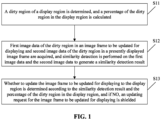
- FIG. 1 is a first flow chart showing an image processing method, according to an embodiment of the present disclosure. As illustrated in FIG. 1 , the image processing method in the embodiment of the present disclosure includes the following operations.
- a dirty region of a display region is determined, and a percentage of the dirty region in the display region is calculated.
- the image processing method in the embodiment of the present disclosure is applied to an electronic device.
- the electronic device may be a mobile phone, a gaming console, a wearable device, a virtual reality device, a personal digital assistant, a notebook computer, a tablet computer, a television terminal, or the like.
- Dirty region redrawing refers to redrawing of a changed region only, rather than full-screen refreshing when a graphical interface is drawn in each frame. Therefore, in the embodiment of the present disclosure, before a response is given to image frame updating of an operating system, the dirty region of the display region is determined and the percentage of the dirty region in the display region is calculated.
- first image data of the dirty region in an image frame to be updated for displaying and second image data of the dirty region in a presently displayed image frame are acquired, and similarity detection is performed on the first image data and the second image data to generate a similarity detection result.
- the first image data of the dirty region in the image frame to be updated for displaying is not combined and displayed to the display region. Instead, it is necessary to compare the image data of the dirty region in the image frame to be updated for displaying with the image data of the dirty region in the presently displayed image frame and determine whether a difference therebetween exceeds a set threshold value. When the difference between the image data of the dirty regions in the image frame to be updated for displaying and the presently displayed image frame exceeds the set threshold value, the image data of the dirty region in the image frame to be updated for displaying is updated to the display region and displayed through a screen.
- the image data of the dirty regions needs to be processed.
- compression is performed to change resolutions of the image data of the dirty regions in the image frame to be updated for displaying and the presently displayed image frame to a set resolution.
- the image data of each of the dirty regions may be compressed to a small image of 9 ⁇ 8 (numbers of columns of pixels by number of rows of pixels), thereby reducing image detail information.
- the image data of the dirty region may also be compressed to a small image with another resolution as required, and the resolution may specifically be set according to a practical requirement of the operating system to be, for example, 18 ⁇ 17, 20 ⁇ 17, 35 ⁇ 33, 48 ⁇ 33, and the like. If the image is reduced more, the processing speed for similarity comparison of the images is higher, and the accuracy of the similarity is correspondingly reduced to a certain extent.
- color red green blue (RGB) values of the image data of the dirty regions in the image frame to be updated for displaying and the presently displayed image frame with the set resolution are converted to gray values for gray image displaying.
- Converting the color RGB value of the reduced image to a gray represented by an integer from 0 to 255 simplifies three-dimensional comparison to one-dimensional comparison, such that the efficiency of comparison for the similarity between the image data of the dirty regions in the embodiments of the present disclosure is improved.
- the operation in which similarity detection is performed on the first image data and the second image data to generate the similarity detection result includes operations as follows. Color intensity differences between adjacent pixels in the first image data are determined, binary values are assigned to the color intensity differences, the assigned binary values of continuous color intensity differences form a first binary character string, and a first hash value of the first binary character string is determined. Color intensity differences between adjacent pixels in the second image data are determined, binary values are assigned to the color intensity differences, the assigned binary values of continuous color intensity differences form a second binary character string, and a second hash value of the second binary character string is determined.
- a Hamming distance between the first hash value and the second hash value is calculated, and the calculated Hamming distance between the first hash value and the second hash value is a Hamming distance between the images of the dirty regions in the image frame to be updated for displaying and the presently displayed image frame.
- the calculated Hamming distance is determined as a similarity value of the first image data and the second image data to obtain the similarity detection result.
- similarity detection may be performed on the first image data and the second image data by use of a perceptual Hash (pHash) algorithm.
- the pHash is a general term of a type of algorithms, including average Hash (aHash), pHash, difference Hash (dHash), and the like. pHash calculates a hash value in a more relative manner rather than calculating the specific hash value in a strict manner, and this is because being similar or not is a relative judgment.
- a principle thereof is to generate a fingerprint character string for each image, i.e., a set of binary digits obtained by operating the image according to a certain hash algorithm, and then compare Hamming distances between different image fingerprints.
- the Hamming distance is as follows: if a first set of binary data is 101 and a second set is 111, the second digit 0 of the first set may be changed to 1 so as to obtain the second set of data 111, and in such case, a Hamming distance between the two sets of data is 1.
- the Hamming distance is the number of steps required to change a set of binary data to another set of data. It is apparent that a difference between two images may be measured through the numerical value. The smaller the Hamming distance, the more similarity that exists. If the Hamming distance is 0, the two images are completely the same.
- the aHash algorithm is relatively high in calculation speed but relatively poor in accuracy.
- the pHash algorithm is relatively high in calculation accuracy but relatively low in operation speed.
- the dHash algorithm is relatively high in accuracy and also high in speed. Therefore, in the embodiments of the present disclosure, the dHash algorithm is preferred to perform similarity detection on the first image data and the second image data to determine the similarity value of the dirty regions in the two image frames.
- the operation in which the first hash value of the first binary character string is determined includes: high-base conversion being performed on the first binary character string to form converted first high-base characters, and the first high-base characters being sequenced to form a character string to form a first difference hash value; and high-base conversion being performed on the second binary character string to form converted second high-base characters, and the second high-base characters being sequenced to form a character string to form a second difference hash value.
- the dHash algorithm is implemented based on a morphing algorithm, and is specifically implemented as follows: (1) the image is compressed to a 9 ⁇ 8 small image with 72 pixels; (2) the image is converted to a gray image; (3) the differences are calculated: the differences between the adjacent pixels of the image frame are determined at first through the dHash algorithm; if the left pixel is brighter than the right one, 1 is recorded; otherwise, 0 is recorded; in such a manner, eight different differences are generated between nine pixels in each row, and there are a total of eight rows, so 64 differences or a 32-bit 01 character string is generated; and (4) the Hamming distance between the image frames is calculated through the hash values based on the difference between character strings, and the Hamming distance is determined as the similarity value between the two image frames.
- the similarity between the two image frames may also be calculated in a histogram manner.
- the image similarity is measured based on a simple vector similarity, and is usually measured by use of a color feature, and this manner is suitable for describing an image difficult to automatically segment.
- a probability distribution of image gray values is mainly reflected, no spatial position information of the image is provided, and a large amount of information is lost, such that the misjudgment rate is high.
- the similarity between the two image frames may also be calculated in the histogram manner.
- whether to update the image frame to be updated for displaying to the display region is determined according to the similarity detection result and the percentage of the dirty region in the display region, and if NO, an updating request for the image frame to be updated for displaying is shielded.
- a first weight value is set for the percentage of the dirty region in the display region, and a second weight value is set for the similarity value.
- a first product value of the first weight value and the percentage of the dirty region in the display region is calculated, and a second product value of the second weight value and the similarity value is calculated.
- a sum value of the first product value and the second product value is calculated.
- the sum value is compared with a set threshold value. When the sum value is greater than or equal to the set threshold value, it is determined that the image frame to be updated for displaying is updated to the display region. Correspondingly, when the sum value is less than the set threshold value, it is determined that the image frame to be updated for displaying is not updated to the display region.
- the operation in which the updating request for the image frame to be updated for displaying is shielded includes: when a dynamic adjustment vertical sync (Vsync) signal of the display region is received, the Vsync signal is intercepted, such that a SurfaceFlinger does not compose a content of the image frame to be updated for displaying.
- Vsync dynamic adjustment vertical sync
- the Vsync signal in the Android ® system may be divided into two types: one is a hardware Vsync signal generated by the screen, and the other is a software Vsync signal generated by the SurfaceFlinger.
- the first type of Vsync signal (the hardware Vsync signal) is essentially a pulse signal, which is generated by a hardware composer (HWC) module according to a screen refresh rate and is configured to trigger or switch some operations.
- the second type of Vsync signal (the software Vsync signal) is transmitted to a Choreographer through a Binder. Therefore, a Vsync signal may be sent to notify the operating system to prepare for refreshing before every refresh of the screen of the electronic device, and then the system calls a central processing unit (CPU) and a graphics processing unit (GPU) for user interface (UI) updating.
- CPU central processing unit
- GPU graphics processing unit
- a Vsync effect on the display region is achieved by intercepting the image frame updating request, i.e., the Vsync signal, for the system, so as to reduce influence brought to the power consumption by drawing of the GPU and the CPU, such that the power consumption of the electronic device for refreshing of the display region is reduced to a certain extent, and the overall performance and battery life of the electronic device are improved.
- FIG. 2 is a second flow chart showing an image processing method, according to an embodiment of the present disclosure. As illustrated in FIG. 2 , the image processing method in the embodiment of the present disclosure includes the following operations.
- a dirty region of a display region is determined.
- the image processing method in the embodiment of the present disclosure is applied to an electronic device.
- the electronic device may be a mobile phone, a gaming console, a wearable device, a virtual reality device, a personal digital assistant, a notebook computer, a tablet computer, a television terminal, or the like.
- Dirty region redrawing refers to redrawing of a changed region only, rather than full-screen refreshing when a graphical interface is drawn in each frame. Therefore, in the embodiment of the present disclosure, before a response is given to image frame updating of an operating system, the dirty region of the display region is determined.
- first image data of the dirty region in an image frame to be updated for displaying and second image data of the dirty region in a presently displayed image frame are acquired, and similarity detection is performed on the first image data and the second image data to generate a similarity detection result.
- the first image data of the dirty region in the image frame to be updated for displaying is not combined and displayed to the display region. Instead, it is necessary to compare the image data of the dirty region in the image frame to be updated for displaying with the image data of the dirty region in the presently displayed image frame and determine whether a difference therebetween exceeds a set threshold value. When the difference between the image data of the dirty regions in the image frame to be updated for displaying and the presently displayed image frame exceeds the set threshold value, the image data of the dirty region in the image frame to be updated for displaying is updated to the display region and displayed through a screen.
- the image data of the dirty regions needs to be processed.
- compression is performed to change resolutions of the image data of the dirty regions in the image frame to be updated for displaying and the presently displayed image frame to a set resolution.
- the image data of each of the dirty regions may be compressed to a small image of 9 ⁇ 8, thereby reducing image detail information.
- the image data of the dirty region may also be compressed to a small image with another resolution as required, and the resolution may specifically be set according to a practical requirement of the operating system to be, for example, 18 ⁇ 17, 20 ⁇ 17, 35 ⁇ 33, 48 ⁇ 33, and the like. If the image is reduced more, the processing speed for similarity comparison of the images is higher, and the accuracy of the similarity is correspondingly reduced to a certain extent.
- color RGB values of the image data of the dirty regions in the image frame to be updated for displaying and the presently displayed image frame with the set resolution are converted to gray values for gray image displaying.
- Converting the color RGB value of the reduced image to a gray represented by an integer from 0 to 255 simplifies three-dimensional comparison to one-dimensional comparison, such that the efficiency of comparison for the similarity between the image data of the dirty regions in the embodiments of the present disclosure is improved.
- the operation in which similarity detection is performed on the first image data and the second image data to generate the similarity detection result includes operations as follows. Color intensity differences between adjacent pixels in the first image data are determined, binary values are assigned to the color intensity differences, the assigned binary values of continuous color intensity differences form a first binary character string, and a first hash value of the first binary character string is determined. Color intensity differences between adjacent pixels in the second image data are determined, binary values are assigned to the color intensity differences, the assigned binary values of continuous color intensity differences form a second binary character string, and a second hash value of the second binary character string is determined.
- a Hamming distance between the first hash value and the second hash value is calculated, and the calculated Hamming distance between the first hash value and the second hash value is a Hamming distance between the images of the dirty regions in the image frame to be updated for displaying and the presently displayed image frame.
- the calculated Hamming distance is determined as a similarity value of the first image data and the second image data to obtain the similarity detection result.
- similarity detection may be performed on the first image data and the second image data by use of a pHash algorithm.
- the pHash is a general term of a type of algorithms, including average Hash (aHash), pHash, difference Hash (dHash), and the like. pHash calculates a hash value in a more relative manner rather than calculating the specific hash value in a strict manner, and this is because being similar or not is a relative judgment.
- a principle thereof is to generate a fingerprint character string for each image, i.e., a set of binary digits obtained by operating the image according to a certain hash algorithm, and then compare Hamming distances between different image fingerprints. The closer the results, the more similarity that exists between the images.
- the Hamming distance is as follows: if a first set of binary data is 101 and a second set is 111, the second digit 0 of the first set may be changed to 1 so as to obtain the second set of data 111, and in such case, a Hamming distance between the two sets of data is 1.
- the Hamming distance is the number of steps required to change a set of binary data to another set of data. It is apparent that a difference between two images may be measured through the numerical value. The smaller the Hamming distance, the more similarity that exists. If the Hamming distance is 0, the two images are completely the same.
- the aHash algorithm is relatively high in calculation speed but relatively poor in accuracy.
- the pHash algorithm is relatively high in calculation accuracy but relatively low in operation speed.
- the dHash algorithm is relatively high in accuracy and also high in speed. Therefore, in the embodiments of the present disclosure, the dHash algorithm is preferred to perform similarity detection on the first image data and the second image data to determine the similarity value of the dirty regions in the two image frames.
- the operation in which the first hash value of the first binary character string is determined includes: high-base conversion being performed on the first binary character string to form converted first high-base characters, and the first high-base characters being sequenced to form a character string to form a first difference hash value; and high-base conversion being performed on the second binary character string to form converted second high-base characters, and the second high-base characters being sequenced to form a character string to form a second difference hash value.
- the dHash algorithm is implemented based on a morphing algorithm, and is specifically implemented as follows: (1) the image is compressed to a 9 ⁇ 8 small image with 72 pixels; (2) the image is converted to a gray image; (3) the differences are calculated: the differences between the adjacent pixels of the image frame are determined at first through the dHash algorithm; if the left pixel is brighter than the right one, 1 is recorded; otherwise, 0 is recorded; in such a manner, eight different differences are generated between nine pixels in each row, and there are a total of eight rows, so 64 differences or a 32-bit 01 character string is generated; and (4) the Hamming distance between the image frames is calculated through the hash values based on the difference between character strings, and the Hamming distance is determined as the similarity value between the two image frames.
- the similarity between the two image frames may also be calculated in a histogram manner.
- the image similarity is measured based on a simple vector similarity, and is usually measured by use of a color feature, and this manner is suitable for describing an image difficult to automatically segment.
- a probability distribution of image gray values is mainly reflected, no spatial position information of the image is provided, and a large amount of information is lost, such that the misjudgment rate is high.
- the similarity between the two image frames may also be calculated in the histogram manner.
- the similarity value is compared with a set threshold value; when the similarity value is greater than or equal to the set threshold value, it is determined that the image frame to be updated for displaying is updated to the display region. Correspondingly, when the similarity value is less than the set threshold value, it is determined that the image frame to be updated for displaying is not updated to the display region.
- the operation in which the updating request for the image frame to be updated for displaying is shielded includes: when a dynamic adjustment Vsync signal of the display region is received, the Vsync signal is intercepted, such that a SurfaceFlinger does not compose a content of the image frame to be updated for displaying.
- the Vsync signal in the Android ® system may be divided into two types: one is a hardware Vsync signal generated by the screen, and the other is a software Vsync signal generated by the SurfaceFlinger.
- the first type of Vsync signal (the hardware Vsync signal) is essentially a pulse signal, which is generated by an HWC module according to a screen refresh rate and is configured to trigger or switch some operations.
- the second type of Vsync signal (the software Vsync signal) is transmitted to a Choreographer through a Binder. Therefore, a Vsync signal may be sent to notify the operating system to prepare for refreshing before every refresh of the screen of the electronic device, and then the system calls a CPU and a GPU for UI updating.
- a Vsync effect on the display region is achieved by intercepting the image frame updating request, i.e., the Vsync signal, for the system, so as to reduce influence brought to the power consumption by drawing of the GPU and the CPU, such that the power consumption of the electronic device for refreshing of the display region is reduced to a certain extent, and the overall performance and battery life of the electronic device are improved.
- a dirty region i.e., a dirty visible region, namely a region to be refreshed.
- the dirty region to be refreshed in the display process is utilized, and a percentage of the dirty region in the whole display region is calculated.
- similarity detection is performed on the dirty region by use of the dHash algorithm, and a new detection model for a similarity between two frames is constructed based on the two values (i.e., the percentage value and the similarity value). Compared with performing similarity detection on the whole display region, this manner has the advantage that the processing speed is increased.
- difference hash values of the dirty regions in two image frames are directly utilized, a similarity value between image data of the dirty regions in the two image frames is determined, and whether to perform composition processing on next frame layer data through a SurfaceFlinger is determined based on the similarity value.
- the dirty region to be refreshed in the display process is utilized, and the percentage p of the dirty region in the whole display region is calculated.
- similarity detection is performed on the dirty region by use of the dHash algorithm to obtain the similarity s, and the new detection model for the similarity between the two frames is constructed based on the two values (i.e., the percentage value and the similarity value).
- the similarity value obtained based on the detection model may be applied to a layer composition strategy of the SurfaceFlinger to control transmission of the Vsync signal, thereby achieving a purpose of dynamic Vsync, which is to reduce the influence brought to the performance by redrawing of the GPU and the CPU.
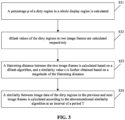
- FIG. 3 is a third flow chart showing an image processing method, according to an embodiment of the present disclosure. As illustrated in FIG. 3 , the image processing method in the embodiment of the present disclosure mainly includes the following processing operations.
- a dirty region of a display region of an electronic device is acquired, and a percentage p of the dirty region in the whole display region is calculated.
- a Hamming distance between the two image frames is calculated based on a dHash algorithm, and a similarity value s is further obtained based on a magnitude of the Hamming distance.
- the two image frames refer to an image frame to be updated for displaying and a presently displayed image frame respectively.
- p represents the percentage of the dirty region in the whole display region
- s represents the similarity between the dirty regions in the previous and next frames
- ⁇ is a weight parameter of p
- ⁇ is a weight parameter of s
- ⁇ + ⁇ 1.
- Values of ⁇ and ⁇ may be regulated as required.
- a similarity Similarity ( p, s) between image data of the dirty regions in the previous and next image frames is calculated according to the similarity algorithm introduced above at an interval of a period T.
- a similarity threshold value £ is set, and magnitudes of the similarity Similarity ( p, s ) and the threshold value £ are compared.
- Similarity ( p, s ) is less than or equal to £, the similarity between the previous and next image frames is relatively low, namely the previous and next image frames are greatly different, such that a Vsync signal is not processed and is normally distributed and transmitted to a SurfaceFlinger for normal layer composition and updating.
- FIG. 4 is a composition structure diagram of a first image processing device, according to an embodiment of the present disclosure.
- the first image processing device in the embodiment of the present disclosure includes: a first determination unit 41, a calculation unit 42, an acquisition unit 43, a similarity detection unit 44, a second determination unit 45, and a shielding unit 46.
- the first determination unit 41 is configured to determine a dirty region of a display region.
- the calculation unit 42 is configured to calculate a percentage of the dirty region in the display region.
- the acquisition unit 43 is configured to acquire first image data of the dirty region in an image frame to be updated for displaying and second image data of the dirty region in a presently displayed image frame.
- the similarity detection unit 44 is configured to perform similarity detection on the first image data and the second image data to generate a similarity detection result.
- the second determination unit 45 is configured to determine whether to update the image frame to be updated for displaying to the display region according to the similarity detection result and the percentage of the dirty region in the display region and, if NO, trigger a shielding unit.
- the shielding unit 46 is configured to shield an updating request for the image frame to be updated for displaying.
- the similarity detection unit 44 includes: a first determination subunit, an assignment subunit, a second determination subunit, a first calculation subunit, and a similarity detection subunit.
- the first determination subunit (not illustrated in FIG. 4 ) is configured to determine color intensity differences between adjacent pixels in the first image data and color intensity differences between adjacent pixels in the second image data.
- the assignment subunit (not illustrated in FIG. 4 ) is configured to assign binary values to the color intensity differences of the first image data, the assigned binary values of continuous color intensity differences forming a first binary character string, and assign binary values to the color intensity differences of the second image data, the assigned binary values of continuous color intensity differences forming a second binary character string.
- the second determination subunit (not illustrated in FIG. 4 ) is configured to determine a first hash value of the first binary character string and a second hash value of the second binary character string.
- the first calculation subunit (not illustrated in FIG. 4 ) is configured to calculate a Hamming distance between the first hash value and the second hash value, the calculated Hamming distance between the first hash value and the second hash value being a Hamming distance between images of the dirty regions in the image frame to be updated for displaying and the presently displayed image frame.
- the similarity detection subunit (not illustrated in FIG. 4 ) is configured to determine the calculated Hamming distance as a similarity value of the first image data and the second image data to obtain the similarity detection result.
- the second determination subunit is further configured to: perform high-base conversion on the first binary character string to form converted first high-base characters and sequence the first high-base characters to form a character string to form a first difference hash value; and perform high-base conversion on the second binary character string to form converted second high-base characters and sequence the second high-base characters to form a character string to form a second difference hash value.
- the first image processing device further includes: a compression unit and a conversion unit.
- the compression unit (not illustrated in FIG. 4 ) is configured to perform compression to change resolutions of the first image data and the second image data to a set resolution.
- the conversion unit (not illustrated in FIG. 4 ) is configured to convert color RGB values of the first image data and the second image data with the set resolution to gray values for gray image displaying.
- the first image processing device further includes: a setting unit (not illustrated in FIG. 4 ), configured to set a first weight value for the percentage of the dirty region in the display region, and set a second weight value for the similarity value.
- a setting unit (not illustrated in FIG. 4 ), configured to set a first weight value for the percentage of the dirty region in the display region, and set a second weight value for the similarity value.
- the second determination unit 45 includes: a second calculation subunit, a third calculation subunit, a comparison subunit, and a third determination subunit.
- the second calculation subunit (not illustrated in FIG. 4 ) is configured to calculate a first product value of the first weight value and the percentage of the dirty region in the display region, and calculate a second product value of the second weight value and the similarity value.
- the third calculation subunit (not illustrated in FIG. 4 ) is configured to calculate a sum value of the first product value and the second product value.
- the comparison subunit (not illustrated in FIG. 4 ) is configured to compare the sum value with a set threshold value.
- the third determination subunit (not illustrated in FIG. 4 ) is configured to, when the sum value is greater than or equal to the set threshold value, determine to update the image frame to be updated for displaying to the display region, and correspondingly, when the sum value is less than the set threshold value, determine not to update the image frame to be updated for displaying to the display region.
- the shielding unit 46 includes: a receiving subunit and an interception subunit.
- the receiving subunit (not illustrated in FIG. 4 ) is configured to receive a dynamic adjustment Vsync signal of the display region.
- the interception subunit (not illustrated in FIG. 4 ) is configured to intercept the Vsync signal to cause a SurfaceFlinger not to compose a content of the image frame to be updated for displaying.
- FIG. 5 is a composition structure diagram of a second image processing device, according to an embodiment of the present disclosure.
- the second image processing device in the embodiment of the present disclosure includes: a first determination unit 51, an acquisition unit 52, a similarity detection unit 53, a second determination unit 54, and a shielding unit 55.
- the first determination unit 51 is configured to determine a dirty region of a display region.
- the acquisition unit 52 is configured to acquire first image data of the dirty region in an image frame to be updated for displaying and second image data of the dirty region in a presently displayed image frame.
- the similarity detection unit 53 is configured to perform similarity detection on the first image data and the second image data to generate a similarity detection result.
- the second determination unit 54 is configured to determine whether to update the image frame to be updated for displaying to the display region according to the similarity detection result and, if NO, trigger a shielding unit.
- the shielding unit 55 is configured to shield an updating request for the image frame to be updated for displaying.
- the similarity detection unit 53 includes: a first determination subunit, an assignment subunit, a second determination subunit, a first calculation subunit, and a similarity detection subunit.
- the first determination subunit (not illustrated in FIG. 5 ) is configured to determine color intensity differences between adjacent pixels in the first image data and color intensity differences between adjacent pixels in the second image data.
- the assignment subunit (not illustrated in FIG. 5 ) is configured to assign binary values to the color intensity differences of the first image data, the assigned binary values of continuous color intensity differences forming a first binary character string, and assign binary values to the color intensity differences of the second image data, the assigned binary values of continuous color intensity differences forming a second binary character string.
- the second determination subunit (not illustrated in FIG. 5 ) is configured to determine a first hash value of the first binary character string and a second hash value of the second binary character string.
- the first calculation subunit (not illustrated in FIG. 5 ) is configured to calculate a Hamming distance between the first hash value and the second hash value, the calculated Hamming distance between the first hash value and the second hash value being a Hamming distance between images of the dirty regions in the image frame to be updated for displaying and the presently displayed image frame.
- the similarity detection subunit (not illustrated in FIG. 5 ) is configured to determine the calculated Hamming distance as a similarity value of the first image data and the second image data to obtain the similarity detection result.
- the second determination subunit is further configured to: perform high-base conversion on the first binary character string to form converted first high-base characters and sequence the first high-base characters to form a character string to form a first difference hash value; and perform high-base conversion on the second binary character string to form converted second high-base characters and sequence the second high-base characters to form a character string to form a second difference hash value.
- the second image processing device further includes: a compression unit and a conversion unit.
- the compression unit (not illustrated in FIG. 5 ) is configured to perform compression to change resolutions of the first image data and the second image data to a set resolution.
- the conversion unit (not illustrated in FIG. 5 ) is configured to convert color RGB values of the first image data and the second image data with the set resolution to gray values for gray image displaying.
- the second determination unit 54 includes: a comparison subunit and a third determination subunit.
- the comparison subunit (not illustrated in FIG. 5 ) is configured to compare the similarity value with a set threshold value.
- the third determination subunit (not illustrated in FIG. 5 ) is configured to, when the similarity value is greater than or equal to the set threshold value, determine to update the image frame to be updated for displaying to the display region, and correspondingly, when the similarity value is less than the set threshold value, determine not to update the image frame to be updated for displaying to the display region.
- the shielding unit 55 includes: a receiving subunit and an interception subunit.
- the receiving subunit (not illustrated in FIG. 5 ) is configured to receive a dynamic adjustment Vsync signal of the display region.
- the interception subunit (not illustrated in FIG. 5 ) is configured to intercept the Vsync signal to cause a SurfaceFlinger not to compose a content of the image frame to be updated for displaying.
- FIG. 6 is a block diagram of an electronic device 800, according to an embodiment of the present disclosure. As illustrated in FIG. 6 , the electronic device 800 supports multi-screen output.
- the electronic device 800 may include one or more of the following components: a processing component 802, a memory 804, a power component 806, a multimedia component 808, an audio component 810, an input/output (I/O) interface 812, a sensor component 814, or a communication component 816.
- the processing component 802 typically controls overall operations of the electronic device 800, such as the operations associated with display, telephone calls, data communications, camera operations, and recording operations.
- the processing component 802 may include one or more processors 820 to execute instructions to perform all or part of the acts in the abovementioned method.
- the processing component 802 may include one or more modules which facilitate interaction between the processing component 802 and other components.
- the processing component 802 may include a multimedia module to facilitate interaction between the multimedia component 808 and the processing component 802.
- the memory 804 is configured to store various types of data to support the operation of the electronic device 800. Examples of such data include instructions for any applications or methods operated on the electronic device 800, contact data, phonebook data, messages, pictures, video, etc.
- the memory 804 may be implemented by any type of volatile or non-volatile memory devices, or a combination thereof, such as a static random access memory (SRAM), an electrically erasable programmable read-only memory (EEPROM), an erasable programmable read-only memory (EPROM), a programmable read-only memory (PROM), a read-only memory (ROM), a magnetic memory, a flash memory, and a magnetic or optical disk.
- SRAM static random access memory
- EEPROM electrically erasable programmable read-only memory
- EPROM erasable programmable read-only memory
- PROM programmable read-only memory
- ROM read-only memory
- magnetic memory a magnetic memory
- flash memory and a magnetic or optical disk.
- the power component 806 provides power for various components of the electronic device 800.
- the power component 806 may include a power management system, one or more power supplies, and other components associated with generation, management, and distribution of power for the electronic device 800.
- the multimedia component 808 includes a screen providing an output interface between the electronic device 800 and a user.
- the screen may include a liquid crystal display (LCD) and a touch panel (TP). If the screen includes the TP, the screen may be implemented as a touch screen to receive an input signal from the user.
- the TP includes one or more touch sensors to sense touches, swipes, and gestures on the TP. The touch sensors may not only sense a boundary of a touch or swipe action, but also detect a period of time and a pressure associated with the touch or swipe action.
- the multimedia component 808 includes a front camera and/or a rear camera.
- the front camera and/or the rear camera may receive external multimedia data when the electronic device 800 is in an operation mode, such as a photographing mode or a video mode.
- an operation mode such as a photographing mode or a video mode.
- Each of the front camera and the rear camera may be a fixed optical lens system or have focusing and optical zooming capabilities.
- the audio component 810 is configured to output and/or input an audio signal.
- the audio component 810 includes a microphone (MIC), and the MIC is configured to receive an external audio signal when the electronic device 800 is in an operation mode, such as a call mode, a recording mode, and a voice recognition mode.
- the received audio signal may further be stored in the memory 804 or sent through the communication component 816.
- the audio component 810 further includes a speaker configured to output the audio signal.
- the I/O interface 812 provides an interface between the processing component 802 and peripheral interface modules, such as a keyboard, a click wheel, buttons, and the like.
- the buttons may include, but are not limited to: a home button, a volume button, a starting button, and a locking button.
- the sensor component 814 includes one or more sensors configured to provide status assessments in various aspects for the electronic device 800. For instance, the sensor component 814 may detect an on/off status of the electronic device 800 and relative positioning of components, such as a display and small keyboard of the electronic device 800, and the sensor component 814 may further detect a change in a position of the electronic device 800 or a component of the electronic device 800, presence or absence of contact between the user and the electronic device 800, orientation or acceleration/deceleration of the electronic device 800, and a change in temperature of the electronic device 800.
- the sensor component 814 may include a proximity sensor configured to detect presence of an object nearby without any physical contact.
- the sensor component 814 may also include a light sensor, such as a complementary metal oxide semiconductor (CMOS) or charge coupled device (CCD) image sensor, configured for use in an imaging application (APP).
- CMOS complementary metal oxide semiconductor
- CCD charge coupled device
- the sensor component 814 may also include an acceleration sensor, a gyroscope sensor, a magnetic sensor, a pressure sensor, or a temperature sensor.
- the communication component 816 is configured to facilitate wired or wireless communication between the electronic device 800 and other devices.
- the electronic device 800 may access a communication-standard-based wireless network, such as a wireless fidelity (WiFi) network, a 2nd-generation (2G) or 3rd-generation (3G) network, or a combination thereof.
- the communication component 816 receives a broadcast signal or broadcast associated information from an external broadcast management system through a broadcast channel.
- the communication component 816 further includes a near field communication (NFC) module to facilitate short-range communications.
- the NFC module may be implemented based on a radio frequency identification (RFID) technology, an infrared data association (IrDA) technology, an ultra-wide band (UWB) technology, a Bluetooth (BT) technology, and other technologies.
- RFID radio frequency identification
- IrDA infrared data association
- UWB ultra-wide band
- BT Bluetooth
- the electronic device 800 may be implemented by one or more application specific integrated circuits (ASICs), digital signal processors (DSPs), digital signal processing devices (DSPDs), programmable logic devices (PLDs), field programmable gate arrays (FPGAs), controllers, micro-controllers, microprocessors, or other electronic components, and is configured to execute a screen recording method for a multi-screen electronic device in the abovementioned embodiments.
- ASICs application specific integrated circuits
- DSPs digital signal processors
- DSPDs digital signal processing devices
- PLDs programmable logic devices
- FPGAs field programmable gate arrays
- controllers micro-controllers, microprocessors, or other electronic components
- non-transitory computer-readable storage medium including instructions, such as included in the memory 804, executable by the processor 820 of the electronic device 800, for performing any image processing method in the abovementioned embodiments.
- the non-transitory computer-readable storage medium may be a ROM, a random access memory (RAM), a compact disc read-only memory (CD-ROM), a magnetic tape, a floppy disc, an optical data storage device, and the like.
Landscapes
- Engineering & Computer Science (AREA)
- Theoretical Computer Science (AREA)
- Physics & Mathematics (AREA)
- General Physics & Mathematics (AREA)
- Computer Hardware Design (AREA)
- Computer Vision & Pattern Recognition (AREA)
- General Engineering & Computer Science (AREA)
- Multimedia (AREA)
- Human Computer Interaction (AREA)
- Quality & Reliability (AREA)
- Image Processing (AREA)
- Controls And Circuits For Display Device (AREA)
- Control Of Indicators Other Than Cathode Ray Tubes (AREA)
- Image Analysis (AREA)
Claims (8)
- Bildverarbeitungsverfahren, ausgeführt auf einer elektronischen Vorrichtung, welche ein Betriebssystem ausführt, wobei das Bildverarbeitungsverfahren die folgenden Schritte aufweist:Bestimmen (S11) eines schmutzigen Bereichs eines Displaybereichs, und Berechnen eines prozentualen Anteils des schmutzigen Bereichs in dem Displaybereich; wobei der schmutzige Bereich ein neu zu zeichnender und zu aktualisierender Bereich ist;Erfassen (S12) erster Bilddaten des schmutzigen Bereichs in einem für die Anzeige zu aktualisierenden Bild und zweiter Bilddaten des schmutzigen Bereichs in einem aktuell angezeigten Bild, und Durchführen einer Ähnlichkeitserkennung mit den ersten Bilddaten und den zweiten Bilddaten, um ein Ähnlichkeitserkennungsergebnis zu erhalten; undFeststellen (S13), ob das zur Anzeige auf den Displaybereich zu aktualisierende Bild gemäß dem Ähnlichkeitserkennungsergebnis und dem prozentualen Anteil des schmutzigen Bereichs in dem Displaybereich aktualisiert werden soll oder nicht, und falls nicht, Blockieren einer Aktualisierungsanforderung für das zur Anzeige zu aktualisierende Bild;wobei das Durchführen einer Ähnlichkeitserkennung mit den ersten Bilddaten und den zweiten Bilddaten, um ein Ähnlichkeitserkennungsergebnis zu erhalten, die folgenden Schritte aufweist:Bestimmen von Farbintensitätsunterschieden zwischen benachbarten Pixeln in den ersten Bilddaten, Zuweisen binärer Werte zu den Farbintensitätsunterschieden, wobei die zugewiesenen binären Werte durchgehender Farbintensitätsunterschiede eine erste Binärzeichenfolge bilden, und Ermitteln eines ersten Hashwerts der ersten Binärzeichenfolge;Bestimmen von Farbintensitätsunterschieden zwischen benachbarten Pixeln in den zweiten Bilddaten, Zuweisen binärer Werte zu den Farbintensitätsunterschieden, wobei die zugewiesenen binären Werte durchgehender Farbintensitätsunterschiede eine zweite Binärzeichenfolge bilden, und Ermitteln eines zweiten Hashwerts der zweiten Binärzeichenfolge; undBerechnen eines Hammingabstands zwischen dem ersten Hashwert und dem zweiten Hashwert, und Bestimmen des berechneten Hammingabstands als einen Ähnlichkeitswert der ersten Bilddaten und der zweiten Bilddaten, um das Ähnlichkeitserkennungsergebnis zu erhalten;ferner mit den Schritten:Einstellen eines ersten Gewichtswerts für den prozentualen Anteil des schmutzigen Bereichs in dem Displaybereich, und Einstellen eines zweiten Gewichtswerts für den Ähnlichkeitswert;wobei das Feststellen, ob das zur Anzeige auf dem Displaybereich zu aktualisierende Bild aktualisiert werden soll, die folgenden Schritte aufweist:Berechnen eines ersten Produktwerts des ersten Gewichtswerts und des prozentualen Anteils des schmutzigen Bereichs in dem Displaybereich, und Berechnen eines zweiten Produktwerts des zweiten Gewichtswerts und des Ähnlichkeitswerts;Berechnen eines Summenwerts des ersten Produktwerts und des zweiten Produktwerts; undVergleichen des Summenwerts mit einem eingestellten Schwellenwert; wenn der Summenwert größer als oder gleich dem eingestellten Schwellenwert ist, Bestimmen, dass das zur Anzeige auf dem Displaybereich zu aktualisierende Bild aktualisiert werden soll, und, entsprechend, wenn der Summenwert geringer als der eingestellte Schwellenwert ist, Bestimmen, dass das zur Anzeige auf dem Displaybereich zu aktualisierende Bild nicht aktualisiert werden soll;wobei das Blockieren der Aktualisierungsanforderung für das zur Anzeige zu aktualisierende Bild den folgenden Schritt aufweist:
in Reaktion auf den Empfang eines vertikalen Sync-Signals (V-sync) des Displaybereichs zur dynamischen Anpassung, Abfangen des V-sync-Signals, um eine Displaykomponente des Betriebssystems zu veranlassen, keinen Inhalt des zur Anzeige zu aktualisierenden Bilds zu erstellen. - Bildverarbeitungsverfahren nach Anspruch 1, bei welchem das Ermitteln des ersten Hashwerts der ersten Binärzeichenfolge die folgenden Schritte aufweist:Durchführen einer Hoch-Basis-Umwandlung der ersten Binärzeichenfolge, um umgewandelte erste Hoch-Basis-Zeichen zu bilden, und Sequenzieren der ersten Hoch-Basis-Zeichen zur Bildung einer Zeichenfolge für das Bilden eines ersten Differenz-Hashwerts; undDurchführen einer Hoch-Basis-Umwandlung der zweiten Binärzeichenfolge, um umgewandelte zweite Hoch-Basis-Zeichen zu bilden, und Sequenzieren der zweiten Hoch-Basis-Zeichen zur Bildung einer Zeichenfolge für das Bilden eines zweiten Differenz-Hashwerts.
- Bildverarbeitungsverfahren nach Anspruch 1 oder 2, wobei das Verfahren vor dem Schritt des Berechnens der Farbintensitätsunterschiede zwischen den benachbarten Pixeln in den ersten Bilddaten und den zweiten Bilddaten ferner die folgenden Schritte aufweist:Durchführen einer Komprimierung, um Auflösungen der ersten Bilddaten und der zweiten Bilddaten zu einer voreingestellten Auflösung zu ändern; undUmwandeln von Rot-Grün-Blau-Farbwerten (RGB) der ersten Bilddaten und der zweiten Bilddaten mit der voreingestellten Auflösung in Grauwerte zur Graubild-Anzeige.
- Elektronische Vorrichtung, welche ein Betriebssystem ausführt, mit:einer ersten Bestimmungseinheit (41), die zum Bestimmen eines schmutzigen Bereichs eines Displaybereichs, und zum Berechnen eines prozentualen Anteils des schmutzigen Bereichs in dem Displaybereich ausgebildet ist; wobei der schmutzige Bereich ein neu zu zeichnender und zu aktualisierender Bereich ist;einer Erfassungseinheit (43), die zum Erfassen erster Bilddaten des schmutzigen Bereichs in einem für die Anzeige zu aktualisierenden Bild und zweiter Bilddaten des schmutzigen Bereichs in einem aktuell angezeigten Bild ausgebildet ist;einer Ähnlichkeitserkennungseinheit (44), die zum Durchführen einer Ähnlichkeitserkennung mit den ersten Bilddaten und den zweiten Bilddaten ausgebildet ist, um ein Ähnlichkeitserkennungsergebnis zu erhalten;einer zweiten Bestimmungseinheit (44), die dazu ausgebildet ist, festzustellen, ob das zur Anzeige auf den Displaybereich zu aktualisierende Bild gemäß dem Ähnlichkeitserkennungsergebnis und dem prozentualen Anteil des schmutzigen Bereichs in dem Displaybereich aktualisiert werden soll oder nicht, und falls nicht, eine Abschirmeinheit (46) zu triggern; undwobei die Abschirmeinheit (46) zum Blockieren einer Aktualisierungsanforderung für das zur Anzeige zu aktualisierende Bild ausgebildet ist;wobei die Ähnlichkeitserkennungseinheit (44) aufweist:eine erste Bestimmungsuntereinheit, die zum Bestimmen von Farbintensitätsunterschieden zwischen benachbarten Pixeln in den ersten Bilddaten und von Farbintensitätsunterschieden zwischen benachbarten Pixeln in den zweiten Bilddaten ausgebildet ist;eine Zuweisungsuntereinheit, die dazu ausgebildet ist, den Farbintensitätsunterschieden binäre Werte zuzuweisen, wobei die zugewiesenen binären Werte durchgehender Farbintensitätsunterschiede eine erste Binärzeichenfolge bilden, und den Farbintensitätsunterschieden binäre Werte zuzuweisen, wobei die zugewiesenen binären Werte durchgehender Farbintensitätsunterschiede eine zweite Binärzeichenfolge bilden;eine zweite Bestimmungsuntereinheit, die zum Ermitteln eines ersten Hashwerts der ersten Binärzeichenfolge und eines zweiten Hashwerts der zweiten Binärzeichenfolge ausgebildet ist;eine erste Berechnungsuntereinheit, die zum Berechnen eines Hammingabstands zwischen dem ersten Hashwert und dem zweiten Hashwert ausgebildet ist; undeine Ähnlichkeitserkennungsuntereinheit, die zum Bestimmen des berechneten Hammingabstands als einen Ähnlichkeitswert der ersten Bilddaten und der zweiten Bilddaten ausgebildet ist, um das Ähnlichkeitserkennungsergebnis zu erhalten;ferner mit:einer Einstelleinheit, die zum Einstellen eines ersten Gewichtswerts für den prozentualen Anteil des schmutzigen Bereichs in dem Displaybereich, und zum Einstellen eines zweiten Gewichtswerts für den Ähnlichkeitswert ausgebildet ist;wobei die zweite Bestimmungseinheit (45) aufweist:eine zweite Berechnungsuntereinheit, die zum Berechnen eines ersten Produktwerts des ersten Gewichtswerts und des prozentualen Anteils des schmutzigen Bereichs in dem Displaybereich, und zum Berechnen eines zweiten Produktwerts des zweiten Gewichtswerts und des Ähnlichkeitswerts ausgebildet ist;eine dritte Berechnungsuntereinheit, die zum Berechnen eines Summenwerst des ersten Produktwerts und des zweiten Produktwerts ausgebildet ist;eine Vergleichsuntereinheit, die zum Vergleichen des Summenwerts mit einem eingestellten Schwellenwert ausgebildet ist;eine dritte Bestimmungsuntereinheit, die dazu ausgebildet ist, wenn der Summenwert größer als oder gleich dem eingestellten Schwellenwert ist, zu bestimmen, dass das zur Anzeige auf dem Displaybereich zu aktualisierende Bild aktualisiert werden soll, und, entsprechend, wenn der Summenwert geringer als der eingestellte Schwellenwert ist, zu bestimmen, dass das zur Anzeige auf dem Displaybereich zu aktualisierende Bild nicht aktualisiert werden soll;wobei die Abschirmeinheit (46) aufweist:eine Empfangsuntereinheit, die dazu ausgebildet ist, ein vertikales Sync-Signals (V-sync) des Displaybereichs zur dynamischen Anpassung zu empfangen; undeine Abfanguntereinheit, die zum Abfangen des V-sync-Signals ausgebildet ist, um eine Displaykomponente des Betriebssystems zu veranlassen, keinen Inhalt des zur Anzeige zu aktualisierenden Bilds zu erstellen.
- Vorrichtung nach Anspruch 4, bei welcher die zweite Bestimmunguntereinheit ferner dazu ausgebildet ist,eine Hoch-Basis-Umwandlung der ersten Binärzeichenfolge, um umgewandelte erste Hoch-Basis-Zeichen zu bilden, und ein Sequenzieren der ersten Hoch-Basis-Zeichen zur Bildung einer Zeichenfolge für das Bilden eines ersten Differenz-Hashwerts durchzuführen; undeine Hoch-Basis-Umwandlung der zweiten Binärzeichenfolge, um umgewandelte zweite Hoch-Basis-Zeichen zu bilden, und ein Sequenzieren der zweiten Hoch-Basis-Zeichen zur Bildung einer Zeichenfolge für das Bilden eines zweiten Differenz-Hashwerts durchzuführen.
- Vorrichtung nach Anspruch 4 oder 5, ferner mit:einer Komprimierungseinheit, die zum Durchführen einer Komprimierung ausgebildet ist, um Auflösungen der ersten Bilddaten und der zweiten Bilddaten zu einer voreingestellten Auflösung zu ändern; undeiner Umwandlungseinheit, die zum Umwandeln von Rot-Grün-Blau-Farbwerten (RGB) der ersten Bilddaten und der zweiten Bilddaten mit der voreingestellten Auflösung in Grauwerte zur Graubild-Anzeige ausgebildet ist.
- Elektronische Vorrichtung mit einem Prozessor und einem Speicher, der dazu ausgebildet ist, von dem Prozessor ausführbare Befehle zu speichern, wobei der Prozessor dazu ausgebildet ist, die ausführbaren Befehle in dem Speicher abzurufen, um das Bildverarbeitungsverfahren nach einem der Ansprüche 1 bis 3 auszuführen.
- Computerlesbares Speichermedium mit Befehlen, die einen Prozessor einer elektronischen Vorrichtung veranlassen, das Bildverarbeitungsverfahren nach einem der Ansprüche 1 bis 3 auszuführen.
Applications Claiming Priority (1)
| Application Number | Priority Date | Filing Date | Title |
|---|---|---|---|
| CN202010452919.XA CN111369561B (zh) | 2020-05-26 | 2020-05-26 | 图像处理方法及装置、电子设备、存储介质 |
Publications (2)
| Publication Number | Publication Date |
|---|---|
| EP3916709A1 EP3916709A1 (de) | 2021-12-01 |
| EP3916709B1 true EP3916709B1 (de) | 2023-10-18 |
Family
ID=71209627
Family Applications (1)
| Application Number | Title | Priority Date | Filing Date |
|---|---|---|---|
| EP21151726.3A Active EP3916709B1 (de) | 2020-05-26 | 2021-01-15 | Bildverarbeitungsverfahren und -vorrichtung, elektronische vorrichtung und speichermedium |
Country Status (3)
| Country | Link |
|---|---|
| US (1) | US11404027B2 (de) |
| EP (1) | EP3916709B1 (de) |
| CN (1) | CN111369561B (de) |
Families Citing this family (10)
| Publication number | Priority date | Publication date | Assignee | Title |
|---|---|---|---|---|
| CN114549596A (zh) * | 2020-11-24 | 2022-05-27 | 腾讯科技(深圳)有限公司 | 一种图像校准方法、装置、电子设备及存储介质 |
| JP7562440B2 (ja) * | 2021-02-09 | 2024-10-07 | キオクシア株式会社 | 文字列検索装置及びメモリシステム |
| CN113111823A (zh) * | 2021-04-22 | 2021-07-13 | 广东工业大学 | 一种建筑施工地的异常行为检测方法和相关装置 |
| CN114090919A (zh) * | 2021-10-25 | 2022-02-25 | 青岛海尔科技有限公司 | 显示策略的确定方法和装置、存储介质及电子装置 |
| CN114926563A (zh) * | 2022-07-18 | 2022-08-19 | 广州中望龙腾软件股份有限公司 | 一种图形自动补齐方法、装置及存储介质 |
| CN116012322A (zh) * | 2022-12-26 | 2023-04-25 | 浙江华睿科技股份有限公司 | 一种相机脏污检测方法、装置、设备及介质 |
| CN116309437B (zh) * | 2023-03-15 | 2025-07-15 | 中国铁塔股份有限公司河北省分公司 | 一种灰尘检测方法、装置及存储介质 |
| CN119488240A (zh) * | 2023-08-17 | 2025-02-21 | 感进机器人(深圳)有限公司 | 清洁设备的控制方法和清洁设备 |
| CN118381931B (zh) * | 2023-12-13 | 2025-07-29 | 天翼云科技有限公司 | 一种弱网环境下的灰度图像压缩方法 |
| CN120641936A (zh) * | 2024-01-10 | 2025-09-12 | 荣耀终端股份有限公司 | 一种图层合成方法、电子设备和存储介质 |
Citations (1)
| Publication number | Priority date | Publication date | Assignee | Title |
|---|---|---|---|---|
| CN109005457B (zh) * | 2018-09-19 | 2021-04-02 | 腾讯科技(北京)有限公司 | 黑屏检测方法、装置、计算机设备及存储介质 |
Family Cites Families (10)
| Publication number | Priority date | Publication date | Assignee | Title |
|---|---|---|---|---|
| US7313764B1 (en) * | 2003-03-06 | 2007-12-25 | Apple Inc. | Method and apparatus to accelerate scrolling for buffered windows |
| CN102270428A (zh) * | 2010-06-01 | 2011-12-07 | 上海政申信息科技有限公司 | 显示装置、显示界面的刷新方法及装置 |
| US9092241B2 (en) * | 2010-09-29 | 2015-07-28 | Verizon Patent And Licensing Inc. | Multi-layer graphics painting for mobile devices |
| US9424660B2 (en) * | 2012-08-07 | 2016-08-23 | Intel Corporation | Media encoding using changed regions |
| CN105448225A (zh) | 2016-01-05 | 2016-03-30 | 京东方科技集团股份有限公司 | 调整屏幕刷新频率的方法和装置以及显示器 |
| CN107316270A (zh) * | 2016-04-25 | 2017-11-03 | 联发科技股份有限公司 | 为由多个帧组成的图像数据生成脏信息的方法及图形系统 |
| US20170365236A1 (en) | 2016-06-21 | 2017-12-21 | Qualcomm Innovation Center, Inc. | Display-layer update deferral |
| US10225536B2 (en) * | 2016-07-01 | 2019-03-05 | Intel Corporation | Dynamic fidelity updates for encoded displays |
| CN106445314B (zh) * | 2016-09-07 | 2019-07-26 | Oppo广东移动通信有限公司 | 显示界面刷新方法及装置 |
| CN108549534B (zh) * | 2018-03-02 | 2020-04-10 | 惠州Tcl移动通信有限公司 | 图形用户界面重绘方法、终端设备及计算机可读存储介质 |
-
2020
- 2020-05-26 CN CN202010452919.XA patent/CN111369561B/zh active Active
-
2021
- 2021-01-12 US US17/146,779 patent/US11404027B2/en active Active
- 2021-01-15 EP EP21151726.3A patent/EP3916709B1/de active Active
Patent Citations (1)
| Publication number | Priority date | Publication date | Assignee | Title |
|---|---|---|---|---|
| CN109005457B (zh) * | 2018-09-19 | 2021-04-02 | 腾讯科技(北京)有限公司 | 黑屏检测方法、装置、计算机设备及存储介质 |
Also Published As
| Publication number | Publication date |
|---|---|
| US11404027B2 (en) | 2022-08-02 |
| CN111369561B (zh) | 2020-09-08 |
| EP3916709A1 (de) | 2021-12-01 |
| US20210375235A1 (en) | 2021-12-02 |
| CN111369561A (zh) | 2020-07-03 |
Similar Documents
| Publication | Publication Date | Title |
|---|---|---|
| US11404027B2 (en) | Image processing method and device, electronic device, and storage medium | |
| US11114130B2 (en) | Method and device for processing video | |
| US11030733B2 (en) | Method, electronic device and storage medium for processing image | |
| US10650502B2 (en) | Image processing method and apparatus, and storage medium | |
| US10032076B2 (en) | Method and device for displaying image | |
| EP3828832B1 (de) | Anzeigesteuerungsverfahren, anzeigesteuerungsvorrichtung und computerlesbares speichermedium | |
| US11488383B2 (en) | Video processing method, video processing device, and storage medium | |
| CN106710539B (zh) | 液晶显示方法及装置 | |
| EP3913476A1 (de) | Bildanzeigeverfahren und -vorrichtung, elektronische vorrichtung und speichermedium | |
| US20220417591A1 (en) | Video rendering method and apparatus, electronic device, and storage medium | |
| EP3764345B1 (de) | Verfahren umgebungslicht zu detektieren, endgerät und speichermedium | |
| US9665925B2 (en) | Method and terminal device for retargeting images | |
| US20220222831A1 (en) | Method for processing images and electronic device therefor | |
| US10438377B2 (en) | Method and device for processing a page | |
| US10846513B2 (en) | Method, device and storage medium for processing picture | |
| CN111290663A (zh) | 曲面屏显示方法及装置、终端及存储介质 | |
| US20170116939A1 (en) | Display method and device and computer-readable medium | |
| US10068151B2 (en) | Method, device and computer-readable medium for enhancing readability | |
| CN112445318B (zh) | 一种对象显示方法、装置、电子设备及存储介质 | |
| CN116385260A (zh) | 图像处理方法、装置、芯片、电子设备及介质 | |
| CN120029748A (zh) | 显示内容识别方法、装置、电子设备及存储介质 | |
| CN117195327A (zh) | 显示控制方法、装置、电子设备及存储介质 |
Legal Events
| Date | Code | Title | Description |
|---|---|---|---|
| PUAI | Public reference made under article 153(3) epc to a published international application that has entered the european phase |
Free format text: ORIGINAL CODE: 0009012 |
|
| STAA | Information on the status of an ep patent application or granted ep patent |
Free format text: STATUS: THE APPLICATION HAS BEEN PUBLISHED |
|
| AK | Designated contracting states |
Kind code of ref document: A1 Designated state(s): AL AT BE BG CH CY CZ DE DK EE ES FI FR GB GR HR HU IE IS IT LI LT LU LV MC MK MT NL NO PL PT RO RS SE SI SK SM TR |
|
| B565 | Issuance of search results under rule 164(2) epc |
Effective date: 20210611 |
|
| STAA | Information on the status of an ep patent application or granted ep patent |
Free format text: STATUS: REQUEST FOR EXAMINATION WAS MADE |
|
| 17P | Request for examination filed |
Effective date: 20220517 |
|
| RBV | Designated contracting states (corrected) |
Designated state(s): AL AT BE BG CH CY CZ DE DK EE ES FI FR GB GR HR HU IE IS IT LI LT LU LV MC MK MT NL NO PL PT RO RS SE SI SK SM TR |
|
| GRAP | Despatch of communication of intention to grant a patent |
Free format text: ORIGINAL CODE: EPIDOSNIGR1 |
|
| STAA | Information on the status of an ep patent application or granted ep patent |
Free format text: STATUS: GRANT OF PATENT IS INTENDED |
|
| RIC1 | Information provided on ipc code assigned before grant |
Ipc: G09G 3/20 20060101AFI20230426BHEP |
|
| INTG | Intention to grant announced |
Effective date: 20230515 |
|
| INTG | Intention to grant announced |
Effective date: 20230515 |
|
| P01 | Opt-out of the competence of the unified patent court (upc) registered |
Effective date: 20230717 |
|
| GRAS | Grant fee paid |
Free format text: ORIGINAL CODE: EPIDOSNIGR3 |
|
| GRAA | (expected) grant |
Free format text: ORIGINAL CODE: 0009210 |
|
| STAA | Information on the status of an ep patent application or granted ep patent |
Free format text: STATUS: THE PATENT HAS BEEN GRANTED |
|
| AK | Designated contracting states |
Kind code of ref document: B1 Designated state(s): AL AT BE BG CH CY CZ DE DK EE ES FI FR GB GR HR HU IE IS IT LI LT LU LV MC MK MT NL NO PL PT RO RS SE SI SK SM TR |
|
| REG | Reference to a national code |
Ref country code: GB Ref legal event code: FG4D |
|
| REG | Reference to a national code |
Ref country code: CH Ref legal event code: EP |
|
| REG | Reference to a national code |
Ref country code: IE Ref legal event code: FG4D |
|
| REG | Reference to a national code |
Ref country code: DE Ref legal event code: R096 Ref document number: 602021005872 Country of ref document: DE |
|
| REG | Reference to a national code |
Ref country code: LT Ref legal event code: MG9D |
|
| REG | Reference to a national code |
Ref country code: NL Ref legal event code: MP Effective date: 20231018 |
|
| REG | Reference to a national code |
Ref country code: AT Ref legal event code: MK05 Ref document number: 1623167 Country of ref document: AT Kind code of ref document: T Effective date: 20231018 |
|
| PG25 | Lapsed in a contracting state [announced via postgrant information from national office to epo] |
Ref country code: NL Free format text: LAPSE BECAUSE OF FAILURE TO SUBMIT A TRANSLATION OF THE DESCRIPTION OR TO PAY THE FEE WITHIN THE PRESCRIBED TIME-LIMIT Effective date: 20231018 |
|
| PG25 | Lapsed in a contracting state [announced via postgrant information from national office to epo] |
Ref country code: GR Free format text: LAPSE BECAUSE OF FAILURE TO SUBMIT A TRANSLATION OF THE DESCRIPTION OR TO PAY THE FEE WITHIN THE PRESCRIBED TIME-LIMIT Effective date: 20240119 |
|
| PG25 | Lapsed in a contracting state [announced via postgrant information from national office to epo] |
Ref country code: IS Free format text: LAPSE BECAUSE OF FAILURE TO SUBMIT A TRANSLATION OF THE DESCRIPTION OR TO PAY THE FEE WITHIN THE PRESCRIBED TIME-LIMIT Effective date: 20240218 |
|
| PG25 | Lapsed in a contracting state [announced via postgrant information from national office to epo] |
Ref country code: LT Free format text: LAPSE BECAUSE OF FAILURE TO SUBMIT A TRANSLATION OF THE DESCRIPTION OR TO PAY THE FEE WITHIN THE PRESCRIBED TIME-LIMIT Effective date: 20231018 |
|
| PG25 | Lapsed in a contracting state [announced via postgrant information from national office to epo] |
Ref country code: AT Free format text: LAPSE BECAUSE OF FAILURE TO SUBMIT A TRANSLATION OF THE DESCRIPTION OR TO PAY THE FEE WITHIN THE PRESCRIBED TIME-LIMIT Effective date: 20231018 |
|
| PG25 | Lapsed in a contracting state [announced via postgrant information from national office to epo] |
Ref country code: ES Free format text: LAPSE BECAUSE OF FAILURE TO SUBMIT A TRANSLATION OF THE DESCRIPTION OR TO PAY THE FEE WITHIN THE PRESCRIBED TIME-LIMIT Effective date: 20231018 |
|
| PG25 | Lapsed in a contracting state [announced via postgrant information from national office to epo] |
Ref country code: LT Free format text: LAPSE BECAUSE OF FAILURE TO SUBMIT A TRANSLATION OF THE DESCRIPTION OR TO PAY THE FEE WITHIN THE PRESCRIBED TIME-LIMIT Effective date: 20231018 Ref country code: IS Free format text: LAPSE BECAUSE OF FAILURE TO SUBMIT A TRANSLATION OF THE DESCRIPTION OR TO PAY THE FEE WITHIN THE PRESCRIBED TIME-LIMIT Effective date: 20240218 Ref country code: GR Free format text: LAPSE BECAUSE OF FAILURE TO SUBMIT A TRANSLATION OF THE DESCRIPTION OR TO PAY THE FEE WITHIN THE PRESCRIBED TIME-LIMIT Effective date: 20240119 Ref country code: ES Free format text: LAPSE BECAUSE OF FAILURE TO SUBMIT A TRANSLATION OF THE DESCRIPTION OR TO PAY THE FEE WITHIN THE PRESCRIBED TIME-LIMIT Effective date: 20231018 Ref country code: BG Free format text: LAPSE BECAUSE OF FAILURE TO SUBMIT A TRANSLATION OF THE DESCRIPTION OR TO PAY THE FEE WITHIN THE PRESCRIBED TIME-LIMIT Effective date: 20240118 Ref country code: AT Free format text: LAPSE BECAUSE OF FAILURE TO SUBMIT A TRANSLATION OF THE DESCRIPTION OR TO PAY THE FEE WITHIN THE PRESCRIBED TIME-LIMIT Effective date: 20231018 Ref country code: PT Free format text: LAPSE BECAUSE OF FAILURE TO SUBMIT A TRANSLATION OF THE DESCRIPTION OR TO PAY THE FEE WITHIN THE PRESCRIBED TIME-LIMIT Effective date: 20240219 |
|
| PG25 | Lapsed in a contracting state [announced via postgrant information from national office to epo] |
Ref country code: SE Free format text: LAPSE BECAUSE OF FAILURE TO SUBMIT A TRANSLATION OF THE DESCRIPTION OR TO PAY THE FEE WITHIN THE PRESCRIBED TIME-LIMIT Effective date: 20231018 Ref country code: RS Free format text: LAPSE BECAUSE OF FAILURE TO SUBMIT A TRANSLATION OF THE DESCRIPTION OR TO PAY THE FEE WITHIN THE PRESCRIBED TIME-LIMIT Effective date: 20231018 Ref country code: PL Free format text: LAPSE BECAUSE OF FAILURE TO SUBMIT A TRANSLATION OF THE DESCRIPTION OR TO PAY THE FEE WITHIN THE PRESCRIBED TIME-LIMIT Effective date: 20231018 Ref country code: NO Free format text: LAPSE BECAUSE OF FAILURE TO SUBMIT A TRANSLATION OF THE DESCRIPTION OR TO PAY THE FEE WITHIN THE PRESCRIBED TIME-LIMIT Effective date: 20240118 Ref country code: LV Free format text: LAPSE BECAUSE OF FAILURE TO SUBMIT A TRANSLATION OF THE DESCRIPTION OR TO PAY THE FEE WITHIN THE PRESCRIBED TIME-LIMIT Effective date: 20231018 Ref country code: HR Free format text: LAPSE BECAUSE OF FAILURE TO SUBMIT A TRANSLATION OF THE DESCRIPTION OR TO PAY THE FEE WITHIN THE PRESCRIBED TIME-LIMIT Effective date: 20231018 |
|
| PG25 | Lapsed in a contracting state [announced via postgrant information from national office to epo] |
Ref country code: DK Free format text: LAPSE BECAUSE OF FAILURE TO SUBMIT A TRANSLATION OF THE DESCRIPTION OR TO PAY THE FEE WITHIN THE PRESCRIBED TIME-LIMIT Effective date: 20231018 |
|
| REG | Reference to a national code |
Ref country code: DE Ref legal event code: R097 Ref document number: 602021005872 Country of ref document: DE |
|
| PG25 | Lapsed in a contracting state [announced via postgrant information from national office to epo] |
Ref country code: CZ Free format text: LAPSE BECAUSE OF FAILURE TO SUBMIT A TRANSLATION OF THE DESCRIPTION OR TO PAY THE FEE WITHIN THE PRESCRIBED TIME-LIMIT Effective date: 20231018 |
|
| PG25 | Lapsed in a contracting state [announced via postgrant information from national office to epo] |
Ref country code: SK Free format text: LAPSE BECAUSE OF FAILURE TO SUBMIT A TRANSLATION OF THE DESCRIPTION OR TO PAY THE FEE WITHIN THE PRESCRIBED TIME-LIMIT Effective date: 20231018 |
|
| PG25 | Lapsed in a contracting state [announced via postgrant information from national office to epo] |
Ref country code: SM Free format text: LAPSE BECAUSE OF FAILURE TO SUBMIT A TRANSLATION OF THE DESCRIPTION OR TO PAY THE FEE WITHIN THE PRESCRIBED TIME-LIMIT Effective date: 20231018 Ref country code: SK Free format text: LAPSE BECAUSE OF FAILURE TO SUBMIT A TRANSLATION OF THE DESCRIPTION OR TO PAY THE FEE WITHIN THE PRESCRIBED TIME-LIMIT Effective date: 20231018 Ref country code: RO Free format text: LAPSE BECAUSE OF FAILURE TO SUBMIT A TRANSLATION OF THE DESCRIPTION OR TO PAY THE FEE WITHIN THE PRESCRIBED TIME-LIMIT Effective date: 20231018 Ref country code: IT Free format text: LAPSE BECAUSE OF FAILURE TO SUBMIT A TRANSLATION OF THE DESCRIPTION OR TO PAY THE FEE WITHIN THE PRESCRIBED TIME-LIMIT Effective date: 20231018 Ref country code: EE Free format text: LAPSE BECAUSE OF FAILURE TO SUBMIT A TRANSLATION OF THE DESCRIPTION OR TO PAY THE FEE WITHIN THE PRESCRIBED TIME-LIMIT Effective date: 20231018 Ref country code: DK Free format text: LAPSE BECAUSE OF FAILURE TO SUBMIT A TRANSLATION OF THE DESCRIPTION OR TO PAY THE FEE WITHIN THE PRESCRIBED TIME-LIMIT Effective date: 20231018 Ref country code: CZ Free format text: LAPSE BECAUSE OF FAILURE TO SUBMIT A TRANSLATION OF THE DESCRIPTION OR TO PAY THE FEE WITHIN THE PRESCRIBED TIME-LIMIT Effective date: 20231018 |
|
| PLBE | No opposition filed within time limit |
Free format text: ORIGINAL CODE: 0009261 |
|
| STAA | Information on the status of an ep patent application or granted ep patent |
Free format text: STATUS: NO OPPOSITION FILED WITHIN TIME LIMIT |
|
| PG25 | Lapsed in a contracting state [announced via postgrant information from national office to epo] |
Ref country code: MC Free format text: LAPSE BECAUSE OF FAILURE TO SUBMIT A TRANSLATION OF THE DESCRIPTION OR TO PAY THE FEE WITHIN THE PRESCRIBED TIME-LIMIT Effective date: 20231018 |
|
| PG25 | Lapsed in a contracting state [announced via postgrant information from national office to epo] |
Ref country code: MC Free format text: LAPSE BECAUSE OF FAILURE TO SUBMIT A TRANSLATION OF THE DESCRIPTION OR TO PAY THE FEE WITHIN THE PRESCRIBED TIME-LIMIT Effective date: 20231018 |
|
| REG | Reference to a national code |
Ref country code: CH Ref legal event code: PL |
|
| PG25 | Lapsed in a contracting state [announced via postgrant information from national office to epo] |
Ref country code: LU Free format text: LAPSE BECAUSE OF NON-PAYMENT OF DUE FEES Effective date: 20240115 |
|
| 26N | No opposition filed |
Effective date: 20240719 |
|
| PG25 | Lapsed in a contracting state [announced via postgrant information from national office to epo] |
Ref country code: LU Free format text: LAPSE BECAUSE OF NON-PAYMENT OF DUE FEES Effective date: 20240115 |
|
| PG25 | Lapsed in a contracting state [announced via postgrant information from national office to epo] |
Ref country code: BE Free format text: LAPSE BECAUSE OF NON-PAYMENT OF DUE FEES Effective date: 20240131 |
|
| PG25 | Lapsed in a contracting state [announced via postgrant information from national office to epo] |
Ref country code: CH Free format text: LAPSE BECAUSE OF NON-PAYMENT OF DUE FEES Effective date: 20240131 |
|
| PG25 | Lapsed in a contracting state [announced via postgrant information from national office to epo] |
Ref country code: SI Free format text: LAPSE BECAUSE OF FAILURE TO SUBMIT A TRANSLATION OF THE DESCRIPTION OR TO PAY THE FEE WITHIN THE PRESCRIBED TIME-LIMIT Effective date: 20231018 |
|
| PG25 | Lapsed in a contracting state [announced via postgrant information from national office to epo] |
Ref country code: SI Free format text: LAPSE BECAUSE OF FAILURE TO SUBMIT A TRANSLATION OF THE DESCRIPTION OR TO PAY THE FEE WITHIN THE PRESCRIBED TIME-LIMIT Effective date: 20231018 Ref country code: CH Free format text: LAPSE BECAUSE OF NON-PAYMENT OF DUE FEES Effective date: 20240131 Ref country code: BE Free format text: LAPSE BECAUSE OF NON-PAYMENT OF DUE FEES Effective date: 20240131 |
|
| REG | Reference to a national code |
Ref country code: BE Ref legal event code: MM Effective date: 20240131 |
|
| PG25 | Lapsed in a contracting state [announced via postgrant information from national office to epo] |
Ref country code: IE Free format text: LAPSE BECAUSE OF NON-PAYMENT OF DUE FEES Effective date: 20240115 |
|
| PG25 | Lapsed in a contracting state [announced via postgrant information from national office to epo] |
Ref country code: IE Free format text: LAPSE BECAUSE OF NON-PAYMENT OF DUE FEES Effective date: 20240115 |
|
| PG25 | Lapsed in a contracting state [announced via postgrant information from national office to epo] |
Ref country code: CY Free format text: LAPSE BECAUSE OF FAILURE TO SUBMIT A TRANSLATION OF THE DESCRIPTION OR TO PAY THE FEE WITHIN THE PRESCRIBED TIME-LIMIT; INVALID AB INITIO Effective date: 20210115 |
|
| PG25 | Lapsed in a contracting state [announced via postgrant information from national office to epo] |
Ref country code: HU Free format text: LAPSE BECAUSE OF FAILURE TO SUBMIT A TRANSLATION OF THE DESCRIPTION OR TO PAY THE FEE WITHIN THE PRESCRIBED TIME-LIMIT; INVALID AB INITIO Effective date: 20210115 |
|
| PG25 | Lapsed in a contracting state [announced via postgrant information from national office to epo] |
Ref country code: FI Free format text: LAPSE BECAUSE OF FAILURE TO SUBMIT A TRANSLATION OF THE DESCRIPTION OR TO PAY THE FEE WITHIN THE PRESCRIBED TIME-LIMIT Effective date: 20231019 |
|
| PG25 | Lapsed in a contracting state [announced via postgrant information from national office to epo] |
Ref country code: TR Free format text: LAPSE BECAUSE OF FAILURE TO SUBMIT A TRANSLATION OF THE DESCRIPTION OR TO PAY THE FEE WITHIN THE PRESCRIBED TIME-LIMIT Effective date: 20231018 |
|
| PGFP | Annual fee paid to national office [announced via postgrant information from national office to epo] |
Ref country code: GB Payment date: 20251127 Year of fee payment: 6 |
|
| PGFP | Annual fee paid to national office [announced via postgrant information from national office to epo] |
Ref country code: FR Payment date: 20251124 Year of fee payment: 6 |
|
| PGFP | Annual fee paid to national office [announced via postgrant information from national office to epo] |
Ref country code: DE Payment date: 20251126 Year of fee payment: 6 |