EP3916207B1 - Gas turbine plant and exhaust carbon dioxide recovery method therefor - Google Patents
Gas turbine plant and exhaust carbon dioxide recovery method therefor Download PDFInfo
- Publication number
- EP3916207B1 EP3916207B1 EP20762430.5A EP20762430A EP3916207B1 EP 3916207 B1 EP3916207 B1 EP 3916207B1 EP 20762430 A EP20762430 A EP 20762430A EP 3916207 B1 EP3916207 B1 EP 3916207B1
- Authority
- EP
- European Patent Office
- Prior art keywords
- carbon dioxide
- exhaust
- line
- gas turbine
- exhaust gas
- Prior art date
- Legal status (The legal status is an assumption and is not a legal conclusion. Google has not performed a legal analysis and makes no representation as to the accuracy of the status listed.)
- Active
Links
Images

Classifications
-
- F—MECHANICAL ENGINEERING; LIGHTING; HEATING; WEAPONS; BLASTING
- F01—MACHINES OR ENGINES IN GENERAL; ENGINE PLANTS IN GENERAL; STEAM ENGINES
- F01N—GAS-FLOW SILENCERS OR EXHAUST APPARATUS FOR MACHINES OR ENGINES IN GENERAL; GAS-FLOW SILENCERS OR EXHAUST APPARATUS FOR INTERNAL-COMBUSTION ENGINES
- F01N3/00—Exhaust or silencing apparatus having means for purifying, rendering innocuous, or otherwise treating exhaust
- F01N3/08—Exhaust or silencing apparatus having means for purifying, rendering innocuous, or otherwise treating exhaust for rendering innocuous
-
- F—MECHANICAL ENGINEERING; LIGHTING; HEATING; WEAPONS; BLASTING
- F01—MACHINES OR ENGINES IN GENERAL; ENGINE PLANTS IN GENERAL; STEAM ENGINES
- F01K—STEAM ENGINE PLANTS; STEAM ACCUMULATORS; ENGINE PLANTS NOT OTHERWISE PROVIDED FOR; ENGINES USING SPECIAL WORKING FLUIDS OR CYCLES
- F01K17/00—Using steam or condensate extracted or exhausted from steam engine plant
- F01K17/06—Returning energy of steam, in exchanged form, to process, e.g. use of exhaust steam for drying solid fuel or plant
-
- F—MECHANICAL ENGINEERING; LIGHTING; HEATING; WEAPONS; BLASTING
- F01—MACHINES OR ENGINES IN GENERAL; ENGINE PLANTS IN GENERAL; STEAM ENGINES
- F01K—STEAM ENGINE PLANTS; STEAM ACCUMULATORS; ENGINE PLANTS NOT OTHERWISE PROVIDED FOR; ENGINES USING SPECIAL WORKING FLUIDS OR CYCLES
- F01K23/00—Plants characterised by more than one engine delivering power external to the plant, the engines being driven by different fluids
- F01K23/02—Plants characterised by more than one engine delivering power external to the plant, the engines being driven by different fluids the engine cycles being thermally coupled
- F01K23/06—Plants characterised by more than one engine delivering power external to the plant, the engines being driven by different fluids the engine cycles being thermally coupled combustion heat from one cycle heating the fluid in another cycle
- F01K23/10—Plants characterised by more than one engine delivering power external to the plant, the engines being driven by different fluids the engine cycles being thermally coupled combustion heat from one cycle heating the fluid in another cycle with exhaust fluid of one cycle heating the fluid in another cycle
-
- F—MECHANICAL ENGINEERING; LIGHTING; HEATING; WEAPONS; BLASTING
- F02—COMBUSTION ENGINES; HOT-GAS OR COMBUSTION-PRODUCT ENGINE PLANTS
- F02C—GAS-TURBINE PLANTS; AIR INTAKES FOR JET-PROPULSION PLANTS; CONTROLLING FUEL SUPPLY IN AIR-BREATHING JET-PROPULSION PLANTS
- F02C3/00—Gas-turbine plants characterised by the use of combustion products as the working fluid
- F02C3/04—Gas-turbine plants characterised by the use of combustion products as the working fluid having a turbine driving a compressor
-
- F—MECHANICAL ENGINEERING; LIGHTING; HEATING; WEAPONS; BLASTING
- F02—COMBUSTION ENGINES; HOT-GAS OR COMBUSTION-PRODUCT ENGINE PLANTS
- F02C—GAS-TURBINE PLANTS; AIR INTAKES FOR JET-PROPULSION PLANTS; CONTROLLING FUEL SUPPLY IN AIR-BREATHING JET-PROPULSION PLANTS
- F02C3/00—Gas-turbine plants characterised by the use of combustion products as the working fluid
- F02C3/34—Gas-turbine plants characterised by the use of combustion products as the working fluid with recycling of part of the working fluid, i.e. semi-closed cycles with combustion products in the closed part of the cycle
-
- F—MECHANICAL ENGINEERING; LIGHTING; HEATING; WEAPONS; BLASTING
- F02—COMBUSTION ENGINES; HOT-GAS OR COMBUSTION-PRODUCT ENGINE PLANTS
- F02C—GAS-TURBINE PLANTS; AIR INTAKES FOR JET-PROPULSION PLANTS; CONTROLLING FUEL SUPPLY IN AIR-BREATHING JET-PROPULSION PLANTS
- F02C6/00—Plural gas-turbine plants; Combinations of gas-turbine plants with other apparatus; Adaptations of gas-turbine plants for special use
- F02C6/04—Gas-turbine plants providing heated or pressurised working fluid for other apparatus, e.g. without mechanical power output
- F02C6/10—Gas-turbine plants providing heated or pressurised working fluid for other apparatus, e.g. without mechanical power output supplying working fluid to a user, e.g. a chemical process, which returns working fluid to a turbine of the plant
-
- F—MECHANICAL ENGINEERING; LIGHTING; HEATING; WEAPONS; BLASTING
- F02—COMBUSTION ENGINES; HOT-GAS OR COMBUSTION-PRODUCT ENGINE PLANTS
- F02C—GAS-TURBINE PLANTS; AIR INTAKES FOR JET-PROPULSION PLANTS; CONTROLLING FUEL SUPPLY IN AIR-BREATHING JET-PROPULSION PLANTS
- F02C6/00—Plural gas-turbine plants; Combinations of gas-turbine plants with other apparatus; Adaptations of gas-turbine plants for special use
- F02C6/18—Plural gas-turbine plants; Combinations of gas-turbine plants with other apparatus; Adaptations of gas-turbine plants for special use using the waste heat of gas-turbine plants outside the plants themselves, e.g. gas-turbine power heat plants
-
- F—MECHANICAL ENGINEERING; LIGHTING; HEATING; WEAPONS; BLASTING
- F01—MACHINES OR ENGINES IN GENERAL; ENGINE PLANTS IN GENERAL; STEAM ENGINES
- F01K—STEAM ENGINE PLANTS; STEAM ACCUMULATORS; ENGINE PLANTS NOT OTHERWISE PROVIDED FOR; ENGINES USING SPECIAL WORKING FLUIDS OR CYCLES
- F01K13/00—General layout or general methods of operation of complete plants
- F01K13/02—Controlling, e.g. stopping or starting
-
- F—MECHANICAL ENGINEERING; LIGHTING; HEATING; WEAPONS; BLASTING
- F05—INDEXING SCHEMES RELATING TO ENGINES OR PUMPS IN VARIOUS SUBCLASSES OF CLASSES F01-F04
- F05D—INDEXING SCHEME FOR ASPECTS RELATING TO NON-POSITIVE-DISPLACEMENT MACHINES OR ENGINES, GAS-TURBINES OR JET-PROPULSION PLANTS
- F05D2260/00—Function
- F05D2260/60—Fluid transfer
- F05D2260/61—Removal of CO2
-
- Y—GENERAL TAGGING OF NEW TECHNOLOGICAL DEVELOPMENTS; GENERAL TAGGING OF CROSS-SECTIONAL TECHNOLOGIES SPANNING OVER SEVERAL SECTIONS OF THE IPC; TECHNICAL SUBJECTS COVERED BY FORMER USPC CROSS-REFERENCE ART COLLECTIONS [XRACs] AND DIGESTS
- Y02—TECHNOLOGIES OR APPLICATIONS FOR MITIGATION OR ADAPTATION AGAINST CLIMATE CHANGE
- Y02E—REDUCTION OF GREENHOUSE GAS [GHG] EMISSIONS, RELATED TO ENERGY GENERATION, TRANSMISSION OR DISTRIBUTION
- Y02E20/00—Combustion technologies with mitigation potential
- Y02E20/32—Direct CO2 mitigation
Definitions
- the present invention relates to a gas turbine plant including a gas turbine and an exhaust carbon dioxide recovery method therefor.
- the plant disclosed in WO 2013/143827 A2 includes a gas turbine, an exhaust heat recovery boiler provided along a flue gas path through which an exhaust gas of the gas turbine flows, and a CO 2 absorption device. Carbon dioxide contained in the exhaust gas is absorbed by an absorption liquid in the CO 2 absorption device, and then stored after being compressed and liquefied.
- EP 2 551 476 A1 discloses the features of the preamble portion of claim 1.
- US 2012/186268 A1 discloses a gas turbine power plant with exhaust gas recirculation, the plant comprising a gas turbine, an exhaust line, a carbon dioxide recovery device, a circulation line, a bypass line, a densiometer, and a valve provided on the bypass line.
- EP 2 644 851 A1 discloses a combined power plant comprising a gas turbine, an exhaust line, a carbon dioxide recovery device, a circulation line, and a valve provided on the exhaust line
- a carbon dioxide concentration contained in the exhaust gas is significantly lower than that of a coal-fired power plant in the related art, and thus in a case in which a carbon dioxide absorption device for the coal-fired power plant is used, there are problems in recovery of the carbon dioxide, such as cost increases due to large equipment and inefficient operation.
- the present invention has been made to solve the above problems, and is to provide a gas turbine plant including the features of claim 1 and an exhaust carbon dioxide recovery method therefor including the features of claim 8 which can further efficiently perform recovery of the carbon dioxide.
- An aspect of the present invention relates to a gas turbine plant including a gas turbine configured to receive fuel in accordance with a required output, combust the fuel, and be driven by a combustion gas generated by combusting the fuel, an exhaust line configured to guide an exhaust gas exhausted from the gas turbine to an outside, a carbon dioxide recovery device provided on the exhaust line and configured to recover carbon dioxide contained in the exhaust gas flowing through the exhaust line, a circulation line branching from a position on the exhaust line on an upstream side in a flow direction of the exhaust gas with the carbon dioxide recovery device as a reference and connected to the gas turbine, a first valve device provided on the circulation line, a bypass line branching from a position on the exhaust line on a downstream side of the circulation line in the flow direction and the upstream side of the carbon dioxide recovery device, bypassing the carbon dioxide recovery device, and connected to a position on the exhaust line on a downstream side of the carbon dioxide recovery device, a second valve device provided on the bypass line, a third valve device provided on the exhaust line at a position between the
- valve and the "valve device” herein are not technically limited to those that can be sealed, and include, for example, a device, such as a damper, that can adjust a flow rate.
- the control device adjusts the opening degrees of the first valve device, the second valve device, and the third valve device based on at least one of the operation state of the gas turbine and the carbon dioxide concentration in the exhaust gas.
- the exhaust gas bypasses the carbon dioxide recovery device through the exhaust line and the bypass line, and flows into the downstream side.
- the control device adjusts the opening degree of the first valve device in a direction of increasing the opening degree from the state described above, so that a part of the exhaust gas is supplied again to the gas turbine through the circulation line.
- the carbon dioxide in the exhaust gas is concentrated. That is, since the carbon dioxide concentration per unit flow rate of the exhaust gas is increased, the carbon dioxide recovery device can further efficiently recover the carbon dioxide.
- control device may be configured to close the first valve device and the third valve device and open the second valve device until a predetermined time elapses from activation of the gas turbine.
- the exhaust gas passes through the exhaust line and the bypass line, bypasses the carbon dioxide recovery device, and flows into the downstream side.
- the exhaust gas containing a large amount of NOx or unburned hydrocarbon immediately after the activation does not flow into the carbon dioxide recovery device.
- a possibility that the performance of the carbon dioxide recovery device is deteriorated can be reduced.
- control device may be configured to, after a predetermined time has elapsed from activation of the gas turbine, adjust the opening degree of the first valve device in a direction of increasing the opening degree in a state in which the second valve device is opened and the third valve device is closed.
- the control device adjusts the opening degree of the first valve device in a direction of increasing the opening degree from the state described above, so that a part of the exhaust gas is supplied again to the gas turbine through the circulation line.
- the carbon dioxide in the exhaust gas is concentrated. That is, since the carbon dioxide concentration per unit flow rate of the exhaust gas is increased, the carbon dioxide recovery device can further efficiently recover the carbon dioxide. As a result, it is possible to reduce a processing capacity required for the carbon dioxide recovery device.
- control device may be configured to, after a predetermined time has elapsed from activation of the gas turbine, close the second valve device and open the third valve device in a case in which the carbon dioxide concentration is larger than a predetermined threshold value.
- the control device closes the second valve device and opens the third valve device.
- the exhaust gas containing a high concentration of the carbon dioxide is supplied to the carbon dioxide recovery device. Since the carbon dioxide concentration per unit flow rate of the exhaust gas is high, the carbon dioxide recovery device can further efficiently recover the carbon dioxide. As a result, it is possible to further reduce the processing capacity required for the carbon dioxide recovery device.
- the second valve device may be closed and the third valve device may be opened even in a case in which the carbon dioxide concentration is lower than the threshold value.
- the gas turbine plant described above may further include an exhaust gas compressor provided on the circulation line and configured to increase a pressure of the exhaust gas flowing through the circulation line.
- the exhaust gas on the circulation line is supplied to the gas turbine in a state of being compressed by the exhaust gas compressor.
- the gas turbine can be further stably and efficiently operated.
- the gas turbine plant described above may further include an exhaust heat recovery boiler configured to generate steam by heat of the exhaust gas exhausted from the gas turbine and guide the exhaust gas passing through an inside of the exhaust heat recovery boiler itself to the exhaust line, in which the carbon dioxide recovery device includes a regeneration tower configured to regenerate an absorption liquid that absorbs the carbon dioxide in the carbon dioxide recovery device by water heated by the exhaust heat recovery boiler or the steam generated by the exhaust heat recovery boiler.
- an exhaust heat recovery boiler configured to generate steam by heat of the exhaust gas exhausted from the gas turbine and guide the exhaust gas passing through an inside of the exhaust heat recovery boiler itself to the exhaust line
- the carbon dioxide recovery device includes a regeneration tower configured to regenerate an absorption liquid that absorbs the carbon dioxide in the carbon dioxide recovery device by water heated by the exhaust heat recovery boiler or the steam generated by the exhaust heat recovery boiler.
- the steam is generated by the heat of the exhaust gas of the gas turbine by the exhaust heat recovery boiler. Due to the steam, the carbon dioxide, which is chemically bonded to the absorption liquid, is removed (recovered) in the regeneration tower inside the carbon dioxide recovery device. That is, with the configuration described above, the absorption liquid can be regenerated by the heat generated inside the gas turbine plant, that is, the heat recovered from the exhaust gas, without using another heat source.
- the gas turbine plant described above may further include an exhaust heat recovery boiler configured to generate steam by heat of the exhaust gas exhausted from the gas turbine and guide the exhaust gas passing through an inside of the exhaust heat recovery boiler itself to the exhaust line, and an exhaust gas heater disposed on the exhaust line on the downstream side of the carbon dioxide recovery device in a flow of the exhaust gas, in which the exhaust gas heater is a heat exchanger configured to heat the exhaust gas by performing heat exchange between water heated by the exhaust heat recovery boiler or steam generated by the exhaust heat recovery boiler and the exhaust gas flowing through the exhaust line.
- the temperature of the exhaust gas rises by performing the heat exchange between the high-temperature water or the steam and the exhaust gas by the exhaust gas heater. As a result, it is possible to reduce a possibility that moisture contained in the exhaust gas condenses to cause dew condensation. Further, since the water or the steam that exchanges the heat with the exhaust gas is supplied from the exhaust heat recovery boiler, the exhaust gas can be heated without using another heat source.
- Another aspect of the present invention relates to an exhaust carbon dioxide recovery method for a gas turbine plant including a gas turbine configured to receive fuel in accordance with a required output, combust the fuel, and be driven by a combustion gas generated by combusting the fuel, an exhaust line configured to guide an exhaust gas exhausted from the gas turbine to an outside, a carbon dioxide recovery device provided on the exhaust line and configured to recover carbon dioxide contained in the exhaust gas flowing through the exhaust line, a circulation line branching from a position on the exhaust line on an upstream side in a flow direction of the exhaust gas with the carbon dioxide recovery device as a reference and connected to the gas turbine, a first valve device provided on the circulation line, a bypass line branching from a position on the exhaust line on a downstream side of the circulation line in the flow direction and the upstream side of the carbon dioxide recovery device, bypassing the carbon dioxide recovery device, and connected to a position on the exhaust line on a downstream side of the carbon dioxide recovery device, a second valve device provided on the bypass line, a third valve device provided on the exhaust
- the opening degrees of the first valve device, the second valve device, and the third valve device are adjusted based on at least one of the operation state of the gas turbine and the carbon dioxide concentration in the exhaust gas.
- the exhaust gas bypasses the carbon dioxide recovery device through the exhaust line and the bypass line, and flows into the downstream side. Therefore, the exhaust gas containing a large amount of NOx or unburned hydrocarbon immediately after the activation does not flow into the carbon dioxide recovery device. As a result, a possibility that the performance of the carbon dioxide recovery device is deteriorated can be reduced.
- the opening degree of the first valve device is adjusted in a direction of increasing the opening degree from the state described above, so that a part of the exhaust gas is supplied again to the gas turbine through the circulation line.
- the carbon dioxide in the exhaust gas is concentrated. That is, since the carbon dioxide concentration per unit flow rate of the exhaust gas is increased, the carbon dioxide recovery device can further efficiently recover the carbon dioxide.
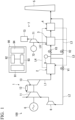
- a gas turbine plant 100 includes a gas turbine 1, an exhaust heat recovery boiler 2, a carbon dioxide recovery device 3, an exhaust gas heater 4, a funnel 5, an exhaust gas compressor 6, a carbon dioxide compression device 7, an exhaust line L1, a circulation line L2, a bypass line L3, a first valve device V1, a second valve device V2, a third valve device V3, and a control device 90.
- the "valve” and the “valve device” herein are not limited to those that can seal a flow path, also include a device, such as a damper, that can adjust the flow rate.
- the gas turbine 1 includes a compressor 11, a combustor 12, and a turbine 13.
- the compressor 11 compresses air introduced from the outside to generate high-pressure compressed air.
- the combustor 12 mixes fuel with this compressed air and combusts the mixture to generate a high-temperature and high-pressure combustion gas.
- the turbine 13 is rotationally driven by the combustion gas.
- the rotating force of the turbine 13 is used, for example, to drive a generator G coaxially connected to the turbine 13.
- a high-temperature exhaust gas is discharged from the turbine 13. This exhaust gas is transported to the exhaust heat recovery boiler 2 provided on an exhaust line L1 by the exhaust line L1 connected to a downstream side of the turbine 13.
- the exhaust heat recovery boiler 2 generates high-temperature and high-pressure steam by performing the heat exchange between the exhaust gas of the gas turbine 1 and the water.
- the configuration of the exhaust heat recovery boiler will be described below.
- the carbon dioxide recovery device 3 is provided on the exhaust line L1 on a downstream side of the exhaust heat recovery boiler 2. A low-temperature exhaust gas that is heat-exchanged with the water in the exhaust heat recovery boiler 2 is transported to the carbon dioxide recovery device 3 through the exhaust line L1.
- the carbon dioxide recovery device 3 carbon dioxide contained in the exhaust gas is chemically bonded to an absorption liquid by bringing the absorption liquid containing amine as a main component and the exhaust gas into gas-liquid contact. As a result, at least a part of components of the carbon dioxide in the exhaust gas is removed.
- the configuration of the carbon dioxide recovery device 3 will be described below.
- the exhaust gas heater 4 is provided on the exhaust line L1 on a downstream side of the carbon dioxide recovery device 3.
- the exhaust gas from which the carbon dioxide has been removed is transported to the exhaust gas heater 4 through the exhaust line L1.
- the absorption liquid may be a chemical absorption agent having a component other than amine.
- the carbon dioxide compression device 7 includes a compressor body 71, a drive unit 72, and a storage unit 73.
- the compressor body 71 compresses the carbon dioxide by being driven by the drive unit 72.
- the compressed carbon dioxide is transported to the storage unit 73.
- the exhaust gas heater 4 heats the exhaust gas by performing the heat exchange between the steam generated in the exhaust heat recovery boiler 2 described above and the exhaust gas. As a result, it is possible to reduce a possibility that moisture contained in the exhaust gas evaporates to cause dew condensation in the exhaust line L1.
- the funnel 5 is provided on the exhaust line L1 on a downstream side of the exhaust gas heater 4. The exhaust gas discharged from the exhaust gas heater 4 is diffused into the atmosphere by the funnel 5.
- one end of the circulation line L2 branching from the exhaust line L1 is connected on the exhaust line L1 at a position between the exhaust heat recovery boiler 2 and the carbon dioxide recovery device 3.
- the other end of the circulation line L2 is connected to the compressor 11 of the gas turbine 1. That is, a part of the exhaust gas flowing through the exhaust line L1 can be returned to the gas turbine 1 (compressor 11) through the circulation line L2.
- the first valve device V1 and the exhaust gas compressor 6 are provided on the circulation line L2. By adjusting an opening degree of the first valve device V1, a flow rate of the exhaust gas flowing through the circulation line L2 can be changed. Note that, as will be described in detail below, the opening degree of the first valve device V1 is adjusted by a command from the control device 90.
- the exhaust gas compressor 6 is provided to increase a pressure of the exhaust gas flowing through the circulation line L2 and pump the exhaust gas to the compressor 11.
- One end of the bypass line L3 branching from the exhaust line L1 is connected to a position on the exhaust line L1 on a downstream side of a branch point between the circulation line L2 and the exhaust line L1 and an upstream side of the carbon dioxide recovery device 3.
- the other end of the bypass line L3 is connected to a position on the exhaust line L1 on the downstream side of the exhaust gas heater 4.
- the second valve device V2 is provided on the bypass line L3. By adjusting an opening degree of the second valve device V2, a flow rate of the exhaust gas flowing through the bypass line L3 can be changed. Note that, as will be described in detail below, the opening degree of the second valve device V2 is adjusted by the command from the control device 90.
- a third valve device V3 is provided on the exhaust line L1 at a position on a downstream side of a branch point between the bypass line L3 and the exhaust line L1 and an upstream side of the carbon dioxide recovery device 3.
- an opening degree of the third valve device V3 By adjusting an opening degree of the third valve device V3, a flow rate of the exhaust gas flowing into the carbon dioxide recovery device 3 from the exhaust line L1 can be adjusted.
- the opening degree of the third valve device V3 is also adjusted by the command from the control device 90.
- a densitometer D that detects a carbon dioxide concentration of the exhaust gas flowing through the exhaust line L1 is provided on the upstream side of the third valve device V3. The densitometer D quantifies the carbon dioxide concentration of the exhaust gas and transmits the quantified carbon dioxide concentration to the control device 90 as an electric signal.
- the exhaust heat recovery boiler 2 is connected to the carbon dioxide recovery device 3 and the exhaust gas heater 4 by a steam supply line L4.
- the steam generated in the exhaust heat recovery boiler 2 is supplied to the carbon dioxide recovery device 3 and the exhaust gas heater 4 through this steam supply line L4.
- the carbon dioxide recovery device 3 the carbon dioxide is separated from the absorption liquid in a state in which the carbon dioxide is bonded, by the heat of the steam supplied through the steam supply line L4.
- the exhaust gas heater 4 heats the exhaust gas by performing the heat exchange between the steam supplied through the steam supply line L4 and the exhaust gas.
- the low-temperature steam (or water) that is used in the carbon dioxide recovery device 3 and the exhaust gas heater 4 is transported to the exhaust heat recovery boiler 2 again through a steam recovery line L5.
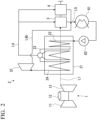
- the exhaust heat recovery boiler 2 includes a flue 21, an economizer 22, an evaporator 23, and a superheater 24, which are disposed in the flue 21, a steam turbine ST, a condenser 61, and a water supply pump 62.
- the economizer 22, the evaporator 23, and the superheater 24 are arranged in this order from the downstream side to the upstream side in a flow direction of the exhaust gas.
- the economizer 22 is connected to a downstream side of the steam recovery line L5.
- the carbon dioxide recovery device 3, the condenser 61 that restores the low-temperature steam recovered from the exhaust gas heater 4 to the water, and the water supply pump 62 that pumps the water are provided on the steam recovery line L5.
- the economizer 22 heats the water transported through the steam recovery line L5.
- the evaporator 23 further heats the high-temperature water heated by the economizer 22 to generate steam. This steam is transported to the superheater 24.
- the superheater 24 generates superheated steam by superheating the steam.
- the superheated steam generated by the superheater 24 is transported to the steam turbine ST.
- the steam turbine ST is rotationally driven by the steam to supply power to a coaxially connected generator and the like (not shown). Further, at least a part of the steam generated by the evaporator 23 is transported to the carbon dioxide recovery device 3 and the exhaust gas heater 4 through the steam supply line L4 described above and used as a heat source. Further, the exhaust of the steam turbine ST is transported to the condenser 61 through a turbine exhaust line L4b. Note that it is also possible to adopt a configuration in which the steam turbine ST is not provided.
- the carbon dioxide recovery device 3 includes an absorption tower 31, a regeneration tower 32, a heat exchanger 33, a reboiler 34, a cooler 36, a first pump P1, and a second pump P2.
- the absorption tower 31 has a tubular shape extending in a vertical direction, and the exhaust line L1 is connected to a lower portion thereof. Inside the absorption tower 31, the absorption liquid, which can be chemically bonded to the carbon dioxide, flows from above to below.
- an aqueous solution of amine containing monoethanolamine (MEA), diethanolamine (DEA), triethanolamine (TEA), diisopropanolamine (DIPA), methyldiethanolamine (MDEA) or an organic solvent containing no water, a mixture thereof, and an amino acid-based aqueous solution are preferably used. Further, the absorption liquid other than amine may be used.
- the exhaust gas flowing into the lower portion of the absorption tower 31 rises in the absorption tower 31 while coming into contact with the absorption liquid flowing from above. At this time, the carbon dioxide contained in the exhaust gas is chemically absorbed by the absorption liquid. A residual exhaust gas from which the carbon dioxide has been removed flows into the exhaust line L1 again from an upper portion of the absorption tower 31.
- the absorption liquid that has absorbed the carbon dioxide is transported to the heat exchanger 33 through an absorption liquid recovery line L31 connected to the lower portion of the absorption tower 31.
- the first pump P1 that pumps the absorption liquid is provided on the absorption liquid recovery line L31.
- the heat exchanger 33 the heat exchange is performed between the absorption liquid regenerated by heating in the regeneration tower 32 and the absorption liquid before regeneration. As a result, the temperature of the absorption liquid before the regeneration is lowered to a certain extent. After passing through the heat exchanger 33, the absorption liquid before the regeneration is transported to an upper portion of the regeneration tower 32 through the absorption liquid recovery line L31.
- the regeneration tower 32 is a device that regenerates the absorption liquid in a state in which the carbon dioxide is absorbed (separates the carbon dioxide).
- An absorption liquid heating line L33 is provided from the lower portion to the upper portion of the regeneration tower 32.
- the reboiler 34 is provided on the absorption liquid heating line L33. High-temperature steam is supplied to the reboiler 34 from the steam supply line L4 described above. In the reboiler 34, a part of the water contained in the absorption liquid is heated by the heat exchange with the steam to become stripping steam. The stripping steam comes into contact with the absorption liquid before the regeneration, which is supplied from the absorption liquid recovery line, in the regeneration tower 32.
- the carbon dioxide is diffused from the absorption liquid before the regeneration, and the absorption liquid is regenerated (becomes a state of containing no carbon dioxide).
- the carbon dioxide diffused from the absorption liquid before the regeneration is transported to the carbon dioxide compression device 7 described above through the recovery line L6 connected to the upper portion of the regeneration tower 32.
- a part of the absorption liquid after the regeneration (that is, a component which is not the stripping steam) is transported to an extraction line L32 connected to the lower portion of the regeneration tower 32.
- the heat exchanger 33, the cooler 36, and the second pump P2 are provided on the extraction line L32 in this order.
- the absorption liquid after the regeneration is supplied from the regeneration tower 32 to the heat exchanger 33.
- the second pump P2 may be provided between the heat exchanger 33 and the regeneration tower 32, or between the cooler 36 and the heat exchanger 33.
- the heat exchange is performed between the absorption liquid before the regeneration and the absorption liquid after the regeneration.
- the absorption liquid after the regeneration passes through the heat exchanger 33 and the cooler 36 to have a low temperature.
- the low-temperature absorption liquid after the regeneration is supplied to the upper portion of the absorption tower 31.
- the control device 90 includes an input unit 91, a timer 92, a determination unit 93, and a valve adjustment unit 94.
- the carbon dioxide concentration in the exhaust gas is input in a state of being quantified by the densitometer D described above, as the electric signal to the input unit 91.
- the timer 92 starts counting the time at the same time as the gas turbine 1 is activated, and when the predetermined time has elapsed, the timer 92 transmits a signal indicating a lapse of time to the determination unit 93, which will be described below.
- the "predetermined time” referred herein can be appropriately set depending on the purpose.
- the "predetermined time” refers to the time required from the activation of the gas turbine 1 until the gas turbine has stable rotation and no load.
- the determination unit 93 determines whether or not the carbon dioxide concentration is within a predetermined threshold value and whether or not the predetermined time described above has elapsed.
- the valve adjustment unit 94 transmits a signal for adjusting the opening degrees of the first valve device V1, the second valve device V2, and the third valve device V3 based on the signal transmitted from the determination unit 93.
- the exhaust gas is generated from the turbine 13.
- This exhaust gas passes through the exhaust heat recovery boiler 2 to have a low temperature, and then flows into the carbon dioxide recovery device 3.
- the carbon dioxide is removed from the exhaust gas as described above. Thereafter, the exhaust gas is heated by the exhaust gas heater 4 and then diffused into the atmosphere from the funnel 5.
- the carbon dioxide, which is removed from the exhaust gas is liquefied and stored by the carbon dioxide compression device 7.
- the property of the exhaust gas of the gas turbine 1 differs depending on an operation state of the gas turbine 1. For example, immediately after the gas turbine 1 is activated, the exhaust gas is in a state of containing a large amount of NOx or unburned hydrocarbon. In a case in which the exhaust gas is supplied to the carbon dioxide recovery device 3 in a state in which these substances are contained, there is a possibility that the absorption liquid is degenerated or deteriorated. Further, immediately after the gas turbine 1 is activated, the carbon dioxide concentration in the exhaust gas is lower than that in a rated operation, so that there is a possibility that the efficiency in the recovery of the carbon dioxide is lowered.
- the opening degrees of the first valve device V1, the second valve device V2, and the third valve device V3 are adjusted by the control device 90, as a result, circulation states of the circulation line L2 and the bypass line L3 are adjusted.
- the control device 90 adjusts the opening degrees of the first valve device V1, the second valve device V2, and the third valve device V3 based on at least one of the operation state of the gas turbine 1 and the carbon dioxide concentration in the exhaust gas.
- the control device 90 closes the first valve device V1 and the third valve device V3, and opens the second valve device V2.
- the exhaust gas passes through the exhaust line L1 and the bypass line L3, bypasses the carbon dioxide recovery device 3, and flows into the funnel 5 on the downstream side of the carbon dioxide recovery device. Therefore, the exhaust gas containing a large amount of NOx or unburned hydrocarbon immediately after the activation does not flow into the carbon dioxide recovery device 3.
- the possibility that the performance of the carbon dioxide recovery device 3 is deteriorated can be reduced.
- the control device 90 adjusts the opening degree of the first valve device V1 in a direction of increasing the opening degree.
- a part of the exhaust gas is supplied again to the compressor 11 of the gas turbine 1 through the circulation line L2.
- the carbon dioxide in the exhaust gas is concentrated. That is, it is possible to increase the carbon dioxide concentration per unit flow rate of the exhaust gas.
- the control device 90 closes the second valve device V2 and opens the third valve device V3 in a case in which the carbon dioxide concentration is larger than the predetermined threshold value.
- the exhaust gas containing a high concentration of the carbon dioxide is supplied to the carbon dioxide recovery device 3. Since the carbon dioxide concentration per unit flow rate of the exhaust gas is high, the carbon dioxide recovery device 3 can further efficiently recover the carbon dioxide. As a result, it is possible to further reduce the processing capacity required for the carbon dioxide recovery device 3.
- the second valve device V2 may be closed and the third valve device V3 may be opened even in a case in which the carbon dioxide concentration is lower than the threshold value.
- the exhaust gas on the circulation line L2 is supplied to the gas turbine 1 in a state of being compressed by the exhaust gas compressor 6.
- the gas turbine 1 can further be stably and efficiently operated.
- the steam is generated by the heat of the exhaust gas of the gas turbine 1 by the exhaust heat recovery boiler 2. Due to the steam, the carbon dioxide, which is chemically bonded to the absorption liquid, is removed (recovered) in the regeneration tower 32 inside the carbon dioxide recovery device 3. That is, with the configuration described above, the absorption liquid can be regenerated by the heat recovered from the exhaust gas without using another heat source.
- the temperature of the exhaust gas rises by performing the heat exchange between the high-temperature water or the steam and the exhaust gas by the exhaust gas heater 4.
- the exhaust gas heater 4 As a result, it is possible to reduce a possibility that moisture contained in the exhaust gas condenses to cause dew condensation.
- the water or the steam that exchanges the heat with the exhaust gas is supplied from the exhaust heat recovery boiler 2, the exhaust gas can be heated without using another heat source.
- the configuration has been described in which the gas turbine plant 100 includes one gas turbine 1, one exhaust heat recovery boiler 2, and one exhaust gas compressor 6.
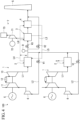
- the configuration of the above embodiment is adopted, so that it is possible to reduce the processing capacity required for the carbon dioxide recovery device 3. Stated another way, it is possible to provide a margin to the processing capacity of the carbon dioxide recovery device 3. Therefore, for example, as shown in Fig. 4 , dual system gas turbine 1 (that is, two gas turbines 1, two exhaust heat recovery boilers 2, and two exhaust gas compressors 6) can also be provided for one carbon dioxide recovery device 3.
- the carbon dioxide recovery device 3 can be further efficiently operated, and the cost and time required for plant construction and maintenance can be reduced.
- the carbon dioxide can be further efficiently recovered.
Landscapes
- Engineering & Computer Science (AREA)
- Chemical & Material Sciences (AREA)
- Combustion & Propulsion (AREA)
- Mechanical Engineering (AREA)
- General Engineering & Computer Science (AREA)
- Chemical Kinetics & Catalysis (AREA)
- General Chemical & Material Sciences (AREA)
- Life Sciences & Earth Sciences (AREA)
- Sustainable Development (AREA)
- Treating Waste Gases (AREA)
- Engine Equipment That Uses Special Cycles (AREA)
Description
- The present invention relates to a gas turbine plant including a gas turbine and an exhaust carbon dioxide recovery method therefor.
- In a power plant using fossil fuels, for example, a plant equipped with a gas turbine (gas turbine plant), an exhaust gas containing carbon dioxide is generated in accordance with an operation of the gas turbine. From the viewpoint of environmental protection, the technology of removing the carbon dioxide from the exhaust gas as much as possible is required. As such technology, for example, a plant disclosed in
WO 2013/143827 A2 (JP 2015-519499 A - The plant disclosed in
WO 2013/143827 A2 (JP 2015-519499 A -
EP 2 551 476 A1claim 1. -
US 2012/186268 A1 discloses a gas turbine power plant with exhaust gas recirculation, the plant comprising a gas turbine, an exhaust line, a carbon dioxide recovery device, a circulation line, a bypass line, a densiometer, and a valve provided on the bypass line. -
EP 2 644 851 A1 - In the gas turbine plant, a carbon dioxide concentration contained in the exhaust gas is significantly lower than that of a coal-fired power plant in the related art, and thus in a case in which a carbon dioxide absorption device for the coal-fired power plant is used, there are problems in recovery of the carbon dioxide, such as cost increases due to large equipment and inefficient operation.
- The present invention has been made to solve the above problems, and is to provide a gas turbine plant including the features of
claim 1 and an exhaust carbon dioxide recovery method therefor including the features of claim 8 which can further efficiently perform recovery of the carbon dioxide. - An aspect of the present invention relates to a gas turbine plant including a gas turbine configured to receive fuel in accordance with a required output, combust the fuel, and be driven by a combustion gas generated by combusting the fuel, an exhaust line configured to guide an exhaust gas exhausted from the gas turbine to an outside, a carbon dioxide recovery device provided on the exhaust line and configured to recover carbon dioxide contained in the exhaust gas flowing through the exhaust line, a circulation line branching from a position on the exhaust line on an upstream side in a flow direction of the exhaust gas with the carbon dioxide recovery device as a reference and connected to the gas turbine, a first valve device provided on the circulation line, a bypass line branching from a position on the exhaust line on a downstream side of the circulation line in the flow direction and the upstream side of the carbon dioxide recovery device, bypassing the carbon dioxide recovery device, and connected to a position on the exhaust line on a downstream side of the carbon dioxide recovery device, a second valve device provided on the bypass line, a third valve device provided on the exhaust line at a position between the bypass line and the carbon dioxide recovery device, a densitometer provided on the exhaust line and configured to detect a carbon dioxide concentration in the exhaust gas, and a control device configured to adjust opening degrees of the first valve device, the second valve device, and the third valve device based on at least one of an operation state of the gas turbine and the carbon dioxide concentration.
- Note that the "valve" and the "valve device" herein are not technically limited to those that can be sealed, and include, for example, a device, such as a damper, that can adjust a flow rate. With the configuration described above, the control device adjusts the opening degrees of the first valve device, the second valve device, and the third valve device based on at least one of the operation state of the gas turbine and the carbon dioxide concentration in the exhaust gas. As a result, for example, immediately after the gas turbine is activated, by closing the first valve device and the third valve device and opening the second valve device, the exhaust gas bypasses the carbon dioxide recovery device through the exhaust line and the bypass line, and flows into the downstream side. Therefore, the exhaust gas containing a large amount of NOx or unburned hydrocarbon immediately after the activation does not flow into the carbon dioxide recovery device. As a result, a possibility that the performance of the carbon dioxide recovery device is deteriorated can be reduced. Further, for example, after a predetermined time has elapsed from activation of the gas turbine, the control device adjusts the opening degree of the first valve device in a direction of increasing the opening degree from the state described above, so that a part of the exhaust gas is supplied again to the gas turbine through the circulation line. As a result, the carbon dioxide in the exhaust gas is concentrated. That is, since the carbon dioxide concentration per unit flow rate of the exhaust gas is increased, the carbon dioxide recovery device can further efficiently recover the carbon dioxide.
- In the gas turbine plant described above, the control device may be configured to close the first valve device and the third valve device and open the second valve device until a predetermined time elapses from activation of the gas turbine.
- With the configuration described above, immediately after the gas turbine is activated, by closing the first valve device and the third valve device and opening the second valve device, the exhaust gas passes through the exhaust line and the bypass line, bypasses the carbon dioxide recovery device, and flows into the downstream side. As a result, the exhaust gas containing a large amount of NOx or unburned hydrocarbon immediately after the activation does not flow into the carbon dioxide recovery device. As a result, a possibility that the performance of the carbon dioxide recovery device is deteriorated can be reduced.
- In the gas turbine plant described above, the control device may be configured to, after a predetermined time has elapsed from activation of the gas turbine, adjust the opening degree of the first valve device in a direction of increasing the opening degree in a state in which the second valve device is opened and the third valve device is closed.
- With the configuration described above, after the predetermined time has elapsed from activation of the gas turbine, the control device adjusts the opening degree of the first valve device in a direction of increasing the opening degree from the state described above, so that a part of the exhaust gas is supplied again to the gas turbine through the circulation line. As a result, the carbon dioxide in the exhaust gas is concentrated. That is, since the carbon dioxide concentration per unit flow rate of the exhaust gas is increased, the carbon dioxide recovery device can further efficiently recover the carbon dioxide. As a result, it is possible to reduce a processing capacity required for the carbon dioxide recovery device.
- In the gas turbine plant described above, the control device may be configured to, after a predetermined time has elapsed from activation of the gas turbine, close the second valve device and open the third valve device in a case in which the carbon dioxide concentration is larger than a predetermined threshold value.
- With the configuration described above, in a case in which the carbon dioxide concentration in the exhaust gas is larger than the threshold value, the control device closes the second valve device and opens the third valve device. As a result, the exhaust gas containing a high concentration of the carbon dioxide is supplied to the carbon dioxide recovery device. Since the carbon dioxide concentration per unit flow rate of the exhaust gas is high, the carbon dioxide recovery device can further efficiently recover the carbon dioxide. As a result, it is possible to further reduce the processing capacity required for the carbon dioxide recovery device. Note that under conditions not described herein, the second valve device may be closed and the third valve device may be opened even in a case in which the carbon dioxide concentration is lower than the threshold value.
- The gas turbine plant described above may further include an exhaust gas compressor provided on the circulation line and configured to increase a pressure of the exhaust gas flowing through the circulation line.
- With the configuration described above, the exhaust gas on the circulation line is supplied to the gas turbine in a state of being compressed by the exhaust gas compressor. As a result, it possible to reduce a pressure loss in a case in which the exhaust gas flows into the gas turbine. As a result, the gas turbine can be further stably and efficiently operated.
- The gas turbine plant described above may further include an exhaust heat recovery boiler configured to generate steam by heat of the exhaust gas exhausted from the gas turbine and guide the exhaust gas passing through an inside of the exhaust heat recovery boiler itself to the exhaust line, in which the carbon dioxide recovery device includes a regeneration tower configured to regenerate an absorption liquid that absorbs the carbon dioxide in the carbon dioxide recovery device by water heated by the exhaust heat recovery boiler or the steam generated by the exhaust heat recovery boiler.
- With the configuration described above, the steam is generated by the heat of the exhaust gas of the gas turbine by the exhaust heat recovery boiler. Due to the steam, the carbon dioxide, which is chemically bonded to the absorption liquid, is removed (recovered) in the regeneration tower inside the carbon dioxide recovery device. That is, with the configuration described above, the absorption liquid can be regenerated by the heat generated inside the gas turbine plant, that is, the heat recovered from the exhaust gas, without using another heat source.
- The gas turbine plant described above may further include an exhaust heat recovery boiler configured to generate steam by heat of the exhaust gas exhausted from the gas turbine and guide the exhaust gas passing through an inside of the exhaust heat recovery boiler itself to the exhaust line, and an exhaust gas heater disposed on the exhaust line on the downstream side of the carbon dioxide recovery device in a flow of the exhaust gas, in which the exhaust gas heater is a heat exchanger configured to heat the exhaust gas by performing heat exchange between water heated by the exhaust heat recovery boiler or steam generated by the exhaust heat recovery boiler and the exhaust gas flowing through the exhaust line.
- With the configuration described above, the temperature of the exhaust gas rises by performing the heat exchange between the high-temperature water or the steam and the exhaust gas by the exhaust gas heater. As a result, it is possible to reduce a possibility that moisture contained in the exhaust gas condenses to cause dew condensation. Further, since the water or the steam that exchanges the heat with the exhaust gas is supplied from the exhaust heat recovery boiler, the exhaust gas can be heated without using another heat source.
- Another aspect of the present invention relates to an exhaust carbon dioxide recovery method for a gas turbine plant including a gas turbine configured to receive fuel in accordance with a required output, combust the fuel, and be driven by a combustion gas generated by combusting the fuel, an exhaust line configured to guide an exhaust gas exhausted from the gas turbine to an outside, a carbon dioxide recovery device provided on the exhaust line and configured to recover carbon dioxide contained in the exhaust gas flowing through the exhaust line, a circulation line branching from a position on the exhaust line on an upstream side in a flow direction of the exhaust gas with the carbon dioxide recovery device as a reference and connected to the gas turbine, a first valve device provided on the circulation line, a bypass line branching from a position on the exhaust line on a downstream side of the circulation line in the flow direction and the upstream side of the carbon dioxide recovery device, bypassing the carbon dioxide recovery device, and connected to a position on the exhaust line on a downstream side of the carbon dioxide recovery device, a second valve device provided on the bypass line, a third valve device provided on the exhaust line at a position between the bypass line and the carbon dioxide recovery device, and a densitometer provided on the exhaust line and configured to detect a carbon dioxide concentration in the exhaust gas, the method including adjusting opening degrees of the first valve device, the second valve device, and the third valve device based on at least one of an operation state of the gas turbine and the carbon dioxide concentration.
- With the method described above, the opening degrees of the first valve device, the second valve device, and the third valve device are adjusted based on at least one of the operation state of the gas turbine and the carbon dioxide concentration in the exhaust gas. As a result, for example, immediately after the gas turbine is activated, by closing the first valve device and the third valve device and opening the second valve device, the exhaust gas bypasses the carbon dioxide recovery device through the exhaust line and the bypass line, and flows into the downstream side. Therefore, the exhaust gas containing a large amount of NOx or unburned hydrocarbon immediately after the activation does not flow into the carbon dioxide recovery device. As a result, a possibility that the performance of the carbon dioxide recovery device is deteriorated can be reduced. Further, for example, after a predetermined time has elapsed from activation of the gas turbine, the opening degree of the first valve device is adjusted in a direction of increasing the opening degree from the state described above, so that a part of the exhaust gas is supplied again to the gas turbine through the circulation line. As a result, the carbon dioxide in the exhaust gas is concentrated. That is, since the carbon dioxide concentration per unit flow rate of the exhaust gas is increased, the carbon dioxide recovery device can further efficiently recover the carbon dioxide.
- According to the present invention, it is possible to provide a gas turbine plant and an exhaust carbon dioxide recovery method therefor which can further efficiently perform recovery of the carbon dioxide.
-
-
Fig. 1 is a diagram showing a configuration of a gas turbine plant according to an embodiment of the present invention. -
Fig. 2 is a diagram showing a configuration of an exhaust heat recovery boiler according to the embodiment of the present invention. -
Fig. 3 is a diagram showing a configuration of a carbon dioxide recovery device according to the embodiment of the present invention. -
Fig. 4 is a diagram showing a modification example of the gas turbine plant according to the embodiment of the present invention. - An embodiment of the present invention will be described with reference to
Figs. 1 to 3 . As shown inFig. 1 , agas turbine plant 100 according to the present embodiment includes agas turbine 1, an exhaustheat recovery boiler 2, a carbondioxide recovery device 3, anexhaust gas heater 4, afunnel 5, anexhaust gas compressor 6, a carbon dioxide compression device 7, an exhaust line L1, a circulation line L2, a bypass line L3, a first valve device V1, a second valve device V2, a third valve device V3, and acontrol device 90. Note that the "valve" and the "valve device" herein are not limited to those that can seal a flow path, also include a device, such as a damper, that can adjust the flow rate. - The
gas turbine 1 includes acompressor 11, acombustor 12, and aturbine 13. Thecompressor 11 compresses air introduced from the outside to generate high-pressure compressed air. Thecombustor 12 mixes fuel with this compressed air and combusts the mixture to generate a high-temperature and high-pressure combustion gas. Theturbine 13 is rotationally driven by the combustion gas. The rotating force of theturbine 13 is used, for example, to drive a generator G coaxially connected to theturbine 13. A high-temperature exhaust gas is discharged from theturbine 13. This exhaust gas is transported to the exhaustheat recovery boiler 2 provided on an exhaust line L1 by the exhaust line L1 connected to a downstream side of theturbine 13. - The exhaust
heat recovery boiler 2 generates high-temperature and high-pressure steam by performing the heat exchange between the exhaust gas of thegas turbine 1 and the water. The configuration of the exhaust heat recovery boiler will be described below. The carbondioxide recovery device 3 is provided on the exhaust line L1 on a downstream side of the exhaustheat recovery boiler 2. A low-temperature exhaust gas that is heat-exchanged with the water in the exhaustheat recovery boiler 2 is transported to the carbondioxide recovery device 3 through the exhaust line L1. - In the carbon
dioxide recovery device 3, carbon dioxide contained in the exhaust gas is chemically bonded to an absorption liquid by bringing the absorption liquid containing amine as a main component and the exhaust gas into gas-liquid contact. As a result, at least a part of components of the carbon dioxide in the exhaust gas is removed. The configuration of the carbondioxide recovery device 3 will be described below. Theexhaust gas heater 4 is provided on the exhaust line L1 on a downstream side of the carbondioxide recovery device 3. The exhaust gas from which the carbon dioxide has been removed is transported to theexhaust gas heater 4 through the exhaust line L1. Note that the absorption liquid may be a chemical absorption agent having a component other than amine. - On the other hand, the carbon dioxide separated from the exhaust gas is transported to the carbon dioxide compression device 7 through a recovery line L6. The carbon dioxide compression device 7 includes a
compressor body 71, adrive unit 72, and astorage unit 73. Thecompressor body 71 compresses the carbon dioxide by being driven by thedrive unit 72. The compressed carbon dioxide is transported to thestorage unit 73. - The
exhaust gas heater 4 heats the exhaust gas by performing the heat exchange between the steam generated in the exhaustheat recovery boiler 2 described above and the exhaust gas. As a result, it is possible to reduce a possibility that moisture contained in the exhaust gas evaporates to cause dew condensation in the exhaust line L1. Thefunnel 5 is provided on the exhaust line L1 on a downstream side of theexhaust gas heater 4. The exhaust gas discharged from theexhaust gas heater 4 is diffused into the atmosphere by thefunnel 5. - Further, one end of the circulation line L2 branching from the exhaust line L1 is connected on the exhaust line L1 at a position between the exhaust
heat recovery boiler 2 and the carbondioxide recovery device 3. The other end of the circulation line L2 is connected to thecompressor 11 of thegas turbine 1. That is, a part of the exhaust gas flowing through the exhaust line L1 can be returned to the gas turbine 1 (compressor 11) through the circulation line L2. The first valve device V1 and theexhaust gas compressor 6 are provided on the circulation line L2. By adjusting an opening degree of the first valve device V1, a flow rate of the exhaust gas flowing through the circulation line L2 can be changed. Note that, as will be described in detail below, the opening degree of the first valve device V1 is adjusted by a command from thecontrol device 90. Theexhaust gas compressor 6 is provided to increase a pressure of the exhaust gas flowing through the circulation line L2 and pump the exhaust gas to thecompressor 11. - One end of the bypass line L3 branching from the exhaust line L1 is connected to a position on the exhaust line L1 on a downstream side of a branch point between the circulation line L2 and the exhaust line L1 and an upstream side of the carbon
dioxide recovery device 3. The other end of the bypass line L3 is connected to a position on the exhaust line L1 on the downstream side of theexhaust gas heater 4. The second valve device V2 is provided on the bypass line L3. By adjusting an opening degree of the second valve device V2, a flow rate of the exhaust gas flowing through the bypass line L3 can be changed. Note that, as will be described in detail below, the opening degree of the second valve device V2 is adjusted by the command from thecontrol device 90. - A third valve device V3 is provided on the exhaust line L1 at a position on a downstream side of a branch point between the bypass line L3 and the exhaust line L1 and an upstream side of the carbon
dioxide recovery device 3. By adjusting an opening degree of the third valve device V3, a flow rate of the exhaust gas flowing into the carbondioxide recovery device 3 from the exhaust line L1 can be adjusted. The opening degree of the third valve device V3 is also adjusted by the command from thecontrol device 90. Further, a densitometer D that detects a carbon dioxide concentration of the exhaust gas flowing through the exhaust line L1 is provided on the upstream side of the third valve device V3. The densitometer D quantifies the carbon dioxide concentration of the exhaust gas and transmits the quantified carbon dioxide concentration to thecontrol device 90 as an electric signal. - The exhaust
heat recovery boiler 2 is connected to the carbondioxide recovery device 3 and theexhaust gas heater 4 by a steam supply line L4. The steam generated in the exhaustheat recovery boiler 2 is supplied to the carbondioxide recovery device 3 and theexhaust gas heater 4 through this steam supply line L4. As will be described in detail below, in the carbondioxide recovery device 3, the carbon dioxide is separated from the absorption liquid in a state in which the carbon dioxide is bonded, by the heat of the steam supplied through the steam supply line L4. Theexhaust gas heater 4 heats the exhaust gas by performing the heat exchange between the steam supplied through the steam supply line L4 and the exhaust gas. The low-temperature steam (or water) that is used in the carbondioxide recovery device 3 and theexhaust gas heater 4 is transported to the exhaustheat recovery boiler 2 again through a steam recovery line L5. - Next, a configuration of the exhaust
heat recovery boiler 2 will be described with reference toFig. 2 . As shown inFig. 2 , the exhaustheat recovery boiler 2 includes aflue 21, an economizer 22, anevaporator 23, and asuperheater 24, which are disposed in theflue 21, a steam turbine ST, acondenser 61, and awater supply pump 62. In theflue 21, the economizer 22, theevaporator 23, and thesuperheater 24 are arranged in this order from the downstream side to the upstream side in a flow direction of the exhaust gas. - The economizer 22 is connected to a downstream side of the steam recovery line L5. The carbon
dioxide recovery device 3, thecondenser 61 that restores the low-temperature steam recovered from theexhaust gas heater 4 to the water, and thewater supply pump 62 that pumps the water are provided on the steam recovery line L5. The economizer 22 heats the water transported through the steam recovery line L5. Theevaporator 23 further heats the high-temperature water heated by the economizer 22 to generate steam. This steam is transported to thesuperheater 24. Thesuperheater 24 generates superheated steam by superheating the steam. - The superheated steam generated by the
superheater 24 is transported to the steam turbine ST. The steam turbine ST is rotationally driven by the steam to supply power to a coaxially connected generator and the like (not shown). Further, at least a part of the steam generated by theevaporator 23 is transported to the carbondioxide recovery device 3 and theexhaust gas heater 4 through the steam supply line L4 described above and used as a heat source. Further, the exhaust of the steam turbine ST is transported to thecondenser 61 through a turbine exhaust line L4b. Note that it is also possible to adopt a configuration in which the steam turbine ST is not provided. - Then, a configuration of the carbon
dioxide recovery device 3 will be described with reference toFig. 3 . As shown inFig. 3 , the carbondioxide recovery device 3 includes anabsorption tower 31, aregeneration tower 32, aheat exchanger 33, areboiler 34, a cooler 36, a first pump P1, and a second pump P2. - The
absorption tower 31 has a tubular shape extending in a vertical direction, and the exhaust line L1 is connected to a lower portion thereof. Inside theabsorption tower 31, the absorption liquid, which can be chemically bonded to the carbon dioxide, flows from above to below. Note that specifically, as such an absorption liquid, an aqueous solution of amine containing monoethanolamine (MEA), diethanolamine (DEA), triethanolamine (TEA), diisopropanolamine (DIPA), methyldiethanolamine (MDEA) or an organic solvent containing no water, a mixture thereof, and an amino acid-based aqueous solution are preferably used. Further, the absorption liquid other than amine may be used. - The exhaust gas flowing into the lower portion of the
absorption tower 31 rises in theabsorption tower 31 while coming into contact with the absorption liquid flowing from above. At this time, the carbon dioxide contained in the exhaust gas is chemically absorbed by the absorption liquid. A residual exhaust gas from which the carbon dioxide has been removed flows into the exhaust line L1 again from an upper portion of theabsorption tower 31. - The absorption liquid that has absorbed the carbon dioxide is transported to the
heat exchanger 33 through an absorption liquid recovery line L31 connected to the lower portion of theabsorption tower 31. Note that the first pump P1 that pumps the absorption liquid is provided on the absorption liquid recovery line L31. As will be described in detail below, in theheat exchanger 33, the heat exchange is performed between the absorption liquid regenerated by heating in theregeneration tower 32 and the absorption liquid before regeneration. As a result, the temperature of the absorption liquid before the regeneration is lowered to a certain extent. After passing through theheat exchanger 33, the absorption liquid before the regeneration is transported to an upper portion of theregeneration tower 32 through the absorption liquid recovery line L31. - The
regeneration tower 32 is a device that regenerates the absorption liquid in a state in which the carbon dioxide is absorbed (separates the carbon dioxide). An absorption liquid heating line L33 is provided from the lower portion to the upper portion of theregeneration tower 32. Thereboiler 34 is provided on the absorption liquid heating line L33. High-temperature steam is supplied to thereboiler 34 from the steam supply line L4 described above. In thereboiler 34, a part of the water contained in the absorption liquid is heated by the heat exchange with the steam to become stripping steam. The stripping steam comes into contact with the absorption liquid before the regeneration, which is supplied from the absorption liquid recovery line, in theregeneration tower 32. As a result, the carbon dioxide is diffused from the absorption liquid before the regeneration, and the absorption liquid is regenerated (becomes a state of containing no carbon dioxide). The carbon dioxide diffused from the absorption liquid before the regeneration is transported to the carbon dioxide compression device 7 described above through the recovery line L6 connected to the upper portion of theregeneration tower 32. - A part of the absorption liquid after the regeneration (that is, a component which is not the stripping steam) is transported to an extraction line L32 connected to the lower portion of the
regeneration tower 32. Theheat exchanger 33, the cooler 36, and the second pump P2 are provided on the extraction line L32 in this order. By driving the second pump P2, the absorption liquid after the regeneration is supplied from theregeneration tower 32 to theheat exchanger 33. Note that the second pump P2 may be provided between theheat exchanger 33 and theregeneration tower 32, or between the cooler 36 and theheat exchanger 33. In theheat exchanger 33, as described above, the heat exchange is performed between the absorption liquid before the regeneration and the absorption liquid after the regeneration. The absorption liquid after the regeneration passes through theheat exchanger 33 and the cooler 36 to have a low temperature. The low-temperature absorption liquid after the regeneration is supplied to the upper portion of theabsorption tower 31. - Then, the
control device 90 will be described. As shown inFig. 1 , thecontrol device 90 includes aninput unit 91, atimer 92, adetermination unit 93, and avalve adjustment unit 94. The carbon dioxide concentration in the exhaust gas is input in a state of being quantified by the densitometer D described above, as the electric signal to theinput unit 91. Thetimer 92 starts counting the time at the same time as thegas turbine 1 is activated, and when the predetermined time has elapsed, thetimer 92 transmits a signal indicating a lapse of time to thedetermination unit 93, which will be described below. Note that the "predetermined time" referred herein can be appropriately set depending on the purpose. In the present embodiment, the "predetermined time" refers to the time required from the activation of thegas turbine 1 until the gas turbine has stable rotation and no load. Thedetermination unit 93 determines whether or not the carbon dioxide concentration is within a predetermined threshold value and whether or not the predetermined time described above has elapsed. Thevalve adjustment unit 94 transmits a signal for adjusting the opening degrees of the first valve device V1, the second valve device V2, and the third valve device V3 based on the signal transmitted from thedetermination unit 93. - Next, an operation of the
gas turbine plant 100 according to the present embodiment will be described. By driving thegas turbine 1, the exhaust gas is generated from theturbine 13. This exhaust gas passes through the exhaustheat recovery boiler 2 to have a low temperature, and then flows into the carbondioxide recovery device 3. In the carbondioxide recovery device 3, the carbon dioxide is removed from the exhaust gas as described above. Thereafter, the exhaust gas is heated by theexhaust gas heater 4 and then diffused into the atmosphere from thefunnel 5. The carbon dioxide, which is removed from the exhaust gas, is liquefied and stored by the carbon dioxide compression device 7. - Here, the property of the exhaust gas of the
gas turbine 1 differs depending on an operation state of thegas turbine 1. For example, immediately after thegas turbine 1 is activated, the exhaust gas is in a state of containing a large amount of NOx or unburned hydrocarbon. In a case in which the exhaust gas is supplied to the carbondioxide recovery device 3 in a state in which these substances are contained, there is a possibility that the absorption liquid is degenerated or deteriorated. Further, immediately after thegas turbine 1 is activated, the carbon dioxide concentration in the exhaust gas is lower than that in a rated operation, so that there is a possibility that the efficiency in the recovery of the carbon dioxide is lowered. - Therefore, in the present embodiment, the opening degrees of the first valve device V1, the second valve device V2, and the third valve device V3 are adjusted by the
control device 90, as a result, circulation states of the circulation line L2 and the bypass line L3 are adjusted. - Specifically, the
control device 90 adjusts the opening degrees of the first valve device V1, the second valve device V2, and the third valve device V3 based on at least one of the operation state of thegas turbine 1 and the carbon dioxide concentration in the exhaust gas. Immediately after thegas turbine 1 is activated, thecontrol device 90 closes the first valve device V1 and the third valve device V3, and opens the second valve device V2. As a result, the exhaust gas passes through the exhaust line L1 and the bypass line L3, bypasses the carbondioxide recovery device 3, and flows into thefunnel 5 on the downstream side of the carbon dioxide recovery device. Therefore, the exhaust gas containing a large amount of NOx or unburned hydrocarbon immediately after the activation does not flow into the carbondioxide recovery device 3. As a result, the possibility that the performance of the carbon dioxide recovery device 3 (property of the absorption liquid) is deteriorated can be reduced. - Further, from the above state, after the predetermined time has elapsed from the activation of the
gas turbine 1, thecontrol device 90 adjusts the opening degree of the first valve device V1 in a direction of increasing the opening degree. As a result, after the predetermined time has elapsed from the activation of thegas turbine 1, a part of the exhaust gas is supplied again to thecompressor 11 of thegas turbine 1 through the circulation line L2. As a result, the carbon dioxide in the exhaust gas is concentrated. That is, it is possible to increase the carbon dioxide concentration per unit flow rate of the exhaust gas. - In addition, from the above state, after the predetermined time has elapsed from the activation of the
gas turbine 1, thecontrol device 90 closes the second valve device V2 and opens the third valve device V3 in a case in which the carbon dioxide concentration is larger than the predetermined threshold value. As a result, the exhaust gas containing a high concentration of the carbon dioxide is supplied to the carbondioxide recovery device 3. Since the carbon dioxide concentration per unit flow rate of the exhaust gas is high, the carbondioxide recovery device 3 can further efficiently recover the carbon dioxide. As a result, it is possible to further reduce the processing capacity required for the carbondioxide recovery device 3. Note that under conditions not described herein, the second valve device V2 may be closed and the third valve device V3 may be opened even in a case in which the carbon dioxide concentration is lower than the threshold value. - Further, with the configuration described above, the exhaust gas on the circulation line L2 is supplied to the
gas turbine 1 in a state of being compressed by theexhaust gas compressor 6. As a result, it possible to reduce a pressure loss in a case in which the exhaust gas flows into thegas turbine 1. As a result, thegas turbine 1 can further be stably and efficiently operated. - Further, with the configuration described above, the steam is generated by the heat of the exhaust gas of the
gas turbine 1 by the exhaustheat recovery boiler 2. Due to the steam, the carbon dioxide, which is chemically bonded to the absorption liquid, is removed (recovered) in theregeneration tower 32 inside the carbondioxide recovery device 3. That is, with the configuration described above, the absorption liquid can be regenerated by the heat recovered from the exhaust gas without using another heat source. - In addition, with the configuration described above, the temperature of the exhaust gas rises by performing the heat exchange between the high-temperature water or the steam and the exhaust gas by the
exhaust gas heater 4. As a result, it is possible to reduce a possibility that moisture contained in the exhaust gas condenses to cause dew condensation. Further, since the water or the steam that exchanges the heat with the exhaust gas is supplied from the exhaustheat recovery boiler 2, the exhaust gas can be heated without using another heat source. - For example, in the above embodiment, the configuration has been described in which the
gas turbine plant 100 includes onegas turbine 1, one exhaustheat recovery boiler 2, and oneexhaust gas compressor 6. On the other hand, the configuration of the above embodiment is adopted, so that it is possible to reduce the processing capacity required for the carbondioxide recovery device 3. Stated another way, it is possible to provide a margin to the processing capacity of the carbondioxide recovery device 3. Therefore, for example, as shown inFig. 4 , dual system gas turbine 1 (that is, twogas turbines 1, two exhaustheat recovery boilers 2, and two exhaust gas compressors 6) can also be provided for one carbondioxide recovery device 3. As a result, the carbondioxide recovery device 3 can be further efficiently operated, and the cost and time required for plant construction and maintenance can be reduced. - In the gas turbine plant according to the aspect of the present invention, the carbon dioxide can be further efficiently recovered.
-
- 100: gas turbine plant
- 1: gas turbine
- 2: exhaust heat recovery boiler
- 3: carbon dioxide recovery device
- 4: exhaust gas heater
- 5: funnel
- 6: exhaust gas compressor
- 7: carbon dioxide compression device
- 11: compressor
- 12: combustor
- 13: turbine
- 21: flue
- 22: economizer
- 23: evaporator
- 24: superheater
- 31: absorption tower
- 32: regeneration tower
- 33: heat exchanger
- 34: reboiler
- 36: cooler
- 61: condenser
- 62: water supply pump
- 90: control device
- 91: input unit
- 92: timer
- 93: determination unit
- 94: valve adjustment unit
- D: densitometer
- G: generator
- L1: exhaust line
- L2: circulation line
- L3: bypass line
- L4: steam supply line
- L4b: turbine exhaust line
- L5: steam recovery line
- L6: recovery line
- L31: absorption liquid recovery line
- L32: extraction line
- L33: absorption liquid heating line
- P1: first pump
- P2: second pump
- ST: steam turbine
- V1: first valve device
- V2: second valve device
- V3: third valve device
Claims (8)
- A gas turbine plant (100) comprising:a gas turbine (1) configured to receive fuel in accordance with a required output, combust the fuel, and be driven by a combustion gas generated by combusting the fuel;an exhaust line (L1) configured to guide an exhaust gas exhausted from the gas turbine (1) to an outside;a carbon dioxide recovery device (3) provided on the exhaust line (L1) and configured to recover carbon dioxide contained in the exhaust gas flowing through the exhaust line (L1) ;a circulation line (L2) branching from a position on the exhaust line (L1) on an upstream side in a flow direction of the exhaust gas with the carbon dioxide recovery device (3) as a reference and connected to the gas turbine (1);a bypass line (L3) branching from a position on the exhaust line (L1) on a downstream side of the circulation line (L2) in the flow direction and the upstream side of the carbon dioxide recovery device (3), bypassing the carbon dioxide recovery device (3), and connected to a position on the exhaust line (L1) on a downstream side of the carbon dioxide recovery device (3);a densitometer (D) provided on the exhaust line (L1) and configured to detect a carbon dioxide concentration in the exhaust gas; anda control device (90),characterized in thatthe gas turbine plant (100) further comprises:a first valve device (V1) provided on the circulation line (L2);a second valve device (V2) provided on the bypass line (L3); anda third valve device (V3) provided on the exhaust line (L1) at a position between the bypass line (L3) and the carbon dioxide recovery device (3), andthe control device (90) is configured to adjust opening degrees of the first valve device (V1), the second valve device (V2), and the third valve device (V3) based on at least one of an operation state of the gas turbine (1) and the carbon dioxide concentration.
- The gas turbine plant (100) according to Claim 1,
wherein the control device (90) is configured to close the first valve device (V1) and the third valve device (V3) and open the second valve device (V2) until a predetermined time elapses from activation of the gas turbine (1). - The gas turbine plant (100) according to Claim 1 or 2,
wherein the control device (90) is configured to, after a predetermined time has elapsed from activation of the gas turbine (1), adjust the opening degree of the first valve device (V1) in a direction of increasing the opening degree in a state in which the second valve device (V2) is opened and the third valve device (V3) is closed. - The gas turbine plant (100) according to any one of Claims 1 to 3,
wherein the control device (90) is configured to, after a predetermined time has elapsed from activation of the gas turbine (1), close the second valve device (V2) and open the third valve device (V3) in a case in which the carbon dioxide concentration is larger than a predetermined threshold value. - The gas turbine plant (100) according to any one of Claims 1 to 4, further comprising:
an exhaust gas compressor (6) provided on the circulation line (L2) and configured to increase a pressure of the exhaust gas flowing through the circulation line (L2). - The gas turbine plant (100) according to any one of Claims 1 to 5, further comprising:an exhaust heat recovery boiler (2) configured to generate steam by heat of the exhaust gas exhausted from the gas turbine (1) and guide the exhaust gas passing through an inside of the exhaust heat recovery boiler (2) itself to the exhaust line (L1),wherein the carbon dioxide recovery device (3) includes a regeneration tower (32) configured to regenerate an absorption liquid that absorbs the carbon dioxide in the carbon dioxide recovery device (3) by water heated by the exhaust heat recovery boiler (2) or the steam generated by the exhaust heat recovery boiler (2).
- The gas turbine plant (100) according to any one of Claims 1 to 6, further comprising:an/the exhaust heat recovery boiler (2) configured to generate steam by heat of the exhaust gas exhausted from the gas turbine (1) and guide the exhaust gas passing through an inside of the exhaust heat recovery boiler (2) itself to the exhaust line (L1); andan exhaust gas heater (4) disposed on the exhaust line (L1) on the downstream side of the carbon dioxide recovery device (3) in a flow of the exhaust gas,wherein the exhaust gas heater (4) is a heat exchanger configured to heat the exhaust gas by performing heat exchange between water heated by the exhaust heat recovery boiler (2) or steam generated by the exhaust heat recovery boiler (2) and the exhaust gas flowing through the exhaust line (L1).
- An exhaust carbon dioxide recovery method for a gas turbine plant (100) including a gas turbine (1) configured to receive fuel in accordance with a required output, combust the fuel, and be driven by a combustion gas generated by combusting the fuel, an exhaust line (L1) configured to guide an exhaust gas exhausted from the gas turbine (1) to an outside, a carbon dioxide recovery device (3) provided on the exhaust line (L1) and configured to recover carbon dioxide contained in the exhaust gas flowing through the exhaust line (L1), a circulation line (L2) branching from a position on the exhaust line (L1) on an upstream side in a flow direction of the exhaust gas with the carbon dioxide recovery device (3) as a reference and connected to the gas turbine (1), a first valve device (V1) provided on the circulation line (L2), a bypass line (L3) branching from a position on the exhaust line (L1) on a downstream side of the circulation line (L2) in the flow direction and the upstream side of the carbon dioxide recovery device (3), bypassing the carbon dioxide recovery device (3), and connected to a position on the exhaust line (L1) on a downstream side of the carbon dioxide recovery device (3), a second valve device (V2) provided on the bypass line (L2), a third valve device (V3) provided on the exhaust line (L1) at a position between the bypass line (L2) and the carbon dioxide recovery device (3), and a densitometer (D) provided on the exhaust line (L1) and configured to detect a carbon dioxide concentration in the exhaust gas, the method comprising:
adjusting opening degrees of the first valve device (V1), the second valve device (V2), and the third valve device (V3) based on at least one of an operation state of the gas turbine (1) and the carbon dioxide concentration.
Applications Claiming Priority (2)
| Application Number | Priority Date | Filing Date | Title |
|---|---|---|---|
| JP2019036442A JP7330718B2 (en) | 2019-02-28 | 2019-02-28 | Gas turbine plant and its exhaust carbon dioxide recovery method |
| PCT/JP2020/003694 WO2020175012A1 (en) | 2019-02-28 | 2020-01-31 | Gas turbine plant and exhaust carbon dioxide recovery method therefor |
Publications (3)
| Publication Number | Publication Date |
|---|---|
| EP3916207A1 EP3916207A1 (en) | 2021-12-01 |
| EP3916207A4 EP3916207A4 (en) | 2022-03-09 |
| EP3916207B1 true EP3916207B1 (en) | 2023-04-19 |
Family
ID=72239712
Family Applications (1)
| Application Number | Title | Priority Date | Filing Date |
|---|---|---|---|
| EP20762430.5A Active EP3916207B1 (en) | 2019-02-28 | 2020-01-31 | Gas turbine plant and exhaust carbon dioxide recovery method therefor |
Country Status (6)
| Country | Link |
|---|---|
| US (1) | US11555429B2 (en) |
| EP (1) | EP3916207B1 (en) |
| JP (1) | JP7330718B2 (en) |
| AU (1) | AU2020229117B2 (en) |
| CA (1) | CA3131362C (en) |
| WO (1) | WO2020175012A1 (en) |
Families Citing this family (6)
| Publication number | Priority date | Publication date | Assignee | Title |
|---|---|---|---|---|
| JP7412102B2 (en) | 2019-07-24 | 2024-01-12 | 三菱重工業株式会社 | gas turbine plant |
| JP7497249B2 (en) | 2020-08-20 | 2024-06-10 | 株式会社シマノ | Brake control device for human-powered vehicle and human-powered vehicle |
| WO2023095362A1 (en) * | 2021-11-29 | 2023-06-01 | 三菱パワー株式会社 | Gas turbine plant, operation method therefor, and remodeling method therefor |
| IT202200014872A1 (en) * | 2022-07-15 | 2024-01-15 | Nuovo Pignone Tecnologie Srl | Plant for High-Efficiency Fuel to Mechanical Energy Conversion |
| JP2024070639A (en) * | 2022-11-11 | 2024-05-23 | 三菱重工業株式会社 | Carbon Dioxide Capture System |
| JP2024114180A (en) * | 2023-02-13 | 2024-08-23 | 三菱重工業株式会社 | Control device, control amount calculation method and program |
Family Cites Families (21)
| Publication number | Priority date | Publication date | Assignee | Title |
|---|---|---|---|---|
| DD119586A5 (en) | 1973-12-21 | 1976-05-05 | ||
| JPS5454544A (en) | 1977-10-08 | 1979-04-28 | Fujitsu Ltd | Display system |
| JPS595119B2 (en) | 1980-03-15 | 1984-02-02 | 松下電工株式会社 | Foam molding method for foam printing panels |
| JPS5773813A (en) | 1981-09-02 | 1982-05-08 | Chuo Spring Co Ltd | Shaping of cushion for supporting exhaust gas purifying honeycomb |
| JP2000337108A (en) | 1999-05-27 | 2000-12-05 | Mitsubishi Heavy Ind Ltd | Carbon dioxide recovery type combined generating system |
| JP2000337109A (en) | 1999-05-27 | 2000-12-05 | Mitsubishi Heavy Ind Ltd | Compressor surge preventing system of carbon dioxide recovery type power generating plant |
| DE102004039164A1 (en) | 2004-08-11 | 2006-03-02 | Alstom Technology Ltd | Method for generating energy in a gas turbine comprehensive power generation plant and power generation plant for performing the method |
| JP2009247932A (en) | 2008-04-02 | 2009-10-29 | Chiyoda Kako Kensetsu Kk | Method for removing carbon dioxide using exhaust gas heat source |
| JP5558036B2 (en) | 2008-09-04 | 2014-07-23 | 株式会社東芝 | Carbon dioxide recovery steam power generation system |
| EP2248999A1 (en) | 2008-12-24 | 2010-11-10 | Alstom Technology Ltd | Power plant with CO2 capture |
| US8303695B2 (en) * | 2010-05-17 | 2012-11-06 | General Electric Company | Systems for compressing a gas |
| CH703218A1 (en) | 2010-05-26 | 2011-11-30 | Alstom Technology Ltd | Method of operating a combined cycle with flue gas recirculation and power plant. |
| EP2395205A1 (en) | 2010-06-10 | 2011-12-14 | Alstom Technology Ltd | Power Plant with CO2 Capture and Compression |
| CH704381A1 (en) | 2011-01-24 | 2012-07-31 | Alstom Technology Ltd | Method for operating a gas turbine power plant with flue gas recirculation and gas turbine power plant with exhaust gas recirculation. |
| JP5704937B2 (en) | 2011-01-31 | 2015-04-22 | 三菱日立パワーシステムズ株式会社 | Thermal power generation system with carbon dioxide separation and recovery device |
| JP5840559B2 (en) | 2011-04-28 | 2016-01-06 | アルストム テクノロジー リミテッドALSTOM Technology Ltd | Exhaust gas recirculation type gas turbine power plant operating method and exhaust gas recirculation type gas turbine power plant |
| EP2551476A1 (en) * | 2011-07-26 | 2013-01-30 | Alstom Technology Ltd | Control of heat generation for carbon capture |
| CA2858631C (en) * | 2011-12-19 | 2017-01-10 | Alstom Technology Ltd. | Control of the gas composition in a gas turbine power plant with flue gas recirculation |
| EP2644851A1 (en) | 2012-03-29 | 2013-10-02 | Alstom Technology Ltd | Method for operating a combined cycle power plant and combined cycle power plant for using such method |
| US10486103B2 (en) * | 2016-10-11 | 2019-11-26 | General Electric Company | Using lithium hydroxide to scrub carbon dioxide from gas turbine |
| JP6933039B2 (en) | 2017-08-10 | 2021-09-08 | 日産自動車株式会社 | Fuel cell stack |
-
2019
- 2019-02-28 JP JP2019036442A patent/JP7330718B2/en active Active
-
2020
- 2020-01-31 EP EP20762430.5A patent/EP3916207B1/en active Active
- 2020-01-31 CA CA3131362A patent/CA3131362C/en active Active
- 2020-01-31 AU AU2020229117A patent/AU2020229117B2/en active Active
- 2020-01-31 US US17/433,044 patent/US11555429B2/en active Active
- 2020-01-31 WO PCT/JP2020/003694 patent/WO2020175012A1/en not_active Ceased
Also Published As
| Publication number | Publication date |
|---|---|
| WO2020175012A1 (en) | 2020-09-03 |
| EP3916207A4 (en) | 2022-03-09 |
| CA3131362A1 (en) | 2020-09-03 |
| US20220136416A1 (en) | 2022-05-05 |
| JP7330718B2 (en) | 2023-08-22 |
| CA3131362C (en) | 2023-12-05 |
| US11555429B2 (en) | 2023-01-17 |
| AU2020229117B2 (en) | 2023-04-06 |
| JP2020139480A (en) | 2020-09-03 |
| AU2020229117A1 (en) | 2021-09-16 |
| EP3916207A1 (en) | 2021-12-01 |
Similar Documents
| Publication | Publication Date | Title |
|---|---|---|
| EP3916207B1 (en) | Gas turbine plant and exhaust carbon dioxide recovery method therefor | |
| AU2019261031B2 (en) | Plant and combustion exhaust gas processing method | |
| US12409411B2 (en) | Exhaust gas processing equipment and gas turbine plant | |
| AU2020316185B2 (en) | Gas turbine plant | |
| WO2012111495A1 (en) | Coal fired boiler system provided with carbon dioxide collecting system | |
| EP2703609A2 (en) | Steam turbine plant, control method of the same, and control system of the same | |
| JP7720949B2 (en) | Gas Turbine Plant | |
| AU2013313605B2 (en) | Heat recovery system and heat recovery method | |
| US20250347238A1 (en) | Exhaust gas processing equipment and gas turbine plant | |
| US9863281B2 (en) | Carbon dioxide capture interface for power generation facilities | |
| US20250345746A1 (en) | Exhaust gas processing equipment and gas turbine plant |
Legal Events
| Date | Code | Title | Description |
|---|---|---|---|
| STAA | Information on the status of an ep patent application or granted ep patent |
Free format text: STATUS: THE INTERNATIONAL PUBLICATION HAS BEEN MADE |
|
| PUAI | Public reference made under article 153(3) epc to a published international application that has entered the european phase |
Free format text: ORIGINAL CODE: 0009012 |
|
| STAA | Information on the status of an ep patent application or granted ep patent |
Free format text: STATUS: REQUEST FOR EXAMINATION WAS MADE |
|
| 17P | Request for examination filed |
Effective date: 20210824 |
|
| AK | Designated contracting states |
Kind code of ref document: A1 Designated state(s): AL AT BE BG CH CY CZ DE DK EE ES FI FR GB GR HR HU IE IS IT LI LT LU LV MC MK MT NL NO PL PT RO RS SE SI SK SM TR |
|
| A4 | Supplementary search report drawn up and despatched |
Effective date: 20220207 |
|
| RIC1 | Information provided on ipc code assigned before grant |
Ipc: F02C 3/34 20060101ALI20220202BHEP Ipc: F01K 17/04 20060101ALI20220202BHEP Ipc: F01K 13/02 20060101ALI20220202BHEP Ipc: F01K 23/10 20060101AFI20220202BHEP |
|
| RAP1 | Party data changed (applicant data changed or rights of an application transferred) |
Owner name: MITSUBISHI HEAVY INDUSTRIES, LTD. |
|
| DAV | Request for validation of the european patent (deleted) | ||
| DAX | Request for extension of the european patent (deleted) | ||
| GRAP | Despatch of communication of intention to grant a patent |
Free format text: ORIGINAL CODE: EPIDOSNIGR1 |
|
| STAA | Information on the status of an ep patent application or granted ep patent |
Free format text: STATUS: GRANT OF PATENT IS INTENDED |
|
| INTG | Intention to grant announced |
Effective date: 20221019 |
|
| RAP1 | Party data changed (applicant data changed or rights of an application transferred) |
Owner name: MITSUBISHI HEAVY INDUSTRIES ENGINEERING, LTD. Owner name: MITSUBISHI HEAVY INDUSTRIES, LTD. |
|
| GRAJ | Information related to disapproval of communication of intention to grant by the applicant or resumption of examination proceedings by the epo deleted |
Free format text: ORIGINAL CODE: EPIDOSDIGR1 |
|
| STAA | Information on the status of an ep patent application or granted ep patent |
Free format text: STATUS: REQUEST FOR EXAMINATION WAS MADE |
|
| INTC | Intention to grant announced (deleted) | ||
| GRAS | Grant fee paid |
Free format text: ORIGINAL CODE: EPIDOSNIGR3 |
|
| STAA | Information on the status of an ep patent application or granted ep patent |
Free format text: STATUS: GRANT OF PATENT IS INTENDED |
|
| GRAP | Despatch of communication of intention to grant a patent |
Free format text: ORIGINAL CODE: EPIDOSNIGR1 |
|
| INTG | Intention to grant announced |
Effective date: 20230213 |
|
| GRAA | (expected) grant |
Free format text: ORIGINAL CODE: 0009210 |
|
| STAA | Information on the status of an ep patent application or granted ep patent |
Free format text: STATUS: THE PATENT HAS BEEN GRANTED |
|
| AK | Designated contracting states |
Kind code of ref document: B1 Designated state(s): AL AT BE BG CH CY CZ DE DK EE ES FI FR GB GR HR HU IE IS IT LI LT LU LV MC MK MT NL NO PL PT RO RS SE SI SK SM TR |
|
| REG | Reference to a national code |
Ref country code: GB Ref legal event code: FG4D |
|
| REG | Reference to a national code |
Ref country code: CH Ref legal event code: EP |
|
| REG | Reference to a national code |
Ref country code: DE Ref legal event code: R096 Ref document number: 602020009960 Country of ref document: DE |
|
| REG | Reference to a national code |
Ref country code: IE Ref legal event code: FG4D |
|
| REG | Reference to a national code |
Ref country code: AT Ref legal event code: REF Ref document number: 1561322 Country of ref document: AT Kind code of ref document: T Effective date: 20230515 |
|
| REG | Reference to a national code |
Ref country code: NL Ref legal event code: FP |
|
| REG | Reference to a national code |
Ref country code: NO Ref legal event code: T2 Effective date: 20230419 |
|
| P01 | Opt-out of the competence of the unified patent court (upc) registered |
Effective date: 20230417 |
|
| REG | Reference to a national code |
Ref country code: LT Ref legal event code: MG9D |
|
| REG | Reference to a national code |
Ref country code: AT Ref legal event code: MK05 Ref document number: 1561322 Country of ref document: AT Kind code of ref document: T Effective date: 20230419 |
|
| PG25 | Lapsed in a contracting state [announced via postgrant information from national office to epo] |
Ref country code: SE Free format text: LAPSE BECAUSE OF FAILURE TO SUBMIT A TRANSLATION OF THE DESCRIPTION OR TO PAY THE FEE WITHIN THE PRESCRIBED TIME-LIMIT Effective date: 20230419 Ref country code: PT Free format text: LAPSE BECAUSE OF FAILURE TO SUBMIT A TRANSLATION OF THE DESCRIPTION OR TO PAY THE FEE WITHIN THE PRESCRIBED TIME-LIMIT Effective date: 20230821 Ref country code: ES Free format text: LAPSE BECAUSE OF FAILURE TO SUBMIT A TRANSLATION OF THE DESCRIPTION OR TO PAY THE FEE WITHIN THE PRESCRIBED TIME-LIMIT Effective date: 20230419 Ref country code: AT Free format text: LAPSE BECAUSE OF FAILURE TO SUBMIT A TRANSLATION OF THE DESCRIPTION OR TO PAY THE FEE WITHIN THE PRESCRIBED TIME-LIMIT Effective date: 20230419 |
|
| PG25 | Lapsed in a contracting state [announced via postgrant information from national office to epo] |
Ref country code: RS Free format text: LAPSE BECAUSE OF FAILURE TO SUBMIT A TRANSLATION OF THE DESCRIPTION OR TO PAY THE FEE WITHIN THE PRESCRIBED TIME-LIMIT Effective date: 20230419 Ref country code: PL Free format text: LAPSE BECAUSE OF FAILURE TO SUBMIT A TRANSLATION OF THE DESCRIPTION OR TO PAY THE FEE WITHIN THE PRESCRIBED TIME-LIMIT Effective date: 20230419 Ref country code: LV Free format text: LAPSE BECAUSE OF FAILURE TO SUBMIT A TRANSLATION OF THE DESCRIPTION OR TO PAY THE FEE WITHIN THE PRESCRIBED TIME-LIMIT Effective date: 20230419 Ref country code: LT Free format text: LAPSE BECAUSE OF FAILURE TO SUBMIT A TRANSLATION OF THE DESCRIPTION OR TO PAY THE FEE WITHIN THE PRESCRIBED TIME-LIMIT Effective date: 20230419 Ref country code: IS Free format text: LAPSE BECAUSE OF FAILURE TO SUBMIT A TRANSLATION OF THE DESCRIPTION OR TO PAY THE FEE WITHIN THE PRESCRIBED TIME-LIMIT Effective date: 20230819 Ref country code: HR Free format text: LAPSE BECAUSE OF FAILURE TO SUBMIT A TRANSLATION OF THE DESCRIPTION OR TO PAY THE FEE WITHIN THE PRESCRIBED TIME-LIMIT Effective date: 20230419 Ref country code: GR Free format text: LAPSE BECAUSE OF FAILURE TO SUBMIT A TRANSLATION OF THE DESCRIPTION OR TO PAY THE FEE WITHIN THE PRESCRIBED TIME-LIMIT Effective date: 20230720 |
|
| RAP2 | Party data changed (patent owner data changed or rights of a patent transferred) |
Owner name: MITSUBISHI HEAVY INDUSTRIES, LTD. |
|
| PG25 | Lapsed in a contracting state [announced via postgrant information from national office to epo] |
Ref country code: FI Free format text: LAPSE BECAUSE OF FAILURE TO SUBMIT A TRANSLATION OF THE DESCRIPTION OR TO PAY THE FEE WITHIN THE PRESCRIBED TIME-LIMIT Effective date: 20230419 |
|
| PG25 | Lapsed in a contracting state [announced via postgrant information from national office to epo] |
Ref country code: SK Free format text: LAPSE BECAUSE OF FAILURE TO SUBMIT A TRANSLATION OF THE DESCRIPTION OR TO PAY THE FEE WITHIN THE PRESCRIBED TIME-LIMIT Effective date: 20230419 |
|
| REG | Reference to a national code |
Ref country code: DE Ref legal event code: R097 Ref document number: 602020009960 Country of ref document: DE |
|
| PG25 | Lapsed in a contracting state [announced via postgrant information from national office to epo] |
Ref country code: SM Free format text: LAPSE BECAUSE OF FAILURE TO SUBMIT A TRANSLATION OF THE DESCRIPTION OR TO PAY THE FEE WITHIN THE PRESCRIBED TIME-LIMIT Effective date: 20230419 Ref country code: SK Free format text: LAPSE BECAUSE OF FAILURE TO SUBMIT A TRANSLATION OF THE DESCRIPTION OR TO PAY THE FEE WITHIN THE PRESCRIBED TIME-LIMIT Effective date: 20230419 Ref country code: RO Free format text: LAPSE BECAUSE OF FAILURE TO SUBMIT A TRANSLATION OF THE DESCRIPTION OR TO PAY THE FEE WITHIN THE PRESCRIBED TIME-LIMIT Effective date: 20230419 Ref country code: EE Free format text: LAPSE BECAUSE OF FAILURE TO SUBMIT A TRANSLATION OF THE DESCRIPTION OR TO PAY THE FEE WITHIN THE PRESCRIBED TIME-LIMIT Effective date: 20230419 Ref country code: DK Free format text: LAPSE BECAUSE OF FAILURE TO SUBMIT A TRANSLATION OF THE DESCRIPTION OR TO PAY THE FEE WITHIN THE PRESCRIBED TIME-LIMIT Effective date: 20230419 Ref country code: CZ Free format text: LAPSE BECAUSE OF FAILURE TO SUBMIT A TRANSLATION OF THE DESCRIPTION OR TO PAY THE FEE WITHIN THE PRESCRIBED TIME-LIMIT Effective date: 20230419 |
|
| PLBE | No opposition filed within time limit |
Free format text: ORIGINAL CODE: 0009261 |
|
| STAA | Information on the status of an ep patent application or granted ep patent |
Free format text: STATUS: NO OPPOSITION FILED WITHIN TIME LIMIT |
|
| 26N | No opposition filed |
Effective date: 20240122 |
|
| PG25 | Lapsed in a contracting state [announced via postgrant information from national office to epo] |
Ref country code: SI Free format text: LAPSE BECAUSE OF FAILURE TO SUBMIT A TRANSLATION OF THE DESCRIPTION OR TO PAY THE FEE WITHIN THE PRESCRIBED TIME-LIMIT Effective date: 20230419 |
|
| PG25 | Lapsed in a contracting state [announced via postgrant information from national office to epo] |
Ref country code: SI Free format text: LAPSE BECAUSE OF FAILURE TO SUBMIT A TRANSLATION OF THE DESCRIPTION OR TO PAY THE FEE WITHIN THE PRESCRIBED TIME-LIMIT Effective date: 20230419 |
|
| REG | Reference to a national code |
Ref country code: DE Ref legal event code: R081 Ref document number: 602020009960 Country of ref document: DE Owner name: MITSUBISHI HEAVY INDUSTRIES, LTD., JP Free format text: FORMER OWNERS: MITSUBISHI HEAVY INDUSTRIES, LTD., TOKYO, JP; MITSUBISHI HEAVY INDUSTRIES ENGINEERING, LTD., YOKOHAMA-SHI, KANAGAWA, JP |
|
| REG | Reference to a national code |
Ref country code: NL Ref legal event code: PD Owner name: MITSUBISHI HEAVY INDUSTRIES, LTD.; JP Free format text: DETAILS ASSIGNMENT: CHANGE OF OWNER(S), ASSIGNMENT; FORMER OWNER NAME: MITSUBISHI HEAVY INDUSTRIES, LTD. Effective date: 20240610 Ref country code: NL Ref legal event code: HC Owner name: MHI ENGINEERING, LTD.; JP Free format text: DETAILS ASSIGNMENT: CHANGE OF OWNER(S), CHANGE OF OWNER(S) NAME; FORMER OWNER NAME: MITSUBISHI HEAVY INDUSTRIES, LTD. Effective date: 20240610 |
|
| REG | Reference to a national code |
Ref country code: GB Ref legal event code: 732E Free format text: REGISTERED BETWEEN 20240620 AND 20240627 |
|
| REG | Reference to a national code |
Ref country code: BE Ref legal event code: PD Owner name: MITSUBISHI HEAVY INDUSTRIES, LTD.; JP Free format text: DETAILS ASSIGNMENT: CHANGE OF OWNER(S), ASSIGNMENT; FORMER OWNER NAME: MITSUBISHI HEAVY INDUSTRIES ENGINEERING, LTD. Effective date: 20240604 |
|
| PG25 | Lapsed in a contracting state [announced via postgrant information from national office to epo] |
Ref country code: MC Free format text: LAPSE BECAUSE OF FAILURE TO SUBMIT A TRANSLATION OF THE DESCRIPTION OR TO PAY THE FEE WITHIN THE PRESCRIBED TIME-LIMIT Effective date: 20230419 |
|
| PG25 | Lapsed in a contracting state [announced via postgrant information from national office to epo] |
Ref country code: MC Free format text: LAPSE BECAUSE OF FAILURE TO SUBMIT A TRANSLATION OF THE DESCRIPTION OR TO PAY THE FEE WITHIN THE PRESCRIBED TIME-LIMIT Effective date: 20230419 |
|
| REG | Reference to a national code |
Ref country code: CH Ref legal event code: PL |
|
| PG25 | Lapsed in a contracting state [announced via postgrant information from national office to epo] |
Ref country code: LU Free format text: LAPSE BECAUSE OF NON-PAYMENT OF DUE FEES Effective date: 20240131 |
|
| PG25 | Lapsed in a contracting state [announced via postgrant information from national office to epo] |
Ref country code: LU Free format text: LAPSE BECAUSE OF NON-PAYMENT OF DUE FEES Effective date: 20240131 |
|
| PG25 | Lapsed in a contracting state [announced via postgrant information from national office to epo] |
Ref country code: CH Free format text: LAPSE BECAUSE OF NON-PAYMENT OF DUE FEES Effective date: 20240131 |
|
| PG25 | Lapsed in a contracting state [announced via postgrant information from national office to epo] |
Ref country code: CH Free format text: LAPSE BECAUSE OF NON-PAYMENT OF DUE FEES Effective date: 20240131 |
|
| PG25 | Lapsed in a contracting state [announced via postgrant information from national office to epo] |
Ref country code: BG Free format text: LAPSE BECAUSE OF FAILURE TO SUBMIT A TRANSLATION OF THE DESCRIPTION OR TO PAY THE FEE WITHIN THE PRESCRIBED TIME-LIMIT Effective date: 20230419 |
|
| PG25 | Lapsed in a contracting state [announced via postgrant information from national office to epo] |
Ref country code: BG Free format text: LAPSE BECAUSE OF FAILURE TO SUBMIT A TRANSLATION OF THE DESCRIPTION OR TO PAY THE FEE WITHIN THE PRESCRIBED TIME-LIMIT Effective date: 20230419 |
|
| PG25 | Lapsed in a contracting state [announced via postgrant information from national office to epo] |
Ref country code: IE Free format text: LAPSE BECAUSE OF NON-PAYMENT OF DUE FEES Effective date: 20240131 |
|
| PG25 | Lapsed in a contracting state [announced via postgrant information from national office to epo] |
Ref country code: IE Free format text: LAPSE BECAUSE OF NON-PAYMENT OF DUE FEES Effective date: 20240131 |
|
| PG25 | Lapsed in a contracting state [announced via postgrant information from national office to epo] |
Ref country code: CY Free format text: LAPSE BECAUSE OF FAILURE TO SUBMIT A TRANSLATION OF THE DESCRIPTION OR TO PAY THE FEE WITHIN THE PRESCRIBED TIME-LIMIT; INVALID AB INITIO Effective date: 20200131 |
|
| PG25 | Lapsed in a contracting state [announced via postgrant information from national office to epo] |
Ref country code: HU Free format text: LAPSE BECAUSE OF FAILURE TO SUBMIT A TRANSLATION OF THE DESCRIPTION OR TO PAY THE FEE WITHIN THE PRESCRIBED TIME-LIMIT; INVALID AB INITIO Effective date: 20200131 |
|
| PG25 | Lapsed in a contracting state [announced via postgrant information from national office to epo] |
Ref country code: TR Free format text: LAPSE BECAUSE OF FAILURE TO SUBMIT A TRANSLATION OF THE DESCRIPTION OR TO PAY THE FEE WITHIN THE PRESCRIBED TIME-LIMIT Effective date: 20230419 |
|
| PGFP | Annual fee paid to national office [announced via postgrant information from national office to epo] |
Ref country code: GB Payment date: 20251211 Year of fee payment: 7 |
|
| PGFP | Annual fee paid to national office [announced via postgrant information from national office to epo] |
Ref country code: FR Payment date: 20251128 Year of fee payment: 7 Ref country code: NL Payment date: 20251215 Year of fee payment: 7 |
|
| PGFP | Annual fee paid to national office [announced via postgrant information from national office to epo] |
Ref country code: BE Payment date: 20251223 Year of fee payment: 7 |
|
| PGFP | Annual fee paid to national office [announced via postgrant information from national office to epo] |
Ref country code: DE Payment date: 20251210 Year of fee payment: 7 Ref country code: NO Payment date: 20260109 Year of fee payment: 7 |
|
| PGFP | Annual fee paid to national office [announced via postgrant information from national office to epo] |
Ref country code: IT Payment date: 20251219 Year of fee payment: 7 |