EP3915720B1 - Production device and production method for component having outer covering - Google Patents
Production device and production method for component having outer covering Download PDFInfo
- Publication number
- EP3915720B1 EP3915720B1 EP20912579.8A EP20912579A EP3915720B1 EP 3915720 B1 EP3915720 B1 EP 3915720B1 EP 20912579 A EP20912579 A EP 20912579A EP 3915720 B1 EP3915720 B1 EP 3915720B1
- Authority
- EP
- European Patent Office
- Prior art keywords
- base member
- surface layer
- edge
- wrapping portion
- layer member
- Prior art date
- Legal status (The legal status is an assumption and is not a legal conclusion. Google has not performed a legal analysis and makes no representation as to the accuracy of the status listed.)
- Active
Links
Images



Classifications
-
- B—PERFORMING OPERATIONS; TRANSPORTING
- B29—WORKING OF PLASTICS; WORKING OF SUBSTANCES IN A PLASTIC STATE IN GENERAL
- B29C—SHAPING OR JOINING OF PLASTICS; SHAPING OF MATERIAL IN A PLASTIC STATE, NOT OTHERWISE PROVIDED FOR; AFTER-TREATMENT OF THE SHAPED PRODUCTS, e.g. REPAIRING
- B29C65/00—Joining or sealing of preformed parts, e.g. welding of plastics materials; Apparatus therefor
- B29C65/56—Joining or sealing of preformed parts, e.g. welding of plastics materials; Apparatus therefor using mechanical means or mechanical connections, e.g. form-fits
- B29C65/565—Joining or sealing of preformed parts, e.g. welding of plastics materials; Apparatus therefor using mechanical means or mechanical connections, e.g. form-fits involving interference fits, e.g. force-fits or press-fits
-
- B—PERFORMING OPERATIONS; TRANSPORTING
- B29—WORKING OF PLASTICS; WORKING OF SUBSTANCES IN A PLASTIC STATE IN GENERAL
- B29C—SHAPING OR JOINING OF PLASTICS; SHAPING OF MATERIAL IN A PLASTIC STATE, NOT OTHERWISE PROVIDED FOR; AFTER-TREATMENT OF THE SHAPED PRODUCTS, e.g. REPAIRING
- B29C63/00—Lining or sheathing, i.e. applying preformed layers or sheathings of plastics; Apparatus therefor
- B29C63/0004—Component parts, details or accessories; Auxiliary operations
-
- B—PERFORMING OPERATIONS; TRANSPORTING
- B29—WORKING OF PLASTICS; WORKING OF SUBSTANCES IN A PLASTIC STATE IN GENERAL
- B29C—SHAPING OR JOINING OF PLASTICS; SHAPING OF MATERIAL IN A PLASTIC STATE, NOT OTHERWISE PROVIDED FOR; AFTER-TREATMENT OF THE SHAPED PRODUCTS, e.g. REPAIRING
- B29C63/00—Lining or sheathing, i.e. applying preformed layers or sheathings of plastics; Apparatus therefor
- B29C63/0026—Lining or sheathing, i.e. applying preformed layers or sheathings of plastics; Apparatus therefor an edge face with strip material, e.g. a panel edge
-
- B—PERFORMING OPERATIONS; TRANSPORTING
- B29—WORKING OF PLASTICS; WORKING OF SUBSTANCES IN A PLASTIC STATE IN GENERAL
- B29C—SHAPING OR JOINING OF PLASTICS; SHAPING OF MATERIAL IN A PLASTIC STATE, NOT OTHERWISE PROVIDED FOR; AFTER-TREATMENT OF THE SHAPED PRODUCTS, e.g. REPAIRING
- B29C63/00—Lining or sheathing, i.e. applying preformed layers or sheathings of plastics; Apparatus therefor
- B29C63/02—Lining or sheathing, i.e. applying preformed layers or sheathings of plastics; Apparatus therefor using sheet or web-like material
- B29C63/04—Lining or sheathing, i.e. applying preformed layers or sheathings of plastics; Apparatus therefor using sheet or web-like material by folding, winding, bending or the like
-
- B—PERFORMING OPERATIONS; TRANSPORTING
- B60—VEHICLES IN GENERAL
- B60N—SEATS SPECIALLY ADAPTED FOR VEHICLES; VEHICLE PASSENGER ACCOMMODATION NOT OTHERWISE PROVIDED FOR
- B60N2/00—Seats specially adapted for vehicles; Arrangement or mounting of seats in vehicles
- B60N2/58—Seat coverings
- B60N2/60—Removable protective coverings
- B60N2/6009—Removable protective coverings covering more than only the seat
-
- B—PERFORMING OPERATIONS; TRANSPORTING
- B60—VEHICLES IN GENERAL
- B60R—VEHICLES, VEHICLE FITTINGS, OR VEHICLE PARTS, NOT OTHERWISE PROVIDED FOR
- B60R13/00—Elements for body-finishing, identifying, or decorating; Arrangements or adaptations for advertising purposes
- B60R13/02—Internal Trim mouldings ; Internal Ledges; Wall liners for passenger compartments; Roof liners
-
- B—PERFORMING OPERATIONS; TRANSPORTING
- B60—VEHICLES IN GENERAL
- B60N—SEATS SPECIALLY ADAPTED FOR VEHICLES; VEHICLE PASSENGER ACCOMMODATION NOT OTHERWISE PROVIDED FOR
- B60N2/00—Seats specially adapted for vehicles; Arrangement or mounting of seats in vehicles
- B60N2/75—Arm-rests
Definitions
- the present disclosure relates to an apparatus and method for manufacturing a surface-layered part, and in particular to an apparatus for manufacturing a surface-layered part that includes a base member assembled with a surface layer member, and to a method for manufacturing the surface-layered part using the apparatus, wherein a front side of the flat base member is covered with the surface layer member, and a wrapping portion formed at an edge of the surface layer member is fitted onto the edge of the base member.
- Surface-layered parts include, for example, an interior part of an automobile or other vehicle. Such an interior part of an automobile or other vehicle may be formed by covering the front side of a flat base member with a surface layer member (see, for example, Japanese Patent Application Publication No. 2004-217080 ). Interior parts of an automobile or other vehicle include an armrest installed inside the automobile. The cross-sectional shape of the flat base member of an armrest is convex on the side that faces the surface layer member.
- the base member is typically a rigid structure made of polypropylene (PP).
- the surface layer member is arranged on the front side of the base member, so as to conform to the surface of the base member.
- the surface layer member is typically made of a stretchable olefin-based elastomer into such a form so as to cover the front side of the base member.
- Fig. 9 is an exploded perspective view of a base member 12 and a surface layer member 20.
- Fig. 10 shows the base member 12 assembled with the surface layer member 20 covering the base member 12.
- the surface layer member 20 includes wrapping portions 24 at its edge 22. The wrapping portions 24 are configured to wrap the corresponding edges 16 of the base member 12. Assembly of the surface layer member 20 with the base member 12, in a covering manner, is performed by fitting the wrapping portions 24 over the respective edges 16 of the base member 12.
- a surface-layered part may be an automobile armrest.
- An apparatus and a method for manufacturing an armrest will be described below, but a similar apparatus and method may be used to manufacture other surface-layered parts.
- the up, down, left, right and other directions used when describing what is shown in the Figures will be based on the directions as seen in those Figures. However, where otherwise indicated particularly, that indication prevails.
- Fig. 9 is an exploded perspective view of the configuration of one end of an armrest 10.
- the armrest 10 includes a base member 12 and a surface layer member 20.
- the base member 12 dictates the general form of the armrest 10, and is typically a flat rigid member made of polypropylene (PP).
- the surface layer member 20 is arranged on the front side 14 of the base member 12, and covers the base member 12.
- the surface layer member 20 is typically made of an olefin-based elastomer, and has a property of being capable of expanding and contracting to some extent.
- the surface layer member 20 is formed into a shape complementary to the shape of the base member 12.
- the armrest 10 of the present embodiment has a convex shape on the front side 14 of the base member 12.
- the surface layer member 20 covers the front side 14 of the convex-shaped base member 12.
- the edge 22 of the surface layer member 20 includes one or more wrapping portion 24, which is configured to wrap a corresponding edge 16 of the base member 12.
- the wrapping portion(s) 24 are fitted onto the edge(s) 16 of the base member 12.
- the surface layer member 20 covers the front side 14 of the base member 12 when the wrapping portions 24 at two side edges 22 of the surface layer member 20 are fitted in a wrapping manner over the respective side edges 16 of the base member 12.
- the base member 12 includes claws 18 on the edge 16 of the base member 12, and the surface layer member 20 includes engagement holes 26 in these wrapping portions 24.
- the engagement holes 26 in the wrapping portions 24 are hooked to the respective claws 18, so that the surface layer member 20 is securely attached to the base member 12.
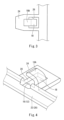
- Figs. 2 and 3 show an enlarged view of the engagement between a hooking tab 18A and an engagement hole 26.
- the claw 18 includes a hooking tab 18A extending in the direction in which the wrapping portion 24 is moved when fitted onto the edge 16 of the base member 12. That is, the hooking tab 18A extends right to left as seen in Fig. 3 .
- the engagement hole 26 of the wrapping portion 24 can only be engaged by the claw 18 once the engagement hole 26 goes beyond the hooking tab 18A. Therefore, the engagement ensures secure fastening of the wrapping portions 24.
- Fig. 4 shows a modified arrangement of the hooking tab 18A of the claw 18.
- the direction of the hooking tab 18A is perpendicular to the direction of fitting the wrapping portion 24.
- This configuration may be adopted in the case where the wrapping portion 24 cannot be moved beyond the position shown in Fig. 4 when being fitted. This allows the wrapping portion 24 to be fitted by being laterally shifted (left to right as seen in Fig. 4 ) even when the fitting movement of the wrapping portion 24 is limited.
- Fig. 1 shows a general configuration of the basic elements of the manufacturing apparatus 30 in a schematic way.
- the manufacturing apparatus 30 includes a workpiece supporting table 32, a push-to-fit device 34, and a clamp device 36.
- the workpiece supporting table 32 is provided for placement of the workpieces for the armrest 10 to be produced.
- the clamp device 36 holds the workpieces for the armrest 10 against the workpiece supporting table 32.
- the push-to-fit device 34 operates to fit the wrapping portion 24 of the surface layer member 20 onto the base member 12 for the armrest 10.
- FIG. 1 On the other hand, another wrapping portion 24, shown on the left side in Fig. 1 , has already been fitted onto the corresponding edge 16 of the base member 12 when being placed on the workpiece supporting table 32.
- This fitting can be performed by a machine, such as a robot, when placing the base member 12 and the surface layer member 20 on the workpiece supporting table 32.
- the fitting of the left wrapping portion 24, which does not include a claw 18, onto the edge 16 of the wrapping portion 24 is easy when the right wrapping portion 24 is opened, and therefore may optionally be performed manually by hand.
- the push-to-fit device 34 will now be described. As shown in Fig. 1 , the push-to-fit device 34 is configured to fit the wrapping portion 24 of the surface layer member 20 onto the edge 16 of the base member 12. In the present embodiment, the push-to-fit device 34 is positioned so as to fit the wrapping portion 24 on the right side as seen in Fig. 1 .
- Fig. 1 schematically shows the push-to-fit device 34 by the movement of a pushing portion 54 alone.
- the push-to-fit device 34 includes a pushing portion 54 configured to push the wrapping portion 24 of the edge 22 of the surface layer member 20.
- the pushing portion 54 is moved by a movable member 56 in the direction of arrow X, from the position indicated by the solid lines to the position indicated by the two-dot-dashed lines.
- the direction of this movement is parallel to a surface of the edge 16 of the base member 12, to which the wrapping portion 24 in the edge 22 of the surface layer member 20 is to be fitted.
- the pushing portion 54 includes a rigid base member 58.
- the pushing portion 54 also includes an elastic member 60 made of an elastic material.
- the elastic member 60 is formed on a surface of the base member 58.
- the surface of the rigid base member 58 on which the elastic member 60 is formed may face forward in the pushing direction.
- the material of the elastic member 60 may be rubber, for example.
- the elastic member 60 extends downward beyond the lower end of the rigid base member 58. As a result, the lower end of the pushing portion 54 pushes the wrapping portion 24 only by pressing the elastic member 60 against the surface of the wrapping portion 24. This is done in a surface contact manner, that is, in a stroking manner.
- the base member 12 of the above embodiment has been described as polypropylene (PP), the base member 12 may be made of various thermoplastics other than PP, having a higher rigidity than the surface layer member 20, or a press-formed steel sheet.
- PP polypropylene
- the surface layer member 20 may be made of not only various thermoplastics such as soft polyvinyl chloride, styrene, olefin, and polyester, but may also be made of various other skin materials, including elastic woven and non-woven fabrics, knitted fabrics, synthetic leathers, natural leathers, and soft films.
- a base member with a surface layer member layered on its lower side, may be placed on the workpiece supporting table, wherein a wrapping portion formed at the edge of the surface layer member is in the opened position, where the wrapping portion is disengaged from the edge of the base member.
- a push-to-fit device then pushes the wrapping portion in the direction fitting it onto the edge of the base member. This automated mechanical fitting of the wrapping portion onto the edge of the base member improves the manufacturing productivity of the surface layered part. Furthermore, the quality of mass produced surface-layered parts is consistent.
- the push-to-fit device includes a pushing portion that pushes the wrapping portion.
- the pushing portion includes a rigid base member and a member made of elastic material on a surface of the rigid base member on the forward side in the pushing direction.
- the push-to-fit device fits the wrapping portion of the surface layer member onto the edge of the base member with the elastic member in contact with the wrapping portion, thereby preventing or suppressing the surface layer member from being damaged.
- the elastic member on a surface of the rigid base member on the forward side in the pushing direction extends beyond the lower end of the base member.
- the extended elastic member pushes the wrapping portion of the surface layer member in a stroking manner, so as to fit it onto the edge of the base member. This allows for a smooth fitting action.
- the direction of movement of the pushing portion of the push-to-fit device is parallel to a surface of the edge of the base member, the surface onto which the wrapping portion is fitted. This configuration allows for a more efficient operation of fitting the wrapping portion of the surface layer member onto the edge of the base member.
Landscapes
- Engineering & Computer Science (AREA)
- Mechanical Engineering (AREA)
- Manufacturing & Machinery (AREA)
- Aviation & Aerospace Engineering (AREA)
- Transportation (AREA)
- Lining Or Joining Of Plastics Or The Like (AREA)
- Vehicle Interior And Exterior Ornaments, Soundproofing, And Insulation (AREA)
- Passenger Equipment (AREA)
- Automatic Assembly (AREA)
- Laminated Bodies (AREA)
Description
- The present disclosure relates to an apparatus and method for manufacturing a surface-layered part, and in particular to an apparatus for manufacturing a surface-layered part that includes a base member assembled with a surface layer member, and to a method for manufacturing the surface-layered part using the apparatus, wherein a front side of the flat base member is covered with the surface layer member, and a wrapping portion formed at an edge of the surface layer member is fitted onto the edge of the base member.
- Surface-layered parts include, for example, an interior part of an automobile or other vehicle. Such an interior part of an automobile or other vehicle may be formed by covering the front side of a flat base member with a surface layer member (see, for example,
Japanese Patent Application Publication No. 2004-217080 -
Fig. 9 is an exploded perspective view of abase member 12 and asurface layer member 20.Fig. 10 shows thebase member 12 assembled with thesurface layer member 20 covering thebase member 12. As shown inFig. 10 , thesurface layer member 20 includes wrappingportions 24 at itsedge 22. The wrappingportions 24 are configured to wrap thecorresponding edges 16 of thebase member 12. Assembly of thesurface layer member 20 with thebase member 12, in a covering manner, is performed by fitting the wrappingportions 24 over therespective edges 16 of thebase member 12. - The
base member 12 includes one ormore claw 18 on one of itsedges 16 at locations corresponding to the wrappingportions 24 of thesurface layer member 20, as shown on the left side ofFig. 10 . Correspondingly, the wrappingportions 24 of thelayer surface member 20 each include anengagement hole 26. Eachengagement hole 26 in thesurface layer member 20 is hooked on thecorresponding claw 18. Theengagement hole 26 is essentially locked so that thesurface layer member 20 is positioned in place, with reference to thebase member 12, in a reliable manner. - The work of fitting the
wrapping portion 24 of thesurface layer member 20 onto theedge 16 of thebase member 12 described above is conventionally performed manually by hand. - Apparatuses and methods for wrapping an edge of a surface layer member over an edge of a base member are described in other documents.
DE 43 08 925 describes a device and method for bending a covering material over a base material.JP 2016-175600 JP 2010-014204 - The above-mentioned manual work of fitting the wrapping
portion 24 of thesurface layer member 20 onto theedge 16 of thebase member 12 relies on the physical power of workers, which requires many man-hours, thereby leading to poor productivity. In addition, the manual work tends to create variations in the quality of a mass-produced product. - In particular, when manually performing the task by hand, hooking the
claws 18 into theengagement holes 26 formed in the wrappingportion 24 is a hard work that puts a heavy burden on the workers' hands and fingers. This results in the problem of an increase in the number of man-hours required for the work. - It is desired to improve the productivity in manufacturing surface-layered parts by automating the work of fitting the wrapping portion of the surface layer member onto the edge of the base member.
- The object is achieved by the apparatus of claim 1 and the method of claim 6. Advantageous further developments are subject-matter of the dependent claims.
- In some embodiments, the base member includes a claw formed at the edge of the base member, and the surface layer member includes an engagement hole at the wrapping portion formed at the edge of the surface layer member. The engagement hole is engageable with the claw. Fitting the wrapping portion of the surface layer member onto the edge of the base member causes the engagement hole to engage the claw.
-
-
Fig. 1 is a schematic cross-sectional view of an apparatus for manufacturing a surface-layered part according to one embodiment. -
Fig. 2 is an enlarged view of a claw formed at the edge of a base member ofFig. 1 . The claw is engaged with an engagement hole formed at a wrapping portion of a surface layer member. -
Fig. 3 is a view of the engagement portion ofFig. 2 as viewed in the direction of arrow III ofFig. 2 . -
Fig. 4 is a view of an engagement portion according to another embodiment, shown in contrast toFig. 2 . -
Fig. 5 is a perspective view of a pushing portion of a push-to-fit device, as viewed from the rearward side of the pushing direction. -
Fig. 6 is a perspective view of the pushing portion of the push-to-fit device as viewed from the forward side of the pushing direction. -
Fig. 7 is an enlarged view of a pushing portion of the push-to-fit device. -
Fig. 8 is a perspective view of a specific configuration of clamp members of a clamp device. -
Fig. 9 is an exploded perspective view of the base member and the surface layer member. -
Fig. 10 is a cross-sectional view of a schematic configuration of a base member with a surface layer member attached to the base member by a conventional manual work. - Embodiments of the present disclosure will be described below with reference to the drawings. In one embodiment, a surface-layered part may be an automobile armrest. An apparatus and a method for manufacturing an armrest will be described below, but a similar apparatus and method may be used to manufacture other surface-layered parts. The up, down, left, right and other directions used when describing what is shown in the Figures will be based on the directions as seen in those Figures. However, where otherwise indicated particularly, that indication prevails.
- Firstly, the
armrest 10 to be produced by the manufacturing apparatus and method as an embodiment will be described. In one embodiment, the finished shape of thearmrest 10 may be substantially the same as that of the armrest shown inFig. 10 , as a conventional armrest. Therefore, the detailed configuration of thearmrest 10 will again be described by way ofFigs. 9 and 10 . -
Fig. 9 is an exploded perspective view of the configuration of one end of anarmrest 10. As shown inFig. 9 , thearmrest 10 includes abase member 12 and asurface layer member 20. Thebase member 12 dictates the general form of thearmrest 10, and is typically a flat rigid member made of polypropylene (PP). Thesurface layer member 20 is arranged on thefront side 14 of thebase member 12, and covers thebase member 12. Thesurface layer member 20 is typically made of an olefin-based elastomer, and has a property of being capable of expanding and contracting to some extent. For the purpose of covering on thebase member 12, thesurface layer member 20 is formed into a shape complementary to the shape of thebase member 12. - As shown in
Fig. 10 , thearmrest 10 of the present embodiment has a convex shape on thefront side 14 of thebase member 12. Thesurface layer member 20 covers thefront side 14 of the convex-shapedbase member 12. Theedge 22 of thesurface layer member 20 includes one ormore wrapping portion 24, which is configured to wrap acorresponding edge 16 of thebase member 12. The wrapping portion(s) 24 are fitted onto the edge(s) 16 of thebase member 12. Thesurface layer member 20 covers thefront side 14 of thebase member 12 when the wrappingportions 24 at twoside edges 22 of thesurface layer member 20 are fitted in a wrapping manner over the respective side edges 16 of thebase member 12. - In the present embodiment, as shown in
Fig. 10 at the wrappingportion 24 on the right side, thebase member 12 includesclaws 18 on theedge 16 of thebase member 12, and thesurface layer member 20 includes engagement holes 26 in these wrappingportions 24. The engagement holes 26 in thewrapping portions 24 are hooked to therespective claws 18, so that thesurface layer member 20 is securely attached to thebase member 12. -
Figs. 2 and3 show an enlarged view of the engagement between a hookingtab 18A and anengagement hole 26. In the present embodiment, theclaw 18 includes a hookingtab 18A extending in the direction in which the wrappingportion 24 is moved when fitted onto theedge 16 of thebase member 12. That is, the hookingtab 18A extends right to left as seen inFig. 3 . As a result, theengagement hole 26 of the wrappingportion 24 can only be engaged by theclaw 18 once theengagement hole 26 goes beyond the hookingtab 18A. Therefore, the engagement ensures secure fastening of the wrappingportions 24. -
Fig. 4 shows a modified arrangement of the hookingtab 18A of theclaw 18. In this modification, the direction of the hookingtab 18A is perpendicular to the direction of fitting the wrappingportion 24. This configuration may be adopted in the case where the wrappingportion 24 cannot be moved beyond the position shown inFig. 4 when being fitted. This allows the wrappingportion 24 to be fitted by being laterally shifted (left to right as seen inFig. 4 ) even when the fitting movement of the wrappingportion 24 is limited. - The wrapping
portion 24 of theedge 22 of thesurface layer member 20 has a smaller width overlapping theedge 16 of thebase member 12 in the portion where theclaws 18 are located than in the portions with noclaws 18. This facilitates arrangement of theclaws 18 and the engagement holes 26. - The
manufacturing apparatus 30 in one embodiment will now be described with reference toFig. 1. Fig. 1 shows a general configuration of the basic elements of themanufacturing apparatus 30 in a schematic way. Themanufacturing apparatus 30 includes a workpiece supporting table 32, a push-to-fit device 34, and aclamp device 36. The workpiece supporting table 32 is provided for placement of the workpieces for the armrest 10 to be produced. Theclamp device 36 holds the workpieces for the armrest 10 against the workpiece supporting table 32. The push-to-fit device 34 operates to fit the wrappingportion 24 of thesurface layer member 20 onto thebase member 12 for thearmrest 10. - The workpiece supporting table 32 is mounted on a
base 38 of themanufacturing apparatus 30. The supportingsurface 40 of the workpiece supporting table 32 may be concaved for placement of an armrest 10 having a convex outer shape. The supportingsurface 40 of the workpiece supporting table 32 may consist of a rigid member made of plastic. Thebase member 12, with thesurface layer member 20 layered on the lower side, is placed on the supportingsurface 40 of the workpiece supporting table 32. At this stage, the wrappingportion 24, shown on the right side inFig. 1 , is in an opened position that is disengaged from theedge 16 of thebase member 12. Accordingly, the wrappingportion 24, shown on the right side inFig. 1 , is not yet fitted onto theedge 16 of thebase member 12. - On the other hand, another wrapping
portion 24, shown on the left side inFig. 1 , has already been fitted onto the correspondingedge 16 of thebase member 12 when being placed on the workpiece supporting table 32. This fitting can be performed by a machine, such as a robot, when placing thebase member 12 and thesurface layer member 20 on the workpiece supporting table 32. Unlike the right one, the fitting of theleft wrapping portion 24, which does not include aclaw 18, onto theedge 16 of the wrappingportion 24 is easy when theright wrapping portion 24 is opened, and therefore may optionally be performed manually by hand. -
Fig. 8 shows a specific configuration of theclamp device 36. When thebase member 12 and thesurface layer member 20 are placed on the supportingsurface 40 of the workpiece supporting table 32, theclamp device 36 holds thebase member 12 and thesurface layer member 20 together against the supportingsurface 40. To achieve this, theclamp device 36 includes a clampingportion 46 at a distal end of the operating mechanism. Theclamp device 36 fixes thebase member 12, from its back side, toward the supporting surface of the workpiece supporting table 32, as shown inFig. 1 . Theclamp device 36 is a mechanism that is operated by a power cylinder (not shown). - The push-to-
fit device 34 will now be described. As shown inFig. 1 , the push-to-fit device 34 is configured to fit the wrappingportion 24 of thesurface layer member 20 onto theedge 16 of thebase member 12. In the present embodiment, the push-to-fit device 34 is positioned so as to fit the wrappingportion 24 on the right side as seen inFig. 1 . -
Fig. 1 schematically shows the push-to-fit device 34 by the movement of a pushingportion 54 alone. The push-to-fit device 34 includes a pushingportion 54 configured to push the wrappingportion 24 of theedge 22 of thesurface layer member 20. The pushingportion 54 is moved by amovable member 56 in the direction of arrow X, from the position indicated by the solid lines to the position indicated by the two-dot-dashed lines. The direction of this movement is parallel to a surface of theedge 16 of thebase member 12, to which the wrappingportion 24 in theedge 22 of thesurface layer member 20 is to be fitted. - The pushing
portion 54 includes arigid base member 58. The pushingportion 54 also includes anelastic member 60 made of an elastic material. Theelastic member 60 is formed on a surface of thebase member 58. The surface of therigid base member 58 on which theelastic member 60 is formed may face forward in the pushing direction. The material of theelastic member 60 may be rubber, for example. Theelastic member 60 extends downward beyond the lower end of therigid base member 58. As a result, the lower end of the pushingportion 54 pushes the wrappingportion 24 only by pressing theelastic member 60 against the surface of the wrappingportion 24. This is done in a surface contact manner, that is, in a stroking manner. - The actuation of the
movable member 56 of the push-to-fit device 34in the X direction causes the pushingportion 54 to move the wrappingportion 24 of thesurface layer member 20 from the position shown by the solid lines inFig. 1 to the position shown by the two-dot chain lines. During this movement, the engagement holes 26 in the wrappingportion 24 are hooked by theclaw 18, which is formed on theedge 16 of thebase member 12. Due to this hooking, the wrappingportion 24 of thesurface layer member 20 is fitted onto theedge 16 of thebase member 12. - During the movement of the pushing
portion 54 described above, the fitting of the wrappingportion 24 onto theedge 16 of thebase member 12 is primarily effected by therigid base member 58. Additionally, theelastic member 60, which extends downward from thebase member 58, moves in a stroking manner along the surface of thesurface layer member 20. The stroking movement of theelastic member 60 ensures a more reliable fastening to the claw 18due to the close contact with the surface of thesurface layer member 20. Additionally, this allows for fitting without damaging thesurface layer member 20. -
Figs. 5 and 6 show a specific configuration of the push-to-fit device 34 around the pushingportions 54.Fig. 5 is a perspective view of the pushingportions 54 viewed from the rearward side of the pushing direction, whileFig. 6 is a perspective view of the pushingportions 54 viewed from the forward side in the pushing direction. The push-to-fit device 34 may be configured as a mechanism in which the shown pushingportions 54 are moved by two air cylinders (not shown). -
Fig. 7 shows an enlarged view of the pushingportion 54 of the push-to-fit device 34 shown inFigs. 5 and 6 . The pushingportion 54 is attached to a movable body via a connectingmember 68. The movable body corresponds to themovable member 56 shown inFig. 1 . The connectingmember 68 and the movable body are fixed to one another by one ormore bolts 70. The connectingmember 68 and thebase member 58 of the pushingportion 54 are fixed to one another by one ormore bolts 72. The pushingportion 54 includes anelastic member 60 made of an elastic material. Theelastic member 60 may be formed on a surface of thebase member 58 on its forward side, on a side in the direction of movement. Theelastic member 60 extends downward beyond the lower end of thebase member 58. - As shown by phantom lines (the two-dot dashed lines) in
Fig. 7 , when the pushingportion 54 pushes the wrappingportion 24 of thesurface layer member 20, thebase member 58 pushes theelastic member 60. Accordingly, the wrappingportion 24 is pushed by theelastic member 60, which extends downward from thebase member 58, in a stroking manner. The wrappingportion 24 is pushed softly, and therefore is not easily scratched. In addition, little noise occurs due to the pushing, thereby reducing the whole working noise. - One embodiment of a manufacturing method using the above described
manufacturing apparatus 30 will now be described. - The
base member 12 and thesurface layer member 20 are prepared in advance in a specified shape. As described above referring to the manufacturing apparatus, thebase member 12 is a rigid member made of polypropylene (PP). Thesurface layer member 20 is formed of an olefin-based elastomer, and has a property of being capable of expanding and contracting to some extent. - The first step will now be described. As shown in
Fig. 1 , thebase member 12 and thesurface layer member 20, which were prepared in the specified shape in the preparatory step, are placed on the supportingsurface 40 of the workpiece supporting table 32 of themanufacturing apparatus 30. They are arranged such that they are layered over each other. To place them on the supportingsurface 40 in such a layered position, thesurface layer member 20 may first be placed on the supportingsurface 40, and thebase member 12 may then be placed on top of thesurface layer member 20. Thesurface layer member 20 and thebase member 12 placed in such a layering manner on the workpiece supporting table 32 are then pressed by the clampingportions 46 of theclamp device 36. Accordingly, their position may be fixed. - After the first step, the wrapping
portion 24, shown on the right side inFig. 1 , is in an opened position, such that it is away from theedge 16 of thebase member 12. That is, theright wrapping portion 24 is not yet fitted on theedge 16 of thebase member 12 when first placed on the workpiece supporting table 32. - However, in the present embodiment, the
other wrapping portion 24, shown on the left side inFig. 1 , has already been fitted on thecorresponding edge 16 of thebase member 12 when placed on the workpiece supporting table 32 by the first step. This fitting may be performed by a machine, such as a robot, or manually by hand, as described above referring to themanufacturing apparatus 30. - The second step will now be described. The second step includes fitting the wrapping
portion 24, shown on the right side inFig. 1 , onto thebase member 12 by the push-to-fit device 34. As this second step is explained with reference toFig. 1 , the push-to-fit device 34 will operate to fit the wrappingportion 24, shown on the right side inFig. 1 , onto theedge 16 of thebase member 12, thereby assembling thesurface layer member 20 with thebase member 12. - The fitting operation of the wrapping
portion 24 by the push-to-fit device 34 is effected by the pushing operation of the pushingportion 54. This pushing operation is performed by theelastic member 60, which extends beyond the lower ends of thebase member 58 of the pushingportion 54, stroking the surface of the wrappingportion 24. This allows for a smooth fitting operation. - The wrapping
portion 24, on the right side as seen inFig. 1 , is fastened by engagement of theclaw 18 with theengagement hole 26. Theengagement hole 26 of the wrappingportion 24 is hooked by the hookingtab 18A of theclaw 18. This is done as the pushingportion 54 strokes the surface of the wrappingportion 24, as described above. This hooking prevents the wrappingportion 24 from being easily disengaged from the hookingtab 18A because the hookingtab 18A extends to the left as seen inFig. 1 while the wrappingportion 24 is biased to the right due to its own elasticity. Accordingly, the wrappingportion 24 is fastened to thebase member 12 with little possibility of being detached from thebase member 12. - In the present embodiment, the direction of movement of the pushing
portion 54 of the push-to-fit device 34 is parallel to a surface of theedge 16 of thebase member 12 onto which the wrappingportion 24 formed in theedge 22 of thesurface layer member 20 is to be fitted. This allows the pushing operation of the wrappingportion 24 by the pushingportion 54 to be smoother. - The
armrest 10, manufactured as the product produced through the above steps, is released from the clampingportion 46 of theclamp device 36 and taken out of themanufacturing device 30 by a robot or other machine. The manufacturing process is thus completed. - The apparatus and method of manufacturing the
armrest 10 of the embodiments described above enable mechanical fitting of a wrappingportion 24 of asurface layer member 20 onto anedge 16 of abase member 12. Productivity can thus be improved, as compared with manual fitting by hand. Additionally, when the product is mass produced, variations in quality can be stabilized. - In the case of the above configuration, when the wrapping
portion 24 of thesurface layer member 20 is fitted on theedge 16 of thebase member 12, theclaws 18 formed on thebase member 12 are locked in the corresponding engagement holes 26 formed in the wrappingportion 24, thesurface layer member 20 can be reliably assembled with thebase member 12. - Further embodiments will be described below.
- In the above embodiment, the surface-layered part has been described as an armrest of an automobile. In another embodiment, the above-mentioned manufacturing apparatus and method can be widely applied to any part with a structure in which a wrapping portion formed on the surface layer member is fitted to an edge of a base member when the surface layer member is attached to the base member. For example, the apparatus and method can be applied to an article of furniture (e.g. armrests of a chair) or an exterior part of a cosmetics box.
- While the
armrest 10 of the above embodiment is convex on thefront side 14 of thebase member 12, the surface-layered part may be convex on the opposite side, that is, it may be concave on thefront side 14 of thebase member 12. The surface-layered part that is not an armrest 10 may have an L-shaped cross-section. - In the above embodiment, the
surface layer member 20 includes theengagement hole 26 in the wrappingportion 24, and theengagement hole 26 is hooked on theclaw 18 formed on theedge 16 of thebase member 12. However, theengagement hole 26 and theclaw 18 may not be included, so that the wrappingportion 24 of thesurface layer member 20 is simply fitted onto theedge 22 of thebase member 12. The wrappingportion 24 shown on the left side inFig. 1 may be mechanically fitted onto theedge 22 of thebase member 12 by another push-to-fit device 34. - While the material for the
base member 12 of the above embodiment has been described as polypropylene (PP), thebase member 12 may be made of various thermoplastics other than PP, having a higher rigidity than thesurface layer member 20, or a press-formed steel sheet. - The
surface layer member 20 may be made of not only various thermoplastics such as soft polyvinyl chloride, styrene, olefin, and polyester, but may also be made of various other skin materials, including elastic woven and non-woven fabrics, knitted fabrics, synthetic leathers, natural leathers, and soft films. - While rubber was mentioned as an example of the material for the
elastic member 60, an elastomer or a thin sheet of metal, such as stainless steel, may also be used. - The above embodiments may have the following advantages.
- In some embodiments, a base member, with a surface layer member layered on its lower side, may be placed on the workpiece supporting table, wherein a wrapping portion formed at the edge of the surface layer member is in the opened position, where the wrapping portion is disengaged from the edge of the base member. A push-to-fit device then pushes the wrapping portion in the direction fitting it onto the edge of the base member. This automated mechanical fitting of the wrapping portion onto the edge of the base member improves the manufacturing productivity of the surface layered part. Furthermore, the quality of mass produced surface-layered parts is consistent.
- In some embodiments, the push-to-fit device includes a pushing portion that pushes the wrapping portion. The pushing portion includes a rigid base member and a member made of elastic material on a surface of the rigid base member on the forward side in the pushing direction. The push-to-fit device fits the wrapping portion of the surface layer member onto the edge of the base member with the elastic member in contact with the wrapping portion, thereby preventing or suppressing the surface layer member from being damaged.
- In some embodiments, the elastic member on a surface of the rigid base member on the forward side in the pushing direction extends beyond the lower end of the base member. As a result, the extended elastic member pushes the wrapping portion of the surface layer member in a stroking manner, so as to fit it onto the edge of the base member. This allows for a smooth fitting action.
- In some embodiments, the direction of movement of the pushing portion of the push-to-fit device is parallel to a surface of the edge of the base member, the surface onto which the wrapping portion is fitted. This configuration allows for a more efficient operation of fitting the wrapping portion of the surface layer member onto the edge of the base member.
- In some embodiments, the base member includes a claw(s) on its edge, and the surface layer member includes an engagement hole(s) in each wrapping portion that engages with a claw. The engagement of the claw(s) with the engagement hole(s) ensures reliable positioning of the surface layer member with respect to the base member.
Claims (7)
- An apparatus (30) for manufacturing a surface-layered part, wherein the surface-layered part comprises a base member (12) assembled with a surface layer member (20), wherein a front side (14) of the flat base member (12) is covered by the surface layer member (20), and a wrapping portion (24) formed at an edge (22) of the surface layer member (20) is configured to be fitted onto an edge (16) of the base member (12), the apparatus (30) comprising:a workpiece supporting table (32) on which the base member (12) and the surface layer member (20) are placed such that the surface layer member (20) is layered with the base member (12), anda push-to-fit device (34) configured to push the wrapping portion (24) formed at the edge (22) of the surface layer member (20) in a direction to fit the wrapping portion (24) onto the edge (16) of the base member (12) from an opened position in which the wrapping portion (24) is away from the edge (16) of the base member (12), the push-to-fit device (34) comprises a pushing portion (54) configured to push the wrapping portion (24) formed at the edge (22) of the surface layer member (20), the pushing portion (54) comprises a rigid base member (58), characterised in that the pushing portion (54) comprises an elastic member (60) formed on a surface of the rigid base member (58).
- The manufacturing apparatus (30) according to claim 1, wherein the surface of the rigid base member (58) on which the elastic member (60) is formed is facing forward in the pushing direction.
- The manufacturing apparatus (30) according to claim 2, wherein the elastic member (60) on the surface of the rigid base member (58) that faces forward in the pushing direction extends beyond a lower end of the base member (58).
- The manufacturing apparatus (30) according to claim 2 or 3, wherein the pushing portion (54) of the push-to-fit device (34) moves parallel to a surface of the edge (16) of the base member (12) onto which the wrapping portion (24) formed in the edge (22) of the surface layer member (20) is to be fitted.
- The manufacturing apparatus (30) according to any one of claims 1 to 4, wherein the material of the elastic member (60) is an elastomer or a thin sheet of metal, such as wherein the elastomer is rubber.
- A method for manufacturing the surface-layered part using the manufacturing device (30) according to any one of claims 1 to 5, the method comprising:a first step of placing the base member (12) and the surface layer member (20) on the workpiece supporting table (32) such that the surface layer member (20) is layered under the base member (12), wherein the wrapping portion (24) formed in the edge (22) of the surface layer member (20) is in the open position away from the edge (16) of the base member (12); anda second step of operating the push-to-fit device (34) to fit the wrapping portion (24) formed in the edge (22) of the surface layer member (20) onto the edge (16) of the base member (12) to assemble the surface layer member (20) with the base member (12).
- The method according to claim 6, wherein:the base member (12) includes a claw (18) formed at the edge (16) of the base member (12), the surface layer member (20) includes an engagement hole (26) at the wrapping portion (24) formed at the edge (22) of the surface layer member (20), the engagement hole (26) is configured to be engageable with the claw (18), andthe fitting of the wrapping portion (24) of the surface layer member (20) onto the edge (16) of the base member (12) is configured to cause the engagement hole (26) to engage the claw (18).
Applications Claiming Priority (2)
| Application Number | Priority Date | Filing Date | Title |
|---|---|---|---|
| JP2020000924A JP6870124B1 (en) | 2020-01-07 | 2020-01-07 | Manufacturing equipment for parts with surface layer and its manufacturing method |
| PCT/JP2020/035216 WO2021140708A1 (en) | 2020-01-07 | 2020-09-17 | Production device and production method for component having outer covering |
Publications (3)
| Publication Number | Publication Date |
|---|---|
| EP3915720A1 EP3915720A1 (en) | 2021-12-01 |
| EP3915720A4 EP3915720A4 (en) | 2022-12-21 |
| EP3915720B1 true EP3915720B1 (en) | 2025-04-09 |
Family
ID=75801941
Family Applications (1)
| Application Number | Title | Priority Date | Filing Date |
|---|---|---|---|
| EP20912579.8A Active EP3915720B1 (en) | 2020-01-07 | 2020-09-17 | Production device and production method for component having outer covering |
Country Status (5)
| Country | Link |
|---|---|
| US (1) | US12076936B2 (en) |
| EP (1) | EP3915720B1 (en) |
| JP (2) | JP6870124B1 (en) |
| CN (1) | CN113382840B (en) |
| WO (1) | WO2021140708A1 (en) |
Family Cites Families (26)
| Publication number | Priority date | Publication date | Assignee | Title |
|---|---|---|---|---|
| JPH04329117A (en) * | 1991-04-30 | 1992-11-17 | Toyoda Gosei Co Ltd | Epidermal edge fixation device |
| DE4308925A1 (en) | 1993-03-19 | 1995-02-23 | Wmt Gmbh Werkzeug & Maschinenb | Methods and devices for folding over and fastening the covering material overhanging the edges of a part, in particular for vehicle interior panelling parts |
| JPH0857955A (en) * | 1994-08-23 | 1996-03-05 | Kasai Kogyo Co Ltd | Method and apparatus for adhering skin material |
| ZA964731B (en) * | 1995-06-07 | 1997-01-07 | Avery Dennison Corp A Legal Bo | Extrusion coating process for making protective and decorative films |
| JP3317659B2 (en) * | 1997-07-04 | 2002-08-26 | 河西工業株式会社 | Terminal treatment method and terminal treatment device for laminated molded article |
| JP2000225645A (en) * | 1998-11-30 | 2000-08-15 | Itoki Crebio Corp | Preparation and structure of top board member of furniture, etc. |
| JP2000272035A (en) * | 1999-03-24 | 2000-10-03 | Araco Corp | Manufacturing method of laminate |
| JP2002104096A (en) * | 2000-10-03 | 2002-04-09 | Togo Seisakusho Corp | Mall mounting structure and clips |
| JP3963452B2 (en) | 2003-01-15 | 2007-08-22 | 河西工業株式会社 | Interior parts for automobiles and manufacturing method thereof |
| JP4114806B2 (en) * | 2004-10-19 | 2008-07-09 | 東海興業株式会社 | Molding assembly method and assembly apparatus |
| JP2007015306A (en) | 2005-07-08 | 2007-01-25 | Inoac Corp | Folding-back device and folding-back method |
| JP2007168168A (en) * | 2005-12-20 | 2007-07-05 | Munekata Co Ltd | End face treatment device of composite molded product by hot air and end face treatment method |
| JP4921194B2 (en) * | 2007-01-31 | 2012-04-25 | トヨタ紡織株式会社 | Skin material bonding apparatus and skin material bonding method |
| JP4805979B2 (en) * | 2008-07-03 | 2011-11-02 | 豊田鉄工株式会社 | Fastening structure for members |
| JP4856679B2 (en) * | 2008-08-06 | 2012-01-18 | 豊田鉄工株式会社 | Connecting structure for vehicle door trim |
| US8276978B2 (en) * | 2009-04-21 | 2012-10-02 | Toyota Motor Engineering & Manufacturing North America, Inc. | Substrates for vehicle instrument panels and vehicle instrument panels incorporating the same |
| US9254770B2 (en) * | 2009-09-22 | 2016-02-09 | Johnson Controls Gmbh | Method for producing a rear wall of a seat backrest |
| JP2013124073A (en) | 2011-12-16 | 2013-06-24 | Ts Tech Co Ltd | Automobile interior equipment |
| JP6119001B2 (en) * | 2013-07-12 | 2017-04-26 | 小島プレス工業株式会社 | Method and apparatus for treating skin corners |
| FR3016938B1 (en) * | 2014-01-30 | 2016-02-26 | Illinois Tool Works | ATTACHMENT FOR ATTACHING A PANEL TO A SUPPORT |
| EP2913184A3 (en) * | 2014-02-26 | 2015-10-21 | KIEFEL GmbH | Method for applying an adhesive to a laminating film, method for laminating a load bearing element, and laminating device |
| JP6301800B2 (en) * | 2014-09-29 | 2018-03-28 | 株式会社イノアックコーポレーション | Method for manufacturing vehicle interior member and terminal processing apparatus |
| JP6329919B2 (en) * | 2015-03-20 | 2018-05-23 | 豊田鉄工株式会社 | Interior parts for vehicles |
| KR20180000363A (en) * | 2016-06-22 | 2018-01-03 | (주)백광정밀 | A insertion apparatus of rubber tube |
| CN109952188B (en) * | 2016-09-15 | 2021-08-31 | 贝尔金国际股份有限公司 | Overlay applicator tray and method of using the same |
| EP3476657B1 (en) * | 2017-10-30 | 2020-08-19 | Volvo Car Corporation | A vehicle ceiling connecting arrangement |
-
2020
- 2020-01-07 JP JP2020000924A patent/JP6870124B1/en active Active
- 2020-09-17 US US17/440,519 patent/US12076936B2/en active Active
- 2020-09-17 EP EP20912579.8A patent/EP3915720B1/en active Active
- 2020-09-17 CN CN202080003495.7A patent/CN113382840B/en active Active
- 2020-09-17 WO PCT/JP2020/035216 patent/WO2021140708A1/en not_active Ceased
-
2021
- 2021-03-17 JP JP2021043197A patent/JP6935604B2/en active Active
Also Published As
| Publication number | Publication date |
|---|---|
| JP6935604B2 (en) | 2021-09-15 |
| JP2021109329A (en) | 2021-08-02 |
| EP3915720A1 (en) | 2021-12-01 |
| WO2021140708A1 (en) | 2021-07-15 |
| JP6870124B1 (en) | 2021-05-12 |
| CN113382840A (en) | 2021-09-10 |
| EP3915720A4 (en) | 2022-12-21 |
| JP2021109654A (en) | 2021-08-02 |
| US12076936B2 (en) | 2024-09-03 |
| CN113382840B (en) | 2023-02-17 |
| US20220161506A1 (en) | 2022-05-26 |
Similar Documents
| Publication | Publication Date | Title |
|---|---|---|
| US8066929B2 (en) | Method and device for placing thin material layers onto a relief mould | |
| JP2017106297A (en) | Automotive equipment to be attached to automotive set, and automotive set equipped with such automotive equipment | |
| US8029037B2 (en) | Method and apparatus for forming a vehicle trim panel | |
| US11679704B1 (en) | Device and method for setting or removing seat trim | |
| EP3915720B1 (en) | Production device and production method for component having outer covering | |
| US9427791B2 (en) | Panel assembly and method of forming same | |
| WO2012130472A1 (en) | Folding method, folding device and component comprising fold | |
| EP2153969A1 (en) | Mold and method for making a trim panel | |
| JP2011207380A (en) | Automobile interior trim, and method for manufacturing the same | |
| JP7067500B2 (en) | Manufacturing method of interior parts and their manufacturing equipment | |
| US20080237925A1 (en) | Vehicle Component and Method For Making a Vehicle Component | |
| CN110662709A (en) | Adhesion Fixtures and Adhesion Methods | |
| US20070042157A1 (en) | Trim panel with edge seal | |
| US4813740A (en) | Closure for seat back cover | |
| JP6970557B2 (en) | Vehicle interior material molding equipment and vehicle interior material manufacturing method | |
| JP4941071B2 (en) | Weather strip | |
| WO2022024635A1 (en) | Seat | |
| JP5151218B2 (en) | Skin terminal fixing method | |
| JP6363486B2 (en) | Interior parts for vehicles | |
| JP6362981B2 (en) | Method for manufacturing vehicle interior member and terminal processing apparatus | |
| JP2002248682A (en) | Mold for mounting skin and skin mounting method | |
| JP2007038561A (en) | Pressure bonding device for ornament sheet | |
| JP5864304B2 (en) | Decoration sheet terminal processing structure | |
| JP4483704B2 (en) | Weather strip | |
| EP3130434B1 (en) | Automatic station to staple a membrane element to a support and method thereof |
Legal Events
| Date | Code | Title | Description |
|---|---|---|---|
| STAA | Information on the status of an ep patent application or granted ep patent |
Free format text: STATUS: THE INTERNATIONAL PUBLICATION HAS BEEN MADE |
|
| PUAI | Public reference made under article 153(3) epc to a published international application that has entered the european phase |
Free format text: ORIGINAL CODE: 0009012 |
|
| STAA | Information on the status of an ep patent application or granted ep patent |
Free format text: STATUS: REQUEST FOR EXAMINATION WAS MADE |
|
| 17P | Request for examination filed |
Effective date: 20210825 |
|
| AK | Designated contracting states |
Kind code of ref document: A1 Designated state(s): AL AT BE BG CH CY CZ DE DK EE ES FI FR GB GR HR HU IE IS IT LI LT LU LV MC MK MT NL NO PL PT RO RS SE SI SK SM TR |
|
| REG | Reference to a national code |
Ref country code: DE Ref legal event code: R079 Free format text: PREVIOUS MAIN CLASS: B23P0021000000 Ipc: B29C0063040000 Ref document number: 602020049339 Country of ref document: DE |
|
| A4 | Supplementary search report drawn up and despatched |
Effective date: 20221118 |
|
| RIC1 | Information provided on ipc code assigned before grant |
Ipc: B60N 2/75 20180101ALI20221114BHEP Ipc: B60N 2/60 20060101ALI20221114BHEP Ipc: B60N 3/00 20060101ALI20221114BHEP Ipc: B23P 19/00 20060101ALI20221114BHEP Ipc: B60R 13/02 20060101ALI20221114BHEP Ipc: B23P 21/00 20060101ALI20221114BHEP Ipc: B29C 63/04 20060101AFI20221114BHEP |
|
| DAV | Request for validation of the european patent (deleted) | ||
| DAX | Request for extension of the european patent (deleted) | ||
| STAA | Information on the status of an ep patent application or granted ep patent |
Free format text: STATUS: EXAMINATION IS IN PROGRESS |
|
| 17Q | First examination report despatched |
Effective date: 20240617 |
|
| 17Q | First examination report despatched |
Effective date: 20240626 |
|
| GRAP | Despatch of communication of intention to grant a patent |
Free format text: ORIGINAL CODE: EPIDOSNIGR1 |
|
| STAA | Information on the status of an ep patent application or granted ep patent |
Free format text: STATUS: GRANT OF PATENT IS INTENDED |
|
| INTG | Intention to grant announced |
Effective date: 20241210 |
|
| GRAS | Grant fee paid |
Free format text: ORIGINAL CODE: EPIDOSNIGR3 |
|
| GRAA | (expected) grant |
Free format text: ORIGINAL CODE: 0009210 |
|
| STAA | Information on the status of an ep patent application or granted ep patent |
Free format text: STATUS: THE PATENT HAS BEEN GRANTED |
|
| AK | Designated contracting states |
Kind code of ref document: B1 Designated state(s): AL AT BE BG CH CY CZ DE DK EE ES FI FR GB GR HR HU IE IS IT LI LT LU LV MC MK MT NL NO PL PT RO RS SE SI SK SM TR |
|
| REG | Reference to a national code |
Ref country code: GB Ref legal event code: FG4D |
|
| REG | Reference to a national code |
Ref country code: CH Ref legal event code: EP |
|
| REG | Reference to a national code |
Ref country code: DE Ref legal event code: R096 Ref document number: 602020049339 Country of ref document: DE |
|
| REG | Reference to a national code |
Ref country code: IE Ref legal event code: FG4D |
|
| REG | Reference to a national code |
Ref country code: NL Ref legal event code: MP Effective date: 20250409 |
|
| PG25 | Lapsed in a contracting state [announced via postgrant information from national office to epo] |
Ref country code: NL Free format text: LAPSE BECAUSE OF FAILURE TO SUBMIT A TRANSLATION OF THE DESCRIPTION OR TO PAY THE FEE WITHIN THE PRESCRIBED TIME-LIMIT Effective date: 20250409 |
|
| REG | Reference to a national code |
Ref country code: AT Ref legal event code: MK05 Ref document number: 1783184 Country of ref document: AT Kind code of ref document: T Effective date: 20250409 |
|
| PG25 | Lapsed in a contracting state [announced via postgrant information from national office to epo] |
Ref country code: PT Free format text: LAPSE BECAUSE OF FAILURE TO SUBMIT A TRANSLATION OF THE DESCRIPTION OR TO PAY THE FEE WITHIN THE PRESCRIBED TIME-LIMIT Effective date: 20250811 Ref country code: ES Free format text: LAPSE BECAUSE OF FAILURE TO SUBMIT A TRANSLATION OF THE DESCRIPTION OR TO PAY THE FEE WITHIN THE PRESCRIBED TIME-LIMIT Effective date: 20250409 Ref country code: FI Free format text: LAPSE BECAUSE OF FAILURE TO SUBMIT A TRANSLATION OF THE DESCRIPTION OR TO PAY THE FEE WITHIN THE PRESCRIBED TIME-LIMIT Effective date: 20250409 |
|
| PGFP | Annual fee paid to national office [announced via postgrant information from national office to epo] |
Ref country code: DE Payment date: 20250924 Year of fee payment: 6 |
|
| REG | Reference to a national code |
Ref country code: LT Ref legal event code: MG9D |
|
| PG25 | Lapsed in a contracting state [announced via postgrant information from national office to epo] |
Ref country code: NO Free format text: LAPSE BECAUSE OF FAILURE TO SUBMIT A TRANSLATION OF THE DESCRIPTION OR TO PAY THE FEE WITHIN THE PRESCRIBED TIME-LIMIT Effective date: 20250709 Ref country code: GR Free format text: LAPSE BECAUSE OF FAILURE TO SUBMIT A TRANSLATION OF THE DESCRIPTION OR TO PAY THE FEE WITHIN THE PRESCRIBED TIME-LIMIT Effective date: 20250710 |
|
| PG25 | Lapsed in a contracting state [announced via postgrant information from national office to epo] |
Ref country code: PL Free format text: LAPSE BECAUSE OF FAILURE TO SUBMIT A TRANSLATION OF THE DESCRIPTION OR TO PAY THE FEE WITHIN THE PRESCRIBED TIME-LIMIT Effective date: 20250409 |
|
| PG25 | Lapsed in a contracting state [announced via postgrant information from national office to epo] |
Ref country code: BG Free format text: LAPSE BECAUSE OF FAILURE TO SUBMIT A TRANSLATION OF THE DESCRIPTION OR TO PAY THE FEE WITHIN THE PRESCRIBED TIME-LIMIT Effective date: 20250409 |
|
| PGFP | Annual fee paid to national office [announced via postgrant information from national office to epo] |
Ref country code: GB Payment date: 20250924 Year of fee payment: 6 |
|
| PG25 | Lapsed in a contracting state [announced via postgrant information from national office to epo] |
Ref country code: HR Free format text: LAPSE BECAUSE OF FAILURE TO SUBMIT A TRANSLATION OF THE DESCRIPTION OR TO PAY THE FEE WITHIN THE PRESCRIBED TIME-LIMIT Effective date: 20250409 |
|
| PG25 | Lapsed in a contracting state [announced via postgrant information from national office to epo] |
Ref country code: AT Free format text: LAPSE BECAUSE OF FAILURE TO SUBMIT A TRANSLATION OF THE DESCRIPTION OR TO PAY THE FEE WITHIN THE PRESCRIBED TIME-LIMIT Effective date: 20250409 |
|
| PGFP | Annual fee paid to national office [announced via postgrant information from national office to epo] |
Ref country code: FR Payment date: 20250923 Year of fee payment: 6 |
|
| PG25 | Lapsed in a contracting state [announced via postgrant information from national office to epo] |
Ref country code: RS Free format text: LAPSE BECAUSE OF FAILURE TO SUBMIT A TRANSLATION OF THE DESCRIPTION OR TO PAY THE FEE WITHIN THE PRESCRIBED TIME-LIMIT Effective date: 20250709 |
|
| PG25 | Lapsed in a contracting state [announced via postgrant information from national office to epo] |
Ref country code: IS Free format text: LAPSE BECAUSE OF FAILURE TO SUBMIT A TRANSLATION OF THE DESCRIPTION OR TO PAY THE FEE WITHIN THE PRESCRIBED TIME-LIMIT Effective date: 20250809 |
|
| PG25 | Lapsed in a contracting state [announced via postgrant information from national office to epo] |
Ref country code: LV Free format text: LAPSE BECAUSE OF FAILURE TO SUBMIT A TRANSLATION OF THE DESCRIPTION OR TO PAY THE FEE WITHIN THE PRESCRIBED TIME-LIMIT Effective date: 20250409 |
|
| REG | Reference to a national code |
Ref country code: DE Ref legal event code: R097 Ref document number: 602020049339 Country of ref document: DE |
|
| PG25 | Lapsed in a contracting state [announced via postgrant information from national office to epo] |
Ref country code: SM Free format text: LAPSE BECAUSE OF FAILURE TO SUBMIT A TRANSLATION OF THE DESCRIPTION OR TO PAY THE FEE WITHIN THE PRESCRIBED TIME-LIMIT Effective date: 20250409 Ref country code: DK Free format text: LAPSE BECAUSE OF FAILURE TO SUBMIT A TRANSLATION OF THE DESCRIPTION OR TO PAY THE FEE WITHIN THE PRESCRIBED TIME-LIMIT Effective date: 20250409 |
|
| PG25 | Lapsed in a contracting state [announced via postgrant information from national office to epo] |
Ref country code: CZ Free format text: LAPSE BECAUSE OF FAILURE TO SUBMIT A TRANSLATION OF THE DESCRIPTION OR TO PAY THE FEE WITHIN THE PRESCRIBED TIME-LIMIT Effective date: 20250409 |
|
| PG25 | Lapsed in a contracting state [announced via postgrant information from national office to epo] |
Ref country code: EE Free format text: LAPSE BECAUSE OF FAILURE TO SUBMIT A TRANSLATION OF THE DESCRIPTION OR TO PAY THE FEE WITHIN THE PRESCRIBED TIME-LIMIT Effective date: 20250409 |
|
| PG25 | Lapsed in a contracting state [announced via postgrant information from national office to epo] |
Ref country code: SK Free format text: LAPSE BECAUSE OF FAILURE TO SUBMIT A TRANSLATION OF THE DESCRIPTION OR TO PAY THE FEE WITHIN THE PRESCRIBED TIME-LIMIT Effective date: 20250409 Ref country code: RO Free format text: LAPSE BECAUSE OF FAILURE TO SUBMIT A TRANSLATION OF THE DESCRIPTION OR TO PAY THE FEE WITHIN THE PRESCRIBED TIME-LIMIT Effective date: 20250409 |
|
| PG25 | Lapsed in a contracting state [announced via postgrant information from national office to epo] |
Ref country code: IT Free format text: LAPSE BECAUSE OF FAILURE TO SUBMIT A TRANSLATION OF THE DESCRIPTION OR TO PAY THE FEE WITHIN THE PRESCRIBED TIME-LIMIT Effective date: 20250409 |
|
| PLBE | No opposition filed within time limit |
Free format text: ORIGINAL CODE: 0009261 |
|
| STAA | Information on the status of an ep patent application or granted ep patent |
Free format text: STATUS: NO OPPOSITION FILED WITHIN TIME LIMIT |
|
| REG | Reference to a national code |
Ref country code: CH Ref legal event code: L10 Free format text: ST27 STATUS EVENT CODE: U-0-0-L10-L00 (AS PROVIDED BY THE NATIONAL OFFICE) Effective date: 20260218 |
|
| 26N | No opposition filed |
Effective date: 20260112 |