EP3912494A1 - Method for producing laminated reconstituted tobacco sheet - Google Patents
Method for producing laminated reconstituted tobacco sheet Download PDFInfo
- Publication number
- EP3912494A1 EP3912494A1 EP19910361.5A EP19910361A EP3912494A1 EP 3912494 A1 EP3912494 A1 EP 3912494A1 EP 19910361 A EP19910361 A EP 19910361A EP 3912494 A1 EP3912494 A1 EP 3912494A1
- Authority
- EP
- European Patent Office
- Prior art keywords
- tobacco
- sheet
- reconstituted tobacco
- sheets
- pressure
- Prior art date
- Legal status (The legal status is an assumption and is not a legal conclusion. Google has not performed a legal analysis and makes no representation as to the accuracy of the status listed.)
- Withdrawn
Links
- 241000208125 Nicotiana Species 0.000 title claims abstract description 443
- 235000002637 Nicotiana tabacum Nutrition 0.000 title claims abstract description 443
- 238000004519 manufacturing process Methods 0.000 title claims abstract description 68
- 239000002994 raw material Substances 0.000 claims abstract description 35
- XLYOFNOQVPJJNP-UHFFFAOYSA-N water Substances O XLYOFNOQVPJJNP-UHFFFAOYSA-N 0.000 claims abstract description 33
- 238000000034 method Methods 0.000 claims abstract description 24
- 239000000284 extract Substances 0.000 claims abstract description 14
- 239000002002 slurry Substances 0.000 claims description 70
- 239000000463 material Substances 0.000 claims description 60
- 239000000796 flavoring agent Substances 0.000 claims description 31
- 235000019634 flavors Nutrition 0.000 claims description 30
- 239000011230 binding agent Substances 0.000 claims description 14
- 238000001035 drying Methods 0.000 claims description 10
- 239000000853 adhesive Substances 0.000 claims description 8
- 230000001070 adhesive effect Effects 0.000 claims description 8
- 239000007788 liquid Substances 0.000 claims description 5
- -1 pulp Substances 0.000 claims description 5
- 238000003892 spreading Methods 0.000 claims description 4
- 230000007480 spreading Effects 0.000 claims description 4
- 230000008569 process Effects 0.000 abstract description 10
- 239000000443 aerosol Substances 0.000 abstract description 7
- 239000003795 chemical substances by application Substances 0.000 abstract description 4
- 230000015572 biosynthetic process Effects 0.000 abstract 1
- 238000003825 pressing Methods 0.000 abstract 1
- 230000000391 smoking effect Effects 0.000 description 19
- PEDCQBHIVMGVHV-UHFFFAOYSA-N Glycerine Chemical compound OCC(O)CO PEDCQBHIVMGVHV-UHFFFAOYSA-N 0.000 description 18
- DNIAPMSPPWPWGF-UHFFFAOYSA-N Propylene glycol Chemical compound CC(O)CO DNIAPMSPPWPWGF-UHFFFAOYSA-N 0.000 description 15
- 230000004048 modification Effects 0.000 description 15
- 238000012986 modification Methods 0.000 description 15
- 238000002485 combustion reaction Methods 0.000 description 13
- 239000000945 filler Substances 0.000 description 10
- 229910052739 hydrogen Inorganic materials 0.000 description 8
- 239000001257 hydrogen Substances 0.000 description 8
- 150000004804 polysaccharides Chemical class 0.000 description 8
- 229920001282 polysaccharide Polymers 0.000 description 7
- 239000005017 polysaccharide Substances 0.000 description 7
- 239000000243 solution Substances 0.000 description 7
- 239000000843 powder Substances 0.000 description 6
- 239000000835 fiber Substances 0.000 description 5
- 238000005266 casting Methods 0.000 description 4
- 238000001125 extrusion Methods 0.000 description 4
- 239000003349 gelling agent Substances 0.000 description 4
- 239000008187 granular material Substances 0.000 description 4
- 238000010438 heat treatment Methods 0.000 description 4
- 239000000203 mixture Substances 0.000 description 4
- 238000005096 rolling process Methods 0.000 description 4
- 238000000926 separation method Methods 0.000 description 4
- 238000003756 stirring Methods 0.000 description 4
- 229920002148 Gellan gum Polymers 0.000 description 3
- 238000000605 extraction Methods 0.000 description 3
- 235000010492 gellan gum Nutrition 0.000 description 3
- 239000000216 gellan gum Substances 0.000 description 3
- 229920001817 Agar Polymers 0.000 description 2
- 229920003043 Cellulose fiber Polymers 0.000 description 2
- 229920002581 Glucomannan Polymers 0.000 description 2
- 229920002907 Guar gum Polymers 0.000 description 2
- 229920000161 Locust bean gum Polymers 0.000 description 2
- OKKJLVBELUTLKV-UHFFFAOYSA-N Methanol Chemical class OC OKKJLVBELUTLKV-UHFFFAOYSA-N 0.000 description 2
- 244000090599 Plantago psyllium Species 0.000 description 2
- 235000010451 Plantago psyllium Nutrition 0.000 description 2
- 240000004584 Tamarindus indica Species 0.000 description 2
- 235000004298 Tamarindus indica Nutrition 0.000 description 2
- 239000008272 agar Substances 0.000 description 2
- 125000004429 atom Chemical group 0.000 description 2
- 235000010418 carrageenan Nutrition 0.000 description 2
- 239000000679 carrageenan Substances 0.000 description 2
- 229920001525 carrageenan Polymers 0.000 description 2
- 229940113118 carrageenan Drugs 0.000 description 2
- 239000002131 composite material Substances 0.000 description 2
- 238000005520 cutting process Methods 0.000 description 2
- 239000000839 emulsion Substances 0.000 description 2
- 238000011049 filling Methods 0.000 description 2
- 239000000499 gel Substances 0.000 description 2
- 229940046240 glucomannan Drugs 0.000 description 2
- 235000010417 guar gum Nutrition 0.000 description 2
- 239000000665 guar gum Substances 0.000 description 2
- 229960002154 guar gum Drugs 0.000 description 2
- 125000004435 hydrogen atom Chemical group [H]* 0.000 description 2
- 235000010420 locust bean gum Nutrition 0.000 description 2
- 239000000711 locust bean gum Substances 0.000 description 2
- 238000002156 mixing Methods 0.000 description 2
- 239000000047 product Substances 0.000 description 2
- 238000007670 refining Methods 0.000 description 2
- 239000012744 reinforcing agent Substances 0.000 description 2
- 239000011347 resin Substances 0.000 description 2
- 229920005989 resin Polymers 0.000 description 2
- 229920001285 xanthan gum Polymers 0.000 description 2
- 235000010493 xanthan gum Nutrition 0.000 description 2
- 239000000230 xanthan gum Substances 0.000 description 2
- 229940082509 xanthan gum Drugs 0.000 description 2
- UHVMMEOXYDMDKI-JKYCWFKZSA-L zinc;1-(5-cyanopyridin-2-yl)-3-[(1s,2s)-2-(6-fluoro-2-hydroxy-3-propanoylphenyl)cyclopropyl]urea;diacetate Chemical compound [Zn+2].CC([O-])=O.CC([O-])=O.CCC(=O)C1=CC=C(F)C([C@H]2[C@H](C2)NC(=O)NC=2N=CC(=CC=2)C#N)=C1O UHVMMEOXYDMDKI-JKYCWFKZSA-L 0.000 description 2
- NOOLISFMXDJSKH-UTLUCORTSA-N (+)-Neomenthol Chemical compound CC(C)[C@@H]1CC[C@@H](C)C[C@@H]1O NOOLISFMXDJSKH-UTLUCORTSA-N 0.000 description 1
- OMDQUFIYNPYJFM-XKDAHURESA-N (2r,3r,4s,5r,6s)-2-(hydroxymethyl)-6-[[(2r,3s,4r,5s,6r)-4,5,6-trihydroxy-3-[(2s,3s,4s,5s,6r)-3,4,5-trihydroxy-6-(hydroxymethyl)oxan-2-yl]oxyoxan-2-yl]methoxy]oxane-3,4,5-triol Chemical compound O[C@@H]1[C@@H](O)[C@@H](O)[C@@H](CO)O[C@@H]1OC[C@@H]1[C@@H](O[C@H]2[C@H]([C@@H](O)[C@H](O)[C@@H](CO)O2)O)[C@H](O)[C@H](O)[C@H](O)O1 OMDQUFIYNPYJFM-XKDAHURESA-N 0.000 description 1
- 239000001884 Cassia gum Substances 0.000 description 1
- VEXZGXHMUGYJMC-UHFFFAOYSA-M Chloride anion Chemical compound [Cl-] VEXZGXHMUGYJMC-UHFFFAOYSA-M 0.000 description 1
- 241000195493 Cryptophyta Species 0.000 description 1
- NOOLISFMXDJSKH-UHFFFAOYSA-N DL-menthol Natural products CC(C)C1CCC(C)CC1O NOOLISFMXDJSKH-UHFFFAOYSA-N 0.000 description 1
- 229920000926 Galactomannan Polymers 0.000 description 1
- 229920002752 Konjac Polymers 0.000 description 1
- 229920002472 Starch Polymers 0.000 description 1
- 229910000831 Steel Inorganic materials 0.000 description 1
- 229920002000 Xyloglucan Polymers 0.000 description 1
- 229920001284 acidic polysaccharide Polymers 0.000 description 1
- 150000004805 acidic polysaccharides Chemical class 0.000 description 1
- 239000000654 additive Substances 0.000 description 1
- 239000007864 aqueous solution Substances 0.000 description 1
- PYMYPHUHKUWMLA-WDCZJNDASA-N arabinose Chemical compound OC[C@@H](O)[C@@H](O)[C@H](O)C=O PYMYPHUHKUWMLA-WDCZJNDASA-N 0.000 description 1
- PYMYPHUHKUWMLA-UHFFFAOYSA-N arabinose Natural products OCC(O)C(O)C(O)C=O PYMYPHUHKUWMLA-UHFFFAOYSA-N 0.000 description 1
- SRBFZHDQGSBBOR-UHFFFAOYSA-N beta-D-Pyranose-Lyxose Natural products OC1COC(O)C(O)C1O SRBFZHDQGSBBOR-UHFFFAOYSA-N 0.000 description 1
- 206010061592 cardiac fibrillation Diseases 0.000 description 1
- 235000019318 cassia gum Nutrition 0.000 description 1
- 239000001913 cellulose Substances 0.000 description 1
- 229920002678 cellulose Polymers 0.000 description 1
- 239000012141 concentrate Substances 0.000 description 1
- 239000000470 constituent Substances 0.000 description 1
- 239000003431 cross linking reagent Substances 0.000 description 1
- 238000000354 decomposition reaction Methods 0.000 description 1
- 230000007423 decrease Effects 0.000 description 1
- 230000006866 deterioration Effects 0.000 description 1
- 230000000694 effects Effects 0.000 description 1
- 239000003995 emulsifying agent Substances 0.000 description 1
- 230000002600 fibrillogenic effect Effects 0.000 description 1
- 239000012634 fragment Substances 0.000 description 1
- 238000013467 fragmentation Methods 0.000 description 1
- 238000006062 fragmentation reaction Methods 0.000 description 1
- 150000004676 glycans Polymers 0.000 description 1
- 239000003906 humectant Substances 0.000 description 1
- 230000003993 interaction Effects 0.000 description 1
- 238000004898 kneading Methods 0.000 description 1
- 235000010485 konjac Nutrition 0.000 description 1
- 229940041616 menthol Drugs 0.000 description 1
- 230000002503 metabolic effect Effects 0.000 description 1
- 229910001510 metal chloride Inorganic materials 0.000 description 1
- 244000005700 microbiome Species 0.000 description 1
- 238000000465 moulding Methods 0.000 description 1
- 239000012466 permeate Substances 0.000 description 1
- 230000002265 prevention Effects 0.000 description 1
- 239000012779 reinforcing material Substances 0.000 description 1
- 239000007787 solid Substances 0.000 description 1
- 239000008107 starch Substances 0.000 description 1
- 235000019698 starch Nutrition 0.000 description 1
- 239000010959 steel Substances 0.000 description 1
- 238000003860 storage Methods 0.000 description 1
- 239000000725 suspension Substances 0.000 description 1
- 235000010491 tara gum Nutrition 0.000 description 1
- 239000000213 tara gum Substances 0.000 description 1
- 239000004034 viscosity adjusting agent Substances 0.000 description 1
- 230000037303 wrinkles Effects 0.000 description 1
- 229920001221 xylan Polymers 0.000 description 1
- 150000004823 xylans Chemical class 0.000 description 1
Images



Classifications
-
- A—HUMAN NECESSITIES
- A24—TOBACCO; CIGARS; CIGARETTES; SIMULATED SMOKING DEVICES; SMOKERS' REQUISITES
- A24B—MANUFACTURE OR PREPARATION OF TOBACCO FOR SMOKING OR CHEWING; TOBACCO; SNUFF
- A24B3/00—Preparing tobacco in the factory
- A24B3/14—Forming reconstituted tobacco products, e.g. wrapper materials, sheets, imitation leaves, rods, cakes; Forms of such products
-
- A—HUMAN NECESSITIES
- A24—TOBACCO; CIGARS; CIGARETTES; SIMULATED SMOKING DEVICES; SMOKERS' REQUISITES
- A24B—MANUFACTURE OR PREPARATION OF TOBACCO FOR SMOKING OR CHEWING; TOBACCO; SNUFF
- A24B15/00—Chemical features or treatment of tobacco; Tobacco substitutes, e.g. in liquid form
- A24B15/10—Chemical features of tobacco products or tobacco substitutes
- A24B15/12—Chemical features of tobacco products or tobacco substitutes of reconstituted tobacco
-
- D—TEXTILES; PAPER
- D21—PAPER-MAKING; PRODUCTION OF CELLULOSE
- D21H—PULP COMPOSITIONS; PREPARATION THEREOF NOT COVERED BY SUBCLASSES D21C OR D21D; IMPREGNATING OR COATING OF PAPER; TREATMENT OF FINISHED PAPER NOT COVERED BY CLASS B31 OR SUBCLASS D21G; PAPER NOT OTHERWISE PROVIDED FOR
- D21H17/00—Non-fibrous material added to the pulp, characterised by its constitution; Paper-impregnating material characterised by its constitution
- D21H17/02—Material of vegetable origin
-
- D—TEXTILES; PAPER
- D21—PAPER-MAKING; PRODUCTION OF CELLULOSE
- D21H—PULP COMPOSITIONS; PREPARATION THEREOF NOT COVERED BY SUBCLASSES D21C OR D21D; IMPREGNATING OR COATING OF PAPER; TREATMENT OF FINISHED PAPER NOT COVERED BY CLASS B31 OR SUBCLASS D21G; PAPER NOT OTHERWISE PROVIDED FOR
- D21H27/00—Special paper not otherwise provided for, e.g. made by multi-step processes
-
- D—TEXTILES; PAPER
- D21—PAPER-MAKING; PRODUCTION OF CELLULOSE
- D21H—PULP COMPOSITIONS; PREPARATION THEREOF NOT COVERED BY SUBCLASSES D21C OR D21D; IMPREGNATING OR COATING OF PAPER; TREATMENT OF FINISHED PAPER NOT COVERED BY CLASS B31 OR SUBCLASS D21G; PAPER NOT OTHERWISE PROVIDED FOR
- D21H27/00—Special paper not otherwise provided for, e.g. made by multi-step processes
- D21H27/30—Multi-ply
Definitions
- the present invention relates to a method for producing a laminated reconstituted tobacco sheet.
- non-combustion heating-type smoking articles having a tobacco rod formed by filling the inside of wrapping paper with a tobacco filler containing a tobacco raw material (such as tobacco midribs, tobacco laminae, shredded tobacco, and tobacco fine powder) and an aerosol-source material (such as glycerol or propylene glycol).
- a tobacco raw material such as tobacco midribs, tobacco laminae, shredded tobacco, and tobacco fine powder
- an aerosol-source material such as glycerol or propylene glycol
- a reconstituted tobacco raw material As the tobacco filler for non-combustion heating-type smoking articles, a reconstituted tobacco raw material is known.
- the reconstituted tobacco raw material is provided by subjecting a tobacco raw material to kneading with additives such as a binder, a gelling agent, a crosslinking agent, a flavor, a hydrophilic flavor, an oleophilic flavor, a viscosity modifier, a humectant, or a reinforcing material, and to molding and drying by a papermaking process (papermaking), a casting process, a rolling process, or an extrusion process;
- examples of the reconstituted tobacco raw material include sheet tobacco, shredded tobacco of the sheet tobacco, and tobacco granules.
- a flavor may be further added.
- the type of the flavor is not particularly limited.
- known examples include a method of performing a papermaking (paper manufacturing) process to produce a tobacco sheet, a method of performing a slurry (casting) process to produce a tobacco sheet, a method of performing a rolling (roll) process to produce a tobacco sheet, and a method of performing an extrusion process to produce a tobacco sheet.
- Reconstituted tobacco sheets used as tobacco fillers in non-combustion heating-type smoking articles are desirably produced to have increased generation amount of aerosol (delivery) to enrich smoking experience.
- tobacco slurry sheets obtained by the slurry (casting) process are known to have high capacity for containing aerosol-source materials such as glycerol, but tend to have low mechanical strength (such as tensile strength or breaking strength) for resisting mechanical stress.
- tobacco paper sheets obtained by the papermaking process tend to have high mechanical strength due to intertwinement of pulp fibers, but tend to have lower capacity for containing (holding) aerosol-source materials than tobacco slurry sheets.
- a technique may be devised: tobacco paper sheets are provided so as to have increased thickness, to thereby increase the capacity for aerosol-source materials contained in the tobacco paper sheets.
- an object is to provide a technique of, during the production process of a reconstituted tobacco sheet containing a tobacco raw material and an aerosol-source material, providing high production suitability and high mechanical strength, and ensuring a sufficient aerosol-source material content per unit area of the reconstituted tobacco sheet.
- a method for producing a laminated reconstituted tobacco sheet according to the present invention includes a sheet feeding step of feeding a plurality of reconstituted tobacco sheets containing an aerosol-source material and moisture; and a pressure-bonding step of continuously passing, through a pressure roller, the plurality of reconstituted tobacco sheets being stacked, to pressure-bond together the reconstituted tobacco sheets, wherein at least one of the reconstituted tobacco sheets is a tobacco paper sheet obtained such that a tobacco raw material is extracted with water and separated into a water-based tobacco extract and an insoluble tobacco residue, the insoluble tobacco residue is mixed with pulp and subjected to papermaking to provide a base sheet, and subsequently the water-based tobacco extract is added to the base sheet.
- This provides a laminated reconstituted tobacco sheet that has high production suitability and high mechanical strength, and has a high aerosol-source material content per unit area.
- the reconstituted tobacco sheets may be pressure-bonded together without applying additional adhesive or binder.
- the plurality of reconstituted tobacco sheets may include a tobacco slurry sheet obtained by spreading, into a sheet shape over a support, a slurry containing a tobacco raw material, pulp, water, and an aerosol-source material, and drying the slurry
- the tobacco slurry sheet may have an aerosol-source material content higher than an aerosol-source material content of the tobacco paper sheet.
- the tobacco paper sheet may have an aerosol-source material content of 12 to 25 wt%.
- the tobacco slurry sheet may have an aerosol-source material content of 12 to 65 wt%.
- reconstituted tobacco sheets positioned in an uppermost layer and a lowermost layer may be formed of the tobacco paper sheet.
- a tobacco slurry sheet may be sandwiched, the tobacco slurry sheet being obtained by spreading, into a sheet shape over a support, a slurry containing a tobacco raw material, pulp, water, and an aerosol-source material, and drying the slurry. Furthermore, between the tobacco paper sheets, a tobacco rolled sheet and/or a tobacco extrusion sheet may be sandwiched.
- the extrusion sheet is a reconstituted tobacco sheet that can be produced by, for example, mixing a tobacco raw material containing tobacco midribs, tobacco laminae, shredded tobacco, tobacco fine powder, and the like with a binder (binding agent), an aerosol-source material (such as glycerol or propylene glycol), water, and the like within a stirring tank, subsequently extruding the mixed raw material, under application of pressure, through a die, and drying the mixed raw material.
- a binder binder
- an aerosol-source material such as glycerol or propylene glycol
- a flavor-containing sheet containing a liquid, powdery, or granular flavor may be sandwiched.
- the reconstituted tobacco sheets fed in the sheet feeding step may each have a moisture content adjusted to be in a range of 12 to 25 wt%.
- the reconstituted tobacco sheets may be pressure-bonded together while the reconstituted tobacco sheets have sheet temperatures controlled to be ordinary temperature to 80°C.
- the pressure roller may be set to nip the reconstituted tobacco sheets at a nip pressure of 200 to 1300 N/cm.
- the pressure roller may be set to have a roller clearance that is 20 to 80% of a total thickness of the plurality of reconstituted tobacco sheets passed through the pressure roller in the pressure-bonding step.
- the present invention provides a technique of, during the production process of a reconstituted tobacco sheet containing shredded tobacco and an aerosol-source material, providing high production suitability and high mechanical strength, and ensuring a sufficient aerosol-source material content per unit area.
- Fig. 1 illustrates a method for producing a laminated reconstituted tobacco sheet according to Embodiment 1.
- the method for producing a laminated reconstituted tobacco sheet in Embodiment 1 includes a sheet feeding step (Step S101) of feeding a plurality of reconstituted tobacco sheets containing an aerosol-source material and water, and a pressure-bonding step (Step S102) of continuously passing, through a pressure roller, the plurality of reconstituted tobacco sheets being stacked to pressure-bond together the reconstituted tobacco sheets, wherein at least one of the reconstituted tobacco sheets is a tobacco paper sheet.
- Fig. 2 illustrates the layer structure of a laminated reconstituted tobacco sheet 1 obtained by the production method illustrated in Fig. 1 .
- the laminated reconstituted tobacco sheet 1 illustrated in Fig. 2 has a trilayer structure in which a first reconstituted tobacco sheet S1, a second reconstituted tobacco sheet S2, and a third reconstituted tobacco sheet S3 are stacked and the sheets are pressure-bonded together.
- the first reconstituted tobacco sheet S1 forming the uppermost layer and the third reconstituted tobacco sheet S3 forming the lowermost layer are formed of tobacco paper sheets 11.
- the second reconstituted tobacco sheet S2 forming the intermediate layer is formed of a tobacco slurry sheet 12.
- the laminated reconstituted tobacco sheet 1 is used as a tobacco filler for filling the inside of the wrapping paper of a tobacco rod of a non-combustion heating-type smoking article.
- the laminated reconstituted tobacco sheet 1 is cut into various shapes such as fine cut, fine granules, flakes, or strips, and subsequently filled, as a tobacco filler, into the inside of wrapping paper to thereby form a tobacco rod.
- the laminated reconstituted tobacco sheet 1 is not limited to the above-described shapes and may be folded into a gathering shape and subsequently filled into the inside of the wrapping paper of a tobacco rod.
- the laminated reconstituted tobacco sheet 1 may be processed such that, in its surface, a plurality of grooves extending in the longitudinal direction are formed at constant intervals by laser processing, for example. Subsequently, the laminated reconstituted tobacco sheet 1 may be rolled into a cylindrical shape such that the grooves formed in the surface extend in the axial direction of the tobacco rod, and a plurality of such cylinders may be piled to form a plurality of layers in the inside of the wrapping paper of the tobacco rod of a non-combustion heating-type smoking article.
- Such a tobacco paper sheet 11 is a reconstituted tobacco sheet obtained such that a tobacco raw material is extracted with water and separated into a water-based tobacco extract and an insoluble tobacco residue, the insoluble tobacco residue is mixed with pulp (cellulose fibers) and subjected to papermaking to provide a base sheet, and subsequently the water-based extract is added to the base sheet.
- the slurry sheet 12 is a reconstituted tobacco sheet obtained such that a slurry raw material at least containing a tobacco raw material, pulp, water, and an aerosol-source material is spread into a sheet shape over a support, and dried.
- Fig. 3 is an explanatory view illustrating a method for producing the tobacco paper sheet 11 according to Embodiment 1.
- a tobacco raw material containing, for example, tobacco midribs, tobacco laminae, shredded tobacco, and tobacco fine powder is extracted with water (extraction step).
- the tobacco raw material is mixed with an amount of water 10 times the amount of the tobacco raw material, and, under stirring, heated at a predetermined temperature for a predetermined time to obtain a mixture.
- Step S202 the mixture obtained in the extraction step is squeezed with, for example, a screw press dehydrator, to achieve separation into a water-based tobacco extract (liquid) and an insoluble tobacco residue (solid) (separation step).
- Step S203 to the insoluble tobacco residue obtained in the separation step, water and pulp (cellulose fibers) are added, and the insoluble tobacco residue is refined with, for example, a refiner, so as to adjust fiber length or cause fibrillation of the fibers to thereby achieve fiberization (refining step).
- Step S204 the insoluble tobacco residue and pulp fiberized in the refining step are processed with a paper machine into a sheet shape, and dried to obtain a base sheet (papermaking step).
- Step S205 to the base sheet, an addition solution containing a concentrated solution of the water-based tobacco extract obtained in the separation step, and an aerosol-source material such as glycerol or propylene glycol is added (flavoring step).
- the concentrated solution of the water-based tobacco extract added to the base sheet in the flavoring step can be obtained by using, for example, an evaporator, to concentrate the water-based tobacco extract.
- Step S206 the flavored base sheet obtained in the flavoring step is dried (drying step).
- the tobacco paper sheet 11 in this embodiment has an aerosol-source material content adjusted to be 12 to 25 wt%.
- the tobacco paper sheet 11 has a moisture content adjusted to be in a range of 12 to 25 wt%.
- the aerosol-source material content is set to 12 wt% or more, the resultant tobacco paper sheet 11 can supply a necessary and sufficient amount of aerosol.
- the aerosol-source material content is set to 25 wt% or less, the aerosol-source material can be prevented from being supplied, to the base sheet, in an excessively large amount beyond the capacity of holding the aerosol-source material in the base sheet. This prevents, for example, the surface of the base sheet from becoming sticky due to the aerosol-source material.
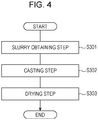
- FIG. 4 is an explanatory view illustrating the method for producing the tobacco slurry sheet 12 according to Embodiment 1. As illustrated in Fig.
- a tobacco raw material containing, for example, tobacco midribs, tobacco laminae, shredded tobacco, and tobacco fine powder is pulverized, and subsequently mixed with small amounts of a binder (binding agent) and a reinforcing agent (such as defibrated pulp) and predetermined amounts of an aerosol-source material (such as glycerol or propylene glycol) and water within, for example, a stirring tank, to thereby obtain a slurry (suspension) (slurry obtaining step).
- a binder binder
- the binder include guar gum, xanthan gum, and CMC (methylol cellulose).
- Step S302 the slurry obtained in the slurry obtaining step is cast (spread) over, for example, a steel belt (support), into a sheet shape, to thereby obtain a slurry web (casting step).
- Step S303 the sheet-shaped slurry web spread to the sheet shape is dried (drying step).
- the steps having been described so far provide the tobacco slurry sheet 12.
- the tobacco slurry sheet 12 in this embodiment has an aerosol-source material content adjusted to be 12 to 65 wt%.
- the tobacco slurry sheet 12 has a moisture content adjusted to be in a range of 12 to 25 wt%.
- the resultant tobacco slurry sheet 12 can supply a necessary and sufficient amount of aerosol.
- the aerosol-source material content is set to 65 wt% or less, the aerosol-source material can be prevented from being supplied, to the tobacco slurry sheet 12, in an excessively large amount beyond the capacity of holding the aerosol-source material in the tobacco slurry sheet 12.
- the surface of the tobacco slurry sheet 12 becomes sticky due to the aerosol-source material to cause accidental adhesion during storage.
- the tobacco slurry sheet 12 has higher capacity of holding the aerosol-source material than the tobacco paper sheet 11.
- the tobacco slurry sheet 12 has higher aerosol-source material content than the tobacco paper sheet 11.
- the tobacco slurry sheet 12 has, due to the characteristics of the production steps, a low degree of intertwinement of pulp fibers, and hence has a feature of having lower mechanical strength (such as tensile strength or breaking strength) than the tobacco paper sheet 11.
- the tobacco paper sheet 11 has, as described above, lower capacity for containing the aerosol-source material than the tobacco slurry sheet 12, but has a higher degree of intertwinement of pulp fibers, and hence has a feature of having higher mechanical strength (such as tensile strength or breaking strength) than the tobacco slurry sheet 12.
- the laminated reconstituted tobacco sheet 1 has a laminated sheet structure in which the tobacco paper sheet 11 and the tobacco slurry sheet 12, which have different features as described above, are laminated together.
- the method for producing the laminated reconstituted tobacco sheet 1 will be specifically described: in the tobacco sheet feeding step (in Fig. 1 , Step S101), two tobacco paper sheets 11 and one tobacco slurry sheet 12 produced by the methods having been described with reference to Fig. 3 and Fig. 4 are prepared.
- the tobacco paper sheets 11 produced by the production method having been described with reference to Fig. 3 and the tobacco slurry sheet 12 produced by the production method having been described with reference to Fig. 4 may be wound into roll shapes such as bobbins.
- Fig. 5 is an explanatory view illustrating the pressure-bonding step in the method for producing the laminated reconstituted tobacco sheet 1 in Embodiment 1.
- the reconstituted tobacco sheets S1 to S3 being stacked such that, in the laminated reconstituted tobacco sheet 1, the tobacco slurry sheet 12 forming the second reconstituted tobacco sheet S2 (intermediate layer) is sandwiched between the tobacco paper sheet 11 forming the first reconstituted tobacco sheet S1 (uppermost layer) and the tobacco paper sheet 11 forming the third reconstituted tobacco sheet S3 (lowermost layer), are continuously passed through a pressure roller 20, to thereby pressure-bond together the reconstituted tobacco sheets S1 to S3.
- the pressure roller 20 includes at least a pair of roller members 21 and 22; between the pair of roller members 21 and 22, the reconstituted tobacco sheets S1 to S3 being stacked are continuously passed, so that the reconstituted tobacco sheets S1 to S3 are subjected to a compressive force in the layer direction (thickness direction).
- the pair of roller members 21 and 22 are used to flatten the plurality of reconstituted tobacco sheets S1 to S3 being stacked, during which hydrogen bonds between the tobacco raw materials are utilized to achieve pressure-bonding together of the reconstituted tobacco sheets S1 to S3.
- hydrogen bonds between the tobacco raw materials of the first reconstituted tobacco sheet S1 (tobacco paper sheet 11) and the second reconstituted tobacco sheet S2 (tobacco slurry sheet 12) are used to pressure-bond together the first reconstituted tobacco sheet S1 (tobacco paper sheet 11) and the second reconstituted tobacco sheet S2 (tobacco slurry sheet 12).
- Hydrogen bonds between the tobacco raw materials of the third reconstituted tobacco sheet S3 (tobacco paper sheet 11) and the second reconstituted tobacco sheet S2 (tobacco slurry sheet 12) are used to pressure-bond together the third reconstituted tobacco sheet S3 (tobacco paper sheet 11) and the second reconstituted tobacco sheet S2 (tobacco slurry sheet 12).
- Such a hydrogen bond is a noncovalent attractive interaction provided between a hydrogen atom covalently bonded to a highly electronegative atom (negative atom) and a lone electron-pair of, for example, N, O, S, F, or a ⁇ electron system positioned adjacent to the hydrogen atom.
- the method for producing the laminated reconstituted tobacco sheet 1 according to this embodiment utilizes, in the pressure-bonding step, hydrogen bonds between the tobacco raw materials, to thereby achieve, without applying additional adhesive or binder, pressure-bonding together of the reconstituted tobacco sheets S1 to S3.
- the pressure roller 20 (the pair of roller members 21 and 22) nips the reconstituted tobacco sheets S1 to S3 at a nip pressure set to be 200 to 1300 N/cm.
- a nip pressure set to be 200 to 1300 N/cm.
- the reconstituted tobacco sheets S1 to S3 can be pressure-bonded together with more certainty, and reconstituted tobacco sheets (in this embodiment, in the laminated reconstituted tobacco sheet 1, the first reconstituted tobacco sheet S1 forming the uppermost layer and the third reconstituted tobacco sheet S3 forming the lowermost layer) passing between the roller members 21 and 22 in the pressure roller 20 can be suitably prevented from adhering to the roller members 21 and 22.
- the roller clearance RC is set to be 20 to 80% of the total thickness of the plurality of reconstituted tobacco sheets S1 to S3 passed through the pressure roller 20 (between the pair of roller members 21 and 22) in the pressure-bonding step.
- the roller clearance RC is set to be in such a preferred range, the above-described problems are less likely to occur.
- the reconstituted tobacco sheets S1 to S3 can be smoothly sent into between the pair of roller members 21 and 22, and occurrence of wrinkling, breakage, and the like of the reconstituted tobacco sheets S1 to S3 can be suitably prevented.
- the reconstituted tobacco sheets S1 to S3 are pressure-bonded together at sheet temperatures controlled to be ordinary temperature to 80°.
- the reconstituted tobacco sheets S1 to S3 may have sheet temperatures controlled to be in a range of 20 to 80°C.
- the above-described problems can be suitably prevented.
- the reconstituted tobacco sheets S1 to S3 can be prevented from adhering to the pair of roller members 21 and 22, the reconstituted tobacco sheets S1 to S3 can be suitably pressure-bonded together.
- the reconstituted tobacco sheets S 1 to S3 fed in the sheet feeding step each have a moisture content adjusted to be in a range of 12 to 25 wt%.
- the reconstituted tobacco sheets S1 to S3 pressure-bonded together in the pressure-bonding step are each provided to have a moisture content in the above-described range, while the first reconstituted tobacco sheet S1 or the third reconstituted tobacco sheet S3 is prevented from adhering to the pair of roller members 21 and 22 in the pressure roller 20, hydrogen bonds between the tobacco raw materials of the reconstituted tobacco sheets S1 to S3 are easily formed to thereby suitably pressure-bond together the sheets.
- the reconstituted tobacco sheets S1 to S3 have an excessively high moisture content, the tobacco raw materials tend to undergo putrefaction or deterioration, for example; when the moisture content is excessively low, the sheets may have high rigidity and tend to fragment.
- the reconstituted tobacco sheets S1 to S3 are each provided to have a moisture content in the above-described range of 12 to 25 wt% to thereby suitably prevent the above-described problems.
- a plurality of reconstituted tobacco sheets S1 to S3 are pressure-bonded together to provide the laminated reconstituted tobacco sheet 1, to thereby achieve an increase in the basis weight of the laminated reconstituted tobacco sheet 1.
- This facilitates an increase in the aerosol-source material content per unit area of the laminated reconstituted tobacco sheet 1.
- a non-combustion heating-type smoking article using the laminated reconstituted tobacco sheet 1 as the tobacco filler in the tobacco rod is provided, during smoking of the non-combustion heating-type smoking article, a sufficient delivery amount of generated aerosol is ensured, to enrich smoking experience.
- At least one of the plurality of reconstituted tobacco sheets S1 to S3 pressure-bonded together in the pressure-bonding step is a tobacco paper sheet, which ensures, in the laminated reconstituted tobacco sheet 1, sufficient mechanical strength (such as tensile strength or breaking strength).
- a plurality of reconstituted tobacco sheets in the pressure-bonding step, can be pressure-bonded together without applying additional adhesive or binder.
- a plurality of reconstituted tobacco sheets are bonded together with a water-insoluble adhesive, from the viewpoint of preventing generation of off-flavor or off-odor during smoking of the non-combustion heating-type smoking article, it is difficult to use a large amount of water-insoluble adhesive.
- the resultant reconstituted tobacco sheets have increased moisture content, so that a re-drying step may become necessary.
- a plurality of reconstituted tobacco sheets can be pressure-bonded together utilizing hydrogen bonds between tobacco raw materials, so that occurrence of the above-described problems can be prevented.
- the number of sheets stacked can be increased, to thereby ensure a sufficient aerosol-source material content per unit area of the laminated reconstituted tobacco sheet 1.
- the thickness of the base sheets can be set to an appropriate thickness such that, at the time of adding, in the flavoring step, the concentrated solution of the water-based tobacco extract or the aerosol-source material to the base sheets, the addition solution containing the concentrated solution of the water-based tobacco extract and the like permeates the base sheets uniformly in the thickness direction within the time determined by, for example, production conditions of the production apparatus (actual apparatus).
- the tobacco paper sheets 11 serving as constituent materials of the laminated reconstituted tobacco sheet 1 have excellent production suitability. Therefore, the production method according to this embodiment provides the laminated reconstituted tobacco sheet 1 that has high production suitability and high mechanical strength, and ensures a sufficient aerosol-source material content per unit area.
- the tobacco slurry sheet 12 has high capacity for holding the aerosol-source material, and hence can contain and hold a larger amount of aerosol-source material.
- the tobacco slurry sheet 12 having high capacity for containing the aerosol-source material and the tobacco paper sheet 11 having high mechanical strength are combined together as a laminated structure to form the laminated reconstituted tobacco sheet 1, so that, in the laminated reconstituted tobacco sheet 1, mechanical strength is ensured and increased aerosol-source material content is achieved.
- the first reconstituted tobacco sheet S1 positioned in the uppermost layer and the third reconstituted tobacco sheet S3 positioned in the lowermost layer are formed of the tobacco paper sheets 11, and the second reconstituted tobacco sheet S2 positioned in the intermediate layer is formed of the tobacco slurry sheet 12.
- the tobacco slurry sheet 12 has a higher aerosol-source material content than the tobacco paper sheets 11, and tends to have a stickier surface than the tobacco paper sheets 11.
- the tobacco slurry sheet 12 is sandwiched between the tobacco paper sheets 11 to form the laminated reconstituted tobacco sheet 1 having outer layers formed of the tobacco paper sheets 11, to thereby prevent the laminated reconstituted tobacco sheet 1 from having a sticky surface.
- the pressure roller 20 the pair of roller members 21 and 22
- adhesion of the reconstituted tobacco sheets to the roller members 21 and 22 and wrinkling, breakage, and the like of the reconstituted tobacco sheets can be more suitably prevented.
- the outer layers of the laminated reconstituted tobacco sheet 1 are formed of the tobacco paper sheets 11 having high mechanical strength, and the tobacco slurry sheet 12 having lower mechanical strength than the tobacco paper sheets 11 is disposed in the intermediate layer of the laminated reconstituted tobacco sheet 1, to thereby facilitate post-production cutting of the laminated reconstituted tobacco sheet 1 into various shapes such as fine cut, fine granules, flakes, or strips, and wrapping using a wrapping machine. More specifically, the laminated reconstituted tobacco sheet 1 employing the above-described laminate structure has increased mechanical strength to thereby achieve prevention of unintentional breakage or fragmentation, to provide improved cutting suitability.
- the outer layers of the laminated reconstituted tobacco sheet 1 are formed of the tobacco paper sheets 11, so that the surface of the laminated reconstituted tobacco sheet 1 is prevented from becoming sticky, and hence improved slidability is achieved in the wrapping unit and the raw material can be smoothly conveyed. This results in improved machinability in the wrapping machine for wrapping the laminated reconstituted tobacco sheet 1.
- Fig. 6 is an explanatory view illustrating the pressure-bonding step in the method for producing the laminated reconstituted tobacco sheet 1 according to Modification 1.
- the method for producing the laminated reconstituted tobacco sheet 1 according to this embodiment as long as at least one of a plurality of reconstituted tobacco sheets is a tobacco paper sheet, and the reconstituted tobacco sheets being stacked are continuously passed through a pressure roller to thereby pressure-bond together the sheets, the number of the reconstituted tobacco sheets stacked is not particularly limited.
- the laminated reconstituted tobacco sheet 1 may include a single tobacco paper sheet.
- the laminated reconstituted tobacco sheet 1 has a bilayer structure in which a single tobacco paper sheet 11 and a single tobacco slurry sheet 12 are stacked and pressure-bonded together.
- the laminated reconstituted tobacco sheet 1 can also be formed so as to have a laminate structure of a combination of the tobacco slurry sheet 12 having high capacity for containing the aerosol-source material and the tobacco paper sheet 11 having high mechanical strength, to thereby achieve suitable increase in the mechanical strength and the capacity for containing the aerosol-source material of the laminated reconstituted tobacco sheet 1.
- the laminated reconstituted tobacco sheet 1 may be formed by pressure-bonding together a plurality of tobacco paper sheets 11.
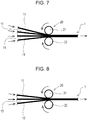
- Fig. 7 is an explanatory view illustrating the pressure-bonding step in the method for producing the laminated reconstituted tobacco sheet 1 according to Modification 2.
- Modification 2 illustrated in Fig. 7 four tobacco paper sheets 11 being stacked are passed through the pressure roller 20 (the pair of roller members 21 and 22) to thereby be pressure-bonded together.
- This Modification provides the laminated reconstituted tobacco sheet 1 having very high mechanical strength.
- the number of tobacco paper sheets 11 stacked may be adjusted in accordance with, for example, the desired mechanical strength or aerosol-source material content of the laminated reconstituted tobacco sheet 1.
- Fig. 8 is an explanatory view illustrating the pressure-bonding step in the method for producing the laminated reconstituted tobacco sheet 1 according to Modification 3.
- the laminated reconstituted tobacco sheet 1 according to Modification 3 has a trilayer structure in which a flavor-containing sheet 13 is sandwiched between the tobacco paper sheet 11 and the tobacco slurry sheet 12.
- the tobacco paper sheet 11, the flavor-containing sheet 13, and the tobacco slurry sheet 12 being stacked are passed through the pressure roller 20 (the pair of roller members 21 and 22), to pressure-bond the sheets together.
- the flavor-containing sheet 13 is a sheet material in which a flavor is covered with a polysaccharide gel not containing any gelling agent.
- examples of the flavor contained in the flavor-containing sheet 13 include various flavors; for example, menthol can be used.
- the flavor contained in the flavor-containing sheet 13 may have the form of liquid, powder, or granules.
- examples of the covering agent for covering the flavor include the following polysaccharides: carrageenan (in Japanese, written in a few forms slightly different from each other) or agar extracted from red marine algae; locust bean gum (carob gum), which is galactomannan extracted from tree seeds; guar gum; tara gum; cassia gum; tamarind gum, which is extracted from resin seeds and has the structure of xyloglucan; psyllium seed gum, which is an acidic polysaccharide extracted from resin seeds and having a structure having xylan as the main chain and arabinose and the like as side chains; xanthan gum or gellan gum (in Japanese, gellan gum is written in a few forms slightly different from each other), which are metabolic polysaccharides of microorganisms; konjak-glucomannan, which is extracted from tuberous roots of konjak; and starch (encompassing products varying in raw material and solubility).
- carrageenan in Japanese, written in a few forms slightly different from each other
- the polysaccharide used as the covering agent for covering the flavor may be a composite of a combination of two or more components selected from the above-described polysaccharide group.
- the method for preparing the flavor-containing sheet 13 is, for example, as follows. First, a polysaccharide (a mono-component or a composite) is dissolved in water under heating. The resultant aqueous solution is mixed with an emulsifying agent and a flavor in a liquid state (or a molten state) at a heating temperature of, for example, 60 to 90°C, and kneaded and emulsified. Subsequently, this emulsion kept in the emulsion state is cast onto a support, and water for dissolving the polysaccharide is evaporated to thereby prepare the flavor-containing sheet 13.
- a polysaccharide a mono-component or a composite
- the laminated reconstituted tobacco sheet 1 including the flavor-containing sheet 13 prepared in the above-described manner can be used as the tobacco filler in the tobacco rod of a non-combustion heating-type smoking article, to thereby prepare a tobacco rod having a high flavor content for a non-combustion heating-type smoking article.
- the polysaccharide can be caused to gel simply by heating, which eliminates the necessity of use of a gelling agent.
- the flavor-containing sheet 13 does not contain a gelling agent such as a metal chloride, and has advantages of not generating undesirable decomposition products of the chloride in the aerosol during, for example, smoking of the non-combustion heating-type smoking article.
- Modification 3 the order of stacking the tobacco paper sheet 11, the flavor-containing sheet 13, and the tobacco slurry sheet 12 can be appropriately changed.
- the type and the number of reconstituted tobacco sheets laminated in the laminated reconstituted tobacco sheet 1 can be appropriately changed.
- the method for producing a laminated reconstituted tobacco sheet according to the present invention is not limited to these.
- the laminated reconstituted tobacco sheet 1 may include a tobacco rolled sheet, which is a reconstituted tobacco sheet produced by a rolling (roll) process.
- the tobacco rolled sheet is a reconstituted tobacco sheet produced by, for example, mixing a tobacco raw material containing tobacco midribs, tobacco laminae, shredded tobacco, tobacco fine powder, and the like with a binder (binding agent), a reinforcing agent (such as defibrated pulp), an aerosol-source material (such as glycerol or propylene glycol), water, and the like within a stirring tank, subsequently rolling the mixture into a sheet shape using a pair of rollers or the like, and drying the mixture.
- a binder binder
- a reinforcing agent such as defibrated pulp
- an aerosol-source material such as glycerol or propylene glycol
Landscapes
- Chemical & Material Sciences (AREA)
- Chemical Kinetics & Catalysis (AREA)
- General Chemical & Material Sciences (AREA)
- Manufacture Of Tobacco Products (AREA)
Abstract
Description
- The present invention relates to a method for producing a laminated reconstituted tobacco sheet.
- There are known non-combustion heating-type smoking articles having a tobacco rod formed by filling the inside of wrapping paper with a tobacco filler containing a tobacco raw material (such as tobacco midribs, tobacco laminae, shredded tobacco, and tobacco fine powder) and an aerosol-source material (such as glycerol or propylene glycol). Such a non-combustion heating-type smoking article is a smoking article configured to use the heating unit of the smoking device, such as an electric heater, to heat the tobacco filler without causing combustion, to deliver an aerosol generated from the tobacco filler to the smoker.
- As the tobacco filler for non-combustion heating-type smoking articles, a reconstituted tobacco raw material is known. The reconstituted tobacco raw material is provided by subjecting a tobacco raw material to kneading with additives such as a binder, a gelling agent, a crosslinking agent, a flavor, a hydrophilic flavor, an oleophilic flavor, a viscosity modifier, a humectant, or a reinforcing material, and to molding and drying by a papermaking process (papermaking), a casting process, a rolling process, or an extrusion process; examples of the reconstituted tobacco raw material include sheet tobacco, shredded tobacco of the sheet tobacco, and tobacco granules. To the tobacco filler, a flavor may be further added. The type of the flavor is not particularly limited.
- As the methods for producing such a reconstituted tobacco sheet, known examples include a method of performing a papermaking (paper manufacturing) process to produce a tobacco sheet, a method of performing a slurry (casting) process to produce a tobacco sheet, a method of performing a rolling (roll) process to produce a tobacco sheet, and a method of performing an extrusion process to produce a tobacco sheet.
-
- Patent document 1:
Japanese Unexamined Patent Application Publication (Translation of PCT Application) No. 2015-517817 - Patent document 2:
Japanese Unexamined Patent Application Publication (Translation of PCT Application) No. 2018-516536 - Patent document 3:
Japanese Patent No. 4860634 - Reconstituted tobacco sheets used as tobacco fillers in non-combustion heating-type smoking articles are desirably produced to have increased generation amount of aerosol (delivery) to enrich smoking experience. In general, tobacco slurry sheets obtained by the slurry (casting) process are known to have high capacity for containing aerosol-source materials such as glycerol, but tend to have low mechanical strength (such as tensile strength or breaking strength) for resisting mechanical stress. On the other hand, tobacco paper sheets obtained by the papermaking process tend to have high mechanical strength due to intertwinement of pulp fibers, but tend to have lower capacity for containing (holding) aerosol-source materials than tobacco slurry sheets. Thus, a technique may be devised: tobacco paper sheets are provided so as to have increased thickness, to thereby increase the capacity for aerosol-source materials contained in the tobacco paper sheets.
- However, in such a case of trying to simply increase the thickness of the base sheets of tobacco paper sheets, the permeation rate of aerosol-source materials applied to the base sheets decreases, which is actually not suitable for practical steps.
- Under such circumstances, the present invention has been made; an object is to provide a technique of, during the production process of a reconstituted tobacco sheet containing a tobacco raw material and an aerosol-source material, providing high production suitability and high mechanical strength, and ensuring a sufficient aerosol-source material content per unit area of the reconstituted tobacco sheet.
- In order to achieve the above-described object, a method for producing a laminated reconstituted tobacco sheet according to the present invention includes a sheet feeding step of feeding a plurality of reconstituted tobacco sheets containing an aerosol-source material and moisture; and a pressure-bonding step of continuously passing, through a pressure roller, the plurality of reconstituted tobacco sheets being stacked, to pressure-bond together the reconstituted tobacco sheets, wherein at least one of the reconstituted tobacco sheets is a tobacco paper sheet obtained such that a tobacco raw material is extracted with water and separated into a water-based tobacco extract and an insoluble tobacco residue, the insoluble tobacco residue is mixed with pulp and subjected to papermaking to provide a base sheet, and subsequently the water-based tobacco extract is added to the base sheet. This provides a laminated reconstituted tobacco sheet that has high production suitability and high mechanical strength, and has a high aerosol-source material content per unit area.
- In the pressure-bonding step, the reconstituted tobacco sheets may be pressure-bonded together without applying additional adhesive or binder.
- The plurality of reconstituted tobacco sheets may include a tobacco slurry sheet obtained by spreading, into a sheet shape over a support, a slurry containing a tobacco raw material, pulp, water, and an aerosol-source material, and drying the slurry
- In the plurality of reconstituted tobacco sheets fed in the sheet feeding step, the tobacco slurry sheet may have an aerosol-source material content higher than an aerosol-source material content of the tobacco paper sheet.
- The tobacco paper sheet may have an aerosol-source material content of 12 to 25 wt%.
- The tobacco slurry sheet may have an aerosol-source material content of 12 to 65 wt%.
- In the pressure-bonding step, of the plurality of reconstituted tobacco sheets passed through the pressure roller, reconstituted tobacco sheets positioned in an uppermost layer and a lowermost layer may be formed of the tobacco paper sheet.
- In the pressure-bonding step, of the plurality of reconstituted tobacco sheets passed through the pressure roller, between the tobacco paper sheets positioned in the uppermost layer and the lowermost layer, a tobacco slurry sheet may be sandwiched, the tobacco slurry sheet being obtained by spreading, into a sheet shape over a support, a slurry containing a tobacco raw material, pulp, water, and an aerosol-source material, and drying the slurry. Furthermore, between the tobacco paper sheets, a tobacco rolled sheet and/or a tobacco extrusion sheet may be sandwiched. The extrusion sheet is a reconstituted tobacco sheet that can be produced by, for example, mixing a tobacco raw material containing tobacco midribs, tobacco laminae, shredded tobacco, tobacco fine powder, and the like with a binder (binding agent), an aerosol-source material (such as glycerol or propylene glycol), water, and the like within a stirring tank, subsequently extruding the mixed raw material, under application of pressure, through a die, and drying the mixed raw material.
- In the pressure-bonding step, of the plurality of reconstituted tobacco sheets passed through the pressure roller, between the tobacco paper sheets in the lowermost layer and the uppermost layer, a flavor-containing sheet containing a liquid, powdery, or granular flavor may be sandwiched.
- The reconstituted tobacco sheets fed in the sheet feeding step may each have a moisture content adjusted to be in a range of 12 to 25 wt%.
- In the pressure-bonding step, the reconstituted tobacco sheets may be pressure-bonded together while the reconstituted tobacco sheets have sheet temperatures controlled to be ordinary temperature to 80°C.
- In the pressure-bonding step, the pressure roller may be set to nip the reconstituted tobacco sheets at a nip pressure of 200 to 1300 N/cm.
- The pressure roller may be set to have a roller clearance that is 20 to 80% of a total thickness of the plurality of reconstituted tobacco sheets passed through the pressure roller in the pressure-bonding step.
- Note that, in the present invention, features for achieving the object can be employed in combination as long as possible.
- The present invention provides a technique of, during the production process of a reconstituted tobacco sheet containing shredded tobacco and an aerosol-source material, providing high production suitability and high mechanical strength, and ensuring a sufficient aerosol-source material content per unit area.
-
- [
Fig. 1] Fig. 1 illustrates a method for producing a laminated reconstituted tobacco sheet according toEmbodiment 1. - [
Fig. 2] Fig. 2 illustrates the layer structure of a laminated reconstitutedtobacco sheet 1 according toEmbodiment 1. - [
Fig. 3] Fig. 3 is an explanatory view illustrating a method for producing a tobacco paper sheet according toEmbodiment 1. - [
Fig. 4] Fig. 4 is an explanatory view illustrating a method for producing a tobacco slurry sheet according toEmbodiment 1. - [
Fig. 5] Fig. 5 is an explanatory view illustrating a pressure-bonding step in a method for producing a laminated reconstituted tobacco sheet inEmbodiment 1. - [
Fig. 6] Fig. 6 is an explanatory view illustrating a pressure-bonding step in a method for producing a laminated reconstituted tobacco sheet according toModification 1. - [
Fig. 7] Fig. 7 is an explanatory view illustrating a pressure-bonding step in a method for producing a laminated reconstituted tobacco sheet according to Modification 2. - [
Fig. 8] Fig. 8 is an explanatory view illustrating a pressure-bonding step in a method for producing a laminated reconstituted tobacco sheet according to Modification 3. - Hereinafter, embodiments of a method for producing a laminated reconstituted tobacco sheet according to the present invention will be described with reference to drawings. Incidentally, the dimensions, materials, shapes, relative positions, and the like of elements described in the embodiments are not intended to limit the technical scope of the invention thereto unless otherwise specified.
-
Fig. 1 illustrates a method for producing a laminated reconstituted tobacco sheet according toEmbodiment 1. The method for producing a laminated reconstituted tobacco sheet inEmbodiment 1 includes a sheet feeding step (Step S101) of feeding a plurality of reconstituted tobacco sheets containing an aerosol-source material and water, and a pressure-bonding step (Step S102) of continuously passing, through a pressure roller, the plurality of reconstituted tobacco sheets being stacked to pressure-bond together the reconstituted tobacco sheets, wherein at least one of the reconstituted tobacco sheets is a tobacco paper sheet. -
Fig. 2 illustrates the layer structure of a laminated reconstitutedtobacco sheet 1 obtained by the production method illustrated inFig. 1 . The laminated reconstitutedtobacco sheet 1 illustrated inFig. 2 has a trilayer structure in which a first reconstituted tobacco sheet S1, a second reconstituted tobacco sheet S2, and a third reconstituted tobacco sheet S3 are stacked and the sheets are pressure-bonded together. In the laminated reconstitutedtobacco sheet 1, the first reconstituted tobacco sheet S1 forming the uppermost layer and the third reconstituted tobacco sheet S3 forming the lowermost layer are formed oftobacco paper sheets 11. The second reconstituted tobacco sheet S2 forming the intermediate layer is formed of atobacco slurry sheet 12. The laminated reconstitutedtobacco sheet 1 is used as a tobacco filler for filling the inside of the wrapping paper of a tobacco rod of a non-combustion heating-type smoking article. For example, the laminated reconstitutedtobacco sheet 1 is cut into various shapes such as fine cut, fine granules, flakes, or strips, and subsequently filled, as a tobacco filler, into the inside of wrapping paper to thereby form a tobacco rod. However, it is apparent that the laminated reconstitutedtobacco sheet 1 is not limited to the above-described shapes and may be folded into a gathering shape and subsequently filled into the inside of the wrapping paper of a tobacco rod. Alternatively, the laminated reconstitutedtobacco sheet 1 may be processed such that, in its surface, a plurality of grooves extending in the longitudinal direction are formed at constant intervals by laser processing, for example. Subsequently, the laminated reconstitutedtobacco sheet 1 may be rolled into a cylindrical shape such that the grooves formed in the surface extend in the axial direction of the tobacco rod, and a plurality of such cylinders may be piled to form a plurality of layers in the inside of the wrapping paper of the tobacco rod of a non-combustion heating-type smoking article. - Hereinafter, the
tobacco paper sheets 11 and theslurry sheet 12 constituting the laminatedreconstituted tobacco sheet 1 will be described. Such atobacco paper sheet 11 is a reconstituted tobacco sheet obtained such that a tobacco raw material is extracted with water and separated into a water-based tobacco extract and an insoluble tobacco residue, the insoluble tobacco residue is mixed with pulp (cellulose fibers) and subjected to papermaking to provide a base sheet, and subsequently the water-based extract is added to the base sheet. Theslurry sheet 12 is a reconstituted tobacco sheet obtained such that a slurry raw material at least containing a tobacco raw material, pulp, water, and an aerosol-source material is spread into a sheet shape over a support, and dried. -
Fig. 3 is an explanatory view illustrating a method for producing thetobacco paper sheet 11 according toEmbodiment 1. As illustrated inFig. 3 , first, in Step S201, a tobacco raw material containing, for example, tobacco midribs, tobacco laminae, shredded tobacco, and tobacco fine powder is extracted with water (extraction step). In the extraction step, for example, the tobacco raw material is mixed with an amount of water 10 times the amount of the tobacco raw material, and, under stirring, heated at a predetermined temperature for a predetermined time to obtain a mixture. Subsequently, in Step S202, the mixture obtained in the extraction step is squeezed with, for example, a screw press dehydrator, to achieve separation into a water-based tobacco extract (liquid) and an insoluble tobacco residue (solid) (separation step). Subsequently, in Step S203, to the insoluble tobacco residue obtained in the separation step, water and pulp (cellulose fibers) are added, and the insoluble tobacco residue is refined with, for example, a refiner, so as to adjust fiber length or cause fibrillation of the fibers to thereby achieve fiberization (refining step). - Subsequently, in Step S204, the insoluble tobacco residue and pulp fiberized in the refining step are processed with a paper machine into a sheet shape, and dried to obtain a base sheet (papermaking step). Subsequently, in Step S205, to the base sheet, an addition solution containing a concentrated solution of the water-based tobacco extract obtained in the separation step, and an aerosol-source material such as glycerol or propylene glycol is added (flavoring step). Incidentally, the concentrated solution of the water-based tobacco extract added to the base sheet in the flavoring step can be obtained by using, for example, an evaporator, to concentrate the water-based tobacco extract. Subsequently, in Step S206, the flavored base sheet obtained in the flavoring step is dried (drying step).
- The production method having been described so far provides the
tobacco paper sheet 11. Incidentally, thetobacco paper sheet 11 in this embodiment has an aerosol-source material content adjusted to be 12 to 25 wt%. Thetobacco paper sheet 11 has a moisture content adjusted to be in a range of 12 to 25 wt%. In such a case where, for thetobacco paper sheet 11, the aerosol-source material content is set to 12 wt% or more, the resultanttobacco paper sheet 11 can supply a necessary and sufficient amount of aerosol. In such a case where, for thetobacco paper sheet 11, the aerosol-source material content is set to 25 wt% or less, the aerosol-source material can be prevented from being supplied, to the base sheet, in an excessively large amount beyond the capacity of holding the aerosol-source material in the base sheet. This prevents, for example, the surface of the base sheet from becoming sticky due to the aerosol-source material. - Hereinafter, a method for producing the
tobacco slurry sheet 12 of the laminatedreconstituted tobacco sheet 1 will be described.Fig. 4 is an explanatory view illustrating the method for producing thetobacco slurry sheet 12 according toEmbodiment 1. As illustrated inFig. 4 , first, in Step S301, a tobacco raw material containing, for example, tobacco midribs, tobacco laminae, shredded tobacco, and tobacco fine powder is pulverized, and subsequently mixed with small amounts of a binder (binding agent) and a reinforcing agent (such as defibrated pulp) and predetermined amounts of an aerosol-source material (such as glycerol or propylene glycol) and water within, for example, a stirring tank, to thereby obtain a slurry (suspension) (slurry obtaining step). Examples of the binder (binding agent) include guar gum, xanthan gum, and CMC (methylol cellulose). - Subsequently, in Step S302, the slurry obtained in the slurry obtaining step is cast (spread) over, for example, a steel belt (support), into a sheet shape, to thereby obtain a slurry web (casting step). Subsequently, in Step S303, the sheet-shaped slurry web spread to the sheet shape is dried (drying step). The steps having been described so far provide the
tobacco slurry sheet 12. Thetobacco slurry sheet 12 in this embodiment has an aerosol-source material content adjusted to be 12 to 65 wt%. Thetobacco slurry sheet 12 has a moisture content adjusted to be in a range of 12 to 25 wt%. In such a case where, for thetobacco slurry sheet 12, the aerosol-source material content is set to 12 wt% or more, the resultanttobacco slurry sheet 12 can supply a necessary and sufficient amount of aerosol. In such a case where, for thetobacco slurry sheet 12, the aerosol-source material content is set to 65 wt% or less, the aerosol-source material can be prevented from being supplied, to thetobacco slurry sheet 12, in an excessively large amount beyond the capacity of holding the aerosol-source material in thetobacco slurry sheet 12. This prevents the following problems: for example, the surface of thetobacco slurry sheet 12 becomes sticky due to the aerosol-source material to cause accidental adhesion during storage. Incidentally, thetobacco slurry sheet 12 has higher capacity of holding the aerosol-source material than thetobacco paper sheet 11. - In this embodiment, the
tobacco slurry sheet 12 has higher aerosol-source material content than thetobacco paper sheet 11. Thetobacco slurry sheet 12 has, due to the characteristics of the production steps, a low degree of intertwinement of pulp fibers, and hence has a feature of having lower mechanical strength (such as tensile strength or breaking strength) than thetobacco paper sheet 11. By contrast, thetobacco paper sheet 11 has, as described above, lower capacity for containing the aerosol-source material than thetobacco slurry sheet 12, but has a higher degree of intertwinement of pulp fibers, and hence has a feature of having higher mechanical strength (such as tensile strength or breaking strength) than thetobacco slurry sheet 12. - In this embodiment, the laminated
reconstituted tobacco sheet 1 has a laminated sheet structure in which thetobacco paper sheet 11 and thetobacco slurry sheet 12, which have different features as described above, are laminated together. Referring again toFig. 1 , the method for producing the laminatedreconstituted tobacco sheet 1 will be specifically described: in the tobacco sheet feeding step (inFig. 1 , Step S101), twotobacco paper sheets 11 and onetobacco slurry sheet 12 produced by the methods having been described with reference toFig. 3 andFig. 4 are prepared. Incidentally, thetobacco paper sheets 11 produced by the production method having been described with reference toFig. 3 and thetobacco slurry sheet 12 produced by the production method having been described with reference toFig. 4 may be wound into roll shapes such as bobbins. -
Fig. 5 is an explanatory view illustrating the pressure-bonding step in the method for producing the laminatedreconstituted tobacco sheet 1 inEmbodiment 1. In the pressure-bonding step (inFig. 1 , Step S102), the reconstituted tobacco sheets S1 to S3 being stacked such that, in the laminatedreconstituted tobacco sheet 1, thetobacco slurry sheet 12 forming the second reconstituted tobacco sheet S2 (intermediate layer) is sandwiched between thetobacco paper sheet 11 forming the first reconstituted tobacco sheet S1 (uppermost layer) and thetobacco paper sheet 11 forming the third reconstituted tobacco sheet S3 (lowermost layer), are continuously passed through apressure roller 20, to thereby pressure-bond together the reconstituted tobacco sheets S1 to S3. Thepressure roller 20 includes at least a pair ofroller members roller members roller members reconstituted tobacco sheet 1 according to this embodiment utilizes, in the pressure-bonding step, hydrogen bonds between the tobacco raw materials, to thereby achieve, without applying additional adhesive or binder, pressure-bonding together of the reconstituted tobacco sheets S1 to S3. - Incidentally, in the pressure-bonding step of this embodiment, the pressure roller 20 (the pair of
roller members 21 and 22) nips the reconstituted tobacco sheets S1 to S3 at a nip pressure set to be 200 to 1300 N/cm. When the nip pressure of thepressure roller 20 is excessively high, the reconstituted tobacco sheets S1 and S3 tend to adhere to the pressure roller 20 (the pair ofroller members 21 and 22); when the nip pressure is excessively low, the reconstituted tobacco sheets S1 to S3 are less likely to be pressure-bonded together. By contrast, when the nip pressure of the pressure roller 20 (the pair ofroller members 21 and 22) is adjusted to be in a range of 200 to 1300 N/cm, the reconstituted tobacco sheets S1 to S3 can be pressure-bonded together with more certainty, and reconstituted tobacco sheets (in this embodiment, in the laminatedreconstituted tobacco sheet 1, the first reconstituted tobacco sheet S1 forming the uppermost layer and the third reconstituted tobacco sheet S3 forming the lowermost layer) passing between theroller members pressure roller 20 can be suitably prevented from adhering to theroller members - When the roller clearance RC in the pressure roller 20 (between the pair of
roller members 21 and 22) is excessively small, in the pressure-bonding step, it may become difficult to smoothly send the reconstituted tobacco sheets S1 to S3 being stacked, into between the pair ofroller members roller members roller members 21 and 22) in the pressure-bonding step. When the roller clearance RC is set to be in such a preferred range, the above-described problems are less likely to occur. Specifically, in the pressure-bonding step, the reconstituted tobacco sheets S1 to S3 can be smoothly sent into between the pair ofroller members - During, in the pressure-bonding step, pressure-bonding together of the reconstituted tobacco sheets S1 to S3, when the reconstituted tobacco sheets S1 to S3 have excessively high sheet temperatures, the first reconstituted tobacco sheet S1 or the third reconstituted tobacco sheet S3 sheet tends to adhere to the pair of
roller members pressure roller 20; when the sheet temperatures are excessively low, the reconstituted tobacco sheets S1 to S3 may become less likely to be pressure-bonded together. Thus, in this embodiment, in the pressure-bonding step, the reconstituted tobacco sheets S1 to S3 are pressure-bonded together at sheet temperatures controlled to be ordinary temperature to 80°. For example, in the pressure-bonding step, the reconstituted tobacco sheets S1 to S3 may have sheet temperatures controlled to be in a range of 20 to 80°C. In this case, the above-described problems can be suitably prevented. Specifically, in the pressure-bonding step, while the reconstituted tobacco sheets S1 to S3 can be prevented from adhering to the pair ofroller members - In this embodiment, the reconstituted tobacco sheets S 1 to S3 fed in the sheet feeding step each have a moisture content adjusted to be in a range of 12 to 25 wt%. When the reconstituted tobacco sheets S1 to S3 pressure-bonded together in the pressure-bonding step are each provided to have a moisture content in the above-described range, while the first reconstituted tobacco sheet S1 or the third reconstituted tobacco sheet S3 is prevented from adhering to the pair of
roller members pressure roller 20, hydrogen bonds between the tobacco raw materials of the reconstituted tobacco sheets S1 to S3 are easily formed to thereby suitably pressure-bond together the sheets. When the reconstituted tobacco sheets S1 to S3 have an excessively high moisture content, the tobacco raw materials tend to undergo putrefaction or deterioration, for example; when the moisture content is excessively low, the sheets may have high rigidity and tend to fragment. Thus, the reconstituted tobacco sheets S1 to S3 are each provided to have a moisture content in the above-described range of 12 to 25 wt% to thereby suitably prevent the above-described problems. - As has been described so far, in the production method in this embodiment, a plurality of reconstituted tobacco sheets S1 to S3 are pressure-bonded together to provide the laminated
reconstituted tobacco sheet 1, to thereby achieve an increase in the basis weight of the laminatedreconstituted tobacco sheet 1. This facilitates an increase in the aerosol-source material content per unit area of the laminatedreconstituted tobacco sheet 1. As a result, when a non-combustion heating-type smoking article using the laminatedreconstituted tobacco sheet 1 as the tobacco filler in the tobacco rod is provided, during smoking of the non-combustion heating-type smoking article, a sufficient delivery amount of generated aerosol is ensured, to enrich smoking experience. - In the method for producing the laminated
reconstituted tobacco sheet 1 according to this embodiment, as described above, at least one of the plurality of reconstituted tobacco sheets S1 to S3 pressure-bonded together in the pressure-bonding step is a tobacco paper sheet, which ensures, in the laminatedreconstituted tobacco sheet 1, sufficient mechanical strength (such as tensile strength or breaking strength). - In the method for producing the laminated
reconstituted tobacco sheet 1 according to this embodiment, in the pressure-bonding step, a plurality of reconstituted tobacco sheets can be pressure-bonded together without applying additional adhesive or binder. When a plurality of reconstituted tobacco sheets are bonded together with a water-insoluble adhesive, from the viewpoint of preventing generation of off-flavor or off-odor during smoking of the non-combustion heating-type smoking article, it is difficult to use a large amount of water-insoluble adhesive. Alternatively, when a plurality of reconstituted tobacco sheets are bonded together with a water-soluble adhesive, the resultant reconstituted tobacco sheets have increased moisture content, so that a re-drying step may become necessary. By contrast, in the method for producing the laminatedreconstituted tobacco sheet 1 according to this embodiment, in the pressure-bonding step, without applying additional adhesive or binder, a plurality of reconstituted tobacco sheets can be pressure-bonded together utilizing hydrogen bonds between tobacco raw materials, so that occurrence of the above-described problems can be prevented. - Furthermore, in the method for producing the laminated
reconstituted tobacco sheet 1 according to this embodiment, even when reconstituted tobacco sheets pressure-bonded together in the pressure-bonding step each have a small sheet thickness, the number of sheets stacked can be increased, to thereby ensure a sufficient aerosol-source material content per unit area of the laminatedreconstituted tobacco sheet 1. Thus, during production of thetobacco paper sheets 11 for forming the first reconstituted tobacco sheet S1 and the third reconstituted tobacco sheet S3, the thickness of the base sheets can be set to an appropriate thickness such that, at the time of adding, in the flavoring step, the concentrated solution of the water-based tobacco extract or the aerosol-source material to the base sheets, the addition solution containing the concentrated solution of the water-based tobacco extract and the like permeates the base sheets uniformly in the thickness direction within the time determined by, for example, production conditions of the production apparatus (actual apparatus). As a result, thetobacco paper sheets 11 serving as constituent materials of the laminatedreconstituted tobacco sheet 1 have excellent production suitability. Therefore, the production method according to this embodiment provides the laminatedreconstituted tobacco sheet 1 that has high production suitability and high mechanical strength, and ensures a sufficient aerosol-source material content per unit area. - In the method for producing the laminated
reconstituted tobacco sheet 1 according to this embodiment, at least one of the plurality of reconstituted tobacco sheets S1 to S3 pressure-bonded together in the pressure-bonding step is thetobacco slurry sheet 12. Thetobacco slurry sheet 12 has high capacity for holding the aerosol-source material, and hence can contain and hold a larger amount of aerosol-source material. Thus, thetobacco slurry sheet 12 having high capacity for containing the aerosol-source material and thetobacco paper sheet 11 having high mechanical strength are combined together as a laminated structure to form the laminatedreconstituted tobacco sheet 1, so that, in the laminatedreconstituted tobacco sheet 1, mechanical strength is ensured and increased aerosol-source material content is achieved. - Furthermore, in the method for producing the laminated
reconstituted tobacco sheet 1 according to this embodiment, in the pressure-bonding step, of the plurality of reconstituted tobacco sheets S1 to S3 passed between the pair ofroller members pressure roller 20, the first reconstituted tobacco sheet S1 positioned in the uppermost layer and the third reconstituted tobacco sheet S3 positioned in the lowermost layer are formed of thetobacco paper sheets 11, and the second reconstituted tobacco sheet S2 positioned in the intermediate layer is formed of thetobacco slurry sheet 12. Thetobacco slurry sheet 12 has a higher aerosol-source material content than thetobacco paper sheets 11, and tends to have a stickier surface than thetobacco paper sheets 11. In order to address this, in the method for producing the laminatedreconstituted tobacco sheet 1 according to this embodiment, thetobacco slurry sheet 12 is sandwiched between thetobacco paper sheets 11 to form the laminatedreconstituted tobacco sheet 1 having outer layers formed of thetobacco paper sheets 11, to thereby prevent the laminatedreconstituted tobacco sheet 1 from having a sticky surface. Thus, during production of the laminatedreconstituted tobacco sheet 1, at the time of, in the pressure-bonding step, flattening of the plurality of stacked reconstituted tobacco sheets using the pressure roller 20 (the pair ofroller members 21 and 22), for example, adhesion of the reconstituted tobacco sheets to theroller members reconstituted tobacco sheet 1 are formed of thetobacco paper sheets 11 having high mechanical strength, and thetobacco slurry sheet 12 having lower mechanical strength than thetobacco paper sheets 11 is disposed in the intermediate layer of the laminatedreconstituted tobacco sheet 1, to thereby facilitate post-production cutting of the laminatedreconstituted tobacco sheet 1 into various shapes such as fine cut, fine granules, flakes, or strips, and wrapping using a wrapping machine. More specifically, the laminatedreconstituted tobacco sheet 1 employing the above-described laminate structure has increased mechanical strength to thereby achieve prevention of unintentional breakage or fragmentation, to provide improved cutting suitability. The outer layers of the laminatedreconstituted tobacco sheet 1 are formed of thetobacco paper sheets 11, so that the surface of the laminatedreconstituted tobacco sheet 1 is prevented from becoming sticky, and hence improved slidability is achieved in the wrapping unit and the raw material can be smoothly conveyed. This results in improved machinability in the wrapping machine for wrapping the laminatedreconstituted tobacco sheet 1. - As the method for producing the laminated
reconstituted tobacco sheet 1 according to this embodiment, various modifications can be employed. For example,Fig. 6 is an explanatory view illustrating the pressure-bonding step in the method for producing the laminatedreconstituted tobacco sheet 1 according toModification 1. In the method for producing the laminatedreconstituted tobacco sheet 1 according to this embodiment, as long as at least one of a plurality of reconstituted tobacco sheets is a tobacco paper sheet, and the reconstituted tobacco sheets being stacked are continuously passed through a pressure roller to thereby pressure-bond together the sheets, the number of the reconstituted tobacco sheets stacked is not particularly limited. The laminatedreconstituted tobacco sheet 1 may include a single tobacco paper sheet. InModification 1 illustrated inFig. 6 , the laminatedreconstituted tobacco sheet 1 has a bilayer structure in which a singletobacco paper sheet 11 and a singletobacco slurry sheet 12 are stacked and pressure-bonded together. In the method for producing the laminatedreconstituted tobacco sheet 1 according toModification 1, the laminatedreconstituted tobacco sheet 1 can also be formed so as to have a laminate structure of a combination of thetobacco slurry sheet 12 having high capacity for containing the aerosol-source material and thetobacco paper sheet 11 having high mechanical strength, to thereby achieve suitable increase in the mechanical strength and the capacity for containing the aerosol-source material of the laminatedreconstituted tobacco sheet 1. - Alternatively, the laminated
reconstituted tobacco sheet 1 may be formed by pressure-bonding together a plurality oftobacco paper sheets 11.Fig. 7 is an explanatory view illustrating the pressure-bonding step in the method for producing the laminatedreconstituted tobacco sheet 1 according to Modification 2. In Modification 2 illustrated inFig. 7 , fourtobacco paper sheets 11 being stacked are passed through the pressure roller 20 (the pair ofroller members 21 and 22) to thereby be pressure-bonded together. This Modification provides the laminatedreconstituted tobacco sheet 1 having very high mechanical strength. However, it is apparent that the number oftobacco paper sheets 11 stacked may be adjusted in accordance with, for example, the desired mechanical strength or aerosol-source material content of the laminatedreconstituted tobacco sheet 1. -
Fig. 8 is an explanatory view illustrating the pressure-bonding step in the method for producing the laminatedreconstituted tobacco sheet 1 according to Modification 3. The laminatedreconstituted tobacco sheet 1 according to Modification 3 has a trilayer structure in which a flavor-containingsheet 13 is sandwiched between thetobacco paper sheet 11 and thetobacco slurry sheet 12. In the pressure-bonding step according to Modification 3, thetobacco paper sheet 11, the flavor-containingsheet 13, and thetobacco slurry sheet 12 being stacked are passed through the pressure roller 20 (the pair ofroller members 21 and 22), to pressure-bond the sheets together. - The flavor-containing
sheet 13 is a sheet material in which a flavor is covered with a polysaccharide gel not containing any gelling agent. Examples of the flavor contained in the flavor-containingsheet 13 include various flavors; for example, menthol can be used. The flavor contained in the flavor-containingsheet 13 may have the form of liquid, powder, or granules. - In the flavor-containing
sheet 13, examples of the covering agent for covering the flavor include the following polysaccharides: carrageenan (in Japanese, written in a few forms slightly different from each other) or agar extracted from red marine algae; locust bean gum (carob gum), which is galactomannan extracted from tree seeds; guar gum; tara gum; cassia gum; tamarind gum, which is extracted from resin seeds and has the structure of xyloglucan; psyllium seed gum, which is an acidic polysaccharide extracted from resin seeds and having a structure having xylan as the main chain and arabinose and the like as side chains; xanthan gum or gellan gum (in Japanese, gellan gum is written in a few forms slightly different from each other), which are metabolic polysaccharides of microorganisms; konjak-glucomannan, which is extracted from tuberous roots of konjak; and starch (encompassing products varying in raw material and solubility). Of these, carrageenan, gellan gum, tamarind gum, psyllium seed gum, konjak-glucomannan, or agar can be used as a mono-component. In the flavor-containingsheet 13, the polysaccharide used as the covering agent for covering the flavor may be a composite of a combination of two or more components selected from the above-described polysaccharide group. - The method for preparing the flavor-containing
sheet 13 is, for example, as follows. First, a polysaccharide (a mono-component or a composite) is dissolved in water under heating. The resultant aqueous solution is mixed with an emulsifying agent and a flavor in a liquid state (or a molten state) at a heating temperature of, for example, 60 to 90°C, and kneaded and emulsified. Subsequently, this emulsion kept in the emulsion state is cast onto a support, and water for dissolving the polysaccharide is evaporated to thereby prepare the flavor-containingsheet 13. - The laminated
reconstituted tobacco sheet 1 including the flavor-containingsheet 13 prepared in the above-described manner can be used as the tobacco filler in the tobacco rod of a non-combustion heating-type smoking article, to thereby prepare a tobacco rod having a high flavor content for a non-combustion heating-type smoking article. The polysaccharide can be caused to gel simply by heating, which eliminates the necessity of use of a gelling agent. Thus, the flavor-containingsheet 13 does not contain a gelling agent such as a metal chloride, and has advantages of not generating undesirable decomposition products of the chloride in the aerosol during, for example, smoking of the non-combustion heating-type smoking article. - Incidentally, in Modification 3, the order of stacking the
tobacco paper sheet 11, the flavor-containingsheet 13, and thetobacco slurry sheet 12 can be appropriately changed. In addition, in Modification 3, the type and the number of reconstituted tobacco sheets laminated in the laminatedreconstituted tobacco sheet 1 can be appropriately changed. - Some embodiments according to the present invention have been described so far; however, the method for producing a laminated reconstituted tobacco sheet according to the present invention is not limited to these. For example, the laminated
reconstituted tobacco sheet 1 may include a tobacco rolled sheet, which is a reconstituted tobacco sheet produced by a rolling (roll) process. The tobacco rolled sheet is a reconstituted tobacco sheet produced by, for example, mixing a tobacco raw material containing tobacco midribs, tobacco laminae, shredded tobacco, tobacco fine powder, and the like with a binder (binding agent), a reinforcing agent (such as defibrated pulp), an aerosol-source material (such as glycerol or propylene glycol), water, and the like within a stirring tank, subsequently rolling the mixture into a sheet shape using a pair of rollers or the like, and drying the mixture. -
- 1
- laminated reconstituted tobacco sheet
- 11
- tobacco paper sheet
- 12
- tobacco slurry sheet
- 13
- flavor-containing sheet
- 20
- pressure roller
- S1
- first reconstituted tobacco sheet
- S2
- second reconstituted tobacco sheet
- S3
- third reconstituted tobacco sheet
Claims (13)
- A method for producing a laminated reconstituted tobacco sheet, the method comprising:a sheet feeding step of feeding a plurality of reconstituted tobacco sheets containing an aerosol-source material and moisture; anda pressure-bonding step of continuously passing, through a pressure roller, the plurality of reconstituted tobacco sheets being stacked, to pressure-bond together the reconstituted tobacco sheets,wherein at least one of the reconstituted tobacco sheets is a tobacco paper sheet obtained such that a tobacco raw material is extracted with water and separated into a water-based tobacco extract and an insoluble tobacco residue, the insoluble tobacco residue is mixed with pulp and subjected to papermaking to provide a base sheet, and subsequently the water-based tobacco extract is added to the base sheet.
- The method for producing a laminated reconstituted tobacco sheet according to Claim 1,
wherein, in the pressure-bonding step, the reconstituted tobacco sheets are pressure-bonded together without applying additional adhesive or binder. - The method for producing a laminated reconstituted tobacco sheet according to Claim 1 or 2,
wherein the plurality of reconstituted tobacco sheets include a tobacco slurry sheet obtained by spreading, into a sheet shape over a support, a slurry containing a tobacco raw material, pulp, water, and an aerosol-source material, and drying the slurry - The method for producing a laminated reconstituted tobacco sheet according to Claim 3,
wherein, in the plurality of reconstituted tobacco sheets fed in the sheet feeding step, the tobacco slurry sheet has an aerosol-source material content higher than an aerosol-source material content of the tobacco paper sheet. - The method for producing a laminated reconstituted tobacco sheet according to Claim 4,
wherein the tobacco paper sheet has an aerosol-source material content of 12 to 25 wt%. - The method for producing a laminated reconstituted tobacco sheet according to Claim 4 or 5,
wherein the tobacco slurry sheet has an aerosol-source material content of 12 to 65 wt%. - The method for producing a laminated reconstituted tobacco sheet according to any one of Claims 1 to 6,
wherein, in the pressure-bonding step, of the plurality of reconstituted tobacco sheets passed through the pressure roller, reconstituted tobacco sheets positioned in an uppermost layer and a lowermost layer are formed of the tobacco paper sheet. - The method for producing a laminated reconstituted tobacco sheet according to Claim 7,
wherein, in the pressure-bonding step, of the plurality of reconstituted tobacco sheets passed through the pressure roller, between the tobacco paper sheets positioned in the uppermost layer and the lowermost layer, a tobacco slurry sheet is sandwiched, the tobacco slurry sheet being obtained by spreading, into a sheet shape over a support, a slurry containing a tobacco raw material, pulp, water, and an aerosol-source material, and drying the slurry. - The method for producing a laminated reconstituted tobacco sheet according to Claim 7 or 8,
wherein, in the pressure-bonding step, of the plurality of reconstituted tobacco sheets passed through the pressure roller, between the tobacco paper sheets in the lowermost layer and the uppermost layer, a flavor-containing sheet containing a liquid, powdery, or granular flavor is sandwiched. - The method for producing a laminated reconstituted tobacco sheet according to any one of Claims 1 to 9,
wherein the reconstituted tobacco sheets fed in the sheet feeding step each have a moisture content adjusted to be in a range of 12 to 25 wt%. - The method for producing a laminated reconstituted tobacco sheet according to any one of Claims 1 to 10,
wherein, in the pressure-bonding step, the reconstituted tobacco sheets are pressure-bonded together while the reconstituted tobacco sheets have sheet temperatures controlled to be ordinary temperature to 80°C. - The method for producing a laminated reconstituted tobacco sheet according to any one of Claims 1 to 11,
wherein, in the pressure-bonding step, the pressure roller is set to nip the reconstituted tobacco sheets at a nip pressure of 200 to 1300 N/cm. - The method for producing a laminated reconstituted tobacco sheet according to any one of Claims 1 to 12,
wherein the pressure roller is set to have a roller clearance that is 20 to 80% of a total thickness of the plurality of reconstituted tobacco sheets passed through the pressure roller in the pressure-bonding step.
Applications Claiming Priority (1)
| Application Number | Priority Date | Filing Date | Title |
|---|---|---|---|
| PCT/JP2019/001532 WO2020148902A1 (en) | 2019-01-18 | 2019-01-18 | Method for producing laminated reconstituted tobacco sheet |
Publications (2)
| Publication Number | Publication Date |
|---|---|
| EP3912494A1 true EP3912494A1 (en) | 2021-11-24 |
| EP3912494A4 EP3912494A4 (en) | 2022-08-31 |
Family
ID=71613188
Family Applications (1)
| Application Number | Title | Priority Date | Filing Date |
|---|---|---|---|
| EP19910361.5A Withdrawn EP3912494A4 (en) | 2019-01-18 | 2019-01-18 | Method for producing laminated reconstituted tobacco sheet |
Country Status (3)
| Country | Link |
|---|---|
| EP (1) | EP3912494A4 (en) |
| JP (1) | JP7145238B2 (en) |
| WO (1) | WO2020148902A1 (en) |
Cited By (3)
| Publication number | Priority date | Publication date | Assignee | Title |
|---|---|---|---|---|
| CN117322670A (en) * | 2022-06-24 | 2024-01-02 | 上海烟草集团有限责任公司 | Aerosol-forming base material, preparation method thereof and smoking article |
| WO2024037932A1 (en) * | 2022-08-19 | 2024-02-22 | Körber Technologies Gmbh | Apparatus and method for producing a strand from a flat multi-layered web, and also rod-form article |
| WO2024042006A1 (en) * | 2022-08-23 | 2024-02-29 | Körber Technologies Gmbh | Method for producing cut tobacco from tobacco leaf material for use in hnb tobacco articles, and hnb tobacco article |
Families Citing this family (24)
| Publication number | Priority date | Publication date | Assignee | Title |
|---|---|---|---|---|
| JP7659571B2 (en) * | 2020-10-02 | 2025-04-09 | 日本たばこ産業株式会社 | Tobacco Sheet |
| JP7653446B2 (en) * | 2020-10-02 | 2025-03-28 | 日本たばこ産業株式会社 | Tobacco Sheet |
| JP7628551B2 (en) * | 2020-10-02 | 2025-02-10 | 日本たばこ産業株式会社 | Tobacco Sheet |
| JP7573048B2 (en) * | 2020-12-24 | 2024-10-24 | 日本たばこ産業株式会社 | Tobacco composition, tobacco-containing segment, non-combustion heating type flavor inhalation device, and non-combustion heating type flavor inhalation system |
| WO2022138263A1 (en) * | 2020-12-24 | 2022-06-30 | 日本たばこ産業株式会社 | Method for manufacturing tobacco rod part for non-combustion heating-type flavor inhalation article |
| EP4268619A4 (en) * | 2020-12-24 | 2024-12-18 | Japan Tobacco Inc. | Tobacco composition, tobacco-containing segment, non-combustion heating-type flavor inhaler, and non-combustion heating-type flavor inhalation system |
| CN117597034A (en) * | 2021-04-27 | 2024-02-23 | 日本烟草产业株式会社 | Tobacco sheets for non-combustion heated flavor smokers, non-combustion heated flavor smokers, and non-combustion heated flavor smokers |
| CN117677304A (en) * | 2021-04-27 | 2024-03-08 | 日本烟草产业株式会社 | Tobacco sheet for non-combustion heated flavor smoker and manufacturing method thereof, non-combustion heated flavor smoker, and non-combustion heated flavor smoker system |
| CN117677307A (en) * | 2021-04-27 | 2024-03-08 | 日本烟草产业株式会社 | Tobacco sheets for non-combustion heated flavor smokers, non-combustion heated flavor smokers, and non-combustion heated flavor smokers |
| KR102605497B1 (en) * | 2021-04-29 | 2023-11-22 | 주식회사 케이티앤지 | Tobacco extract sheet, method for manufacturing the same and smoking article including the same |
| CN113439867B (en) * | 2021-07-02 | 2023-03-24 | 河南卷烟工业烟草薄片有限公司 | Method for preparing reconstituted tobacco for heating non-combustible cigarettes by combining dry method and rolling method |
| WO2023282170A1 (en) * | 2021-07-07 | 2023-01-12 | 日本たばこ産業株式会社 | Tobacco sheet for non-combustion heating type flavor inhalers, method for producing same, non-combustion heating type flavor inhaler, and non-combustion heating type flavor inhalation system |
| KR20240046623A (en) * | 2021-09-01 | 2024-04-09 | 니뽄 다바코 산교 가부시키가이샤 | Tobacco sheet for non-combustion heating type flavor inhaler, non-combustion heating type flavor inhaler, and non-combustion heating type flavor inhalation system |
| KR20240117123A (en) | 2021-12-14 | 2024-07-31 | 니뽄 다바코 산교 가부시키가이샤 | Tobacco materials and manufacturing methods thereof, and tobacco products |
| WO2023145009A1 (en) * | 2022-01-28 | 2023-08-03 | 日本たばこ産業株式会社 | Tobacco filler and non-combustion-heating-type flavor inhalation apparatus |
| CN117297159B (en) * | 2022-06-24 | 2025-11-21 | 上海烟草集团有限责任公司 | Roll forming device and system for aerosol forming substrate |
| WO2024224496A1 (en) * | 2023-04-26 | 2024-10-31 | 日本たばこ産業株式会社 | Flavor-generating article and smoking system |
| WO2024261954A1 (en) * | 2023-06-22 | 2024-12-26 | 日本たばこ産業株式会社 | Method for producing flavor generator and flavor generator |
| WO2024261957A1 (en) * | 2023-06-22 | 2024-12-26 | 日本たばこ産業株式会社 | Flavor generator production method, and flavor generator |
| CN116965579B (en) * | 2023-07-19 | 2026-01-30 | 浙江中烟工业有限责任公司 | A method for preparing reconstituted tobacco leaves for heated cigarettes |
| CN117137172A (en) * | 2023-10-23 | 2023-12-01 | 云南中烟工业有限责任公司 | A kind of magnetic laminated reconstituted tobacco leaf, its preparation method and use |
| WO2025186949A1 (en) * | 2024-03-06 | 2025-09-12 | 日本たばこ産業株式会社 | Heated tobacco and electrically-heated tobacco inhalation system |
| KR20250149315A (en) * | 2024-04-09 | 2025-10-16 | 주식회사 케이티앤지 | Method of manufacturing tobacco medium |
| CN119235045B (en) * | 2024-10-30 | 2026-07-17 | 云南中烟工业有限责任公司 | Reconstituted tobacco prepared by powder paper forming process and preparation method thereof |
Family Cites Families (7)
| Publication number | Priority date | Publication date | Assignee | Title |
|---|---|---|---|---|
| US4497331A (en) * | 1982-08-11 | 1985-02-05 | Tmci, Inc. | Tobacco product with high filling power and process of making same |
| JPH1170630A (en) * | 1997-07-03 | 1999-03-16 | Oji Paper Co Ltd | Laminate |
| DE102005006117B4 (en) | 2005-02-10 | 2007-01-11 | British American Tobacco (Germany) Gmbh | Processing of tobacco materials with a high proportion of small tobacco pieces |
| TWI605764B (en) | 2012-05-31 | 2017-11-21 | 菲利浦莫里斯製品股份有限公司 | Blended rods, method of forming such a rod, aerosol-generating article, aerosol-forming substrate and system comprising an electrically-operated aerosol-generating apparatus and an aerosol-generating article |
| GB201505597D0 (en) * | 2015-03-31 | 2015-05-13 | British American Tobacco Co | Article for use with apparatus for heating smokable material |
| WO2018235241A1 (en) | 2017-06-22 | 2018-12-27 | 日本たばこ産業株式会社 | Flavor generation segment, and flavor generation article and flavor suction system comprising the same |
| CN108835707A (en) * | 2018-08-07 | 2018-11-20 | 湖北中烟工业有限责任公司 | A kind of electromagnetic induction heating cigarette and preparation method thereof |
-
2019
- 2019-01-18 WO PCT/JP2019/001532 patent/WO2020148902A1/en not_active Ceased
- 2019-01-18 JP JP2020566083A patent/JP7145238B2/en not_active Expired - Fee Related
- 2019-01-18 EP EP19910361.5A patent/EP3912494A4/en not_active Withdrawn
Cited By (4)
| Publication number | Priority date | Publication date | Assignee | Title |
|---|---|---|---|---|
| CN117322670A (en) * | 2022-06-24 | 2024-01-02 | 上海烟草集团有限责任公司 | Aerosol-forming base material, preparation method thereof and smoking article |
| CN117322670B (en) * | 2022-06-24 | 2026-02-27 | 上海烟草集团有限责任公司 | An aerosol forming substrate, its preparation method, and smoking products |
| WO2024037932A1 (en) * | 2022-08-19 | 2024-02-22 | Körber Technologies Gmbh | Apparatus and method for producing a strand from a flat multi-layered web, and also rod-form article |
| WO2024042006A1 (en) * | 2022-08-23 | 2024-02-29 | Körber Technologies Gmbh | Method for producing cut tobacco from tobacco leaf material for use in hnb tobacco articles, and hnb tobacco article |
Also Published As
| Publication number | Publication date |
|---|---|
| WO2020148902A1 (en) | 2020-07-23 |
| JPWO2020148902A1 (en) | 2021-09-09 |
| JP7145238B2 (en) | 2022-09-30 |
| EP3912494A4 (en) | 2022-08-31 |
Similar Documents
| Publication | Publication Date | Title |
|---|---|---|
| JP7145238B2 (en) | Method for producing laminated reconstituted tobacco sheet | |
| WO2016067226A1 (en) | Nano-lamination reconsituted tobacco | |
| JP6811616B2 (en) | Reconstructed tobacco sheet and related methods | |
| CN111526739B (en) | Process for the preparation of a sheet comprising an alkaloid-containing homogenized material and an aerosol-forming article comprising components produced therefrom | |
| US4497331A (en) | Tobacco product with high filling power and process of making same | |
| US4337783A (en) | Forming sheet from reconstituted tobacco | |
| CA2574858A1 (en) | Smokeable tobacco substitute filler having an increased fill value and method of making same | |
| KR102767322B1 (en) | Method for producing a sheet comprising a homogenized material containing an alkaloid and an aerosol-forming article comprising a component produced therefrom | |
| CN113439867B (en) | Method for preparing reconstituted tobacco for heating non-combustible cigarettes by combining dry method and rolling method | |
| US12601093B2 (en) | Nonwoven fabric; pouched product and related methods | |
| EP2846651B1 (en) | Tobacco product that produces lower carbon monoxide to tar ratio | |
| EP1489927B1 (en) | Method for manufacturing a top loaded cigarette filler | |
| EP0216926A1 (en) | Process for manufacturing wrinkled sheet tobacco | |
| JPS6045914B2 (en) | Manufacturing method for wrinkled sheet cigarettes | |
| CN113100470B (en) | Preparation method of composite tobacco base material | |
| EP4689285A1 (en) | Method and plant for making a cellulose-based web | |
| US4770194A (en) | Method of manufacturing wrinkled sheet tobacco | |
| CN113115973A (en) | Preparation method of reconstituted tobacco sheet base for heating cigarettes | |
| EP4643667A1 (en) | Reconstituted tobacco sheet production method | |
| EP4643660A1 (en) | Production method for reconstituted tobacco sheet | |
| EP3453266A1 (en) | Tabacco sheet, rod-shaped smoking article and method for producing a tabacco sheet | |
| EP4643661A1 (en) | Method for producing reconstituted tobacco sheet | |
| EP4643662A1 (en) | Method for producing reconstituted tobacco sheet | |
| CN121242284A (en) | All-tobacco type cigarette with shell-core structure and preparation method thereof | |
| KR20250075864A (en) | Method for producing reconstituted tobacco leaves sheet that reduces loss of cigarette end, and cigarette containing reconstituted tobacco leaves sheet produced thereby |
Legal Events
| Date | Code | Title | Description |
|---|---|---|---|
| STAA | Information on the status of an ep patent application or granted ep patent |
Free format text: STATUS: THE INTERNATIONAL PUBLICATION HAS BEEN MADE |
|
| PUAI | Public reference made under article 153(3) epc to a published international application that has entered the european phase |
Free format text: ORIGINAL CODE: 0009012 |
|
| STAA | Information on the status of an ep patent application or granted ep patent |
Free format text: STATUS: REQUEST FOR EXAMINATION WAS MADE |
|
| 17P | Request for examination filed |
Effective date: 20210811 |
|
| AK | Designated contracting states |
Kind code of ref document: A1 Designated state(s): AL AT BE BG CH CY CZ DE DK EE ES FI FR GB GR HR HU IE IS IT LI LT LU LV MC MK MT NL NO PL PT RO RS SE SI SK SM TR |
|
| DAV | Request for validation of the european patent (deleted) | ||
| DAX | Request for extension of the european patent (deleted) | ||
| REG | Reference to a national code |
Ref country code: DE Ref legal event code: R079 Free format text: PREVIOUS MAIN CLASS: A24F0047000000 Ipc: A24B0003140000 |
|
| A4 | Supplementary search report drawn up and despatched |
Effective date: 20220728 |
|
| RIC1 | Information provided on ipc code assigned before grant |
Ipc: D21H 27/00 20060101ALI20220722BHEP Ipc: D21H 17/02 20060101ALI20220722BHEP Ipc: D21H 27/30 20060101ALI20220722BHEP Ipc: A24B 15/12 20060101ALI20220722BHEP Ipc: A24B 3/14 20060101AFI20220722BHEP |
|
| STAA | Information on the status of an ep patent application or granted ep patent |
Free format text: STATUS: THE APPLICATION HAS BEEN WITHDRAWN |
|
| 18W | Application withdrawn |
Effective date: 20231229 |