EP3910001A1 - Polycarbonate copolymer and associated film extrusion composition, extruded film, and capacitor - Google Patents
Polycarbonate copolymer and associated film extrusion composition, extruded film, and capacitor Download PDFInfo
- Publication number
- EP3910001A1 EP3910001A1 EP20196451.7A EP20196451A EP3910001A1 EP 3910001 A1 EP3910001 A1 EP 3910001A1 EP 20196451 A EP20196451 A EP 20196451A EP 3910001 A1 EP3910001 A1 EP 3910001A1
- Authority
- EP
- European Patent Office
- Prior art keywords
- carbonate units
- polysiloxane
- polycarbonate
- independently
- mole percent
- Prior art date
- Legal status (The legal status is an assumption and is not a legal conclusion. Google has not performed a legal analysis and makes no representation as to the accuracy of the status listed.)
- Pending
Links
- 0 C*C1=C=CC(C2(c3ccccc3C(C)(C)C2([Rh])[Rh])c2ccccc2)=CC=C1 Chemical compound C*C1=C=CC(C2(c3ccccc3C(C)(C)C2([Rh])[Rh])c2ccccc2)=CC=C1 0.000 description 2
- PYOLJOJPIPCRDP-UHFFFAOYSA-N CC1CC(C)(C)CCC1 Chemical compound CC1CC(C)(C)CCC1 PYOLJOJPIPCRDP-UHFFFAOYSA-N 0.000 description 1
- VQMPTVQCADWACQ-UHFFFAOYSA-N CCC(C)(CC)N Chemical compound CCC(C)(CC)N VQMPTVQCADWACQ-UHFFFAOYSA-N 0.000 description 1
- YXFVVABEGXRONW-UHFFFAOYSA-N Cc1ccccc1 Chemical compound Cc1ccccc1 YXFVVABEGXRONW-UHFFFAOYSA-N 0.000 description 1
- KRLGJSLYSJCBOL-UHFFFAOYSA-N O=C(c1ccccc1C1(c2ccccc2)c2ccccc2)N1c1ccccc1 Chemical compound O=C(c1ccccc1C1(c2ccccc2)c2ccccc2)N1c1ccccc1 KRLGJSLYSJCBOL-UHFFFAOYSA-N 0.000 description 1
- BKQXUNGELBDWLS-UHFFFAOYSA-N c1ccc(C2(c(cccc3)c3-c3ccccc23)c2ccccc2)cc1 Chemical compound c1ccc(C2(c(cccc3)c3-c3ccccc23)c2ccccc2)cc1 BKQXUNGELBDWLS-UHFFFAOYSA-N 0.000 description 1
Classifications
-
- C—CHEMISTRY; METALLURGY
- C08—ORGANIC MACROMOLECULAR COMPOUNDS; THEIR PREPARATION OR CHEMICAL WORKING-UP; COMPOSITIONS BASED THEREON
- C08G—MACROMOLECULAR COMPOUNDS OBTAINED OTHERWISE THAN BY REACTIONS ONLY INVOLVING UNSATURATED CARBON-TO-CARBON BONDS
- C08G64/00—Macromolecular compounds obtained by reactions forming a carbonic ester link in the main chain of the macromolecule
- C08G64/18—Block or graft polymers
- C08G64/186—Block or graft polymers containing polysiloxane sequences
-
- C—CHEMISTRY; METALLURGY
- C08—ORGANIC MACROMOLECULAR COMPOUNDS; THEIR PREPARATION OR CHEMICAL WORKING-UP; COMPOSITIONS BASED THEREON
- C08L—COMPOSITIONS OF MACROMOLECULAR COMPOUNDS
- C08L83/00—Compositions of macromolecular compounds obtained by reactions forming in the main chain of the macromolecule a linkage containing silicon with or without sulfur, nitrogen, oxygen or carbon only; Compositions of derivatives of such polymers
- C08L83/10—Block- or graft-copolymers containing polysiloxane sequences
-
- B—PERFORMING OPERATIONS; TRANSPORTING
- B32—LAYERED PRODUCTS
- B32B—LAYERED PRODUCTS, i.e. PRODUCTS BUILT-UP OF STRATA OF FLAT OR NON-FLAT, e.g. CELLULAR OR HONEYCOMB, FORM
- B32B15/00—Layered products comprising a layer of metal
- B32B15/04—Layered products comprising a layer of metal comprising metal as the main or only constituent of a layer, which is next to another layer of the same or of a different material
- B32B15/08—Layered products comprising a layer of metal comprising metal as the main or only constituent of a layer, which is next to another layer of the same or of a different material of synthetic resin
- B32B15/09—Layered products comprising a layer of metal comprising metal as the main or only constituent of a layer, which is next to another layer of the same or of a different material of synthetic resin comprising polyesters
-
- B—PERFORMING OPERATIONS; TRANSPORTING
- B32—LAYERED PRODUCTS
- B32B—LAYERED PRODUCTS, i.e. PRODUCTS BUILT-UP OF STRATA OF FLAT OR NON-FLAT, e.g. CELLULAR OR HONEYCOMB, FORM
- B32B27/00—Layered products comprising a layer of synthetic resin
- B32B27/36—Layered products comprising a layer of synthetic resin comprising polyesters
- B32B27/365—Layered products comprising a layer of synthetic resin comprising polyesters comprising polycarbonates
-
- C—CHEMISTRY; METALLURGY
- C08—ORGANIC MACROMOLECULAR COMPOUNDS; THEIR PREPARATION OR CHEMICAL WORKING-UP; COMPOSITIONS BASED THEREON
- C08G—MACROMOLECULAR COMPOUNDS OBTAINED OTHERWISE THAN BY REACTIONS ONLY INVOLVING UNSATURATED CARBON-TO-CARBON BONDS
- C08G77/00—Macromolecular compounds obtained by reactions forming a linkage containing silicon with or without sulfur, nitrogen, oxygen or carbon in the main chain of the macromolecule
- C08G77/42—Block-or graft-polymers containing polysiloxane sequences
- C08G77/448—Block-or graft-polymers containing polysiloxane sequences containing polycarbonate sequences
-
- C—CHEMISTRY; METALLURGY
- C08—ORGANIC MACROMOLECULAR COMPOUNDS; THEIR PREPARATION OR CHEMICAL WORKING-UP; COMPOSITIONS BASED THEREON
- C08J—WORKING-UP; GENERAL PROCESSES OF COMPOUNDING; AFTER-TREATMENT NOT COVERED BY SUBCLASSES C08B, C08C, C08F, C08G or C08H
- C08J5/00—Manufacture of articles or shaped materials containing macromolecular substances
- C08J5/18—Manufacture of films or sheets
-
- C—CHEMISTRY; METALLURGY
- C08—ORGANIC MACROMOLECULAR COMPOUNDS; THEIR PREPARATION OR CHEMICAL WORKING-UP; COMPOSITIONS BASED THEREON
- C08L—COMPOSITIONS OF MACROMOLECULAR COMPOUNDS
- C08L69/00—Compositions of polycarbonates; Compositions of derivatives of polycarbonates
-
- H—ELECTRICITY
- H01—ELECTRIC ELEMENTS
- H01B—CABLES; CONDUCTORS; INSULATORS; SELECTION OF MATERIALS FOR THEIR CONDUCTIVE, INSULATING OR DIELECTRIC PROPERTIES
- H01B3/00—Insulators or insulating bodies characterised by the insulating materials; Selection of materials for their insulating or dielectric properties
- H01B3/18—Insulators or insulating bodies characterised by the insulating materials; Selection of materials for their insulating or dielectric properties mainly consisting of organic substances
- H01B3/30—Insulators or insulating bodies characterised by the insulating materials; Selection of materials for their insulating or dielectric properties mainly consisting of organic substances plastics; resins; waxes
- H01B3/42—Insulators or insulating bodies characterised by the insulating materials; Selection of materials for their insulating or dielectric properties mainly consisting of organic substances plastics; resins; waxes polyesters; polyethers; polyacetals
- H01B3/421—Polyesters
- H01B3/426—Polycarbonates
-
- H—ELECTRICITY
- H01—ELECTRIC ELEMENTS
- H01G—CAPACITORS; CAPACITORS, RECTIFIERS, DETECTORS, SWITCHING DEVICES, LIGHT-SENSITIVE OR TEMPERATURE-SENSITIVE DEVICES OF THE ELECTROLYTIC TYPE
- H01G4/00—Fixed capacitors; Processes of their manufacture
- H01G4/002—Details
- H01G4/018—Dielectrics
- H01G4/06—Solid dielectrics
- H01G4/14—Organic dielectrics
- H01G4/18—Organic dielectrics of synthetic material, e.g. derivatives of cellulose
-
- H—ELECTRICITY
- H01—ELECTRIC ELEMENTS
- H01G—CAPACITORS; CAPACITORS, RECTIFIERS, DETECTORS, SWITCHING DEVICES, LIGHT-SENSITIVE OR TEMPERATURE-SENSITIVE DEVICES OF THE ELECTROLYTIC TYPE
- H01G4/00—Fixed capacitors; Processes of their manufacture
- H01G4/32—Wound capacitors
-
- B—PERFORMING OPERATIONS; TRANSPORTING
- B32—LAYERED PRODUCTS
- B32B—LAYERED PRODUCTS, i.e. PRODUCTS BUILT-UP OF STRATA OF FLAT OR NON-FLAT, e.g. CELLULAR OR HONEYCOMB, FORM
- B32B2270/00—Resin or rubber layer containing a blend of at least two different polymers
-
- B—PERFORMING OPERATIONS; TRANSPORTING
- B32—LAYERED PRODUCTS
- B32B—LAYERED PRODUCTS, i.e. PRODUCTS BUILT-UP OF STRATA OF FLAT OR NON-FLAT, e.g. CELLULAR OR HONEYCOMB, FORM
- B32B2307/00—Properties of the layers or laminate
- B32B2307/20—Properties of the layers or laminate having particular electrical or magnetic properties, e.g. piezoelectric
- B32B2307/202—Conductive
-
- B—PERFORMING OPERATIONS; TRANSPORTING
- B32—LAYERED PRODUCTS
- B32B—LAYERED PRODUCTS, i.e. PRODUCTS BUILT-UP OF STRATA OF FLAT OR NON-FLAT, e.g. CELLULAR OR HONEYCOMB, FORM
- B32B2457/00—Electrical equipment
- B32B2457/16—Capacitors
-
- C—CHEMISTRY; METALLURGY
- C08—ORGANIC MACROMOLECULAR COMPOUNDS; THEIR PREPARATION OR CHEMICAL WORKING-UP; COMPOSITIONS BASED THEREON
- C08J—WORKING-UP; GENERAL PROCESSES OF COMPOUNDING; AFTER-TREATMENT NOT COVERED BY SUBCLASSES C08B, C08C, C08F, C08G or C08H
- C08J2369/00—Characterised by the use of polycarbonates; Derivatives of polycarbonates
-
- C—CHEMISTRY; METALLURGY
- C08—ORGANIC MACROMOLECULAR COMPOUNDS; THEIR PREPARATION OR CHEMICAL WORKING-UP; COMPOSITIONS BASED THEREON
- C08J—WORKING-UP; GENERAL PROCESSES OF COMPOUNDING; AFTER-TREATMENT NOT COVERED BY SUBCLASSES C08B, C08C, C08F, C08G or C08H
- C08J2383/00—Characterised by the use of macromolecular compounds obtained by reactions forming in the main chain of the macromolecule a linkage containing silicon with or without sulfur, nitrogen, oxygen, or carbon only; Derivatives of such polymers
- C08J2383/10—Block- or graft-copolymers containing polysiloxane sequences
-
- C—CHEMISTRY; METALLURGY
- C08—ORGANIC MACROMOLECULAR COMPOUNDS; THEIR PREPARATION OR CHEMICAL WORKING-UP; COMPOSITIONS BASED THEREON
- C08J—WORKING-UP; GENERAL PROCESSES OF COMPOUNDING; AFTER-TREATMENT NOT COVERED BY SUBCLASSES C08B, C08C, C08F, C08G or C08H
- C08J2469/00—Characterised by the use of polycarbonates; Derivatives of polycarbonates
-
- C—CHEMISTRY; METALLURGY
- C08—ORGANIC MACROMOLECULAR COMPOUNDS; THEIR PREPARATION OR CHEMICAL WORKING-UP; COMPOSITIONS BASED THEREON
- C08J—WORKING-UP; GENERAL PROCESSES OF COMPOUNDING; AFTER-TREATMENT NOT COVERED BY SUBCLASSES C08B, C08C, C08F, C08G or C08H
- C08J2483/00—Characterised by the use of macromolecular compounds obtained by reactions forming in the main chain of the macromolecule a linkage containing silicon with or without sulfur, nitrogen, oxygen, or carbon only; Derivatives of such polymers
- C08J2483/10—Block- or graft-copolymers containing polysiloxane sequences
Definitions
- This application relates to a heat-resistant extruded film, a film capacitor comprising the extruded film, and a heat-resistant polycarbonate-polysiloxane useful in forming the extruded film.
- Electrostatic film capacitors with high volumetric energy density, high operating temperature, and long lifetime are critical components for pulse-power, automotive, and industrial electronics.
- Capacitors are essentially energy-storage devices having two parallel conductive plates separated by a thin layer of an electrically insulating (dielectric) film. When a voltage is applied across the plates, the electric field in the dielectric displaces electric charges, and thus stores energy.
- the amount of energy stored by a capacitor depends on the dielectric constant and breakdown voltage of the insulating material used to form the film, and the dimensions (total area and thickness) of the film. To maximize the amount of energy that a capacitor can accumulate, the dielectric constant and breakdown voltage of the film are maximized, and the thickness of the film is minimized.
- the physical characteristics of the dielectric material in the capacitor are the determining factors for the performance of a capacitor, improvements in one or more of the physical properties of the dielectric material in a capacitor can result in corresponding performance improvements in the capacitor component, usually resulting in performance and lifetime enhancements of the electronics system or product in which it is embedded.
- High temperature polycarbonate copolymers have been used in the formation of electrostatic film capacitors. See, for example, U.S. Patent Application Publication Nos. US 2016/0060403 A1 and US 2019/0153217 A1 of Mahood et al. However, there is a desire for extrusion compositions exhibiting an improved ability to be extruded as films having thicknesses of less than ten micrometers.
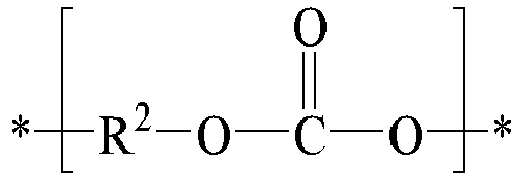
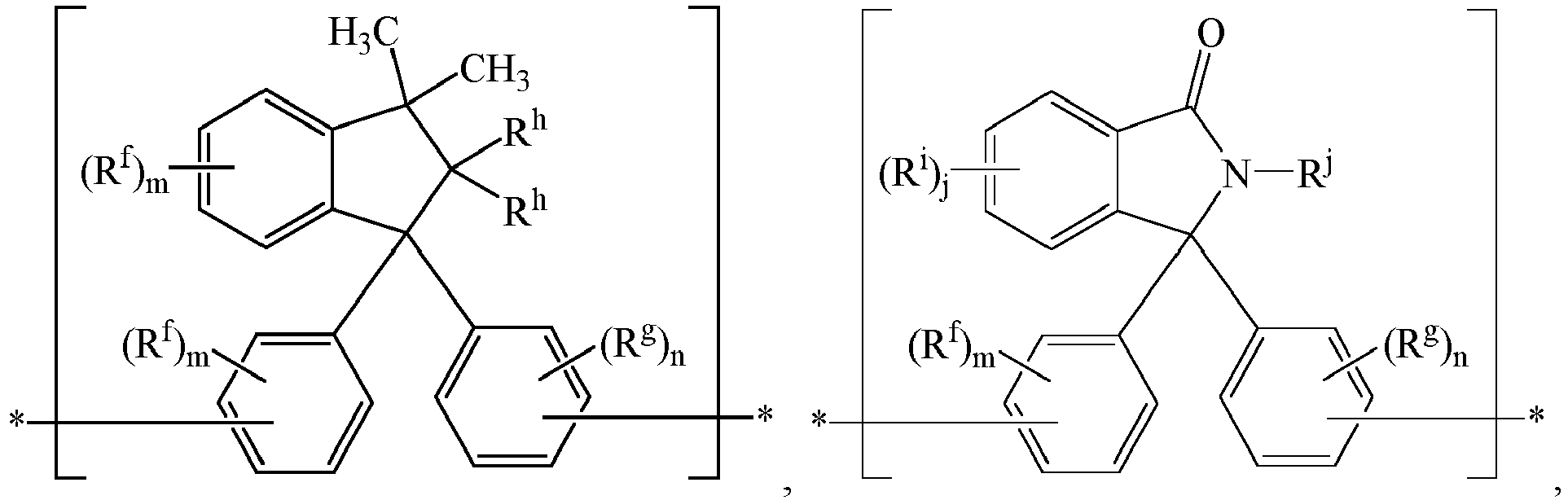
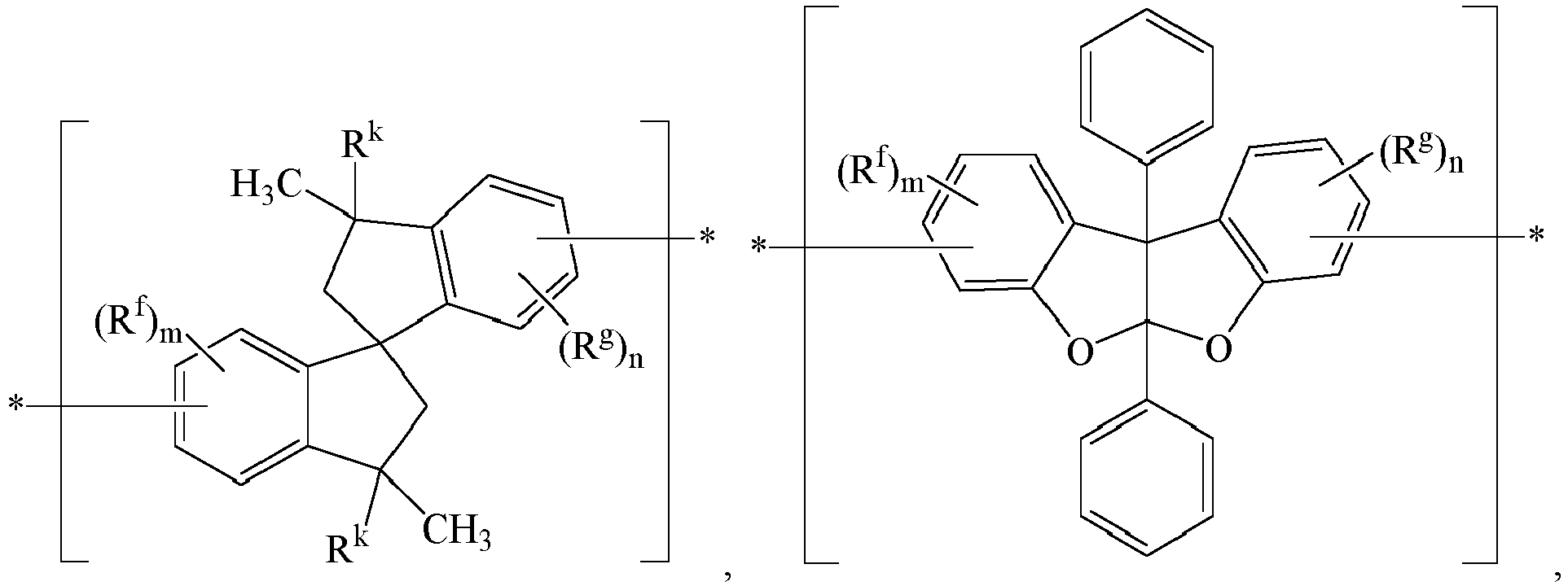
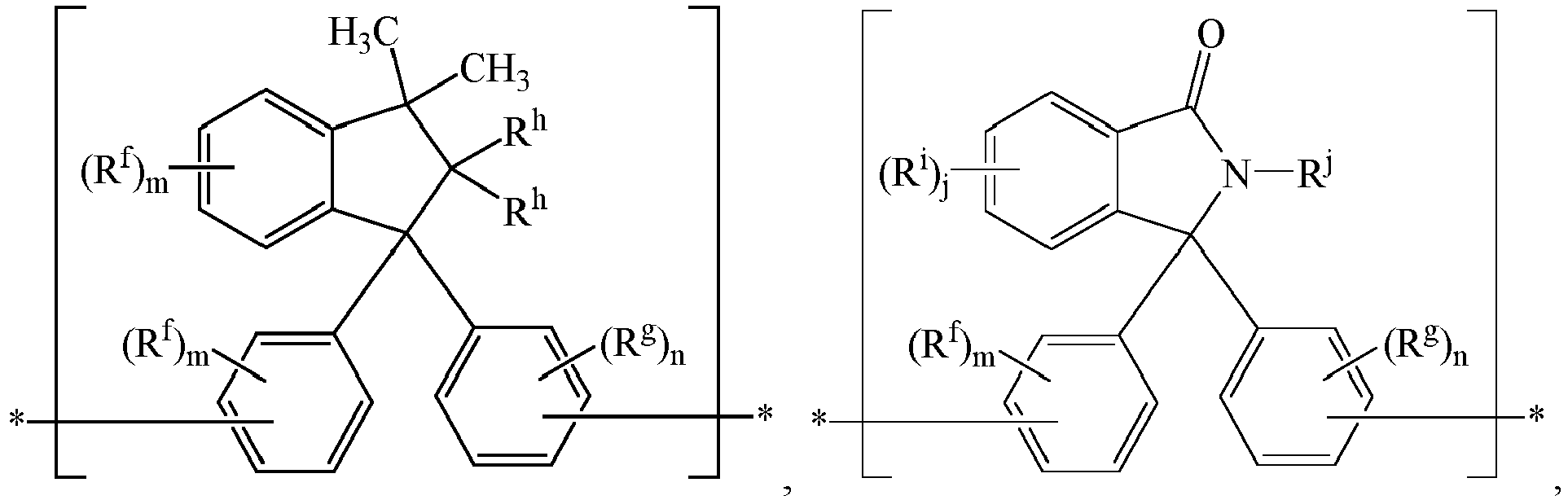
- One embodiment is a polycarbonate-polysiloxane comprising, based on 100 mole percent of total carbonate units in the polycarbonate-polysiloxane, 20 to 69.95 mole percent of first carbonate units having the structure wherein R 1 is a C 6 -C 16 divalent aromatic group; 30 to 79.95 mole percent of second carbonate units having the structure wherein R 2 is a C 17 -C 40 divalent aromatic group having the structure or wherein R f and R g are each independently at each occurrence C 1 -C 12 alkyl, C 1 -C 12 alkoxyl, or C 2 -C 12 alkenyl; each R h is hydrogen or two occurrence of R h combine with the carbon atom to which they are attached to form a carbonyl group; each occurrence of R i is independently C 1 -C 6 alkyl; R j is hydrogen, C 1 -C 6 alkyl, or phenyl optionally substituted with 1, 2, 3, 4, or 5 C 1 -C 6
- compositions comprising a polycarbonate-polysiloxane comprising, based on 100 mole percent of total carbonate units in the polycarbonate-polysiloxane: 20 to 69.95 mole percent of first carbonate units having the structure wherein R 1 is a C 6 -C 16 divalent aromatic group; 30 to 79.95 mole percent of second carbonate units having the structure wherein R 2 is a C 17 -C 40 divalent aromatic group having the structure or wherein R f and R g are each independently at each occurrence C 1 -C 12 alkyl, C 1 -C 12 alkoxyl, or C 2 -C 12 alkenyl; each R h is hydrogen or two occurrence of R h combine with the carbon atom to which they are attached to form a carbonyl group; each occurrence of R i is independently C 1 -C 6 alkyl; R j is hydrogen, C 1 -C 6 alkyl, or phenyl optionally substituted with 1, 2, 3, 4, or 5 C 1
- Another embodiment is an extruded film comprising the composition in any of its variations described herein.
- Another embodiment is a capacitor comprising the extruded film, and an electrically conductive metal layer in contact with the extruded film.
- the present inventors have determined extrusion compositions comprising as their primary component a polycarbonate-polysiloxane comprising specific amounts of polysiloxane carbonate units and two types of aromatic carbonate units exhibit an improved ability to be extruded as films having thicknesses of less than ten micrometers.
- One embodiment is a polycarbonate-polysiloxane comprising, based on 100 mole percent of total carbonate units in the polycarbonate-polysiloxane, 20 to 69.95 mole percent of first carbonate units having the structure wherein R 1 is a C 6 -C 16 divalent aromatic group; 30 to 79.95 mole percent of second carbonate units having the structure wherein R 2 is a C 17 -C 40 divalent aromatic group having the structure or wherein R f and R g are each independently at each occurrence C 1 -C 12 alkyl, C 1 -C 12 alkoxyl, or C 2 -C 12 alkenyl; each R h is hydrogen or two occurrence of R h combine with the carbon atom to which they are attached to form a carbonyl group; each occurrence of R i is independently C 1 -C 6 alkyl; R j is hydrogen, C 1 -C 6 alkyl, or phenyl optionally substituted with 1, 2, 3, 4, or 5 C 1 -C 6
- hydrocarbyl refers to a residue that contains only carbon and hydrogen unless it is specifically identified as “substituted hydrocarbyl".
- the hydrocarbyl residue can be aliphatic or aromatic, straight-chain, cyclic, bicyclic, branched, saturated, or unsaturated. It can also contain combinations of aliphatic, aromatic, straight chain, cyclic, bicyclic, branched, saturated, and unsaturated hydrocarbon moieties. When the hydrocarbyl residue is described as substituted, it can contain heteroatoms in addition to carbon and hydrogen.
- the polycarbonate-polysiloxane comprises first carbonate units, second carbonate units, and third carbonate units.
- the first (low heat) carbonate units have the structure wherein R 1 is a C 6 -C 16 divalent aromatic group. "Low heat” means that a homopolymer of the first carbonate units has a glass transition temperature of 135 °C to less than 155 °C, determined by differential scanning calorimetry according to ASTM D3418-15 at a heating rate of 20 °C/minute.
- the first carbonate units have the structure wherein R a and R b are each independently halogen (i.e., F, Cl, Br, or I), C 1 -C 3 alkyl, or C 1 -C 3 alkoxyl; c is zero or 1; p and q are each independently zero or 1; and X a is a single bond, -O-, -S-, -S(O)-, -S(O) 2 -, -C(O)-, or a C 1 -C 4 divalent hydrocarbylene group, which can be cyclic or acyclic, aromatic or non-aromatic, and can further comprise one or more heteroatoms selected from halogens, oxygen, nitrogen, sulfur, silicon, and phosphorus.
- R a and R b are each independently halogen (i.e., F, Cl, Br, or I), C 1 -C 3 alkyl, or C 1 -C 3 alkoxyl
- c is zero or 1
- C 3 -C 6 cycloalkylene e.g., 1,4-cyclohexylene
- C 3 -C 6 cycloalkylidene e.g., cyclohexylidene
- R c and R d
- X a and each terminal bond of the first carbonate unit can be disposed ortho, meta, or para (preferably para) to each other.
- p and q are each zero.
- c is 1; p and q are each 1; and R a and R b are each methyl, disposed meta to X a .
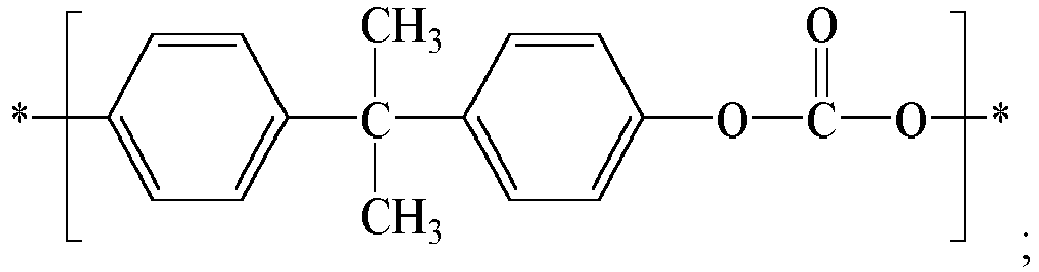
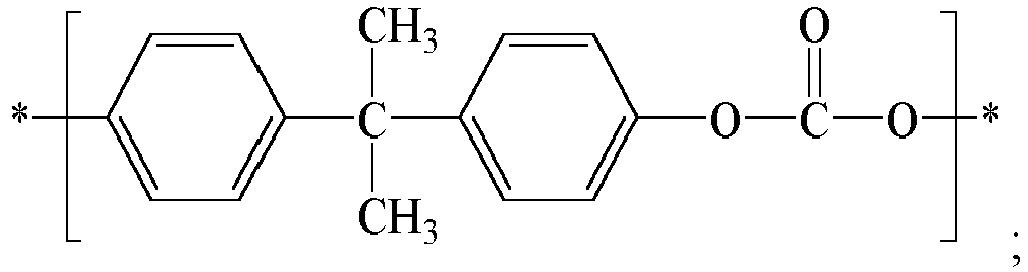
- the first carbonate unit is derived from bisphenol A, has the structure and is referred to as a bisphenol A carbonate unit.
- the polycarbonate-polysiloxane comprises the first (low heat) carbonate units in an amount of 20 to 69.95 mole percent, based on 100 mole percent of total carbonate units in the polycarbonate-polysiloxane.
- the amount of first carbonate units can be 30 to 69.95 mole percent, 35 to 64.95 mole percent, or 45 to 64.95 mole percent.
- the polycarbonate-polysiloxane comprises second (high heat) carbonate units having the structure wherein R 2 is a C 17 -C 40 divalent aromatic group.
- “High heat” means that a homopolymer of the second carbonate units has a glass transition temperature of 155 °C or higher, or 155 to 300 °C, determined by differential scanning calorimetry according to ASTM D3418-15 at a heating rate of 20 °C/minute.
- second carbonate units include those having the structures and wherein R f and R g are each independently at each occurrence C 1 -C 12 alkyl, C 1 -C 12 alkoxyl, or C 2 -C 12 alkenyl; each R h is hydrogen or two occurrence of R h combine with the carbon atom to which they are attached to form a carbonyl group; each occurrence of R i is independently C 1 -C 6 alkyl; R j is hydrogen, C 1 -C 6 alkyl, or phenyl optionally substituted with 1, 2, 3, 4, or 5 C 1 -C 6 alkyl groups; R k is independently at each occurrence C 1 -C 3 alkyl or phenyl, preferably methyl; X b is C 6 -C 12 arylene, C 4 -C 18 cycloalkylene, C 4 -C 18 cycloalkylidene, or -C(R m )(R n )- wherein R m is hydrogen, C 1
- R f and R g are each independently at each occurrence C 1 -C 3 alkyl or C 1 -C 3 alkoxyl; each R i is C 1 -C 3 alkyl; R j is methyl or phenyl; and each R k is methyl.
- Exemplary second carbonate units include those having the structures wherein R f , R g , R j , m, and n are defined above; R m is independently at each occurrence hydrogen or C 1 -C 4 alkyl; and g is zero, 1, 2, 3, 4, 5, 6, 7, 8, 9, or 10.
- R f and R g are each independently C 1 -C 3 alkyl or C 1 -C 3 alkoxyl; each R m is methyl; and m and n are each independently zero or 1.
- the second carbonate units have the structure or a combination thereof, where the first structure above is referred to as 2-phenyl-3,3'-bis(4-hydroxyphenyl)phthalimidine carbonate or PPPBP carbonate, and the second structure above is referred to as bisphenol isophorone carbonate or BPI carbonate.
- the polycarbonate-polysiloxane comprises the second (high heat) carbonate units in an amount of 30 to 79.95 mole percent, based on 100 mole percent of total carbonate units in the polycarbonate-polysiloxane.
- the amount of second carbonate units can be 30 to 69.95 mole percent, 35 to 64.95 mole percent, or 35 to 54.95 mole percent.
- the polycarbonate-polysiloxane further comprises third (polysiloxane-containing) carbonate units.
- Each of the third carbonate units comprises a divalent carbonate group (-OC(O)O-) and a divalent polysiloxane group, the divalent polysiloxane group comprising 5 to 60 diorganosiloxane units having the structure wherein each occurrence of R 3 is independently a C 1 -C 14 hydrocarbyl group.
- the C 1 -C 14 hydrocarbyl group can be aliphatic or aromatic, straight-chain, cyclic, bicyclic, branched, saturated, or unsaturated. It can also contain combinations of aliphatic, aromatic, straight chain, cyclic, bicyclic, branched, saturated, and unsaturated hydrocarbon moieties.
- R 3 groups include C 1 -C 14 alkyl, C 1 -C 14 alkoxyl, C 2 -C 14 alkenyl, C 2 -C 14 alkenyloxyl, C 6 -C 14 aryl, C 6 -C 14 aryloxyl, C 7 -C 14 arylalkyl, and C 6 -C 14 alkylaryl. In some embodiments, each occurrence of R 3 is methyl.
- Each of the third carbonate units comprises 5 to 60 diorganosiloxane units.
- the number of diorganosiloxane units can be 10 to 60, or 20 to 60, or 30 to 60, or 35 to 55.
- the third carbonate units have the structure, wherein Ar is independently at each occurrence a C 6 -C 24 aromatic divalent group optionally substituted with 1, 2, 3, or 4 substituents, each substituent independently selected from the group consisting of halogen (i.e., F, Cl, Br, or I), C 1 -C 6 alkyl, and C 1 -C 6 alkoxyl; R 4 is independently at each occurrence a C 2 -C 8 divalent aliphatic group; R 5 and R 6 are independently at each occurrence C 1 -C 12 alkyl or C 6 -C 18 aryl; m and n and q are independently at each occurrence zero or 1; and p is (30-n-q) to (60-n-q), or (35-n-q) to (55-n-q).
- halogen i.e., F, Cl, Br, or I
- R 4 is independently at each occurrence a C 2 -C 8 divalent aliphatic group
- R 5 and R 6 are
- Ar groups include 1,3-phenylene, 1,4-phenylene, and 2,2-bis (4-phenylenyl)propane.
- each occurrence of Ar can be derived from a C 6 -C 24 dihydroxyarylene compound, such as, for example, resorcinol, 1,1- bis (4-hydroxyphenyl)methane, 1,1- bis (4-hydroxyphenyl)ethane, 1,1- bis (4-hydroxyphenyl)propane, 2,2- bis (4-hydroxyphenyl)propane, 1,1- bis (4-hydroxyphenyl)butane, 2,2- bis (4-hydroxyphenyl)butane, 2,2- bis (4-hydroxyphenyl)octane, 2,2- bis (4-hydroxy-3-methylphenyl)propane, 1,1- bis (4-hydroxyphenyl)cyclohexane, bis (4-hydroxyphenyl)sulfide, 2,2- bis (3,5-dibromo-4
- R 4 groups include, for example, dimethylene (-(CH 2 ) 2 -), trimethylene (-(CH 2 ) 3 -), hexamethylene (-(CH 2 ) 6 -), and 1,4-cyclohexylene.
- each occurrence of R 4 is trimethylene.
- R 5 and R 6 groups include, for example, methyl, ethyl, 1-propyl, cyclohexyl, and phenyl. In some embodiments, each occurrence of R 5 and R 6 is methyl.
- each occurrence of m and n and q is zero. In other embodiments, each occurrence of m and n and q is 1. In some embodiments, p is (35-n-q) to (55-n-q).
- the third carbonate units have the structure, wherein r is 5 to 60, or 5 to 60, or 10 to 60, or 20 to 60, or 30 to 60, or 35 to 55.
- the third carbonate units have the structure, wherein r is 5 to 60, or 5 to 60, or 10 to 60, or 20 to 60, or 30 to 60, or 35 to 55.
- the third carbonate units have the structure, wherein s is 3 to 58, or 8 to 58, or 18 to 58, or 28 to 58, or 33 to 53.
- s is 43
- the structure is referred to as D45 carbonate.
- the polycarbonate-polysiloxane comprises third carbonate units in an amount of 0.05 to 0.4 mole percent, based on 100 mole percent of total carbonate units in the polycarbonate-polysiloxane.
- the third carbonate units can be present in an amount of 0.05 to 0.35 mole percent, or 0.05 to 0.3 mole percent, or 0.05 to 0.25 mole percent.
- the polycarbonate-polysiloxane comprises 30 to 69.95 mole percent of first carbonate units, 30 to 69.95 mole percent of second carbonate units, and 0.05 to 0.35 mole percent of third carbonate units, based on 100 mole percent of total carbonate units in the polycarbonate-polysiloxane.
- the polycarbonate-polysiloxane comprises 35 to 64.95 mole percent of first carbonate units, 35 to 64.95 mole percent of second carbonate units, and 0.05 to 0.3 mole percent of third carbonate units, based on 100 mole percent of total carbonate units in the polycarbonate-polysiloxane.
- the polycarbonate-polysiloxane comprises 45 to 64.95 mole percent of first carbonate units, 35 to 54.95 mole percent of second carbonate units, and 0.05 to 0.25 mole percent of third carbonate units, based on 100 mole percent of total carbonate units in the polycarbonate-polysiloxane.
- the polycarbonate-polysiloxane has a weight average molecular weight of 10,000 to 50,000 grams/mole, as determined by gel permeation chromatography using bisphenol A polycarbonate standards. Within this range, the weight average molecular weight can be 15,000 to 40,000 grams/mole, or 24,000 to 30,000 grams/mole.
- the first carbonate units have the structure and the second carbonate units have the structure or a combination thereof.
- the third carbonate units have the structure wherein Ar is independently at each occurrence a C 6 -C 24 aromatic divalent group optionally substituted with 1, 2, 3, or 4 substituents, each substituent independently selected from the group consisting of halogen, C 1 -C 6 alkyl, and C 1 -C 6 alkoxyl; R 4 is independently at each occurrence a C 2 -C 8 divalent aliphatic group; R 5 and R 6 are independently at each occurrence C 1 -C 12 alkyl or C 6 -C 18 aryl; m and n and q are independently at each occurrence zero or 1; and p is (30-n-q) to (60-n-q), or (35-n-q) to (55-n-q).
- the polycarbonate-polysiloxane comprises 35 to 64.95 mole percent of first carbonate units, 35 to 64.95 mole percent of second carbonate units, and 0.05 to 0.3 mole percent of third carbonate units.
- the first carbonate units have the structure the second carbonate units have the structure or a combination thereof;
- the third carbonate units have the structure wherein Ar is independently at each occurrence a C 6 -C 24 aromatic divalent group optionally substituted with 1, 2, 3, or 4 substituents, each substituent independently selected from the group consisting of halogen, C 1 -C 6 alkyl, and C 1 -C 6 alkoxyl;
- R 4 is independently at each occurrence a C 2 -C 8 divalent aliphatic group;
- R 5 and R 6 are independently at each occurrence C 1 -C 12 alkyl or C 6 -C 18 aryl;
- m and n and q are independently at each occurrence zero or 1; and
- p is (30-n-q) to (60-n-q), or (35-n-q) to (55-n-q);
- the polycarbonate-polysiloxane comprises 35 to 64.95 mole percent of first carbonate units
- the first carbonate units have the structure the second carbonate units have the structure or a combination thereof;
- the third carbonate units have the structure wherein Ar is independently at each occurrence a C 6 -C 24 aromatic divalent group optionally substituted with 1, 2, 3, or 4 substituents, each substituent independently selected from the group consisting of halogen, C 1 -C 6 alkyl, and C 1 -C 6 alkoxyl;
- R 4 is independently at each occurrence a C 2 -C 8 divalent aliphatic group;
- R 5 and R 6 are independently at each occurrence C 1 -C 12 alkyl or C 6 -C 18 aryl;
- m and n and q are independently at each occurrence zero or 1; and
- p is (30-n-q) to (60-n-q), or (35-n-q) to (55-n-q);
- the polycarbonate-polysiloxane comprises 45 to 69.95 mole percent of first carbonate units, 30
- the polycarbonate-polysiloxane can be prepared using known methods for synthesizing polycarbonate copolymers, including those described in, for example, U.S. Patent Numbers 3,419,634 and 3,419,635 to Vaughn , 3,821,325 to Merritt et al. , 3,832,419 to Merritt , and 6,072,011 to Hoover .
- a detailed procedure for synthesizing a polycarbonate-polysiloxane is included in the working examples below.
- Another embodiment is a composition comprising the polycarbonate-polysiloxane in any of its above-described variations.
- a polycarbonate-polysiloxane comprising, based on 100 mole percent of total carbonate units in the polycarbonate-polysiloxane: 20 to 69.95 mole percent of first carbonate units having the structure wherein R 1 is a C 6 -C 16 divalent aromatic group; 30 to 79.95 mole percent of second carbonate units having the structure wherein R 2 is a C 17 -C 40 divalent aromatic group; and 0.05 to 0.4 mole percent of third carbonate units, each third carbonate unit comprising a divalent carbonate group (-OC(O)O-) and a divalent polysiloxane group, the divalent polysiloxane group comprising 5 to 60 diorganosiloxane units having the structure wherein each occurrence of R 3 is independently a C 1 -C 13 hydrocarbyl group; wherein the polycarbonate-polys
- composition is useful for forming extruded films.
- the composition typically comprises 70 to 100 weight percent of the polycarbonate-polysiloxane, based on the total weight of the composition.
- the composition further comprises a roughening agent.
- Roughening agents provide extruded films with surface roughness, i.e., physical texture.
- Suitable roughening agents include particulate materials comprising, for example, synthetic or natural silicas, limestones, talcs, zeolites, crosslinked silicones, cyclic olefin copolymers, and combinations thereof.
- the roughening agent can comprise a crosslinked silicone, preferably a crosslinked silsesquioxane, more preferably a crosslinked polymethylsilsesquioxane.
- Silsesquioxanes are cage-like structures having Si-O-Si linkages and tetrahedral Si vertices. Silsesquioxanes can be in molecular form as cages with 6, 8, 10, or 12 Si vertices, as well as in polymer form.
- the T 8 cages have the formula [R-SiO 1.5 ] 8 , or equivalently R 8 Si 8 O 12 .
- Each Si center is bonded to three oxo groups, which in turn connect to other Si centers.
- the fourth group on Si is an R group.
- Each R group can independently be a C 1 -C 8 alkyl, a C 1 -C 8 alkenyl, an acrylate, a methacrylate, a hydroxyl, or an epoxide.
- Crosslinked polymethylsilsesquioxane particles are spherical and have a pliable, gel-like consistency, making them amenable to processing using fine filters. For example, when the composition is passed through a melt filter (e.g., a 5 micrometer filter), the roughening agent does not clog the filter, avoiding the problems encountered when inorganic fine particles are used as roughening agents.
- the roughening agent comprises a particulate crosslinked polymethylsilsesquioxane having a median equivalent spherical diameter of 0.1 to 10 micrometers, or 0.1 to 5 micrometers, or 0.1 to 3 micrometers, or 0.2 to 2 micrometers, determined by laser diffraction according to ISO 13320:2009.
- Particulate crosslinked polymethylsilsesquioxanes are commercially available, for example under the trade name TOSPEARL from Momentive Performance Chemicals.
- the roughening agent When present in the composition, can be used in an amount of 0.05 to 2 weight percent, based on the total weight of the composition. Within this range, the roughening agent amount can be 0.05 to 1 weight percent, or 0.1 to 0.8 weight percent, or 0.15 to 0.6 weight percent.
- the composition can, optionally, include an organic slip agent.
- Organic slip agents improve the handling characteristics of extruded films. Suitable organic slip agents include, for example, pentaerythritol tetrastearate, dipentaerythritol hexastearate, glycerol tristearate, high density polyethylene, polymethylpentene, and combinations thereof.
- the organic slip agent can be used in an amount of 0.1 to 15 weight percent, based on the total weight of the composition. Within this range, the organic slip agent amount can be 0.1 to 5 weight percent, or 0.1 to 2 weight percent, or 0.1 to 1 weight percent.
- the composition can, optionally, include one or more additives known in the thermoplastics art.
- Additives include, for example, stabilizers, mold release agents, lubricants, processing aids, drip retardants, nucleating agents, ultraviolet light absorbers, colorants (including dyes and pigments), antioxidants, anti-static agents, blowing agents, metal deactivators, antiblocking agents, and combinations thereof.
- additives are typically used in a total amount of less than or equal to 10 weight percent, or less than or equal to 5 weight percent, or less than or equal to 1 weight percent, based on the total weight of the composition.
- the composition comprises 70 to 99.95 weight percent of the polycarbonate-polysiloxane and further comprises 0.05 to 2 weight percent of a roughening agent;
- the polycarbonate-polysiloxane comprises 35 to 64.95 mole percent of first carbonate units, 35 to 64.95 mole percent of second carbonate units, and 0.05 to 0.3 mole percent of third carbonate units;
- the first carbonate units have the structure the second carbonate units have the structure or a combination thereof;
- the third carbonate units have the structure wherein Ar is independently at each occurrence a C 6 -C 24 aromatic divalent group optionally substituted with 1, 2, 3, or 4 substituents, each substituent independently selected from the group consisting of halogen, C 1 -C 6 alkyl, and C 1 -C 6 alkoxyl;
- R 4 is independently at each occurrence a C 2 -C 8 divalent aliphatic group;
- R 5 and R 6 are independently at each occurrence C 1 -C 12 alkyl or C 6
- extruded film comprising the composition in any of its above-described variations.
- the composition can be extruded using extruders conventionally used for thermoplastic compositions using a flat die.
- An extrusion cast film method can include melting the composition in an extruder, conveying the molten composition through a flat die of small lip gap separation, optionally stretching of the film using relatively high take-up speeds, and cooling/solidifying the film-forming composition to form the final film.
- the extruder can be of the single- or twin-screw design, and a melt pump can be used to provide a constant, non-pulsating flow of polymer through the die.
- the die lip gap can be as small as 100-200 micrometers, and the take-up rollers can operate at speeds of up to 200 meters/minute.
- the design can include the addition of a heated roll to temper/anneal the film and thus minimize the occurrence of frozen-in internal stresses.
- the edges of the film can be trimmed, and the film wound up on a roll using a tension-controlled winding mechanism.
- the accuracy of delivering a constant and uniform flow of molten polymer through the die, the rheological properties of the polymer used to make the film, the cleanliness of both polymer and equipment, and the mechanical characteristics of the take-up mechanism will all contribute to the successful preparation of extruded films of relatively small thicknesses.
- the film thickness is 2 to 15 micrometers, or 2 to 10 micrometers, or 2 to 8 micrometers, or 2 to 6 micrometers.
- the extruded film has a thickness of 2 to 15 micrometers
- the composition comprises, based on the total weight of the composition, 70 to 99.95 weight percent of the polycarbonate-polysiloxane, and 0.05 to 2 weight percent of a roughening agent comprising a particulate crosslinked polymethylsilsesquioxane having a median equivalent spherical diameter of 0.1 to 10 micrometers determined by laser diffraction according to ISO 13320:2009.
- a metallized film e.g., a film capacitor
- an extruded film comprising the composition in any of its above-described variations
- an electrically conductive metal layer in contact with the extruded film.
- the electrically conductive metal layer comprises a metal selected from the group consisting of copper, aluminum, silver, gold, nickel, zinc, titanium, chromium, vanadium, platinum, tantalum, niobium, brass, and combinations thereof.
- Methods for the metallization of polymer films include, for example, vacuum metal vapor deposition, metal sputtering, plasma treatments, electron beam treatments, chemical oxidation, or reduction reactions, as well as electroless wet-chemical deposition.
- the extruded film can be metallized on both sides by conventional electroless plating.
- a patterned metal layer can be formed on a surface of the film, for example by ink jet printing.
- the thickness of the electrically conductive metal layer is determined by the intended use of the metallized film, and can be, for example, 0.1 to 1000 nanometers, or 0.5 to 500 nanometers, or 1 to 10 nanometers.
- Another embodiment is a composition
- a composition comprising, based on the total weight of the composition: 65 to 99.95 weight percent of a copolycarbonate comprising first carbonate units derived from a first bisphenol monomer such that a homopolycarbonate of the first bisphenol monomer has a glass transition temperature less than 155 °C determined by dynamic mechanical analysis according to ASTM E1640-13 at a heating rate of 1 °C/minute, and second carbonate units derived from a second bisphenol monomer such that a homopolycarbonate of the second bisphenol monomer has a glass transition temperature of 155 °C or higher determined by dynamic mechanical analysis according to ASTM E1640-13 at a heating rate of 1 °C/minute; and 0.05 to 2 weight percent of a roughening agent comprising a particulate crosslinked polymethylsilsesquioxane having a median equivalent spherical diameter greater than 5 micrometers and less than or equal to 10 micrometers determined by laser diffraction according to ISO 13320:2009
- copolycarbonate corresponds to the "high heat copolycarbonate" of European Patent Application No. 18206355.2 filed 14 November 2018 , and International Patent Application No. PCT/US19/061477 filed 14 November 2019 , both of which are incorporated herein by reference.
- the invention includes at least the following aspects.
- the following is a procedure for synthesizing a polycarbonate copolymer containing about 62.5 mole percent of bisphenol isophorone (BPI) carbonate units, about 37.34 mole percent of bisphenol A (BPA) carbonate units, and about 0.16 mole percent of D45 carbonate units.
- BPI bisphenol isophorone
- BPA bisphenol A
- D45 carbonate units Polycarbonate copolymers containing different proportions of the same carbonate units can be synthesized by varying the proportions of the respective monomers.
- a reactor was equipped with an overhead condenser, an agitator, and a circulation pump. Methylene chloride (18 liters), BPI (3157 grams), BPA (1393 grams), D45 (91 grams), water (10 liters), triethylamine (30 grams), and sodium gluconate (10 grams) were charged to the reactor.
- PCP para-cumylphenol
- methylene chloride 800 grams
- Phosgene gas 2650 grams was bubbled through the reactor at 90 grams/minute and the pH was maintained between 9 and 10 with the addition of 33 weight percent aqueous sodium hydroxide while the solution was vigorously agitated.
- the reaction mixture was allowed to stir for 10 minutes while the pH stabilized at 9.
- a sample of the reaction product was analyzed by gel permeation chromatography (GPC) using bisphenol A polycarbonate standards and found to have a weight average molecular weight (M w ) of 28,665 grams/mole and a number average molecular weight (M n ) of 10,254 grams/mole.
- M w weight average molecular weight
- M n number average molecular weight
- the reactor was purged with nitrogen for 5 minutes, then the contents were discharged to a feed tank.
- the mixture was fed to a train of liquid-liquid centrifuges where the brine phase was separated from the polymer solution in methylene chloride. Triethylamine was removed by washing the polymer solution with 1 weight percent aqueous hydrochloric acid, and residual ions were removed by washing with water.
- the purified polymer solution was transferred to a feed pot.
- the resin was isolated by contacting the polymer solution with steam through a precipitation jet to flash off the methylene chloride leaving a white wet cake. Water was removed from the resin by placing it in a cone shaped dryer and passing heated nitrogen through the powder for four hours. The yield of isolated resin powder was 10.2 kilograms. GPC analysis of the isolated resin yielded a M w of 28,256 grams/mole, and ultra-high performance liquid chromatographic analysis of a copolymer hydrolysate (obtained by reaction of terpolymer with potassium hydroxide) yielded a BPI content of 63 mole percent.
- PMSS Particulate crosslinked polymethylsilsesquioxane having an average particle size of 0.5 micrometer as determined by scanning electron microscopy; available as XC99-A8808 Silicone Beads from Momentive.
- PETS Pentaerythritol tetrastearate, CAS Reg. No. 115-83-3 .
- Table 2 summarizes film extrusion composition characteristics and film properties.
- “Copolymer” refers to the copolymer used in the film extrusion composition (copolymer descriptions are in Table 1); “Polysiloxane carbonate (mol%)” is the mole percent of polysiloxane carbonate units based on the total of all carbonate units in the copolymer; “BPI carbonate (mol%)” is the mole percent of BPI carbonate units based on the total of all carbonate units in the copolymer; “BPA carbonate (mol%)” is the mole percent of BPA carbonate units based on the total of all carbonate units in the copolymer; and “M w (kg/mol)” is the weight average molecular weight of the copolymer.
- Each film extrusion composition contained 99.34 weight percent of the specified copolymer, 0.3 weight percent of PETS, 0.3 weight percent of PMSS-2, and 0.06 weight percent of AO. All compositions were compounded on a Werner & Pfleiderer co-rotating twin-screw extruder having a Length-to-Diameter ratio of 30:1 and a vacuum port located near the die face. Compounding was conducted at a temperature of 285-330 °C.
- Films were extruded using a 25 millimeter single-screw extruder utilizing a melt pump to eliminate pulsating melt flow.
- the melt pump was adjusted to provide optimum melt pressure in the die at temperatures of 330-360 °C.
- the melt was extruded through a vertical 450 millimeter wide t-die with a die gap clearance of 100-300 micrometers.
- the melt curtain was cast onto a polished chill roll and drawn down in the machine direction to the thickness specified in Table 2. Gauge was controlled by matching the melt pump output and take-up speed of the downstream equipment to provide uniform constant film thickness.
- Film properties are summarized in Table 2. "Processability" indicates how easily a film can be extruded from the extrusion composition. A rating of zero means that the composition could not be processed to form a 5 micrometer thick extruded film; a rating of 1 means that the composition was difficult to process to form a 5 micrometer thick extruded film; a rating of 2 means that the composition could be consistently processed to form a 5 micrometer thick extruded film; and a rating of 3 means that the composition could be consistently processed to form a 3 micrometer thick extruded film. A rating of 2 or 3 is preferred and is predictive of a robust processing window for formation of thin gauge films for capacitor applications.
- Tensile elongation having units of % gauge length
- tensile stress at break tensile stress at break
- tensile modulus tensile modulus
- Tear strength (having units of Newtons/millimeter) was evaluated according to ISO 6383-1 at 23 °C on 5 micrometer thick extruded films in machine and transverse directions. Test parameters were as follows: (1) test rate: 200 mm/sec; (2) test extension: 50 millimeters; (3) load cell: 10 Newtons; (4) 5 runs reported per sample; (5) Instron Test Rack with Bluehill 3 software; (6) film sample size: 25 millimeter by 200 millimeter strips; (7) 30 millimeter cut made in short end of sample to initiate tear site; (8) each leg of sample mounted using pneumatic grips; (9) static was removed from sample using deionized air gun; and (10) average tear was calculated from area of load/extension curve selected by operator. Higher tear strength is predictive of better film handling through the extrusion, metallization, and cap winding processes of film capacitor fabrication.
- Slip Rating and “Slip Rank” are subjective measures of the slipperiness of the surface of an extruded film. Slip ratings range from 1 (sticky) to 3 (slippery), and the displayed value is the average of ratings from five evaluators. Slip rank is the forced ranking among 18 samples, with 1 being the best and 18 being the worst; the displayed value is the average of rankings from five evaluators. Slip is essential for good handling of the film web through the extrusion process, metallization, capacitor winding, and capacitor flattening processes. Too little slip causes blocking and wrinkling in the extrusion process and the inability to flatten capacitor windings. Too much slip creates problems in metallization handling, and telescoping and tracking issues during unwind and rewind in metallization.
- Surface roughness is an important physical property of the film which impacts slip directly and is essential for good handling of film web through the extrusion process, film metallization, and capacitor winding. Inadequate surface roughness can cause blocking and also air entrapment between the windings of the subsequent layers of film in the master roll during extrusion. Trapped gas is a primary cause of telescoping during metallization. Excessive surface roughness drops the efficiency of the wound capacitor (volume to energy ratings) and reduces the breakdown strength of the film. Surface roughness properties (all having units of micrometers) were determined according to JIS B0601:1994.
- Ra is the arithmetic mean roughness
- Ry is the maximum height
- Rz is the cross point average height
- S is the average local maximum interval
- Sm is the average irregularity interval
- RMS is the root mean square roughness. Values in Table 2 represent the average of values from five samples.
- Surface roughness properties were determined using a Keyence confocal microscope. The primary roughness image was captured on the Keyence VK-200 using a 50X objective. The sample was mounted on a flat polycarbonate plaque to minimize surface departure. The top surface of film was brought into focus using the stage height adjustment in laser measurement mode. The scan range was set manually to 1 micrometer above the film top surface to 1 micrometer below the film top surface.
- the total scan range did not exceed film thickness.
- the target Z scan range was 2-4 micrometers to ensure that the bottom side of the film was not imaged during data collection. If the entire field of view could not be captured within the targeted scan range, the sample was moved in the X and Y direction to ensure a flat image was acquired.
- auto gain was implemented to establish acceptable brightness and contrast settings throughout total scan range.
- the double scan option was used under high accuracy settings.
- the Z step height was 0.1 micrometer. The measurement was made under these settings using a 50X objective providing a 280-300 millimeter by 200 millimeter field of view for data analysis. Five separate measurements were made using one 50 millimeter by 100 millimeter sample at various locations.
- the Ra calculation determined the absolute value of the height difference between the reference surface and the measured surface, then determined the average of the distance between each dot on the roughness curve surface and the reference surface.
- the Ry calculation was performed by determining the sum of the height of the highest peak (Yp) and the depth of the lowest valley (Yv) by comparing the distance between the reference surface and each point on the roughness curve surface.
- the Rz value was determined from the sum of the average of the absolute values of heights of the five highest peaks and the average of the absolute values of depths of the five lowest valleys.
- the RMS calculation indicated the square root of the sum of the squares of the difference between the reference surface and the roughness curve surface.
- the Bosch test is a continuous electrical break down test procedure and apparatus that can measure the number of breakdowns in a film that occurs at a specified voltage per unit thickness. The lower the clearing counts at each voltage level, the higher the quality of the film (i.e., lower defects, scratches, wrinkles, and thickness non-uniformities). Electrical clearing counts were determined at 150, 200, 250, 300, 350, 400, 450, and 500 volts/micrometer.
- a film to be tested was sandwiched between a grounded metalized layer on a counter electrode film and a polished steel roller. The film under test and the corresponding grounded metalized film (counter electrode) were wound through the apparatus at 10 meters per minute in a roll-to-roll process.
- the electrical potential of the high potential roller was controlled using BK Precision 1788B power supply in conjunction with a TREK 20/20C amplifier.
- a Labview software control interface was used in conjunction with a National Instruments NI-9223 voltage input module to measure voltage/current spikes at specified voltages to determine the number of breakdown counts. The number and location of the breakdown counts was recorded for 1 square meter of film at each voltage. Clearing count values in Table 2 represent an average of five tests per sample. No results are presented for Comparative Example 2 because it was not possible to extrude a film thinner than 19 micrometers. For Examples 5-7, no results are presented for voltages of 450 and 500 volts/micrometer. For these samples, so many counts were observed at 400 volts/micrometer that the operator stopped the test.
- Table 2 illustrate that the inventive examples exhibit not only good processability, but also a desirable balance of processability, tensile strength, tear strength, surface roughness, and electrical resistance. Relative to the comparative examples in which the polycarbonate-polysiloxanes have greater polysiloxane content, the inventive examples generally exhibit improved processability. Relative to the comparative examples incorporating polycarbonate copolymers lacking polysiloxane content, the inventive examples with polycarbonate-polysiloxanes, particularly those in which the polycarbonate-polysiloxanes having lower contents of BPI carbonate, generally exhibit improved processability, electrical performance, and slip properties.
Landscapes
- Chemical & Material Sciences (AREA)
- Engineering & Computer Science (AREA)
- Organic Chemistry (AREA)
- Health & Medical Sciences (AREA)
- Chemical Kinetics & Catalysis (AREA)
- Medicinal Chemistry (AREA)
- Polymers & Plastics (AREA)
- Manufacturing & Machinery (AREA)
- Power Engineering (AREA)
- Materials Engineering (AREA)
- Microelectronics & Electronic Packaging (AREA)
- Physics & Mathematics (AREA)
- Spectroscopy & Molecular Physics (AREA)
- Polyesters Or Polycarbonates (AREA)
- Compositions Of Macromolecular Compounds (AREA)
Abstract




Description
- This application relates to a heat-resistant extruded film, a film capacitor comprising the extruded film, and a heat-resistant polycarbonate-polysiloxane useful in forming the extruded film.
- Electrostatic film capacitors with high volumetric energy density, high operating temperature, and long lifetime are critical components for pulse-power, automotive, and industrial electronics. Capacitors are essentially energy-storage devices having two parallel conductive plates separated by a thin layer of an electrically insulating (dielectric) film. When a voltage is applied across the plates, the electric field in the dielectric displaces electric charges, and thus stores energy. The amount of energy stored by a capacitor depends on the dielectric constant and breakdown voltage of the insulating material used to form the film, and the dimensions (total area and thickness) of the film. To maximize the amount of energy that a capacitor can accumulate, the dielectric constant and breakdown voltage of the film are maximized, and the thickness of the film is minimized. Because the physical characteristics of the dielectric material in the capacitor are the determining factors for the performance of a capacitor, improvements in one or more of the physical properties of the dielectric material in a capacitor can result in corresponding performance improvements in the capacitor component, usually resulting in performance and lifetime enhancements of the electronics system or product in which it is embedded.
- High temperature polycarbonate copolymers have been used in the formation of electrostatic film capacitors. See, for example, U.S. Patent Application Publication Nos.
US 2016/0060403 A1 andUS 2019/0153217 A1 of Mahood et al. However, there is a desire for extrusion compositions exhibiting an improved ability to be extruded as films having thicknesses of less than ten micrometers. - One embodiment is a polycarbonate-polysiloxane comprising, based on 100 mole percent of total carbonate units in the polycarbonate-polysiloxane, 20 to 69.95 mole percent of first carbonate units having the structure




- Another embodiment is a composition comprising a polycarbonate-polysiloxane comprising, based on 100 mole percent of total carbonate units in the polycarbonate-polysiloxane: 20 to 69.95 mole percent of first carbonate units having the structure


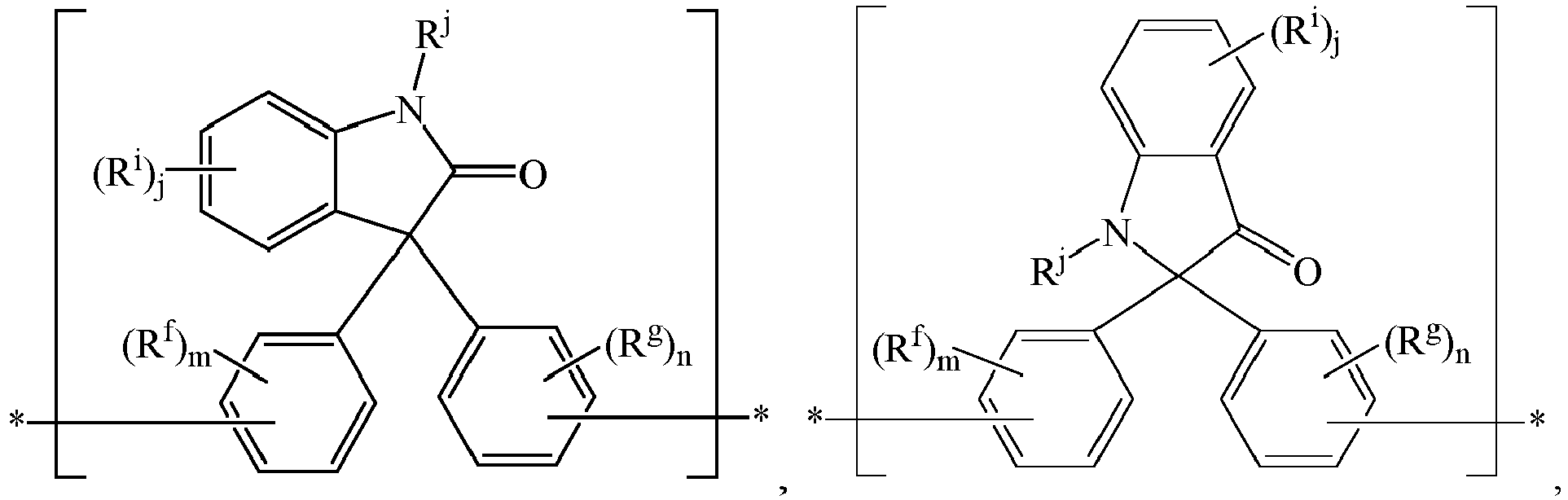


- Another embodiment is an extruded film comprising the composition in any of its variations described herein.
- Another embodiment is a capacitor comprising the extruded film, and an electrically conductive metal layer in contact with the extruded film.
- These and other embodiments are described in detail below.
- The present inventors have determined extrusion compositions comprising as their primary component a polycarbonate-polysiloxane comprising specific amounts of polysiloxane carbonate units and two types of aromatic carbonate units exhibit an improved ability to be extruded as films having thicknesses of less than ten micrometers.
- One embodiment is a polycarbonate-polysiloxane comprising, based on 100 mole percent of total carbonate units in the polycarbonate-polysiloxane, 20 to 69.95 mole percent of first carbonate units having the structure


- The polycarbonate-polysiloxane comprises first carbonate units, second carbonate units, and third carbonate units. The first (low heat) carbonate units have the structure

- In some embodiments, the first carbonate units have the structure

US 2014/0295363 A1 of Sun et al. , and International Patent Application Publication NumbersWO 2013/175448 A1 of Chen et al. , andWO 2014/072923 A1 of Fernandez et al. - In some embodiments, the first carbonate unit is derived from bisphenol A, has the structure

- The polycarbonate-polysiloxane comprises the first (low heat) carbonate units in an amount of 20 to 69.95 mole percent, based on 100 mole percent of total carbonate units in the polycarbonate-polysiloxane. Within this range, the amount of first carbonate units can be 30 to 69.95 mole percent, 35 to 64.95 mole percent, or 45 to 64.95 mole percent.
- In addition to the first (low heat) carbonate units, the polycarbonate-polysiloxane comprises second (high heat) carbonate units having the structure


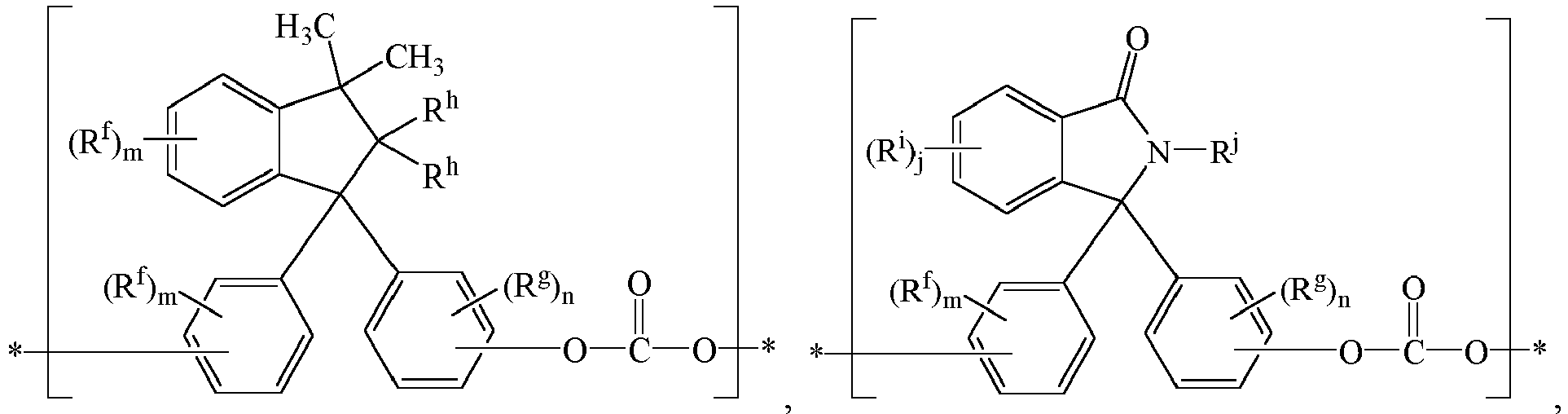


- Exemplary second carbonate units include those having the structures


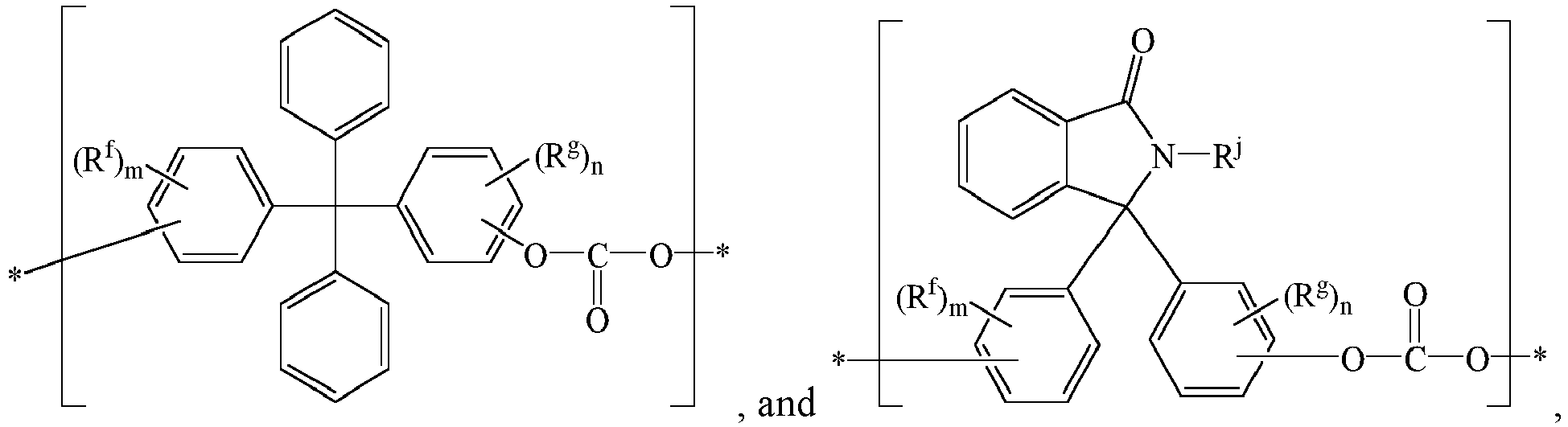
- In some embodiments, the second carbonate units have the structure

- The polycarbonate-polysiloxane comprises the second (high heat) carbonate units in an amount of 30 to 79.95 mole percent, based on 100 mole percent of total carbonate units in the polycarbonate-polysiloxane. Within this range, the amount of second carbonate units can be 30 to 69.95 mole percent, 35 to 64.95 mole percent, or 35 to 54.95 mole percent.
- In addition to the first (low heat) carbonate units and the second (high heat) carbonate units, the polycarbonate-polysiloxane further comprises third (polysiloxane-containing) carbonate units. Each of the third carbonate units comprises a divalent carbonate group (-OC(O)O-) and a divalent polysiloxane group, the divalent polysiloxane group comprising 5 to 60 diorganosiloxane units having the structure

- The C1-C14 hydrocarbyl group can be aliphatic or aromatic, straight-chain, cyclic, bicyclic, branched, saturated, or unsaturated. It can also contain combinations of aliphatic, aromatic, straight chain, cyclic, bicyclic, branched, saturated, and unsaturated hydrocarbon moieties. Examples of R3 groups include C1-C14 alkyl, C1-C14 alkoxyl, C2-C14 alkenyl, C2-C14 alkenyloxyl, C6-C14 aryl, C6-C14 aryloxyl, C7-C14 arylalkyl, and C6-C14 alkylaryl. In some embodiments, each occurrence of R3 is methyl.
- Each of the third carbonate units comprises 5 to 60 diorganosiloxane units. Within this range, the number of diorganosiloxane units can be 10 to 60, or 20 to 60, or 30 to 60, or 35 to 55.
- In some embodiments, the third carbonate units have the structure,

- Examples of Ar groups include 1,3-phenylene, 1,4-phenylene, and 2,2-bis(4-phenylenyl)propane. When each occurrence of m, n, and q is zero, each occurrence of Ar can be derived from a C6-C24 dihydroxyarylene compound, such as, for example, resorcinol, 1,1-bis(4-hydroxyphenyl)methane, 1,1-bis(4-hydroxyphenyl)ethane, 1,1-bis(4-hydroxyphenyl)propane, 2,2-bis(4-hydroxyphenyl)propane, 1,1-bis(4-hydroxyphenyl)butane, 2,2-bis(4-hydroxyphenyl)butane, 2,2-bis(4-hydroxyphenyl)octane, 2,2-bis(4-hydroxy-3-methylphenyl)propane, 1,1-bis(4-hydroxyphenyl)cyclohexane, bis(4-hydroxyphenyl)sulfide, 2,2-bis(3,5-dibromo-4-hydroxyphenyl)propane, and 1,1-bis(4-hydroxy-3-t-butylphenyl)propane.
- Examples of R4 groups include, for example, dimethylene (-(CH2)2-), trimethylene (-(CH2)3-), hexamethylene (-(CH2)6-), and 1,4-cyclohexylene. In some embodiments, each occurrence of R4 is trimethylene.
- Examples of R5 and R6 groups include, for example, methyl, ethyl, 1-propyl, cyclohexyl, and phenyl. In some embodiments, each occurrence of R5 and R6 is methyl.
- In some embodiments, each occurrence of m and n and q is zero. In other embodiments, each occurrence of m and n and q is 1. In some embodiments, p is (35-n-q) to (55-n-q).
- In some embodiments, the third carbonate units have the structure,
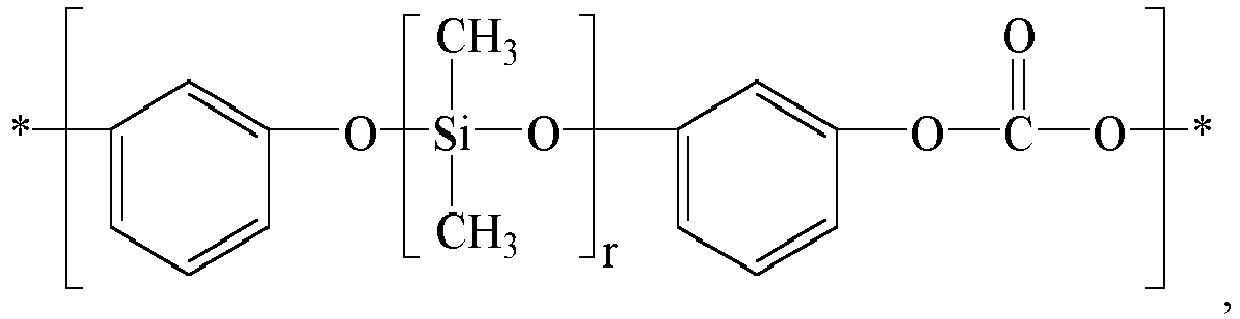
- In other embodiments, the third carbonate units have the structure,

- In still other embodiments, the third carbonate units have the structure,

- The polycarbonate-polysiloxane comprises third carbonate units in an amount of 0.05 to 0.4 mole percent, based on 100 mole percent of total carbonate units in the polycarbonate-polysiloxane. Within this range, the third carbonate units can be present in an amount of 0.05 to 0.35 mole percent, or 0.05 to 0.3 mole percent, or 0.05 to 0.25 mole percent.
- In some embodiments, the polycarbonate-polysiloxane comprises 30 to 69.95 mole percent of first carbonate units, 30 to 69.95 mole percent of second carbonate units, and 0.05 to 0.35 mole percent of third carbonate units, based on 100 mole percent of total carbonate units in the polycarbonate-polysiloxane.
- In other embodiments, the polycarbonate-polysiloxane comprises 35 to 64.95 mole percent of first carbonate units, 35 to 64.95 mole percent of second carbonate units, and 0.05 to 0.3 mole percent of third carbonate units, based on 100 mole percent of total carbonate units in the polycarbonate-polysiloxane.
- In other embodiments, the polycarbonate-polysiloxane comprises 45 to 64.95 mole percent of first carbonate units, 35 to 54.95 mole percent of second carbonate units, and 0.05 to 0.25 mole percent of third carbonate units, based on 100 mole percent of total carbonate units in the polycarbonate-polysiloxane.
- In some embodiments, the polycarbonate-polysiloxane has a weight average molecular weight of 10,000 to 50,000 grams/mole, as determined by gel permeation chromatography using bisphenol A polycarbonate standards. Within this range, the weight average molecular weight can be 15,000 to 40,000 grams/mole, or 24,000 to 30,000 grams/mole.
- In some embodiments of the polycarbonate-polysiloxane, the first carbonate units have the structure

- In some embodiments of the polycarbonate-polysiloxane, the third carbonate units have the structure

- In some embodiments, the polycarbonate-polysiloxane comprises 35 to 64.95 mole percent of first carbonate units, 35 to 64.95 mole percent of second carbonate units, and 0.05 to 0.3 mole percent of third carbonate units.
- In a very specific embodiment of the polycarbonate-polysiloxane, the first carbonate units have the structure


- In another very specific embodiment of the polycarbonate-polysiloxane, the first carbonate units have the structure


- The polycarbonate-polysiloxane can be prepared using known methods for synthesizing polycarbonate copolymers, including those described in, for example,
U.S. Patent Numbers 3,419,634 and3,419,635 to Vaughn ,3,821,325 to Merritt et al. ,3,832,419 to Merritt , and6,072,011 to Hoover . A detailed procedure for synthesizing a polycarbonate-polysiloxane is included in the working examples below. - Another embodiment is a composition comprising the polycarbonate-polysiloxane in any of its above-described variations. Thus, one embodiment is a polycarbonate-polysiloxane comprising, based on 100 mole percent of total carbonate units in the polycarbonate-polysiloxane: 20 to 69.95 mole percent of first carbonate units having the structure


- The composition is useful for forming extruded films. When used for this purpose, the composition typically comprises 70 to 100 weight percent of the polycarbonate-polysiloxane, based on the total weight of the composition.
- In some embodiments, the composition further comprises a roughening agent. Roughening agents provide extruded films with surface roughness, i.e., physical texture. Suitable roughening agents include particulate materials comprising, for example, synthetic or natural silicas, limestones, talcs, zeolites, crosslinked silicones, cyclic olefin copolymers, and combinations thereof.
- The roughening agent can comprise a crosslinked silicone, preferably a crosslinked silsesquioxane, more preferably a crosslinked polymethylsilsesquioxane. Silsesquioxanes are cage-like structures having Si-O-Si linkages and tetrahedral Si vertices. Silsesquioxanes can be in molecular form as cages with 6, 8, 10, or 12 Si vertices, as well as in polymer form. The cages are sometimes labeled T6 T8, T10, and T12, respectively (T = tetrahedral vertex). The T8 cages have the formula [R-SiO1.5]8, or equivalently R8Si8O12. Each Si center is bonded to three oxo groups, which in turn connect to other Si centers. The fourth group on Si is an R group. Each R group can independently be a C1-C8 alkyl, a C1-C8 alkenyl, an acrylate, a methacrylate, a hydroxyl, or an epoxide. Crosslinked polymethylsilsesquioxane particles are spherical and have a pliable, gel-like consistency, making them amenable to processing using fine filters. For example, when the composition is passed through a melt filter (e.g., a 5 micrometer filter), the roughening agent does not clog the filter, avoiding the problems encountered when inorganic fine particles are used as roughening agents. In some embodiments, the roughening agent comprises a particulate crosslinked polymethylsilsesquioxane having a median equivalent spherical diameter of 0.1 to 10 micrometers, or 0.1 to 5 micrometers, or 0.1 to 3 micrometers, or 0.2 to 2 micrometers, determined by laser diffraction according to ISO 13320:2009. Particulate crosslinked polymethylsilsesquioxanes are commercially available, for example under the trade name TOSPEARL from Momentive Performance Chemicals.
- When present in the composition, the roughening agent can be used in an amount of 0.05 to 2 weight percent, based on the total weight of the composition. Within this range, the roughening agent amount can be 0.05 to 1 weight percent, or 0.1 to 0.8 weight percent, or 0.15 to 0.6 weight percent.
- The composition can, optionally, include an organic slip agent. Organic slip agents improve the handling characteristics of extruded films. Suitable organic slip agents include, for example, pentaerythritol tetrastearate, dipentaerythritol hexastearate, glycerol tristearate, high density polyethylene, polymethylpentene, and combinations thereof. When present, the organic slip agent can be used in an amount of 0.1 to 15 weight percent, based on the total weight of the composition. Within this range, the organic slip agent amount can be 0.1 to 5 weight percent, or 0.1 to 2 weight percent, or 0.1 to 1 weight percent.
- The composition can, optionally, include one or more additives known in the thermoplastics art. Additives include, for example, stabilizers, mold release agents, lubricants, processing aids, drip retardants, nucleating agents, ultraviolet light absorbers, colorants (including dyes and pigments), antioxidants, anti-static agents, blowing agents, metal deactivators, antiblocking agents, and combinations thereof. When present, such additives are typically used in a total amount of less than or equal to 10 weight percent, or less than or equal to 5 weight percent, or less than or equal to 1 weight percent, based on the total weight of the composition.
- In a very specific embodiment, the composition comprises 70 to 99.95 weight percent of the polycarbonate-polysiloxane and further comprises 0.05 to 2 weight percent of a roughening agent; the polycarbonate-polysiloxane comprises 35 to 64.95 mole percent of first carbonate units, 35 to 64.95 mole percent of second carbonate units, and 0.05 to 0.3 mole percent of third carbonate units; the first carbonate units have the structure


- Another embodiment is an extruded film comprising the composition in any of its above-described variations. The composition can be extruded using extruders conventionally used for thermoplastic compositions using a flat die. An extrusion cast film method can include melting the composition in an extruder, conveying the molten composition through a flat die of small lip gap separation, optionally stretching of the film using relatively high take-up speeds, and cooling/solidifying the film-forming composition to form the final film. The extruder can be of the single- or twin-screw design, and a melt pump can be used to provide a constant, non-pulsating flow of polymer through the die. The die lip gap can be as small as 100-200 micrometers, and the take-up rollers can operate at speeds of up to 200 meters/minute. The design can include the addition of a heated roll to temper/anneal the film and thus minimize the occurrence of frozen-in internal stresses. The edges of the film can be trimmed, and the film wound up on a roll using a tension-controlled winding mechanism. The accuracy of delivering a constant and uniform flow of molten polymer through the die, the rheological properties of the polymer used to make the film, the cleanliness of both polymer and equipment, and the mechanical characteristics of the take-up mechanism will all contribute to the successful preparation of extruded films of relatively small thicknesses. In some embodiments, the film thickness is 2 to 15 micrometers, or 2 to 10 micrometers, or 2 to 8 micrometers, or 2 to 6 micrometers.
- In some embodiments, the extruded film has a thickness of 2 to 15 micrometers, and the composition comprises, based on the total weight of the composition, 70 to 99.95 weight percent of the polycarbonate-polysiloxane, and 0.05 to 2 weight percent of a roughening agent comprising a particulate crosslinked polymethylsilsesquioxane having a median equivalent spherical diameter of 0.1 to 10 micrometers determined by laser diffraction according to ISO 13320:2009.
- Another embodiment is a metallized film (e.g., a film capacitor) comprising: an extruded film comprising the composition in any of its above-described variations; and an electrically conductive metal layer in contact with the extruded film. A variety of metals and metal alloys can be used for the electrically conductive metal layer, depending on the intended use of the film. In some embodiments, the electrically conductive metal layer comprises a metal selected from the group consisting of copper, aluminum, silver, gold, nickel, zinc, titanium, chromium, vanadium, platinum, tantalum, niobium, brass, and combinations thereof. Methods for the metallization of polymer films are known, and include, for example, vacuum metal vapor deposition, metal sputtering, plasma treatments, electron beam treatments, chemical oxidation, or reduction reactions, as well as electroless wet-chemical deposition. The extruded film can be metallized on both sides by conventional electroless plating. Alternatively, a patterned metal layer can be formed on a surface of the film, for example by ink jet printing. The thickness of the electrically conductive metal layer is determined by the intended use of the metallized film, and can be, for example, 0.1 to 1000 nanometers, or 0.5 to 500 nanometers, or 1 to 10 nanometers.
- Another embodiment is a composition comprising, based on the total weight of the composition: 65 to 99.95 weight percent of a copolycarbonate comprising first carbonate units derived from a first bisphenol monomer such that a homopolycarbonate of the first bisphenol monomer has a glass transition temperature less than 155 °C determined by dynamic mechanical analysis according to ASTM E1640-13 at a heating rate of 1 °C/minute, and second carbonate units derived from a second bisphenol monomer such that a homopolycarbonate of the second bisphenol monomer has a glass transition temperature of 155 °C or higher determined by dynamic mechanical analysis according to ASTM E1640-13 at a heating rate of 1 °C/minute; and 0.05 to 2 weight percent of a roughening agent comprising a particulate crosslinked polymethylsilsesquioxane having a median equivalent spherical diameter greater than 5 micrometers and less than or equal to 10 micrometers determined by laser diffraction according to ISO 13320:2009. The copolycarbonate corresponds to the "high heat copolycarbonate" of European Patent Application No.
18206355.2 filed 14 November 2018 PCT/US19/061477 filed 14 November 2019 - All ranges disclosed herein are inclusive of the endpoints, and the endpoints are independently combinable with each other. Each range disclosed herein constitutes a disclosure of any point or sub-range lying within the disclosed range.
- The invention includes at least the following aspects.
- Aspect 1: A polycarbonate-polysiloxane comprising, based on 100 mole percent of total carbonate units in the polycarbonate-polysiloxane, 20 to 69.95 mole percent of first carbonate units having the structure


- Aspect 2: The polycarbonate-polysiloxane of aspect 1, wherein the first carbonate units have the structure
the second carbonate units have the structure
- Aspect 3: The polycarbonate-polysiloxane of aspect 1 or 2, wherein the third carbonate units have the structure

- Aspect 4: The polycarbonate-polysiloxane of any one of aspects 1-3, comprising 35 to 64.95 mole percent of first carbonate units, 35 to 64.95 mole percent of second carbonate units, and 0.05 to 0.3 mole percent of third carbonate units.
- Aspect 5: The polycarbonate-polysiloxane of aspect 1, wherein the first carbonate units have the structure



- Aspect 6: A composition comprising a polycarbonate-polysiloxane comprising, based on 100 mole percent of total carbonate units in the polycarbonate-polysiloxane: 20 to 69.95 mole percent of first carbonate units having the structure


- Aspect 7: The composition of aspect 6, wherein the polycarbonate-polysiloxane comprises 35 to 64.95 mole percent of first carbonate units, 35 to 64.95 mole percent of second carbonate units, and 0.05 to 0.3 mole percent of third carbonate units.
- Aspect 8: The composition of aspect 6 or 7, comprising, based on the total weight of the composition: 70 to 99.95 weight percent of the polycarbonate-polysiloxane; and 0.05 to 2 weight percent of a roughening agent.
- Aspect 9: The composition of aspect 8, wherein the roughening agent comprises a particulate crosslinked polymethylsilsesquioxane having a median equivalent spherical diameter of 0.1 to 10 micrometers determined by laser diffraction according to ISO 13320:2009.
- Aspect 10: The composition of aspect 6, wherein the composition comprises 70 to 99.95 weight percent of the polycarbonate-polysiloxane and further comprises 0.05 to 2 weight percent of a roughening agent; the polycarbonate-polysiloxane comprises 35 to 64.95 mole percent of first carbonate units, 35 to 64.95 mole percent of second carbonate units, and 0.05 to 0.3 mole percent of third carbonate units; the first carbonate units have the structure


- Aspect 11: An extruded film comprising the composition of any one of aspects 6-10.
- Aspect 12: The extruded film of aspect 11, wherein the extruded film has a thickness of 2 to 15 micrometers; and wherein the composition comprises, based on the total weight of the composition, 70 to 99.95 weight percent of the polycarbonate-polysiloxane, and 0.05 to 2 weight percent of a roughening agent comprising a particulate crosslinked polymethylsilsesquioxane having a median equivalent spherical diameter of 0.1 to 10 micrometers determined by laser diffraction according to ISO 13320:2009.
- Aspect 13: A capacitor comprising: an extruded film comprising the composition of any one of aspects 6-10; and an electrically conductive metal layer in contact with the extruded film.
- Aspect 14: A metallized film comprising: an extruded film comprising the composition of any one of aspects 6-10; and an electrically conductive metal layer in contact with the extruded film.
- Aspect 15: A composition comprising, based on the total weight of the composition: 65 to 99.95 weight percent of a copolycarbonate comprising first carbonate units derived from a first bisphenol monomer such that a homopolycarbonate of the first bisphenol monomer has a glass transition temperature less than 155 °C determined by dynamic mechanical analysis according to ASTM E1640-13 at a heating rate of 1 °C/minute, and second carbonate units derived from a second bisphenol monomer such that a homopolycarbonate of the second bisphenol monomer has a glass transition temperature of 155 °C or higher determined by dynamic mechanical analysis according to ASTM E1640-13 at a heating rate of 1 °C/minute; and 0.05 to 2 weight percent of a roughening agent comprising a particulate crosslinked polymethylsilsesquioxane having a median equivalent spherical diameter greater than 5 micrometers and less than or equal to 10 micrometers determined by laser diffraction according to ISO 13320:2009.
- The invention is further illustrated by the following non-limiting examples.
- Materials used in these experiments are summarized in Table 1.
- The following is a procedure for synthesizing a polycarbonate copolymer containing about 62.5 mole percent of bisphenol isophorone (BPI) carbonate units, about 37.34 mole percent of bisphenol A (BPA) carbonate units, and about 0.16 mole percent of D45 carbonate units. Polycarbonate copolymers containing different proportions of the same carbonate units can be synthesized by varying the proportions of the respective monomers. A reactor was equipped with an overhead condenser, an agitator, and a circulation pump. Methylene chloride (18 liters), BPI (3157 grams), BPA (1393 grams), D45 (91 grams), water (10 liters), triethylamine (30 grams), and sodium gluconate (10 grams) were charged to the reactor. Apara-cumylphenol (PCP; 112 grams) solution in methylene chloride (800 grams) was fed to the reactor at 200 grams/minute. Phosgene gas (2650 grams) was bubbled through the reactor at 90 grams/minute and the pH was maintained between 9 and 10 with the addition of 33 weight percent aqueous sodium hydroxide while the solution was vigorously agitated. Upon completion of the phosgene addition, the reaction mixture was allowed to stir for 10 minutes while the pH stabilized at 9. A sample of the reaction product was analyzed by gel permeation chromatography (GPC) using bisphenol A polycarbonate standards and found to have a weight average molecular weight (Mw) of 28,665 grams/mole and a number average molecular weight (Mn) of 10,254 grams/mole. The reactor was purged with nitrogen for 5 minutes, then the contents were discharged to a feed tank. The mixture was fed to a train of liquid-liquid centrifuges where the brine phase was separated from the polymer solution in methylene chloride. Triethylamine was removed by washing the polymer solution with 1 weight percent aqueous hydrochloric acid, and residual ions were removed by washing with water. The purified polymer solution was transferred to a feed pot. The resin was isolated by contacting the polymer solution with steam through a precipitation jet to flash off the methylene chloride leaving a white wet cake. Water was removed from the resin by placing it in a cone shaped dryer and passing heated nitrogen through the powder for four hours. The yield of isolated resin powder was 10.2 kilograms. GPC analysis of the isolated resin yielded a Mw of 28,256 grams/mole, and ultra-high performance liquid chromatographic analysis of a copolymer hydrolysate (obtained by reaction of terpolymer with potassium hydroxide) yielded a BPI content of 63 mole percent.
Table 1 Material Description BPI/BPA 1 p-Cumylphenol-endcapped polycarbonate containing 20 mole percent bisphenol A (BPA) carbonate units and 80 mole percent bisphenol isophorone (BPI) carbonate units; the copolymer having a weight average molecular weight of 24,000 grams/mole determined by gel permeation chromatography using BPA polycarbonate standards. BPI/BPA 2 p-Cumylphenol-endcapped polycarbonate containing 20 mole percent BPA carbonate units and 80 mole percent BPI carbonate units; the copolymer having a weight average molecular weight of 21,500 grams/mole determined by gel permeation chromatography using BPA polycarbonate standards. BPI/BPA 3 p-Cumylphenol-endcapped polycarbonate containing 20 mole percent BPA carbonate units and 80 mole percent BPI carbonate units; the copolymer having a weight average molecular weight of 28,000 grams/mole determined by gel permeation chromatography using BPA polycarbonate standards. BPI/BPA 4 p-Cumylphenol-endcapped polycarbonate containing 55 mole percent BPA carbonate units and 45 mole percent BPI carbonate units, the copolymer having a weight average molecular weight of 25,000 grams/mole determined by gel permeation chromatography using BPA polycarbonate standards. BPI/BPA 5 p-Cumylphenol-endcapped polycarbonate containing 55 mole percent BPA carbonate units and 45 mole percent BPI carbonate units, the copolymer having a weight average molecular weight of 28,000 grams/mole determined by gel permeation chromatography using BPA polycarbonate standards. BPI/BPA 6 p-Cumylphenol-endcapped polycarbonate containing 43 mole percent BPA carbonate units and 57 mole percent BPI carbonate units, the copolymer having a weight average molecular weight of 28,000 grams/mole determined by gel permeation chromatography using BPA polycarbonate standards. BPI/BPA 7 p-Cumylphenol-endcapped polycarbonate containing 37.5 mole percent BPA carbonate units and 62.5 mole percent BPI carbonate units, the copolymer having a weight average molecular weight of 25,000 grams/mole determined by gel permeation chromatography using BPA polycarbonate standards. BPI/BPA 8 p-Cumylphenol-endcapped polycarbonate containing 42 mole percent BPA carbonate units and 58 mole percent BPI carbonate units, the copolymer having a weight average molecular weight of 28,000 grams/mole determined by gel permeation chromatography using BPA polycarbonate standards. BPI/BPA/Silox 1 p-Cumylphenol-endcapped polycarbonate-polysiloxane with 1 weight percent of polysiloxane carbonate units having an average of about 45 dimethylsiloxane units per carbonate unit, and 99 weight percent total of BPA carbonate units and BPI (BPI) carbonate units, the BPA carbonate units and BPI carbonate units being present in a mole ratio of 20:80 (equivalent to 75.081 mole percent BPI carbonate units, 24.834 mole percent BPA carbonate units, and 0.086 mole percent polysiloxane carbonate units, all based on total moles of carbonate units in the polycarbonate-polysiloxane); the polycarbonate-polysiloxane having a weight average molecular weight of 22,000 grams/mole determined by gel permeation chromatography using BPA polycarbonate standards. BPI/BPA/Silox 2 p-Cumylphenol-endcapped polycarbonate-polysiloxane with 2 weight percent of polysiloxane carbonate units having an average of about 45 dimethylsiloxane units per carbonate unit, and 98 weight percent total of BPA carbonate units and BPI carbonate units, the BPA carbonate units and BPI carbonate units being present in a mole ratio of 20:80 (equivalent to 75.015 mole percent BPI carbonate units, 24.812 mole percent BPA carbonate units, and 0.173 mole percent polysiloxane carbonate units, all based on total moles of carbonate units in the polycarbonate-polysiloxane); the polycarbonate-polysiloxane having a weight average molecular weight of 22,000 grams/mole determined by gel permeation chromatography using BPA polycarbonate standards. BPI/BPA/Silox 3 p-Cumylphenol-endcapped polycarbonate-polysiloxane with 5 weight percent of polysiloxane carbonate units having an average of about 45 dimethylsiloxane units per carbonate unit, and 95 weight percent total of BPA carbonate units and BPI carbonate units, the BPA carbonate units and BPI carbonate units being present in a mole ratio of 20:80 (equivalent to 74.811 mole percent BPI carbonate units, 24.744 mole percent BPA carbonate units, and 0.445 mole percent polysiloxane carbonate units, all based on total moles of carbonate units in the polycarbonate-polysiloxane); the polycarbonate-polysiloxane having a weight average molecular weight of 28,000 grams/mole determined by gel permeation chromatography using BPA polycarbonate standards. BPI/BPA/Silox 4 p-Cumylphenol-endcapped polycarbonate-polysiloxane with 2 weight percent of polysiloxane carbonate units having an average of about 45 dimethylsiloxane units per carbonate unit, and 98 weight percent total of BPA carbonate units and BPI carbonate units, the BPA carbonate units and BPI carbonate units being present in a mole ratio of 20:80 (equivalent to 75.015 mole percent BPI carbonate units, 24.812 mole percent BPA carbonate units, and 0.173 mole percent polysiloxane carbonate units, all based on total moles of carbonate units in the polycarbonate-polysiloxane); the polycarbonate-polysiloxane having a weight average molecular weight of 28,000 grams/mole determined by gel permeation chromatography using BPA polycarbonate standards. BPI/BPA/Silox 5 p-Cumylphenol-endcapped polycarbonate-polysiloxane with 2 weight percent of polysiloxane carbonate units having an average of about 45 dimethylsiloxane units per carbonate unit, and 98 weight percent total of BPA carbonate units and BPI carbonate units, the BPA carbonate units and BPI carbonate units being present in a mole ratio of 55:45 (equivalent to 38.151 mole percent BPI carbonate units, 61.692 mole percent BPA carbonate units, and 0.156 mole percent polysiloxane carbonate units, all based on total moles of carbonate units in the polycarbonate-polysiloxane); the polycarbonate-polysiloxane having a weight average molecular weight of 25,000 grams/mole determined by gel permeation chromatography using BPA polycarbonate standards. BPI/BPA/Silox 6 p-Cumylphenol-endcapped polycarbonate-polysiloxane with 2 weight percent of polysiloxane carbonate units having an average of about 45 dimethylsiloxane units per carbonate unit, and 98 weight percent total of BPA carbonate units and BPI carbonate units, the BPA carbonate units and BPI carbonate units being present in a mole ratio of 55:45 (equivalent to 38.151 mole percent BPI carbonate units, 61.692 mole percent BPA carbonate units, and 0.156 mole percent polysiloxane carbonate units, all based on total moles of carbonate units in the polycarbonate-polysiloxane); the polycarbonate-polysiloxane having a weight average molecular weight of 28,000 grams/mole determined by gel permeation chromatography using BPA polycarbonate standards. BPI/BPA/Silox 7 p-Cumylphenol-endcapped polycarbonate-polysiloxane with 2 weight percent of polysiloxane carbonate units having an average of about 45 dimethylsiloxane units per carbonate unit, and 98 weight percent total of BPA carbonate units and BPI carbonate units, the BPA carbonate units and BPI carbonate units being present in a mole ratio of 37.5:62.5 (equivalent to 55.655 mole percent BPI carbonate units, 44.180 mole percent BPA carbonate units, and 0.164 mole percent polysiloxane carbonate units, all based on total moles of carbonate units in the polycarbonate-polysiloxane); the polycarbonate-polysiloxane having a weight average molecular weight of 25,000 grams/mole determined by gel permeation chromatography using BPA polycarbonate standards. BPI/BPA/Silox 8 p-Cumylphenol-endcapped polycarbonate-polysiloxane with 2 weight percent of polysiloxane carbonate units having an average of about 45 dimethylsiloxane units per carbonate unit, and 98 weight percent total of BPA carbonate units and BPI carbonate units, the BPA carbonate units and BPI carbonate units being present in a mole ratio of 37.5:62.5 (equivalent to 55.655 mole percent BPI carbonate units, 44.180 mole percent BPA carbonate units, and 0.164 mole percent polysiloxane carbonate units, all based on total moles of carbonate units in the polycarbonate-polysiloxane); the polycarbonate-polysiloxane having a weight average molecular weight of 28,000 grams/mole determined by gel permeation chromatography using BPA polycarbonate standards. BPI/BPA/Silox 9 p-Cumylphenol-endcapped polycarbonate-polysiloxane with 2 weight percent of polysiloxane carbonate units having an average of about 45 dimethylsiloxane units per carbonate unit, and 98 weight percent total of BPA carbonate units and BPI carbonate units, the BPA carbonate units and BPI carbonate units being present in a mole ratio of 20:80 (equivalent to 75.015 mole percent BPI carbonate units, 24.812 mole percent BPA carbonate units, and 0.173 mole percent polysiloxane carbonate units, all based on total moles of carbonate units in the polycarbonate-polysiloxane); the polycarbonate-polysiloxane having a weight average molecular weight of 25,000 grams/mole determined by gel permeation chromatography using BPA polycarbonate standards. BPI/BPA/Silox 10 p-Cumylphenol-endcapped polycarbonate-polysiloxane with 5 weight percent of polysiloxane carbonate units having an average of about 45 dimethylsiloxane units per carbonate unit, and 95 weight percent total of BPA carbonate units and BPI carbonate units, the BPA carbonate units and BPI carbonate units being present in a mole ratio of 20:80 (equivalent to 74.811 mole percent BPI carbonate units, 24.744 mole percent BPA carbonate units, and 0.445 mole percent polysiloxane carbonate units, all based on total moles of carbonate units in the polycarbonate-polysiloxane); the polycarbonate-polysiloxane having a weight average molecular weight of 28,000 grams/mole determined by gel permeation chromatography using BPA polycarbonate standards. PMSS Particulate crosslinked polymethylsilsesquioxane, having an average particle size of 0.5 micrometer as determined by scanning electron microscopy; available as XC99-A8808 Silicone Beads from Momentive. PETS Pentaerythritol tetrastearate, CAS Reg. No. 115-83-3. AO Tris(2,4-di-tert-butylphenyl)phosphite, CAS Reg. No. 31570-04-4; available as IRGAFOS™ 168 from Ciba. - Table 2 summarizes film extrusion composition characteristics and film properties. In Table 2, "Copolymer" refers to the copolymer used in the film extrusion composition (copolymer descriptions are in Table 1); "Polysiloxane carbonate (mol%)" is the mole percent of polysiloxane carbonate units based on the total of all carbonate units in the copolymer; "BPI carbonate (mol%)" is the mole percent of BPI carbonate units based on the total of all carbonate units in the copolymer; "BPA carbonate (mol%)" is the mole percent of BPA carbonate units based on the total of all carbonate units in the copolymer; and "Mw (kg/mol)" is the weight average molecular weight of the copolymer. Each film extrusion composition contained 99.34 weight percent of the specified copolymer, 0.3 weight percent of PETS, 0.3 weight percent of PMSS-2, and 0.06 weight percent of AO. All compositions were compounded on a Werner & Pfleiderer co-rotating twin-screw extruder having a Length-to-Diameter ratio of 30:1 and a vacuum port located near the die face. Compounding was conducted at a temperature of 285-330 °C.
- Films were extruded using a 25 millimeter single-screw extruder utilizing a melt pump to eliminate pulsating melt flow. The melt pump was adjusted to provide optimum melt pressure in the die at temperatures of 330-360 °C. The melt was extruded through a vertical 450 millimeter wide t-die with a die gap clearance of 100-300 micrometers. The melt curtain was cast onto a polished chill roll and drawn down in the machine direction to the thickness specified in Table 2. Gauge was controlled by matching the melt pump output and take-up speed of the downstream equipment to provide uniform constant film thickness.
- Film properties are summarized in Table 2. "Processability" indicates how easily a film can be extruded from the extrusion composition. A rating of zero means that the composition could not be processed to form a 5 micrometer thick extruded film; a rating of 1 means that the composition was difficult to process to form a 5 micrometer thick extruded film; a rating of 2 means that the composition could be consistently processed to form a 5 micrometer thick extruded film; and a rating of 3 means that the composition could be consistently processed to form a 3 micrometer thick extruded film. A rating of 2 or 3 is preferred and is predictive of a robust processing window for formation of thin gauge films for capacitor applications.
- Tensile elongation (having units of % gauge length), tensile stress at break (megapascals), and tensile modulus (megapascals) were evaluated according to ASTM D882-02 at 23 °C on 5 micrometer thick extruded films in machine and transverse directions. Higher tensile stress at break is predictive of better film handling through the extrusion, metallization, and cap winding processes of film capacitor fabrication.
- Tear strength (having units of Newtons/millimeter) was evaluated according to ISO 6383-1 at 23 °C on 5 micrometer thick extruded films in machine and transverse directions. Test parameters were as follows: (1) test rate: 200 mm/sec; (2) test extension: 50 millimeters; (3) load cell: 10 Newtons; (4) 5 runs reported per sample; (5) Instron Test Rack with Bluehill 3 software; (6) film sample size: 25 millimeter by 200 millimeter strips; (7) 30 millimeter cut made in short end of sample to initiate tear site; (8) each leg of sample mounted using pneumatic grips; (9) static was removed from sample using deionized air gun; and (10) average tear was calculated from area of load/extension curve selected by operator. Higher tear strength is predictive of better film handling through the extrusion, metallization, and cap winding processes of film capacitor fabrication.
- "Slip Rating" and "Slip Rank" are subjective measures of the slipperiness of the surface of an extruded film. Slip ratings range from 1 (sticky) to 3 (slippery), and the displayed value is the average of ratings from five evaluators. Slip rank is the forced ranking among 18 samples, with 1 being the best and 18 being the worst; the displayed value is the average of rankings from five evaluators. Slip is essential for good handling of the film web through the extrusion process, metallization, capacitor winding, and capacitor flattening processes. Too little slip causes blocking and wrinkling in the extrusion process and the inability to flatten capacitor windings. Too much slip creates problems in metallization handling, and telescoping and tracking issues during unwind and rewind in metallization.
- Surface roughness is an important physical property of the film which impacts slip directly and is essential for good handling of film web through the extrusion process, film metallization, and capacitor winding. Inadequate surface roughness can cause blocking and also air entrapment between the windings of the subsequent layers of film in the master roll during extrusion. Trapped gas is a primary cause of telescoping during metallization. Excessive surface roughness drops the efficiency of the wound capacitor (volume to energy ratings) and reduces the breakdown strength of the film. Surface roughness properties (all having units of micrometers) were determined according to JIS B0601:1994. "Ra" is the arithmetic mean roughness; "Ry" is the maximum height; "Rz" is the cross point average height; "S" is the average local maximum interval; "Sm" is the average irregularity interval; and "RMS" is the root mean square roughness. Values in Table 2 represent the average of values from five samples. Surface roughness properties were determined using a Keyence confocal microscope. The primary roughness image was captured on the Keyence VK-200 using a 50X objective. The sample was mounted on a flat polycarbonate plaque to minimize surface departure. The top surface of film was brought into focus using the stage height adjustment in laser measurement mode. The scan range was set manually to 1 micrometer above the film top surface to 1 micrometer below the film top surface. The total scan range did not exceed film thickness. The target Z scan range was 2-4 micrometers to ensure that the bottom side of the film was not imaged during data collection. If the entire field of view could not be captured within the targeted scan range, the sample was moved in the X and Y direction to ensure a flat image was acquired. Once the scan range was set, auto gain was implemented to establish acceptable brightness and contrast settings throughout total scan range. The double scan option was used under high accuracy settings. The Z step height was 0.1 micrometer. The measurement was made under these settings using a 50X objective providing a 280-300 millimeter by 200 millimeter field of view for data analysis. Five separate measurements were made using one 50 millimeter by 100 millimeter sample at various locations. Surface roughness measurements were made in accordance to JIS B0601:1994 standard calculations on each image. A template for multi-line scan analysis was used to calculate and report the average value determined for each of the five individual scans. The analysis included 60 lines across each image in the machine direction and was reported as an average for Ra (arithmetic mean roughness), Ry (maximum height), Rz (cross point average height), and RMS (root mean square roughness). Preprocessing of the acquired images included the following steps in accordance with Keyence recommendations: auto tilt correction; auto noise elimination; height cut level; and DCL/BCL level. Roughness curve correction: Height data was generated by taking a roughness measurement on the tilt-corrected surface. This allowed the surface roughness to be determined from the line roughness cross section curve. Surface roughness determined a baseline by using the least squares method on the height data and determined the distance from that baseline of each height data point. The Ra calculation determined the absolute value of the height difference between the reference surface and the measured surface, then determined the average of the distance between each dot on the roughness curve surface and the reference surface. The Ry calculation was performed by determining the sum of the height of the highest peak (Yp) and the depth of the lowest valley (Yv) by comparing the distance between the reference surface and each point on the roughness curve surface. The Rz value was determined from the sum of the average of the absolute values of heights of the five highest peaks and the average of the absolute values of depths of the five lowest valleys. The RMS calculation indicated the square root of the sum of the squares of the difference between the reference surface and the roughness curve surface.
- Electrical properties were determined using the Bosch test. The Bosch test is a continuous electrical break down test procedure and apparatus that can measure the number of breakdowns in a film that occurs at a specified voltage per unit thickness. The lower the clearing counts at each voltage level, the higher the quality of the film (i.e., lower defects, scratches, wrinkles, and thickness non-uniformities). Electrical clearing counts were determined at 150, 200, 250, 300, 350, 400, 450, and 500 volts/micrometer. A film to be tested was sandwiched between a grounded metalized layer on a counter electrode film and a polished steel roller. The film under test and the corresponding grounded metalized film (counter electrode) were wound through the apparatus at 10 meters per minute in a roll-to-roll process. The electrical potential of the high potential roller was controlled using BK Precision 1788B power supply in conjunction with a TREK 20/20C amplifier. A Labview software control interface was used in conjunction with a National Instruments NI-9223 voltage input module to measure voltage/current spikes at specified voltages to determine the number of breakdown counts. The number and location of the breakdown counts was recorded for 1 square meter of film at each voltage. Clearing count values in Table 2 represent an average of five tests per sample. No results are presented for Comparative Example 2 because it was not possible to extrude a film thinner than 19 micrometers. For Examples 5-7, no results are presented for voltages of 450 and 500 volts/micrometer. For these samples, so many counts were observed at 400 volts/micrometer that the operator stopped the test.
- The property results in Table 2 illustrate that the inventive examples exhibit not only good processability, but also a desirable balance of processability, tensile strength, tear strength, surface roughness, and electrical resistance. Relative to the comparative examples in which the polycarbonate-polysiloxanes have greater polysiloxane content, the inventive examples generally exhibit improved processability. Relative to the comparative examples incorporating polycarbonate copolymers lacking polysiloxane content, the inventive examples with polycarbonate-polysiloxanes, particularly those in which the polycarbonate-polysiloxanes having lower contents of BPI carbonate, generally exhibit improved processability, electrical performance, and slip properties.


- In this experiment, tensile properties were measured for films as-extruded and after aging for 170 hours at 150 °C. Results are presented in Table 3, where percent change values were calculated as 100 times (the post-aging value - the as-extruded value) divided by the as-extruded value. The results were used in a multi-response optimization model, which predicted that one of the copolymer compositions providing good processability and minimum change in physical properties on aging would comprise 61.3 mole percent bisphenol A carbonate units, 38.6 mole percent BPI carbonate units, and 0.078 mole percent polysiloxane carbonate units, all based on the total moles of carbonate units in the copolymer.


Claims (15)
- A polycarbonate-polysiloxane comprising, based on 100 mole percent of total carbonate units in the polycarbonate-polysiloxane,20 to 69.95 mole percent of first carbonate units having the structure
 30 to 79.95 mole percent of second carbonate units having the structure


 0.05 to 0.4 mole percent of third carbonate units, each third carbonate unit comprising a divalent carbonate group and a divalent polysiloxane group, the divalent polysiloxane group comprising 5 to 60 diorganosiloxane units having the structure
 wherein the polycarbonate-polysiloxane has a weight average molecular weight of 18,000 to 35,000 grams/mole, determined by gel permeation chromatography with bisphenol A polycarbonate standards; andwherein if the polycarbonate-polysiloxane comprises 70 to 79.95 mole percent of the second carbonate units, then the polycarbonate-polysiloxane has a weight average molecular weight of 18,000 to 24,000 grams/mole.
 - The polycarbonate-polysiloxane of claim 1, wherein
the first carbonate units have the structure
the second carbonate units have the structure
- The polycarbonate-polysiloxane of claim 1 or 2, wherein the third carbonate units have the structure

- The polycarbonate-polysiloxane of any one of claims 1-3, comprising 35 to 64.95 mole percent of first carbonate units, 35 to 64.95 mole percent of second carbonate units, and 0.05 to 0.3 mole percent of third carbonate units.
- The polycarbonate-polysiloxane of claim 1, wherein
the first carbonate units have the structure

the third carbonate units have the structure
the polycarbonate-polysiloxane comprises 35 to 64.95 mole percent of first carbonate units, 35 to 64.95 mole percent of second carbonate units, and 0.05 to 0.3 mole percent of third carbonate units; and
the polycarbonate-polysiloxane has a weight average molecular weight of 20,000 to 35,000 grams/mole, determined by gel permeation chromatography using bisphenol A polycarbonate standards. - A composition comprising a polycarbonate-polysiloxane comprising, based on 100 mole percent of total carbonate units in the polycarbonate-polysiloxane:20 to 69.95 mole percent of first carbonate units having the structure
 30 to 79.95 mole percent of second carbonate units having the structure

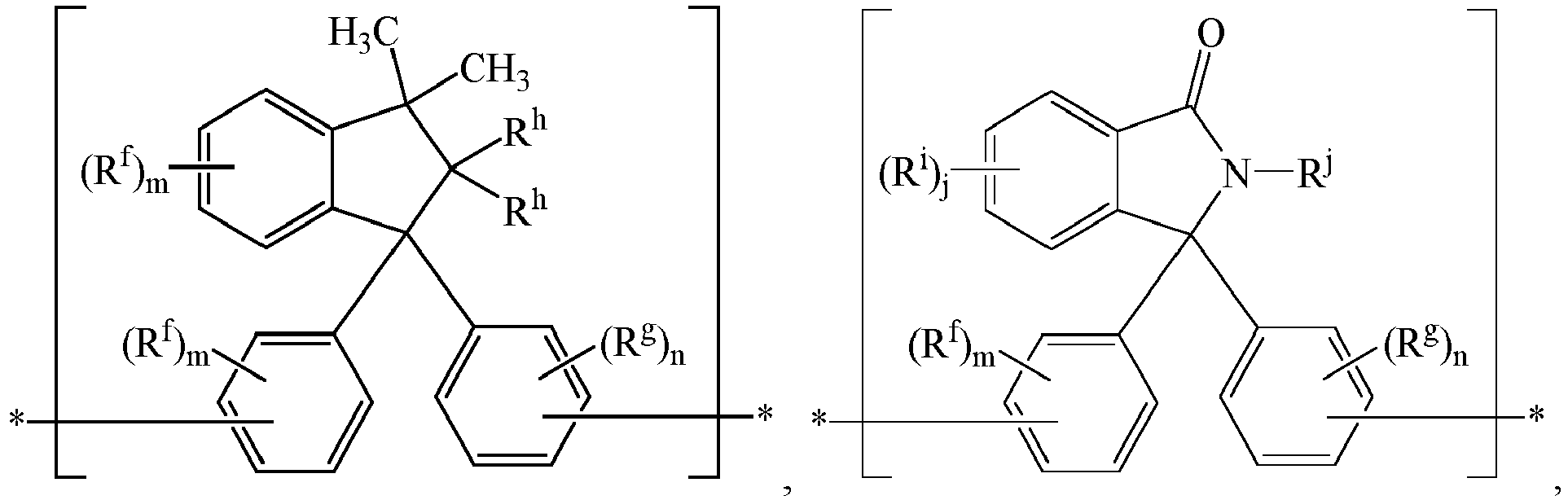

 0.05 to 0.4 mole percent of third carbonate units, each third carbonate unit comprising a divalent carbonate group and a divalent polysiloxane group, the divalent polysiloxane group comprising 5 to 60 diorganosiloxane units having the structure
 wherein the polycarbonate-polysiloxane has a weight average molecular weight of 18,000 to 35,000 grams/mole, determined by gel permeation chromatography with bisphenol A polycarbonate standards; andwherein if the polycarbonate-polysiloxane comprises 70 to 79.95 mole percent of the second carbonate units, then the polycarbonate-polysiloxane has a weight average molecular weight of 18,000 to 24,000 grams/mole.
 - The composition of claim 6, wherein the polycarbonate-polysiloxane comprises 35 to 64.95 mole percent of first carbonate units, 35 to 64.95 mole percent of second carbonate units, and 0.05 to 0.3 mole percent of third carbonate units.
- The composition of claim 6 or 7, comprising, based on the total weight of the composition:70 to 99.95 weight percent of the polycarbonate-polysiloxane; and0.05 to 2 weight percent of a roughening agent.
- The composition of claim 8, wherein the roughening agent comprises a particulate crosslinked polymethylsilsesquioxane having a median equivalent spherical diameter of 0.1 to 10 micrometers determined by laser diffraction according to ISO 13320:2009.
- The composition of claim 6, wherein
the composition comprises 70 to 99.95 weight percent of the polycarbonate-polysiloxane and further comprises 0.05 to 2 weight percent of a roughening agent;
the polycarbonate-polysiloxane comprises 35 to 64.95 mole percent of first carbonate units, 35 to 64.95 mole percent of second carbonate units, and 0.05 to 0.3 mole percent of third carbonate units;
the first carbonate units have the structure

the third carbonate units have the structure
the polycarbonate-polysiloxane has a weight average molecular weight of 20,000 to 35,000 grams/mole, determined by gel permeation chromatography using bisphenol A polycarbonate standards; and
the roughening agent comprises a particulate crosslinked polymethylsilsesquioxane having a median equivalent spherical diameter of 0.1 to 10 micrometers determined by laser diffraction according to ISO 13320:2009. - An extruded film comprising the composition of any one of claims 6-10.
- The extruded film of claim 11,
wherein the extruded film has a thickness of 2 to 15 micrometers; and
wherein the composition comprises, based on the total weight of the composition, 70 to 99.95 weight percent of the polycarbonate-polysiloxane, and 0.05 to 2 weight percent of a roughening agent comprising a particulate crosslinked polymethylsilsesquioxane having a median equivalent spherical diameter of 0.1 to 10 micrometers determined by laser diffraction according to ISO 13320:2009. - A capacitor comprising:an extruded film comprising the composition of any one of claims 6-10; andan electrically conductive metal layer in contact with the extruded film.
- A metallized film comprising:an extruded film comprising the composition of any one of claims 6-10; andan electrically conductive metal layer in contact with the extruded film.
- A composition comprising, based on the total weight of the composition:65 to 99.95 weight percent of a copolycarbonate comprisingfirst carbonate units derived from a first bisphenol monomer such that a homopolycarbonate of the first bisphenol monomer has a glass transition temperature less than 155 °C determined by dynamic mechanical analysis according to ASTM E1640-13 at a heating rate of 1 °C/minute, andsecond carbonate units derived from a second bisphenol monomer such that a homopolycarbonate of the second bisphenol monomer has a glass transition temperature of 155 °C or higher determined by dynamic mechanical analysis according to ASTM E1640-13 at a heating rate of 1 °C/minute; and0.05 to 2 weight percent of a roughening agent comprising a particulate crosslinked polymethylsilsesquioxane having a median equivalent spherical diameter greater than 5 micrometers and less than or equal to 10 micrometers determined by laser diffraction according to ISO 13320:2009.
Priority Applications (10)
| Application Number | Priority Date | Filing Date | Title |
|---|---|---|---|
| EP22176778.3A EP4089132B1 (en) | 2020-05-13 | 2020-09-16 | Polycarbonate copolymer and associated film extrusion composition, extruded film, and capacitor |
| JP2021080217A JP2021193172A (en) | 2020-05-13 | 2021-05-11 | Polycarbonate copolymers and related film extruded compositions, extruded films, and capacitors |
| CN202311217470.9A CN117126524A (en) | 2020-05-13 | 2021-05-12 | Polycarbonate copolymer compositions and extruded films |
| CN202110519073.1A CN113881028A (en) | 2020-05-13 | 2021-05-12 | Polycarbonate copolymer and related film extrusion composition, extruded film, and capacitor |
| KR1020210061974A KR102297409B1 (en) | 2020-05-13 | 2021-05-13 | Polycarbonate copolymer and associated film extrusion composition, extruded film, and capacitor |
| US17/319,188 US11866571B2 (en) | 2020-05-13 | 2021-05-13 | Polycarbonate copolymer and associated film extrusion composition, extruded film, and capacitor |
| KR1020210112996A KR102313510B1 (en) | 2020-05-13 | 2021-08-26 | Polycarbonate copolymer and associated film extrusion composition, extruded film, and capacitor |
| JP2022099349A JP7779808B2 (en) | 2020-05-13 | 2022-06-21 | Compositions, extruded films, capacitors and metallized films |
| US18/388,721 US11976195B2 (en) | 2020-05-13 | 2023-11-10 | Polycarbonate copolymer and associated film extrusion composition, extruded film, and capacitor |
| JP2024051241A JP2024071604A (en) | 2020-05-13 | 2024-03-27 | Composition and polycarbonate polysiloxane |
Applications Claiming Priority (1)
| Application Number | Priority Date | Filing Date | Title |
|---|---|---|---|
| US202063023904P | 2020-05-13 | 2020-05-13 |
Related Child Applications (1)
| Application Number | Title | Priority Date | Filing Date |
|---|---|---|---|
| EP22176778.3A Division EP4089132B1 (en) | 2020-05-13 | 2020-09-16 | Polycarbonate copolymer and associated film extrusion composition, extruded film, and capacitor |
Publications (1)
| Publication Number | Publication Date |
|---|---|
| EP3910001A1 true EP3910001A1 (en) | 2021-11-17 |
Family
ID=72521537
Family Applications (1)
| Application Number | Title | Priority Date | Filing Date |
|---|---|---|---|
| EP20196451.7A Pending EP3910001A1 (en) | 2020-05-13 | 2020-09-16 | Polycarbonate copolymer and associated film extrusion composition, extruded film, and capacitor |
Country Status (2)
| Country | Link |
|---|---|
| US (1) | US11866571B2 (en) |
| EP (1) | EP3910001A1 (en) |
Cited By (2)
| Publication number | Priority date | Publication date | Assignee | Title |
|---|---|---|---|---|
| WO2023047198A1 (en) * | 2021-09-27 | 2023-03-30 | Shpp Global Technologies B.V. | Film extrusion composition and associated extruded film, metallized film, and capacitor |
| US12180365B2 (en) | 2018-11-14 | 2024-12-31 | Shpp Global Technologies B.V. | Extruded capacitor films with high temperature performance, methods of manufacture, and articles containing the same |
Citations (18)
| Publication number | Priority date | Publication date | Assignee | Title |
|---|---|---|---|---|
| US3419634A (en) | 1966-01-03 | 1968-12-31 | Gen Electric | Organopolysiloxane polycarbonate block copolymers |
| US3419635A (en) | 1966-01-03 | 1968-12-31 | Gen Electric | Room temperature vulcanizing organopolysiloxane-polycarbonate compositions |
| US3821325A (en) | 1973-03-23 | 1974-06-28 | Gen Electric | Organopolysiloxane-polycarbonate block copolymers |
| US3832419A (en) | 1973-03-23 | 1974-08-27 | Gen Electric | Organopolysiloxane-polycarbonate block copolymers |
| US6072011A (en) | 1991-07-01 | 2000-06-06 | General Electric Company | Polycarbonate-polysiloxane block copolymers |
| US20080081884A1 (en) * | 2006-09-29 | 2008-04-03 | General Electric Company | Polycarbonate-polysiloxane copolymer compositions and articles formed therefrom |
| EP2336247A1 (en) * | 2009-09-14 | 2011-06-22 | Mitsubishi Engineering-Plastics Corporation | Polycarbonate resin composition and molded article |
| WO2012155116A1 (en) * | 2011-05-12 | 2012-11-15 | Sabic Innovative Plastics Ip B.V. | Amorphous polycarbonate films for capacitors, methods of manufacture, and articles manufactured therefrom |
| WO2013175448A1 (en) | 2012-05-24 | 2013-11-28 | Sabic Innovative Plastics Ip B.V. | Flame retardant thermoplastic compositions, methods of manufacture thereof and articles comprising the same |
| WO2014072923A1 (en) | 2012-11-07 | 2014-05-15 | Sabic Innovative Plastics Ip B.V. | Process for producing polycarbonate compositions |
| US20140179843A1 (en) * | 2012-12-21 | 2014-06-26 | Sabic Innovative Plastics Ip B.V. | Polycarbonate compositions, articles formed therefrom, and methods of manufacture thereof |
| US20140295363A1 (en) | 2011-10-08 | 2014-10-02 | Sabic Innovative Plastics Ip B.V. | Plastic flame housing and method of making the same |
| US20140326162A1 (en) * | 2013-05-01 | 2014-11-06 | Sabic Innovative Plastics Ip B.V. | Interior train components having low smoke and low heat release, and methods of their manufacture |
| US20160060403A1 (en) | 2013-08-28 | 2016-03-03 | Sabic Global Technologies B.V. | Polycarbonate films for capacitors, methods of manufacture, and articles manufactured therefrom |
| US20160070027A1 (en) * | 2014-09-10 | 2016-03-10 | Sabic Global Technologies B. V. | Optically diffusive plastic having high stiffness |
| WO2017196922A1 (en) * | 2016-05-12 | 2017-11-16 | Sabic Global Technologies B.V. | Capacitor films with high temperature performance, methods of manufacture, and articles thereof |
| US20180079862A1 (en) * | 2015-04-07 | 2018-03-22 | Covestro Deutschland Ag | Block co-condensates of polysiloxanes and dihydroxydiphenylcycloalkane-based n (co)polycarbonates |
| EP3540011A1 (en) * | 2018-03-15 | 2019-09-18 | SABIC Global Technologies B.V. | Improved flame retardant compositions |
Family Cites Families (15)
| Publication number | Priority date | Publication date | Assignee | Title |
|---|---|---|---|---|
| US5019418A (en) * | 1985-03-12 | 1991-05-28 | Sprague Electric Company | Metallized film capacitor process |
| US5530083A (en) | 1994-07-21 | 1996-06-25 | General Electric Company | Silicone-polycarbonate block copolymers and polycarbonate blends having reduced haze, and method for making |
| US6066700A (en) | 1997-03-12 | 2000-05-23 | Bayer Aktiengesellschaft | Process for the production of polysiloxane/polycarbonate block co-condensation products |
| HK1043142B (en) | 1998-12-16 | 2004-08-20 | 旭化成化学株式会社 | Flame-retardant polycarbonate resin composition with excellent melt flowability |
| EP1611176B1 (en) | 2003-02-21 | 2015-09-09 | SABIC Global Technologies B.V. | Process for preparing transparent and high-heat polycarbonate-polysiloxane copolymers |
| US7135538B2 (en) | 2003-11-12 | 2006-11-14 | General Electric Company | Transparent polycarbonate-polysiloxane copolymer blend, method for the preparation thereof, and article derived therefrom |
| WO2005113638A1 (en) | 2004-05-20 | 2005-12-01 | Idemitsu Kosan Co., Ltd. | Polycarbonate resin and electrophotographic photosensitive member using same |
| KR101781662B1 (en) * | 2009-10-28 | 2017-09-25 | 데이진 필름 솔루션스 가부시키가이샤 | Biaxially oriented film for electrical insulation purposes, and film capacitor produced using biaxially oriented film for electrical insulation purposes |
| JP5684548B2 (en) | 2010-11-30 | 2015-03-11 | 帝人株式会社 | Glass fiber reinforced resin composition |
| US9115283B2 (en) | 2011-03-31 | 2015-08-25 | Sabic Global Technologies B.V. | Heat resistant clear polycarbonate-polysiloxane compounds |
| JP5947117B2 (en) | 2012-06-12 | 2016-07-06 | 帝人株式会社 | Fluorescent light emitting resin composition |
| CN106164175A (en) * | 2014-04-15 | 2016-11-23 | 沙特基础工业全球技术有限公司 | High heat polycarbonate compositions |
| JP2018045138A (en) | 2016-09-15 | 2018-03-22 | キヤノン株式会社 | Electrophotographic photoreceptor, process cartridge and electrophotographic device |
| CN111187403B (en) | 2018-11-14 | 2022-08-02 | 万华化学集团股份有限公司 | Siloxane copolycarbonate and preparation method thereof |
| CN111560117B (en) | 2020-06-08 | 2022-08-05 | 万华化学集团股份有限公司 | Preparation method of siloxane copolycarbonate |
-
2020
- 2020-09-16 EP EP20196451.7A patent/EP3910001A1/en active Pending
-
2021
- 2021-05-13 US US17/319,188 patent/US11866571B2/en active Active
Patent Citations (19)
| Publication number | Priority date | Publication date | Assignee | Title |
|---|---|---|---|---|
| US3419635A (en) | 1966-01-03 | 1968-12-31 | Gen Electric | Room temperature vulcanizing organopolysiloxane-polycarbonate compositions |
| US3419634A (en) | 1966-01-03 | 1968-12-31 | Gen Electric | Organopolysiloxane polycarbonate block copolymers |
| US3821325A (en) | 1973-03-23 | 1974-06-28 | Gen Electric | Organopolysiloxane-polycarbonate block copolymers |
| US3832419A (en) | 1973-03-23 | 1974-08-27 | Gen Electric | Organopolysiloxane-polycarbonate block copolymers |
| US6072011A (en) | 1991-07-01 | 2000-06-06 | General Electric Company | Polycarbonate-polysiloxane block copolymers |
| US20080081884A1 (en) * | 2006-09-29 | 2008-04-03 | General Electric Company | Polycarbonate-polysiloxane copolymer compositions and articles formed therefrom |
| EP2336247A1 (en) * | 2009-09-14 | 2011-06-22 | Mitsubishi Engineering-Plastics Corporation | Polycarbonate resin composition and molded article |
| WO2012155116A1 (en) * | 2011-05-12 | 2012-11-15 | Sabic Innovative Plastics Ip B.V. | Amorphous polycarbonate films for capacitors, methods of manufacture, and articles manufactured therefrom |
| US20140295363A1 (en) | 2011-10-08 | 2014-10-02 | Sabic Innovative Plastics Ip B.V. | Plastic flame housing and method of making the same |
| WO2013175448A1 (en) | 2012-05-24 | 2013-11-28 | Sabic Innovative Plastics Ip B.V. | Flame retardant thermoplastic compositions, methods of manufacture thereof and articles comprising the same |
| WO2014072923A1 (en) | 2012-11-07 | 2014-05-15 | Sabic Innovative Plastics Ip B.V. | Process for producing polycarbonate compositions |
| US20140179843A1 (en) * | 2012-12-21 | 2014-06-26 | Sabic Innovative Plastics Ip B.V. | Polycarbonate compositions, articles formed therefrom, and methods of manufacture thereof |
| US20140326162A1 (en) * | 2013-05-01 | 2014-11-06 | Sabic Innovative Plastics Ip B.V. | Interior train components having low smoke and low heat release, and methods of their manufacture |
| US20160060403A1 (en) | 2013-08-28 | 2016-03-03 | Sabic Global Technologies B.V. | Polycarbonate films for capacitors, methods of manufacture, and articles manufactured therefrom |
| US20160070027A1 (en) * | 2014-09-10 | 2016-03-10 | Sabic Global Technologies B. V. | Optically diffusive plastic having high stiffness |
| US20180079862A1 (en) * | 2015-04-07 | 2018-03-22 | Covestro Deutschland Ag | Block co-condensates of polysiloxanes and dihydroxydiphenylcycloalkane-based n (co)polycarbonates |
| WO2017196922A1 (en) * | 2016-05-12 | 2017-11-16 | Sabic Global Technologies B.V. | Capacitor films with high temperature performance, methods of manufacture, and articles thereof |
| US20190153217A1 (en) | 2016-05-12 | 2019-05-23 | Sabic Global Technologies B.V. | Capacitor films with high temperature performance, methods of manufacture, and articles thereof |
| EP3540011A1 (en) * | 2018-03-15 | 2019-09-18 | SABIC Global Technologies B.V. | Improved flame retardant compositions |
Cited By (3)
| Publication number | Priority date | Publication date | Assignee | Title |
|---|---|---|---|---|
| US12180365B2 (en) | 2018-11-14 | 2024-12-31 | Shpp Global Technologies B.V. | Extruded capacitor films with high temperature performance, methods of manufacture, and articles containing the same |
| WO2023047198A1 (en) * | 2021-09-27 | 2023-03-30 | Shpp Global Technologies B.V. | Film extrusion composition and associated extruded film, metallized film, and capacitor |
| US12466922B2 (en) | 2021-09-27 | 2025-11-11 | Shpp Global Technologies B.V. | Film extrusion composition and associated extruded film, metallized film, and capacitor |
Also Published As
| Publication number | Publication date |
|---|---|
| US11866571B2 (en) | 2024-01-09 |
| US20210363351A1 (en) | 2021-11-25 |
Similar Documents
| Publication | Publication Date | Title |
|---|---|---|
| US11976195B2 (en) | Polycarbonate copolymer and associated film extrusion composition, extruded film, and capacitor | |
| US20160060403A1 (en) | Polycarbonate films for capacitors, methods of manufacture, and articles manufactured therefrom | |
| US11866571B2 (en) | Polycarbonate copolymer and associated film extrusion composition, extruded film, and capacitor | |
| EP3455286B1 (en) | Capacitor films with high temperature performance, methods of manufacture, and articles thereof | |
| CN1199208C (en) | Biaxially oriented polypropylene film with improved shrinkage at high temperature | |
| TWI836248B (en) | Films, wire covering materials, films for flexible printed circuit boards, and laminates | |
| US12180365B2 (en) | Extruded capacitor films with high temperature performance, methods of manufacture, and articles containing the same | |
| CN1192455A (en) | Bisoriented foil made of cyclic olefine polyer, use and prepn. method | |
| US12466922B2 (en) | Film extrusion composition and associated extruded film, metallized film, and capacitor | |
| US20190305161A1 (en) | Thermoplastic embossed film | |
| EP4656674A1 (en) | Extruded films with high temperature performance, and articles containing the same | |
| KR101070800B1 (en) | Polyamide film |
Legal Events
| Date | Code | Title | Description |
|---|---|---|---|
| PUAI | Public reference made under article 153(3) epc to a published international application that has entered the european phase |
Free format text: ORIGINAL CODE: 0009012 |
|
| STAA | Information on the status of an ep patent application or granted ep patent |
Free format text: STATUS: THE APPLICATION HAS BEEN PUBLISHED |
|
| AK | Designated contracting states |
Kind code of ref document: A1 Designated state(s): AL AT BE BG CH CY CZ DE DK EE ES FI FR GB GR HR HU IE IS IT LI LT LU LV MC MK MT NL NO PL PT RO RS SE SI SK SM TR |
|
| B565 | Issuance of search results under rule 164(2) epc |
Effective date: 20210707 |
|
| STAA | Information on the status of an ep patent application or granted ep patent |
Free format text: STATUS: REQUEST FOR EXAMINATION WAS MADE |
|
| 17P | Request for examination filed |
Effective date: 20220411 |
|
| RBV | Designated contracting states (corrected) |
Designated state(s): AL AT BE BG CH CY CZ DE DK EE ES FI FR GB GR HR HU IE IS IT LI LT LU LV MC MK MT NL NO PL PT RO RS SE SI SK SM TR |
|
| STAA | Information on the status of an ep patent application or granted ep patent |
Free format text: STATUS: EXAMINATION IS IN PROGRESS |
|
| 17Q | First examination report despatched |
Effective date: 20241014 |