EP3909799B1 - Lenkwinkelabhängige drehmomentverteilung - Google Patents
Lenkwinkelabhängige drehmomentverteilung Download PDFInfo
- Publication number
- EP3909799B1 EP3909799B1 EP21162066.1A EP21162066A EP3909799B1 EP 3909799 B1 EP3909799 B1 EP 3909799B1 EP 21162066 A EP21162066 A EP 21162066A EP 3909799 B1 EP3909799 B1 EP 3909799B1
- Authority
- EP
- European Patent Office
- Prior art keywords
- ground
- drive
- engaging means
- control device
- ground engaging
- Prior art date
- Legal status (The legal status is an assumption and is not a legal conclusion. Google has not performed a legal analysis and makes no representation as to the accuracy of the status listed.)
- Active
Links
Images


Classifications
-
- B—PERFORMING OPERATIONS; TRANSPORTING
- B60—VEHICLES IN GENERAL
- B60K—ARRANGEMENT OR MOUNTING OF PROPULSION UNITS OR OF TRANSMISSIONS IN VEHICLES; ARRANGEMENT OR MOUNTING OF PLURAL DIVERSE PRIME-MOVERS IN VEHICLES; AUXILIARY DRIVES FOR VEHICLES; INSTRUMENTATION OR DASHBOARDS FOR VEHICLES; ARRANGEMENTS IN CONNECTION WITH COOLING, AIR INTAKE, GAS EXHAUST OR FUEL SUPPLY OF PROPULSION UNITS IN VEHICLES
- B60K23/00—Arrangement or mounting of control devices for vehicle transmissions, or parts thereof, not otherwise provided for
- B60K23/08—Arrangement or mounting of control devices for vehicle transmissions, or parts thereof, not otherwise provided for for changing number of driven wheels, for switching from driving one axle to driving two or more axles
- B60K23/0808—Arrangement or mounting of control devices for vehicle transmissions, or parts thereof, not otherwise provided for for changing number of driven wheels, for switching from driving one axle to driving two or more axles for varying torque distribution between driven axles, e.g. by transfer clutch
-
- B—PERFORMING OPERATIONS; TRANSPORTING
- B60—VEHICLES IN GENERAL
- B60K—ARRANGEMENT OR MOUNTING OF PROPULSION UNITS OR OF TRANSMISSIONS IN VEHICLES; ARRANGEMENT OR MOUNTING OF PLURAL DIVERSE PRIME-MOVERS IN VEHICLES; AUXILIARY DRIVES FOR VEHICLES; INSTRUMENTATION OR DASHBOARDS FOR VEHICLES; ARRANGEMENTS IN CONNECTION WITH COOLING, AIR INTAKE, GAS EXHAUST OR FUEL SUPPLY OF PROPULSION UNITS IN VEHICLES
- B60K17/00—Arrangement or mounting of transmissions in vehicles
- B60K17/04—Arrangement or mounting of transmissions in vehicles characterised by arrangement, location or kind of gearing
- B60K17/10—Arrangement or mounting of transmissions in vehicles characterised by arrangement, location or kind of gearing of fluid gearing
-
- B—PERFORMING OPERATIONS; TRANSPORTING
- B60—VEHICLES IN GENERAL
- B60K—ARRANGEMENT OR MOUNTING OF PROPULSION UNITS OR OF TRANSMISSIONS IN VEHICLES; ARRANGEMENT OR MOUNTING OF PLURAL DIVERSE PRIME-MOVERS IN VEHICLES; AUXILIARY DRIVES FOR VEHICLES; INSTRUMENTATION OR DASHBOARDS FOR VEHICLES; ARRANGEMENTS IN CONNECTION WITH COOLING, AIR INTAKE, GAS EXHAUST OR FUEL SUPPLY OF PROPULSION UNITS IN VEHICLES
- B60K7/00—Disposition of motor in, or adjacent to, traction wheel
- B60K7/0015—Disposition of motor in, or adjacent to, traction wheel the motor being hydraulic
-
- B—PERFORMING OPERATIONS; TRANSPORTING
- B62—LAND VEHICLES FOR TRAVELLING OTHERWISE THAN ON RAILS
- B62D—MOTOR VEHICLES; TRAILERS
- B62D11/00—Steering non-deflectable wheels; Steering endless tracks or the like
- B62D11/02—Steering non-deflectable wheels; Steering endless tracks or the like by differentially driving ground-engaging elements on opposite vehicle sides
- B62D11/04—Steering non-deflectable wheels; Steering endless tracks or the like by differentially driving ground-engaging elements on opposite vehicle sides by means of separate power sources
-
- B—PERFORMING OPERATIONS; TRANSPORTING
- B62—LAND VEHICLES FOR TRAVELLING OTHERWISE THAN ON RAILS
- B62D—MOTOR VEHICLES; TRAILERS
- B62D11/00—Steering non-deflectable wheels; Steering endless tracks or the like
- B62D11/02—Steering non-deflectable wheels; Steering endless tracks or the like by differentially driving ground-engaging elements on opposite vehicle sides
- B62D11/06—Steering non-deflectable wheels; Steering endless tracks or the like by differentially driving ground-engaging elements on opposite vehicle sides by means of a single main power source
- B62D11/10—Steering non-deflectable wheels; Steering endless tracks or the like by differentially driving ground-engaging elements on opposite vehicle sides by means of a single main power source using gearings with differential power outputs on opposite sides, e.g. twin-differential or epicyclic gears
- B62D11/14—Steering non-deflectable wheels; Steering endless tracks or the like by differentially driving ground-engaging elements on opposite vehicle sides by means of a single main power source using gearings with differential power outputs on opposite sides, e.g. twin-differential or epicyclic gears differential power outputs being effected by additional power supply to one side, e.g. power originating from secondary power source
- B62D11/18—Steering non-deflectable wheels; Steering endless tracks or the like by differentially driving ground-engaging elements on opposite vehicle sides by means of a single main power source using gearings with differential power outputs on opposite sides, e.g. twin-differential or epicyclic gears differential power outputs being effected by additional power supply to one side, e.g. power originating from secondary power source the additional power supply being supplied hydraulically
- B62D11/183—Control systems therefor
-
- B—PERFORMING OPERATIONS; TRANSPORTING
- B60—VEHICLES IN GENERAL
- B60K—ARRANGEMENT OR MOUNTING OF PROPULSION UNITS OR OF TRANSMISSIONS IN VEHICLES; ARRANGEMENT OR MOUNTING OF PLURAL DIVERSE PRIME-MOVERS IN VEHICLES; AUXILIARY DRIVES FOR VEHICLES; INSTRUMENTATION OR DASHBOARDS FOR VEHICLES; ARRANGEMENTS IN CONNECTION WITH COOLING, AIR INTAKE, GAS EXHAUST OR FUEL SUPPLY OF PROPULSION UNITS IN VEHICLES
- B60K17/00—Arrangement or mounting of transmissions in vehicles
- B60K17/34—Arrangement or mounting of transmissions in vehicles for driving both front and rear wheels, e.g. four wheel drive vehicles
- B60K17/356—Arrangement or mounting of transmissions in vehicles for driving both front and rear wheels, e.g. four wheel drive vehicles having fluid or electric motor, for driving one or more wheels
-
- B—PERFORMING OPERATIONS; TRANSPORTING
- B60—VEHICLES IN GENERAL
- B60K—ARRANGEMENT OR MOUNTING OF PROPULSION UNITS OR OF TRANSMISSIONS IN VEHICLES; ARRANGEMENT OR MOUNTING OF PLURAL DIVERSE PRIME-MOVERS IN VEHICLES; AUXILIARY DRIVES FOR VEHICLES; INSTRUMENTATION OR DASHBOARDS FOR VEHICLES; ARRANGEMENTS IN CONNECTION WITH COOLING, AIR INTAKE, GAS EXHAUST OR FUEL SUPPLY OF PROPULSION UNITS IN VEHICLES
- B60K23/00—Arrangement or mounting of control devices for vehicle transmissions, or parts thereof, not otherwise provided for
- B60K23/08—Arrangement or mounting of control devices for vehicle transmissions, or parts thereof, not otherwise provided for for changing number of driven wheels, for switching from driving one axle to driving two or more axles
- B60K2023/085—Arrangement or mounting of control devices for vehicle transmissions, or parts thereof, not otherwise provided for for changing number of driven wheels, for switching from driving one axle to driving two or more axles automatically actuated
- B60K2023/0866—Arrangement or mounting of control devices for vehicle transmissions, or parts thereof, not otherwise provided for for changing number of driven wheels, for switching from driving one axle to driving two or more axles automatically actuated with hydraulic means only
-
- B—PERFORMING OPERATIONS; TRANSPORTING
- B60—VEHICLES IN GENERAL
- B60Y—INDEXING SCHEME RELATING TO ASPECTS CROSS-CUTTING VEHICLE TECHNOLOGY
- B60Y2200/00—Type of vehicle
- B60Y2200/20—Off-Road Vehicles
- B60Y2200/22—Agricultural vehicles
- B60Y2200/222—Harvesters
-
- B—PERFORMING OPERATIONS; TRANSPORTING
- B62—LAND VEHICLES FOR TRAVELLING OTHERWISE THAN ON RAILS
- B62D—MOTOR VEHICLES; TRAILERS
- B62D11/00—Steering non-deflectable wheels; Steering endless tracks or the like
- B62D11/02—Steering non-deflectable wheels; Steering endless tracks or the like by differentially driving ground-engaging elements on opposite vehicle sides
- B62D11/06—Steering non-deflectable wheels; Steering endless tracks or the like by differentially driving ground-engaging elements on opposite vehicle sides by means of a single main power source
Definitions
- the invention relates to an electronic control device of a drive unit of a vehicle designed as a self-propelled agricultural harvesting machine with all-wheel drive according to the preamble of claim 1.
- Self-propelled agricultural harvesting machines such as a so-called forage harvester or a combine harvester, are generally equipped with an all-wheel drive.
- a main engine generates a drive torque, which is proportionally fed to the ground engagement means of the front axle and the ground engagement means of the rear axle.
- Such ground engagement means can be designed either as crawler tracks, wheels or a combination of wheels and crawler tracks. Due to a larger axle load on the front axle, the self-propelled agricultural harvesting machines mentioned at the beginning in particular transfer a large part of the drive torque to the ground by means of the ground engagement means on the front axle, so that the tires arranged on the front axle have a significantly larger diameter than the rear tires or are designed as crawler tracks.
- a steering angle is set on the wheels of the rear axle in vehicles designed in this way, while the ground engagement means on the front axle are arranged essentially rigidly.
- the state of the art discloses a large number of differently designed control devices which control the ground engagement means depending on dynamic and static vehicle parameters.
- DE 10 2007 030 168 A1 An electronic control device for controlling the drive means of ground engaging means of a vehicle designed as a self-propelled agricultural work machine has become known. This determines a maximum permissible wheel torque based on dynamic and static vehicle parameters, which serves to optimize traction and prevent slippage. The determined permissible wheel torque limits the application-dependent specification of a displacement volume on the hydraulic motors which are used to drive the wheels.
- the DE 10 2007 030 168 A1 known control device calculates a value from various parameters Axle load of the wheels, on the basis of which the hydraulic motors are controlled with a corresponding displacement.
- the rear axle with the steered wheels When cornering, the rear axle with the steered wheels describes a larger curve radius than the front axle.
- the ground engagement devices of the rear axle transfer essentially the same drive torque to the ground as when driving straight ahead.
- the state of the art only provides for a change in the drive torque between the left and right drive wheels in extreme situations, such as oversteering or understeering, and in the event of slip.
- vehicles, especially self-propelled agricultural harvesting machines are not driven under full load when cornering, so slipping and oversteering or understeering rarely occur. Driving under full load is rarely possible, especially on headlands during harvesting.
- the inventive control of the drive unit by means of the electronic control device makes it possible to reduce the turning circle of a self-propelled agricultural harvesting machine equipped with four-wheel drive in a simple manner.
- the vehicle pushes into the curve.
- turning of the vehicle about a vertically extending axis is promoted, so that the curve radius is reduced when cornering.
- the drive unit can comprise a hydraulic pump, wherein the front axle and the rear axle each have at least one drive means designed as a hydraulic motor, which drives the ground engagement means assigned to the respective axle, wherein preferably each ground engagement means has a hydraulic motor assigned to it.
- the ground engagement means can be designed as wheels, since these represent cost-effective means for transmitting the drive torque to the ground.
- a particularly advantageous embodiment provides that the ground engagement means of the rear axle are designed as wheels and the ground engagement means of the front axle are designed as crawler tracks.
- the invention finds a particularly advantageous application here, since crawler tracks have a high rotational resistance, which counteracts a rotational movement about a vertically extending axis required for cornering.
- a further advantageous embodiment provides that the adjustment of the ratio between the drive torque transmitted to the ground by the ground engagement means of the front axle and the ground engagement means of the rear axle is carried out continuously. Continuous adjustment ensures comfortable operation of the vehicle for the driver.
- the electronic control device controls the drive means in such a way that an increase in the steering angle, in particular an increase compared to 0 degrees, leads to an increase in the drive torque transmitted to the ground by the ground engagement means of the rear axle and preferably to a reduction in the drive torque transmitted to the ground by the ground engagement means of the front axle.
- the increase in the drive torque transmitted to the ground by the ground engagement means of the rear axle leads to the desired reduction in the curve radius.
- the electronic control device can control the drive unit in such a way that when cornering, the drive torque transmitted to the ground by the ground engagement means of the rear axle can be greater than the drive torque transmitted to the ground by the ground engagement means of the front axle.
- the adjustment can be made by specifying a displacement volume on the hydraulic motors.
- the vehicle has a rear axle steering so that when cornering the steered rear ground engagement means cause the vehicle to rotate about a vertical vehicle axis.
- the Fig. 1 shows a schematic representation of an embodiment of a drive unit of a self-propelled agricultural harvesting machine 1 with an electronic control device 2 according to the invention for the hydraulic drive units of the travel drive.
- the harvesting machine 1 has a frame (not shown) or a self-supporting chassis which is supported on front ground engagement means 3, 4 and rear ground engagement means 5, 6 which are in engagement with the ground and are designed as wheels.
- the ground engagement means 3, 4, 5, 6 transfer the drive torques acting on them to the ground.
- the rear ground engagement means 5, 6, which are generally designed as wheels, are arranged so as to be steerable, while the front ground engagement means 3, 4, which are generally designed as wheels, have a larger tire diameter than the rear wheels and carry the greater part of the weight of the vehicle, in particular in the embodiment of a harvesting machine 1, for example a combine harvester or forage harvester.
- the front ground engagement means 3, 4 of a harvesting machine 1 can also consist of a crawler track (not shown), with each track corresponding to a front ground engagement means 3, 4. Due to the different weight distribution of the vehicle on the front axle 7 and rear axle 8, there is also different traction on the front and rear ground engagement means 3, 4, 5, 6.
- the ground engagement means 3, 4 arranged on the front axle 7 are less critical in terms of traction than the drive wheels arranged on the rear steering axle 8 due to the greater wheel load.
- the drive unit comprises a main engine 9 in the form of an internal combustion engine, preferably a diesel engine, which drives various crop processing and conveying devices and the travel drive of the harvesting machine 1.
- the travel drives are driven via a shaft 10 of the main engine 9 to the hydraulic pump 11, the fluid displacement of which converts mechanical power into hydraulic power (pressure ⁇ volume flow), whereby the swivel plate can be controlled.
- the control of the hydraulic pump 11 will not be discussed in detail here because it is assumed to be known.
- a gearbox 12 shown in dashed lines
- the hydraulic pump 11 has an outlet 13 and an inlet 14.
- the outlet 13 is connected as an inlet via hydraulic lines 15 and a distributor 16 to the inlet 17 of the hydraulic motors 18, 19, 20, 21, while the outlet 22 of the hydraulic motors 18, 19, 20, 21 is fed back to the inlet 14 of the hydraulic pump 11 via hydraulic lines 23 as a return line.
- Two of the hydraulic motors 18, 19 are arranged on the front axle 7, with each hydraulic motor 18, 19 driving one of the front wheels via a drive shaft 24, 25.
- Two further hydraulic motors 20, 21 are located on the rear axle 8 and each drive a rear wheel via a drive shaft 26, 27.
- the control device 2 is connected to a plurality of sensors arranged in the harvesting machine 1 in order to receive their signals 28 for processing.
- One of these sensors relates to a steering angle sensor 29, which detects the current steering angle 33 on the rear axle 8.
- the steerable rear axle 8 is split in two in the illustrated embodiment and designed as a pendulum axle.
- values for a specification of the drive torque are calculated using the control device 2, from which at least one performance curve 30 is determined for the hydraulic motors 18, 19, 20, 21.
- the displacement volume for the hydraulic motors 18, 19, 20, 21 is specified from the performance curve 30 and the drive torque of the ground engagement means 3, 4, 5, 6 is set using the displacement volume.
- the displacement volume specification is controlled in a manner known per se by regulating a hydraulic adjustment motor (not shown) or a swivel plate of the hydraulic motors 18, 19, 20, 21.
- An adjustment device (not shown) is available for adjusting the swivel plate, which transmits a predetermined movement from the control device 2 to the swivel plate, wherein the adjustment device can preferably consist of an electromechanical actuator.
- the swivel disk of the hydraulic motors 18, 19, 20, 21 is thus controlled via the power curve 30 contained in the control device 2, resulting in an adjustable displacement volume.
- control device 2 determines the values for the specification of the drive torque as a function of the steering angle 33.
- the control device 2 calculates the specification of the drive torque in such a way that the ratio between the drive torque transmitted to the ground by the ground engagement means 3, 4 of the front axle 7 and the drive torque transmitted to the ground by the ground engagement means 5, 6 of the rear axle 8 is regulated as a function of the steering angle 33.
- control device 2 is set up in such a way that, with increasing deviation of the steering angle 33 from 0 degrees for the ground engagement means 5, 6 arranged on the rear axle 8, it also determines an increasingly increased specification of the drive torque.
- a steering angle 33 of 0 degrees corresponds to a steering angle 33 intended for travel in the forward direction.
- the specification of the drive torque for the ground engagement means 3, 4 arranged on the front axle 7 behaves in the opposite way to the specification of the drive torque for the ground engagement means 5, 6 arranged on the rear axle 8.
- the determined specification of the drive torque for the ground engagement means 3, 4 arranged on the front axle 7 becomes lower with increasing deviation of the steering angle 33 from 0 degrees.
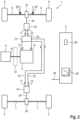
- Fig. 2 shows an alternative embodiment of the drive unit of the self-propelled agricultural harvesting machine with an electronic control device 2 according to the invention in a schematic representation. Descriptions and details of the drive and the control device 2 which are identical in the Fig. 1 are included in Fig. 2 are not listed repeatedly and are marked with the same reference symbols for identical elements.
- the main difference to the drive from the Fig. 1 is that the Fig. 2
- the all-wheel drive shown comprises only two hydraulic motors 19, 20, each of which drives a differential gear 36, 37 with a drive shaft 34, 35.
- the first hydraulic motor 19 drives the two front ground engagement means 3, 4 via a first drive shaft 34 and a first self-locking differential gear 36.
- the second hydraulic motor 20 drives the two rear ground engagement means 5, 6 via a second drive shaft 35 and a second self-locking differential gear 37.
- Fig. 3 shows an example of the displacement volume 31 of the hydraulic motors 18, 19 assigned to the ground engagement means 3, 4 of the front axle 7 and the displacement volume 32 of the hydraulic motors 20, 21 assigned to the ground engagement means 5, 6 of the rear axle 8 as a function of the steering angle 33.
- the specification max L corresponds to the maximum adjustable steering angle 33 for a left-hand bend and max R corresponds to the maximum adjustable steering angle 33 for a right-hand bend.
- Fig. 3 shows that at a steering angle 33 of 0 degrees, a larger amount of displacement volume 31 is assigned to the hydraulic motors 18, 19 assigned to the front axle 7 than to the hydraulic motors 20, 21 assigned to the rear axle 8.
- An increase in the steering angle 33 now leads to a continuous change in the ratio between the displacement volume 31 implemented by the hydraulic motors 18, 19 assigned to the front axle 7 and the displacement volume 32 implemented by the hydraulic motors 20, 21 assigned to the rear axle 8.
- the displacement volume 32 implemented by the hydraulic motors 20, 21 of the rear axle 8 increases, while the displacement volume 31 implemented by the hydraulic motors 18, 19 of the front axle 7 decreases.
- the hydraulic motors 20, 21 used to drive the ground engagement means 5, 6 of the rear axle 8 are assigned a larger amount of displacement 32 than the hydraulic motors 24, 25 used to drive the ground engagement means 3, 4 of the front axle 7, so that the ground engagement means 5, 6 arranged on the rear axle 8 transmit a larger drive torque to the ground than the ground engagement means 3, 4 arranged on the front axle 7.
- a threshold value is preferably in a range of 5-10 degrees, more preferably in a range of 10-15 degrees, more preferably in a range of 15-20 degrees.
- the total displacement volume 31, 32 implemented by the hydraulic motors 18, 19, 20, 21 used for the drive can also increase or decrease, whereby the proportional allocation to the hydraulic motors 18, 19 used to drive the ground engagement means 3, 4 of the front axle 7 and to the hydraulic motors 20, 21 used to drive the ground engagement means 5, 6 of the rear axle 8 is made depending on the steering angle 33.
- the proportional allocation to the hydraulic motors 18, 19 used to drive the ground engagement means 3, 4 of the front axle 7 and to the hydraulic motors 20, 21 used to drive the ground engagement means 5, 6 of the rear axle 8 is made depending on the steering angle 33.
- the device disclosed can be a further component of the electronic control device 2 for the drive unit of the vehicle equipped according to the invention.
Landscapes
- Engineering & Computer Science (AREA)
- Chemical & Material Sciences (AREA)
- Combustion & Propulsion (AREA)
- Transportation (AREA)
- Mechanical Engineering (AREA)
- Automation & Control Theory (AREA)
- Non-Deflectable Wheels, Steering Of Trailers, Or Other Steering (AREA)
- Guiding Agricultural Machines (AREA)
- Arrangement And Driving Of Transmission Devices (AREA)
Description
- Die Erfindung betrifft eine elektronische Steuerungseinrichtung einer Antriebseinheit eines als selbstfahrende landwirtschaftliche Erntemaschine mit Allradantrieb ausgebildeten Fahrzeugs gemäß dem Oberbegriff des Anspruchs 1.
- Selbstfahrende landwirtschaftliche Erntemaschinen, wie etwa ein sogenannter Feldhäcksler oder ein Mähdrescher, sind in aller Regel mit einem Allradantrieb ausgestattet. Ein Hauptmotor generiert ein Antriebsdrehmoment, welches anteilig den Bodeneingriffsmitteln der Vorderachse und den Bodeneingriffsmitteln der Hinterachse zugeführt wird. Derartige Bodeneingriffsmitteln können entweder als Raupenlaufwerke, Räder oder einer Kombination von Rädern und Raupenlaufwerken ausgebildet sein. Bedingt durch einer an der Vorderachse anliegenden größeren Achslast übertragen insbesondere die eingangs genannten selbstfahrenden landwirtschaftlichen Erntemaschinen einen Großteil des Antriebsdrehmoments mittels den an der Vorderachse befindlichen Bodeneingriffsmittel auf den Boden, sodass die an der Vorderachse angeordneten Reifen einen deutlich größeren Durchmesser als die Hinterreifen aufweisen oder als Raupenlaufwerke ausgebildet sind. Für einen Lenkvorgang wird bei derartig ausgebildeten Fahrzeugen an den Rädern der Hinterachse ein Lenkwinkel eingestellt, während die Bodeneingriffsmittel der Vorderachse im Wesentlichen starr angeordnet sind.
- Der Stand der Technik offenbart eine Vielzahl von verschiedenartig eingerichteten Steuereinrichtungen, welche die Bodeneingriffsmittel in Abhängigkeit von dynamischen und statischen Fahrzeugparametern ansteuern. Aus der
DE 10 2007 030 168 A1 ist eine elektronische Steuereinrichtung zur Ansteuerung der Antriebsmittel von Bodeneingriffsmitteln eines als selbstfahrende landwirtschaftliche Arbeitsmaschine ausgebildeten Fahrzeugs bekannt geworden. Diese ermittelt anhand dynamischer und statischer Fahrzeugparameter ein maximal zulässiges Raddrehmoment, welches der Optimierung der Traktion und Verhinderung von Schlupf dient. Das ermittelte zulässige Raddrehmoment begrenzt die einsatzabhängige Vorgabe eines Schluckvolumens an den Hydraulikmotoren, welche zum Antrieb der Räder verwendet werden. Primär verwendet die aus derDE 10 2007 030 168 A1 bekannt gewordene Steuerungseinrichtung eine aus verschiedenen Parametern berechnete Achslast der Räder, auf dessen Grundlage die Hydraulikmotoren mit einem entsprechenden Schluckvolumen angesteuert werden. - Bei einer Kurvenfahrt beschreibt die Hinterachse mit den eingelenkten Rädern einen größeren Kurvenradius als die Vorderachse. Hierbei übertragen die Bodeneingriffsmittel der Hinterachse im Wesentlichen das gleiche Antriebsdrehmoment auf den Boden wie bei einer Geradeausfahrt. Während einer Kurvenfahrt sieht der Stand der Technik lediglich in Extremsituationen, wie beispielsweise einem Über- oder Untersteuern, und bei Schlupf eine Änderung des Antriebsdrehmoments zwischen den linken und rechten Antriebsrädern vor. In aller Regel werden Fahrzeuge, insbesondere selbstfahrende landwirtschaftliche Erntemaschinen, bei Kurvenfahrt nicht unter Volllast gefahren, sodass Schlupf sowie ein Über- oder Untersteuern selten auftritt. Insbesondere beim Vorgewende im Erntebetrieb ist ein Fahren unter Volllast selten möglich.
- Hier zeigt sich ein Nachteil des Standes der Technik auf, da dieser bei einer Kurvenfahrt ein unverändertes, im Wesentlichen starres Verhältnis zwischen dem der Vorderachse und der Hinterachse zugeführten Antriebsdrehmoment vorsieht. Dies führt dazu, dass eine mit einfachen Mitteln erreichbare potentielle Minimierung des Wendekreises eines mit Hinterachslenkung versehenen Fahrzeugs nicht erreicht wird.
- Es ist Aufgabe der Erfindung die beschriebenen Nachteile des Stands der Technik zu vermeiden und insbesondere eine selbstfahrende landwirtschaftliche Erntemaschine zu schaffen, bei welcher die Lenkcharakteristik verbessert wird, indem das Verhältnis des von den Bodeneingriffsmitteln der Vorderachse und der Hinterachse auf den Boden übertragenen Antriebsdrehmoment optimiert wird.
- Diese Aufgabe wird erfindungsgemäß durch eine elektronische Steuerungseinrichtung mit den Merkmalen des Anspruchs 1 gelöst.
- Die erfindungsgemäße Ansteuerung der Antriebseinheit mittels der elektronischen Steuereinrichtung ermöglicht auf einfache Art und Weise den Wendekreis einer mit einem Allradantrieb ausgestatteten selbstfahrenden landwirtschaftlichen Erntemaschine zu reduzieren. Indem das auf den Boden übertragene Antriebsdrehmoment von den an der Hinterachse angeordneten Bodeneingriffsmittel bei einer Kurvenfahrt erhöht wird, schiebt das Fahrzeug in die Kurve hinein. Weiterhin wird ein drehen des Fahrzeugs um eine sich vertikal erstreckende Achse gefördert, sodass sich der Kurvenradius bei einer Kurvenfahrt verringert.
- In einer vorteilhaften Weiterbildung kann die Antriebseinheit eine Hydraulikpumpe umfassen, wobei die Vorderachse und die Hinterachse jeweils zumindest ein als Hydraulikmotor ausgebildetes Antriebsmittel aufweisen, welches die der jeweiligen Achse zugeordneten Bodeneingriffsmittel antreibt, wobei vorzugsweise jedes Bodeneingriffsmittel jeweils einen diesem zugeordneten Hydraulikmotor aufweist. Diese vorteilhafte Weiterbildung ermöglicht es auf einfache Art und Weise das Verhältnis des Antriebsmoments zwischen den Bodeneingriffsmitteln entsprechend anzupassen.
- Vorteilhafterweise können die Bodeneingriffsmittel als Räder ausgebildet sein, da diese kostengünstige Mittel zur Übertragung des Antriebsdrehmoments auf den Boden darstellen.
- Eine besonders vorteilhafte Ausgestaltung sieht vor, dass die Bodeneingriffsmittel der Hinterachse als Räder und die Bodeneingriffsmittel der Vorderachse als Raupenlaufwerke ausgebildet sind. Hier findet die Erfindung einen besonders vorteilhaften Anwendungsfall, da Raupenlaufwerke einen hohen Drehwiderstand aufweisen, welche einer für die Kurvenfahrt erforderlichen Drehbewegung um eine sich vertikal erstreckende Achse entgegenwirkt. Eine erfindungsgemäße Anpassung des Verhältnisses des Antriebsdrehmoments, wobei das Antriebsdrehmoment der hinteren, als Räder ausgestalteten und bei einer Kurvenfahrt eingelenkten Bodeneingriffsmittel erhöht wird, führt nun dazu, dass zum Drehen der Raupenlaufwerke um ihre vertikale Achse eine erhöhte Kraft generiert wird und somit sich der Kurvenradius reduziert.
- Eine weitere vorteilhafte Ausgestaltung sieht vor, dass die Anpassung des Verhältnisses zwischen dem von den Bodeneingriffsmitteln der Vorderachse und dem von den Bodeneingriffsmitteln der Hinterachse auf den Boden übertragenen Antriebsdrehmoment stufenlos erfolgt. Eine stufenlose Anpassung stellt für den Fahrer einen komfortablen Betrieb des Fahrzeugs sicher.
- Erfindungsgemäß steuert die elektronische Steuerungseinrichtung die Antriebsmittel derart an, dass ein Anstieg des Lenkwinkels, insbesondere ein Anstieg gegenüber 0 Grad, zu einer Erhöhung des von den Bodeneingriffsmitteln der Hinterachse auf den Boden übertragenen Antriebsdrehmoments und vorzugsweise zu einer Absenkung des von den Bodeneingriffsmitteln der Vorderachse auf den Boden übertragenen Antriebsdrehmoments führt. Die Erhöhung des von den Bodeneingriffsmitteln der Hinterachse auf den Boden übertragenen Antriebsdrehmoments führt zu der gewünschten Reduzierung des Kurvenradius. Durch eine gleichzeitige Absenkung des von den Bodeneingriffsmitteln der Vorderachse auf den Boden übertragenen Antriebsdrehmoments kann die Kurvenfahrt ohne eine Veränderung der Geschwindigkeit fortgesetzt werden.
- Vorzugsweise kann die elektronische Steuerungseinrichtung zur weiteren Reduzierung des Kurvenradius die Antriebseinheit derart ansteuern, so dass bei einer Kurvenfahrt das von den Bodeneingriffsmitteln der Hinterachse auf den Boden übertragene Antriebsdrehmoment größer als das von den Bodeneingriffsmitteln der Vorderachse auf den Boden übertragene Antriebsdrehmoment sein kann.
- Um auf einfache Art und Weise die Anpassung des Verhältnisses des von den Bodeneingriffsmitteln der Vorderachse und Hinterachse auf den Boden übertragenen Antriebsdrehmoments zu erreichen, kann die Anpassung durch eine Schluckvolumenvorgabe an den Hydraulikmotoren erfolgen.
- Erfindungsgemäß weist das Fahrzeug eine Hinterachslenkung auf, damit bei einer Kurvenfahrt die eingelenkten hinteren Bodeneingriffsmittel zum Drehen des Fahrzeugs um eine vertikale Fahrzeugachse führen.
- Weitere vorteilhafte Ausgestaltungen sind Gegenstand weiterer Unteransprüche und werden nachfolgend an Hand eines in mehreren Figuren dargestellten Ausführungsbeispiels beschrieben. Es zeigen:
- Figur 1
- eine schematische Darstellung einer Ausführungsform einer Antriebseinheit einer selbstfahrenden landwirtschaftlichen Erntemaschine mit einer erfindungsgemäßen elektronischen Steuerungseinrichtung für die hydraulischen Antriebseinheiten des Fahrantriebes;
- Figur 2
- eine schematische Darstellung einer alternativen Ausführungsform der Antriebseinheit der selbstfahrenden landwirtschaftlichen Erntemaschine mit einer erfindungsgemäßen elektronischen Steuerungseinrichtung;
- Figur 3
- einen beispielhaften Verlauf der Schluckvolumina der den Bodeneingriffsmitteln der Vorderachse und den Bodeneingriffsmitteln der Hinterachse zugeordneten Hydraulikmotoren.
- Die
Fig. 1 zeigt in schematischer Darstellung eine Ausführungsform einer Antriebseinheit einer selbstfahrenden landwirtschaftlichen Erntemaschine 1 mit einer erfindungsgemäßen elektronischen Steuerungseinrichtung 2 für die hydraulischen Antriebseinheiten des Fahrantriebes. Die Erntemaschine 1 weist einen (nicht dargestellten) Rahmen oder ein selbsttragendes Chassis auf, der sich auf vorderen Bodeneingriffsmitteln 3, 4 und hinteren Bodeneingriffsmitteln 5, 6 abstützt, die sich im Eingriff mit dem Boden befinden und als Räder ausgebildet sind. Die Bodeneingriffsmittel 3, 4, 5, 6 übertragen die auf diese wirkenden Antriebsdrehmomente auf den Boden. Die in aller Regel als Räder ausgebildeten hinteren Bodeneingriffsmitteln 5, 6 sind lenkbar angeordnet, während die in aller Regel als Räder ausgebildeten vorderen Bodeneingriffsmittel 3, 4 einen größeren Reifendurchmesser als die hinteren Räder aufweisen und den größeren Teil des Gewichtes des Fahrzeuges tragen, insbesondere in der Ausführungsform einer Erntemaschine 1, beispielsweise eines Mähdreschers oder Feldhäckslers. Die vorderen Bodeneingriffsmittel 3, 4 einer Erntemaschine 1 können aber auch aus jeweils einem Raupenlaufwerk (nicht dargestellt) bestehen, wobei jeweils ein Laufwerk einem Bodeneingriffsmittel 3, 4 vorne entspricht. Aufgrund der unterschiedlichen Gewichtsverteilung des Fahrzeugs auf die vordere 7 und hintere Achse 8 erfolgt auch eine unterschiedliche Traktion an den vorderen und hinteren Bodeneingriffsmitteln 3, 4, 5, 6. Die an der vorderen Achse 7 angeordneten Bodeneingriffsmittel 3, 4 sind aufgrund der größeren Radlast traktionsunkritischer als die an der hinteren Lenkachse 8 angeordneten Antriebsräder. - Die Antriebseinheit umfasst einen Hauptmotor 9 in Ausführung eines Verbrennungsmotors, vorzugsweise eines Dieselmotors, der verschiedene Gutbearbeitungs- und Fördereinrichtungen und den Fahrantrieb der Erntemaschine 1 antreibt. Der Antrieb der Fahrantriebe erfolgt über eine Welle 10 des Hauptmotors 9 zur Hydraulikpumpe 11, deren Fluidverdrängung durch eine Schwenkscheibe (nicht gezeigt) mechanische Leistung in hydraulische Leistung (Druck × Volumenstrom) umwandelt, wobei die Schwenkscheibe gesteuert werden kann. Auf die Steuerung der Hydraulikpumpe 11 soll hier nicht näher eingegangen werden, weil diese als bekannt vorausgesetzt wird. Zwischen dem Hauptmotor 9 und der Hydraulikpumpe 11 kann sich alternativ noch ein Getriebe 12 (gestrichelt dargestellt) befinden. Die Hydraulikpumpe 11 weist einen Auslass 13 und einen Einlass 14 auf. Der Auslass 13 ist als Zulauf über Hydraulikleitungen 15 und einem Verteiler 16 mit dem Einlass 17 der Hydraulikmotoren 18, 19, 20, 21 verbunden, während der Auslass 22 der Hydraulikmotoren 18, 19, 20, 21 über Hydraulikleitungen 23 als Rücklauf mit dem Einlass 14 der Hydraulikpumpe 11 rückgekoppelt ist. Zwei der Hydraulikmotoren 18, 19 sind an der vorderen Achse 7 angeordnet, wobei jeder Hydraulikmotor 18, 19 über eine Antriebswelle 24, 25 eines der Vorderräder antreibt. Zwei weitere Hydraulikmotoren 20, 21 befinden sich an der Hinterachse 8 und treiben jeweils über eine Antriebswelle 26, 27 ein Hinterrad an.
- Die Steuerungseinrichtung 2 ist mit einer Vielzahl von in der Erntemaschine 1 angeordneten Sensoren verbunden, um deren Signale 28 zur Verarbeitung aufzunehmen. Einer dieser Sensoren betrifft einen Lenkwinkelsensor 29, welcher den aktuellen Lenkwinkel 33 an der Hinterachse 8 erfasst. Die lenkbar ausgestaltete Hinterachse 8 ist im dargestellten Ausführungsbeispiel zweigeteilt und als Pendelachse ausgelegt.
- Aus dem erfassten Lenkwinkel 33 werden anhand der Steuerungseinrichtung 2 Werte für eine Vorgabe des Antriebsdrehmoments berechnet, woraus zumindest eine Leistungskurven 30 für die Hydraulikmotoren 18, 19, 20, 21 bestimmt wird. Aus der Leistungskurve 30 wird das Schluckvolumen für die Hydraulikmotoren 18, 19, 20, 21 vorgegeben und mittels des Schluckvolumens das Antriebsdrehmoment der Bodeneingriffsmittel 3, 4, 5, 6 eingestellt. Die Steuerung der Schluckvolumenvorgabe erfolgt in an sich bekannter Weise durch Regeln eines (nicht dargestellten) hydraulischen Verstellmotors bzw. einer Schwenkscheibe der Hydraulikmotoren 18, 19, 20, 21. Zur Verstellung der Schwenkscheibe steht eine (nicht dargestellte) Verstelleinrichtung zur Verfügung, welche eine vorgegebene Bewegung von der Steuerungseinrichtung 2 auf die Schwenkscheibe überträgt, wobei die Verstelleinrichtung vorzugsweise aus einem elektromechanischen Aktor bestehen kann. Die Schwenkscheibe der Hydraulikmotoren 18, 19, 20, 21 wird somit über die in der Steuerungseinrichtung 2 enthaltene Leistungskurve 30 gesteuert, wodurch sich ein regelbares Schluckvolumen ergibt.
- Erfindungsgemäß ist nun vorgesehen, dass die Steuerungseinrichtung 2 die Werte für die Vorgabe des Antriebsdrehmoments in Abhängigkeit des Lenkwinkels 33 ermittelt. Die Steuerungseinrichtung 2 berechnet die Vorgabe des Antriebsdrehmoments derart, so dass das Verhältnis zwischen dem von den Bodeneingriffsmitteln 3, 4 der Vorderachse 7 auf den Boden übertragenen Antriebsdrehmoment und dem von den Bodeneingriffsmitteln 5, 6 der Hinterachse 8 auf den Boden übertragenen Antriebsdrehmoment in Abhängigkeit des Lenkwinkels 33 geregelt wird.
- Im Detail ist die Steuerungseinrichtung 2 derart eingerichtet, so dass diese mit zunehmender Abweichung des Lenkwinkels 33 von 0 Grad für die an der Hinterachse 8 angeordneten Bodeneingriffsmittel 5, 6 ebenfalls eine zunehmend erhöhte Vorgabe des Antriebsdrehmoments ermittelt. Ein Lenkwinkel 33 von 0 Grad entspricht hierbei einen für eine Fahrt in Vorwärtsfahrtrichtung vorgesehenen Lenkwinkel 33. Hingegen verhält sich die Vorgabe des Antriebsdrehmoments für die an der vorderen Achse 7 angeordneten Bodeneingriffsmittel 3, 4 gegensätzlich zu der Vorgabe des Antriebsdrehmoments für die an der Hinterachse 8 angeordneten Bodeneingriffsmittel 5, 6. Die ermittelte Vorgabe des Antriebsdrehmoments für die an der vorderen Achse 7 angeordneten Bodeneingriffsmittel 3, 4 wird mit zunehmender Abweichung des Lenkwinkels 33 von 0 Grad geringer.
-
Fig. 2 zeigt eine alternative Ausführungsform der Antriebseinheit der selbstfahrenden landwirtschaftlichen Erntemaschine mit einer erfindungsgemäßen elektronischen Steuerungseinrichtung 2 in einer schematischen Darstellung. Beschreibungen und Angaben zum Fahrantrieb und zur Steuerungseinrichtung 2 die identisch in derFig. 1 enthalten sind, werden inFig. 2 nicht wiederholt aufgeführt und sind bei übereinstimmenden Elementen mit denselben Bezugszeichen gekennzeichnet. Der wesentliche Unterschied zum Fahrantrieb aus derFig. 1 besteht darin, dass der inFig. 2 gezeigte Allradantrieb nur zwei Hydraulikmotoren 19, 20 umfasst, die jeweils mit einer Antriebswelle 34, 35 ein Differenzialgetriebe 36, 37 antreiben. Der erste Hydraulikmotor 19 treibt über eine erste Antriebswelle 34 und ein erstes selbstsperrendes Differentialgetriebe 36 die beiden vorderen Bodeneingriffsmittel 3, 4 an. Der zweite Hydraulikmotor 20 treibt über eine zweite Antriebswelle 35 und ein zweites selbstsperrendes Differentialgetriebe 37 die beiden hinteren Bodeneingriffsmittel 5, 6 an. -
Fig. 3 zeigt einen beispielhaften Verlauf des Schluckvolumens 31 der den Bodeneingriffsmitteln 3, 4 der Vorderachse 7 zugeordneten Hydraulikmotoren 18, 19 und des Schluckvolumens 32 der den Bodeneingriffsmitteln 5, 6 der Hinterachse 8 zugeordneten Hydraulikmotoren 20, 21 in Abhängigkeit des Lenkwinkels 33. Die Angabe maxL entspricht den maximal einstellbaren Lenkwinkel 33 für eine Linkskurve und maxR den maximal einstellbaren Lenkwinkel 33 für eine Rechtkurve. - Wie
Fig. 3 zeigt wird bei einem Lenkwinkel 33 von 0 Grad den der Vorderachse 7 zugeordneten Hydraulikmotoren 18, 19 eine größere Menge an Schluckvolumen 31 zugewiesen als den der Hinterachse 8 zugeordneten Hydraulikmotoren 20, 21. Ein Anstieg des Lenkwinkels 33 führt nun zu einer stufenlosen Veränderung des Verhältnisses zwischen dem umgesetzten Schluckvolumen 31 von den der Vorderachse 7 zugeordneten Hydraulikmotoren 18, 19 und dem umgesetzten Schluckvolumen 32 von den der Hinterachse 8 zugeordneten Hydraulikmotoren 20, 21. Mit ansteigendem Lenkwinkel 33 steigt das von den Hydraulikmotoren 20, 21 der Hinterachse 8 umgesetzte Schluckvolumen 32 an, während das von den Hydraulikmotoren 18, 19 der Vorderachse 7 umgesetzte Schluckvolumen 31 geringer wird. - Übersteigt der Lenkwinkel 33 bei einer Kurvenfahrt einen bestimmten Schwellenwert, wird den zum Antrieb der Bodeneingriffsmittel 5, 6 der Hinterachse 8 verwendeten Hydraulikmotoren 20, 21 eine größere Menge an Schluckvolumen 32 zugewiesen als den zum Antrieb der Bodeneingriffsmittel 3, 4 der Vorderachse 7 verwendeten Hydraulikmotoren 24, 25, so dass die an der Hinterachse 8 angeordneten Bodeneingriffsmittel 5, 6 ein größeres Antriebsdrehmoment auf den Boden übertragen als die an der Vorderachse 7 angeordneten Bodeneingriffsmittel 3, 4. Vorzugsweise liegt ein derartiger Schwellenwert in einem Bereich von 5-10 Grad, weiter vorzugsweise in einem Bereich von 10-15 Grad, weiter vorzugsweise in einem Bereich von 15-20 Grad.
- Es sei darauf hingewiesen, dass das insgesamt von den zum Antrieb verwendeten Hydraulikmotoren 18, 19, 20, 21 umgesetzte Schluckvolumen 31, 32 ebenfalls zu oder abnehmen kann, wobei die anteilige Zuweisung zu den zum Antrieb der Bodeneingriffsmittel 3, 4 der Vorderachse 7 verwendeten Hydraulikmotoren 18, 19 und zu den zum Antrieb der Bodeneingriffsmittel 5, 6 der Hinterachse 8 verwendeten Hydraulikmotoren 20, 21 in Abhängigkeit des Lenkwinkels 33 erfolgt. Weiterhin liegt ein abweichender Kurvenverlauf von der in
Fig. 3 gezeigten linearen Zunahme bzw. Abnahme des Schluckvolumens, wie beispielsweise eine exponentielle Zunahme bzw. Abnahme des Schluckvolumens 31, 32 in Abhängigkeit des Lenkwinkels 33 ebenfalls im Rahmen der Erfindung. - Selbstverständlich können die aus dem Stand der Technik bekannten Einrichtung wie ABS, VDC, TCS, ASR und ESP sowie die in der
DE 10 2007 030 168 A1 offenbarte Einrichtung weiterer Bestandteil der elektronischen Steuerungseinrichtung 2 für die Antriebseinheit des erfindungsgemäß ausgestatten Fahrzeugs sein. -
1 Erntemaschine 34 Antriebswelle 2 Steuerungseinrichtung 35 Antriebswelle 3 Vorderes Bodeneingriffsmittel 36 Differenzialgetriebe 4 Vorderes Bodeneingriffsmittel 37 Differenzialgetriebe 5 Hinteres Bodeneingriffsmittel 6 Hinteres Bodeneingriffsmittel 7 Vordere Achse 8 Hintere Achse 9 Hauptmotor 10 Welle 11 Hydraulikpumpe 12 Getriebe 13 Auslass (Pumpe) 14 Einlass (Pumpe) 15 Hydraulikleitungen (Zulauf) 16 Verteiler 17 Einlass (Motor) 18 Hydraulikmotor (vorne) 19 Hydraulikmotor (vorne) 20 Hydraulikmotor (hinten) 21 Hydraulikmotor (hinten) 22 Auslass (Motor) 23 Hydraulikleitungen (Rücklauf) 24 Antriebswelle (v. r.) 25 Antriebswelle (v. I.) 26 Antriebswelle (h. r.) 27 Antriebswelle (h. I.) 28 Signale 29 Lenkwinkelsensor 30 Leistungskurve 31 Schluckvolumen (Vorderachse) 32 Schluckvolumen (Hinterachse) 33 Lenkwinkel
Claims (7)
- Elektronische Steuerungseinrichtung (2) einer Antriebseinheit eines als selbstfahrende landwirtschaftliche Erntemaschine (1) mit Allradantrieb ausgebildeten Fahrzeuges zumindest bestehend aus einem Hauptmotor (9), einem Lenkwinkelsensor (29) zur Ermittlung eines Lenkwinkels (33), einer Vorderachse (7) und einer Hinterachse (8) mit jeweils an diesen angeordneten Bodeneingriffsmitteln (3, 4, 5, 6), welche mit einem Boden im Eingriff stehen, wobei das Fahrzeug eine Hinterachslenkung aufweist,
dadurch gekennzeichnet, dasseine Anpassung des Verhältnisses zwischen einem von den Bodeneingriffsmitteln (3, 4) der Vorderachse (7) auf den Boden übertragenen Antriebsdrehmoment und einem von den Bodeneingriffsmitteln (5, 6) der Hinterachse (8) auf den Boden übertragenen Antriebsdrehmoment in Abhängigkeit des Lenkwinkels (33) erfolgt,wobei die elektronische Steuerungseinrichtung (2) die Antriebsmittel derart ansteuert, so dass ein Anstieg des Lenkwinkels (33), insbesondere ein Anstieg gegenüber 0 Grad, zu einer Erhöhung des von den Bodeneingriffsmitteln (5, 6) der Hinterachse (8) auf den Boden übertragenen Antriebsdrehmoments und vorzugsweise zu einer Absenkung des von den Bodeneingriffsmitteln (3, 4) der Vorderachse (7) auf den Boden übertragenen Antriebsdrehmoments führt. - Elektronische Steuerungseinrichtung (2) einer Antriebseinheit eines Fahrzeuges nach Anspruch 1, dadurch gekennzeichnet, dass die Antriebseinheit eine Hydraulikpumpe (11) umfasst, wobei die Vorderachse (7) und die Hinterachse (8) jeweils zumindest ein als Hydraulikmotor (18, 19, 20, 21) ausgebildetes Antriebsmittel aufweist, welches die der jeweiligen Achse zugeordneten Bodeneingriffsmittel (3, 4, 5, 6) antreibt, wobei vorzugsweise jedes Bodeneingriffsmittel (3, 4, 5, 6) jeweils einen diesem zugeordneten Hydraulikmotor (18, 19, 20, 21) aufweist.
- Elektronische Steuerungseinrichtung (2) einer Antriebseinheit eines Fahrzeuges nach einem der Ansprüche 1 oder 2, dadurch gekennzeichnet, dass die Bodeneingriffsmittel (3, 4, 5, 6) Räder sind.
- Elektronische Steuerungseinrichtung (2) einer Antriebseinheit eines Fahrzeuges nach einem der Ansprüche 1 oder 2, dadurch gekennzeichnet, dass die Bodeneingriffsmittel (5, 6) der Hinterachse (8) als Räder und die Bodeneingriffsmittel (3, 4) der Vorderachse (7) als Raupenlaufwerke ausgebildet sind.
- Elektronische Steuerungseinrichtung (2) einer Antriebseinheit eines Fahrzeuges nach einem der Ansprüche 1 bis 4, dadurch gekennzeichnet, dass die Anpassung des Verhältnisses zwischen dem von den Bodeneingriffsmitteln (3, 4) der Vorderachse (7) und dem von den Bodeneingriffsmitteln (5, 6) der Hinterachse (8) auf den Boden übertragenen Antriebsdrehmoment stufenlos erfolgt.
- Elektronische Steuerungseinrichtung (2) einer Antriebseinheit eines Fahrzeuges nach einem der Ansprüche 1 bis 5, dadurch gekennzeichnet, dass die elektronische Steuerungseinrichtung (2) die Antriebseinheit derart ansteuert, so dass bei einer Kurvenfahrt das von den Bodeneingriffsmitteln (5, 6) der Hinterachse (8) auf den Boden übertragene Antriebsdrehmoment größer als das von den Bodeneingriffsmitteln (3, 4) der Vorderachse (7) auf den Boden übertragene Antriebsdrehmoment ist.
- Elektronische Steuerungseinrichtung (2) einer Antriebseinheit eines Fahrzeuges nach einem der Ansprüche 1 bis 6, dadurch gekennzeichnet, dass die Anpassung des Verhältnisses durch eine Schluckvolumenvorgabe (31, 32) an den Hydraulikmotoren (18, 19, 20, 21) erfolgt.
Applications Claiming Priority (1)
| Application Number | Priority Date | Filing Date | Title |
|---|---|---|---|
| DE102020112948.3A DE102020112948A1 (de) | 2020-05-13 | 2020-05-13 | Lenkwinkelabhängige Drehmomentverteilung |
Publications (2)
| Publication Number | Publication Date |
|---|---|
| EP3909799A1 EP3909799A1 (de) | 2021-11-17 |
| EP3909799B1 true EP3909799B1 (de) | 2024-11-27 |
Family
ID=74871277
Family Applications (1)
| Application Number | Title | Priority Date | Filing Date |
|---|---|---|---|
| EP21162066.1A Active EP3909799B1 (de) | 2020-05-13 | 2021-03-11 | Lenkwinkelabhängige drehmomentverteilung |
Country Status (2)
| Country | Link |
|---|---|
| EP (1) | EP3909799B1 (de) |
| DE (1) | DE102020112948A1 (de) |
Family Cites Families (5)
| Publication number | Priority date | Publication date | Assignee | Title |
|---|---|---|---|---|
| US4936406A (en) * | 1987-10-23 | 1990-06-26 | Fuji Jukogyo Kabushiki Kaisha | Power transmitting system for a four-wheel drive vehicle |
| US20030216212A1 (en) * | 2002-05-20 | 2003-11-20 | Deer & Company, A Delaware Corporation | Interaxle differential control system |
| DE102007030168A1 (de) | 2007-06-27 | 2009-01-08 | Claas Selbstfahrende Erntemaschinen Gmbh | Elektronische Steuerung für die Antriebseinheit eines Fahrzeugs |
| DE102010009665B4 (de) * | 2010-02-27 | 2017-08-03 | Bayerische Motoren Werke Aktiengesellschaft | Verfahren zur Steuerung des Drehmoments eines Antriebsmotors in einem Kraftfahrzeug |
| JP7109743B2 (ja) * | 2019-01-30 | 2022-08-01 | マツダ株式会社 | 車両システム |
-
2020
- 2020-05-13 DE DE102020112948.3A patent/DE102020112948A1/de not_active Withdrawn
-
2021
- 2021-03-11 EP EP21162066.1A patent/EP3909799B1/de active Active
Also Published As
| Publication number | Publication date |
|---|---|
| EP3909799A1 (de) | 2021-11-17 |
| DE102020112948A1 (de) | 2021-11-18 |
Similar Documents
| Publication | Publication Date | Title |
|---|---|---|
| EP2759438B1 (de) | Fahrzeugantrieb mit einem hydrostatischen Hilfsantrieb, Fahrzeug mit einem derartigen Fahrzeugantrieb und Betriebsverfahren dafür | |
| EP3100934B1 (de) | Landwirtschaftliche arbeitsmaschine | |
| DE3437435C2 (de) | Anordnung zur Steuerung der Kraftübertragung eines vierradangetriebenen Fahrzeuges | |
| DE102013011883A1 (de) | Verfahren zum Betreiben der Lenkung eines Kranftfahrzeugs | |
| DE3840397A1 (de) | Anordnung zum steuern der verteilung der antriebskraft in einem fahrzeug mit vierradantrieb | |
| DE102007030168A1 (de) | Elektronische Steuerung für die Antriebseinheit eines Fahrzeugs | |
| DE3437436C2 (de) | Anordnung zur Steuerung der Kraftübertragung eines vierradangetriebenen Fahrzeuges | |
| EP3083314B1 (de) | Ausgleichseinheit eines kraftfahrzeugs sowie verfahren zu deren steuerung | |
| EP1989087B1 (de) | Verfahren und vorrichtung zur regelung des antriebsschlupfes angetriebener räder eines fahrzeugs mit der motordrehzahl als stellgrösse | |
| DE19748086A1 (de) | Fahrzeug mit Vierradantrieb | |
| EP1031494B1 (de) | Steuersystem für Raupenfahrzeuge | |
| DE19539670B4 (de) | Drehmomentverteilungs-Steuersystem | |
| EP2576266B1 (de) | Hydrostatischer fahrantrieb | |
| EP1648729A1 (de) | Steuervorrichtung für ein zumindest zeitweise vierradgetriebenes kraftfahrzeug | |
| EP3909799B1 (de) | Lenkwinkelabhängige drehmomentverteilung | |
| EP1670660A1 (de) | Steuersystem für ein zumindest zeitweise vierradgetriebenes kraftfahrzeug | |
| DE102012011181B4 (de) | Verfahren zum Betreiben einer Antriebseinrichtung sowie entsprechendes Steuergerät | |
| EP1826420B1 (de) | Verfahren sowie Vorrichtung zur Regelung eines Antriebssystems | |
| EP3628524B1 (de) | Antriebssystem mit variabler sperrdifferential-funktion | |
| EP0331203B1 (de) | Verfahren zum gleichsinnigen Auslenken der Hinterräder eines Kraftfahrzeuges in Abhängigkeit von der Auslenkung der Vorderräder | |
| EP3901004B1 (de) | Driftausgleich | |
| DE102015114055A1 (de) | Landwirtschaftliches Fahrzeug | |
| EP1185807B1 (de) | Hydrostatischer fahrantrieb | |
| EP1462292B1 (de) | Steuersystem zur variablen Drehmomentenverteilung | |
| EP3628895B1 (de) | Hydrostatischer antrieb für ein kraftfahrzeug |
Legal Events
| Date | Code | Title | Description |
|---|---|---|---|
| PUAI | Public reference made under article 153(3) epc to a published international application that has entered the european phase |
Free format text: ORIGINAL CODE: 0009012 |
|
| STAA | Information on the status of an ep patent application or granted ep patent |
Free format text: STATUS: THE APPLICATION HAS BEEN PUBLISHED |
|
| AK | Designated contracting states |
Kind code of ref document: A1 Designated state(s): AL AT BE BG CH CY CZ DE DK EE ES FI FR GB GR HR HU IE IS IT LI LT LU LV MC MK MT NL NO PL PT RO RS SE SI SK SM TR |
|
| B565 | Issuance of search results under rule 164(2) epc |
Effective date: 20210910 |
|
| STAA | Information on the status of an ep patent application or granted ep patent |
Free format text: STATUS: REQUEST FOR EXAMINATION WAS MADE |
|
| 17P | Request for examination filed |
Effective date: 20220517 |
|
| RBV | Designated contracting states (corrected) |
Designated state(s): AL AT BE BG CH CY CZ DE DK EE ES FI FR GB GR HR HU IE IS IT LI LT LU LV MC MK MT NL NO PL PT RO RS SE SI SK SM TR |
|
| P01 | Opt-out of the competence of the unified patent court (upc) registered |
Effective date: 20230516 |
|
| STAA | Information on the status of an ep patent application or granted ep patent |
Free format text: STATUS: EXAMINATION IS IN PROGRESS |
|
| 17Q | First examination report despatched |
Effective date: 20231109 |
|
| GRAP | Despatch of communication of intention to grant a patent |
Free format text: ORIGINAL CODE: EPIDOSNIGR1 |
|
| STAA | Information on the status of an ep patent application or granted ep patent |
Free format text: STATUS: GRANT OF PATENT IS INTENDED |
|
| RIC1 | Information provided on ipc code assigned before grant |
Ipc: B62D 11/18 20060101ALI20240613BHEP Ipc: B62D 11/06 20060101ALI20240613BHEP Ipc: B62D 11/04 20060101ALI20240613BHEP Ipc: B60K 17/356 20060101ALI20240613BHEP Ipc: B60K 17/10 20060101ALI20240613BHEP Ipc: B60K 7/00 20060101ALI20240613BHEP Ipc: B60K 23/08 20060101AFI20240613BHEP |
|
| INTG | Intention to grant announced |
Effective date: 20240702 |
|
| GRAS | Grant fee paid |
Free format text: ORIGINAL CODE: EPIDOSNIGR3 |
|
| GRAA | (expected) grant |
Free format text: ORIGINAL CODE: 0009210 |
|
| STAA | Information on the status of an ep patent application or granted ep patent |
Free format text: STATUS: THE PATENT HAS BEEN GRANTED |
|
| AK | Designated contracting states |
Kind code of ref document: B1 Designated state(s): AL AT BE BG CH CY CZ DE DK EE ES FI FR GB GR HR HU IE IS IT LI LT LU LV MC MK MT NL NO PL PT RO RS SE SI SK SM TR |
|
| REG | Reference to a national code |
Ref country code: GB Ref legal event code: FG4D Free format text: NOT ENGLISH |
|
| REG | Reference to a national code |
Ref country code: CH Ref legal event code: EP |
|
| REG | Reference to a national code |
Ref country code: DE Ref legal event code: R096 Ref document number: 502021005918 Country of ref document: DE |
|
| REG | Reference to a national code |
Ref country code: IE Ref legal event code: FG4D Free format text: LANGUAGE OF EP DOCUMENT: GERMAN |
|
| REG | Reference to a national code |
Ref country code: LT Ref legal event code: MG9D |
|
| REG | Reference to a national code |
Ref country code: NL Ref legal event code: MP Effective date: 20241127 |
|
| PG25 | Lapsed in a contracting state [announced via postgrant information from national office to epo] |
Ref country code: IS Free format text: LAPSE BECAUSE OF FAILURE TO SUBMIT A TRANSLATION OF THE DESCRIPTION OR TO PAY THE FEE WITHIN THE PRESCRIBED TIME-LIMIT Effective date: 20250327 Ref country code: HR Free format text: LAPSE BECAUSE OF FAILURE TO SUBMIT A TRANSLATION OF THE DESCRIPTION OR TO PAY THE FEE WITHIN THE PRESCRIBED TIME-LIMIT Effective date: 20241127 Ref country code: PT Free format text: LAPSE BECAUSE OF FAILURE TO SUBMIT A TRANSLATION OF THE DESCRIPTION OR TO PAY THE FEE WITHIN THE PRESCRIBED TIME-LIMIT Effective date: 20250327 |
|
| PG25 | Lapsed in a contracting state [announced via postgrant information from national office to epo] |
Ref country code: FI Free format text: LAPSE BECAUSE OF FAILURE TO SUBMIT A TRANSLATION OF THE DESCRIPTION OR TO PAY THE FEE WITHIN THE PRESCRIBED TIME-LIMIT Effective date: 20241127 Ref country code: NL Free format text: LAPSE BECAUSE OF FAILURE TO SUBMIT A TRANSLATION OF THE DESCRIPTION OR TO PAY THE FEE WITHIN THE PRESCRIBED TIME-LIMIT Effective date: 20241127 |
|
| PG25 | Lapsed in a contracting state [announced via postgrant information from national office to epo] |
Ref country code: BG Free format text: LAPSE BECAUSE OF FAILURE TO SUBMIT A TRANSLATION OF THE DESCRIPTION OR TO PAY THE FEE WITHIN THE PRESCRIBED TIME-LIMIT Effective date: 20241127 |
|
| PG25 | Lapsed in a contracting state [announced via postgrant information from national office to epo] |
Ref country code: ES Free format text: LAPSE BECAUSE OF FAILURE TO SUBMIT A TRANSLATION OF THE DESCRIPTION OR TO PAY THE FEE WITHIN THE PRESCRIBED TIME-LIMIT Effective date: 20241127 |
|
| PG25 | Lapsed in a contracting state [announced via postgrant information from national office to epo] |
Ref country code: NO Free format text: LAPSE BECAUSE OF FAILURE TO SUBMIT A TRANSLATION OF THE DESCRIPTION OR TO PAY THE FEE WITHIN THE PRESCRIBED TIME-LIMIT Effective date: 20250227 |
|
| PG25 | Lapsed in a contracting state [announced via postgrant information from national office to epo] |
Ref country code: LV Free format text: LAPSE BECAUSE OF FAILURE TO SUBMIT A TRANSLATION OF THE DESCRIPTION OR TO PAY THE FEE WITHIN THE PRESCRIBED TIME-LIMIT Effective date: 20241127 Ref country code: GR Free format text: LAPSE BECAUSE OF FAILURE TO SUBMIT A TRANSLATION OF THE DESCRIPTION OR TO PAY THE FEE WITHIN THE PRESCRIBED TIME-LIMIT Effective date: 20250228 |
|
| PGFP | Annual fee paid to national office [announced via postgrant information from national office to epo] |
Ref country code: AT Payment date: 20250417 Year of fee payment: 5 |
|
| PG25 | Lapsed in a contracting state [announced via postgrant information from national office to epo] |
Ref country code: PL Free format text: LAPSE BECAUSE OF FAILURE TO SUBMIT A TRANSLATION OF THE DESCRIPTION OR TO PAY THE FEE WITHIN THE PRESCRIBED TIME-LIMIT Effective date: 20241127 |
|
| PG25 | Lapsed in a contracting state [announced via postgrant information from national office to epo] |
Ref country code: RS Free format text: LAPSE BECAUSE OF FAILURE TO SUBMIT A TRANSLATION OF THE DESCRIPTION OR TO PAY THE FEE WITHIN THE PRESCRIBED TIME-LIMIT Effective date: 20250227 |
|
| PG25 | Lapsed in a contracting state [announced via postgrant information from national office to epo] |
Ref country code: SM Free format text: LAPSE BECAUSE OF FAILURE TO SUBMIT A TRANSLATION OF THE DESCRIPTION OR TO PAY THE FEE WITHIN THE PRESCRIBED TIME-LIMIT Effective date: 20241127 |
|
| PG25 | Lapsed in a contracting state [announced via postgrant information from national office to epo] |
Ref country code: DK Free format text: LAPSE BECAUSE OF FAILURE TO SUBMIT A TRANSLATION OF THE DESCRIPTION OR TO PAY THE FEE WITHIN THE PRESCRIBED TIME-LIMIT Effective date: 20241127 |
|
| PG25 | Lapsed in a contracting state [announced via postgrant information from national office to epo] |
Ref country code: EE Free format text: LAPSE BECAUSE OF FAILURE TO SUBMIT A TRANSLATION OF THE DESCRIPTION OR TO PAY THE FEE WITHIN THE PRESCRIBED TIME-LIMIT Effective date: 20241127 |
|
| PG25 | Lapsed in a contracting state [announced via postgrant information from national office to epo] |
Ref country code: RO Free format text: LAPSE BECAUSE OF FAILURE TO SUBMIT A TRANSLATION OF THE DESCRIPTION OR TO PAY THE FEE WITHIN THE PRESCRIBED TIME-LIMIT Effective date: 20241127 |
|
| PG25 | Lapsed in a contracting state [announced via postgrant information from national office to epo] |
Ref country code: SK Free format text: LAPSE BECAUSE OF FAILURE TO SUBMIT A TRANSLATION OF THE DESCRIPTION OR TO PAY THE FEE WITHIN THE PRESCRIBED TIME-LIMIT Effective date: 20241127 |
|
| PG25 | Lapsed in a contracting state [announced via postgrant information from national office to epo] |
Ref country code: CZ Free format text: LAPSE BECAUSE OF FAILURE TO SUBMIT A TRANSLATION OF THE DESCRIPTION OR TO PAY THE FEE WITHIN THE PRESCRIBED TIME-LIMIT Effective date: 20241127 |
|
| PG25 | Lapsed in a contracting state [announced via postgrant information from national office to epo] |
Ref country code: IT Free format text: LAPSE BECAUSE OF FAILURE TO SUBMIT A TRANSLATION OF THE DESCRIPTION OR TO PAY THE FEE WITHIN THE PRESCRIBED TIME-LIMIT Effective date: 20241127 |
|
| REG | Reference to a national code |
Ref country code: DE Ref legal event code: R097 Ref document number: 502021005918 Country of ref document: DE |
|
| PG25 | Lapsed in a contracting state [announced via postgrant information from national office to epo] |
Ref country code: SE Free format text: LAPSE BECAUSE OF FAILURE TO SUBMIT A TRANSLATION OF THE DESCRIPTION OR TO PAY THE FEE WITHIN THE PRESCRIBED TIME-LIMIT Effective date: 20241127 |
|
| PLBE | No opposition filed within time limit |
Free format text: ORIGINAL CODE: 0009261 |
|
| STAA | Information on the status of an ep patent application or granted ep patent |
Free format text: STATUS: NO OPPOSITION FILED WITHIN TIME LIMIT |
|
| REG | Reference to a national code |
Ref country code: CH Ref legal event code: L10 Free format text: ST27 STATUS EVENT CODE: U-0-0-L10-L00 (AS PROVIDED BY THE NATIONAL OFFICE) Effective date: 20251008 |
|
| PG25 | Lapsed in a contracting state [announced via postgrant information from national office to epo] |
Ref country code: MC Free format text: LAPSE BECAUSE OF FAILURE TO SUBMIT A TRANSLATION OF THE DESCRIPTION OR TO PAY THE FEE WITHIN THE PRESCRIBED TIME-LIMIT Effective date: 20241127 |
|
| REG | Reference to a national code |
Ref country code: CH Ref legal event code: H13 Free format text: ST27 STATUS EVENT CODE: U-0-0-H10-H13 (AS PROVIDED BY THE NATIONAL OFFICE) Effective date: 20251023 |
|
| 26N | No opposition filed |
Effective date: 20250828 |
|
| PG25 | Lapsed in a contracting state [announced via postgrant information from national office to epo] |
Ref country code: LU Free format text: LAPSE BECAUSE OF NON-PAYMENT OF DUE FEES Effective date: 20250311 |
|
| GBPC | Gb: european patent ceased through non-payment of renewal fee |
Effective date: 20250311 |
|
| PG25 | Lapsed in a contracting state [announced via postgrant information from national office to epo] |
Ref country code: GB Free format text: LAPSE BECAUSE OF NON-PAYMENT OF DUE FEES Effective date: 20250311 |
|
| PG25 | Lapsed in a contracting state [announced via postgrant information from national office to epo] |
Ref country code: FR Free format text: LAPSE BECAUSE OF NON-PAYMENT OF DUE FEES Effective date: 20250331 |
|
| PG25 | Lapsed in a contracting state [announced via postgrant information from national office to epo] |
Ref country code: CH Free format text: LAPSE BECAUSE OF NON-PAYMENT OF DUE FEES Effective date: 20250331 |
|
| PG25 | Lapsed in a contracting state [announced via postgrant information from national office to epo] |
Ref country code: IE Free format text: LAPSE BECAUSE OF NON-PAYMENT OF DUE FEES Effective date: 20250311 |
|
| PGFP | Annual fee paid to national office [announced via postgrant information from national office to epo] |
Ref country code: DE Payment date: 20260319 Year of fee payment: 6 |
|
| PGFP | Annual fee paid to national office [announced via postgrant information from national office to epo] |
Ref country code: BE Payment date: 20260319 Year of fee payment: 6 |