EP3907712A1 - A device and a method for complex surveillance of mobile housing objects - Google Patents
A device and a method for complex surveillance of mobile housing objects Download PDFInfo
- Publication number
- EP3907712A1 EP3907712A1 EP21020249.5A EP21020249A EP3907712A1 EP 3907712 A1 EP3907712 A1 EP 3907712A1 EP 21020249 A EP21020249 A EP 21020249A EP 3907712 A1 EP3907712 A1 EP 3907712A1
- Authority
- EP
- European Patent Office
- Prior art keywords
- block
- bus
- data
- interface
- input
- Prior art date
- Legal status (The legal status is an assumption and is not a legal conclusion. Google has not performed a legal analysis and makes no representation as to the accuracy of the status listed.)
- Granted
Links
Images

Classifications
-
- G—PHYSICS
- G08—SIGNALLING
- G08B—SIGNALLING SYSTEMS, e.g. PERSONAL CALLING SYSTEMS; ORDER TELEGRAPHS; ALARM SYSTEMS
- G08B19/00—Alarms responsive to two or more different undesired or abnormal conditions, e.g. burglary and fire, abnormal temperature and abnormal rate of flow
-
- B—PERFORMING OPERATIONS; TRANSPORTING
- B60—VEHICLES IN GENERAL
- B60R—VEHICLES, VEHICLE FITTINGS, OR VEHICLE PARTS, NOT OTHERWISE PROVIDED FOR
- B60R25/00—Fittings or systems for preventing or indicating unauthorised use or theft of vehicles
- B60R25/10—Fittings or systems for preventing or indicating unauthorised use or theft of vehicles actuating a signalling device
- B60R25/1004—Alarm systems characterised by the type of sensor, e.g. current sensing means
-
- B—PERFORMING OPERATIONS; TRANSPORTING
- B60—VEHICLES IN GENERAL
- B60R—VEHICLES, VEHICLE FITTINGS, OR VEHICLE PARTS, NOT OTHERWISE PROVIDED FOR
- B60R25/00—Fittings or systems for preventing or indicating unauthorised use or theft of vehicles
- B60R25/10—Fittings or systems for preventing or indicating unauthorised use or theft of vehicles actuating a signalling device
- B60R25/102—Fittings or systems for preventing or indicating unauthorised use or theft of vehicles actuating a signalling device a signal being sent to a remote location, e.g. a radio signal being transmitted to a police station, a security company or the owner
-
- B—PERFORMING OPERATIONS; TRANSPORTING
- B60—VEHICLES IN GENERAL
- B60R—VEHICLES, VEHICLE FITTINGS, OR VEHICLE PARTS, NOT OTHERWISE PROVIDED FOR
- B60R25/00—Fittings or systems for preventing or indicating unauthorised use or theft of vehicles
- B60R25/30—Detection related to theft or to other events relevant to anti-theft systems
-
- G—PHYSICS
- G06—COMPUTING OR CALCULATING; COUNTING
- G06F—ELECTRIC DIGITAL DATA PROCESSING
- G06F3/00—Input arrangements for transferring data to be processed into a form capable of being handled by the computer; Output arrangements for transferring data from processing unit to output unit, e.g. interface arrangements
- G06F3/01—Input arrangements or combined input and output arrangements for interaction between user and computer
-
- G—PHYSICS
- G08—SIGNALLING
- G08B—SIGNALLING SYSTEMS, e.g. PERSONAL CALLING SYSTEMS; ORDER TELEGRAPHS; ALARM SYSTEMS
- G08B13/00—Burglar, theft or intruder alarms
- G08B13/02—Mechanical actuation
- G08B13/08—Mechanical actuation by opening, e.g. of door, of window, of drawer, of shutter, of curtain, of blind
-
- G—PHYSICS
- G08—SIGNALLING
- G08B—SIGNALLING SYSTEMS, e.g. PERSONAL CALLING SYSTEMS; ORDER TELEGRAPHS; ALARM SYSTEMS
- G08B17/00—Fire alarms; Alarms responsive to explosion
- G08B17/10—Actuation by presence of smoke or gases, e.g. automatic alarm devices for analysing flowing fluid materials by the use of optical means
-
- G—PHYSICS
- G08—SIGNALLING
- G08B—SIGNALLING SYSTEMS, e.g. PERSONAL CALLING SYSTEMS; ORDER TELEGRAPHS; ALARM SYSTEMS
- G08B21/00—Alarms responsive to a single specified undesired or abnormal condition and not otherwise provided for
- G08B21/18—Status alarms
-
- G—PHYSICS
- G08—SIGNALLING
- G08B—SIGNALLING SYSTEMS, e.g. PERSONAL CALLING SYSTEMS; ORDER TELEGRAPHS; ALARM SYSTEMS
- G08B25/00—Alarm systems in which the location of the alarm condition is signalled to a central station, e.g. fire or police telegraphic systems
- G08B25/01—Alarm systems in which the location of the alarm condition is signalled to a central station, e.g. fire or police telegraphic systems characterised by the transmission medium
- G08B25/08—Alarm systems in which the location of the alarm condition is signalled to a central station, e.g. fire or police telegraphic systems characterised by the transmission medium using communication transmission lines
-
- G—PHYSICS
- G08—SIGNALLING
- G08B—SIGNALLING SYSTEMS, e.g. PERSONAL CALLING SYSTEMS; ORDER TELEGRAPHS; ALARM SYSTEMS
- G08B25/00—Alarm systems in which the location of the alarm condition is signalled to a central station, e.g. fire or police telegraphic systems
- G08B25/01—Alarm systems in which the location of the alarm condition is signalled to a central station, e.g. fire or police telegraphic systems characterised by the transmission medium
- G08B25/10—Alarm systems in which the location of the alarm condition is signalled to a central station, e.g. fire or police telegraphic systems characterised by the transmission medium using wireless transmission systems
Definitions
- the invention falls within the scope of electronic control systems and relates to a device for ensuring complex surveillance of mobile housing objects, in particular caravans and recreational vehicles, and to a method for implementing said device.
- LPWA/GNSS interface arrangements are also known in the prior art, e. g. by Quectel (https://vyvoj.hw.cz/nova-rodina-modulu-lpwa-s-funkci-gnss.html; https://www.quectel.com/product/bg77.htm; https://www.quectel.com/product/bg95.htm; available on 6 May 2021).
- the aim of the presented invention is to link all information and control signals into one unit, which would ensure the processing of all data in real time and provide the user with information on the status of all devices in one place and allow them to be controlled or set up for automatic control, while at the same time the communication part of the unit would be characterized by low power and data consumption and high regional compatibility, while allowing the monitoring of the location of such controlled mobile housing object.
- a device for complex surveillance of mobile housing objects comprising a control unit including a control microprocessor unit, and data input blocks, data output blocks, a communication interface block and a power supply block connected thereto.
- the data input blocks, the data output blocks, the communication interface block and the power supply block are connected to the control microprocessor unit in parallel.
- the device comprises at least three data input blocks that are provided with connectors for connecting monitored apparatuses and that are selected from the group comprising a battery input block for the status of a vehicle battery, a mains input block for the presence of mains voltage, a solar input block for the presence of solar panel voltage, an ignition input block for the status of an ignition key, a lighting input block for the status of lighting, an alarm input block for alarm signalisation, a temperature input block for measuring external and internal temperature, a water tank input block for clean and waste water levels, as well as the device comprises at least three data output blocks that are provided with connectors for connecting controlled apparatuses and that are selected from the group comprising a waste output block for a waste tank heating element, a pump output block for a water pump, a ventilator output block for a ventilator, an alarm output block for an alarm, a heating output block for independent heating, a lock output block for a door lock controller, a lighting output block for a lighting status controller.
- LPWA low-power wide-area
- GNSS global navigation satellite system
- the communication interface block therefore contains the LPWA/GNSS interface, which allows the unit to communicate across an entire spectrum of mobile operator networks in different countries, where loT (Internet of things) networks are gradually being set up.
- this module further comprises a GNSS interface, it is possible to determine the location of the mobile housing object and further process this information for further data outputs.
- the communication interface block comprises an ISM radio interface to which a weighing sensor for measuring the weight of a gas bottle is wirelessly connected.
- At least one device selected from the group comprising a security sensor for a closed door, a cooling sensor for measuring temperature in a refrigerator, a temperature-humidity sensor for measuring temperature, pressure and humidity, a smoke-gas sensor for measuring carbon monoxide concentration and smoke detection, an RFID key (RFID radio-frequency identification) and between one to ten universal wireless switches is connected to the ISM radio interface.
- the power supply block is connected to a low-voltage power supply of 12 V having an implemented 230/12 V converter, which power supply is further connected to a vehicle battery, a mains power supply and a leisure battery, wherein the vehicle battery is further connected to the control microprocessor unit via the battery input block and a mains sensor for the presence of mains voltage is connected to an output of the mains power supply, which sensor is connected to the control microprocessor unit via the mains input block.
- At least one mobile device equipped with a communication mobile application, and/or at least one remote computer equipped with a computer program and/or a communication web application is wirelessly connected to the Bluetooth interface and/or the LPWA/GNSS interface.
- the above-formulated aim is achieved by a method for complex surveillance of mobile housing objects according to claim 7 or 8, optionally according to claims 9 to 13.
- the advantage of communication via the LPWA/GNSS interface is the saving of power, data and media, together with optimal security of the whole object and allowing the monitoring of the location of such a controlled mobile housing object.
- a mobile housing object remotely from a remote computer (e. g. from a dispatching centre at a rental facility), as well as it can be controlled from the mobile application by a user of the mobile housing object.
- the LPWA interface is coupled with the GNSS interface, which transmits the location and thus creates a logbook with a history of movement and a dispatching map where individual mobile housing objects are located (storing data e. g. in an SQL database).
- the LPWA/GNSS interface can offer remote assistance to users of a mobile housing object in case of problems outside the rental facility, as well as remote control of the preparation and takeover of a mobile housing object, while remotely checking e. g. the condition of batteries, water tanks, gas cylinders, temperatures, voltage connections, fuel tank, etc.
- service intervals, maintenance, usage statistics of specific functionalities of the mobile housing object, fuel card, travel services, parking or mooring, on-line reservations and billing or chat with users can be remotely controlled or enquired.
- the advantage of the Bluetooth interface when communicating with a mobile device is its proximity range, and thus the possibility of omitting additional communication links in the transmission chain (such as a message exchange centre) if only near-by control is required by the user.
- the advantage of requesting input data collection according to claim 11 is that the device does not have to be constantly in communication with the mobile device and/or the remote computer (so-called lower data and power consumption), which is feasible only for LPWA network, e. g. of Narrowband loT or LTE-M type, where e. g. UDP network protocol is used.
- LPWA network e. g. of Narrowband loT or LTE-M type, where e. g. UDP network protocol is used.
- the new invention achieves an improved effect in that a mutual link is established between the different systems of the mobile housing object, thus achieving optimal functioning of the whole system and ensuring the greatest possible savings in power, data and media, together with optimal security of the whole object and allowing the monitoring of the location of such a controlled mobile housing object.
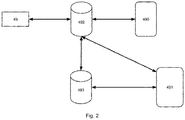
- FIG. 1 A specific example of the invention is schematically shown in the attached drawings showing the overall connection of the device to ensure complex surveillance of mobile housing objects ( Fig. 1 ) and the method of transmitting data via the LPWA/GNSS interface ( Fig. 2 ).
- the device for ensuring complex surveillance of mobile housing objects is implemented as part of a surveillance system comprising a control unit 1 , which includes a control microprocessor unit 11 to which data input blocks 2 , data output blocks 3 , a communication interface block 4, a power supply block 5, an accelerometer positioning block 6, a SIM-card block 7 with a connected SIM slot 71 fitted with a SIM card (not shown) and an SD-card block 8 with a connected SD slot 81 fitted with an SD card (not shown) are connected in parallel.
- the control microprocessor unit 11 is connected via the power supply block 5 to a low voltage power supply 50 of 12 V with an implemented 230/12 V converter (not shown), which is connected to a vehicle battery 51, a mains power supply 52 of 230 V and a leisure battery 53.
- a mains sensor 220 of the presence of mains voltage is further connected to an unmarked output of the mains power supply 52, which sensor is connected to the control microprocessor unit 11 via a mains input block 22.
- the vehicle battery 51 is further connected to the control microprocessor unit 11 via a battery input block 21.
- a solar sensor 230 for the presence of solar panel voltage is connected to a solar input block 23
- a detector 240 for the status of an ignition key is connected to an ignition input block 24
- at least one lighting sensor 250 for the status of lighting is connected to a lighting input block 250
- at least one alarm sensor 260 is connected to an alarm input block 26
- an external temperature sensor 271 and an internal temperature sensor 272 are connected to a temperature input block 27
- a waste water level meter 281 and a clean water level meter 282 are connected to a water tank input block 28.
- a waste tank heating element 310 is connected to a waste output block 310 for heating of a waste tank
- a water pump 320 is connected to a pump output block 32
- a ventilator 330 is connected to a ventilator output block 33
- an alarm 340 is connected to an alarm output block 344
- independent heating 350 is connected to a heating output block 35
- a door lock controller 360 is connected to a lock output block 36
- at least one lighting status controller 370 is connected to a lighting output block 37.
- the communication interface block 4 comprises the following wired communication interfaces connected to the control microprocessor unit 11 and connected to the monitored and controlled devices: a LIN-BUS bus 41 having a connector connected to heating 411, air conditioning 412 and a boiler 413 ; a CAN-BUS bus 42 having a connector connected to an air sensor 421 for external air status, a touch panel 422 and an infrared access interface 423 ; a UART bus 43 having a connector connected to a naviceiver 431 and a heating unit 432; an RS232 bus 44 having a connector connected to a touch display unit 440; an RS485 bus 45 having a connector connected to a power supply 450; a USB bus 46 having a connector.
- the communication interface block 4 also comprises the following wireless communication technologies connected to the control microprocessor unit 11 and connected to the monitored and controlled devices: an ISM radio interface 47, to which a weighing sensor 471 for measuring the weight of a gas bottle, at least one security sensor 472 for a closed door, a cooling sensor 473 for measuring temperature in a refrigerator, a temperature-humidity sensor 474 for measuring temperature, pressure and humidity, a smoke-gas sensor 475 for measuring carbon monoxide concentration and smoke detection, an RFID key 476 and one to ten universal wireless switches 477 are connected in parallel; a Bluetooth interface 48, to which at least one first mobile device 480 is connected via a mobile application (not shown); an LPWA/GNSS interface 49, to which at least one second mobile device 490 and/or a remote computer 491 (not shown in Figure 1 ) and/or a general external antenna are connected via a message exchange centre 492.
- an ISM radio interface 47 to which a weighing sensor 471 for measuring the weight of a gas bottle, at least one security
- the SIM card is used via the SIM-card block 8 by the control microprocessor unit 11 for telephone communications performed on telephone operator lines, which are carried out using the LPWA/GNSS interface 49.
- the control microprocessor unit 11 informs the user, using the touch display unit 441 and the mobile application on the mobile device 480, 490 which is connected to the control microprocessor unit 11 optionally via the Bluetooth interface 48 or the LPWA/GNSS interface 49, about the status of the individual connected devices which are also controlled by means of a mobile application in the mobile device 480, 490 and by means of the touch panel 422.
- the mobile device 490 uses the LPWA/GNSS interface 49, the mobile device 490 communicates via the message exchange centre 492.
- the remote computer 491 can be connected to the control microprocessor unit 11 via the LPWA/GNSS interface 49 and the message exchange centre 492, see Figure 2 .
- the control microprocessor unit 11 detects the tilt of a mobile residential object by means of the accelerometer positioning block 6.
- the control microprocessor unit 11 evaluates input data from the connected monitored devices and sends SMS information on the nature of the detected event to the paired mobile devices 480, 490 or to the remote computer 491, together with the display of a notification on the mobile application of the mobile device 480, 490, while at the same time taking appropriate measures corresponding to the nature of the non-standard event, such as starting a horn inside the object, launching ventilation of the interior space, and so on.
- the user may take certain measures themselves by sending an appropriate command to perform the requested action of a specific device connected to the control microprocessor unit 11.
- Activation in step f. means that at least one of the blocks 31 - 37 and the devices 310 , 320, 330, 340, 350, 360 and/or 370, or the communication interface block 4 and at least one of the bus/interfaces 41 - 47 and the devices 411 - 413 , 421 - 423 , 431 - 432, 440 , 450 and/or 471 - 477 perform their function.
- the wireless transmission in steps c. and e. between the message exchange centre 492 and the remote computer 491 may include storing input and/or output data in a database 493 , preferably in an SQL database.
- the sequence of steps in the method for providing complex surveillance of mobile housing objects by means of the Bluetooth interface 48 differs only in step c., when the input data are wirelessly transmitted from the control microprocessor unit 11 via the Bluetooth interface 48 to at least one mobile device 480 equipped with a mobile application, and in step e., when the output data are wirelessly transmitted in the opposite direction.
- the control microprocessor unit 11 can be equipped with a First In - First Out (FIFO) stack, so requests from the LPWA/GNSS and Bluetooth interfaces are handled sequentially to avoid command conflicts.
- FIFO First In - First Out
- the input data may include data about the location of said device, wherein the data can be transmitted via the LPWA/GNSS interface 49.
- the wireless transmission of the input data from the control microprocessor unit 11 to the mobile device 480 , 490 and/or the remote computer 491 in step c. may occur on the basis of:
- the above-disclosed method for providing complex surveillance of mobile housing objects by means of the LPWA/GNSS interface 49 or the Bluetooth interface 48 is operable by a computer program (a mobile application, a web application) comprising instructions which, when the program is executed by a mobile device 480 , 490 and/or a remote computer 491, cause the device for complex surveillance of mobile housing objects in combination with the mobile device 480 , 490 and/or the remote computer 491 to carry out the steps of the above-mentioned method.
- the computer program can be stored on a computer-readable data carrier (e. g. a CD, hard drive, etc.) or it can be carried by a data carrier signal (e. g. in case of downloading the program from the Internet).
- the device for complex surveillance of mobile housing objects is usable in caravans, recreational vehicles, mobile homes, ships and the like to facilitate the monitoring and control of individual devices related to the operation of these objects.
Landscapes
- Engineering & Computer Science (AREA)
- General Physics & Mathematics (AREA)
- Physics & Mathematics (AREA)
- Business, Economics & Management (AREA)
- Emergency Management (AREA)
- Mechanical Engineering (AREA)
- Theoretical Computer Science (AREA)
- Computer Networks & Wireless Communication (AREA)
- General Engineering & Computer Science (AREA)
- Human Computer Interaction (AREA)
- Chemical & Material Sciences (AREA)
- Analytical Chemistry (AREA)
- Selective Calling Equipment (AREA)
- Telephonic Communication Services (AREA)
- Alarm Systems (AREA)
Abstract
Description
- The invention falls within the scope of electronic control systems and relates to a device for ensuring complex surveillance of mobile housing objects, in particular caravans and recreational vehicles, and to a method for implementing said device.
- In the field of mobile housing objects, especially caravans, there is a number of systems informing users about the condition of installed devices, such as lighting, water heating, battery status, heating or air conditioning control or security of the object, which also allow setting their parameters. At present, the industrial standard of the Caravanning Industry Association, which uses a single CI-BUS, a Caravanning-Industry-BUS, is used primarily in the field of mobile residential surveillance devices. Solutions using different interfaces for control units are known, for example, the connection of devices using a serial data bus, a CAN-BUS, Controller Area Network, and some solutions use a universal asynchronous serial interface, i. e. UART. Units of an earlier production date are equipped with RS232 or RS485 buses. Many manufacturers of various devices also use 1-wire buses, or local serial digital buses, a LIN-BUS. Surveillance devices also use wireless communication technologies, such as wireless radio data link in ISM band, Bluetooth technology, or use GSM/GPRS mobile communication networks. The individual systems therefore have different means of communication and different ways of connecting to their control unit, and no solution is known that would allow comprehensive supervision of all installed devices of different manufacturers equipped with different communication interfaces and buses and which would therefore be equipped with all commonly used means of communication. However, if a mutual link between the different systems is not established, the optimal functioning of the whole system is not ensured and as much energy and media savings as possible is not possible.
- Also, in the field of mobile housing objects, especially recreational vehicles and caravans, there is a number of systems for monitoring or controlling the operation of their residential part, for example disclosed in the Czech utility model
CZ 30244 U1 - LPWA/GNSS interface arrangements are also known in the prior art, e. g. by Quectel (https://vyvoj.hw.cz/nova-rodina-modulu-lpwa-s-funkci-gnss.html; https://www.quectel.com/product/bg77.htm; https://www.quectel.com/product/bg95.htm; available on 6 May 2021).
- The aim of the presented invention is to link all information and control signals into one unit, which would ensure the processing of all data in real time and provide the user with information on the status of all devices in one place and allow them to be controlled or set up for automatic control, while at the same time the communication part of the unit would be characterized by low power and data consumption and high regional compatibility, while allowing the monitoring of the location of such controlled mobile housing object.
- The above-formulated aim is achieved by a device for complex surveillance of mobile housing objects according to
claim 1, the device comprising a control unit including a control microprocessor unit, and data input blocks, data output blocks, a communication interface block and a power supply block connected thereto. The data input blocks, the data output blocks, the communication interface block and the power supply block are connected to the control microprocessor unit in parallel. Optionally, an accelerometer positioning block, and/or a SIM-card block with a connected SIM-slot (SIM = subscriber identity module), and/or an SD-card block with a connected SD-slot (SD = secure digital) are connected to the control microprocessor unit. - The communication interface block comprises at least one wireless communication technology and at least two wired communication interfaces connected to the control microprocessor unit and selected from the group comprising a LIN-BUS bus having a connector (LIN = local interconnect network), a CAN-BUS bus having a connector (CAN = controller area network), a UART bus having a connector (UART = universal asynchronous receiver-transmitter), a USB bus having a connector (USB = universal serial bus), an RS232 bus having a connector (RS232 = recommended standard 232) and an RS485 bus having a connector (RS485 = recommended standard 485).
- In addition, the device comprises at least three data input blocks that are provided with connectors for connecting monitored apparatuses and that are selected from the group comprising a battery input block for the status of a vehicle battery, a mains input block for the presence of mains voltage, a solar input block for the presence of solar panel voltage, an ignition input block for the status of an ignition key, a lighting input block for the status of lighting, an alarm input block for alarm signalisation, a temperature input block for measuring external and internal temperature, a water tank input block for clean and waste water levels, as well as the device comprises at least three data output blocks that are provided with connectors for connecting controlled apparatuses and that are selected from the group comprising a waste output block for a waste tank heating element, a pump output block for a water pump, a ventilator output block for a ventilator, an alarm output block for an alarm, a heating output block for independent heating, a lock output block for a door lock controller, a lighting output block for a lighting status controller.
- The underlying idea of the invention is the fact that the wireless communication technology of the communication interface block is an LPWA/GNSS interface (LPWA = low-power wide-area; GNSS = global navigation satellite system), which can optionally be supplemented by at least one wireless communication technology selected from the group containing an ISM radio interface (ISM = industrial, scientific and medical) and a Bluetooth interface.
- In a basic embodiment, the communication interface block therefore contains the LPWA/GNSS interface, which allows the unit to communicate across an entire spectrum of mobile operator networks in different countries, where loT (Internet of things) networks are gradually being set up. On the one hand, this interface has higher signal penetration than commonly used GSM/GPRS transmissions (GSM = global system for mobile communications; GPRS = general packet radio service) and at the same time significantly lower power and data consumption, which is mainly reflected in the life of the leisure battery from which the unit is powered. Furthermore, if this module further comprises a GNSS interface, it is possible to determine the location of the mobile housing object and further process this information for further data outputs.
- In a preferred embodiment, the communication interface block comprises an ISM radio interface to which a weighing sensor for measuring the weight of a gas bottle is wirelessly connected.
- It is also advantageous when at least one device selected from the group comprising a security sensor for a closed door, a cooling sensor for measuring temperature in a refrigerator, a temperature-humidity sensor for measuring temperature, pressure and humidity, a smoke-gas sensor for measuring carbon monoxide concentration and smoke detection, an RFID key (RFID = radio-frequency identification) and between one to ten universal wireless switches is connected to the ISM radio interface.
- It is also advantageous when the power supply block is connected to a low-voltage power supply of 12 V having an implemented 230/12 V converter, which power supply is further connected to a vehicle battery, a mains power supply and a leisure battery, wherein the vehicle battery is further connected to the control microprocessor unit via the battery input block and a mains sensor for the presence of mains voltage is connected to an output of the mains power supply, which sensor is connected to the control microprocessor unit via the mains input block.
- Finally, it is advantageous when at least one mobile device equipped with a communication mobile application, and/or at least one remote computer equipped with a computer program and/or a communication web application is wirelessly connected to the Bluetooth interface and/or the LPWA/GNSS interface.
- Furthermore, the above-formulated aim is achieved by a method for complex surveillance of mobile housing objects according to
claim - The advantage of the Bluetooth interface when communicating with a mobile device is its proximity range, and thus the possibility of omitting additional communication links in the transmission chain (such as a message exchange centre) if only near-by control is required by the user.
- The advantage of requesting input data collection according to
claim 11 is that the device does not have to be constantly in communication with the mobile device and/or the remote computer (so-called lower data and power consumption), which is feasible only for LPWA network, e. g. of Narrowband loT or LTE-M type, where e. g. UDP network protocol is used. - Furthermore, the above-formulated aim is achieved by a computer program [product] according to claim 14 and by a data carrier or a signal thereof according to claim 15.
- The new invention achieves an improved effect in that a mutual link is established between the different systems of the mobile housing object, thus achieving optimal functioning of the whole system and ensuring the greatest possible savings in power, data and media, together with optimal security of the whole object and allowing the monitoring of the location of such a controlled mobile housing object.
- A specific example of the invention is schematically shown in the attached drawings showing the overall connection of the device to ensure complex surveillance of mobile housing objects (
Fig. 1 ) and the method of transmitting data via the LPWA/GNSS interface (Fig. 2 ). - The drawings depicting the present invention and the examples of particular embodiments described below in no way limit the scope of protection specified in the definition, but only clarify the subject-matter of the invention.
- The device for ensuring complex surveillance of mobile housing objects is implemented as part of a surveillance system comprising a
control unit 1, which includes acontrol microprocessor unit 11 to whichdata input blocks 2,data output blocks 3, acommunication interface block 4, apower supply block 5, anaccelerometer positioning block 6, a SIM-card block 7 with a connectedSIM slot 71 fitted with a SIM card (not shown) and an SD-card block 8 with a connectedSD slot 81 fitted with an SD card (not shown) are connected in parallel. Thecontrol microprocessor unit 11 is connected via thepower supply block 5 to a lowvoltage power supply 50 of 12 V with an implemented 230/12 V converter (not shown), which is connected to avehicle battery 51, amains power supply 52 of 230 V and aleisure battery 53. Amains sensor 220 of the presence of mains voltage is further connected to an unmarked output of themains power supply 52, which sensor is connected to thecontrol microprocessor unit 11 via amains input block 22. Thevehicle battery 51 is further connected to thecontrol microprocessor unit 11 via abattery input block 21. - Individual monitored apparatuses are further connected to the
data input blocks 2 via connectors (not shown) as follows: asolar sensor 230 for the presence of solar panel voltage is connected to asolar input block 23, adetector 240 for the status of an ignition key is connected to anignition input block 24, at least onelighting sensor 250 for the status of lighting is connected to alighting input block 250, at least onealarm sensor 260 is connected to analarm input block 26, anexternal temperature sensor 271 and aninternal temperature sensor 272 are connected to atemperature input block 27, a wastewater level meter 281 and a cleanwater level meter 282 are connected to a watertank input block 28. - Individual controlled devices are connected to the
data output blocks 3 via connectors (not shown) as follows: A wastetank heating element 310 is connected to awaste output block 310 for heating of a waste tank, awater pump 320 is connected to apump output block 32, aventilator 330 is connected to aventilator output block 33, analarm 340 is connected to an alarm output block 344,independent heating 350 is connected to aheating output block 35, adoor lock controller 360 is connected to alock output block 36, at least onelighting status controller 370 is connected to alighting output block 37. - The
communication interface block 4 comprises the following wired communication interfaces connected to thecontrol microprocessor unit 11 and connected to the monitored and controlled devices: a LIN-BUS bus 41 having a connector connected toheating 411,air conditioning 412 and aboiler 413; a CAN-BUS bus 42 having a connector connected to anair sensor 421 for external air status, atouch panel 422 and aninfrared access interface 423; aUART bus 43 having a connector connected to anaviceiver 431 and aheating unit 432; anRS232 bus 44 having a connector connected to atouch display unit 440; an RS485bus 45 having a connector connected to apower supply 450; aUSB bus 46 having a connector. - The
communication interface block 4 also comprises the following wireless communication technologies connected to thecontrol microprocessor unit 11 and connected to the monitored and controlled devices: anISM radio interface 47, to which aweighing sensor 471 for measuring the weight of a gas bottle, at least onesecurity sensor 472 for a closed door, acooling sensor 473 for measuring temperature in a refrigerator, a temperature-humidity sensor 474 for measuring temperature, pressure and humidity, a smoke-gas sensor 475 for measuring carbon monoxide concentration and smoke detection, anRFID key 476 and one to ten universalwireless switches 477 are connected in parallel; a Bluetoothinterface 48, to which at least one firstmobile device 480 is connected via a mobile application (not shown); an LPWA/GNSS interface 49, to which at least one secondmobile device 490 and/or a remote computer 491 (not shown inFigure 1 ) and/or a general external antenna are connected via amessage exchange centre 492. - The SIM card is used via the SIM-
card block 8 by thecontrol microprocessor unit 11 for telephone communications performed on telephone operator lines, which are carried out using the LPWA/GNSS interface 49. - The
control microprocessor unit 11 informs the user, using the touch display unit 441 and the mobile application on themobile device control microprocessor unit 11 optionally via the Bluetoothinterface 48 or the LPWA/GNSS interface 49, about the status of the individual connected devices which are also controlled by means of a mobile application in themobile device touch panel 422. Using the LPWA/GNSS interface 49, themobile device 490 communicates via themessage exchange centre 492. In addition, theremote computer 491 can be connected to thecontrol microprocessor unit 11 via the LPWA/GNSS interface 49 and themessage exchange centre 492, seeFigure 2 . - The
control microprocessor unit 11 detects the tilt of a mobile residential object by means of theaccelerometer positioning block 6. - In the event of a non-standard event or a crisis situation, such as fire, unauthorised intrusion of a foreign person, gas leakage and the like, which is captured by sensors of the installed equipment, the
control microprocessor unit 11 evaluates input data from the connected monitored devices and sends SMS information on the nature of the detected event to the pairedmobile devices remote computer 491, together with the display of a notification on the mobile application of themobile device control microprocessor unit 11. - The sequence of steps in the method for providing complex surveillance of mobile housing objects by means of the LPWA/
GNSS interface 49 is as follows (seeFigure 2 ): - a. providing a device for complex surveillance of mobile housing objects, the device comprising the
control unit 1 including thecontrol microprocessor unit 11 and at least threedata input blocks 2 connected thereto (blocks 21-28 anddevices data output blocks 3 connected thereto (blocks 31-37 anddevices communication interface block 4 connected thereto (bus/interface 41-47 and devices 411-413, 421-423, 431-432, 440, 450 and/or 471-477), thepower block 5 connected thereto (blocks 50-53) and optionally theaccelerometer positioning block 6 connected thereto, wherein thecommunication interface block 4 comprises a wireless communication technology in the form of the LPWA/GNSS interface 49 and at least two communication interfaces connected to thecontrol microprocessor unit 11 and selected from the group comprising the LIN-BUS bus 41 having a connector, the CAN-BUS bus 42 having a connector, theUART bus 43 having a connector, theUSB bus 46 having a connector, theRS232 bus 44 having a connector and theRS485 bus 45 having a connector, and optionally further the ISM radio interface 47 - preferably it is the device according to the invention, described above and inclaims 1 to 6 below; - b. collecting input data from at least one
data input block 2 and/or from at least one communication interface of thecommunication interface block 4 and/or optionally from theaccelerometer positioning block 6 to thecontrol microprocessor unit 11; - c. transmitting in a wireless manner the input data from the
control microprocessor unit 11 via the LPWA/GNSS interface 49 to the message exchange centre 492 (e. g. using a UDP network protocol), and further to at least onemobile device 490 equipped with a mobile application and/or to at least oneremote computer 491 equipped with a computer program or a web application (e. g. using a TCP/IP network protocol); - d. displaying the input data in the
mobile device 490 and/or in theremote computer 491 and based on the input data, creating output data in themobile device 490 by means of the mobile application and/or in theremote computer 491 by means of the computer program or the web application; - e. transmitting in a wireless manner the output data from the
mobile device 490 and/or from theremote computer 491 to themessage exchange centre 492, and further via the LPWA/GNSS interface 49 to thecontrol microprocessor unit 11; and - f. transmitting the output data from the
control microprocessor unit 11 to at least onedata output block 3 and/or to at least one communication interface of thecommunication interface block 4, thereby activating at least onedata output block 3 and/or to at least one communication interface of thecommunication interface block 4. - Activation in step f. means that at least one of the blocks 31-37 and the
devices communication interface block 4 and at least one of the bus/interfaces 41-47 and the devices 411-413, 421-423, 431-432, 440, 450 and/or 471-477 perform their function. - The wireless transmission in steps c. and e. between the
message exchange centre 492 and theremote computer 491 may include storing input and/or output data in adatabase 493, preferably in an SQL database. - The sequence of steps in the method for providing complex surveillance of mobile housing objects by means of the
Bluetooth interface 48 differs only in step c., when the input data are wirelessly transmitted from thecontrol microprocessor unit 11 via theBluetooth interface 48 to at least onemobile device 480 equipped with a mobile application, and in step e., when the output data are wirelessly transmitted in the opposite direction. Thecontrol microprocessor unit 11 can be equipped with a First In - First Out (FIFO) stack, so requests from the LPWA/GNSS and Bluetooth interfaces are handled sequentially to avoid command conflicts. - In any case, the input data may include data about the location of said device, wherein the data can be transmitted via the LPWA/
GNSS interface 49. - The wireless transmission of the input data from the
control microprocessor unit 11 to themobile device remote computer 491 in step c. may occur on the basis of: - a. a request for collecting input data sent from the
mobile device - b. an automatic setting of periodic transmission of the input data (e. g. when the mobile housing object is in motion and its location is sent to the dispatching centre via the GNSS interface, e. g. in the order of minutes or hours (e. g. every 1 minute));
- c. a warning signal of an emergency mode contained in the input data (e. g. if a non-standard event or a crisis situation occurs, e. g. fire, unauthorised intrusion of a foreign person, gas leakage or theft of the mobile housing object).
- The above-disclosed method for providing complex surveillance of mobile housing objects by means of the LPWA/
GNSS interface 49 or theBluetooth interface 48 is operable by a computer program (a mobile application, a web application) comprising instructions which, when the program is executed by amobile device remote computer 491, cause the device for complex surveillance of mobile housing objects in combination with themobile device remote computer 491 to carry out the steps of the above-mentioned method. The computer program can be stored on a computer-readable data carrier (e. g. a CD, hard drive, etc.) or it can be carried by a data carrier signal (e. g. in case of downloading the program from the Internet). - The device for complex surveillance of mobile housing objects is usable in caravans, recreational vehicles, mobile homes, ships and the like to facilitate the monitoring and control of individual devices related to the operation of these objects.
-
- 1 control unit
- 11 control microprocessor unit
- 2 data input block
- 21 battery input block the status of a
vehicle battery 51 - 22 mains input block for the presence of mains voltage
- 220 mains sensor for the presence of mains voltage
- 23 solar input block for the presence of solar panel voltage
- 230 solar sensor for the presence of solar panel voltage
- 24 ignition input block for the status of an ignition key
- 240 detector for the status of an ignition key
- 25 lighting input block for the status of lighting
- 250 lighting sensor for the status of lighting
- 26 alarm input block for alarm signalisation
- 260 alarm sensor
- 27 temperature input block for measuring external and internal temperature
- 271 external temperature sensor
- 272 internal temperature sensor
- 28 water tank input block for clean and waste water levels
- 281 waste water level meter
- 282 clean water level meter
- 3 data output block
- 31 waste output block for a waste
tank heating element 310 - 310 waste tank heating element
- 32 pump output block for a
water pump 320 - 320 water pump
- 33 ventilator output block for a
ventilator 330 - 330 ventilator
- 34 alarm output block for an
alarm 340 - 340 alarm
- 35 heating output block for
independent heating 350 - 350 independent heating
- 36 lock output block for a
door lock controller 360 - 360 door lock controller
- 37 lighting output block for a
lighting status controller 370 - 370 lighting status controller
- 4 communication interface block
- 41 LIN-BUS bus
- 411 heating
- 412 air-conditioning
- 413 boiler
- 42 CAN-BUS bus
- 421 air sensor for external air status
- 422 touch panel
- 423 infrared access interface
- 43 UART bus
- 431 naviceiver
- 432 heating unit
- 44 RS232 bus
- 440 touch display unit
- 45 RS485 bus
- 450 power supply
- 46 USB bus
- 47 ISM radio interface
- 471 weighing sensor for measuring the weight of a gas bottle
- 472 security sensor for a closed door
- 473 cooling sensor for measuring temperature in a refrigerator
- 474 temperature-humidity sensor for measuring temperature, pressure and humidity
- 475 smoke-gas sensor for measuring carbon monoxide concentration and smoke detection
- 476 RFID key
- 477 universal wireless switch
- 48 Bluetooth interface
- 480 first mobile device
- 49 LPWA/GNSS interface
- 490 second mobile device
- 491 remote computer
- 492 message exchange centre
- 493 database
- 5 power supply block
- 50 low-voltage power supply
- 51 vehicle battery
- 52 mains power supply
- 53 leisure battery
- 6 accelerometer positioning block
- 7 SIM-card block
- 71 SIM-slot
- 8 SD-card block
- 81 SD-slot
Claims (15)
- A device for complex surveillance of mobile housing objects, the device comprising a control unit (1) including a control microprocessor unit (11) and data input blocks (2), data output blocks (3), a communication interface block (4) and a power supply block (5) connected thereto,
wherein the data input blocks (2), the data output blocks (3), the communication interface block (4) and the power supply block (5) are connected to the control microprocessor unit (11) in parallel,
wherein optionally an accelerometer positioning block (6), and/or a SIM-card block (7) with a connected SIM-slot (71), and/or an SD-card block (8) with a connected SD-slot (81) are connected to the control microprocessor unit (11),
wherein the communication interface block (4) comprises at least one wireless communication technology and at least two wired communication interfaces connected to the control microprocessor unit (11) and selected from the group comprising a LIN-BUS bus (41) having a connector, a CAN-BUS bus (42) having a connector, a UART bus (43) having a connector, a USB bus (46) having a connector, an RS232 bus (44) having a connector and an RS485 bus (45) having a connector,
wherein the device comprises at least three data input blocks (2) that are provided with connectors for connecting monitored apparatuses and that are selected from the group comprising a battery input block (21) for the status of a vehicle battery (51), a mains input block (22) for the presence of mains voltage, a solar input block (23) for the presence of solar panel voltage, an ignition input block (24) for the status of an ignition key, a lighting input block (25) for the status of lighting, an alarm input block (26) for alarm signalisation, a temperature input block (27) for measuring external and internal temperature, a water tank input block (28) for clean and waste water levels,
wherein the device comprises at least three data output blocks (3) that are provided with connectors for connecting controlled apparatuses and that are selected from the group comprising a waste output block (31) for a waste tank heating element (310), a pump output block (32) for a water pump (320), a ventilator output block (33) for a ventilator (330), an alarm output block (34) for an alarm (340), a heating output block (35) for independent heating (350), a lock output block (36) for a door lock controller (360), a lighting output block (37) for a lighting status controller (370),
characterised in that the wireless communication technology of the communication interface block (4) is an LPWA/GNSS interface (49). - The device according to claim 1, characterised in that the communication interface block (4) further comprises at least one wireless communication technology selected from the group comprising an ISM radio interface (47) and a Bluetooth interface (48).
- The device according to claim 1 or 2, characterised in that the communication interface block (4) comprises the ISM radio interface (47) to which a weighing sensor (471) for measuring the weight of a gas bottle is wirelessly connected.
- The device according to any of claims 1 to 3, characterised in that the communication interface block (4) comprises the ISM radio interface (47) to which at least one device selected from the group comprising a security sensor (472) for a closed door, a cooling sensor (473) for measuring temperature in a refrigerator, a temperature-humidity sensor (474) for measuring temperature, pressure and humidity, a smoke-gas sensor (475) for measuring carbon monoxide concentration and smoke detection, an RFID key (476) and between one to ten universal wireless switches (477) is connected.
- The device according to any of the preceding claims, characterised in that the power supply block (5) is connected to a low-voltage power supply (50) of 12 V having an implemented 230/12 V converter, which power supply is further connected to a vehicle battery (51), a mains power supply (52) and a leisure battery (53), wherein the vehicle battery (51) is further connected to the control microprocessor unit (11) via the battery input block (21) and a mains sensor (220) for the presence of mains voltage is connected to an output of the mains power supply (52), which sensor is connected to the control microprocessor unit (11) via the mains input block (22).
- The device according to any of the preceding claims, characterised in that at least one mobile device (480, 490) equipped with a communication mobile application, and/or at least one remote computer (491) equipped with a computer program and/or a communication web application is wirelessly connectable to the Bluetooth interface (48) and/or the LPWA/GNSS interface (49).
- A method for complex surveillance of mobile housing objects, characterised in that it comprises the following steps:a. providing a device for complex surveillance of mobile housing objects, the device comprising a control unit (1) including a control microprocessor unit (11) and at least three data input blocks (2), at least three data output blocks (3), a communication interface block (4), a power supply block (5) and optionally an accelerometer positioning block (6) connected thereto, wherein the communication interface block (4) comprises a wireless communication technology in the form of an LPWA/GNSS interface (49) and at least two communication interfaces connected to the control microprocessor unit (11) and selected from the group comprising a LIN-BUS bus (41) having a connector, a CAN-BUS bus (42) having a connector, a UART bus (43) having a connector, a USB bus (46) having a connector, an RS232 bus (44) having a connector and an RS485 bus (45) having a connector, and optionally further an ISM radio interface (47);b. collecting input data from at least one data input block (2) and/or from at least one communication interface of the communication interface block (4) and/or optionally from the accelerometer positioning block (6) to the control microprocessor unit (11);c. transmitting in a wireless manner the input data from the control microprocessor unit (11) via the LPWA/GNSS interface (49) to a message exchange centre (492), and further to at least one mobile device (490) equipped with a mobile application and/or to at least one remote computer (491) equipped with a computer program or a web application;d. displaying the input data in the mobile device (490) and/or in the remote computer (491) and based on the input data, creating output data in the mobile device (490) by means of the mobile application and/or in the remote computer (491) by means of the computer program or the web application;e. transmitting in a wireless manner the output data from the mobile device (490) and/or from the remote computer (491) to the message exchange centre (492), and further via the LPWA/GNSS interface (49) to the control microprocessor unit (11); andf. transmitting the output data from the control microprocessor unit (11) to at least one data output block (3) and/or to at least one communication interface of the communication interface block (4), thereby activating at least one data output block (3) and/or to at least one communication interface of the communication interface block (4).
- A method for complex surveillance of mobile housing objects, characterised in that it comprises the following steps:a. providing a device for complex surveillance of mobile housing objects, the device comprising a control unit (1) including a control microprocessor unit (11) and at least three data input blocks (2), at least three data output blocks (3), a communication interface block (4), a power supply block (5) and optionally an accelerometer positioning block (6) connected thereto, wherein the communication interface block (4) comprises a wireless communication technology in the form of an LPWA/GNSS interface (49), a Bluetooth interface (48) and at least two communication interfaces connected to the control microprocessor unit (11) and selected from the group comprising a LIN-BUS bus (41) having a connector, a CAN-BUS bus (42) having a connector, a UART bus (43) having a connector, a USB bus (46) having a connector, an RS232 bus (44) having a connector and an RS485 bus (45) having a connector, and optionally further an ISM radio interface (47);b. collecting input data from at least one data input block (2) and/or from at least one communication interface of the communication interface block (4) and/or optionally from the accelerometer positioning block (6) to the control microprocessor unit (11);c. transmitting in a wireless manner the input data from the control microprocessor unit (11) via the Bluetooth interface (48) to at least one mobile device (480) equipped with a mobile application;d. displaying the input data in the mobile device (480) and based on the input data, creating output data in the mobile device (480) by means of the mobile application;e. transmitting in a wireless manner the output data from the mobile device (480) via the Bluetooth interface (48) to the control microprocessor unit (11); andf. transmitting the output data from the control microprocessor unit (11) to at least one data output block (3) and/or to at least one communication interface of the communication interface block (4), thereby activating at least one data output block (3) and/or to at least one communication interface of the communication interface block (4).
- The method according to claim 7, characterised in that the input data and/or the output data are stored in a database (493), preferably an SQL database, when they are transmitted in a wireless manner between the message exchange centre (492) and the remote computer (491) in the steps c. and/or e.
- The method according to any of claims 7 or 9, characterised in that the input data according to step b. of claim 7 further comprise positioning data of the device for complex surveillance of mobile housing objects and are transmitted according to step c. of claim 7.
- The method according to any of claims 7 to 10, characterised in that a request for input data collection according to step b. of claim 7 or 8, or optionally of claim 10 is transmitted in a wireless manner before step b. of claim 7 from the mobile device (490) and/or from the remote computer (491) to the message exchange centre (492), and further via the LPWA/GNSS interface (49) to the control microprocessor unit (11), or before step b. of claim 8 from the mobile device (480) via the Bluetooth interface (48) to the control microprocessor unit (11).
- The method according to any of claims 7 to 10, characterised in that transmission of the input data according to step c. of claim 7 or 8, or optionally of claim 10, is performed automatically periodically or provided that the input data include a warning signal of emergency mode.
- The method according to any of claims 7 to 12, characterised in that the data input blocks (2) are selected from the group comprising a battery input block (21) for the status of a vehicle battery (51), a mains input block (22) for the presence of mains voltage, a solar input block (23) for the presence of solar panel voltage, an ignition input block (24) for the status of an ignition key, a lighting input block (25) for the status of lighting, an alarm input block (26) for alarm signalisation, a temperature input block (27) for measuring external and internal temperature, a water tank input block (28) for clean and waste water levels,
wherein the data output blocks (3) are selected from the group comprising a waste output block (31) for a waste tank heating element (310), a pump output block (32) for a water pump (320), a ventilator output block (33) for a ventilator (330), an alarm output block (34) for an alarm (340), a heating output block (35) for independent heating (350), a lock output block (36) for a door lock controller (360), a lighting output block (37) for a lighting status controller (370),
wherein if said bus (41-45) or the ISM radio interface (47) is present, any of heating (411), air-conditioning (412) and/or a boiler (413) is connected to the LIN-BUS bus (41), wherein any of an air sensor (421) for external air status, a touch panel (422) and/or an infrared access interface (423) is connected to the CAN-BUS bus (42), wherein any of a naviceiver (431) and/or a heating unit (432) is connected to the UART bus (43), wherein a touch display unit (440) is connected to the RS232 bus (44), wherein a power supply (450) is connected to the RS485 bus (45), wherein any of a weighing sensor (471) for measuring the weight of a gas bottle, at least one security sensor (472) for a closed door, a cooling sensor (473) for measuring temperature in a refrigerator, a temperature-humidity sensor (474) for measuring temperature, pressure and humidity, a smoke-gas sensor (475) for measuring carbon monoxide concentration and smoke detection, an RFID key (476) and a universal wireless switch (477) is connected to the ISM radio interface (47). - A computer program [product] comprising instructions which, when the program is executed by a mobile device (480, 490) and/or a remote computer (491), cause the device for complex surveillance of mobile housing objects in combination with the mobile device (480, 490) and/or the remote computer (491) to carry out the steps b. to f. of the method according to claim 7 or 8, and optionally the steps b. to f. of the method according to any of claims 9 to 13.
- A computer-readable data carrier or a signal thereof, having stored thereon or carrying the computer program [product] according to claim 14.
Applications Claiming Priority (1)
| Application Number | Priority Date | Filing Date | Title |
|---|---|---|---|
| CZ2020-37513U CZ35178U1 (en) | 2020-05-06 | 2020-05-06 | Equipment for providing comprehensive supervision of mobile residential buildings |
Publications (3)
| Publication Number | Publication Date |
|---|---|
| EP3907712A1 true EP3907712A1 (en) | 2021-11-10 |
| EP3907712C0 EP3907712C0 (en) | 2023-08-30 |
| EP3907712B1 EP3907712B1 (en) | 2023-08-30 |
Family
ID=76543300
Family Applications (1)
| Application Number | Title | Priority Date | Filing Date |
|---|---|---|---|
| EP21020249.5A Active EP3907712B1 (en) | 2020-05-06 | 2021-05-06 | A device and a method for complex surveillance of mobile housing objects |
Country Status (2)
| Country | Link |
|---|---|
| EP (1) | EP3907712B1 (en) |
| CZ (1) | CZ35178U1 (en) |
Citations (5)
| Publication number | Priority date | Publication date | Assignee | Title |
|---|---|---|---|---|
| WO2004066275A2 (en) * | 2003-01-16 | 2004-08-05 | Obs Inc. | Systems and methods for mobile security and monitoring |
| US20090224896A1 (en) * | 2008-03-04 | 2009-09-10 | Toyota Motor Engineering & Manufacturing North America, Inc. | Method and system for intrusion detection |
| US20140306814A1 (en) * | 2013-04-15 | 2014-10-16 | Flextronics Ap, Llc | Pedestrian monitoring application |
| WO2016150424A1 (en) * | 2015-03-24 | 2016-09-29 | Huf Hülsbeck & Fürst Gmbh & Co. Kg | Monitoring module for monitoring a mobile device |
| CZ30244U1 (en) | 2016-11-02 | 2017-01-10 | Michal Provázek s.r.o. | A device for providing comprehensive supervision of mobile residential buildings |
-
2020
- 2020-05-06 CZ CZ2020-37513U patent/CZ35178U1/en not_active IP Right Cessation
-
2021
- 2021-05-06 EP EP21020249.5A patent/EP3907712B1/en active Active
Patent Citations (5)
| Publication number | Priority date | Publication date | Assignee | Title |
|---|---|---|---|---|
| WO2004066275A2 (en) * | 2003-01-16 | 2004-08-05 | Obs Inc. | Systems and methods for mobile security and monitoring |
| US20090224896A1 (en) * | 2008-03-04 | 2009-09-10 | Toyota Motor Engineering & Manufacturing North America, Inc. | Method and system for intrusion detection |
| US20140306814A1 (en) * | 2013-04-15 | 2014-10-16 | Flextronics Ap, Llc | Pedestrian monitoring application |
| WO2016150424A1 (en) * | 2015-03-24 | 2016-09-29 | Huf Hülsbeck & Fürst Gmbh & Co. Kg | Monitoring module for monitoring a mobile device |
| CZ30244U1 (en) | 2016-11-02 | 2017-01-10 | Michal Provázek s.r.o. | A device for providing comprehensive supervision of mobile residential buildings |
Non-Patent Citations (1)
| Title |
|---|
| "Correspondence of Final ATIS IoT Categorization", TP-2019-0174-CORRESPONDENCE_OF_FINAL_ATIS_IOT_CATEGORIZATION.ZIP, 16 October 2019 (2019-10-16) - 16 October 2019 (2019-10-16), XP084032508 * |
Also Published As
| Publication number | Publication date |
|---|---|
| CZ35178U1 (en) | 2021-06-22 |
| EP3907712C0 (en) | 2023-08-30 |
| EP3907712B1 (en) | 2023-08-30 |
Similar Documents
| Publication | Publication Date | Title |
|---|---|---|
| US11778144B2 (en) | Vehicle monitoring | |
| CN112272631B (en) | Vehicle remote control system, communication module, vehicle, server, vehicle remote control method, vehicle remote control program, and storage medium | |
| CN101857008B (en) | Active-mode intelligent safety monitoring instrument for car | |
| CN103019235B (en) | Intelligent remote diagnosis system and intelligent remote diagnosis method | |
| CN108466599A (en) | A kind of vehicle monitoring method and system | |
| CN102097003A (en) | Intelligent traffic safety system based on human condition recognition | |
| CN103763376A (en) | Intelligent automobile network cloud service system and method and special WIFI system for automobile network | |
| CN103543676B (en) | A kind of remote vehicular terminal based on safety and diagnosis | |
| JP2016094030A (en) | Remote controller for vehicle-mounted device and system | |
| CN104860234A (en) | Monitoring system based on Internet of Things for forklift in factory | |
| CN101624038B (en) | Vehicle real-time wireless sensing monitoring system | |
| CN108466529A (en) | A kind of Vehicular intelligent rescue system and method | |
| AU2007303668A1 (en) | Moving object position monitoring system | |
| CN110182153A (en) | A kind of vehicle mounted multimedia acquisition GPS and BDS signal logic method | |
| CN204567573U (en) | Based on automobile monitoring and the anti-theft system of 3G network | |
| EP3907712B1 (en) | A device and a method for complex surveillance of mobile housing objects | |
| CN205930055U (en) | High duty tire intelligence tire pressure detecting system | |
| CN202413303U (en) | Vehicle tire movement monitoring system | |
| CN106157392A (en) | Intelligent key system | |
| CZ30244U1 (en) | A device for providing comprehensive supervision of mobile residential buildings | |
| CN212202138U (en) | Coal mine safety monitoring system | |
| CN202142157U (en) | Residential Intelligent Anti-theft System Based on GSM/GPS | |
| CN111870839B (en) | Intelligent vehicle-mounted fire extinguisher management system based on Internet of things | |
| JP6775255B2 (en) | Remote controllers and systems for in-vehicle devices | |
| CN205091595U (en) | Long -range vehicle management system |
Legal Events
| Date | Code | Title | Description |
|---|---|---|---|
| PUAI | Public reference made under article 153(3) epc to a published international application that has entered the european phase |
Free format text: ORIGINAL CODE: 0009012 |
|
| STAA | Information on the status of an ep patent application or granted ep patent |
Free format text: STATUS: THE APPLICATION HAS BEEN PUBLISHED |
|
| AK | Designated contracting states |
Kind code of ref document: A1 Designated state(s): AL AT BE BG CH CY CZ DE DK EE ES FI FR GB GR HR HU IE IS IT LI LT LU LV MC MK MT NL NO PL PT RO RS SE SI SK SM TR |
|
| B565 | Issuance of search results under rule 164(2) epc |
Effective date: 20211004 |
|
| STAA | Information on the status of an ep patent application or granted ep patent |
Free format text: STATUS: REQUEST FOR EXAMINATION WAS MADE |
|
| 17P | Request for examination filed |
Effective date: 20220509 |
|
| RBV | Designated contracting states (corrected) |
Designated state(s): AL AT BE BG CH CY CZ DE DK EE ES FI FR GB GR HR HU IE IS IT LI LT LU LV MC MK MT NL NO PL PT RO RS SE SI SK SM TR |
|
| RIC1 | Information provided on ipc code assigned before grant |
Ipc: G08B 25/10 20060101ALI20220810BHEP Ipc: G08B 25/08 20060101ALI20220810BHEP Ipc: G08B 21/18 20060101ALI20220810BHEP Ipc: G08B 17/10 20060101ALI20220810BHEP Ipc: B60R 25/30 20130101ALI20220810BHEP Ipc: G08B 19/00 20060101ALI20220810BHEP Ipc: G08B 13/08 20060101AFI20220810BHEP |
|
| GRAP | Despatch of communication of intention to grant a patent |
Free format text: ORIGINAL CODE: EPIDOSNIGR1 |
|
| STAA | Information on the status of an ep patent application or granted ep patent |
Free format text: STATUS: GRANT OF PATENT IS INTENDED |
|
| INTG | Intention to grant announced |
Effective date: 20230324 |
|
| GRAS | Grant fee paid |
Free format text: ORIGINAL CODE: EPIDOSNIGR3 |
|
| GRAA | (expected) grant |
Free format text: ORIGINAL CODE: 0009210 |
|
| STAA | Information on the status of an ep patent application or granted ep patent |
Free format text: STATUS: THE PATENT HAS BEEN GRANTED |
|
| AK | Designated contracting states |
Kind code of ref document: B1 Designated state(s): AL AT BE BG CH CY CZ DE DK EE ES FI FR GB GR HR HU IE IS IT LI LT LU LV MC MK MT NL NO PL PT RO RS SE SI SK SM TR |
|
| RAP1 | Party data changed (applicant data changed or rights of an application transferred) |
Owner name: LARISSA HOLDING BV Owner name: MIARE B.V. |
|
| REG | Reference to a national code |
Ref country code: GB Ref legal event code: FG4D |
|
| REG | Reference to a national code |
Ref country code: CH Ref legal event code: PK Free format text: BERICHTIGUNGEN Ref country code: CH Ref legal event code: EP |
|
| REG | Reference to a national code |
Ref country code: DE Ref legal event code: R096 Ref document number: 602021004560 Country of ref document: DE |
|
| REG | Reference to a national code |
Ref country code: IE Ref legal event code: FG4D |
|
| RIN2 | Information on inventor provided after grant (corrected) |
Inventor name: THE INVENTOR HAS WAIVED HIS RIGHT TO BE THUS MENTIONED. |
|
| U01 | Request for unitary effect filed |
Effective date: 20230920 |
|
| U07 | Unitary effect registered |
Designated state(s): AT BE BG DE DK EE FI FR IT LT LU LV MT NL PT SE SI Effective date: 20230929 |
|
| PG25 | Lapsed in a contracting state [announced via postgrant information from national office to epo] |
Ref country code: GR Free format text: LAPSE BECAUSE OF FAILURE TO SUBMIT A TRANSLATION OF THE DESCRIPTION OR TO PAY THE FEE WITHIN THE PRESCRIBED TIME-LIMIT Effective date: 20231201 |
|
| PG25 | Lapsed in a contracting state [announced via postgrant information from national office to epo] |
Ref country code: IS Free format text: LAPSE BECAUSE OF FAILURE TO SUBMIT A TRANSLATION OF THE DESCRIPTION OR TO PAY THE FEE WITHIN THE PRESCRIBED TIME-LIMIT Effective date: 20231230 |
|
| PG25 | Lapsed in a contracting state [announced via postgrant information from national office to epo] |
Ref country code: RS Free format text: LAPSE BECAUSE OF FAILURE TO SUBMIT A TRANSLATION OF THE DESCRIPTION OR TO PAY THE FEE WITHIN THE PRESCRIBED TIME-LIMIT Effective date: 20230830 Ref country code: NO Free format text: LAPSE BECAUSE OF FAILURE TO SUBMIT A TRANSLATION OF THE DESCRIPTION OR TO PAY THE FEE WITHIN THE PRESCRIBED TIME-LIMIT Effective date: 20231130 Ref country code: IS Free format text: LAPSE BECAUSE OF FAILURE TO SUBMIT A TRANSLATION OF THE DESCRIPTION OR TO PAY THE FEE WITHIN THE PRESCRIBED TIME-LIMIT Effective date: 20231230 Ref country code: HR Free format text: LAPSE BECAUSE OF FAILURE TO SUBMIT A TRANSLATION OF THE DESCRIPTION OR TO PAY THE FEE WITHIN THE PRESCRIBED TIME-LIMIT Effective date: 20230830 Ref country code: GR Free format text: LAPSE BECAUSE OF FAILURE TO SUBMIT A TRANSLATION OF THE DESCRIPTION OR TO PAY THE FEE WITHIN THE PRESCRIBED TIME-LIMIT Effective date: 20231201 |
|
| PG25 | Lapsed in a contracting state [announced via postgrant information from national office to epo] |
Ref country code: PL Free format text: LAPSE BECAUSE OF FAILURE TO SUBMIT A TRANSLATION OF THE DESCRIPTION OR TO PAY THE FEE WITHIN THE PRESCRIBED TIME-LIMIT Effective date: 20230830 |
|
| PG25 | Lapsed in a contracting state [announced via postgrant information from national office to epo] |
Ref country code: ES Free format text: LAPSE BECAUSE OF FAILURE TO SUBMIT A TRANSLATION OF THE DESCRIPTION OR TO PAY THE FEE WITHIN THE PRESCRIBED TIME-LIMIT Effective date: 20230830 |
|
| PG25 | Lapsed in a contracting state [announced via postgrant information from national office to epo] |
Ref country code: SM Free format text: LAPSE BECAUSE OF FAILURE TO SUBMIT A TRANSLATION OF THE DESCRIPTION OR TO PAY THE FEE WITHIN THE PRESCRIBED TIME-LIMIT Effective date: 20230830 Ref country code: RO Free format text: LAPSE BECAUSE OF FAILURE TO SUBMIT A TRANSLATION OF THE DESCRIPTION OR TO PAY THE FEE WITHIN THE PRESCRIBED TIME-LIMIT Effective date: 20230830 Ref country code: ES Free format text: LAPSE BECAUSE OF FAILURE TO SUBMIT A TRANSLATION OF THE DESCRIPTION OR TO PAY THE FEE WITHIN THE PRESCRIBED TIME-LIMIT Effective date: 20230830 Ref country code: CZ Free format text: LAPSE BECAUSE OF FAILURE TO SUBMIT A TRANSLATION OF THE DESCRIPTION OR TO PAY THE FEE WITHIN THE PRESCRIBED TIME-LIMIT Effective date: 20230830 Ref country code: SK Free format text: LAPSE BECAUSE OF FAILURE TO SUBMIT A TRANSLATION OF THE DESCRIPTION OR TO PAY THE FEE WITHIN THE PRESCRIBED TIME-LIMIT Effective date: 20230830 |
|
| REG | Reference to a national code |
Ref country code: DE Ref legal event code: R097 Ref document number: 602021004560 Country of ref document: DE |
|
| U20 | Renewal fee for the european patent with unitary effect paid |
Year of fee payment: 4 Effective date: 20240523 |
|
| PLBE | No opposition filed within time limit |
Free format text: ORIGINAL CODE: 0009261 |
|
| STAA | Information on the status of an ep patent application or granted ep patent |
Free format text: STATUS: NO OPPOSITION FILED WITHIN TIME LIMIT |
|
| 26N | No opposition filed |
Effective date: 20240603 |
|
| REG | Reference to a national code |
Ref country code: CH Ref legal event code: PL |
|
| PG25 | Lapsed in a contracting state [announced via postgrant information from national office to epo] |
Ref country code: MC Free format text: LAPSE BECAUSE OF FAILURE TO SUBMIT A TRANSLATION OF THE DESCRIPTION OR TO PAY THE FEE WITHIN THE PRESCRIBED TIME-LIMIT Effective date: 20230830 |
|
| PG25 | Lapsed in a contracting state [announced via postgrant information from national office to epo] |
Ref country code: MC Free format text: LAPSE BECAUSE OF FAILURE TO SUBMIT A TRANSLATION OF THE DESCRIPTION OR TO PAY THE FEE WITHIN THE PRESCRIBED TIME-LIMIT Effective date: 20230830 Ref country code: CH Free format text: LAPSE BECAUSE OF NON-PAYMENT OF DUE FEES Effective date: 20240531 |
|
| PG25 | Lapsed in a contracting state [announced via postgrant information from national office to epo] |
Ref country code: IE Free format text: LAPSE BECAUSE OF NON-PAYMENT OF DUE FEES Effective date: 20240506 |
|
| U20 | Renewal fee for the european patent with unitary effect paid |
Year of fee payment: 5 Effective date: 20250512 |
|
| PG25 | Lapsed in a contracting state [announced via postgrant information from national office to epo] |
Ref country code: CY Free format text: LAPSE BECAUSE OF FAILURE TO SUBMIT A TRANSLATION OF THE DESCRIPTION OR TO PAY THE FEE WITHIN THE PRESCRIBED TIME-LIMIT; INVALID AB INITIO Effective date: 20210506 |
|
| PG25 | Lapsed in a contracting state [announced via postgrant information from national office to epo] |
Ref country code: HU Free format text: LAPSE BECAUSE OF FAILURE TO SUBMIT A TRANSLATION OF THE DESCRIPTION OR TO PAY THE FEE WITHIN THE PRESCRIBED TIME-LIMIT; INVALID AB INITIO Effective date: 20210506 |
|
| GBPC | Gb: european patent ceased through non-payment of renewal fee |
Effective date: 20250506 |
|
| PG25 | Lapsed in a contracting state [announced via postgrant information from national office to epo] |
Ref country code: GB Free format text: LAPSE BECAUSE OF NON-PAYMENT OF DUE FEES Effective date: 20250506 |