EP3907248A1 - Manufacturing method for composite materials - Google Patents
Manufacturing method for composite materials Download PDFInfo
- Publication number
- EP3907248A1 EP3907248A1 EP21171293.0A EP21171293A EP3907248A1 EP 3907248 A1 EP3907248 A1 EP 3907248A1 EP 21171293 A EP21171293 A EP 21171293A EP 3907248 A1 EP3907248 A1 EP 3907248A1
- Authority
- EP
- European Patent Office
- Prior art keywords
- temperature
- resin composition
- bismaleimide
- prepreg
- composite material
- Prior art date
- Legal status (The legal status is an assumption and is not a legal conclusion. Google has not performed a legal analysis and makes no representation as to the accuracy of the status listed.)
- Pending
Links
- 238000004519 manufacturing process Methods 0.000 title claims description 73
- 239000002131 composite material Substances 0.000 title claims description 27
- 239000011342 resin composition Substances 0.000 claims abstract description 122
- 229920003192 poly(bis maleimide) Polymers 0.000 claims abstract description 107
- XQUPVDVFXZDTLT-UHFFFAOYSA-N 1-[4-[[4-(2,5-dioxopyrrol-1-yl)phenyl]methyl]phenyl]pyrrole-2,5-dione Chemical compound O=C1C=CC(=O)N1C(C=C1)=CC=C1CC1=CC=C(N2C(C=CC2=O)=O)C=C1 XQUPVDVFXZDTLT-UHFFFAOYSA-N 0.000 claims abstract description 76
- 239000000463 material Substances 0.000 claims abstract description 70
- 238000010438 heat treatment Methods 0.000 claims abstract description 55
- 239000000835 fiber Substances 0.000 claims abstract description 39
- 230000002787 reinforcement Effects 0.000 claims abstract description 32
- 229920005989 resin Polymers 0.000 claims abstract description 30
- 239000011347 resin Substances 0.000 claims abstract description 30
- -1 bismaleimide compound Chemical class 0.000 claims description 76
- 238000000465 moulding Methods 0.000 claims description 43
- 229920000049 Carbon (fiber) Polymers 0.000 claims description 30
- 239000004917 carbon fiber Substances 0.000 claims description 30
- VNWKTOKETHGBQD-UHFFFAOYSA-N methane Chemical compound C VNWKTOKETHGBQD-UHFFFAOYSA-N 0.000 claims description 30
- 238000000034 method Methods 0.000 claims description 21
- 238000004949 mass spectrometry Methods 0.000 claims description 12
- 230000000630 rising effect Effects 0.000 claims description 8
- 239000003733 fiber-reinforced composite Substances 0.000 description 49
- 229920005992 thermoplastic resin Polymers 0.000 description 29
- 238000001723 curing Methods 0.000 description 23
- 239000000126 substance Substances 0.000 description 21
- 150000002500 ions Chemical class 0.000 description 16
- 239000011800 void material Substances 0.000 description 15
- 239000000047 product Substances 0.000 description 11
- 125000004432 carbon atom Chemical group C* 0.000 description 10
- 238000005259 measurement Methods 0.000 description 10
- 239000000203 mixture Substances 0.000 description 9
- VLKZOEOYAKHREP-UHFFFAOYSA-N n-Hexane Chemical compound CCCCCC VLKZOEOYAKHREP-UHFFFAOYSA-N 0.000 description 9
- 125000003342 alkenyl group Chemical group 0.000 description 8
- 239000007787 solid Substances 0.000 description 8
- 230000000052 comparative effect Effects 0.000 description 6
- 239000011229 interlayer Substances 0.000 description 6
- 150000001875 compounds Chemical class 0.000 description 5
- 239000002657 fibrous material Substances 0.000 description 5
- 230000000704 physical effect Effects 0.000 description 5
- 125000003903 2-propenyl group Chemical group [H]C([*])([H])C([H])=C([H])[H] 0.000 description 4
- WOCGGVRGNIEDSZ-UHFFFAOYSA-N 4-[2-(4-hydroxy-3-prop-2-enylphenyl)propan-2-yl]-2-prop-2-enylphenol Chemical compound C=1C=C(O)C(CC=C)=CC=1C(C)(C)C1=CC=C(O)C(CC=C)=C1 WOCGGVRGNIEDSZ-UHFFFAOYSA-N 0.000 description 4
- RTZKZFJDLAIYFH-UHFFFAOYSA-N Diethyl ether Chemical compound CCOCC RTZKZFJDLAIYFH-UHFFFAOYSA-N 0.000 description 4
- ATUOYWHBWRKTHZ-UHFFFAOYSA-N Propane Chemical compound CCC ATUOYWHBWRKTHZ-UHFFFAOYSA-N 0.000 description 4
- 125000003118 aryl group Chemical group 0.000 description 4
- 238000006243 chemical reaction Methods 0.000 description 4
- 239000003795 chemical substances by application Substances 0.000 description 4
- 239000012467 final product Substances 0.000 description 4
- 229910052739 hydrogen Inorganic materials 0.000 description 4
- 239000001257 hydrogen Substances 0.000 description 4
- 238000005470 impregnation Methods 0.000 description 4
- 229920001721 polyimide Polymers 0.000 description 4
- 125000004368 propenyl group Chemical group C(=CC)* 0.000 description 4
- XAZPKEBWNIUCKF-UHFFFAOYSA-N 1-[4-[4-[2-[4-[4-(2,5-dioxopyrrol-1-yl)phenoxy]phenyl]propan-2-yl]phenoxy]phenyl]pyrrole-2,5-dione Chemical compound C=1C=C(OC=2C=CC(=CC=2)N2C(C=CC2=O)=O)C=CC=1C(C)(C)C(C=C1)=CC=C1OC(C=C1)=CC=C1N1C(=O)C=CC1=O XAZPKEBWNIUCKF-UHFFFAOYSA-N 0.000 description 3
- MOSSLXZUUKTULI-UHFFFAOYSA-N 3-[3-(2,5-dioxopyrrol-3-yl)-4-methylphenyl]pyrrole-2,5-dione Chemical compound CC1=CC=C(C=2C(NC(=O)C=2)=O)C=C1C1=CC(=O)NC1=O MOSSLXZUUKTULI-UHFFFAOYSA-N 0.000 description 3
- 239000004697 Polyetherimide Substances 0.000 description 3
- 239000004642 Polyimide Substances 0.000 description 3
- 239000012965 benzophenone Substances 0.000 description 3
- 238000013329 compounding Methods 0.000 description 3
- 238000013007 heat curing Methods 0.000 description 3
- 239000007788 liquid Substances 0.000 description 3
- 239000002245 particle Substances 0.000 description 3
- 229920002239 polyacrylonitrile Polymers 0.000 description 3
- 229920001601 polyetherimide Polymers 0.000 description 3
- DRWLKECFWWDHJL-UHFFFAOYSA-N C1(C=CC(N1)=O)=O.C1(C=CC(N1)=O)=O.NCCCCCCN Chemical compound C1(C=CC(N1)=O)=O.C1(C=CC(N1)=O)=O.NCCCCCCN DRWLKECFWWDHJL-UHFFFAOYSA-N 0.000 description 2
- UFHFLCQGNIYNRP-UHFFFAOYSA-N Hydrogen Chemical compound [H][H] UFHFLCQGNIYNRP-UHFFFAOYSA-N 0.000 description 2
- 125000000217 alkyl group Chemical group 0.000 description 2
- 229920006231 aramid fiber Polymers 0.000 description 2
- 238000011074 autoclave method Methods 0.000 description 2
- 239000003365 glass fiber Substances 0.000 description 2
- PCHJSUWPFVWCPO-UHFFFAOYSA-N gold Chemical compound [Au] PCHJSUWPFVWCPO-UHFFFAOYSA-N 0.000 description 2
- 150000002431 hydrogen Chemical class 0.000 description 2
- 238000006116 polymerization reaction Methods 0.000 description 2
- 230000008569 process Effects 0.000 description 2
- 239000001294 propane Substances 0.000 description 2
- 239000000376 reactant Substances 0.000 description 2
- 238000010998 test method Methods 0.000 description 2
- 239000002562 thickening agent Substances 0.000 description 2
- 239000002759 woven fabric Substances 0.000 description 2
- PUKLCKVOVCZYKF-UHFFFAOYSA-N 1-[2-(2,5-dioxopyrrol-1-yl)ethyl]pyrrole-2,5-dione Chemical compound O=C1C=CC(=O)N1CCN1C(=O)C=CC1=O PUKLCKVOVCZYKF-UHFFFAOYSA-N 0.000 description 1
- FJKKJQRXSPFNPM-UHFFFAOYSA-N 1-[3-(2,5-dioxopyrrol-1-yl)-4-methylphenyl]pyrrole-2,5-dione Chemical compound CC1=CC=C(N2C(C=CC2=O)=O)C=C1N1C(=O)C=CC1=O FJKKJQRXSPFNPM-UHFFFAOYSA-N 0.000 description 1
- IPJGAEWUPXWFPL-UHFFFAOYSA-N 1-[3-(2,5-dioxopyrrol-1-yl)phenyl]pyrrole-2,5-dione Chemical compound O=C1C=CC(=O)N1C1=CC=CC(N2C(C=CC2=O)=O)=C1 IPJGAEWUPXWFPL-UHFFFAOYSA-N 0.000 description 1
- FXEKNWLZNLIDNR-UHFFFAOYSA-N 1-[3-(2,5-dioxopyrrol-1-yl)propyl]pyrrole-2,5-dione Chemical compound O=C1C=CC(=O)N1CCCN1C(=O)C=CC1=O FXEKNWLZNLIDNR-UHFFFAOYSA-N 0.000 description 1
- AQGZJQNZNONGKY-UHFFFAOYSA-N 1-[4-(2,5-dioxopyrrol-1-yl)phenyl]pyrrole-2,5-dione Chemical compound O=C1C=CC(=O)N1C1=CC=C(N2C(C=CC2=O)=O)C=C1 AQGZJQNZNONGKY-UHFFFAOYSA-N 0.000 description 1
- QIRNGVVZBINFMX-UHFFFAOYSA-N 2-allylphenol Chemical compound OC1=CC=CC=C1CC=C QIRNGVVZBINFMX-UHFFFAOYSA-N 0.000 description 1
- ZOXJGFHDIHLPTG-UHFFFAOYSA-N Boron Chemical compound [B] ZOXJGFHDIHLPTG-UHFFFAOYSA-N 0.000 description 1
- 238000005821 Claisen rearrangement reaction Methods 0.000 description 1
- ISWSIDIOOBJBQZ-UHFFFAOYSA-N Phenol Chemical compound OC1=CC=CC=C1 ISWSIDIOOBJBQZ-UHFFFAOYSA-N 0.000 description 1
- 239000004695 Polyether sulfone Substances 0.000 description 1
- 239000000654 additive Substances 0.000 description 1
- 125000001931 aliphatic group Chemical group 0.000 description 1
- PNEYBMLMFCGWSK-UHFFFAOYSA-N aluminium oxide Inorganic materials [O-2].[O-2].[O-2].[Al+3].[Al+3] PNEYBMLMFCGWSK-UHFFFAOYSA-N 0.000 description 1
- 230000002457 bidirectional effect Effects 0.000 description 1
- 230000015572 biosynthetic process Effects 0.000 description 1
- 229910052796 boron Inorganic materials 0.000 description 1
- 239000000919 ceramic Substances 0.000 description 1
- 239000003086 colorant Substances 0.000 description 1
- 230000006835 compression Effects 0.000 description 1
- 238000007906 compression Methods 0.000 description 1
- 239000011231 conductive filler Substances 0.000 description 1
- 238000004090 dissolution Methods 0.000 description 1
- 239000000945 filler Substances 0.000 description 1
- 230000009477 glass transition Effects 0.000 description 1
- 238000010191 image analysis Methods 0.000 description 1
- 239000003112 inhibitor Substances 0.000 description 1
- 239000011256 inorganic filler Substances 0.000 description 1
- 229910003475 inorganic filler Inorganic materials 0.000 description 1
- 239000002184 metal Substances 0.000 description 1
- 229910052751 metal Inorganic materials 0.000 description 1
- 239000002557 mineral fiber Substances 0.000 description 1
- 239000004745 nonwoven fabric Substances 0.000 description 1
- 239000000049 pigment Substances 0.000 description 1
- 229920002492 poly(sulfone) Polymers 0.000 description 1
- 229920000728 polyester Polymers 0.000 description 1
- 229920006393 polyether sulfone Polymers 0.000 description 1
- 239000009719 polyimide resin Substances 0.000 description 1
- 229920000642 polymer Polymers 0.000 description 1
- 239000002994 raw material Substances 0.000 description 1
- 230000009467 reduction Effects 0.000 description 1
- 239000011435 rock Substances 0.000 description 1
- HBMJWWWQQXIZIP-UHFFFAOYSA-N silicon carbide Chemical compound [Si+]#[C-] HBMJWWWQQXIZIP-UHFFFAOYSA-N 0.000 description 1
- 229910010271 silicon carbide Inorganic materials 0.000 description 1
- 239000003381 stabilizer Substances 0.000 description 1
- 229920001187 thermosetting polymer Polymers 0.000 description 1
Classifications
-
- C—CHEMISTRY; METALLURGY
- C08—ORGANIC MACROMOLECULAR COMPOUNDS; THEIR PREPARATION OR CHEMICAL WORKING-UP; COMPOSITIONS BASED THEREON
- C08J—WORKING-UP; GENERAL PROCESSES OF COMPOUNDING; AFTER-TREATMENT NOT COVERED BY SUBCLASSES C08B, C08C, C08F, C08G or C08H
- C08J5/00—Manufacture of articles or shaped materials containing macromolecular substances
- C08J5/04—Reinforcing macromolecular compounds with loose or coherent fibrous material
-
- B—PERFORMING OPERATIONS; TRANSPORTING
- B29—WORKING OF PLASTICS; WORKING OF SUBSTANCES IN A PLASTIC STATE IN GENERAL
- B29C—SHAPING OR JOINING OF PLASTICS; SHAPING OF MATERIAL IN A PLASTIC STATE, NOT OTHERWISE PROVIDED FOR; AFTER-TREATMENT OF THE SHAPED PRODUCTS, e.g. REPAIRING
- B29C35/00—Heating, cooling or curing, e.g. crosslinking or vulcanising; Apparatus therefor
- B29C35/02—Heating or curing, e.g. crosslinking or vulcanizing during moulding, e.g. in a mould
- B29C35/0288—Controlling heating or curing of polymers during moulding, e.g. by measuring temperatures or properties of the polymer and regulating the process
- B29C35/0294—Controlling heating or curing of polymers during moulding, e.g. by measuring temperatures or properties of the polymer and regulating the process using tempering units for temperature control of moulds or cores
-
- B—PERFORMING OPERATIONS; TRANSPORTING
- B29—WORKING OF PLASTICS; WORKING OF SUBSTANCES IN A PLASTIC STATE IN GENERAL
- B29C—SHAPING OR JOINING OF PLASTICS; SHAPING OF MATERIAL IN A PLASTIC STATE, NOT OTHERWISE PROVIDED FOR; AFTER-TREATMENT OF THE SHAPED PRODUCTS, e.g. REPAIRING
- B29C70/00—Shaping composites, i.e. plastics material comprising reinforcements, fillers or preformed parts, e.g. inserts
- B29C70/003—Shaping composites, i.e. plastics material comprising reinforcements, fillers or preformed parts, e.g. inserts characterised by the matrix material, e.g. material composition or physical properties
-
- B—PERFORMING OPERATIONS; TRANSPORTING
- B29—WORKING OF PLASTICS; WORKING OF SUBSTANCES IN A PLASTIC STATE IN GENERAL
- B29C—SHAPING OR JOINING OF PLASTICS; SHAPING OF MATERIAL IN A PLASTIC STATE, NOT OTHERWISE PROVIDED FOR; AFTER-TREATMENT OF THE SHAPED PRODUCTS, e.g. REPAIRING
- B29C70/00—Shaping composites, i.e. plastics material comprising reinforcements, fillers or preformed parts, e.g. inserts
- B29C70/02—Shaping composites, i.e. plastics material comprising reinforcements, fillers or preformed parts, e.g. inserts comprising combinations of reinforcements, e.g. non-specified reinforcements, fibrous reinforcing inserts and fillers, e.g. particulate fillers, incorporated in matrix material, forming one or more layers and with or without non-reinforced or non-filled layers
- B29C70/021—Combinations of fibrous reinforcement and non-fibrous material
- B29C70/025—Combinations of fibrous reinforcement and non-fibrous material with particular filler
-
- C—CHEMISTRY; METALLURGY
- C08—ORGANIC MACROMOLECULAR COMPOUNDS; THEIR PREPARATION OR CHEMICAL WORKING-UP; COMPOSITIONS BASED THEREON
- C08J—WORKING-UP; GENERAL PROCESSES OF COMPOUNDING; AFTER-TREATMENT NOT COVERED BY SUBCLASSES C08B, C08C, C08F, C08G or C08H
- C08J5/00—Manufacture of articles or shaped materials containing macromolecular substances
- C08J5/04—Reinforcing macromolecular compounds with loose or coherent fibrous material
- C08J5/0405—Reinforcing macromolecular compounds with loose or coherent fibrous material with inorganic fibres
- C08J5/042—Reinforcing macromolecular compounds with loose or coherent fibrous material with inorganic fibres with carbon fibres
-
- B—PERFORMING OPERATIONS; TRANSPORTING
- B29—WORKING OF PLASTICS; WORKING OF SUBSTANCES IN A PLASTIC STATE IN GENERAL
- B29K—INDEXING SCHEME ASSOCIATED WITH SUBCLASSES B29B, B29C OR B29D, RELATING TO MOULDING MATERIALS OR TO MATERIALS FOR MOULDS, REINFORCEMENTS, FILLERS OR PREFORMED PARTS, e.g. INSERTS
- B29K2063/00—Use of EP, i.e. epoxy resins or derivatives thereof, as moulding material
-
- B—PERFORMING OPERATIONS; TRANSPORTING
- B29—WORKING OF PLASTICS; WORKING OF SUBSTANCES IN A PLASTIC STATE IN GENERAL
- B29K—INDEXING SCHEME ASSOCIATED WITH SUBCLASSES B29B, B29C OR B29D, RELATING TO MOULDING MATERIALS OR TO MATERIALS FOR MOULDS, REINFORCEMENTS, FILLERS OR PREFORMED PARTS, e.g. INSERTS
- B29K2079/00—Use of polymers having nitrogen, with or without oxygen or carbon only, in the main chain, not provided for in groups B29K2061/00 - B29K2077/00, as moulding material
- B29K2079/08—PI, i.e. polyimides or derivatives thereof
-
- B—PERFORMING OPERATIONS; TRANSPORTING
- B29—WORKING OF PLASTICS; WORKING OF SUBSTANCES IN A PLASTIC STATE IN GENERAL
- B29K—INDEXING SCHEME ASSOCIATED WITH SUBCLASSES B29B, B29C OR B29D, RELATING TO MOULDING MATERIALS OR TO MATERIALS FOR MOULDS, REINFORCEMENTS, FILLERS OR PREFORMED PARTS, e.g. INSERTS
- B29K2307/00—Use of elements other than metals as reinforcement
- B29K2307/04—Carbon
-
- C—CHEMISTRY; METALLURGY
- C08—ORGANIC MACROMOLECULAR COMPOUNDS; THEIR PREPARATION OR CHEMICAL WORKING-UP; COMPOSITIONS BASED THEREON
- C08J—WORKING-UP; GENERAL PROCESSES OF COMPOUNDING; AFTER-TREATMENT NOT COVERED BY SUBCLASSES C08B, C08C, C08F, C08G or C08H
- C08J2379/00—Characterised by the use of macromolecular compounds obtained by reactions forming in the main chain of the macromolecule a linkage containing nitrogen with or without oxygen, or carbon only, not provided for in groups C08J2361/00 - C08J2377/00
- C08J2379/04—Polycondensates having nitrogen-containing heterocyclic rings in the main chain; Polyhydrazides; Polyamide acids or similar polyimide precursors
- C08J2379/08—Polyimides; Polyester-imides; Polyamide-imides; Polyamide acids or similar polyimide precursors
-
- C—CHEMISTRY; METALLURGY
- C08—ORGANIC MACROMOLECULAR COMPOUNDS; THEIR PREPARATION OR CHEMICAL WORKING-UP; COMPOSITIONS BASED THEREON
- C08J—WORKING-UP; GENERAL PROCESSES OF COMPOUNDING; AFTER-TREATMENT NOT COVERED BY SUBCLASSES C08B, C08C, C08F, C08G or C08H
- C08J2479/00—Characterised by the use of macromolecular compounds obtained by reactions forming in the main chain of the macromolecule a linkage containing nitrogen with or without oxygen, or carbon only, not provided for in groups C08J2461/00 - C08J2477/00
- C08J2479/04—Polycondensates having nitrogen-containing heterocyclic rings in the main chain; Polyhydrazides; Polyamide acids or similar polyimide precursors
- C08J2479/08—Polyimides; Polyester-imides; Polyamide-imides; Polyamide acids or similar polyimide precursors
Definitions
- the present invention relates to a method for producing a composite material. More specifically, it relates to a method for producing a composite material including a step of curing, by multistage heating, a prepreg consisting of a fiber reinforcement material and a resin composition containing a bismaleimide resin.
- a fiber reinforced composite material excellent in specific strength and specific elastic modulus is widely used in aerospace components and the like.
- a method for producing the fiber reinforced composite material a method for producing a composite material including a step of curing a prepreg, which is integrally constituted of a fiber reinforcement material and a thermosetting resin in an uncured state in advance, is widely used.
- Examples of the method for producing a composite material include an autoclave molding method.
- JP 2019-157097 A discloses that a fiber reinforced composite material is produce by the autoclave molding method using a prepreg containing a bismaleimide-based resin composition.
- the autoclave molding method is a molding method in which a prepreg is laminated in a molding die, and the resulting laminated product is enclosed in a bagging film and then heated and pressurized in an autoclave, while the air and volatile materials are removed under a vacuum, to heat cure the prepreg.
- the pressure inside the autoclave is generally from 0.6 to 1.0 (MPa).
- the autoclave molding method can obtain a highly reliable fiber reinforced composite material.
- an autoclave molding apparatus having high pressurizing capacity is large in size and expensive in price and requires a large amount of equipment investment, causing a limitation to application of the autoclave molding method.
- Patent Literature 1 JP 2019-157097 A
- An object of the present invention is to provide a method for producing a highly reliable fiber reinforced composite material in which a prepreg is cured without using an autoclave molding apparatus, or using an autoclave molding apparatus having low pressurizing capacity.
- the present inventors have found that the above-mentioned problems can be solved by heating a prepreg stepwise at prescribed temperatures at the time of molding the prepreg, thereby completing the present invention.
- the present invention for solving the above-mentioned problems is as follows.
- the invention described in the above [5] and [6] is a method for molding a composite material in which the fiber reinforcement material or the resin composition constituting the prepreg is limited to the prescribed material.
- the method for producing a composite material including a step of curing the prepreg of the present invention makes it possible to produce a high-quality fiber reinforced composite material under no pressure or a low pressure by heating the prepreg at the prescribed temperature zone lower than the curing starting temperature for the prescribed period of time.
- a high-quality fiber reinforced composite material can be produced without using an autoclave molding apparatus.
- a prescribed prepreg is molded under a prescribed condition.
- the prepreg to which the production method of the present invention is applied consists of a fiber reinforcement material and a bismaleimide-based resin composition formed by including a bismaleimide resin in an uncured state.
- the fiber reinforcement material and the bismaleimide-based resin composition are integrated with each other in advance in a manner such that a part or the whole of the bismaleimide-based resin composition is impregnated into the fiber reinforcement material.
- the prepreg molding method of the present invention includes a first heating step in which the prepreg is heated at a temperature (T 1 ) and held at this temperature (T 1 ) for 30 minutes or more.
- the temperature (T 1 ) is lower than a curing temperature T 3 of the bismaleimide-based resin compound.
- the first heating step is a step in which the bismaleimide-based resin composition is impregnated into the fiber reinforcement material in a state of high fluidity of the bismaleimide-based resin composition constituting the prepreg to replace voids inside the fiber reinforcement material with the bismaleimide-based resin composition under a vacuum and heating, thereby removing the voids from the prepreg.
- T 1 The temperature (T 1 ) at which the prepreg is held in the first heating step facilitates impregnation and satisfies the following formula (1).
- the temperature (T 1 ) is preferably Td or higher, more preferably Te or higher.
- the term "being held at the temperature (T 1 ) for 30 minutes or more” described herein does not mean “being gradually heated from Tb to Ta at a constant temperature rising rate, rather means “being held at the constant temperature (T 1 ) within a range from Tb to Ta for 30 minutes or more".
- the term "being held at the constant temperature (T 1 ) for 30 minutes or more” means that the prepreg is held in a range of the temperature (T 1 ) ⁇ 10°C for 30 minutes or more (note that the average temperature during the holding time is Tb or higher).
- the bismaleimide-based resin composition can be sufficiently impregnated into the fiber reinforcement material without applying high pressure.
- the heating temperature is higher than Ta, voids tend to occur in the obtained fiber reinforced composite material due to insufficient impregnation of the resin composition.
- T 1 The specific temperature of T 1 varies depending on the composition of the bismaleimide-based resin composition. However, it is generally from 60 to 130 [°C], preferably from 80 to 110 [°C].
- the temperatures Ta, Tb, Td, and Te defined by the viscosity of the bismaleimide-based resin composition can be determined from a temperature-viscosity curve of the bismaleimide-based resin composition measured by using a rheometer.
- the time for holding the prepreg at the temperature (T 1 ) in the first heating step is 30 minutes or more, preferably 45 minutes or more, more preferably 60 minutes or more.
- the upper limit of the holding time is not particularly limited. However, it is preferably 12 hours or less, more preferably 6 hours or less in consideration of productivity.
- the prepreg molding method of the present invention preferably includes the second heating step of holding the prepreg at the temperature (T 2 ) for 30 minutes or more after the above first heating step but before the curing of the bismaleimide-based resin composition.
- the second heating step is a step of removing, under a vacuum and heating, a moisture remaining in the prepreg and a volatile component caused by a chemical reaction of the bismaleimide-based resin composition.
- the temperature (T 2 ) at which the prepreg is held in the second heating step is a temperature for removing the volatile content and satisfies the following formula (2).
- T 2 Tc ⁇ 20 °C
- Tc is a peak temperature showing a maximum peak among the peaks observed in a range from 90 to 180 [°C] in a total ion current chromatogram (TIC) of the prepreg measured at a temperature rising rate of 10 [°C/min] using a thermal gravimetric mass spectrometry apparatus (TG-MS).
- TIC total ion current chromatogram
- the temperature (T 2 ) at which the prepreg is held in the second heating step is in a range from (Tc - 20) to (Tc + 20) [°C].
- the temperature (T 2 ) is preferably in a range from (Tc - 10) to (Tc + 20) [°C], more preferably in a range from Tc to (Tc + 20) [°C].
- Heating at this temperature for 30 minutes or more can sufficiently remove the volatile component mainly derived from the bismaleimide-based resin composition from the prepreg without applying high pressure.
- the heating temperature is (Tc - 20) [°C] or higher
- the volatile component can be particularly sufficiently removed.
- the heating temperature is (Tc + 20) [°C] or lower
- the viscosity is hardly increased by the partial curing reaction of the bismaleimide-based resin composition before the volatile component is removed, thus the volatile component can be particularly sufficiently removed.
- the voids occurring in the obtained fiber reinforced composite material due to the volatile component resulting from the prepreg can be particularly reduced.
- the term "being held at the temperature (T 2 ) for 30 minutes or more” described herein does not mean “being gradually heated from (Tc-20) to (Tc+20) at a constant temperature rising rate, rather means “being held at the constant temperature (T 2 ) within a range from (Tc-20) to (Tc+20) for 30 minutes or more".
- the term "being held at the constant temperature (T 2 ) for 30 minutes or more” means that the prepreg is held in a range of the temperature (T 2 ) ⁇ 10°C for 30 minutes or more (note that the average temperature during the holding time is (Tc-20) or higher).
- T 2 The specific temperature of T 2 varies depending on the volatile component included in the bismaleimide-based resin composition. However, it is generally from 110 to 160 [°C], preferably from 130 to 150 [°C].
- the time for holding the prepreg at the temperature (T 2 ) in the second heating step is 30 minutes or more, preferably 45 minutes or more, more preferably 60 minutes or more.
- the upper limit of the holding time is not particularly limited. However, it is preferably 12 hours or less, more preferably 6 hours or less in consideration of productivity.
- the prepreg molding method of the present invention includes a curing step of curing the bismaleimide-based resin composition by heating at the prescribed temperature or higher after the first heating step and/or the second heating step described above.
- the heating temperature T 3 in the curing step is a curing temperature of the bismaleimide-based resin composition and varies depending on the composition thereof. However, it is generally from 160 to 205 [°C], preferably from 170 to 195 [°C], more preferably from 175 to 190 [°C].
- the prepreg is heated stepwise with a setting of the temperature (T 1 ) ⁇ the temperature (T 2 ) ⁇ the temperature (T 3 ).
- the difference between the temperatures T 1 and T 2 and the difference between the temperatures T 2 and T 3 are each preferably 10 [°C] or more. Further, the difference between T 1 and T 3 is preferably 20 [°C] or more, more preferably 50 [°C] or more. Heating at these temperatures sufficiently different from each other (T 1 and T 2 , and, T 2 and T 3 ) can significantly reduce formation of voids caused by the insufficient impregnation and the volatile component, respectively.
- the prepreg applied to the method for producing a composite material of the present invention consists of the fiber reinforcement material and the bismaleimide-based resin composition formed by including the bismaleimide resin in an uncured state.
- the bismaleimide resin composition is formed by including a known bismaleimide compound and various additives such as a thermoplastic resin, a filler, and a pigment to be added as necessary.
- the bismaleimide compound (hereinafter, also referred to as "BMI") compounded in the bismaleimide resin composition a conventionally known bismaleimide compound can be used.
- the bismaleimide compound represented by the following chemical formula (1) can be mentioned.
- R 1 to R 4 each independently represent a group selected from the group consisting of -H, -CH 3 , -C 2 H 5 , -C 3 H 7 , -F,-Cl, -Br, and -I; X is described later]
- the bismaleimide compound preferably includes an aromatic bismaleimide and may include an aliphatic bismaleimide.
- the amount of the aromatic bismaleimide with respect to the whole bismaleimide compound included in the prepreg is preferably 70 weight% or more.
- X in the chemical formula (1) preferably has structures described in the following chemical formulae (2) to (8).
- R 5 represents -CH 2 -, -C(CH 3 ) 2 -, -O-, or -SO 2 -.
- R 5 represents -CH 2 -, -C(CH 3 ) 2 -, -O-, or -SO 2 -.
- R 6 to R 9 each independently represent a group selected from the group consisting of -H, -CH 3 , -C 2 H 5 , -C 3 H 7 , -F,-Cl, -Br, and -I.
- R 5 represents -CH 2 -, -C(CH 3 ) 2 -, -O-, or -SO 2 -.
- R 10 and R 11 each independently represent -CH 2 -, -C(CH 3 ) 2 -, -O-, or -SO 2 -; in the chemical formula (8), n is from 0 to 0.5]
- aromatic bismaleimide compound examples include N,N'-4,4'-diphenylmethane bismaleimide, N,N'-4,4'-diphenyl ether bismaleimide, N,N'-m-phenylene bismaleimide, N,N'-p-phenylene bismaleimide, N,N'-m-toluylene bismaleimide, N,N'-4,4'-biphenylene bismaleimide, N,N'-4,4'-(3,3'-dimethylbiphenylene) bismaleimide, 2,2-bis[4-(4-maleimidephenoxy)phenyl]propane, 3,3'-dimethyl-5,5'-diethyl-4,4'-diphenylmethane bismaleimide, 4-methyl-1,3-phenylene bismaleimide, N,N'-4,4'-diphenylsulfone bismaleimide, and N,N'-4,4'-benzophenone bismaleimide,
- the content of the aromatic bismaleimide compound in the bismaleimide-based resin composition is preferably from 20 to 80 weight%, more preferably from 30 to 65 weight%, particularly preferably from 35 to 60 weight%, with respect to the total mass of the present resin composition.
- the content of the aromatic bismaleimide compound is within this range, it becomes easy to adjust the viscosity of the resin composition to an appropriate range and reduce voids during molding. Further, the fiber reinforced composite material excellent in both heat resistance and impact resistance can be easily obtained.
- the content of the aromatic bismaleimide compound is less than 20 weight%, heat resistance of the fiber reinforced composite material obtained as a final product using the present resin composition tends to be lowered.
- the content of the aromatic bismaleimide compound is more than 80 weight%, impact resistance of the fiber reinforced composite material obtained as a final product using the present resin composition tends to be lowered.
- X in the chemical formula (1) preferably has structures described in the following chemical formulae (9) to (11).
- n represents an integer equal to or less than 10, preferably 1, 2, 3, 4, or 6.
- Examples of such an aliphatic bismaleimide compound include 1,6'-bismaleimide-(2,2,4-trimethyl)hexane, hexamethylenediamine bismaleimide, N,N'-1,2-ethylene bismaleimide, N,N'-1,3-propylene bismaleimide, and N,N'-1,4-tetramethylene bismaleimide. Of those, 1,6'-bismaleimide-(2,2,4-trimethyl)hexane and hexamethylenediamine bismaleimide are particularly preferable. These aliphatic bismaleimide compounds may be used solely or may be used in combination of two or more thereof.
- the content of the aliphatic bismaleimide compound in the bismaleimide-based resin composition is preferably from 3 to 30 weight%, more preferably from 5 to 20 weight%, particularly preferably from 7 to 15 weight%, with respect to the total mass of the present resin composition.
- the compounding amount of the aliphatic bismaleimide compound is less than 3 weight%, impact resistance of the fiber reinforced composite material obtained as a final product using the present resin composition tends to be lowered due to poor toughness.
- the content of the aliphatic bismaleimide compound is more than 30 weight%, heat resistance of the fiber reinforced composite material obtained as a final product tends to be lowered.
- the bismaleimide-based resin composition may include an alkenyl phenol compound and/or an alkenyl phenol ether compound.
- the alkenyl phenol ether compound can be obtained through a reaction between a phenol-based compound and an alkenyl halide. Further, the alkenyl phenol ether compound compounded in the present resin composition can be obtained through Claisen rearrangement of an alkenyl phenol ether compound ( JP-A-52-994 ).
- the alkenyl phenol compound and/or the alkenyl phenol ether compound may include a rearranged product thereof.
- alkenyl phenol compound and/or the alkenyl phenyl ether compound allyl phenol, methallyl phenol, or an ether thereof are preferable.
- Compounds of the following chemical formulae (12) to (16) are more preferable as the alkenyl phenol compound or the alkenyl phenyl ether compound.
- R 12 , R 13 , and R 14 each independently represent hydrogen or an alkenyl group having 2 to 10 carbon atoms, and preferably an allyl group or a propenyl group, provided that at least one of R 12 , R 13 , and R 14 is an alkenyl group having 2 to 10 carbon atoms.
- R 15 represents a direct bond, -CH 2 -, -C(CH 3 ) 2 -, -O-, -S-, -SO-, or -S02-;
- R 16 , R 17 , R 18 , and R 19 each independently represent hydrogen or an alkenyl group having 2 to 10 carbon atoms, and preferably an allyl group or a propenyl group, provided that at least one of R 16 , R 17 , R 18 , and R 19 is an alkenyl group having 2 to 10 carbon atoms.
- R 15 represents a direct bond, -CH 2 -, -C(CH 3 ) 2 -, -O-, -S-, -SO-, or -SO 2 -.
- R 20 and R 21 represent a direct bond, -CH 2 -, -C(CH 3 ) 2 -, -O-,-S-, -SO-, or -SO 2 -;
- R 22 , R 23 , R 24 , R 25 , R 26 , and R 27 each independently represent hydrogen, an alkyl group having 1 to 4 carbon atoms, or alkenyl group having 2 to 10 carbon atoms, and preferably an allyl group or a propenyl group, provided that at least one of R 22 , R 23 , R 24 , R 25 , R 26 , and R 27 is an alkenyl group having 2 to 10 carbon atoms;
- P represents an integer from 0 to 10.
- R 15 represents a direct bond, -CH 2 -, -C(CH 3 ) 2 -, -O-, -S-, -SO-, or -SO 2 -;
- R 28 and R 29 each independently represent hydrogen, an alkyl group having 1 to 4 carbon atoms, or alkenyl group having 2 to 10 carbon atoms, and preferably an allyl group or a propenyl group, provided that at least one of R 28 and R 29 is an alkenyl group having 2 to 10 carbon atoms.
- alkenyl phenol compound or alkenyl phenol ether compound examples include O,O'-diallylbisphenol A, 4,4'-dihydroxy-3,3'-diallyldiphenyl, bis(4-hydroxy-3-allylphenyl)methane, 2,2'-bis(4-hydroxy-3,5-diallylphenyl)propane, 2,2'-diallylbisphenol F, 4,4'-dihydroxy-3,3'-diallyldiphenyl ether, and 4,4'-bis-0-propenylphenoxy-benzophenone.
- O,O'-diallylbisphenol A 2,2'-bis(4-hydroxy-3,5-diallylphenyl)propane, 2,2'-diallylbisphenol F, and the like are preferable because of a high glass transition point of the resin after heat curing.
- O,O'-diallylbisphenol A is particularly preferable as it reduces the viscosity of the present resin composition.
- the alkenyl phenol compound and/or the alkenyl phenol ether compound may be used solely or may be used in admixture of two or more thereof.
- the alkenyl phenol compound and/or the alkenyl phenol ether compound function as a curing agent of the bismaleimide compound.
- the compounding amount in the present resin composition is preferably from 10 to 70 [weight%], more preferably from 20 to 50 [weight%], particularly preferably from 25 to 40 [weight%].
- the viscosity of the present resin composition is adjusted by appropriately including the alkenyl phenol compound and/or the alkenyl phenol ether compound within the above prescribed range, making it possible to obtain excellent molding processability. Further, the present resin composition is sufficiently impregnated into the reinforcement fiber material, allowing the present resin composition to be sufficiently contact to the reinforcement fiber material.
- the present resin composition a part or the whole of the aromatic bismaleimide compound and/or the aliphatic bismaleimide compound may be dissolved in the alkenyl phenol compound and/or the alkenyl phenol ether compound.
- the present resin composition is preferably formed by including a liquid component and a solid component.
- a ratio of the solid component in the resin composition is preferably from 5 to 50 [weight%], more preferably from 15 to 45 [weight%], particularly preferably from 25 to 40 [weight%]. When the ratio of the solid component is within this range, it becomes easy to adjust the viscosity of the resin composition to an appropriate range and reduce voids during molding.
- the solid component in the present invention refers to a component which is present in a solid state in the resin composition with a temperature of 80 [°C].
- the bismaleimide compound among the solid components is dissolved in the resin composition at the molding temperature or lower of the prepreg constituted by using the present resin composition.
- the liquid component refers to a component which is present in a liquid state in the resin composition with a temperature of 80 [°C].
- the ratio of the solid component in the resin composition is more than 50 [weight%]
- the viscosity of the resin composition may significantly increase.
- handleability may be significantly deteriorated in the production step of the resin composition and the production step of the prepreg.
- the ratio of the solid component in the resin composition is less than 5 [weight%]
- the bismaleimide compound is dissolved in the alkenyl phenol compound and/or alkenyl phenol ether compound. In such a case, heating upon this dissolution may simultaneously cause the progression of the curing reaction, which in turn increases the viscosity of the resin composition through polymerization.
- handleability may be significantly deteriorated in the production step of the resin composition and the production step of the prepreg.
- the present resin composition preferably includes a thermoplastic resin.
- a thermoplastic resin a known thermoplastic resin can be used. Both the thermoplastic resin soluble in the alkenyl phenol compound and/or the alkenyl phenyl ether compound (hereinafter, also referred to as "soluble thermoplastic resin") and the thermoplastic resin insoluble in the alkenyl phenol compound and/or the alkenyl phenyl ether compound (hereinafter, also referred to as "insoluble thermoplastic resin”) can be used.
- the term "soluble in the alkenyl phenol compound and/or the alkenyl phenyl ether compound” means that a part or the whole of the thermoplastic resin can be solved in the alkenyl phenol compound and/or the alkenyl phenyl ether compound under the temperature condition for molding the fiber reinforced composite material.
- the soluble thermoplastic resin is dissolved in the resin composition to increase the viscosity thereof when the resin composition is heated in the molding process of the fiber reinforced composite material. This can prevent a flow of the resin composition in the molding process.
- thermoplastic resin examples include polyethersulfone, polysulfone, polyetherimide, and polyimide.
- the content thereof is preferably from 0.1 to 15 [weight%], more preferably from 1 to 10 [weight%].
- the viscosity of the resin composition can be easily adjusted to an appropriate range.
- the content of the soluble thermoplastic resin is more than 15 [weight%], the viscosity of the resin composition becomes high and handleability may be significantly deteriorated.
- thermoplastic resin insoluble in the alkenyl phenol compound and/or the alkenyl phenyl ether compound refers to a thermoplastic resin insoluble in the alkenyl phenol compound and/or the alkenyl phenyl ether compound at least under the temperature condition for molding the fiber reinforced composite material.
- the insoluble thermoplastic resin include a polyimide resin.
- the content thereof is preferably from 0.1 to 40 [weight%], more preferably from 1 to 20 [weight%].
- the insoluble thermoplastic resin is compounded within this range, it becomes easy to adjust the viscosity of the resin composition to an appropriate range, reduce voids during molding, and obtain the fiber reinforced composite material excellent in impact resistance.
- the content of the insoluble thermoplastic resin is more than 40 [weight%], the viscosity of the resin composition becomes high and handleability may be significantly deteriorated.
- the particle diameter of the insoluble thermoplastic resin is not particularly limited. However, it is preferably from 0.1 to 100 [ ⁇ m], more preferably from 1 to 50 [ ⁇ m].
- the present resin composition may include other components as long as heat resistance, molding processability, and toughness are not deteriorated.
- other components include a polymerization inhibitor, a conductive particle, a conductive filler, an inorganic filler, a rubber-like component, a toughness-imparting agent, a stabilizer, a releasing agent, a coloring agent, and a thickening agent.
- the viscosity of the resin composition can be adjusted by adding the thickening agent.
- examples of the reinforcement fiber constituting the reinforcement fiber material include a carbon fiber, a glass fiber, an aramid fiber, a silicon carbide fiber, a polyester fiber, a ceramic fiber, an alumina fiber, a boron fiber, a metal fiber, a mineral fiber, a rock fiber, and a slug fiber.
- a carbon fiber, a glass fiber, and an aramid fiber are preferable.
- a carbon fiber is more preferable from the viewpoint of obtaining a fiber reinforced composite material which has excellent specific strength and specific elastic modulus, light weight, and high strength.
- a polyacrylonitrile (PAN)-based carbon fiber having excellent tensile strength is particularly preferable.
- the tensile elastic modulus is preferably from 170 to 600 [GPa], particularly preferably from 220 to 450 [GPa]. Further, the tensile strength is preferably 3920 [MPa] (400 kgf/mm 2 ) or more. Using such a carbon fiber can improve mechanical characteristics of the fiber reinforced composite material.
- the shape of the reinforcement fiber material is not limited. However, it is preferably a sheet-shaped product from the viewpoint of processability.
- the reinforcement fiber sheet include a sheet-shaped product in which a large number of reinforcement fibers are arranged in parallel in one direction, a bidirectional woven fabric such as a plain weave and a twill weave, a multi-axial woven fabric, a non-woven fabric, a mat, a knit, a braid, and a paper prepared from the reinforcement fibers through paper making.
- the thickness of the reinforcement fiber sheet is preferably from 0.01 to 3 [mm], more preferably from 0.1 to 1.5 [mm].
- the areal weight of the reinforcement fiber sheet is preferably from 70 to 400 [g/m 2 ], more preferably from 100 to 300 [g/m 2 ].
- the content of the resin composition in the present prepreg is preferably from 20 to 60 [weight%], more preferably from 30 to 50 [weight%], with respect to the total mass of the reinforcement fiber material and the resin composition.
- the content of the present resin composition is less than 20 [weight%], voids and the like may occur inside the fiber reinforced composite material produced by using such a prepreg.
- the content of the present resin composition is more than 60 [weight%], the insufficient content of the reinforcement fiber tends to cause a reduction in the strength of the obtained fiber reinforced composite material.
- the fiber reinforced composite material produced by the molding method of the present invention has a void fraction of preferably 1 [%] or less, more preferably 0.1 [%] or less.
- the void fraction of the present invention refers to a value measured by image analysis using a cross-section image of the fiber reinforced composite material.
- the voids of the fiber reinforced composite material are generated intensively in an interlayer portion.
- the generation state of voids generated in the fiber reinforced composite material can be confirmed by measuring the interlayer shear strength.
- the fiber reinforced composite material produced by the molding method of the present invention exhibits the interlayer shear strength comparable to that of the fiber reinforced composite material molded by the autoclave method using the prepreg having the same composition.
- a drop rate of the interlayer shear strength is preferably 28 [%] or less, more preferably 15 [%] or less, still more preferably 7 [%] or less, particularly preferably 5 [%] or less, as compared with the fiber reinforced composite material molded by the autoclave method using the same prepreg.
- a BMI prepreg was laminated in the sequence of [45°/-45°/0/90°]5s and cured under the molding conditions shown in Table 1 to obtain a composite.
- the center part of the composite was cut, and acquired a cross-section image of the composite using a digital microscope VHX-5000 (manufactured by Keyence Corp.).
- the void fraction was measured by the automatic area measuring function of VHX-5000.
- ILSS drop rate interlayer shear strength drop rate
- the measurement was performed according to ASTM-D7136 and ASTM-D7137 test methods.
- the viscosity of the bismaleimide-based resin composition was measured using a rheometer ARES-RDA manufactured by TA Instruments. Using a parallel plate having a diameter of 40 mm, the thickness of the resin between the parallel plates was set to 0.5 mm, and then the viscosity was measured up to 200°C at a temperature rising rate of 2°C/min under the condition of an angular velocity of 10 radians/sec. Ta, Tb, Td, and Te were determined from the temperature-viscosity curve thus obtained.
- the prepreg was subjected to thermal gravimetric mass spectrometry measurement using an apparatus in which TG-DSC/DTA STA 449 F1 Jupiter manufactured by NETZSCH-Gerätebau GmbH was coupled with a mass spectrometer QMS manufactured by NETZSCH-Gedorfebau GmbH.
- the thermal gravimetric mass spectrometry measurement was performed from room temperature to 180°C at a temperature rising rate of 2°C/min under He atmosphere, and Tc was determined from the total ion current chromatogram (TIC) thus obtained.
- a bismaleimide-based resin composition was prepared in the composition shown in Production example 1 in Table 1.
- Ta, Tb, Td, and Te of this bismaleimide-based resin composition were 123 [°C], 63 [°C], 70 [°C], and 82 [°C], respectively.
- This bismaleimide-based resin composition was applied on a release film with an areal weight of 50 [g/m 2 ] using a film coater as a one-side resin film to obtain a resin sheet.
- the carbon fiber (IMS 65) strands were fed between two resin sheets and uniformly arranged in one direction (carbon fiber volume content of 57 [vol%], areal weight of 190 [g/m 2 ]), thereby being formed into a sheet.
- the resulting product was pressurized and heated at 100 [°C] using a roller to obtain a prepreg.
- the peak temperature (Tc) showing the maximum peak among the peaks observed in a range from 90 to 180 [°C] in the total ion current chromatogram (TIC) obtained by the thermal gravimetric mass spectrometry measurement (TG-MS) was 135 [°C].
- a bismaleimide-based resin composition was prepared in the composition shown in Production example 2 in Table 1.
- Ta, Tb, Td, and Te of this bismaleimide-based resin composition were 125 [°C], 64 [°C], 69 [°C], and 82 [°C], respectively.
- This bismaleimide-based resin composition was applied on a release film with an areal weight of 50 [g/m 2 ] using a film coater as a one-side resin film to obtain a resin sheet.
- the carbon fiber (IMS 65) strands were fed between two resin sheets and uniformly arranged in one direction (carbon fiber volume content of 57 [vol%], areal weight of 190 [g/m 2 ]), thereby being formed into a sheet.
- the resulting product was pressurized and heated at 100 [°C] using a roller to obtain a prepreg.
- the peak temperature (Tc) showing the maximum peak among the peaks observed in a range from 90 to 180 [°C] in the total ion current chromatogram (TIC) obtained by the thermal gravimetric mass spectrometry measurement (TG-MS) was 135 [°C].
- a bismaleimide-based resin composition was prepared in the composition shown in Production example 3 in Table 1.
- Ta, Tb, Td, and Te of this bismaleimide-based resin composition were 150 [°C], 60 [°C], 66 [°C], and 79 [°C], respectively.
- This bismaleimide-based resin composition was applied on a release film with an areal weight of 50 [g/m 2 ] using a film coater as a one-side resin film to obtain a resin sheet.
- the carbon fiber (IMS 65) strands were fed between two resin sheets and uniformly arranged in one direction (carbon fiber volume content of 57 [vol%], areal weight of 190 [g/m 2 ]), thereby being formed into a sheet.
- the resulting product was pressurized and heated at 100 [°C] using a roller to obtain a prepreg.
- the peak temperature (Tc) showing the maximum peak among the peaks observed in a range from 90 to 180 [°C] in the total ion current chromatogram (TIC) obtained by the thermal gravimetric mass spectrometry measurement (TG-MS) was 135 [°C].
- a bismaleimide-based resin composition was prepared in the composition shown in Production example 4 in Table 1.
- Ta, Tb, Td, and Te of this bismaleimide-based resin composition were 123 [°C], 63 [°C], 70 [°C], and 82 [°C], respectively.
- This bismaleimide-based resin composition was applied on a release film with an areal weight of 50 [g/m 2 ] using a film coater as a one-side resin film to obtain a resin sheet.
- the carbon fiber (HTS 40) strands were fed between two resin sheets and uniformly arranged in one direction (carbon fiber volume content of 57 [vol%], areal weight of 190 [g/m 2 ]), thereby being formed into a sheet.
- the resulting product was pressurized and heated at 100 [°C] using a roller to obtain a prepreg.
- the peak temperature (Tc) showing the maximum peak among the peaks observed in a range from 90 to 180 [°C] in the total ion current chromatogram (TIC) obtained by the thermal gravimetric mass spectrometry measurement (TG-MS) was 135 [°C].
- a bismaleimide-based resin composition was prepared in the composition shown in Production example 5 in Table 1.
- Ta, Tb, Td, and Te of this bismaleimide-based resin composition were 123 [°C], 63 [°C], 70 [°C], and 82 [°C], respectively.
- This bismaleimide-based resin composition was applied on a release film with an areal weight of 50 [g/m 2 ] using a film coater as a one-side resin film to obtain a resin sheet.
- the carbon fiber (UMS55) strands were fed between two resin sheets and uniformly arranged in one direction (carbon fiber volume content of 57 [vol%], areal weight of 190 [g/m 2 ]), thereby being formed into a sheet.
- the resulting product was pressurized and heated at 100 [°C] using a roller to obtain a prepreg.
- the peak temperature (Tc) showing the maximum peak among the peaks observed in a range from 90 to 180 [°C] in the total ion current chromatogram (TIC) obtained by the thermal gravimetric mass spectrometry measurement (TG-MS) was 135 [°C].
- a bismaleimide-based resin composition was prepared in the composition shown in Production example 6 in Table 1.
- Ta, Tb, Td, and Te of this bismaleimide-based resin composition were 123 [°C], 63 [°C], 70 [°C], and 82 [°C], respectively.
- This bismaleimide-based resin composition was applied on a release film with an areal weight of 50 [g/m 2 ] using a film coater as a one-side resin film to obtain a resin sheet.
- the carbon fiber (IMS 65) strands were fed between two resin sheets and uniformly arranged in one direction (carbon fiber volume content of 65 [vol%], areal weight of 270 [g/m 2 ]), thereby being formed into a sheet.
- the resulting product was pressurized and heated at 100 [°C] using a roller to obtain a prepreg.
- the peak temperature (Tc) showing the maximum peak among the peaks observed in a range from 90 to 180 [°C] in the total ion current chromatogram (TIC) obtained by the thermal gravimetric mass spectrometry measurement (TG-MS) was 135 [°C].
- the prepreg obtained in Production example 1 was laminated in the sequence of [45°/- 45°/0°/90°]5s and cured in an autoclave at the temperature (T 3 ) of 180 [°C] under the pressure condition of 0.6 [MPa] to obtain a fiber reinforced composite material.
- the stepwise heating at the temperature (T 1 ) and the temperature (T 2 ) was omitted.
- the void fraction of this fiber reinforced composite material was 0.04 [%].
- the prepreg obtained in Production example 1 was laminated in the sequence of [45°/- 45°/0°/90°]5s, held in an autoclave at the temperature (T 1 ) for the period of time shown in Table 2 under the pressure condition of 0.3 [MPa], and then cured at the temperature (T 3 ) of 180 [°C] to obtain a fiber reinforced composite material.
- the heating at the temperature (T 2 ) was omitted.
- the void fraction and the ILSS drop rate with respect to Reference example 1 of this fiber reinforced composite material were as shown in Table 2.
- Tb (63 [°C]) ⁇ T 1 (90 [°C]) ⁇ Ta (123 [°C]) exhibited the performance substantially comparable to that of the fiber reinforced composite material molded by the conventional autoclave molding method using high pressure (Reference example 1).
- the prepreg obtained in Production example 1 was laminated in the sequence of [45°/- 45°/0°/90°]5s, held in an autoclave at the temperature (T 1 ) of 90 [°C] for 60 minutes under the pressure condition shown in Table 3, then further held at the temperature (T 2 ) for the period of time shown in Table 3, and cured at the temperature (T 3 ) of 180 [°C] to obtain a fiber reinforced composite material.
- the void fraction and the ILSS drop rate with respect to Reference example 1 of this fiber reinforced composite material were as shown in Table 3. Examples 4 to 6 including the first heating step and the second heating step showed further satisfactory results.
- a fiber reinforced composite material was obtained by the same operation as in Example 6 except that the prepreg with the different kind and compounding amount of the insoluble thermoplastic resin was used.
- the void fraction, the ILSS drop rate with respect to Reference example 1, and the impact resistance (CAI) of this fiber reinforced composite material were as shown in Table 4. Satisfactory results were also obtained even when the insoluble thermoplastic resin was changed.
- a fiber reinforced composite material was obtained by the same operation as in Example 6 except that the carbon fiber from the different brand was used in the prepreg.
- the void fraction of this fiber reinforced composite material was as shown in Table 5. Satisfactory results were also obtained even when the fiber brand was changed.
- the prepreg having the high fiber volume content was laminated in the sequence of [45°/-45°/0°/90°]5s, held in an autoclave at the temperature (T 1 ) and the temperature (T 2 ) shown in Table 6 for the period of time shown in Table 6 under the pressure condition of 0.3 [MPa], and then cured at the temperature (T 3 ) of 180 [°C] to obtain a fiber reinforced composite material.
- the void fraction and the ILSS drop rate with respect to Reference example 1 of this fiber reinforced composite material were as shown in Table 6.
- the carbon fiber volume content is high, the relative amount of the resin is reduced and voids tend to increase during molding. However, it was confirmed that satisfactory results could be obtained in Examples 11 and 12 having the high carbon fiber volume content by including the first heating step and the second heating step.
Landscapes
- Chemical & Material Sciences (AREA)
- Engineering & Computer Science (AREA)
- Health & Medical Sciences (AREA)
- Composite Materials (AREA)
- Mechanical Engineering (AREA)
- Physics & Mathematics (AREA)
- Materials Engineering (AREA)
- Manufacturing & Machinery (AREA)
- Chemical Kinetics & Catalysis (AREA)
- Medicinal Chemistry (AREA)
- Polymers & Plastics (AREA)
- Organic Chemistry (AREA)
- Mathematical Physics (AREA)
- Oral & Maxillofacial Surgery (AREA)
- Thermal Sciences (AREA)
- Inorganic Chemistry (AREA)
- Reinforced Plastic Materials (AREA)
Abstract
A prepreg consisting of a fiber reinforcement material and a resin composition containing a bismaleimide resin is molded through a first heating step in which the prepreg is held at a temperature (T1) equal to or higher than a temperature at which the resin composition exhibits a viscosity of 100 [Pa·s] and equal to or lower than a temperature at which the resin composition exhibits the minimum viscosity for 30 minutes or more, followed by being held at a temperature equal to or higher than a curing temperature of the bismaleimide resin.
Description
- The present invention relates to a method for producing a composite material. More specifically, it relates to a method for producing a composite material including a step of curing, by multistage heating, a prepreg consisting of a fiber reinforcement material and a resin composition containing a bismaleimide resin.
- A fiber reinforced composite material excellent in specific strength and specific elastic modulus is widely used in aerospace components and the like. As a method for producing the fiber reinforced composite material, a method for producing a composite material including a step of curing a prepreg, which is integrally constituted of a fiber reinforcement material and a thermosetting resin in an uncured state in advance, is widely used.
- Examples of the method for producing a composite material include an autoclave molding method.
JP 2019-157097 A - The autoclave molding method can obtain a highly reliable fiber reinforced composite material. However, an autoclave molding apparatus having high pressurizing capacity is large in size and expensive in price and requires a large amount of equipment investment, causing a limitation to application of the autoclave molding method.
- Thus, there is a demand for a method for producing a highly reliable fiber reinforced composite material in which a prepreg is cured without using an autoclave molding apparatus, or using an autoclave molding apparatus having low pressurizing capacity.
- Patent Literature 1:
JP 2019-157097 A - An object of the present invention is to provide a method for producing a highly reliable fiber reinforced composite material in which a prepreg is cured without using an autoclave molding apparatus, or using an autoclave molding apparatus having low pressurizing capacity.
- The present inventors have found that the above-mentioned problems can be solved by heating a prepreg stepwise at prescribed temperatures at the time of molding the prepreg, thereby completing the present invention.
- The present invention for solving the above-mentioned problems is as follows.
- [1] A method for producing a composite material including a step of curing a prepreg consisting of a fiber reinforcement material and a resin composition containing a bismaleimide resin,
the method including:- a first heating step in which the prepreg is heated to a first temperature (T1) and held at the first temperature (T1) for 30 minutes or more to impregnate the resin composition into a fiber; and
- a curing step in which the prepreg is heated to a third temperature (T3) higher than the first temperature (T1) and held at the third temperature (T3) to cure the resin composition,

- where Ta is a temperature at which the resin composition exhibits a minimum viscosity and
- Tb is a temperature at which the resin composition exhibits the viscosity of 100 [Pa·s].
- [2] The method for producing a composite material according to [1], further including a second heating step of holding the prepreg at a second temperature (T2) for 30 minutes or more between the first heating step and the curing step, wherein the second temperature (T2) satisfies the following formula (2):

The invention described in the above [2] further includes the second heating step of removing under a vacuum a volatile material resulting from the bismaleimide-based resin composition. This second heating step can sufficiently remove under a vacuum the volatile component mainly resulting from the bismaleimide-based resin composition. As a result, in the fiber reinforced composite material thus obtained, the occurrence of voids due to the volatile component of the bismaleimide-based resin composition can be reduced. - [3] The method for producing a composite material according to [2], having a setting of the first temperature (T1) < the second temperature (T2) < the third temperature (T3).
The invention described in the above [3] has a setting of the first temperature (T1) < the second temperature (T2) < the third temperature (T3), allowing the prepreg to be molded in the composite material through three temperature zones having different roles. - [4] The method for producing a composite material according to [1], in which a pressure during molding is set to 0.5 [MPa] or less.
The invention described in the above [4] is a method for molding a composite material in which the prepreg is molded under no pressure or a low pressure. - [5] The method for producing a composite material according to [1], in which the fiber reinforcement material is a carbon fiber.
- [6] The method for producing a composite material according to [1], in which the resin composition includes, as an essential component,
a component (a), which is a bismaleimide compound, and
a component (b), which is an alkenyl phenol compound and/or an alkenyl phenol ether compound. - The invention described in the above [5] and [6] is a method for molding a composite material in which the fiber reinforcement material or the resin composition constituting the prepreg is limited to the prescribed material.
- The method for producing a composite material including a step of curing the prepreg of the present invention makes it possible to produce a high-quality fiber reinforced composite material under no pressure or a low pressure by heating the prepreg at the prescribed temperature zone lower than the curing starting temperature for the prescribed period of time. Thus, a high-quality fiber reinforced composite material can be produced without using an autoclave molding apparatus.
- Hereinafter, a method for producing a composite material of the present invention will be described in detail.
- In the method for producing a composite material of the present invention, a prescribed prepreg is molded under a prescribed condition.
- The prepreg to which the production method of the present invention is applied consists of a fiber reinforcement material and a bismaleimide-based resin composition formed by including a bismaleimide resin in an uncured state. In the prepreg, the fiber reinforcement material and the bismaleimide-based resin composition are integrated with each other in advance in a manner such that a part or the whole of the bismaleimide-based resin composition is impregnated into the fiber reinforcement material.
- The prepreg molding method of the present invention includes a first heating step in which the prepreg is heated at a temperature (T1) and held at this temperature (T1) for 30 minutes or more. The temperature (T1) is lower than a curing temperature T3 of the bismaleimide-based resin compound. The first heating step is a step in which the bismaleimide-based resin composition is impregnated into the fiber reinforcement material in a state of high fluidity of the bismaleimide-based resin composition constituting the prepreg to replace voids inside the fiber reinforcement material with the bismaleimide-based resin composition under a vacuum and heating, thereby removing the voids from the prepreg.
- The temperature (T1) at which the prepreg is held in the first heating step facilitates impregnation and satisfies the following formula (1).

- where Ta is a temperature at which the resin composition exhibits a minimum viscosity and
- Tb is a temperature at which the resin composition exhibits the viscosity of 100 [Pa·s].
- The temperature (T1) is preferably Td or higher, more preferably Te or higher.
- Td: temperature at which resin composition exhibits viscosity of 50 [Pa·s] (where Td ≤ Ta)
- Te: temperature at which resin composition exhibits viscosity of 15 [Pa·s] (where Te ≤ Ta)
- The term "being held at the temperature (T1) for 30 minutes or more" described herein does not mean "being gradually heated from Tb to Ta at a constant temperature rising rate, rather means "being held at the constant temperature (T1) within a range from Tb to Ta for 30 minutes or more". The term "being held at the constant temperature (T1) for 30 minutes or more" means that the prepreg is held in a range of the temperature (T1) ± 10°C for 30 minutes or more (note that the average temperature during the holding time is Tb or higher).
- When the heating is performed for the prescribed period of time at around the temperature where the viscosity of the bismaleimide-based resin composition is low, the bismaleimide-based resin composition can be sufficiently impregnated into the fiber reinforcement material without applying high pressure. When the heating temperature is higher than Ta, voids tend to occur in the obtained fiber reinforced composite material due to insufficient impregnation of the resin composition.
- The specific temperature of T1 varies depending on the composition of the bismaleimide-based resin composition. However, it is generally from 60 to 130 [°C], preferably from 80 to 110 [°C].
- In the present invention, the temperatures Ta, Tb, Td, and Te defined by the viscosity of the bismaleimide-based resin composition can be determined from a temperature-viscosity curve of the bismaleimide-based resin composition measured by using a rheometer.
- The time for holding the prepreg at the temperature (T1) in the first heating step is 30 minutes or more, preferably 45 minutes or more, more preferably 60 minutes or more. The upper limit of the holding time is not particularly limited. However, it is preferably 12 hours or less, more preferably 6 hours or less in consideration of productivity.
- The prepreg molding method of the present invention preferably includes the second heating step of holding the prepreg at the temperature (T2) for 30 minutes or more after the above first heating step but before the curing of the bismaleimide-based resin composition. The second heating step is a step of removing, under a vacuum and heating, a moisture remaining in the prepreg and a volatile component caused by a chemical reaction of the bismaleimide-based resin composition.
- The temperature (T2) at which the prepreg is held in the second heating step is a temperature for removing the volatile content and satisfies the following formula (2).

- Note that the total ion current chromatogram (TIC) is a chart in which the total counts of all ions generated by an ion source are plotted on the vertical axis and the time is plotted on the horizontal axis.
- That is, the temperature (T2) at which the prepreg is held in the second heating step is in a range from (Tc - 20) to (Tc + 20) [°C]. The temperature (T2) is preferably in a range from (Tc - 10) to (Tc + 20) [°C], more preferably in a range from Tc to (Tc + 20) [°C].
- Heating at this temperature for 30 minutes or more can sufficiently remove the volatile component mainly derived from the bismaleimide-based resin composition from the prepreg without applying high pressure. When the heating temperature is (Tc - 20) [°C] or higher, the volatile component can be particularly sufficiently removed. When the heating temperature is (Tc + 20) [°C] or lower, the viscosity is hardly increased by the partial curing reaction of the bismaleimide-based resin composition before the volatile component is removed, thus the volatile component can be particularly sufficiently removed. As a result, the voids occurring in the obtained fiber reinforced composite material due to the volatile component resulting from the prepreg can be particularly reduced.
- The term "being held at the temperature (T2) for 30 minutes or more" described herein does not mean "being gradually heated from (Tc-20) to (Tc+20) at a constant temperature rising rate, rather means "being held at the constant temperature (T2) within a range from (Tc-20) to (Tc+20) for 30 minutes or more". The term "being held at the constant temperature (T2) for 30 minutes or more" means that the prepreg is held in a range of the temperature (T2) ± 10°C for 30 minutes or more (note that the average temperature during the holding time is (Tc-20) or higher).
- The specific temperature of T2 varies depending on the volatile component included in the bismaleimide-based resin composition. However, it is generally from 110 to 160 [°C], preferably from 130 to 150 [°C].
- The time for holding the prepreg at the temperature (T2) in the second heating step is 30 minutes or more, preferably 45 minutes or more, more preferably 60 minutes or more. The upper limit of the holding time is not particularly limited. However, it is preferably 12 hours or less, more preferably 6 hours or less in consideration of productivity.
- The prepreg molding method of the present invention includes a curing step of curing the bismaleimide-based resin composition by heating at the prescribed temperature or higher after the first heating step and/or the second heating step described above.
- The heating temperature T3 in the curing step is a curing temperature of the bismaleimide-based resin composition and varies depending on the composition thereof. However, it is generally from 160 to 205 [°C], preferably from 170 to 195 [°C], more preferably from 175 to 190 [°C].
- In the prepreg molding method of the present invention, the prepreg is heated stepwise with a setting of the temperature (T1) < the temperature (T2) < the temperature (T3). The difference between the temperatures T1 and T2 and the difference between the temperatures T2 and T3 are each preferably 10 [°C] or more. Further, the difference between T1 and T3 is preferably 20 [°C] or more, more preferably 50 [°C] or more. Heating at these temperatures sufficiently different from each other (T1 and T2, and, T2 and T3) can significantly reduce formation of voids caused by the insufficient impregnation and the volatile component, respectively.
- The prepreg applied to the method for producing a composite material of the present invention consists of the fiber reinforcement material and the bismaleimide-based resin composition formed by including the bismaleimide resin in an uncured state.
- The bismaleimide resin composition is formed by including a known bismaleimide compound and various additives such as a thermoplastic resin, a filler, and a pigment to be added as necessary.
- As the bismaleimide compound (hereinafter, also referred to as "BMI") compounded in the bismaleimide resin composition, a conventionally known bismaleimide compound can be used. For example, the bismaleimide compound represented by the following chemical formula (1) can be mentioned.

- [in the chemical formula (1), R1 to R4 each independently represent a group selected from the group consisting of -H, -CH3, -C2H5, -C3H7, -F,-Cl, -Br, and -I; X is described later]
- In the present invention, the bismaleimide compound preferably includes an aromatic bismaleimide and may include an aliphatic bismaleimide. In the present invention, the amount of the aromatic bismaleimide with respect to the whole bismaleimide compound included in the prepreg is preferably 70 weight% or more.
- In a case where the bismaleimide compound includes an aromatic ring structure (hereinafter, also referred to as "aromatic bismaleimide compound"), X in the chemical formula (1) preferably has structures described in the following chemical formulae (2) to (8).


- [in the chemical formula (5), R5 represents -CH2-, -C(CH3)2-, -O-, or -SO2-.]

- [in the chemical formula (6), R5 represents -CH2-, -C(CH3)2-, -O-, or -SO2-. R6 to R9 each independently represent a group selected from the group consisting of -H, -CH3, -C2H5, -C3H7, -F,-Cl, -Br, and -I.]

- [in the chemical formula (7), R5 represents -CH2-, -C(CH3)2-, -O-, or -SO2-.]
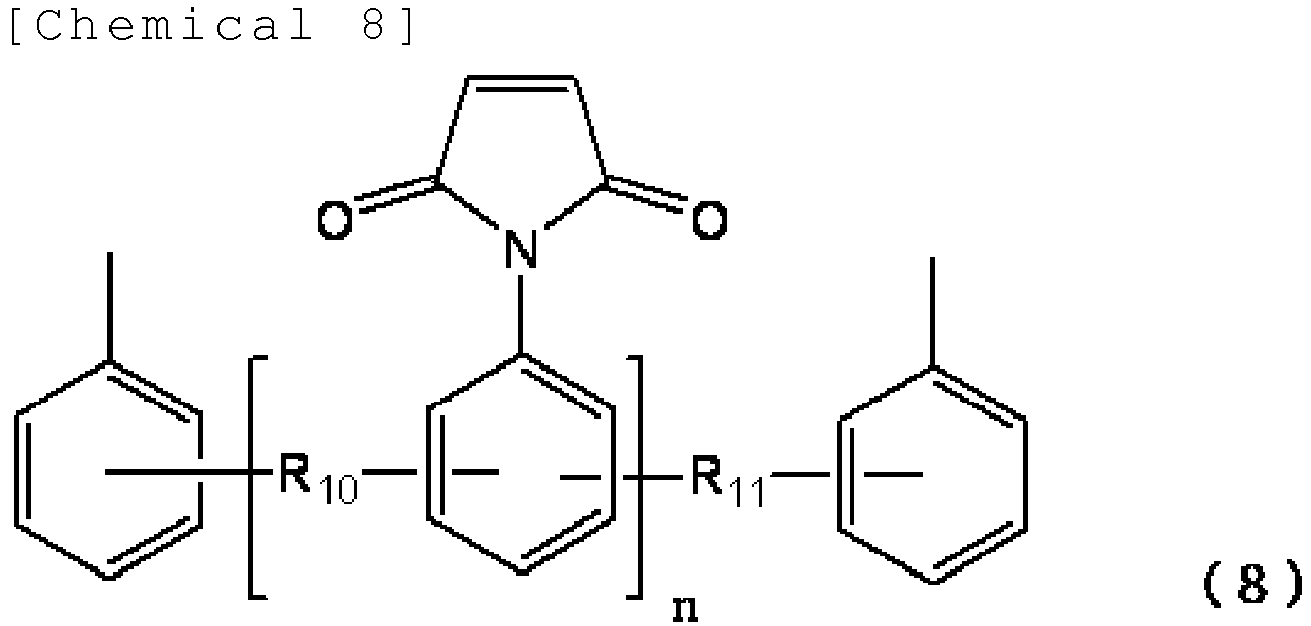
- [in the chemical formula (8), R10 and R11 each independently represent -CH2-, -C(CH3)2-, -O-, or -SO2-; in the chemical formula (8), n is from 0 to 0.5]
- Examples of such an aromatic bismaleimide compound include N,N'-4,4'-diphenylmethane bismaleimide, N,N'-4,4'-diphenyl ether bismaleimide, N,N'-m-phenylene bismaleimide, N,N'-p-phenylene bismaleimide, N,N'-m-toluylene bismaleimide, N,N'-4,4'-biphenylene bismaleimide, N,N'-4,4'-(3,3'-dimethylbiphenylene) bismaleimide, 2,2-bis[4-(4-maleimidephenoxy)phenyl]propane, 3,3'-dimethyl-5,5'-diethyl-4,4'-diphenylmethane bismaleimide, 4-methyl-1,3-phenylene bismaleimide, N,N'-4,4'-diphenylsulfone bismaleimide, and N,N'-4,4'-benzophenone bismaleimide.
- From the viewpoint of heat resistance of the fiber reinforced composite material after heat curing, N,N'-4,4'-diphenylmethane bismaleimide, N,N'-4,4'-diphenyl ether bismaleimide, N,N'-m-toluylene bismaleimide, 2,2-bis[4-(4-maleimidephenoxy)phenyl]propane, 4-methyl-1,3-phenylene bismaleimide, N,N'-4,4'-diphenylsulfone bismaleimide, and N,N'-4,4'-benzophenone bismaleimide are preferable, and N,N'-4,4'-diphenylmethane bismaleimide, N,N'-4,4'-diphenyl ether bismaleimide, N,N'-m-toluylene bismaleimide, 2,2-bis[4-(4-maleimidephenoxy)phenyl]propane, and 4-methyl-1,3-phenylene bismaleimide are particularly preferable. These aromatic bismaleimide compounds may be used solely or may be used in combination of two or more thereof.
- The content of the aromatic bismaleimide compound in the bismaleimide-based resin composition is preferably from 20 to 80 weight%, more preferably from 30 to 65 weight%, particularly preferably from 35 to 60 weight%, with respect to the total mass of the present resin composition. When the content of the aromatic bismaleimide compound is within this range, it becomes easy to adjust the viscosity of the resin composition to an appropriate range and reduce voids during molding. Further, the fiber reinforced composite material excellent in both heat resistance and impact resistance can be easily obtained. When the content of the aromatic bismaleimide compound is less than 20 weight%, heat resistance of the fiber reinforced composite material obtained as a final product using the present resin composition tends to be lowered. When the content of the aromatic bismaleimide compound is more than 80 weight%, impact resistance of the fiber reinforced composite material obtained as a final product using the present resin composition tends to be lowered.
- In a case where the bismaleimide compound does not include the aromatic ring structure (hereinafter, also referred to as "aliphatic bismaleimide compound"), X in the chemical formula (1) preferably has structures described in the following chemical formulae (9) to (11).

- [in the chemical formula (9), n represents an integer equal to or less than 10, preferably 1, 2, 3, 4, or 6.]


- Examples of such an aliphatic bismaleimide compound include 1,6'-bismaleimide-(2,2,4-trimethyl)hexane, hexamethylenediamine bismaleimide, N,N'-1,2-ethylene bismaleimide, N,N'-1,3-propylene bismaleimide, and N,N'-1,4-tetramethylene bismaleimide. Of those, 1,6'-bismaleimide-(2,2,4-trimethyl)hexane and hexamethylenediamine bismaleimide are particularly preferable. These aliphatic bismaleimide compounds may be used solely or may be used in combination of two or more thereof.
- The content of the aliphatic bismaleimide compound in the bismaleimide-based resin composition is preferably from 3 to 30 weight%, more preferably from 5 to 20 weight%, particularly preferably from 7 to 15 weight%, with respect to the total mass of the present resin composition. When the compounding amount of the aliphatic bismaleimide compound is less than 3 weight%, impact resistance of the fiber reinforced composite material obtained as a final product using the present resin composition tends to be lowered due to poor toughness. When the content of the aliphatic bismaleimide compound is more than 30 weight%, heat resistance of the fiber reinforced composite material obtained as a final product tends to be lowered.
- The bismaleimide-based resin composition may include an alkenyl phenol compound and/or an alkenyl phenol ether compound. The alkenyl phenol ether compound can be obtained through a reaction between a phenol-based compound and an alkenyl halide. Further, the alkenyl phenol ether compound compounded in the present resin composition can be obtained through Claisen rearrangement of an alkenyl phenol ether compound (
JP-A-52-994 - As the alkenyl phenol compound and/or the alkenyl phenyl ether compound, allyl phenol, methallyl phenol, or an ether thereof are preferable. Compounds of the following chemical formulae (12) to (16) are more preferable as the alkenyl phenol compound or the alkenyl phenyl ether compound.


- [in the chemical formula (12), R12, R13, and R14 each independently represent hydrogen or an alkenyl group having 2 to 10 carbon atoms, and preferably an allyl group or a propenyl group, provided that at least one of R12, R13, and R14 is an alkenyl group having 2 to 10 carbon atoms.]

- [in the chemical formula (13), R15 represents a direct bond, -CH2-, -C(CH3)2-, -O-, -S-, -SO-, or -S02-; R16, R17, R18, and R19 each independently represent hydrogen or an alkenyl group having 2 to 10 carbon atoms, and preferably an allyl group or a propenyl group, provided that at least one of R16, R17, R18, and R19 is an alkenyl group having 2 to 10 carbon atoms.]
- Among the compounds of the chemical formula (13), compounds of the following chemical formula (14) are particularly preferable.

- [in the chemical formula (14), R15 represents a direct bond, -CH2-, -C(CH3)2-, -O-, -S-, -SO-, or -SO2-.]
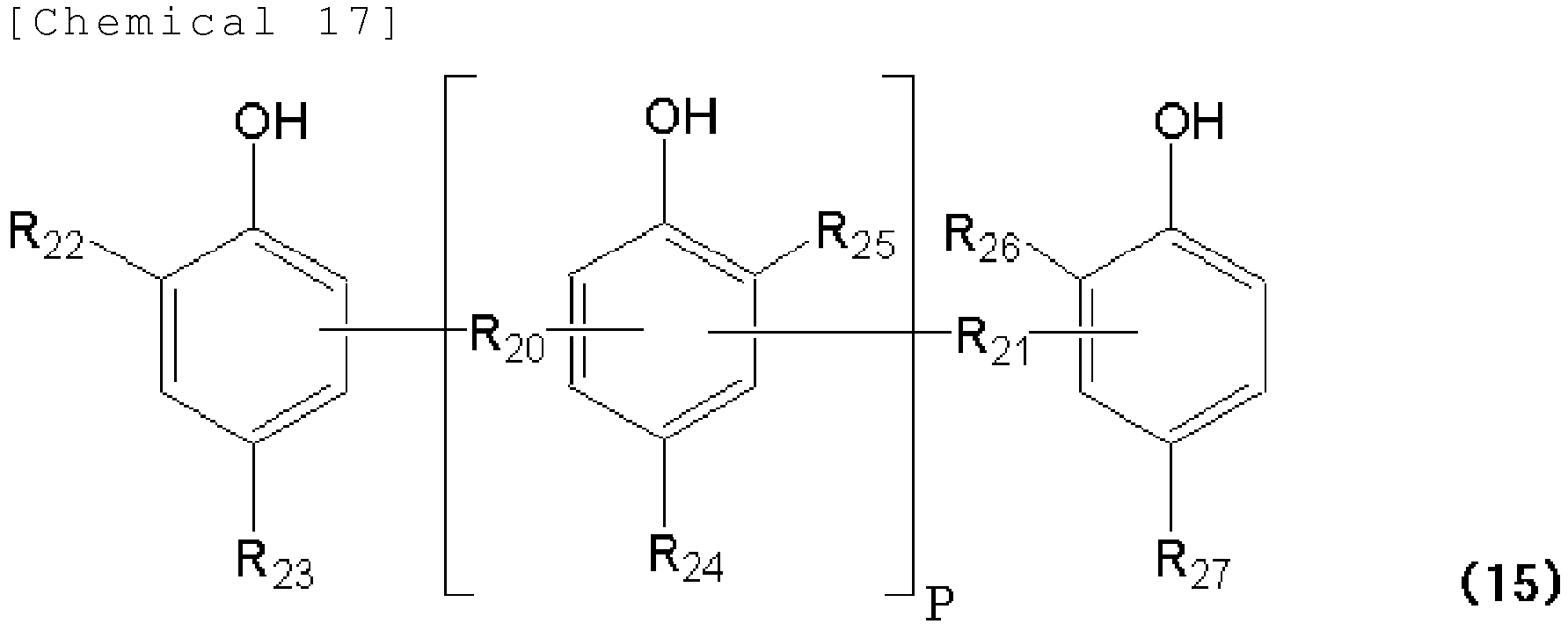
- [in the chemical formula (15), R20 and R21 represent a direct bond, -CH2-, -C(CH3)2-, -O-,-S-, -SO-, or -SO2-; R22, R23, R24, R25, R26, and R27 each independently represent hydrogen, an alkyl group having 1 to 4 carbon atoms, or alkenyl group having 2 to 10 carbon atoms, and preferably an allyl group or a propenyl group, provided that at least one of R22, R23, R24, R25, R26, and R27 is an alkenyl group having 2 to 10 carbon atoms; P represents an integer from 0 to 10.]

- [in the chemical formula (16), R15 represents a direct bond, -CH2-, -C(CH3)2-, -O-, -S-, -SO-, or -SO2-; R28 and R29 each independently represent hydrogen, an alkyl group having 1 to 4 carbon atoms, or alkenyl group having 2 to 10 carbon atoms, and preferably an allyl group or a propenyl group, provided that at least one of R28 and R29 is an alkenyl group having 2 to 10 carbon atoms.]
- Examples of such an alkenyl phenol compound or alkenyl phenol ether compound include O,O'-diallylbisphenol A, 4,4'-dihydroxy-3,3'-diallyldiphenyl, bis(4-hydroxy-3-allylphenyl)methane, 2,2'-bis(4-hydroxy-3,5-diallylphenyl)propane, 2,2'-diallylbisphenol F, 4,4'-dihydroxy-3,3'-diallyldiphenyl ether, and 4,4'-bis-0-propenylphenoxy-benzophenone. Of those, O,O'-diallylbisphenol A, 2,2'-bis(4-hydroxy-3,5-diallylphenyl)propane, 2,2'-diallylbisphenol F, and the like are preferable because of a high glass transition point of the resin after heat curing. O,O'-diallylbisphenol A is particularly preferable as it reduces the viscosity of the present resin composition. In the present resin composition, the alkenyl phenol compound and/or the alkenyl phenol ether compound may be used solely or may be used in admixture of two or more thereof.
- The alkenyl phenol compound and/or the alkenyl phenol ether compound function as a curing agent of the bismaleimide compound. The compounding amount in the present resin composition is preferably from 10 to 70 [weight%], more preferably from 20 to 50 [weight%], particularly preferably from 25 to 40 [weight%]. The viscosity of the present resin composition is adjusted by appropriately including the alkenyl phenol compound and/or the alkenyl phenol ether compound within the above prescribed range, making it possible to obtain excellent molding processability. Further, the present resin composition is sufficiently impregnated into the reinforcement fiber material, allowing the present resin composition to be sufficiently contact to the reinforcement fiber material.
- In the present resin composition, a part or the whole of the aromatic bismaleimide compound and/or the aliphatic bismaleimide compound may be dissolved in the alkenyl phenol compound and/or the alkenyl phenol ether compound. The present resin composition is preferably formed by including a liquid component and a solid component. A ratio of the solid component in the resin composition is preferably from 5 to 50 [weight%], more preferably from 15 to 45 [weight%], particularly preferably from 25 to 40 [weight%]. When the ratio of the solid component is within this range, it becomes easy to adjust the viscosity of the resin composition to an appropriate range and reduce voids during molding. Note that the solid component in the present invention refers to a component which is present in a solid state in the resin composition with a temperature of 80 [°C]. The bismaleimide compound among the solid components is dissolved in the resin composition at the molding temperature or lower of the prepreg constituted by using the present resin composition. Further, the liquid component refers to a component which is present in a liquid state in the resin composition with a temperature of 80 [°C].
- When the ratio of the solid component in the resin composition is more than 50 [weight%], the viscosity of the resin composition may significantly increase. As a result, handleability may be significantly deteriorated in the production step of the resin composition and the production step of the prepreg. When the ratio of the solid component in the resin composition is less than 5 [weight%], the bismaleimide compound is dissolved in the alkenyl phenol compound and/or alkenyl phenol ether compound. In such a case, heating upon this dissolution may simultaneously cause the progression of the curing reaction, which in turn increases the viscosity of the resin composition through polymerization. As a result, handleability may be significantly deteriorated in the production step of the resin composition and the production step of the prepreg.
- The present resin composition preferably includes a thermoplastic resin. As the thermoplastic resin, a known thermoplastic resin can be used. Both the thermoplastic resin soluble in the alkenyl phenol compound and/or the alkenyl phenyl ether compound (hereinafter, also referred to as "soluble thermoplastic resin") and the thermoplastic resin insoluble in the alkenyl phenol compound and/or the alkenyl phenyl ether compound (hereinafter, also referred to as "insoluble thermoplastic resin") can be used.
- In the present invention, the term "soluble in the alkenyl phenol compound and/or the alkenyl phenyl ether compound" means that a part or the whole of the thermoplastic resin can be solved in the alkenyl phenol compound and/or the alkenyl phenyl ether compound under the temperature condition for molding the fiber reinforced composite material. The soluble thermoplastic resin is dissolved in the resin composition to increase the viscosity thereof when the resin composition is heated in the molding process of the fiber reinforced composite material. This can prevent a flow of the resin composition in the molding process.
- Examples of the soluble thermoplastic resin include polyethersulfone, polysulfone, polyetherimide, and polyimide.
- In a case where the soluble thermoplastic resin is compounded, the content thereof is preferably from 0.1 to 15 [weight%], more preferably from 1 to 10 [weight%]. When the content of the soluble thermoplastic resin is within this range, the viscosity of the resin composition can be easily adjusted to an appropriate range. When the content of the soluble thermoplastic resin is more than 15 [weight%], the viscosity of the resin composition becomes high and handleability may be significantly deteriorated.
- The insoluble thermoplastic resin is compounded in the present resin composition as necessary. In the present invention, the term "thermoplastic resin insoluble in the alkenyl phenol compound and/or the alkenyl phenyl ether compound" refers to a thermoplastic resin insoluble in the alkenyl phenol compound and/or the alkenyl phenyl ether compound at least under the temperature condition for molding the fiber reinforced composite material. Examples of the insoluble thermoplastic resin include a polyimide resin.
- In a case where the insoluble thermoplastic resin is compounded, the content thereof is preferably from 0.1 to 40 [weight%], more preferably from 1 to 20 [weight%]. When the insoluble thermoplastic resin is compounded within this range, it becomes easy to adjust the viscosity of the resin composition to an appropriate range, reduce voids during molding, and obtain the fiber reinforced composite material excellent in impact resistance. When the content of the insoluble thermoplastic resin is more than 40 [weight%], the viscosity of the resin composition becomes high and handleability may be significantly deteriorated. The particle diameter of the insoluble thermoplastic resin is not particularly limited. However, it is preferably from 0.1 to 100 [µm], more preferably from 1 to 50 [µm].
- The present resin composition may include other components as long as heat resistance, molding processability, and toughness are not deteriorated. Examples of other components include a polymerization inhibitor, a conductive particle, a conductive filler, an inorganic filler, a rubber-like component, a toughness-imparting agent, a stabilizer, a releasing agent, a coloring agent, and a thickening agent. The viscosity of the resin composition can be adjusted by adding the thickening agent.
- In the present prepreg, examples of the reinforcement fiber constituting the reinforcement fiber material include a carbon fiber, a glass fiber, an aramid fiber, a silicon carbide fiber, a polyester fiber, a ceramic fiber, an alumina fiber, a boron fiber, a metal fiber, a mineral fiber, a rock fiber, and a slug fiber. Of these reinforcement fibers, a carbon fiber, a glass fiber, and an aramid fiber are preferable. A carbon fiber is more preferable from the viewpoint of obtaining a fiber reinforced composite material which has excellent specific strength and specific elastic modulus, light weight, and high strength. Of carbon fibers, a polyacrylonitrile (PAN)-based carbon fiber having excellent tensile strength is particularly preferable.
- In a case where the PAN-based carbon fiber is used as the reinforcement fiber, the tensile elastic modulus is preferably from 170 to 600 [GPa], particularly preferably from 220 to 450 [GPa]. Further, the tensile strength is preferably 3920 [MPa] (400 kgf/mm2) or more. Using such a carbon fiber can improve mechanical characteristics of the fiber reinforced composite material.
- The shape of the reinforcement fiber material is not limited. However, it is preferably a sheet-shaped product from the viewpoint of processability. Examples of the reinforcement fiber sheet include a sheet-shaped product in which a large number of reinforcement fibers are arranged in parallel in one direction, a bidirectional woven fabric such as a plain weave and a twill weave, a multi-axial woven fabric, a non-woven fabric, a mat, a knit, a braid, and a paper prepared from the reinforcement fibers through paper making. The thickness of the reinforcement fiber sheet is preferably from 0.01 to 3 [mm], more preferably from 0.1 to 1.5 [mm]. Further, the areal weight of the reinforcement fiber sheet is preferably from 70 to 400 [g/m2], more preferably from 100 to 300 [g/m2].
- The content of the resin composition in the present prepreg is preferably from 20 to 60 [weight%], more preferably from 30 to 50 [weight%], with respect to the total mass of the reinforcement fiber material and the resin composition. When the content of the present resin composition is less than 20 [weight%], voids and the like may occur inside the fiber reinforced composite material produced by using such a prepreg. When the content of the present resin composition is more than 60 [weight%], the insufficient content of the reinforcement fiber tends to cause a reduction in the strength of the obtained fiber reinforced composite material.
- The fiber reinforced composite material produced by the molding method of the present invention has a void fraction of preferably 1 [%] or less, more preferably 0.1 [%] or less.
- The void fraction of the present invention refers to a value measured by image analysis using a cross-section image of the fiber reinforced composite material.
- The voids of the fiber reinforced composite material are generated intensively in an interlayer portion. Thus, the generation state of voids generated in the fiber reinforced composite material can be confirmed by measuring the interlayer shear strength. The fiber reinforced composite material produced by the molding method of the present invention exhibits the interlayer shear strength comparable to that of the fiber reinforced composite material molded by the autoclave method using the prepreg having the same composition. A drop rate of the interlayer shear strength (ILSS drop rate) is preferably 28 [%] or less, more preferably 15 [%] or less, still more preferably 7 [%] or less, particularly preferably 5 [%] or less, as compared with the fiber reinforced composite material molded by the autoclave method using the same prepreg.
- Hereinafter, the present invention will be described in more detail by way of Examples. However, the present invention is not limited by the following Examples.
- As raw materials of a prepreg, the followings are used.
-
- BMI1100-H: BMI-1100H (trade name) (N,N'-4,4'-diphenylmethane bismaleimide, manufactured by Daiwa Kasei Industry Co., Ltd.)
- TDAB: Compimide TDAB (trade name) (toluene-2,4-bismaleimide, manufactured by Evonik Industries AG)
-
- BMI-TMH: BMI-TMH (trade name) (1,6'-bismaleimide-(2,2,4-trimethyl)hexane, manufactured by Daiwa Kasei Industry Co., Ltd.)
-
- DABPA: DABPA (trade name) (2,2'-diallylbisphenol A, manufactured by Daiwa Kasei Industry Co., Ltd.)
-
- Ultem1000-1000 (trade name) crushed product (polyetherimide, manufactured by Saudi Basic Industries Corp., average particle diameter of 15 [µm])
-
- AURUM PD450M (trade name) (polyimide, manufactured by Mitsui Chemicals, Inc.)
- P84 (trade name) (polyimide, manufactured by HP Polymers Ltd.)
-
- "Tenax" (trade name) IMS 65 E 23 24K 830tex (carbon fiber strand, manufactured by Teijin Ltd., tensile elastic modulus: 290 [GPa])
- "Tenax" (trade name) HTS 40 E 13 6K 400tex (carbon fiber strand, manufactured by Teijin Ltd., tensile elastic modulus: 240 [GPa])
- "Tenax" (trade name) UMS 55 F 23 12K 360tex (carbon fiber strand, manufactured by Teijin Ltd., tensile elastic modulus: 550 [GPa])
- Physical properties of the fiber reinforced composite material were measured by the following methods.
- A BMI prepreg was laminated in the sequence of [45°/-45°/0/90°]5s and cured under the molding conditions shown in Table 1 to obtain a composite. The center part of the composite was cut, and acquired a cross-section image of the composite using a digital microscope VHX-5000 (manufactured by Keyence Corp.). The void fraction was measured by the automatic area measuring function of VHX-5000.
- The measurement was performed according to ASTM D2344 test method. A drop rate obtained in comparison with Reference example 1 was defined as the interlayer shear strength drop rate (ILSS drop rate).
- The measurement was performed according to ASTM-D7136 and ASTM-D7137 test methods.
- The viscosity of the bismaleimide-based resin composition was measured using a rheometer ARES-RDA manufactured by TA Instruments. Using a parallel plate having a diameter of 40 mm, the thickness of the resin between the parallel plates was set to 0.5 mm, and then the viscosity was measured up to 200°C at a temperature rising rate of 2°C/min under the condition of an angular velocity of 10 radians/sec. Ta, Tb, Td, and Te were determined from the temperature-viscosity curve thus obtained.
- Ta: temperature at which resin composition exhibits minimum viscosity
- Tb: temperature at which resin composition exhibits viscosity of 100 [Pa·s]
- Td: temperature at which resin composition exhibits viscosity of 50 [Pa·s] (where temperature is lower than temperature Ta having minimum viscosity)
- Te: temperature at which resin composition exhibits viscosity of 15 [Pa·s] (where temperature is lower than temperature Ta having minimum viscosity)
- The prepreg was subjected to thermal gravimetric mass spectrometry measurement using an apparatus in which TG-DSC/DTA STA 449 F1 Jupiter manufactured by NETZSCH-Gerätebau GmbH was coupled with a mass spectrometer QMS manufactured by NETZSCH-Gerätebau GmbH. The thermal gravimetric mass spectrometry measurement was performed from room temperature to 180°C at a temperature rising rate of 2°C/min under He atmosphere, and Tc was determined from the total ion current chromatogram (TIC) thus obtained.
- Tc: a peak temperature showing a maximum peak among the peaks observed in a range from 90 to 180 [°C] in a total ion current chromatogram (TIC) of the prepreg measured at a temperature rising rate of 10 [°C/min] using a thermal gravimetric mass spectrometry apparatus (TG-MS).
- Total ion current chromatogram (TIC): chart in which total counts of all ions generated by ion source are plotted on vertical axis and time is plotted on horizontal axis.
- A bismaleimide-based resin composition was prepared in the composition shown in Production example 1 in Table 1. Ta, Tb, Td, and Te of this bismaleimide-based resin composition were 123 [°C], 63 [°C], 70 [°C], and 82 [°C], respectively.
- This bismaleimide-based resin composition was applied on a release film with an areal weight of 50 [g/m2] using a film coater as a one-side resin film to obtain a resin sheet. Next, the carbon fiber (IMS 65) strands were fed between two resin sheets and uniformly arranged in one direction (carbon fiber volume content of 57 [vol%], areal weight of 190 [g/m2]), thereby being formed into a sheet. The resulting product was pressurized and heated at 100 [°C] using a roller to obtain a prepreg. In this prepreg, the peak temperature (Tc) showing the maximum peak among the peaks observed in a range from 90 to 180 [°C] in the total ion current chromatogram (TIC) obtained by the thermal gravimetric mass spectrometry measurement (TG-MS) was 135 [°C].
- A bismaleimide-based resin composition was prepared in the composition shown in Production example 2 in Table 1. Ta, Tb, Td, and Te of this bismaleimide-based resin composition were 125 [°C], 64 [°C], 69 [°C], and 82 [°C], respectively. This bismaleimide-based resin composition was applied on a release film with an areal weight of 50 [g/m2] using a film coater as a one-side resin film to obtain a resin sheet. Next, the carbon fiber (IMS 65) strands were fed between two resin sheets and uniformly arranged in one direction (carbon fiber volume content of 57 [vol%], areal weight of 190 [g/m2]), thereby being formed into a sheet. The resulting product was pressurized and heated at 100 [°C] using a roller to obtain a prepreg. In this prepreg, the peak temperature (Tc) showing the maximum peak among the peaks observed in a range from 90 to 180 [°C] in the total ion current chromatogram (TIC) obtained by the thermal gravimetric mass spectrometry measurement (TG-MS) was 135 [°C].
- A bismaleimide-based resin composition was prepared in the composition shown in Production example 3 in Table 1. Ta, Tb, Td, and Te of this bismaleimide-based resin composition were 150 [°C], 60 [°C], 66 [°C], and 79 [°C], respectively. This bismaleimide-based resin composition was applied on a release film with an areal weight of 50 [g/m2] using a film coater as a one-side resin film to obtain a resin sheet. Next, the carbon fiber (IMS 65) strands were fed between two resin sheets and uniformly arranged in one direction (carbon fiber volume content of 57 [vol%], areal weight of 190 [g/m2]), thereby being formed into a sheet. The resulting product was pressurized and heated at 100 [°C] using a roller to obtain a prepreg. In this prepreg, the peak temperature (Tc) showing the maximum peak among the peaks observed in a range from 90 to 180 [°C] in the total ion current chromatogram (TIC) obtained by the thermal gravimetric mass spectrometry measurement (TG-MS) was 135 [°C].
- A bismaleimide-based resin composition was prepared in the composition shown in Production example 4 in Table 1. Ta, Tb, Td, and Te of this bismaleimide-based resin composition were 123 [°C], 63 [°C], 70 [°C], and 82 [°C], respectively. This bismaleimide-based resin composition was applied on a release film with an areal weight of 50 [g/m2] using a film coater as a one-side resin film to obtain a resin sheet. Next, the carbon fiber (HTS 40) strands were fed between two resin sheets and uniformly arranged in one direction (carbon fiber volume content of 57 [vol%], areal weight of 190 [g/m2]), thereby being formed into a sheet. The resulting product was pressurized and heated at 100 [°C] using a roller to obtain a prepreg. In this prepreg, the peak temperature (Tc) showing the maximum peak among the peaks observed in a range from 90 to 180 [°C] in the total ion current chromatogram (TIC) obtained by the thermal gravimetric mass spectrometry measurement (TG-MS) was 135 [°C].
- A bismaleimide-based resin composition was prepared in the composition shown in Production example 5 in Table 1. Ta, Tb, Td, and Te of this bismaleimide-based resin composition were 123 [°C], 63 [°C], 70 [°C], and 82 [°C], respectively. This bismaleimide-based resin composition was applied on a release film with an areal weight of 50 [g/m2] using a film coater as a one-side resin film to obtain a resin sheet. Next, the carbon fiber (UMS55) strands were fed between two resin sheets and uniformly arranged in one direction (carbon fiber volume content of 57 [vol%], areal weight of 190 [g/m2]), thereby being formed into a sheet. The resulting product was pressurized and heated at 100 [°C] using a roller to obtain a prepreg. In this prepreg, the peak temperature (Tc) showing the maximum peak among the peaks observed in a range from 90 to 180 [°C] in the total ion current chromatogram (TIC) obtained by the thermal gravimetric mass spectrometry measurement (TG-MS) was 135 [°C].
- A bismaleimide-based resin composition was prepared in the composition shown in Production example 6 in Table 1. Ta, Tb, Td, and Te of this bismaleimide-based resin composition were 123 [°C], 63 [°C], 70 [°C], and 82 [°C], respectively. This bismaleimide-based resin composition was applied on a release film with an areal weight of 50 [g/m2] using a film coater as a one-side resin film to obtain a resin sheet. Next, the carbon fiber (IMS 65) strands were fed between two resin sheets and uniformly arranged in one direction (carbon fiber volume content of 65 [vol%], areal weight of 270 [g/m2]), thereby being formed into a sheet. The resulting product was pressurized and heated at 100 [°C] using a roller to obtain a prepreg. In this prepreg, the peak temperature (Tc) showing the maximum peak among the peaks observed in a range from 90 to 180 [°C] in the total ion current chromatogram (TIC) obtained by the thermal gravimetric mass spectrometry measurement (TG-MS) was 135 [°C].
- The prepreg obtained in Production example 1 was laminated in the sequence of [45°/- 45°/0°/90°]5s and cured in an autoclave at the temperature (T3) of 180 [°C] under the pressure condition of 0.6 [MPa] to obtain a fiber reinforced composite material. The stepwise heating at the temperature (T1) and the temperature (T2) was omitted. The void fraction of this fiber reinforced composite material was 0.04 [%].
- The prepreg obtained in Production example 1 was laminated in the sequence of [45°/- 45°/0°/90°]5s, held in an autoclave at the temperature (T1) for the period of time shown in Table 2 under the pressure condition of 0.3 [MPa], and then cured at the temperature (T3) of 180 [°C] to obtain a fiber reinforced composite material. The heating at the temperature (T2) was omitted. The void fraction and the ILSS drop rate with respect to Reference example 1 of this fiber reinforced composite material were as shown in Table 2. The fiber reinforced composite material in Example 1 in which T1 in the first heating step satisfied the formula (1): Tb (63 [°C]) ≤ T1 (90 [°C]) ≤ Ta (123 [°C]) exhibited the performance substantially comparable to that of the fiber reinforced composite material molded by the conventional autoclave molding method using high pressure (Reference example 1).
- The prepreg obtained in Production example 1 was laminated in the sequence of [45°/- 45°/0°/90°]5s, held in an autoclave at the temperature (T1) of 90 [°C] for 60 minutes under the pressure condition shown in Table 3, then further held at the temperature (T2) for the period of time shown in Table 3, and cured at the temperature (T3) of 180 [°C] to obtain a fiber reinforced composite material. The void fraction and the ILSS drop rate with respect to Reference example 1 of this fiber reinforced composite material were as shown in Table 3. Examples 4 to 6 including the first heating step and the second heating step showed further satisfactory results.
- A fiber reinforced composite material was obtained by the same operation as in Example 6 except that the prepreg with the different kind and compounding amount of the insoluble thermoplastic resin was used. The void fraction, the ILSS drop rate with respect to Reference example 1, and the impact resistance (CAI) of this fiber reinforced composite material were as shown in Table 4. Satisfactory results were also obtained even when the insoluble thermoplastic resin was changed.
- A fiber reinforced composite material was obtained by the same operation as in Example 6 except that the carbon fiber from the different brand was used in the prepreg. The void fraction of this fiber reinforced composite material was as shown in Table 5. Satisfactory results were also obtained even when the fiber brand was changed.
- As in Production example 6, the prepreg having the high fiber volume content was laminated in the sequence of [45°/-45°/0°/90°]5s, held in an autoclave at the temperature (T1) and the temperature (T2) shown in Table 6 for the period of time shown in Table 6 under the pressure condition of 0.3 [MPa], and then cured at the temperature (T3) of 180 [°C] to obtain a fiber reinforced composite material. The void fraction and the ILSS drop rate with respect to Reference example 1 of this fiber reinforced composite material were as shown in Table 6. When the carbon fiber volume content is high, the relative amount of the resin is reduced and voids tend to increase during molding. However, it was confirmed that satisfactory results could be obtained in Examples 11 and 12 having the high carbon fiber volume content by including the first heating step and the second heating step.
-
(Table 1) Production example 1 Production example 2 Production example 3 Production example 4 Production example 5 Production example 6 Resin composition Bismaleimide compound BMI-TMH Mass 11.2 11.2 11.2 11.2 11.2 11.2 TDAB Mass 20.0 20.0 20.0 20.0 20.0 20.0 BMI1100-H Mass 30.6 30.6 30.6 30.6 30.6 30.6 Co-reactant DABPA Mass 38.2 38.2 38.2 38.2 38.2 38.2 Soluble thermoplastic resin PEI Mass 4.3 4.3 4.3 4.3 4.3 4.3 Insoluble thermoplastic resin AURUM Mass 18.4 - - 18.4 18.4 18.4 P84 Mass - 18.4 - - - - Carbon fiber brand - IMS 65 IMS 65 IMS 65 HTS 40 UMS 55 IMS 65 Carbon fiber volume content % 57 57 57 57 57 65 Ta °C 123 125 150 123 123 123 Tb °C 63 64 60 63 63 63 Tc °C 135 135 135 135 135 135 Td °C 70 69 66 70 70 70 Te °C 82 82 79 82 82 82 -
(Table 2) Reference example 1 Comparative example 1 Comparative example 2 Example 1 Comparative example 3 Prepreg - Production example 1 Production example 1 Production example 1 Production example 1 Production example 1 Molding pressure MPa 0.6 0.3 0.3 0.3 0.3 First heating step T1 °C None None 50 90 140 Time min 0 0 60 60 60 Curing step T3 °C 180 180 180 180 180 Moldability (void fraction) % 0.04 5 5 0.5 3 Physical property (ILSS drop rate) % 0 30 30 5 27 -
(Table 3) Example 1 Example 2 Example 3 Example 4 Example 5 Example 6 Prepreg - Production example 1 Production example 1 Production example 1 Production example 1 Production example 1 Production example 1 Molding pressure MPa 0.3 0.15 0 0.3 0.15 0 First heating step T1 °C 90 90 90 90 90 90 Time min 60 60 60 60 60 60 Second heating step T2 °C None None None 140 140 140 Time min 0 0 0 60 60 60 Curing step T3 °C 180 180 180 180 180 180 Moldability (void fraction) % 0.5 0.7 1 0.05 0.06 0.07 Physical property (ILSS drop rate) % 5 7 15 0.1 0.3 0.5 -
(Table 4) Reference example 1 Example 6 Example 7 Example 8 Prepreg Production example 1 Production example 1 Production example 2 Production example 3 Molding pressure MPa 0.6 0 0 0 First heating step T1 °C None 90 90 90 Time min 0 60 60 60 Second heating step T2 °C None 140 140 140 Time min 0 60 60 60 Curing step T3 °C 180 180 180 180 Moldability (void fraction) % 0.04 0.07 0.07 0.04 Physical property (ILSS drop rate) % 0 0.5 0.5 0 Impact resistance (CAI) MPa 220 217 205 98 -
(Table 5) Example 9 Example 6 Example 10 Prepreg - Production example 4 Production example 1 Production example 5 Molding pressure MPa 0 0 0 First heating step T1 °C 90 90 90 Time min 60 60 60 Second heating step T2 °C 140 140 140 Time min 60 60 60 Curing step T3 °C 180 180 180 Moldability (void fraction) % 0.07 0.07 0.07 -
(Table 6) Comparative example 4 Example 11 Example 12 Prepreg - Production example 6 Production example 6 Production example 6 Molding pressure MPa 0.3 0.3 0.3 First heating step T1 °C None 90 90 Time min 0 60 60 Second heating step T2 °C None None 140 Time min 0 0 60 Curing step T3 °C 180 180 180 Moldability (void fraction) % 7 2 0.06 Physical property (ILSS drop rate) % 35 20 0.3
Claims (6)
- A method for producing a composite material including a step of curing a prepreg consisting of a fiber reinforcement material and a resin composition containing a bismaleimide resin, the method comprising:a first heating step in which the prepreg is heated to a first temperature (T1) and held at the first temperature (T1) for 30 minutes or more to impregnate the resin composition into a fiber; anda curing step in which the prepreg is heated to a third temperature (T3) higher than the first temperature (T1) and held at the third temperature (T3) to cure the resin composition,wherein the first temperature (T1) satisfies the following formula (1):
 Ta is a temperature at which the resin composition exhibits a minimum viscosity andTb is a temperature at which the resin composition exhibits the viscosity of 100 [Pa·s].
 - The method for producing a composite material according to claim 1, further including a second heating step of holding the prepreg at a second temperature (T2) for 30 minutes or more between the first heating step and the curing step, wherein the second temperature (T2) satisfies the following formula (2):

- The method for producing a composite material according to claim 2, having a setting of the first temperature (T1) < the second temperature (T2) < the third temperature (T3).
- The method for producing a composite material according to claim 1, wherein a pressure during molding is set to 0.5 [MPa] or less.
- The method for producing a composite material according to claim 1, wherein the fiber reinforcement material is a carbon fiber.
- The method for producing a composite material according to claim 1,
wherein the resin composition includes, as an essential component,
a component (a), which is a bismaleimide compound, and
a component (b), which is an alkenyl phenol compound and/or an alkenyl phenol ether compound.
Applications Claiming Priority (1)
| Application Number | Priority Date | Filing Date | Title |
|---|---|---|---|
| JP2020080872A JP7563893B2 (en) | 2020-04-30 | 2020-04-30 | Manufacturing method of composite material |
Publications (1)
| Publication Number | Publication Date |
|---|---|
| EP3907248A1 true EP3907248A1 (en) | 2021-11-10 |
Family
ID=76641564
Family Applications (1)
| Application Number | Title | Priority Date | Filing Date |
|---|---|---|---|
| EP21171293.0A Pending EP3907248A1 (en) | 2020-04-30 | 2021-04-29 | Manufacturing method for composite materials |
Country Status (3)
| Country | Link |
|---|---|
| US (1) | US20210347096A1 (en) |
| EP (1) | EP3907248A1 (en) |
| JP (2) | JP7563893B2 (en) |
Citations (4)
| Publication number | Priority date | Publication date | Assignee | Title |
|---|---|---|---|---|
| JPS52994A (en) | 1975-06-19 | 1977-01-06 | Ciba Geigy Ag | Imide grouppcontaining crosslinked polymer and preparation thereof |
| US5077363A (en) * | 1989-04-17 | 1991-12-31 | Basf Aktiengesellschaft | Heat-curable bismaleidmide/alkenyl phenol/n-vinyl pyrrolidone resin |
| US5637387A (en) * | 1991-06-03 | 1997-06-10 | Ciba-Geigy Corporation | Storage-stable advanced polymaleimide compositions |
| JP2019157097A (en) | 2018-03-17 | 2019-09-19 | 帝人株式会社 | Prepreg and fiber-reinforced composite material, and method for producing same |
Family Cites Families (11)
| Publication number | Priority date | Publication date | Assignee | Title |
|---|---|---|---|---|
| CA2034969A1 (en) * | 1990-02-09 | 1991-08-10 | Walter V. Breitigam | Process for preparing thermoset composite articles |
| JPH05318476A (en) * | 1992-05-20 | 1993-12-03 | Toshiba Chem Corp | Manufacture of prepreg for laminate and its device |
| JP2005015552A (en) * | 2003-06-24 | 2005-01-20 | Tdk Corp | Thermosetting resin composition, prepreg and substrate using the same |
| EP1595689B1 (en) * | 2004-05-11 | 2007-01-17 | Hexcel Holding GmbH | Prepregs for use in building lay-ups of composite materials and process for their preparation |
| JP2007297547A (en) * | 2006-05-02 | 2007-11-15 | Yokohama Rubber Co Ltd:The | Resin composition for prepreg sheet, prepreg sheet and fiber-reinforced composite material |
| JP2014114369A (en) * | 2012-12-10 | 2014-06-26 | Toho Tenax Co Ltd | Thermosetting bismaleimide-based resin composition, prepreg using the resin composition, and method for producing the same |
| US9427943B2 (en) * | 2013-03-15 | 2016-08-30 | Henkel IP & Holding GmbH | Prepreg curing process for preparing composites having superior surface finish and high fiber consolidation |
| US9205633B2 (en) * | 2013-03-15 | 2015-12-08 | Henkel IP & Holding GmbH | Prepreg curing process for preparing composites having superior surface finish and high fiber consolidation |
| JP2015117375A (en) * | 2013-11-15 | 2015-06-25 | 明和化成株式会社 | Allylphenol novolac resin composition, cured product obtained by curing the same, method for producing cured product, and fiber-reinforced resin molded article |
| EP3196238B1 (en) * | 2014-09-19 | 2019-07-03 | Toray Industries, Inc. | Notched pre-preg and notched pre-preg sheet |
| JP6965530B2 (en) * | 2016-03-16 | 2021-11-10 | 東レ株式会社 | Notch prepreg and method of manufacturing notch prepreg |
-
2020
- 2020-04-30 JP JP2020080872A patent/JP7563893B2/en active Active
-
2021
- 2021-04-27 US US17/241,640 patent/US20210347096A1/en active Pending
- 2021-04-29 EP EP21171293.0A patent/EP3907248A1/en active Pending
-
2024
- 2024-05-10 JP JP2024076998A patent/JP2024096426A/en not_active Withdrawn
Patent Citations (4)
| Publication number | Priority date | Publication date | Assignee | Title |
|---|---|---|---|---|
| JPS52994A (en) | 1975-06-19 | 1977-01-06 | Ciba Geigy Ag | Imide grouppcontaining crosslinked polymer and preparation thereof |
| US5077363A (en) * | 1989-04-17 | 1991-12-31 | Basf Aktiengesellschaft | Heat-curable bismaleidmide/alkenyl phenol/n-vinyl pyrrolidone resin |
| US5637387A (en) * | 1991-06-03 | 1997-06-10 | Ciba-Geigy Corporation | Storage-stable advanced polymaleimide compositions |
| JP2019157097A (en) | 2018-03-17 | 2019-09-19 | 帝人株式会社 | Prepreg and fiber-reinforced composite material, and method for producing same |
Also Published As
| Publication number | Publication date |
|---|---|
| JP2021172801A (en) | 2021-11-01 |
| JP7563893B2 (en) | 2024-10-08 |
| US20210347096A1 (en) | 2021-11-11 |
| JP2024096426A (en) | 2024-07-12 |
Similar Documents
| Publication | Publication Date | Title |
|---|---|---|
| TWI475055B (en) | Particle-toughened fiber-reinforced polymer composites | |
| TWI480325B (en) | Particle-toughened polymer compositions | |
| US5268223A (en) | Toughened fiber-reinforced composites | |
| KR20140088588A (en) | Prepreg, fiber-reinforced composite material, method for producing same, and epoxy resin composition | |
| WO2014050896A1 (en) | Prepreg and method for producing same | |
| JP2022084774A (en) | Carbon fiber prepreg and resin composition | |
| JP2014114368A (en) | Thermosetting bismaleimide-based resin composition and prepreg, and method for producing the same | |
| JP2019157097A (en) | Prepreg and fiber-reinforced composite material, and method for producing same | |
| JP2014114369A (en) | Thermosetting bismaleimide-based resin composition, prepreg using the resin composition, and method for producing the same | |
| EP3889207A1 (en) | Thermosetting resin composition, film adhesive, prepreg, and production method thereof | |
| EP4172240A1 (en) | Novel compositions with improved characteristics | |
| EP3730552B1 (en) | Thermosetting resin composition | |
| US20210347096A1 (en) | Method for producing composite material | |
| NL9101120A (en) | FIBER-REINFORCED COMPOSITIONS TURNED WITH POROUS RESIN PARTICLES. | |
| WO2023204070A1 (en) | Aldehyde-group-containing benzoxazine resin | |
| EP3623406B1 (en) | Epoxy resin composition, prepreg, fiber-reinforced composite material, and method for producing same | |
| JPH0381342A (en) | Prepreg manufacturing method | |
| JP7654820B2 (en) | BMI resin formulation for carbon fiber reinforced composite materials, BMI prepreg and carbon fiber reinforced composite materials | |
| Luo et al. | Study on BMI modified allyl‐functional novolac resin/silica cloth composites: Effect of allylation degree on thermal and mechanical properties | |
| JP2014105317A (en) | Resin composition, prepreg using resin composition, and method of manufacturing resin composition | |
| EP4596612A1 (en) | Prepreg, and method for producing fiber-reinforced composite material using said prepreg | |
| JP2013209474A (en) | Resin composition, prepreg using the same and method for producing resin composition | |
| EP0351026A2 (en) | Fiber-reinforced composites toughened with elongated rigid particles |
Legal Events
| Date | Code | Title | Description |
|---|---|---|---|
| PUAI | Public reference made under article 153(3) epc to a published international application that has entered the european phase |
Free format text: ORIGINAL CODE: 0009012 |
|
| STAA | Information on the status of an ep patent application or granted ep patent |
Free format text: STATUS: REQUEST FOR EXAMINATION WAS MADE |
|
| 17P | Request for examination filed |
Effective date: 20210429 |
|
| AK | Designated contracting states |
Kind code of ref document: A1 Designated state(s): AL AT BE BG CH CY CZ DE DK EE ES FI FR GB GR HR HU IE IS IT LI LT LU LV MC MK MT NL NO PL PT RO RS SE SI SK SM TR |
|
| B565 | Issuance of search results under rule 164(2) epc |
Effective date: 20211011 |
|
| STAA | Information on the status of an ep patent application or granted ep patent |
Free format text: STATUS: EXAMINATION IS IN PROGRESS |
|
| 17Q | First examination report despatched |
Effective date: 20230913 |