EP3903090B1 - Überwachung und steuerung hydrophober komponenten in einem zellstoffprozess - Google Patents
Überwachung und steuerung hydrophober komponenten in einem zellstoffprozess Download PDFInfo
- Publication number
- EP3903090B1 EP3903090B1 EP19835683.4A EP19835683A EP3903090B1 EP 3903090 B1 EP3903090 B1 EP 3903090B1 EP 19835683 A EP19835683 A EP 19835683A EP 3903090 B1 EP3903090 B1 EP 3903090B1
- Authority
- EP
- European Patent Office
- Prior art keywords
- intensity values
- sample
- particles
- fraction
- light scattering
- Prior art date
- Legal status (The legal status is an assumption and is not a legal conclusion. Google has not performed a legal analysis and makes no representation as to the accuracy of the status listed.)
- Active
Links
Images




Classifications
-
- G—PHYSICS
- G01—MEASURING; TESTING
- G01N—INVESTIGATING OR ANALYSING MATERIALS BY DETERMINING THEIR CHEMICAL OR PHYSICAL PROPERTIES
- G01N21/00—Investigating or analysing materials by the use of optical means, i.e. using sub-millimetre waves, infrared, visible or ultraviolet light
- G01N21/62—Systems in which the material investigated is excited whereby it emits light or causes a change in wavelength of the incident light
- G01N21/63—Systems in which the material investigated is excited whereby it emits light or causes a change in wavelength of the incident light optically excited
- G01N21/64—Fluorescence; Phosphorescence
-
- D—TEXTILES; PAPER
- D21—PAPER-MAKING; PRODUCTION OF CELLULOSE
- D21G—CALENDERS; ACCESSORIES FOR PAPER-MAKING MACHINES
- D21G9/00—Other accessories for paper-making machines
-
- G—PHYSICS
- G01—MEASURING; TESTING
- G01N—INVESTIGATING OR ANALYSING MATERIALS BY DETERMINING THEIR CHEMICAL OR PHYSICAL PROPERTIES
- G01N1/00—Sampling; Preparing specimens for investigation
- G01N1/28—Preparing specimens for investigation including physical details of (bio-)chemical methods covered elsewhere, e.g. G01N33/50, C12Q
- G01N1/30—Staining; Impregnating ; Fixation; Dehydration; Multistep processes for preparing samples of tissue, cell or nucleic acid material and the like for analysis
-
- G—PHYSICS
- G01—MEASURING; TESTING
- G01N—INVESTIGATING OR ANALYSING MATERIALS BY DETERMINING THEIR CHEMICAL OR PHYSICAL PROPERTIES
- G01N15/00—Investigating characteristics of particles; Investigating permeability, pore-volume or surface-area of porous materials
- G01N15/02—Investigating particle size or size distribution
- G01N15/0205—Investigating particle size or size distribution by optical means
-
- G—PHYSICS
- G01—MEASURING; TESTING
- G01N—INVESTIGATING OR ANALYSING MATERIALS BY DETERMINING THEIR CHEMICAL OR PHYSICAL PROPERTIES
- G01N15/00—Investigating characteristics of particles; Investigating permeability, pore-volume or surface-area of porous materials
- G01N15/02—Investigating particle size or size distribution
- G01N15/0255—Investigating particle size or size distribution with mechanical, e.g. inertial, classification, and investigation of sorted collections
-
- G—PHYSICS
- G01—MEASURING; TESTING
- G01N—INVESTIGATING OR ANALYSING MATERIALS BY DETERMINING THEIR CHEMICAL OR PHYSICAL PROPERTIES
- G01N15/00—Investigating characteristics of particles; Investigating permeability, pore-volume or surface-area of porous materials
- G01N15/06—Investigating concentration of particle suspensions
-
- G—PHYSICS
- G01—MEASURING; TESTING
- G01N—INVESTIGATING OR ANALYSING MATERIALS BY DETERMINING THEIR CHEMICAL OR PHYSICAL PROPERTIES
- G01N21/00—Investigating or analysing materials by the use of optical means, i.e. using sub-millimetre waves, infrared, visible or ultraviolet light
- G01N21/84—Systems specially adapted for particular applications
- G01N21/85—Investigating moving fluids or granular solids
-
- G—PHYSICS
- G01—MEASURING; TESTING
- G01N—INVESTIGATING OR ANALYSING MATERIALS BY DETERMINING THEIR CHEMICAL OR PHYSICAL PROPERTIES
- G01N30/00—Investigating or analysing materials by separation into components using adsorption, absorption or similar phenomena or using ion-exchange, e.g. chromatography or field flow fractionation
- G01N30/0005—Field flow fractionation
-
- G—PHYSICS
- G01—MEASURING; TESTING
- G01N—INVESTIGATING OR ANALYSING MATERIALS BY DETERMINING THEIR CHEMICAL OR PHYSICAL PROPERTIES
- G01N33/00—Investigating or analysing materials by specific methods not covered by groups G01N1/00 - G01N31/00
- G01N33/34—Paper
- G01N33/343—Paper pulp
-
- G—PHYSICS
- G01—MEASURING; TESTING
- G01N—INVESTIGATING OR ANALYSING MATERIALS BY DETERMINING THEIR CHEMICAL OR PHYSICAL PROPERTIES
- G01N15/00—Investigating characteristics of particles; Investigating permeability, pore-volume or surface-area of porous materials
- G01N15/06—Investigating concentration of particle suspensions
- G01N15/075—Investigating concentration of particle suspensions by optical means
-
- G—PHYSICS
- G01—MEASURING; TESTING
- G01N—INVESTIGATING OR ANALYSING MATERIALS BY DETERMINING THEIR CHEMICAL OR PHYSICAL PROPERTIES
- G01N15/00—Investigating characteristics of particles; Investigating permeability, pore-volume or surface-area of porous materials
- G01N2015/0042—Investigating dispersion of solids
- G01N2015/0053—Investigating dispersion of solids in liquids, e.g. trouble
-
- G—PHYSICS
- G01—MEASURING; TESTING
- G01N—INVESTIGATING OR ANALYSING MATERIALS BY DETERMINING THEIR CHEMICAL OR PHYSICAL PROPERTIES
- G01N15/00—Investigating characteristics of particles; Investigating permeability, pore-volume or surface-area of porous materials
- G01N15/02—Investigating particle size or size distribution
- G01N2015/0288—Sorting the particles
-
- G—PHYSICS
- G01—MEASURING; TESTING
- G01N—INVESTIGATING OR ANALYSING MATERIALS BY DETERMINING THEIR CHEMICAL OR PHYSICAL PROPERTIES
- G01N21/00—Investigating or analysing materials by the use of optical means, i.e. using sub-millimetre waves, infrared, visible or ultraviolet light
- G01N21/84—Systems specially adapted for particular applications
- G01N21/88—Investigating the presence of flaws or contamination
- G01N21/94—Investigating contamination, e.g. dust
Definitions
- the present invention relates to a method and an apparatus for monitoring and controlling hydrophobic contaminants in an aqueous stream of a pulp or papermaking process.
- Measurements of solid matter containing liquids are typical in forest industry, in which wood pulp samples or filtrates, such as wire water, white water, thickener filtrate or other pulp filtrate, or circulated water, are monitored in order to be able to control the overall process.
- the liquids used often contain solid matter that needs to be measured and monitored.
- the measurement may be carried out off-line or on-line, where off-line methods often involve batch sampling and laboratory analyses. They enable providing accurate and versatile information on the suspension, but suffer from considerable time delays. On-line methods, on the other hand, provide instant or almost instant information on the suspension, but the data obtained is usually not as accurate as that achieved in the laboratory.
- Liquids and filtrates in pulp industry contain particles the amount, type, and size distribution of which have a considerable effect on upcoming process stages. For example, pitch may cause running problems on paper machines.
- One technique for analyzing papermaking process samples is a method where harmful particles, such as pitch, white pitch and stickies, that disturb the papermaking process causing production down-time and paper defects, are detected.
- the system fractionates the particles according to their mass and/or size.
- the fractionated samples are analyzed with optical measurements.
- the system measures the particle and/or mass distribution of a filtrate to detect paper machine problems.
- WO2015/075319 A1 relates to a prior art method and system for monitoring particles properties in a stream by sampling liquids and by subsequent measurements to the samples.
- US9562861 B2 relates to a prior art method and device for analysing macrostickies in an aqueous medium, such as in recycled pulp process streams.
- Hydrophobic contaminants such as wood pitch
- hydrophobicity may be due either to increased pulp consistency (increased particle count) or due to increased pitch concentration.
- concentration of pitch has a direct effect on the quality of the end product: the higher the pitch concentration, the poorer the quality of the pulp, which may cause problems in further processing of the pulp.
- Hydrophobicity density (i.e. hydrophobicity index) describes the concentration of hydrophobic contaminants and/or the density of hydrophobic contaminants.
- concentration or density of wood pitch may be defined as the mass of wood pitch divided by the volume or mass of a sample, for example, a milligram of wood pitch in a kilogram of solid matter (mg/kg), a milligram of wood pitch in a kilogram of dry solid of the sample (mg/kg), a milligram of wood pitch in a certain volume (like mg/l).
- the concentration may also be defined as the count of wood pitch divided by the volume of the sample, mass of solid matter in the sample or mass of dry solid in the sample.
- Hydrophobic contaminants may be wood pitch.
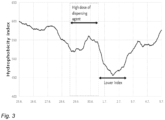
- An embodiment discloses a simple method and device for estimating the concentration of pitch and/or density of pitch in a pulp sample. If it is known that there are impurities in the pulp (or the pulp liquid), they may be affected by increasing the amount of washing water or by adding a chemical that disperses (stabilizes) pitch into small particles which may be removed from the mass by washing to avoid them being passed to the paper mill.
- a monitoring unit may be installed on the white water tank or headbox.
- Pitch concentration monitoring may be performed on-line to predict or determine the need for adding control chemicals.
- the monitoring may be performed by using an on-line tool that monitors the relative particle size, relative count and relative hydrophobicity in the sample.
- Colloidal pitch particles in the wet end of the pulp drying machine may be monitored by on-line measurement that is able to separate the particles based on their size/mass and return a relative hydrophobicity value.
- the samples for continuous on-line monitoring may be taken from the white water chest or wire water of the pulp drying machine, since this is typically where the cycling up of the hydrophobic particles is the most prevalent.
- a method and system for monitoring and controlling hydrophobic components in a pulp mill is disclosed.
- a method and system for monitoring and controlling pulp purity/pulp impurities is provided.
- An embodiment is related to the use of an online or portable measurement device or system in a pulp mill.
- the system measures the density/concentration of hydrophobic contaminants, i.e. hydrophobicity index, in the pulp sample and controls the chemical treatment of pulp streams and/or washing of the pulp, on the basis of the measured hydrophobicity index.
- the system may also be used for monitoring incoming pulp streams in a paper machine and for controlling a computerized deposit control program on the basis of the hydrophobicity index to control the concentration of hydrophobic contaminants in the pulp stream (or in dried pulp).
- specific measurement variable(s) are used for monitoring and/or controlling hydrophobic contaminants in pulp streams.
- the hydrophobicity density i.e. the density of hydrophobic contaminants, i.e. a hydrophobicity index
- the hydrophobicity density enables more accurately to describe or characterize changes in the concentration of hydrophobic particles than the hydrophobicity value itself.
- the hydrophobicity value for a pulp stream or sample is a sum parameter of the count and density of hydrophobic contaminants. The effect of chemical treatment and washing of the pulp on pulp quality may more easily be discovered by monitoring the hydrophobicity density, due to the elimination of consistency variations in the measurement results of the measurement system.
- the total particle count correlates with the consistency of the pulp, i.e. the total particle count equals to the sum of the light scattering intensity values for all fractions of the pulp sample.
- An exemplary method comprises continuously in repeating cycles conducting a sample to an optical measurement device, adding a hydrophobic dye to the sample, fractionating the sample into fractions according to particle size and/or mass, and measuring fluorescence intensity values and light scattering intensity values from the fractions.
- the method further comprises calculating a cumulative sum of the fluorescence intensity values and light scattering intensity values over the fractions, calculating the hydrophobicity density of the particles by dividing the cumulative sum of the fluorescence intensity values with the cumulative sum of the light scattering intensity values, using the hydrophobicity density of the particles for monitoring hydrophobic components in the pulp stream, and controlling the hydrophobic contaminants in the pulp by manual adjustment and/or automatic dosing of chemicals, and/or by pulp washing control.
- the method steps may be performed at selected intervals or when desired.
- the method comprises calculating the sum of the fluorescence intensity values over the fractions, calculating the sum light scattering intensity values over the fractions, calculating the hydrophobicity density of the particles by dividing the sum of the fluorescence intensity values with the sum of the light scattering intensity values.
- Particles in the fractions may be, for example, colloids, fines, and fibers.
- the chemicals to be used may include dispersing agent(s), fixative(s), retention aid(s), surfactant(s) and/or detackifier(s), for example.
- the pulp washing may be controlled e.g. by controlling the use of washing water, or by controlling the use of washing chemicals such as dispersing agent(s).
- the method may comprise calculating a cumulative sum of the fluorescence intensity signal for each of the fractions, calculating a cumulative sum of the light scattering intensity signal for each of the fractions, calculating the hydrophobicity density for each of the fractions (e.g. colloids fraction, fines fraction, agglomerates fraction, fibers fraction), using the specific information thus obtained for chemical treatment of pulp stream(s), e.g. for the selection of right chemical(s), for the selection of right dosage(s), and/or for automatic dosing control of chemical(s).
- the hydrophobicity density of the particles may be calculated by dividing the cumulative sum of the fluorescence intensity signal by the cumulative sum of the light scattering intensity signal.
- the hydrophobicity density of the particles may be used for monitoring and controlling the hydrophobic components in the pulp. Controlling of the hydrophobic contaminants may be manual adjustment and/or automatic dosing of chemicals such as dispersing agent(s), fixative(s), retention aid(s), surfactant(s) and/or detackifier(s) in the pulp, and/or controlling pulp washing, e.g. controlling the use of water or washing chemicals such as dispersing agent(s).
- chemicals such as dispersing agent(s), fixative(s), retention aid(s), surfactant(s) and/or detackifier(s) in the pulp
- pulp washing e.g. controlling the use of water or washing chemicals such as dispersing agent(s).
- controlling of the use of water may include controlling the amount of wash water or how much fresh water is taken in and how much water is drained out (describes how much water circulation has been closed).
- An exemplary method may comprise calculating a cumulative sum of the fluorescence intensity signal for each fraction, calculating a cumulative sum of the light scattering intensity signal for each fraction, calculating hydrophobicity density for each fraction (e.g. colloids, fines, agglomerates, fibers), using this specific information for chemical treatment of pulp stream(s) (e.g. by selection of right chemical(s), by selection of right dosage(s), and/or by automatic dosing control of chemical(s)).
- hydrophobicity density e.g. colloids, fines, agglomerates, fibers
- the pulp stream (or sample) is a dilute obtained by diluting dried pulp or high consistency pulp (for example, more than 1.5%) with water.
- a sample is taken from a selected filtrate water (or a very dilute pulp, low consistency pulp, for example, less than 1.5%) at the pulp mill, a dye is added, the sample is fractionated, and the hydrophobicity of all the fractions is measured.
- the light scattering and fluorescence intensities are measured from all the fractions, the fluorescence intensity values of all the fractions (which are present in the sample; typically there are no fibers present in the filtrate water) are summed up, the light scattering intensity values of all the fractions are summed up (the area), and the total sum of fluorescence intensity values is divided with the total sum of light scattering intensity values to obtain the hydrophobicity density which may also be referred to as the hydrophobicity index.
- the process may be a continuous process wherein a cumulative sum of the values over a selected period is obtained.
- hydrophobicity density also referred to as the hydrophobicity index
- hydrophobicity index hydrophobicity density
- hydrophobicity index for one fraction only. In that case the sum of fluorescence intensity values for said fraction is divided with the sum of light scattering intensity values for said fraction to obtain the hydrophobicity density for said fraction.
- hydrophobicity index only for some of the fractions. In that case the sum of fluorescence intensity values for the selected fractions is divided with the sum of light scattering intensity values for said fractions to obtain the hydrophobicity density for said fractions.
- samples may be taken from an aqueous pulp stream at any part of the pulp or paper making process.
- the samples may be taken from pulp suspensions, diluted pulp, pulp filtrates, filtrate water, dilute mass, white water, or wire water.
- control chemicals or pulp washing water may be added to the aqueous stream at a desired part of the pulp or paper making process.
- control chemicals may be added to the pulp stream (e.g. pulp washers, mixing chest, machine chest).
- pulp samples may be taken at different positions of the pulp production or papermaking process.
- pulp may be manufactured and dried before transporting it to another manufactory, wherein during drying of the pulp, the low consistency pulp is on the wire (or between the wires) and water is removed from between the wire reels. If at that stage a sample is taken and analysed from the wire water, and if it is discovered that there is pitch in the wire water, chemicals may be added to pulp suspension(s) before the wire section to affect (i.e. to decrease) the amount (the concentration) of pitch.
- An exemplary device continuously (or batchwise) measures the hydrophobicity index of the particles in a pulp stream, specifically in the white water stream in the pulp dryer.
- Figure 4 illustrates an exemplary method.
- an apparatus which may be an online device and/or a portable device takes a sample of an aqueous pulp flow.
- the sample may be taken from dried pulp or high consistency pulp, wherein the pulp sample is then diluted with water.
- the apparatus adds hydrophobic dye to the sample, and in item 403 the apparatus performs fractionation into fractions of the sample based on size and/or mass.
- the fractionation may be performed e.g. by means of field flow fractionation. It is also possible that the dye addition is performed only after the fractionation by adding the dye to the individual fractions.
- the apparatus performs optical measurement on the fractions thereby obtaining fluorescence intensity and light scattering intensity values for each of the fractions.
- the fluorescence intensity and light scattering intensity are measured as a function of time, thereby obtaining multiple values of fluorescence and light scattering for each fraction. Measuring frequency of fluorescence intensities and light scattering intensities may be, for example, once per second.
- the method comprises performing in the apparatus the steps of adding together the fluorescence intensity values of the fractions thus obtaining a sum of the fluorescence intensity values, and adding together the light scattering intensity values of the fractions thus obtaining a cumulative sum of the light scattering intensity values.
- the hydrophobic index is calculated in the apparatus by 1) calculating a hydrophobicity density of the particles in the sample by dividing the sum of the fluorescence intensity values with the sum of the light scattering intensity values, and monitoring and controlling the amount of hydrophobic contaminants in the aqueous stream based on the calculated hydrophobicity density of the particles in the sample, and/or 2) calculating a hydrophobicity density of the particles in the fraction by dividing the sum of fluorescence intensity values of the fraction with the sum of light scattering intensity values of the fraction, and monitoring and controlling the amount of hydrophobic contaminants in the aqueous stream based on the calculated hydrophobicity density of the particles in the fraction.
- the apparatus may be configured to send a control signal to dosing means to dose chemical(s) and/or washing water to the pulp if so required based on the hydrophobicity density. If the apparatus repeats the process e.g. at predetermined time intervals, calculations for the hydrophobicity index may be performed cumulatively.
- FIG. 5 illustrates an exemplary apparatus.
- Sample and water input stream is denoted with the numeral 30 and output stream with numeral 38.
- a first flow chamber 31 may be a disintegration channel 31 provided with expansions 31A and narrow parts 31B such that depressions are formed to the region of the expansion 31A.
- the disintegration channel 31 serves to gradually release particles according to their size and/or mass to a FFF channel 33 following the disintegration channel 31.
- the fractionation proceeds in the FFF channel 33.
- a homogenizer tube 35 which is an optional part, comprises a vessel with a larger cross-sectional area than the FFF channel 33 and homogenizes the particle populations exiting the FFF channel into one population.
- the first flow chamber 31 may also be a fractionator of the type where particle separation into particle populations is based on particle settling, centrifugal separation or filtering according to the mass or size (or both) of the particles. Also, the sample may be fractionated as pretreated or untreated.
- the fractionation of the sample may be carried out in the apparatus by means of one or more of filtration, centrifugation, sedimentation, column flow fractionator, tube fractionator, field flow fractionation (FFF), and disintegration channel assisted field flow fractionator.
- FFF field flow fractionation
- FFF field flow fractionation
- FFF field flow fractionation
- the term "field flow fractionation” herein means a separation technique where a field is applied to a fluid suspension or solution pumped through a separation channel, perpendicular to the direction of flow, in order to cause separation of the particles present in the fluid, dependent on their differing mobilities under the force exerted by the field.
- the field is typically a gravitational field.
- the fractionation is based on field flow fractionation (FFF).
- the fractionation of the sample may be carried out e.g. as described in WO 2013/175 077 or WO 2015/075 319 .
- the output signals of the online sensors in the online system are fluorescence intensity signal and light scattering intensity signal.
- the ratio of the sum of fluorescence intensity signal to the sum of light scattering intensity signal is calculated, which ratio correlates directly with hydrophobicity index of the sample fractions when a hydrophobic dye such as Nile red is added to the sample.
- Figures 1A and 1B show an example of the hydrophobicity density for different pulp types.
- Figures 1A and 1B show that the pulp type (pulp type 2) having the highest hydrophobicity density, has the highest pitch concentration.
- Figures 1A and 1B also show that the pulp type (pulp type 1) having the lowest hydrophobicity density, has the lowest pitch concentration.
- the system may comprise means of interpreting the results and to extract key variables for particle size and hydrophobicity index of a sample.
- the method may comprise pre-treatment and separation of samples in order to achieve the objectives is described.
- the hydrophobicity index of individual fractions or the whole sample is used for monitoring the performance of chemicals by controlling the chemicals (e.g. controlling the dosage of chemical) and optimization of chemical dosing or chemical program (type of chemicals, chemical dosages, dosing points of chemicals in the process).
- An on-line analysis method and system are disclosed, to monitor and control liquids such as aqueous suspensions or filtrates that contain solid matter in pulp industry.
- the technology presented herein may be widely applied in the pulp industry, paper industry and/or any other bioindustry, for example, in wet end monitoring, broke treatment, stickies control of recycled pulp and chemical/mechanical pulp treatment including bleaching and dry section. It may be used for online monitoring of particle populations such as colloids, white pitch, wood pitch, stickies, fines, fillers, fibers, or agglomerates, and their hydrophobicity.
- the online system enables real-time problem solving and optimization of chemistry in a pulp or paper mill.
- the method may be an on-line method.
- the sampling and measurement may also be performed manually by using a portable device.
- the sampling, fractionation and measurements may be performed at a pre-set basis, intermittent basis, and/or continuous basis.
- One or more chemicals may be used that modify the size and or surface characteristics of hydrophobic particles.
- the information obtained on the hydrophobicity density of the particles in the sample or fraction(s) may be utilized to form a control loop for the addition of one or more chemicals (dosage and/or type of the chemical), which may be used to control the amount/concentration of hydrophobic particles.
- the chemical(s) may include at least one of a fixative, a detackifier, dispersant, surfactant, and retention aid.
- the chemicals may be added to wet pulp. The chemicals may be added e.g. before the head box of the pulp process or in the wet end of the paper making process.
- the method may include a correlating step where the hydrophobicity index obtained for the sample, is compared to a calibration curve predetermined for the analysis system, wherein the calibration curve indicates the correlation between the concentration of hydrophobic contaminants in the pulp stream (or diluted mass) and the hydrophobicity index of the sample.
- the pitch and/or other hydrophobic material in the pulp may be quantified.
- the amount of pitch in the pulp affects the pulp quality e.g. with regard to runnability on a paper machine.
- Pitch decreases the pulp quality e.g. by making it tackier.
- the hydrophobicity density of the particles may be utilized to deduce the concentration of wood pitch in the aqueous stream on the basis of a predefined correlation between the concentration of the pitch particles and the hydrophobicity density.
- the method may comprise determining a hydrophobicity index level whereby the process (pulp drying machine or paper/board machine) works well, i.e. there are no problems caused by the wood pitch.
- the dosing of pulp washing water into the aqueous stream is controlled based on the calculated hydrophobicity density of the particles in the sample and/or based on the calculated hydrophobicity density of the particles in the fraction.
- the method comprises, based on the calculated hydrophobicity density, controlling the amount and/or type of chemical(s) added to the aqueous stream, to control the concentration of hydrophobic contaminants.
- the method and system enable on-line monitoring the pitch concentration in cellulose pulp.
- the pulp process is monitored on-line by monitoring the concentration of pitch in pulp suspension or filtrates or dilutes of the pulp process. An on-line value for the concentration of pitch in the pulp process is obtained.
- the monitoring may also be performed batchwise and/or by means of a portable device.
- the on-line analysis system may be used for monitoring hydrophobic particles in the pulp or paper making process.
- the system may be used to analyse the particle size and hydrophobicity distributions of the sample.
- the analysis system is able to identify e.g. the effect of one or more chemicals, e.g. a fixing agent, on the hydrophobic particle amount or distribution.
- the method comprises measuring by optical measurement at least one of said particle populations to produce measurement signals representative of the amount and/or properties of the particles, processing said measurement signals to extract the fluorescence intensity values and the light scattering intensity values of each particle population or of the whole sample, wherein the processing of said measurement signals may include filtering, averaging and base-line correction of said signals.
- Hydrophobicity refers to a tendency of nonpolar substances to aggregate in an aqueous solution and exclude water molecules.
- Hydrophobic material means "water-fearing" material, and hydrophobicity describes the segregation of water and nonpolar substances, which maximizes hydrogen bonding between molecules of water and minimizes the area of contact between water and nonpolar molecules. Hydrophobicity leads to separation of a mixture of e.g. oil and water into its two components.
- the pulp stream or sample may include particles such as colloidal particles, fine particles, agglomerates, and/or fibers.
- Colloidal particles are small particles, typically within the size range of 0,1 ⁇ m - 5 ⁇ m.
- Fine particles are typically within the size range of 5-100 ⁇ m.
- Agglomerates are typically within the size range of more than 10 ⁇ m.
- Fibers are typically within the size range of 0.7-2.9 mm (length) and 16-35 mm (diameter).
- the fiber length/size may vary depending on the tree species from which the pulp originates and on whether it is from springwood or summerwood, as follows.
- Eucalyptus fiber length 1 mm, fiber diameter 16 ⁇ m
- birch fiber length 1.1 mm, fiber diameter 22 ⁇ m
- aspen fiber length 0.8 mm, fiber diameter 18 ⁇ m
- acacia fiber length 0.7 mm, fiber diameter 20 ⁇ m
- pine fiber length 2.9 mm, fiber diameter from 20 mm (summerwood) to 35 mm (springwood);
- spruce fiber length 2.9 mm, fiber diameter from 19 mm (summerwood) to 33 mm (springwood).
- a pulp machine may use different types of pulps.
- the hydrophobicity density of particles for three different pulp streams were measured over a time period (from 22 nd June to 6 th August, see Figure 1A ; and from 8 th August to 7 th October, see Figure 1B ).
- pulp type 2 originates from tree species that have high wood pitch content.
- Pulp type 3 originates from tree species with a lower amount of wood pitch. This may be clearly seen from the measured hydrophobicity density in Figures 1A and 1B .
- the hydrophobicity density is the highest for pulp type 2. Pulp type 1 has the lowest wood pitch content.
- the above examples prove the technical performance of the exemplary method.
- the hydrophobicity density describes well the content of hydrophobic components in the pulp stream.
Landscapes
- Chemical & Material Sciences (AREA)
- Health & Medical Sciences (AREA)
- Life Sciences & Earth Sciences (AREA)
- Pathology (AREA)
- General Physics & Mathematics (AREA)
- Immunology (AREA)
- Physics & Mathematics (AREA)
- Analytical Chemistry (AREA)
- Biochemistry (AREA)
- General Health & Medical Sciences (AREA)
- Dispersion Chemistry (AREA)
- Engineering & Computer Science (AREA)
- Food Science & Technology (AREA)
- Medicinal Chemistry (AREA)
- Biomedical Technology (AREA)
- Molecular Biology (AREA)
- Nuclear Medicine, Radiotherapy & Molecular Imaging (AREA)
- Investigating, Analyzing Materials By Fluorescence Or Luminescence (AREA)
- Paper (AREA)
Claims (18)
- Verfahren zum Überwachen und Steuern hydrophober Verunreinigungen in einem wässrigen Strom eines Zellstoff- oder Papierherstellungsprozesses, wobei das Verfahren umfasstLeiten einer Probe (401) des wässrigen Stroms zu einer optischen Messvorrichtung (37), wobei die Probe Feststoffpartikel enthält;Zugeben von hydrophobem Farbstoff zur Probe (402),Fraktionieren der Probe in eine oder mehrere Fraktionen nach Partikelgröße und/oder Partikelmasse (403),Messen von Fluoreszenzintensitätswerten und Lichtstreuungsintensitätswerten für jede der einen oder mehreren Fraktionen (404), wobei das Verfahren ferner umfasst:- Zusammenaddieren der Fluoreszenzintensitätswerte der Fraktionen, um somit eine Summe der Fluoreszenzintensitätswerte (405) zu erhalten,- Zusammenaddieren der Lichtstreuungsintensitätswerte der Fraktionen, um somit eine Summe der Lichtstreuungsintensitätswerte (405) zu erhalten,- Berechnen einer Hydrophobizitätsdichte der Partikel in der Probe durch Teilen der Summe der Fluoreszenzintensitätswerte durch die Summe der Lichtstreuungsintensitätswerte (406) und- Überwachen und Steuern der Konzentration von hydrophoben Verunreinigungen im wässrigen Strom basierend auf der berechneten Hydrophobizitätsdichte der Partikel in der Probe (407),
oder- Zusammenaddieren der Fluoreszenzintensitätswerte einer Fraktion, um somit eine Summe der Fluoreszenzintensitätswerte in der Fraktion (405) zu erhalten,- Zusammenaddieren der Lichtstreuungsintensitätswerte der Fraktion, um somit eine Summe der Lichtstreuungsintensitätswerte in der Fraktion (405) zu erhalten,- Berechnen einer Hydrophobizitätsdichte der Partikel in der Fraktion durch Teilen der Summe von Fluoreszenzintensitätswerten der Fraktion durch die Summe von Lichtstreuungsintensitätswerten der Fraktion (406) und- Überwachen und Steuern der Konzentration von hydrophoben Verunreinigungen im wässrigen Strom basierend auf der berechneten Hydrophobizitätsdichte der Partikel in der Fraktion (407). - Verfahren nach Anspruch 1, wobei das Verfahren das Steuern (407) der Konzentration von hydrophoben Verunreinigungen im wässrigen Strom durchmanuelles und/oder automatisches Einstellen des Dosierens von mindestens einer Chemikalie in den wässrigen Strom und/odermanuelles und/oder automatisches Einstellen des Dosierens von Zellstoffwaschwasser in den wässrigen Strom umfasst.
- Verfahren nach Anspruch 1 oder 2, wobei das Verfahren umfasstSteuern des Dosierens von Zellstoffwaschwasser in den wässrigen Strom basierend auf der berechneten Hydrophobizitätsdichte der Partikel in der Probe und/oder basierend auf der berechneten Hydrophobizitätsdichte der Partikel in der Fraktion und/oderNutzen der Hydrophobizitätsdichte der Partikel zum Ableiten der Konzentration von Holzpech im wässrigen Strom basierend auf einer vordefinierten Korrelation zwischen der Konzentration der Pechpartikel und der Hydrophobizitätsdichte.
- Verfahren nach einem der nach einem der vorhergehenden Ansprüche, wobei das Verfahren kontinuierlich in Abhängigkeit von Zeit umfasst:Leiten der Probe (401) des wässrigen Stroms zu einer optischen Messvorrichtung (37), wobei die Probe Feststoffpartikel enthält;Zugeben von hydrophobem Farbstoff zur Probe (402),Fraktionieren der Probe in eine oder mehrere Fraktionen nach Partikelgröße und/oder Partikelmasse (403),Messen der Fluoreszenzintensitätswerte und der Lichtstreuungsintensitätswerte für jede der einen oder mehreren Fraktionen (404),wobei das Verfahren ferner umfasstZusammenaddieren der Fluoreszenzintensitätswerte, die kontinuierlich in Abhängigkeit von Zeit gemessen werden, um somit eine kumulative Summe der Fluoreszenzintensitätswerte (405) zu erhalten,Zusammenaddieren der Lichtstreuungsintensitätswerte, die kontinuierlich in Abhängigkeit von Zeit gemessen werden, um somit eine kumulative Summe der Lichtstreuungsintensitätswerte (405) zu erhalten,Berechnen der Hydrophobizitätsdichte der Partikel in der Probe durch Teilen der kumulativen Summe der Fluoreszenzintensitätswerte durch die kumulative Summe der Lichtstreuungsintensitätswerte (406) und/oderBerechnen der Hydrophobizitätsdichte der Partikel in der Fraktion durch Teilen der Fluoreszenzintensitätswerte durch die Lichtstreuungsintensitätswerte (406).
- Verfahren nach einem der vorhergehenden Ansprüche, wobei das Fraktionieren (403) umfasst
Fraktionieren der Probe in eine oder mehrere von einer Kolloidfraktion, Feinstofffraktion, Agglomeratfraktion und Faserfraktion. - Verfahren nach einem der vorhergehenden Ansprüche, wobei die hydrophoben VerunreinigungMikro-Stickies in Form von Kolloidpartikeln und/oder Partikeln, die auf Feinpartikel adsorbiert sind, und/oderMakro-Stickies sind.
- Verfahren nach einem der vorhergehenden Ansprüche, wobei die hydrophoben Verunreinigungen Pechpartikel sind, in Form von
Kolloidpartikeln, Agglomeraten und/oder Partikeln, die auf Fasern adsorbiert sind. - Verfahren nach einem der vorhergehenden Ansprüche, wobeidas Verfahren basierend auf der berechneten Hydrophobizitätsdichte das Steuern (407) der Menge und/oder Art mindestens einer dem wässrigen Strom zugegebenen Chemikalie umfasst, um die Konzentration hydrophober Verunreinigungen zu steuern, und/oderdas Verfahren basierend auf der berechneten Hydrophobizitätsdichte das Steuern (407) des Dosierens eines oder mehrerer von einem Dispergiermittel, Fixiermittel, Antiklebemittel, Retentionshilfsmittel und Tensid in den wässrigen Strom umfasst.
- Verfahren nach einem der vorhergehenden Ansprüche, wobeidie Probe des wässrigen Stroms aus Filtratwasser, verdünnter Masse oder Siebwasser entnommen wird und/oderChemikalien und/oder Zellstoffwaschwasser dem wässrigen Strom an einer Position zugegeben werden, die sich an einer Probeentnahmeposition, stromaufwärts der Probeentnahmeposition und/oder stromabwärts der Probeentnahmeposition befindet.
- Gerät zum Überwachen und Steuern hydrophober Verunreinigungen in einem wässrigen Strom eines Zellstoff- oder Papierherstellungsprozesses, wobei das Gerät umfasstProbeentnahmeeinrichtung, die dazu konfiguriert ist, eine Probe des wässrigen Stroms zu entnehmen, wobei die Probe Feststoffpartikel enthält;Färbeeinrichtungen, die dazu konfiguriert sind, der Probe einen hydrophoben Farbstoff zuzugeben,einen Fraktionator (31, 33), der dazu konfiguriert ist, die Probe in eine oder mehrere Fraktionen nach Partikelgröße und/oder Partikelmasse zu fraktionieren,ein optisches Messinstrument (37), das dazu konfiguriert ist, Fluoreszenzintensitätswerte und Lichtstreuungsintensitätswerte für jede der einen oder mehreren Fraktionen zu messen, wobei das Gerät ferner umfasst:- Recheneinrichtungen, die dazu konfiguriert sind, die Fluoreszenzintensitätswerte der Fraktionen zusammenzuaddieren, um somit eine Summe der Fluoreszenzintensitätswerte zu erhalten, und die Lichtstreuungsintensitätswerte der Fraktionen zusammenzuaddieren, um somit eine Summe der Lichtstreuungsintensitätswerte zu erhalten,wobei die Recheneinrichtungen ferner konfiguriert sind zum- Berechnen einer Hydrophobizitätsdichte der Partikel in der Probe durch Teilen der Summe der Fluoreszenzintensitätswerte durch die Summe der Lichtstreuungsintensitätswerte, und das Gerät Steuerungseinrichtungen umfasst, die dazu konfiguriert sind, die Konzentration von hydrophoben Verunreinigungen im wässrigen Strom basierend auf der berechneten Hydrophobizitätsdichte der Partikel in der Probe zu überwachen und zu steuern,oder wobei das Gerät ferner umfasst:- Recheneinrichtungen, die dazu konfiguriert sind, die Fluoreszenzintensitätswerte einer Fraktion zusammenzuaddieren, um somit eine Summe der Fluoreszenzintensitätswerte in der Fraktion zu erhalten, und die Lichtstreuungsintensitätswerte der Fraktionen zusammenzuaddieren, um somit eine Summe der Lichtstreuungsintensitätswerte in der Fraktion zu erhalten,wobei die Recheneinrichtungen ferner konfiguriert sind zum- Berechnen einer Hydrophobizitätsdichte der Partikel in der Fraktion durch Teilen der Summe der Fluoreszenzintensitätswerte der Fraktion durch die Summe der Lichtstreuungsintensitätswerte der Fraktion, und das Gerät Steuerungseinrichtungen umfasst, die dazu konfiguriert sind, die Konzentration von hydrophoben Verunreinigungen im wässrigen Strom basierend auf der berechneten Hydrophobizitätsdichte der Partikel in der Fraktion zu überwachen und zu steuern.
- Gerät nach Anspruch 10, wobei die Steuerungseinrichtungen konfiguriert sind zumSteuern der Konzentration von hydrophoben Verunreinigungen im wässrigen Strom durchmanuelles und/oder automatisches Einstellen des Dosierens von mindestens einer Chemikalie in den wässrigen Strom und/odermanuelles und/oder automatisches Einstellen des Dosierens von Zellstoffwaschwasser in den wässrigen Strom.
- Gerät nach Anspruch 10 oder 11, wobei die Recheneinrichtungen ferner konfiguriert sind zum
Nutzen der Hydrophobizitätsdichte der Partikel zum Ableiten der Konzentration von Pech im wässrigen Strom basierend auf einer vordefinierten Korrelation zwischen der Konzentration der Pechpartikel und der hydrophobe Dichte. - Gerät nach Anspruch 10, 11 oder 12,wobei das Gerät kontinuierlich in Abhängigkeit von Zeit konfiguriert ist zum Leiten der Probe des wässrigen Stroms zu einer optischen Messvorrichtung (37), wobei die Probe Feststoffpartikel enthält;Zugeben eines hydrophoben Farbstoffs zur Probe,Fraktionieren der Probe in eine oder mehrere Fraktionen nach Partikelgröße und/oder Partikelmasse,Messen der Fluoreszenzintensitätswerte und der Lichtstreuungsintensitätswerte für jede der einen oder mehreren Fraktionen,wobei das Gerät ferner konfiguriert ist zumZusammenaddieren der Fluoreszenzintensitätswerte, die kontinuierlich in Abhängigkeit von Zeit gemessen werden, um somit eine kumulative Summe der Fluoreszenzintensitätswerte zu erhalten,Zusammenaddieren der Lichtstreuungsintensitätswerte, die kontinuierlich in Abhängigkeit von der Zeit gemessen werden, um somit eine kumulative Summe der Lichtstreuungsintensitätswerte zu erhalten,Berechnen der Hydrophobizitätsdichte der Partikel in der Probe durch Teilen der kumulativen Summe der Fluoreszenzintensitätswerte durch die kumulative Summe der Lichtstreuungsintensitätswerte und/oderBerechnen der Hydrophobizitätsdichte der Partikel in der Fraktion durch Teilen der Fluoreszenzintensitätswerte durch die Lichtstreuungsintensitätswerte.
- Gerät nach einem der vorhergehenden Ansprüche 10-13, wobei der Fraktionator (31, 33) konfiguriert ist zum
Fraktionieren der Probe in eine oder mehrere von einer Kolloidfraktion, Feinstofffraktion, Agglomeratfraktion und Faserfraktion. - Gerät nach einem der vorhergehenden Ansprüche 10-14, wobei der wässrige Strom Pech als hydrophobe Verunreinigungen in Form von Kolloidpartikeln, Agglomeraten und/oder auf Fasern adsorbierten Partikeln enthält.
- Gerät nach einem der vorhergehenden Ansprüche 10-15, wobei das Gerät dazu konfiguriert, basierend auf der berechneten Hydrophobizitätsdichte das Dosieren eines oder mehrerer von einem Dispergiermittel, Fixiermittel, Antiklebemittel, Retentionshilfsmittel und Tensid in den wässrigen Strom zu steuern.
- Gerät nach einem der vorhergehenden Ansprüche 10-16, wobeidie Probe des wässrigen Stroms aus Filtratwasser, verdünnter Masse oder Siebwasser entnommen wird und/oderChemikalien und/oder Zellstoffwaschwasser dem wässrigen Strom an einer Position zugegeben werden, die sich an einer Probeentnahmeposition, stromaufwärts der Probeentnahmeposition und/oder stromabwärts der Probeentnahmeposition befindet.
- Verwendung des Verfahrens nach einem der Ansprüche 1-9 oder des Geräts nach einem der Ansprüche 10-17 zum Überwachen, Steuern und Optimieren der chemischen und verfahrenstechnischen Leistung beim Herstellungsprozess von Zellstoff, Papier und/oder Pappe.
Applications Claiming Priority (3)
| Application Number | Priority Date | Filing Date | Title |
|---|---|---|---|
| US201862785862P | 2018-12-28 | 2018-12-28 | |
| FI20195437A FI129722B (en) | 2018-12-28 | 2019-05-27 | Monitoring and regulation of hydrophobic components in a pulping process |
| PCT/FI2019/050921 WO2020136308A1 (en) | 2018-12-28 | 2019-12-20 | Monitoring and controlling hydrophobic components in a pulp process |
Publications (3)
| Publication Number | Publication Date |
|---|---|
| EP3903090A1 EP3903090A1 (de) | 2021-11-03 |
| EP3903090C0 EP3903090C0 (de) | 2024-11-13 |
| EP3903090B1 true EP3903090B1 (de) | 2024-11-13 |
Family
ID=71993730
Family Applications (1)
| Application Number | Title | Priority Date | Filing Date |
|---|---|---|---|
| EP19835683.4A Active EP3903090B1 (de) | 2018-12-28 | 2019-12-20 | Überwachung und steuerung hydrophober komponenten in einem zellstoffprozess |
Country Status (7)
| Country | Link |
|---|---|
| US (1) | US12044607B2 (de) |
| EP (1) | EP3903090B1 (de) |
| CN (1) | CN113330291B (de) |
| BR (1) | BR112021010176A2 (de) |
| ES (1) | ES2993562T3 (de) |
| FI (1) | FI129722B (de) |
| PL (1) | PL3903090T3 (de) |
Families Citing this family (1)
| Publication number | Priority date | Publication date | Assignee | Title |
|---|---|---|---|---|
| WO2025262365A1 (en) * | 2024-06-20 | 2025-12-26 | Kemira Oyj | Defects and extractive amount in pulp |
Family Cites Families (15)
| Publication number | Priority date | Publication date | Assignee | Title |
|---|---|---|---|---|
| DE69737513T2 (de) * | 1996-04-25 | 2007-12-13 | Genicon Sciences Corp., San Diego | Teilchenförmiges markierungsmittel verwendendes analytassay |
| DE19700648A1 (de) * | 1997-01-10 | 1998-07-23 | Basf Ag | Verfahren und Vorrichtung zur Bestimmung der Größenverteilung von verschiedenartigen Partikeln in einer Probe |
| US20090260767A1 (en) * | 2003-04-14 | 2009-10-22 | Every Penny Counts, Inc. | Use of hydrophobic dyes to monitor hydrophobic contaminants in a papermaking process |
| DE102005023326A1 (de) | 2005-05-17 | 2006-11-23 | Basf Ag | Verfahren zur Bestimmung der Leimungsmittelkonzentration, der Teilchengröße und der Teilchengrößenverteilung von Leimungsmitteln in einem Papierstoff |
| CA2631709C (en) * | 2006-01-18 | 2013-05-21 | Cascades Canada Inc. | Method for measuring hydrophobic contaminants in paper pulp |
| US20100012284A1 (en) * | 2007-03-01 | 2010-01-21 | Basf Se | Method for determining hydrophobic organic particles in a paper stock |
| US8160305B2 (en) | 2007-11-30 | 2012-04-17 | Hercules Incorporated | Method and apparatus for measuring deposition of particulate contaminants in pulp and paper slurries |
| US9562861B2 (en) | 2011-04-05 | 2017-02-07 | Nalco Company | Method of monitoring macrostickies in a recycling and paper or tissue making process involving recycled pulp |
| FI124516B (en) * | 2012-05-25 | 2014-09-30 | Kemira Oyj | A method for analyzing a sample in a fluid stream containing a solid, a system for measuring sample suspensions containing solid particles of various sizes and using them to observe or control industrial processes |
| FI126456B (en) * | 2013-08-26 | 2016-12-15 | Kemira Oyj | Method for detecting transparent exopolymers in a water sample |
| FI128658B (en) | 2013-11-24 | 2020-09-30 | Kemira Oyj | Method and system for analysis of a sample containing solid particles and use of the method and system |
| CN103743610A (zh) * | 2014-01-16 | 2014-04-23 | 陕西科技大学 | 一种纸浆中微细胶粘物含量的检测方法 |
| CN107636227B (zh) * | 2015-06-23 | 2021-01-05 | 凯米罗总公司 | 在纸或纸板制造中在水性环境中控制疏水性颗粒的方法 |
| JP6222173B2 (ja) * | 2015-06-26 | 2017-11-01 | 栗田工業株式会社 | ピッチ分析方法及びピッチ処理方法 |
| WO2019002699A1 (en) * | 2017-06-30 | 2019-01-03 | Kemira Oyj | MONITORING THE QUALITY OF A PAPER PULP |
-
2019
- 2019-05-27 FI FI20195437A patent/FI129722B/en active IP Right Grant
- 2019-12-20 PL PL19835683.4T patent/PL3903090T3/pl unknown
- 2019-12-20 US US17/418,510 patent/US12044607B2/en active Active
- 2019-12-20 BR BR112021010176-4A patent/BR112021010176A2/pt active Search and Examination
- 2019-12-20 CN CN201980082818.3A patent/CN113330291B/zh active Active
- 2019-12-20 ES ES19835683T patent/ES2993562T3/es active Active
- 2019-12-20 EP EP19835683.4A patent/EP3903090B1/de active Active
Also Published As
| Publication number | Publication date |
|---|---|
| EP3903090C0 (de) | 2024-11-13 |
| ES2993562T8 (en) | 2025-02-19 |
| EP3903090A1 (de) | 2021-11-03 |
| US12044607B2 (en) | 2024-07-23 |
| CA3124748A1 (en) | 2020-07-02 |
| PL3903090T3 (pl) | 2025-04-14 |
| CN113330291B (zh) | 2024-11-08 |
| US20220146396A1 (en) | 2022-05-12 |
| FI129722B (en) | 2022-07-29 |
| FI20195437A1 (en) | 2020-06-29 |
| BR112021010176A2 (pt) | 2021-08-17 |
| ES2993562T3 (en) | 2025-01-02 |
| CN113330291A (zh) | 2021-08-31 |
Similar Documents
| Publication | Publication Date | Title |
|---|---|---|
| CA2923319C (en) | A method and system for analyzing a liquid sample containing particles of solid matter and the use of such a method and system | |
| US12454796B2 (en) | Pulp quality monitoring | |
| EP3071947B1 (de) | Optische bestimmung von anionischer ladung in einem prozessstrom | |
| EP3903090B1 (de) | Überwachung und steuerung hydrophober komponenten in einem zellstoffprozess | |
| WO2020136308A1 (en) | Monitoring and controlling hydrophobic components in a pulp process | |
| CA3124748C (en) | Monitoring and controlling hydrophobic components in a pulp process | |
| US12174612B2 (en) | Estimating risk level in an aqueous process | |
| Kopra et al. | Optimisation of pressure filter performance using refractometer measurements-Mill investigations | |
| FI93902B (fi) | Menetelmä ja laitteisto massasulppunäytteen pihka-ainepitoisuuden määrittämiseksi | |
| Iso-Herttua et al. | Simulation-aided paper machine stability studies | |
| RU2021118305A (ru) | Мониторинг и регулирование содержания гидрофобных компонентов в способе получения волокнистой массы |
Legal Events
| Date | Code | Title | Description |
|---|---|---|---|
| STAA | Information on the status of an ep patent application or granted ep patent |
Free format text: STATUS: UNKNOWN |
|
| STAA | Information on the status of an ep patent application or granted ep patent |
Free format text: STATUS: THE INTERNATIONAL PUBLICATION HAS BEEN MADE |
|
| PUAI | Public reference made under article 153(3) epc to a published international application that has entered the european phase |
Free format text: ORIGINAL CODE: 0009012 |
|
| STAA | Information on the status of an ep patent application or granted ep patent |
Free format text: STATUS: REQUEST FOR EXAMINATION WAS MADE |
|
| 17P | Request for examination filed |
Effective date: 20210721 |
|
| AK | Designated contracting states |
Kind code of ref document: A1 Designated state(s): AL AT BE BG CH CY CZ DE DK EE ES FI FR GB GR HR HU IE IS IT LI LT LU LV MC MK MT NL NO PL PT RO RS SE SI SK SM TR |
|
| DAV | Request for validation of the european patent (deleted) | ||
| DAX | Request for extension of the european patent (deleted) | ||
| STAA | Information on the status of an ep patent application or granted ep patent |
Free format text: STATUS: EXAMINATION IS IN PROGRESS |
|
| 17Q | First examination report despatched |
Effective date: 20220711 |
|
| GRAP | Despatch of communication of intention to grant a patent |
Free format text: ORIGINAL CODE: EPIDOSNIGR1 |
|
| STAA | Information on the status of an ep patent application or granted ep patent |
Free format text: STATUS: GRANT OF PATENT IS INTENDED |
|
| INTG | Intention to grant announced |
Effective date: 20240611 |
|
| GRAS | Grant fee paid |
Free format text: ORIGINAL CODE: EPIDOSNIGR3 |
|
| GRAA | (expected) grant |
Free format text: ORIGINAL CODE: 0009210 |
|
| STAA | Information on the status of an ep patent application or granted ep patent |
Free format text: STATUS: THE PATENT HAS BEEN GRANTED |
|
| AK | Designated contracting states |
Kind code of ref document: B1 Designated state(s): AL AT BE BG CH CY CZ DE DK EE ES FI FR GB GR HR HU IE IS IT LI LT LU LV MC MK MT NL NO PL PT RO RS SE SI SK SM TR |
|
| REG | Reference to a national code |
Ref country code: GB Ref legal event code: FG4D |
|
| REG | Reference to a national code |
Ref country code: CH Ref legal event code: EP |
|
| REG | Reference to a national code |
Ref country code: IE Ref legal event code: FG4D |
|
| REG | Reference to a national code |
Ref country code: DE Ref legal event code: R096 Ref document number: 602019062026 Country of ref document: DE |
|
| U01 | Request for unitary effect filed |
Effective date: 20241119 |
|
| U07 | Unitary effect registered |
Designated state(s): AT BE BG DE DK EE FI FR IT LT LU LV MT NL PT RO SE SI Effective date: 20241125 |
|
| REG | Reference to a national code |
Ref country code: ES Ref legal event code: FG2A Ref document number: 2993562 Country of ref document: ES Kind code of ref document: T3 Effective date: 20250102 |
|
| REG | Reference to a national code |
Ref country code: CH Ref legal event code: PK Free format text: BERICHTIGUNGEN |
|
| RIN2 | Information on inventor provided after grant (corrected) |
Inventor name: BJERKETVEDT, TRAVIS Inventor name: BERGERON, ANDY Inventor name: PIIRONEN, MARJATTA Inventor name: JOENSUU, IIRIS |
|
| U20 | Renewal fee for the european patent with unitary effect paid |
Year of fee payment: 6 Effective date: 20250128 |
|
| PG25 | Lapsed in a contracting state [announced via postgrant information from national office to epo] |
Ref country code: HR Free format text: LAPSE BECAUSE OF FAILURE TO SUBMIT A TRANSLATION OF THE DESCRIPTION OR TO PAY THE FEE WITHIN THE PRESCRIBED TIME-LIMIT Effective date: 20241113 Ref country code: IS Free format text: LAPSE BECAUSE OF FAILURE TO SUBMIT A TRANSLATION OF THE DESCRIPTION OR TO PAY THE FEE WITHIN THE PRESCRIBED TIME-LIMIT Effective date: 20250313 |
|
| PG25 | Lapsed in a contracting state [announced via postgrant information from national office to epo] |
Ref country code: NO Free format text: LAPSE BECAUSE OF FAILURE TO SUBMIT A TRANSLATION OF THE DESCRIPTION OR TO PAY THE FEE WITHIN THE PRESCRIBED TIME-LIMIT Effective date: 20250213 |
|
| PG25 | Lapsed in a contracting state [announced via postgrant information from national office to epo] |
Ref country code: GR Free format text: LAPSE BECAUSE OF FAILURE TO SUBMIT A TRANSLATION OF THE DESCRIPTION OR TO PAY THE FEE WITHIN THE PRESCRIBED TIME-LIMIT Effective date: 20250214 |
|
| PG25 | Lapsed in a contracting state [announced via postgrant information from national office to epo] |
Ref country code: RS Free format text: LAPSE BECAUSE OF FAILURE TO SUBMIT A TRANSLATION OF THE DESCRIPTION OR TO PAY THE FEE WITHIN THE PRESCRIBED TIME-LIMIT Effective date: 20250213 |
|
| PG25 | Lapsed in a contracting state [announced via postgrant information from national office to epo] |
Ref country code: SM Free format text: LAPSE BECAUSE OF FAILURE TO SUBMIT A TRANSLATION OF THE DESCRIPTION OR TO PAY THE FEE WITHIN THE PRESCRIBED TIME-LIMIT Effective date: 20241113 |
|
| PG25 | Lapsed in a contracting state [announced via postgrant information from national office to epo] |
Ref country code: SK Free format text: LAPSE BECAUSE OF FAILURE TO SUBMIT A TRANSLATION OF THE DESCRIPTION OR TO PAY THE FEE WITHIN THE PRESCRIBED TIME-LIMIT Effective date: 20241113 |
|
| PG25 | Lapsed in a contracting state [announced via postgrant information from national office to epo] |
Ref country code: CZ Free format text: LAPSE BECAUSE OF FAILURE TO SUBMIT A TRANSLATION OF THE DESCRIPTION OR TO PAY THE FEE WITHIN THE PRESCRIBED TIME-LIMIT Effective date: 20241113 |
|
| REG | Reference to a national code |
Ref country code: CH Ref legal event code: PL |
|
| PG25 | Lapsed in a contracting state [announced via postgrant information from national office to epo] |
Ref country code: MC Free format text: LAPSE BECAUSE OF FAILURE TO SUBMIT A TRANSLATION OF THE DESCRIPTION OR TO PAY THE FEE WITHIN THE PRESCRIBED TIME-LIMIT Effective date: 20241113 |
|
| PLBE | No opposition filed within time limit |
Free format text: ORIGINAL CODE: 0009261 |
|
| STAA | Information on the status of an ep patent application or granted ep patent |
Free format text: STATUS: NO OPPOSITION FILED WITHIN TIME LIMIT |
|
| PG25 | Lapsed in a contracting state [announced via postgrant information from national office to epo] |
Ref country code: CH Free format text: LAPSE BECAUSE OF NON-PAYMENT OF DUE FEES Effective date: 20241231 |
|
| 26N | No opposition filed |
Effective date: 20250814 |
|
| PG25 | Lapsed in a contracting state [announced via postgrant information from national office to epo] |
Ref country code: IE Free format text: LAPSE BECAUSE OF NON-PAYMENT OF DUE FEES Effective date: 20241220 |
|
| GBPC | Gb: european patent ceased through non-payment of renewal fee |
Effective date: 20250213 |
|
| PG25 | Lapsed in a contracting state [announced via postgrant information from national office to epo] |
Ref country code: GB Free format text: LAPSE BECAUSE OF NON-PAYMENT OF DUE FEES Effective date: 20250213 |
|
| PGFP | Annual fee paid to national office [announced via postgrant information from national office to epo] |
Ref country code: PL Payment date: 20251212 Year of fee payment: 7 |
|
| U20 | Renewal fee for the european patent with unitary effect paid |
Year of fee payment: 7 Effective date: 20251230 |
|
| PGFP | Annual fee paid to national office [announced via postgrant information from national office to epo] |
Ref country code: ES Payment date: 20260130 Year of fee payment: 7 |