EP3901931A2 - Individuelles überwachungsgerät vom typ verbundenes uhrenarmband und individuelles verfahren zur überwachung eines entsprechenden nutzers - Google Patents
Individuelles überwachungsgerät vom typ verbundenes uhrenarmband und individuelles verfahren zur überwachung eines entsprechenden nutzers Download PDFInfo
- Publication number
- EP3901931A2 EP3901931A2 EP21170254.3A EP21170254A EP3901931A2 EP 3901931 A2 EP3901931 A2 EP 3901931A2 EP 21170254 A EP21170254 A EP 21170254A EP 3901931 A2 EP3901931 A2 EP 3901931A2
- Authority
- EP
- European Patent Office
- Prior art keywords
- sensor
- detection
- user
- child
- anomaly
- Prior art date
- Legal status (The legal status is an assumption and is not a legal conclusion. Google has not performed a legal analysis and makes no representation as to the accuracy of the status listed.)
- Withdrawn
Links
Images


Classifications
-
- G—PHYSICS
- G08—SIGNALLING
- G08B—SIGNALLING SYSTEMS, e.g. PERSONAL CALLING SYSTEMS; ORDER TELEGRAPHS; ALARM SYSTEMS
- G08B21/00—Alarms responsive to a single specified undesired or abnormal condition and not otherwise provided for
- G08B21/02—Alarms for ensuring the safety of persons
- G08B21/04—Alarms for ensuring the safety of persons responsive to non-activity, e.g. of elderly persons
- G08B21/0438—Sensor means for detecting
- G08B21/0453—Sensor means for detecting worn on the body to detect health condition by physiological monitoring, e.g. electrocardiogram, temperature, breathing
-
- A—HUMAN NECESSITIES
- A61—MEDICAL OR VETERINARY SCIENCE; HYGIENE
- A61B—DIAGNOSIS; SURGERY; IDENTIFICATION
- A61B5/00—Measuring for diagnostic purposes; Identification of persons
- A61B5/68—Arrangements of detecting, measuring or recording means, e.g. sensors, in relation to patient
- A61B5/6801—Arrangements of detecting, measuring or recording means, e.g. sensors, in relation to patient specially adapted to be attached to or worn on the body surface
- A61B5/6802—Sensor mounted on worn items
- A61B5/681—Wristwatch-type devices
-
- A—HUMAN NECESSITIES
- A61—MEDICAL OR VETERINARY SCIENCE; HYGIENE
- A61B—DIAGNOSIS; SURGERY; IDENTIFICATION
- A61B5/00—Measuring for diagnostic purposes; Identification of persons
- A61B5/0002—Remote monitoring of patients using telemetry, e.g. transmission of vital signals via a communication network
- A61B5/0015—Remote monitoring of patients using telemetry, e.g. transmission of vital signals via a communication network characterised by features of the telemetry system
- A61B5/0022—Monitoring a patient using a global network, e.g. telephone networks, internet
-
- A—HUMAN NECESSITIES
- A61—MEDICAL OR VETERINARY SCIENCE; HYGIENE
- A61B—DIAGNOSIS; SURGERY; IDENTIFICATION
- A61B5/00—Measuring for diagnostic purposes; Identification of persons
- A61B5/01—Measuring temperature of body parts ; Diagnostic temperature sensing, e.g. for malignant or inflamed tissue
-
- A—HUMAN NECESSITIES
- A61—MEDICAL OR VETERINARY SCIENCE; HYGIENE
- A61B—DIAGNOSIS; SURGERY; IDENTIFICATION
- A61B5/00—Measuring for diagnostic purposes; Identification of persons
- A61B5/02—Detecting, measuring or recording for evaluating the cardiovascular system, e.g. pulse, heart rate, blood pressure or blood flow
- A61B5/0205—Simultaneously evaluating both cardiovascular conditions and different types of body conditions, e.g. heart and respiratory condition
- A61B5/02055—Simultaneously evaluating both cardiovascular condition and temperature
-
- A—HUMAN NECESSITIES
- A61—MEDICAL OR VETERINARY SCIENCE; HYGIENE
- A61B—DIAGNOSIS; SURGERY; IDENTIFICATION
- A61B5/00—Measuring for diagnostic purposes; Identification of persons
- A61B5/02—Detecting, measuring or recording for evaluating the cardiovascular system, e.g. pulse, heart rate, blood pressure or blood flow
- A61B5/024—Measuring pulse rate or heart rate
-
- A—HUMAN NECESSITIES
- A61—MEDICAL OR VETERINARY SCIENCE; HYGIENE
- A61B—DIAGNOSIS; SURGERY; IDENTIFICATION
- A61B5/00—Measuring for diagnostic purposes; Identification of persons
- A61B5/02—Detecting, measuring or recording for evaluating the cardiovascular system, e.g. pulse, heart rate, blood pressure or blood flow
- A61B5/026—Measuring blood flow
-
- A—HUMAN NECESSITIES
- A61—MEDICAL OR VETERINARY SCIENCE; HYGIENE
- A61B—DIAGNOSIS; SURGERY; IDENTIFICATION
- A61B5/00—Measuring for diagnostic purposes; Identification of persons
- A61B5/145—Measuring characteristics of blood in vivo, e.g. gas concentration or pH-value ; Measuring characteristics of body fluids or tissues, e.g. interstitial fluid or cerebral tissue
- A61B5/14542—Measuring characteristics of blood in vivo, e.g. gas concentration or pH-value ; Measuring characteristics of body fluids or tissues, e.g. interstitial fluid or cerebral tissue for measuring blood gases
-
- A—HUMAN NECESSITIES
- A61—MEDICAL OR VETERINARY SCIENCE; HYGIENE
- A61B—DIAGNOSIS; SURGERY; IDENTIFICATION
- A61B5/00—Measuring for diagnostic purposes; Identification of persons
- A61B5/72—Signal processing specially adapted for physiological signals or for diagnostic purposes
- A61B5/7235—Details of waveform analysis
- A61B5/7246—Details of waveform analysis using correlation, e.g. template matching or determination of similarity
-
- A—HUMAN NECESSITIES
- A61—MEDICAL OR VETERINARY SCIENCE; HYGIENE
- A61B—DIAGNOSIS; SURGERY; IDENTIFICATION
- A61B5/00—Measuring for diagnostic purposes; Identification of persons
- A61B5/74—Details of notification to user or communication with user or patient; User input means
- A61B5/742—Details of notification to user or communication with user or patient; User input means using visual displays
-
- A—HUMAN NECESSITIES
- A61—MEDICAL OR VETERINARY SCIENCE; HYGIENE
- A61B—DIAGNOSIS; SURGERY; IDENTIFICATION
- A61B5/00—Measuring for diagnostic purposes; Identification of persons
- A61B5/74—Details of notification to user or communication with user or patient; User input means
- A61B5/746—Alarms related to a physiological condition, e.g. details of setting alarm thresholds or avoiding false alarms
-
- G—PHYSICS
- G08—SIGNALLING
- G08B—SIGNALLING SYSTEMS, e.g. PERSONAL CALLING SYSTEMS; ORDER TELEGRAPHS; ALARM SYSTEMS
- G08B21/00—Alarms responsive to a single specified undesired or abnormal condition and not otherwise provided for
- G08B21/02—Alarms for ensuring the safety of persons
- G08B21/0202—Child monitoring systems using a transmitter-receiver system carried by the parent and the child
- G08B21/0205—Specific application combined with child monitoring using a transmitter-receiver system
- G08B21/0211—Combination with medical sensor, e.g. for measuring heart rate, temperature
-
- G—PHYSICS
- G08—SIGNALLING
- G08B—SIGNALLING SYSTEMS, e.g. PERSONAL CALLING SYSTEMS; ORDER TELEGRAPHS; ALARM SYSTEMS
- G08B21/00—Alarms responsive to a single specified undesired or abnormal condition and not otherwise provided for
- G08B21/02—Alarms for ensuring the safety of persons
- G08B21/0202—Child monitoring systems using a transmitter-receiver system carried by the parent and the child
- G08B21/0288—Attachment of child unit to child/article
-
- G—PHYSICS
- G08—SIGNALLING
- G08B—SIGNALLING SYSTEMS, e.g. PERSONAL CALLING SYSTEMS; ORDER TELEGRAPHS; ALARM SYSTEMS
- G08B21/00—Alarms responsive to a single specified undesired or abnormal condition and not otherwise provided for
- G08B21/02—Alarms for ensuring the safety of persons
- G08B21/08—Alarms for ensuring the safety of persons responsive to the presence of persons in a body of water, e.g. a swimming pool; responsive to an abnormal condition of a body of water
- G08B21/088—Alarms for ensuring the safety of persons responsive to the presence of persons in a body of water, e.g. a swimming pool; responsive to an abnormal condition of a body of water by monitoring a device worn by the person, e.g. a bracelet attached to the swimmer
-
- G—PHYSICS
- G16—INFORMATION AND COMMUNICATION TECHNOLOGY [ICT] SPECIALLY ADAPTED FOR SPECIFIC APPLICATION FIELDS
- G16H—HEALTHCARE INFORMATICS, i.e. INFORMATION AND COMMUNICATION TECHNOLOGY [ICT] SPECIALLY ADAPTED FOR THE HANDLING OR PROCESSING OF MEDICAL OR HEALTHCARE DATA
- G16H40/00—ICT specially adapted for the management or administration of healthcare resources or facilities; ICT specially adapted for the management or operation of medical equipment or devices
- G16H40/60—ICT specially adapted for the management or administration of healthcare resources or facilities; ICT specially adapted for the management or operation of medical equipment or devices for the operation of medical equipment or devices
- G16H40/67—ICT specially adapted for the management or administration of healthcare resources or facilities; ICT specially adapted for the management or operation of medical equipment or devices for the operation of medical equipment or devices for remote operation
-
- A—HUMAN NECESSITIES
- A61—MEDICAL OR VETERINARY SCIENCE; HYGIENE
- A61B—DIAGNOSIS; SURGERY; IDENTIFICATION
- A61B2503/00—Evaluating a particular growth phase or type of persons or animals
- A61B2503/06—Children, e.g. for attention deficit diagnosis
-
- A—HUMAN NECESSITIES
- A61—MEDICAL OR VETERINARY SCIENCE; HYGIENE
- A61B—DIAGNOSIS; SURGERY; IDENTIFICATION
- A61B2562/00—Details of sensors; Constructional details of sensor housings or probes; Accessories for sensors
- A61B2562/02—Details of sensors specially adapted for in-vivo measurements
- A61B2562/0219—Inertial sensors, e.g. accelerometers, gyroscopes, tilt switches
-
- A—HUMAN NECESSITIES
- A61—MEDICAL OR VETERINARY SCIENCE; HYGIENE
- A61B—DIAGNOSIS; SURGERY; IDENTIFICATION
- A61B2562/00—Details of sensors; Constructional details of sensor housings or probes; Accessories for sensors
- A61B2562/02—Details of sensors specially adapted for in-vivo measurements
- A61B2562/0247—Pressure sensors
-
- A—HUMAN NECESSITIES
- A61—MEDICAL OR VETERINARY SCIENCE; HYGIENE
- A61B—DIAGNOSIS; SURGERY; IDENTIFICATION
- A61B2562/00—Details of sensors; Constructional details of sensor housings or probes; Accessories for sensors
- A61B2562/02—Details of sensors specially adapted for in-vivo measurements
- A61B2562/0271—Thermal or temperature sensors
-
- A—HUMAN NECESSITIES
- A61—MEDICAL OR VETERINARY SCIENCE; HYGIENE
- A61B—DIAGNOSIS; SURGERY; IDENTIFICATION
- A61B2562/00—Details of sensors; Constructional details of sensor housings or probes; Accessories for sensors
- A61B2562/02—Details of sensors specially adapted for in-vivo measurements
- A61B2562/029—Humidity sensors
Definitions
- the present invention relates to the field of personal monitoring devices.
- the invention relates to a connected watch making it possible to monitor a user when the latter evolves in a potentially perilous environment, for example a hiker, a climber, a skier, a person performing rock climbing. natural environment whether professional or not.
- the invention also relates to the field of spotting in such perilous environments.
- the invention also relates to a device for monitoring people, in particular children, taking the form of a bracelet intended to be worn by a child on the wrist and capable of delivering information characteristic of an anomaly in the event of danger to the child, especially in the event of drowning.
- a device for monitoring people in particular children, taking the form of a bracelet intended to be worn by a child on the wrist and capable of delivering information characteristic of an anomaly in the event of danger to the child, especially in the event of drowning.
- Such an invention could also be adapted as an individual protection device against drowning for other age categories, for example for adolescents, adults, or even seniors.
- Connected bracelets are known, for example, making it possible to communicate by audio or video, or to send messages.
- Connected bracelets are also known which are used as monitoring devices, and comprising one or more sensors making it possible to measure, for example, a person's pulse, his calorie expenditure during physical exercise, or external data such as temperature, ambient humidity, or location using satellite data.
- Such connected watches do not currently allow precise monitoring to be carried out, because in the event of impossible access to a network, such a watch will not be geolocated exactly.
- such watches make it possible to take measurements so as to display them on a screen but do not process this data so as to alert the emergency services if necessary.
- Connected bracelets are known, for example, making it possible to communicate by audio or video, or to send messages.
- Connected bracelets are also known used as monitoring devices, and comprising one or more sensors making it possible to measuring, for example, a person's pulse, calorie expenditure during physical exercise, or external data such as ambient temperature or humidity.
- the object of the invention is in particular to overcome the drawbacks of the prior art.
- the invention proposes a new and inventive approach making it possible to resolve at least in part some of the drawbacks of the prior art.
- this connected watch can be worn continuously, it makes it possible to provide reliable continuous monitoring and, moreover, monitoring suitable for use in environments which may present a risk to the health of a user.
- this connected watch makes it possible to obtain reliable data and to perform analyzes on precise data.
- the data can also be cross-checked, which amplifies this reliability.
- Such a connected watch also proves to be easy to use and inexpensive to implement.
- said communication means comprise means for receiving a first item of information delivered by said beacon, when said beacon is located near said watch, and means of transmission of a second piece of information to said beacon when said beacon is located near said watch.
- this makes it possible to communicate with the beacons and thus to obtain information as well as to communicate it to the beacon.
- Such an embodiment may for example be useful for an emergency service in the event of a need to find a person, or for use with a view to guiding a user.
- the connected watch further comprises a sensor capable of measuring atmospheric pressure and an external oxygen level.
- the connected watch further comprises alert means and, if information indicating the detection of an anomaly is delivered by said delivery means, said means of 'alert generate an alert message which is transmitted by means of transmission means to at least one predetermined contact.
- the invention further relates to a beaconing system comprising a plurality of passive beacons geographically spaced at least a distance and making it possible to alert emergency services or passing hikers at low frequency, each of said beacons being able to communicate with a watch. connected according to one of the aforementioned embodiments, when said connected watch is located near said beacon, so that said beacon can deliver first information to said connected watch and receive second information delivered by said connected watch.
- the beaconing system allows the connected watch to communicate with the beacons and thus obtain information as well as communicate it to the beacon. Such an embodiment may for example be useful for an emergency service in the event of a need to find a person, or for use with a view to guiding a user.
- the method implements a beaconing system according to the aforementioned embodiment, and, when said connected watch is located near a beacon, the method comprises a step of receiving a first item of information delivered by said beacon and a step of transmitting a second item of information to said beacon.
- the invention further relates to a computer program product downloadable from a communication network and / or stored on a medium readable by a microprocessor and / or executable by a microprocessor, characterized in that it comprises program code instructions for the execution of a method for monitoring a user according to one of the aforementioned embodiments, when it is executed on a computer or a mobile terminal.
- the invention further relates to a storage medium readable by a terminal and not transient, storing a computer program comprising a set of instructions executable by a computer or a processor for implementing the method according to one of the modes of operation. aforementioned achievement.
- the invention proposes a new and inventive approach making it possible to resolve at least in part some of the drawbacks of the prior art.
- the measuring module is located on said bracelet, on a surface of the bracelet arranged opposite said main body, said measuring module being intended to come into position in a screw position. -to a radial artery and / or radial vein of the child's wrist, when the bracelet is worn by the child.
- the device comprises at least a third sensor capable of measuring a third ambient parameter, the processing means comprising means for analyzing the third measured ambient parameter.
- said third sensor is a pressure sensor.
- the processing module also comprises alert means if information indicating the detection of an anomaly is delivered by said delivery means.
- the device comprises means for manually activating monitoring.
- the processing module also comprises means for the remote transmission of said information indicating the detection or non-detection of an anomaly delivered by the delivery means.
- the device comprises an electric power supply.
- the invention further relates to a computer program product downloadable from a communication network and / or stored on a medium readable by a microprocessor and / or executable by a microprocessor, characterized in that it comprises program code instructions for the execution of an individual method against drowning according to one of the aforementioned embodiments, when it is executed on a computer or a mobile terminal.
- the invention further relates to a storage medium readable by a computer or a mobile and non-transient terminal, storing a computer program comprising a set of instructions executable by a computer or a processor for implementing the method according to one of the invention. of the aforementioned embodiments.
- the invention relates to an individual protection system against drowning comprising a bracelet according to one of the aforementioned embodiments, and at least one cuff capable of being put around the arms of a child.
- the general principle of the invention is based on the implementation of a connected watch, able to come into contact with a user's wrist, comprising a main body provided with a display screen, a bracelet connected to the main body, a measurement module intended to be positioned opposite a radial artery of the user's wrist, when the watch is worn by the user, a processing module, and a localization module (6), the watch being able to indicate the detection or non-detection of an anomaly according to several criteria which are measured at the level of this radial artery.
- Such a watch makes it possible to perform a coherent analysis of vital data thanks to a combination of sensors, and thus to determine a person's condition. It also makes it possible to obtain a precise position of the user at a given moment whatever the conditions of evolution. This determination can for example make it possible to carry out live diagnostics by emergency services, to locate a person in difficulty.
- Such a connected watch can, for example, be used to monitor people who go hiking, in the mountains, on skis, or for any person having to operate in conditions which may be at risk.
- This type of connected watch is easy to design and use.
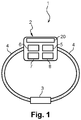
- the connected watch 1 comprises a main body 2 provided with a display screen 20, a bracelet 4 connected to the main body 2, a measurement module 3, a processing module 5 , and a location module 6.
- this watch is able to come into contact with a wrist of a user, so that one of the portions, more particularly the portion of the watch where a measurement module 3 is housed, can come into position in vis-à-vis a radial artery of the user's wrist, when the watch is worn by this user.
- a main body 2 is, in this embodiment, produced by injected plastic molding so as to provide a waterproof material that is resistant to the various conditions in which the watch could be brought to evolve, such as in extreme temperature zones or high altitude areas.
- the bracelet 4 can also be made by molding injected plastic or silicone.
- This bracelet can, for example, have a closure positioned on one side, so as to facilitate its putting on and its removal.
- the bracelet could also be a clasp bracelet or a locking bracelet for security reasons.
- the watch presented in this embodiment includes an electric power supply.
- a power supply is here in the form of a battery 57, provided at the level of the processing means 5, which thus enables this watch to be autonomous.
- This battery may, according to one embodiment, be a rechargeable battery or not.
- a battery could, moreover, be a LiPO battery allowing rapid charging.
- This battery can be connected to a USB port to recharge it.
- the recharging could also be done by induction so as to avoid a potential entry of water or dust.
- these measurements are carried out continuously.
- this measurement module could also include a sensor making it possible to detect a fall of the user, for example an altimeter capable of detecting a sudden change in altitude (here, in the altitude of the wrist).
- a sensor making it possible to detect a fall of the user, for example an altimeter capable of detecting a sudden change in altitude (here, in the altitude of the wrist).
- one or more of the sensors can, according to one embodiment, be activated or deactivated by user action, for example by touch action on the device. display screen 20 or by a combination of buttons.
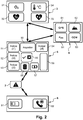
- the measurement module 3 is connected, by means of a cable, which is here a flat cable, to a processing module 5 which aims to analyze the measured parameters and to deliver information. indicating the detection or non-detection of an anomaly as a function of said analysis.
- the means 55 for delivering information indicating the detection or non-detection of an anomaly as a function of the analysis of the oxygen levels, heart rate, ascending and descending blood flow , and the user's skin temperature can deliver information indicating the detection of an anomaly if at least one of the measured parameters is characteristic of an anomaly.
- the delivery means can deliver information indicating the detection. an anomaly.
- the delivery means can therefore also deliver information indicating the detection of an anomaly.
- the delivery means can deliver information indicating the detection of an abnormality, for example hypothermia.
- the delivery means can deliver information indicating the detection of an anomaly if at least two of the measured parameters are characteristic of an anomaly, that is, if at least two of the measured parameters are outside the respective predetermined threshold.
- this processing module 5 further comprises means 58 for storing the measured data of the first sensor 31, second sensor 32, third sensor 33 and fourth sensor 34.
- the watch further comprises means for analyzing data measured and stored over a predefined period, for example to detect possible anomalies, such as cardiac arrhythmia, hypertension, or hypothermia.
- the storage means may also contain at least one item of information relating to the user belonging to the group comprising: the user's age, an anatomical data of the user, a user's morphological data, user's medical history, and user's blood type.
- a heart rate threshold will not be the same whether the person is athletic or not, depending on his age or morphology.
- a medical history can be useful for the medical profession if it has to perform an operative intervention. Such a feature can therefore prove to be useful in the case of emergency services which may need to access certain patient data in order to be able to intervene quickly.
- this or these information relating to the user can be consulted by display on the display screen 20 of the main body 2.
- one or more of the information relating to the user can be automatically displayed in the event of delivery of information indicating the detection of an anomaly.
- the avalanche victim detector 62 is an electronic transceiver device of a particular radio signal, intended to quickly locate its wearer if the latter is buried under a snow avalanche, by another transceiver manipulated. nearby by a rescue person.
- Such an avalanche victim detector can make it possible to transmit this particular low-energy radio signal even when the watch no longer has a battery for a predetermined period of time, for example for 7 days.
- the geolocation sensor 61 allows, for example, the user to know his position in connection with a map displayed on the screen 20 of the watch connected. This mapping can also include a display of an estimated route as well as an estimate of the time remaining before reaching a location objective entered by the user.
- Such a map can, for example, be downloadable by means of an application, such as a mobile application, which would be paired with such a connected watch. It could also be provided that the connected watch also incorporates a compass. In this way, it makes it possible to amplify the precision of the indications given as to the position and the direction to be followed for a user.
- this location sensor is able to share its location with other location sensors of connected watches nearby so that the map displayed on the main screen can display other people at proximity.
- the location module 6 comprises means 63 of communication capable of communicating with a beacon 9.
- the connected watch 1 is designed to be able to communicate with a marking system 90 as illustrated in figure 5 .
- This beaconing system 90 comprises a plurality of beacons 9 geographically spaced at least a distance D, each of the beacons 9 being able to communicate with the connected watch when the latter is located near the beacon 9, so that the nearby beacon 9 can deliver a first piece of information R to the connected watch 1 and receive a second piece of information T transmitted by the connected watch 1.
- the communication means 63 comprise means for receiving the first information and means for transmitting the second information.
- the distance D can for example be equal to 1 km. As a result, it is possible to know the exact position of the user at 1 km ready. It should be noted that between two beacons, the position of the user can be approximated, for example according to an estimate of the speed of the user, of the path taken.
- the first item of information comprises at least one element from the group comprising: the time of communication with the beacon 9, the date of communication with the beacon 9, the location of said beacon 9, and a number of people having received information by the beacon 9 within a predetermined period of time.
- the second item of information comprises at least one element from the group comprising: the time of communication with the beacon 9, the date of communication with the beacon 9, an identifier number of the connected watch 1, and characteristic information of the user.
- a markup at a given beacon a user can for example know the number of people passed by this beacon in a given time. For example, we could provide a display of a number of people who tagged to a given tag in the last hour. Provision could also be made for the first item of information to contain an approximate distance to a person who marked out this given beacon within the defined period of time. This can possibly be done by triangulating the data.
- this data can allow a member of the group to relate to others and, for example, to follow them without losing them.
- a group provision could for example be made for the identifier number of the connected watch or for the information characteristic of the user to be recognizable by the whole group (for example an identical start of the serial number for a whole group of watches) so as to facilitate the use.
- a feature may, for example, be useful with a view to renting out such connected watches, for example in leisure centers or in mountain ski resorts.
- the connected watch further comprises a sensor 64 capable of measuring atmospheric pressure and an external oxygen level, which is here placed in the location module 6.
- this sensor could also be positioned elsewhere on the smartwatch.
- the watch connected according to this embodiment further comprises alert means 7. Therefore, if information indicating the detection of an anomaly is delivered by the delivery means 55, these alert means 7 generate a alert message which is transmitted by means of transmission means 8, for example to a predetermined contact or to an emergency service.
- the transmission means 8 comprise a port 81 configured to receive a SIM card, preferably a nano SIM card.
- transmission means can be accompanied by transmission means implemented in the form of an antenna operating by wireless technology such as Bluetooth, Wifi, 3G, 4G, or 5G.
- the alert message can, for example, be sent in the form of an SMS or a voice message sent to a person's phone.
- This alert message can also be sent in the form of a notification on a mobile terminal of a predetermined contact.
- This alert message can also be accompanied by an alert sent to emergency services so as to gain in efficiency for the intervention.
- the alert message may contain important information on the alert generated, for example the measurement which generated this alert, information relating to the user, the location of the user.
- the alert message can also be accompanied by a pre-diagnosis so as to more easily direct a person to the right emergency service, or to direct the emergency services directly.
- the message sent can also contain a remote access code allowing the emergency services or the predetermined contact to obtain a great deal of information contained in the connected watch, such as markup information for example.
- the predetermined contact (s) are stored in the storage means.
- this predetermined contact can also be automatically displayed on the display screen 20 in the event of delivery of information indicating the detection of an anomaly.
- An embodiment of the invention can be provided in which the measured data are accessible by the user who, for example by action on the display screen or by a combination of buttons, sends data to the emergency services or to the predetermined contact. by means of transmission means 8 so as to be able to carry out a remote diagnosis or to direct the user's request.
- transmission means are accompanied by reception means (not shown here) so that a third party, for example an emergency service, can enter data in a format recognized by the network. show.
- the watch connected according to the embodiment presented further comprises unique identification means.
- the connected watch can include means for detecting a placement of this watch on the user's wrist.
- the transmission means may further comprise means 82 for an emergency call from the predetermined contact.
- These emergency call means can be implemented in the form of two buttons placed on either side of the main body, the user having to simultaneously press the two buttons to make this emergency call.
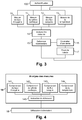
- the step of issuing instructions for information indicating the detection or non-detection of an anomaly as a function of the analysis of the oxygen levels, and / or rhythm cardiac and / or ascending and / or descending blood flow and / or skin temperature of the user can deliver information indicating the detection of an anomaly if at least one of the measured parameters is characteristic of an anomaly.
- the issuing step being able to deliver information indicating the detection of an anomaly can be carried out if at least two of the measured parameters are characteristic of 'an anomaly, that is to say if at least two of the measured parameters are outside the respective predetermined threshold.
- the method comprises a prior authentication step 100.
- a prior authentication step 100 it makes it possible to secure the connected watch by limiting access to the data and its use to one or more authorized persons.
- the invention also relates to a computer program product downloadable from a communication network and / or stored on a medium readable by a microprocessor and / or executable by a microprocessor, comprising program code instructions for the execution of a method. monitoring the user according to one of the aforementioned embodiments, when it is executed on a computer.
- the invention also relates to a non-transient, computer-readable storage medium storing a computer program comprising a set of instructions executable by a computer or a processor for implementing the user monitoring method according to the invention. one of the aforementioned embodiments.
- the storage medium can be included in the main body, for example in the memory 58 integrated at the location of the processing module. It could also be included at the location of the measurement module.
- the general principle of the invention is based on the implementation of an individual monitoring device against drowning, of the connected bracelet type, capable of coming into contact with a child's wrist, and capable of coming into contact with a child's wrist. indicate the detection or non-detection of an abnormality based on an analysis of measured physiological parameters of the child.
- Such a bracelet can be used to reinforce the security and the surveillance of people, more particularly of vulnerable people, even more particularly of children, in order to avoid drowning.
- Such an individual monitoring device can, for example, be used in a private or municipal swimming pool, in the sea, in bodies of water, or in any place that may represent a risk of flooding.
- This type of device is simple in design and use.
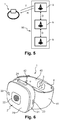
- the monitoring device 1 comprises a waterproof main body 2 and a bracelet 4 connected to the main body 2.
- the main body 2 here has a substantially square shape with rounded corners and consists of a bottom 29 surmounted by side walls 21, the whole being covered with an upper surface 20 forming a cover.
- this main body would have another shape.
- Such a main body 2 is, in this embodiment, produced by injected plastic molding so as to provide a waterproof material that is resistant to the different conditions in which it could be brought to evolve, such as sea water. also provide a main body made of another material which makes it possible to provide the same conditions of strength and tightness.
- the bracelet 4 connected to the main body 2, it has a first portion 40 carrying a surface disposed opposite the main body 2 and intended to come into position vis-à-vis a radial artery and / or radial vein of the wrist. the child, when the bracelet is worn by the child, and two second portions 41 each connected by one end to the main body 2, one of the two further carrying the first portion.
- This bracelet 4 can also be made by molding injected plastic or silicone.
- the bracelet 4 is formed of two arms, one of the arms consisting of one of the two second portions 41 connected to the first portion 40, and the other arm consisting of the other of the two. second portions 41.
- This bracelet also has a loop 42 carried by the arm simply consisting of the other of the two second portions 41 so as to fit into one of the holes formed in the first portion 40.
- the bracelet 4 ′ is a bracelet with a clasp, so that such a device 4 ′ is attached to the wrist of a child in the manner of a classic clasp watch.
- Two push buttons 420 ′ arranged on either side of one of the two second portions carrying the clasp allow a child to open this clasp. Therefore, this can provide double security to prevent a child from removing the bracelet.
- the means 50 for analyzing the first measured physiological parameter compare the value of the first physiological parameter with respect to a first predetermined value range
- the means 51 for analyzing the second measured physiological parameter compare the value of the second physiological parameter with respect to a second predetermined value range.
- the first sensor 31 is a sensor measuring the level of oxygen in the blood, the first value range lying between 86% and 90%.
- the second sensor 32 is a sensor measuring the heart rate, the second value range being between 65 and 90 beats per minute.
- the first value range could be defined by a succession of thresholds crossed within the same range of values going from 80% to 90%, for example a step at 90% then a step at 88% then a step to 86% and so on, given that below 80% a child can be considered to be hypoxic.
- the oxygen level drops steadily.
- the mechanism of drowning in children is not the same as in adults, because the child drowns when inhaling water, so it could be water drowning or drowning. dry that occurs at a distance from the first drowning.
- Such a sensor can thus make it possible to evaluate at the instant T the oxygen level at the precise moment when the child is drowning but also at a distance from drowning for dry drownings.
- the first and second sensors will work according to a principle of absorbance of light at the level of the radial artery. The principle of absorbance will make it possible to determine the oxygen saturation rate of a medium, here the child's blood.
- the quantity of light absorbed by a medium is proportional to its concentration in a given chemical species according to the Beer-Lambert law.
- These sensors which are therefore placed under the radial vein, are equipped with a light emitter-receiver and linked to a processor.
- the transmitter allows the emission of an infrared light and a red light thanks to two LEDs. These two lights will cross the radial artery intermittently and will be picked up by a receiver.
- the processing module consisting here of a nanoprocessor, will quantify them. A calculation of the quantity of light absorbed will make it possible to determine the blood oxygen saturation, by isolating the variations of the artery on the cardiac sensor.
- Blood saturation is expressed as a percentage and will allow an estimate of the rate.
- the normal value is between 90% and 100%.
- the sensor will also make it possible to measure the heart rate by calculating the upward and downward flow, by measuring the variation of the various blood flows at the level of the artery.
- the means for analyzing the first parameter are here composed of a microprocessor containing an algorithm allowing the calculation of data and the analysis of the oxygen level and the means for analyzing the second parameter are composed of a second microprocessor calculating the oxygen level to assess heart and lung problems in the second bracelet.
- the measurement module may have a round or square shape, so as to encompass the entire surface of the wrist containing the radial artery.
- skin temperature could be useful in detecting possible hypothermia.
- This measuring module 3 is, in the illustrated embodiment, located on the bracelet 4, on a surface of the portion 40 of the bracelet which is arranged opposite the main body 2. Therefore, the measuring module 3 is intended for to be positioned vis-à-vis a radial artery and / or radial vein of the child's wrist, when the bracelet is worn by the child.
- Such an arrangement is useful for making precise measurements of physiological parameters.
- This measurement module 3 is connected, by means of a cable 43, which is here a flat cable, to a processing module 5 which aims to analyze the measured parameters and to deliver information indicating the detection or the non detection of an anomaly based on said analysis.
- a cable 43 which is here a flat cable
- the processing module 5 also comprises alert means 52, 53 if information indicating the detection of an anomaly is delivered by the delivery means 55.
- warning means are present in the form of an audible warning device 52 placed opposite orifices 23 implemented on a side wall 21 so as to emit a warning sound so that people near the child can see that the child is in a dangerous situation.
- warning means also comprise, in this embodiment, a warning light 52 emitting a light in the event of detection of an anomaly, the information therefore possibly being the emission of light.
- a warning light is implemented here in the form of an LED placed opposite a window 22 created on the cover 20 and covered with an at least partially transparent material. In this way, a light signal, for example a flashing of the LED can alert people nearby that the child is in a dangerous situation.
- the device according to the embodiment described here also has means 24 for manually activating monitoring. These means are implemented here in the form of two buttons extending from two opposite sides of the side wall 21 and allowing a person, for example one of the child's parents, to activate and / or to activate. deactivate the monitoring device, and also activate and / or deactivate the implementation of the monitoring method which will be presented below.
- buttons In one implementation, to activate or deactivate the device, a person must simultaneously press both buttons.
- Such manual activation means of the monitoring can also be implemented in the form of a single button, for example a button placed in a place that is difficult to access the device so that it cannot be accidentally deactivated. .
- Such an activation means could also be implemented in the form of a code to be typed in order by means of three or more buttons, so as to make the activation and deactivation even more secure.
- the processing module 5 also comprises means 56 for the remote transmission of information indicating the detection or non-detection of an anomaly delivered by the means issuance 55.
- Such transmission means 56 can for example be implemented in the form of an element capable of transmitting and receiving data by wireless technology such as Bluetooth, Wifi, 3G, 4G, or 5G.
- Such an element can for example be associated with a port for a SIM card (SIM, micro Sim, nano SIM) so that this information is sent in the form of an SMS to a remote terminal.
- SIM SIM, micro Sim, nano SIM
- These transmission means 56 can also, according to a variant, be paired with a remote terminal so as to be able to communicate with an application, for example a mobile application, and send alerts in the form of notifications.
- the device 1 also comprises a third sensor 33 capable of measuring a third ambient parameter, the processing means comprising means for analyzing the third measured ambient parameter.
- the means for analyzing the third ambient parameter can, in a manner analogous to the first and second physiological parameters of the child, analyze this third ambient parameter with respect to a third predetermined value range. Consequently, the analysis means are able to deliver information characteristic of an anomaly if the first physiological parameter, the second physiological parameter, and the third external parameter are not located respectively in the first, second and third predetermined value ranges. .
- the third sensor is a pressure sensor placed on a monolithic silicon chip, so as to provide an ultra compact and reliable pressure sensor.
- the third sensor is a pressure sensor. Therefore, if the measured ambient pressure turns out to be too high, it may be, in the case of a risk of drowning, a fall into the water which causes this sudden change in pressure.
- the means for analyzing the third ambient parameter detect that this third parameter is outside the normal pressure value range, the normal pressure corresponding for example to the pressure of the free air, they will press, in combination with an anomaly if the first physiological parameter and the second physiological parameter are not either located within their value range, on delivery of information characteristic of an anomaly by the delivery means.
- Such information can, for example, make it possible to obtain additional information on the location of the child, or more precise information on the situation in which the child is.
- such information could be taken into account by the processing module as a function of a location of the child cross-checked with a map stored in a memory. indicating places potentially at risk.
- the device presented in this embodiment comprises a power supply.
- a power supply is here in the form of a battery, provided at the level of the processing means 5, which thus allows this device to be autonomous.
- a battery can, for example, be a LiPO battery allowing rapid charging.
- This battery can be connected to a USB port to recharge it. The recharging could also be done by induction so as to avoid a potential entry of water or dust.
- This method is capable of delivering information indicating the detection or non-detection of an anomaly, which may in particular be characteristic of a risk of drowning for a child.
- the delivery of the information indicating the detection or non-detection of an abnormality depends on both the first and the second physiological parameters of the child.
- This information indicating the detection of an anomaly may for example consist of an audible alert emitted by the audible warning device 53, or a visual alert emitted by the LED 52.
- the device of the first embodiment presented comprises means for manually activating monitoring, here in the form of side buttons 24.
- buttons can make it possible to activate and / or deactivate the implementation of the monitoring method.
- the monitoring method could also include a deactivation step after a certain period of time during which no measurement could be carried out, a sign that the device no longer exists. is more connected to the wrist of a child. Such a step could for example be useful to save the battery of a device.
- armbands can be, for example, conventional inflatable armbands or armbands having a material capable of floating.
- Such armbands can, according to one embodiment, comprise a sensor capable of sending data to the bracelet, for example at the level of the transmission means 56.
- this sensor could be a sensor for detecting placement on the child's arm, an alert being emitted as soon as it is detected that the child is removing his cuffs.
- an alert could have an alert distance condition, an alert being emitted as soon as the child moves away from the armbands, for example at 50cm or 1m.
- Such a feature could allow, for example, an adult to be warned when the child removes his armbands and walks away from them.
- Such armbands could also be linked to a mobile terminal application.
- the invention also relates to a computer program product downloadable from a communication network and / or stored on a medium readable by a microprocessor and / or executable by a microprocessor, comprising program code instructions for the execution of a method.
- personal drowning surveillance according to one of the aforementioned embodiments, when it is executed on a computer.
- the invention also relates to a non-transient, computer-readable storage medium, storing a computer program comprising a set of instructions executable by a computer or a processor for implementing the method of personal drowning monitoring according to the invention. one of the aforementioned embodiments.
- the storage medium can be included in the main body, for example a memory 54 integrated at the location of the processing module. It could also be included at the location of the measurement module.
Landscapes
- Health & Medical Sciences (AREA)
- Life Sciences & Earth Sciences (AREA)
- General Health & Medical Sciences (AREA)
- Engineering & Computer Science (AREA)
- Physics & Mathematics (AREA)
- Biomedical Technology (AREA)
- Heart & Thoracic Surgery (AREA)
- Medical Informatics (AREA)
- Public Health (AREA)
- Biophysics (AREA)
- Pathology (AREA)
- Veterinary Medicine (AREA)
- Molecular Biology (AREA)
- Surgery (AREA)
- Animal Behavior & Ethology (AREA)
- Cardiology (AREA)
- Physiology (AREA)
- Business, Economics & Management (AREA)
- General Physics & Mathematics (AREA)
- Emergency Management (AREA)
- Child & Adolescent Psychology (AREA)
- Pulmonology (AREA)
- Psychiatry (AREA)
- Computer Vision & Pattern Recognition (AREA)
- Hematology (AREA)
- Signal Processing (AREA)
- Optics & Photonics (AREA)
- Artificial Intelligence (AREA)
- Primary Health Care (AREA)
- General Business, Economics & Management (AREA)
- Computer Networks & Wireless Communication (AREA)
- Epidemiology (AREA)
- Physical Education & Sports Medicine (AREA)
- Gerontology & Geriatric Medicine (AREA)
- Measuring And Recording Apparatus For Diagnosis (AREA)
- Measuring Pulse, Heart Rate, Blood Pressure Or Blood Flow (AREA)
- Electric Clocks (AREA)
Applications Claiming Priority (2)
| Application Number | Priority Date | Filing Date | Title |
|---|---|---|---|
| FR2004050A FR3109658B1 (fr) | 2020-04-23 | 2020-04-23 | Dispositif de protection individuelle d’un enfant contre les noyades du type bracelet connecte et procede de surveillance d’un enfant correspondant. |
| FR2004051A FR3109640B1 (fr) | 2020-04-23 | 2020-04-23 | Montre connectee de surveillance, systeme de balisage et procede de surveillance d’un utilisateur correspondants. |
Publications (2)
| Publication Number | Publication Date |
|---|---|
| EP3901931A2 true EP3901931A2 (de) | 2021-10-27 |
| EP3901931A3 EP3901931A3 (de) | 2022-01-05 |
Family
ID=75562691
Family Applications (1)
| Application Number | Title | Priority Date | Filing Date |
|---|---|---|---|
| EP21170254.3A Withdrawn EP3901931A3 (de) | 2020-04-23 | 2021-04-23 | Individuelles überwachungsgerät vom typ verbundenes uhrenarmband und individuelles verfahren zur überwachung eines entsprechenden nutzers |
Country Status (3)
| Country | Link |
|---|---|
| US (1) | US12064263B2 (de) |
| EP (1) | EP3901931A3 (de) |
| WO (1) | WO2021214419A2 (de) |
Families Citing this family (5)
| Publication number | Priority date | Publication date | Assignee | Title |
|---|---|---|---|---|
| CN115191965A (zh) * | 2022-06-23 | 2022-10-18 | 深圳市纳晶云科技有限公司 | 一种智能手表的人体生命监测系统 |
| CN115670401A (zh) * | 2022-11-10 | 2023-02-03 | 甘肃省人民医院 | 一种基于老年人护理的健康监管系统 |
| TR2024002780A2 (tr) * | 2024-03-07 | 2024-03-21 | Guelsacan Behic Ayhan | Deprem ve benzeri̇ aci̇l durumlarda arama kurtarma kolayliği sağlayan akilli bi̇lekli̇k si̇stemi̇ |
| ES3001808A1 (es) * | 2024-11-06 | 2025-03-05 | Senior Telecomunicaciones Y Servicios Avanzados Sl | Sistema y metodo de geolocalizacion en situacion de auxilio |
| CN119138856B (zh) * | 2024-11-15 | 2025-01-24 | 香港中文大学(深圳) | 一种多传感器脉搏波定位装置及分析系统 |
Family Cites Families (28)
| Publication number | Priority date | Publication date | Assignee | Title |
|---|---|---|---|---|
| JPH0644753B2 (ja) | 1986-06-10 | 1994-06-08 | 三菱電機株式会社 | サンプリング同期の監視方式 |
| IL137045A0 (en) * | 2000-06-27 | 2001-06-14 | Gorenberg Nora Viviana | A non-invasive method and apparatus for measuring the mechanical performance of the heart |
| GB2408893B (en) | 2003-12-04 | 2006-11-08 | Motorola Inc | Method and apparatus for survivor location |
| US7733224B2 (en) * | 2006-06-30 | 2010-06-08 | Bao Tran | Mesh network personal emergency response appliance |
| US7539533B2 (en) * | 2006-05-16 | 2009-05-26 | Bao Tran | Mesh network monitoring appliance |
| EP1918191B1 (de) | 2006-11-06 | 2009-02-11 | Jürgen Puls | Verfahren und Einrichtung zum Erkennen der Ertrinkungsgefahr für eine Person im Wasser |
| US7554453B2 (en) | 2006-12-22 | 2009-06-30 | Thermocline Ventures Llc | Water alarm devices, systems and related methods |
| US20090322513A1 (en) * | 2008-06-27 | 2009-12-31 | Franklin Dun-Jen Hwang | Medical emergency alert system and method |
| US8532751B2 (en) * | 2008-09-30 | 2013-09-10 | Covidien Lp | Laser self-mixing sensors for biological sensing |
| US9492092B2 (en) * | 2009-05-20 | 2016-11-15 | Sotera Wireless, Inc. | Method for continuously monitoring a patient using a body-worn device and associated system for alarms/alerts |
| CH703352A1 (fr) | 2010-06-30 | 2011-12-30 | Infrasurvey Sarl | Méthode de positionnement de balise souterraine. |
| US9031641B2 (en) * | 2011-07-28 | 2015-05-12 | Medtronic, Inc. | Quantifying laser-doppler perfusion signal for arrhythmia detection and disease monitoring |
| JP6044753B2 (ja) | 2012-01-06 | 2016-12-14 | セイコーエプソン株式会社 | 救難支援装置及び救難支援システム |
| WO2015177594A2 (en) * | 2014-05-22 | 2015-11-26 | Samsung Electronics Co., Ltd. | Electrocardiogram watch clasp |
| US10154401B2 (en) | 2014-06-23 | 2018-12-11 | BeaconWatch, LLC | Safety device utilizing a beacon |
| US20160106326A1 (en) * | 2014-10-21 | 2016-04-21 | Google Inc. | Pressure Wave Measurement of Blood Flow |
| KR102270209B1 (ko) | 2014-10-28 | 2021-06-29 | 삼성전자주식회사 | 신체 착용형 전자 장치 |
| US20180000418A1 (en) * | 2015-01-05 | 2018-01-04 | Huawei Technologies Co., Ltd. | Method for detecting wearable device, and wearable device |
| US9924880B2 (en) * | 2015-02-11 | 2018-03-27 | Samsung Electronics Co., Ltd. | RF doppler bio-signal sensor for continuous heart rate variability and blood pressure monitoring |
| CN104814726B (zh) | 2015-05-28 | 2016-08-24 | 京东方科技集团股份有限公司 | 一种智能手环 |
| US20190066478A1 (en) | 2015-06-01 | 2019-02-28 | Stuart Reich | Personal safety monitoring using a multi-sensor apparatus |
| JP6594135B2 (ja) * | 2015-09-16 | 2019-10-23 | オムロンヘルスケア株式会社 | 生体情報測定装置、生体情報測定方法、及び生体情報測定プログラム |
| US11020058B2 (en) * | 2016-02-12 | 2021-06-01 | Qualcomm Incorporated | Methods and devices for calculating blood pressure based on measurements of arterial blood flow and arterial lumen |
| US10213117B2 (en) * | 2016-02-18 | 2019-02-26 | Qualcomm Incorporated | Blood pressure estimation based on pulse wave velocity |
| JP2017153875A (ja) * | 2016-03-04 | 2017-09-07 | セイコーエプソン株式会社 | 生体情報測定装置および生体情報測定方法 |
| BE1024423B1 (fr) | 2016-12-21 | 2018-02-13 | Idahealth Inc | Equipement de surveillance des flux sanguins et respiratoires |
| JP7001514B2 (ja) * | 2018-03-23 | 2022-01-19 | 日本光電工業株式会社 | 生体情報モニタ、及びプログラム |
| US20200126391A1 (en) * | 2018-10-22 | 2020-04-23 | Nicole Lovett | Drowning Prevention System |
-
2021
- 2021-04-23 EP EP21170254.3A patent/EP3901931A3/de not_active Withdrawn
- 2021-04-23 US US17/239,541 patent/US12064263B2/en active Active
- 2021-04-23 WO PCT/FR2021/050712 patent/WO2021214419A2/fr not_active Ceased
Also Published As
| Publication number | Publication date |
|---|---|
| US20210330257A1 (en) | 2021-10-28 |
| WO2021214419A2 (fr) | 2021-10-28 |
| WO2021214419A3 (fr) | 2021-12-23 |
| EP3901931A3 (de) | 2022-01-05 |
| US12064263B2 (en) | 2024-08-20 |
Similar Documents
| Publication | Publication Date | Title |
|---|---|---|
| WO2021214419A2 (fr) | Dispositif de surveillance individuelle du type bracelet connecte et procede de surveillance d'un utilisateur correspondant | |
| Garg et al. | Healthcare monitoring of mountaineers by low power wireless sensor networks | |
| ES2293225T3 (es) | Aparato y sistema para seguimiento y control. | |
| EP1278457B1 (de) | Verfahren und vorrichtung zur detektion abnormaler situtationen | |
| US20080266118A1 (en) | Personal emergency condition detection and safety systems and methods | |
| US8659435B2 (en) | Waterproof optically-sensing fiberless-optically-communicating vitality monitoring and alarming system, particularly for swimmers and infants | |
| US20180132768A1 (en) | Living body monitoring system, portable electronic apparatus, living body monitoring program, computer readable recording medium, living body monitoring method, display device and display method | |
| US10072975B2 (en) | Wearable to monitor exposure to UV radiation | |
| JP7022234B2 (ja) | 監視装置、監視方法、及び監視プログラム | |
| CN101615332A (zh) | 跌倒检测警报装置、方法及使用该装置的鞋子 | |
| WO2017049958A1 (zh) | 瘫倒监测和预防装置及其处理方法 | |
| FR2785073A1 (fr) | Systeme de surveillance de la sante, sans fil | |
| WO2020085108A1 (ja) | 監視装置、監視方法、及び監視プログラム | |
| US12263010B2 (en) | Opioid overdose alert wearable device method and devices | |
| US20260143093A1 (en) | Personal monitoring apparatus and methods | |
| CN113570823A (zh) | 一种户外监测预警装置 | |
| EP0915398A1 (de) | Verbesserte Sicherheitsarmbanduhr | |
| FR3109658A1 (fr) | Dispositif de protection individuelle d’un enfant contre les noyades du type bracelet connecte et procede de surveillance d’un enfant correspondant. | |
| JP2001093068A (ja) | 人体異常検知通信端末 | |
| FR3109640A1 (fr) | Montre connectee de surveillance, systeme de balisage et procede de surveillance d’un utilisateur correspondants. | |
| KR102712193B1 (ko) | 생체정보 센싱 및 위험 알람 장치 | |
| Abo-Zahhad et al. | Intelligent IoT-Based Tracking System for Constant Supervision of Health Status and Daily Activities of Children | |
| Sah et al. | AlpineShield: Advanced Smart Jacket for Mountaineer Safety | |
| EP3768152B1 (de) | System zur überwachung von stress bei einer person | |
| KR20230102428A (ko) | 동적 지오펜싱 및 메쉬 네트워크 기반 인원 관리 시스템 및 그 방법 |
Legal Events
| Date | Code | Title | Description |
|---|---|---|---|
| PUAI | Public reference made under article 153(3) epc to a published international application that has entered the european phase |
Free format text: ORIGINAL CODE: 0009012 |
|
| STAA | Information on the status of an ep patent application or granted ep patent |
Free format text: STATUS: THE APPLICATION HAS BEEN PUBLISHED |
|
| AK | Designated contracting states |
Kind code of ref document: A2 Designated state(s): AL AT BE BG CH CY CZ DE DK EE ES FI FR GB GR HR HU IE IS IT LI LT LU LV MC MK MT NL NO PL PT RO RS SE SI SK SM TR |
|
| PUAL | Search report despatched |
Free format text: ORIGINAL CODE: 0009013 |
|
| AK | Designated contracting states |
Kind code of ref document: A3 Designated state(s): AL AT BE BG CH CY CZ DE DK EE ES FI FR GB GR HR HU IE IS IT LI LT LU LV MC MK MT NL NO PL PT RO RS SE SI SK SM TR |
|
| RIC1 | Information provided on ipc code assigned before grant |
Ipc: A61B 5/11 20060101ALI20211202BHEP Ipc: A61B 5/026 20060101ALI20211202BHEP Ipc: A61B 5/024 20060101ALI20211202BHEP Ipc: G08B 21/04 20060101AFI20211202BHEP |
|
| STAA | Information on the status of an ep patent application or granted ep patent |
Free format text: STATUS: REQUEST FOR EXAMINATION WAS MADE |
|
| 17P | Request for examination filed |
Effective date: 20220705 |
|
| RBV | Designated contracting states (corrected) |
Designated state(s): AL AT BE BG CH CY CZ DE DK EE ES FI FR GB GR HR HU IE IS IT LI LT LU LV MC MK MT NL NO PL PT RO RS SE SI SK SM TR |
|
| RAP3 | Party data changed (applicant data changed or rights of an application transferred) |
Owner name: KERROUCHE, SAMIRA Owner name: BOUYAHIA, HAYAME |
|
| RIN1 | Information on inventor provided before grant (corrected) |
Inventor name: KERROUCHE, SAMIRA Inventor name: BOUYAHIA, HAYAME |
|
| STAA | Information on the status of an ep patent application or granted ep patent |
Free format text: STATUS: EXAMINATION IS IN PROGRESS |
|
| 17Q | First examination report despatched |
Effective date: 20230712 |
|
| STAA | Information on the status of an ep patent application or granted ep patent |
Free format text: STATUS: THE APPLICATION IS DEEMED TO BE WITHDRAWN |
|
| 18D | Application deemed to be withdrawn |
Effective date: 20231101 |