EP3901158A2 - Polycyclic compound and organic light-emitting element comprising same - Google Patents
Polycyclic compound and organic light-emitting element comprising same Download PDFInfo
- Publication number
- EP3901158A2 EP3901158A2 EP20847289.4A EP20847289A EP3901158A2 EP 3901158 A2 EP3901158 A2 EP 3901158A2 EP 20847289 A EP20847289 A EP 20847289A EP 3901158 A2 EP3901158 A2 EP 3901158A2
- Authority
- EP
- European Patent Office
- Prior art keywords
- group
- substituted
- unsubstituted
- carbon atoms
- deuterium
- Prior art date
- Legal status (The legal status is an assumption and is not a legal conclusion. Google has not performed a legal analysis and makes no representation as to the accuracy of the status listed.)
- Pending
Links
- 0 CC*C1(C)CC(*CC)(*CC)CC1 Chemical compound CC*C1(C)CC(*CC)(*CC)CC1 0.000 description 218
- FXUUPRBLPFIEGA-UHFFFAOYSA-N CC(C)(CC1(C)C)c(cc2C)c1cc2N1c2cc(C)cc(N(c3c(C)cc(C(C)(C)CC4(C)C)c4c3)c3c4cc(C(C)(C)CCC5(C)C)c5c3)c2S4c2cc(-c3c(c4ccccc4[s]4)c4ccc3)ccc12 Chemical compound CC(C)(CC1(C)C)c(cc2C)c1cc2N1c2cc(C)cc(N(c3c(C)cc(C(C)(C)CC4(C)C)c4c3)c3c4cc(C(C)(C)CCC5(C)C)c5c3)c2S4c2cc(-c3c(c4ccccc4[s]4)c4ccc3)ccc12 FXUUPRBLPFIEGA-UHFFFAOYSA-N 0.000 description 2
- RYVKNDWNQCSGPE-UHFFFAOYSA-N C(C1OC(C2C=CC=CC2C=C2)=C2C1=C1)C=C1c1c(cccc2)c2c(-c2ccccc2)c2c1cccc2 Chemical compound C(C1OC(C2C=CC=CC2C=C2)=C2C1=C1)C=C1c1c(cccc2)c2c(-c2ccccc2)c2c1cccc2 RYVKNDWNQCSGPE-UHFFFAOYSA-N 0.000 description 1
- ILGUUBNKQWYXNQ-UHFFFAOYSA-N C1C=CC(c2cc3ccccc3cc2)=CC1C1c2ccccc2C(c(cc2)cc3c2[o]c(c2c4)c3ccc2ccc4-c(cc2)ccc2-c2ccc(C3c4ccccc4C(c(cc4)cc5c4[o]c4c5ccc5ccccc45)=C4C=CC=CC34)cc2)=C2C=CC=CC12 Chemical compound C1C=CC(c2cc3ccccc3cc2)=CC1C1c2ccccc2C(c(cc2)cc3c2[o]c(c2c4)c3ccc2ccc4-c(cc2)ccc2-c2ccc(C3c4ccccc4C(c(cc4)cc5c4[o]c4c5ccc5ccccc45)=C4C=CC=CC34)cc2)=C2C=CC=CC12 ILGUUBNKQWYXNQ-UHFFFAOYSA-N 0.000 description 1
- JDURGYFKYGLZML-UHFFFAOYSA-N CC(C)(C)C(C1)C=CC2=C1C(C)(CCCC1)C1(C)N2c1cc(N(c2cc(C(C)(C)CCC3(C)C)c3cc2)c2cc(C(C)(C)CCC3(C)C)c3cc2B2c(cc(C(C)(C)CCC3(C)C)c3c3)c3N3c4cccc5c4C4C=CC=CC4O5)c2c3c1 Chemical compound CC(C)(C)C(C1)C=CC2=C1C(C)(CCCC1)C1(C)N2c1cc(N(c2cc(C(C)(C)CCC3(C)C)c3cc2)c2cc(C(C)(C)CCC3(C)C)c3cc2B2c(cc(C(C)(C)CCC3(C)C)c3c3)c3N3c4cccc5c4C4C=CC=CC4O5)c2c3c1 JDURGYFKYGLZML-UHFFFAOYSA-N 0.000 description 1
- ZSFXDKNVCQQQHV-UHFFFAOYSA-N CC(C)(C)C1C#CC(C(C2)C=CC3=C2C(C)(CCCC2)C2(C)N3c2cc(N(c3cc(C(C)(C)CCC4(C)C)c4cc3)c3cc(C(C)(C)CCC4(C)C)c4cc3B3c(cc(C(C)(C)CCC4(C)C)c4c4)c4N4c5cccc6c5C5C=CC=CC5O6)c3c4c2)=CC1 Chemical compound CC(C)(C)C1C#CC(C(C2)C=CC3=C2C(C)(CCCC2)C2(C)N3c2cc(N(c3cc(C(C)(C)CCC4(C)C)c4cc3)c3cc(C(C)(C)CCC4(C)C)c4cc3B3c(cc(C(C)(C)CCC4(C)C)c4c4)c4N4c5cccc6c5C5C=CC=CC5O6)c3c4c2)=CC1 ZSFXDKNVCQQQHV-UHFFFAOYSA-N 0.000 description 1
- NNMWKWHSRMPPHZ-UHFFFAOYSA-N CC(C)(C)c(c-1c2Cc3c-1cccc3)ccc2N1c(cc(C)cc2N(c3cc(C(C)(C)CCC4(C)C)c4cc3)c3cc(C(C)(C)CCC4(C)C)c4cc33)c2S3c2c1cc(C(C)(C)CCC1(C)C)c1c2 Chemical compound CC(C)(C)c(c-1c2Cc3c-1cccc3)ccc2N1c(cc(C)cc2N(c3cc(C(C)(C)CCC4(C)C)c4cc3)c3cc(C(C)(C)CCC4(C)C)c4cc33)c2S3c2c1cc(C(C)(C)CCC1(C)C)c1c2 NNMWKWHSRMPPHZ-UHFFFAOYSA-N 0.000 description 1
- YVBBIBRRYIMLLW-UHFFFAOYSA-N CC(C)(C)c(c1c(cc2)c(cccc3)c3[s]1)c2N(c1c(B2c3cc(C(C)(C)CCC4(C)C)c4cc3N3c4cc(C(C)(C)CCC5(C)C)c5cc4)cc(C(C)(C)CCC4(C)C)c4c1)c1c2c3cc(C)c1 Chemical compound CC(C)(C)c(c1c(cc2)c(cccc3)c3[s]1)c2N(c1c(B2c3cc(C(C)(C)CCC4(C)C)c4cc3N3c4cc(C(C)(C)CCC5(C)C)c5cc4)cc(C(C)(C)CCC4(C)C)c4c1)c1c2c3cc(C)c1 YVBBIBRRYIMLLW-UHFFFAOYSA-N 0.000 description 1
- CXMXKVKSPMSQRE-UHFFFAOYSA-N CC(C)(C)c(c1c2[s]c3ccccc13)ccc2N(c1c(B2c3cc(C(C)(C)CCC4(C)C)c4cc3N3c4cc(C(C)(C)CCC5(C)C)c5cc4)cc(C(C)(C)CCC4(C)C)c4c1)c1c2c3cc(C)c1 Chemical compound CC(C)(C)c(c1c2[s]c3ccccc13)ccc2N(c1c(B2c3cc(C(C)(C)CCC4(C)C)c4cc3N3c4cc(C(C)(C)CCC5(C)C)c5cc4)cc(C(C)(C)CCC4(C)C)c4c1)c1c2c3cc(C)c1 CXMXKVKSPMSQRE-UHFFFAOYSA-N 0.000 description 1
- VYUGPILLNZDILA-UHFFFAOYSA-N CC(C)(C)c(cc1)c2[o]c3ccccc3c2c1N(c1c2cc(C(C)(C)CC3(C)C)c3c1)c1c3S2c2cc(C(C)(C)CCC4(C)C)c4cc2N(c2cc(C(C)(C)CCC4(C)C)c4cc2)c3cc(C)c1 Chemical compound CC(C)(C)c(cc1)c2[o]c3ccccc3c2c1N(c1c2cc(C(C)(C)CC3(C)C)c3c1)c1c3S2c2cc(C(C)(C)CCC4(C)C)c4cc2N(c2cc(C(C)(C)CCC4(C)C)c4cc2)c3cc(C)c1 VYUGPILLNZDILA-UHFFFAOYSA-N 0.000 description 1
- OHAUNCWHHNRSFT-UHFFFAOYSA-N CC(C)(C)c(cc1)c2[s]c3ccccc3c2c1N(c1c2cc(C(C)(C)CC3(C)C)c3c1)c1c3S2c2cc(C(C)(C)CCC4(C)C)c4cc2N(c2cc(C(C)(C)CCC4(C)C)c4cc2)c3cc(C)c1 Chemical compound CC(C)(C)c(cc1)c2[s]c3ccccc3c2c1N(c1c2cc(C(C)(C)CC3(C)C)c3c1)c1c3S2c2cc(C(C)(C)CCC4(C)C)c4cc2N(c2cc(C(C)(C)CCC4(C)C)c4cc2)c3cc(C)c1 OHAUNCWHHNRSFT-UHFFFAOYSA-N 0.000 description 1
- FEBRIZZSPVTRNH-UHFFFAOYSA-N CC(C)(C)c(cc1)cc(-c2ccccc2)c1N(c1c(B2c(c(N3c4cc(C(C)(C)CC5(C)C)c5cc4C)c4)ccc4-c4cccc5c4c(cccc4)c4[o]5)cc(C(C)(C)CC4(C)C)c4c1)c1c2c3cc(C)c1 Chemical compound CC(C)(C)c(cc1)cc(-c2ccccc2)c1N(c1c(B2c(c(N3c4cc(C(C)(C)CC5(C)C)c5cc4C)c4)ccc4-c4cccc5c4c(cccc4)c4[o]5)cc(C(C)(C)CC4(C)C)c4c1)c1c2c3cc(C)c1 FEBRIZZSPVTRNH-UHFFFAOYSA-N 0.000 description 1
- OJKSPFTXIMTFNS-UHFFFAOYSA-N CC(C)(C)c(cc1)cc(-c2ccccc2)c1N1c(cc(C)cc2N(c3cc(C(C)(C)CCC4(C)C)c4cc3C)c3cc(-c4cccc5c4c(cccc4)c4[o]5)ccc33)c2S3c2c1cc(C(C)(C)CC1(C)C)c1c2 Chemical compound CC(C)(C)c(cc1)cc(-c2ccccc2)c1N1c(cc(C)cc2N(c3cc(C(C)(C)CCC4(C)C)c4cc3C)c3cc(-c4cccc5c4c(cccc4)c4[o]5)ccc33)c2S3c2c1cc(C(C)(C)CC1(C)C)c1c2 OJKSPFTXIMTFNS-UHFFFAOYSA-N 0.000 description 1
- SDOZXGOCFPLEJT-UHFFFAOYSA-N CC(C)(C)c(cc1)cc(-c2ccccc2)c1N1c(cc(C)cc2N(c3cc(C(C)(C)CCC4(C)C)c4cc3C)c3cc(-c4cccc5c4c4ccccc4[o]5)ccc33)c2S3c2cc(C(C)(C)CCC3(C)C)c3cc12 Chemical compound CC(C)(C)c(cc1)cc(-c2ccccc2)c1N1c(cc(C)cc2N(c3cc(C(C)(C)CCC4(C)C)c4cc3C)c3cc(-c4cccc5c4c4ccccc4[o]5)ccc33)c2S3c2cc(C(C)(C)CCC3(C)C)c3cc12 SDOZXGOCFPLEJT-UHFFFAOYSA-N 0.000 description 1
- AMDHFQCKJOOCEI-UHFFFAOYSA-N CC(C)(C)c(cc1)cc(C)c1N(c1ccc(B(c2cc(C(C)(C)CCC3(C)C)c3cc2N(c2cc(C(C)(C)CCC3(C)C)c3cc2)c2cc(C)c3)c2c3N2c3cccc4c3[s]c3c4cccc3)c2c1)c1ccc(C(C)(C)C)cc1C Chemical compound CC(C)(C)c(cc1)cc(C)c1N(c1ccc(B(c2cc(C(C)(C)CCC3(C)C)c3cc2N(c2cc(C(C)(C)CCC3(C)C)c3cc2)c2cc(C)c3)c2c3N2c3cccc4c3[s]c3c4cccc3)c2c1)c1ccc(C(C)(C)C)cc1C AMDHFQCKJOOCEI-UHFFFAOYSA-N 0.000 description 1
- ARIHIOXRQLBDQY-UHFFFAOYSA-N CC(C)(C)c(cc1)cc(C)c1N(c1ccc2S(c(cc(C(C)(C)CCC3(C)C)c3c3)c3N(c3cc(C(C)(C)CCC4(C)C)c4cc3)c3cc(C)c4)c3c4N(c3cccc4c3[o]c3c4cccc3)c2c1)c1ccc(C(C)(C)C)cc1C Chemical compound CC(C)(C)c(cc1)cc(C)c1N(c1ccc2S(c(cc(C(C)(C)CCC3(C)C)c3c3)c3N(c3cc(C(C)(C)CCC4(C)C)c4cc3)c3cc(C)c4)c3c4N(c3cccc4c3[o]c3c4cccc3)c2c1)c1ccc(C(C)(C)C)cc1C ARIHIOXRQLBDQY-UHFFFAOYSA-N 0.000 description 1
- SOKKXNMFRPLYIS-UHFFFAOYSA-N CC(C)(C)c(cc1)cc(C)c1N(c1ccc2S(c3cc(C(C)(C)CCC4(C)C)c4cc3N(c3cc(C(C)(C)CCC4(C)C)c4cc3)c3cc(C)c4)c3c4N(c3ccc(c4ccccc4[o]4)c4c3)c2c1)c1ccc(C(C)(C)C)cc1C Chemical compound CC(C)(C)c(cc1)cc(C)c1N(c1ccc2S(c3cc(C(C)(C)CCC4(C)C)c4cc3N(c3cc(C(C)(C)CCC4(C)C)c4cc3)c3cc(C)c4)c3c4N(c3ccc(c4ccccc4[o]4)c4c3)c2c1)c1ccc(C(C)(C)C)cc1C SOKKXNMFRPLYIS-UHFFFAOYSA-N 0.000 description 1
- APQHMQBBBOFKCW-UHFFFAOYSA-N CC(C)(C)c(cc1)cc(C)c1N(c1ccc2S(c3cc(C(C)(C)CCC4(C)C)c4cc3N(c3cc(C(C)(C)CCC4(C)C)c4cc3)c3cc(C)c4)c3c4N(c3ccc(c4ccccc4[s]4)c4c3)c2c1)c1ccc(C(C)(C)C)cc1C Chemical compound CC(C)(C)c(cc1)cc(C)c1N(c1ccc2S(c3cc(C(C)(C)CCC4(C)C)c4cc3N(c3cc(C(C)(C)CCC4(C)C)c4cc3)c3cc(C)c4)c3c4N(c3ccc(c4ccccc4[s]4)c4c3)c2c1)c1ccc(C(C)(C)C)cc1C APQHMQBBBOFKCW-UHFFFAOYSA-N 0.000 description 1
- HUKIGBCOGWKIOR-UHFFFAOYSA-N CC(C)(C)c(cc1)cc(C2(C)C3(C)CCCC2)c1N3c(cc1)cc2c1S(c1cc(C(C)(C)CCC3(C)C)c3cc1N(c1cc(C(C)(C)CCC3(C)C)c3cc1)c1cc(C)c3C4(C)c5ccccc5-5)c1c3N2c1c4c-5ccc1 Chemical compound CC(C)(C)c(cc1)cc(C2(C)C3(C)CCCC2)c1N3c(cc1)cc2c1S(c1cc(C(C)(C)CCC3(C)C)c3cc1N(c1cc(C(C)(C)CCC3(C)C)c3cc1)c1cc(C)c3C4(C)c5ccccc5-5)c1c3N2c1c4c-5ccc1 HUKIGBCOGWKIOR-UHFFFAOYSA-N 0.000 description 1
- NHVOSJOEZDIIJD-UHFFFAOYSA-N CC(C)(C)c(cc1)cc(C2(C)C3(C)CCCC2)c1N3c1cc(N(c(cc2)cc3c2[o]c2ccccc32)c2c(B3c4cc(C(C)(C)CCC5(C)C)c5cc4N4c(ccc(C(C)(C)C)c5)c5-c5ccccc5)c4cc(C)c2)c3cc1 Chemical compound CC(C)(C)c(cc1)cc(C2(C)C3(C)CCCC2)c1N3c1cc(N(c(cc2)cc3c2[o]c2ccccc32)c2c(B3c4cc(C(C)(C)CCC5(C)C)c5cc4N4c(ccc(C(C)(C)C)c5)c5-c5ccccc5)c4cc(C)c2)c3cc1 NHVOSJOEZDIIJD-UHFFFAOYSA-N 0.000 description 1
- KRKDGBGOKKYUDS-UHFFFAOYSA-N CC(C)(C)c(cc1)cc(C2(C)C3(C)CCCC2)c1N3c1cc(N(c2c3[o]c4ccccc4c3ccc2)c2cc(C(C)(C)CCC3(C)C)c3cc2B2c(cc(C(C)(C)CCC3(C)C)c3c3)c3N3c4cccc5c4[s]c4c5cccc4)c2c3c1 Chemical compound CC(C)(C)c(cc1)cc(C2(C)C3(C)CCCC2)c1N3c1cc(N(c2c3[o]c4ccccc4c3ccc2)c2cc(C(C)(C)CCC3(C)C)c3cc2B2c(cc(C(C)(C)CCC3(C)C)c3c3)c3N3c4cccc5c4[s]c4c5cccc4)c2c3c1 KRKDGBGOKKYUDS-UHFFFAOYSA-N 0.000 description 1
- PJZAVJJXVBSXIM-UHFFFAOYSA-N CC(C)(C)c(cc1)cc(C2(C)C3(C)CCCC2)c1N3c1cc(N(c2cc(C(C)(C)CC3(C)C)c3cc2C)c2cc(C(C)(C)CCC3(C)C)c3cc2B2c(cc(C(C)(C)CCC3(C)C)c3c3)c3N3c4c5[s]c6ccccc6c5ccc4)c2c3c1 Chemical compound CC(C)(C)c(cc1)cc(C2(C)C3(C)CCCC2)c1N3c1cc(N(c2cc(C(C)(C)CC3(C)C)c3cc2C)c2cc(C(C)(C)CCC3(C)C)c3cc2B2c(cc(C(C)(C)CCC3(C)C)c3c3)c3N3c4c5[s]c6ccccc6c5ccc4)c2c3c1 PJZAVJJXVBSXIM-UHFFFAOYSA-N 0.000 description 1
- FRGKGSHRPLBQEG-UHFFFAOYSA-N CC(C)(C)c(cc1)cc(C2(C)C3(C)CCCC2)c1N3c1cc(N(c2cc(C(C)(C)CCC3(C)C)c3cc2)c2cc(C(C)(C)CCC3(C)C)c3cc22)c3S2c(cc(C(C)(C)c2ccccc2C2(C)C)c2c2)c2N(c(cc2)cc4c2c(cccc2)c2[s]4)c3c1 Chemical compound CC(C)(C)c(cc1)cc(C2(C)C3(C)CCCC2)c1N3c1cc(N(c2cc(C(C)(C)CCC3(C)C)c3cc2)c2cc(C(C)(C)CCC3(C)C)c3cc22)c3S2c(cc(C(C)(C)c2ccccc2C2(C)C)c2c2)c2N(c(cc2)cc4c2c(cccc2)c2[s]4)c3c1 FRGKGSHRPLBQEG-UHFFFAOYSA-N 0.000 description 1
- IQRVKYKNSAVUBH-UHFFFAOYSA-N CC(C)(C)c(cc1)cc(C2(C)C3(C)CCCC2)c1N3c1cc(N(c2cc(C(C)(C)CCC3(C)C)c3cc2)c2cc(C(C)(C)CCC3(C)C)c3cc2B2c(cc(C(C)(C)CC3(C)C)c3c3)c3N3c4cccc5c4[s]c4c5cccc4)c2c3c1 Chemical compound CC(C)(C)c(cc1)cc(C2(C)C3(C)CCCC2)c1N3c1cc(N(c2cc(C(C)(C)CCC3(C)C)c3cc2)c2cc(C(C)(C)CCC3(C)C)c3cc2B2c(cc(C(C)(C)CC3(C)C)c3c3)c3N3c4cccc5c4[s]c4c5cccc4)c2c3c1 IQRVKYKNSAVUBH-UHFFFAOYSA-N 0.000 description 1
- PZHRSUPBQWMKHH-UHFFFAOYSA-N CC(C)(C)c(cc1)cc(C2(C)C3(C)CCCC2)c1N3c1cc(N(c2cc(C(C)(C)CCC3(C)C)c3cc2)c2cc(C(C)(C)CCC3(C)C)c3cc2B2c(cc(C(C)(C)CCC3(C)C)c3c3)c3N3c(cc4)cc5c4c(cccc4)c4[s]5)c2c3c1 Chemical compound CC(C)(C)c(cc1)cc(C2(C)C3(C)CCCC2)c1N3c1cc(N(c2cc(C(C)(C)CCC3(C)C)c3cc2)c2cc(C(C)(C)CCC3(C)C)c3cc2B2c(cc(C(C)(C)CCC3(C)C)c3c3)c3N3c(cc4)cc5c4c(cccc4)c4[s]5)c2c3c1 PZHRSUPBQWMKHH-UHFFFAOYSA-N 0.000 description 1
- GTIVIXIGYKESOB-UHFFFAOYSA-N CC(C)(C)c(cc1)cc(C2(C)C3(C)CCCC2)c1N3c1cc(N(c2cc(C(C)(C)CCC3(C)C)c3cc2)c2cc(C(C)(C)CCC3(C)C)c3cc2B2c(cc(C(C)(C)CCC3(C)C)c3c3)c3N3c4ccc5[s]c6ccccc6c5c4)c2c3c1 Chemical compound CC(C)(C)c(cc1)cc(C2(C)C3(C)CCCC2)c1N3c1cc(N(c2cc(C(C)(C)CCC3(C)C)c3cc2)c2cc(C(C)(C)CCC3(C)C)c3cc2B2c(cc(C(C)(C)CCC3(C)C)c3c3)c3N3c4ccc5[s]c6ccccc6c5c4)c2c3c1 GTIVIXIGYKESOB-UHFFFAOYSA-N 0.000 description 1
- QJELLYAWXVVTBN-UHFFFAOYSA-N CC(C)(C)c(cc1)cc(C2(C)C3(C)CCCC2)c1N3c1cc(N(c2cc(C(C)(C)CCC3(C)C)c3cc2)c2cc(C(C)(C)CCC3(C)C)c3cc2B2c(cc(C(C)(C)c3ccccc3C3(C)C)c3c3)c3N3c(cc4)cc5c4c(cccc4)c4[o]5)c2c3c1 Chemical compound CC(C)(C)c(cc1)cc(C2(C)C3(C)CCCC2)c1N3c1cc(N(c2cc(C(C)(C)CCC3(C)C)c3cc2)c2cc(C(C)(C)CCC3(C)C)c3cc2B2c(cc(C(C)(C)c3ccccc3C3(C)C)c3c3)c3N3c(cc4)cc5c4c(cccc4)c4[o]5)c2c3c1 QJELLYAWXVVTBN-UHFFFAOYSA-N 0.000 description 1
- PFEVREDLVIJFEB-UHFFFAOYSA-N CC(C)(C)c(cc1)cc(C2(C)C3(C)CCCC2)c1N3c1cc(N(c2ccc(c(cccc3)c3[s]3)c3c2)c2c(B3c4cc(C(C)(C)CCC5(C)C)c5cc4N4c5cc(C(C)(C)CCC6(C)C)c6cc5)cc(C(C)(C)c5ccccc5C5(C)C)c5c2)c3c4c1 Chemical compound CC(C)(C)c(cc1)cc(C2(C)C3(C)CCCC2)c1N3c1cc(N(c2ccc(c(cccc3)c3[s]3)c3c2)c2c(B3c4cc(C(C)(C)CCC5(C)C)c5cc4N4c5cc(C(C)(C)CCC6(C)C)c6cc5)cc(C(C)(C)c5ccccc5C5(C)C)c5c2)c3c4c1 PFEVREDLVIJFEB-UHFFFAOYSA-N 0.000 description 1
- BSAKMCVPEFTJGB-UHFFFAOYSA-N CC(C)(C)c(cc1)cc(C2(C)C3(C)CCCC2)c1N3c1cc(N(c2ccc3[s]c(cccc4)c4c3c2)c2c(B3c4cc(C(C)(C)CCC5(C)C)c5cc4N4c(ccc(C(C)(C)C)c5)c5-c5ccccc5)c4cc(C)c2)c3cc1 Chemical compound CC(C)(C)c(cc1)cc(C2(C)C3(C)CCCC2)c1N3c1cc(N(c2ccc3[s]c(cccc4)c4c3c2)c2c(B3c4cc(C(C)(C)CCC5(C)C)c5cc4N4c(ccc(C(C)(C)C)c5)c5-c5ccccc5)c4cc(C)c2)c3cc1 BSAKMCVPEFTJGB-UHFFFAOYSA-N 0.000 description 1
- VPGKRGQYBKNQEL-UHFFFAOYSA-N CC(C)(C)c(cc1)cc(C2(C)C3(C)CCCC2)c1N3c1cc(N(c2cccc3c2[o]c2c3cccc2)c2c(B3c4cc(C(C)(C)c5ccccc5C5(C)C)c5cc4N4c5cc(C(C)(C)CCC6(C)C)c6cc5C)c4cc(C)c2)c3cc1 Chemical compound CC(C)(C)c(cc1)cc(C2(C)C3(C)CCCC2)c1N3c1cc(N(c2cccc3c2[o]c2c3cccc2)c2c(B3c4cc(C(C)(C)c5ccccc5C5(C)C)c5cc4N4c5cc(C(C)(C)CCC6(C)C)c6cc5C)c4cc(C)c2)c3cc1 VPGKRGQYBKNQEL-UHFFFAOYSA-N 0.000 description 1
- MKSWOOXWZPMNGM-UHFFFAOYSA-N CC(C)(C)c(cc1)cc(C2(C)C3(C)CCCC2)c1N3c1cc(N(c2cccc3c2[o]c2ccccc32)c2c(B3c4cc(C(C)(C)CCC5(C)C)c5cc4N4c5ccc(C(C)(C)CCC6(C)C)c6c5)c4cc(C)c2)c3cc1 Chemical compound CC(C)(C)c(cc1)cc(C2(C)C3(C)CCCC2)c1N3c1cc(N(c2cccc3c2[o]c2ccccc32)c2c(B3c4cc(C(C)(C)CCC5(C)C)c5cc4N4c5ccc(C(C)(C)CCC6(C)C)c6c5)c4cc(C)c2)c3cc1 MKSWOOXWZPMNGM-UHFFFAOYSA-N 0.000 description 1
- GBZGAAPLWVARNR-UHFFFAOYSA-N CC(C)(C)c(cc1)cc(C2(C)C3(C)CCCC2)c1N3c1cc(N(c2cccc3c2[s]c2c3cccc2)c2c(B3c4cc(C(C)(C)CCC5(C)C)c5cc4N4c5cc(C(C)(C)CCC6(C)C)c6cc5)c4cc(C)c2)c3cc1 Chemical compound CC(C)(C)c(cc1)cc(C2(C)C3(C)CCCC2)c1N3c1cc(N(c2cccc3c2[s]c2c3cccc2)c2c(B3c4cc(C(C)(C)CCC5(C)C)c5cc4N4c5cc(C(C)(C)CCC6(C)C)c6cc5)c4cc(C)c2)c3cc1 GBZGAAPLWVARNR-UHFFFAOYSA-N 0.000 description 1
- PMRQRCSNBQVQCI-UHFFFAOYSA-N CC(C)(C)c(cc1)cc(C2(C)C3(C)CCCC2)c1N3c1ccc(B(c2cc(C(C)(C)c3ccccc3C3(C)C)c3cc2N(c(ccc(C(C)(C)C)c2)c2-c2ccccc2)c2cc(C)c3)c2c3N2c3ccc4[o]c5ccccc5c4c3)c2c1 Chemical compound CC(C)(C)c(cc1)cc(C2(C)C3(C)CCCC2)c1N3c1ccc(B(c2cc(C(C)(C)c3ccccc3C3(C)C)c3cc2N(c(ccc(C(C)(C)C)c2)c2-c2ccccc2)c2cc(C)c3)c2c3N2c3ccc4[o]c5ccccc5c4c3)c2c1 PMRQRCSNBQVQCI-UHFFFAOYSA-N 0.000 description 1
- RVDSVEAALRDNBM-UHFFFAOYSA-N CC(C)(C)c(cc1)cc(C2(C)C3(C)CCCC2)c1N3c1ccc2S(c(cc(C(C)(C)CCC3(C)C)c3c3)c3N(c(ccc(C(C)(C)C)c3)c3-c3ccccc3)c3cc(C)c4)c3c4N(c3ccc4[s]c(cccc5)c5c4c3)c2c1 Chemical compound CC(C)(C)c(cc1)cc(C2(C)C3(C)CCCC2)c1N3c1ccc2S(c(cc(C(C)(C)CCC3(C)C)c3c3)c3N(c(ccc(C(C)(C)C)c3)c3-c3ccccc3)c3cc(C)c4)c3c4N(c3ccc4[s]c(cccc5)c5c4c3)c2c1 RVDSVEAALRDNBM-UHFFFAOYSA-N 0.000 description 1
- YLXTWASWPUWGAY-UHFFFAOYSA-N CC(C)(C)c(cc1)cc([s]c2c3)c1c2ccc3N(c1c2cc(C(C)(C)CCC3(C)C)c3c1)c1cc(N(c3ccccc3)c3ccccc3)cc3c1S2c1cc(C(C)(C)CCC2(C)C)c2cc1N3c1cc(C(C)(C)CCC2(C)C)c2cc1 Chemical compound CC(C)(C)c(cc1)cc([s]c2c3)c1c2ccc3N(c1c2cc(C(C)(C)CCC3(C)C)c3c1)c1cc(N(c3ccccc3)c3ccccc3)cc3c1S2c1cc(C(C)(C)CCC2(C)C)c2cc1N3c1cc(C(C)(C)CCC2(C)C)c2cc1 YLXTWASWPUWGAY-UHFFFAOYSA-N 0.000 description 1
- SDDJEIFCSOLXEZ-UHFFFAOYSA-N CC(C)(C)c(cc1)cc([s]c2ccc3)c1c2c3N(c1c(B2c3cc(C(C)(C)CCC4(C)C)c4cc3N3c4cc(C(C)(C)CCC5(C)C)c5cc4)ccc(N(c4c(C)cccc4)c4ccccc4C)c1)c1c2c3cc(C)c1 Chemical compound CC(C)(C)c(cc1)cc([s]c2ccc3)c1c2c3N(c1c(B2c3cc(C(C)(C)CCC4(C)C)c4cc3N3c4cc(C(C)(C)CCC5(C)C)c5cc4)ccc(N(c4c(C)cccc4)c4ccccc4C)c1)c1c2c3cc(C)c1 SDDJEIFCSOLXEZ-UHFFFAOYSA-N 0.000 description 1
- RYCPVHZSJGSLGU-UHFFFAOYSA-N CC(C)(C)c(cc1)cc([s]c2ccc3)c1c2c3N(c1cc(N(c2ccccc2)c2ccccc2)ccc1B1c2cc(C(C)(C)CCC3(C)C)c3cc2N2c3cc(C(C)(C)CCC4(C)C)c4cc3)c3c1c2cc(C)c3 Chemical compound CC(C)(C)c(cc1)cc([s]c2ccc3)c1c2c3N(c1cc(N(c2ccccc2)c2ccccc2)ccc1B1c2cc(C(C)(C)CCC3(C)C)c3cc2N2c3cc(C(C)(C)CCC4(C)C)c4cc3)c3c1c2cc(C)c3 RYCPVHZSJGSLGU-UHFFFAOYSA-N 0.000 description 1
- UJNMPKOPNGTYPO-UHFFFAOYSA-N CC(C)(C)c(cc1)cc2c1-c1cccc3c1C2(C)c1c(C)cc2N(c4cc(C(C)(C)CCC5(C)C)c5cc4)c4cc(C(C)(C)CCC5(C)C)c5cc4B4c2c1N3c1c4ccc(N(c2ccccc2)c2ccccc2)c1 Chemical compound CC(C)(C)c(cc1)cc2c1-c1cccc3c1C2(C)c1c(C)cc2N(c4cc(C(C)(C)CCC5(C)C)c5cc4)c4cc(C(C)(C)CCC5(C)C)c5cc4B4c2c1N3c1c4ccc(N(c2ccccc2)c2ccccc2)c1 UJNMPKOPNGTYPO-UHFFFAOYSA-N 0.000 description 1
- NXMNEVJECUNEJL-UHFFFAOYSA-N CC(C)(C)c(cc1)cc2c1N(c1cccc3c1c1ccccc1[o]3)c1cc(C)cc3c1B2c(cc(C(C)(C)CC1(C)C)c1c1)c1N3c(c(C)c1)ccc1-c1ccccc1 Chemical compound CC(C)(C)c(cc1)cc2c1N(c1cccc3c1c1ccccc1[o]3)c1cc(C)cc3c1B2c(cc(C(C)(C)CC1(C)C)c1c1)c1N3c(c(C)c1)ccc1-c1ccccc1 NXMNEVJECUNEJL-UHFFFAOYSA-N 0.000 description 1
- CIBOQSMNDUGADY-UHFFFAOYSA-N CC(C)(C)c(cc1)cc2c1S(c1cc(C(C)(C)CC3(C)C)c3cc1N(c(c(C)c1)ccc1-c1ccccc1)c1cc(C)c3)c1c3N2c1c(c2ccccc2[o]2)c2ccc1 Chemical compound CC(C)(C)c(cc1)cc2c1S(c1cc(C(C)(C)CC3(C)C)c3cc1N(c(c(C)c1)ccc1-c1ccccc1)c1cc(C)c3)c1c3N2c1c(c2ccccc2[o]2)c2ccc1 CIBOQSMNDUGADY-UHFFFAOYSA-N 0.000 description 1
- ROINQLVPZSAWMS-UHFFFAOYSA-N CC(C)(C)c(cc1)cc2c1c(cccc1N(c3c(B4c5cc(C(C)(C)CCC6(C)C)c6cc5N5c6cc(C(C)(C)CCC7(C)C)c7cc6)cc(C(C)(C)CCC6(C)C)c6c3)c3c4c5cc(C)c3)c1[o]2 Chemical compound CC(C)(C)c(cc1)cc2c1c(cccc1N(c3c(B4c5cc(C(C)(C)CCC6(C)C)c6cc5N5c6cc(C(C)(C)CCC7(C)C)c7cc6)cc(C(C)(C)CCC6(C)C)c6c3)c3c4c5cc(C)c3)c1[o]2 ROINQLVPZSAWMS-UHFFFAOYSA-N 0.000 description 1
- UDIUHQCCVKDIGX-UHFFFAOYSA-N CC(C)(C)c(cc1)cc2c1c(cccc1N(c3c4ccc(N(c5ccccc5)c5ccccc5)c3)c3c5S4c4cc(C(C)(C)CCC6(C)C)c6cc4N(c4cc(C(C)(C)CCC6(C)C)c6cc4)c5cc(C)c3)c1[o]2 Chemical compound CC(C)(C)c(cc1)cc2c1c(cccc1N(c3c4ccc(N(c5ccccc5)c5ccccc5)c3)c3c5S4c4cc(C(C)(C)CCC6(C)C)c6cc4N(c4cc(C(C)(C)CCC6(C)C)c6cc4)c5cc(C)c3)c1[o]2 UDIUHQCCVKDIGX-UHFFFAOYSA-N 0.000 description 1
- LOGYBJGENBIIOC-UHFFFAOYSA-N CC(C)(C)c(cc1)cc2c1c(cccc1N(c3c4ccc(N(c5ccccc5)c5ccccc5)c3)c3c5S4c4cc(C(C)(C)CCC6(C)C)c6cc4N(c4cc(C(C)(C)CCC6(C)C)c6cc4)c5cc(C)c3)c1[s]2 Chemical compound CC(C)(C)c(cc1)cc2c1c(cccc1N(c3c4ccc(N(c5ccccc5)c5ccccc5)c3)c3c5S4c4cc(C(C)(C)CCC6(C)C)c6cc4N(c4cc(C(C)(C)CCC6(C)C)c6cc4)c5cc(C)c3)c1[s]2 LOGYBJGENBIIOC-UHFFFAOYSA-N 0.000 description 1
- FJDNEKVXJMRUOL-UHFFFAOYSA-N CC(C)(C)c(cc1)ccc1-c(cc1)cc(C2(C)C3(C)CCCC2)c1N3c(cc1N(c(cc2)cc3c2c(cccc2)c2[s]3)c2c3cc(C(C)(C)CCC4(C)C)c4c2)cc2c1S3c1cc(C(C)(C)CCC3(C)C)c3cc1N2c1cc(C(C)(C)CCC2(C)C)c2cc1 Chemical compound CC(C)(C)c(cc1)ccc1-c(cc1)cc(C2(C)C3(C)CCCC2)c1N3c(cc1N(c(cc2)cc3c2c(cccc2)c2[s]3)c2c3cc(C(C)(C)CCC4(C)C)c4c2)cc2c1S3c1cc(C(C)(C)CCC3(C)C)c3cc1N2c1cc(C(C)(C)CCC2(C)C)c2cc1 FJDNEKVXJMRUOL-UHFFFAOYSA-N 0.000 description 1
- AITUTMNRDNMSOB-UHFFFAOYSA-N CC(C)(C)c(cc1)ccc1-c(cc1)cc(C2(C)C3(C)CCCC2)c1N3c(cc1N(c2ccc(C(C)(C)C)cc2-c2ccccc2)c2c3cc(C(C)(C)CC4(C)C)c4c2)cc2c1S3c1cc(-c3ccccc3)ccc1N2c1cc(C(C)(C)CCC2(C)C)c2cc1C Chemical compound CC(C)(C)c(cc1)ccc1-c(cc1)cc(C2(C)C3(C)CCCC2)c1N3c(cc1N(c2ccc(C(C)(C)C)cc2-c2ccccc2)c2c3cc(C(C)(C)CC4(C)C)c4c2)cc2c1S3c1cc(-c3ccccc3)ccc1N2c1cc(C(C)(C)CCC2(C)C)c2cc1C AITUTMNRDNMSOB-UHFFFAOYSA-N 0.000 description 1
- HEUISVAKYGBVBA-UHFFFAOYSA-N CC(C)(C)c(cc1)ccc1-c(cc1)cc(C2(C)C3(C)CCCC2)c1N3c(cc1N(c2cccc3c2[s]c2c3cccc2)c2c3cc(C(C)(C)CCC4(C)C)c4c2)cc2c1S3c1cc(C(C)(C)CCC3(C)C)c3cc1N2c1cc(C(C)(C)CC2(C)C)c2cc1C Chemical compound CC(C)(C)c(cc1)ccc1-c(cc1)cc(C2(C)C3(C)CCCC2)c1N3c(cc1N(c2cccc3c2[s]c2c3cccc2)c2c3cc(C(C)(C)CCC4(C)C)c4c2)cc2c1S3c1cc(C(C)(C)CCC3(C)C)c3cc1N2c1cc(C(C)(C)CC2(C)C)c2cc1C HEUISVAKYGBVBA-UHFFFAOYSA-N 0.000 description 1
- XOMHDPLHYHMMAV-UHFFFAOYSA-N CC(C)(C)c(cc1)ccc1-c(cc1)cc(C2(C)C3(C)CCCC2)c1N3c1cc(N(c2cc(C(C)(C)CCC3(C)C)c3cc2)c2cc(C(C)(C)CCC3(C)C)c3cc2B2c(cc(C(C)(C)CC3(C)C)c3c3)c3N3c4cccc5c4[s]c4c5cccc4)c2c3c1 Chemical compound CC(C)(C)c(cc1)ccc1-c(cc1)cc(C2(C)C3(C)CCCC2)c1N3c1cc(N(c2cc(C(C)(C)CCC3(C)C)c3cc2)c2cc(C(C)(C)CCC3(C)C)c3cc2B2c(cc(C(C)(C)CC3(C)C)c3c3)c3N3c4cccc5c4[s]c4c5cccc4)c2c3c1 XOMHDPLHYHMMAV-UHFFFAOYSA-N 0.000 description 1
- VJYAREQTJMCIGC-UHFFFAOYSA-N CC(C)(C)c(cc1)ccc1-c(cc1)cc(C2(C)C3(C)CCCC2)c1N3c1cc(N(c2cc(C(C)(C)CCC3(C)C)c3cc2)c2cc(C(C)(C)CCC3(C)C)c3cc2B2c(cc(C(C)(C)CCC3(C)C)c3c3)c3N3c(cc4)cc5c4c(cccc4)c4[s]5)c2c3c1 Chemical compound CC(C)(C)c(cc1)ccc1-c(cc1)cc(C2(C)C3(C)CCCC2)c1N3c1cc(N(c2cc(C(C)(C)CCC3(C)C)c3cc2)c2cc(C(C)(C)CCC3(C)C)c3cc2B2c(cc(C(C)(C)CCC3(C)C)c3c3)c3N3c(cc4)cc5c4c(cccc4)c4[s]5)c2c3c1 VJYAREQTJMCIGC-UHFFFAOYSA-N 0.000 description 1
- WROFBQYMTALGEG-UHFFFAOYSA-N CC(C)(C)c(cc1)ccc1-c(cc1)cc(C2(C)C3(C)CCCC2)c1N3c1cc(N(c2cc(C(C)(C)CCC3(C)C)c3cc2)c2cc(C(C)(C)CCC3(C)C)c3cc2B2c(cc(C(C)(C)CCC3(C)C)c3c3)c3N3c4ccc5[s]c(cccc6)c6c5c4)c2c3c1 Chemical compound CC(C)(C)c(cc1)ccc1-c(cc1)cc(C2(C)C3(C)CCCC2)c1N3c1cc(N(c2cc(C(C)(C)CCC3(C)C)c3cc2)c2cc(C(C)(C)CCC3(C)C)c3cc2B2c(cc(C(C)(C)CCC3(C)C)c3c3)c3N3c4ccc5[s]c(cccc6)c6c5c4)c2c3c1 WROFBQYMTALGEG-UHFFFAOYSA-N 0.000 description 1
- AOVQNRCZHPVQON-UHFFFAOYSA-N CC(C)(C)c(cc1)ccc1-c(cc1)cc(C2(C)C3(C)CCCC2)c1N3c1cc(N(c2cc(C(C)(C)CCC3(C)C)c3cc2)c2cc(C(C)(C)CCC3(C)C)c3cc2B2c(cc(C(C)(C)c3ccccc3C3(C)C)c3c3)c3N3c(cc4)cc5c4c(cccc4)c4[s]5)c2c3c1 Chemical compound CC(C)(C)c(cc1)ccc1-c(cc1)cc(C2(C)C3(C)CCCC2)c1N3c1cc(N(c2cc(C(C)(C)CCC3(C)C)c3cc2)c2cc(C(C)(C)CCC3(C)C)c3cc2B2c(cc(C(C)(C)c3ccccc3C3(C)C)c3c3)c3N3c(cc4)cc5c4c(cccc4)c4[s]5)c2c3c1 AOVQNRCZHPVQON-UHFFFAOYSA-N 0.000 description 1
- GDWMTNVVLAIGNA-UHFFFAOYSA-N CC(C)(C)c(cc1)ccc1-c(cc1)cc(C2(C)C3(C)CCCC2)c1N3c1cc(N(c2cc(C(C)(C)c3ccccc3C3(C)C)c3cc2B2c(cc(C(C)(C)CC3(C)C)c3c3)c3N3c(cc4)cc5c4c(cccc4)c4[o]5)c4cc(C(C)(C)CCC5(C)C)c5cc4C)c2c3c1 Chemical compound CC(C)(C)c(cc1)ccc1-c(cc1)cc(C2(C)C3(C)CCCC2)c1N3c1cc(N(c2cc(C(C)(C)c3ccccc3C3(C)C)c3cc2B2c(cc(C(C)(C)CC3(C)C)c3c3)c3N3c(cc4)cc5c4c(cccc4)c4[o]5)c4cc(C(C)(C)CCC5(C)C)c5cc4C)c2c3c1 GDWMTNVVLAIGNA-UHFFFAOYSA-N 0.000 description 1
- UPECCFRVGRTTHH-UHFFFAOYSA-N CC(C)(C)c(cc1)ccc1-c(cc1)cc(C2(C)C3(C)CCCC2)c1N3c1cc(N(c2ccc(C(C)(C)C)cc2B2c(cc(C(C)(C)CC3(C)C)c3c3)c3N3c4ccc(C(C)(C)C)cc4-c4ccccc4)c4cc(C(C)(C)CCC5(C)C)c5cc4C)c2c3c1 Chemical compound CC(C)(C)c(cc1)ccc1-c(cc1)cc(C2(C)C3(C)CCCC2)c1N3c1cc(N(c2ccc(C(C)(C)C)cc2B2c(cc(C(C)(C)CC3(C)C)c3c3)c3N3c4ccc(C(C)(C)C)cc4-c4ccccc4)c4cc(C(C)(C)CCC5(C)C)c5cc4C)c2c3c1 UPECCFRVGRTTHH-UHFFFAOYSA-N 0.000 description 1
- XVRJUNKTSILMCR-UHFFFAOYSA-N CC(C)(C)c(cc1)ccc1-c(cc1)cc(C2(C)C3(C)CCCC2)c1N3c1cc(N(c2ccc(C(C)(C)C)cc2B2c(cc(C(C)(C)CCC3(C)C)c3c3)c3N3c4ccc(C(C)(C)C)cc4-c4ccccc4)c4cc(C(C)(C)CCC5(C)C)c5cc4C)c2c3c1 Chemical compound CC(C)(C)c(cc1)ccc1-c(cc1)cc(C2(C)C3(C)CCCC2)c1N3c1cc(N(c2ccc(C(C)(C)C)cc2B2c(cc(C(C)(C)CCC3(C)C)c3c3)c3N3c4ccc(C(C)(C)C)cc4-c4ccccc4)c4cc(C(C)(C)CCC5(C)C)c5cc4C)c2c3c1 XVRJUNKTSILMCR-UHFFFAOYSA-N 0.000 description 1
- AYPNKYXJESWPDD-UHFFFAOYSA-N CC(C)(C)c(cc1)ccc1-c(cc1C2(C)C3(C)CCCC2)ccc1N3c1cc(N(c(cc2)cc3c2c(cccc2)c2[o]3)c2c(B3c4cc(C(C)(C)CCC5(C)C)c5cc4N4c5cc(C(C)(C)CCC6(C)C)c6cc5)cc(C(C)(C)c5ccccc5C5(C)C)c5c2)c3c4c1 Chemical compound CC(C)(C)c(cc1)ccc1-c(cc1C2(C)C3(C)CCCC2)ccc1N3c1cc(N(c(cc2)cc3c2c(cccc2)c2[o]3)c2c(B3c4cc(C(C)(C)CCC5(C)C)c5cc4N4c5cc(C(C)(C)CCC6(C)C)c6cc5)cc(C(C)(C)c5ccccc5C5(C)C)c5c2)c3c4c1 AYPNKYXJESWPDD-UHFFFAOYSA-N 0.000 description 1
- GMVCDWKJYUPVCT-UHFFFAOYSA-N CC(C)(C)c(cc1)ccc1-c(cc1C2(C)C3(C)CCCC2)ccc1N3c1cc(N(c2cc(C(C)(C)CCC3(C)C)c3cc2)c2cc(C(C)(C)CCC3(C)C)c3cc22)c3S2c(cc(C(C)(C)c2ccccc2C2(C)C)c2c2)c2N(c(cc2)cc4c2c(cccc2)c2[s]4)c3c1 Chemical compound CC(C)(C)c(cc1)ccc1-c(cc1C2(C)C3(C)CCCC2)ccc1N3c1cc(N(c2cc(C(C)(C)CCC3(C)C)c3cc2)c2cc(C(C)(C)CCC3(C)C)c3cc22)c3S2c(cc(C(C)(C)c2ccccc2C2(C)C)c2c2)c2N(c(cc2)cc4c2c(cccc2)c2[s]4)c3c1 GMVCDWKJYUPVCT-UHFFFAOYSA-N 0.000 description 1
- ISSSVZNYSRAONH-UHFFFAOYSA-N CC(C)(C)c(cc1)ccc1N(c(cc1)cc2c1[o]c1ccccc21)c1cc(N(c2ccc(C(C)(C)C)cc2)c2cc(C)cc3c2B2c4cc(C(C)(C)CCC5(C)C)c5cc4N3c(ccc(C(C)(C)C)c3)c3-c3ccccc3)c2cc1 Chemical compound CC(C)(C)c(cc1)ccc1N(c(cc1)cc2c1[o]c1ccccc21)c1cc(N(c2ccc(C(C)(C)C)cc2)c2cc(C)cc3c2B2c4cc(C(C)(C)CCC5(C)C)c5cc4N3c(ccc(C(C)(C)C)c3)c3-c3ccccc3)c2cc1 ISSSVZNYSRAONH-UHFFFAOYSA-N 0.000 description 1
- ZVWPQHJXXWFFAJ-UHFFFAOYSA-N CC(C)(C)c(cc1)ccc1N(c1c(B2c(cc(CC(C)(C)C3)c3c3)c3N3c4ccc(C(C)(C)C)cc4-c4cc(-c5ccccc5)cc(-c5ccccc5)c4)cc(C(C)(C)C)cc1)c1c2c3cc(C(C)(C)C)c1 Chemical compound CC(C)(C)c(cc1)ccc1N(c1c(B2c(cc(CC(C)(C)C3)c3c3)c3N3c4ccc(C(C)(C)C)cc4-c4cc(-c5ccccc5)cc(-c5ccccc5)c4)cc(C(C)(C)C)cc1)c1c2c3cc(C(C)(C)C)c1 ZVWPQHJXXWFFAJ-UHFFFAOYSA-N 0.000 description 1
- KQOYMYSPAOSZCN-UHFFFAOYSA-N CC(C)(C)c(cc1)ccc1N(c1ccc(C(C)(C)C)cc1)c(cc1)cc(N(c2cccc3c2c(cccc2)c2[o]3)c2cc(C)c3)c1S1c2c3N(c2cc(C(C)(C)CC3(C)C)c3cc2C)c2c1cc(C(C)(C)c1c(C3(C)C)cccc1)c3c2 Chemical compound CC(C)(C)c(cc1)ccc1N(c1ccc(C(C)(C)C)cc1)c(cc1)cc(N(c2cccc3c2c(cccc2)c2[o]3)c2cc(C)c3)c1S1c2c3N(c2cc(C(C)(C)CC3(C)C)c3cc2C)c2c1cc(C(C)(C)c1c(C3(C)C)cccc1)c3c2 KQOYMYSPAOSZCN-UHFFFAOYSA-N 0.000 description 1
- JZUWMXLZIYZYHT-UHFFFAOYSA-N CC(C)(C)c(cc1)ccc1N(c1ccc(C(C)(C)C)cc1)c(cc1)cc2c1S(c1cc(C(C)(C)CC3(C)C)c3cc1N(c1cc(C(C)(C)CCC3(C)C)c3cc1C)c1cc(C)c3)c1c3N2c1ccc2[o]c3cc(C(C)(C)C)ccc3c2c1 Chemical compound CC(C)(C)c(cc1)ccc1N(c1ccc(C(C)(C)C)cc1)c(cc1)cc2c1S(c1cc(C(C)(C)CC3(C)C)c3cc1N(c1cc(C(C)(C)CCC3(C)C)c3cc1C)c1cc(C)c3)c1c3N2c1ccc2[o]c3cc(C(C)(C)C)ccc3c2c1 JZUWMXLZIYZYHT-UHFFFAOYSA-N 0.000 description 1
- LHKOAIZQVBEBCH-UHFFFAOYSA-N CC(C)(C)c(cc1)ccc1N(c1ccc(C(C)(C)C)cc1)c(cc1)cc2c1S(c1cc(C(C)(C)CC3(C)C)c3cc1N(c1cc(C(C)(C)CCC3(C)C)c3cc1C)c1cc(C)c3)c1c3N2c1ccc2[s]c(cccc3)c3c2c1 Chemical compound CC(C)(C)c(cc1)ccc1N(c1ccc(C(C)(C)C)cc1)c(cc1)cc2c1S(c1cc(C(C)(C)CC3(C)C)c3cc1N(c1cc(C(C)(C)CCC3(C)C)c3cc1C)c1cc(C)c3)c1c3N2c1ccc2[s]c(cccc3)c3c2c1 LHKOAIZQVBEBCH-UHFFFAOYSA-N 0.000 description 1
- PRUPCTIIFYEWKN-UHFFFAOYSA-N CC(C)(C)c(cc1)ccc1N(c1ccc(C(C)(C)C)cc1)c(cc1)cc2c1S(c1cc(C(C)(C)CC3(C)C)c3cc1N(c1cc(C(C)(C)CCC3(C)C)c3cc1C)c1cc(C)c3)c1c3N2c1ccc2[s]c3cc(C(C)(C)C)ccc3c2c1 Chemical compound CC(C)(C)c(cc1)ccc1N(c1ccc(C(C)(C)C)cc1)c(cc1)cc2c1S(c1cc(C(C)(C)CC3(C)C)c3cc1N(c1cc(C(C)(C)CCC3(C)C)c3cc1C)c1cc(C)c3)c1c3N2c1ccc2[s]c3cc(C(C)(C)C)ccc3c2c1 PRUPCTIIFYEWKN-UHFFFAOYSA-N 0.000 description 1
- WTUVKGRCDXJYMR-UHFFFAOYSA-N CC(C)(C)c(cc1)ccc1N(c1ccc(C(C)(C)C)cc1)c(cc1)cc2c1S(c1cc(C(C)(C)CCC3(C)C)c3cc1N(c1cc(C(C)(C)CC3(C)C)c3cc1C)c1cc(C(C)(C)C)c3)c1c3N2c1cccc2c1[s]c1ccccc21 Chemical compound CC(C)(C)c(cc1)ccc1N(c1ccc(C(C)(C)C)cc1)c(cc1)cc2c1S(c1cc(C(C)(C)CCC3(C)C)c3cc1N(c1cc(C(C)(C)CC3(C)C)c3cc1C)c1cc(C(C)(C)C)c3)c1c3N2c1cccc2c1[s]c1ccccc21 WTUVKGRCDXJYMR-UHFFFAOYSA-N 0.000 description 1
- UFYQQUQXEAJYDQ-UHFFFAOYSA-N CC(C)(C)c(cc1)ccc1N(c1ccc(C(C)(C)C)cc1)c(cc1N(c2ccc3[o]c(cccc4)c4c3c2)c2c3cc(C(C)(C)CCC4(C)C)c4c2)cc2c1S3c1cc(C(C)(C)CCC3(C)C)c3cc1N2c1cc(C(C)(C)CCC2(C)C)c2cc1 Chemical compound CC(C)(C)c(cc1)ccc1N(c1ccc(C(C)(C)C)cc1)c(cc1N(c2ccc3[o]c(cccc4)c4c3c2)c2c3cc(C(C)(C)CCC4(C)C)c4c2)cc2c1S3c1cc(C(C)(C)CCC3(C)C)c3cc1N2c1cc(C(C)(C)CCC2(C)C)c2cc1 UFYQQUQXEAJYDQ-UHFFFAOYSA-N 0.000 description 1
- XMFCKGMGKNAFIU-UHFFFAOYSA-N CC(C)(C)c(cc1)ccc1N(c1ccc(C(C)(C)C)cc1)c1cc(N(c2c(c3ccc(C(C)(C)C)cc3[o]3)c3ccc2)c2c(B3c4cc(C(C)(C)CCC5(C)C)c5cc4N4c5ccc(C(C)(C)CCC6(C)C)c6c5)c4cc(C)c2)c3cc1 Chemical compound CC(C)(C)c(cc1)ccc1N(c1ccc(C(C)(C)C)cc1)c1cc(N(c2c(c3ccc(C(C)(C)C)cc3[o]3)c3ccc2)c2c(B3c4cc(C(C)(C)CCC5(C)C)c5cc4N4c5ccc(C(C)(C)CCC6(C)C)c6c5)c4cc(C)c2)c3cc1 XMFCKGMGKNAFIU-UHFFFAOYSA-N 0.000 description 1
- LSDGJSKNZXEPIF-UHFFFAOYSA-N CC(C)(C)c(cc1)ccc1N(c1ccc(C(C)(C)C)cc1)c1cc(N(c2c(c3ccc(C(C)(C)C)cc3[s]3)c3ccc2)c2c(B3c4cc(C(C)(C)CCC5(C)C)c5cc4N4c5cc(C(C)(C)CCC6(C)C)c6cc5)c4cc(C)c2)c3cc1 Chemical compound CC(C)(C)c(cc1)ccc1N(c1ccc(C(C)(C)C)cc1)c1cc(N(c2c(c3ccc(C(C)(C)C)cc3[s]3)c3ccc2)c2c(B3c4cc(C(C)(C)CCC5(C)C)c5cc4N4c5cc(C(C)(C)CCC6(C)C)c6cc5)c4cc(C)c2)c3cc1 LSDGJSKNZXEPIF-UHFFFAOYSA-N 0.000 description 1
- OHPOSQSKZDPITB-UHFFFAOYSA-N CC(C)(C)c(cc1)ccc1N(c1ccc(C(C)(C)C)cc1)c1cc(N(c2cc(C(C)(C)CC3(C)C)c3cc2)c2c(B3c(cc(C(C)(C)CC4(C)C)c4c4)c4N4c5ccc(C(C)(C)CC6(C)C)c6c5)cc(C(C)(C)CC5(C)C)c5c2)c3c4c1 Chemical compound CC(C)(C)c(cc1)ccc1N(c1ccc(C(C)(C)C)cc1)c1cc(N(c2cc(C(C)(C)CC3(C)C)c3cc2)c2c(B3c(cc(C(C)(C)CC4(C)C)c4c4)c4N4c5ccc(C(C)(C)CC6(C)C)c6c5)cc(C(C)(C)CC5(C)C)c5c2)c3c4c1 OHPOSQSKZDPITB-UHFFFAOYSA-N 0.000 description 1
- NBIZZYDMNQFONS-UHFFFAOYSA-N CC(C)(C)c(cc1)ccc1N(c1ccc(C(C)(C)C)cc1)c1cc(N(c2cc(C(C)(C)CCC3(C)C)c3cc2)c2cc(C(C)(C)CCC3(C)C)c3cc2B2c(cc(C(C)(C)CCC3(C)C)c3c3)c3N3c4ccc5[s]c(cccc6)c6c5c4)c2c3c1 Chemical compound CC(C)(C)c(cc1)ccc1N(c1ccc(C(C)(C)C)cc1)c1cc(N(c2cc(C(C)(C)CCC3(C)C)c3cc2)c2cc(C(C)(C)CCC3(C)C)c3cc2B2c(cc(C(C)(C)CCC3(C)C)c3c3)c3N3c4ccc5[s]c(cccc6)c6c5c4)c2c3c1 NBIZZYDMNQFONS-UHFFFAOYSA-N 0.000 description 1
- GHAUUFGUZZFSAS-UHFFFAOYSA-N CC(C)(C)c(cc1)ccc1N(c1ccc(C(C)(C)C)cc1)c1cc(N(c2cc(C)cc3c2B2c4cc(C(C)(C)c5c(C6(C)C)cccc5)c6cc4N3c3c4[s]c(cccc5)c5c4ccc3)c3cc(C(C)(C)c4ccccc4C4(C)C)c4cc3C)c2cc1 Chemical compound CC(C)(C)c(cc1)ccc1N(c1ccc(C(C)(C)C)cc1)c1cc(N(c2cc(C)cc3c2B2c4cc(C(C)(C)c5c(C6(C)C)cccc5)c6cc4N3c3c4[s]c(cccc5)c5c4ccc3)c3cc(C(C)(C)c4ccccc4C4(C)C)c4cc3C)c2cc1 GHAUUFGUZZFSAS-UHFFFAOYSA-N 0.000 description 1
- MDAADBKHGJQCDB-UHFFFAOYSA-N CC(C)(C)c(cc1)ccc1N(c1ccc(C(C)(C)C)cc1)c1cc(N(c2ccc(C(C)(C)C)cc2B2c(cc(C(C)(C)c3c(C4(C)C)cccc3)c4c3)c3N3c4c5[s]c(cccc6)c6c5ccc4)c4cc(C(C)(C)c5c(C6(C)C)cccc5)c6cc4C)c2c3c1 Chemical compound CC(C)(C)c(cc1)ccc1N(c1ccc(C(C)(C)C)cc1)c1cc(N(c2ccc(C(C)(C)C)cc2B2c(cc(C(C)(C)c3c(C4(C)C)cccc3)c4c3)c3N3c4c5[s]c(cccc6)c6c5ccc4)c4cc(C(C)(C)c5c(C6(C)C)cccc5)c6cc4C)c2c3c1 MDAADBKHGJQCDB-UHFFFAOYSA-N 0.000 description 1
- ODZWCGSXSPLAKF-UHFFFAOYSA-N CC(C)(C)c(cc1)ccc1N(c1ccc(C(C)(C)C)cc1)c1ccc2S(c3cc(C(C)(C)CCC4(C)C)c4cc3N(c3cc(C(C)(C)CCC4(C)C)c4cc3)c3cc(C)c4)c3c4N(c3c(c4ccccc4[o]4)c4ccc3)c2c1 Chemical compound CC(C)(C)c(cc1)ccc1N(c1ccc(C(C)(C)C)cc1)c1ccc2S(c3cc(C(C)(C)CCC4(C)C)c4cc3N(c3cc(C(C)(C)CCC4(C)C)c4cc3)c3cc(C)c4)c3c4N(c3c(c4ccccc4[o]4)c4ccc3)c2c1 ODZWCGSXSPLAKF-UHFFFAOYSA-N 0.000 description 1
- DMNKFOKGDHLAKD-UHFFFAOYSA-N CC(C)(C)c(cc1)ccc1N(c1ccc(C(C)(C)C)cc1)c1ccc2S(c3cc(C(C)(C)CCC4(C)C)c4cc3N(c3cc(C(C)(C)CCC4(C)C)c4cc3)c3cc(C)c4)c3c4N(c3c(c4ccccc4[s]4)c4ccc3)c2c1 Chemical compound CC(C)(C)c(cc1)ccc1N(c1ccc(C(C)(C)C)cc1)c1ccc2S(c3cc(C(C)(C)CCC4(C)C)c4cc3N(c3cc(C(C)(C)CCC4(C)C)c4cc3)c3cc(C)c4)c3c4N(c3c(c4ccccc4[s]4)c4ccc3)c2c1 DMNKFOKGDHLAKD-UHFFFAOYSA-N 0.000 description 1
- NTQNJSOAKCOGNH-UHFFFAOYSA-N CC(C)(C)c(cc1)ccc1N(c1ccc(C(C)(C)C)cc1B1c(cc(C(C)(C)CCC2(C)C)c2c2)c2N2c3ccc(C(C)(C)C)cc3-c3ccccc3-c3ccccc3)c3c1c2cc(N(c1ccccc1C)c1c(C)cccc1)c3 Chemical compound CC(C)(C)c(cc1)ccc1N(c1ccc(C(C)(C)C)cc1B1c(cc(C(C)(C)CCC2(C)C)c2c2)c2N2c3ccc(C(C)(C)C)cc3-c3ccccc3-c3ccccc3)c3c1c2cc(N(c1ccccc1C)c1c(C)cccc1)c3 NTQNJSOAKCOGNH-UHFFFAOYSA-N 0.000 description 1
- PGQKBFJELXSSNF-UHFFFAOYSA-N CC(C)(C)c(cc1)ccc1N(c1ccc(C(C)(C)C)cc1B1c(cc(CC2(C)C3)c3c3)c3N3c(ccc(C(C)(C)C)c4)c4-c(cc4)ccc4-c4ccc(C(C)(C)C)c2c4)c2c1c3cc(C(C)(C)C)c2 Chemical compound CC(C)(C)c(cc1)ccc1N(c1ccc(C(C)(C)C)cc1B1c(cc(CC2(C)C3)c3c3)c3N3c(ccc(C(C)(C)C)c4)c4-c(cc4)ccc4-c4ccc(C(C)(C)C)c2c4)c2c1c3cc(C(C)(C)C)c2 PGQKBFJELXSSNF-UHFFFAOYSA-N 0.000 description 1
- RNXIGVYKPPLYQH-UHFFFAOYSA-N CC(C)(C)c(cc1)ccc1N(c1ccccc1)c(cc1)cc2c1S(c1cc(C(C)(C)CC3(C)C)c3cc1N(c1cc(C(C)(C)CCC3(C)C)c3cc1C)c1cc(C)c3)c1c3N2c1c(c2ccccc2[o]2)c2c(C(C)(C)C)cc1 Chemical compound CC(C)(C)c(cc1)ccc1N(c1ccccc1)c(cc1)cc2c1S(c1cc(C(C)(C)CC3(C)C)c3cc1N(c1cc(C(C)(C)CCC3(C)C)c3cc1C)c1cc(C)c3)c1c3N2c1c(c2ccccc2[o]2)c2c(C(C)(C)C)cc1 RNXIGVYKPPLYQH-UHFFFAOYSA-N 0.000 description 1
- GZNGTCOCQKEHLX-UHFFFAOYSA-N CC(C)(C)c(cc1-c2ccccc2)ccc1N(c1c2cc(C(C)(C)CC3(C)C)c3c1)c1c3S2c2cc(C(C)(C)C)ccc2N(c2cc(C(C)(C)CCC4(C)C)c4cc2C)c3cc(N(C2(C)C3(C)CCCC2)c(cc2)c3cc2-c2ccccc2)c1 Chemical compound CC(C)(C)c(cc1-c2ccccc2)ccc1N(c1c2cc(C(C)(C)CC3(C)C)c3c1)c1c3S2c2cc(C(C)(C)C)ccc2N(c2cc(C(C)(C)CCC4(C)C)c4cc2C)c3cc(N(C2(C)C3(C)CCCC2)c(cc2)c3cc2-c2ccccc2)c1 GZNGTCOCQKEHLX-UHFFFAOYSA-N 0.000 description 1
- XZPGNHPIVGWMJI-UHFFFAOYSA-N CC(C)(C)c(cc1-c2ccccc2)ccc1N(c1c2cc(C(C)(C)CC3(C)C)c3c1)c1cc(N(C3(C)C4(C)CCCC3)c(cc3)c4cc3-c3ccccc3)cc3c1S2c1cc(-c2ccccc2)ccc1N3c1cc(C(C)(C)CCC2(C)C)c2cc1C Chemical compound CC(C)(C)c(cc1-c2ccccc2)ccc1N(c1c2cc(C(C)(C)CC3(C)C)c3c1)c1cc(N(C3(C)C4(C)CCCC3)c(cc3)c4cc3-c3ccccc3)cc3c1S2c1cc(-c2ccccc2)ccc1N3c1cc(C(C)(C)CCC2(C)C)c2cc1C XZPGNHPIVGWMJI-UHFFFAOYSA-N 0.000 description 1
- DDWIXIAJHZIOND-UHFFFAOYSA-N CC(C)(C)c(cc1-c2ccccc2)ccc1N1c2cc(C)cc(N(c3c4[o]c5ccccc5c4ccc3)c3cc(C(C)(C)c4c(C5(C)C)cccc4)c5cc33)c2B3c2c1cc(C(C)(C)c1ccccc1C1(C)C)c1c2 Chemical compound CC(C)(C)c(cc1-c2ccccc2)ccc1N1c2cc(C)cc(N(c3c4[o]c5ccccc5c4ccc3)c3cc(C(C)(C)c4c(C5(C)C)cccc4)c5cc33)c2B3c2c1cc(C(C)(C)c1ccccc1C1(C)C)c1c2 DDWIXIAJHZIOND-UHFFFAOYSA-N 0.000 description 1
- OCUGPZSIGIQDBU-UHFFFAOYSA-N CC(C)(C)c(cc1-c2ccccc2)ccc1N1c2cc(N(C3(C)C4(C)CCCC3)c(cc3)c4cc3-c3ccccc3)cc(N(c3ccc(C(C)(C)C)cc33)c4c(C)cc(C(C)(C)CCC5(C)C)c5c4)c2S3c2c1cc(C(C)(C)CCC1(C)C)c1c2 Chemical compound CC(C)(C)c(cc1-c2ccccc2)ccc1N1c2cc(N(C3(C)C4(C)CCCC3)c(cc3)c4cc3-c3ccccc3)cc(N(c3ccc(C(C)(C)C)cc33)c4c(C)cc(C(C)(C)CCC5(C)C)c5c4)c2S3c2c1cc(C(C)(C)CCC1(C)C)c1c2 OCUGPZSIGIQDBU-UHFFFAOYSA-N 0.000 description 1
- NIOMXEVIDKVBIZ-UHFFFAOYSA-N CC(C)(C)c(cc12)ccc1N(c1c(c3ccccc3[o]3)c3ccc1)c1cc(C)cc3c1B2c(cc(C(C)(C)CCC1(C)C)c1c1)c1N3c1cc(-c2ccccc2)ccc1C Chemical compound CC(C)(C)c(cc12)ccc1N(c1c(c3ccccc3[o]3)c3ccc1)c1cc(C)cc3c1B2c(cc(C(C)(C)CCC1(C)C)c1c1)c1N3c1cc(-c2ccccc2)ccc1C NIOMXEVIDKVBIZ-UHFFFAOYSA-N 0.000 description 1
- XXWGVKKBPQVKLL-UHFFFAOYSA-N CC(C)(C)c(cc12)ccc1N(c1c(c3ccccc3[s]3)c3ccc1)c1cc(C)cc3c1S2c1cc(C(C)(C)CCC2(C)C)c2cc1N3c1cc(C(C)(C)CC2(C)C)c2cc1C Chemical compound CC(C)(C)c(cc12)ccc1N(c1c(c3ccccc3[s]3)c3ccc1)c1cc(C)cc3c1S2c1cc(C(C)(C)CCC2(C)C)c2cc1N3c1cc(C(C)(C)CC2(C)C)c2cc1C XXWGVKKBPQVKLL-UHFFFAOYSA-N 0.000 description 1
- XLZIHHJHKLRGGM-UHFFFAOYSA-N CC(C)(C)c(cc1B2c(c3cc(C)c4)c4N(c4cccc5c4[o]c4ccccc54)c4cc(C(C)(C)CCC5(C)C)c5cc24)ccc1N3c1cc(C(C)(C)CCC2(C)C)c2cc1C Chemical compound CC(C)(C)c(cc1B2c(c3cc(C)c4)c4N(c4cccc5c4[o]c4ccccc54)c4cc(C(C)(C)CCC5(C)C)c5cc24)ccc1N3c1cc(C(C)(C)CCC2(C)C)c2cc1C XLZIHHJHKLRGGM-UHFFFAOYSA-N 0.000 description 1
- AGAOXGDSCUAHAA-UHFFFAOYSA-N CC(C)(C)c(cc1C)ccc1N(c(cc1)cc2c1[s]c1c2cccc1)c(cc1N(c2ccc(C(C)(C)CC3(C)C)c3c2)c2c3cc(C(C)(C)CC4(C)C)c4c2)cc2c1S3c(cc(C(C)(C)CC1(C)C)c1c1)c1N2c1cc(C(C)(C)CC2(C)C)c2cc1 Chemical compound CC(C)(C)c(cc1C)ccc1N(c(cc1)cc2c1[s]c1c2cccc1)c(cc1N(c2ccc(C(C)(C)CC3(C)C)c3c2)c2c3cc(C(C)(C)CC4(C)C)c4c2)cc2c1S3c(cc(C(C)(C)CC1(C)C)c1c1)c1N2c1cc(C(C)(C)CC2(C)C)c2cc1 AGAOXGDSCUAHAA-UHFFFAOYSA-N 0.000 description 1
- YBZQHDUUFQTROE-UHFFFAOYSA-N CC(C)(C)c(cc1C)ccc1N(c1c(B2c(ccc(N(c3ccccc3)c3ccccc3)c3)c3N3c(ccc(C(C)(C)C)c4)c4-c4ccccc4)cc(C(C)(C)CC4(C)C)c4c1)c1c2c3cc(N(c2ccccc2)c2ccccc2)c1 Chemical compound CC(C)(C)c(cc1C)ccc1N(c1c(B2c(ccc(N(c3ccccc3)c3ccccc3)c3)c3N3c(ccc(C(C)(C)C)c4)c4-c4ccccc4)cc(C(C)(C)CC4(C)C)c4c1)c1c2c3cc(N(c2ccccc2)c2ccccc2)c1 YBZQHDUUFQTROE-UHFFFAOYSA-N 0.000 description 1
- QXPAAYBMBGTOKD-UHFFFAOYSA-N CC(C)(C)c(cc1C)ccc1N(c1cc(C(C)(C)CCC2(C)C)c2cc1B1c(cc(C(C)(C)CC2(C)C)c2c2)c2N2c(cc3)cc4c3c(cccc3)c3[o]4)c3c1c2cc(N(C1(C)C2(C)CCCC1)c(cc1)c2cc1-c1ccccc1)c3 Chemical compound CC(C)(C)c(cc1C)ccc1N(c1cc(C(C)(C)CCC2(C)C)c2cc1B1c(cc(C(C)(C)CC2(C)C)c2c2)c2N2c(cc3)cc4c3c(cccc3)c3[o]4)c3c1c2cc(N(C1(C)C2(C)CCCC1)c(cc1)c2cc1-c1ccccc1)c3 QXPAAYBMBGTOKD-UHFFFAOYSA-N 0.000 description 1
- JUOOROPLZNKFBV-UHFFFAOYSA-N CC(C)(C)c(cc1C)ccc1N(c1ccc2[s]c3ccccc3c2c1)c(cc1N(c2cc(C(C)(C)CCC3(C)C)c3cc2)c2cc(C(C)(C)CCC3(C)C)c3cc22)cc3c1S2c(cc(C(C)(C)CCC1(C)C)c1c1)c1N3c1ccc(C(C)(C)CCC2(C)C)c2c1 Chemical compound CC(C)(C)c(cc1C)ccc1N(c1ccc2[s]c3ccccc3c2c1)c(cc1N(c2cc(C(C)(C)CCC3(C)C)c3cc2)c2cc(C(C)(C)CCC3(C)C)c3cc22)cc3c1S2c(cc(C(C)(C)CCC1(C)C)c1c1)c1N3c1ccc(C(C)(C)CCC2(C)C)c2c1 JUOOROPLZNKFBV-UHFFFAOYSA-N 0.000 description 1
- CMICKEFPWYGXPS-UHFFFAOYSA-N CC(C)(C)c(cc1C)ccc1N1c2cc(C)cc(N(c(ccc(C(C)(C)C)c3)c3-c3ccccc3)c3c4cc(C(C)(C)CC5(C)C)c5c3)c2S4c2cc(-c3c(c4ccccc4[s]4)c4ccc3)ccc12 Chemical compound CC(C)(C)c(cc1C)ccc1N1c2cc(C)cc(N(c(ccc(C(C)(C)C)c3)c3-c3ccccc3)c3c4cc(C(C)(C)CC5(C)C)c5c3)c2S4c2cc(-c3c(c4ccccc4[s]4)c4ccc3)ccc12 CMICKEFPWYGXPS-UHFFFAOYSA-N 0.000 description 1
- ZIPOJBCYOWCKQS-UHFFFAOYSA-N CC(C)(C)c(cc1C)ccc1N1c2cc(N(c3ccccc3)c3cccc(C4(C)c5cc(N6c7cc(N(c8ccccc8)c8ccccc8)ccc77)ccc5C(C)(C)C4)c3)cc6c2B7c2c1cc(C(C)(C)CC1(C)C)c1c2 Chemical compound CC(C)(C)c(cc1C)ccc1N1c2cc(N(c3ccccc3)c3cccc(C4(C)c5cc(N6c7cc(N(c8ccccc8)c8ccccc8)ccc77)ccc5C(C)(C)C4)c3)cc6c2B7c2c1cc(C(C)(C)CC1(C)C)c1c2 ZIPOJBCYOWCKQS-UHFFFAOYSA-N 0.000 description 1
- GCIUFAKIKABFAE-UHFFFAOYSA-N CC(C)(C)c(cc1C2(C)C3(C)CCCC2)c(C(C)(CCC2(C)C)c4c2cc(C)c(N2c5c(B6c(cc(C(C)(C)CC7(C)C)c7c7)c7N7c8cccc-9c8C8(C)c%10ccccc-9%10)c7c8c(C)c5)c4)cc1N3c1ccc6c2c1 Chemical compound CC(C)(C)c(cc1C2(C)C3(C)CCCC2)c(C(C)(CCC2(C)C)c4c2cc(C)c(N2c5c(B6c(cc(C(C)(C)CC7(C)C)c7c7)c7N7c8cccc-9c8C8(C)c%10ccccc-9%10)c7c8c(C)c5)c4)cc1N3c1ccc6c2c1 GCIUFAKIKABFAE-UHFFFAOYSA-N 0.000 description 1
- RAIKIMCUTDMZEA-UHFFFAOYSA-N CC(C)(C)c(cc1C2(C)C3(C)CCCC2)ccc1N3c(cc1N(c(cc2)cc3c2c(cccc2)c2[s]3)c2c3cc(C(C)(C)CCC4(C)C)c4c2)cc2c1S3c1cc(C(C)(C)CCC3(C)C)c3cc1N2c1cc(C(C)(C)CCC2(C)C)c2cc1 Chemical compound CC(C)(C)c(cc1C2(C)C3(C)CCCC2)ccc1N3c(cc1N(c(cc2)cc3c2c(cccc2)c2[s]3)c2c3cc(C(C)(C)CCC4(C)C)c4c2)cc2c1S3c1cc(C(C)(C)CCC3(C)C)c3cc1N2c1cc(C(C)(C)CCC2(C)C)c2cc1 RAIKIMCUTDMZEA-UHFFFAOYSA-N 0.000 description 1
- FELXSJXPIXPDSV-UHFFFAOYSA-N CC(C)(C)c(cc1C2(C)C3(C)CCCC2)ccc1N3c1cc(N(c2ccc(c(cccc3)c3[o]3)c3c2)c(cc2)c(B3c4cc(C(C)(C)CCC5(C)C)c5cc4N4c5cc(C(C)(C)CCC6(C)C)c6cc5)cc2-c2ccccc2)c3c4c1 Chemical compound CC(C)(C)c(cc1C2(C)C3(C)CCCC2)ccc1N3c1cc(N(c2ccc(c(cccc3)c3[o]3)c3c2)c(cc2)c(B3c4cc(C(C)(C)CCC5(C)C)c5cc4N4c5cc(C(C)(C)CCC6(C)C)c6cc5)cc2-c2ccccc2)c3c4c1 FELXSJXPIXPDSV-UHFFFAOYSA-N 0.000 description 1
- LJVOWVIOEVFPDC-UHFFFAOYSA-N CC(C)(C)c(cc1N(c2c(B3c4cc(N(c5ccccc5)c5ccccc5)ccc4N4c5cc(-c6ccccc6)ccc5C)cc(C(C)(C)CCC5(C)C)c5c2)c2c3c4cc(C)c2)cc2c1[o]c1ccccc21 Chemical compound CC(C)(C)c(cc1N(c2c(B3c4cc(N(c5ccccc5)c5ccccc5)ccc4N4c5cc(-c6ccccc6)ccc5C)cc(C(C)(C)CCC5(C)C)c5c2)c2c3c4cc(C)c2)cc2c1[o]c1ccccc21 LJVOWVIOEVFPDC-UHFFFAOYSA-N 0.000 description 1
- HYZLEEFRPUANAL-UHFFFAOYSA-N CC(C)(C)c(cc1[o]c2ccc3)ccc1c2c3N(c1cc(N(c2c(C)cccc2)c2ccccc2C)ccc11)c2c3S1c1cc(C(C)(C)CCC4(C)C)c4cc1N(c1cc(C(C)(C)CCC4(C)C)c4cc1)c3cc(C)c2 Chemical compound CC(C)(C)c(cc1[o]c2ccc3)ccc1c2c3N(c1cc(N(c2c(C)cccc2)c2ccccc2C)ccc11)c2c3S1c1cc(C(C)(C)CCC4(C)C)c4cc1N(c1cc(C(C)(C)CCC4(C)C)c4cc1)c3cc(C)c2 HYZLEEFRPUANAL-UHFFFAOYSA-N 0.000 description 1
- KSMFYIPLEDYPRM-UHFFFAOYSA-N CC(C)(C)c(cc1[s]c2ccc3)ccc1c2c3N(c1cc(N(c2ccccc2)c2ccccc2)ccc11)c2c3S1c1cc(C(C)(C)CC4(C)C)c4cc1N(c1cc(C(C)(C)CCC4(C)C)c4cc1C)c3cc(C)c2 Chemical compound CC(C)(C)c(cc1[s]c2ccc3)ccc1c2c3N(c1cc(N(c2ccccc2)c2ccccc2)ccc11)c2c3S1c1cc(C(C)(C)CC4(C)C)c4cc1N(c1cc(C(C)(C)CCC4(C)C)c4cc1C)c3cc(C)c2 KSMFYIPLEDYPRM-UHFFFAOYSA-N 0.000 description 1
- GCGUHCCAPJNYBW-UHFFFAOYSA-N CC(C)(C)c1c(C(C)(CCC2(C)C)c3c2cc(C)c(N(c2c(B4c5cc(C(C)(C)CC6(C)C)c6cc5N5c6c7[s]c(cccc8)c8c7ccc6)ccc(C(C6(C)C7(C)CCCC6)=C)c2)c2c4c5cc(C)c2)c3)cc(C)c7c1 Chemical compound CC(C)(C)c1c(C(C)(CCC2(C)C)c3c2cc(C)c(N(c2c(B4c5cc(C(C)(C)CC6(C)C)c6cc5N5c6c7[s]c(cccc8)c8c7ccc6)ccc(C(C6(C)C7(C)CCCC6)=C)c2)c2c4c5cc(C)c2)c3)cc(C)c7c1 GCGUHCCAPJNYBW-UHFFFAOYSA-N 0.000 description 1
- DJCYXPWZVQUQOT-UHFFFAOYSA-N CC(C)(C)c1cc(N(c(cc2)cc3c2[o]c2c3cccc2)c2c3cc(C(C)(C)CCC4(C)C)c4c2)c2S3c3cc(C(C)(C)CCC4(C)C)c4cc3N(c3cc(C(C)(C)CC4(C)C)c4cc3C)c2c1 Chemical compound CC(C)(C)c1cc(N(c(cc2)cc3c2[o]c2c3cccc2)c2c3cc(C(C)(C)CCC4(C)C)c4c2)c2S3c3cc(C(C)(C)CCC4(C)C)c4cc3N(c3cc(C(C)(C)CC4(C)C)c4cc3C)c2c1 DJCYXPWZVQUQOT-UHFFFAOYSA-N 0.000 description 1
- GIYHSHRGEQSXNA-UHFFFAOYSA-N CC(C)(C)c1cc(N(c(cc2)cc3c2[o]c2ccccc32)c2c3cc(C(C)(C)CC4(C)C)c4c2)c2S3c3cc(C(C)(C)CCC4(C)C)c4cc3N(c3cc(C(C)(C)CCC4(C)C)c4cc3)c2c1 Chemical compound CC(C)(C)c1cc(N(c(cc2)cc3c2[o]c2ccccc32)c2c3cc(C(C)(C)CC4(C)C)c4c2)c2S3c3cc(C(C)(C)CCC4(C)C)c4cc3N(c3cc(C(C)(C)CCC4(C)C)c4cc3)c2c1 GIYHSHRGEQSXNA-UHFFFAOYSA-N 0.000 description 1
- FZPLDGFJIFRSHG-UHFFFAOYSA-N CC(C)(C)c1cc(N(c(cc2)cc3c2[s]c2ccccc32)c2c3cc(C(C)(C)CC4(C)C)c4c2)c2S3c3cc(C(C)(C)CCC4(C)C)c4cc3N(c3cc(C(C)(C)CCC4(C)C)c4cc3C)c2c1 Chemical compound CC(C)(C)c1cc(N(c(cc2)cc3c2[s]c2ccccc32)c2c3cc(C(C)(C)CC4(C)C)c4c2)c2S3c3cc(C(C)(C)CCC4(C)C)c4cc3N(c3cc(C(C)(C)CCC4(C)C)c4cc3C)c2c1 FZPLDGFJIFRSHG-UHFFFAOYSA-N 0.000 description 1
- QJSOMFMNDKFTMO-UHFFFAOYSA-N CC(C)(C)c1cc(N(c2c(B3c4cc(C(C)(C)CC5(C)C)c5cc4N4c5cc(C(C)(C)CCC6(C)C)c6cc5C)ccc(N(c5ccccc5)c5ccccc5)c2)c2c3c4cc(C)c2)cc2c1[o]c1c2cccc1 Chemical compound CC(C)(C)c1cc(N(c2c(B3c4cc(C(C)(C)CC5(C)C)c5cc4N4c5cc(C(C)(C)CCC6(C)C)c6cc5C)ccc(N(c5ccccc5)c5ccccc5)c2)c2c3c4cc(C)c2)cc2c1[o]c1c2cccc1 QJSOMFMNDKFTMO-UHFFFAOYSA-N 0.000 description 1
- CRDKCCBSPZDTCO-UHFFFAOYSA-N CC(C)(C)c1cc(N(c2c(B3c4cc(C(C)(C)CC5(C)C)c5cc4N4c5cc(C(C)(C)CCC6(C)C)c6cc5C)ccc(N(c5ccccc5)c5ccccc5)c2)c2c3c4cc(C)c2)cc2c1[s]c1c2cccc1 Chemical compound CC(C)(C)c1cc(N(c2c(B3c4cc(C(C)(C)CC5(C)C)c5cc4N4c5cc(C(C)(C)CCC6(C)C)c6cc5C)ccc(N(c5ccccc5)c5ccccc5)c2)c2c3c4cc(C)c2)cc2c1[s]c1c2cccc1 CRDKCCBSPZDTCO-UHFFFAOYSA-N 0.000 description 1
- AKUCBQXZTVGUGM-UHFFFAOYSA-N CC(C)(C)c1cc(N(c2cc(C)cc3c2B2c(cc(C(C)(C)CCC4(C)C)c4c4)c4N3c3cccc4c3[o]c3ccccc43)c3cc(C(C)(C)CCC4(C)C)c4cc3C)c2cc1 Chemical compound CC(C)(C)c1cc(N(c2cc(C)cc3c2B2c(cc(C(C)(C)CCC4(C)C)c4c4)c4N3c3cccc4c3[o]c3ccccc43)c3cc(C(C)(C)CCC4(C)C)c4cc3C)c2cc1 AKUCBQXZTVGUGM-UHFFFAOYSA-N 0.000 description 1
- HCIQCECRVGGYQP-UHFFFAOYSA-N CC(C)(C)c1cc(N(c2ccc3[s]c(cccc4)c4c3c2)c2c(B3c4cc(C(C)(C)CCC5(C)C)c5cc4N4c5cc(C(C)(C)CC6(C)C)c6cc5C)cc(C(C)(C)CCC5(C)C)c5c2)c3c4c1 Chemical compound CC(C)(C)c1cc(N(c2ccc3[s]c(cccc4)c4c3c2)c2c(B3c4cc(C(C)(C)CCC5(C)C)c5cc4N4c5cc(C(C)(C)CC6(C)C)c6cc5C)cc(C(C)(C)CCC5(C)C)c5c2)c3c4c1 HCIQCECRVGGYQP-UHFFFAOYSA-N 0.000 description 1
- IUXYILALDLKGSO-UHFFFAOYSA-N CC(C)(C)c1cc(N2c3cc(N(c4ccccc4)c4ccccc4)cc(N(c4cc(C(C)(C)CCC5(C)C)c5cc4)c4cc(C(C)(C)CCC5(C)C)c5cc44)c3B4c3c2cc(C(C)(C)CCC2(C)C)c2c3)cc-2c1C(C)(C)c1ccccc-21 Chemical compound CC(C)(C)c1cc(N2c3cc(N(c4ccccc4)c4ccccc4)cc(N(c4cc(C(C)(C)CCC5(C)C)c5cc4)c4cc(C(C)(C)CCC5(C)C)c5cc44)c3B4c3c2cc(C(C)(C)CCC2(C)C)c2c3)cc-2c1C(C)(C)c1ccccc-21 IUXYILALDLKGSO-UHFFFAOYSA-N 0.000 description 1
- NZEGPPWJARXREO-UHFFFAOYSA-N CC(C)(C)c1cc(N2c3cc(N(c4ccccc4)c4ccccc4)cc(N(c4cc(C(C)(C)CCC5(C)C)c5cc4)c4cc(C(C)(C)CCC5(C)C)c5cc44)c3B4c3c2cc(C(C)(C)CCC2(C)C)c2c3)cc2c1[s]c1ccccc21 Chemical compound CC(C)(C)c1cc(N2c3cc(N(c4ccccc4)c4ccccc4)cc(N(c4cc(C(C)(C)CCC5(C)C)c5cc4)c4cc(C(C)(C)CCC5(C)C)c5cc44)c3B4c3c2cc(C(C)(C)CCC2(C)C)c2c3)cc2c1[s]c1ccccc21 NZEGPPWJARXREO-UHFFFAOYSA-N 0.000 description 1
- QTOCZGPKBAUIKL-UHFFFAOYSA-N CC(C)(C)c1ccc(c(c([o]2)c3)ccc3N(c3cc(C(C)(C)CCC4(C)C)c4cc33)c4c5S3c3cc(C(C)(C)CCC6(C)C)c6cc3N(c3ccc(C(C)(C)CCC6(C)C)c6c3)c5cc(C)c4)c2c1 Chemical compound CC(C)(C)c1ccc(c(c([o]2)c3)ccc3N(c3cc(C(C)(C)CCC4(C)C)c4cc33)c4c5S3c3cc(C(C)(C)CCC6(C)C)c6cc3N(c3ccc(C(C)(C)CCC6(C)C)c6c3)c5cc(C)c4)c2c1 QTOCZGPKBAUIKL-UHFFFAOYSA-N 0.000 description 1
- DHPSCQDZJHYRNF-UHFFFAOYSA-N CC(C)(C)c1ccc(c(c([s]2)c3)ccc3N(c3c(B4c5cc(C(C)(C)CCC6(C)C)c6cc5N5c6cc(C(C)(C)CCC7(C)C)c7cc6)cc(C(C)(C)CCC6(C)C)c6c3)c3c4c5cc(C)c3)c2c1 Chemical compound CC(C)(C)c1ccc(c(c([s]2)c3)ccc3N(c3c(B4c5cc(C(C)(C)CCC6(C)C)c6cc5N5c6cc(C(C)(C)CCC7(C)C)c7cc6)cc(C(C)(C)CCC6(C)C)c6c3)c3c4c5cc(C)c3)c2c1 DHPSCQDZJHYRNF-UHFFFAOYSA-N 0.000 description 1
- WYJZGAPWJXSONA-UHFFFAOYSA-N CC(C)(C)c1ccc(c(c([s]2)c3)ccc3N(c3cc(N(c4ccccc4)c4ccccc4)ccc3C3c(cc(C(C)(C)CCC4(C)C)c4c4)c4N4c5cc(C(C)(C)CCC6(C)C)c6cc5)c5c3c4cc(C)c5)c2c1 Chemical compound CC(C)(C)c1ccc(c(c([s]2)c3)ccc3N(c3cc(N(c4ccccc4)c4ccccc4)ccc3C3c(cc(C(C)(C)CCC4(C)C)c4c4)c4N4c5cc(C(C)(C)CCC6(C)C)c6cc5)c5c3c4cc(C)c5)c2c1 WYJZGAPWJXSONA-UHFFFAOYSA-N 0.000 description 1
- XRHIKBDVGSKNIX-UHFFFAOYSA-N CC(C)(C)c1ccc(c(cccc2N3c(cc(C)cc4N(c5cc(C(C)(C)CCC6(C)C)c6cc5)c5cc(C(C)(C)CCC6(C)C)c6cc55)c4S5c4c3cc(C(C)(C)CCC3(C)C)c3c4)c2[s]2)c2c1 Chemical compound CC(C)(C)c1ccc(c(cccc2N3c(cc(C)cc4N(c5cc(C(C)(C)CCC6(C)C)c6cc5)c5cc(C(C)(C)CCC6(C)C)c6cc55)c4S5c4c3cc(C(C)(C)CCC3(C)C)c3c4)c2[s]2)c2c1 XRHIKBDVGSKNIX-UHFFFAOYSA-N 0.000 description 1
- KFRMTXKDWKMJMZ-UHFFFAOYSA-N CC(C)(C)c1ccc(c2cc(N(c3c4cc(C(C)(C)CCC5(C)C)c5c3)c3c5S4c4cc(C(C)(C)CCC6(C)C)c6cc4N(c4cc(C(C)(C)CCC6(C)C)c6cc4)c5cc(N(c4ccccc4)c4ccccc4)c3)ccc2[s]2)c2c1 Chemical compound CC(C)(C)c1ccc(c2cc(N(c3c4cc(C(C)(C)CCC5(C)C)c5c3)c3c5S4c4cc(C(C)(C)CCC6(C)C)c6cc4N(c4cc(C(C)(C)CCC6(C)C)c6cc4)c5cc(N(c4ccccc4)c4ccccc4)c3)ccc2[s]2)c2c1 KFRMTXKDWKMJMZ-UHFFFAOYSA-N 0.000 description 1
- ZLOVXBHXAUXQAA-UHFFFAOYSA-N CC(C)(C)c1ccc2-c3cc(N(c4c5cc(C(C)(C)CCC6(C)C)c6c4)c4c6S5c(cc(C(C)(C)CCC5(C)C)c5c5)c5N(c5cc(C(C)(C)CCC7(C)C)c7cc5)c6cc(N(c5ccccc5)c5ccccc5)c4)ccc3C(C)(C)c2c1 Chemical compound CC(C)(C)c1ccc2-c3cc(N(c4c5cc(C(C)(C)CCC6(C)C)c6c4)c4c6S5c(cc(C(C)(C)CCC5(C)C)c5c5)c5N(c5cc(C(C)(C)CCC7(C)C)c7cc5)c6cc(N(c5ccccc5)c5ccccc5)c4)ccc3C(C)(C)c2c1 ZLOVXBHXAUXQAA-UHFFFAOYSA-N 0.000 description 1
- MAIJXPNMVHYGIA-UHFFFAOYSA-N CC(C)(C)c1ccc2c(c(N(c3c4cc(C(C)(C)CC5(C)C)c5c3)c3cc(C(C)(C)C)cc5c3S4c3cc(C(C)(C)CCC4(C)C)c4cc3N5c3cc(C(C)(C)CCC4(C)C)c4cc3)ccc3)c3[s]c2c1 Chemical compound CC(C)(C)c1ccc2c(c(N(c3c4cc(C(C)(C)CC5(C)C)c5c3)c3cc(C(C)(C)C)cc5c3S4c3cc(C(C)(C)CCC4(C)C)c4cc3N5c3cc(C(C)(C)CCC4(C)C)c4cc3)ccc3)c3[s]c2c1 MAIJXPNMVHYGIA-UHFFFAOYSA-N 0.000 description 1
- HWBUMPPLDAGTEA-UHFFFAOYSA-N CC(C)(C)c1cccc(N(c2cc(C(C)(C)C)ccc2)c2cc(N(c3cc(C(C)(C)CC4(C)C)c4cc3)c3cc(C(C)(C)CC4(C)C)c4cc3B3c(cc(C(C)(C)CC4(C)C)c4c4)c4N4c5ccc(C(C)(C)CC6(C)C)c6c5)c3c4c2)c1 Chemical compound CC(C)(C)c1cccc(N(c2cc(C(C)(C)C)ccc2)c2cc(N(c3cc(C(C)(C)CC4(C)C)c4cc3)c3cc(C(C)(C)CC4(C)C)c4cc3B3c(cc(C(C)(C)CC4(C)C)c4c4)c4N4c5ccc(C(C)(C)CC6(C)C)c6c5)c3c4c2)c1 HWBUMPPLDAGTEA-UHFFFAOYSA-N 0.000 description 1
- HQEOJNGRKLMLFG-UHFFFAOYSA-N CC(C)(CC(C)(C)c1c2)c1cc(C)c2N1c2cc(N(c3ccccc3)c3ccccc3)cc(N(c3c(C)cc(C(C)(C)CC4(C)C)c4c3)c3cc(N(c4ccccc4)c4ccccc4)ccc33)c2B3c2c1cc(C(C)(C)CCC1(C)C)c1c2 Chemical compound CC(C)(CC(C)(C)c1c2)c1cc(C)c2N1c2cc(N(c3ccccc3)c3ccccc3)cc(N(c3c(C)cc(C(C)(C)CC4(C)C)c4c3)c3cc(N(c4ccccc4)c4ccccc4)ccc33)c2B3c2c1cc(C(C)(C)CCC1(C)C)c1c2 HQEOJNGRKLMLFG-UHFFFAOYSA-N 0.000 description 1
- CSWBKPTXJXRSGB-UHFFFAOYSA-N CC(C)(CC(C)(C)c1c2)c1cc1c2N(c2ccc(c(cccc3)c3[o]3)c3c2)c2cc(N(C3(C)C4(C)CCCC3)c3c4cccc3)cc(N(c3c4)c5cc(C(C)(C)CCC6(C)C)c6cc5C)c2B1c3ccc4-c1ccccc1 Chemical compound CC(C)(CC(C)(C)c1c2)c1cc1c2N(c2ccc(c(cccc3)c3[o]3)c3c2)c2cc(N(C3(C)C4(C)CCCC3)c3c4cccc3)cc(N(c3c4)c5cc(C(C)(C)CCC6(C)C)c6cc5C)c2B1c3ccc4-c1ccccc1 CSWBKPTXJXRSGB-UHFFFAOYSA-N 0.000 description 1
- CNPMSFDTEIXLIR-UHFFFAOYSA-N CC(C)(CC(C)(C)c1c2)c1cc1c2N(c2cccc3c2[s]c2c3cccc2)c2cc(N(C3(C)C4(C)CCCC3)c3c4cccc3)cc3c2B1c1cc(C(C)(C)CCC2(C)C)c2cc1N3c1cc(C(C)(C)CCC2(C)C)c2cc1 Chemical compound CC(C)(CC(C)(C)c1c2)c1cc1c2N(c2cccc3c2[s]c2c3cccc2)c2cc(N(C3(C)C4(C)CCCC3)c3c4cccc3)cc3c2B1c1cc(C(C)(C)CCC2(C)C)c2cc1N3c1cc(C(C)(C)CCC2(C)C)c2cc1 CNPMSFDTEIXLIR-UHFFFAOYSA-N 0.000 description 1
- PHXKQODVVUOKPK-UHFFFAOYSA-N CC(C)(CC(C)(C)c1c2)c1cc1c2N(c2cccc3c2[s]c2ccccc32)c2cc(N(C3(C)C4(C)CCCC3)c(cc3)c4cc3-c3ccccc3)cc3c2B1c1cc(C(C)(C)CCC2(C)C)c2cc1N3c1cc(C(C)(C)CCC2(C)C)c2cc1 Chemical compound CC(C)(CC(C)(C)c1c2)c1cc1c2N(c2cccc3c2[s]c2ccccc32)c2cc(N(C3(C)C4(C)CCCC3)c(cc3)c4cc3-c3ccccc3)cc3c2B1c1cc(C(C)(C)CCC2(C)C)c2cc1N3c1cc(C(C)(C)CCC2(C)C)c2cc1 PHXKQODVVUOKPK-UHFFFAOYSA-N 0.000 description 1
- JEAJVZXVPSWRKA-UHFFFAOYSA-N CC(C)(CC(C)(C)c1c2)c1ccc2N1c2cc(N(c3ccccc3)c3ccccc3)cc(N(c3c(C)cc(C(C)(C)CCC4(C)C)c4c3)c3c4ccc(N(c5ccccc5)c5ccccc5)c3)c2S4c2c1cc(C(C)(C)CC1(C)C)c1c2 Chemical compound CC(C)(CC(C)(C)c1c2)c1ccc2N1c2cc(N(c3ccccc3)c3ccccc3)cc(N(c3c(C)cc(C(C)(C)CCC4(C)C)c4c3)c3c4ccc(N(c5ccccc5)c5ccccc5)c3)c2S4c2c1cc(C(C)(C)CC1(C)C)c1c2 JEAJVZXVPSWRKA-UHFFFAOYSA-N 0.000 description 1
- CDTFKCGLPIVJOR-UHFFFAOYSA-N CC(C)(CC(C)(c1c2)c3cccc(N4c5ccccc5)c3)c1cc(C)c2N(c1cc(N(c2ccccc2)c2ccccc2)ccc11)c2cc4cc3c2B1c(cc(C(C)(C)CCC1(C)C)c1c1)c1N3c1ccc(C(C)(C)CCC2(C)C)c2c1 Chemical compound CC(C)(CC(C)(c1c2)c3cccc(N4c5ccccc5)c3)c1cc(C)c2N(c1cc(N(c2ccccc2)c2ccccc2)ccc11)c2cc4cc3c2B1c(cc(C(C)(C)CCC1(C)C)c1c1)c1N3c1ccc(C(C)(C)CCC2(C)C)c2c1 CDTFKCGLPIVJOR-UHFFFAOYSA-N 0.000 description 1
- FDOONQGPMFKCNJ-UHFFFAOYSA-N CC(C)(CC1(C)C)c(cc2B3c(c4cc(C)c5)c5N(c5c(c(cccc6)c6[s]6)c6ccc5)c5c3ccc(N(c3ccccc3)c3ccccc3)c5)c1cc2N4c1cc(C(C)(C)CCC2(C)C)c2cc1C Chemical compound CC(C)(CC1(C)C)c(cc2B3c(c4cc(C)c5)c5N(c5c(c(cccc6)c6[s]6)c6ccc5)c5c3ccc(N(c3ccccc3)c3ccccc3)c5)c1cc2N4c1cc(C(C)(C)CCC2(C)C)c2cc1C FDOONQGPMFKCNJ-UHFFFAOYSA-N 0.000 description 1
- LNLWEZGLVUFXBN-UHFFFAOYSA-N CC(C)(CC1(C)C)c(cc2B3c(c4cc(C)c5)c5N(c5c(c6ccccc6[o]6)c6ccc5)c5c3ccc(N(c3ccccc3)c3ccccc3)c5)c1cc2N4c1cc(C(C)(C)CCC2(C)C)c2cc1C Chemical compound CC(C)(CC1(C)C)c(cc2B3c(c4cc(C)c5)c5N(c5c(c6ccccc6[o]6)c6ccc5)c5c3ccc(N(c3ccccc3)c3ccccc3)c5)c1cc2N4c1cc(C(C)(C)CCC2(C)C)c2cc1C LNLWEZGLVUFXBN-UHFFFAOYSA-N 0.000 description 1
- LMOVWYQVKROERR-UHFFFAOYSA-N CC(C)(CC1(C)C)c(cc2B3c(c4cc(C)c5)c5N(c5cccc(C6(C)C)c5-c5c6cccc5)c5c3ccc(N(c3ccccc3)c3ccccc3)c5)c1cc2N4c1cc(C(C)(C)CCC2(C)C)c2cc1C Chemical compound CC(C)(CC1(C)C)c(cc2B3c(c4cc(C)c5)c5N(c5cccc(C6(C)C)c5-c5c6cccc5)c5c3ccc(N(c3ccccc3)c3ccccc3)c5)c1cc2N4c1cc(C(C)(C)CCC2(C)C)c2cc1C LMOVWYQVKROERR-UHFFFAOYSA-N 0.000 description 1
- IKWFPOREGASARW-UHFFFAOYSA-N CC(C)(CC1(C)C)c(cc2B3c4c5cc(C)cc4N(c4ccc(c6ccccc6[s]6)c6c4)c4c3cc(C(C)(C)CCC3(C)C)c3c4)c1cc2N5c1cc(C(C)(C)CCC2(C)C)c2cc1C Chemical compound CC(C)(CC1(C)C)c(cc2B3c4c5cc(C)cc4N(c4ccc(c6ccccc6[s]6)c6c4)c4c3cc(C(C)(C)CCC3(C)C)c3c4)c1cc2N5c1cc(C(C)(C)CCC2(C)C)c2cc1C IKWFPOREGASARW-UHFFFAOYSA-N 0.000 description 1
- PYDGOOWWLJZSBI-UHFFFAOYSA-N CC(C)(CC1(C)C)c(cc2B3c4cc(C(C)(C)CCC5(C)C)c5cc4N4c(cc5)c(C)cc5-c5ccccc5)c1cc2N(c1c(c(cccc2)c2[o]2)c2ccc1)c1c3c4cc(C)c1 Chemical compound CC(C)(CC1(C)C)c(cc2B3c4cc(C(C)(C)CCC5(C)C)c5cc4N4c(cc5)c(C)cc5-c5ccccc5)c1cc2N(c1c(c(cccc2)c2[o]2)c2ccc1)c1c3c4cc(C)c1 PYDGOOWWLJZSBI-UHFFFAOYSA-N 0.000 description 1
- RKZSWEXAOSTROG-UHFFFAOYSA-N CC(C)(CC1(C)C)c(cc2C)c1cc2N(c1cc(C(C)(C)CCC2(C)C)c2cc1B1c(cc(C(C)(C)CCC2(C)C)c2c2)c2N2c3cccc4c3[s]c3c4cccc3)c3c1c2cc(N(C1(C)C2(C)CCCC1)c1c2cccc1)c3 Chemical compound CC(C)(CC1(C)C)c(cc2C)c1cc2N(c1cc(C(C)(C)CCC2(C)C)c2cc1B1c(cc(C(C)(C)CCC2(C)C)c2c2)c2N2c3cccc4c3[s]c3c4cccc3)c3c1c2cc(N(C1(C)C2(C)CCCC1)c1c2cccc1)c3 RKZSWEXAOSTROG-UHFFFAOYSA-N 0.000 description 1
- PDQHJKQUISJRIE-UHFFFAOYSA-N CC(C)(CC1(C)C)c(cc2C)c1cc2N1c(cc(cc2N(c3cccc4c3[s]c3c4cccc3)c3c4cc(C(C)(C)CCC5(C)C)c5c3)N(C3(C)C5(C)CCCC3)c(cc3)c5cc3-c3ccccc3)c2S4c2cc(C(C)(C)CCC3(C)C)c3cc12 Chemical compound CC(C)(CC1(C)C)c(cc2C)c1cc2N1c(cc(cc2N(c3cccc4c3[s]c3c4cccc3)c3c4cc(C(C)(C)CCC5(C)C)c5c3)N(C3(C)C5(C)CCCC3)c(cc3)c5cc3-c3ccccc3)c2S4c2cc(C(C)(C)CCC3(C)C)c3cc12 PDQHJKQUISJRIE-UHFFFAOYSA-N 0.000 description 1
- QRBUNGNKPFUHPO-UHFFFAOYSA-N CC(C)(CC1(C)C)c2c1cc1N(C3=CC(c4ccccc4)=CCC3(C)C)c3cc(C)cc(N(c4c(c5ccccc5[o]5)c5ccc4)c4c5ccc(C6C=CC=CC6)c4)c3B5c1c2 Chemical compound CC(C)(CC1(C)C)c2c1cc1N(C3=CC(c4ccccc4)=CCC3(C)C)c3cc(C)cc(N(c4c(c5ccccc5[o]5)c5ccc4)c4c5ccc(C6C=CC=CC6)c4)c3B5c1c2 QRBUNGNKPFUHPO-UHFFFAOYSA-N 0.000 description 1
- ARKGWDMXFNBBPQ-UHFFFAOYSA-N CC(C)(CC1(C)C)c2c1cc1S(c3cc(C(C)(C)CCC4(C)C)c4cc3N(c3cc(C(C)(C)CCC4(C)C)c4cc3)c3cc(C)c4)c3c4N(c3ccc4[o]c(cccc5)c5c4c3)c1c2 Chemical compound CC(C)(CC1(C)C)c2c1cc1S(c3cc(C(C)(C)CCC4(C)C)c4cc3N(c3cc(C(C)(C)CCC4(C)C)c4cc3)c3cc(C)c4)c3c4N(c3ccc4[o]c(cccc5)c5c4c3)c1c2 ARKGWDMXFNBBPQ-UHFFFAOYSA-N 0.000 description 1
- PCUMPMPGBIYQDG-UHFFFAOYSA-N CC(C)(CCC(C)(C)c1c2)c1cc(B1c3cc(-c4ccccc4)ccc3N3c4cc(C(C)(C)CCC5(C)C)c5cc4C)c2N(c2cccc4c2[o]c2ccccc42)c2c1c3cc(C)c2 Chemical compound CC(C)(CCC(C)(C)c1c2)c1cc(B1c3cc(-c4ccccc4)ccc3N3c4cc(C(C)(C)CCC5(C)C)c5cc4C)c2N(c2cccc4c2[o]c2ccccc42)c2c1c3cc(C)c2 PCUMPMPGBIYQDG-UHFFFAOYSA-N 0.000 description 1
- FDZILCHIZWJHPV-UHFFFAOYSA-N CC(C)(CCC(C)(C)c1c2)c1cc(B1c3cc(N(c4ccccc4)c4ccccc4)ccc3N3c(c(C)c4)ccc4-c4ccccc4)c2N(c2c(c4ccccc4[o]4)c4ccc2)c2c1c3cc(C)c2 Chemical compound CC(C)(CCC(C)(C)c1c2)c1cc(B1c3cc(N(c4ccccc4)c4ccccc4)ccc3N3c(c(C)c4)ccc4-c4ccccc4)c2N(c2c(c4ccccc4[o]4)c4ccc2)c2c1c3cc(C)c2 FDZILCHIZWJHPV-UHFFFAOYSA-N 0.000 description 1
- SZXSGEZZFCBPBJ-UHFFFAOYSA-N CC(C)(CCC1(C)C)c(cc2)c1cc2N(c1c2cc(C(C)(C)CCC3(C)C)c3c1)c1cc(C)cc3c1B2c(cc(C(C)(C)CCC1(C)C)c1c1)c1N3c1c2[s]c3ccccc3c2ccc1 Chemical compound CC(C)(CCC1(C)C)c(cc2)c1cc2N(c1c2cc(C(C)(C)CCC3(C)C)c3c1)c1cc(C)cc3c1B2c(cc(C(C)(C)CCC1(C)C)c1c1)c1N3c1c2[s]c3ccccc3c2ccc1 SZXSGEZZFCBPBJ-UHFFFAOYSA-N 0.000 description 1
- NFBWAOBEFNBDJP-UHFFFAOYSA-N CC(C)(CCC1(C)C)c(cc2)c1cc2N(c1cc(C(C)(C)CCC2(C)C)c2cc11)c2c3S1c(cc(C(C)(C)CCC1(C)C)c1c1)c1N(c1c4[o]c(cccc5)c5c4ccc1)c3cc(N(c1ccccc1C)c1c(C)cccc1)c2 Chemical compound CC(C)(CCC1(C)C)c(cc2)c1cc2N(c1cc(C(C)(C)CCC2(C)C)c2cc11)c2c3S1c(cc(C(C)(C)CCC1(C)C)c1c1)c1N(c1c4[o]c(cccc5)c5c4ccc1)c3cc(N(c1ccccc1C)c1c(C)cccc1)c2 NFBWAOBEFNBDJP-UHFFFAOYSA-N 0.000 description 1
- NMJGVWBMCBOINC-UHFFFAOYSA-N CC(C)(CCC1(C)C)c(cc2)c1cc2N(c1cc(C(C)(C)CCC2(C)C)c2cc11)c2cc(C)cc3c2B1c(cc(C(C)(C)CCC1(C)C)c1c1)c1N3c1cccc2c1[o]c1c2cccc1 Chemical compound CC(C)(CCC1(C)C)c(cc2)c1cc2N(c1cc(C(C)(C)CCC2(C)C)c2cc11)c2cc(C)cc3c2B1c(cc(C(C)(C)CCC1(C)C)c1c1)c1N3c1cccc2c1[o]c1c2cccc1 NMJGVWBMCBOINC-UHFFFAOYSA-N 0.000 description 1
- UHPNRPTWNQZUMQ-UHFFFAOYSA-N CC(C)(CCC1(C)C)c(cc2)c1cc2N(c1cc(C(C)(C)CCC2(C)C)c2cc11)c2cc(N(c3ccccc3C)c3c(C)cccc3)cc3c2S1c(cc(C(C)(C)CCC1(C)C)c1c1)c1N3c1c2[s]c(cccc3)c3c2ccc1 Chemical compound CC(C)(CCC1(C)C)c(cc2)c1cc2N(c1cc(C(C)(C)CCC2(C)C)c2cc11)c2cc(N(c3ccccc3C)c3c(C)cccc3)cc3c2S1c(cc(C(C)(C)CCC1(C)C)c1c1)c1N3c1c2[s]c(cccc3)c3c2ccc1 UHPNRPTWNQZUMQ-UHFFFAOYSA-N 0.000 description 1
- KOPOBAURDUKSBN-UHFFFAOYSA-N CC(C)(CCC1(C)C)c(cc2)c1cc2N(c1cc(C(C)(C)CCC2(C)C)c2cc1B1c(cc(C(C)(C)CCC2(C)C)c2c2)c2N2c(cc3)cc4c3[s]c3ccccc43)c3c1c2cc(N(c1ccccc1)c1ccccc1)c3 Chemical compound CC(C)(CCC1(C)C)c(cc2)c1cc2N(c1cc(C(C)(C)CCC2(C)C)c2cc1B1c(cc(C(C)(C)CCC2(C)C)c2c2)c2N2c(cc3)cc4c3[s]c3ccccc43)c3c1c2cc(N(c1ccccc1)c1ccccc1)c3 KOPOBAURDUKSBN-UHFFFAOYSA-N 0.000 description 1
- YSBUXJKTNBCHRM-UHFFFAOYSA-N CC(C)(CCC1(C)C)c(cc2)c1cc2N1c2cc(C)cc(N(c3c(c(cccc4)c4[s]4)c4ccc3)c3cc(N(c4c(C)cccc4)c4ccccc4C)ccc33)c2B3c2c1cc(C(C)(C)CCC1(C)C)c1c2 Chemical compound CC(C)(CCC1(C)C)c(cc2)c1cc2N1c2cc(C)cc(N(c3c(c(cccc4)c4[s]4)c4ccc3)c3cc(N(c4c(C)cccc4)c4ccccc4C)ccc33)c2B3c2c1cc(C(C)(C)CCC1(C)C)c1c2 YSBUXJKTNBCHRM-UHFFFAOYSA-N 0.000 description 1
- KVEYKUPQDPRPEB-UHFFFAOYSA-N CC(C)(CCC1(C)C)c(cc2)c1cc2N1c2cc(C)cc(N(c3c(c4ccccc4[o]4)c4ccc3)c3cc(N(c4ccccc4)c4ccccc4)ccc33)c2B3c2cc(C(C)(C)CCC3(C)C)c3cc12 Chemical compound CC(C)(CCC1(C)C)c(cc2)c1cc2N1c2cc(C)cc(N(c3c(c4ccccc4[o]4)c4ccc3)c3cc(N(c4ccccc4)c4ccccc4)ccc33)c2B3c2cc(C(C)(C)CCC3(C)C)c3cc12 KVEYKUPQDPRPEB-UHFFFAOYSA-N 0.000 description 1
- XABAQWJCDRXDNQ-UHFFFAOYSA-N CC(C)(CCC1(C)C)c(cc2)c1cc2N1c2cc(C)cc(N(c3c(c4ccccc4[s]4)c4ccc3)c3cc(N(c4ccccc4)c4ccccc4)ccc33)c2B3c2cc(C(C)(C)CCC3(C)C)c3cc12 Chemical compound CC(C)(CCC1(C)C)c(cc2)c1cc2N1c2cc(C)cc(N(c3c(c4ccccc4[s]4)c4ccc3)c3cc(N(c4ccccc4)c4ccccc4)ccc33)c2B3c2cc(C(C)(C)CCC3(C)C)c3cc12 XABAQWJCDRXDNQ-UHFFFAOYSA-N 0.000 description 1
- HLTWPQRZFRWMTC-UHFFFAOYSA-N CC(C)(CCC1(C)C)c(cc2)c1cc2N1c2cc(C)cc(N(c3cccc4c3[s]c3ccccc43)c3c4ccc(N(c5ccccc5)c5ccccc5)c3)c2B4c2cc(C(C)(C)CCC3(C)C)c3cc12 Chemical compound CC(C)(CCC1(C)C)c(cc2)c1cc2N1c2cc(C)cc(N(c3cccc4c3[s]c3ccccc43)c3c4ccc(N(c5ccccc5)c5ccccc5)c3)c2B4c2cc(C(C)(C)CCC3(C)C)c3cc12 HLTWPQRZFRWMTC-UHFFFAOYSA-N 0.000 description 1
- UWJSFTMWBCENBR-UHFFFAOYSA-N CC(C)(CCC1(C)C)c(cc2B3c(c(N4c(c(C)c5)ccc5-c5ccccc5)c5)ccc5N(c5ccccc5)c5ccccc5)c1cc2N(c1cccc2c1[o]c1ccccc21)c1c3c4cc(C)c1 Chemical compound CC(C)(CCC1(C)C)c(cc2B3c(c(N4c(c(C)c5)ccc5-c5ccccc5)c5)ccc5N(c5ccccc5)c5ccccc5)c1cc2N(c1cccc2c1[o]c1ccccc21)c1c3c4cc(C)c1 UWJSFTMWBCENBR-UHFFFAOYSA-N 0.000 description 1
- KNQLAGRAGUWYHC-UHFFFAOYSA-N CC(C)(CCC1(C)C)c(cc2B3c(c4cc(C)c5)c5N(c5c(c6ccccc6[o]6)c6ccc5)c5c3ccc(-c3ccccc3)c5)c1cc2N4c1cc(-c2ccccc2)ccc1C Chemical compound CC(C)(CCC1(C)C)c(cc2B3c(c4cc(C)c5)c5N(c5c(c6ccccc6[o]6)c6ccc5)c5c3ccc(-c3ccccc3)c5)c1cc2N4c1cc(-c2ccccc2)ccc1C KNQLAGRAGUWYHC-UHFFFAOYSA-N 0.000 description 1
- SDMHUHROEZVJEQ-UHFFFAOYSA-N CC(C)(CCC1(C)C)c(cc2B3c(ccc(-c4ccccc4)c4)c4N4c5cc(C(C)(C)CCC6(C)C)c6cc5C)c1cc2N(c1cccc2c1[o]c1ccccc21)c1c3c4cc(C)c1 Chemical compound CC(C)(CCC1(C)C)c(cc2B3c(ccc(-c4ccccc4)c4)c4N4c5cc(C(C)(C)CCC6(C)C)c6cc5C)c1cc2N(c1cccc2c1[o]c1ccccc21)c1c3c4cc(C)c1 SDMHUHROEZVJEQ-UHFFFAOYSA-N 0.000 description 1
- NLNPTDWZEYCMQG-UHFFFAOYSA-N CC(C)(c1c-2cccc1)c1c-2c(N(c2c(B3c4cc(C(C)(C)CCC5(C)C)c5cc4N4c5cc(C(C)(C)CCC6(C)C)c6cc5)ccc(N(c5c(C)cccc5)c5c(C)cccc5)c2)c2c3c4cc(C)c2)ccc1 Chemical compound CC(C)(c1c-2cccc1)c1c-2c(N(c2c(B3c4cc(C(C)(C)CCC5(C)C)c5cc4N4c5cc(C(C)(C)CCC6(C)C)c6cc5)ccc(N(c5c(C)cccc5)c5c(C)cccc5)c2)c2c3c4cc(C)c2)ccc1 NLNPTDWZEYCMQG-UHFFFAOYSA-N 0.000 description 1
- BZFRJNBMXDFKGR-UHFFFAOYSA-N CC(C)(c1ccccc1-c1ccc2)c1c2N(c1c(B2c3cc(C(C)(C)CCC4(C)C)c4cc3N3c4cc(C(C)(C)CCC5(C)C)c5cc4)ccc(N(c4ccccc4)c4ccccc4)c1)c1c2c3cc(C)c1 Chemical compound CC(C)(c1ccccc1-c1ccc2)c1c2N(c1c(B2c3cc(C(C)(C)CCC4(C)C)c4cc3N3c4cc(C(C)(C)CCC5(C)C)c5cc4)ccc(N(c4ccccc4)c4ccccc4)c1)c1c2c3cc(C)c1 BZFRJNBMXDFKGR-UHFFFAOYSA-N 0.000 description 1
- SZTYTCQSBVMJRI-UHFFFAOYSA-N CC(C)C1=CC=CCC1 Chemical compound CC(C)C1=CC=CCC1 SZTYTCQSBVMJRI-UHFFFAOYSA-N 0.000 description 1
- NCFLNKDMESPBPT-UHFFFAOYSA-N CC(C)c1cc(N(c2ccc(C(C)(C)C)cc2-c(cc2)ccc2-c2ccc(C(C)(C)C)cc2)c2c(B3c4cc(C(C)(C)C)ccc4N4c5ccc(C(C)(C)C)cc5)cc(CC(C)(C)C5)c5c2)c3c4c1 Chemical compound CC(C)c1cc(N(c2ccc(C(C)(C)C)cc2-c(cc2)ccc2-c2ccc(C(C)(C)C)cc2)c2c(B3c4cc(C(C)(C)C)ccc4N4c5ccc(C(C)(C)C)cc5)cc(CC(C)(C)C5)c5c2)c3c4c1 NCFLNKDMESPBPT-UHFFFAOYSA-N 0.000 description 1
- PMKCJSMZJYNCBD-UHFFFAOYSA-N CC(C)c1cc(N(c2ccc(C(C)(C)C)cc2-c2cccc(C(C)(C)C)c2)c2c(B3c(ccc(C(C)(C)C)c4)c4N4c5cc(C(C)(C)C)ccc5)cc(C(C)(C)CC5(C)C)c5c2)c3c4c1 Chemical compound CC(C)c1cc(N(c2ccc(C(C)(C)C)cc2-c2cccc(C(C)(C)C)c2)c2c(B3c(ccc(C(C)(C)C)c4)c4N4c5cc(C(C)(C)C)ccc5)cc(C(C)(C)CC5(C)C)c5c2)c3c4c1 PMKCJSMZJYNCBD-UHFFFAOYSA-N 0.000 description 1
- UFCYUIOTFJZSDG-UHFFFAOYSA-N CC1(C)c2cccc(N(c3cc(N(c4ccccc4)c4ccccc4)ccc3B3c4cc(C(C)(C)CCC5(C)C)c5cc4N4c5cc(C(C)(C)CCC6(C)C)c6cc5)c5c3c4cc(C)c5)c2-c2c1cccc2 Chemical compound CC1(C)c2cccc(N(c3cc(N(c4ccccc4)c4ccccc4)ccc3B3c4cc(C(C)(C)CCC5(C)C)c5cc4N4c5cc(C(C)(C)CCC6(C)C)c6cc5)c5c3c4cc(C)c5)c2-c2c1cccc2 UFCYUIOTFJZSDG-UHFFFAOYSA-N 0.000 description 1
- XFNKVIOSHNTSLM-UHFFFAOYSA-N CC1(C2(C)CCCC1)c(cc(cc1)-c3ccccc3)c1N2c1cc(N(c2c3[o]c4ccccc4c3ccc2)c2cc(C(C)(C)CCC3(C)C)c3cc2B2c(cc(C(C)(C)CCC3(C)C)c3c3)c3N3c4cccc5c4c4ccccc4[o]5)c2c3c1 Chemical compound CC1(C2(C)CCCC1)c(cc(cc1)-c3ccccc3)c1N2c1cc(N(c2c3[o]c4ccccc4c3ccc2)c2cc(C(C)(C)CCC3(C)C)c3cc2B2c(cc(C(C)(C)CCC3(C)C)c3c3)c3N3c4cccc5c4c4ccccc4[o]5)c2c3c1 XFNKVIOSHNTSLM-UHFFFAOYSA-N 0.000 description 1
- HJZJPQCYIVPOBQ-UHFFFAOYSA-N CC1(C2(C)CCCC1)c(cc(cc1)-c3ccccc3)c1N2c1cc(N(c2cc(C(C)(C)CCC3(C)C)c3cc2)c2cc(C(C)(C)CCC3(C)C)c3cc22)c3S2c(cc(C(C)(C)c2ccccc2C2(C)C)c2c2)c2N(c(cc2)cc(C4)c2-c2c4cccc2)c3c1 Chemical compound CC1(C2(C)CCCC1)c(cc(cc1)-c3ccccc3)c1N2c1cc(N(c2cc(C(C)(C)CCC3(C)C)c3cc2)c2cc(C(C)(C)CCC3(C)C)c3cc22)c3S2c(cc(C(C)(C)c2ccccc2C2(C)C)c2c2)c2N(c(cc2)cc(C4)c2-c2c4cccc2)c3c1 HJZJPQCYIVPOBQ-UHFFFAOYSA-N 0.000 description 1
- AQQZWBZQBRYWPV-UHFFFAOYSA-N CC1(C2(C)CCCC1)c(cc(cc1)-c3ccccc3)c1N2c1cc(N(c2cc(C(C)(C)CCC3(C)C)c3cc2)c2cc(C(C)(C)CCC3(C)C)c3cc2B2c(cc(C(C)(C)CCC3(C)C)c3c3)c3N3c(cc4)cc5c4c(cccc4)c4[s]5)c2c3c1 Chemical compound CC1(C2(C)CCCC1)c(cc(cc1)-c3ccccc3)c1N2c1cc(N(c2cc(C(C)(C)CCC3(C)C)c3cc2)c2cc(C(C)(C)CCC3(C)C)c3cc2B2c(cc(C(C)(C)CCC3(C)C)c3c3)c3N3c(cc4)cc5c4c(cccc4)c4[s]5)c2c3c1 AQQZWBZQBRYWPV-UHFFFAOYSA-N 0.000 description 1
- OMKHMBUGPLWTNB-UHFFFAOYSA-N CC1(C2(C)CCCC1)c(cc(cc1)-c3ccccc3)c1N2c1cc(N(c2cc(C(C)(C)CCC3(C)C)c3cc2)c2cc(C(C)(C)CCC3(C)C)c3cc2B2c(cc(C(C)(C)CCC3(C)C)c3c3)c3N3c4ccc5[s]c(cccc6)c6c5c4)c2c3c1 Chemical compound CC1(C2(C)CCCC1)c(cc(cc1)-c3ccccc3)c1N2c1cc(N(c2cc(C(C)(C)CCC3(C)C)c3cc2)c2cc(C(C)(C)CCC3(C)C)c3cc2B2c(cc(C(C)(C)CCC3(C)C)c3c3)c3N3c4ccc5[s]c(cccc6)c6c5c4)c2c3c1 OMKHMBUGPLWTNB-UHFFFAOYSA-N 0.000 description 1
- KCKZMJWRVSIZEX-UHFFFAOYSA-N CC1(C2(C)CCCC1)c(cc(cc1)-c3ccccc3)c1N2c1cc(N(c2cc(C(C)(C)CCC3(C)C)c3cc2)c2cc(C(C)(C)CCC3(C)C)c3cc2B2c(cc(C(C)(C)c3ccccc3C3(C)C)c3c3)c3N3c(cc4)cc5c4c(cccc4)c4[o]5)c2c3c1 Chemical compound CC1(C2(C)CCCC1)c(cc(cc1)-c3ccccc3)c1N2c1cc(N(c2cc(C(C)(C)CCC3(C)C)c3cc2)c2cc(C(C)(C)CCC3(C)C)c3cc2B2c(cc(C(C)(C)c3ccccc3C3(C)C)c3c3)c3N3c(cc4)cc5c4c(cccc4)c4[o]5)c2c3c1 KCKZMJWRVSIZEX-UHFFFAOYSA-N 0.000 description 1
- PYYMXLLZZBEARZ-UHFFFAOYSA-N CC1(C2(C)CCCC1)c(cc(cc1)-c3ccccc3)c1N2c1cc(N(c2cc(C(C)(C)CCC3(C)C)c3cc2)c2cc(C(C)(C)CCC3(C)C)c3cc2B2c(cc(C(C)(C)c3ccccc3C3(C)C)c3c3)c3N3c(cc4)cc5c4c(cccc4)c4[s]5)c2c3c1 Chemical compound CC1(C2(C)CCCC1)c(cc(cc1)-c3ccccc3)c1N2c1cc(N(c2cc(C(C)(C)CCC3(C)C)c3cc2)c2cc(C(C)(C)CCC3(C)C)c3cc2B2c(cc(C(C)(C)c3ccccc3C3(C)C)c3c3)c3N3c(cc4)cc5c4c(cccc4)c4[s]5)c2c3c1 PYYMXLLZZBEARZ-UHFFFAOYSA-N 0.000 description 1
- GXTAYLRHECFMEF-UHFFFAOYSA-N CC1(C2(C)CCCC1)c(cccc1)c1N2c(cc1N(c(cc2)cc3c2c(cccc2)c2[s]3)c2c3cc(C(C)(C)CCC4(C)C)c4c2)cc2c1S3c(cc(C(C)(C)CCC1(C)C)c1c1)c1N2c1cc(C(C)(C)CCC2(C)C)c2cc1 Chemical compound CC1(C2(C)CCCC1)c(cccc1)c1N2c(cc1N(c(cc2)cc3c2c(cccc2)c2[s]3)c2c3cc(C(C)(C)CCC4(C)C)c4c2)cc2c1S3c(cc(C(C)(C)CCC1(C)C)c1c1)c1N2c1cc(C(C)(C)CCC2(C)C)c2cc1 GXTAYLRHECFMEF-UHFFFAOYSA-N 0.000 description 1
- ZAFDFRNSNNEJOB-UHFFFAOYSA-N CC1(C2(C)CCCC1)c(cccc1)c1N2c1cc(N(c2c3[o]c4ccccc4c3ccc2)c2cc(C(C)(C)CCC3(C)C)c3cc2B2c(cc(C(C)(C)CCC3(C)C)c3c3)c3N3c4cccc5c4[s]c4c5cccc4)c2c3c1 Chemical compound CC1(C2(C)CCCC1)c(cccc1)c1N2c1cc(N(c2c3[o]c4ccccc4c3ccc2)c2cc(C(C)(C)CCC3(C)C)c3cc2B2c(cc(C(C)(C)CCC3(C)C)c3c3)c3N3c4cccc5c4[s]c4c5cccc4)c2c3c1 ZAFDFRNSNNEJOB-UHFFFAOYSA-N 0.000 description 1
- GRXLHXPFCVPSMC-UHFFFAOYSA-N CC1(C2(C)CCCC1)c(cccc1)c1N2c1cc(N(c2cc(C(C)(C)CCC3(C)C)c3cc2)c2cc(C(C)(C)CCC3(C)C)c3cc22)c3S2c(cc(C(C)(C)c2ccccc2C2(C)C)c2c2)c2N(c(cc2)cc4c2c(cccc2)c2[s]4)c3c1 Chemical compound CC1(C2(C)CCCC1)c(cccc1)c1N2c1cc(N(c2cc(C(C)(C)CCC3(C)C)c3cc2)c2cc(C(C)(C)CCC3(C)C)c3cc22)c3S2c(cc(C(C)(C)c2ccccc2C2(C)C)c2c2)c2N(c(cc2)cc4c2c(cccc2)c2[s]4)c3c1 GRXLHXPFCVPSMC-UHFFFAOYSA-N 0.000 description 1
- SGMHHBFVOXXABO-UHFFFAOYSA-N CC1(C2(C)CCCC1)c(cccc1)c1N2c1cc(N(c2cc(C(C)(C)CCC3(C)C)c3cc2)c2cc(C(C)(C)CCC3(C)C)c3cc2B2c(cc(C(C)(C)CCC3(C)C)c3c3)c3N3c4ccc5[s]c6ccccc6c5c4)c2c3c1 Chemical compound CC1(C2(C)CCCC1)c(cccc1)c1N2c1cc(N(c2cc(C(C)(C)CCC3(C)C)c3cc2)c2cc(C(C)(C)CCC3(C)C)c3cc2B2c(cc(C(C)(C)CCC3(C)C)c3c3)c3N3c4ccc5[s]c6ccccc6c5c4)c2c3c1 SGMHHBFVOXXABO-UHFFFAOYSA-N 0.000 description 1
- UFZKNDSCPUKJIG-UHFFFAOYSA-N CC1(C2(C)CCCC1)c1ccccc1N2c1cc(N(c2c3[o]c4ccccc4c3ccc2)c2cc(C(C)(C)CCC3(C)C)c3cc2B2c(cc(C(C)(C)CCC3(C)C)c3c3)c3N3c4cccc5c4c4ccccc4[o]5)c2c3c1 Chemical compound CC1(C2(C)CCCC1)c1ccccc1N2c1cc(N(c2c3[o]c4ccccc4c3ccc2)c2cc(C(C)(C)CCC3(C)C)c3cc2B2c(cc(C(C)(C)CCC3(C)C)c3c3)c3N3c4cccc5c4c4ccccc4[o]5)c2c3c1 UFZKNDSCPUKJIG-UHFFFAOYSA-N 0.000 description 1
- RBZGGNOIDSJVRM-UHFFFAOYSA-N CC1(C2(C)CCCC1)c1ccccc1N2c1cc(N(c2cc(C(C)(C)CCC3(C)C)c3cc2)c2c(B3c(cc(C(C)(C)CCC4(C)C)c4c4)c4N4c5ccc(c(cccc6)c6[s]6)c6c5)cc(C(C)(C)CCC5(C)C)c5c2)c3c4c1 Chemical compound CC1(C2(C)CCCC1)c1ccccc1N2c1cc(N(c2cc(C(C)(C)CCC3(C)C)c3cc2)c2c(B3c(cc(C(C)(C)CCC4(C)C)c4c4)c4N4c5ccc(c(cccc6)c6[s]6)c6c5)cc(C(C)(C)CCC5(C)C)c5c2)c3c4c1 RBZGGNOIDSJVRM-UHFFFAOYSA-N 0.000 description 1
- FYUQQTBIGMWALD-UHFFFAOYSA-N CC1(C2(C)CCCC1)c1ccccc1N2c1cc(N(c2cc(C(C)(C)CCC3(C)C)c3cc2)c2cc(C(C)(C)CCC3(C)C)c3cc2B2c(cc(C(C)(C)c3ccccc3C3(C)C)c3c3)c3N3c(cc4)cc5c4c(cccc4)c4[s]5)c2c3c1 Chemical compound CC1(C2(C)CCCC1)c1ccccc1N2c1cc(N(c2cc(C(C)(C)CCC3(C)C)c3cc2)c2cc(C(C)(C)CCC3(C)C)c3cc2B2c(cc(C(C)(C)c3ccccc3C3(C)C)c3c3)c3N3c(cc4)cc5c4c(cccc4)c4[s]5)c2c3c1 FYUQQTBIGMWALD-UHFFFAOYSA-N 0.000 description 1
- ZFWVKAARKSPKEL-UHFFFAOYSA-N CC1(C2(C)CCCC1)c1ccccc1N2c1cc(N(c2ccc(C(C)(C)CCC3(C)C)c3c2)c2cc(C(C)(C)CCC3(C)C)c3cc2B2c(cc(C(C)(C)c3ccccc3C3(C)C)c3c3)c3N3c(cc4)cc5c4c(cccc4)c4[o]5)c2c3c1 Chemical compound CC1(C2(C)CCCC1)c1ccccc1N2c1cc(N(c2ccc(C(C)(C)CCC3(C)C)c3c2)c2cc(C(C)(C)CCC3(C)C)c3cc2B2c(cc(C(C)(C)c3ccccc3C3(C)C)c3c3)c3N3c(cc4)cc5c4c(cccc4)c4[o]5)c2c3c1 ZFWVKAARKSPKEL-UHFFFAOYSA-N 0.000 description 1
- IYXKKFRFUAQAQT-UHFFFAOYSA-N CC1(C=CC=CC11)C=Cc2c1[o]c(cc1)c2cc1-c1c(cccc2)c2c(-c(cc2)ccc2C2=CCC(CCC=C3)C3=C2)c2c1cccc2 Chemical compound CC1(C=CC=CC11)C=Cc2c1[o]c(cc1)c2cc1-c1c(cccc2)c2c(-c(cc2)ccc2C2=CCC(CCC=C3)C3=C2)c2c1cccc2 IYXKKFRFUAQAQT-UHFFFAOYSA-N 0.000 description 1
- JESHKXYAIGKTEZ-UHFFFAOYSA-N CC1(C=CC=CC11)C=Cc2c1[o]c(cc1)c2cc1-c1c(cccc2)c2c(-c2cc(-c3cccc4c3cccc4)ccc2)c2c1cccc2 Chemical compound CC1(C=CC=CC11)C=Cc2c1[o]c(cc1)c2cc1-c1c(cccc2)c2c(-c2cc(-c3cccc4c3cccc4)ccc2)c2c1cccc2 JESHKXYAIGKTEZ-UHFFFAOYSA-N 0.000 description 1
- OGLBSSBFOWMPRL-UHFFFAOYSA-N CC1(c2c3cccc2-c2ccccc12)c1c(C)cc2N(c4cc(C(C)(C)CCC5(C)C)c5cc4)c4cc(C(C)(C)CCC5(C)C)c5cc4S4c2c1N3c1c4cc(C(C)(C)CCC2(C)C)c2c1 Chemical compound CC1(c2c3cccc2-c2ccccc12)c1c(C)cc2N(c4cc(C(C)(C)CCC5(C)C)c5cc4)c4cc(C(C)(C)CCC5(C)C)c5cc4S4c2c1N3c1c4cc(C(C)(C)CCC2(C)C)c2c1 OGLBSSBFOWMPRL-UHFFFAOYSA-N 0.000 description 1
- MJMAFIFTFQATGF-UHFFFAOYSA-N CC1C=CC(C(C)(C2)C=CC3=C2C(C)(CCCC2)C2(C)N3c2cc(N(c3cc(C(C)(C)CCC4(C)C)c4cc3)c3cc(C(C)(C)CCC4(C)C)c4cc3B3c(cc(C(C)(C)CCC4(C)C)c4c4)c4N4C5=CC=CC6OC7(C)C=CC=CC7C56C)c3c4c2)=CC1 Chemical compound CC1C=CC(C(C)(C2)C=CC3=C2C(C)(CCCC2)C2(C)N3c2cc(N(c3cc(C(C)(C)CCC4(C)C)c4cc3)c3cc(C(C)(C)CCC4(C)C)c4cc3B3c(cc(C(C)(C)CCC4(C)C)c4c4)c4N4C5=CC=CC6OC7(C)C=CC=CC7C56C)c3c4c2)=CC1 MJMAFIFTFQATGF-UHFFFAOYSA-N 0.000 description 1
- OWDMDWOASYSRKT-UHFFFAOYSA-N CC1c2c(C)c(cccc3)c3c(C)c2C=CC1O Chemical compound CC1c2c(C)c(cccc3)c3c(C)c2C=CC1O OWDMDWOASYSRKT-UHFFFAOYSA-N 0.000 description 1
- SRCQYSQCKOUHTG-JTDNENJMSA-N C[C@H](CCCC1)C1C1CCCCC1 Chemical compound C[C@H](CCCC1)C1C1CCCCC1 SRCQYSQCKOUHTG-JTDNENJMSA-N 0.000 description 1
- UAKXIZUDRMMRES-UHFFFAOYSA-N Oc(c(-c(c1c2cccc1)c(ccc(-c1c(cccc3)c3ccc1)c1)c1c2-c(c(O)c(c(O)c1O)O)c1O)c(c(O)c1O)O)c1O Chemical compound Oc(c(-c(c1c2cccc1)c(ccc(-c1c(cccc3)c3ccc1)c1)c1c2-c(c(O)c(c(O)c1O)O)c1O)c(c(O)c1O)O)c1O UAKXIZUDRMMRES-UHFFFAOYSA-N 0.000 description 1
- VTJFITDVKQCNIR-UHFFFAOYSA-N Oc(c(-c(c1c2cccc1)c(ccc(-c1cc3ccccc3cc1)c1)c1c2-c(c(O)c(c(O)c1O)O)c1O)c(c(O)c1O)O)c1O Chemical compound Oc(c(-c(c1c2cccc1)c(ccc(-c1cc3ccccc3cc1)c1)c1c2-c(c(O)c(c(O)c1O)O)c1O)c(c(O)c1O)O)c1O VTJFITDVKQCNIR-UHFFFAOYSA-N 0.000 description 1
- AVABMQOFBAHLPA-UHFFFAOYSA-N Oc(c(-c(ccc1c(c2c3cccc2)-c(c(O)c(c(O)c2O)O)c2O)cc1c3-c(c(O)c(c(O)c1O)O)c1O)c(c(O)c1O)O)c1O Chemical compound Oc(c(-c(ccc1c(c2c3cccc2)-c(c(O)c(c(O)c2O)O)c2O)cc1c3-c(c(O)c(c(O)c1O)O)c1O)c(c(O)c1O)O)c1O AVABMQOFBAHLPA-UHFFFAOYSA-N 0.000 description 1
- VRVZUGZTYHXUNL-UHFFFAOYSA-N Oc(c(-c1cc2c(-c3c(cccc4)c4ccc3)c(cccc3)c3c(-c3cccc4c3cccc4)c2cc1)c(c(O)c1O)O)c1O Chemical compound Oc(c(-c1cc2c(-c3c(cccc4)c4ccc3)c(cccc3)c3c(-c3cccc4c3cccc4)c2cc1)c(c(O)c1O)O)c1O VRVZUGZTYHXUNL-UHFFFAOYSA-N 0.000 description 1
- SVVPGFWEOPMLNS-UHFFFAOYSA-N Oc(c(-c1cc2c(-c3cc4ccccc4cc3)c(cccc3)c3c(-c3cc(cccc4)c4cc3)c2cc1)c(c(O)c1O)O)c1O Chemical compound Oc(c(-c1cc2c(-c3cc4ccccc4cc3)c(cccc3)c3c(-c3cc(cccc4)c4cc3)c2cc1)c(c(O)c1O)O)c1O SVVPGFWEOPMLNS-UHFFFAOYSA-N 0.000 description 1
Images


Classifications
-
- C—CHEMISTRY; METALLURGY
- C07—ORGANIC CHEMISTRY
- C07F—ACYCLIC, CARBOCYCLIC OR HETEROCYCLIC COMPOUNDS CONTAINING ELEMENTS OTHER THAN CARBON, HYDROGEN, HALOGEN, OXYGEN, NITROGEN, SULFUR, SELENIUM OR TELLURIUM
- C07F5/00—Compounds containing elements of Groups 3 or 13 of the Periodic Table
- C07F5/02—Boron compounds
- C07F5/027—Organoboranes and organoborohydrides
-
- C—CHEMISTRY; METALLURGY
- C07—ORGANIC CHEMISTRY
- C07B—GENERAL METHODS OF ORGANIC CHEMISTRY; APPARATUS THEREFOR
- C07B59/00—Introduction of isotopes of elements into organic compounds ; Labelled organic compounds per se
- C07B59/002—Heterocyclic compounds
-
- C—CHEMISTRY; METALLURGY
- C07—ORGANIC CHEMISTRY
- C07F—ACYCLIC, CARBOCYCLIC OR HETEROCYCLIC COMPOUNDS CONTAINING ELEMENTS OTHER THAN CARBON, HYDROGEN, HALOGEN, OXYGEN, NITROGEN, SULFUR, SELENIUM OR TELLURIUM
- C07F5/00—Compounds containing elements of Groups 3 or 13 of the Periodic Table
- C07F5/02—Boron compounds
-
- C—CHEMISTRY; METALLURGY
- C09—DYES; PAINTS; POLISHES; NATURAL RESINS; ADHESIVES; COMPOSITIONS NOT OTHERWISE PROVIDED FOR; APPLICATIONS OF MATERIALS NOT OTHERWISE PROVIDED FOR
- C09K—MATERIALS FOR MISCELLANEOUS APPLICATIONS, NOT PROVIDED FOR ELSEWHERE
- C09K11/00—Luminescent materials, e.g. electroluminescent or chemiluminescent
- C09K11/06—Luminescent materials, e.g. electroluminescent or chemiluminescent containing organic luminescent materials
-
- H—ELECTRICITY
- H10—SEMICONDUCTOR DEVICES; ELECTRIC SOLID-STATE DEVICES NOT OTHERWISE PROVIDED FOR
- H10K—ORGANIC ELECTRIC SOLID-STATE DEVICES
- H10K50/00—Organic light-emitting devices
- H10K50/10—OLEDs or polymer light-emitting diodes [PLED]
- H10K50/11—OLEDs or polymer light-emitting diodes [PLED] characterised by the electroluminescent [EL] layers
- H10K50/12—OLEDs or polymer light-emitting diodes [PLED] characterised by the electroluminescent [EL] layers comprising dopants
-
- H—ELECTRICITY
- H10—SEMICONDUCTOR DEVICES; ELECTRIC SOLID-STATE DEVICES NOT OTHERWISE PROVIDED FOR
- H10K—ORGANIC ELECTRIC SOLID-STATE DEVICES
- H10K85/00—Organic materials used in the body or electrodes of devices covered by this subclass
- H10K85/30—Coordination compounds
- H10K85/321—Metal complexes comprising a group IIIA element, e.g. Tris (8-hydroxyquinoline) gallium [Gaq3]
- H10K85/322—Metal complexes comprising a group IIIA element, e.g. Tris (8-hydroxyquinoline) gallium [Gaq3] comprising boron
-
- H—ELECTRICITY
- H10—SEMICONDUCTOR DEVICES; ELECTRIC SOLID-STATE DEVICES NOT OTHERWISE PROVIDED FOR
- H10K—ORGANIC ELECTRIC SOLID-STATE DEVICES
- H10K85/00—Organic materials used in the body or electrodes of devices covered by this subclass
- H10K85/60—Organic compounds having low molecular weight
- H10K85/615—Polycyclic condensed aromatic hydrocarbons, e.g. anthracene
-
- H—ELECTRICITY
- H10—SEMICONDUCTOR DEVICES; ELECTRIC SOLID-STATE DEVICES NOT OTHERWISE PROVIDED FOR
- H10K—ORGANIC ELECTRIC SOLID-STATE DEVICES
- H10K85/00—Organic materials used in the body or electrodes of devices covered by this subclass
- H10K85/60—Organic compounds having low molecular weight
- H10K85/615—Polycyclic condensed aromatic hydrocarbons, e.g. anthracene
- H10K85/626—Polycyclic condensed aromatic hydrocarbons, e.g. anthracene containing more than one polycyclic condensed aromatic rings, e.g. bis-anthracene
-
- H—ELECTRICITY
- H10—SEMICONDUCTOR DEVICES; ELECTRIC SOLID-STATE DEVICES NOT OTHERWISE PROVIDED FOR
- H10K—ORGANIC ELECTRIC SOLID-STATE DEVICES
- H10K85/00—Organic materials used in the body or electrodes of devices covered by this subclass
- H10K85/60—Organic compounds having low molecular weight
- H10K85/631—Amine compounds having at least two aryl rest on at least one amine-nitrogen atom, e.g. triphenylamine
-
- H—ELECTRICITY
- H10—SEMICONDUCTOR DEVICES; ELECTRIC SOLID-STATE DEVICES NOT OTHERWISE PROVIDED FOR
- H10K—ORGANIC ELECTRIC SOLID-STATE DEVICES
- H10K85/00—Organic materials used in the body or electrodes of devices covered by this subclass
- H10K85/60—Organic compounds having low molecular weight
- H10K85/631—Amine compounds having at least two aryl rest on at least one amine-nitrogen atom, e.g. triphenylamine
- H10K85/636—Amine compounds having at least two aryl rest on at least one amine-nitrogen atom, e.g. triphenylamine comprising heteroaromatic hydrocarbons as substituents on the nitrogen atom
-
- H—ELECTRICITY
- H10—SEMICONDUCTOR DEVICES; ELECTRIC SOLID-STATE DEVICES NOT OTHERWISE PROVIDED FOR
- H10K—ORGANIC ELECTRIC SOLID-STATE DEVICES
- H10K85/00—Organic materials used in the body or electrodes of devices covered by this subclass
- H10K85/60—Organic compounds having low molecular weight
- H10K85/649—Aromatic compounds comprising a hetero atom
- H10K85/657—Polycyclic condensed heteroaromatic hydrocarbons
-
- H—ELECTRICITY
- H10—SEMICONDUCTOR DEVICES; ELECTRIC SOLID-STATE DEVICES NOT OTHERWISE PROVIDED FOR
- H10K—ORGANIC ELECTRIC SOLID-STATE DEVICES
- H10K85/00—Organic materials used in the body or electrodes of devices covered by this subclass
- H10K85/60—Organic compounds having low molecular weight
- H10K85/649—Aromatic compounds comprising a hetero atom
- H10K85/657—Polycyclic condensed heteroaromatic hydrocarbons
- H10K85/6572—Polycyclic condensed heteroaromatic hydrocarbons comprising only nitrogen in the heteroaromatic polycondensed ring system, e.g. phenanthroline or carbazole
-
- H—ELECTRICITY
- H10—SEMICONDUCTOR DEVICES; ELECTRIC SOLID-STATE DEVICES NOT OTHERWISE PROVIDED FOR
- H10K—ORGANIC ELECTRIC SOLID-STATE DEVICES
- H10K85/00—Organic materials used in the body or electrodes of devices covered by this subclass
- H10K85/60—Organic compounds having low molecular weight
- H10K85/649—Aromatic compounds comprising a hetero atom
- H10K85/657—Polycyclic condensed heteroaromatic hydrocarbons
- H10K85/6574—Polycyclic condensed heteroaromatic hydrocarbons comprising only oxygen in the heteroaromatic polycondensed ring system, e.g. cumarine dyes
-
- H—ELECTRICITY
- H10—SEMICONDUCTOR DEVICES; ELECTRIC SOLID-STATE DEVICES NOT OTHERWISE PROVIDED FOR
- H10K—ORGANIC ELECTRIC SOLID-STATE DEVICES
- H10K85/00—Organic materials used in the body or electrodes of devices covered by this subclass
- H10K85/60—Organic compounds having low molecular weight
- H10K85/649—Aromatic compounds comprising a hetero atom
- H10K85/657—Polycyclic condensed heteroaromatic hydrocarbons
- H10K85/6576—Polycyclic condensed heteroaromatic hydrocarbons comprising only sulfur in the heteroaromatic polycondensed ring system, e.g. benzothiophene
-
- H—ELECTRICITY
- H10—SEMICONDUCTOR DEVICES; ELECTRIC SOLID-STATE DEVICES NOT OTHERWISE PROVIDED FOR
- H10K—ORGANIC ELECTRIC SOLID-STATE DEVICES
- H10K85/00—Organic materials used in the body or electrodes of devices covered by this subclass
- H10K85/60—Organic compounds having low molecular weight
- H10K85/658—Organoboranes
-
- C—CHEMISTRY; METALLURGY
- C07—ORGANIC CHEMISTRY
- C07B—GENERAL METHODS OF ORGANIC CHEMISTRY; APPARATUS THEREFOR
- C07B2200/00—Indexing scheme relating to specific properties of organic compounds
- C07B2200/05—Isotopically modified compounds, e.g. labelled
-
- C—CHEMISTRY; METALLURGY
- C09—DYES; PAINTS; POLISHES; NATURAL RESINS; ADHESIVES; COMPOSITIONS NOT OTHERWISE PROVIDED FOR; APPLICATIONS OF MATERIALS NOT OTHERWISE PROVIDED FOR
- C09K—MATERIALS FOR MISCELLANEOUS APPLICATIONS, NOT PROVIDED FOR ELSEWHERE
- C09K2211/00—Chemical nature of organic luminescent or tenebrescent compounds
- C09K2211/10—Non-macromolecular compounds
- C09K2211/1003—Carbocyclic compounds
- C09K2211/1011—Condensed systems
-
- C—CHEMISTRY; METALLURGY
- C09—DYES; PAINTS; POLISHES; NATURAL RESINS; ADHESIVES; COMPOSITIONS NOT OTHERWISE PROVIDED FOR; APPLICATIONS OF MATERIALS NOT OTHERWISE PROVIDED FOR
- C09K—MATERIALS FOR MISCELLANEOUS APPLICATIONS, NOT PROVIDED FOR ELSEWHERE
- C09K2211/00—Chemical nature of organic luminescent or tenebrescent compounds
- C09K2211/10—Non-macromolecular compounds
- C09K2211/1003—Carbocyclic compounds
- C09K2211/1014—Carbocyclic compounds bridged by heteroatoms, e.g. N, P, Si or B
-
- C—CHEMISTRY; METALLURGY
- C09—DYES; PAINTS; POLISHES; NATURAL RESINS; ADHESIVES; COMPOSITIONS NOT OTHERWISE PROVIDED FOR; APPLICATIONS OF MATERIALS NOT OTHERWISE PROVIDED FOR
- C09K—MATERIALS FOR MISCELLANEOUS APPLICATIONS, NOT PROVIDED FOR ELSEWHERE
- C09K2211/00—Chemical nature of organic luminescent or tenebrescent compounds
- C09K2211/10—Non-macromolecular compounds
- C09K2211/1018—Heterocyclic compounds
- C09K2211/1025—Heterocyclic compounds characterised by ligands
- C09K2211/1029—Heterocyclic compounds characterised by ligands containing one nitrogen atom as the heteroatom
-
- C—CHEMISTRY; METALLURGY
- C09—DYES; PAINTS; POLISHES; NATURAL RESINS; ADHESIVES; COMPOSITIONS NOT OTHERWISE PROVIDED FOR; APPLICATIONS OF MATERIALS NOT OTHERWISE PROVIDED FOR
- C09K—MATERIALS FOR MISCELLANEOUS APPLICATIONS, NOT PROVIDED FOR ELSEWHERE
- C09K2211/00—Chemical nature of organic luminescent or tenebrescent compounds
- C09K2211/10—Non-macromolecular compounds
- C09K2211/1018—Heterocyclic compounds
- C09K2211/1025—Heterocyclic compounds characterised by ligands
- C09K2211/1044—Heterocyclic compounds characterised by ligands containing two nitrogen atoms as heteroatoms
- C09K2211/1055—Heterocyclic compounds characterised by ligands containing two nitrogen atoms as heteroatoms with other heteroatoms
-
- C—CHEMISTRY; METALLURGY
- C09—DYES; PAINTS; POLISHES; NATURAL RESINS; ADHESIVES; COMPOSITIONS NOT OTHERWISE PROVIDED FOR; APPLICATIONS OF MATERIALS NOT OTHERWISE PROVIDED FOR
- C09K—MATERIALS FOR MISCELLANEOUS APPLICATIONS, NOT PROVIDED FOR ELSEWHERE
- C09K2211/00—Chemical nature of organic luminescent or tenebrescent compounds
- C09K2211/10—Non-macromolecular compounds
- C09K2211/1018—Heterocyclic compounds
- C09K2211/1025—Heterocyclic compounds characterised by ligands
- C09K2211/1088—Heterocyclic compounds characterised by ligands containing oxygen as the only heteroatom
-
- C—CHEMISTRY; METALLURGY
- C09—DYES; PAINTS; POLISHES; NATURAL RESINS; ADHESIVES; COMPOSITIONS NOT OTHERWISE PROVIDED FOR; APPLICATIONS OF MATERIALS NOT OTHERWISE PROVIDED FOR
- C09K—MATERIALS FOR MISCELLANEOUS APPLICATIONS, NOT PROVIDED FOR ELSEWHERE
- C09K2211/00—Chemical nature of organic luminescent or tenebrescent compounds
- C09K2211/10—Non-macromolecular compounds
- C09K2211/1018—Heterocyclic compounds
- C09K2211/1025—Heterocyclic compounds characterised by ligands
- C09K2211/1092—Heterocyclic compounds characterised by ligands containing sulfur as the only heteroatom
-
- H—ELECTRICITY
- H10—SEMICONDUCTOR DEVICES; ELECTRIC SOLID-STATE DEVICES NOT OTHERWISE PROVIDED FOR
- H10K—ORGANIC ELECTRIC SOLID-STATE DEVICES
- H10K2101/00—Properties of the organic materials covered by group H10K85/00
- H10K2101/30—Highest occupied molecular orbital [HOMO], lowest unoccupied molecular orbital [LUMO] or Fermi energy values
-
- H—ELECTRICITY
- H10—SEMICONDUCTOR DEVICES; ELECTRIC SOLID-STATE DEVICES NOT OTHERWISE PROVIDED FOR
- H10K—ORGANIC ELECTRIC SOLID-STATE DEVICES
- H10K50/00—Organic light-emitting devices
- H10K50/10—OLEDs or polymer light-emitting diodes [PLED]
- H10K50/11—OLEDs or polymer light-emitting diodes [PLED] characterised by the electroluminescent [EL] layers
Definitions
- the present specification relates to a polycyclic compound and an organic light emitting device including the same.
- an organic light emitting device is a light emitting device using an organic semiconductor material, and requires an exchange of holes and/or electrons between electrodes and organic semiconductor materials.
- the organic light emitting device may be roughly divided into the following two organic light emitting devices depending on the operation principle.
- the first organic light emitting device is a light emitting device in which an exciton is formed in an organic material layer by a photon that flows from an external light source to the device, the exciton is separated into electrons and holes, and the electrons and the holes are each transferred to different electrodes and used as a current source (voltage source).
- the second organic light emitting device is a light emitting device in which holes and/or electrons are injected into organic semiconductor material layers forming an interface with an electrode by applying a voltage or current to two or more electrodes, and the device is operated by the injected electrons and holes.
- an organic light emitting phenomenon refers to a phenomenon in which electric energy is converted into light energy by using an organic material.
- An organic light emitting device using the organic light emitting phenomenon usually has a structure including a positive electrode, a negative electrode, and an organic material layer interposed therebetween.
- the organic material layer has in many cases a multi-layered structure composed of different materials in order to improve the efficiency and stability of the organic light emitting device, and for example, may be composed of a hole injection layer, a hole transport layer, a light emitting layer, an electron blocking layer, an electron transport layer, an electron injection layer, and the like.
- Such a structure of the organic light emitting device if a voltage is applied between the two electrodes, holes are injected from the positive electrode into the organic material layer and electrons are injected from the negative electrode into the organic material layer, and when the injected holes and electrons meet each other, an exciton is formed, and light is emitted when the exciton falls down again to a ground state.
- Such an organic light emitting device has been known to have characteristics such as self-emission, high brightness, high efficiency, a low driving voltage, a wide viewing angle, and high contrast.
- materials used as an organic material layer may be classified into a light emitting material and a charge transport material, for example, a hole injection material, a hole transport material, an electron blocking material, an electron transport material, an electron injection material, and the like depending on the function.
- the light emitting materials include blue, green, and red light emitting materials according to the light emitting color, and yellow and orange light emitting materials required for implementing a much better natural color.
- a host/dopant system may be used as a light emitting material for the purpose of enhancing color purity and light emitting efficiency through energy transfer.
- the principle is that when a small amount of dopant which has a smaller energy band gap and better light emitting efficiency than those of a host mainly constituting a light emitting layer is mixed in the light emitting layer, the excitons generated by the host are transported to the dopant to emit light with high efficiency. In this case, it is possible to obtain light with a desired wavelength according to the type of dopant used because the wavelength of the host moves to the wavelength range of the dopant.
- a material constituting an organic material layer in a device for example, a hole injection material, a hole transport material, a light emitting material, an electron blocking material, an electron transport material, an electron injection material, and the like need to be supported by stable and efficient materials, so that there is a continuous need for developing a new material.
- Patent Document 1 Patent Document 1
- the present specification describes a compound and an organic light emitting device including the same.
- the present specification provides a polycyclic compound represented by the following Formula 100.
- an exemplary embodiment of the present specification provides an organic light emitting device including: a first electrode; a second electrode provided to face the first electrode; and an organic material layer having one or more layers provided between the first electrode and the second electrode, in which one or more layers of the organic material layer include the above-described polycyclic compound.
- the compound of the present invention can be used as a material for an organic material layer of an organic light emitting device.
- an organic light emitting device is manufactured by including the compound of the present invention, an organic light emitting device having high efficiency, low voltage and long-service life characteristics can be obtained, and when the compound of the present invention is included in a light emitting layer of an organic light emitting device, an organic light emitting device having high color gamut can be manufactured.
- the present specification provides a compound represented by the following Formula 100.
- a compound represented by the following Formula 100 When a compound represented by the following Formula 100 is used in an organic material layer of an organic light emitting device, efficiency and service life characteristics of the organic light emitting device are improved.
- An existing compound having a high sublimation temperature has a problem in that due to the low stability of the compound, the efficiency and service life of a device deteriorate when applied to the device, but a compound represented by the following Formula 100 includes an aliphatic hydrocarbon ring (specifically a cycloalkene ring) substituted with an alkyl group in the molecule, and thus has high stability due to a low sublimation temperature, and for this reason, it is possible to obtain a device having excellent efficiency and long service life characteristics when the compound is applied to the device.
- an aliphatic hydrocarbon ring specifically a cycloalkene ring
- a compound represented by the following Formula 100 includes a cycloalkene ring in the molecule, and thus may also be applied for a solution process due to the increased solubility.
- substitution means that a hydrogen atom bonded to a carbon atom of a compound is changed into another substituent, and a position to be substituted is not limited as long as the position is a position at which the hydrogen atom is substituted, that is, a position at which the substituent may be substituted, and when two or more are substituted, the two or more substituents may be the same as or different from each other.
- substituted or unsubstituted means being substituted with one or two or more substituents selected from the group consisting of deuterium; a halogen group; a cyano group (-CN); a silyl group; a boron group; a substituted or unsubstituted alkyl group; a substituted or unsubstituted cycloalkyl group; a substituted or unsubstituted aryl group; and a substituted or unsubstituted heterocyclic group or being substituted with a substituent to which two or more substituents are linked among the substituents exemplified above, or having no substituent.
- the substituent to which two or more substituents are linked may be a biphenyl group. That is, the biphenyl group may also be an aryl group, and may be interpreted as a substituent to which two phenyl groups are linked.
- the fact that two or more substituents are linked indicates that hydrogen of any one substituent is substituted with another substituent.
- an isopropyl group and a phenyl group may be linked to each other to become a substituent of or
- the case where three substituents are linked to one another includes not only a case where (Substituent 1)-(Substituent 2)-(Substituent 3) are consecutively linked to one another, but also a case where (Substituent 2) and (Substituent 3) are linked to (Substituent 1).
- two phenyl groups and an isopropyl group may be linked to each other to become a substituent of The same also applies to the case where four or more substituents are linked to one another.
- a dotted line means a site bonded or fused to another substituent or a bonding portion.
- examples of a halogen group include fluorine (F), chlorine (Cl), bromine (Br) or iodine (I).
- a silyl group may be represented by a formula of -SiY1Y2Y3, and Y1, Y2, and Y3 may be each hydrogen; a substituted or unsubstituted alkyl group; or a substituted or unsubstituted aryl group.
- Specific examples of the silyl group include a trimethylsilyl group, a triethylsilyl group, a t-butyldimethylsilyl group, a vinyldimethylsilyl group, a propyldimethylsilyl group, a triphenylsilyl group, a diphenylsilyl group, a phenylsilyl group, and the like, but are not limited thereto.
- a boron group may be represented by a formula of -BY4Y5, and Y4 and Y5 may be each hydrogen; a substituted or unsubstituted alkyl group; or a substituted or unsubstituted aryl group.
- Specific examples of the boron group include a trimethylboron group, a triethylboron group, a t-butyldimethylboron group, a triphenylboron group, a phenylboron group, and the like, but are not limited thereto.
- an alkyl group may be straight-chained or branched, and the number of carbon atoms thereof is not particularly limited, but is preferably 1 to 60. According to an exemplary embodiment, the number of carbon atoms of the alkyl group is 1 to 30. According to another exemplary embodiment, the number of carbon atoms of the alkyl group is 1 to 20. According to still another exemplary embodiment, the number of carbon atoms of the alkyl group is 1 to 10. According to yet another exemplary embodiment, the number of carbon atoms of the alkyl group is 1 to 6. According to still yet another exemplary embodiment, the number of carbon atoms of the alkyl group is 1 to 4.
- alkyl group examples include a methyl group, an ethyl group, a propyl group, an isopropyl group, a butyl group, an isobutyl group, a tert-butyl group, a pentyl group, a hexyl group, a heptyl group, an octyl group, and the like, but are not limited thereto.
- an amine group may be selected from the group consisting of -NH 2 ; an alkylamine group; an alkylarylamine group; an arylamine group; an arylheteroarylamine group; an alkylheteroarylamine group; and a heteroarylamine group, and the number of carbon atoms thereof is not particularly limited, but is preferably 1 to 60. In the case of an arylamine group, the number of carbon atoms thereof is 6 to 60. According to another exemplary embodiment, the number of carbon atoms of the arylamine group is 6 to 40.
- the amine group include a methylamine group; a dimethylamine group; an ethylamine group; a diethylamine group; a phenylamine group; a naphthylamine group; a biphenylamine group; an anthracenylamine group; a 9-methylanthracenylamine group; a diphenylamine group; an N-phenylnaphthylamine group; a ditolylamine group; an N-phenyltolylamine group; a triphenylamine group; an N-phenylbiphenylamine group; an N-phenylnaphthylamine group; an N-biphenylnaphthylamine group; an N-naphthylfluorenylamine group; an N-phenylphenanthrenylamine group; an N-biphenylphenanthrenylamine group; an N-phenylfluorenylamine group;
- an alkylarylamine group means an amine group in which an alkyl group and an aryl group are substituted with N of the amine group.
- an arylheteroarylamine group means an amine group in which an aryl group and a heteroaryl group are substituted with N of the amine group.
- an alkylheteroarylamine group means an amine group in which an alkyl group and a heteroaryl group are substituted with N of the amine group.
- the alkyl group in the alkylamine group, the arylalkylamine group, the alkylthioxy group, the alkylsulfoxy group, and the alkylheteroarylamine group is the same as the above-described examples of the alkyl group.
- examples of the alkylthioxy group include a methylthioxy group; an ethylthioxy group; a tert-butylthioxy group; a hexylthioxy group; an octylthioxy group; and the like
- examples of the alkylsulfoxy group include mesyl; an ethylsulfoxy group; a propylsulfoxy group; a butylsulfoxy group; and the like, but the examples are not limited thereto.
- a cycloalkyl group is not particularly limited, but has preferably 3 to 60 carbon atoms, and according to an exemplary embodiment, the number of carbon atoms of the cycloalkyl group is 3 to 30. According to another exemplary embodiment, the number of carbon atoms of the cycloalkyl group is 3 to 20. According to still another exemplary embodiment, the number of carbon atoms of the cycloalkyl group is 3 to 6.
- the cycloalkyl group includes not only a single ring group, but also a double ring group such as a bridgehead, a fused ring, and a spiro ring.
- cyclopropyl group examples include a cyclopropyl group, a cyclobutyl group, a cyclopentyl group, a cyclohexyl group, a cycloheptyl group, a cyclooctyl group, and the like, but are not limited thereto.
- cycloalkene is a ring group in which a double bond is present in a hydrocarbon ring, but is a non-aromatic ring group, and the number of carbon atoms thereof is not particularly limited, but may be 3 to 60, and may be 3 to 30 according to an exemplary embodiment.
- the cycloalkene includes not only a single ring group, but also a double ring group such as a bridgehead, a fused ring, and a spiro ring.
- Examples of the cycloalkene include cyclopropene, cyclobutene, cyclopentene, cyclohexene, and the like, but are not limited thereto.
- an aryl group is not particularly limited, but has preferably 6 to 60 carbon atoms, and may be a monocyclic aryl group or a polycyclic aryl group. According to an exemplary embodiment, the number of carbon atoms of the aryl group is 6 to 30. According to an exemplary embodiment, the number of carbon atoms of the aryl group is 6 to 20. Examples of a monocyclic aryl group as the aryl group include a phenyl group, a biphenyl group, a terphenyl group, and the like, but are not limited thereto.
- the polycyclic aryl group examples include a naphthyl group, an anthracenyl group, a phenanthrenyl group, a pyrenyl group, a perylenyl group, a triphenyl group, a chrysenyl group, a fluorenyl group, and the like, but are not limited thereto.
- the substituted aryl group also includes a form in which an aliphatic ring is fused to the aryl group.
- the alkylaryl group means an aryl group substituted with an alkyl group, and a substituent other than the alkyl group may be further linked.
- an arylalkyl group means an alkyl group substituted with an aryl group, and a substituent other than the aryl group may be further linked.
- a heterocyclic group is a cyclic group including one or more of N, O, P, S, Si, and Se as a heteroatom, and the number of carbon atoms thereof is not particularly limited, but is preferably 2 to 60. According to an exemplary embodiment, the number of carbon atoms of the heterocyclic group is 2 to 30. According to an exemplary embodiment, the number of carbon atoms of the heterocyclic group is 2 to 20.
- heterocyclic group examples include a pyridine group, a pyrrole group, a pyrimidine group, a pyridazinyl group, a furan group, a thiophene group, an imidazole group, a pyrazole group, a dibenzofuran group, a dibenzothiophene group, a carbazole group, a hexahydrocarbazole group, and the like, but are not limited thereto.
- a heterocyclic group may be monocyclic or polycyclic, may be an aromatic ring, an aliphatic ring, or a fused ring of the aromatic ring and the aliphatic ring, and may be selected from the examples of the heterocyclic group.
- an aromatic hydrocarbon ring means a hydrocarbon ring in which pi electrons are completely conjugated and are planar, and the description on the aryl group may be applied to an aromatic hydrocarbon ring except for a divalent aromatic hydrocarbon ring.
- an aliphatic hydrocarbon ring is a structure in which the aliphatic hydrocarbon ring is bonded in a ring, and means a ring which is not aromatic.
- the aliphatic hydrocarbon ring include cycloalkyane or cycloalkene, and the above-described description on the cycloalkyl group or cycloalkenyl group may be applied to the aliphatic hydrocarbon ring except for a divalent aliphatic hydrocarbon ring.
- a substituted aliphatic hydrocarbon ring also includes an aliphatic hydrocarbon ring in which aromatic rings are fused.
- a fused ring of an aromatic hydrocarbon ring and an aliphatic hydrocarbon ring means that an aromatic hydrocarbon ring and an aliphatic hydrocarbon ring form a fused ring.
- the "adjacent" group may mean a substituent substituted with an atom directly linked to an atom in which the corresponding substituent is substituted, a substituent disposed to be sterically closest to the corresponding substituent, or another substituent substituted with an atom in which the corresponding substituent is substituted.
- two substituents substituted at the ortho position in a benzene ring and two substituents substituted with the same carbon in an aliphatic ring may be interpreted as groups which are "adjacent" to each other.
- substituents (four in total) linked to two consecutive carbons in an aliphatic ring may be interpreted as "adjacent" groups.
- the "adjacent groups are bonded to each other to form a ring" among the substituents means that a substituent is bonded to an adjacent group to form a substituted or unsubstituted hydrocarbon ring; or a substituted or unsubstituted hetero ring.
- a fused hydrocarbon ring may be monovalent or divalent.
- the fused hydrocarbon rings correspond to monovalent groups.
- the present specification provides a polycyclic compound represented by the following Formula 100.
- the aliphatic ring included in Formula 100 is selected from the following structures.
- n115 When n115 is 2, R115's are the same as or different from each other. When n116 is 2 or higher, R116's are the same as or different from each other. When n117 is 2 or higher, R117's are the same as or different from each other.
- the aliphatic ring included in Formula 100 means one or more rings of 1) an aliphatic hydrocarbon ring formed by bonding two R301's, 2) a cyclopentene ring when x101 is 1, 3) a cyclohexene ring when x101 is 2, 4) an aliphatic hydrocarbon ring included in Cy3, and 5) an aliphatic hydrocarbon ring included in Cy4.
- R105 to R114 are the same as or different from each other, and are each independently a substituted or unsubstituted alkyl group having 1 to 10 carbon atoms. In an exemplary embodiment of the present specification, R105 to R114 are the same as or different from each other, and are each independently a substituted or unsubstituted alkyl group having 1 to 6 carbon atoms.
- R105 to R114 are a methyl group.
- R115 and R116 are the same as or different from each other, and are each independently hydrogen; or deuterium.
- R117 is hydrogen or deuterium, or four adjacent R117's are bonded to each other to form a substituted or unsubstituted benzene ring.
- R117 is hydrogen or deuterium, or four adjacent R117's are bonded to each other to form a benzene ring which is unsubstituted or substituted with an alkyl group having 1 to 10 carbon atoms.
- R117 is hydrogen or deuterium, or four adjacent R117's are bonded to each other to form a benzene ring.
- the aliphatic ring included in Formula 100 is selected from the following structures.
- R301's are the same as or different from each other, are each independently deuterium; a substituted or unsubstituted alkyl group; a substituted or unsubstituted aryl group; a substituted or unsubstituted heterocyclic group; or a substituted or unsubstituted amine group, and adjacent two R301's are bonded to each other to form a substituted or unsubstituted hydrocarbon ring.
- R301 is deuterium; a substituted or unsubstituted alkyl group having 1 to 10 carbon atoms; a substituted or unsubstituted aryl group having 6 to 30 carbon atoms; a substituted or unsubstituted heterocyclic group having 6 to 30 carbon atoms; a substituted or unsubstituted arylamine group having 6 to 60 carbon atoms; or a substituted or unsubstituted arylheteroarylamine group having 6 to 60 carbon atoms, and two adjacent R301's are bonded to each other to form a substituted or unsubstituted aliphatic hydrocarbon ring having 5 to 30 carbon atoms.
- R301 is deuterium; a substituted or unsubstituted alkyl group having 1 to 6 carbon atoms; a substituted or unsubstituted aryl group having 6 to 20 carbon atoms; a substituted or unsubstituted heterocyclic group having 6 to 20 carbon atoms; a substituted or unsubstituted arylamine group having 6 to 40 carbon atoms; or a substituted or unsubstituted arylheteroarylamine group having 6 to 40 carbon atoms, and two adjacent R301's are bonded to each other to form a substituted or unsubstituted aliphatic hydrocarbon ring having 5 to 20 carbon atoms.
- R301 is deuterium; an alkyl group having 1 to 10 carbon atoms, which is unsubstituted or substituted with one or more substituents selected from the group consisting of deuterium and an aryl group having 6 to 30 carbon atoms or a substituent to which two or more groups selected from the group are linked; an aryl group having 6 to 30 carbon atoms, which is unsubstituted or substituted with one or more substituents selected from the group consisting of deuterium and an alkyl group having 1 to 10 carbon atoms or a substituent to which two or more groups selected from the group are linked; a heterocyclic group having 6 to 30 carbon atoms, which is unsubstituted or substituted with one or more substituents selected from the group consisting of deuterium, an alkyl group having 1 to 10 carbon atoms and an aryl group having 6 to 30 carbon atoms or a substituent to which two or more groups selected from the group are linked; an
- R301 is a methyl group; an isopropyl group; a tert-butyl group; a 2-phenylpropan-2-yl group; a phenyl group which is unsubstituted or substituted with a methyl group or a tert-butyl group; a dimethylfluorenyl group; a dibenzofuran group; a dibenzothiophene group; a hexahydrocarbazole group which is unsubstituted or substituted with a methyl group, a tert-butyl group, a phenyl group, a tolyl group, a tert-butylphenyl group or a tetramethyltetrahydronaphthalene group; a diphenylamine group which is unsubstituted or substituted with a methyl group or a tert-butyl group, and is unfused or fused with a methylfluorenyl group
- R302 is hydrogen; deuterium; or a substituted or unsubstituted alkyl group.
- R302 is hydrogen; deuterium; or a substituted or unsubstituted alkyl group having 1 to 10 carbon atoms.
- R302 is hydrogen; deuterium; or a substituted or unsubstituted alkyl group having 1 to 6 carbon atoms.
- R302 is hydrogen; deuterium; or a methyl group.
- n302 is 2 or higher, and two or four of a plurality of R302's are a methyl group.
- Formula 100 is represented by any one of the following Formulae 1 to 3.
- Cy3 and Cy4 are the same as or different from each other, and are each independently one selected from the group consisting of a substituted or unsubstituted aromatic hydrocarbon ring; a substituted or unsubstituted aliphatic hydrocarbon ring; and a substituted or unsubstituted aromatic hetero ring, or a ring in which two or more rings selected from the group are fused, and at least one of Cy3 and Cy4 is one selected from the following Formulae A-1 to A-3.
- At least one of Cy3 and Cy4 is selected from Formulae A-1 to A-3, and the other is a substituted or unsubstituted aromatic hydrocarbon ring.
- At least one of Cy3 and Cy4 is selected from Formulae A-1 to A-3, and the other is a substituted or unsubstituted aromatic hydrocarbon ring having 6 to 60 carbon atoms.
- At least one of Cy3 and Cy4 is selected from Formulae A-1 to A-3, and the other is a substituted or unsubstituted aromatic hydrocarbon ring having 6 to 30 carbon atoms.
- At least one of Cy3 and Cy4 is selected from Formulae A-1 to A-3, and the other is a substituted or unsubstituted monocyclic aromatic hydrocarbon ring having 6 to 20 carbon atoms.
- At least one of Cy3 and Cy4 is selected from Formulae A-1 to A-3, and the other is an aromatic hydrocarbon ring having 6 to 30 carbon atoms, which is unsubstituted or substituted with one or more substituents selected from the group consisting of deuterium, an alkyl group having 1 to 10 carbon atoms, and an aryl group having 6 to 30 carbon atoms or a substituent to which two or more groups selected from the group are linked.
- At least one of Cy3 and Cy4 is selected from Formulae A-1 to A-3, and the other is a monocyclic aromatic hydrocarbon ring having 6 to 20 carbon atoms, which is unsubstituted or substituted with one or more substituents selected from the group consisting of deuterium, an alkyl group having 1 to 6 carbon atoms, and an aryl group having 6 to 20 carbon atoms or a substituent to which two or more groups selected from the group are linked.
- At least one of Cy3 and Cy4 is selected from Formulae A-1 to A-3, and the other is a monocyclic aromatic hydrocarbon ring having 6 to 20 carbon atoms, which is unsubstituted or substituted with deuterium, an alkyl group having 1 to 10 carbon atoms, or an arylalkyl group having 7 to 50 carbon atoms.
- At least one of Cy3 and Cy4 is selected from Formulae A-1 to A-3, the other is a phenyl group, a biphenyl group, or a terphenyl group, and the phenyl group, the biphenyl group, or the terphenyl group is unsubstituted or substituted with a methyl group, an isopropyl group, a tert-butyl group, or a 2-phenylpropan-2-yl group.
- Cy3 and Cy4 are the same as or different from each other, and are each independently selected from Formulae A-1 to A-3.
- R118 and R119 are the same as or different from each other, and are each independently hydrogen; deuterium; a substituted or unsubstituted alkyl group; or a substituted or unsubstituted aryl group.
- R118 and R119 are the same as or different from each other, and are each independently hydrogen; deuterium; a substituted or unsubstituted alkyl group having 1 to 10 carbon atoms; or a substituted or unsubstituted aryl group having 6 to 30 carbon atoms.
- R118 and R119 are a methyl group.
- R101 is hydrogen; deuterium; a substituted or unsubstituted alkyl group; or a substituted or unsubstituted aryl group.
- R101 is hydrogen; deuterium; a substituted or unsubstituted alkyl group having 1 to 10 carbon atoms; or a substituted or unsubstituted aryl group having 6 to 30 carbon atoms.
- R101 is hydrogen; deuterium; or a substituted or unsubstituted alkyl group having 1 to 6 carbon atoms.
- R101 is hydrogen; deuterium; or a tert-butyl group.
- R102 is hydrogen; deuterium; a substituted or unsubstituted alkyl group; or a substituted or unsubstituted aryl group, or four adjacent R102's are bonded to each other to form a substituted or unsubstituted aromatic hydrocarbon ring.
- R102 is hydrogen; deuterium; a substituted or unsubstituted alkyl group having 1 to 10 alkyl group; or a substituted or unsubstituted aryl group having 6 to 30 carbon atoms, or four adjacent R102's are bonded to each other to form a substituted or unsubstituted aromatic hydrocarbon ring having 6 to 30 carbon atoms.
- R102 is hydrogen; deuterium; or a substituted or unsubstituted alkyl group having 1 to 6 carbon atoms, or four adjacent R102's are bonded to each other to form a substituted or unsubstituted benzene ring.
- R102 is hydrogen; deuterium; or a methyl group, or four adjacent R102's are bonded to each other to form a benzene ring.
- n102 is 2 or higher, and two or four of a plurality of R102's are a methyl group.
- R103 and R104 are the same as or different from each other, and are each independently hydrogen; deuterium; a substituted or unsubstituted alkyl group; or a substituted or unsubstituted aryl group, or two adjacent R103's; or two adjacent R104's are bonded to each other to form a substituted or unsubstituted hydrocarbon ring.
- R103 and R104 are the same as or different from each other, and are each independently hydrogen; deuterium; a substituted or unsubstituted alkyl group having 1 to 10 carbon atoms; or a substituted or unsubstituted aryl group having 6 to 30 carbon atoms, or two adjacent R103's; or two adjacent R104's are bonded to each other to form a substituted or unsubstituted aliphatic hydrocarbon ring having 5 to 30 carbon atoms.
- R103 and R104 are the same as or different from each other, and are each independently hydrogen; deuterium; a substituted or unsubstituted alkyl group having 1 to 6 carbon atoms; or a substituted or unsubstituted aryl group having 6 to 20 carbon atoms, or two adjacent R103's; or two adjacent R104's are bonded to each other to form a substituted or unsubstituted aliphatic hydrocarbon ring having 5 to 20 carbon atoms.
- the alkyl group or aryl group of R103 and R104 may be substituted with one or more substituents selected from the group consisting of deuterium, an alkyl group having 1 to 10 carbon atoms, and an aryl group having 6 to 30 carbon atoms; or a substituent to which two or more groups selected from the group are linked.
- the alkyl group or aryl group of R103 and R104 may be substituted with deuterium, an alkyl group having 1 to 10 carbon atoms, an arylalkyl group having 7 to 50 carbon atoms, or an aryl group having 6 to 30 carbon atoms.
- the aliphatic hydrocarbon ring formed by bonding two adjacent R103's; or two adjacent R104's to each other may be substituted with one or more substituents selected from the group consisting of deuterium and an alkyl group having 1 to 10 carbon atoms; or a substituent to which two or more groups selected from the group are linked.
- R103 and R104 are the same as or different from each other, and are each independently hydrogen; deuterium; an alkyl group having 1 to 6 carbon atoms, which is unsubstituted or substituted with deuterium or an aryl group having 6 to 20 carbon atoms; or an aryl group having 6 to 20 carbon atoms, which is unsubstituted or substituted with deuterium or an alkyl group having 1 to 6 carbon atoms, or two adjacent R103's; or two adjacent R104's are bonded to each other to form an aliphatic hydrocarbon ring having 5 or 6 carbon atoms, which is unsubstituted or substituted with an alkyl group having 1 to 6 carbon atoms.
- R103 and R104 are the same as or different from each other, and are each independently hydrogen; deuterium; a methyl group; an isopropyl group; a tert-butyl group; a 2-phenylpropan-2-yl group; or a phenyl group which is unsubstituted or substituted with a tert-butyl group, or two adjacent R103's; or two adjacent R104's are bonded to each other to form a cyclopentene ring which is unsubstituted or substituted with a methyl group, or a cyclohexene ring which is unsubstituted or substituted with a methyl group.
- R103 is hydrogen; deuterium; a methyl group; an isopropyl group; a tert-butyl group; a 2-phenylpropan-2-yl; or a phenyl group which is unsubstituted or substituted with a tert-butyl group.
- R104 is hydrogen; deuterium; a methyl group; an isopropyl group; a tert-butyl group; a 2-phenylpropan-2-yl group; or a phenyl group which is unsubstituted or substituted with a tert-butyl group, or two adjacent R104's are bonded to each other to form a cyclopentene ring which is unsubstituted or substituted with a methyl group, or a cyclohexene ring which is unsubstituted or substituted with a methyl group.
- n101 is 2 or higher, R101's are the same as or different from each other.
- n102 is 2 or higher, R102's are the same as or different from each other.
- n103 is 2 or higher, R103's are the same as or different from each other.
- n104 is 2 or higher, R104's are the same as or different from each other.
- Cy3 and Cy4 are the same as or different from each other, and are each independently selected from the following Groups A-11 to A-14, and at least one of Cy3 and Cy4 is selected from the following Groups A-11 to A-13.
- R101 may be applied to R41.
- R41 is hydrogen; deuterium; a substituted or unsubstituted alkyl group; or a substituted or unsubstituted aryl group.
- R41 is hydrogen; deuterium; a substituted or unsubstituted alkyl group having 1 to 10 carbon atoms; or a substituted or unsubstituted aryl group having 6 to 30 carbon atoms.
- R41 is hydrogen; deuterium; or a substituted or unsubstituted alkyl group having 1 to 6 carbon atoms.
- R41 is hydrogen; deuterium; or a tert-butyl group.
- R102 may be applied to R42 to R44.
- R42 and R43 are the same as or different from each other, and are each independently hydrogen; deuterium; a substituted or unsubstituted alkyl group; or a substituted or unsubstituted aryl group.
- R42 and R43 are the same as or different from each other, and are each independently hydrogen; deuterium; a substituted or unsubstituted alkyl group having 1 to 10 carbon atoms; or a substituted or unsubstituted aryl group having 6 to 30 carbon atoms.
- R42 and R43 are the same as or different from each other, and are each independently hydrogen; deuterium; or a substituted or unsubstituted alkyl group having 1 to 6 carbon atoms.
- R42 and R43 are the same as or different from each other, and are each independently hydrogen; deuterium; or a methyl group.
- R44 is hydrogen; deuterium; a substituted or unsubstituted alkyl group; or a substituted or unsubstituted aryl group, or four adjacent R44's are bonded to each other to form a substituted or unsubstituted aromatic hydrocarbon ring.
- R44 is hydrogen; deuterium; a substituted or unsubstituted alkyl group having 1 to 10 carbon atoms; or a substituted or unsubstituted aryl group having 6 to 30 carbon atoms, or four adjacent R44's are bonded to each other to form a substituted or unsubstituted aromatic hydrocarbon ring having 6 to 30 carbon atoms.
- R44 is hydrogen; deuterium; or a substituted or unsubstituted alkyl group having 1 to 6 carbon atoms, or four adjacent R44's are bonded to each other to form a substituted or unsubstituted benzene ring.
- R44 is hydrogen; deuterium; or a methyl group, or four adjacent R44's are bonded to each other to form a benzene ring.
- R103 and R104 may be applied to R45 to R49.
- R46 to R50 are the same as or different from each other, and are each independently hydrogen; deuterium; a substituted or unsubstituted alkyl group; or a substituted or unsubstituted aryl group, or are bonded to an adjacent substituent to form a substituted or unsubstituted ring.
- R46 to R50 are the same as or different from each other, and are each independently hydrogen; deuterium; a substituted or unsubstituted alkyl group having 1 to 10 carbon atoms; or a substituted or unsubstituted aryl group having 6 to 30 carbon atoms, or two adjacent substituents are bonded to each other to form a substituted or unsubstituted hydrocarbon ring having 5 to 30 carbon atoms.
- R46 to R50 are the same as or different from each other, and are each independently hydrogen; deuterium; a substituted or unsubstituted alkyl group having 1 to 6 carbon atoms; or a substituted or unsubstituted aryl group having 6 to 20 carbon atoms, or two adjacent substituents are bonded to each other to form a substituted or unsubstituted aliphatic hydrocarbon ring having 5 to 20 carbon atoms.
- the alkyl group or aryl group of R46 to R50 may be substituted with one or more substituents selected from the group consisting of deuterium, an alkyl group having 1 to 10 carbon atoms, and an aryl group having 6 to 30 carbon atoms; or a substituent to which two or more groups selected from the group are linked.
- the alkyl group or aryl group of R46 to R50 may be substituted with deuterium, an alkyl group having 1 to 10 carbon atoms, an arylalkyl group having 7 to 50 carbon atoms, or an aryl group having 6 to 30 carbon atoms.
- the aliphatic hydrocarbon ring formed by bonding two adjacent R49's; or two adjacent R50's to each other may be substituted with one or more substituents selected from the group consisting of deuterium and an alkyl group having 1 to 10 carbon atoms; or a substituent to which two or more groups selected from the group are linked.
- R46 to R50 are the same as or different from each other, and are each independently hydrogen; deuterium; an alkyl group having 1 to 6 carbon atoms, which is unsubstituted or substituted with deuterium or an aryl group having 6 to 20 carbon atoms; or an aryl group having 6 to 20 carbon atoms, which is unsubstituted or substituted with deuterium or an alkyl group having 1 to 6 carbon atoms, or two adjacent R49's; or two adjacent R50's are bonded to each other to form an aliphatic hydrocarbon ring having 5 or 6 carbon atoms, which is unsubstituted or substituted with an alkyl group having 1 to 6 carbon atoms.
- R46 to R50 are the same as or different from each other, and are each independently hydrogen; deuterium; a methyl group; an isopropyl group; a tert-butyl group; a 2-phenylpropan-2-yl group; or a phenyl group which is unsubstituted or substituted with a tert-butyl group, or two adjacent R49's; or two adjacent R50's are bonded to each other to form a cyclopentene ring which is unsubstituted or substituted with a methyl group, or a cyclohexene ring which is unsubstituted or substituted with a methyl group.
- R45 is hydrogen; deuterium; or a substituted or unsubstituted alkyl group.
- R45 is hydrogen; deuterium; or a substituted or unsubstituted alkyl group having 1 to 10 carbon atoms.
- R45 is hydrogen; deuterium; or an alkyl group having 1 to 10 carbon atoms, which is substituted with one or more substituents selected from the group consisting of deuterium, an alkyl group having 1 to 10 carbon atoms, and an aryl group having 6 to 30 carbon atoms, or a substituent to which two or more groups selected from the group are linked.
- R45 is hydrogen; deuterium; a methyl group; an isopropyl group; a tert-butyl group; or a 2-phenylpropan-2-yl group.
- R51 and R52 are the same as or different from each other, and are each independently hydrogen; deuterium; or a substituted or unsubstituted alkyl group.
- R51 and R52 are the same as or different from each other, and are each independently hydrogen; deuterium; or a substituted or unsubstituted alkyl group having 1 to 10 carbon atoms.
- R51 and R52 are the same as or different from each other, and are each independently hydrogen; deuterium; or an alkyl group having 1 to 10 carbon atoms, which is substituted with one or more substituents selected from the group consisting of deuterium, an alkyl group having 1 to 10 carbon atoms, and an aryl group having 6 to 30 carbon atoms, or a substituent to which two or more groups selected from the group are linked.
- R51 and R52 are the same as or different from each other, and are each independently hydrogen; deuterium; a methyl group; an isopropyl group; a tert-butyl group; or a 2-phenylpropan-2-yl group.
- Group A-12 is selected from the following Group A-12-1.
- R1 is deuterium; a substituted or unsubstituted alkyl group; a substituted or unsubstituted heterocyclic group; or a substituted or unsubstituted amine group.
- R1 is deuterium; a substituted or unsubstituted alkyl group; a substituted or unsubstituted heterocyclic group; or -N(R211)(R212).
- R1 is deuterium; a substituted or unsubstituted alkyl group having 1 to 10 carbon atoms; a substituted or unsubstituted N-containing heterocyclic group having 2 to 30 carbon atoms; a substituted or unsubstituted arylamine group having 6 to 60 carbon atoms; or a substituted or unsubstituted arylheteroarylamine group having 6 to 60 carbon atoms.
- R1 is deuterium; a substituted or unsubstituted alkyl group having 1 to 6 carbon atoms; a substituted or unsubstituted N-containing heterocyclic group having 2 to 20 carbon atoms; a substituted or unsubstituted arylamine group having 6 to 40 carbon atoms; or a substituted or unsubstituted arylheteroarylamine group having 6 to 40 carbon atoms.
- R1 is deuterium; a substituted or unsubstituted alkyl group having 1 to 10 carbon atoms; a substituted or unsubstituted N-containing heterocyclic group having 2 to 30 carbon atoms; or -N(R211)(R212).
- R1 is deuterium; a substituted or unsubstituted alkyl group having 1 to 6 carbon atoms; a substituted or unsubstituted N-containing heterocyclic group having 2 to 20 carbon atoms; or -N(R211)(R212).
- R1 is deuterium; an alkyl group having 1 to 10 carbon atoms, which is unsubstituted or substituted with deuterium; an N-containing heterocyclic group having 2 to 30 carbon atoms, which is unsubstituted or substituted with one or more substituents selected from the group consisting of deuterium, an alkyl group having 1 to 10 carbon atoms, and an aryl group having 6 to 30 carbon atoms, or a substituent to which two or more groups selected from the group are linked; an arylamine group having 6 to 60 carbon atoms, which is unsubstituted or substituted with one or more substituents selected from the group consisting of deuterium and an alkyl group having 1 to 10 carbon atoms or a substituent to which two or more groups selected from the group are linked, and is unfused or fused with an aliphatic hydrocarbon ring having 5 to 30 carbon atoms; or an arylheteroarylamine group having
- R1 is deuterium; an alkyl group having 1 to 6 carbon atoms, which is unsubstituted or substituted with deuterium; an N-containing heterocyclic group having 2 to 20 carbon atoms, which is unsubstituted or substituted with an alkyl group having 1 to 6 carbon atoms, an aryl group having 6 to 20 carbon atoms, or an alkylaryl group having 7 to 30 carbon atoms; an arylamine group having 6 to 40 carbon atoms, which is unsubstituted or substituted with deuterium or an alkyl group having 1 to 6 carbon atoms, and is unfused or fused with an aliphatic hydrocarbon ring having 5 or 6 carbon atoms; or an arylheteroarylamine group having 6 to 40 carbon atoms, which is unsubstituted or substituted with deuterium.
- R1 is a methyl group which is unsubstituted or substituted with deuterium; an isopropyl group; a tert-butyl group; a hexahydrocarbazole group which is unsubstituted or substituted with a methyl group, a tert-butyl group, a phenyl group, a tolyl group, a tert-butylphenyl group, or a tetramethyltetrahydronaphthalene group; a diphenylamine group which is unsubstituted or substituted with a methyl group, an isopropyl group, or a tert-butyl group, and is unfused or fused with cyclopentene or cyclohexene; an N-phenyl-N-dibenzofuranamine group; or an N-phenyl-N-dibenzothiopheneamine group.
- R211 and R212 are the same as or different from each other, and are each independently a substituted or unsubstituted aryl group; or a substituted or unsubstituted heterocyclic group.
- R211 and R212 are the same as or different from each other, and are each independently a substituted or unsubstituted aryl group having 6 to 30 carbon atoms; or a substituted or unsubstituted heterocyclic group having 2 to 30 carbon atoms.
- R211 and R212 are the same as or different from each other, and are each independently an aryl group having 6 to 30 carbon atoms, which is unsubstituted or substituted with deuterium or an alkyl group having 1 to 10 carbon atoms, and is unfused or fused with an aliphatic hydrocarbon ring having 5 to 30 carbon atoms; or a heterocyclic group having 2 to 30 carbon atoms, which is unsubstituted or substituted with deuterium or an alkyl group having 1 to 10 carbon atoms.
- R211 and R212 are the same as or different from each other, and are each independently an aryl group having 6 to 20 carbon atoms, which is unsubstituted or substituted with deuterium or an alkyl group having 1 to 6 carbon atoms, and is unfused or fused with an aliphatic hydrocarbon ring having 5 or 6 carbon atoms; or a heterocyclic group having 6 to 20 carbon atoms, which is unsubstituted or substituted with deuterium or an alkyl group having 1 to 6 carbon atoms.
- R211 and R212 are the same as or different from each other, and are each independently a phenyl group which is unsubstituted or substituted with deuterium, a methyl group, or a tert-butyl group; a tetrahydronaphthalene group which is unsubstituted or substituted with a methyl group; a dibenzofuran group; or a dibenzothiophene group.
- R1 is an alkyl group having 1 to 10 carbon atoms, which is unsubstituted or substituted with deuterium; an arylamine group having 6 to 60 carbon atoms, which is unsubstituted or substituted with one or more substituents selected from the group consisting of deuterium and an alkyl group having 1 to 10 carbon atoms, or a substituent to which two or more groups selected from the group are linked, and is unfused or fused with an aliphatic hydrocarbon ring having 5 to 30 carbon atoms; an arylheteroarylamine group having 6 to 60 carbon atoms, which is unsubstituted or substituted with one or more substituents selected from the group consisting of deuterium and an alkyl group having 1 to 10 carbon atoms, or a substituent to which two or more groups selected from the group are linked; or the following Formula Het1.
- R203 and R204 are the same as or different from each other, and are each independently hydrogen; deuterium; or a substituted or unsubstituted alkyl group.
- R203 and R204 are the same as or different from each other, and are each independently hydrogen; deuterium; or a substituted or unsubstituted alkyl group having 1 to 10 carbon atoms.
- R203 and R204 are the same as or different from each other, and are each independently hydrogen; deuterium; or a substituted or unsubstituted alkyl group having 1 to 6 carbon atoms.
- R203 and R204 are a methyl group.
- R205 is hydrogen; deuterium; a substituted or unsubstituted alkyl group; or a substituted or unsubstituted aryl group.
- R205 is hydrogen; deuterium; a substituted or unsubstituted alkyl group having 1 to 10 carbon atoms; or a substituted or unsubstituted aryl group having 6 to 30 carbon atoms.
- R205 is hydrogen; deuterium; an alkyl group having 1 to 10 carbon atoms, which is unsubstituted or substituted with deuterium; or an aryl group having 6 to 30 carbon atoms, which is unsubstituted or substituted with one or more substituents selected from the group consisting of deuterium and an alkyl group having 1 to 10 carbon atoms, or a substituent to which two or more groups selected from the group are linked.
- R205 is hydrogen; deuterium; an alkyl group having 1 to 6 carbon atoms, which is unsubstituted or substituted with deuterium; or an aryl group having 6 to 20 carbon atoms, which is unsubstituted or substituted with deuterium or an alkyl group having 1 to 6 carbon atoms.
- a form in which an aliphatic hydrocarbon ring is fused is also included in the substituted aryl group of R205.
- R205 is hydrogen; deuterium; a methyl group, a tert-butyl group; a phenyl group which is unsubstituted or substituted with a methyl group or a tert-butyl group; or a tetrahydronaphthalene group which is unsubstituted or substituted with a methyl group.
- R3 and R4 are the same as or different from each other, and are each independently deuterium; a substituted or unsubstituted alkyl group; a substituted or unsubstituted aryl group; a substituted or unsubstituted heterocyclic group; or a substituted or unsubstituted amine group.
- R3 and R4 are the same as or different from each other, and are each independently deuterium; a substituted or unsubstituted alkyl group having 1 to 10 carbon atoms; a substituted or unsubstituted aryl group having 6 to 30 carbon atoms; a substituted or unsubstituted heterocyclic group having 6 to 30 carbon atoms; a substituted or unsubstituted arylamine group having 6 to 60 carbon atoms; or a substituted or unsubstituted arylheteroarylamine group having 6 to 60 carbon atoms.
- R3 and R4 are the same as or different from each other, and are each independently deuterium; a substituted or unsubstituted alkyl group having 1 to 6 carbon atoms; a substituted or unsubstituted aryl group having 6 to 20 carbon atoms; a substituted or unsubstituted heterocyclic group having 6 to 20 carbon atoms; a substituted or unsubstituted arylamine group having 6 to 40 carbon atoms; or a substituted or unsubstituted arylheteroarylamine group having 6 to 40 carbon atoms.
- R3 and R4 are the same as or different from each other, and are each independently deuterium; a substituted or unsubstituted alkyl group having 1 to 10 carbon atoms; a substituted or unsubstituted aryl group having 6 to 30 carbon atoms; a substituted or unsubstituted heterocyclic group having 6 to 30 carbon atoms; or - N(R211) (R212) .
- R3 and R4 are the same as or different from each other, and are each independently deuterium; a substituted or unsubstituted alkyl group having 1 to 6 carbon atoms; a substituted or unsubstituted aryl group having 6 to 20 carbon atoms; a substituted or unsubstituted heterocyclic group having 6 to 20 carbon atoms; or - N(R211) (R212) .
- R3 and R4 are the same as or different from each other, and are each independently deuterium; an alkyl group having 1 to 10 carbon atoms, which is unsubstituted or substituted with one or more substituents selected from the group consisting of deuterium and an aryl group having 6 to 30 carbon atoms or a substituent to which two or more groups selected from the group are linked; an aryl group having 6 to 30 carbon atoms, which is unsubstituted or substituted with one or more substituents selected from the group consisting of deuterium and an alkyl group having 1 to 10 carbon atoms or a substituent to which two or more groups selected from the group are linked; a heterocyclic group having 6 to 30 carbon atoms, which is unsubstituted or substituted with one or more substituents selected from the group consisting of deuterium, an alkyl group having 1 to 10 carbon atoms and an aryl group having 6 to 30 carbon atoms or a
- R3 and R4 are the same as or different from each other, and are each independently deuterium; an alkyl group having 1 to 6 carbon atoms, which is unsubstituted or substituted with deuterium or an aryl group having 6 to 20 carbon atoms; an aryl group having 6 to 20 carbon atoms, which is unsubstituted or substituted with deuterium or an alkyl group having 1 to 6 carbon atoms; a heterocyclic group having 6 to 20 carbon atoms, which is unsubstituted or substituted with an alkyl group having 1 to 6 carbon atoms, an aryl group having 6 to 20 carbon atoms, or an alkylaryl group having 7 to 30 carbon atoms; an arylamine group having 6 to 40 carbon atoms, which is unsubstituted or substituted with deuterium or an alkyl group having 1 to 6 carbon atoms; or an arylheteroarylamine group having 2 to 40 carbon atoms
- R3 and R4 are the same as or different from each other, and are each independently a methyl group; an isopropyl group; a tert-butyl group; a 2-phenylpropan-2-yl group; a phenyl group which is unsubstituted or substituted with a methyl group or a tert-butyl group; a dimethylfluorenyl group; a dibenzofuran group; a dibenzothiophene group; a hexahydrocarbazole group which is unsubstituted or substituted with a methyl group, a tert-butyl group, a phenyl group, a tolyl group, a tert-butylphenyl group or a tetramethyltetrahydronaphthalene group; a diphenylamine group which is unsubstituted or substituted with a methyl group or a tert
- two adjacent R3's are bonded to each other to form a substituted or unsubstituted aliphatic hydrocarbon ring.
- two adjacent R3's are bonded to each other to form an aliphatic hydrocarbon ring having 5 to 30 carbon atoms, which is unsubstituted or substituted with an alkyl group having 1 to 10 carbon atoms.
- two adjacent R3's are bonded to each other to form an aliphatic hydrocarbon ring having 5 to 20 carbon atoms, which is unsubstituted or substituted with an alkyl group having 1 to 6 carbon atoms.
- two adjacent R3's are bonded to each other to form an aliphatic hydrocarbon ring having 5 or 6 carbon atoms, which is unsubstituted or substituted with a methyl group.
- R2, R5, R6, and R8 are the same as or different from each other, and are each independently hydrogen; deuterium; or a substituted or unsubstituted alkyl group, or two adjacent substituents are bonded to each other to form a substituted or unsubstituted hydrocarbon ring.
- R2, R5, R6, and R8 are the same as or different from each other, and are each independently hydrogen; deuterium; or a substituted or unsubstituted alkyl group having 1 to 10 carbon atoms, or two adjacent substituents are bonded to each other to form a substituted or unsubstituted hydrocarbon ring having 5 to 30 carbon atoms.
- R2, R5, R6, and R8 are the same as or different from each other, and are each independently hydrogen; deuterium; or a substituted or unsubstituted alkyl group having 1 to 6 carbon atoms, or two adjacent substituents are bonded to each other to form a substituted or unsubstituted hydrocarbon ring having 5 to 20 carbon atoms.
- R2, R5, R6, and R8 are the same as or different from each other, and are each independently hydrogen; deuterium; or a methyl group, or two adjacent R2's; two adjacent R5's; or two adjacent R6's are bonded to each other to form a benzene ring.
- n2 is 4 or higher, and four of a plurality of R2's are a methyl group.
- n5 is 4 or higher, and four of a plurality of R5's are a methyl group.
- n6 is 4 or higher, and four of a plurality of R6's are a methyl group.
- n8 is 2 or higher, and two or four of a plurality of R8's are a methyl group.
- n1 is 1.
- n3 is 1.
- n4 is 1.
- n2 is 2 or higher
- R2's are the same as or different from each other.
- n5 is 2 or higher
- R5's are the same as or different from each other.
- n6 is 2 or higher
- R6's are the same as or different from each other.
- Formula 100 is represented by any one of the following Formulae 101 to 109.
- R1 may be applied to R21.
- R21 is a substituted or unsubstituted alkyl group; a substituted or unsubstituted heterocyclic group; or a substituted or unsubstituted amine group.
- R21 is deuterium; a substituted or unsubstituted alkyl group; a substituted or unsubstituted heterocyclic group; or -N(R211)(R212).
- R21 is a substituted or unsubstituted alkyl group having 1 to 10 carbon atoms; a substituted or unsubstituted N-containing heterocyclic group having 2 to 30 carbon atoms; a substituted or unsubstituted arylamine group having 6 to 60 carbon atoms; or a substituted or unsubstituted arylheteroarylamine group having 6 to 60 carbon atoms.
- R21 is an alkyl group having 1 to 10 carbon atoms, which is unsubstituted or substituted with deuterium; an N-containing heterocyclic group having 2 to 30 carbon atoms, which is unsubstituted or substituted with one or more substituents selected from the group consisting of deuterium, an alkyl group having 1 to 10 carbon atoms, and an aryl group having 6 to 30 carbon atoms, or a substituent to which two or more groups selected from the group are linked; an arylamine group having 6 to 60 carbon atoms, which is unsubstituted or substituted with one or more substituents selected from the group consisting of deuterium and an alkyl group having 1 to 10 carbon atoms or a substituent to which two or more groups selected from the group are linked, and is unfused or fused with an aliphatic hydrocarbon ring having 5 to 30 carbon atoms; or an arylheteroarylamine group having 6 to 60 carbon
- R21 is an alkyl group having 1 to 6 carbon atoms, which is unsubstituted or substituted with deuterium; an N-containing heterocyclic group having 2 to 20 carbon atoms, which is unsubstituted or substituted with an alkyl group having 1 to 6 carbon atoms, an aryl group having 6 to 20 carbon atoms, or an alkylaryl group having 7 to 30 carbon atoms; an arylamine group having 6 to 40 carbon atoms, which is unsubstituted or substituted with deuterium or an alkyl group having 1 to 6 carbon atoms, and is unfused or fused with an aliphatic hydrocarbon ring having 5 or 6 carbon atoms; or an arylheteroarylamine group having 6 to 40 carbon atoms, which is unsubstituted or substituted with deuterium.
- R21 is a methyl group which is unsubstituted or substituted with deuterium; an isopropyl group; a tert-butyl group; a hexahydrocarbazole group which is unsubstituted or substituted with a methyl group, a tert-butyl group, a phenyl group, a tolyl group, a tert-butylphenyl group, or a tetramethyltetrahydronaphthalene group; a diphenylamine group which is unsubstituted or substituted with a methyl group, an isopropyl group, or a tert-butyl group, and is unfused or fused with cyclopentene or cyclohexene; an N-phenyl-N-dibenzofuranamine group; or an N-phenyl-N-dibenzothiopheneamine group.
- R21 is an alkyl group having 1 to 10 carbon atoms, which is unsubstituted or substituted with deuterium; an N-containing heterocyclic group having 2 to 30 carbon atoms, which is unsubstituted or substituted with one or more substituents selected from the group consisting of deuterium, an alkyl group having 1 to 10 carbon atoms, and an aryl group having 6 to 30 carbon atoms, or a substituent to which two or more groups selected from the group are linked; or -N(R211)(R212).
- R21 is an alkyl group having 1 to 10 carbon atoms, which is unsubstituted or substituted with deuterium; an arylamine group having 6 to 60 carbon atoms, which is unsubstituted or substituted with one or more substituents selected from the group consisting of deuterium and an alkyl group having 1 to 10 carbon atoms, or a substituent to which two or more groups selected from the group are linked, and is unfused or fused with an aliphatic hydrocarbon ring having 5 to 30 carbon atoms; an arylheteroarylamine group having 6 to 60 carbon atoms, which is unsubstituted or substituted with one or more substituents selected from the group consisting of deuterium and an alkyl group having 1 to 10 carbon atoms, or a substituent to which two or more groups selected from the group are linked; or the above Formula Het1.
- R22 is hydrogen; or deuterium.
- R31 is hydrogen; or deuterium.
- R3 and R4 may be applied to G1 and G2.
- At least one of G1 and G2 is a substituted or unsubstituted alkyl group having 1 to 10 carbon atoms; a substituted or unsubstituted aryl group having 6 to 30 carbon atoms; a substituted or unsubstituted arylamine group having 6 to 60 carbon atoms; or a substituted or unsubstituted arylheteroarylamine group having 6 to 60 carbon atoms.
- At least one of G1 and G2 is deuterium; a substituted or unsubstituted alkyl group; a substituted or unsubstituted heterocyclic group; or -N(R211)(R212).
- At least one of G1 and G2 is an alkyl group having 1 to 10 carbon atoms, which is unsubstituted or substituted with one or more substituents selected from the group consisting of deuterium and an aryl group having 6 to 30 carbon atoms or a substituent to which two or more groups selected from the group are linked; an aryl group having 6 to 30 carbon atoms, which is unsubstituted or substituted with one or more substituents selected from the group consisting of deuterium and an alkyl group having 1 to 10 carbon atoms or a substituent to which two or more groups selected from the group are linked; a heterocyclic group having 6 to 30 carbon atoms, which is unsubstituted or substituted with one or more substituents selected from the group consisting of deuterium, an alkyl group having 1 to 10 carbon atoms and an aryl group having 6 to 30 carbon atoms or a substituent to which two or more groups selected from the group are linked;
- At least one of G1 and G2 is an alkyl group having 1 to 6 carbon atoms, which is unsubstituted or substituted with deuterium or an aryl group having 6 to 20 carbon atoms; an aryl group having 6 to 20 carbon atoms, which is unsubstituted or substituted with deuterium or an alkyl group having 1 to 6 carbon atoms; a heterocyclic group having 6 to 20 carbon atoms, which is unsubstituted or substituted with an alkyl group having 1 to 6 carbon atoms, an aryl group having 6 to 20 carbon atoms, or an alkylaryl group having 7 to 30 carbon atoms; an arylamine group having 6 to 40 carbon atoms, which is unsubstituted or substituted with deuterium or an alkyl group having 1 to 6 carbon atoms, and is unfused or fused with an aliphatic hydrocarbon ring having 5 or 6 carbon atoms; or an arylamine group having 6 to 40 carbon
- At least one of G1 and G2 is a methyl group; an isopropyl group; a tert-butyl group; a 2-phenylpropan-2-yl group; a phenyl group which is unsubstituted or substituted with a methyl group or a tert-butyl group; a dimethylfluorenyl group; a dibenzofuran group; a dibenzothiophene group; a hexahydrocarbazole group, which is unsubstituted or substituted with a methyl group, a tert-butyl group, a phenyl group, a tolyl group, a tert-butylphenyl group, or a tetramethyltetrahydronaphthalene group; a diphenylamine group which is unsubstituted or substituted with a methyl group, an isopropyl group, or a
- At least one of G1 and G2 is an alkyl group having 1 to 10 carbon atoms, which is unsubstituted or substituted with one or more substituents selected from the group consisting of deuterium and an aryl group having 6 to 30 carbon atoms or a substituent to which two or more groups selected from the group are linked; an aryl group having 6 to 30 carbon atoms, which is unsubstituted or substituted with one or more substituents selected from the group consisting of deuterium and an alkyl group having 1 to 10 carbon atoms or a substituent to which two or more groups selected from the group are linked; a heterocyclic group having 6 to 30 carbon atoms, which is unsubstituted or substituted with one or more substituents selected from the group consisting of deuterium, an alkyl group having 1 to 10 carbon atoms, and an aryl group having 6 to 30 carbon atoms or a substituent to which two or more groups selected from the group
- any one of G1 and G2 is a substituted or unsubstituted alkyl group; a substituted or unsubstituted aryl group; a substituted or unsubstituted heterocyclic group; or a substituted or unsubstituted amine group, and the other is hydrogen or deuterium.
- any one of G1 and G2 is a substituted or unsubstituted alkyl group having 1 to 10 carbon atoms; a substituted or unsubstituted aryl group having 6 to 30 carbon atoms; a substituted or unsubstituted heterocyclic group having 6 to 30 carbon atoms; a substituted or unsubstituted arylamine group having 6 to 60 carbon atoms; or a substituted or unsubstituted arylheteroarylamine group having 6 to 60 carbon atoms, and the other is hydrogen or deuterium.
- any one of G1 and G2 is an alkyl group having 1 to 6 carbon atoms, which is unsubstituted or substituted with deuterium or an aryl group having 6 to 20 carbon atoms; an aryl group having 6 to 20 carbon atoms, which is unsubstituted or substituted with deuterium or an alkyl group having 1 to 6 carbon atoms; a heterocyclic group having 6 to 20 carbon atoms, which is unsubstituted or substituted with an alkyl group having 1 to 6 carbon atoms, an aryl group having 6 to 20 carbon atoms, or an alkylaryl group having 7 to 30 carbon atoms; an arylamine group having 6 to 40 carbon atoms, which is unsubstituted or substituted with deuterium or an alkyl group having 1 to 6 carbon atoms, and is unfused or fused with an aliphatic hydrocarbon ring having 5 or 6 carbon atoms; or an aryl
- any one of G1 and G2 is an alkyl group having 1 to 6 carbon atoms, which is unsubstituted or substituted with deuterium or an aryl group having 6 to 20 carbon atoms; an aryl group having 6 to 20 carbon atoms, which is unsubstituted or substituted with deuterium or an alkyl group having 1 to 6 carbon atoms; a heterocyclic group having 6 to 20 carbon atoms, which is unsubstituted or substituted with an alkyl group having 1 to 6 carbon atoms, an aryl group having 6 to 20 carbon atoms, or an alkylaryl group having 7 to 30 carbon atoms; or - N(R211)(R212), and the other is hydrogen or deuterium.
- Y1 to Y6 are the same as or different from each other, and are each independently hydrogen; or deuterium, or four adjacent Y3's; or four adjacent Y6's are bonded to each other to form a benzene ring.
- Y1 to Y6 are the same as or different from each other, and are each independently hydrogen; or deuterium, or four adjacent Y3's; or four adjacent Y6's are bonded to each other to form a benzene ring.
- Formula 103 is represented by the following Formula 103-1 or 103-2.
- Formula 107 is represented by the following Formula 107-1 or 107-2.
- Formula 108 is represented by the following Formula 108-1 or 108-2.
- Formula 109 is represented by any one of the following Formulae 109-1 to 109-3.
- Formula 100 is represented by any one of the following Formulae 201 to 209.
- R121 and R122 are the same as or different from each other, and are each independently hydrogen; or deuterium.
- R123 is hydrogen or deuterium, or four adjacent R117's are bonded to each other to form a substituted or unsubstituted benzene ring.
- R123 is hydrogen or deuterium, or four adjacent R117's are bonded to each other to form a benzene ring which is unsubstituted or substituted with an alkyl group having 1 to 10 carbon atoms.
- R123 is hydrogen or deuterium, or four adjacent R117's are bonded to each other to form a benzene ring.
- Cy11 to Cy13 are the same as or different from each other, and are each independently selected from the following structures.
- R103 may be applied to R32.
- R104 may be applied to R33.
- R32 and R33 are the same as or different from each other, and are each independently hydrogen; deuterium; a substituted or unsubstituted alkyl group; or a substituted or unsubstituted aryl group, or two adjacent R32's; or two adjacent R33's are bonded to each other to form a substituted or unsubstituted hydrocarbon ring.
- R32 and R33 are the same as or different from each other, and are each independently hydrogen; deuterium; a substituted or unsubstituted alkyl group having 1 to 10 carbon atoms; or a substituted or unsubstituted aryl group having 6 to 30 carbon atoms, or two adjacent R32's; or two adjacent R33's are bonded to each other to form a substituted or unsubstituted aliphatic hydrocarbon ring having 5 to 30 carbon atoms.
- R32 and R33 are the same as or different from each other, and are each independently hydrogen; deuterium; a substituted or unsubstituted alkyl group having 1 to 6 carbon atoms; or a substituted or unsubstituted aryl group having 6 to 20 carbon atoms, or two adjacent R32's; or two adjacent R33's are bonded to each other to form a substituted or unsubstituted aliphatic hydrocarbon ring having 5 to 20 carbon atoms.
- the alkyl group or aryl group of R32 and R33 may be substituted with one or more substituents selected from the group consisting of deuterium, an alkyl group having 1 to 10 carbon atoms, and an aryl group having 6 to 30 carbon atoms; or a substituent to which two or more groups selected from the group are linked.
- the alkyl group or aryl group of R32 and R33 may be substituted with deuterium, an alkyl group having 1 to 10 carbon atoms, an arylalkyl group having 7 to 50 carbon atoms, or an aryl group having 6 to 30 carbon atoms.
- the aliphatic hydrocarbon ring formed by bonding two adjacent R32's; or two adjacent R33's to each other may be substituted with one or more substituents selected from the group consisting of deuterium and an alkyl group having 1 to 10 carbon atoms; or a substituent to which two or more groups selected from the group are linked.
- R32 and R33 are the same as or different from each other, and are each independently hydrogen; deuterium; an alkyl group having 1 to 6 carbon atoms, which is unsubstituted or substituted with deuterium or an aryl group having 6 to 20 carbon atoms; or an aryl group having 6 to 20 carbon atoms, which is unsubstituted or substituted with deuterium or an alkyl group having 1 to 6 carbon atoms, or two adjacent R32's; or two adjacent R33's are bonded to each other to form an aliphatic hydrocarbon ring having 5 or 6 carbon atoms, which is unsubstituted or substituted with an alkyl group having 1 to 6 carbon atoms.
- R32 and R33 are the same as or different from each other, and are each independently hydrogen; deuterium; a methyl group; an isopropyl group; a tert-butyl group; a 2-phenylpropan-2-yl group; or a phenyl group which is unsubstituted or substituted with a tert-butyl group, or two adjacent R32's; or two adjacent R33's are bonded to each other to form a cyclopentene ring which is unsubstituted or substituted with a methyl group, or a cyclohexene ring which is unsubstituted or substituted with a methyl group.
- R32 is hydrogen; deuterium; a methyl group; an isopropyl group; a tert-butyl group; a 2-phenylpropan-2-yl group; or a phenyl group which is unsubstituted or substituted with a tert-butyl group.
- R33 is hydrogen; deuterium; a methyl group; an isopropyl group; a tert-butyl group; a 2-phenylpropan-2-yl group; or a phenyl group which is unsubstituted or substituted with a tert-butyl group, or two adjacent R33's are bonded to each other to form a cyclopentene ring which is unsubstituted or substituted with a methyl group, or a cyclohexene ring which is unsubstituted or substituted with a methyl group.
- R101 may be applied to R34 and R35.
- R34 and R35 are the same as or different from each other, and are each independently hydrogen; deuterium; a substituted or unsubstituted alkyl group; or a substituted or unsubstituted aryl group.
- R34 and R35 are the same as or different from each other, and are each independently hydrogen; deuterium; a substituted or unsubstituted alkyl group having 1 to 10 carbon atoms; or a substituted or unsubstituted aryl group having 6 to 30 carbon atoms.
- R34 and R35 are the same as or different from each other, and are each independently hydrogen; deuterium; or a substituted or unsubstituted alkyl group having 1 to 6 carbon atoms.
- R34 and R35 are the same as or different from each other, and are each independently hydrogen; deuterium; or a tert-butyl group.
- R36 and R37 are the same as or different from each other, and are each independently hydrogen; or deuterium.
- R102 may be applied to R38.
- R38 is hydrogen; deuterium; a substituted or unsubstituted alkyl group; or a substituted or unsubstituted aryl group.
- R38 is hydrogen; deuterium; a substituted or unsubstituted alkyl group having 1 to 10 carbon atoms; or a substituted or unsubstituted aryl group having 6 to 30 carbon atoms.
- R38 is hydrogen; deuterium; or a substituted or unsubstituted alkyl group having 1 to 6 carbon atoms.
- R38 is hydrogen; deuterium; or a methyl group.
- Cy3 and Cy4 may be applied to Cy5 to Cy7.
- Cy5 to Cy7 are the same as or different from each other, and are each independently selected from Formulae A-1 to A-3, or a substituted or unsubstituted aromatic hydrocarbon ring.
- Cy5 to Cy7 are the same as or different from each other, and are each independently selected from Formulae A-1 to A-3, or a substituted or unsubstituted aromatic hydrocarbon ring having 6 to 30 carbon atoms.
- Cy5 to Cy7 are the same as or different from each other, and are each independently selected from Formulae A-1 to A-3, or a substituted or unsubstituted monocyclic aromatic hydrocarbon ring having 6 to 20 carbon atoms.
- Cy5 to Cy7 are the same as or different from each other, and are each independently selected from Formulae A-1 to A-3, or a monocyclic aromatic hydrocarbon ring having 6 to 20 carbon atoms, which is unsubstituted or substituted with one or more substituents selected from the group consisting of deuterium, an alkyl group having 1 to 6 carbon atoms, and an aryl group having 6 to 20 carbon atoms or a substituent to which two or more groups selected from the group are linked.
- Cy5 to Cy7 are the same as or different from each other, and are each independently selected from Formulae A-1 to A-3, or a monocyclic aromatic hydrocarbon ring having 6 to 20 carbon atoms, which is unsubstituted or substituted with deuterium, an alkyl group having 1 to 10 carbon atoms, or an arylalkyl group having 7 to 50 carbon atoms.
- Cy5 to Cy7 are the same as or different from each other, and are each independently selected from A-1 to A-3, or a phenyl group, a biphenyl group, or a terphenyl group, and the phenyl group, the biphenyl group, or the terphenyl group is unsubstituted or substituted with a methyl group, an isopropyl group, a tert-butyl group, or a 2-phenylpropan-2-yl group.
- Cy5 to Cy7 are the same as or different from each other, and are each independently selected from Formulae A-1 to A-3.
- Cy5 to Cy7 are the same as or different from each other, and are each independently selected from Groups A-11 to A-14.
- Formula 103 excludes the case where two tert-butyl groups are included as a substituent included in G2, or/and Cy3. That is, the case where G2 of Formula 103 is a tert-butyl group may be included, the case where there is one tert-butyl group among the substituents linked to Cy3 of Formula 103 may be included, and the case where there are three tert-butyl groups among the substituents linked to Cy3 of Formula 103 may also be included. However, the case where there is one tert-butyl group among the substituents linked to Cy3 while G2 of Formula 103 is a tert-butyl group is excluded. Further, the case where there are two tert-butyl groups among the substituents linked to Cy3 of Formula 103 is also excluded.
- Formula 205 excludes the case where two tert-butyl groups are included as a substituent included in G2, or/and Cy7. That is, the case where G2 of Formula 205 is a tert-butyl group may be included, the case where there is one tert-butyl group among the substituents linked to Cy7 of Formula 205 may be included, and the case where there are three tert-butyl groups among the substituents linked to Cy7 of Formula 205 may also be included. However, the case where there is one tert-butyl group among the substituents linked to Cy7 while G2 of Formula 205 is a tert-butyl group is excluded. Further, the case where there are two tert-butyl groups among the substituents linked to Cy7 of Formula 205 is also excluded.
- Formula 1 may be represented by any one of the following structures.
- the substituent of the compound of Formula 1 may be bonded by a method known in the art, and the type and position of the substituent or the number of substituents may be changed according to the technology known in the art.
- a conjugation length and an energy band gap of the compound are closely associated with each other. Specifically, the longer a conjugation length of a compound is, the smaller an energy bandgap is.
- various substituents may be introduced into the core structure as described above to synthesize compounds having various energy bandgaps. Further, in the present invention, various substituents may be introduced into the core structure having the structure described above to adjust the HOMO and LUMO energy levels of a compound.
- substituents may be introduced into the core structure having the structure described above to synthesize compounds having inherent characteristics of the introduced substituents.
- a substituent usually used for a hole injection layer material, a material for transporting holes, a light emitting layer material, and an electron transport layer material, which are used for manufacturing an organic light emitting device may be introduced into the core structure to synthesize a material which satisfies conditions required for each organic material layer.
- the organic light emitting device is an organic light emitting device including: a first electrode; a second electrode provided to face the first electrode; and an organic material layer having one or more layers provided between the first electrode and the second electrode, in which one or more layers of the organic material layer include the above-described compound.
- the organic light emitting device of the present invention may be manufactured using typical manufacturing methods and materials of an organic light emitting device, except that the above-described compound is used to form an organic material layer having one or more layers.
- the compound may be formed as an organic material layer by not only a vacuum deposition method, but also a solution application method when an organic light emitting device is manufactured.
- the solution application method means spin coating, dip coating, inkjet printing, screen printing, a spray method, roll coating, and the like, but is not limited thereto.
- the organic material layer of the organic light emitting device of the present invention may be composed of a single-layered structure, but may be composed of a multilayered structure in which two or more organic material layers are stacked.
- the organic light emitting device of the present invention may have a structure including a hole injection layer, a hole transport layer, a layer which injects and transports holes simultaneously, a light emitting layer, an electron transport layer, an electron injection layer, and the like as organic material layers.
- the structure of the organic light emitting device is not limited thereto, and may include a fewer or greater number of organic material layers.
- the organic material layer may include one or more layers of an electron transport layer, an electron injection layer, and a layer which injects and transports electrons simultaneously, and one or more layers of the layers may include the compound represented by Formula 1.
- the organic material layer may include an electron transport layer or an electron injection layer, and the electron transport layer or the electron injection layer may include the compound represented by Formula 1.
- the organic material layer may include one or more layers of a hole injection layer, a hole transport layer, and a layer which injects and transports holes simultaneously, and one or more layers of the layers may include the compound represented by Formula 1.
- the organic material layer may include a hole injection layer or a hole transport layer, and the hole transport layer or the hole injection layer may include the compound represented by Formula 1.
- the organic material layer includes a light emitting layer, and the light emitting layer includes the compound represented by Formula 1.
- the compound represented by Formula 1 may be included as a dopant of the light emitting layer.
- the organic light emitting device is a green organic light emitting device in which the light emitting layer includes the compound represented by Formula 1 as a dopant.
- the organic light emitting device is a red organic light emitting device in which the light emitting layer includes the compound represented by Formula 1 as a dopant.
- the organic light emitting device is a blue organic light emitting device in which the light emitting layer includes the compound represented by Formula 1 as a dopant.
- the organic material layer including the compound represented by Formula 1 may include the compound represented by Formula 1 as a dopant, and may include an organic compound such as an anthracene-based compound as a host.
- the organic material layer including the heterocyclic compound represented by Formula 1 may include the compound represented by Formula 1 as a dopant, and may include a fluorescent host or a phosphorescent host.
- the organic material layer including the heterocyclic compound represented by Formula 1 may include the compound represented by Formula 1 as a dopant, include a fluorescent host or a phosphorescent host, and include another organic compound, a metal or a metal compound as a dopant.
- the organic material layer including the compound represented by Formula 1 may include the compound represented by Formula 1 as a dopant and include a fluorescent host or a phosphorescent host, and may be used with an iridium (Ir)-based dopant.
- the organic material layer includes a light emitting layer
- the light emitting layer includes the above-described polycyclic compound as a dopant of the light emitting layer, and includes a compound represented by the following Formula H as a host of the light emitting layer.
- L21 and L22 are the same as or different from each other, and are each independently a direct bond; a monocyclic or polycyclic arylene group having 6 to 30 carbon atoms; or a monocyclic or polycyclic heteroarylene group having 2 to 30 carbon atoms.
- L21 and L22 are the same as or different from each other, and are each independently a direct bond; a monocyclic or polycyclic arylene group having 6 to 20 carbon atoms; or a monocyclic or polycyclic heteroarylene group having 2 to 20 carbon atoms.
- L21 and L22 are the same as or different from each other, and are each independently a direct bond; a phenylene group which is unsubstituted or substituted with deuterium; a biphenylylene group which is unsubstituted or substituted with deuterium; a naphthalene group which is unsubstituted or substituted with deuterium; a divalent dibenzofuran group; or a divalent dibenzothiophene group.
- Ar21 and Ar22 are the same as or different from each other, and are each independently a substituted or unsubstituted monocyclic or polycyclic aryl group having 6 to 30 carbon atoms; or a substituted or unsubstituted monocyclic or polycyclic heterocyclic group having 2 to 30 carbon atoms.
- Ar21 and Ar22 are the same as or different from each other, and are each independently a substituted or unsubstituted monocyclic or polycyclic aryl group having 6 to 20 carbon atoms; or a substituted or unsubstituted monocyclic or polycyclic heterocyclic group having 2 to 20 carbon atoms.
- Ar21 and Ar22 are the same as or different from each other, and are each independently a substituted or unsubstituted monocyclic to tetracyclic aryl group having 6 to 20 carbon atoms; or a substituted or unsubstituted monocyclic to tetracyclic heterocyclic group having 6 to 20 carbon atoms.
- Ar21 and Ar22 are the same as or different from each other, and are each independently a substituted or unsubstituted phenyl group; a substituted or unsubstituted biphenyl group; a substituted or unsubstituted terphenyl group; a substituted or unsubstituted naphthyl group; a substituted or unsubstituted anthracene group; a substituted or unsubstituted phenanthrene group; a substituted or unsubstituted phenalene group; a substituted or unsubstituted fluorene group; a substituted or unsubstituted benzofluorene group; a substituted or unsubstituted furan group; a substituted or unsubstituted thiophene group; a substituted or unsubstituted dibenzofuran group; a substituted or unsubstituted naphthobenz
- Ar21 and Ar22 are the same as or different from each other, and are each independently a phenyl group which is unsubstituted or substituted with deuterium or a monocyclic or polycyclic aryl group having 6 to 20 carbon atoms; a biphenyl group which is unsubstituted or substituted with deuterium or a monocyclic or polycyclic aryl group having 6 to 20 carbon atoms; a naphthyl group which is unsubstituted or substituted with a monocyclic or polycyclic aryl group having 6 to 20 carbon atoms; a dibenzofuran group which is unsubstituted or substituted with a monocyclic or polycyclic aryl group having 6 to 20 carbon atoms; a naphthobenzofuran group which is unsubstituted or substituted with a monocyclic or polycyclic aryl group having 6 to 20 carbon atoms; a dibenzothioph
- Ar21 and Ar22 are the same as or different from each other, and are each independently a phenyl group which is unsubstituted or substituted with deuterium; a biphenyl group which is unsubstituted or substituted with deuterium; a terphenyl group; a naphthyl group which is unsubstituted or substituted with deuterium; a phenanthrene group; a dibenzofuran group; a naphthobenzofuran group; a dibenzothiophene group; or a naphthobenzothiophene group.
- any one of Ar21 and Ar22 is a substituted or unsubstituted aryl group, and the other is a substituted or unsubstituted heterocyclic group.
- Ar21 is a substituted or unsubstituted aryl group
- Ar22 is a substituted or unsubstituted heterocyclic group.
- Ar21 is a substituted or unsubstituted heterocyclic group
- Ar22 is a substituted or unsubstituted aryl group.
- R201 is hydrogen; deuterium; a halogen group; a substituted or unsubstituted straight-chained or branched alkyl group having 1 to 30 carbon atoms; a substituted or unsubstituted monocyclic or polycyclic cycloalkyl group having 3 to 30 carbon atoms; a substituted or unsubstituted monocyclic or polycyclic aryl group having 6 to 30 carbon atoms; or a substituted or unsubstituted monocyclic or polycyclic heterocyclic group having 2 to 30 carbon atoms.
- R201 is hydrogen; deuterium; fluorine; a substituted or unsubstituted straight-chained or branched alkyl group having 1 to 10 carbon atoms; a substituted or unsubstituted monocyclic or polycyclic cycloalkyl group having 3 to 10 carbon atoms; a substituted or unsubstituted monocyclic or polycyclic aryl group having 6 to 30 carbon atoms; or a substituted or unsubstituted monocyclic or polycyclic heterocyclic group having 2 to 30 carbon atoms.
- R201 is hydrogen; a substituted or unsubstituted monocyclic or polycyclic aryl group having 6 to 30 carbon atoms; or a substituted or unsubstituted monocyclic or polycyclic heterocyclic group having 2 to 30 carbon atoms.
- R201 is hydrogen; a substituted or unsubstituted monocyclic or polycyclic aryl group having 6 to 20 carbon atoms; or a substituted or unsubstituted monocyclic or polycyclic heterocyclic group having 2 to 20 carbon atoms.
- R201 is hydrogen; a substituted or unsubstituted monocyclic to tetracyclic aryl group having 6 to 20 carbon atoms; or a substituted or unsubstituted monocyclic to tetracyclic heterocyclic group having 6 to 20 carbon atoms.
- R201 is hydrogen; a substituted or unsubstituted phenyl group; a substituted or unsubstituted biphenyl group; a substituted or unsubstituted terphenyl group; a substituted or unsubstituted naphthyl group; a substituted or unsubstituted anthracene group; a substituted or unsubstituted phenanthrene group; a substituted or unsubstituted phenalene group; a substituted or unsubstituted fluorene group; a substituted or unsubstituted benzofluorene group; a substituted or unsubstituted furan group; a substituted or unsubstituted thiophene group; a substituted or unsubstituted dibenzofuran group; a substituted or unsubstituted naphthobenzofuran group; a substituted or unsubstit
- R201 is hydrogen; deuterium; a phenyl group which is unsubstituted or substituted with deuterium or a monocyclic or polycyclic aryl group having 6 to 20 carbon atoms; a biphenyl group which is unsubstituted or substituted with a monocyclic or polycyclic aryl group having 6 to 20 carbon atoms; a naphthyl group which is unsubstituted or substituted with deuterium or a monocyclic or polycyclic aryl group having 6 to 20 carbon atoms; a dibenzofuran group which is unsubstituted or substituted with a monocyclic or polycyclic aryl group having 6 to 20 carbon atoms; a naphthobenzofuran group which is unsubstituted or substituted with a monocyclic or polycyclic aryl group having 6 to 20 carbon atoms; a dibenzothiophene group which is unsubstituteduted or substituted with a
- R201 is hydrogen; deuterium; a phenyl group which is unsubstituted or substituted with deuterium, a phenyl group, or a naphthyl group; a biphenyl group; a naphthyl group which is unsubstituted or substituted with deuterium, a phenyl group, or a naphthyl group; a dibenzofuran group; a naphthobenzofuran group; a dibenzothiophene group; or a naphthobenzothiophene group.
- R202 is hydrogen; or deuterium.
- R202's are deuterium.
- R202 is hydrogen
- R202 is deuterium
- the compound represented by Formula H is any one selected from the following compounds.
- the light emitting layer includes the above-described polycyclic compound as a dopant of the light emitting layer, and includes the compound represented by Formula H as a host of the light emitting layer.
- a content of the dopant may be selected within a range of 0.01 to 10 parts by weight based on 100 parts by weight of the light emitting layer, but is not limited thereto.
- the light emitting layer includes a host and a dopant, and the host and the dopant are included at a weight ratio of 99:1 to 1:99, preferably 99 : 1 to 70 : 30, and more preferably 99 : 1 to 90 : 10.
- the light emitting layer may further include a host material, and examples of the host include a fused aromatic ring derivative, a hetero ring-containing compound, and the like.
- the fused aromatic ring derivative include anthracene derivatives, pyrene derivatives, naphthalene derivatives, pentacene derivatives, phenanthrene compounds, fluoranthene compounds, and the like
- examples of the hetero ring-containing compound include carbazole derivatives, dibenzofuran derivatives, ladder-type furan compounds, pyrimidine derivatives, triazine derivatives, or the like, and the examples thereof may be a compound of two or more thereof, but are not limited thereto.
- the organic material layer includes a light emitting layer, and the light emitting layer includes one or more dopants, and a host.
- the organic material layer includes a light emitting layer, and the light emitting layer includes two or more mixed dopants and a host.
- one or more of the two or more mixed dopants include Formula 1, and the host includes the compound represented by Formula H.
- One or more of the two or more mixed dopants include Formula 1, and the others may use dopant materials known in the related art, but the present invention is not limited thereto.
- one or more of the two or more mixed dopants include Formula 1, and the others may use one or more of a boron-based compound, a pyrene-based compound, and a delayed fluorescence-based compound, which are different from the compounds in Formula 1, but the present invention is not limited thereto.
- the organic material layer includes a light emitting layer, and the light emitting layer includes one or more hosts.
- the organic material layer includes a light emitting layer, and the light emitting layer includes two or more mixed hosts.
- one or more of the two or more mixed hosts are the compound represented by Formula H.
- the two or more mixed hosts are different from each other, and are each independently the compound represented by Formula H.
- the organic material layer includes a light emitting layer, and the light emitting layer includes two mixed hosts.
- the organic material layer includes a light emitting layer
- the light emitting layer includes two mixed hosts
- the two mixed hosts are different from each other
- the two hosts are the compounds represented by Formula H.
- the organic material layer includes a light emitting layer, and includes: a first host represented by Formula H; and a second host represented by Formula H, and the first host and the second host are different from each other.
- the first host : the second host are included at a weight ratio of 95 : 5 to 5 : 95, preferably at a weight ratio of 70 : 30 to 30 : 70.
- the organic material layer includes a light emitting layer, and the light emitting layer includes one or more hosts, and a dopant.
- the organic material layer includes a light emitting layer, the light emitting layer includes one or more hosts, and a dopant, the host includes the compound represented by Formula H, and the dopant includes the compound represented by Formula 1.
- the organic material layer includes a light emitting layer, and the light emitting layer includes two or more mixed hosts, and a dopant.
- one or more of the two or more mixed hosts include the compound represented by Formula H, and the dopant includes the compound represented by Formula 1.
- the two or more mixed hosts are different from each other.
- the organic material layer includes a light emitting layer, and the light emitting layer includes two mixed hosts, and a dopant.
- the two mixed hosts are different from each other, and each independently include the compound represented by Formula H, and the dopant includes the compound represented by Formula 1.
- the organic material layer includes a light emitting layer, and includes: a first host represented by Formula H; a second host represented by Formula H; and a dopant represented by Formula 1, and the first host and the second host are different from each other.
- one or more hosts and one or more dopants are used in the organic material layer, the one or more hosts include the compound represented by Formula H, and the one or more dopants include the compound represented by Formula 1.
- two or more mixed hosts and two or more mixed dopants are used in the organic material layer, the same material as described above may be used in the two or more mixed hosts, and the same material as described above may be used in the two or more mixed dopants.
- the maximum emission peak of the light emitting layer including the polycyclic compound represented by Formula 100 is 380 nm to 500 nm. That is, the light emitting layer including the above-described polycyclic compound is a blue light emitting layer.
- the first electrode is a positive electrode
- the second electrode is a negative electrode
- the first electrode is a negative electrode
- the second electrode is a positive electrode
- the structure of the organic light emitting device of the present invention may have a structure such as following (1) to (18), but is not limited thereto.
- the structure of the organic light emitting device of the present invention may have a structure as illustrated in FIGS. 1 and 2 , but is not limited thereto.
- FIG. 1 exemplifies the structure of an organic light emitting device in which a positive electrode 2, a light emitting layer 3, and a negative electrode 4 are sequentially stacked on a substrate 1.
- the compound represented by Formula 1 may be included in the light emitting layer 3.
- FIG. 2 exemplifies a structure of an organic light emitting device in which a positive electrode 2, a first hole injection layer 5, a second hole injection layer 6, a hole transport layer 7, an electron blocking layer 8, a light emitting layer 3, a first electron transport layer 9, a second electron transport layer 10, an electron injection layer 11, and a negative electrode 4 are sequentially stacked on a substrate 1.
- the compound represented by Formula 1 may be included in the light emitting layer 3.
- the organic light emitting device may be manufactured by depositing a metal or a metal oxide having conductivity, or an alloy thereof on a substrate to form a positive electrode, forming an organic material layer having one or more layers selected from the group consisting of a hole injection layer, a hole transport layer, a layer which transports and injects holes simultaneously, a light emitting layer, an electron transport layer, an electron injection layer, and a layer which transports and injects electrons simultaneously, thereon, and then depositing a material, which may be used as a negative electrode, thereon, by using a physical vapor deposition (PVD) method such as sputtering or e-beam evaporation.
- PVD physical vapor deposition
- an organic light emitting device may also be made by sequentially depositing a negative electrode material, an organic material layer, and a positive electrode material on a substrate.
- the organic material layer may have a multi-layered structure including a hole injection layer, a hole transport layer, a light emitting layer, and an electron transport layer, and the like, but is not limited thereto and may have a single-layered structure. Further, the organic material layer may be manufactured to include a fewer number of layers by a method such as a solvent process, for example, spin coating, dip coating, doctor blading, screen printing, inkjet printing, or a thermal transfer method, using various polymer materials, instead of a deposition method.
- a solvent process for example, spin coating, dip coating, doctor blading, screen printing, inkjet printing, or a thermal transfer method, using various polymer materials, instead of a deposition method.
- the positive electrode is an electrode which injects holes, and as a positive electrode material, materials having a high work function are usually preferred so as to facilitate the injection of holes into an organic material layer.
- the positive electrode material which may be used in the present invention include: a metal, such as vanadium, chromium, copper, zinc, and gold, or an alloy thereof; a metal oxide, such as zinc oxide, indium oxide, indium tin oxide (ITO), and indium zinc oxide (IZO); a combination of a metal and an oxide, such as ZnO : Al or SnO 2 : Sb; a conductive polymer, such as poly(3-methylthiophene), poly[3,4-(ethylene-1,2-dioxy)thiophene] (PEDOT), polypyrrole, and polyaniline; and the like, but are not limited thereto.
- a metal such as vanadium, chromium, copper, zinc, and gold, or an alloy thereof
- a metal oxide such as zinc oxide, indium oxide, in
- the negative electrode is an electrode which injects electrons, and as a negative electrode material, materials having a low work function are usually preferred so as to facilitate the injection of electrons into an organic material layer.
- the negative electrode material include: a metal such as magnesium, calcium, sodium, potassium, titanium, indium, yttrium, lithium, gadolinium, aluminum, silver, tin, and lead, or an alloy thereof; a multi-layer structured material, such as LiF/Al or LiO 2 /Al; and the like, but are not limited thereto.
- the hole injection layer is a layer which serves to facilitate the injection of holes from a positive electrode to a light emitting layer and may have a single-layered or multi-layered structure
- a hole injection material is preferably a material which may proficiently accept holes from a positive electrode at a low voltage
- the highest occupied molecular orbital (HOMO) of the hole injection material is preferably a value between the work function of the positive electrode material and the HOMO of the neighboring organic material layer.
- the hole injection material examples include metal porphyrin, oligothiophene, arylamine-based organic materials, hexanitrile hexaazatriphenylene-based organic materials, quinacridone-based organic materials, perylene-based organic materials, anthraquinone, polyaniline-based and polythiophene-based conductive polymers, and the like, but are not limited thereto.
- the hole injection layer may have a thickness of 1 to 150 nm.
- the hole injection layer has a thickness of 1 nm or more, there is an advantage in that it is possible to prevent hole injection characteristics from deteriorating, and when the hole injection layer has a thickness of 150 nm or less, there is an advantage in that it is possible to prevent the driving voltage from being increased in order to improve the movement of holes due to the too thick hole injection layer.
- the hole injection layer has a multi-layered structure of two or more layers.
- the hole transport layer may serve to facilitate the transport of holes.
- a hole transport material is suitably a material having high hole mobility which may accept holes from a positive electrode or a hole injection layer and transfer the holes to a light emitting layer. Specific examples thereof include arylamine-based organic materials, conductive polymers, block copolymers having both conjugated portions and non-conjugated portions, and the like, but are not limited thereto.
- a hole buffer layer may be additionally provided between a hole injection layer and a hole transport layer, and may include hole injection or transport materials known in the art.
- An electron blocking layer may be provided between a hole transport layer and a light emitting layer.
- the electron blocking layer the above-described spiro compound or a material known in the art may be used.
- the light emitting layer may emit red, green, or blue light, and may be composed of a phosphorescent material or a fluorescent material.
- the light emitting material is a material which may receive holes and electrons from a hole transport layer and an electron transport layer, respectively, and combine the holes and the electrons to emit light in a visible ray region, and is preferably a material having high quantum efficiency for fluorescence or phosphorescence.
- Alq 3 8-hydroxy-quinoline aluminum complexes
- carbazole-based compounds dimerized styryl compounds
- BAlq 10-hydroxybenzoquinoline-metal compounds
- benzoxazole-based, benzthiazole-based and benzimidazole-based compounds poly(p-phenylenevinylene) (PPV)-based polymers
- spiro compounds polyfluorene, lubrene, and the like, but are not limited thereto.
- Examples of the host material for the light emitting layer include fused aromatic ring derivatives, or hetero ring-containing compounds, and the like.
- examples of the fused aromatic ring derivative include anthracene derivatives, pyrene derivatives, naphthalene derivatives, pentacene derivatives, phenanthrene compounds, fluoranthene compounds, and the like
- examples of the hetero ring-containing compound include carbazole derivatives, dibenzofuran derivatives, ladder-type furan compounds, pyrimidine derivatives, and the like, but the examples thereof are not limited thereto.
- a phosphorescent material such as bis(1-phenylisoquinoline)acetylacetonate iridium (PIQIr(acac)), bis(1-phenylquinoline)acetylacetonate iridium (PQIr(acac)), tris(1-phenylquinoline)iridium (PQIr), or octaethylporphyrin platinum (PtOEP), or a fluorescent material such as tris(8-hydroxyquinolino)aluminum (Alq 3 ) as a light emitting dopant, but the light emitting dopant is not limited thereto.
- PIQIr(acac) bis(1-phenylquinoline)acetylacetonate iridium
- PQIr(acac) bis(1-phenylquinoline)acetylacetonate iridium
- PtOEP octaethylporphyrin
- the light emitting layer emits green light
- a phosphorescent material such as fac tris(2-phenylpyridine)iridium (Ir(ppy) 3 ), or a fluorescent material such as tris(8-hydroxyquinolino)aluminum (Alq 3 ), as the light emitting dopant, but the light emitting dopant is not limited thereto.
- the light emitting layer emits blue light
- a phosphorescent material such as (4,6-F2ppy) 2 Irpic
- a fluorescent material such as spiro-DPVBi, spiro-6P, distyryl benzene (DSB), distyryl arylene (DSA), a PFO-based polymer or a PPV-based polymer
- the light emitting dopant is not limited thereto.
- a hole blocking layer may be provided between the electron transport layer and the light emitting layer, and materials known in the art may be used.
- the electron transport layer serves to facilitate the transport of electrons, and may have a single-layered or multi-layered structure.
- An electron transport material is suitably a material having high electron mobility which may proficiently accept electrons from a negative electrode and transfer the electrons to a light emitting layer. Specific examples thereof include: Al complexes of 8-hydroxyquinoline; complexes including Alq 3 ; organic radical compounds; hydroxyflavone-metal complexes; and the like, but are not limited thereto.
- the electron transport layer may have a thickness of 1 to 50 nm.
- an electron transport layer has a thickness of 1 nm or more, there is an advantage in that it is possible to prevent electron transport characteristics from deteriorating, and when the electron transport layer has a thickness of 50 nm or less, there is an advantage in that it is possible to prevent the driving voltage from being increased in order to improve the movement of electrons due to the too thick electron transport layer.
- an electron transport layer has a multi-layered structure of two or more layers, and an electron transport layer adjacent to a negative electrode includes an n-type dopant.
- the electron injection layer may serve to facilitate the injection of electrons.
- An electron injection material is preferably a compound which has a capability of transporting electrons, an effect of injecting electrons from a negative electrode, and an excellent effect of injecting electrons into a light emitting layer or a light emitting material, prevents excitons produced from a light emitting layer from moving to a hole injection layer, and is also excellent in the ability to form a thin film.
- fluorenone anthraquinodimethane, diphenoquinone, thiopyran dioxide, oxazole, oxadiazole, triazole, imidazole, perylenetetracarboxylic acid, fluorenylidene methane, anthrone, and the like, and derivatives thereof, metal complex compounds, nitrogen-containing 5-membered ring derivatives, and the like, but are not limited thereto.
- Examples of the metal complex compounds include 8-hydroxyquinolinato lithium, bis(8-hydroxyquinolinato) zinc, bis(8-hydroxyquinolinato) copper, bis(8-hydroxyquinolinato) manganese, tris(8-hydroxyquinolinato) aluminum, tris(2-methyl-8-hydroxyquinolinato) aluminum, tris(8-hydroxyquinolinato) gallium, bis(10-hydroxybenzo[h]quinolinato) beryllium, bis(10-hydroxybenzo[h]quinolinato) zinc, bis(2-methyl-8-quinolinato) chlorogallium, bis(2-methyl-8-quinolinato)(o-cresolato) gallium, bis(2-methyl-8-quinolinato)(1-naphtholato) aluminum, bis(2-methyl-8-quinolinato)(2-naphtholato) gallium, and the like, but are not limited thereto.
- the hole blocking layer is a layer which blocks holes from reaching a negative electrode, and may be generally formed under the same conditions as those of the hole injection layer. Specific examples thereof include oxadiazole derivatives or triazole derivatives, phenanthroline derivatives, BCP, aluminum complexes, and the like, but are not limited thereto.
- the organic light emitting device may be a top emission type, a bottom emission type, or a dual emission type according to the material to be used.
- the compound represented by Formula 100 may be synthesized in addition to the above-described compounds.
- a glass substrate thinly coated with indium tin oxide (ITO) to have a thickness of 1,400 ⁇ was put into distilled water in which a detergent was dissolved, and ultrasonically washed.
- ITO indium tin oxide
- a product manufactured by Fischer Co. was used as the detergent
- distilled water which had been filtered twice with a filter manufactured by Millipore Co.
- ultrasonic washing was conducted twice repeatedly using distilled water for 10 minutes.
- ultrasonic washing was conducted by using isopropyl alcohol, acetone, and methanol solvents, and the resulting product was dried and then transported to a plasma washing machine. Furthermore, the substrate was cleaned by using oxygen plasma for 5 minutes, and then was transported to a vacuum deposition machine.
- the following HI-A and HAT-CN were thermally vacuum deposited to have a thickness of 650 ⁇ and 50 ⁇ , respectively, on the ITO transparent electrode prepared as described, thereby forming first and second hole injection layers.
- the following HT-A was vacuum deposited to have a thickness of 600 ⁇ on the hole injection layer, thereby forming a hole transport layer.
- the following HT-B was vacuum deposited to have a thickness of 50 ⁇ on the hole transport layer, thereby forming an electron blocking layer.
- Compound 1 of the present invention as a blue light emitting dopant based on 100 parts by weight of the light emitting layer and the following BH as a host were vacuum deposited to have a thickness of 200 ⁇ on the electron blocking layer, thereby forming a light emitting layer.
- the following compound ET-A as a first electron transport layer was vacuum deposited to have a thickness of 50 ⁇ on the light emitting layer, and subsequently, the following ET-B and LiQ were vacuum deposited at a weight ratio of 1:1, thereby forming a second electron transport layer having a thickness of 360 ⁇ .
- LiQ was vacuum deposited to have a thickness of 5 ⁇ on the second electron transport layer, thereby forming an electron injection layer.
- Aluminum and silver were deposited at a weight ratio of 10:1 to have a thickness of 220 ⁇ on the electron injection layer, aluminum was deposited to have a thickness of 1,000 ⁇ thereon, thereby forming a negative electrode.
- the deposition rate of the organic materials were maintained at 0.4 to 0.9 ⁇ /sec, the deposition rate of aluminum of the negative electrode was maintained at 2 ⁇ /sec, and the degree of vacuum during the deposition was maintained at 1 ⁇ 10 -7 to 1 ⁇ 10 -8 torr, thereby manufacturing an organic light emitting device.
- Example 1-1 Devices were manufactured in the same manner as in Example 1-1, except that compounds described in the following Table 1 were used as the dopant of the light in Example 1-1.
- Example 1-1 Devices were manufactured in the same manner as in Example 1-1, except that compounds described in the following Table 1 were used as the dopant of the light emitting layer in Example 1-1.
- a system in which Compound 1 (dopant) and Compound BH (host) were included at a weight ratio of 5 : 95 was implemented.
- the molecules, the temperature, and the simulation time were set to 300 (a ratio of 95% of Host and 5% of Dopant), 300 K, and 3 ns, respectively, using an OPLS3e force field, and the molecular dynamics were calculated through NVT and NPT calculations, thereby implementing the environment of the doped device computationally and chemically.
- Example 2-1 Molecular systems were calculated in the same manner as in Example 2-1, except that dopants described in the following Table 2 were used instead of Compound 1 in Example 2-1.
- Example 2-1 Molecular systems were calculated in the same manner as in Example 2-1, except that dopants described in the following Table 2 were used instead of Compound 1 in Example 1.
- FIGS. 3 to 9 illustrate the implemented molecular models.
- FIGS. 3 to 7 illustrate the systems of Examples 2-1 to 2-5, respectively, and
- FIGS. 8 and 9 illustrate the systems of Comparative Examples 2-1 and 2-2.
- Table 2 The values obtained by calculating the total density and the average distance between different molecules in this case are shown in the following Table 2.
Landscapes
- Chemical & Material Sciences (AREA)
- Engineering & Computer Science (AREA)
- Materials Engineering (AREA)
- Physics & Mathematics (AREA)
- Spectroscopy & Molecular Physics (AREA)
- Organic Chemistry (AREA)
- Inorganic Chemistry (AREA)
- Optics & Photonics (AREA)
- Electroluminescent Light Sources (AREA)
Abstract
Description
- The present specification relates to a polycyclic compound and an organic light emitting device including the same.
- This application claims priority to and the benefit of
Korean Patent Application Nos. 10-2019-0093157 10-2019-0156836 10-2020-0065269 - In the present specification, an organic light emitting device is a light emitting device using an organic semiconductor material, and requires an exchange of holes and/or electrons between electrodes and organic semiconductor materials. The organic light emitting device may be roughly divided into the following two organic light emitting devices depending on the operation principle. The first organic light emitting device is a light emitting device in which an exciton is formed in an organic material layer by a photon that flows from an external light source to the device, the exciton is separated into electrons and holes, and the electrons and the holes are each transferred to different electrodes and used as a current source (voltage source). The second organic light emitting device is a light emitting device in which holes and/or electrons are injected into organic semiconductor material layers forming an interface with an electrode by applying a voltage or current to two or more electrodes, and the device is operated by the injected electrons and holes.
- In general, an organic light emitting phenomenon refers to a phenomenon in which electric energy is converted into light energy by using an organic material. An organic light emitting device using the organic light emitting phenomenon usually has a structure including a positive electrode, a negative electrode, and an organic material layer interposed therebetween. Here, the organic material layer has in many cases a multi-layered structure composed of different materials in order to improve the efficiency and stability of the organic light emitting device, and for example, may be composed of a hole injection layer, a hole transport layer, a light emitting layer, an electron blocking layer, an electron transport layer, an electron injection layer, and the like. In such a structure of the organic light emitting device, if a voltage is applied between the two electrodes, holes are injected from the positive electrode into the organic material layer and electrons are injected from the negative electrode into the organic material layer, and when the injected holes and electrons meet each other, an exciton is formed, and light is emitted when the exciton falls down again to a ground state. Such an organic light emitting device has been known to have characteristics such as self-emission, high brightness, high efficiency, a low driving voltage, a wide viewing angle, and high contrast.
- In an organic light emitting device, materials used as an organic material layer may be classified into a light emitting material and a charge transport material, for example, a hole injection material, a hole transport material, an electron blocking material, an electron transport material, an electron injection material, and the like depending on the function. The light emitting materials include blue, green, and red light emitting materials according to the light emitting color, and yellow and orange light emitting materials required for implementing a much better natural color.
- Furthermore, a host/dopant system may be used as a light emitting material for the purpose of enhancing color purity and light emitting efficiency through energy transfer. The principle is that when a small amount of dopant which has a smaller energy band gap and better light emitting efficiency than those of a host mainly constituting a light emitting layer is mixed in the light emitting layer, the excitons generated by the host are transported to the dopant to emit light with high efficiency. In this case, it is possible to obtain light with a desired wavelength according to the type of dopant used because the wavelength of the host moves to the wavelength range of the dopant.
- In order to fully exhibit the above-described excellent characteristics of the organic light emitting device, a material constituting an organic material layer in a device, for example, a hole injection material, a hole transport material, a light emitting material, an electron blocking material, an electron transport material, an electron injection material, and the like need to be supported by stable and efficient materials, so that there is a continuous need for developing a new material.
- [Prior Art Document] (Patent Document 1) International
- Patent Publication No.
2017-126443 - The present specification describes a compound and an organic light emitting device including the same.
- The present specification provides a polycyclic compound represented by the following Formula 100.

- In Formula 100,
- R1 and R301 are the same as or different from each other, and are each independently deuterium; a nitrile group; a halogen group; a substituted or unsubstituted alkyl group; a substituted or unsubstituted alkoxy group; a substituted or unsubstituted silyl group; a substituted or unsubstituted aryl group; a substituted or unsubstituted heterocyclic group; or a substituted or unsubstituted amine group, or are bonded to an adjacent substituent to form a substituted or unsubstituted ring,
- x101 is 1 or 2,
- Cy3 and Cy4 are the same as or different from each other, and are each independently one selected from the group consisting of a substituted or unsubstituted aromatic hydrocarbon ring; a substituted or unsubstituted aliphatic hydrocarbon ring; and a substituted or unsubstituted aromatic hetero ring, or a ring in which two or more rings selected from the group are fused,
- R302 is hydrogen; deuterium; a nitrile group; a halogen group; a substituted or unsubstituted alkyl group; a substituted or unsubstituted alkoxy group; a substituted or unsubstituted silyl group; a substituted or unsubstituted aryl group; a substituted or unsubstituted heterocyclic group; or a substituted or unsubstituted amine group, or is bonded to an adjacent substituent to form a substituted or unsubstituted ring,
- n1 is an integer from 1 to 3, n301 is an integer from 1 to 4, and n302 is an integer from 0 to 10,
- when n1, n301, and n302 are each 2 or higher, substituents in the parenthesis are the same as or different from each other,
- at least one of Cy3 and Cy4 is one selected from the following Formulae A-1 to A-3,
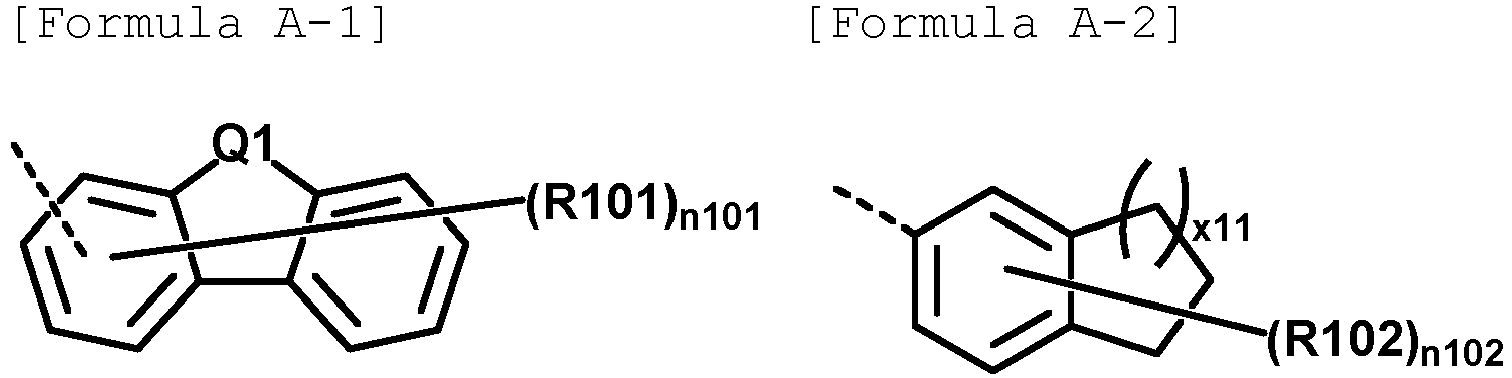


- a dotted line is a position which is connected to Formula 100,
- Q1 is O; S; or C(R118)(R119),
- R101 to R104, R118, and R119 are the same as or different from each other, and are each independently hydrogen; deuterium; a nitrile group; a halogen group; a substituted or unsubstituted alkyl group; a substituted or unsubstituted alkoxy group; a substituted or unsubstituted silyl group; a substituted or unsubstituted aryl group; a substituted or unsubstituted heterocyclic group; or a substituted or unsubstituted amine group, or are bonded to an adjacent substituent to form a substituted or unsubstituted ring,
- x11 is 1 or 2,
- n101 is an integer from 0 to 7, n102 is an integer from 0 to 11, n103 is an integer from 0 to 4, and n104 is an integer from 0 to 5,
- when n101 to n104 are each 2 or higher, substituents in the parenthesis are the same as or different from each other,
- one or more of the aliphatic rings included in Formula 100 are selected from the following structures,

- a dotted double line is a position where substituents are fused,
- R105 to R114 are the same as or different from each other, and are each independently a substituted or unsubstituted alkyl group,
- R115 to R117 are the same as or different from each other, and are each independently hydrogen; deuterium; a nitrile group; a halogen group; a substituted or unsubstituted alkyl group; a substituted or unsubstituted alkoxy group; a substituted or unsubstituted silyl group; a substituted or unsubstituted aryl group; a substituted or unsubstituted heterocyclic group; or a substituted or unsubstituted amine group, or are bonded to an adjacent substituent to form a substituted or unsubstituted ring, n115 is an integer from 0 to 2, and n116 and n117 are each an integer from 0 to 4, and
- when n115 to n117 are each 2 or higher, substituents in the parenthesis are the same as or different from each other.
- Further, an exemplary embodiment of the present specification provides an organic light emitting device including: a first electrode; a second electrode provided to face the first electrode; and an organic material layer having one or more layers provided between the first electrode and the second electrode, in which one or more layers of the organic material layer include the above-described polycyclic compound.
- The compound of the present invention can be used as a material for an organic material layer of an organic light emitting device. When an organic light emitting device is manufactured by including the compound of the present invention, an organic light emitting device having high efficiency, low voltage and long-service life characteristics can be obtained, and when the compound of the present invention is included in a light emitting layer of an organic light emitting device, an organic light emitting device having high color gamut can be manufactured.
-
-
FIGS. 1 to 2 illustrate an example of the organic light emitting device according to the present invention. -
FIGS. 3 to 7 each illustrate systems of Examples 2-1 to 2-5. -
FIGS. 8 and9 each illustrate systems of Comparative -
- 1:
- Substrate
- 2:
- Positive electrode
- 3:
- Light emitting layer
- 4:
- Negative electrode
- 5:
- First hole injection layer
- 6:
- Second hole injection layer
- 7:
- Hole transport layer
- 8:
- Electron blocking layer
- 9:
- First electron transport layer
- 10:
- Second electron transport layer
- 11:
- Electron injection layer
- Hereinafter, the present specification will be described in more detail.
- The present specification provides a compound represented by the following Formula 100. When a compound represented by the following Formula 100 is used in an organic material layer of an organic light emitting device, efficiency and service life characteristics of the organic light emitting device are improved. An existing compound having a high sublimation temperature has a problem in that due to the low stability of the compound, the efficiency and service life of a device deteriorate when applied to the device, but a compound represented by the following Formula 100 includes an aliphatic hydrocarbon ring (specifically a cycloalkene ring) substituted with an alkyl group in the molecule, and thus has high stability due to a low sublimation temperature, and for this reason, it is possible to obtain a device having excellent efficiency and long service life characteristics when the compound is applied to the device.
- Further, a compound represented by the following Formula 100 includes a cycloalkene ring in the molecule, and thus may also be applied for a solution process due to the increased solubility.
- When one part "includes" one constituent element in the present specification, unless otherwise specifically described, this does not mean that another constituent element is excluded, but means that another constituent element may be further included.
- When one member is disposed "on" another member in the present specification, this includes not only a case where the one member is brought into contact with another member, but also a case where still another member is present between the two members.
- Examples of the substituents in the present specification will be described below, but are not limited thereto.
- The term "substitution" means that a hydrogen atom bonded to a carbon atom of a compound is changed into another substituent, and a position to be substituted is not limited as long as the position is a position at which the hydrogen atom is substituted, that is, a position at which the substituent may be substituted, and when two or more are substituted, the two or more substituents may be the same as or different from each other.
- In the present specification, the term "substituted or unsubstituted" means being substituted with one or two or more substituents selected from the group consisting of deuterium; a halogen group; a cyano group (-CN); a silyl group; a boron group; a substituted or unsubstituted alkyl group; a substituted or unsubstituted cycloalkyl group; a substituted or unsubstituted aryl group; and a substituted or unsubstituted heterocyclic group or being substituted with a substituent to which two or more substituents are linked among the substituents exemplified above, or having no substituent. For example, "the substituent to which two or more substituents are linked" may be a biphenyl group. That is, the biphenyl group may also be an aryl group, and may be interpreted as a substituent to which two phenyl groups are linked.
- In the present specification, the fact that two or more substituents are linked indicates that hydrogen of any one substituent is substituted with another substituent. For example, an isopropyl group and a phenyl group may be linked to each other to become a substituent of


- In the present specification, the case where three substituents are linked to one another includes not only a case where (Substituent 1)-(Substituent 2)-(Substituent 3) are consecutively linked to one another, but also a case where (Substituent 2) and (Substituent 3) are linked to (Substituent 1). For example, two phenyl groups and an isopropyl group may be linked to each other to become a substituent of

- In the present specification, a dotted line means a site bonded or fused to another substituent or a bonding portion.
- Examples of the substituents will be described below, but are not limited thereto.
- In the present specification, examples of a halogen group include fluorine (F), chlorine (Cl), bromine (Br) or iodine (I).
- In the present specification, a silyl group may be represented by a formula of -SiY1Y2Y3, and Y1, Y2, and Y3 may be each hydrogen; a substituted or unsubstituted alkyl group; or a substituted or unsubstituted aryl group. Specific examples of the silyl group include a trimethylsilyl group, a triethylsilyl group, a t-butyldimethylsilyl group, a vinyldimethylsilyl group, a propyldimethylsilyl group, a triphenylsilyl group, a diphenylsilyl group, a phenylsilyl group, and the like, but are not limited thereto.
- In the present specification, a boron group may be represented by a formula of -BY4Y5, and Y4 and Y5 may be each hydrogen; a substituted or unsubstituted alkyl group; or a substituted or unsubstituted aryl group. Specific examples of the boron group include a trimethylboron group, a triethylboron group, a t-butyldimethylboron group, a triphenylboron group, a phenylboron group, and the like, but are not limited thereto.
- In the present specification, an alkyl group may be straight-chained or branched, and the number of carbon atoms thereof is not particularly limited, but is preferably 1 to 60. According to an exemplary embodiment, the number of carbon atoms of the alkyl group is 1 to 30. According to another exemplary embodiment, the number of carbon atoms of the alkyl group is 1 to 20. According to still another exemplary embodiment, the number of carbon atoms of the alkyl group is 1 to 10. According to yet another exemplary embodiment, the number of carbon atoms of the alkyl group is 1 to 6. According to still yet another exemplary embodiment, the number of carbon atoms of the alkyl group is 1 to 4. Specific examples of the alkyl group include a methyl group, an ethyl group, a propyl group, an isopropyl group, a butyl group, an isobutyl group, a tert-butyl group, a pentyl group, a hexyl group, a heptyl group, an octyl group, and the like, but are not limited thereto.
- In the present specification, an amine group may be selected from the group consisting of -NH2; an alkylamine group; an alkylarylamine group; an arylamine group; an arylheteroarylamine group; an alkylheteroarylamine group; and a heteroarylamine group, and the number of carbon atoms thereof is not particularly limited, but is preferably 1 to 60. In the case of an arylamine group, the number of carbon atoms thereof is 6 to 60. According to another exemplary embodiment, the number of carbon atoms of the arylamine group is 6 to 40. Specific examples of the amine group include a methylamine group; a dimethylamine group; an ethylamine group; a diethylamine group; a phenylamine group; a naphthylamine group; a biphenylamine group; an anthracenylamine group; a 9-methylanthracenylamine group; a diphenylamine group; an N-phenylnaphthylamine group; a ditolylamine group; an N-phenyltolylamine group; a triphenylamine group; an N-phenylbiphenylamine group; an N-phenylnaphthylamine group; an N-biphenylnaphthylamine group; an N-naphthylfluorenylamine group; an N-phenylphenanthrenylamine group; an N-biphenylphenanthrenylamine group; an N-phenylfluorenylamine group; an N-phenyl terphenylamine group; an N-phenanthrenylfluorenylamine group; an N-biphenylfluorenylamine group; an N-(4-(tert-butyl)phenyl)-N-phenylamine group; an N,N-bis(4-(tert-butyl)phenyl)amine group; an N,N-bis(3-(tert-butyl)phenyl)amine group, and the like, but are not limited thereto.
- In the present specification, an alkylarylamine group means an amine group in which an alkyl group and an aryl group are substituted with N of the amine group.
- In the present specification, an arylheteroarylamine group means an amine group in which an aryl group and a heteroaryl group are substituted with N of the amine group.
- In the present specification, an alkylheteroarylamine group means an amine group in which an alkyl group and a heteroaryl group are substituted with N of the amine group.
- In the present specification, the alkyl group in the alkylamine group, the arylalkylamine group, the alkylthioxy group, the alkylsulfoxy group, and the alkylheteroarylamine group is the same as the above-described examples of the alkyl group. Specifically, examples of the alkylthioxy group include a methylthioxy group; an ethylthioxy group; a tert-butylthioxy group; a hexylthioxy group; an octylthioxy group; and the like, and examples of the alkylsulfoxy group include mesyl; an ethylsulfoxy group; a propylsulfoxy group; a butylsulfoxy group; and the like, but the examples are not limited thereto.
- In the present specification, a cycloalkyl group is not particularly limited, but has preferably 3 to 60 carbon atoms, and according to an exemplary embodiment, the number of carbon atoms of the cycloalkyl group is 3 to 30. According to another exemplary embodiment, the number of carbon atoms of the cycloalkyl group is 3 to 20. According to still another exemplary embodiment, the number of carbon atoms of the cycloalkyl group is 3 to 6. The cycloalkyl group includes not only a single ring group, but also a double ring group such as a bridgehead, a fused ring, and a spiro ring. Specific examples thereof include a cyclopropyl group, a cyclobutyl group, a cyclopentyl group, a cyclohexyl group, a cycloheptyl group, a cyclooctyl group, and the like, but are not limited thereto.
- In the present specification, cycloalkene is a ring group in which a double bond is present in a hydrocarbon ring, but is a non-aromatic ring group, and the number of carbon atoms thereof is not particularly limited, but may be 3 to 60, and may be 3 to 30 according to an exemplary embodiment. The cycloalkene includes not only a single ring group, but also a double ring group such as a bridgehead, a fused ring, and a spiro ring. Examples of the cycloalkene include cyclopropene, cyclobutene, cyclopentene, cyclohexene, and the like, but are not limited thereto.
- In the present specification, an aryl group is not particularly limited, but has preferably 6 to 60 carbon atoms, and may be a monocyclic aryl group or a polycyclic aryl group. According to an exemplary embodiment, the number of carbon atoms of the aryl group is 6 to 30. According to an exemplary embodiment, the number of carbon atoms of the aryl group is 6 to 20. Examples of a monocyclic aryl group as the aryl group include a phenyl group, a biphenyl group, a terphenyl group, and the like, but are not limited thereto. Examples of the polycyclic aryl group include a naphthyl group, an anthracenyl group, a phenanthrenyl group, a pyrenyl group, a perylenyl group, a triphenyl group, a chrysenyl group, a fluorenyl group, and the like, but are not limited thereto. In the present specification, the substituted aryl group also includes a form in which an aliphatic ring is fused to the aryl group. In the present specification, the alkylaryl group means an aryl group substituted with an alkyl group, and a substituent other than the alkyl group may be further linked.
- In the present specification, an arylalkyl group means an alkyl group substituted with an aryl group, and a substituent other than the aryl group may be further linked.
- In the present specification, a heterocyclic group is a cyclic group including one or more of N, O, P, S, Si, and Se as a heteroatom, and the number of carbon atoms thereof is not particularly limited, but is preferably 2 to 60. According to an exemplary embodiment, the number of carbon atoms of the heterocyclic group is 2 to 30. According to an exemplary embodiment, the number of carbon atoms of the heterocyclic group is 2 to 20. Examples of the heterocyclic group include a pyridine group, a pyrrole group, a pyrimidine group, a pyridazinyl group, a furan group, a thiophene group, an imidazole group, a pyrazole group, a dibenzofuran group, a dibenzothiophene group, a carbazole group, a hexahydrocarbazole group, and the like, but are not limited thereto. In the present specification, a heterocyclic group may be monocyclic or polycyclic, may be an aromatic ring, an aliphatic ring, or a fused ring of the aromatic ring and the aliphatic ring, and may be selected from the examples of the heterocyclic group.
- In the present specification, an aromatic hydrocarbon ring means a hydrocarbon ring in which pi electrons are completely conjugated and are planar, and the description on the aryl group may be applied to an aromatic hydrocarbon ring except for a divalent aromatic hydrocarbon ring.
- In the present specification, an aliphatic hydrocarbon ring is a structure in which the aliphatic hydrocarbon ring is bonded in a ring, and means a ring which is not aromatic. Examples of the aliphatic hydrocarbon ring include cycloalkyane or cycloalkene, and the above-described description on the cycloalkyl group or cycloalkenyl group may be applied to the aliphatic hydrocarbon ring except for a divalent aliphatic hydrocarbon ring. Further, a substituted aliphatic hydrocarbon ring also includes an aliphatic hydrocarbon ring in which aromatic rings are fused.
- In the present specification, a fused ring of an aromatic hydrocarbon ring and an aliphatic hydrocarbon ring means that an aromatic hydrocarbon ring and an aliphatic hydrocarbon ring form a fused ring.
- In the present specification, the "adjacent" group may mean a substituent substituted with an atom directly linked to an atom in which the corresponding substituent is substituted, a substituent disposed to be sterically closest to the corresponding substituent, or another substituent substituted with an atom in which the corresponding substituent is substituted. For example, two substituents substituted at the ortho position in a benzene ring and two substituents substituted with the same carbon in an aliphatic ring may be interpreted as groups which are "adjacent" to each other. In addition, substituents (four in total) linked to two consecutive carbons in an aliphatic ring may be interpreted as "adjacent" groups.
- In the present specification, the "adjacent groups are bonded to each other to form a ring" among the substituents means that a substituent is bonded to an adjacent group to form a substituted or unsubstituted hydrocarbon ring; or a substituted or unsubstituted hetero ring.
- In the present specification, a fused hydrocarbon ring may be monovalent or divalent. Specifically, in the formulae of the present application, when Cy3 and Cy4 are fused hydrocarbon rings, the fused hydrocarbon rings correspond to monovalent groups.
- The present specification provides a polycyclic compound represented by the following Formula 100.

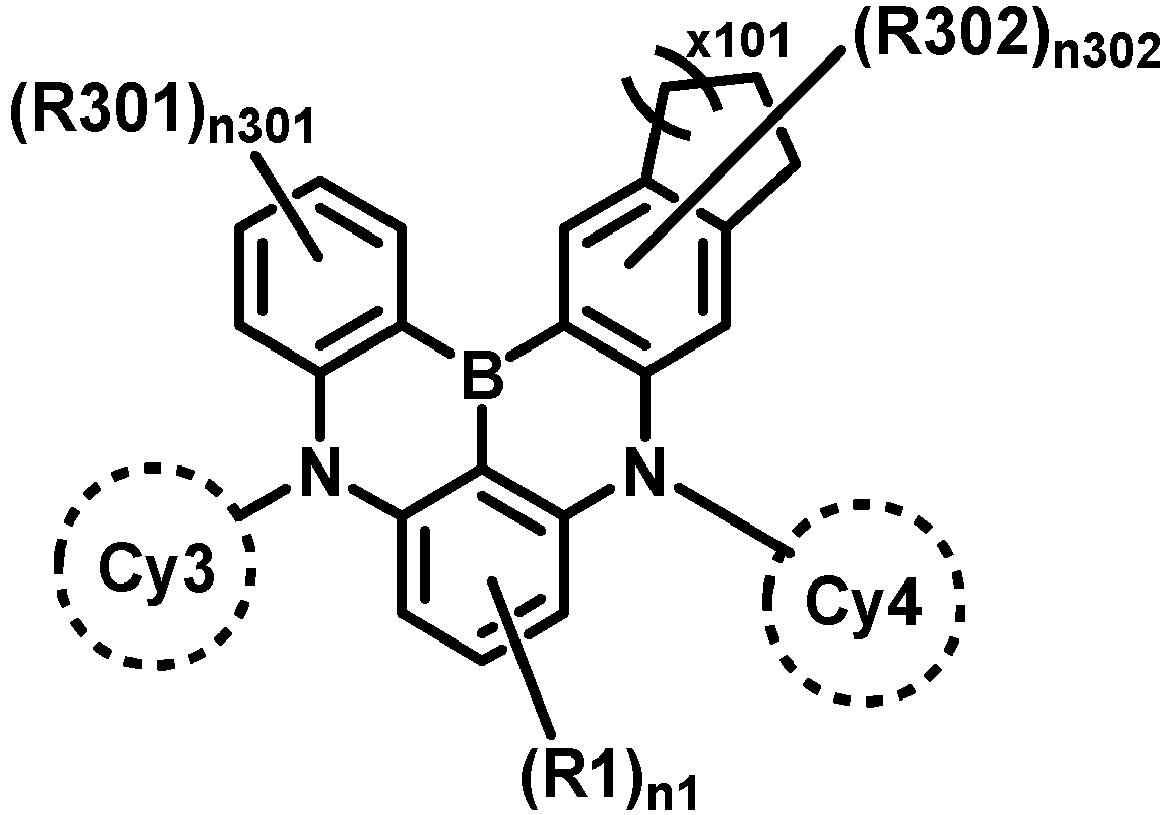
- In an exemplary embodiment of the present specification, the aliphatic ring included in Formula 100 is selected from the following structures.

- In the structures,
- a dotted double line is a position where substituents are fused,
- R105 to R114 are the same as or different from each other, and are each independently a substituted or unsubstituted alkyl group,
- R115 to R117 are the same as or different from each other, and are each independently hydrogen; deuterium; a nitrile group; a halogen group; a substituted or unsubstituted alkyl group; a substituted or unsubstituted alkoxy group; a substituted or unsubstituted silyl group; a substituted or unsubstituted aryl group; a substituted or unsubstituted heterocyclic group; or a substituted or unsubstituted amine group, or are bonded to an adjacent substituent to form a substituted or unsubstituted ring, n115 is an integer from 0 to 2, and n116 and n117 are each an integer from 0 to 4, and
- when n115 to n117 are each 2 or higher, substituents in the parenthesis are the same as or different from each other.
- When n115 is 2, R115's are the same as or different from each other. When n116 is 2 or higher, R116's are the same as or different from each other. When n117 is 2 or higher, R117's are the same as or different from each other.
- In the present specification, the aliphatic ring included in Formula 100 means one or more rings of 1) an aliphatic hydrocarbon ring formed by bonding two R301's, 2) a cyclopentene ring when x101 is 1, 3) a cyclohexene ring when x101 is 2, 4) an aliphatic hydrocarbon ring included in Cy3, and 5) an aliphatic hydrocarbon ring included in Cy4.
- In an exemplary embodiment of the present specification, R105 to R114 are the same as or different from each other, and are each independently a substituted or unsubstituted alkyl group having 1 to 10 carbon atoms. In an exemplary embodiment of the present specification, R105 to R114 are the same as or different from each other, and are each independently a substituted or unsubstituted alkyl group having 1 to 6 carbon atoms.
- In an exemplary embodiment of the present specification, R105 to R114 are a methyl group. In an exemplary embodiment of the present specification, R115 and R116 are the same as or different from each other, and are each independently hydrogen; or deuterium.
- In an exemplary embodiment of the present specification, R117 is hydrogen or deuterium, or four adjacent R117's are bonded to each other to form a substituted or unsubstituted benzene ring.
- In an exemplary embodiment of the present specification, R117 is hydrogen or deuterium, or four adjacent R117's are bonded to each other to form a benzene ring which is unsubstituted or substituted with an alkyl group having 1 to 10 carbon atoms.
- In an exemplary embodiment of the present specification, R117 is hydrogen or deuterium, or four adjacent R117's are bonded to each other to form a benzene ring.
- In an exemplary embodiment of the present specification, all the aliphatic rings included in Formula 100 are selected from the above structures.
- In an exemplary embodiment of the present specification, the aliphatic ring included in Formula 100 is selected from the following structures.

- In an exemplary embodiment of the present specification, R301's are the same as or different from each other, are each independently deuterium; a substituted or unsubstituted alkyl group; a substituted or unsubstituted aryl group; a substituted or unsubstituted heterocyclic group; or a substituted or unsubstituted amine group, and adjacent two R301's are bonded to each other to form a substituted or unsubstituted hydrocarbon ring.
- In an exemplary embodiment of the present specification, R301 is deuterium; a substituted or unsubstituted alkyl group having 1 to 10 carbon atoms; a substituted or unsubstituted aryl group having 6 to 30 carbon atoms; a substituted or unsubstituted heterocyclic group having 6 to 30 carbon atoms; a substituted or unsubstituted arylamine group having 6 to 60 carbon atoms; or a substituted or unsubstituted arylheteroarylamine group having 6 to 60 carbon atoms, and two adjacent R301's are bonded to each other to form a substituted or unsubstituted aliphatic hydrocarbon ring having 5 to 30 carbon atoms.
- In an exemplary embodiment of the present specification, R301 is deuterium; a substituted or unsubstituted alkyl group having 1 to 6 carbon atoms; a substituted or unsubstituted aryl group having 6 to 20 carbon atoms; a substituted or unsubstituted heterocyclic group having 6 to 20 carbon atoms; a substituted or unsubstituted arylamine group having 6 to 40 carbon atoms; or a substituted or unsubstituted arylheteroarylamine group having 6 to 40 carbon atoms, and two adjacent R301's are bonded to each other to form a substituted or unsubstituted aliphatic hydrocarbon ring having 5 to 20 carbon atoms.
- In an exemplary embodiment of the present specification, R301 is deuterium; an alkyl group having 1 to 10 carbon atoms, which is unsubstituted or substituted with one or more substituents selected from the group consisting of deuterium and an aryl group having 6 to 30 carbon atoms or a substituent to which two or more groups selected from the group are linked; an aryl group having 6 to 30 carbon atoms, which is unsubstituted or substituted with one or more substituents selected from the group consisting of deuterium and an alkyl group having 1 to 10 carbon atoms or a substituent to which two or more groups selected from the group are linked; a heterocyclic group having 6 to 30 carbon atoms, which is unsubstituted or substituted with one or more substituents selected from the group consisting of deuterium, an alkyl group having 1 to 10 carbon atoms and an aryl group having 6 to 30 carbon atoms or a substituent to which two or more groups selected from the group are linked; an arylamine group having 6 to 60 carbon atoms, which is unsubstituted or substituted with one or more substituents selected from the group consisting of deuterium and an alkyl group having 1 to 10 carbon atoms or a substituent to which two or more groups selected from the group are linked, and is unfused or fused with an aliphatic hydrocarbon ring having 5 or 6 carbon atoms; or an arylheteroarylamine group having 6 to 60 carbon atoms, which is unsubstituted or substituted with one or more substituents selected from the group consisting of deuterium and an alkyl group having 1 to 10 carbon atoms or a substituent to which two or more groups selected from the group are linked, and two adjacent R301's are bonded to each other to form an aliphatic hydrocarbon ring having 5 to 30 carbon atoms, which is unsubstituted or substituted with one or more substituents selected from the group consisting of deuterium, an alkyl group having 1 to 10 carbon atoms and an aryl group having 6 to 30 carbon atoms or substituents to which two or more groups selected from the group are linked.
- In an exemplary embodiment of the present specification, R301 is a methyl group; an isopropyl group; a tert-butyl group; a 2-phenylpropan-2-yl group; a phenyl group which is unsubstituted or substituted with a methyl group or a tert-butyl group; a dimethylfluorenyl group; a dibenzofuran group; a dibenzothiophene group; a hexahydrocarbazole group which is unsubstituted or substituted with a methyl group, a tert-butyl group, a phenyl group, a tolyl group, a tert-butylphenyl group or a tetramethyltetrahydronaphthalene group; a diphenylamine group which is unsubstituted or substituted with a methyl group or a tert-butyl group, and is unfused or fused with cyclohexene; an N-phenyl-N-dibenzofuranamine group which is unsubstituted or substituted with a methyl group or a tert-butyl group; or an N-phenyl-N-dibenzothiopheneamine group which is unsubstituted or substituted with a methyl group or a tert-butyl group.
- In an exemplary embodiment of the present specification, R302 is hydrogen; deuterium; or a substituted or unsubstituted alkyl group.
- In an exemplary embodiment of the present specification, R302 is hydrogen; deuterium; or a substituted or unsubstituted alkyl group having 1 to 10 carbon atoms.
- In an exemplary embodiment of the present specification, R302 is hydrogen; deuterium; or a substituted or unsubstituted alkyl group having 1 to 6 carbon atoms.
- In an exemplary embodiment of the present specification, R302 is hydrogen; deuterium; or a methyl group.
- In an exemplary embodiment of the present specification, n302 is 2 or higher, and two or four of a plurality of R302's are a methyl group.
- In an exemplary embodiment of the present specification, Formula 100 is represented by any one of the following
Formulae 1 to 3.


- In
Formulae 1 to 3, - R1, Cy3, Cy4, and n1 are the same as those defined in Formula 100,
- R3 and R4 are the same as or different from each other, and are each independently deuterium; a nitrile group; a halogen group; a substituted or unsubstituted alkyl group; a substituted or unsubstituted alkoxy group; a substituted or unsubstituted silyl group; a substituted or unsubstituted aryl group; a substituted or unsubstituted heterocyclic group; or a substituted or unsubstituted amine group, or are bonded to an adjacent substituent to form a substituted or unsubstituted ring,
- R2, R5, R6, and R8 are the same as or different from each other, and are each independently hydrogen; deuterium; a nitrile group; a halogen group; a substituted or unsubstituted alkyl group; a substituted or unsubstituted alkoxy group; a substituted or unsubstituted silyl group; a substituted or unsubstituted aryl group; a substituted or unsubstituted heterocyclic group; or a substituted or unsubstituted amine group, or are bonded to an adjacent substituent to form a substituted or unsubstituted ring, n3 and n4 are each an integer from 1 to 4, n2, n5, and n6 are each an integer from 0 to 10, and n8 is an integer from 0 to 8, and
- when n2 to n6 and n8 are each 2 or higher, substituents in the parenthesis are the same as or different from each other.
- In an exemplary embodiment of the present specification, Cy3 and Cy4 are the same as or different from each other, and are each independently one selected from the group consisting of a substituted or unsubstituted aromatic hydrocarbon ring; a substituted or unsubstituted aliphatic hydrocarbon ring; and a substituted or unsubstituted aromatic hetero ring, or a ring in which two or more rings selected from the group are fused, and at least one of Cy3 and Cy4 is one selected from the following Formulae A-1 to A-3.


- In Formulae A-1 to A-3,
- a dotted line is a position which is connected to Formula 100,
- Q1 is O; S; or C(R118)(R119),
- R101 to R104, R118, and R119 are the same as or different from each other, and are each independently hydrogen; deuterium; a nitrile group; a halogen group; a substituted or unsubstituted alkyl group; a substituted or unsubstituted alkoxy group; a substituted or unsubstituted silyl group; a substituted or unsubstituted aryl group; a substituted or unsubstituted heterocyclic group; or a substituted or unsubstituted amine group, or are bonded to an adjacent substituent to form a substituted or unsubstituted ring,
- x11 is 1 or 2,
- n101 is an integer from 0 to 7, n102 is an integer from 0 to 11, n103 is an integer from 0 to 4, and n104 is an integer from 0 to 5, and
- when n101 to n104 are each 2 or higher, substituents in the parenthesis are the same as or different from each other.
- In an exemplary embodiment of the present specification, at least one of Cy3 and Cy4 is selected from Formulae A-1 to A-3, and the other is a substituted or unsubstituted aromatic hydrocarbon ring.
- In an exemplary embodiment of the present specification, at least one of Cy3 and Cy4 is selected from Formulae A-1 to A-3, and the other is a substituted or unsubstituted aromatic hydrocarbon ring having 6 to 60 carbon atoms.
- In an exemplary embodiment of the present specification, at least one of Cy3 and Cy4 is selected from Formulae A-1 to A-3, and the other is a substituted or unsubstituted aromatic hydrocarbon ring having 6 to 30 carbon atoms.
- In an exemplary embodiment of the present specification, at least one of Cy3 and Cy4 is selected from Formulae A-1 to A-3, and the other is a substituted or unsubstituted monocyclic aromatic hydrocarbon ring having 6 to 20 carbon atoms.
- In an exemplary embodiment of the present specification, at least one of Cy3 and Cy4 is selected from Formulae A-1 to A-3, and the other is an aromatic hydrocarbon ring having 6 to 30 carbon atoms, which is unsubstituted or substituted with one or more substituents selected from the group consisting of deuterium, an alkyl group having 1 to 10 carbon atoms, and an aryl group having 6 to 30 carbon atoms or a substituent to which two or more groups selected from the group are linked.
- In an exemplary embodiment of the present specification, at least one of Cy3 and Cy4 is selected from Formulae A-1 to A-3, and the other is a monocyclic aromatic hydrocarbon ring having 6 to 20 carbon atoms, which is unsubstituted or substituted with one or more substituents selected from the group consisting of deuterium, an alkyl group having 1 to 6 carbon atoms, and an aryl group having 6 to 20 carbon atoms or a substituent to which two or more groups selected from the group are linked.
- In an exemplary embodiment of the present specification, at least one of Cy3 and Cy4 is selected from Formulae A-1 to A-3, and the other is a monocyclic aromatic hydrocarbon ring having 6 to 20 carbon atoms, which is unsubstituted or substituted with deuterium, an alkyl group having 1 to 10 carbon atoms, or an arylalkyl group having 7 to 50 carbon atoms.
- In an exemplary embodiment of the present specification, at least one of Cy3 and Cy4 is selected from Formulae A-1 to A-3, the other is a phenyl group, a biphenyl group, or a terphenyl group, and the phenyl group, the biphenyl group, or the terphenyl group is unsubstituted or substituted with a methyl group, an isopropyl group, a tert-butyl group, or a 2-phenylpropan-2-yl group.
- In an exemplary embodiment of the present specification, Cy3 and Cy4 are the same as or different from each other, and are each independently selected from Formulae A-1 to A-3.
- In an exemplary embodiment of the present specification, R118 and R119 are the same as or different from each other, and are each independently hydrogen; deuterium; a substituted or unsubstituted alkyl group; or a substituted or unsubstituted aryl group.
- In an exemplary embodiment of the present specification, R118 and R119 are the same as or different from each other, and are each independently hydrogen; deuterium; a substituted or unsubstituted alkyl group having 1 to 10 carbon atoms; or a substituted or unsubstituted aryl group having 6 to 30 carbon atoms.
- In an exemplary embodiment of the present specification, R118 and R119 are a methyl group.
- In an exemplary embodiment of the present specification, R101 is hydrogen; deuterium; a substituted or unsubstituted alkyl group; or a substituted or unsubstituted aryl group.
- In an exemplary embodiment of the present specification, R101 is hydrogen; deuterium; a substituted or unsubstituted alkyl group having 1 to 10 carbon atoms; or a substituted or unsubstituted aryl group having 6 to 30 carbon atoms.
- In an exemplary embodiment of the present specification, R101 is hydrogen; deuterium; or a substituted or unsubstituted alkyl group having 1 to 6 carbon atoms.
- In an exemplary embodiment of the present specification, R101 is hydrogen; deuterium; or a tert-butyl group.
- In an exemplary embodiment of the present specification, R102 is hydrogen; deuterium; a substituted or unsubstituted alkyl group; or a substituted or unsubstituted aryl group, or four adjacent R102's are bonded to each other to form a substituted or unsubstituted aromatic hydrocarbon ring.
- In an exemplary embodiment of the present specification, R102 is hydrogen; deuterium; a substituted or unsubstituted alkyl group having 1 to 10 alkyl group; or a substituted or unsubstituted aryl group having 6 to 30 carbon atoms, or four adjacent R102's are bonded to each other to form a substituted or unsubstituted aromatic hydrocarbon ring having 6 to 30 carbon atoms.
- In an exemplary embodiment of the present specification, R102 is hydrogen; deuterium; or a substituted or unsubstituted alkyl group having 1 to 6 carbon atoms, or four adjacent R102's are bonded to each other to form a substituted or unsubstituted benzene ring.
- In an exemplary embodiment of the present specification, R102 is hydrogen; deuterium; or a methyl group, or four adjacent R102's are bonded to each other to form a benzene ring.
- In an exemplary embodiment of the present specification, n102 is 2 or higher, and two or four of a plurality of R102's are a methyl group.
- In an exemplary embodiment of the present specification, R103 and R104 are the same as or different from each other, and are each independently hydrogen; deuterium; a substituted or unsubstituted alkyl group; or a substituted or unsubstituted aryl group, or two adjacent R103's; or two adjacent R104's are bonded to each other to form a substituted or unsubstituted hydrocarbon ring.
- In an exemplary embodiment of the present specification, R103 and R104 are the same as or different from each other, and are each independently hydrogen; deuterium; a substituted or unsubstituted alkyl group having 1 to 10 carbon atoms; or a substituted or unsubstituted aryl group having 6 to 30 carbon atoms, or two adjacent R103's; or two adjacent R104's are bonded to each other to form a substituted or unsubstituted aliphatic hydrocarbon ring having 5 to 30 carbon atoms.
- In an exemplary embodiment of the present specification, R103 and R104 are the same as or different from each other, and are each independently hydrogen; deuterium; a substituted or unsubstituted alkyl group having 1 to 6 carbon atoms; or a substituted or unsubstituted aryl group having 6 to 20 carbon atoms, or two adjacent R103's; or two adjacent R104's are bonded to each other to form a substituted or unsubstituted aliphatic hydrocarbon ring having 5 to 20 carbon atoms.
- In an exemplary embodiment of the present specification, the alkyl group or aryl group of R103 and R104 may be substituted with one or more substituents selected from the group consisting of deuterium, an alkyl group having 1 to 10 carbon atoms, and an aryl group having 6 to 30 carbon atoms; or a substituent to which two or more groups selected from the group are linked.
- In an exemplary embodiment of the present specification, the alkyl group or aryl group of R103 and R104 may be substituted with deuterium, an alkyl group having 1 to 10 carbon atoms, an arylalkyl group having 7 to 50 carbon atoms, or an aryl group having 6 to 30 carbon atoms.
- In an exemplary embodiment of the present specification, the aliphatic hydrocarbon ring formed by bonding two adjacent R103's; or two adjacent R104's to each other may be substituted with one or more substituents selected from the group consisting of deuterium and an alkyl group having 1 to 10 carbon atoms; or a substituent to which two or more groups selected from the group are linked.
- In an exemplary embodiment of the present specification, R103 and R104 are the same as or different from each other, and are each independently hydrogen; deuterium; an alkyl group having 1 to 6 carbon atoms, which is unsubstituted or substituted with deuterium or an aryl group having 6 to 20 carbon atoms; or an aryl group having 6 to 20 carbon atoms, which is unsubstituted or substituted with deuterium or an alkyl group having 1 to 6 carbon atoms, or two adjacent R103's; or two adjacent R104's are bonded to each other to form an aliphatic hydrocarbon ring having 5 or 6 carbon atoms, which is unsubstituted or substituted with an alkyl group having 1 to 6 carbon atoms.
- In an exemplary embodiment of the present specification, R103 and R104 are the same as or different from each other, and are each independently hydrogen; deuterium; a methyl group; an isopropyl group; a tert-butyl group; a 2-phenylpropan-2-yl group; or a phenyl group which is unsubstituted or substituted with a tert-butyl group, or two adjacent R103's; or two adjacent R104's are bonded to each other to form a cyclopentene ring which is unsubstituted or substituted with a methyl group, or a cyclohexene ring which is unsubstituted or substituted with a methyl group.
- In an exemplary embodiment of the present specification, R103 is hydrogen; deuterium; a methyl group; an isopropyl group; a tert-butyl group; a 2-phenylpropan-2-yl; or a phenyl group which is unsubstituted or substituted with a tert-butyl group.
- In an exemplary embodiment of the present specification, R104 is hydrogen; deuterium; a methyl group; an isopropyl group; a tert-butyl group; a 2-phenylpropan-2-yl group; or a phenyl group which is unsubstituted or substituted with a tert-butyl group, or two adjacent R104's are bonded to each other to form a cyclopentene ring which is unsubstituted or substituted with a methyl group, or a cyclohexene ring which is unsubstituted or substituted with a methyl group.
- When n101 is 2 or higher, R101's are the same as or different from each other. When n102 is 2 or higher, R102's are the same as or different from each other. When n103 is 2 or higher, R103's are the same as or different from each other. When n104 is 2 or higher, R104's are the same as or different from each other.
- In an exemplary embodiment of the present specification, Cy3 and Cy4 are the same as or different from each other, and are each independently selected from the following Groups A-11 to A-14, and at least one of Cy3 and Cy4 is selected from the following Groups A-11 to A-13.
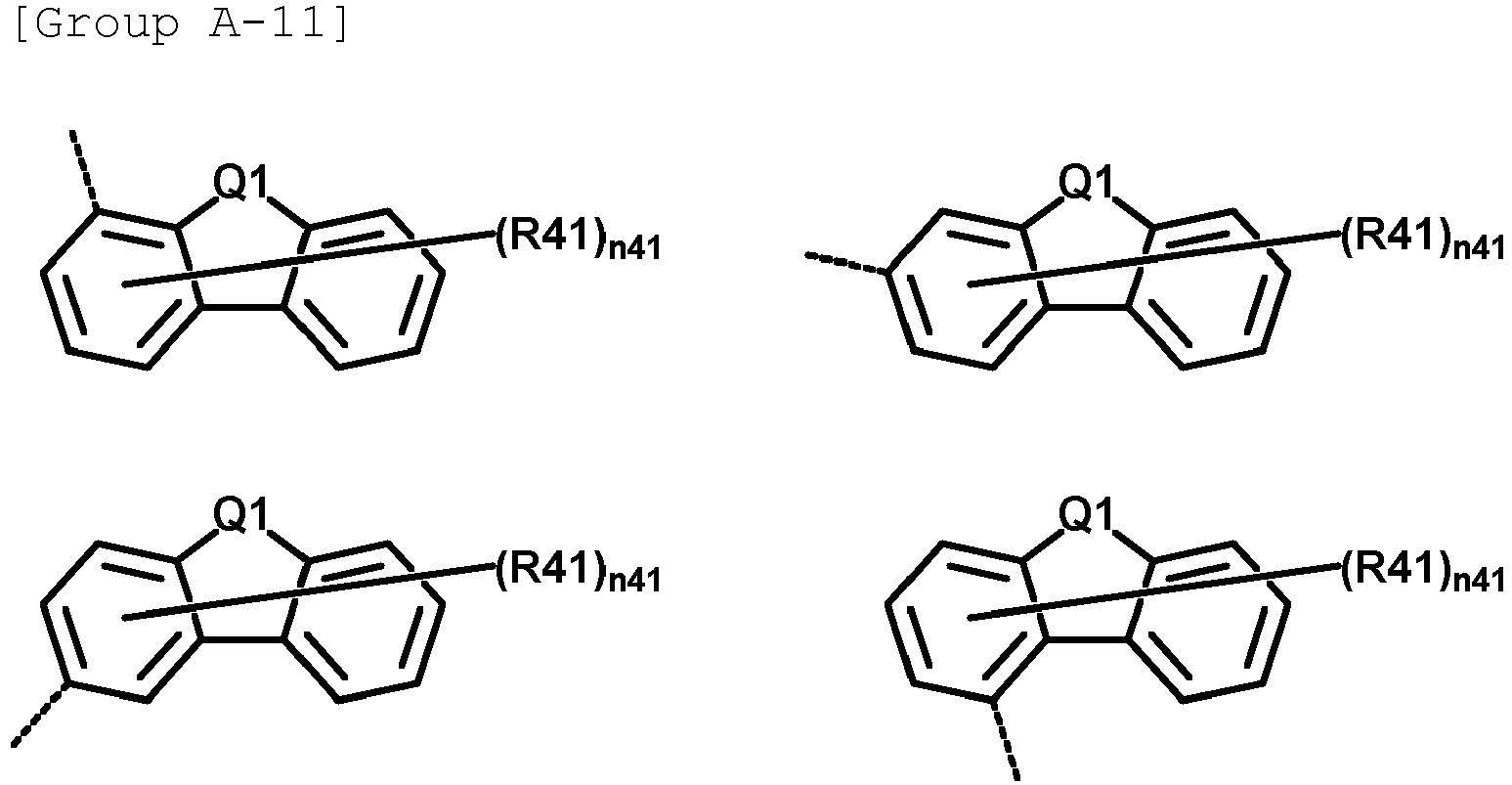


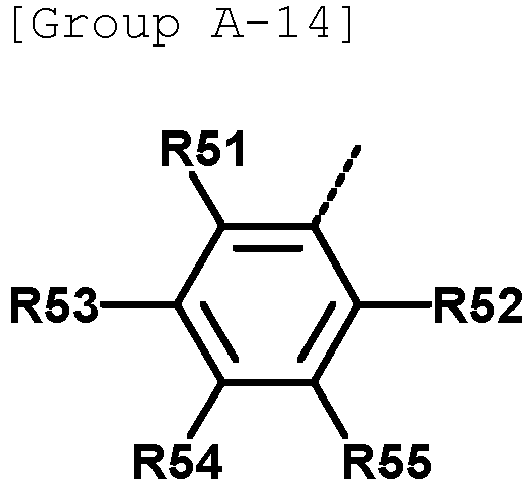
- In Groups A-11 to A-14,
- a dotted line is a position which is connected to Formula 100,
- Q1 is O; S; or C(R118)(R119),
- R41 to R43, R46 to R50, R53 to R55, R118, and R119 are the same as or different from each other, and are each independently hydrogen; deuterium; a nitrile group; a halogen group; a substituted or unsubstituted alkyl group; a substituted or unsubstituted alkoxy group; a substituted or unsubstituted silyl group; a substituted or unsubstituted aryl group; a substituted or unsubstituted heterocyclic group; or a substituted or unsubstituted amine group, or are bonded to an adjacent substituent to form a substituted or unsubstituted ring,
- R45, R51, and R52 are the same as or different from each other, and are each independently hydrogen; deuterium; or a substituted or unsubstituted alkyl group,
- n41, n43, and n44 are each an integer from 0 to 7, and n42, n49, and n50 are each an integer from 0 to 5, and
- when n41 to n44, n49, and n50 are each 2 or higher, substituents in the parenthesis are the same as or different from each other.
- In an exemplary embodiment of the present specification, the above-described description on R101 may be applied to R41.
- In an exemplary embodiment of the present specification, R41 is hydrogen; deuterium; a substituted or unsubstituted alkyl group; or a substituted or unsubstituted aryl group.
- In an exemplary embodiment of the present specification, R41 is hydrogen; deuterium; a substituted or unsubstituted alkyl group having 1 to 10 carbon atoms; or a substituted or unsubstituted aryl group having 6 to 30 carbon atoms.
- In an exemplary embodiment of the present specification, R41 is hydrogen; deuterium; or a substituted or unsubstituted alkyl group having 1 to 6 carbon atoms.
- In an exemplary embodiment of the present specification, R41 is hydrogen; deuterium; or a tert-butyl group.
- In an exemplary embodiment of the present specification, the above-described description on R102 may be applied to R42 to R44.
- In an exemplary embodiment of the present specification, R42 and R43 are the same as or different from each other, and are each independently hydrogen; deuterium; a substituted or unsubstituted alkyl group; or a substituted or unsubstituted aryl group.
- In an exemplary embodiment of the present specification, R42 and R43 are the same as or different from each other, and are each independently hydrogen; deuterium; a substituted or unsubstituted alkyl group having 1 to 10 carbon atoms; or a substituted or unsubstituted aryl group having 6 to 30 carbon atoms.
- In an exemplary embodiment of the present specification, R42 and R43 are the same as or different from each other, and are each independently hydrogen; deuterium; or a substituted or unsubstituted alkyl group having 1 to 6 carbon atoms.
- In an exemplary embodiment of the present specification, R42 and R43 are the same as or different from each other, and are each independently hydrogen; deuterium; or a methyl group.
- In an exemplary embodiment of the present specification, R44 is hydrogen; deuterium; a substituted or unsubstituted alkyl group; or a substituted or unsubstituted aryl group, or four adjacent R44's are bonded to each other to form a substituted or unsubstituted aromatic hydrocarbon ring.
- In an exemplary embodiment of the present specification, R44 is hydrogen; deuterium; a substituted or unsubstituted alkyl group having 1 to 10 carbon atoms; or a substituted or unsubstituted aryl group having 6 to 30 carbon atoms, or four adjacent R44's are bonded to each other to form a substituted or unsubstituted aromatic hydrocarbon ring having 6 to 30 carbon atoms.
- In an exemplary embodiment of the present specification, R44 is hydrogen; deuterium; or a substituted or unsubstituted alkyl group having 1 to 6 carbon atoms, or four adjacent R44's are bonded to each other to form a substituted or unsubstituted benzene ring.
- In an exemplary embodiment of the present specification, R44 is hydrogen; deuterium; or a methyl group, or four adjacent R44's are bonded to each other to form a benzene ring.
- In an exemplary embodiment of the present specification, the above-described description on R103 and R104 may be applied to R45 to R49.
- In an exemplary embodiment of the present specification, R46 to R50 are the same as or different from each other, and are each independently hydrogen; deuterium; a substituted or unsubstituted alkyl group; or a substituted or unsubstituted aryl group, or are bonded to an adjacent substituent to form a substituted or unsubstituted ring.
- In an exemplary embodiment of the present specification, R46 to R50 are the same as or different from each other, and are each independently hydrogen; deuterium; a substituted or unsubstituted alkyl group having 1 to 10 carbon atoms; or a substituted or unsubstituted aryl group having 6 to 30 carbon atoms, or two adjacent substituents are bonded to each other to form a substituted or unsubstituted hydrocarbon ring having 5 to 30 carbon atoms.
- In an exemplary embodiment of the present specification, R46 to R50 are the same as or different from each other, and are each independently hydrogen; deuterium; a substituted or unsubstituted alkyl group having 1 to 6 carbon atoms; or a substituted or unsubstituted aryl group having 6 to 20 carbon atoms, or two adjacent substituents are bonded to each other to form a substituted or unsubstituted aliphatic hydrocarbon ring having 5 to 20 carbon atoms.
- In an exemplary embodiment of the present specification, the alkyl group or aryl group of R46 to R50 may be substituted with one or more substituents selected from the group consisting of deuterium, an alkyl group having 1 to 10 carbon atoms, and an aryl group having 6 to 30 carbon atoms; or a substituent to which two or more groups selected from the group are linked.
- In an exemplary embodiment of the present specification, the alkyl group or aryl group of R46 to R50 may be substituted with deuterium, an alkyl group having 1 to 10 carbon atoms, an arylalkyl group having 7 to 50 carbon atoms, or an aryl group having 6 to 30 carbon atoms.
- In an exemplary embodiment of the present specification, the aliphatic hydrocarbon ring formed by bonding two adjacent R49's; or two adjacent R50's to each other may be substituted with one or more substituents selected from the group consisting of deuterium and an alkyl group having 1 to 10 carbon atoms; or a substituent to which two or more groups selected from the group are linked.
- In an exemplary embodiment of the present specification, R46 to R50 are the same as or different from each other, and are each independently hydrogen; deuterium; an alkyl group having 1 to 6 carbon atoms, which is unsubstituted or substituted with deuterium or an aryl group having 6 to 20 carbon atoms; or an aryl group having 6 to 20 carbon atoms, which is unsubstituted or substituted with deuterium or an alkyl group having 1 to 6 carbon atoms, or two adjacent R49's; or two adjacent R50's are bonded to each other to form an aliphatic hydrocarbon ring having 5 or 6 carbon atoms, which is unsubstituted or substituted with an alkyl group having 1 to 6 carbon atoms.
- In an exemplary embodiment of the present specification, R46 to R50 are the same as or different from each other, and are each independently hydrogen; deuterium; a methyl group; an isopropyl group; a tert-butyl group; a 2-phenylpropan-2-yl group; or a phenyl group which is unsubstituted or substituted with a tert-butyl group, or two adjacent R49's; or two adjacent R50's are bonded to each other to form a cyclopentene ring which is unsubstituted or substituted with a methyl group, or a cyclohexene ring which is unsubstituted or substituted with a methyl group.
- In an exemplary embodiment of the present specification, R45 is hydrogen; deuterium; or a substituted or unsubstituted alkyl group.
- In an exemplary embodiment of the present specification, R45 is hydrogen; deuterium; or a substituted or unsubstituted alkyl group having 1 to 10 carbon atoms.
- In an exemplary embodiment of the present specification, R45 is hydrogen; deuterium; or an alkyl group having 1 to 10 carbon atoms, which is substituted with one or more substituents selected from the group consisting of deuterium, an alkyl group having 1 to 10 carbon atoms, and an aryl group having 6 to 30 carbon atoms, or a substituent to which two or more groups selected from the group are linked.
- In an exemplary embodiment of the present specification, R45 is hydrogen; deuterium; a methyl group; an isopropyl group; a tert-butyl group; or a 2-phenylpropan-2-yl group.
- In an exemplary embodiment of the present specification, R51 and R52 are the same as or different from each other, and are each independently hydrogen; deuterium; or a substituted or unsubstituted alkyl group.
- In an exemplary embodiment of the present specification, R51 and R52 are the same as or different from each other, and are each independently hydrogen; deuterium; or a substituted or unsubstituted alkyl group having 1 to 10 carbon atoms.
- In an exemplary embodiment of the present specification, R51 and R52 are the same as or different from each other, and are each independently hydrogen; deuterium; or an alkyl group having 1 to 10 carbon atoms, which is substituted with one or more substituents selected from the group consisting of deuterium, an alkyl group having 1 to 10 carbon atoms, and an aryl group having 6 to 30 carbon atoms, or a substituent to which two or more groups selected from the group are linked.
- In an exemplary embodiment of the present specification, R51 and R52 are the same as or different from each other, and are each independently hydrogen; deuterium; a methyl group; an isopropyl group; a tert-butyl group; or a 2-phenylpropan-2-yl group.
- In an exemplary embodiment of the present specification, Group A-12 is selected from the following Group A-12-1.


- In Group A-12-1,
- the definitions of R42 to R44 are the same as those defined in Group A-12, and
- n421, n431, and n441 are each an integer from 0 to 3, and when n421, n431, and n441 are each 2 or higher, substituents in the parenthesis are the same as or different from each other.
- When n41 is 2 or higher, R41's are the same as or different from each other. When n42 is 2 or higher, R42's are the same as or different from each other. When n43 is 2 or higher, R43's are the same as or different from each other. When n44 is 2 or higher, R44's are the same as or different from each other. When n49 is 2 or higher, R49's are the same as or different from each other. When n50 is 2 or higher, R50's are the same as or different from each other.
- In an exemplary embodiment of the present specification, R1 is deuterium; a substituted or unsubstituted alkyl group; a substituted or unsubstituted heterocyclic group; or a substituted or unsubstituted amine group.
- In an exemplary embodiment of the present specification, R1 is deuterium; a substituted or unsubstituted alkyl group; a substituted or unsubstituted heterocyclic group; or -N(R211)(R212).
- In an exemplary embodiment of the present specification, R1 is deuterium; a substituted or unsubstituted alkyl group having 1 to 10 carbon atoms; a substituted or unsubstituted N-containing heterocyclic group having 2 to 30 carbon atoms; a substituted or unsubstituted arylamine group having 6 to 60 carbon atoms; or a substituted or unsubstituted arylheteroarylamine group having 6 to 60 carbon atoms.
- In an exemplary embodiment of the present specification, R1 is deuterium; a substituted or unsubstituted alkyl group having 1 to 6 carbon atoms; a substituted or unsubstituted N-containing heterocyclic group having 2 to 20 carbon atoms; a substituted or unsubstituted arylamine group having 6 to 40 carbon atoms; or a substituted or unsubstituted arylheteroarylamine group having 6 to 40 carbon atoms.
- In an exemplary embodiment of the present specification, R1 is deuterium; a substituted or unsubstituted alkyl group having 1 to 10 carbon atoms; a substituted or unsubstituted N-containing heterocyclic group having 2 to 30 carbon atoms; or -N(R211)(R212).
- In an exemplary embodiment of the present specification, R1 is deuterium; a substituted or unsubstituted alkyl group having 1 to 6 carbon atoms; a substituted or unsubstituted N-containing heterocyclic group having 2 to 20 carbon atoms; or -N(R211)(R212).
- In an exemplary embodiment of the present specification, R1 is deuterium; an alkyl group having 1 to 10 carbon atoms, which is unsubstituted or substituted with deuterium; an N-containing heterocyclic group having 2 to 30 carbon atoms, which is unsubstituted or substituted with one or more substituents selected from the group consisting of deuterium, an alkyl group having 1 to 10 carbon atoms, and an aryl group having 6 to 30 carbon atoms, or a substituent to which two or more groups selected from the group are linked; an arylamine group having 6 to 60 carbon atoms, which is unsubstituted or substituted with one or more substituents selected from the group consisting of deuterium and an alkyl group having 1 to 10 carbon atoms or a substituent to which two or more groups selected from the group are linked, and is unfused or fused with an aliphatic hydrocarbon ring having 5 to 30 carbon atoms; or an arylheteroarylamine group having 6 to 60 carbon atoms, which is unsubstituted or substituted with one or more substituents selected from the group consisting of deuterium and an alkyl group having 1 to 10 carbon atoms, or a substituent to which two or more groups selected from the group are linked.
- In an exemplary embodiment of the present specification, R1 is deuterium; an alkyl group having 1 to 6 carbon atoms, which is unsubstituted or substituted with deuterium; an N-containing heterocyclic group having 2 to 20 carbon atoms, which is unsubstituted or substituted with an alkyl group having 1 to 6 carbon atoms, an aryl group having 6 to 20 carbon atoms, or an alkylaryl group having 7 to 30 carbon atoms; an arylamine group having 6 to 40 carbon atoms, which is unsubstituted or substituted with deuterium or an alkyl group having 1 to 6 carbon atoms, and is unfused or fused with an aliphatic hydrocarbon ring having 5 or 6 carbon atoms; or an arylheteroarylamine group having 6 to 40 carbon atoms, which is unsubstituted or substituted with deuterium.
- In an exemplary embodiment of the present specification, R1 is a methyl group which is unsubstituted or substituted with deuterium; an isopropyl group; a tert-butyl group; a hexahydrocarbazole group which is unsubstituted or substituted with a methyl group, a tert-butyl group, a phenyl group, a tolyl group, a tert-butylphenyl group, or a tetramethyltetrahydronaphthalene group; a diphenylamine group which is unsubstituted or substituted with a methyl group, an isopropyl group, or a tert-butyl group, and is unfused or fused with cyclopentene or cyclohexene; an N-phenyl-N-dibenzofuranamine group; or an N-phenyl-N-dibenzothiopheneamine group.
- In an exemplary embodiment of the present specification, R211 and R212 are the same as or different from each other, and are each independently a substituted or unsubstituted aryl group; or a substituted or unsubstituted heterocyclic group.
- In an exemplary embodiment of the present specification, R211 and R212 are the same as or different from each other, and are each independently a substituted or unsubstituted aryl group having 6 to 30 carbon atoms; or a substituted or unsubstituted heterocyclic group having 2 to 30 carbon atoms.
- In an exemplary embodiment of the present specification, R211 and R212 are the same as or different from each other, and are each independently an aryl group having 6 to 30 carbon atoms, which is unsubstituted or substituted with deuterium or an alkyl group having 1 to 10 carbon atoms, and is unfused or fused with an aliphatic hydrocarbon ring having 5 to 30 carbon atoms; or a heterocyclic group having 2 to 30 carbon atoms, which is unsubstituted or substituted with deuterium or an alkyl group having 1 to 10 carbon atoms.
- In an exemplary embodiment of the present specification, R211 and R212 are the same as or different from each other, and are each independently an aryl group having 6 to 20 carbon atoms, which is unsubstituted or substituted with deuterium or an alkyl group having 1 to 6 carbon atoms, and is unfused or fused with an aliphatic hydrocarbon ring having 5 or 6 carbon atoms; or a heterocyclic group having 6 to 20 carbon atoms, which is unsubstituted or substituted with deuterium or an alkyl group having 1 to 6 carbon atoms.
- In an exemplary embodiment of the present specification, R211 and R212 are the same as or different from each other, and are each independently a phenyl group which is unsubstituted or substituted with deuterium, a methyl group, or a tert-butyl group; a tetrahydronaphthalene group which is unsubstituted or substituted with a methyl group; a dibenzofuran group; or a dibenzothiophene group.
- In an exemplary embodiment of the present specification, R1 is an alkyl group having 1 to 10 carbon atoms, which is unsubstituted or substituted with deuterium; an arylamine group having 6 to 60 carbon atoms, which is unsubstituted or substituted with one or more substituents selected from the group consisting of deuterium and an alkyl group having 1 to 10 carbon atoms, or a substituent to which two or more groups selected from the group are linked, and is unfused or fused with an aliphatic hydrocarbon ring having 5 to 30 carbon atoms; an arylheteroarylamine group having 6 to 60 carbon atoms, which is unsubstituted or substituted with one or more substituents selected from the group consisting of deuterium and an alkyl group having 1 to 10 carbon atoms, or a substituent to which two or more groups selected from the group are linked; or the following Formula Het1.

- In Formula Het1,
- a dotted line is a position which is connected to Formula 100,
- R203 to R205 are the same as or different from each other, and are each independently hydrogen; deuterium; an alkyl group having 1 to 10 carbon atoms, which is unsubstituted or substituted with deuterium; or an aryl group having 6 to 30 carbon atoms, which is unsubstituted or substituted with one or more substituents selected from the group consisting of deuterium and an alkyl group having 1 to 10 carbon atoms, or a substituent to which two or more groups selected from the group are linked, and
- n205 is an integer from 0 to 12, and when n205 is 2 or higher, R205's are the same as or different from each other.
- In an exemplary embodiment of the present specification, R203 and R204 are the same as or different from each other, and are each independently hydrogen; deuterium; or a substituted or unsubstituted alkyl group.
- In an exemplary embodiment of the present specification, R203 and R204 are the same as or different from each other, and are each independently hydrogen; deuterium; or a substituted or unsubstituted alkyl group having 1 to 10 carbon atoms.
- In an exemplary embodiment of the present specification, R203 and R204 are the same as or different from each other, and are each independently hydrogen; deuterium; or a substituted or unsubstituted alkyl group having 1 to 6 carbon atoms.
- In an exemplary embodiment of the present specification, R203 and R204 are a methyl group.
- In an exemplary embodiment of the present specification, R205 is hydrogen; deuterium; a substituted or unsubstituted alkyl group; or a substituted or unsubstituted aryl group.
- In an exemplary embodiment of the present specification, R205 is hydrogen; deuterium; a substituted or unsubstituted alkyl group having 1 to 10 carbon atoms; or a substituted or unsubstituted aryl group having 6 to 30 carbon atoms.
- In an exemplary embodiment of the present specification, R205 is hydrogen; deuterium; an alkyl group having 1 to 10 carbon atoms, which is unsubstituted or substituted with deuterium; or an aryl group having 6 to 30 carbon atoms, which is unsubstituted or substituted with one or more substituents selected from the group consisting of deuterium and an alkyl group having 1 to 10 carbon atoms, or a substituent to which two or more groups selected from the group are linked.
- In an exemplary embodiment of the present specification, R205 is hydrogen; deuterium; an alkyl group having 1 to 6 carbon atoms, which is unsubstituted or substituted with deuterium; or an aryl group having 6 to 20 carbon atoms, which is unsubstituted or substituted with deuterium or an alkyl group having 1 to 6 carbon atoms.
- A form in which an aliphatic hydrocarbon ring is fused is also included in the substituted aryl group of R205.
- In an exemplary embodiment of the present specification, R205 is hydrogen; deuterium; a methyl group, a tert-butyl group; a phenyl group which is unsubstituted or substituted with a methyl group or a tert-butyl group; or a tetrahydronaphthalene group which is unsubstituted or substituted with a methyl group.
- In an exemplary embodiment of the present specification, R3 and R4 are the same as or different from each other, and are each independently deuterium; a substituted or unsubstituted alkyl group; a substituted or unsubstituted aryl group; a substituted or unsubstituted heterocyclic group; or a substituted or unsubstituted amine group.
- In an exemplary embodiment of the present specification, R3 and R4 are the same as or different from each other, and are each independently deuterium; a substituted or unsubstituted alkyl group having 1 to 10 carbon atoms; a substituted or unsubstituted aryl group having 6 to 30 carbon atoms; a substituted or unsubstituted heterocyclic group having 6 to 30 carbon atoms; a substituted or unsubstituted arylamine group having 6 to 60 carbon atoms; or a substituted or unsubstituted arylheteroarylamine group having 6 to 60 carbon atoms.
- In an exemplary embodiment of the present specification, R3 and R4 are the same as or different from each other, and are each independently deuterium; a substituted or unsubstituted alkyl group having 1 to 6 carbon atoms; a substituted or unsubstituted aryl group having 6 to 20 carbon atoms; a substituted or unsubstituted heterocyclic group having 6 to 20 carbon atoms; a substituted or unsubstituted arylamine group having 6 to 40 carbon atoms; or a substituted or unsubstituted arylheteroarylamine group having 6 to 40 carbon atoms.
- In an exemplary embodiment of the present specification, R3 and R4 are the same as or different from each other, and are each independently deuterium; a substituted or unsubstituted alkyl group having 1 to 10 carbon atoms; a substituted or unsubstituted aryl group having 6 to 30 carbon atoms; a substituted or unsubstituted heterocyclic group having 6 to 30 carbon atoms; or - N(R211) (R212) .
- In an exemplary embodiment of the present specification, R3 and R4 are the same as or different from each other, and are each independently deuterium; a substituted or unsubstituted alkyl group having 1 to 6 carbon atoms; a substituted or unsubstituted aryl group having 6 to 20 carbon atoms; a substituted or unsubstituted heterocyclic group having 6 to 20 carbon atoms; or - N(R211) (R212) .
- In an exemplary embodiment of the present specification, R3 and R4 are the same as or different from each other, and are each independently deuterium; an alkyl group having 1 to 10 carbon atoms, which is unsubstituted or substituted with one or more substituents selected from the group consisting of deuterium and an aryl group having 6 to 30 carbon atoms or a substituent to which two or more groups selected from the group are linked; an aryl group having 6 to 30 carbon atoms, which is unsubstituted or substituted with one or more substituents selected from the group consisting of deuterium and an alkyl group having 1 to 10 carbon atoms or a substituent to which two or more groups selected from the group are linked; a heterocyclic group having 6 to 30 carbon atoms, which is unsubstituted or substituted with one or more substituents selected from the group consisting of deuterium, an alkyl group having 1 to 10 carbon atoms and an aryl group having 6 to 30 carbon atoms or a substituent to which two or more groups selected from the group are linked; an arylamine group having 6 to 60 carbon atoms, which is unsubstituted or substituted with one or more substituents selected from the group consisting of deuterium and an alkyl group having 1 to 10 carbon atoms or a substituent to which two or more groups selected from the group are linked, and is unfused or fused with an aliphatic hydrocarbon ring having 5 to 30 carbon atoms; or an arylheteroarylamine group having 6 to 60 carbon atoms, which is unsubstituted or substituted with one or more substituents selected from the group consisting of deuterium and an alkyl group having 1 to 10 carbon atoms or a substituent to which two or more groups selected from the group are linked.
- In an exemplary embodiment of the present specification, R3 and R4 are the same as or different from each other, and are each independently deuterium; an alkyl group having 1 to 6 carbon atoms, which is unsubstituted or substituted with deuterium or an aryl group having 6 to 20 carbon atoms; an aryl group having 6 to 20 carbon atoms, which is unsubstituted or substituted with deuterium or an alkyl group having 1 to 6 carbon atoms; a heterocyclic group having 6 to 20 carbon atoms, which is unsubstituted or substituted with an alkyl group having 1 to 6 carbon atoms, an aryl group having 6 to 20 carbon atoms, or an alkylaryl group having 7 to 30 carbon atoms; an arylamine group having 6 to 40 carbon atoms, which is unsubstituted or substituted with deuterium or an alkyl group having 1 to 6 carbon atoms; or an arylheteroarylamine group having 2 to 40 carbon atoms, which is unsubstituted or substituted with deuterium or an alkyl group having 1 to 6 carbon atoms.
- In an exemplary embodiment of the present specification, R3 and R4 are the same as or different from each other, and are each independently a methyl group; an isopropyl group; a tert-butyl group; a 2-phenylpropan-2-yl group; a phenyl group which is unsubstituted or substituted with a methyl group or a tert-butyl group; a dimethylfluorenyl group; a dibenzofuran group; a dibenzothiophene group; a hexahydrocarbazole group which is unsubstituted or substituted with a methyl group, a tert-butyl group, a phenyl group, a tolyl group, a tert-butylphenyl group or a tetramethyltetrahydronaphthalene group; a diphenylamine group which is unsubstituted or substituted with a methyl group or a tert-butyl group, and is unfused or fused with cyclohexene; an N-phenyl-N-dibenzofuranamine group which is unsubstituted or substituted with a methyl group or a tert-butyl group; or an N-phenyl-N-dibenzothiopheneamine group which is unsubstituted or substituted with a methyl group or a tert-butyl group.
- In an exemplary embodiment of the present specification, two adjacent R3's are bonded to each other to form a substituted or unsubstituted aliphatic hydrocarbon ring.
- In an exemplary embodiment of the present specification, two adjacent R3's are bonded to each other to form an aliphatic hydrocarbon ring having 5 to 30 carbon atoms, which is unsubstituted or substituted with an alkyl group having 1 to 10 carbon atoms.
- In an exemplary embodiment of the present specification, two adjacent R3's are bonded to each other to form an aliphatic hydrocarbon ring having 5 to 20 carbon atoms, which is unsubstituted or substituted with an alkyl group having 1 to 6 carbon atoms.
- In an exemplary embodiment of the present specification, two adjacent R3's are bonded to each other to form an aliphatic hydrocarbon ring having 5 or 6 carbon atoms, which is unsubstituted or substituted with a methyl group.
- In an exemplary embodiment of the present specification, R2, R5, R6, and R8 are the same as or different from each other, and are each independently hydrogen; deuterium; or a substituted or unsubstituted alkyl group, or two adjacent substituents are bonded to each other to form a substituted or unsubstituted hydrocarbon ring.
- In an exemplary embodiment of the present specification, R2, R5, R6, and R8 are the same as or different from each other, and are each independently hydrogen; deuterium; or a substituted or unsubstituted alkyl group having 1 to 10 carbon atoms, or two adjacent substituents are bonded to each other to form a substituted or unsubstituted hydrocarbon ring having 5 to 30 carbon atoms.
- In an exemplary embodiment of the present specification, R2, R5, R6, and R8 are the same as or different from each other, and are each independently hydrogen; deuterium; or a substituted or unsubstituted alkyl group having 1 to 6 carbon atoms, or two adjacent substituents are bonded to each other to form a substituted or unsubstituted hydrocarbon ring having 5 to 20 carbon atoms.
- In an exemplary embodiment of the present specification, R2, R5, R6, and R8 are the same as or different from each other, and are each independently hydrogen; deuterium; or a methyl group, or two adjacent R2's; two adjacent R5's; or two adjacent R6's are bonded to each other to form a benzene ring.
- In an exemplary embodiment of the present specification, n2 is 4 or higher, and four of a plurality of R2's are a methyl group.
- In an exemplary embodiment of the present specification, n5 is 4 or higher, and four of a plurality of R5's are a methyl group.
- In an exemplary embodiment of the present specification, n6 is 4 or higher, and four of a plurality of R6's are a methyl group.
- In an exemplary embodiment of the present specification, n8 is 2 or higher, and two or four of a plurality of R8's are a methyl group.
- In an exemplary embodiment of the present specification, n1 is 1.
- In an exemplary embodiment of the present specification, n3 is 1.
- In an exemplary embodiment of the present specification, n4 is 1.
- When n2 is 2 or higher, R2's are the same as or different from each other. When n5 is 2 or higher, R5's are the same as or different from each other. When n6 is 2 or higher, R6's are the same as or different from each other.
- In an exemplary embodiment of the present specification, Formula 100 is represented by any one of the following Formulae 101 to 109.
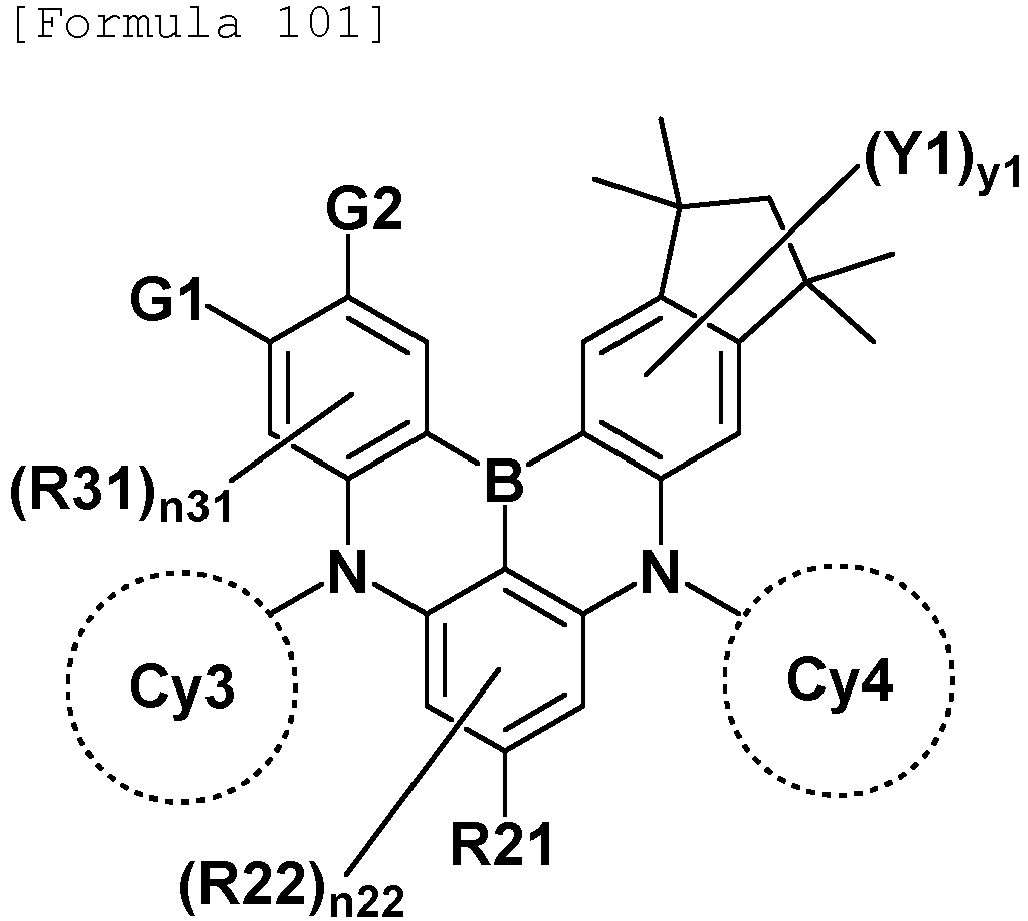


- In Formulae 101 to 109,
- Cy3 and Cy4 are the same as those defined in Formula 100,
- R22, R31, G1, G2, and Y1 to Y6 are the same as or different from each other, and are each independently hydrogen; deuterium; a nitrile group; a halogen group; a substituted or unsubstituted alkyl group; a substituted or unsubstituted alkoxy group; a substituted or unsubstituted silyl group; a substituted or unsubstituted aryl group; a substituted or unsubstituted heterocyclic group; or a substituted or unsubstituted amine group, or are bonded to an adjacent substituent to form a substituted or unsubstituted ring,
- R21 is a substituted or unsubstituted alkyl group; a substituted or unsubstituted aryl group; a substituted or unsubstituted heterocyclic group; or a substituted or unsubstituted amine group,
- at least one of G1 and G2 is a substituted or unsubstituted alkyl group; a substituted or unsubstituted aryl group; a substituted or unsubstituted heterocyclic group; or a substituted or unsubstituted amine group,
- n22 and n31 are each an integer from 0 to 2, y1 and y5 are each an integer from 0 to 4, and y2 to y4 and y6 are each an integer from 0 to 6, and
- when n22, n31, and y1 to y6 are each 2 or higher, substituents in the parenthesis are the same as or different from each other.
- In an exemplary embodiment of the present specification, the above-described description on R1 may be applied to R21.
- In an exemplary embodiment of the present specification, R21 is a substituted or unsubstituted alkyl group; a substituted or unsubstituted heterocyclic group; or a substituted or unsubstituted amine group.
- In an exemplary embodiment of the present specification, R21 is deuterium; a substituted or unsubstituted alkyl group; a substituted or unsubstituted heterocyclic group; or -N(R211)(R212).
- In an exemplary embodiment of the present specification, R21 is a substituted or unsubstituted alkyl group having 1 to 10 carbon atoms; a substituted or unsubstituted N-containing heterocyclic group having 2 to 30 carbon atoms; a substituted or unsubstituted arylamine group having 6 to 60 carbon atoms; or a substituted or unsubstituted arylheteroarylamine group having 6 to 60 carbon atoms.
- In an exemplary embodiment of the present specification, R21 is an alkyl group having 1 to 10 carbon atoms, which is unsubstituted or substituted with deuterium; an N-containing heterocyclic group having 2 to 30 carbon atoms, which is unsubstituted or substituted with one or more substituents selected from the group consisting of deuterium, an alkyl group having 1 to 10 carbon atoms, and an aryl group having 6 to 30 carbon atoms, or a substituent to which two or more groups selected from the group are linked; an arylamine group having 6 to 60 carbon atoms, which is unsubstituted or substituted with one or more substituents selected from the group consisting of deuterium and an alkyl group having 1 to 10 carbon atoms or a substituent to which two or more groups selected from the group are linked, and is unfused or fused with an aliphatic hydrocarbon ring having 5 to 30 carbon atoms; or an arylheteroarylamine group having 6 to 60 carbon atoms, which is unsubstituted or substituted with one or more substituents selected from the group consisting of deuterium and an alkyl group having 1 to 10 carbon atoms, or a substituent to which two or more groups selected from the group are linked.
- In an exemplary embodiment of the present specification, R21 is an alkyl group having 1 to 6 carbon atoms, which is unsubstituted or substituted with deuterium; an N-containing heterocyclic group having 2 to 20 carbon atoms, which is unsubstituted or substituted with an alkyl group having 1 to 6 carbon atoms, an aryl group having 6 to 20 carbon atoms, or an alkylaryl group having 7 to 30 carbon atoms; an arylamine group having 6 to 40 carbon atoms, which is unsubstituted or substituted with deuterium or an alkyl group having 1 to 6 carbon atoms, and is unfused or fused with an aliphatic hydrocarbon ring having 5 or 6 carbon atoms; or an arylheteroarylamine group having 6 to 40 carbon atoms, which is unsubstituted or substituted with deuterium.
- In an exemplary embodiment of the present specification, R21 is a methyl group which is unsubstituted or substituted with deuterium; an isopropyl group; a tert-butyl group; a hexahydrocarbazole group which is unsubstituted or substituted with a methyl group, a tert-butyl group, a phenyl group, a tolyl group, a tert-butylphenyl group, or a tetramethyltetrahydronaphthalene group; a diphenylamine group which is unsubstituted or substituted with a methyl group, an isopropyl group, or a tert-butyl group, and is unfused or fused with cyclopentene or cyclohexene; an N-phenyl-N-dibenzofuranamine group; or an N-phenyl-N-dibenzothiopheneamine group.
- In an exemplary embodiment of the present specification, R21 is an alkyl group having 1 to 10 carbon atoms, which is unsubstituted or substituted with deuterium; an N-containing heterocyclic group having 2 to 30 carbon atoms, which is unsubstituted or substituted with one or more substituents selected from the group consisting of deuterium, an alkyl group having 1 to 10 carbon atoms, and an aryl group having 6 to 30 carbon atoms, or a substituent to which two or more groups selected from the group are linked; or -N(R211)(R212).
- In an exemplary embodiment of the present specification, R21 is an alkyl group having 1 to 10 carbon atoms, which is unsubstituted or substituted with deuterium; an arylamine group having 6 to 60 carbon atoms, which is unsubstituted or substituted with one or more substituents selected from the group consisting of deuterium and an alkyl group having 1 to 10 carbon atoms, or a substituent to which two or more groups selected from the group are linked, and is unfused or fused with an aliphatic hydrocarbon ring having 5 to 30 carbon atoms; an arylheteroarylamine group having 6 to 60 carbon atoms, which is unsubstituted or substituted with one or more substituents selected from the group consisting of deuterium and an alkyl group having 1 to 10 carbon atoms, or a substituent to which two or more groups selected from the group are linked; or the above Formula Het1.
- In an exemplary embodiment of the present specification, R22 is hydrogen; or deuterium.
- In an exemplary embodiment of the present specification, R31 is hydrogen; or deuterium.
- In an exemplary embodiment of the present specification, the above-described description on R3 and R4 may be applied to G1 and G2.
- In an exemplary embodiment of the present specification, at least one of G1 and G2 is a substituted or unsubstituted alkyl group having 1 to 10 carbon atoms; a substituted or unsubstituted aryl group having 6 to 30 carbon atoms; a substituted or unsubstituted arylamine group having 6 to 60 carbon atoms; or a substituted or unsubstituted arylheteroarylamine group having 6 to 60 carbon atoms.
- In an exemplary embodiment of the present specification, at least one of G1 and G2 is deuterium; a substituted or unsubstituted alkyl group; a substituted or unsubstituted heterocyclic group; or -N(R211)(R212).
- In an exemplary embodiment of the present specification, at least one of G1 and G2 is an alkyl group having 1 to 10 carbon atoms, which is unsubstituted or substituted with one or more substituents selected from the group consisting of deuterium and an aryl group having 6 to 30 carbon atoms or a substituent to which two or more groups selected from the group are linked; an aryl group having 6 to 30 carbon atoms, which is unsubstituted or substituted with one or more substituents selected from the group consisting of deuterium and an alkyl group having 1 to 10 carbon atoms or a substituent to which two or more groups selected from the group are linked; a heterocyclic group having 6 to 30 carbon atoms, which is unsubstituted or substituted with one or more substituents selected from the group consisting of deuterium, an alkyl group having 1 to 10 carbon atoms and an aryl group having 6 to 30 carbon atoms or a substituent to which two or more groups selected from the group are linked; an arylamine group having 6 to 60 carbon atoms, which is unsubstituted or substituted with one or more substituents selected from the group consisting of deuterium and an alkyl group having 1 to 10 carbon atoms or a substituent to which two or more groups selected from the group are linked, and is unfused or fused with an aliphatic hydrocarbon ring having 5 to 30 carbon atoms; or an arylheteroarylamine group having 6 to 60 carbon atoms, which is unsubstituted or substituted with one or more substituents selected from the group consisting of deuterium and an alkyl group having 1 to 10 carbon atoms or a substituent to which two or more groups selected from the group are linked.
- In an exemplary embodiment of the present specification, at least one of G1 and G2 is an alkyl group having 1 to 6 carbon atoms, which is unsubstituted or substituted with deuterium or an aryl group having 6 to 20 carbon atoms; an aryl group having 6 to 20 carbon atoms, which is unsubstituted or substituted with deuterium or an alkyl group having 1 to 6 carbon atoms; a heterocyclic group having 6 to 20 carbon atoms, which is unsubstituted or substituted with an alkyl group having 1 to 6 carbon atoms, an aryl group having 6 to 20 carbon atoms, or an alkylaryl group having 7 to 30 carbon atoms; an arylamine group having 6 to 40 carbon atoms, which is unsubstituted or substituted with deuterium or an alkyl group having 1 to 6 carbon atoms, and is unfused or fused with an aliphatic hydrocarbon ring having 5 or 6 carbon atoms; or an arylheteroarylamine group having 6 to 40 carbon atoms, which is unsubstituted or substituted with deuterium.
- In an exemplary embodiment of the present specification, at least one of G1 and G2 is a methyl group; an isopropyl group; a tert-butyl group; a 2-phenylpropan-2-yl group; a phenyl group which is unsubstituted or substituted with a methyl group or a tert-butyl group; a dimethylfluorenyl group; a dibenzofuran group; a dibenzothiophene group; a hexahydrocarbazole group, which is unsubstituted or substituted with a methyl group, a tert-butyl group, a phenyl group, a tolyl group, a tert-butylphenyl group, or a tetramethyltetrahydronaphthalene group; a diphenylamine group which is unsubstituted or substituted with a methyl group, an isopropyl group, or a tert-butyl group, and is unfused or fused with cyclopentene or cyclohexene; an N-phenyl-N-dibenzofuranamine group; or an N-phenyl-N-dibenzothiopheneamine group.
- In an exemplary embodiment of the present specification, at least one of G1 and G2 is an alkyl group having 1 to 10 carbon atoms, which is unsubstituted or substituted with one or more substituents selected from the group consisting of deuterium and an aryl group having 6 to 30 carbon atoms or a substituent to which two or more groups selected from the group are linked; an aryl group having 6 to 30 carbon atoms, which is unsubstituted or substituted with one or more substituents selected from the group consisting of deuterium and an alkyl group having 1 to 10 carbon atoms or a substituent to which two or more groups selected from the group are linked; a heterocyclic group having 6 to 30 carbon atoms, which is unsubstituted or substituted with one or more substituents selected from the group consisting of deuterium, an alkyl group having 1 to 10 carbon atoms, and an aryl group having 6 to 30 carbon atoms or a substituent to which two or more groups selected from the group are linked; or -N(R211)(R212).
- In an exemplary embodiment of the present specification, any one of G1 and G2 is a substituted or unsubstituted alkyl group; a substituted or unsubstituted aryl group; a substituted or unsubstituted heterocyclic group; or a substituted or unsubstituted amine group, and the other is hydrogen or deuterium.
- In an exemplary embodiment of the present specification, any one of G1 and G2 is a substituted or unsubstituted alkyl group having 1 to 10 carbon atoms; a substituted or unsubstituted aryl group having 6 to 30 carbon atoms; a substituted or unsubstituted heterocyclic group having 6 to 30 carbon atoms; a substituted or unsubstituted arylamine group having 6 to 60 carbon atoms; or a substituted or unsubstituted arylheteroarylamine group having 6 to 60 carbon atoms, and the other is hydrogen or deuterium.
- In an exemplary embodiment of the present specification, any one of G1 and G2 is an alkyl group having 1 to 6 carbon atoms, which is unsubstituted or substituted with deuterium or an aryl group having 6 to 20 carbon atoms; an aryl group having 6 to 20 carbon atoms, which is unsubstituted or substituted with deuterium or an alkyl group having 1 to 6 carbon atoms; a heterocyclic group having 6 to 20 carbon atoms, which is unsubstituted or substituted with an alkyl group having 1 to 6 carbon atoms, an aryl group having 6 to 20 carbon atoms, or an alkylaryl group having 7 to 30 carbon atoms; an arylamine group having 6 to 40 carbon atoms, which is unsubstituted or substituted with deuterium or an alkyl group having 1 to 6 carbon atoms, and is unfused or fused with an aliphatic hydrocarbon ring having 5 or 6 carbon atoms; or an arylheteroarylamine group having 6 to 40 carbon atoms, which is unsubstituted or substituted with deuterium, and the other is hydrogen or deuterium.
- In an exemplary embodiment of the present specification, any one of G1 and G2 is an alkyl group having 1 to 6 carbon atoms, which is unsubstituted or substituted with deuterium or an aryl group having 6 to 20 carbon atoms; an aryl group having 6 to 20 carbon atoms, which is unsubstituted or substituted with deuterium or an alkyl group having 1 to 6 carbon atoms; a heterocyclic group having 6 to 20 carbon atoms, which is unsubstituted or substituted with an alkyl group having 1 to 6 carbon atoms, an aryl group having 6 to 20 carbon atoms, or an alkylaryl group having 7 to 30 carbon atoms; or - N(R211)(R212), and the other is hydrogen or deuterium. In an exemplary embodiment of the present specification, Y1 to Y6 are the same as or different from each other, and are each independently hydrogen; or deuterium, or four adjacent Y3's; or four adjacent Y6's are bonded to each other to form a benzene ring.
- In an exemplary embodiment of the present specification, Y1 to Y6 are the same as or different from each other, and are each independently hydrogen; or deuterium, or four adjacent Y3's; or four adjacent Y6's are bonded to each other to form a benzene ring.
- In an exemplary embodiment of the present specification, Formula 103 is represented by the following Formula 103-1 or 103-2.


- In Formulae 103-1 and 103-2,
definitions of G1, G2, Cy3, Cy4, R21, R22, R31, n22, and n31 are the same as those defined in Formula 103. In an exemplary embodiment of the present specification, Formula 107 is represented by the following Formula 107-1 or 107-2.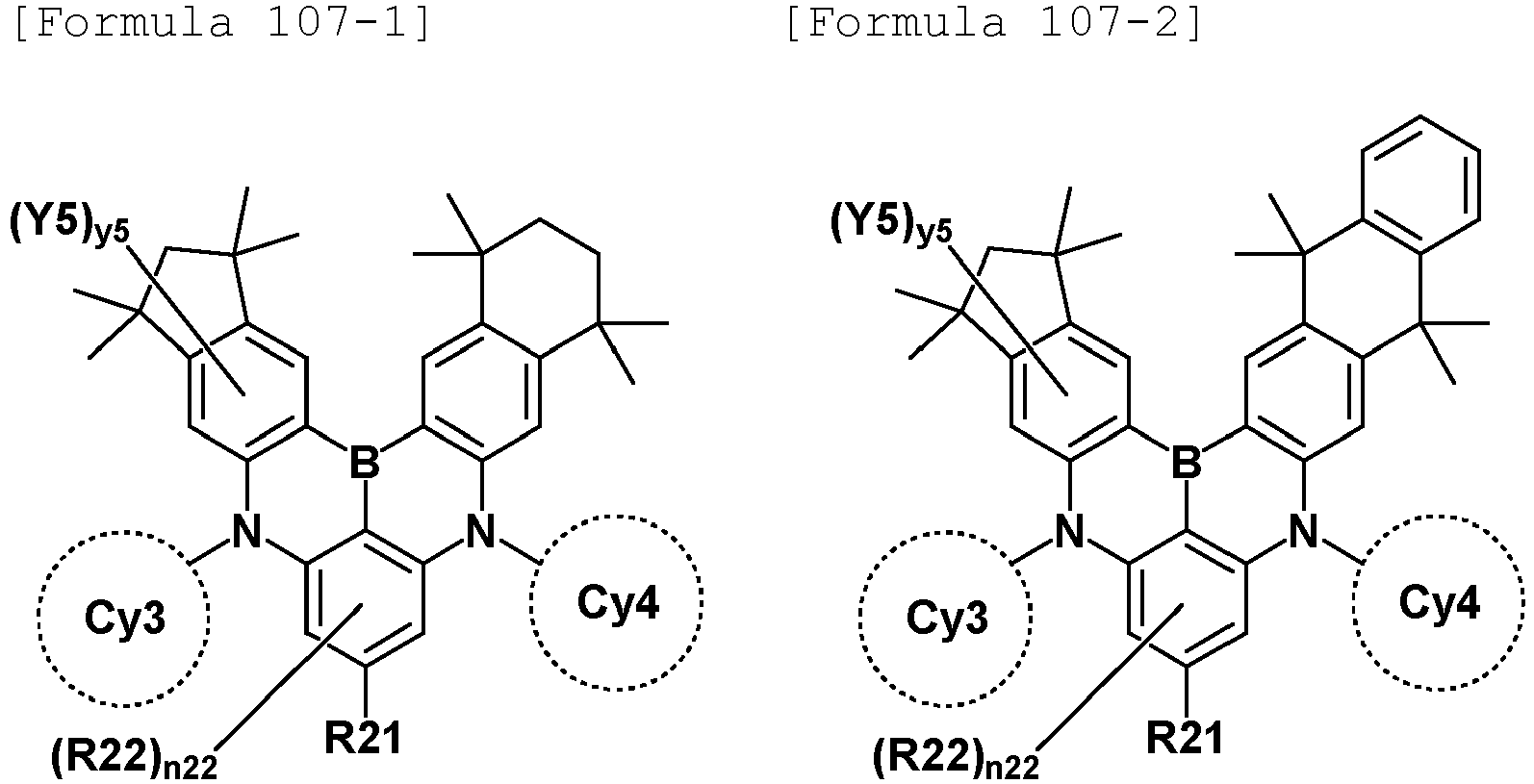
- In Formulae 107-1 and 107-2,
definitions of Y5, Cy3, Cy4, R21, R22, n22, and y5 are the same as those defined in Formula 107. - In an exemplary embodiment of the present specification, Formula 108 is represented by the following Formula 108-1 or 108-2.

- In Formulae 108-1 and 108-2,
definitions of Y4, Cy3, Cy4, R21, R22, n22, and y4 are the same as those defined in Formula 108. - In an exemplary embodiment of the present specification, Formula 109 is represented by any one of the following Formulae 109-1 to 109-3.


- In Formulae 109-1 to 109-3,
definitions of Cy3, Cy4, R21, R22, and n22 are the same as those defined in Formula 109. - In an exemplary embodiment of the present specification, Formula 100 is represented by any one of the following Formulae 201 to 209.


- In Formulae 201 to 209,
- Q1 is the same as that defined in Formula 100,
- Cy5 to Cy7 are the same as or different from each other, and are each independently one selected from the group consisting of a substituted or unsubstituted aromatic hydrocarbon ring; a substituted or unsubstituted aliphatic hydrocarbon ring; and a substituted or unsubstituted aromatic hetero ring, or a ring in which two or more rings selected from the group are fused,
- R22, R31 to R38, G1, and G2 are the same as or different from each other, and are each independently hydrogen; deuterium; a nitrile group; a halogen group; a substituted or unsubstituted alkyl group; a substituted or unsubstituted alkoxy group; a substituted or unsubstituted silyl group; a substituted or unsubstituted aryl group; a substituted or unsubstituted heterocyclic group; or a substituted or unsubstituted amine group, or are bonded to an adjacent substituent to form a substituted or unsubstituted ring,
- R21 is a substituted or unsubstituted alkyl group; a substituted or unsubstituted aryl group; a substituted or unsubstituted heterocyclic group; or a substituted or unsubstituted amine group,
- at least one of G1 and G2 is a substituted or unsubstituted alkyl group; a substituted or unsubstituted aryl group; a substituted or unsubstituted heterocyclic group; or a substituted or unsubstituted amine group, x1 to x3 are each 1 or 2,
- n22, n31, n36, and n37 are each an integer from 0 to 2, n32 and n35 are each an integer from 0 to 4, n33 is an integer from 0 to 5, and n34 and n38 are each an integer from 0 to 3,
- when n22 and n31 to n38 are each 2 or higher, substituents in the parenthesis are the same as or different from each other,
- Cy11 to Cy13 are the same as or different from each other, and are each independently selected from the following structures,

- a dotted double line is a position where substituents are fused,
- R121 to R123 are the same as or different from each other, and are each independently hydrogen; deuterium; a substituted or unsubstituted alkyl group; a substituted or unsubstituted aryl group; or a substituted or unsubstituted heterocyclic group, or are bonded to an adjacent substituent to form a substituted or unsubstituted ring, and
- n121 is an integer from 0 to 2, n122 and n123 are each an integer from 0 to 4, and when n121 to n123 are each 2 or more, substituents in the parenthesis are the same as or different from each other.
- In an exemplary embodiment of the present specification, the above-described description on R115 to R117 is applied to R121 to R123.
- In an exemplary embodiment of the present specification, R121 and R122 are the same as or different from each other, and are each independently hydrogen; or deuterium.
- In an exemplary embodiment of the present specification, R123 is hydrogen or deuterium, or four adjacent R117's are bonded to each other to form a substituted or unsubstituted benzene ring.
- In an exemplary embodiment of the present specification, R123 is hydrogen or deuterium, or four adjacent R117's are bonded to each other to form a benzene ring which is unsubstituted or substituted with an alkyl group having 1 to 10 carbon atoms.
- In an exemplary embodiment of the present specification, R123 is hydrogen or deuterium, or four adjacent R117's are bonded to each other to form a benzene ring.
- In an exemplary embodiment of the present specification, Cy11 to Cy13 are the same as or different from each other, and are each independently selected from the following structures.

- In an exemplary embodiment of the present specification, the above-described description on R103 may be applied to R32.
- In an exemplary embodiment of the present specification, the above-described description on R104 may be applied to R33.
- In an exemplary embodiment of the present specification, R32 and R33 are the same as or different from each other, and are each independently hydrogen; deuterium; a substituted or unsubstituted alkyl group; or a substituted or unsubstituted aryl group, or two adjacent R32's; or two adjacent R33's are bonded to each other to form a substituted or unsubstituted hydrocarbon ring.
- In an exemplary embodiment of the present specification, R32 and R33 are the same as or different from each other, and are each independently hydrogen; deuterium; a substituted or unsubstituted alkyl group having 1 to 10 carbon atoms; or a substituted or unsubstituted aryl group having 6 to 30 carbon atoms, or two adjacent R32's; or two adjacent R33's are bonded to each other to form a substituted or unsubstituted aliphatic hydrocarbon ring having 5 to 30 carbon atoms.
- In an exemplary embodiment of the present specification, R32 and R33 are the same as or different from each other, and are each independently hydrogen; deuterium; a substituted or unsubstituted alkyl group having 1 to 6 carbon atoms; or a substituted or unsubstituted aryl group having 6 to 20 carbon atoms, or two adjacent R32's; or two adjacent R33's are bonded to each other to form a substituted or unsubstituted aliphatic hydrocarbon ring having 5 to 20 carbon atoms.
- In an exemplary embodiment of the present specification, the alkyl group or aryl group of R32 and R33 may be substituted with one or more substituents selected from the group consisting of deuterium, an alkyl group having 1 to 10 carbon atoms, and an aryl group having 6 to 30 carbon atoms; or a substituent to which two or more groups selected from the group are linked.
- In an exemplary embodiment of the present specification, the alkyl group or aryl group of R32 and R33 may be substituted with deuterium, an alkyl group having 1 to 10 carbon atoms, an arylalkyl group having 7 to 50 carbon atoms, or an aryl group having 6 to 30 carbon atoms.
- In an exemplary embodiment of the present specification, the aliphatic hydrocarbon ring formed by bonding two adjacent R32's; or two adjacent R33's to each other may be substituted with one or more substituents selected from the group consisting of deuterium and an alkyl group having 1 to 10 carbon atoms; or a substituent to which two or more groups selected from the group are linked.
- In an exemplary embodiment of the present specification, R32 and R33 are the same as or different from each other, and are each independently hydrogen; deuterium; an alkyl group having 1 to 6 carbon atoms, which is unsubstituted or substituted with deuterium or an aryl group having 6 to 20 carbon atoms; or an aryl group having 6 to 20 carbon atoms, which is unsubstituted or substituted with deuterium or an alkyl group having 1 to 6 carbon atoms, or two adjacent R32's; or two adjacent R33's are bonded to each other to form an aliphatic hydrocarbon ring having 5 or 6 carbon atoms, which is unsubstituted or substituted with an alkyl group having 1 to 6 carbon atoms. In an exemplary embodiment of the present specification, R32 and R33 are the same as or different from each other, and are each independently hydrogen; deuterium; a methyl group; an isopropyl group; a tert-butyl group; a 2-phenylpropan-2-yl group; or a phenyl group which is unsubstituted or substituted with a tert-butyl group, or two adjacent R32's; or two adjacent R33's are bonded to each other to form a cyclopentene ring which is unsubstituted or substituted with a methyl group, or a cyclohexene ring which is unsubstituted or substituted with a methyl group.
- In an exemplary embodiment of the present specification, R32 is hydrogen; deuterium; a methyl group; an isopropyl group; a tert-butyl group; a 2-phenylpropan-2-yl group; or a phenyl group which is unsubstituted or substituted with a tert-butyl group.
- In an exemplary embodiment of the present specification, R33 is hydrogen; deuterium; a methyl group; an isopropyl group; a tert-butyl group; a 2-phenylpropan-2-yl group; or a phenyl group which is unsubstituted or substituted with a tert-butyl group, or two adjacent R33's are bonded to each other to form a cyclopentene ring which is unsubstituted or substituted with a methyl group, or a cyclohexene ring which is unsubstituted or substituted with a methyl group.
- In an exemplary embodiment of the present specification, the above-described description on R101 may be applied to R34 and R35.
- In an exemplary embodiment of the present specification, R34 and R35 are the same as or different from each other, and are each independently hydrogen; deuterium; a substituted or unsubstituted alkyl group; or a substituted or unsubstituted aryl group.
- In an exemplary embodiment of the present specification, R34 and R35 are the same as or different from each other, and are each independently hydrogen; deuterium; a substituted or unsubstituted alkyl group having 1 to 10 carbon atoms; or a substituted or unsubstituted aryl group having 6 to 30 carbon atoms.
- In an exemplary embodiment of the present specification, R34 and R35 are the same as or different from each other, and are each independently hydrogen; deuterium; or a substituted or unsubstituted alkyl group having 1 to 6 carbon atoms.
- In an exemplary embodiment of the present specification, R34 and R35 are the same as or different from each other, and are each independently hydrogen; deuterium; or a tert-butyl group.
- In an exemplary embodiment of the present specification, R36 and R37 are the same as or different from each other, and are each independently hydrogen; or deuterium.
- In an exemplary embodiment of the present specification, the above-described description on R102 may be applied to R38.
- In an exemplary embodiment of the present specification, R38 is hydrogen; deuterium; a substituted or unsubstituted alkyl group; or a substituted or unsubstituted aryl group.
- In an exemplary embodiment of the present specification, R38 is hydrogen; deuterium; a substituted or unsubstituted alkyl group having 1 to 10 carbon atoms; or a substituted or unsubstituted aryl group having 6 to 30 carbon atoms.
- In an exemplary embodiment of the present specification, R38 is hydrogen; deuterium; or a substituted or unsubstituted alkyl group having 1 to 6 carbon atoms.
- In an exemplary embodiment of the present specification, R38 is hydrogen; deuterium; or a methyl group.
- In an exemplary embodiment of the present specification, the above-described description on Cy3 and Cy4 may be applied to Cy5 to Cy7.
- In an exemplary embodiment of the present specification, Cy5 to Cy7 are the same as or different from each other, and are each independently selected from Formulae A-1 to A-3, or a substituted or unsubstituted aromatic hydrocarbon ring.
- In an exemplary embodiment of the present specification, Cy5 to Cy7 are the same as or different from each other, and are each independently selected from Formulae A-1 to A-3, or a substituted or unsubstituted aromatic hydrocarbon ring having 6 to 30 carbon atoms.
- In an exemplary embodiment of the present specification, Cy5 to Cy7 are the same as or different from each other, and are each independently selected from Formulae A-1 to A-3, or a substituted or unsubstituted monocyclic aromatic hydrocarbon ring having 6 to 20 carbon atoms.
- In an exemplary embodiment of the present specification, Cy5 to Cy7 are the same as or different from each other, and are each independently selected from Formulae A-1 to A-3, or a monocyclic aromatic hydrocarbon ring having 6 to 20 carbon atoms, which is unsubstituted or substituted with one or more substituents selected from the group consisting of deuterium, an alkyl group having 1 to 6 carbon atoms, and an aryl group having 6 to 20 carbon atoms or a substituent to which two or more groups selected from the group are linked.
- In an exemplary embodiment of the present specification, Cy5 to Cy7 are the same as or different from each other, and are each independently selected from Formulae A-1 to A-3, or a monocyclic aromatic hydrocarbon ring having 6 to 20 carbon atoms, which is unsubstituted or substituted with deuterium, an alkyl group having 1 to 10 carbon atoms, or an arylalkyl group having 7 to 50 carbon atoms.
- In an exemplary embodiment of the present specification, Cy5 to Cy7 are the same as or different from each other, and are each independently selected from A-1 to A-3, or a phenyl group, a biphenyl group, or a terphenyl group, and the phenyl group, the biphenyl group, or the terphenyl group is unsubstituted or substituted with a methyl group, an isopropyl group, a tert-butyl group, or a 2-phenylpropan-2-yl group.
- In an exemplary embodiment of the present specification, Cy5 to Cy7 are the same as or different from each other, and are each independently selected from Formulae A-1 to A-3.
- In an exemplary embodiment of the present specification, Cy5 to Cy7 are the same as or different from each other, and are each independently selected from Groups A-11 to A-14.
- In an exemplary embodiment of the present specification, in Formula 103, when Cy4 is
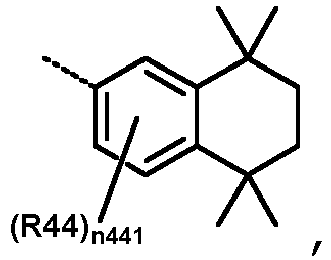
there are two or more substituents linked to the phenyl group of Cy3. - In an exemplary embodiment of the present specification, in Formula 205, when Cy11 and Cy13 are each

there are two or more substituents linked to the phenyl group of Cy7. - In an exemplary embodiment of the present specification, Formula 103 excludes the case where two tert-butyl groups are included as a substituent included in G2, or/and Cy3. That is, the case where G2 of Formula 103 is a tert-butyl group may be included, the case where there is one tert-butyl group among the substituents linked to Cy3 of Formula 103 may be included, and the case where there are three tert-butyl groups among the substituents linked to Cy3 of Formula 103 may also be included. However, the case where there is one tert-butyl group among the substituents linked to Cy3 while G2 of Formula 103 is a tert-butyl group is excluded. Further, the case where there are two tert-butyl groups among the substituents linked to Cy3 of Formula 103 is also excluded.
- In an exemplary embodiment of the present specification, Formula 205 excludes the case where two tert-butyl groups are included as a substituent included in G2, or/and Cy7. That is, the case where G2 of Formula 205 is a tert-butyl group may be included, the case where there is one tert-butyl group among the substituents linked to Cy7 of Formula 205 may be included, and the case where there are three tert-butyl groups among the substituents linked to Cy7 of Formula 205 may also be included. However, the case where there is one tert-butyl group among the substituents linked to Cy7 while G2 of Formula 205 is a tert-butyl group is excluded. Further, the case where there are two tert-butyl groups among the substituents linked to Cy7 of Formula 205 is also excluded.
- In an exemplary embodiment of the present specification, the above-described formulae exclude the following compounds.


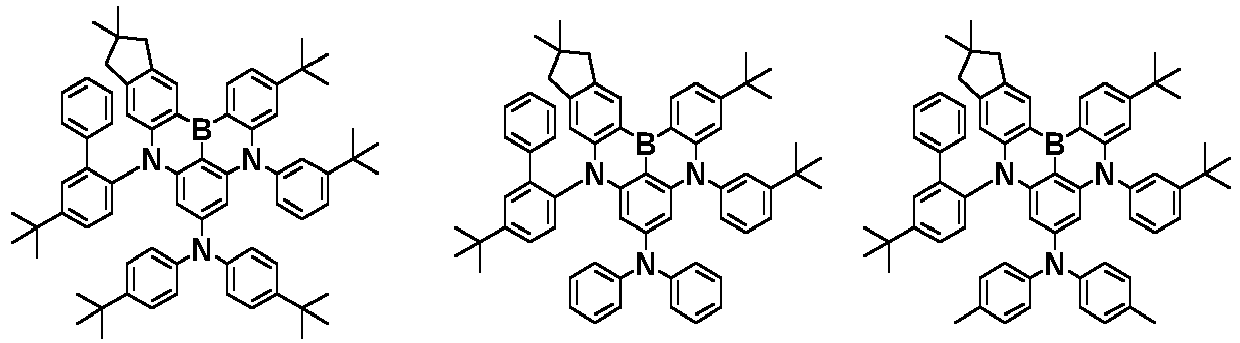


- In an exemplary embodiment of the present specification,
Formula 1 may be represented by any one of the following structures.


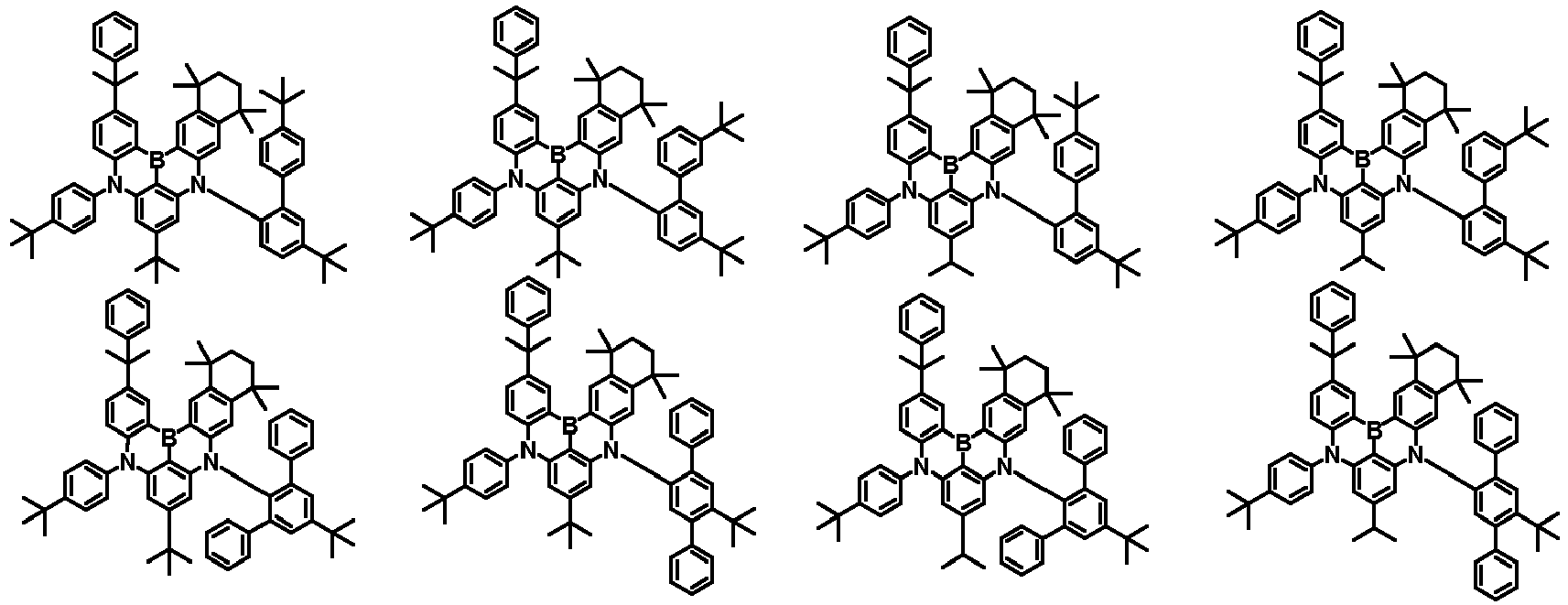


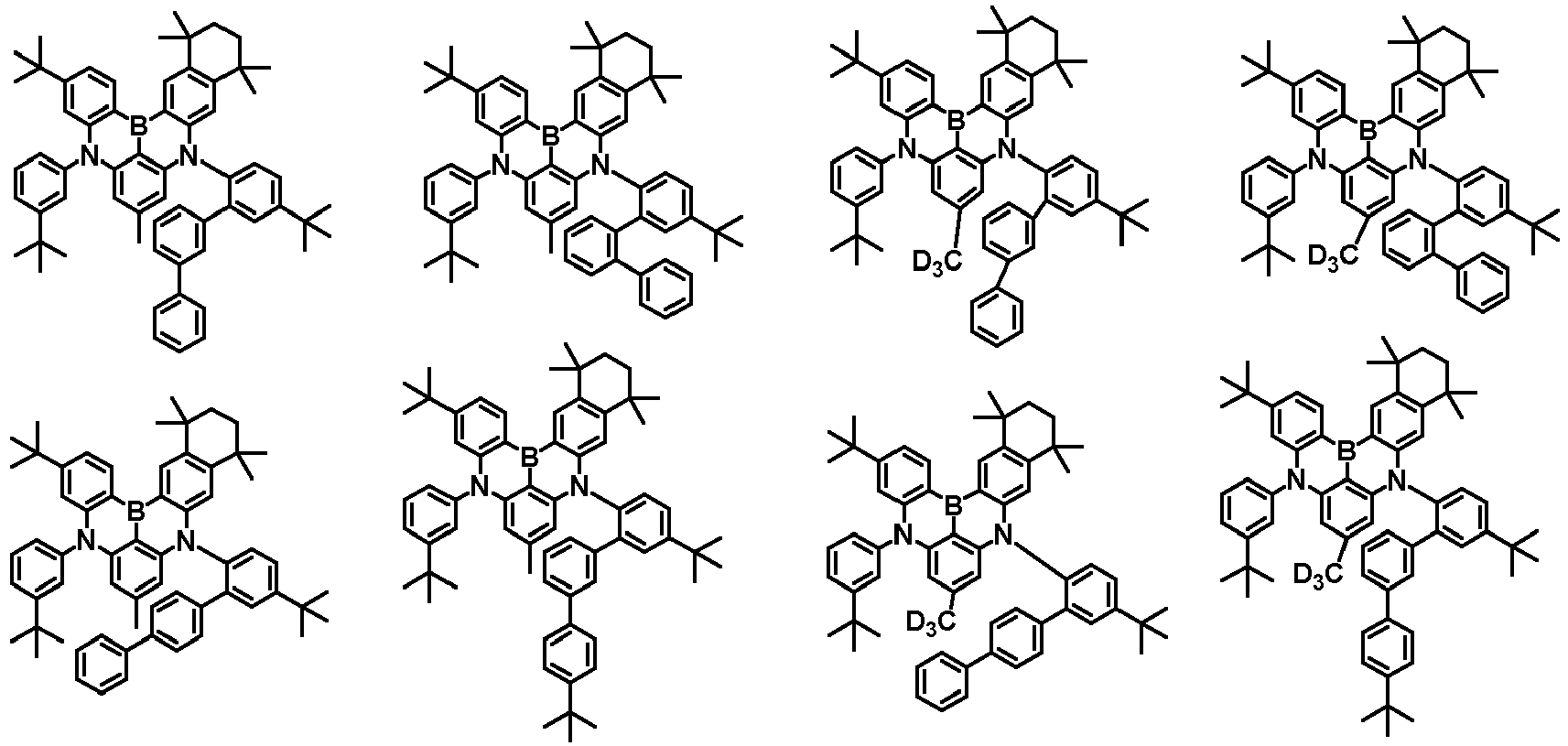

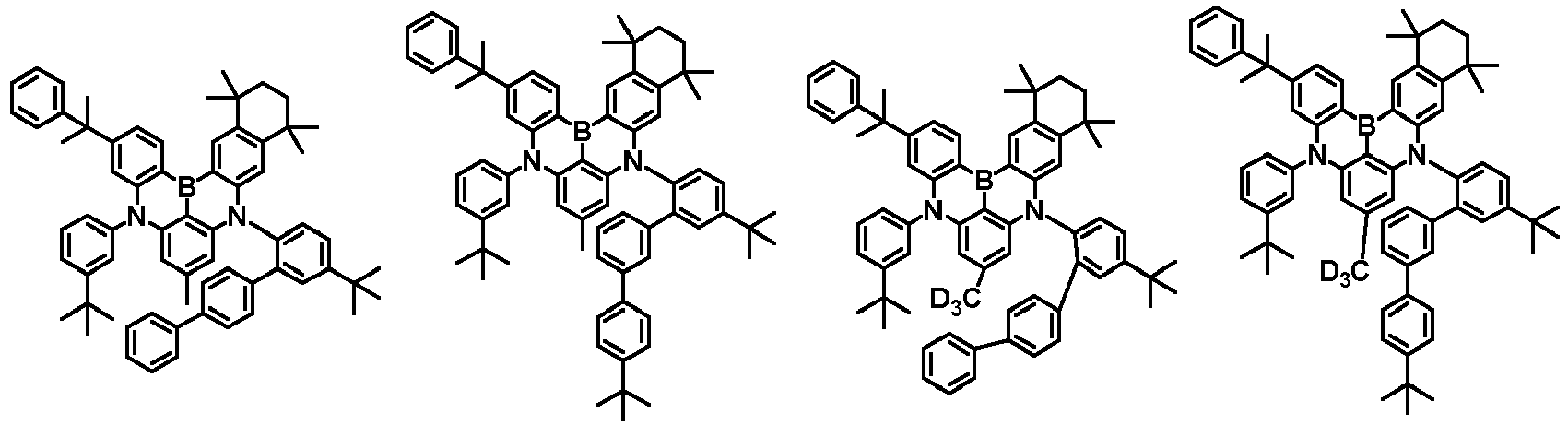


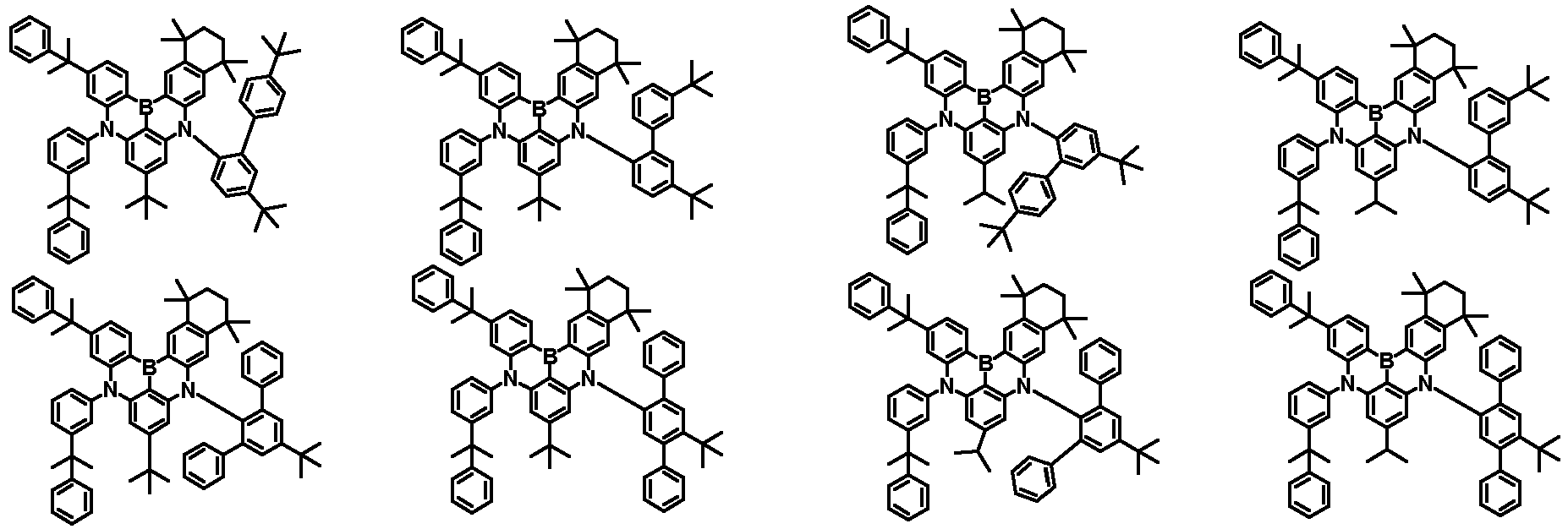








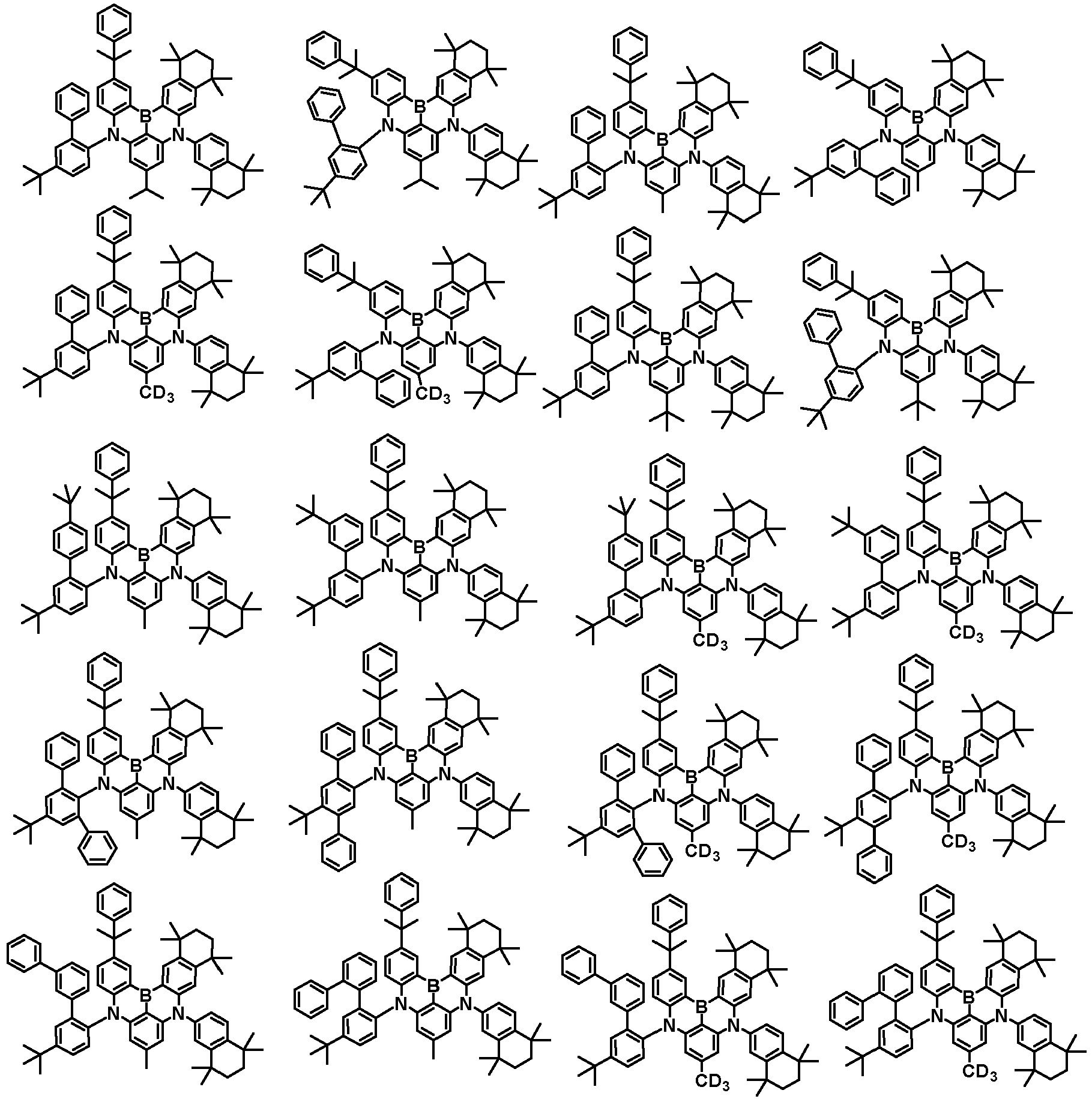














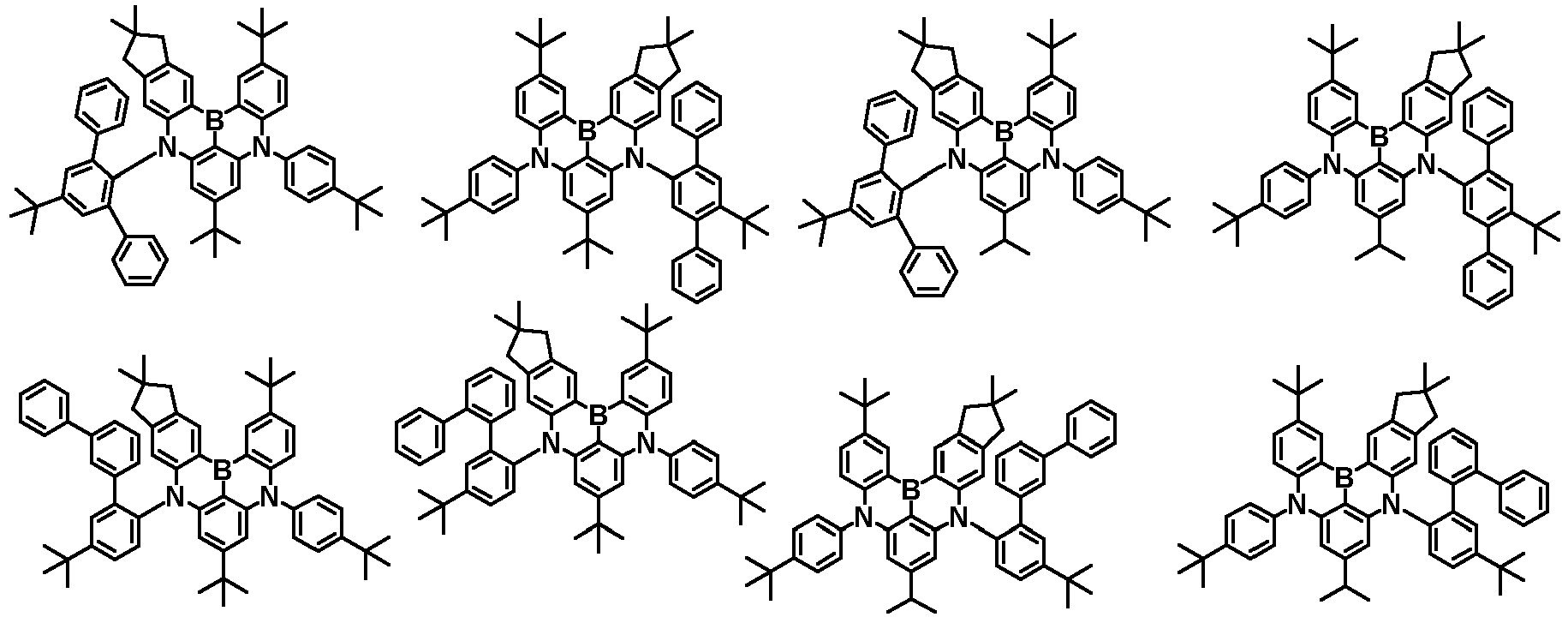

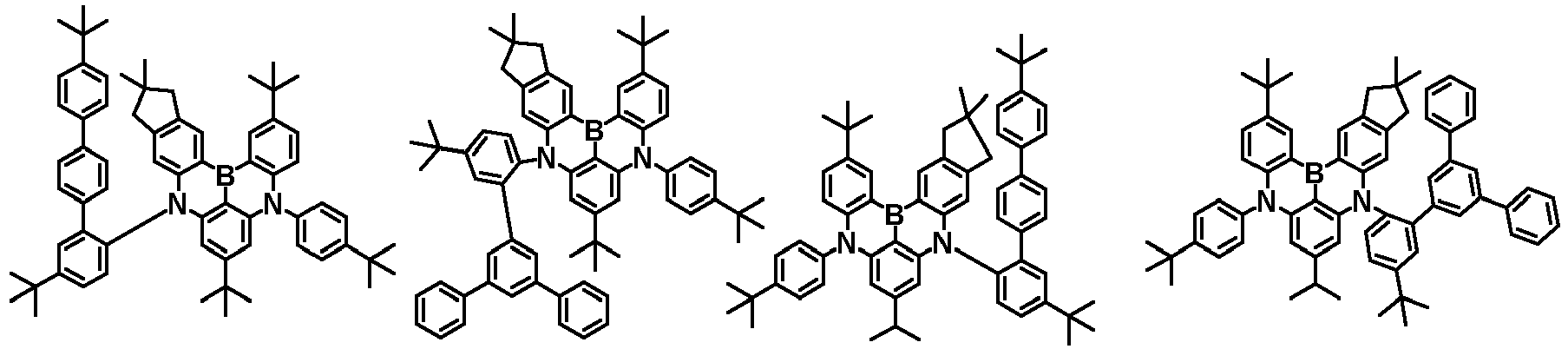


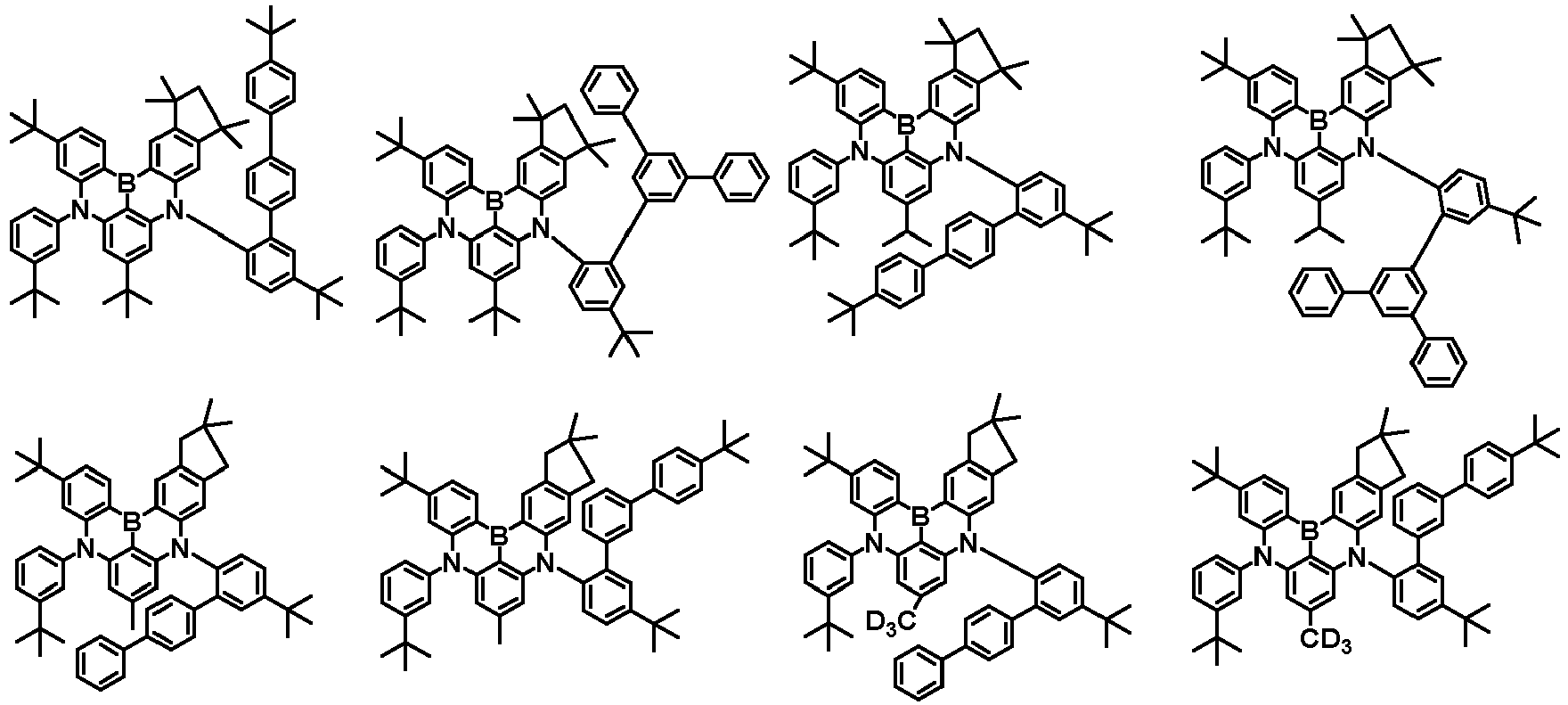


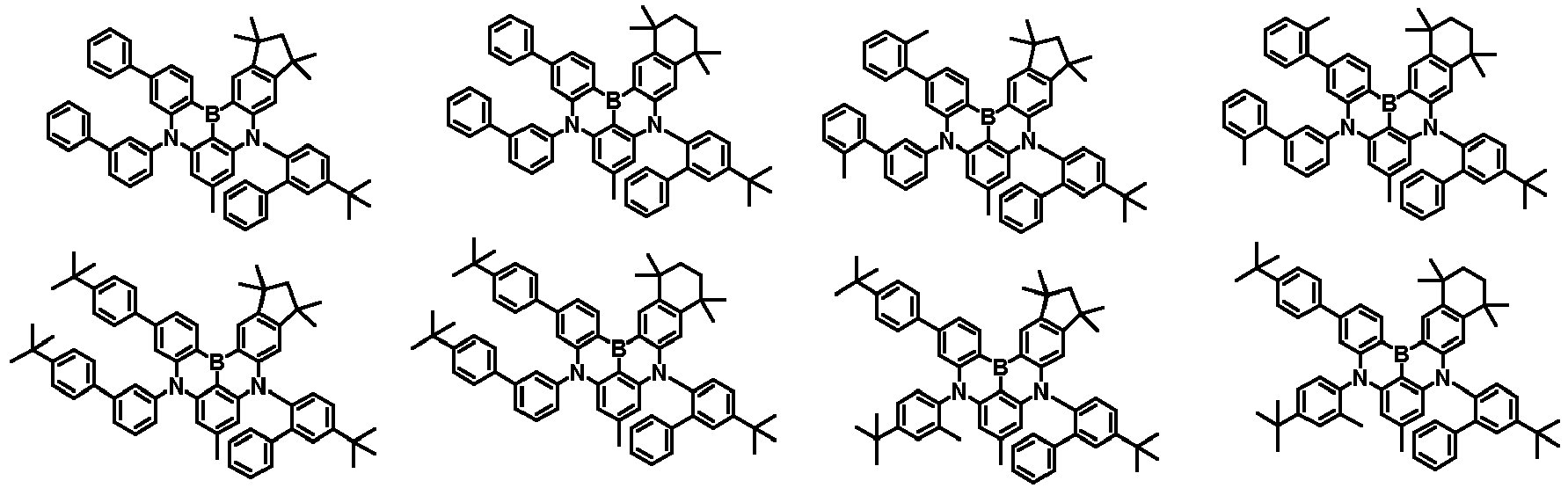


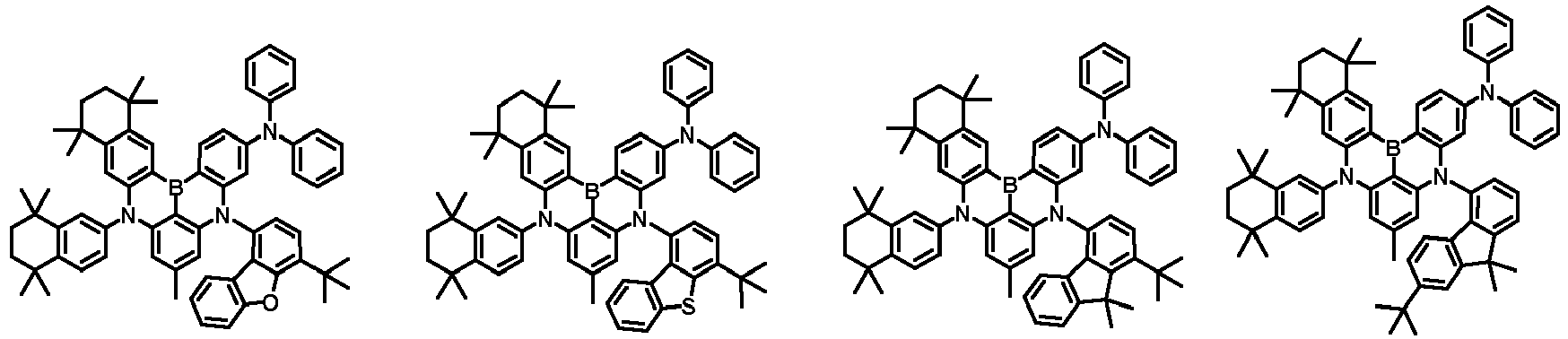





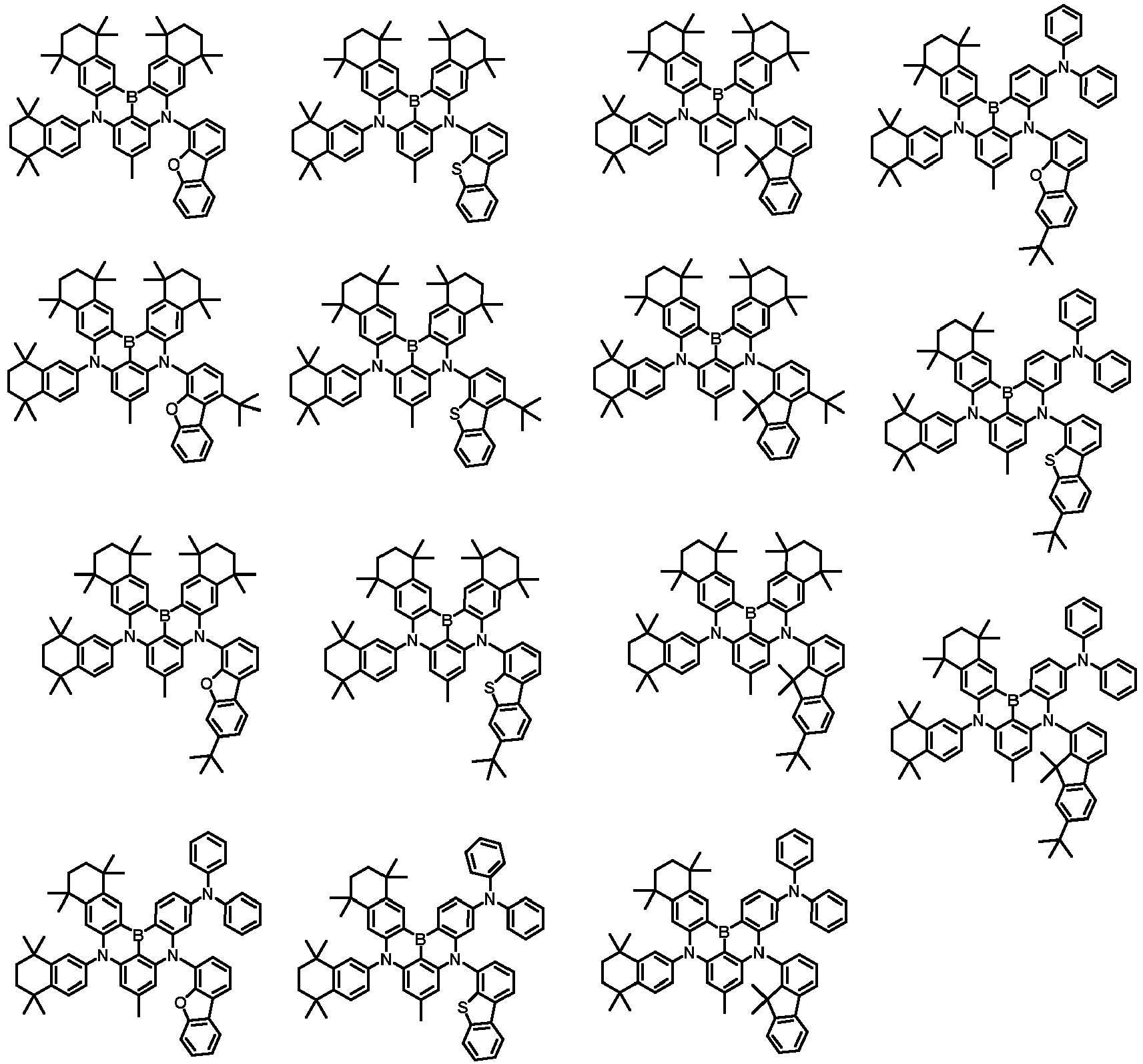
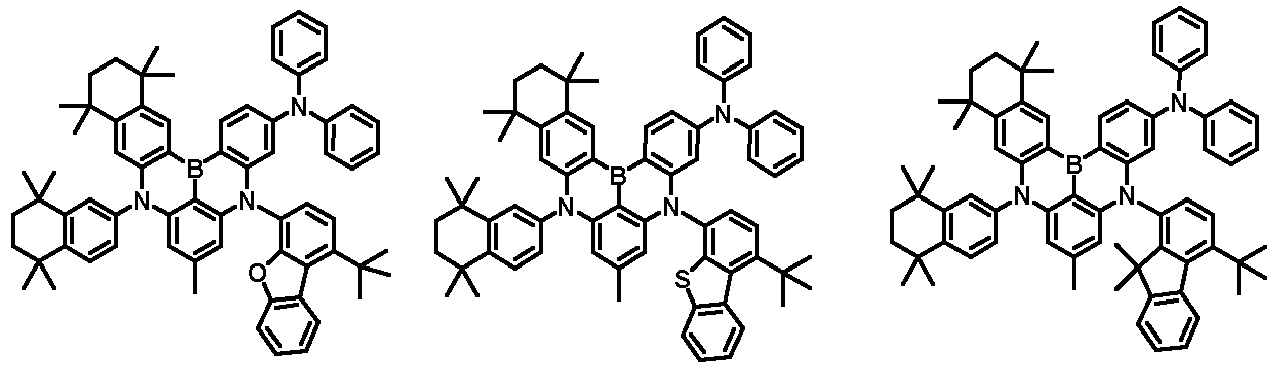


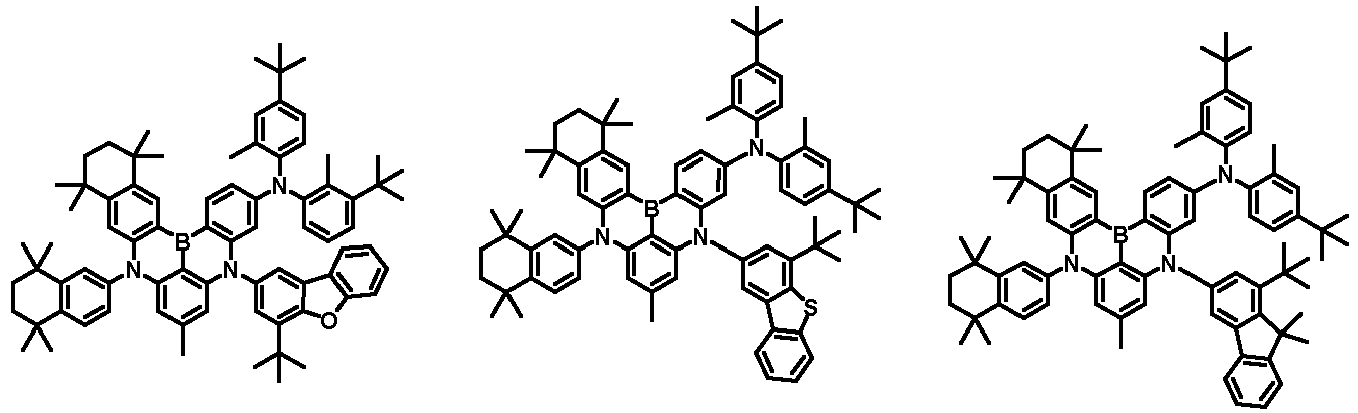


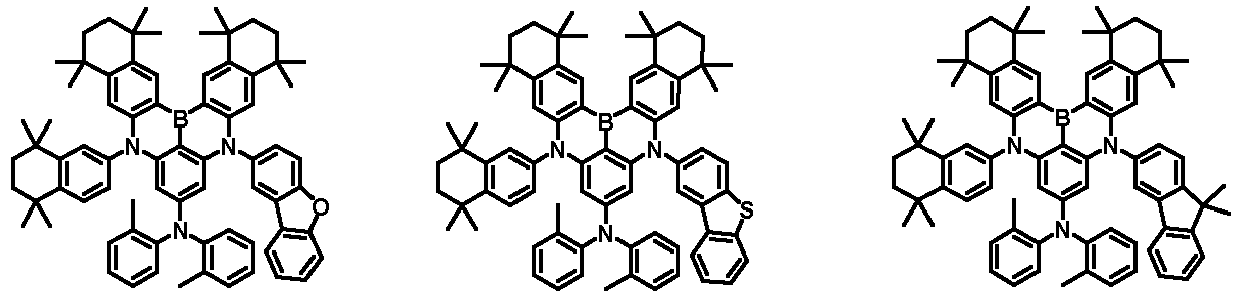


























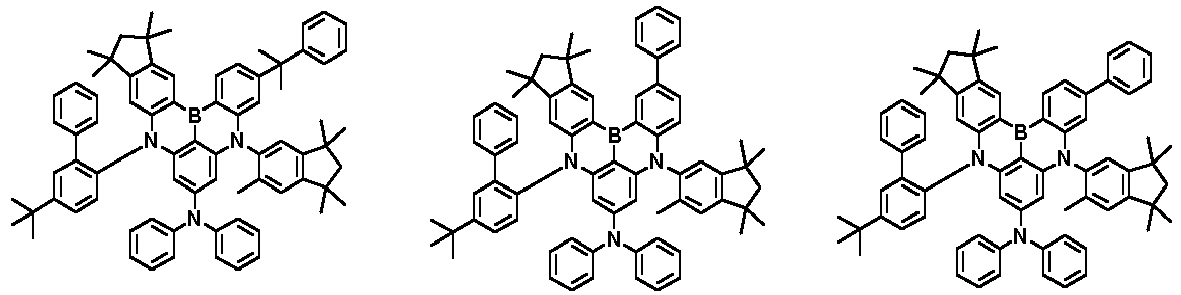



















































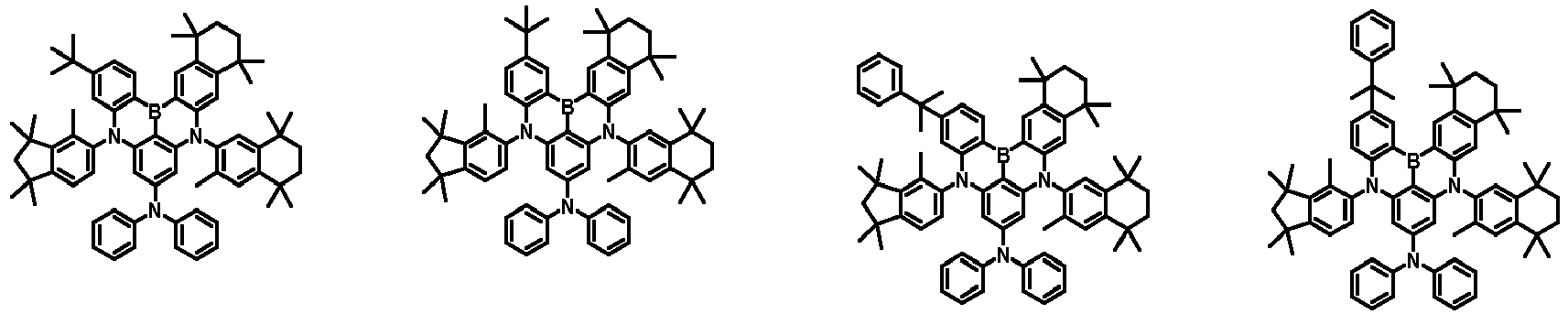


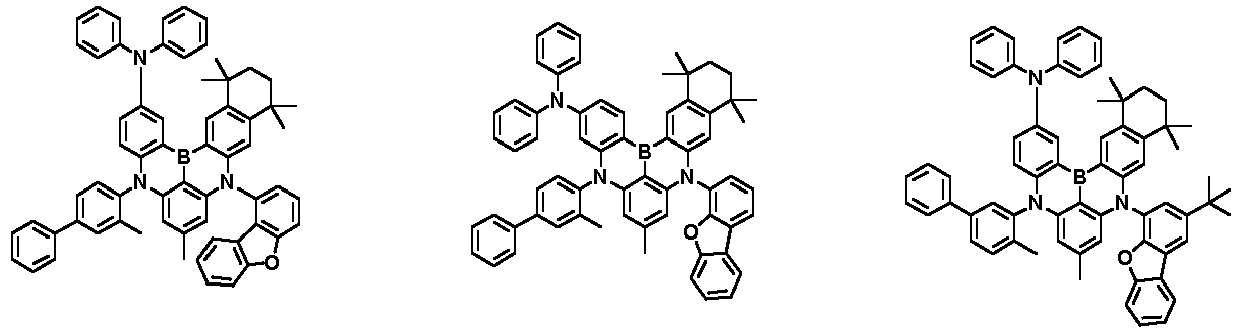

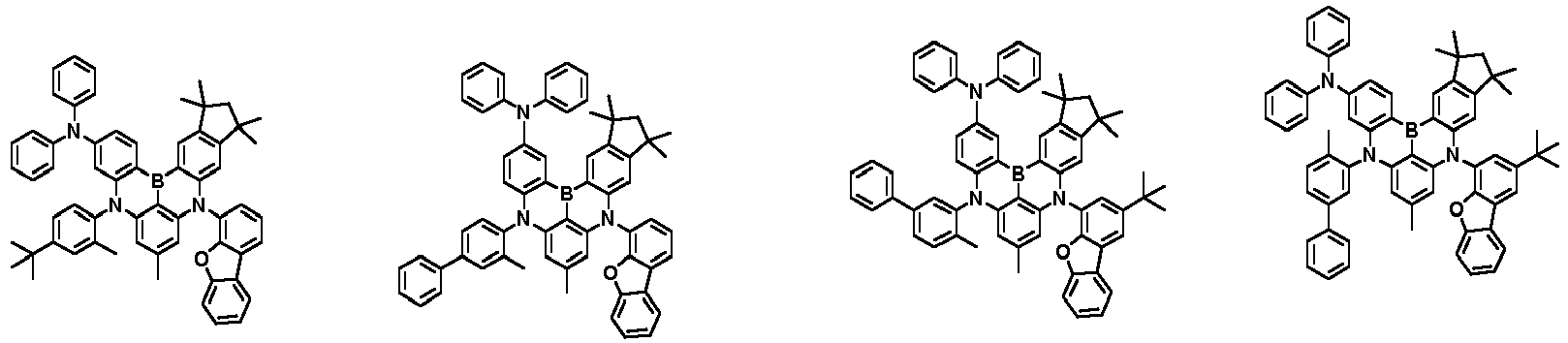


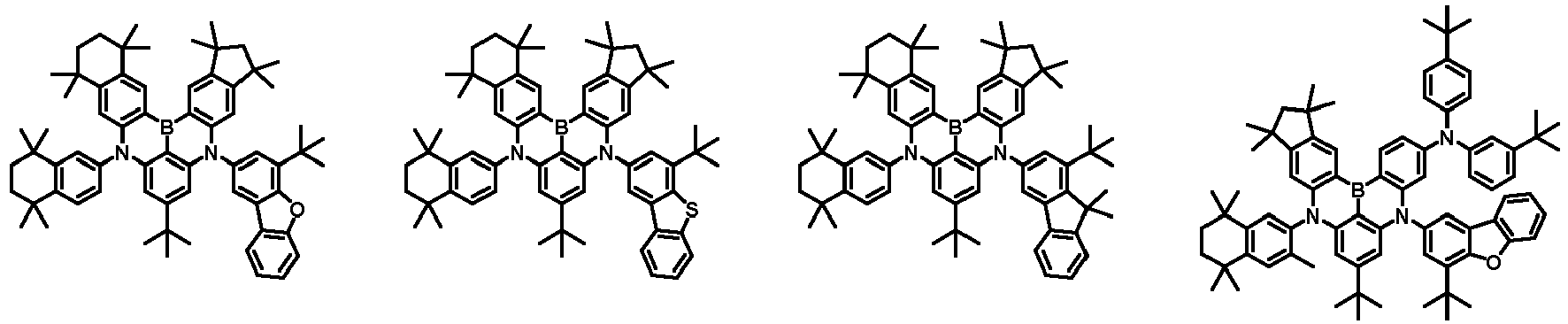
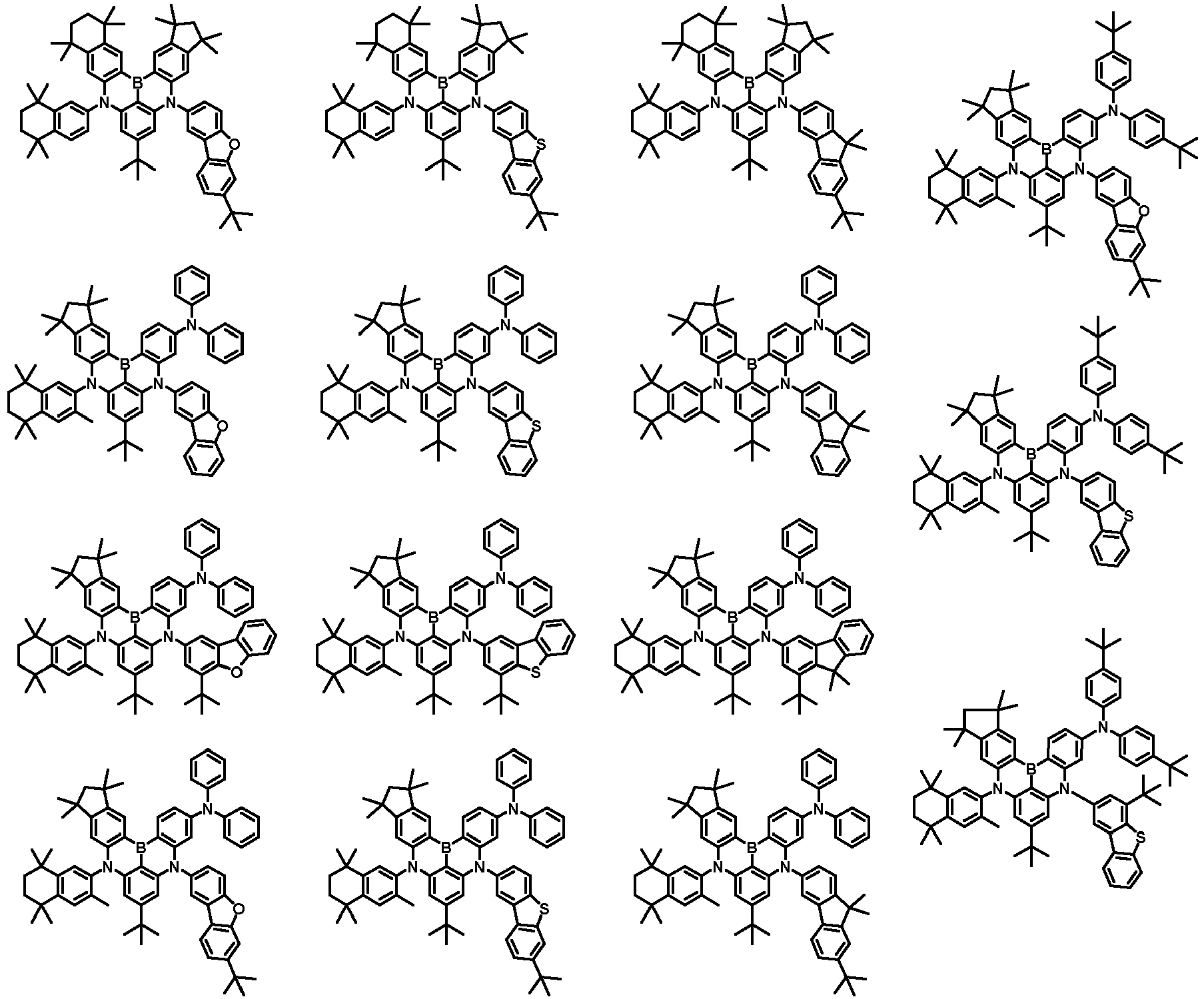


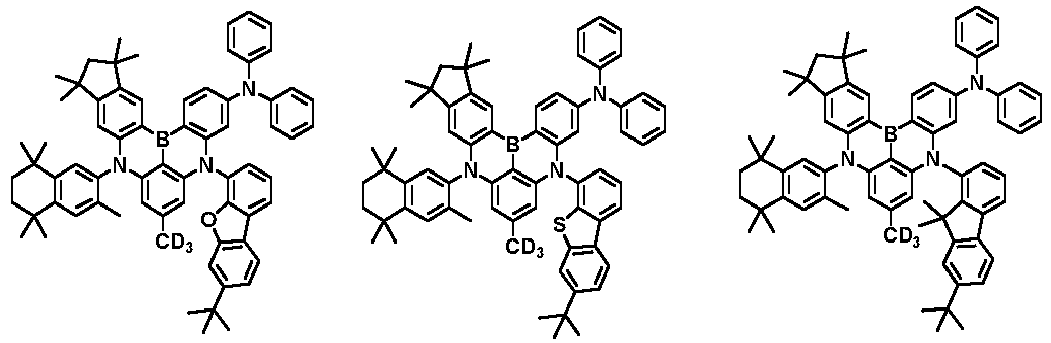
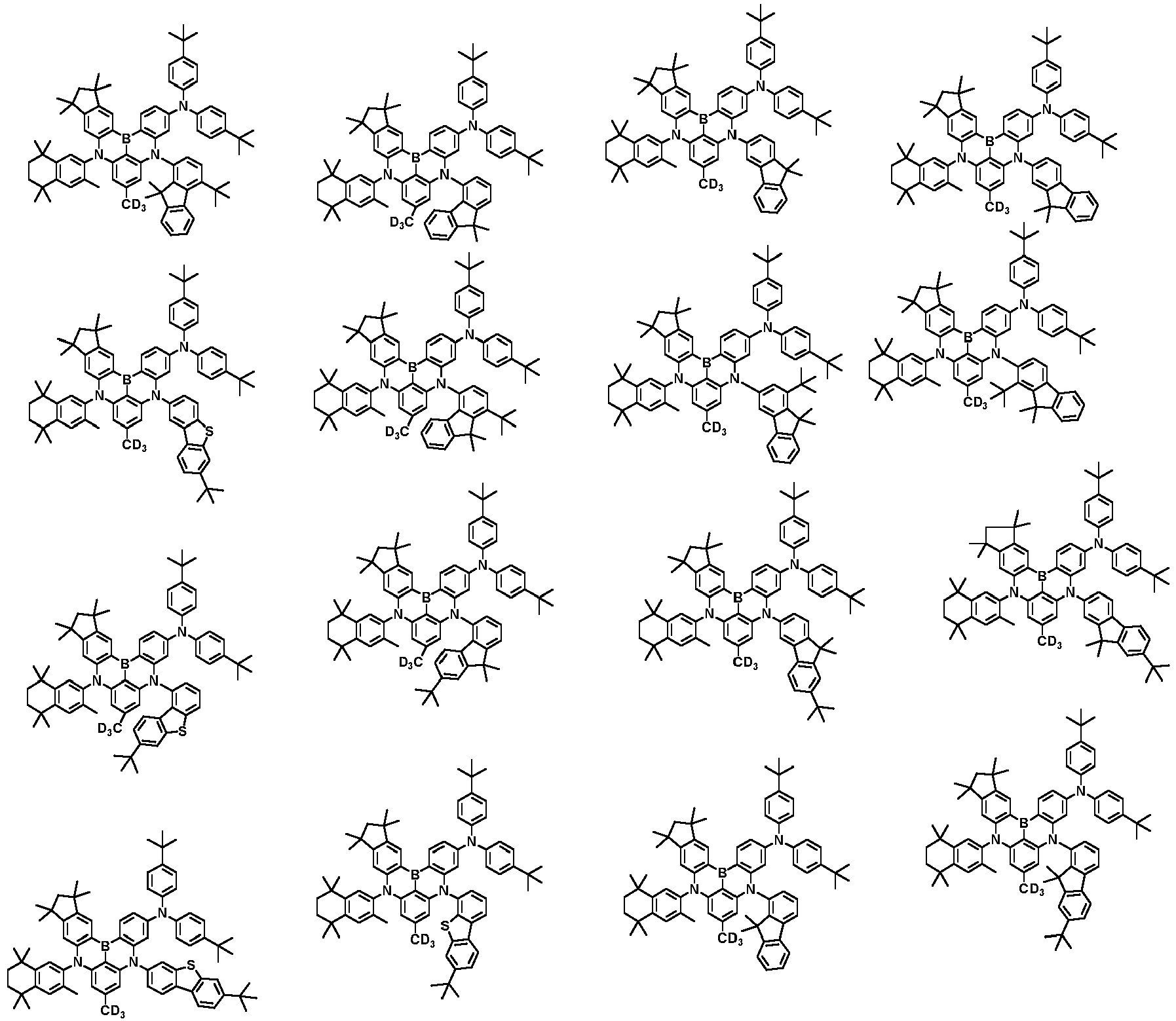











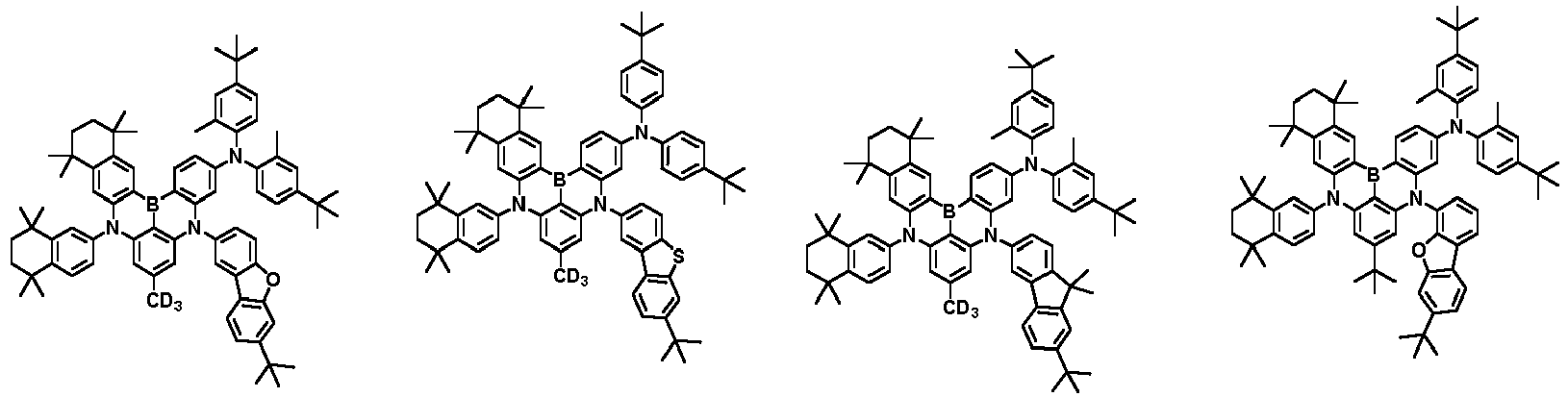





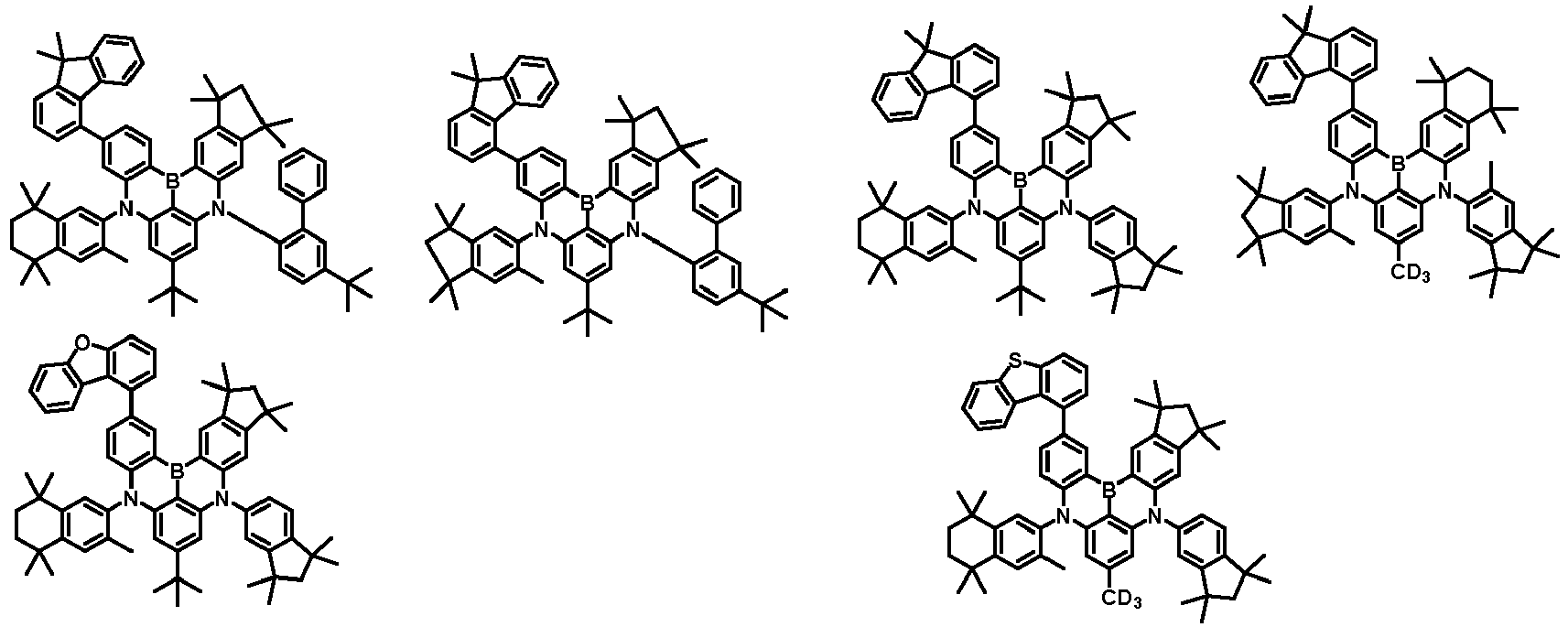




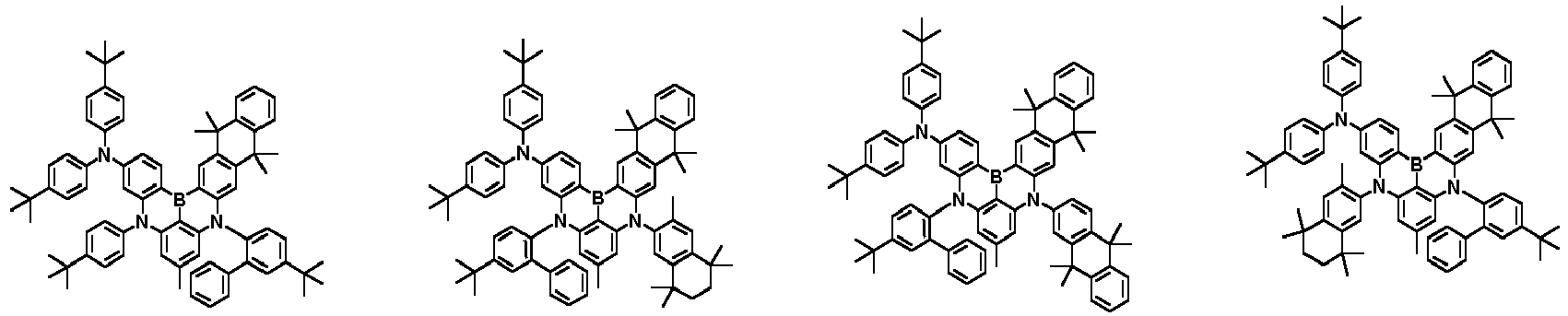


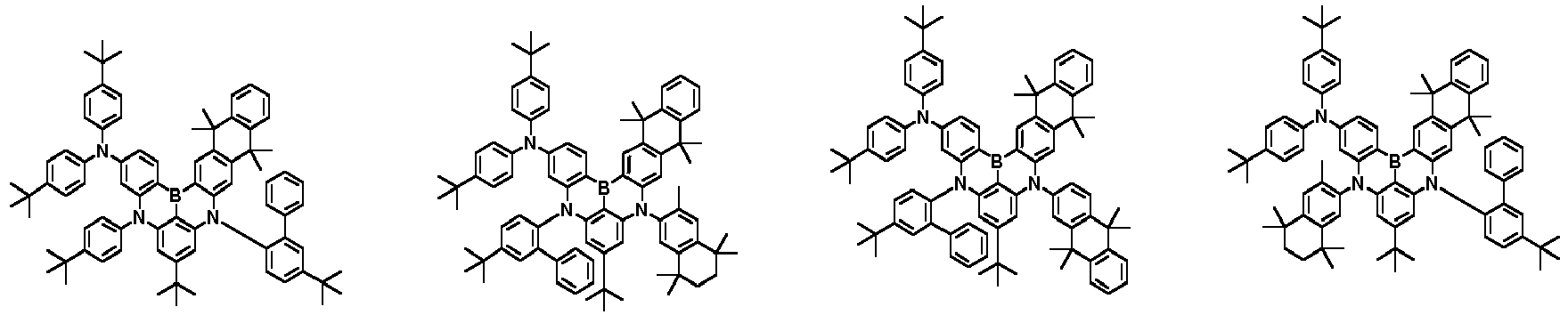


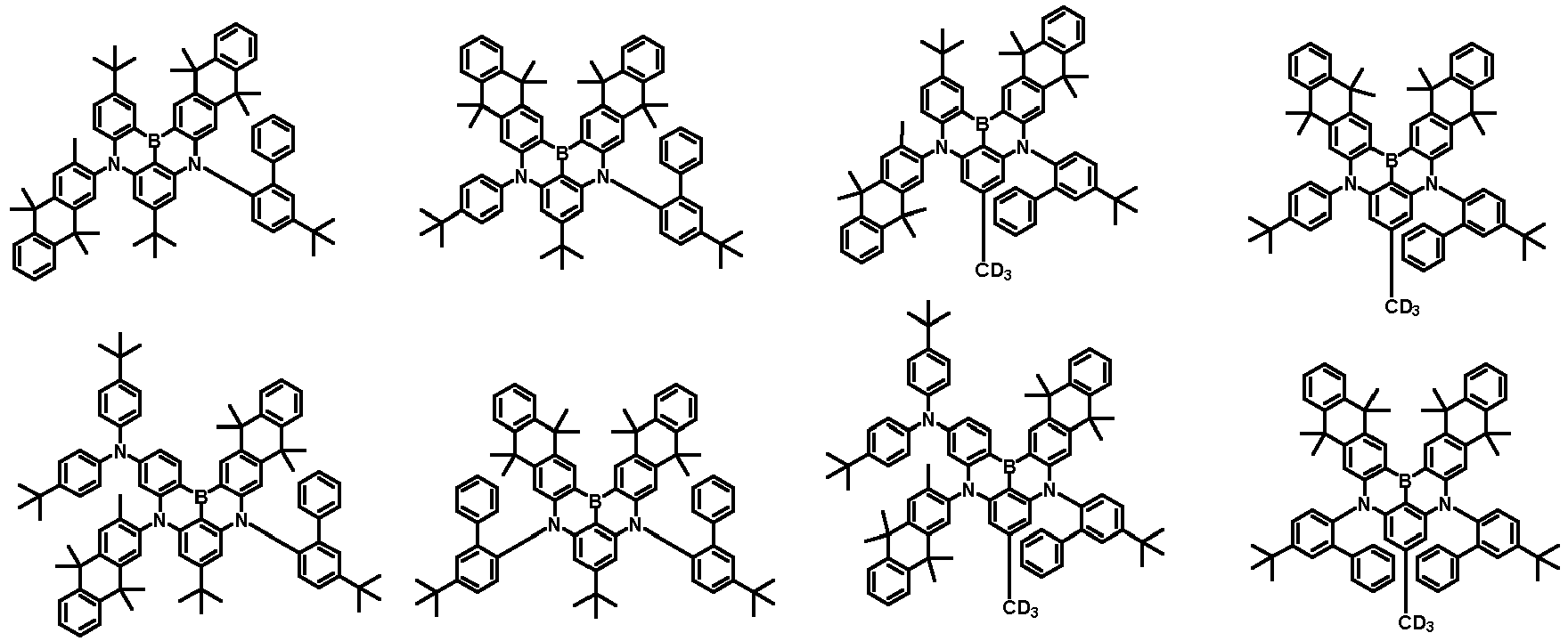









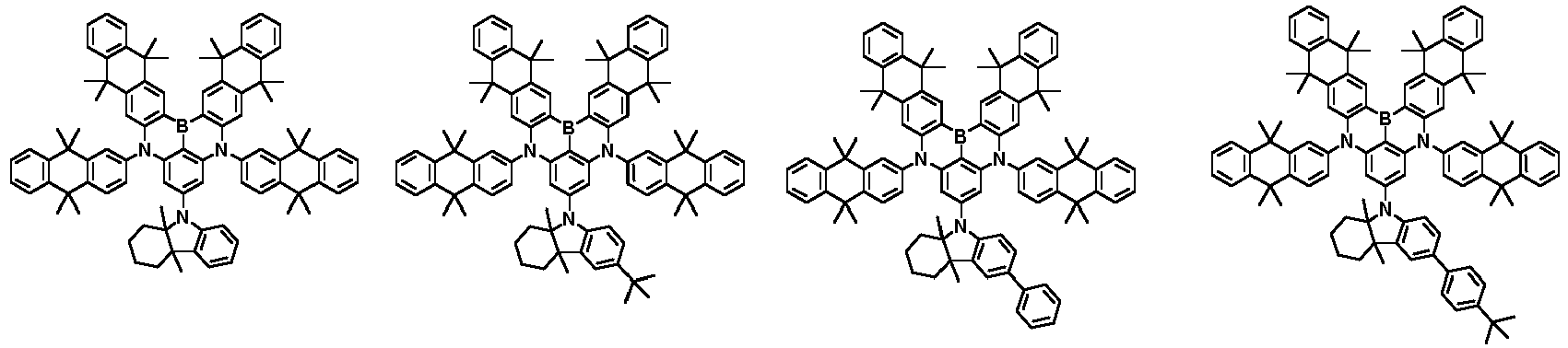


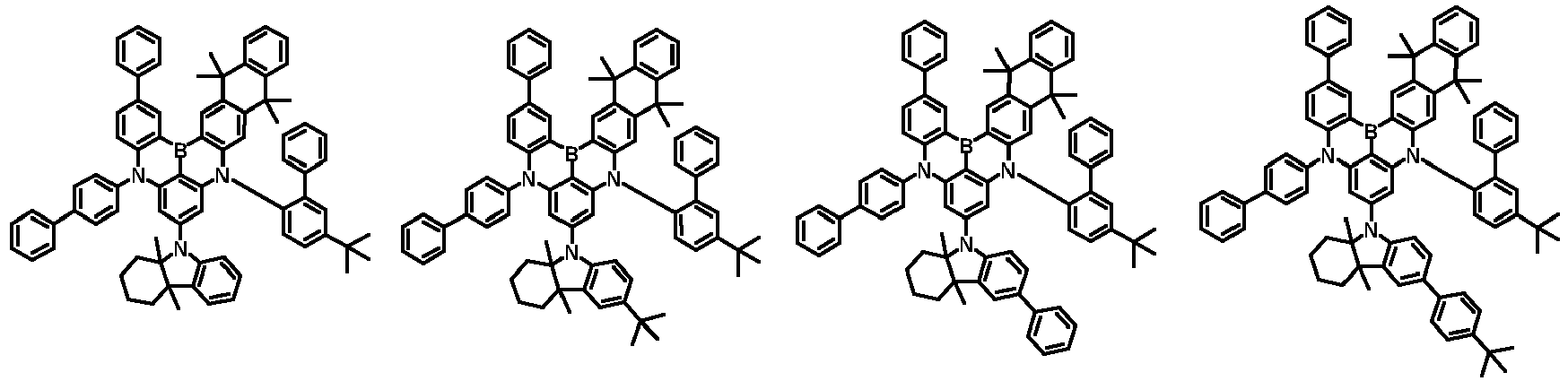

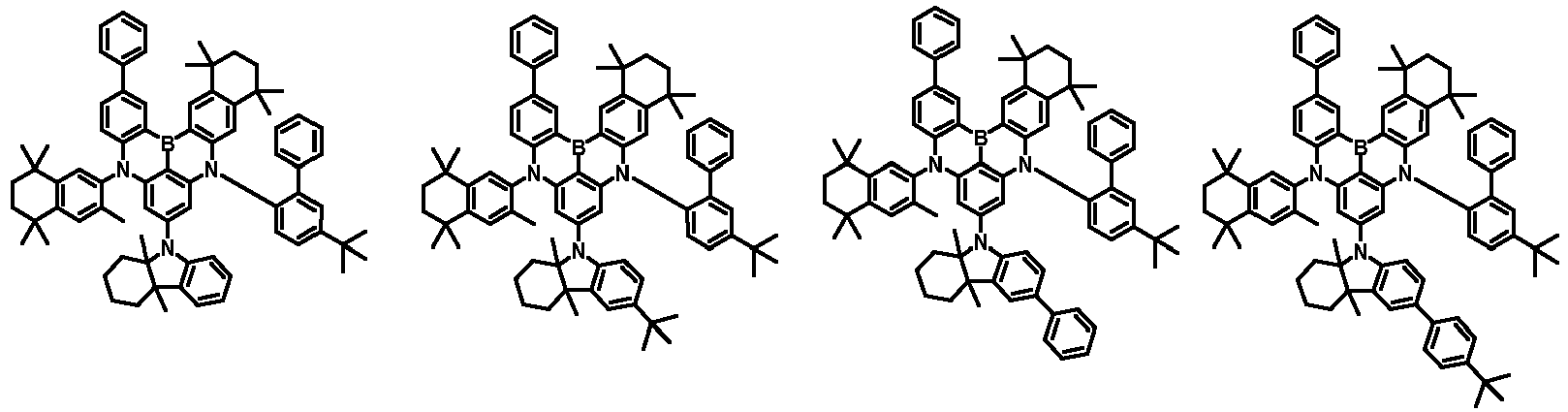


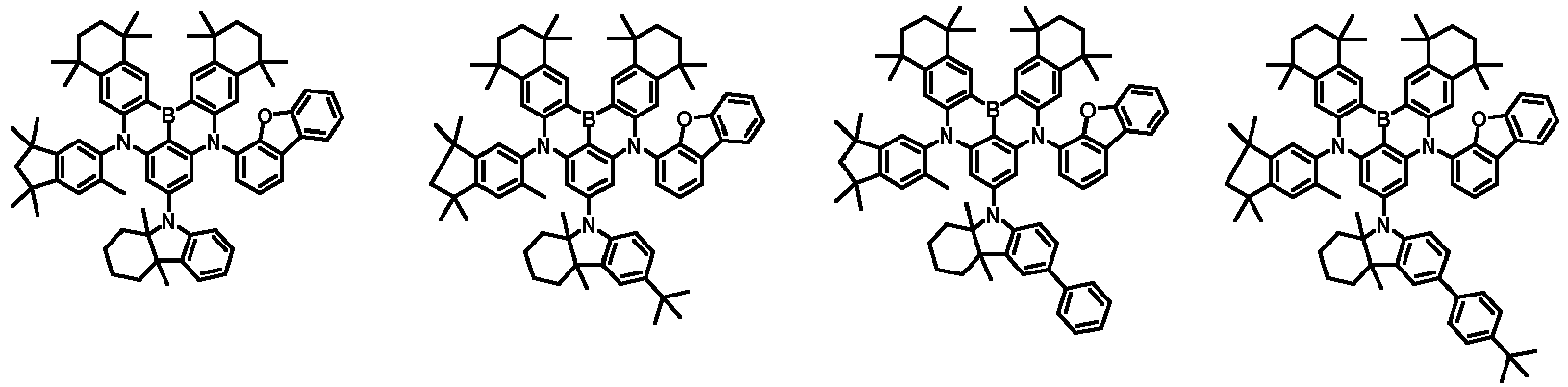
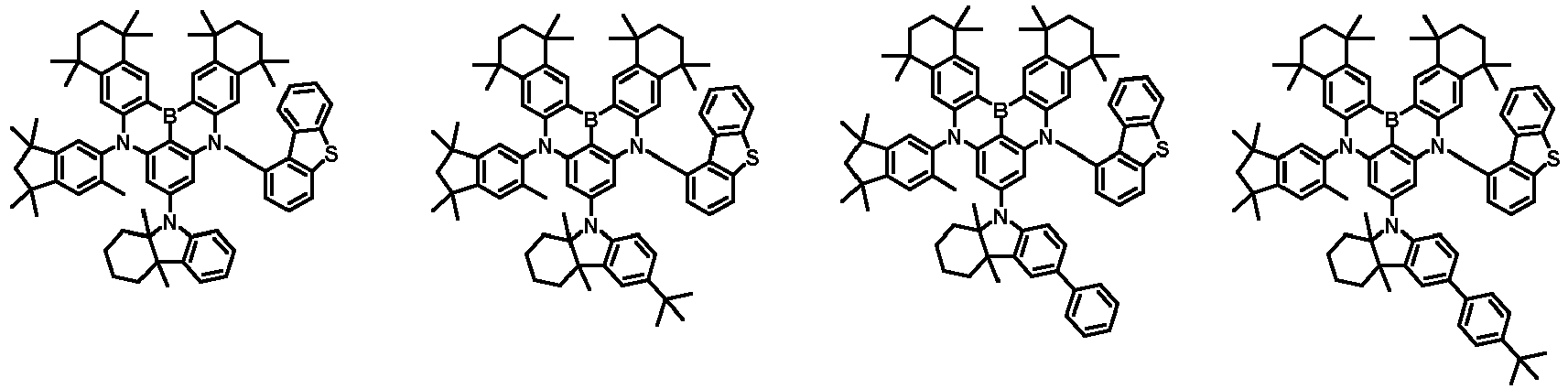


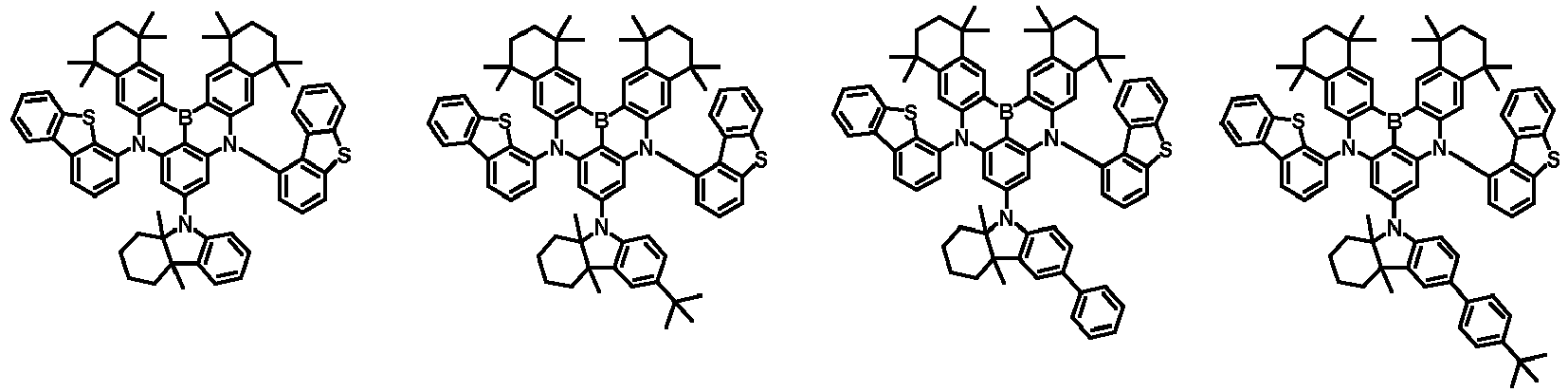


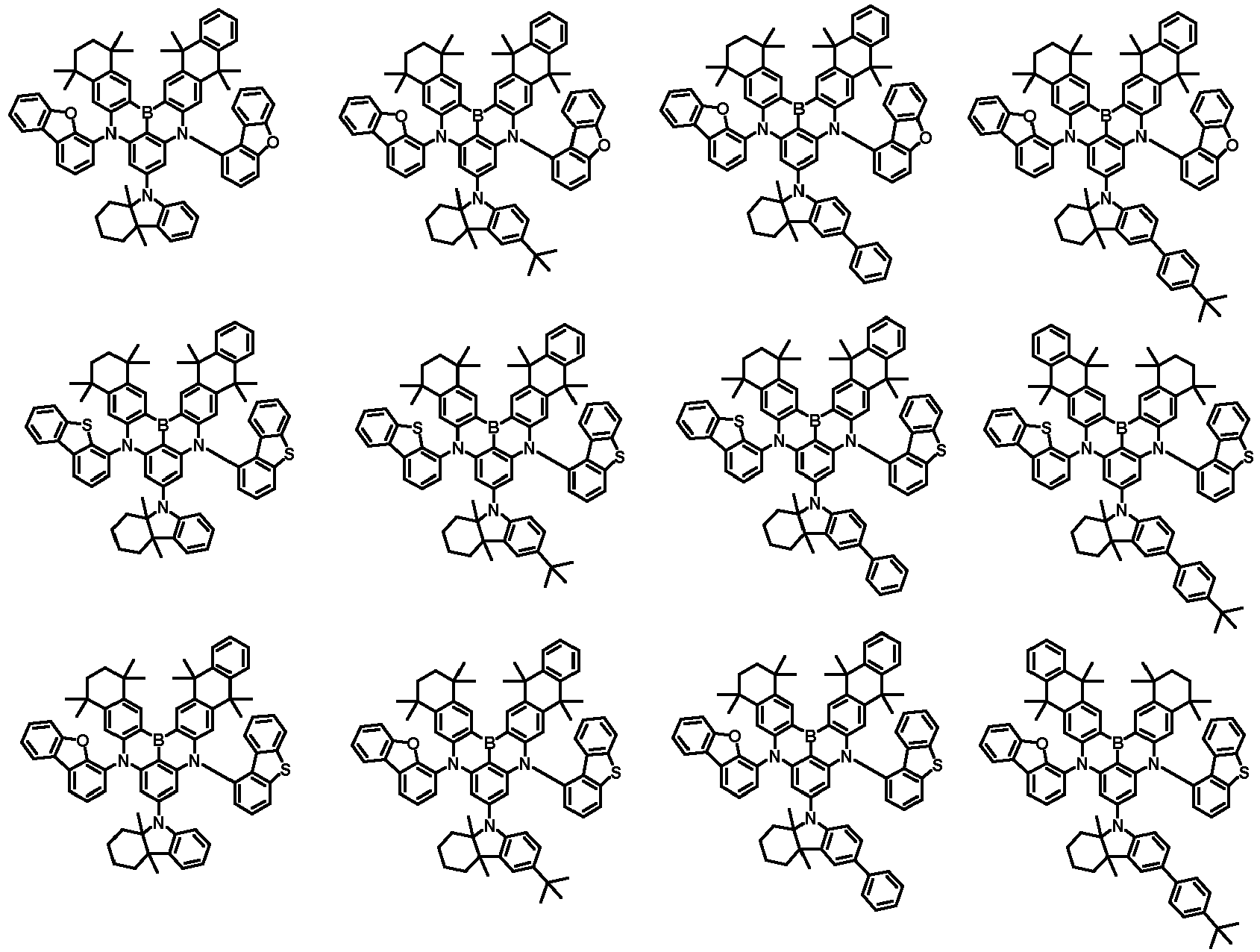

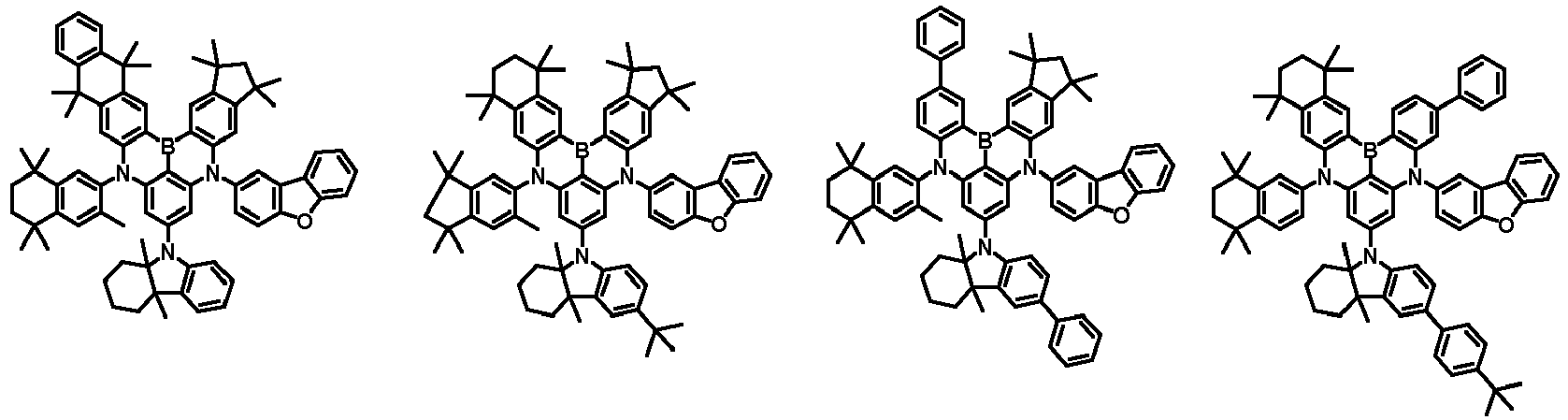












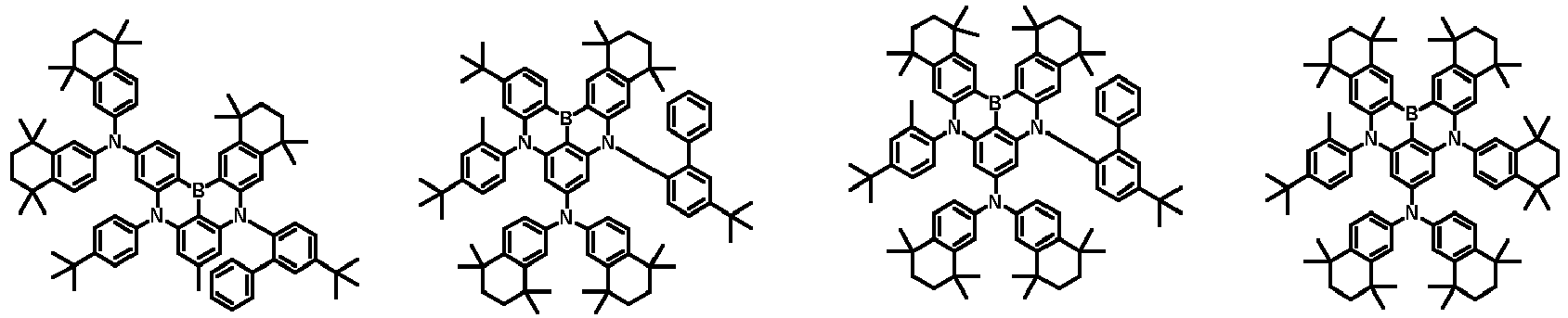


- The substituent of the compound of
Formula 1 may be bonded by a method known in the art, and the type and position of the substituent or the number of substituents may be changed according to the technology known in the art. - A conjugation length and an energy band gap of the compound are closely associated with each other. Specifically, the longer a conjugation length of a compound is, the smaller an energy bandgap is.
- In the present invention, various substituents may be introduced into the core structure as described above to synthesize compounds having various energy bandgaps. Further, in the present invention, various substituents may be introduced into the core structure having the structure described above to adjust the HOMO and LUMO energy levels of a compound.
- In addition, various substituents may be introduced into the core structure having the structure described above to synthesize compounds having inherent characteristics of the introduced substituents. For example, a substituent usually used for a hole injection layer material, a material for transporting holes, a light emitting layer material, and an electron transport layer material, which are used for manufacturing an organic light emitting device, may be introduced into the core structure to synthesize a material which satisfies conditions required for each organic material layer.
- Furthermore, the organic light emitting device according to the present invention is an organic light emitting device including: a first electrode; a second electrode provided to face the first electrode; and an organic material layer having one or more layers provided between the first electrode and the second electrode, in which one or more layers of the organic material layer include the above-described compound.
- The organic light emitting device of the present invention may be manufactured using typical manufacturing methods and materials of an organic light emitting device, except that the above-described compound is used to form an organic material layer having one or more layers.
- The compound may be formed as an organic material layer by not only a vacuum deposition method, but also a solution application method when an organic light emitting device is manufactured. Here, the solution application method means spin coating, dip coating, inkjet printing, screen printing, a spray method, roll coating, and the like, but is not limited thereto.
- The organic material layer of the organic light emitting device of the present invention may be composed of a single-layered structure, but may be composed of a multilayered structure in which two or more organic material layers are stacked. For example, the organic light emitting device of the present invention may have a structure including a hole injection layer, a hole transport layer, a layer which injects and transports holes simultaneously, a light emitting layer, an electron transport layer, an electron injection layer, and the like as organic material layers. However, the structure of the organic light emitting device is not limited thereto, and may include a fewer or greater number of organic material layers.
- In the organic light emitting device of the present invention, the organic material layer may include one or more layers of an electron transport layer, an electron injection layer, and a layer which injects and transports electrons simultaneously, and one or more layers of the layers may include the compound represented by
Formula 1. - In another organic light emitting device, the organic material layer may include an electron transport layer or an electron injection layer, and the electron transport layer or the electron injection layer may include the compound represented by
Formula 1. - In the organic light emitting device of the present invention, the organic material layer may include one or more layers of a hole injection layer, a hole transport layer, and a layer which injects and transports holes simultaneously, and one or more layers of the layers may include the compound represented by
Formula 1. - In still another organic light emitting device, the organic material layer may include a hole injection layer or a hole transport layer, and the hole transport layer or the hole injection layer may include the compound represented by
Formula 1. - In another exemplary embodiment, the organic material layer includes a light emitting layer, and the light emitting layer includes the compound represented by
Formula 1. As an example, the compound represented byFormula 1 may be included as a dopant of the light emitting layer. - In an exemplary embodiment of the present specification, the organic light emitting device is a green organic light emitting device in which the light emitting layer includes the compound represented by
Formula 1 as a dopant. - According to an exemplary embodiment of the present specification, the organic light emitting device is a red organic light emitting device in which the light emitting layer includes the compound represented by
Formula 1 as a dopant. - In another exemplary embodiment, the organic light emitting device is a blue organic light emitting device in which the light emitting layer includes the compound represented by
Formula 1 as a dopant. - As another example, the organic material layer including the compound represented by
Formula 1 may include the compound represented byFormula 1 as a dopant, and may include an organic compound such as an anthracene-based compound as a host. - As still another example, the organic material layer including the heterocyclic compound represented by
Formula 1 may include the compound represented byFormula 1 as a dopant, and may include a fluorescent host or a phosphorescent host. - In still another exemplary embodiment, the organic material layer including the heterocyclic compound represented by
Formula 1 may include the compound represented byFormula 1 as a dopant, include a fluorescent host or a phosphorescent host, and include another organic compound, a metal or a metal compound as a dopant. - As yet another example, the organic material layer including the compound represented by
Formula 1 may include the compound represented byFormula 1 as a dopant and include a fluorescent host or a phosphorescent host, and may be used with an iridium (Ir)-based dopant. - According to an exemplary embodiment of the present specification, the organic material layer includes a light emitting layer, and the light emitting layer includes the above-described polycyclic compound as a dopant of the light emitting layer, and includes a compound represented by the following Formula H as a host of the light emitting layer.


- In Formula H,
- L21 and L22 are the same as or different from each other, and are each independently a direct bond; a substituted or unsubstituted arylene group; or a substituted or unsubstituted heteroarylene group,
- Ar21 and Ar22 are the same as or different from each other, and are each independently a substituted or unsubstituted aryl group; or a substituted or unsubstituted heterocyclic group,
- R201 and R202 are the same as or different from each other, and are each independently hydrogen; deuterium; a halogen group; a substituted or unsubstituted alkyl group; a substituted or unsubstituted cycloalkyl group; a substituted or unsubstituted aryl group; or a substituted or unsubstituted heterocyclic group, and
- n202 is an integer from 0 to 7, and when n202 is 2 or higher, R202's are the same as or different from each other.
- In an exemplary embodiment of the present specification, L21 and L22 are the same as or different from each other, and are each independently a direct bond; a monocyclic or polycyclic arylene group having 6 to 30 carbon atoms; or a monocyclic or polycyclic heteroarylene group having 2 to 30 carbon atoms.
- In an exemplary embodiment of the present specification, L21 and L22 are the same as or different from each other, and are each independently a direct bond; a monocyclic or polycyclic arylene group having 6 to 20 carbon atoms; or a monocyclic or polycyclic heteroarylene group having 2 to 20 carbon atoms.
- In an exemplary embodiment of the present specification, L21 and L22 are the same as or different from each other, and are each independently a direct bond; a phenylene group which is unsubstituted or substituted with deuterium; a biphenylylene group which is unsubstituted or substituted with deuterium; a naphthalene group which is unsubstituted or substituted with deuterium; a divalent dibenzofuran group; or a divalent dibenzothiophene group.
- In an exemplary embodiment of the present specification, Ar21 and Ar22 are the same as or different from each other, and are each independently a substituted or unsubstituted monocyclic or polycyclic aryl group having 6 to 30 carbon atoms; or a substituted or unsubstituted monocyclic or polycyclic heterocyclic group having 2 to 30 carbon atoms.
- In an exemplary embodiment of the present specification, Ar21 and Ar22 are the same as or different from each other, and are each independently a substituted or unsubstituted monocyclic or polycyclic aryl group having 6 to 20 carbon atoms; or a substituted or unsubstituted monocyclic or polycyclic heterocyclic group having 2 to 20 carbon atoms.
- In an exemplary embodiment of the present specification, Ar21 and Ar22 are the same as or different from each other, and are each independently a substituted or unsubstituted monocyclic to tetracyclic aryl group having 6 to 20 carbon atoms; or a substituted or unsubstituted monocyclic to tetracyclic heterocyclic group having 6 to 20 carbon atoms.
- In an exemplary embodiment of the present specification, Ar21 and Ar22 are the same as or different from each other, and are each independently a substituted or unsubstituted phenyl group; a substituted or unsubstituted biphenyl group; a substituted or unsubstituted terphenyl group; a substituted or unsubstituted naphthyl group; a substituted or unsubstituted anthracene group; a substituted or unsubstituted phenanthrene group; a substituted or unsubstituted phenalene group; a substituted or unsubstituted fluorene group; a substituted or unsubstituted benzofluorene group; a substituted or unsubstituted furan group; a substituted or unsubstituted thiophene group; a substituted or unsubstituted dibenzofuran group; a substituted or unsubstituted naphthobenzofuran group; a substituted or unsubstituted dibenzothiophene group; or a substituted or unsubstituted naphthobenzothiophene group.
- In an exemplary embodiment of the present specification, Ar21 and Ar22 are the same as or different from each other, and are each independently a phenyl group which is unsubstituted or substituted with deuterium or a monocyclic or polycyclic aryl group having 6 to 20 carbon atoms; a biphenyl group which is unsubstituted or substituted with deuterium or a monocyclic or polycyclic aryl group having 6 to 20 carbon atoms; a naphthyl group which is unsubstituted or substituted with a monocyclic or polycyclic aryl group having 6 to 20 carbon atoms; a dibenzofuran group which is unsubstituted or substituted with a monocyclic or polycyclic aryl group having 6 to 20 carbon atoms; a naphthobenzofuran group which is unsubstituted or substituted with a monocyclic or polycyclic aryl group having 6 to 20 carbon atoms; a dibenzothiophene group which is unsubstituted or substituted with a monocyclic or polycyclic aryl group having 6 to 20 carbon atoms; or a naphthobenzothiophene group which is unsubstituted or substituted with a monocyclic or polycyclic aryl group having 6 to 20 carbon atoms.
- In an exemplary embodiment of the present specification, Ar21 and Ar22 are the same as or different from each other, and are each independently a phenyl group which is unsubstituted or substituted with deuterium; a biphenyl group which is unsubstituted or substituted with deuterium; a terphenyl group; a naphthyl group which is unsubstituted or substituted with deuterium; a phenanthrene group; a dibenzofuran group; a naphthobenzofuran group; a dibenzothiophene group; or a naphthobenzothiophene group.
- In an exemplary embodiment of the present specification, any one of Ar21 and Ar22 is a substituted or unsubstituted aryl group, and the other is a substituted or unsubstituted heterocyclic group.
- In an exemplary embodiment of the present specification, Ar21 is a substituted or unsubstituted aryl group, and Ar22 is a substituted or unsubstituted heterocyclic group.
- In an exemplary embodiment of the present specification, Ar21 is a substituted or unsubstituted heterocyclic group, and Ar22 is a substituted or unsubstituted aryl group.
- In an exemplary embodiment of the present specification, R201 is hydrogen; deuterium; a halogen group; a substituted or unsubstituted straight-chained or branched alkyl group having 1 to 30 carbon atoms; a substituted or unsubstituted monocyclic or polycyclic cycloalkyl group having 3 to 30 carbon atoms; a substituted or unsubstituted monocyclic or polycyclic aryl group having 6 to 30 carbon atoms; or a substituted or unsubstituted monocyclic or polycyclic heterocyclic group having 2 to 30 carbon atoms.
- In an exemplary embodiment of the present specification, R201 is hydrogen; deuterium; fluorine; a substituted or unsubstituted straight-chained or branched alkyl group having 1 to 10 carbon atoms; a substituted or unsubstituted monocyclic or polycyclic cycloalkyl group having 3 to 10 carbon atoms; a substituted or unsubstituted monocyclic or polycyclic aryl group having 6 to 30 carbon atoms; or a substituted or unsubstituted monocyclic or polycyclic heterocyclic group having 2 to 30 carbon atoms.
- In an exemplary embodiment of the present specification, R201 is hydrogen; a substituted or unsubstituted monocyclic or polycyclic aryl group having 6 to 30 carbon atoms; or a substituted or unsubstituted monocyclic or polycyclic heterocyclic group having 2 to 30 carbon atoms.
- In an exemplary embodiment of the present specification, R201 is hydrogen; a substituted or unsubstituted monocyclic or polycyclic aryl group having 6 to 20 carbon atoms; or a substituted or unsubstituted monocyclic or polycyclic heterocyclic group having 2 to 20 carbon atoms.
- In an exemplary embodiment of the present specification, R201 is hydrogen; a substituted or unsubstituted monocyclic to tetracyclic aryl group having 6 to 20 carbon atoms; or a substituted or unsubstituted monocyclic to tetracyclic heterocyclic group having 6 to 20 carbon atoms.
- In an exemplary embodiment of the present specification, R201 is hydrogen; a substituted or unsubstituted phenyl group; a substituted or unsubstituted biphenyl group; a substituted or unsubstituted terphenyl group; a substituted or unsubstituted naphthyl group; a substituted or unsubstituted anthracene group; a substituted or unsubstituted phenanthrene group; a substituted or unsubstituted phenalene group; a substituted or unsubstituted fluorene group; a substituted or unsubstituted benzofluorene group; a substituted or unsubstituted furan group; a substituted or unsubstituted thiophene group; a substituted or unsubstituted dibenzofuran group; a substituted or unsubstituted naphthobenzofuran group; a substituted or unsubstituted dibenzothiophene group; or a substituted or unsubstituted naphthobenzothiophene group.
- In an exemplary embodiment of the present specification, R201 is hydrogen; deuterium; a phenyl group which is unsubstituted or substituted with deuterium or a monocyclic or polycyclic aryl group having 6 to 20 carbon atoms; a biphenyl group which is unsubstituted or substituted with a monocyclic or polycyclic aryl group having 6 to 20 carbon atoms; a naphthyl group which is unsubstituted or substituted with deuterium or a monocyclic or polycyclic aryl group having 6 to 20 carbon atoms; a dibenzofuran group which is unsubstituted or substituted with a monocyclic or polycyclic aryl group having 6 to 20 carbon atoms; a naphthobenzofuran group which is unsubstituted or substituted with a monocyclic or polycyclic aryl group having 6 to 20 carbon atoms; a dibenzothiophene group which is unsubstituted or substituted with a monocyclic or polycyclic aryl group having 6 to 20 carbon atoms; or a naphthobenzothiophene group which is unsubstituted or substituted with a monocyclic or polycyclic aryl group having 6 to 20 carbon atoms.
- In an exemplary embodiment of the present specification, R201 is hydrogen; deuterium; a phenyl group which is unsubstituted or substituted with deuterium, a phenyl group, or a naphthyl group; a biphenyl group; a naphthyl group which is unsubstituted or substituted with deuterium, a phenyl group, or a naphthyl group; a dibenzofuran group; a naphthobenzofuran group; a dibenzothiophene group; or a naphthobenzothiophene group.
- According to an exemplary embodiment of the present specification, R202 is hydrogen; or deuterium.
- According to an exemplary embodiment of the present specification, four or more of R202's are deuterium.
- According to an exemplary embodiment of the present specification, R202 is hydrogen.
- According to an exemplary embodiment of the present specification, R202 is deuterium.
- In an exemplary embodiment of the present specification, when the compound represented by Formula H is substituted with deuterium, 30% or more of H at a substitutable position is substituted with deuterium. In another exemplary embodiment, in the structure of Formula H, 40% or more of H at a substitutable position is substituted with deuterium. In still another exemplary embodiment, in the structure of Formula H, 60% or more of H at a substitutable position is substituted with deuterium.
- In yet another exemplary embodiment, in the structure of Formula H, 80% or more of H at a substitutable position is substituted with deuterium. In still yet another exemplary embodiment, in the structure of Formula H, 100% of H at a substitutable position is substituted with deuterium.
- In an exemplary embodiment of the present specification, the compound represented by Formula H is any one selected from the following compounds.





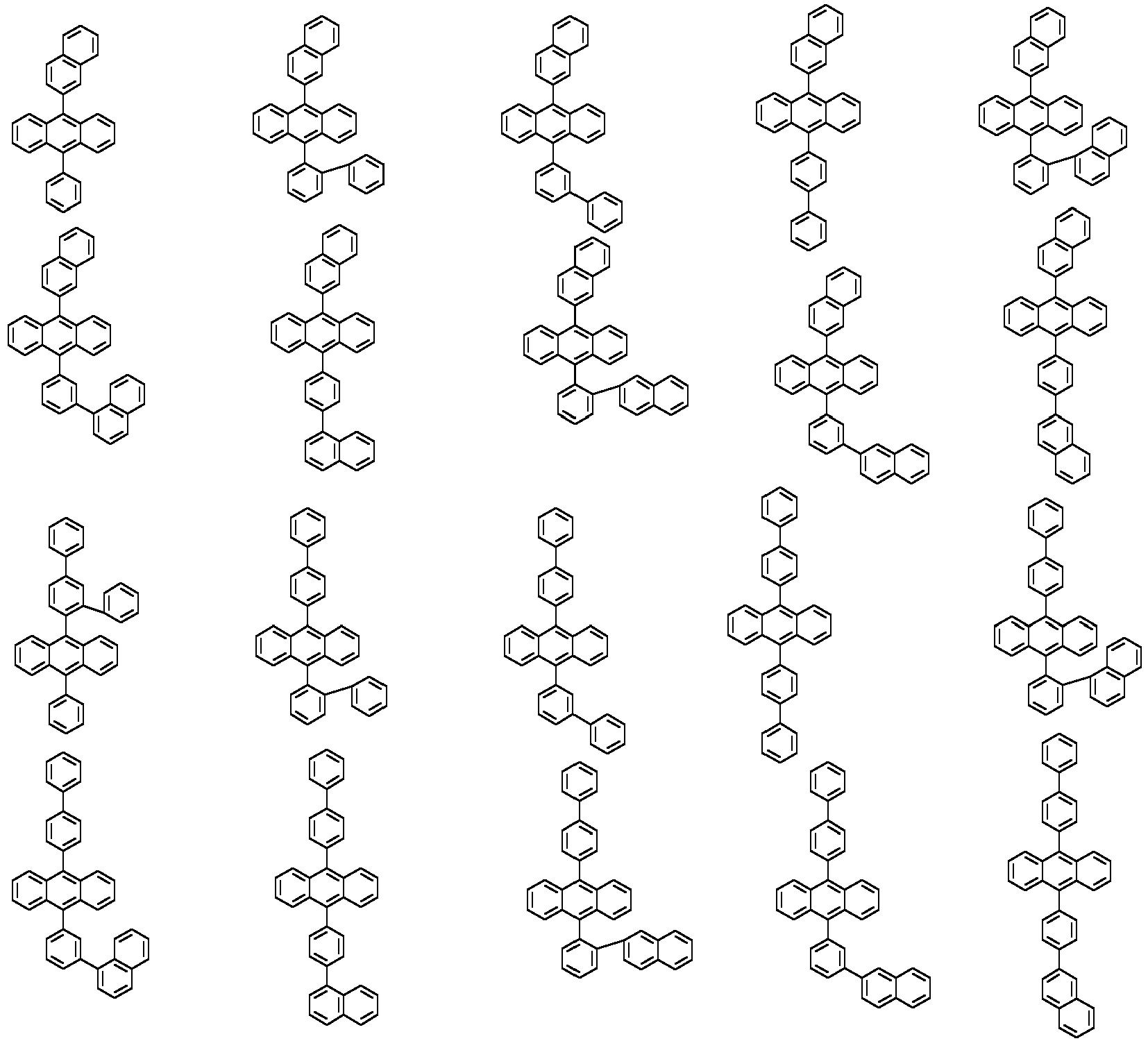


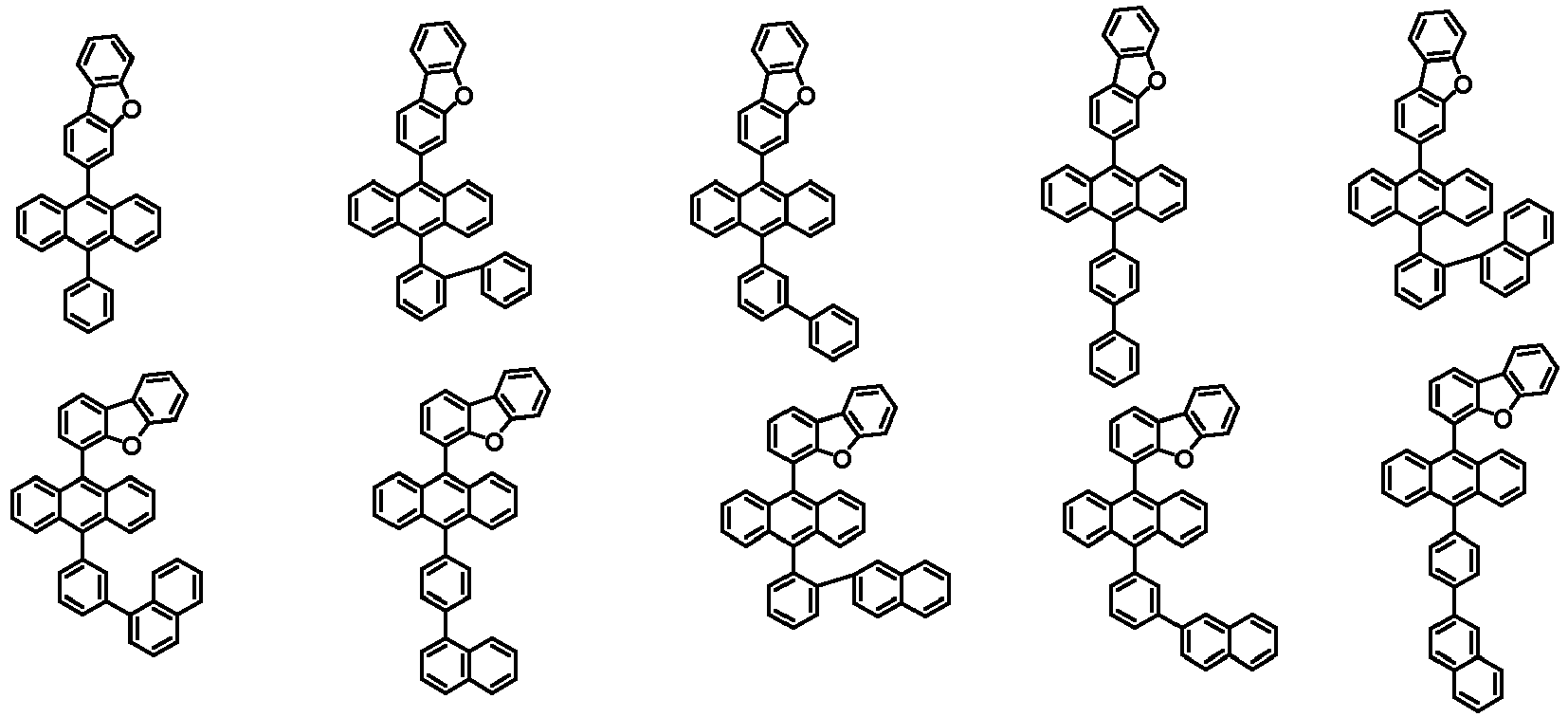


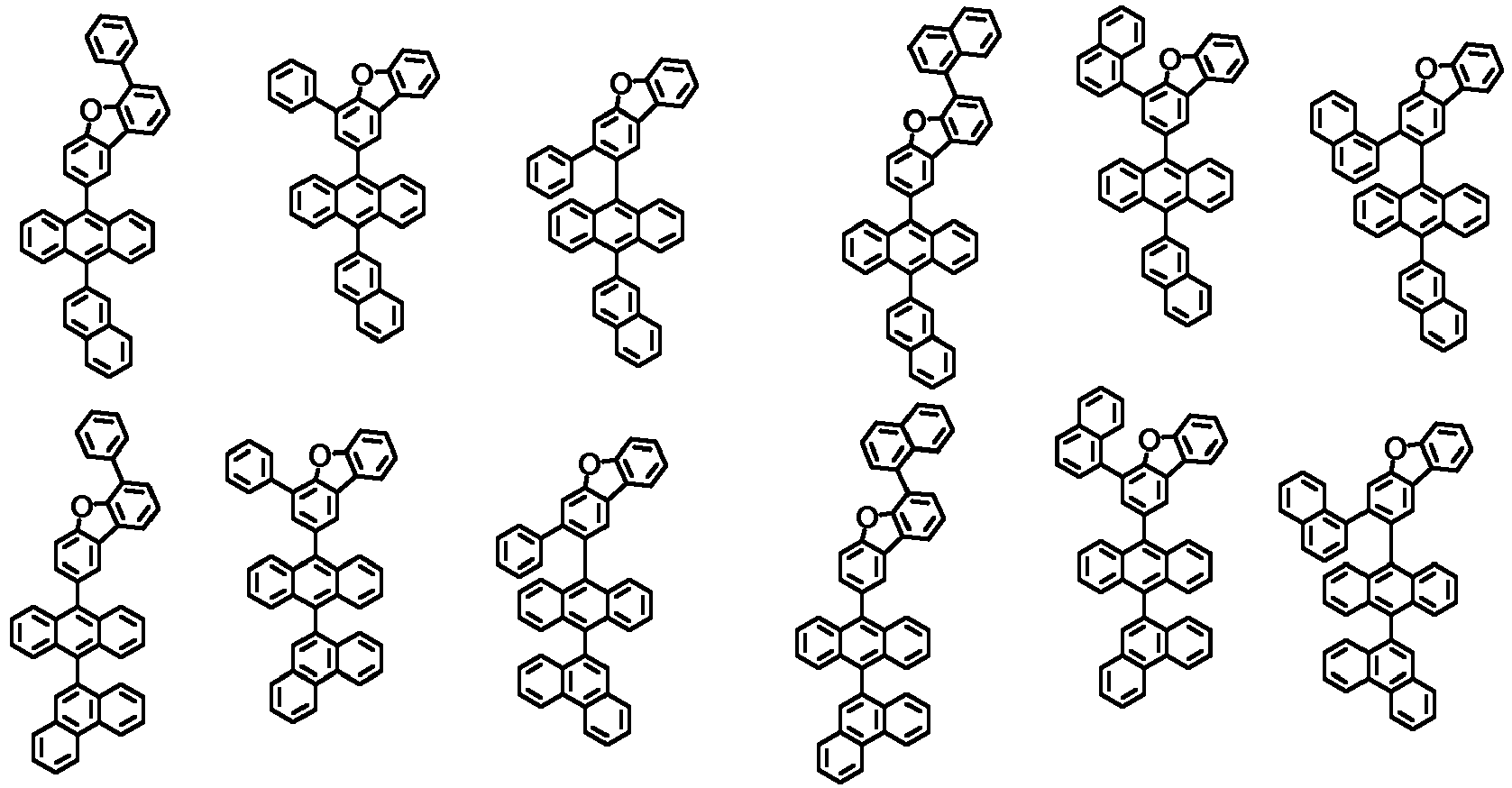


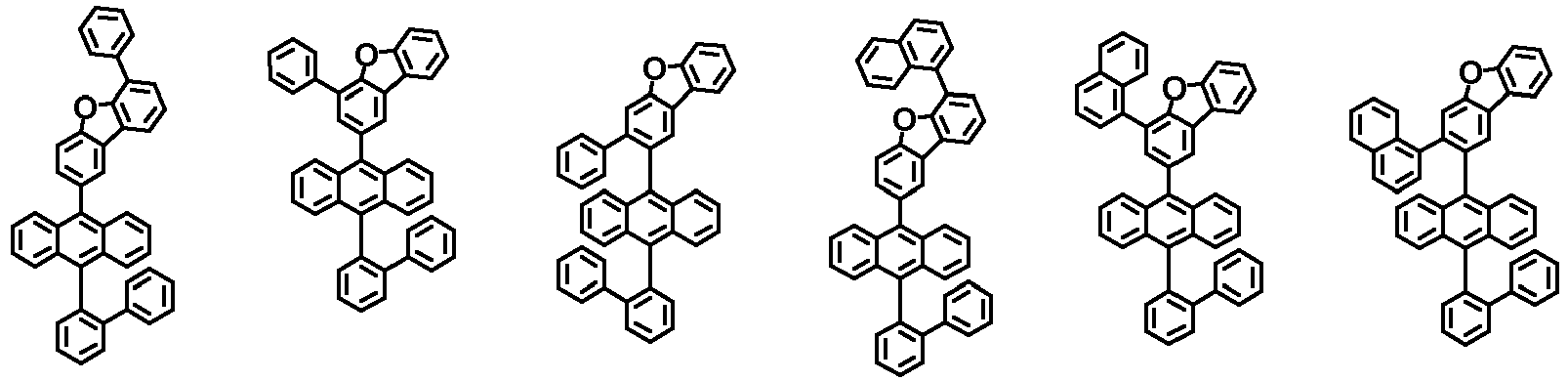


- In an exemplary embodiment of the present specification, the light emitting layer includes the above-described polycyclic compound as a dopant of the light emitting layer, and includes the compound represented by Formula H as a host of the light emitting layer.
- In an exemplary embodiment of the present specification, when the light emitting layer includes a host and a dopant, a content of the dopant may be selected within a range of 0.01 to 10 parts by weight based on 100 parts by weight of the light emitting layer, but is not limited thereto.
- In an exemplary embodiment of the present specification, the light emitting layer includes a host and a dopant, and the host and the dopant are included at a weight ratio of 99:1 to 1:99, preferably 99 : 1 to 70 : 30, and more preferably 99 : 1 to 90 : 10.
- The light emitting layer may further include a host material, and examples of the host include a fused aromatic ring derivative, a hetero ring-containing compound, and the like. Specifically, examples of the fused aromatic ring derivative include anthracene derivatives, pyrene derivatives, naphthalene derivatives, pentacene derivatives, phenanthrene compounds, fluoranthene compounds, and the like, and examples of the hetero ring-containing compound include carbazole derivatives, dibenzofuran derivatives, ladder-type furan compounds, pyrimidine derivatives, triazine derivatives, or the like, and the examples thereof may be a compound of two or more thereof, but are not limited thereto.
- According to an exemplary embodiment of the present specification, the organic material layer includes a light emitting layer, and the light emitting layer includes one or more dopants, and a host.
- According to an exemplary embodiment of the present specification, the organic material layer includes a light emitting layer, and the light emitting layer includes two or more mixed dopants and a host.
- According to an exemplary embodiment of the present specification, one or more of the two or more mixed dopants include
Formula 1, and the host includes the compound represented by Formula H. One or more of the two or more mixed dopants includeFormula 1, and the others may use dopant materials known in the related art, but the present invention is not limited thereto. - According to an exemplary embodiment of the present specification, one or more of the two or more mixed dopants include
Formula 1, and the others may use one or more of a boron-based compound, a pyrene-based compound, and a delayed fluorescence-based compound, which are different from the compounds inFormula 1, but the present invention is not limited thereto. - According to an exemplary embodiment of the present specification, the organic material layer includes a light emitting layer, and the light emitting layer includes one or more hosts.
- According to an exemplary embodiment of the present specification, the organic material layer includes a light emitting layer, and the light emitting layer includes two or more mixed hosts.
- According to an exemplary embodiment of the present specification, one or more of the two or more mixed hosts are the compound represented by Formula H.
- According to an exemplary embodiment of the present specification, the two or more mixed hosts are different from each other, and are each independently the compound represented by Formula H.
- According to an exemplary embodiment of the present specification, the organic material layer includes a light emitting layer, and the light emitting layer includes two mixed hosts.
- According to an exemplary embodiment of the present specification, the organic material layer includes a light emitting layer, the light emitting layer includes two mixed hosts, the two mixed hosts are different from each other, and the two hosts are the compounds represented by Formula H.
- According to an exemplary embodiment of the present specification, the organic material layer includes a light emitting layer, and includes: a first host represented by Formula H; and a second host represented by Formula H, and the first host and the second host are different from each other.
- According to an exemplary embodiment of the present specification, the first host : the second host are included at a weight ratio of 95 : 5 to 5 : 95, preferably at a weight ratio of 70 : 30 to 30 : 70.
- According to an exemplary embodiment of the present specification, the organic material layer includes a light emitting layer, and the light emitting layer includes one or more hosts, and a dopant.
- According to an exemplary embodiment of the present specification, the organic material layer includes a light emitting layer, the light emitting layer includes one or more hosts, and a dopant, the host includes the compound represented by Formula H, and the dopant includes the compound represented by
Formula 1. - According to an exemplary embodiment of the present specification, the organic material layer includes a light emitting layer, and the light emitting layer includes two or more mixed hosts, and a dopant.
- According to an exemplary embodiment of the present specification, one or more of the two or more mixed hosts include the compound represented by Formula H, and the dopant includes the compound represented by
Formula 1. - In the present specification, the two or more mixed hosts are different from each other.
- According to an exemplary embodiment of the present specification, the organic material layer includes a light emitting layer, and the light emitting layer includes two mixed hosts, and a dopant.
- According to an exemplary embodiment of the present specification, the two mixed hosts are different from each other, and each independently include the compound represented by Formula H, and the dopant includes the compound represented by
Formula 1. - According to an exemplary embodiment of the present specification, the organic material layer includes a light emitting layer, and includes: a first host represented by Formula H; a second host represented by Formula H; and a dopant represented by
Formula 1, and the first host and the second host are different from each other. - According to an exemplary embodiment of the present specification, one or more hosts and one or more dopants are used in the organic material layer, the one or more hosts include the compound represented by Formula H, and the one or more dopants include the compound represented by
Formula 1. - According to an exemplary embodiment of the present specification, two or more mixed hosts and two or more mixed dopants are used in the organic material layer, the same material as described above may be used in the two or more mixed hosts, and the same material as described above may be used in the two or more mixed dopants.
- In an exemplary embodiment of the present specification, the maximum emission peak of the light emitting layer including the polycyclic compound represented by Formula 100 is 380 nm to 500 nm. That is, the light emitting layer including the above-described polycyclic compound is a blue light emitting layer.
- In an exemplary embodiment of the present specification, the first electrode is a positive electrode, and the second electrode is a negative electrode.
- According to another exemplary embodiment, the first electrode is a negative electrode, and the second electrode is a positive electrode.
- The structure of the organic light emitting device of the present invention may have a structure such as following (1) to (18), but is not limited thereto.
- (1) Positive electrode/Hole transport layer/Light emitting layer/Negative electrode
- (2) Positive electrode/Hole injection layer/Hole transport layer/Light emitting layer/Negative electrode
- (3) Positive electrode/Hole injection layer/Hole buffer layer/Hole transport layer/Light emitting layer/Negative electrode
- (4) Positive electrode/Hole transport layer/Light emitting layer/Electron transport layer/Negative electrode
- (5) Positive electrode/Hole transport layer/Light emitting layer/Electron transport layer/Electron injection layer/Negative electrode
- (6) Positive electrode/Hole injection layer/Hole transport layer/Light emitting layer/Electron transport layer/Negative electrode
- (7) Positive electrode/Hole injection layer/Hole transport layer/Light emitting layer/Electron transport layer/Electron injection layer/Negative electrode
- (8) Positive electrode/Hole injection layer/Hole buffer layer/Hole transport layer/Light emitting layer/Electron transport layer/Negative electrode
- (9) Positive electrode/Hole injection layer/Hole buffer layer/Hole transport layer/Light emitting layer/Electron transport layer/Electron injection layer/Negative electrode
- (10) Positive electrode/Hole transport layer/Electron blocking layer/Light emitting layer/Electron transport layer/Negative electrode
- (11) Positive electrode/ Hole transport layer/Electron blocking layer/Light emitting layer/Electron transport layer/Electron injection layer/Negative electrode
- (12) Positive electrode/Hole injection layer/Hole transport layer/Electron blocking layer/Light emitting layer/Electron transport layer/Negative electrode
- (13) Positive electrode/Hole injection layer/Hole transport layer/Electron blocking layer/Light emitting layer/Electron transport layer/Electron injection layer/Negative electrode
- (14) Positive electrode/Hole transport layer/Light emitting layer/Hole blocking layer/Electron transport layer/Negative electrode
- (15) Positive electrode/Hole transport layer/Light emitting layer/Hole blocking layer/Electron transport layer/Electron injection layer/Negative electrode
- (16) Positive electrode/Hole injection layer/Hole transport layer/Light emitting layer/Hole blocking layer/Electron transport layer/Negative electrode
- (17) Positive electrode/Hole injection layer/Hole transport layer/Light emitting layer/Hole blocking layer/Electron transport layer/Electron injection layer/Negative electrode
- (18) Positive electrode/Hole injection layer/Hole transport layer/Electron blocking layer/Light emitting layer/Hole blocking layer/Electron injection and transport layer/Negative electrode
- The structure of the organic light emitting device of the present invention may have a structure as illustrated in
FIGS. 1 and 2 , but is not limited thereto. -
FIG. 1 exemplifies the structure of an organic light emitting device in which apositive electrode 2, alight emitting layer 3, and anegative electrode 4 are sequentially stacked on asubstrate 1. In the structure described above, the compound represented byFormula 1 may be included in thelight emitting layer 3. -
FIG. 2 exemplifies a structure of an organic light emitting device in which apositive electrode 2, a firsthole injection layer 5, a secondhole injection layer 6, ahole transport layer 7, anelectron blocking layer 8, alight emitting layer 3, a firstelectron transport layer 9, a secondelectron transport layer 10, anelectron injection layer 11, and anegative electrode 4 are sequentially stacked on asubstrate 1. In the structure described above, the compound represented byFormula 1 may be included in thelight emitting layer 3. - For example, the organic light emitting device according to the present invention may be manufactured by depositing a metal or a metal oxide having conductivity, or an alloy thereof on a substrate to form a positive electrode, forming an organic material layer having one or more layers selected from the group consisting of a hole injection layer, a hole transport layer, a layer which transports and injects holes simultaneously, a light emitting layer, an electron transport layer, an electron injection layer, and a layer which transports and injects electrons simultaneously, thereon, and then depositing a material, which may be used as a negative electrode, thereon, by using a physical vapor deposition (PVD) method such as sputtering or e-beam evaporation. In addition to the method described above, an organic light emitting device may also be made by sequentially depositing a negative electrode material, an organic material layer, and a positive electrode material on a substrate.
- The organic material layer may have a multi-layered structure including a hole injection layer, a hole transport layer, a light emitting layer, and an electron transport layer, and the like, but is not limited thereto and may have a single-layered structure. Further, the organic material layer may be manufactured to include a fewer number of layers by a method such as a solvent process, for example, spin coating, dip coating, doctor blading, screen printing, inkjet printing, or a thermal transfer method, using various polymer materials, instead of a deposition method.
- The positive electrode is an electrode which injects holes, and as a positive electrode material, materials having a high work function are usually preferred so as to facilitate the injection of holes into an organic material layer. Specific examples of the positive electrode material which may be used in the present invention include: a metal, such as vanadium, chromium, copper, zinc, and gold, or an alloy thereof; a metal oxide, such as zinc oxide, indium oxide, indium tin oxide (ITO), and indium zinc oxide (IZO); a combination of a metal and an oxide, such as ZnO : Al or SnO2 : Sb; a conductive polymer, such as poly(3-methylthiophene), poly[3,4-(ethylene-1,2-dioxy)thiophene] (PEDOT), polypyrrole, and polyaniline; and the like, but are not limited thereto.
- The negative electrode is an electrode which injects electrons, and as a negative electrode material, materials having a low work function are usually preferred so as to facilitate the injection of electrons into an organic material layer. Specific examples of the negative electrode material include: a metal such as magnesium, calcium, sodium, potassium, titanium, indium, yttrium, lithium, gadolinium, aluminum, silver, tin, and lead, or an alloy thereof; a multi-layer structured material, such as LiF/Al or LiO2/Al; and the like, but are not limited thereto.
- The hole injection layer is a layer which serves to facilitate the injection of holes from a positive electrode to a light emitting layer and may have a single-layered or multi-layered structure, and a hole injection material is preferably a material which may proficiently accept holes from a positive electrode at a low voltage, and the highest occupied molecular orbital (HOMO) of the hole injection material is preferably a value between the work function of the positive electrode material and the HOMO of the neighboring organic material layer. Specific examples of the hole injection material include metal porphyrin, oligothiophene, arylamine-based organic materials, hexanitrile hexaazatriphenylene-based organic materials, quinacridone-based organic materials, perylene-based organic materials, anthraquinone, polyaniline-based and polythiophene-based conductive polymers, and the like, but are not limited thereto. The hole injection layer may have a thickness of 1 to 150 nm. When the hole injection layer has a thickness of 1 nm or more, there is an advantage in that it is possible to prevent hole injection characteristics from deteriorating, and when the hole injection layer has a thickness of 150 nm or less, there is an advantage in that it is possible to prevent the driving voltage from being increased in order to improve the movement of holes due to the too thick hole injection layer. In an exemplary embodiment of the present specification, the hole injection layer has a multi-layered structure of two or more layers.
- The hole transport layer may serve to facilitate the transport of holes. A hole transport material is suitably a material having high hole mobility which may accept holes from a positive electrode or a hole injection layer and transfer the holes to a light emitting layer. Specific examples thereof include arylamine-based organic materials, conductive polymers, block copolymers having both conjugated portions and non-conjugated portions, and the like, but are not limited thereto.
- A hole buffer layer may be additionally provided between a hole injection layer and a hole transport layer, and may include hole injection or transport materials known in the art.
- An electron blocking layer may be provided between a hole transport layer and a light emitting layer. As the electron blocking layer, the above-described spiro compound or a material known in the art may be used.
- The light emitting layer may emit red, green, or blue light, and may be composed of a phosphorescent material or a fluorescent material. The light emitting material is a material which may receive holes and electrons from a hole transport layer and an electron transport layer, respectively, and combine the holes and the electrons to emit light in a visible ray region, and is preferably a material having high quantum efficiency for fluorescence or phosphorescence. Specific examples thereof include: 8-hydroxy-quinoline aluminum complexes (Alq3); carbazole-based compounds; dimerized styryl compounds; BAlq; 10-hydroxybenzoquinoline-metal compounds; benzoxazole-based, benzthiazole-based and benzimidazole-based compounds; poly(p-phenylenevinylene) (PPV)-based polymers; spiro compounds; polyfluorene, lubrene, and the like, but are not limited thereto.
- Examples of the host material for the light emitting layer include fused aromatic ring derivatives, or hetero ring-containing compounds, and the like. Specifically, examples of the fused aromatic ring derivative include anthracene derivatives, pyrene derivatives, naphthalene derivatives, pentacene derivatives, phenanthrene compounds, fluoranthene compounds, and the like, and examples of the hetero ring-containing compound include carbazole derivatives, dibenzofuran derivatives, ladder-type furan compounds, pyrimidine derivatives, and the like, but the examples thereof are not limited thereto.
- When the light emitting layer emits red light, it is possible to use a phosphorescent material such as bis(1-phenylisoquinoline)acetylacetonate iridium (PIQIr(acac)), bis(1-phenylquinoline)acetylacetonate iridium (PQIr(acac)), tris(1-phenylquinoline)iridium (PQIr), or octaethylporphyrin platinum (PtOEP), or a fluorescent material such as tris(8-hydroxyquinolino)aluminum (Alq3) as a light emitting dopant, but the light emitting dopant is not limited thereto. When the light emitting layer emits green light, it is possible to use a phosphorescent material such as fac tris(2-phenylpyridine)iridium (Ir(ppy)3), or a fluorescent material such as tris(8-hydroxyquinolino)aluminum (Alq3), as the light emitting dopant, but the light emitting dopant is not limited thereto. When the light emitting layer emits blue light, it is possible to use a phosphorescent material such as (4,6-F2ppy)2Irpic, or a fluorescent material such as spiro-DPVBi, spiro-6P, distyryl benzene (DSB), distyryl arylene (DSA), a PFO-based polymer or a PPV-based polymer as the light emitting dopant, but the light emitting dopant is not limited thereto.
- A hole blocking layer may be provided between the electron transport layer and the light emitting layer, and materials known in the art may be used.
- The electron transport layer serves to facilitate the transport of electrons, and may have a single-layered or multi-layered structure. An electron transport material is suitably a material having high electron mobility which may proficiently accept electrons from a negative electrode and transfer the electrons to a light emitting layer. Specific examples thereof include: Al complexes of 8-hydroxyquinoline; complexes including Alq3; organic radical compounds; hydroxyflavone-metal complexes; and the like, but are not limited thereto. The electron transport layer may have a thickness of 1 to 50 nm. When the electron transport layer has a thickness of 1 nm or more, there is an advantage in that it is possible to prevent electron transport characteristics from deteriorating, and when the electron transport layer has a thickness of 50 nm or less, there is an advantage in that it is possible to prevent the driving voltage from being increased in order to improve the movement of electrons due to the too thick electron transport layer. In an exemplary embodiment of the present specification, an electron transport layer has a multi-layered structure of two or more layers, and an electron transport layer adjacent to a negative electrode includes an n-type dopant.
- The electron injection layer may serve to facilitate the injection of electrons. An electron injection material is preferably a compound which has a capability of transporting electrons, an effect of injecting electrons from a negative electrode, and an excellent effect of injecting electrons into a light emitting layer or a light emitting material, prevents excitons produced from a light emitting layer from moving to a hole injection layer, and is also excellent in the ability to form a thin film. Specific examples thereof include fluorenone, anthraquinodimethane, diphenoquinone, thiopyran dioxide, oxazole, oxadiazole, triazole, imidazole, perylenetetracarboxylic acid, fluorenylidene methane, anthrone, and the like, and derivatives thereof, metal complex compounds, nitrogen-containing 5-membered ring derivatives, and the like, but are not limited thereto.
- Examples of the metal complex compounds include 8-hydroxyquinolinato lithium, bis(8-hydroxyquinolinato) zinc, bis(8-hydroxyquinolinato) copper, bis(8-hydroxyquinolinato) manganese, tris(8-hydroxyquinolinato) aluminum, tris(2-methyl-8-hydroxyquinolinato) aluminum, tris(8-hydroxyquinolinato) gallium, bis(10-hydroxybenzo[h]quinolinato) beryllium, bis(10-hydroxybenzo[h]quinolinato) zinc, bis(2-methyl-8-quinolinato) chlorogallium, bis(2-methyl-8-quinolinato)(o-cresolato) gallium, bis(2-methyl-8-quinolinato)(1-naphtholato) aluminum, bis(2-methyl-8-quinolinato)(2-naphtholato) gallium, and the like, but are not limited thereto.
- The hole blocking layer is a layer which blocks holes from reaching a negative electrode, and may be generally formed under the same conditions as those of the hole injection layer. Specific examples thereof include oxadiazole derivatives or triazole derivatives, phenanthroline derivatives, BCP, aluminum complexes, and the like, but are not limited thereto.
- The organic light emitting device according to the present invention may be a top emission type, a bottom emission type, or a dual emission type according to the material to be used.
- Hereinafter, the present specification will be described in detail with reference to Examples, Comparative Examples, and the like for specifically describing the present specification. However, the Examples and the Comparative Examples according to the present specification may be modified in various forms, and it is not interpreted that the scope of the present specification is limited to the Examples and the Comparative Examples described below in detail. The Examples and the Comparative Examples of the present specification are provided to more completely explain the present specification to a person with ordinary skill in the art.
-

- After 40 g of 1-bromo-3-chloro-5-methylbenzene, 54.8 g of bis(4-(tert-butyl)phenyl)amine, 56.1 g of sodium-tert-butoxide, and 1.0 g of bis(tri-tert-butylphosphine)palladium(0) were put into 600 ml of toluene under a nitrogen atmosphere, the resulting mixture was stirred under reflux for 2 hours. After the completion of the reaction, the resulting product was extracted, and then recrystallized to obtain 65 g of
Intermediate 1. (yield 82%). MS[M+H]+ = 407 -

- After 30 g of
Intermediate 1, 30.5 g of N-(5-(tert-butyl)-[1,1'-biphenyl]-2-yl)-5,5,8,8-tetramethyl-5,6,7,8-tetrahydronaphthalen-2-amine, 14.2 g of sodium-tert-butoxide, and 0.4 g of bis(tri-tert-butylphosphine)palladium(0) were put into 450 ml of toluene under a nitrogen atmosphere, the resulting mixture was stirred under reflux for 2 hours. After the completion of the reaction, the resulting product was extracted, and then recrystallized to obtain 45 g ofIntermediate 2. (yield 78%). MS[M+H]+ = 782 -

- After 25 g of
Intermediate 2 and 21.3 g of boron triiodide were put into 250 ml of 1,2-dichlorobenzene under a nitrogen atmosphere, the resulting mixture was stirred at 160°C for 4 hours. After the completion of the reaction, the resulting product was extracted, and then recrystallized to obtain 8 g of Compound 1 (yield 32%). MS[M+H]+ = 789 -

- 40 g of 1-bromo-3-(tert-butyl)-5-chlorobenzene instead of 1-bromo-3-chloro-5-methylbenzene, and the same material and equivalent weight as in the synthesis method of
Intermediate 1 were used, and the resulting product was recrystallized to obtain 60 g ofIntermediate 3. (yield 83%). MS[M+H]+ = 449 -

- 30 g of intermediate 3 and 27.5 g of N-(5-(tert-butyl)-[1,1'-biphenyl]-2-yl)-5,5,8,8-tetramethyl-5,6,7,8-tetrahydronaphthalen-2-amine, and the same material and equivalent weight as in the synthesis method of
Intermediate 2 were used, and the resulting product was recrystallized to obtain 43 g ofIntermediate 4. (yield 78%). MS[M+H]+ = 824 -

- After 25 g of
Intermediate 4 and 20.2 g of boron triiodide were put into 250 ml of 1,2-dichlorobenzene under a nitrogen atmosphere, the resulting mixture was stirred at 160°C for 4 hours. After the completion of the reaction, the resulting product was extracted, and then recrystallized to obtain 8.4g of Compound 2 (yield 33%). MS[M+H]+ = 832 -

- 30 g of intermediate 1 and 38.6 g of N-(4-(tert-butyl)-2-(5,5,8,8-tetramethyl-5,6,7,8-tetrahydronaphthalen-2-yl)phenyl)-5,5,8,8-tetramethyl-5,6,7,8-tetrahydronaphthalen-2-amine, and the same material and equivalent weight as in the synthesis method of
Intermediate 2 were used, and the resulting product was recrystallized to obtain 46 g ofIntermediate 5. (yield 70%). MS[M+H]+ = 892 -

- After 25 g of
Intermediate 5 and 20.2 g of boron triiodide were put into 250 ml of 1,2-dichlorobenzene under a nitrogen atmosphere, the resulting mixture was stirred at 160°C for 4 hours. After the completion of the reaction, the resulting product was extracted, and then recrystallized to obtain 8.1 g of Compound 3 (yield 31%). MS[M+H]+ = 900 -

- 30 g of
Intermediate 1 and 28.8 g of bis(5,5,8,8-tetramethyl-5,6,7,8-tetrahydronaphthalen-2-yl)amine, and the same material and equivalent weight as in the synthesis method ofIntermediate 2 were used, and the resulting product was recrystallized to obtain 42 g ofIntermediate 6. (yield 75%). MS[M+H]+ = 760 -

- After 25 g of
Intermediate 6 and 21.9 g of boron triiodide were put into 250 ml of 1,2-dichlorobenzene under a nitrogen atmosphere, the resulting mixture was stirred at 160°C for 4 hours. After the completion of the reaction, the resulting product was extracted, and then recrystallized to obtain 7.9 g of Compound 4 (yield 31%). MS[M+H]+ = 767 -

- 40 g of 1-bromo-3-chloro-5-methylbenzene, 75.8 g of bis(5,5,8,8-tetramethyl-5,6,7,8-tetrahydronaphthalen-2-yl)amine, and the same material and equivalent weight as in the synthesis method of
Intermediate 1 were used, and the resulting product was recrystallized to obtain 72 g ofIntermediate 7. (yield 72%). MS[M+H]+ = 515 -

- 30 g of
Intermediate 7, 30.5 g, 20.9 g of 5-(tert-butyl)-N-(3-(tert-butyl)phenyl)-[1,1'-biphenyl]-2-amine, and the same material and equivalent weight as in the synthesis method ofIntermediate 2 were used, and the resulting product was recrystallized to obtain 39 g ofIntermediate 8. (yield 80%). MS[M+H]+ = 836 -

- After 25 g of
Intermediate 8 and 19.9 g of boron triiodide were put into 250 ml of 1,2-dichlorobenzene under a nitrogen atmosphere, the resulting mixture was stirred at 160°C for 4 hours. After the completion of the reaction, the resulting product was extracted, and then recrystallized to obtain 8.1 g of Compound 5 (yield 32%). MS[M+H]+ = 844 -

- After 40 g of 1,3-dibromo-5-methylbenzene, 98.8 g of N-(5-(tert-butyl)-[1,1'-biphenyl]-2-yl)-5,5,8,8-tetramethyl-5,6,7,8-tetrahydronaphthalen-2-amine, 92 g of sodium-tert-butoxide, and 0.6 g of bis(tri-tert-butylphosphine)palladium(0) were put into 1,000 ml of toluene, the resulting mixture was stirred under reflux for 2 hours. After the completion of the reaction, the resulting product was extracted, and then recrystallized to obtain 80 g of
Intermediate 9. (yield 73%). MS[M+H]+ = 912 -

- After 25 g of
Intermediate 9 and 18.3 g of boron triiodide were put into 250 ml of 1,2-dichlorobenzene under a nitrogen atmosphere, the resulting mixture was stirred at 160°C for 4 hours. After the completion of the reaction, the resulting product was extracted, and then recrystallized to obtain 7.8 g of Compound 6 (yield 31%). MS[M+H]+ = 920 -

- 40 g of 1-bromo-3-chloro-5-methylbenzene and 80.1 g of N-(5-(tert-butyl)-[1,1'-biphenyl]-2-yl)-5,5,8,8-tetramethyl-5,6,7,8-tetrahydronaphthalen-2-amine, and the same material and equivalent weight as in the synthesis method of
Intermediate 1 were used, and the resulting product was recrystallized to obtain 77 g ofIntermediate 11. (yield 74%). MS[M+H]+ = 537 -

- 30 g of
Intermediate 11 and 22.7 g of bis(4-(2-phenylpropan-2-yl)phenyl)amine, and the same material and equivalent weight as in the synthesis method ofIntermediate 2 were used, and the resulting product was recrystallized to obtain 33 g of Intermediate 12. (yield 65%). MS[M+H]+ = 906 -

- After 25 g of Intermediate 12 and 18.4 g of boron triiodide were put into 250 ml of 1,2-dichlorobenzene under a nitrogen atmosphere, the resulting mixture was stirred at 160°C for 4 hours. After the completion of the reaction, the resulting product was extracted, and then recrystallized to obtain 7.5 g of Compound 8 (yield 30%). MS[M+H]+ = 914
-

- 30 g of
Intermediate 7, 23.7 g of bis(4-(2-phenylpropan-2-yl)phenyl)amine, and the same material and equivalent weight as in the synthesis method ofIntermediate 2 were used, and the resulting product was recrystallized to obtain 36 g of Intermediate 13. (yield 70%). MS[M+H]+ = 884 -

- After 25 g of Intermediate 13 and 18.8 g of boron triiodide were put into 250 ml of 1,2-dichlorobenzene under a nitrogen atmosphere, the resulting mixture was stirred at 160°C for 4 hours. After the completion of the reaction, the resulting product was extracted, and then recrystallized to obtain 7.6 g of Compound 9 (yield 30%). MS[M+H]+ = 892
-

- 30 g of intermediate 7 and 24.7 g of N-(5-(tert-butyl)-[1,1'-biphenyl]-2-yl)-5,5,8,8-tetramethyl-5,6,7,8-tetrahydronaphthalen-2-amine, and the same material and equivalent weight as in the synthesis method of
Intermediate 2 were used, and the resulting product was recrystallized to obtain 39 g of Intermediate 14. (yield 75%). MS[M+H]+ = 890 -

- After 25 g of Intermediate 14 and 18.7 g of boron triiodide were put into 250 ml of 1,2-dichlorobenzene under a nitrogen atmosphere, the resulting mixture was stirred at 160°C for 4 hours. After the completion of the reaction, the resulting product was extracted, and then recrystallized to obtain 7.2 g of Compound 10 (yield 29%). MS[M+H]+ = 898
-

- 30 g of intermediate 7, 28.5 g of N-(5'-(tert-butyl)-[1,1':3',1"-terphenyl]-2'-yl)-5,5,8,8-tetramethyl-5,6,7,8-tetrahydronaphthalen-2-amine, and the same material and equivalent weight as in the synthesis method of
Intermediate 2 were used, and the resulting product was recrystallized to obtain 42 g of Intermediate 15. (yield 75%). MS[M+H]+ = 966 -

- After 25 g of Intermediate 15 and 17.3 g of boron triiodide were put into 250 ml of 1,2-dichlorobenzene under a nitrogen atmosphere, the resulting mixture was stirred at 160°C for 4 hours. After the completion of the reaction, the resulting product was extracted, and then recrystallized to obtain 7.6 g of Compound 11 (yield 30%). MS[M+H]+ = 974
-

- 30 g of intermediate 7 and 20.4 g of N-(4-(tert-butyl)-2-methylphenyl)-5,5,8,8-tetramethyl-5,6,7,8-tetrahydronaphthalen-2-amine, and the same material and equivalent weight as in the synthesis method of
Intermediate 2 were used, and the resulting product was recrystallized to obtain 33 g of Intermediate 16. (yield 68%). MS[M+H]+ = 828 -

- After 25 g of Intermediate 16 and 20.1 g of boron triiodide were put into 250 ml of 1,2-dichlorobenzene under a nitrogen atmosphere, the resulting mixture was stirred at 160°C for 4 hours. After the completion of the reaction, the resulting product was extracted, and then recrystallized to obtain 7.7 g of Compound 12 (yield 31%). MS[M+H]+ = 836
-

- 30 g of intermediate 7 and 20.4 g of N-(4-(tert-butyl)phenyl)-3,5,5,8,8-pentamethyl-5,6,7,8-tetrahydronaphthalen-2-amine, and the same material and equivalent weight as in the synthesis method of
Intermediate 2 were used, and the resulting product was recrystallized to obtain 32 g of Intermediate 17. (yield 66%). MS[M+H]+ = 828 -

- After 25 g of Intermediate 17 and 20.1 g of boron triiodide were put into 250 ml of 1,2-dichlorobenzene under a nitrogen atmosphere, the resulting mixture was stirred at 160°C for 4 hours. After the completion of the reaction, the resulting product was extracted, and then recrystallized to obtain 7.5 g of Compound 13 (yield 30%). MS[M+H]+ = 836
-

- 40 g of 1-bromo-3-chloro-5-methylbenzene and 78.6 g of 3,5,5,8,8-pentamethyl-N-(5,5,8,8-tetramethyl-5,6,7,8-tetrahydronaphthalen-2-yl)-5,6,7,8-tetrahydronaphthalen-2-amine, and the same material and equivalent weight as in the synthesis method of
Intermediate 1 were used, and the resulting product was recrystallized to obtain 78 g of Intermediate 18. (yield 76%). MS[M+H]+ = 529 -

- 30 g of intermediate 18 and 19.9 g of N-(3-(tert-butyl)phenyl)-3,5,5,8,8-pentamethyl-5,6,7,8-tetrahydronaphthalen-2-amine, and the same material and equivalent weight as in the synthesis method of
Intermediate 2 were used, and the resulting product was recrystallized to obtain 32 g of Intermediate 19. (yield 68%). MS[M+H]+ = 828 -


- After 25 g of Intermediate 19 and 20.1 g of boron triiodide were put into 250 ml of 1,2-dichlorobenzene under a nitrogen atmosphere, the resulting mixture was stirred at 160°C for 4 hours. After the completion of the reaction, the resulting product was extracted, and then recrystallized to obtain 7.8 g of Compound 14 (yield 31%). MS[M+H]+ = 836
-

- 30 g of 1,3-dibromo-5-methylbenzene and 93.5 g of bis(5,5,8,8-tetramethyl-5,6,7,8-tetrahydronaphthalen-2-yl)amine, and the same material and equivalent weight as in the synthesis method of
Intermediate 2 were used, and the resulting product was recrystallized to obtain 77 g of Intermediate 20. (yield 74%). MS[M+H]+ = 868 -

- After 25 g of Intermediate 20 and 19.2 g of boron triiodide were put into 250 ml of 1,2-dichlorobenzene under a nitrogen atmosphere, the resulting mixture was stirred at 160°C for 4 hours. After the completion of the reaction, the resulting product was extracted, and then recrystallized to obtain 7.8 g of Compound 15 (yield 31%). MS[M+H]+ = 876
-

- 30 g of 1,3-dibromo-5-methylbenzene and 100.2 g of bis(3,5,5,8,8-pentaamethyl-5,6,7,8-tetrahydronaphthalen-2-yl)amine, and the same material and equivalent weight as in the synthesis method of
Intermediate 2 were used, and the resulting product was recrystallized to obtain 74 g of Intermediate 21. (yield 69%). MS[M+H]+ = 896 -

- After 25 g of Intermediate 21 and 18.6 g of boron triiodide were put into 250 ml of 1,2-dichlorobenzene under a nitrogen atmosphere, the resulting mixture was stirred at 160°C for 4 hours. After the completion of the reaction, the resulting product was extracted, and then recrystallized to obtain 7.7 g of Compound 16 (yield 31%). MS[M+H]+ = 904
-

- After 40 g of
Intermediate 11, 12.2 g of 4-(tert-butyl)-2-methylaniline, 21.5 g of sodium-tert-butoxide, and 0.4 g of bis(tri-tert-butylphosphine)palladium(0) were put into 600 ml of toluene, the resulting mixture was refluxed for 1 hour, whether the reaction proceeded was confirmed, and then 14.3 g of 1-bromo-3-chlorobenzene was added thereto during the reflux reaction, and the reflux reaction was performed for an additional 1 hour. After the completion of the reaction, the resulting product was extracted, and then recrystallized to obtain 44 g of Intermediate 22. (yield 76%). MS[M+H]+ = 774 -

- After 25 g of Intermediate 22 and 21.5 g of boron triiodide were put into 250 ml of 1,2-dichlorobenzene, the resulting mixture was stirred at 160°C for 4 hours. After the completion of the reaction, the resulting product was extracted, and then recrystallized to obtain 7.6 g of Intermediate 23 (yield 30%). MS[M+H]+ = 876
-

- After 7 g of Intermediate 23, 1.52 g of diphenylamine, 1.7 g of sodium-tert-butoxide, and 0.05 g of bis(tri-tert-butylphosphine)palladium(0) were put into 80 ml of xylene under a nitrogen atmosphere, the resulting mixture was stirred under reflux for 5 hours. After the completion of the reaction, the resulting product was extracted, and then recrystallized to obtain 7 g of Compound 17 (yield 85%). MS[M+H]+ = 915
-

- After 7 g of Intermediate 23, 1.52 g of bis(4-(tert-butyl)phenyl)amine, 2.6 g of sodium-tert-butoxide, and 0.05 g of bis(tri-tert-butylphosphine)palladium(0) were put into 80 ml of xylene under a nitrogen atmosphere, the resulting mixture was stirred under reflux for 5 hours. After the completion of the reaction, the resulting product was extracted, and then recrystallized to obtain 7.7 g of Compound 18 (yield 84%). MS[M+H]+ = 1027
-

- After 7 g of Intermediate 23, 2.77 g of bis(4-(tert-butyl)-2-methylphenyl)amine, 2.7 g of sodium-tert-butoxide, and 0.5 g of bis(tri-tert-butylphosphine)palladium(0) were put into 80 ml of xylene under a nitrogen atmosphere, the resulting mixture was stirred under reflux for 5 hours. After the completion of the reaction, the resulting product was extracted, and then recrystallized to obtain 7.8 g of Compound 19 (yield 83%). MS[M+H]+ = 1055
-

- 40 g of 1-bromo-3-(tert-butyl)-5-chlorobenzene and 66.5 g of N-(5-(tert-butyl)-[1,1'-biphenyl]-2-yl)-5,5,8,8-tetramethyl-5,6,7,8-tetrahydronaphthalen-2-amine, and the same material and equivalent weight as in the synthesis method of
Intermediate 1 were used, and the resulting product was recrystallized to obtain 75 g of Intermediate 24. (yield 80%). MS[M+H]+ = 579 -

- After 40 g of Intermediate 24, 11.3 g of 4-(tert-butyl)-2-methylaniline, 19.9 g of sodium-tert-butoxide, and 0.4 g of bis(tri-tert-butylphosphine)palladium(0) were put into 600 ml of toluene, the resulting mixture was refluxed for 1 hour, whether the reaction proceeded was confirmed, and then 13.2 g of 1-bromo-3-chlorobenzene was added thereto during the reflux reaction, and the reflux reaction was performed for an additional 1 hour. After the completion of the reaction, the resulting product was extracted, and then recrystallized to obtain 42 g of Intermediate 25 (yield 74%). MS[M+H]+ = 816
-

- After 25 g of Intermediate 25 and 20.4 g of boron triiodide were put into 250 ml of 1,2-dichlorobenzene under a nitrogen atmosphere, the resulting mixture was stirred at 160°C for 4 hours. After the completion of the reaction, the resulting product was extracted, and then recrystallized to obtain 8.1 g of Intermediate 26 (yield 32%). MS[M+H]+ = 825
-

- After 7 g of Intermediate 26, 1.5 g of diphenylamine, 1.7 g of sodium-tert-butoxide, and 0.05 g of bis(tri-tert-butylphosphine)palladium(0) were put into 80 ml of xylene, the resulting mixture was stirred under reflux for 5 hours. After the completion of the reaction, the resulting product was extracted, and then recrystallized to obtain 6.5 g of Compound 20 (yield 80%). MS[M+H]+ = 957
-

- 40 g of 1-bromo-3-chloro-5-methylbenzene and 56.5 g of N-(4-(tert-butyl)-2-methylphenyl)-5,5,8,8-tetramethyl-5,6,7,8-tetrahydronaphthalen-2-amine, and the same material and equivalent weight as in the synthesis method of
Intermediate 1 were used, and the resulting product was recrystallized to obtain 55 g of Intermediate 27. (yield 72%). MS[M+H]+ = 475 -

- After 40 g of Intermediate 27, 13.8 g of 4-(tert-butyl)-2-methylaniline, 24.3 g of sodium-tert-butoxide, and 0.4 g of bis(tri-tert-butylphosphine)palladium(0) were put into 600 ml of toluene, the resulting mixture was refluxed for 1 hour, whether the reaction proceeded was confirmed, and then 16.2 g of 1-bromo-3-chlorobenzene was added thereto during the reflux reaction, and the reflux reaction was performed for an additional 1 hour. After the completion of the reaction, the resulting product was extracted, and then recrystallized to obtain 44 g of Intermediate 28. (yield 73%). MS[M+H]+ = 712
-

- After 25 g of Intermediate 28 and 23.4 g of boron triiodide were put into 250 ml of 1,2-dichlorobenzene under a nitrogen atmosphere, the resulting mixture was stirred at 160°C for 4 hours. After the completion of the reaction, the resulting product was extracted, and then recrystallized to obtain 8.2 g of Intermediate 29 (yield 32%). MS[M+H]+ = 720
-

- After 7 g of Intermediate 29, 1.7g of diphenylamine, 1.8g of sodium-tert-butoxide, and 0.05 g of bis(tri-tert-butylphosphine)palladium(0) were put into 80 ml of xylene, the resulting mixture was stirred under reflux for 5 hours. After the completion of the reaction, the resulting product was extracted, and then recrystallized to obtain 6.6 g of Compound 21 (yield 70%). MS[M+H]+ = 965
-

- After 40 g of
Intermediate 7, 17.6 g of 5-(tert-butyl)-[1,1'-biphenyl]-2-amine, 22.4 g of sodium-tert-butoxide, and 0.4 g of bis(tri-tert-butylphosphine)palladium(0) were put into 600 ml of toluene, the resulting mixture was refluxed for 1 hour, whether the reaction proceeded was confirmed, and then 14.9 g of 1-bromo-3-chlorobenzene was added thereto during the reflux reaction, and the reflux reaction was performed for an additional 1 hour. After the completion of the reaction, the resulting product was extracted, and then recrystallized to obtain 45 g of Intermediate 30. (yield 71%). MS[M+H]+ = 814 -

- After 25 g of Intermediate 30 and 20.4 g of boron triiodide were put into 250 ml of 1,2-dichlorobenzene under a nitrogen atmosphere, the resulting mixture was stirred at 160°C for 4 hours. After the completion of the reaction, the resulting product was extracted, and then recrystallized to obtain 8.3 g of Intermediate 31 (yield 33%). MS[M+H]+ = 822
-

- After 7 g of Intermediate 31, 2.4 g of bis(4-(tert-butyl)phenyl)amine, 1.7 g of sodium-tert-butoxide, and 0.05 g of bis(tri-tert-butylphosphine)palladium(0) were put into 80 ml of xylene, the resulting mixture was stirred under reflux for 5 hours. After the completion of the reaction, the resulting product was extracted, and then recrystallized to obtain 6.5 g of Compound 22 (yield 72%). MS[M+H]+ = 1067
-

- After 7 g of Intermediate 31, 3.4 g of bis(5,5,8,8-tetramethyl-5,6,7,8-tetrahydronaphthalen-2-yl)amine, 1.7 g of sodium-tert-butoxide, and 0.05 g of bis(tri-tert-butylphosphine)palladium(0) were put into 80 ml of xylene, the resulting mixture was stirred under reflux for 5 hours. After the completion of the reaction, the resulting product was extracted, and then recrystallized to obtain 7.4 g of Compound 23 (yield 74%). MS[M+H]+ = 1175
-

- 40 g of 1-bromo-3-chloro-5-methylbenzene and 78.6 g of 1,5,5,8,8-pentamethyl-N-(5,5,8,8-tetramethyl-5,6,7,8-tetrahydronaphthalen-2-yl)-5,6,7,8-tetrahydronaphthalen-2-amine, and the same material and equivalent weight as in the synthesis method of
Intermediate 1 were used, and the resulting product was recrystallized to obtain 72 g of Intermediate 32. (yield 70%). MS[M+H]+ = 529 -

- After 40 g of Intermediate 32, 16.5 g of 3,5,5,8,8-pentamethyl-5,6,7,8-tetrahydronaphthalen-2-amine, 14.5 g of sodium-tert-butoxide, and 0.4 g of bis(tri-tert-butylphosphine)palladium(0) were put into 600 ml of toluene, the resulting mixture was refluxed for 1 hour, whether the reaction proceeded was confirmed, and then 14.5 g of 1-bromo-3-chlorobenzene was added thereto during the reflux reaction, and the reflux reaction was performed for an additional 1 hour. After the completion of the reaction, the resulting product was extracted, and then recrystallized to obtain 46 g of Intermediate 33. (yield 74%). MS[M+H]+ = 820
-

- After 25 g of Intermediate 33 and 20.3 g of boron triiodide were put into 250 ml of 1,2-dichlorobenzene under a nitrogen atmosphere, the resulting mixture was stirred at 160°C for 4 hours. After the completion of the reaction, the resulting product was extracted, and then recrystallized to obtain 7.7 g of Compound 34 (yield 31%). MS[M+H]+ = 828
-

- After 7 g of Intermediate 34, 2.4 g of bis(4-(tert-butyl)phenyl)amine, 1.7 g of sodium-tert-butoxide, and 0.05 g of bis(tri-tert-butylphosphine)palladium(0) were put into 80 ml of xylene, the resulting mixture was stirred under reflux for 5 hours. After the completion of the reaction, the resulting product was extracted, and then recrystallized to obtain 6.8 g of Compound 25 (yield 75%). MS[M+H]+ = 1073
-

- 40 g of 3-bromo-5-chlorophenol and 79.4 g of N-(5-(tert-butyl)-[1,1'-biphenyl]-2-yl)-5,5,8,8-tetramethyl-5,6,7,8-tetrahydronaphthalen-2-amine, and the same material and equivalent weight as in the synthesis method of
Intermediate 1 were used, and the resulting product was recrystallized to obtain 70 g of Intermediate 35. (yield 57%). MS[M+H]+ = 539 -

- After 40 g of intermediate 35, 20 ml of 1,1,2,2,3,3,4,4,4-nonafluorobutane-1-sulfonyl fluoride, and 30 g of potassium carbonate were put into 400 ml of tetrahydrofuran and 200 ml of water, the resulting mixture was reacted for 3 hours, and then the resulting product was extracted after the completion of the reaction, and then the solvent was removed to obtain 58 g of Intermediate 36. (yield 97%). MS[M+H]+ = 805
-

- After 40 g of Intermediate 36, 14 g of bis(4-(tert-butyl)phenyl)amine, 0.85 g of Pd(dba)2, 1.42 g of Xphos, and 48.6 g of cesium carbonate were put into 500 ml of xylene under a nitrogen atmosphere, the resulting mixture was stirred under reflux for 24 hours. After the completion of the reaction, the resulting product was extracted, and then recrystallized to obtain 31 g of Intermediate 37. (yield 78%). MS[M+H]+ = 802
-

- After 25 g of Intermediate 37 and 20.8 g of boron triiodide were put into 250 ml of 1,2-dichlorobenzene, the resulting mixture was stirred at 160°C for 4 hours. After the completion of the reaction, the resulting product was extracted, and then recrystallized to obtain 7.9 g of Intermediate 38 (yield 31%). MS[M+H]+ = 810
-

- After 7 g of Intermediate 38, 1.46 g of diphenylamine, 2.5 g of sodium-tert-butoxide, and 0.05 g of bis(tri-tert-butylphosphine)palladium(0) were put into 80 ml of xylene, the resulting mixture was stirred under reflux for 5 hours. After the completion of the reaction, the resulting product was extracted, and then recrystallized to obtain 6.2 g of Compound 26 (yield 76%). MS[M+H]+ = 943
-

- After 7 g of Intermediate 38, 2.43 g of bis(4-(tert-butyl)phenyl)amine, 2.5 g of sodium-tert-butoxide, and 0.05 g of bis(tri-tert-butylphosphine)palladium(0) were put into 80 ml of xylene, the resulting mixture was stirred under reflux for 5 hours. After the completion of the reaction, the resulting product was extracted, and then recrystallized to obtain 6.7 g of Compound 27 (yield 73%). MS[M+H]+ = 1055
-

- After 40 g of 1,3-dibromo-5-chlorobenzene, 121.8 g of N-(5-(tert-butyl)-[1,1'-biphenyl]-2-yl)-5,5,8,8-tetramethyl-5,6,7,8-tetrahydronaphthalen-2-amine, 56.9 g of sodium-tert-butoxide, and 0.8 g of bis(tri-tert-butylphosphine)palladium(0) were put into 1,200 ml of toluene under a nitrogen atmosphere, the resulting mixture was refluxed for 1 hour, the resulting product was extracted after the completion of the reaction, and then recrystallized to obtain 99 g of Intermediate 41. (yield 72%). MS[M+H]+ = 932
-

- After 25 g of Intermediate 41 and 17.9 g of boron triiodide were put into 250 ml of 1,2-dichlorobenzene under a nitrogen atmosphere, the resulting mixture was stirred at 160°C for 4 hours. After the completion of the reaction, the resulting product was extracted, and then recrystallized to obtain 7.7 g of Intermediate 42 (yield 31%). MS[M+H]+ = 940
-

- After 7 g of Intermediate 42, 2.1 g of bis(4-(tert-butyl)phenyl)amine, 1.5 g of sodium-tert-butoxide, and 0.04 g of bis(tri-tert-butylphosphine)palladium(0) were put into 80 ml of xylene, the resulting mixture was stirred under reflux for 5 hours. After the completion of the reaction, the resulting product was extracted, and then recrystallized to obtain 6.4 g of Compound 29 (yield 72%). MS[M+H]+ = 1185
-

- 40 g of intermediate 36 and 17.4 g of N-(4-(tert-butyl)-2-methylphenyl)-5,5,8,8-tetramethyl-5,6,7,8-tetrahydronaphthalen-2-amine, and the same material and equivalent weight as in the synthesis method of Intermediate 37 under a nitrogen atmosphere were used, and the resulting product was recrystallized to obtain 35 g of Intermediate 43. (yield 81%). MS[M+H]+ = 870
-


- After 25 g of Intermediate 43 and 19.1 g of boron triiodide were put into 250 ml of 1,2-dichlorobenzene under a nitrogen atmosphere, the resulting mixture was stirred at 160°C for 4 hours. After the completion of the reaction, the resulting product was extracted, and then recrystallized to obtain 7.8 g of Intermediate 44 (yield 31%). MS[M+H]+ = 878
-

- After 7 g of Intermediate 44, 2.2 g of bis(4-(tert-butyl)phenyl)amine, 1.5 g of sodium-tert-butoxide, and 0.04 g of bis(tri-tert-butylphosphine)palladium(0) were put into 80 ml of xylene, the resulting mixture was stirred under reflux for 5 hours. After the completion of the reaction, the resulting product was extracted, and then recrystallized to obtain 6.6 g of Compound 30 (yield 74%). MS[M+H]+ = 1123
-

- 40 g of 3-bromo-5-chlorophenol and 75.2 g of bis(5,5,8,8-tetramethyl-5,6,7,8-tetrahydronaphthalen-2-yl)amine, and the same material and equivalent weight as in the synthesis method of Intermediate 35 were used, and the resulting product was recrystallized to obtain 70 g of Intermediate 45. (yield 70%). MS[M+H]+ = 517
-

- 40 g of Intermediate 45 was used with the same material and equivalent weight as in the synthesis method of Intermediate 36 were used, and the resulting product was recrystallized to obtain 56 g of Intermediate 46. (yield 92%). MS[M+H]+ = 783
-

- 40 g of Intermediate 46 and 16.4 g of di([1,1'-biphenyl]-4-yl)amine, and the same material and equivalent weight as in the synthesis method of Intermediate 37 under a nitrogen atmosphere were used, and the resulting product was recrystallized to obtain 34 g of Intermediate 47 (yield 81%). MS[M+H]+ = 820
-

- 25 g of Intermediate 47, and the same material and equivalent weight as in the synthesis method of Intermediate 38 were used, and the resulting product was recrystallized to obtain 7.5 g of Intermediate 48 (yield 30%). MS[M+H]+ = 828
-

- After 7 g of Intermediate 48, 1.46 g of bis(4-(tert-butyl)phenyl)amine, 1.5 g of sodium-tert-butoxide, and 0.05 g of bis(tri-tert-butylphosphine)palladium(0) were put into 80 ml of xylene, the resulting mixture was stirred under reflux for 5 hours. After the completion of the reaction, the resulting product was extracted, and then recrystallized to obtain 6.7 g of Compound 31 (yield 78%). MS[M+H]+ = 1073
-

- 40 g of Intermediate 46 and 14 g of bis(4-(tert-butyl)phenyl)amine, and the same material and equivalent weight as in the synthesis method of Intermediate 37 under a nitrogen atmosphere were used, and the resulting product was recrystallized to obtain 32 g of Intermediate 49 (yield 83%). MS[M+H]+ = 780
-

- After 25 g of Intermediate 49 and 21.3 g of boron triiodide were put into 250 ml of 1,2-dichlorobenzene under a nitrogen atmosphere, the resulting mixture was stirred at 160°C for 4 hours. After the completion of the reaction, the resulting product was extracted, and then recrystallized to obtain 7.5 g of Intermediate 50 (yield 30%). MS[M+H]+ = 788
-

- After 7 g of Intermediate 50, 2.5 g of bis(4-(tert-butyl)phenyl)amine, 1.7 g of sodium-tert-butoxide, and 0.05 g of bis(tri-tert-butylphosphine)palladium(0) were put into 80 ml of xylene, the resulting mixture was stirred under reflux for 5 hours. After the completion of the reaction, the resulting product was extracted, and then recrystallized to obtain 6.5 g of Compound 32 (yield 71%). MS[M+H]+ = 1033
-

- 40 g of Intermediate 46 and 14 g of bis(3-(tert-butyl)phenyl)amine, and the same material and equivalent weight as in the synthesis method of Intermediate 37 under a nitrogen atmosphere were used, and the resulting product was recrystallized to obtain 30 g of Intermediate 51 (yield 81%). MS[M+H]+ = 780
-

- After 25 g of Intermediate 51 and 21.3 g of boron triiodide were put into 250 ml of 1,2-dichlorobenzene under a nitrogen atmosphere, the resulting mixture was stirred at 160°C for 4 hours. After the completion of the reaction, the resulting product was extracted, and then recrystallized to obtain 7.4 g of Intermediate 52 (yield 30%). MS[M+H]+ = 788
-


- After 7 g of Intermediate 52, 2.5 g of bis(4-(tert-butyl)phenyl)amine, 1.7 g of sodium-tert-butoxide, and 0.05 g of bis(tri-tert-butylphosphine)palladium(0) were put into 80 ml of xylene, the resulting mixture was stirred under reflux for 5 hours. After the completion of the reaction, the resulting product was extracted, and then recrystallized to obtain 6.6 g of Compound 33 (yield 72%). MS[M+H]+ = 1033
-

- 40 g of intermediate 35 and 17.4 g of N-(4-(tert-butyl)phenyl)-3,5,5,8,8-pentamethyl-5,6,7,8-tetrahydronaphthalen-2-amine, and the same material and equivalent weight as in the synthesis method of Intermediate 37 under a nitrogen atmosphere were used, and the resulting product was recrystallized to obtain 34 g of Intermediate 53. (yield 79%). MS[M+H]+ = 870
-

- After 25 g of Intermediate 53 and 19.2 g of boron triiodide were put into 250 ml of 1,2-dichlorobenzene under a nitrogen atmosphere, the resulting mixture was stirred at 160°C for 4 hours. After the completion of the reaction, the resulting product was extracted, and then recrystallized to obtain 7.1 g of Intermediate 54 (yield 28%). MS[M+H]+ = 878
-

- After 7 g of Intermediate 54, 2.3 g of bis(4-(tert-butyl)phenyl)amine, 1.5 g of sodium-tert-butoxide, and 0.05 g of bis(tri-tert-butylphosphine)palladium(0) were put into 80 ml of xylene, the resulting mixture was stirred under reflux for 5 hours. After the completion of the reaction, the resulting product was extracted, and then recrystallized to obtain 6.6 g of Compound 34 (yield 74%). MS[M+H]+ = 1123
-

- 40 g of Intermediate 35 and 19.4 g of bis(5,5,8,8-tetramethyl-5,6,7,8-tetrahydronaphthalen-2-yl)amine, and the same material and equivalent weight as in the synthesis method of Intermediate 37 under a nitrogen atmosphere were used, and the resulting product was recrystallized to obtain 35 g of Intermediate 55. (yield 77%). MS[M+H]+ = 910
-

- After 25 g of Intermediate 55 and 18.3 g of boron triiodide were put into 250 ml of 1,2-dichlorobenzene under a nitrogen atmosphere, the resulting mixture was stirred at 160°C for 4 hours. After the completion of the reaction, the resulting product was extracted, and then recrystallized to obtain 7.4 g of Intermediate 56 (yield 29%). MS[M+H]+ = 918
-

- After 7 g of Intermediate 56, 2.1 g of bis(4-(tert-butyl)phenyl)amine, 1.5 g of sodium-tert-butoxide, and 0.05 g of bis(tri-tert-butylphosphine)palladium(0) were put into 80 ml of xylene, the resulting mixture was stirred under reflux for 5 hours. After the completion of the reaction, the resulting product was extracted, and then recrystallized to obtain 6.5 g of Compound 35 (yield 73%). MS[M+H]+ = 1163
-

- 40 g of 1,3-dibromo-5-chlorobenzene and 115.3 g of bis(5,5,8,8-tetramethyl-5,6,7,8-tetrahydronaphthalen-2-yl)amine, and the same material and equivalent weight as in the synthesis method of Intermediate 41 under a nitrogen atmosphere were used, and the resulting product was recrystallized to obtain 99 g of Intermediate 57. (yield 75%). MS[M+H]+ = 888
-

- After 25 g of Intermediate 57 and 18.7 g of boron triiodide were put into 250 ml of 1,2-dichlorobenzene under a nitrogen atmosphere, the resulting mixture was stirred at 160°C for 4 hours. After the completion of the reaction, the resulting product was extracted, and then recrystallized to obtain 7.7 g of Intermediate 58 (yield 31%). MS[M+H]+ = 896
-

- After 7 g of Intermediate 58, 1.4 g of diphenylamine, 1.5 g of sodium-tert-butoxide, and 0.05 g of bis(tri-tert-butylphosphine)palladium(0) were put into 80 ml of xylene, the resulting mixture was stirred under reflux for 5 hours. After the completion of the reaction, the resulting product was extracted, and then recrystallized to obtain 6.3 g of Compound 36. (yield 78%). MS[M+H]+ = 1029
-

- After 7 g of Intermediate 58, 2.2 g of bis(4-(tert-butyl)phenyl)amine, 1.5 g of sodium-tert-butoxide, and 0.05 g of bis(tri-tert-butylphosphine)palladium(0) were put into 80 ml of xylene, the resulting mixture was stirred under reflux for 5 hours. After the completion of the reaction, the resulting product was extracted, and then recrystallized to obtain 6.5 g of Compound 37. (yield 73%). MS[M+H]+ = 1141
-

- After 40 g of
Intermediate 7, 14.3 g of dibenzo[b,d]furan-1-amine, 22.4 g of sodium-tert-butoxide, and 0.4 g of bis(tri-tert-butylphosphine)palladium(0) were put into 600 ml of toluene, the resulting mixture was refluxed for 1 hour, whether the reaction proceeded was confirmed, and then 20.8 g of 6-bromo-1,1,4,4-tetramethyl-1,2,3,4-tetrahydronaphthalene was added thereto during the reflux reaction, and the reflux reaction was performed for an additional 1 hour. After the completion of the reaction, the resulting product was extracted, and then recrystallized to obtain 54 g of Intermediate 59. (yield 82%). MS[M+H]+ = 848 -

- After 25 g of Intermediate 59 and 19.7 g of boron triiodide were put into 250 ml of 1,2-dichlorobenzene under a nitrogen atmosphere, the resulting mixture was stirred at 160°C for 4 hours. After the completion of the reaction, the resulting product was extracted, and then recrystallized to obtain 7.5 g of Compound 38. (yield 30%). MS[M+H]+ = 856
-

- 40 g of
Intermediate 7, 15.5 g of dibenzo[b,d]thiophen-1-amine, and the same material and equivalent weight as in the synthesis method of Intermediate 59 were used, and the resulting product was recrystallized to obtain 52 g of Intermediate 60. (yield 77%). MS[M+H]+ = 864 -

- After 25 g of Intermediate 60 and 19.3 g of boron triiodide were put into 250 ml of 1,2-dichlorobenzene under a nitrogen atmosphere, the resulting mixture was stirred at 160°C for 4 hours. After the completion of the reaction, the resulting product was extracted, and then recrystallized to obtain 7.7 g of Compound 39 (yield 31%). MS[M+H]+ = 872
-

- 40 g of
Intermediate 7 and 16.3 g of 9,9-dimethyl-9H-fluoren-4-amine, and the same material and equivalent weight as in the synthesis method of Intermediate 59 to obtain 54 g of Intermediate 61. (yield 79%). MS[M+H]+ = 874 -

- After 25 g of Intermediate 61 and 19.1 g of boron triiodide were put into 250 ml of 1,2-dichlorobenzene under a nitrogen atmosphere, the resulting mixture was stirred at 160°C for 4 hours. After the completion of the reaction, the resulting product was extracted, and then recrystallized to obtain 7.5 g of Compound 40 (yield 30%). MS[M+H]+ = 882
-

- 40 g of
Intermediate 7, 14.3 g of dibenzo[b,d]furan-4-amine, and the same material and equivalent weight as in the synthesis method of Intermediate 59 were used, and the resulting product was recrystallized to obtain 53 g of Intermediate 62. (yield 77%). MS[M+H]+ = 848 -

- After 25 g of Intermediate 62 and 19.7 g of boron triiodide were put into 250 ml of 1,2-dichlorobenzene under a nitrogen atmosphere, the resulting mixture was stirred at 160°C for 4 hours. After the completion of the reaction, the resulting product was extracted, and then recrystallized to obtain 7.7 g of Compound 41 (yield 31%). MS[M+H]+ = 856
-

- 40 g of
Intermediate 7 and 15.5 g of dibenzo[b,d]thiophen-4-amine, and the same material and equivalent weight as in the synthesis method of Intermediate 59 were used, and the resulting product was recrystallized to obtain 54 g of Intermediate 63. (yield 78%). MS[M+H]+ = 864 -

- After 25 g of Intermediate 63 and 19.3 g of boron triiodide were put into 250 ml of 1,2-dichlorobenzene under a nitrogen atmosphere, the resulting mixture was stirred at 160°C for 4 hours. After the completion of the reaction, the resulting product was extracted, and then recrystallized to obtain 7.6 g of Compound 42 (yield 31%). MS[M+H]+ = 872
-

- 40 g of
Intermediate 7 and 16.3 g of 9,9-dimethyl-9H-fluoren-1-amine, and the same material and equivalent weight as in the synthesis method of Intermediate 59 were used, and the resulting product was recrystallized to obtain 51 g of Intermediate 64. (yield 77%). MSM+H]+ = 874 -
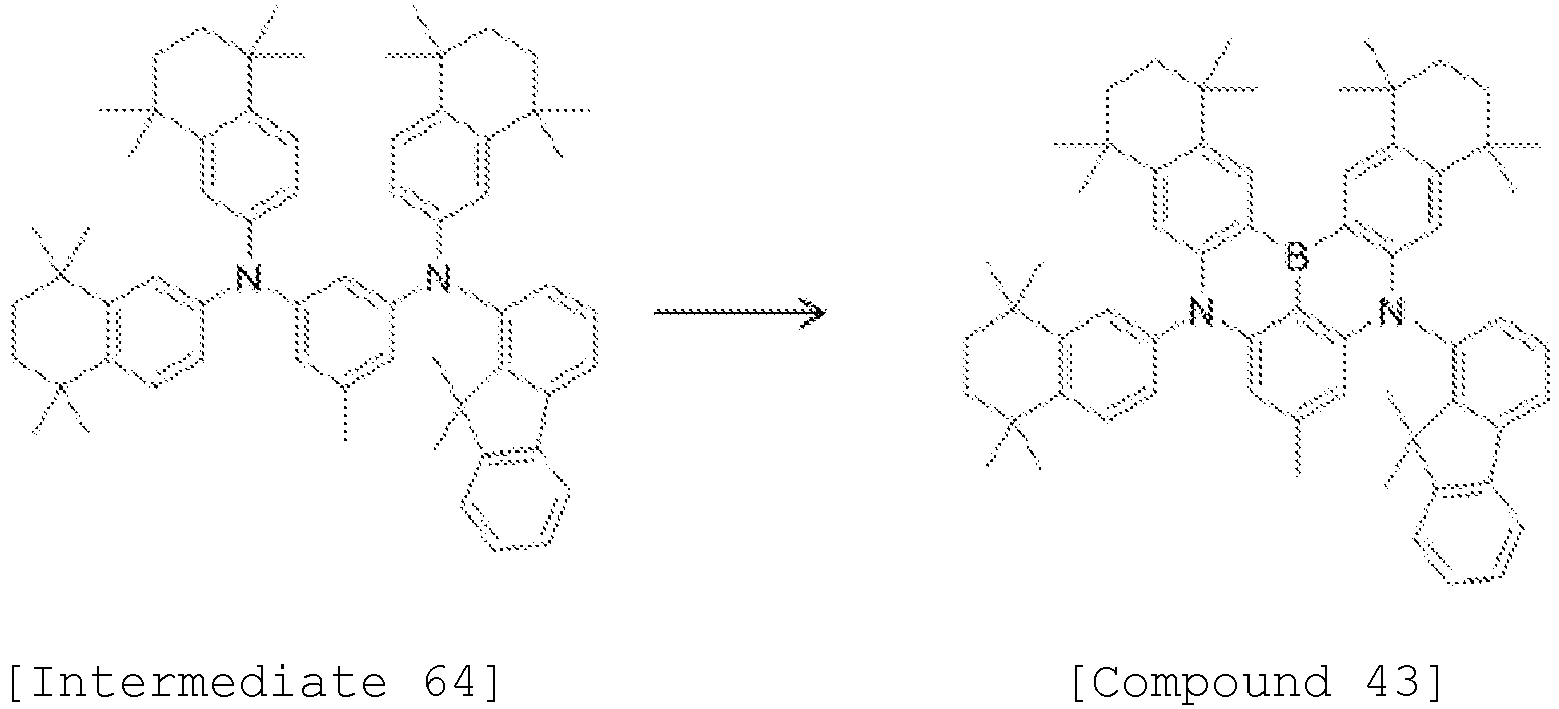
- After 25 g of Intermediate 64 and 19.1 g of boron triiodide were put into 250 ml of 1,2-dichlorobenzene under a nitrogen atmosphere, the resulting mixture was stirred at 160°C for 4 hours. After the completion of the reaction, the resulting product was extracted, and then recrystallized to obtain 7.2 g of Compound 43 (yield 28%). MS[M+H]+ = 882
-

- 40 g of
Intermediate 7, 14.3 g of dibenzo[b,d]furan-4-amine, and 16.6 g of 1-(bromo)-3-(tert-butyl)benzene, and the same material and equivalent weight as in the synthesis method of Intermediate 59 were used, and the resulting product was recrystallized to obtain 47 g of Intermediate 65. (yield 76%). MS[M+H]+ = 794 -

- After 25 g of Intermediate 65 and 21 g of boron triiodide were put into 250 ml of 1,2-dichlorobenzene under a nitrogen atmosphere, the resulting mixture was stirred at 160°C for 4 hours. After the completion of the reaction, the resulting product was extracted, and then recrystallized to obtain 7.8 g of Compound 44 (yield 31%). MS[M+H]+ = 801
-


- After 40 g of
Intermediate 7, 14.3 g of dibenzo[b,d]furan-1-amine, 22.4 g of sodium-tert-butoxide, and 0.4 g of bis(tri-tert-butylphosphine)palladium(0) were put into 600 ml of toluene, the resulting mixture was refluxed for 1 hour, whether the reaction proceeded was confirmed, and then 14.9 g of 1-bromo-3-chlorobenzene was added thereto during the reflux reaction, and the reflux reaction was performed for an additional 1 hour. After the completion of the reaction, the resulting product was extracted, and then recrystallized to obtain 46 g of Intermediate 66. (yield 77%). MS[M+H]+ = 771 -

- After 25 g of Intermediate 66 and 21.6 g of boron triiodide were put into 250 ml of 1,2-dichlorobenzene under a nitrogen atmosphere, the resulting mixture was stirred at 160°C for 4 hours. After the completion of the reaction, the resulting product was extracted, and then recrystallized to obtain 7.8 g of Intermediate 67 (yield 31%). MS[M+H]+ = 780
-

- After 7 g of Intermediate 67, 2.5 g of bis(4-(tert-butyl)phenyl)amine, 1.7 g of sodium-tert-butoxide, and 0.05 g of bis(tri-tert-butylphosphine)palladium(0) were put into 80 ml of xylene, the resulting mixture was stirred under reflux for 5 hours. After the completion of the reaction, the resulting product was extracted, and then recrystallized to obtain 6.6 g of Compound 45 (yield 72%). MS[M+H]+ = 1025
-

- After 40 g of N-(3-chloro-5-methylphenyl)-N-(5,5,8,8-tetramethyl-5,6,7,8-tetrahydronaphthalen-2-yl)dibenzo[b,d]furan-1-amine, 16.6 g of 3,5,5,8,8-pentamethyl-5,6,7,8-tetrahydronaphthalen-2-amine, 23.3 g of sodium-tert-butoxide, and 0.4 g of bis(tri-tert-butylphosphine)palladium(0) were put into 600 ml of toluene, the resulting mixture was refluxed for 1 hour, whether the reaction proceeded was confirmed, and then 15.5 g of 1-bromo-3-chlorobenzene was added thereto during the reflux reaction, and the reflux reaction was performed for an additional 1 hour. After the completion of the reaction, the resulting product was extracted, and then recrystallized to obtain 47 g of Intermediate 68. (yield 74%). MS[M+H]+ = 786
-

- After 25 g of Intermediate 68 and 21.2 g of boron triiodide were put into 250 ml of 1,2-dichlorobenzene under a nitrogen atmosphere, the resulting mixture was stirred at 160°C for 4 hours. After the completion of the reaction, the resulting product was extracted, and then recrystallized to obtain 7.7 g of Intermediate 69 (yield 30%). MS[M+H]+ = 794
-

- After 7 g of Intermediate 69, 2.5 g of bis(4-(tert-butyl)phenyl)amine, 1.7 g of sodium-tert-butoxide, and 0.05 g of bis(tri-tert-butylphosphine)palladium(0) were put into 80 ml of xylene, the resulting mixture was stirred under reflux for 5 hours. After the completion of the reaction, the resulting product was extracted, and then recrystallized to obtain 6.8 g of Compound 46. (yield 74%). MS[M+H]+ = 1039
-
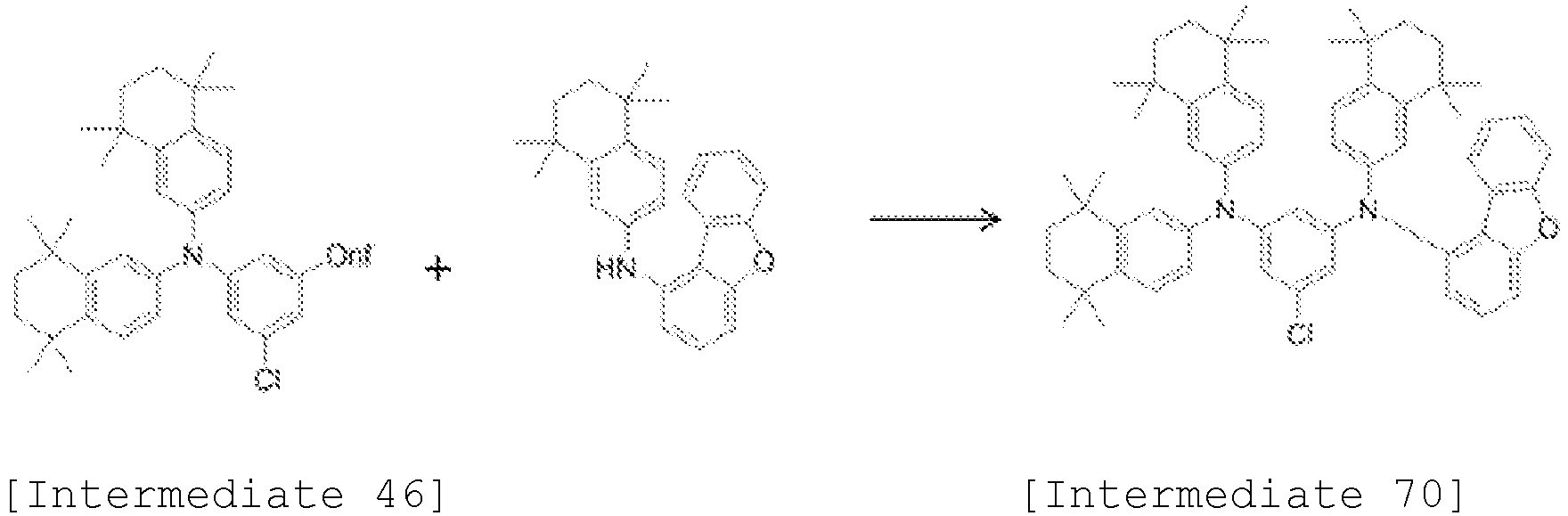
- After 40 g of Intermediate 46 and 18.9 g of N-(5,5,8,8-tetramethyl-5,6,7,8-tetrahydronapthalen-2-yl)dibenzo[b,d]furan-1-amine were reacted using the same material and equivalent weight as in the synthesis method of Intermediate 47, the resulting product was extracted, and then recrystallized to obtain 34 g of Intermediate 70. (yield 77%). MS[M+H]+ = 868
-

- After 25 g of Intermediate 70 and 19.2 g of boron triiodide were put into 250 ml of 1,2-dichlorobenzene under a nitrogen atmosphere, the resulting mixture was stirred at 160°C for 4 hours. After the completion of the reaction, the resulting product was extracted, and then recrystallized to obtain 7.5 g of Intermediate 71 (yield 30%). MS[M+H]+ = 876
-

- After 7 g of Intermediate 71, 2.5 g of bis(4-(tert-butyl)phenyl)amine, 1.7 g of sodium-tert-butoxide, and 0.05 g of bis(tri-tert-butylphosphine)palladium(0) were put into 80 ml of xylene, the resulting mixture was stirred under reflux for 5 hours. After the completion of the reaction, the resulting product was extracted, and then recrystallized to obtain 6.9 g of Compound 47. (yield 70%). MS[M+H]+ = 1120
-

- 30 g of N-(3-chloro-5-(methyl-d3)phenyl)-5,5,8,8-tetramethyl-N-(5,5,8,8-tetramethyl-5,6,7,8-tetrahydronapthalen-2-yl)-5,6,7,8-tetrahydronaphthalen-2-amine and 20.4 g of N-(4-(tert-butyl)phenyl)-3,5,5,8,8-pentamethyl-5,6,7,8-tetrahydronaphthalen-2-amine, and the same material and equivalent weight as in the synthesis method of
Intermediate 2 were used, and the resulting product was recrystallized to obtain 33 g of Intermediate 72. (yield 69%). MS[M+H]+ = 831 -

- After 25 g of Intermediate 72 and 20.4 g of boron triiodide were put into 250 ml of 1,2-dichlorobenzene under a nitrogen atmosphere, the resulting mixture was stirred at 160°C for 4 hours. After the completion of the reaction, the resulting product was extracted, and then recrystallized to obtain 7.4 g of Compound 48 (yield 29%). MS[M+H]+ = 839
-

- 30 g of 1,3-dibromo-5-(tert-butyl)benzene and 83 g of 3,5,5,8,8-pentamethyl-N-(5,5,8,8-tetramethyl-5,6,7,8-tetrahydronaphthalen-2-yl)-5,6,7,8-tetrahydronaphthalen-2-amine, and the same material and equivalent weight as in the synthesis method of Intermediate 20 were used, and the resulting product was recrystallized to obtain 66 g of Intermediate 73. (yield 69%). MS[M+H]+ = 938
-

- After 25 g of Intermediate 73 and 17.7 g of boron triiodide were put into 250 ml of 1,2-dichlorobenzene under a nitrogen atmosphere, the resulting mixture was stirred at 160°C for 4 hours. After the completion of the reaction, the resulting product was extracted, and then recrystallized to obtain 7.6 g of Compound 49 (yield 30%). MS[M+H]+ = 946
-

- After 40 g of N-(5-(tert-butyl)-[1,1'-biphenyl]-2-yl)-N-(3-chloro-5-(methyl-d3)phenyl)-5,5,8,8-tetramethyl-5,6,7,8-tetrahydronaphthalen-2-amine, 12.1 g of 4-(tert-butyl)-2-methylaniline, 21.4g of sodium-tert-butoxide, and 0.4 g of bis(tri-tert-butylphosphine)palladium(0) were put into 600 ml of toluene, the resulting mixture was refluxed for 1 hour, whether the reaction proceeded was confirmed, and then 14.2 g of 1-bromo-3-chlorobenzene was added thereto during the reflux reaction, and the reflux reaction was performed for an additional 1 hour. After the completion of the reaction, the resulting product was extracted, and then recrystallized to obtain 42 g of Intermediate 74. (yield 73%). MS[M+H]+ = 777
-

- After 25 g of Intermediate 74 and 21.4 g of boron triiodide were put into 250 ml of 1,2-dichlorobenzene under a nitrogen atmosphere, the resulting mixture was stirred at 160°C for 4 hours. After the completion of the reaction, the resulting product was extracted, and then recrystallized to obtain 7.5 g of Intermediate 75 (yield 30%). MS[M+H]+ = 785
-

- After 7 g of Intermediate 75, 2.5 g of bis(4-(tert-butyl)phenyl)amine, 1.7 g of sodium-tert-butoxide, and 0.05 g of bis(tri-tert-butylphosphine)palladium(0) were put into 80 ml of xylene, the resulting mixture was stirred under reflux for 5 hours. After the completion of the reaction, the resulting product was extracted, and then recrystallized to obtain 7.1 g of Compound 50. (yield 77%). MS[M+H]+ = 1030
-

- After 40 g of N-(5-(tert-butyl)-[1,1'-biphenyl]-2-yl)-N-(3-chloro-5-methylphenyl)-1,1,3,3-tetramethyl-2,3-dihydro-1H-inden-5-amine, 12.1 g of 4-(tert-butyl)-2-methylaniline, 22.1 g of sodium-tert-butoxide, and 0.4 g of bis(tri-tert-butylphosphine)palladium(0) were put into 600 ml of toluene, the resulting mixture was refluxed for 1 hour, whether the reaction proceeded was confirmed, and then 14.6 g of 1-bromo-3-chlorobenzene was added thereto during the reflux reaction, and the reflux reaction was performed for an additional 1 hour. After the completion of the reaction, the resulting product was extracted, and then recrystallized to obtain 43 g of Intermediate 76. (yield 74%). MS[M+H]+ = 760
-

- After 25 g of Intermediate 76 and 21.9 g of boron triiodide were put into 250 ml of 1,2-dichlorobenzene under a nitrogen atmosphere, the resulting mixture was stirred at 160°C for 4 hours. After the completion of the reaction, the resulting product was extracted, and then recrystallized to obtain 7.1 g of Intermediate 77 (yield 28%). MS[M+H]+ = 768
-

- After 7 g of Intermediate 77, 2.5 g of bis(4-(tert-butyl)phenyl)amine, 1.7 g of sodium-tert-butoxide, and 0.05 g of bis(tri-tert-butylphosphine)palladium(0) were put into 80 ml of xylene, the resulting mixture was stirred under reflux for 5 hours. After the completion of the reaction, the resulting product was extracted, and then recrystallized to obtain 6.5 g of Compound 51. (yield 72%). MS[M+H]+ = 1013
-

- 30 g of N-(3-chloro-5-(methyl-d3)phenyl)-1,1,3,3-tetramethyl-N-(1,1,3,3-tetramethyl-2,3-dihydro-1H-inden-5-yl)-2,3-dihydro-1H-inden-5-amine and 27.4 g of N-(4-(tert-butyl)phenyl)-1,1,3,3,6-pentamethyl-2,3-dihydro-1H-inden-5-amine, and the same material and equivalent weight as in the synthesis method of
Intermediate 2 were used, and the resulting product was recrystallized to obtain 33 g of Intermediate 78. (yield 78%). MS[M+H]+ = 789 -

- After 25 g of Intermediate 78 and 21.1 g of boron triiodide were put into 250 ml of 1,2-dichlorobenzene under a nitrogen atmosphere, the resulting mixture was stirred at 160°C for 4 hours. After the completion of the reaction, the resulting product was extracted, and then recrystallized to obtain 7.5 g of Compound 52 (yield 30%). MS[M+H]+ = 797
-

- 30 g of 1,3-dibromo-5-methylbenzene and 90.1 g of 1,1,3,3,6-pentamethyl-N-(1,1,3,3-tetramethyl-2,3-dihydro-1H-inden-5-yl)-2,3-dihydro-1H-inden-5-amine, and the same material and equivalent weight as in the synthesis method of Intermediate 20 were used, and the resulting product was recrystallized to obtain 66 g of Intermediate 79. (yield 66%). MS[M+H]+ = 840
-

- After 25 g of Intermediate 79 and 19.8 g of boron triiodide were put into 250 ml of 1,2-dichlorobenzene under a nitrogen atmosphere, the resulting mixture was stirred at 160°C for 4 hours. After the completion of the reaction, the resulting product was extracted, and then recrystallized to obtain 7.3 g of Compound 53 (yield 29%). MS[M+H]+ = 848
-

- After 40 g of N-(3-chloro-5-(methyl-d3)phenyl)-5,5,8,8-tetramethyl-N-(5,5,8,8-tetramethyl-5,6,7,8-tetrahydronaphthalen-2-yl)-5,6,7,8-tetrahydronaphthalen-2-amine, 14.2 g of dibenzo[b,d]furan-1-amine, 22.3 g of sodium-tert-butoxide, and 0.4 g of bis(tri-tert-butylphosphine)palladium(0) were put into 600 ml of toluene, the resulting mixture was refluxed for 1 hour, whether the reaction proceeded was confirmed, and then 14.1 g of 1-bromo-3-chlorobenzene was added thereto during the reflux reaction, and the reflux reaction was performed for an additional 1 hour. After the completion of the reaction, the resulting product was extracted, and then recrystallized to obtain 41 g of Intermediate 80. (yield 68%). MS[M+H]+ = 775
-

- After 25 g of Intermediate 80 and 21.5 g of boron triiodide were put into 250 ml of 1,2-dichlorobenzene under a nitrogen atmosphere, the resulting mixture was stirred at 160°C for 4 hours. After the completion of the reaction, the resulting product was extracted, and then recrystallized to obtain 7.5 g of Intermediate 81 (yield 30%). MS[M+H]+ = 783
-

- After 7 g of Intermediate 81, 2.5 g of bis(4-(tert-butyl)phenyl)amine, 1.7 g of sodium-tert-butoxide, and 0.05 g of bis(tri-tert-butylphosphine)palladium(0) were put into 80 ml of xylene, the resulting mixture was stirred under reflux for 5 hours. After the completion of the reaction, the resulting product was extracted, and then recrystallized to obtain 6.6 g of Compound 54. (yield 72%). MS[M+H]+ = 1028
-

- 40 g of Intermediate 46, 31 g of N-(4-(dibenzo[b,d]furan-1-yl)phenyl)-3-methyl-[1,1'-biphenyl]-4-amine, and the same material and equivalent weight as in the synthesis method of Intermediate 37 were used, and the resulting product was recrystallized to obtain 55 g of Intermediate 82. (yield 78%). MS[M+H]+ = 924
-

- After 25 g of Intermediate 82 and 18 g of boron triiodide were put into 250 ml of 1,2-dichlorobenzene under a nitrogen atmosphere, the resulting mixture was stirred at 160°C for 4 hours. After the completion of the reaction, the resulting product was extracted, and then recrystallized to obtain 7.2 g of Intermediate 83 (yield 29%). MS[M+H]+ = 932
-

- After 7 g of Intermediate 83, 2.1g of bis(4-(tert-butyl)phenyl)amine, 1.7 g of sodium-tert-butoxide, and 0.05 g of bis(tri-tert-butylphosphine)palladium(0) were put into 80 ml of xylene, the resulting mixture was stirred under reflux for 5 hours. After the completion of the reaction, the resulting product was extracted, and then recrystallized to obtain 6.4 g of Compound 55. (yield 72%). MS[M+H]+ = 1177
-

- 40 g of Intermediate 46 and 34 g of N-(4-(dibenzo[b,d]thiophen-2-yl)phenyl)-3-methyl-[1,1'-biphenyl]-4-amine, and the same material and equivalent weight as in the synthesis method of Intermediate 37 were used, and the resulting product was recrystallized to obtain 54 g of Intermediate 84. (yield 74%). MS[M+H]+ = 940
-

- After 25 g of Intermediate 84 and 17.7 g of boron triiodide were put into 250 ml of 1,2-dichlorobenzene under a nitrogen atmosphere, the resulting mixture was stirred at 160°C for 4 hours. After the completion of the reaction, the resulting product was extracted, and then recrystallized to obtain 7.5 g of Intermediate 85 (yield 30%). MS[M+H]+ = 948
-
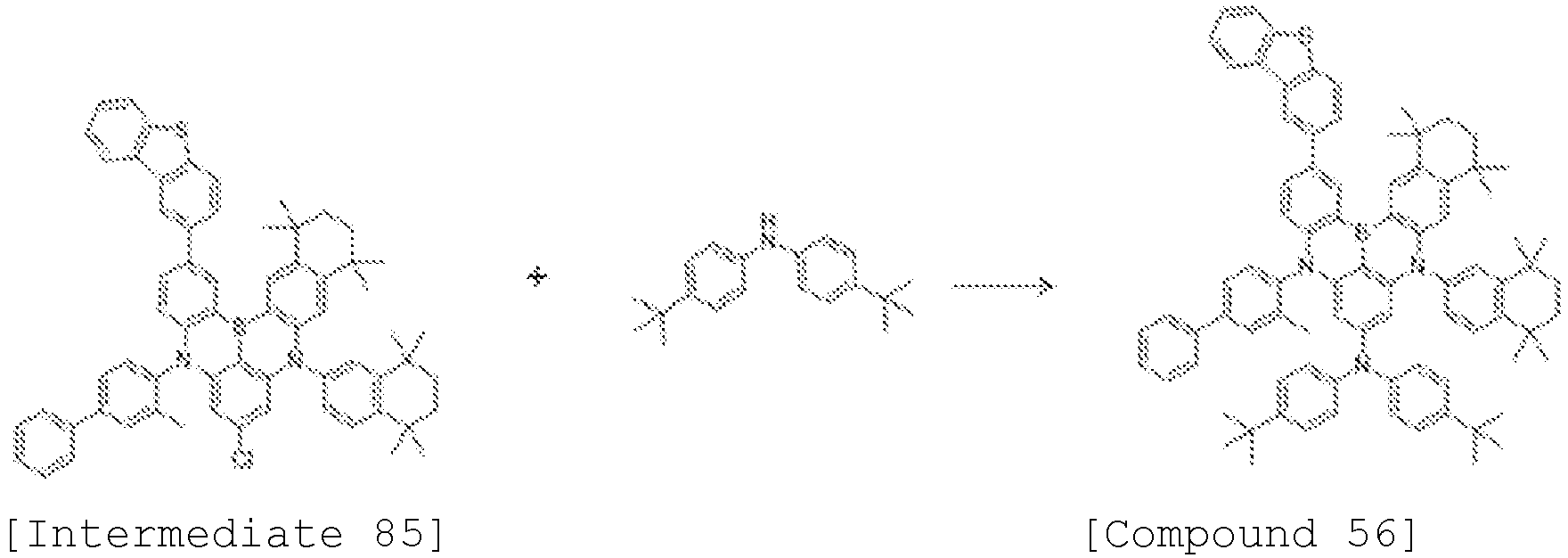
- After 7 g of Intermediate 85, 2.1 g of bis(4-(tert-butyl)phenyl)amine, 1.7 g of sodium-tert-butoxide, and 0.05 g of bis(tri-tert-butylphosphine)palladium(0) were put into 80 ml of xylene, the resulting mixture was stirred under reflux for 5 hours. After the completion of the reaction, the resulting product was extracted, and then recrystallized to obtain 6.6 g of Compound 56. (yield 72%). MS[M+H]+ = 1235
-

- 40 g of Intermediate 46 and 35 g of N-(4-(9,9-dimethyl-9H-fluoren-1-yl)phenyl)-3-methyl-[1,1'-biphenyl]-4-amine, and the same material and equivalent weight as in the synthesis method of Intermediate 37 to obtain 53 g of Intermediate 86. (yield 72%). MS[M+H]+ = 950
-


- After 25 g of Intermediate 86 and 17.5 g of boron triiodide were put into 250 ml of 1,2-dichlorobenzene under a nitrogen atmosphere, the resulting mixture was stirred at 160°C for 4 hours. After the completion of the reaction, the resulting product was extracted, and then recrystallized to obtain 7.7 g of Intermediate 87 (yield 31%). MS[M+H]+ = 958
-

- After 7 g of Intermediate 87, 2.1 g of bis(4-(tert-butyl)phenyl)amine, 1.7 g of sodium-tert-butoxide, and 0.05 g of bis(tri-tert-butylphosphine)palladium(0) were put into 80 ml of xylene, the resulting mixture was stirred under reflux for 5 hours. After the completion of the reaction, the resulting product was extracted, and then recrystallized to obtain 6.8 g of Compound 57. (yield 75%). MS[M+H]+ = 1245
-

- 40 g of Intermediate 46 and 15 g of 4-(tert-butyl)-N-(3-chlorophenyl)-2-methylaniline, and the same material and equivalent weight as in the synthesis method of Intermediate 37 were used, and the resulting product was recrystallized to obtain 31 g of Intermediate 88. (yield 79%). MSM+H]+ = 772
-

- After 25 g of Intermediate 88 and 21.6 g of boron triiodide were put into 250 ml of 1,2-dichlorobenzene under a nitrogen atmosphere, the resulting mixture was stirred at 160°C for 4 hours. After the completion of the reaction, the resulting product was extracted, and then recrystallized to obtain 7.6 g of Intermediate 89 (yield 30%). MS[M+H]+ = 780
-

- After 7 g of Intermediate 89, 4.3 g of bis(4-(tert-butyl)phenyl)amine, 2.1 g of sodium-tert-butoxide, and 0.05 g of bis(tri-tert-butylphosphine)palladium(0) were put into 80 ml of xylene, the resulting mixture was stirred under reflux for 5 hours. After the completion of the reaction, the resulting product was extracted, and then recrystallized to obtain 7.2 g of Compound 58. (yield 78%). MS[M+H]+ = 1270
-

- After 7 g of Intermediate 58, 3 g of bis(5,5,8,8-tetramethyl-5,6,7,8-tetrahydronaphthalen-2-yl)amine, 1.5 g of sodium-tert-butoxide, and 0.04 g of bis(tri-tert-butylphosphine)palladium(0) were put into 80 ml of xylene, the resulting mixture was stirred under reflux for 5 hours. After the completion of the reaction, the resulting product was extracted, and then recrystallized to obtain 7.1 g of Compound 59 (yield 73%). MS[M+H]+ = 1249
-

- After 40 g of 1-bromo-3-chloro-5-methylbenzene, 89.5 g of N-(5-(tert-butyl)-[1,1'-biphenyl]-2-yl)-9,9,10,10-tetramethyl-9,10-dihydroanthracen-2-amine, 56.1 g of sodium-tert-butoxide, and 1.0 g of bis(tri-tert-butylphosphine)palladium(0) were put into 600 ml of toluene under a nitrogen atmosphere, the resulting mixture was stirred under reflux for 2 hours. After the completion of the reaction, the resulting product was extracted, and then recrystallized to obtain 88 g of Intermediate 90. (yield 77%). MS[M+H]+ = 585
-

- After 30 g of Intermediate 90, 14.5 g of bis(4-(tert-butyl)phenyl)amine, 9.9 g of sodium-tert-butoxide, and 0.3 g of bis(tri-tert-butylphosphine)palladium(0) were put into 450 ml of toluene under a nitrogen atmosphere, the resulting mixture was stirred under reflux for 2 hours. After the completion of the reaction, the resulting product was extracted, and then recrystallized to obtain 34 g of Intermediate 91. (yield 80%). MS[M+H]+ = 830
-

- After 25 g of Intermediate 91 and 20.1 g of boron triiodide were put into 250 ml of 1,2-dichlorobenzene under a nitrogen atmosphere, the resulting mixture was stirred at 160°C for 4 hours. After the completion of the reaction, the resulting product was extracted, and then recrystallized to obtain 7.5 g of Compound 60 (yield 30%). MS[M+H]+ = 838
-

- After 30 g of Intermediate 90, 23.2 g of 9,9,10,10-tetramethyl-N-(3,5,5,8,8-pentamethyl-5,6,7,8-tetrahydronapthalen-2-yl)-9,10-dihydroanthracen-2-amine, 9.9 g of sodium-tert-butoxide, and 0.3 g of bis(tri-tert-butylphosphine)palladium(0) were put into 450 ml of toluene under a nitrogen atmosphere, the resulting mixture was stirred under reflux for 2 hours. After the completion of the reaction, the resulting product was extracted, and then recrystallized to obtain 38 g of Intermediate 92. (yield 74%). MS[M+H]+ = 1000
-

- After 25 g of Intermediate 92 and 20.1 g of boron triiodide were put into 250 ml of 1,2-dichlorobenzene under a nitrogen atmosphere, the resulting mixture was stirred at 160°C for 4 hours. After the completion of the reaction, the resulting product was extracted, and then recrystallized to obtain 7.6 g of Compound 61 (yield 30%). MS[M+H]+ = 1008
-

- After 30 g of Intermediate 90, 14.9 g of 3,5,5,8,8-pentamethyl-5,6,7,8-tetrahydronaphthalen-2-amine, 19.8 g of sodium-tert-butoxide, and 0.4 g of bis(tri-tert-butylphosphine)palladium(0) were put into 600 ml of toluene under a nitrogen atmosphere, the resulting mixture was refluxed for 1 hour, whether the reaction proceeded was confirmed, and then 13.1 g of 1-bromo-3-chlorobenzene was added thereto during the reflux reaction, and the reflux reaction was performed for an additional 1 hour. After the completion of the reaction, the resulting product was extracted, and then recrystallized to obtain 44 g of Intermediate 93. (yield 73%). MS[M+H]+ = 876 (yield 77%), MS[M+H]+= 585
-

- After 25 g of Intermediate 93 and 19 g of boron triiodide were put into 250 ml of 1,2-dichlorobenzene under a nitrogen atmosphere, the resulting mixture was stirred at 160°C for 4 hours. After the completion of the reaction, the resulting product was extracted, and then recrystallized to obtain 8.0 g of Intermediate 94. (yield 32%). MS[M+H]+ = 884
-
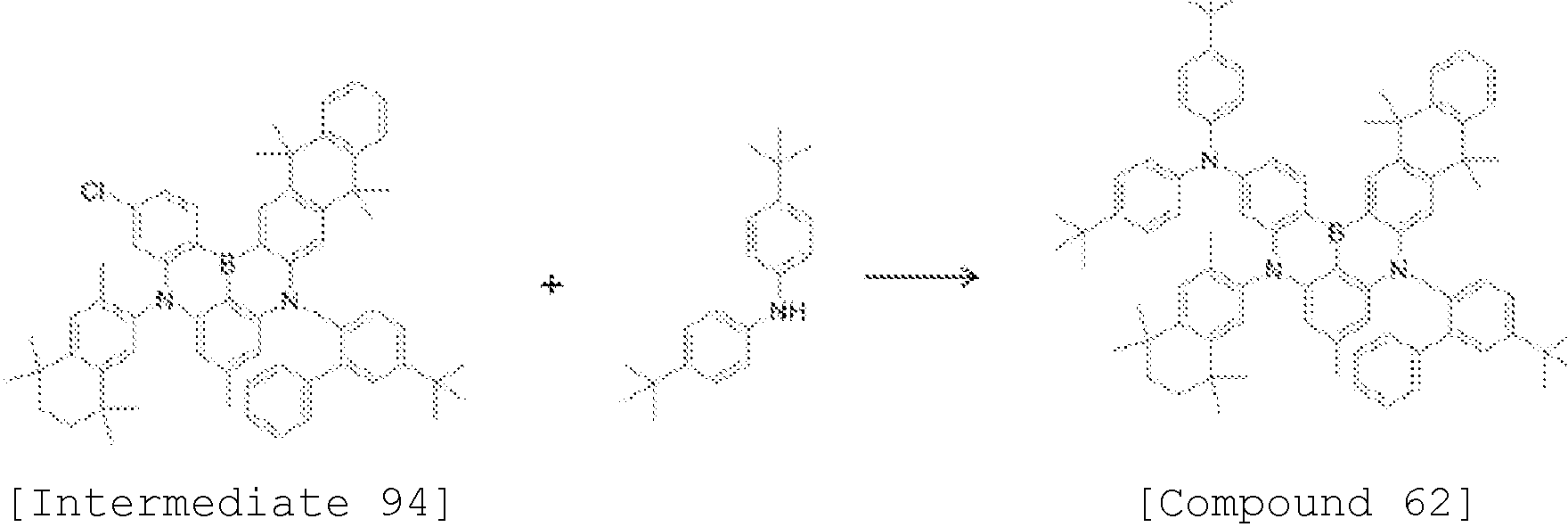
- After 7 g of Intermediate 94, 14.5 g of bis(4-(tert-butyl)phenyl)amine, 9.9 g of sodium-tert-butoxide, and 0.3 g of bis(tri-tert-butylphosphine)palladium(0) were put into 150 ml of toluene under a nitrogen atmosphere, the resulting mixture was stirred under reflux for 2 hours. After the completion of the reaction, the resulting product was extracted, and then recrystallized to obtain 6.9 g of Compound 62. (yield 77%). MS[M+H]+ = 1129
-

- After 30 g of 1,3-dibromo-5-methylbenzene, 108 g of 9,9,10,10-tetramethyl-N-(3,5,5,8,8-pentamethyl-5,6,7,8-tetrahydronapthalen-2-yl)-9,10-dihydroanthracen-2-amine, 70 g of sodium-tert-butoxide, and 1.2 g of bis(tri-tert-butylphosphine)palladium(0) were put into 600 ml of toluene under a nitrogen atmosphere, the resulting mixture was stirred under reflux for 2 hours. After the completion of the reaction, the resulting product was extracted, and then recrystallized to obtain 88 g of Intermediate 95. (yield 72%). MS[M+H]+ = 1012
-

- After 25 g of Intermediate 95 and 16.4 g of boron triiodide were put into 250 ml of 1,2-dichlorobenzene under a nitrogen atmosphere, the resulting mixture was stirred at 160°C for 4 hours. After the completion of the reaction, the resulting product was extracted, and then recrystallized to obtain 7.9 g of Intermediate 96. (yield 31%). MS[M+H]+ = 1020
-

- After 7 g of Intermediate 96, 1.93 g of bis(4-(tert-butyl)phenyl)amine, 1.32 g of sodium-tert-butoxide, and 0.03 g of bis(tri-tert-butylphosphine)palladium(0) were put into 80 ml of xylene under a nitrogen atmosphere, the resulting mixture was stirred under refluxed for 5 hours. After the completion of the reaction, the resulting product was extracted, and then recrystallized to obtain 6.9 g of Compound 63. (yield 79%). MS[M+H]+ = 1265
-

- After 7 g of Intermediate 58, 1.93 g of 4a,9a-dimethyl-2,3,4,4a,9,9a-hexahydro-1H-carbazole, 1.52g of sodium-tert-butoxide, and 0.04 g of bis(tri-tert-butylphosphine)palladium(0) were put into 80 ml of xylene under a nitrogen atmosphere, the resulting mixture was stirred under reflux for 5 hours. After the completion of the reaction, the resulting product was extracted, and then recrystallized to obtain 6.5 g of Compound 64. (yield 78%). MS[M+H]+ = 1061
-

- After 7 g of Intermediate 58, 2.05 g of 6-(tert-butyl)-4a,9a-dimethyl-2,3,4,4a,9,9a-hexahydro-1H-carbazole, 1.52 g of sodium-tert-butoxide, and 0.04 g of bis(tri-tert-butylphosphine)palladium(0) were put into 80 ml of xylene under a nitrogen atmosphere, the resulting mixture was stirred under reflux for 5 hour. After the completion of the reaction, the resulting product was extracted, and then recrystallized to obtain 6.7 g of Compound 65. (yield 77%). MS[M+H]+ = 1117
-

- After 7 g of Intermediate 71, 2.06 g of 6-(tert-butyl)-4a,9a-dimethyl-2,3,4,4a,9,9a-hexahydro-1H-carbazole, 1.55 g of sodium-tert-butoxide, and 0.04 g of bis(tri-tert-butylphosphine)palladium(0) were put into 80 ml of xylene under a nitrogen atmosphere, the resulting mixture was stirred under reflux for 5 hours. After the completion of the reaction, the resulting product was extracted, and then recrystallized to obtain 6.9 g of Compound 66. (yield 79%). MS[M+H]+ = 1097
-

- After 30 g of 1,3-dibromo-5-methylbenzene, 82 g of N-(5,5,8,8-tetramethyl-5,6,7,8-tetrahydronaphthalen-2-yl)dibenzo[b,d]furan-4-amine, 64 g of sodium-tert-butoxide, and 0.6 g of bis(tri-tert-butylphosphine)palladium(0) were put into 600 ml of toluene under a nitrogen atmosphere, the resulting mixture was stirred under reflux for 2 hours. After the completion of the reaction, the resulting product was extracted, and then recrystallized to obtain 69 g of Intermediate 97. (yield 73%). MS[M+H]+ = 848
-

- After 25 g of Intermediate 97 and 19.6 g of boron triiodide were put into 250 ml of 1,2-dichlorobenzene under a nitrogen atmosphere, the resulting mixture was stirred at 160°C for 4 hours. After the completion of the reaction, the resulting product was extracted, and then recrystallized to obtain 7.2 g of Intermediate 98. (yield 29%). MS[M+H]+ = 856
-

- After 7 g of Intermediate 98, 2.1 g of 6-(tert-butyl)-4a,9a-dimethyl-2,3,4,4a,9,9a-hexahydro-1H-carbazole, 1.6 g of sodium-tert-butoxide, and 0.04 g of bis(tri-tert-butylphosphine)palladium(0) were put into 80 ml of xylene under a nitrogen atmosphere, the resulting mixture was stirred under reflux for 5 hours. After the completion of the reaction, the resulting product was extracted, and then recrystallized to obtain 7.0 g of Compound 67. (yield 79%). MS[M+H]+ = 1077
-

- After 7 g of Intermediate 67, 2.31 g of 6-(tert-butyl)-4a,9a-dimethyl-2,3,4,4a,9,9a-hexahydro-1H-carbazole, 1.8 g of sodium-tert-butoxide, and 0.05 g of bis(tri-tert-butylphosphine)palladium(0) were put into 80 ml of xylene under a nitrogen atmosphere, the resulting mixture was stirred under reflux for 5 hours. After the completion of the reaction, the resulting product was extracted, and then recrystallized to obtain 7.1 g of Compound 68. (yield 79%). MS[M+H]+ = 1001
-

- After 30g of N-(5-(tert-butyl)-[1,1'-biphenyl]-2-yl)-N-(3-chloro-5-methylphenyl)-1,1,3,3-tetramethyl-2,3-dihydro-1H-inden-5-amine, 16.5 g of bis(4-(tert-butyl)phenyl)amine, 11.1 g of sodium-tert-butoxide, and 0.3 g of bis(tri-tert-butylphosphine)palladium(0) were put into 450 ml of toluene under a nitrogen atmosphere, the resulting mixture was stirred under reflux for 2 hours. After the completion of the reaction, the resulting product was extracted, and then recrystallized to obtain 34 g of Intermediate 99. (yield 77%). MS[M+H]+ = 768
-

- After 25 g of Intermediate 99 and 21.7 g of boron triiodide were put into 250 ml of 1,2-dichlorobenzene under a nitrogen atmosphere, the resulting mixture was stirred at 160°C for 4 hours. After the completion of the reaction, the resulting product was extracted, and then recrystallized to obtain 7.3 g of Compound 71 (yield 29%). MS[M+H]+ = 776
-

- After 30 g of
Intermediate 1, 15.7 g of 3-(tert-butyl)-N-(4-(tert-butyl)phenyl)aniline, 10.8g of sodium-tert-butoxide, and 0.3 g of bis(tri-tert-butylphosphine)palladium(0) were put into 450 ml of toluene under a nitrogen atmosphere, the resulting mixture was stirred under reflux for 2 hours. After the completion of the reaction, the resulting product was extracted, and then recrystallized to obtain 33 g of Intermediate 100. (yield 76%). MS[M+H]+ = 782 -

- After 25 g of Intermediate 100 and 21.3 g of boron triiodide were put into 250 ml of 1,2-dichlorobenzene under a nitrogen atmosphere, the resulting mixture was stirred at 160°C for 4 hours. After the completion of the reaction, the resulting product was extracted, and then recrystallized to obtain 7.5 g of Compound 72 (yield 30%). MS[M+H]+ = 790
- By introducing various substituents in the same manner as in the Synthesis Examples, the compound represented by Formula 100 may be synthesized in addition to the above-described compounds.
- A glass substrate thinly coated with indium tin oxide (ITO) to have a thickness of 1,400 Å was put into distilled water in which a detergent was dissolved, and ultrasonically washed. In this case, a product manufactured by Fischer Co., was used as the detergent, and distilled water, which had been filtered twice with a filter manufactured by Millipore Co., was used as the distilled water. After the ITO was washed for 30 minutes, ultrasonic washing was conducted twice repeatedly using distilled water for 10 minutes. After the washing using distilled water was completed, ultrasonic washing was conducted by using isopropyl alcohol, acetone, and methanol solvents, and the resulting product was dried and then transported to a plasma washing machine. Furthermore, the substrate was cleaned by using oxygen plasma for 5 minutes, and then was transported to a vacuum deposition machine.
- The following HI-A and HAT-CN were thermally vacuum deposited to have a thickness of 650 Å and 50 Å, respectively, on the ITO transparent electrode prepared as described, thereby forming first and second hole injection layers. The following HT-A was vacuum deposited to have a thickness of 600 Å on the hole injection layer, thereby forming a hole transport layer. The following HT-B was vacuum deposited to have a thickness of 50 Å on the hole transport layer, thereby forming an electron blocking layer. Subsequently, 4 parts by weight of
Compound 1 of the present invention as a blue light emitting dopant based on 100 parts by weight of the light emitting layer and the following BH as a host were vacuum deposited to have a thickness of 200 Å on the electron blocking layer, thereby forming a light emitting layer. Next, the following compound ET-A as a first electron transport layer was vacuum deposited to have a thickness of 50 Å on the light emitting layer, and subsequently, the following ET-B and LiQ were vacuum deposited at a weight ratio of 1:1, thereby forming a second electron transport layer having a thickness of 360 Å. LiQ was vacuum deposited to have a thickness of 5 Å on the second electron transport layer, thereby forming an electron injection layer. Aluminum and silver were deposited at a weight ratio of 10:1 to have a thickness of 220 Å on the electron injection layer, aluminum was deposited to have a thickness of 1,000 Å thereon, thereby forming a negative electrode. - In the aforementioned procedure, the deposition rate of the organic materials were maintained at 0.4 to 0.9 Å/sec, the deposition rate of aluminum of the negative electrode was maintained at 2 Å/sec, and the degree of vacuum during the deposition was maintained at 1×10⁻⁷ to 1×10⁻⁸ torr, thereby manufacturing an organic light emitting device.


- Devices were manufactured in the same manner as in Example 1-1, except that compounds described in the following Table 1 were used as the dopant of the light in Example 1-1.

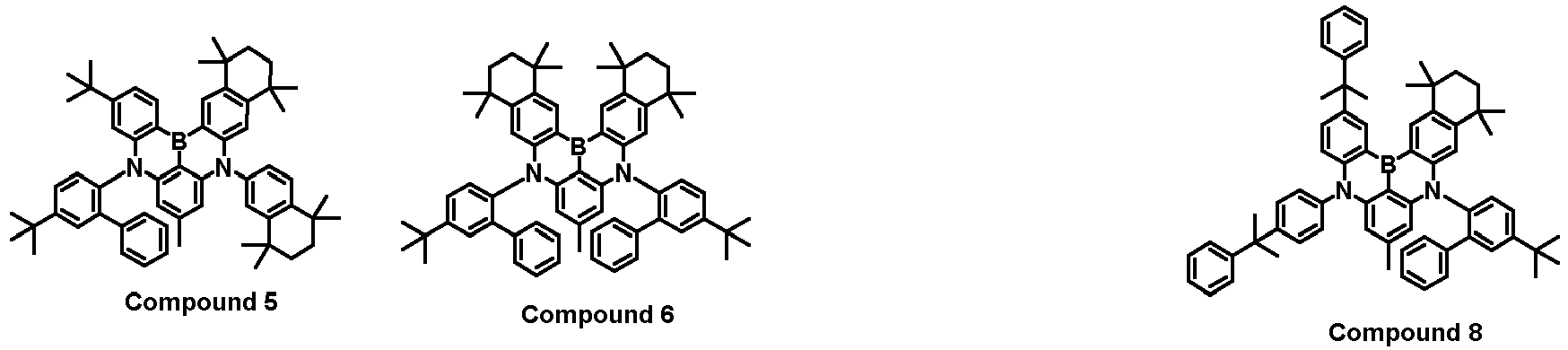


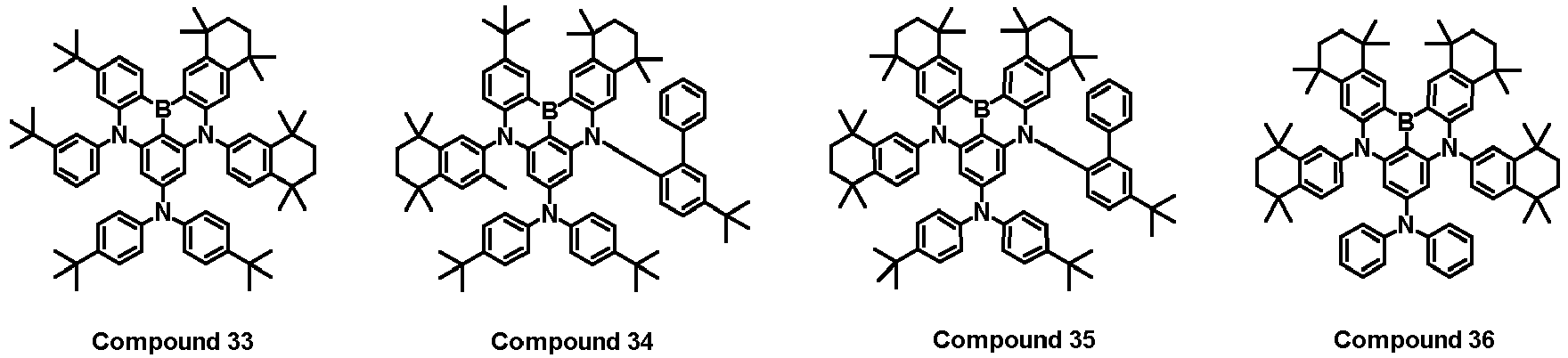


- Devices were manufactured in the same manner as in Example 1-1, except that compounds described in the following Table 1 were used as the dopant of the light emitting layer in Example 1-1.

- The efficiencies, service lives, and color coordinates (based on 1931 CIE color coordinate) of the organic light emitting devices manufactured in the Examples and the Comparative Examples at a current density of 10 mA/cm2 were measured, and the results thereof are shown in the following Table 1.
[Table 1] Dopant material Efficiency (cd/A) Color coordinate Service life CIE (x) CIE (y) T95 (hr) Example 1-1 Compound 1 9.12 0.15 0.05 271 Example 1-2 Compound 2 9.12 0.15 0.05 272 Example 1-3 Compound 3 9.24 0.14 0.05 283 Example 1-4 Compound 4 9.28 0.15 0.05 285 Example 1-5 Compound 5 9.29 0.15 0.05 282 Example 1-6 Compound 6 9.29 0.15 0.05 284 Example 1-8 Compound 8 9.14 0.14 0.05 273 Example 1-9 Compound 9 9.26 0.14 0.05 284 Example 1-10 Compound 10 9.45 0.15 0.06 291 Example 1-11 Compound 11 9.44 0.15 0.06 292 Example 1-12 Compound 12 9.45 0.15 0.06 289 Example 1-13 Compound 13 9.45 0.15 0.05 291 Example 1-14 Compound 14 9.4 0.15 0.05 292 Example 1-15 Compound 15 9.77 0.14 0.05 294 Example 1-16 Compound 16 9.77 0.14 0.05 292 Example 1-17 Compound 17 9.15 0.15 0.06 274 Example 1-18 Compound 18 9.15 0.15 0.06 272 Example 1-19 Compound 19 9.16 0.15 0.06 273 Example 1-20 Compound 20 9.15 0.15 0.06 275 Example 1-21 Compound 21 9.15 0.15 0.06 276 Example 1-22 Compound 22 9.29 0.15 0.06 283 Example 1-23 Compound 23 9.51 0.15 0.06 289 Example 1-25 Compound 25 9.48 0.15 0.06 291 Example 1-26 Compound 26 9.19 0.14 0.05 277 Example 1-27 Compound 27 9.2 0.14 0.05 280 Example 1-29 Compound 29 9.34 0.14 0.05 281 Example 1-30 Compound 30 9.33 0.14 0.05 283 Example 1-31 Compound 31 9.31 0.15 0.06 281 Example 1-32 Compound 32 9.33 0.14 0.05 280 Example 1-33 Compound 33 9.33 0.14 0.05 281 Example 1-34 Compound 34 9.32 0.14 0.05 280 Example 1-35 Compound 35 9.48 0.15 0.05 290 Example 1-36 Compound 36 9.81 0.15 0.05 290 Example 1-37 Compound 37 9.83 0.15 0.05 289 Example 1-38 Compound 38 9.5 0.15 0.06 285 Example 1-39 Compound 39 9.49 0.15 0.06 287 Example 1-40 Compound 40 9.5 0.15 0.06 285 Example 1-41 Compound 41 9.5 0.15 0.06 286 Example 1-42 Compound 42 9.5 0.15 0.06 282 Example 1-43 Compound 43 9.5 0.15 0.06 284 Example 1-44 Compound 44 9.31 0.15 0.06 280 Example 1-45 Compound 45 9.29 0.15 0.05 281 Example 1-46 Compound 46 9.3 0.15 0.05 280 Example 1-47 Compound 47 9.46 0.15 0.05 288 Example 1-48 Compound 48 9.45 0.15 0.05 286 Example 1-49 Compound 49 9.78 0.14 0.05 290 Example 1-50 Compound 50 9.16 0.15 0.06 274 Example 1-51 Compound 51 9.14 0.15 0.06 275 Example 1-52 Compound 52 9.43 0.15 0.05 284 Example 1-53 Compound 53 9.75 0.14 0.05 293 Example 1-54 Compound 54 9.3 0.15 0.05 283 Example 1-55 Compound 55 9.31 0.15 0.06 285 Example 1-56 Compound 56 9.3 0.15 0.06 284 Example 1-57 Compound 57 9.31 0.15 0.06 284 Example 1-58 Compound 58 9.33 0.15 0.05 283 Example 1-59 Compound 59 9.89 0.15 0.05 290 Example 1-60 Compound 60 9.15 0.15 0.05 274 Example 1-61 Compound 61 9.47 0.15 0.06 290 Example 1-62 Compound 62 9.31 0.15 0.06 285 Example 1-63 Compound 63 9.86 0.15 0.05 289 Example 1-64 Compound 64 9.85 0.15 0.05 295 Example 1-65 Compound 65 9.88 0.15 0.05 294 Example 1-66 Compound 66 9.48 0.15 0.05 291 Example 1-67 Compound 67 9.39 0.14 0.05 290 Example 1-68 Compound 68 9.34 0.15 0.05 288 Comparative Example 1-1 Compound BD1 7.54 0.15 0.05 240 Comparative Example 1-2 Compound BD2 7.83 0.15 0.05 245 - As can be confirmed in Table 1, it can be seen that when the compound represented by Formula 100 is used as a dopant of a light emitting layer of an organic light emitting device, the efficiency and service life of the device are increased.
- A system in which Compound 1 (dopant) and Compound BH (host) were included at a weight ratio of 5 : 95 was implemented. Specifically, the molecules, the temperature, and the simulation time were set to 300 (a ratio of 95% of Host and 5% of Dopant), 300 K, and 3 ns, respectively, using an OPLS3e force field, and the molecular dynamics were calculated through NVT and NPT calculations, thereby implementing the environment of the doped device computationally and chemically.
- Molecular systems were calculated in the same manner as in Example 2-1, except that dopants described in the following Table 2 were used instead of
Compound 1 in Example 2-1.

- Molecular systems were calculated in the same manner as in Example 2-1, except that dopants described in the following Table 2 were used instead of
Compound 1 in Example 1.
- The implemented molecular models are illustrated in
FIGS. 3 to 9 .FIGS. 3 to 7 illustrate the systems of Examples 2-1 to 2-5, respectively, andFIGS. 8 and9 illustrate the systems of Comparative Examples 2-1 and 2-2. The values obtained by calculating the total density and the average distance between different molecules in this case are shown in the following Table 2.[Table 2] Dopant Overall density Density (g/cm3) Average intermolecular distance Radial (Å) Example 2-1 Compound 11.093 15.20 Example 2-2 Compound 101.090 15.47 Example 2-3 Compound 59 1.07 15.77 Example 2-4 Compound 71 1.086 15.24 Example 2-5 Compound 72 1.092 15.32 Comparative Example 2-1 Compound BD1 1.12 14.7 Comparative Example 2-2 Compound BD2 1.094 15.1 - Referring to Table 2 and
FIGS. 3 to 9 , it can be confirmed that the distance between the host and the dopant is further increased as the aliphatic hydrocarbon ring is substituted with a methyl group, and the overall density is reduced. When materials are densely packed in one space, intermolecular Dexter transfer occurs, resulting in a reduction in efficiency. As in Examples 2-1 to 2-5 of the present invention, when an aliphatic hydrocarbon ring substituted with a methyl group is included, the efficiency of the device is increased and the injection of unnecessary electrons and holes is reduced while the intermolecular distance is increased and the packing density is reduced, so that the service life of the device is also improved.
Claims (12)
- A polycyclic compound represented by the following Formula 100:
 R1 and R301 are the same as or different from each other, and are each independently deuterium; a nitrile group; a halogen group; a substituted or unsubstituted alkyl group; a substituted or unsubstituted alkoxy group; a substituted or unsubstituted silyl group; a substituted or unsubstituted aryl group; a substituted or unsubstituted heterocyclic group; or a substituted or unsubstituted amine group, or are bonded to an adjacent substituent to form a substituted or unsubstituted ring,x101 is 1 or 2,Cy3 and Cy4 are the same as or different from each other, and are each independently one selected from the group consisting of a substituted or unsubstituted aromatic hydrocarbon ring; a substituted or unsubstituted aliphatic hydrocarbon ring; and a substituted or unsubstituted aromatic hetero ring, or a ring in which two or more rings selected from the group are fused,R302 is hydrogen; deuterium; a nitrile group; a halogen group; a substituted or unsubstituted alkyl group; a substituted or unsubstituted alkoxy group; a substituted or unsubstituted silyl group; a substituted or unsubstituted aryl group; a substituted or unsubstituted heterocyclic group; or a substituted or unsubstituted amine group, or is bonded to an adjacent substituent to form a substituted or unsubstituted ring,n1 is an integer from 1 to 3, n301 is an integer from 1 to 4, and n302 is an integer from 0 to 10,when n1, n301, and n302 are each 2 or higher, substituents in the parenthesis are the same as or different from each other,at least one of Cy3 and Cy4 is one selected from the following Formulae A-1 to A-3,
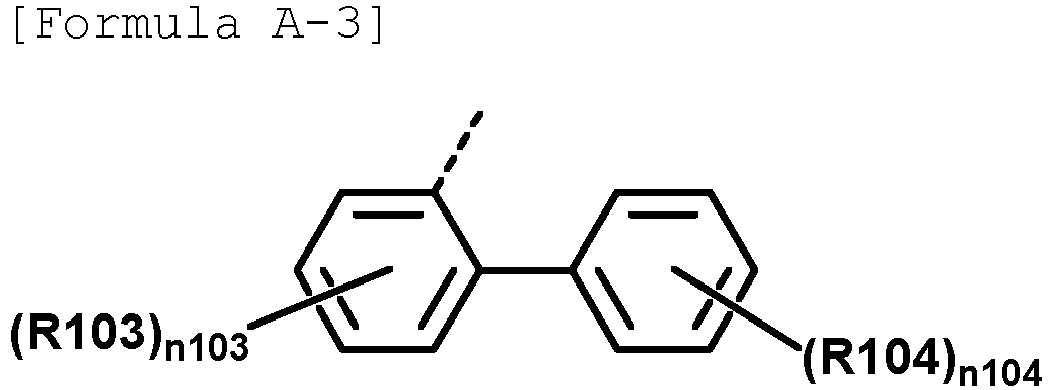 a dotted line is a position which is connected to Formula 100,Q1 is O; S; or C(R118)(R119),R101 to R104, R118, and R119 are the same as or different from each other, and are each independently hydrogen; deuterium; a nitrile group; a halogen group; a substituted or unsubstituted alkyl group; a substituted or unsubstituted alkoxy group; a substituted or unsubstituted silyl group; a substituted or unsubstituted aryl group; a substituted or unsubstituted heterocyclic group; or a substituted or unsubstituted amine group, or are bonded to an adjacent substituent to form a substituted or unsubstituted ring,x11 is 1 or 2,n101 is an integer from 0 to 7, n102 is an integer from 0 to 11, n103 is an integer from 0 to 4, and n104 is an integer from 0 to 5, andwhen n101 to n104 are each 2 or higher, substituents in the parenthesis are the same as or different from each other,one or more of the aliphatic rings included in Formula 100 are selected from the following structures,
 a dotted double line is a position where substituents are fused,R105 to R114 are the same as or different from each other, and are each independently a substituted or unsubstituted alkyl group,R115 to R117 are the same as or different from each other, and are each independently hydrogen; deuterium; a nitrile group; a halogen group; a substituted or unsubstituted alkyl group; a substituted or unsubstituted alkoxy group; a substituted or unsubstituted silyl group; a substituted or unsubstituted aryl group; a substituted or unsubstituted heterocyclic group; or a substituted or unsubstituted amine group, or are bonded to an adjacent substituent to form a substituted or unsubstituted ring, n115 is an integer from 0 to 2, and n116 and n117 are each an integer from 0 to 4, andwhen n115 to n117 are each 2 or higher, substituents in the parenthesis are the same as or different from each other.
 - The polycyclic compound of claim 1, wherein Formula 100 is represented by any one of the following Formulae 1 to 3:


 R1, Cy3, Cy4, and n1 are the same as those defined in Formula 100,R3 and R4 are the same as or different from each other, and are each independently deuterium; a nitrile group; a halogen group; a substituted or unsubstituted alkyl group; a substituted or unsubstituted alkoxy group; a substituted or unsubstituted silyl group; a substituted or unsubstituted aryl group; a substituted or unsubstituted heterocyclic group; or a substituted or unsubstituted amine group, or are bonded to an adjacent substituent to form a substituted or unsubstituted ring,R2, R5, R6, and R8 are the same as or different from each other, and are each independently hydrogen; deuterium; a nitrile group; a halogen group; a substituted or unsubstituted alkyl group; a substituted or unsubstituted alkoxy group; a substituted or unsubstituted silyl group; a substituted or unsubstituted aryl group; a substituted or unsubstituted heterocyclic group; or a substituted or unsubstituted amine group, or are bonded to an adjacent substituent to form a substituted or unsubstituted ring,n3 and n4 are each an integer from 1 to 4, n2, n5, and n6 are each an integer from 0 to 10, and n8 is an integer from 0 to 8, andwhen n2 to n6 and n8 are each 2 or higher, substituents in the parenthesis are the same as or different from each other.
 - The polycyclic compound of claim 1, wherein Cy3 and Cy4 are the same as or different from each other, and are each independently selected from the following Groups A-11 to A-14, and at least one of Cy3 and Cy4 is selected from the following Groups A-11 to A-13:


 a dotted line is a position which is connected to Formula 100,Q1 is O; S; or C(R118)(R119),R41 to R44, R46 to R50, R53 to R55, R118, and R119 are the same as or different from each other, and are each independently hydrogen; deuterium; a nitrile group; a halogen group; a substituted or unsubstituted alkyl group; a substituted or unsubstituted alkoxy group; a substituted or unsubstituted silyl group; a substituted or unsubstituted aryl group; a substituted or unsubstituted heterocyclic group; or a substituted or unsubstituted amine group, or are bonded to an adjacent substituent to form a substituted or unsubstituted ring,R45, R51, and R52 are the same as or different from each other, and are each independently hydrogen; deuterium; or a substituted or unsubstituted alkyl group,n41, n43, and n44 are each an integer from 0 to 7, and n42, n49, and n50 are each an integer from 0 to 5, andwhen n41 to n44, n49, and n50 are each 2 or higher, substituents in the parenthesis are the same as or different from each other.
 - The polycyclic compound of claim 1, wherein Formula 100 is represented by any one of the following Formulae 101 to 109:


 Cy3 and Cy4 are the same as those defined in Formula 100,R22, R31, G1, G2, and Y1 to Y6 are the same as or different from each other, and are each independently hydrogen; deuterium; a nitrile group; a halogen group; a substituted or unsubstituted alkyl group; a substituted or unsubstituted alkoxy group; a substituted or unsubstituted silyl group; a substituted or unsubstituted aryl group; a substituted or unsubstituted heterocyclic group; or a substituted or unsubstituted amine group, or are bonded to an adjacent substituent to form a substituted or unsubstituted ring,R21 is a substituted or unsubstituted alkyl group; a substituted or unsubstituted aryl group; a substituted or unsubstituted heterocyclic group; or a substituted or unsubstituted amine group,at least one of G1 and G2 is a substituted or unsubstituted alkyl group; a substituted or unsubstituted aryl group; a substituted or unsubstituted heterocyclic group; or a substituted or unsubstituted amine group,n22 and n31 are each an integer from 0 to 2, y1 and y5 are each an integer from 0 to 4, and y2 to y4 and y6 are each an integer from 0 to 6, andwhen n22, n31, and y1 to y6 are each 2 or higher, substituents in the parenthesis are the same as or different from each other.
 - The polycyclic compound of claim 1, wherein Formula 100 is represented by any one of the following Formulae 201 to 209:


 Q1 is the same as that defined in Formula 100,Cy5 to Cy7 are the same as or different from each other, and are each independently one selected from the group consisting of a substituted or unsubstituted aromatic hydrocarbon ring; a substituted or unsubstituted aliphatic hydrocarbon ring; and a substituted or unsubstituted aromatic hetero ring, or a ring in which two or more rings selected from the group are fused,R22, R31 to R38, G1, and G2 are the same as or different from each other, and are each independently hydrogen; deuterium; a nitrile group; a halogen group; a substituted or unsubstituted alkyl group; a substituted or unsubstituted alkoxy group; a substituted or unsubstituted silyl group; a substituted or unsubstituted aryl group; a substituted or unsubstituted heterocyclic group; or a substituted or unsubstituted amine group, or are bonded to an adjacent substituent to form a substituted or unsubstituted ring,R21 is a substituted or unsubstituted alkyl group; a substituted or unsubstituted aryl group; a substituted or unsubstituted heterocyclic group; or a substituted or unsubstituted amine group,at least one of G1 and G2 is a substituted or unsubstituted alkyl group; a substituted or unsubstituted aryl group; a substituted or unsubstituted heterocyclic group; or a substituted or unsubstituted amine group, x1 to x3 are each 1 or 2,n22, n31, n36, and n37 are each an integer from 0 to 2, n32 and n35 are each an integer from 0 to 4, n33 is an integer from 0 to 5, and n34 and n38 are each an integer from 0 to 3,when n22 and n31 to n38 are each 2 or higher, substituents in the parenthesis are the same as or different from each other,Cy11 to Cy13 are the same as or different from each other, and are each independently selected from the following structures,
 a dotted double line is a position where substituents are fused,R121 to R123 are the same as or different from each other, and are each independently hydrogen; deuterium; a substituted or unsubstituted alkyl group; a substituted or unsubstituted aryl group; or a substituted or unsubstituted heterocyclic group, or are bonded to an adjacent substituent to form a substituted or unsubstituted ring, andn121 is an integer from 0 to 2, n122 and n123 are each an integer from 0 to 4, and when n121 to n123 are each 2 or more, substituents in the parenthesis are the same as or different from each other.
 - The polycyclic compound of claim 1, wherein R1 is an alkyl group having 1 to 10 carbon atoms, which is unsubstituted or substituted with deuterium; an arylamine group having 6 to 60 carbon atoms, which is unsubstituted or substituted with one or more substituents selected from the group consisting of deuterium and an alkyl group having 1 to 10 carbon atoms, or a substituent to which two or more groups selected from the group are linked; an arylheteroarylamine group having 6 to 60 carbon atoms, which is unsubstituted or substituted with one or more substituents selected from the group consisting of deuterium and an alkyl group having 1 to 10 carbon atoms, or a substituent to which two or more groups selected from the group are linked; or the following Formula Het1:
 a dotted line is a position which is connected to Formula 100,R203 to R205 are the same as or different from each other, and are each independently hydrogen; deuterium; an alkyl group having 1 to 10 carbon atoms, which is unsubstituted or substituted with deuterium; or an aryl group having 6 to 30 carbon atoms, which is unsubstituted or substituted with one or more substituents selected from the group consisting of deuterium and an alkyl group having 1 to 10 carbon atoms, or a substituent to which two or more groups selected from the group are linked, andn205 is an integer from 0 to 12, and when n205 is 2 or higher, R205's are the same as or different from each other.
 - The polycyclic compound of claim 4, wherein any one of G1 and G2 is an alkyl group having 1 to 6 carbon atoms, which is unsubstituted or substituted with deuterium or an aryl group having 6 to 20 carbon atoms; an aryl group having 6 to 20 carbon atoms, which is unsubstituted or substituted with deuterium or an alkyl group having 1 to 6 carbon atoms; a heterocyclic group having 6 to 20 carbon atoms, which is unsubstituted or substituted with an alkyl group having 1 to 6 carbon atoms, an aryl group having 6 to 20 carbon atoms, or an alkylaryl group having 7 to 30 carbon atoms; or -N(R211)(R121), and the other is hydrogen or deuterium,at least one of Cy3 and Cy4 is selected from Formulae A-1 to A-3, and the other is an aromatic hydrocarbon ring having 6 to 30 carbon atoms, which is unsubstituted or substituted with one or more substituents selected from the group consisting of deuterium, an alkyl group having 1 to 10 carbon atoms, and an aryl group having 6 to 30 carbon atoms or a substituent to which two or more groups selected from the group are linked,R21 is an alkyl group having 1 to 10 carbon atoms, which is unsubstituted or substituted with deuterium; an N-containing heterocyclic group having 2 to 30 carbon atoms, which is unsubstituted or substituted with one or more substituents selected from the group consisting of deuterium, an alkyl group having 1 to 10 carbon atoms, and an aryl group having 6 to 30 carbon atoms, or a substituent to which two or more groups selected from the group are linked; or -N(R211)(R121), andR211 and R212 are the same as or different from each other, and are each independently an aryl group having 6 to 20 carbon atoms, which is unsubstituted or substituted with deuterium or an alkyl group having 1 to 6 carbon atoms, and is unfused or fused with an aliphatic hydrocarbon ring having 5 or 6 carbon atoms; or a heterocyclic group having 6 to 20 carbon atoms, which is unsubstituted or substituted with deuterium or an alkyl group having 1 to 6 carbon atoms.
- The polycyclic compound of claim 1, wherein Formula 100 is represented by any one of the following compounds:





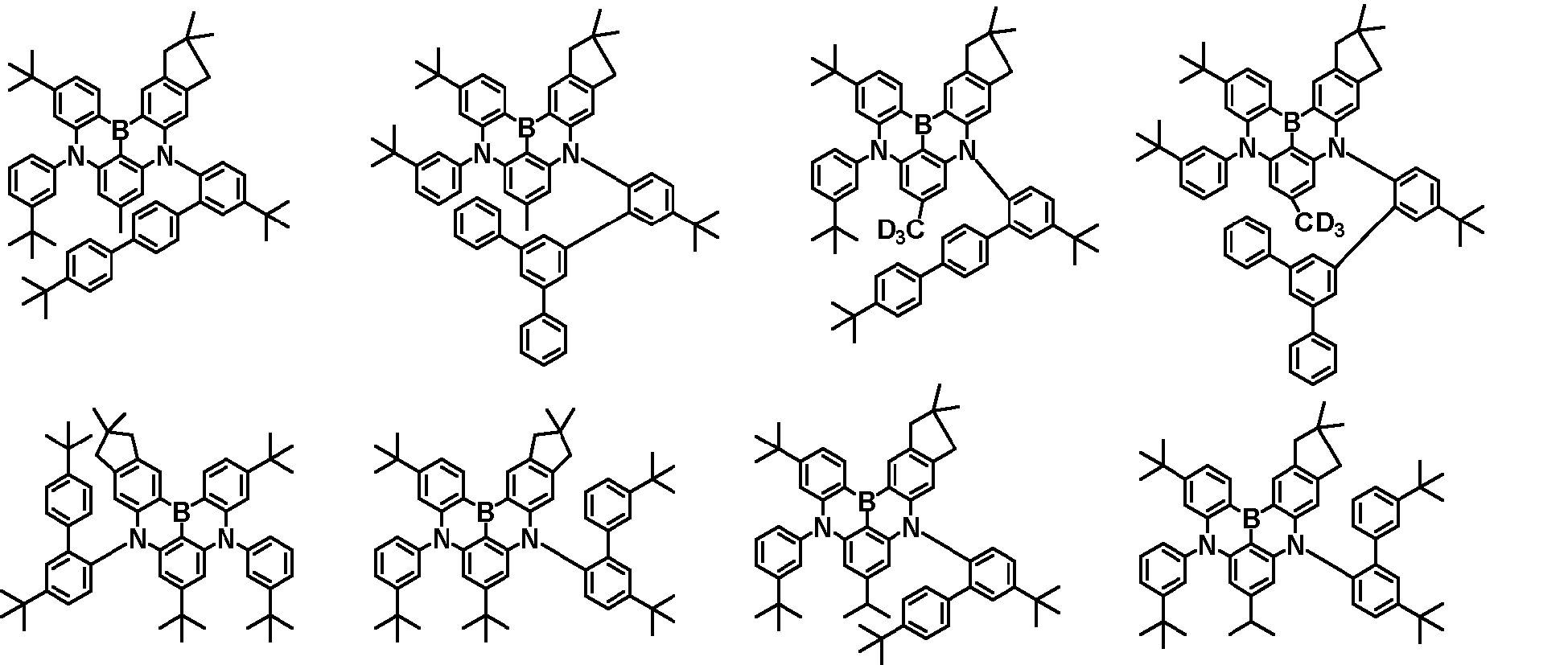


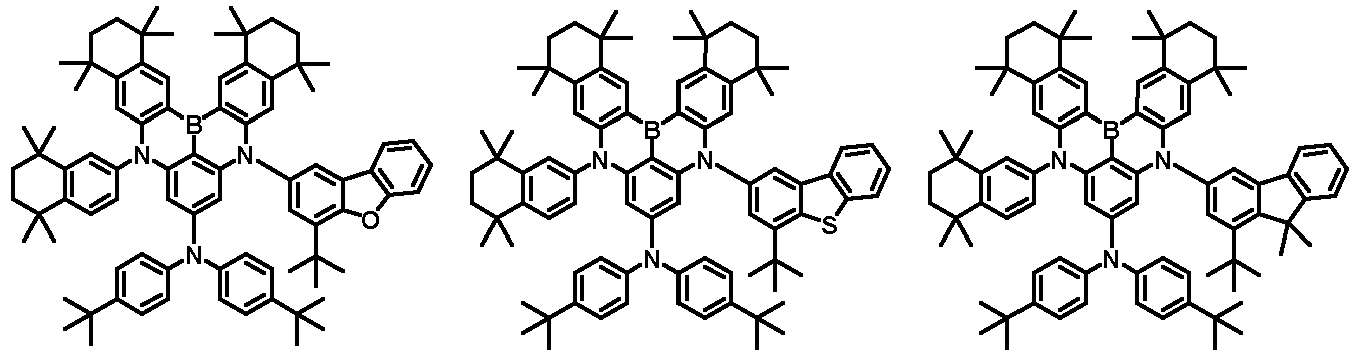








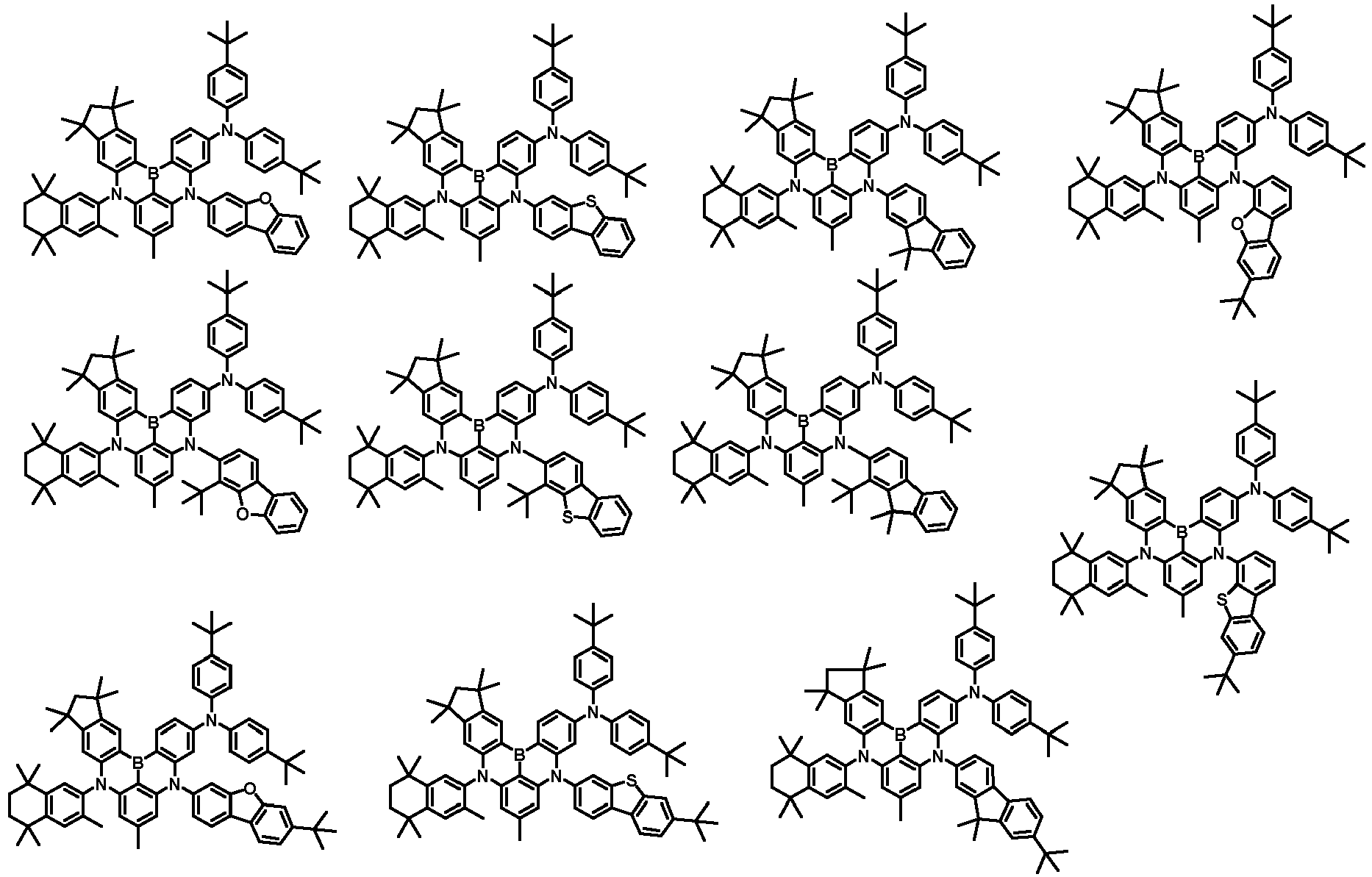

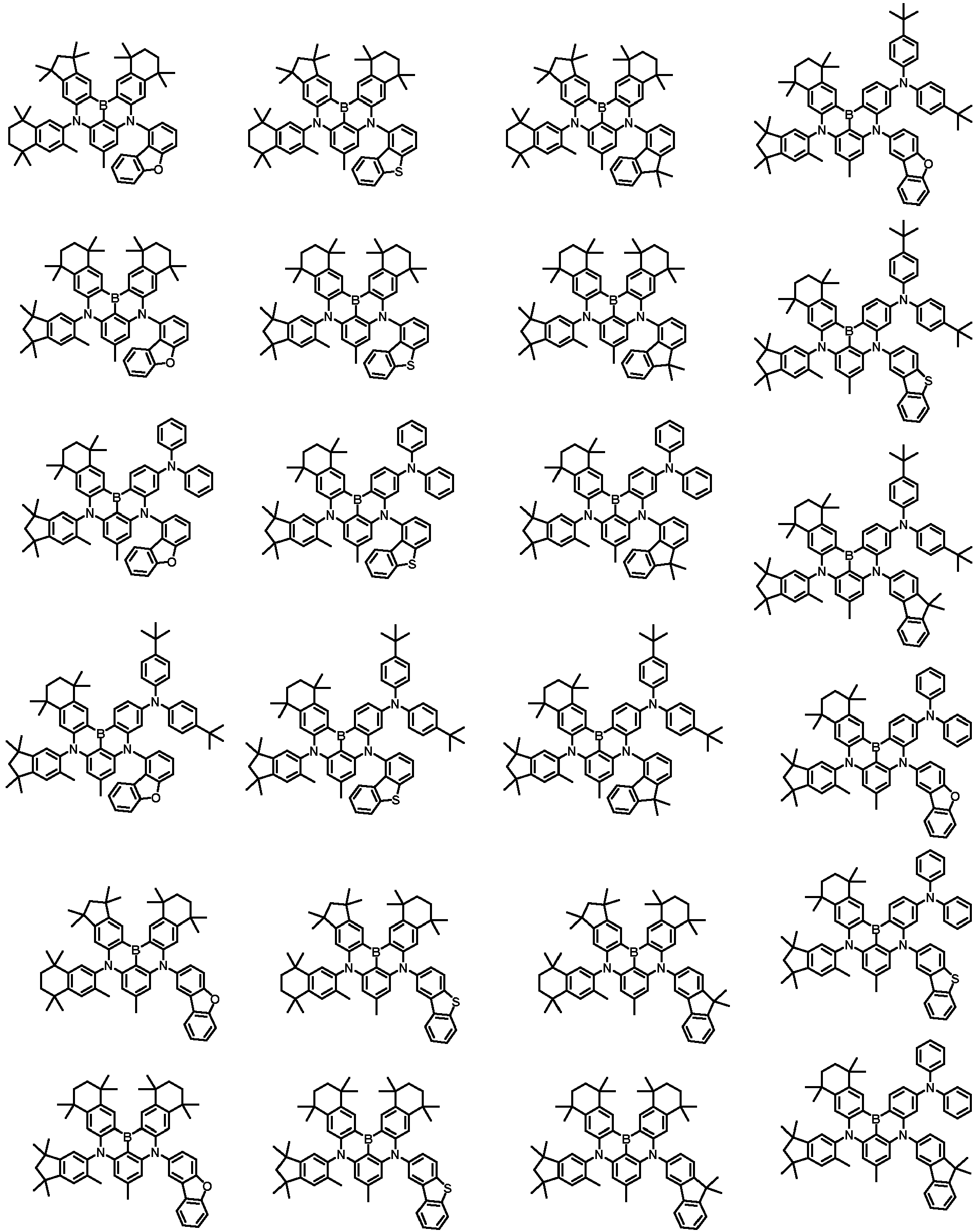





























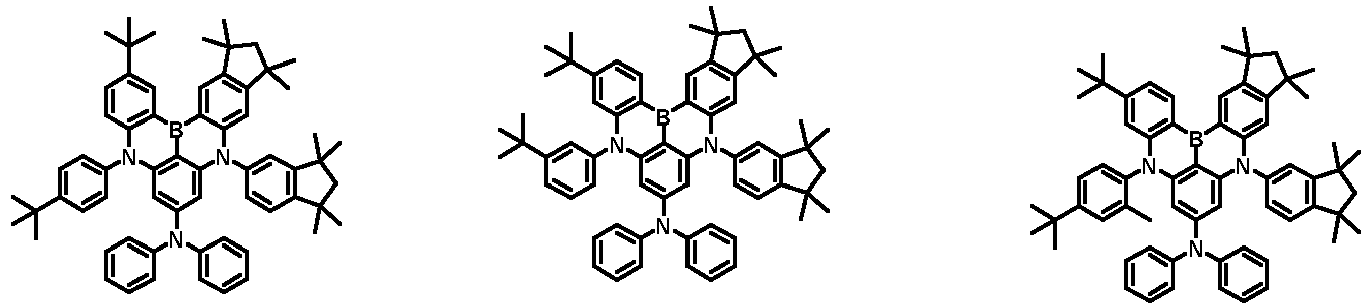


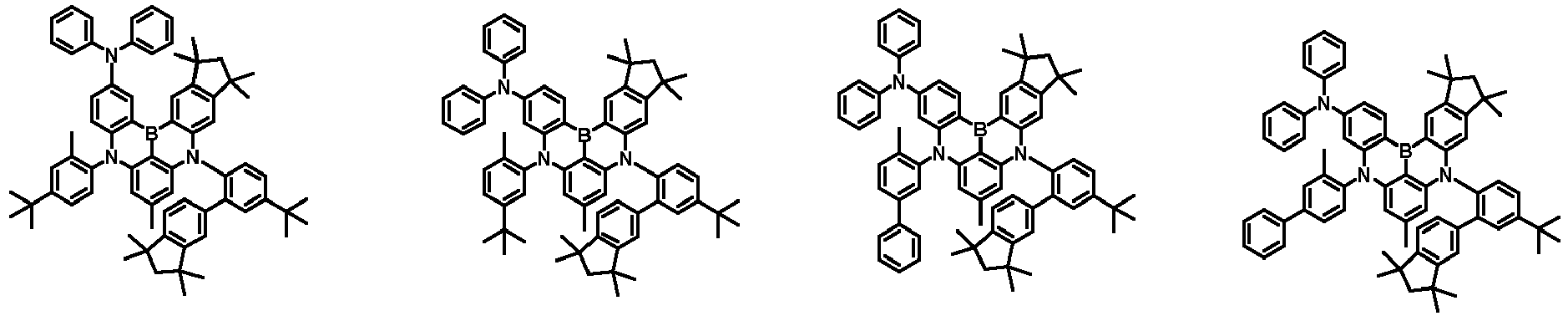














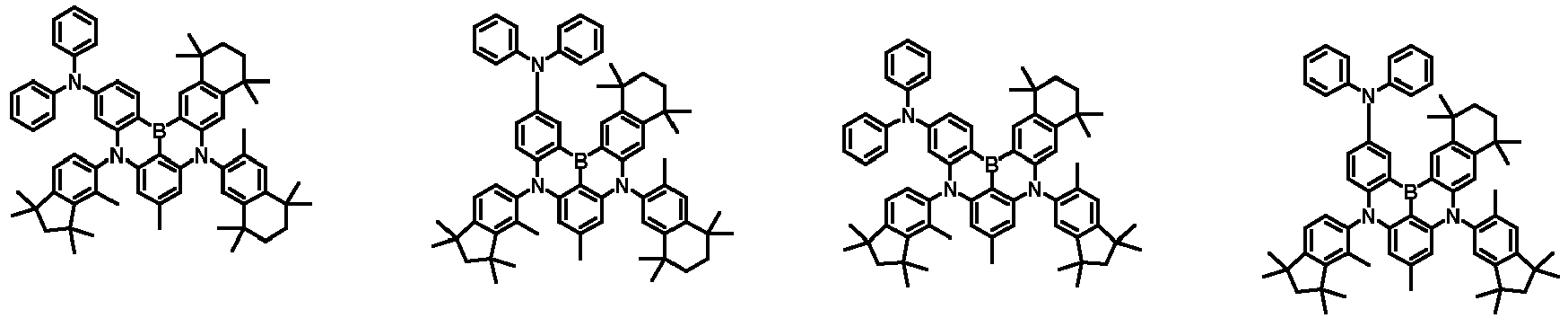

















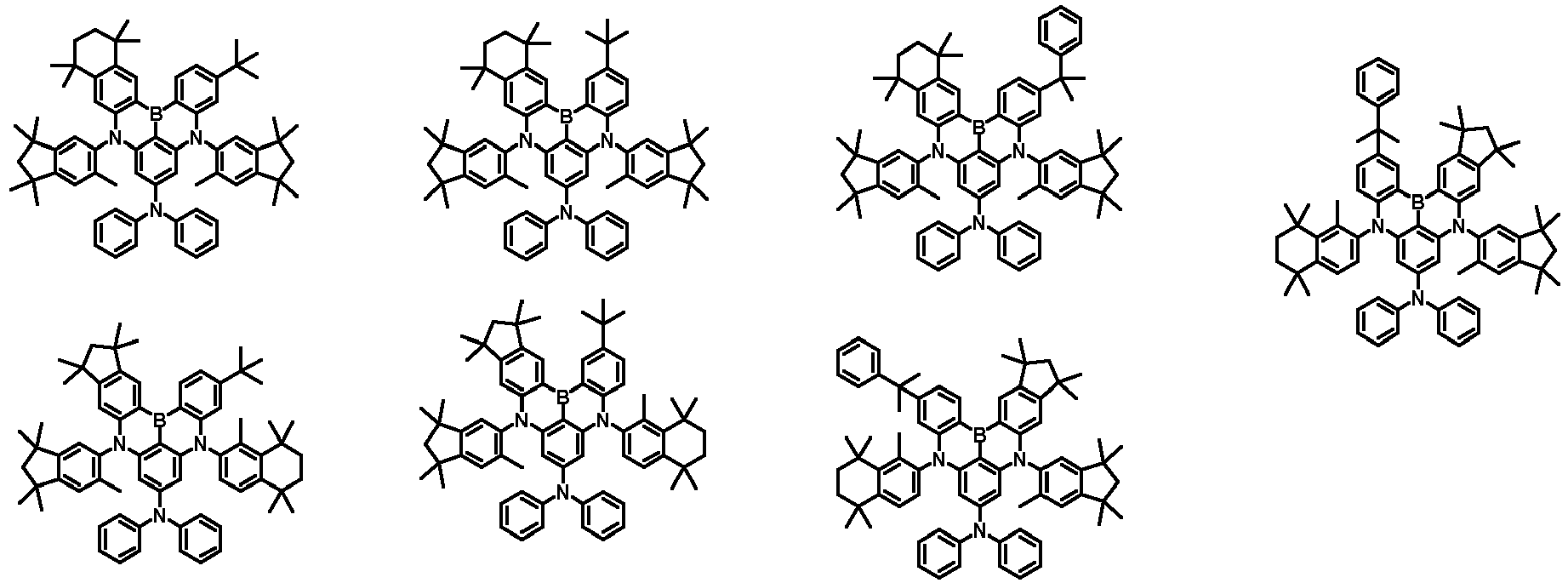




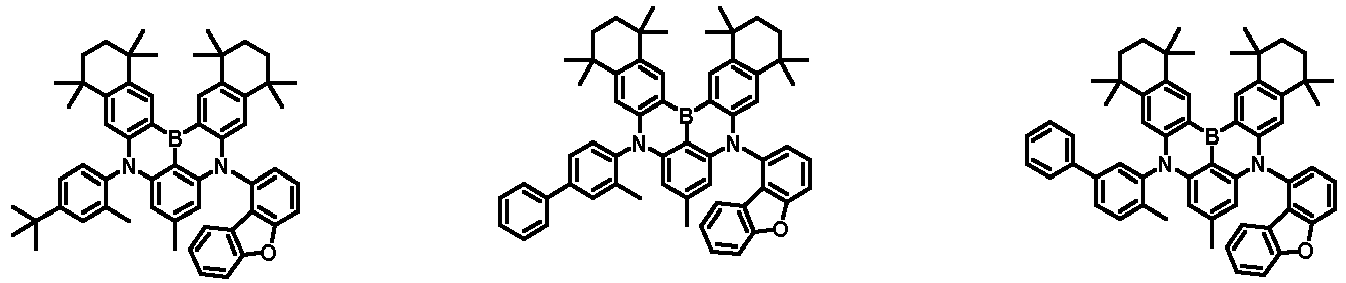





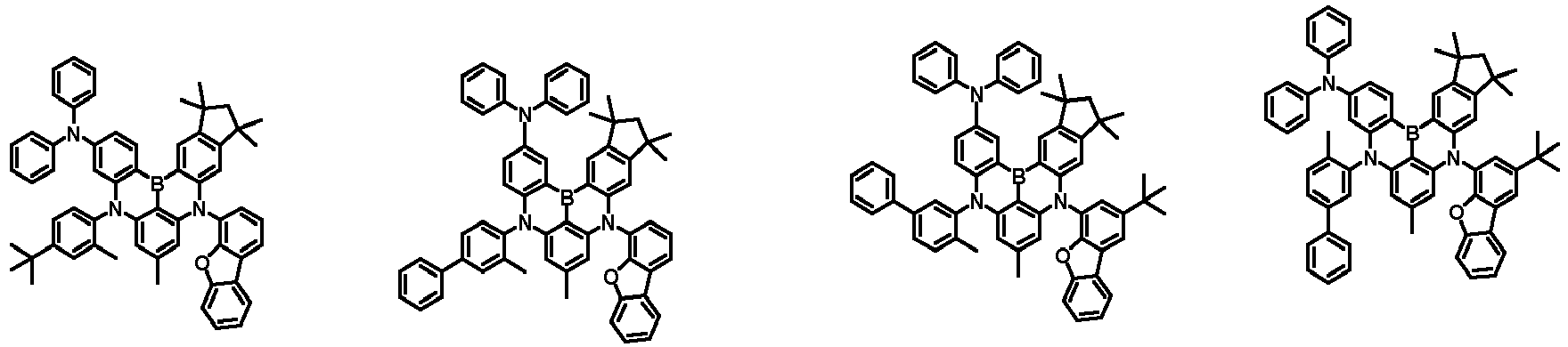




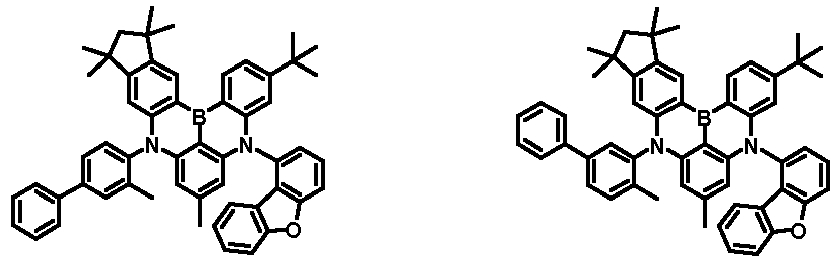


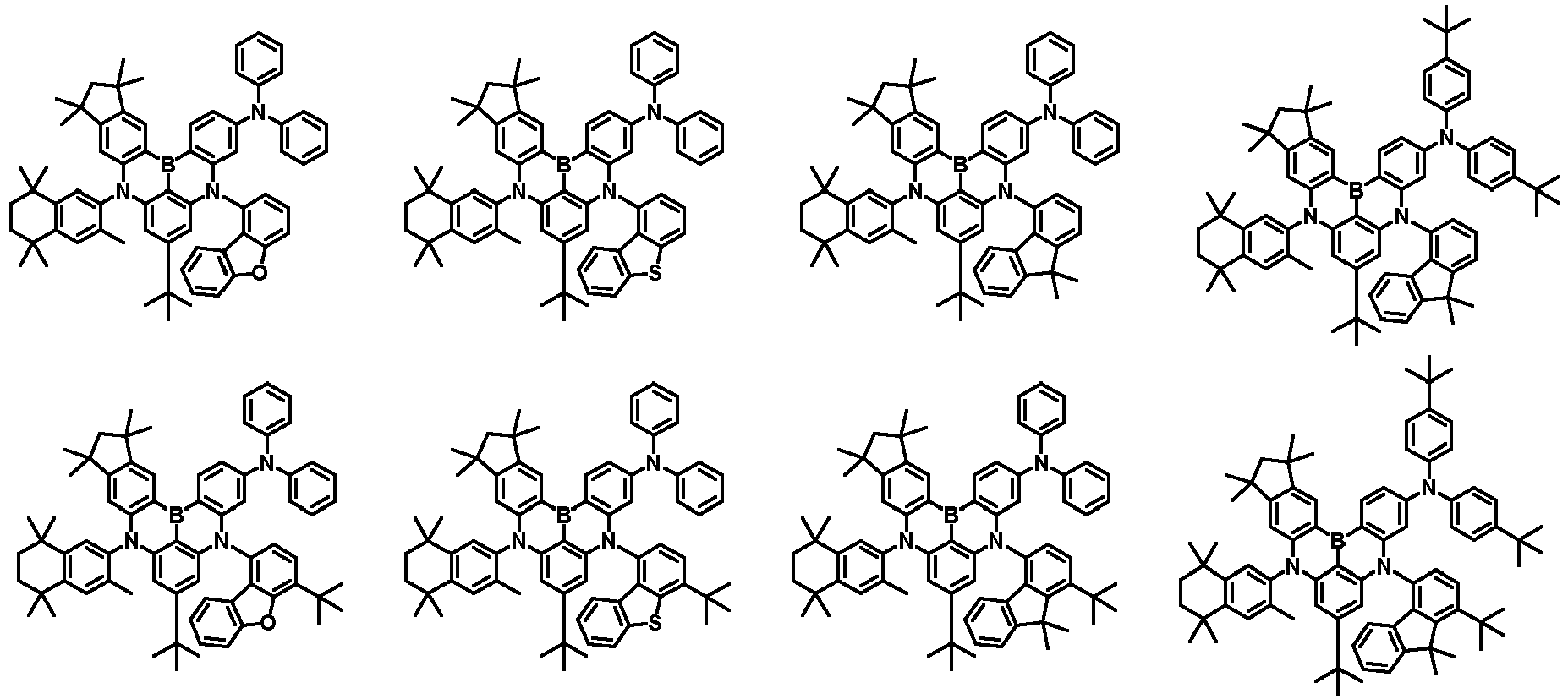
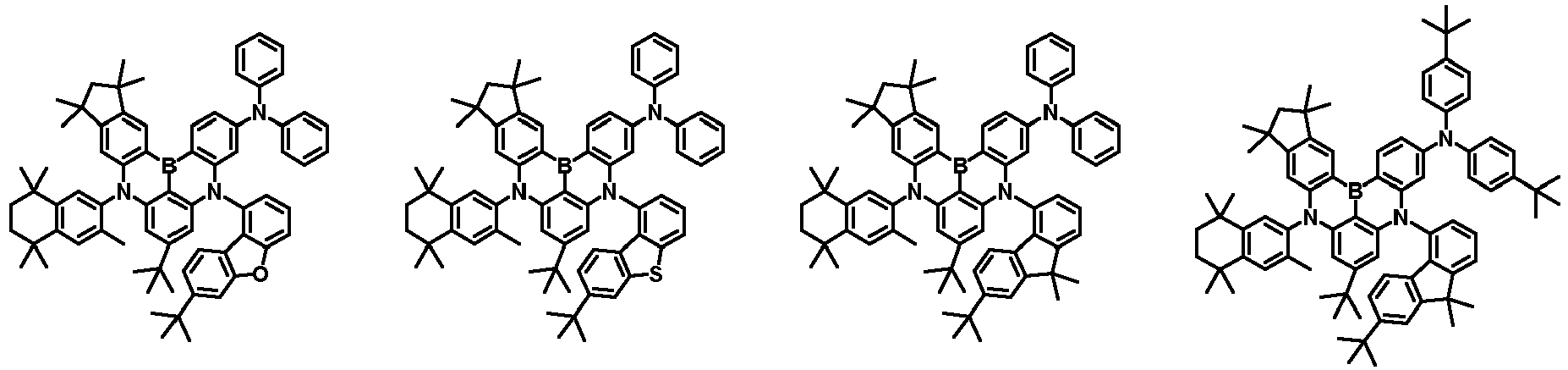


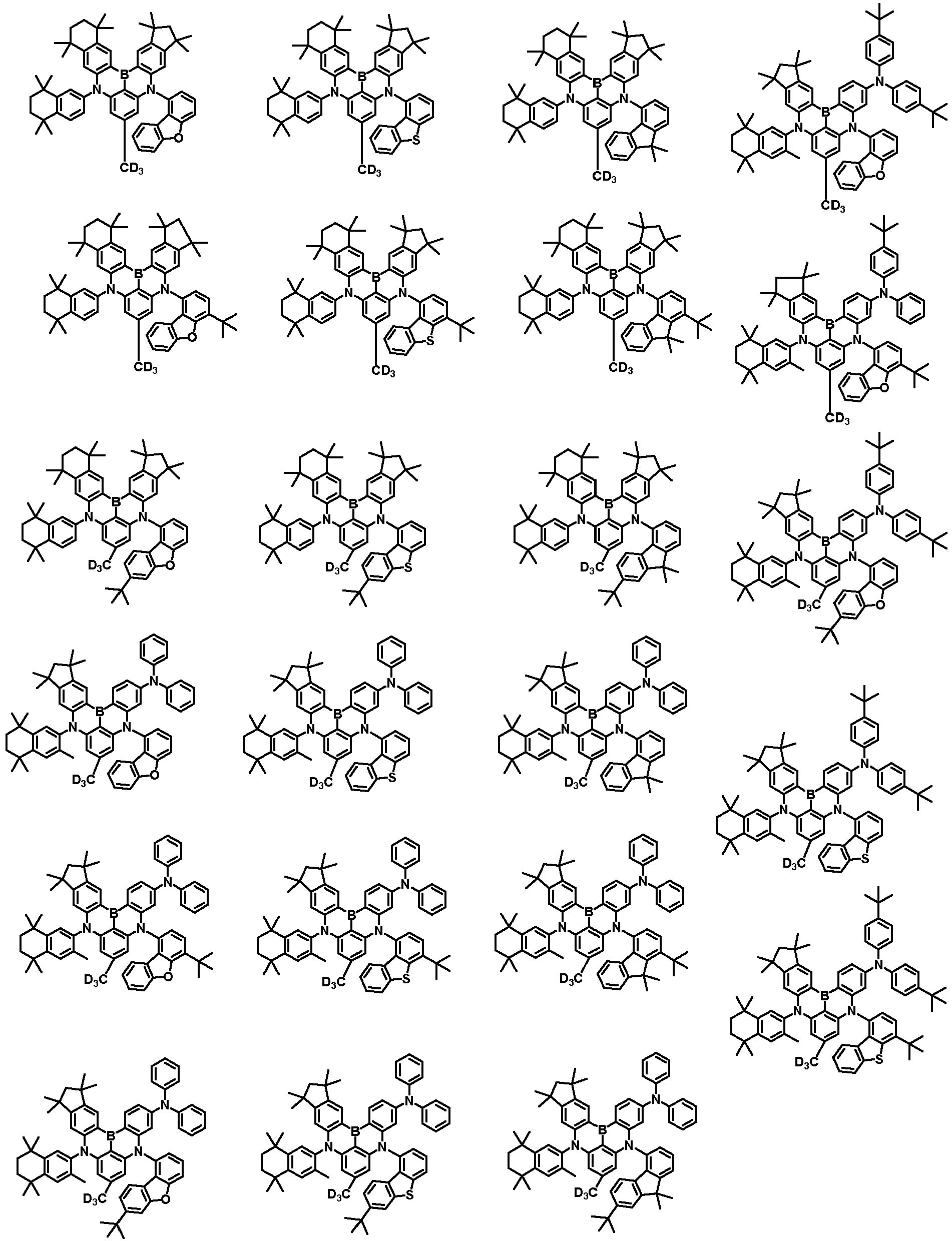


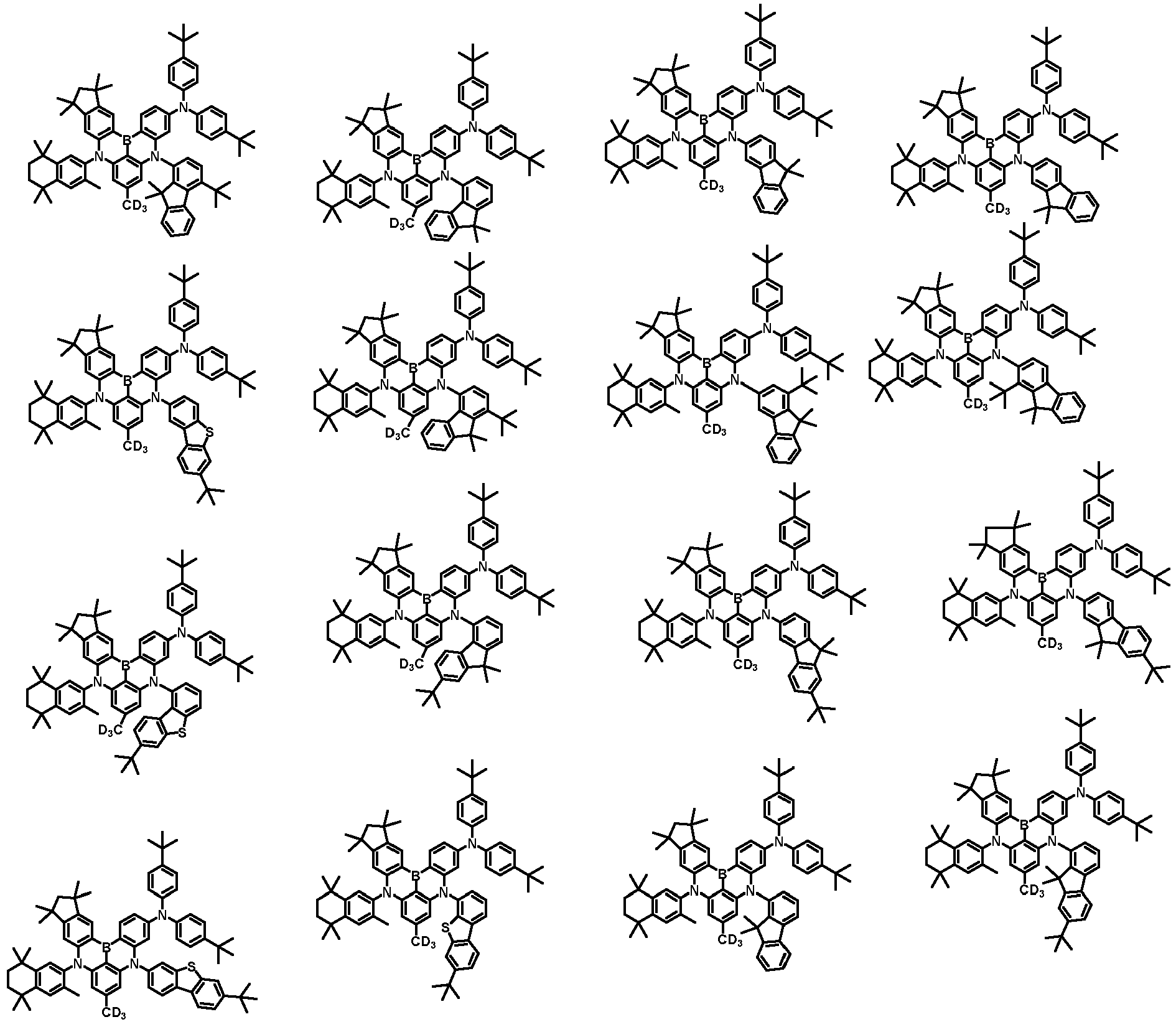


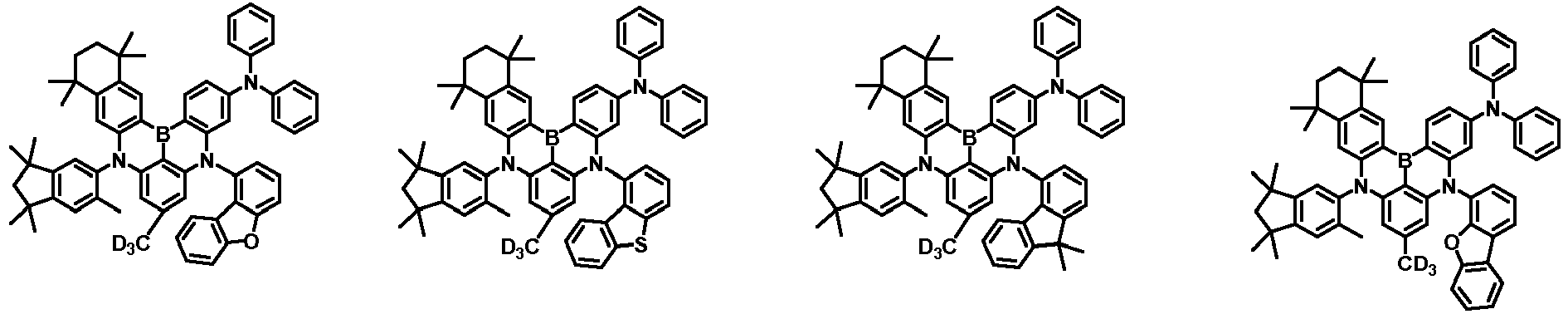
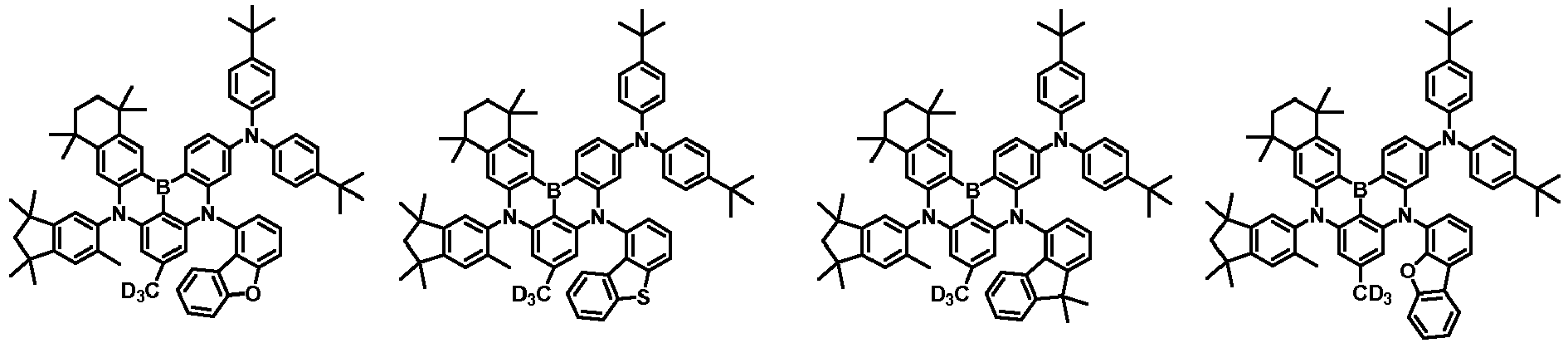


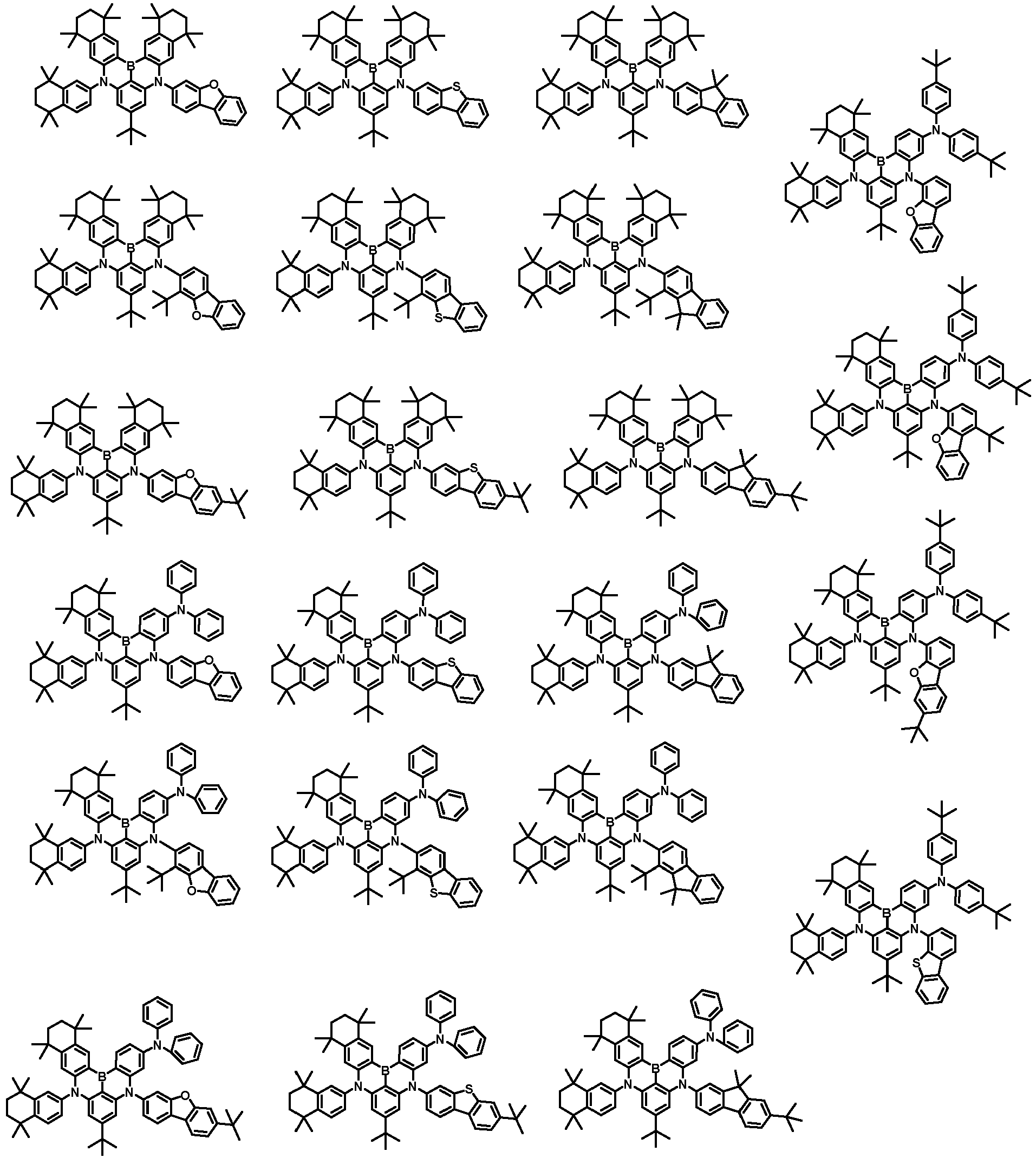

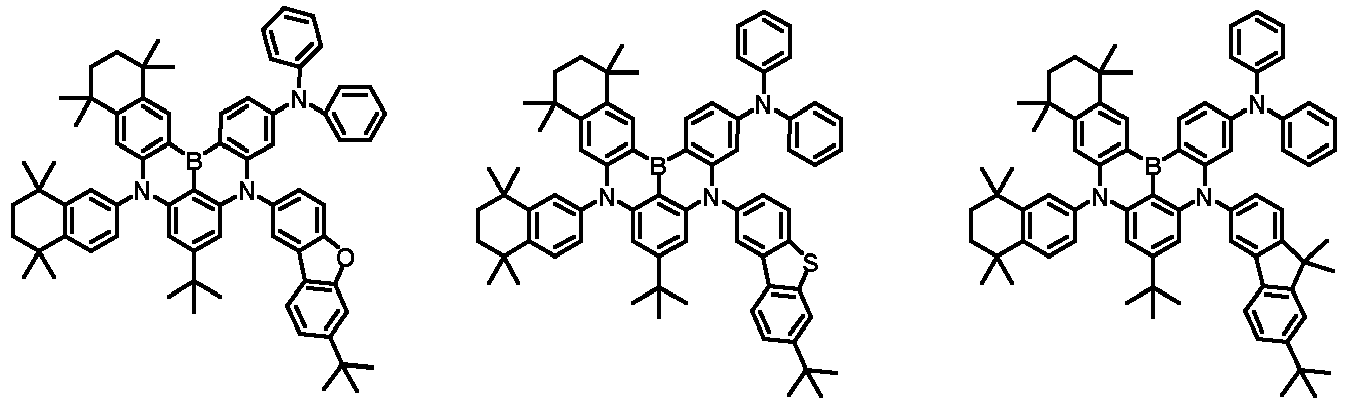


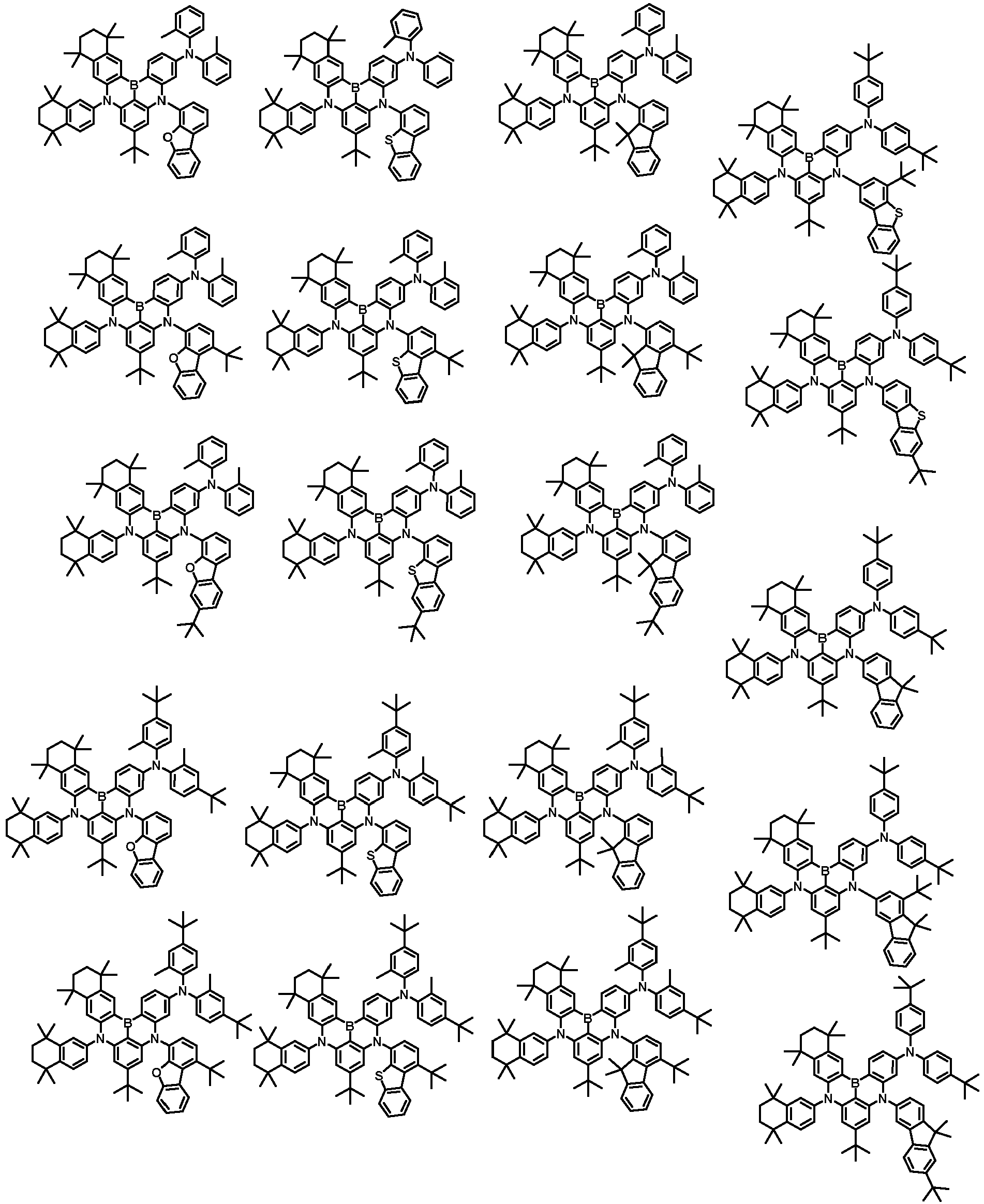


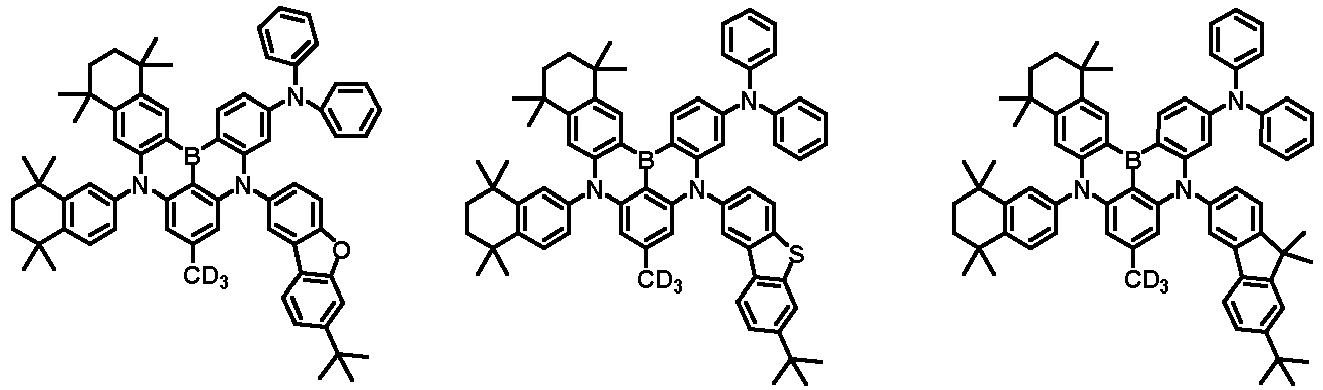

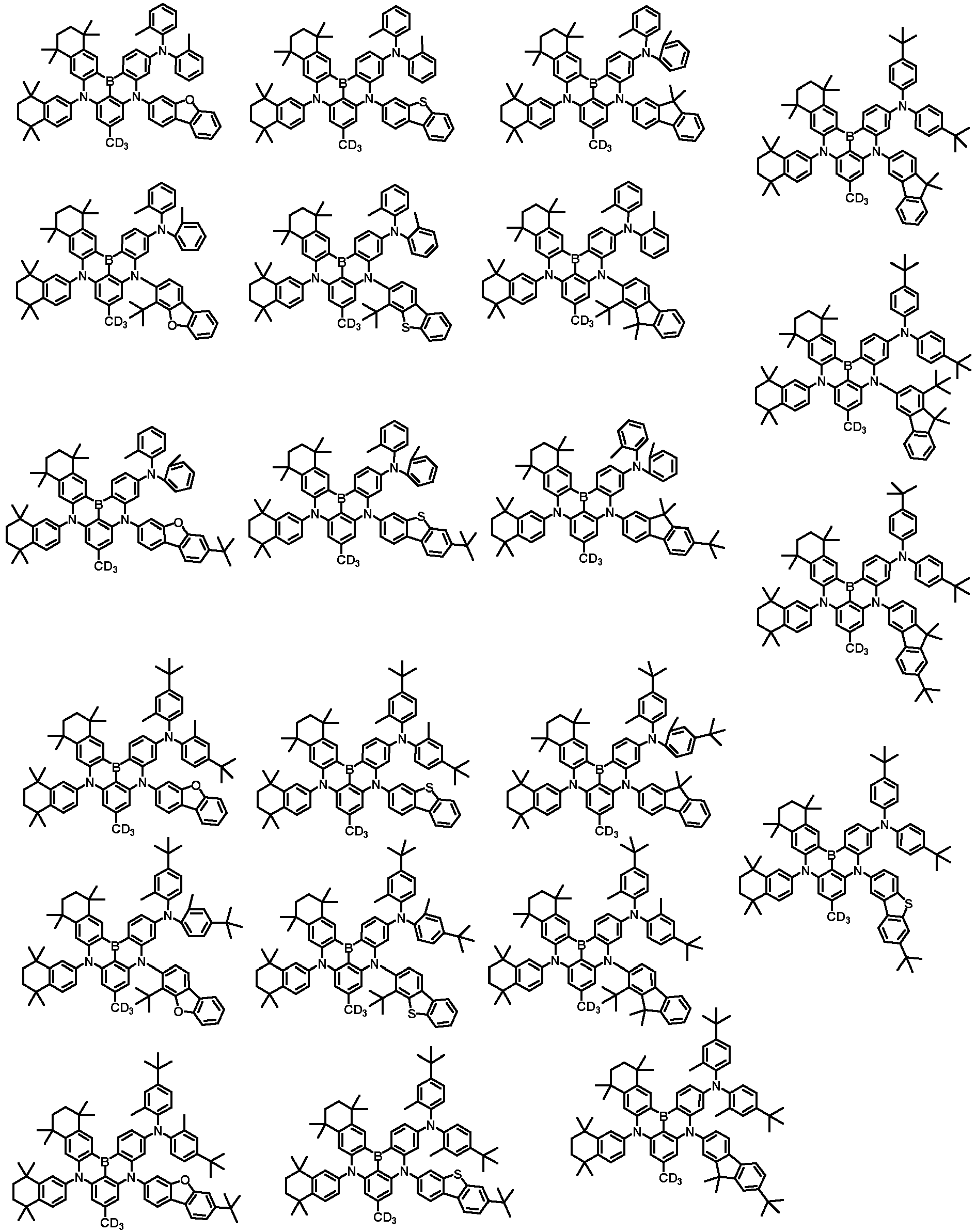











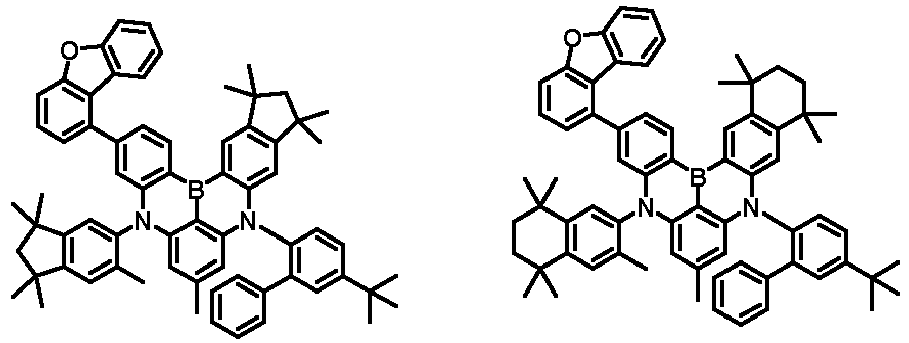





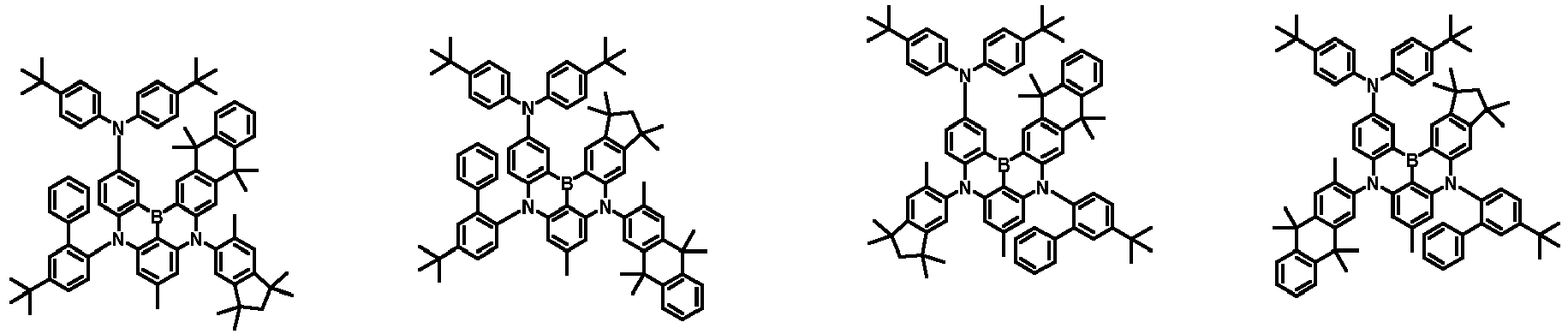


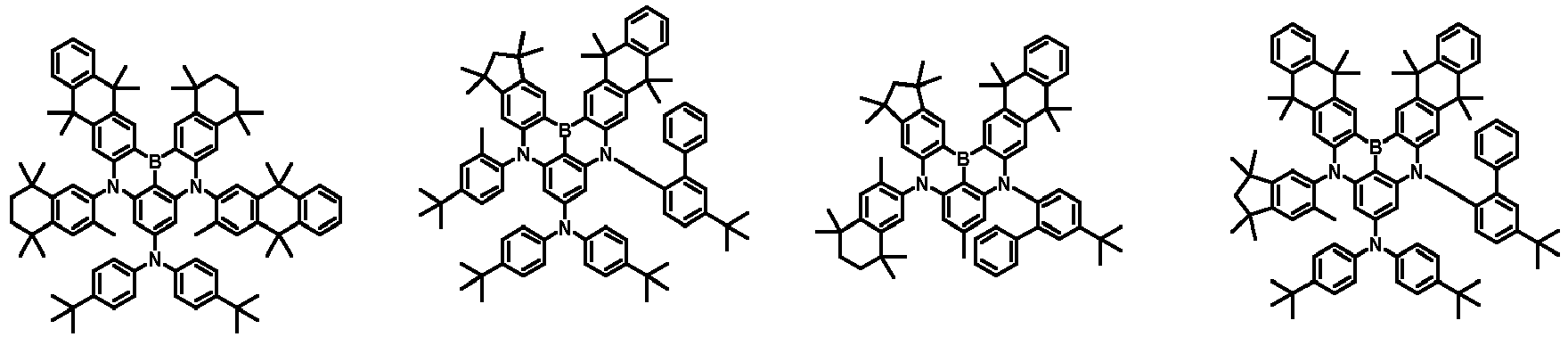


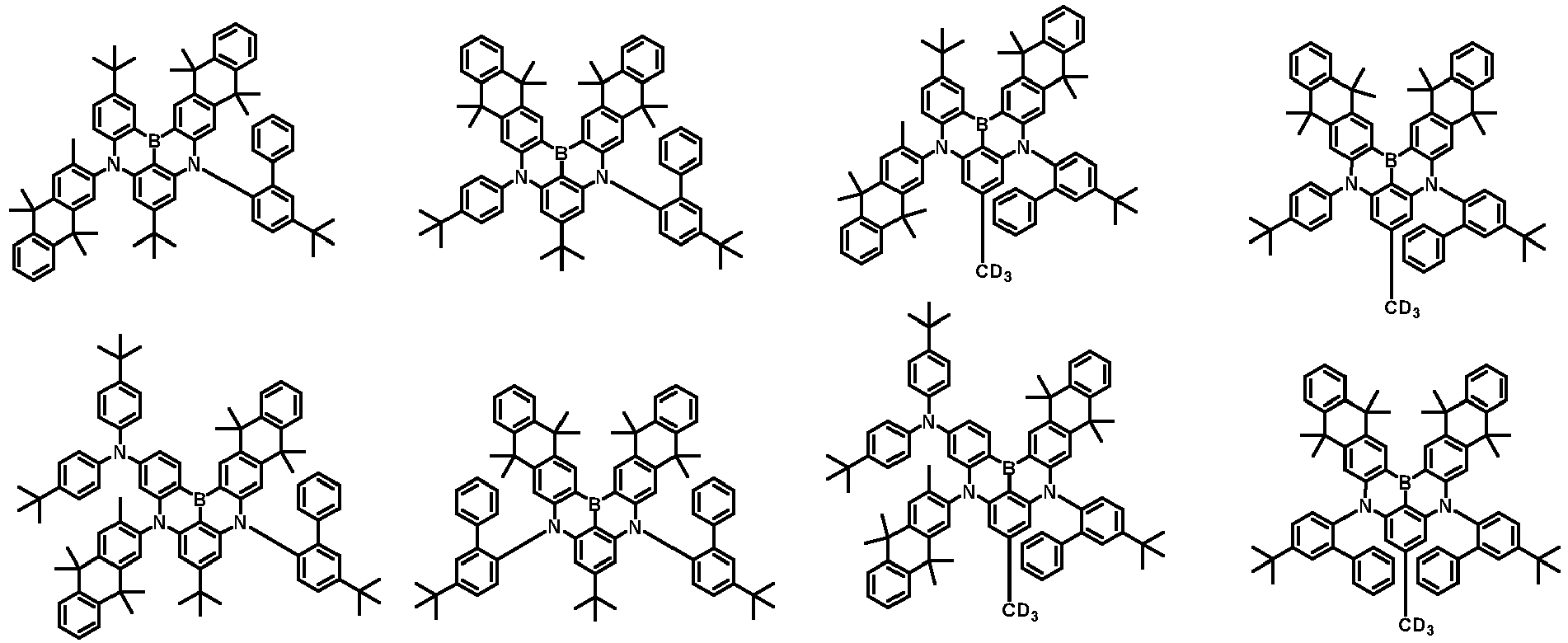

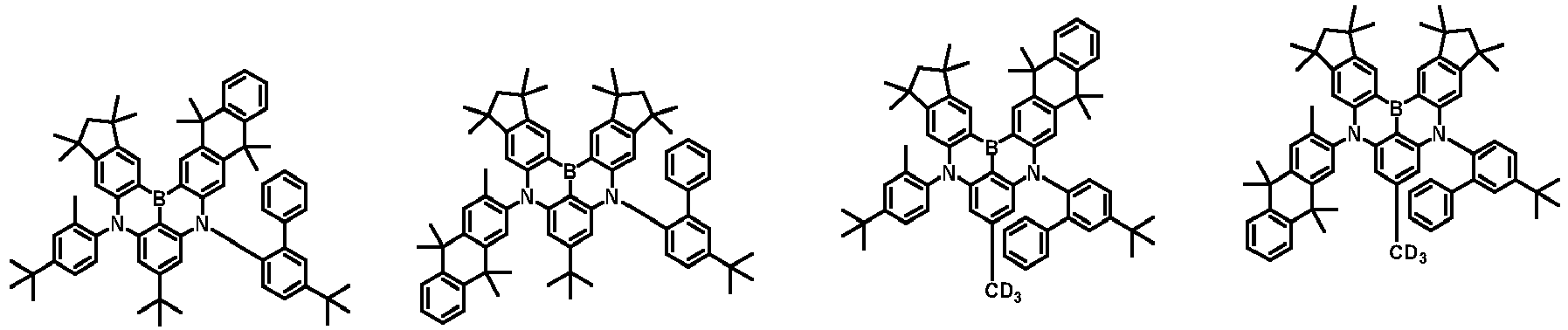





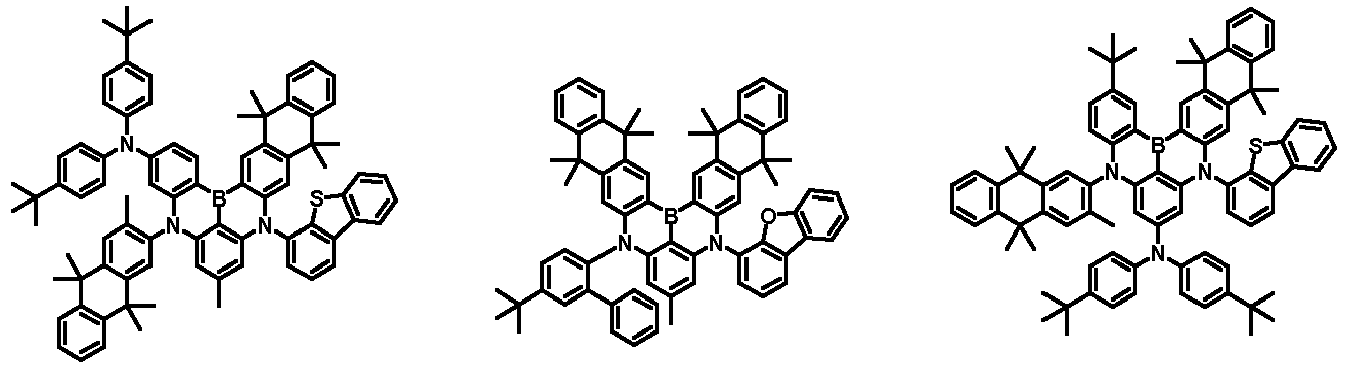


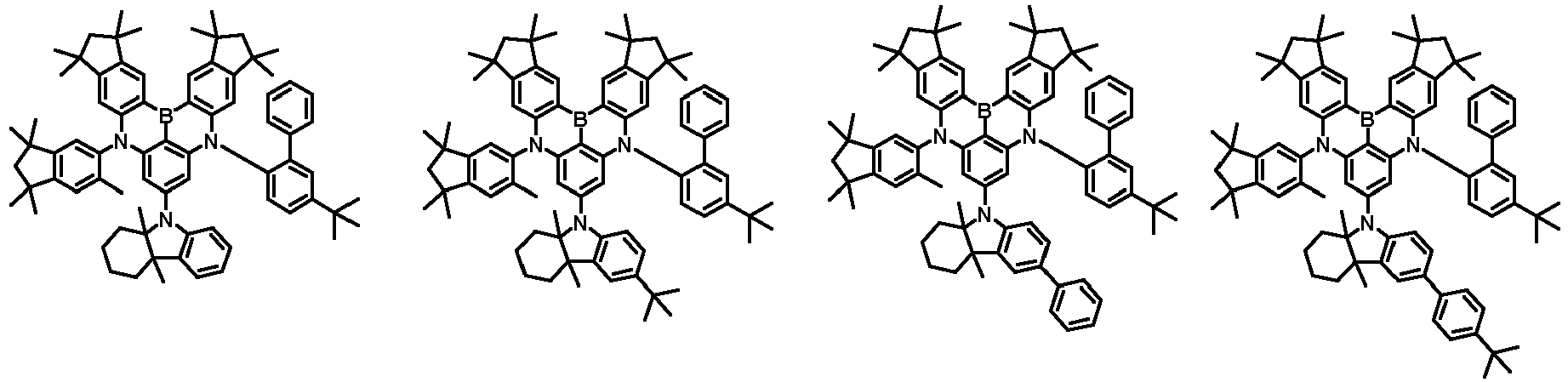


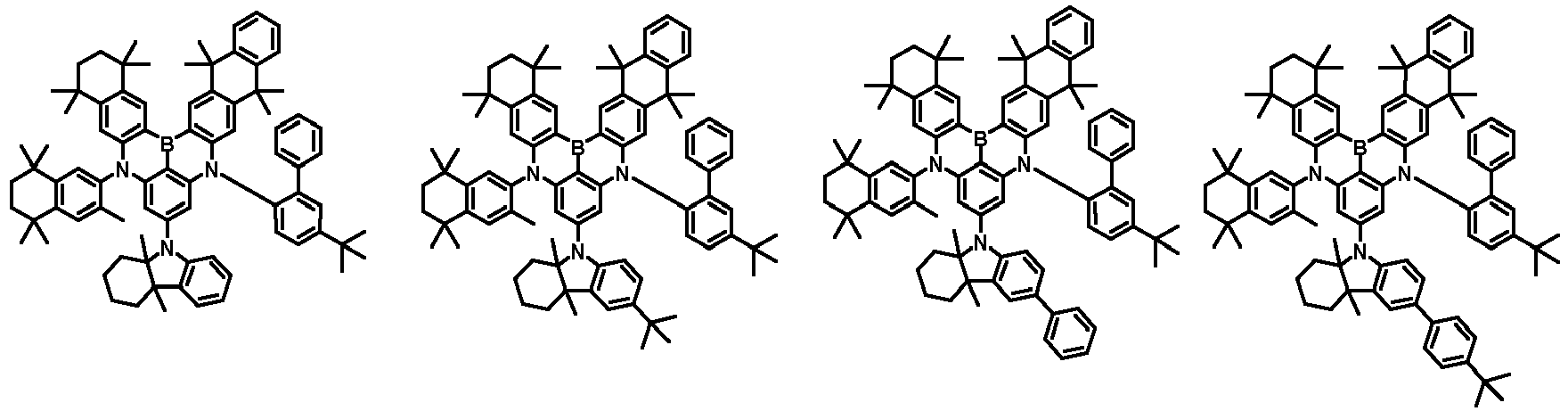
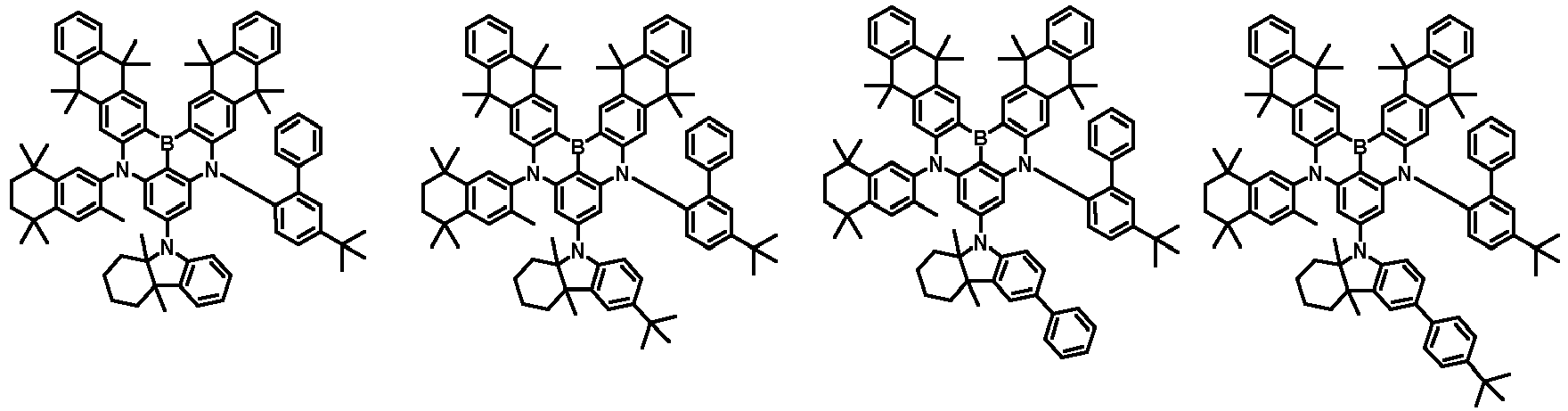


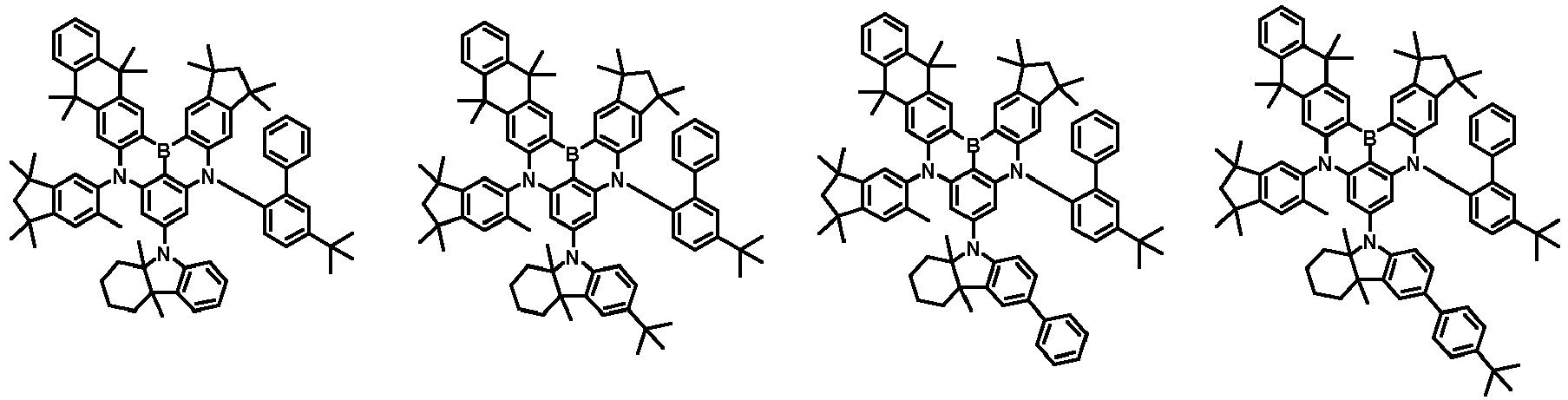


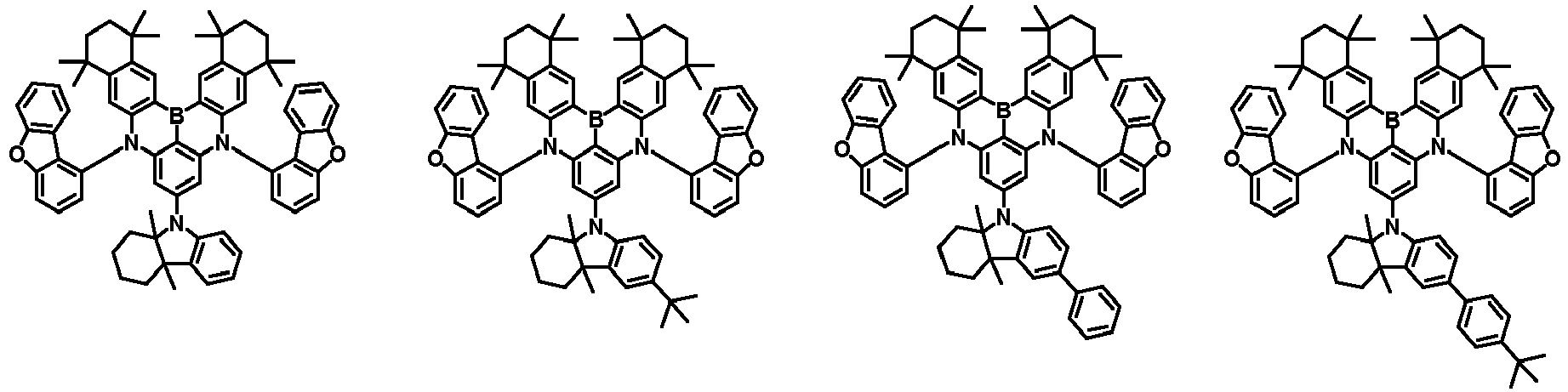


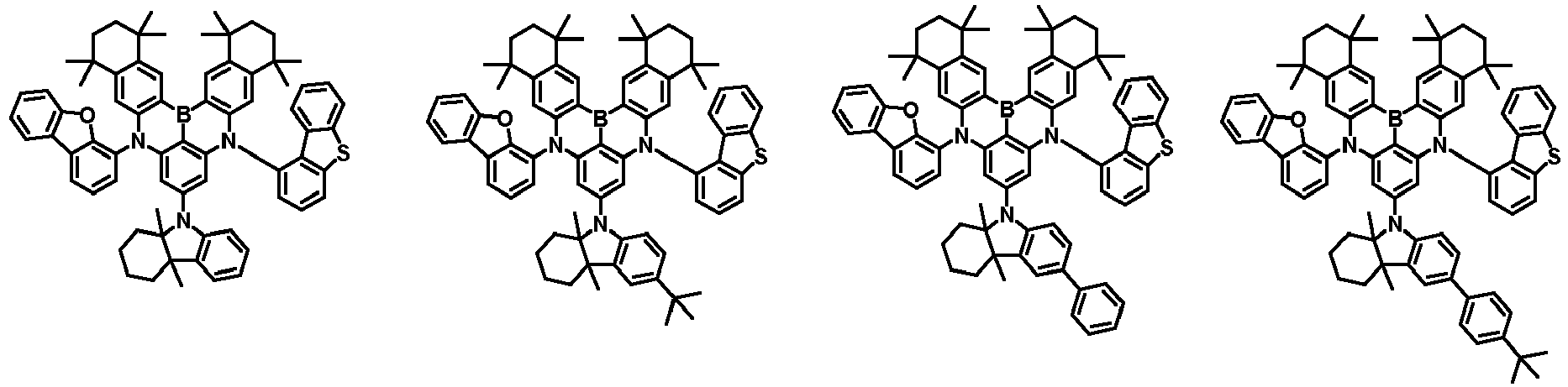


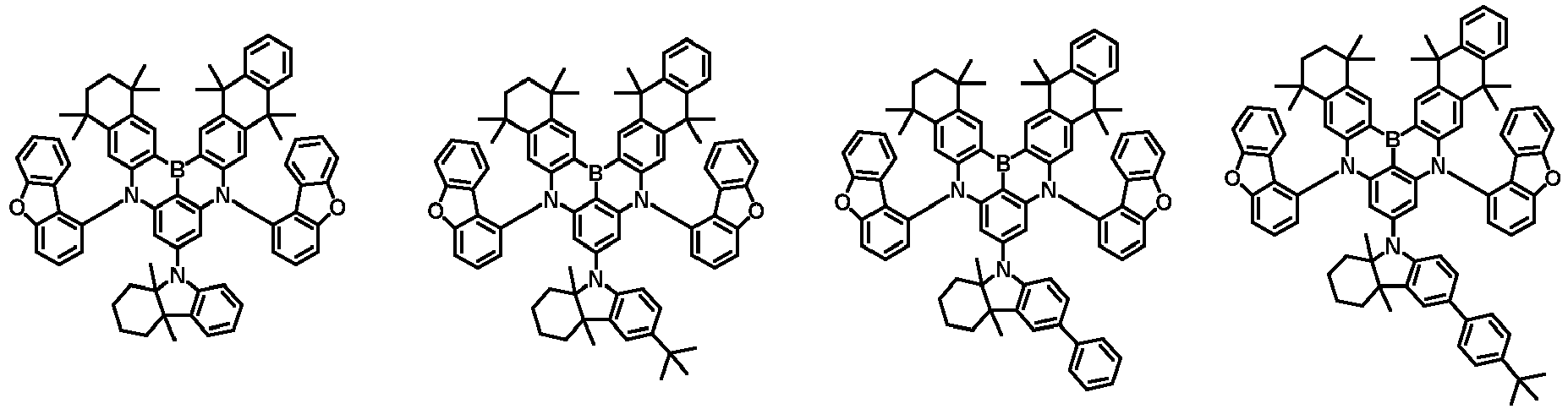


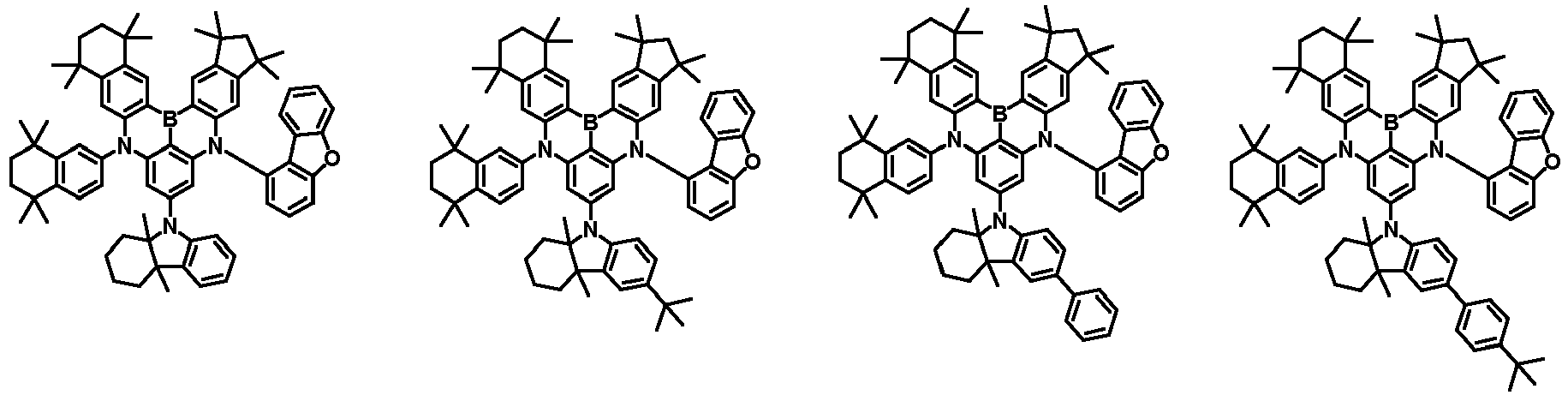





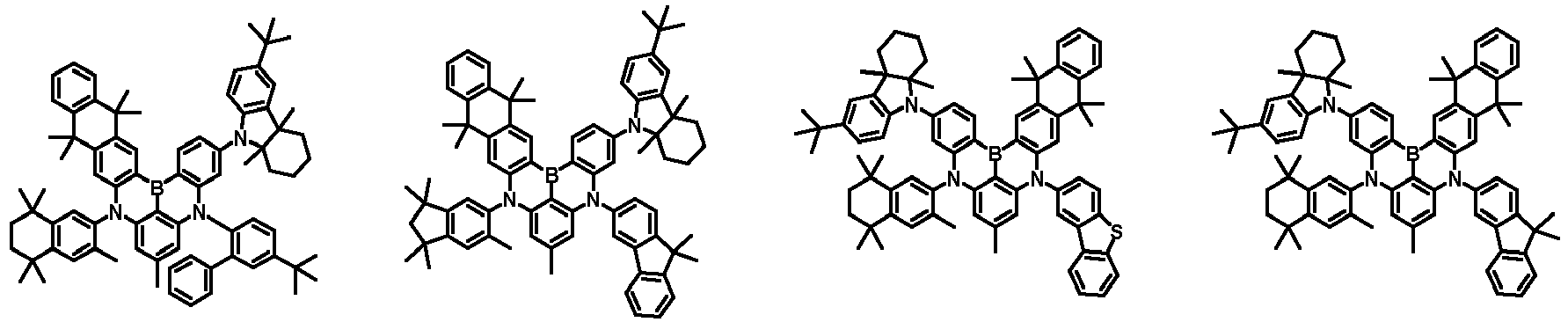









- An organic light emitting device comprising:a first electrode;a second electrode provided to face the first electrode; andan organic material layer having one or more layers provided between the first electrode and the second electrode,wherein one or more layers of the organic material layer comprise the polycyclic compound according to any one of claims 1 to 8.
- The organic light emitting device of claim 9, wherein the organic material layer comprises a light emitting layer, and the light emitting layer comprises the polycyclic compound.
- The organic light emitting device of claim 9, wherein the organic material layer comprises a light emitting layer, and
the light emitting layer comprises the polycyclic compound as a dopant of the light emitting layer, and a compound represented by the following Formula H as a host of the light emitting layer:
 L21 and L22 are the same as or different from each other, and are each independently a direct bond; a substituted or unsubstituted arylene group; or a substituted or unsubstituted heteroarylene group,Ar21 and Ar2 are the same as or different from each other, and are each independently a substituted or unsubstituted aryl group; or a substituted or unsubstituted heterocyclic group,R201 and R202 are the same as or different from each other, and are each independently hydrogen; deuterium; a halogen group; a substituted or unsubstituted alkyl group; a substituted or unsubstituted cycloalkyl group; a substituted or unsubstituted aryl group; or a substituted or unsubstituted heterocyclic group, andn202 is an integer from 0 to 7, and when n202 is 2 or higher, R202's are the same as or different from each other.
 - The organic light emitting device of claim 9, wherein the organic material layer further comprises one or two or more layers selected from the group consisting of a light emitting layer, a hole injection layer, a hole transport layer, an electron injection layer, an electron transport layer, an electron blocking layer, and a hole blocking layer.
Applications Claiming Priority (4)
| Application Number | Priority Date | Filing Date | Title |
|---|---|---|---|
| KR20190093157 | 2019-07-31 | ||
| KR20190156836 | 2019-11-29 | ||
| KR1020200065269A KR102239440B1 (en) | 2019-07-31 | 2020-05-29 | Multicyclic compound and organic light emitting device comprising the same |
| PCT/KR2020/010123 WO2021020928A2 (en) | 2019-07-31 | 2020-07-31 | Polycyclic compound and organic light-emitting element comprising same |
Publications (2)
| Publication Number | Publication Date |
|---|---|
| EP3901158A2 true EP3901158A2 (en) | 2021-10-27 |
| EP3901158A4 EP3901158A4 (en) | 2022-03-02 |
Family
ID=74560787
Family Applications (1)
| Application Number | Title | Priority Date | Filing Date |
|---|---|---|---|
| EP20847289.4A Pending EP3901158A4 (en) | 2019-07-31 | 2020-07-31 | POLYCYCLIC COMPOUND AND ORGANIC ELECTROLUMINESCENT ELEMENT COMPRISING THEM |
Country Status (5)
| Country | Link |
|---|---|
| US (1) | US12497415B2 (en) |
| EP (1) | EP3901158A4 (en) |
| JP (1) | JP7248229B2 (en) |
| KR (2) | KR102239440B1 (en) |
| CN (1) | CN113396151B (en) |
Cited By (1)
| Publication number | Priority date | Publication date | Assignee | Title |
|---|---|---|---|---|
| US12435098B2 (en) | 2019-11-29 | 2025-10-07 | Lg Chem, Ltd. | Heterocyclic compound and organic light-emitting device comprising same |
Families Citing this family (8)
| Publication number | Priority date | Publication date | Assignee | Title |
|---|---|---|---|---|
| JP7642946B2 (en) * | 2019-04-22 | 2025-03-11 | 学校法人関西学院 | Cycloalkane-fused polycyclic aromatic compounds |
| JP7650018B2 (en) * | 2019-08-30 | 2025-03-24 | 学校法人関西学院 | Polycyclic aromatic compounds |
| CN114106022A (en) * | 2020-08-31 | 2022-03-01 | 北京鼎材科技有限公司 | Organic compound for organic electroluminescent device and organic electroluminescent device |
| JP7710670B2 (en) * | 2020-12-07 | 2025-07-22 | エスケーマテリアルズジェイエヌシー株式会社 | Polycyclic aromatic compounds |
| KR102791674B1 (en) * | 2021-09-14 | 2025-04-03 | 주식회사 엘지화학 | Novel compound and organic light emitting device comprising the same |
| CN116120352B (en) * | 2022-12-12 | 2026-04-07 | 深圳市华星光电半导体显示技术有限公司 | Organic compounds, light-emitting elements and display panels |
| KR102737104B1 (en) * | 2023-04-12 | 2024-11-29 | 주식회사 엘지화학 | Organic compound and organic light emitting device comprising same |
| CN116332978B (en) * | 2023-05-30 | 2023-08-29 | 吉林奥来德光电材料股份有限公司 | An organic compound, its preparation method, and an organic electroluminescent device comprising it |
Family Cites Families (36)
| Publication number | Priority date | Publication date | Assignee | Title |
|---|---|---|---|---|
| JP5724588B2 (en) | 2011-04-28 | 2015-05-27 | コニカミノルタ株式会社 | ORGANIC ELECTROLUMINESCENT ELEMENT MATERIAL, ORGANIC ELECTROLUMINESCENT ELEMENT, DISPLAY DEVICE AND LIGHTING DEVICE |
| US10374166B2 (en) | 2014-02-18 | 2019-08-06 | Kwansei Gakuin Educational Foundation | Polycyclic aromatic compound |
| TWI636056B (en) | 2014-02-18 | 2018-09-21 | 學校法人關西學院 | Polycyclic aromatic compound and method for production the same, material for organic device and application thereof |
| KR102343144B1 (en) | 2014-10-17 | 2021-12-27 | 삼성디스플레이 주식회사 | Organic light-emitting devices |
| US10373062B2 (en) * | 2014-12-12 | 2019-08-06 | Omni Ai, Inc. | Mapper component for a neuro-linguistic behavior recognition system |
| TWI688137B (en) | 2015-03-24 | 2020-03-11 | 學校法人關西學院 | Organic electric field light-emitting element, display device and lighting device |
| JP6696971B2 (en) | 2015-03-25 | 2020-05-20 | 学校法人関西学院 | Polycyclic aromatic compound and composition for forming light emitting layer |
| EP3275442B1 (en) | 2015-03-25 | 2021-07-28 | National Cancer Center | Therapeutic agent for bile duct cancer |
| WO2017092508A1 (en) | 2015-12-04 | 2017-06-08 | 广州华睿光电材料有限公司 | D-a type compound and application thereof |
| WO2017126443A1 (en) | 2016-01-21 | 2017-07-27 | 学校法人関西学院 | Polycyclic aromatic compound |
| KR20250078582A (en) | 2016-02-10 | 2025-06-02 | 가꼬우 호징 관세이 가쿠잉 | Delayed fluorescent organic electric field light-emitting element |
| KR102148056B1 (en) | 2016-03-29 | 2020-08-25 | 주식회사 엘지화학 | Organic light emitting device |
| US10686141B2 (en) | 2016-09-07 | 2020-06-16 | Kwansei Gakuin Educational Foundation | Polycyclic aromatic compound |
| US11239428B2 (en) | 2016-11-23 | 2022-02-01 | Guangzhou Chinaray Optoelectronic Materials Ltd. | Boron-containing organic compound and applications thereof, organic mixture, and organic electronic device |
| CN109790463B (en) | 2017-03-09 | 2022-02-08 | 株式会社Lg化学 | Organic light emitting device |
| CN109564973B (en) | 2017-03-30 | 2023-03-31 | 株式会社Lg化学 | Organic light emitting device |
| JP2018174279A (en) | 2017-03-31 | 2018-11-08 | 国立大学法人九州大学 | Organic semiconductor laser element |
| WO2018186404A1 (en) | 2017-04-03 | 2018-10-11 | 出光興産株式会社 | Organic electroluminescent element and electronic device |
| KR102053324B1 (en) | 2017-05-02 | 2019-12-06 | 주식회사 엘지화학 | Novel compound and organic light emitting device comprising the same |
| KR101876763B1 (en) | 2017-05-22 | 2018-07-11 | 머티어리얼사이언스 주식회사 | Organic compound and organic electroluminescent device comprising the same |
| CN107417715A (en) | 2017-07-14 | 2017-12-01 | 瑞声科技(南京)有限公司 | A kind of electroluminescent organic material and its luminescent device |
| US12239016B2 (en) | 2017-09-19 | 2025-02-25 | Lg Chem, Ltd. | Organic light emitting element |
| KR102117765B1 (en) * | 2017-09-28 | 2020-06-02 | 주식회사 엘지화학 | Multicyclic compound and organic light emitting device comprising the same |
| KR102141284B1 (en) | 2017-11-06 | 2020-08-05 | 주식회사 엘지화학 | Multicyclic compound and organic light emitting device comprising the same |
| JP6967433B2 (en) | 2017-11-27 | 2021-11-17 | エスケーマテリアルズジェイエヌシー株式会社 | Organic electroluminescent device |
| US11594690B2 (en) | 2017-12-14 | 2023-02-28 | Guangzhou Chinaray Optoelectronic Materials Ltd. | Organometallic complex, and polymer, mixture and formulation comprising same, and use thereof in electronic device |
| KR102134523B1 (en) * | 2017-12-26 | 2020-07-16 | 주식회사 엘지화학 | Compound and organic light emitting device comprising the same |
| KR102404399B1 (en) | 2018-01-08 | 2022-06-02 | 주식회사 엘지화학 | Organic light emitting device |
| KR20200139684A (en) | 2018-04-05 | 2020-12-14 | 이데미쓰 고산 가부시키가이샤 | Organic electroluminescence device and electronic device |
| KR101990818B1 (en) | 2018-05-04 | 2019-06-19 | 머티어리얼사이언스 주식회사 | Organic electroluminescent device |
| CN110492009B (en) | 2018-05-14 | 2020-11-10 | 江苏三月科技股份有限公司 | An electroluminescent device based on exciplex system with boron-containing organic compounds |
| WO2020017931A1 (en) * | 2018-07-19 | 2020-01-23 | 주식회사 엘지화학 | Polycyclic compound and organic light-emitting device comprising same |
| WO2020054676A1 (en) | 2018-09-10 | 2020-03-19 | 学校法人関西学院 | Organic electroluminescent element |
| JP7642946B2 (en) * | 2019-04-22 | 2025-03-11 | 学校法人関西学院 | Cycloalkane-fused polycyclic aromatic compounds |
| CN118742080A (en) | 2019-05-15 | 2024-10-01 | 株式会社Lg化学 | Organic light-emitting devices |
| JP7650018B2 (en) | 2019-08-30 | 2025-03-24 | 学校法人関西学院 | Polycyclic aromatic compounds |
-
2020
- 2020-05-29 KR KR1020200065269A patent/KR102239440B1/en active Active
- 2020-07-31 CN CN202080010225.9A patent/CN113396151B/en active Active
- 2020-07-31 US US17/423,185 patent/US12497415B2/en active Active
- 2020-07-31 JP JP2021540053A patent/JP7248229B2/en active Active
- 2020-07-31 EP EP20847289.4A patent/EP3901158A4/en active Pending
-
2021
- 2021-04-01 KR KR1020210042703A patent/KR20210038531A/en not_active Withdrawn
Cited By (1)
| Publication number | Priority date | Publication date | Assignee | Title |
|---|---|---|---|---|
| US12435098B2 (en) | 2019-11-29 | 2025-10-07 | Lg Chem, Ltd. | Heterocyclic compound and organic light-emitting device comprising same |
Also Published As
| Publication number | Publication date |
|---|---|
| CN113396151A (en) | 2021-09-14 |
| CN113396151B (en) | 2024-04-05 |
| US20230077439A1 (en) | 2023-03-16 |
| JP2022542626A (en) | 2022-10-06 |
| JP7248229B2 (en) | 2023-03-29 |
| KR20210015623A (en) | 2021-02-10 |
| EP3901158A4 (en) | 2022-03-02 |
| KR20210038531A (en) | 2021-04-07 |
| US12497415B2 (en) | 2025-12-16 |
| KR102239440B1 (en) | 2021-04-13 |
Similar Documents
| Publication | Publication Date | Title |
|---|---|---|
| KR102216430B1 (en) | Multicyclic compound and organic light emitting device comprising the same | |
| EP3901158A2 (en) | Polycyclic compound and organic light-emitting element comprising same | |
| KR102053569B1 (en) | Multicyclic compound and organic light emitting device comprising the same | |
| KR102227043B1 (en) | Polycyclic compound and organic light emitting device comprising same | |
| KR102391296B1 (en) | Organic light emitting device | |
| KR102798036B1 (en) | Organic light emitting device comprising organic compound | |
| KR20190078541A (en) | Compound and organic light emitting device comprising the same | |
| EP3339293B1 (en) | Compound and organic electronic device comprising same | |
| KR102453982B1 (en) | Multicyclic compound and organic light emitting device comprising same | |
| KR102191157B1 (en) | Multicyclic compound and organic light emitting device comprising the same | |
| KR102237174B1 (en) | Polycyclic compound and organic light emitting device comprising the same | |
| KR102209926B1 (en) | Polycyclic compound and organic light emitting device comprising the same | |
| KR20200080188A (en) | Compound and organic light emitting device comprising the same | |
| KR102382164B1 (en) | Compound and organic light emitting device comprising same | |
| KR102230987B1 (en) | Multicyclic compound and organic light emitting device comprising the same | |
| KR20230073104A (en) | Compound and organic light emitting device comprising same | |
| KR102256782B1 (en) | Multicyclic compound and organic light emitting device comprising the same | |
| KR20230032260A (en) | Compound and organic light emitting device comprising the same | |
| KR102922662B1 (en) | Compound and organic light emitting device comprising the same | |
| KR102247292B1 (en) | Multicyclic compound and organic light emitting device comprising the same | |
| KR102405393B1 (en) | Organic light emitting device | |
| KR102875402B1 (en) | Heterocyclic compound and organic light emitting device comprising the same | |
| KR20230028184A (en) | Compound and organic light emitting device comprising the same | |
| KR20230028183A (en) | Compound and organic light emitting device comprising the same | |
| KR20230038348A (en) | Compound and organic light emitting device comprising the same |
Legal Events
| Date | Code | Title | Description |
|---|---|---|---|
| STAA | Information on the status of an ep patent application or granted ep patent |
Free format text: STATUS: THE INTERNATIONAL PUBLICATION HAS BEEN MADE |
|
| PUAI | Public reference made under article 153(3) epc to a published international application that has entered the european phase |
Free format text: ORIGINAL CODE: 0009012 |
|
| STAA | Information on the status of an ep patent application or granted ep patent |
Free format text: STATUS: REQUEST FOR EXAMINATION WAS MADE |
|
| 17P | Request for examination filed |
Effective date: 20210721 |
|
| AK | Designated contracting states |
Kind code of ref document: A2 Designated state(s): AL AT BE BG CH CY CZ DE DK EE ES FI FR GB GR HR HU IE IS IT LI LT LU LV MC MK MT NL NO PL PT RO RS SE SI SK SM TR |
|
| A4 | Supplementary search report drawn up and despatched |
Effective date: 20220202 |
|
| RIC1 | Information provided on ipc code assigned before grant |
Ipc: C09K 11/06 20060101ALI20220127BHEP Ipc: H01L 51/50 20060101ALI20220127BHEP Ipc: H01L 51/00 20060101ALI20220127BHEP Ipc: C07F 5/02 20060101AFI20220127BHEP |
|
| DAV | Request for validation of the european patent (deleted) | ||
| DAX | Request for extension of the european patent (deleted) |