EP3901106B1 - Method for fabrication of low-hydroxyl high-purity silica glass - Google Patents
Method for fabrication of low-hydroxyl high-purity silica glass Download PDFInfo
- Publication number
- EP3901106B1 EP3901106B1 EP20913069.9A EP20913069A EP3901106B1 EP 3901106 B1 EP3901106 B1 EP 3901106B1 EP 20913069 A EP20913069 A EP 20913069A EP 3901106 B1 EP3901106 B1 EP 3901106B1
- Authority
- EP
- European Patent Office
- Prior art keywords
- temperature
- degrees celsius
- powders
- gas
- silica powders
- Prior art date
- Legal status (The legal status is an assumption and is not a legal conclusion. Google has not performed a legal analysis and makes no representation as to the accuracy of the status listed.)
- Active
Links
Images



Classifications
-
- C—CHEMISTRY; METALLURGY
- C03—GLASS; MINERAL OR SLAG WOOL
- C03B—MANUFACTURE, SHAPING, OR SUPPLEMENTARY PROCESSES
- C03B19/00—Other methods of shaping glass
- C03B19/10—Forming beads
- C03B19/1005—Forming solid beads
- C03B19/102—Forming solid beads by blowing a gas onto a stream of molten glass or onto particulate materials, e.g. pulverising
-
- C—CHEMISTRY; METALLURGY
- C01—INORGANIC CHEMISTRY
- C01B—NON-METALLIC ELEMENTS; COMPOUNDS THEREOF; METALLOIDS OR COMPOUNDS THEREOF NOT COVERED BY SUBCLASS C01C
- C01B33/00—Silicon; Compounds thereof
- C01B33/113—Silicon oxides; Hydrates thereof
- C01B33/12—Silica; Hydrates thereof, e.g. lepidoic silicic acid
- C01B33/18—Preparation of finely divided silica neither in sol nor in gel form; After-treatment thereof
- C01B33/181—Preparation of finely divided silica neither in sol nor in gel form; After-treatment thereof by a dry process
- C01B33/183—Preparation of finely divided silica neither in sol nor in gel form; After-treatment thereof by a dry process by oxidation or hydrolysis in the vapour phase of silicon compounds such as halides, trichlorosilane, monosilane
-
- C—CHEMISTRY; METALLURGY
- C01—INORGANIC CHEMISTRY
- C01B—NON-METALLIC ELEMENTS; COMPOUNDS THEREOF; METALLOIDS OR COMPOUNDS THEREOF NOT COVERED BY SUBCLASS C01C
- C01B33/00—Silicon; Compounds thereof
- C01B33/113—Silicon oxides; Hydrates thereof
- C01B33/12—Silica; Hydrates thereof, e.g. lepidoic silicic acid
- C01B33/18—Preparation of finely divided silica neither in sol nor in gel form; After-treatment thereof
- C01B33/181—Preparation of finely divided silica neither in sol nor in gel form; After-treatment thereof by a dry process
- C01B33/183—Preparation of finely divided silica neither in sol nor in gel form; After-treatment thereof by a dry process by oxidation or hydrolysis in the vapour phase of silicon compounds such as halides, trichlorosilane, monosilane
- C01B33/184—Preparation of finely divided silica neither in sol nor in gel form; After-treatment thereof by a dry process by oxidation or hydrolysis in the vapour phase of silicon compounds such as halides, trichlorosilane, monosilane by hydrolysis of tetrafluoride
-
- C—CHEMISTRY; METALLURGY
- C03—GLASS; MINERAL OR SLAG WOOL
- C03B—MANUFACTURE, SHAPING, OR SUPPLEMENTARY PROCESSES
- C03B19/00—Other methods of shaping glass
- C03B19/06—Other methods of shaping glass by sintering, e.g. by cold isostatic pressing of powders and subsequent sintering, by hot pressing of powders, by sintering slurries or dispersions not undergoing a liquid phase reaction
- C03B19/066—Other methods of shaping glass by sintering, e.g. by cold isostatic pressing of powders and subsequent sintering, by hot pressing of powders, by sintering slurries or dispersions not undergoing a liquid phase reaction for the production of quartz or fused silica articles
-
- C—CHEMISTRY; METALLURGY
- C03—GLASS; MINERAL OR SLAG WOOL
- C03B—MANUFACTURE, SHAPING, OR SUPPLEMENTARY PROCESSES
- C03B19/00—Other methods of shaping glass
- C03B19/14—Other methods of shaping glass by gas- or vapour- phase reaction processes
-
- C—CHEMISTRY; METALLURGY
- C03—GLASS; MINERAL OR SLAG WOOL
- C03B—MANUFACTURE, SHAPING, OR SUPPLEMENTARY PROCESSES
- C03B19/00—Other methods of shaping glass
- C03B19/14—Other methods of shaping glass by gas- or vapour- phase reaction processes
- C03B19/1453—Thermal after-treatment of the shaped article, e.g. dehydrating, consolidating, sintering
-
- C—CHEMISTRY; METALLURGY
- C03—GLASS; MINERAL OR SLAG WOOL
- C03B—MANUFACTURE, SHAPING, OR SUPPLEMENTARY PROCESSES
- C03B20/00—Processes specially adapted for the production of quartz or fused silica articles, not otherwise provided for
-
- C—CHEMISTRY; METALLURGY
- C03—GLASS; MINERAL OR SLAG WOOL
- C03B—MANUFACTURE, SHAPING, OR SUPPLEMENTARY PROCESSES
- C03B32/00—Thermal after-treatment of glass products not provided for in groups C03B19/00, C03B25/00 - C03B31/00 or C03B37/00, e.g. crystallisation, eliminating gas inclusions or other impurities; Hot-pressing vitrified, non-porous, shaped glass products
-
- C—CHEMISTRY; METALLURGY
- C03—GLASS; MINERAL OR SLAG WOOL
- C03C—CHEMICAL COMPOSITION OF GLASSES, GLAZES OR VITREOUS ENAMELS; SURFACE TREATMENT OF GLASS; SURFACE TREATMENT OF FIBRES OR FILAMENTS MADE FROM GLASS, MINERALS OR SLAGS; JOINING GLASS TO GLASS OR OTHER MATERIALS
- C03C1/00—Ingredients generally applicable to manufacture of glasses, glazes, or vitreous enamels
- C03C1/02—Pretreated ingredients
- C03C1/022—Purification of silica sand or other minerals
-
- C—CHEMISTRY; METALLURGY
- C03—GLASS; MINERAL OR SLAG WOOL
- C03C—CHEMICAL COMPOSITION OF GLASSES, GLAZES OR VITREOUS ENAMELS; SURFACE TREATMENT OF GLASS; SURFACE TREATMENT OF FIBRES OR FILAMENTS MADE FROM GLASS, MINERALS OR SLAGS; JOINING GLASS TO GLASS OR OTHER MATERIALS
- C03C3/00—Glass compositions
- C03C3/04—Glass compositions containing silica
- C03C3/06—Glass compositions containing silica with more than 90% silica by weight, e.g. quartz
-
- C—CHEMISTRY; METALLURGY
- C01—INORGANIC CHEMISTRY
- C01P—INDEXING SCHEME RELATING TO STRUCTURAL AND PHYSICAL ASPECTS OF SOLID INORGANIC COMPOUNDS
- C01P2006/00—Physical properties of inorganic compounds
- C01P2006/10—Solid density
-
- C—CHEMISTRY; METALLURGY
- C03—GLASS; MINERAL OR SLAG WOOL
- C03B—MANUFACTURE, SHAPING, OR SUPPLEMENTARY PROCESSES
- C03B2201/00—Type of glass produced
- C03B2201/02—Pure silica glass, e.g. pure fused quartz
- C03B2201/03—Impurity concentration specified
- C03B2201/04—Hydroxyl ion (OH)
-
- C—CHEMISTRY; METALLURGY
- C03—GLASS; MINERAL OR SLAG WOOL
- C03B—MANUFACTURE, SHAPING, OR SUPPLEMENTARY PROCESSES
- C03B2207/00—Glass deposition burners
- C03B2207/30—For glass precursor of non-standard type, e.g. solid SiH3F
- C03B2207/32—Non-halide
-
- C—CHEMISTRY; METALLURGY
- C03—GLASS; MINERAL OR SLAG WOOL
- C03B—MANUFACTURE, SHAPING, OR SUPPLEMENTARY PROCESSES
- C03B25/00—Annealing glass products
-
- C—CHEMISTRY; METALLURGY
- C03—GLASS; MINERAL OR SLAG WOOL
- C03C—CHEMICAL COMPOSITION OF GLASSES, GLAZES OR VITREOUS ENAMELS; SURFACE TREATMENT OF GLASS; SURFACE TREATMENT OF FIBRES OR FILAMENTS MADE FROM GLASS, MINERALS OR SLAGS; JOINING GLASS TO GLASS OR OTHER MATERIALS
- C03C2201/00—Glass compositions
- C03C2201/02—Pure silica glass, e.g. pure fused quartz
-
- C—CHEMISTRY; METALLURGY
- C03—GLASS; MINERAL OR SLAG WOOL
- C03C—CHEMICAL COMPOSITION OF GLASSES, GLAZES OR VITREOUS ENAMELS; SURFACE TREATMENT OF GLASS; SURFACE TREATMENT OF FIBRES OR FILAMENTS MADE FROM GLASS, MINERALS OR SLAGS; JOINING GLASS TO GLASS OR OTHER MATERIALS
- C03C2201/00—Glass compositions
- C03C2201/06—Doped silica-based glasses
- C03C2201/20—Doped silica-based glasses containing non-metals other than boron or halide
- C03C2201/23—Doped silica-based glasses containing non-metals other than boron or halide containing hydroxyl groups
-
- C—CHEMISTRY; METALLURGY
- C03—GLASS; MINERAL OR SLAG WOOL
- C03C—CHEMICAL COMPOSITION OF GLASSES, GLAZES OR VITREOUS ENAMELS; SURFACE TREATMENT OF GLASS; SURFACE TREATMENT OF FIBRES OR FILAMENTS MADE FROM GLASS, MINERALS OR SLAGS; JOINING GLASS TO GLASS OR OTHER MATERIALS
- C03C2203/00—Production processes
- C03C2203/10—Melting processes
-
- C—CHEMISTRY; METALLURGY
- C03—GLASS; MINERAL OR SLAG WOOL
- C03C—CHEMICAL COMPOSITION OF GLASSES, GLAZES OR VITREOUS ENAMELS; SURFACE TREATMENT OF GLASS; SURFACE TREATMENT OF FIBRES OR FILAMENTS MADE FROM GLASS, MINERALS OR SLAGS; JOINING GLASS TO GLASS OR OTHER MATERIALS
- C03C2203/00—Production processes
- C03C2203/40—Gas-phase processes
-
- C—CHEMISTRY; METALLURGY
- C03—GLASS; MINERAL OR SLAG WOOL
- C03C—CHEMICAL COMPOSITION OF GLASSES, GLAZES OR VITREOUS ENAMELS; SURFACE TREATMENT OF GLASS; SURFACE TREATMENT OF FIBRES OR FILAMENTS MADE FROM GLASS, MINERALS OR SLAGS; JOINING GLASS TO GLASS OR OTHER MATERIALS
- C03C2204/00—Glasses, glazes or enamels with special properties
Definitions
- the disclosure relates to material preparations, and more particularly, to a method for preparing a quartz glass with low content of hydroxyl and high purity.
- Quartz glass is made by melting pure silica, which is widely used in fields of lenses, prisms, reflection mirrors, windows, photomasks, and wafers.
- the quartz glass is usually prepared by a one-step method (that is, directly prepared by a vapor deposition method such as CVD, PVCD, etc.).
- the one-step method for preparing the quartz glass has advantages of low deposition temperature, high deposition rate, low energy consumption, and low production cost, making it the first choice for preparing the quartz glass.
- D1 discloses a method of producing a uniform silica glass block comprising using silica powder as a raw material, and treating it at high temperature and pressure by a hot press and/or a hot isostatic press in vacuum or in an inert gas atmosphere, preferably with a capsule of silica glass or a high-melting point metal.
- D2 discloses an invention relating to optical quality glass made by vacuum casting very stable, low viscosity aqueous suspension of submicron silica particles.
- the suspension is a mixture of silica particles and aqueous ammonia, and is characterized by a solid loading of up to 75 weight percent.
- a method for preparing quartz glass with low content of hydroxyl and high purity is needed to make quartz glass with a low content of hydroxyl.
- a method for preparing quartz glass with low content of hydroxyl and high purity includes providing silica powders, and the silica powders including hydroxyl groups.
- the silica powders are dehydroxylated, which includes drying the silica powders at a first temperature, heating the silica powders up to a second temperature and introducing a first oxidizing gas including halogen gas, thereby obtaining first dehydroxylated powders, and heating the first dehydroxylated powders up to a third temperature and introducing a second oxidizing gas including oxygen or ozone, thereby obtaining second dehydroxylated powders.
- the second dehydroxylated powders are heated up to a fourth temperature to obtain a vitrified body.
- the vitrified body is cooled to obtain the quartz glass with low content of hydroxyl and high purity.
- a total mass of the introduced first oxidizing gas is within 1% of a total mass of the silica powders.
- the method further includes heating the vitrified body up to a fifth temperature in a range of 1600 degrees Celsius to 2300 degrees Celsius for 1 hour or more, thereby homogenizing the vitrified body at high temperature.
- cooling the vitrified body further includes cooling the vitrified body from the fourth temperature to room temperature with a cooling speed greater or equal to 20 minutes per degree Celsius.
- preparation of the silica powders includes providing a silicon-containing raw material, and hydrolyzing the silicon-containing raw material by a vapor deposition method to form the silica powders.
- the silicon-containing raw material includes at least one of SiF 4 , C 6 H 18 O 3 Si 3 , C 8 H 24 O 4 Si 4 , C 10 H 30 O 5 Si 5 , and C 12 H 36 O 6 Si 6 .
- the vapor deposition method includes one of a chemical vapor deposition method, a plasma chemical vapor deposition method, a vapor axial deposition method, and an outside vapor deposition method.
- At least one of the first oxidizing gas includes at least one of fluorine gas, chlorine gas, and bromine gas.
- At least one of the first oxidizing gas and the second oxidizing gases further includes an inert gas, and the inert gas includes at least one of nitrogen, helium, and argon.
- the first temperature is in a range of 200 degrees Celsius to 400 degrees Celsius
- the second temperature is in a range of 700 degrees Celsius to 1000 degrees Celsius
- the third temperature is in a range of 1050 degrees Celsius to 1250 degrees Celsius
- the fourth temperature is in a range of 1300 degrees Celsius to 1500 degrees Celsius.
- a quartz glass with low content of hydroxyl and high purity prepared by the above method is also provided.
- the quartz glass has a content of hydroxyl less than 1 ppm.
- the hydroxyl groups are removed by the first oxidizing gas, and the elements of the first oxidizing gas is removed by the second oxidizing gas.
- the quartz glass with low content of hydroxyl and high purity can be prepared.
- FIG. 1 illustrates an embodiment of a method for preparing quartz glass with low content of hydroxyl and high purity, which includes following steps.
- S1 silica powders are provided.
- the preparation of the silica powders in S1 includes following step.
- a silicon-containing raw material is provided.
- the silicon-containing raw material is SiCl 4 , and a purity of the SiCl 4 is greater than 99.999% (calculated by mass percentage).
- the silicon-containing raw material may include at least one of SiF 4 , C 6 H 18 O 3 Si 3 , C 8 H 24 O 4 Si 4 , C 10 H 30 O 5 Si 5 , and C 12 H 36 O 6 Si 6 .
- the silicon-containing raw material is hydrolyzed by vapor axial deposition (VAD) to form the silica powders.
- VAD vapor axial deposition
- the vapor axial deposition method includes placing the silicon-containing raw material in a hydrogen-oxygen flame to obtain the silica powders after reaction.
- the reaction equation of the silicon-containing raw material in the hydrogen-oxygen flame is as follows. SiCl 4 +2H 2 +O 2 ⁇ SiO 2 +4HCl
- the silica powders are in a gray and loose state, and the density ⁇ of the silica powders is 0.5 g/cm 3 to 0.9 g/cm 3 .
- a large number of water molecules or hydroxyl groups may be introduced into the silicon-containing raw material during the reaction in the hydrogen-oxygen flame.
- the water molecules exist in the silica powders in a free state, and the hydroxyl groups are bonded to the silica powders by hydrogen bonds or covalent bonds.
- the silica powder may also be prepared by outside vapor deposition (OVD).
- OLED outside vapor deposition
- S2 the silica powders are dehydroxylated.
- the dehydroxylation includes following steps.
- a temperature of a high-temperature furnace is adjusted to a first temperature T1.
- the first temperature T1 is 200 degrees Celsius to 400 degrees Celsius.
- the silica powders are then dried in the high-temperature furnace at the temperature of T1, and the drying and heat preservation time period is t1, wherein t1 ⁇ 3h.
- the free water molecules in the silica powders are then removed.
- the drying and heat preserving in S20 is performed in an inert gas atmosphere.
- a purity of the inert gas is 99.999999%, and the inert gas includes at least one of nitrogen, helium, and argon.
- S21 the temperature of the high-temperature furnace is raised to a second temperature T2, wherein the second temperature T2 is 700 degrees Celsius to 1000 degrees Celsius.
- a first oxidizing gas is introduced into the high-temperature furnace containing the silica powders for a time period t2, wherein t2 ⁇ 0.5h.
- a first dehydroxylated powders are then obtained.
- the first oxidizing gas includes at least one of fluorine gas, chlorine gas, and gaseous bromine.
- the highly electronegative atoms (fluorine atoms, chlorine atoms, and bromine atoms) in the first oxidizing gas can replace the hydroxyl groups and other impurities (for example, metal atoms) in the silica through a redox reaction.
- a total mass of the introduced first oxidizing gas is within 1% of a total mass of the silica powders.
- the excessive first oxidizing gas may be doped into the silica powders, thereby affecting the uniformity of the subsequent obtained quartz glass and causing waste of the first oxidizing gas at the same time.
- the first oxidizing gas further includes the inert gas, and the inert gas functions as a carrier to send oxygen and/or ozone into the high-temperature furnace.
- the temperature of the high-temperature furnace is further raised to a third temperature T3, and the third temperature T3 is 1050 degrees Celsius to 1250 degrees Celsius.
- a second oxidizing gas is introduced into the high-temperature furnace containing the first dehydroxylated powders for a time period t3, wherein t3 ⁇ 3h.
- a second dehydroxylated powders are obtained.
- the second oxidizing gas includes at least one of oxygen or ozone.
- the first oxidizing gas and the second oxidizing gas include halogen atoms and oxygen atoms, respectively.
- the halogen atoms in the first oxidizing gas can be bonded with the first dehydroxylated powders to form silicon-halide bonds.
- the oxygen atoms in the second oxidizing gas can be bonded with the first dehydroxylated powders to form silicon-oxygen bonds. Since the silicon-oxygen bonds are more stable than the silicon-halogen bonds, the halogen atoms bonded to the first dehydroxylated powders are easily replaced by the oxygen atom, and further be carried out by the inert gas. Thus, elements of fluorine, chlorine, or bromine element is removed, so that an optical uniformity of the subsequent obtained quartz glass can be improved.
- the second oxidizing gas in S23 further includes the inert gas, and the inert gas function as a carrier to send oxygen and/or ozone into the high-temperature furnace.
- the vitrification in S3 includes introducing the inert gas into the high-temperature furnace to carry out the remaining free oxygen and chlorine in the furnace. Then, the temperature is gradually raised to the fourth temperature T4 to vitrify the powders.
- the fourth temperature T4 ranges from 1300 degrees Celsius to 1500 degrees Celsius, and the reaction time period is t4, wherein t4 ⁇ 1h.
- the annealing includes cooling the vitrified body from the fourth temperature T4 at a cooling speed v, wherein ⁇ 20 minutes per degree Celsius.
- steps as follows are further included between S3 and S4.
- the temperature of the high-temperature furnace is further raised to a fifth temperature T5.
- the fifth temperature T5 is 1600 degrees Celsius to 2300 degrees Celsius, and the preservation time period is t5, wherein t5 ⁇ 1h.
- the vitrified body is homogenized at high temperature, and elements of fluorine, chlorine, or bromine are further removed to improve the optical uniformity of the subsequent obtained quartz glass.
- the present disclosure also provides a quartz glass with low content of hydroxyl and high purity, which is prepared by the above method.
- the content of hydroxyl in the quartz glass is less than 1 ppm, and the optical uniformity (defined as an uneven degree of refractive index changes over different portions in a designated region) is less than or equal to 4.3 ⁇ 10 -5 .
- the optical uniformity of the quartz glass is less than 2 ⁇ 10 -6 .
- the spectral transmittance of the quartz glass at 190 nm to 2700 nm is greater than 90%.
- the content of metal impurity in the quartz glass is less than 0.2 ppm.
- the stress birefringence is less than 2 nm/cm.
- the quartz glass with low content of hydroxyl and high purity made by the method of the present invention has a low content of hydroxyl, which increases the transmittance.
- the quartz glass can be applied in high-power lasers, has the characteristics of low heat generation and long service life.
- the quartz glass can also suitable for being processed into ultraviolet, infrared or full-band optical lenses, and has the characteristics of high transmittance.
- the quartz glass can also be processed into optical windows with excellent high temperature resistance, or high pressure or corrosion resistance.
- the quartz glass can also be processed into photomask substrates, wafers, and other products with high optical transmittance and high material stability.
- the gaseous silicon tetrachloride with a purity of more than 99.999% was hydrolyzed in a hydrogen-oxygen flame with a purity of more than 99.9999%, to obtain the silica powders.
- the density of the silica powders ⁇ was 0.6g/cm 3 .
- the silica powders are kept at a temperature of T1 in a high-temperature furnace, wherein T1 was 300 degrees Celsius.
- Helium was used as a protective gas, and the purity of the helium was 99.9999%.
- the heat preservation time period t1 was 5h.
- a mix gas of helium and chlorine was introduced into the high-temperature furnace containing the silica powders.
- the flow ratio of helium and chlorine was 20:1.
- the amount of the chlorine was 0.4kg.
- the furnace temperature T2 was 900 degrees Celsius.
- the reaction time t2 was 1h. Then, the first dehydroxylated powders were obtained.
- the temperature of the high-temperature furnace containing the first dehydroxylated powders was raised to T3 of 1150 degrees Celsius.
- a mix gas of helium and oxygen was introduced.
- the flow ratio of helium and oxygen was 5:1.
- the reaction time t3 was 5h. Then, the second dehydroxylated powders was obtained.
- a helium of high purity was introduced into the high-temperature furnace containing the second dehydroxylated powders.
- the purity of the helium was 99.999999%.
- the temperature was gradually increased to T4 of 1350 degrees Celsius.
- the reaction time t4 was 3h. Then, the vitrified body was obtained.
- the vitrified body was cooled to 300 degrees Celsius at a speed v of 50 minutes per degree Celsius, and then cooled at room temperature to obtain the quartz glass.
- Samples 1#, 2#, 3#, and 4# were prepared according to the above conditions.
- the content of metal impurity, hydroxyl, spectral transmittance, optical uniformity, and stress birefringence were shown in Table 1.
- Table 1 Sample No. Content of metal impurity (ppm) Content of hydroxyl (ppm) Spectral transmittance at 190nm Spectral transmittance at 2700nm Optical uniformity Stress birefringence (nm/cm) 1# 0.1 ⁇ 1 91% 92% 35 ⁇ 10 -6 2.0 2# 0.1 ⁇ 1 91% 92% 40 ⁇ 10 -6 2.3 3# 0.1 ⁇ 1 92% 92% 43 ⁇ 10 -6 2.4 4# 0.1 ⁇ 1 92% 92% 37 ⁇ 10 -6 2.1
- the transmittance in Table 1 refers to the ratio of energy of light waves at specific wavelengths (190nm, 2700nm) after transmitted through the quartz glass with respect to that before incident on the quartz glass.
- the optical uniformity in Table 1 refers to the uneven degree of refractive index changes over different portions in the designated region, which is expressed by a maximum difference of the refractive index changes.
- the stress birefringence in Table 1 refers to the optical path difference of the light caused by the density difference in different regions in the quartz glass.
- Example 1 The preparation method of Example 1 can be mainly divided into four main steps, including powder synthesis, powder dehydroxylation, powder vitrification, and annealing.
- the content of hydroxyl in each sample is less than 1 ppm, and the optical uniformity is less than or equal to 43 ⁇ 10 -6 .
- the gaseous silicon tetrachloride with a purity of more than 99.999% was hydrolyzed in a hydrogen-oxygen flame with a purity of more than 99.9999%, to obtain the silica powders.
- the density of the silica powders ⁇ was 0.6g/cm 3 .
- the silica powders are kept at a temperature of T1 in a high-temperature furnace, wherein T1 was 300 degrees Celsius.
- Helium of high purity was used as a protective gas, and the purity of the helium was 99.9999%.
- the heat preservation time period t1 was 5h.
- a mix gas of helium and chlorine was introduced into the high-temperature furnace containing the silica powders.
- the flow ratio of helium and chlorine was 20:1.
- the amount of the chlorine was 0.4kg.
- the furnace temperature T2 was 900 degrees Celsius.
- the reaction time t2 was 1h. Then, the first dehydroxylated powders were obtained.
- the temperature of the high-temperature furnace containing the first dehydroxylated powders was raised to T3 of 1150 degrees Celsius.
- a mix gas of helium and oxygen was introduced.
- the flow ratio of helium and oxygen was 5:1.
- the reaction time t3 was 5h. Then, the second dehydroxylated powders was obtained.
- a helium of high purity was introduced into the high-temperature furnace containing the second dehydroxylated powders.
- the purity of the helium was 99.999999%.
- the temperature was gradually increased to T4 of 1350 degrees Celsius.
- the reaction time t4 was 3h. Then, the vitrified body was obtained.
- the vitrified body was further heat at a temperature T5 of 1800 degrees Celsius, to homogenize the vitrified body.
- the homogenization time period t5 was 3h.
- the vitrified body was cooled to 300 degrees Celsius at a speed v of 50 minutes per degree Celsius, and then cooled at room temperature to obtain the quartz glass.
- Samples 5#, 6#, 7#, and 8# were prepared according to the above conditions.
- the content of metal impurity, hydroxyl, spectral transmittance, optical uniformity, and stress birefringence were shown in Table 2.
- Table 2 Sample No. Content of metal impurity (ppm) Content of hydroxyl (ppm) Spectral transmittance at 190nm Spectral transmittance at 2700nm Optical uniformity Stress birefringence (nm/cm) 5# 0.1 ⁇ 1 91% 92% 0.8 ⁇ 10 -6 1.0 6# 0.1 ⁇ 1 91% 92% 1.1 ⁇ 10 -6 1.3 7# 0.1 ⁇ 1 92% 92% 1.2 ⁇ 10 -6 1.4 8# 0.1 ⁇ 1 92% 92% 1.0 ⁇ 10 -6 1.1
- Example 2 The preparation method of Example 2 can be mainly divided into five main steps, including powder synthesis, powder dehydroxylation, powder vitrification, high-temperature homogenization, and annealing.
- the content of hydroxyl in each sample is less than 1 ppm, and the optical uniformity is 0.8 ⁇ 10 -6 to 1.2 ⁇ 10 -6 .
- the high-temperature homogenization can significantly improve the optical uniformity of the quartz glass.
- the gaseous silicon tetrachloride with a purity of more than 99.999% was hydrolyzed in a hydrogen-oxygen flame with a purity of more than 99.9999%, to obtain the silica powders.
- the density of the silica powders ⁇ was 0.6g/cm 3 .
- the silica powders are kept at a temperature of T1 in a high-temperature furnace, wherein T1 was 300 degrees Celsius.
- Helium of high purity was used as a protective gas, and the purity of the helium was 99.9999%.
- the heat preservation time period t1 was 5h.
- a mix gas of helium and chlorine was introduced into the high-temperature furnace containing the silica powders.
- the flow ratio of helium and chlorine was 20: 1.
- the amount of the chlorine was 0.4kg.
- the furnace temperature T2 was 900 degrees Celsius.
- the reaction time t2 was 1h. Then, the first dehydroxylated powders were obtained.
- a helium of high purity was introduced into the high-temperature furnace containing the silica powders.
- the purity of the helium was 99.999999%.
- the temperature was gradually increased to T4 of 1350 degrees Celsius.
- the reaction time t4 was 3h. Then, the vitrified body was obtained.
- the vitrified body was further heat at a temperature T5 of 1800 degrees Celsius, to homogenize the vitrified body.
- the homogenization time period t5 was 3h.
- the vitrified body was cooled to 300 degrees Celsius at a speed v of 50 minutes per degree Celsius, and then cooled at room temperature to obtain the quartz glass.
- Samples 9#, 10#, 11#, and 12# were prepared according to the above conditions.
- the content of metal impurity, hydroxyl, spectral transmittance, optical uniformity, and stress birefringence were shown in Table 3.
- Table 3 Sample No. Content of metal impurity (ppm) Content of hydroxyl (ppm) Spectral transmittance at 190nm Spectral transmittance at 2700nm Optical uniformity Stress birefringence (nm/cm) 9# 0.1 ⁇ 1 91% 92% 10 ⁇ 10 -6 1.7 10# 0.1 ⁇ 1 91% 92% 11 ⁇ 10 -6 1.9 11# 0.1 ⁇ 1 92% 92% 12 ⁇ 10 -6 2.0 12# 0.1 ⁇ 1 92% 92% 11 ⁇ 10 -6 1.8
- the preparation method of Comparative Example 1 can be mainly divided into five main steps, including powder synthesis, powder dehydroxylation, powder vitrification, high-temperature homogenization, and annealing. No mixed gas of helium and oxygen was used to replace the remaining chlorine in the powder dehydroxylation step. Thus, it can be found that the content of hydroxyl in each sample in Comparative Example 1 is less than 1 ppm, and the optical uniformity is 10 ⁇ 10 -6 to 12 ⁇ 10 -6 . Compared with Example 2, it can be found that the residual chlorine reduces the optical uniformity of the quartz glass.
- the gaseous silicon tetrachloride with a purity of more than 99.999% was hydrolyzed in a hydrogen-oxygen flame with a purity of more than 99.9999%, to obtain the silica powders.
- the density of the silica powders ⁇ was 0.6g/cm 3 .
- a helium of high purity was introduced into the high-temperature furnace containing the silica powders.
- the purity of the helium was 99.999999%.
- the temperature was gradually increased to T4 of 1350 degrees Celsius.
- the reaction time t4 was 3h. Then, the vitrified body was obtained.
- the vitrified body was cooled to 300 degrees Celsius at a speed v of 50 minutes per degree Celsius, and then cooled at room temperature to obtain the quartz glass.
- Samples 13#, 14#, 15#, and 16# were prepared according to the above conditions.
- the content of metal impurity, hydroxyl, spectral transmittance, optical uniformity, and stress birefringence were shown in Table 4.
- Table 4Sample No. Content of metal impurity (ppm) Content of hydroxyl (ppm) Spectral transmittance at 190nm Spectral transmittance at 2700nm
- 14# 0.2 36 89% 61% 1.1 ⁇ 10 -6 1.3
- the preparation method of Comparative Example 2 can be mainly divided into three main steps, including powder synthesis, powder vitrification, and annealing. It can be found that the content of hydroxyl in each sample in Comparative Example 1 is higher than 30 ppm, and the optical uniformity is 0.9 ⁇ 10 -6 to 1.1 ⁇ 10 -6 . Compared with Example 1, it can be found that chlorine can significantly reduce the content of hydroxyl, and at the same time reduce the optical uniformity of the final quartz glass.
Landscapes
- Chemical & Material Sciences (AREA)
- Engineering & Computer Science (AREA)
- Organic Chemistry (AREA)
- Materials Engineering (AREA)
- Chemical Kinetics & Catalysis (AREA)
- Life Sciences & Earth Sciences (AREA)
- Manufacturing & Machinery (AREA)
- General Chemical & Material Sciences (AREA)
- Geochemistry & Mineralogy (AREA)
- Dispersion Chemistry (AREA)
- Inorganic Chemistry (AREA)
- Thermal Sciences (AREA)
- Physics & Mathematics (AREA)
- General Life Sciences & Earth Sciences (AREA)
- Glass Compositions (AREA)
- Glass Melting And Manufacturing (AREA)
Description
- The disclosure relates to material preparations, and more particularly, to a method for preparing a quartz glass with low content of hydroxyl and high purity.
- Quartz glass is made by melting pure silica, which is widely used in fields of lenses, prisms, reflection mirrors, windows, photomasks, and wafers.
- In existing technologies, the quartz glass is usually prepared by a one-step method (that is, directly prepared by a vapor deposition method such as CVD, PVCD, etc.). The one-step method for preparing the quartz glass has advantages of low deposition temperature, high deposition rate, low energy consumption, and low production cost, making it the first choice for preparing the quartz glass.
- However, the quartz glass prepared by the one-step method has a high hydroxyl content, and the uniformity of the quartz glass is not high. D1 (
US 4938788A ) discloses a method of producing a uniform silica glass block comprising using silica powder as a raw material, and treating it at high temperature and pressure by a hot press and/or a hot isostatic press in vacuum or in an inert gas atmosphere, preferably with a capsule of silica glass or a high-melting point metal. By conducting calcination in fluorine, chlorine or their compound gas and then in oxygen, the OH group content of the silica glass can be reduced dramatically. D2 (US2003/121283A1 ) discloses an invention relating to optical quality glass made by vacuum casting very stable, low viscosity aqueous suspension of submicron silica particles. The suspension is a mixture of silica particles and aqueous ammonia, and is characterized by a solid loading of up to 75 weight percent. - A method for preparing quartz glass with low content of hydroxyl and high purity is needed to make quartz glass with a low content of hydroxyl.
- A method for preparing quartz glass with low content of hydroxyl and high purity, includes providing silica powders, and the silica powders including hydroxyl groups. The silica powders are dehydroxylated, which includes drying the silica powders at a first temperature, heating the silica powders up to a second temperature and introducing a first oxidizing gas including halogen gas, thereby obtaining first dehydroxylated powders, and heating the first dehydroxylated powders up to a third temperature and introducing a second oxidizing gas including oxygen or ozone, thereby obtaining second dehydroxylated powders. The second dehydroxylated powders are heated up to a fourth temperature to obtain a vitrified body. The vitrified body is cooled to obtain the quartz glass with low content of hydroxyl and high purity. In the present invention, a total mass of the introduced first oxidizing gas is within 1% of a total mass of the silica powders.
- Furthermore, after heating the second dehydroxylated powders up to the fourth temperature to obtain the vitrified body, the method further includes heating the vitrified body up to a fifth temperature in a range of 1600 degrees Celsius to 2300 degrees Celsius for 1 hour or more, thereby homogenizing the vitrified body at high temperature.
- Furthermore, cooling the vitrified body further includes cooling the vitrified body from the fourth temperature to room temperature with a cooling speed greater or equal to 20 minutes per degree Celsius.
- Furthermore, preparation of the silica powders includes providing a silicon-containing raw material, and hydrolyzing the silicon-containing raw material by a vapor deposition method to form the silica powders.
- Furthermore, the silicon-containing raw material includes at least one of SiF4, C6H18O3Si3, C8H24O4Si4, C10H30O5Si5, and C12H36O6Si6.
- Furthermore, the vapor deposition method includes one of a chemical vapor deposition method, a plasma chemical vapor deposition method, a vapor axial deposition method, and an outside vapor deposition method.
- Furthermore, at least one of the first oxidizing gas includes at least one of fluorine gas, chlorine gas, and bromine gas.
- Furthermore, at least one of the first oxidizing gas and the second oxidizing gases further includes an inert gas, and the inert gas includes at least one of nitrogen, helium, and argon.
- Furthermore, the first temperature is in a range of 200 degrees Celsius to 400 degrees Celsius, the second temperature is in a range of 700 degrees Celsius to 1000 degrees Celsius, the third temperature is in a range of 1050 degrees Celsius to 1250 degrees Celsius, and the fourth temperature is in a range of 1300 degrees Celsius to 1500 degrees Celsius.
- A quartz glass with low content of hydroxyl and high purity prepared by the above method is also provided. The quartz glass has a content of hydroxyl less than 1 ppm.
- In the method for preparing the quartz glass with low content of hydroxyl and high purity according to the present disclosure, the hydroxyl groups are removed by the first oxidizing gas, and the elements of the first oxidizing gas is removed by the second oxidizing gas. Thus, the quartz glass with low content of hydroxyl and high purity can be prepared.
-
-
FIG. 1 is a flowchart of a method for preparing quartz glass with low content of hydroxyl and high purity, according to the present disclosure. -
FIG. 2 is a spectral transmittance graph of the quartz glass with low content of hydroxyl and high purity, prepared by an embodiment of the present disclosure. -
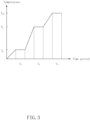
FIG. 3 is a graph of temperatures and time periods during dihydroxylation. -
FIG. 4 is a graph of temperatures and time periods during vitrification and homogenization. - Many aspects of the disclosure may be better understood with reference to the following drawings.
- Implementations of the disclosure will now be described, by way of embodiments only, with reference to the drawings. The disclosure is illustrative only, and changes may be made in the detail within the principles of the present disclosure. It will, therefore, be appreciated that the embodiments may be modified within the scope of the claims.
- Unless otherwise defined, all technical terms used herein have the same meaning as commonly understood by one of ordinary skill in the art. The technical terms used herein are not to be considered as limiting the scope of the embodiments.
- Implementations of the disclosure will now be described, by way of embodiments only, with reference to the drawings. It should be noted that non-conflicting details and features in the embodiments of the present disclosure may be combined with each other.
-
FIG. 1 illustrates an embodiment of a method for preparing quartz glass with low content of hydroxyl and high purity, which includes following steps. - S1: silica powders are provided.
- In the embodiment, the preparation of the silica powders in S1 includes following step.
- S10: a silicon-containing raw material is provided. The silicon-containing raw material is SiCl4, and a purity of the SiCl4 is greater than 99.999% (calculated by mass percentage). In other embodiments, the silicon-containing raw material may include at least one of SiF4, C6H18O3Si3, C8H24O4Si4, C10H30O5Si5, and C12H36O6Si6.
- S11: the silicon-containing raw material is hydrolyzed by vapor axial deposition (VAD) to form the silica powders. The vapor axial deposition method includes placing the silicon-containing raw material in a hydrogen-oxygen flame to obtain the silica powders after reaction. The reaction equation of the silicon-containing raw material in the hydrogen-oxygen flame is as follows.
SiCl4+2H2+O2→SiO2+4HCl
- In the embodiment, the silica powders are in a gray and loose state, and the density ρ of the silica powders is 0.5 g/cm3 to 0.9 g/cm3. A large number of water molecules or hydroxyl groups may be introduced into the silicon-containing raw material during the reaction in the hydrogen-oxygen flame. The water molecules exist in the silica powders in a free state, and the hydroxyl groups are bonded to the silica powders by hydrogen bonds or covalent bonds.
- In other embodiments, the silica powder may also be prepared by outside vapor deposition (OVD).
- S2: the silica powders are dehydroxylated. The dehydroxylation includes following steps.
- S20: referring to
FIG. 3 , a temperature of a high-temperature furnace is adjusted to a first temperature T1. The first temperature T1 is 200 degrees Celsius to 400 degrees Celsius. The silica powders are then dried in the high-temperature furnace at the temperature of T1, and the drying and heat preservation time period is t1, wherein t1≥3h. The free water molecules in the silica powders are then removed. - In the embodiment, the drying and heat preserving in S20 is performed in an inert gas atmosphere. A purity of the inert gas is 99.999999%, and the inert gas includes at least one of nitrogen, helium, and argon.
- S21: the temperature of the high-temperature furnace is raised to a second temperature T2, wherein the second temperature T2 is 700 degrees Celsius to 1000 degrees Celsius. A first oxidizing gas is introduced into the high-temperature furnace containing the silica powders for a time period t2, wherein t2≥0.5h. A first dehydroxylated powders are then obtained.
- In the embodiment, in S21, the first oxidizing gas includes at least one of fluorine gas, chlorine gas, and gaseous bromine. The highly electronegative atoms (fluorine atoms, chlorine atoms, and bromine atoms) in the first oxidizing gas can replace the hydroxyl groups and other impurities (for example, metal atoms) in the silica through a redox reaction.
- In the invention, in S21, a total mass of the introduced first oxidizing gas is within 1% of a total mass of the silica powders. When the total mass of the introduced first oxidizing gas exceeds 1% of the total mass of the silica powders, the excessive first oxidizing gas may be doped into the silica powders, thereby affecting the uniformity of the subsequent obtained quartz glass and causing waste of the first oxidizing gas at the same time.
- In the embodiment, the first oxidizing gas further includes the inert gas, and the inert gas functions as a carrier to send oxygen and/or ozone into the high-temperature furnace.
- S22: the temperature of the high-temperature furnace is further raised to a third temperature T3, and the third temperature T3 is 1050 degrees Celsius to 1250 degrees Celsius. A second oxidizing gas is introduced into the high-temperature furnace containing the first dehydroxylated powders for a time period t3, wherein t3≥3h. A second dehydroxylated powders are obtained. The second oxidizing gas includes at least one of oxygen or ozone. The first oxidizing gas and the second oxidizing gas include halogen atoms and oxygen atoms, respectively. The halogen atoms in the first oxidizing gas can be bonded with the first dehydroxylated powders to form silicon-halide bonds. The oxygen atoms in the second oxidizing gas can be bonded with the first dehydroxylated powders to form silicon-oxygen bonds. Since the silicon-oxygen bonds are more stable than the silicon-halogen bonds, the halogen atoms bonded to the first dehydroxylated powders are easily replaced by the oxygen atom, and further be carried out by the inert gas. Thus, elements of fluorine, chlorine, or bromine element is removed, so that an optical uniformity of the subsequent obtained quartz glass can be improved.
- In the embodiment, the second oxidizing gas in S23 further includes the inert gas, and the inert gas function as a carrier to send oxygen and/or ozone into the high-temperature furnace.
- S3: the second dehydroxylated powders are vitrified to obtain a vitrified body.
- In the embodiment, the vitrification in S3 includes introducing the inert gas into the high-temperature furnace to carry out the remaining free oxygen and chlorine in the furnace. Then, the temperature is gradually raised to the fourth temperature T4 to vitrify the powders. The fourth temperature T4 ranges from 1300 degrees Celsius to 1500 degrees Celsius, and the reaction time period is t4, wherein t4≥1h.
- S4: Annealing and cooling are performed. Then, the quartz glass with low content of hydroxyl and high purity is obtained.
- In the embodiment, referring to
FIG. 4 , in step S4, the annealing includes cooling the vitrified body from the fourth temperature T4 at a cooling speed v, wherein ν≥20 minutes per degree Celsius. - In the embodiment, steps as follows are further included between S3 and S4.
- S30: the temperature of the high-temperature furnace is further raised to a fifth temperature T5. The fifth temperature T5 is 1600 degrees Celsius to 2300 degrees Celsius, and the preservation time period is t5, wherein t5≥1h. Thus, the vitrified body is homogenized at high temperature, and elements of fluorine, chlorine, or bromine are further removed to improve the optical uniformity of the subsequent obtained quartz glass.
- The present disclosure also provides a quartz glass with low content of hydroxyl and high purity, which is prepared by the above method. The content of hydroxyl in the quartz glass is less than 1 ppm, and the optical uniformity (defined as an uneven degree of refractive index changes over different portions in a designated region) is less than or equal to 4.3×10⁻⁵. Preferably, the optical uniformity of the quartz glass is less than 2×10⁻⁶.
- In the embodiment, referring to
FIG. 2 , the spectral transmittance of the quartz glass at 190 nm to 2700 nm is greater than 90%. The content of metal impurity in the quartz glass is less than 0.2 ppm. The stress birefringence is less than 2 nm/cm. - The quartz glass with low content of hydroxyl and high purity made by the method of the present invention has a low content of hydroxyl, which increases the transmittance. The quartz glass can be applied in high-power lasers, has the characteristics of low heat generation and long service life. The quartz glass can also suitable for being processed into ultraviolet, infrared or full-band optical lenses, and has the characteristics of high transmittance. The quartz glass can also be processed into optical windows with excellent high temperature resistance, or high pressure or corrosion resistance. The quartz glass can also be processed into photomask substrates, wafers, and other products with high optical transmittance and high material stability.
- The preparation method and the performance of the products are illustrated by following examples.
- The gaseous silicon tetrachloride with a purity of more than 99.999% was hydrolyzed in a hydrogen-oxygen flame with a purity of more than 99.9999%, to obtain the silica powders. The density of the silica powders ρ was 0.6g/cm3.
- The silica powders are kept at a temperature of T1 in a high-temperature furnace, wherein T1 was 300 degrees Celsius. Helium was used as a protective gas, and the purity of the helium was 99.9999%. The heat preservation time period t1 was 5h.
- A mix gas of helium and chlorine was introduced into the high-temperature furnace containing the silica powders. The flow ratio of helium and chlorine was 20:1. The amount of the chlorine was 0.4kg. The furnace temperature T2 was 900 degrees Celsius. The reaction time t2 was 1h. Then, the first dehydroxylated powders were obtained.
- The temperature of the high-temperature furnace containing the first dehydroxylated powders was raised to T3 of 1150 degrees Celsius. A mix gas of helium and oxygen was introduced. The flow ratio of helium and oxygen was 5:1. The reaction time t3 was 5h. Then, the second dehydroxylated powders was obtained.
- A helium of high purity was introduced into the high-temperature furnace containing the second dehydroxylated powders. The purity of the helium was 99.999999%. The temperature was gradually increased to T4 of 1350 degrees Celsius. The reaction time t4 was 3h. Then, the vitrified body was obtained.
- The vitrified body was cooled to 300 degrees Celsius at a speed v of 50 minutes per degree Celsius, and then cooled at room temperature to obtain the quartz glass.
- Samples 1#, 2#, 3#, and 4# were prepared according to the above conditions. The content of metal impurity, hydroxyl, spectral transmittance, optical uniformity, and stress birefringence were shown in Table 1.
Table 1 Sample No. Content of metal impurity (ppm) Content of hydroxyl (ppm) Spectral transmittance at 190nm Spectral transmittance at 2700nm Optical uniformity Stress birefringence (nm/cm) 1# 0.1 < 1 91% 92% 35×10-6 2.0 2# 0.1 < 1 91% 92% 40×10-6 2.3 3# 0.1 < 1 92% 92% 43×10-6 2.4 4# 0.1 < 1 92% 92% 37×10-6 2.1 - The transmittance in Table 1 refers to the ratio of energy of light waves at specific wavelengths (190nm, 2700nm) after transmitted through the quartz glass with respect to that before incident on the quartz glass. The optical uniformity in Table 1 refers to the uneven degree of refractive index changes over different portions in the designated region, which is expressed by a maximum difference of the refractive index changes. The stress birefringence in Table 1 refers to the optical path difference of the light caused by the density difference in different regions in the quartz glass.
- The preparation method of Example 1 can be mainly divided into four main steps, including powder synthesis, powder dehydroxylation, powder vitrification, and annealing. In Example 1, the content of hydroxyl in each sample is less than 1 ppm, and the optical uniformity is less than or equal to 43×10-6.
- The gaseous silicon tetrachloride with a purity of more than 99.999% was hydrolyzed in a hydrogen-oxygen flame with a purity of more than 99.9999%, to obtain the silica powders. The density of the silica powders ρ was 0.6g/cm3.
- The silica powders are kept at a temperature of T1 in a high-temperature furnace, wherein T1 was 300 degrees Celsius. Helium of high purity was used as a protective gas, and the purity of the helium was 99.9999%. The heat preservation time period t1 was 5h.
- A mix gas of helium and chlorine was introduced into the high-temperature furnace containing the silica powders. The flow ratio of helium and chlorine was 20:1. The amount of the chlorine was 0.4kg. The furnace temperature T2 was 900 degrees Celsius. The reaction time t2 was 1h. Then, the first dehydroxylated powders were obtained.
- The temperature of the high-temperature furnace containing the first dehydroxylated powders was raised to T3 of 1150 degrees Celsius. A mix gas of helium and oxygen was introduced. The flow ratio of helium and oxygen was 5:1. The reaction time t3 was 5h. Then, the second dehydroxylated powders was obtained.
- A helium of high purity was introduced into the high-temperature furnace containing the second dehydroxylated powders. The purity of the helium was 99.999999%. The temperature was gradually increased to T4 of 1350 degrees Celsius. The reaction time t4 was 3h. Then, the vitrified body was obtained.
- The vitrified body was further heat at a temperature T5 of 1800 degrees Celsius, to homogenize the vitrified body. The homogenization time period t5 was 3h.
- The vitrified body was cooled to 300 degrees Celsius at a speed v of 50 minutes per degree Celsius, and then cooled at room temperature to obtain the quartz glass.
- Samples 5#, 6#, 7#, and 8# were prepared according to the above conditions. The content of metal impurity, hydroxyl, spectral transmittance, optical uniformity, and stress birefringence were shown in Table 2.
Table 2 Sample No. Content of metal impurity (ppm) Content of hydroxyl (ppm) Spectral transmittance at 190nm Spectral transmittance at 2700nm Optical uniformity Stress birefringence (nm/cm) 5# 0.1 < 1 91% 92% 0.8×10⁻⁶ 1.0 6# 0.1 < 1 91% 92% 1.1×10⁻⁶ 1.3 7# 0.1 < 1 92% 92% 1.2×10⁻⁶ 1.4 8# 0.1 < 1 92% 92% 1.0×10⁻⁶ 1.1 - The preparation method of Example 2 can be mainly divided into five main steps, including powder synthesis, powder dehydroxylation, powder vitrification, high-temperature homogenization, and annealing. In Example 2, the content of hydroxyl in each sample is less than 1 ppm, and the optical uniformity is 0.8×10⁻⁶ to 1.2×10⁻⁶. Compared with Example 1, it can be found that the high-temperature homogenization can significantly improve the optical uniformity of the quartz glass.
- The gaseous silicon tetrachloride with a purity of more than 99.999% was hydrolyzed in a hydrogen-oxygen flame with a purity of more than 99.9999%, to obtain the silica powders. The density of the silica powders ρ was 0.6g/cm3.
- The silica powders are kept at a temperature of T1 in a high-temperature furnace, wherein T1 was 300 degrees Celsius. Helium of high purity was used as a protective gas, and the purity of the helium was 99.9999%. The heat preservation time period t1 was 5h.
- A mix gas of helium and chlorine was introduced into the high-temperature furnace containing the silica powders. The flow ratio of helium and chlorine was 20: 1. The amount of the chlorine was 0.4kg. The furnace temperature T2 was 900 degrees Celsius. The reaction time t2 was 1h. Then, the first dehydroxylated powders were obtained.
- A helium of high purity was introduced into the high-temperature furnace containing the silica powders. The purity of the helium was 99.999999%. The temperature was gradually increased to T4 of 1350 degrees Celsius. The reaction time t4 was 3h. Then, the vitrified body was obtained.
- The vitrified body was further heat at a temperature T5 of 1800 degrees Celsius, to homogenize the vitrified body. The homogenization time period t5 was 3h.
- The vitrified body was cooled to 300 degrees Celsius at a speed v of 50 minutes per degree Celsius, and then cooled at room temperature to obtain the quartz glass.
- Samples 9#, 10#, 11#, and 12# were prepared according to the above conditions. The content of metal impurity, hydroxyl, spectral transmittance, optical uniformity, and stress birefringence were shown in Table 3.
Table 3 Sample No. Content of metal impurity (ppm) Content of hydroxyl (ppm) Spectral transmittance at 190nm Spectral transmittance at 2700nm Optical uniformity Stress birefringence (nm/cm) 9# 0.1 < 1 91% 92% 10×10-6 1.7 10# 0.1 < 1 91% 92% 11×10-6 1.9 11# 0.1 < 1 92% 92% 12×10-6 2.0 12# 0.1 < 1 92% 92% 11×10-6 1.8 - The preparation method of Comparative Example 1 can be mainly divided into five main steps, including powder synthesis, powder dehydroxylation, powder vitrification, high-temperature homogenization, and annealing. No mixed gas of helium and oxygen was used to replace the remaining chlorine in the powder dehydroxylation step. Thus, it can be found that the content of hydroxyl in each sample in Comparative Example 1 is less than 1 ppm, and the optical uniformity is 10×10-6 to 12×10-6. Compared with Example 2, it can be found that the residual chlorine reduces the optical uniformity of the quartz glass.
- The gaseous silicon tetrachloride with a purity of more than 99.999% was hydrolyzed in a hydrogen-oxygen flame with a purity of more than 99.9999%, to obtain the silica powders. The density of the silica powders ρ was 0.6g/cm3.
- A helium of high purity was introduced into the high-temperature furnace containing the silica powders. The purity of the helium was 99.999999%. The temperature was gradually increased to T4 of 1350 degrees Celsius. The reaction time t4 was 3h. Then, the vitrified body was obtained.
- The vitrified body was cooled to 300 degrees Celsius at a speed v of 50 minutes per degree Celsius, and then cooled at room temperature to obtain the quartz glass.
- Samples 13#, 14#, 15#, and 16# were prepared according to the above conditions. The content of metal impurity, hydroxyl, spectral transmittance, optical uniformity, and stress birefringence were shown in Table 4.
Table 4Sample No. Content of metal impurity (ppm) Content of hydroxyl (ppm) Spectral transmittance at 190nm Spectral transmittance at 2700nm Optical uniformity Stress birefringence (nm/cm) 13# 0.2 35 89% 60% 1.0×10⁻⁶ 1.2 14# 0.2 36 89% 61% 1.1×10⁻⁶ 1.3 15# 0.2 34 89% 62% 0.9×10⁻⁶ 1.4 16# 0.2 33 88% 61% 1.0×10⁻⁶ 1.2 - The preparation method of Comparative Example 2 can be mainly divided into three main steps, including powder synthesis, powder vitrification, and annealing. It can be found that the content of hydroxyl in each sample in Comparative Example 1 is higher than 30 ppm, and the optical uniformity is 0.9×10⁻⁶ to 1.1×10⁻⁶. Compared with Example 1, it can be found that chlorine can significantly reduce the content of hydroxyl, and at the same time reduce the optical uniformity of the final quartz glass.
- Although the embodiments of the present disclosure have been shown and described, those having ordinary skill in the art can understand that changes may be made within the principles of the present disclosure, up to and including the full extent of the claims. It will, therefore, be appreciated that the embodiments described above may be modified within the scope of the claims.
Claims (9)
- A method for preparing quartz glass with low content of hydroxyl and high purity, comprising:providing silica powders, the silica powders comprising hydroxyl groups;dehydroxylating the silica powders, comprising:drying the silica powders at a first temperature;heating the silica powders up to a second temperature and introducing a first oxidizing gas comprising halogen gas, thereby obtaining first dehydroxylated powders;heating the first dehydroxylated powders up to a third temperature and introducing a second oxidizing gas comprising oxygen or ozone, thereby obtaining second dehydroxylated powders;heating the second dehydroxylated powders up to a fourth temperature to obtain a vitrified body; andcooling the vitrified body to obtain the quartz glass; characterized in that a total mass of the introduced first oxidizing gas is within 1% of a total mass of the silica powders.
- The method of claim 1, characterized in that, after heating the second dehydroxylated powders up to the fourth temperature to obtain the vitrified body, the method further comprises:
heating the vitrified body up to a fifth temperature in a range of 1600 degrees Celsius to 2300 degrees Celsius for 1 hour or more, thereby homogenizing the vitrified body. - The method of claim 1, characterized in that, cooling the vitrified body further comprises:
cooling the vitrified body from the fourth temperature to room temperature with a cooling speed greater or equal to 20 minutes per degree Celsius. - The method of claim 1, characterized in that, preparation of the silica powders comprises:providing a silicon-containing raw material; andhydrolyzing the silicon-containing raw material by a vapor deposition method to form the silica powders.
- The method of claim 4, characterized in that, the silicon-containing raw material comprises at least one of SiF4, C6H18O3Si3, C8H24O4Si4, C10H30O5Si5, and C12H36O6Si6.
- The method of claim 4, characterized in that, the vapor deposition method comprises one of a chemical vapor deposition method, a plasma chemical vapor deposition method, a vapor axial deposition method, and an outside vapor deposition method.
- The method of claim 1, characterized in that, at least one of the first oxidizing gas comprises at least one of fluorine gas, chlorine gas, and bromine gas.
- The method of claim 1, characterized in that, at least one of the first oxidizing gas and the second oxidizing gases further comprises an inert gas, and the inert gas comprises at least one of nitrogen, helium, and argon.
- The method of claim 1, characterized in that, the first temperature is in a range of 200 degrees Celsius to 400 degrees Celsius, the second temperature is in a range of 700 degrees Celsius to 1000 degrees Celsius, the third temperature is in a range of 1050 degrees Celsius to 1250 degrees Celsius, and the fourth temperature is in a range of 1300 degrees Celsius to 1500 degrees Celsius.
Applications Claiming Priority (2)
| Application Number | Priority Date | Filing Date | Title |
|---|---|---|---|
| CN202011001200.0A CN114249524A (en) | 2020-09-22 | 2020-09-22 | Low-hydroxyl high-purity quartz glass and preparation method thereof |
| PCT/CN2020/134893 WO2021174936A1 (en) | 2020-09-22 | 2020-12-09 | Low-hydroxyl high-purity silica glass and method for fabrication thereof |
Publications (4)
| Publication Number | Publication Date |
|---|---|
| EP3901106A1 EP3901106A1 (en) | 2021-10-27 |
| EP3901106A4 EP3901106A4 (en) | 2022-11-09 |
| EP3901106B1 true EP3901106B1 (en) | 2024-11-06 |
| EP3901106C0 EP3901106C0 (en) | 2024-11-06 |
Family
ID=76920377
Family Applications (1)
| Application Number | Title | Priority Date | Filing Date |
|---|---|---|---|
| EP20913069.9A Active EP3901106B1 (en) | 2020-09-22 | 2020-12-09 | Method for fabrication of low-hydroxyl high-purity silica glass |
Country Status (6)
| Country | Link |
|---|---|
| US (1) | US11981594B2 (en) |
| EP (1) | EP3901106B1 (en) |
| JP (1) | JP7195441B2 (en) |
| KR (1) | KR20210082534A (en) |
| CN (1) | CN114249524A (en) |
| WO (1) | WO2021174936A1 (en) |
Families Citing this family (9)
| Publication number | Priority date | Publication date | Assignee | Title |
|---|---|---|---|---|
| CN111051259A (en) * | 2017-08-29 | 2020-04-21 | 住友电气工业株式会社 | Method for producing glass fine particle deposit, method for producing glass base material, and glass base material |
| CN114368757A (en) * | 2022-01-21 | 2022-04-19 | 成都光华科技发展有限公司 | Purification method of high-purity quartz sand |
| CN114751631B (en) * | 2022-05-17 | 2022-12-20 | 上海菲利华石创科技有限公司 | Low-hydroxyl opaque quartz glass and manufacturing method thereof |
| CN116177876B (en) * | 2022-12-27 | 2024-01-16 | 中建材玻璃新材料研究院集团有限公司 | Method for reducing hydroxyl content of lithium aluminosilicate glass |
| CN117023595A (en) * | 2023-08-01 | 2023-11-10 | 新特能源股份有限公司 | Preparation method of high-purity silicon dioxide |
| CN117902814B (en) * | 2024-03-11 | 2024-09-06 | 宁波云德半导体材料有限公司 | Quartz ring and preparation method thereof |
| CN118324148A (en) * | 2024-03-21 | 2024-07-12 | 中触媒新材料股份有限公司 | A method for calcining high-purity silicon oxide |
| CN120289069B (en) * | 2025-06-11 | 2025-09-02 | 南通晶体有限公司 | Preparation method of quartz glass by using quartz powder as raw material and quartz product |
| CN120887638B (en) * | 2025-09-30 | 2025-12-30 | 南通晶体有限公司 | Preparation method of deep ultraviolet quartz glass and deep ultraviolet quartz glass |
Family Cites Families (20)
| Publication number | Priority date | Publication date | Assignee | Title |
|---|---|---|---|---|
| JPS5858292B2 (en) | 1980-01-21 | 1983-12-24 | 株式会社日立製作所 | Silica glass manufacturing method |
| JPS62158121A (en) | 1985-12-27 | 1987-07-14 | Shinetsu Sekiei Kk | Homogenization method for quartz glass |
| JP2737191B2 (en) | 1987-12-28 | 1998-04-08 | 東ソー株式会社 | Method for producing homogeneous quartz glass block |
| JP2835540B2 (en) | 1991-06-29 | 1998-12-14 | 信越石英株式会社 | Method of manufacturing quartz glass member for excimer laser |
| JP2530954B2 (en) | 1991-08-30 | 1996-09-04 | 信越石英株式会社 | Optical member |
| JPH06263468A (en) | 1993-03-12 | 1994-09-20 | Sumitomo Electric Ind Ltd | Glass base material manufacturing method |
| EP1101741B1 (en) | 1999-11-15 | 2005-07-13 | Heraeus Quarzglas GmbH & Co. KG | Quartz glass product for an optical element and process of its manufacture |
| WO2002026647A1 (en) | 2000-09-28 | 2002-04-04 | Corning Incorporated | Optical glass silica soot particles and method of making same |
| JP4213412B2 (en) | 2002-06-26 | 2009-01-21 | 東ソー株式会社 | Synthetic quartz glass for vacuum ultraviolet light, manufacturing method thereof, and mask substrate for vacuum ultraviolet light using the same |
| JP2004338992A (en) | 2003-05-14 | 2004-12-02 | Sumitomo Electric Ind Ltd | Manufacturing method of glass base material |
| DE102006022303B4 (en) * | 2006-05-11 | 2009-06-18 | Heraeus Quarzglas Gmbh & Co. Kg | Process for the preparation of synthetic quartz glass with predetermined hydroxyl group content |
| JP5719590B2 (en) | 2007-05-09 | 2015-05-20 | コーニング インコーポレイテッド | Glass with low OH and OD levels |
| WO2012056037A1 (en) * | 2010-10-28 | 2012-05-03 | Heraeus Quarzglas Gmbh & Co. Kg | Method for producing synthetic quartz glass granules |
| DE102011121153B3 (en) * | 2011-12-15 | 2013-03-21 | Heraeus Quarzglas Gmbh & Co. Kg | Process for the production of synthetic quartz glass and quartz glass for use as cladding material of an optical fiber |
| JP6569459B2 (en) * | 2015-10-19 | 2019-09-04 | 住友電気工業株式会社 | Method for producing silica glass and silica glass |
| TW201731782A (en) * | 2015-12-18 | 2017-09-16 | 何瑞斯廓格拉斯公司 | Preparation of a quartz glass body in a multi-chamber oven |
| CN106116121A (en) * | 2016-08-31 | 2016-11-16 | 中国建筑材料科学研究总院 | The preparation method of quartz glass and quartz glass |
| CN110040942B (en) * | 2018-01-16 | 2021-10-12 | 中天科技集团有限公司 | Method for dehydroxylating powder and method for preparing quartz glass |
| CN110183100B (en) * | 2019-06-19 | 2021-07-16 | 湖北菲利华石英玻璃股份有限公司 | A method for preparing quartz glass using large-scale silica soot |
| CN111393022B (en) * | 2020-03-23 | 2022-11-01 | 黄冈师范学院 | Preparation method of high-purity low-hydroxyl quartz glass raw material |
-
2020
- 2020-09-22 CN CN202011001200.0A patent/CN114249524A/en active Pending
- 2020-12-09 JP JP2021534259A patent/JP7195441B2/en active Active
- 2020-12-09 US US17/422,897 patent/US11981594B2/en active Active
- 2020-12-09 EP EP20913069.9A patent/EP3901106B1/en active Active
- 2020-12-09 KR KR1020217018132A patent/KR20210082534A/en not_active Ceased
- 2020-12-09 WO PCT/CN2020/134893 patent/WO2021174936A1/en not_active Ceased
Also Published As
| Publication number | Publication date |
|---|---|
| EP3901106A4 (en) | 2022-11-09 |
| US11981594B2 (en) | 2024-05-14 |
| WO2021174936A1 (en) | 2021-09-10 |
| CN114249524A (en) | 2022-03-29 |
| KR20210082534A (en) | 2021-07-05 |
| JP2022526062A (en) | 2022-05-23 |
| EP3901106A1 (en) | 2021-10-27 |
| US20220340469A1 (en) | 2022-10-27 |
| EP3901106C0 (en) | 2024-11-06 |
| JP7195441B2 (en) | 2022-12-23 |
Similar Documents
| Publication | Publication Date | Title |
|---|---|---|
| EP3901106A1 (en) | Low-hydroxyl high-purity silica glass and method for fabrication thereof | |
| CN101426744B (en) | Component of quartz glass for use in semiconductor manufacture and method for producing the same | |
| US20080066497A1 (en) | Holder Made From Quartz Glass for the Processing of Semiconductor Wafers and Method for Production of the Holder | |
| JP3845906B2 (en) | Method for producing synthetic silica glass | |
| US20090098370A1 (en) | Black synthetic quartz glass with a transparent layer | |
| JPWO2008069194A1 (en) | Synthetic opaque quartz glass and method for producing the same | |
| JP2017508713A (en) | Boron doped titania-silica glass with very small CTE gradient | |
| EP0770584B1 (en) | Method for producing heat-resistant synthetic quartz glass | |
| CN110040942A (en) | The preparation method of body of powder deshydroxy processing method and quartz glass | |
| CN105517965B (en) | The method for manufacturing the quartz glass of Fe2O3 doping | |
| JPH11310423A (en) | Synthetic quartz glass and its production | |
| CN115448576B (en) | Preparation method of optical quartz material based on combination of vibration environment and vibration isolation environment | |
| CN116323503B (en) | Black Quartz Glass and its Manufacturing Method | |
| EP2048120B1 (en) | Process for producing optical fiber base and apparatus therefor | |
| JP2822854B2 (en) | Synthetic quartz glass optical member and method of manufacturing the same | |
| JPH0733259B2 (en) | Ultraviolet-resistant synthetic quartz glass and method for producing the same | |
| JP2677293B2 (en) | Manufacturing method of preform for optical fiber | |
| KR20250174567A (en) | Manufacturing method of quartz ware | |
| JPH05279049A (en) | Production of synthetic quartz glass | |
| JPH0776092B2 (en) | Glass manufacturing method | |
| JP2814805B2 (en) | Quartz glass substrate for polysilicon TFT LCD | |
| JP2022061950A (en) | Black quartz glass and its manufacturing method | |
| CN121872657A (en) | Preparation method for improving gap chlorine molecular defect of high-purity quartz glass | |
| JPS60239339A (en) | Preparation of parent material for optical fiber | |
| CN121159064A (en) | Preparation device and method of deep ultraviolet mask quartz glass substrate |
Legal Events
| Date | Code | Title | Description |
|---|---|---|---|
| STAA | Information on the status of an ep patent application or granted ep patent |
Free format text: STATUS: UNKNOWN |
|
| STAA | Information on the status of an ep patent application or granted ep patent |
Free format text: STATUS: THE INTERNATIONAL PUBLICATION HAS BEEN MADE |
|
| PUAI | Public reference made under article 153(3) epc to a published international application that has entered the european phase |
Free format text: ORIGINAL CODE: 0009012 |
|
| STAA | Information on the status of an ep patent application or granted ep patent |
Free format text: STATUS: REQUEST FOR EXAMINATION WAS MADE |
|
| 17P | Request for examination filed |
Effective date: 20210723 |
|
| AK | Designated contracting states |
Kind code of ref document: A1 Designated state(s): AL AT BE BG CH CY CZ DE DK EE ES FI FR GB GR HR HU IE IS IT LI LT LU LV MC MK MT NL NO PL PT RO RS SE SI SK SM TR |
|
| RAP3 | Party data changed (applicant data changed or rights of an application transferred) |
Owner name: JIANGSU ZHONGTIAN TECHNOLOGY CO., LTD. Owner name: ZHONGTIAN TECHNOLOGY ADVANCED MATERIALS CO., LTD. |
|
| RIN1 | Information on inventor provided before grant (corrected) |
Inventor name: CHEN, YALI Inventor name: SHEN, YICHUN Inventor name: ZHANG, XIANGEN Inventor name: MA, JUNYI Inventor name: QIAN, YIGANG Inventor name: WANG, MENGFEI Inventor name: TANG, MINGMING |
|
| A4 | Supplementary search report drawn up and despatched |
Effective date: 20221007 |
|
| RIC1 | Information provided on ipc code assigned before grant |
Ipc: C03B 20/00 20060101AFI20220930BHEP |
|
| DAV | Request for validation of the european patent (deleted) | ||
| DAX | Request for extension of the european patent (deleted) | ||
| GRAP | Despatch of communication of intention to grant a patent |
Free format text: ORIGINAL CODE: EPIDOSNIGR1 |
|
| STAA | Information on the status of an ep patent application or granted ep patent |
Free format text: STATUS: GRANT OF PATENT IS INTENDED |
|
| INTG | Intention to grant announced |
Effective date: 20240722 |
|
| GRAS | Grant fee paid |
Free format text: ORIGINAL CODE: EPIDOSNIGR3 |
|
| GRAA | (expected) grant |
Free format text: ORIGINAL CODE: 0009210 |
|
| STAA | Information on the status of an ep patent application or granted ep patent |
Free format text: STATUS: THE PATENT HAS BEEN GRANTED |
|
| AK | Designated contracting states |
Kind code of ref document: B1 Designated state(s): AL AT BE BG CH CY CZ DE DK EE ES FI FR GB GR HR HU IE IS IT LI LT LU LV MC MK MT NL NO PL PT RO RS SE SI SK SM TR |
|
| REG | Reference to a national code |
Ref country code: GB Ref legal event code: FG4D |
|
| REG | Reference to a national code |
Ref country code: CH Ref legal event code: EP |
|
| REG | Reference to a national code |
Ref country code: DE Ref legal event code: R096 Ref document number: 602020041096 Country of ref document: DE |
|
| REG | Reference to a national code |
Ref country code: IE Ref legal event code: FG4D |
|
| U01 | Request for unitary effect filed |
Effective date: 20241115 |
|
| U07 | Unitary effect registered |
Designated state(s): AT BE BG DE DK EE FI FR IT LT LU LV MT NL PT RO SE SI Effective date: 20241212 |
|
| U20 | Renewal fee for the european patent with unitary effect paid |
Year of fee payment: 5 Effective date: 20241226 |
|
| PG25 | Lapsed in a contracting state [announced via postgrant information from national office to epo] |
Ref country code: IS Free format text: LAPSE BECAUSE OF FAILURE TO SUBMIT A TRANSLATION OF THE DESCRIPTION OR TO PAY THE FEE WITHIN THE PRESCRIBED TIME-LIMIT Effective date: 20250306 Ref country code: HR Free format text: LAPSE BECAUSE OF FAILURE TO SUBMIT A TRANSLATION OF THE DESCRIPTION OR TO PAY THE FEE WITHIN THE PRESCRIBED TIME-LIMIT Effective date: 20241106 |
|
| PG25 | Lapsed in a contracting state [announced via postgrant information from national office to epo] |
Ref country code: ES Free format text: LAPSE BECAUSE OF FAILURE TO SUBMIT A TRANSLATION OF THE DESCRIPTION OR TO PAY THE FEE WITHIN THE PRESCRIBED TIME-LIMIT Effective date: 20241106 |
|
| PG25 | Lapsed in a contracting state [announced via postgrant information from national office to epo] |
Ref country code: NO Free format text: LAPSE BECAUSE OF FAILURE TO SUBMIT A TRANSLATION OF THE DESCRIPTION OR TO PAY THE FEE WITHIN THE PRESCRIBED TIME-LIMIT Effective date: 20250206 |
|
| PG25 | Lapsed in a contracting state [announced via postgrant information from national office to epo] |
Ref country code: GR Free format text: LAPSE BECAUSE OF FAILURE TO SUBMIT A TRANSLATION OF THE DESCRIPTION OR TO PAY THE FEE WITHIN THE PRESCRIBED TIME-LIMIT Effective date: 20250207 |
|
| PG25 | Lapsed in a contracting state [announced via postgrant information from national office to epo] |
Ref country code: PL Free format text: LAPSE BECAUSE OF FAILURE TO SUBMIT A TRANSLATION OF THE DESCRIPTION OR TO PAY THE FEE WITHIN THE PRESCRIBED TIME-LIMIT Effective date: 20241106 |
|
| PG25 | Lapsed in a contracting state [announced via postgrant information from national office to epo] |
Ref country code: RS Free format text: LAPSE BECAUSE OF FAILURE TO SUBMIT A TRANSLATION OF THE DESCRIPTION OR TO PAY THE FEE WITHIN THE PRESCRIBED TIME-LIMIT Effective date: 20250206 |
|
| U1N | Appointed representative for the unitary patent procedure changed after the registration of the unitary effect |
Representative=s name: METIDA; LT |
|
| PG25 | Lapsed in a contracting state [announced via postgrant information from national office to epo] |
Ref country code: SM Free format text: LAPSE BECAUSE OF FAILURE TO SUBMIT A TRANSLATION OF THE DESCRIPTION OR TO PAY THE FEE WITHIN THE PRESCRIBED TIME-LIMIT Effective date: 20241106 |
|
| PG25 | Lapsed in a contracting state [announced via postgrant information from national office to epo] |
Ref country code: SK Free format text: LAPSE BECAUSE OF FAILURE TO SUBMIT A TRANSLATION OF THE DESCRIPTION OR TO PAY THE FEE WITHIN THE PRESCRIBED TIME-LIMIT Effective date: 20241106 |
|
| PG25 | Lapsed in a contracting state [announced via postgrant information from national office to epo] |
Ref country code: CZ Free format text: LAPSE BECAUSE OF FAILURE TO SUBMIT A TRANSLATION OF THE DESCRIPTION OR TO PAY THE FEE WITHIN THE PRESCRIBED TIME-LIMIT Effective date: 20241106 |
|
| REG | Reference to a national code |
Ref country code: CH Ref legal event code: PL |
|
| PLBE | No opposition filed within time limit |
Free format text: ORIGINAL CODE: 0009261 |
|
| STAA | Information on the status of an ep patent application or granted ep patent |
Free format text: STATUS: NO OPPOSITION FILED WITHIN TIME LIMIT |
|
| PG25 | Lapsed in a contracting state [announced via postgrant information from national office to epo] |
Ref country code: MC Free format text: LAPSE BECAUSE OF FAILURE TO SUBMIT A TRANSLATION OF THE DESCRIPTION OR TO PAY THE FEE WITHIN THE PRESCRIBED TIME-LIMIT Effective date: 20241106 |
|
| 26N | No opposition filed |
Effective date: 20250807 |
|
| PG25 | Lapsed in a contracting state [announced via postgrant information from national office to epo] |
Ref country code: CH Free format text: LAPSE BECAUSE OF NON-PAYMENT OF DUE FEES Effective date: 20241231 |
|
| PG25 | Lapsed in a contracting state [announced via postgrant information from national office to epo] |
Ref country code: IE Free format text: LAPSE BECAUSE OF NON-PAYMENT OF DUE FEES Effective date: 20241209 |
|
| GBPC | Gb: european patent ceased through non-payment of renewal fee |
Effective date: 20250206 |
|
| PG25 | Lapsed in a contracting state [announced via postgrant information from national office to epo] |
Ref country code: GB Free format text: LAPSE BECAUSE OF NON-PAYMENT OF DUE FEES Effective date: 20250206 |
|
| U20 | Renewal fee for the european patent with unitary effect paid |
Year of fee payment: 6 Effective date: 20251229 |
|
| PG25 | Lapsed in a contracting state [announced via postgrant information from national office to epo] |
Ref country code: CY Free format text: LAPSE BECAUSE OF FAILURE TO SUBMIT A TRANSLATION OF THE DESCRIPTION OR TO PAY THE FEE WITHIN THE PRESCRIBED TIME-LIMIT Effective date: 20241106 |