EP3901008B1 - Front vehicle-body structure for vehicle, and vehicle - Google Patents
Front vehicle-body structure for vehicle, and vehicle Download PDFInfo
- Publication number
- EP3901008B1 EP3901008B1 EP21163671.7A EP21163671A EP3901008B1 EP 3901008 B1 EP3901008 B1 EP 3901008B1 EP 21163671 A EP21163671 A EP 21163671A EP 3901008 B1 EP3901008 B1 EP 3901008B1
- Authority
- EP
- European Patent Office
- Prior art keywords
- vehicle
- panel
- body structure
- dash
- bead
- Prior art date
- Legal status (The legal status is an assumption and is not a legal conclusion. Google has not performed a legal analysis and makes no representation as to the accuracy of the status listed.)
- Active
Links
Images




Classifications
-
- B—PERFORMING OPERATIONS; TRANSPORTING
- B62—LAND VEHICLES FOR TRAVELLING OTHERWISE THAN ON RAILS
- B62D—MOTOR VEHICLES; TRAILERS
- B62D25/00—Superstructure or monocoque structure sub-units; Parts or details thereof not otherwise provided for
- B62D25/08—Front or rear portions
- B62D25/14—Dashboards as superstructure sub-units
-
- B—PERFORMING OPERATIONS; TRANSPORTING
- B62—LAND VEHICLES FOR TRAVELLING OTHERWISE THAN ON RAILS
- B62D—MOTOR VEHICLES; TRAILERS
- B62D25/00—Superstructure or monocoque structure sub-units; Parts or details thereof not otherwise provided for
- B62D25/08—Front or rear portions
-
- B—PERFORMING OPERATIONS; TRANSPORTING
- B62—LAND VEHICLES FOR TRAVELLING OTHERWISE THAN ON RAILS
- B62D—MOTOR VEHICLES; TRAILERS
- B62D21/00—Understructures, i.e. chassis frame on which a vehicle body may be mounted
- B62D21/15—Understructures, i.e. chassis frame on which a vehicle body may be mounted having impact absorbing means, e.g. a frame designed to permanently or temporarily change shape or dimension upon impact with another body
-
- B—PERFORMING OPERATIONS; TRANSPORTING
- B60—VEHICLES IN GENERAL
- B60K—ARRANGEMENT OR MOUNTING OF PROPULSION UNITS OR OF TRANSMISSIONS IN VEHICLES; ARRANGEMENT OR MOUNTING OF PLURAL DIVERSE PRIME-MOVERS IN VEHICLES; AUXILIARY DRIVES FOR VEHICLES; INSTRUMENTATION OR DASHBOARDS FOR VEHICLES; ARRANGEMENTS IN CONNECTION WITH COOLING, AIR INTAKE, GAS EXHAUST OR FUEL SUPPLY OF PROPULSION UNITS IN VEHICLES
- B60K26/00—Arrangement or mounting of propulsion-unit control devices in vehicles
- B60K26/02—Arrangement or mounting of propulsion-unit control devices in vehicles of initiating means or elements
-
- B—PERFORMING OPERATIONS; TRANSPORTING
- B62—LAND VEHICLES FOR TRAVELLING OTHERWISE THAN ON RAILS
- B62D—MOTOR VEHICLES; TRAILERS
- B62D21/00—Understructures, i.e. chassis frame on which a vehicle body may be mounted
- B62D21/15—Understructures, i.e. chassis frame on which a vehicle body may be mounted having impact absorbing means, e.g. a frame designed to permanently or temporarily change shape or dimension upon impact with another body
- B62D21/152—Front or rear frames
-
- B—PERFORMING OPERATIONS; TRANSPORTING
- B62—LAND VEHICLES FOR TRAVELLING OTHERWISE THAN ON RAILS
- B62D—MOTOR VEHICLES; TRAILERS
- B62D25/00—Superstructure or monocoque structure sub-units; Parts or details thereof not otherwise provided for
- B62D25/20—Floors or bottom sub-units
- B62D25/2009—Floors or bottom sub-units in connection with other superstructure subunits
- B62D25/2018—Floors or bottom sub-units in connection with other superstructure subunits the subunits being front structures
-
- B—PERFORMING OPERATIONS; TRANSPORTING
- B62—LAND VEHICLES FOR TRAVELLING OTHERWISE THAN ON RAILS
- B62D—MOTOR VEHICLES; TRAILERS
- B62D25/00—Superstructure or monocoque structure sub-units; Parts or details thereof not otherwise provided for
- B62D25/20—Floors or bottom sub-units
- B62D25/2009—Floors or bottom sub-units in connection with other superstructure subunits
- B62D25/2045—Floors or bottom sub-units in connection with other superstructure subunits the subunits being fire walls
-
- B—PERFORMING OPERATIONS; TRANSPORTING
- B62—LAND VEHICLES FOR TRAVELLING OTHERWISE THAN ON RAILS
- B62D—MOTOR VEHICLES; TRAILERS
- B62D25/00—Superstructure or monocoque structure sub-units; Parts or details thereof not otherwise provided for
- B62D25/20—Floors or bottom sub-units
- B62D25/2054—Load carrying floors for commercial vehicles
Definitions
- This invention relates to a front vehicle-body structure for a vehicle, in which an organ type accelerator pedal or a foot rest is disposed on a vehicle-width-direction inner side of a dash panel opposed to a power train, for example.
- Patent Literature 1 discloses a front vehicle-body structure in which a dash panel on a passenger seat side includes a mechanism composed of a footboard on which a foot of an occupant is placed, a support member rotatably supporting a back end of the footboard, and a load absorption member absorbing a load applied to the footboard.
- Patent Literature 1 while a load caused by bracing of both of the legs by the occupant and a load moving the occupant to a vehicle front when a vehicle collides with a collision object are absorbed by the load absorption member, an impact load acting on the lower limbs of the occupant is absorbed by rotational movement of the footboard to the vehicle front. Accordingly, in Patent Literature 1, a force causing the toes to approach the shins is inhibited from acting on the lower limbs of the occupant, and damage to the lower limbs of the occupant is thereby reduced.
- Patent Literature 1 In a case of a driver seat of a left-hand drive vehicle, because an accelerator pedal is arranged on the right side of the dash panel opposed to the power train, a mechanism as in Patent Literature 1 cannot be provided to the dash panel.
- an organ type accelerator pedal has a problem that because the accelerator pedal and the dash panel are integrally displaced to the vehicle rear when the dash panel is displaced to the vehicle rear due to the impact load, the force bending the ankles of the occupant so as to cause the toes to approach the shins tends to be transmitted to the lower limbs of the occupant.
- the organ type accelerator pedal in which the organ type accelerator pedal is arranged, in order to lessen the displacement to the vehicle rear due to the impact load, for example, it is possible to make a board thickness thick.
- Patent Literature 2 Another example of a front vehicle body structure is disclosed in Patent Literature 2 wherein a front vehicle-body structure for a vehicle with a power train is disposed in a vehicle front portion; a dash panel dividing an inside from an outside of a vehicle cabin in vehicle rear of the power train; and an organ type accelerator pedal or a foot rest are disposed on an inner side of the dash panel opposed to the power train, and the dash panel includes: a panel rear portion; a panel front portion extending from the panel rear portion to a vehicle front upper side; and a fragile portion extending in a vehicle width direction along a boundary between the panel rear portion and the panel front portion.
- Patent Literature 1 Japanese Patent Laid-Open No. 2013-14171
- Patent Literature 2 DE 197 30 290 A1
- an object of the present invention is to inhibit a weight increase and reduce an impact load transmitted to lower limbs of an occupant.
- This invention is defined in claim 1 and particularly provides a front vehicle-body structure for a vehicle, the front vehicle-body structure including: a power train disposed in a vehicle front portion; a dash panel dividing an inside from an outside of a vehicle cabin in vehicle rear of the power train; and an organ type accelerator pedal or a foot rest disposed on a vehicle-width-direction inner side of the dash panel opposed to the power train, wherein the dash panel includes: a panel rear portion in which the accelerator pedal or the foot rest is arranged; a panel front portion extending from the panel rear portion to a vehicle front upper side; and a fragile portion extending in a vehicle width direction along a boundary between the panel rear portion and the panel front portion and being fragile compared to the panel rear portion and the panel front portion.
- the above fragile portion denotes a bead protruding in a thickness direction of the dash panel, a portion that is made thin compared to the panel rear portion and the panel front portion, or the like.
- the rigidity of the fragile portion is lower than the rigidity of a portion around the fragile portion.
- the front vehicle-body structure for a vehicle can inhibit a weight increase and reduce an impact load transmitted to the lower limbs of an occupant.
- the front vehicle-body structure for a vehicle can cause the power train moving backward due to collision with a collision object to contact with the panel front portion earlier than the panel rear portion.
- the front vehicle-body structure for a vehicle can bend the dash panel at the fragile portion such that the panel front portion rotationally moves to the vehicle rear around the fragile portion as a pivot.
- the front vehicle-body structure for a vehicle can absorb an impact load applied to the dash panel and inhibit the accelerator pedal or the foot rest from being displaced to the vehicle rear.
- the front vehicle-body structure for a vehicle can inhibit the impact load from acting on the lower limbs of the occupant as a force causing the toes to approach the shins.
- the front vehicle-body structure for a vehicle can inhibit a weight increase compared to a case where a board thickness of the dash panel is made thick.
- the front vehicle-body structure for a vehicle can inhibit a weight increase and reduce the impact load transmitted to the lower limbs of the occupant.
- the fragile portion may be composed of a lateral bead protruding to a vehicle lower side and extending in the vehicle width direction.
- the fragile portion can be formed with a comparatively simple configuration.
- the front vehicle-body structure for a vehicle can certainly inhibit a weight increase.
- the panel front portion of the dash panel may include a front portion bead being adjacent to the lateral bead and extending in a vehicle front-rear direction.
- the front vehicle-body structure for a vehicle can certainly bend the dash panel at the fragile portion.
- the front vehicle-body structure for a vehicle can certainly reduce the impact load transmitted to the lower limbs of the occupant by the front portion bead provided in the panel front portion.
- the panel rear portion of the dash panel may include a rear portion bead being adjacent to the lateral bead and extending in a vehicle front-rear direction.
- the front vehicle-body structure for a vehicle can more certainly bend the dash panel at the fragile portion.
- the front vehicle-body structure for a vehicle can inhibit the panel rear portion from being deformed due to the impact load applied to the dash panel.
- the front vehicle-body structure for a vehicle can inhibit the accelerator pedal or the foot rest from being displaced to the vehicle rear together with the panel rear portion.
- the front vehicle-body structure for a vehicle can more certainly reduce the impact load transmitted to the lower limbs of the occupant by the rear portion bead provided in the panel rear portion.
- the dash panel may include a reinforcement member having a front end positioned close to the fragile portion and covering the panel rear portion.
- the rigidity of the panel rear portion can be improved more in the front vehicle-body structure for a vehicle, the rigidity difference between the fragile portion and the panel rear portion can further be made large.
- the front vehicle-body structure for a vehicle can further certainly bend the dash panel at the fragile portion.
- the front vehicle-body structure for a vehicle can further inhibit the panel rear portion from being deformed due to the impact load applied to the dash panel.
- the front vehicle-body structure for a vehicle can further inhibit the accelerator pedal or the foot rest from being displaced to the vehicle rear together with the panel rear portion.
- the reinforcement member is provided that covers the panel rear portion, the front vehicle-body structure for a vehicle can further certainly reduce the impact load transmitted to the lower limbs of the occupant.
- the reinforcement member may include a reinforcement bead protruding to a vehicle upper side and forming a closed cross-section with the panel rear portion. Particularly, the reinforcement bead protrudes upward.
- the rigidity of the panel rear portion can further be improved in the front vehicle-body structure for a vehicle, the rigidity difference between the fragile portion and the panel rear portion can still further be made large.
- the front vehicle-body structure for a vehicle can more certainly bend the dash panel at the fragile portion.
- the front vehicle-body structure for a vehicle can certainly inhibit the panel rear portion from being deformed due to the impact load applied to the dash panel.
- the front vehicle-body structure for a vehicle can certainly inhibit the accelerator pedal or the foot rest from being displaced to the vehicle rear together with the panel rear portion.
- the front vehicle-body structure for a vehicle can still further reduce the impact load transmitted to the lower limbs of the occupant.
- the panel front portion of the dash panel may include: an insertion hole through which a vehicle component is inserted; and an opening reinforcement member disposed along an opening edge of the insertion hole.
- the opening reinforcement member is provided, a periphery of the insertion hole can thereby be inhibited from being fragile, and the rigidity of the panel front portion can be inhibited from being lowered due to the insertion hole.
- the front vehicle-body structure for a vehicle can secure the rigidity difference between the fragile portion and the panel front portion.
- the front vehicle-body structure for a vehicle can certainly bend the dash panel at the fragile portion.
- the front vehicle-body structure for a vehicle can reduce the impact load transmitted to the lower limbs of the occupant.
- the dash panel includes a dash lower panel and a dash upper panel disposed on a vehicle upper side of the dash lower panel.
- the dash lower panel includes the panel rear portion and the panel front portion.
- the accelerator pedal or the foot rest is disposed on a left side of a floor tunnel in the vehicle width direction .
- the powertrain is transversely mounted.
- the powertrain is a transmission.
- the front vehicle-body structure includes a floor frame extending in the vehicle front-rear direction
- the fragile portion is on the vehicle-width-direction inner side of the floor frame.
- the floor frame is disposed across a floor panel and the dash panel.
- the front vehicle-body structure includes one or more longitudinal beads extending in the vehicle front-rear direction on the vehicle-width-direction outer side of the fragile portion.
- a vehicle included the above front vehicle-body structure.
- the front vehicle-body structure can inhibit a weight increase and reduce an impact load transmitted to lower limbs of an occupant.
- a vehicle of this embodiment is particularly a left-hand drive vehicle in which an organ type accelerator pedal is disposed on a vehicle-width-direction inner side of a dash panel opposed to a transmission.
- a front vehicle-body structure of such a vehicle will be described by using FIG. 1 to FIG. 9 .
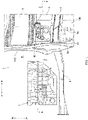
- FIG. 1 illustrates a plan view of a vehicle left side in a vehicle front portion
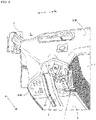
- FIG. 2 illustrates an external perspective view of a dash panel 6 as seen from an inside of a vehicle cabin
- FIG. 3 illustrates an external perspective view of a panel rear portion 81 in a state where an accelerator pedal 7 is disassembled.
- FIG. 4 illustrates an arrow cross-sectional view taken along A-A in FIG. 1
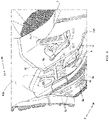
- FIG. 5 illustrates an external perspective view of a dash lower panel 8
- FIG. 6 illustrates an arrow cross-sectional view taken along B-B in FIG. 1
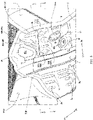
- FIG. 7 illustrates an external perspective view of the dash lower panel 8 in a state where a reinforcement member 10 is detached.
- FIG. 8 illustrates an arrow cross-sectional view taken along C-C in FIG. 5
- FIG. 9 illustrates an arrow cross-sectional view taken along D-D in FIG. 5 .
- an arrow Fr and an arrow Rr indicate a front-rear direction (longitudinal direction) of the vehicle (1), the arrow Fr indicates front direction, and the arrow Rr indicates rear direction.
- an arrow Rh and an arrow Lh indicate a vehicle width direction (left-right direction) of the vehicle (1), the arrow Rh indicates a right direction, and the arrow Lh indicates a left direction.
- a vehicle 1 is a left-hand drive vehicle in which a driver seat is arranged on the left side in the vehicle width direction.
- a vehicle front portion of this vehicle 1 particularly includes a floor tunnel 2 extending in a vehicle front-rear direction at a general center in the vehicle width direction in a vehicle cabin and a floor panel 3 disposed on a vehicle-width-direction outer side of the floor tunnel 2 and forming a vehicle cabin floor.
- the vehicle front portion of the vehicle 1 particularly includes a floor frame 4 as a vehicle-body framework member extending in the vehicle front-rear direction on the vehicle-width-direction outer side of the floor tunnel 2 and a front side frame 5 as a vehicle-body framework member extending from a front end of the floor frame 4 to a vehicle front.
- the vehicle front portion of the vehicle 1 includes the dash panel 6 dividing the inside from the outside of the vehicle cabin in the vehicle front-rear direction, the dash panel 6, a transmission T disposed in an engine room (or an engine compartment) E surrounded by the front side frames 5, and the accelerator pedal 7 disposed in the dash panel 6 (or on the dash panel 6).
- the floor frame 4 is particularly disposed across the floor panel 3 and the dash panel 6 in a position on the vehicle-width-direction outer side of a general center of the floor panel 3 in the vehicle width direction.
- This floor frame 4 is formed such that its cross-sectional shape in a vertical cross-section along the vehicle width direction forms a closed cross-section with the floor panel 3 and the dash panel 6.
- the front side frame 5 is particularly formed into a shape extending from the dash panel 6 to the vehicle front so as to be continuous with the floor frame 4. Note that a rear portion of the front side frame 5 is disposed so as to overlap with the floor frame 4 with the dash panel 6 interposed therebetween (see FIG. 8 and FIG. 9 ).
- the front side frame 5 is a closed cross-sectional member that has a closed cross-section of a cross-sectional shape in a vertical cross-section along the vehicle width direction, and is composed of an outer panel positioned on the vehicle-width-direction outer side and an inner panel positioned on the vehicle-width-direction inner side with respect to the outer panel.
- the dash panel 6 is particularly composed of the dash lower panel 8 disposed in a vehicle lower side and a dash upper panel 9 disposed on a vehicle upper side of the dash lower panel 8.
- the dash lower panel 8 is particularly a panel member that is disposed on a vehicle front side of the floor panel 3 and in a portion on the vehicle-width-direction outer side of the floor tunnel 2. As illustrated in FIG. 3 and FIG. 4 , this dash lower panel 8 is formed so as to rise from a front end of the floor panel 3 to a vehicle front upper side.
- the dash lower panel 8 is disposed in a state where it is inclined such that a front end is positioned on the vehicle upper side of a back end in a vertical cross-section along the vehicle front-rear direction.
- the dash lower panel 8 is formed into a shape having a shorter length in the vehicle front-rear direction in a portion on the vehicle-width-direction outer side of the floor frame 4 than the length in the vehicle front-rear direction in a portion between the floor tunnel 2 and the floor frame 4.
- the dash upper panel 9 is particularly a panel member that divides the inside from the outside of the vehicle cabin in the vehicle front-rear direction on the vehicle upper side of the floor tunnel 2 and the dash lower panel 8. As illustrated in FIG. 3 and FIG. 4 , this dash panel 6 is particularly formed into a shape extending from an upper end of the dash lower panel 8 toward a vehicle rear upper side.
- the dash upper panel 9 is disposed in a state where it is inclined such that an upper end is positioned in vehicle rear of a lower end in a vertical cross-section along the vehicle front-rear direction.
- the transmission T is particularly an automatic transmission, for example, and as illustrated in FIG. 1 and FIG. 4 , is disposed in a position being adjacent to the front side frame 5 on the vehicle-width-direction inner side and being spaced apart, to the vehicle front, at a predetermined interval from the dash lower panel 8 of the dash panel 6.
- the transmission T is disposed on the left side of the engine room E in the vehicle width direction.
- the transmission T may be transversely mounted.
- the accelerator pedal 7 is an organ type accelerator pedal. As illustrated in FIG. 1 to FIG. 3 , this accelerator pedal 7 is particularly fixed to an upper surface on the vehicle-width-direction inner side in the dash lower panel 8. Thus, the accelerator pedal 7 is adjacent to the floor tunnel 2 on the left side in the vehicle width direction and is opposed to the transmission T with the dash panel 6 interposed therebetween.
- the accelerator pedal 7 is disposed on a vehicle rear side of a general center of the dash lower panel 8 in the vehicle front-rear direction.
- this accelerator pedal 7 particularly includes a pedal step surface portion 71 on which the right foot of an occupant or a driver is placed, a pedal pedestal 72 swingably supporting a lower end of the pedal step surface portion 71 via a hinge, and a base plate 73 fixing the pedal pedestal 72 to the dash panel 6.
- the dash lower panel 8 particularly includes one or plural longitudinal beads 8a generally linearly extending in the vehicle front-rear direction on the vehicle-width-direction outer side of the floor frame 4 and a generally linear lateral bead 8b being adjacent to a vehicle front side of the accelerator pedal 7 on the vehicle-width-direction inner side of the floor frame 4 and extending in the vehicle width direction.
- This lateral bead 8b divides the dash lower panel 8 into a panel rear portion 81 on the vehicle rear side and a panel front portion 85 on the vehicle front side between the floor tunnel 2 and the floor frame 4.
- the dash lower panel 8 particularly includes a reinforcement member 10 reinforcing the panel rear portion 81 and/or an opening reinforcement member 11 reinforcing a periphery of an insertion hole 85a provided in the panel front portion 85.
- the longitudinal bead 8a is particularly formed such that its cross-sectional shape in a horizontal cross-section along the vehicle width direction becomes a cross-sectional shape in a general arc shape protruding to a vehicle front lower side.
- the one or plural longitudinal beads 8a are formed in a front portion and a rear portion on the vehicle-width-direction outer side of the floor frame 4 while being spaced apart at predetermined intervals in the vehicle width direction.
- the lateral bead 8b is particularly configured to function as a fragile portion in the dash lower panel 8 in cooperation with the panel rear portion 81 and the panel front portion 85.
- the lateral bead 8b is formed to have such a length that both ends in the vehicle width direction are respectively positioned close to the floor tunnel 2 and the floor frame 4.
- the lateral bead 8b is particularly formed such that its cross-sectional shape in a vertical cross-section along the vehicle front-rear direction becomes a cross-sectional shape in a general arc shape protruding to the vehicle front lower side.
- the panel rear portion 81 is particularly a portion on the vehicle rear side of the lateral bead 8b. As illustrated in FIG. 3 to FIG. 7 , in this panel rear portion 81, in the vicinity of a general center in the vehicle width direction, a seat surface portion 81a to which the base plate 73 of the accelerator pedal 7 is particularly fixed is provided to protrude toward the vehicle upper side.
- this seat surface portion 81a is particularly formed into a generally long elliptical shape that is long in a vehicle up-down direction. Furthermore, as illustrated in FIG. 5 to FIG. 7 , the seat surface portion 81a includes two stud bolts B that are for fastening the base plate 73 of the accelerator pedal 7 and are spaced apart at a predetermined interval in the vehicle front-rear direction.
- the rear portion bead 82 formed on the leftmost side in the vehicle width direction is particularly set as a first rear portion bead 82a, and in order from the left side in the vehicle width direction, the rear portion beads 82 positioned on the vehicle-width-direction inner sides of the first rear portion bead 82a are particularly set as a second rear portion bead 82b, a third rear portion bead 82c, and a fourth rear portion bead 82d.
- the first rear portion bead 82a is particularly formed with a length in the vehicle front-rear direction from the vicinity of a left end of the lateral bead 8b in the vehicle width direction to a position slightly in the vehicle front of the seat surface portion 81a and into a generally linear shape extending in the vehicle front-rear direction.
- this first rear portion bead 82a is particularly formed such that its cross-sectional shape in a horizontal cross-section along the vehicle width direction becomes a cross-sectional shape in a general arc shape protruding to the vehicle front lower side.
- the second rear portion bead 82b is particularly formed in a position on the vehicle-width-direction outer side of the seat surface portion 81a, with a length in the vehicle front-rear direction from the lateral bead 8b to a front portion of the seat surface portion 81a, and into a generally linear shape extending in the vehicle front-rear direction.
- this second rear portion bead 82b is formed such that its cross-sectional shape in a horizontal cross-section along the vehicle width direction becomes a cross-sectional shape in a general arc shape protruding to the vehicle front lower side.
- the third rear portion bead 82c is particularly formed in generally the same position in the vehicle width direction as the seat surface portion 81a, with a length in the vehicle front-rear direction from the lateral bead 8b to the vicinity of a front end of the seat surface portion 81a, and into a generally linear shape extending in the vehicle front-rear direction.
- this third rear portion bead 82c is particularly formed such that its cross-sectional shape in a horizontal cross-section along the vehicle width direction becomes a cross-sectional shape in a general arc shape protruding to the vehicle front lower side.
- a bulge portion 81b bulging to the vehicle front lower side in a general dome shape is particularly formed in a rear portion of the third rear portion bead 82c.
- the fourth rear portion bead 82d is particularly formed with a length in the vehicle front-rear direction from the vicinity of a right side of the lateral bead 8b in the vehicle width direction to a back end of the seat surface portion 81a and into a generally linear shape extending in the vehicle front-rear direction.
- this fourth rear portion bead 82d is particularly formed such that its cross-sectional shape in a horizontal cross-section along the vehicle width direction becomes a cross-sectional shape in a general arc shape protruding to the vehicle front lower side.
- a recess portion 81c protruding to the vehicle front lower side with a back surface shape in a generally long elliptical shape that is long in the vehicle width direction is particularly formed at a general center of the fourth rear portion bead 82d in the vehicle front-rear direction. Note that as illustrated in FIG. 7 , a left end in the vehicle width direction in this recess portion 81c is coupled with the bulge portion 81b of the third rear portion bead 82c.
- the panel front portion 85 is particularly a portion provided to extend from a front end of the panel rear portion 81 toward the vehicle front upper side with the lateral bead 8b interposed therebetween.
- the insertion hole 85a through which a steering shaft not illustrated is inserted is particularly formed to open on the vehicle front side of the first rear portion bead 82a and the second rear portion bead 82b of the panel rear portion 81.
- the insertion hole 85a is particularly formed to open in a generally long elliptical shape that is long in the vehicle front-rear direction in a back view.
- three front portion beads 86 being adjacent to the lateral bead 8b and extending in the vehicle front-rear direction are particularly formed while being spaced apart at predetermined intervals in the vehicle width direction.
- the front portion bead 86 formed on the leftmost side in the vehicle width direction is set as a first front portion bead 86a, and in order from the left side in the vehicle width direction, the front portion beads 86 positioned on the vehicle-width-direction inner sides of the first front portion bead 86a are particularly set as a second front portion bead 86b and a third front portion bead 86c.
- the first front portion bead 86a is particularly formed in generally the same position in the vehicle width direction as the second rear portion bead 82b of the panel rear portion 81 and into a generally linear shape extending, along the insertion hole 85a, from the lateral bead 8b toward the vehicle front and the right side in the vehicle width direction.
- the first front portion bead 86a is particularly formed with a length in the vehicle front-rear direction from the lateral bead 8b to the vicinity of the front end of the dash lower panel 8.
- this first front portion bead 86a is particularly formed such that its cross-sectional shape in a horizontal cross-section along the vehicle width direction becomes a cross-sectional shape in a general arc shape protruding to the vehicle front lower side.
- the second front portion bead 86b is particularly formed in generally the same position in the vehicle width direction as the third rear portion bead 82c of the panel rear portion 81 and into a generally linear shape extending from the lateral bead 8b toward the vehicle front.
- a front end of the second front portion bead 86b is particularly coupled with the first front portion bead 86a.
- this second front portion bead 86b is particularly formed such that its cross-sectional shape in a horizontal cross-section along the vehicle width direction becomes a cross-sectional shape in a general arc shape protruding to the vehicle front lower side.
- the third front portion bead 86c is particularly formed in generally the same position in the vehicle width direction as the fourth rear portion bead 82d of the panel rear portion 81, with a length in the vehicle front-rear direction from the lateral bead 8b to the vicinity of the front end of the dash lower panel 8, and into a generally linear shape extending in the vehicle front-rear direction.
- this third front portion bead 86c is particularly formed such that its cross-sectional shape in a horizontal cross-section along the vehicle width direction becomes a cross-sectional shape in a general arc shape protruding to the vehicle front lower side.
- the reinforcement member 10 is particularly formed in a size covering an upper surface of the panel rear portion 81 and is particularly joined to the upper surface of the panel rear portion 81.
- an opening 10a through which the seat surface portion 81a is inserted is particularly formed to open in this reinforcement member 10.
- the opening 10a is formed to open in a generally long elliptical shape that is long in the vehicle front-rear direction.
- the reinforcement member 10 particularly includes three reinforcement beads 101 formed while being spaced apart at predetermined intervals in the vehicle width direction and one bulge 102.
- the reinforcement bead 101 formed on the leftmost side in the vehicle width direction is particularly set as a first reinforcement bead 101a, and in order from the left side in the vehicle width direction, the reinforcement beads 101 positioned on the vehicle-width-direction inner sides of the first reinforcement bead 101a are set as a second reinforcement bead 101b and a third reinforcement bead 101c.
- the first reinforcement bead 101a is particularly formed in generally the same position in the vehicle width direction as the first rear portion bead 82a and with a shorter length in the vehicle front-rear direction than the first rear portion bead 82a.
- this first reinforcement bead 101a is particularly formed to have a cross-section in a general arc shape protruding toward the vehicle rear upper side in a horizontal cross-section along the vehicle width direction.
- the first reinforcement bead 101a is particularly formed into a shape in which its generally central portion in the vehicle front-rear direction bulges toward the vehicle rear upper side in a general truncated cone shape.
- the first reinforcement bead 101a particularly configures a closed cross-section with the first rear portion bead 82a of the panel rear portion 81 in a state where the panel rear portion 81 and the reinforcement member 10 are joined together.
- the second reinforcement bead 101b is particularly formed in generally the same position in the vehicle width direction as the second rear portion bead 82b and with a shorter length in the vehicle front-rear direction than the second rear portion bead 82b. As illustrated in FIG. 8 , this second reinforcement bead 101b is particularly formed to have a cross-section in a general arc shape protruding toward the vehicle rear upper side in a horizontal cross-section along the vehicle width direction.
- the second reinforcement bead 101b particularly configures a closed cross-section with the second rear portion bead 82b of the panel rear portion 81 in a state where the panel rear portion 81 and the reinforcement member 10 are joined together.
- the third reinforcement bead 101c is particularly formed in generally the same position in the vehicle width direction as the fourth rear portion bead 82d and with a shorter length in the vehicle front-rear direction than the fourth rear portion bead 82d.
- this third reinforcement bead 101c is particularly formed to have a cross-section in a generally trapezoidal shape protruding toward the vehicle rear upper side in a horizontal cross-section along the vehicle width direction.
- the third reinforcement bead 101c particularly configures a closed cross-section with the fourth rear portion bead 82d of the panel rear portion 81 in a state where the panel rear portion 81 and the reinforcement member 10 are joined together.
- the bulge 102 is particularly formed in generally the same position in the vehicle width direction as the bulge portion 81b of the panel rear portion 81. As illustrated in FIG. 8 , this bulge 102 is particularly formed to have a cross-sectional shape protruding toward the vehicle front lower side in a horizontal cross-section along the vehicle width direction.
- the bulge 102 is particularly formed so as to overlap with the bulge portion 81b of the panel rear portion 81 in a state where the panel rear portion 81 and the reinforcement member 10 are joined together.
- an opening reinforcement member 11 is particularly a reinforcement member joined to an upper surface of the panel front portion 85. As illustrated in FIG. 5 , this opening reinforcement member 11 is particularly in a general U-shape along a lower portion of an opening edge of the insertion hole 85a in a back view and reinforces the lower portion of the opening edge of the insertion hole 85a along a portion between the insertion hole 85a and the lateral bead 8b and a portion between the insertion hole 85a and the first front portion bead 86a.
- FIG. 10 illustrates a cross-sectional view of a state where the transmission T contacts with the dash lower panel 8
- FIG. 11 illustrates a cross-sectional view of a state where the dash lower panel 8 is deformed.
- the transmission T is pressed by the collision object and thereby starts moving toward the vehicle rear in the engine room E.
- the dash panel 6 is positioned in the vehicle rear of the transmission T, as illustrated in FIG. 10 , the transmission T first contacts with a front end of the dash panel 6, that is, the panel front portion 85 in the dash lower panel 8.
- the transmission T presses the panel front portion 85 of the dash lower panel 8 to the vehicle rear.
- the lateral bead 8b functions as the fragile portion in the dash lower panel 8.
- the dash lower panel 8 bends and deforms at the lateral bead 8b such that a front end of the panel front portion 85 rotationally moves toward the vehicle rear upper side around the lateral bead 8b as a pivot.
- the front vehicle-body structure for the vehicle 1 includes the transmission T disposed in the vehicle front portion, the dash lower panel 8 dividing the inside from the outside of the vehicle cabin in the vehicle rear of the transmission T, and the organ type accelerator pedal 7 disposed on the vehicle-width-direction inner side of the dash lower panel 8 opposed to the transmission T.
- the dash lower panel 8 includes the panel rear portion 81 in which the accelerator pedal 7 is arranged and the panel front portion 85 extending from the panel rear portion 81 to the vehicle front upper side.
- the dash lower panel 8 includes the fragile portion (lateral bead 8b) extending in the vehicle width direction along a boundary between the panel rear portion 81 and the panel front portion 85 and being fragile compared to the panel rear portion 81 and the panel front portion 85.
- the front vehicle-body structure for the vehicle 1 can inhibit a weight increase and reduce an impact load transmitted to the lower limbs of the occupant.
- the front vehicle-body structure for the vehicle 1 can cause the transmission T moving backward due to collision with the collision object to contact with the panel front portion 85 earlier than the panel rear portion 81.
- the front vehicle-body structure for the vehicle 1 can bend the dash lower panel 8 at the fragile portion (lateral bead 8b) such that the panel front portion 85 rotationally moves to the vehicle rear around the fragile portion (lateral bead 8b) as the pivot.
- the front vehicle-body structure for the vehicle 1 can absorb an impact load applied to the dash lower panel 8 and inhibit the accelerator pedal 7 from being displaced to the vehicle rear.
- the front vehicle-body structure for the vehicle 1 can inhibit the impact load from acting on the lower limbs of the occupant as a force causing the toes to approach the shins.
- the front vehicle-body structure for the vehicle 1 can inhibit a weight increase compared to a case where a board thickness of the dash lower panel 8 is made thick.
- the front vehicle-body structure for the vehicle 1 can inhibit a weight increase and reduce the impact load transmitted to the lower limbs of the occupant.
- the fragile portion is composed of the lateral bead 8b protruding to a vehicle lower side and extending in the vehicle width direction.
- the fragile portion can be formed with a comparatively simple configuration.
- the front vehicle-body structure for the vehicle 1 can certainly inhibit a weight increase.
- the panel front portion 85 of the dash lower panel 8 includes the front portion beads 86 being adjacent to the lateral bead 8b and extending in the vehicle front-rear direction.
- the front vehicle-body structure for the vehicle 1 can certainly bend the dash lower panel 8 at the fragile portion (lateral bead 8b) .
- the front vehicle-body structure for the vehicle 1 can certainly reduce the impact load transmitted to the lower limbs of the occupant by the front portion beads 86 provided in the panel front portion 85.
- the panel rear portion 81 of the dash lower panel 8 includes the rear portion beads 82 being adjacent to the lateral bead 8b and extending in the vehicle front-rear direction.
- the front vehicle-body structure for the vehicle 1 can more certainly bend the dash lower panel 8 at the fragile portion (lateral bead 8b).
- the front vehicle-body structure for the vehicle 1 can inhibit the panel rear portion 81 from being deformed due to an impact load applied to the dash panel 6.
- the front vehicle-body structure for the vehicle 1 can inhibit the accelerator pedal 7 from being displaced to the vehicle rear together with the panel rear portion 81.
- the front vehicle-body structure for the vehicle 1 can more certainly reduce the impact load transmitted to the lower limbs of the occupant by the rear portion beads 82 provided in the panel rear portion 81.
- the dash lower panel 8 includes the reinforcement member 10 having a front end positioned close to the fragile portion (lateral bead 8b) and covering the panel rear portion 81.
- the rigidity of the panel rear portion 81 can be improved more in the front vehicle-body structure for the vehicle 1, the rigidity difference between the fragile portion (lateral bead 8b) and the panel rear portion 81 can further be made large.
- the front vehicle-body structure for the vehicle 1 can further certainly bend the dash lower panel 8 at the fragile portion (lateral bead 8b).
- the front vehicle-body structure for the vehicle 1 can further inhibit the panel rear portion 81 from being deformed due to the impact load applied to the dash panel 6.
- the front vehicle-body structure for the vehicle 1 can further inhibit the accelerator pedal 7 from being displaced to the vehicle rear together with the panel rear portion 81.
- the reinforcement member 10 is provided that covers the panel rear portion 81, the front vehicle-body structure for the vehicle 1 can further certainly reduce the impact load transmitted to the lower limbs of the occupant.
- the reinforcement member 10 includes reinforcement beads 101 protruding to the vehicle upper side and forming closed cross-sections with the panel rear portion 81.
- the rigidity of the panel rear portion 81 can further be improved in the front vehicle-body structure for the vehicle 1, the rigidity difference between the fragile portion (lateral bead 8b) and the panel rear portion 81 can still further be made large.
- the front vehicle-body structure for the vehicle 1 can more certainly bend the dash lower panel 8 at the fragile portion (lateral bead 8b).
- the front vehicle-body structure for the vehicle 1 can certainly inhibit the panel rear portion 81 from being deformed due to the impact load applied to the dash panel 6.
- the front vehicle-body structure for the vehicle 1 can certainly inhibit the accelerator pedal 7 from being displaced to the vehicle rear together with the panel rear portion 81.
- the front vehicle-body structure for the vehicle 1 can still further reduce the impact load transmitted to the lower limbs of the occupant.
- the panel front portion 85 of the dash lower panel 8 includes the insertion hole 85a through which the steering shaft is inserted and the opening reinforcement member 11 disposed along the opening edge of the insertion hole 85a.
- the opening reinforcement member 11 is provided, the periphery of the insertion hole 85a can thereby be inhibited from being fragile, and the rigidity of the panel front portion 85 can be inhibited from being lowered due to the insertion hole 85a.
- the front vehicle-body structure for the vehicle 1 can secure the rigidity difference between the fragile portion (lateral bead 8b) and the panel front portion 85.
- the front vehicle-body structure for the vehicle 1 can certainly bend the dash lower panel 8 at the fragile portion (lateral bead 8b).
- the front vehicle-body structure for the vehicle 1 can reduce the impact load transmitted to the lower limbs of the occupant.
- the dash panel 6 is composed of the dash lower panel 8 and the dash upper panel 9; however, a dash panel is not limited to this but may be a dash panel in which a dash lower panel and a dash upper panel are integrally formed.
- the fragile portion is in a configuration including the lateral bead 8b in the dash lower panel 8; however, a configuration is not limited to this but may be in an appropriate shape as long as it extends in the vehicle width direction and functions as the fragile portion.
- a thin portion in which a boundary portion between a panel front portion and a panel rear portion is made thin may be included in the dash lower panel as the fragile portion.
- front portion beads 86 of the panel front portion 85 and the rear portion beads 82 of the panel rear portion 81 are provided that are in shapes protruding to the vehicle front lower side; however, a front portion bead and a rear portion bead are not limited to those but may be a front portion bead and a rear portion bead in shapes protruding to the vehicle rear upper side.
- the reinforcement member 10 is joined to the upper surface of the panel rear portion 81 in the dash lower panel 8; however, a reinforcement member is not limited to this but may be provided to a lower surface of the panel rear portion 81.
- the panel front portion 85 is provided that includes the insertion hole 85a through which the steering shaft is inserted; however, an insertion hole is not limited to this but may be an insertion hole through which an appropriate vehicle component such as a wire harness is inserted, for example.
- the description is not exclusive.
- a configuration is possible that includes a lateral bead functioning as a fragile portion on a vehicle front side of a foot rest in a front vehicle-body structure for a right-hand drive vehicle including an engine disposed in a vehicle front portion and the foot rest arranged on a vehicle-width-direction inner side of a dash lower panel opposed to the engine.
- a lateral bead functioning as a fragile portion on a vehicle front side of a foot rest in a front vehicle-body structure for a right-hand drive vehicle including an engine disposed in a vehicle front portion and the foot rest arranged on a vehicle-width-direction inner side of a dash lower panel opposed to the engine.
Landscapes
- Engineering & Computer Science (AREA)
- Chemical & Material Sciences (AREA)
- Combustion & Propulsion (AREA)
- Transportation (AREA)
- Mechanical Engineering (AREA)
- Body Structure For Vehicles (AREA)
Description
- This invention relates to a front vehicle-body structure for a vehicle, in which an organ type accelerator pedal or a foot rest is disposed on a vehicle-width-direction inner side of a dash panel opposed to a power train, for example.
- In a vehicle such as an automobile, when a vehicle front portion collides with a collision object, an impact load acts on an occupant seated on a front seat such that the occupant is thrown out to a vehicle front. In this case, when the occupant braces both of the legs against movement to the vehicle front, as a force bending the ankles of the occupant so as to cause the toes approach the shins, the impact load tends to act on the lower limbs of the occupant. Thus, when the vehicle front portion collides with the collision object, the occupant might injure the lower limbs by the impact load.
- Accordingly, various techniques have been suggested that reduce damage to the lower limbs of the occupant when the vehicle front portion collides with the collision object.
- For example,
Patent Literature 1 discloses a front vehicle-body structure in which a dash panel on a passenger seat side includes a mechanism composed of a footboard on which a foot of an occupant is placed, a support member rotatably supporting a back end of the footboard, and a load absorption member absorbing a load applied to the footboard. - In this
Patent Literature 1, while a load caused by bracing of both of the legs by the occupant and a load moving the occupant to a vehicle front when a vehicle collides with a collision object are absorbed by the load absorption member, an impact load acting on the lower limbs of the occupant is absorbed by rotational movement of the footboard to the vehicle front. Accordingly, inPatent Literature 1, a force causing the toes to approach the shins is inhibited from acting on the lower limbs of the occupant, and damage to the lower limbs of the occupant is thereby reduced. - Incidentally, when the vehicle front portion collides with the collision object, a power train disposed in the vehicle front portion moves backward and contacts with a dash panel, and the impact load may thereby be applied to the dash panel on a passenger seat side. In this case, because a mechanism as in
Patent Literature 1 can absorb the impact load applied to the dash panel of the passenger seat, even if the dash panel is displaced to vehicle rear, an impact load transmitted to the lower limbs of the occupant can be lessened. - However, for example, in a case of a driver seat of a left-hand drive vehicle, because an accelerator pedal is arranged on the right side of the dash panel opposed to the power train, a mechanism as in
Patent Literature 1 cannot be provided to the dash panel. - Furthermore, an organ type accelerator pedal has a problem that because the accelerator pedal and the dash panel are integrally displaced to the vehicle rear when the dash panel is displaced to the vehicle rear due to the impact load, the force bending the ankles of the occupant so as to cause the toes to approach the shins tends to be transmitted to the lower limbs of the occupant.
- Thus, in the dash panel in which the organ type accelerator pedal is arranged, in order to lessen the displacement to the vehicle rear due to the impact load, for example, it is possible to make a board thickness thick.
- However, in this case, there is a problem that the impact load can be inhibited from acting on the lower limbs of the occupant as the force bending the ankles of the occupant so as to cause the toes approach the shins but weight and cost significantly increase. Another example of a front vehicle body structure is disclosed in
Patent Literature 2 wherein a front vehicle-body structure for a vehicle with a power train is disposed in a vehicle front portion; a dash panel dividing an inside from an outside of a vehicle cabin in vehicle rear of the power train; and an organ type accelerator pedal or a foot rest are disposed on an inner side of the dash panel opposed to the power train, and the dash panel includes: a panel rear portion; a panel front portion extending from the panel rear portion to a vehicle front upper side; and a fragile portion extending in a vehicle width direction along a boundary between the panel rear portion and the panel front portion. - [Patent Literature 1]
Japanese Patent Laid-Open No. 2013-14171 DE 197 30 290 A1 - In consideration of the above-described problem, an object of the present invention is to inhibit a weight increase and reduce an impact load transmitted to lower limbs of an occupant.
- This invention is defined in
claim 1 and particularly provides a front vehicle-body structure for a vehicle, the front vehicle-body structure including: a power train disposed in a vehicle front portion; a dash panel dividing an inside from an outside of a vehicle cabin in vehicle rear of the power train; and an organ type accelerator pedal or a foot rest disposed on a vehicle-width-direction inner side of the dash panel opposed to the power train, wherein the dash panel includes: a panel rear portion in which the accelerator pedal or the foot rest is arranged; a panel front portion extending from the panel rear portion to a vehicle front upper side; and a fragile portion extending in a vehicle width direction along a boundary between the panel rear portion and the panel front portion and being fragile compared to the panel rear portion and the panel front portion. - The above fragile portion denotes a bead protruding in a thickness direction of the dash panel, a portion that is made thin compared to the panel rear portion and the panel front portion, or the like. Particularly, the rigidity of the fragile portion is lower than the rigidity of a portion around the fragile portion.
- According to this invention, the front vehicle-body structure for a vehicle can inhibit a weight increase and reduce an impact load transmitted to the lower limbs of an occupant.
- Specifically, because the panel front portion of the dash panel is provided to extend from the panel rear portion to the vehicle front upper side, the front vehicle-body structure for a vehicle can cause the power train moving backward due to collision with a collision object to contact with the panel front portion earlier than the panel rear portion.
- In this case, because the fragile portion is provided in the boundary between the panel rear portion and the panel front portion, the front vehicle-body structure for a vehicle can bend the dash panel at the fragile portion such that the panel front portion rotationally moves to the vehicle rear around the fragile portion as a pivot.
- Accordingly, the front vehicle-body structure for a vehicle can absorb an impact load applied to the dash panel and inhibit the accelerator pedal or the foot rest from being displaced to the vehicle rear. Thus, the front vehicle-body structure for a vehicle can inhibit the impact load from acting on the lower limbs of the occupant as a force causing the toes to approach the shins.
- Furthermore, because it is sufficient that only the fragile portion is provided in the dash panel, the front vehicle-body structure for a vehicle can inhibit a weight increase compared to a case where a board thickness of the dash panel is made thick.
- Consequently, the front vehicle-body structure for a vehicle can inhibit a weight increase and reduce the impact load transmitted to the lower limbs of the occupant.
- As an aspect of this invention, the fragile portion may be composed of a lateral bead protruding to a vehicle lower side and extending in the vehicle width direction.
- With this configuration, in the front vehicle-body structure for a vehicle, the fragile portion can be formed with a comparatively simple configuration. Thus, the front vehicle-body structure for a vehicle can certainly inhibit a weight increase.
- Further, as an aspect of this invention, the panel front portion of the dash panel may include a front portion bead being adjacent to the lateral bead and extending in a vehicle front-rear direction.
- With this configuration, because the rigidity of the panel front portion can be improved in the front vehicle-body structure for a vehicle, a rigidity difference between the fragile portion and the panel front portion can be made large.
- Thus, when the impact load is applied to the dash panel via the power train, the front vehicle-body structure for a vehicle can certainly bend the dash panel at the fragile portion.
- Consequently, the front vehicle-body structure for a vehicle can certainly reduce the impact load transmitted to the lower limbs of the occupant by the front portion bead provided in the panel front portion.
- Further, as an aspect of this invention, the panel rear portion of the dash panel may include a rear portion bead being adjacent to the lateral bead and extending in a vehicle front-rear direction.
- With this configuration, because the rigidity of the panel rear portion can be improved in the front vehicle-body structure for a vehicle, a rigidity difference between the fragile portion and the panel rear portion can be made large.
- Thus, when the impact load is applied to the dash panel via the power train, the front vehicle-body structure for a vehicle can more certainly bend the dash panel at the fragile portion.
- Furthermore, because the rigidity of the panel rear portion is improved by the rear portion bead, the front vehicle-body structure for a vehicle can inhibit the panel rear portion from being deformed due to the impact load applied to the dash panel.
- Thus, the front vehicle-body structure for a vehicle can inhibit the accelerator pedal or the foot rest from being displaced to the vehicle rear together with the panel rear portion.
- Consequently, the front vehicle-body structure for a vehicle can more certainly reduce the impact load transmitted to the lower limbs of the occupant by the rear portion bead provided in the panel rear portion.
- Further, as an aspect of this invention, the dash panel may include a reinforcement member having a front end positioned close to the fragile portion and covering the panel rear portion.
- With this configuration, because the rigidity of the panel rear portion can be improved more in the front vehicle-body structure for a vehicle, the rigidity difference between the fragile portion and the panel rear portion can further be made large.
- Thus, when the impact load is applied to the dash panel via the power train, the front vehicle-body structure for a vehicle can further certainly bend the dash panel at the fragile portion.
- Furthermore, because the rigidity of the panel rear portion is improved by the reinforcement member, the front vehicle-body structure for a vehicle can further inhibit the panel rear portion from being deformed due to the impact load applied to the dash panel.
- Thus, the front vehicle-body structure for a vehicle can further inhibit the accelerator pedal or the foot rest from being displaced to the vehicle rear together with the panel rear portion.
- Consequently, since the reinforcement member is provided that covers the panel rear portion, the front vehicle-body structure for a vehicle can further certainly reduce the impact load transmitted to the lower limbs of the occupant.
- Further, as an aspect of this invention, the reinforcement member may include a reinforcement bead protruding to a vehicle upper side and forming a closed cross-section with the panel rear portion. Particularly, the reinforcement bead protrudes upward.
- With this configuration, because the rigidity of the panel rear portion can further be improved in the front vehicle-body structure for a vehicle, the rigidity difference between the fragile portion and the panel rear portion can still further be made large.
- Thus, when the impact load is applied to the dash panel via the power train, the front vehicle-body structure for a vehicle can more certainly bend the dash panel at the fragile portion.
- Furthermore, because the rigidity of the panel rear portion is improved by the reinforcement bead of the reinforcement member, the front vehicle-body structure for a vehicle can certainly inhibit the panel rear portion from being deformed due to the impact load applied to the dash panel.
- Thus, the front vehicle-body structure for a vehicle can certainly inhibit the accelerator pedal or the foot rest from being displaced to the vehicle rear together with the panel rear portion.
- Consequently, since the reinforcement bead is provided in the reinforcement member, the front vehicle-body structure for a vehicle can still further reduce the impact load transmitted to the lower limbs of the occupant.
- Further, as an aspect of this invention, the panel front portion of the dash panel may include: an insertion hole through which a vehicle component is inserted; and an opening reinforcement member disposed along an opening edge of the insertion hole.
- With this configuration, in the front vehicle-body structure for a vehicle, the opening reinforcement member is provided, a periphery of the insertion hole can thereby be inhibited from being fragile, and the rigidity of the panel front portion can be inhibited from being lowered due to the insertion hole.
- Thus, even in a case where the insertion hole is provided, the front vehicle-body structure for a vehicle can secure the rigidity difference between the fragile portion and the panel front portion.
- Accordingly, when the impact load is applied to the dash panel via the power train, the front vehicle-body structure for a vehicle can certainly bend the dash panel at the fragile portion.
- Consequently, even in a case where the insertion hole is provided in the panel front portion, the front vehicle-body structure for a vehicle can reduce the impact load transmitted to the lower limbs of the occupant.
- Particularly, the dash panel includes a dash lower panel and a dash upper panel disposed on a vehicle upper side of the dash lower panel.
- Further particularly, the dash lower panel includes the panel rear portion and the panel front portion.
- Further particularly, the accelerator pedal or the foot rest is disposed on a left side of a floor tunnel in the vehicle width direction.
- Further particularly, the powertrain is transversely mounted.
- Further particularly, the powertrain is a transmission.
- Further particularly, the front vehicle-body structure includes a floor frame extending in the vehicle front-rear direction
- Further particularly, the fragile portion is on the vehicle-width-direction inner side of the floor frame.
- Further particularly, the floor frame is disposed across a floor panel and the dash panel.
- Further particularly, the front vehicle-body structure includes one or more longitudinal beads extending in the vehicle front-rear direction on the vehicle-width-direction outer side of the fragile portion.
- Further particularly, a vehicle included the above front vehicle-body structure.
- The front vehicle-body structure can inhibit a weight increase and reduce an impact load transmitted to lower limbs of an occupant.
-
-
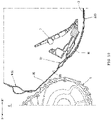
FIG. 1 is a plan view illustrating an external appearance of a vehicle left side in a vehicle front portion by a planar view. -
FIG. 2 is an external perspective view illustrating an external appearance of a dash panel as seen from an inside of a vehicle cabin. -
FIG. 3 is an external perspective view illustrating an external appearance of a panel rear portion in a state where an accelerator pedal is disassembled. -
FIG. 4 is an arrow cross-sectional view taken along A-A inFIG. 1 . -
FIG. 5 is an external perspective view illustrating an external appearance of a dash lower panel. -
FIG. 6 is an arrow cross-sectional view taken along B-B inFIG. 1 . -
FIG. 7 is an external perspective view illustrating an external appearance of the dash lower panel in a state where a reinforcement member is detached. -
FIG. 8 is an arrow cross-sectional view taken along C-C inFIG. 5 . -
FIG. 9 is an arrow cross-sectional view taken along D-D inFIG. 5 . -
FIG. 10 is a cross-sectional view, along arrows A-A, illustrating a state where a transmission contacts with the dash lower panel. -
FIG. 11 is a cross-sectional view, along arrows A-A, illustrating a state where the dash lower panel is deformed. - One embodiment of this invention will hereinafter be described with reference to drawings. All of the features as shown in the drawings may not necessarily be essential.
- A vehicle of this embodiment is particularly a left-hand drive vehicle in which an organ type accelerator pedal is disposed on a vehicle-width-direction inner side of a dash panel opposed to a transmission. A front vehicle-body structure of such a vehicle will be described by using
FIG. 1 to FIG. 9 . - Note that
FIG. 1 illustrates a plan view of a vehicle left side in a vehicle front portion,FIG. 2 illustrates an external perspective view of adash panel 6 as seen from an inside of a vehicle cabin, andFIG. 3 illustrates an external perspective view of a panelrear portion 81 in a state where anaccelerator pedal 7 is disassembled. - Furthermore,
FIG. 4 illustrates an arrow cross-sectional view taken along A-A inFIG. 1 ,FIG. 5 illustrates an external perspective view of a dashlower panel 8,FIG. 6 illustrates an arrow cross-sectional view taken along B-B inFIG. 1 , andFIG. 7 illustrates an external perspective view of the dashlower panel 8 in a state where areinforcement member 10 is detached. - In addition,
FIG. 8 illustrates an arrow cross-sectional view taken along C-C inFIG. 5 , andFIG. 9 illustrates an arrow cross-sectional view taken along D-D inFIG. 5 . - Further, in the drawings, an arrow Fr and an arrow Rr indicate a front-rear direction (longitudinal direction) of the vehicle (1), the arrow Fr indicates front direction, and the arrow Rr indicates rear direction. Furthermore, an arrow Rh and an arrow Lh indicate a vehicle width direction (left-right direction) of the vehicle (1), the arrow Rh indicates a right direction, and the arrow Lh indicates a left direction.
- Note that in this embodiment, a description will be made about a left side in the vehicle width direction in the vehicle front portion, and detailed descriptions and illustrations of a right side in the vehicle width direction will not be made.
- A
vehicle 1 is a left-hand drive vehicle in which a driver seat is arranged on the left side in the vehicle width direction. As illustrated inFIG. 1 , a vehicle front portion of thisvehicle 1 particularly includes afloor tunnel 2 extending in a vehicle front-rear direction at a general center in the vehicle width direction in a vehicle cabin and afloor panel 3 disposed on a vehicle-width-direction outer side of thefloor tunnel 2 and forming a vehicle cabin floor. - Furthermore, as illustrated in
FIG. 1 , the vehicle front portion of thevehicle 1 particularly includes a floor frame 4 as a vehicle-body framework member extending in the vehicle front-rear direction on the vehicle-width-direction outer side of thefloor tunnel 2 and afront side frame 5 as a vehicle-body framework member extending from a front end of the floor frame 4 to a vehicle front. - In addition, as illustrated in
FIG. 1 , the vehicle front portion of thevehicle 1 includes thedash panel 6 dividing the inside from the outside of the vehicle cabin in the vehicle front-rear direction, thedash panel 6, a transmission T disposed in an engine room (or an engine compartment) E surrounded by the front side frames 5, and theaccelerator pedal 7 disposed in the dash panel 6 (or on the dash panel 6). - More specifically, as illustrated in
FIG. 1 andFIG. 2 , the floor frame 4 is particularly disposed across thefloor panel 3 and thedash panel 6 in a position on the vehicle-width-direction outer side of a general center of thefloor panel 3 in the vehicle width direction. This floor frame 4 is formed such that its cross-sectional shape in a vertical cross-section along the vehicle width direction forms a closed cross-section with thefloor panel 3 and thedash panel 6. - Further, the
front side frame 5 is particularly formed into a shape extending from thedash panel 6 to the vehicle front so as to be continuous with the floor frame 4. Note that a rear portion of thefront side frame 5 is disposed so as to overlap with the floor frame 4 with thedash panel 6 interposed therebetween (seeFIG. 8 andFIG. 9 ). - Specifically, the
front side frame 5 is a closed cross-sectional member that has a closed cross-section of a cross-sectional shape in a vertical cross-section along the vehicle width direction, and is composed of an outer panel positioned on the vehicle-width-direction outer side and an inner panel positioned on the vehicle-width-direction inner side with respect to the outer panel. - Further, as illustrated in
FIG. 2 andFIG. 3 , thedash panel 6 is particularly composed of the dashlower panel 8 disposed in a vehicle lower side and a dashupper panel 9 disposed on a vehicle upper side of the dashlower panel 8. - As illustrated in
FIG. 2 andFIG. 3 , the dashlower panel 8 is particularly a panel member that is disposed on a vehicle front side of thefloor panel 3 and in a portion on the vehicle-width-direction outer side of thefloor tunnel 2. As illustrated inFIG. 3 andFIG. 4 , this dashlower panel 8 is formed so as to rise from a front end of thefloor panel 3 to a vehicle front upper side. - Specifically, as illustrated in
FIG. 4 , the dashlower panel 8 is disposed in a state where it is inclined such that a front end is positioned on the vehicle upper side of a back end in a vertical cross-section along the vehicle front-rear direction. - Note that the dash
lower panel 8 is formed into a shape having a shorter length in the vehicle front-rear direction in a portion on the vehicle-width-direction outer side of the floor frame 4 than the length in the vehicle front-rear direction in a portion between thefloor tunnel 2 and the floor frame 4. - Meanwhile, as illustrated in
FIG. 2 andFIG. 4 , the dashupper panel 9 is particularly a panel member that divides the inside from the outside of the vehicle cabin in the vehicle front-rear direction on the vehicle upper side of thefloor tunnel 2 and the dashlower panel 8. As illustrated inFIG. 3 andFIG. 4 , thisdash panel 6 is particularly formed into a shape extending from an upper end of the dashlower panel 8 toward a vehicle rear upper side. - Specifically, as illustrated in
FIG. 4 , the dashupper panel 9 is disposed in a state where it is inclined such that an upper end is positioned in vehicle rear of a lower end in a vertical cross-section along the vehicle front-rear direction. - Further, the transmission T is particularly an automatic transmission, for example, and as illustrated in
FIG. 1 andFIG. 4 , is disposed in a position being adjacent to thefront side frame 5 on the vehicle-width-direction inner side and being spaced apart, to the vehicle front, at a predetermined interval from the dashlower panel 8 of thedash panel 6. In other words, the transmission T is disposed on the left side of the engine room E in the vehicle width direction. The transmission T may be transversely mounted. - Further, as illustrated in
FIG. 2 to FIG. 4 , theaccelerator pedal 7 is an organ type accelerator pedal. As illustrated inFIG. 1 to FIG. 3 , thisaccelerator pedal 7 is particularly fixed to an upper surface on the vehicle-width-direction inner side in the dashlower panel 8. Thus, theaccelerator pedal 7 is adjacent to thefloor tunnel 2 on the left side in the vehicle width direction and is opposed to the transmission T with thedash panel 6 interposed therebetween. - Specifically, as illustrated in
FIG. 1 to FIG. 3 , theaccelerator pedal 7 is disposed on a vehicle rear side of a general center of the dashlower panel 8 in the vehicle front-rear direction. As illustrated inFIG. 3 andFIG. 4 , thisaccelerator pedal 7 particularly includes a pedalstep surface portion 71 on which the right foot of an occupant or a driver is placed, apedal pedestal 72 swingably supporting a lower end of the pedalstep surface portion 71 via a hinge, and abase plate 73 fixing thepedal pedestal 72 to thedash panel 6. - Note that although detailed illustrations are not made, in the
pedal pedestal 72, a detection sensor detecting a swing angle of the pedalstep surface portion 71 as an accelerator opening, a connector with which a wire harness for communicating with an ECU controlling an engine is connected, and so forth are built. - In the following, a detailed description will next be made about the dash
lower panel 8 of the above-describeddash panel 6. - As illustrated in
FIG. 5 andFIG. 6 , the dashlower panel 8 particularly includes one or plurallongitudinal beads 8a generally linearly extending in the vehicle front-rear direction on the vehicle-width-direction outer side of the floor frame 4 and a generally linearlateral bead 8b being adjacent to a vehicle front side of theaccelerator pedal 7 on the vehicle-width-direction inner side of the floor frame 4 and extending in the vehicle width direction. - This
lateral bead 8b divides the dashlower panel 8 into a panelrear portion 81 on the vehicle rear side and apanel front portion 85 on the vehicle front side between thefloor tunnel 2 and the floor frame 4. - Furthermore, as illustrated in
FIG. 5 andFIG. 6 , the dashlower panel 8 particularly includes areinforcement member 10 reinforcing the panelrear portion 81 and/or anopening reinforcement member 11 reinforcing a periphery of aninsertion hole 85a provided in thepanel front portion 85. - More specifically, the
longitudinal bead 8a is particularly formed such that its cross-sectional shape in a horizontal cross-section along the vehicle width direction becomes a cross-sectional shape in a general arc shape protruding to a vehicle front lower side. As illustrated inFIG. 5 , the one or plurallongitudinal beads 8a are formed in a front portion and a rear portion on the vehicle-width-direction outer side of the floor frame 4 while being spaced apart at predetermined intervals in the vehicle width direction. - Further, the
lateral bead 8b is particularly configured to function as a fragile portion in the dashlower panel 8 in cooperation with the panelrear portion 81 and thepanel front portion 85. - Specifically, as illustrated in
FIG. 5 , thelateral bead 8b is formed to have such a length that both ends in the vehicle width direction are respectively positioned close to thefloor tunnel 2 and the floor frame 4. - Furthermore, as illustrated in
FIG. 6 , thelateral bead 8b is particularly formed such that its cross-sectional shape in a vertical cross-section along the vehicle front-rear direction becomes a cross-sectional shape in a general arc shape protruding to the vehicle front lower side. - Further, as illustrated in
FIG. 5 andFIG. 6 , the panelrear portion 81 is particularly a portion on the vehicle rear side of thelateral bead 8b. As illustrated inFIG. 3 to FIG. 7 , in this panelrear portion 81, in the vicinity of a general center in the vehicle width direction, aseat surface portion 81a to which thebase plate 73 of theaccelerator pedal 7 is particularly fixed is provided to protrude toward the vehicle upper side. - As illustrated in
FIG. 7 , thisseat surface portion 81a is particularly formed into a generally long elliptical shape that is long in a vehicle up-down direction. Furthermore, as illustrated inFIG. 5 to FIG. 7 , theseat surface portion 81a includes two stud bolts B that are for fastening thebase plate 73 of theaccelerator pedal 7 and are spaced apart at a predetermined interval in the vehicle front-rear direction. - As illustrated in
FIG. 7 andFIG. 8 , in such a panelrear portion 81, fourrear portion beads 82 extending in the vehicle front-rear direction are formed adjacently to thelateral bead 8b while being spaced apart at predetermined intervals in the vehicle width direction. - Note that among the four
rear portion beads 82, therear portion bead 82 formed on the leftmost side in the vehicle width direction is particularly set as a firstrear portion bead 82a, and in order from the left side in the vehicle width direction, therear portion beads 82 positioned on the vehicle-width-direction inner sides of the firstrear portion bead 82a are particularly set as a secondrear portion bead 82b, a thirdrear portion bead 82c, and a fourthrear portion bead 82d. - Specifically, as illustrated in
FIG. 7 , the firstrear portion bead 82a is particularly formed with a length in the vehicle front-rear direction from the vicinity of a left end of thelateral bead 8b in the vehicle width direction to a position slightly in the vehicle front of theseat surface portion 81a and into a generally linear shape extending in the vehicle front-rear direction. As illustrated inFIG. 8 , this firstrear portion bead 82a is particularly formed such that its cross-sectional shape in a horizontal cross-section along the vehicle width direction becomes a cross-sectional shape in a general arc shape protruding to the vehicle front lower side. - As illustrated in
FIG. 7 , the secondrear portion bead 82b is particularly formed in a position on the vehicle-width-direction outer side of theseat surface portion 81a, with a length in the vehicle front-rear direction from thelateral bead 8b to a front portion of theseat surface portion 81a, and into a generally linear shape extending in the vehicle front-rear direction. As illustrated inFIG. 8 , this secondrear portion bead 82b is formed such that its cross-sectional shape in a horizontal cross-section along the vehicle width direction becomes a cross-sectional shape in a general arc shape protruding to the vehicle front lower side. - As illustrated in
FIG. 7 , the thirdrear portion bead 82c is particularly formed in generally the same position in the vehicle width direction as theseat surface portion 81a, with a length in the vehicle front-rear direction from thelateral bead 8b to the vicinity of a front end of theseat surface portion 81a, and into a generally linear shape extending in the vehicle front-rear direction. - As illustrated in
FIG. 8 , this thirdrear portion bead 82c is particularly formed such that its cross-sectional shape in a horizontal cross-section along the vehicle width direction becomes a cross-sectional shape in a general arc shape protruding to the vehicle front lower side. - Furthermore, as illustrated in
FIG. 7 , abulge portion 81b bulging to the vehicle front lower side in a general dome shape is particularly formed in a rear portion of the thirdrear portion bead 82c. - As illustrated in
FIG. 7 , the fourthrear portion bead 82d is particularly formed with a length in the vehicle front-rear direction from the vicinity of a right side of thelateral bead 8b in the vehicle width direction to a back end of theseat surface portion 81a and into a generally linear shape extending in the vehicle front-rear direction. As illustrated inFIG. 8 , this fourthrear portion bead 82d is particularly formed such that its cross-sectional shape in a horizontal cross-section along the vehicle width direction becomes a cross-sectional shape in a general arc shape protruding to the vehicle front lower side. - Furthermore, as illustrated in
FIG. 7 , arecess portion 81c protruding to the vehicle front lower side with a back surface shape in a generally long elliptical shape that is long in the vehicle width direction is particularly formed at a general center of the fourthrear portion bead 82d in the vehicle front-rear direction. Note that as illustrated inFIG. 7 , a left end in the vehicle width direction in thisrecess portion 81c is coupled with thebulge portion 81b of the thirdrear portion bead 82c. - Further, as illustrated in
FIG. 4 to FIG. 6 , thepanel front portion 85 is particularly a portion provided to extend from a front end of the panelrear portion 81 toward the vehicle front upper side with thelateral bead 8b interposed therebetween. - As illustrated in
FIG. 3 andFIG. 7 , in thispanel front portion 85, theinsertion hole 85a through which a steering shaft not illustrated is inserted is particularly formed to open on the vehicle front side of the firstrear portion bead 82a and the secondrear portion bead 82b of the panelrear portion 81. - Note that as illustrated in
FIG. 3 andFIG. 7 , theinsertion hole 85a is particularly formed to open in a generally long elliptical shape that is long in the vehicle front-rear direction in a back view. - Furthermore, as illustrated in
FIG. 5 andFIG. 7 , in thepanel front portion 85, threefront portion beads 86 being adjacent to thelateral bead 8b and extending in the vehicle front-rear direction are particularly formed while being spaced apart at predetermined intervals in the vehicle width direction. - Note that among the three
front portion beads 86, thefront portion bead 86 formed on the leftmost side in the vehicle width direction is set as a firstfront portion bead 86a, and in order from the left side in the vehicle width direction, thefront portion beads 86 positioned on the vehicle-width-direction inner sides of the firstfront portion bead 86a are particularly set as a secondfront portion bead 86b and a thirdfront portion bead 86c. - Specifically, as illustrated in
FIG. 7 , the firstfront portion bead 86a is particularly formed in generally the same position in the vehicle width direction as the secondrear portion bead 82b of the panelrear portion 81 and into a generally linear shape extending, along theinsertion hole 85a, from thelateral bead 8b toward the vehicle front and the right side in the vehicle width direction. - Note that as illustrated in
FIG. 7 , the firstfront portion bead 86a is particularly formed with a length in the vehicle front-rear direction from thelateral bead 8b to the vicinity of the front end of the dashlower panel 8. - As illustrated in
FIG. 9 , this firstfront portion bead 86a is particularly formed such that its cross-sectional shape in a horizontal cross-section along the vehicle width direction becomes a cross-sectional shape in a general arc shape protruding to the vehicle front lower side. - As illustrated in
FIG. 7 , the secondfront portion bead 86b is particularly formed in generally the same position in the vehicle width direction as the thirdrear portion bead 82c of the panelrear portion 81 and into a generally linear shape extending from thelateral bead 8b toward the vehicle front. - Note that as illustrated in
FIG. 7 , a front end of the secondfront portion bead 86b is particularly coupled with the firstfront portion bead 86a. - As illustrated in
FIG. 9 , this secondfront portion bead 86b is particularly formed such that its cross-sectional shape in a horizontal cross-section along the vehicle width direction becomes a cross-sectional shape in a general arc shape protruding to the vehicle front lower side. - As illustrated in
FIG. 7 , the thirdfront portion bead 86c is particularly formed in generally the same position in the vehicle width direction as the fourthrear portion bead 82d of the panelrear portion 81, with a length in the vehicle front-rear direction from thelateral bead 8b to the vicinity of the front end of the dashlower panel 8, and into a generally linear shape extending in the vehicle front-rear direction. As illustrated inFIG. 9 , this thirdfront portion bead 86c is particularly formed such that its cross-sectional shape in a horizontal cross-section along the vehicle width direction becomes a cross-sectional shape in a general arc shape protruding to the vehicle front lower side. - Further, as illustrated in
FIG. 5 , thereinforcement member 10 is particularly formed in a size covering an upper surface of the panelrear portion 81 and is particularly joined to the upper surface of the panelrear portion 81. As illustrated inFIG. 5 , anopening 10a through which theseat surface portion 81a is inserted is particularly formed to open in thisreinforcement member 10. Note that as illustrated inFIG. 5 , theopening 10a is formed to open in a generally long elliptical shape that is long in the vehicle front-rear direction. - Furthermore, as illustrated in
FIG. 5 , thereinforcement member 10 particularly includes threereinforcement beads 101 formed while being spaced apart at predetermined intervals in the vehicle width direction and onebulge 102. - Note that among the three
reinforcement beads 101, thereinforcement bead 101 formed on the leftmost side in the vehicle width direction is particularly set as afirst reinforcement bead 101a, and in order from the left side in the vehicle width direction, thereinforcement beads 101 positioned on the vehicle-width-direction inner sides of thefirst reinforcement bead 101a are set as asecond reinforcement bead 101b and athird reinforcement bead 101c. - Specifically, as illustrated in
FIG. 5 ,FIG. 7 , andFIG. 8 , thefirst reinforcement bead 101a is particularly formed in generally the same position in the vehicle width direction as the firstrear portion bead 82a and with a shorter length in the vehicle front-rear direction than the firstrear portion bead 82a. - As illustrated in
FIG. 8 , thisfirst reinforcement bead 101a is particularly formed to have a cross-section in a general arc shape protruding toward the vehicle rear upper side in a horizontal cross-section along the vehicle width direction. - Furthermore, as illustrated in
FIG. 5 andFIG. 8 , thefirst reinforcement bead 101a is particularly formed into a shape in which its generally central portion in the vehicle front-rear direction bulges toward the vehicle rear upper side in a general truncated cone shape. - Moreover, as illustrated in
FIG. 8 , thefirst reinforcement bead 101a particularly configures a closed cross-section with the firstrear portion bead 82a of the panelrear portion 81 in a state where the panelrear portion 81 and thereinforcement member 10 are joined together. - As illustrated in
FIG. 5 ,FIG. 7 , andFIG. 8 , thesecond reinforcement bead 101b is particularly formed in generally the same position in the vehicle width direction as the secondrear portion bead 82b and with a shorter length in the vehicle front-rear direction than the secondrear portion bead 82b. As illustrated inFIG. 8 , thissecond reinforcement bead 101b is particularly formed to have a cross-section in a general arc shape protruding toward the vehicle rear upper side in a horizontal cross-section along the vehicle width direction. - Moreover, as illustrated in
FIG. 8 , thesecond reinforcement bead 101b particularly configures a closed cross-section with the secondrear portion bead 82b of the panelrear portion 81 in a state where the panelrear portion 81 and thereinforcement member 10 are joined together. - As illustrated in
FIG. 5 ,FIG. 7 , andFIG. 8 , thethird reinforcement bead 101c is particularly formed in generally the same position in the vehicle width direction as the fourthrear portion bead 82d and with a shorter length in the vehicle front-rear direction than the fourthrear portion bead 82d. - As illustrated in
FIG. 8 , thisthird reinforcement bead 101c is particularly formed to have a cross-section in a generally trapezoidal shape protruding toward the vehicle rear upper side in a horizontal cross-section along the vehicle width direction. - Moreover, as illustrated in
FIG. 8 , thethird reinforcement bead 101c particularly configures a closed cross-section with the fourthrear portion bead 82d of the panelrear portion 81 in a state where the panelrear portion 81 and thereinforcement member 10 are joined together. - As illustrated in
FIG. 5 ,FIG. 7 , andFIG. 8 , thebulge 102 is particularly formed in generally the same position in the vehicle width direction as thebulge portion 81b of the panelrear portion 81. As illustrated inFIG. 8 , thisbulge 102 is particularly formed to have a cross-sectional shape protruding toward the vehicle front lower side in a horizontal cross-section along the vehicle width direction. - That is, the
bulge 102 is particularly formed so as to overlap with thebulge portion 81b of the panelrear portion 81 in a state where the panelrear portion 81 and thereinforcement member 10 are joined together. - Further, as illustrated in
FIG. 5 , an openingreinforcement member 11 is particularly a reinforcement member joined to an upper surface of thepanel front portion 85. As illustrated inFIG. 5 , this openingreinforcement member 11 is particularly in a general U-shape along a lower portion of an opening edge of theinsertion hole 85a in a back view and reinforces the lower portion of the opening edge of theinsertion hole 85a along a portion between theinsertion hole 85a and thelateral bead 8b and a portion between theinsertion hole 85a and the firstfront portion bead 86a. - Next, a brief description will be made with reference to
FIG. 10 andFIG. 11 about a state in the front vehicle-body structure for thevehicle 1 in the above-described configuration in a case where the transmission T moving backward to the vehicle rear due to collision with a collision object contacts with thedash panel 6. - Note that
FIG. 10 illustrates a cross-sectional view of a state where the transmission T contacts with the dashlower panel 8, andFIG. 11 illustrates a cross-sectional view of a state where the dashlower panel 8 is deformed. - First, in a case where a collision object collides with the vehicle front portion between the front side frames 5, the transmission T is pressed by the collision object and thereby starts moving toward the vehicle rear in the engine room E. In this case, because the
dash panel 6 is positioned in the vehicle rear of the transmission T, as illustrated inFIG. 10 , the transmission T first contacts with a front end of thedash panel 6, that is, thepanel front portion 85 in the dashlower panel 8. - When the transmission T thereafter further moves to the vehicle rear, the transmission T presses the
panel front portion 85 of the dashlower panel 8 to the vehicle rear. In this case, because the rigidity of thelateral bead 8b is relatively low with respect to the panelrear portion 81 and thepanel front portion 85, thelateral bead 8b functions as the fragile portion in the dashlower panel 8. - Thus, when the
panel front portion 85 is pressed by the transmission T, as illustrated inFIG. 11 , the dashlower panel 8 bends and deforms at thelateral bead 8b such that a front end of thepanel front portion 85 rotationally moves toward the vehicle rear upper side around thelateral bead 8b as a pivot. - In such a manner, when the dash
lower panel 8 is pressed to the vehicle rear by the transmission T, the front vehicle-body structure for thevehicle 1 inhibits theaccelerator pedal 7 from being displaced to the vehicle rear integrally with the panelrear portion 81. - As described above, the front vehicle-body structure for the
vehicle 1 includes the transmission T disposed in the vehicle front portion, the dashlower panel 8 dividing the inside from the outside of the vehicle cabin in the vehicle rear of the transmission T, and the organtype accelerator pedal 7 disposed on the vehicle-width-direction inner side of the dashlower panel 8 opposed to the transmission T. - Furthermore, the dash
lower panel 8 includes the panelrear portion 81 in which theaccelerator pedal 7 is arranged and thepanel front portion 85 extending from the panelrear portion 81 to the vehicle front upper side. - In addition, the dash
lower panel 8 includes the fragile portion (lateral bead 8b) extending in the vehicle width direction along a boundary between the panelrear portion 81 and thepanel front portion 85 and being fragile compared to the panelrear portion 81 and thepanel front portion 85. - In this invention, the front vehicle-body structure for the
vehicle 1 can inhibit a weight increase and reduce an impact load transmitted to the lower limbs of the occupant. - Specifically, because the
panel front portion 85 of the dashlower panel 8 is provided to extend from the panelrear portion 81 to the vehicle front upper side, the front vehicle-body structure for thevehicle 1 can cause the transmission T moving backward due to collision with the collision object to contact with thepanel front portion 85 earlier than the panelrear portion 81. - In this case, because the fragile portion (
lateral bead 8b) is provided in the boundary between the panelrear portion 81 and thepanel front portion 85, the front vehicle-body structure for thevehicle 1 can bend the dashlower panel 8 at the fragile portion (lateral bead 8b) such that thepanel front portion 85 rotationally moves to the vehicle rear around the fragile portion (lateral bead 8b) as the pivot. - Accordingly, the front vehicle-body structure for the
vehicle 1 can absorb an impact load applied to the dashlower panel 8 and inhibit theaccelerator pedal 7 from being displaced to the vehicle rear. Thus, the front vehicle-body structure for thevehicle 1 can inhibit the impact load from acting on the lower limbs of the occupant as a force causing the toes to approach the shins. - Furthermore, because it is sufficient that only the fragile portion (
lateral bead 8b) is provided in the dashlower panel 8, the front vehicle-body structure for thevehicle 1 can inhibit a weight increase compared to a case where a board thickness of the dashlower panel 8 is made thick. - Consequently, the front vehicle-body structure for the
vehicle 1 can inhibit a weight increase and reduce the impact load transmitted to the lower limbs of the occupant. - Further, the fragile portion is composed of the
lateral bead 8b protruding to a vehicle lower side and extending in the vehicle width direction. - With this configuration, in the front vehicle-body structure for the
vehicle 1, the fragile portion can be formed with a comparatively simple configuration. Thus, the front vehicle-body structure for thevehicle 1 can certainly inhibit a weight increase. - Further, the
panel front portion 85 of the dashlower panel 8 includes thefront portion beads 86 being adjacent to thelateral bead 8b and extending in the vehicle front-rear direction. - With this configuration, because the rigidity of the
panel front portion 85 can be improved in the front vehicle-body structure for thevehicle 1, a rigidity difference between the fragile portion (lateral bead 8b) and thepanel front portion 85 can be made large. - Thus, when the impact load is applied to the dash
lower panel 8 via the transmission T, the front vehicle-body structure for thevehicle 1 can certainly bend the dashlower panel 8 at the fragile portion (lateral bead 8b) . - Consequently, the front vehicle-body structure for the
vehicle 1 can certainly reduce the impact load transmitted to the lower limbs of the occupant by thefront portion beads 86 provided in thepanel front portion 85. - Further, the panel
rear portion 81 of the dashlower panel 8 includes therear portion beads 82 being adjacent to thelateral bead 8b and extending in the vehicle front-rear direction. - With this configuration, because the rigidity of the panel
rear portion 81 can be improved in the front vehicle-body structure for thevehicle 1, a rigidity difference between the fragile portion (lateral bead 8b) and the panelrear portion 81 can be made large. - Thus, when the impact load is applied to the dash
lower panel 8 via the transmission T, the front vehicle-body structure for thevehicle 1 can more certainly bend the dashlower panel 8 at the fragile portion (lateral bead 8b). - Furthermore, because the rigidity of the panel
rear portion 81 is improved by therear portion beads 82, the front vehicle-body structure for thevehicle 1 can inhibit the panelrear portion 81 from being deformed due to an impact load applied to thedash panel 6. - Thus, the front vehicle-body structure for the
vehicle 1 can inhibit theaccelerator pedal 7 from being displaced to the vehicle rear together with the panelrear portion 81. - Consequently, the front vehicle-body structure for the
vehicle 1 can more certainly reduce the impact load transmitted to the lower limbs of the occupant by therear portion beads 82 provided in the panelrear portion 81. - Further, the dash
lower panel 8 includes thereinforcement member 10 having a front end positioned close to the fragile portion (lateral bead 8b) and covering the panelrear portion 81. - With this configuration, because the rigidity of the panel
rear portion 81 can be improved more in the front vehicle-body structure for thevehicle 1, the rigidity difference between the fragile portion (lateral bead 8b) and the panelrear portion 81 can further be made large. - Thus, when the impact load is applied to the dash
lower panel 8 via the transmission T, the front vehicle-body structure for thevehicle 1 can further certainly bend the dashlower panel 8 at the fragile portion (lateral bead 8b). - Furthermore, because the rigidity of the panel
rear portion 81 is improved by thereinforcement member 10, the front vehicle-body structure for thevehicle 1 can further inhibit the panelrear portion 81 from being deformed due to the impact load applied to thedash panel 6. - Thus, the front vehicle-body structure for the
vehicle 1 can further inhibit theaccelerator pedal 7 from being displaced to the vehicle rear together with the panelrear portion 81. - Consequently, since the
reinforcement member 10 is provided that covers the panelrear portion 81, the front vehicle-body structure for thevehicle 1 can further certainly reduce the impact load transmitted to the lower limbs of the occupant. - Further, the
reinforcement member 10 includesreinforcement beads 101 protruding to the vehicle upper side and forming closed cross-sections with the panelrear portion 81. - With this configuration, because the rigidity of the panel
rear portion 81 can further be improved in the front vehicle-body structure for thevehicle 1, the rigidity difference between the fragile portion (lateral bead 8b) and the panelrear portion 81 can still further be made large. - Thus, when the impact load is applied to the dash
lower panel 8 via the transmission T, the front vehicle-body structure for thevehicle 1 can more certainly bend the dashlower panel 8 at the fragile portion (lateral bead 8b). - Furthermore, because the rigidity of the panel
rear portion 81 is improved by thereinforcement beads 101 of thereinforcement member 10, the front vehicle-body structure for thevehicle 1 can certainly inhibit the panelrear portion 81 from being deformed due to the impact load applied to thedash panel 6. - Thus, the front vehicle-body structure for the
vehicle 1 can certainly inhibit theaccelerator pedal 7 from being displaced to the vehicle rear together with the panelrear portion 81. - Consequently, since the
reinforcement beads 101 are provided in thereinforcement member 10, the front vehicle-body structure for thevehicle 1 can still further reduce the impact load transmitted to the lower limbs of the occupant. - Further, the
panel front portion 85 of the dashlower panel 8 includes theinsertion hole 85a through which the steering shaft is inserted and the openingreinforcement member 11 disposed along the opening edge of theinsertion hole 85a. - With this configuration, in the front vehicle-body structure for the
vehicle 1, the openingreinforcement member 11 is provided, the periphery of theinsertion hole 85a can thereby be inhibited from being fragile, and the rigidity of thepanel front portion 85 can be inhibited from being lowered due to theinsertion hole 85a. - Thus, even in a case where the
insertion hole 85a is provided, the front vehicle-body structure for thevehicle 1 can secure the rigidity difference between the fragile portion (lateral bead 8b) and thepanel front portion 85. - Accordingly, when the impact load is applied to the dash
lower panel 8 via the transmission T, the front vehicle-body structure for thevehicle 1 can certainly bend the dashlower panel 8 at the fragile portion (lateral bead 8b). - Consequently, even in a case where the
insertion hole 85a is provided in thepanel front portion 85, the front vehicle-body structure for thevehicle 1 can reduce the impact load transmitted to the lower limbs of the occupant. - In correspondence between a configuration of this invention and the above-described embodiment,
- a power train of this invention corresponds to the transmission T of the embodiment,
- the same applies to the following,
- a dash panel corresponds to the dash
lower panel 8, - a fragile portion corresponds to the
lateral bead 8b, and a vehicle component corresponds to the steering shaft; however, this invention is not limited only to the configuration of the above-described embodiment but may provide many embodiments. - For example, in the above-described embodiment, the
dash panel 6 is composed of the dashlower panel 8 and the dashupper panel 9; however, a dash panel is not limited to this but may be a dash panel in which a dash lower panel and a dash upper panel are integrally formed. - Further, the fragile portion is in a configuration including the
lateral bead 8b in the dashlower panel 8; however, a configuration is not limited to this but may be in an appropriate shape as long as it extends in the vehicle width direction and functions as the fragile portion. For example, a thin portion in which a boundary portion between a panel front portion and a panel rear portion is made thin may be included in the dash lower panel as the fragile portion. - Further, the
front portion beads 86 of thepanel front portion 85 and therear portion beads 82 of the panelrear portion 81 are provided that are in shapes protruding to the vehicle front lower side; however, a front portion bead and a rear portion bead are not limited to those but may be a front portion bead and a rear portion bead in shapes protruding to the vehicle rear upper side. - Further, the
reinforcement member 10 is joined to the upper surface of the panelrear portion 81 in the dashlower panel 8; however, a reinforcement member is not limited to this but may be provided to a lower surface of the panelrear portion 81. - Further, the
panel front portion 85 is provided that includes theinsertion hole 85a through which the steering shaft is inserted; however, an insertion hole is not limited to this but may be an insertion hole through which an appropriate vehicle component such as a wire harness is inserted, for example. - Further, although a description has been made about the front vehicle-body structure for the left-hand drive vehicle that includes the transmission T disposed in the vehicle front portion and the organ
type accelerator pedal 7 disposed on the vehicle-width-direction inner side of the dashlower panel 8 opposed to the transmission T, the description is not exclusive. - For example, a configuration is possible that includes a lateral bead functioning as a fragile portion on a vehicle front side of a foot rest in a front vehicle-body structure for a right-hand drive vehicle including an engine disposed in a vehicle front portion and the foot rest arranged on a vehicle-width-direction inner side of a dash lower panel opposed to the engine. In this case also, similar effects to the above-described embodiment can be provided.
-
- 1
- vehicle
- 7
- accelerator pedal
- 8
- dash lower panel
- 8b
- lateral bead
- 10
- reinforcement member
- 11
- opening reinforcement member
- 81
- panel rear portion
- 82
- rear portion bead
- 85
- panel front portion
- 85a
- insertion hole
- 86
- front portion bead
- 101
- reinforcement bead
- T
- transmission
Claims (15)
- A front vehicle-body structure for a vehicle (1), the front vehicle-body structure comprising:a power train (T) disposed in a vehicle front portion;a dash panel (6) dividing an inside from an outside of a vehicle cabin in vehicle rear of the power train (T); andan organ type accelerator pedal (7) or a foot rest disposed on a vehicle-width-direction inner side of the dash panel (6) opposed to the power train (T), whereinthe dash panel (6) includes:a panel rear portion (81) in which the accelerator pedal (7) or the foot rest is arranged;a panel front portion (85) extending from the panel rear portion (81) to a vehicle front upper side; anda fragile portion (8b) extending in a vehicle width direction along a boundary between the panel rear portion (81) and the panel front portion (85) and being fragile compared to the panel rear portion (81) and the panel front portion (85).
- The front vehicle-body structure for a vehicle (1) according to claim 1, whereinthe fragile portion (8b) is composed ofa lateral bead (8b) protruding to a vehicle lower side and extending in the vehicle width direction.
- The front vehicle-body structure for a vehicle (1) according to claim 2, whereinthe panel front portion (85) of the dash panel (6) includesa front portion bead (86) being adjacent to the lateral bead and extending in a vehicle front-rear direction.
- The front vehicle-body structure for a vehicle (1) according to claim 2 or 3, whereinthe panel rear portion (81) of the dash panel (6) includesa rear portion bead (82) being adjacent to the lateral bead and extending in a vehicle front-rear direction.
- The front vehicle-body structure for a vehicle (1) according to any one of the preceding claims, whereinthe dash panel (6) includesa reinforcement member (10) having a front end positioned close to the fragile portion (8b) and covering the panel rear portion (81).
- The front vehicle-body structure for a vehicle (1) according to claim 5, whereinthe reinforcement member (10) includesa reinforcement bead (101) protruding to a vehicle upper side and forming a closed cross-section with the panel rear portion (81).
- The front vehicle-body structure for a vehicle (1) according to any one of the preceding claims, wherein
the panel front portion (85) of the dash panel (6) includes:an insertion hole (85a) through which a vehicle component is inserted; andan opening reinforcement member (11) disposed along an opening edge of the insertion hole (85a). - The front vehicle-body structure for a vehicle (1) according to any one of the preceding claims, whereinthe dash panel (6) includes a dash lower panel (8) and a dash upper panel (9) disposed on a vehicle upper side of the dash lower panel (8), andthe dash lower panel (8) includes the panel rear portion (81) and the panel front portion (85).
- The front vehicle-body structure for a vehicle (1) according to any one of the preceding claims, wherein
the accelerator pedal (7) or the foot rest is disposed on a left side of a floor tunnel (2) in the vehicle width direction. - The front vehicle-body structure for a vehicle (1) according to any one of the preceding claims, wherein
the powertrain is transversely mounted. - The front vehicle-body structure for a vehicle (1) according to any one of the preceding claims, wherein
the powertrain is a transmission (T). - The front vehicle-body structure for a vehicle (1) according to any one of the preceding claims, further comprising a floor frame (4) extending in the vehicle front-rear direction, wherein
the fragile portion (8b) is on the vehicle-width-direction inner side of the floor frame (4). - The front vehicle-body structure for a vehicle (1) according to claim 12, wherein the floor frame (4) is disposed across a floor panel (3) and the dash panel (6).
- The front vehicle-body structure for a vehicle (1) according to any one of the preceding claims, further comprising one or more longitudinal beads (8a) extending in the vehicle front-rear direction on the vehicle-width-direction outer side of the fragile portion (8b).
- A vehicle (1) comprising the front vehicle-body structure according to any one of the preceding claims.
Applications Claiming Priority (1)
| Application Number | Priority Date | Filing Date | Title |
|---|---|---|---|
| JP2020074839A JP7435199B2 (en) | 2020-04-20 | 2020-04-20 | Vehicle front body structure |
Publications (2)
| Publication Number | Publication Date |
|---|---|
| EP3901008A1 EP3901008A1 (en) | 2021-10-27 |
| EP3901008B1 true EP3901008B1 (en) | 2022-12-28 |
Family
ID=75111473
Family Applications (1)
| Application Number | Title | Priority Date | Filing Date |
|---|---|---|---|
| EP21163671.7A Active EP3901008B1 (en) | 2020-04-20 | 2021-03-19 | Front vehicle-body structure for vehicle, and vehicle |
Country Status (4)
| Country | Link |
|---|---|
| US (1) | US11541941B2 (en) |
| EP (1) | EP3901008B1 (en) |
| JP (1) | JP7435199B2 (en) |
| CN (1) | CN113525527B (en) |
Families Citing this family (3)
| Publication number | Priority date | Publication date | Assignee | Title |
|---|---|---|---|---|
| JP7044009B2 (en) * | 2018-08-10 | 2022-03-30 | トヨタ自動車株式会社 | Body structure |
| JP7435199B2 (en) * | 2020-04-20 | 2024-02-21 | マツダ株式会社 | Vehicle front body structure |
| US11505130B1 (en) * | 2020-04-29 | 2022-11-22 | Zoox, Inc. | Component tray assembly for vehicles |
Family Cites Families (28)
| Publication number | Priority date | Publication date | Assignee | Title |
|---|---|---|---|---|
| JPH0328954U (en) * | 1989-07-31 | 1991-03-22 | ||
| JP2907538B2 (en) * | 1990-11-30 | 1999-06-21 | 日産自動車株式会社 | Accelerator pedal device for vehicles |
| JP3311797B2 (en) * | 1992-10-31 | 2002-08-05 | マツダ株式会社 | Lower body structure of car |
| JPH0891165A (en) * | 1994-09-22 | 1996-04-09 | Inoac Corp | Structure of air bag door of car interior side member |
| JPH08127360A (en) * | 1994-10-28 | 1996-05-21 | Nissan Motor Co Ltd | Subframe mounting structure for automobiles |
| JP3329098B2 (en) * | 1994-11-04 | 2002-09-30 | 日産自動車株式会社 | Car body floor structure |
| DE19730290C2 (en) * | 1996-09-30 | 2001-08-23 | Opel Adam Ag | Floor assembly for a motor vehicle body |
| JP3734148B2 (en) * | 2000-11-14 | 2006-01-11 | 三菱自動車工業株式会社 | Vehicle footrest structure |
| JP3794624B2 (en) * | 2001-10-05 | 2006-07-05 | 本田技研工業株式会社 | Brake hydraulic pressure generator mounting structure |
| JP2005029061A (en) * | 2003-07-08 | 2005-02-03 | Nissan Motor Co Ltd | Vehicle pedal retraction suppression structure |
| EP1816056B1 (en) * | 2006-02-02 | 2016-11-02 | Mazda Motor Corporation | Automobile movable floor apparatus |
| JP5177016B2 (en) * | 2009-02-27 | 2013-04-03 | トヨタ自動車株式会社 | Accelerator pedal unit mounting structure |
| JP4770964B2 (en) * | 2009-04-17 | 2011-09-14 | マツダ株式会社 | Car driver's seat floor structure |
| JP2011240907A (en) * | 2010-05-21 | 2011-12-01 | Mazda Motor Corp | Floor panel structure of vehicle |
| JP5724562B2 (en) * | 2011-04-12 | 2015-05-27 | マツダ株式会社 | Front structure of vehicle compartment |
| JP5879057B2 (en) | 2011-06-30 | 2016-03-08 | 富士重工業株式会社 | Vehicle floor structure |
| JP5544388B2 (en) * | 2012-03-29 | 2014-07-09 | 富士重工業株式会社 | Body front structure |
| JP6172046B2 (en) * | 2014-05-23 | 2017-08-02 | マツダ株式会社 | Front body structure of the vehicle |
| JP6079708B2 (en) * | 2014-07-07 | 2017-02-15 | マツダ株式会社 | Front body structure of the vehicle |
| JP6399302B2 (en) * | 2014-12-01 | 2018-10-03 | スズキ株式会社 | Footrest structure for vehicles |
| JP6102953B2 (en) * | 2015-01-16 | 2017-03-29 | マツダ株式会社 | Subframe structure of vehicle |
| JP6387980B2 (en) * | 2016-02-19 | 2018-09-12 | マツダ株式会社 | Automobile pedal structure |
| MY182411A (en) * | 2016-06-20 | 2021-01-25 | Honda Motor Co Ltd | Vehicle body front structure |
| FR3055300B1 (en) * | 2016-09-01 | 2019-06-07 | Peugeot Citroen Automobiles Sa | UTILITY VEHICLE WITH REINFORCEMENTS AGAINST SIDE SHOCKS |
| JP7063113B2 (en) * | 2018-05-24 | 2022-05-09 | トヨタ自動車株式会社 | Noise suppression structure for the passenger compartment |
| KR102792221B1 (en) * | 2019-10-16 | 2025-04-04 | 현대자동차주식회사 | Pedal apparatus for protection automobile driver |
| JP7435199B2 (en) * | 2020-04-20 | 2024-02-21 | マツダ株式会社 | Vehicle front body structure |
| JP7476778B2 (en) * | 2020-12-08 | 2024-05-01 | トヨタ自動車株式会社 | Pedal device for vehicle |
-
2020
- 2020-04-20 JP JP2020074839A patent/JP7435199B2/en active Active
-
2021
- 2021-03-02 CN CN202110228444.0A patent/CN113525527B/en active Active
- 2021-03-19 EP EP21163671.7A patent/EP3901008B1/en active Active
- 2021-03-19 US US17/206,709 patent/US11541941B2/en active Active
Also Published As
| Publication number | Publication date |
|---|---|
| JP7435199B2 (en) | 2024-02-21 |
| EP3901008A1 (en) | 2021-10-27 |
| US20210323611A1 (en) | 2021-10-21 |
| JP2021172128A (en) | 2021-11-01 |
| CN113525527A (en) | 2021-10-22 |
| CN113525527B (en) | 2023-04-07 |
| US11541941B2 (en) | 2023-01-03 |
Similar Documents
| Publication | Publication Date | Title |
|---|---|---|
| EP3901008B1 (en) | Front vehicle-body structure for vehicle, and vehicle | |
| US20020167200A1 (en) | Vehicle body structure | |
| EP2767457A1 (en) | Front-end structure for vehicle | |
| JPH1024793A (en) | Car seats | |
| JP4348983B2 (en) | Front body structure of automobile | |
| JP2000318653A (en) | Sill side part reinforcing structure for automobile | |
| JPH0747227Y2 (en) | Car instrument panel structure | |
| JPH1029500A (en) | Collision sensing device | |
| JP3653807B2 (en) | Side sill reinforcement structure for automobiles | |
| JP4352769B2 (en) | Lower body structure of automobile | |
| JP4299899B2 (en) | Auto body floor structure | |
| JP4337397B2 (en) | Body structure | |
| JP4154698B2 (en) | Rear side structure of vehicle | |
| JP6708079B2 (en) | Vehicle seat | |
| JP4725372B2 (en) | Car side structure | |
| JPH0781465A (en) | Car seat mounting structure | |
| JP7754068B2 (en) | Vehicle side structure | |
| JP2021062813A (en) | Vehicle body structure | |
| US20250382013A1 (en) | Body structure | |
| JPH03112791A (en) | Body side part structure of vehicle | |
| JP3980705B2 (en) | Auto body structure | |
| JP7571707B2 (en) | Vehicle step structure | |
| JP3595077B2 (en) | Pedal bracket support structure | |
| JP4563251B2 (en) | Car seat mounting structure | |
| JP4174947B2 (en) | Under cover mounting structure for vehicles |
Legal Events
| Date | Code | Title | Description |
|---|---|---|---|
| PUAI | Public reference made under article 153(3) epc to a published international application that has entered the european phase |
Free format text: ORIGINAL CODE: 0009012 |
|
| STAA | Information on the status of an ep patent application or granted ep patent |
Free format text: STATUS: THE APPLICATION HAS BEEN PUBLISHED |
|
| AK | Designated contracting states |
Kind code of ref document: A1 Designated state(s): AL AT BE BG CH CY CZ DE DK EE ES FI FR GB GR HR HU IE IS IT LI LT LU LV MC MK MT NL NO PL PT RO RS SE SI SK SM TR |
|
| B565 | Issuance of search results under rule 164(2) epc |
Effective date: 20210916 |
|
| STAA | Information on the status of an ep patent application or granted ep patent |
Free format text: STATUS: REQUEST FOR EXAMINATION WAS MADE |
|
| 17P | Request for examination filed |
Effective date: 20220324 |
|
| RBV | Designated contracting states (corrected) |
Designated state(s): AL AT BE BG CH CY CZ DE DK EE ES FI FR GB GR HR HU IE IS IT LI LT LU LV MC MK MT NL NO PL PT RO RS SE SI SK SM TR |
|
| GRAP | Despatch of communication of intention to grant a patent |
Free format text: ORIGINAL CODE: EPIDOSNIGR1 |
|
| STAA | Information on the status of an ep patent application or granted ep patent |
Free format text: STATUS: GRANT OF PATENT IS INTENDED |
|
| INTG | Intention to grant announced |
Effective date: 20220712 |
|
| GRAS | Grant fee paid |
Free format text: ORIGINAL CODE: EPIDOSNIGR3 |
|
| GRAA | (expected) grant |
Free format text: ORIGINAL CODE: 0009210 |
|
| STAA | Information on the status of an ep patent application or granted ep patent |
Free format text: STATUS: THE PATENT HAS BEEN GRANTED |
|
| AK | Designated contracting states |
Kind code of ref document: B1 Designated state(s): AL AT BE BG CH CY CZ DE DK EE ES FI FR GB GR HR HU IE IS IT LI LT LU LV MC MK MT NL NO PL PT RO RS SE SI SK SM TR |
|
| REG | Reference to a national code |
Ref country code: GB Ref legal event code: FG4D |
|
| REG | Reference to a national code |
Ref country code: CH Ref legal event code: EP |
|
| REG | Reference to a national code |
Ref country code: DE Ref legal event code: R096 Ref document number: 602021001070 Country of ref document: DE |
|
| REG | Reference to a national code |
Ref country code: AT Ref legal event code: REF Ref document number: 1540322 Country of ref document: AT Kind code of ref document: T Effective date: 20230115 |
|
| REG | Reference to a national code |
Ref country code: IE Ref legal event code: FG4D |
|
| REG | Reference to a national code |
Ref country code: LT Ref legal event code: MG9D |
|
| PG25 | Lapsed in a contracting state [announced via postgrant information from national office to epo] |
Ref country code: SE Free format text: LAPSE BECAUSE OF FAILURE TO SUBMIT A TRANSLATION OF THE DESCRIPTION OR TO PAY THE FEE WITHIN THE PRESCRIBED TIME-LIMIT Effective date: 20221228 Ref country code: NO Free format text: LAPSE BECAUSE OF FAILURE TO SUBMIT A TRANSLATION OF THE DESCRIPTION OR TO PAY THE FEE WITHIN THE PRESCRIBED TIME-LIMIT Effective date: 20230328 Ref country code: LT Free format text: LAPSE BECAUSE OF FAILURE TO SUBMIT A TRANSLATION OF THE DESCRIPTION OR TO PAY THE FEE WITHIN THE PRESCRIBED TIME-LIMIT Effective date: 20221228 Ref country code: FI Free format text: LAPSE BECAUSE OF FAILURE TO SUBMIT A TRANSLATION OF THE DESCRIPTION OR TO PAY THE FEE WITHIN THE PRESCRIBED TIME-LIMIT Effective date: 20221228 |
|
| REG | Reference to a national code |
Ref country code: NL Ref legal event code: MP Effective date: 20221228 |
|
| REG | Reference to a national code |
Ref country code: AT Ref legal event code: MK05 Ref document number: 1540322 Country of ref document: AT Kind code of ref document: T Effective date: 20221228 |
|
| PG25 | Lapsed in a contracting state [announced via postgrant information from national office to epo] |
Ref country code: RS Free format text: LAPSE BECAUSE OF FAILURE TO SUBMIT A TRANSLATION OF THE DESCRIPTION OR TO PAY THE FEE WITHIN THE PRESCRIBED TIME-LIMIT Effective date: 20221228 Ref country code: LV Free format text: LAPSE BECAUSE OF FAILURE TO SUBMIT A TRANSLATION OF THE DESCRIPTION OR TO PAY THE FEE WITHIN THE PRESCRIBED TIME-LIMIT Effective date: 20221228 Ref country code: HR Free format text: LAPSE BECAUSE OF FAILURE TO SUBMIT A TRANSLATION OF THE DESCRIPTION OR TO PAY THE FEE WITHIN THE PRESCRIBED TIME-LIMIT Effective date: 20221228 Ref country code: GR Free format text: LAPSE BECAUSE OF FAILURE TO SUBMIT A TRANSLATION OF THE DESCRIPTION OR TO PAY THE FEE WITHIN THE PRESCRIBED TIME-LIMIT Effective date: 20230329 |
|
| PG25 | Lapsed in a contracting state [announced via postgrant information from national office to epo] |
Ref country code: NL Free format text: LAPSE BECAUSE OF FAILURE TO SUBMIT A TRANSLATION OF THE DESCRIPTION OR TO PAY THE FEE WITHIN THE PRESCRIBED TIME-LIMIT Effective date: 20221228 |
|
| PG25 | Lapsed in a contracting state [announced via postgrant information from national office to epo] |
Ref country code: SM Free format text: LAPSE BECAUSE OF FAILURE TO SUBMIT A TRANSLATION OF THE DESCRIPTION OR TO PAY THE FEE WITHIN THE PRESCRIBED TIME-LIMIT Effective date: 20221228 Ref country code: RO Free format text: LAPSE BECAUSE OF FAILURE TO SUBMIT A TRANSLATION OF THE DESCRIPTION OR TO PAY THE FEE WITHIN THE PRESCRIBED TIME-LIMIT Effective date: 20221228 Ref country code: PT Free format text: LAPSE BECAUSE OF FAILURE TO SUBMIT A TRANSLATION OF THE DESCRIPTION OR TO PAY THE FEE WITHIN THE PRESCRIBED TIME-LIMIT Effective date: 20230428 Ref country code: ES Free format text: LAPSE BECAUSE OF FAILURE TO SUBMIT A TRANSLATION OF THE DESCRIPTION OR TO PAY THE FEE WITHIN THE PRESCRIBED TIME-LIMIT Effective date: 20221228 Ref country code: EE Free format text: LAPSE BECAUSE OF FAILURE TO SUBMIT A TRANSLATION OF THE DESCRIPTION OR TO PAY THE FEE WITHIN THE PRESCRIBED TIME-LIMIT Effective date: 20221228 Ref country code: CZ Free format text: LAPSE BECAUSE OF FAILURE TO SUBMIT A TRANSLATION OF THE DESCRIPTION OR TO PAY THE FEE WITHIN THE PRESCRIBED TIME-LIMIT Effective date: 20221228 Ref country code: AT Free format text: LAPSE BECAUSE OF FAILURE TO SUBMIT A TRANSLATION OF THE DESCRIPTION OR TO PAY THE FEE WITHIN THE PRESCRIBED TIME-LIMIT Effective date: 20221228 |
|
| PG25 | Lapsed in a contracting state [announced via postgrant information from national office to epo] |
Ref country code: SK Free format text: LAPSE BECAUSE OF FAILURE TO SUBMIT A TRANSLATION OF THE DESCRIPTION OR TO PAY THE FEE WITHIN THE PRESCRIBED TIME-LIMIT Effective date: 20221228 Ref country code: PL Free format text: LAPSE BECAUSE OF FAILURE TO SUBMIT A TRANSLATION OF THE DESCRIPTION OR TO PAY THE FEE WITHIN THE PRESCRIBED TIME-LIMIT Effective date: 20221228 Ref country code: IS Free format text: LAPSE BECAUSE OF FAILURE TO SUBMIT A TRANSLATION OF THE DESCRIPTION OR TO PAY THE FEE WITHIN THE PRESCRIBED TIME-LIMIT Effective date: 20230428 Ref country code: AL Free format text: LAPSE BECAUSE OF FAILURE TO SUBMIT A TRANSLATION OF THE DESCRIPTION OR TO PAY THE FEE WITHIN THE PRESCRIBED TIME-LIMIT Effective date: 20221228 |
|
| REG | Reference to a national code |
Ref country code: DE Ref legal event code: R097 Ref document number: 602021001070 Country of ref document: DE |
|
| PG25 | Lapsed in a contracting state [announced via postgrant information from national office to epo] |
Ref country code: MC Free format text: LAPSE BECAUSE OF FAILURE TO SUBMIT A TRANSLATION OF THE DESCRIPTION OR TO PAY THE FEE WITHIN THE PRESCRIBED TIME-LIMIT Effective date: 20221228 Ref country code: DK Free format text: LAPSE BECAUSE OF FAILURE TO SUBMIT A TRANSLATION OF THE DESCRIPTION OR TO PAY THE FEE WITHIN THE PRESCRIBED TIME-LIMIT Effective date: 20221228 |
|
| PLBE | No opposition filed within time limit |
Free format text: ORIGINAL CODE: 0009261 |
|
| STAA | Information on the status of an ep patent application or granted ep patent |
Free format text: STATUS: NO OPPOSITION FILED WITHIN TIME LIMIT |
|
| REG | Reference to a national code |
Ref country code: BE Ref legal event code: MM Effective date: 20230331 |
|
| 26N | No opposition filed |
Effective date: 20230929 |
|
| PG25 | Lapsed in a contracting state [announced via postgrant information from national office to epo] |
Ref country code: LU Free format text: LAPSE BECAUSE OF NON-PAYMENT OF DUE FEES Effective date: 20230319 |
|
| REG | Reference to a national code |
Ref country code: IE Ref legal event code: MM4A |
|
| PG25 | Lapsed in a contracting state [announced via postgrant information from national office to epo] |
Ref country code: SI Free format text: LAPSE BECAUSE OF FAILURE TO SUBMIT A TRANSLATION OF THE DESCRIPTION OR TO PAY THE FEE WITHIN THE PRESCRIBED TIME-LIMIT Effective date: 20221228 Ref country code: IE Free format text: LAPSE BECAUSE OF NON-PAYMENT OF DUE FEES Effective date: 20230319 Ref country code: FR Free format text: LAPSE BECAUSE OF NON-PAYMENT OF DUE FEES Effective date: 20230331 |
|
| PG25 | Lapsed in a contracting state [announced via postgrant information from national office to epo] |
Ref country code: BE Free format text: LAPSE BECAUSE OF NON-PAYMENT OF DUE FEES Effective date: 20230331 |
|
| PG25 | Lapsed in a contracting state [announced via postgrant information from national office to epo] |
Ref country code: IT Free format text: LAPSE BECAUSE OF FAILURE TO SUBMIT A TRANSLATION OF THE DESCRIPTION OR TO PAY THE FEE WITHIN THE PRESCRIBED TIME-LIMIT Effective date: 20221228 |
|
| REG | Reference to a national code |
Ref country code: CH Ref legal event code: PL |
|
| PG25 | Lapsed in a contracting state [announced via postgrant information from national office to epo] |
Ref country code: BG Free format text: LAPSE BECAUSE OF FAILURE TO SUBMIT A TRANSLATION OF THE DESCRIPTION OR TO PAY THE FEE WITHIN THE PRESCRIBED TIME-LIMIT Effective date: 20221228 |
|
| PG25 | Lapsed in a contracting state [announced via postgrant information from national office to epo] |
Ref country code: BG Free format text: LAPSE BECAUSE OF FAILURE TO SUBMIT A TRANSLATION OF THE DESCRIPTION OR TO PAY THE FEE WITHIN THE PRESCRIBED TIME-LIMIT Effective date: 20221228 |
|
| PG25 | Lapsed in a contracting state [announced via postgrant information from national office to epo] |
Ref country code: CH Free format text: LAPSE BECAUSE OF NON-PAYMENT OF DUE FEES Effective date: 20240331 |
|
| PG25 | Lapsed in a contracting state [announced via postgrant information from national office to epo] |
Ref country code: CY Free format text: LAPSE BECAUSE OF FAILURE TO SUBMIT A TRANSLATION OF THE DESCRIPTION OR TO PAY THE FEE WITHIN THE PRESCRIBED TIME-LIMIT; INVALID AB INITIO Effective date: 20210319 |
|
| PG25 | Lapsed in a contracting state [announced via postgrant information from national office to epo] |
Ref country code: HU Free format text: LAPSE BECAUSE OF FAILURE TO SUBMIT A TRANSLATION OF THE DESCRIPTION OR TO PAY THE FEE WITHIN THE PRESCRIBED TIME-LIMIT; INVALID AB INITIO Effective date: 20210319 |
|
| GBPC | Gb: european patent ceased through non-payment of renewal fee |
Effective date: 20250319 |
|
| PG25 | Lapsed in a contracting state [announced via postgrant information from national office to epo] |
Ref country code: TR Free format text: LAPSE BECAUSE OF FAILURE TO SUBMIT A TRANSLATION OF THE DESCRIPTION OR TO PAY THE FEE WITHIN THE PRESCRIBED TIME-LIMIT Effective date: 20221228 |
|
| PG25 | Lapsed in a contracting state [announced via postgrant information from national office to epo] |
Ref country code: GB Free format text: LAPSE BECAUSE OF NON-PAYMENT OF DUE FEES Effective date: 20250319 |
|
| PGFP | Annual fee paid to national office [announced via postgrant information from national office to epo] |
Ref country code: DE Payment date: 20260128 Year of fee payment: 6 |