EP3899083B1 - Turbinenteil aus rhenium- und/oder rutheniumhaltiger superlegierung und zugehöriges herstellungsverfahren - Google Patents
Turbinenteil aus rhenium- und/oder rutheniumhaltiger superlegierung und zugehöriges herstellungsverfahren Download PDFInfo
- Publication number
- EP3899083B1 EP3899083B1 EP19850726.1A EP19850726A EP3899083B1 EP 3899083 B1 EP3899083 B1 EP 3899083B1 EP 19850726 A EP19850726 A EP 19850726A EP 3899083 B1 EP3899083 B1 EP 3899083B1
- Authority
- EP
- European Patent Office
- Prior art keywords
- layer
- substrate
- chromium
- process according
- platinum
- Prior art date
- Legal status (The legal status is an assumption and is not a legal conclusion. Google has not performed a legal analysis and makes no representation as to the accuracy of the status listed.)
- Active
Links
Images

Classifications
-
- C—CHEMISTRY; METALLURGY
- C22—METALLURGY; FERROUS OR NON-FERROUS ALLOYS; TREATMENT OF ALLOYS OR NON-FERROUS METALS
- C22C—ALLOYS
- C22C19/00—Alloys based on nickel or cobalt
- C22C19/03—Alloys based on nickel or cobalt based on nickel
- C22C19/05—Alloys based on nickel or cobalt based on nickel with chromium
- C22C19/051—Alloys based on nickel or cobalt based on nickel with chromium and Mo or W
- C22C19/057—Alloys based on nickel or cobalt based on nickel with chromium and Mo or W with the maximum Cr content being less 10%
-
- C—CHEMISTRY; METALLURGY
- C23—COATING METALLIC MATERIAL; COATING MATERIAL WITH METALLIC MATERIAL; CHEMICAL SURFACE TREATMENT; DIFFUSION TREATMENT OF METALLIC MATERIAL; COATING BY VACUUM EVAPORATION, BY SPUTTERING, BY ION IMPLANTATION OR BY CHEMICAL VAPOUR DEPOSITION, IN GENERAL; INHIBITING CORROSION OF METALLIC MATERIAL OR INCRUSTATION IN GENERAL
- C23C—COATING METALLIC MATERIAL; COATING MATERIAL WITH METALLIC MATERIAL; SURFACE TREATMENT OF METALLIC MATERIAL BY DIFFUSION INTO THE SURFACE, BY CHEMICAL CONVERSION OR SUBSTITUTION; COATING BY VACUUM EVAPORATION, BY SPUTTERING, BY ION IMPLANTATION OR BY CHEMICAL VAPOUR DEPOSITION, IN GENERAL
- C23C10/00—Solid state diffusion of only metal elements or silicon into metallic material surfaces
- C23C10/28—Solid state diffusion of only metal elements or silicon into metallic material surfaces using solids, e.g. powders, pastes
-
- C—CHEMISTRY; METALLURGY
- C23—COATING METALLIC MATERIAL; COATING MATERIAL WITH METALLIC MATERIAL; CHEMICAL SURFACE TREATMENT; DIFFUSION TREATMENT OF METALLIC MATERIAL; COATING BY VACUUM EVAPORATION, BY SPUTTERING, BY ION IMPLANTATION OR BY CHEMICAL VAPOUR DEPOSITION, IN GENERAL; INHIBITING CORROSION OF METALLIC MATERIAL OR INCRUSTATION IN GENERAL
- C23C—COATING METALLIC MATERIAL; COATING MATERIAL WITH METALLIC MATERIAL; SURFACE TREATMENT OF METALLIC MATERIAL BY DIFFUSION INTO THE SURFACE, BY CHEMICAL CONVERSION OR SUBSTITUTION; COATING BY VACUUM EVAPORATION, BY SPUTTERING, BY ION IMPLANTATION OR BY CHEMICAL VAPOUR DEPOSITION, IN GENERAL
- C23C28/00—Coating for obtaining at least two superposed coatings either by methods not provided for in a single one of groups C23C2/00 - C23C26/00 or by combinations of methods provided for in subclasses C23C and C25C or C25D
- C23C28/30—Coatings combining at least one metallic layer and at least one inorganic non-metallic layer
- C23C28/32—Coatings combining at least one metallic layer and at least one inorganic non-metallic layer including at least one pure metallic layer
- C23C28/321—Coatings combining at least one metallic layer and at least one inorganic non-metallic layer including at least one pure metallic layer with at least one metal alloy layer
- C23C28/3215—Coatings combining at least one metallic layer and at least one inorganic non-metallic layer including at least one pure metallic layer with at least one metal alloy layer at least one MCrAlX layer
-
- C—CHEMISTRY; METALLURGY
- C23—COATING METALLIC MATERIAL; COATING MATERIAL WITH METALLIC MATERIAL; CHEMICAL SURFACE TREATMENT; DIFFUSION TREATMENT OF METALLIC MATERIAL; COATING BY VACUUM EVAPORATION, BY SPUTTERING, BY ION IMPLANTATION OR BY CHEMICAL VAPOUR DEPOSITION, IN GENERAL; INHIBITING CORROSION OF METALLIC MATERIAL OR INCRUSTATION IN GENERAL
- C23C—COATING METALLIC MATERIAL; COATING MATERIAL WITH METALLIC MATERIAL; SURFACE TREATMENT OF METALLIC MATERIAL BY DIFFUSION INTO THE SURFACE, BY CHEMICAL CONVERSION OR SUBSTITUTION; COATING BY VACUUM EVAPORATION, BY SPUTTERING, BY ION IMPLANTATION OR BY CHEMICAL VAPOUR DEPOSITION, IN GENERAL
- C23C28/00—Coating for obtaining at least two superposed coatings either by methods not provided for in a single one of groups C23C2/00 - C23C26/00 or by combinations of methods provided for in subclasses C23C and C25C or C25D
- C23C28/30—Coatings combining at least one metallic layer and at least one inorganic non-metallic layer
- C23C28/34—Coatings combining at least one metallic layer and at least one inorganic non-metallic layer including at least one inorganic non-metallic material layer, e.g. metal carbide, nitride, boride, silicide layer and their mixtures, enamels, phosphates and sulphates
- C23C28/345—Coatings combining at least one metallic layer and at least one inorganic non-metallic layer including at least one inorganic non-metallic material layer, e.g. metal carbide, nitride, boride, silicide layer and their mixtures, enamels, phosphates and sulphates with at least one oxide layer
-
- C—CHEMISTRY; METALLURGY
- C23—COATING METALLIC MATERIAL; COATING MATERIAL WITH METALLIC MATERIAL; CHEMICAL SURFACE TREATMENT; DIFFUSION TREATMENT OF METALLIC MATERIAL; COATING BY VACUUM EVAPORATION, BY SPUTTERING, BY ION IMPLANTATION OR BY CHEMICAL VAPOUR DEPOSITION, IN GENERAL; INHIBITING CORROSION OF METALLIC MATERIAL OR INCRUSTATION IN GENERAL
- C23C—COATING METALLIC MATERIAL; COATING MATERIAL WITH METALLIC MATERIAL; SURFACE TREATMENT OF METALLIC MATERIAL BY DIFFUSION INTO THE SURFACE, BY CHEMICAL CONVERSION OR SUBSTITUTION; COATING BY VACUUM EVAPORATION, BY SPUTTERING, BY ION IMPLANTATION OR BY CHEMICAL VAPOUR DEPOSITION, IN GENERAL
- C23C28/00—Coating for obtaining at least two superposed coatings either by methods not provided for in a single one of groups C23C2/00 - C23C26/00 or by combinations of methods provided for in subclasses C23C and C25C or C25D
- C23C28/30—Coatings combining at least one metallic layer and at least one inorganic non-metallic layer
- C23C28/34—Coatings combining at least one metallic layer and at least one inorganic non-metallic layer including at least one inorganic non-metallic material layer, e.g. metal carbide, nitride, boride, silicide layer and their mixtures, enamels, phosphates and sulphates
- C23C28/345—Coatings combining at least one metallic layer and at least one inorganic non-metallic layer including at least one inorganic non-metallic material layer, e.g. metal carbide, nitride, boride, silicide layer and their mixtures, enamels, phosphates and sulphates with at least one oxide layer
- C23C28/3455—Coatings combining at least one metallic layer and at least one inorganic non-metallic layer including at least one inorganic non-metallic material layer, e.g. metal carbide, nitride, boride, silicide layer and their mixtures, enamels, phosphates and sulphates with at least one oxide layer with a refractory ceramic layer, e.g. refractory metal oxide, ZrO2, rare earth oxides or a thermal barrier system comprising at least one refractory oxide layer
-
- F—MECHANICAL ENGINEERING; LIGHTING; HEATING; WEAPONS; BLASTING
- F01—MACHINES OR ENGINES IN GENERAL; ENGINE PLANTS IN GENERAL; STEAM ENGINES
- F01D—NON-POSITIVE DISPLACEMENT MACHINES OR ENGINES, e.g. STEAM TURBINES
- F01D5/00—Blades; Blade-carrying members; Heating, heat-insulating, cooling or antivibration means on the blades or the members
- F01D5/12—Blades
- F01D5/28—Selecting particular materials; Particular measures relating thereto; Measures against erosion or corrosion
- F01D5/286—Particular treatment of blades, e.g. to increase durability or resistance against corrosion or erosion
-
- F—MECHANICAL ENGINEERING; LIGHTING; HEATING; WEAPONS; BLASTING
- F01—MACHINES OR ENGINES IN GENERAL; ENGINE PLANTS IN GENERAL; STEAM ENGINES
- F01D—NON-POSITIVE DISPLACEMENT MACHINES OR ENGINES, e.g. STEAM TURBINES
- F01D5/00—Blades; Blade-carrying members; Heating, heat-insulating, cooling or antivibration means on the blades or the members
- F01D5/12—Blades
- F01D5/28—Selecting particular materials; Particular measures relating thereto; Measures against erosion or corrosion
- F01D5/288—Protective coatings for blades
-
- F—MECHANICAL ENGINEERING; LIGHTING; HEATING; WEAPONS; BLASTING
- F05—INDEXING SCHEMES RELATING TO ENGINES OR PUMPS IN VARIOUS SUBCLASSES OF CLASSES F01-F04
- F05D—INDEXING SCHEME FOR ASPECTS RELATING TO NON-POSITIVE-DISPLACEMENT MACHINES OR ENGINES, GAS-TURBINES OR JET-PROPULSION PLANTS
- F05D2230/00—Manufacture
- F05D2230/30—Manufacture with deposition of material
- F05D2230/31—Layer deposition
-
- F—MECHANICAL ENGINEERING; LIGHTING; HEATING; WEAPONS; BLASTING
- F05—INDEXING SCHEMES RELATING TO ENGINES OR PUMPS IN VARIOUS SUBCLASSES OF CLASSES F01-F04
- F05D—INDEXING SCHEME FOR ASPECTS RELATING TO NON-POSITIVE-DISPLACEMENT MACHINES OR ENGINES, GAS-TURBINES OR JET-PROPULSION PLANTS
- F05D2230/00—Manufacture
- F05D2230/40—Heat treatment
-
- F—MECHANICAL ENGINEERING; LIGHTING; HEATING; WEAPONS; BLASTING
- F05—INDEXING SCHEMES RELATING TO ENGINES OR PUMPS IN VARIOUS SUBCLASSES OF CLASSES F01-F04
- F05D—INDEXING SCHEME FOR ASPECTS RELATING TO NON-POSITIVE-DISPLACEMENT MACHINES OR ENGINES, GAS-TURBINES OR JET-PROPULSION PLANTS
- F05D2260/00—Function
- F05D2260/95—Preventing corrosion
-
- F—MECHANICAL ENGINEERING; LIGHTING; HEATING; WEAPONS; BLASTING
- F05—INDEXING SCHEMES RELATING TO ENGINES OR PUMPS IN VARIOUS SUBCLASSES OF CLASSES F01-F04
- F05D—INDEXING SCHEME FOR ASPECTS RELATING TO NON-POSITIVE-DISPLACEMENT MACHINES OR ENGINES, GAS-TURBINES OR JET-PROPULSION PLANTS
- F05D2300/00—Materials; Properties thereof
- F05D2300/10—Metals, alloys or intermetallic compounds
- F05D2300/13—Refractory metals, i.e. Ti, V, Cr, Zr, Nb, Mo, Hf, Ta, W
- F05D2300/132—Chromium
-
- F—MECHANICAL ENGINEERING; LIGHTING; HEATING; WEAPONS; BLASTING
- F05—INDEXING SCHEMES RELATING TO ENGINES OR PUMPS IN VARIOUS SUBCLASSES OF CLASSES F01-F04
- F05D—INDEXING SCHEME FOR ASPECTS RELATING TO NON-POSITIVE-DISPLACEMENT MACHINES OR ENGINES, GAS-TURBINES OR JET-PROPULSION PLANTS
- F05D2300/00—Materials; Properties thereof
- F05D2300/10—Metals, alloys or intermetallic compounds
- F05D2300/14—Noble metals, i.e. Ag, Au, platinum group metals
- F05D2300/143—Platinum group metals, i.e. Os, Ir, Pt, Ru, Rh, Pd
-
- F—MECHANICAL ENGINEERING; LIGHTING; HEATING; WEAPONS; BLASTING
- F05—INDEXING SCHEMES RELATING TO ENGINES OR PUMPS IN VARIOUS SUBCLASSES OF CLASSES F01-F04
- F05D—INDEXING SCHEME FOR ASPECTS RELATING TO NON-POSITIVE-DISPLACEMENT MACHINES OR ENGINES, GAS-TURBINES OR JET-PROPULSION PLANTS
- F05D2300/00—Materials; Properties thereof
- F05D2300/10—Metals, alloys or intermetallic compounds
- F05D2300/17—Alloys
- F05D2300/175—Superalloys
-
- F—MECHANICAL ENGINEERING; LIGHTING; HEATING; WEAPONS; BLASTING
- F05—INDEXING SCHEMES RELATING TO ENGINES OR PUMPS IN VARIOUS SUBCLASSES OF CLASSES F01-F04
- F05D—INDEXING SCHEME FOR ASPECTS RELATING TO NON-POSITIVE-DISPLACEMENT MACHINES OR ENGINES, GAS-TURBINES OR JET-PROPULSION PLANTS
- F05D2300/00—Materials; Properties thereof
- F05D2300/60—Properties or characteristics given to material by treatment or manufacturing
- F05D2300/607—Monocrystallinity
-
- F—MECHANICAL ENGINEERING; LIGHTING; HEATING; WEAPONS; BLASTING
- F05—INDEXING SCHEMES RELATING TO ENGINES OR PUMPS IN VARIOUS SUBCLASSES OF CLASSES F01-F04
- F05D—INDEXING SCHEME FOR ASPECTS RELATING TO NON-POSITIVE-DISPLACEMENT MACHINES OR ENGINES, GAS-TURBINES OR JET-PROPULSION PLANTS
- F05D2300/00—Materials; Properties thereof
- F05D2300/60—Properties or characteristics given to material by treatment or manufacturing
- F05D2300/611—Coating
Definitions
- the invention relates to a turbine part, such as a turbine blade or a distributor vane for example, used in aeronautics.
- the exhaust gases generated by the combustion chamber can reach high temperatures, above 1200°C, or even 1600°C.
- the parts of the turbojet engine, in contact with these exhaust gases, such as the turbine blades for example, must therefore be able to maintain their mechanical properties at these high temperatures.
- Superalloys constitute a family of high-strength metal alloys that can work at temperatures relatively close to their melting points (typically 0.7 to 0.8 times their melting temperatures).
- rhenium and/or ruthenium into a superalloy to increase its mechanical resistance capacity, in particular creep resistance, at high temperature.
- the introduction of rhenium and/or ruthenium makes it possible to increase the operating temperature of these superalloys by approximately 100°C compared with the first polycrystalline superalloys.
- the average mass fraction of rhenium and/or ruthenium in the superalloy requires a reduction in the average mass fraction of chromium in the superalloy, in order to maintain a stable allotropic structure of the superalloy, in particular a ⁇ - ⁇ ' phase.
- the chromium in the superalloy promotes the formation of Cr 2 O 3 oxide, which has the same crystallographic structure as ⁇ -Al 2 O 3 and thus allows the nucleation of a layer of ⁇ -Al 2 O 3 . This stable layer of ⁇ -Al 2 O 3 helps to protect superalloy against oxidation.
- Increasing the average mass fraction of rhenium and/or ruthenium therefore results in a lower resistance to oxidation of the superalloy compared to a superalloy without rhenium and/or ruthenium.
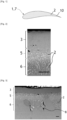
- FIGS. 1 to 3 schematically illustrate a section of a prior art turbine part 1, for example a turbine blade 7 or a distributor vane.
- the part 1 comprises a substrate 2 made of a monocrystalline metal superalloy covered with a coating 10, for example an environmental barrier comprising a thermal barrier.
- the environmental barrier typically comprises an underlayer, preferably a metallic underlayer 3, a protective layer and a thermally insulating layer.
- the underlayer 3 covers the substrate 2 made of metallic superalloy.
- the underlayer 3 is itself covered with the protective layer, formed by oxidation of the metallic underlayer 3.
- the protective layer makes it possible to protect the substrate 2 made of superalloy from corrosion and/or oxidation.
- the thermally insulating layer covers the protective layer.
- the thermally insulating layer may be made of ceramic, for example yttria zirconia.
- the sublayer 3 is typically made from simple nickel aluminide ⁇ -NiAl or platinum modified ⁇ -NiAlPt.
- the average atomic fraction of aluminum (between 35% and 45%) of the sublayer 3 is sufficient to exclusively form a protective layer of aluminum oxide (Al 2 O 3 ) to protect the superalloy substrate 2 against oxidation and corrosion.
- Such sublayers are for example described in the document WO 2007/008227 A2 .
- SRZ Primary and secondary reaction zones
- FIG. 2 is a microphotograph of the section of a sublayer 3 covering a substrate 2 of a part 1.
- the microphotograph is carried out before the part is subjected to a series of thermal cycles making it possible to simulate the temperature conditions of the part 1 during its use.
- the substrate 2 is rich in rhenium, that is to say that the average mass fraction of rhenium is greater than or equal to 0.04. It is known to use rhenium in the composition of superalloys to increase the creep resistance of superalloy parts.
- the substrate 2 has a ⁇ - ⁇ ' phase, and in particular a ⁇ -Ni phase.
- the sublayer 3 is of the ⁇ -NiAlPt type.
- the substrate 2 has a primary inter-diffusion zone 5, in the part of the substrate directly covered by the sub-layer 3.
- the substrate 2 also has a secondary inter-diffusion zone 6, directly covered by the primary inter-diffusion zone 5.
- the scale bar corresponds to a length equal to 20 ⁇ m.
- FIG. 3 is a photomicrograph of the section of the sublayer 3 covering the substrate 2 of the part 1.
- the photomicrograph shows the sublayer 3 and the substrate 2 after having subjected them to the series of thermal cycles described above.
- the sublayer 3 covers the substrate 2.
- the substrate 2 has a primary inter-diffusion zone 5 and a secondary inter-diffusion zone 6.
- the scale bar corresponds to a length equal to 20 ⁇ m.
- An aim of the invention is to propose a solution for effectively protecting a superalloy turbine part from oxidation and corrosion while increasing its service life, during use, compared to known parts.
- Another object of the invention is to limit or prevent the formation of secondary reaction zones while allowing an aluminum oxide to be formed during use of the part.
- Another aim of the invention is to at least partially prevent the formation of cracks in the substrate of a part subjected to high temperature conditions, for example above 1000°C, as well as the flaking of the protective layer of aluminum oxide.
- superalloy refers to an alloy which, at high temperature and high pressure, has very good resistance to oxidation, corrosion, creep and cyclic stresses (particularly mechanical or Superalloys find particular application in the manufacture of parts used in aeronautics, for example turbine blades, because they constitute a family of high-strength alloys that can work at temperatures relatively close to their melting points (typically 0.7 to 0.8 times their melting temperatures).
- a superalloy may have a two-phase microstructure comprising a first phase (called the " ⁇ phase”) forming a matrix, and a second phase (called the “ ⁇ ' phase”) forming precipitates that harden in the matrix.
- the coexistence of these two phases is referred to as the ⁇ - ⁇ ' phase.
- the "base” of the superalloy refers to the main metallic component of the matrix. In most cases, superalloys include an iron, cobalt, or nickel base, but sometimes also a titanium or aluminum base. The base of the superalloy is preferably a nickel base.
- Nickel-based superalloys have the advantage of offering a good compromise between resistance to oxidation, resistance to rupture at high temperature and weight, which justifies their use in the hottest parts of turbojets.
- the ⁇ ' phase has an ordered L12 structure, derived from the face-centered cubic structure, consistent with the matrix, i.e. having an atomic mesh very close to it.
- the ⁇ ' phase Due to its ordered nature, the ⁇ ' phase has the remarkable property of having a mechanical resistance that increases with temperature up to about 800°C.
- the very strong coherence between the ⁇ and ⁇ ' phases gives nickel-based superalloys very high mechanical resistance when hot, which itself depends on the ⁇ / ⁇ ' ratio and the size of the hardening precipitates.
- a superalloy is, in all embodiments of the invention, rich in rhenium and/or ruthenium, i.e. the average mass fraction of rhenium and ruthenium of the superalloy is greater than or equal to at 4%, making it possible to increase the creep resistance of the superalloy parts compared to the superalloy parts without rhenium.
- a superalloy is also, in all the embodiments of the invention, low in chromium on average, that is to say that the average mass fraction in the whole of the superalloy in chromium is less than 0.05, preferably less than 0.03. Indeed, the depletion of chromium during an enrichment in rhenium and/or ruthenium of the superalloy makes it possible to maintain a stable allotropic structure of the superalloy, in particular a ⁇ - ⁇ ' phase.
- atomic fraction refers to the mole fraction, that is, the ratio of the amount of substance of an element or group of elements to the total amount.
- mass fraction refers to the ratio of the mass of an element or group of elements to the total mass.
- FIG. 4 illustrates a method of manufacturing a part 1, comprising a substrate 2 and an underlayer 4.
- the substrate 2 used is of the CMSX-4 plus type (registered trademark) and has the chemical composition, in average atomic fraction, described in table 1.
- Tables 1 Cr Co Mo Your W Cb D Al You Hf Neither 3.5 10 0.6 8 6 0 4.8 5.7 0.85 0.1 Stay
- an enrichment layer 11 is deposited on the substrate 2.
- the enrichment layer 11 has at least an average atomic fraction of platinum greater than 90% and an average atomic fraction of chromium of between 3% and 10%.
- the enrichment layer 11 comprises at least chromium and platinum, and preferably chromium, platinum, hafnium and silicon.
- the enrichment layer 11 does not comprise nickel.
- the different elements of the enrichment layer 11 may be alloyed.
- the different elements of the enrichment layer 11 can be deposited simultaneously.
- the enrichment layer 11 can also comprise several superimposed layers: each element can be deposited separately.
- at least one layer of platinum and at least one layer of chromium can be deposited separately.
- the chromium layer(s) have a total thickness of between 200 nm and 2 ⁇ m and the platinum layer(s) have a total thickness of between 3 ⁇ m and 10 ⁇ m.
- the quantity of metals diffused during the method according to one embodiment of the invention is optimized.
- the deposition of the layer(s) forming the enrichment layer 11 may be carried out under vacuum, for example by vapor phase (PVD process, acronym for the English term “ Physical Vapor Deposition ”).
- PVD process acronym for the English term “ Physical Vapor Deposition ”.
- Different PVD methods may be used for the manufacture of the enrichment layer 11, such as cathode sputtering, electron gun evaporation, laser ablation and electron beam-assisted physical vapor deposition.
- the enrichment layer 11 may also be deposited by thermal spraying.
- a sub-layer 4 is formed on the surface of the substrate 2.
- the heat treatment is preferably carried out for more than one hour at a temperature between 1000°C and 1200°C, preferably for more than two hours at a temperature between 1000°C and 1200°C, and even more preferably substantially four hours at a temperature between 1050°C and 1150°C.
- a sufficient quantity of platinum and chromium is deposited during step 401 so that, after heat treatment step 402, the average atomic fraction of platinum in sublayer 4 is between 15% and 25%, and so that the average atomic fraction of chromium in the sublayer 4 is greater than 5% and preferably between 5% and 20%.
- the quantity of platinum and chromium deposited in the enrichment layer 11 is therefore all the higher as the atomic molar fraction of chromium and platinum of the substrate 2 is low, which is typically the case for a substrate 2 enriched in rhenium and/or ruthenium.
- the thickness of the enrichment layer 11 is preferably between 100 nm and 20 ⁇ m.
- FIG. 5 is a scanning electron microscopy photograph of the microstructure of a substrate 2 and a sublayer 4 of a part 1.
- the sublayer 4 is manufactured by the process illustrated in the figure 4 , in which an enrichment layer 11 comprising only chromium and platinum is deposited, during step 401 of the method.
- the scale bar of the figure 5 corresponds to a length equal to 20 ⁇ m.
- the sublayer 4 generally has a ⁇ - ⁇ ' phase and an average atomic fraction of chromium greater than 5%, preferably between 5% and 20%, of aluminum between 10% and 20%, of platinum between 15% and 25%.
- the sublayer 4 has an average atomic fraction of chromium substantially equal to 5.8%, an average atomic fraction of aluminum substantially equal to 11%, an average atomic fraction of platinum substantially equal to 21%, an average atomic fraction of hafnium less than 0.5% and an average atomic fraction of silicon less than 1%.
- the sublayer 4 preferably has exclusively a ⁇ - ⁇ ' phase. Indeed, the introduction of elements into the substrate 2 by the enrichment method described above makes it possible not to cause a phase transition of the substrate 2, and thus to avoid mechanical stresses in the substrate 2 which could cause the appearance of cracks 8.
- a substantially horizontal line divides the sublayer 4 into two superimposed parts: this line corresponds to the limit between the substrate 2 and the enrichment layer 11, before the heat treatment step 402 during the manufacture of a part 1.
- the thickness of the sublayer 4 is typically between 1 ⁇ m and 100 ⁇ m, and preferably between 5 ⁇ m and 50 ⁇ m.
- the average atomic fraction of chromium in sublayer 4 helps to promote the formation of ⁇ -Al 2 O 3 when the part is used under working conditions.
- sub-layer 4 prevents the formation of cracks during prolonged heat treatment, representative of the working conditions of a turbine.
- the scale bar corresponds to a length equal to 20 ⁇ m.
- the figure 6 is a scanning electron microscopy photograph of a part 1 comprising the substrate 2 and the underlayer 4, after the prolonged heat treatment. During the prolonged heat treatment, the part 1 is placed in air for 100 hours at 1050°C and then for 10 hours at 1150°C. No crack 8 is detectable in the substrate 2 after the prolonged heat treatment.
Landscapes
- Chemical & Material Sciences (AREA)
- Engineering & Computer Science (AREA)
- Materials Engineering (AREA)
- Mechanical Engineering (AREA)
- Metallurgy (AREA)
- Organic Chemistry (AREA)
- Inorganic Chemistry (AREA)
- Chemical Kinetics & Catalysis (AREA)
- General Engineering & Computer Science (AREA)
- Ceramic Engineering (AREA)
- Turbine Rotor Nozzle Sealing (AREA)
- Physical Vapour Deposition (AREA)
- Composite Materials (AREA)
Claims (10)
- Verfahren zur Herstellung eines Turbinenteils (1) für die Luftfahrt, umfassend:- ein Substrat (2) aus einer nickelbasierten monokristallinen Superlegierung, umfassend Chrom und mindestens ein Element, das aus Rhenium und Ruthenium ausgewählt ist, eine γ-γ'-Phase aufweist, einen mittleren Massenanteil an Rhenium und an Ruthenium von über oder gleich 4% und einen mittleren Massenanteil an Chrom von unter oder gleich 5% und vorzugsweise von unter oder gleich 3%,- eine Unterschicht (4), die mindestens einen Teil einer Oberfläche des Substrats (2) bedeckt,wobei die Unterschicht (4) eine γ-γ'-Phase und einen mittleren Atomanteil aufweist:- an Chrom zwischen 5% und 10%,- an Aluminium zwischen 10% und 20%,- an Platin zwischen 15% und 25%,wobei dieses Verfahren mindestens die Schritte umfasst:a) Aufbringen einer Anreicherungsschicht (11) auf das Substrat (2), wobei die Anreicherungsschicht (11) mindestens einen mittleren Atomanteil an Platin von über 90% und einen mittleren Atomanteil an Chrom zwischen 3% und 10% aufweist,b) Wärmebehandlung der aus dem Substrat (2) und der Anreicherungsschicht (11) gebildeten Anordnung bei einer Temperatur zwischen 1000°C und 1200°C während über einer Stunde, vorzugsweise während über 2 Stunden, so dass die Anreicherungsschicht (11) zumindest teilweise in das Substrat (2) diffundiert.
- Verfahren nach Anspruch 1, wobei die Wärmebehandlung der aus dem Substrat (2) und der Anreicherungsschicht (11) gebildeten Anordnung bei einer Temperatur zwischen 1050°C und 1150°C während etwa 4 Stunden durchgeführt wird.
- Verfahren nach Anspruch 1 oder 2, wobei bei Schritt a) des Aufbringens einer Anreicherungsschicht mindestens eine Chromschicht und eine Platinschicht getrennt aufgebracht werden, wobei die Chromschicht(en) eine Gesamtdicke zwischen 200 nm und 2 µm und die Platinschicht (en) eine Gesamtdicke zwischen 3 µm und 10 µm aufweist/aufweisen.
- Verfahren nach Anspruch 1 oder 2, wobei bei Schritt a) des Aufbringens einer Anreicherungsschicht gleichzeitig Chrom und Platin aufgebracht werden.
- Verfahren nach einem der vorangehenden Ansprüche, wobei das Aufbringen der Anreicherungsschicht (11) durch eine Methode durchgeführt wird, die aus einer physikalischen Gasphasenabscheidung, einer thermischen Projektion, einer Elektronenkanonenverdampfung, einer gepulster Laserablation und Sputtern ausgewählt ist.
- Verfahren nach einem der vorangehenden Ansprüche, wobei die Unterschicht (4) ausschließlich eine γ-γ'-Phase aufweist.
- Verfahren nach einem der vorangehenden Ansprüche, wobei die Unterschicht (4) einen mittleren Atomanteil aus Silizium von unter 2% aufweist.
- Verfahren nach einem der vorangehenden Ansprüche, wobei die Unterschicht (4) eine Dicke zwischen 5 µm und 50 µm und vorzugsweise zwischen 5 µm und 15 µm aufweist.
- Verfahren nach einem der vorangehenden Ansprüche, dadurch gekennzeichnet, dass es einen Schritt umfasst, der darin besteht, eine Schutzschicht aus Aluminiumoxid zu bilden, die die Unterschicht (4) bedeckt.
- Verfahren nach Anspruch 9, dadurch gekennzeichnet, dass es einen Schritt umfasst, der darin besteht, eine wärmeisolierende Schicht aus Keramik zu bilden, die die Schutzschicht aus Aluminiumoxid bedeckt.
Applications Claiming Priority (2)
| Application Number | Priority Date | Filing Date | Title |
|---|---|---|---|
| FR1873972A FR3090696B1 (fr) | 2018-12-21 | 2018-12-21 | Piece de turbine en superalliage comprenant du rhenium et/ou du ruthenium et procede de fabrication associe |
| PCT/FR2019/053254 WO2020128394A1 (fr) | 2018-12-21 | 2019-12-20 | Pièce de turbine en superalliage comprenant du rhenium et/ou du ruthenium et procédé de fabrication associé |
Publications (2)
| Publication Number | Publication Date |
|---|---|
| EP3899083A1 EP3899083A1 (de) | 2021-10-27 |
| EP3899083B1 true EP3899083B1 (de) | 2025-02-26 |
Family
ID=67107595
Family Applications (1)
| Application Number | Title | Priority Date | Filing Date |
|---|---|---|---|
| EP19850726.1A Active EP3899083B1 (de) | 2018-12-21 | 2019-12-20 | Turbinenteil aus rhenium- und/oder rutheniumhaltiger superlegierung und zugehöriges herstellungsverfahren |
Country Status (5)
| Country | Link |
|---|---|
| US (1) | US11873736B2 (de) |
| EP (1) | EP3899083B1 (de) |
| CN (1) | CN113242913A (de) |
| FR (1) | FR3090696B1 (de) |
| WO (1) | WO2020128394A1 (de) |
Families Citing this family (4)
| Publication number | Priority date | Publication date | Assignee | Title |
|---|---|---|---|---|
| FR3102775B1 (fr) * | 2019-11-05 | 2022-04-22 | Safran | Piece d'aeronef en superalliage comprenant un canal de refroidissement |
| US12270313B2 (en) * | 2023-09-01 | 2025-04-08 | Pratt & Whitney Canada Corp. | Engine carcass stiffener for high maneuver loads |
| FR3155858A1 (fr) * | 2023-11-29 | 2025-05-30 | Safran | Superalliage de nickel revêtu |
| FR3163665A1 (fr) * | 2024-06-21 | 2025-12-26 | Safran Helicopter Engines | Procédé d’aluminisation d’un substrat comprenant du nickel |
Family Cites Families (19)
| Publication number | Priority date | Publication date | Assignee | Title |
|---|---|---|---|---|
| US4526814A (en) * | 1982-11-19 | 1985-07-02 | Turbine Components Corporation | Methods of forming a protective diffusion layer on nickel, cobalt, and iron base alloys |
| US5667663A (en) * | 1994-12-24 | 1997-09-16 | Chromalloy United Kingdom Limited | Method of applying a thermal barrier coating to a superalloy article and a thermal barrier coating |
| US6066405A (en) * | 1995-12-22 | 2000-05-23 | General Electric Company | Nickel-base superalloy having an optimized platinum-aluminide coating |
| EP0846788A1 (de) * | 1996-12-06 | 1998-06-10 | Siemens Aktiengesellschaft | Superlegierung mit angereichertem Überzug und Verfahren zur Herstellung |
| US6475642B1 (en) * | 2000-08-31 | 2002-11-05 | General Electric Company | Oxidation-resistant coatings, and related articles and processes |
| US6497920B1 (en) * | 2000-09-06 | 2002-12-24 | General Electric Company | Process for applying an aluminum-containing coating using an inorganic slurry mix |
| US7157151B2 (en) * | 2002-09-11 | 2007-01-02 | Rolls-Royce Corporation | Corrosion-resistant layered coatings |
| US20100151125A1 (en) * | 2003-08-04 | 2010-06-17 | General Electric Company | Slurry chromizing process |
| EP1524334A1 (de) * | 2003-10-17 | 2005-04-20 | Siemens Aktiengesellschaft | Schutzschicht zum Schutz eines Bauteils gegen Korrosion und Oxidation bei hohen Temperaturen und Bauteil |
| DE602005014877D1 (de) * | 2004-08-18 | 2009-07-23 | Univ Iowa State Res Found Inc | aus -Ni+ '-Ni3Al-LEGIERUNGEN, DIE MIT EINER AUS DER PT GRUPPE MODIFIZIERT SIND, UND DIE EINER HOCHTEMPERATURKORROSIONSBESTÄNDIGKEIT AUFWEISEN |
| US7229701B2 (en) * | 2004-08-26 | 2007-06-12 | Honeywell International, Inc. | Chromium and active elements modified platinum aluminide coatings |
| US20060093849A1 (en) * | 2004-11-02 | 2006-05-04 | Farmer Andrew D | Method for applying chromium-containing coating to metal substrate and coated article thereof |
| US7531217B2 (en) * | 2004-12-15 | 2009-05-12 | Iowa State University Research Foundation, Inc. | Methods for making high-temperature coatings having Pt metal modified γ-Ni +γ′-Ni3Al alloy compositions and a reactive element |
| US7247393B2 (en) * | 2005-09-26 | 2007-07-24 | General Electric Company | Gamma prime phase-containing nickel aluminide coating |
| EP1870485A1 (de) * | 2006-06-22 | 2007-12-26 | Siemens Aktiengesellschaft | Zusammensetzung und Verfahren zur Metallisierung eines Bauteils |
| US7846243B2 (en) * | 2007-01-09 | 2010-12-07 | General Electric Company | Metal alloy compositions and articles comprising the same |
| US20100159136A1 (en) * | 2008-12-19 | 2010-06-24 | Rolls-Royce Corporation | STATIC CHEMICAL VAPOR DEPOSITION OF y-Ni + y'-Ni3AI COATINGS |
| GB2511768A (en) * | 2013-03-12 | 2014-09-17 | Rolls Royce Plc | Erosion Resistant Coating |
| US9587302B2 (en) * | 2014-01-14 | 2017-03-07 | Praxair S.T. Technology, Inc. | Methods of applying chromium diffusion coatings onto selective regions of a component |
-
2018
- 2018-12-21 FR FR1873972A patent/FR3090696B1/fr active Active
-
2019
- 2019-12-20 CN CN201980085289.2A patent/CN113242913A/zh active Pending
- 2019-12-20 EP EP19850726.1A patent/EP3899083B1/de active Active
- 2019-12-20 US US17/415,082 patent/US11873736B2/en active Active
- 2019-12-20 WO PCT/FR2019/053254 patent/WO2020128394A1/fr not_active Ceased
Non-Patent Citations (3)
| Title |
|---|
| M J DONACHIE ET AL: "Compositions of Typical Cast Superalloys", 31 July 2007 (2007-07-31), pages 545 - 552, XP055645540, Retrieved from the Internet <URL:https://www.tms.org/communities/ftattachments/superalloystable_castcomp.pdf> [retrieved on 20191122] * |
| TAWANCY H M ED - VILASI MICHEL ET AL: "Enhancing the Oxidation Properties of Gamma Prime + Gamma Platinum Bond Coat by Rhenium and Yttrium Additions for Improved Adhesion of Thermal Barrier Coatings on Nickel-Base Superalloys", OXIDATION OF METALS, SPRINGER NEW YORK LLC, US, vol. 84, no. 5, 11 July 2015 (2015-07-11), pages 491 - 507, XP035579848, ISSN: 0030-770X, [retrieved on 20150711], DOI: 10.1007/S11085-015-9566-Z * |
| TAWANCY H M ET AL: "Performance of Bond Coats Modified by Platinum Group Metals for Applications in Thermal Barrier Coatings", JOURNAL OF MATERIALS ENGINEERING AND PERFORMANCE, ASM INTERNATIONAL, MATERIALS PARK, OH, US, vol. 26, no. 7, 7 June 2017 (2017-06-07), pages 3191 - 3203, XP036274746, ISSN: 1059-9495, [retrieved on 20170607], DOI: 10.1007/S11665-017-2749-9 * |
Also Published As
| Publication number | Publication date |
|---|---|
| US20220065111A1 (en) | 2022-03-03 |
| FR3090696B1 (fr) | 2020-12-04 |
| EP3899083A1 (de) | 2021-10-27 |
| FR3090696A1 (fr) | 2020-06-26 |
| WO2020128394A1 (fr) | 2020-06-25 |
| US11873736B2 (en) | 2024-01-16 |
| CN113242913A (zh) | 2021-08-10 |
Similar Documents
| Publication | Publication Date | Title |
|---|---|---|
| EP3899083B1 (de) | Turbinenteil aus rhenium- und/oder rutheniumhaltiger superlegierung und zugehöriges herstellungsverfahren | |
| EP3532648B1 (de) | Superlegierung auf der basis von nickel, einkristalline turbinenschaufel und strömungsmaschine | |
| FR2932496A1 (fr) | Procede de depot d'une barriere thermique | |
| EP3685018B1 (de) | Turbinenteil aus einer superlegierung mit rhenium und/oder ruthenium und zugehöriges herstellungsverfahren | |
| EP3469112B1 (de) | Verfahren zum schutz eines hafniumfreien, einkristallinen superlegierungsteil auf nickelbasis vor korrosion und oxidation | |
| EP3601634B1 (de) | Turbinenkomponente aus superlegierung und zugehöriges herstellungsverfahren | |
| FR2941965A1 (fr) | Procede de depot d'une couche de protection sur une piece | |
| FR2718464A1 (fr) | Article en super alliage ayant un revêtement de barrière thermique et sa fabrication. | |
| EP3698020B1 (de) | Turbinenbauteil aus superlegierung mit rhenium und zugehöriges herstellungsverfahren | |
| EP3532653B1 (de) | Teil mit einem substrat aus einer monokristallinen superlegierung auf nickelbasis und verfahren zur herstellung davon | |
| WO2012146864A1 (fr) | Pièce comportant un revêtement sur un substrat métallique en superalliaae, le revêtement comprenant une sous-couche métallique | |
| FR3113255A1 (fr) | Protection contre l’oxydation ou la corrosion d’une pièce creuse en superalliage | |
| EP4367278B1 (de) | Superlegierung auf nickelbasis, einkristalline leitschaufel und turbinenmotor | |
| EP4041930B1 (de) | Luftfahrtteil aus rhenium- und/oder rutheniumhaltiger superlegierung und zugehöriges herstellungsverfahren | |
| FR3155860A1 (fr) | Superalliage de nickel revêtu | |
| FR3138451A1 (fr) | Procédé d’application de revêtement et aube de turbine avec revêtement appliqué suivant ce procédé | |
| RU2777682C2 (ru) | Деталь турбины из суперсплава с содержанием рения и/или рутения и способ её изготовления | |
| EP4055201A1 (de) | Superlegierungsflugzeugteil mit kühlkanal | |
| FR2999611A1 (fr) | Procede de fabrication d'un revetement et piece thermomecanique en superalliage comprenant un revetement obtenu selon ce procede |
Legal Events
| Date | Code | Title | Description |
|---|---|---|---|
| STAA | Information on the status of an ep patent application or granted ep patent |
Free format text: STATUS: UNKNOWN |
|
| STAA | Information on the status of an ep patent application or granted ep patent |
Free format text: STATUS: THE INTERNATIONAL PUBLICATION HAS BEEN MADE |
|
| PUAI | Public reference made under article 153(3) epc to a published international application that has entered the european phase |
Free format text: ORIGINAL CODE: 0009012 |
|
| STAA | Information on the status of an ep patent application or granted ep patent |
Free format text: STATUS: REQUEST FOR EXAMINATION WAS MADE |
|
| 17P | Request for examination filed |
Effective date: 20210622 |
|
| AK | Designated contracting states |
Kind code of ref document: A1 Designated state(s): AL AT BE BG CH CY CZ DE DK EE ES FI FR GB GR HR HU IE IS IT LI LT LU LV MC MK MT NL NO PL PT RO RS SE SI SK SM TR |
|
| DAV | Request for validation of the european patent (deleted) | ||
| DAX | Request for extension of the european patent (deleted) | ||
| STAA | Information on the status of an ep patent application or granted ep patent |
Free format text: STATUS: EXAMINATION IS IN PROGRESS |
|
| 17Q | First examination report despatched |
Effective date: 20240321 |
|
| GRAP | Despatch of communication of intention to grant a patent |
Free format text: ORIGINAL CODE: EPIDOSNIGR1 |
|
| STAA | Information on the status of an ep patent application or granted ep patent |
Free format text: STATUS: GRANT OF PATENT IS INTENDED |
|
| INTG | Intention to grant announced |
Effective date: 20241009 |
|
| GRAS | Grant fee paid |
Free format text: ORIGINAL CODE: EPIDOSNIGR3 |
|
| GRAA | (expected) grant |
Free format text: ORIGINAL CODE: 0009210 |
|
| STAA | Information on the status of an ep patent application or granted ep patent |
Free format text: STATUS: THE PATENT HAS BEEN GRANTED |
|
| AK | Designated contracting states |
Kind code of ref document: B1 Designated state(s): AL AT BE BG CH CY CZ DE DK EE ES FI FR GB GR HR HU IE IS IT LI LT LU LV MC MK MT NL NO PL PT RO RS SE SI SK SM TR |
|
| REG | Reference to a national code |
Ref country code: GB Ref legal event code: FG4D Free format text: NOT ENGLISH |
|
| REG | Reference to a national code |
Ref country code: CH Ref legal event code: EP |
|
| REG | Reference to a national code |
Ref country code: DE Ref legal event code: R096 Ref document number: 602019066612 Country of ref document: DE |
|
| REG | Reference to a national code |
Ref country code: IE Ref legal event code: FG4D Free format text: LANGUAGE OF EP DOCUMENT: FRENCH |
|
| REG | Reference to a national code |
Ref country code: NL Ref legal event code: MP Effective date: 20250226 |
|
| PG25 | Lapsed in a contracting state [announced via postgrant information from national office to epo] |
Ref country code: RS Free format text: LAPSE BECAUSE OF FAILURE TO SUBMIT A TRANSLATION OF THE DESCRIPTION OR TO PAY THE FEE WITHIN THE PRESCRIBED TIME-LIMIT Effective date: 20250526 |
|
| PG25 | Lapsed in a contracting state [announced via postgrant information from national office to epo] |
Ref country code: FI Free format text: LAPSE BECAUSE OF FAILURE TO SUBMIT A TRANSLATION OF THE DESCRIPTION OR TO PAY THE FEE WITHIN THE PRESCRIBED TIME-LIMIT Effective date: 20250226 |
|
| PG25 | Lapsed in a contracting state [announced via postgrant information from national office to epo] |
Ref country code: PL Free format text: LAPSE BECAUSE OF FAILURE TO SUBMIT A TRANSLATION OF THE DESCRIPTION OR TO PAY THE FEE WITHIN THE PRESCRIBED TIME-LIMIT Effective date: 20250226 |
|
| PG25 | Lapsed in a contracting state [announced via postgrant information from national office to epo] |
Ref country code: ES Free format text: LAPSE BECAUSE OF FAILURE TO SUBMIT A TRANSLATION OF THE DESCRIPTION OR TO PAY THE FEE WITHIN THE PRESCRIBED TIME-LIMIT Effective date: 20250226 |
|
| REG | Reference to a national code |
Ref country code: LT Ref legal event code: MG9D |
|
| PG25 | Lapsed in a contracting state [announced via postgrant information from national office to epo] |
Ref country code: IS Free format text: LAPSE BECAUSE OF FAILURE TO SUBMIT A TRANSLATION OF THE DESCRIPTION OR TO PAY THE FEE WITHIN THE PRESCRIBED TIME-LIMIT Effective date: 20250626 Ref country code: NO Free format text: LAPSE BECAUSE OF FAILURE TO SUBMIT A TRANSLATION OF THE DESCRIPTION OR TO PAY THE FEE WITHIN THE PRESCRIBED TIME-LIMIT Effective date: 20250526 |
|
| PG25 | Lapsed in a contracting state [announced via postgrant information from national office to epo] |
Ref country code: NL Free format text: LAPSE BECAUSE OF FAILURE TO SUBMIT A TRANSLATION OF THE DESCRIPTION OR TO PAY THE FEE WITHIN THE PRESCRIBED TIME-LIMIT Effective date: 20250226 |
|
| PG25 | Lapsed in a contracting state [announced via postgrant information from national office to epo] |
Ref country code: HR Free format text: LAPSE BECAUSE OF FAILURE TO SUBMIT A TRANSLATION OF THE DESCRIPTION OR TO PAY THE FEE WITHIN THE PRESCRIBED TIME-LIMIT Effective date: 20250226 |
|
| PG25 | Lapsed in a contracting state [announced via postgrant information from national office to epo] |
Ref country code: PT Free format text: LAPSE BECAUSE OF FAILURE TO SUBMIT A TRANSLATION OF THE DESCRIPTION OR TO PAY THE FEE WITHIN THE PRESCRIBED TIME-LIMIT Effective date: 20250626 Ref country code: LV Free format text: LAPSE BECAUSE OF FAILURE TO SUBMIT A TRANSLATION OF THE DESCRIPTION OR TO PAY THE FEE WITHIN THE PRESCRIBED TIME-LIMIT Effective date: 20250226 |
|
| PG25 | Lapsed in a contracting state [announced via postgrant information from national office to epo] |
Ref country code: BG Free format text: LAPSE BECAUSE OF FAILURE TO SUBMIT A TRANSLATION OF THE DESCRIPTION OR TO PAY THE FEE WITHIN THE PRESCRIBED TIME-LIMIT Effective date: 20250226 Ref country code: GR Free format text: LAPSE BECAUSE OF FAILURE TO SUBMIT A TRANSLATION OF THE DESCRIPTION OR TO PAY THE FEE WITHIN THE PRESCRIBED TIME-LIMIT Effective date: 20250527 |
|
| REG | Reference to a national code |
Ref country code: AT Ref legal event code: MK05 Ref document number: 1770672 Country of ref document: AT Kind code of ref document: T Effective date: 20250226 |
|
| PG25 | Lapsed in a contracting state [announced via postgrant information from national office to epo] |
Ref country code: SE Free format text: LAPSE BECAUSE OF FAILURE TO SUBMIT A TRANSLATION OF THE DESCRIPTION OR TO PAY THE FEE WITHIN THE PRESCRIBED TIME-LIMIT Effective date: 20250226 |
|
| PG25 | Lapsed in a contracting state [announced via postgrant information from national office to epo] |
Ref country code: SM Free format text: LAPSE BECAUSE OF FAILURE TO SUBMIT A TRANSLATION OF THE DESCRIPTION OR TO PAY THE FEE WITHIN THE PRESCRIBED TIME-LIMIT Effective date: 20250226 |
|
| PG25 | Lapsed in a contracting state [announced via postgrant information from national office to epo] |
Ref country code: DK Free format text: LAPSE BECAUSE OF FAILURE TO SUBMIT A TRANSLATION OF THE DESCRIPTION OR TO PAY THE FEE WITHIN THE PRESCRIBED TIME-LIMIT Effective date: 20250226 |
|
| PG25 | Lapsed in a contracting state [announced via postgrant information from national office to epo] |
Ref country code: IT Free format text: LAPSE BECAUSE OF FAILURE TO SUBMIT A TRANSLATION OF THE DESCRIPTION OR TO PAY THE FEE WITHIN THE PRESCRIBED TIME-LIMIT Effective date: 20250226 |
|
| PG25 | Lapsed in a contracting state [announced via postgrant information from national office to epo] |
Ref country code: AT Free format text: LAPSE BECAUSE OF FAILURE TO SUBMIT A TRANSLATION OF THE DESCRIPTION OR TO PAY THE FEE WITHIN THE PRESCRIBED TIME-LIMIT Effective date: 20250226 |
|
| PG25 | Lapsed in a contracting state [announced via postgrant information from national office to epo] |
Ref country code: CZ Free format text: LAPSE BECAUSE OF FAILURE TO SUBMIT A TRANSLATION OF THE DESCRIPTION OR TO PAY THE FEE WITHIN THE PRESCRIBED TIME-LIMIT Effective date: 20250226 Ref country code: EE Free format text: LAPSE BECAUSE OF FAILURE TO SUBMIT A TRANSLATION OF THE DESCRIPTION OR TO PAY THE FEE WITHIN THE PRESCRIBED TIME-LIMIT Effective date: 20250226 |
|
| PG25 | Lapsed in a contracting state [announced via postgrant information from national office to epo] |
Ref country code: RO Free format text: LAPSE BECAUSE OF FAILURE TO SUBMIT A TRANSLATION OF THE DESCRIPTION OR TO PAY THE FEE WITHIN THE PRESCRIBED TIME-LIMIT Effective date: 20250226 |
|
| PG25 | Lapsed in a contracting state [announced via postgrant information from national office to epo] |
Ref country code: SK Free format text: LAPSE BECAUSE OF FAILURE TO SUBMIT A TRANSLATION OF THE DESCRIPTION OR TO PAY THE FEE WITHIN THE PRESCRIBED TIME-LIMIT Effective date: 20250226 |
|
| REG | Reference to a national code |
Ref country code: DE Ref legal event code: R097 Ref document number: 602019066612 Country of ref document: DE |
|
| PLBE | No opposition filed within time limit |
Free format text: ORIGINAL CODE: 0009261 |
|
| STAA | Information on the status of an ep patent application or granted ep patent |
Free format text: STATUS: NO OPPOSITION FILED WITHIN TIME LIMIT |
|
| PGFP | Annual fee paid to national office [announced via postgrant information from national office to epo] |
Ref country code: GB Payment date: 20251229 Year of fee payment: 7 |
|
| PGFP | Annual fee paid to national office [announced via postgrant information from national office to epo] |
Ref country code: FR Payment date: 20251222 Year of fee payment: 7 |
|
| 26N | No opposition filed |
Effective date: 20251127 |